Article

Impact of Digital Transformation on ESG Performance in Manufacturing Enterprises: From the Perspective of Internal Interaction in Digital Transformation


School of Shipping Economics and Management, Dalian Maritime University, Dalian 116026, China
*
Author to whom correspondence should be addressed.
Sustainability 2026, 18(5), 2349; https://doi.org/10.3390/su18052349
Submission received: 8 January 2026 / Revised: 16 February 2026 / Accepted: 23 February 2026 / Published: 28 February 2026
(This article belongs to the Section Economic and Business Aspects of Sustainability)

Abstract

Against the backdrop of a booming digital economy, manufacturing faces a conflict between its high energy consumption and sustainable development goals, positioning digital transformation as a key solution. Enterprise digital transformation is often categorized into management, production, and service digitalization. During transformation, it is challenging to advance all domains simultaneously, and interactions exist between them, so these effects should be considered. We use a sample of Chinese A-share listed manufacturing enterprises using data from 2012 to 2023 to investigate how digital transformations and their internal interactions affect enterprise sustainability performance (ESG performance), analyzing the differences between these effects in different types of enterprises. The findings demonstrate that digitalization across the management, production, and service domains enhances ESG performance. Significant interaction effects exist between management and production digitalization, between production and service digitalization, and across all three domains, while the interaction between management and service digitalization is insignificant. Heterogeneity analysis reveals that in private enterprises, the interaction between management and service digitalization positively affects ESG performance, whereas its effect is insignificant in state-owned enterprises. In large enterprises, interactions involving service digitalization are insignificant; in contrast, in SMEs, although service digitalization alone negatively impacts ESG, its interaction with management digitalization strengthens the latter’s positive effect. Mediation tests indicate that production efficiency partially mediates the effect of production digitalization on ESG, and innovation output mediates the effects of both management and service digitalization.

1. Introduction

The rapid emergence of digital technologies, such as big data, the Internet of Things, and blockchain, has led to a global digitalisation wave, presenting both challenges and opportunities. The digital economy is gradually becoming China’s primary economic model. Driven by the continuous development of the digital economy, comprehensive digital transformation has become an inevitable trend for enterprises.
The manufacturing sector is the bedrock of China’s national strength, underpinning its real economy. Therefore, achieving sustainable development in manufacturing enterprises is of great importance. China’s manufacturing sector is a pillar industry of the national economy, providing substantial employment opportunities. However, its high energy consumption and high-emission industrial structure make manufacturing a primary source of environmental pollution. Problems like not having enough new green technology and higher environmental rules are becoming more obvious. Manufacturing enterprises are exploring sustainable development pathways. They are also striving for higher ESG performance. This has made the problem a focal point.
Digital transformation is the key to resolving this tension. It enables the precise monitoring and optimisation of production processes, propelling enterprises towards smart manufacturing and flexible production. It also creates more high-value employment opportunities [1]. It also enhances the efficiency of internal communication, supports the establishment of scientific decision-making mechanisms, reduces decision-making risks and elevates enterprise governance standards [2]. Against this backdrop, researching the impact of digital transformation on the ESG performance of manufacturing enterprises is of great importance.
The digital transformation of manufacturing enterprises is a strategic process with holistic and systematic characteristics. It is rich in connotation and involves multiple fields. It is therefore necessary to reshape organisational management, manufacturing, marketing services and other domains comprehensively during transformation. In recent years, research on enterprise digital transformation has progressed. It has become increasingly clear that practical factors make it difficult to promote all domains of digital transformation at the same time. This is especially true in the early stages of enterprise transformation. Enterprises usually need to consider their own situation and focus on certain domains of digitalization first. Based on this reality, many scholars have conducted increasingly detailed research on enterprise digital transformation, analyzing it across different domains. Generally, these studies focus on a single domain of enterprise digitalization, such as management, production or services, to analyze its impact on enterprises. Management digitalization is often defined as the process by which enterprises rebuild their organizational structure and optimize their processes by hiring digital talent and implementing networking and information technology [3]. Production digitalization is defined as enterprises applying digital technology to their production processes to digitally transform their equipment, processes and factories [3]. Service digitalization is often defined as the use of digital technology in product sales and services [3]. Each of these three aspects impacts enterprises’ ESG performance through different mechanisms.
Digital transformation is an inherently holistic and systemic process. Although enterprises may adopt development strategies with different areas of focus, digitalization inevitably interacts and collectively impacts enterprise performance across different domains. This interactive process generates internal interactions within the enterprise. Specifically, the internal interaction of digital transformation refers to the dynamic process of inter-connection. It also refers to the mutual reinforcement among digital tools and departments. These departments may be across domains such as management, production and service. This is during the implementation of digital transformation. It is not simply the superposition of technologies, but rather an organic integration that produces a ‘1 + 1 > 2’ effect [4]. In recent years, understanding of digital transformation has expanded across multiple domains. Scholars also recognize that these internal interactions cannot be overlooked. Nevertheless, research in this area remains underdeveloped. It still lacks rigorous empirical evidence. This is needed to clarify how interactions across different domains of digital transformation contribute to sustainable development.
Existing studies have analyzed the digital transformation of manufacturing enterprises as a whole [2] and the impact of various components on enterprises’ ESG performance [5]. These studies have emphasized the importance of internal interaction in digital transformation [6]. Based on a review of existing research, we found that enterprise digital transformation can be divided into three domains: management digitalization, service digitalization and production digitalization. These domains impact enterprise ESG performance through different mechanisms. Furthermore, these domains interact with each other, resulting in additional effects on enterprises’ ESG performance. Our research aims to answer the following questions: How do management digitalization, service digitalization and production digitalization individually impact enterprises’ ESG performance? What impact does simultaneous advancement of digitalization in different domains, interacting with each other, have on enterprises’ ESG performance? How do these impacts differ between different types of enterprises? These questions are crucial for enterprises formulating digital transformation strategies.
Against this backdrop, we focus on the perspective of internal interactions in digital transformation. Based on theoretical analysis, we conducted empirical testing with Chinese manufacturing enterprises as our research subjects. We examined the impact of different domains of digitalization on the ESG performance of manufacturing enterprises, considering variations in these effects across enterprises of different sizes and equity structures.
Our research provides a preliminary empirical examination of the internal interactions of digital transformation, supplementing existing research on the role of enterprise digitalization. It provides insights for further research on the internal interaction effects of the digital transformation of enterprises and provides a reference for relevant institutions involved in the digital transformation of manufacturing enterprises.

2. Literature Review

2.1. Impact of Digital Transformation on Enterprises’ ESG Performance

The digital transformation of manufacturing enterprises has far-reaching implications and involves multiple domains. In research concerning digital transformation, many scholars have recognized its holistic nature and chosen to analyze its impact on enterprise performance as an integrated whole [1]. In recent years, as research into enterprise digital transformation has progressed, it has become clear that the various domains of digital transformation cannot usually advance completely simultaneously during the transformation process. Enterprises typically need to prioritize digitalization in certain areas based on their specific circumstances. Considering this, a significant proportion of scholars have started conducting more segmented research on enterprise digital transformation.
Scholars approach the concept of digital transformation from different angles [7]. For example, Qi breaks down the concept into three domains: management digitalization, production digitalization and service digitalization, in order to measure digital transformation [6]. Other scholars focus on a specific domain to analyze the impact of digitalization in that area on enterprises [1,8,9]. Overall, these studies often examine the impact of digitalization on enterprises in one of the three domains: management digitalization, production digitalization, or service digitalization.
Management digitalization is defined as follows: it is the systematic introduction and cultivation of digitally skilled professionals, the comprehensive development of networked and information infrastructure, and the subsequent restructuring of organizational architecture and management models to optimize business processes and operational efficiency [3]. Basu and Fernald examined the impact of management digitalization on organizational efficiency [10]. Other scholars have also focused on management digitalization and its functions [11,12,13]. Research indicates that management digitalization reduces information asymmetry and communication costs [2], thereby enhancing the scientific rigor and timeliness of decision-making and improving the quality of internal controls [14]. It also promotes learning and knowledge sharing, boosts innovation capabilities [15], enhances financial performance [16] and facilitates enterprise social responsibility fulfilment [17]. In summary, management digitalization primarily enhances the internal control efficiency of enterprises, improves their ESG performance from a governance perspective, and encourages them to fulfil their social responsibilities and improve their ESG performance in the social dimension.
Service digitalization is defined as the introduction and application of advanced digital technologies by enterprises. This process aims to optimize and intelligently transform the entire product sales process and all aspects of customer service, thereby improving overall service efficiency and user experience [18]. Some scholars have identified the critical importance of service digitalization for customer management [8] and its impact on enterprise sustainability [5]. It enhances customer loyalty and satisfaction while expanding markets, boosting enterprise competitiveness [19], improving service efficiency, and reducing carbon emissions and resource waste [20]. In other words, service digitalization primarily enables enterprises to enhance product competitiveness and gain consumer trust, thereby improving their ESG performance in the social dimension. It can also reduce the environmental impact of service links, thereby helping enterprises to improve their ESG performance in the environmental dimension.
Production digitalization is defined as the systematic introduction and application of digital technology in the production process with the aim of digitally upgrading and transforming equipment, processes and factories. By adopting advanced technologies such as the Internet of Things, data analysis and artificial intelligence, enterprises can optimize production efficiency, improve management accuracy and develop a more intelligent, flexible and sustainable production and operations system [9]. Existing research indicates that production digitization can optimize production scheduling and resource allocation, enhance equipment and labor productivity [21], improve financial performance [22], and reduce carbon emissions [6]. Sabbioni et al. discussed the importance of production digitalization for enterprises within the Industry 4.0 paradigm [23], while Shen and Zhang explored the impact of manufacturing enterprises’ production digitalization on their green performance [24]. In other words, digitalizing production mainly improves enterprises’ management efficiency in the production process. This improves their governance level, reduces resource waste and pollution emissions during production, and enhances their ESG performance in the environmental dimension.

2.2. Internal Interactions of Digital Transformation

As research progresses, an increasing number of scholars recognize that digital transformation is essentially a holistic and systematic process. The digitalization of various enterprise domains inevitably triggers interactions between different departments and systems, which in turn impact enterprise performance. During this process, the capabilities developed in different domains of digital transformation can complement each other. Data exchange between these domains enhances the overall capability of the enterprise [4]. This creates a greater impact than digitizing isolated domains alone.
In recent years, as digitalization has advanced, the understanding of digital transformation has expanded to multiple domains. Some scholars have emphasized that the internal interactions arising during digital transformation cannot be overlooked. Vial highlighted the need for enterprises to focus on internal coordination throughout this process [25]. Similarly, Wang et al. emphasized the significant interactions within digital transformation [26]. However, research on the internal interactions of digital transformation remains largely theoretical, and there is still a lack of empirical evidence to clarify how the interaction effects among all domains of digital transformation influence enterprises in the context of sustainable development. Our study aims to address this gap by employing empirical methods to examine such effects.

3. Theoretical Analysis and Research Hypotheses

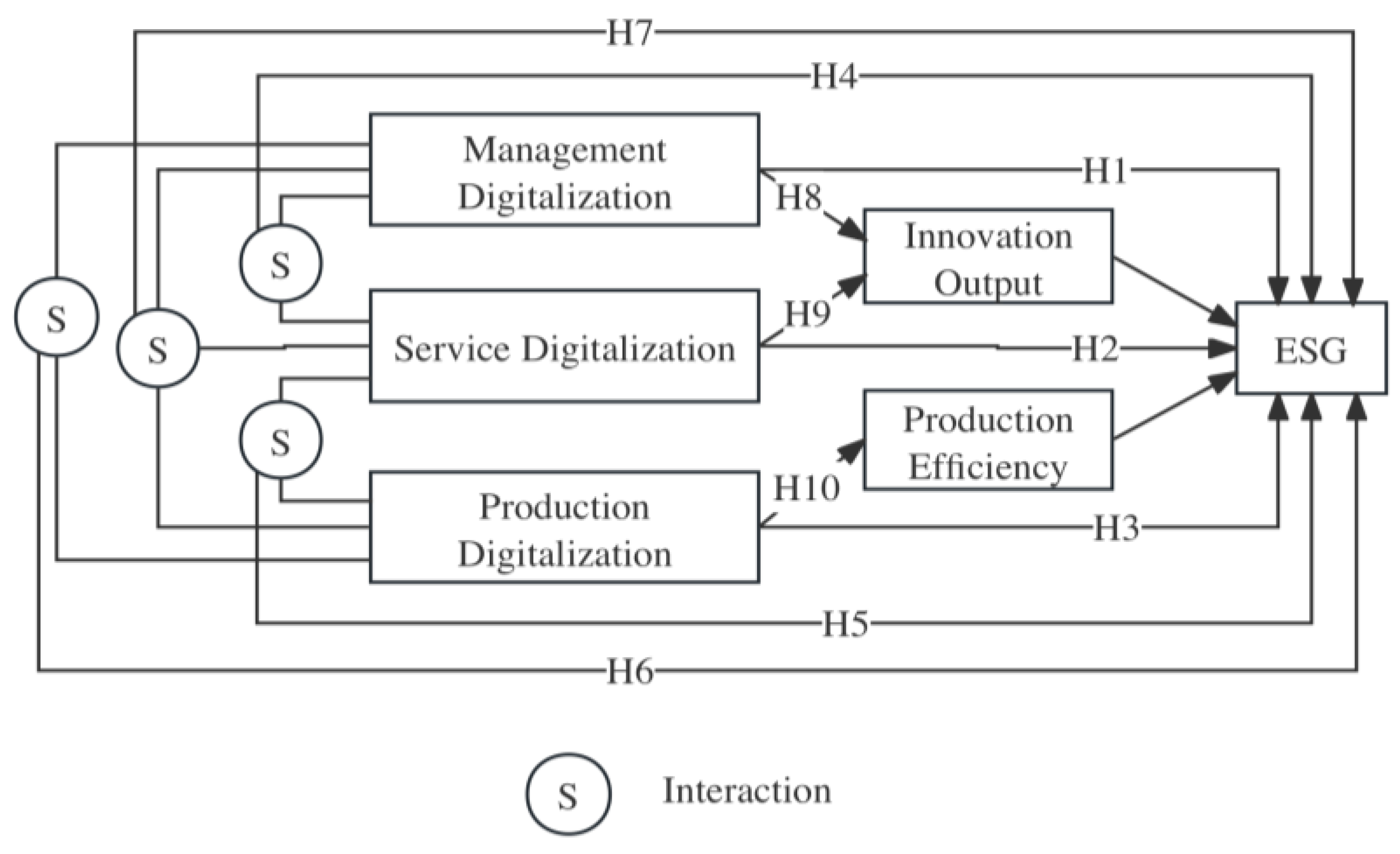
Our research adopts the above framework. First, we examine the impact of three digital transformation domains on enterprise ESG performance. Second, we analyze how interactions between these domains affect ESG performance. Finally, we explore the mechanisms through which all digital transformation domains influence ESG performance. In other words, we focus on a segmented analysis of enterprise digital transformation, with particular emphasis on internal interactions during this process. Drawing on existing research [7,18], enterprise digital transformation is mostly categorized into three domains: management digitalization, service digitalization, and production digitalization. These domains represent distinct focuses of enterprise digital transformation and involve specific mechanisms that affect ESG performance. Management digitalization primarily enhances organizational efficiency and information processing capabilities—both critical for innovation. Higher innovation output effectively improves ESG performance. Service digitalization generates innovative ideas through service channels to drive enterprise innovation, thereby boosting ESG performance via increased innovation output. Production digitalization reduces equipment failure rates and optimizes operational processes, thereby enhancing production efficiency and improving ESG performance (Figure 1).
In the early stages of digital transformation, enterprises may prioritize a single domain. As digital development progresses, however, they advance multiple domains concurrently, enabling internal interactions. According to resource complementarity theory, interactive advancement of different digital domains facilitates more effective resource complementarity. These interactions create a mutually reinforcing effect that generates greater value and exerts a stronger positive impact on ESG performance.
Management digitalization in manufacturing enterprises refers to the digitalization of all aspects of management processes and organizational development [18], aiming to further improve management efficiency. This often involves hiring executives with educational backgrounds and work experience in information technology, intelligent systems, or networking [10], implementing digital enterprise management systems [12], and leveraging the internet for networked infrastructure construction [13]. Management digitalization facilitates internal communication, enhances organizational efficiency and market responsiveness [27], expands knowledge and resource acquisition channels, and strengthens resource acquisition capabilities [28]. It also helps manufacturing enterprises gain sustainable competitive advantages through innovation. Digital management tools enable enterprises to systematically and accurately demonstrate their social responsibility fulfillment to stakeholders. By addressing diverse stakeholder needs, enterprises can mitigate compliance risks, enhance social reputation [17], and improve both economic and social performance.
Therefore, we propose Hypothesis H1: Management digitalization in manufacturing enterprises can enhance their ESG performance.
Service digitalization in manufacturing enterprises refers to transforming customer service through digital technologies (e.g., big data and AI) in service processes [18]. This enables digital customer service solutions such as intelligent support, remote operations, and maintenance. As a key component of digital strategy, service digitalization integrates digital technologies into order processing, customer service, and after-sales support—boosting operational efficiency, enhancing customer satisfaction and loyalty, accelerating product innovation, and reducing resource consumption and environmental impact. Digital services allow enterprises to efficiently integrate customer information, implement full-lifecycle customer management, and collect customer feedback [8]. These improvements significantly enhance customer satisfaction and loyalty while providing valuable insights for product innovation [19]. Higher customer satisfaction and stronger product innovation also promote better corporate social performance. Furthermore, existing literature notes that digital services replace physical interactions with online methods (e.g., intelligent customer service and remote operations), effectively reducing resource consumption (e.g., transportation and paper) and energy use in service delivery [20]. This lowers energy consumption and carbon emissions generated during service processes. Digital service platforms help enterprises overcome spatial and temporal constraints, expanding service coverage and enhancing their environmental and social image—demonstrating superior ESG performance.
Therefore, we propose Hypothesis H2: Service digitalization in manufacturing enterprises can enhance their ESG performance.
Production digitalization in manufacturing enterprises involves using digital technologies (e.g., artificial intelligence, cloud computing, and big data analytics) to digitize production processes [9]. Production digitalization provides enterprises with unique advantages in terms of production efficiency and quality, effectively enhancing the competitiveness of their products. It can also reduce energy consumption and carbon emissions during the production process, achieving green production [29]. These improvements can effectively enhance a enterprise’s environmental performance. Furthermore, smart manufacturing, which is achieved through production digitalization, enables enterprises to deeply integrate information technology and industrialization, thereby realizing efficient, precise, and flexible production processes. Leveraging intelligent technologies allows enterprises to control resource usage and pollutant emissions more accurately, reduce energy consumption in production, and promote green upgrades [30]. This can also improve enterprises’ environmental performance.
Therefore, we propose Hypothesis H3: Production digitization in manufacturing enterprises can enhance their ESG performance.
By simultaneously advancing management and service digitalization, manufacturing enterprises can achieve real-time interaction between customer demands/feedback and operational data. This allows for real-time data sharing and agile response mechanisms, thereby enabling enterprises to comprehensively capture customer lifecycle information [31]. After the digital service platform collects customer behavior data, it transmits the data to the enterprise’s management system in real time. This enables enterprises to quickly gain insight into market trends, adjust strategies, and provide feedback to the server. These adjustments achieve dynamic optimization of service processes [32]. It improves the ESG performance of enterprises from a governance perspective. Additionally, according to dynamic capability theory, positive feedback from interaction better integrates internal and external enterprise resources and capabilities, improving adaptability to environmental changes [33]. This prevents resource waste caused by information lags, improves resource utilization, and effectively improves enterprises’ environmental performance.
The interaction between management and service digitalization goes beyond mere data sharing; it requires enterprises to integrate external social and environmental demands into internal management processes. This interaction may weaken in two scenarios: (1) Enterprise digitalization and ESG strategies are superficial and not integrated with core operations, so customer feedback fails to trigger substantive changes; (2) Service departments and strategic management units have divergent objectives and incompatible incentives, distorting or diminishing market signals during internal transmission. Insignificant empirical findings may indicate that sample enterprises face organizational and strategic barriers, preventing effective closed-loop management.
Therefore, we propose Hypothesis H4: Interaction between management digitalization and service digitalization enhances manufacturing enterprises’ ESG performance.
By simultaneously advancing management digitalization and production digitalization, manufacturing enterprises can achieve efficient data integration, eliminating information silos [28]. They realize mutual reinforcement by leveraging complementary digital capabilities across dimensions. Production data can be quickly fed back into management systems to inform managerial decision-making [34]. Management can identify production issues through data insights, adjust strategies in real time, and communicate changes to production operations for agile responses. According to dynamic capability theory, positive interaction feedback significantly improves enterprises’ adaptability to market changes and production capacity utilization. This reduces resource and energy waste caused by production information delays, lowers environmental costs, and ultimately enhances ESG performance.
The interaction between management and production digitalization primarily impacts production resource utilization efficiency and environmental performance. It may be constrained by two factors: (1) Incomplete production equipment upgrades and insufficient digitalization hinder support for refined management; (2) Real-time data-driven dynamic adjustments may increase operational complexity and management costs, making implementation difficult under cost pressures. Thus, the empirical significance of this interaction is hypothesized to be linked to the digital foundation of sample enterprises’ production processes and their cost-bearing capacity.
Therefore, we propose Hypothesis H5: Interaction between management digitalization and production digitalization can enhance manufacturing enterprises’ ESG performance.
By simultaneously advancing production digitalization and service digitalization, manufacturing enterprises can optimize resource allocation, achieve value enhancement, and foster integrated product-service innovation. This boosts innovation vitality. Production digitalization optimizes manufacturing processes through intelligent technologies, enabling more efficient and personalized production. Service digitalization leverages these production efficiency advantages to provide value-added services and create new profit points [35]. According to dynamic capability theory, the interaction between production and service digitalization can create a closed loop of “precision production + precise service.” This interaction enhances enterprises’ environmental adaptability, improves their resource utilization, reduces waste, and thus improves their ESG performance. Integrating and innovating products and services can generate innovation vitality that helps enterprises promote continuous improvement of product quality over the long term, thus improving their social performance.
The interaction between production and service digitalization creates new business models and enhances environmental performance throughout the entire lifecycle by optimizing product performance during usage. Key challenges in this interaction include the following: (1) Enterprises are accustomed to one-time product sales models and lack organizational capabilities and profitable business model designs for ongoing services; (2) Production departments prioritize manufacturing efficiency and costs, while service departments focus on customer satisfaction and renewal rates—conflicting objectives that may hinder collaboration. Insignificant empirical results suggest sample enterprises face internal organizational barriers.
Therefore, we propose Hypothesis H6: Interaction between production digitization and service digitization can enhance manufacturing enterprises’ ESG performance.
By simultaneously advancing management digitalization, service digitalization, and production digitalization, manufacturing enterprises can significantly enhance their ESG performance. It reshapes the value chain and achieves more efficient resource integration. According to Business Process Reengineering (BPR) theory, internal interactions during digital transformation can reshape the enterprise value chain by breaking down departmental silos [36]. Service digitalization provides real-time customer usage and preference data; management digitalization enables accurate demand analysis and strategic adjustments based on this data, which in turn drives production digitalization to adapt production. More efficient information interconnection promotes flexible manufacturing and rapid responses to personalized customization needs [37]. This process boosts customer satisfaction and loyalty while creating greater product value. Additionally, on-demand production significantly reduces inventory backlogs and oversupply, minimizing resource waste and environmental impact. Furthermore, personalized services and customized production better align with consumer demands for social responsibility and sustainability, strengthening social recognition and enhancing social performance.
According to resource complementarity theory, a enterprise’s competitive advantage stems from the proactive integration and dynamic allocation of diverse resources. The interaction among the three digital domains enables deep integration of different resource types: management digitalization provides data governance and decision support, service digitalization delivers market intelligence and expands sales channels, and production digitalization supplies manufacturing insights and executes production tasks. This interaction empowers enterprises to quickly respond to policy shifts, technological advancements, and market demands, securing sustainable competitive advantages.
When management, production, and service digitalization advance simultaneously and interact deeply, they empower enterprises to systematically and routinely address the complex, multi-objective, cross-domain challenges of ESG. This requires a clear ESG digitalization strategy, robust cross-departmental process reengineering capabilities, and sustained IT investment. Insignificant empirical results indicate sample enterprises need to further strengthen these capabilities.
Therefore, we propose Hypothesis H7: Interaction among management digitalization, production digitalization, and service digitalization can enhance manufacturing enterprises’ ESG performance.
Management digitalization effectively breaks down internal data silos, comprehensively integrates internal data, and efficiently acquires external data [27]. It also enables enterprises to accurately capture industry trends, conduct relevant research based on R&D capabilities, and monitor R&D project progress and key performance indicators in real time. This allows timely adjustments and optimizations, significantly shortening the new product development cycle [28]. This data-driven decision-making model reduces innovation trial-and-error costs, enables more efficient R&D resource allocation, and lays a solid foundation for innovation activities.
Higher innovation output enables enterprises to launch competitive products and services, increase market share, accelerate green technology innovation and application, and improve environmental performance. It also helps enterprises better meet social needs, enhance social reputation, and improve social performance [38].
Therefore, we propose Hypothesis H8: Management digitalization in manufacturing enterprises enhances their ESG performance by improving innovation output.
Service digitalization leverages technologies like big data analytics to precisely capture customer preferences and serves as a real-time channel for gathering feedback and suggestions. R&D teams can swiftly identify product improvement directions by referencing this feedback, bypassing traditional market research cycles. This rapidly translates customer needs into innovation priorities, shortens the time from concept to product launch, and drives enterprises’ innovation.
Better innovation output can help enterprises launch competitive products, obtain economic benefits, reduce resource waste, and promote green development. It also helps establish a good brand image, enhances consumer trust, and improves corporate ESG performance from the social dimension [38].
Therefore, we propose Hypothesis H9: Service digitalization in manufacturing enterprises enhances ESG performance by improving innovation output.
Production digitalization uses advanced information technology to enable extensive equipment interconnectivity and real-time production monitoring. This technology enables efficient and precise fault detection and maintenance, significantly reducing equipment downtime. Additionally, in-depth analysis of operational data optimizes equipment workflows, lowers energy consumption during production, and increases production efficiency.
Increased production efficiency effectively reduces unit energy consumption. Digitally driven production process optimization enables more efficient equipment operation and rational energy utilization. It also allows enterprises to detect and correct product quality issues early in the production cycle, minimizing defective and scrap output. These improvements reduce the negative environmental impact of production activities and enhance ESG performance.
Therefore, we propose Hypothesis H10: Production digitalization in manufacturing enterprises enhances their ESG performance by improving production efficiency.

4. Empirical Design

4.1. Samples and Data

Our study focuses on manufacturing enterprises listed on China’s A-share market, utilizing data from 2012 to 2023 as the research sample. The sample underwent the following processing: deleting cases with missing key variables; excluding enterprises classified as ST, *ST, or PT; and two-tailed trimming of all continuous variables at the 1% level. Following these procedures, the final dataset comprised 20,174 unbalanced panel observations from 2531 manufacturing enterprises. Relevant financial and digital transformation data originated from CSMAR (China Stock Market & Accounting Research Database), the Statistical Yearbook of Cities, and the Statistical Yearbook of Science and Technology. ESG performance metrics derived from enterprise ESG ratings disclosed by Huazheng and FTSE Russell.

4.2. Variables

4.2.1. Dependent Variable

ESG Performance (ESG): Drawing on existing research [39], we employed Huazheng ESG ratings to measure enterprise ESG performance in a baseline model. Ratings range from C (lowest) to AAA (highest) across nine tiers. To quantify ESG performance, we assigned scores from 1 to 9 based on the overall ESG rating, using the average quarterly scores for each year as the annual ESG performance metric. In the robustness test, we chose the FTSE Russell Score to measure enterprises’ ESG performance, which is shown as ESG1 in the variable table.

4.2.2. Independent Variables

Management Digitalization (Magt_DT): Management digitalization enables integrated storage and operation of internal enterprise data, further enhancing management efficiency. Referencing the research by Qi et al. [18], we measured enterprise management digitalization using the normalized average of the following three indicators: (1) the number of executives with digital backgrounds out of the total number of enterprises’ executives; (2) the level of information system development (measure as the proportion of enterprise intelligent software investment); (3) the level of network infrastructure development (measured as the number of enterprise internet ports). Specific measurement methods are detailed in Table 1.
Service Digitalization (Serv_DT): An online sales scale provides a direct reflection of an enterprise’s digital service operations. Following the methodology of Qi et al. [18], we measured service digitalization using the online sales for the year disclosed by the enterprise in financial reports.
Production Digitalization (Prod_DT): Production digitalization enhances efficiency and quality, enabling intelligent manufacturing. Drawing from Zhou et al. [14], we measured production digitalization using the book value of intelligent manufacturing equipment disclosed by the enterprise in the annual report.

4.2.3. Mediating Variables

Innovation Output (Patent_RD): Innovation output refers to the intensity of an enterprise’s R&D activities, typically measured using patent data [40]. Our study employed the annual number of invention patent applications as the primary metric for enterprise innovation output.
Production Efficiency (TFP): Production efficiency refers to the output efficiency of an enterprise’s production activities [41]. In our study, we used an enterprise’s total factor productivity as the primary measure of production efficiency.

4.2.4. Control Variables

Drawing on existing literature [41,42,43], we utilized the following control variables: enterprise size (LnSize); enterprise age (Age); GDP of the prefecture-level city where the enterprise is located (LnGDP); whether the enterprise is loss-making (Loss); number of board members (Board); debt-to-asset ratio (Debt); environmental R&D investment intensity (Env_RD); enterprise green transition index (Green); enterprise reputation (Reputation); high-tech enterprise status (HighTech); and equity nature (Equity). Additionally, this study controls for fixed effects at the year level (Year) and industry level (Industry).
The definitions and measurement methods for each variable are shown in Table 1.

4.3. Model Specification

4.3.1. Baseline Regression Model

To examine the relationship between digital transformation, internal interaction within digital transformation, and enterprise ESG performance, we established the following model:
E S G i t = α 0 ( 1 ) + α 1 ( 1 ) M a g t _ D T i t + α 2 ( 1 ) P r o d _ D T i t + α 3 ( 1 ) S e r v _ D T i t + α 4 ( 1 ) C o n t r o l s i t + I n d u s t r y i + Y e a r t + ε i t
E S G i t = α 0 ( 2 ) + α 1 ( 2 )   M a g t _ D T i t + α 2 ( 2 )   P r o d _ D T i t + α 3 ( 2 )   S e r v _ D T i t + α 4 ( 2 ) M a g t _ D T i t S e r v _ D T i t + α 5 ( 2 ) C o n t r o l s i t + I n d u s t r y i + Y e a r t + ε i t
E S G i t = α 0 ( 3 ) + α 1 ( 3 ) M a g t _ D T i t + α 2 ( 3 ) P r o d _ D T i t + α 3 ( 3 ) S e r v _ D T i t + α 4 ( 3 ) M a g t _ D T i t P r o d   _ D T i t + α 5 ( 3 )   C o n t r o l s i t + I n d u s t r y i + Y e a r t + ε i t
E S G i t = α 0 ( 4 ) + α 1 ( 4 ) M a g t _ D T i t + α 2 ( 4 ) P r o d _ D T i t + α 3 ( 4 ) S e r v _ D T i t + α 4 ( 4 ) S e r v _ D T i t P r o d   _ D T i t + α 5 ( 4 )   C o n t r o l s i t + I n d u s t r y i + Y e a r t + ε i t
E S G i t = α 0 5 + α 1 5 M a g t D T i t + α 2 5 P r o d _ D T i t + α 3 5 S e r v _ D T i t + α 4 5 M a g t _ D T i t P r o d _ D T i t S e r v _ D T i t + α 5 ( 5 )   C o n t r o l s i t + I n d u s t r y i + Y e a r t + ε i t
where E S G i t represents the dependent variable (ESG performance) of the model, M a g t _ D T i t , P r o d _ D T i t , and S e r v _ D T i t denote the independent variables of the model (management digitalization, production digitalization, service digitalization, C o n t r o l s i t constitutes a series of control variables (LnSize, Age, LnGDP, Loss, Board, Deb, Env_RD, Green, Reputation, HighTech, Equity). α 1 3 represents the individual impact of digital transformation parties on ESG, and α 4 ( 2 5 ) represents the impact of internal interaction on ESG, I n d u s t r y i and Y e a r t respectively indicate the industry effect and year effect of the firm, and ε i t represents the residual.

4.3.2. Mediating Effect Regression Model

To verify the mediating effect of innovation output and production efficiency in the path of digital transformation on enterprise ESG, this study adopts existing methodologies [44] and establishes the following model:
P a t e n t _ R D i t = γ 0 + γ 1 M a g t _ D T i t + γ 2 S e r v _ D T i t + γ 3 C o n t r o l s i t + I n d u s t r y i + Y e a r t + ε i t
E S G i t = ω 0 ( 1 ) + ω 1 ( 1 ) M a g t _ D T i t + ω 2 ( 1 ) S e r v _ D T i t + ω 3 ( 1 ) P a t e n t _ R D i t + ω 4 ( 1 ) C o n t r o l s i t + I n d u s t r y i + Y e a r t + ε i t
T F P i t = δ 0 + δ 1 P r o d _ D T i t + δ 2 C o n t r o l s i t + I n d u s t r y i + Y e a r t + ε i t
E S G i t = ω 0 ( 2 ) + ω 1 ( 2 ) P r o d _ D T i t + ω 2 ( 2 ) T F P i t + ω 3 ( 2 ) C o n t r o l s i t + I n d u s t r y i + Y e a r t + ε i t
Specifically, the mediating variables are P a t n e t _ R D i t (innovation output) and T F P i t (production efficiency). γ 1 and γ 2 represent the regression coefficients of digital transformation on innovation output, while δ 1 represents the regression coefficient of digital transformation on enterprise production efficiency. ω 1 ( 1 ) , ω 2 ( 1 ) , and ω 1 ( 2 ) denote the direct effect of digital transformation on enterprise ESG performance; ω 3 ( 1 ) represents the regression coefficient of innovation output on enterprise ESG performance, and ω 2 ( 2 ) represents the regression coefficient of production efficiency on enterprise ESG performance.

5. Empirical Results

5.1. Descriptive Statistics

Descriptive statistics are presented in Table 2. The indicators for management digitalization (Magt_DT), production digitalization (Prod_DT), and service digitalization (Serv_DT) reveal significant disparities in the current state of digital transformation across various dimensions within manufacturing enterprises. Similarly, substantial variations exist in enterprises’ production efficiency and innovation output.

5.2. Multicollinearity Test

To ensure the accuracy of estimation results, we employed the VIF method to test for multicollinearity among variables. Table 3 shows that the VIF value of each variable is within the safe range of less than 10, and the mean variance inflation factor (VIF) for all variables related to enterprise performance is 2.04, indicating no severe multicollinearity issues among variables in the model. This confirms the stability and accuracy of regression results.

5.3. Baseline Regression Results

Based on models (1–5), we examined the impact of digital transformation and internal interactions within digital transformation on enterprise ESG performance. The baseline regression results are presented in Table 4. Column (2) of the table shows the respective impacts of various domains of digital transformation on ESG, while columns (3–6) demonstrate how different internal interactions within digital transformation affect ESG performance. It can be observed that, except for the interaction term between management and service digitalization, all coefficients are significantly positive. Findings indicate that regardless of control variable inclusion, management digitalization, production digitalization, and service digitalization are all significantly positive at the 1% level. The regression coefficients for the interaction terms between management and production digitalization, production and service digitalization, and the overall interaction term for all three digitalization domains are all significantly positive, validating hypotheses H1–3 and H5–7. However, the regression coefficient for the interaction term between management and service digitalization is not significant, indicating that hypothesis H4 is not supported.

5.4. Robustness Tests

To ensure the robustness of the conclusions, the following robustness tests were conducted. Considering that ESG ratings may vary across countries, the dependent variable was replaced with ratings from the international rating agency FTSE Russell. Additionally, we revised the metrics for explanatory variables: We reallocated the weights of three indicators in management digitalization using the PCA method, with the resulting weights shown in Table 5. We replaced the production digitalization metric with the ratio of smart device book value to the number of employees and substituted the service digitalization metric with online sales revenue divided by total enterprise revenue. The results are shown in columns (1–6) of Table 6. Considering that enterprises may be affected by non-time-varying factors, the model was modified to a two-way fixed effects model for re-regression. Results are shown in columns (7–12). After these adjustments, both experiments yielded results consistent with the baseline regression findings, indicating the robustness of the regression model and results.

5.5. Endogeneity Test

Enterprises with higher ESG performance typically possess greater resources and operational efficiency, leading to correspondingly higher levels of digitalization. Therefore, a bidirectional causal relationship may exist between digital transformation and ESG performance. To address potential endogeneity, we employed the industry average of other enterprises as instrumental variables and conducted endogeneity tests. The results of the first stage are presented in Appendix A. Table 7 reports the results from the second stage, showing that the regression coefficients for each explanatory variable are like those in the baseline regression. Furthermore, we tested the instrumental variables: the p-value for the LM statistic was 0, significantly rejecting the null hypothesis of unidentifiability; the F-statistic of 48.437 significantly exceeded the critical value for 10% error (16.38), rejecting the null hypothesis of weak instrumentality. These results confirm that the baseline regression holds even after controlling for endogeneity.

5.6. Heterogeneity Analysis

5.6.1. Heterogeneity in Enterprise Ownership Structure

State-owned enterprises (SOEs) and private enterprises exhibit significant differences in resource acquisition, decision-making mechanisms, and operational objectives. These disparities may lead to divergent impacts of various domains of digital transformation on enterprise ESG performance. To examine the heterogeneous effects of digital transformation on ESG performance across different ownership natures, this study categorizes sample enterprises into SOEs and private enterprises. The results of the grouped regression analysis are presented in Table 8. Columns (1–3), (5), (7–9), and (11) indicate that for both SOEs and private enterprises, the coefficients for management, production, and service digitalization, as well as the interaction terms between management and production digitalization and between production and service digitalization, are like those in the baseline regression. Columns (4), (6), (10), and (12) reveal that in SOEs, the interaction coefficients for management digitalization and service digitalization are significantly negative, while the overall interaction coefficients for the three types of digitalization are insignificant. Conversely, in private enterprises, both interaction coefficients are significantly positive.

5.6.2. Heterogeneity in Enterprise Size

Enterprises of different sizes exhibit significant variations in resource endowments, organizational structures, market positions, and risk-response capabilities. These factors profoundly influence how enterprises advance their digital transformation and their ESG practice capabilities. To validate the heterogeneous impact of digital transformation on ESG performance across different enterprise sizes, we categorized the sample enterprises into large enterprises and small and medium-sized enterprises (SMEs) based on annual operating revenue, following the Ministry of Finance’s Regulations on the Classification Standards for Small and Medium-sized Enterprises. The results of the grouped regression are presented in Table 9. Columns (1–4) reveal that within the large enterprise group, the coefficients for management digitalization, service digitalization, and the interaction term between production and service digitalization are not significant, contrasting with the significant positive results observed for SMEs. Conversely, the coefficient for service digitalization is significantly negative in the SME group, differing from the significant positive result in the large enterprise group.

5.7. Mediating Effect Test

Table 10 presents the results of mediating effect tests for innovation output (Patent_RD) in the pathways linking enterprise management digitalization and service digitalization to ESG performance, as well as for production efficiency (TFP) in the pathway linking enterprise production digitalization to ESG performance. Column (1) presents the baseline regression results. Columns (2) and (4) show that the regression coefficients of the independent variables on Patent_RD and TFP are significantly positive, indicating that management and service digitalization effectively enhance innovation output, while producing digitalization effectively boosts production efficiency. Columns (3) and (5) reveal that the estimated coefficients for innovation output (Patent_RD) and total factor productivity (TFP) are both significantly positive. This indicates that innovation output and production efficiency can enhance enterprises’ ESG performance, suggesting that there is a certain partial mediating effect of innovation output and production efficiency in this process. This validates Hypotheses H8–10.

5.8. Results Discussion

We used data from Chinese A-share listed manufacturing enterprises (2012–2023) to explore how different digital transformation domains and their internal interactions affect ESG performance. Results show that management, service, and production digitalization—along with the interactions between management and production digitalization, production and service digitalization, and the combined interaction of all three domains—exert significant positive impacts on ESG performance, validating Hypotheses H1–3 and H5–7. However, the interaction between management and service digitalization had no significant effect, failing to support Hypothesis H4. This may reflect that some enterprises’ organizational structures have not adapted to digital transformation, limiting the interactive effect between these two domains. These findings remained robust after robustness and endogeneity tests.
Mediation analysis revealed that innovation output partially mediates the positive relationship between management digitalization and service digitalization on enterprises’ ESG performance, while production efficiency partially mediates the positive relationship between production digitalization and enterprises’ ESG performance, validating Hypotheses H8–10.
Equity ownership heterogeneity analysis showed contrasting results: in state-owned enterprises (SOEs), the interaction between management and service digitalization had a negative coefficient, and the combined three-domain interaction was insignificant. In private enterprises, by contrast, both the management-service interaction and the three-domain combined interaction had significantly positive coefficients. This divergence reflects a critical institutional boundary condition: the management-service digitalization interaction is insignificant or negative in SOEs but significantly positive in private enterprises.
The difference cannot be attributed to digitalization level itself, but to divergent institutional logics and strategic objectives. SOEs, rooted in institutional theory, face strong “institutional isomorphism” pressures. Their digital transformation often constitutes symbolic compliance with top-down policy signals, such as the national “Digital China” and “high-quality development” initiatives. Management and service digitalization may thus become isolated “policy responses” to meet higher-level evaluations. Forced integration may even expose inherent management redundancy and process rigidity, triggering interdepartmental conflicts that stifle synergistic value [45]. Private enterprises, by contrast, operate on market efficiency logic, with digital investments driven by competitive survival and profit goals. The management-service digitalization interaction closes the loop from customer insights to strategic adjustments, enabling rapid market responsiveness and customer value creation. This is the key to improving ESG performance, especially in social and governance dimensions. Our findings challenge the universality of the “digital transformation interaction effect”. We reveal that its efficacy depends heavily on the enterprise’s institutional environment and dominant logic. They also provide new micro-level evidence that institutional contexts shape technological innovation outcomes.
Enterprise size heterogeneity analysis showed that in large enterprises, the interaction between management and service digitalization and production and service digitalization were insignificant—unlike the significant positive interactions observed in SMEs. This discrepancy stems from large enterprises’ complex organizational structures and hierarchies, where information silos and conflicting interests hinder seamless coordination. Information flows and decision-making are constrained by established protocols, often requiring multi-departmental approval for service-side insights to inform management decisions. Such processes can dilute immediate interaction effects. Additionally, large enterprises handle higher sales volumes and more diverse after-sales issues, generating massive, rapidly updating service data. Mass production also demands frequent responses to fragmented, personalized service requests, which may reduce equipment utilization, weaken procurement economies of scale, and raise unit costs. Large enterprises may thus strategically ignore certain service data to preserve production efficiency, explaining the insignificant interaction effects.
Notably, in SMEs, service digitalization alone had a significantly negative coefficient, contrasting with large enterprises. This seems to contradict the generally optimistic narrative about digital transformation. However, it reflects digital transformation risks under resource constraints. From a resource-based view, isolated service digitalization investments in resource-scarce SMEs constitute misallocation: limited financial resources, managerial attention, and technical talent are diverted to online channels and customer interfaces, crowding out resources for core ESG initiatives (e.g., green production, pollution control, employee welfare) with more direct impacts. Furthermore, without complementary data analytics capabilities and cross-departmental integration processes, data collected on the service side cannot be effectively converted into actions for decision-making or optimization. This fails to generate the expected returns and undermines overall operational robustness and sustainable performance due to increased costs and fragmented attention [45]. This finding reflects the real-world predicament of China’s numerous small and medium-sized enterprises (SMEs). Under intense pressure to undergo digital transformation, these enterprises may be compelled to make imitative, fragmented digital investments without considering how these investments align with their resources and capabilities. This negative effect shows that, for vulnerable enterprises, one-dimensional digitalization lacking internal coordination is ineffective and dangerous. Therefore, SMEs undergoing digital transformation must consider the limitations imposed by their size and resources.
In contrast to large enterprises, the management-service digitalization interaction had a significantly positive coefficient in SMEs. This indicates that SMEs benefit substantially from prioritizing this interaction: it enables them to accurately identify customer needs, optimize products and services, and improve production/service efficiency, thereby significantly enhancing ESG performance. These heterogeneity results partly explain why Hypothesis H4 was unsupported: complex organizational structures and management systems in SOEs and large enterprises hinder the management-service digitalization interaction, reducing its impact on ESG performance.

6. Conclusions

6.1. Discussion

Our research categorizes digital transformation into three core domains—management, production, and services—and examines their internal interactions. This provides a more systematic analytical framework for understanding the relationship between digital transformation and ESG performance in manufacturing enterprises. Our findings go beyond the confirmatory debate over “whether digitalization is effective”, revealing the structural logic and contextual boundaries for realizing digital value.
All digital transformation domains exert a significant positive impact on ESG performance, consistent with prevailing conclusions in existing studies. More theoretically meaningful is the pronounced interaction effect among most of these three domains. This indicates that digital transformation’s promotion of ESG is not merely the simple sum of individual domain effects, but is amplified through complementary and coupled mechanisms within the domains themselves. This finding aligns with the “digital convergence” theory and advances it: convergence extends beyond technology to encompass organizational operating logic and value creation processes. Only enterprises that effectively integrate digital resources can convert technological potential into sustainable competitive advantage. Isolated digital investments—even in a single excel domain—struggle to address cross-functional, multidimensional strategic imperatives like ESG.
Our research further shows that the direction and strength of digital interaction effects vary by enterprise equity and size. In SOEs, the interaction term between management and service digitalization has a negative coefficient, and the three-dimensional interaction effect is insignificant. This must be interpreted through differing institutional logics: constrained by institutional pressures, SOEs’ digital transformation often symbolically responds to policy signals. Management and service digitalization may thus become isolated “policy compliance” rather than integrated efficiency-driven innovation. This not only fails to generate effective value but may also trigger internal friction by exposing existing managerial inefficiencies. This finding provides new micro-level evidence for institutional theory: the institutional environment not only influences technology adoption decisions but also profoundly shapes how technological value is realized.
Research findings among SMEs reveal the critical implications of the resource-based view in digital contexts: when resources are constrained, enterprises that blindly follow the digital transformation wave and over-invest resources in single-dimensional digital infrastructure may face resource misallocation. More crucially, without complementary data analytics and cross-departmental integration capabilities, service-side data collection fails to translate into decision-optimization actions. This not only prevents expected returns but also erodes sustainable performance through rising costs and fragmented attention. Encouragingly, we also found that when SMEs focus on the interactive between management and services, they can derive significant benefits. This implies that for vulnerable enterprises, “how to digitalize” is more critical than “whether to digitalize”.
In summary, our research reveals the underlying mechanisms through which digital transformation impacts ESG performance. Our findings suggest that future studies should shift focus from the “technology adoption” perspective to the “organizational restructuring” perspective, moving beyond inquiries about “the extent of digital investment” to explore “how digital resources are allocated”. This holds significant theoretical implications and practical significance for understanding the heterogeneous outcomes of corporate digital transformation in transition economies.

6.2. Theoretical Contributions

Our research advances understanding of digital transformation and its performance implications by shifting focus from “whether enterprises digitalize” to “how they allocate digital resources”. Moving beyond single-dimensional examinations and aggregate constructs, we propose and test cross-domain digital resource integration and its interaction-driven incremental value. This integration determines if digital investments deliver strategic outcomes. Based on this, our study makes three interrelated theoretical contributions.
First, the existing literature mostly treats digitalization as a whole or examines its sub-dimensions separately, assuming digital value is additive. Studies on interaction effects usually focus on external moderators’ regulation of digital performance. Unlike prior work, we theorize inter-domain digital interactions as an independent value source. We show these interactions are significant, determining if enterprises’ digital resources are generative or fall into inertia. This provides a simple yet powerful framework to understand why enterprises with similar digital levels have different performance.
Second, our research expands complementarity theory and dynamic capability theory. Classical resource complementarity theory assumes value emerges when resources coexist. Our findings show that besides spontaneous resource complementarity, deliberate organizational restructuring and process reengineering can enhance it to create greater value, providing additional theoretical support for the endogenous construction of digital value. We also identify cross-domain digital interaction as a crucial but previously under-explored foundation of dynamic capability: an enterprise’s ability to perceive, connect, and reconfigure digital value chain segments to meet integrated strategic demands like ESG. Our findings demonstrate that digital-era dynamic capability involves not only “responding to change” but also “building internal conditions for adaptive responses”.
Finally, our research deepens understanding of the relationship between digital transformation and ESG performance. Existing studies mainly verify whether digital transformation enhances ESG performance. Our findings not only confirm the positive impact but also reveal critical boundary conditions: when enterprises focus on internal digital interactions, the improvement of ESG performance is significantly amplified. In contrast, isolated digital investments may yield limited results. Our research provides a more precise theoretical explanation for the different ESG performance outcomes of digital transformation, highlighting the key role of internal interactions in turning technological potential into sustainable competitive advantage.

6.3. Recommendations Based on Results

Based on these findings, we propose the following recommendations to enhance the effectiveness of digital transformation and improve ESG performance among Chinese manufacturing enterprises.
For policymakers, support policies need to shift from encouraging “technology adoption” to fostering a “collaborative ecosystem.” First, governments should implement targeted and differentiated incentive measures. Based on our findings, private enterprises, especially small and medium-sized ones, are the primary beneficiaries of internal interactions from digital transformation. Therefore, for small and medium-sized enterprises, government subsidies should prioritize supporting their systematic digital transformation to prevent fragmented investments. For state-owned enterprises, evaluation systems should be reformed to incorporate cross-departmental collaboration efficiency in digital transformation as a key performance metric. Additionally, the government could compile and publish “benchmark cases” and “implementation guidelines” for manufacturing digital collaboration that enhances ESG performance, categorized by scale and type (state-owned/private enterprises). This would provide comparable and actionable reference pathways for similar enterprises.
For managers of manufacturing enterprises, it is essential to move beyond the traditional approach of merely adopting digital technologies in isolation. Instead, they should integrate the concept of interaction into the strategic planning and implementation of digital transformation. Enterprises should systematically assess their level and connectivity across three digital domains, then design digital transformation strategies tailored to their specific circumstances. Private and small-to-medium enterprises should leverage their agility to actively explore interactions between management and service digitalization. However, they must guard against pursuing service digitization in isolation, ensuring it is developed in tandem with backend data analytics and management decision-making capabilities. Large enterprises must confront organizational barriers and establish internal communication channels. Before advancing digital collaboration, state-owned enterprises should first establish ESG and sustainable value creation as the shared strategic direction for digitalization across all dimensions, minimizing tokenistic integration.
Based on the mechanisms identified in our study, enterprises should regard improving production efficiency as a key objective when planning and evaluating production digitalization projects, ensuring clear alignment with green development goals. Similarly, in planning and assessing management and service digitalization projects, emphasis should be placed on boosting innovation output, thereby reinforcing the sustainable development outcomes of digital transformation.

6.4. Limitations and Future Research Prospects

Our study also has limitations. Some enterprises were excluded from the sample due to severe data gaps, potentially limiting the comprehensiveness of the findings. Future research could expand the sample size for more detailed verification. Although efforts were made to eliminate confounding factors, unobserved variables may still influence the conclusions. Subsequent studies could adopt more comprehensive methods for robustness analysis. When constructing indicators, although we referred to existing studies to measure indicators, the measurement methods may still have problems of inaccurate description and robustness. Especially regarding the measurement of service digitization, our research employs metrics related to online sales scale due to data limitations and the highly diverse means by which enterprises digitize their services. This approach may not provide a highly specific description of service digitization. Other, more comprehensive and documented measurement methods can be considered in subsequent studies. Future research could explore more precise measurement methods tailored to manufacturing enterprises. Though we investigated the impact mechanism of digital transformation on ESG performance in manufacturing enterprises, the mechanism analysis is incomplete and superficial. Subsequent research can investigate this further and explore the roles of other mediating variables. Furthermore, in the heterogeneity analysis section, the selected variables represent inherent characteristics of the enterprises themselves. While these characteristics can assist enterprises in making decisions based on their unique traits, they are beyond the control of the enterprises. Consequently, their implications for management have certain limitations. Future research should consider using variables that enterprises can alter to conduct analyses, thereby conducting further research with greater practical relevance. Due to data limitations, we chose the lag value of the explanatory variable for the endogeneity test. In future experiments, we will explore more exogenous instrumental variables for endogeneity testing to improve the robustness of the experimental results. For some experimental results, we only provided explanations from the perspective of coefficient similarity, and due to space limitations, we did not conduct more data-driven research. Future studies can reference these results to conduct more in-depth theoretical research. The ESG level of enterprises includes three dimensions: environmental, social, and governance. More in-depth research can be conducted in future research to analyze the impact of digital transformation on the different dimensions of ESG of manufacturing enterprises.

Author Contributions

Conceptualization, C.W. and Y.L.; methodology, C.W.; software, Y.S. and S.Y.; validation, C.W., Y.L. and Y.S.; formal analysis, Y.S. and S.Y.; investigation, Y.L.; resources, Y.L.; data curation, Y.S. and S.Y.; writing—original draft preparation, C.W.; writing—review and editing, C.W. and Y.L.; visualization, C.W.; supervision, Y.L.; project administration, Y.L.; funding acquisition, Y.L. All authors have read and agreed to the published version of the manuscript.

Funding

This research was funded by the National Natural Science Foundation of China, grant number 72271037. The APC was funded by 72271037.

Institutional Review Board Statement

Not applicable.

Informed Consent Statement

Not applicable.

Data Availability Statement

Relevant financial and digital transformation data originated from CSMAR (China Stock Market & Accounting Research Database), China’s Statistical Yearbook of Cities, and China’s Statistical Yearbook of Science and Technology. ESG performance metrics derived from enterprise ESG ratings disclosed by Huazheng and FTSE Russell.

Conflicts of Interest

The authors declare no conflicts of interest.

Appendix A

Table A1 presents the first part of the endogeneity test results. Based on these results, we can see that all instrumental variables meet the requirements and are valid instrumental variables.
Table A1. Results of endogeneity tests (stage 1).
VariablesMagt_DTMagt_DTMagt_DTMagt_DTMagt_DTProd_DTProd_DTProd_DTProd_DTProd_DTServ_DTServ_DTServ_DTServ_DTServ_DT
L.Magt_DT0.789 ***0.926 ***0.753 ***0.830 ***0.758 ***0.028 ***0.195 ***0.039 ***0.014 **0.035 ***0.401 ***0.517 ***0.161 ***0.392 ***0.566 ***
(0.068)(0.321)(0.070)(0.068)(0.069)(0.009)(0.041)(0.009)(0.007)(0.009)(0.949)(0.184)(0.031)(0.0951)(0.179)
L.Serv_DT0.985 1.004 ***0.903 ***1.253 ***0.835 ***0.340 ***0.370 ***0.314 ***0.769 ***0.308 ***0.0145 ***0.0137 ***0.0145 ***0.0297 ***0.0137 ***
(0.247)(0.251)(0.249)(0.226)(0.254)(0.032)(0.032)(0.032)(0.042)(0.033)(0.002)(0.00121)(0.002)(0.009)(0.0021)
L.Prod_DT0.140 ***0.139 ***1.587 ***1.254 **1.581 ***0.410 ***0.407 ***0.468 ***0.488 ***0.447 ***0.972 ***0.972 ***0.971 ***0.948 ***0.971 ***
(0.021)(0.021)(0.221)(0.492)(0.221)(0.027)(0.027)(0.028)(0.063)(0.028)(0.0017)(0.0019)(0.002)(0.0161)(0.002)
Mul_L.MP 0.185 *** 0.300 *** 0.0863 **
(0.012) (0.054) (0.0439)
Mul_L.MS 0.665 *** 0.208 *** 0.737 **
(0.250) (0.032) (0.353)
Mul_L.PS 0.439 *** 1.487 *** 0.0021 **
(0.0074) (0.095) (0.0010)
Mul_L.ALL 1.067 ** 0.223 *** 0.0043 **
(0.414) (0.053) (0.0025)
ControlsYesYesYesYesYesYesYesYesYesYesYesYesYesYesYes
IndustryYesYesYesYesYesYesYesYesYesYesYesYesYesYesYes
YearYesYesYesYesYesYesYesYesYesYesYesYesYesYesYes
Constant0.447−0.334 *0.151 ***−0.3110.4470.792 ***0.737 ***1.129 ***0.715 ***0.743 ***0.548 ***0.560 ***0.572 ***0.107 ***0.577 ***
(0.291)(0.290)(0.034)(0.292)(0.290)(0.037)(0.038)(0.043)(0.392)(0.038)(0.0410)(0.0421)(0.045)(0.0345)(0.044)
Observations18,14318,14318,14318,14318,14318,15718,15718,15718,15718,15718,15718,15718,15718,15718,157
Note: This table presents the first-stage regression results corresponding to the Two-Stage Least Squares (2SLS) estimates reported in Table 7. The dependent variable in each column is the respective digital transformation variable (Magt_DT, Serv_DT, Prod_DT). The instrumental variable is industry average of other enterprises. All specifications include the full set of control variables as in the baseline model, as well as industry and year fixed effects. Robust standard errors are clustered at the firm level and shown in parentheses. *, **, and *** indicate significance at the 10%, 5%, and 1% levels, respectively.

References

  1. Jin, M.; Chen, Y. Has green innovation been improved by intelligent manufacturing?—Evidence from listed Chinese manufacturing enterprises. Technol. Forecast. Soc. Change 2024, 205, 123487. [Google Scholar] [CrossRef]
  2. Huang, H.; Wang, C.; Wang, L.; Yarovaya, L. Corporate digital transformation and idiosyncratic risk: Based on corporate governance perspective. Emerg. Mark. Rev. 2023, 56, 101045. [Google Scholar] [CrossRef]
  3. Cheng, W.; Li, C.; Zhao, T. The stages of enterprise digital transformation and its impact on internal control: Evidence from China. Int. Rev. Financ. Anal. 2024, 92, 103079. [Google Scholar] [CrossRef]
  4. Teece, D.J. Profiting from technological innovation: Implications for integration, collaboration, licensing and public policy. Res. Policy 1986, 15, 285–305. [Google Scholar] [CrossRef]
  5. Kolagar, M.; Parida, V.; Sjödin, D. Linking Digital Servitization and Industrial Sustainability Performance: A Configurational Perspective on Smart Solution Strategies. IEEE Trans. Eng. Manag. 2024, 71, 7743–7755. [Google Scholar] [CrossRef]
  6. Feng, T. Do Intelligent Manufacturing Concerns Promote Corporate Sustainability? Based on the Perspective of Green Innovation. Sustainability 2023, 15, 10958. [Google Scholar] [CrossRef]
  7. Gurbaxani, V.; Dunkle, D. Gearing Up for Successful Digital Transformation. MIS Q. Exec. 2019, 18, 209–220. [Google Scholar] [CrossRef]
  8. Gil-Gomez, H.; Guerola-Navarro, V.; Oltra-Badenes, R.; Lozano-Quilis, J.A. Customer relationship management: Digital transformation and sustainable business model innovation. Econ. Res.-Ekon. Istraž. 2020, 33, 2733–2750. [Google Scholar] [CrossRef]
  9. Cao, B.; Li, L.; Zhang, K.; Ma, W. The influence of digital intelligence transformation on carbon emission reduction in manufacturing firms. J. Environ. Manag. 2024, 367, 121987. [Google Scholar] [CrossRef]
  10. Basu, S.; Fernald, J. Information and Communications Technology as a General-Purpose Technology: Evidence from US Industry Data. Ger. Econ. Rev. 2007, 8, 146–173. [Google Scholar] [CrossRef]
  11. Hu, D.; Peng, Y.; Fang, T.; Chen, C.W. The effects of executives’ overseas background on enterprise digital transformation: Evidence from China. Chin. Manag. Stud. 2023, 17, 1053–1084. [Google Scholar] [CrossRef]
  12. Schultz, B. The Effect of Age and Background of Religious Broadcasting Executives on Digital Television Implementation. J. Media Relig. 2002, 1, 217–229. [Google Scholar] [CrossRef]
  13. Pivoto, D.G.S.; de Almeida, L.F.F.; da Rosa Righi, R.; Rodrigues, J.J.P.C.; Lugli, A.B.; Alberti, A.M. Cyber-physical systems architectures for industrial internet of things applications in Industry 4.0: A literature review. J. Manuf. Syst. 2021, 58, 176–192. [Google Scholar] [CrossRef]
  14. Zhou, X.; Sou, K.; Gao, Z.; Xiong, J. Integration of digitalization and green finance for sustainable and resilient manufacturing and service operations in China: An empirical analysis. Front. Environ. Sci. 2025, 13, 1604316. [Google Scholar] [CrossRef]
  15. Nambisan, S. Digital Entrepreneurship: Toward a Digital Technology Perspective of Entrepreneurship. Entrep. Theory Pract. 2017, 41, 1029–1055. [Google Scholar] [CrossRef]
  16. Brynjolfsson, E.; Hitt, L.M.; Kim, H.H. Strength in Numbers: How Does Data-Driven Decisionmaking Affect Firm Performance? OM Decis.-Mak. Organ. eJournal. 2011. [Google Scholar] [CrossRef]
  17. Wu, X.; Li, L.; Liu, D.; Li, Q. Technology empowerment: Digital transformation and enterprise ESG performance—Evidence from China’s manufacturing sector. PLoS ONE 2024, 19, e0302029. [Google Scholar] [CrossRef] [PubMed]
  18. Qi, Y.; Chen, Q.; Yang, M.; Sun, Y. Ambidextrous knowledge accumulation, dynamic capability and manufacturing digital transformation in China. J. Knowl. Manag. 2024, 28, 2275–2305. [Google Scholar] [CrossRef]
  19. Matarazzo, M.; Penco, L.; Profumo, G.; Quaglia, R. Digital transformation and customer value creation in Made in Italy SMEs: A dynamic capabilities perspective. J. Bus. Res. 2021, 123, 642–656. [Google Scholar] [CrossRef]
  20. Kandemir, B.; Özceylan, E.; Tanyaş, M. Redesign, Smart and Digital Enablement of Sales and Operations Planning Processes: A Study of White Goods Manufacturing. In Intelligent Systems in Digital Transformation: Theory and Applications; Kahraman, C., Haktanır, E., Eds.; Springer International Publishing: Cham, Switzerland, 2023; pp. 221–238. [Google Scholar]
  21. Brisco, R. Understanding Industry 4.0 Digital Transformation. Proc. Des. Soc. 2022, 2, 2423–2432. [Google Scholar] [CrossRef]
  22. Gust, G.; Neumann, D.; Flath, C.; Brandt, T.; Stroehle, P. How a Traditional Company Seeded New Analytics Capabilities. MIS Q. Exec. 2017, 16, 215–230. [Google Scholar]
  23. Sabbioni, A.; Corradi, A.; Monti, S.; De Rolt, C.R. From Digital Services to Sustainable Ones: Novel Industry 5.0 Environments Enhanced by Observability. Information 2025, 16, 821. [Google Scholar] [CrossRef]
  24. Shen, Y.; Zhang, X. Intelligent manufacturing, green technological innovation and environmental pollution. J. Innov. Knowl. 2023, 8, 100384. [Google Scholar] [CrossRef]
  25. Vial, G. Understanding digital transformation: A review and a research agenda. J. Strateg. Inf. Syst. 2019, 28, 118–144. [Google Scholar] [CrossRef]
  26. Wang, L.; Zhang, H.; Jin, L.; Wang, Q.; Shi, L.; Duan, K.; Liu, P.; Han, J.; Dong, H. How to realize digital transformation in satellite communication industry?—Configuration analysis based on the technology-organization-environment framework. Front. Environ. Sci. 2023, 11, 1002135. [Google Scholar] [CrossRef]
  27. Lin, B.; Xie, Y. Impacts of digital transformation on corporate green technology innovation: Do board characteristics play a role? Corp. Soc. Responsib. Environ. Manag. 2024, 31, 1741–1755. [Google Scholar] [CrossRef]
  28. Xiong, X. Examining the influence of knowledge transfer and dynamic capabilities on enterprise digital transformation. PLoS ONE 2024, 19, e0311176. [Google Scholar] [CrossRef]
  29. May, G.; Stahl, B.; Taisch, M.; Kiritsis, D. Energy management in manufacturing: From literature review to a conceptual framework. J. Clean. Prod. 2017, 167, 1464–1489. [Google Scholar] [CrossRef]
  30. Cai, S.; Chen, X.; Bose, I. Exploring the role of IT for environmental sustainability in China: An empirical analysis. Int. J. Prod. Econ. 2013, 146, 491–500. [Google Scholar] [CrossRef]
  31. Liu, L.; An, S.; Liu, X. Enterprise digital transformation and customer concentration: An examination based on dynamic capability theory. Front. Psychol. 2022, 13, 987268. [Google Scholar] [CrossRef] [PubMed]
  32. Hutsaliuk, O.; Bondar, I.; Kalinin, O.; Sokolovskiy, V.; Navolokina, A. Integration Development of Logistics Activities of Corporate Enterprises Based on Intellectualization and Management Technologies. In Proceedings of the Intelligent Transport Systems: Ecology, Safety, Quality, Comfort; Springer: Cham, Switzerland, 2025; pp. 270–286. [Google Scholar]
  33. Helfat, C.; Martin, J. Dynamic Managerial Capabilities: Review and Assessment of Managerial Impact on Strategic Change. J. Manag. 2015, 41, 1281–1312. [Google Scholar] [CrossRef]
  34. Denkena, B.; Dittrich, M.-A.; Wilmsmeier, S. Automated production data feedback for adaptive work planning and production control. Procedia Manuf. 2019, 28, 18–23. [Google Scholar] [CrossRef]
  35. Fuchs, J.; Schneider, R.; Oks, S.; Franke, J. Service-based integration of modular control components in digital manufacturing platforms. In Proceedings of the IEEE 19th International Conference on Industrial Informatics (INDIN), Palma de Mallorca, Spain, 21–23 July 2021. [Google Scholar]
  36. Smajli, E.; Feldman, G.; Cox, S. Exploring the Limitations of Business Process Maturity Models: A Systematic Literature Review. Inf. Syst. Manag. 2024, 42, 2–21. [Google Scholar] [CrossRef]
  37. Avvaru, V.; Bruno, G.; Chiabert, P.; Traini, E. Integration of PLM, MES and ERP Systems to Optimize the Engineering, Production and Business. In Proceedings of the 17th International Conference on Product Lifecycle Management-PLM-Annual, Rapperswil, Switzerland, 5–8 July 2020; pp. 70–82. [Google Scholar]
  38. Jing, H.; Zhang, S. The Impact of Artificial Intelligence on ESG Performance of Manufacturing Firms: The Mediating Role of Ambidextrous Green Innovation. Systems 2024, 12, 499. [Google Scholar] [CrossRef]
  39. Xie, H.; Qin, Z.; Li, J. ESG performance and corporate carbon emission intensity: Based on panel data analysis of A-share listed companies. Front. Environ. Sci. 2024, 12, 1483237. [Google Scholar] [CrossRef]
  40. Albert, M.B.; Avery, D.; Narin, F.; McAllister, P. Direct validation of citation counts as indicators of industrially important patents. Res. Policy 1991, 20, 251–259. [Google Scholar] [CrossRef]
  41. Ma, L.; Ma, S.; Tang, Q.; Sun, M.; Yan, H.; Yuan, X.; Tian, W.; Chen, Y. Environmental regulation effect on the different technology innovation-based the empirical analysis. PLoS ONE 2024, 19, e0296008. [Google Scholar] [CrossRef] [PubMed]
  42. Qian, S. The effect of ESG on enterprise value under the dual carbon goals: From the perspectives of financing constraints and green innovation. Int. Rev. Econ. Financ. 2024, 93, 318–331. [Google Scholar] [CrossRef]
  43. Meng, T.; Dato Haji Yahya, M.H.; Ashhari, Z.M.; Yu, D. ESG performance, investor attention, and company reputation: Threshold model analysis based on panel data from listed companies in China. Heliyon 2023, 9, e20974. [Google Scholar] [CrossRef]
  44. Jin, X.; Wu, Y. How does digital transformation affect the ESG performance of Chinese manufacturing state-owned enterprises?-Based on the mediating mechanism of dynamic capabilities and the moderating mechanism of the institutional environment. PLoS ONE 2024, 19, e0301864. [Google Scholar] [CrossRef]
  45. Yang, X.; Han, Q. Nonlinear effects of enterprise digital transformation on environmental, social and governance (ESG) performance: Evidence from China. Sustain. Account. Manag. Policy J. 2024, 15, 355–381. [Google Scholar] [CrossRef]
Figure 1. Theoretical framework diagram.
Sustainability 18 02349 g001
Table 1. Variable definitions.
Variable NameVariable SymbolMeasurement Method
Dependent VariableESG PerformanceESGHuazheng Enterprise ESG Index
ESG1FTSE Russell Enterprise ESG Index
Independent VariablesManagement DigitalizationMagt_DTAverage score after normalization of digital background executives, proportion of investment in intelligent software, and number of internet access ports
Service DigitalizationServ_DTln(Online sales disclosed in enterprise annual reports)
Production DigitalizationProd_DTln(Book value of enterprise smart manufacturing equipment)
Mediating VariablesInnovation OutputPatent_DTNumber of invention patent applications filed by the listed enterprise itself in the current year
Production EfficiencyTFPTotal Factor Productivity (TFP)
Control VariablesEnterprise sizelnSizeln(Total Assets at Year-End)
Enterprise AgeAgeStatistical Year—Year of Enterprise Establishment
Prefecture-Level City GDPlnGDPln(GDP of the prefecture-level city where the enterprise is headquartered in the current year)
Loss-Making StatusLossIf current year net profit is less than 0, take 1; otherwise take 0
Number of Board MembersBoardTake the natural logarithm of the number of board members
Debt-to-Asset RatioDebtTotal liabilities/total assets, reflecting liabilities
Environmental R&D Investment IntensityEnv_RDRatio of enterprise environmental R&D expenditure to total assets
Green Transition IndexGreenln(frequency of green transition keywords in the enterprise annual reports + 1)
Enterprise ReputationReputationln(Number of positive online and print media reports + 1)
High-Tech StatusHighTechAssign 1 if the enterprise is high-tech, otherwise 0
Equity NatureEquityIf the enterprise is a state-owned enterprise, take 1; otherwise, take 0
Table 2. Descriptive statistics.
VariableObsMeanStd. Dev.MinMax
ESG20,2071.531.2809
ESG120,2070.811.9304.67
Magt_DT20,1810.020.1600.848
Prod_DT20,20711.561.3−1.9329.8
Serv_DT20,20721.451.799.0133
TFP20,2015.952.12010.13
Patent_RD20,200102.59428.50016405
Size20,20722.041.66832.97
Age20,20718.636.02164
LnGDP20,0878.821.7022.95
Loss20,2000.120.3201
Board20,1306.254.31030
Debt20,2000.390.190.011
Env_RD20,1220.053.040294.41
Green20,1231.961.34010
Reputation20,1235.382.86010
HighTech20,1230.80.401
Equity20,1210.240.4201
Note: This table reports the summary statistics for all variables used in the main analyses. The sample comprises Chinese A-share listed manufacturing enterprises from 2012 to 2023. ESG is the dependent variable. Magt_DT, Serv_DT, and Prod_DT are the key independent variables measuring management, service, and production digitalization, respectively.
Table 3. Multicollinearity test.
VIF1/VIF
Magt_DT1.550.646925
Prod_DT2.360.424572
Serv_DT4.320.231395
LnSize4.110.243462
Age1.270.790097
LnGDP1.350.740042
Loss1.230.816001
Board1.140.876274
Debt1.60.623771
Env_RD2.570.388948
Green1.070.931766
Reputation2.720.367877
HighTech2.10.47619
Equity1.150.868468
Mean VIF2.04
Note: This table reports the Variance Inflation Factors (VIF) from a regression including all independent and control variables. A VIF value exceeding 10 is often considered indicative of severe multicollinearity.
Table 4. Baseline regression results.
Variables(1)
ESG
(2)
ESG
(3)
ESG
(4)
ESG
(5)
ESG
(6)
ESG
Magt_DT0.468 ***0.193 ***0.0407 **0.186 ***0.130 ***0.178 ***
(0.0109)(0.00966)(0.0168)(0.0230)(0.0961)(0.0223)
Prod_DT0.465 ***0.163 ***0.118 ***0.163 ***0.142 ***0.147 ***
(0.0103)(0.00948)(0.0103)(0.00948)(0.00958)(0.00973)
Serv_DT0.293 ***0.0356 **0.0470 ***0.0386 **0.0322 ***0.0507 ***
(0.0102)(0.0145)(0.0145)(0.0174)(0.0127)(0.0152)
Mul_MP 0.455 ***
(0.0412)
Mul_MS 0.0149
(0.0495)
Mul_PS 0.0491 ***
(0.0113)
Mul_ALL 0.0126 **
(0.00631)
ControlsNoYesYesYesYesYes
IndustryYesYesYesYesYesYes
YearYesYesYesYesYesYes
Constant−0.0919 **−0.170 ***−0.165 ***−0.171 ***−0.217 **−0.326
(0.0369)(0.0258)(0.0257)(0.0263)(0.0304)(0.0269)
Observations20,17420,05120,05120,05120,05120,051
R-squared0.3410.5440.5470.5440.4160.412
Note: The dependent variable is the ESG score. All specifications include industry and year fixed effects. Robust standard errors clustered at the enterprise level are reported in parentheses. *, **, and *** indicate significance at the 10%, 5%, and 1% levels, respectively. The values in parentheses represent robust standard errors. Definitions of all variables are provided in Table 1.
Table 5. Weights of each indicator derived from the PCA method.
IndicatorWeight
digital background executives0.367
proportion of investment in intelligent software0.368
number of internet access ports0.265
Note: This table presents the factor loadings and weights of the three underlying indicators (IT Executive, Management System, Network Infrastructure) used to construct the alternative management digitalization variable for robustness checks.
Table 6. Results of robustness tests.
VariablesReplacing the Dependent VariableTest Model Replacement
(1)
ESG1
(2)
ESG1
(3)
ESG1
(4)
ESG1
(5)
ESG1
(6)
ESG1
(7)
ESG
(8)
ESG
(9)
ESG
(10)
ESG
(11)
ESG
(12)
ESG
Magt_DT0.195 ***0.125 ***0.0314 ***0.0112 ***0.0125 ***0.111 ***0.468 ***0.567 ***0.0407 **0.186 ***0.200 ***0.126 ***
(0.0288)(0.0288)(0.0041)(0.0029)(0.0029)(0.0029)(0.0213)(0.0167)(0.0262)(0.0451)(0.0151)(0.0349)
Prod_DT0.285 ***0.205 ***0.214 ***0.206 ***0.199 ***0.207 ***0.465 ***0.532 ***0.118 ***0.163 ***0.183 ***0.160 ***
(0.0227)(0.0316)(0.0321)(0.0316)(0.0318)(0.0316)(0.0153)(0.0156)(0.0134)(0.0138)(0.0405)(0.0153)
Serv_DT0.549 ***0.272 ***0.267 ***0.285 ***0.294 ***0.493 ***0.293 ***0.745 ***0.0470 **0.0386 **0.289 ***0.140 ***
(0.0223)(0.0769)(0.0769)(0.0798)(0.0611)(0.099)(0.0183)(0.0155)(0.0240)(0.0267)(0.0423)(0.0238)
Mul_MP 0.0584 ** 0.455 ***
(0.0318) (0.0698)
Mul_MS 0.257 0.0149
(0.765) (0.0959)
Mul_PS 0.179 *** 0.0711 ***
(0.890) (0.0237)
Mul_ALL 0.0392 ** 0.0533 **
(0.113) (0.0256)
ControlsNoYesYesYesYesYesNoYesYesYesYesYes
IndustryYesYesYesYesYesYesYesYesYesYesYesYes
YearYesYesYesYesYesYesYesYesYesYesYesYes
Constant−0.637 ***−0.483 ***−0.477 ***−0.498 ***−0.411−0.241 ***−0.253 ***−0.289 ***−0.278 ***−0.291 ***−0.271 ***−0.269 ***
(0.0498)(0.0444)(0.0320)(0.0439)(0.0328)(0.0420)(0.0125)(0.0184)(0.0188)(0.0185)(0.0478)(0.0223)
Observations19,20018,30518,30518,30518,30518,30520,17420,05120,05120,05120,05120,051
R-squared0.2640.4410.4330.4430.4450.4310.3410.5440.5470.5440.4570.455
Note: The dependent variable is the ESG score. All models include industry and year fixed effects. Robust standard errors clustered at the enterprise level are in parentheses. *, **, and *** indicate significance at the 10%, 5%, and 1% levels, respectively. The values in parentheses represent robust standard errors.
Table 7. Results of endogeneity tests (stage 2).
Variables(1)
ESG
(2)
ESG
(3)
ESG
(4)
ESG
(5)
ESG
Magt_DT0.267 **0.372 ***0.261 ***0.254 ***0.324 **
−0.107(0.082)(0.023)(0.023)(0.013)
Prod_DT0.293 ***0.303 ***0.231 ***0.239 ***0.316 **
−0.062(0.084)(0.024)(0.029)(0.013)
Serv_DT0.048 ***0.040 ***0.205 ***0.214 ***0.299 **
−0.01(0.013)(0.029)(0.033)(0.014)
Mul_MP 0.73 ***
(0.0015)
Mul_MS 0.101
(0.25)
Mul_PS 0.064 **
−0.028
ControlsYesYesYesYesYes
IndustryYesYesYesYesYes
YearYesYesYesYesYes
Constant0.241 *−0.358 *−0.313 **−0.219 **−0.227 **
(0.543)−0.209−0.14−0.106−0.101
Observations17,72217,72217,72217,72217,722
Kleibergen-Paap rk LM statistic26.294 ***
(p-value 0.000)
Kleibergen-Paap Wald rk F statistic48.437
[16.38]
Note: This table reports the second-stage results of the 2SLS estimation. The instrumental variable for digitalization is the industry average of other enterprises. The dependent variable is the ESG score. *, **, and *** indicate significance at the 10%, 5%, and 1% levels, respectively. The Kleibergen-Paap rk LM statistic (p-value) and the Kleibergen-Paap Wald rk F statistic are reported to test for underidentification and weak instruments, respectively. Full first-stage regression results are available in Appendix A.
Table 8. Results of heterogeneity in enterprise ownership structure.
Variables(1)
ESG
(2)
ESG
(3)
ESG
(4)
ESG
(5)
ESG
(6)
ESG
(7)
ESG
(8)
ESG
(9)
ESG
(10)
ESG
(11)
ESG
(12)
ESG
State-Owned EnterprisesPrivate Enterprises
Magt_DT0.651 ***0.376 ***0.438 ***0.531 ***0.360 ***0.404 ***0.0654 ***0.0380 ***0.226 ***0.404 ***0.287 ***0.456 ***
(0.0202)(0.0176)(0.0330)(0.0422)(0.0177)(0.0295)(0.0116)(0.0114)(0.0355)(0.0384)(0.0114)(0.0478)
Prod_DT0.540 ***0.242 ***0.263 ***0.233 ***0.333 ***0.237 ***0.0315 ***0.01830.0409 ***0.01740.028 ***0.0364 ***
(0.0178)(0.0163)(0.0189)(0.0164)(0.0353)(0.0168)(0.0121)(0.0123)(0.0129)(0.0122)(0.0867)(0.0123)
Serv_DT0.232 ***0.0896 ***0.0919 ***0.0149 ***0.0279 ***0.0978 ***0.600 ***0.177 ***0.171 ***0.138 ***0.111 ***0.141 ***
(0.0213)(0.0201)(0.0201)(0.00273)(0.00348)(0.0213)(0.0108)(0.0270)(0.0270)(0.0272)(0.0112)(0.0272)
Mul_MP 0.135 ** 0.768 ***
(0.0612) (0.137)
Mul_MS −0.302 *** 1.007 ***
(0.0751) (0.101)
Mul_PS 0.0418 *** 0.582 ***
(0.00628) (0.134)
Mul_ALL 0.0969 0.023 ***
(0.0826) (0.0096)
ControlsNoYesYesYesYesYesNoYesYesYesYesYes
IndustryYesYesYesYesYesYesYesYesYesYesYesYes
YearYesYesYesYesYesYesYesYesYesYesYesYes
Constant0.00640−0.198 ***−0.203 ***−0.156 ***−0.0727 *0.0349−0.404 ***−0.242 ***−0.243 ***−0.216 ***0.585 ***−0.185 ***
(0.0421)(0.0363)(0.0364)(0.0377)(0.0414)(0.0385)(0.0426)(0.0428)(0.0428)(0.0428)(0.0816)(0.0442)
Observations51425080508050805080508015,03014,97114,97114,97114,97114,971
R-squared0.6100.7390.7390.7400.7410.7390.3400.3820.3830.3860.2880.287
Note: This table presents the regression results for subsamples split by ownership. The dependent variable is the ESG score. All specifications include industry and year fixed effects. Robust standard errors clustered at the enterprise level are reported in parentheses. *, **, and *** indicate significance at the 10%, 5%, and 1% levels, respectively.
Table 9. Results of heterogeneity in enterprise size.
Variables(1)
ESG
(2)
ESG
(3)
ESG
(4)
ESG
(5)
ESG
(6)
ESG
(7)
ESG
(8)
ESG
(9)
ESG
(10)
ESG
(11)
ESG
(12)
ESG
Large EnterprisesSME
Magt_DT
0.631 ***0.328 ***0.272 ***0.263 ***0.328 ***0.518 ***0.283 ***0.137 ***0.0635 ***0.0419 **0.132 ***0.515 ***
(0.0353)(0.0354)(0.0574)(0.0560)(0.0354)(0.0649)(0.00768)(0.00609)(0.0110)(0.0185)(0.00608)(0.0165)
Prod_DT
0.461 ***0.269 ***0.249 ***0.269 ***0.368 ***0.244 ***0.381 ***0.133 ***0.0802 ***0.133 ***0.0739 ***0.0926 ***
(0.0322)(0.0323)(0.0360)(0.0323)(0.0707)(0.0331)(0.00724)(0.00611)(0.00650)(0.00611)(0.0195)(0.00622)
Serv_DT
0.195 ***0.149 *0.155 *0.0926 *0.03300.0962 **−0.178 ***−0.103 ***−0.0959 ***−0.0666 ***0.100 ***−0.0324 ***
(0.0327)(0.0429)(0.0431)(0.0514)(0.0679)(0.0449)(0.00903)(0.00996)(0.00982)(0.0120)(0.0207)(0.0102)
Mul_MP
0.249 ** 0.620 ***
(0.120) (0.0286)
Mul_MS
0.181 0.217 ***
(0.119) (0.0400)
Mul_PS
0.177 0.370 ***
(0.113) (0.0331)
Mul_ALL
0.424 *** 0.968 ***
(0.121) (0.0392)
ControlsNoYesYesYesYesYesNoYesYesYesYesYes
IndustryYesYesYesYesYesYesYesYesYesYesYesYes
YearYesYesYesYesYesYesYesYesYesYesYesYes
Constant
0.0145−0.371 ***−0.376 ***−0.393 ***−0.421 ***−0.1630.219 ***−0.0135−0.00202−0.0363 **−0.0103−0.0380 **
(0.0899)(0.0869)(0.0870)(0.0881)(0.0230)(0.0089)(0.0210)(0.0167)(0.0165)(0.0172)(0.0207)(0.0172)
Observations39623907390739073907390716,21216,14416,14416,14416,14416,144
R-squared0.4420.5340.5340.5340.5340.5350.4840.6970.7060.6980.7000.708
Note: This table presents the regression results for subsamples split by enterprise size. The dependent variable is the ESG score. All specifications include industry and year fixed effects. Robust standard errors clustered at the enterprise level are reported in parentheses. *, **, and *** indicate significance at the 10%, 5%, and 1% levels, respectively.
Table 10. Results of mechanism tests.
Variables(1)
ESG
(2)
Patent_RD
(3)
ESG
(4)
TFP
(5)
ESG
Magt_DT0.193 ***0.0155 ***0.189 ***
(0.00966)(0.00233)(0.00966)
Prod_DT0.163 *** 0.0375 ***0.160 ***
(0.00948) (0.00662)(0.00948)
Serv_DT0.0356 **0.0487 ***0.0248 *
(0.0145)(0.00350)(0.0145)
Patent_RD 0.222 ***
(0.0293)
TFP 0.0669 ***
(0.0101)
ControlsYesYesYesYesYes
IndustryYesYesYesYesYes
YearYesYesYesYesYes
Constant−0.170 ***−0.0492 ***−0.159 ***−0.0177−0.168 ***
(0.0258)(0.00623)(0.0258)(0.0180)(0.0257)
Observations20,05120,05120,05120,05120,051
R-squared0.5440.3790.5450.4040.545
Note: This table reports the results of the mediation effect tests based on the causal steps approach. Column (2) and (3) presents the results for the mediation path via Innovation Output. Column (4) and (5) presents the results for the mediation path via Production Efficiency. All regressions include industry and year fixed effects. Robust standard errors clustered at the firm level are in parentheses. *, **, and *** indicate significance at the 10%, 5%, and 1% levels, respectively.
Disclaimer/Publisher’s Note: The statements, opinions and data contained in all publications are solely those of the individual author(s) and contributor(s) and not of MDPI and/or the editor(s). MDPI and/or the editor(s) disclaim responsibility for any injury to people or property resulting from any ideas, methods, instructions or products referred to in the content.