Article

Can Artificial Intelligence Drive Sustainable Growth? Empirical Evidence on the AI–Energy–Growth Nexus in Advanced Economies


Foreign Trade Department, Gaziantep University Social Science Vocational School, 27310 Gaziantep, Türkiye
Sustainability 2026, 18(5), 2308; https://doi.org/10.3390/su18052308
Submission received: 19 January 2026 / Revised: 22 February 2026 / Accepted: 24 February 2026 / Published: 27 February 2026

Abstract

This study examines the short-run relationship among artificial intelligence (AI), renewable energy, and economic growth across the G7 countries, China, and South Korea, employing two complementary panel datasets spanning different time horizons. Specifically, Models A1 and A2 utilise annual data for the 2010–2025 period, while Models B1 and B2 focus on a shorter window (2017–2025). Motivated by the ongoing debate on whether AI-driven digital transformation can coexist with environmental sustainability, the analysis integrates technological and energy–economics frameworks. Thus, using panel data and the Fixed Effects (FEs) estimator with Driscoll–Kraay robust standard errors, four models (A1, A2, B1, B2) are estimated to explore how AI investment affects economic growth and energy demand in the short run. The results indicate that AI investment alone does not significantly enhance short-run economic growth, reflecting adjustment costs and learning effects in the early phase of AI adoption. However, this does not imply that AI is ineffective per se. Rather, the findings show that when AI investment is combined with higher renewable energy capacity, its growth impact becomes positive and statistically significant, underscoring the importance of complementary green energy infrastructure in unlocking the short-run benefits of AI-driven transformation.

1. Introduction

The rapid integration of Artificial Intelligence (AI) into global production systems is reshaping the foundations of economic growth, technological innovation, and energy consumption. As a general-purpose technology, AI enhances productivity and efficiency across industries, but it also transforms the energy landscape through data centres, computational infrastructure, and automation processes [1,2,3].
Understanding how AI investment affects economic growth and interacts with energy systems has therefore become a critical research priority in the era of digital transformation and climate transition. The interaction between AI-driven technological change and energy systems presents a dual challenge for policymakers. On one hand, AI has the potential to boost productivity and promote sustainable economic growth; on the other hand, the expansion of digital infrastructures in the early stages of adoption can temporarily increase energy demand, offsetting some of these gains. This raises a central policy and research question: Can the economic benefits of AI coexist with environmental sustainability? Addressing this question requires a comprehensive examination of how AI investment, renewable energy capacity, and energy demand jointly influence economic outcomes.
The existing literature provides mixed and sometimes conflicting evidence. Studies such as ref. [4], which provide cross-country sectoral evidence showing that industrial robot adoption significantly increases labour productivity and contributes positively to GDP growth through measurable capital deepening effects; ref. [5], which documents productivity spillovers from intelligent technologies during the Fourth Industrial Revolution and demonstrate how digital adoption generates indirect efficiency gains across sectors; and ref. [6], which develop a formal endogenous growth framework conceptualising artificial intelligence as a general-purpose technology capable of accelerating innovation, increasing research productivity, and sustaining long-run economic growth, demonstrate that AI and automation enhance productivity and GDP growth through capital deepening and innovation spillovers. However, refs. [7,8] argue that digitalisation may also increase total energy use, generating a rebound effect in which efficiency improvements fail to reduce—and may even raise—aggregate energy consumption. Conversely, refs. [9,10] show that technological learning and renewable energy integration can reverse this pattern over time, enhancing energy efficiency and sustainability. These divergent findings highlight the complexity of the AI–energy–growth nexus and the importance of contextual factors such as renewable energy capacity, R&D intensity, and financial development.
This study contributes to the ongoing debate by empirically examining the short-run effects of AI investments on economic growth and energy demand from a sustainability perspective. Using panel data from the G7 countries, China, and South Korea over the 2010–2025 period, the research tests three core hypotheses:
H1. 
AI investments have a positive effect on economic growth in the short run;
H2. 
the growth-enhancing effect of AI is stronger in countries with higher renewable energy capacity (moderating effect);
H3. 
AI development increases energy demand in the short term but promotes energy efficiency after reaching a certain adoption threshold. By testing these hypotheses, the study aims to provide new empirical evidence on how digital innovation and the green energy transition jointly shape sustainable growth dynamics.
The main contribution of this research lies in bridging two critical strands of literature—technological economics and energy sustainability—through an integrated empirical framework. The analysis employs the Fixed Effects (FEs) estimator with Driscoll–Kraay robust standard errors, which yields consistent results even in the presence of heteroskedasticity, serial correlation, and cross-sectional dependence. The findings indicate that AI investments alone do not generate immediate growth gains; however, when combined with renewable energy capacity and R&D activities, they contribute to a more sustainable and resilient growth trajectory. Therefore, this study not only enriches the empirical understanding of AI’s macroeconomic role but also provides policy insights for guiding sustainable digital transformation in advanced economies.

2. Theoretical Framework

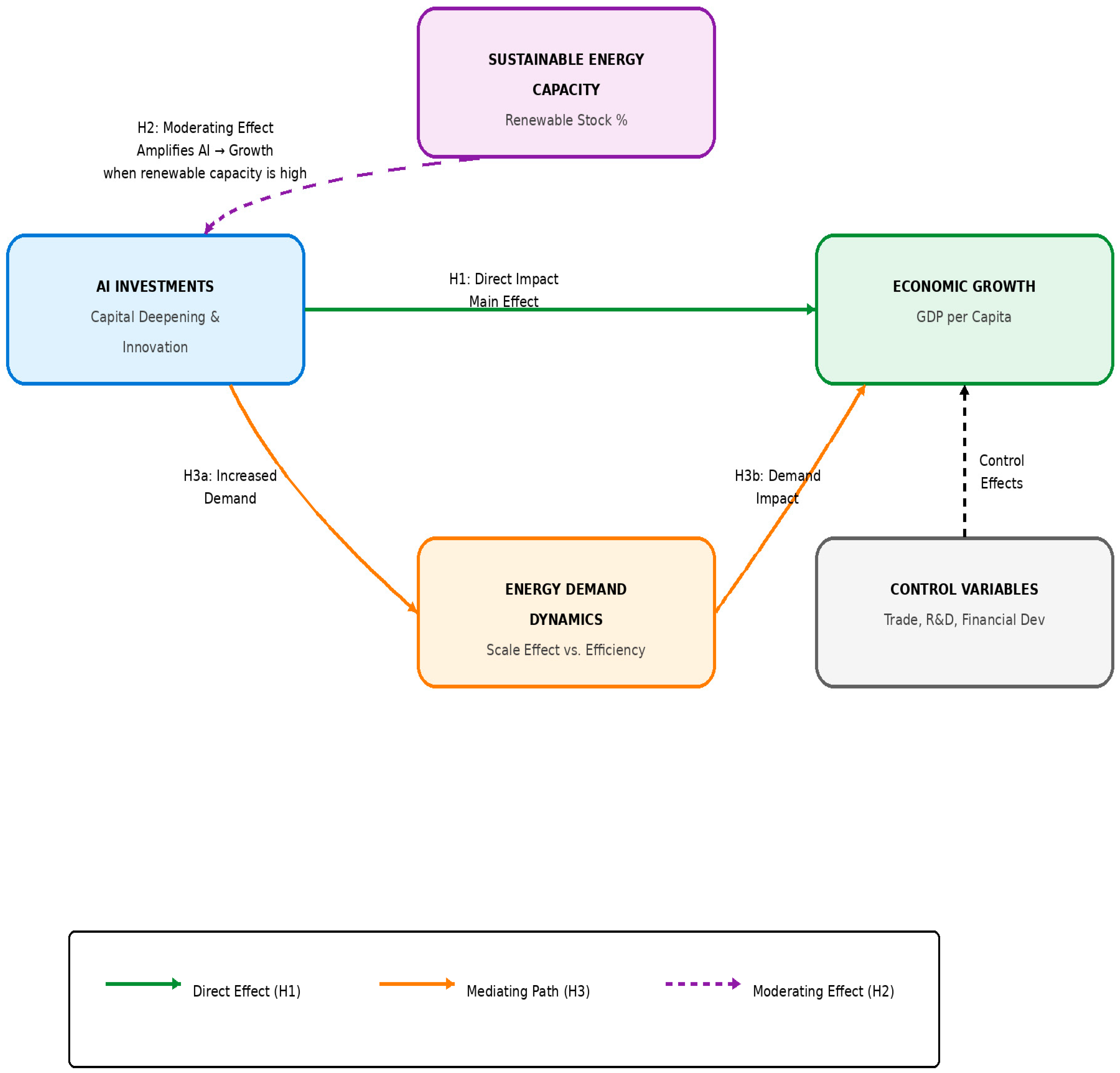
The theoretical framework of this study has been designed using a multi-layered approach to analyse the macroeconomic effects of AI investments and their symbiotic relationship with energy dynamics. AI investments and the dynamic relationship between sustainable energy and economic growth are primarily addressed within the framework of Neoclassical Growth Theory (NGT), Endogenous Growth Theory (EGT), and the General Purpose Technologies (GPT) approach. The study positions AI not only as a factor of production but also as a transformative force that alters energy consumption patterns; it synthesises production function-based approaches, complementary asset theories, and environmental economics hypotheses (EKC and Jevons Paradox). The fundamental mechanism, which includes AI investments directly stimulating growth through capital deepening, creating indirect effects through energy demand, and the “moderating” role of the sustainable energy stock in this relationship, is presented in Figure 1. This conceptual framework summarises AI’s need for energy infrastructure as a GPT and the leverage effect of clean energy capacity on growth in a comprehensive flow diagram.
This study integrates technological economics and energy sustainability studies by modelling AI not only as a productivity-enhancing technological input but also as an energy-relevant structural force. From the perspective of technological economics, AI investments influence economic growth through innovation, automation, and capital deepening channels. Simultaneously, the energy sustainability framework emphasises how technological change interacts with renewable energy capacity, energy prices, and environmental constraints to shape energy demand and efficiency. By explicitly incorporating interaction terms between AI indicators and renewable energy capacity, as well as nonlinear specifications in the energy demand models, the proposed framework captures both the growth-enhancing and energy-intensive dimensions of AI diffusion. This integrated approach allows the analysis to reflect short-run adjustment costs, learning effects, and transitional inefficiencies that arise during green digital transformation, thereby providing a coherent empirical link between technological progress and sustainable energy dynamics.

2.1. Neoclassical Approach and Capital Deepening

The potential of AI investments to stimulate economic growth is based primarily on the NGT developed by refs. [11,12]. According to this theory, economic growth depends on capital accumulation and labour supply, as well as technological progress, which is considered an external shock. AI investments can be modelled within this framework as a technological shock (Total Factor Productivity) that increases the efficiency of physical capital and shifts the production possibilities curve outward. Businesses’ expenditure on AI hardware and software increases output per worker by creating “capital deepening”. This theoretical basis supports the study’s first H1, which posits that AI investments have a positive effect on growth.
Figure 1 summarises the conceptual framework of the study and illustrates the hypothesised transmission channels linking AI, renewable energy capacity, economic growth, and energy demand. In this framework, AI development is expected to affect economic growth directly through productivity gains and indirectly through its interaction with renewable energy capacity, which captures the role of sustainable energy infrastructure in amplifying or constraining AI-driven growth effects. At the same time, AI influences energy demand through two opposing mechanisms: an expansion effect driven by increased digital infrastructure and computational intensity, and an efficiency effect associated with optimisation, automation, and energy management technologies. Renewable energy capacity is modelled as both a moderating and complementary factor, shaping the magnitude and direction of AI’s economic and energy-related impacts. Control variables, including trade openness, financial development, carbon emissions, energy prices, and capital formation, are incorporated to account for macroeconomic, environmental, and structural conditions that jointly determine growth and energy consumption dynamics.

2.2. Internal Growth and Knowledge Dissemination

The EGT, developed to overcome the limitations of the Solow model, which treats technology as exogenous, provides a more comprehensive framework for explaining the long-term effects of AI. According to this approach, proposed by refs. [13,14], technological change is an endogenous result of the economic system and relies on the production of “ideas”. AI, unlike traditional physical capital, is a “non-rivalrous” form of knowledge capital that does not diminish with use. It is argued that AI differs from traditional capital and is not merely a production input but a method that changes innovation itself [15]. AI algorithms and data analytics capabilities provide increasing returns by accelerating R&D processes and facilitating cross-sector knowledge spillovers. In innovation-focused economies such as the G7 countries, AI is not merely a production tool but the fundamental engine that sustains growth by generating new innovations.

2.3. General Purpose Technology (GPT) and Energy as a Complementary Asset

The original contribution of this study, the AI and renewable energy interaction (AI × Renewable), is based on the GPT theory developed by ref. [16]. Like electricity and the internet, AI is considered a GPT with the potential to transform all sectors [17]. However, the GPT theory emphasises that these technologies require “complementary assets” to increase efficiency. In the context of this study, the energy infrastructure required for AI’s massive data processing capacity is the most critical complementary asset. AI technologies with high energy intensity cannot fully reflect their growth potential when energy supply is limited or costly. Therefore, a sustainable and low-cost energy stock is a factor that leverages AI’s impact on growth. This theoretical mechanism validates the interaction term in the model used in this study and the hypothesis that “AI’s impact is stronger in countries with high sustainable energy capacity” (H2).

2.4. Task-Based Approach and the Jevons Paradox

The dual effect of AI on energy demand and efficiency is explained by the “Task-Based Approach” presented by ref. [18] and the “Jevons Paradox” (Rebound Effect) in environmental economics. According to ref. [18], automation technologies reduce production costs (efficiency effect), leading to economies of scale. However, this increase in productivity can paradoxically increase total resource consumption.
According to this paradox, first proposed by ref. [19] and expanded upon by ref. [20] in modern energy economics, technological progress may reduce energy consumption per unit (efficiency), but total consumption may increase due to lower costs (H3). AI, on the one hand, provides energy efficiency through network optimisation (supply-side efficiency), while on the other hand, it drives up energy demand due to the increasing processing load of data centres (demand-side scale effect). Therefore, in this study, energy demand is modelled not only as an explanatory variable in the growth model but also as a dependent variable affected by AI.
Within this framework, the Task-Based Approach and the Jevons Paradox are not competing explanations but rather complementary mechanisms that jointly capture the dual impact of AI on energy demand. The Task-Based Approach emphasises how AI-driven automation reallocates tasks and enhances productivity, leading to efficiency gains and lower energy intensity per unit of output. However, the Jevons Paradox highlights that these efficiency improvements may simultaneously reduce production costs, stimulate new activities, and lead to scale effects and increased demand for digital services. When combined, these two perspectives suggest that AI can generate short-run increases in energy demand due to expansion and rebound effects, while potentially enabling long-run efficiency gains through optimisation and technological learning. This integrated view provides the theoretical basis for H3 and justifies modelling AI–energy interactions as potentially nonlinear and time-dependent.

2.5. Temporal Inconsistency in the Relationship Between AI and Energy Demand: The EKC Hypothesis and Scale Effect

The impact of AI investments on energy demand depends on the time dimension and follows a nonlinear dynamic. In this study, the structure of AI, which increases energy consumption in the short term but decreases it (or increases efficiency) in the long term, has been modelled within the framework of the EKC Hypothesis. The EKC hypothesis, introduced to the literature by ref. [21], predicts an inverted U-shaped relationship between economic growth and environmental degradation (energy consumption). According to this theoretical approach, the technological transformation process occurs in three stages: scale effect, composition effect, and technical effect.
In the short term, the scale effect and energy intensity are at the forefront. The installation and proliferation phase of AI technologies corresponds to the rising part of the EKC (scale effect). Training and operating AI models require massive data centres and high processing power (GPUs/TPUs). At this stage, AI is an energy-intensive capital investment. It has been noted that as the complexity of algorithms increases, AI’s carbon footprint increases exponentially [22]. Therefore, during the early adoption phase of the technology, the “scale effect” prevails due to the expansion of physical infrastructure (data centres, servers), and energy demand increases. This situation theoretically validates this study’s hypothesis that “AI investments increase energy demand in the short term” (H3).
In the long term, the technical impact and efficiency are noteworthy. In the long term, AI’s “technical impact” comes into play. As the level of technological maturity increases, AI algorithms become a tool for optimising energy systems. AI applications such as smart grids, demand-side management, and predictive maintenance minimise losses in energy transmission and distribution. This process corresponds to the decreasing part of the EKC; that is, as technology advances, the energy intensity per unit of output decreases. In their study examining the impact of different types of technology on energy, ref. [23] emphasised that advanced digital technologies take on an energy-saving character in the long term.
A rebound effect may also occur as a threat. The biggest theoretical obstacle to this expected long-term decline is the Rebound Effect (Jevons Paradox). As explained by ref. [20], the energy efficiency provided by AI reduces the effective cost of energy. Lower costs may encourage both producers and consumers to use more digital services. If the “new demand” created by AI (e.g., increased traffic due to the proliferation of autonomous vehicles) outweighs the efficiency gains (less fuel per vehicle), total energy demand may increase rather than decrease. Therefore, the study argues that the net effect of AI on energy depends on the trade-off between technical efficiency gains and increased demand.

2.6. The Leveraging Effect on Growth: Sustainable Energy as a Regulatory Variable

One of the main hypotheses of this study is that the marginal effect of AI investments on economic growth is not constant but rather varies according to the level of sustainable energy capacity possessed by countries (H2). Statistically positioned as a “moderating variable,” sustainable energy stock is modelled as an external condition that alters the direction or strength of the relationship between the independent variable (AI) and the dependent variable (growth). In the theoretical literature, this mechanism is explained by the Directed Technical Change and Green Growth theories.
Constraining factors must be overcome. The impact of energy-intensive technologies on growth is often hindered by the “resource constraint” barrier in traditional growth models. It is emphasised that energy inputs are an indispensable complementary factor for capital accumulation and growth [24]. High energy-consuming technologies such as AI, when operating in a fossil fuel-dependent infrastructure, face the risk of “diminishing returns” due to rising energy costs and environmental externalities (carbon taxes, regulations). However, when sustainable energy capacity is high, this resource constraint eases. Clean energy strengthens AI’s contribution to growth (amplification effect) by reducing its operational costs and enabling it to scale without being hampered by environmental regulations.
The synergy between environmental sustainability and efficiency should not be overlooked. According to the Directed Technological Change model developed by ref. [25], technological innovations can be directed towards “dirty” or “clean” technologies. If an economy supports DT investments with clean energy infrastructure, dependence on “dirty” inputs decreases and the returns on innovation increase. In this context, sustainable energy is not just an energy source for DT investments but a strategic complement that increases its economic efficiency. The interaction term (AI x Renewable) in the model used in this study tests precisely this synergy: as the share of renewable energy increases, the coefficient (elasticity) of AI investment on GDP should increase positively. This situation theoretically confirms that green energy infrastructure acts as a “lever” for AI-based growth.

3. Literature Review

3.1. The Relationship Between AI and Growth

The relationship between AI and economic growth has attracted growing attention in the empirical literature, with most studies documenting a positive association between AI-related technologies and productivity or output growth. However, the magnitude, timing, and inclusiveness of these effects remain highly heterogeneous, largely due to differences in proxy selection, empirical strategies, and the stage of technological diffusion considered. Table S1 summarises the key empirical contributions in this field and provides the basis for the critical assessment presented below.
Early macro-level evidence predominantly relies on physical automation indicators, particularly industrial robots, as proxies for AI adoption. In a seminal contribution, ref. [4] analyse data from 17 OECD countries across multiple sectors over the period 1993–2007 and find that increases in robot density significantly enhance labour productivity and GDP growth. Their estimates suggest that robot adoption contributed approximately 0.36 percentage points to labour productivity growth and 0.37 percentage points to annual GDP growth—an effect comparable to that of historical general-purpose technologies such as the steam engine. At the same time, while this study provides strong evidence in support of the growth-enhancing role of automation, its reliance on industrial robots as the sole AI proxy excludes software-based and algorithmic innovations and predates the deep learning and generative AI era, limiting its relevance for contemporary AI-driven growth dynamics.
A more nuanced picture emerges when distributional effects are considered. Using data on commuting areas in the United States, it has been shown that exposure to robots increases productivity but also reduces employment due to displacement effects [26]. Their findings indicate that each additional robot per thousand workers reduces the employment rate by approximately 0.2 percentage points, while productivity gains remain modest. The authors argue that some automation technologies may represent “so-so technologies,” generating limited productivity improvements relative to their labour-displacing effects. Compared with ref. [4], this study highlights an important trade-off between efficiency gains and labour market outcomes, suggesting that AI-driven growth may be unevenly distributed. However, its exclusive focus on the United States constrains its external validity, particularly for countries with stronger labour protections and different institutional settings, such as several G7 economies.
Moving beyond physical automation, firm-level studies emphasise the innovation channel of AI-driven growth. Using system GMM estimates on a global sample of approximately 6000 companies, it has been found that companies holding AI-related patents achieve 3–4 per cent higher labour productivity than companies not engaged in AI-related innovations, with this effect being stronger in the service sectors [27]. This evidence suggests that AI-driven innovation generates higher productivity returns than conventional technological change. Nevertheless, by focusing exclusively on patent-holding firms, the analysis may suffer from selection bias toward large and technologically advanced companies, potentially overstating aggregate productivity effects and underrepresenting small and medium-sized enterprises.
At the macro level, ref. [5] provides robust evidence that AI functions as a general-purpose technology (GPT). Using a dynamic panel framework for G7 and Eurozone countries over the period 1990–2014, the study shows that increases in the stock of “smart technologies” significantly raise productivity, with estimated elasticities ranging from 0.01 to 0.06. Importantly, the results indicate strong scale effects: productivity gains intensify as AI capital accumulates. Compared with refs. [4,26], this study explicitly captures the cumulative and systemic nature of AI diffusion. However, the reliance on patent-based indicators may underestimate AI’s true impact by excluding non-patented, open-source, and proprietary algorithmic innovations.
Direct macro-level empirical evidence linking AI investment to GDP growth remains limited, prompting several theoretical contributions to clarify the underlying mechanisms. In this context, ref. [6] conceptualise artificial intelligence as a general-purpose technology (GPT) within an endogenous growth framework. Their theoretical model demonstrates that AI enhances long-run economic growth by accelerating innovation, increasing research productivity, and generating scale effects across sectors. Importantly, the authors emphasise that the growth-enhancing impact of AI is conditional on complementary investments in human capital, data infrastructure, and institutional quality, and may be accompanied by transitional adjustment costs in the short run. This theoretical perspective provides a coherent foundation for interpreting heterogeneous empirical findings and supports the hypothesis that AI-driven growth effects unfold gradually as complementary factors accumulate.
Taken together, the studies summarised in Table S1 provide substantial support for H1, which posits a positive relationship between AI investment and economic growth. However, they also reveal important limitations. First, most empirical analyses rely on indirect AI proxies, such as robot density, patent counts, or ICT investment, which may only partially capture modern AI capabilities. Second, most studies focus on long-run or medium-term effects and largely abstract from short-run adjustment costs, learning frictions, and transitional inefficiencies. Third, cross-country heterogeneity—particularly among advanced economies at the technological frontier—remains insufficiently explored.
In summary, the existing literature converges on the view that AI and related digital technologies have the potential to enhance productivity and economic growth, supporting Hypothesis H1. However, there is no consensus regarding the timing, distributional consequences, or sustainability of these effects. Disagreements persist over whether AI-driven efficiency gains outweigh adjustment costs and energy-intensive scale effects, particularly in the short run. Moreover, the moderating role of renewable energy capacity in shaping AI-driven growth outcomes remains largely unexplored. By focusing on short-run dynamics, explicitly modelling interaction effects with renewable energy, and testing nonlinear energy demand responses, this study addresses these unresolved issues and contributes new empirical evidence on the conditional and sustainability-relevant nature of AI-driven growth in advanced economies.

3.2. The Relationship Between Digitalisation, AI and Energy Demand

The relationship between digitalisation, AI, and energy demand constitutes one of the most contested issues in the sustainability literature. Existing studies provide mixed and seemingly conflicting evidence, reflecting the complex and transitional nature of digital technologies. As summarised in Table S2, empirical findings can broadly be grouped into two strands: those emphasising scale and rebound effects that increase total energy demand, and those highlighting efficiency gains that reduce energy intensity over time. Importantly, these strands are not mutually exclusive; rather, they describe different mechanisms and stages of technological diffusion, which are explicitly captured in H3 of this study.
Early macro-level evidence largely supports the view that digitalisation and ICT expansion increase energy demand through scale effects. Using the ARDL framework for OECD countries, it is demonstrated that ICT development significantly increases electricity consumption in the short term [9]. Although efficiency gains partially offset this effect in the long run, the initial impact remains positive, indicating that energy demand rises during the early adoption phase of digital technologies. Similar conclusions are reached by ref. [28], who finds that ICT diffusion in emerging economies increases electricity consumption by stimulating economic activity and technology adoption. These studies provide strong empirical support for the first part of H3, which posits that AI-driven digitalisation increases energy demand in the short term.
Evidence from advanced economies further reinforces the rebound-effect argument. Using panel fixed-effects estimations for EU countries, ref. [7], which focuses on ICT capital stock, documents a statistically significant positive relationship between ICT investment and total energy consumption, consistent with the Jevons paradox. Despite improvements in energy efficiency at the micro level, aggregate energy use rises because productivity gains reduce effective costs and encourage higher output and consumption. This line of research highlights a critical limitation of efficiency-based narratives: technological progress alone does not guarantee absolute reductions in energy demand.
At the global level, long-term scenario-based studies extend this argument. Using the Integrated Futures (IFs) integrated assessment model, it is predicted that widespread ICT deployment will increase global energy demand and carbon emissions over time, even when productivity gains are taken into account [8]. More recently, ref. [29] provide a detailed footprint assessment of global ICT infrastructure, demonstrating that the rapid expansion of data centres, networks, and end-user devices substantially increases energy demand and emissions. These studies are particularly relevant for AI, as modern AI applications are highly dependent on energy-intensive computational infrastructure. Together, they underscore that scale and rebound effects are structurally embedded in digital transformation processes, lending strong support to the short-run energy-increasing mechanism proposed in H3.
In contrast, a growing body of literature emphasises that digitalisation can reduce energy intensity once a certain level of technological maturity is reached. Using the Panel Smooth Transition Regression (PSTR) model for Chinese provinces, a clear non-linear relationship between the digital economy and energy intensity has been identified [10]. Their results reveal an inverted U-shaped pattern: digitalisation initially increases energy intensity, but beyond a threshold, further development significantly reduces it through efficiency gains and structural upgrading. This finding aligns closely with the second part of H3, which predicts that AI adoption eventually promotes energy efficiency after surpassing an adoption threshold.
Complementary evidence is provided by studies that emphasise optimisation and learning effects in the digitalisation–energy nexus. Research focusing on ICT-enabled energy management, smart grids, and industrial optimisation suggests that advanced digital technologies can lower energy intensity by improving resource allocation and reducing energy losses once a sufficient level of technological maturity is achieved [9,10]. In particular, evidence from nonlinear frameworks shows that efficiency gains tend to materialise only after substantial investment in digital infrastructure and complementary assets, implying the presence of threshold effects and learning dynamics [10]. At the same time, large-scale expansion of digital infrastructure, including data centres and communication networks, may offset these efficiency gains in the early stages through strong scale and rebound effects [28]. Taken together, this literature highlights the critical role of timing and nonlinearity in shaping the overall impact of digitalisation and AI on energy demand [9,10,28].
Overall, the literature reveals no simple linear relationship between digitalisation, AI, and energy demand. A broad consensus exists that digital technologies increase energy demand in the early stages of diffusion, driven by infrastructure expansion, data centre growth, and rebound effects. At the same time, there is growing agreement that mature digital systems can enhance energy efficiency and reduce energy intensity through optimisation and structural change. The main disagreement concerns whether and when efficiency gains outweigh scale effects, and how this balance differs across countries, development stages, and energy systems.
This study positions itself within this unresolved debate by explicitly testing H3 in a short-run macro-panel framework. Unlike much of the existing literature, which focuses either on long-run projections or single mechanisms, the present analysis allows for nonlinear and transitional dynamics between AI investment and energy demand. By incorporating squared AI terms and interaction effects, the study empirically examines whether AI-driven digitalisation follows an inverted U-shaped pattern consistent with rebound and efficiency effects. In doing so, it contributes new evidence on the short-run sustainability implications of AI adoption in advanced economies and clarifies the conditions under which digital innovation may transition from being energy-intensive to energy-efficient.

3.3. Energy Consumption, Sustainable Energy and Growth

The relationship between energy consumption, sustainable energy deployment, and economic growth has been extensively examined in the empirical literature, yet the findings remain heterogeneous across countries, periods, and energy structures. As summarised in Table S3, existing studies differ not only in their methodological approaches but also in the direction and magnitude of the estimated effects, reflecting the transitional nature of energy systems and the evolving role of renewable energy in growth processes.
Early panel-based evidence largely supports the feedback hypothesis, which posits a bidirectional relationship between renewable energy consumption and economic growth. Using a panel VECM framework for OECD countries, ref. [30] demonstrate that renewable energy consumption and economic growth mutually reinforce each other, with a 1% increase in renewable energy consumption exerting a statistically significant positive impact on GDP. This finding suggests that renewable energy functions not merely as an input to production but also as an endogenous component of the growth process in advanced economies. However, the long sample period (1985–2005) analysed in this study corresponds to an early phase of renewable energy diffusion, which may limit the applicability of its magnitude estimates to more recent energy transition contexts.
In contrast, evidence from G7 countries indicates weaker or statistically insignificant growth effects of renewable energy, particularly compared with fossil fuels. Ref. [31], employing a panel ARDL approach, find that renewable energy consumption does not exert a robust positive effect on economic growth in G7 economies over the period 1980–2009. The authors argue that, during this phase, renewable energy technologies had not yet achieved sufficient scale, cost competitiveness, or technological maturity to contribute meaningfully to growth. This result highlights an important limitation of early renewable energy deployment: without complementary technological progress and infrastructure, the growth contribution of renewables may remain modest.
More recent cross-country studies suggest that the growth impact of renewable energy strengthens as economies advance and energy technologies mature. A study analysing 38 countries with the highest energy consumption, using FMOLS and DOLS estimators, reported that renewable energy consumption has a statistically significant positive elasticity with respect to GDP [32]. A 1% increase in renewable energy consumption raises GDP by approximately 0.105%, with the effect being considerably stronger in high-income countries. This finding underscores the role of economic development and institutional capacity in translating renewable energy expansion into growth gains, suggesting that renewable energy is more growth-enhancing in economies with advanced technological and financial systems.
Evidence from emerging economies further reinforces the importance of heterogeneity and country-specific conditions. Using Bootstrap panel Granger causality tests, the mixed and asymmetric effects of renewable energy consumption on economic growth are determined [33]. While renewable energy exhibits positive causal effects on growth in several emerging economies, the direction and strength of the relationship vary substantially across countries. The authors emphasise that structural factors—such as energy mix, institutional quality, and investment capacity—critically shape the growth outcomes of renewable energy deployment. These results caution against assuming a uniform growth effect of sustainable energy across different development stages.
Focusing on advanced European economies, ref. [34] provides strong evidence of a positive long-run relationship between renewable energy consumption and economic growth. Using panel econometric techniques for EU countries, the study finds that renewable energy not only supports economic growth but also contributes to CO2 emission reductions, thereby aligning growth objectives with environmental sustainability. This dual effect highlights the increasing compatibility between renewable energy expansion and sustainable growth in regions with well-developed energy markets and supportive policy frameworks.
Country-specific evidence further nuances the energy–growth nexus. Algeria was examined using cointegrated polynomial regression, which documented a strong positive relationship between total energy consumption and economic growth, and revealed that human capital development increases efficiency and reduces energy demand [35]. This result suggests that growth in energy-intensive economies may still depend heavily on energy consumption, but efficiency-enhancing factors such as human capital can mitigate energy demand pressures.
Taken together, the studies in Table S3 reveal both convergence and divergence in the literature. A broad consensus exists that energy consumption—particularly renewable energy—plays a crucial role in supporting long-term economic growth. However, there is substantial disagreement regarding the timing, magnitude, and conditionality of this effect. While early-stage renewable energy deployment may yield weak or insignificant growth impacts, more recent evidence indicates that technological maturity, institutional quality, and complementary investments significantly enhance the growth contribution of sustainable energy.
These findings provide direct theoretical and empirical grounding for H2, which posits that the growth-enhancing effect of AI investments is stronger in countries with higher renewable energy capacity. The literature reviewed suggests that renewable energy acts as a complementary asset that alleviates energy constraints, reduces environmental externalities, and enhances the productivity of energy-intensive technologies. In this context, renewable energy capacity does not merely contribute to growth independently but also amplifies the effectiveness of advanced technologies.
Positioned within this literature, the present study extends existing work by explicitly modelling renewable energy capacity as a moderating factor in the AI–growth relationship. Unlike prior studies that examine energy and growth in isolation, this analysis integrates digital transformation and sustainable energy within a unified short-run empirical framework. By focusing on advanced economies and testing interaction effects between AI investment and renewable energy capacity, the study contributes novel evidence on how the green energy transition conditions the economic returns to AI-driven technological change, thereby advancing the literature on sustainable growth in the digital era.

4. Materials and Methods

4.1. Data Description and Sources

Table S4 contains the data and sources used. As the question of how AI investments affect economic growth and how this relationship is shaped by sustainable energy capacity is addressed, growth in this context refers not to an increase in total production (GDP) but to an increase in the level of production per capita. In other words, the focus is not on total output but on increases in welfare and productivity. GDP per capita (real, at constant prices) therefore directly captures the impact of AI investments on productivity, the capacity to increase output per capita through capital deepening and technology diffusion. The logarithmic form ( G r o w t h i t = l n ( G D P p e r   c a p i t a i t ) for GDP per capita approximates the growth rate. This model appears to be fully consistent with the growth theories of refs. [11,13]. Furthermore, almost all empirical studies examining the impact of AI, ICT, or innovation on growth use GDP per capita or GDP per capita growth rate [4,5,6].
To capture AI investment from complementary perspectives, this study employs two alternative proxy indicators: AIProxy and Stanford AI Private Investment. AIProxy reflects the broader diffusion and intensity of AI-related activities across the economy, capturing structural and technological adoption effects that are relevant over a relatively longer time horizon. In contrast, the Stanford AI Private Investment indicator directly measures financial investment flows into AI-related projects, providing a more concrete but narrower representation of AI investment dynamics. The use of two proxies is primarily motivated by data availability and time dimension constraints. While AIProxy allows for a longer sample period, the Stanford AI Private Investment data are available only for a shorter and more recent time span. Therefore, these proxies are not treated as substitutes but rather as complementary measures that enable robustness checks across different samples and periods. Each proxy has inherent limitations: AIProxy may capture broader digitalisation effects beyond pure investment, whereas the Stanford measure is restricted by its shorter time coverage and focus on private investment flows. By jointly employing both indicators, the study aims to provide a more comprehensive and cautious assessment of the short-run AI–energy–growth nexus.
The Global AI Vibrancy Tool from Stanford University provides data on private AI investments by country. Total AI Private Investment includes the total amount of private investment (nominal USD) received for AI ventures in a given country. This is because, in the models used in this study, the AI Investments variable is defined as “Capital Deepening”. Economically, this means new and active capital entering the production process. According to H1 (Economic Growth), “Private Investment” (Venture Capital, PE, etc.) is “fresh money” entering the system for companies to conduct R&D, hire staff, and develop new technologies. This money is directly converted into innovation and production. Therefore, total private investment is the most suitable option for this model. According to H3 (Energy Demand), an AI venture that receives investment allocates a large share of the funds to purchase hardware (GPUs) or to lease cloud computing services. In other words, this money is spent directly on energy-consuming infrastructure. The variable that will most strongly test the energy demand H3 is the total private investment variable. Since the total AI private investment data are in nominal USD, the data were converted to real USD using the US Consumer Price Index before analysis. Otherwise, even if investment appears to have increased, it may actually only be inflation that has risen, and the model may produce misleading results. Other potential investment data included in the Global AI Vibrancy Tool are Total AI Mergers and Acquisitions (M&A) and Total AI Public Offerings (IPOs). Total AI Merger/Acquisition (M&A) is when one company acquires another. It is usually a transfer of ownership; that is, no new server is added to the system or new technology is created—only existing technology changes hands. Its impact on energy demand and new capital formation is more indirect than that of “Private Investment”. Total AI Public Offering (IPO) data is highly volatile. One year, there may be a massive public offering; the next year, there may be none. In panel data analysis (regression), such extreme deviations undermine the validity of the model.
Stanford AI proprietary investment data were used in the short-panel robustness check (Model B) to directly assess AI-specific investment effects. The main analysis was structured to measure long-term effects as well as short-term ones. This approach is consistent with the methodological applications of refs. [4,5], which balance data sensitivity and longitudinal depth. In the main analysis (Model A), a longer historical digital capital proxy (ICT-based indicator) was created to ensure long-term consistency and capture the long-term impact of AI investment. The composite index created captures both the physical and digital dimensions of AI investments: A I   C o m p o s i t e   I n d e x i t = 0.5   ×   I C T G o o d s i t + 0.5   ×   I C T S e r v i c e s i t . According to this proxy, AI investment is economically based on two fundamental components. These are physical capital (servers, data centres, chips) and knowledge and service capital (software, data science, algorithm exports). The variables used for A I P r o x y i t are the share of ICT goods (such as electronics, computers, and telecommunications equipment) in total goods exports (ICT goods exports (% of total goods exports)) and the share of ICT services (such as software, data processing, cloud services, consulting) in total services exports (ICT service exports (% of service exports, BoP)). These variables represent the hardware, software, and services components of AI, respectively. These two variables represent the capital deepening channel through which AI affects economic growth. This method is a variation in the approach favoured in studies such as refs. [4,5]; while they use “robot stock” or “ICT intensity”, this study measures it from a trade perspective.
The concept of sustainable energy capacity is most accurately represented by the share of installed renewable electricity capacity. The renewable electricity capacity share (%), which is the ratio of installed renewable energy generation capacity to total installed capacity, represents infrastructure stock (representing the country’s clean energy potential) and is directly related to the energy-intensive nature of AI investments. As energy supply or consumption data reflect short-term fluctuations, they are inconsistent with the structural-moderator logic of H2.
According to the H3, AI investments increase energy demand in the short term and promote energy efficiency in the long term. H3 aims to examine the behaviour of energy demand over time (short run). Therefore, the energy variable used must reflect both the scale of demand (consumption) and efficiency trends (efficiency gains). Energy use per capita appears appropriate in this regard. This is because, in the short term, AI investment → increased energy use (scale effect), while in the long term, energy use per capita may decrease due to the optimisation effect of AI (efficiency effect). In other words, this variable is the most suitable indicator for measuring the dual nature (scale vs. efficiency) of H3. Therefore, the energy demand dynamics included in the research model (Figure 1) are represented by per capita energy consumption (kg of oil equivalent per capita), consistent with refs. [24,34,36]. This variable reflects both the scale effect of AI-driven economic expansion and the long-term efficiency effect described in H3.
Trade is the sum of exports and imports of goods and services. The trade balance is expressed as a percentage of Gross Domestic Product (GDP), which is the total income generated by the production of goods and services within an economic region over a given period. Gross Fixed Capital Formation (GFCF) indicates the net increase in productive capacity (machinery, infrastructure, factories, software, etc.) in economies. This is equivalent to the increase in the capital stock (ΔK) in the neoclassical growth model. In other words, it indicates how much of the country’s income is reinvested in productive capital. Therefore, GFCF is used as the direct capital accumulation rate, as in Equation (1):
G F C F t = Investment in fixed assets G D P × 100
Based on the assumption in this study that “AI investments promote growth through capital deepening,” the validity of the following mechanism is tested in the growth model: A I i t → Capital Deepening → G r o w t h i t . GFCF is a suitable variable for controlling this mechanism econometrically. GFCF has been added to the model because it directly measures physical capital accumulation, is one of the structural determinants of growth alongside AI investments, and is a standard control variable in refs. [11,13]-type models in the literature.
The main question of this study concerns how AI investments affect economic growth and how this relationship is shaped by sustainable energy capacity and energy demand. In other words, the main question is based on the concept of “sustainable growth”. However, it is known that energy demand or renewable capacity alone is not sufficient to measure sustainability. This is because an economy’s energy consumption may increase, but if this is accompanied by a decrease in carbon intensity, it is a positive outcome for environmental sustainability. Therefore, CO2 emissions are an environmental output of the energy demand channel and an indirect variable that tests the effectiveness of sustainable energy capacity. In other words, energy demand can increase growth, but if this demand comes from high-carbon-intensity sources, it conflicts with the goal of sustainable growth in the long term. Therefore, the CO2 variable should be included in the model as an output of environmental sustainability.
Models A1–A2 and B1–B2 measure only economic and technological interactions. If CO2 emissions are not included in the model, the environmental quality of energy sources (fossil vs. renewable) is disregarded. This shortcoming has been criticised in the literature. Ref. [24] defines the exclusion of the “environmental cost of energy input” in sustainable growth analyses as a methodological weakness. At the same time, ref. [37] shows that energy growth analyses that do not include the interaction between renewable energy and CO2 emissions do not reflect the “green growth” context. Therefore, CO2 emissions serve as a complementary control variable that measures the environmental impact of energy demand. According to ref. [37], per capita land use, land-use change, and forestry (LULUCF) CO2 emissions (t CO2e/person) were used as a proxy to measure the environmental impact of energy consumption, thereby ensuring that only energy-related and industrial sources were considered in the analysis.
In this study, R&D is used as a control variable for technological capacity and innovation level. The model’s main effect has already been measured by AI investments. That is, AI investment is used as the source of technology. Therefore, the role of the R&D variable should be to control the overall innovation ecosystem across countries, not AI itself. According to refs. [13,37,38], R&D expenditure (as a percentage of GDP) is used as an indicator of technological capacity and reflects each country’s investment in innovation relative to its economic output. Therefore, R&D, which is the relative economic resources allocated by countries to technology, has been used in the form of R&D expenditure (% of GDP). Financial development, which is used to capture elements such as international financial depth, access to credit, and capital market efficiency at the macro level, has been measured using the IMF Financial Development Index, which assesses the depth, accessibility, and efficiency of financial institutions and markets [39,40].
The impact of AI investments on energy demand is sensitive to the level of energy prices (for example, low prices encourage energy use, whereas high prices increase energy efficiency). This effect is at the heart of the “Jevons paradox” debate—that is, even if technological efficiency increases, total demand may rise due to cheap energy. Therefore, energy prices indirectly affect the following two channels: AI → Energy Demand → Growth. References such as refs. [24,34] have demonstrated that energy prices alter the relationship between technological development and growth through the “cost channel”. Moreover, energy prices reflect differences in energy intensity across countries and clarify the effect of the sustainable energy capacity variable (as the share of renewable energy is generally inversely related to energy prices). Energy prices have been included in this study as a control variable to capture external shocks that affect both energy demand and economic growth.
The selection of the sample periods is strictly determined by data availability. The 2010–2025 period is employed because the ICT-based AI proxy, renewable energy capacity, and core macroeconomic variables are consistently available only from 2010 onwards for the full country sample. Direct AI private investment data, however, are available only for the 2017–2024 period, which defines the shorter horizon used in Models B1–B2. The year 2025 is included because several key datasets already report values for that year. To ensure a balanced panel, missing observations in other series are completed using standard and conservative extrapolation methods. This approach ensures temporal consistency across variables without affecting the robustness of the empirical results.

4.2. Data Completion Procedures

In line with studies conducted by refs. [37,41], growth rate extrapolation (5-year trend) was used for the gaps in recent years. In parallel with the studies conducted by refs. [42,43], a Kalman filter-like correction (3-year moving average) and Growth Rate Extrapolation (Trend Rate Method) were used together in the data set containing five years of missing data (International Monetary Fund Financial Development Index) because there were >4 missing data points. The aim of this method is to reduce noise in the series. This method extends the series while preserving the continuity of the trend, suppresses fluctuations, and keeps long-term forecasts stable in a realistic manner. Subsequently, the growth extrapolation rate method was used for the financial development index. The aim of this approach is to provide a balanced panel estimate while preserving internal dynamics. It also allows for a forward-looking sustainability analysis for the 2025 horizon.

4.2.1. Growth Rate Extrapolation Method

In line with studies by refs. [37,41], missing annual values were completed using a growth-rate extrapolation technique based on the average trend of the previous five years. To estimate missing years in the data using trend growth, the growth rates for the last n years are first calculated, as in Equation (2):
g = 1 n   i = t n + 1 t ( X i X i 1 1 )
Estimates for missing years are then made as in Equation (3):
X ^ t + k = X t + k 1 × ( 1 + g )
Alternatively, it is performed repeatedly as in Equation (4):
X ^ t + k = X t × ( 1 + g ) k
Here, X t denotes the year for which the last observation is known, g denotes the average annual growth rate (e.g., over the last five years), and k denotes the number of years estimated. This method enables short-term extension in the presence of missing data and is frequently used in macroeconomic series [37,41].

4.2.2. Hybrid Method (Kalman-like Smoothing + Growth Rate Extrapolation)

In parallel with the studies by refs. [42,43], a hybrid approach combining a Kalman-like correction (a three-year centred moving average) with growth rate extrapolation was applied to maintain temporal continuity across countries for smoother variables, such as the financial development index. This method was selected to complete missing years in the data set and smooth out fluctuating financial series while preserving the trend. The methodological steps are as follows.
(a)
Smoothing step (Kalman-like, 3-year moving average)
This step (Equation (5)) reduces short-term fluctuations in the series. A 3-year symmetrical moving average is applied:
X ~ t = X t 1 + X t + X t + 1 3
Here, X t is the original variable (e.g., Financial Development index), X ~ t is the smoothed value, and t − 1, t and t + 1 denote consecutive years. This process can be considered a simplified version of the Kalman filter (trend extraction is performed using deterministic averaging instead of signal extraction).
(b)
Growth rate exploration step for missing path
The average growth rate for the last n years of the adjusted series is calculated as in Equation (6):
g = 1 n   i = t n + 1 t ( X ~ i X ~ i 1 1 )
Here, g represents the average annual growth rate. The estimation formula for the missing year t + k is given in Equation (7):
X ^ t + k = X ~ t + k 1 × ( 1 + g )
Here, X ^ t + k is the estimated value, g is the average growth rate over the last five years, and k indicates the number of years projected forward.
(c)
Final Hybrid Model
The method can be summarised in two stages as in Equation (8):
X ~ t + k = X t 1 + X t + X t + 1 3 × ( 1 + g )
This formula encompasses both smoothing and lengthening.
If F D I 2020 , 0.908; g, 0.001481531 (average value over the last five years), we can derive the F D I 2021 data using the hybrid method as follows:
FDI 2021 = 0.908 × ( 1 + 0.001481531 ) = 0.909

4.3. Data Transformations

Following the methodological conventions in panel macro-energy literature [37,44,45], variables expressed in absolute or unbounded scales were log-transformed to enable elasticity interpretation. At the same time, bounded ratios and normalised indices were retained in their original form.
GDP per capita exhibits substantial cross-country variation and exponential growth over time. The logarithmic transformation reduces heteroskedasticity and allows coefficients to be interpreted as elasticities of growth. Stanford AI investment data exhibit exponential scaling across years and countries (billions of USD). Logging ensures comparability and converts growth rates into percentage effects. Energy use per capita values are strictly positive and right-skewed. Log transformation aligns with prior literature measuring income–energy elasticity [45,46]. Emission data often have heavy right tails. Logarithmic transformation normalises variance and supports log–log specification in environmental Kuznets-type models. The PPP-based energy price index (values > 0) allows log conversion. The coefficient thus represents the price elasticity of demand—a standard interpretation in energy economics [30].
ICI (AI Investment Proxy) is computed as the mean of ICT goods and services export shares (%). These are ratio indicators (bounded between 0 and 100); taking logs would distort relative proportions. RE (Sustainable Energy Capacity) is a percentage share variable (0/100). Logarithmic conversion is not meaningful for percentage-based compositions. Trade (% of GDP) and GFCF (% of GDP) are both are ratio-based macro indicators, not absolute monetary flows. Transforming them would undermine the interpretability of marginal effects. R&D expenditure (% of GDP) is a ratio variable where the variation is small (typically 0–5%). Logarithm would yield negligible informational gain and may introduce noise. FDI (Financial Development Index) is bounded between 0 and 1. The logarithm is not applicable since log (0 < x < 1) produces negative, unbounded values. Instead, the normalised form maintains interpretability as a continuous index.

4.4. Model Framework and Specification

The empirical analysis consists of four models (A1–A2–B1–B2) designed to examine the short-run effects of AI investment on economic growth and energy demand. Models A1 and A2 employ ICT-based proxies for AI investment over 2010–2025, while Models B1 and B2 utilise direct AI private investment data from the Stanford AI Index for 2017–2024. Table S5 shows the analytical framework of the models.
The study is built upon three theoretical hypotheses (H1–H3) that conceptualise the relationships between AI investment, economic growth, and energy demand. To empirically test these hypotheses, four econometric models (A1–A2, B1, and B2) are developed. Each model corresponds to an empirical hypothesis (EH1–EH2) derived from the theoretical framework, as summarised in Table S6.
The initial research design aimed to test both short- and long-run relationships among AI, renewable energy, and economic performance through three hypotheses in Table S7. However, the absence of cointegration restricted the analysis to short-run estimations. The absence of cointegration indicates that the variables do not share a stable long-run equilibrium relationship over the sample period; therefore, estimating long-run coefficients would be econometrically invalid and potentially spurious. Accordingly, the analysis is restricted to short-run dynamics, where the relationships among first-differenced and stationary variables can be consistently identified. The hypotheses were reformulated to reflect short-term dynamics (see Table S7). This adjustment ensures methodological consistency without altering the study’s theoretical motivation.
Table S7 integrates the theoretical and empirical hypotheses, demonstrating how the conceptual framework (H1–H3) is empirically tested through Models A1–A2 and B1–B2. The table also highlights the inclusion of non-linear terms [ ( A I P r o x y i t ) 2 , ( A I I n v e s t i t ) 2 ] in the energy demand models to examine potential inverted-U relationships consistent with the EKC hypothesis.
AI investment contributes to economic growth by enhancing productivity, innovation, and technological efficiency. In the short run, AI investment is expected to positively affect economic growth, though adjustment costs and adoption frictions may delay its measurable impact (H1). Renewable energy moderates the AI–growth relationship by enabling cleaner and more efficient technological diffusion. However, given the absence of long-term cointegration, this study assesses the balancing role of renewable energy capacity in the short term and examines how the intensity of the green transition enhances the growth effects of AI investments (H2). In the short run, AI development increases energy demand, but higher levels of AI adoption are expected to improve efficiency, leading to a nonlinear (inverted U-shaped) relationship consistent with the rebound effect H3.
Note: Theoretical hypotheses (H1–H3) define the conceptual framework of the study, while empirical hypotheses (EH1–EH2) operationalise these relationships through econometric models (A1–A2–B1–B2). Models A1 and A2 (2010–2025), and Models B1 and B2 (2017–2024) capture short-run dynamics. Non-linear effects in Models A2 and B2 are tested by including squared terms of AI investment ( A I P r o x y i t ) 2   a n d   ( A I I n v e s t i t ) 2 , following the Environmental Kuznets Curve approach.

4.5. Econometric Specification

Based on the structure outlined in Table S5, the econometric formulations of the models are as follows:
Model A1 (Growth Model)
lnGDPpc i t = α i + β 1 AIProxy i t + β 2 R E i t + β 3 ( AIProxy i t x R E i t ) + β 4 ln ( EnergyDemand i t ) + β 5 Controls i t + ε i t
Model A2 (Energy Demand Model)
l n E n e r g y D e m a n d i t = δ i + θ 1 A I P r o x y i t + θ 2 ( A I P r o x y i t ) 2 + θ 3 l n G D P p c i t + θ 4 R E i t + θ 5 ( C o n t r o l s i t ) + e i t
Model B1 (Growth Model)
l n G D P p c i t = μ i + λ 1 l n A I I n v e s t i t + λ 2 R E i t + λ 3 ( l n A I I n v e s t i t x R E i t ) + λ 4 l n ( E n e r g y D e m a n d i t ) + λ 5 C o n t r o l s i t + η i t
Model B2 (Energy Demand Model)
l n E n e r g y D e m a n d i t = ϕ i + γ 1 l n A I I n v e s t i t + γ 2 ( l n A I I n v e s t i t ) 2 + γ 3 l n G D P p c i t + γ 4 R E i t + γ 5 C o n t r o l s i t + ϵ i t
The notation used in the econometric formulations is described as follows. The subscript i denotes the cross-sectional dimension, representing the individual countries included in the sample (G7, China, and South Korea). At the same time, t denotes the time dimension, covering the annual observations from 2010 to 2025 (or 2017–2024). The variable l n G D P p c i t indicates the natural logarithm of GDP per capita and serves as the dependent variable in the growth models (Model A1 and Model B1). Similarly, l n E n e r g y D e m a n d i t represents the natural logarithm of per capita energy use and is used as the dependent variable in the energy demand models (Model A2 and Model B2). The key explanatory variable A I P r o x y i t denotes the composite proxy of AI investment, constructed as the average of ICT goods exports and ICT services exports (both expressed as shares of total exports). In the Model B1 and Model B2, A I I n v e s t represents the Stanford AI Private Investment Index, which directly measures the annual value of AI-related private investments in each country. R E i t refers to the renewable electricity capacity share (%), capturing the contribution of renewable sources to total installed electricity generation capacity. This variable is also interacted with AI-related variables ( A I P r o x y i t × R E i t ) or ( A I I n v e s t i t × R E i t ) to assess the moderating role of renewable energy in the AI–growth and AI–energy relationships.
The vector C o n t r o l s i t includes a set of macroeconomic and environmental covariates commonly used in the literature, namely: CO2 emissions per capita ( l n C O 2 i t ), R&D expenditure (% of GDP) ( R & D i t ), financial development index (IMF composite index) ( F D I i t ) trade openness (% of GDP), energy price level (PPP-based) ( l n E P L i t ), and gross fixed capital formation (% of GDP) ( G F C F i t ). These control variables are incorporated to account for technological progress, institutional quality, and structural differences among countries. The parameters i ,   δ i ,   μ i ,   a n d   ϕ i denote country-specific fixed effects that capture unobservable heterogeneity across countries, while ε i t ,   e i t ,   η i t ,   a n d   ϵ i t represent the stochastic error terms.
Although sector-specific indicators of energy efficiency and digital adoption are not directly included due to data comparability constraints across countries, the selected control variables capture these structural differences indirectly. In particular, gross fixed capital formation (GFCF) reflects investment intensity, including investments in energy-saving and efficiency-enhancing technologies; R&D expenditure controls for countries’ innovation capacity and their potential to improve energy efficiency; and the energy price level (PPP-based) captures incentives for energy-saving behaviour and technology adoption across sectors. Moreover, CO2 emissions per capita proxy differences in energy intensity and production structures, while trade openness reflects structural specialisation and exposure to technology diffusion. Together with country fixed effects, these variables enable the model to account for cross-country heterogeneity in economic structure, energy efficiency potential, and the realisation of digitalisation-driven efficiency gains, consistent with standard practice in the macro-energy and growth literature.
Several recent studies—e.g., ref. [47], which offers a comprehensive theoretical and empirical synthesis of the Environmental Kuznets Curve (EKC) hypothesis and rigorously document the inverted-U relationship between economic growth and environmental degradation; ref. [41], which critically assesses the evolution of sustainable energy technologies and underscore how technological transitions may initially intensify energy demand before yielding long-term sustainability gains; ref. [48], which provides empirical evidence on the role of artificial intelligence and emerging digital technologies in the energy sector, highlighting their dual capacity to increase computational energy requirements while simultaneously enhancing system-level optimisation and efficiency; and ref. [49], which presents large-scale city-level evidence from China demonstrating that digital economy development strengthens green economic efficiency through technological upgrading and structural transformation mechanisms—collectively suggest that the relationship between technological advancement and environmental or energy outcomes is inherently non-linear and consistent with the EKC framework. According to this framework, in the early stages of technological diffusion, AI-related investments can increase energy consumption due to the scale effect: higher output, data centre expansion, and industrial automation all raise energy demand. Beyond a certain threshold, however, efficiency and substitution effects emerge: AI enhances resource optimisation, supports smart grids, and promotes the integration of renewables, ultimately reducing energy intensity. To examine the potential non-linear dynamics between AI development and energy demand, the squared terms of AI investment ( A I P r o x y i t ) 2   and ( A I I n v e s t i t ) 2 are incorporated into Models A2 and B2. This inclusion allows testing whether the relationship follows an inverted-U or U-shaped pattern, consistent with the EKC hypothesis.
A positive sign for A I P r o x y i t   a n d   A I I n v e s t i t and a negative sign for ( A I P r o x y i t ) 2   a n d   ( A I I n v e s t i t ) 2 would indicate that AI investment initially increases, but later reduces, energy demand as technological maturity improves energy efficiency and resource management.

4.6. Estimation Techniques

The empirical estimation employs a Fixed-Effects (FEs) estimator with Driscoll–Kraay-robust standard errors to analyse the short-run relationships among AI, renewable energy, economic growth, and energy demand across the G7 countries, China, and South Korea. This approach, developed by ref. [50] and implemented following [51], provides consistent inference under heteroskedasticity, serial correlation, and cross-sectional dependence, conditions frequently encountered in macro-panel datasets involving economically integrated countries. The Fixed Effects (FEs) estimator accounts for unobserved country-specific heterogeneity, allowing control for time-invariant structural characteristics such as institutional quality, technological capacity, and energy structure. The Driscoll–Kraay covariance matrix corrects the standard errors to ensure robustness against various forms of dependence in the error term, making the estimator particularly suitable for panels with moderate time dimensions (T = 9 and T = 16).
Compared to standard FE estimators with clustered or heteroskedasticity-robust errors, the Driscoll–Kraay correction provides more reliable inference when common shocks, spillovers, and global trends affect multiple countries simultaneously. Moreover, given the dataset’s moderate time dimension and focus on short-run dynamics, this approach is more appropriate than dynamic GMM methods, which may suffer from instrument proliferation and weak-instrument bias in short panels. Accordingly, the chosen methodology offers a robust, conservative estimation strategy that enhances the credibility of the empirical results relative to alternative approaches commonly used in related studies.
Two groups of models were estimated. In the A1 (AI–Economic Growth) and A2 (AI–Energy Demand) models, which cover the 2010–2025 period (T = 16), the variables lnGDPpc, AIProxy, RE, lnEnergyDemand, and R&D were included in first differences due to their I(1) integration order. All other control variables—Trade, FDI, lnEPL, GFCF, and CO2 emissions—were included in levels, as they were found to be stationary I(0) according to panel unit root and structural break tests. In contrast, the B1 (AI–Economic Growth) and B2 (AI–Energy Demand) models, estimated for the shorter 2017–2025 period (T = 9), include only Trade and RE in first differences, while all remaining variables were incorporated in levels. This adjustment ensures the stationarity of all series and prevents spurious regression bias.
For all models, a lag length of two was specified to capture potential short-memory autocorrelation while preserving degrees of freedom, in line with recommendations by ref. [51]. The estimations were implemented in Stata 17 using the xtscc command, which efficiently computes Driscoll–Kraay standard errors for fixed-effects panels with small to moderate time dimensions. This unified estimation strategy provides a consistent and robust framework across the four models (A1–A2–B1–B2), ensuring that inference remains valid despite potential cross-sectional dependence and short panel characteristics. As such, the Driscoll–Kraay FE approach offers reliable short-run evidence on the complex interaction between AI development, renewable energy, and macroeconomic performance in advanced economies.

4.7. Diagnostic and Robustness Tests

Before estimation, a series of diagnostic procedures was conducted to ensure the econometric validity of the models. Panel unit root tests, including refs. [52,53,54,55], were first employed to determine the order of integration for each variable. Given the relatively small time dimension of the dataset (T = 9 for B models and T = 16 for A models), the results from the CIPS test were found to be unstable due to limited degrees of freedom. Therefore, the ADF–PP panel tests were considered more reliable and were used to guide the treatment of variables in first differences or levels.
The Bai–Perron multiple structural break tests [56], and Zivot–Andrews unit root tests [57] were additionally conducted for variables that exhibited non-stationarity at first difference, specifically Trade, lnCO2, and GFCF. The results confirmed the presence of structural shifts consistent with global economic shocks, such as the COVID-19 pandemic, validating the need for robustness corrections in the estimations.
Following the integration and stationarity assessments, all models were estimated using the Fixed Effects estimator with Driscoll–Kraay robust standard errors. This method inherently corrects for heteroskedasticity, autocorrelation, and cross-sectional dependence, as recommended for panels with moderate T and N [50,51]. Accordingly, additional diagnostic tests, such as the Breusch–Pagan LM test, Wooldridge serial correlation test, or Pesaran CD test, were not required post-estimation, since their effects were already addressed by the Driscoll–Kraay correction.
The robustness of the results was further verified by comparing models A1–A2 (T = 16) and B1–B2 (T = 9), using the shorter panels to confirm the stability of the estimated coefficients. In both datasets, coefficient signs and statistical significance levels were consistent, supporting the reliability of the findings. The use of lag(2) in the Driscoll–Kraay specification also provided an additional safeguard against short-memory autocorrelation while preserving the efficiency of the estimates.
Overall, the diagnostic and robustness procedures confirm that the models are statistically sound, well specified, and free of major econometric concerns. The Fixed Effects estimator with Driscoll–Kraay-robust errors provides consistent and reliable inferences regarding the short-run linkages among AI, renewable energy, and macroeconomic dynamics across advanced economies.

5. Results

5.1. Results of Empirical Analysis Using Models A1 and A2

Table S8 presents the descriptive statistics for all variables used in the short-run models (A1 and A2) for the 2010–2025 period for the G7 countries, China, and South Korea. The table reports the number of observations (Obs), mean, standard deviation, minimum, and maximum values for each variable.
The results indicate a balanced panel structure with 144 observations per variable. The mean value of ln(GDP per capita) (10.44) suggests a relatively high-income level across the sample, consistent with advanced economies. The average share of renewable electricity capacity (RE = 37.0%) exhibits substantial but heterogeneous variation across countries, reflecting differences in energy transition stages.
The AIProxy variable, constructed as the composite of ICT goods and services exports, exhibits considerable variation (mean = 8.66, SD = 4.95), indicating cross-country differences in AI-related technological activity. Similarly, the interaction term (AIProxy × RE) exhibits substantial dispersion, indicating that the combined effect of AI investment and renewable energy capacity varies significantly across the sample economies.
Among the control variables, average trade openness is 57.2% of GDP, and gross fixed capital formation averages 24.6%, suggesting robust economic integration and investment activity. CO2 emissions (lnCO2) have moderate dispersion (mean = 2.17), while financial development (FDI = 0.80) remains high but stable across countries. The average energy price level (lnEPL = 4.53) shows limited variation, suggesting a relatively similar energy cost structure across the G7.
Overall, the descriptive results highlight a diversified yet comparable macroeconomic and energy profile among advanced and emerging economies, supporting the empirical feasibility of panel-based short-run analysis. Furthermore, the correlation matrix for all variables used in Models A1 and A2 is presented in Tables S9 and S10. For Model A1, the correlation coefficients indicate moderate associations among most variables, with no evidence of excessive pairwise correlation that would suggest severe multicollinearity in the growth model. For Model A2, while the linear and squared AI terms are naturally highly correlated, the correlations among the remaining variables are generally moderate, supporting the inclusion of nonlinear terms without concern for multicollinearity.
Table S11 presents the results of cross-sectional dependence (CD) tests for the panel dataset (N = 9, T = 16). The Breusch–Pagan LM test [58] strongly rejects the null hypothesis of cross-sectional independence for Model A1 (p < 0.01), indicating significant interdependence among countries in the short-run growth model. For Model A2, the LM statistic remains significant, while the Pesaran scaled LM and CD tests [59,60] fail to reject the null, possibly due to small-N limitations. These results suggest that, while economic growth variables exhibit strong common shocks across the G7, China, and Korea, energy demand appears more country-specific. Given the evidence of cross-sectional dependence, second-generation panel unit root (CIPS) [61] and cointegration (Westerlund) tests [62,63] are applied in the next stage to ensure robust inference.
As shown in Table S12, the results of the first-generation tests should be interpreted with caution due to the presence of cross-sectional dependency confirmed in Table S10. Therefore, the results regarding integration orders are based on the CIPS test, which accounts for cross-sectional dependency. The results show that most variables are non-stationary at the level but become stationary after first differencing, indicating integration of order one (I(1)). A few variables, including AIProxy × RE, FDI, and ln(Energy Price Level PPP), are stationary at the level (I(0)), suggesting short-run dynamics consistent with institutional and market-driven factors.
Table S13 presents the structural break test results for the variables that remained non-stationary after first differencing according to the CIPS test, namely Trade, GFCF, and lnCO2. The results from the Zivot–Andrews and Bai–Perron tests confirm the presence of significant structural breaks around 2014–2023, corresponding mainly to the global trade slowdown (2014–2016), the COVID-19 pandemic (2020), and the post-pandemic recovery period (2021–2023). After incorporating these breaks, all three variables exhibit stationarity with structural breaks (I(0) with breaks), supporting the robustness of their inclusion in the panel framework. These results validate that the observed non-stationarity in the CIPS test was likely driven by exogenous shocks rather than stochastic trends, which is consistent with the findings in refs. [64,65].
For trade, it identified 2015 and 2020 in Germany, France, Italy, and the United Kingdom; 2019 and 2021 in the USA, the Republic of Korea, and Japan; and 2016 and 2020 in Canada and China as structural break years. For CO2, 2020 was identified as the structural break year for all countries.
The Zivot–Andrews test, conducted in Stata 17, identified 2023 as the structural break year for GFCF in the USA, the Republic of Korea, Japan, and Italy; 2018 in Germany, France, and China; and 2015 in Canada. For Trade, it identified 2021 as the structural break year for the USA, the Republic of Korea, Japan, Canada, Italy, and the United Kingdom; 2022 for Germany; and 2014 for France. For CO2, it was found in 2023 in the USA and Japan; 2020 in Germany and the UK; 2014 in France; 2021 in the Republic of Korea, Canada, and China; and 2019 in Italy to be structural break years.
Given the presence of structural breaks and confirmed cross-sectional dependence among panel units (see Table S8), the study proceeds with the ref. [62] error-correction-based panel cointegration test. The Westerlund approach is preferred over traditional residual-based tests (e.g., Pedroni, Kao) because it accounts for cross-sectional dependence, incorporates country-specific short-run dynamics, and remains valid in the presence of structural breaks, as documented in ref. [63].
Therefore, applying the Westerlund test at this stage ensures more reliable inference regarding the long-run equilibrium relationships among AI-related variables, energy demand, and growth, consistent with best practices in recent panel econometrics.
Error-correction-based panel cointegration tests were conducted to examine the existence of a long-term equilibrium relationship among economic growth (lnGDP per capita), AI development, renewable energy capacity, and energy consumption within the A1 model specification [62]. The results across the three versions of the A1 model (A1.1–A1.3) consistently indicate that the null hypothesis of no cointegration cannot be rejected once robust (bootstrap) p-values are considered. Although some conventional p-values (e.g., A1.1 Gt = −3.677, p = 0.004) initially suggest a possible long-run linkage, these results lose significance after applying bootstrapped critical values, which are more reliable for panels with small sample dimensions (N = 9, T = 16). Therefore, after correcting for cross-sectional dependence and finite-sample bias via bootstrapping, no evidence of a stable long-run equilibrium among the variables is found.
Table S14 reports the results of the ref. [62] error-correction-based panel cointegration test for different specifications of the A1 model. Bootstrap p-values (1000 replications) are presented to account for cross-sectional dependence. A1 tests include country-specific constants but no deterministic trends. The null hypothesis of no cointegration cannot be rejected at the 5% significance level for any model. Bootstrap critical values were used because cross-sectional dependence among the G7, China, and Korea is highly likely given global energy and technology linkages. Asymptotic critical values assume cross-sectional independence and large T, which are not applicable here. Bootstrapping provides finite-sample corrections and robust p-values that more closely approximate the true sampling distribution. This approach is consistent with ref. [66], who emphasise that bootstrapped p-values yield more accurate inference in panels with small N and T.
The division of the A1 model into three submodels was primarily motivated by computational and methodological constraints in Stata 12/17, which limit the xtwest test to a maximum of six covariates. To ensure comprehensive testing of the theoretical framework without overparameterising the model, control variables were introduced sequentially in sets of two—(A1.1 with Trade and lnCO2), (A1.2 with R&D and FDI), and (A1.3 with lnEPL and GFCF).
Table S15 reports the results of the ref. [62] error-correction-based panel cointegration test for different specifications of the A2 model. The division of the A2 model into three submodels was primarily motivated by computational and methodological constraints in Stata 17, which limit the xtwest test to a maximum of six covariates. To ensure comprehensive testing of the theoretical framework without overparameterising the model, control variables were introduced sequentially in sets of two—(A2.1 with Trade and lnCO2), (A2.2 with R&D and FDI), and (A2.3 with lnEPL and GFCF).
Panel cointegration tests revealed no evidence of a long-term equilibrium relationship between the variables in either Model A1 (AI–Economic Growth relationship) or Model A2 (AI–Energy Demand relationship) [62]. Consequently, estimation methods that rely on the presence of cointegration, such as Fully Modified OLS (FMOLS) or Dynamic OLS (DOLS), are not econometrically appropriate in this context.
Given the existence of cross-sectional dependence and the relatively short time dimension (T = 16), the study employed the Fixed Effects estimator with ref. [50] robust standard errors. This estimator corrects for heteroskedasticity, serial correlation, and cross-sectional dependence without requiring cointegration among variables. It allows consistent estimation of short-run effects while controlling for unobserved country-specific heterogeneity. This approach has been widely adopted in small- and medium-sized panels in which long-run equilibrium cannot be statistically confirmed, e.g., refs. [37,41]. Therefore, the results reflect the short-run dynamic impacts of AI investment, renewable energy capacity, and other controls on economic growth and energy demand rather than long-run equilibrium relationships.
Table S16 reports the Fixed-Effects Panel Estimation results with Driscoll–Kraay robust standard errors for Model A1, which examines the relationship between AI development and economic growth across the G7 countries, China, and South Korea for the period 2010–2025. The estimation results indicate that changes in AI activity (ΔAIProxy) do not have a statistically significant direct effect on economic growth in the short run (p = 0.807). This finding suggests that the impact of AI adoption on growth materialises gradually, depending on complementary factors such as digital infrastructure, labour adaptation, and institutional readiness. However, the interaction term between AI and renewable energy capacity (ΔAIProxy × RE) exhibits a negative and weakly significant coefficient (β = −0.0002, p < 0.10), indicating that the short-run interaction between AI activity and renewable energy capacity is associated with a temporary reduction in economic growth rather than an immediate productivity-enhancing effect.
Among the control variables, gross fixed capital formation (GFCF) is positive and statistically significant (β = 0.0041, p < 0.05), confirming that capital accumulation plays a crucial role in stimulating short-run economic growth. Additionally, energy demand (ΔlnEnergyDemand) exerts a strong, highly significant positive effect (β = 0.3994, p < 0.01), indicating that energy consumption remains a key driver of output expansion in advanced economies. This outcome aligns with conventional energy–growth literature emphasising the energy–growth nexus, e.g., ref. [30]. Other variables, such as trade openness, CO2 emissions, and R&D expenditure, are not statistically significant, suggesting that their growth-enhancing effects may emerge only in the long term, once structural adjustments are complete.
The overall model fit is satisfactory, with a within R2 of 0.5340 and a highly significant F-statistic (F(10,14) = 82.40; p < 0.01). The application of Driscoll–Kraay robust standard errors (maximum lag = 2) ensures reliability against heteroskedasticity, serial correlation, and cross-sectional dependence—issues common in multi-country panels with integrated economies. In summary, the results highlight that while AI investment and renewable capacity contribute to modernisation individually, their joint short-run effects on economic growth are transitional and not yet productivity-enhancing. Over time, as economies adapt to AI-driven technological integration, these effects are expected to become more pronounced and positive.
Table S17 presents the Fixed-Effects Panel Estimation results with Driscoll–Kraay robust standard errors for Model A2, which investigates the short-run relationship between AI development and energy demand across G7 countries, China, and South Korea during 2010–2025. The coefficients of both AI activity (ΔAIProxy) and its squared term (ΔAIProxy2) are statistically insignificant, suggesting that AI diffusion has not yet produced measurable effects on energy consumption in the short term. This result reflects the transitional stage of AI integration, where digital infrastructure expansion and data-driven processes may temporarily offset potential efficiency gains. As economies advance toward more advanced AI adoption—particularly in energy management and smart grid systems—these effects are expected to yield energy-saving outcomes. Economic growth (ΔlnGDPpc) exhibits a positive, highly significant coefficient (β = 0.7614, p < 0.01), confirming the energy–growth nexus, in which higher output and income levels are associated with greater energy consumption. Similarly, CO2 emissions per capita (lnCO2) are positively significant (β = 0.0550, p < 0.05), reinforcing the link between energy use and environmental degradation, consistent with previous studies such as refs. [30,41]. The Financial Development Index (FDI) shows a positive, statistically significant coefficient (β = 0.1467, p < 0.05), indicating that greater financial depth and credit availability promote investment in energy-intensive sectors. This finding aligns with the arguments of refs. [39,43], who highlight that financial development stimulates production and investment, thereby increasing energy demand in the short term. In contrast, the Energy Price Level (lnEPL) variable shows a negative, though weakly significant, coefficient (β = −0.1504, p < 0.10), suggesting that higher energy prices reduce energy consumption by encouraging efficiency improvements and resource substitution. This supports the theoretical expectation from energy economics that price mechanisms serve as effective short-run tools for moderating energy demand.
Other control variables—such as renewable energy share (ΔRE), trade openness, R&D expenditure, and gross fixed capital formation (GFCF)—are statistically insignificant, suggesting that their influence on energy demand likely operates through long-term rather than immediate channels. The model demonstrates a satisfactory overall fit (within R2 = 0.4717) and a highly significant F-statistic (F(10,15) = 128.58; p < 0.01), confirming the robustness of the model’s explanatory capacity. The use of Driscoll–Kraay robust standard errors (maximum lag = 2) ensures resistance to heteroskedasticity, autocorrelation, and cross-sectional dependence, making the estimates reliable given the moderate time dimension (T = 16). In conclusion, the findings indicate that while AI development has not yet generated short-term reductions in energy demand, economic growth and financial expansion continue to drive energy consumption, whereas higher energy prices exert a moderating effect. These results underscore the importance of integrating AI policies with energy pricing and financial-sector reforms to guide economies toward energy-efficient digital transformation pathways.
Additionally, the inflexion point of the inverted U-shaped relationship for Model A2 is formulated as follows:
Δ A I P r o x y * = β Δ A I P r o x y 2 β Δ ( A I P r o x y ) 2
When numerical values are substituted into the relevant formula, a turning point is obtained for Model A2. Accordingly, the turning point indicates a very high level of AI density. As AI spread in the current sample remains below this threshold, no statistically significant inverse U-shaped effect on energy demand is observed in the short term. This finding indicates that H3 is not supported in the short term for Model A2, but that potential long-term effects have not yet emerged.
Δ A I P r o x y * = 0.0026 2   ×   0.0003 = 0.0026 0.00006 43.3
Although Models A1 and A2 were initially specified to capture long-term dynamics, the absence of cointegration among the variables indicates that there is no stable long-term equilibrium relationship between AI, renewable energy, and macroeconomic indicators during the sample period. Consequently, these models were estimated in their short-term forms using the Fixed Effects (FEs) estimator with Driscoll–Kraay robust standard errors to provide consistent inferences under cross-sectional dependence and autocorrelation.
In Tables S16 and S17, several control variables, such as trade openness and R&D expenditure, exhibit statistically insignificant coefficients. This outcome does not necessarily imply that these variables are economically irrelevant; rather, it reflects the short-run nature of the empirical framework and the characteristics of the sample. In the short term, the effects of trade integration and R&D investments on economic growth and energy demand are often indirect and materialise through longer adjustment processes, learning effects, and structural transformations. Moreover, in advanced economies with relatively stable trade regimes and mature innovation systems, short-run variations in these variables may be insufficient to generate statistically detectable impacts once country fixed effects and cross-sectional dependence are controlled for. Similar findings have been reported in the panel macro-energy literature, where R&D and trade variables tend to exert a stronger influence in long-run or dynamic specifications rather than in short-run fixed-effects estimations. Therefore, their inclusion primarily serves to mitigate omitted-variable bias and ensure model completeness rather than to capture immediate causal effects.
To further strengthen the empirical robustness of the findings, complementary short-term estimates using Models B1 and B2, with total AI private investment as the primary explanatory variable (an alternative AI measure), are presented in the following section. The fundamental motivation behind this dual-model approach is to assess whether the short-term relationships among AI, economic growth, and energy demand are consistent across different proxy representations of AI and to provide further evidence for these relationships.

5.2. Results of Empirical Analysis Using Models B1 and B2

Table S18 presents descriptive statistics for the variables included in the short-run models (B1 and B2) for the period 2017–2025 for the G7 countries, China, and South Korea. The results indicate sufficient variability across the dataset, supporting the robustness of the short-run econometric estimations. The mean of lnGDP per capita (10.49) suggests relatively high-income economies, while lnAIInvest (20.29) exhibits considerable dispersion, reflecting the heterogeneity in AI investment intensity across countries.
The variation in the renewable energy (RE) share and the AI × RE interaction term highlights cross-country differences in the degree of integration between technological innovation and clean energy development. The relatively stable distributions of financial development and the energy price level (lnEPL) indicate consistent financial and market structures across advanced economies, thereby ensuring comparability of results.
Overall, the descriptive statistics confirm that the panel data possess adequate within- and between-country variation to allow consistent estimation of both the AI–economic growth (Model B1) and AI–energy demand (Model B2) relationships. The balanced structure and moderate dispersion of variables reduce the risk of bias and multicollinearity, thereby enhancing the reliability of subsequent estimations. Furthermore, the correlation matrix for all variables used in Models B1 and B2 is presented in Tables S19 and S20. For Model B1, the correlation structure shows low-to-moderate pairwise correlations, indicating that AI investment and its interaction with renewable energy are not excessively collinear with other regressors. For Model B2, high correlation between the linear and squared AI investment terms reflects model design, whereas correlations among other variables remain within acceptable ranges for reliable estimation.
Table S21 presents the results of cross-sectional dependence (CD) tests for Models B1 and B2. The Breusch–Pagan LM, Pesaran Scaled LM, and Pesaran CD tests were conducted to examine the null hypothesis of cross-sectional independence across panel units. For Model B1, all three tests yield statistically significant results at the 1% level (p < 0.01), indicating strong evidence of cross-sectional dependence among countries. This suggests that economic shocks or policy changes in one country are likely to have spillover effects on others. Accordingly, first-generation panel unit root and cointegration tests, which assume cross-sectional independence, would be inappropriate. Instead, the use of second-generation methods, such as the CIPS panel unit root test and the Westerlund cointegration test, is justified.
In contrast, the results for Model B2 are mixed. While the Breusch–Pagan LM test indicates dependence at the 1% level (p = 0.0098), both the Pesaran Scaled LM and CD tests are statistically insignificant (p > 0.8), failing to reject the null of independence. This discrepancy may arise due to the sensitivity of the LM test to panel size (N and T), especially when T is relatively small, as in this dataset. Given these mixed results, cautious interpretation is advised. However, to maintain methodological consistency and comparability, the application of second-generation panel tests remains defensible for Model B2 as well.
Table S22 reports the results of panel unit root tests for the short-run models (B1 and B2). The tests applied include Levin–Lin–Chu (LLC), Im–Pesaran–Shin (IPS), Fisher–ADF, Fisher–PP, and Pesaran’s (2007) CIPS test [61]. However, due to the short time dimension of the panel (T = 9), the CIPS test produced almost identical statistics across all variables, indicating a loss of power and weak discriminatory ability in distinguishing between I(0) and I(1) processes. As noted by refs. [61,67], the CIPS test performs reliably only when the time dimension is moderate or large (typically T ≥ 15–20). Hence, in this study, the CIPS results were treated as supplementary rather than decisive.
To ensure reliable identification of the integration order, the panel ADF (Im–Pesaran–Shin) and panel PP (Fisher–PP) tests were primarily used, as these tests exhibit higher power in short panels [53]. Based on these results, most variables were found to be stationary at the level (I(0)). At the same time, only Trade and Renewable Energy Share of Electricity Capacity (RE) were stationary after first differencing (I(1)). Accordingly, in the short-run estimations (Models B1 and B2), these two variables (Trade and RE) were included in their first-differenced form, while all other variables were used in levels. This approach ensures the robustness and validity of the econometric specification despite the dataset’s limited time dimension.
Due to the short time span in the sample (T = 9), the panel cointegration test could not be applied [62]. This test generally requires at least 16 years of time series (T ≥ 16) for error-correction dynamics to be estimated in a statistically meaningful way. The limited time dimension in the sample would invalidate the test’s asymptotic properties, thereby reducing the reliability of the results. Therefore, a Fixed-Effects (FEs) model estimated using Driscoll and Kraay’s robust standard errors, which examines short-term relationships, was used.
Table S23 reports the Fixed Effects Panel Estimation results with Driscoll–Kraay robust standard errors for Model B1, which examines the short-run nexus between AI investment and economic growth across the G7 countries, China, and South Korea during 2017–2025. The results show that AI investment (lnAIInvest) has a negative but statistically insignificant coefficient (β = −0.0134, p > 0.10), implying that, in the short run, increases in AI investment may not immediately translate into measurable economic gains. This finding aligns with the literature that emphasises adjustment costs and delays in technology adoption in the early phases of digital transformation [26]. The interaction term (lnAIInvest × RE) is highly significant and positive (β = 0.0004, p < 0.01), suggesting that the growth effects of AI investment become more pronounced when accompanied by renewable energy expansion. This reflects a synergistic relationship between technological innovation and the green energy transition, where AI facilitates efficiency, optimisation, and smart management within renewable energy systems [48,49]. Although the direct effect of the renewable energy share (ΔRE) is positive but statistically insignificant, this outcome reinforces the notion that its independent contribution to short-term growth remains limited; however, its combined effect with AI investments can be substantial through energy efficiency and innovation channels. Gross fixed capital formation (GFCF) variable has a positive, though weakly significant, coefficient (β = 0.0111, p < 0.10), indicating that capital accumulation continues to support economic expansion, even during periods of technological transformation. Likewise, R&D expenditure is strongly positive and significant (β = 0.0499, p < 0.01), highlighting the critical role of innovation capacity in sustaining digital-age growth. Among the other control variables, trade openness (ΔTrade), CO2 emissions (lnCO2), financial development (FDI), and the energy price level (lnEPL) are not statistically significant, suggesting that their short-run effects are likely muted or operate indirectly through capital accumulation and innovation dynamics. The negative yet insignificant coefficient on lnEPL suggests that higher energy prices may exert mild cost pressures on production, temporarily constraining output growth—a finding consistent with short-term adjustment effects in energy-intensive sectors. Overall, the model demonstrates high explanatory power (within R2 = 0.9189) and a strongly significant F-statistic (F(10,15) = 14,482.80; p < 0.01), confirming the robustness of the estimation. The use of Driscoll–Kraay robust standard errors (lag length = 2) ensures consistency in the presence of heteroskedasticity, serial correlation, and cross-sectional dependence—making the results reliable even with a relatively short time dimension (T = 9). In summary, the results indicate that AI investments alone may not yield immediate growth dividends, but when integrated with renewable energy expansion, capital accumulation, and R&D efforts, they foster a sustainable short-run growth trajectory for advanced economies.
Table S24 presents the Fixed Effects Panel Estimation results with Driscoll–Kraay robust standard errors for Model B2, which investigates the short-run relationship between AI development and energy demand across the G7 countries, China, and South Korea for the 2017–2025 period. The estimation results indicate that AIProxy (representing AI activity intensity) has a positive and statistically significant effect on energy demand (β = 0.0898, p < 0.05). This implies that, in the short run, an expansion of AI-related activities tends to increase overall energy consumption, likely due to the energy-intensive nature of data centres, machine-learning operations, and digital infrastructure. This finding aligns with previous studies, e.g., refs. [48,49], which emphasise that AI technologies initially exert upward pressure on energy demand before potential efficiency gains are realised. Moreover, the squared term of AIProxy (AIProxy2) has a negative and statistically significant coefficient (β = −0.0021, p < 0.05), indicating a nonlinear (inverted U-shaped) relationship between AI and energy demand. This supports the hypothesis that while low to moderate levels of AI adoption increase energy use, beyond a certain threshold, AI-driven optimisation and automation begin to reduce energy intensity. The pattern is consistent with the EKC hypothesis framework extended to digital transformation [41,47].
Among the control variables, CO2 emissions (lnCO2) and R&D expenditure (R&D) are strongly positive and statistically significant at the 1% level. This suggests that higher emissions and greater innovation activities coincide with increased energy consumption, likely reflecting the scale effects of industrial activity and technological development in advanced economies. The Financial Development Index (FDI) also has a positive and significant effect (β = 0.3840, p < 0.05), implying that greater financial depth and efficiency are associated with higher energy demand, possibly due to increased access to credit and capital for energy-intensive industries and technological infrastructure. In contrast, trade openness (ΔTrade) and gross fixed capital formation (GFCF) are negative and statistically significant (p < 0.01), suggesting that more integrated economies and those investing more efficiently in productive capital tend to improve energy efficiency, thereby reducing overall energy demand. The Energy Price Level (lnEPL) variable is weakly negative (p < 0.10), indicating that higher energy prices may slightly discourage consumption and production activities, thereby exerting a moderating effect on short-term energy demand.
Additionally, the inflexion point of the inverted U-shaped relationship for Model B2 is formulated as follows:
A I I n v e s t * = β A I I n v e s t 2 β A I I n v e s t 2
When numerical values are substituted into the relevant formula, a turning point is obtained for the Model B2. Accordingly, this threshold is observable and policy-relevant. AI investments increase energy demand up to this level, after which energy efficiency and optimisation effects become dominant. This result strongly supports H3 for the B2 model and is consistent with the digitalisation-adapted EKC/J-curve mechanism.
A I I n v e s t * = 0.0898 2   ×   ( 0.0021 ) = 0.0898 0.0042 21.4
The model demonstrates strong overall performance, with a within R2 of 0.9401 and a highly significant F-statistic (F(10,15) = 1567.87; p < 0.01), confirming high explanatory power. The application of Driscoll–Kraay robust standard errors (maximum lag = 2) ensures consistency in the presence of heteroskedasticity, serial correlation, and cross-sectional dependence, which is particularly important for panels with a short time dimension (T = 9). Overall, the findings reveal that AI development initially increases energy demand but ultimately promotes energy efficiency through technological learning and optimisation. This dynamic transition from energy-intensive digital expansion to AI-driven efficiency underscores AI’s dual role in shaping sustainable energy consumption patterns in advanced economies.

6. Discussion

The A1 model examines the short-run interaction between AI investment, renewable energy development, energy demand, and economic growth across G7 countries, China, and South Korea. The AIProxy coefficient representing AI investment is positive but not statistically significant. This indicates that AI investments do not have an immediate, direct impact on short-term economic growth. This finding is consistent with refs. [4,5], which emphasise that the productivity effects of digital transformation generally emerge in the long term, as they require adaptation, organisational change, and human capital development. This interpretation is also supported by ref. [4], who show that robot adoption contributes to productivity mainly in the medium and long term, and by ref. [6], who argue that AI-driven growth effects depend on cumulative innovation and structural adjustment processes. Therefore, although H1 is directionally supported, no statistically significant short-term growth effect has been identified. In contrast, the interaction term between AI investment and renewable energy capacity (AIProxy × RE) is negative and statistically significant. This result does not support H2, indicating that in countries with greater renewable energy capacity, AI investment may weaken its short-term growth effect. This result can be interpreted as reflecting the transition costs and temporary efficiency losses that arise in the early stages of the transition to green energy. Similar findings have also been reported in refs. [30,48,49]. These researchers argue that the green energy transition may initially increase production costs and temporarily slow economic growth before long-term benefits emerge. Beyond transitional cost explanations, this finding can also be interpreted through the lens of the complementary assets and adjustment framework associated with advanced digital technologies such as AI. The productivity gains from AI investments critically depend on the availability of complementary assets, including digital infrastructure, skilled labour, data governance frameworks, and energy system readiness. In economies simultaneously expanding renewable energy capacity, these complementary inputs may not yet be fully aligned, leading to coordination frictions and short-term inefficiencies. In addition, the framework of directed technical change developed by ref. [26] suggests that technological progress must be steered toward clean sectors to generate sustainable growth effects, implying that misalignment during early transition phases may temporarily weaken productivity outcomes. From this perspective, the negative interaction term reflects a J-curve effect: the initial phase of the green digital transformation entails adjustment costs and learning frictions, whereas the potential synergies between AI and renewable energy are expected to materialise only over a longer horizon. This interpretation is consistent with theoretical discussions on general-purpose technologies, which emphasise that substantial productivity gains typically emerge after an initial period of restructuring and institutional adaptation. Meanwhile, the ΔlnEnergyDemand variable has a strong, positive effect on economic growth, confirming that energy consumption remains the primary driver of short-term economic growth. This result is consistent with the traditional growth–energy relationship discussed in refs. [32,40,41,43], in which increasing energy demand is seen alongside higher production and economic activity. In other words, economic growth and energy consumption reinforce each other in the short term, highlighting the importance of integrating energy security and efficiency policies into broader growth strategies. Similarly, ref. [35] shows that energy consumption and human capital jointly influence growth dynamics, reinforcing the argument that energy demand remains a core driver of short-term economic expansion. Among the control variables, R&D expenditure has a negative, but statistically insignificant, coefficient. This demonstrates that R&D activities do not immediately yield productivity gains, as the effects of innovation typically accumulate over time. According to the endogenous growth model, the impact of R&D emerges gradually through knowledge accumulation and technological diffusion. Conversely, GFCF shows a positive and significant coefficient, indicating that physical capital accumulation continues to play a central role in supporting short-term economic growth.
The trade openness (Trade) variable has a positive but statistically insignificant coefficient on short-term economic growth. This result indicates that the effects of foreign trade on growth generally emerge in the medium and long term through channels such as scale, competition, and technology diffusion. The relatively short period under review and the heterogeneity in trade structures between countries may explain why the short-term growth effect of trade openness could not be statistically captured. The variable for CO2 emissions per capita (lnCO2) is positive but insignificant. This indicates that the relationship between economic growth and environmental pressures in the short term is weak or indirect. This result is supported by the emergence of a structure, particularly in advanced economies, in which growth has partially decoupled from carbon intensity, thanks to environmental regulations and technological improvements. In line with the Environmental Kuznets Curve framework, ref. [34] shows that structural transformation, renewable energy adoption, and technological progress play decisive roles in shaping the non-linear relationship between economic growth and environmental degradation, suggesting that short-term insignificance may mask longer-term adjustment dynamics. The fact that the coefficient on the financial development index (FDI) is negative but statistically insignificant suggests that financial deepening has indirect, time-lagged effects via mechanisms such as investment composition, risk sharing, and resource allocation, rather than producing a direct short-term growth effect. In this context, the fact that the effects of financial development cannot be fully captured by short-term panel estimates is consistent with the literature. The energy price level (lnEPL) variable was also not statistically significant. This result indicates that changes in energy prices are reflected to a limited extent in short-term production and growth decisions; it takes time for firms and households to adjust to price signals. It can be argued that the effects of energy prices on growth are realised more through long-term substitution, efficiency, and technology investments. The renewable energy share (ΔRE) variable exhibits a positive but statistically insignificant effect on economic growth in the short term. This result indicates that the effects of renewable energy investments on growth are mostly limited in the short term due to high initial costs, infrastructure investments, and learning processes. As emphasised in the literature, the contribution of renewable energy capacity to economic performance generally emerges in the medium and long term, as costs decline and economies of scale come into play. Refs. [30,31,32,33] also demonstrate that the positive growth effects of renewable energy are typically observed in the long run rather than in short-term estimations. In this context, the insignificance of the ΔRE variable in short-term panel estimates is consistent with findings that the growth effect of renewable energy investments is spread over time. Overall, the results of Model A1 indicate that AI investment has no short-term effect on growth, that energy demand has a strong positive effect, and that the AI-RE interaction has a temporary negative effect. These findings suggest that digitalisation and green energy policies may create opposing effects in the short term but may be complementary in the long term. In summary, according to the Model A1 findings, H1 is not statistically supported but only directionally supported, while H2 is not directionally supported but statistically supported.
The A2 model investigates the short-term impact of AI development on energy demand in G7 countries, China, and South Korea. The results indicate that AI activity (ΔAIProxy) and the square of AI activity (ΔAIProxy2) are statistically insignificant. This suggests that the spread of AI has not yet had a measurable short-term impact on energy consumption. As emphasised by refs. [7,9], in the early stages of digitalisation, the expansion of energy-intensive digital infrastructure, such as data centres and network systems, may temporarily offset potential efficiency gains. This finding is further supported by refs. [28,29], who demonstrate that ICT expansion and digital infrastructure development significantly increase electricity consumption, especially during early diffusion stages. Therefore, the findings imply that AI integration is in a transitional phase and that energy-saving potential will materialise in the long term. Similarly, ref. [10] finds a non-linear relationship between digital economy development and energy intensity, indicating that efficiency gains materialise only after digital penetration surpasses certain thresholds. Economic growth (ΔlnGDPpc) is positive and highly significant, confirming the classic feedback hypothesis between growth and energy consumption: higher levels of production and income lead to greater energy demand, while increased energy use supports further production. This finding is consistent with refs. [30,41], which show that growth and energy consumption reinforce each other in advanced economies. Similarly, per capita CO2 emissions (lnCO2) are positive and significant, indicating that higher energy consumption comes with greater environmental pressure. This highlights that the growth–energy relationship continues to be carbon-intensive in the short term. In addition, consistent with the Environmental Kuznets Curve perspective, ref. [34] argues that structural transformation and renewable energy adoption shape the nonlinear interaction between growth and environmental degradation, implying that short-term carbon intensity may precede longer-term environmental improvements. The Financial Development Index (FDI) is positive and statistically significant, indicating that deeper financial systems and increased credit availability encourage investment in energy-intensive sectors. This result is consistent with refs. [39,40,43], which emphasise that financial development increases energy consumption in the short term by encouraging production and investment. In contrast, the Energy Price Level (lnEPL) exhibits a negative and weak coefficient. This finding indicates that higher energy prices reduce energy demand by encouraging efficiency gains and the transition to alternative energy sources. This is consistent with theoretical expectations in energy economics, where price mechanisms are seen as effective short-term tools for moderating energy use. This interpretation is also compatible with the rebound-effect literature initiated by ref. [19] and further elaborated by ref. [20], which suggests that efficiency improvements and price adjustments may initially alter consumption patterns before long-term reductions in energy use materialise. Other control variables, such as the share of renewable energy (ΔRE), trade openness, R&D expenditure, and gross fixed capital formation (GFCF), are statistically insignificant, implying that their effects on energy demand are primarily realised through long-term structural channels. In particular, as fossil fuels continue to dominate industrial energy consumption during the transition phase, the share of renewable energy has yet to show a significant impact in the short term. The coefficient of the Trade (trade openness) variable is negative but statistically insignificant. This finding indicates that foreign trade has no significant effect on energy demand in the short term. The impact of trade openness on energy demand generally manifests itself through indirect and time-lagged channels such as the transformation of the production structure, technology transfer, and productivity gains. The relatively short period examined (T = 16) and the heterogeneity of trade structures between countries explain why the effect of trade on energy demand cannot be statistically captured in the short term. This result is consistent with findings in the literature on the trade–energy relationship, which indicate that short-term effects are limited, while long-term effects are more pronounced. The model confirms its robustness by exhibiting satisfactory explanatory power (R2 = 0.4717) and a highly significant F-statistic (F(10,15) = 128.58, p < 0.01). The use of Driscoll–Kraay robust standard errors ensures that the estimates are consistent under heteroscedasticity, autocorrelation, and cross-sectional dependence, which is particularly appropriate for a medium-sized time dimension (T = 16). Overall, the A2 model’s findings indicate that H3 is not supported: AI development does not increase energy demand and does not yield efficiency gains beyond a certain threshold. However, as AI-focused optimisation and smart energy management systems mature, this relationship is expected to develop over time. In line with ref. [10], the absence of a short-term nonlinear effect may indicate that digital diffusion has not yet surpassed the critical threshold required to generate measurable energy efficiency gains. From a policy perspective, these findings emphasise the need to integrate AI strategies with energy pricing, financial system development, and clean energy investment policies. Such coordination will help balance the short-term energy pressures of digital expansion while steering economies towards a more energy-efficient and sustainable digital transition.
The B1 model examines the short-term relationship between AI investment and economic growth in G7 countries, China, and South Korea during 2017–2025. The results reveal that AI investment (lnAIInvest) has a negative but statistically insignificant coefficient. This indicates that the expansion of AI-related investments has not yet yielded measurable growth benefits in the short term. This finding is consistent with ref. [27], which argues that high adaptation costs, learning inefficiencies, and labour market frictions in the early stages of technological adoption typically delay productivity gains. A similar adjustment-friction mechanism is highlighted by ref. [26], who show that automation may initially generate labour displacement effects before productivity improvements fully materialise. Such investments typically require complementary capital, digital infrastructure, and human capital adaptation before translating into economic growth, which explains the lack of significant short-term impact. This also means that H1 is rejected. The interaction term between AI investment and the share of renewable energy (lnAIInvest × RE) is positive and highly significant, highlighting the synergistic effect between technological innovation and the green energy transition. This demonstrates that AI investments contribute more effectively to growth when aligned with renewable energy expansion, as AI technologies improve the efficiency, integration, and optimisation of clean energy systems [48,49]. Such complementarities show that countries combining digital transformation with energy transition policies experience increased growth effects. This finding is also consistent with refs. [31,32,33], who document that renewable energy consumption supports economic growth, particularly when embedded within broader structural and technological transformation processes. This supports the H2, which suggests that AI’s growth-enhancing role is stronger in economies where the share of sustainable energy capacity is higher. Although the direct coefficient of renewable energy (ΔRE) is positive but insignificant, this result emphasises that its independent short-term contribution to growth remains modest. However, the interaction between renewable energy and AI investment amplifies its overall impact on economic growth through energy efficiency and technological innovation channels. The positive and weakly significant coefficient of gross fixed capital formation (GFCF) indicates that capital accumulation continues to play an important role in supporting production growth during digital transformation. This result is consistent with the Solow and Romer growth frameworks, which hold that investment in physical and knowledge capital is fundamental to sustaining productivity. Research and development (R&D) expenditure shows a strong and statistically significant positive effect on growth, reaffirming the importance of innovation-driven productivity in the digital age. Taken together, these results indicate that AI’s impact occurs not directly, but through the channels of innovation, renewable energy integration, and capital accumulation. Trade openness (ΔTrade), CO2 emissions (lnCO2), financial development (FDI), and energy price level (lnEPL) are statistically insignificant in the B1 model. This implies that the effects of these control variables are indirect or emerge over the longer term. Although the coefficient of the energy demand (lnEnergyDemand) variable is positive, it is statistically insignificant. This result indicates that increases in energy consumption in the short term do not contribute directly and significantly to economic growth. Particularly in developed economies, where energy demand has largely reached saturation levels, marginal increases in energy use may have limited impact on production and income growth. Furthermore, improvements in energy efficiency and structural transformations may weaken the short-term relationship between energy consumption and growth. This finding is consistent with the literature emphasising that the energy–growth relationship is shaped more by long-term and structural dynamics. Overall, the B1 model exhibits high explanatory power (R2 = 0.9189) and strong statistical significance (F(10,15) = 14.482.80; p < 0.01), confirming the robustness of the results. The use of Driscoll–Kraay robust standard errors (lag length = 2) ensures that the estimates remain consistent under heteroscedasticity, autocorrelation, and cross-sectional dependence; this is important given the short time span (T = 9). In summary, the findings for the B1 model reject H1 but support H2: although AI investments alone do not immediately generate growth effects, the expansion of renewable energy, R&D activities and capital accumulation integration creates a sustainable short-term growth trend in advanced economies.
Model B2 examines the short-term relationship between AI development and energy demand in G7 countries, China, and South Korea during the 2017–2025 period. The results show that AI investments (lnAIInvest) have a positive and statistically significant coefficient (β = 0.0898, p < 0.05). This indicates that the expansion of AI-related activities increases overall energy consumption in the short term. Such a result primarily stems from the energy-intensive nature of data centres, machine learning processes, and digital infrastructure. Ref. [8] similarly emphasises that AI training and large-scale computational processes entail substantial energy use and carbon emissions, reinforcing the short-term upward pressure on energy demand. This finding is consistent with refs. [48,49], which emphasise that AI technologies exert upward pressure on energy demand before realising efficiency improvements and optimisation advantages. Furthermore, the square of AI In-vest (AIProxy2) is negative and statistically significant (β = −0.0021, p < 0.05), indicating a non-linear (inverse U-shaped) relationship between AI development and energy demand. This implies that while low to moderate AI adoption increases energy consumption, AI-focused automation and optimisation beyond a certain threshold begin to reduce energy intensity. This model supports the EKC hypothesis adapted to digital transformation [41,47]. This nonlinear pattern is conceptually aligned with the rebound and efficiency debate discussed by Jevons (1865) [19] and Sorrell (2009) [20], suggesting that early-stage technological expansion may intensify resource use before long-term efficiency gains stabilise energy demand. Therefore, these findings provide strong evidence supporting H3, which suggests that AI increases energy demand in the short term but promotes efficiency and energy savings over time. Regarding the control variables, both CO2 emissions (lnCO2) and R&D expenditure (R&D) are positive and highly significant (p < 0.01). This indicates that higher emissions and more intensive innovation activities are associated with greater energy consumption, which likely reflects the scale effects of industrial production and technological activities in advanced economies. The Financial Development Index (FDI) also has a positive and statistically significant effect (β = 0.3840, p < 0.05), suggesting that deeper and more efficient financial systems stimulate short-term energy demand by facilitating investment and credit access for energy-intensive industries and technological infrastructure. This result supports the arguments of refs. [39,40,43], which emphasise that financial development increases energy consumption by stimulating production and investment. In contrast, trade openness (ΔTrade) and gross fixed capital formation (GFCF) are negative and statistically significant (p < 0.01). These findings indicate that economies that are more integrated into global trade and make more efficient investments in productive capital tend to increase energy efficiency, which in turn leads to a decrease in energy demand. Similarly, the Energy Price Level (lnEPL) variable is weakly negative (p < 0.10), indicating that higher energy prices slightly discourage consumption and production activities, thereby moderately affecting short-term energy demand. The per capita income (lnGDPpc) variable is statistically insignificant. This result indicates that changes in income levels in the short term do not have a decisive effect on energy demand and that energy consumption is shaped more by technological, structural, and production-related factors. The coefficient of the renewable energy share (ΔRE) variable was also found to be statistically insignificant. This finding suggests that increases in renewable energy capacity do not directly reduce total energy demand in the short term; rather, the effects emerge more in the long term through efficiency gains and energy substitution. Model B2 exhibits strong overall performance, with an R2 value of 0.9401 and a highly significant F statistic (F(10,15) = 1567.87; p < 0.01), confirming its high explanatory power. The use of Driscoll–Kraay robust standard errors (maximum lag = 2) ensures that the estimates remain consistent under heteroscedasticity, autocorrelation, and cross-sectional dependence—a fundamental feature for short panels (T = 9). In summary, the results strongly support H3 and demonstrate that AI development initially contributes to higher energy demand but ultimately promotes efficiency and optimisation once technological learning effects materialise. This interpretation is consistent with recent evidence from low-carbon city initiatives [68], which shows that green technology innovation initially entails adjustment costs but eventually enhances ecological efficiency and optimises the energy structure (see, e.g., ecological efficiency assessments under low-carbon city construction.
To enhance the policy relevance of the inverted U-shaped relationship (H3), the turning points of AI development were explicitly calculated for Models A2 and B2. In Model A2, the implied threshold value of AI activity is approximately 43.3, which lies well beyond the observed range of AI diffusion in the sample. This explains why the nonlinear effect of AI on energy demand does not materialise in the short run over the 2010–2025 period. In contrast, Model B2 yields a turning point of approximately 21.4, indicating that AI investments initially increase energy demand but begin to reduce it once a critical investment intensity is reached. This finding provides concrete empirical support for a digital-energy Kuznets-type mechanism, whereby early-stage AI expansion is energy-intensive, while more advanced AI adoption promotes efficiency and optimisation.
These findings have important implications for the interpretation of the results. Firstly, it is understood that the effects of AI on the economy and energy system are still in the development phase and that long-term complementarities may not yet be fully established. Furthermore, the absence of cointegration indicates that the meaningful policy effects of AI investments are more likely to manifest in the short term through transition costs, learning processes, and temporary changes in productivity. In this context, the findings reveal that AI investments alone do not create a direct and strong short-term effect on economic growth. However, as observed in Model B1, the interaction between AI investments and renewable energy capacity (AIInvest × RE) produces a significant and positive effect on economic growth. This indicates that the impact of AI on growth is conditional and emerges when supported by sustainable energy infrastructure. Therefore, while the short-term findings of the study are valuable for understanding the early effects of AI on economic growth and energy demand, they should not be interpreted as indicating that long-term effects do not exist. These effects may emerge over longer time horizons or in periods when digital transformation and energy systems have matured.

7. Conclusions

This study contributes to the existing literature by explicitly identifying how its short-run macro-level findings differ from and extend previous empirical results on AI, energy, and economic growth. While much of the earlier literature reports positive long-run growth or energy efficiency effects of AI and digitalisation, the present study shows that AI investments do not generate statistically significant short-run growth effects when considered in isolation. In contrast to studies that assume an unconditionally positive AI–renewable energy nexus, the results reveal that this interaction can be negative during early transition phases, reflecting adjustment costs and coordination frictions that are typically overlooked in prior research. Moreover, unlike most macro studies that focus on linear relationships, this paper documents a nonlinear (inverted U-shaped) relationship between AI investment and energy demand and explicitly quantifies the turning point, thereby distinguishing between energy-intensive early adoption and efficiency gains at more advanced stages. By emphasising short-run dynamics, interaction effects, and nonlinear mechanisms, this study offers a clearer and more differentiated understanding of how its results diverge from earlier findings and provides new evidence on the conditional and transitional nature of AI-driven sustainable growth.
From a practical perspective, the results indicate that AI investments alone are not sufficient to generate immediate economic or energy efficiency gains. In the short run, AI-related expansion may increase energy demand unless it is supported by renewable energy capacity, appropriate energy pricing, and innovation-oriented financial systems. This implies that policymakers should coordinate AI strategies with energy transition policies and avoid expecting instant growth or efficiency benefits from digital investments. The findings also highlight the importance of timing, as premature expectations regarding AI-driven sustainability gains may lead to misguided policy evaluations.
One significant methodological limitation of this study is that no panel cointegration relationship was detected among the key variables. Although the initial aim was to examine the AI–energy–growth relationship in both the short and long term, the absence of a cointegration relationship prevented long-term predictions from being made. Consequently, the empirical analysis was necessarily limited to short-term dynamics, and the coefficients obtained reflect temporary adjustment effects rather than permanent structural relationships.
Future research may benefit from expanded time-series datasets covering a broader historical range of AI-related investment and energy-transition data. Such expansions will enable more comprehensive modelling of long-term causal dynamics through techniques such as dynamic cointegration frameworks or structural break-adjusted panel estimations. Furthermore, future research could extend the current framework by examining country-specific differences in the AI-growth-energy nexus across G7 economies using heterogeneous panel estimators (e.g., Average Group or PMG models).

Supplementary Materials

The following supporting information can be downloaded at: https://www.mdpi.com/article/10.3390/su18052308/s1. Table S1. (Section 3.1) Key Literature on the Relationship between AI and Growth: Table S2. (Section 3.2) Key Literature on the Relationship between Digitalisation, AI and Energy Demand; Table S3. (Section 3.3) Key Literature on the Relationship between Energy Consumption, Sustainable Energy and Growth; Table S4. (Section 4.1) Variable Descriptions, Data Sources, and Missing Data Completion Methods https://data.worldbank.org/indicator/NY.GDP.PCAP.KD, https://hai.stanford.edu/ai-index/, https://data.worldbank.org/indicator/GB.XPD.RSDV.GD.ZS, https://data.imf.org/?sk=F8032E80-B36C-43B1-AC26-493C5B1CD33B, https://databank.worldbank.org/source/world-development-indicators, https://hai.stanford.edu/ai-index/global-vibrancy-tool, https://data.worldbank.org/indicator/TX.VAL.ICTG.ZS.UN, https://data.worldbank.org/indicator/BX.GSR.CCIS.ZS, https://pxweb.irena.org/pxweb/en/IRENASTAT/IRENASTAT__Power%20Capacity%20and%20Generation/RE-SHARE_2025_H2_PX.px?utm, https://data.worldbank.org/indicator/EG.USE.PCAP.KG.OE, https://data.worldbank.org/indicator/NE.TRD.GNFS.ZS, https://data.worldbank.org/indicator/NE.GDI.FTOT.ZS, https://data.worldbank.org/indicator/EN.GHG.CO2.PC.CE.AR5 (accessed on 22 December 2025). Table S5. (Section 4.4) Variable Definitions and Logarithmic Transformations; Table S6. (Section 4.4) Analytical Framework of the Models; Table S7. (Section 4.4) Integration of Theoretical and Empirical Hypotheses Across Model Specifications; Table S8. (Section 5.1) Descriptive Statistics for Model A1 and A2; Table S9. (Section 5.1) Correlation Matrix—Model A1; Table S10. (Section 5.1) Correlation Matrix-Model A2; Table S11. (Section 5.1) Tests for Cross-Sectional Dependence in Panel Data (Model A); Table S12. (Section 5.1) Panel Unit Root Test Results at Level and First Difference (Model A); Table S13. (Section 5.1) Structural Break and Adjusted Integration Results for Non-Stationary Variables (Trade, GFCF, and lnCO2) (Model A); Table S14. (Section 5.1) Westerlund (2007) [62] Panel Cointegration Test Results for the A1 Model (A1.1–A1.3); Table S15. (Section 5.1) Westerlund (2007) [62] Panel Cointegration Test Results for the A2 Model (A2.1–A2.3); Table S16. (Section 5.1) Fixed Effects Panel Estimation with Driscoll–Kraay Robust Standard Errors for Model A1 (AI–Economic Growth Nexus); Table S17. (Section 5.1) Fixed Effects Panel Estimation with Driscoll–Kraay Robust Standard Errors for Model A2 (AI–Energy Demand Nexus); Table S18. (Section 5.2) Descriptive Statistics for Model B1 and B2; Table S19. (Section 5.2) Correlation Matrix-Model B1; Table S20. (Section 5.2) Correlation Matrix-Model B2; Table S21. (Section 5.2) Tests for Cross-Sectional Dependence in Panel Data (Model B); Table S22. (Section 5.2) Panel Unit Root Test Results at Level and First Difference (Model B); Table S23. (Section 5.2) Fixed Effects Panel Estimation with Driscoll–Kraay Robust Standard Errors for Model B1 (AI–Economic Growth Nexus); Table S24. (Section 5.2) Fixed Effects Panel Estimation with Driscoll–Kraay Robust Standard Errors for Model B2 (AI–Energy Demand Nexus).

Funding

This research received no external funding.

Institutional Review Board Statement

This study does not require ethical approval.

Informed Consent Statement

This study does not require consent statement.

Data Availability Statement

All data sources are listed in the Supplementary Materials section.

Conflicts of Interest

The authors declare no conflicts of interest.

Abbreviations

The following abbreviations are used in this manuscript:
G7Multidisciplinary Digital Publishing Institute
AIArtificial Intelligence
FEFixed Effect
R&DResearch and Development
GPTGeneral Purpose Technologies
EKCEnvironmental Kuznets Curve
DTDirect Technological
GDPGross Domestic Product
EUEuropean Union
USUnited States
ICTInformation and Communication Technology
SMEsSmall and Medium Enterprise
OLSOrdinary Least Square
GMMGeneralised Method of Moments
OECDGeneralised Method of Moments
ARDLAutoregressive Distributed Lag Model
NARDLAutoregressive Distributed Lag Model
VECMNonlinear Autoregressive Distributed Lag Model
FMOLSVector Error Correction Model
DOLSDynamic Ordinary Least Squares
GPUsDynamic Ordinary Least Squares
M&AMerger and Acquisition
IPOTotal AI Public Offering
WDIWorld Development Indicators
PPPPurchasing Power Parity
GFCFGross Fixed Capital Formation
IMFInternational Monetary Fund
FDIFinancial Development Index
CIPSCross-Sectionally Augmented IPS Test
RERenewable Energy Share of Electricity Capacity
EPLEnergy Price Level
NGTNeoclassical Growth Theory
EGTEndogenous Growth Theory

References

  1. International Energy Agency. Energy and AI; International Energy Agency: Paris, France, 2024; Available online: https://www.iea.org/reports/energy-and-ai (accessed on 22 December 2025).
  2. Masanet, E.; Shehabi, A.; Lei, N.; Smith, S.; Koomey, J. Recalibrating global data centre energy-use estimates. Science 2020, 367, 984–986. [Google Scholar] [CrossRef]
  3. Organisation for Economic Co-operation and Development. Artificial Intelligence in Society; OECD Publishing: Paris, France, 2023. [Google Scholar] [CrossRef]
  4. Graetz, G.; Michaels, G. Robots at work. Rev. Econ. Stat. 2018, 100, 753–768. [Google Scholar] [CrossRef]
  5. Venturini, F. Intelligent technologies and productivity spillovers: Evidence from the Fourth Industrial Revolution. J. Econ. Behav. Organ. 2022, 194, 220–243. [Google Scholar] [CrossRef]
  6. Aghion, P.; Jones, B.F.; Jones, C.I. Artificial Intelligence and Economic Growth; NBER Working Papers 23928; National Bureau of Economic Research, Inc.: Cambridge, MA, USA, 2017. [Google Scholar] [CrossRef]
  7. Lange, S.; Pohl, J.; Santarius, T. Digitalization and energy consumption: Does ICT reduce energy demand? Ecol. Econ. 2020, 176, 106760. [Google Scholar] [CrossRef]
  8. Moyer, J.D.; Hughes, B.B. ICTs: Do they contribute to increased carbon emissions? Technol. Forecast. Soc. Change 2012, 79, 919–931. [Google Scholar] [CrossRef]
  9. Salahuddin, M.; Alam, K. Information and communication technology, electricity consumption and economic growth in OECD countries. Int. J. Electr. Power Energy Syst. 2016, 84, 185–193. [Google Scholar] [CrossRef]
  10. Zhao, H.; Guo, S. Analysis of the non-linear impact of digital economy development on energy intensity: Empirical research based on the PSTR model. Energy 2023, 282, 128867. [Google Scholar] [CrossRef]
  11. Solow, R.M. A contribution to the theory of economic growth. Q. J. Econ. 1956, 70, 65–94. [Google Scholar] [CrossRef]
  12. Swan, T.W. Economic growth and capital accumulation. Econ. Rec. 1956, 32, 334–361. [Google Scholar] [CrossRef]
  13. Romer, P.M. Endogenous technological change. J. Polit. Econ. 1990, 98, S71–S102. [Google Scholar] [CrossRef]
  14. Aghion, P.; Howitt, P. A model of growth through creative destruction. Econometrica 1992, 60, 323–351. [Google Scholar] [CrossRef]
  15. Cockburn, I.M.; Henderson, R.M.; Stern, S. The Impact of Artificial Intelligence on Innovation; NBER Working Papers 24449; National Bureau of Economic Research, Inc.: Cambridge, MA, USA, 2018. [Google Scholar] [CrossRef]
  16. Bresnahan, T.F.; Trajtenberg, M. General purpose technologies “Engines of growth”. J. Econom. 1995, 65, 83–108. [Google Scholar] [CrossRef]
  17. Brynjolfsson, E.; Rock, D.; Syverson, C. Artificial intelligence and the modern productivity paradox: A clash of expectations and statistics. Natl. Bur. Econ. Res. Work. Pap. 2018, 24001. [Google Scholar] [CrossRef]
  18. Acemoglu, D.; Restrepo, P. The race between man and machine: Implications of technology for growth, factor shares, and employment. Am. Econ. Rev. 2018, 108, 1488–1542. [Google Scholar] [CrossRef]
  19. Jevons, W.S. The Coal Question: An Inquiry Concerning the Progress of the Nation, and the Probable Exhaustion of Our Coal-Mines; Macmillan and Co.: London, UK, 1865. [Google Scholar]
  20. Sorrell, S. Jevons’ paradox revisited: The evidence for backfire from improved energy efficiency. Energy Policy 2009, 37, 1456–1469. [Google Scholar] [CrossRef]
  21. Grossman, G.M.; Krueger, A.B. Environmental Impacts of a North American Free Trade Agreement; NBER Working Papers 3914; National Bureau of Economic Research, Inc.: Cambridge, MA, USA, 1991. [Google Scholar] [CrossRef]
  22. Dhar, P. The carbon impact of artificial intelligence. Nat. Mach. Intell. 2020, 2, 423–425. [Google Scholar] [CrossRef]
  23. Hu, J.; Du, H.; Huang, N. The driving effect of energy demand evolution: From the perspective of heterogeneity in technology. Energy 2023, 275, 127361. [Google Scholar] [CrossRef]
  24. Bretschger, L. Energy prices, growth, and the channels in between: Theory and evidence. Resour. Energy Econ. 2009, 31, 163–179. [Google Scholar] [CrossRef]
  25. Acemoglu, D.; Aghion, P.; Bursztyn, L.; Hemous, D. The environment and directed technical change. Am. Econ. Rev. 2012, 102, 131–166. [Google Scholar] [CrossRef] [PubMed]
  26. Acemoglu, D.; Restrepo, P. Robots and jobs: Evidence from US labour markets. J. Polit. Econ. 2020, 128, 2188–2244. [Google Scholar] [CrossRef]
  27. Damioli, G.; Van Roy, V.; Vertesy, D. The impact of artificial intelligence on labour productivity. Eurasian Bus. Rev. 2021, 11, 1–25. [Google Scholar] [CrossRef]
  28. Sadorsky, P. Information communication technology and electricity consumption in emerging economies. Energy Policy 2012, 48, 130–136. [Google Scholar] [CrossRef]
  29. Belkhir, L.; Elmeligi, A. Assessing ICT global emissions footprint: Trends to 2040 & recommendations. J. Clean. Prod. 2018, 177, 448–463. [Google Scholar] [CrossRef]
  30. Apergis, N.; Payne, J.E. Renewable energy consumption and economic growth: Evidence from a panel of OECD countries. Energy Policy 2010, 38, 656–660. [Google Scholar] [CrossRef]
  31. Tugcu, C.T.; Ozturk, I.; Aslan, A. Renewable and non-renewable energy consumption and economic growth relationship revisited: Evidence from G7 countries. Energy Econ. 2012, 34, 1942–1950. [Google Scholar] [CrossRef]
  32. Bhattacharya, M.; Paramati, S.R.; Ozturk, I.; Bhattacharya, S. The effect of renewable energy consumption on economic growth: Evidence from top 38 countries. Appl. Energy 2016, 162, 733–741. [Google Scholar] [CrossRef]
  33. Destek, M.A.; Aslan, A. Renewable and non-renewable energy consumption and economic growth in emerging economies: Evidence from bootstrap panel causality. Renew. Energy 2017, 111, 757–763. [Google Scholar] [CrossRef]
  34. Pata, U.K. Renewable and non-renewable energy consumption, economic complexity, CO2 emissions, and ecological footprint in the USA: Testing the EKC hypothesis with a structural break. Environ. Sci. Pollut. Res. 2021, 28, 846–861. [Google Scholar] [CrossRef]
  35. Bouznit, M.; Pablo-Romero, M.P.; Sánchez-Braza, A. Economic growth, human capital, and energy consumption in Algeria: Evidence from cointegrating polynomial regression and a simultaneous equations model. Environ. Sci. Pollut. Res. 2022, 30, 23450–23466. [Google Scholar] [CrossRef]
  36. Bouznit, M.; Pablo-Romero, M.P.; Sánchez-Braza, A. Economic growth and energy consumption nexus in MENA countries: A panel data analysis with structural breaks. Energy Econ. 2022, 107, 105880. [Google Scholar] [CrossRef]
  37. Dogan, E.; Seker, F. Determinants of CO2 emissions in the European Union: The role of renewable and non-renewable energy. Renew. Energy 2016, 94, 429–439. [Google Scholar] [CrossRef]
  38. Ulku, H. R&D, Innovation, and Economic Growth: An Empirical Analysis; IMF Working Papers; International Monetary Fund: Washington, DC, USA, 2004; Volume 2004. [Google Scholar] [CrossRef]
  39. Levine, R. Finance and growth: Theory and evidence. In Handbook of Economic Growth; Aghion, P., Durlauf, S.N., Eds.; Elsevier: Amsterdam, The Netherlands, 2005; Volume 1A, pp. 865–934. [Google Scholar] [CrossRef]
  40. Sassi, S.; Goaied, M. Financial development, ICT diffusion and economic growth: Lessons from MENA region. Telecommun. Policy 2013, 37, 252–261. [Google Scholar] [CrossRef]
  41. Shahbaz, M.; Siddiqui, A.; Siddiqui, M.; Jiao, Z.; Kautish, P. Exploring the growth of sustainable energy technologies: A review. Sustain. Energy Technol. Assess. 2023, 57, 103157. [Google Scholar] [CrossRef]
  42. Beck, N.; Katz, J.N. Modeling dynamics in time-series–cross-section political economy data. Annu. Rev. Polit. Sci. 2011, 14, 331–352. [Google Scholar] [CrossRef]
  43. Sadorsky, P. The impact of financial development on energy consumption in emerging economies. Energy Policy 2010, 38, 2528–2535. [Google Scholar] [CrossRef]
  44. Pesaran, M.H.; Shin, Y.; Smith, R.J. Pooled mean group estimation of dynamic heterogeneous panels. J. Am. Stat. Assoc. 1999, 94, 621–634. [Google Scholar] [CrossRef]
  45. Stern, D.I. Economic growth and energy. In Encycl. Energy; Cleveland, C.J., Ed.; Elsevier: Amsterdam, The Netherlands, 2004; Volume 2, pp. 35–51. [Google Scholar] [CrossRef]
  46. Shaari, M.S.; Hussain, N.E.; Ismail, M.S. Relationship between energy consumption and economic growth: Empirical evidence for Malaysia. Bus. Syst. Rev. 2013, 2, 17–28. [Google Scholar]
  47. Dinda, S. The Environmental Kuznets Curve hypothesis: A survey. Ecol. Econ. 2004, 49, 431–455. [Google Scholar] [CrossRef]
  48. Lyu, W.; Liu, J. Artificial intelligence and emerging digital technologies in the energy sector. Appl. Energy 2021, 303, 117615. [Google Scholar] [CrossRef]
  49. Li, J.; Chen, L.; Chen, Y.; He, J. Digital economy, technological innovation, and green economic efficiency—Empirical evidence from 277 cities in China. Manag. Decis. Econ. 2022, 43, 616–629. [Google Scholar] [CrossRef]
  50. Driscoll, J.C.; Kraay, A.C. Consistent covariance matrix estimation with spatially dependent panel data. Rev. Econ. Stat. 1998, 80, 549–560. [Google Scholar] [CrossRef]
  51. Hoechle, D. Robust standard errors for panel regressions with cross-sectional dependence. Stata J. 2007, 7, 281–312. [Google Scholar] [CrossRef]
  52. Levin, A.; Lin, C.F.; Chu, C.S.J. Unit root tests in panel data: Asymptotic and finite-sample properties. J. Econom. 2002, 108, 1–24. [Google Scholar] [CrossRef]
  53. Im, K.S.; Pesaran, M.H.; Shin, Y. Testing for unit roots in heterogeneous panels. J. Econom. 2003, 115, 53–74. [Google Scholar] [CrossRef]
  54. Maddala, G.S.; Wu, S. A comparative study of unit root tests with panel data and a new simple test. Oxf. Bull. Econ. Stat. 1999, 61, 631–652. [Google Scholar] [CrossRef]
  55. Choi, I. Unit root tests for panel data. J. Int. Money Financ. 2001, 20, 249–272. [Google Scholar] [CrossRef]
  56. Bai, J.; Perron, P. Computation and analysis of multiple structural change models. J. Appl. Econom. 2003, 18, 1–22. [Google Scholar] [CrossRef]
  57. Zivot, E.; Andrews, D.W.K. Further evidence on the great crash, the oil-price shock, and the unit-root hypothesis. J. Bus. Econ. Stat. 1992, 10, 251–270. [Google Scholar] [CrossRef]
  58. Breusch, T.S.; Pagan, A.R. The Lagrange Multiplier test and its applications to model specification in econometrics. Rev. Econ. Stud. 1980, 47, 239–253. [Google Scholar] [CrossRef]
  59. Pesaran, M.H. General Diagnostic Tests for Cross Section Dependence in Panels; Cambridge Working Papers in Economics No. 0435; University of Cambridge, Faculty of Economics: Cambridge, UK, 2004. [Google Scholar]
  60. Pesaran, M.H.; Ullah, A.; Yamagata, T. A bias-adjusted LM test of error cross-section independence. Econom. J. 2008, 11, 105–127. [Google Scholar] [CrossRef]
  61. Pesaran, M.H. A simple panel unit root test in the presence of cross-section dependence. J. Appl. Econom. 2007, 22, 265–312. [Google Scholar] [CrossRef]
  62. Westerlund, J. Testing for error correction in panel data. Oxf. Bull. Econ. Stat. 2007, 69, 709–748. [Google Scholar] [CrossRef]
  63. Westerlund, J.; Edgerton, D.L. A simple test for cointegration in dependent panels with structural breaks. Oxf. Bull. Econ. Stat. 2008, 70, 665–704. [Google Scholar] [CrossRef]
  64. Breitung, J.; Das, S. Panel unit root tests under cross-sectional dependence. Stat. Neerl. 2005, 59, 414–433. [Google Scholar] [CrossRef]
  65. Carrion-i-Silvestre, J.L.; Kim, D.; Perron, P. GLS-based unit root tests with multiple structural breaks under both the null and the alternative hypotheses. Econom. Theory 2009, 25, 1754–1792. [Google Scholar] [CrossRef]
  66. Persyn, D.; Westerlund, J. Error-correction-based cointegration tests for panel data. Stata J. 2008, 8, 232–241. [Google Scholar] [CrossRef]
  67. Baltagi, B.H. Econometric Analysis of Panel Data, 6th ed.; Springer Nature: Cham, Switzerland, 2021. [Google Scholar] [CrossRef]
  68. Du, M.; Antunes, J.; Wanke, P.; Chen, Z. Ecological efficiency assessment under the construction of low-carbon city: A perspective of green technology innovation. J. Environ. Plan. Manag. 2022, 65, 1727–1752. [Google Scholar] [CrossRef]
Figure 1. Research Model: AI Investments and Sustainable Growth. The figure design was created by Claude AI, https://claude.ai.
Sustainability 18 02308 g001
Disclaimer/Publisher’s Note: The statements, opinions and data contained in all publications are solely those of the individual author(s) and contributor(s) and not of MDPI and/or the editor(s). MDPI and/or the editor(s) disclaim responsibility for any injury to people or property resulting from any ideas, methods, instructions or products referred to in the content.