Article

The Impact of the Digital Economy on Tourism Economic Resilience and Its Spatial Effects—Evidence from the Yangtze River Basin, China


1
School of Economics and Management, Shanghai Polytechnic University, Shanghai 201209, China
2
School of International Education, Shanghai Polytechnic University, Shanghai 201209, China
*
Author to whom correspondence should be addressed.
Sustainability 2026, 18(5), 2299; https://doi.org/10.3390/su18052299
Submission received: 19 January 2026 / Revised: 15 February 2026 / Accepted: 24 February 2026 / Published: 27 February 2026

Abstract

Against the backdrop of global economic volatility, environmental pressures, and intensifying industry competition, tourism resilience has become a critical indicator for assessing the capacity of tourism systems to withstand external shocks and achieve sustainable development. As an important engine of high-quality economic growth, the digital economy provides new momentum for strengthening tourism economic resilience. Existing literature predominantly focuses on the direct impacts of the digital economy, with insufficient exploration of its mediating pathways and spatial effects. Based on panel data from 11 provinces in China’s Yangtze River Basin from 2011 to 2023, this study constructs comprehensive evaluation index systems for the digital economy and tourism economic resilience. A mediating effect model and a Spatial Durbin Model are employed to systematically examines the impact mechanisms and spatial spillover effects of the digital economy on tourism resilience. The results show that the digital economy significantly enhances tourism economic resilience, primarily by fostering openness and technological innovation. Heterogeneity analysis indicates that this effect is more pronounced in provinces located in the upper and lower reaches of the Yangtze River Basin. Spatial analysis further reveals a significant positive local effect, accompanied by a negative spillover—or ‘siphon’—effect on neighboring provinces. Building upon the verification of the fundamental relationship, this study further extends the theoretical analytical framework of tourism resilience from the dimensions of mechanism decomposition and spatial effects. It thereby offers new empirical evidence and policy insights for fostering regional tourism resilience in the era of the digital economy.

1. Introduction

In recent years, the digital economy driven by intelligent technologies has expanded rapidly, fundamentally reshaping the operational logic and value creation mechanisms of traditional industries. As a sector characterized by a high degree of integration with information and communication technologies, the tourism industry is undergoing a systematic transformation that extends beyond superficial digitalization toward deeper structural reconfiguration. In this process, the extensive adoption and integration of advanced digital technologies—such as big data, the Internet of Things, and artificial intelligence—across the tourism value chain, including governance, service provision, and marketing, has fostered the emergence of a smart tourism model. Through the deep integration of digital technologies with tourism services, smart tourism not only enhances the industry’s capacity to cope with external risks but also provides new momentum for industrial upgrading and sustainable transformation.
At the same time, the digital economy has emerged as a pivotal force driving the transformation and upgrading of the tourism industry. Confronted with multiple challenges, including public health emergencies and market fluctuations [1], the tourism sector increasingly demands a more resilient development paradigm. This adaptive capacity is conceptualized by scholars as tourism economic resilience [2], which encompasses not only the ability of tourism systems to recover rapidly from external shocks but also their capacity to proactively adjust industrial structures and innovate operational models [3]. Such dynamic adaptability enables the tourism economy to sustain long-term development under complex and uncertain conditions. The Yangtze River Basin, characterized by a relatively high level of tourism development, a solid economic foundation, and strong regional linkages, provides an ideal empirical context for examining the relationship between the digital economy and tourism economic resilience. Investigating this relationship can generate insights with broader applicability to other regions.
Notably, the impact of the digital economy on the tourism industry increasingly transcends geographical boundaries. Advances in information and communication technologies have relaxed traditional locational constraints and facilitated the cross-regional mobility of tourism-related factors. As a result, spatial spillover effects have emerged, reshaping patterns of regional linkage and interaction in tourism economic development.
Currently, exploring the relationship between the digital economy and tourism development constitutes a research focus in academia. However, studies integrating resilience theory into tourism research remain insufficient, with existing literature predominantly concentrating on the direct impacts of the digital economy while neglecting its mediating pathways and spatial effects. In view of this, based on panel data from provinces in China’s Yangtze River Basin spanning 2011 to 2023, this study constructs comprehensive evaluation index systems for both the digital economy and tourism economic resilience. Employing a mediating effect model and a Spatial Durbin Model, it systematically examines the impact mechanisms and spatial spillover effects of the digital economy on tourism economic resilience. This study is expected to provide both theoretical and practical foundations for advancing the digital transformation of the tourism industry and improving the modern tourism system. It offers certain guiding value for clarifying the mechanisms through which the digital economy empowers tourism resilience, formulating scientific and reasonable tourism development policies, and promoting the high-quality development of the modern tourism industry.

2. Literature Review

The concept of resilience originated in physics, specifically referring to the ability of a system to return to its original state after being subjected to external stress [4]. In recent years, this concept has been introduced into the field of regional economic research [2,5,6,7]. Since the 1980s, the frequent occurrence of economic recessions has profoundly impacted regional economic development [5,6,8,9,10,11,12], with different regions exhibiting varied responses to recessionary shocks [13]. Reggiani et al. suggested that resilience might be a key factor in explaining this phenomenon [8]. Consequently, regional economic resilience has garnered widespread attention and become a research focus [5,14,15,16,17,18].
Early research on economic resilience was closely associated with the notion of engineering resilience, which assumes that urban or regional economic systems possess a single, stable equilibrium. Under this “single-equilibrium” perspective, external shocks are regarded as temporary and predictable disturbances, and economic systems are expected to return to their original equilibrium state through internal adjustment mechanisms once the shock subsides. With the deepening of theoretical understanding, scholars have increasingly recognized that cities and regions are not static or closed systems, but rather complex adaptive systems shaped by interactions among multiple subsystems, including economic, social, and ecological components [19]. Consequently, concepts of ecological resilience and socio-economic resilience have been introduced into resilience research, shifting the analytical perspective from “single equilibrium” to “multiple equilibria”.
However, traditional urban and regional economic theories based on assumptions of “single equilibrium” or “multiple equilibria” face limitations in explaining the spatial heterogeneity of resilience [20]. To address this shortcoming, scholars have introduced the concept of adaptation to better capture the spatial dynamics of economic resilience. From an adaptive perspective, resilience is understood as a dynamic evolutionary process rather than a static attribute, highlighting its temporal variability and path dependence.
Most studies conceptualize tourism economic resilience through four dimensions—resistance, recovery, reorganization, and renewal—or adopt three of these dimensions to comprehensively characterize tourism economic systems. Wang et al. constructed an evaluation framework for tourism economic system resilience based on resistance, recovery, restructuring, and renewal capacities, thereby enriching the conceptual understanding of resilience [21]. Sheng et al. developed a tourism economic resilience framework encompassing resistance, recovery, and renewal dimensions and employed 16 indicators to examine the mechanisms driving improvements in tourism economic resilience [22].
With the rapid advancement of the digital economy, new analytical perspectives and methodological approaches have been introduced into the study of tourism economic resilience. Existing research indicates that the multidimensional characteristics of the digital economy are intrinsically linked to the resistance, recovery, and renewal framework of tourism economic resilience. Both concepts operate at a macro level and represent complex systems integrating information from multiple domains. By constructing a digital economy indicator system, scholars can quantitatively identify the specific pathways through which the digital economy influences different dimensions of tourism economic resilience. For example, Wu et al. investigated the roles of digital infrastructure, digital industrial development, digital innovation capacity, and digital inclusive finance in enhancing tourism economic resilience [23]. Zhu et al. employed a spatiotemporal analytical framework and demonstrated that the digital economy exerts a significant positive effect on tourism economic resilience [24].
Meanwhile, the transmission mechanisms through which the digital economy influences tourism economic resilience have increasingly become a focal point in academic research. Existing studies suggest that these mechanisms generally operate through both tourism-specific and economy-wide factors [25]. Sheng et al. demonstrated that the digital economy indirectly enhances tourism economic resilience in the Yellow River Basin by facilitating factor mobility and strengthening innovation capacity [22]. With the deepening of interdisciplinary integration, Ma et al. linked tourism city resilience with residents’ well-being, thereby extending the analytical scope of resilience research [26]. From a micro perspective, Hu employed innovation and entrepreneurial vitality as well as social security levels as mediating variables, and conducted measurement based on population proportion data [27]. From a macro perspective, Zhao et al. identified industrial structure rationalization and upgrading as positive mediators in the relationship between the digital economy and agricultural economic resilience, demonstrating that both channels exert significant mediating effects [28].
Digital development has also endowed the tourism industry with increasingly outward-oriented characteristics. Xu et al. argued that new-quality productive forces contribute to a high-level opening-up environment, thereby enhancing the resilience of industrial chains [29]. Cheng et al. emphasized that high-level openness, production capacity, and industrial structure optimization are critical determinants of digital trade resilience [30]. However, existing studies on the relationship between openness and resilience have predominantly focused on manufacturing and trade sectors, with relatively limited attention devoted to tourism economic resilience. To date, few studies have systematically examined the transmission mechanism linking openness and tourism economic resilience within the context of the digital economy. Accordingly, this study incorporates openness as a mediating variable to elucidate the pathways through which the digital economy empowers tourism economic resilience.
Moreover, technological innovation capacity, as a core driving force of industrial development and resilience building, warrants in-depth examination with respect to its transmission pathways. The widespread adoption of digital technologies has substantially enhanced research and development efficiency and the transformation of research outputs within the tourism industry, thereby providing critical technological support for service innovation, managerial optimization, and business model upgrading. Luo et al. argue that innovation-driven development, as a mode of economic growth, promotes economic expansion through technological progress as well as institutional and managerial reforms [31]. Shen et al. further point out that the integration of digital and real industries is particularly effective in strengthening the responsiveness of regional innovation ecosystems [32]. Specifically, the deep integration of digital product manufacturing, digital technology application industries, and traditional industries contributes to enhancing the resilience of regional innovation ecosystems. Accordingly, technological innovation plays a pivotal mediating role in the mechanisms through which the digital economy influences tourism economic resilience. Based on the above literature review, this study systematically examines the mediating mechanisms linking the digital economy and tourism economic resilience, with the aim of more comprehensively revealing how digital technologies empower tourism economic resilience through multiple pathways.
In addition, tourism economic resilience exhibits pronounced regional heterogeneity. Region-specific studies reveal distinct spatial patterns and evolutionary trajectories. For instance, research on the Wuling Mountain Area reports an overall upward trend in tourism economic resilience, accompanied by narrowing regional disparities and a spatial pattern characterized by “northern prominence, central depression, and southern stability” [33]. Other studies on the Yangtze River Economic Belt have demonstrated that tourism economic resilience is generally higher in the eastern region than in the central and western regions. Furthermore, the findings indicate that regional tourism industry agglomeration not only strengthens economic resilience within a province, but also generates significant positive spatial spillover effects, thereby enhancing tourism economic resilience in neighboring provinces [34]. This study focuses on the Yangtze River Basin, with particular emphasis on examining the spatial effects of the core driving factors of the digital economy on tourism economic resilience, and further revealing the spatial spillover effects they generate.
Overall, existing research has substantially enriched the theoretical framework of tourism economic resilience through multidimensional conceptualization and empirical investigation. Nevertheless, several limitations persist. First, many studies adopt a single-perspective approach and lack a systematic examination of the mechanisms through which the digital economy affects tourism economic resilience. Second, empirical evidence on mediating mechanisms remains insufficient. Third, the underlying drivers of regional heterogeneity require further exploration. Therefore, using provincial-level data from China’s Yangtze River Basin, this study incorporates openness to the outside world and technological innovation as mediating variables to conduct an in-depth examination of the relationship between the digital economy and tourism economic resilience, with the objective of providing empirical evidence to support the sustainable development of the tourism industry.

3. Theoretical Analysis and Research Hypotheses

3.1. Direct Effects of the Digital Economy on Tourism Economic Resilience

The digital economy is profoundly reshaping the operational logic of the tourism industry. On the one hand, digital technologies break down traditional geographical and sectoral boundaries, reduce information asymmetry, and facilitate more efficient coordination and integration across the tourism industry chain. On the other hand, the digital economy promotes deep integration between tourism and other industries [35], giving rise to emerging formats such as “tourism + culture”, “tourism + health”, and “tourism + sports”. These new business models contribute to the formation of a more resilient industrial ecosystem, enhance the tourism industry’s capacity to withstand external risks, and drive the continuous innovation-driven evolution of the tourism economic system [36,37].
Moreover, the digital economy strengthens continuity across the tourism service chain before, during, and after crisis events by enabling the rapid rebalancing of supply and demand based on real-time data. For instance, big data platforms dynamically monitor environmental quality and visitor flows in scenic areas, while intelligent control systems respond promptly to pollution incidents and overcrowding risks, thereby mitigating the adverse impacts of sudden shocks on tourism ecosystems [38]. Overall, the digital economy provides a solid foundation for the tourism industry to exhibit stronger adaptive capacity in response to economic fluctuations. Based on the above analysis, the following hypothesis is proposed:
H1: 
The digital economy has a significantly positive effect on tourism economic resilience.

3.2. Mediating Effects of the Digital Economy on Tourism Economic Resilience

From the perspective of openness, the digital economy reduces cross-border barriers to tourism activities and expands market openness [39]. In the context of cross-border tourism, the 144 h visa-free transit policy has encouraged foreign visitors to travel within China. When combined with simplified and digitalized border clearance procedures—such as paperless processing that enables travelers to complete immigration formalities using valid international travel documents and electronic boarding passes—the travel experience of international transit passengers has been substantially enhanced. These measures have expanded China’s tourism market and promoted a higher level of openness within the tourism sector. Meanwhile, a high level of openness, supported by the domestic economic circulation system, facilitates the efficient integration of domestic and international markets by attracting global resources [40]. Through learning-by-doing processes and intensified competitive effects, openness enhances tourism economic resilience. Tourism practitioners accumulate cross-cultural service experience by serving international tourists, thereby improving service quality, while competitive pressure from global peers accelerates innovation among domestic enterprises. Such positive interactions within an open environment contribute to strengthening tourism economic resilience.
From the perspective of technological innovation, the widespread diffusion of digital technologies is accelerating the transformation of the tourism industry toward intelligent development [41]. Technologies such as big data, artificial intelligence, and the Internet of Things are increasingly embedded in scenic area management, service optimization, and marketing activities. Meanwhile, the digital economy optimizes the allocation of innovation resources and reduces operational and development costs for tourism enterprises [42]. Through cloud computing and collaborative platforms, small and medium-sized tourism firms gain access broader resource networks and innovation ecosystems, thereby accelerating technological upgrading and service improvement. Yang et al. argue that digital intelligence significantly enhances the resilience of innovation ecosystems through the transmission mechanism of strengthening technological innovation capacity [43]. This mechanism is equally applicable to the tourism economy. Digital technologies not only promote the intelligent and customized development of tourism products and services but also enhance the responsiveness and recovery capacity of the entire tourism industry chain through innovation spillover effects, thereby strengthening the tourism industry’s resilience in the face of economic fluctuations and external shocks. Accordingly, the following hypotheses are proposed:
H2a: 
The digital economy enhances tourism economic resilience by improving the level of openness.
H2b: 
The digital economy enhances tourism economic resilience by improving the level of technological innovation.

3.3. Spatial Spillover Effects of the Digital Economy on Tourism Economic Resilience

The externalities of the digital economy enable its influence to transcend traditional geographical boundaries, enhancing tourism economic resilience by compressing virtual network distances and facilitating cross-regional connectivity. In this context, regional economies do not simply fluctuate around a stable equilibrium; rather, they continuously adjust and evolve along pre-existing development trajectories in response to structural transformation and technological change [44]. The diffusion of digital technologies may promote functional reorganization and capacity upgrading in some regions. However, it may simultaneously reinforce existing resource endowments, locking certain regions into established development paths and intensifying path dependence [45].
Moreover, the digital economy exhibits pronounced network effects: the greater the number of users, the higher the value generated. This characteristic increases the likelihood that digital economic activities will agglomerate in a limited number of core cities during the early stages of development [46]. Such agglomeration is manifested not only in the concentration of digital infrastructure and platform resources, but also in the sustained inflow of high-end talent, capital, and innovative factors into these core regions. In contrast, peripheral areas may face risks of factor outflow, industrial homogenization, and weakened innovation capacity. When confronted with external shocks, the recovery capacity of their tourism economic systems may therefore be comparatively constrained [47].
Specifically, in the domain of tourism big data and platform governance, core regions—owing to their technological and data advantages—are more likely to obtain information control and standard-setting power. In terms of talent mobility, highly skilled digital professionals tend to cluster in digitally advanced regions, further reinforcing spatial concentration [48]. Regarding payment systems and platform ecosystems, core regions are better positioned to establish integrated and efficient service networks. The cumulative effects of these mechanisms may widen interregional disparities and reduce the ability of peripheral regions to restructure and restore functions when facing shocks [49].
Accordingly, from the perspective of dynamic regional economic evolution, the development of the digital economy may generate positive local spillover effects while simultaneously exerting negative spatial spillover effects on the tourism economic resilience of neighboring regions through resource reallocation and the reinforcement of path-dependent development trajectories. Based on this theoretical reasoning, this study proposes the following hypothesis:
H3: 
The development of the digital economy exerts a negative spatial spillover effect on the tourism economic resilience of neighboring regions.

4. Data Sources and Research Methods

4.1. Analysis of the Measurement Results of Tourism Economic Resilience

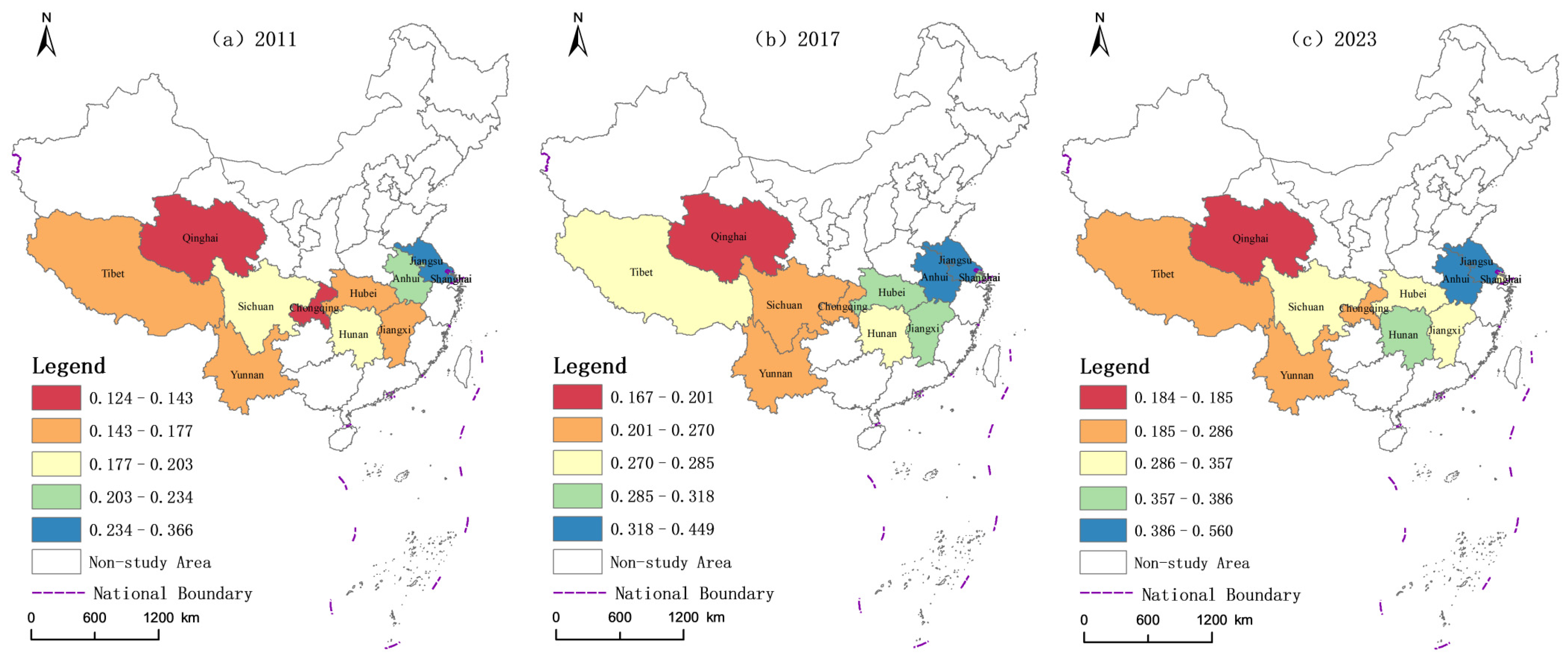
Based on the constructed indicator system and the results of the entropy weighting method, this study measures the composite scores of tourism economic resilience for 11 provinces in the Yangtze River Basin from 2011 to 2023. From a temporal perspective, tourism economic resilience in the Yangtze River Basin as a whole exhibits a steady upward trend. However, substantial interprovincial disparities persist, and regional heterogeneity has become increasingly pronounced. Table 1 reports the composite resilience scores for each province over the study period. To more intuitively illustrate spatial differences, graded choropleth maps are constructed for three representative years—2011, 2017, and 2023 (Figure 1).
Figure 1a presents the spatial distribution of tourism economic resilience across provinces in the Yangtze River Basin in 2011. Overall, a clear stepwise pattern characterized by “high levels in the east and low levels in the west” is observed. High-resilience provinces are primarily concentrated in the eastern coastal areas, where index values generally exceed 0.234, forming a distinct high-value cluster. In contrast, most central and western provinces exhibit relatively low resilience levels, with values largely below 0.177. Notably, several western provinces fall into the lowest category (0.124–0.143), indicating pronounced regional development imbalances.
Figure 1b depicts the spatial distribution pattern in 2017. Compared with 2011, the classification intervals shift upward overall, reflecting an improvement in the general level of tourism economic resilience. The eastern high-value cluster becomes more consolidated and expands modestly, while parts of the central region move into the second tier (0.201–0.270), suggesting a gradual diffusion trend from east to west. Nevertheless, improvements in the western low-value regions remain limited, and absolute interregional disparities persist.
Figure 1c illustrates the spatial distribution pattern in 2023. The agglomeration of high-resilience provinces (≥0.318) becomes more pronounced, and the leading position of the eastern region is further reinforced. The central region experiences a notable overall improvement, with most provinces entering the 0.270–0.318 range. However, several western provinces continue to lag behind, remaining in the lower range of 0.167–0.201. As a result, regional development gradients persist, and the spatial differentiation pattern shows a tendency toward consolidation alongside overall improvement.
Overall, although tourism economic resilience in the Yangtze River Basin has improved steadily during the study period, spatial heterogeneity remains a salient feature, with the persistent gap between the eastern region and other areas constituting a key structural characteristic of regional development.

4.2. Data Sources and Processing

Based on information obtained from the Yangtze River Water Resources Network, provinces located along the main stream of the Yangtze River were identified, while provinces situated solely along tributaries were excluded. Accordingly, this study examines 11 provinces (autonomous regions and municipalities) within the Yangtze River Basin over the period from 2011 to 2023. The data were primarily sourced from the China Statistical Yearbook, China City Statistical Yearbook, China Tourism Statistical Yearbook, China Culture and Tourism Statistical Yearbook, as well as provincial and municipal statistical yearbooks and statistical bulletins. Additional data were collected from the EPS database and the Digital Finance Research Center of Peking University. Missing observations for certain years and regions were supplemented using linear interpolation.

4.3. Variable Definitions

4.3.1. Tourism Economic Resilience (Res)

There is no universally accepted framework for evaluating tourism economic resilience. When the concept of resilience was first introduced into economic analysis, Martin proposed a framework encompassing four dimensions: resistance, recovery, reorganization, and renewal [2], and subsequent studies have widely adopted this framework. Owing to differences in research objectives and analytical perspectives, scholars often integrate and adjust resilience-related indicators across different dimensions. For example, Wang et al. classified tourism resilience indicators into resistance, recovery, adjustment, and renewal capacities [50]. In their framework, tourism fixed asset investment is categorized under adaptability, while the proportion of inbound tourism revenue and the number of college students are assigned to renewal capacities. By contrast, Wang et al. divided tourism resilience into resistance, recovery, and renewal [33]. In this classification, tourism fixed asset investment and the proportion of tourism revenue are regarded as indicators of resilience, whereas the number of secondary school students is incorporated into the renewal dimension.
Building on existing scholarly research, this study draws on References [22,51] to construct an evaluation index system for tourism economic resilience. The system comprises three dimensions—resistance capacity, recovery capacity, and renewal capacity—and includes 14 specific indicators (Table 2). The entropy method is employed to compute the composite index. Following Luo et al., two secondary indicators are constructed to measure tourism industrial structure optimization, namely tourism industrial structure rationalization and tourism industrial structure upgrading [52]. These are proxied by the ratio of total tourism revenue to the value added of the tertiary industry and the ratio of tourism value added to the value added of the tertiary industry, respectively.
First, resistance capacity comprises tourism resource endowment, environmental governance, rationalization of the tourism industrial structure, and upgrading of the tourism industrial structure, reflecting the ability of the tourism system to maintain stability when confronted with external shocks. Tourism resource endowment captures the richness and attractiveness of tourism-related assets within a region; abundant tourism resources enhance a region’s ability to withstand adverse disturbances. However, tourism economic resilience depends not only on resource abundance, but also on the broader economic foundation that sustains the continuous operation of the tourism industry. The overall scale and strength of the regional economy determine critical conditions, including infrastructure development, public service provision capacity, market demand size, and fiscal support capability, all of which provide essential support for the tourism sector in resisting shocks. Accordingly, total GDP is employed as one indicator to reflect the economic foundation underlying tourism resource endowment.
With respect to environmental governance, a sound ecological environment constitutes a fundamental guarantee for the sustainable development of tourism. The green coverage rate is used to represent regional ecological conditions [53], while the ratio of total environmental governance expenditure to GDP measures the intensity and priority of local environmental governance efforts. As an integral component of the tourism economy, the tourism industry plays a pivotal role within the tertiary sector. Drawing on Luo Yanju et al. [52], the rationalization and upgrading of the tourism industrial structure are incorporated to better capture the structural role of tourism within the service economy.
Second, recovery capacity encompasses three dimensions: tourism economic vulnerability, tourism infrastructure, and consumption potential. Tourism economic vulnerability is measured using three indicators: the centralized sewage treatment rate, the harmless domestic waste treatment rate, and the regional unemployment rate. Tourism infrastructure includes transportation, accommodation, catering, cultural and entertainment, as well as safety and sanitation facilities. Subject to data availability, the number of star-rated hotels, travel agencies, 5A scenic spots, and related employees are adopted as proxy indicators. Consumption potential is measured by residents’ disposable income, reflecting the capacity of local demand to support tourism development.
Third, renewal capacity is reflected in tourist turnover and innovation capacity within the tourism sector. Tourist turnover is measured by tourist throughput, which indicates the level of market dynamism and the efficiency of tourism resource utilization in a region. Meanwhile, government expenditures related to innovation and relevant output outcomes signal the presence of a supportive innovation environment, which facilitates product upgrading and service model optimization in the tourism sector. These factors collectively enhance the adaptability, transformation capacity, and long-term sustainability of tourism economic development.

4.3.2. Digital Economy (Dig)

Following Zhao et al. and Gao et al., the level of digital economy development is comprehensively measured across three dimensions: digital infrastructure, digital industrialization, and industrial digitalization [54,55]. The corresponding evaluation index system is reported in Table 3, and indicator weights are determined using the entropy method. Data for the Digital Inclusive Finance Index are obtained from the Digital Finance Research Center of Peking University [56].
First, the digital foundation comprises digital infrastructure and the broader economic development environment. Digital infrastructure primarily captures the hardware conditions that support regional digital transformation, including the number of domain names, mobile phone penetration rate, length of optical fiber cables, and the number of internet access ports. Collectively, these indicators constitute the fundamental support system for the development of the digital economy.
The economic development environment reflects the macroeconomic conditions underpinning the adoption and diffusion of digital technologies. It is measured by per capita GDP, residents’ consumption level, and the tourism and outbound consumption price index. With the widespread use of digital platforms, online price comparison systems, and real-time information disclosure mechanisms, price formation in the tourism market has become increasingly transparent and efficient. In this context, the tourism and outbound consumption price index serves not only as a conventional indicator of price fluctuations, but also, to some extent, as a proxy for the external economic environment shaped by digital infrastructure through enhanced information transmission efficiency and improved market mechanisms.
Second, the digital industry refers to the industrial scale generated by digital technologies themselves, particularly the output capacity of core digital economy sectors such as telecommunications and information technology services. In terms of development scale, the total volume of telecommunications and postal services is employed to reflect the output capacity of communication and digital services. Regarding core human capital reserves, the number of employees in information transmission, computer services and software industries, as well as those in transportation, warehousing, and postal services, are adopted as representative indicators.
Finally, industrial digitalization encompasses digital inclusive finance and industrial innovation, representing the extent to which the tourism industry undergoes transformation through digital technologies and reflecting the integrative application effects of the digital economy across sectors.

4.3.3. Mediating Variables

Two mediating variables are incorporated in this study. The first is openness (open), measured by the ratio of total imports and exports to GDP, which reflects a region’s degree of internationalization and integration into global markets. Regions with higher levels of digital economy development tend to exhibit greater openness, facilitating international tourist flows and improving tourism service facilities, thereby enhancing tourism economic resilience.
The second mediating variable is technological innovation (tech), measured by the proportion of invention patent applications in total patent applications. A higher level of technological innovation indicates stronger research and development capability and greater potential for commercialization, enabling tourism enterprises to optimize product supply, improve service efficiency, enhance visitor experience, and strengthen their resilience to market fluctuations.

4.3.4. Control Variables

To mitigate potential bias in the baseline regression arising from omitted variables, this study follows relevant literature and incorporates a set of control variables. Regional economic level (area) reflects market demand and regional supply capacity and may influence tourism economic resilience through channels such as tourism consumption potential, infrastructure investment, and service quality provision; it is measured by GDP per capita. Tax burden level (tax), expressed in logarithmic form, captures the fiscal pressure faced by local governments and may affect tourism investment as well as the intensity of policy support. Government intervention level (fis) reflects the extent of governmental involvement in economic activities and may influence tourism infrastructure development and industrial policy orientation; it is measured as the ratio of government expenditure to GDP. Transportation infrastructure (tran) is measured by the sum of the logarithms of highway mileage and freight volume. Specifically, freight volume reflects tourism market demand and regional carrying capacity, while highway mileage represents transportation accessibility; higher accessibility facilitates tourist mobility and destination reachability. Financial development level (fin) is measured by the ratio of the balance of deposits and loans of financial institutions to GDP. Descriptive statistics for the main variables are reported in Table 4.

4.4. Econometric Model Specification

4.4.1. Baseline Regression Model

This study employs a fixed-effects panel model as the baseline regression framework to examine the impact of digital economy development on tourism economic resilience in the Yangtze River Basin. The fixed-effects specification effectively controls for unobservable, time-invariant regional heterogeneity—such as historical development trajectories, institutional settings, and geographical endowments—thereby alleviating omitted variable bias and enhancing the credibility of the estimation results.
Nevertheless, the fixed-effects model has inherent limitations, including its inability to identify the effects of time-invariant explanatory variables and its reliance on within-region temporal variation for coefficient estimation. Considering the structure of the panel data and the research objectives of this study, the fixed-effects model is therefore adopted as the primary empirical strategy for baseline regression analysis. The model is specified as follows:
r e s i t = α 0 + α 1 d i g i t + α 2 c o n t r o l s i t + η i + θ t + ε i t
where resit denotes tourism economic resilience, digit represents the level of digital economy development, and controlsit is a vector of control variables. The terms ηi and θt capture province-specific fixed effects and time fixed effects, respectively, while εit denotes the random disturbance term. Subscripts i and t index provinces and years, respectively. The constant term is denoted by α0, α1 and α2 are the estimated coefficients measuring the effects of the digital economy and control variables on tourism economic resilience.

4.4.2. Mediating Effect Model

To further investigate the mechanisms through which the digital economy influences tourism economic resilience, this study constructs a mediation analysis framework to examine the transmission pathways of the digital economy’s effects. The corresponding models are specified as follows:
M e d i t 1 i t = β 0 + β 1 d i g i t + β 2 c o n t r o l s i t + η i + θ t + ε i t
M e d i t 2 i t = β 0 + β 1 d i g i t + β 2 c o n t r o l s i t + η i + θ t + ε i t
r e s = β 0 + β 1 d i g i t + M e d i t 1 i t + β 2 c o n t r o l s i t + η i + θ t + ε i t
r e s = β 0 + β 1 d i g i t + M e d i t 2 i t + β 2 c o n t r o l s i t + η i + θ t + ε i t
where Medit1it denotes the mediating variable representing the level of openness to the outside world (open), and Medit2it denotes the mediating variable representing the level of technological innovation (tech). The term β0 is the constant, while β1 and β2 are the estimated coefficients capturing the effects of the digital economy and the vector of control variables, respectively. Other terms are defined consistently with the baseline model.

4.4.3. Spatial Panel Durbin Model

Specification of Spatial Weight Matrix: The construction of a spatial econometric model requires the specification of an appropriate spatial weight matrix. This study adopts a geographic distance–based weight matrix (W1), defined as the inverse of the squared geographical distance between provinces. Given that both digital economy development and tourism activities are closely associated with spatial proximity, geographical distance plays an important role in shaping tourism-related interactions and preferences. Accordingly, a distance-based spatial weight matrix is employed to capture spatial dependence in tourism economic resilience.
Spatial Autocorrelation Model: Prior to estimating the Spatial Durbin Model (SDM), it is necessary to examine whether spatial dependence exists in the dependent and explanatory variables. This study applies the global Moran’s I index to test for spatial autocorrelation in tourism economic resilience and the digital economy. The corresponding calculation is expressed as follows:
I = i = 1 n j = 1 n w i j x i x ¯ x j x ¯ S 2 i = 1 n j = 1 n w i j
where I denotes the global Moran’s I statistic; n represents the number of spatial units; Wij denotes the spatial weight between units i and j; subscripts i and j index spatial units; xi and xj denote the tourism economic resilience values of units i and j, respectively; and x ¯ represents the mean value of tourism economic resilience across all spatial units.
Spatial Durbin Model: This study constructs a spatial panel Durbin model (SDM) with two-way fixed effects to examine the spatial spillover effects of the digital economy on tourism economic resilience. The model is specified as follows:
r e s i t = ρ i = 1 n W i j r e s + α 0 + α 1 d i g i t + α 1 c o n t r o l s i t + μ j = 1 n W i j d i g i t + φ j = 1 n W i j c o n t r o l s i t + η i + θ t + ε i t
where ρ, μ, and ϕ denote the spatial lag coefficients of the dependent variable, the digital economy, and the control variables, respectively. The terms ηi and ηt represent individual (province-specific) fixed effects and time fixed effects, respectively, while εit is the random disturbance term.

5. Results and Analysis

5.1. Baseline Regression Results

Control variables, including the regional economic development level and tax burden level, are gradually introduced into the regression models, and the corresponding estimation results are reported in Table 5. The results show that regardless of whether the digital economy variable is included alone or control variables are sequentially added, the coefficient of the digital economy remains significantly positive at the 1% level. This finding indicates that the development of the digital economy effectively enhances tourism economic resilience by strengthening the tourism industry’s capacity to cope with external shocks through optimized resource allocation and diversified development pathways. Accordingly, Hypothesis H1 is supported.
With respect to the control variables, the regional economic development level and tax burden level exhibit significantly negative coefficients in the stepwise regressions. One possible explanation is that excessive concentration of economic resources in specific areas may hinder balanced intra-provincial development, leading to inefficiencies in the allocation of tourism resources. In addition, a high tax burden increases operational pressure on tourism enterprises, which may reduce service efficiency and deteriorate the tourism environment, thereby weakening tourism economic resilience. In the full model, government intervention level and transportation infrastructure display significantly positive coefficients, suggesting that supportive government policies and improved transportation conditions enhance tourist confidence and contribute to the stability of tourism-related enterprises. Improved transportation infrastructure also expands tourism accessibility for diverse population groups, thereby broadening the effective demand base.

5.2. Endogeneity Test

To address potential endogeneity concerns in the baseline regression, this study adopts an instrumental variable (IV) approach. A valid instrument must be correlated with the endogenous explanatory variable while remaining exogenous to the dependent variable. Following prior studies, provincial-level postal business volume (iv1) and telecommunications business volume (iv2) are selected as instrumental variables for the digital economy [57].
With respect to relevance, postal and telecommunications business volume is widely used as an indicator of the development foundation of regional information and communication infrastructure, reflecting the historical accumulation upon which the formation and expansion of the digital economy depend. As the digital economy advances, demand for information transmission, data exchange, and network services has increased substantially. Consequently, a stable and close relationship exists between the scale of postal and telecommunications services and the level of digital economy development, indicating that the selected instrumental variables satisfy the relevance requirement with respect to the explanatory variable.
With respect to exogeneity, postal and telecommunications systems primarily function as general-purpose communication infrastructure, and their business volume does not directly reflect tourism activities or tourism resource endowments. The influence of postal and telecommunications services on tourism economic resilience mainly operates indirectly through their role in promoting regional digitalization, such as facilitating the development of online tourism platforms, the diffusion of digital payment systems, and improvements in information transmission efficiency. Moreover, after controlling for factors including regional economic development level, transportation infrastructure conditions, and fiscal capacity, the probability that postal and telecommunications business volume directly affects tourism economic resilience through alternative channels is relatively low. Therefore, the exogeneity assumption of the selected instrumental variables is well justified.
As reported in Table 6, the estimated coefficients of the digital economy remain significantly positive at the 1% level when either instrument is used individually or when both are employed jointly. Moreover, the Kleibergen–Paap LM statistics are significant, and the corresponding Wald F-statistics (101.945, 106.242, and 133.088) exceed conventional critical values, indicating the absence of under-identification and weak instrument problems. Overall, these results confirm the robustness of the estimation results and the validity of the selected instrumental variables.

5.3. Robustness Tests

To further verify the robustness of the baseline regression results and to address potential sensitivity to model specification, variable measurement, and estimation strategy, this study conducts robustness checks from multiple perspectives using four alternative approaches. The detailed results are reported in Table 7. First, the dependent variable is replaced with an index constructed using principal component analysis (PCA). Second, a dummy variable for the COVID-19 pandemic is incorporated to assess the potential impact of this unexpected public health shock on the regression results. Given that COVID-19 first emerged in China in December 2019 and was declared by the World Health Organization in May 2023 as no longer constituting a Public Health Emergency of International Concern (PHEIC), this study defines the period from 2020 to 2023 as the pandemic impact phase. Accordingly, a COVID-19 dummy variable (COVID) is constructed, which takes the value of 1 for the years 2020–2023 and 0 otherwise [58]. Third, extreme values are excluded to mitigate the influence of outliers. Finally, an additional control variable—financial development level—is incorporated into the model.
Across all robustness specifications, the coefficient of the digital economy remains significantly positive at the 1% level, further confirming the conclusion that digital economy development plays a positive role in enhancing tourism economic resilience. Notably, the financial development variable exhibits a negative coefficient, which may reflect the tendency of financial systems to favor high-return sectors such as real estate and manufacturing over tourism. This bias potentially constrains financing access for tourism enterprises and, in turn, weakens tourism economic resilience.

5.4. Mediating Effects of the Digital Economy

The mediating effects of openness and technological innovation are reported in Table 8. Column (1)–(3) presents the baseline regression results. Column (4) indicates that the digital economy significantly promotes openness at the 1% significance level, with a coefficient of 0.9196, thereby supporting Hypothesis H2a. Column (5) further shows that the digital economy exerts a significantly positive effect on technological innovation. Taken together, these results confirm that openness and technological innovation function as important mediating channels through which the digital economy enhances tourism economic resilience, thus providing empirical support for Hypothesis H2b.
The negative coefficient of the mediating variable may reflect an inhibiting effect. First, diagnostic tests are conducted to examine whether the sign reversal is driven by excessive correlation among explanatory variables. Although some degree of correlation exists, it does not appear sufficient to fully account for the observed negative coefficients. Therefore, the negative mediating effect is unlikely to be solely attributable to multicollinearity. Second, although the development of the digital economy significantly promotes higher levels of openness and technological innovation, it may simultaneously intensify interregional competition and factor agglomeration. After controlling for the level of digital economic development, the residual effects of openness and technological innovation are more likely to manifest as a crowding-out of tourism-related factors, thereby marginally weakening tourism economic resilience in certain regions.
This phenomenon is particularly pronounced in the spatial context of the Yangtze River Basin, where digital economic development tends to attract innovation resources toward core cities, while peripheral areas face the risk of a siphoning of tourism-related labor, capital, and market attention. Consequently, even regions characterized by relatively high levels of openness or technological investment may still experience suppressed tourism economic resilience.

5.5. Heterogeneity Analysis

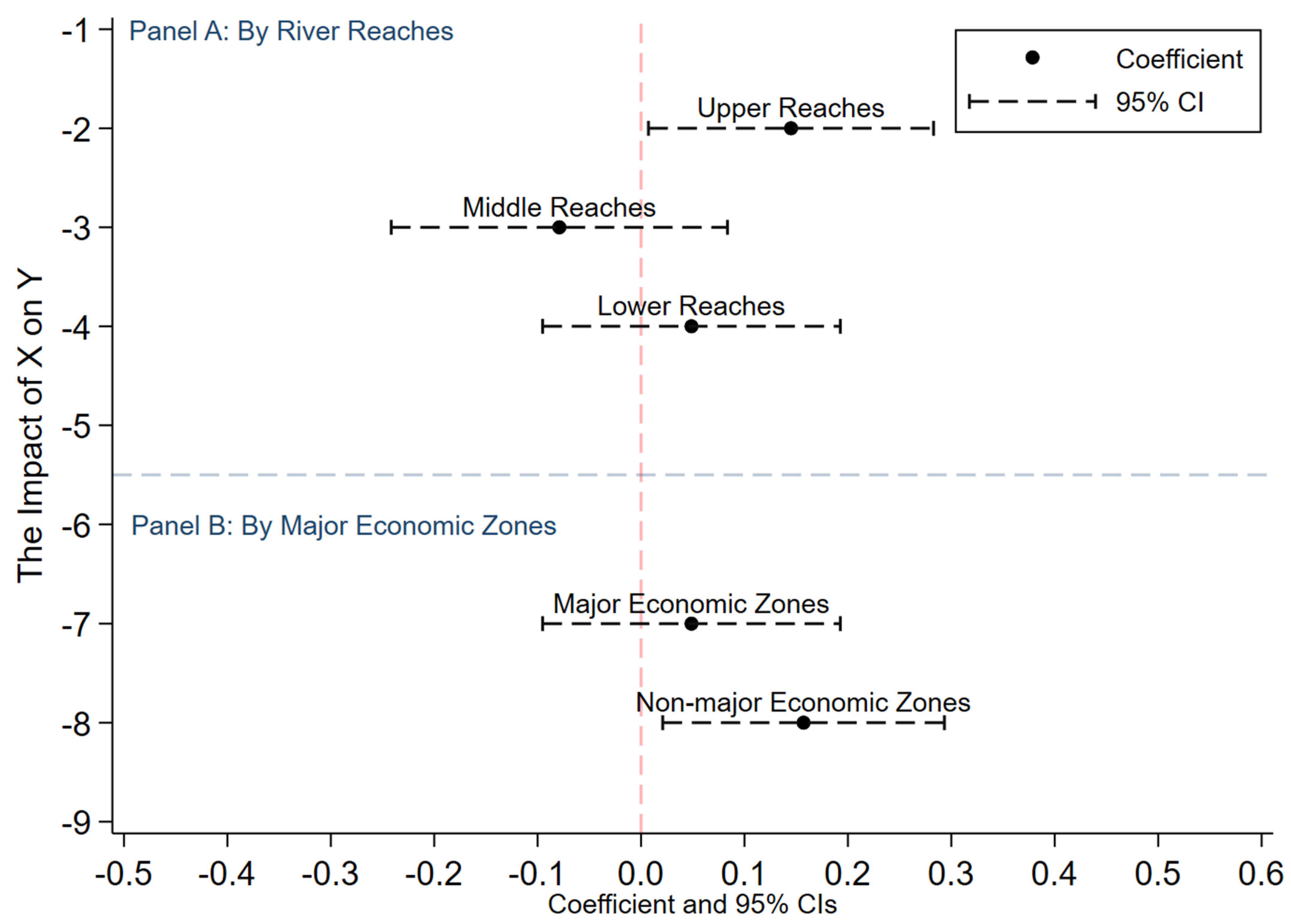
First, following Qi [59], this study conducts a heterogeneity analysis by classifying provinces according to whether they are located within the Bohai Rim Economic Circle, the Yangtze River Delta Economic Circle, or the Pearl River Delta Economic Circle. The corresponding results are reported in Columns (1)–(2) of Table 9. The findings indicate substantial heterogeneity across groups. Specifically, the regression coefficient of the digital economy is significantly positive at the 5% level for provinces within the three major economic circles, while for provinces outside these core economic circles, the coefficient is significant at the 1% level and exhibits stronger statistical significance (Figure 2). This suggests that the digital economy exerts a more pronounced positive effect on tourism economic resilience in non-core economic circle provinces. A plausible explanation is that provinces with relatively weaker economic foundations experience larger marginal gains from digital empowerment, which helps compensate for structural deficiencies inherent in traditional development models. In such regions, conventional tourism infrastructure and service systems are often underdeveloped. By contrast, digital access—such as online booking, digital marketing, mobile payment, and intelligent service platforms—can rapidly offset shortcomings in offline capabilities, substantially reduce operating costs, expand tourism markets, and enhance adaptability and adjustment efficiency when responding to external shocks.
Second, provinces are further classified into upper, middle, and lower reaches of the Yangtze River Basin. Given that the majority of the land areas of Hubei and Jiangxi are located in the middle reaches, these two provinces are categorized as midstream regions. The results of the corresponding heterogeneity analysis are presented in Columns (3)–(5) of Table 9. The findings reveal significant differences across the three subregions. The regression coefficient of the digital economy is significantly positive at the 1% level in the upper reaches and at the 5% level in the lower reaches, whereas it is not statistically significant in the middle reaches. One possible explanation is that the lower reaches—characterized by rapid urbanization, strong population agglomeration, and concentrated educational resources—possess a clear advantage in digital industry development. These regions can continuously supply high-skilled labor and leverage mature internet ecosystems to facilitate knowledge exchange and technological spillovers, thereby accelerating digital technology iteration and business model innovation and strengthening regional economic resilience. Moreover, well-developed transportation infrastructure and efficient logistics systems reduce factor mobility costs, creating favorable conditions for the expansion of the digital economy. This virtuous cycle enables the tourism industry to demonstrate stronger adaptability and recovery capacity when facing external shocks.
By contrast, the upper reaches mainly consist of regions receiving strong national policy support, such as those covered by the Western Development Strategy and the Chengdu–Chongqing Twin-City Economic Circle. These areas benefit from sustained policy dividends in digital infrastructure deployment, fiscal transfer payments, and industrial guidance. Such policies not only directly enhance digital network coverage but also promote the digitalization of tourism public services through “new infrastructure” initiatives, thereby strengthening the systemic resilience of the tourism industry. While the middle reaches tend to bear a greater concentration of traditional manufacturing and heavy industries, where industrial structural transformation progresses more slowly. Tourism resources in these regions are often highly homogeneous with those of neighboring provinces, making it difficult to establish differentiated competitive advantages. In addition, weaker talent agglomeration and limited knowledge spillover effects constrain technological innovation and inter-industry collaboration. Consequently, the level of digital economy development in the middle reaches lags behind that of both the upper and lower reaches, thereby restricting the potential for enhancing local tourism economic resilience.

5.6. Spatial Spillover Effects of the Digital Economy

The application of spatial econometric models requires preliminary testing to determine the appropriate model specification. The results of the LM test and the Wald test both passed the significance test at the 5% level or above, indicating that the Spatial Durbin Model (SDM) is the most appropriate specification. Furthermore, the LR test is significant at the 1% levels, respectively, suggesting that a two-way fixed effects specification should be adopted (see Table 10). In addition, the global Moran’s I indices for both the digital economy and tourism economic resilience are significantly positive at the 10% level in most years, with only a few exceptions. This finding indicates the existence of spatial dependence and provides empirical justification for employing spatial econometric methods (see Table 11). Accordingly, based on a comprehensive set of diagnostic tests and model selection criteria, this study ultimately adopts a spatial panel Durbin model with two-way fixed effects to examine the spatial spillover effects of the digital economy on tourism economic resilience.
The estimation results of the spatial Durbin model, based on the inverse squared geographical distance weight matrix, are reported in Table 12. The coefficient of the digital economy’s direct effect on local tourism economic resilience is 0.0959 and is significant at the 1% level, indicating a strong local enhancement effect. By contrast, the spatial spillover coefficient is −0.327 and is significant at the 10% level, suggesting a negative spillover effect on neighboring provinces. These findings indicate that while the digital economy significantly improves local tourism economic resilience, it simultaneously exerts a suppressive influence on surrounding regions, thereby validating Hypothesis H3.
The effect decomposition results based on the Spatial Durbin Model indicate that the impact of the digital economy on tourism economic resilience exhibits pronounced spatial heterogeneity (Table 13). By decomposing the total effect of the digital economy into direct and indirect components, the results show that the direct effect has a coefficient of 0.130, which is significantly positive at the 1% level and consistent in direction with both the baseline regression and the main spatial estimation results. This finding suggests that the development of the digital economy significantly enhances local tourism economic resilience. By contrast, the indirect effect is significantly negative at the 5% level, with a coefficient of −0.260, indicating that the digital economy exerts a significant inhibitory effect on the tourism economic resilience of neighboring regions. This result implies the existence of a spatial “siphoning effect”, whereby the expansion of the digital economy may generate negative spillovers to adjacent regions through mechanisms such as factor agglomeration and resource reallocation. This finding is consistent with the conclusions of Liu et al., who demonstrate that although data capital at the provincial level significantly promotes local economic growth, it simultaneously produces a suppressive effect on neighboring provinces [60].
The formation of the siphoning effect can be attributed to several interrelated factors. First, regions with more advanced digital economies tend to attract tourism enterprises, skilled labor, and capital through digital platforms, gradually forming “digital tourism hubs”, while neighboring provinces face the risk of factor outflows [61]. Second, algorithm-driven recommendation mechanisms and Matthew effects on tourism platforms such as Ctrip and Qunar cause tourist flows to concentrate disproportionately in highly digitalized destinations, thereby crowding out tourism demand in adjacent regions. Third, inefficiencies in the cross-regional sharing of tourism data elements hinder coordinated development between leading tourism provinces and their neighbors, resulting in highly digitalized regions becoming “digital tourism islands”. Finally, disparities in digital tourism infrastructure construction across regions lead to uneven improvements in tourism risk resistance: while digitally advanced provinces experience enhanced resilience, neighboring regions remain relatively disadvantaged. Collectively, these factors give rise to a spatial pattern characterized by “local enhancement but neighboring suppression” of tourism economic resilience driven by the digital economy [62].

6. Discussion and Conclusions

6.1. Conclusions

Based on panel data from 11 provinces (including autonomous regions and municipalities) in the Yangtze River Basin over the period 2011–2023, this study employs the entropy method to construct an evaluation system for tourism economic resilience, examines its evolutionary characteristics through mediation and heterogeneity analyses, and applies a Spatial Durbin Model to investigate the direct, spillover, and total effects of key influencing factors. The main conclusions are summarized as follows: the empirical results indicate that the digital economy significantly enhances tourism economic resilience. Government policy support strengthens market confidence by optimizing the tourism development environment, while improvements in transportation infrastructure expand the reach of tourist source markets and improve the efficiency of tourism resource utilization. With respect to mediating mechanisms, openness to the outside world reduces cross-border barriers and promotes interactions among capital flows and tourist movements, thereby weakening geographical constraints and accelerating the integration of domestic and international tourism factors. This process enhances the adaptability and stability of the tourism economy when confronted with external shocks such as policy adjustments and market fluctuations. Technological innovation reflects the deep transformation of the tourism industry toward intelligence and digitalization. Through intelligent management technologies, service process optimization, and business model innovation, technological innovation effectively improves resource allocation efficiency and systemic crisis response capacity, thereby strengthening resistance to disturbances and recovery performance and consolidating the foundation of tourism economic resilience. In terms of heterogeneity, the positive effect of the digital economy on tourism economic resilience is more pronounced in the upper and lower reaches of the Yangtze River Basin and in provinces located within the three major economic circles, while the effect is relatively weaker in the middle reaches. Regarding spatial spillover effects, the impact of the digital economy on tourism economic resilience exhibits significant spatial disparities: the local effect is significantly positive, whereas negative spillover effects are observed in neighboring provinces, giving rise to a spatial “siphoning effect”.

6.2. Policy Implications

Based on the research findings, this study proposes the following policy recommendations for promoting the sustainable development of tourism economic resilience through the digital economy in the Yangtze River Basin. First, promote the digital upgrading of the tourism industry to enhance overall tourism economic resilience. Policymakers should accelerate the deep application of digital technologies in the tourism sector by leveraging big data, artificial intelligence, and related technologies to improve coordination efficiency along the tourism industrial chain and reduce information asymmetry. Meanwhile, multi-industry integration under the “tourism +” model should be encouraged to build a diversified and resilient tourism industrial ecosystem. In addition, tourism crisis management mechanisms should be improved to enable dynamic risk monitoring, early warning, and rapid response, thereby strengthening the industry’s capacity to cope with external shocks. Second, advance high-level openness while fostering a balanced dual-circulation development pattern. In the process of opening up, greater emphasis should be placed on balanced development. While promoting the digitalization of cross-border tourism, policy guidance should be employed to diversify tourist source markets, with particular attention to strengthening the domestic tourism market. This approach will help form a dual-circulation development pattern characterized by mutual reinforcement between domestic and international markets, thereby mitigating the impacts of external environmental fluctuations and enhancing the stability and resilience of the tourism economic system. Third, harness the spillover and driving effects of the digital economy to narrow spatial disparities in tourism resilience. Cross-regional tourism data-sharing platforms should be established to integrate tourism resource information across regions, dismantle data barriers, and realize resource complementarity. Furthermore, paired cooperation mechanisms between digitally advanced and less-developed regions should be promoted. Through a “core-driven periphery” approach, smart tourism service standards and digital management experience can be diffused more effectively, facilitating the equitable distribution of digital economy dividends and gradually narrowing spatial disparities in tourism economic resilience across provinces.

Author Contributions

Conceptualization, J.Z. and Y.S.; Methodology, J.Z., K.F., Y.S. and J.Y.; Software, J.Y.; Validation, J.Z., K.F. and J.Y.; Formal analysis, J.Z., K.F., Y.S. and J.Y.; Investigation, J.Z. and J.Y.; Resources, J.Z. and J.Y.; Data curation, J.Z., K.F. and J.Y.; Writing—original draft, J.Z., K.F., Y.S. and J.Y.; Writing—review and editing, J.Z., K.F., Y.S. and J.Y.; Visualization, J.Z. and Y.S.; Supervision, J.Z.; Project administration, J.Z.; Funding acquisition, J.Z. All authors have read and agreed to the published version of the manuscript.

Funding

This paper was supported by Youth Science and Technology Talent Sailing Program Project of Shanghai Science and Technology Commission (23YF1413700), Research Project of China Association of Trade in Services (CATIS-PR-260133), Youth Foundation Project of Ministry of Education Humanities and Social Sciences (24YJC910011).

Institutional Review Board Statement

Not applicable.

Informed Consent Statement

Not applicable.

Data Availability Statement

The data are available from the corresponding author upon reasonable request.

Conflicts of Interest

The authors declare no conflicts of interest.

References

  1. Wang, J.; Wei, R.J. The Impact and Time-varying Effects of Economic Policy Uncertainty on China’s Inbound Tourism Development. J. Tech. Econ. Manag. 2024, 10, 134–140. [Google Scholar]
  2. Martin, R.; Sunley, P.; Gardiner, B.; Tyler, P. How regions react to recessions: Resilience and the role of economic structure. Reg. Stud. 2016, 50, 561–585. [Google Scholar] [CrossRef]
  3. Romão, J. Tourism, smart specialisation, growth, and resilience. Ann. Tour. Res. 2020, 84, 102995. [Google Scholar] [CrossRef]
  4. Reggiani, A. Network resilience for transport security: Some methodological considerations. Transp. Policy 2013, 28, 63–68. [Google Scholar] [CrossRef]
  5. Martin, R. Regional economic resilience, hysteresis and recessionary shocks. J. Econ. Geogr. 2012, 12, 1–32. [Google Scholar] [CrossRef]
  6. Eraydin, A. Attributes and characteristics of regional resilience: Defining and measuring the resilience of Turkish region. Reg. Stud. 2016, 50, 600–614. [Google Scholar] [CrossRef]
  7. Martin, R.; Sunley, P. On the notion of regional economic resilience: Conceptualization and explanation. J. Econ. Geogr. 2015, 15, 1–42. [Google Scholar] [CrossRef]
  8. Reggiani, A.; Graaff, D.T.; Nijkamp, P. Resilience: An evolutionary approach to spatial economic systems. Netw. Spat. Econ. 2002, 2, 211–229. [Google Scholar] [CrossRef]
  9. Rizzi, P.; Graziano, P.; Dallara, A. A capacity approach to territorial resilience: The case of European regions. Ann. Reg. Sci. 2018, 60, 285–328. [Google Scholar] [CrossRef]
  10. Hill, E.; Wial, H.; Wolman, H. Exploring Regional Economic Resilience; Working Paper; Institute of Urban and Regional Development, University of California, Berkeley: Berkeley, CA, USA, 2008; pp. 1–12. [Google Scholar]
  11. Fingleton, B.; Garretsen, H.; Martin, R. Recessionary shocks and regional employment: Evidence on the resilience of UK regions. J. Reg. Sci. 2012, 52, 109–133. [Google Scholar] [CrossRef]
  12. Doran, J.; Fingleton, B. Employment resilience in Europe and the 2008 economic crisis: Insights from micro-level data. Reg. Stud. 2016, 50, 644–656. [Google Scholar] [CrossRef]
  13. Shao, Y.W.; Xu, J. Understanding urban resilience: A conceptual analysis based on integrated international literature review. Urban Plan. Int. 2015, 30, 48–54. [Google Scholar]
  14. Rose, A. Economic resilience to natural and man- made disasters: Multidisciplinary origins and contextual dimensions. Environ. Hazards 2007, 7, 383–398. [Google Scholar] [CrossRef]
  15. Cerra, V.; Saxena, S.C. Growth dynamics: The myth of economic recover. Am. Econ. Rev. 2008, 98, 439–457. [Google Scholar] [CrossRef]
  16. Cerra, V.; Panizza, U.; Saxena, S.C. International evidence on recovery from recession. Contemp. Econ. Policy 2013, 31, 424–439. [Google Scholar] [CrossRef]
  17. Simmie, J.; Martin, R. The economic resilience of regions: Towards an evolutionary approach. Camb. J. Reg. Econ. Soc. 2010, 3, 27–43. [Google Scholar] [CrossRef]
  18. Sun, J.W.; Sun, X.Y. Research progress of regional economic resilience and exploration of its application in China. Econ. Geogr. 2017, 37, 1–9. [Google Scholar]
  19. Xu, Y.Y.; Li, G.; Cui, S.H.; Xu, Y.P.; Pan, J.B.; Tong, N.J.; Xu, J.R.; Zhu, Y.G. Review and Perspective on Resilience Science: From Ecological Theory to Urban Practice. Acta Ecol. Sin. 2018, 38, 5297–5304. [Google Scholar] [CrossRef]
  20. Li, T.Y. New Progress in Study on Resilient Cities. Urban Plan. Int. 2017, 32, 15–25. [Google Scholar] [CrossRef]
  21. Wang, Q.; Zhao, L.; Yu, W.; Jia, J.Q. Spatial-Temporal Evolution Characteristics and Influencing Factors of Resilience of Tourism Economic System in China. Geogr. Geo-Inf. Sci. 2020, 36, 113–118. [Google Scholar]
  22. Sheng, Y.C.; Tan, Z.S.; Li, Q.; Xu, L.L. Can the digital economy promote the resilience of the tourism economy in the Yellow River Basin? Arid Land Geogr. 2023, 46, 1704–1713. [Google Scholar]
  23. Wu, D.D.; Feng, X.G.; Ma, R.F.; Hao, C.; Wu, Y. Nonlinear Effects of Digital Economy Development on Tourism Total Factor Productivity. Tour. Trib. 2023, 38, 47–65. [Google Scholar]
  24. Zhu, J.M.; Lu, X.L. Mechanism of impact and spatial effects of digital economy in enhancing tourism economic resilience. Prog. Geogr. 2024, 43, 2004–2020. [Google Scholar]
  25. Nikos, N.; Cathy, P.; Heather, S.; Chloe, S.; Gary, W. Tourism and hospitality industry resilience during the COVID-19 pandemic: Evidence from England. Curr. Issues Tour. 2022, 25, 46–59. [Google Scholar]
  26. Ma, X.F.; Hu, S.L. Spatiotemporal adaptation characteristics and influencing factors of tourism city resilience and residents’ happiness level: Taking Zhangjiajie City as an example. Resour. Sci. 2022, 44, 2373–2385. [Google Scholar] [CrossRef]
  27. Hu, Y.; Chen, Y.Q.; Li, Y. The Impact of Digital Economy on Urban Economic Resilience in the Yangtze River Delta Region. J. East China Norm. Univ. Humanit. Soc. Sci. 2022, 54, 143–154+175–176. [Google Scholar]
  28. Zhao, W.; Xu, X.W. Effect and Mechanism of Digital Economy on the Resilience of Agricultural Economy. J. S. China Agric. Univ. Soc. Sci. Ed. 2023, 22, 87–96. [Google Scholar]
  29. Xu, J.; Li, X.M. New Quality Productivity, Integration of Digital Economy and Real Economy, and Resilience of Industrial Chain and Supply Chain. Stat. Decis. 2025, 41, 11–16. [Google Scholar]
  30. Cheng, Y.J.; Liu, X.; Yang, L.J. Research on Spatio-temporal Differentiation and Grouping Mechanism of China’ s Digital Trade Resilience. J. Stat. Inf. 2025, 40, 47–58. [Google Scholar]
  31. Luo, W.B.; Zhang, B.; Zhang, C.; Tao, Y.T. Sci-Tech Finance Facilitates the Development of New Quality Productive Forces. Southwest Financ. 2025, 8, 45–55. [Google Scholar]
  32. Shen, C.R.; Gao, B. Digital-Real Industry Integration and Regional Innovation Ecosystem Resilience: From the Perspective of “Node-Line-Network” Industrial Network Structure. East China Econ. Manag. 2025, 40, 42–49. [Google Scholar]
  33. Wang, Z.F.; Zheng, S.J. Evolution of Spatio-temporal Patterns and Influencing Factors of Tourism Economic Resilience in the Wuling Mountains Area. Geogr. Geo-Inf. Sci. 2024, 40, 143–150. [Google Scholar]
  34. He, X.R.; Ren, D.C.; Xu, H.C. The Impact of Regional Tourism Industry Agglomeration on Resilience of Tourism Economy and its Spatial Effect: A Case Study of the Yangtze River Economic Belt. J. Nat. Sci. Hunan Norm. Univ. 2024, 47, 54–64. [Google Scholar]
  35. Chen, Q.C.; Wang, Z.F.; Qiu, M.Z.; Wang, W.L. Connotation Characteristics, Research Review, and Prospects of Digitalization in the Tourism Industry. Econ. Geogr. 2025, 45, 198–209. [Google Scholar]
  36. Li, Z.J. Exploration & Analysis on the Dynamic Mechanism and Way of Implementation of the Integrated Development of the Ice & Snow Industry and the Tourism Industry. China Sport Sci. Technol. 2019, 55, 56–62+80. [Google Scholar]
  37. Zhang, Y.D.; Li, R.D.; Zhao, M.; Liu, Y.G.; Li, M.H. Actual Dilemmas and Breakthrough Paths of Sustainable Development in Ice and Snow Tourism Driven by the Integration of Culture, Sports and Tourism Industries. J. Shenyang Sport Univ. 2025, 44, 110–116. [Google Scholar]
  38. Shi, J.Z.; Xu, Y.Y. Formation mechanism and development of new quality productive forces in tourism industry in the context of digital integration. J. Nat. Resour. 2025, 40, 2618–2632. [Google Scholar] [CrossRef]
  39. Su, J.; Du, J.W.; Jiao, C.H. High-Level Opening-Up and High-Quality Development of Cultural Trade—From the Evidence of the “Belt and Road” Initiative. Jianghan Trib. 2025, 7, 19–29. [Google Scholar]
  40. Wu, C.C.; Zhang, H. Promote the Construction of the New Development Pattern with High-Level Opening Up: From the Perspective of Chinese Imports. J. Party Sch. Cent. Comm. C.P.C. Chin. Acad. Gov. 2023, 27, 101–112. [Google Scholar]
  41. Song, R.; Yang, X.Y. Digital Economy Promotes the Construction of Modern Tourism System: Internal Logic and Countermeasures. Price Theory Pract. 2024, 5, 26–31. [Google Scholar]
  42. Lin, M.S.; Hu, X.P.; Yang, Y.; Zou, Y.G.; Wang, R.; Liu, H.J.; Chen, G.H.; Wang, X.J.; Chen, S.H.; Lin, J.; et al. The impact of flow economy on innovative development of tourism resources: Hot reaction and cold thinking. J. Nat. Resour. 2023, 38, 2237–2262. [Google Scholar] [CrossRef]
  43. Yang, H.C.; Zhong, Y.; Zhong, S.Q.; Li, L.S. The Impact of Digital Intelligence on the Resilience of Innovation Ecosystem: The Perspective of “Local-Neighborhood” Effect. Sci. Technol. Prog. Policy 2025, 42, 76–86. [Google Scholar]
  44. Zhang, Y.S.; Deng, S.Y.; Zhang, Y.X. Research on Urban Economic Resilience: Theoretical Progress and Future Directions. J. Manag. 2022, 35, 54–67. [Google Scholar]
  45. Zheng, M.Z.; Li, F.Q. Agglomeration of Producer Services and Urban Economic Resilience: Theoretical Foundations and Empirical Evidence. Stat. Decis. 2024, 17, 126–131. (In Chinese) [Google Scholar]
  46. Feng, X.G.; Li, Z.Y. New Quality Productivity and High-quality Development of Tourism: Driving Mechanism, Key Issues and Innovative Practice. Shanghai J. Econ. 2024, 9, 38–48+59. [Google Scholar]
  47. Hou, B.; Yang, J.; Yu, F.L. Deep Integration of Culture and Tourism for High-quality Development: Connotation, Motivation and Mechanism. J. Bus. Econ. 2020, 10, 86–96. [Google Scholar]
  48. Chen, L.L.; Xu, J.H.; Li, Y.J. High-quality Development of Digital Technology Enabled Tourism: Theoretical Mechanism and Path Exploration. Reform 2022, 2, 101–110. [Google Scholar]
  49. Sheng, B.; Liu, Y.Y. Research on the Measurement and Spatial Characteristics of China’ s Digital Economy. Nanjing J. Soc. Sci. 2022, 1, 43–54. [Google Scholar]
  50. Wang, X.Y.; Guo, L.Z. Spatiotemporal Characteristics and Configuration Mechanism of China’s Inbound Tourism Economic Resilience at the Provincial Level. Econ. Geogr. 2023, 43, 219–228. [Google Scholar]
  51. Dong, Y.J.; Zhang, Y.D. Resilience, efficiency improvement and growth recovery of China’s inbound tourism economy. J. Shaanxi Norm. Univ. Nat. Sci. Ed. 2023, 51, 1–11. [Google Scholar]
  52. Luo, Y.J.; Wei, R.H.; Huang, Y.; Duan, H.Y. Impact and pathways of the digital economy on carbon emission efficiency of the tourism industry. Stat. Decis. 2024, 40, 84–89. (In Chinese) [Google Scholar]
  53. Liao, L.P.; Du, M.Z.; Huang, J. The Effect of Urban Resilience on Residents’ Subjective Happiness: Evidence from China. Land 2022, 11, 1896. [Google Scholar] [CrossRef]
  54. Zhao, T.; Zhang, Z.; Liang, S.K. Digital Economy, Entrepreneurship, and High-Quality Economic Development: Empirical Evidence from Urban China. J. Manag. World 2020, 36, 65–76. [Google Scholar]
  55. Gao, Y.L.; Wang, Y. Exploration of the Impact and Mechanism of the Digital Economy on Industrial Resilience—Taking the tourism industry as an example. J. Commer. Econ. 2024, 22, 189–192. [Google Scholar]
  56. Guo, F.; Wang, J.Y.; Wang, F.; Kong, T.; Zhang, X.; Cheng, Z.Y. Measuring China’s Digital Financial Inclusion: Index Compilation and Spatial Characteristics. China Econ. Q. 2020, 19, 1401–1418. [Google Scholar]
  57. Wang, Z.R.; Dai, Z.Y. Digital Economy and Economic Resilience: Research Based on Provincial Panel Data. Enterp. Econ. 2024, 43, 150–160. [Google Scholar]
  58. Qian, H.Z.; Tao, Y.Q.; Cang, S.W.; Cang, Y.Y. Theoretical and Empirical Analysis on the Development of Digital Finance and Economic Growth in China. J. Quant. Technol. Econ. 2020, 37, 26–46. [Google Scholar]
  59. Qi, P.; Liu, P.Y.; Zhao, F. Digital Industry Cluster and Regional Economic Resilience: An Empirical Analysis Based on Provincial Panel Data. Zhejiang Acad. J. 2025, 2, 129–137+240. [Google Scholar]
  60. Liu, T.X.; Zhang, Y.D.; Rong, K.; Zhou, D. Analysis on Mechanism of Data as a New Growth Engine for China. Econ. Res. J. 2024, 59, 19–36. [Google Scholar]
  61. Ren, B.P.; Du, Y.X. Coupling coordination of economic growth, industrial development and ecology in the Yellow River Basin. China Popul. Resour. Environ. 2021, 31, 119–129. [Google Scholar]
  62. Xu, W.X.; Zhou, J.P.; Liu, C.J. The impact of digital economy on urban carbon emissions: Based on the analysis of spatial effects. Geogr. Res. 2022, 41, 111–129. [Google Scholar]
Figure 1. Spatiotemporal Heterogeneity in Tourism Economic Resilience in the Yangtze River Basin, 2011–2023.
Sustainability 18 02299 g001
Figure 2. Heterogeneity Test Forest Plot. Dots represent estimated coefficients, and black horizontal dashed lines indicate 95% confidence intervals. The vertical dashed line denotes the zero-effect benchmark.
Sustainability 18 02299 g002
Table 1. Measurement of Tourism Economic Resilience in the Yangtze River Basin, 2011–2023.
BasinProvince2011201220132014201520162017201820192020202120222023Mean
Up
reaches
Qinhai0.125 0.165 0.130 0.157 0.157 0.150 0.168 0.173 0.184 0.163 0.171 0.150 0.184 0.160
Sichuan0.189 0.218 0.220 0.228 0.253 0.247 0.261 0.289 0.322 0.323 0.350 0.335 0.357 0.276
Tibet0.172 0.208 0.188 0.220 0.242 0.227 0.270 0.260 0.265 0.246 0.232 0.251 0.281 0.236
Yunnan0.173 0.194 0.199 0.209 0.223 0.241 0.262 0.274 0.311 0.221 0.234 0.253 0.286 0.237
Chongqing0.143 0.174 0.170 0.173 0.185 0.190 0.201 0.220 0.229 0.194 0.231 0.224 0.260 0.200
Middle
reaches
Hubei0.177 0.206 0.209 0.251 0.270 0.282 0.296 0.301 0.315 0.274 0.302 0.308 0.345 0.272
Hunan0.203 0.225 0.222 0.267 0.270 0.281 0.276 0.291 0.326 0.309 0.308 0.315 0.357 0.281
Jiangxi0.164 0.182 0.201 0.227 0.248 0.261 0.285 0.318 0.335 0.298 0.320 0.309 0.348 0.269
Lower
reaches
Shanghai0.234 0.262 0.252 0.249 0.258 0.278 0.294 0.312 0.310 0.302 0.326 0.309 0.355 0.288
Jiangsu0.365 0.414 0.397 0.402 0.427 0.436 0.449 0.489 0.505 0.508 0.576 0.538 0.559 0.467
Anhui0.231 0.263 0.248 0.269 0.277 0.311 0.318 0.337 0.358 0.308 0.339 0.338 0.386 0.306
Table 2. Evaluation Index System of Tourism Economic Resilience.
Overall IndicatorFirst-Level IndicatorSecond-Level IndicatorIndicator Description
Tourism Economic ResilienceResistance CapacityTourism Resource EndowmentTotal GDP
Number of tourists/resident population
Environmental GovernanceProvincial environmental governance expenditure/GDP
Green coverage rate
Rationalization of Tourism Industrial StructureTotal tourism revenue/value added of the tertiary industry
Upgrading of Tourism Industrial StructureIncrement of tourism revenue/increment of the tertiary industry
Recovery CapacityImpact of Tourism Economic VulnerabilityCentralized sewage treatment rate
Harmless treatment rate of domestic waste
Regional unemployment rate
Tourism InfrastructureNumber of travel agencies, star-rated hotels, and 5A scenic spots
Employees in travel agencies, star-rated hotels, and tourist attractions
Consumption PotentialDisposable income
Tourism Economic ResilienceRenewal CapacityTourism Reception CapacityTourist turnover
Renewal InputFiscal expenditure on science and technology/GDP
Local fiscal expenditure on education/GDP
Renewal OutputNumber of patents granted
Table 3. Evaluation Index System of Digital Economy.
Overall IndicatorFirst-Level IndicatorSecond-Level IndicatorIndicator Description
Digital EconomyDigital InfrastructureDigital FoundationNumber of domain names
Mobile phone penetration rate
Length of optical fiber cables
Number of Internet access ports
Economic Development EnvironmentGDP per capita
Residents’ consumption level
Tourism and outbound consumption price index (previous year = 100)
Digital IndustrializationEmploymentEmployees in transportation, warehousing, and postal services
Employees in information transmission, computer services, and software industries
Development ScaleTotal telecommunications business volume
Total postal business volume
Science and technology expenditure
Industrial DigitalizationDigital Inclusive FinanceIndustrial Innovation
Industrial InnovationTotal foreign direct investment
Table 4. Descriptive Statistics of Variables.
VariableSymbolObservationsMeanS.D.MinMax
Tourism Economic Resilienceres1430.270.0900.120.58
Digital Economydig1430.210.160.010.72
Regional Economic Levelarea14310.920.499.9112.16
Tax Burden Levellntax143−2.600.33−3.17−1.67
Government Intervention Levelfis1430.340.310.121.35
Transportation Infrastructuretran14314.081.898.7816.13
Financial Development Levelfin1431.500.520.673.00
Table 5. Basic Regression Results of the Impact of Digital Economy on Tourism Economic Resilience.
Variable(1)(2)(3)(4)(5)
ResResResResRes
Dig0.4536 ***0.4615 ***0.4896 ***0.5408 ***0.3842 ***
(0.0250)(0.0238)(0.0273)(0.0466)(0.0461)
Area −0.0473 **−0.0525 ***−0.0495 ***0.0542 ***
(0.0115)(0.0116)(0.0118)(0.0181)
LnTax 0.0282 **0.0286 **0.2190 ***
(0.0140)(0.0139)(0.0300)
Fis −0.01960.0425 ***
(0.0144)(0.0153)
Tran 0.0423 ***
(0.0061)
Constant0.1749 ***0.05010.02080.2311−0.8044 ***
(0.0067)(0.0309)(0.0338)(0.1586)(0.2028)
Observations143143143143143
R-squared0.7000.7320.7400.7430.810
Note: *** and ** indicate that the significance level reaches 1% and 5%, respectively.
Table 6. Results of Endogeneity Test.
Variable(1)(1)(1)
Res-iv1Res-iv2Res-iv1 + iv2
Dig11.252 ***10.860 ***11.1896 ***
(1.3525)(2.1165)(1.4037)
Constant2014.593 ***2014.677 ***2014.607 ***
(0.4459)(0.6116)(0.4621)
Kleibergen-Paaprk LM Statistic24.231 ***
(0.000)
13.865 ***
(0.0002)
25.226 ***
(0.000)
Kleibergen-Paaprk Wald F Statistic101.945106.242133.088
Observations143143143
R-squared0.26720.26550.2669
Note: *** indicates that the significance level reaches 1%.
Table 7. Results of Robustness Test.
Variable(1)(2)(3)(4)
Alternative Dependent VariableExcluding Special YearsExcluding Extreme ValuesAdding Control Variables
Dig1.5441 ***0.1698 ***0.3537 ***0.3110 ***
(0.3488)(0.0527)(0.0451)(0.0454)
Area0.14440.0977 ***0.0417 ***0.0934 ***
(0.1160)(0.0158)(0.0150)(0.0177)
Lntax0.2431 *0.00440.0570 ***0.0753 ***
(0.1369)(0.0143)(0.0174)(0.0173)
Fis0.5118 **0.1704 ***0.2123 ***0.2914 ***
(0.2269)(0.0176)(0.0289)(0.0316)
Tran0.3085 ***0.2413 ***0.0417 ***0.0458 ***
(0.0462)(0.0262)(0.0059)(0.0057)
COVID −0.0173 *
(0.0090)
Fin −0.0509 ***
(0.0105)
Constant−4.9927 ***−1.0107 ***−0.7716 ***−1.2860 ***
(1.5328)(0.1729)(0.1987)(0.2126)
Observations143143139143
R-squared0.7990.8560.7910.838
Note: ***, ** and * indicate that the significance level reaches 1%, 5% and 10%, respectively.
Table 8. Results of Mediating Effect.
Variable Level of OpennessLevel of Technological Innovation
(1)(2)(3)(4)(5)
ResResResOpenTech
Dig0.4536 ***0.5011 ***0.4645 ***0.9196 ***0.0741 **
(0.0250)(0.0280)(0.0250)(0.1317)(0.0346)
Open −0.0516 ***
(0.0155)
Tech −0.1476 **
(0.0598)
Constant0.1749 ***0.1772 ***0.1957 ***0.04540.1411 ***
(0.0067)(0.0065)(0.0107)(0.0350)(0.0092)
Observations143143143143143
R-squared0.7000.7220.7120.2570.031
Note: *** and ** indicate that the significance level reache1% and 5%, respectively.
Table 9. Results of Heterogeneity.
Variable(1)(2)(3)(4)(5)
Three Major Economic ZonesNon-Major Economic ZonesUpper ReachesMiddle ReachesLower Reaches
ResResResResRes
Dig0.171 **0.205 ***0.244 ***0.03180.171 **
(0.0776)(0.0490)(0.0455)(0.0819)(0.0776)
Constant−0.593−0.960 ***−0.721 ***−1.776 ***−0.593
(0.462)(0.158)(0.140)(0.268)(0.462)
Control VariablesYesYesYesYesYes
Individual Fixed EffectsYesYesYesYesYes
Time Fixed EffectsYesYesYesYesYes
Observations39104653939
R-squared0.9400.8200.8710.9090.940
Note: *** and ** indicate that the significance level reaches 1% and 5%, respectively.
Table 10. Test results of the spatial panel econometric model.
Test StatisticTest TypeStatistic Valuep-Value
LM (LAG)Spatial Lag8.824<0.01
LM (ERR)Spatial Error113.687<0.001
R-LM (LAG)Spatial Lag4.402<0.05
R-LM (ERR)Spatial Error109.265<0.001
Wald (LAG)Spatial Lag17.69<0.01
Wald (ERR)Spatial Error12.91<0.05
LR (LAG)Spatial Lag37.13<0.001
LR (ERR)Spatial Error29.15<0.001
LR-testIndividual Fixed Effects57.01<0.001
LR-testTime Fixed Effects190.45<0.001
Table 11. Results of Global Moran’s I Test.
YearDigital EconomyTourism Economic Resilience
Moran’sIz-ValueMoran’sIz-Value
20110.05191.86890.10113.0092
20120.05881.96900.08923.0220
20130.03481.67620.07792.7201
20140.03211.61670.08462.6565
20150.03551.63950.04702.1586
20160.05521.86260.13603.1969
20170.05681.88840.11492.9733
20180.05461.90120.10442.8810
20190.04871.83380.06402.2303
20200.03631.67370.01551.6157
20210.08552.21000.03461.9680
20220.08642.20600.03541.9201
20230.07432.10420.08592.5344
Table 12. Regression Results of Spatial Durbin Model.
Variable(1)(2)(3)(4)
MainWxSpatialVariance
Dig0.0959 ***−0.327 *
(0.0341)(0.197)
Area0.106 *−0.229
(0.0639)(0.326)
LnTax0.0293 *0.220 **
(0.0172)(0.106)
Fis0.232 ***0.339
(0.0416)(0.334)
Tran−0.0154−0.0728
(0.0118)(0.0679)
rho −0.821 ***
(0.225)
sigma2_e 0.000165 ***
(1.97 × 10⁻⁵)
Observations
R-squared143143143143
Numberofid0.0930.0930.0930.093
Note: ***, ** and * indicate that the significance level reaches 1%, 5% and 10%, respectively.
Table 13. Decomposition Results of Spatial Durbin Model.
Variable(1)(2)(3)
DirectIndirectTotal
Dig0.130 ***−0.260 **−0.130
(0.0351)(0.118)(0.122)
Area0.137 **−0.204−0.0671
(0.0597)(0.193)(0.213)
LnTax0.01180.125 *0.136 **
(0.0137)(0.0672)(0.0689)
Inf0.226 ***0.06270.289
(0.0483)(0.217)(0.198)
Tran−0.0115−0.0449−0.0565
(0.0111)(0.0391)(0.0453)
Observations143143143
R-squared0.0930.0930.093
Numberofid111111
Note: ***, ** and * indicate that the significance level reaches 1%, 5% and 10%, respectively.
Disclaimer/Publisher’s Note: The statements, opinions and data contained in all publications are solely those of the individual author(s) and contributor(s) and not of MDPI and/or the editor(s). MDPI and/or the editor(s) disclaim responsibility for any injury to people or property resulting from any ideas, methods, instructions or products referred to in the content.