Benchmark Operational Condition Multimodal Dataset Construction for the Municipal Solid Waste Incineration Process



Abstract
1. Introduction
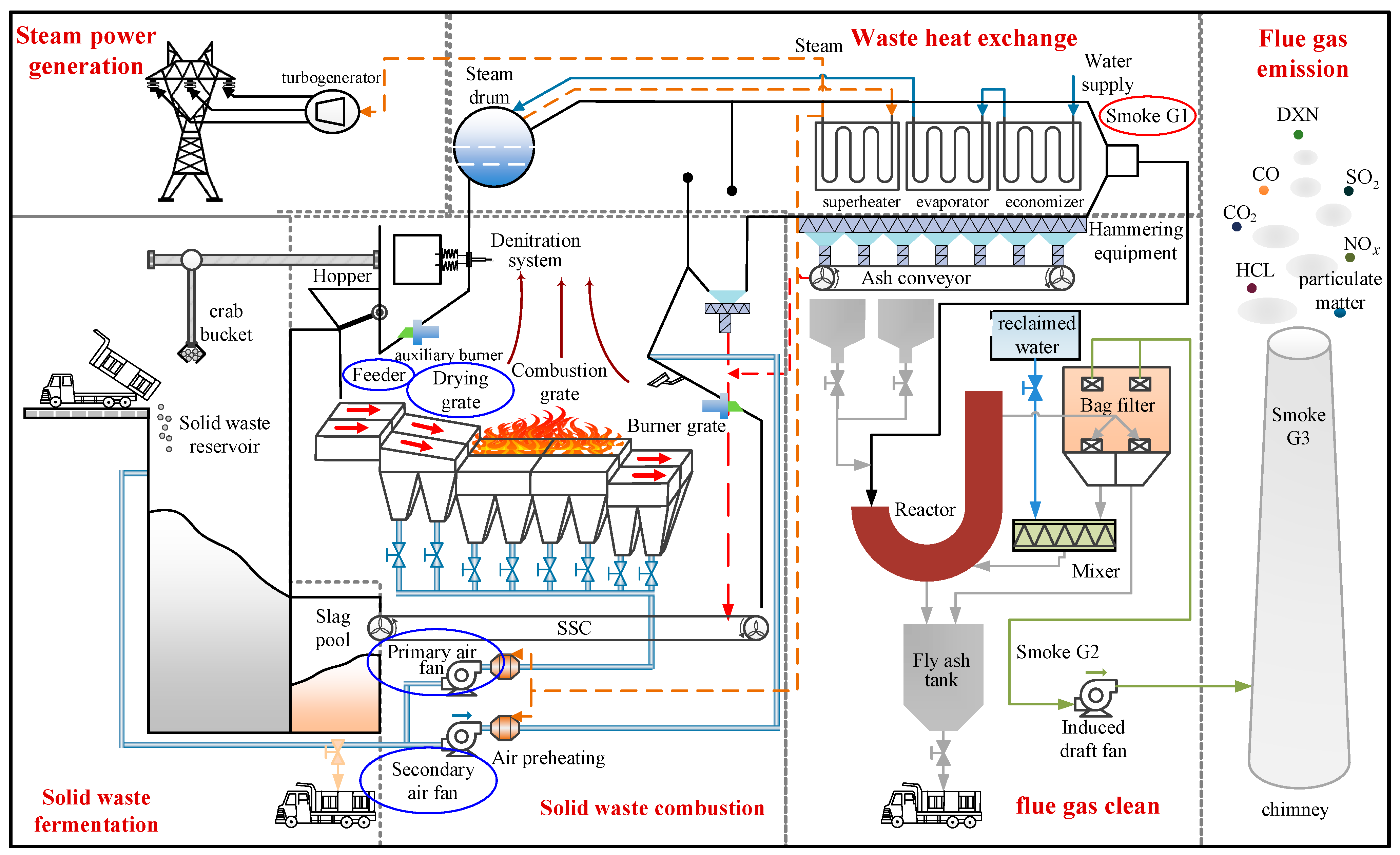
2. Description of MSWI Process
3. Materials and Methods
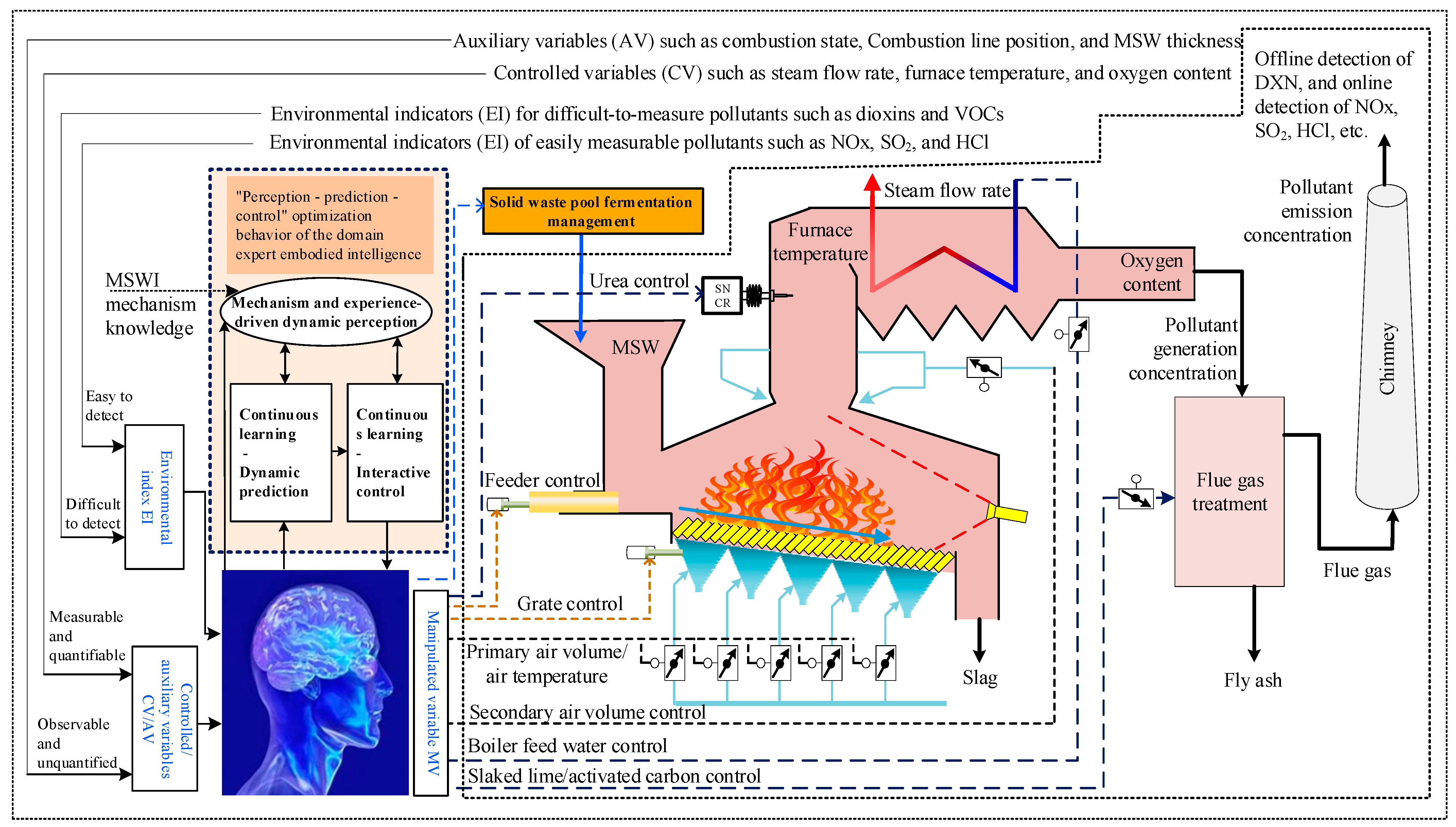
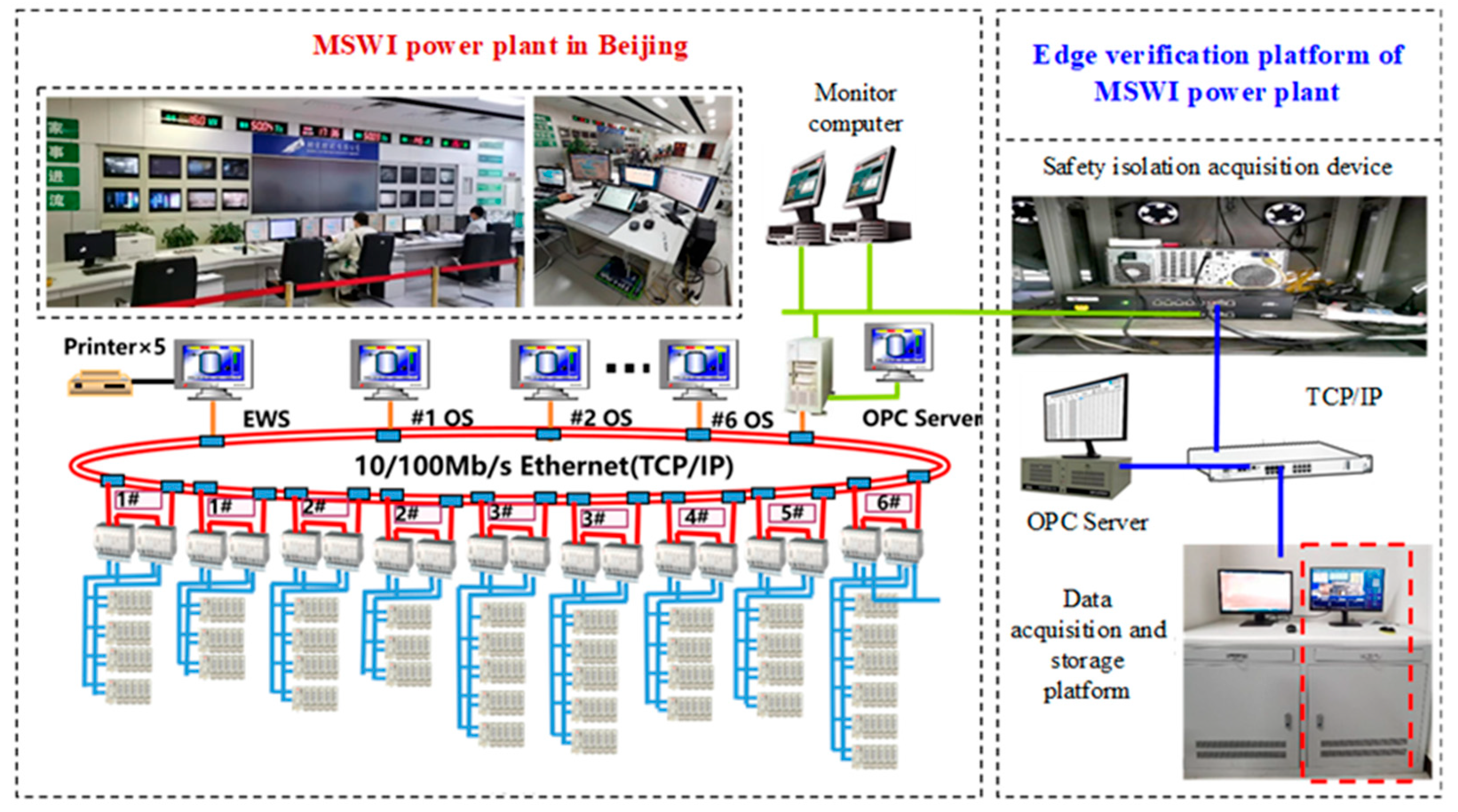
3.1. Data Collection and Selection Description
- (1)
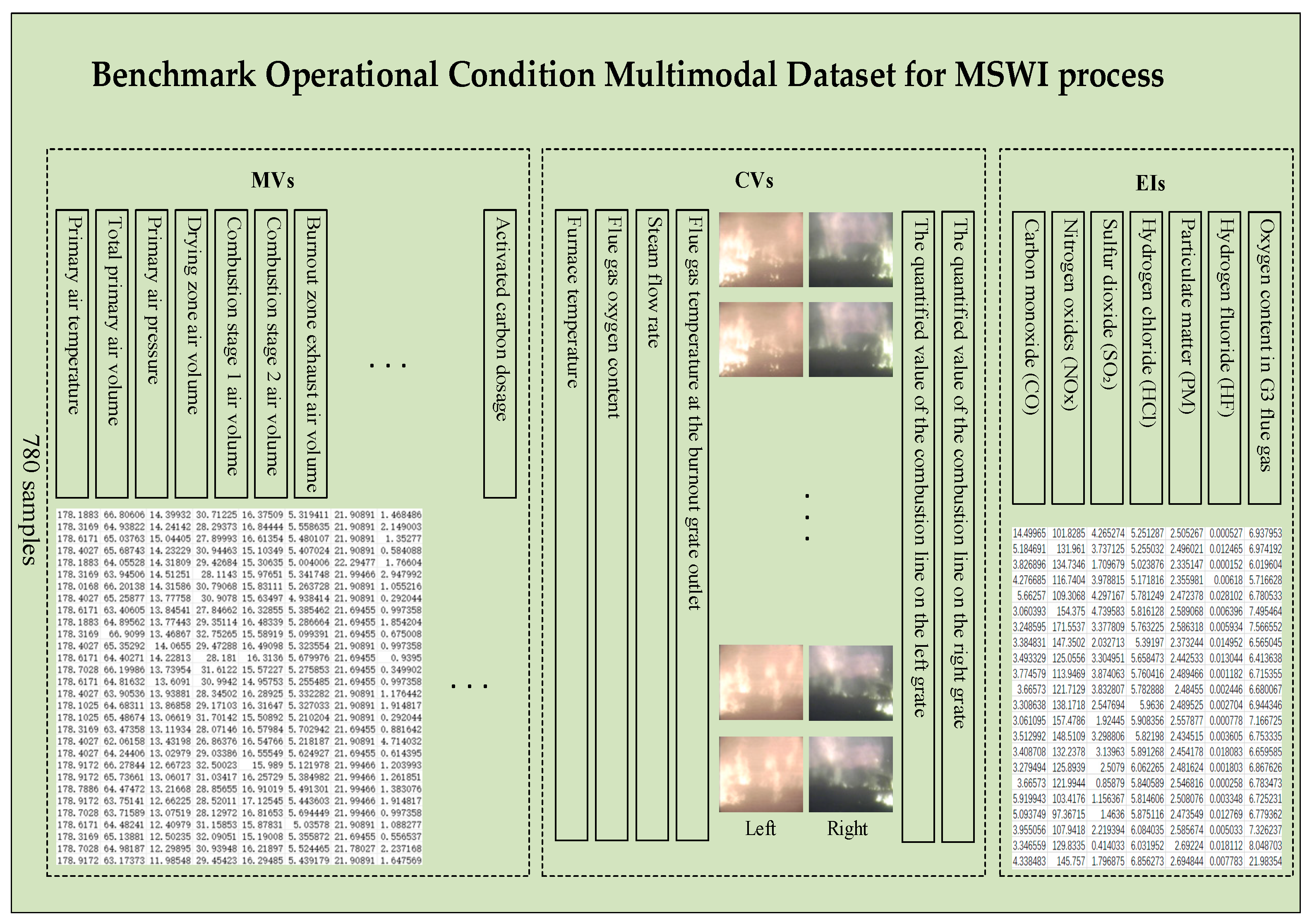
- Environmental indicators (EIs): These variables reflect the environmental performance of the incineration process and are used as optimization targets.
- (2)
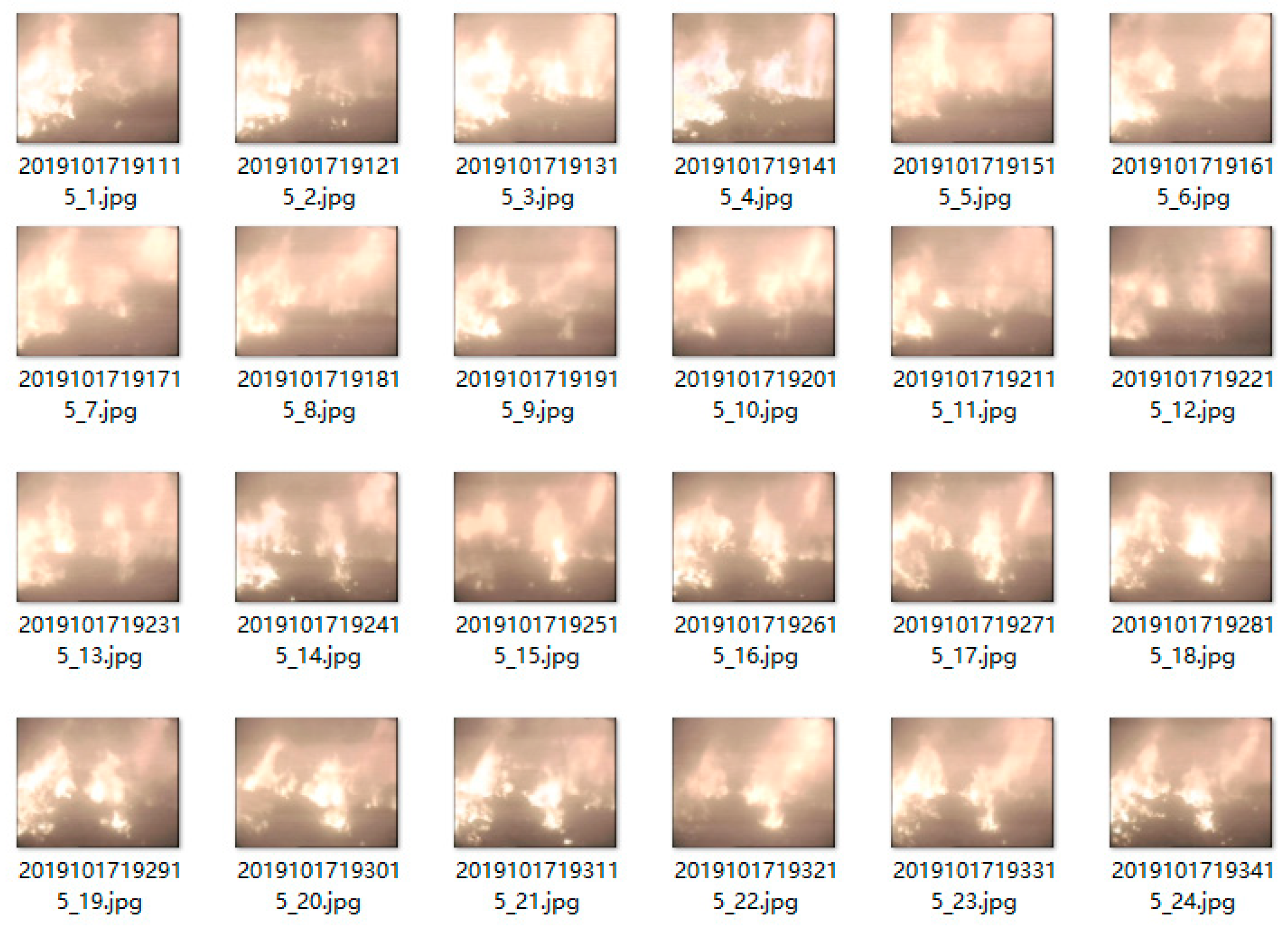
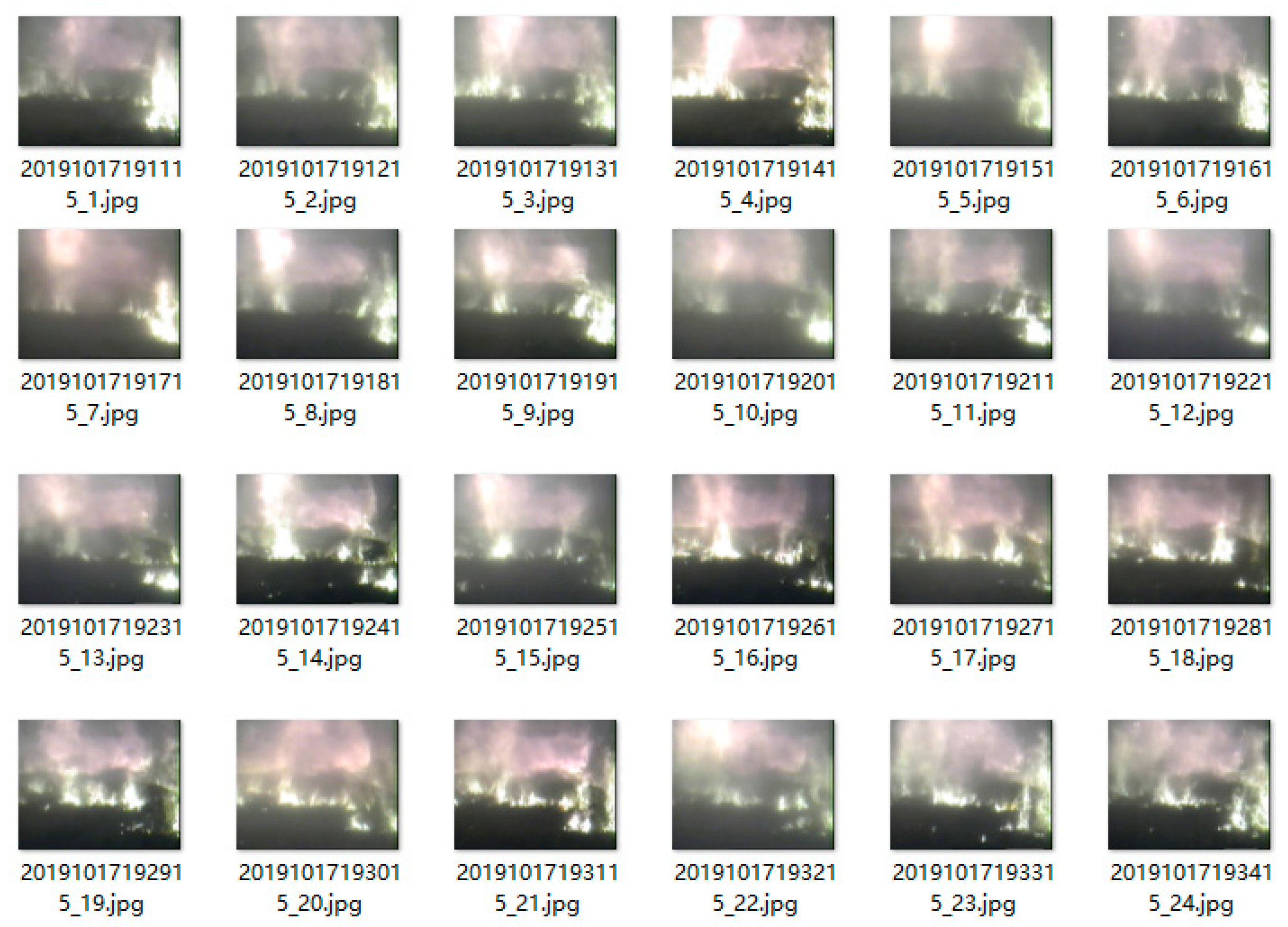
- Controlled variables (CVs): These are key output variables directly regulated through control actions.
- (3)
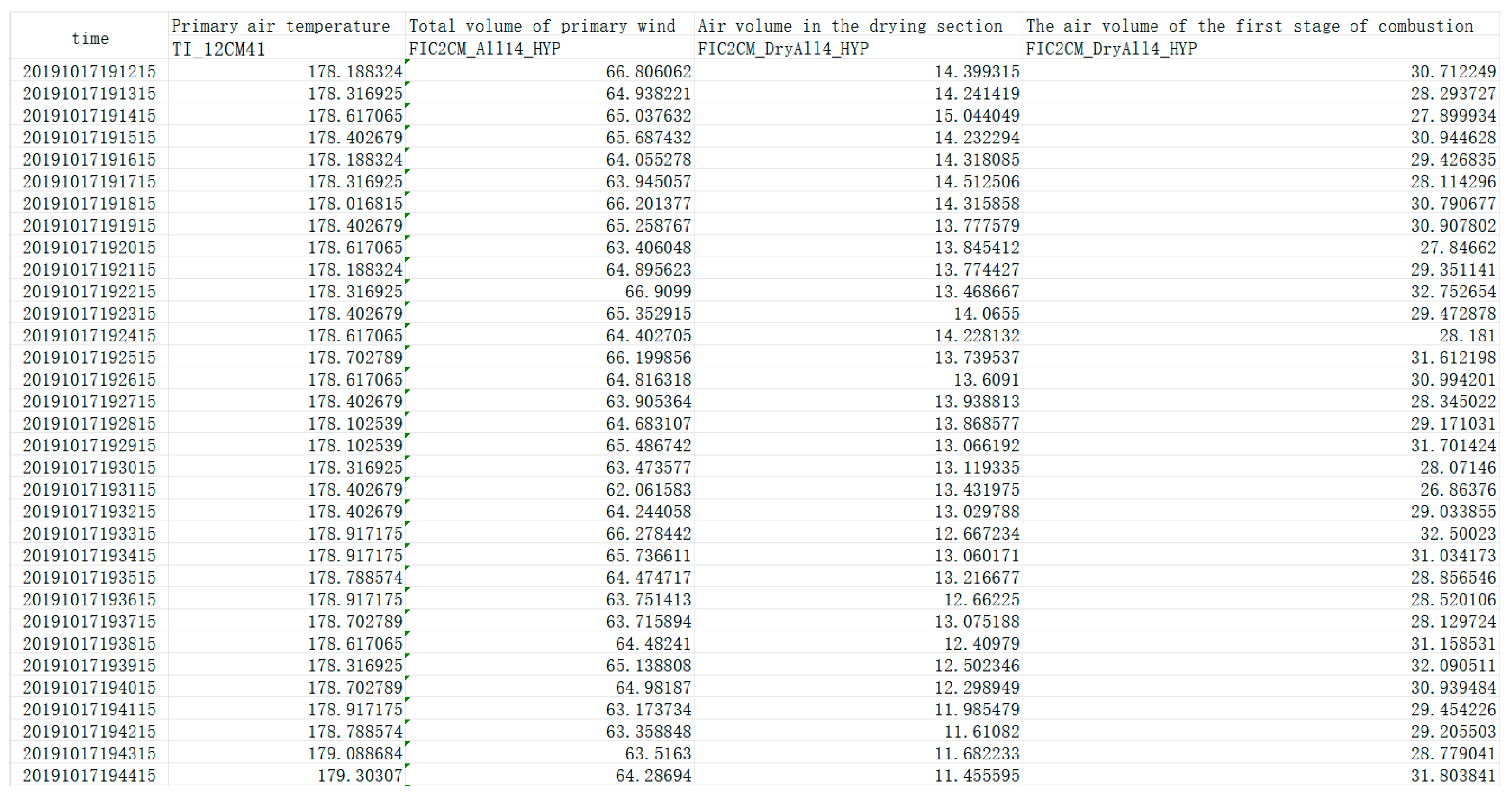
- Manipulated variable (MVs): These are input variables that can be directly adjusted by the control system.
3.2. Process Data Processing Module
3.2.1. Process Data Preprocessing Sub-Module
3.2.2. Missing Value Handling Sub-Module
3.2.3. Outlier Data Handling Sub-Module
3.3. Flame Image Processing Module
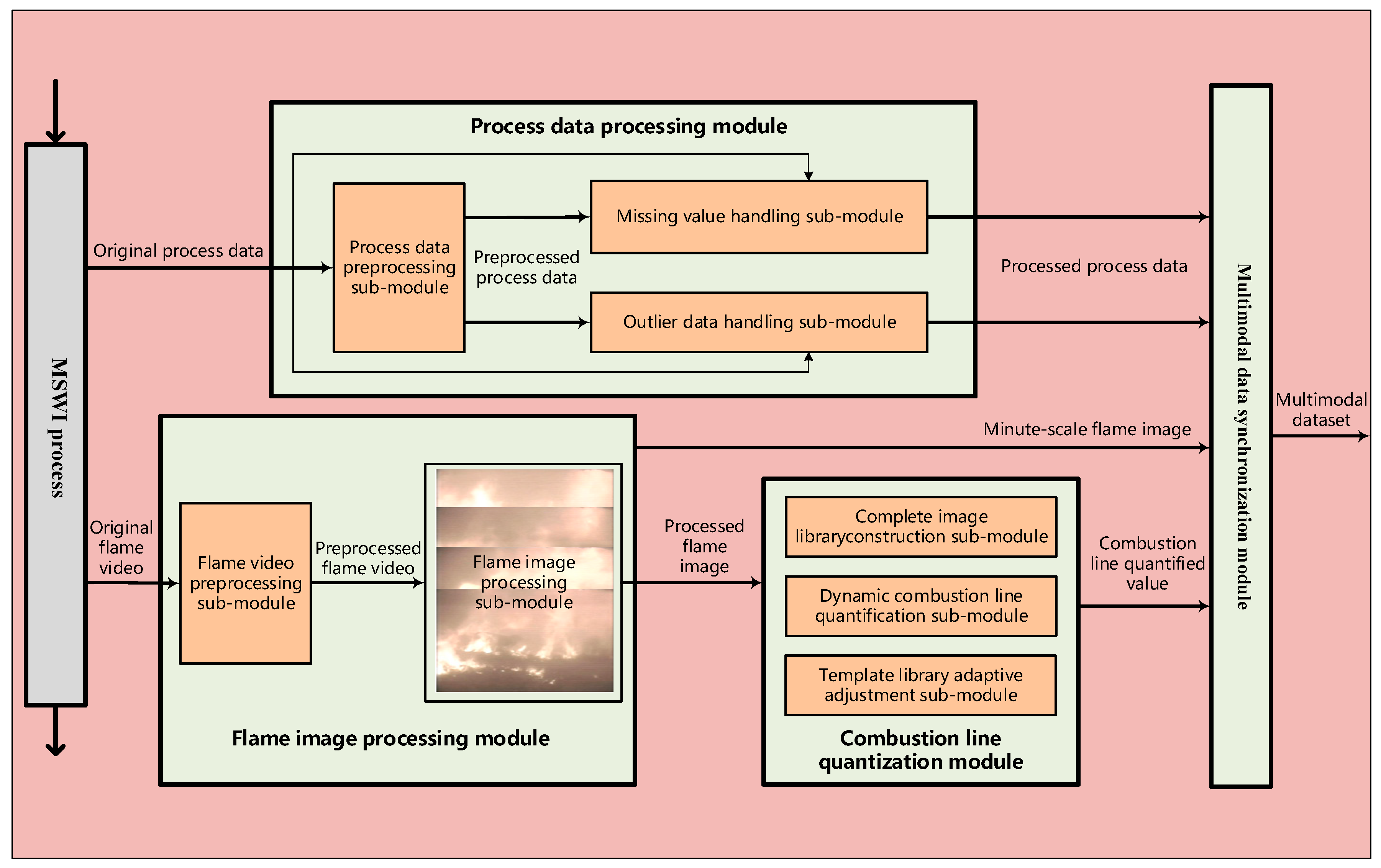
3.4. Combustion Line Quantification Module
- (1)
- Complete image library offline construction sub-module. The data-driven CLQ algorithm requires data that aligns with the global distribution. However, in scenarios with limited data, conventional image generation algorithms [26] struggle to supplement the distinctive flame features in scarce images, making it even more challenging to capture missing image characteristics [27,28,29]. Hence, this article employed image processing, deep convolutional generative adversarial network (DCGAN), and cycle-consistent generative adversarial network (CycleGAN) [24] techniques and mechanism knowledge on furnace flame images to construct a complete flame image library encompassing normal, abnormal, and highly abnormal combustion patterns. This library is enriched with grate position features, a substantial quantity of unlabeled flame images, and mechanism-based pseudo-labels.
- (2)
- Dynamic combustion line quantification sub-module. This article aims to enhance quantification accuracy by incorporating a broader range of flame characteristics and providing more flame information for subsequent control purposes. Hence, this article employs the spatial convolutional neural network (SCNN) matching approach for quantification. This strategy not only yields quantified values but also provides corresponding templates. These matched templates can be directly linked to control strategies, enabling an “end-to-end” control approach. This constitutes the core idea. Firstly, SCNN is trained based on the complete flame image library. Then, the combustion line feature is extracted, and the corresponding template sub-library is loaded. Finally, the online CLQ is realized based on SCNN multi-scale feature similarity matching.
- (3)
- Template library adaptive adjustment sub-module. The time cost of directly matching against a complete image library is exceedingly high. Therefore, it is essential to construct a non-redundant flame template library. Additionally, employing a time-reversed retrieval of the template library can significantly enhance retrieval efficiency. Hence, a redundancy discriminant mechanism is adopted to construct and update the typical template library from unadjusted images.
3.4.1. Complete Image Library Construction Sub-Module
- (1)
- Normal flame image sub-library
- (2)
- Abnormal flame image sub-library
- (3)
- Extremely abnormal flame sub-library
3.4.2. Dynamic Combustion Line Quantification Sub-Module
3.4.3. Template Library Adaptive Adjustment Sub-Module
3.5. Multimodal Data Synchronization Module
4. Results
4.1. Process Data Processing Results
4.2. Flame Image Processing Results
4.3. Combustion Line Quantification Result
4.4. Multimodal Data Synchronization Results
5. Discussion
5.1. Limitations and Scalability
5.2. Application Prospects
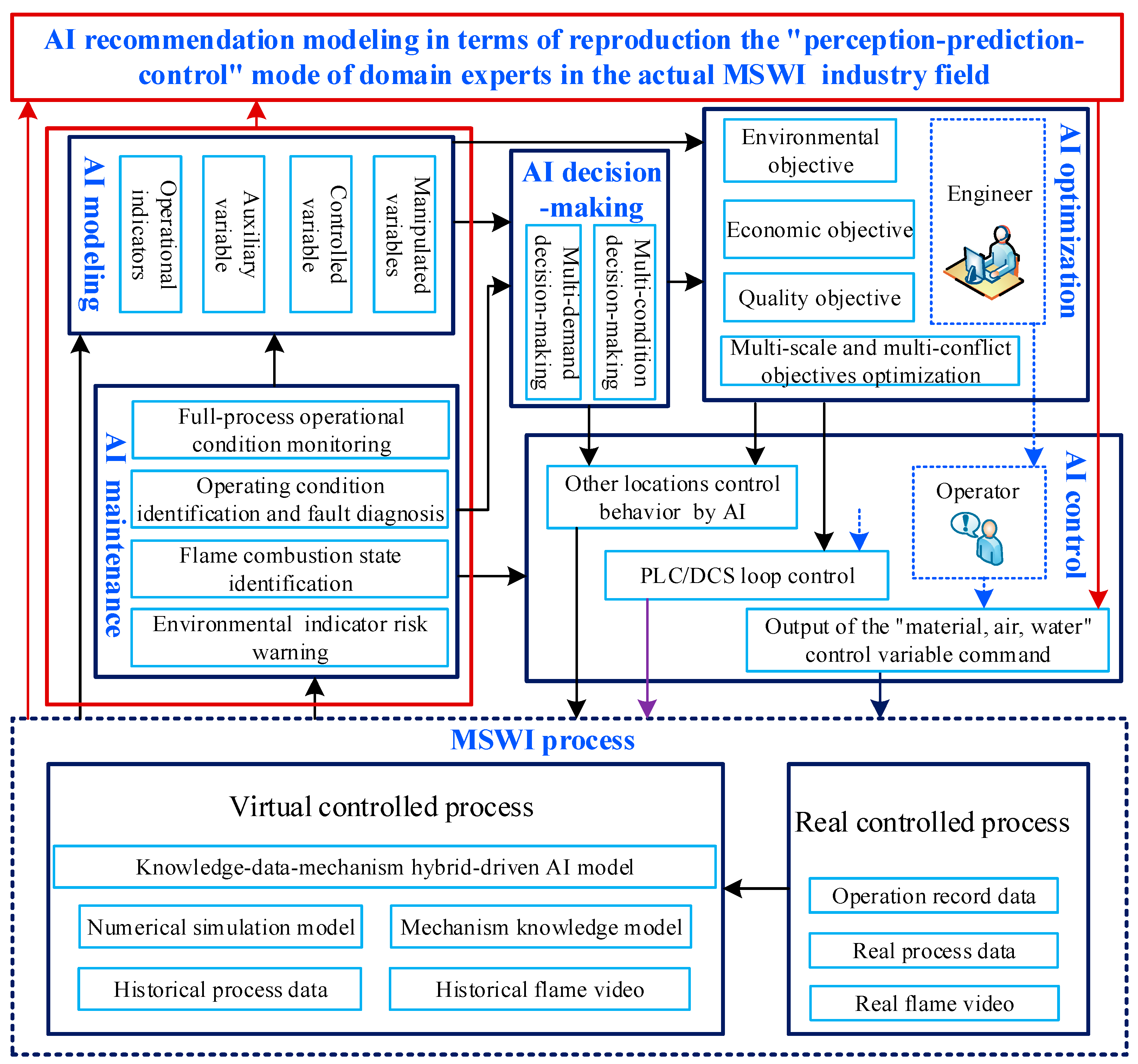
- (1)
- Difficulties in AI modeling
- (2)
- Difficulties in AI Maintenance
- (3)
- Difficulties in AI decision-making
- (4)
- Difficulties in AI optimization
- (5)
- Difficulties in AI control
6. Conclusions
Author Contributions
Funding
Institutional Review Board Statement
Informed Consent Statement
Data Availability Statement
Conflicts of Interest
Abbreviations
| Abbreviation | Full Name |
| MSW | Municipal solid waste |
| MSWI | MSW incineration |
| AI | Artificial intelligence |
| CNN | Convolutional neural network |
| LSTM | Long short-term memory |
| EM | Expectation-Maximization |
| LRI | Laser ranging interferometry |
| DXN | Dioxin |
| CV | Controlled variable |
| EI | Environmental indicators |
| MV | Manipulated variable |
| AV | Auxiliary variable |
| CO | Carbon monoxide |
| NOx | Nitrogen oxides |
| SO2 | Sulfur dioxide |
| HCl | Hydrogen chloride |
| PM | Particulate matter |
| HF | Hydrogen fluoride |
| MI | Mutual Information |
| LRDT | Linear regression decision tree |
| CART | Classification and regression tree |
| GAN | Generative adversarial network |
| SCNN | Spatial convolutional neural network |
| CLQ | Combustion line quantification |
| DCGAN | Deep convolutional generative adversarial network |
| CycleGAN | Cycle—consistent generative adversarial network |
| FID | Fréchet inception distance |
| KNN | K-nearest neighbors |
| XGBoost | eXtreme gradient boosting |
| Symbol | Meaning |
| The average grate speed in the constructed dataset | |
| The actual sample value in the constructed dataset | |
| The grate speed converted into units | |
| The total number of samples in the dataset | |
| The number of features in the dataset | |
| The process dataset | |
| Correlated input features | |
| Output feature | |
| Complete samples of the data for training | |
| The input feature dataset of the remaining missing samples for predicting the missing values | |
| The loss function value of MSE | |
| The -th eigenvalue of the -th sample in the -th iteration | |
| The first non-leaf node | |
| The segmentation variable of the first non-leaf node | |
| Minimum sample size | |
| The output of the -th leaf node | |
| The input of the -th leaf node | |
| The weight matrix of the -th leaf node | |
| A regularized least squares loss function | |
| The true output of the leaf node | |
| The coefficient of the regularization term | |
| A collection of real flame images with normal combustion lines | |
| A set of real burning line abnormal forward shift flame images | |
| A set of real flame images with abnormal backward shift in the burning line | |
| A set of extremely abnormal forward shift flame images of the real burning line | |
| Flame images with the combustion line position ranging from 0 to 60% | |
| Real-time flame image | |
| The t-th image of a normal and real flame on the combustion line | |
| Tuple < mean of , variance of > | |
| The t-th generated image of the abnormally backward shifting flame of the combustion line | |
| Tuple < mean of , variance of > | |
| The t-th generated flame image with the combustion line abnormally moving forward | |
| Tuple < mean of , variance of > | |
| The t-th real image of the burning line with an abnormally backward shifting flame | |
| Tuple < mean of , variance of > | |
| The t-th real image of a flame with an abnormally forward shift in the burning line | |
| Tuple < mean of , variance of > | |
| The t-th real image of a flame with an extremely abnormal forward shift in the burning line | |
| Tuple < mean of , variance of > | |
| Construct set of real burning line extreme anomaly forward shift images in the form of a pairs | |
| The set of extremely abnormal forward shift images of the burning line generated is constructed in the form of tuple | |
| Construct real set of abnormal forward shift images of combustion lines in the form of tuples | |
| The set of abnormal forward shift images of the combustion line generated is constructed in the form of tuple | |
| Construct set of normal flame images of real combustion lines in the form of tuples | |
| Construct real set of abnormal backshift images of burning lines in the form of tuples | |
| The set of abnormal backshift images of the burning line generated is constructed in the form of tuple | |
| The burning line does not exist in the image set | |
| An image library for SCNN training, | |
| Siamese network algorithm | |
| The average value of the burning line | |
| The variance of the burning line | |
| The corresponding template sublibrary loaded | |
| CLQcurrent | The quantified value of the burning line of |
| The i-th template in the corresponding template sublibrary loaded | |
| Template library for extreme abnormal flame images with the combustion line moving forward | |
| Template library for abnormal flame images with forward shift in the combustion line | |
| A template library for normal flame images of the combustion line | |
| Template library for abnormal flame images with rearward burning lines | |
| The edge feature image of the combustion line obtained by the combustion line edge feature extraction algorithm | |
| Morphological processing algorithm | |
| The width of the image resolution captured by the camera is 576 | |
| The length of the image resolution captured by the camera is 720 | |
| Lower limit of pixels in the burning area | |
| The mean value of the white pixels in some areas of | |
| The variance of the white pixels in some areas of | |
| When the threshold of variance is greater than this threshold, it is considered that the burning line does not exist | |
| Combustion line calibration algorithm | |
| The mean of the multivariate normal distribution of the feature matrix | |
| The mean of the multivariate normal distribution of the feature matrix | |
| The covariance matrix of | |
| The covariance matrix of | |
| The generated set of pseudo-labeled images of extreme abnormal flames | |
| A set of unlabeled real flame images | |
| The generated pseudo-labeled image of extreme abnormal flames | |
| Unmarked real flame images | |
| A generator for converting pseudo-labeled images into real images | |
| A generator for converting real images into pseudo-labeled images | |
| A discriminator for determining whether it is a real image | |
| A discriminator for determining whether an image is falsely labeled | |
| The pseudo-labeled image generated by | |
| The real image generated by | |
| Reconstructed real images by | |
| Reconstructed pseudo-labeled images by | |
| The identity verification image of the real image | |
| The authentication image of the falsely labeled image | |
| The predicted value of the discrimination result of the generated pseudo-labeled image by ,. | |
| The set of | |
| The predicted value of , for the discrimination result of the falsely labeled image. | |
| The set of | |
| The predicted value of , for the generated real image discrimination result | |
| The set of | |
| The predicted value of , for the discrimination result of the real image | |
| The set of | |
| A vector with all elements being 1 s | |
| A vector with all elements being 0 | |
| m | And the number of images in |
| k | And the number of images in |
| Update the loss function of | |
| Update the loss function of | |
| Flame image set | |
| It includes a set of real and generated flame images with the burning line moving forward and extreme moving forward, with the burning line position ranging from 0% to 51% | |
| A set of normal flame images containing real combustion lines, with the position of the combustion lines ranging from 51% to 73.6% | |
| A set of flame images with real and generated burning lines shifted backward, with burning line positions ranging from 73.6% to 100% | |
| The flame image in , | |
| The label value corresponding to | |
| Positive samples constructed for training the Siamese network | |
| Negative samples constructed for training Siamese networks | |
| The label value of the positive sample, | |
| The label value of the negative sample, | |
| The predicted value of the Siamese network for positive samples | |
| The predicted value of the Siamese network for negative samples | |
| Twin network | |
| The fully connected layer in a twin network | |
| The VGG16 layer in the twin network | |
| The loss function of the twin network | |
| The characteristic description of | |
| Measure the similarity between and based on the Siamese network | |
| The maximum similarity between and in is measured by using SCNN | |
| Measure the similarity threshold | |
| Weight parameter | |
| The j-th image in and its corresponding feature | |
| The number of templates in | |
| The j-th image in | |
| The average burning line of | |
| The variance of the combustion line of | |
| J | The number of images in |
References
- Li, B.; Liu, Y.; Xiong, X.; Zhang, M.; Duan, O. Study on the Behavior of Chlorine in the Melting Process of Municipal Solid Waste Incineration Fly Ash. Environ. Sanit. Eng. 2025, 33, 110–115. [Google Scholar]
- Chen, A.; Chen, J.; Cui, J.; Fan, C.; Han, W. Research on the Risk and Countermeasures of “Garbage Encirclement” in 31 Municipalities Directly under the Central Government and Provincial Capitals (Capital Cities) in China: An Empirical Study Based on the DIIS Method. Bull. Chin. Acad. Sci. 2019, 34, 797–806. [Google Scholar]
- National Development and Reform Commission. Guiding Opinions on Promoting High-Quality Development of Municipal Solid Waste Incineration Power Generation. 2021. Available online: https://www.ndrc.gov.cn/wsdwhfz/202111/t20211111_1303691.html (accessed on 2 August 2025).
- Meng, X.; Hou, Q.; Qiao, J. Intelligent Operation Optimization of Municipal Solid Waste Incineration Process Based on Multi-Objective Particle Swarm Optimization Algorithm. Acta Autom. Sin. 2024, 50, 2462–2473. [Google Scholar]
- Tang, J.; Xia, H.; Yu, W.; Qiao, J. Research Status and Prospect of Intelligent Optimization Control in Urban Solid Waste Incineration Process. Acta Autom. Sin. 2023, 49, 2019–2059. [Google Scholar]
- Tang, J.; Xu, W.; Xia, H.; Qiao, J. Missing Data Filling and Application for Urban Solid Waste Incineration Process. J. Beijing Univ. Technol. 2023, 49, 435–448. [Google Scholar]
- Liu, S. Incomplete big data filling algorithm based on machine learning. Int. Core J. Eng. 2021, 7, 461–466. [Google Scholar]
- Wu, S.; Feng, X.; Shan, Z. Missing data imputation approach based on incomplete data clustering. Chin. J. Comput. 2012, 35, 1726–1738. [Google Scholar] [CrossRef]
- Emmanuel, T.; Maupong, T.; Mpoeleng, D.; Semong, T.; Mphago, B.; Tabona, O. A survey on missing data in machine learning. J. Big Data 2021, 8, 140. [Google Scholar] [CrossRef]
- Deng, J.; Shan, L.; He, D.; Tang, R. Methods for Handling Missing Data and Their Development Trends. Stat. Decis. 2019, 35, 28–34. [Google Scholar]
- Li, B.; Huang, Q.; Lu, X.; Zhang, X.; Wang, B. Cross-Domain Deep Text Matching Based on Meta-Learning Instance Weighting Method. Softw. Guide 2025, 1–8. Available online: https://link.cnki.net/urlid/42.1671.TP.20250715.1722.028 (accessed on 2 August 2025).
- Liang, L.; Lin, J.; Huo, Y. Adaptive k-Nearest Neighbor Missing Value Imputation Method Based on Probability Density. J. South China Norm. Univ. 2024, 56, 80–90. [Google Scholar]
- Kabir, G.; Tesfamariam, S.; Hemsing, J.; Sadiq, R. Handling incomplete and missing data in water network database using imputation methods. Sustain. Resilient Infrastruct. 2020, 5, 365–377. [Google Scholar] [CrossRef]
- Yan, Q.; Hu, M.; Jin, S.; Huang, W. Gap Filling for ISMN Time Series Using CYGNSS Data. IEEE Geosci. Remote Sens. Lett. 2025, 22, 2500105. [Google Scholar] [CrossRef]
- Tzoumpas, K.; Estrada, A.; Miraglio, P.; Zambelli, P. A Data Filling Methodology for Time Series Based on CNN and (Bi)LSTM Neural Networks. IEEE Access 2024, 12, 31443–31460. [Google Scholar] [CrossRef]
- Zhu, H.; Deng, Z.; Tang, Z.; Zhu, H. An improved expectation maximization algorithm for missing data management of concrete pump truck. J. Cent. South Univ. (Sci. Technol.) 2021, 52, 443–450. [Google Scholar]
- Zhao, X.; Zhang, Y.; Yin, B.; Liu, H.; Zhang, K. Imputation of incomplete bus arrival time based on the improved k-means algorithm. J. Beijing Univ. Technol. 2018, 44, 135–143. [Google Scholar]
- Lu, S.W.; Wu, X.L.; Zheng, J.; He, Z.; Gu, J.; Han, H. Data-cleaning method based on dynamic fusion LOF for municipal wastewater treatment process. Control. Decis. 2022, 37, 1231–1240. [Google Scholar]
- Han, H.; Lu, S.; Wu, X.; Qiao, J. Abnormal data cleaning method for municipal wastewater treatment based on improved support vector machine. J. Beijing Univ. Technol. 2021, 47, 1011–1020. [Google Scholar]
- Hu, L.; Xu, X.; Xiao, P.; Wang, Y.; Liu, J. A Review of Missing Data Handling Methods for Time Series. Control Theory Appl. 2025, 1–15. Available online: https://link.cnki.net/urlid/44.1240.TP.20250716.1838.114 (accessed on 2 August 2025).
- Yin, H.; Zhu, Z.; Yan, Y.; Wang, C.; Zhong, M.; Feng, W.; Zhu, J.; Gu, D. Preprocessing of GRACE-FO Gravity Satellite Laser Interferometry Ranging Raw Data. Chin. J. Geophys. 2025, 68, 1615–1632. [Google Scholar]
- Guo, H. Quantitative Study on Flame Combustion Line for Grate Furnace Municipal Solid Waste Incineration Process. Master’s Thesis, Beijing University of Technology, Beijing, China, 2023. [Google Scholar]
- Huang, W.; Meng, X.; Qiao, J. Dynamic Collaborative Optimization Method for Municipal Solid Waste Incineration Process. Sci. Sin. 2025, 55, 1200–1220. [Google Scholar] [CrossRef]
- Cosimo, M.; Marco, M.; Nicolas, S. The relationship between municipal solid waste and greenhouse gas emissions: Evidence from Switzerland. Waste Manag. 2020, 113, 508–520. [Google Scholar] [CrossRef] [PubMed]
- Guo, H.; Tang, J.; Ding, H.; Qiao, J. Combustion State Recognition for MSWI Processes Based on Hybrid Data Augmentation. Acta Autom. Sin. 2024, 50, 560–575. [Google Scholar]
- Niu, Z.; Reformat, M.Z.; Tang, W.; Zhao, B. Electrical Equipment Identification Method with Synthetic Data Using Edge-Oriented Generative Adversarial Network. IEEE Access 2020, 8, 136487–136497. [Google Scholar] [CrossRef]
- Liu, X.; Ren, Y.; Wang, L. Low-Illumination LiDAR Image Missing Region Inpainting Algorithm Based on U-Net and GAN. Laser J. 2025, 46, 135–141. [Google Scholar]
- Lin, C.T.; Huang, S.W.; Wu, Y.Y.; Lai, S.H. GAN-Based Day-to-Night Image Style Transfer for Nighttime Vehicle Detection. IEEE Trans. Intell. Transp. Syst. 2021, 22, 951–963. [Google Scholar] [CrossRef]
- Zhang, C.; Tang, Y.; Zhao, C.; Sun, Q.; Ye, Z.; Kurths, J. Multitask GANs for Semantic Segmentation and Depth Completion With Cycle Consistency. IEEE Trans. Neural Netw. Learn. Syst. 2021, 32, 5404–5415. [Google Scholar] [CrossRef] [PubMed]
- Zhang, Y.; Han, X.; Zhang, H.; Zhao, L. Edge detection algorithm of image fusion based on improved Sobel operator. In Proceedings of the IEEE 3rd Information Technology and Mechatronics Engineering Conference (ITOEC), Chongqing, China, 3–5 October 2017; pp. 457–461. [Google Scholar]
- Liao, R.; Ma, C.; Xie, Y.; Sui, X.; Yang, J.; Li, T.; Zhang, P. Dataset of Active Industrial Heat Source Areas in India from 2012 to 2021. China Sci. Data 2025, 10, 164–174. [Google Scholar]
- Wang, L.; Bai, J.; Li, Y.; Li, W. Dense Control Valve Parts Dataset for Industrial Object Detection. Opt. Precis. Eng. 2024, 32, 1241–1251. [Google Scholar] [CrossRef]
- Wang, P.; Zeng, L.; Shao, X.; Li, J. Research on Multi-Source Data Fusion Modeling Method for Wing Aerodynamic Load Based on Pre-Training and Fine-Tuning. Acta Aeronaut. Astronaut. Sin. 2025, 1–15. Available online: https://link.cnki.net/urlid/11.1929.v.20250725.1653.016 (accessed on 2 August 2025).
- Yan, Y.; Liu, X.; Li, Z.; Sha, Y.; Zhang, W.; Wang, R. A Virtual-Real Combined Oil Storage Control Experiment Platform Based on Data-Driven Modeling. Exp. Technol. Manag. 2025, 42, 179–187. [Google Scholar]



| Type | Process Variable Types | ||
|---|---|---|---|
| Process Variable Name | Value Range | Unit | |
| MVs | Primary air temperature | [90.20, 182.82] | °C |
| Total primary air volume | [50.72, 79.58] | km3N | |
| Primary air pressure | [1.63, 3.33] | KPa | |
| Drying zone air volume | [9.60, 17.29] | km3N/h | |
| Combustion stage 1 air volume | [20.05, 42.09] | km3N/h | |
| Combustion stage 2 air volume | [12.39, 20.31] | km3N/h | |
| Burnout zone exhaust air volume | [2.17, 9.70] | km3N/h | |
| Secondary air temperature | [11.49, 22.99] | °C | |
| Secondary air volume | [0, 44.80] | km3N/h | |
| Waste feed rate | [3.39, 7.33] | m/h | |
| Grate speed in the drying zone | [4.25, 6.90] | m/h | |
| Grate speed in combustion stage 1 | [4.35, 6.93] | m/h | |
| Grate speed in combustion stage 2 | [4.90, 6.66] | m/h | |
| Boiler feedwater flow | [0.73, 1.73] | t/h | |
| Urea dosage | [1.03, 3.90] | L/h | |
| Quicklime dosage | [382, 410] | kg/h | |
| Activated carbon dosage | [25.20, 25.20] | kg/h | |
| CVs | Furnace temperature | [897.10, 1051.15] | °C |
| Flue gas oxygen content | [5.19, 11.76] | % | |
| Steam flow rate | [56.39, 77.81] | t/h | |
| Flue gas temperature at the burnout grate outlet | [591.80, 892.19] | °C | |
| Quantified value of the combustion line | [0, 1] | % | |
| EIs | Carbon monoxide (CO) | [0, 293.68] | mg/m3N |
| Nitrogen oxides (NOx) | [0, 430.69] | mg/m3N | |
| Sulfur dioxide (SO2) | [0, 52.38] | mg/m3N | |
| Hydrogen chloride (HCl) | [0, 6.45] | mg/m3N | |
| Particulate matter (PM) | [1.49, 7.86] | mg/m3N | |
| Hydrogen fluoride (HF) | [0, 0.20] | mg/m3N | |
| Oxygen content in G3 flue gas | [7.69, 25.00] | % | |
| Processed MVs | Original MVs | Calculation Method |
|---|---|---|
| Primary air temperature | Primary air temperature | / |
| Total primary air volume | The air volume of the first drying section on the left, the air volume of the first drying section on the right, the air volume of the second drying section on the left, the air volume of the second drying section on the right, the air volume of the first combustion section on the left, the air volume of the first combustion section on the right, the air volume of the second combustion section on the left, the air volume of the second combustion section on the right, the air volume of the second combustion section on the left, and the air volume of the second combustion section on the right | Summation |
| Primary air pressure | Primary air pressure | / |
| Drying zone air volume | The air volume of the first drying section on the left, the air volume of the first drying section on the right, the air volume of the second drying section on the left, and the air volume of the second drying section on the right | Summation |
| Combustion stage 1 air volume | The air volume of the first stage of combustion on the left, the air volume of the first stage of combustion on the right, the air volume of the second stage of combustion on the left, and the air volume of the second stage of combustion on the right | Summation |
| Combustion stage 2 air volume | The air volume of the first stage of combustion on the left, the air volume of the first stage of combustion on the right, the air volume of the second stage of combustion on the left, and the air volume of the second stage of combustion on the right | Summation |
| Burnout zone exhaust air volume | The combustion air volume on the left and the combustion air volume on the right | Summation |
| Secondary air temperature | Secondary air temperature | / |
| Secondary air volume | Secondary air volume | / |
| Waste feed rate | The left inner feeding speed, left outer feeding speed, right inner feeding speed, and right outer feeding speed | Take the mean value |
| Grate speed in the drying zone | The left inner drying grate velocity, the left outer drying grate velocity, the right inner drying grate velocity, and the right outer drying grate velocity | Take the mean value |
| Grate speed in combustion stage 1 | The combustion speeds of the first section of the left inner grate, the first section of the left outer grate, the first section of the right inner grate, and the first section of the right outer grate | Take the mean value |
| Grate speed in combustion stage 2 | The combustion grate speed of the left inner burner, the combustion grate speed of the left outer burner, the combustion grate speed of the right inner burner, and the combustion grate speed of the right outer burner | Take the mean value |
| Boiler feedwater flow | The current cumulative amount and the cumulative amount of the previous minute | The current value minus the value of the previous minute |
| Urea dosage | The current cumulative amount and the cumulative amount of the previous minute | The current value minus the value of the previous minute |
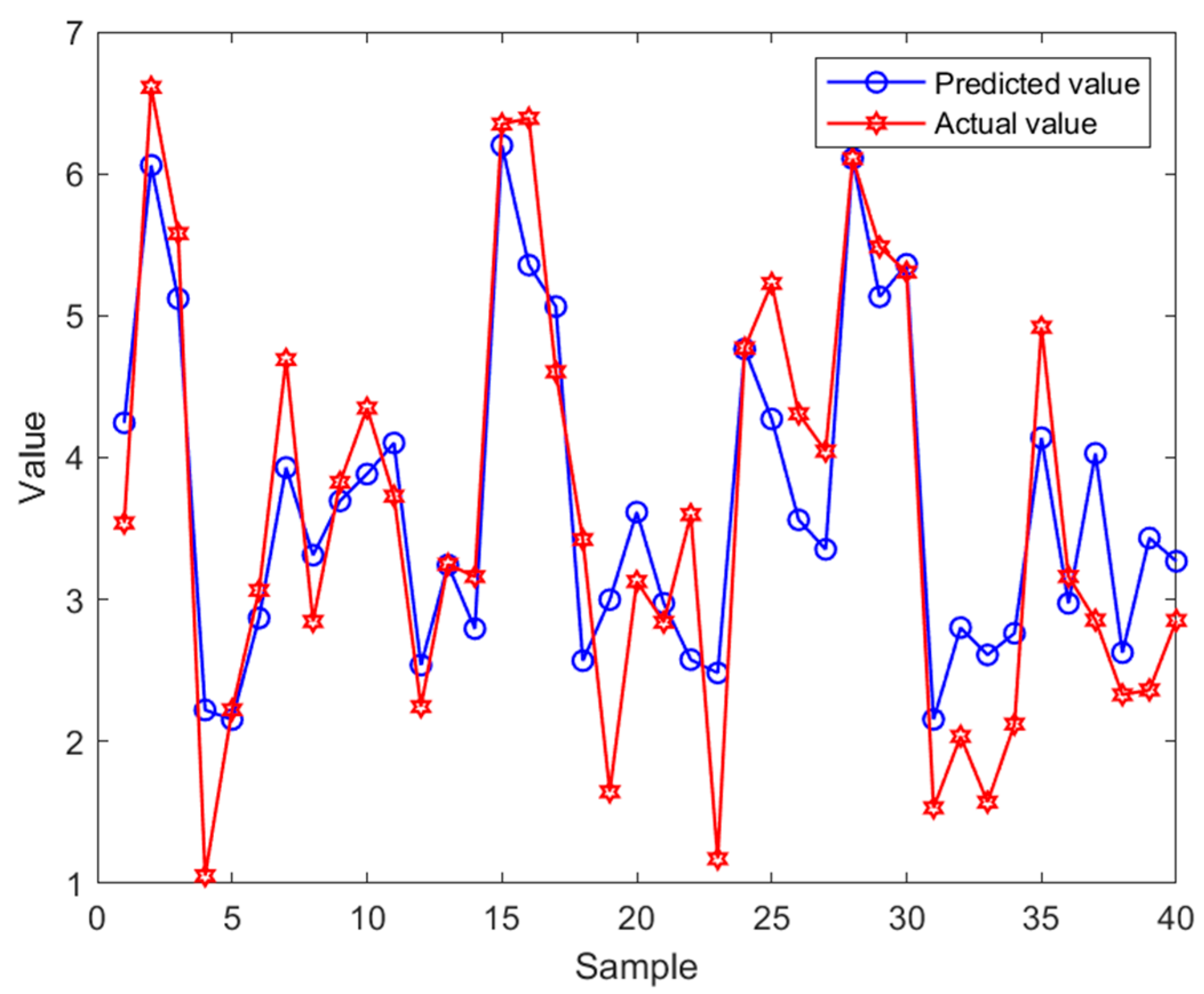
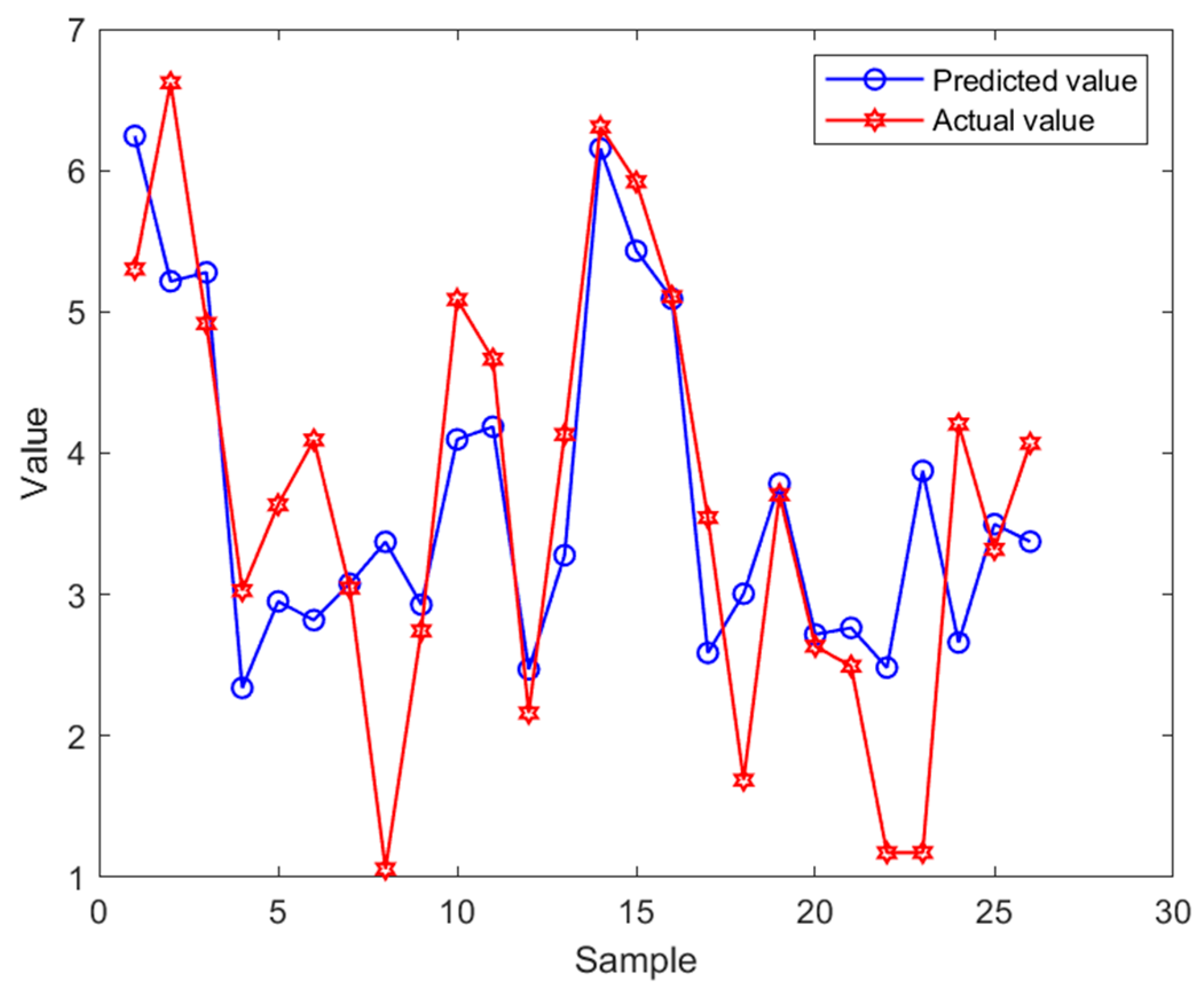
| Dataset | Method | RMSE | MAE | R2 |
|---|---|---|---|---|
| Training Set | KNN | 1.4309 | 0.9461 | 0.2727 |
| XGBoost | 0.7334 | 0.6160 | 0.7663 | |
| LRDT | 0.6829 | 0.5654 | 0.7974 | |
| Validation set | KNN | 1.6145 | 1.2778 | −1.1364 |
| XGBoost | 1.1402 | 0.9236 | 0.4635 | |
| LRDT | 1.0356 | 0.7811 | 0.5575 |
| Original Flame Image | Image of the Burning Line | Quantified Value of the Combustion Line |
|---|---|---|
 |  | 0.7287 |
 |  | 0.7112 |
 |  | 0.6946 |
Disclaimer/Publisher’s Note: The statements, opinions and data contained in all publications are solely those of the individual author(s) and contributor(s) and not of MDPI and/or the editor(s). MDPI and/or the editor(s) disclaim responsibility for any injury to people or property resulting from any ideas, methods, instructions or products referred to in the content. |
© 2026 by the authors. Licensee MDPI, Basel, Switzerland. This article is an open access article distributed under the terms and conditions of the Creative Commons Attribution (CC BY) license.
Share and Cite
Hua, Y.; Tang, J.; Tian, H. Benchmark Operational Condition Multimodal Dataset Construction for the Municipal Solid Waste Incineration Process. Sustainability 2026, 18, 2282. https://doi.org/10.3390/su18052282
Hua Y, Tang J, Tian H. Benchmark Operational Condition Multimodal Dataset Construction for the Municipal Solid Waste Incineration Process. Sustainability. 2026; 18(5):2282. https://doi.org/10.3390/su18052282
Chicago/Turabian StyleHua, Yapeng, Jian Tang, and Hao Tian. 2026. "Benchmark Operational Condition Multimodal Dataset Construction for the Municipal Solid Waste Incineration Process" Sustainability 18, no. 5: 2282. https://doi.org/10.3390/su18052282
APA StyleHua, Y., Tang, J., & Tian, H. (2026). Benchmark Operational Condition Multimodal Dataset Construction for the Municipal Solid Waste Incineration Process. Sustainability, 18(5), 2282. https://doi.org/10.3390/su18052282