Article

The Tourist Life Cycle in Millennial Solo Travel: The Roles of Bias and Narrative Information in Thailand and Asia

by
Usanee Danklang
and
Adisorn Leelasantitham
*
Technology of Information System Management Division, Faculty of Engineering, Mahidol University, Nakhon Pathom 73170, Thailand
*
Author to whom correspondence should be addressed.
Sustainability 2026, 18(5), 2265; https://doi.org/10.3390/su18052265
Submission received: 5 February 2026 / Revised: 19 February 2026 / Accepted: 24 February 2026 / Published: 26 February 2026
(This article belongs to the Section Tourism, Culture, and Heritage)

Abstract

This study examined the psychology-driven decision-making dynamics of Millennial solo travellers in Asia, with a comparative focus on Thai and other Asian tourists. While the Theory of Planned Behaviour (TPB) is widely applied in tourism research, prior studies may not fully address the attitude-mediated construct–intention gap, stage-based intention–behaviour variation, and post-intention outcomes. To extend this perspective, the study proposes the I-SMART Cognitive TPB Model, integrating temporal bias, loss aversion, narrative-driven information, Social Exchange Theory, the four-stage tourism life cycle, and post-intention marketing behaviours. Survey data from 800 respondents (400 Thai, 400 Asian) were analysed using structural equation modelling. The findings indicate that narrative information may play a stronger role in shaping attitudes among Asian travellers, whereas Thai travellers appear more influenced by time-based motivation. Pre-trip factors emerged as key contributors to intention formation in both groups, while post-intention patterns diverged: intention linked more strongly to satisfaction among Asian travellers and to revisit tendencies among Thai travellers. Theoretically, the study offers an integrated cognitive–behavioural model that complements TPB by incorporating bias-driven and stage-based mechanisms. Practically, the findings provide guidance for designing digital infrastructure, time-sensitive policies, and storytelling-driven marketing strategies tailored to Millennial solo travellers.

1. Introduction

The global tourism industry may play a longstanding role in supporting economic value worldwide, and although it was affected by a pandemic, it has shown an overall positive recovery trend [1]. The pandemic caused severe disruption across the tourism sector between 2019 and 2022. Following this period, a positive rebound may have been observed, contributing to signs of sustained global recovery [2]. In 2023, [3] reported approximately 1286 million international tourists, equivalent to 88 percent of pre-pandemic levels, which may indicate continued progress toward global recovery.
Asia may also reflect this broader recovery trend, showing broad signs of recovery from a pandemic following earlier pandemic-related disruptions. Asia may have re-emerged as a key tourism market and a potential driver of regional and global economic growth. The region may have reached around 65 percent of pre-pandemic tourism levels, reflecting a gradual rebound since early 2023 following the reopening of several major markets and destinations. Nonetheless, recovery may remain uneven across subregions, with South Asia returning to 87 percent of pre-pandemic levels and North-East Asia reaching 55 percent [3]. Despite this progress, there may still be considerable scope for continued recovery across Asia. The reopening of additional source markets and destinations may be expected to further support regional improvement and contribute to the global tourism rebound [3]. This pattern may be reflected in the region’s tourism dynamics, where cost efficiency, accommodation availability, and collaborative tourism activities may play important roles [2].
Building on these regional patterns, Thailand may be viewed as showing notable signs of tourism recovery within the region, reflecting an overall upward trend in visitor activity. Aligned with the regional trend, Thailand may have experienced a strong recovery in tourist arrivals compared with other countries in the region. The country may have recorded 39.80 million tourists and tourism revenue exceeding 582 billion baht in the third quarter of 2024, which may represent a 29.8 percent year-on-year increase [3].
Tourist behaviour appears to have shifted across different stages of the pandemic, with indications that some travellers are moving from traditional group-based travel toward more individualised forms, including solo travel. Before COVID-19, international tourism was largely characterised by organised and conventional travel patterns, with group-based travel serving as a dominant mainstream form [1]. During the pandemic, strict travel restrictions and safety measures may have encouraged some tourists to alter their travel behaviour [4,5]. These shifts may have gradually redirected some tourists from traditional group-based travel [6] toward more individualised forms, including solo travel. Solo travel may have gained growing attention due to its compatibility with individual needs, personal independence, flexible travel planning, and opportunities for self-discovery and confidence building [7,8,9]. Correspondingly, Refs. [4,5] projected solo travel to expand at a CAGR of more than 14 percent between 2025 and 2030.
Tourist travel choices may be shaped by different types of constraints, where group travel may involve behavioural limitations while solo travel may face sociocultural pressures, particularly within the context of Asia and Thailand. Despite its popularity, group travel presents several limitations, including restricted freedom, limited flexibility in adjusting itineraries, and constraints that may not align with individual tourist needs [2]. Solo travel may help address some behavioural constraints associated with group travel by providing greater personal autonomy, although it may still involve challenges that affect travellers differently in Asian and Thai contexts. However, solo travel continues to face sociocultural tensions arising from growing individualism existing alongside social norms and cultural expectations.
Research on solo travel in Asia and Thailand may still leave several aspects of solo travellers’ experiences and decision-making insufficiently understood, particularly within sociocultural conditions and the broader digital environment. Prior tourism research has discussed various behavioural and contextual factors influencing travel decisions—such as attitudes, community norms, and safety concerns—which may shape how travellers make decisions and engage with their travel experiences [8,10]. However, research on solo travellers in Asia continues to exhibit several important gaps. First, there remains a lack of clear explanation regarding how narrative information on social media influences solo travellers’ attitudes and decisions [11]. Second, existing studies provide a limited examination of complex, time-based decision-making processes across the tourist life cycle, which may reflect dynamic patterns in solo travel behaviour [12]. Third, there is a need for a deeper understanding of how post-trip behaviour shapes future travel intentions, particularly in socioculturally sensitive contexts such as Asia [13,14]. Existing research on travel behaviour may largely rely on the Theory of Planned Behaviour (TPB) [8] and may remain limited in its consideration of psychological and digital influences across the tourist life cycle [15]. Previous studies examining group and individual travel behaviour have frequently relied on the Theory of Planned Behaviour (TPB) as the primary analytical framework [16]. Building on this perspective, earlier research has incorporated motivation, constraints, and perceived risk to explain behavioural intentions and post-trip outcomes such as satisfaction, word-of-mouth, loyalty, and repeated travel [17,18]. However, prior literature has tended to focus mainly on behavioural factors and may not be integrated psychological dimensions that may play a central role in shaping travel attitudes. At the same time, technology and social media may increasingly shape travel-related perceptions and decision-making in the current environment [15]. In addition, the tourist life cycle may still lack explanation across its full span.
Given these limitations, the following research questions are proposed:
RQ1: What psychological factors influence tourists’ attitudes toward solo travel?
RQ2: At what stage of the solo travel process do changes in decision-making tend to occur?
RQ3: How do post-trip behaviours affect solo travellers’ intentions to travel again?
RQ4: How should tourism operators adapt to the dynamic behavioural patterns of solo travellers?
The objective of this study was to clarify how psychological and digital influences shape solo travellers’ decision-making across the full tourist life cycle [15], particularly within cross-national travel contexts in the Asian region, including Thailand. The study, therefore, proposes the I-SMART Cognitive TPB model, developed under the TPB framework [19], to address the research questions outlined above [20]. The target population comprised Generation Y solo travellers, with comparisons made between Thai travellers and travellers from other Asian countries. Data were collected through online questionnaires and analysed using descriptive statistics and structural equation modelling (SmartPLS 4.1.0.9).
This study may offer theoretical implications by extending the Theory of Planned Behaviour (TPB) through the integration of psychological factors and digital influences that shape solo travel behaviour across the full tourist life cycle. By proposing the I-SMART model under TPB, the study may help clarify how cognitive processes, narrative information in digital contexts, and time-based decision dynamics within the tourism life cycle [15] could be jointly considered in explaining potentially non-linear solo travel decision-making. Such an approach may contribute to advancing theoretical understanding of psychological and digital determinants within cross-national travel contexts in the Asian region, including Thailand.
Taken together, these theoretical considerations may inform practical applications in tourism settings. In practical terms, this study may provide value for policymakers and tourism practitioners by highlighting how psychological, digital, and tourist life cycle considerations may influence solo travellers’ perceptions and decisions. These insights may support the development of tourism policies and digital infrastructure that address travellers’ needs across the travel journey [13], and may guide the design of marketing strategies tailored to different traveller groups, including Asian and Thai solo travellers. Such implications may also help inform approaches that enhance travel confidence, experience quality, and revisit or repeat-travel intentions.

2. Literature Reviews and Theoretical Background

2.1. Types of Tourist Travel Behaviour

Tourist travel behaviour has traditionally been shaped by the social, cultural, and psychological characteristics of travellers. Two predominant forms—group travel and solo travel—illustrate different behavioural tendencies that provide the contextual foundation for understanding the cognitive and motivational mechanisms examined in this study.
Group travel remains one of the most common forms of tourism, as it facilitates social interaction and strengthens relationships among group members, contributing to a more satisfying travel experience [21]. This format addresses the needs for convenience, safety, and economic value through cost-sharing and coordinated activities [22,23]. Insights from social psychology suggest that shared participation during travel plays an important role in fostering a collective atmosphere that enhances the sense of belonging [24], group familiarity [13], intimacy [25], and shared identity [26,27]. Despite these advantages, group travel presents limitations, particularly regarding personal freedom and flexibility in decision-making [28]. For younger generations, especially Gen Y, perceived risks and constraints play a notable role in shaping travel intentions [29,30]. Differences in available time, budgets, and convenience further increase the complexity of planning [24]. As a result, decision-making often requires balancing individual preferences with collective expectations [31].
Solo travel refers to situations in which individuals choose to travel independently, either throughout the entire trip or for specific segments [6,32]. Solo travellers typically organise and manage their trips without reliance on tour groups, allowing them greater autonomy and control over their experiences [7]. Solo travel styles vary widely—from backpacking to adventure-oriented travel—reflecting the desire for personalised experiences that align with individual identity [6]. Motivations commonly associated with solo travel include flexibility, freedom of choice, the pursuit of self-reflective experiences, and opportunities to meet new people [18]. These motivational factors reflect psychological drives linked to independence, self-determination, and adventure [7], which contribute to enhanced mental and emotional well-being [10]. Solo travel is therefore frequently viewed as a process of empowerment and an avenue for expressing personal agency beyond traditional social expectations [33].
However, solo travellers also face constraints, many of which stem from safety concerns and sociocultural pressures, particularly in regions with conservative gender norms [34]. For this reason, safety is a prominent factor affecting solo travel decisions [35]. Technology has consequently become central to solo travel behaviour, supporting travel planning, access to spatial and contextual information, and the creation of social networks throughout the journey [36]. Taken together, group and solo travel illustrate distinct behavioural characteristics and contextual influences that shape motivation, constraints, and information use during travel. These behavioural foundations provide the basis for linking tourist behaviour to the psychological and cognitive mechanisms examined through the Theory of Planned Behaviour (TPB) and subsequent model components in this study. These behavioural contrasts suggest that solo travel constitutes a context in which traditional TPB assumptions of stable intention formation may be particularly fragile.

2.2. Theory of Planned Behaviour (TPB)

The Theory of Planned Behaviour (TPB) is a widely applied framework for explaining the relationships among attitudes, intentions, and actual behaviour in tourism research [16]. According to the TPB, an individual’s behavioural intention is shaped by three key components: attitude toward the behaviour, subjective norms, and perceived behavioural control. These components together determine intention, which serves as the most immediate predictor of actual behaviour [37,38]. Attitude toward the behaviour (ATT) reflects an individual’s positive or negative evaluation of performing a behaviour. In the context of travel, favourable attitudes strengthen the intention to undertake a trip, whereas unfavourable attitudes weaken such intentions [17,39]. Subjective norms (SJN) represent perceived social pressure from significant others. Social expectations, cultural norms, and influence from family or peers shape the extent to which individuals feel encouraged or discouraged to travel [17,39]. Perceived behavioural control (PBC) refers to an individual’s assessment of how easy or difficult it is to perform a behaviour. It influences intention both directly and indirectly and reflects perceived capability, resources, or situational constraints [17,39].
While the TPB has been widely applied in tourism research, its predictive ability may be constrained in dynamic or uncertain environments, particularly in increasingly digitalised contexts [40]. This consideration may be particularly relevant in solo travel contexts, where decisions often evolve under situational constraints, varied motivations, immediate emotional reactions, and social media influences [6]. These conditions may challenge the assumption of stable and rational intention formation within the TPB. Table 1 summarises the core components of the TPB and may help outline their conceptual roles and key limitations relevant to tourism behaviour.

2.3. Attitude–Intention Limitation in the TPB

In this context, one major limitation of the TPB may be its inability to account for psychological and contextual biases that may create discrepancies between cognitive constructs and behavioural intentions [39]. This phenomenon, referred to as the attitude-mediated construct–intention gap, may emerge from several bias-driven mechanisms:
Temporal bias may reflect how motivation and evaluations shift across time, especially under time pressure, uncertainty, or uneven valuation of alternatives [41]. These fluctuations may result in ad hoc decision-making or interpretations that diverge from the actual context [42,43]. Loss aversion, according to prospect theory, suggests that individuals may tend to prioritise avoiding losses over acquiring gains [44]. This may cause travellers to choose familiar or lower-risk alternatives, even when new or unfamiliar options may provide greater benefits [45]. Narrative-driven information effects may challenge the TPB’s assumption that information acts as a neutral external factor with linear influence on attitudes [46]. Digital information is often narrative-driven, shaped by imagery, sequencing, presentation structure, and emotional framing [47]. Such information may permeate cognitive processing, influencing attitude formation in non-linear ways [48]. Thus, information may function as an interpretive mechanism embedded within cognitive evaluation rather than a simple external stimulus.
Taken together, these three mechanisms illustrate how psychological biases shape the attitude–intention relationship within the TPB framework. Table 2 summarises key psychological biases and their impacts and outlines how each mechanism contributes to the attitude–intention gap in tourism contexts.
These psychological limitations may highlight the need to incorporate cognitive mechanisms into the understanding of travel decision-making. To address this gap, the next section examines how temporal bias, loss aversion, and narrative-driven information may connect with motivation (MOT), constraint (CON), and information (INI) within the cognitive process dimension of this study.

2.4. Cognitive Processes and Bias-Driven Mechanisms Underlying MOT, CON, and INI

Building on these psychological limitations, the cognitive process dimension may provide a basis for explaining how travellers interpret, evaluate, and respond to travel-related situations under bias-driven conditions. In this study, temporal bias, loss aversion, and narrative-driven information are conceptualised as mechanisms that may shape motivation (MOT), constraint (CON), and information (INI) as antecedents to attitude formation [50,51].
Motivation under temporal bias (MOT) may reflect how individuals’ motivational priorities shift across time, particularly under time pressure or uneven valuation of alternatives [52,53]. These fluctuations may influence how travellers form intentions in real-world situations, often leading to rapid evaluations or preference changes that may not align with initial expectations [7].
Constraint under loss aversion (CON) may capture the influence of negative bias in which individuals may tend to avoid potential losses more strongly than they pursue potential gains. In tourism decision-making, this bias may lead travellers to adopt cautious or risk-averse choices, often favouring familiar or lower-risk options even when new alternatives may offer greater benefits [37,38].
Information under narrative-driven interpretation (INI) may highlight how travellers process information not simply as objective stimuli but through narrative structures embedded in digital content. Visual sequencing, language framing, and contextual cues may influence how information is interpreted, affecting both emotional and cognitive appraisals during intention formation [40]. This mechanism may help explain why information quality and presentation may shape attitudes more strongly than linear, neutral models suggest. Table 3 summarises the cognitive mechanisms underlying MOT, CON, and INI and outlines how each mechanism contributes to attitude and intention formation [7].
Together, these mechanisms may illustrate how cognitive processes interact with motivational, constraint-related, and informational factors in shaping travel intentions. This may provide a foundation for linking internal cognitive dynamics with broader evaluative processes, forming the basis for the next section on social exchange theory (SET).

2.5. Social Exchange Theory (SET)

Social exchange theory (SET) provides a framework for understanding how individuals evaluate behaviours through a comparison of expected rewards and perceived costs [59,60]. In tourism contexts, these evaluations often take place under conditions of time pressure, uncertainty, and rapid exposure to digital information, which may lead travellers to rely on cognitive shortcuts rather than fully rational assessments. Table 4 summarises key developments in social exchange theory and highlights core concepts most relevant to cognitive and reward–cost mechanisms in tourism behaviour.
These theoretical developments show how SET conceptualises behaviour through reward–cost evaluations, providing a possible basis for integrating temporal bias, loss aversion, and narrative-driven information into motivation (MOT), constraint (CON), and information (INI) within this study. This connection may support the explanation of how travellers assess benefits and drawbacks under real-world cognitive conditions [66], forming a basis for the stage-based behavioural analysis presented in the next section.

2.6. Tourism Life Cycle and the Stage-Based Intention–Behaviour Limitation

Although the TPB acknowledges the presence of an intention–behaviour gap, it does not fully explain why travellers’ behaviours may change across different points in time [39]. Tourism behaviour may be conceptualised as temporally structured at the cognitive level, as decisions may be experienced or retrospectively recalled as unfolding gradually, and travellers’ evaluations and responses may shift as they progress through different phases of their journey [56,67]. As a result, behavioural outcomes may deviate from the initial intentions, particularly when unexpected events, contextual changes, or emotional responses occur throughout the trip.
Traditional tourism research conceptualises travel behaviour across three stages—pre-travel, during travel, and post-travel [68,69,70,71].
However, in contemporary digital environments, where information is readily accessible and real-time interactions shape travellers’ perceptions, these transitions are often more fluid and non-linear. To capture this complexity, this study adopted a four-stage tourism life cycle—Pre-Trip, On-Route, On-Site, and Post-Trip—rather than the traditional three-stage tourism life cycle [47], drawing on the Plenary FIT Life Cycle framework [15,54].
These stages may be interpreted as analytically defined and cognitively represented phases rather than directly observed temporal sequences.
Pre-Trip: Travellers form expectations, search for information, and evaluate alternatives. Both intuitive and deliberative processes play a role, shaping their initial intention to travel [72].
On-Route: Travellers encounter uncertainties, logistical challenges, and unplanned events. These situational pressures may modify evaluations formed earlier and may influence real-time decision adjustments [55,73].
On-Site: Travellers compare actual experiences against pre-trip expectations. Immediate stimuli—such as online reviews, service encounters, or environmental cues—may shift attitudes and influence spontaneous decisions [74].
Post-Trip: Travellers evaluate the trip outcomes, reflect on their experience, and determine whether expectations were met. Post-purchase regret, attribution processes, and memory-based evaluations may shape outcomes such as satisfaction, e-WOM, and revisit intentions [56,67].
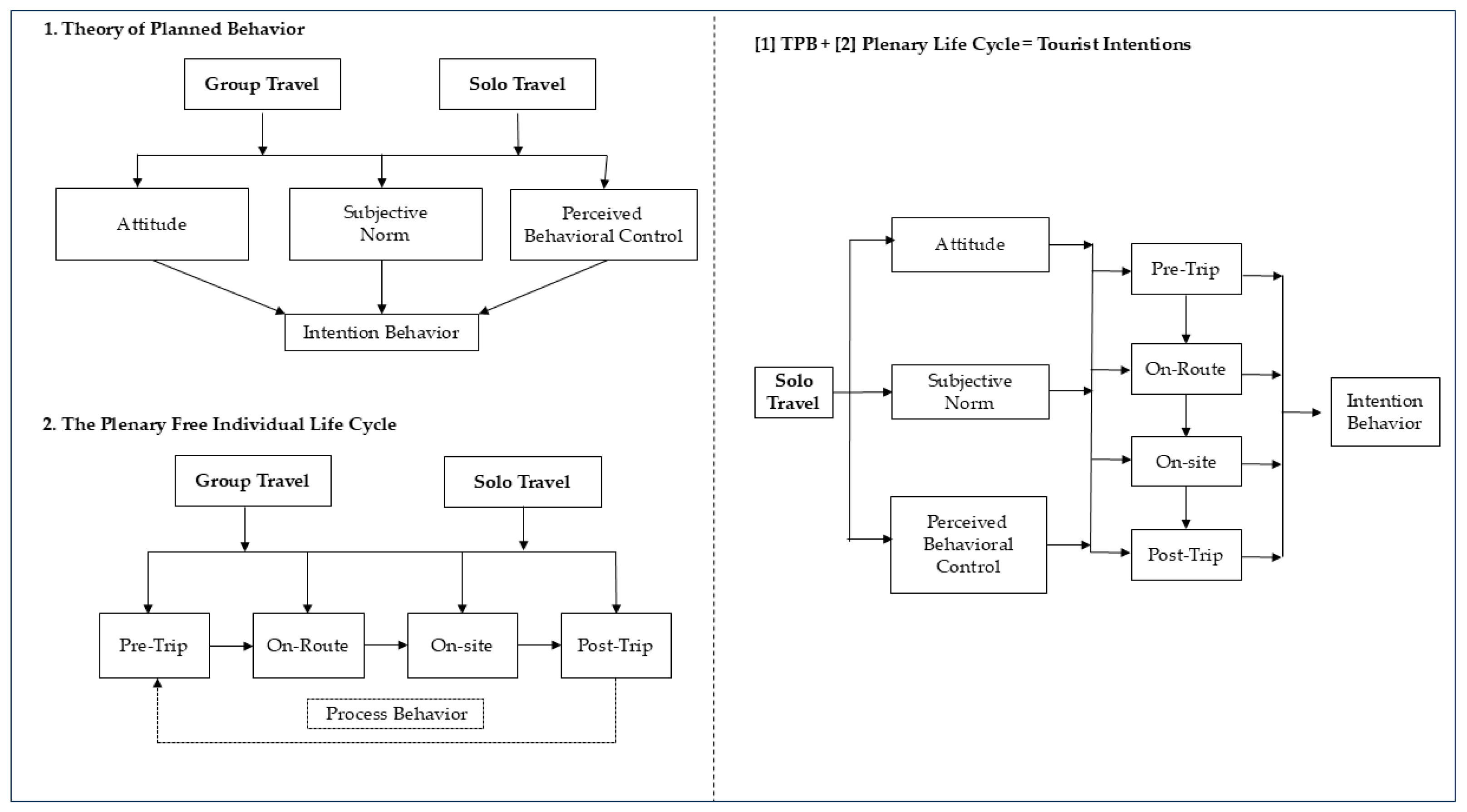
Together, these four stages illustrate how travel behaviour may evolve through discrete yet interconnected phases, demonstrating why behavioural outcomes may not always align with initial intentions. This stage-based interpretation forms the foundation for the examination of post-intention behaviours in the next section. Figure 1 visualises the integration of the Theory of Planned Behaviour and the Plenary Free Individual Life Cycle [15] to explain tourist intentions in solo travel contexts. It may illustrate how attitude, subjective norms, and perceived behavioural control operate alongside stage-based processes—pre-trip, on-route, on-site, and post-trip—to shape intention and behavioural outcomes.

2.7. Post-Intention Marketing Behaviours Limitation

Travel behaviour does not conclude at the point of intention; instead, post-intention responses may shape how travellers evaluate their experiences and engage with destinations thereafter. These outcomes—most notably satisfaction, electronic word-of-mouth (e-WOM), and revisit intention—represent [75,76] key behavioural indicators in tourism, particularly for solo travel. They may reflect the cumulative influence of expectations formed during the pre-trip stage, evaluations made on-site, and reflections occurring during the post-trip phase [67].
Satisfaction may arise when travellers perceive that their expectations and personal travel goals have been met. It may reflect both cognitive and emotional fulfilment, particularly in solo travel contexts where autonomy and self-directed experiences may contribute to a stronger sense of achievement [77,78]. Electronic word-of-mouth (e-WOM) may capture travellers’ willingness to share their experiences digitally. Positive e-WOM is often shaped by memorable or meaningful experiences, including those linked to sustainability [68,69,70,71] or distinctive local interactions, and may play a role in shaping the perceptions of other travellers [79,80,81]. Revisit intention may reflect the travellers’ willingness to return to a destination based on familiarity, emotional attachment, or perceived value. It may serve as an indicator of destination loyalty and longer-term behavioural commitment [82,83]. Table 5 summarises the three core post-intention behaviours examined in this study and outlines their behavioural meaning and corresponding marketing implications.

2.8. Research Framework

Drawing on the theoretical components synthesised in Section 2.1, Section 2.2, Section 2.3, Section 2.4, Section 2.5 and Section 2.6, this study developed a research framework that integrated cognitive-bias mechanisms, TPB constructs, stage-based travel behaviour, and post-intention outcomes to explain solo-travel decision pathways. The framework was organised around four interconnected components.
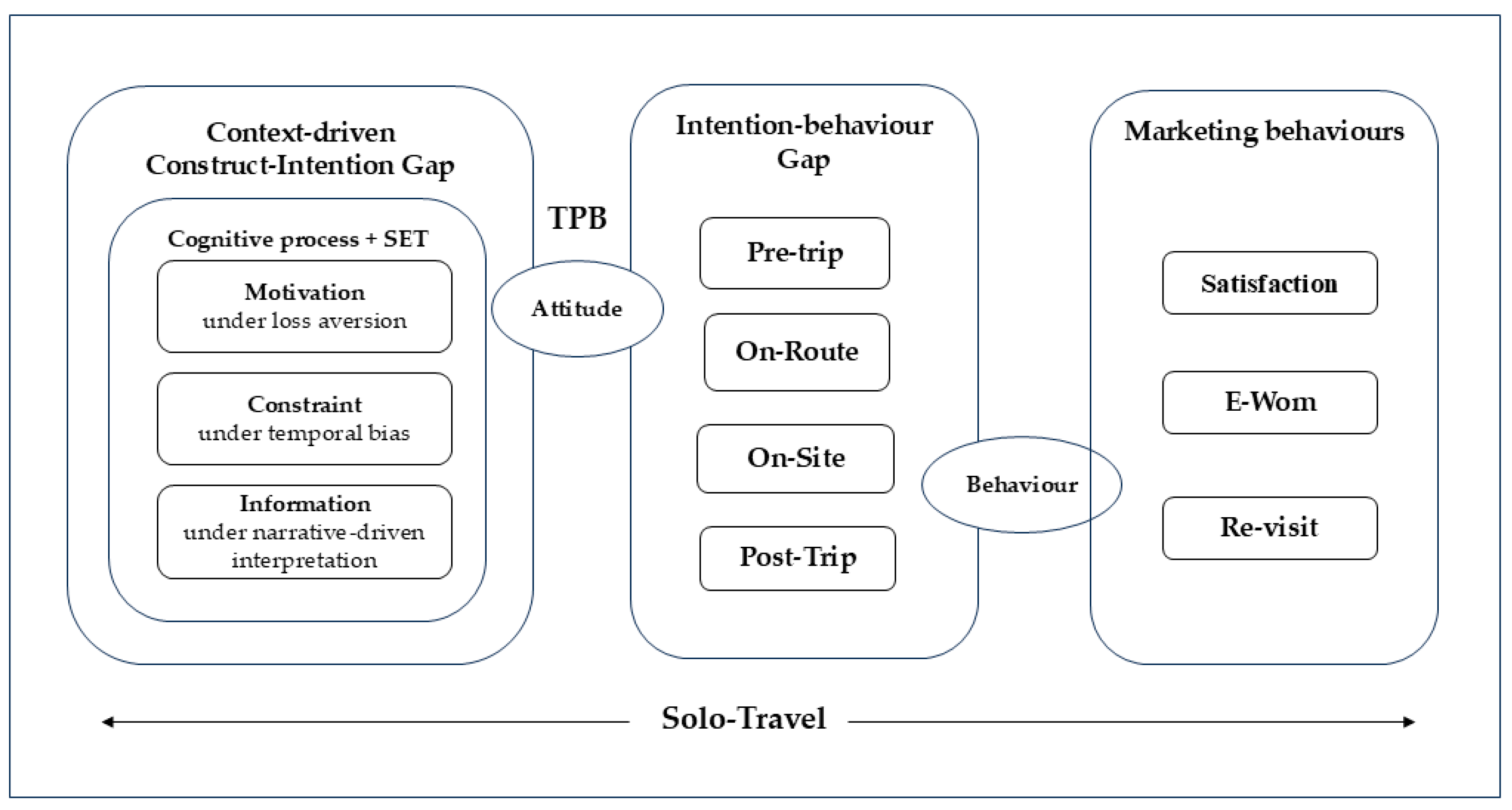
First, the cognitive process and SET dimension address the context-driven construct–intention gap through three mechanisms: motivation under temporal bias (MOT), constraint under loss aversion (CON), and information under narrative-driven interpretation (INI). These mechanisms may shape how travellers interpret value, risk, and meaning in ways that may influence attitude formation. Second, attitude, situated within the Theory of Planned Behaviour (TPB), represents the evaluative response derived from these cognitive processes. Within the TPB structure, attitude may act as a key determinant of subsequent behavioural intention. Third, behavioural expression across the tourism life cycle [15] may reflect the intention–behaviour limitation. Solo-travel decisions may unfold dynamically across four stages—pre-trip, on-route, on-site, and post-trip—each of which may be shaped by situational cues, emotional evaluations, and real-time contextual feedback. Finally, post-intention marketing behaviours—namely satisfaction, electronic word-of-mouth (e-WOM) [75,76], and revisit intention—may represent downstream outcomes that emerge after travel has been completed, offering practical implications for tourism operators and destination managers. Figure 2 illustrates this integrated framework and shows how cognitive-bias mechanisms feed into TPB-driven attitudes, which then guide behavioural expressions across travel stages and subsequent post-intention outcomes.
To situate the framework within the existing body of research, Table 6 summarises how prior studies have incorporated each component across group-travel and solo-travel contexts. The table highlights the fragmented and selective treatment of cognitive, attitudinal, stage-based, and post-intention variables in earlier studies. As indicated in Table 6, no prior research appears to have fully linked all four components—cognitive mechanisms (MOT, CON, INI), TPB attitude formation, stage-based travel behaviour, and post-intention outcomes—within a single framework.
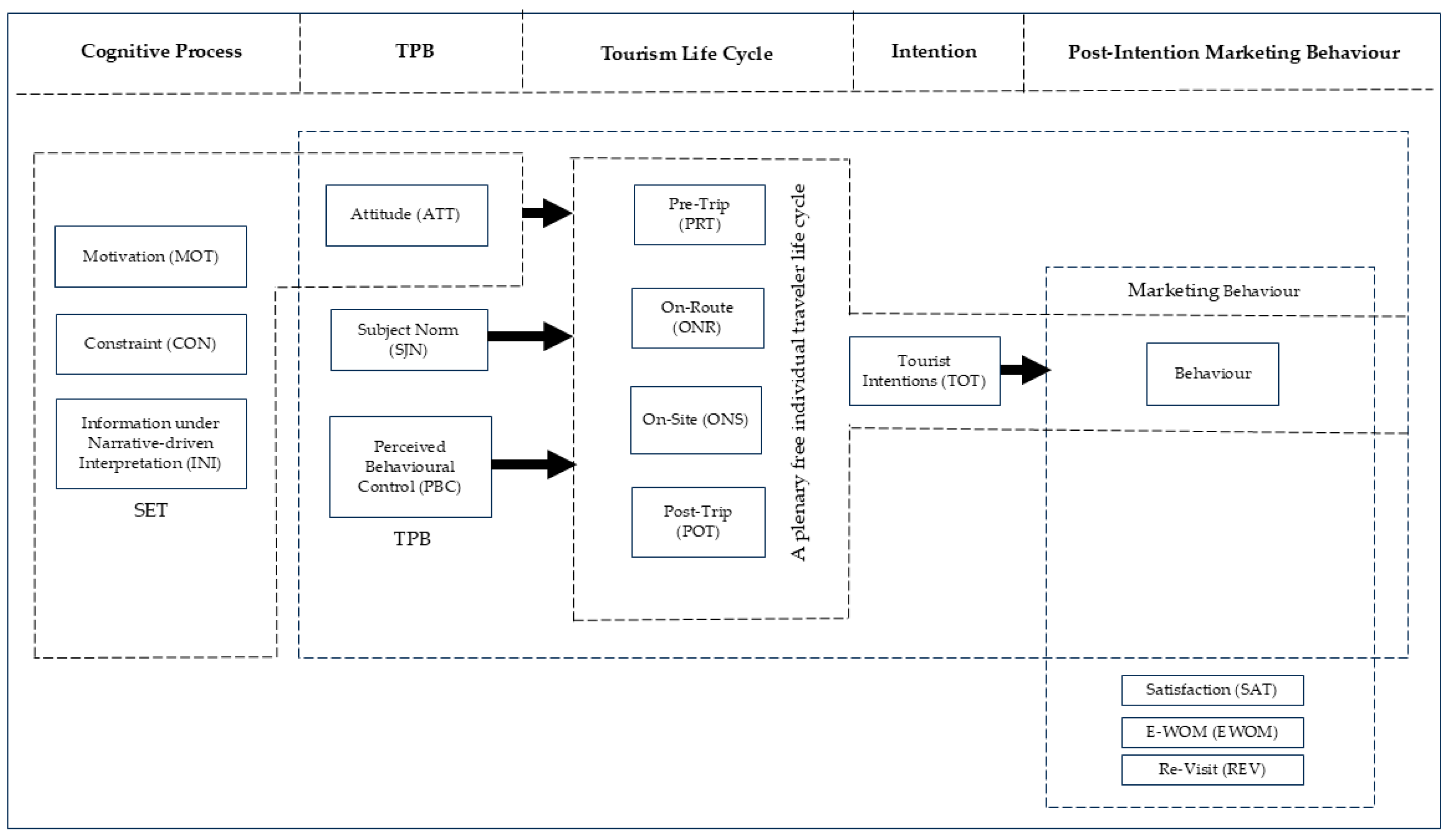
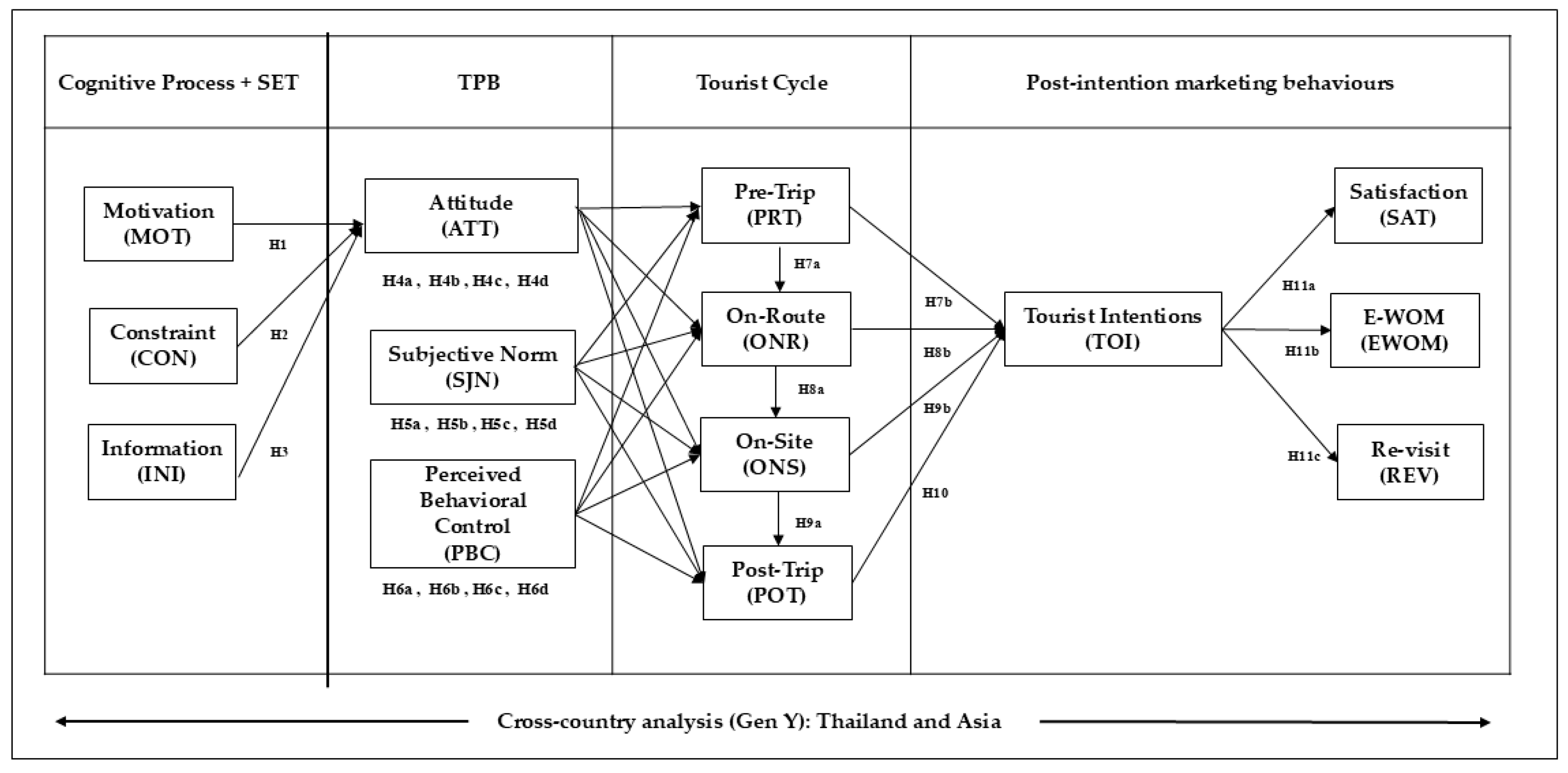
To enhance conceptual clarity given the integration of multiple psychological, digital, and stage-based components, the model is visually summarised in Figure 3 to illustrate the structural relationships among its key dimensions. The figure illustrates the integration of cognitive processes, TPB constructs, stage-based travel behaviour, and post-intention marketing behaviours within the solo-travel context.

3. Proposed Research Model and Hypothesis

3.1. Proposed Research Model

The study presents the I-SMART Cognitive TPB model [20], which consists of I (Information) as one factor of the cognitive mechanism beyond external stimuli, combined with S (Social Exchange Theory) that may help explain the weighing of values (Motivation) against trade-offs (Constraint). MAR (MARketing) is included as a factor reflecting perceived value and potential marketing impact, and T (Tourist Life Cycle), which is expanded into four stages to capture the dynamics of tourism behaviour. These components are integrated with the TPB (Theory of Planned Behaviour) as a cognitive-process framework that may help explain the formation of attitudes, intentions, and behaviours at each stage of the Gen Y solo-travel life cycle within a digital context. A comparative test was conducted between Thailand and other Asian countries (such as Vietnam, South Korea, and Japan) to reflect potential differences in cultural, social, and digital structures that may influence tourism-behaviour formation.
This study was conducted across three analytical formats, comparing Thailand and Asia as follows. The first model examined the attitude-mediated construct–intention relationship to analyse how motivation under temporal bias (MOT), constraint under loss aversion (CON), and information under narrative-driven interpretation (INI) influenced attitudes and intentions toward solo travel. The second model examined the stage-based intention–behaviour model to explore the relationship between intention and actual behaviour at each stage of the tourism life cycle for solo tourists. The third model examined post-intention marketing behaviours to determine how actual behaviour after intention may affect satisfaction (SAT), electronic word-of-mouth (E-WOM), and revisit intention (REV) for potential marketing-policy and programme design. Figure 4 presents the I-SMART Cognitive TPB model used in this study. The model depicts how cognitive-bias mechanisms, TPB constructs, stage-based travel behaviour, and post-intention outcomes interact to explain the solo-travel decision pathway.
While the Theory of Planned Behaviour (TPB) has been widely extended to incorporate additional predictors such as emotions, past behaviour, and contextual factors, most extensions retain a relatively stable intention–behaviour structure. The I-SMART Cognitive TPB model differs by integrating psychological bias constructs and digital environmental influences within a phase-based tourism life cycle framework. Rather than merely adding predictors, the model reconceptualises intention formation as dynamically embedded within travel phases, thereby offering a more context-sensitive application of TPB to solo travel decision-making.

3.2. Hypothesis

3.2.1. Motivation Under Temporal Bias (MOT)

Motivation is often regarded as an important factor shaping travel behaviour, encompassing both internal and external influences that may contribute to positive attitudes and proactive behavioural tendencies [101]. In the context of solo travel, motivation may encourage travellers to navigate challenges and engage with opportunities in sustainable tourism. Previous research has reviewed four decades of sustainable tourism development and identified key trends and future research directions [7]. Within the motivation under temporal bias (MOT) dimension, however, motivation is characterised as a positive motivational drive that may vary across time, whereby present outcomes may be weighted more heavily than future outcomes, or decisions may be made under time constraints [102]. Such temporal bias may influence motivation in ways that shape individuals’ intentions and actual behaviour in solo-travel contexts [18]. Based on this conceptual rationale, it is expected that:
H1. 
MOT influences attitude toward solo travel.

3.2.2. Constraint Under Loss Aversion (CON)

Constraints in tourism generally refer to barriers such as finances, safety, or time, which may negatively influence travellers’ attitudes and may reduce the likelihood of adopting sustainable practices [103]. This consideration may be particularly relevant for solo travellers, who often face higher levels of uncertainty and behavioural adjustment. Within the constraint under loss aversion (CON) dimension, constraint is characterised as a negative motivational drive that may arise from risk-averse tendencies. Travellers may prioritise the potential for loss over the potential for gain, leading them to prefer the same or familiar alternatives even when new options may offer more favourable outcomes. Such loss-related considerations may function as a constraint that steers travellers away from potentially beneficial alternatives [104]. Based on this conceptual rationale, the following hypothesis is proposed:
H2. 
CON influences attitude toward solo travel.

3.2.3. Information Under Narrative-Driven Interpretation (INI)

Narrative information in the digital context may play an important role in shaping tourists’ perceptions and attitudes, as information quality—such as completeness and credibility—may influence travel experiences and intentions [105]. However, research on solo travel has tended to focus primarily on motivations and constraints, leaving the potentially shaped or manipulated influence of online media information relatively underexplored [49]. The interpretation of such information is therefore not always purely rational, but may take place alongside narrative-based processing, through which digital content may shape how information is understood both semantically and emotionally [49,105]. Based on this conceptual rationale, the following hypothesis is proposed:
H3. 
INI influences attitude toward solo travel.

3.2.4. Attitudes (ATT)

Attitude (ATT) refers to a positive or negative evaluation of a particular behaviour [96]. Attitudes may be formed by important beliefs, often derived from past observations or experiences, and may influence intentions that lead to actual behaviour [88,106]. Tourism research suggests that attitude may serve as an important predictor of behavioural intention. In the context of solo travel, attitudes toward risk may influence travellers’ intentions, while positive attitudes toward benefits such as personal growth and independence may reinforce intentions to continue travelling alone [96]. Based on this conceptual rationale, the following hypotheses are proposed:
H4a. 
ATT influences pre-trip planning.
H4b. 
ATT influences on-route behaviours.
H4c. 
ATT influences on-site behaviours.
H4d. 
ATT influences post-trip reflections.

3.2.5. Subjective Norms (SJN)

Subjective norms (SJN) refer to social pressures that may encourage or discourage a particular behaviour [107]. These norms are shaped by social expectations, cultural influences, and interactions with significant others [107,108]. Research suggests that SJN may influence tourists’ intentions, particularly during the travel planning phase. For solo travellers, the support or dissent expressed within their social networks may shape their willingness to engage in sustainable tourism practices, since social norms and mandatory expectations have been proven to influence intentions towards environmentally friendly travel [109,110]. Based on these conceptual considerations, the following hypotheses are proposed:
H5a. 
SJN influences pre-trip planning.
H5b. 
SJN influences on-route behaviours.
H5c. 
SJN influences on-site behaviours.
H5d. 
SJN influences post-trip reflections.

3.2.6. Perceived Behavioural Control (PBC)

Perceived behavioural control (PBC) reflects a person’s confidence in performing a behaviour, considering the available resources, skills, and opportunities [73]. In tourism contexts, individuals with higher levels of PBC may be more likely to engage in sustainable tourism practices and may be better able to overcome various obstacles, particularly for solo travellers who often face greater logistical and situational complexities. Prior studies suggest that PBC may exert a positive influence on sustainability-related behavioural intentions across different stages of the travel process [73,111]. Based on these conceptual considerations, the following hypotheses are proposed:
H6a. 
PBC influences pre-trip planning.
H6b. 
PBC influences on-route behaviours.
H6c. 
PBC influences on-site behaviours.
H6d. 
PBC influences post-trip reflections.

3.2.7. Pre-Trip Phase (PRT)

The pre-trip phase (PRT) encompasses travellers’ early activities of researching and planning, which are important steps that may shape subsequent behaviour [36]. Prior studies suggest that careful planning may encourage more sustainable practices, particularly for solo travellers who may require higher confidence and intention when navigating travel uncertainties [36,89]. Based on these conceptual considerations, the following hypotheses are proposed:
H7a. 
PRT planning influences on-route behaviours.
H7b. 
PRT planning influences travel intentions.

3.2.8. On-Route Phase (ONR)

The on-route phase (ONR) refers to the period during which travellers are en route to their destination, a stage in which emerging behaviours may influence their subsequent on-site experiences [112]. Prior research suggests that adopting sustainable practices and exhibiting positive behaviours while travelling may promote more meaningful engagement with the destination, and may also shape longer-term intentions toward sustainable tourism [100]. Based on these conceptual considerations, the following hypotheses are proposed:
H8a. 
ONR behaviours influence on-site experiences.
H8b. 
ONR behaviours influence travel intentions.

3.2.9. On-Site Phase (ONS)

The on-site phase (ONS) focuses on tourist behaviour and direct experiences that involve interaction with the local environment and culture. Positive and sustainable behaviours may enhance satisfaction and may influence post-trip evaluations [112]. Prior research suggests that engaging in meaningful and responsible activities may help build more positive attitudes and may encourage intentions to undertake repeat travel [100] Based on these conceptual considerations, the following hypotheses are proposed:
H9a. 
ONS behaviours influence post-trip reflections.
H9b. 
ONS behaviours influence travel intentions.

3.2.10. Post-Trip Phase (POT)

The post-trip phase (POT) involves reflecting on and evaluating travel experiences, where positive evaluations may influence future travel intentions and repeat behaviours [67]. Prior research suggests that tourists who evaluate their experiences positively may be more likely to maintain sustainable travel behaviour on subsequent trips [100]. For solo travellers, satisfaction derived from past trips may help reduce uncertainty and may stimulate motivation to engage in sustainable travel in the future [67,113]. Based on this conceptual rationale, the following hypothesis is proposed:
H10. 
POT influences travel intentions.

3.2.11. Tourist Intention (TOI)

Tourist intention (TOI) refers to the willingness and commitment to adopt specific behaviours, such as sustainable solo travel [18]. Within the TPB framework, intention acts as a mediator between external and internal factors and actual behaviour. Stronger intentions may help predict behaviour and are shaped by attitudes, subjective norms, and perceived behavioural control [88]. Prior tourism research suggests that intention may be associated with sustainable practices, satisfaction, electronic word-of-mouth, and revisit behaviour [71,86]. However, these outcomes do not necessarily occur sequentially; instead, they may emerge in parallel and influence future behaviour. Based on these conceptual considerations, the following hypotheses are proposed:
H11a. 
INT influences SAT.
H11b. 
INT influences EWOM.
H11c. 
INT influences REV.

3.2.12. Satisfaction (SAT)

Satisfaction refers to the extent to which a travel experience meets or exceeds expectations and represents a key outcome reflecting the alignment between intentions and actual experiences. Positive satisfaction derived from sustainable practices may foster loyalty and repeat behaviour [67,114].

3.2.13. Electronic Word-of-Mouth (EWOM)

Electronic word-of-mouth (EWOM) refers to the likelihood that tourists share their experiences online. Travellers with stronger sustainable intentions and positive experiences may be more inclined to generate positive e-WOM, which may help build credibility and promote sustainable tourism [76,115].

3.2.14. Revisit Intention (REV)

Revisit intention (REV) refers to the likelihood that a tourist will return to the same destination, reflecting destination loyalty and the continuity of repeat travel behaviour [82,83].

4. Research Methodology

The research methodology, as illustrated in Figure 5, was structured to address the stated problems by examining factors that may influence solo travel decisions among Thai and Asian Generation Y (Millennial) travellers within the I-SMART Cognitive TPB model.

4.1. Questionnaire Design

The questionnaire consisted of 69 items designed to capture a comprehensive view of repeat solo travel behaviour and sustainable travel practices. It incorporated four key components: demographic information, travel history, behavioural and attitudinal insights, and post-intention. The instrument specifically targeted Generation Y solo travellers (born between 1982 and 1996; aged 29–43 in 2025) [112], focusing on Thai respondents and respondents from other Asian countries who experienced solo travel in Thailand. In addition to demographic data, the questionnaire collected information on individual travel history, frequency of solo trips, motivations, and familiarity with sustainable practices. Responses were measured using a 5-point Likert scale, where 1 indicates “not relevant” and 5 indicates “most relevant”, allowing respondents to express the degree of personal relevance for each item. This scale facilitated the identification of individual-level factors associated with solo travel decisions and the integration of sustainability considerations. While the study placed primary emphasis on Thailand, it also included respondents from the broader Asian region to explore potential similarities in cross-national travel behaviour and decision-making patterns. The comparison between Thai tourists and solo travellers from other Asian countries was operationalised based on travel origin, distinguishing domestic travellers from inbound travellers from other Asian countries. As the study did not directly operationalise or measure cultural value dimensions, the observed differences were interpreted as cross-national variations in travel-related behaviour within the specific tourism context.

4.2. Institutional Review Board: IRB and Informed Consent

Approval case: The study was conducted in accordance with the Declaration of Helsinki, and the protocol was approved by the Institutional Review Board of Mahidol University and assigned the approval number COE No. MU-CIRB 2025/034.2402 (approved on 24 February 2025). Informed consent for participation was obtained from all subjects involved in the study.

4.3. Pilot Testing

A pilot test was conducted with a sample of 30 participants over a 15-day period from 5 to 20 August 2025 to ensure the clarity and comprehensibility of the questionnaire. This approach aligns with the recommendation of [1], who suggested a sample size of approximately 30 participants for pilot testing, particularly when the pilot group closely resembles the target population. The pilot test also helped minimise time and cost during the pre-test phase.

4.4. Main Testing

Following the revision of the questionnaire based on the pilot test results, the main data collection phase was carried out. Data were collected using offline questionnaires and categorised into two respondent groups: Thai solo travellers and other Asian solo travellers. All participants received a research information sheet and an informed consent form approved by the Institutional Review Board (IRB). Data collection took place over a 60-day period from 1 September to 30 October 2025. Participant screening was conducted to ensure eligibility based on traveller type and solo travel status, as presented in Table 7.

4.5. Statistical Data Analysis

Structural equation modelling (SEM) was employed to examine the relationships between the TPB constructs and repeat solo travel intentions, providing a broader view of the factors that may influence solo travel behaviour. Additional analyses were conducted to explore the extent to which sustainable practices are incorporated into repeat solo travel behaviour. All analyses were performed using SmartPLS version 4.1.0.9 following the two-stage analytical procedure recommended by [2], beginning with the evaluation of the measurement model to assess reliability and validity, and then proceeding to the structural model to test the hypothesised relationships.

5. Results

5.1. Measurement Model

To determine the appropriateness of the indicators, the 69-item questionnaire was examined in terms of mean, standard deviation (S.D.), indicator loading, and variance inflation factor (VIF) to ensure both reliability and validity. The analysis showed that standard deviation values fell within the range of 0.69 to 0.94 for Asian tourists and ranged from 0.71 to 1.01 for Thai tourists. All indicator loadings for Asian tourists were between 0.710 and 0.888, while those for Thai tourists ranged from 0.708 to 0.852, surpassing the recommended threshold of 0.70 [116]. Multicollinearity was assessed in the formative measurement model through the outer VIF values, which ranged from 1.423 to 3.159 for Asian tourists, and from 1.320 to 2.192 for Thai tourists—well below the critical cut-off point of 5.00 [117]. These findings support the reliability and validity of the construct measurements, as detailed in Table 8.
An evaluation of the reliability and validity of the results was subsequently conducted and is presented in Table 9. The process began with the examination of internal consistency for each latent construct, assessed using Cronbach’s alpha, with a recommended minimum threshold of 0.70 [116]. The alpha values for Asian tourists ranged from 0.782 to 0.928, while those for Thai tourists ranged from 0.741 to 0.870. To further confirm internal consistency, the composite reliability (CR) was calculated, which should also exceed the threshold of 0.70 [127]. The CR values for Asian tourists ranged from 0.786 to 0.929, and those for Thai tourists ranged from 0.741 to 0.870. Additionally, the extent to which the indicators explained the variance of their associated latent constructs was assessed using average variance extracted (AVE), where a minimum value of 0.50 is required. The AVE values ranged from 0.564 to 0.770 for Asian tourists, and from 0.605 to 0.777 for Thai tourists.
To assess discriminant validity, the Fornell–Larcker criterion was applied to ensure that each latent construct was sufficiently distinct from the others. As stated by [127], this condition is satisfied when the square root of the AVE for each construct exceeds 0.70. For Asian tourists, the values ranged from 0.564 to 0.825, while for Thai tourists, they ranged from 0.258 to 0.836, confirming that all constructs were empirically distinguishable in both groups, as shown in Table 10.
As a final step, the heterotrait–monotrait ratio (HTMT) was examined, following the guidelines proposed by [128]. The results, as shown in Table 11, indicate that all HTMT values fell below the liberal threshold of 0.90. This provides additional evidence supporting the discriminant validity of the constructs.

5.2. Structural Model

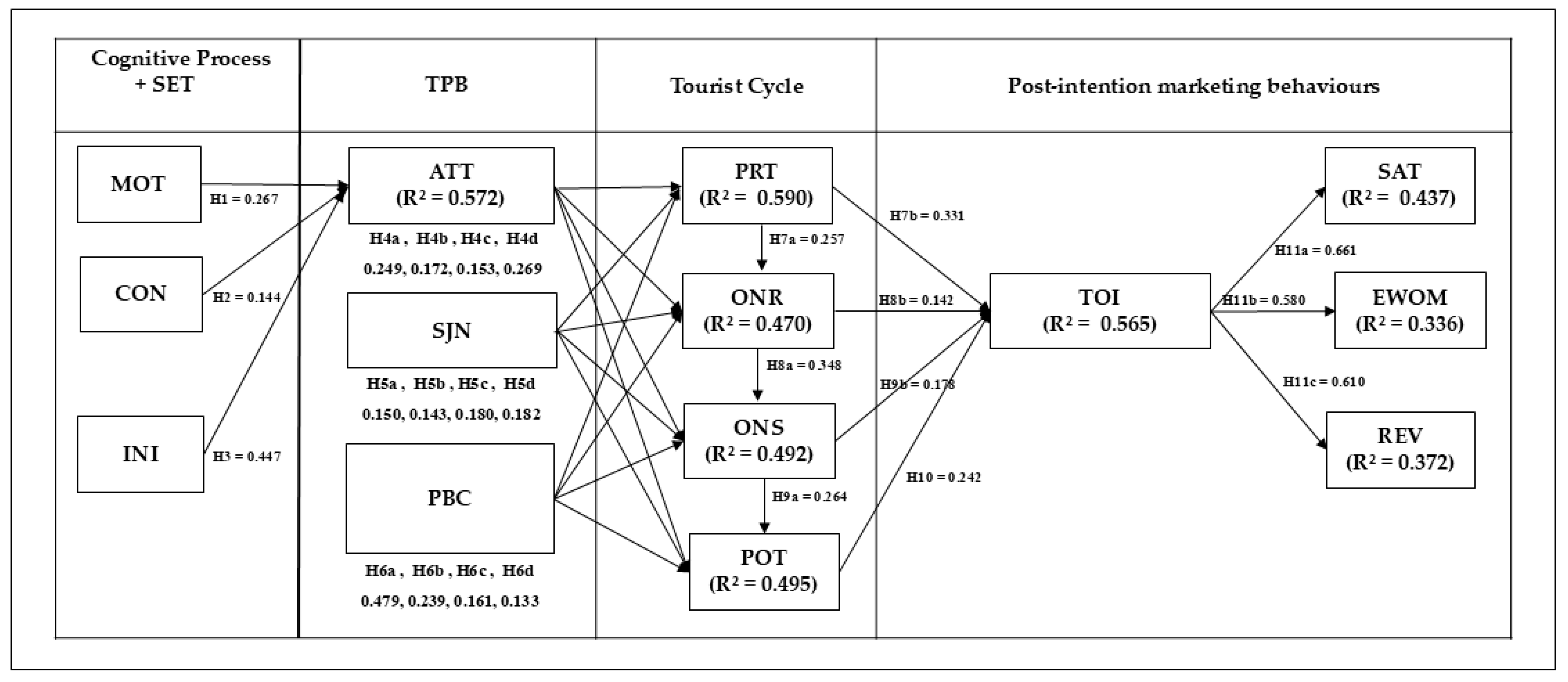
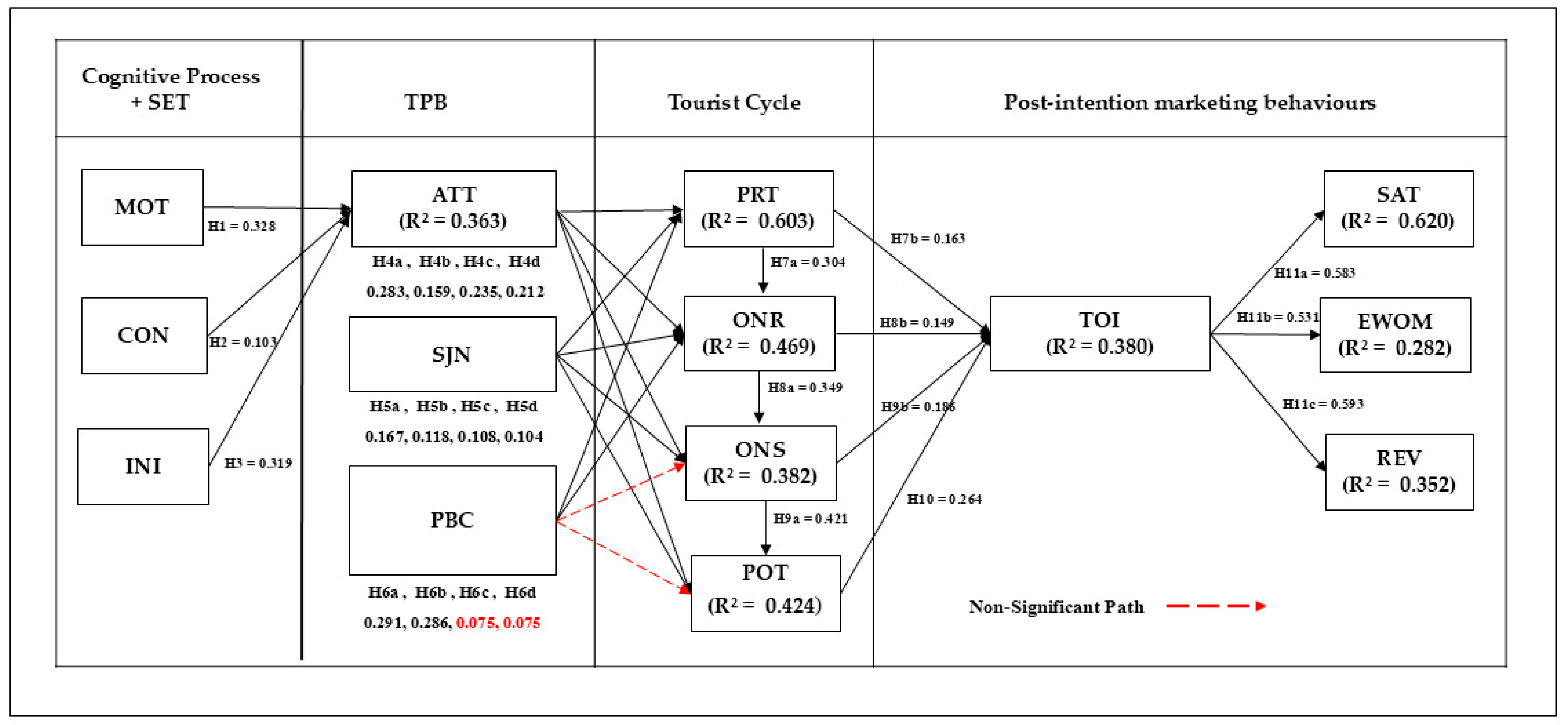
Hypothesis testing was conducted using the proposed structural model, applying the bootstrapping technique with 5000 subsamples, in accordance with the recommendations of [116]. The evaluation of the path coefficients (β) was based on standard thresholds: a t-value greater than 1.96, an inner VIF below 5.00, and a p-value less than 0.05. The results are shown in Table 12. The results demonstrated that all hypothesised relationships—covering H1, H2, H3, H4a to H4d, H5a to H5d, H6a to H6d, H7a and H7b, H8a and H8b, H9a and H9b, H10, H11a to H11c, and H12—were statistically supported. The standardised path coefficients (β) ranged from 0.133 to 0.661 for Asian tourists, and from 0.075 to 0.593 for Thai tourists, thereby confirming the proposed associations among the latent constructs. A graphical representation of the structural model for Asian tourists is provided in Figure 6, with the corresponding model for Thai tourists illustrated in Figure 7.
Moreover, to further assess the possibility of multicollinearity and common method bias, full collinearity was examined using the variance inflation factor (VIF). Analysis revealed that for Asian tourists, the full collinearity VIF ranged from 1.000 to 2.442, and for Thai tourists, it ranged from 1.000 to 1.000–1.928. All values were significantly below the stringent threshold of 3.30 [129] and the general threshold of 5.00 [130]. These results indicate the absence of multicollinearity and common method bias and confirm the strength and reliability of the structured model.

5.3. Model Fit

The overall quality of the model was examined in line with the criteria outlined by [131] using SmartPLS to assess three principal aspects: (1) average variance extracted (AVE), (2) the coefficient of determination (R2), and (3) the model’s goodness-of-fit (GoF).
In the case of Asian tourists, the AVE values obtained for each endogenous variable were: ATT = 0.667, EWOM = 0.777, TOI = 0.620, ONR = 0.651, ONS = 0.698, POT = 0.661, PRT = 0.667, REV = 0.730, and SAT = 0.725, and the R2 values obtained for each endogenous variable were: ATT = 0.572, EWOM = 0.336, TOE = 0.565, ONR = 0.470, ONS = 0.492, POT = 0.495, PRT = 0.590, REV = 0.372, and SAT = 0.437. The corresponding GoF value was derived using Equation (1), as illustrated below.
For Thai tourists, the AVE values followed a similar structure: ATT = 0.571, EWOM = 0.653, TOI = 0.637, ONR = 0.611, ONS = 0.713, POT = 0.627, PRT = 0.603, REV = 0.618, and SAT = 0.620, and the R2 values followed a similar structure: ATT = 0.363, EWOM = 0.282, TOI = 0.380, ONR = 0.469, ONS = 0.382, POT = 0.424, PRT = 0.354, REV = 0.352, and SAT = 0.339, with the GoF calculated through Equation (2). Taken together, these indicators demonstrate that the model provides a satisfactory representation of the structural relationships among the constructs proposed in the research model.
The GOF for Asian tourists
G o F = R ¯ 2 × A V E ¯ = 0.480 × 0.685 = 0.574
The GOF for Thai tourists
G o F = R ¯ 2 × A V E ¯ = 0.3717 × 0.6288 = 0.483
To evaluate the overall model fit, several goodness-of-fit indices were assessed in accordance with the PLS-SEM guidelines. As shown in Table 13, the SRMR values for both Asian tourists (0.050) and Thai tourists (0.055) were well below the recommended threshold of 0.08, indicating a strong model fit. Similarly, the dULS and dG values for both groups fell below their respective 95% confidence intervals, further confirming an acceptable level of fit between the empirical and model-implied correlation matrices. Although the chi-square values were relatively high—which is common in PLS-SEM due to large sample sizes and the non-parametric nature of the method—they do not undermine the validity of the model. Finally, while the NFI values for both groups (0.751 for Asian tourists and 0.746 for Thai tourists) did not reach the conventional threshold of 0.90, they remained within an acceptable range given the complexity of the model. These results collectively suggest that the measurement and structural models demonstrated adequate fit for both tourist groups.

5.4. Path Coefficient (β): Asian Tourists vs. Thai Tourists

The study results were divided into three parts.

5.4.1. Results of the Analysis of Construct Factors with Intention Through Attitude (Construct–Intention)

This first section highlights contextual differences between Asian tourists and Thai tourists in how MOT, CON, and INI may influence attitude (ATT), as summarised in Table 14. Within the reward–cost structure specified by Social Exchange Theory (SET), ATT may be interpreted as an evaluative outcome shaped by different weightings of the motivation under temporal bias (MOT), constraint under loss aversion (CON), and information under narrative-driven interpretation (INI) factors. For the Asian group, INI → ATT (β = 0.447) demonstrated the strongest influence among the three predictors. This suggests that narrative-driven information in digital media may play a central role in shaping attitudes toward solo travel within this group. MOT → ATT (β = 0.267) also showed a meaningful positive influence, indicating that motivation under temporal bias may shape how Asian tourists evaluate travel decisions, particularly when short-term outcomes are emphasised. In contrast, CON → ATT (β = 0.144) was relatively low, implying that loss-avoidant tendencies may not substantially weaken attitudes toward solo travel among Asian tourists. Overall, the R2 value of 0.572 suggests that MOT, CON, and INI together explain a substantial proportion of the variance in attitudes in the Asian group. The stronger coefficient of INI (β = 0.447), relative to MOT (β = 0.267) and CON (β = 0.144), may indicate that evaluative attitudes in this group are more strongly associated with information-weighted reward assessments within the SET reward–cost framework. For the Thai group, MOT → ATT (β = 0.328) exhibited the strongest influence, indicating that temporal-bias-related motivation may play a prominent role in shaping attitudes in this group. INI → ATT (β = 0.319) also showed a notable positive effect, though slightly lower than MOT, suggesting that narrative information remains influential but to a lesser extent than that in the broader Asian sample. As with the Asian group, CON → ATT (β = 0.103) had a comparatively small effect, indicating that loss-related constraints may have a limited role in shaping attitudes among Thai tourists. The R2 value of 0.363 indicates that MOT, CON, and INI collectively explain a smaller proportion of attitude variance for Thai tourists compared with the Asian group. The relatively stronger effect of MOT (β = 0.328) compared with INI (β = 0.319) and CON (β = 0.103) suggests a comparatively greater weighting of motivational reward considerations in the evaluative process in this group, consistent with SET’s reward–cost structure.

5.4.2. Intention–Behaviour Analysis Results

This section describes how the TPB components—ATT, SJN, and PBC—are associated with behavioural expressions across the four stages of the tourism life cycle for solo travellers, as summarised in Table 15.
For the Asian group, PBC → PRT (β = 0.479) demonstrated the strongest influence among all paths. This suggests that perceived behavioural control may play an important role in shaping the pre-trip preparation for Asian solo travellers. ATT also showed meaningful effects across the stages, with the strongest association observed at ATT → POT (β = 0.268), indicating that attitudes may be particularly relevant when travellers evaluate their experiences after the trip.
SJN showed relatively consistent but smaller effects across the stages (β = 0.143–0.182), suggesting that social expectations may play a modest role throughout the life cycle.
The pre-trip stage (PRT) showed the highest explanatory power (R2 = 0.590), indicating stronger contributions of ATT, SJN, and PBC to pre-trip behaviour than to other stages.
For the Thai group, PBC also demonstrated the strongest effect in the pre-trip stage, with PBC → PRT (β = 0.291) representing the highest path coefficient within the model. ATT also played an important role, with ATT → PRT (β = 0.283) appearing slightly below PBC but still notable. SJN exhibited smaller effects across the stages (β = 0.104–0.167), suggesting that social expectations may be less influential in shaping Thai solo travellers’ behaviour throughout the life cycle. As in the Asian group, the pre-trip stage had the highest explanatory power (R2 = 0.603), suggesting stronger predictive contributions of TPB components in this phase relative to others.
Stage 2 examines how each phase of the tourism life cycle may influence tourist intention (TOI), as summarised in Table 16. For Asian tourists, the pre-trip phase (PRT) demonstrated the strongest association with intention (β = 0.331), which was higher than the corresponding effect observed among Thai tourists (β = 0.163). In contrast, the post-trip phase (POT) exhibited a stronger association with TOI among Thai tourists (β = 0.264) compared with Asian tourists (β = 0.242).

5.4.3. Analysis Results of Post-Intention Marketing Behaviours

This section presents the post-intention outcomes, showing how tourist intention (TOI) may be associated with satisfaction (SAT), electronic word-of-mouth (E-WOM), and revisit intention (REV), as summarised in Table 17. Among the Asian tourists, the strongest association was observed for TOI → SAT (β = 0.661), suggesting that intention may be closely linked with overall satisfaction in this group. In contrast, for Thai tourists, the strongest effect occurred for TOI → REV (β = 0.593), indicating that intention may be particularly relevant in shaping revisit-related behavioural tendencies.

6. Discussion

6.1. Interpretation of Attitude-Mediated Construct–Intention

Narrative-driven information emerged as the most influential attitudinal driver among Asian tourists, indicating that meaningful and emotionally framed digital content may shape their travel evaluations more strongly than rational assessments alone. This pattern aligns with the broader role of narrative processing in digital decision environments. Among the Thai tourists, motivation shaped by temporal bias appeared more central to attitude formation. This suggests that short-term considerations, time-pressured judgments, and immediate outcome evaluations may be especially salient in shaping how Thai travellers form attitudes toward solo travel. From a social exchange theory (SET) perspective, these differences may reflect variations in how reward-related and cost-related considerations are cognitively weighted during attitude formation. Among the Asian tourists, narrative-driven information (INI) may account for a larger share of this evaluative weighting. Among the Thai tourists, motivation under temporal bias (MOT) accounted for a comparatively greater share within the same reward–cost structure.

6.2. Interpretation of Stage-Based Intention-Behaviour

A key pattern that emerged from the analysis is that the pre-trip (PRT) stage tends to be the strongest behavioural point for both groups, consistent with the central role of preparation in shaping subsequent tourist behaviour. For Asian tourists, this preparation appears to be grounded primarily in perceived behavioural control (PBC), suggesting that travellers in this group may prioritise a sense of self-management—including planning, resource access, and control over their travel choices. When travellers perceive that they can effectively manage the travel process, they may be more prepared to commit to the trip. Among the Thai tourists, however, attitude appeared to play a more prominent role during the pre-trip phase. This pattern may reflect the importance of positive expectations and emotional reassurance, where Thai travellers may be more inclined to proceed with a trip when they feel confident that the experience will be worthwhile and aligned with anticipated outcomes. Consistent with these differences, subjective norms (SJN) showed only minimal influence across both groups, suggesting that social expectations may carry limited weight in shaping solo-travel decisions—an effect that may resemble “ambient noise” within decision processing, particularly in individualised travel contexts.
The comparison between groups further suggests that PRT tends to exert a stronger influence on intention among Asian tourists, highlighting the importance of planning and anticipation. In contrast, post-trip (POT) evaluations appeared more influential for Thai tourists, implying that reflective assessments of actual experiences and memory-based evaluations may be more decisive in shaping future intentions. These patterns reinforce that the formation of intention (TOI) may not follow a linear sequence but instead varies across stages of the tourist life cycle [15,54] and may depend on the sociocultural context in which travellers interpret their experiences. However, given the cross-sectional and retrospective nature of the data, these stage differences should be interpreted as cognitively structured representations of travel phases rather than as directly observed temporal transitions. Accordingly, the life cycle pattern discussed here may reflect how travellers organise and evaluate their experiences across perceived phases, rather than demonstrating real-time behavioural progression. For Asian tourists, confidence in their ability to manage and control [132] the trip appears to relate to their readiness to travel. For Thai tourists, confidence that the trip will be worthwhile [133] may similarly correspond with their readiness to travel.

6.3. Interpretation of Post-Intention Marketing Behaviour

The interpretation suggests that for Asian tourists, intention is closely associated with satisfaction, indicating that the willingness to engage in solo travel may translate into a perception that the experience is worthwhile and aligns with expectations. In contrast, among the Thai tourists, intention showed a stronger association with repeated travel, suggesting that commitment to solo travel may extend beyond immediate satisfaction and may contribute to the formation of a tangible tendency to return. In both groups, electronic word-of-mouth (E-WOM) appeared at a secondary level [105]. This pattern suggests that although tourists are willing to share their experiences, the underlying motivations may differ: Asian tourists may prioritise immediate experiential value, whereas Thai tourists may be more oriented toward long-term evaluative commitment [134]. For Asian tourists, intention appears to be associated with subsequent satisfaction, whereas for Thai tourists, intention may be linked to repeat-visit behaviour. Across both groups, e-WOM tended to function as a secondary rather than a primary post-intention outcome.
Although the present study adopted a phase-based tourism life cycle framework, the cross-sectional design did not permit the direct observation of changes in travel intentions over time. The findings therefore reflect phase-differentiated patterns rather than longitudinal transitions. Future research employing longitudinal designs may provide stronger insight into how intentions and behavioural responses evolve across the travel journey.

7. Compare with Previous Research

Previous research using the TPB has often explained travel behaviour through its three core variables (attitude, subjective norms, and perceived behavioural control) in a largely linear manner, with a predominant focus on external motivations and constraints. This study expands that scope by integrating cognitive psychology mechanisms (temporal bias, loss aversion, narrative-driven information) and social exchange theory (SET) to address the attitude-mediated construct–intention gap and the stage-based intention–behaviour gap. It further incorporates a more nuanced tourist life cycle and post-intention marketing behaviour to reflect the decision-making dynamics of Gen Y solo travellers in digital contexts. Comparative insights between Thai and Asian travellers—an area that remains relatively underexplored—also contribute to extending the current tourism literature.

8. Theoretical Implications

This study extends the TPB framework by integrating psychological biases (temporal bias, loss aversion) and the role of narrative information in digital contexts. The findings suggest that in solo travel, social pressure (subjective norms), a core TPB component, may have limited influence. Regional differences also appeared, where Asian tourists seemed more guided by narrative information and perceived behavioural control, while Thai tourists placed greater emphasis on short-term motivations and perceived worthwhileness. These patterns indicate that digital tourism behaviour may need to be explained through psychological and data-driven mechanisms rather than relying primarily on social structures. Accordingly, this research proposes the I-SMART Cognitive TPB Model, integrating TPB with cognitive processes and the tourism life cycle to address potentially non-linear decision-making in digital contexts.

9. Practical Implications

9.1. Policy Makers

For Asian countries, policy directions may prioritise strengthening digital infrastructure and improving tourism data transparency, supporting travellers who value control and confidence during their journeys [135]. Governments may enhance digital platforms integrating essential information—such as safe routes, transport systems, and access to local services—alongside cross-border cooperation on tourism information. Emphasis may also be placed on digital content quality and safety standards to reduce uncertainty and build trust in solo travel. For Thai policymakers, a support framework addressing time-based motivations and value-for-money perceptions may be relevant. Potential measures could include flexible vacation policies, short-term domestic travel programmes, and financial incentives such as discount cards or tax benefits. These approaches may contribute to positioning solo travel as both leisure and a safe, meaningful experience, consistent with existing safety and communication infrastructure.

9.2. Marketer

In the Asian context, marketing strategies may benefit from digital storytelling—including video reviews, user experiences, travel blogs, and influencer narratives—to highlight control, safety, and immediacy. Additional strategies may involve real-time information, support systems for solo travellers, and culturally resonant content framing solo travel as self-discovery. For Thai travellers, communication may emphasise tangible and emotional value, such as demonstrating how short trips can be fulfilling. Authentic reviews, value-oriented promotions, and messaging portraying solo travel as “safe and worthwhile” may enhance appeal. Longer-term engagement may be supported through loyalty programmes, traveller privileges, and campaigns normalising solo travel as an emerging habit.

9.3. Implications Within the Customer Journey Framework

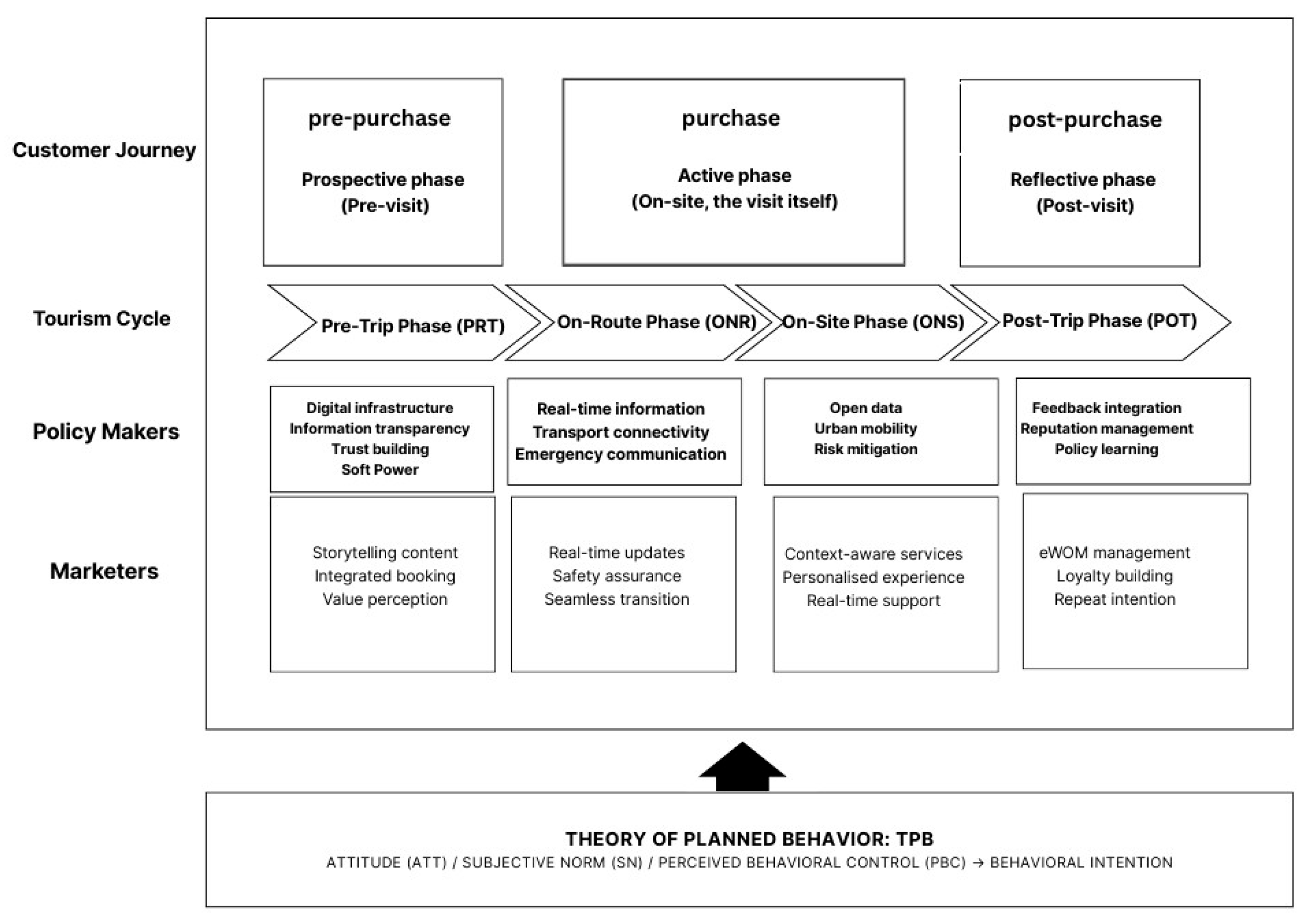
Integrating tourism policies and marketing strategies within the Customer Journey Mapping framework [136,137] may enable the contextualised application of TPB mechanisms across travel stages, particularly in supporting solo travel in Asia (see Figure 8). Pre-travel phase: Greater emphasis may be placed on digital transparency and institutional trustworthiness aligned with international standards to strengthen perceived behavioural control and reduce uncertainty. On-route and on-site phases: Real-time information systems, safety alerts, navigation tools, and responsive support channels may help sustain behavioural intention under dynamic conditions. Integrated digital platforms connecting local information, emergency services, and communication channels may support confidence among solo travellers. Post-travel phase: Electronic word-of-mouth (e-WOM) and feedback systems may reinforce links between personalised experiences and longer-term behavioural intention and destination loyalty.
In summary, digital service design for solo travellers should prioritise practical, phase-specific interventions across the travel journey. For example, policymakers may focus on enhancing real-time information transparency and safety visibility during pre-travel and on-route stages, while marketers may develop targeted digital content and value-oriented campaigns that reinforce perceived behavioural control and reduce uncertainty. Aligning platform features and communication strategies with travellers’ stage-based needs can strengthen intention formation and support sustained solo travel engagement.

10. Conclusions

This research aims to understand the dynamics of solo-travel decision-making among Generation Y solo travellers, with a comparative focus on Thai and other Asian tourists in digital contexts. The literature review (LI) indicates that although the Theory of Planned Behaviour (TPB) is widely used in tourism research, it may not fully capture the attitude-mediated construct–intention gap, the stage-based intention–behaviour gap, or post-intention marketing behaviours. Accordingly, psychological biases (temporal bias, loss aversion, narrative-driven information) were integrated with social exchange theory (SET), the four-stage tourism life cycle, and post-intention outcomes (satisfaction, e-WOM, revisit). This study, therefore, proposes the I-SMART Cognitive TPB Model (PRO), which integrates information, SET, marketing, and the tourist life cycle into TPB to help explain potentially non-linear decision-making among Millennial solo travellers.
Using a sample of 800 respondents (400 Thai, 400 Asian), IRB-approved, and analysed via SEM, the study found that Asian tourists tended to be guided by narrative information (INI → ATT), whereas Thai tourists were more influenced by time-related motivation (MOT → ATT). In the intention–behaviour dimension, the pre-trip (PRT) stage was consistently influential, although the driving variables differed (Asian = PBC; Thai = Attitude). In post-intention behaviour, Asian tourists were more strongly associated with satisfaction (SAT), while Thai tourists showed stronger links to repeat travel (REV). These findings suggest that tourist intention may vary not only across the phases of the tourist life cycle but also according to culturally shaped patterns—such as the stronger pre-trip influence observed among Asian travellers and the more pronounced post-trip influence among Thai travellers. Compared with previous research, this study extends TPB by integrating psychological frameworks, digital information use, and a post-intention dimension.
Theoretically, the I-SMART Cognitive TPB Model complements TPB by foregrounding cognitive-bias mechanisms, while empirical results in this study suggest that subjective norms may play a comparatively limited role in solo-travel decisions. Practically, implications include investment in digital infrastructure, safety systems, and time-based policy incentives for Thai travellers. For marketers, the findings encourage the use of digital storytelling and value-driven strategies to promote repeat visits. Overall, this study indicates that Millennial solo travel behaviour reflects complex dynamics shaped by psychological biases and narrative interpretation, supporting the need for integrated theoretical and applied frameworks.

11. Limitations

This study has several limitations that define the scope of applicability of its findings. First, the sample was limited to Millennial tourists in Thailand and selected Asian countries; therefore, the results may not generalise to other age groups or regions. Second, the cross-sectional design did not allow for the direct observation of changes in travel intentions and behaviour across different travel periods. Third, although the study integrated the TPB framework, cognitive bias, SET, and the tourism life cycle, broader contextual factors—such as macroeconomic conditions, global crises, or public policy environments—were not incorporated into the model and may also influence solo tourist behaviour. Fourth, cultural value dimensions were not directly operationalised in this study. Consequently, the cross-national differences identified reflect behavioural variations within the defined travel context.

12. Further Directions

Two main points should be considered: first, expanding the study scope to a wider and more diverse sample group, including age groups different from Millennials, Generation Y, or Baby Boomers, including comparisons between regions with different cultures [138] and digital infrastructures [139], such as Europe, America, or Africa, and using longitudinal studies and systematically collecting qualitative data to reflect the dynamics and changes in solo travel behaviour over the long-term and at each stage of the travel life cycle. Second, integrating immediate emotional variables, real-world factors, and the role of rapidly changing digital technologies, such as AI-driven recommendation [140] or social media narrative dynamics, including design and experimental testing at both the marketing strategy and public policy levels would confirm and verify the consistency as well as further develop the application of the I-SMART Cognitive TPB model framework to make it robust and practically applicable in both academic and practical contexts.

Author Contributions

U.D.: Conceptualization, Data curation, Formal analysis, Methodology, Software, Writing—original draft, Writing—review & editing, Validation, Visualization. A.L.: Conceptualization, Data curation, Formal analysis, Funding acquisition, Investigation, Methodology, Project administration, Resources, Software, Supervision, Validation, Visualization, Writing—review & editing. All authors have read and agreed to the published version of the manuscript.

Funding

This research received no external funding.

Institutional Review Board Statement

The study was conducted in accordance with the Declaration of Helsinki and approved by the Institutional Review Board of Mahidol University (COE No. MU-CIRB 2025/034.2402, approved on 24 February 2025).

Informed Consent Statement

Informed consent was obtained from all subjects involved in the study.

Data Availability Statement

The data presented in this study are available on request from the corresponding author. The data are not publicly available due to ethical and confidentiality considerations.

Conflicts of Interest

The authors declare no conflicts of interest.

References

  1. Yepez, C.; Leimgruber, W. The Evolving Landscape of Tourism, Travel, and Global Trade since the COVID-19 Pandemic. Res. Glob. 2024, 8, 100207. [Google Scholar] [CrossRef]
  2. UN Tourism. International Tourism Recovers Pre-Pandemic Levels in 2024. 2024. Available online: https://www.Untourism.Int/News/International-Tourism-Recovers-Pre-Pandemic-Levels-in-2024 (accessed on 4 February 2026).
  3. UNWTO. World Tourism Barometer. Available online: https://en.unwto-ap.org/resources/worldtourismbarometer-january-2024 (accessed on 4 February 2026).
  4. Grand View Research. Solo Travel Market Report. Available online: https://www.grandviewresearch.com/industry-analysis/solo-travel-market-report (accessed on 4 February 2026).
  5. Custom Market Insights. Global Solo Travel Market Report. Available online: https://www.custommarketinsights.com/report/solo-travel-market (accessed on 4 February 2026).
  6. Otegui-Carles, A.; Araújo-Vila, N.; Fraiz-Brea, J.A. Solo Travel Research and Its Gender Perspective: A Critical Bibliometric Review. Tour. Hosp. 2022, 3, 733–751. [Google Scholar] [CrossRef]
  7. Yang, E.C.L. What Motivates and Hinders People from Travelling Alone? A Study of Solo and Non-Solo Travellers. Curr. Issues Tour. 2021, 24, 2458–2471. [Google Scholar] [CrossRef]
  8. Nguyen, D.T.A.; Hsu, L. Solo Travel Intention: A Study of Indonesian Muslim and Non-Muslim Women. J. Leis. Res. 2024, 55, 159–184. [Google Scholar] [CrossRef]
  9. Pereira, A.; Silva, C. Women Solo Travellers: Motivations and Experiences. Millenium-J. Educ. Technol. Health 2018, 2, 99–106. [Google Scholar] [CrossRef]
  10. Hamid, S.; Ali, R.; Azhar, M.; Khan, S. Solo Travel and Well-Being Amongst Women: An Exploratory Study. Indones. J. Tour. Leis. 2021, 2, 1–13. [Google Scholar] [CrossRef]
  11. Elnur, A.; Akgün, H. Social Media Experiences of Solo Leisure Travelers during the Travel Process: A Phenomenological Study. Heliyon 2025, 11, e41313. [Google Scholar] [CrossRef]
  12. Karl, M.; Kock, F.; Ritchie, B.W.; Gauss, J. Affective Forecasting and Travel Decision-Making: An Investigation in Times of a Pandemic. Ann. Tour. Res. 2021, 87, 103139. [Google Scholar] [CrossRef]
  13. Su, L.; Cheng, J.; Swanson, S.R. The Impact of Tourism Activity Type on Emotion and Storytelling: The Moderating Roles of Travel Companion Presence and Relative Ability. Tour. Manag. 2020, 81, 104138. [Google Scholar] [CrossRef]
  14. Sousa, N.; Alén, E.; Losada, N.; Melo, M. Breaking Barriers: Unveiling Challenges of Introducing Virtual Reality for Managers in the Tourism Industry. Tour. Hosp. Manag. 2024, 30, 269–282. [Google Scholar] [CrossRef]
  15. Phaosathianphan, N.; Leelasantitham, A. A Plenary Free Individual Traveler Life Cycle for Assessment of Adoption Intelligent Travel Assistant. Heliyon 2020, 6, e04428. [Google Scholar] [CrossRef]
  16. Hadinejad, A.; Esfandiar, K.; Skavronskaya, L. Advancing Sustainable Tourism Behavioural Research: A Metacognitive Perspective. Curr. Issues Tour. 2025, 1–20. [Google Scholar] [CrossRef]
  17. Wang, X.; Lai, I.K.W.; Wang, K. Do Young Women Travellers Really Consider the Risk of Sexual Harassment during Night Travel? Evening Travel vs Midnight Travel. Tour. Rev. 2023, 78, 58–71. [Google Scholar] [CrossRef]
  18. Bianchi, C. Antecedents of Tourists’ Solo Travel Intentions. Tour. Rev. 2022, 77, 780–795. [Google Scholar] [CrossRef]
  19. Ajzen, I. The Theory of Planned Behavior. Organ. Behav. Hum. Decis. Process. 1991, 50, 179–211. [Google Scholar] [CrossRef]
  20. Leelasantitham, A. A Novel Guideline Framework for Research and Development in the Field of Management of Technology and Innovation. In Proceedings of the 5th Technology Innovation Management and Engineering Science International Conference, TIMES-iCON 2024-Proceedings, Bangkok, Thailand, 19–21 June 2024; Institute of Electrical and Electronics Engineers Inc.: New York, NY, USA, 2024. [Google Scholar]
  21. Wang, L.; Wang, J.; Shen, P.; Liu, S.; Zhang, S. Low-Carbon Travel Behavior in Daily Residence and Tourism Destination: Based on TPB-ABC Integrated Model. Sustainability 2023, 15, 14349. [Google Scholar] [CrossRef]
  22. Han, S.; Ramkissoon, H.; You, E.; Kim, M.J. Support of Residents for Sustainable Tourism Development in Nature-Based Destinations: Applying Theories of Social Exchange and Bottom-up Spillover. J. Outdoor Recreat. Tour. 2023, 43, 100643. [Google Scholar] [CrossRef]
  23. Liu, B.; Moyle, B.; Kralj, A.; Chen, Y.; Li, Y. Cause-Related Marketing in Tourism: How Goal Framing Promotes Consumer Prosocial Behaviours. J. Sustain. Tour. 2024, 33, 942–963. [Google Scholar] [CrossRef]
  24. Manka, M. Interrail Youth Travel (Re)Producing Communities of Belonging–Memories of Finnish Travellers 1972–1991. J. Tour. Hist. 2022, 14, 215–237. [Google Scholar] [CrossRef]
  25. Matteucci, X.; Volić, I.; Filep, S. Dimensions of Friendship in Shared Travel Experiences. Leis. Sci. 2022, 44, 697–714. [Google Scholar] [CrossRef]
  26. Doornbos, J.; van Hoven, B.; Groote, P. “We Have a Shared History”: Roots Travel to Indonesia across Indo-European Generations. Tour. Geogr. 2023, 25, 865–880. [Google Scholar] [CrossRef]
  27. Patwardhan, V.; Ribeiro, M.A.; Payini, V.; Woosnam, K.M.; Mallya, J.; Gopalakrishnan, P. Visitors’ Place Attachment and Destination Loyalty: Examining the Roles of Emotional Solidarity and Perceived Safety. J. Travel Res. 2020, 59, 3–21. [Google Scholar] [CrossRef]
  28. Parady, G.; Oyama, Y.; Chikaraishi, M. Text-Aided Group Decision-Making Process Observation Method (x-GDP): A Novel Methodology for Observing the Joint Decision-Making Process of Travel Choices. Transportation 2023, 52, 413–437. [Google Scholar] [CrossRef]
  29. Khan, M.J.; Chelliah, S.; Khan, F.; Amin, S. Perceived Risks, Travel Constraints and Visit Intention of Young Women Travelers: The Moderating Role of Travel Motivation. Tour. Rev. 2019, 74, 721–738. [Google Scholar] [CrossRef]
  30. Khan, M.J.; Chelliah, S.; Ahmed, S. Factors Influencing Destination Image and Visit Intention among Young Women Travellers: Role of Travel Motivation, Perceived Risks, and Travel Constraints. Asia Pac. J. Tour. Res. 2017, 22, 1139–1155. [Google Scholar] [CrossRef]
  31. Kim, J.K.; Kwon, W.C.; Choi, I.Y.; Heo, H.; Moon, H.S. A Group Travel Recommender System Based on Group Approximate Constraint Satisfaction. IEEE Access 2024, 12, 96113–96125. [Google Scholar] [CrossRef]
  32. Yang, E.C.L.; Liang, A.R.D.; Lin, J.H. A Market Segmentation Study of Solo Travel Intentions and Constraints. J. Hosp. Tour. Res. 2023, 49, 132–145. [Google Scholar] [CrossRef]
  33. Trelohan, M.; Lagier, J.; Montargot, N. The Identity Empowerment of Women through Solo Backpacking. Curr. Issues Tour. 2025, 1–16. [Google Scholar] [CrossRef]
  34. Yang, E.C.L.; Khoo-Lattimore, C.; Arcodia, C. Power and Empowerment: How Asian Solo Female Travellers Perceive and Negotiate Risks. Tour. Manag. 2018, 68, 32–45. [Google Scholar] [CrossRef]
  35. Yang, E.C.L.; Khoo-Lattimore, C.; Arcodia, C. A Systematic Literature Review of Risk and Gender Research in Tourism. Tour. Manag. 2017, 58, 89–100. [Google Scholar] [CrossRef]
  36. Nirkow, A.; Abbasian, S. Solo Traveling Behavior in Pre-Pandemic and Post-Pandemic Eras—A Comparative Analysis. Consum. Behav. Tour. Hosp. 2024, 19, 465–477. [Google Scholar] [CrossRef]
  37. Meng, B.; Cui, M. The Role of Co-Creation Experience in Forming Tourists’ Revisit Intention to Home-Based Accommodation: Extending the Theory of Planned Behavior. Tour. Manag. Perspect. 2020, 33, 100581. [Google Scholar] [CrossRef]
  38. Sparks, B.; Pan, G.W. Chinese Outbound Tourists: Understanding Their Attitudes, Constraints and Use of Information Sources. Tour. Manag. 2009, 30, 483–494. [Google Scholar] [CrossRef]
  39. Esfandiar, K.; Pearce, J.; Dowling, R.; Goh, E. Pro-Environmental Behaviours in Protected Areas: A Systematic Literature Review and Future Research Directions. Tour. Manag. Perspect. 2022, 41, 100943. [Google Scholar] [CrossRef]
  40. Chen, M.F.; Tung, P.J. Developing an Extended Theory of Planned Behavior Model to Predict Consumers’ Intention to Visit Green Hotels. Int. J. Hosp. Manag. 2014, 36, 221–230. [Google Scholar] [CrossRef]
  41. O’donoghue, T.; Rabin, M. Doing It Now or Later; American Economic Association (AEA): Nashville, TN, USA, 1999; Volume 89. [Google Scholar]
  42. Bernheim, B.D.; Dellavigna, S.; Laibson, D. Handbook of Behavioral Economics Foundations and Applications 2; Elsevier: Amsterdam, The Netherlands, 2019. [Google Scholar]
  43. Mun, K.; Lee, M.; Shim, J. Effects of Work Engagement and Barriers on Evidence-Based Practice Implementation for Clinical Nurses: A Cross-Sectional Study. Healthcare 2024, 12, 2223. [Google Scholar] [CrossRef]
  44. Tversky, A.; Kahneman, D. Loss Aversion in Riskless Choice: A Reference-Dependent Model. Q. J. Econ. 1991, 106, 1039–1061. [Google Scholar] [CrossRef]
  45. Nguyen, M.P.; Mirzoev, T.; Le, T.M. Contribution of Health Workforce to Health Outcomes: Empirical Evidence from Vietnam. Hum. Resour. Health 2016, 14, 68. [Google Scholar] [CrossRef]
  46. Chernev, A.; Böckenholt, U.; Goodman, J. Choice Overload: A Conceptual Review and Meta-Analysis. J. Consum. Psychol. 2015, 25, 333–358. [Google Scholar] [CrossRef]
  47. Kullada, P.; Michelle Kurniadjie, C.R. Examining the Influence of Digital Information Quality on Tourists’ Experience. J. Qual. Assur. Hosp. Tour. 2021, 22, 191–217. [Google Scholar] [CrossRef]
  48. Wang, D.; Liu, A.T.; Cheung, C. Understanding Memorable Tourism Experience: Long-Term Memory System and Revisit Intention. Eur. J. Tour. Hosp. Recreat. 2023, 13, 125–141. [Google Scholar] [CrossRef]
  49. Nikjoo, A.; Markwell, K.; Nikbin, M.; Hernández-Lara, A.B. The Flag-Bearers of Change in a Patriarchal Muslim Society: Narratives of Iranian Solo Female Travelers on Instagram. Tour. Manag. Perspect. 2021, 38, 100817. [Google Scholar] [CrossRef]
  50. Leong, L.Y.; Hew, T.S.; Ooi, K.B.; Metri, B.; Dwivedi, Y.K. Extending the Theory of Planned Behavior in the Social Commerce Context: A Meta-Analytic SEM (MASEM) Approach. Inf. Syst. Front. 2023, 25, 1847–1879. [Google Scholar] [CrossRef]
  51. Yang, R.; O’Connor, P.; Wibowo, S. Unpacking Risk Aversion and Uncertainty Avoidance: An Analysis from a Tourists’ Personality Traits and Information Search Perspective. Tour. Recreat. Res. 2025, 50, 261–281. [Google Scholar] [CrossRef]
  52. Hohmann, L.A.; Garza, K.B. The Moderating Power of Impulsivity: A Systematic Literature Review Examining the Theory of Planned Behavior. Pharmacy 2022, 10, 85. [Google Scholar] [CrossRef] [PubMed]
  53. Nguyen, Q. Linking Loss Aversion and Present Bias with Overspending Behavior of Tourists: Insights from a Lab-in-the-Field Experiment. Tour. Manag. 2016, 54, 152–159. [Google Scholar] [CrossRef]
  54. Phaosathianphan, N.; Leelasantitham, A. An Intelligent Travel Technology Assessment Model for Destination Impacts of Tourist Adoption. Tour. Manag. Perspect. 2021, 40, 100882. [Google Scholar] [CrossRef]
  55. Son, J.S.; Chen, G.; Liechty, T.; Janke, M.C.; West, S.T.; Wong, J.D.; Naar, J.J. The Role of Facilitators in the Constraint Negotiation of Leisure-Time Physical Activity. Leis. Sci. 2024, 46, 123–142. [Google Scholar] [CrossRef]
  56. Amir, S.; Astuti, W.; Chandrarin, G.; Narmaditya, B.S. The Role of Memorable Travel Experiences in Bridging Tourist Enthusiasm, Interaction, and Behavioral Intentions in Ecotourism Destinations. Discov. Sustain. 2025, 6, 417. [Google Scholar] [CrossRef]
  57. Can, A.S.; Ekinci, Y.; Dilek-Fidler, S. Fantasy or Reality? Unveiling the Power of Realistic Narratives in Tourism Social Media Advertising. Tour. Manag. 2025, 106, 104998. [Google Scholar] [CrossRef]
  58. Cohn, N.; Kutas, M. What’s Your Neural Function, Visual Narrative Conjunction? Grammar, Meaning, and Fluency in Sequential Image Processing. Cogn. Res. Princ. Implic. 2017, 2, 27. [Google Scholar] [CrossRef] [PubMed]
  59. Homans, G.C. Social Behavior as Exchange; The University of Chicago Press: Chicago, IL, USA, 1958; Volume 63. [Google Scholar]
  60. Qin, X.; Ye, S.; Xiang, F.; Wang, C. Examining the Formation of Resident Support for Tourism: An Integration of Social Exchange Theory and Tolerance Zone Theory. Sustainability 2025, 17, 4921. [Google Scholar] [CrossRef]
  61. Thibaut, J.W. The Social Psychology of Groups; John Wiley: Hoboken, NJ, USA, 1959. [Google Scholar]
  62. Blau, P. Exchange and Power in Social Life; John Wiley: Hoboken, NJ, USA, 1986. [Google Scholar]
  63. Organ, D.W.; Konovsky, M. Cognitive Versus Affective Determinants of Organizational Citizenship Behavior; American Psychological Association: Washington, DC, USA, 1989. [Google Scholar]
  64. Morgan, R.M.; Hunt, S.D. The Commitment-Trust Theory of Relationship Marketing. J. Mark. 1994, 58, 20–38. [Google Scholar] [CrossRef]
  65. Ahmad, R.; Nawaz, M.R.; Ishaq, M.I.; Khan, M.M.; Ashraf, H.A. Social Exchange Theory: Systematic Review and Future Directions. Front. Psychol. 2023, 13, 1015921. [Google Scholar] [CrossRef]
  66. Sabari, S.R. Impact of Cognitive and Affective Image on Tourists’ Travel Motivation. Indian J. Mark. 2020, 50, 35–45. [Google Scholar] [CrossRef]
  67. Li, T.T.; Liu, F.; Soutar, G.N. Experiences, Post-Trip Destination Image, Satisfaction and Loyalty: A Study in an Ecotourism Context. J. Destin. Mark. Manag. 2021, 19, 100547. [Google Scholar] [CrossRef]
  68. Zhang, X.; Huang, R. Research on the Sustainable Design Model of Tourism Brands in Ethnic Minority Areas: A Perspective Based on the Theory of Planned Behavior. Sustainability 2025, 17, 3022. [Google Scholar] [CrossRef]
  69. Azhar, M.; Ali, R.; Hamid, S.; Akhtar, M.J.; Rahman, M.N. Demystifying the Effect of Social Media EWOM on Revisit Intention Post-COVID-19: An Extension of Theory of Planned Behavior. Future Bus. J. 2022, 8, 49. [Google Scholar] [CrossRef]
  70. Luongo, S.; Napolano, E.; Gul, K. Sustainable Tourism Intentions: Extending the Theory of Planned Behavior. Tur.-Ital. J. Tour. 2024, 32, 31–60. [Google Scholar] [CrossRef]
  71. Rasoolimanesh, S.M.; Seyfi, S.; Hall, C.M.; Hatamifar, P. Understanding Memorable Tourism Experiences and Behavioural Intentions of Heritage Tourists. J. Destin. Mark. Manag. 2021, 21, 100621. [Google Scholar] [CrossRef]
  72. Cao, L.; Xie, D.; Qu, Y. A Process Perspective on Experience Co-Creation: How Pre-Trip Involvement Prompts Destination Loyalty. Tour. Manag. 2023, 96, 104711. [Google Scholar] [CrossRef]
  73. Chung, J.Y.; Baik, H.J.; Lee, C.K. The Role of Perceived Behavioural Control in the Constraint-Negotiation Process: The Case of Solo Travel. Leis. Stud. 2017, 36, 481–492. [Google Scholar] [CrossRef]
  74. Jalilvand, M.R.; Samiei, N. The Impact of Electronic Word of Mouth on a Tourism Destination Choice: Testing the Theory of Planned Behavior (TPB). Internet Res. 2012, 22, 591–612. [Google Scholar] [CrossRef]
  75. Seow, A.N.; Foroughi, B.; Choong, Y.O. Tourists’ Satisfaction, Experience, and Revisit Intention for Wellness Tourism: E Word-of-Mouth as the Mediator. Sage Open 2024, 14, 21582440241274049. [Google Scholar] [CrossRef]
  76. Serra-Cantallops, A.; Ramón Cardona, J.; Salvi, F. Antecedents of Positive EWOM in Hotels. Exploring the Relative Role of Satisfaction, Quality and Positive Emotional Experiences. Int. J. Contemp. Hosp. Manag. 2020, 32, 3457–3477. [Google Scholar] [CrossRef]
  77. Koch, J.; Gerdt, S.O.; Schewe, G. Determinants of Sustainable Behavior of Firms and the Consequences for Customer Satisfaction in Hospitality. Int. J. Hosp. Manag. 2020, 89, 102515. [Google Scholar] [CrossRef]
  78. Qiu, N.; Li, H.; Pan, C.; Wu, J.; Guo, J. The Study on the Relationship between Perceived Value, Satisfaction, and Tourist Loyalty at Industrial Heritage Sites. Heliyon 2024, 10, e37184. [Google Scholar] [CrossRef]
  79. Yen, C.L.A.; Tang, C.H.H. Hotel Attribute Performance, EWOM Motivations, and Media Choice. Int. J. Hosp. Manag. 2015, 46, 79–88. [Google Scholar] [CrossRef]
  80. Kawakami, T.; Kishiya, K.; Parry, M.E. Personal Word of Mouth, Virtual Word of Mouth, and Innovation Use. J. Prod. Innov. Manag. 2013, 30, 17–30. [Google Scholar] [CrossRef]
  81. Li, Y.; Tan, R.; Gong, X. How Omnichannel Integration Promotes Customer Word-of-Mouth Behaviors: The Mediating Roles of Perceived Personal Preference Fit and Perceived Social Relatedness. Inf. Technol. People 2023, 36, 1726–1753. [Google Scholar] [CrossRef]
  82. Soliman, M. Extending the Theory of Planned Behavior to Predict Tourism Destination Revisit Intention. Int. J. Hosp. Tour. Adm. 2021, 22, 524–549. [Google Scholar] [CrossRef]
  83. Lin, M. Understanding the Influencing Factors of Tourists’ Revisit Intention in Traditional Villages. Heliyon 2024, 10, e35029. [Google Scholar] [CrossRef] [PubMed]
  84. Azhar, M.; Nafees, S.; Sujood; Hamid, S. Understanding Post-Pandemic Travel Intention toward Rural Destinations by Expanding the Theory of Planned Behavior (TPB). Future Bus. J. 2023, 9, 36. [Google Scholar] [CrossRef]
  85. Yu, T.Y.; Liu, C.H.; Horng, J.S.; Chou, S.F.; Huang, Y.C.; Fang, Y.P.; Lin, J.Y.; Vu, H.T. Discovering How Digital Attitudes, Control, Self-Efficacy and Social Norms Influence the Digital Behavior Decision-Making of Leisure and Recreation Activities Participants. Curr. Psychol. 2025, 44, 1032–1054. [Google Scholar] [CrossRef]
  86. Yarimoglu, E.; Gunay, T. The Extended Theory of Planned Behavior in Turkish Customers’ Intentions to Visit Green Hotels. Bus. Strategy Environ. 2020, 29, 1097–1108. [Google Scholar] [CrossRef]
  87. Park, S.H.; Hsieh, C.M.; Lee, C.K. Examining Chinese College Students’ Intention to Travel to Japan Using the Extended Theory of Planned Behavior: Testing Destination Image and the Mediating Role of Travel Constraints. J. Travel Tour. Mark. 2017, 34, 113–131. [Google Scholar] [CrossRef]
  88. Wang, L.H.; Yeh, S.S.; Chen, K.Y.; Huan, T.C. Tourists’ Travel Intention: Revisiting the TPB Model with Age and Perceived Risk as Moderator and Attitude as Mediator. Tour. Rev. 2022, 77, 877–896. [Google Scholar] [CrossRef]
  89. Girotto, M.; Nicolas, C.; Campo, J. Pre-Travel Experiential Tourism Communication: A Study of Catalonia and Veneto. J. Vacat. Mark. 2025, 13567667251335046. [Google Scholar] [CrossRef]
  90. Zhang, X.; Ramayah, T. Solving the Mystery of Storytelling in Destination Marketing: A Systematic Review. J. Hosp. Tour. Manag. 2024, 59, 222–237. [Google Scholar] [CrossRef]
  91. Xu, X.; Chen, F. Effective Tourism Destination Stories: Matching Effects between Story Type and Destination Type. J. Hosp. Tour. Manag. 2024, 60, 393–404. [Google Scholar] [CrossRef]
  92. Pourazad, N.; Stocchi, L.; Simmonds, L. Influencers and the Choice of a Travel Destination: A Customer Journey and Information Processing Perspective. Inf. Technol. Tour. 2025, 27, 1185–1228. [Google Scholar] [CrossRef]
  93. Kwangsawad, A.; Nusawat, P.; Jattamart, A. Immersive Storytelling Content and Innovation Resistance in Agritourism Marketing Context: Impact on Traveler Post-Experience Behavior. J. Theor. Appl. Electron. Commer. Res. 2025, 20, 165. [Google Scholar] [CrossRef]
  94. Abbasi, G.A.; Kumaravelu, J.; Goh, Y.N.; Dara Singh, K.S. Understanding the Intention to Revisit a Destination by Expanding the Theory of Planned Behaviour (TPB). Span. J. Mark.-ESIC 2021, 25, 282–311. [Google Scholar] [CrossRef]
  95. Moliner-Tena, M.A.; Algueró-Boronat, M.; Rodríguez-Artola, R.M. Solo and Shared Tourist Experience: The Competition between Intrinsic and Extrinsic Motivations. J. Bus. Res. 2026, 202, 115790. [Google Scholar] [CrossRef]
  96. Yang, E.C.L.; Nimri, R.; Lai, M.Y. Uncovering the Critical Drivers of Solo Holiday Attitudes and Intentions. Tour. Manag. Perspect. 2022, 41, 100913. [Google Scholar] [CrossRef]
  97. Siddiqui, S.; Bano, N. An Investigation of Factors Affecting Solo Travel Intention among Marginalized Groups: A Case of Indian Muslim Women. Tour. Recreat. Res. 2023, 48, 1014–1034. [Google Scholar] [CrossRef]
  98. Hua, Y. Tourists’ Intention to Visit Dark Sites in China: Integrating the Theory of Planned Behavior with Constraint Negotiation. Pak. J. Life Soc. Sci. (PJLSS) 2024, 22, 18576–18592. [Google Scholar] [CrossRef]
  99. Koay, K.Y.; Ong, D.L.T.; Idris, I.; Kamarulzaman, N.S.B.; Cheah, C.W. The Rise of Solo Dining: Prediction and Consumer Profiling. J. Foodserv. Bus. Res. 2024, 28, 1334–1353. [Google Scholar] [CrossRef]
  100. Zhang, Y.; Guan, X.; Zhang, R. Research on the Formation Process and Elements of the Solo Tourist’s Well-Being Based on the Grounded Theory. Asia Pac. J. Tour. Res. 2024, 29, 592–605. [Google Scholar] [CrossRef]
  101. Zhao, Y.; Yang, J.; Song, J.; Lu, Y. The Effects of Tourism Motivation and Perceived Value on Tourists’ Behavioral Intention Toward Forest Health Tourism: The Moderating Role of Attitude. Sustainability 2025, 17, 713. [Google Scholar] [CrossRef]
  102. Kim, S.; Filimonau, V.; Dickinson, J.E. Tourist Perception of the Value of Time on Holidays: Implications for the Time Use Rebound Effect and Sustainable Travel Practice. J. Travel Res. 2023, 62, 362–381. [Google Scholar] [CrossRef]
  103. Wong, J.Y.; Kuo, C.Y. How Chinese Students’ Travel Constraints Influence Their Travel Intentions in Thailand: Moderating Role of Cross-Cultural Adaptation. Sustainability 2021, 13, 1665. [Google Scholar] [CrossRef]
  104. Han, H.; Kim, S.; Blankson-Stiles-Ocran, S.; Quan, W.; Al-Ansi, A.; Choi, H. A Configurational Impact Assessment of Pet Tourism Destination Visit Intention: Application of TPB, Servicescapes, and Loss-Aversion under Prospect Theory. Curr. Issues Tour. 2025, 28, 4004–4024. [Google Scholar] [CrossRef]
  105. González-Rodríguez, M.R.; Díaz-Fernández, M.C.; Bilgihan, A.; Okumus, F.; Shi, F. The Impact of EWOM Source Credibility on Destination Visit Intention and Online Involvement: A Case of Chinese Tourists. J. Hosp. Tour. Technol. 2022, 13, 855–874. [Google Scholar] [CrossRef]
  106. Zorlu, K.; Tuncer, M.; Taşkın, G.A. The Effect of COVID-19 on Tourists’ Attitudes and Travel Intentions: An Empirical Study on Camping/Glamping Tourism in Turkey during COVID-19. J. Hosp. Tour. Insights 2023, 6, 947–965. [Google Scholar] [CrossRef]
  107. Sulivyo, L.; Maya Dewi, F.; Bina Bangsa, U.; Serang, K.; Banten, P.; Putra Perdana Indonesia, S.; Tangerang, K. Exploration of Subjective Norms of Tourists in the Application of Planned Behavior Theory to Predict the Intention to Visit Tourist Objects in Indonesia. J. Indones. Manaj. Inform. Komun. 2024, 5, 1459–1466. [Google Scholar]
  108. Wasaya, A.; Prentice, C.; Hsiao, A. The Influence of Norms on Tourist Behavioural Intentions. J. Hosp. Tour. Manag. 2022, 50, 277–287. [Google Scholar] [CrossRef]
  109. Helferich, M.; Thøgersen, J.; Bergquist, M. Direct and Mediated Impacts of Social Norms on Pro-Environmental Behavior. Glob. Environ. Change 2023, 80, 102680. [Google Scholar] [CrossRef]
  110. Sorcaru, I.A.; Muntean, M.C.; Manea, L.D.; Nistor, R. From Social Norms to Pro-Environmental Behavior: The Role of Destination Social Responsibility for Families Traveling with Children. Technol. Forecast. Soc. Change 2024, 209, 123830. [Google Scholar] [CrossRef]
  111. Gelaidan, H.M.; Al-Swidi, A.; Hafeez, M.H. Studying the Joint Effects of Perceived Service Quality, Perceived Benefits, and Environmental Concerns in Sustainable Travel Behavior: Extending the TPB. Sustainability 2023, 15, 11266. [Google Scholar] [CrossRef]
  112. Damanik, J.; Priyambodo, T.K.; Wibowo, M.E.; Pitanatri, P.D.S.; Wachyuni, S.S. Travel Behaviour Differences among Indonesian Youth in Generations Y and Z: Pre-, during and Post-Travel. Consum. Behav. Tour. Hosp. 2023, 18, 35–48. [Google Scholar] [CrossRef]
  113. Balaskas, S.; Yfantidou, I.; Panteli, A.; Komis, K.; Nikolopoulos, T. From Intention to Action: Modeling Post-Visit Responsible Behavior in Ecotourism. Tour. Hosp. 2025, 6, 170. [Google Scholar] [CrossRef]
  114. Zeng, L.; Li, R.Y.M. Tourist Satisfaction, Willingness to Revisit and Recommend, and Mountain Kangyang Tourism Spots Sustainability: A Structural Equation Modelling Approach. Sustainability 2021, 13, 10620. [Google Scholar] [CrossRef]
  115. Liu, X.; Lin, J.; Jiang, X.; Chang, T.; Lin, H. EWOM Information Richness and Online User Review Behavior: Evidence from TripAdvisor. J. Theor. Appl. Electron. Commer. Res. 2024, 19, 880–898. [Google Scholar] [CrossRef]
  116. Hair, J.F.; Matthews, L.M.; Matthews, R.L.; Sarstedt, M. PLS-SEM or CB-SEM: Updated Guidelines on Which Method to Use. Int. J. Multivar. Data Anal. 2017, 1, 107–123. [Google Scholar] [CrossRef]
  117. O’Brien, R.M. A Caution Regarding Rules of Thumb for Variance Inflation Factors. Qual. Quant. 2007, 41, 673–690. [Google Scholar] [CrossRef]
  118. Pendleton, J.R.L.; Clayton, N.S. Time in Mind: A Multidisciplinary Review on Temporal Perception, Cognition, and Memory. Front. Cogn. 2026, 4, 1688754. [Google Scholar] [CrossRef]
  119. Teng, Y.M.; Wu, K.S.; Lee, Y.C. Do Personal Values and Motivation Affect Women’s Solo Travel Intentions in Taiwan? Humanit. Soc. Sci. Commun. 2023, 10, 8. [Google Scholar] [CrossRef] [PubMed]
  120. Lin, Y.K.; Nawijn, J. The Impact of Travel Motivation on Emotions: A Longitudinal Study. J. Destin. Mark. Manag. 2020, 16, 100363. [Google Scholar] [CrossRef]
  121. Kono, S.; Ito, E.; Walker, G.J.; Gui, J. Predictive Power of Leisure Constraint-Negotiation Models within the Leisure-Time Physical Activity Context: A Partial Least Squares Structural Equation Modeling Approach. J. Leis. Res. 2020, 51, 325–347. [Google Scholar] [CrossRef]
  122. Dias, S.; Afonso, V.A. Impact of Mobile Applications in Changing the Tourist Experience. Eur. J. Tour. Hosp. Recreat. 2021, 11, 113–120. [Google Scholar] [CrossRef]
  123. Tan, G.W.H.; Lee, V.H.; Lin, B.; Ooi, K.B. Mobile Applications in Tourism: The Future of the Tourism Industry? Ind. Manag. Data Syst. 2017, 117, 560–581. [Google Scholar] [CrossRef]
  124. Wu, S.; Ma, E.; Wang, J.; Li, D. Experience with Travel Mobile Apps and Travel Intentions—The Case of University Students in China. Sustainability 2022, 14, 12603. [Google Scholar] [CrossRef]
  125. Bagheri, F.; Guerreiro, M.; Pinto, P.; Ghaderi, Z. From Tourist Experience to Satisfaction and Loyalty: Exploring the Role of a Sense of Well-Being. J. Travel Res. 2024, 63, 1989–2004. [Google Scholar] [CrossRef]
  126. Um, S.; Chon, K.; Ro, Y.H. Antecedents of Revisit Intention. Ann. Tour. Res. 2006, 33, 1141–1158. [Google Scholar] [CrossRef]
  127. Fornell, C.; Larcker, D.F. Evaluating Structural Equation Models with Unobservable Variables and Measurement Error. J. Mark. Res. 1981, 18, 39–50. [Google Scholar] [CrossRef]
  128. Henseler, J.; Ringle, C.M.; Sarstedt, M. A New Criterion for Assessing Discriminant Validity in Variance-Based Structural Equation Modeling. J. Acad. Mark. Sci. 2015, 43, 115–135. [Google Scholar] [CrossRef]
  129. Kock, N. Common Method Bias in PLS-SEM: A Full Collinearity Assessment Approach. Int. J. E-Collab. 2015, 11, 10. [Google Scholar] [CrossRef]
  130. Hair, J.F.; Hult, G.T.M.; Ringle, C.M.; Sarstedt, M.; Danks, N.P.; Ray, S. Partial Least Squares Structural Equation Modeling (PLS-SEM) Using R: A Workbook; Springer: Cham, Switzerland, 2022. [Google Scholar]
  131. Chin, W.W. The Partial Least Squares Approach to Structural Equation Modeling; Psychology Press: East Sussex, UK, 2015. [Google Scholar]
  132. Meliana, M.; Yudhistira, P.G.A. From Fear to Adventure: How Trust, Risk, and Behavior Control Influence Gen Z’s Solo Travel Intention. J. Manaj. Teor. Terap.|J. Theory Appl. Manag. 2025, 18, 78–96. [Google Scholar] [CrossRef]
  133. Bailey, C.; Madden, A.; Lips-Wiersma, M. Experiencing Meaningful Work through Worthwhile Contributions: A Critical Discourse Analysis. Hum. Relat. 2025, 78, 550–578. [Google Scholar] [CrossRef]
  134. Panya, V.; Leelasantitham, A. A Digital Business Soft Power Framework for Sustainable Strategies in the Retail Industry. Manag. Rev. Q. 2025, 1–53. [Google Scholar] [CrossRef]
  135. Chaipunha, N.; Panya, V.; Leelasantitham, A. Analytical Challenges of Quantum and Classical Computing in Thailand: A Comparative Exploration of Machine Learning Through Classification. In Proceedings of the 5th Technology Innovation Management and Engineering Science International Conference, TIMES-iCON 2024-Proceedings, Bangkok, Thailand, 19–21 June 2024; Institute of Electrical and Electronics Engineers Inc.: New York, NY, USA, 2024. [Google Scholar]
  136. Clawson, M.; Knetsch, J.L. Economics of Outdoor Recreation; Taylor & Francis Group: Abingdon, UK, 2013. [Google Scholar]
  137. Lemon, K.N.; Peter, C. Verhoef Understanding Customer Experience Throughout the Customer Journey. J. Mark. 2016, 80, 69–96. [Google Scholar] [CrossRef]
  138. Ortiz, O.; Rusu, C.; Rusu, V.; Matus, N.; Ito, A. Tourist EXperience Considering Cultural Factors: A Systematic Literature Review. Sustainability 2024, 16, 10042. [Google Scholar] [CrossRef]
  139. Chakraborty, D.; Polisetty, A.; Nunkoo, R.; Rana, N.P. What Drives Tourists towards Sustainable Behaviour? A Longitudinal Study. Asia Pac. J. Tour. Res. 2024, 29, 352–374. [Google Scholar] [CrossRef]
  140. Panya, V.; Sa-nga-ngam, P.; Leelasantitham, A. AI-Powered Personalization in Online Shopping: Key Factors Influencing Customer Retention. J. Mob. Multimed. 2025, 21, 307–342. [Google Scholar] [CrossRef]
Figure 1. Integrated framework of the theory of planned behaviour and the plenary free individual life cycle. Note: Arrows indicate directional relationships and sequential process flow; dashed lines represent process continuity. The dashed vertical line separates the theoretical components from the integrated framework.
Sustainability 18 02265 g001
Figure 2. Research framework of solo travel.
Sustainability 18 02265 g002
Figure 3. Graphical illustration of the model components and linkages. Note: Solid arrows indicate hypothesised directional relationships, while dotted lines represent conceptual boundaries within the framework.
Sustainability 18 02265 g003
Figure 4. Proposed I-SMART Cognitive TPB model.
Sustainability 18 02265 g004
Figure 5. Research methodology steps.
Sustainability 18 02265 g005
Figure 6. Structural model results for Asian tourists. Note: Path coefficients (β) are shown on the arrows, and R2 values indicate explained variance. All paths shown are significant. Abbreviations are defined in the text.
Sustainability 18 02265 g006
Figure 7. Structural model results for Thai tourists. Note: Path coefficients (β) are shown on the arrows; R2 values indicate explained variance. Solid lines represent significant paths, and dashed red lines indicate non-significant paths. Abbreviations are defined in the text.
Sustainability 18 02265 g007
Figure 8. Customer journey mapping framework.
Sustainability 18 02265 g008
Table 1. Overview of TPB components and limitations.
Main ComponentDescriptionLimitationReferences
Attitude (ATT)Positive or negative evaluation of performing the behaviour influences behavioural intention.May not fully reflect contextual biases or emotional factors.[17,39]
Subjective Norms (SJN)Positive or negative evaluation of performing the behaviour influences behavioural intention.May only partially capture influences from peer networks or social media.[17,39]
Perceived Behavioural Control (PBC)Perception of ease or difficulty in performing a behaviour; affects both behaviour and intention.Contextual limitations and situational variance may be underestimated.[17,39]
Table 2. Psychological limitations and the attitude–intention gap.
Concept/
Framework
DescriptionImpact on Attitude and IntentionReferences
Temporal BiasMotivation and evaluation fluctuate across time under time constraints and changing valuesMay lead to hasty decisions or biased interpretations of travel alternatives.[7,41]
Loss AversionIndividuals exhibit stronger reactions to potential losses than gains.May promote cautious or conservative decision tendencies, including a preference for familiar choices.[37,38,43]
Narrative-driven
Information
Information is interpreted through narrative structures rather than as neutral stimuli.May exert a strong influence on attitude formation, particularly under uncertain or time-sensitive conditions.[40,49]
Table 3. Cognitive mechanisms underlying MOT, CON, and INI.
VariableTheoretical MechanismImpact on Attitude and IntentionReferences
MOT: Motivation under Temporal Bias Motivations and alternative assessments change over time; greater emphasis is placed on current outcomes than future outcomes.Stimulating attitudes and intentions under time constraints may lead to hasty decisions or imbalanced evaluations.[15,54]
CON: Constraint under Loss AversionNegative cognitive biases cause individuals to prioritise avoiding losses over potential gains.May promote greater caution toward perceived risks, where travellers may often prefer familiar paths over new ones, even when new options may offer better outcomes.[44,55]
INI: Information under Narrative-driven InterpretationInformation is interpreted through narrative structure, sequencing, language, and context, shaping perception and meaning.Attitudes and intentions may be shaped through semantic and emotional processing, particularly in digital contexts.[49,56,57,58]
Table 4. Key Developments in social exchange theory relevant to tourism behaviour.
TheoryAuthor(s)Core ConceptReferences
Social Behaviour ExchangeGeorge C. HomansBehaviour as reward–cost evaluation
(economic)
[59]
Social Psychology of Group
Exchange
John W. ThibautReward–cost structure within group interaction[61]
Blau’s Social Exchange TheoryPeter M. BlauSocial structure driven by exchange of rewards and obligations[62]
Organisational Exchange TheoryDenis W. Organ, Mary A. KonovskyCognitive and affective determinants of exchange-based behaviour[63]
Social Exchange Theory (Marketing)Robert M. Morgan, Shelby D. HuntExchange-based relational behaviour[64]
Social Exchange Theory (SET)Ahmad et al. (2023)Systematic review on SET across social sciences[65]
SET in TourismHan et al. (2023)Exchange mechanisms in sustainable tourism and
community interactions
[22]
SET in TourismQin et al. (2025)SET is applied in tourism management and sustainable tourism to explain resident support[60]
Table 5. Post-intention marketing behaviours in tourism.
VariableDescriptionMarketing ImplicationReferences
SAT (Satisfaction)A traveller’s perceived fulfilment and enjoyment from achieving travel goals.Designing experiences that match individual needs and expectations may help enhance satisfaction and loyalty.[77,78]
E-WOM
(Electronic Word-of-Mouth)
Sharing positive experiences through digital media, influencing how others perceive destinations.Leveraging positive experiences—especially those related to sustainability—may support online word-of-mouth and may shape perceptions among younger travellers.[79,80,81]
REV (Revisit Intention)A traveller’s intention to revisit a destination based on memorable experiences and familiarity.Strengthening attachment and familiarity may increase revisit intention and may support more sustainable forms of destination loyalty.[82,83]
Table 6. Summary of components used in prior tourism studies and this study.
ContextTPBAttitudeTourist Life CyclePost-Intention BehaviourReferences
Cognitive Process + SETMarketing Behaviour
MOTCONINI SATE-WOMREV
Group Travel [84,85]
[86]
[29]
[84,87,88]
[47]
[89]
[90,91,92]
[93]
[94]
[79]
[95]
[75]
[82]
[82]
[68]
[69]
[86]
Solo Travel [96,97]
[98,99]
[15,54,100]
[36]
[95]
This Work
Remark: TPB = Theory of Planned Behavior/✓ indicates that the framework was applied in the study/MOT = Motivation under temporal bias/CON = Constraint under loss aversion/INI = Information under narrative-driven interpretation/SAT = Satisfaction/E-WOM = Electronic word-of-mouth/REV = Revisit intention.
Table 7. Demographics of the respondents.
VariablesLevelAsian Tourist (N = 400)Thai Tourist (N = 400)
FrequencyPercentageFrequency Percentage
GenderMale19849.514837
Female1844619849.5
LGBTQIA+184.55413.5
Age29 to 33 years7819.55614
34 to 38 years2526319649
39 to 43 years7017.514837
Education LevelSecondary school41102.5
Vocational or equivalent215.25369
Bachelor’s degree or equivalent23759.2525664
Master’s degree or equivalent120307318.25
Doctoral degree or equivalent184.5256.25
IncomeLess than 15,000 THB184.5102.5
15,000 to 30,000 THB7518.7513834.5
30,001 to 50,000 THB12330.7510426
50,001 to 100,000 THB9523.756817
More than 100,000 THB4912.254812
Prefer not to answer4010328
Native CountriesEast Asia24360.7500
South Asia184.500
Southeast Asia (excluding Thai)13533.75
Thai 400100
Western Asia & Middle East4100
Solo Traveling Experiences1 to 3 Times17142.7519448.5
4 to 6 times1604012030
7 to 9 times4210.5317.75
More than 10 times276.755513.75
Table 8. Construct reliability and validity.
IndexMeasurement ItemsAsian TouristThai TouristSource
MeanS.D.Loading (>0.70)Outer VIF
(<5.00)
MeanS.D.Loading (>0.70)Outer VIF
(<5.00)
Motivation under temporal bias (MOT)
MOT1Immediate benefits or short-term rewards make me more motivated to travel solo.4.080.690.8361.9204.130.790.7571.485[96,118]
MOT2Limited-time opportunities (e.g., promotions, trending places) strongly increase my motivation to travel solo.4.260.780.7321.5164.030.820.8481.768[96,118]
MOT3Feeling time pressure increases my motivation to make quick solo-travel decisions.4.120.770.8251.7043.970.850.7381.484[118,119,120]
MOT4When a solo trip feels worthwhile “right now,” my motivation to travel increases.4.270.770.7991.6224.110.880.7461.440[118,119,120]
Constraint under loss aversion (CON)
CON1I tend to choose destinations I already know because unfamiliar places feel riskier.3.890.740.7101.4233.810.900.8171.617[104,121]
CON2I usually follow travel plans or routines I am familiar with to avoid the risk of unexpected problems.4.150.780.7841.5083.810.890.7141.368[104,121]
CON3Concerns that transportation or accessibility issues may lead to losses make me prefer familiar travel options.4.040.780.7961.5843.720.920.7131.320[104,121]
CON4I often repeat activities I have done before, as unfamiliar activities may lead to negative or uncomfortable outcomes.4.120.810.8161.6753.631.010.7551.405[104,121]
Information under narrative-driven interpretation (INI)
INI1Narrative-style travel content (e.g., stories, vlogs, reviews) strongly shapes how I interpret solo travel.4.170.840.8051.8303.940.910.7181.491[49,122,123,124]
INI2Emotionally framed online content affects how positive or negative I feel about travelling solo.4.010.730.7351.6494.000.810.7981.948[49,122,123,124]
INI3The way online travel information is ordered or structured (what comes first/last) influences my interpretation of a destination.4.120.810.8131.9644.000.840.8262.073[49,122,123,124]
INI4The language and wording used in online travel content strongly influence my attitude toward solo travel.4.100.800.7531.6453.970.910.7561.555[49,122,123,124]
INI5When multiple sources present similar stories or narratives, they strongly shape my view of a destination.4.170.780.8061.8733.980.890.7401.623[49,122,123,124]
Attitude (ATT)
ATT1Solo travel is good and appealing to me.4.340.770.8051.8694.120.770.7161.579[96,119]
ATT2Solo travel helps me develop skills in various areas.4.190.830.8312.1304.050.840.8081.818[96,119]
ATT3Solo travel increases my efficiency in managing tasks.4.170.770.8021.8964.110.770.7551.612[96,119]
ATT4Solo travel is beneficial.4.160.780.7841.8494.050.820.7862.009[96,119]
ATT5Solo travel makes managing things easier.4.270.800.8602.4874.070.830.7081.735[96,119]
Subjective norm (SJN)
SJN1Most of my family or significant others support solo travel.4.200.830.8602.2133.880.870.8051.733[96,107]
SJN2Most of my family or significant others have travelled solo or planned to.3.860.710.7391.4943.880.860.8101.688[96,107]
SJN3Most of my family or significant others think traveling solo is good.4.090.870.8552.1723.840.830.8091.727[96,107]
SJN4Solo travel is accepted by people in my surrounding social circles.4.230.810.8411.9433.990.790.7741.533[96,107]
Perceived behavioural control (PBC)
PBC1You make the decisions for your solo travel.4.160.860.8482.3834.020.840.7721.596[18,96]
PBC2You make the decisions for your solo travel.3.900.790.7621.7873.860.750.7861.794[18,96]
PBC3You can manage your travel trips solo effectively.4.040.860.8492.3163.910.820.7841.791[18,96]
PBC4You strive to overcome obstacles in solo travel successfully.4.090.790.8462.3443.970.840.7631.596[18,96]
PBC5You are financially and temporally prepared for solo travel.4.170.820.8472.3453.920.780.7391.540[18,96]
Pre-trip planning (PRT)
PRT1Planning a solo trip is a good idea.4.360.760.8021.8884.250.730.7211.508[15,54]
PRT2Pre-trip planning for a solo trip is a wise decision.4.010.740.8072.0204.080.820.7891.834[15,54]
PRT3Pre-trip planning provides benefits for solo travellers.4.220.810.8141.9334.160.790.7651.614[15,54]
PRT4Pre-trip planning for a solo trip is enjoyable.4.180.780.8242.2264.130.790.7931.763[15,54]
PRT5Having a well-thought-out solo trip plan ensures a better experience.4.220.820.8362.1574.180.820.8121.976[15,54]
On-route behaviour (ONR)
ONR1Managing events during solo travel is a good idea.4.260.770.8291.8264.090.800.7751.552[15,54]
ONR2Handling unexpected events during solo travel is a wise decision.3.970.710.7431.5093.960.790.7761.534[15,54]
ONR3Managing tasks during solo travel is beneficial.4.060.890.8311.8594.070.810.8301.799[15,54]
ONR4Managing situations that arise during solo travel is enjoyable and excel at.4.170.750.8201.7483.950.860.7431.451[15,54]
On-site behaviour (ONS)
ONS1Making decisions on-site during solo travel is a good idea.4.300.720.8311.6614.100.710.8451.718[15,54]
ONS2Making decisions on-site during solo travel is beneficial.4.180.750.8321.6314.090.710.8351.666[15,54]
ONS3Making decisions on-site during solo travel enhances my flexibility and creativity.4.260.750.8431.6074.130.760.8521.728[15,54]
Post-trip behaviour (POT)
POT1Reflecting on solo travel after the trip is a good idea.4.320.770.8252.0414.110.720.8021.840[15,54]
POT2Reflecting on solo travel after the trip is wise.3.970.740.7361.6764.000.740.7651.687[15,54]
POT3Reflecting on solo travel after the trip is beneficial.4.170.800.8272.1754.150.720.8041.903[15,54]
POT4Reflecting on solo travel after the trip is enjoyable.4.130.780.8192.0134.040.810.7711.713[15,54]
POT5Reflecting on solo travel after the trip improves my future travel plans.4.250.780.8532.3284.210.750.8172.000[15,54]
Tourist intention (TOI)
IOI1I intend to travel solo.4.320.790.7831.7934.170.780.7821.833[75,114,125,126]
IOI2I have a strong desire to travel solo.3.990.740.7431.6783.990.780.7691.757[75,114,125,126]
IOI3I expect to gain meaningful experiences from traveling solo.4.170.760.8081.9034.180.800.8151.948[75,114,125,126]
IOI4I am confident that I will follow through with my solo travel plans.4.140.750.7961.8284.150.800.8261.986[75,114,125,126]
IOI5I feel inspired by others’ solo travel stories and want to explore on my own.4.190.790.8051.9824.120.740.7971.894[75,114,125,126]
Satisfaction (SAT)
SAT1I am satisfied with my solo travel experience.4.200.830.8442.2643.950.820.7311.520[75,114,125,126]
SAT2I feel pleased with the experiences I gained during my solo travel.3.860.710.8122.0893.900.760.7821.755[75,114,125,126]
SAT3I believe my decision to travel solo was the right one.4.090.870.8592.5343.860.890.7911.875[75,114,125,126]
SAT4My solo travel experience exceeded my expectations.3.960.810.8722.7723.980.780.8192.013[75,114,125,126]
STA5I would recommend solo travel to others based on my satisfaction.4.230.810.8692.7393.990.910.8121.881[75,114,125,126]
Electronic word-of-mouth (EWOM)
EWOM1I intend to share my solo trip reviews.4.120.920.8812.9353.980.840.8382.119[71,76]
EWOM2I intend to post online opinions about my solo travel experiences.3.860.820.8843.0523.760.870.8362.192[71,76]
EWOM3I intend to provide recommendations about solo travel through online reviews.4.110.880.8883.1593.870.910.7921.835[71,76]
EWOM4I intend to post online reviews supporting other travellers planning solo trips.4.010.880.8722.9123.810.890.8252.136[71,76]
EWOM5I find sharing online reviews about solo travel an important way to help others.4.170.880.8802.9793.930.930.7641.779[71,76]
Revisiting intention (REV)
REV1I plan to travel solo again in the near future.4.090.940.8232.1743.780.990.7471.671[37,38]
REV2I am confident about returning to solo travel again.3.930.840.8232.2913.880.840.8251.946[37,38]
REV3I am well-prepared in terms of time, finances, and opportunities to travel solo again.4.040.870.8232.3873.880.860.7831.752[37,38]
REV4I am motivated to explore new destinations while maintaining my solo travel habits.4.130.810.8232.2773.930.900.7681.664[37,38]
REV5I will recommend solo travel based on my positive experiences, increasing the likelihood of revisiting.4.160.850.8232.2653.930.900.8061.887[37,38]
Table 9. Reliability and validity of the results.
ConstructsCodeAsian TouristThai Tourist
Cronbach’s Alpha (>0.70)Composite Reliability (>0.70)Average Variance Extracted (AVE) (>0.50)Cronbach’s Alpha (>0.70)Composite Reliability (>0.70)Average Variance Extracted (AVE) (>0.50)
Motivation under temporal biasMOT0.8120.8230.6390.7760.7910.599
Constraint under loss aversionCON0.7820.7910.6050.7410.7410.564
Information under narrative-driven interpretation INI0.8430.8480.6140.8260.8270.591
AttitudeATT0.8750.8770.6670.8110.8170.571
Subjective normSJN0.8430.8480.6810.8120.8120.639
Perceived behaviour controlPBC0.8880.8920.6910.8270.8290.591
Pre-trip planningPRT0.8750.8760.6670.8350.8370.603
On-route behaviourONR0.8210.8270.6510.7870.7900.611
On-site behaviourONS0.7840.7860.6980.7980.7990.713
Post-trip experiencePOT0.8710.8770.6610.8510.8520.627
Tourist intentionsTOI0.8470.8490.6200.8570.8600.637
SatisfactionSAT0.9050.9070.7250.8470.8480.620
Electronic word-of-mouthEWOM0.9280.9290.7770.8700.8730.659
Re-visitingREV0.8940.8990.7030.8460.8510.618
Table 10. Fornell–Larcker criterion.
Asian TouristsThai Tourists
ATTCONEWOMTOIINIMOTONRONSPBCPOTPRTREVSATSJN ATTCONEWOMTOIINIMOTONRONSPBCPOTPRTREVSATSJN
ATT0.817 ATT0.755
CON0.5920.778 CON0.3040.751
EWOM0.5710.5070.881 EWOM0.4950.2030.812
TOI0.5690.5330.5800.788 TOI0.4750.2330.5310.798
INI0.7120.6670.5870.5710.783 INI0.5070.2790.3410.3080.769
MOT0.6310.5620.4900.5460.6320.799 MOT0.5180.3410.3920.3440.4860.774
ONR0.5720.5010.4810.5850.5980.4660.807 ONR0.5070.3900.4310.4610.4250.4590.782
ONS0.5620.4810.5430.6100.6060.4630.6260.835 ONS0.4900.2800.5060.5130.4460.3520.5560.844
PBC0.6450.5290.5420.5530.5740.4960.6110.5700.831 PBC0.5430.3250.4530.4730.4070.4630.5770.4490.769
POT0.6110.4920.6270.6230.6210.5040.5350.5890.5560.813 POT0.4940.2340.5000.5210.3980.3650.4320.5960.4220.792
PRT0.6470.4900.5050.6730.6150.5300.6100.6070.7220.6070.817 PRT0.4980.3020.4140.4800.4550.3730.5760.5300.5130.5010.777
REV0.6480.5570.7010.6100.5930.4620.5070.5470.5740.6070.5850.838 REV0.4550.2290.6210.5930.3720.3620.4550.4860.5160.4900.3960.786
SAT0.6650.5160.7290.6610.5930.5050.5640.5360.5970.6720.5970.7440.852 SAT0.4840.2170.6080.5830.3420.3650.4290.4920.4640.5200.3690.7110.788
SJN0.5930.5030.4580.5040.5130.3870.5150.5370.5460.5560.5590.5500.5600.825SJN0.3420.3120.3830.3930.3290.3770.4070.3610.4120.3590.3830.4120.3740.799
Table 11. Heterotrait–monotrait (HTMT).
Asian TouristsThai Tourists
ATTCONEWOMTOIINIMOTONRONSPBCPOTPRTREVSATSJN ATTCONEWOMTOIINIMOTONRONSPBCPOTPRTREVSATSJN
ATT ATT
CON0.709 CON0.389
EWOM0.6300.582 EWOM0.5940.258
TOI0.6550.6450.650 TOI0.5740.2920.611
INI0.8220.8170.6610.671 INI0.6130.3550.4040.366
MOT0.7390.6930.5600.6520.756 MOT0.6420.4570.4800.4190.602
ONR0.6700.6150.5480.7020.7120.564 ONR0.6300.5100.5190.5600.5230.583
ONS0.6760.6020.6350.7460.7340.5720.777 ONS0.6060.3640.6080.6180.5470.4410.701
PBC0.7270.6270.5940.6370.6540.5820.7100.678 PBC0.6610.4230.5300.5590.4820.5750.7140.549
POT0.6920.5810.6950.7220.7200.5930.6290.7070.630 POT0.5900.2930.5810.6100.4740.4410.5280.7220.501
PRT0.7350.5850.5580.7800.7120.6270.7170.7270.8160.693 PRT0.6010.3790.4870.5690.5390.4560.7080.6470.6110.590
REV0.7300.6540.7670.6950.6750.5310.5860.6470.6420.6830.657 REV0.5490.2940.7200.6920.4410.4430.5570.5900.6160.5760.469
SAT0.7430.6020.7960.7510.6750.5860.6470.6320.6620.7540.6660.825 SAT0.5850.2790.7070.6810.4050.4460.5260.5960.5520.6110.4350.836
SJN0.6870.6090.5140.5940.6020.4600.6140.6600.6240.6470.6470.6310.639 SJN0.4240.4040.4550.4710.3970.4790.5100.4470.5040.4310.4620.4950.451
Table 12. Results of the structural model.
Asian TouristsThai Tourists
HypothesesRelationshipPath Coefficient (β > 0.1)t-Value
(>1.96)
p-Value (<0.05)Inner VIF
(<5)
RemarkHypothesesRelationshipPath Coefficient (β > 0.1)t-Value
(>1.96)
p-Value (<0.05)Inner VIF
(<5)
Remark
H1MOT → ATT0.2675.3690.0001.769SupportedH1MOT → ATT0.3285.2850.0001.393Supported
H2CON → ATT0.1442.4710.0141.914SupportedH2CON → ATT0.1032.1060.0351.154Supported
H3INI → ATT0.4477.8570.0002.183SupportedH3INI → ATT0.3195.8380.0001.335Supported
H4aATT → PRT0.2494.3880.0001.996SupportedH4aATT → PRT0.2835.5060.0001.454Supported
H4bATT → ONR0.1722.3670.0052.147SupportedH4bATT → ONR0.1593.1830.0011.578Supported
H4cATT → ONS0.1532.4710.0142.093SupportedH4cATT → ONS0.2354.4380.0001.556Supported
H4dATT → POT0.2694.5320.0002.091SupportedH4dATT → POT0.2123.4730.0011.603Supported
H5aSJN → PRT0.1503.0410.0021.661SupportedH5aSJN → PRT0.1673.5010.0001.233Supported
H5bSJN → ONR0.1432.2870.0181.715SupportedH5bSJN → ONR0.1182.8370.0051.276Supported
H5cSJN → ONS0.1802.9830.0031.718SupportedH5cSJN → ONS0.1082.5050.0121.282Supported
H5dSJN → POT0.1823.0660.0021.762SupportedH5dSJN → POT0.1042.1180.0341.274Supported
H6aPBC → PRT0.47910.3740.0001.842SupportedH6aPBC → PRT0.2915.2350.0001.546Supported
H6bPBC → ONR0.2393.5900.0002.403SupportedH6bPBC → ONR0.2865.6180.0001.677Supported
H6cPBC → ONS0.1612.5390.0112.081SupportedH6cPBC → ONS0.0751.2510.2111.783Unsupported
H6dPBC → POT0.1332.1520.0311.986SupportedH6dPBC → POT0.0751.2440.2141.607Unsupported
H7aPRT → ONR0.2574.0070.0002.442SupportedH7aPRT → ONR0.3045.1380.0001.549Supported
H7bPRT → TOI0.3315.9740.0002.052SupportedH7bPRT → TOI0.1632.7240.0061.749Supported
H8aONR → ONS0.3485.6540.0001.808SupportedH8aONR → ONS0.3495.6580.0001.693Supported
H8bONR → TOI0.1422.7180.0071.947SupportedH8bONR → TOI0.1492.5020.0121.724Supported
H9aONS → POT0.2644.3560.0001.740SupportedH9aONS → POT0.4217.2490.0001.449Supported
H9bONS → TOI0.1782.9910.0032.051SupportedH9bONS → TOI0.1862.6470.0081.928Supported
H10POT → TOI0.2424.0070.0001.838SupportedH10POT → TOI0.2643.9750.0001.677Supported
H11aTOI → SAT0.66120.0980.0001.000SupportedH11aTOI → SAT0.58314.5610.0001.000Supported
H11bTOI → EWOM0.58015.2660.0001.000SupportedH11bTOI → EWOM0.53112.9830.0001.000Supported
H11cTOI → REV0.61015.7400.0001.000SupportedH11cTOI → REV0.59314.9440.0001.000Supported
Remark: → indicates the structural relationship between variables in the model.
Table 13. Goodness-of-fit (Asian and Thai tourists).
PLS Goodness-of-Fit IndicesGoodness of Fit
Asian TouristsThai Tourists
Index ValueHI95Index ValueHI95
SRMR0.0500.1330.0550.110
dULS5.27036.6946.77026.976
dG2.1592.6042.7473.064
Chi-square4892.3565318.1355361.7425784.193
NFI0.7510.7290.7460.726
Table 14. Effects of MOT, CON, and INI on ATT among Asian and Thai tourists.
Construct–Intention Through AttitudeATTRemark
Asian Tourists (R2 = 0.572)Thai Tourists (R2 = 0.363)
MOT0.2670.328MOT had a significantly greater influence on ATT among Thai tourists than Asian tourists, suggesting comparatively stronger reward-related weighting within the SET framework.
CON0.1440.103
INI0.4470.319INI had a significantly greater influence on ATT among Asian tourists than Thai tourists, indicating relatively greater reward-framing evaluation within the SET reward–cost structure.
Table 15. Effects of ATT, SJN, and PBC on the tourist life cycle among Asian and Thai tourists.
TPBTourism Life CycleRemark
Asian TouristsThai Tourists
PRT
(R2 = 0.590)
ONR
(R2 = 0.470)
ONS
(R2 = 0.492)
POT
(R2 = 0.495)
PRT
(R2 = 0.603)
ONR
(R2 = 0.469)
ONS
(R2 = 0.382)
POT
(R2 = 0.424)
ATT0.2490.1720.1530.2680.2830.1590.2350.212ATT had a significantly greater influence on PRT among Thai tourists than Asian tourists.
SJN0.1500.1430.1800.1820.1670.1180.1080.104
PBC0.4790.2390.1610.1330.2910.2860.0750.075PBC had a significantly greater influence on PRT among Asian tourists than Thai tourists.
Table 16. Effects of the tourist life cycle on tourist intention (TOI) among Asian and Thai tourists.
Tourist Life CycleIntention Tourists (TOI)
(R2 = 0.380)
Observation
Asian TouristsThai Tourists
PRT0.331 0.163 PRT stage had a significantly greater effect on TOI among Asian tourists than Thai tourists.
ONR0.142 0.149
ONS0.178 0.186
POT0.242 0.264 POT stage had a significantly greater effect on TOI among Thai tourists than Asian tourists.
Table 17. Effects of tourist intention on SAT, EWOM, and REV among Asian and Thai tourists.
Tourist IntentionAsian TouristsThai Tourists
SAT
(R2 = 0.437)
EWOM
(R2 = 0.336)
REV
(R2 = 0.372)
SAT
(R2 = 0.620)
EWOM
(R2 = 0.282)
REV
(R2 = 0.352)
TOI0.6610.5800.6100.5830.5310.593
Disclaimer/Publisher’s Note: The statements, opinions and data contained in all publications are solely those of the individual author(s) and contributor(s) and not of MDPI and/or the editor(s). MDPI and/or the editor(s) disclaim responsibility for any injury to people or property resulting from any ideas, methods, instructions or products referred to in the content.