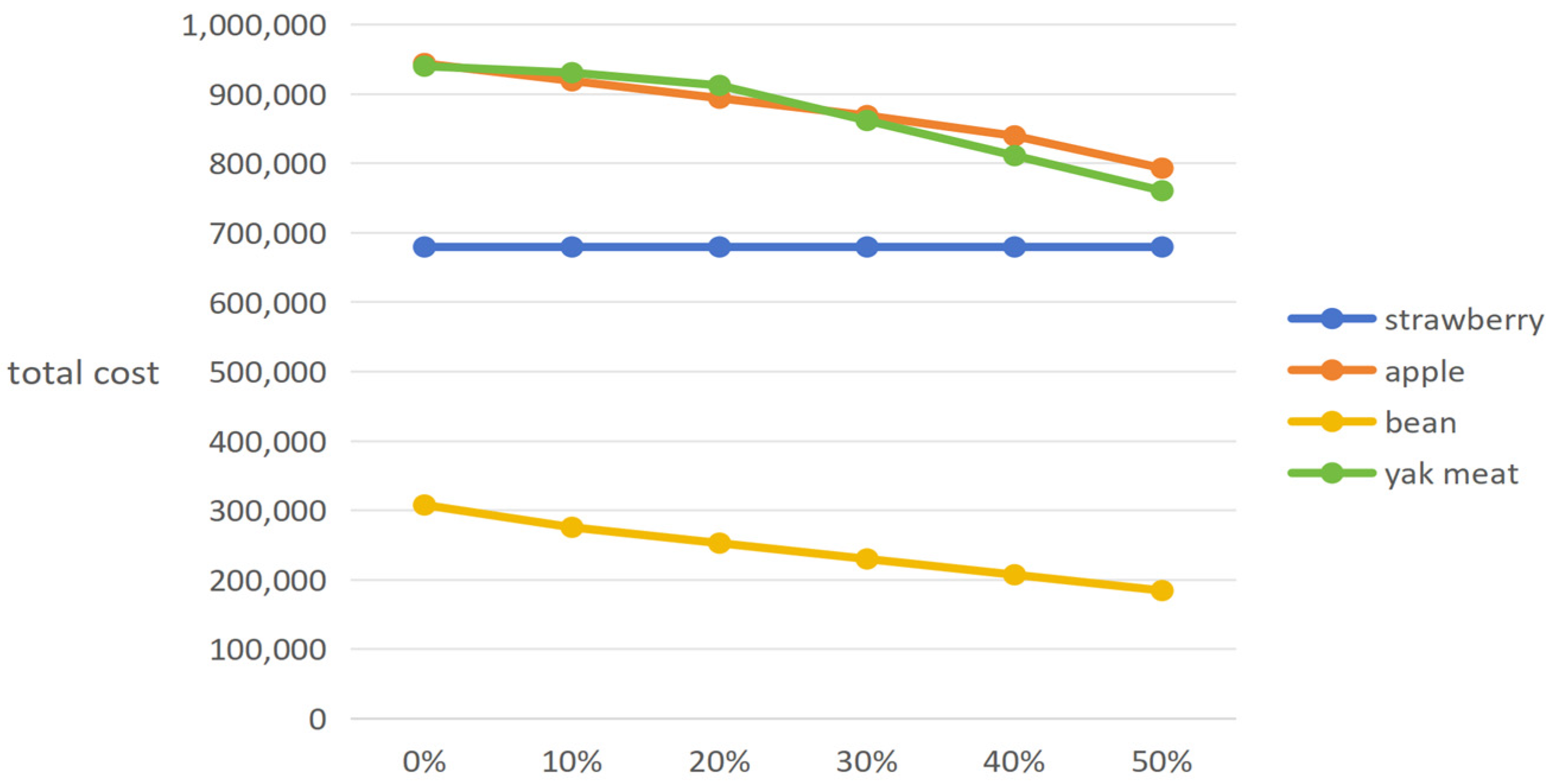
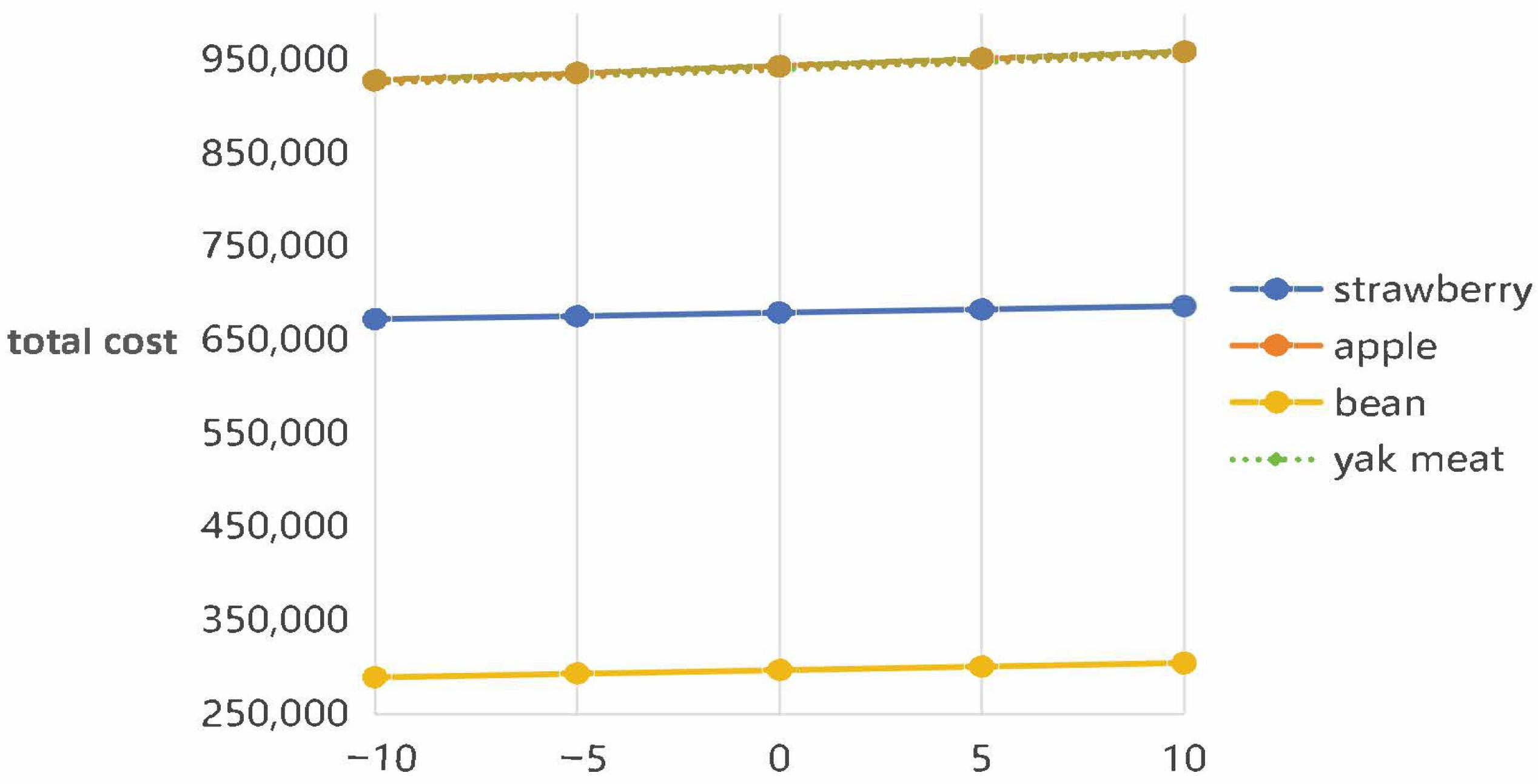
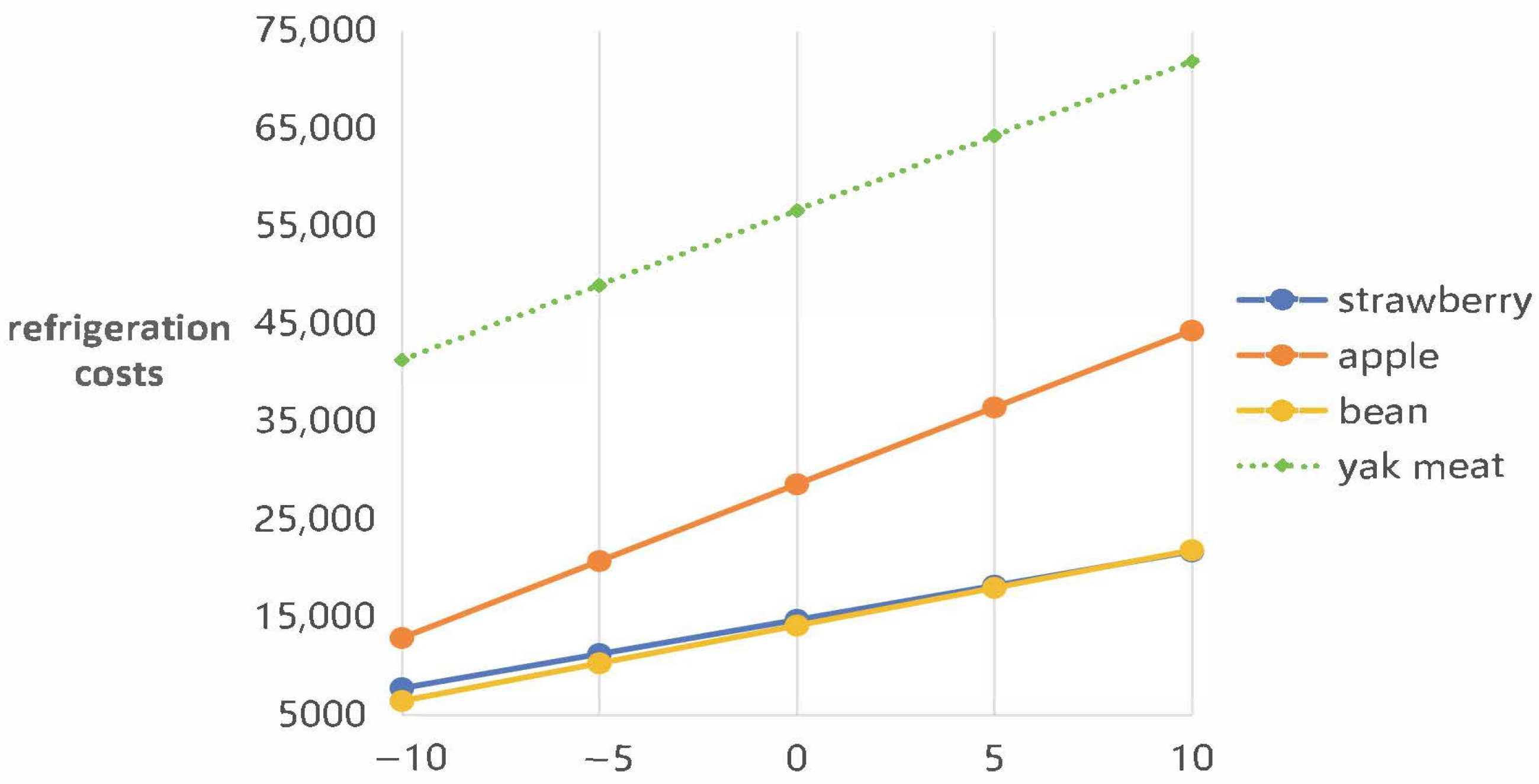
Optimization of Multimodal Transportation Routes for Refrigerated Goods Under Uncertain Demand


Abstract
1. Introduction
2. Literature Review
3. Problem Description and Model Formulation
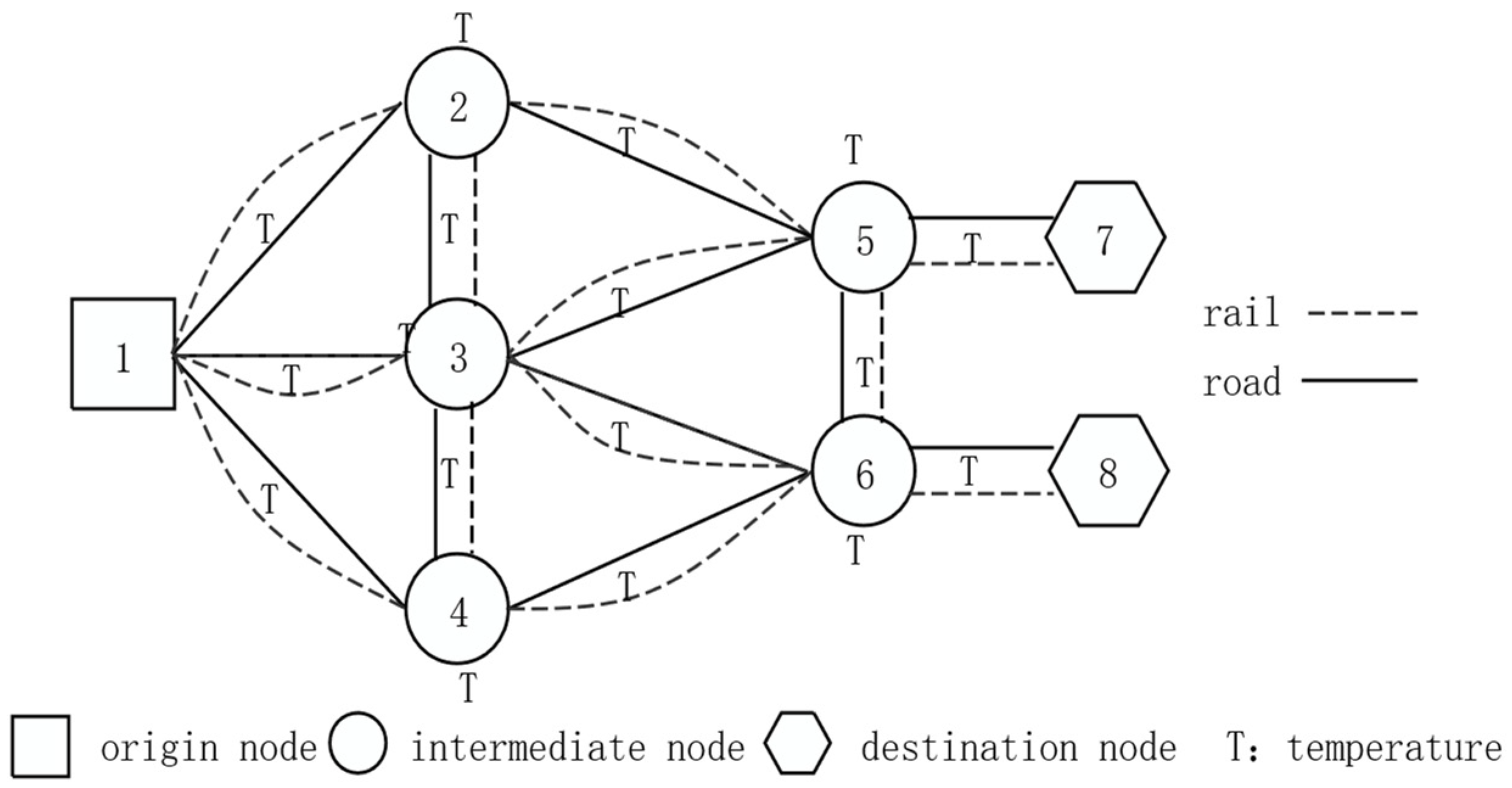
3.1. Problem Description
3.2. Model Formulation
3.2.1. Model Assumptions
3.2.2. Notation Definition
3.2.3. Mathematical Model
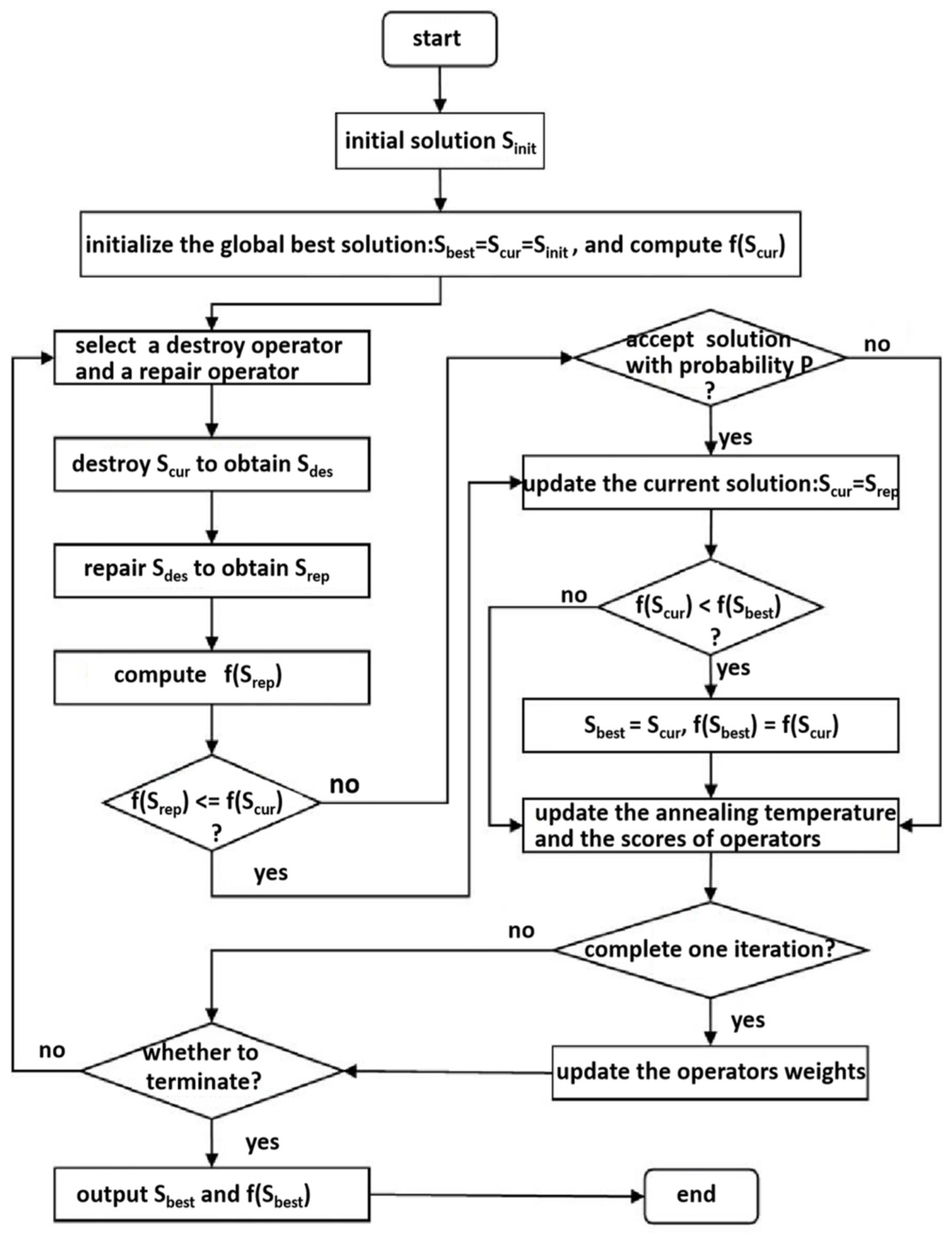
4. An Improved ALNS Algorithm
4.1. Initial Feasible Solution
4.2. Destroy Operators
4.3. Repair Operators
4.4. Adaptive Mechanism
4.5. Acceptance Criterion
| Algorithm 1. Pseudocode for the improved ALNS |
| Input: initial solution , destroy operator set , repair operator set , cooling rate , initial temperature |
| Output: the best-found solution |
| 1: Step 1: initialize |
| 2: ← //the best-found solution |
| 3: ← //current solution |
| 4: T ← T_initial //initial simulated annealing temperature |
| 5: Step 2: iterative search |
| 6: while the iteration termination condition is not met then |
| 7: //choose an operator using roulette wheel mechanism |
| 8: ← use roulette wheel mechanism to choose a destroy operator from D |
| 9: ← use roulette wheel mechanism to choose a repair operator from R |
| 10: //operate on the current solution to generate a new solution |
| 11: ← apply the destroy operator and the repair operator to |
| 12: //assess the new solution |
| 13: if then |
| 14: ← //update the best-found solution |
| 15: ← //update current solution |
| 16: else if the simulated annealing acceptance criterion is met then |
| 17: ← //accept the new solution as the current solution according to the simulated annealing criterion |
| 18: end if |
| 19: //update simulated annealing temperature |
| 20: |
| 21: if algorithm reaches the specified number of iterations, then |
| 22: update operator weights based on previous performance data |
| 23: end if |
| 24: end while |
| 25: Step 3: Output results: |
| 26: Output the best-found solution |
4.6. Methodological Enhancements of the Improved ALNS Algorithm
- Improved adaptive scoring mechanism: Most existing ALNS implementations adopt fixed scores to evaluate operator performance, which limits the algorithm’s adaptability and may hinder its ability to escape local optima. To address this issue, a randomized adaptive scoring mechanism is proposed. Instead of using fixed values, each score level is defined as a random variable within a predefined interval: Score1 ∈ [28, 33], Score2 ∈ [18, 23], Score3 ∈ [8, 13], and Score4 ∈ [3, 8]. By dynamically varying the scores within reasonable bounds, the algorithm enhances search diversity and improves its global exploration capability without sacrificing solution stability.
- Alternating a dual-weight operator selection strategy: In the conventional ALNS framework, operator selection probabilities are fully driven by accumulated weights. Although effective in exploitation, this mechanism may lead to excessive reliance on operators that perform well in early iterations, thereby reducing search diversity in later stages. To mitigate this imbalance, an alternating dual-weight strategy is proposed. Two weighting schemes are employed: dynamically updated weights following the standard ALNS mechanism, and fixed uniform weights that assign equal selection probabilities to all operators. The algorithm alternates between these two schemes across iterations, using dynamic weights in odd-numbered iterations and uniform weights in even-numbered iterations. This strategy balances exploitation and exploration, prevents operator overuse, and improves overall search robustness.
5. Case Study
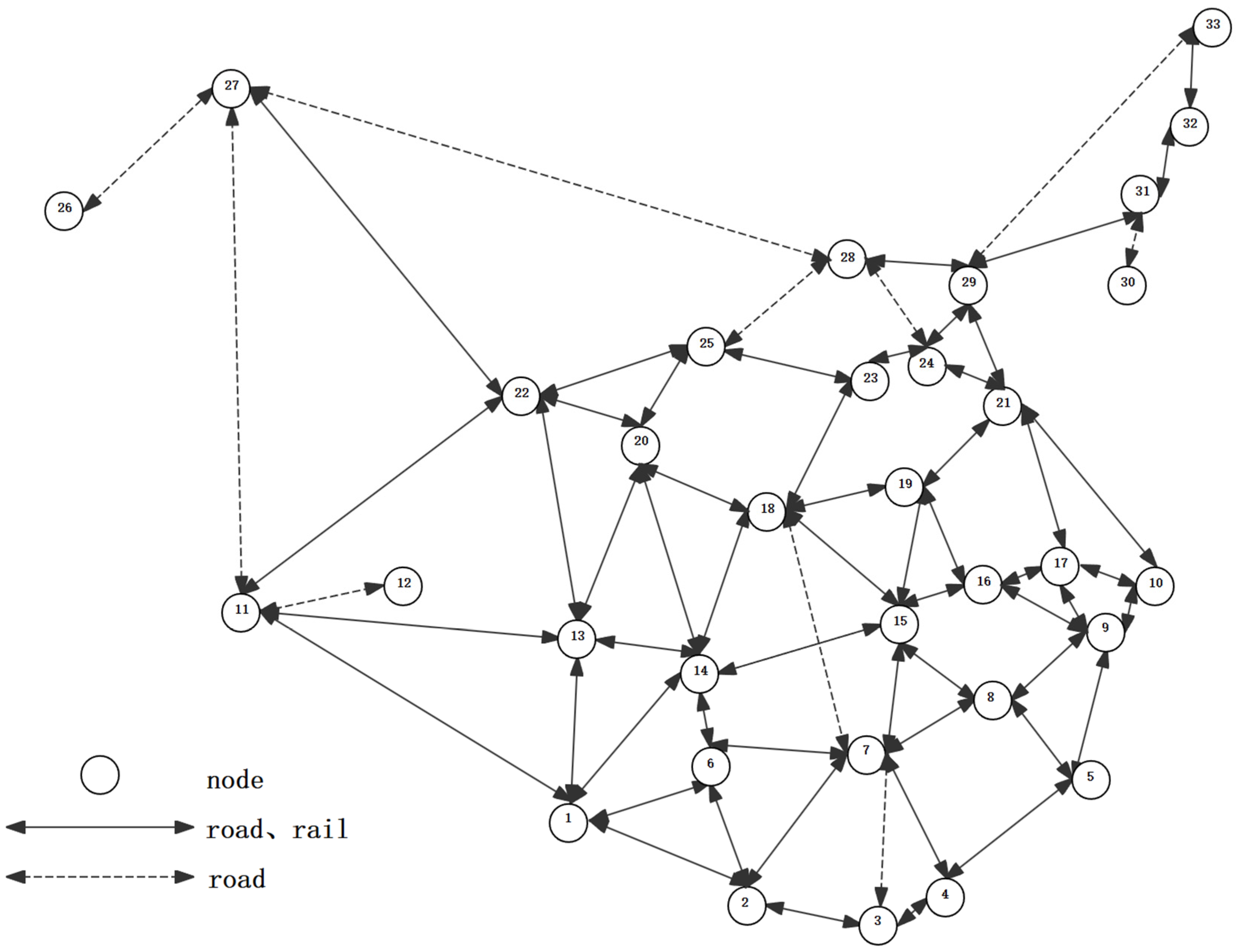
5.1. Background of Case
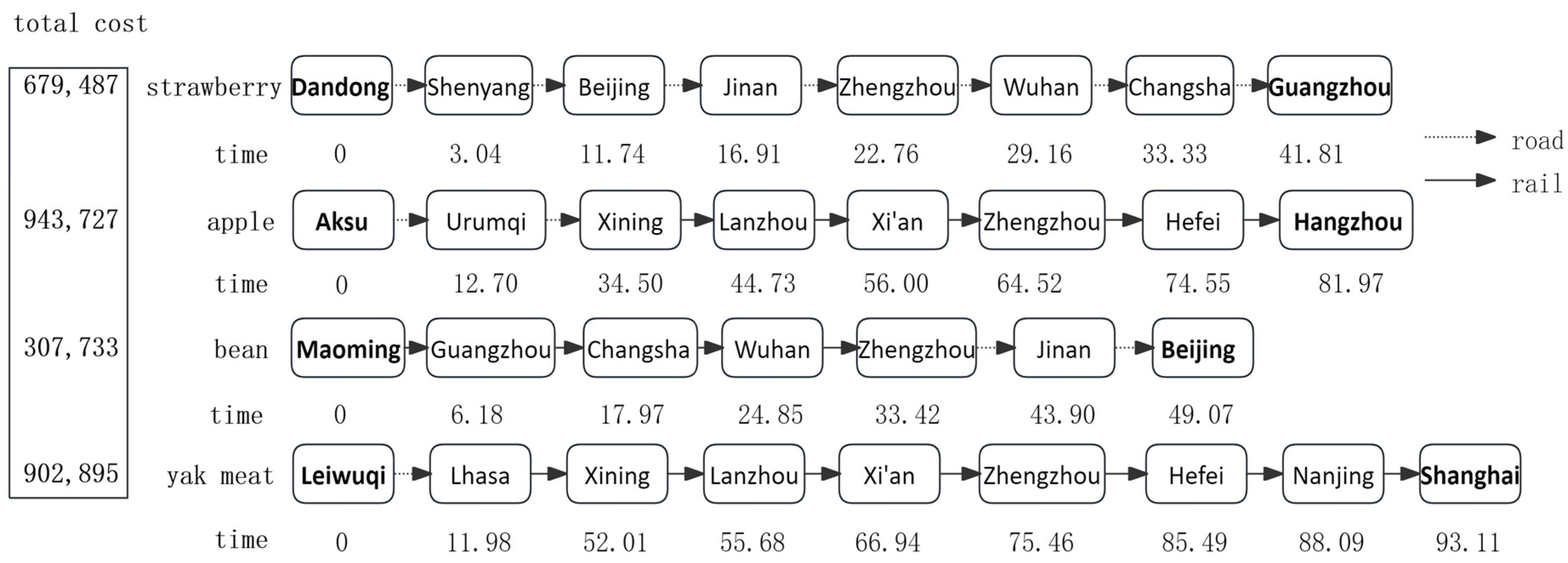
5.2. Result of Case
5.3. Comparative Analysis of Results
5.3.1. Comparison with Gurobi
5.3.2. Comparison with GA
5.4. Sensitivity Analysis
6. Discussion
7. Conclusions
Author Contributions
Funding
Institutional Review Board Statement
Informed Consent Statement
Data Availability Statement
Acknowledgments
Conflicts of Interest
Abbreviation
| ALNS | Adaptive large neighborhood search |
| MIP | Mixed-integer programming |
References
- Bin, L.; Jiawei, L.; Chen, A.; Theodorakis, P.E.; Zhu, Z.; Yu, J. Selection of the cold logistics model based on the carbon footprint of fruits and vegetables in China. J. Clean. Prod. 2022, 334, 130251. [Google Scholar] [CrossRef]
- Gao, L.; Zhan, M. Route Optimization of Multimodal Transport Considering Regional Differences under Carbon Tax Policy. Sustainability 2025, 17, 5743. [Google Scholar] [CrossRef]
- Chen, X.Y.; Yang, J.B.; Xu, D.L. Inventory policy and heuristic for long-term multi-product perishable inventory routing problem with static demand. J. Oper. Res. Soc. China 2022, 10, 659–683. [Google Scholar] [CrossRef]
- Liu, Z.; Guo, H.; Zhao, Y.; Hu, B.; Shi, L.; Lang, L.; Huang, B. Research on the optimized route of cold chain logistics transportation of fresh products in context of energy-saving and emission reduction. Math. Biosci. Eng. 2021, 18, 1926–1940. [Google Scholar] [CrossRef] [PubMed]
- Liu, S. Multimodal transportation route optimization of cold chain container in time-varying network considering carbon emissions. Sustainability 2023, 15, 4435. [Google Scholar] [CrossRef]
- Bortolini, M.; Faccio, M.; Ferrari, E.; Gamberi, M.; Pilati, F. Fresh food sustainable distribution: Cost, delivery time and carbon footprint three-objective optimization. J. Food Eng. 2016, 174, 56–67. [Google Scholar] [CrossRef]
- SteadieSeifi, M.; Dellaert, N.P.; Nuijten, W.; Van Woensel, T. A metaheuristic for the multimodal network flow problem with product quality preservation and empty repositioning. Transp. Res. Part B Methodol. 2017, 106, 321–344. [Google Scholar] [CrossRef]
- SteadieSeifi, M.; Dellaert, N.; Van Woensel, T. Multi-modal transport of perishable products with demand uncertainty and empty repositioning: A scenario-based rolling horizon framework. EURO J. Transp. Logist. 2021, 10, 100044. [Google Scholar] [CrossRef]
- Enayati, S.; Li, H.; Campbell, J.F.; Pan, D. Multimodal vaccine distribution network design with drones. Transp. Sci. 2023, 57, 1069–1095. [Google Scholar] [CrossRef]
- Zhang, X.; Lam, J.S.L.; Iris, Ç. Cold chain shipping mode choice with environmental and financial perspectives. Transp. Res. Part D Transp. Environ. 2020, 87, 102537. [Google Scholar] [CrossRef]
- Bilican, M.S.; Iris, Ç.; Karatas, M. A collaborative decision support framework for sustainable cargo composition in container shipping services. Ann. Oper. Res. 2024, 342, 79–111. [Google Scholar] [CrossRef]
- Hao, C.; Yue, Y. Optimization on combination of transport routes and modes on dynamic programming for a container multimodal transport system. Procedia Eng. 2016, 137, 382–390. [Google Scholar] [CrossRef]
- Wolfinger, D.; Tricoire, F.; Doerner, K.F. A matheuristic for a multimodal long haul routing problem. EURO J. Transp. Logist. 2019, 8, 397–433. [Google Scholar] [CrossRef]
- Chen, C.C.; Schonfeld, P. A hybrid heuristic technique for optimal coordination in intermodal logistics scheduling. Int. J. Shipp. Transp. Logist. 2017, 9, 475–499. [Google Scholar] [CrossRef]
- Zhang, D.; Zhan, Q.; Chen, Y.; Li, S. Joint optimization of logistics infrastructure investments and subsidies in a regional logistics network with CO2 emission reduction targets. Transp. Res. Part D Transp. Environ. 2018, 60, 174–190. [Google Scholar] [CrossRef]
- Zhu, C.; Zhu, X. Multi-objective path-decision model of multimodal transport considering uncertain conditions and carbon emission policies. Symmetry 2022, 14, 221. [Google Scholar] [CrossRef]
- Zhao, Y.; Liu, R.; Zhang, X.; Whiteing, A. A chance-constrained stochastic approach to intermodal container routing problems. PLoS ONE 2018, 13, e0192275. [Google Scholar] [CrossRef]
- Abbassi, A.; El Hilali Alaoui, A.; Boukachour, J. Robust optimisation of the intermodal freight transport problem: Modeling and solving with an efficient hybrid approach. J. Comput. Sci. 2019, 30, 127–142. [Google Scholar] [CrossRef]
- Yang, J.; Liang, D.; Zhang, Z.; Wang, H.; Bin, H. Path optimization of container multimodal transportation considering differences in cargo time sensitivity. Transp. Res. Rec. 2024, 2678, 1279–1292. [Google Scholar] [CrossRef]
- Zukhruf, F.; Frazila, R.B.; Burhani, J.T.; Prakoso, A.D.; Sahadewa, A.; Langit, J.S. Developing an integrated restoration model of multimodal transportation network. Transp. Res. D Transp. Environ. 2022, 110, 103413. [Google Scholar] [CrossRef]
- Zhang, S.; Li, L. The multi-visits drone-vehicle routing problem with simultaneous pickup and delivery service. J. Oper. Res. Soc. China 2024, 12, 965–995. [Google Scholar] [CrossRef]
- Pizzol, M. Deterministic and stochastic carbon footprint of intermodal ferry and truck freight transport across Scandinavian routes. J. Clean. Prod. 2019, 224, 626–636. [Google Scholar] [CrossRef]
- Sun, Y.; Lang, M. Modeling the multicommodity multimodal routing problem with schedule-based services and carbon dioxide emission costs. Math. Probl. Eng. 2015, 2015, 406218. [Google Scholar] [CrossRef]
- Göçmen, E.; Erol, R. The problem of sustainable intermodal transportation: A case study of an international logistics company, Turkey. Sustainability 2018, 10, 4268. [Google Scholar] [CrossRef]
- Zhang, H.; Li, Y.; Zhang, Q.; Chen, D. Route selection of multimodal transport based on China railway transportation. J. Adv. Transp. 2021, 2021, 9984659. [Google Scholar] [CrossRef]
- Feng, X.; Song, R.; Yin, W.; Yin, X.; Zhang, R. Multimodal transportation network with cargo containerization technology: Advantages and challenges. Transp. Policy 2023, 132, 128–143. [Google Scholar] [CrossRef]
- Zhang, T.; Cheng, J.; Zou, Y. Multimodal transportation routing optimization based on multi-objective Q-learning under time uncertainty. Complex Intell. Syst. 2024, 10, 3133–3152. [Google Scholar] [CrossRef]
- Li, M.; Sun, X. Path optimization of low-carbon container multimodal transport under uncertain conditions. Sustainability 2022, 14, 14098. [Google Scholar] [CrossRef]
- Gao, Y. Optimisation of the port-hinterland intermodal container flow with inland hub capacity concern. Int. J. Shipp. Transp. Logist. 2024, 19, 328–352. [Google Scholar] [CrossRef]
- Zhang, H.; Huang, Q.; Ma, L.; Zhang, Z. Sparrow search algorithm with adaptive t distribution for multi-objective low-carbon multimodal transportation planning problem with fuzzy demand and fuzzy time. Expert Syst. Appl. 2024, 238, 122042. [Google Scholar] [CrossRef]
- Baidya, A.; Bera, U.K.; Maiti, M. Breakable fuzzy multi-stage transportation problem. J. Oper. Res. Soc. China 2015, 3, 53–67. [Google Scholar] [CrossRef]
- Liu, B.; Iwamura, K. Chance constrained programming with fuzzy parameters. Fuzzy Sets Syst. 1998, 94, 227–237. [Google Scholar] [CrossRef]
- Ropke, S.; Pisinger, D. An adaptive large neighborhood search heuristic for the pickup and delivery problem with time windows. Transp. Sci. 2006, 40, 455–472. [Google Scholar] [CrossRef]
- Sun, J.Q.; Wang, S.N.; Yan, S.X. Cold-chain container multimodal transport route choice considering carbon emissions. J. Dalian Maritime Univ. 2022, 48, 57–65. [Google Scholar] [CrossRef]
- GB/T 22918-2008; Technical Requirements for Temperature-Controlled Transportation of Perishable Food. Standardization Administration of the People’s Republic of China, General Administration of Quality Supervision, Inspection and Quarantine of the People’s Republic of China: Beijing, China, 2008.
- Ortega Molina, P.; Astasio Arbiza, P.; Albaladejo Vicente, R.; Arrazola Martínez, P.; Villanueva Orbáiz, R.; Juanes Pardo, J.R.D. Mantenimiento de la cadena del frío para las vacunas: Una revisión sistemática. Gac. Sanit. 2007, 21, 343–348. [Google Scholar] [CrossRef]
- Ren, Y.; Chen, Q.; Lau, Y.Y.; Dulebenets, M.A.; Li, M.; Li, B.; Poo, M.C.-P.; Zhang, P. An improved migratory birds optimization algorithm for closed-loop supply chain network planning in a fuzzy environment. PLoS ONE 2024, 19, e0306294. [Google Scholar] [CrossRef]
- Sun, Y.; Yu, N.; Huang, B. Green road–rail intermodal routing problem with improved pickup and delivery services integrating truck departure time planning under uncertainty: An interactive fuzzy programming approach. Complex Intell. Syst. 2022, 8, 1459–1486. [Google Scholar] [CrossRef]



| Notation | Meaning |
|---|---|
| Sets: | |
| K | set of transportation modes. |
| O | set of origin nodes. |
| D | set of destination nodes. |
| H | set of intermediate nodes. |
| M | set of nodes. |
| N | set of transportation tasks n. |
| A | . |
| Parameters: | |
| weight of a refrigerated container for transportation task n. | |
| to node j using transportation mode k. | |
| average speed of transportation mode k. | |
| earliest and latest time windows for transportation task n. | |
| storage cost that arrives earlier than the time window. | |
| penalty cost that arrives later than the time window. | |
| . | |
| . | |
| . | |
| . | |
| fuel consumption per distance and weight. | |
| unit cost of carbon emissions. | |
| emission factor of fuel consumption. | |
| . | |
| . | |
| optimal storage temperature for transportation task n. | |
| maximum allowable damage for transportation task n. | |
| unit cost of energy. | |
| indicator of whether the goods undergo respiration (1 if yes, 0 otherwise). | |
| price of goods in transportation task n. | |
| respiratory heat generated by goods in transportation task n. | |
| cooling capacity generated per unit of energy. | |
| heat transfer coefficient. | |
| S | heat transfer area of the container. |
| to node j. | |
| Decision variables: | |
| . | |
| uncertain number of containers for transportation task n. | |
| arrival time of transportation task n at the destination node. | |
| . | |
| . | |
| . | |
| . | |
| . | |
| . | |
| . | |
| = 1 if task n transport from node to node j using mode , and 0 otherwise. | |
| , and 0 otherwise. | |
| Refrigerated Goods | Origin- Destination | Weight | Volume | Time Windows | Temperature | Respiratory Heat | Value |
|---|---|---|---|---|---|---|---|
| strawberry | 30–4 | 8 | (16, 20, 22) | 24–48 | 2 | 41 | 20,000 |
| apple | 26–9 | 16 | (17, 25, 28) | 70–80 | 0 | 31 | 12,000 |
| bean | 3–29 | 10 | (5, 18, 23) | 48–60 | 8 | 24 | 13,200 |
| yak meat | 12–10 | 20 | (20, 28, 34) | 60–70 | −18 | — | 60,000 |
| Refrigerated Goods | Three-Parameter | |||
|---|---|---|---|---|
| strawberry | 0.00002 | 2 | −20 | 20% |
| apple | 0.005 | 0.45 | −30 | 5% |
| bean | 0.00006 | 1.6 | 10 | 10% |
| yak meat | 0 | 0 | 0 | 0 |
| Cargo | ALNS | Gurobi | Comparison Result | |||
|---|---|---|---|---|---|---|
| Total Cost | Time | Total Cost | Time | Gap1 | Gap2 | |
| Strawberry | 679,487 | 0.23 | 679,487 | 127.11 | 0.00% | −99.82% |
| Apple | 943,727 | 0.24 | 943,727 | 1.4 | 0.00% | −82.86% |
| Bean | 307,733 | 0.25 | 296,927 | 0.67 | 3.64% | −62.69% |
| Yak Meat | 939,855 | 0.19 | 939,855 | 10.07 | 0.00% | −98.11% |
| Arc | Maximum Flow | Arc | Maximum Flow |
|---|---|---|---|
| Urumqi (27)–Xining (22) | 23 | Zhengzhou (19)–Jinan (21) | 17 |
| Hefei (16)–Hangzhou (9) | 24 | Nanjing (17)–Shanghai (10) | 27 |
| Guangzhou (4)–Changsha (7) | 16 | Wuhan (15)–Hefei (16) | 26 |
| Confidence Level | Route | Total Cost |
|---|---|---|
| 95% | Aksu–Urumqi–Hohhot–Shijiazhuang–Jinan–Nanjing–Hangzhou | 993,151 |
| 90% | Aksu–Urumqi–Hohhot–Shijiazhuang–Jinan–Nanjing–Hangzhou | 976,920 |
| 85% | Aksu–Urumqi–Xining–Lanzhou–Xi’an–Zhengzhou–Hefei-Hangzhou | 910,846 |
| 80% | Aksu–Urumqi–Xining–Lanzhou–Xi’an–Zhengzhou–Hefei–Hangzhou | 894,461 |
| 75% | Aksu–Urumqi–Xining–Lanzhou–Xi’an–Zhengzhou–Hefei–Hangzhou | 878,112 |
| Confidence Level | Route | Total Cost |
|---|---|---|
| 95% | Maoming–Changsha–Wuhan–Hefei–Nanjing–Jinan–Beijing | 324,355 |
| 90% | Maoming–Changsha–Wuhan–Zhengzhou–Jinan–Beijing | 310,354 |
| 85% | Maoming–Changsha–Wuhan–Zhengzhou–Jinan–Beijing | 297,955 |
| 80% | Maoming–Guangzhou–Changsha–Wuhan–Zhengzhou–Jinan–Beijing | 275,996 |
| 75% | Maoming–Guangzhou–Changsha–Wuhan–Zhengzhou–Jinan–Beijing | 264,819 |
| Confidence Level | Route | Total Cost |
|---|---|---|
| 95% | Leiwuqi–Lhasa–Chengdu–Chongqing–Wuhan–Hefei–Nanjing–Shanghai | 963,625 |
| 90% | Leiwuqi–Lhasa–Chengdu–Chongqing–Wuhan–Hefei–Nanjing–Shanghai | 949,659 |
| 85% | Leiwuqi–Lhasa–Chengdu–Chongqing–Wuhan–Hefei–Nanjing–Shanghai | 921,124 |
| 80% | Leiwuqi–Lhasa–Chengdu–Chongqing–Wuhan–Hefei–Nanjing–Shanghai | 906,248 |
| 75% | Leiwuqi–Lhasa–Chengdu–Chongqing–Wuhan–Hefei–Nanjing–Shanghai | 880,928 |
Disclaimer/Publisher’s Note: The statements, opinions and data contained in all publications are solely those of the individual author(s) and contributor(s) and not of MDPI and/or the editor(s). MDPI and/or the editor(s) disclaim responsibility for any injury to people or property resulting from any ideas, methods, instructions or products referred to in the content. |
© 2026 by the authors. Licensee MDPI, Basel, Switzerland. This article is an open access article distributed under the terms and conditions of the Creative Commons Attribution (CC BY) license.
Share and Cite
Hu, G.; Zhang, S.; Ding, F.; Cheng, Y.-C. Optimization of Multimodal Transportation Routes for Refrigerated Goods Under Uncertain Demand. Sustainability 2026, 18, 2230. https://doi.org/10.3390/su18052230
Hu G, Zhang S, Ding F, Cheng Y-C. Optimization of Multimodal Transportation Routes for Refrigerated Goods Under Uncertain Demand. Sustainability. 2026; 18(5):2230. https://doi.org/10.3390/su18052230
Chicago/Turabian StyleHu, Guan, Si Zhang, Feiyang Ding, and Yu-Chao Cheng. 2026. "Optimization of Multimodal Transportation Routes for Refrigerated Goods Under Uncertain Demand" Sustainability 18, no. 5: 2230. https://doi.org/10.3390/su18052230
APA StyleHu, G., Zhang, S., Ding, F., & Cheng, Y.-C. (2026). Optimization of Multimodal Transportation Routes for Refrigerated Goods Under Uncertain Demand. Sustainability, 18(5), 2230. https://doi.org/10.3390/su18052230