Article

Critical Peak Pricing Optimization Considering Photovoltaic Utilization and Consumer Heterogeneity


by
Xiaobao Yu
*,
Gan Song
and
Jialong Jin
School of Economics and Management, Shanghai University of Electric Power, Shanghai 201306, China
*
Author to whom correspondence should be addressed.
Sustainability 2026, 18(5), 2194; https://doi.org/10.3390/su18052194
Submission received: 20 January 2026 / Revised: 16 February 2026 / Accepted: 22 February 2026 / Published: 25 February 2026

Abstract

To support the sustainable transition of power systems with high penetration of renewable energy, this study proposes an optimization model for critical peak pricing (CPP) that integrates photovoltaic (PV) utilization and consumer heterogeneity. With the aim of improving renewable energy consumption, reducing carbon emissions, and enhancing the long-term sustainability of distribution networks, electricity consumers are classified according to their diverse behavioral characteristics, and a differentiated CPP mechanism is designed accordingly. Time periods are dynamically segmented using fuzzy membership functions based on net load curves, enabling price signals to better align electricity demand with PV generation profiles. Consumer psychology is further incorporated to develop a user response model that reflects heterogeneous demand-side behavior. A multi-objective CPP optimization framework is established to balance the economic interests of electricity consumers, retailers, and other stakeholders, while simultaneously promoting renewable energy integration and system-level sustainability. The proposed model is solved using a genetic algorithm. Case studies demonstrate that the approach effectively smooths net load curves, encourages electricity consumption during periods of high PV output, improves economic benefits for all participants, and enhances carbon emission reduction performance. Finally, a sensitivity analysis under multiple scenarios is conducted to evaluate the robustness and sustainability implications of the proposed CPP mechanism.

1. Introduction

In recent years, with the ongoing reform of the power system, China’s electricity spot market has been gradually developing. However, due to the increasing depletion of fossil fuels and growing societal energy demands, photovoltaic and other renewable energy sources have emerged as important alternatives. With low carbon emissions, a clean nature, and broad distribution, solar energy is expected to be pivotal in future energy systems [1]. Nevertheless, the PV system suffers from fluctuation and uncertainty. Extensive connections into distribution networks may compromise power system stability and, in some cases, exceed the system’s absorption capacity, leading to resource waste.
The demand response (DR) mechanism is indispensable to accommodate the extensive development of renewable power, balance electricity supply and demand, and facilitate the integration of new energy sources. Electricity retailers and consumers play key roles in this process. As primary implementers of the DR mechanism, retailers mainly profit by purchasing electricity on behalf of customers and earning margin differentials—thus, their procurement costs directly affect profitability. With the number of electricity retailers increasing and competition becoming increasingly intense [2], it is imperative to develop an effective DR mechanism within the power spot market. Such a mechanism should guide users toward active peak shaving and valley filling, improve supply–demand balance, reduce procurement costs, increase profits, and enhance renewable energy consumption.
(1)
Electricity price mechanism in the spot market
The spot market is an important part of the electricity market and plays a key role in coordinating stable transactions between market entities such as electricity retailers and maintaining the secure operation of the system [3]. However, electricity prices fluctuate significantly in the spot market, and electricity retailers face certain market risks when participating [4]. Therefore, a reasonable electricity price mechanism is particularly important for electricity retailers. As a dynamic price mechanism based on the spot market electricity price, the real-time electricity price (RTP) can transmit price signals to users in time with market fluctuations and guide their electricity consumption behavior. However, when implementing RTP, electricity retailers actually transfer the price fluctuation risk in the spot market directly to users. This variable electricity cost is not conducive to the optimization of users’ electricity income [5], thus greatly reducing users’ keenness to participate in the RTP mechanism; as such, the RTP mechanism is not widely used at present [6]. Currently, electricity retailers mainly adopt a time-of-use tariff (TOU) in demand-side management, guiding users’ electricity consumption behavior through price signals, effectively realizing peak cutting and valley filling [7]. However, due to the static characteristics of TOU, it is difficult to effectively adjust the load pattern over long time scales, especially periodic peak loads, which are the main factors that hinder the utilization of clean energy sources—PV, for instance. Therefore, improving the flexibility and consistency of the electricity price mechanism is an important trend in future electricity price reform. As a dynamic pricing mechanism, the critical peak price (CPP) can further optimize long-term load distribution based on TOU, effectively reduce the periodic peak load, optimize the start plan of traditional units of the system, and raise the capability of renewable utilization; this is the main price means for regulating the terminal load demand on the future power-selling side [8,9,10].
(2)
Research on the mechanisms of critical peak prices
As an important price-based DR method, the critical peak price mechanism is being increasingly adopted across provinces and cities in China. Most international studies of CPP are grounded in completely deregulated power markets [11], yet they lack applicability to the present power market structure with the separation of power plants and grids in China [12]. There are a few studies on CPP in China; these are generally based on TOU and mainly focus on time division, electricity price setting, and user behavior. Liu et al. compared the similarities and differences between CPP and interruptible load, determined the peak rate and peak date based on TOU, and used the CPP action mechanism model to quantify the user’s response to CPP [13]. JI et al. proposed a CPP model that divides peak periods using a fuzzy membership function and establishes a user response curve based on consumer psychology [14]. Wang et al. established a CPP dynamic optimization model grounded in consumer psychology theory, determining the peak day, time period, and peak rate according to the dynamic change in the peak load [15]. In terms of CPP design optimization, Naz et al. aimed to reduce generation costs and peak load demand by combining the enhanced differential evolution algorithm and the gray wolf optimization approach to optimize CPP [16]. ZHU et al. analyzed the user’s electricity price sensitivity based on consumer psychology theory and built an electricity price optimization model aiming at peak cutting, valley filling, and maximizing user satisfaction [17]. LU et al. built a non-cooperative Stackelberg model grounded in consumer psychology theory and game theory to optimize CPP and quantified the influence of load variability on power company revenue and consumer contentment [18]. YU et al. conducted an analysis of response levels across industrial customer segments to the CPP based on factors such as consumer risk preferences, considered the benefits of both the grid and its consumers, and built a multi-objective CPP optimization framework [19]. YU et al. constructed a multi-objective CPP optimization framework by studying the impact of CPP on the operation of power supply units and comprehensively considering generation-side coal consumption and consumer contentment [20]. The above studies achieved a certain peak cutting and valley filling effect by constructing different CPP mechanisms, but none of them consider the influence of renewable power generation factors on CPP.
On the basis of the above research, Song et al. comprehensively took into account energy costs and constructed a multi-stage random planning model (MSSP) to help retailers optimize their bidding strategies and CPP operation mechanisms in the face of multiple uncertainties [21]. Liu constructed an optimization framework for TOU grounded in the equivalent load theory and comprehensively considering new energy and load volatility [22]. WANG et al. focused on the user side, establishing a TOU price optimization model that took into account both the features of photovoltaic output and the net load curve [23], which effectively improved the absorption capacity of the distribution grid for PV generation [24].
Based on existing research methods, studies on the optimization of the CPP mechanism can mainly be categorized into two types:
(1)
CPP optimization methods based on traditional load curves use historical user load data as the core input, focusing on optimizing peak periods and tariff levels; they can achieve a certain level of peak shaving and valley filling. However, regarding high photovoltaic penetration, existing research methods ignore the temporal fluctuations in photovoltaic output. This approach can easily misjudge periods of “abundant supply but high load” as peaks during periods of high photovoltaic generation, leading to conflicts between price signals and renewable energy consumption targets, and even “peak–valley inversion.” As a result, the CPP mechanism still focuses on suppressing electricity consumption rather than guiding the coordinated matching of electricity consumption and renewable energy output, which is unfavorable for the effective utilization of renewable energy, such as PV. Although a few studies have considered the factor of renewable energy output in TOU mechanism research, which can improve the matching relationship between load and renewable energy under the static TOU framework, this price structure is fixed, meaning that it struggles to cope with random peak loads, and it lacks the ability to be extended under the dynamic pricing framework of CPP.
(2)
CPP optimization methods based on user behavior modeling, which introduce consumer psychology or game theory models to characterize user response behavior, have certain advantages in user-side regulation. However, they all ignore the differences in consumer electricity price responses and fail to distinguish the differences in users’ electricity usage flexibility, electricity price sensitivity, and production constraints. Applying a uniform CPP electricity price structure to different types of users makes it difficult to accurately characterize the real response behavior of different users, thus limiting the regulatory effect of the CPP mechanism in practical applications.
In summary, while existing research on CPP has made some progress in electricity price optimization and peak shaving, given the high proportion of PV grid integration and the heterogeneity of electricity consumers, current CPP optimization methods are insufficient to simultaneously consider both renewable energy integration and price signal effectiveness. Therefore, it is necessary to construct a CPP optimization framework that integrates both renewable energy integration and consumer heterogeneity. Based on these research shortcomings, starting from the electricity retail side and based on consumer psychology theory, this study establishes a peak electricity price optimization model that comprehensively considers both PV integration and consumer heterogeneity. The main innovations are as follows:
(1)
In response to the large-scale integration of PV and other new kinds of energy power generation into the distribution network, and considering that existing research on the CPP mechanism fails to adequately account for the factors of renewable energy output, this study proposes using the net load curve of terminal electricity load minus photovoltaic output as the basis for dividing time periods. Taking into account both the user’s electricity load and the volatility of PV power generation, the time period division is dynamically adjusted by setting reasonable fuzzy membership parameters. This aims to encourage consumers to use more power during periods of high PV output, reduce curtailment, and promote the absorption of renewable energy. This mechanism helps reduce carbon emissions by minimizing the curtailment of PV and improving the utilization of renewable energy, while also smoothing the net load curve to enhance the stability and resilience of the power system, delivering significant environmental and systemic sustainability benefits.
(2)
In response to the variations in electricity usage behavior, preferences, and demands among different electricity users, and the fact that existing research on CPP mechanisms has not distinguished these differences when constructing user response behavior, this study proposes classifying users into active, herd, and stubborn types based on the heterogeneity of electricity consumer price response behavior. This would allow for a more precise understanding of the responsiveness of different types of users, enabling the implementation of a differentiated peak pricing mechanism and fully leveraging its effectiveness in practical applications. Differential pricing can precisely incentivize users to actively participate in demand response, reducing system peak load and carbon emissions. At the same time, it takes into account social equity by avoiding excessive burden on stubborn users and fostering green electricity consumption habits, thereby promoting the long-term sustainable development of the energy system from both social and behavioral perspectives.

2. Analysis of the Critical Peak Pricing Mechanism in the Spot Market

China’s CPP mechanism is usually based on the framework of the existing TOU mechanism by further identifying the most pronounced supply and demand conflicts during high periods, such as the critical peak period, implementing a critical peak price [25], and setting the price discount rate in different periods of non-peak days, so as to encourage consumers to reduce their electricity usage in the critical peak period [20]. This can effectively alleviate the supply–demand contradiction caused by peak-temperature-sensitive load peaks in winter and summer. Compared with the TOU mechanism, the CPP mechanism has a longer action period, which can not only achieve the purpose of “peak shaving and valley filling” but also effectively improve the absorption capacity of new energy [26]. The CPP rate structure consists of elements such as critical peak day, critical peak period start and end time, and discount rate of the electricity price on non-critical peak days [7]. A comparison of TOU and CPP rate structures is shown in Table 1.
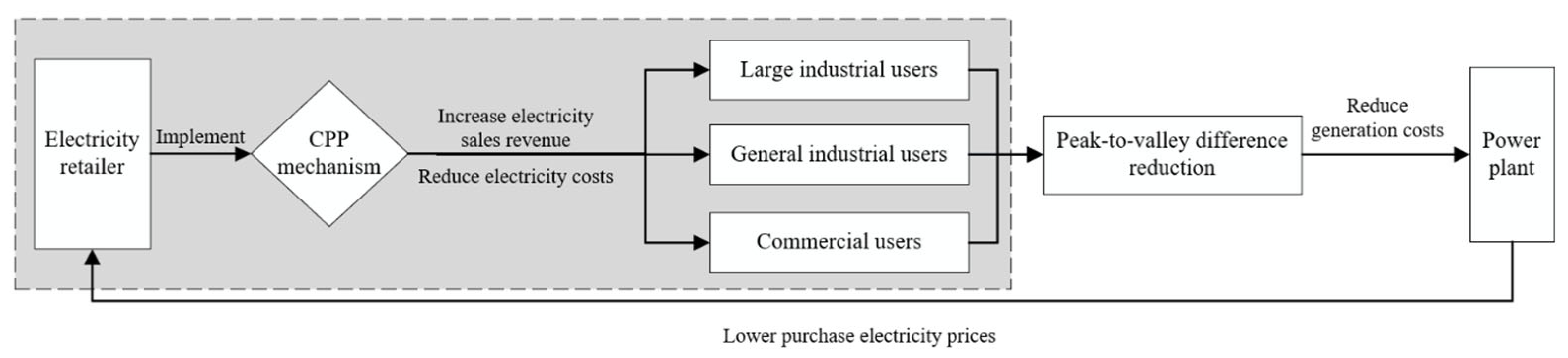
The profit mechanisms of the electricity retailer when implementing the CPP mechanism are shown in Figure 1. After responding to the peak mechanism, electricity users will modify their electricity usage behaviors and shift the electricity demand during high price periods to the periods with lower prices, thereby alleviating the peak-to-valley difference in the system. For power plants, narrowing the peak-to-valley difference can reduce the start–stop and peak shaving costs of power plants, thereby reducing the power generation costs. In the power spot market, electricity retailers may have lower power purchase prices, which in turn increases the profit space of electricity retailers and increases their keenness to implement the CPP mechanism. At the same time, electricity retailers can transfer part of their interests to customers through electricity price discounts, and the customers’ electricity costs will be reduced, enabling the electricity retailers to attract more customers and enhance their competitiveness in market transactions, thus forming a virtuous cycle.
In addition, the traditional CPP mechanism typically relies on the user-side load curve to divide the period, but this method has limitations when dealing with a high proportion of renewable energy access, which is unfavorable for the effective utilization of renewable energy; this lag not only results in the waste of renewable energy resources but also hinders the transition of the power system toward low-carbon development. To effectively break this bottleneck, in this study, we use the net load curve to divide the period, combined with photovoltaic power generation factors; not only does this allow us to more accurately identify the real peak power demand but it also more effectively encourages users to use more electricity during the photovoltaic power output period, improving their absorption rate. Then, a more reasonable critical peak price is formulated according to the user’s DR, and the optimized critical peak price model is applied to the spot market of electricity between the electricity retailer and the user. This optimization mechanism, by maximizing the utilization of renewable energy, can effectively reduce resource waste caused by solar curtailment and lower the carbon intensity of the power system. It thereby not only enhances system operational efficiency but also provides robust support for the green and low-carbon transition and long-term sustainable development of the power industry. The specific role is as follows:
(1)
The average power supply cost of power plants fell
The system’s net load will exhibit a narrower peak–valley difference and smoother variations after the CPP mechanism is implemented between the electricity retailer and the electricity user. This will lead to higher operation efficiency, less frequent starts and stops, and lower peak regulation expenditures of traditional generators so as to reduce the average power supply cost of the power plant.
(2)
The operating costs of power grid equipment were reduced
The load distribution of the power grid equipment (such as transformers and transmission lines) will be more uniform after the CPP mechanism is implemented between the electricity retailer and the electricity user. This will increase the equipment utilization rate, reduce the excessive loss of equipment due to the peak load, extend equipment life, and thereby reduce equipment maintenance and replacement costs.
(3)
The profits of the electricity retailer increased
The costs of power generation and transmission will decrease after the CPP mechanism is implemented between the electricity retailer and the electricity user. This will lead to reducing the purchasing cost of the selling company, thereby increasing the profit space of the electricity retailer.
(4)
Promoting the consumption of renewable energy
By dividing the time periods by the net load, the phenomenon of peak and valley inversion in the renewable energy generation period is avoided, and users are guided to use more electricity in the renewable energy generation period, reduce the phenomenon of solar curtailment, and achieve the dual goals of load adjustment and renewable energy consumption. This helps reduce the power system’s dependence on fossil fuels, thereby lowering carbon emissions while simultaneously enhancing its adaptability to high proportions of renewable energy. It supports the green and low-carbon transition of the power system from both technological and environmental dimensions.

3. Model Construction

At this stage, the CPP formulation process under the development of China’s power market mainly consists of three steps [27]: the establishment of peak dates and peak periods, the establishment of user DR models, and the establishment of CPP optimization mechanism models. Since the current renewable energy generation of photovoltaics and other renewable energy sources has not yet been fully connected to the power grid, there are certain limitations in the formulation of the CPP pricing optimization model. In order to mitigate the impact of these limitations, this study built upon the CPP optimization model under the following assumptions, aiming to build a benchmark theoretical framework to clearly reveal the design logic and potential of the price mechanism itself:
Hypothesis 1.
Photovoltaic prediction output is accurate.
Hypothesis 2.
Photovoltaic power generation is preferred to fully enter the network.
The CPP optimization model is constructed as follows:
Step 1: Considering the impact of large-scale grid connection of photovoltaics, this study proposes relying on the net load curve for dividing the time period, comprehensively considering the characteristics of user electricity load and photovoltaic power generation, and dynamically adjusting the time period division through fuzzy membership.
Step 2: Based on the heterogeneity of the electricity price response behavior of electricity consumers, dividing users into three categories—positive, follower, and stubborn users—a set of user differential DR models are designed.
Step 3: Starting from the net load indicators, economic indicators, and carbon emission reduction efficiency indicators, and taking into careful consideration the benefits of electricity users, electricity retailers, and other factors, a CPP multi-objective optimization model for photovoltaic consumption and consumer heterogeneity is designed.

3.1. Division of Time Period

There is an important relationship between the implementation effect of the CPP mechanism and the division of the time period [28]. Only by more accurately dividing the critical peak period can satisfactory results be obtained. To better alleviate system pressure and enhance the utilization level of PV generation, the power system needs to optimize the load curve through demand-side response. The division of time periods should shift from the conventional approaches, relying only on the electricity demand curve, to approaches relying on the net load curve, defined as the electricity demand load minus the PV output. By dividing the period of the net load curve, it can accurately reflect the load’s demand for traditional electricity and solve the issues of supply and demand imbalance as well as the inversion of peak and valley. At the same time, the power dispatching center can arrange the output of the traditional generator set more accurately, relying on the net load curve, reducing the phenomenon of insufficient power generation and excessive power generation.
q N L , t = q T L , t q P V , t
where q N L , t is the net load value at time point t , kW; q T L , t is the total load value at time point t , kW; and q P V , t is the photovoltaic power generation at time point t , kW
(1)
Critical Peak Date
The determination of the critical peak date needs to be based on the scientific setting of the trigger thresholds of the peak window [29]. Considering that the peak load tends to have a short duration and is strongly influenced by the end-user power usage patterns and climatic fluctuations [30], this study selects summer as the critical peak month after taking into account the electricity usage habits of the end users and summer temperature, in combination with the present state of China’s electricity market. The critical peak date is then identified by analyzing the net load data. When the estimated net load on a certain day reaches a specific proportion of the maximum estimated net load on a single day in this month, the day is identified as the critical peak day. Thus,
q N L , F o r e c a s t max q N L , max Ω
In this formula, q N L , F o r e c a s t max is the maximum estimated net load on a certain date, kW; q N L , max is the maximum presumed net load for a single day of this month, kW; Ω indicates the peak triggering threshold, according to the “Notice on Further Improving the Time-sharing Electricity Price Mechanism” issued by the National Development and Reform Commission of China in 2021, which clearly states that the peak period is reasonably determined based on the period when the maximum load of the local power system was 95% or more in the previous two years. In order to ensure the user’s electricity comfort and keenness to respond to electricity prices, the critical value range of this model triggering is set at 0.9~1.
(2)
Divide the time periods using fuzzy membership degree
After the CPP execution date is determined, the classification of the critical peak day into critical peak, high, flat, and valley periods follows the net load curve. The fuzzy membership function μ is applied to derive the membership degree of net load q N L , t at each moment, and the resulting values are used to assign the time period. Although there is no unified expression for the membership function at present, its construction usually follows the statistical characteristics of the load curve and the parameter setting rules commonly used in existing peak electricity price studies [22]. In this study, within the framework of the time period division method proposed in [30], relevant parameters of peak time periods are introduced, and without changing the original parameter setting principles, the value range commonly used in related studies is used to extend the description of the peak interval, thereby ensuring the repeatability and comparability of the method in different scenarios: that is, when 0.9 μ 1 , it belongs to the critical peak period; when 0.7 μ < 0.9 , it belongs to the high period; when 0.3 μ < 0.7 , it belongs to the flat period; and when 0 μ < 0.3 , it belongs to the valley period. Thus,
μ = q N L , t q N L , min q N L , max q N L , min
In this formula, μ represents the membership value; q N L , min is the minimum net load value of the day, kW; q N L , max is the maximum daily net load value, kW; and q N L , t is the net load value at the time of the day, kW.

3.2. Demand Response Modeling

Due to the differences between different electricity users in terms of consumption behavior and response to the CPP mechanism [31], there is heterogeneity in consumer electricity price response behavior among different users. Therefore, in the optimization design of the CPP mechanism, it is necessary to base the classification of electricity users into behavior types on the features of electricity consumer heterogeneity so as to more reasonably characterize the degree of different users’ responses to price signals, thereby designing electricity pricing strategies more accurately. Through a differentiated CPP mechanism, different types of users can be more effectively guided to adjust their electricity consumption habits, thus providing a basis for decision-making to achieve peak shaving and valley filling and promote the consumption of renewable energy.
(1)
User classification
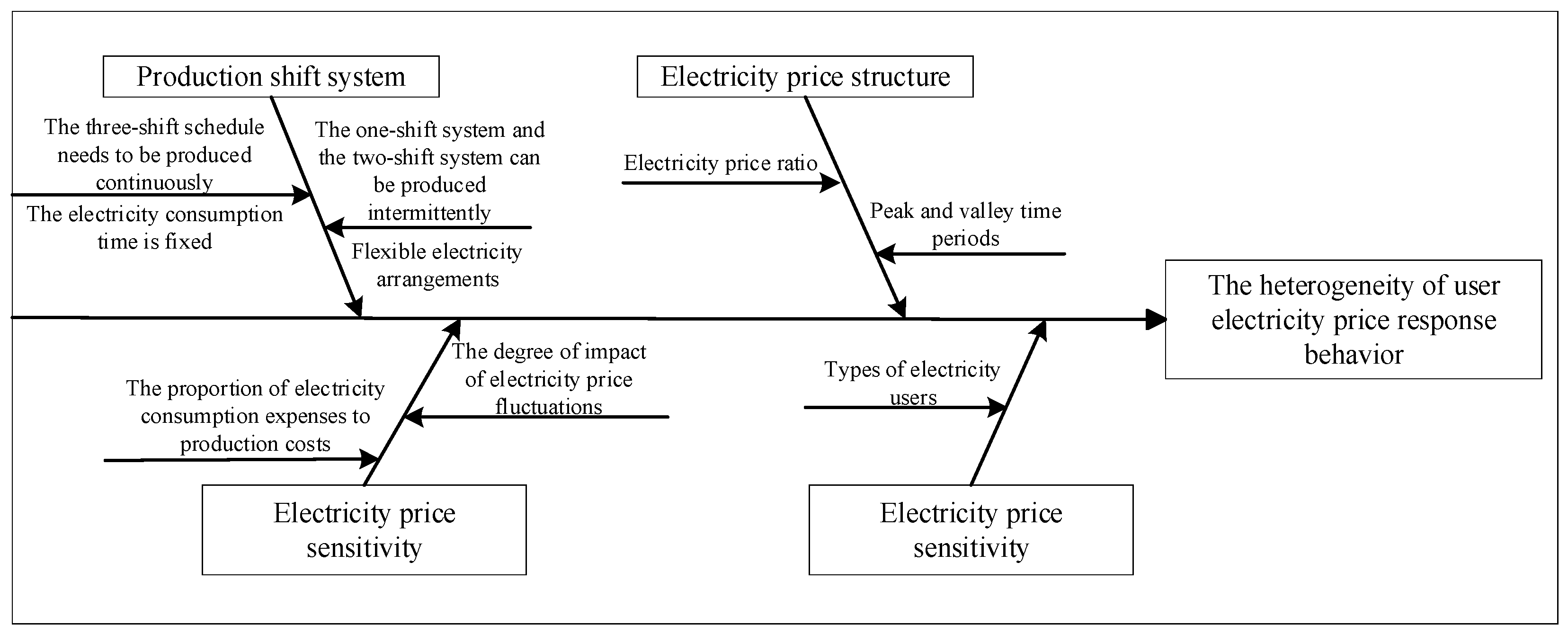
The electricity usage behavior of users is primarily influenced by factors such as the production shift system and electricity price sensitivity coefficient [32]. The primary factors that lead to heterogeneity in the electricity price response behavior of power users are shown in the following Figure 2:
Production shift system factor: It is indicative of the user’s demand for uninterrupted power supply [33]. Enterprises operating on a three-shift system are typically heavy industries that need continuous production. For example, the arrangement of power usage transfers for steel and petroleum processing industries is subject to production processes; enterprises operating on one-shift and two-shift systems are typically light industries that can be produced intermittently, such as the food industry, and the arrangement of power usage transfers is restricted by the difficulty of employee production arrangements.
Electricity-price-sensitive factor: The higher the proportion of electricity consumption for users to produce costs is, the more sensitive they are to fluctuating electricity and the higher the user’s enthusiasm for responding to the CPP mechanism is; they show a stronger tendency to transfer peak electricity demand to lower electricity bills, for instance, the cement industry [34].
Electricity price structure factor: The extent to which users respond to CPP is significantly affected by the division of time periods and the design of the price ratio. For example, building upon the original TOU, introducing CPP can enlarge the gap of the electricity price, leading users to shift additional load away from peak periods.
Duration of electricity price implementation: Generally, there are significant differences in the speed of power adjustments for various types of electricity users as the time for electricity price mechanism implementation increases.
Based on the heterogeneity of electricity consumer price response behavior mentioned above, this study classifies electricity users into three types—the active type, the herd type, and the stubborn type—to describe typical behavioral patterns under different response characteristics:
Active users: This type of user has a strong response to fluctuations in electricity prices. For example, for some large industrial users such as cement manufacturers, non-metallic mineral manufacturers, and some ordinary industrial users of the small-scale processing industry, the production shift structure is a higher degree of flexibility. With effective scheduling, they can flexibly respond to price signals, with a considerable peak cutting potential. Such enterprises’ electricity expenditures constitute a significant share of overall expenses; through price-based demand adjustments, firms can curtail their operational expenditures on manufacturing.
Herd users: This type of user’s response to price fluctuations is between stubborn and active. For example, for some large industrial users such as the food and textile processing industry and some commercial users, for instance, the transportation and warehousing industries, the disparity between peak and valley loads is pronounced, with a certain degree of peak shift potential, but the proportion of electricity costs in the total cost of production is relatively low. There is a degree of consciousness in electricity conservation, but its load-adjustable capacity is relatively weak.
Stubborn users: This type of user is less responsive to fluctuations in electricity prices. This category includes the petroleum processing industry, steel manufacturing industry, and other large industrial users, which feature extensive industrial operations and prolonged equipment runtime, and the use of electrical equipment for continuous and reliable power supply performance demand. In addition, the adjustable load of some commercial users, such as the accommodation and catering service industry (air conditioning, lighting, etc.), is closely related to the comfort of customers, and its adjustment space is limited. These users cannot actively respond to electricity price changes; if the price of electricity is significantly increased, it may result in higher manufacturing expenses.
It should be emphasized that the above user classification is a qualitative division grounded in the typical consumption traits of users in the electricity industry. It is used as a theoretical modeling abstraction to characterize the differences in electricity price responses. It aims to evaluate the regulatory effect of the differentiated CPP mechanism under different response characteristics, rather than to quantitatively identify specific user groups.
(2)
User demand response model
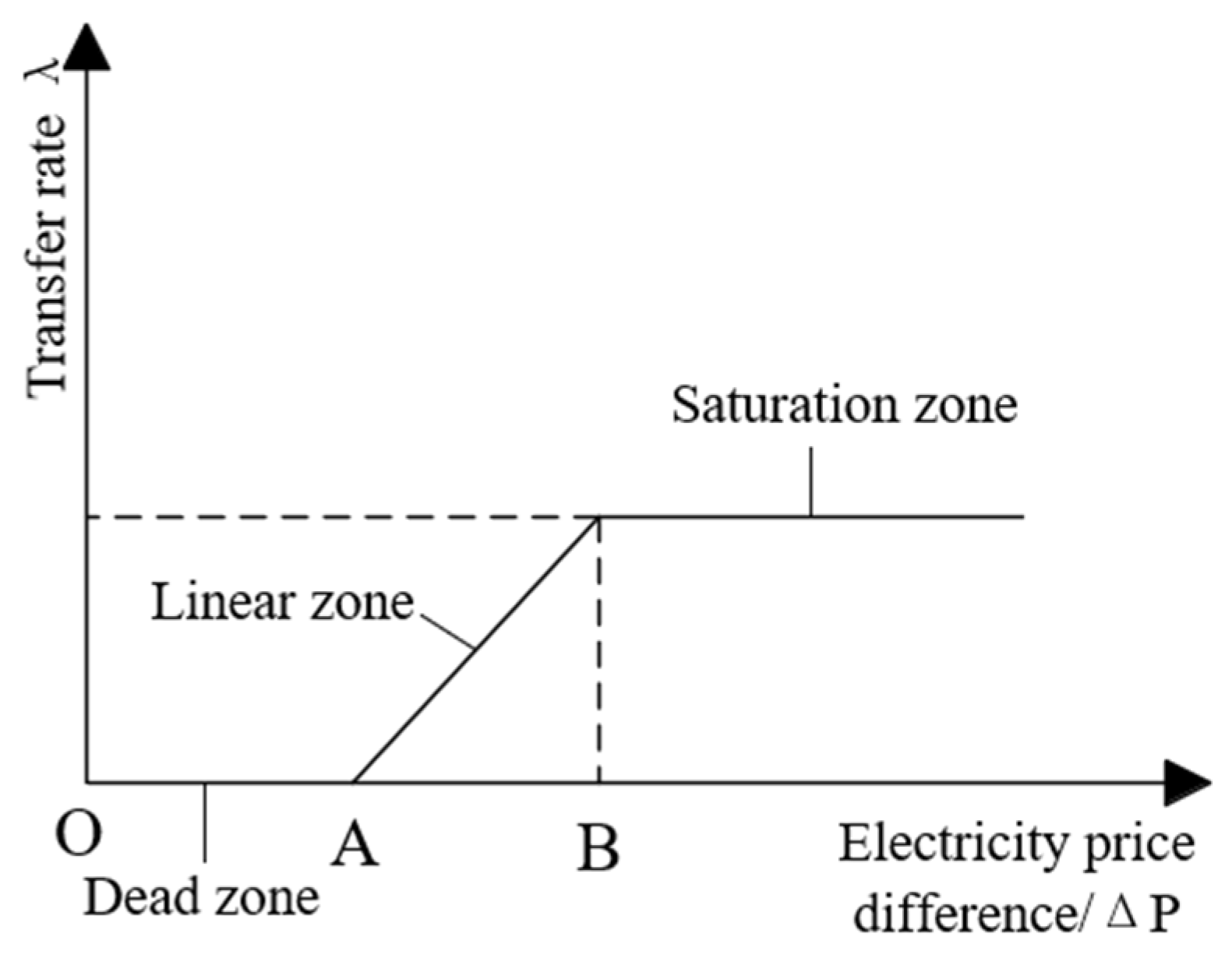
According to the stimulus-response theory in consumer psychology, users respond to different electricity prices to different degrees, leading to different consumption behaviors. The electricity price is a kind of stimulus to users. The response to this stimulus is not infinite, but there is a difference threshold [35], which presents the typical characteristics of no response–linear response–saturation response (as shown in Figure 3). When the price change falls below the difference threshold, users hardly respond to the price change. This range of electricity prices below the difference threshold is called the dead zone, that is, the O-A region. By the same token, when the price change exceeds the difference threshold, users will respond to the price change, and the extent of response is approximately linearly associated with the price change. This is called the linear region, that is, the A-B linear region. Users’ response to the price will also reach a saturation value. When the price change is too large and exceeds the saturation value, users reach the saturation state and, in effect, no longer transfer load. The range of electricity prices greater than the saturation value is called the response saturation region, that is, from point B to positive infinity. Therefore, this influence process is usually abstracted as a piecewise linear function, which is determined according to three parameters: the difference threshold, the slope of the linear segment, and the saturation value [31].
The load transfer rate of different periods for users can be expressed as
λ i j = 0 K i j ( Δ P i j A i j ) λ max Δ P i j < A i j   ( Dead   zone ) A i j < Δ P i j < B i j   ( Linear   zone ) Δ P i j > B i j   ( Saturation   zone )
In this formula, Δ P i j represents the difference between the price of electricity for period i and the price of electricity for period j in USD /kWh; A i j represents the lowest price difference at which electricity users begin to adjust their behavior, which is the difference threshold in Figure 3 in USD /kWh; B i j represents the saturation price difference where the electricity user has made the largest adjustment, which is the saturation value in Figure 3 in USD /kWh; K i j is the slope of the linear region where electricity users adjust their power consumption behavior, which is the response slope in Figure 3; λ i j and λ max represents the load transfer rate and the upper limit reached in the adjustment period i to j of the electricity user, respectively.
On critical peak days, there are six load transfer rates: critical peak–high load transfer rate λ c h , critical peak–flat load transfer rate λ c f , critical peak–valley load transfer rate λ c v , high–flat load transfer rate λ h f , high–valley load transfer rate λ h v , and flat–valley load transfer rate λ f v . Thus, the user load demand model for critical peak days after implementing the CPP mechanism is derived:
q t = q t 0 λ c h q c _ λ c f q c _ λ c v q c _ t T c q t 0 λ h f q h _ λ h v q h _ + λ c h q c _ t T h q t 0 λ f v q f _ + λ c f q c _ + λ h f q h _ t T f q t 0 + λ c v q c _ + λ h v q h _ + λ f v q f _ t T v
In this formula, q t and q t 0 are, respectively, the load at time t prior to and following CPP mechanism implementation; q c _ , q h _ , and q f _ , respectively, represent the mean loads during the critical peak, high, and flat periods, kW; T c , T h , T f , and T v represent the four periods of critical peak, high, flat, and valley, respectively.
On non-peak days, because there are only three periods, and there are three types of load transfer rates: high–flat load transfer rate λ h f , high–valley load transfer rate λ h v , and flat–valley load transfer rate λ f v . Therefore, a user load demand model for non-peak days after CPP implementation can be constructed:
q t = q t 0 λ h f q h _ λ h v q h _ t T h q t 0 λ f v q f _ + λ h f q _ h t T f q t 0 + λ h v q h _ + λ f v q _ f t T v

3.3. CPP Model Optimization

The price mechanism is the core of the power market mechanism, and it directly affects the implementation effect of the CPP mechanism, similarly to time division. The ultimate goal of implementing the CPP mechanism is peak shaving and valley filling [36]. This study constructs a multi-objective optimization model of CPP from the perspectives of electricity retailers, users, and plants. According to the heterogeneity of electricity consumers’ electricity price response behavior, the electricity price p c of different types of users during the critical peak period and the rate discount r of non-peak days are determined, thereby encouraging users to modify their electricity consumption habits more effectively. The optimization design premise is as follows:

3.3.1. Objective Function

(1)
From the perspective of electricity users, on the basis of meeting daily electricity consumption, electricity users optimize electricity consumption behaviors by responding to the CPP mechanism, the primary objective of which is to lower their electricity costs:
max U = R T O U R C P P
R T O U = i = 1 n h = 0 23 q T O U , t i × p T O U , t i
R C P P = i = 1 n h = 0 23 ( 1 x i ) q n C P P , t i × p n C P P , t i + i = 1 n h = 0 23 x i × q C P P , t i × p C P P , t i
In this formula, R T O U and R C P P are, respectively, the electricity usage cost of electricity users under the implementation of the TOU mechanism and the CPP mechanism in USD; p T O U , t i , p n C P P , t i , and p C P P , t i are the electricity prices at time t on day i under the TOU mechanism, on the non-critical peak day under the CPP mechanism and on the critical peak day under the CPP mechanism in USD /kWh, respectively; q T O U , t i , q n C P P , t i , and q C P P , t i are the loads used by the user at time t on day i under the TOU mechanism, on the non-critical peak day under the CPP mechanism and on the critical peak day under the CPP mechanism, kW; x i ∈ {0,1}, serves as the decision variable for identifying the i day of this month as the critical peak day (1) or not (0); n denotes the total count of days within the month.
(2)
From the perspective of the electricity retailers, when the selling company implements the CPP mechanism, its benefits can be measured by the sales profit, which is derived from the sales revenue minus the purchase cost:
max B = i = 1 n h = 0 23 ( 1 x i ) q n C P P , t i × p n C P P , t i + i = 1 n h = 0 23 x i × q C P P , t i × p C P P , t i P e Q e
Q e = i = 1 n t = 0 23 ( 1 x i ) ( q j i + q f i + q p i + q g i ) + i = 1 n t = 0 23 x i ( q f i + q p i + q g i )
where p n C P P , t i and p C P P , t i are the electricity prices sold by electricity retailers to users on non-critical peak and critical peak days at time t on the i day upon the implementation of the CPP mechanism, respectively, in USD /kWh; P e represents the average electricity purchase price that electricity retailers pay from power plants upon the implementation of the CPP mechanism in USD /kWh; Q e is the total purchased electricity, kW; B represents the sales profit of the electricity retailer in USD.
(3)
From the perspective of the electricity plant, the CPP mechanism reduces the extra cost caused by frequent start–stops and peak load operations via peak filling, load optimization, and load curve smoothing:
min ( C d + C s ) = k d ( q C P P , N L t + 1 q C P P , N L t ) 2 + N s × C f
N s = K q C P P , N L g
In this formula, C d is the peak load balancing cost of the power plant in USD; q C P P , N L t is the net load of all users during the period t after the CPP mechanism is implemented, kW; k d is the cost coefficient of peak regulation. C s denotes the generation unit’s start–stop cost. N s is the number of start–stops of the generator set, which is inversely proportional to the net load of the valley period q C P P , N L g ; C f denotes each unit’s start–stop cost in USD; K is a constant related to the operation of the system, indicating the frequency of start–stops at a specific load level.
(4)
Peak shaving and valley filling: The ultimate objective of implementing the CPP mechanism is to shave the peak and fill the valley as much as possible, minimize the peak–valley difference, and optimize the load curve [21]:
min Δ Q = ( Q N L , max Q N L , min )
where Q N L , max denotes the maximum net load when the CPP mechanism is implemented, kW; Q N L , min is the minimum net load when implementing the CPP mechanism, kW.
It should be noted that the TOU electricity price in the model is the currently published regulated price. The CPP critical peak electricity price and non-critical peak day discount rate are decision variables of the model and are determined through optimization.

3.3.2. Constraints

(1)
User satisfaction: When the load of electricity users changes significantly before and after the implementation of the CPP mechanism, user satisfaction will decrease, which means that electricity users have largely responded to the CPP mechanism to change their own consumption habits, but a significant reduction in satisfaction will weaken the keenness of electricity users to respond. Therefore, when optimizing CPP, the satisfaction of electricity users should be constrained:
θ 1 = 1 t = 0 23 q T O U , t q C P P , t t = 0 23 q T O U , t > δ 1
θ 2 = 1 t = 0 23 q T O U , t × p T O U , t q C P P , t × p C P P , t t = 0 23 q T O U , t × p T O U , t > δ 2
where θ 1 and θ 2 are the customer’s satisfaction with the load usage and electricity expenses after the CPP mechanism is implemented, respectively; δ 1 and δ 2 are constants—that is, limited values of satisfaction; the value range is set to 0.9~1 based on a previous study [20].
(2)
Average electricity price: In order to avoid increasing the overall economic burden on users and improve the fairness and acceptability of the CPP mechanism, a constraint must be imposed such that the mean electricity price under CPP does not exceed that under TOU:
P _ T O U P _ C P P 0
P _ T O U = i = 1 n t = 0 23 q T O U , t × p T O U , t i = 1 n t = 0 23 q T O U , t
P _ C P P = i = 1 n t = 0 23 ( 1 x i ) q n C P P , t × p n C P P , t + i = 1 n t = 0 23 x i × q C P P , t × p C P P , t i = 1 n t = 0 23 ( 1 x i ) q n C P P , t + i = 1 n t = 0 23 x i × q C P P , t
In this formula, P _ T O U and P _ C P P are, respectively, the users’ mean electricity price under the TOU mechanism and under the CPP mechanism in USD /kWh.
(3)
Constraint on peak electricity price and rate discount: This is implemented in order to ensure the rationality of price adjustment and the interests of users while achieving the target of load adjustment, as well as preventing excessive pricing or discounts affecting the implementation effect and user acceptance of the CPP mechanism. On the basis of meeting the mean price constraint, the value of peak electricity price and rate discount on non-peak days also need to be constrained:
1 < p c p h < 2.5
0.9 < r < 1
(4)
Constraint on peak net load: In order to prevent electricity users from having an excessive response to the CPP mechanism to form a new load peak, thus destroying the original load regulation target, a constraint must be imposed on the peak net load on critical peak days and non-critical peak days after putting into effect the CPP mechanism:
q T O U , N L i , min < q C P P , N L i < q T O U , N L i , max
q T O U , N L i , min < q n C P P , N L i < q T O U , N L i , max
In this formula, q T O U , N L i , min and q T O U , N L i , max , respectively, represent the minimum and maximum values of the net load on day i of the TOU mechanism, kW. q C P P , N L i and q n C P P , N L i , respectively, represent the net load values of the CPP mechanism on the critical peak day and non-critical peak day on day i , kW.
(5)
Total power constraints: We aim to ensure that the DR only adjusts the load distribution without changing the overall power demand of users so as to avoid affecting the plans and earnings of the power grid and electricity retailers due to changes in electricity, while keeping the life and production habits of users free from too much interference. Thus, the total power consumption should be kept unchanged after the implementation of the CPP mechanism:
i = 1 n t = 0 23 q T O U , t i = i = 1 n t = 0 23 ( 1 x i ) q n C P P , t i + i = 1 n t = 0 23 x i × q C P P , t i

3.3.3. Indicator Calculation

The index analysis mainly involves the net load index and economic benefit index. The key indicators involved and their corresponding computations are presented in Table 2.

4. Analysis of Numerical Examples

4.1. Optimization Results

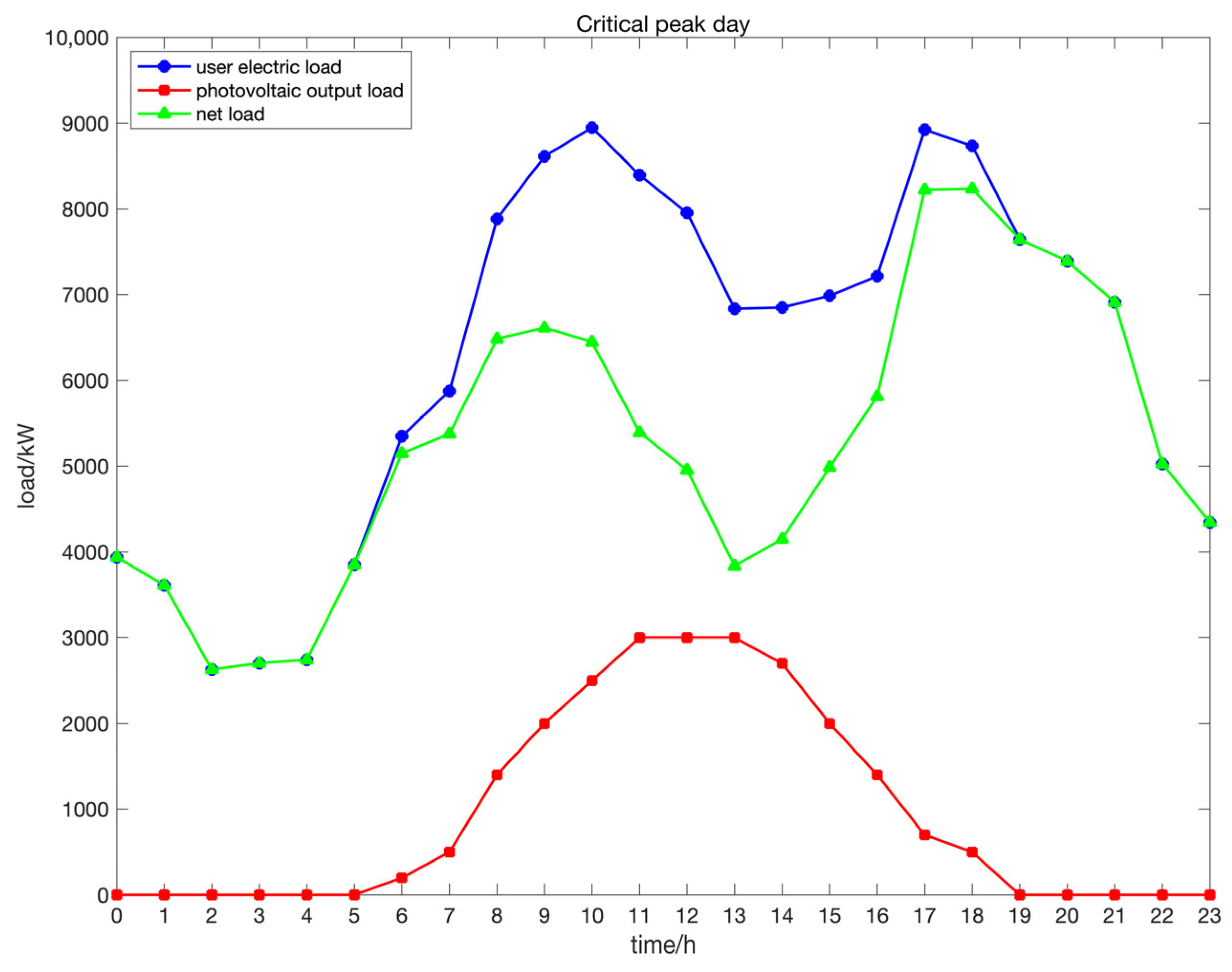
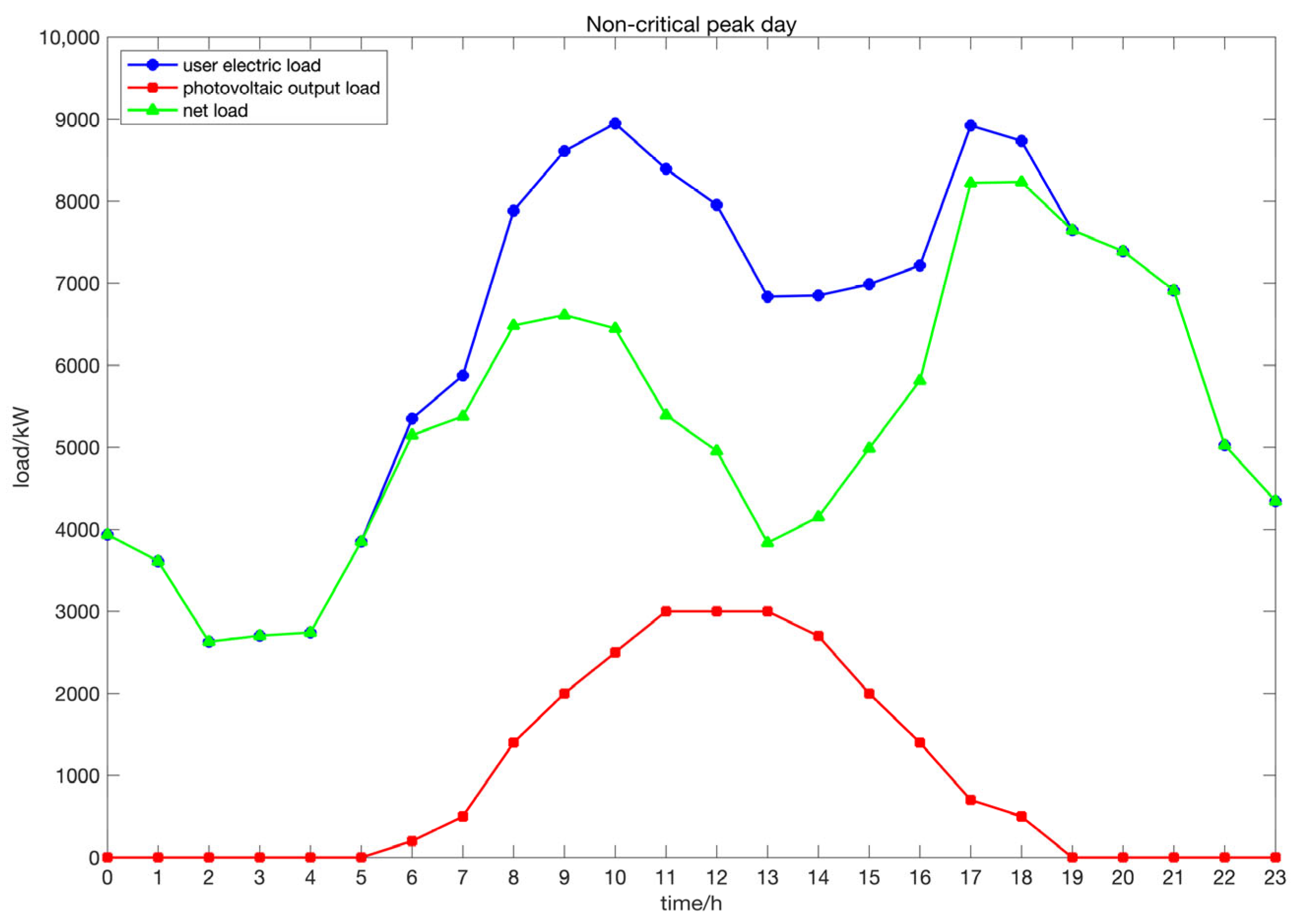
This study takes the load statistics of an industrial zone in the Xinjiang Province of China as an example and selects two typical day datasets for example analysis. The electricity load curve, photovoltaic output curve, and its net counterpart are illustrated in Figure 4 and Figure 5.
The conventional time period division approach relies only on the end user’s power load. As shown in the figure above, it is easy to divide the photovoltaic power output period (such as 10:00–15:00) into high or even critical peak periods while only considering the end user’s power load, which hinders the effective utilization of renewable energy power generation. For thermal power plants, performing calculations based only on the power load curve cannot accurately arrange the output of the traditional generator set, making it easy to produce excess electricity and increase the cost of power plants. The research in this paper is grounded in the net load curve; a partial large-scale semi-gradient membership function is used to divide the period, and a typical 24 h day is divided into four periods. The resulting classification of time division is reported in Table 3.
As indicated by the division results in Table 3, the PV output period is divided into a flat period and a valley period grounded in the user’s net load. In this way, the power dispatching center can more accurately arrange the output of traditional generator sets grounded in the net load curve, reduce the power generation cost, and guide users to use more electricity during the PV output period. This promotes the uptake of new photovoltaic power generation. This adjustment not only improves system operational efficiency but also effectively reduces solar curtailment and carbon emissions by promoting photovoltaic integration. It enhances the power system’s adaptability to high proportions of renewable energy, providing crucial support for the green energy transition.
According to the heterogeneity of electricity consumer price response, power consumers are divided into three types: active users, herd users, and stubborn users. The parameter settings for the peak electricity price mechanism model for different user types in this region reference research in the field of peak electricity pricing in China, which is well developed. For instance, Refs. [14,31,37] empirically calibrated user response parameters when studying dynamic peak electricity pricing. Building upon these studies, this research fully considers the electricity consumption characteristics of different user types. For instance, active users have a certain degree of flexibility in their production processes, and electricity expenditure accounts for a relatively high proportion of production costs; thus, they are more sensitive to changes in electricity prices, exhibiting a lower difference threshold and a higher response slope. Due to strong production continuity, strict process constraints, and limited adjustment space, stubborn users are given a higher difference threshold and a lower response slope. Furthermore, the settings were made in conjunction with the high photovoltaic penetration scenario, as shown in Table 4.
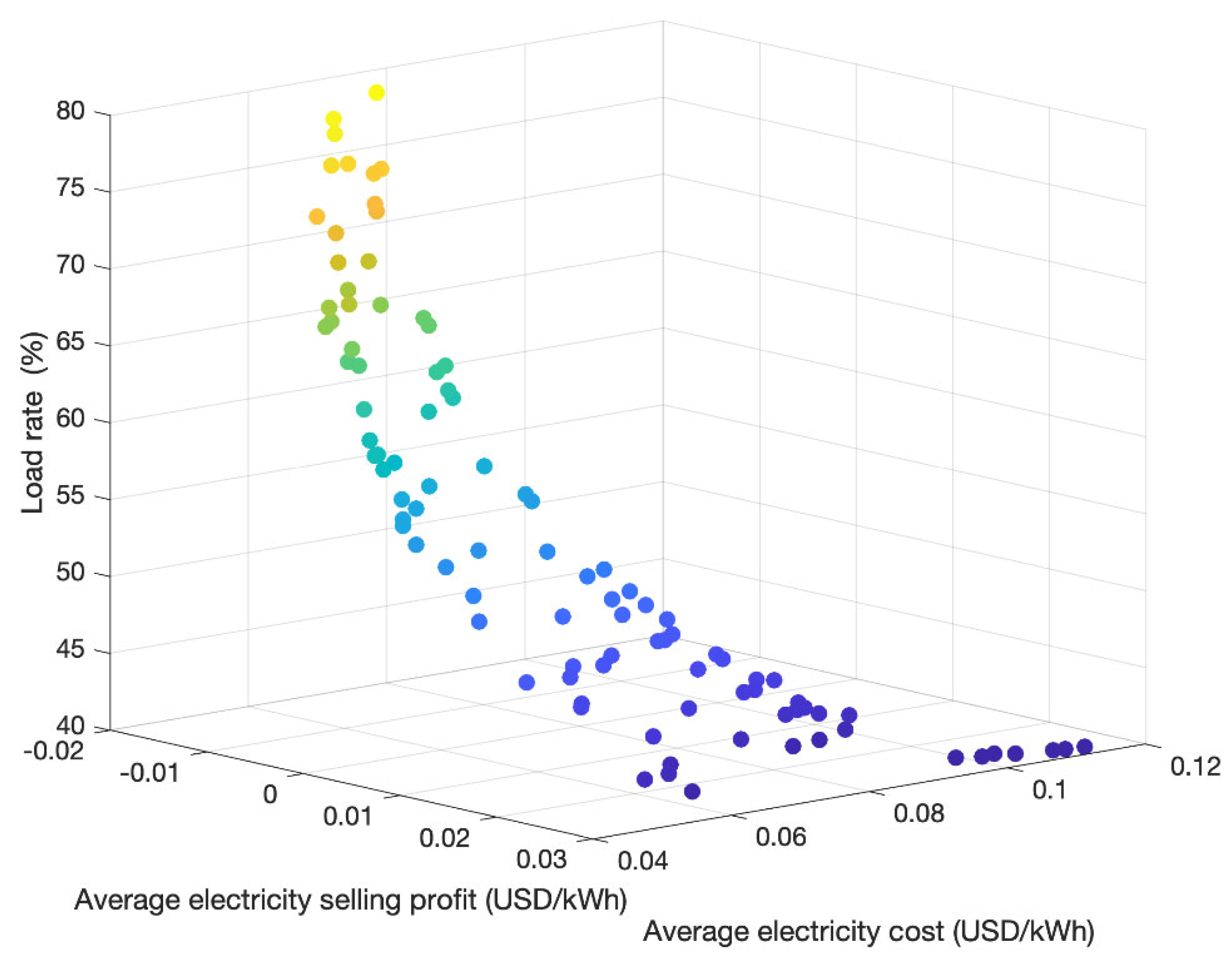
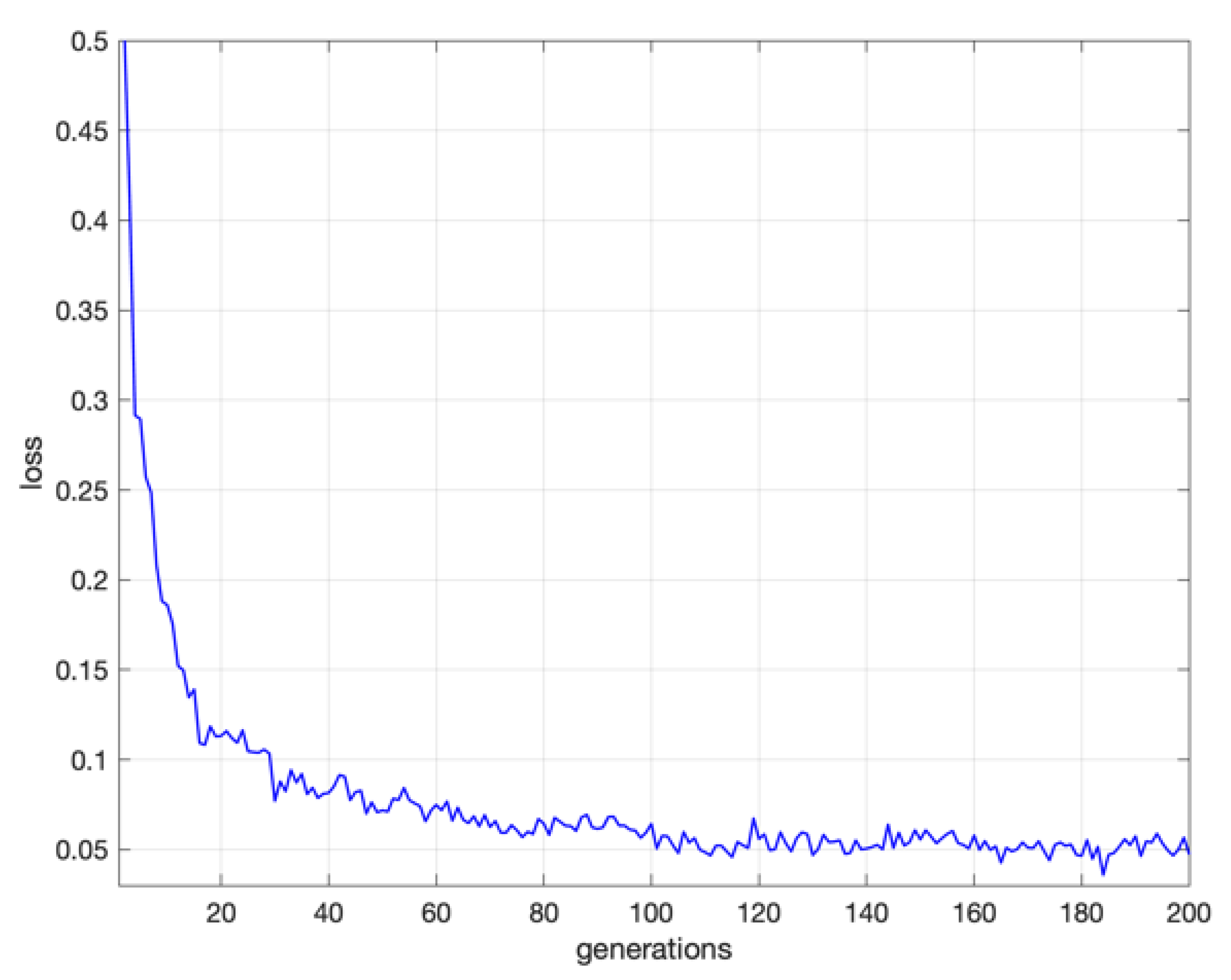
When all the above parameters are determined, the multi-objective optimization model of critical peak price is constructed with comprehensive consideration of the interests of electricity users, power-selling companies, etc. This model is solved using the NSGA-II genetic algorithm. Building upon NSGA, NSGA-II incorporates a non-dominated sorting mechanism and an elitism strategy, which lowers computational complexity, broadens the solution space, and enhances both robustness and convergence speed [38]. By adopting the crowding distance metric in place of fitness sharing, it enables the Pareto optimal set to be extended across the entire frontier while preserving an even spread, thereby circumventing the need for a manually defined sharing radius and safeguarding population diversity. Based on these advantages, this study implements the NSGA-II multi-objective evolutionary algorithm using GATBX in the MATLAB R2023b environment to solve the CPP model. The algorithm employs the default genetic operators from GATBX to handle individual selection, crossover, and mutation. Key parameters are configured as follows: a population size of 100, crossover probability of 0.7, mutation probability of 0.07, and a maximum of 200 iterations. Execution stops once this iteration limit is reached. Convergence is evaluated by examining the Pareto optimal set and the evolution of the objective function during continuous iterations. The convergence of the loss function is then used to verify that the algorithm configuration ensures the convergence and stability of the solution results. The Pareto front solution and the convergence plot of the loss function are shown in Figure 6 and Figure 7 after inputting the parameters and the original electricity price for the region (as shown in Table 5).
Finally, the optimal critical peak price and discount rate for each user type are obtained; they are presented in Table 6.
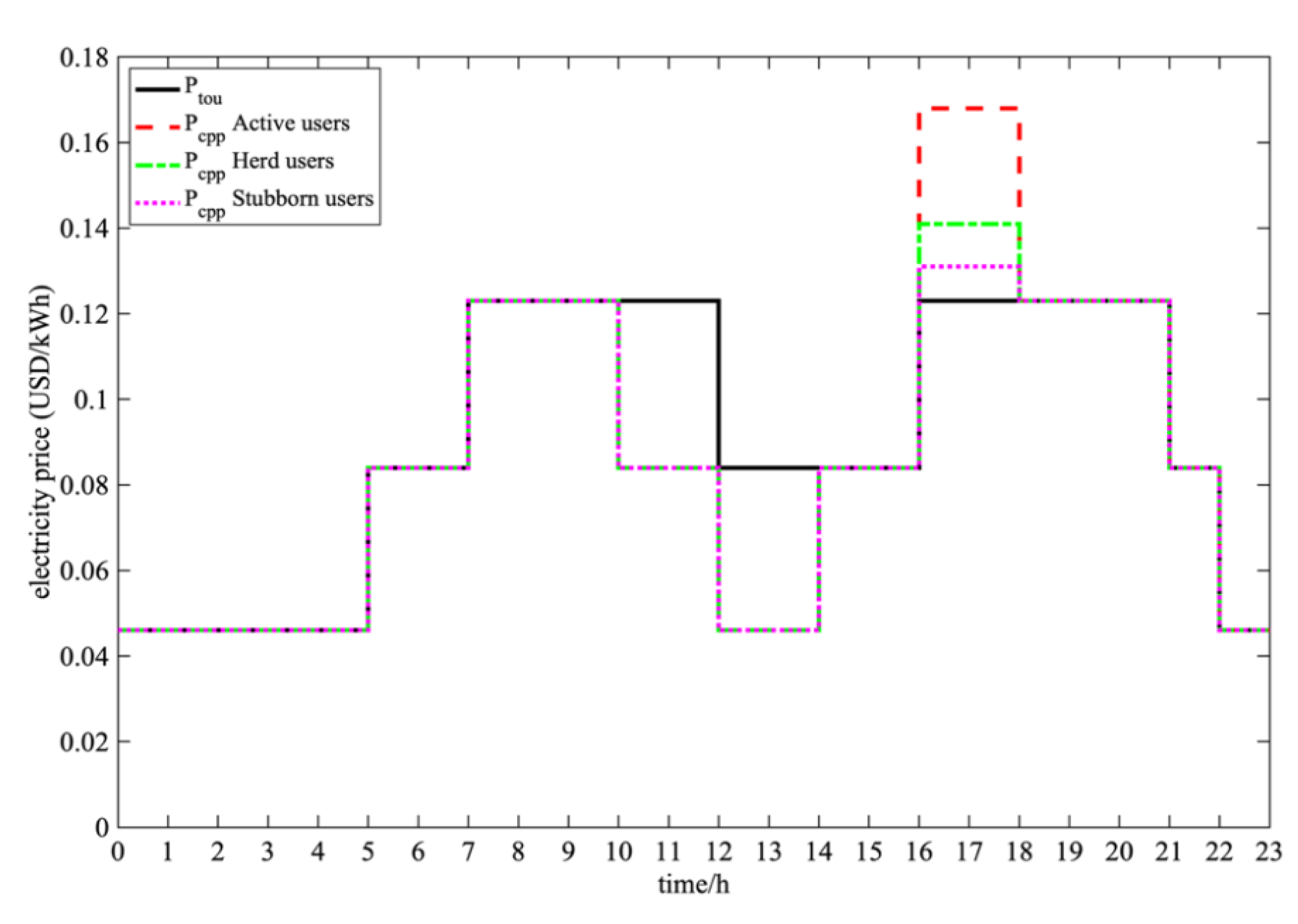
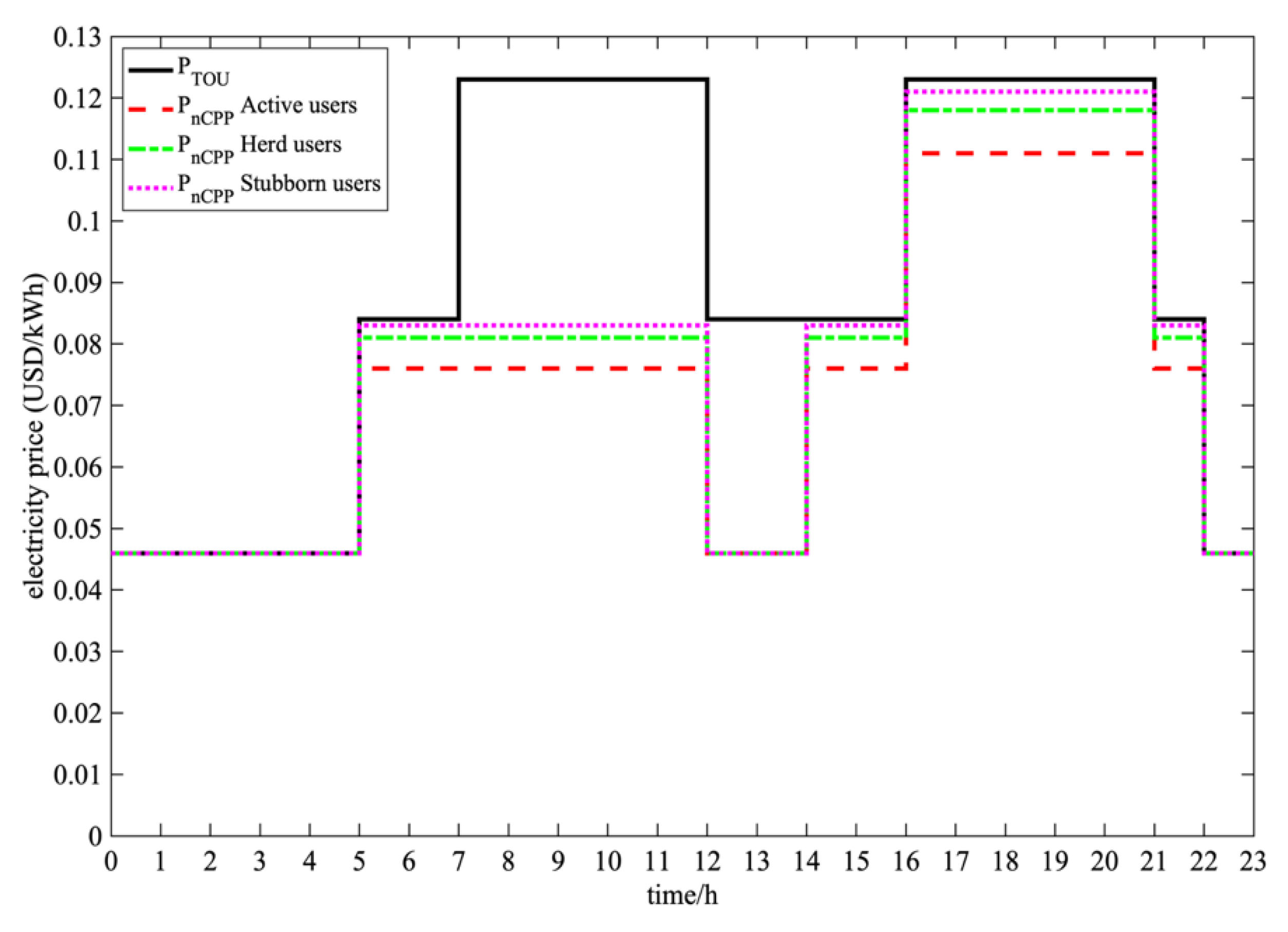
We substitute the obtained optimal critical peak price and discount rate into Table 1 to obtain the optimal price across various periods of the non-critical peak day and critical peak day, as presented in Table 7 and Figure 8 and Figure 9:
It is evident from Figure 8 and Figure 9 that active users have a higher electricity price within critical peak periods on critical peak days and a large discount rate on non-critical peak days. This is because active users have a high level of electricity price response and can reduce electricity costs by adjusting their usage habits. When the electricity prices are relatively high and the discount rates are large, it is easier to optimize their electricity usage behavior and encourage such users to shift the electricity load during peak hours to the trough period to play the role of DR. Meanwhile, herd users have a lower electricity price within critical peak periods on critical peak days and a smaller discount rate on non-critical peak days compared to active users. This is because the price response degree of such users is medium, and they make partial adjustments according to the price signal, so the critical peak price level should not be too high; otherwise, their adjustment space is limited, and it may be difficult to bear. Stubborn users have the lowest electricity price within critical peak periods on critical peak days and the smallest discount rate on non-critical peak days. This is because such users are not sensitive to changes in electricity prices; no matter how electricity prices change, their electricity habits are difficult to change. Electricity prices that are too high will significantly increase cost pressure while failing to achieve effective DR, so, for stubborn users, electricity prices are relatively low to avoid excessively high cost burdens, especially in some basic industrial fields. Maintaining stable production and a low-cost power supply is essential.
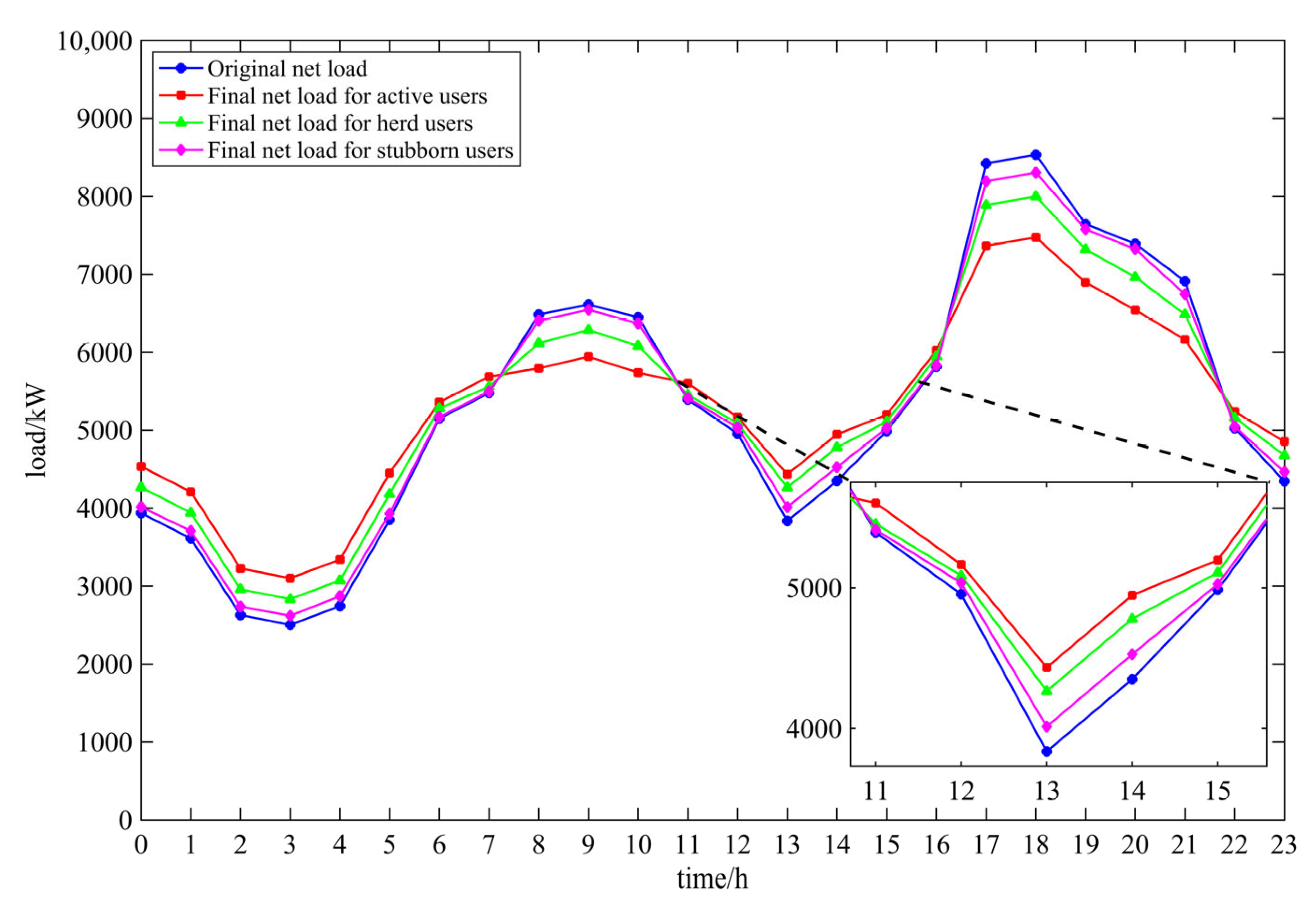
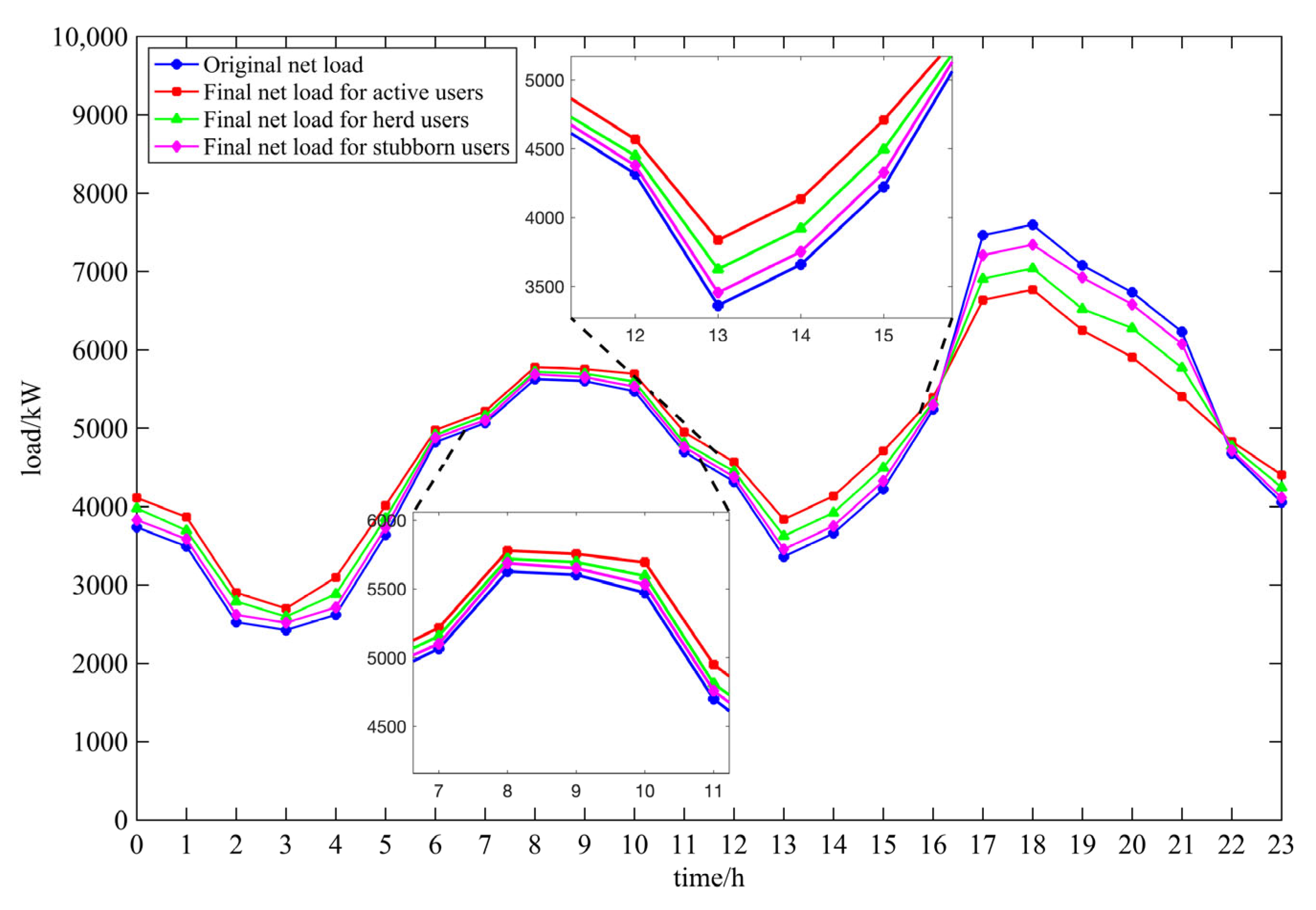
Figure 10 and Figure 11 show a contrast between the net load profiles before and after the CPP tariff is implemented for different users.
As shown in Figure 10 and Figure 11, taking the net load curve as the reference for time division, the original high or even critical peak PV output period (11:00–17:00) is divided into flat or valley periods on critical peak days. The high PV output period (8:00–13:00) is divided into flat and valley periods during non-critical peak days. It effectively promotes the transfer of electricity load to the photovoltaic power output period. Compared with the traditional period division, which is only based on the terminal power load, taking the electricity load minus the net load of photovoltaic power output as the basis for division is conducive to guiding users to use more electricity during the photovoltaic power generation period, reducing the phenomenon of light abandonment and promoting photovoltaic consumption. This achieves dynamic synergy between energy supply and demand, effectively enhancing the utilization efficiency of clean energy and the low-carbon level of system operation, thereby providing strong support for the construction of a high-proportion renewable energy power system.
To more effectively test the validity and feasibility of the CPP optimization model proposed herein, the following takes active users as an example to analyze and verify the implementation effect after optimization through relevant indicators, as shown in Table 8:
As shown in Table 8, after active users implement the optimized CPP electricity price, the net load curve during critical peak and non-critical peak days is significantly improved. While reducing the peak net load, the net load valley value is improved, and the impact of peak shaving and valley filling is obvious. On non-critical peak days, the net load peak decreased from 7597 kW to 6768.9 kW, a decrease of 10.9%. The valley value of the net load increased from 2423 kW to 2699 kW, an increase of 11.39%. The net load peak–valley gap was reduced from 5174 kW to 4068.9 kW, a decrease of 21.34%. The variation rate of the net load peak–valley gap decreased from 68.11% to 60.13%, which decreased by 12.14%. The variability in the net load also improved significantly, and the load rate increased by 8.62%. As for the electricity retailer, due to the reduction in the power generation cost of power plants, the electricity retailer receives a lower power purchase cost, and the average profit from power-selling on non-peak days increases from 0.0178 USD /kWh to 0.0189 USD /kWh, an increase of 6.18%. At the same time, as the original high period (such as 8:00–13:00) is divided into flat and valley periods after considering the photovoltaic output, as well as the reason for the electricity price discount, the average daily electricity cost of users during non-critical peak days is substantially reduced compared with the TOU mechanism, from the original 0.0989 USD /kWh to 0.0872 USD /kWh. This represents a reduction of 11.83%.
On the critical peak day, the peak net load decreased from 8534 kW to 74,755.6 kW, a decrease of 12.4%. The valley value of the net load increased from 2503 kW to 3100.7 kW, an increase of 23.88%. The net load peak–valley gap was reduced from 6031 kW to 4374.9 kW, a decrease of 27.46%. The variation rate of the net load peak–valley gap decreased from 70.67% to 58.52%, i.e., 12.15%. Meanwhile, the load rate increased by 8.91%. As for the electricity retailer, due to the reduction in the generation cost, the electricity retailer receives a lower power purchase cost, and the average profit of electricity selling on the peak day increases from 0.0178 USD /kWh to 0.0192 USD/kWh, an increase of 7.87%. It is worth noting that, while a moderate increase in CPPs will raise electricity costs for users, it serves as a necessary price signal to guide load shifting. Although the average daily electricity cost for users on critical peak days increases by 2.5% compared to the TOU mechanism, the overall total electricity cost for users is lower than under the TOU mechanism. This is because critical peak days constitute only a minor fraction of the days within a month, and users receive a lower discounted price during non-critical peak days. In addition, the carbon emission reduction benefits increased by 18.19% because the net load curve divided the photovoltaic power output period, which was originally the high-electricity-consumption period, into flat and valley periods. This effectively guides users to transfer the load during critical peak periods to the photovoltaic output periods, improves the level of photovoltaic consumption, reduces the phenomenon of light abandonment, promotes the transformation of the energy structure toward a clean and low-carbon direction, reduces the consumption of fossil fuels, lays a solid foundation for the long-term sustainable development of the power system, and achieves dual improvement of economic and environmental benefits.
Overall, the deployment of the optimized CPP mechanism significantly alleviates the load strain of the electricity system and the peak shaving burden of the conventional generators, which not only improves the economic benefits of the generation side, the electricity retailer, and the electricity user but also effectively guides the user to use more electricity during the photovoltaic period and promotes photovoltaic consumption. This optimization strategy significantly reduces carbon emissions by promoting the substitution of renewable energy, offering a viable market-based pathway to achieve the “dual carbon” goals while delivering both economic benefits and sustainability value.

4.2. Sensitivity Analysis

To further investigate the effects of different factors on the price and implementation effect of the CPP mechanism, this section conducts a sensitivity analysis for constructing different scenarios for active users:
Scenario 1.
Sensitivity analysis of user DR model parameters (slope K i j , threshold   A i j , and saturation value   B i j ) to CPP.
Scenario 2.
Sensitivity analysis of user satisfaction to CPP.
Scenario 3.
Sensitivity analysis of PV uptake rate to CPP.
(1)
Sensitivity analysis of user DR model parameters to CPP
Due to the large number of parameters in the user DR model, this section only discusses a set of parameters for active users. By adjusting the values of K i j , A i j , and B i j , the impact of their changes on the price and implementation effect of the CPP mechanism is discussed.
Keeping K i j = 0.015 unchanged, we change the values of ( A i j , B i j ) by taking (0.089, 0.713), (0.109, 0.913), and (0.129, 0.813), respectively, and re-substituting the changed parameters into the model. The results obtained are shown in Table 9.
Table 9 shows that the changes in the threshold value and saturation value exert a weak impact on the level of the electricity price and the implementation effect, which indicates that the CPP mechanism is insensitive to these parameters during the optimization process.
Moreover, while the values of A i j and B i j remain unchanged, the values of K i j are changed to 0.010, 0.012, and 0.015, and the changed values are re-inserted into the model for optimization calculation. The results obtained are shown in Table 10.
Table 10 shows that the change in the user response slope has a significant impact on the level of electricity price and the implementation effect. When K i j = 0.015, the peak reduction rate of the net load is the largest, which indicates that the user response slope K i j exerts a substantial influence on the final results of the optimization. This is highly correlated with the heterogeneity characteristics of different user types, which also verifies that the differentiated CPP design put forward in this study can accurately reflect the real response reaction of various user categories. Therefore, in the process of formulating and implementing the CPP mechanism, it is crucial for power-selling companies to implement different peak electricity prices according to different types of users. This can not only guide the herd and active users to respond to the electricity price changes to achieve the effect of peak cutting and valley filling, but it will also prevent significant increases in the cost of electricity for stubborn users.
(2)
Sensitivity analysis of user satisfaction to CPP
The values of user satisfaction were changed to 0.85, 0.9, and 0.95, with the obtained results displayed in Table 11.
Table 11 shows that the change in user satisfaction has a significant impact on the level of electricity price and the implementation effect. When the user satisfaction is low, the corresponding electricity price is high, which can effectively improve the load. However, in the long run, it will weaken the enthusiasm of users to implement the CPP mechanism, resulting in a decline in user comfort; thus, the scientific use and popularization of CPP implementation are limited. On the contrary, when the user satisfaction is high, the corresponding electricity price is low, but the net load reduction rate also responds to the decrease, reducing the implementation effect of CPP, and it is hard to realize the intended objective of peak cutting and valley filling. In short, too much or too little user satisfaction can adversely affect the CPP mechanism. Therefore, when optimizing CPP, user satisfaction should be taken into account as much as possible to ensure the applicability and feasibility of the mechanism.
(3)
Sensitivity analysis of photovoltaic grid connection rate to the CPP mechanism
The above results are the optimal pricing results calculated from the net load curve obtained when the distribution network is fully connected to photovoltaic power output under the assumed conditions. However, owing to the limited grid connection capacity of the grid in reality, the impact of changing the photovoltaic grid connection rate on the electricity price and implementation effect of the CPP mechanism is discussed below. The grid connection rate of photovoltaic power generation is taken as 50%, 75%, and 100%, and the results are shown in Table 12.
Table 12 shows that the photovoltaic grid connection rate has a significant impact on electricity prices and implementation effectiveness. Different photovoltaic grid connection rates affect the net load value, thus altering the time period division. Therefore, the actual photovoltaic grid connection rate is crucial in optimizing the CPP mechanism. It also demonstrates that, regardless of the photovoltaic grid connection rate, the proposed CPP optimization model can improve load, further illustrating its scientific validity and effectiveness.

5. Conclusions

Against the backdrop of the high-penetration connection of renewable energy generation into the grid, this study conducted an in-depth study of the CPP mechanism. Starting from the electricity retailer side, by introducing a net load curve, the aim is to synergistically achieve the dual objectives of “photovoltaic consumption” and “peak shaving and valley filling”. Simultaneously, based on the heterogeneity of electricity consumers’ price response, users are classified into different types, and differentiated CPP optimization models are constructed to increase the validity and effectiveness of the mechanism’s implementation. The models are solved using the NSGA-II algorithm, and through multi-scenario sensitivity analysis, the effects of multiple factors on the price and implementation impact of the CPP mechanism are explored, identifying its key influencing factors. The key conclusions of this study are summarized below:
(1)
Taking active users as an example, compared with the TOU mechanism, the net load curve showed significant improvement after implementing the optimized CPP mechanism. While the peak net load decreased, the minimum net load increased. The net load peak–valley gap decreased by 27.46% and 21.34% during critical peak and non- critical peak days, respectively, and the net load factor increased by 8.62% and 8.91%, respectively. The peak shaving and valley filling effects were substantial, alleviating the system’s peak shaving pressure to a significant degree and creating lower electricity purchase costs for electricity sales companies, increasing their average electricity sales profit by 6.18–7.87%. Simultaneously, it effectively guided users to shift their critical peak load to periods of high photovoltaic power generation, improving the efficiency of photovoltaic power consumption and carbon emission reduction.
(2)
Users’ electricity costs have also been optimized. Taking active users as an example, compared to the TOU mechanism, although the average electricity cost on critical peak days increased slightly due to the enhanced electricity price signal, from 0.0989 USD/kWh to 0.1014 USD/kWh, an increase of 2.5%, owing to critical peak days, constitutes only a minor fraction of the days within a month, and users received lower discounted prices during non-critical peak days. The average electricity cost on non-critical peak days dropped to 0.0872 USD/kWh, a decrease of 11.78%. Therefore, the overall average electricity cost for users generally shows a downward trend. This strategy of exchanging a controllable increase in costs on a few critical peak days for significant cost savings on most non-critical peak days is the key to the CPP mechanism in terms of guiding electricity consumption behavior and optimizing overall social welfare.
(3)
Differential pricing ensures fairness and efficiency. For active users, higher critical peak prices and discount rates effectively incentivize their flexible electricity usage, allowing them to minimize the impact of increased critical peak day costs and even benefit from higher total electricity costs by actively adjusting their behavior. For herd users, moderate price signals provide guidance for adjustments. For stubborn users, relatively mild price changes, with the lowest critical peak prices and smallest discount rates, prevent them from bearing an excessive financial burden, reflecting the mechanism’s inclusivity.
(4)
Through the analysis of the electricity price and implementation effect of the CPP mechanism in different scenarios, the results show that the changes in the user’s electricity price response threshold and saturation value exert a weak impact on the optimization result and implementation effect of the CPP mechanism, while the changes in the user’s electricity price response slope, satisfaction, and photovoltaic consumption rate exert a stronger influence on the optimization result and implementation effect of the CPP mechanism.
In summary, this study systematically addresses the challenges of coordinating PV consumption and load regulation under high-proportion renewable energy integration by constructing a peak price optimization model that considers net load curves and consumer heterogeneity. The model demonstrates good performance in terms of PV consumption, peak shaving, and valley filling, and it could provide economic benefits for multiple stakeholders in the electricity market. Furthermore, it achieves precise matching between user response behavior and price signals through differentiated pricing, providing a theoretical basis and decision support for electricity retailers to design dynamic pricing mechanisms in the electricity market environment. From a sustainability perspective, this mechanism guides load to match the timing of renewable energy output through the net load curve, thereby enhancing the power system’s adaptability to variable renewable energy and providing operational support for the integration of high-proportion clean energy. Meanwhile, the differentiated pricing strategy based on user heterogeneity not only helps cultivate end users’ awareness of green electricity consumption and their habit of active demand response but also lays an institutional foundation for building a fair, inclusive, and efficient sustainable power market. This embodies the multi-dimensional value of integrating technological optimization with social guidance to jointly advance the energy transition. It should be noted that the CPP optimization model constructed in this study is a baseline theoretical framework. It calculates the most reasonable price using a genetic algorithm under the assumption that all PV power generation is connected to the distribution network. Therefore, future research on CPP mechanisms could introduce robust optimization or multi-stage stochastic programming to endogenize prediction uncertainty into the model and, combined with actual PV grid connection rates, formulate more resilient pricing strategies.

Author Contributions

Conceptualization, X.Y. and G.S.; methodology, X.Y. and G.S.; validation, G.S.; formal analysis, X.Y.; investigation, J.J.; writing—original draft, G.S.; writing—review and editing, X.Y.; visualization, G.S. and J.J.; supervision, X.Y. and G.S.; project administration, J.J. All authors have read and agreed to the published version of the manuscript.

Funding

This research was funded by the Ministry of Education’s Humanities and Social Sciences Research Project of China, grant number 23YJC630220.

Institutional Review Board Statement

Not applicable.

Informed Consent Statement

Not applicable.

Data Availability Statement

The original contributions presented in this study are included in the article. Further inquiries can be directed to the corresponding author.

Conflicts of Interest

The authors declare no conflicts of interest.

References

  1. Qi, J.; Xu, Y.; Jiang, D.; Zhou, D. Analysis of PV hosting capacity in distribution grids considering users’ voltage-regulation responsibility under dynamic Time-of-Use pricing. Electr. Power Syst. Res. 2026, 255, 112713. [Google Scholar] [CrossRef]
  2. Liu, J.; Zhang, W.; Hu, G.; Xu, B.; Cui, X.; Liu, X.; Zhao, J. Master–Slave Game Pricing Strategy of Time-of-Use Electricity Price of Electricity Retailers Considering Users’ Electricity Utility and Satisfaction. Sustainability 2025, 17, 3020. [Google Scholar] [CrossRef]
  3. Zhang, L.; Tian, C.; Li, Z.; Yin, S.; Xie, A.; Wang, P.; Ding, Y. The Impact of Participation Ratio and Bidding Strategies on New Energy’s Involvement in Electricity Spot Market Trading under Marketization Trends—An Empirical Analysis Based on Henan Province, China. Energies 2024, 17, 4463. [Google Scholar] [CrossRef]
  4. Guo, K.J.; Gao, C.W.; Lin, G.Y.; Lu, S.X.; Feng, X.F. Incentive demand response optimization strategy for e-commerce vendors in spot market environment. Autom. Electr. Power Syst. 2020, 44, 28–35. [Google Scholar]
  5. Thomas, A.G.; Tesfatsion, L. Braided cobwebs: Cautionary tales for dynamic pricing in retail electric power markets. IEEE Trans. Power Syst. 2018, 33, 6870–6882. [Google Scholar] [CrossRef]
  6. Yang, J.J.; Zhao, J.H.; Wen, F.S.; Meng, K.; Dong, Z.Y. Electricity retail core business structure and electricity purchase and sale decisions. Autom. Electr. Power Syst. 2017, 41, 10–18+20–23. [Google Scholar]
  7. Manfre Jaimes, D.; Zamudio López, M.; Zareipour, H.; Quashie, M. A Hybrid Model for Multi-Day-Ahead Electricity Price Forecasting considering Price Spikes. Forecasting 2023, 5, 499–521. [Google Scholar] [CrossRef]
  8. Liang, Y.; Li, Z.; Li, Y.; Leng, S.; Cao, H.; Li, K. Bilevel Optimal Economic Dispatch of CNG Main Station Considering Demand Response. Energies 2023, 16, 3080. [Google Scholar] [CrossRef]
  9. Zhang, Z.; Zhang, P.; Zhao, Y.; Chen, X.; Zong, Z.; Wu, K.; Zhou, J. Survey-based air-conditioning demand response for critical peak reduction considering residential consumption behaviors. Energy Rep. 2020, 6, 3303–3315. [Google Scholar] [CrossRef]
  10. Schlereth, C.; Skiera, B.; Schulz, F. Why do consumers prefer static instead of dynamic pricing plans? An empirical study for a better understanding of the low preferences for time-variant pricing plans. Eur. J. Oper. Res. 2018, 269, 1165–1179. [Google Scholar] [CrossRef]
  11. Gajowniczek, K.; Nafkha, R.; Ząbkowski, T. Seasonal peak demand classification with machine learning techniques. In Proceedings of the 2018 International Conference on Applied Mathematics & Computer Science (ICAMCS), Paris, France, 13–15 April 2018; IEEE: New York, NY, USA, 2018; pp. 101–105. [Google Scholar]
  12. Wang, J.; Li, H. The impact of electricity price on power-generation structure: Evidence from China. Front. Environ. Sci. 2021, 9, 733809. [Google Scholar] [CrossRef]
  13. Liu, D.N.; Li, H.; Wang, L.X.; Zhang, T.T. Study on Dynamic Adjustment Method of Power Grid Critical Peak Periods Considering Load Characteristics. IOP Conf. Ser. Earth Environ. Sci. 2021, 804, 032004. [Google Scholar] [CrossRef]
  14. Ji, L.; Zhang, K.S.; Zhang, G.; Wang, Y.Q. Peak Electricity Pricing Model Based on the Theory of Consumer Psychology. Power Syst. Clean Energy 2017, 33, 89–92+98. [Google Scholar]
  15. Wang, W.J.; Han, Y.C.; Wang, M.; He, Y. Research on fair residential critical peak price: Based on a price penalty mechanism for high-electricity consumers. Appl. Energy 2023, 351, 121892. [Google Scholar] [CrossRef]
  16. Naz, M.; Iqbal, Z.; Javaid, N.; Khan, Z.A.; Abdul, W.; Almogren, A.; Alamri, A. Efficient power scheduling in smart homes using hybrid grey wolf differential evolution optimization technique with real time and critical peak pricing schemes. Energies 2018, 11, 384. [Google Scholar] [CrossRef]
  17. Zhu, L.F.; Zhou, X.; Chen, M.L.; Tan, J. Research on Peak Price Optimization Based on Consumer Psychology. Telecom Power Technol. 2019, 36, 107–108+110. [Google Scholar]
  18. Lu, Q.; Zhang, Y. A multi-objective optimization model considering users’ satisfaction and multi-type demand response in dynamic electricity price. Energy 2022, 240, 122504. [Google Scholar] [CrossRef]
  19. Yu, X.; Dong, Z.; Zheng, D. Research on Critical Peak Price Decision Optimization Considering Industrial Consumer’s Risk Appetite under the Carbon Neutrality Goal. Sustainability 2023, 15, 9347. [Google Scholar] [CrossRef]
  20. Yu, X.B.; Dong, Z.Y.; Zheng, D.D.; Tian, L.; Cai, Z.J. Peak electricity price optimization model and sensitivity analysis taking into account coal consumption rate. Syst. Eng. Theory Pract. 2024, 44, 2260–2272. [Google Scholar]
  21. Song, H.Y.; Lee, G.S.; Yoon, Y.T. Optimal operation of critical peak pricing for an energy retailer considering balancing costs. Energies 2019, 12, 4658. [Google Scholar] [CrossRef]
  22. Liu, M.C. Considering the Impact of New Energy Consumption on Peak and Valley Time-of-Use Electricity Prices. Master’s Thesis, North China Electric Power University, Beijing, China, 2021. [Google Scholar]
  23. Wang, S.X.; Wang, H.Z.; Zhao, Q.Y.; Li, X.R.; Li, S.S. Time-of-use electricity price optimization method for improving photovoltaic acceptance capacity of distribution network. Autom. Electr. Power Syst. 2023, 47, 38–46. [Google Scholar]
  24. Zhu, L.X.; Zhu, L.; Wu, Q.Y.; Xu, T.; Huang, M.; Gao, N.; Wang, K.A.; Wu, W.M.; Li, W.; Koh, C.S.; et al. Design, Optimization, and Experimental Study of a Novel Direct-Driven Linear-Rotary Wave Generator. IEEE Trans. Energy Convers. 2025, 40, 1712–1725. [Google Scholar] [CrossRef]
  25. Zhu, C.; Wang, M.Q.; Zhang, Y.; Fang, X.; Mo, Z.; Su, S. Research on the optimization of the start-up conditions of peak electricity prices in summer. J. Electr. Power Sci. Technol. 2024, 39, 96–103. [Google Scholar]
  26. Schittekatte, T.; Mallapragada, D.; Joskow, P.L.; Schmalensee, R. Electricity Retail Rate Design in a Decarbonizing Economy: An Analysis of Time-of-use and Critical Peak Pricing. Energy J. 2024, 45, 25–56. [Google Scholar] [CrossRef]
  27. Zhan, Y.; Sun, C.; Xu, M. Critical peak pricing and firm’s asset efficiency: A double machine learning study with China’s new energy manufacturing industry. Energy Econ. 2026, 153, 109048. [Google Scholar] [CrossRef]
  28. Jeon, W.; Lamadrid L., A.J.; Mount, T.D. A Robust Alternative to Critical Peak Pricing for Electricity Using Distributed Energy Storage. Energy J. 2025, 46, 259–296. [Google Scholar]
  29. Samuel, O.; Javaid, S.; Javaid, N.; Ahmed, S.H.; Afzal, M.K.; Ishmanov, F. An Efficient Power Scheduling in Smart Homes Using Jaya Based Optimization with Time-of-Use and Critical Peak Pricing Schemes. Energies 2018, 11, 3155. [Google Scholar] [CrossRef]
  30. Wang, M.; Yu, Z.; Chen, Y.; Yang, X.; Zhou, J. Short-term load forecasting considering improved cumulative effect of hourly temperature. Electr. Power Syst. Res. 2022, 205, 107746. [Google Scholar] [CrossRef]
  31. Tan, X.D.; Chen, Y.C.; Li, Y.; Jing, J.B.; Jiang, N.; Wang, Z.J.; Shen, Y.W. Research on time-sharing electricity price optimization considering load development and user behavior. China Electr. Power 2018, 51, 136–144. [Google Scholar]
  32. Huang, W.X.; Wang, J.G.; Wang, J.P.; Zeng, H.Y.; Zhou, M.; Cao, J.X. EV charging load profile identification and seasonal difference analysis via charging sessions data of charging stations. Energy 2024, 288, 129771. [Google Scholar] [CrossRef]
  33. Nie, S.H.; Chen, L.; Min, Y.; Li, P.Y.; Zhai, X.; Ji, X.D.; Sun, Y.K. Analysis of the potential and characteristics of industrial load participating in primary frequency regulation. Power Grid Technol. 2023, 47, 3994–4005. [Google Scholar]
  34. Chen, J.L.; Huang, J.P.; Zhang, Y.; Dai, J.; Zhu, G.Y. Time-sharing electricity price period division and price formulation based on user behavior. Electr. Power Big Data 2020, 23, 69–76. [Google Scholar]
  35. Li, M.K.; Zhang, K.S. Research on TOU pricing model taking account of distributed photovoltaic generation. Power Syst. Clean Energy 2018, 34, 74–78. [Google Scholar]
  36. Gao, D.; Wang, Q.; Han, Q. How Does Critical Peak Pricing Boost Urban Green Total Factor Energy Efficiency? Evidence from a Double Machine Learning Model. Energies 2025, 18, 4970. [Google Scholar] [CrossRef]
  37. Zhou, M.; Yin, Y.C.; Huang, Y.H.; Li, G.Y. Dynamic peak electricity price considering user response and its game solution method. Power Syst. Technol. 2016, 40, 3348–3354. [Google Scholar]
  38. Lu, Q.; Zhang, Y. Demand response strategy of game between power supply and power consumption under multi-type user mode. Int. J. Electr. Power Energy Syst. 2022, 134, 107402. [Google Scholar] [CrossRef]
Figure 1. Profit mechanisms of electricity retailers based on the peak pricing mechanism.
Sustainability 18 02194 g001
Figure 2. Primary factors influencing the heterogeneity of the electricity price response behavior of electricity users.
Sustainability 18 02194 g002
Figure 3. Schematic diagram of the load transfer rate for typical users.
Sustainability 18 02194 g003
Figure 4. Comparison chart of electricity load, photovoltaic output load, and net load curves on critical peak days.
Sustainability 18 02194 g004
Figure 5. Comparison chart of electricity load, photovoltaic output load, and net load curves on non-critical peak days.
Sustainability 18 02194 g005
Figure 6. Pareto frontier solution set.
Sustainability 18 02194 g006
Figure 7. Loss function convergence process.
Sustainability 18 02194 g007
Figure 8. Comparison of electricity prices during different time periods on the critical peak day for various types of users.
Sustainability 18 02194 g008
Figure 9. Comparison of electricity prices during different time periods on the non-critical peak day for various types of users.
Sustainability 18 02194 g009
Figure 10. Comparison of net load curves for various types of users before and after implementing CPP on critical peak days.
Sustainability 18 02194 g010
Figure 11. Comparison of net load curves for various types of users before and after implementing CPP on non-critical peak days.
Sustainability 18 02194 g011
Table 1. Comparison of TOU and CPP rate structures.
Time PeriodTOUCPP
Non-Critical Peak DayCritical Peak Day
Valley p v p v p v
Flat p f r p f p f
High p h r p h p h
Critical peak p c
Note: r is the discount rate of the electricity price on non-critical peak days; p c , p h , p f , and p v represent the electricity price of the critical peak, high, flat, and valley periods, respectively.
Table 2. Index calculation formula and meaning.
IndexCalculationImplication
Load rate (%) α = t = 0 23 q N L , t i / 24 q N L , max i Used to evaluate the fluctuation in net load before and after electricity price optimization, reflecting the load pressure of the electricity system and the peak regulation intensity of the traditional units, where q N L , t i and q N L , max i , respectively, represent the net load and maximum net load at time t on the i day, kW.
Peak-to-valley difference change rate (%) σ = q N L , max i q N L , min i q N L , max i Serves to assess the variation in the net load peak-to-trough spread pre-price and post-price optimization, which can prove the effectiveness and economy of electricity price optimization, where q N L , min i represents the minimum net load on day i , kW.
Critical peak period load reduction rate (%) η = q T O U , N L , max i q C P P , N L , max i q T O U , N L , max i Used to demonstrate the visual performance of peak net load improvement, where q T O U , N L , max i and q C P P , N L , max i , respectively, represent the maximum net load (kW) under the TOU mechanism and CPP mechanism on day i .
Average profit margin of electricity retailers (USD/kWh) B ¯ = t = 0 23 q C P P i , t × p C P P i , t t = 0 23 q C P P i , t P e An index used to prove that the electricity selling profit of the electricity retailer can be improved after the optimization of the electricity price model, where q C P P i , t represents the load at time t on day i under the CPP, kW; p C P P i , t represents the electricity price at time t on day i under the CPP in USD/kWh; P e represents the average power purchase price after putting into effect the CPP in USD/kWh.
Average cost of electricity used by users (USD/kWh) = t = 0 23 q C P P i , t × p C P P i , t t = 0 23 q C P P i , t An index used to prove that the cost of electricity purchase can be reduced after the optimization of the electricity price model.
Carbon emission reduction benefits (USD) R C O 2 = t = 0 23 q P V i , t × E F g r i d , C M × P C O 2 Used to measure the carbon dioxide emissions reduced by increasing photovoltaic absorption and reflect the environmental benefits of the CPP mechanism. q P V i , t represents the photovoltaic grid-connected power at time t on day i , kWh; E F g r i d , C M represents the regional combination marginal emission factor. Based on the results of the China regional power grid benchmark emission factor for the emission reduction project in 2023, the value is 0.7660 kg CO2/kWh. P C O 2 represents the carbon price; according to the latest Fudan carbon price index, the value is 11.22 USD/tCO2.
Table 3. Comparison of time periods between TOU and CPP.
Time PeriodTOUCPP
Non-Critical Peak DayCritical Peak Day
Valley————17:00–19:00
Flat8:00–13:00
17:00–22:00
17:00–22:009:00–11:00
19:00–22:00
High6:00–8:00
13:00–17:00
22:00–23:00
6:00–13:00
15:00–17:00
22:00–23:00
6:00–9:00
11:00–13:00
15:00–17:00
22:00–23:00
Critical peak23:00–6:0023:00–6:00
13:00–15:00
13:00–15:00
23:00–6:00
Table 4. Parameters of the CPP user demand response model.
User TypeTime Period K i j A i j B i j λ max (%)
Active usersCritical peak–high0.0150.1090.9132
Critical peak–flat0.0230.3151.123
Critical peak–valley0.0230.211.2042
High–flat0.030.0580.2836
High–valley0.050.110.5138
Flat–valley0.060.0580.44
Herd usersCritical peak–high0.010.1430.721
Critical peak–flat0.0150.3751.042
Critical peak–valley0.0140.2731.122
High–flat0.020.130.234
High–valley0.030.1940.4696
Flat–valley0.040.110.2923
Stubborn usersCritical peak–high0.0070.3020.5131
Critical peak–flat0.0080.4130.631
Critical peak–valley0.010.350.7272
High–flat0.0060.2510.371
High–valley0.010.1840.4821
Flat–valley0.0080.230.451
Table 5. Original TOU electricity price system.
Time PeriodElectricity Price Under TOU (USD/kWh)
High0.123
Flat0.084
Valley0.046
Table 6. Optimal critical peak price and discount rate for each user type.
User TypeCritical Peak Price (USD/kWh)Discount Rate on Non-Critical Peak Day
Active users0.1680.901
Herd users0.1410.957
Stubborn users0.1310.980
Table 7. Comparison of TOU and CPP electricity price systems.
User TypeTime PeriodElectricity Price Under TOU (USD/kWh)Electricity Price Under CPP (USD/kWh)
Non-Critical Peak DayCritical Peak Day
Active usersCritical peak0.168
High0.1230.1110.123
Flat0.0840.0760.084
Valley0.0460.0460.046
Herd usersCritical peak0.141
High0.1230.1180.123
Flat0.0840.0810.084
Valley0.0460.0460.046
Stubborn usersCritical peak0.131
High0.1230.1210.123
Flat0.0840.0830.084
Valley0.0460.0460.046
Table 8. CPP evaluation indicators.
IndexTypical Day 1Rate of Increase (%)Typical Day 2Rate of Increase (%)
TOUnCPPTOUCPP
Net load peak value (kW)75976768.9−10.985347475.6−12.4
Net load valley value (kW)2423269911.3925033100.723.88
Net load peak–valley gap (kW)51744068.9−21.3460314374.9−27.46
Load rate (%)62.7271.348.6262.0470.958.91
Net load peak–valley gap variation rate (%)68.1160.13−7.9870.6758.52−12.15
Critical peak period load reduction rate (%)12.4
Average profit margin of electricity retailers (USD/kWh)0.01780.01896.180.01780.01927.87
Average cost of electricity used by users (USD/kWh)0.09890.0872−11.830.09890.10142.52
Carbon emission reduction benefits (USD)166.58195.6218.19166.58195.6218.19
Table 9. Influence of changes in threshold and saturation values on the CPP mechanism.
Threshold   Value   A i j Saturation   Value   B i j Critical Peak Period Electricity Price pcDiscount Rate on Non-Peak Days rCritical Peak Period Load Reduction Rate (%)
nCPPCPP
0.0890.7130.16810.910.9412.42
0.1090.9130.1680.90110.912.4
0.1290.8130.16870.900410.9212.38
Table 10. Influence of changes in the user response slope on the CPP mechanism.
User   Response   Slope   K i j Critical Peak Period Electricity Price pcDiscount Rate on Non-Peak Days rCritical Peak Period Load Reduction Rate (%)
nCPPCPP
0.0100.14790.9128.139.72
0.0120.15760.9069.3611.16
0.0150.1680.90110.912.4
Table 11. Influence of changes in user satisfaction constraints on CPP.
User SatisfactionCritical Peak Period Electricity Price pcDiscount Rate on Non-Peak Days rCritical Peak Period Load Reduction Rate (%)
nCPPCPP
0.850.16870.900211.2413.93
0.90.1680.90110.912.4
0.950.16750.900310.9911.78
Table 12. Influences of changes in PV grid connection rate on CPP mechanism.
Photovoltaic Grid Connection RateCritical Peak Period Electricity Price pcDiscount Rate on Non-Peak Days rCritical Peak Period Load Reduction Rate (%)
nCPPCPP
50%0.18410.9458.9611.87
75%0.15730.9269.8312.18
100%0.1680.90110.912.4
Disclaimer/Publisher’s Note: The statements, opinions and data contained in all publications are solely those of the individual author(s) and contributor(s) and not of MDPI and/or the editor(s). MDPI and/or the editor(s) disclaim responsibility for any injury to people or property resulting from any ideas, methods, instructions or products referred to in the content.