1. Introduction
1.1. Research Background
1.1.1. The Global Climate Imperative and the Transport Paradox
The global development trajectory is increasingly characterized by tensions between neoliberal economic expansion and environmental sustainability. In response to accelerating climate risks, the international community adopted the Paris Agreement, which formalized a global commitment to carbon neutrality under the framework of Nationally Determined Contributions (NDCs) and Long-Term Low-Emission Development Strategies (LT-LEDS) [
1]. While these strategies aim to align short-term mitigation targets with long-term decarbonization pathways, their voluntary nature has limited enforcement, particularly in sectors structurally dependent on fossil fuels.
Among these sectors, transportation represents a persistent challenge. Transport-related emissions continue to rise alongside expanding global trade, positioning the sector as a structural bottleneck in climate policy. This pattern reflects a broader limitation of ecological modernisation theory, whereby economic growth and environmental protection fail to decouple in sectors reliant on liquid fossil fuels [
2]. Globally, transport activities account for more than 25% of CO
2 emissions, with international shipping—driven primarily by trade expansion—emerging as the fastest-growing emissions-intensive segment. As the world’s largest trading nation, China occupies a central position within the global carbon–trade nexus [
3], facing the dual challenge of sustaining export-led growth while reducing emissions embedded in its logistics and supply chains [
4,
5].
1.1.2. The Political Economy of China’s Export-Led Expansion
China’s trade dominance is rooted in a state-led developmental model that prioritised export expansion as the primary engine of economic growth. This strategy fostered a globally competitive industrial base and consolidated China’s role as a central node in international trade networks, becoming a core element of its national rejuvenation agenda [
6]. Over time, this model has evolved from a focus on volume-driven, labour-intensive exports toward a quality-oriented structure emphasising medium- and high-technology manufacturing [
7].
This transition has been institutionalised through initiatives such as
Made in China 2025, which aim to elevate China’s position within global value chains by promoting technological sophistication and industrial upgrading [
8]. Empirical evidence suggests that trade openness and facilitation exhibit complex interactions with energy use and emissions in emerging economies. While trade liberalisation may contribute to emissions reductions in the long run through technological diffusion, economic growth and rising energy demand tend to exert upward pressure on carbon emissions in the short term
Importantly, the composition of exports plays a decisive role in shaping transport-related emissions. High-value and time-sensitive goods often rely on carbon-intensive logistics modes such as air freight and express road transport, generating significantly higher emissions per ton–kilometre than bulk maritime shipping [
9]. Consequently, China’s shift toward high-tech and value-added exports—while environmentally beneficial in production—may unintentionally intensify emissions within the transport sector unless accompanied by substantial advances in green logistics and low-carbon transport technologies [
10,
11].
1.1.3. The Belt and Road Initiative and the Middle Corridor
China’s influence on global transport emissions extends beyond domestic production and exports through large-scale overseas infrastructure investments under the Belt and Road Initiative (BRI). A critical component of this strategy is the development of Eurasian connectivity corridors, particularly the Middle Corridor, also known as the Trans-Caspian International Transport Route. This corridor has gained strategic relevance as an alternative to traditional northern routes, especially amid geopolitical and economic disruptions [
12].
China’s investments in transport and communication infrastructure across Central Asia and the South Caucasus have substantially reshaped regional logistics systems, enhancing trade connectivity between Asia and Europe [
13]. While rail transport is generally regarded as less carbon-intensive than air freight, the expansion of rail corridors has increased inland transport demand and associated emissions, partly offsetting environmental gains [
14].
From both geopolitical and economic perspectives, the BRI functions as a mechanism to secure market access, energy resources, and logistical resilience, while reinforcing China’s global economic integration [
15,
16]. These developments underscore the importance of evaluating transport-related environmental impacts within the context of China’s outward-oriented trade and infrastructure strategies, particularly as rising trade volumes continue to exert pressure on transport-sector CO
2 emissions [
17,
18].
1.1.4. Theoretical Framework: Trade, Growth, and the Environment
To analyse the complex interactions between trade expansion and transport-related emissions, this study draws on established theoretical frameworks linking economic growth, trade, and environmental outcomes. The Environmental Kuznets Curve (EKC) hypothesis posits an inverted U-shaped relationship between income growth and environmental degradation, suggesting that emissions may decline beyond a certain income threshold due to technological progress and structural transformation [
19,
20,
21]. However, empirical support for the EKC remains mixed, particularly for transport emissions, which often continue to rise even in advanced economies.
Complementing the EKC perspective, the Pollution Haven and Pollution Halo hypotheses examine whether trade expansion leads to the relocation of pollution-intensive activities or facilitates the diffusion of cleaner technologies [
22,
23,
24]. To operationalise these mechanisms, the study adopts the scale, technique, and composition effects framework. The scale effect reflects emission growth driven by expanding trade volumes; the technique effect captures emission reductions from technological innovation; and the composition effect represents shifts in industrial structure toward less carbon-intensive sectors [
25,
26,
27].
1.1.5. Research Gap and Objectives
Despite extensive empirical research on China’s carbon emissions [
28], a significant gap remains in the treatment of exports within econometric analyses. Most studies model exports as a homogeneous aggregate, neglecting qualitative differences between export categories with substantially different transport intensities and carbon footprints. Exporting raw materials and bulk commodities differs fundamentally from exporting high-precision, time-sensitive manufactured goods, yet these distinctions are rarely incorporated into transport emissions modelling.
To address this limitation, the present study integrates classical econometric techniques with political-economic considerations, explicitly accounting for China’s transition toward high-technology exports and state-led industrial upgrading. Transport-related CO2 emissions (CO2TR) are employed as the dependent variable, while medium- and high-technology exports (MHT_EXP) and industrial value added (IND_VA) are introduced to capture structural and technological transformations within China’s export profile. These variables are analysed using a multifunctional econometric framework designed to ensure robustness, diagnostic validity, and predictive accuracy.
Accordingly, the study seeks to answer the following research questions:
How does the export-to-GDP ratio influence long-term trends in transport-sector CO2 emissions?
Does the expansion of high-technology exports generate a technological dividend that reduces transport emission intensity?
What role does industrial value added play in shaping the energy demand of China’s logistics and transport networks?
By addressing these questions, the research provides an integrated assessment of how China’s evolving trade structure influences transport-related emissions, offering empirical insights for the formulation of green trade strategies aligned with the country’s “Dual Carbon” objectives and international climate commitments.
1.2. Literature Review
1.2.1. Transport Sector Emissions and Decomposition Approaches
The transport sector has emerged as one of the most challenging domains for climate mitigation due to its strong dependence on fossil fuels and its close linkage with economic growth and trade expansion. Recent studies emphasize that transport-related CO
2 emissions differ substantially across transport modes and regions, necessitating targeted mitigation strategies such as low-carbon fuels, electrification, and sustainable mobility systems [
29]. Moreover, consumption-based accounting frameworks demonstrate that neglecting transport emissions leads to a systematic underestimation of carbon embodied in international trade, particularly for export-oriented economies like China [
30].
A substantial body of literature employs decomposition techniques to identify the driving forces behind transport emissions. Li et al. (2019) [
31] investigated the decoupling relationship between transport development and CO
2 emissions across 30 Chinese provinces using the Tapio decoupling index and the Logarithmic Mean Divisia Index (LMDI). Their findings revealed that weak decoupling was more prevalent in underdeveloped regions, with income levels acting as the primary constraint, while the roles of population, emissions efficiency, transport intensity, and industrial structure varied significantly across provinces.
Similarly, Gu et al. (2024) [
32] analyzed China’s transport emissions from 2001 to 2019 using the IPCC emission factor method combined with LMDI decomposition. Their results showed that although total transport emissions continued to rise, the growth rate slowed after 2013 due to improvements in energy structure and energy intensity. Per capita GDP emerged as the dominant positive driver, while clean energy adoption, transport electrification, and logistics modernization exerted significant mitigating effects.
1.2.2. Urban, Regional, and Modal Heterogeneity in Transport Emissions
Beyond national-level analyses, several studies highlight strong spatial and structural heterogeneity in transport emissions. Wan et al. (2025) [
33] examined regional disparities in urban transport emissions by classifying cities into six categories and applying the Geographical Detector Model alongside LMDI. Their results indicated that economic growth dominated emissions in large metropolitan areas, industrial structure was decisive in coastal cities, while public transport participation and carrying capacity were particularly influential in inland and medium-sized cities. These findings underscore the importance of region-specific policy design.
At the global scale, Wang et al. (2021) [
34] developed a compound modeling framework to decompose international shipping emissions into bilateral trade flows. Their analysis demonstrated that a small fraction of trade routes accounted for a disproportionate share of global shipping emissions and that optimizing trade structures could reduce shipping-related CO
2 emissions by up to 38%. This evidence highlights the critical interaction between trade patterns and transport-sector decarbonization.
1.2.3. Trade Structure, Technology, and Transport Emissions
A growing strand of literature focuses on the role of trade composition and technological sophistication in shaping transport-related emissions. Okoth et al. (2026) [
35] analyzed the effects of transportation technologies, high- and medium-technology exports, trade freedom, and globalization on transport-related CO
2 emissions in the ten highest-emitting countries using AMG (Augmented Mean Group) and CCE (Common Correlated Effects) estimators. Their findings revealed pronounced cross-country heterogeneity: while advanced transport technologies reduced emissions in some economies, high- and medium-technology exports and trade globalization increased transport emissions in others. These results highlight that technological upgrading does not automatically guarantee emission reductions unless aligned with green logistics and energy transitions.
This complexity is particularly relevant for China, where the shift toward high-technology and value-added exports may increase reliance on carbon-intensive transport modes such as air freight and express logistics, potentially offsetting efficiency gains in production.
1.2.4. Evidence from Advanced and Emerging Economies
Cross-country evidence further illustrates the diversity of transport emission drivers. Kiracı (2025) [
36] examined air transport CO
2 emissions in 38 OECD countries from 2013 to 2023 and found that GDP growth, GDP per capita, and international tourism significantly increased emissions, while international trade exerted a mitigating effect. These findings highlight the nuanced role of trade openness in advanced economies pursuing net-zero targets.
In the United States, Jiang, Wu, and Wu (2022) [
37] analyzed emissions from road passenger and freight transport using LMDI decomposition and found that reductions in energy intensity and transport intensity were the most effective mitigation channels, with transport structure changes redistributing emissions across modes. Complementing this, Bonnemaizon et al. (2025) [
38] used high-resolution GPS-based Floating Car Data across 454 U.S. urban areas and showed that per capita emissions were primarily driven by travel demand, while congestion played a relatively minor role.
European studies further emphasize policy heterogeneity. Georgatzi et al. (2020) [
39] found that environmental policy stringency and climate mitigation technologies significantly reduced transport emissions in 12 European countries, whereas infrastructure investment had no statistically significant effect. Tiwari et al. (2025) [
40] similarly demonstrated that transport infrastructure, taxes, and institutional quality exerted heterogeneous effects across nine European economies, reinforcing the need for country-specific policy frameworks.
1.2.5. Evidence from Emerging and Transition Economies
In emerging economies, transport emissions remain closely tied to economic expansion and structural transformation. Jain and Rankavat (2023) analyzed [
41] India’s transport sector from 2001 to 2020 using LMDI and Tapio decoupling methods, finding that road transport dominated emissions, while economic growth, population, and energy systems intensified emissions. Improvements in energy efficiency and transport technologies partially offset these effects but were insufficient to reverse overall trends.
Studies from Central Asia and neighboring regions provide additional insights. Nurgozhina et al. (2025) [
42] assessed sectoral emissions and carbon sequestration capacities in Kazakhstan, identifying transport as a major emission hotspot and emphasizing the role of best available technologies, alternative fuels, and reforestation. Yakhshilikov et al. (2025) [
43] employed an agent-based model to evaluate decarbonization pathways for Uzbekistan’s road transport sector, concluding that technological progress alone is insufficient without sustained policy interventions such as carbon pricing and regulatory mandates.
Focusing on freight transport, Shahbaz, Bayat, and Tanyaş (2023) [
44] examined Turkey’s transport emissions using an ARDL framework and found that only road freight exerted a significant long-run positive effect on CO
2 emissions. At the urban scale, Heidari, Bikdeli, and Daneshvar (2023) [
45] developed a dynamic simulation model for Mashhad city, demonstrating that transport emissions could be substantially reduced under strategic policy scenarios emphasizing low-emission vehicles and public transport.
Transport-related CO2 emissions are driven by the interplay of economic growth, trade expansion, technological change, and policy frameworks, yet most econometric studies overlook differences in export composition and their distinct transport carbon footprints. This study addresses this gap by integrating industrial value added and medium- and high-technology exports into a transport-specific emissions framework, providing a clearer assessment of the environmental impacts of China’s evolving export structure while keeping the analysis tightly aligned with the econometric methodology.
2. Materials and Methods
2.1. Data Description and Variable Construction
This study employs annual time-series data for China to examine the determinants of transport-related carbon dioxide emissions, with a particular emphasis on trade intensity and export composition. The dependent variable is transport-related CO2 emissions (CO2_TR), which capture emissions generated by transportation activities associated with economic and trade processes. The explanatory variables include exports as a share of GDP (EXP_GDP), annual GDP growth rate (GDP_GR), medium- and high-technology exports (MHT_EXP), and industrial value added (IND_VA). These variables are selected to reflect both macroeconomic dynamics and structural changes in China’s export-led development model.
All data were obtained from the World Bank [
46] and the International Monetary Fund [
47], and were cross-validated against official statistics from the National Bureau of Statistics of China [
48] to ensure consistency and reliability. Prior to empirical analysis, the datasets were screened for missing observations, outliers, and measurement inconsistencies. Where necessary, variables were transformed to maintain uniform units and facilitate intertemporal comparability, in line with established practices in environmental and trade-related emissions research.
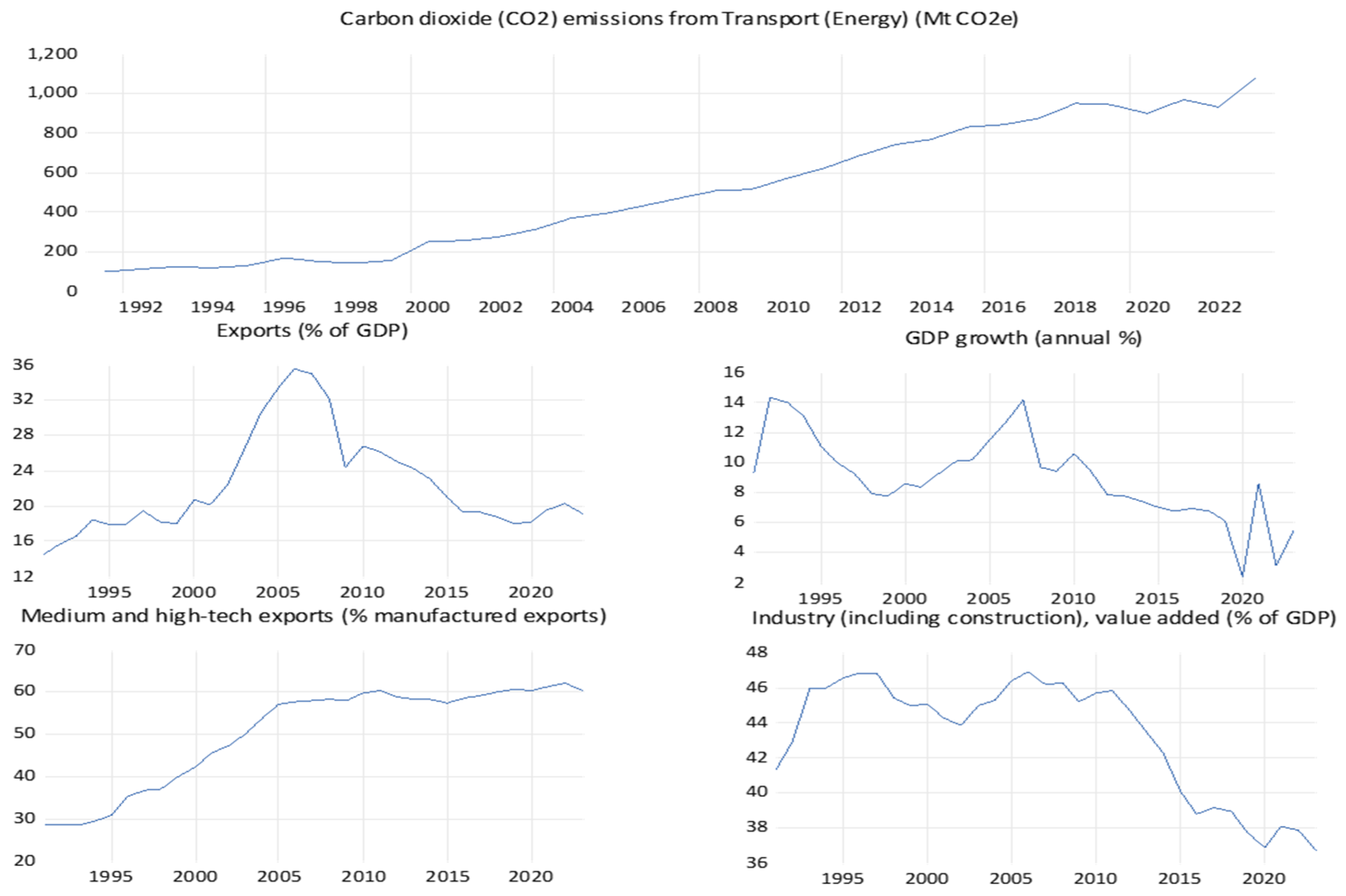
Figure 1 illustrates the time-series behavior of the variables over the sample period (1991–2023). Transport-related CO
2 emissions display a persistent upward trend, reflecting China’s expanding trade volume and transport demand. In contrast, industrial value added shows a gradual decline after 2005, indicating structural transformation within the economy. These divergent trends suggest the presence of non-stationary behavior and reinforce the need for dynamic econometric techniques capable of identifying long-run equilibrium relationships among the variables.
2.2. Descriptive Statistics
Table 1 presents the summary statistics for all variables included in the analysis. Most series exhibit moderate dispersion, as reflected by their standard deviations, with CO
2_TR (321.8) and MHT_EXP (11.9) showing the highest variability over the sample period. The skewness and kurtosis values indicate that the distributions of the variables deviate only moderately from normality.
The Jarque–Bera test results show that the null hypothesis of normality cannot be rejected for GDP_GR, indicating that this variable closely follows a normal distribution. This property supports its direct inclusion in linear econometric models without requiring additional non-parametric transformations. Overall, the descriptive statistics confirm that the data are suitable for econometric modeling and subsequent machine-learning analysis.
2.3. Econometric Methodology
2.3.1. ARDL Model Specification
To examine the relationship between transport-related CO
2 emissions and macroeconomic factors, the study adopts the Autoregressive Distributed Lag (ARDL) approach. The ARDL methodology is particularly well-suited for small samples and for models involving variables integrated of mixed orders, I(0) and I(1). Following Pesaran et al. (2001) [
49], the general ARDL specification is expressed as:
where Y
t denotes the dependent variable (CO
2_TR), X
t represents the vector of explanatory variables (EXP_GDP, GDP_GR, MHT_EXP, IND_VA), Δ is the first difference operator, and ε
t is the error term. This formulation allows simultaneous estimation of short-run dynamics (α
i, β
j) and long-run relationships (φ, θ) within a single framework.
Prior to ARDL estimation, the stationarity properties of the variables were assessed using the Augmented Dickey–Fuller (ADF) [
50,
51] unit root test to ensure that none of the series were integrated of order two. Correlation analysis was also conducted to assess potential multicollinearity among the regressors. The existence of long-run cointegration was examined using the ARDL bounds testing approach, while short-run dynamics were captured through the associated error correction model (ECM). To validate the robustness of the estimated ARDL model, a series of diagnostic tests were applied, including tests for serial correlation, heteroskedasticity, and parameter stability. These procedures ensure the reliability and consistency of the estimated coefficients.
2.3.2. Long-Run Estimation: FMOLS and DOLS
To quantify long-run numerical effects, the study further applies Fully Modified Ordinary Least Squares (FMOLS) and Dynamic Ordinary Least Squares (DOLS), which correct for potential endogeneity and serial correlation in cointegrated systems [
52,
53,
54]. The FMOLS estimator is specified as:
where Y
+ is the dependent variable corrected for serial correlation and endogeneity. The DOLS estimator incorporates leads and lags of first-differenced regressors and is specified as:
where ΔX
(t−k) represents the leads and lags of the first-differenced independent variables, allowing unbiased estimation of long-run parameters.
The combination of ARDL, FMOLS, and DOLS provides a comprehensive framework for analyzing both short-run dynamics and long-run relationships between transport-related CO2 emissions and the selected macroeconomic and trade-related variables.
2.3.3. Machine-Learning Approach: XGBoost and SHAP
To complement traditional econometric approaches, this study employs a machine-learning framework based on Extreme Gradient Boosting (XGBoost) to model transport-related CO
2 emissions and quantify the relative importance of macroeconomic and trade-related predictors. XGBoost is a high-performance ensemble learning algorithm that constructs additive regression trees in a sequential manner to minimize a defined loss function while incorporating regularization to prevent overfitting [
55]. The XGBoost model is defined as:
Here,
yi is the predicted value of CO
2_TR for observation i
i, x
i is the feature vector of explanatory variables (EXP_GDP, GDP_GR, MHT_EXP, IND_VA),
fk represents the
k regression tree,
K is the total number of trees, and
F denotes the space of possible regression trees. The objective function minimized during training is expressed as:
Here, L is a differentiable loss function (e.g., squared error), and Ω(fk) is a regularization term controlling model complexity.
To interpret the model and evaluate feature-level contributions, SHapley Additive exPlanations (SHAP) values are employed [
56]. SHAP assigns each feature a contribution score for a given prediction based on cooperative game theory, ensuring consistency and local accuracy. The SHAP value for feature jjj in observation iii is defined as:
Here, F is the set of all features, S is a subset of features excluding j, and fS(xS) is the model prediction using only features in S. SHAP values provide a global understanding of variable importance and allow detailed analysis of marginal effects for each predictor.
The dataset was divided into training (80%) and testing (20%) subsets to enable a reliable assessment of out-of-sample predictive performance. Key hyperparameters, including the learning rate, maximum tree depth, number of boosting iterations, and subsampling ratio, were optimized through cross-validation to ensure model stability and accuracy. Model performance was evaluated using Root Mean Square Error, Mean Absolute Error, and the coefficient of determination, while SHAP values were used to interpret the marginal influence of GDP growth, industrial value added, export share, and medium- and high-tech exports on predicted transport-related CO2 emissions. The combined application of XGBoost and SHAP yields a robust and transparent analytical framework that captures nonlinear relationships and provides interpretable insights into the macroeconomic determinants of transport emissions.
3. Results
3.1. Unit Root Test and Correlation Analysis
The Augmented Dickey–Fuller (ADF) unit root tests in
Table 2 indicate that all variables are integrated of order one, I(1), as they exhibit non-stationarity in levels but achieve stationarity after first differencing. No variable is found to be integrated of order two, I(2), and the series consist of a combination of I(0) and I(1) processes. This mixed integration order satisfies the essential condition for employing the Autoregressive Distributed Lag (ARDL) bounds testing approach. Consequently, the dataset is appropriate for investigating long-run cointegration relationships using the ARDL methodology, which remains valid for variables of differing integration orders, provided that none are I(2).
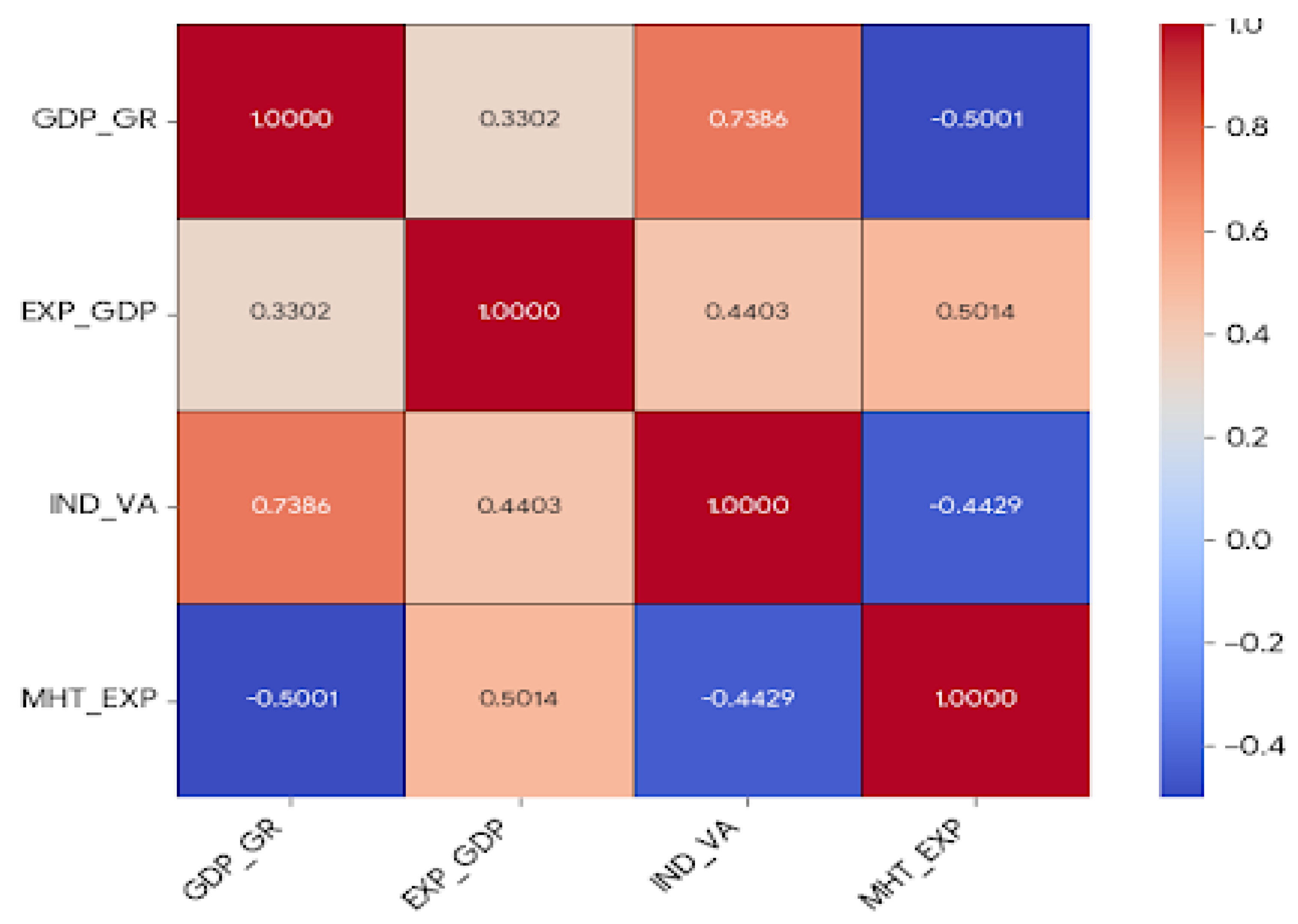
Figure 2 presents the pairwise correlations among GDP growth (GDP_GR), exports as a share of GDP (EXP_GDP), industrial value added (IND_VA), and manufacturing exports (MHT_EXP). The results indicate a strong positive association between GDP growth and industrial value added (0.7386), a moderate positive correlation with EXP_GDP (0.3302), and a moderate negative correlation with MHT_EXP (−0.5001). Additionally, EXP_GDP is moderately positively correlated with both IND_VA (0.4403) and MHT_EXP (0.5014), while IND_VA and MHT_EXP exhibit a moderate negative correlation (−0.4429), suggesting that economic expansion, industrial output, and export composition are interconnected through a combination of reinforcing and inverse relationships. This also indicates that the correlation coefficients among the explanatory variables remain within moderate bounds, implying a minimal likelihood of severe multicollinearity. As none of the pairwise correlations approach the conventionally critical threshold (|r| > 0.8), the results suggest that multicollinearity is unlikely to distort coefficient precision. Consequently, the diagnostic evidence supports the suitability and stability of estimating a linear econometric framework, including the ARDL approach.
3.2. ARDL Bounds Test and Cointegration Analysis
The F-Bounds test statistic in
Table 3 (10.11) exceeds the upper critical values at all significance levels, indicating a long-run cointegration relationship between CO
2_TR and the selected macroeconomic explanatory variables. These results underscore the significant interconnection between macroeconomic dynamics, sectoral performance, and transport-related emissions, highlighting the necessity for integrated policy measures aimed at fostering sustainable economic growth while ensuring environmentally sustainable transport development.
3.3. Short-Run Dynamics and Error Correction Mechanism
Table 4 presents the regression estimates that quantify the individual and joint effects of GDP growth, industrial value added, total exports, and manufactured exports on transport-related CO
2 emissions. The results reveal that industrial value added and high-technology exports have particularly strong positive associations with emissions, while their interaction terms highlight sectors where economic expansion disproportionately drives carbon output. By incorporating these findings into scenario-based forecasting, the table provides a nuanced basis for identifying which economic levers—such as sector-specific industrial growth or export composition—can be targeted to achieve meaningful emission reductions.
The ECM results demonstrate that transport-related CO2 emissions exhibit a strong short-run sensitivity to macroeconomic fluctuations, with GDP growth exerting a pronounced positive influence that underscores the emission-intensive nature of economic expansion. The consistently negative and statistically significant lagged CO2 terms indicate the presence of a short-run self-correction mechanism that mitigates volatility in emission dynamics. The error correction coefficient, measured at 0.6974 (p = 0.0003), provides robust evidence of a long-run cointegrating relationship between transport emissions and the macroeconomic variables, notwithstanding its atypical positive sign. Taken together, these quantitative outcomes reveal that transport-sector emissions are shaped jointly by immediate macroeconomic impulses and the deeper structural forces governing long-run adjustment.
Although the error correction coefficient appears positive, this outcome is related to the normalization procedure applied in the ARDL specification rather than indicating divergence from equilibrium. The sign reflects how the long-run equation was parameterized in the estimation framework, and when the relationship is expressed in its conventional normalized form, the adjustment mechanism implies convergence toward equilibrium.
3.4. Model Diagnostics and Stability Tests
The Breusch–Godfrey LM test in
Table 5 shows no first-order serial correlation in the ECM residuals, with an F-statistic of 0.4494 (
p = 0.5506) and ObsR-squared of 3.7784 (
p = 0.0519), failing to reject the null hypothesis. The Breusch–Pagan–Godfrey test confirms homoskedasticity, with an F-statistic of 0.6135 (
p = 0.8008) and ObsR-squared of 22.8044 (
p = 0.5314), indicating constant residual variance. These results indicate that the ECM residuals are independent and homoskedastic, ensuring the reliability of the estimated short- and long-run effects of transport-related CO
2 emissions on macroeconomic variables.
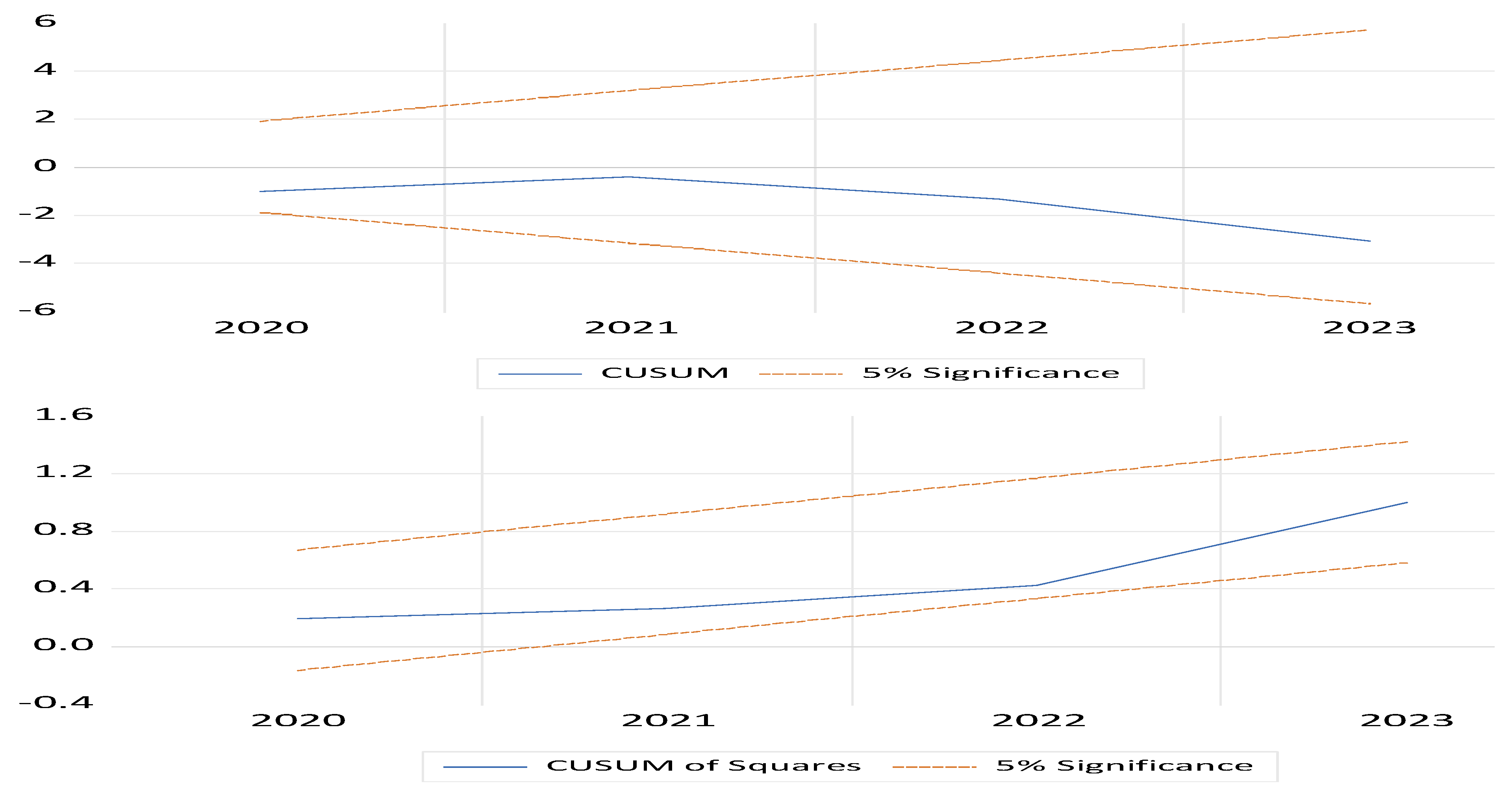
The CUSUM and CUSUM of Squares tests are used to evaluate whether the regression coefficients remain stable over time. In both tests, the test statistics stay within the 5% significance bounds, suggesting that there is no evidence of structural instability in the model (
Figure 3).
3.5. Long-Run Elasticities: FMOLS and DOLS Estimates
The FMOLS and DOLS estimations provide consistent evidence of a stable long-run association between macroeconomic dynamics and transport-related CO2 emissions, with coefficients exhibiting both economic plausibility and statistical significance. A 1-unit increase in GDP growth (GDP_GR) elevates CO2 emissions by 21.35 units in the FMOLS model and 50.82 units in the DOLS specification, underscoring a pronounced scale effect whereby economic expansion intensifies environmental pressures. In contrast, a 1-unit improvement in the export-to-GDP ratio (EXP_GDP) lowers emissions by 18.89 units (FMOLS) and 20.03 units (DOLS), indicating that greater trade orientation and cleaner export composition contribute to long-run emission reductions. Likewise, a 1-unit rise in industry value added (IND_VA) reduces emissions by 36.74 units in FMOLS and 47.83 units in DOLS, reflecting a shift toward more energy-efficient and technologically advanced industrial structures. Conversely, a 1-unit increase in medium and high-tech exports (MHT_EXP) leads to an increase in emissions of 24.78 units (FMOLS) and 25.02 units (DOLS), suggesting that the scale and energy demands of high-tech production continue to exert upward pressure on long-run CO2 emissions despite technological advancements.
The statistical diagnostics in
Table 6 demonstrate that the Dynamic Ordinary Least Squares (DOLS) specification provides a markedly superior representation of the long-run relationship. The model attains an adjusted R
2 of 0.9869, indicating that it accounts for almost the entire variation in CO
2 emissions with exceptionally high explanatory power. In addition, the standard error of regression produced by the DOLS estimator (34.69) is less than half of that obtained from the FMOLS model (73.43), highlighting its substantially greater precision. This lower dispersion of residuals also implies that the DOLS-based estimates exhibit reduced volatility and stronger reliability for long-run inference.
3.6. Machine-Learning Results: XGBoost Model Performance
Extreme Gradient Boosting (XGBoost) was incorporated alongside traditional econometric models to better capture nonlinear relationships and complex interactions among variables that linear methods may overlook. Despite the moderate dataset size, XGBoost enhances predictive accuracy and robustness in forecasting transport-related CO
2 emissions, with SHAP values used to interpret feature importance and quantify variable contributions. The dataset was divided into training (80%) and testing (20%) subsets. The XGBoost regression model was estimated using 100 boosting iterations, a learning rate of 0.1, a maximum tree depth of 3, and a subsample proportion of 0.8. The resulting model performance indicators are presented in
Table 7.
The AI model exhibits strong predictive capability. The training RMSE (4.02) and MAE (3.27) indicate an exceptionally close fit to the training data, while the higher testing RMSE (87.16) and MAE (70.25) reflect a moderate increase in prediction error, which can plausibly be attributed to the relatively small sample size (n = 33). The coefficients of determination for both the training (R2 = 0.9998) and testing (R2 = 0.9975) sets demonstrate that the model accounts for nearly all of the observed variation in transport-related CO2 emissions. Furthermore, the Mean Absolute Percentage Error (MAPE) confirms highly accurate predictions for the training subset (1.05%) and satisfactory accuracy for the testing subset (14.15%), aligning with commonly accepted thresholds in environmental modeling.
Overall, the findings suggest that XGBoost effectively captures the nonlinear associations between CO2_TR and the macroeconomic, industrial, and trade-related variables, namely GDP growth, industrial value added, medium- and high-technology exports, and exports as a share of GDP. The slightly elevated prediction error in the test set indicates mild overfitting, which is a foreseeable outcome given the limited number of observations.
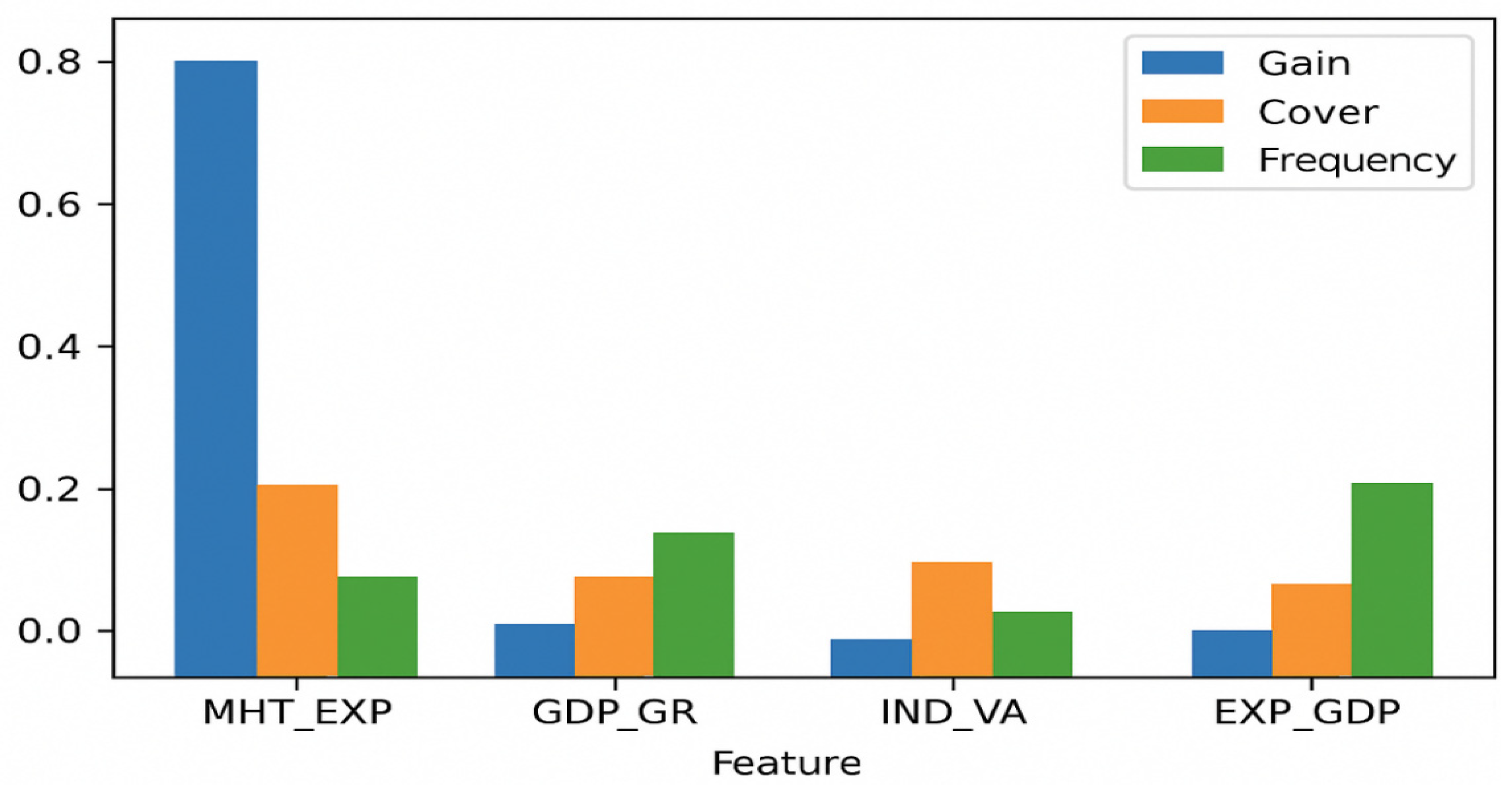
The feature importance derived from the XGBoost model is presented in
Table 8 and visually depicted in
Figure 4.
The XGBoost feature importance metrics provide insights into the contributions of each predictor. Gain, which reflects a feature’s impact on model accuracy, identifies MHT_EXP (medium- and high-technology exports) as the most influential variable, accounting for approximately 73% of total gain, highlighting the strong effect of high-tech export activity on transport-related CO2 emissions. Cover, indicating the proportion of observations affected by a feature, is highest for IND_VA, suggesting that industrial activity consistently influences predictions across the dataset. Frequency, representing how often a feature is used in tree splits, shows that EXP_GDP, despite its lower gain, is applied most frequently, indicating widespread but relatively minor effects on model outcomes. Overall, the results emphasize that trade composition, particularly the share of medium- and high-tech exports, is the primary determinant of transport emissions in China, while GDP growth and industrial activity exert moderate positive effects, and EXP_GDP contributes indirectly through its influence on transport intensity.
3.7. SHAP Interpretation
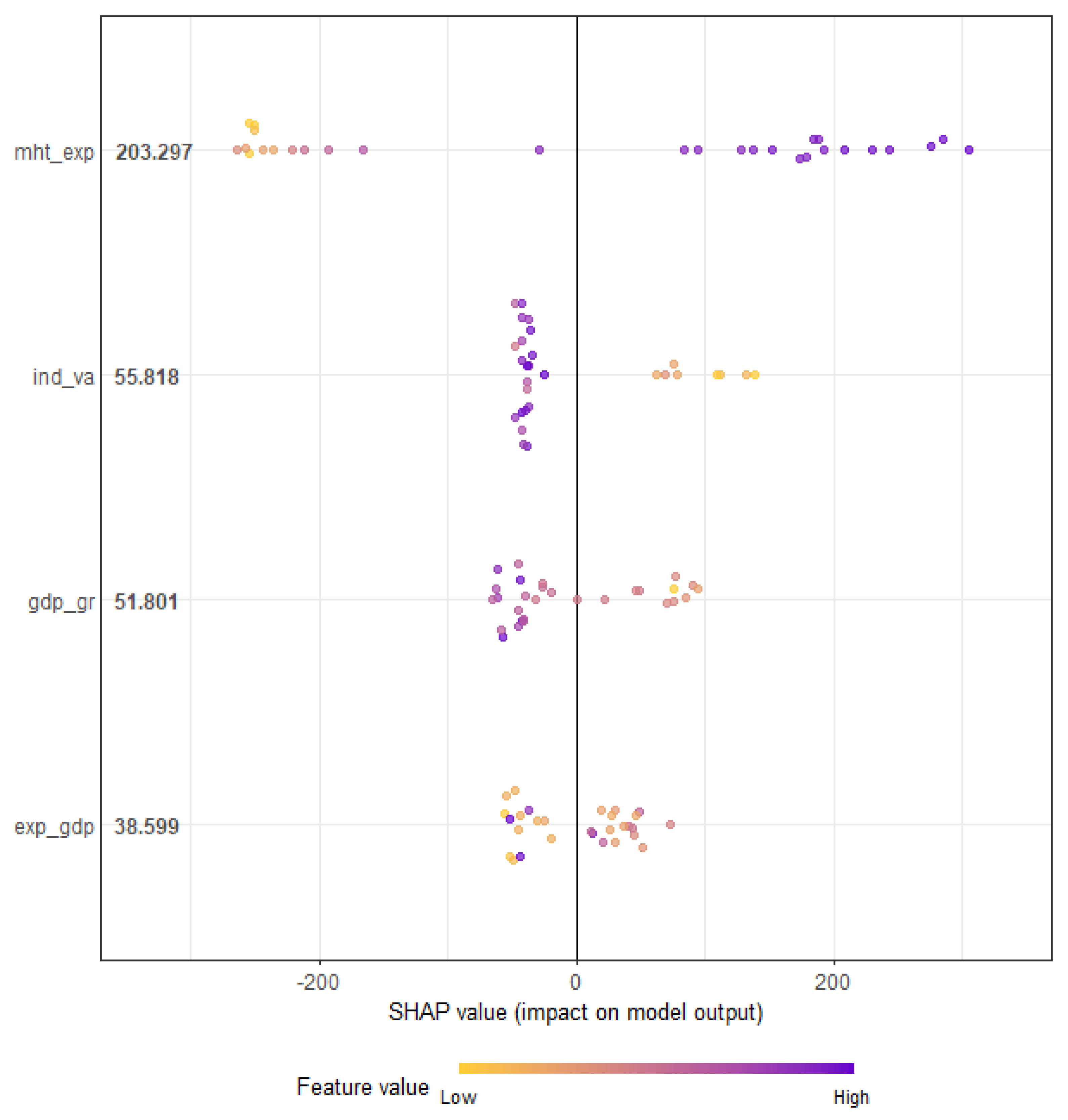
SHapley Additive exPlanations (SHAP) were employed to assess the contribution of each predictor to individual XGBoost model predictions. MHT_EXP is the most influential variable, with a mean absolute SHAP value of 203.3, indicating that higher shares of high-tech exports strongly increase predicted transport-related CO
2 emissions. GDP_GR and IND_VA exhibit moderate positive effects, consistent with the role of economic growth and industrial activity in elevating transport emissions, while EXP_GDP shows minimal and mixed SHAP contributions, suggesting limited direct influence. SHAP dependence analyses reveal that GDP_GR consistently raises CO
2_TR, largely independent of the export-to-GDP ratio, highlighting weak interaction effects.
Figure 5 demonstrates that elevated levels of MHT_EXP produce pronounced positive SHAP contributions, while GDP_GR, IND_VA, and EXP_GDP exhibit comparatively smaller and more balanced effects on the model predictions. Overall, these results indicate that trade composition, specifically the proportion of medium- and high-technology exports, serves as the dominant driver of transport-related CO
2 emissions, whereas economic growth and industrial activity contribute to a lesser, secondary extent.
SHAP analysis confirms that medium- and high-technology exports are the primary driver of transport-related CO2 emissions in China, with GDP growth and industrial activity exerting secondary positive effects, while the overall export share has minimal direct impact. Integrating XGBoost with SHAP provides a robust and interpretable framework to identify key determinants of emissions, offering insights for targeted policies on sustainable industrialization, efficient export logistics, and transport-sector mitigation strategies.
4. Discussion
4.1. Drivers of Transport Emissions
The combined econometric and machine-learning evidence demonstrates that transport-related CO
2 emissions in China are shaped by both stable long-run structural forces and complex short-run nonlinear dynamics. The FMOLS and DOLS estimations confirm the presence of a long-term equilibrium relationship between transport emissions and macroeconomic as well as trade-related variables, indicating that emissions evolve jointly with economic growth, industrial activity, and trade structure rather than responding to transitory fluctuations. This finding supports the broader view that transport systems function as a key transmission channel linking production, trade expansion, and environmental pressure in emerging economies [
57]. The long-run results consistently show that GDP growth exerts a positive and statistically significant effect on transport-related CO
2 emissions, reflecting the scale effect of economic expansion. Rising income levels and output growth intensify freight demand, vehicle utilization, and fuel consumption, thereby increasing emissions. The strong short-run responsiveness of emissions to GDP growth and the rapid speed of adjustment toward equilibrium suggest that China’s transport sector is deeply integrated with industrial production and export logistics. This tight coupling leaves limited scope for buffering growth-induced emission shocks, reinforcing the notion that transport remains one of the most emission-intensive sectors globally despite ongoing decarbonisation efforts [
58].
A central contribution of this study lies in distinguishing between aggregate trade openness and trade composition. The negative long-run impact of the export-to-GDP ratio on transport emissions indicates that greater trade openness, when accompanied by efficiency improvements and logistics rationalisation, can contribute to emission reductions. This outcome implies that scale effects associated with trade expansion may be partially offset by efficiency and structural effects, such as improved supply-chain coordination, higher load factors, and more efficient transport modes. Similar conclusions have been drawn in European contexts, where structural change and targeted policy instruments have helped mitigate transport-related emissions without constraining trade activity [
59].
In contrast, medium- and high-technology exports are found to significantly increase transport-sector CO
2 emissions, highlighting the emission-intensive nature of technologically sophisticated trade. High-value exports often rely on time-sensitive, long-distance, and high-frequency transport services, which amplify fuel use and emissions. This result underscores a critical paradox: while technological upgrading is typically associated with productivity gains and cleaner production processes, it may simultaneously intensify emissions through more energy-demanding logistics. Comparable dynamics have been observed in densely populated economies, where transport infrastructure expansion linked to industrial upgrading raises emissions unless moderated by environment-related technologies [
60]. The emission-reducing effect of industrial value added further highlights the role of internal efficiency gains in mitigating transport emissions. Higher industrial value added likely reflects production consolidation, improved process efficiency, and reduced logistical fragmentation, all of which lower transport intensity per unit of output. This finding aligns with evidence from transport restructuring studies demonstrating that reallocating transport volumes and improving modal efficiency can generate measurable emission reductions [
61].
The machine-learning results provide complementary insights into the nonlinear structure of transport emissions. The superior predictive performance of the XGBoost model confirms the relevance of complex interactions and threshold effects that traditional linear models may fail to capture. SHAP analysis identifies medium- and high-technology exports as the dominant driver of emissions, outweighing aggregate trade volume. This suggests that trade composition plays a more decisive role than trade scale in shaping transport emissions, reinforcing arguments that AI-based approaches are particularly well suited for detecting sectoral sensitivities and nonlinear amplification mechanisms within transport systems [
62].
This study advances the literature by operationalizing export composition within a transport-specific emissions framework, explicitly distinguishing medium- and high-technology exports from aggregate trade measures. By integrating these exports with industrial value added across linear cointegration models and a nonlinear XGBoost–SHAP framework, the analysis captures structural and threshold dynamics that conventional China-focused ARDL and panel studies—treating exports as homogeneous—tend to overlook. Furthermore, the Mean Absolute Percentage Error (MAPE) confirms the accuracy of the predictions [
63,
64].
Taken together, the findings indicate that China’s export-led growth does not inherently conflict with transport-sector decarbonisation. Instead, environmental outcomes depend critically on how exports are structured, transported, and supported by logistics infrastructure. Without targeted interventions, continued expansion of high-technology exports risks locking in carbon-intensive transport pathways, even as industrial efficiency improves.
4.2. BRI Finance and Trade Effects
China’s expanding financial engagement under the Belt and Road Initiative (BRI) provides a crucial institutional and financial context for understanding the evolving relationship between trade expansion, transport activity, and CO
2 emissions. By 2025, cumulative BRI-related investments exceeded USD 1 trillion, covering infrastructure, energy, transport, and industrial projects across more than 150 participating countries. This unprecedented scale reflects a structural shift in China’s outward economic strategy, in which infrastructure finance functions as a core mechanism for trade facilitation and global supply-chain integration [
65]. Recent statistics released by China’s Ministry of Commerce indicate a further acceleration of BRI-related financial flows. Between January and November 2025, Chinese enterprises invested approximately USD 35.7 billion in non-financial direct investments in BRI partner countries and signed new overseas construction contracts worth USD 201.7 billion. The rapid growth of both investment and contracting activity suggests renewed emphasis on transport corridors, logistics hubs, and cross-border connectivity. However, limited transparency regarding project classification and country definitions complicates precise assessment of the environmental implications of these expenditures [
66].
The extensive geographic dispersion of BRI participation—spanning Africa, Europe, Asia, Latin America, and the Pacific—underscores its systemic influence on global transport networks. By reshaping long-distance freight flows and stimulating multimodal transport demand, BRI-financed infrastructure is likely to increase transport volumes both along major corridors and within domestic logistics systems of participating economies. Without the integration of low-carbon technologies and modal shifts, such expansion may intensify transport-sector emissions at both regional and global levels. Empirical evidence further suggests that BRI participation materially alters trade patterns. Countries joining the initiative experience significant increases in exports to China, driven largely by infrastructure improvements that reduce transport costs and logistical bottlenecks [
67]. These trade-enhancing effects reinforce China’s central role within global value chains and amplify the scale and complexity of international transport activity. At the same time, the spatial concentration of these effects implies heightened competitive pressures among countries with similar manufacturing structures, potentially reinforcing emission-intensive trade routes.
From a transport-emissions perspective, the scale and orientation of BRI finance carry long-term implications. Large investments in ports, railways, highways, and logistics facilities can lock in energy use patterns for decades. While such infrastructure enhances trade efficiency and economic integration, it may also elevate CO2 emissions if fossil-fuel-based transport systems dominate project design and operation. Consequently, the environmental footprint of BRI expenditure depends not only on investment volume but also on the technological composition and sustainability standards embedded within financed projects.
Overall, China’s financial commitment to the BRI represents a powerful driver of global trade and transport restructuring. Integrating climate objectives into BRI financing—through support for rail-based freight, electrified transport systems, and low-carbon logistics—will be essential for preventing infrastructure-led trade expansion from undermining long-term emission reduction goals. In this context, the BRI emerges simultaneously as an opportunity for sustainable connectivity and a potential source of persistent transport-sector carbon lock-in.
5. Conclusions
The findings of this study offer significant insights for policy formulation at the nexus of economic growth, trade expansion, and transport-sector CO2 emissions in China. Evidence from ARDL, FMOLS, and DOLS estimations indicates that transport-related emissions are closely associated with macroeconomic activity, industrial value added, and trade composition, while machine-learning analyses using XGBoost reveal nonlinear effects and the predominant influence of medium- and high-technology exports. These results collectively suggest that China’s export-led growth model produces a dual outcome: it fosters economic development and industrial modernization, yet simultaneously intensifies transport-sector emissions, particularly through energy-demanding high-technology trade.
The results indicate that targeted policies promoting energy-efficient industrial practices, low-carbon logistics, and green trade facilitation can effectively reduce transport-sector CO2 emissions. From a policy standpoint, the robust positive linkage between GDP growth and transport emissions underscores the imperative of decoupling economic expansion from carbon-intensive logistics. By linking export composition and industrial structure to empirically supported strategies, these interventions provide evidence-based guidance for aligning China’s export-led growth with climate mitigation objectives. The emission-reducing effect of industrial value added highlights the potential of industrial consolidation, technological upgrading, and supply-chain integration to mitigate emissions. In contrast, the significant contribution of medium- and high-technology exports to transport emissions indicates that trade composition, rather than overall trade volume, should be central to policy interventions. Measures such as promoting rail-based freight, electrifying logistics fleets, and optimizing export logistics can effectively reduce emissions without impeding economic activity.
Furthermore, the study emphasizes the strategic role of China’s Belt and Road Initiative in shaping global transport and emissions dynamics. Extensive BRI investments in transport and logistics infrastructure facilitate export growth and integration into global value chains but may simultaneously entrench high-emission transport patterns if dominated by fossil-fuel-intensive systems. Incorporating sustainability criteria into BRI financing, including low-carbon transport technologies, energy-efficient port operations, and electrified rail networks, represents a critical policy instrument to reconcile trade expansion with environmental objectives.
The integration of econometric and AI-based approaches demonstrates that conventional macroeconomic policies alone are insufficient to address the complex determinants of transport emissions. Policymakers should pursue hybrid strategies that combine structural economic reforms with technology-driven, sector-specific interventions, particularly targeting the most emission-intensive segments of high-technology exports. By emphasizing trade composition, logistics efficiency, and low-carbon transport infrastructure, China can achieve the dual goals of maintaining export-led growth while advancing long-term climate mitigation. This study provides a comprehensive framework for evidence-based policy design, highlighting the need for coordinated action across economic, industrial, and trade domains reinforced by investments in sustainable transport and advanced logistics systems.
Author Contributions
Conceptualization was carried out by S.G. and R.I.H.; methodology was developed by S.G. and R.I.H.; software implementation was performed by R.I.H.; validation was conducted by B.L., D.G., S.R., V.D., and D.M.; formal analysis was performed by B.L., D.G., and V.D.; investigation was undertaken by S.G., B.L., R.I.H., D.G., and S.R.; resources were provided by R.I.H.; data curation was carried out by S.G., D.G., V.D., and D.M.; the original draft was written by S.G. and R.I.H.; review and editing were performed by B.L., D.G., S.R., V.D., and D.M.; visualization was prepared by S.R., V.D., and D.M.; supervision was provided by B.L., D.G., S.R., V.D., and D.M.; and project administration was coordinated by S.G., B.L., R.I.H., S.R., and D.M. All authors have read and agreed to the published version of the manuscript.
Funding
This research received no specific grant from any funding agency in the public, commercial, or not-for-profit sectors.
Institutional Review Board Statement
Not applicable.
Informed Consent Statement
Not applicable.
Data Availability Statement
All data used in this study were obtained from the World Bank and the International Monetary Fund and were cross-validated against official statistics from the National Bureau of Statistics of China. These datasets are publicly accessible and were used to ensure accuracy and reliability of the analysis.
Acknowledgments
The authors thank colleagues and institutions that provided valuable guidance and feedback during the research process.
Conflicts of Interest
Author Sinisa Rajkovic was employed by Association of Accountants and Auditors of Republic of Srpska. The remaining authors declare that the research was conducted in the absence of any commercial or financial relationships that could be construed as a potential conflicts of interest.
References
- United Nations. Climate Change; United Nations: New York, NY, USA, 2026; Available online: https://unfccc.int/process-and-meetings/the-paris-agreement (accessed on 20 February 2026).
- Bailey, I.; Gouldson, A.; Newell, P. Ecological Modernisation and the Governance of Carbon: A Critical analysis. Antipode 2011, 43, 682–703. [Google Scholar] [CrossRef]
- Lei, L.; Xia, L.Q. China’s international role in navigating the climate–trade nexus. In London School of Economics and Political Science; Graham Research Institute on Climate Change and the Environment, Energy Foundation: London, UK, 2022; Available online: https://www.lse.ac.uk/granthaminstitute/wp-content/uploads/2022/10/Chinas-international-role-in-navigating-the-climate-trade-nexus-1.pdf (accessed on 20 February 2026).
- Xu, B.; Lin, B. Investigating the role of high-tech industry in reducing China’s CO2 emissions: A regional perspective. J. Clean. Prod. 2017, 177, 169–177. [Google Scholar] [CrossRef]
- Wang, X.; Dong, X.; Zhang, Z.; Wang, Y. Transportation carbon reduction technologies: A review of fundamentals, application, and performance. J. Traffic Transp. Eng. 2024, 11, 1340–1377. [Google Scholar] [CrossRef]
- Brühl, V. The economic rise of China—An analysis of China’s growth drivers. Int. Econ. Econ. Policy 2025, 22, 16. [Google Scholar] [CrossRef]
- Xie, F.; Kuang, X.; Wang, J. China’s Miracle from the Perspective of Political Economy. World Rev. Political Econ. 2021, 12, 150–180. Available online: https://www.jstor.org/stable/48676084 (accessed on 20 February 2026).
- Kuo, K. Made in China 2.0: The Future of Global Manufacturing? World Economic Forum. 26 June 2025. Available online: https://www.weforum.org/stories/2025/06/how-china-is-reinventing-the-future-of-global-manufacturing/ (accessed on 20 February 2026).
- Rudi, A.; Fröhling, M.; Zimmer, K.; Schultmann, F. Freight transportation planning considering carbon emissions and in-transit holding costs: A capacitated multi-commodity network flow model. EURO J. Transp. Logist. 2014, 5, 123–160. [Google Scholar] [CrossRef]
- Duan, H.; Hu, M.; Zhang, Y.; Wang, J.; Jiang, W.; Huang, Q.; Li, J. Quantification of carbon emissions of the transport service sector in China by using streamlined life cycle assessment. J. Clean. Prod. 2015, 95, 109–116. [Google Scholar] [CrossRef]
- Wang, J. Research on the Impact of China’s Import and Export Trade on Carbon Emission under the Perspective of Carbon Emission Reduction—Empirical Evidence Based on Provincial Panel Data. Highlights Bus. Econ. Manag. 2024, 26, 159–167. [Google Scholar] [CrossRef]
- Ozat, M.; Haley, N. The Middle Corridor: The Beginning of the End for Russia’s Northern Corridor? Caspian Policy Center: Washington, DC, USA, 2023; Available online: https://www.caspianpolicy.org/research/energy-and-economy-program-eep/the-middle-corridor-the-beginning-of-the-end-for-russias-northern-corridor (accessed on 20 February 2026).
- Kenderdine, T.; Bucsky, P. The Middle Corridor: Policy Development and Trade Potential of the Trans-Caspian International Transport Route. In Unlocking Transport Connectivity in the Trans-Caspian Corridor; Asian Development Bank Institute: Tokyo, Japan, 2021; pp. 73–111. Available online: https://www.adb.org/sites/default/files/publication/743006/adbi-unlocking-transport-connectivity-092921-web.pdf (accessed on 20 February 2026).
- Li, L.; Zhang, X. Reducing CO2 emissions through pricing, planning, and subsidizing rail freight. Transp. Res. Part D Transp. Environ. 2020, 87, 102483. [Google Scholar] [CrossRef]
- Bu, H.; Li, G.; Yu, X.; Xun, Z. Is smart carbon emission reduction justified in China? Evidence from national big data comprehensive pilot zones. Heliyon 2023, 9, e17744. [Google Scholar] [CrossRef]
- Jensen, F.; Chen-Florea, A.L.Q. Chinese investments in global port infrastructures: The Belt and Road Initiative as variegated logistical fixes. Territ. Politics Gov. 2025, 1–16. [Google Scholar] [CrossRef]
- Schulz, D. Tracking Trans Continental Connections: China Inaugurates a New Transcontinental Freight Train Route Through the Caspian Region; Caspian Policy Center: Washington, DC, USA, 2022; Available online: https://www.caspianpolicy.org/research/energy-and-economy-program-eep/tracking-trans-continental-connections-china-inaugurates-a-new-transcontinental-freight-train-route-through-the-caspian-region (accessed on 20 February 2026).
- Nurseiit, N. Attractiveness and prospects of the middle Corridor for cargo transportation between Europe and Asia. J. Eurasian Stud. 2025, 17, 167–182. [Google Scholar] [CrossRef]
- Stern, D.I. The environmental Kuznets curve. In Companion to Environmental Studies; Routledge: London, UK, 2018; pp. 49–54. Available online: https://www.taylorfrancis.com/chapters/edit/10.4324/9781315640051-11/environmental-kuznets-curve-david-stern (accessed on 20 February 2026).
- Leal, P.H.; Marques, A.C. The evolution of the environmental Kuznets curve hypothesis assessment: A literature review under a critical analysis perspective. Heliyon 2022, 8, e11521. [Google Scholar] [CrossRef]
- Almeida, D.; Carvalho, L.; Ferreira, P.; Dionísio, A.; Haq, I.U. Global Dynamics of Environmental Kuznets Curve: A Cross-Correlation Analysis of Income and CO2 Emissions. Sustainability 2024, 16, 9089. [Google Scholar] [CrossRef]
- Benzerrouk, Z.; Abid, M.; Sekrafi, H. Pollution haven or halo effect? A comparative analysis of developing and developed countries. Energy Rep. 2021, 7, 4862–4871. [Google Scholar] [CrossRef]
- Algül, Y.; Kaya, V.; Yalçinkaya, Ö. Pollution Haven or Pollution Halo? In Handbook of Energy and Environment in the 21st Century. Technology and Policy Dynamics, 1st ed.; CRC Press: Boca Raton, FL, USA, 2024; pp. 357–375. [Google Scholar] [CrossRef]
- Abbasi, M.A.; Nosheen, M.; Rahman, H.U. An approach to the pollution haven and pollution halo hypotheses in Asian countries. Environ. Sci. Pollut. Res. 2023, 30, 49270–49289. [Google Scholar] [CrossRef]
- Mohapatra, S.; Adamowicz, W.; Boxall, P. Dynamic technique and scale effects of economic growth on the environment. Energy Econ. 2016, 57, 256–264. [Google Scholar] [CrossRef]
- Liobikienė, G.; Butkus, M. Scale, composition, and technique effects through which the economic growth, foreign direct investment, urbanization, and trade affect greenhouse gas emissions. Renew. Energy 2018, 132, 1310–1322. [Google Scholar] [CrossRef]
- Chen, K.S.; Chin, L.; Law, S.H.; Kaliappan, S.R.; Foo, Y.S. Decomposing scale, technique and composition effects of foreign direct investment on environmental quality. Environ. Sci. Pollut. Res. 2024, 31, 47039–47054. [Google Scholar] [CrossRef] [PubMed]
- Zhang, Y. Scale, technique and composition effects in Trade-Related carbon emissions in China. Environ. Resour. Econ. 2011, 51, 371–389. [Google Scholar] [CrossRef]
- Tsigdinos, S. Emissions from the Transport Sector. In Hydrogen and Low-Carbon Fuels in Circular Bio-Economy: Assessment Methodologies, Production Technologies and Sector-Specific Applications; Springer Nature: Cham, Switzerland, 2025; pp. 7–25. [Google Scholar] [CrossRef]
- Wang, C.; Zhao, Y.; Wang, Y.; Wood, J.; Kim, C.Y.; Li, Y. Transportation CO2 emission decoupling: An assessment of the Eurasian logistics corridor. Transp. Res. Part D Transp. Environ. 2020, 86, 102486. [Google Scholar] [CrossRef]
- Li, Y.; Du, Q.; Lu, X.; Wu, J.; Han, X. Relationship between the development and CO2 emissions of transport sector in China. Transp. Res. Part D Transp. Environ. 2019, 74, 1–14. [Google Scholar] [CrossRef]
- Gu, J.; Jiang, S.; Zhang, J.; Jiang, J. An analysis of the decomposition and driving force of carbon emissions in transport sector in China. Sci. Rep. 2024, 14, 30177. [Google Scholar] [CrossRef]
- Wan, J.; Wu, X.; Li, Y.; Li, Z.; Deng, K.; Zeng, J.; Fan, X.; Cao, Y. Driving factors and interactions of urban transportation carbon emissions: A case study of China. Transp. Res. Part D Transp. Environ. 2025, 143, 104740. [Google Scholar] [CrossRef]
- Wang, X.-T.; Liu, H.; Lv, Z.-F.; Deng, F.-Y.; Xu, H.-L.; Qi, L.-J.; Shi, M.-S.; Zhao, J.-C.; Zheng, S.-X.; Man, H.-Y. Trade-linked shipping CO2 emissions. Nat. Clim. Change 2021, 11, 945–951. [Google Scholar] [CrossRef]
- Okoth, E.; Erdem, A.; Degirmenci, T.; Sanver, C. The Impact of Transportation Technologies, Technological Exports, Trade Freedom and Trade Globalisation on Transport-Based CO2 Emissions in the Top 10 Emitter Countries. IET Intell. Transp. Syst. 2026, 20, e70130. [Google Scholar] [CrossRef]
- Kiracı, K. Determinants of air transport CO2 emissions in OECD countries. Sustain. Futures 2025, 10, 100877. [Google Scholar] [CrossRef]
- Jiang, R.; Wu, P.; Wu, C. Driving factors behind energy-related carbon emissions in the US road transport sector: A decomposition analysis. Int. J. Environ. Res. Public Health 2022, 19, 2321. [Google Scholar] [CrossRef]
- Bonnemaizon, X.; Ciais, P.; Zhou, C.; Arous, S.B.; Megel, N.; Berghäuser, G.; Davis, S.J. Drivers of CO2 emissions from road transport in US urban areas. Environ. Res. Commun. 2025, 7, 125028. [Google Scholar] [CrossRef]
- Georgatzi, V.V.; Stamboulis, Y.; Vetsikas, A. Examining the determinants of CO2 emissions caused by the transport sector: Empirical evidence from 12 European countries. Econ. Anal. Policy 2020, 65, 11–20. [Google Scholar] [CrossRef]
- Tiwari, A.K.; Aydin, M.; Degirmenci, T.; Sofuoğlu, E.; Ozcelik, A. Transport Infrastructure Investment, Transport Tax, Institutional Quality, and Transport-Based CO2 Emissions: Is an Environmentally Sustainable Transport Policy Followed in the Selected EU Countries? Sustain. Dev. 2025, 33, 8098–8109. [Google Scholar] [CrossRef]
- Jain, S.; Rankavat, S. Analysing driving factors of India’s transportation sector CO2 emissions: Based on LMDI decomposition method. Heliyon 2023, 9, e19871. [Google Scholar] [CrossRef]
- Nurgozhina, A.E.; Menéndez Pidal, I.; Dronin, N.M.; Zhaparova, S.; Kurmanbayeva, A.; Idrisheva, Z.; Bukunova, A. Scenario-Based Evaluation of Greenhouse Gas Emissions and Ecosystem-Based Mitigation Strategies in Kazakhstan. Sustainability 2025, 17, 8362. [Google Scholar] [CrossRef]
- Yakhshilikov, J.; Cavana, M.; Inoyatkhodjaev, J.; Giarola, S.; Leone, P. Long-term energy and emissions outlook for the road transport sector of Uzbekistan: Insights from an agent-based energy model. Energy 2025, 339, 139106. [Google Scholar] [CrossRef]
- Shahbaz, M.; Bayat, T.; Tanyaş, M. The Contribution of Transport Modes to Carbon Emissions in Turkey. In Economic Growth and Environmental Quality in a Post-Pandemic World; Routledge: London, UK, 2023; pp. 251–274. Available online: https://www.taylorfrancis.com/chapters/edit/10.4324/9781003336563-13/contribution-transport-modes-carbon-emissions-turkey-muhammad-shahbaz-tu%C4%9Frul-bayat-mehmet-tanya%C5%9F (accessed on 20 February 2026).
- Heidari, E.; Bikdeli, S.; Daneshvar, M.R.M. A dynamic model for CO2 emissions induced by urban transportation during 2005–2030, a case study of Mashhad, Iran. Environ. Dev. Sustain. 2023, 25, 4217–4236. [Google Scholar] [CrossRef]
- World Bank. Data China; World Bank Group: Washington, DC, USA, 2025; Available online: https://data.worldbank.org/country/china (accessed on 20 February 2026).
- IMF. China, People’s Republic of Datasets; International Monetary Fund: Washington, DC, USA, 2025; Available online: https://www.imf.org/external/datamapper/profile/CHN (accessed on 20 February 2026).
- NBSC. China Statistical Yearbook; National Bureau of Statistics of China: Beijing, China, 2023. Available online: https://www.stats.gov.cn/english/Statisticaldata/yearbook/ (accessed on 20 February 2026).
- Pesaran, M.H.; Shin, Y.; Smith, R.J. Bounds testing approaches to the analysis of level relationships. J. Appl. Econom. 2001, 16, 289–326. [Google Scholar] [CrossRef]
- Dickey, D.A.; Fuller, W.A. Distribution of the estimators for autoregressive time series with a unit root. J. Am. Stat. Assoc. 1979, 74, 427–431. [Google Scholar] [CrossRef]
- Said, S.E.; Dickey, D.A. Testing for unit roots in autoregressive–moving average models of unknown order. Biometrika 1984, 71, 599–607. [Google Scholar] [CrossRef]
- Phillips, P.C.B.; Hansen, B.E. Statistical inference in instrumental variables regression with I(1) processes. Rev. Econ. Stud. 1990, 57, 99–125. [Google Scholar] [CrossRef]
- Saikkonen, P. Asymptotically efficient estimation of cointegration regressions. Econom. Theory 1991, 7, 1–21. [Google Scholar] [CrossRef]
- Stock, J.H.; Watson, M.W. A simple estimator of cointegrating vectors in higher order integrated systems. Econometrica 1993, 61, 783–820. [Google Scholar] [CrossRef]
- Chen, T.; Guestrin, C. XGBoost: A scalable tree boosting system. In Proceedings of the 22nd ACM SIGKDD International Conference on Knowledge Discovery and Data Mining, San Francisco, CA, USA, 13–17 August 2016; pp. 785–794. Available online: https://dl.acm.org/doi/abs/10.1145/2939672.2939785 (accessed on 20 February 2026).
- Lundberg, S.M.; Lee, S.-I. A unified approach to interpreting model predictions. Adv. Neural Inf. Process. Syst. 2017, 30, 4765–4774. [Google Scholar]
- Zhou, R.; Guan, S.; He, B. The Impact of Trade Openness on Carbon Emissions: Empirical Evidence from Emerging Countries. Energies 2025, 18, 697. [Google Scholar] [CrossRef]
- Solaymani, S.; Botero, J. Reducing Carbon Emissions from Transport Sector: Experience and Policy Design Considerations. Sustainability 2025, 17, 3762. [Google Scholar] [CrossRef]
- Artan, S.; Pata, U.K.; Hayaloglu, P.; Cakir, M.A.; Recepoglu, M.; Cay Cakir, S. Revealing the environmental influences of energy, transport, and pollution taxes on different transportation modes. Int. J. Sustain. Transp. 2025, 19, 1005–1013. [Google Scholar] [CrossRef]
- Wang, Y.; Ali, A.; Chen, Z. Dynamic relationships between environment-related technologies, agricultural value added, transport infrastructure and environmental emissions in the five most populous countries. Sci. Rep. 2025, 15, 2308. [Google Scholar] [CrossRef] [PubMed]
- Abuselidze, G.; Levchenko, N.; Shyshkanova, G.; Platonov, O.; Iushchenko, L. Policy of decarbonisation of the transport sector of the economy of Ukraine: Problems and perspectives. Ecol. Chem. Eng. 2023, 30, 517–540. [Google Scholar] [CrossRef]
- Ouyang, S.; Zhao, P.; Gong, Z. A review of transport carbon emissions: Insights from artificial intelligence and big data. J. Clean. Prod. 2025, 532, 146906. [Google Scholar] [CrossRef]
- Makridakis, S.; Wheelwright, S.C.; Hyndman, R.J. Forecasting Methods and Applications; John Wiley & Sons: Hoboken, NJ, USA, 2008. [Google Scholar]
- Hyndman, R.J.; Athanasopoulos, G. Forecasting: Principles and Practice; OTexts: Melbourne, Australia, 2018. [Google Scholar]
- Nedopil, C. China’s Belt and Road Initiative (BRI) Investment and Construction Engagement Statistics: 2025 Update; Green Finance & Development Center, Fanhai International School of Finance, Fudan University: Shanghai, China, 2025; Available online: https://greenfdc.org/wp-content/uploads/2025/07/Nedopil-2025-China-Belt-and-Road-Initiative-BRI-Investment-Report-2025-H1-1.pdf (accessed on 20 February 2026).
- Nedopil, C. Countries of the Belt and Road Initiative by Continent (May 2025); Green Finance & Development Center, Fanhai International School of Finance, Fudan University: Shanghai, China, 2025; Available online: https://greenfdc.org/countries-of-the-belt-and-road-initiative-bri/ (accessed on 20 February 2026).
- Li, H.; Todo, Y. The Direct and Indirect Effect of the Belt and Road Initiative on Exports to China; Research Institute of Economy, Trade and Industry (RIETI): Tokyo, Japan, 2025; Available online: https://www.jsie.jp/Annual_Meeting/2025s_Seinan_Gakuin_Univ/pdf/6-1_Li_Paper.pdf (accessed on 20 February 2026).
| Disclaimer/Publisher’s Note: The statements, opinions and data contained in all publications are solely those of the individual author(s) and contributor(s) and not of MDPI and/or the editor(s). MDPI and/or the editor(s) disclaim responsibility for any injury to people or property resulting from any ideas, methods, instructions or products referred to in the content. |




 ,
,