Article

Multi-Criteria Decision Analysis for Assessing Green Hydrogen Suitability in MENA FFED Countries


by
Abdelhafidh Benreguieg
1,
Lina Montuori
1,*,
Manuel Alcázar-Ortega
1 and
Pierluigi Siano
2,3
1
Institute for Energy Engineering, Universitat Politècnica de València, Camino de Vera s/n, 46022 Valencia, Spain
2
Department of Management & Innovation Systems, University of Salerno, Via Giovanni Paolo II, 132, 84084 Fisciano, Italy
3
Department of Electrical and Electronic Engineering Science, University of Johannesburg, Johannesburg 2006, South Africa
*
Author to whom correspondence should be addressed.
Sustainability 2026, 18(4), 2157; https://doi.org/10.3390/su18042157
Submission received: 13 January 2026 / Revised: 8 February 2026 / Accepted: 15 February 2026 / Published: 23 February 2026

Abstract

For nations heavily dependent on fossil-fuel exports, hydrogen is emerging as a promising solution to reduce carbon emissions while preserving economic stability and promoting countries’ energy independence. This research study examines hydrogen potential as a renewable energy source to facilitate the transition toward a sustainable economy with a special focus on Middle East and North Africa (MENA) countries. The analysis delves into policy frameworks, technological advancements, and infrastructure adaptations to build a reliable green hydrogen supply chain for a scalable and bankable future. The role played by other renewable energies like solar and wind, together with the risk related to the high demand for water resources to achieve the green hydrogen transition, has also been assessed. Furthermore, key challenges have been highlighted, including the repurposing of the existing pipelines into the energy networks, public–private partnerships to secure investment, and legislation requirements to encourage the adoption of novel hydrogen applications. In order to do that, a SWOT-PESTEL analysis has been carried out to identify the main decarbonization strategies for achieving a replicable framework. Moreover, a multi-criteria decision analysis was performed, applying 11 indicators across supply-side (e.g., solar/wind potential, LCOE, and water stress), demand-pull/logistics (e.g., maritime connectivity, steel production, and LNG export capacity), and risk/regulation dimensions (e.g., governance effectiveness, regulatory quality, and fossil rent dependence). The Analytic Hierarchy Process (AHP) was used for weighting, the entropy method for weighting variability (hybrid 50/50 combined weights), min–max normalization for costs, 5% Winsorization for outliers, and TOPSIS for aggregation following OECD-JRC composite indicator guidelines. Results have been validated through a multiple scenario analysis (base, supply-led, and risk-aware) and sensitivity testing via Dirichlet bootstrapping (5000 iterations) with ±20% weight perturbations. Six countries of the MENA region have been studied. The multi-criteria decision analysis outcomes rank Egypt (composite score 0.518), Algeria (0.482), and Oman (0.479) as the most suitable countries for large-scale green hydrogen and ammonia production/export, while Saudi Arabia, Qatar, and Kuwait achieved lower supply scores in the base case due to higher perceived risks.

1. Introduction

Hydrogen is widely regarded as the cornerstone of the green energy transition, especially for hard-to-abate sectors where direct electrification is technically, physically, or economically unfeasible [1]. Currently, the majority of produced hydrogen originates from fossil fuels through steam reforming, which occurs without CO2 capture and results in less than 1% being released; it is therefore considered low-emission [2]. Nevertheless, this production approach raises substantial concerns regarding the associated greenhouse gas emissions. A promising alternative has been identified as green hydrogen, generated via the electrolysis of water in a process powered by renewables with a reduction in the carbon footprint [3]. Green hydrogen provides substantial benefits for industries transitioning to sustainable practices as it enables participation in emerging energy markets by utilizing hydrogen surplus in flexibility markets, either by reintegrating stored hydrogen into the grid or optimizing self-consumption through electrolysis [4].
Currently, ammonia production, methanol synthesis, and petroleum refining represent the primary industrial uses of hydrogen [5]. Gas turbines can use hydrogen-rich blends or pure hydrogen by adjusting fuel flow and/or accelerating flame speeds in mixtures exceeding 30% [6]. The multi-purpose nature of green hydrogen establishes it as a functional alternative for powering demanding industrial processes such as aviation and the maritime sector. In fact, aviation represents 2.6% of global CO2 emissions, which is projected to rise to between 4.6% and 20.2% by 2050 [7]. Concerns also persist in the maritime sector, where unmanaged shipping is expected to contribute about 15% of global CO2 emissions by 2050 [8].
This trend highlights the global imperative for low-emission fuels to alleviate environmental impacts. Green hydrogen emits about 85% less carbon dioxide equivalent than blue hydrogen and roughly 95% less than gray hydrogen since its production relies on renewable energy sources [7]. This positions it as an essential tool for reducing emissions in carbon-intensive sectors such as steelmaking, cement production, and transportation—sectors where other decarbonization options are limited. EU policies and legislative frameworks are designed to bridge green hydrogen with renewable sources, formalizing its integration into existing energy systems, although current production costs, together with water availability, remain major obstacles to its large-scale adoption [9]. Thus, the high-water intensity of green hydrogen electrolysis represents a significant constraint for its deployment in water-stressed areas.
In such contexts, wastewater and desalinated seawater serve as sustainable inputs, especially for coastal areas. A previous study established green hydrogen as able to reduce about 60 gigatons of CO2 by 2050, which represents 6% of the total reduction needed to meet the established net-zero targets [10].
The levelized cost of hydrogen (LCOH) is an important indicator to assess its economic feasibility. Exploring the LCOH involves different parameters, including capital expenditure (CAPEX), operational costs (OPEX) for the energy consumed, capacity factors (CF), the cost of water, and the weighted average cost of capital (WACC). For electrolyzers, depending upon the type of technology and system configuration, the CAPEX can differ substantially. CAPEX for proton-exchange membrane (PEM) electrolyzers for the entire system (>10 MW) ranges from 700 to 1400 USD/kW, while alkaline electrolyzers offer a more cost-effective range between 500 and 1000 USD/kW [11]. Operational expenditure (OPEX), which includes maintenance, labor, and energy costs, will also largely define the total LCOH as energy costs can be as high as 50 to 75% of the total LCOH, illustrating the significance of energy price risk [12].
According to the 2030 International Energy Agency (IEA) LCOH Map [13], CAPEX assumptions are estimated at 380–1300 USD/kW for solar PV, 980–3260 USD/kW for onshore wind, and 620–960 USD/kW for electrolysis, while OPEX assumptions rank between 8 and 26 USD/kW for solar PV, 25 and 83 USD/kW for onshore wind, and 19 and 30 USD/kW for electrolysis. Currently, green hydrogen production costs range from 3.4 to 7.5 USD/kg [14], and the LCOH is expected to globally drop below 5 USD/kg by 2030 using solar and wind energy [15]. Blue hydrogen produced from natural gas (NG) with carbon capture and storage (CCS) costs between 1.17 and 1.56 US dollars per kilogram in the United States, while conventional hydrogen without carbon capture is estimated at 1.04 USD/kg [16].
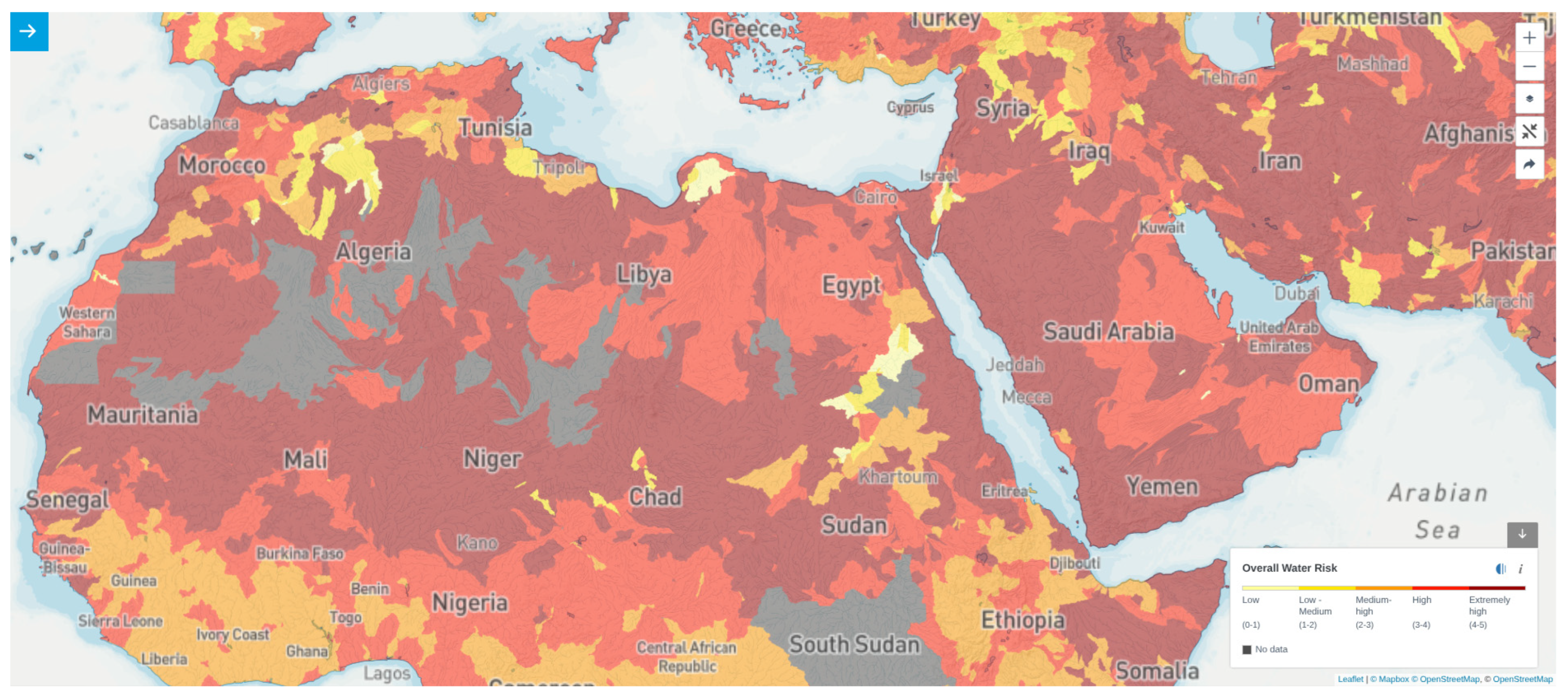
The capacity factor (CF), which indicates the actual output, is a key determinant in the calculation of the LCOH since it is directly linked to the price and source of electricity used for the electrolysis process, whether it is derived from renewables or the grid. In fact, integrating renewables with electrolyzer operations reduces the risks and impacts of fluctuating energy prices, which can stabilize the LCOH [17]. The capacity factor (CF), which indicates the actual output compared to the maximum theoretical output over time, can also have a substantial effect on the LCOH. Higher capacity factors are usually related to renewables that have more consistency, like wind or solar with energy storage, enabling good overall hydrogen production [18]. Water availability may present a factor in determining the LCOH in areas that do not have substantial amounts of freshwater; however, desalination remains negligible in terms of the overall costs of the system [19]. New evaluations also indicate that utilizing alternative water sources like produced water from industrial processes or effluents from water-resource-recovery facilities could diminish costs associated with water [20]. Producing green hydrogen through electrolysis requires significant water input. The stoichiometric requirement is approximately 9 L of water per kilogram of hydrogen produced; however, practical total operational water consumption can escalate to 15 to 25 L per kilogram due to additional needs, such as purification, cooling, and evaporation losses ranging from 6 to 16 L/kg [21]. The World Resources Institute (WRI) Aqueduct 4.0 tool [21] has been taken into consideration to identify water-related risks, including physical scarcity, aquifer depletion, and overall hydrological stress. Figure 1 shows that the overall water risk on a yearly basis, calculated by aggregating all existing indicators from the Physical Quantity, Quality, and Regulatory and Reputational Risk categories, is high. This risk is extremely high in 75% of the MENA region [22].
The cost of financing projects (WACC) is another factor to take into account, as a decrease in WACC can attract hydrogen production investments, allowing for a favorable economic evaluation of projects and positively affecting the LCOH over time [23]. Furthermore, the concept of equivalent operating hours, often defined as expected production hours per year, is vital since it delineates the actual operational efficiency of the electrolyzer systems. Operational strategies can also improve available hours by utilizing energy during low-price or surplus production periods [24].
Regarding the implementation of a hydrogen industrial hub, while blending hydrogen into the existing NG system is feasible, its transportation requires careful assessment of material compatibility and precise pressure regulation. In fact, existing infrastructure made of steel can experience embrittlement when transporting hydrogen [25]. Trials carried out in the framework of the HyDeploy project have shown the hydrogen blending into NG up to 20% to be safe without requiring a major pipeline upgrade [26]. Reductions in capacity, fuel delivery mechanisms, and different operational pressures are dictated by the blending type applied in distribution versus transmission systems. Transmission systems, which operate under higher pressures and larger scales, encounter many challenges compared to distribution networks [27]. This differentiation is critical, as blending impacts the combustion efficiency and emissions profiles of end-use appliances [28]. Global green hydrogen policies tend to achieve net-zero goals by integrating hydrogen into diverse sectors, such as using the waste heat generated by electrolysis to cover 2.5–4% of EU district heating (DH) demand [29]. The aggregation of small loads by means of a DH configuration, as done in the NG sector, can allow utilities and consumers to efficiently manage hydrogen consumption and promote the creation of a new energy market model [30,31]. Based on IRENA’s World Energy Transitions Outlook 1.5 °C pathway, the role of hydrogen will be central to achieving net-zero emissions by 2050, accounting for 14% of the final energy production, together with the projected cost reductions for electrolyzers that are expected to be equal to 60% by 2030 [26,31]. Both South Africa’s commitment to the Paris Agreement [32] and West Africa’s strategic cooperation with Europe to align climate and development goals [33] are policies that emphasize that scaling the hydrogen economy relies on technological innovation to afford lower pricing and global net-zero transition [34].
While prior hydrogen readiness assessments and multi-criteria decision analysis (MCDA) studies have already evaluated production pathways and supplier selection, the present research study aims to overcome the remaining problem gaps. Among them, readiness indicators often overemphasize the technical maturity and economic viability of hydrogen applications, neglecting social pillars, resource constraints (e.g., water scarcity), and implementation issues. Only 7% of announced hydrogen projects reached Final Investment Decisions (FIDs) in 2023 [35]. Furthermore, MCDA applications frequently rely on subjective weighting without the support of hybrid data-driven methods, uncertainty boundary analysis, and focus on global scales, underrepresenting regional FFED contexts. This article is designed to provide an in-depth examination of the role of green hydrogen in fossil-fuel export-dependent (FFED) economies. As part of the novelty of this research study, an MCDA analysis based on 11 indicators has been carried out in order to evaluate the main factors of FFED economies in MENA countries—fossil dependence, geopolitical risks, export-oriented demands, and water stress. While standard MCDA overlooks governance (WGI) and logistics proxies (LPI/LSCI), our research focuses on assessing the feasibility of selected countries for hydrogen production according to the weighted criteria selected.
Section 2 describes the research methodology: definition of FFED countries, data sources, indicators, and the overall analytical workflow. Section 3 contains mathematical methods indicating normalization, entropy, and TOPSIS equations used in the MCDA analysis. Section 4 quantifies solar and wind resource potential across MENA and compares six FFED countries (Algeria, Egypt, Kuwait, Oman, Qatar, and Saudi Arabia) on energy mix, existing hydrogen projects, policies, decarbonization targets, and infrastructure readiness. Section 5 and Section 6 present, respectively, a PESTEL and SWOT analysis of the green hydrogen transition in MENA FFED countries. Section 7 introduces and applies a transparent multi-criteria decision analysis (MCDA) with 11 indicators and AHP–entropy weighting to rank six MENA countries for green hydrogen/ammonia export potential.

2. Research Methodology Design

In this section, the research methodology designed to evaluate the potential for hydrogen adoption in FFED countries is presented. The aim is to examine readiness and capability for hydrogen as a sustainable alternative in MENA FFED countries, where the green transition can generate substantial economic risk.
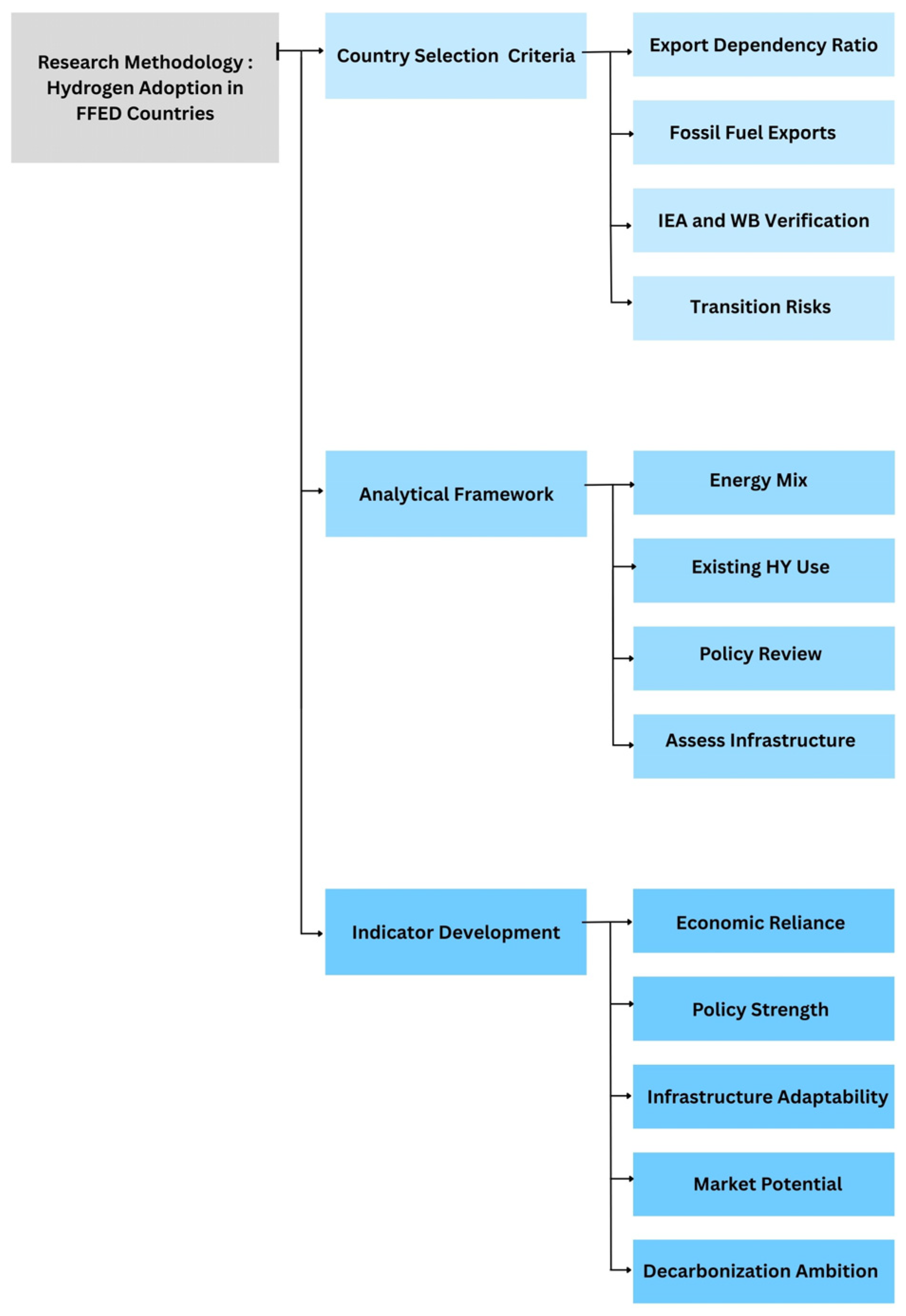
Candidate countries were identified using strict economic thresholds and established international datasets—IEA and World Bank datasets [36,37]—for the methodology validation. Two main selection criteria were applied to identify them: the export dependency ratio and the proportion of Gross Domestic Product (GDP) generated from fossil fuels. Countries in which fossil-fuel exports account for more than 50% of total merchandise exports were classified as high-dependence, countries with more than 10% were classified as low-dependence. Countries that account for less than 10% were excluded from the analysis.
Following the identification of countries, a structured analysis of the selected countries based on their energy mix was carried out. Data from government energy reports and IEA enabled the distribution between fossil fuels, renewable sources (mainly solar and wind), and other energy sources, such as nuclear energy.
Later, existing applications of hydrogen were investigated, focusing on the industrial and transport sectors and considering previous academic research, pilot projects successfully implemented, and demonstration initiatives still ongoing. The objective is to map existing use and identify barriers.
Furthermore, established policies and regulations for hydrogen-infrastructure hub deployment, together with financial support mechanisms, were reviewed. In parallel, national decarbonization goals were analyzed through the contributions to net-zero pledges, sourced from International Climate Reporting Platforms [38]. Moreover, data on pipeline systems, storage capacity, industrial clusters, ports, and shipping facilities were collected.
Subsequently, a comparative analysis was conducted among the selected MENA countries based on the following political, technical, and economic criteria:
Economic Reliance: Defined as the proportion of fossil-fuel exports relative to gross domestic product.
Policy Strength: Assessed by the presence of national hydrogen strategies and the level of government funding and institutional support.
Infrastructure Adaptability: Measured by the extent to which existing oil and gas infrastructure can be repurposed for hydrogen applications.
Market Potential: Calculated based on projected domestic hydrogen demand and potential export opportunities, as reported in trade assessments.
Decarbonization Ambition: Estimated by comparing national climate policy targets with actual emission outcomes.
This methodology offers a clear way to evaluate the potential for hydrogen adoption in these countries by bringing together economic, policy, infrastructural, and environmental dimensions; this can be seen in the visual block diagram in Figure 2, which summarizes the designed methodology.
Once the current state of hydrogen adoption in MENA FFED countries was assessed, a scoring process based on 11 indicators was applied to benchmark countries against each other. The indicators were fed into a scoring MCDA system, allowing the identification of countries better positioned as long-term participants in the hydrogen economy. Additionally, a cluster analysis was used in parallel to group states with similar profiles, distinguishing early adopters, transitional cases, and late movers. This dual method provides both detail and comparability across fossil-fuel-dependent economies.
The final ranking identified relative hydrogen readiness among selected countries.

3. Modeling of the Multi-Criteria Decision Analysis

A multi-criteria decision analysis was applied to rank the MENA countries by evaluating them against multiple criteria and complex decisions. The raw data of 11 indicators (Table 1) were converted to comparable, dimensionless scores through a fully objective, data-driven process consisting of two main steps: outlier treatment and min–max normalization with directional inversion for cost-type indicators. This approach follows standard recommendations in the OECD-JRC’s Handbook on Constructing Composite Indicators [39]. Outliers were treated via Winsorization at the 5% level to reduce extreme influence without removal. The analysis primarily utilizes Technique for Order Preference by Similarity to Ideal Solution (TOPSIS), supported by entropy weighting for objective weight determination [40].

3.1. Min–Max Normalization

Normalization is a critical step in MCDA in which heterogeneous criterion values are transformed into comparable information [41]. During the normalization process, raw data is transformed into a dimensionless scale [0, 1] where 0 represents the worst performance and 1 represents the best performance for a given criterion. This is crucial for combining criteria with different units and ranges. The formula is
x i j = x i j m i n i x i j m a x i x i j m i n i x i j
For negative cost indicators (lower is better, e.g., S3 LCOE, S4 water stress, R3 fossil rent dependence before inversion), inversion is performed first by taking the reciprocal or subtracting from a suitable benchmark, then applying the positive formula above. Specifically:
x i j = m a x i x i j x i j m a x i x i j m i n j x i j
where
  • m i n i ( x i j ) is the minimum value observed for criterion j across all alternatives i ;
  • m a x i x i j is the maximum value observed for criterion j across all alternatives i .

3.2. Derivation of AHP Base Weights w A H P b a s e

The Analytic Hierarchy Process (AHP) was employed to determine the subjective weights for each criterion, resulting in the w A H P b a s e vector. This process involved collecting expert judgments through pairwise comparisons. Experts evaluated the relative importance of each criterion against every other criterion using Saaty’s nine-point fundamental scale [42]. This scale assigns numerical values to verbal judgments of relative importance (e.g., 1 for equal importance, 3 for moderate importance, 5 for strong importance, and so on, up to 9 for extreme importance). For each pair of criteria ( C i , C j ), an expert determined how much more important the former was compared to C j . If C i was rated x times more important than C j , then C j was implicitly 1 x times as important as C i . These judgments were structured into a pairwise comparison matrix. Considering a subset of criteria (S1, S2, D1), a simplified expert judgment might result in A
A = 1 3 1 2 1 3 1 1 4 2 4 1
where
  • S1 is moderately more important than S2 (3);
  • S1 is moderately less important than D1 (1/2);
  • S2 is moderately less important than S1 (1/3);
  • S2 is strongly less important than D1 (1/4);
  • D1 is moderately more important than S1 (2);
  • D1 is strongly more important than S2 (4).
From the full pairwise comparison matrix (covering all 11 criteria), the relative weights (e.g., using the eigenvector method) were mathematically derived. The consistency ratio (CR) was calculated to ensure the logical coherence of expert judgments, with values typically below 0.10 indicating acceptable consistency. The w A H P b a s e array in the code directly represents these calculated and normalized AHP weights.

3.3. Entropy Weighting

Entropy weighting is an objective method used to determine the relative importance (weights) of each criterion. Criteria with higher variability across alternatives (i.e., lower entropy) are assigned higher weights as they are considered more discriminatory; conversely, criteria with little-to-no variability (higher entropy) receive lower weights.
Hybrid weights are computed by taking into account the weight based on the Analytic Hierarchy Process (AHP) and the entropy weight as follows:
w c o m b i n e d = 0.5 × w A H P + 0.5 × w E n t r o p y
Subsequently, they are normalized using a normalized decision matrix:
X = ( x i j ) m × n
The first step for calculating entropy weights is the construction of the Probability Matrix ( P ) where for each criterion j t h across m alternatives, the probability p i j is determined as follows:
p i j = x i j + ϵ i = 1 m x i j + ϵ ,   i = 1 , 2 , , m ,   j = 1 , 2 , , m
where ϵ is a correction constant to ensure that p i j > 0 .
Then, the calculation of the entropy ( E j ) for each criterion j is given by:
E j = k i = 1 m p i j l n p i j ,   j = 1 , 2 , , n
where k = 1 l n ( m ) and when x i j = 0 , it is assumed p i j l n p i j is equal to 0.
After that, the Degree of Divergence ( D j ) for criterion j is computed as outlined below:
D j = 1 E j
Finally, in order to guarantee uniform weights are assigned, the entropy weights ( w j ) for criterion j t h are evaluated by normalizing the divergence values:
w j = D j j = 1 n D j ,   j = 1 , 2 , , n

3.4. TOPSIS Method

The TOPSIS method is an MCDA tool for identifying the best option and ranking alternatives based on their distance from an ideal solution [40]. The alternative should have the shortest geometric distance from the Positive Ideal Solution (PIS) and the longest geometric distance from the Negative Ideal Solution (NIS). In the Weighted Normalized Decision Matrix ( V ), each normalized criterion value is multiplied by its assigned weight:
v i j = w j x i j
where X = x i j m × n is the normalized decision matrix and W = w 1 , w 2 , , w n is the vector of criterion weights. Then, the Positive Ideal Solution P I S , V + and Negative Ideal Solution ( N I S , V ) are identified as follows:
V + = v 1 + , v 2 + , , v n + = m a x i v i j j J B , m i n i v i j j J C
V = v 1 , v 2 , , v n = m i n i v i j j J B , m a x i v i j j J C
where J B represents the benefit criteria, and J C represents the cost criteria.
Afterwards, the maximum value for PIS and minimum value for NIS across all v i j are selected:
V + = v i 1 , v i 2 , , v i n
V = v i 1 , v i 2 , , v i n
Subsequently, the Euclidean distance of each alternative from the PIS ( S i + ) and NIS ( S i ), called Separation Measures, is calculated:
S i + = j = 1 n v i j v j + 2
S i = j = 1 n v i j v j 2
The Relative Closeness C i for each alternative i is computed as outlined below:
C i = S i S i + + S i
This score ranges from 0 to 1, where higher values indicate better performance. As can be seen, the MCDA methods adopted to carry out the FFED MENA country analysis provide a comprehensive evaluation of alternatives under various criteria, considering both objective and subjective weight influences (through combined AHP/entropy weights). Finally, the Relative Closeness C i was used to rank possible alternatives in order to identify the best option.

4. Comparative Analysis Among MENA FFED Countries

The design of renewable energy systems for green hydrogen production critically depends on prior evaluations of solar irradiance and wind speed in the target regions.
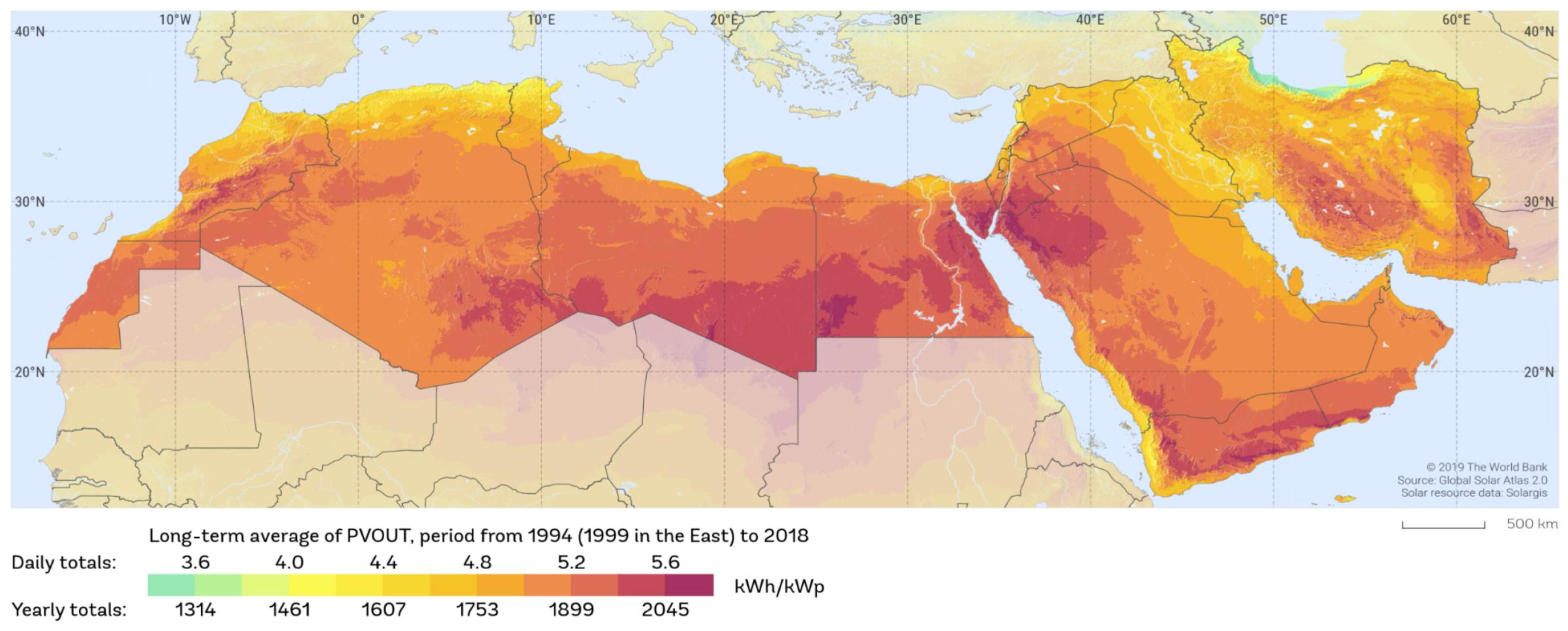
Across MENA regions, Global Horizontal Irradiance (GHI) and Direct Normal Irradiance (DNI), as well as wind speed to a standard height, show highly favorable potential (Figure 3) [43]. In fact, photovoltaic power-production potential in the MENA region accounts for almost over than 1899 kWh/kWp annually. Specifically, in areas with high levels of solar energy, GHI reaches levels above 2000 kWh/m2/year, while DNI reaches 1800 kWh/m2/year in desert areas, such as Egypt and Saudi Arabia [44]. GHI is the total amount of solar radiation received overall on a horizontal surface, making it important for photovoltaic (PV) system assessments, while DNI provides the amount of direct sunlight received, which is crucial for solar thermal applications. Consequently, areas with high DNI, like Algeria, are particularly suitable for concentrated solar power (CSP) technologies [45].
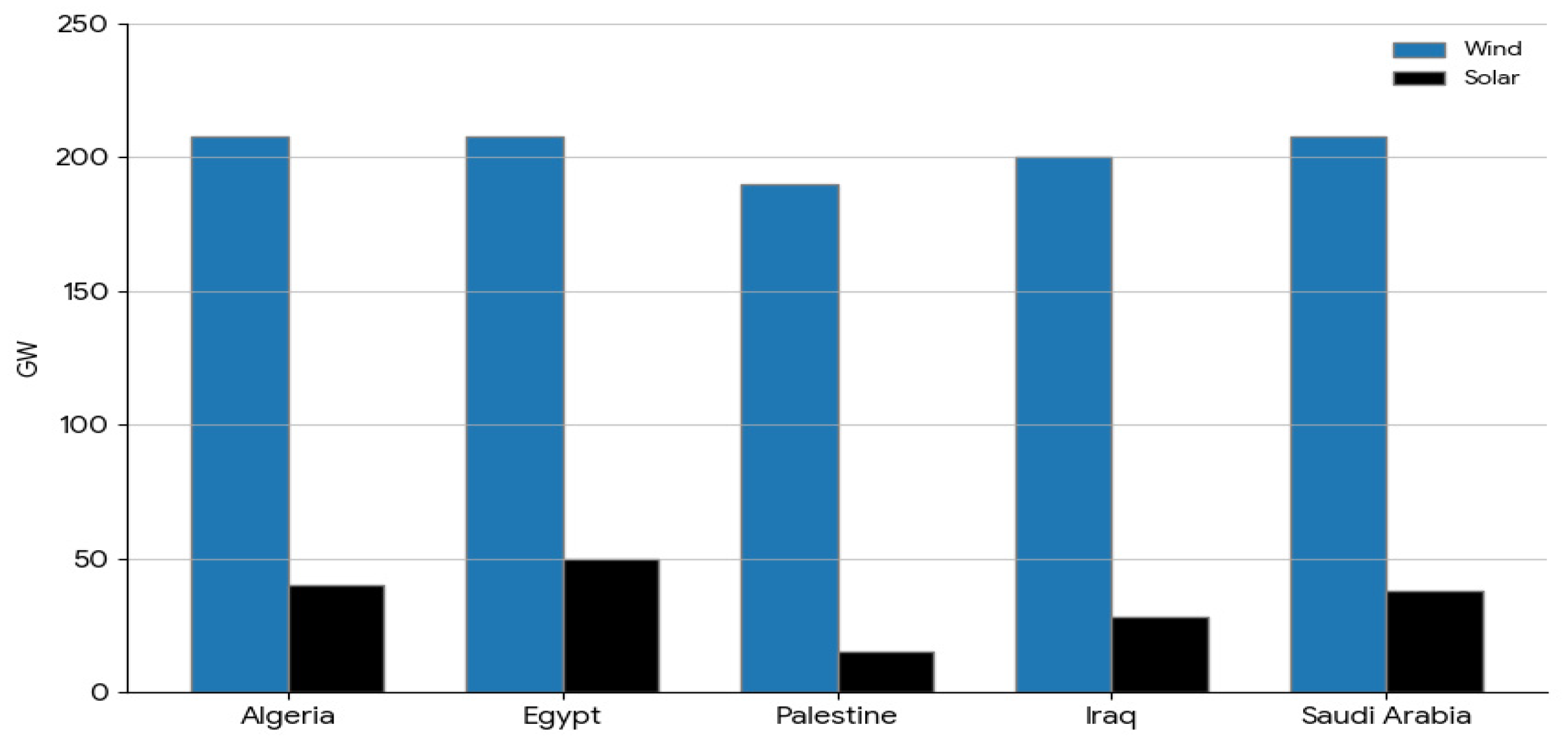
Similarly, the Global Wind Atlas (GWA) shows that typical wind speeds in MENA regions can range from 5 to 9 m/s at a height of 100 m [46], reaching peak value in the coastal areas. As shown in Figure 4, countries such as Algeria, Saudi Arabia, Egypt, and Oman—marked by large coastal areas and abundant deserts—are characterized by an average wind speed above the thresholds that result in an effective use of wind turbines for energy production (typically >6 m/s) [47]. Validation of these datasets can be further achieved through on site measurements and meteorological data collected over several years, which helps refine the accuracy of resource assessments [48,49].
The data presented in Figure 4 were estimated using solar and wind potential for selected countries from the World Bank’s Global Solar Atlas [43] and Global Wind Atlas [46]. Solar potential was calculated based on average annual Global Horizontal Irradiance (GHI) values, typically ranging from 1800 to 2400 kWh/m2/year across these countries, converted to gigawatts (GW) using a simplified land-use assumption. Wind potential was calculated using average wind speeds at 100 m (4.5–9.0 m/s) and corresponding power densities (150–600 W/m2), converted into GW with similar land constraints.
The land area used was estimated by excluding protected areas, high-slope terrain (>34%), urban/agricultural land, and biodiversity zones, potentially reducing available area depending on the country [50]. For consistency, 1000 km2 of usable land per country—with solar yielding 0.2–0.25 GW/km2 (20–25% capacity factor) and wind yielding 0.01 GW/km2 (30–40% capacity factor, assuming 10 MW/km2 turbine density)—was assumed [51]. Finally, the assumptions considered to carry out the analysis are presented in Table 2.
The intentional integration of green hydrogen practices in MENA economies aims to foster a reliable, sustainable energy transition while addressing climate change concerns. A comparative analysis (Table 3) was carried out among six selected MENA countries according to the political, technical, and economic criteria presented in Section 2.
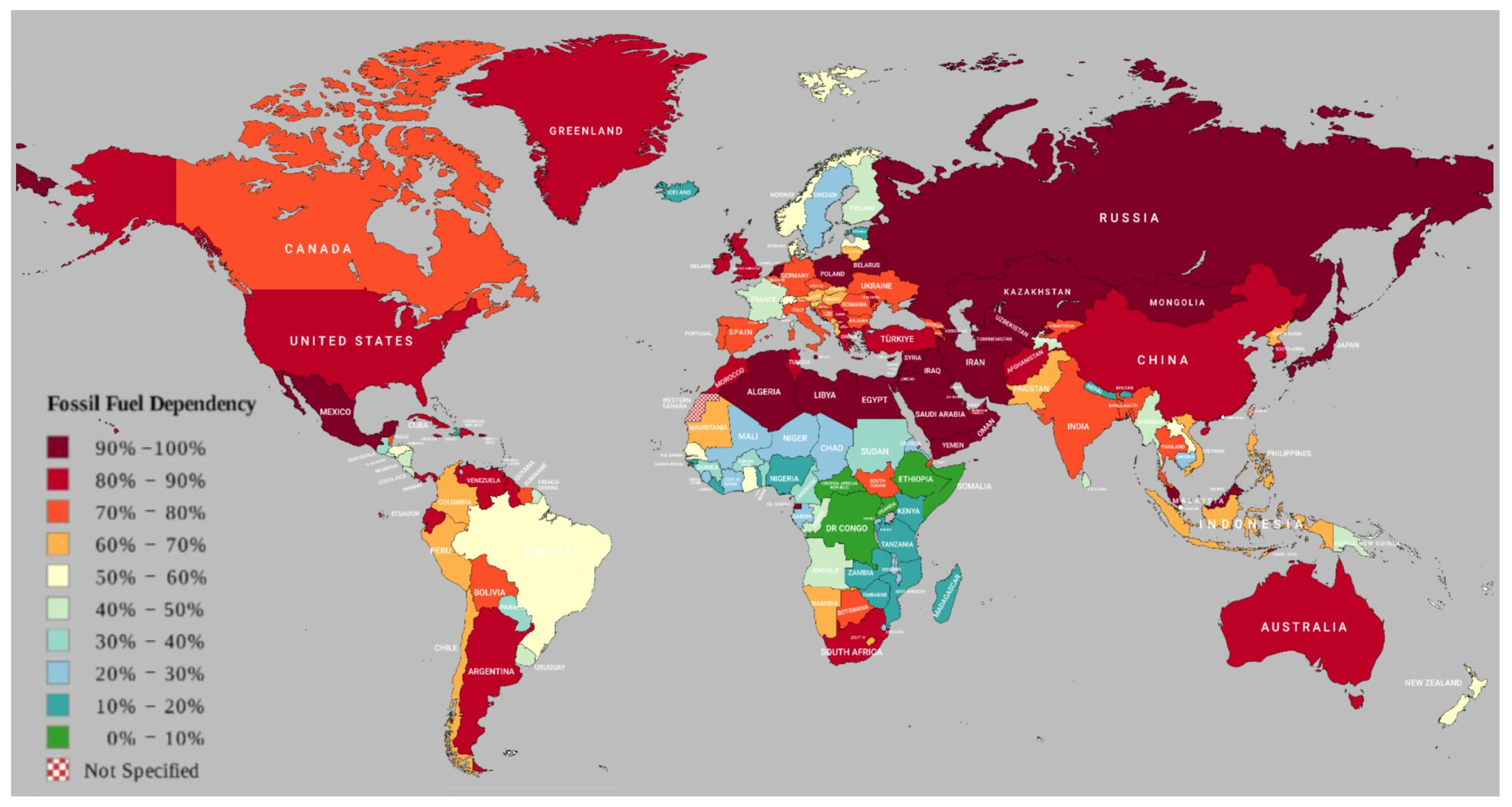
Figure 5 shows the worldwide fossil-fuel energy-dependency rates, highlighting MENA countries as the area with highest FFED rate, between 90 and 100%. The natural endowment of these countries, which hold some of the largest proven oil and gas reserves in the world, has made fossil-fuel energy sources the more convenient asset for their economies. However, the historical fossil-fuel dependency that affects these countries is not just due to the large availability of fossil fuels, but also to their reliance on extensive infrastructure—including power plants and LNG terminals for fossil-fuel exports—strongly influenced by the economic models and political institutions that completely dominate the oil and gas companies of their respective countries [60].
In spite of that, the comparative analysis shows MENA countries to be characterized by their abundance of renewable energy resources, which results in a unique opportunity for MENA countries to reshape their economies and to become major exporters of green hydrogen. Algeria, Egypt, Oman, and Saudi Arabia are projected to drive 85% of the region’s renewable capacity growth by 2027, and they are heavily investing in wind farms too [61]. In particular, Saudi Arabia, historically one of the major oil exporters, is now exploring energy production technologies based on hydrogen with the aim of leading energy exports towards a green economy. However, transitioning to a diversified and sustainable economy requires important investments, new technologies, and policy planning to balance the required economic needs and achieve long-term sustainability objectives.

Economic Analysis of HY Integration in the FFED Countries’ Energy Mix

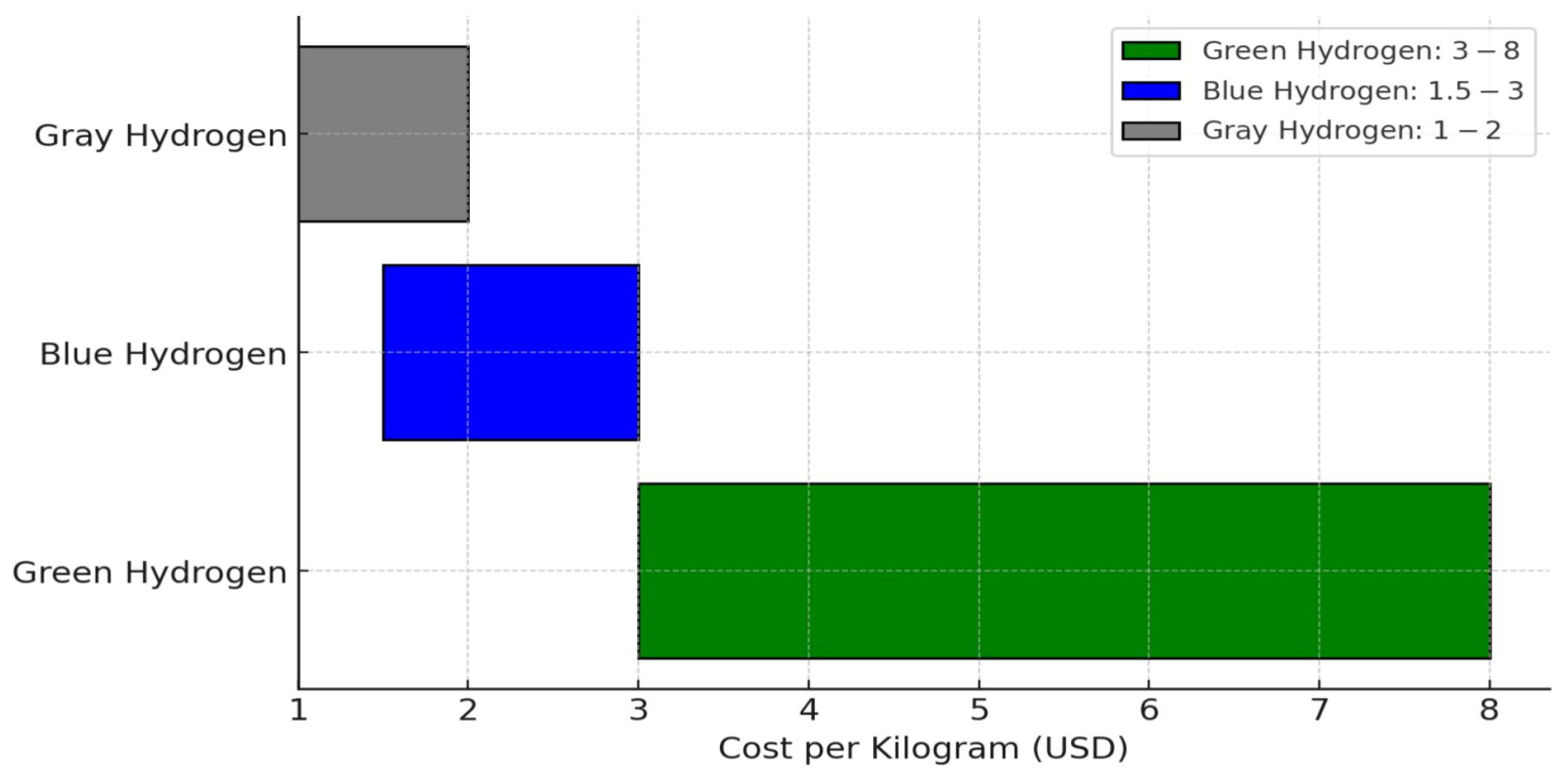
Currently, producing green hydrogen is far more expensive than creating blue or gray hydrogen, primarily because it depends on renewable energy and high-cost electrolyzers (Figure 6). From recent estimates, green hydrogen can cost anywhere from about 3 to 8 USD/kg, depending on how much one pays for electricity and how efficiently the electrolyzers operate [62].
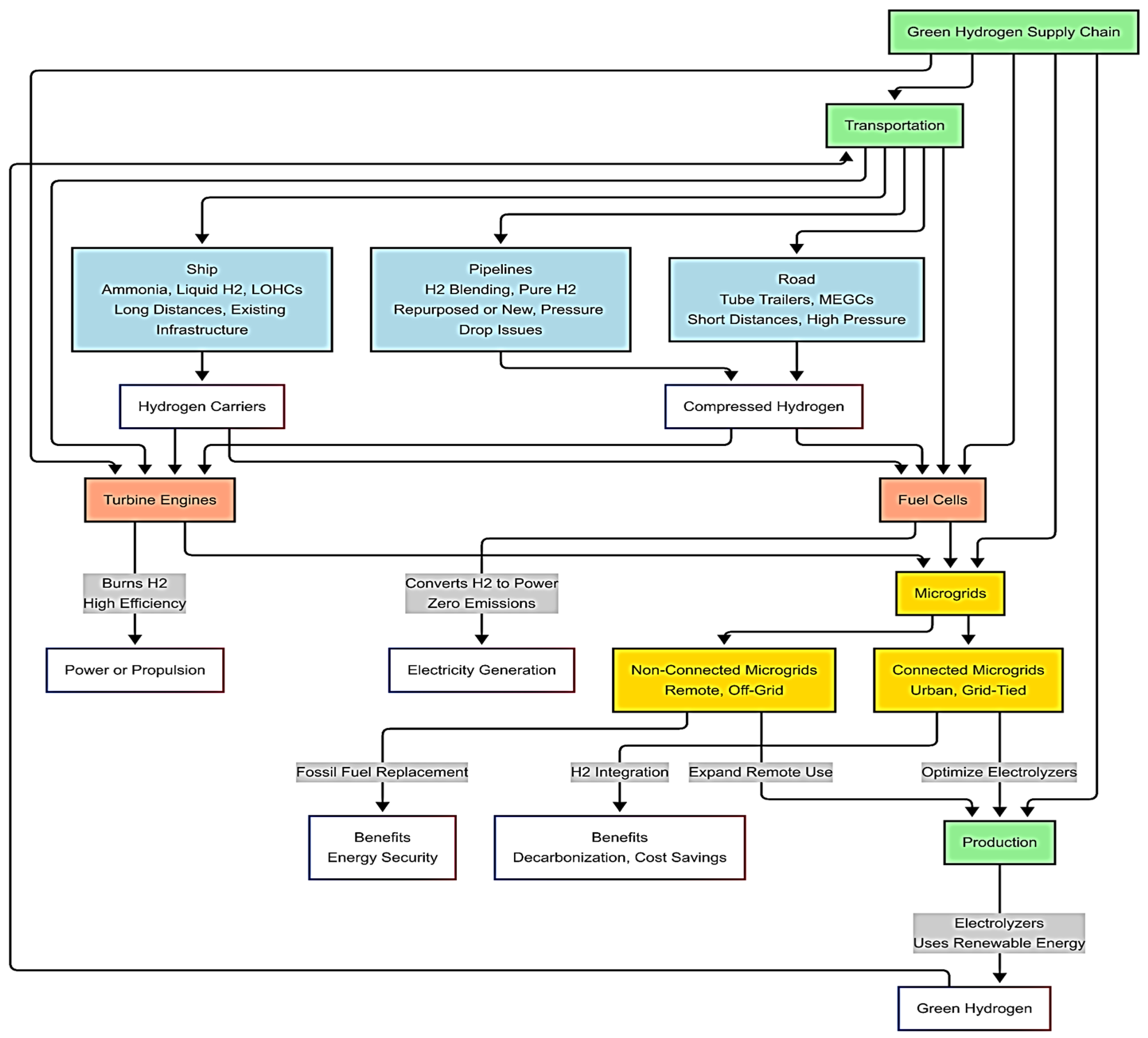
Blue hydrogen, made from NG with carbon capture and storage (CCS), costs about 1.5–3 USD/kg. Gray hydrogen, made from NG without CCS, can be as low as 1–2 USD/kg [63]. This shows the cost challenge green hydrogen faces against fossil-fuel methods. Its cost depends on electricity, electrolyzer efficiency, and production scale. Electricity is the biggest factor, so regions with cheap wind or solar power can produce hydrogen at a lower cost [64]. Furthermore, as the technology for electrolyzers—especially advanced polymer electrolyte membranes (PEMs)—improves, researchers expect the setup and operating costs to decrease, which would help reduce the price of green hydrogen [65]. Also, if production occurs on a larger scale, one benefits from economies of scale, making each unit of hydrogen cheaper. Experts predict that green hydrogen could rival fossil-fuel hydrogen in price by 2030 to 2050, particularly in scenarios where renewable energy plays a significant role [33]. Green hydrogen could become appealing as electrolyzers improve and renewable energy becomes less expensive. Moreover, by emphasizing the true cost of blue and gray hydrogen, starting to factor in the environmental cost through carbon pricing could make green hydrogen even more competitive [66]. However, achieving that depends on following technological developments and implementing regulations supporting investment in green hydrogen systems. Transporting hydrogen from point A to point B and storing it properly is highly important if researchers aim to integrate it into the energy mix, especially since it does not pack much energy per volume (Figure 7) [67]. Researchers have several main ways to store hydrogen: as compressed gas, liquid hydrogen, or in ammonia, each with its own advantages and disadvantages. Compressed hydrogen gas is forced into tanks at very high pressures, up to 700 bar. This is fairly common for hydrogen fuel-cell cars and industrial use because it is relatively straightforward, and researchers already know how to implement it. Furthermore, compressing it requires substantial energy, and with the high levels of pressure, there are safety concerns. Then there is liquid hydrogen, which, kept very cold at around −253 °C, offers greater energy density. For large-scale applications like space flight or some industrial configurations where every unit of space and weight matters, it is suitable. As a counterpart, it takes considerable energy to turn hydrogen into a liquid, and one needs advanced, insulated tanks to maintain it that way, which increases the logistics and cost. Ammonia is beginning to appear very promising for transporting hydrogen because it holds more energy, and researchers already have the systems in place to produce and move it.
Ammonia is made from hydrogen and nitrogen via the Haber–Bosch process, and it is easier to handle than pure hydrogen [68]. Additionally, it is safer to transport. The challenge is converting ammonia back to hydrogen, which involves catalysts and can potentially release CO2 if one is not careful. Aiming to make ammonia a more practical option for hydrogen storage and transportation, there is some interesting work in progress with novel catalysts to make this conversion more efficient [69]. Despite these benefits, cheaper catalysts are required to facilitate more efficient conversion of ammonia to hydrogen. Table 4 summarizes key economic and technical aspects of the hydrogen storage methods.

5. PESTEL Analysis for Assessing Green Hydrogen Suitability in MENA FFED Countries

A PESTEL analysis was used to assess the influence of macro factors on strategies and initiatives implemented in FFED countries to enable the transition towards a green hydrogen-based economy. Moreover, the PESTEL analysis also allows the identification of external opportunities and challenges related to this transition.
Table 5 summarizes the results of the PESTEL analysis into a comparison matrix by addressing each one of the macro-environmental factors and showing their correlation with the MCDA indicators.
Findings demonstrated the critical influence of political and economic factors on the development of hydrogen hubs in FFED economies. Government regulations, like Saudi Arabia’s Vision 2030 and Egypt’s Renewable Energy Plans, can contribute to determining the scale of hydrogen integration, but political stability in the MENA region remains crucial for attracting foreign investment. International trade policies are expected to evolve toward fostering cross-border hydrogen markets, but EU partnerships with neighboring FFED economies are crucial to meet the targets established by the 2030 Agenda [74]. FFED countries face a major challenge, reducing their fossil-fuel energy dependence—that for some countries exceeds 90%—while focusing on building new green energy sectors. In this framework, hydrogen production cost represents a strong challenge, as its cost will impact competitiveness and deter private investors, especially in FFED economies vulnerable to inflation, with fluctuating interest rates, and with high unemployment. However, long-term projections suggest that new production technologies could reduce hydrogen costs to 1–2 USD/kg by 2050, benefitting FFED economies [33].
From a social perspective, the rapidly growing young population in the MENA region intensifies the need for job creation. The development of a green hydrogen-based economy could generate new employment opportunities, although extensive workforce training and skill development will be necessary to support the reliability of this sustainable energy market [75]. Public acceptance of hydrogen technologies is still limited in many MENA regions, as fossil-fuel dependency is still heavy in these countries [13]. Awareness campaigns are necessary to promote the use of hydrogen as part of a low-carbon lifestyle. On the other hand, advancements in hydrogen production technologies are strongly required in order to enable its deployment in FFED economies. In fact, electrolyzer advancements, smart grid integration, and storage breakthroughs are central to lowering costs and improving system reliability [76].
Furthermore, ongoing research in water electrolysis and methane decomposition is building a viable roadmap for MENA nations to use their RES potential to enhance hydrogen production [77]. Finally, effective collaboration between governments and the private sector is crucial for establishing the foundations of a solid hydrogen-based economy and facilitating hydrogen integration into industrial sectors traditionally dominated by fossil fuels [78].
Table 5. PESTEL matrix for assessing green hydrogen suitability in MENA FFED countries and influence of the PESTEL macro factors on MCDA indicators.
PESTEL
Dimension
AlgeriaEgyptKuwaitOmanQatarSaudi ArabiaMCDA
Indicators
Political2040 H2 targetAmbitious export goals (8% of global market) Net-zero target 2035Net-zero 2050 Vision National Vision 2030 Vision 2030; net-zero by 2060; 50% RES by 2030 R1, R3
Economic99% FFED 93% FFED ~100% FFED; high unemployment/inflation risks ~99% FFED99.8% FFED strong investment capacity~100% FFED robust fundingS1, S2 (PVOUT, Wind), S3 (LCOE), D2 (LSCI), D3 (Steel Production), R3
SocialYoung population; limited public awarenessGrowing population; job creation potentialHigh unemployment; social stability concerns in transitionYouth diversity; job opportunities Limited domestic demand; expatriate workforceLarge population; Vision 2030 requires jobs/skills shiftR1, R2
TechnologicalSolar/wind potential high; infrastructure adaptation possible21 projects; strong RES integration; electrolysis focusLimited RES; advanced oil/gas technology adaptableHydro-led infrastructure Advanced NG/LNG infrastructure NEOM mega-project ongoing; advanced RE and electrolysisD1 (LPI), D2 (LSCI), D4 (LNG export capacity), R2 (WGI Regulatory Quality)
EnvironmentalWater stress moderate (Saharan aquifers); low RES shareHigh RE potential; high water stress; desalination neededHigh water stress; limited RESHigh solar/wind; high water stress; coastal advantagesHigh water stress; gas-dominantHigh RE potential; extreme water stressS1, S2 (PVOUT, Wind), S4 (Water Stress)
LegalNDC alignmentNational strategy; incentives for green investmentEmerging regulations; NDC targetsStrong frameworks (Vision 2040)Vision 2030 policies; emission-reduction lawsSaudi Green Initiative; regulatory supportR2 (WGI Regulatory Quality)
Ref.[12,19,21,37][21,37,79][21,55][21,37,54,56][21,56,57][58,59]

6. SWOT Analysis for Assessing Green Hydrogen Suitability in MENA FFED Countries

A SWOT analysis was carried out in order to evaluate internal capabilities and external conditions of MENA FFED countries in the context of the ongoing energy transition. Table 6 highlights the readiness and limitations of MENA countries to embrace a green hydrogen economy, discussing the strengths, weaknesses, opportunities, and threats that MENA FFED countries are facing.
Many of the countries in the MENA region have valuable renewable-energy potential—mainly in solar and wind. Previous studies highlighted MENA countries as characterized by high GHG-mitigation potential that can be enhanced by capitalizing on solar potential [26]. This advantage can make hydrogen production easier, allowing for newly developed infrastructure to accommodate the hydrogen energy approach. MENA countries already have substantial energy-related infrastructure, and this infrastructure is adaptable to new energy types, including green hydrogen production and storage [80]. In transitioning to green hydrogen, the MENA countries would benefit from new revenue streams associated with the sale of renewable energy certificates and/or hydrogen. In fact, green sukuks are currently gaining attention as financial instruments for funding some of these ventures [81]. The opportunity to harness green hydrogen offers countries such as Saudi Arabia and Qatar, given their stable geopolitical contexts, a pathway to shape the global green hydrogen landscape while diversifying their economies [82,83]. MENA countries are collectively aware of the need to transition towards a sustainable and green economy, as any disruption in the global fossil-fuel markets can lead to immediate and severe economic instability, limiting investment for hydrogen technologies [84]. Although MENA countries possess considerable green energy potential, renewable energy sectors are still less developed than fossil-fuel-based industries, and the transition will require significant financial investment and technological innovation [85]. Policy–action misalignment represents a key obstacle to renewable-energy project deployment. Moreover, insufficient public awareness may trigger social opposition, while incumbent fossil-fuel industries may hinder the transition due to legacy dependencies and economic interests [27]. MENA countries could play a crucial role as hydrogen exporters in the global scenario, taking advantage of their local availability of renewable energy and foreign partners’ investments in the development of a reliable green hydrogen hub [86]. Moreover, employment opportunities across a range of areas of expertise—from research and development to manufacturing to distribution—can support FFED local economies [87]. Participation in global climate accords and initiatives can also provide valuable opportunities for MENA countries to get financial support for renewable projects, including hydrogen projects [88].
On the other hand, geopolitical instability and energy price volatility—which affect the MENA region—remain significant risks for hydrogen development, while economic recessions could constrain investment and reduce export competitiveness [39]. In fact, the increasing climate awareness and stricter environmental regulations may accelerate pressure on MENA countries to transition rapidly to a low-carbon economy, potentially without adequate preparation. Moreover, rapid technological advancements could undermine MENA’s competitiveness, requiring costly infrastructure adaptations and developments, broadening economic crises in these fossil-fuel-dependent regions [89,90].
Table 6. SWOT analysis of FFED economies in the MENA region.
StrengthsWeaknesses
Abundant renewable resources, especially solar and wind (e.g., Iran’s solar potential for major GHG reductions) [26]High dependence on fossil-fuel export revenues, causing vulnerability to market disruptions [84]
Existing energy infrastructure that can be adapted for hydrogen production and storage [80]Underdeveloped renewable energy sector compared to fossil fuels, requiring large investments [91]
Revenue from fossil fuels historically funded development; potential to redirect financing into green hydrogen (e.g., green sukuks) [81].Governance and regulatory frameworks for renewable energy lag behind fossil-fuel policies [85]
Strategic geopolitical positioning (e.g., Saudi Arabia) to lead in global hydrogen markets [82,83]Social backlash possible from communities reliant on fossil-fuel industries, fearing job losses [92]
Recognition of the need for economic diversification and adoption of green hydrogen strategies [84]Resistance from fossil-fuel businesses with vested interests, complicating transition [27]
OpportunitiesThreats
Rising global demand for green hydrogen, positioning MENA as a competitive exporter [93]Global energy market volatility and price fluctuations could disrupt hydrogen investment [39]
Innovation and technological advancements tailored to regional needs [94]Stricter international environmental regulations may accelerate transition pressures [95]
International partnerships for investment, technology transfer, and knowledge sharing [86]Competing regions (the EU, US, and Asia) may advance hydrogen technologies faster [89]
Job creation across R&D, manufacturing, and distribution [87]Large infrastructural changes are needed; slow adaptation could hinder competitiveness [15]
Access to funding and support through international climate agreements [88]Rapid transition risks economic disruption, unemployment, and social unrest [90]

7. MCDA Application for Assessing Green Hydrogen Suitability in MENA Countries

To achieve a replicable framework for evaluating the suitability of selected countries in the MENA region for developing renewable hydrogen (H2) and/or ammonia (NH3) value chains, an MCDA analysis was carried out.
There are multiple approaches available for multi-criteria decision analysis (MCDA). As already mentioned in Section 3, in this research study, a TOPSIS method was adopted as it is among the methods widely recognized for their effectiveness in solving complex MCDA problems. The TOPSIS method was selected because it uses only Euclidean distances and does not demand extra user-defined functions. This makes the entire analysis transparent, replicable, and easy to communicate to a broad audience. It ranks alternatives (countries) based on their relative distances from a Positive Ideal Solution and a Negative Ideal Solution through an easily interpretable process [40].
Alternatively, PROMETHEE focuses the multi-criteria decision analysis on outranking through pairwise comparison, which results in the need to specify preference functions and thresholds for each criterion, while VIKOR focuses on compromise solutions and is particularly useful when no single alternative is perfect across all criteria [96]. Furthermore, due to the existing gap in the MCDA methods, as the use of different approaches could lead to different solutions, future studies of this research will aim to use PROMETHEE and VIKOR and to compare their results with the TOPSIS analysis carried out in this study.
According to the MCDA method that was selected, the multiple indicators shown in Table 7 are evaluated across supply-side, demand-pull/logistics, and risk/regulation dimensions, aligned with EU regulations such as Renewable Fuels of Non-Biological Origin (RFNBO) and demand signals from sectors like shipping, chemicals, and steel. The rankings will help select the most suitable countries for green hydrogen production.
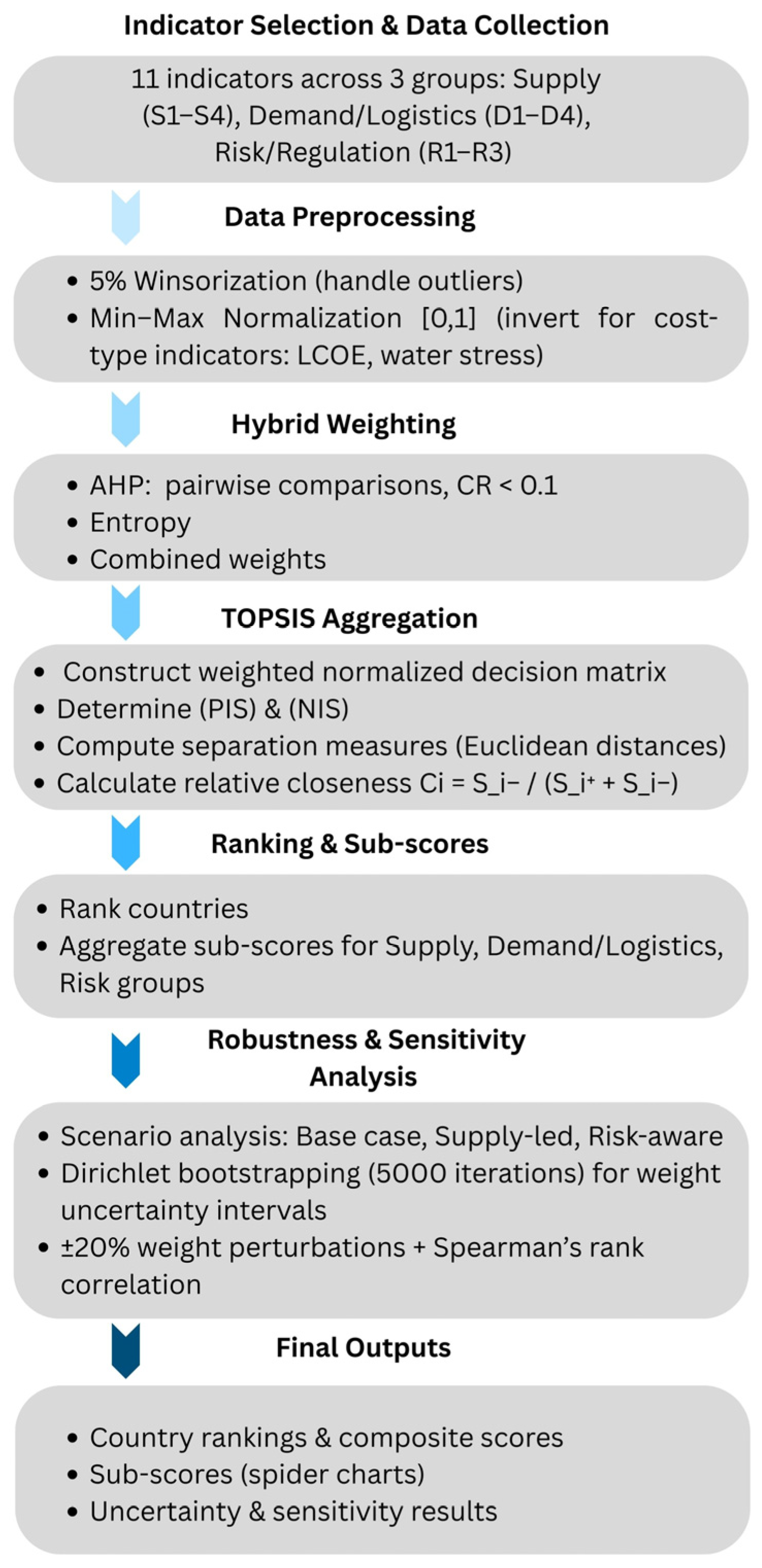
As discussed in Section 3, following the OECD-JRC guidelines for composite indices [100], Analytic Hierarchy Process (AHP) was used for weighting, min–max normalization (with inversion for cost indicators), Winsorization (5% for outliers), and TOPSIS aggregation. The robustness of the MCDA assessment is examined through scenario analysis (base, supply-led, risk-aware) and sensitivity tests. The MCDA process flow employed in this study is schematically presented in Figure 8, while the mathematical methods are described in Section 3.
The first stage of the MCDA process involved normalizing all criteria using min–max scaling to place them on a common 0–1 scale. Positive and negative indicators were normalized; this step allows for logical aggregation using the weighting techniques applied later. As a result, every country’s performance becomes directly comparable across supply, demand, and risk indicators. To reflect both expert judgment and data-driven information, the analysis used a hybrid weighting framework. AHP weights represented the subjective importance assigned by domain experts, while entropy weights measured the degree of informational variability in each criterion, giving more weight to indicators with higher discriminative power across countries. The final combined weights were calculated as the average of the AHP and entropy weights and then normalized. Scenario-specific variations, including supply-led and risk-aware configurations, were also produced by selectively boosting relevant criterion groups. This resulted in a balanced and transparent weighting system that captures expert priorities, objective data patterns, and policy-driven alternatives. To assess uncertainty around the final weights, we applied the Dirichlet bootstrapping method [4], generating 5000 alternative weight vectors that preserve the overall weight distribution. The resulting intervals reveal the sensitivity of each indicator, and wide intervals are more sensitive to variability. A large-scale sensitivity analysis was conducted by perturbing weights randomly within ±20% and recalculating TOPSIS scores for 5000 simulations. This allowed the analysis to assess a country’s ranking stability under possible changes in weighting. Spearman’s correlation between simulated rankings and baseline rankings offers a measure of overall stability, while score standard deviations and rank ranges report uncertainty at the country level. Countries with small score variations and narrow rank intervals demonstrate solid positions. To enhance the interpretation of results, sub-scores for each country across supply, demand, and risk categories were calculated by aggregating the criteria within each group using the combined weights (Table 8).
A country may score well in supply potential but lag in demand or carry high risk exposure. Data preprocessing, normalization, entropy weighting, AHP integration, scoring, and sensitivity simulations were performed in a Python environment. The code relies on transparent, open-source libraries such as NumPy, pandas, and Plotly, ensuring that all results can be independently replicated and verified. The complete Python code [101] used to generate the tables, figures, and HTML map was published previously, providing transparency while enabling future researchers to reproduce, extend, or adapt the analysis for related applications.

8. Results and Discussions

The potential of renewable hydrogen to replace fossil fuels in the MENA region and drive FFED countries towards a green energy transition by serving hard-to-electrify sectors, such as transportation and heavy industry, have been discussed by carrying out a combined PESTEL-SWOT analysis. Specifically, the PESTEL analysis allows the identification of how political, environmental, social, technological, and legal macro factors are affecting the deployment of a reliable hydrogen economy in fossil-fuel-based economies. Furthermore, this analysis allows the identification of how PESTEL macro factors can be modeled into the MCDA indicators. The findings of the PESTEL analysis point out that economic incentives and governmental support are key for the development of the hydrogen supply chain, for promoting innovation, and for reducing social pressure [102]. Likewise, the SWOT analysis suggests that hydrogen deployment could promote economic growth in MENA countries through the integration of domestic renewable energy sources (solar and wind) and strategic cooperation with European partners [103]. In addition, MENA countries should harmonize their regulations with European hydrogen strategies [34]. In this framework, the Social Impact Assessment Matrix, Table 9, summarizes how energy access, environmental quality, and community development have been identified as the driving factors of the MENA region’s green energy transition. Results emphasize the positive and negative impacts that the deployment of a green hydrogen-based economy can have on them.
The implementation of hydrogen-based energy systems can make a significant impact on remote areas where energy supply is unreliable. In fact, rural electrification through small-scale hydrogen energy production may substantially enhance living standards by providing essential community services, health care, and education. Nevertheless, the trade-off of the advantages must be balanced against the heavy investment costs, technology transfer costs, and project development costs, which could ultimately deny many of the lower-income communities access to hydrogen technology [28]. This inequity reinforces the necessity for positive policy intervention to reduce economic inequalities as hydrogen infrastructure is rolled out in MENA nations [104]. Despite the environmental benefit in terms of GHG emission reduction, producing hydrogen requires the availability of local water for electrolysis, and in dry-arid environments, it can result in a constraint due to water scarcity [105]. In terms of community development, hydrogen employment may present a strong opportunity for job creation and economic diversification, especially for hydrocarbon-dependent regions [5]. However, there is a responsibility to explore negative externalities like community displacement caused by infrastructure projects, along with health risks associated with construction activities and operational emissions during initial deployment phases.

8.1. Circular Economy Integration with Hydrogen Microgrids

As fossil-fuel-dependent MENA economies attempt to modernize their energy infrastructure, the concept of a circular economy becomes significantly pertinent to society, especially in considering hydrogen microgrids and how materials may be utilized circularly, similar to current fossil-fuel precincts. Overall, this could lead to a more sustainable, economically viable energy model by processing waste streams from already existing circular economies as a part of hydrogen production. Anaerobic digestion of organic residues, notably agricultural biomass, can be used as a feedstock to generate hydrogen. Countries such as Algeria are examining the potential for agricultural waste in the production of biogas that could be converted into hydrogen [106]. This has the benefit of providing a renewable feedstock for energy supply, and it also mitigates the environmental externalities related to conventional waste management techniques, such as open burning and landfilling. The use of carbon capture, utilization, and storage (CCUS) technologies enables the transition to blue hydrogen by utilizing the CO2 emissions from fossil-fuel resources. Countries such as Saudi Arabia are considering the production of hydrogen with CO2 filtered via CCUS technologies, as it can simultaneously create a closed-loop process that reduces the environmental impact while ensuring energy security. The added cost of CCUS will have long-term economic gains by finding opportunity in valuations from CO2 captured that could be concentrated into many different industrial uses. Moreover, using industrial byproducts for hydrogen production could open up another layer of circular economy integration. Wastewater treatment plants, especially in the densely populated areas of the MENA region, are a largely untapped resource for hydrogen production from their advanced treatment processes [104]. The impact of transitioning to a circular economy approach for a better relationship with resources will produce meaningful benefits through resource efficiency, economic growth, and sustainability on a global scale. Transitioning, however, comes with challenges. The technology scalability of biogas cleaning technologies and CCUS integration continue to be significant barriers in developing hydrogen systems that synergize the principles of a circular economy. Facilitating innovation, investments in research and development, as well as regulatory frameworks to promote the use of creative financing, are essential first steps [32]. Governments and institutions in the MENA region are encouraged to advance the development of technologies with circular economy principles through hydrogen production systems. By expanding the use of hydrogen through a circular economy framework, it will not only enhance the economic rationale for hydrogen microgrids but also create the socio-environmental factors for continued economic growth for fossil-fuel-producing economies, which are essential for improving sustainability and ongoing growth. The addition of hydrogen microgrids into the energy portfolios of developing MENA countries presents a monumental opportunity to decarbonize and broaden the economic diversity from the fossil-fuel-based economy they have always relied upon. Both the interaction with this hydrogen pathway and achieving integration through traditional means depend on effective policies and proper commitment to the identified socio-economic/environmental weaknesses. One key element of the proposed policy change must focus on equity and social inclusiveness by providing access to hydrogen technologies for communities. It should include the development of financial models and incentives that will allow low-income households access to affordable hydrogen, such as reaching inclusive growth targets, as the MENA context shifts to hydrogen-fueled energy systems. Furthermore, the necessary capacity-building initiatives for local expertise and community participation in hydrogen projects should be implemented and deployed. These would establish the socio-technical component of the energy transition, providing the most necessary infrastructure suited for sustainable development [107]. It is important that ongoing research continues to take into account the economic implications of incorporating various waste streams into hydrogen production processes, the establishment of comprehensive studies of the emissions associated with these practices [90], and that long-term studies of socio-environmental impacts of hydrogen microgrids in real-world settings will provide critical insights to guide future strategies. While the hydrogen economy has many opportunities for development and innovation, carbon-free hydrogen integration in the MENA region requires a technological, economic, social, and environmental approach. Addressing these issues will be critical in leveraging the hydrogen integration opportunities to decarbonize fossil-fuel-based economies and clear a path for a sustainable future [108].

8.2. Multi-Criteria Decision Analysis Results

Table 10 illustrates how indicator importance shifts under various methodological approaches. The initial weights (AHP base) were assigned through the Analytic Hierarchy Process, representing a subjective expert-driven assessment of indicator importance. For instance, S1 (0.12) and S4 (0.13) have relatively high AHP weights, suggesting their initial importance in the supply group. We observe that entropy weights (data-driven) often diverged from the initial AHP base weights (expert judgment), particularly for indicators like ‘S3’ and ‘S4,’ where entropy assigned considerably higher weights (0.205 and 0.230, respectively) compared to their AHP weights, suggesting that these indicators show considerable variation across countries. The ‘combined base’ weights, a 50/50 blend, successfully integrated both perspectives. The consistency ratio (CR) being ‘<0.1’ for AHP-derived weights confirms the internal logical consistency of the expert judgments, adding credibility to the AHP component. This comparison demonstrates the value of a hybrid approach in balancing expert opinion with data-driven insights.
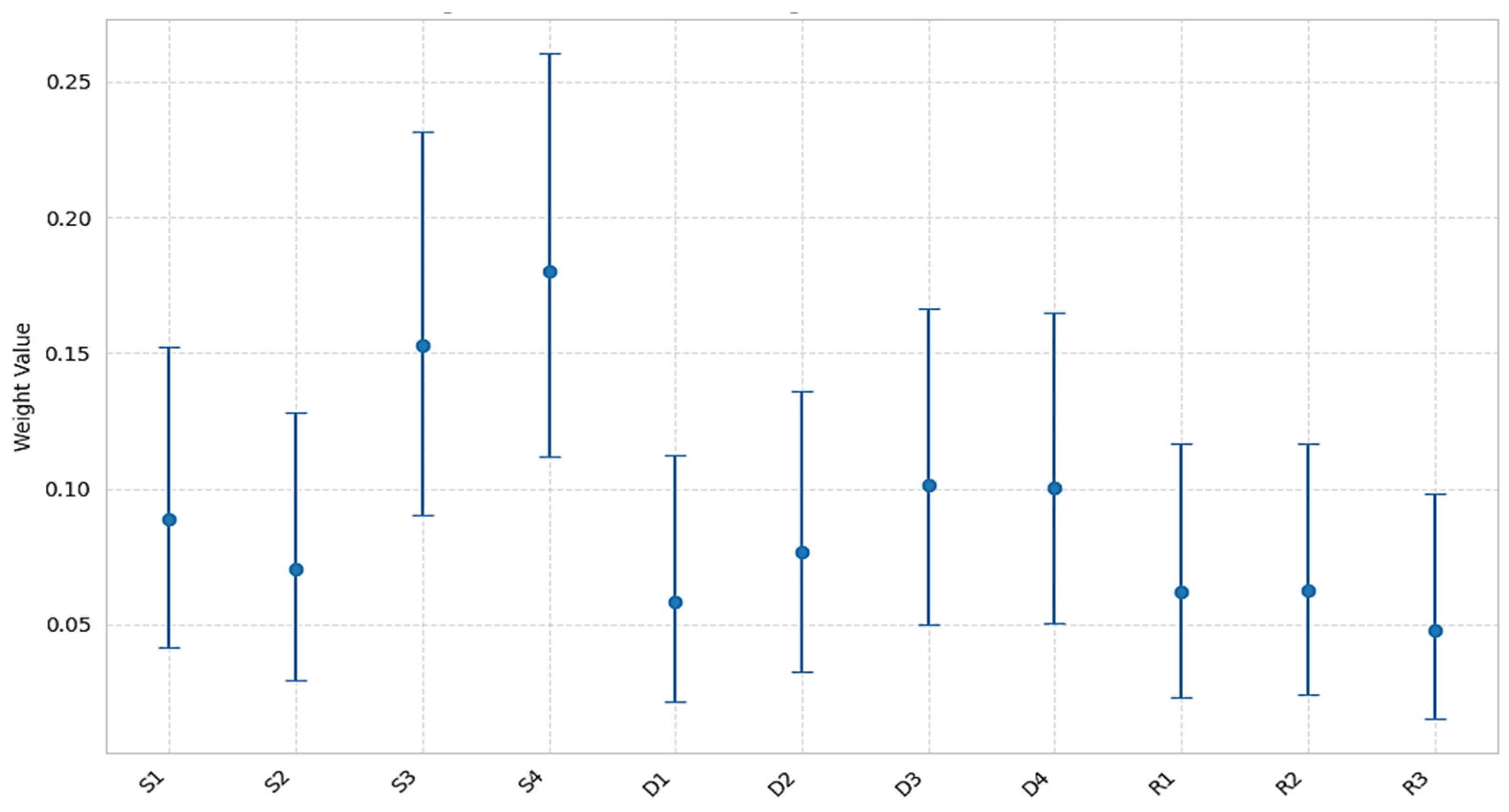
Table 11 and Figure 9 reveal insights into the importance and stability of the indicator weights. ‘S4’ (water stress) showed the highest mean weight (0.1618), with a 95% confidence interval of [0.1148, 0.2146]. The national water-stress scores (S4) were derived by averaging the baseline/projected 2030 values from WRI Aqueduct 4.0. This indicates that water stress was highly influential, suggesting its critical role in the MENA region’s energy transition to green hydrogen. After reviewing several hydrogen studies, we note that desalination energy costs are negligible in the overall LCOH calculation; specifically, LCOW from large-scale reverse osmosis desalination is around 2 Euro/m3. With a practical water consumption of ~20 L per kg of hydrogen (including losses and cooling), this translates to only ~0.04 Euro/kg of hydrogen—a very minor fraction (<1–2%) compared to the dominant electricity cost component in the LCOH (typically 50–75% of the total). This negligible impact is reported in similar studies. In addition, LCOW is almost the same in selected countries for large-scale RO plants thanks to the low energy costs in FFED, especially in the MENA region.
Other indicators report varying degrees of mean weight and confidence intervals, providing a clear understanding of their contributions and reliability.
Table 11 provides the mean weights (combined base) and their 95% confidence intervals (2.5th and 97.5th percentiles) derived from 5000 Dirichlet-based simulations. In Figure 9, the Dirichlet-based weight intervals are visually represented with error bars around the mean weights.
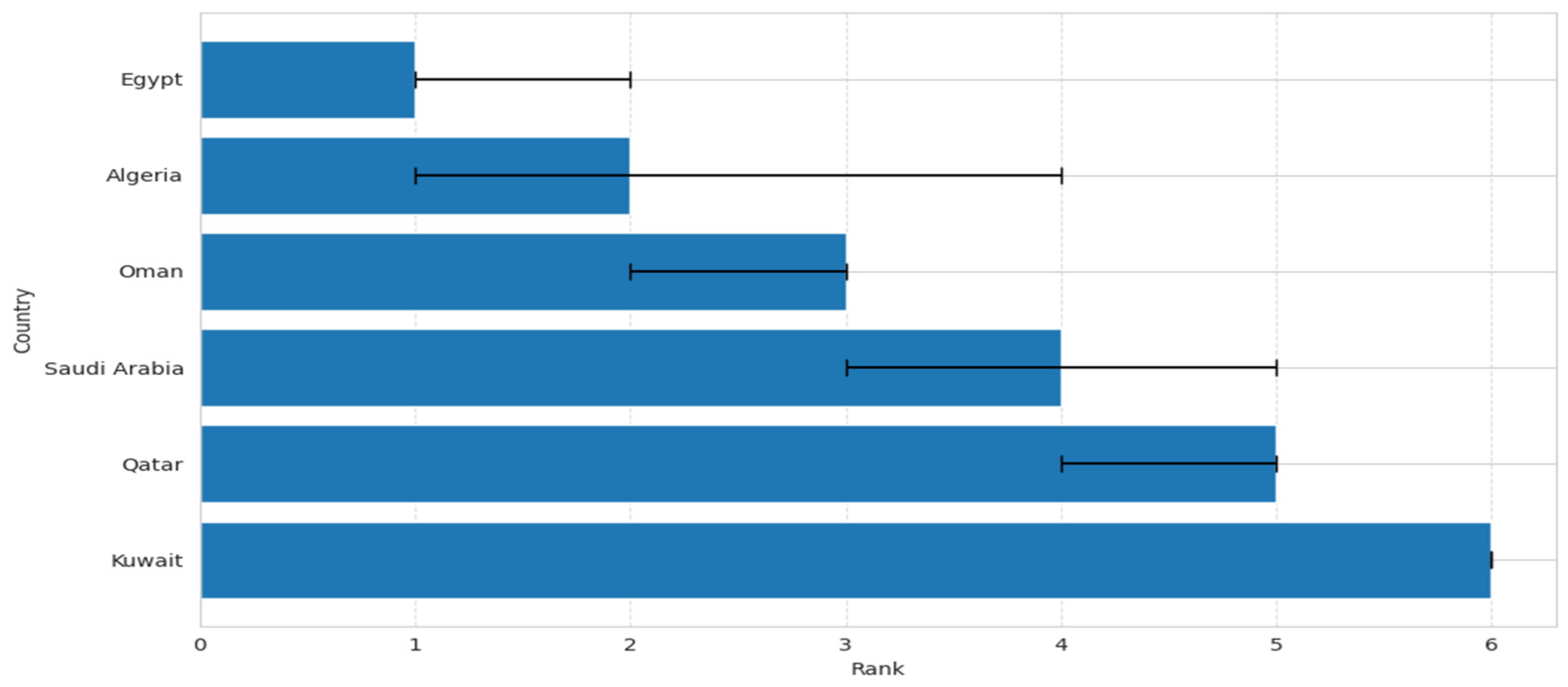
Table 12 discusses the main scores, their standard deviations, and the rank stability (min/max ranks) for each country; this identifies the countries with more stable or variable ranks—refer to Figure 10 for a visual representation of scores and uncertainty. Egypt (score: 0.5177), Algeria (score: 0.4819), and Oman (score: 0.4789) are the top three performers, indicating they are the most suitable countries for hydrogen production and export based on the combined base weights. Kuwait (score: 0.2929) is the lowest-ranked country, followed by Qatar (score: 0.3517) and Saudi Arabia (score: 0.3983). These countries appear less suitable under the current criteria and weighting scheme.
The ‘Score_Std’ column represents the standard deviation uncertainty. Algeria reported the highest score (0.02635), indicating its score is slightly more sensitive to changes compared to others. Kuwait has the lowest standard deviation (0.01233), implying its score is quite stable, although it is also the lowest score. Egypt, despite being ranked 1, shows a range from 1 to 2, meaning that, in some simulations, another country (likely Algeria or Oman) could briefly surpass it (Figure 10). Algeria has the widest rank range, from 1 to 4, indicating that while its main rank is 2, it could potentially move up to first place or drop down to fourth, highlighting a greater sensitivity to weight changes than the other top countries.
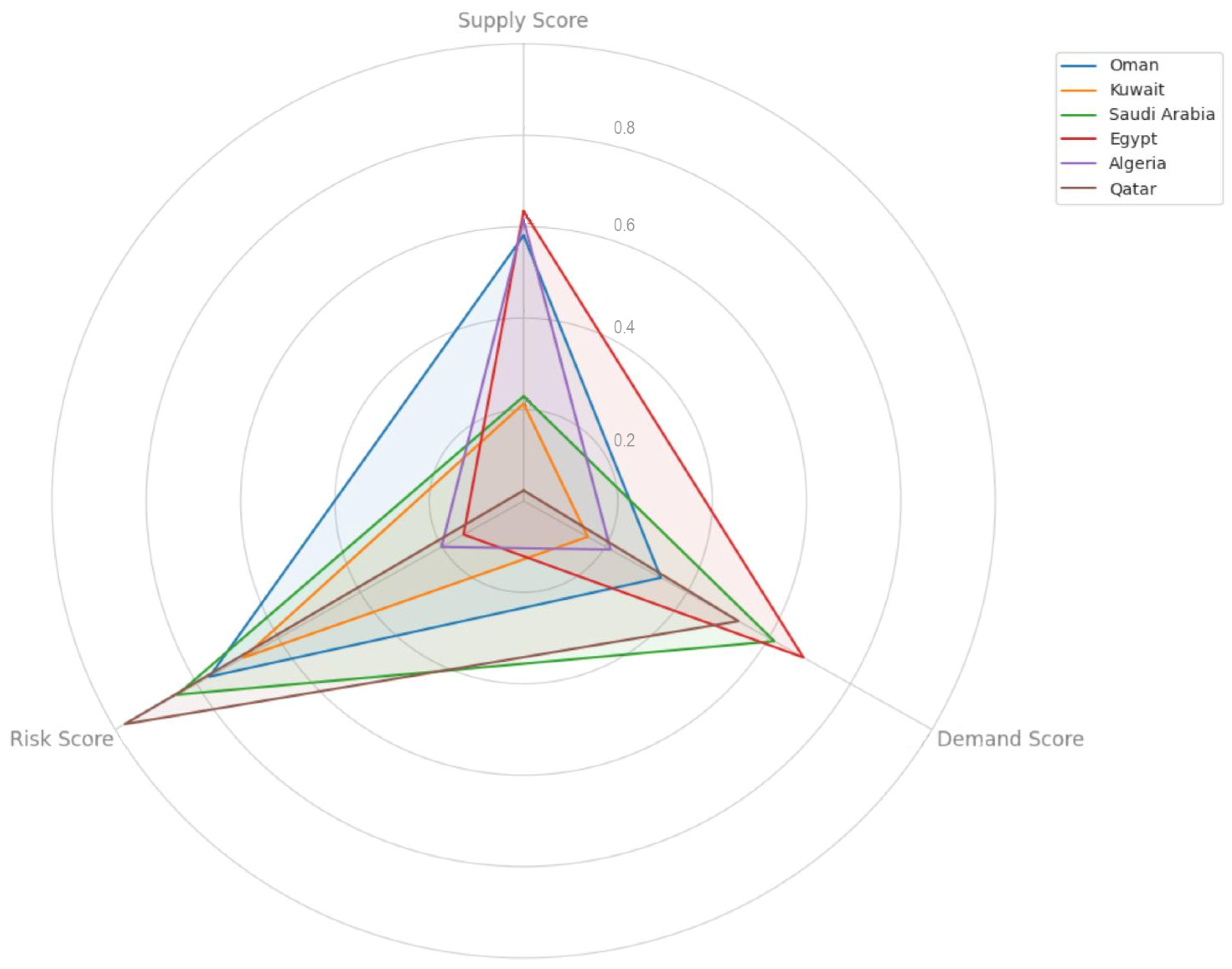
Table 13 discusses selected countries’ scores in supply, demand, and risk. Oman has a strong risk rating of 0.769 and a good supply rating of 0.581, but a low demand rating of 0.336. It is then considered moderately reliable in green hydrogen production, but has a small domestic market. Kuwait’s supply (0.213) and demand scores (0.157) are both very low, with a moderate risk score (0.686).
As shown in Figure 11, Kuwait’s supply capacity and domestic demand for green hydrogen results are found to be significantly limited, although quite stable through the risk profile.
Saudi Arabia has a strong risk profile, with an outstanding rating of 0.848 and a good demand score (0.614); however, its supply score is low (0.229), which implies that while the country has a highly favorable risk profile and a robust demand for green hydrogen, there are limitations in producing large quantities of green hydrogen. Egypt has very high supply (0.634) and demand (0.685) levels, indicating a strong ability to produce and consume green hydrogen. However, its risk score is the lowest at 0.147, suggesting significant political, regulatory, and/or investment risks that could limit project development. Similar to Egypt, Algeria has strong supply potential (supply score = 0.614) but has low demand (0.213) and risk (0.201) levels. This means that Algeria has a lot of resources and infrastructure but has not yet developed a significant domestic demand for green hydrogen, and is facing relatively high operational risks due to lower governance indicators, especially in government effectiveness and regulatory quality. Qatar has a unique profile; it has a very high-risk score (0.977), a good demand score (0.526), and a low supply score (0.023), demonstrating a very stable and attractive risk environment and a moderate level of domestic demand but very limited supply potential.
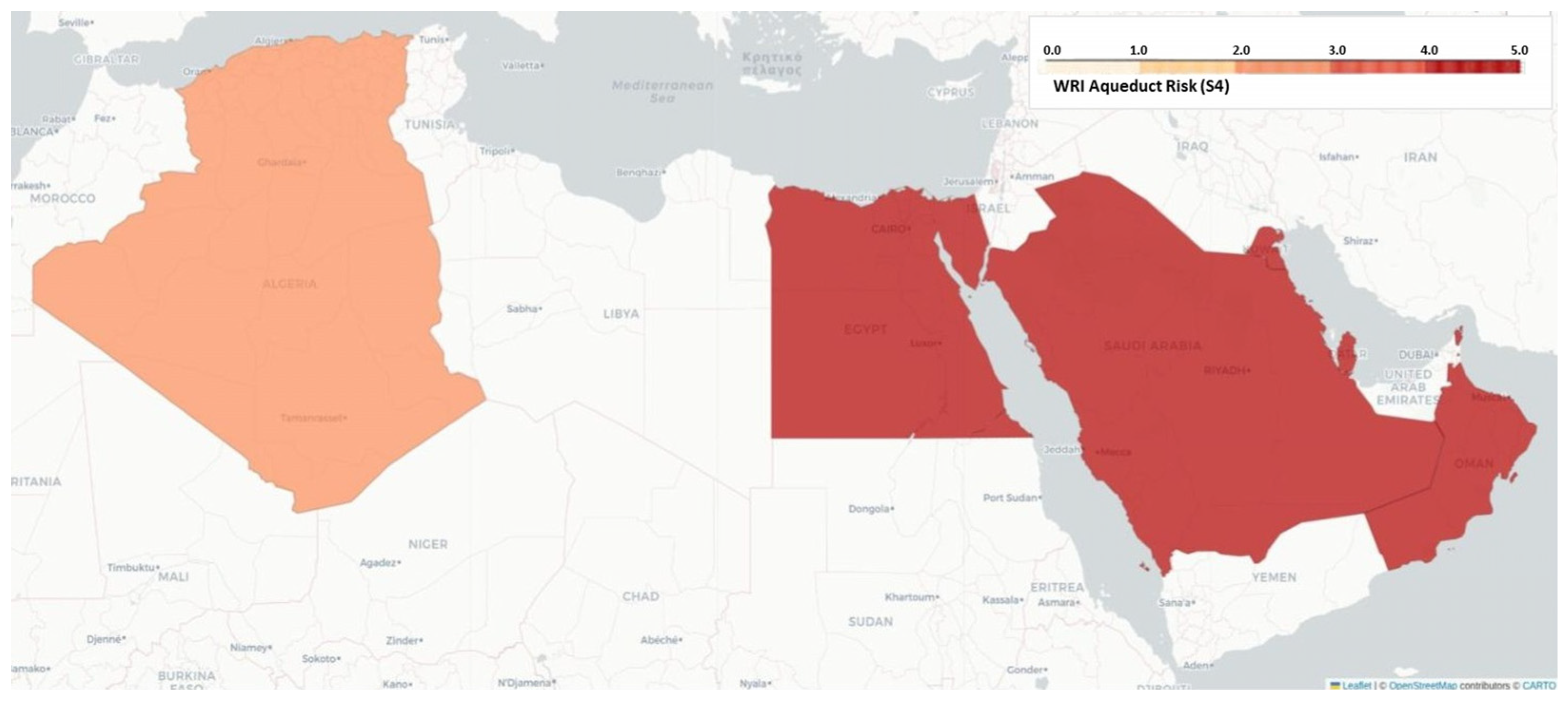
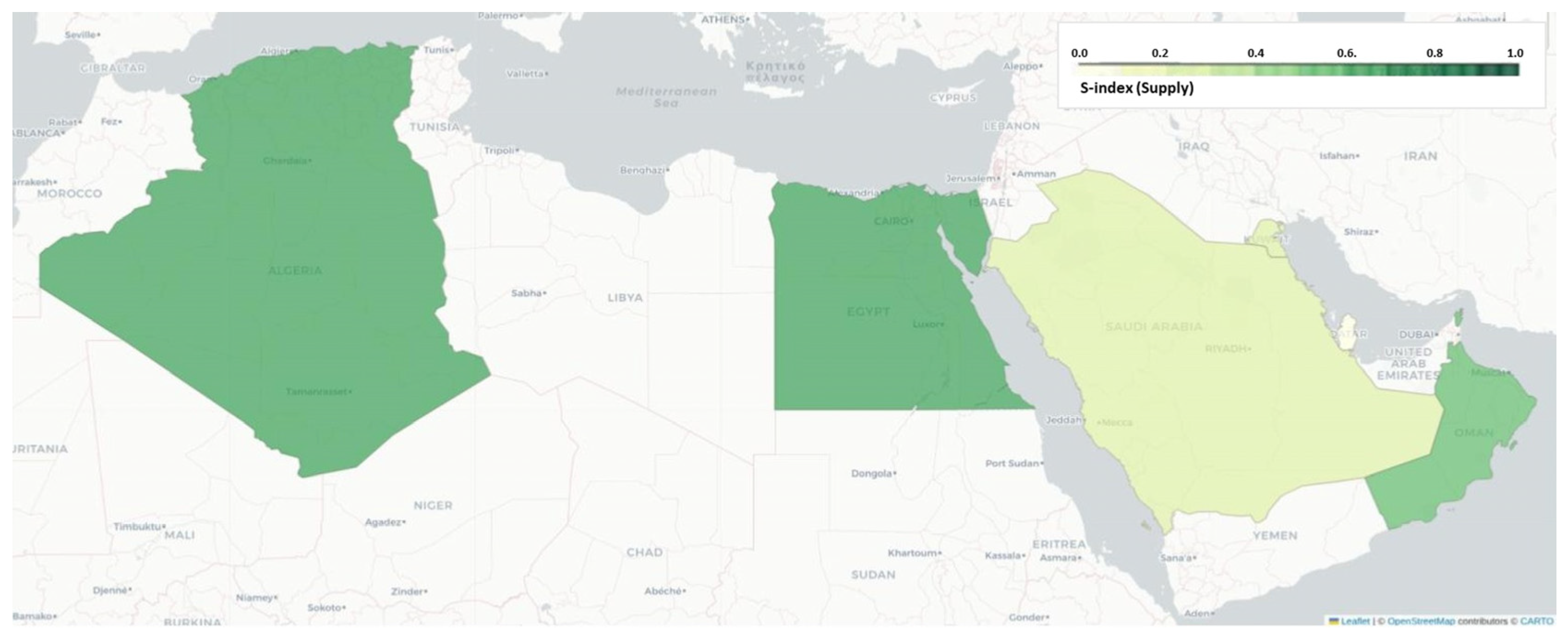
Figure 12 and Figure 13 provide an interactive geographical visualization of ‘Aqueduct Stress’ and ‘S-Index (Supply)’ across the selected countries. Egypt and Algeria display darker green shades, indicating the highest supply score. This suggests strong potential or favorable conditions for hydrogen supply in these two countries. Most countries in the study—like Oman, Saudi Arabia, Egypt, and Qatar—are shown in dark red, meaning they are expected to face extremely high-water stress by 2030. Given that all of the analyzed countries are located in arid or desert environments, Kuwait is still under serious stress but slightly less so than its neighbors, with a lower score. Algeria stands out as the least stressed, shown in light red, mainly because it has large fossil groundwater reserves in the Sahara that are not heavily used yet, giving it an advantage that the other countries do not have. Robustness is a necessary standard for any composite index to ensure that the final ranking is stable and not simply determined by subjective choices in weightings or only slight error in the input data. The Dirichlet sampling method has been used to test this stability. The Dirichlet sampling simulation (5000 runs) was performed, where each individual weight was sampled from a uniform distribution within a 20% interval of its original value.
The ultimate measure of the index’s structural stability is Spearman’s Rank Correlation (ρ) across all the weight perturbations (both Dirichlet and the ±20% OAT tests). Spearman’s ρ is calculated for the ranks of every country pair across all 5000 simulations.
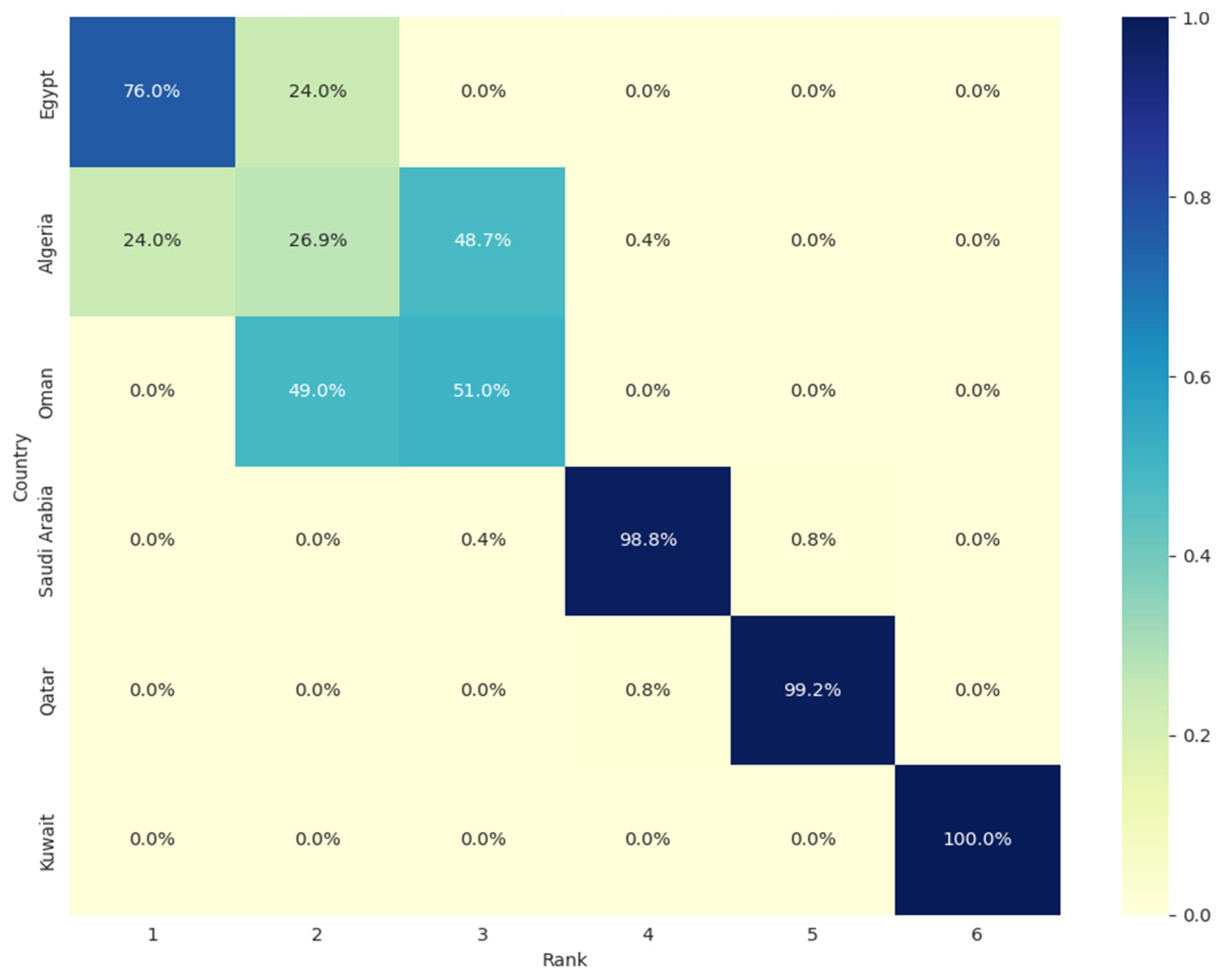
Figure 14 summarizes the percentages of times each country achieved a particular rank across 5000 sensitivity simulations. The sensitivity heatmap reveals that while some countries like Kuwait, Qatar, and Saudi Arabia maintain relatively stable positions (especially at the lower ranks), countries like Oman and Algeria exhibit higher rank variability, suggesting that their final ranking is more sensitive to the precise weight distribution used in the MCDA model. Egypt maintains a strong but not absolute lead.

9. Conclusions

Green hydrogen can play a pivotal role in FFED countries’ decarbonization process if properly supported by technology advancements and governmental investments. Many challenges still need to be solved to make green hydrogen affordable and effective. Current production costs are from 3 to 8 USD/kg, compared to 1–3 USD/kg for blue or gray hydrogen. New materials can accelerate hydrogen production, scaling up the technology and enhancing electrolyzer performance to reduce the cost of green HY to 1–2 USD/kg by 2050. Moreover, by linking hydrogen production with traditional renewable energy like solar, which represents more than 90% of the MENA region’s renewable potential, the fluctuations in energy supply can be addressed, enhancing energy network reliability and cost-effectiveness.
Furthermore, this research study underscores that green hydrogen, derived from renewable-powered electrolysis, offers a zero-emission alternative capable of decarbonizing sectors such as transportation, industry, and power generation, providing a strategic opportunity to nations with high potential of REN, such as the African region, to redefine their roles in global energy markets. On the other hand, the HY’s great versatility has been evidenced by its applications in microgrids and fuel cells, alongside the advancements in storage methods using ammonia and compressed gas. Moreover, hydrogen has been demonstrated to be especially promising for sectors like steel and cement, where electrification is not straightforward. Additionally, the implementation of a green hydrogen supply chain will have a beneficial impact in developing countries’ economies by creating new employment opportunities and ensuring long-term energy sustainability. In line with that, the SWOT analysis reinforces this duality: strengths in established technologies and renewable integration are tempered by weaknesses in cost and efficiency, yet opportunities for decarbonization and circular economy innovations outweigh threats posed by competing technologies and geopolitical uncertainties. Building out hydrogen infrastructure will require substantial investment, particularly for storage and transport. Hydrogen is challenging because it is not as energy-dense, and it is flammable, so new safe methods to store it need to be tested—such as in liquid form or in emerging solid-state technologies and liquid organic hydrogen carriers (LOHCs)—to transport hydrogen safely across the globe. Successfully achieving all of this is crucial for meeting the future demand for green hydrogen and for meeting the ambitious sustainable targets established for 2050.
The results of the MCDA identify Egypt as the most suitable MENA FFED country for large-scale green hydrogen and green ammonia production and export (composite score 0.52), followed by Algeria (0.82). Oman, Saudi Arabia, Qatar, and Kuwait rank considerably lower (0.35–0.29), mainly because of higher water-stress risks. The entire analysis—including raw data, normalization procedures, AHP–entropy weighting, scenario definitions, sensitivity tests, Dirichlet simulations (5000 iterations), and all figures—is fully transparent, replicable, and openly available at the Zenodo repository [101].

Author Contributions

Conceptualization, A.B. and L.M.; methodology, L.M.; validation, L.M.; formal analysis, A.B., L.M. and M.A.-O.; investigation, A.B. and L.M.; writing—original draft preparation, A.B. and L.M.; writing—review and editing, L.M., M.A.-O. and P.S.; visualization, L.M., M.A.-O. and P.S.; supervision L.M., M.A.-O. and P.S. All authors have read and agreed to the published version of the manuscript.

Funding

The research has been developed in the framework of the project PAID-06-25, financed by the Vice-Rectorate for Research of the Universitat Politècnica de València.

Institutional Review Board Statement

Not applicable.

Informed Consent Statement

Not applicable.

Data Availability Statement

Research Data are openly available at the Zenodo repository [97].

Conflicts of Interest

The authors declare no conflicts of interest.

Nomenclature

AHP Analytic Hierarchy Process
BAU Business as Usual
CAPEX Capital Expenditure
CCS Carbon capture and storage
CCUS Carbon capture, utilization, and storage
CF Capacity factor
CO2 Carbon dioxide equivalent
CR Consistency ratio
CSP Concentrated solar power
DH District heating
DNI Direct Normal Irradiance
EU European Union
FFED Fossil-fuel export-dependent
GHI Global Horizontal Irradiance
GHG Greenhouse gas
GSA Global Solar Atlas
GWA Global Wind Atlas
IEA International Energy Agency
IRENA International Renewable Energy Agency
LCOE Levelized cost of electricity
LCOH Levelized cost of hydrogen
LNG Liquefied Natural Gas
LOHC Liquid organic hydrogen carrier
LPI Logistics Performance Index
MCDA Multi-criteria decision analysis
MENA Middle East and North Africa
NDC Nationally Determined Contribution
NG Natural gas
OPEX Operational expenditure
PEM Proton-exchange membrane
PESTEL Political, Economic, Social, Technological, Environmental, Legal
PV Photovoltaic
RES Renewable energy
RFNBO Renewable Fuels of Non-Biological Origin
SIAM Social Impact Assessment Matrix
SWOT Strengths, Weaknesses, Opportunities, Threats
WACC Weighted average cost of capital
WGI Worldwide Governance Indicators
WRI World Resources Institute
ZERO-H Net-Zero Emissions Scenario with Clean Hydrogen
ZERO-NH Net-Zero Emissions Scenario without Hydrogen

References

  1. Mevawala, C.; Autrey, T.; Brooks, K.; Bowden, M.; Müller, K. 1,4-Butanediol as a Hydrogen Carrier: Liquid- versus Gas-Phase Dehydrogenation. Energy Fuels 2022, 37, 560–566. [Google Scholar] [CrossRef]
  2. Dominic, A.; Zenner, T.; Winter, M.; Schullerus, G. A Coalition Framework for Increasing Market Participation of Electrolysers and Renewable Energy Sources. In 2025 21st International Conference on the European Energy Market (EEM); IEEE: Piscataway, NJ, USA, 2025; pp. 1–6. [Google Scholar] [CrossRef]
  3. Scarpati, G.; Frasci, E.; Di Ilio, G.; Jannelli, E. A comprehensive review on metal hydrides-based hydrogen storage systems for mobile applications. J. Energy Storage 2024, 102, 113934. [Google Scholar] [CrossRef]
  4. Karabatsos, G. A Dirichlet process functional approach to heteroscedastic-consistent covariance estimation. Int. J. Approx. Reason. 2016, 78, 210–222. [Google Scholar] [CrossRef]
  5. Fischedick, M.; Holtz, G.; Fink, T.; Amroune, S.; Wehinger, F. A phase model for the low-carbon transformation of energy systems in the MENA region. Energy Transit. 2020, 4, 127–139. [Google Scholar] [CrossRef]
  6. Martin, P.; Ocko, I.B.; Esquivel-Elizondo, S.; Kupers, R.; Cebon, D.; Baxter, T.; Hamburg, S.P. A review of challenges with using the natural gas system for hydrogen. Energy Sci. Eng. 2024, 12, 3995–4009. [Google Scholar] [CrossRef]
  7. Hamed, A.M.; Kamaruddin, T.; Ramli, N.; Abdul-Wahab, M.F. A review on blue and green hydrogen production process and their life cycle assessments. IOP Conf. Ser. Earth Environ. Sci. 2023, 1281, 012034. [Google Scholar] [CrossRef]
  8. Montuori, L.; Alcázar-Ortega, M.; Díaz-Bello, D.; Vargas-Salgado, C. Towards the decarbonization of the maritime industry: Design of a novel methodology for the sustainable strategy assessment. Sustain. Energy Technol. Assess. 2025, 83, 104632. [Google Scholar] [CrossRef]
  9. Nyangon, J.; Darekar, A. Advancements in hydrogen energy systems: A review of levelized costs, financial incentives and technological innovations. Innov. Green Dev. 2024, 3, 100149. [Google Scholar] [CrossRef]
  10. Sun, H.; Wang, Z.; Meng, Q.; White, S. Advancements in hydrogen storage technologies: Enhancing efficiency, safety, and economic viability for sustainable energy transition. Int. J. Hydrogen Energy 2025, 105, 10–22. [Google Scholar] [CrossRef]
  11. Benchenina, Y.; Zemmit, A.; Bouzaki, M.M.; Loukriz, A.; Elsayed, S.K.; Alzaed, A.; Ali, G.; Ghoneim, S.S.M. Advancing green hydrogen production in Algeria with opportunities and challenges for future directions. Sci. Rep. 2025, 15, 5559. [Google Scholar] [CrossRef] [PubMed]
  12. IEA. Algeria—Countries & Regions—IEA. Available online: https://www.iea.org/countries/algeria (accessed on 1 November 2025).
  13. Galich, A.; Marz, L. Alternative energy technologies as a cultural endeavor: A case study of hydrogen and fuel cell development in Germany. Energy Sustain. Soc. 2012, 2, 2. [Google Scholar] [CrossRef]
  14. Abdechafik, E.h.; Ait Ousaleh, H.; Mehmood, S.; Filali Baba, Y.; Bürger, I.; Linder, M.; Faik, A. An analytical review of recent advancements on solid-state hydrogen storage. Int. J. Hydrogen Energy 2023, 52, 1182–1193. [Google Scholar] [CrossRef]
  15. Nikolakakos, C.; Mushtaq, U.; Cvetkovic, M. An Integrated Control System for Frequency and Voltage Support via Type-3 Wind Turbines equipped with Energy Storage System. In Proceedings of the 2020 IEEE Power & Energy Society General Meeting (PESGM), Montreal, QC, Canada, 2–6 August 2020; pp. 1–5. [Google Scholar] [CrossRef]
  16. Mulky, L.; Srivastava, S.; Lakshmi, T.; Sandadi, E.R.; Gour, S.; Thomas, N.A.; Shanmuga Priya, S.; Sudhakar, K. An overview of hydrogen storage technologies—Key challenges and opportunities. Mater. Chem. Phys. 2024, 325, 129710. [Google Scholar] [CrossRef]
  17. Márquez-Barja, J.; Calafate, C.T.; Cano, J.-C.; Manzoni, P. An overview of vertical handover techniques: Algorithms, protocols and tools. Comput. Commun. 2011, 34, 985–997. [Google Scholar] [CrossRef]
  18. Annual Production Steel Data. worldsteel.org. Available online: https://worldsteel.org/data/annual-production-steel-data/?ind=P1_crude_steel_total_pub/CHN/IND (accessed on 1 November 2025).
  19. Boudghene Stambouli, A.; Kitamura, Y.; Benmessaoud, M.T.; Yassaa, N. Algeria’s journey towards a green hydrogen future: Strategies for renewable energy integration and climate commitments. Int. J. Hydrogen Energy 2024, 58, 753–763. [Google Scholar] [CrossRef]
  20. Ramík, J. Applications in Practical Decision-Making Methods: PROMETHEE and TOPSIS. In Pairwise Comparisons Method; Lecture Notes in Economics and Mathematical Systems; Springer: Cham, Switzerland, 2020; pp. 213–228. [Google Scholar] [CrossRef]
  21. Kuzma, S.; Bierkens, M.F.; Anush Lakshman, S.; Luo, T.; Saccoccia, L.; Sutanudjaja, E.H.; van Beek, R. Aqueduct 4.0: Updated Decision-Relevant Global Water Risk Indicators; World Resources Institute: Washington, DC, USA, 2023. [Google Scholar] [CrossRef]
  22. Ghorbani, N.; Aghahosseini, A.; Breyer, C. Assessment of a cost-optimal power system fully based on renewable energy for Iran by 2050—Achieving zero greenhouse gas emissions and overcoming the water crisis. Renew. Energy 2020, 146, 125–148. [Google Scholar] [CrossRef]
  23. Ourya, I.; Nabil, N.; Abderafi, S.; Boutammachte, N.; Rachidi, S. Assessment of green hydrogen production in Morocco, using hybrid renewable sources (PV and wind). Int. J. Hydrogen Energy 2023, 48, 37428–37442. [Google Scholar] [CrossRef]
  24. Staples, M.D.; Malina, R.; Suresh, P.; Hileman, J.I.; Barrett, S.R.H. Aviation CO2 emissions reductions from the use of alternative jet fuels. Energy Policy 2018, 114, 342–354. [Google Scholar] [CrossRef]
  25. Alsayegh, O.A. Barriers facing the transition toward sustainable energy system in Kuwait. Energy Strategy Rev. 2021, 38, 100779. [Google Scholar] [CrossRef]
  26. Rüde, T.; Dürr, S.; Preuster, P.; Wolf, M.; Wasserscheid, P. Benzyltoluene/perhydro benzyltoluene—Pushing the performance limits of pure hydrocarbon liquid organic hydrogen carrier (LOHC) systems. Sustain. Energy Fuels 2022, 6, 1541–1553. [Google Scholar] [CrossRef]
  27. Liu, S.; Meyer, Q.; Xu, D.; Cheng, Y.; Osmieri, L.; Li, X.-H.; Zhao, C. Breaking the Activity and Stability Trade-Off of Platinum-Free Catalysts for the Oxygen Reduction Reaction in Hydrogen Fuel Cells. ACS Nano 2025, 19, 19524–19551. [Google Scholar] [CrossRef]
  28. Kong, C.; Zhang, J.; Ntarmah, A.H.; Kong, Y.; Zhao, H. Carbon Neutrality in the Middle East and North Africa: The Roles of Renewable Energy, Economic Growth, and Government Effectiveness. Int. J. Environ. Res. Public Health 2022, 19, 10676. [Google Scholar] [CrossRef]
  29. CCUS-Enabled Hydrogen Production Report Written by CCUS-Enabled Hydrogen Production Working Group. 2023. Available online: https://hydrogen-uk.org/wp-content/uploads/2023/09/HUK-CCUS-Enabled-Hydrogen-Production.pdf (accessed on 1 November 2025).
  30. Rondón-Cordero, V.H.; Montuori, L.; Alcázar-Ortega, M.; Siano, P. Advancements in hybrid and ensemble ML models for energy consumption forecasting: Results and challenges of their applications. Renew. Sustain. Energy Rev. 2025, 224, 116095. [Google Scholar] [CrossRef]
  31. Jayachandran, M.; Gatla, R.K.; Flah, A.; Milyani, A.H.; Milyani, H.M.; Blazek, V.; Prokop, L.; Kraiem, H. Challenges and Opportunities in Green Hydrogen Adoption for Decarbonizing Hard-to-Abate Industries: A Comprehensive Review. IEEE Access 2024, 12, 23363–23388. [Google Scholar] [CrossRef]
  32. Xue, C.; Shahbaz, M.; Ahmed, Z.; Ahmad, M.; Sinha, A. Clean energy consumption, economic growth, and environmental sustainability: What is the role of economic policy uncertainty? Renew. Energy 2021, 184, 899–907. [Google Scholar] [CrossRef]
  33. Zun, M.T.; McLellan, B.C. Cost Projection of Global Green Hydrogen Production Scenarios. Hydrogen 2023, 4, 932–960. [Google Scholar] [CrossRef]
  34. Terrapon-Pfaff, J.; Ersoy, S.R.; Prantner, M.; Viebahn, P. Country risks analysis for the development of green hydrogen and synthetic fuel sectors in the MENA region. Front. Energy Res. 2024, 12, 1466381. [Google Scholar] [CrossRef]
  35. Greenwald, J.E.; Zhao, M.; Wicks, D.A. Critical mineral demands may limit scaling of green hydrogen production. Front. Geochem. 2024, 1, 1328384. [Google Scholar] [CrossRef]
  36. Adjusted Net Savings|DataBank. databank.worldbank.org. Available online: https://databank.worldbank.org/source/adjusted-net-savings/Series/NY.GDP.TOTL.RT.ZS (accessed on 1 November 2025).
  37. The World Bank. DataBank|The World Bank. Worldbank.org. Available online: https://www.worldbank.org/en/publication/worldwide-governance-indicators/interactive-data-access (accessed on 1 November 2025).
  38. IEA. IEA—The Global Energy Authority. Iea.org. Available online: https://www.iea.org (accessed on 1 November 2025).
  39. Lee, Y.T.; Gautam, R.P.; Islam, S.M.; Barile, C.J. Cuprous Oxide Electrodeposited with Nickel for the Oxygen Evolution Reaction in 1 M NaOH. J. Phys. Chem. C 2018, 123, 1287–1292. [Google Scholar] [CrossRef]
  40. Uzun, B.; Taiwo, M.; Syidanova, A.; Uzun Ozsahin, D. The Technique For Order of Preference by Similarity to Ideal Solution (TOPSIS). In Application of Multi-Criteria Decision Analysis in Environmental and Civil Engineering; Springer: Cham, Switzerland, 2021; pp. 25–30. [Google Scholar] [CrossRef]
  41. Roszkowska, E. Entropy and Normalization in MCDA: A Data-Driven Perspective on Ranking Stability. Entropy 2026, 28, 114. [Google Scholar] [CrossRef]
  42. Saaty, T.L. A scaling method for priorities in hierarchical structures. J. Math. Psychol. 1977, 15, 234–281. [Google Scholar] [CrossRef]
  43. Global Solar Atlas. globalsolaratlas.info. Available online: https://globalsolaratlas.info/global-pv-potential-study (accessed on 1 November 2025).
  44. Global Solar Atlas. globalsolaratlas.info. Available online: https://globalsolaratlas.info/download/middle-east-and-north-africa (accessed on 1 November 2025).
  45. Szemat-Vielma, W.; Scheibz, J.; Kasraoui, N.; Al-Omar, F. Sun Powered Green Hydrogen—A Comparative Analysis from the Kingdoms of Morocco and Saudi Arabia. In Proceedings of the International Petroleum Technology Conference, Dhahran, Saudi Arabia, 12–14 February 2024. [Google Scholar] [CrossRef]
  46. Global Wind Atlas. Available online: https://globalwindatlas.info (accessed on 1 November 2025).
  47. Griffin, B.J.; Kohfeld, K.E.; Cooper, A.B.; Boenisch, G. Importance of location for describing typical and extreme wind speed behavior. Geophys. Res. Lett. 2010, 37. [Google Scholar] [CrossRef]
  48. Archer, C.L. Evaluation of global wind power. J. Geophys. Res. 2005, 110. [Google Scholar] [CrossRef]
  49. Ahshan, R. Potential and Economic Analysis of Solar-to-Hydrogen Production in the Sultanate of Oman. Sustainability 2021, 13, 9516. [Google Scholar] [CrossRef]
  50. Santangeli, A.; Di Minin, E.; Toivonen, T.; Pogson, M.; Hastings, A.; Smith, P.; Moilanen, A. Synergies and trade-offs between renewable energy expansion and biodiversity conservation—A cross-national multifactor analysis. GCB Bioenergy 2016, 8, 1191–1200. [Google Scholar] [CrossRef]
  51. IRENA. Renewable Power Generation Costs in 2024; International Renewable Energy Agency: Abu Dhabi, United Arab Emirates, 2025; Available online: https://www.irena.org/-/media/Files/IRENA/Agency/Publication/2025/Jul/IRENA_TEC_RPGC_in_2024_2025.pdf (accessed on 1 November 2025).
  52. IEA. Egypt—Countries & Regions. Available online: https://www.iea.org/countries/egypt (accessed on 1 November 2025).
  53. IEA. Kuwait—Countries & Regions. Available online: https://www.iea.org/countries/kuwait (accessed on 1 November 2025).
  54. Al-Shidhani, M.A.; Hayyan, M. Oman’s energy transition roadmap to net zero 2050. Energy Nexus 2025, 19, 100493. [Google Scholar] [CrossRef]
  55. IEA. Oman—Countries & Regions—IEA. Available online: https://www.iea.org/countries/oman (accessed on 1 November 2025).
  56. IEA. Qatar—Countries & Regions. Available online: https://www.iea.org/countries/Qatar (accessed on 1 November 2025).
  57. Hydrogen as a Catalyst for Emissions Reduction in Qatar. Middle East Council on Global Affairs. Available online: https://mecouncil.org/publication_chapters/hydrogen-as-a-catalyst-for-emissions-reduction-in-qatar/ (accessed on 1 November 2025).
  58. IEA. IEA Saudi Arabia—Countries & Regions. Available online: https://www.iea.org/countries/saudi-arabia (accessed on 1 November 2025).
  59. Islam, M.T.; Ali, A. Sustainable green energy transition in Saudi Arabia: Characterizing policy framework, interrelations and future research directions. Next Energy 2024, 5, 100161. [Google Scholar] [CrossRef]
  60. Dependency on Fossil Fuels and the Road to Clean Energy., Fossil Fuel Map. Available online: https://www.fossilfuelmap.com (accessed on 1 November 2025).
  61. Bridgeland, R.; Chapman, A.; McLellan, B.; Sofronis, P.; Fujii, Y. Challenges toward achieving a successful hydrogen economy in the US: Potential end-use and infrastructure analysis to the year 2100. Clean. Prod. Lett. 2022, 3, 100012. [Google Scholar] [CrossRef]
  62. Shi, X.; Qian, Y.; Yang, S. Fluctuation Analysis of a Complementary Wind–Solar Energy System and Integration for Large Scale Hydrogen Production. ACS Sustain. Chem. Eng. 2020, 8, 7097–7110. [Google Scholar] [CrossRef]
  63. Ueckerdt, F.; Verpoort, P.; Anantharaman, R.; Bauer, C.; Beck, F.J.; Longden, T.; Roussanaly, S. On the cost competitiveness of blue and green hydrogen. Preprint 2022. [Google Scholar] [CrossRef]
  64. Walter, V.; Göransson, L.; Taljegard, M.; Öberg, S.; Odenberger, M. Low-cost hydrogen in the future European electricity system—Enabled by flexibility in time and space. Appl. Energy 2023, 330, 120315. [Google Scholar] [CrossRef]
  65. Foslie, S.S.; Straus, J.; Korpås, M. Green or blue? Enabling industrial decarbonization and demand response with hydrogen for high temperature process heating. In 2023 19th International Conference on the European Energy Market (EEM); IEEE: Piscataway, NJ, USA, 2023. [Google Scholar] [CrossRef]
  66. Newborough, M.; Cooley, G. Developments in the global hydrogen market: The spectrum of hydrogen colours. Fuel Cells Bull. 2020, 2020, 16–22. [Google Scholar] [CrossRef]
  67. Akhtar, M.S.; Dickson, R.; Liu, J.J. Life Cycle Assessment of Inland Green Hydrogen Supply Chain Networks with Current Challenges and Future Prospects. ACS Sustain. Chem. Eng. 2021, 9, 17152–17163. [Google Scholar] [CrossRef]
  68. Deng, W.; Huang, C.; Li, X.; Zhang, H.; Dai, Y. Dynamic Simulation Analysis and Optimization of Green Ammonia Production Process under Transition State. Processes 2022, 10, 2143. [Google Scholar] [CrossRef]
  69. Zheng, C.; Guan, B.; Guo, J.; Su, T.; Zhou, J.; Chen, J.; Zhang, Y.; Yuan, Y.; Xie, W.; Zhou, N.; et al. Research Status, Optimization Strategies, and Future Prospects of Ammonia Decomposition Catalysts for COx-Free Hydrogen. Ind. Eng. Chem. Res. 2023, 62, 11305–11336. [Google Scholar] [CrossRef]
  70. Amirthan, T.; Perera, M.S.A. The role of storage systems in hydrogen economy: A review. J. Nat. Gas Sci. Eng. 2022, 108, 104843. [Google Scholar] [CrossRef]
  71. Aziz, M. Liquid Hydrogen: A Review on Liquefaction, Storage, Transportation, and Safety. Energies 2021, 14, 5917. [Google Scholar] [CrossRef]
  72. Andersson, J.; Grönkvist, S. Large-scale storage of hydrogen. Int. J. Hydrogen Energy 2019, 44, 11901–11919. [Google Scholar] [CrossRef]
  73. Xu, Y.; Zhou, Y.; Li, Y.; Ding, Z. Research Progress and Application Prospects of Solid-State Hydrogen Storage Technology. Molecules 2024, 29, 1767. [Google Scholar] [CrossRef] [PubMed]
  74. Pepe, J.M. The Emerging Geopolitics of Hydrogen Value and Supply Chains: A Focus on EU’s Future Relations with the Eurasian Supercontinent. J. Int. Politics 2023, 28, 109–144. [Google Scholar] [CrossRef]
  75. Forouheshfar, Y.; El Mekkaoui, N.; d’Albis, H. Demographics in MENA Countries: A Major Driver for Economic Growth. Economist 2020, 168, 183–213. [Google Scholar] [CrossRef]
  76. Nnabuife, S.G.; Hamzat, A.K.; Whidborne, J.; Kuang, B.; Jenkins, K.W. Integration of renewable energy sources in tandem with electrolysis: A technology review for green hydrogen production. Int. J. Hydrogen Energy 2024, 107, 218–240. [Google Scholar] [CrossRef]
  77. Liu, F.; Shi, C.; Guo, X.; He, Z.; Pan, L.; Huang, Z.-F.; Zhang, X.; Zou, J.-J. Rational Design of Better Hydrogen Evolution Electrocatalysts for Water Splitting: A Review. Adv. Sci. 2022, 9, 2200307. [Google Scholar] [CrossRef]
  78. Karmaker, S.C.; Chapman, A.; Sen, K.K.; Hosan, S.; Saha, B.B. Renewable Energy Pathways toward Accelerating Hydrogen Fuel Production: Evidence from Global Hydrogen Modeling. Sustainability 2022, 15, 588. [Google Scholar] [CrossRef]
  79. Ramadan, M.; Piccinetti, L.; Saleh, H.M.; Salem, N.; Mokhtar, M.; Santoro, D.; El-Bary, A.A.; Sakr, M.M. Future scenarios of green hydrogen in the MENA countries: The case of Egypt. Insights Reg. Dev. 2023, 5, 92–114. [Google Scholar] [CrossRef]
  80. Keshminder, J.S.; Abdullah, M.S.; Mardi, M. Green sukuk—Malaysia surviving the bumpy road: Performance, challenges and reconciled issuance framework. Qual. Res. Financ. Mark. 2022, 14, 76–94. [Google Scholar] [CrossRef]
  81. Chentouf, M.; Allouch, M. Environmental energy security in the MENA region—An aggregated composite index. Environ. Dev. Sustain. 2022, 24, 10945–10974. [Google Scholar] [CrossRef]
  82. Al-Saidi, M. From Economic to Extrinsic Values of Sustainable Energy: Prestige, Neo-Rentierism, and Geopolitics of the Energy Transition in the Arabian Peninsula. Energies 2020, 13, 5545. [Google Scholar] [CrossRef]
  83. Le Billon, P.; Lujala, P.; Singh, D.; Culbert, V.; Kristoffersen, B. Fossil fuels, climate change, and the COVID-19 crisis: Pathways for a just and green post-pandemic recovery. Clim. Policy 2021, 21, 1347–1356. [Google Scholar] [CrossRef]
  84. Petitet, M.; Ricaud, B.; Felder, F.A.; Elshurafa, A.M. Cross-border electricity trading in the GCC countries, Egypt, Jordan and Iraq: Hourly market coupling or bilateral agreements? Energy 2025, 327, 136320. [Google Scholar] [CrossRef]
  85. Quitzow, R.; Bersalli, G.; Eicke, L.; Jahn, J.; Lilliestam, J.; Lira, F.; Marian, A.; Süsser, D.; Thapar, S.; Weko, S.; et al. The COVID-19 crisis deepens the gulf between leaders and laggards in the global energy transition. Energy Res. Soc. Sci. 2021, 74, 101981. [Google Scholar] [CrossRef] [PubMed]
  86. Mishra, S.; Manhas, N.S. Promoting Green Energy Transition Through G20. India Q. J. Int. Aff. 2023, 79, 552–563. [Google Scholar] [CrossRef]
  87. Diyali, N.; Chettri, M.; Saha, S.; Saha, A.; Kundu, S.; Mondal, D.; Dhak, D.; Biswas, B. Electrocatalytic hydrogen production activity with a copper(ii)-dipyridylamine complex in acidic water. CrystEngComm 2023, 25, 6837–6844. [Google Scholar] [CrossRef]
  88. Benato, A.; D’Alpaos, C.; Macor, A. Possible Ways of Extending the Biogas Plants Lifespan after the Feed-In Tariff Expiration. Energies 2022, 15, 8113. [Google Scholar] [CrossRef]
  89. Lai, J.-L.; Luo, W.-J.; Kuan, Y.-D.; Zhang, P.-J. The Effect of Hydrogen Production Rate of the via Different Preparation of Co-Based Catalyst with Sodium Borohydride. Catalysts 2021, 11, 528. [Google Scholar] [CrossRef]
  90. Akhmedov, E.; Mukashev, Y.; Akhmedov, A. The influence of COVID-19 on the transition to a more circular economy in oil-exporting countries. E3S Web Conf. 2023, 408, 01001. [Google Scholar] [CrossRef]
  91. Prontera, A.; Rubino, A. Greening energy governance through agencification in the Global South: Drivers and implications. Regul. Gov. 2024, 18, 460–478. [Google Scholar] [CrossRef]
  92. Vidican Auktor, G.; Loewe, M. Subsidy Reform and the Transformation of Social Contracts: The Cases of Egypt, Iran and Morocco. Soc. Sci. 2022, 11, 85. [Google Scholar] [CrossRef]
  93. Jalbout, E.; Genge, L.; Muesgens, F. H2Europe: An analysis of long-term hydrogen import-potentials from the MENA region. In 2022 18th International Conference on the European Energy Market (EEM); IEEE: Piscataway, NJ, USA, 2022. [Google Scholar] [CrossRef]
  94. Li, T.; Liu, P.; Li, Z. Impacts of Low-Carbon Targets and Hydrogen Production Alternatives on Energy Supply System Transition: An Infrastructure-Based Optimization Approach and a Case Study of China. Processes 2021, 9, 160. [Google Scholar] [CrossRef]
  95. Chepeliev, M.; McDougall, R.; van der Mensbrugghe, D. Including Fossil-fuel Consumption Subsidies in the GTAP Data Base. J. Glob. Econ. Anal. 2018, 3, 84–121. [Google Scholar] [CrossRef]
  96. Opricovic, S.; Tzeng, G.-H. Extended VIKOR method in comparison with outranking methods. Eur. J. Oper. Res. 2007, 178, 514–529. [Google Scholar] [CrossRef]
  97. World Bank Global Rankings 2023|Logistics Performance Index. Available online: https://lpi.worldbank.org/international/global (accessed on 1 November 2025).
  98. LSCI maritime connectivity, UNCTADstat Data Centre. Available online: https://unctadstat.unctad.org/datacentre/dataviewer/US.LSCI_M (accessed on 1 November 2025).
  99. The LNG Industry GIIGNL Annual Report 2025. Available online: https://files.elfsightcdn.com/eafe4a4d-3436-495d-b748-5bdce62d911d/5a159954-fafb-4af9-a613-dca88e2a1736/GIIGNL-Livre-2025-20250610.pdf (accessed on 1 November 2025).
  100. OECD. Handbook on Constructing Composite Indicators: Methodology and User Guide; OECD eBooks; Organization for Economic Cooperation and Development: Paris, France, 2008. [Google Scholar] [CrossRef]
  101. Benreguieg, H. Hafidbenr/hydrogen-mcda-analysis: MCDA for Assessing GH Suitability in MENA FFED Countries. Zenodo 2025. [Google Scholar] [CrossRef]
  102. Veenstra, A.; Mulder, M. Profitability of Hydrogen Production: Assessment of Investments in Electrolysers Under Various Market Circumstances. Appl. Energy 2024, 375, 124111. [Google Scholar] [CrossRef]
  103. Lee, D.; Kim, K. Research and Development Investment and Collaboration Framework for the Hydrogen Economy in South Korea. Sustainability 2021, 13, 10686. [Google Scholar] [CrossRef]
  104. Song, Y.; Mu, H.; Li, N.; Shi, X.; Zhao, X.; Chen, C.; Wang, H. Techno-economic analysis of a hybrid energy system for CCHP and hydrogen production based on solar energy. Int. J. Hydrogen Energy 2022, 47, 24533–24547. [Google Scholar] [CrossRef]
  105. Khaled, M.W.B.; Dahmani, M.; Youssef, A.B. Overcoming Barriers to Energy Transition in the MENA Region: New Institutional Dynamics. Preprints.org. Available online: https://www.preprints.org/manuscript/202402.1440 (accessed on 1 November 2025).
  106. Hejazi, M.; Santos, S.R.; Miralles-Wilhelm, F.; Kim, S.; Kyle, P.; Liu, Y.; Vernon, C.; Delgado, A.; Edmonds, J.; Clarke, L. Impacts of water scarcity on agricultural production and electricity generation in the Middle East and North Africa. Front. Environ. Sci. 2023, 11, 1082930. [Google Scholar] [CrossRef]
  107. Binsuwadan, J.; Yousif, G.; Abdulrahim, H.; Alofaysan, H. The Role of the Circular Economy in Fostering Sustainable Economic Growth in the GCC. Sustainability 2023, 15, 15926. [Google Scholar] [CrossRef]
  108. Belaid, F.; Boukrami, E.; Amine, R. Renewable Energy in the MENA Region: Key Challenges and Lessons Learned. In Advances in Managing Energy and Climate Risks; Lecture Notes in Energy; Springer: Cham, Switzerland, 2021; pp. 1–22. [Google Scholar] [CrossRef]
Figure 1. Annual water risk in the MENA region (data source: WRI Aqueduct 4.0 tool [21]).
Sustainability 18 02157 g001
Figure 2. Research methodology for assessing hydrogen adoption in MENA FFED countries.
Sustainability 18 02157 g002
Figure 3. Photovoltaic power-production potential in the MENA region [45].
Sustainability 18 02157 g003
Figure 4. Renewable energy mix potential in MENA countries, expressed in GW. Source: own elaboration from [43,46].
Sustainability 18 02157 g004
Figure 5. Worldwide map displaying fossil-fuel dependency. Source: own elaboration from [60].
Sustainability 18 02157 g005
Figure 6. Cost comparison of green hydrogen production methods. Source: own elaboration from [62,63].
Sustainability 18 02157 g006
Figure 7. Green hydrogen supply chain [67].
Sustainability 18 02157 g007
Figure 8. Methodology implemented to carry out the multi-criteria decision analysis.
Sustainability 18 02157 g008
Figure 9. Bootstrapped weight intervals (95% confidence). Source: Author’s dataset and open-access repository [101].
Sustainability 18 02157 g009
Figure 10. Ranking with uncertainty bars. Source: Author’s dataset and open-access repository [101].
Sustainability 18 02157 g010
Figure 11. Spider chart of sub-scores for the six MENA countries under analysis. Source: Author’s dataset and open-access repository [101].
Sustainability 18 02157 g011
Figure 12. Choropleth map of water-stress overlay, WRI Aqueduct Risk (S4). Source: own elaboration. Basemap: © OpenStreetMap contributors: ODbL; License: Creative Commons Attribution 4.0; Water-risk overlay: WRI Aqueduct 4.0. Source: Author’s dataset and open-access repository [101].
Sustainability 18 02157 g012
Figure 13. Choropleth map of S-index (hydrogen supply potential). Source: own elaboration. Basemap: © OpenStreetMap contributors: ODbL; License: Creative Commons Attribution 4.0; Water-risk overlay: WRI Aqueduct 4.0. Source: Author’s dataset and open-access repository [101].
Sustainability 18 02157 g013
Figure 14. Global sensitivity heatmap of rank variation and Spearman’s Rho from weight perturbations. Source: Author’s dataset and open-access repository [101].
Sustainability 18 02157 g014
Table 1. Identification of the multi-criteria decision analysis indicators.
IndicatorMCDA GroupDescription
S1, S2 (PVOUT, Wind)SupplyRenewable energy potential influencing supply cost and availability.
S3 (LCOE)SupplyCost of energy.
S4 (Water Stress)SupplyWater stress levels affecting resource availability (WRI Aqueduct).
D1 (LPI)DemandLogistics performance.
D2 (LSCI)DemandMaritime sector connectivity.
D3 (Steel Production)DemandRaw material availability.
D4 (LNG Export Capacity)DemandPotential for hydrogen export.
R1 (WGI Government Effectiveness)RiskPolitical stability and the government’s ability to commit to announced projects.
R2 (WGI Regulatory Quality)RiskCountry’s ability to comply with hydrogen project standards.
R3RiskCountry’s reliance on fossil fuels.
Table 2. Technical assumptions for renewable potential estimation in MENA countries.
ParameterSolar (PV) Wind (Onshore) Assumptions
Resource Input1800–2400 kWh/m2/year (GHI)4.5–9.0 m/s at 100 mBased on Global Solar and Wind Atlases [43,46]
Power Density200–250 MW/km210 MW/km2Solar ~20–25% CF on high GHI; wind 10 MW/km2 installed → 30–40% CF [51]
Usable Land Area1000 km2 (assumed net, excluding land-use constraints)1000 km2 (assumed net, excluding land-use constraints)Applied uniformly across selected countries
Capacity Factor20–25%30–40%IRENA reports [51]
Table 3. Comparative analysis among six selected MENA FFED countries.
CountryFFED 2023 Energy Mix Hydrogen UtilizationPolicy & Regulatory SupportDecarbonization
Goals
Infrastructure Readiness
Algeria
[12,19]
99% Oil (34.7%), NG (64.9%), Wind and Solar (0.1%) Emerging interest in green hydrogen; pilot projects ongoing (i.e., MedHySol 1–1000 MW).Developing hydrogen strategy: Algerian Strategy on Green Hydrogen 2040 Committed to GHG emission reduction
by 2030
Moderate; existing gas infrastructure available for hydrogen export
Egypt
[52]
93% Oil (44%), NG (49%), Biofuel (3.2%) Target 8% of the global green hydrogen market and to emerge as a major exporter Green hydrogen included in the National RES Strategy RES target of 42% by 2030, green ammonia and hydrogen production for shipping fuels and industrial use21 projects underway for green hydrogen production
Kuwait
[25,53]
~100%Oil (48%), NG (52%) Emerging interest in green hydrogen; white paper for national strategy Developing hydrogen strategy with an RES target of 15% by 2030 NDC targets to reduce emissions by 7.4%; net-zero by 2035 Advanced oil and gas infrastructure potentially adaptable for hydrogen
Oman
[54,55]
~99% Oil (13.2%), NG (86.2%), RES (0.7%) Pilot projects ongoing with the goal of 1 Mtpa of green H2 by 2030 Strong interest in green hydrogen as a part of net-zero vision by 2050 RES target of 30% by 2030; net-zero by 2050Developing hydrogen infrastructure capability; 50,000 km2 of land for green hydrogen
Qatar
[56,57]
99.8% NG (92%); Oil (6.8%); limited RES Main investments in blue ammonia plant Strong policies encouraging diversification of the energy mixCommitted to GHG emission reduction
by 2030; net-zero by 2050
Advanced oil and gas infrastructure, large capacity for LNG exports, hydrogen deployment ongoing
Saudi Arabia
[58,59]
~100% Heavy Reliance on Oil and NG Major green hydrogen initiatives (i.e., NEOM: ~600 tH2/day → ~1.2 Mtpa NH3)Comprehensive hydrogen strategy with a 2030 GHG emission-reduction target RES target of 50% by 2030; net-zero target set for 2060Advanced and adaptable transport infrastructure
Table 4. Technical and economic comparison between different hydrogen storage methods.
Storage MethodEnergy DensityCostSafetyRef.
Compressed GasModerate energy density, requires high pressures up to 700 bars.Generally lower cost compared to other methods, but high compression costs.Safety concerns due to high pressure, requiring robust containment.[10,16,70]
Liquid HydrogenHigh gravimetric and volumetric densities.High cost due to liquefaction and storage at cryogenic temperatures.Safety issues related to extremely low temperatures and hydrogen boil-off.[3,71,72]
Solid-State StorageHigh energy density potential, but not yet fully realized.Potentially lower costs with advancements in materials.High safety levels due to stable storage, but requires further development for industrial use.[14,70,73]
Table 7. Technical specifications of the MCDA indicator dataset.
IndicatorUnitCode/NoteSourceSignYear/
Period
S1. PVOUTkWh/kWp/dayTech report GSA 2.0; raster/pointGlobal Solar Atlas [44]+2025
S2. Wind @100 mm/sDataset v4 (250 m)Global Wind Atlas (DTU) [46] +2025
S3. LCOE USD/kWhRegional benchmarkingLCOE Global Map [43]2024
S4. Water StressProjected score %Baseline/projected 2030WRI Aqueduct 4.0 [21] 2030
D1. LPI (logistics)Score (1–5)Complete dataset 2007–2023World Bank LPI 2023 [97]+2023
D2. LSCI (maritime connectivity)Index, mean = 100 in Q3-2023IS.SHP.GCNW.XQUNCTAD [98]+2025 (Q3)
D3. Steel ProductionMtpaReport 2025; NH3 outlookIFA [18]+2024
D4. LNG Export CapacityNumber of LNG berthsGas/LNG infrastructureGIIGNL [99]+2024
R1. WGI Government Effectiveness%DataBank/metadataWorld Bank WGI [36]+2023
R2. WGI Regulatory Quality%DataBank/metadata (average)World Bank WGI [36]+2023
R3. Fossil Rent Dependence% of GDPNY.GDP.TOTL.RT.ZS inverseWorld Bank WGI [36]+2020–2021
Table 8. Replicable dataset for selected countries in the MENA region.
CountryS1S2S3 (2024)S4D1D2 (Q3/2025)D3D4R1R2R3
Oman5.628.310.0853.31423.032626629.2
Kuwait4.897.980.0943.2341.012516329.3
Saudi Arabia5.677.590.0953.42449.60796925.6
Egypt5.748.70.0853.128210.73342265.1
Algeria5.58.360.0922.5714.524271622.6
Qatar56.70.0953.5901.117868127.3
Table 9. Social Impact Assessment Matrix (SIAM).
Impact FactorPositive ImpactsNegative Impacts
Energy AccessEnhanced reliability of electricity supply in remote areasHigh initial costs may exclude low-income communities
Environmental QualityReduction in GHG emissions and local pollutant levelsPotential water uses during hydrogen production
Community DevelopmentCreation of jobs and promotion of economic diversificationDisplacement of communities due to infrastructure development
Table 10. AHP weights for base/supply-led/risk-aware scenarios with CR. Source: Author’s dataset and open-access repository [101].
IndicatorAHP (Base)EntropyCombined BaseCombined Supply-LedCombined Risk-Aware
S10.120.0580.0890.1070.082
S20.10.040.070.0840.065
S30.10.2050.1530.1840.141
S40.130.230.180.2170.166
D10.080.0370.0590.0470.054
D20.080.0730.0770.0620.071
D30.10.1020.1010.0810.093
D40.090.1110.1010.0810.093
R10.070.0540.0620.050.085
R20.070.0550.0620.050.086
R30.060.0350.0480.0380.066
CR<0.1-<0.1<0.1<0.1
Table 11. Weight intervals (expert bootstrap). Source: Author’s dataset and open-access repository [101].
IndicatorMean Weight2.5th Percentile97.5th Percentile
S10.0890.0410.152
S20.070.0290.128
S30.1530.090.231
S40.180.1120.261
D10.0590.0220.113
D20.0770.0330.136
D30.1010.050.167
D40.1010.0510.165
R10.0620.0230.117
R20.0620.0240.117
R30.0480.0150.098
Table 12. MENA region’s selected countries’ ranking. Source: Author’s dataset and open-access repository [101].
CountryScoreScore_StdRankRank_MinRank_Max
Egypt0.5180.025112
Algeria0.4820.026214
Oman0.4790.025323
Saudi Arabia0.3980.02435
Qatar0.3520.019545
Kuwait0.2930.012666
Table 13. Sub-scores for spider chart. Source: Author’s dataset and open-access repository [101].
CountrySupply ScoreDemand ScoreRisk Score
Oman0.5810.3360.769
Kuwait0.2130.1570.686
Saudi Arabia0.2290.6140.848
Egypt0.6340.6850.147
Algeria0.6140.2130.201
Qatar0.0230.5260.977
Disclaimer/Publisher’s Note: The statements, opinions and data contained in all publications are solely those of the individual author(s) and contributor(s) and not of MDPI and/or the editor(s). MDPI and/or the editor(s) disclaim responsibility for any injury to people or property resulting from any ideas, methods, instructions or products referred to in the content.