Article

Toward Sustainable Restoration of Utah Lake: A Synthesis of the Existing Literature with New Active Dust Sampling Data and Analyses


by
Gustavious P. Williams
1,*,
Jacob B. Taggart
2,
Kristen E. Smith
3,
Theron G. Miller
2 and
Stephen T. Nelson
2,4
1
Department of Civil and Construction Engineering, Brigham Young University, Provo, UT 84602, USA
2
Wasatch Front Water Quality Council, Salt Lake City, UT 84119, USA
3
Department of Geological Sciences, Brigham Young University, Provo, UT 84602, USA
4
Department of Geology and Geophysics, University of Utah, Salt Lake City, UT 84112, USA
*
Author to whom correspondence should be addressed.
Sustainability 2026, 18(4), 2125; https://doi.org/10.3390/su18042125
Submission received: 5 January 2026 / Revised: 26 January 2026 / Accepted: 12 February 2026 / Published: 21 February 2026
(This article belongs to the Special Issue Advances in Management of Hydrology, Water Resources and Ecosystem)

Abstract

Utah Lake is a large, shallow, highly eutrophic system that is naturally rich in phosphorus (P) and is prone to harmful algal blooms (HABs). While ongoing regulatory efforts often focus on reducing external anthropogenic P loads, particularly from wastewater treatment plants (WWTPs), accumulating evidence suggests that internal sediment P cycling and atmospheric deposition (AD) govern water column P concentrations and are the primary drivers of the lake’s trophic state. We synthesize the existing literature and present new data to demonstrate that (1) the lake’s P-rich, geologic sediments buffer the water column, rendering it largely insensitive to major changes in anthropogenic P inputs due to sorption dynamics, and (2) AD alone provides sufficient P to sustain the lake’s eutrophic status. New analyses on previous AD measurements combined with new active dust sampling data reinforce these conclusions by demonstrating no attenuation of dust deposition to the interior of Utah Lake. We conclude that efforts focused solely on limiting P inputs will have minimal impact on lowering the water column P concentration or improving the lake’s water quality, and that alternative physical and biological restoration methods, such as carp removal and shoreline restoration, are likely to be far more effective.

1. Introduction

1.1. Background

Utah Lake is one of the largest freshwater lakes by area in the western United States and a defining feature of the Utah Valley. Shallow, polymictic, and nutrient-rich, the lake is a focus of environmental management, ecological restoration, and scientific inquiry. Utah Lake has historically faced persistent water quality challenges—including elevated nutrient concentrations and harmful algal blooms (HABs)—which has catalyzed state and federal agencies to invest in monitoring, modeling, and restoration initiatives aimed at understanding and mitigating nutrient loads. Despite these concerns, research shows that the lake-wide eutrophic conditions of Utah Lake are maintained largely by its geologic phosphorus reservoir and internal sediment–water exchange processes, with anthropogenic inputs contributing nutrient enrichment and algal blooms more in localized areas [1,2,3]. Research on other lakes have shown that nutrient concentrations in the water column can be insensitive to external loads, either natural or anthropogenic [4,5,6,7,8,9,10]. Studies have demonstrated that in these conditions, actions that can minimize sediment–water interactions, such as fish removal, can have significant impacts [11].
Utah Lake is a large, shallow, polymictic lake in north-central Utah, USA, with a surface area of approximately 380 km2 and a mean depth of ~3 m. Owing to its shallow bathymetry, modest changes in water level produce large changes in lake surface area and volume; a 30 cm change in stage can alter surface area by more than 10 km2. The lake is a remnant of Pleistocene Lake Bonneville and is underlain predominantly by fine-grained, carbonate-rich sediments derived from limestone-dominated regional geology. These silty sediments, combined with frequent wind-driven mixing, wave action, and benthic disturbance, promote continual sediment resuspension and a poorly defined sediment–water interface—conditions that strongly influence internal phosphorus cycling and water-column buffering.
Utah Lake’s physical characteristics amplify its insensitivity to anthropogenic nutrient inputs and complicate lake-wide restoration. In addition to being shallow, turbid, and subject to frequent wind-driven mixing with sediments that have elevated phosphorous (P) concentrations, the lake exhibits a high surface-area-to-volume ratio, which causes it to be particularly vulnerable to nutrient delivery through atmospheric deposition (AD) [12,13,14,15]. Regulatory debate has centered on whether external anthropogenic P loads—particularly those from wastewater treatment plants (WWTPs)—are the dominant driver of impairment and thus the most cost-effective management target. Costs from proposed statewide nutrient reductions from WWTPs discharging into Utah Lake could exceed one billion dollars in capital and operational costs [1]. Yet multiple studies have estimated that maintaining Utah Lake’s current eutrophic condition requires only ~17 metric tons or 1000 kg (Mg) of external P annually, a fraction of current estimated annual loadings from AD, sediment, and other sources [1,2,12,14,16]. This apparent mismatch underscores the need to critically re-evaluate published studies on non-anthropogenic processes and loads that govern water column P concentrations and data that provide insights to long-term trends in algal blooms and lake water quality [1,2,3,16,17,18,19].
High nutrient levels in the water column are the primary driver of eutrophication in Utah Lake, which supports the development of recurrent HABs. These blooms can produce cyanotoxins and contribute to periodic hypoxia, thereby threatening ecological health and recreational use. However, despite their frequency, a recent satellite-based analysis by Tanner, et al. [3] used 1068 Landsat scenes from 1984 to 2021 and, over this ~40-year period, found no lake-wide increasing trend in chlorophyll-a (Chl a) concentrations—an index of algal biomass—despite a ~300% increase in Utah County’s population during that period [Appendix A]. Tate [20] found comparable results and found that variance along the shores had slightly increased, but concentration had remained stable. As algal blooms have not increased over this period of large growth, this implies that anthropogenic P loads are not the drivers of algal blooms in Utah Lake.

1.2. Overview

A sustainable approach to the management of Utah Lake’s water quality and ecological trophic state requires a clear and complete understanding of both external and internal sources of nutrients, the biogeochemical processes that govern their cycling, and the long-term mass balance of these elements within the lake. While point source contributions such as WWTP effluent and non-point sources such as agricultural runoff and stormwater have received substantial attention, other pathways remain understudied. Internal nutrient cycling—particularly P remobilization from sediments—has been identified as a potentially dominant source, due to resuspension, microbial activity, and redox-sensitive P release from iron-bound phases under low-oxygen microzones in the sediment–water interface [1,2,17,21].
Several mass balance and nutrient budget studies have attempted to quantify nutrient loading to Utah Lake [22]. These include modeling efforts by the Utah Division of Water Quality (DWQ), university-led investigations, and, more recently, assessments by the Utah Lake Science Panel (ULSP). These studies generally agree that P loads to the lake are substantial, but they vary significantly in source attribution and internal loading assumptions. For example, DWQ reports have emphasized tributary inflows as the dominant source, whereas other researchers have identified internal sediment fluxes and atmospheric deposition as under-accounted components that can provide substantial or even governing loads to the lake. Critically, a recent analysis of sediment core data, discussed below, revealed P burial rates that far exceed the atmospheric deposition rates accepted by the ULSP, and instead suggest deficits in the P mass balance conceptual model.
AD is increasingly recognized as an important yet historically overlooked nutrient source for surface waters. Published Utah Lake AD results have reported data from various studies that implemented two different sampling protocols. There are two studies that collected both wet and dry deposition based on National Atmospheric Deposition Program (NADP) protocols [12,13] and a third that collected bulk deposition associated with precipitation along with source attribution [14,15]. Each of these studies quantified P inputs over five or six years, respectively, using multiple shoreline sites and a mid-lake site for the latter two studies [13,14,15] which estimated P deposition rates ranging from 80 to 350 Mg of P per year. While numerous studies have documented long-range dust sources for higher elevations in the nearby Wasatch and Uinta mountain ranges [23,24,25,26,27,28], the attribution study for dust captured at the shoreline of Utah Lake showed that the dust sources were predominantly local, originating from the vicinity of Goshen Valley to the southwest of the lake, although dust from more distant sources was possible during high winds, consistent with earlier studies [14]. Telfer, et al. [14] hypothesized that the majority of dust sources were local because most of the AD load came during calm or inversion conditions with smaller dust particles lofted from nearby sources rather than from long-range transport, as observed in the AD results from nearby mountain ranges [23,24,25,26,27,28].
The ULSP critiqued the findings of Olsen, et al. [12], which used the NADP protocol, raising concerns about potential insect contamination in sampling containers, sampler height, and the proximity of solar panels, hypothesizing that airborne nutrient deposition attenuates or diminishes with distance from shore, resulting in AD load estimates that were too high. The second study by Barrus, et al. [13], used the NADP protocol and was designed and conducted to address these issues, with the collection equipment modified to address the stated concerns. These modifications included raising the collection platform, adding mesh to prevent insect contamination, moving the solar panels to reduce potential splash from rainfall, and adding a mid-lake site (Bird Island) to characterize attenuation [13]. The data and analysis demonstrated (1) that the loads measured during this study were consistent with measurements recorded in Olsen, et al. [12] and (2) that there was no measurable attenuation in deposition across the lake based on data from Bird Island which is located in the middle of the lake, well away from shore. Barrus, et al. [13] analyzed all the data and found that the data collected at Bird Island were not statistically different from data collected at the shoreline stations, and in some cases were slightly higher, but not at statistically significant levels [13].
In this paper, we report results from an additional dust collection campaign using active air samplers, which found no evidence of dust attenuation at Utah Lake when comparing collections from the shoreline to the interior of the lake. These data thereby support published AD results which document a lack of attenuation [13,15].
The discrepancy between competing estimates of atmospheric P inputs has significant implications for nutrient budgeting and management. If deposition is occurring at the high field-measured rates, rather than the lower literature-estimated rates, then current Total Maximum Daily Load (TMDL) assessments may underestimate this pathway, resulting in insufficient understanding of nutrient loads to the lake. Resolving this uncertainty is essential to ensuring that restoration plans for Utah Lake are scientifically justified and based on measured nutrient loads and associated processes. This issue is further complicated by research which demonstrates that water column P-concentrations are insensitive to any outside loads and governed by sediments which have high P concentrations from geologic sources [1,2,17,21,29].

1.3. Study Goals

We provide a comprehensive literature review and technical synthesis of published studies on nutrient sources, biogeochemical processes, and mass balances affecting Utah Lake, with a particular focus on addressing concerns of AD attenuation over the lake and contextualizing AD within the broader nutrient regime of the lake, including the role of sediment–water interactions in regulating P concentrations. Utah Lake is unique as studies have presented data which indicate that sediment processes govern water column P concentrations in the lake [1,2]. Despite the substantial amount of data and analysis published on AD to Utah Lake and other relevant reference material in the literature, regulators have discounted much of this work due to two main uncertainties: potential sample contamination by insects and disagreements on whether dust attenuates from the shoreline toward the center of the lake.
While Barrus, et al. [13] directly addresses both these issues, in this paper, we critically summarize and evaluate published research to assess AD attenuation in the broader context of Utah Lake’s nutrient mass balance and sediment–water column interactions. We present new data and analyses of samples and dust loads on the shores and evaluate potential attenuation of deposition to the lake interior. By triangulating multiple lines of evidence, we aim to develop a more accurate and integrated understanding of nutrient dynamics in the lake that is relevant to nutrient source characterization and lake management.
In this paper, we summarize the literature that shows that P concentrations in Utah Lake are governed less by external anthropogenic sources or natural AD, but rather by the dynamic interplay between P-rich sediments and the water column [1,2]; sediment sorption and desorption processes buffer the water column P concentrations against short term changes despite rapid changes in lake volume on an annual scale and large changes in P loadings over time [2,30,31]. We review the published literature and provide new data that support the hypothesis that high rates of AD provide external P loads at amounts comparable to or exceeding tributary and WWTP contributions and that these estimated rates are not significantly affected by either sample contamination or attenuation [13,15]. Our review concludes that published research indicates that Utah Lake’s nutrient regime may be relatively insensitive external nutrient loads, suggesting that effective restoration strategies must explicitly account for internal cycling in addition to traditional point and non-point source controls.

2. Synthesis of the Existing Literature on Phosphorus Inputs

2.1. Atmospheric Deposition: A Review

2.1.1. Utah Lake’s Susceptibility to Atmospheric Deposition

Utah Lake is especially prone to receiving atmospheric nutrient inputs due to its unique physical and watershed characteristics. The surrounding basin contains P-rich geologic formations and soils that readily generate dust and particulates which have naturally high P concentrations [1,14,15,16,21], with soils containing P concentrations up to 1000 mg kg−1 [1,21,29]. Studies present evidence of geologic origin that demonstrate that P concentrations are the same in Utah Lake sediments, shoreline soils deposited by Lake Bonniville in the Late Pleistocene Epoch, and Deer Creek reservoir sediments more than 50 km upstream [1,14,21,29]. Agricultural activity, irrigation practices, drought, climate change, and expanding urban areas further mobilize P-laden particles into the atmosphere [13,25]. Local sources of dust include wind erosion and anthropogenic sources such as unpaved roads, quarries, or agricultural activities [13,15]. Local dust sources, primarily from areas south and west of the lake, provide the majority of AD to Utah Lake [14]. Furthermore, Utah Valley experiences seasonally persistent atmospheric stability—manifesting as strong winter inversions and stagnant summertime high-pressure systems— that trap particulate matter, enhancing dry deposition and episodic wet deposition following precipitation events [13,15]. The lake’s shallow depth and large surface area increase the relative importance of deposition compared to deeper lakes with a smaller surface area because Utah Lake’s water volume is small relative to its available deposition area, resulting in higher concentrations of deposited material [12,13,14,15].

2.1.2. Atmospheric Phosphorus Loads

Several independent studies found that P-related AD in Utah Lake is large and persistent [12,13,15,16]. Table 1 summarizes recent literature. Olsen, et al. [12] reported an upper bound for total phosphorus (TP) loads of approximately 350 Mg over an eight-month period and a lower bound estimate of only 8 Mg for the same period, which assumed strong attenuation and eliminated samples with contamination [12]. The reason the lower bound was so low was that they removed any samples that had visual contamination including visible dust or soil particles, not just plant matter, or insects. They noted this issue and stated that the actual load was likely closer to the reported upper bound. Although insect skeletons comprise chitin which is relatively impermeable and does not contain P, the most recent studies carefully controlled for insect contamination and eliminated one sampling site because of insect contamination, we only address this concern using published data [13,15].
More recent field measurements and modeling efforts have produced somewhat lower upper bounds, but significantly higher lower bounds. Barrus, et al. [13] and Brown, et al. [15] reported total deposition ranging from 75 to 235 Mg yr−1, depending on assumptions about the balance between wet and dry deposition. Barrus, et al. [13] estimated TP deposition loads of 262 tons in 2019 and 133 Mg in 2020 which includes both wet and dry deposition, the 2020 measurement used screened samplers that resulted in lower rates. Brown, et al. [15] calculated that precipitation alone delivered 121 Mg yr−1. Their measurement method excludes dry deposition. For reference, loads required to cause eutrophic status are about 17 Mg yr−1 [2].
Data from Barrus, et al. [13] show that precipitation-related deposition accounts for approximately 52% of the total atmospheric P load, with dry/contact deposition comprising 35% to 41.5%, and dust particles contributing a minor fraction (6.5% to 13%) of the total deposition. Brown, et al. [15] measured annual loads from precipitation of 120 Mg/yr and used ratios from [13] to suggest total loads of ~300 Mg/yr. Mass balance calculations based on P burial rates in lake sediments, which suggest that atmospheric deposition rates likely exceed 100 Mg yr−1 to account for the annual mass burial [34,35]. Telfer, et al. [14] used six years of data from Brown, et al. [15] used ICP data on 25 elements and found that the majority of the samples, which were predominantly from smaller particles associated with dry deposition were more similar to surface soils from local empty fields south and west of the lake. These samples were not similar to farther playa and desert sources which do contribute to dust deposition at higher elevations [23,39].
For context, maintaining Utah Lake’s eutrophic state requires only 17 Mg yr−1 of external P [12,38]. Measured loads of TP from AD sources range from 75 to 262 Mg yr−1 [13,14,15] which exceed the threshold by at least a factor of four [15,38]. This indicates that atmospheric inputs alone, without contributions from WWTPs or tributaries, are theoretically sufficient to sustain Utah Lake’s impaired trophic state [13,15,38].

2.1.3. AD Spatial Deposition and Attenuation

Despite broad published agreement on the magnitude of P deposition, disagreements remain regarding spatial patterns and sampling reliability. A central issue is whether atmospheric deposition attenuates or decreases from the shoreline. Some earlier studies assumed that deposition declined to either zero or background levels away from the shore [12,16], while later studies using lake interior measurements and statistical analyses found deposition rates to be relatively uniform, with no statistically significant difference between interior and shoreline collections [13,40]. These earlier studies lacked lake interior data and relied on assumed attenuation patterns. Despite this published work using measured data, this is still perceived as an unresolved issue because of early conceptual models which have since been proven to be incorrect [13,14].
Interpretation of AD measurements is further complicated by potential sample contamination from insects and debris [12,13] as well as by challenges in distinguishing between wet deposition (nutrients washed out by rain), dry deposition (settling dust), and contact deposition (fine particles that do not settle retained when they contact the water surface) [13,15], contributing to large temporal variability [13]. For instance, unscreened samplers have reported up to three times higher nutrient concentrations than screened samplers, indicating the influence of local contamination and debris but also the fact that screens block some particulate matter and the capture of fine particles by electrostatic charge on the screen [13]. Barrus, et al. [13] attributed some of this discrepancy to the exclusion of insects and large plant matter, but mainly to the fact that the screens both blocked and captured fine dust, which limited contact deposition.
Even with the variation across studies, we found a consistent conclusion in the published literature: AD delivers a substantial and persistent supply of nutrients to Utah Lake [13,15,38]. Refinements in sampling methods and lake-interior measurements have largely resolved these uncertainties. Recent work resolves many of the earlier concerns about spatial bias and sampler reliability, showing no sign of attenuation across the lake and reinforcing the view that atmospheric inputs act as an unavoidable nutrient load [13]. These studies, which filter out insects and other debris, shrink the upper bound of earlier estimates but still report P loads in the hundreds of Mg yr−1 [13,15].

2.1.4. Active Particulate Collection

To close the remaining gaps—particularly concerns about the possibility of spatial attenuation—we carried out an active dust-sampling study. From July to October 2024, our instruments collected airborne material on a near-biweekly schedule at three sites: one on the southwest lake shore, one on the interior of the lake, and one on the eastern shore. These data allowed precise measurements of dust mass and P content, but since this was active sampling, the data did not represent AD, but rather the amount of dust in the atmosphere that could be potentially deposited. We present these methods and results in Section 3, where they offer an independent test of spatial patterns across the lake.

2.2. Sediments: The Dominant Reservoir and Regulator of Phosphorus

Table 2 summarizes published studies on Utah Lake sediments, geochemistry, and water quality that collectively demonstrate the dominant role of sediments as both a long-term P reservoir and a regulator of water-column P concentrations. These studies provide essential context for interpreting AD to the lake by documenting the geologic origin, internal cycling, and buffering capacity that govern nutrient dynamics in Utah Lake.

2.2.1. Stability of Water Column Phosphorus Concentrations

Neither AD, tributary, nor anthropogenic (i.e., WWTP) input loads explain observed nutrient concentrations in Utah Lake’s water column. Based on data over the last ~50 years, dissolved P concentrations in the water column show little variation—hovering between 0.02 and 0.04 mg L−1—despite major swings in lake volume and total dissolved P mass in the water [2]. That persistent stability signals a dynamic equilibrium or essentially a steady state, governed not by what enters the lake, but by what circulates within it. Based on the published data, internal cycling, especially the sorption processes that link water column P concentrations to the P concentrations in the phosphorus-rich sediments [1,2,14,29] exerts a far stronger and more persistent influence.
Taggart, et al. [2] analyzed over 1600 dissolved phosphorus (DP) samples from the State of Utah’s AQWMS database from 1989 to 2022 which indicated that water column concentrations have remained within a narrow range of 0.02 to 0.04 mg L−1, despite large fluctuations in lake volume, hydrologic inputs, and external nutrient loads. Even during periods of high or low water—such as the 10-fold volume shift from 1.3 × 10⁹ m3 (2011) to 1.3 × 10⁸ m3 (2016)—P concentrations remained largely unchanged. These findings demonstrate that in-lake P concentrations are not strongly influenced by external loading or lake volume, but instead are regulated by internal biogeochemical processes, particularly through sediment–water interactions.
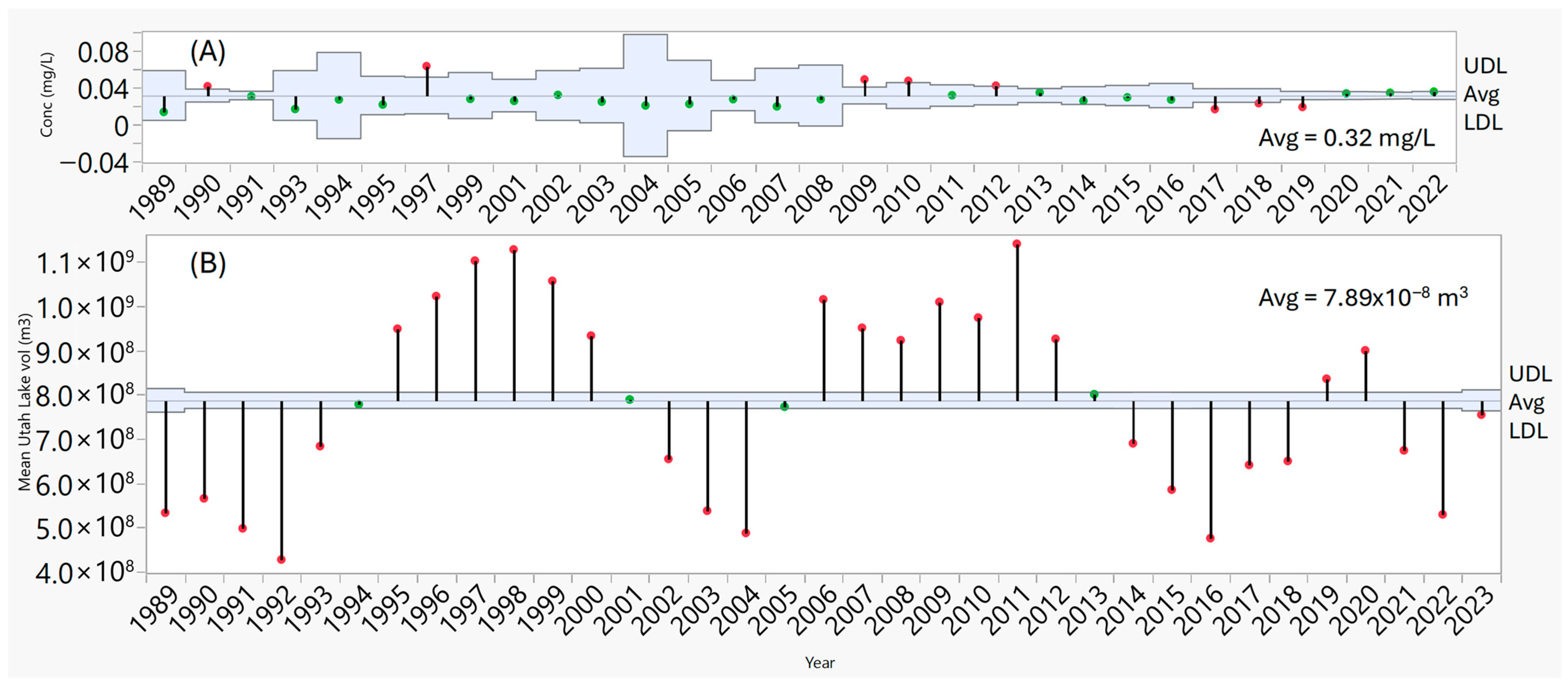
We applied an Analysis of Means (ANOM) to dissolved P concentrations from Utah’s Ambient Water Quality Monitoring System (AWQMS) [44] and annual Utah Lake volumes from the U.S. Bureau of Reclamation [45]. We followed the approach of Taggart, et al. [2] which only included dissolved phosphorus (DP) values from AWQMS and had data from 1989 through 2023–all the available P data in the system. This resulted in a sample size of 1658 measurements. Our objective was to determine whether any yearly mean differed significantly from the long-term overall mean at α = 0.05. ANOM compares each group mean to the overall mean by calculating upper and lower decision limits (UDL and LDL) based on residual variance and annual sample sizes. Means falling outside these limits indicate statistically significant deviation; means within the limits reflect expected interannual variability. To generate the plots in Figure 1, we computed yearly means for each variable, calculated decision limits using the F-distribution for unequal sample sizes, and plotted each year’s deviation from the overall mean, marking significant values in red and nonsignificant values in green. Figure 1 has P-concentration data in the top panel (Figure 1A) and lake volume data in the bottom panel (Figure 1B).
Dissolved P concentrations (Figure 1A) remain almost entirely within the ANOM decision band. The few slight excursions beyond the limits are minimal, indicating that P concentrations have been remarkably stable over the observed time period and that deviations from the long-term mean are small. In contrast, Utah Lake volumes (Figure 1B) frequently fall well outside the decision limits, often by large margins, demonstrating substantial and statistically significant interannual variability. If water-column P concentrations were strongly driven by external natural or anthropogenic loads, we would expect similar variability in P; instead, concentrations remain statistically indistinguishable from the overall mean even during prolonged wet periods (1995–1999; 2006–2012), when dilution should lower P, or during dry years when evaporation should concentrate P. These findings, consistent with Taggart, et al. [2], support the conclusion that in-lake sorption processes regulate water-column P despite large hydrologic fluctuations and likely changes in external P-loads from 1989 through 2022.
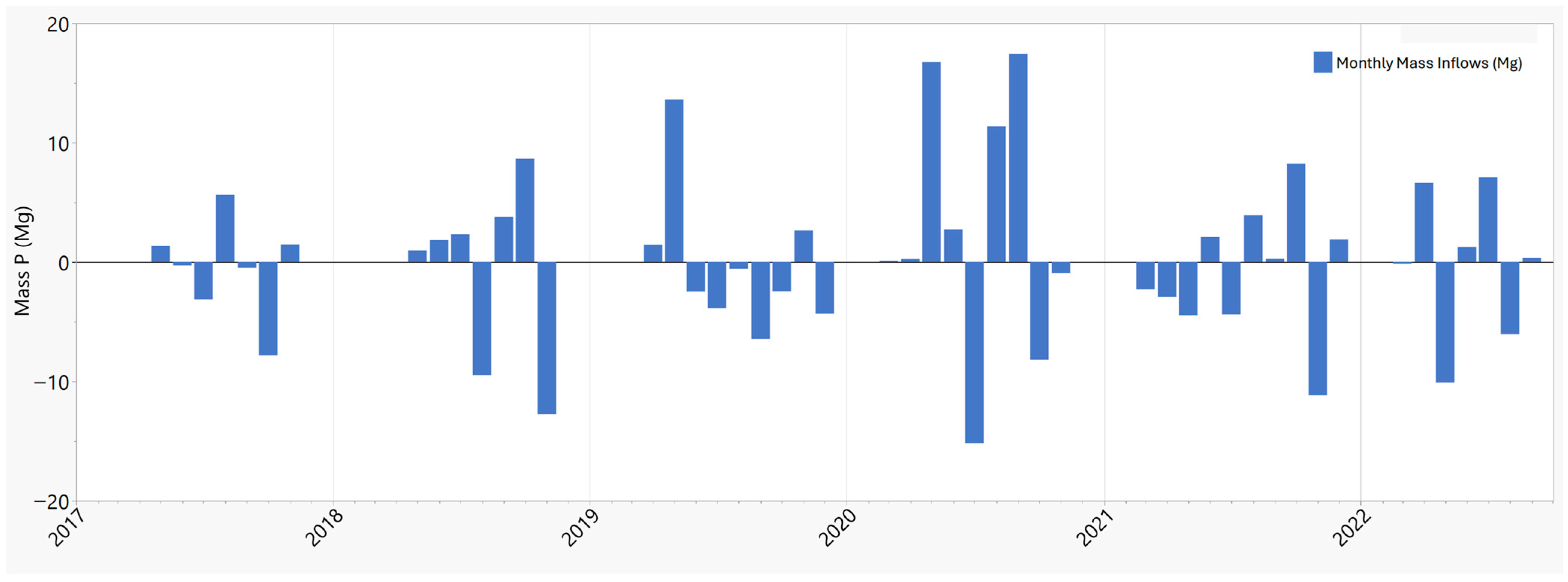
Following the methods of Taggart, et al. [2], we computed the total mass inflow to Utah Lake using measured dissolved P mass (Mg) from AQWMS [44] and Utah Lake’s water volume (m3) from the BOR [45] at the beginning of each month (Figure 2). We computed the mass inflow as the monthly change in the mass of dissolved P in Utah minus the outflow in the Jordan River. This aggregate inflow term includes DP from point sources (e.g., tributaries and wastewater effluent), nonpoint sources (e.g., atmospheric deposition and overland flow), and internal processes (e.g., mineral precipitation and sorption/desorption).
The total mass of dissolved P inflows ranges from positive 17 Mg per month to negative 15 Mg per month. The graph is restricted to the period since 2017 for visualization purposes and because prior years have only a few data points per year. Assume that the majority of the inflows remain stable, then these results demonstrate that sediment sorption processes act as both sinks and sources, maintaining constant concentrations of dissolved P in the water column.
Rather than behaving as a strict mass-balance model with stable loading would predict, dissolved P mass increased and decreased with lake volume, with dissolved P mass changes lagging volume changes to some extent. We interpret this pattern as the lake adjusting toward equilibrium concentrations within a sorption-controlled system: the water column responds to dilution events (e.g., spring runoff) and concentration effects (e.g., late-summer evaporation). If sorption processes did not dominate, we would expect in-lake dissolved P mass to remain relatively insensitive to volume fluctuations unless external loads changed substantially. Because wastewater treatment plants and atmospheric deposition account for a large portion of the load, we do not expect large short-term variability in loading; moreover, water-column inflow loads represent a relatively small portion of the total estimated dissolved P load, so spring inflows alone should not drive large lake-wide mass changes. Consistent with this interpretation, Taggart, et al. [2] found a moderate, statistically significant association between lake volume and DP mass (Pearson r = 0.56, p < 0.001).
In summary, if external P inputs remain approximately stable, we would expect the lake-wide dissolved P mass to remain relatively constant, with concentrations declining during spring dilution and increasing during summer evaporation. Instead, we observed comparatively stable dissolved P concentrations with dissolved P mass that rose with increasing lake volume and fell as volume declined. We view this coupled volume–mass behavior as supporting evidence that sorption processes buffer water-column dissolve P concentrations as hydrologic conditions change.
Additional evidence reinforces the stability of P in Utah Lake. Tanner, et al. [3] analyzed 1068 Landsat scenes spanning nearly four decades (1984–2021) and found no lake-wide increase in Chl a—our best satellite proxy for algal biomass—even as Utah County’s population grew by roughly 300%. They found that where trends in Chl a concentration do appear, they are small and not statistically significant, with Sen’s slope values ranging only from –0.05 to +0.1 µg L−1 per year for any 30 m pixel. Across the main lake, not a single pixel showed an increasing trend; a few showed slight declines. The only increasing trends occur in Provo or Goshen Bays, yet even there the total change over forty years amounts to at most ±4 µg L−1—which is small when compared to background Chl a levels which routinely exceed 100 µg L−1 in places like Provo Bay. These small, localized increases are statistically insignificant in most months.
Tanner, et al. [3] concluded that the long-term record shows that algal mass, similar to water column P concentrations [2], exhibits little variability and is remarkably insensitive to expected increases in external P-loads. They note that the near absence of change in algal blooms over four decades signals that external and anthropogenic nutrient inputs are not the primary control on bloom intensity. Since water-column nutrient concentrations have remained essentially constant, data instead point toward internal controls, especially geochemical and physical processes.

2.2.2. High Phosphorus Content in Sediments and Soils

Several different Utah Lake sediment sampling studies document the presence of high total TP concentrations, with values ranging from 280 to 1710 mg kg−1 and an average of 666 mg kg−1 across 85 samples [1,16,17,21]. Importantly, these concentrations are statistically indistinguishable from Late Pleistocene Epoch sediments on the shoreline (averaging 786 mg kg−1) [21] and comparable to sediments in upstream reservoirs such as Deer Creek (1107–2573 mg kg−1) [29] and to surrounding lacustrine soils (603–1114 mg kg−1, avg. 786 mg kg−1) [14,21]. The similar P concentrations in lake sediments, surrounding soils, and upstream inputs support the hypothesis that the high concentrations in sediment P are of natural geologic origin rather than derived from modern anthropogenic sources.
Geologic mapping supports this interpretation. The Utah Lake watershed contains phosphate-rich geologic formations, including the Delle Phosphatic Member of the Deseret Limestone (early Mississippian) and the Meade Peak Member of the Phosphoria and Park City Formation (Late Permian) [2,29,46]. Although the economically viable deposits of the latter formation occur outside the immediate Utah Lake vicinity, these phosphate-rich units are notably present within the watershed and consequently contribute phosphorus-bearing detritus to valley-fill deposits throughout the watershed [2,29].
Recent core analyses by Williams, et al. [16] provide detailed vertical and spatial profiles of TP within the lake’s sediment archive. Three sediment cores, collected from a deep-water site, Goshen Bay, and Provo Bay, indicate that TP concentrations at the base of all cores (pre-European settlement layers) were approximately 700–800 mg kg−1, rising to over 1800 mg kg−1 in Provo Bay by the mid-20th century [16]. While the deep-water core (19UL-DW) showed only a modest increase in TP over time (reaching ~1044 mg kg−1 in the 1990s), both Provo Bay and Goshen Bay exhibited dramatic increases:
  • Provo Bay TP concentrations rose from ~800 mg kg−1 to ~1850 mg kg−1 between 1940 and 1985, stabilizing afterward;
  • Goshen Bay TP concentrations exceeded 1000 mg kg−1 after the 1980s following a period of fluctuation.
Building on this spatially limited study, Taggart, et al. [17] conducted a lake-wide investigation that substantially expanded the sediment record by collecting 10 cores distributed across the accessible near-shore margins of Utah Lake. These cores also penetrated much deeper sediments (140–240 cm) than earlier studies, ensuring the sampling of sediment well below the 30–40 cm depth generally associated with pre-settlement deposition. Importantly, unlike most prior efforts that disproportionately sampled in Provo and Goshen Bays, this expanded network provided a more balanced representation of the main lake, improving lake-wide interpretation.
Across all cores, total P ranged from 166 to 941 mg kg−1 (median 498 mg kg−1). While Taggart, et al. [17] detected a lake-wide geochemical shift at 30–40 cm, a depth they held as consistent with the onset of European settlement, this shift was primarily visible in redox-sensitive and pollutant-associated elements (e.g., Pb, Zn, Cu). Crucially, except for the cores collected from Provo Bay and Goshen Bay, TP did not exhibit a strong depth trend: for most open-lake sites, P remained relatively stable with depth, or even showed mild increases at intermediate depths (e.g., 20–40 cm and 60–100 cm), indicating that sediment P is strongly controlled by natural geochemical sources rather than a clear anthropogenic signal.
In contrast, the Provo Bay and Goshen Bay cores showed the familiar eutrophic pattern of high surface P and decreasing concentration with depth, consistent with increased anthropogenic-related nutrient loading either from direct input or changes to surface conditions of increasing erosion or other factors [17]. Within the cores taken in the bays, the elevated upper-layer P co-occurred with enrichments in Pb, Zn, Cu, Cd, and Ni, implying stronger and more persistent anthropogenic influence relative to the rest of the lake.
Overall, this broader and deeper coring effort demonstrates that while shallow bays exhibit signatures of anthropogenic P loading, the main body of Utah Lake does not show large, settlement-related increases in sediment P with depth, an indication that high sediment P concentrations are geologic in origin [17].
Supporting the hypothesis of geologic origin, the sediment mineralogy across all cores is dominated by calcite, quartz, and dolomite, with stable calcite–quartz ratios over time indicating a consistent source of endogenic carbonate and detrital mineral inputs [16]. These minerals likely include erosional material from local phosphate-bearing formations, such as the Delle Phosphatic Member and Meade Peak Member, which have known outcrops throughout the watershed [2]. Further geochemical indicators, such as carbon:nitrogen (C:N) ratios consistently below 10 and δ13C values in the −25 to −28‰ range, suggest that the dominant source of organic matter in the sediments is algal, not terrestrial. This aligns with the lake’s persistent productivity and shallow, well-mixed conditions, where benthic and planktonic primary producers contribute directly to sediment deposition [16,41].
Taken together, these findings indicate the following:
  • Much of Utah Lake’s P is derived from natural, geologic sources, with anthropogenic influences superimposed over time;
  • The lake’s sediments serve both as a reservoir and modulator of P through sorption and burial processes.
This P-rich sediment matrix plays a central role in buffering water column concentrations, creating a dynamic equilibrium that complicates the relationship between external loading and observed eutrophication symptoms.

2.2.3. Sediment–Water Phosphorus Equilibrium and Sorption Dynamics

A growing body of research indicates that sediment–water interactions dominate P dynamics in Utah Lake. Randall, et al. [1] found that up to 49% of sediment TP is associated with redox-sensitive iron oxides which can release P under reducing conditions, while an additional 39% is bound to calcium minerals which are generally stable in Utah Lake’s alkaline conditions and thus represent a more permanent P fraction. P-fractionation observed in Utah Lake sediments is similar to Deer Creek sediments upstream [29]. These finding indicate that ~50% of the sediment forms of P are readily exchanged with the overlying water in Utah Lake’s shallow, polymictic environment, where wave action, carp bioturbation, and microbial activity continuously mix sediments with the water column [1,29,42]. Laboratory studies and sequential extractions confirm that up to 440 mg/kg of sediment P is potentially available for desorption into the water column [1].
Taggart, et al. [2] applied a sorption model with a range of sorption coefficient values to explain Utah Lake’s P stability, showing that the equilibrium between dissolved and sediment-bound P can buffer the lake against changes in external loading. They used the Freundlich isotherm model and assumed Kd values from 100 to 600 to demonstrate that even with the lowest Kd value, the lake maintains a relatively constant DP concentration even as external inputs vary significantly. Their modeling suggests that only extreme reductions or increases in external P loads would meaningfully shift water column concentrations due to the sediment’s buffering capacity [2].
Further evidence of the sediment reservoir’s capacity to supply P comes from porewater data. Studies characterizing P concentrations at the sediment–water interface confirm the presence of a massive, chemically driven P gradient, strongly suggesting high internal loading potential. Randall, et al. [1] reported that total dissolved phosphorus (TDP) concentrations in pore water were approximately an order of magnitude higher than those measured in the overlying water column [1].
Aremu [30] confirmed that sediments near the water interface have redox conditions that mobilize P, making it readily available for sorption interaction. Aremu [30] found the redox potential decreases rapidly from oxidizing (approximately +200 mV) in the bottom water column to reducing (approximately −100 mV) in the porewater within 10 cm below the sediment surface [30]. These reducing conditions in the sediment suggest that redox sensitive minerals, particularly iron (Fe), are not a stable sink for P [30], leading to the high dissolved P concentrations found in the porewater and demonstrating the mechanism for potential P release into the lake [30].
External P loads to Utah Lake are estimated at 133.4 Mg yr−1 from WWTP and 49.6 Mg yr−1 from tributaries, and between 32 and 200 Mg yr−1 from atmospheric deposition, Utah Lake acts as a P sink, with a relatively low amount of P exported (~85 Mg yr−1) through the Jordan River [2,21]. However, sediment core studies, except for sediments in the bays, do not show enrichment in the top layers. Taggart, et al. [17] suggest that the available sediment reservoir of P is so large compared to this annual influx, that this enrichment from the annual sediment load is well within the variance of the sediment concentrations. This supports the idea that internal processes dominate P mass balance [1,2,16,17,21,29].

2.2.4. Sediment Summary

The literature strongly supports the conclusion that P concentrations in Utah Lake are controlled by an internal biogeochemical equilibrium with high-P sediments, not by recent or external inputs alone. Sediments exhibit geologic-level P concentrations, and sediment–water exchanges—via sorption, desorption, resuspension, and redox reactions—create a system that is buffered and self-regulating. Nutrient management in Utah Lake must therefore account for this equilibrium behavior, emphasizing sediment dynamics and internal cycling in parallel with external load reductions to achieve meaningful water quality improvements. In practical terms, Utah Lake’s sediments function as an essentially infinite reservoir of P relative to annual external inputs. With TP concentrations consistently in the hundreds to thousands of mg kg−1 across vast sediment volumes, the capacity for sustained P release far exceeds any near-term reductions in watershed loading.

3. New Particulate Data

3.1. Methods

3.1.1. Active Air Sampler

We deployed three MiniVol TAS Portable Air Samplers (Airmetrics, Springfield, OR, USA) to actively collect suspended particulate matter as a proxy for AD across Utah Lake. The MiniVol samplers we used for this study minimize biological contamination (e.g., from insects and birds) by drawing ambient air through a controlled inlet and filter that excludes larger debris. The primary goal of this sampling campaign was to characterize spatial distribution of suspended particulates in air and determine if there was any evidence of attenuation across the lake. We also characterized nutrient and other elemental content of the particulates as an index to nutrient AD.
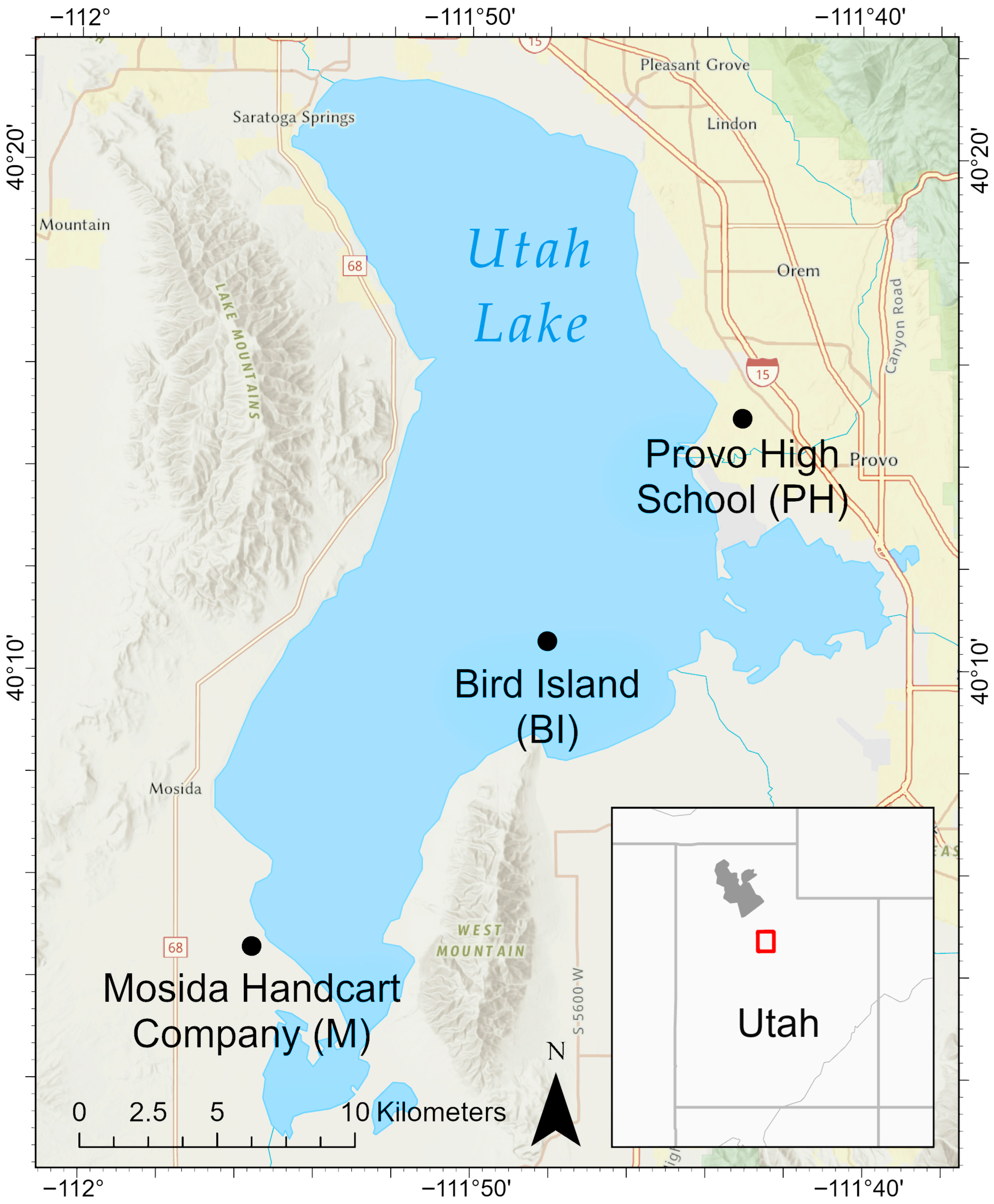
The three sampling sites we used for this study were (1) a southwestern shoreline site at the Mosida Handcart Company Trek Camp (Mosida; M), (2) a mid-lake site on Bird Island (BI), and (3) a northeastern shore site at Provo High School (Provo High; PH) (Figure 3). We based our sampler alignment on the prevailing dust transport direction identified during discrete dust events [14,39]. The sites form an approximately straight southwest–northeast transect spanning ~25 km from Mosida to Provo High, with Bird Island (representing mid-lake conditions), located about 15 km northeast of Mosida and 10 km southwest of Provo High (Figure 3).
Due to elevated lake levels and weather constraints, our sampling season was conducted between July and October 2024, as prior to this time, the Bird Island site was mostly inundated by the lake.
We used a pre-weighed, EPA-compliant 2 µm PTFE 46.2 mm filter following 40 CFR Part 50, Appendix L [47]. The MiniVol samplers continuously drew air through the filters at a flow rate of 5 L min−1 [48]. We pre-weighed each dry filter in the laboratory prior to transporting them to the field and installing them in the collectors. Although this configuration does not provide a direct measurement of AD, it offers a relative estimate of potential airborne dust inputs into the lake, capturing both larger particles that settle directly onto the surface and finer particles deposited through contact or washout during precipitation events. Except for the first filter deployed at the Provo High site—which collected particulate fallout from fireworks during the week of the July 4th holiday—we replaced the sampler filters on a roughly biweekly schedule, adjusting for weather conditions to maintain continuous sampling and ensure sufficient dust accumulation for analysis. Over the course of the study, we collected one filter per site (n = 3) during each of six sampling periods, for a total of 18 filters, plus one additional filter at the Provo High site during the week of Independence Day (July 4th), yielding 19 filters overall.
Following field retrieval, we placed our pre-weighed filters in desiccant jars for 24 h to remove adsorbed moisture and then weighed them to determine the total mass of collected dust based on the pre-weighed mass of the filter. We then transferred our filters to clean Teflon beakers and weighed the combined beaker–filter assemblies prior to synthetic lake water (SLW) extraction and acid digestion. To verify that our procedures did not introduce measurable contamination, we processed a laboratory blank consisting of an unused filter; this blank confirmed that contamination during extraction and digestion was negligible.

3.1.2. Soluble Fraction: Synthetic Lake Water Extraction

To estimate the soluble fraction of P and other elements in lake water, we prepared a synthetic lake water (SLW) solution formulated to approximate the long-term average ionic composition of Utah Lake. Using multiple years of year-round water quality data, we reproduced typical major cation and anion concentrations by dissolving 340 mg NaHCO3, 650 mg NaCl, 55 mg KCl, 215 mg CaSO4·2H2O, and 920 mg anhydrous MgSO4 in 1 L of Milli-Q water, yielding a solution with a pH of approximately 8.0. The resulting ionic strength and makeup is consistent with measured lake conditions.
To perform the soluble extraction, we added 20 mL of SLW to each Teflon beaker, ensuring that the filter was fully submerged. Because all filters were processed as a single batch, we included one control sample containing a blank filter and SLW. We shook the samples for 24 h and then placed them in an inclined position for an additional 24 h to allow particulates to settle. After settling, we carefully decanted each supernatant, filtered each through a 0.45 µm syringe filter, and acidified them with 1 mL of trace-metal–grade HNO3 to preserve dissolved constituents.
We analyzed the resulting filtrates for 28 target elements, including major cations, trace metals, and P using a ThermoFisher iCAP 7400 Duo ICP-OES (Thermo Fisher Scientific, Waltham, MA, USA). The increase in measured P concentration relative to the SLW blank represented the lake-soluble P fraction.

3.1.3. Insoluble Fraction: Acid Digestion

Following SLW extraction, we oven-dried the remaining dust and filters in the Teflon beakers and reweighed them to estimate mass loss. We did not adjust for any salts from the SLW that dried on the filters. After drying the filters, we used acid digestion to quantify total elemental content. We added 4.8 mL of acid solution (3 parts HNO3: 1 part HCl), tightly sealed the containers to prevent evaporation, and heated them at 100 °C for 20 h on a hot plate. After cooling, we rinsed the digests and filters with 15.2 mL of deionized water (added in calibrated aliquots) and then transferred the liquid and undigested material to centrifuge tubes. We then centrifuged the suspensions and analyzed the supernatants for the same 28 target elements tested for the soluble fraction (total major cations, trace metals, and P) using the same ThermoFisher iCAP 7400 Duo ICP-OES.
We used both soluble and total digestion results to estimate the proportion of P that is water-soluble under typical lake conditions. Although HF digestion was not used, our method of digestion effectively dissolved the mineral phases expected to host P; thus, the measured total P values are considered representative. Resistant silicate minerals such as quartz were likely undigested but are not known to retain appreciable amounts of P. We evaluated the other major and trace elements to fingerprint the samples for determining if the particulates across the ~25 km transect were significantly different from each other.
Because we performed repeated sampling under shared temporal conditions, we used a linear mixed model to test for spatial differences while allowing the overall deposition level to fluctuate between sampling periods. To meet normality assumptions, we performed a log10-transformation on all elemental dust concentrations, including P, and verified normality visually using QQ plots of model residuals. We also conducted pairwise post hoc comparisons using Tukey-adjusted estimated marginal means. For analysis of the data that contained fireworks impacts, we calculated enrichment factors (EF) for each element by dividing the results from the fireworks sample by the median results of the other samples which we assumed as “background” for the fireworks event.
We performed all analyses using R version 4.4.1 [49] using the packages lme4 (ver 1.1-37) [50], lmerTest (ver 3.2-0) [51], and emmeans (ver 2.0.1) [52] and performed visual analysis and plotting using ggplot2 (ver 4.0.0) [53], and plotly (ver 6.5.0) [54].

3.2. Results

3.2.1. Dust Mass and Elemental Data

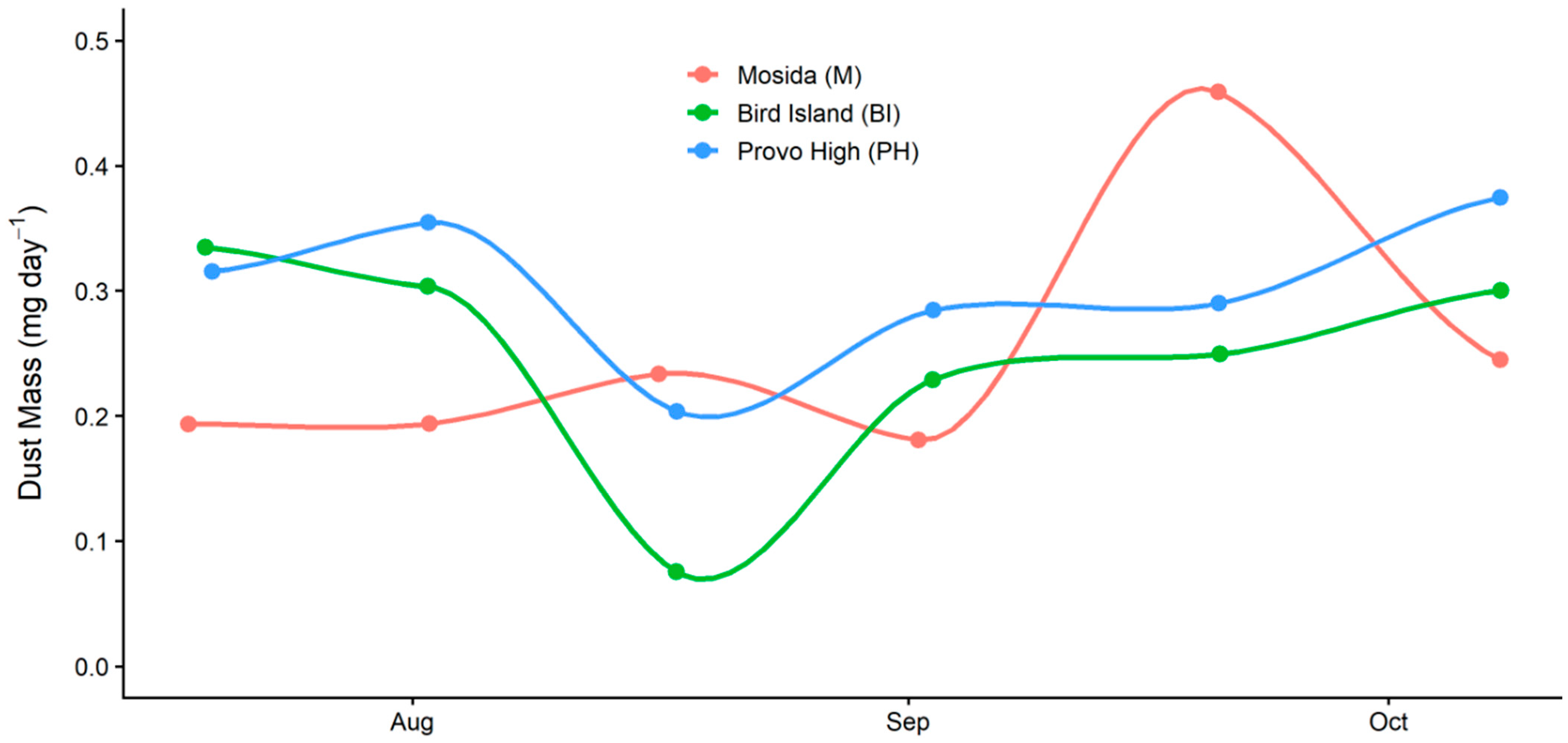
We collected 19 active air samples across Provo High (PH, n = 7), Mosida (M, n = 6), and Bird Island (BI, n = 6) between July and October 2024 with details in Table 3. Sampling durations ranged from 7.7 to 20.9 days. Mean dust deposition rates were similar among sites: PH averaged 0.28 mg day−1 (range: 0.16–0.37 mg day−1), BI averaged 0.25 mg day−1 (0.08–0.33 mg day−1), and M averaged 0.25 mg day−1 (0.18–0.46 mg day−1). The earliest PH sample (2–10 July), collected during the Independence Day (4 July) period, provides a basis for evaluating contributions from fireworks to atmospheric particulates.
Total phosphorus (TP) concentrations in dust varied more widely but showed no consistent spatial gradients, which we explore in the Section 3.2. Median TP was highest at Mosida (~5218 mg kg−1; range: 3639–7780 mg kg−1), intermediate at Bird Island (~4787 mg kg−1; range: 2250–7349 mg kg−1), and lowest at Provo High (~2879 mg kg−1; range: 1744–3229 mg kg−1). All sites occasionally exhibited elevated TP, with maximum values of 7780 mg kg−1 (M), 7349 mg kg−1 (BI), and 3229 mg kg−1 (PH).
Overall, dust deposition rates were consistent across sites, while TP content showed broader variability but no directional spatial pattern, supporting the interpretation that all three locations were influenced by similar regional dust sources and transport conditions.
We analyzed both the soluble and insoluble elemental composition of the dust using ICP-OES for 28 elements (full dataset provided in the Supplementary Materials). For the soluble fraction, concentrations generally fell within the low-ppb range, with consistent patterns across Provo High, Mosida, and Bird Island. Major crustal elements (Ca, K, Fe, Al, and Ba) dominated the mass of the soluble fraction and showed basin-wide coherence, consistent with the uniform geochemical signatures observed in the spider diagrams. Calcium exhibited the highest concentrations across all samples (~10,000–80,000 ppb), followed by K (~1900–53,000 ppb) and Si (~500–1700 ppb). Transition metals such as Cu, Cr, and Zn occurred at much lower concentrations (typically < 50 ppb for Cr and Cu, and < 120 ppb for Zn), with no systematic differences among sites.
P concentrations in the soluble fraction were likewise comparable among sites, ranging from ~400 to over 5000 ppb, mirroring the spatial uniformity observed in total P deposition. Notably, the Provo High fireworks-period sample displayed elevated concentrations of several elements—including Al, B, Ba, K, and Zn—relative to background conditions, consistent with known pyrotechnic signatures. However, aside from this isolated event, elemental patterns remained highly consistent across locations and sampling periods. The absence of meaningful spatial divergence in any major or trace element supports our broader conclusion that all sites were influenced by the same regional dust sources and atmospheric transport pathways.
For the insoluble fraction, concentrations of major crustal elements—including Ca, K, Fe, Al, and Si—were consistently one to two orders of magnitude higher than those of trace metals, and exhibited similar magnitudes across Provo High, Mosida, and Bird Island. Ca dominated the insoluble fraction, ranging from ~90,000 to >315,000 ppb, followed by K (~17,000–182,000 ppb) and Na (~150,000–1,900,000 ppb). Fe and Al showed similarly coherent basin-wide signatures, with Fe spanning ~13,000–22,000 ppb and Al ~7000–21,000 ppb. Trace metals such as Cu, Cr, Ni, Pb, and Zn occurred at much lower concentrations (typically <200 ppb for Cr and Ni; < 500 ppb for Zn; <200 ppb for Pb), and no element displayed systematic differences among sites.
As with the soluble fraction, the only pronounced deviation occurred in the firework-period sample at Provo High (2–10 July). This sample exhibited enriched concentrations of multiple elements—most notably Ba, K, Cu, Fe, and Zn—consistent with known pyrotechnic emission profiles. Excluding this event-related outlier, the remaining insoluble samples displayed highly overlapping concentration ranges and parallel geochemical patterns across all sampling periods and locations.
The following sections provide detailed analysis and discussion of these data.

3.2.2. Particulate Mass and Spatial Patterns

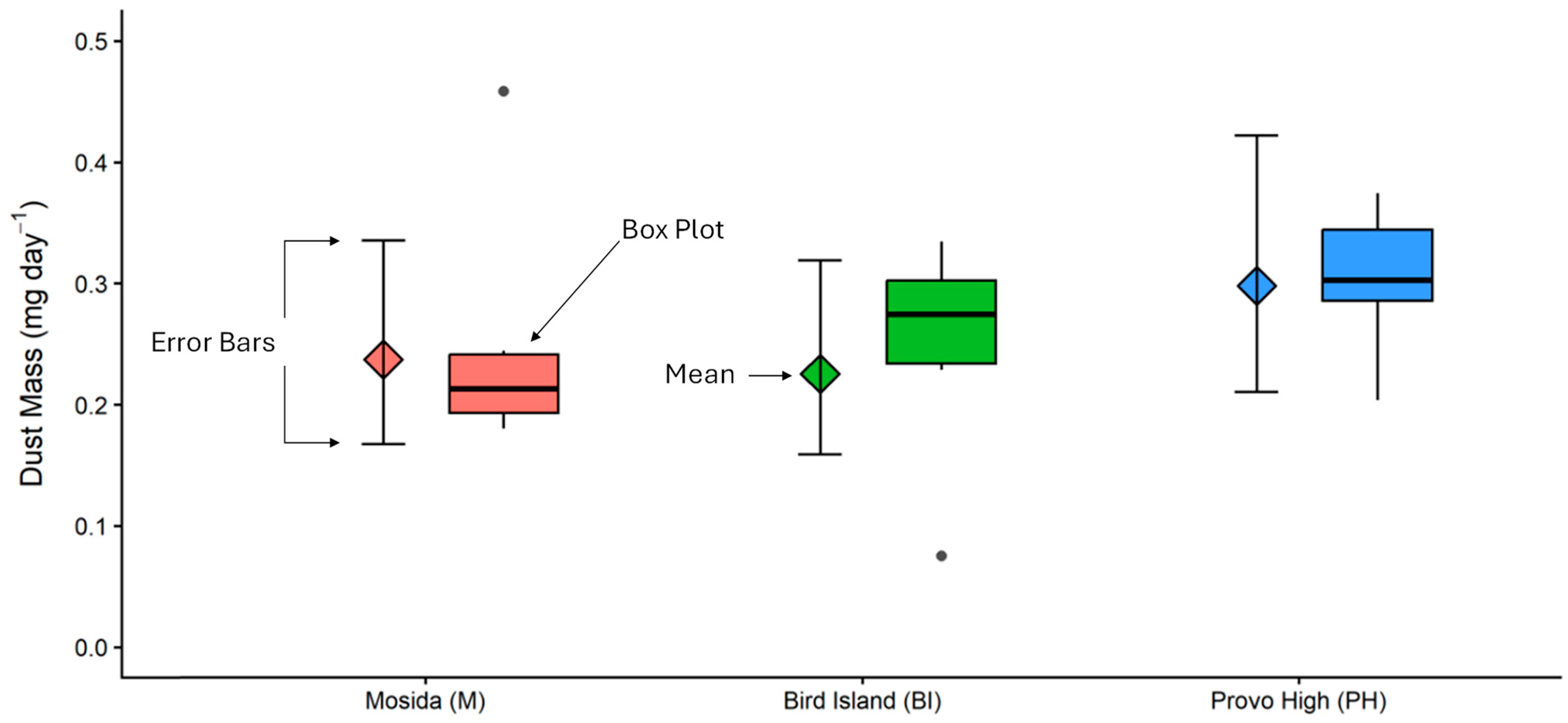
We compared the relative filter weights among sites to assess whether dust loading attenuated (decreased) across the lake. When we fit a linear mixed model to the total mass of the particulate data (Figure 3), we observed some variability among sampling periods (σ2 = 0.006), but most variation was residual (σ2 = 0.024), indicating that temporal effects contributed modestly to overall variability (approximately 20% of total variance). However, an ANOVA on the mixed model (Type III, Satterthwaite’s method) found no significant effect of sampling period (F(1,4) = 0.31, p = 0.61) and no site–period interaction (F(2,8) = 0.35, p = 0.72), suggesting that total deposition remained relatively stable through time and that temporal patterns were similar among sites. Statistically, we observed no attenuation across the lake, as the Bird Island site could not be distinguished from the Mosida or Provo High sites based on sampling location.
Estimated marginal geometric means (back-transformed from log10 values) indicated slightly higher deposition at Provo High ( x = 0.298 mg day−1; 95% CI = 0.210–0.422 mg day−1) compared to Mosida ( x = 0.237 mg day−1; 95% CI = 0.168–0.336 mg day−1) and Bird Island ( x = 0.225 mg day−1; 95% CI = 0.159–0.319 mg day−1) (Figure 4). Nonetheless, site effects did not differ significantly (F(2,10) = 1.05, p = 0.39), and Tukey-adjusted pairwise contrasts (p > 0.40) confirmed that deposition rates were relatively consistent across the transect, consistent with a broadly similar dust source across the lake.
The linear mixed-effects model for our data indicated moderate variability among sampling periods (SD = 0.076) but with greater residual variation (SD = 0.155), suggesting that temporal effects contributed modestly to overall variability in total deposition. However, the sampling period was not a significant predictor of total deposition (p = 0.61), indicating no consistent temporal trend across the sampling season.
Statistical analysis using a linear mixed model indicated no significant differences in particulate mass among sites, as reflected by the overlapping 95% confidence bounds shown visually in Figure 5. However, the boxplots reveal some nuances in the particulate data, suggesting a spatial gradient across the transect. Mosida, located on the southwestern shore of Utah Lake, exhibited relatively lower deposition, while Provo High, on the northeastern shore, showed the highest levels. Bird Island, situated near the lake’s center, displayed intermediate values. The visual differences, shown by the box plots, which highlight the 25th, 50th, and 75th quartiles, are not visually present in the mean of the data, which shows Mosida and Bird Island as essentially the same, with Provo High slightly elevated. However, because of the relatively large variability and the small number of samples (n = 6) for any site, visual representation of the data can be misleading, and, despite these visual differences, all three sites are statistically indistinguishable.
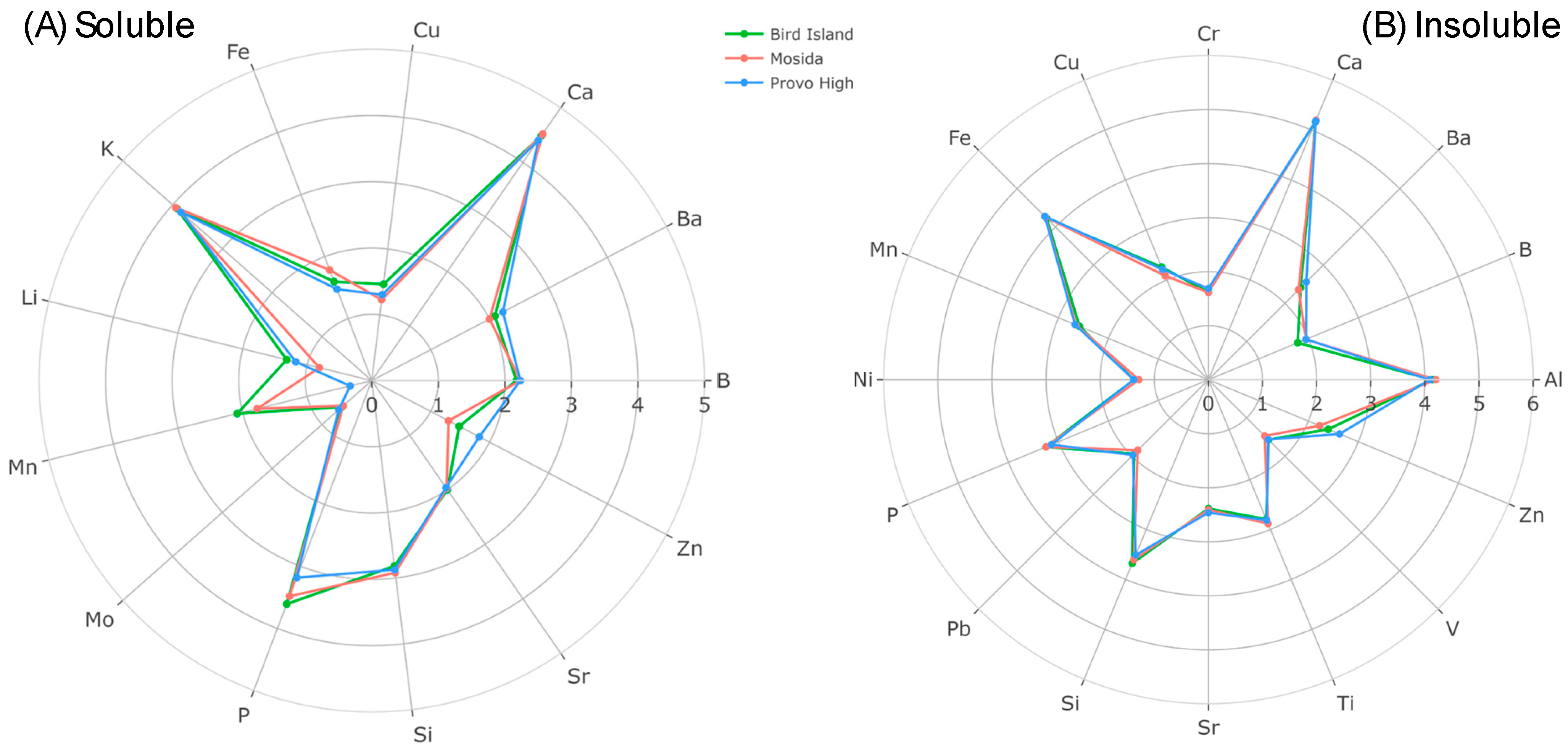
To assess whether the chemical composition of deposited dust varied among sites, we plotted the median elemental concentrations from both the soluble and insoluble ICP fractions using spider diagrams (Figure 6). Spider diagrams allow us to visualize the relative ratios of many elements within a single graphic; the shape of each plot reflects elemental ratios and is insensitive to absolute concentration, whereas the overall size of the plot reflects concentration magnitude.
We log10-transformed the data to place all elements on a comparable scale and included only elements detected in at least 80%, thereby minimizing noise from elements detected near method detection limits. The resulting profiles from Mosida, Bird Island, and Provo High School were nearly indistinguishable in both shape and magnitude for both fractions (Figure 5), indicating minimal spatial variability in elemental composition across the lake. For the insoluable fraction, which represents residual particulate material following acid digestion of both the collected solids and the filter matrix, we omitted K, Mg, and Na as the filters were enriched by the synthetic lake water used in the soluble element extraction.
Figure 6 The near-identical shapes and magnitudes of the soluble and insoluble elemental profiles reinforce our statistical results, which show no significant differences among sites. The close overlap across all three locations indicates that deposited particulates are chemically uniform at the scale of the Utah Lake basin. This uniformity points to a shared set of dominant regional dust sources and common atmospheric transport pathways, with little evidence that local conditions—such as road proximity, shoreline characteristics, or small-scale disturbances—meaningfully affect dust composition.
Taken together, the overlapping profiles in both fractions illustrate the same conclusion reached through statistical analysis: there is no detectable spatial variation in the elemental composition of deposited dust. These patterns support a consistent dust provenance for all sampled locations and highlight the basin-wide processes that govern dust generation and redistribution. This supports the hypothesis that there is no meaningful attenuation across Utah Lake. given no discernible compositional differences between the shoreline and mid-lake particulate matter.

3.2.3. Particulate Phosphorus (P) Content

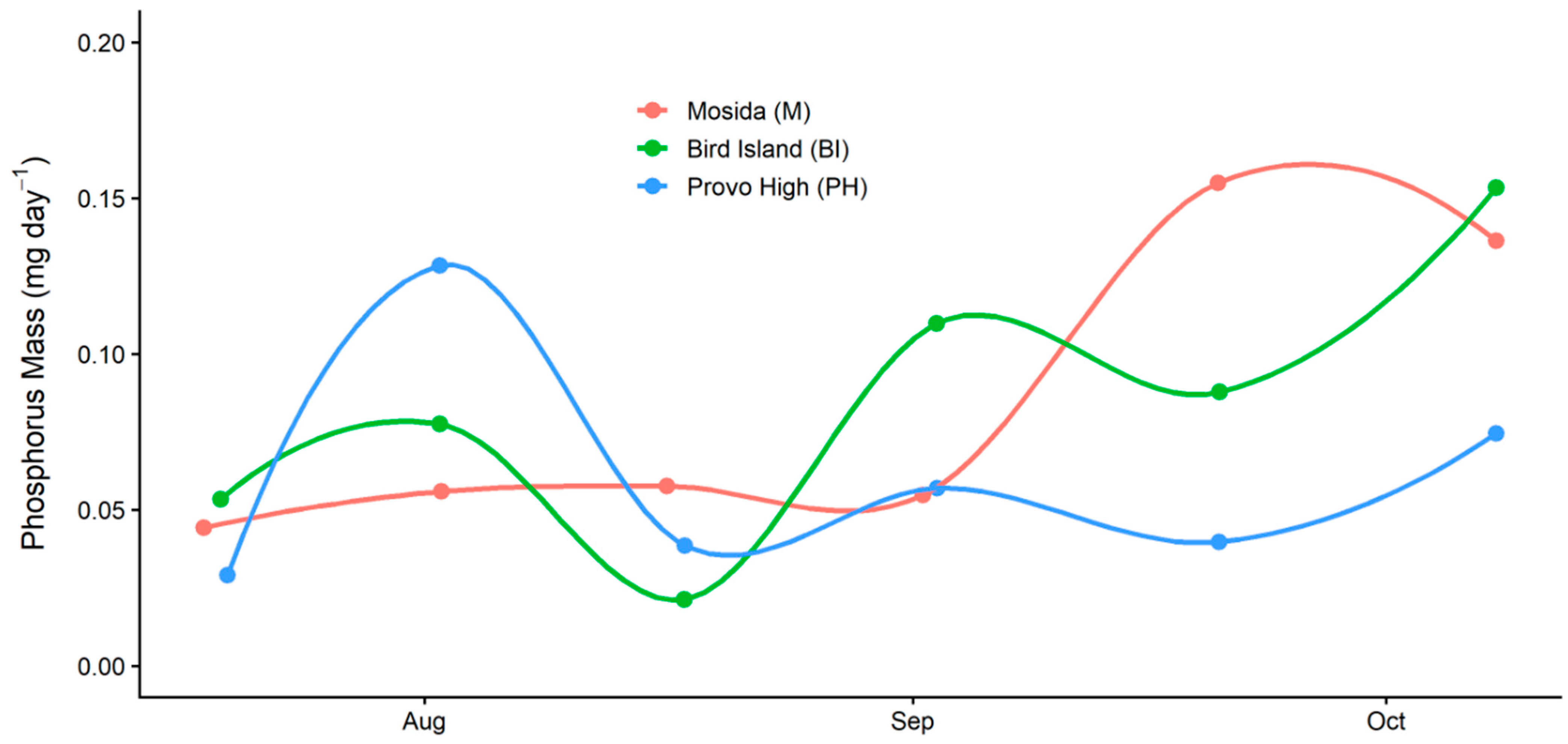
Because P is a key nutrient of concern for Utah Lake, we examined P concentrations within the collected dust samples in greater detail. We fit a linear mixed model to the P component of the particulate data, with the results shown in Figure 7.
Figure 7 shows the temporal variation in P deposition rates at the three particulate samples. The points are centered at the mid-point of each sampling period, while the values represent the computed P deposition rate, which is the total P captured divided by the length of the sampling period. The figure shows that the sites exhibit similar trends, and that no site is consistently higher or lower than any other site.
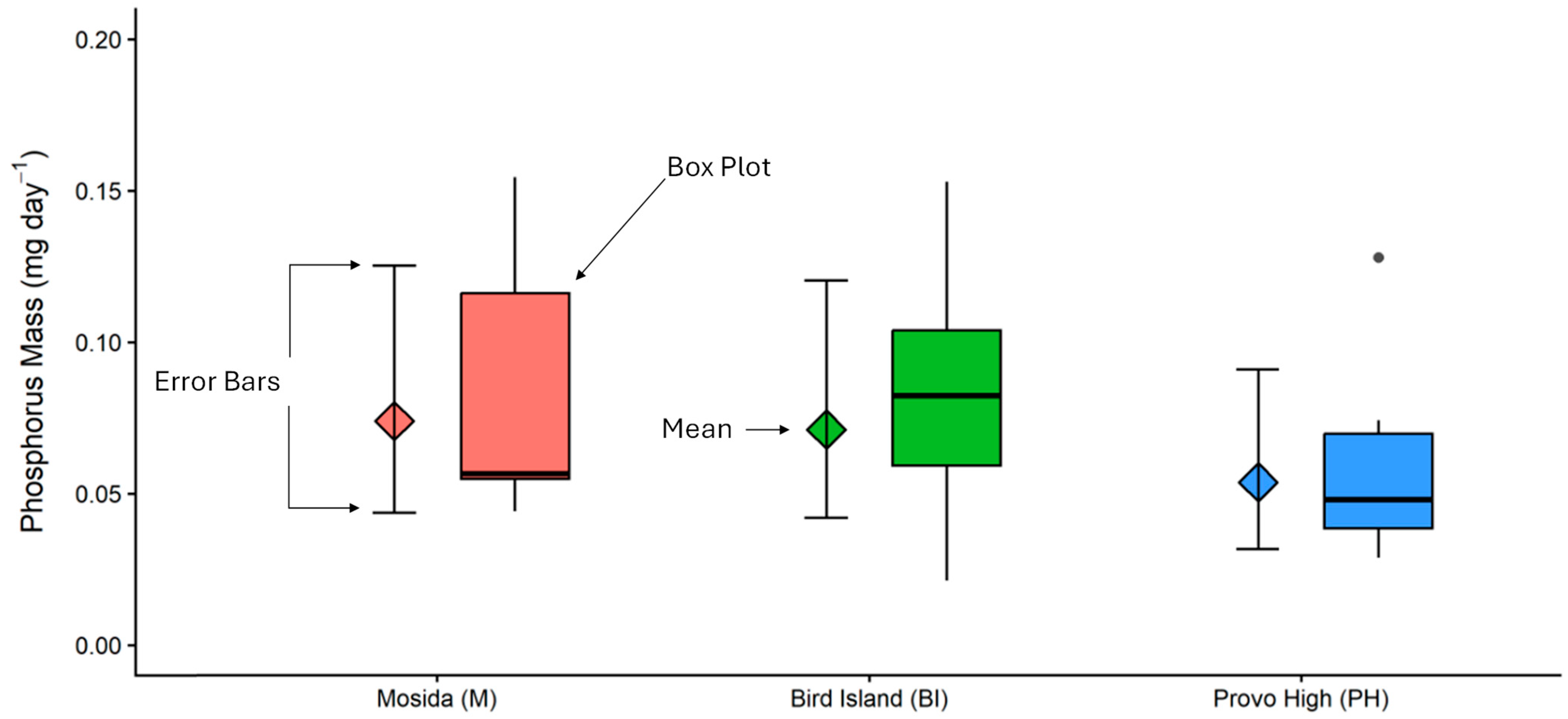
Boxplots (Figure 8) display the distribution of P deposition values, with the bold lines indicating the median or 50th quartile and the box boundaries representing the 25th and 75th quartiles, with the size of the boxes representing the interquartile range (IQR). The whiskers ±1.5 × IQR and outliers beyond 1.5IQR are shown as dots. Statistical analysis using a linear mixed-effects model showed no significant differences in P) deposition among sites (F(2,10) = 0.820, p = 0.468), a result which is reflected in the overlapping 95% confidence intervals for the estimated marginal means (Tukey-adjusted p > 0.49). Mean P deposition was slightly higher at Mosida (0.074 mg day−1) and Bird Island (0.071 mg day−1) than at Provo High (0.053 mg day−1), but these differences were not statistically meaningful and indicate broadly similar dust sources and particle composition across the lake transect. The back-transformed overall mean deposition rate was approximately 0.07 mg day−1, demonstrating relatively low and stable P inputs throughout the study area.
Our mixed effects model revealed moderate variability among sampling periods (SD = 0.155), though residual variation was larger (SD = 0.205). When expressed as variances, temporal differences accounted for roughly 36% of total variance (σ2 = 0.024), with the remaining 64% arising from within-period variability (σ2 = 0.042). When we included sampling period as a fixed effect, the model did not detect statistically significant temporal differences (F(1,4) = 3.76, p = 0.125), nor was there a significant site-by-period interaction (F(2,8) = 0.875, p = 0.453), indicating that temporal fluctuations were comparable across all locations. These results show that while P deposition fluctuated moderately over time, most variation occurred within sampling periods rather than between them–supporting the hypothesis that there is no attenuation or spatial difference in P deposition rates.
Estimated marginal means, back-transformed from log10 values, further confirmed the absence of spatial gradients: Mosida exhibited the highest mean deposition (0.074 mg day−1; 95% CI = 0.044–0.125 mg day−1), followed by Bird Island (0.071 mg day−1; 95% CI = 0.042–0.121 mg day−1) and Provo High (0.054 mg day−1; 95% CI = 0.032–0.091 mg day−1). Pairwise comparisons again showed no significant differences among sites (Tukey-adjusted p > 0.49).
Taken together, these results indicate that P capture was relatively uniform across the lake transect and remained consistent through time, with only modest temporal variability. While variability existed, the data from the sites are not statistically different. that did not differ among sites. The combined spatial and temporal patterns strongly suggest that all locations were influenced by similar dust sources and atmospheric transport processes, resulting in stable and comparable P deposition rates across the study area.

3.2.4. Fireworks Impacts to Particulates

During the week of the 4th of July holiday, we intentionally ran the active air sampler at Provo High School to capture the influence of regional and local fireworks displays on particulate composition relative to median conditions during the other sampling periods. Both the soluble and insoluble elemental fractions from this particular sample exhibited clear enrichment patterns that reflect short-lived, yet intense, pyrotechnic inputs to the atmosphere. The laboratory blank, which consisted of an unused filter processed alongside our samples, indicated negligible contamination during extraction, digestion, and analysis.
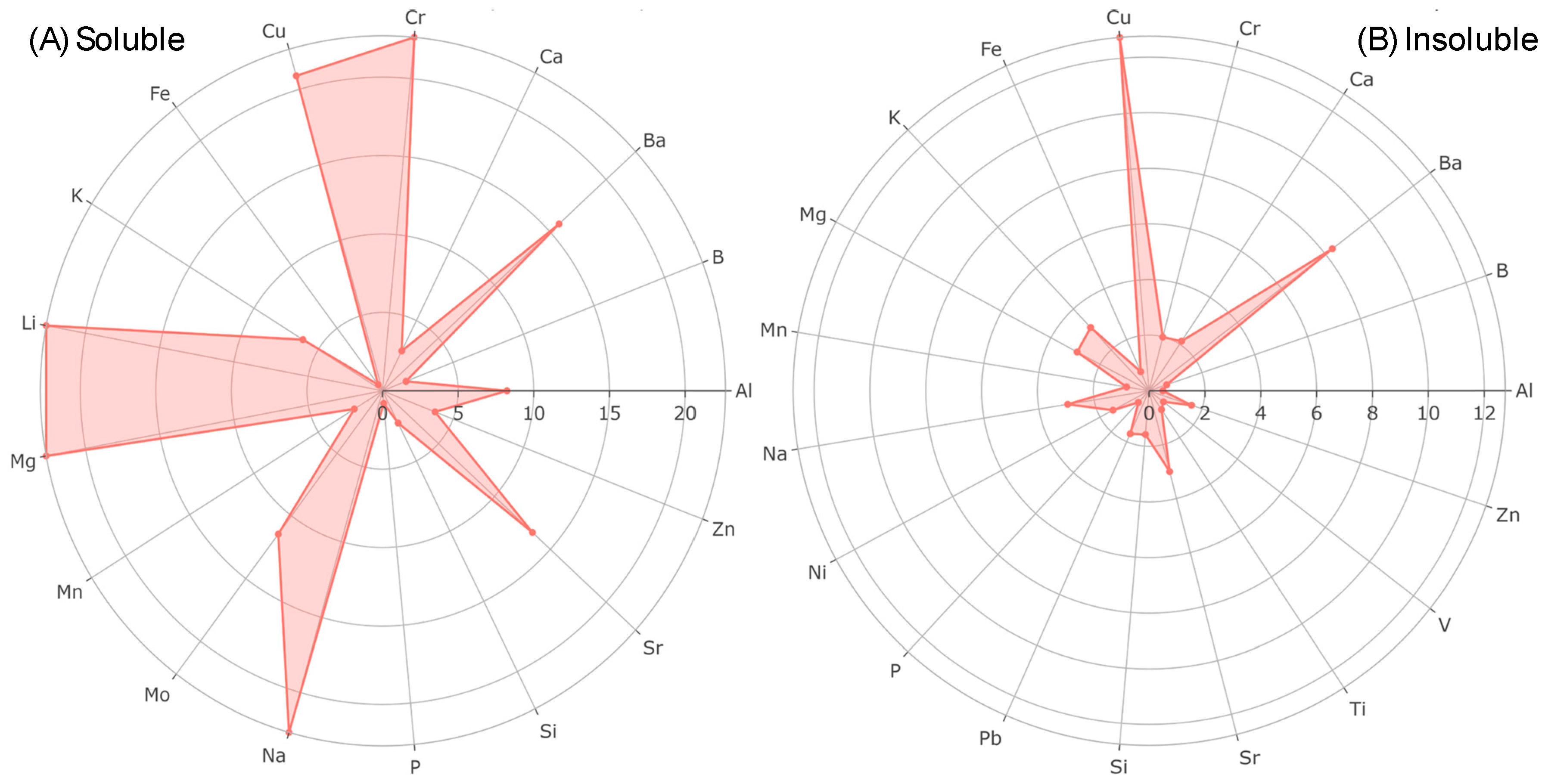
Although our ICP analysis quantified 28 elements, several elements were not consistently detected across all samples. To ensure clear and interpretable spider diagrams, we retained only those elements detected in at least 80% of samples or those showing strong enrichment in the fireworks sample. After selecting the elements to retain, we then calculated enrichment factors (EF) for each element by dividing the results from the fireworks sample by the median background results capture. We used the median value of each element from the samples from all three sites (n = 18). Figure 9 presents these results for both the soluble and insoluble fractions as EF. The elements Cr, Mg, and Na were not detected in background samples of soluble elements, resulting in an undefined or effectively infinite enrichment, consistent with their absence under normal atmospheric conditions. We consequently chose to represent the EF values for these elements by having them match the EF of Li, the soluble element with the largest finite EF.
The soluble fraction (Figure 9A) showed pronounced enrichment in several metals commonly associated with pyrotechnic formulations. When compared to the median background concentrations, the fireworks sample exhibited significant enrichment (EF ≥ 5) for Al, Ba, Cr, Cu, K, Li, Mg, Mo, Na, and Sr, with all of these elements except Al and K exceeding an EF of 10. The strong enrichments observed for Ba, Sr, Cu, Al, Li, Mg, Na, and K are fully consistent with pyrotechnic sources, reflecting their widespread use as colorants, metallic fuels, and oxidizer components in fireworks formulations [4,6,7]. Mo may represent a minor additive or manufacturing impurity as we did not find a reference to it in the literature for fireworks. The insoluble fraction (Figure 9B) exhibited a more selective enrichment pattern. Only Ba and Cu exceeded the EF ≥ 5 threshold, with Cu alone surpassing EF = 10. Both elements are characteristic fireworks constituents, supporting the conclusion that fireworks activity introduced particulate-bound elements to the local atmosphere [4,6,7].
Despite representing only a single week of deposition, these exceptionally high enrichments suggest a concentrated and transient influx of soluble elements from fireworks fallout. Together, the soluble and insoluble enrichment patterns indicate that local fireworks activity introduced a broad suite of elements to the atmosphere, temporarily altering the geochemical composition of airborne particulates during the event window. Many of these elements were present in the particulate matter in water-soluble forms, suggesting that fireworks can influence short-term deposition chemistry in receiving environments such as Utah Lake. However, given the lake’s large size and frequent mixing, it is likely that these short-lived inputs were rapidly diluted and did not result in lasting water-quality impacts to the lake.

4. Discussion

4.1. Nutrients

Utah Lake shares several physical and ecological features with other shallow, wind-exposed systems that experience sediment resuspension and bioturbation, including lakes impacted by common carp such as Malheur Lake (USA) and Lake Taihu (China). However, Utah Lake is distinct in that these processes act on sediments with unusually high, geologically derived phosphorus concentrations, a condition not reported for most other shallow lakes, and one that fundamentally alters nutrient buffering and trophic response.
Understanding Utah Lake’s nutrient dynamics is essential for interpreting its persistent eutrophic state and evaluating the potential effectiveness of nutrient-management strategies. In particular, the role of P—traditionally considered the primary driver of the lake’s eutrophication—must be assessed within the context of both external inputs and internal biogeochemical processes. Multiple lines of evidence indicate that P concentrations in Utah Lake are governed predominantly by natural geologic sources and sediment-driven internal cycling rather than by contemporary anthropogenic loading.
Sediment records provide important context for interpreting the dominance of internal processes. Abu-Hmeidan, et al. [21] found little to no detectable temporal change in sediment P concentrations between modern and pre-settlement layers at their sampling sites, consistent with a large, geologically inherited P reservoir. This conclusion stands in agreement with observations that Utah Lake sediments contain naturally elevated phosphorus [21] and with evidence that several P-rich geologic formations occur within the watershed, providing plausible natural sources of sediment-bound P [2]. These observations suggest that Utah Lake’s P regime largely reflects natural baseline conditions.
P cycling in Utah Lake is also characterized by strong sediment–water coupling that maintains the system in a quasi-steady state. The lake behaves as a well-buffered, equilibrium-driven system in which sediment–water exchange regulates water-column P concentrations more strongly than direct inflows [2]. Empirical and modeling studies show that water-column P is relatively insensitive to variation in external loading, consistent with sorption-dominated control by the sediment reservoir. As a consequence, reductions in point-source discharges—such as the P content of effluent from WWTPs—are unlikely to produce meaningful decreases in water-column P concentrations.
Because of this buffering, P concentrations consistently exceed algal limitation thresholds, making P a non-limiting nutrient in Utah Lake [2,3,12,21]. Maintaining eutrophic conditions in Utah Lake requires only ~17 Mg P yr−1, yet each major P source exceeds this threshold by a wide margin. AD alone contributes several times this amount [12], tributary inputs exceed it by an order of magnitude, and sediment TP concentrations averaging 666 ppm [1,21] indicate an internal reservoir that greatly surpasses the load needed to sustain eutrophication. As a result, algal production is controlled primarily by light limitation due to high turbidity rather than by P availability [3].
Long-term monitoring further demonstrates the stability of this internally regulated system. Despite more than an order-of-magnitude variation observed in lake volume over the past 40 years, dissolved P concentrations have remained remarkably constant (0.02–0.04 mg L−1; [2]. The proportional scaling of P mass with lake volume—while concentrations remain steady—is a hallmark of the lake’s sediment buffering capacity. Chl a concentrations have likewise shown no meaningful trend from 1984 to 2021, despite major population growth and likely increases in anthropogenic nutrient inputs [3]. Collectively, these findings show that Utah Lake’s P regime is highly stable and overwhelmingly governed by internal sediment processes rather than contemporary watershed loads.

4.2. Attenuation

Given the substantial role of AD in Utah Lake’s nutrient budget, an important consideration is whether deposition rates attenuate or diminish with distance from shore. If strong attenuation occurred, shoreline-based measurements could substantially overestimate lake-wide AD loading. However, evidence from both the published literature and the present study indicate that attenuation across Utah Lake is negligible.
Prior studies specifically examining spatial patterns of AD found no significant decline in nutrient deposition from the shoreline toward the lake interior [13,14,15]. Some conceptual models used before data were available, assumed that dust-derived material—dominated by local shoreline sources—would decrease sharply with distance, often within a zone of influence less than 1 km [12,36]. Contrary to these assumptions, field measurements demonstrated that nutrient loads at a mid-lake site (i.e., Bird Island) were not statistically different from shoreline stations [13,15]. This finding was further supported by source attribution analysis showing that the elemental composition of deposited solids clustered consistently across mid-lake and shoreline locations [14]. Our analysis of particulate data captured using active air samples at Mosida, Bird Island, and Provo High, further highlight the hypothesis that there is no attenuation of AD across the lake.
Data from the present study (Section 3) show no evidence of spatial attenuation across Utah Lake. Despite sampling along a ~25 km transect that included a mid-lake site at Bird Island, dust deposition and composition were statistically indistinguishable among all three locations, and neither total deposition nor P content exhibited meaningful spatial gradients. These results align with prior studies reporting spatially pervasive, relatively uniform deposition patterns with no distance-dependent decline [13,14,15,40]. Together, the concordance across independent datasets reinforces the validity of shoreline-based measurements and demonstrates that atmospheric inputs are spatially uniform across the lake. This supports the use of shoreline sampling to estimate whole-lake nutrient loads and counters assumptions that mid-lake deposition should be substantially lower or approach background levels.
Additional analyses by Richards [40] provide further confirmation that attenuation is not discernible in AD measurements for in Utah Lake. This study, which was explicitly designed to address concerns regarding the spatial representativeness of AD measurements, incorporated data collected from multiple shoreline sites and a mid-lake location at Bird Island using the sampling network established by Barrus, et al. [13] and Brown, et al. [15]. Using mixed-effects linear regression models on log10-transformed data, Richards [40] showed that nutrient deposition rates for Total Phosphorus (TP) and Dissolved Inorganic Nitrogen (DIN) did not statistically decline with distance from the shore. The Bird Island sampler—located nearly 3 km from the nearest shoreline—provides direct evidence that mid-lake deposition does not diminish to near-zero or background levels and that they were comparable in magnitude to those at shoreline sites. Together, these findings demonstrate that shoreline measurements reliably represent deposition across the entire lake surface.
These findings indicate that AD is sufficiently well-mixed over the lake surface to justify extrapolating shoreline measurements to represent basin-wide inputs [13]. Consequently, nutrient load estimates derived from shoreline measurements represent the substantial total AD load (which includes settlement, contact, and precipitation AD) necessary to sustain the lake’s eutrophic state [13,15].

4.3. Sediments

The absence of spatial attenuation of AD underscores the importance of internal processes in regulating nutrient dynamics within Utah Lake. Central among these processes is the geochemical behavior of the lake’s sediments, which exert dominant control over P mobility, distribution, and long-term stability. This dominance is explained by the fact that Utah Lake’s sediments display complex biogeochemical characteristics shaped by physical mixing, redox-driven reactions, and strong sorption capacity [1].
Because Utah Lake is shallow (~3 m mean depth) and polymictic, sediment resuspension is frequent and widespread. Wind-driven mixing, carp-related bioturbation, and recreational disturbance continually rework the sediment surface, enhancing sediment–water interactions and driving exchange of nutrients and redox-sensitive elements [1]. The sediments themselves are organic-rich and typically reducing, creating conditions that promote internal nutrient cycling [1]. These sediments also have an exceptionally high P content, with total P reaching as high as 1710 ppm, and having a mean value of 666 ppm [1,17,21,29], forming a massive internal P reservoir that dwarfs contemporary external loads. The high P levels are largely attributable to naturally phosphorus-rich bedrock—most notably to geologic units such as the Phosphoria and Park City Formations—which set an inherently elevated background for sediment P [2,17,21].
Against this geologic backdrop, however, sediment analyses reveal a spatially heterogeneous history of P accumulation rather than a simple, basin-wide trend. Abu-Hmeidan, et al. [21] reported no statistically significant differences between lake sediment, shoreline soils from a Late Pleistocene deposition, and upstream sediments in Deer Creek reservoir [29], consistent with a dominant geologic P reservoir. However, more spatially resolved coring studies revealed important local departures from this pattern. Williams, et al. [16] documented pronounced mid- to late-20th-century increases in TP in cores collected from semi-isolated embayments (Goshen Bay and Provo Bay), whereas a contemporaneous main-basin core exhibited only muted change. Similarly, Taggart, et al. [17] found that of ten near-shore cores, only those located in the same impacted embayments displayed the expected surface enrichment; the eight main-lake sites did not show any post-settlement P enrichment, but they did demonstrate signatures of post-European settlement, particularly in Pb levels attributed to leaded gasoline use. Together these studies demonstrate that anthropogenic enrichment is real and detectable in localized areas receiving direct inputs (e.g., wastewater, agricultural runoff), but it is only present in the bays, not the main lake which remains hydrologically distinct. This heterogeneity likely reflects the fact that P levels in the lake are governed by sorption processes and interactions between the water column and lake sediments due to the pervasive resuspension characteristic of Utah Lake’s shallow, polymictic environment and the high sediment P content of geologic–rather than anthropogenic–origin.
Mobility of P within the sediments is strongly governed by redox dynamics. Under anoxic conditions, reductive dissolution of iron oxides releases iron-bound P—estimated to constitute 40–60% of sediment TP—into sediment porewater [1,16]. Although the overlying water column is often oxidizing (+200 mV), porewater becomes reducing within the upper 10 cm of sediment, reaching values as low as –100 mV [31]. This gradient allows dissolved P to diffuse upward, aided by porewater concentrations that are approximately an order of magnitude higher (~3.96 mg L−1) than water-column concentrations [16]. Conversely, when oxidizing conditions prevail, P is sequestered through precipitation with iron minerals [1]. These alternating processes contribute to the dynamic yet ultimately stable P exchange between sediments and the water column.
Despite the complexity of sediment redox processes, sorption processes remain the dominant regulator of water-column P. Phosphate sorbs readily to particle surfaces, and the lake’s large sorption capacity maintains dissolved P within a narrow equilibrium range of 0.02–0.04 mg L−1 [2,41]. The persistence of this narrow concentration window across multiple decades reflects strong buffering through continuous sorption–desorption exchanges between the sediments and the water column.
Ultimately, Utah Lake’s sediments act as a powerful geochemical buffer. The P-rich sediments underlying Utah Lake extend to great depths—potentially thousands of meters— constituting an effectively inexhaustible reservoir relative to annual external inputs [2]. As a result, water-column P remains extremely stable through time and largely insensitive to contemporary watershed loading. This long-term consistency underscores the conclusion that Utah Lake’s P regime is overwhelmingly regulated by sorption processes rather than by modern anthropogenic sources.

5. Conclusions

This study synthesizes AD patterns, sediment geochemistry, and P cycling dynamics to evaluate the effectiveness of controlling external nutrient inputs as a restoration strategy for Utah Lake. Across multiple lines of evidence, a coherent conclusion emerges: reductions in anthropogenic P inputs—such as from WWTPs or agricultural runoff—are unlikely to meaningfully change dissolved P concentrations or improve the lake’s trophic state because water column P concentrations are governed by in-lake sorption processes. Any changes to external loads, either natural or anthropogenic, have a minimal impact on water column P-concentrations in Utah Lake. We presented population growth here as contextual background rather than as a mechanistic proxy for P loading, particularly given improvements in wastewater treatment and changes in per-capita discharges over time. While nonpoint sources contribute to external phosphorus inputs and may vary with hydrology and land use, the absence of corresponding lake-wide concentration variability indicates that these inputs are strongly buffered by internal sediment–water sorption processes.
New data presented in this study, along with multiple published AD investigations, show no attenuation across the lake surface, meaning that shoreline measurements accurately represent lake-wide inputs. These deposition patterns reinforce the role of atmospheric sources as a persistent, spatially uniform contributor to the lake’s nutrient status.
The most important conclusion from reviewing the published literature is the dominant influence of the lake’s sediments, which control water column P-concentrations. Utah Lake is a sorption-dominated, shallow, polymictic system whose water column P concentrations are largely controlled by a massive, geologically derived sedimentary P reservoir [1,2,17,21]. Strongly reducing porewaters promote the release of iron-bound P under anoxia, enabling dissolved P to diffuse into the water column, whereas oxic conditions subsequently sequester P again—creating a recurring redox cycle of release and retention. Additionally, sorption–desorption processes between the sediments and water column maintain dissolved P within a narrow, equilibrium-driven range [2,41]. These internal dynamics, combined with evidence of long-term stability in historical P concentrations, demonstrate that the sediments effectively buffer the lake against changes in external loading.
This review and the data show that Utah Lake’s P regime is governed primarily by internal processes, not by anthropogenic sources. While there are on-going debates about the magnitude of the P-load from AD, this study shows that AD loads have limited impact on water column concentrations and, even at the lower range of the AD load estimates, provide enough P to maintain eutrophic conditions.
As a result, even substantial reductions in external P—such as those proposed through WWTP upgrades costing up to $1 billion [1]—are expected to produce negligible improvements in water quality [2]. This expectation aligns with observations from other shallow eutrophic lakes, where persistent internal loading can sustain elevated P concentrations for decades despite external load reductions [5,8,9,10]. In support of other mitigation measures, Søndergaard, et al. [11] demonstrated that in lakes governed by internal nutrient cycling, fish removal has a significant beneficial impact to lake ecology and water quality.
Given this context, effective restoration of Utah Lake requires approaches that directly target internal P cycling and physical disturbances rather than focusing solely on limiting controllable external inputs. Carp removal is a promising management tool as their benthic feeding habits cause a substantial increase in sediment resuspension and P release [1]. Fish removal has led to reductions of up to 50% in water column P following successful removals, and even removing a portion of the population has measurable beneficial impacts [11]. Complementary strategies include shoreline restoration and sediment stabilization, such as wave breaks, macrophyte reestablishment, and substrate protection. These interventions reduce sediment disturbance from wind-driven mixing and recreational activities, limiting the flux of P from the vast internal reservoir [2].
In summary, the literature shows that Utah Lake’s nutrient regime is dominated by powerful sediment–water coupling and a virtually inexhaustible geologic P reservoir. These internal controls overwhelm the influence of external loads, which means that external load reductions alone will not meaningfully change in-lake P concentrations, thereby making further debate over the magnitude of AD inputs largely irrelevant to water-quality outcomes. Effective restoration must therefore target the internal mechanisms that regulate nutrient dynamics—sediment resuspension, internal loading through sorption, and disrupted benthic processes—through actions such as carp removal, shoreline vegetation recovery, and sediment stabilization. Prioritizing these interventions offers the only scientifically defensible and potentially transformative path toward long-term ecological recovery of Utah Lake.

Supplementary Materials

The following supporting information can be downloaded at https://www.mdpi.com/article/10.3390/su18042125/s1. DataTables_02.xlsx.

Author Contributions

Conceptualization, G.P.W., K.E.S. and J.B.T.; methodology, G.P.W., J.B.T. and K.E.S.; formal analysis, G.P.W., J.B.T. and K.E.S.; investigation, G.P.W., J.B.T. and K.E.S.; resources, G.P.W.; data curation, G.P.W., J.B.T. and K.E.S.; writing—original draft preparation, G.P.W., J.B.T. and K.E.S.; writing—review and editing, G.P.W., J.B.T., K.E.S., T.G.M. and S.T.N.; visualization, G.P.W., J.B.T. and K.E.S.; supervision, G.P.W. and S.T.N.; project administration, G.P.W.; funding acquisition, G.P.W. All authors have read and agreed to the published version of the manuscript.

Funding

This research was funded by the Wasatch Front Water Quality Council.

Institutional Review Board Statement

Not applicable.

Informed Consent Statement

Not applicable.

Data Availability Statement

The original contributions presented in this study are included in the article/Supplementary Material. Further inquiries can be directed to the corresponding author.

Conflicts of Interest

The authors declare no conflicts of interest.

Abbreviations

The following abbreviations are used in this manuscript:
ADAtmospheric Deposition
ANOMAnalysis of Means
AWQMSAmbient Water Quality Monitoring System
BIBird Island
Chl aChlorophyll a
CIConfidence Interval
DINDissolved Inorganic Nitrogen
DPDissolved Phosphorus
DWQUtah Division of Water Quality
EFEnrichment Factor
HABHarmful Algal Bloom
IQRInterquartile Range
LDLLower Decision Limit
MMosida Handcart Company
NADPNational Atmospheric Deposition Program
PPhosphorus
PHProvo High School
SDStandard Deviation
TDPTotal Dissolved Phosphorus
TMDLTotal Maximum Daily Load
TPTotal Phosphorus
UDLUpper Decision Limit
ULSPUtah Lake Science Panel
WWTPWastewater Treatment Plant

Appendix A

Appendix A.1. Population Estimates

Table A1 provides data on Utah County population growth at ~10-year intervals over the last 50 years, including the most recent official estimate for mid-2024. The 2025 estimate is not yet available at the county level from the U.S. Census Bureau but state data suggest continued growth; we include the 2024 figure as the most recent official county estimate.
Table A1. Population growth in Utah County, Utah, at approximately 10-year intervals from 1970 to 2024 based on U.S. Census Bureau decennial counts and the most recent county-level population estimate.
YearPopulation (Approx.)
1970137,800
1980218,100
1990264,900
2000371,600
2010516,600
2020659,400
2024747,234 (est.)
Data from U.S. Census Bureau (via Federal Reserve Economic Data, FRED).

Appendix A.2. WWTP Load Estimates

Interpreting wastewater-derived P loads requires consideration of treatment status, regulatory limits, and operational variability among facilities. At present, the Timpanogos, Springville, and Salem wastewater treatment plants are in compliance with the statutory effluent limit of 1 mg/L TP. Provo is currently in the startup phase of its upgraded treatment system, while upgrades at Spanish Fork and Payson are nearing completion.
Table A2 summarizes estimated annual phosphorus loads (English tons yr−1) for major wastewater treatment plants discharging to Utah Lake, calculated using current average flows and design flows under the assumption of a 1 mg L−1 effluent concentration. Reported flows are rounded to the nearest million gallons per day (MGD) and represent approximate averages; actual annual flows may vary substantially due to inflow and infiltration.
Although the regulatory discharge limit is 1 mg L−1, most facilities (with the exception of Springville) employ biological phosphorus removal. This treatment approach typically produces average effluent concentrations of approximately 0.6 mg L−1, with the Timpanogos facility commonly achieving values in the range of 0.4–0.6 mg L−1. To reflect this operational reality, the table also presents total phosphorus loads calculated at effluent concentrations of 0.8 mg L−1 and 0.6 mg L−1.
Based on these assumptions, when all wastewater treatment plant upgrades are complete, the combined annual phosphorus load from wastewater facilities is expected to be less than approximately 65 English tons per year under current flow conditions, assuming typical biological phosphorus removal performance. At full design capacity, projected to occur on the order of two decades or more in the future, the combined wastewater-derived phosphorus load is expected to increase to approximately 100 English tons per year.
Table A2. Current P loads from WWTPs discharging into Utah Lake at both current flows and at the plant design flow.
Treatment PlantCurrent FlowDesign FlowP at Current Flows (1 mg/L)P Load at Design Flows (1 mg/L)
MGDMGDTons/YearTons/Year
Timpanogos183027.445.7
Orem101415.221.3
Provo121818.327.4
Springville577.610.7
Spanish Fork466.19.1
Payson354.67.6
Salem0.81.51.22.3
Total Load80.4124.0
P at 0.8 mg/L64.399.2
P at 0.6 mg/L48.274.4

Appendix A.3. Utah Lake Load Estimates

Published estimates of P loads to Utah Lake vary widely among studies, and no single source provides a definitive lake-wide nutrient budget. Reported values differ substantially depending on measurement methods, temporal scales, treatment of internal cycling, and assumptions regarding phosphorus bioavailability. Wastewater treatment plants and tributary inflows are generally identified as the largest external sources, yet their estimated contributions span broad ranges across studies. Estimates of atmospheric deposition and internal sediment loading exhibit particularly large uncertainty, in some cases differing by orders of magnitude. These uncertainties indicate that available load estimates should be interpreted as approximate and comparative rather than precise. Importantly, even studies reporting relatively high atmospheric phosphorus inputs do not observe proportional changes in lake-wide water-column concentrations, reflecting strong sediment–water buffering and reinforcing the conclusion that external phosphorus loads are relatively insignificant drivers of in-lake concentrations compared to internal sediment processes.
Historical sediments in Utah Lake are often conceptualized as a potential P source, as shown in Table A3; however, mass balance analyses indicate that approximately 90% of phosphorus entering the lake is retained rather than exported. On an annual basis, this net retention implies that lake sediments function predominantly as a phosphorus sink. At shorter temporal scales, sediment–water interactions are more dynamic. Taggart, et al. [2] demonstrated that on a monthly basis, sediments can alternately act as either a source or a sink of phosphorus, with net exchanges on the order of tens of tons per month. This behavior is consistent with a sorption-dominated system in which sediments buffer water-column phosphorus concentrations over time.
Table A3. Summary of published phosphorus load estimates to Utah Lake by major source category, showing approximate annual TP loads from wastewater effluent, tributary inflows, internal sediment release, and atmospheric deposition. Estimates for each category vary widely and there are not accepted values.
SourceEstimated P Load
(Metric Tons/Year)
Wastewater effluent (WWTPs)~80 to 133.4
Tributaries (surface inflow)~49.6 to 275
Internal loading (release from sediments)~45.0
Atmospheric deposition (AD)~32.0 to 250
Published load budgets for Utah Lake suggest that wastewater effluent and tributary inflows together contribute in the order of 180–200 Mg P yr−1, with internal sediment release and atmospheric deposition each contributing in the order of tens of tons per year, though estimates vary widely with method. Despite these external fluxes, water-column phosphorus concentrations remain relatively stable across hydrologic conditions, indicating strong internal sediment–water buffering dominates phosphorus dynamics [2].

References

  1. Randall, M.C.; Carling, G.T.; Dastrup, D.B.; Miller, T.; Nelson, S.T.; Rey, K.A.; Hansen, N.C.; Bickmore, B.R.; Aanderud, Z.T. Sediment potentially controls in-lake phosphorus cycling and harmful cyanobacteria in shallow, eutrophic Utah Lake. PLoS ONE 2019, 14, e0212238. [Google Scholar] [CrossRef]
  2. Taggart, J.B.; Ryan, R.L.; Williams, G.P.; Miller, A.W.; Valek, R.A.; Tanner, K.B.; Cardall, A.C. Historical Phosphorus Mass and Concentrations in Utah Lake: A Case Study with Implications for Nutrient Load Management in a Sorption-Dominated Shallow Lake. Water 2024, 16, 933. [Google Scholar] [CrossRef]
  3. Tanner, K.B.; Cardall, A.C.; Williams, G.P. A Spatial Long-Term Trend Analysis of Estimated Chlorophyll-a Concentrations in Utah Lake Using Earth Observation Data. Remote Sens. 2022, 14, 3664. [Google Scholar] [CrossRef]
  4. Khedr, M.; Liu, X.; Hadiatullah, H.; Orasche, J.; Zhang, X.; Cyrys, J.; Michalke, B.; Zimmermann, R.; Schnelle-Kreis, J. Influence of New Year’s fireworks on air quality—A case study from 2010 to 2021 in Augsburg, Germany. Atmos. Pollut. Res. 2022, 13, 101341. [Google Scholar] [CrossRef]
  5. Kronvang, B.; Jeppesen, E.; Conley, D.J.; Søndergaard, M.; Larsen, S.E.; Ovesen, N.B.; Carstensen, J. Nutrient pressures and ecological responses to nutrient loading reductions in Danish streams, lakes and coastal waters. J. Hydrol. 2005, 304, 274–288. [Google Scholar] [CrossRef]
  6. Pirker, L.; Velkavrh, Ž.; Osīte, A.; Drinovec, L.; Močnik, G.; Remškar, M. Fireworks—A source of nanoparticles, PM2.5, PM10, and carbonaceous aerosols. Air Qual. Atmos. Health 2022, 15, 1275–1286. [Google Scholar] [CrossRef]
  7. Pongpiachan, S.; Iijima, A.; Cao, J. Hazard Quotients, Hazard Indexes, and Cancer Risks of Toxic Metals in PM10 during Firework Displays. Atmosphere 2018, 9, 144. [Google Scholar] [CrossRef]
  8. Soendergaard, M.; Jensen, J.P.; Jeppesen, E. Seasonal response of nutrients to reduced phosphorus loading in 12 Danish lakes. Freshw. Biol. 2005, 50, 1605–1615. [Google Scholar] [CrossRef]
  9. Søndergaard, M.; Jensen, J.P.; Jeppesen, E. Retention and internal loading of phosphorus in shallow, eutrophic lakes. Sci. World J. 2001, 1, 427–442. [Google Scholar] [CrossRef]
  10. Søndergaard, M.; Jensen, J.P.; Jeppesen, E. Role of sediment and internal loading of phosphorus in shallow lakes. Hydrobiologia 2003, 506, 135–145. [Google Scholar] [CrossRef]
  11. Søndergaard, M.; Liboriussen, L.; Pedersen, A.R.; Jeppesen, E. Lake restoration by fish removal: Short-and long-term effects in 36 Danish lakes. Ecosystems 2008, 11, 1291–1305. [Google Scholar] [CrossRef]
  12. Olsen, J.M.; Williams, G.P.; Miller, A.W.; Merritt, L. Measuring and calculating current atmospheric phosphorous and nitrogen loadings to utah lake using field samples and geostatistical analysis. Hydrology 2018, 5, 45. [Google Scholar] [CrossRef]
  13. Barrus, S.M.; Williams, G.P.; Miller, A.W.; Borup, M.B.; Merritt, L.B.; Richards, D.C.; Miller, T.G. Nutrient Atmospheric Deposition on Utah Lake: A Comparison of Sampling and Analytical Methods. Hydrology 2021, 8, 123. [Google Scholar] [CrossRef]
  14. Telfer, J.T.; Brown, M.M.; Williams, G.P.; Tanner, K.B.; Miller, A.W.; Sowby, R.B.; Miller, T.G. Source Attribution of Atmospheric Dust Deposition to Utah Lake. Hydrology 2023, 10, 210. [Google Scholar] [CrossRef]
  15. Brown, M.M.; Telfer, J.T.; Williams, G.P.; Miller, A.W.; Sowby, R.B.; Hales, R.C.; Tanner, K.B. Nutrient Loadings to Utah Lake from Precipitation-Related Atmospheric Deposition. Hydrology 2023, 10, 200. [Google Scholar] [CrossRef]
  16. Williams, R.; Nelson, S.; Rushforth, S.; Rey, K.; Carling, G.; Bickmore, B.; Heathcote, A.; Miller, T.; Meyers, L. Human-Driven Trophic Changes in a Large, Shallow Urban Lake: Changes in Utah Lake, Utah from Pre-European Settlement to the Present. Water Air Soil Pollut. 2023, 234, 218. [Google Scholar] [CrossRef]
  17. Taggart, J.B.; Woodland, L.M.; Tanner, K.B.; Williams, G.P. A Geochemical Study of Near-Shore Sediment Cores from Utah Lake, UT, USA. Geosciences 2025, 15, 363. [Google Scholar] [CrossRef]
  18. King, L.; Devey, M.; Leavitt, P.R.; Power, M.J.; Brothers, S.; Brahney, J. Anthropogenic forcing leads to an abrupt shift to phytoplankton dominance in a shallow eutrophic lake. Freshw. Biol. 2024, 69, 335–350. [Google Scholar] [CrossRef]
  19. Zanazzi, A.; Wang, W.; Peterson, H.; Emerman, S.H. Using stable isotopes to determine the Water Balance of Utah Lake (Utah, USA). Hydrology 2020, 7, 88. [Google Scholar] [CrossRef]
  20. Tate, R.S. Landsat Collections Reveal Long-Term Algal Bloom Hot Spots of Utah Lake. Master’s Thesis, Brigham Young University, Provo, UT, USA, 2019. [Google Scholar]
  21. Abu-Hmeidan, H.Y.; Williams, G.P.; Miller, A.W. Characterizing Total Phosphorus in Current and Geologic Utah Lake Sediments: Implications for Water Quality Management Issues. Hydrology 2018, 5, 8. [Google Scholar] [CrossRef]
  22. PSOMAS SWCA. Utah Lake TMDL: Pollutant Loading Assessment & Designated Beneficial Use Impairment Assessment; Utah Division of Water Quality: Salt Lake City, UT, USA, 2007; pp. 1–88. [Google Scholar]
  23. Carling, G.T.; Fernandez, D.P.; Johnson, W.P. Dust-mediated loading of trace and major elements to Wasatch Mountain snowpack. Sci. Total Environ. 2012, 432, 65–77. [Google Scholar] [CrossRef]
  24. Dastrup, D.; Carling, G.; Collins, S.; Nelson, S.; Fernandez, D.; Tingey, D.; Hahnenberger, M.; Aanderud, Z. Aeolian dust chemistry and bacterial communities in snow are unique to airshed locations across northern Utah, USA. Atmos. Environ. 2018, 193, 251–261. [Google Scholar] [CrossRef]
  25. Goodman, M.M.; Carling, G.T.; Fernandez, D.P.; Rey, K.A.; Hale, C.A.; Bickmore, B.R.; Nelson, S.T.; Munroe, J.S. Trace element chemistry of atmospheric deposition along the Wasatch Front (Utah, USA) reflects regional playa dust and local urban aerosols. Chem. Geol. 2019, 530, 119317. [Google Scholar] [CrossRef]
  26. Lawless, Z.; Hosler, T.; Adams, B.R.; Carling, G.T. Combining modeling and isotopic signatures to track Aeolian dust from source to sink in the Wasatch Front, Utah, USA. Aeolian Res. 2025, 72, 100954. [Google Scholar] [CrossRef]
  27. Munroe, J.S.; Carling, G.T.; Perry, K.D.; Fernandez, D.P.; Mallia, D.V. Mixing of natural and urban dust along the Wasatch Front of northern Utah, USA. Sci. Rep. 2025, 15, 3851. [Google Scholar] [CrossRef]
  28. Munroe, J.S.; Norris, E.D.; Carling, G.T.; Beard, B.L.; Satkoski, A.M.; Liu, L. Isotope fingerprinting reveals western North American sources of modern dust in the Uinta Mountains, Utah, USA. Aeolian Res. 2019, 38, 39–47. [Google Scholar] [CrossRef]
  29. Casbeer, W.; Williams, G.P.; Borup, M.B. Phosphorus distribution in delta sediments: A unique data set from deer creek reservoir. Hydrology 2018, 5, 58. [Google Scholar] [CrossRef]
  30. Aremu, A.S. Investigating the Geochemical Trends at the Sediment-Water Interface of the Shallow and Eutrophic Utah Lake. Master’s Thesis, Brigham Young University, Provo, UT, USA, 2023. [Google Scholar]
  31. Jarvis, F.F.S.J. Phosphorus Sorption and Kinetics Across the Sediment-Water Interface of Utah Lake, a Shallow Eutrophic Lake. Master’s Thesis, Brigham Young University, Provo, UT, USA, 2023. [Google Scholar]
  32. Barrus, S.M. Improvements of Atmospheric Deposition Sampling Procedures and Further Analysis of Its Impact on Utah Lake. Master’s Thesis, Brigham Young University, Provo, UT, USA, 2021. [Google Scholar]
  33. Reidhead, J.G. Significance of the Rates of Atmospheric Deposition Around Utah Lake and Phosphorus-Fractionation of Local Soils. Master’s Thesis, Brigham Young University, Provo, UT, USA, 2019. [Google Scholar]
  34. Nelson, S. Information Sheet on the Burial Rate of Phosphorus in Sediment and Implications for the Magnitude of Atmospheric Deposition; Wasatch Front Water Quality Council: South Salt Lake, UT, USA, 2025. [Google Scholar]
  35. Meyers, L. Air Deposition of Nutrients on Utah Lake State of the Science; Utah State University: Logan, UT, USA, 2025. [Google Scholar]
  36. Brahney, J. Estimating Total and Bioavailable Nutrient Loading to Utah Lake from the Atmosphere; Utah State University: Logan, UT, USA, 2019. [Google Scholar]
  37. Brett, M. Quantification of nutrient inputs, sediment storage and release, and long-term recovery in Utah Lake. In Proceedings of the Utah Lake Science Panel Meeting, Salt Lake City, UT, USA, 29 June 2023. [Google Scholar]
  38. Miller, T. Misrepresentations of The Utah Lake Nutrient Budget: Science Panel Decisions To Deny Empirical Data. In Proceedings of the Utah Lake Science Panel Meeting, Salt Lake City, UT, USA, 29 June 2024. [Google Scholar]
  39. Steenburgh, W.J.; Massey, J.D.; Painter, T.H. Episodic dust events of Utah’s Wasatch Front and adjoining region. J. Appl. Meteorol. Climatol. 2012, 51, 1654–1669. [Google Scholar] [CrossRef]
  40. Richards, D.C. Nutrient Atmospheric Deposition on Utah Lake and Great Salt Lake Locations 2020, Including Effects of Sampler Type Statistical Analyses and Results; Wasatch Water Quality Council: South Salt Lake, UT, USA, 2021. [Google Scholar]
  41. Valek, R.A.; Tanner, K.B.; Taggart, J.B.; Ryan, R.L.; Cardall, A.C.; Woodland, L.M.; Oxborrow, M.J.; Williams, G.P.; Miller, A.W.; Sowby, R.B. Regulated Inductively Coupled Plasma–Optical Emission Spectrometry Detectible Elements in Utah Lake: Characterization and Discussion. Water 2024, 16, 2170. [Google Scholar] [CrossRef]
  42. Taggart, J.B.; Ryan, R.L.; Miller, A.W.; Miller, T.G.; Williams, G.P. A Phosphorus Microfractionation (P-MF) Method for Measuring Phosphorus Fractions in Small Quantities of Suspended Solids and Sediments: Detailed Method and Example Application. Environments 2025, 12, 218. [Google Scholar] [CrossRef]
  43. Tanner, K.B.; Cardall, A.C.; Williams, G.P. A Six-Year, Spatiotemporally Comprehensive Dataset and Data Retrieval Tool for Analyzing Chlorophyll-a, Turbidity, and Temperature in Utah Lake Using Sentinel and MODIS Imagery. Data 2025, 10, 128. [Google Scholar] [CrossRef]
  44. Utah Department of Water Quality. Databases & Information. Available online: https://deq.utah.gov/water-quality/databases-and-information (accessed on 23 October 2025).
  45. United States Bureau of Reclamation. Historic Data|Water Operations—UC Region—Bureau of Reclamation. Available online: https://www.usbr.gov/rsvrWater/HistoricalApp.html (accessed on 23 October 2025).
  46. Brimhall, W.H.; Merritt, L.B. Geology of Utah Lake: Implications for resource management. Great Basin Nat. Mem. 1981, 5, 24–42. [Google Scholar]
  47. United States Environmental Protection Agency. 40 CFR Part 50, Appendix L: Reference Method for the Determination of Fine Particulate Matter as PM2.5 in the Atmosphere; United States Environmental Protection Agency: Washington, DC, USA, 2024. [Google Scholar]
  48. Marcy, M.J.; Carling, G.T.; Thompson, A.N.; Bickmore, B.R.; Nelson, S.T.; Rey, K.A.; Fernandez, D.P.; Heiner, M.; Adams, B.R. Trace element chemistry and strontium isotope ratios of atmospheric particulate matter reveal air quality impacts from mineral dust, urban pollution, and fireworks in the Wasatch Front, Utah, USA. Appl. Geochem. 2024, 162, 105906. [Google Scholar] [CrossRef]
  49. R Core Team. R: A Language and Environment for Statistical Computing; R Foundation for Statistical Computing: Vienna, Austria, 2024. [Google Scholar]
  50. Bates, D.; Mächler, M.; Bolker, B.; Walker, S. Fitting linear mixed-effects models using lme4. J. Stat. Softw. 2015, 67, 1–48. [Google Scholar] [CrossRef]
  51. Kuznetsova, A.; Brockhoff, P.B.; Christensen, R.H. lmerTest package: Tests in linear mixed effects models. J. Stat. Softw. 2017, 82, 1–26. [Google Scholar] [CrossRef]
  52. Lenth, R. emmeans: Estimated Marginal Means, aka Least-Squares Means; R Package Version 1.8.5; 2023. Available online: https://www.rdocumentation.org/packages/emmeans/versions/1.11.2-8 (accessed on 23 October 2025).
  53. Wickham, H. Data analysis. In ggplot2: Elegant Graphics for Data Analysis; Springer: Cham, Switzerland, 2016; pp. 189–201. [Google Scholar]
  54. Sievert, C. Interactive Web-Based Data Visualization with R, Plotly, and Shiny; Chapman and Hall/CRC: Boca Raton, FL, USA, 2020. [Google Scholar]
Figure 1. Analysis of means (ANOM) plot shows that annual dissolved P concentrations in Utah Lake (A) are not statistically different from the overall mean concentration except for a few years (red dots) where the values fall slightly outside the range (α = 0.05). Conversely, the annual volume for Utah Lake (B) is nearly always different from the overall mean by significant amounts (α = 0.05). The blue shaded area represents the upper decision limit (UDL) and lower decision limit (LDL) which are the confidence intervals for any given year. Red dots indicate data statistically different from the mean, green dot indicate data that are not statistically different from the mean at α = 0.05. Data from Utah Ambient Water Quality Monitoring System (AWQMS) [44] and US Bureau of Reclamation [45].
Sustainability 18 02125 g001
Figure 2. Monthly dissolved P total mass inflows (Mg or t) from all sources including sorption into Utah Lake. These are computed as the change in the lake mass plus the mass outflow in the Jordan River. Data are shown only for months with dissolved P concentration measurements.
Sustainability 18 02125 g002
Figure 3. Locations of our study’s three active air samplers across Utah Lake, Utah, including Mosida Handcart Company (M), Bird Island (BI), and Provo High School (PH). The map illustrates the spatial distribution of sampling locations relative to Utah Lake’s size and geography, providing context for assessing the representativeness of atmospheric dust deposition across the lake. (Basemap: OpenStreetMap©).
Sustainability 18 02125 g003
Figure 4. Temporal variation in total particulate mass across six sampling periods at the three Utah Lake sites (Mosida, Bird Island, and Provo High). Points represent the midpoint of each sampling period (x-axis) with mean values for each period and site (y-axis).
Sustainability 18 02125 g004
Figure 5. Particulate sampling results from the three sampling sites, shown as error bars (left) and boxplots (right) for each site. Error bars represent the 95% confidence interval with a diamond marking the model-adjusted geometric means based on log10 back-transformed data. Boxplots display the distribution of raw sample data, with the bold line indicating the median, the box boundaries representing the 25th and 75th quantiles with the size the interquartile range (IQR), whiskers represent ±1.5 × IQR, and outliers shown as dots.
Sustainability 18 02125 g005
Figure 6. Spider diagram showing median concentrations of log10-transformed soluble elements (Panel (A)) and insoluble elements (Panel (B)) extracted from particulates collected at Mosida, Bird Island, and Provo High School. Only elements detected in at least 80% of samples are displayed. For the insoluble elements (Panel (B)), we omitted K, Mg, and Na as they were influenced by the synthetic lake water extraction. The three sites exhibit highly similar element profiles, suggesting a shared regional dust source for sites across Utah Lake.
Sustainability 18 02125 g006
Figure 7. Temporal variation in phosphorus (P) deposition across six sampling periods at the three Utah Lake sites (Mosida, Bird Island, and Provo High). Points represent the midpoint of each sampling period as well as the mean values for each period and site.
Sustainability 18 02125 g007
Figure 8. Phosphorus (P) deposition results from the three sampling sites, shown as error bars (left) and boxplots (right). Error bars represent the 95% confidence interval with a diamond marking the model-adjusted geometric means based on log10 back-transformed data. Black dots are measurements outside the 95% confidence interval.
Sustainability 18 02125 g008
Figure 9. Spider diagram showing element-specific enrichment factors (EFs) for the soluble fraction (Panel (A)) and the insoluble fraction (Panel (B)) of the fireworks sample collected at Provo High School. Because the soluble elements Cr, Mg, and Na were not detected in our background samples, we set these values to the same EF of Li, the largest soluble EF, to represent their approximately infinite EF.
Sustainability 18 02125 g009
Table 1. Summary of Atmospheric Deposition (AD) Phosphorus Loads in Utah Lake (TP).
SourceTime Period/Study YearMeasurement Type/MethodTotal P Load
(Mg yr−1)
Notes
Olsen, et al. [12]
2018
8 months (May–December 2017)Field measured (Bulk/Dry Deposition)8 Mg
(Low Bound)
350 Mg
(High Bound)
The low estimate used “uncontaminated samples”, assumes significant attenuation. The high estimate included all samples, including those with insects or debris.
Barrus [32]
2021
2019–2020 (Annualized)Field measured
(Unscreened samplers)
262 Mg yr−1Updated methods to address concerns, no attenuation, all samples.
Barrus, et al. [13]
2021
6-Year Average (2017–2022)
Annualized
2019
Field measurements (Updated, Screened samplers)6-Year lower bound average
65.87 Mg yr−1
2019 annualized 133 Mg yr−1
Updated methods, screened samples to exclude insect contributions and debris. One site was removed due to insect contamination. No attenuation.
Average TP load from precipitation, inverse distance for spatial averaging.
Reidhead [33]
2019
7.5 months (April–November 2018)Field measured (Bulk/Dry Deposition)147 Mg TP
over 7.5 months
Included Soluble Reactive P SRP, 53.4 Mg. Evaluated various attenuation models. Methods followed [12].
Brown, et al. [15]
2023
2016–2022
(Annualized)
Field measured, Precipitation-Related AD only (IDW method)120.96 Mg yr−1Load from precipitation events and is considered a lower bound for total AD loading. Brown et al. (2023) [15] estimates this is 40% of the total AD load. Computed loads using three load averaging methods: average, Thiessen polygons, and inverse distance.
Nelson [34]
Meyers [35]
2025
Annual ConstraintMass Balance Constraint>100 Mg yr−1Calculated minimum rate required to balance P burial observed in lake sediments.
Brahney [36]
2019
Annual EstimateModeled/
Bootstrapped (Urban/Regional Influence)
5.0 ± 3.1 Mg yr−1
(Mean TP)
Represents low-end estimates based on regional data and modeling attenuation scenarios. Used data from high mountains on average—no lake shore data
Brett [37]
2023
Annual Model InputULWQS Mass Balance Model Input32.0 Mg yr−1Value adopted by the ULSP for P mass balance modeling. Method not reported
Miller [38]
2024
Annual Estimate (Low End)Summary of Empirical Data170 Mg TP yr−1Used as a “low estimate” of AD in Science Panel presentations comparing empirical findings to model estimates.
Telfer, et al. [14]
2023
2016–2022 from Brown, et al. [15] samplesSource AttributionFound that samples from local dust sources were more similar to dust in lake AD samples than samples from distant sources. Suggests the major source of the dry deposition AD onto Utah Lake is the local empty fields south and west of the lake, and not the farther playa and desert sources as previously suggested.
Table 2. Summary of Sediments, Geochemistry, and Water Quality Papers on Utah Lake.
ReferenceNotes
Sediment Geochemistry, Phosphorus Origin, and Historical Deposition
Abu-Hmeidan, et al. [21]
2018
  • Utah Lake’s average sediment TP (~666 mg kg−1) matches concentrations in pre-settlement geologic sediments and indicates that the sediments are naturally P-rich.
  • Lake’s impaired state is largely geologic and relatively insensitive to external anthropogenic P loading.
Casbeer, et al. [29]
2018
  • Upstream of Utah Lake, delta sediments in Deer Creek Reservoir contain very high TP (~2570 mg kg−1), reinforcing the dominance of geologic P in the watershed.
  • A large NaOH-extractable fraction suggests substantial P could be mobilized under anoxic conditions.
  • Average Deer Creek sediment concentrations are similar to Utah Lake.
Williams, et al. [16]
2023
  • Cores skewed toward bay locations, with one core in lake
  • Sediment cores from Utah Lake demonstrate that nutrients (P, N) and heavy metals (Pb) have increased in lakebed sediments beginning in the mid-20th century.
  • Low C:N ratios (~8.4) confirm that organic matter is primarily algal.
  • Bottom waters remain mostly oxic; any anoxia from HABs is brief and not retained in the sediment record.
Taggart, et al. [17]
2025
  • Deeper Utah Lake cores (140–240 cm) show no substantial settlement-related P changes at open-lake sites; bays are primarily where P decreases with depth.
  • A settlement-era geochemical shift does appear at a depth of ~30–40 cm, but the shift is mainly in pollutant metals (e.g., Pb) rather than P.
  • Supports that sediment P levels have remained relatively stable and geologically controlled within the open-lake.
Valek, et al. [41]
2024
  • Weekly, ppb-level ICP-OES monitoring (2021–2022) measured total vs. dissolved concentrations of 25 elements (including P).
  • P (total and dissolved) was commonly above Utah’s criterion (0.025 mg/L), and total and dissolved P were strongly correlated (PCC ≈ 0.95)—consistent with a sorption-dominated system where resuspension of P-rich sediments helps sustain dissolved (bioavailable) P in the water column.
  • Total recoverable Al frequently exceeded criteria, but dissolved Al was well below—attributed to Al bound in suspended clay particles,
  • Sediment resuspension/mineralogy can drive high “total” concentrations even when the dissolved (bioavailable) fraction is low.
Redox Processes, Internal Loading and Sorption Behavior
Randall, et al. [1]
2019
  • About half of sediment P in Utah Lake is bound to redox-sensitive Fe oxides/hydroxides (Bicarbonate/Dithionite fraction).
  • Porewater total dissolved P is up to an order of magnitude higher than the overlying water (up to 10.8 mg L−1).
  • Elevated P and HABs concentrated along the eastern shoreline near urban inflows.
Aremu [30]
2023
  • Redox potential in Utah Lake shifts from oxidizing (+200 mV) at the sediment–water interface to reducing (−100 mV) within a depth of 10 cm of sediment.
  • Extensive reducing conditions suggest Fe minerals are not a stable long-term P sink.
  • Sediment chemistry may favor internal P release under common lake conditions.
Jarvis [31]
2023
  • Sorption experiments show that Utah Lake is well-mixed spatially with respect to P sorption behavior.
  • Most sediment P is associated with carbonate minerals (~63%) and Fe/Mn redox-sensitive compounds.
  • Utah Lake sediments have a high sorption capacity, and extremely low water-column P levels are required before sediments begin releasing P.
  • Supports hypothesis that water column P concentrations are governed by sorption
Taggart, et al. [42] 2025
  • Suspended solids in Utah Lake have significantly higher P content across all fractions compared to sediments
  • High P-concentration in suspended fines, help drive sorption equilibrium in water column
Water Column Dynamics and Water Quality Trends
Zanazzi, et al. [19]
2020
  • Utah Lake is well mixed vertically but poorly mixed horizontally.
  • Estimated water residence time is ~0.5 years.
  • Weak horizontal mixing limits dilution of pollutants from local point sources.
Tanner, et al. [3] 2022
  • No observed trend in Chl a concentrations over ~40-year Landsat record in the main body of Utah Lake.
  • Slight upward trend in Provo Bay, but not significant.
Taggart, et al. [2]
2024
  • Analyzed 40 years of State of Utah monitoring data (1989–2022) on Utah Lake.
  • Dissolved P concentrations remained essentially constant (~0.02–0.04 mg L−1) despite large, long-term fluctuations in lake volume.
  • Consistent concentrations indicate a sorption-dominated system in which sediment buffering keeps water-column P largely insensitive to external loading.
Valek, et al. [41]
2024
  • Total aluminum in Utah Lake frequently exceeds criteria, but dissolved Al is far below standards—indicating suspended clays dominate the signal.
  • Dissolved Cu approaches or exceeds acute aquatic life limits in some years (notably 2022), with elevated Cu levels possibly linked to algaecide applications.
Tanner, et al. [43]
2025
  • Algal growth in Utah Lake is correlated with temperature and turbidity.
  • Utah Lake is light and temperature limited, not nutrient limited for algal growth.
Table 3. Summary of active air dust samples for the Provo High (PH), Mosida (M), and Bird Island (BI) sites. Provo High has seven samples, while Mosida and Bird Island have six samples.
SiteStart DateTotal Time
(Days)
Dust Mass
(mg)
Dust
(mg/Day)
Total Phosphorus
(mg kg−1 Dust)
PH12-Jul-247.701.200.162506.60
BI12-Jul-2414.104.720.332249.89
M10-Jul-2416.003.090.193657.32
PH10-Jul-2418.985.980.321743.69
BI26-Jul-2413.924.220.303554.10
M26-Jul-2414.132.740.194071.21
PH29-Jul-247.952.820.352878.59
BI9-Aug-2416.981.280.084787.23
M9-Aug-2414.773.450.233639.04
PH9-Aug-2417.053.470.203228.94
BI26-Aug-2415.023.440.237197.85
M24-Aug-2417.253.120.185218.67
PH26-Aug-2415.084.290.283013.63
BI10-Sep-2420.895.210.257349.37
M10-Sep-2420.729.500.466995.10
PH10-Sep-2420.816.030.292849.51
BI1-Oct-2414.004.200.307153.70
M1-Oct-2413.983.420.247779.50
PH1-Oct-2413.985.230.372778.18
Disclaimer/Publisher’s Note: The statements, opinions and data contained in all publications are solely those of the individual author(s) and contributor(s) and not of MDPI and/or the editor(s). MDPI and/or the editor(s) disclaim responsibility for any injury to people or property resulting from any ideas, methods, instructions or products referred to in the content.