Article

Deciphering the Impact of the Digital Economy on Tourism Transportation Carbon Emissions in China: Mechanisms and Threshold Effects


College of Economics, Sichuan Agricultural University, Chengdu 611130, China
*
Author to whom correspondence should be addressed.
Sustainability 2026, 18(4), 2107; https://doi.org/10.3390/su18042107
Submission received: 20 January 2026 / Revised: 17 February 2026 / Accepted: 17 February 2026 / Published: 20 February 2026

Abstract

Does the rapid expansion of the digital economy ultimately reduce or increase carbon emissions in tourism transportation? Its impact remains ambivalent, presenting both clear opportunities and unforeseen challenges. This study hypothesizes that while the digital economy increases total carbon emissions by expanding the scale of travel and driving up private car ownership, it concurrently reduces emission intensity. This study estimates tourism transportation carbon emissions across 30 Chinese provinces (2011–2021) using a bottom-up approach. By integrating fixed-effects, mediation, and threshold models, it systematically examines the digital economy’s direct, mechanistic, and nonlinear impacts on emission dynamics. The empirical findings provide strong support for initial hypotheses. Further, the threshold tests uncover the tipping points in how threshold variables influence tourism transportation carbon emissions. The effect of the digital economy transitions from accelerating to attenuating emission growth once these boundaries are crossed, revealing a shift from a scale-driven regime to an efficiency-driven equilibrium. These findings suggest that well-calibrated policies can harness digitalization to foster low-carbon transformation. Recommended measures include implementing tiered subsidy schemes for low-emission vehicles and fostering cross-regional collaboration to establish carbon-inclusive platforms.

1. Introduction

Since the signing of the United Nations Framework Convention on Climate Change, the negative climate impact of the tourism industry has become increasingly apparent [1]. Under the current scenario, emissions from tourism transport are on a trajectory to grow to 1.998 billion tonnes by 2030, a significant increase from the 1.597 billion tonnes recorded in 2016, as reported by the World Tourism Organization [2]. The transportation sector accounts for approximately one-fourth of global energy-related carbon emissions [3]. Within tourism, travel transportation, serving as the critical link between origin and destination [4], is responsible for approximately three-quarters of the sector’s carbon emissions [5], highlighting its pivotal role in the global carbon reduction effort [6]. It is evident that travel transportation constitutes the primary source of tourism’s carbon footprint [7,8,9], with air travel and self-driving tourism being particularly significant contributors [10]. The current state of tourism travel emissions is severely misaligned with the 1.5 °C temperature goal set by the Paris Agreement. Failure to curb this trend promptly will significantly narrow the window for achieving net-zero emissions [11]. Specifically, the aviation industry’s immature decarbonization pathway, combined with a growing shift toward private car travel, thus presents a compounded challenge for emission reduction efforts [12]. Consequently, promoting the low-carbon transition of tourism transportation is no longer merely an environmental issue but has become a core challenge related to economic sustainability and international climate responsibilities [13]. There is an urgent need to advance this transition through technological innovation and global cooperation; failure to do so will likely lead to higher future climate adaptation costs and economic losses [14].
Within the current research framework on tourism transportation carbon emissions, scholars have conducted in-depth explorations from both macro [15] and micro levels, focusing on inter-regional transportation carbon emissions [16,17]. Multiple influencing factors have been identified, including tourist volume, industrial structure, and energy efficiency [18,19,20]. Among these, tourist volume is recognized as the primary incremental factor [6], while optimizing the industrial structure and transitioning to cleaner energy sources are regarded as critical emission reduction pathways [21]. Furthermore, the digital economy demonstrates significant potential in enhancing carbon emission reduction in tourism transportation. It employs digital twin technology to simulate transportation systems for optimized decision-making [22] and utilizes intelligent travel platforms for precise route planning to reduce in-transit vehicle emissions [23]. While existing research has extensively examined technological applications, it has not extended to an in-depth analysis of systematic mechanisms, including the driving forces of data elements [24,25].
Although academic research on the digital economy and carbon emissions has yielded substantial results, proposing numerous valuable theories and perspectives [26], there remains considerable scope for further investigation. Compared with existing literature, the marginal contributions of this paper are as follows: Initially, although previous studies have separately examined the impact of the digital economy on carbon emissions in transportation [27] or tourism [13], they have yet to elucidate the specific mechanisms by which the digital economy influences the unique carbon emission patterns associated with travel behavior. By adopting a nonlinear analytical approach, this study reveals the intrinsic relationship between the two within the Chinese context, achieving a breakthrough in research perspective. Subsequently, existing scholarship has largely been confined to macro-level analyses, such as spatial [13] and policy dimensions [28], or meso-level factors like energy structure optimization [29] and green innovation [30]. To bridge this research gap, the present study constructs a mediation model incorporating vehicle ownership and travel scale, uncovering a micro-level behavioral mechanism through which the digital economy affects tourism-related transportation carbon emissions. Finally, at the methodological level, this study breaks through the limitations of traditional models that use environmental regulations [31] and urbanization level [32] as threshold variables, and innovatively introduces other threshold variables, including the number of A-grade tourist attractions and air quality. By employing a dynamic panel threshold model, this study establishes a solid empirical foundation for the design of differentiated policies.

2. Mechanism Analysis

2.1. Direct Impact of the Digital Economy on Tourism Transportation Carbon

A complex nonlinear relationship exists between the digital economy and tourism carbon emissions [33], which can be primarily characterized by an inverted U-shaped local carbon reduction effect and a U-shaped spatial spillover reduction effect [34]. As a subcategory of tourism carbon emissions, the impact of the digital economy on tourism transportation carbon emissions demonstrates a dynamic balance characterized by the coexistence of two pathways [35]. The first pathway is reflected in its influence on total carbon emissions. The total tourism transportation carbon emissions, an absolute measure, directly quantifies the absolute volume of CO2 generated by transportation activities within the sector and serves as a key indicator for assessing its overall contribution to climate change. This absolute metric focuses on the scale of environmental impact, and its growth is primarily driven by the expansion of overall economic activity. In this process, the digital economy exhibits a significant scale effect. For instance, with the rapid development of the digital economy, tourism information and scenic area tickets can be accessed conveniently through the Internet. This improved user experience stimulates tourism demand, directly increasing tourism transportation activities and thereby raising the absolute volume of tourism transportation carbon emissions. Concurrently, the construction of digital infrastructure can address the high demand, although it involves substantial energy consumption [36], further contributing to the overall growth. of tourism carbon emissions. In parallel, a second pathway exists concerning carbon emission intensity. In contrast, tourism transportation carbon emission intensity is an efficiency indicator, revealing the amount of emissions per unit of GDP created. Its core lies in measuring the carbon efficiency of economic activities. The efficiency effect of the digital economy plays a dominant role here. It facilitates the penetration of digital technologies into traditional industries, supporting the establishment of carbon markets [37], enhancing energy utilization efficiency, and increasing the penetration of clean technologies. These factors, combined with structural optimization, collectively drive the improvement of the emission intensity indicator. This direct effect confirms that the advancement of the digital economy promotes the low-carbon transformation of tourism transportation. The core reason for the differing impacts on total emissions and intensity lies in the divergence of its operational pathways: the scale effect amplifies the total volume of economic activity, directly elevating absolute emissions, whereas the efficiency effect enhances the quality and sustainability of economic growth through technological innovation and optimized resource allocation.
It is worth mentioning that the emergence of the digital economy has accelerated the transformation of traditional economic models [38], currently exhibiting trends such as rapid technological evolution, deep activation of data elements [39], and persistent regional disparities. This duality necessitates that policy formulation balances aggregate control with intensity regulation to achieve synergy between emission reduction and development. Therefore, understanding precisely how the digital economy influences tourism transportation carbon emissions through these dual mechanisms remains a pressing issue that requires further attention. Only by constructing an observational perspective that combines scientific measurement with contextual adaptability can the sustainable development of the digital economy be effectively guided. Based on the foregoing analysis, this paper puts forward the first hypothesis:
H1. 
The digital economy significantly increases total tourism transportation carbon emissions while simultaneously reducing its emission intensity.

2.2. Indirect Effects of the Digital Economy on Tourism Transportation Carbon

2.2.1. Car Ownership

The growth in automobile ownership accurately captures the tangible, measurable material outcomes resulting from changes in tourism behavior driven by the digital economy, thereby clearly revealing the causal chain from digital technology adoption to behavioral shifts, increased material consumption, and subsequent environmental impacts. On the one hand, digital platforms lower the threshold for using private transportation, increasing households’ long-term willingness and capacity to own cars. On the other hand, the growing popularity of niche and dispersed tourist destinations compels travelers to rely on private vehicles, thereby structurally reinforcing the role of automobiles in tourism practices. Consequently, automobile ownership effectively measures how the digital economy transforms virtual convenience and personalized demand into a substantive reliance on high-carbon transportation infrastructure, acting as a critical bridge that connects evolving digital consumption behavior with the environmental outcome of increased carbon emissions.
The digital economy has significantly accelerated the growth of car ownership. From one perspective, the convenient services provided by digital platforms and their precise data-driven recommendations [40] expand car purchasing channels and reduce the barriers and decision-making costs associated with vehicle acquisition, thereby stimulating automobile consumption. From another perspective, the flexibility of the ride-hailing industry has made it a viable option for some individuals under current economic conditions characterized by employment pressures, which can directly enhance the registration demand for operational vehicles. Combined with the online and simplified procedures for car license applications and related processes, these factors have further increased car penetration rates, contributing to an expansion of car ownership.
In addition, rising living standards and a growing preference for convenient and flexible travel have further driven an increase in car ownership, thereby exacerbating tourism transportation carbon emissions [41]. Notwithstanding policy incentives for new energy vehicles, internal combustion engine vehicles continue to dominate the tourism market, serving as the primary driver of carbon emissions. Furthermore, although electric vehicles offer zero-exhaust advantages, their operational dependence on carbon-intensive power generation means they still facilitate the growth of aggregate emissions [42]. Accordingly, this paper proposes the second research hypothesis:
H2. 
The digital economy significantly drives private car ownership growth, thus exacerbating carbon emissions in tourism transportation.

2.2.2. Travel Scale

Travel scale reflects the aggregate expansion and spatial dispersion resulting from the digital economy’s reshaping of tourism consumption patterns. Digital platforms not only stimulate and unlock latent travel demand through intelligent recommendations and convenient booking services, making frequent and extensive travel the new norm, but also, via immersive experience marketing, guide tourists toward more dispersed and remote destinations, significantly increasing the average distance and spatial range of individual trips. Consequently, travel scale serves as a key metric to observe the link between digital consumption guidance and the overall growth of carbon emissions.
The digital economy has become a catalyst for the expansion of travel scale. Through real-time dispatching platforms, the threshold for tourists to use ride-hailing services has been significantly reduced. Simultaneously, intelligent navigation services optimize the travel experience, stimulating tourism demand, increasing travel frequency, and extending the travel radius [11]. These developments highlight the role of the digital economy as a central driver of travel scale expansion.
However, the expansion of the travel scale has also become a core factor contributing to the continuous rise in total tourism transportation carbon emissions. Although advancements in low-carbon technologies have gradually reduced emissions per unit of tourist travel [43], the rapid increase in the tourist population continues to elevate overall emissions. Moreover, the explosive growth of self-drive tourism has further intensified the rise in total tourism transportation emissions. The increase resulting from the scale effect substantially outweighs the reductions achieved through technology-driven efficiency improvements, ultimately demonstrating a continuous increase in the total carbon emissions from tourism transportation. Accordingly, this paper proposes the third hypothesis:
H3. 
The digital economy significantly propels tourism scale growth, with this expansion being the primary driver of escalating total tourism transportation carbon emissions.

3. Methodology and Data

3.1. Econometric Methodology

3.1.1. Baseline Model

To examine the impact of the digital economy on tourism transportation carbon emissions in China, a two-way fixed-effects (TWFE) panel regression model was constructed as follows:
c e t t i t = γ 0 + γ 1 d i g e i t + k = 1 6 γ k X i t + μ i + θ t + ε i t
where i denotes the province, t represents the year, and c e t t indicates the carbon emissions from tourism transportation; d i g e represents the level of digital economy; X is a control variable sequence, including six major variables: gross domestic product, industrial structure, education level, urbanization level, transportation infrastructure, and green coverage area; μ indicates the spatial fixed effects; θ denotes the time fixed effects; and ε i t is the random error term.

3.1.2. Mediation Effect Model

The mechanism analysis indicates that the digital economy shapes tourism transportation carbon emissions via vehicle ownership and travel scale. To validate these mediating pathways, we employ the stepwise approach of [44] to determine if the digital economy drives emission growth through these specific channels. The regression models are specified as follows:
m e d i t = ϑ 0 + ϑ 1 d i g e i t + k = 1 6 ϑ k X i t + μ i + θ t + ε i t
c e t t i t = σ 0 + σ 1 d i g e i t + σ 2 m e d i t + k = 1 6 σ k X i t + μ i + θ t + ε i t
where m e d i t denotes the car ownership and travel scale. Equations (2) and (3) together constitute a mediation effect model. Equation (2) tests the influence of the digital economy on the mediating variables, and Equation (3) examines the joint impact of the digital economy and mediating variables on tourism transportation carbon emissions.

3.1.3. Threshold Regression Model

Given China’s uneven regional economic development, the impact of the digital economy on tourism transportation carbon emissions may exhibit nonlinear features. To capture potential nonlinearities in this relationship, we utilize the threshold panel model developed by ref. [45] to conduct the empirical analysis. The model is expressed as follows:
c e t t i t = ρ 0 + ρ 1 d i g e i t · I ( q i t α ) + ρ 2 d i g e i t · I ( q i t > α ) + k = 1 6 ρ k X i t + μ i + θ t + ε i t
c e t t i t = β 0 + β 1 d i g e i t · I ( q i t α 1 ) + β 2 d i g e i t · I ( α 1 < q i t α 2 ) + β 2 d i g e i t · I ( q i t > α 2 ) + k = 1 6 β k X i t + μ i + θ t + ε i t
where q i t is the threshold variable, encompassing the number of A-level scenic areas, air quality indicators, and the quantity of infrastructure elements; α is the estimated threshold value, which serves to divide the inter-provincial sample into distinct segments; the differing regression coefficients across these segments reflect the heterogeneity being investigated; and I ( · ) is an instruction function.

3.2. Variables

3.2.1. Core Explanatory Variable: Digital Economy Level (dige)

The rapid evolution of the digital economy presents substantial challenges to its measurement. Early research often relied on single indicators, such as the number of Internet users or Internet penetration rates, to approximate the level of digital economic development [46]. However, the digital economy is essentially a multidimensional and integrated system, and these singular metrics are inadequate for capturing its overall development status. Consequently, two principal measurement approaches have been established: the scale measurement method [47] and the index measurement method [45,46]. The former evaluates the overall magnitude of the digital economy using a value-added scale, while the latter quantifies its development through a comprehensive index system.
Because the scale measurement method is highly dependent on the narrow definitions of the digital economy, this study adopts an index measurement method to assess its development level. In alignment with the “Statistical Classification of the Digital Economy and Its Core Industries” promulgated by the National Bureau of Statistics, this study constructs a multidimensional evaluation index system. This framework adheres to the principles of rigor, comprehensiveness, and operability, drawing on established methodological benchmarks [48,49]. The system adopts a three-tier framework of “digital infrastructure—digital environment—digital application” which reflects the developmental logic of the digital economy from hard foundation to soft environment and then to deep integration, providing a clear theoretical hierarchy. This framework includes 3 first-level indicators and 13 s-level indicators across three dimensions. The specific indicators are listed in Table 1.
Within this evaluation framework, certain secondary indicators may exhibit conceptual overlaps. To address this, we conduct a Variance Inflation Factor (VIF) test on all indicators, which yields a VIF value of 6.23—below the critical threshold of 10. This indicates the absence of severe multicollinearity from a statistical standpoint. Nevertheless, to further enhance the robustness of the analysis and thoroughly mitigate potential information redundancy, this study employs the entropy weight method to measure the overall development level of the digital economy [50,51]. The entropy weight method, which assigns weights based on information entropy, can automatically identify and address information redundancy by compressing multidimensional information into a single composite variable. Therefore, it fundamentally eliminates the impact of multicollinearity prior to regression analysis. By determining weights according to the dispersion degree of the data itself, this approach effectively avoids biases introduced by subjective judgment, making it highly regarded in academic research.
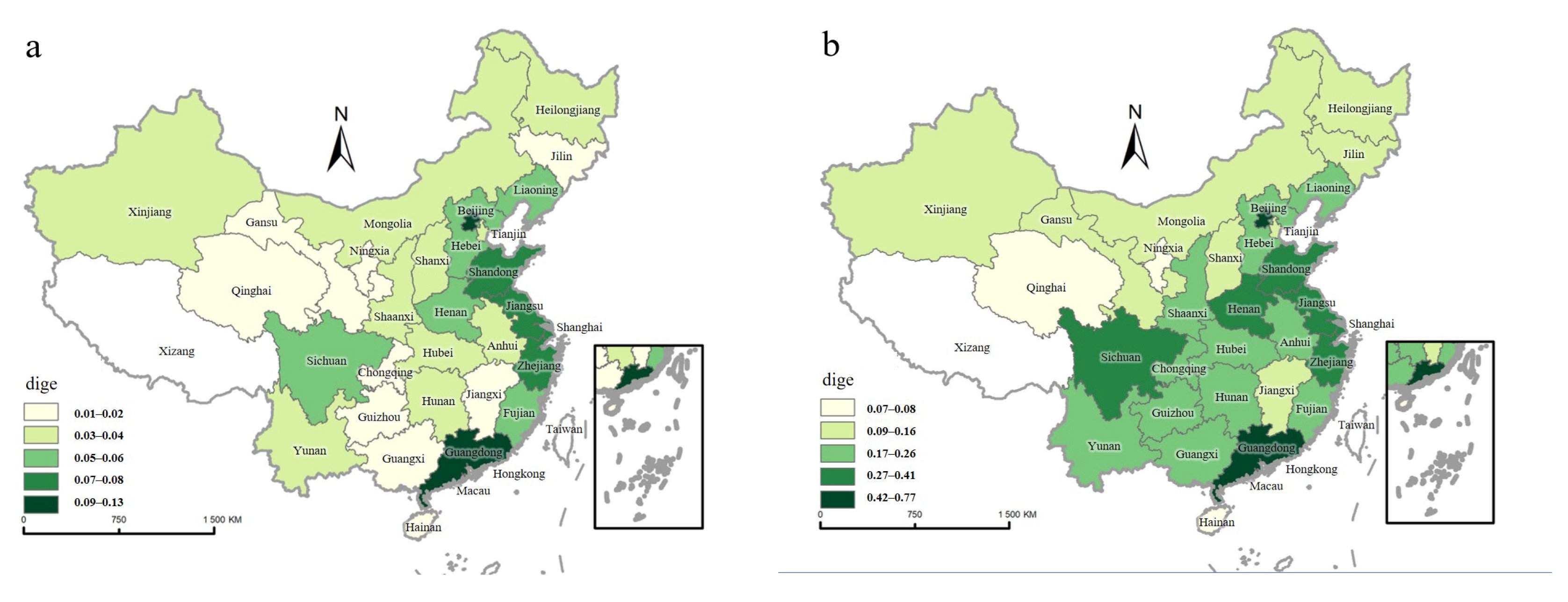
Therefore, it fundamentally eliminates the impact of multicollinearity prior to regression analysis. By determining weights according to the dispersion degree of the data itself, this approach effectively avoids biases introduced by subjective judgment, making it highly regarded in academic research. Figure 1 shows the digital economy development levels of Chinese provinces in 2011 and 2021, based on the entropy weight method.

3.2.2. Dependent Variable: Tourism Transportation Carbon Emissions (cett)

The accurate calculation of tourism transportation carbon emissions remains challenging and relies on estimation methods. Currently, two primary approaches are commonly employed. The first estimates emissions by disaggregating the carbon coefficient from the total energy consumption of a given region or sector. The second method relies on traveler mobility chain data, which aggregate emissions according to the mode of transportation. Considering the continuity and availability of statistical data, this study adopts the bottom-up method proposed by the World Tourism Organization (UNWTO), drawing on prior research by refs. [4] and others. The calculation formula is as follows:
c e t t = i = 1 4 ω i × L i × Y i
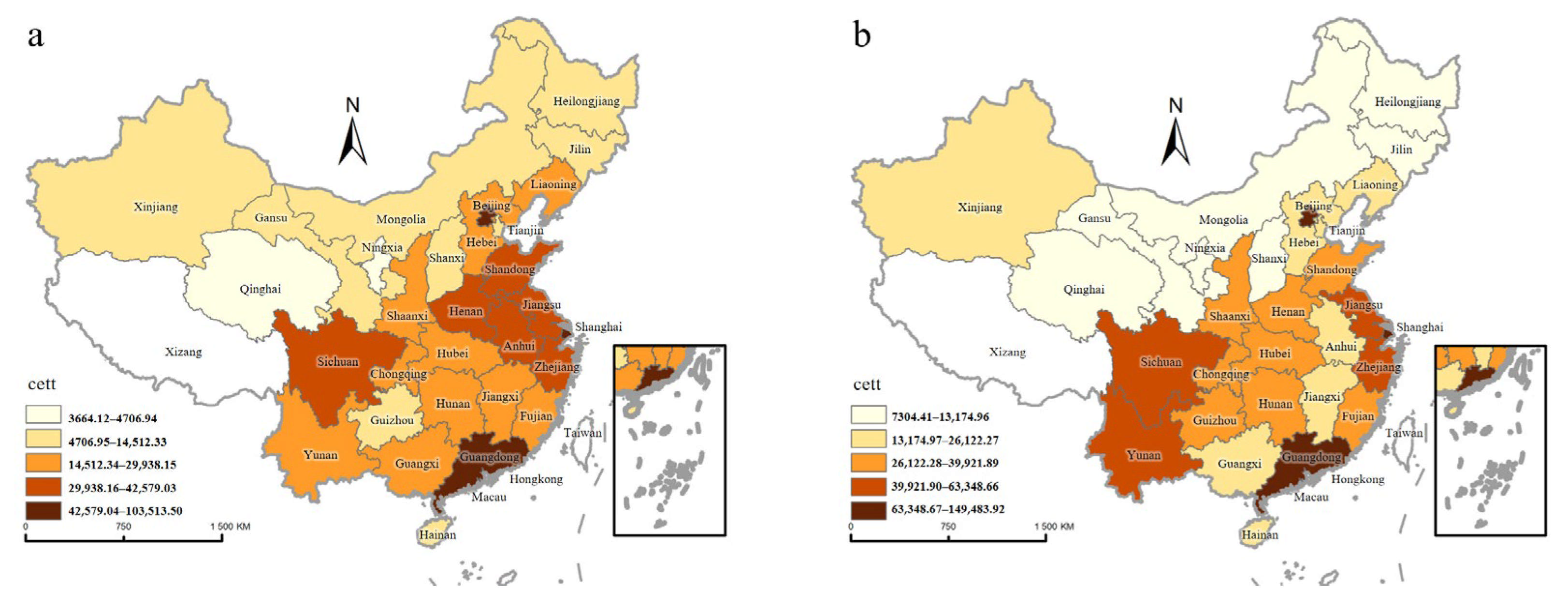
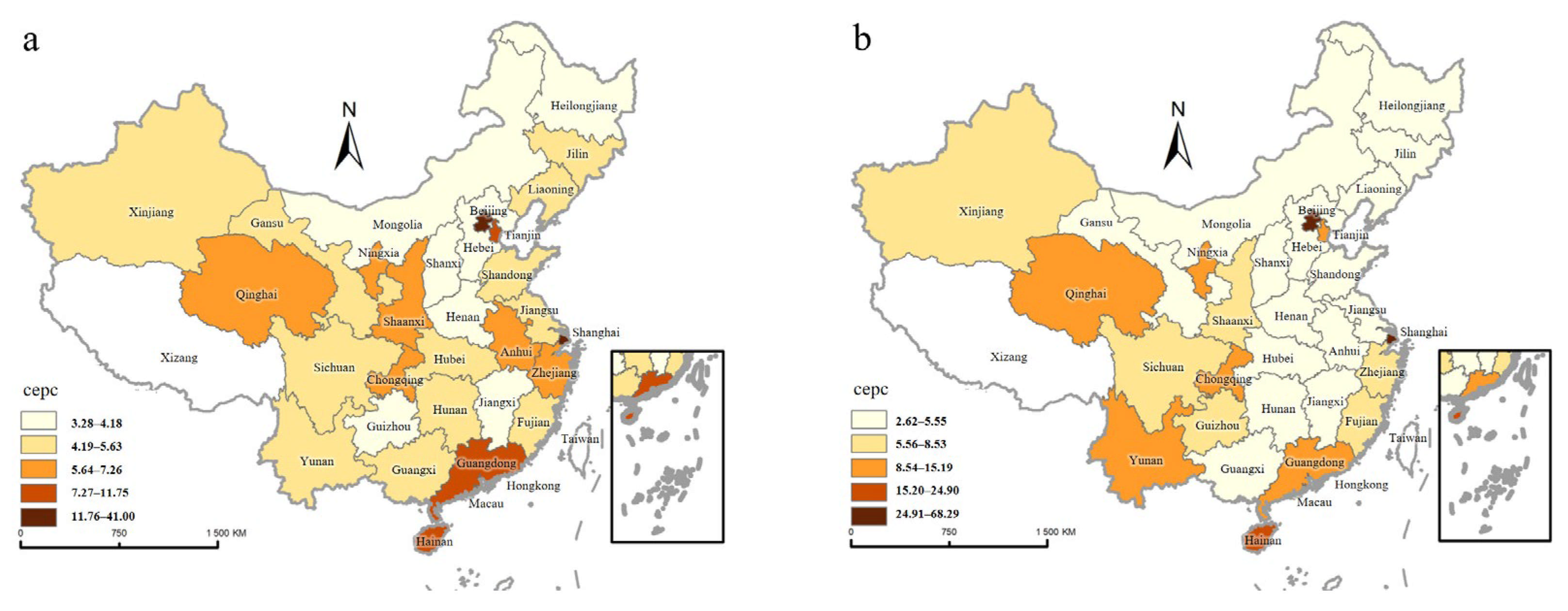
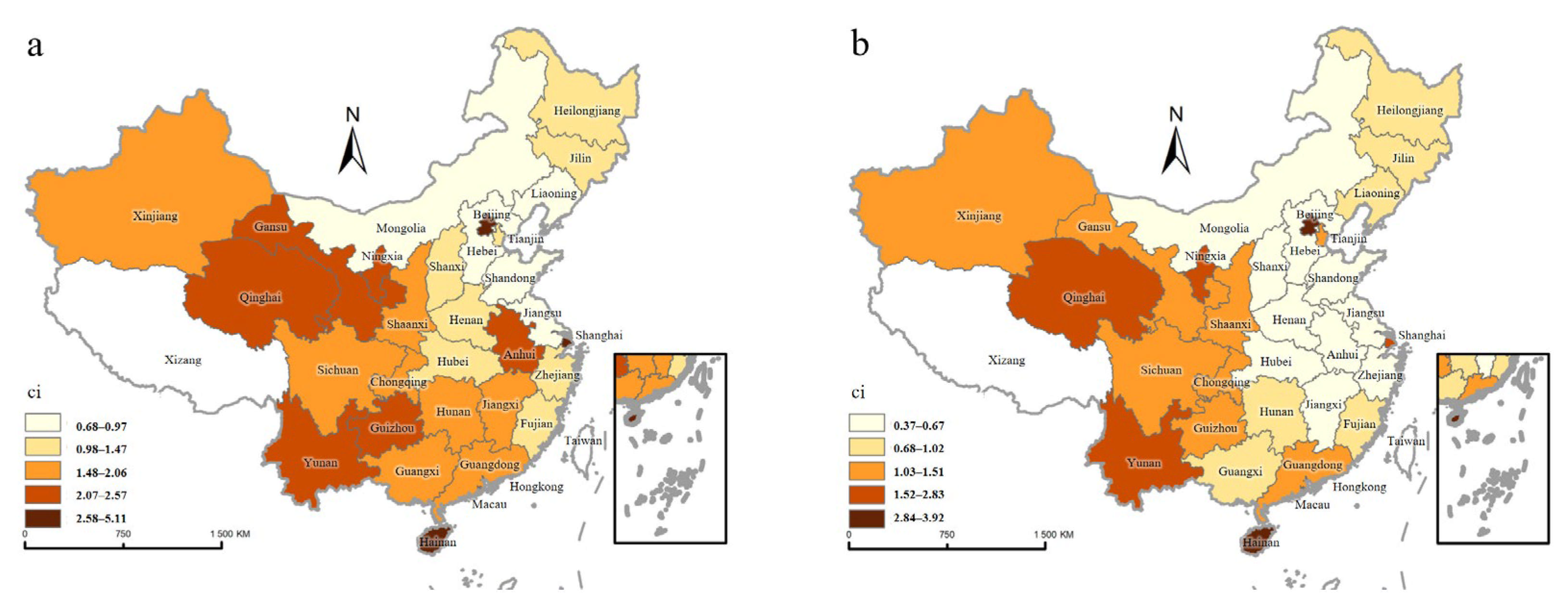
where c e t t denotes the total tourism transportation carbon emissions; ω i represents the proportion of tourists among passengers utilizing various transportation modes (rail, road, air, and water transport); L i indicates the carbon emission factor for each transportation mode; and Y i denotes the passenger turnover for each transportation mode. Based on prior studies [52,53], the proportions of rail, road, air, and water transport were 31.6%, 13.8%, 64.7%, and 10.6%, respectively. The corresponding carbon emission factors are 27 gCO2/pkm for rail, 133 gCO2/pkm for road, 137 gCO2/pkm for air, and 106 gCO2/pkm for water transport. c e p c represents per capita tourism transportation carbon emissions, estimated by the ratio of total tourism transportation carbon emissions to population; c i indicates tourism transportation carbon emission intensity, defined as tourism transportation carbon emissions per unit of GDP. Figure 2, Figure 3 and Figure 4 display the total tourism transportation carbon emissions ( c e t t ), per capita tourism transportation carbon emissions ( c e p c ), and tourism transportation carbon emission intensity ( c i ) across Chinese provinces for the years 2011 and 2021, respectively.

3.2.3. Other Variables

The selection, definition, and measurement of additional variables, including control variables (e.g., overall economic scale [54] and industrial structure [55,56,57,58,59]), mediating variables (e.g., automobile ownership [60]), and threshold variables (e.g., the number of A-rated scenic spots [61,62,63]), are specified in Table 2 as follows:

3.3. Data Sources

To ensure data reliability, this study investigates 30 provinces in China, excluding the Hong Kong Special Administrative Region, Macao Special Administrative Region, Taiwan Region, and Tibet Autonomous Region. The dataset spans from 2011 to 2021, covering 11 consecutive years. The research data are primarily obtained from the National Bureau of Statistics, China Statistical Yearbook, China Environmental Yearbook, EPS database, and statistical yearbooks of each province (autonomous region or municipality). Missing values are addressed using interpolation combined with smoothing prediction techniques. All statistical analyses are performed using Stata software (version 17.0).

4. Results Analysis

4.1. Baseline Regression Results

To mitigate the endogenous bias arising from regional heterogeneity and temporal trends, this study applies a time-space two-way fixed-effects panel model for the baseline regression. Table 3 lists the outcomes of the fixed-effects models for comparison. The findings reveal that the digital economy significantly increases both total and per capita tourism transportation carbon emissions at the 1% significance level, while simultaneously exerting a marked reduction effect on carbon emission intensity. This outcome indicates that the current vigorous development of the digital economy and its emission reduction effects exhibit a complex duality: on one hand, the technological empowerment and efficiency enhancements brought by the digital economy have become apparent, improving energy utilization efficiency and reducing carbon emission intensity; on the other hand, the additional emissions generated by the economic scale expansion and consumer demand growth driven by the digital economy still outweigh the achievable emission reduction contributions at this stage, thus keeping total carbon emissions on an upward trajectory. It can be foreseen that as digital technologies continue to penetrate and deepen in application, their technological emission reduction effects are likely to strengthen progressively. When the digital economy reaches a mature stage, economic development and carbon emissions may achieve decoupling, the overall emission trajectory will cross the tipping point, entering the descending segment on the right side of the inverted U-shaped curve, thereby probably driving total carbon emissions into a phase of absolute decline.
The core reason for these divergent impacts—where total emissions rise while intensity falls—resides in the dynamic interplay between the scale effect and the efficiency effect. Specifically, the scale effect, catalyzed by digital-driven economic expansion and stimulated tourism demand, currently offsets the emission reductions achieved through technological optimization. This confirms that the tourism transportation sector is presently situated on the ascending left side of the Environmental Kuznets Curve. By systematically identifying this simultaneous expansion of absolute emissions and the contraction of relative intensity, this study provides robust empirical evidence that validates Hypothesis H1.

4.2. Heterogeneity Analysis

4.2.1. Temporal Heterogeneity

As indicated by the regression analysis (Table 3), the development of the digital economy can intensify total tourism transportation carbon emissions, although the temporal heterogeneity of this effect has not been explicitly addressed.
To capture the dynamic evolution of the digital economy’s influence on tourism transportation carbon emissions, the sample period from 2011 to 2021 is divided into three sub-periods for separate regression analysis. The estimated coefficient of the digital economy, as shown in Table 4, rise steadily from 0.426 during 2011–2014 to 1.047 in 2015–2018 and further to 3.443 in 2019–2021. These results demonstrate the evident and progressive intensification of the driving effect exerted by the digital economy on tourism transportation carbon emissions. Meanwhile, the economic scale shifts from an insignificant driver in the early period to a major contributor at the 1% significance level in the later stage, highlighting the inertia of carbon emissions associated with rising economic levels. After initially reducing emissions to a significant level, the urbanization rate reverses to become a catalyst for large-scale expansion, reflecting a transformation in urban development patterns from intensive growth to high-carbon dependence. The carbon reduction effect of transportation infrastructure has consistently weakened. Its inhibitory influence, which is significant at the 1% level in the early period, is reduced to the 10% level later, thereby supporting the baseline inference that improvements in transportation infrastructure may induce energy rebound effects. Overall, across all models employing TWFE, the explanatory power increases markedly, with R2 increasing from 0.126 to 0.475. This progression indicates a continuous enhancement of the model’s explanatory validity, benefiting from the expansion and completeness of data over time.

4.2.2. Spatial Heterogeneity

The regression analysis of regional heterogeneity indicates that the digital economy exerts differential effects on tourism transportation carbon emissions across regions. The digital economy exerts a statistically significant promoting effect in the eastern region at the 1% level. In contrast, its impact in the central region is moderate, with a coefficient of 0.208 (Table 5). Most notably, in the western region, however, the effect takes on a multiplier characteristic, reflected in a coefficient of 4.840, which reflects the dispersed distribution of scenic spots and the diversity of transportation demand. This outcome highlights the path dependence of high growth and high emissions when digital technologies are applied in less developed regions. Regarding the control variables, the efficiency of transportation infrastructure in reducing emissions displays a stepwise decline from east to west. The influence of education level also varies across regions. While it contributes to emission reduction in the eastern and central regions, it acts as a strong contributing factor to emission increases in the western region, significant at the 1% level. All models are validated using TWFE, with the model for the central region demonstrating the highest explanatory power.

4.3. Mediation Effect

In the selection of mediating variables, this study moves away from conventional mediation analyses that rely on theoretically convenient but contextually arbitrary variables. Instead, it situates car ownership (co) and travel scale (travel) within the observable realities of tourism development under the digital economy. These variables are not predefined theoretical constructs but emerge through observing the rapid growth of the tourism industry and drawing on existing literature. These factors directly reshape consumption and travel patterns. The regression results in Table 6 further confirm that the digital economy significantly increases tourism transportation carbon emissions by promoting growth in automobile ownership and expanding the scale of travel.
Specifically, digital technologies have streamlined vehicle purchasing processes, directly contributing to increased car ownership. Concurrently, the robust growth of digital economy platforms—such as those for hotel and ticket bookings—has effectively lowered the barriers to private car use. The resultant decline in transaction costs and enhanced convenience of using private cars have indirectly further boosted car ownership levels. This rise in car ownership subsequently drives a shift in travel patterns, with tourists increasingly prioritizing freedom and personalized experiences, making self-driving tours a mainstream choice. The increased share of these high-carbon transportation modes, coupled with a relative decline in public transportation usage, has a statistically significant impact on exacerbating carbon emissions at the 1% level.
Furthermore, the in-depth development of the digital economy, particularly smart tourism, plays a key role in reducing the overall barriers to travel by enhancing information accessibility and marketing precision. This expansion effect, supported by a positive regression coefficient of 0.648, significantly promotes the scale of tourism activities. The convenience of online bookings encourages people to plan short-distance trips more frequently and undertake long-distance travel more easily, leading to increased trip frequency and expanded travel ranges, which in turn generates additional transportation carbon emissions. Moreover, the wide array of activities promoted through internet-based personalized recommendations and deeper experiential projects within destinations contribute to a growing tourist population and extended lengths of stay. This mechanism is further evidenced by the observed positive mediating role, with a coefficient of 0.624, illustrating how digital development facilitates travel expansion and ultimately leads to increased carbon emissions from transportation and related sectors.
Thus, both statistical and economic analyses support Hypotheses H2 and H3, indicating that in China’s current developmental stage, the digital economy remains on the left side of the inverted U-shaped curve, with its ongoing digitalization primarily stimulating rather than curbing carbon emissions.

4.4. Robust Test

The baseline regression analysis identifies a notable increase in carbon emissions from tourism transportation attributable to the digital economy. To verify the robustness of this conclusion, three approaches are employed. (1) Alternative Explanatory Variable: The mobile phone penetration rate is recalculated using the ratio of total mobile phone users to the permanent resident population, and the regression is re-estimated with this revised variable. (2) Exclusion of Extreme Years: To minimize potential anomalies and statistical disturbances, the model is re-estimated after excluding the three years most affected by the COVID-19 pandemic (2019–2021). (3) Instrumental Variable Estimation: The original model is re-estimated using an instrumental variable. (4) Altering Clustered Standard Errors: The standard errors are re-clustered at the provincial level to account for potential correlations within provinces and to verify the robustness of the baseline estimation. (5) Applying Winsorizing or Truncating: To mitigate the influence of outliers, the model is re-estimated using both winsorized and truncated samples (at the 1% level) for all continuous variables. (6) Adopting the Double Machine Learning (DML) Model: The baseline model is re-estimated using the Double Machine Learning approach to control for potential nonlinear confounders and improve causal inference robustness.
In the robustness check involving the substitution of explanatory variables, the mobile phone penetration rate is used as a replacement for the original explanatory variable. The results in Columns (1) of Table 7 indicate that following this substitution, the coefficient increases substantially, while the signs and significance of the other control variables remain largely consistent, confirming the robustness of the regression results.
For the robustness check based on the exclusion of abnormal years, the regression is re-estimated after removing the three pandemic-affected years (2019–2021). The data in Column (2) of Table 7 show a more pronounced influence of the digital economy on tourism transportation carbon emissions. This finding further corroborates the reliability of the research conclusions.
When evaluating the influence of the digital economy on carbon emissions from tourism transportation, baseline regression results may suffer from endogeneity bias, which could generate distorted estimates and inconsistent conclusions. The endogeneity issue arises from three principal sources. First, for the omitted variable bias, although extensive control variables are included, unobserved factors are still likely to affect both digital economy development and tourism-related carbon emissions simultaneously, thereby biasing the estimates. Second, for reverse causality, carbon emissions from tourism transportation are not only shaped by the digital economy but also increase naturally as the diffusion and application of digital technologies expand, creating a bidirectional relationship. Third, regarding measurement error, the evaluation index system constructed for the digital economy in this study may not fully or accurately capture the actual level of regional digital development. In prior research, historical data have often been adopted to address endogeneity concerns. Following this approach [64,65], the present study introduces an instrumental variable—specifically, the interaction between the 1984 per capita number of post offices and the time trend. The selection of the 1984 postal network as an instrumental variable is justified by its ability to meet the relevance and exclusion restriction conditions. In terms of relevance, postal infrastructure served as the physical network for information transmission, and its historical layout established a foundation for the subsequent diffusion of communication technologies, thereby creating a path-dependent relationship with contemporary digital economy development. Regarding excludability, the choice of 1984—a period during China’s early reform and opening-up—is critical. The distribution of post offices at that time was primarily influenced by administrative planning and geographical factors, rather than being directly linked to current tourism transportation carbon emissions. Its impact operates mainly through shaping early information flow patterns, which subsequently influence the digital economy, rather than through traditional transport-related channels. Thus, this instrumental variable helps isolate the net effect of the digital economy on tourism transportation carbon emissions, enhancing the reliability of the empirical results.
The first-stage regression results presented in Column (3) of Table 7 confirm that the instrumental variable has a significant correlation with the digital economy, with an F-statistic above 25, indicating the absence of weak instrument bias. The second-stage regression results shown in Column (4) reveal that after correcting for endogeneity using the IV method, the coefficient for the digital economy remains statistically significant at the 10% level, indicating a favorable influence on tourism transportation carbon emissions in China. This demonstrates that the digital economy acts as a contributory driver of these emissions.
For the robustness check involving the alteration of the clustering level, the standard errors are re-clustered at the province level. The result in Column (5) of Table 8 demonstrates that after this adjustment, dige remains positively significant at the 1% level. The signs and significance of the other control variables are largely consistent with the baseline regression, thereby confirming the robustness of the findings.
In the robustness checks employing Winsorizing and Truncating treatments to mitigate the influence of outliers, the regression is re-estimated using the respective samples. As shown in Column (6) and (7) of Table 8, dige continues to be statistically significant at the 1% level (0.676, t = 4.659 and 0.620, t = 3.791, respectively). Furthermore, trsp retains its negative significance, and other variables show considerable stability, which further verifies the reliability of the initial results.
Regarding the robustness check based on changing the estimation model, the DML approach is applied. The result reported in the last column of Table 8 indicates that dige becomes substantially larger and remains highly significant (1.852, t = 8.261). This provides strong evidence supporting the resilience of the identified association under different model specifications.

4.5. Threshold Effects

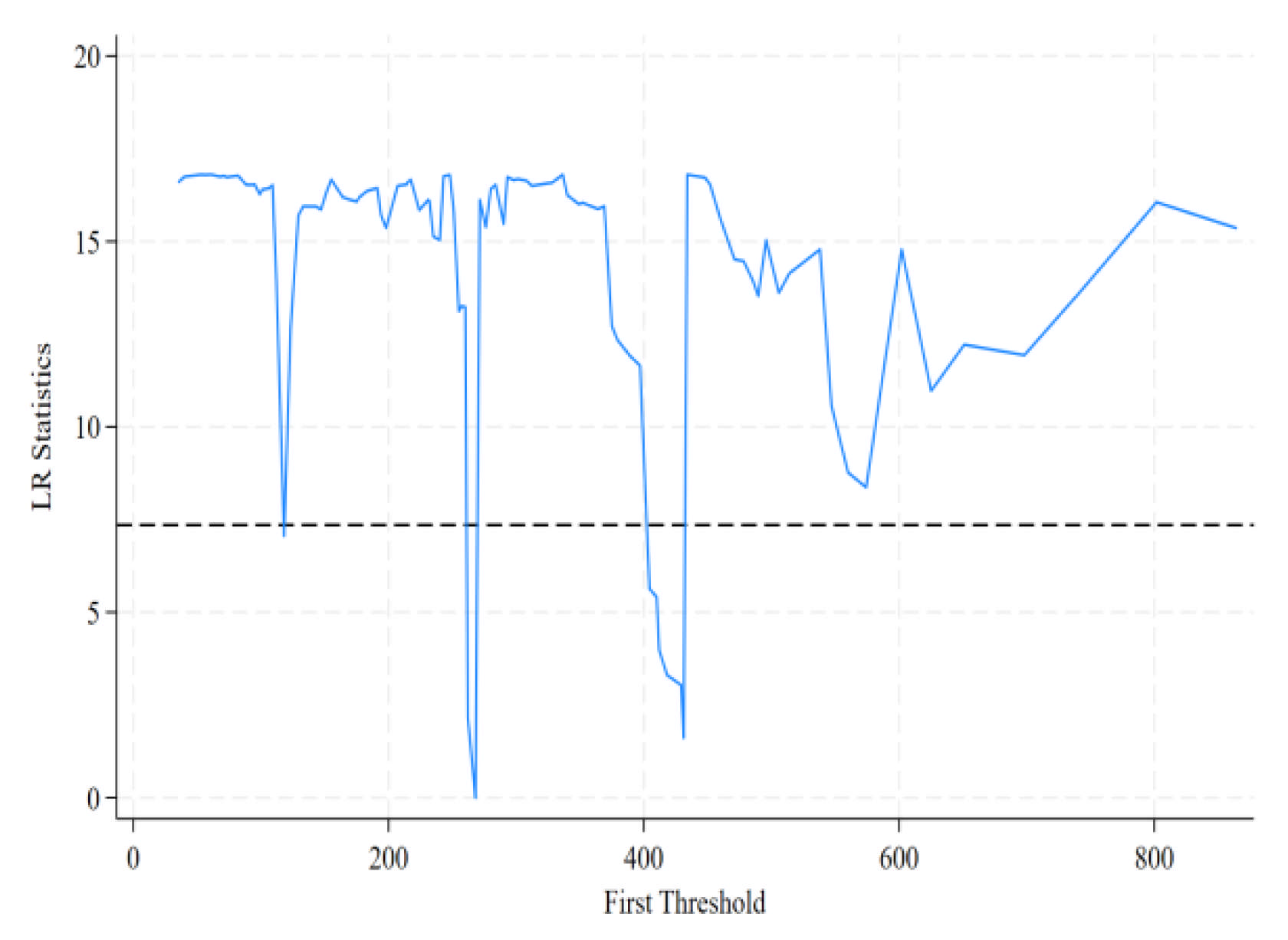
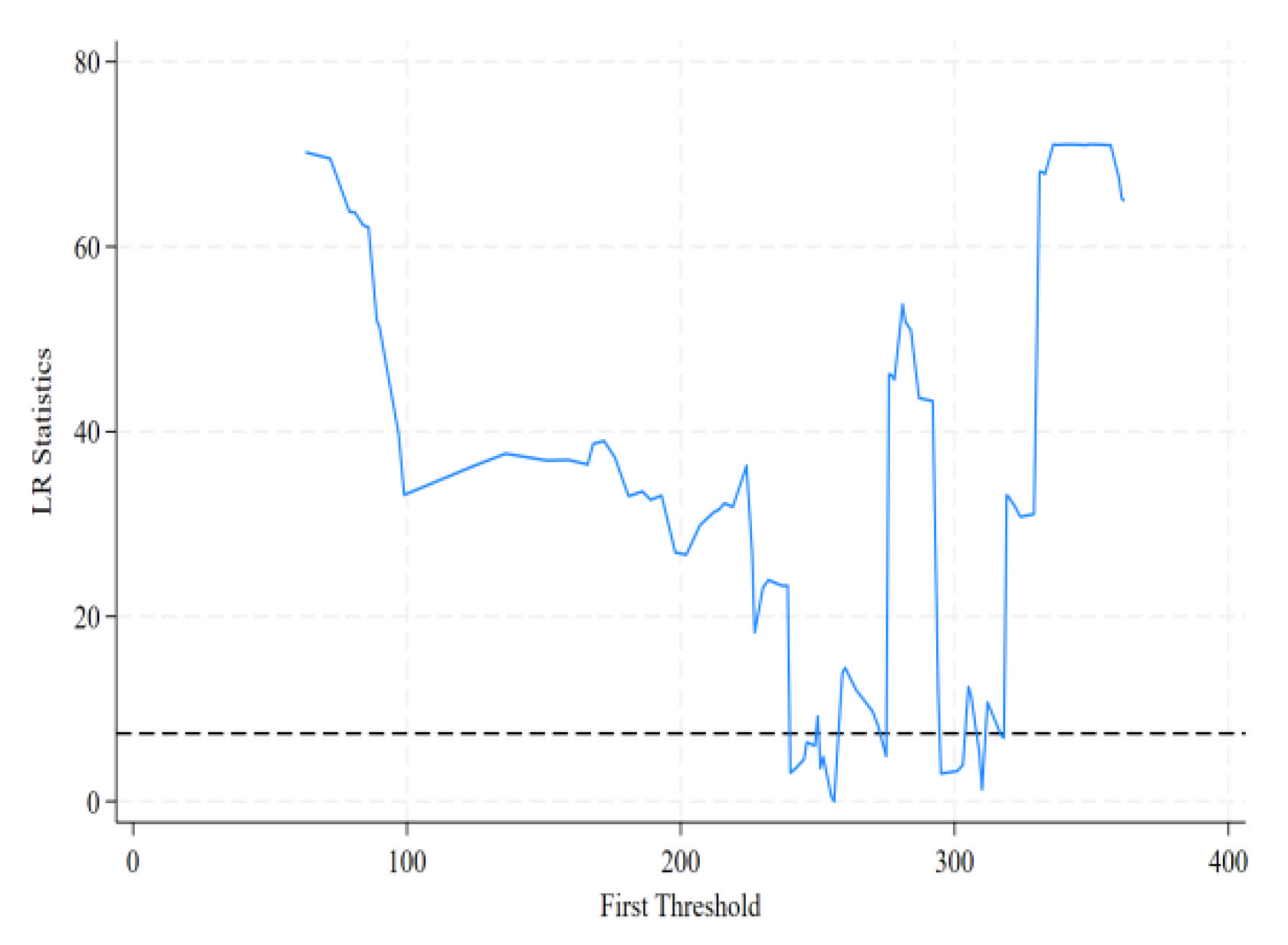
The results of the threshold effect tests reported in Table 9 and Table 10 demonstrate that different variables exert significant nonlinear impacts on tourism transportation carbon emissions. When the number of A-level scenic spots (spot) is used as the threshold variable, the single-threshold model yields strong statistical significance, with a threshold value of 430 and a confidence interval of [414.50, 503.96]. Below this threshold, the impact coefficient reaches 0.494 and is significant at the 1% level. However, the coefficient declines sharply to 0.162 and is significant only at the 10% level beyond the threshold. This indicates a distinct threshold effect. While the number of A-level scenic spots promotes tourism transportation carbon emissions up to a certain level, exceeding this critical value diminishes its promoting influence.
Concretely, in the initial stage of tourism development, the increase in A-level scenic spots leads to a significant rise in transportation carbon emissions due to economies of scale and fragmented infrastructure. However, once the number of scenic spots surpasses a certain critical threshold, the clustered attraction layout promotes the adoption of low-carbon travel modes such as shared mobility, walking, and cycling. The region then enters a mature phase of tourism development, characterized by optimized infrastructure and energy-efficient technologies, resulting in a slower growth rate of carbon emissions.
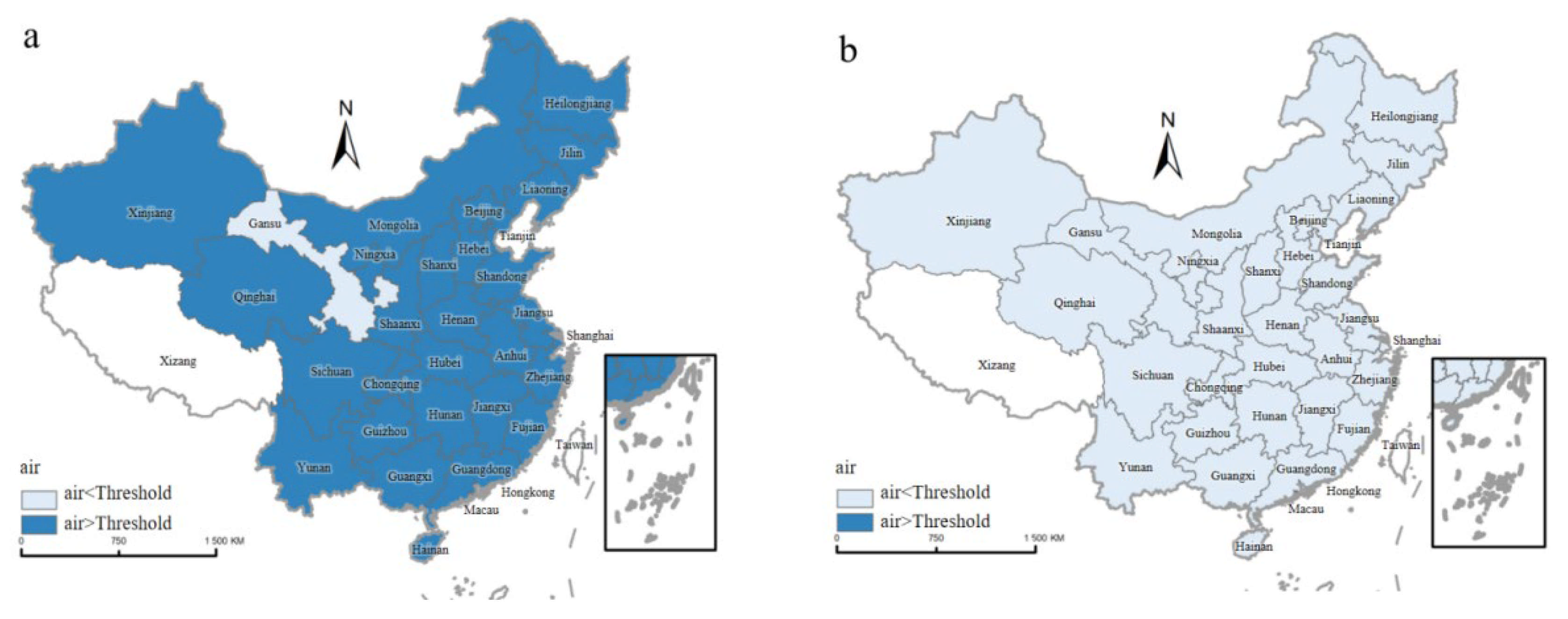
For environmental quality indicators (air), the single-threshold effect is also significant, and its impact intensity follows a decreasing pattern. The improvement effect is the strongest when the environmental quality level falls below the threshold of 257. Once this level is exceeded, the marginal effect decreases. This declining trend could be attributed to the principle of rising marginal costs in environmental governance, where a reduction in pollution to lower levels substantially diminished the emission reduction effectiveness of each additional unit of governance investment.
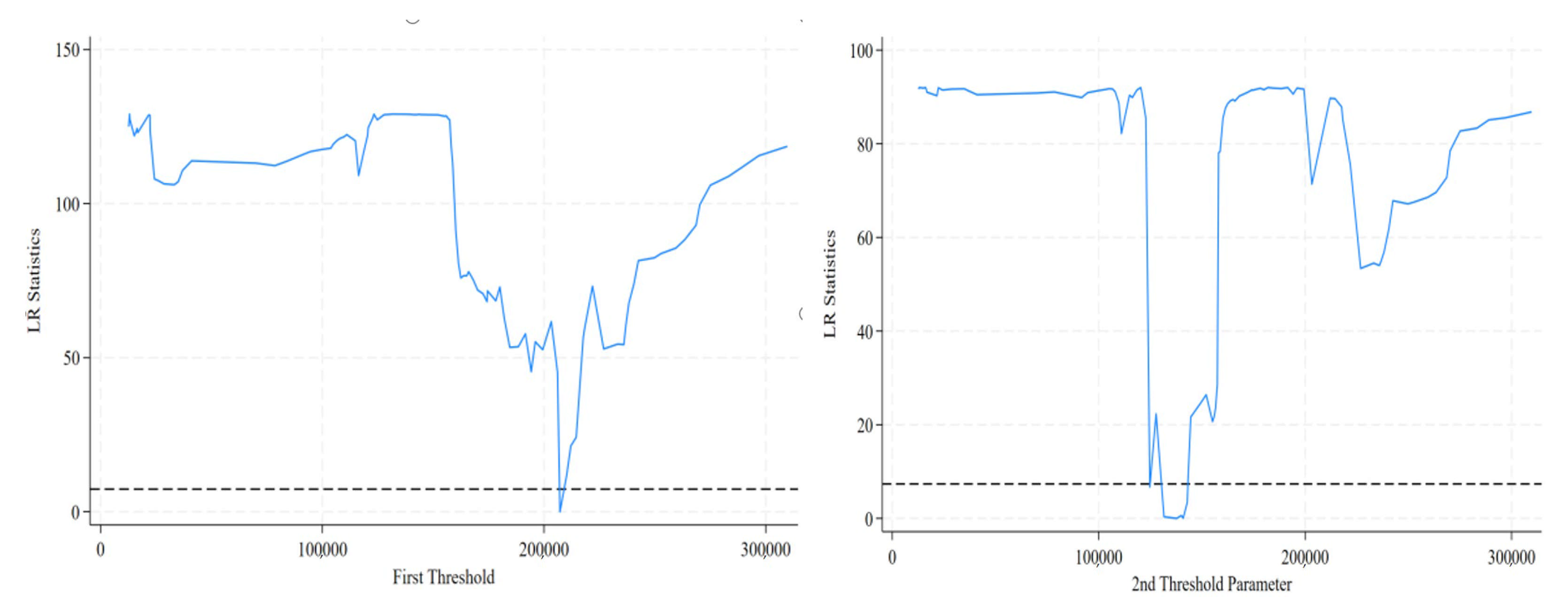
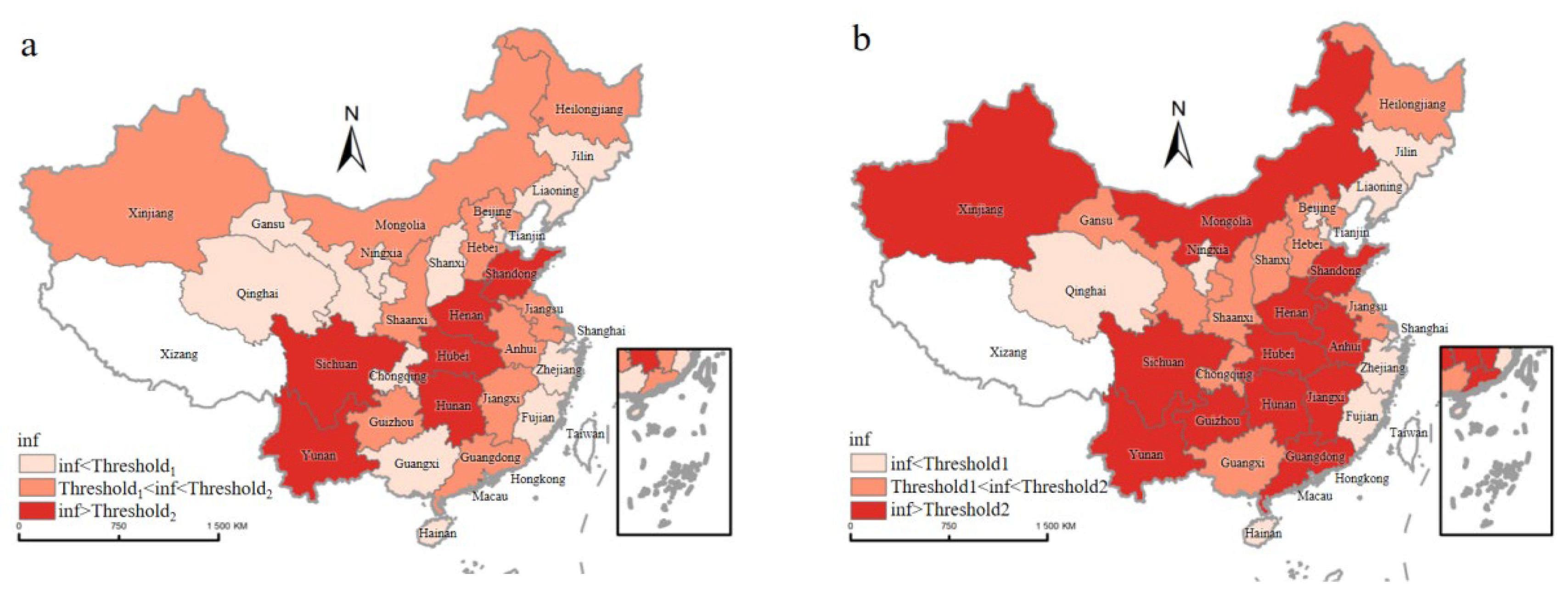
The quantity of infrastructure (inf) exhibits more complex characteristics, showing a double-threshold effect. Two threshold values, 137,771 and 207,189.5950, divided the samples into three distinct intervals. When infrastructure investment remains below 137,771, the focus lies on establishing basic connectivity, such as providing targeted support for tourist shuttle routes to preliminarily guide low-carbon and intensive travel modes. At this stage, infrastructure is fragmented and networks are underdeveloped, with transportation relying heavily on high-carbon patterns, resulting in an overall non-significant impact on carbon emissions. At moderate investment levels, efforts shift toward encouraging shared mobility, advancing the construction of tourist scenic byways, and improving road network grading and quality. Infrastructure begins to form corridors, though the overall network remains incomplete, with this effect achieving statistical significance only at the 5% level. Once investment exceeds 207,189.5950, demand-side management strategies, such as implementing congestion pricing policies for specific zones and periods, come into play. At this mature stage of tourism and transportation systems, a strongly significant promotional effect emerges. This three-stage progression—from non-significant promotion to moderate significance, and then to strong promotion—suggests that infrastructure construction must surpass a certain scale threshold before its impact on tourism transportation carbon emissions becomes substantively evident.
The goodness-of-fit results further indicate that all models exhibit a high degree of explanatory power. Based on 330 observed samples, the panel data provides robust empirical support for these conclusions. Moreover, the differentiated significance levels of the control variables indirectly confirmed that the threshold model could effectively capture the complex interaction relationships among the variables.
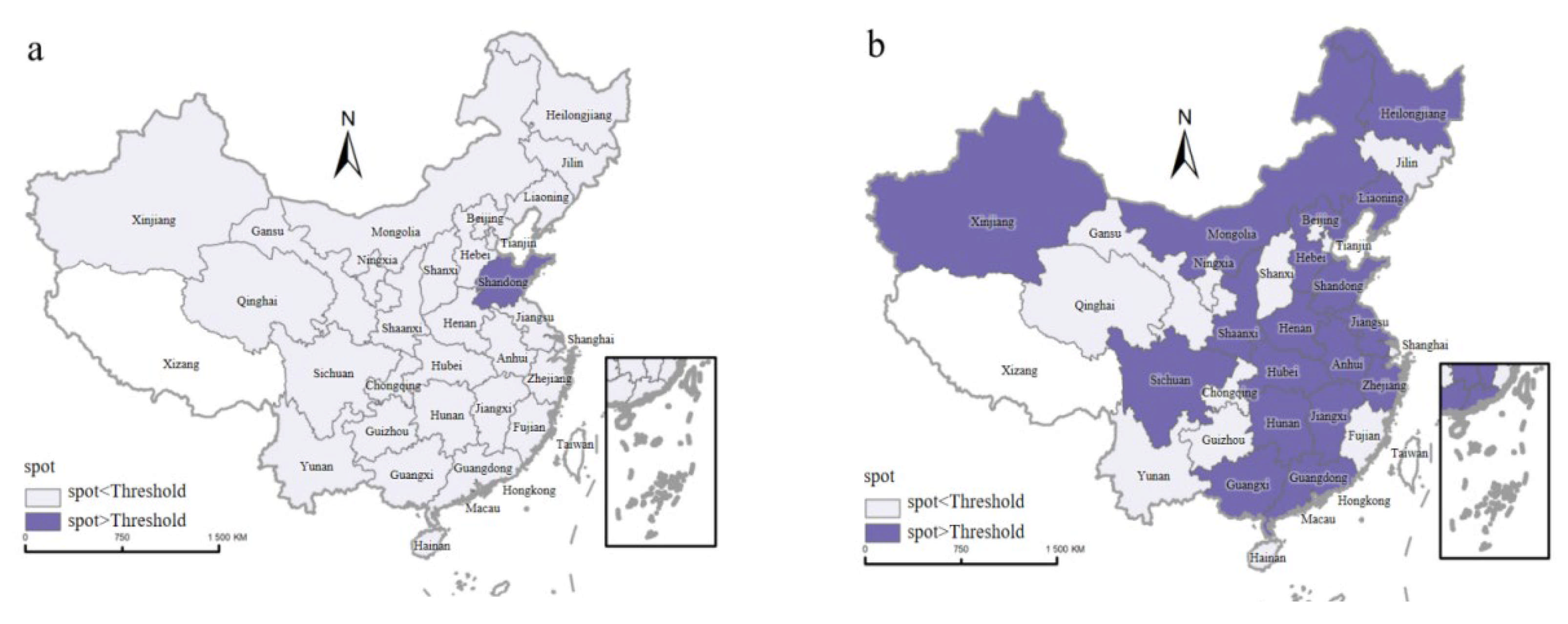
Figure 5 and Figure 6 depict the single-threshold effects of the digital economy on total tourism transportation carbon emissions, with the threshold variables being spot and air, respectively, while Figure 7 presents the corresponding double-threshold effect with inf as the threshold variable. To provide geographical context for these threshold variables, the spatial distributions of spot, air and inf across Chinese provinces for the years 2011 and 2021 are further illustrated in Figure 8, Figure 9 and Figure 10, respectively.

5. Conclusions and Policy Implication

5.1. Conclusions

The digital economy has become a major driver of total carbon emissions from tourism transportation. This study evaluated these emissions using panel data from 30 Chinese provinces between 2011 and 2021. By employing empirical analysis through four dimensions (baseline regression, heterogeneity analysis, mediation effects, and threshold effects), the mechanisms by which the digital economy influences tourism-related carbon emissions were systematically examined. The principal conclusions are summarized as follows:
Although the penetration of digital technology increased both the total and per capita emissions from tourism transportation (p < 0.01), it simultaneously improved energy efficiency and reduced carbon intensity at the 1% level, thereby supporting low-carbon transformation.
Second, tourism transportation carbon emissions displayed strong spatiotemporal heterogeneity. Over time, the driving effect of the digital economy exhibits a progressively strengthening trend, increasing from 0.426 to 1.047 and then to 3.443. Spatially, the effect varied across regions, ranging from “promoting-weakly promoting-strongly promoting” in the central, eastern and western provinces, respectively.
Third, the digital economy affected emissions through both direct and indirect mechanisms. Currently, China’s digital economy remains primarily positioned on the left-hand side of the inverted U-shaped curve, where its development contributes positively to carbon emissions. The influence operated mainly through two channels: increased vehicle ownership and expanded travel scale. This relationship remained robust even after accounting for endogeneity concerns and robustness checks.
Fourth, multiple variables exhibited significant nonlinear effects on tourism transportation emissions. The number of A-rated scenic spots demonstrated a threshold effect. Upon exceeding the threshold of 430, carbon emissions rise to a turning point, after which the promoting effect begins to taper off. Environmental quality indicators revealed a single-threshold effect with declining marginal benefits. The relationship between infrastructure investment and carbon emissions followed a double-threshold pattern. The promotional effect transitioned from being statistically insignificant to progressively significant as investment scaled up, revealing a complex and nonlinear interaction characterized by distinct phases of influence.

5.2. Policy Implications

To enable the digital economy to advance energy conservation and carbon reduction in tourism transportation more effectively, the following tiered policy recommendations are proposed, differentiating between immediate actions and long-term strategic reforms.
In the short term, actions should prioritize deploying existing technologies and management tools. Intelligent traffic control systems should be implemented in popular tourist cities to optimize real-time traffic flow and reduce congestion-related emissions. Additionally, integrated Mobility-as-a-Service platforms that combine public transit and shared mobility should be developed to encourage a shift away from private vehicles. Meanwhile, regional carbon-inclusive platforms can be piloted to break down data barriers across sectors, allowing tourists to earn redeemable points for low-carbon travel choices. Supportive measures, such as tiered subsidies for low-emission vehicles, should also be promoted to accelerate the transition toward cleaner transport.
In the long term, policies should utilize digitalization to drive structural reforms in tourism transportation and establish a sustainable low-carbon model. This requires building a nationwide interconnected data infrastructure to enable cross-regional and cross-sector data sharing, which will support precise governance and intelligent scheduling. Advanced technologies such as AI and digital twins should be widely applied to simulate and optimize transportation systems—for instance, through city-level traffic-energy models that dynamically assess emission reduction strategies and inform infrastructure planning. Ultimately, cross-regional collaborative governance and market mechanisms should be developed, including a unified low-carbon tourism transportation certification system and a transregional carbon sink trading market. These steps would institutionalize incentives and fundamentally foster the green transformation of the sector.

5.3. Limitations

This study has several limitations that warrant careful consideration. The measurement of carbon emissions relies solely on coefficient-based estimates for only 30 Chinese provinces, which may overlook regional variations. Key data, including transport mode shares and emission coefficients, are drawn from previous studies. Additionally, the 11-year observation period is insufficient to reveal long-term nonlinear dynamics.

5.4. Directions for Future Research

Future research could advance in several key directions. In terms of methodology, moving beyond coefficient-based estimations by integrating big data and artificial intelligence can significantly improve the accuracy of carbon accounting and forecasting. Building on this, extending the study period beyond 11 years is essential to better assess long-term impacts and dynamic thresholds. Moreover, conducting comparative analyses between digital economy pilot and non-pilot regions would help clarify the effectiveness of relevant policies and their spatial spillover effects.

Author Contributions

Conceptualization, S.Y. and Y.W.; methodology, S.Y. and Y.W.; software, S.Y.; validation, Y.Y.; formal analysis, Y.Y. and Y.W.; data curation, S.Y.; writing—original draft preparation, S.Y.; writing—review and editing, Y.Y. and Y.W.; supervision, Y.W.; project administration, Y.W.; funding acquisition, Y.W. All authors have read and agreed to the published version of the manuscript.

Funding

This research was supported by the National Social Science Fund of China (grant number: 24XJY033), Sichuan Science and Technology Program (grant number: 2026YFHZ0282) and the National College Students Innovation and Entrepreneurship Training Program (grant number: 202510626012).

Institutional Review Board Statement

Not applicable.

Informed Consent Statement

Not applicable.

Data Availability Statement

The original contributions presented in the study are included in the article. Further inquiries can be directed to the corresponding author.

Conflicts of Interest

The authors declare no conflicts of interest.

References

  1. Lu, L.; Zeng, J.; Yu, T.H. Research on carbon emission accounting and low-carbon optimization of tourism transportation based on travel patterns: A case study of Xiamen. Geogr. Geoinf. Sci. 2025, 41, 152–160. [Google Scholar]
  2. Zhang, Y.; Liu, X.; Yang, J. Digital economy, green dual innovation and carbon emissions. Sustainability 2024, 16, 7291. [Google Scholar] [CrossRef]
  3. Faber, J.; Hanayama, S.; Zhang, S.; Pereda, P.; Comer, B.; Hauerhof, E.; van der Loeff, W.S.; Smith, T.; Zhang, Y.; Kosaka, H.; et al. Fourth IMO GHG Study; International Maritime Organization: London, UK, 2020. [Google Scholar]
  4. Shi, P.H.; Wu, P. A rough estimation of energy consumption and CO2 emission in tourism sector of China. Acta Geogr. Sin. 2011, 66, 235–243. [Google Scholar]
  5. Juschten, M.; Hössinger, R. Out of the city—But how and where? A mode-destination choice model for urban–rural tourism trips in Austria. Curr. Issues Tour. 2021, 24, 1465–1481. [Google Scholar] [CrossRef]
  6. Lenzen, M.; Sun, Y.Y.; Faturay, F.; Ting, Y.P.; Geschke, A.; Malik, A. The carbon footprint of global tourism. Nat. Clim. Change 2018, 8, 522–528. [Google Scholar] [CrossRef]
  7. UNWTO; UNEP; WMO. Climate Change and Tourism: Responding to Global Challenges; UNWTO: Madrid, Spain, 2008. [Google Scholar]
  8. Feng, D.; Li, C.; Li, Y. Study on spatial-temporal evolution, decoupling effect and influencing factors of tourism transportation carbon emissions: Taking north China as an example. Atmosphere 2024, 15, 720. [Google Scholar] [CrossRef]
  9. Tao, Y.G.; Huang, Z.F.; Shi, C.Y. Carbon dioxide emissions from regional tourism transport: A substitutional bottom-up analysis. Acta Ecol. Sin. 2015, 35, 4224–4233. [Google Scholar] [CrossRef]
  10. Huang, Y.Z. Influencing factors and emission reduction measures of tourism transportation carbon footprint abroad. Technol. Mark. 2013, 20, 216–218. [Google Scholar]
  11. Zhou, H.; Chi, X.T.; Norman, R.; Zhang, Y.Q.; Song, C.Y. Tourists’ urban travel modes: Choices for enhanced transport and environmental sustainability. Transp. Res. D Transp. Environ. 2024, 129, 104144. [Google Scholar] [CrossRef]
  12. Marsden, G.; Mullen, C.; Bache, I.; Bartle, I.; Flinders, M. Carbon reduction and travel behaviour: Discourses, disputes and contradictions in governance. Transp. Policy 2014, 35, 71–78. [Google Scholar] [CrossRef]
  13. Gan, C.; Wang, K.; Voda, M. Does tourism development become an accelerator of low-carbon transition? The moderating role of digital economy and green finance. J. Environ. Manag. 2025, 385, 125664. [Google Scholar] [CrossRef]
  14. Lin, Y.H.; Nitivattananon, V. A low-emission pathway for tourism passenger transport in small and medium-sized urban destinations—Case of Yilan, Taiwan. Int. J. Tour. Cities 2024, 11, 138–154. [Google Scholar] [CrossRef]
  15. Zhang, J.; Zhang, Y. Tourism, economic growth, energy consumption, and CO2 emissions in China. Tour. Econ. 2021, 27, 1060–1080. [Google Scholar] [CrossRef]
  16. Rico, A.; Martínez-Blanco, J.; Montlleó, M.; Rodríguez, G.; Tavares, N.; Arias, A.; Oliver-Solà, J. Carbon footprint of tourism in Barcelona. Tour. Manag. 2019, 70, 491–504. [Google Scholar] [CrossRef]
  17. Zha, J.P.; Dai, J.Q.; Ma, S.Q.; Chen, Y.R.; Wang, X.H. How to decouple tourism growth from carbon emissions? A case study of Chengdu, China. Tour. Manag. Perspect. 2021, 39, 100849. [Google Scholar] [CrossRef]
  18. Luo, F.; Becken, S.; Zhong, Y.D. Changing travel patterns in China and ‘carbon footprint’ implications for a domestic tourist destination. Tour. Manag. 2018, 65, 1–13. [Google Scholar] [CrossRef]
  19. Lei, T.; Wang, Y.Q.; Wang, C. Spatial correlation network and influencing factors of carbon emissions from inter-provincial tourism transportation in China. Huan Jing Ke Xue 2025, 46, 53–65. [Google Scholar]
  20. Li, H.Y.; Hui, J.; Wu, Z.Q. Are poverty alleviation and carbon reduction parallel paths? Empirical research on the interaction between poverty alleviation and carbon emissions. J. Environ. Dev. 2023, 32, 274–301. [Google Scholar] [CrossRef]
  21. Sun, Y.Y. Decomposition of tourism greenhouse gas emissions: Revealing the dynamics between tourism economic growth, technological efficiency, and carbon emissions. Tour. Manag. 2016, 55, 326–336. [Google Scholar] [CrossRef]
  22. Jafari, M.; Kavousi-Fard, A.; Chen, T.; Karimi, M. A review on digital twin technology in smart grid, transportation system and smart city: Challenges and future. IEEE Access 2023, 11, 17471–17484. [Google Scholar] [CrossRef]
  23. Song, J.; He, G.N.; Wang, J.X.; Zhang, P.W. Shaping future low-carbon energy and transportation systems: Digital technologies and applications. Energy 2022, 1, 285–305. [Google Scholar] [CrossRef]
  24. Luo, X.; Yin, X.; Li, Y.; Zhou, X. Decoupling China’s tourism economy from carbon emissions through digitalization: A supply-side analytical framework. Sustainability 2025, 17, 5183. [Google Scholar] [CrossRef]
  25. Gössling, S.; Higham, J.; Nunkoo, R. The digital transition in tourism: A framework for analyzing systemic changes in data-driven mobility ecosystems. Ann. Tour. Res. 2023, 99, 103551. [Google Scholar]
  26. Chen, W.; Wu, Y. Does intellectual property protection stimulate digital economy development? J. Appl. Econ. 2022, 25, 723–730. [Google Scholar] [CrossRef]
  27. Ouni, M.; Mrad, S.; Mraihi, R. Pathways to sustainable transportation in G-20 countries: Unveiling the role of green technology, green energy, green finance and digital economy using panel data and machine learning analyses. Res. Transp. Bus. Manag. 2025, 60, 101355. [Google Scholar] [CrossRef]
  28. Sturgeon, T.J. Upgrading strategies for the digital economy. Glob. Strategy J. 2021, 11, 34–57. [Google Scholar] [CrossRef]
  29. Zhang, Z.; Yu, Q.; Gao, K.; He, H.D.; Liu, Y.; Huang, H. Carbon emission reduction benefits of ride-hailing vehicle electrification considering energy structure. Appl. Energy 2025, 377, 124548. [Google Scholar] [CrossRef]
  30. Nie, Z.P.; Li, H.J. How does the digital economy improve energy eco-efficiency? Evidence from provincial panel data in China. Pol. J. Environ. Stud. 2025, 34, 2819–2834. [Google Scholar] [CrossRef]
  31. Wu, L.X.; Gui, Y.Q.; Zhang, Q.K.; Yu, M.J. Digital economy, environmental regulation, and carbon emissions: Based on a dynamic panel threshold model. In Proceedings of the 2024 9th International Conference on Intelligent Information Processing, Bucharest, Romania, 21–23 November 2024. [Google Scholar]
  32. Zhang, S.W.; Ge, Y.M.; Li, X.S.; Huang, C.Q. Can tourism economy enhance the level of urban green development? A study based on spatial effects and threshold characteristics. J. Resour. Ecol. 2024, 15, 1094–1105. [Google Scholar] [CrossRef]
  33. Balezentis, T.; Krisciukaitiene, I.; Balezentis, A.; Garland, R. Rural tourism development in Lithuania (2003–2010): A quantitative analysis. Tour. Manag. Perspect. 2012, 2–3, 1–6. [Google Scholar] [CrossRef]
  34. Li, Z.G.; Wang, J. How does the digital economy affect spatial carbon emissions under economic agglomeration? J. Xi’an Jiaotong Univ. (Soc. Sci.) 2022, 42, 87–97. [Google Scholar]
  35. Han, J.L.; Zheng, W.Q.; Cai, H.Y.; Ming, Q.Z.; Yan, X.; Fu, Y.; Zhao, Z.X. A study of the spatial spillover effects and mechanisms of the digital economy on tourism carbon neutrality ability. Environ. Dev. Sustain. 2025. [Google Scholar] [CrossRef]
  36. Cheng, Z.H.; Han, Y.J. Spatial and temporal differentiation of carbon emission of tourism industry in Shanxi Province from 2000 to 2012. J. Shaanxi Nor. Univ. (Nat. Sci. Ed.) 2015, 43, 77–82. [Google Scholar]
  37. Shi, D.Q.; Ding, H.; Wei, P.; Liu, J.H. Can smart city construction reduce environmental pollution. China Ind. Econ. 2018, 117–135. [Google Scholar] [CrossRef]
  38. Bakhshi, H.; Larsen, J. ICT-specific technological progress in the United Kingdom. J. Macroecon. 2005, 27, 648–669. [Google Scholar] [CrossRef]
  39. Horodnic, I.A.; Williams, C.C.; Apetrei, A.; Mațcu, M.; Horodnic, A.V. Services purchase from the informal economy using digital platforms. Serv. Ind. J. 2023, 43, 854–874. [Google Scholar] [CrossRef]
  40. Freund, C.; Weinhold, D. The internet and international trade in services. Am. Econ. Rev. 2002, 92, 236–240. [Google Scholar] [CrossRef]
  41. Zhong, Z.Q.; Wu, J.; Xu, A.W.; Wei, M.; Wang, Z. Preliminary estimation of CO2 emission of tourism industry and its regional difference in China. World Reg. Stud. 2016, 25, 83–94. [Google Scholar]
  42. Wang, K.; Xiao, Y.; Li, Z.M.; Liu, H.L. Spatial analysis for regional difference of tourism carbon emissions in China. Chin. J. Popul. Resour. Environ. 2016, 26, 83–90. [Google Scholar]
  43. Ming, Y.; Liu, Y.F.; Sheng, M.S.; Wen, L. Effects of digital economy on carbon emission reduction: New evidence from China. Energy Policy 2022, 171, 113271. [Google Scholar] [CrossRef]
  44. Baron, R.M.; Kenny, D.A. The moderator-mediator variable distinction in social psychological research: Conceptual, strategic, and statistical considerations. J. Personal. Soc. Psychol. 1986, 51, 1173–1182. [Google Scholar] [CrossRef] [PubMed]
  45. Hansen, B.E. Threshold effects in non-dynamic panels: Estimation, testing, and inference. J. Econ. 1999, 93, 345–368. [Google Scholar] [CrossRef]
  46. Myovella, G.; Karacuka, M.; Haucap, J. Determinants of digitalization and digital divide in Sub-Saharan African economies: A spatial Durbin analysis. Telecommun. Policy 2021, 45, 102224. [Google Scholar] [CrossRef]
  47. Bai, L.; Chen, X.H. How does the digital economy affect industrial SO2 emissions: Theoretical interpretation and empirical testing. J. Dongbei Univ. Finance Econ. 2020, 5, 73–81. [Google Scholar] [CrossRef]
  48. Yang, H.M.; Jiang, L. Digital economy, spatial effects and total factor productivity. Stat. Res. 2021, 38, 3–15. [Google Scholar]
  49. Guo, F.; Wang, J.Y.; Wang, F.; Sun, T.; Zhang, X.; Cheng, Z.Y. Measuring China’s digital financial inclusion: Index compilation and spatial characteristics. China Econ. Q. 2020, 19, 1401–1418. [Google Scholar]
  50. Zhao, Z.Y.; Zhao, Y.H.; Shi, X.P.; Zheng, L.; Fan, S.N.; Zuo, S.M. Green innovation and carbon emission performance: The role of digital economy. Energy Policy 2024, 195, 114344. [Google Scholar] [CrossRef]
  51. Lin, K.; Ye, T.; Xi, S.; Yi, C. Digital economy, green innovation, and agricultural carbon emission reduction: Spillover effects and analyses of mechanisms. Sustainability 2025, 17, 10420. [Google Scholar] [CrossRef]
  52. Kuo, N.W.; Chen, P.H. Quantifying energy use, carbon dioxide emission, and other environmental loads from island tourism based on a lifecycle assessment approach. J. Clean. Prod. 2009, 17, 1324–1330. [Google Scholar] [CrossRef]
  53. Max, X.J.; Han, M.M.; Luo, J.; Song, Y.Q.; Chen, R.M.; Sun, X.Y. The empirical decomposition and peak path of China’s tourism carbon emissions. Environ. Sci. Pollut. Res. Int. 2021, 28, 66448–66463. [Google Scholar]
  54. Bloom, D.E.; Canning, D.; Sevilla, J. The effect of health on economic growth: A production function approach. World Dev. 2004, 32, 1–13. [Google Scholar] [CrossRef]
  55. Bagchi, A.K. Industrialization and growth: A comparative study: Edited by: Hollis Chenery, Sherman Robinson and Moshe Syrquin (New York: Oxford University Press, for the World Bank, 1986.£ 27.50 hardback. Pp. x + 387). Struct. Change Econ. Dyn. 1991, 2, 247–249. [Google Scholar] [CrossRef]
  56. Barro, R.J.; Lee, J.W. A new data set of educational attainment in the world, 1950–2010. J. Dev. Econ. 2013, 104, 184–198. [Google Scholar] [CrossRef]
  57. Henderson, V. The urbanization process and economic growth: The so-what question. J. Econ. Growth 2003, 8, 47–71. [Google Scholar] [CrossRef]
  58. Démurger, S. Infrastructure development and economic growth: An explanation for regional disparities in China? J. Comp. Econ. 2001, 29, 95–117. [Google Scholar] [CrossRef]
  59. Zheng, S.Q.; Kahn, M.E. Understanding China’s urban pollution dynamics. J. Econ. Lit. 2013, 51, 731–772. [Google Scholar] [CrossRef]
  60. Dargay, J.; Gately, D.; Sommer, M. Vehicle ownership and income growth, worldwide: 1960–2030. Energy J. 2007, 28, 143–170. [Google Scholar] [CrossRef]
  61. Song, H.Y.; Li, G. Tourism demand modelling and forecasting—A review of recent research. Tour. Manag. 2008, 29, 203–220. [Google Scholar] [CrossRef]
  62. Wu, T.P.; Wu, H.C.; Ye, G.R.; Wu, X.; Pan, B.Y. The contribution of international tourism development to economic growth in Chinese economy. J. Policy Res. Tour. Leis. Events 2024, 16, 575–589. [Google Scholar] [CrossRef]
  63. Calderon, C.A.; Serven, L. The effects of infrastructure development on growth and income distribution. Ann. Econ. Finance 2014, 15, 521–534. [Google Scholar]
  64. Nunn, N.; Qian, N. US food aid and civil conflict. Am. Econ. Rev. 2014, 104, 1630–1666. [Google Scholar] [CrossRef]
  65. Huang, Q.H.; Yu, Y.Z.; Zhang, S.L. Internet development and productivity growth in manufacturing industry: Internal mechanism and China experiences. China Ind. Econ. 2019, 8, 5–23. [Google Scholar] [CrossRef]
Figure 1. (a) Digital economy development levels across Chinese provinces in 2011. (b) Digital economy development levels across Chinese provinces in 2021.
Sustainability 18 02107 g001
Figure 2. (a) c e t t in Chinese provinces in 2011. (b) c e t t in Chinese provinces in 2021.
Sustainability 18 02107 g002
Figure 3. (a) c e p c in Chinese provinces in 2011. (b) c e p c in Chinese provinces in 2021.
Sustainability 18 02107 g003
Figure 4. (a) c i in Chinese provinces in 2011. (b) c i in Chinese provinces in 2021.
Sustainability 18 02107 g004
Figure 5. Single-threshold effect of dige on cett: the role of spot. The LR black line of the image of the threshold effect represents the trend of the likelihood ratio statistic. The same applies hereafter.
Sustainability 18 02107 g005
Figure 6. Single-threshold effect of dige on cett: the role of air.
Sustainability 18 02107 g006
Figure 7. Double-threshold effect of dige on cett: the role of inf.
Sustainability 18 02107 g007
Figure 8. (a) spot in Chinese provinces in 2011. (b) spot in Chinese provinces in 2021.
Sustainability 18 02107 g008
Figure 9. (a) air in Chinese provinces in 2011. (b) air in Chinese provinces in 2021.
Sustainability 18 02107 g009
Figure 10. (a) inf in Chinese provinces in 2011. (b) inf in Chinese provinces in 2021.
Sustainability 18 02107 g010
Table 1. Digital Economy Evaluation Index System.
First IndexSecondary IndexInterpretationIndex Attribute
digital infrastructureInternet Broadband Access PortsTotal number of physical ports available for internet access to various users.+
Mobile Telephone Base StationsTotal number of radio stations providing mobile communication signal coverage.+
IPv4 AddressesTotal number of IPv4 addresses.+
Long-Distance Optical Cable LinesLength of optical fiber cables laid for cross-regional communication.+
Internet WebpagesTotal number of HTML pages on the public internet that can be indexed by crawlers.+
digital environmentTelephone Penetration RateProportion of total telephone users relative to the total population.+
Digital Inclusive Finance IndexIndex compiled by the Institute of Digital Finance at Peking University and Ant Group, reflecting the degree of digital inclusive finance development across regions.+
Mobile Internet UsersNumber of users accessing the internet through mobile terminals.+
Computer Penetration RateProportion of households owning computers.+
digital applicationWebsites per EnterpriseNumber of independent websites owned and maintained by enterprises on the public internet.+
Computers per EmployeeRatio of total number of computers used by an enterprise to its total number of employees.+
E-commerce Sales RevenueTotal order value of goods or services generated by enterprises through third-party platforms.+
Enterprises with E-commerce ActivityTotal number of enterprises engaged in the procurement or sale of goods and services via the internet.+
Table 2. Statistical description of the variables.
TypeVariableDefinitionMeasurement MethodUnit
Control VariablesgdpEconomic ScaleGross Domestic ProductCNY 100 Million
strIndustrial StructureProportion of Tertiary Industry%
eduEducation LevelAverage Number of Students Enrolled in Higher Education10,000 Persons
urbUrbanization LevelProportion of Urban Population%
trspTransportation InfrastructureRoad MileageKilometers
greeGreen Coverage LevelGreen Coverage AreaHectares
Mediating VariablescoAutomobile OwnershipNumber of Automobiles Registered for the First Time with Public Security Traffic Management Departments10,000 Vehicles
travelTravel ScalePassenger Turnover100 Million Person-Kilometers
Threshold VariablesspotNumber of A-rated Scenic SpotsTotal Number of 1A–5A Rated Tourist Scenic Spots Evaluated by National Culture and Tourism Department/
airAir QualityNumber of Days When Air Quality in Provincial Capitals Reaches or Exceeds Grade II StandardsDays
infInfrastructure LevelNumber of Community Service Facilities/
Robustness Test VariablesphoneMobile Phone Penetration RateProportion of Total Mobile Phone Users to Permanent Residents%
postNumber of Post OfficesNumber of Original Post Office Branches in 1984/
Table 3. Benchmark regression results.
Variablescettcepcci
(1)(2)(3)(4)(5)(6)
dige0.411 ***
(4.975)
0.697 ***
(4.860)
9.619 **
(3.073)
20.791 ***
(3.889)
−1.322 ***
(−5.024)
−1.557 ***
(−3.421)
gdp 0.009 *
(1.654)
0.397 **
(1.962)
−0.114 ***
(−6.590)
str −0.002
(−1.052)
−0.013
(−0.234)
−0.005
(−1.106)
edu −0.158
(−0.685)
−1.207
(−0.140)
−1.801 **
(−2.459)
urb 0.001
(0.084)
−0.098
(−0.928)
−0.032 ***
(−3.559)
trsp −0.210 ***
(−5.676)
-−7.111 ***
(−5.159)
0.370 ***
(3.156)
gree 0.002
(0.429)
−0.152
(−1.130)
0.012
(1.082)
_cons0.262 ***
(21.733)
0.342 **
(2.020)
7.123 ***
(15.607)
14.140 **
(2.243)
1.908 ***
(49.725)
4.529 ***
(8.437)
Year FeYESYESYESYESYESYES
Province FeYESYESYESYESYESYES
R20.3820.5180.2260.4150.6630.739
Obs330330330330330330
Note: ***, **, and * indicate significance at the 10%, 5%, and 1% levels, respectively; t-values are reported in brackets.
Table 4. Temporal Heterogeneity Analysis Results.
Variables2011–20142015–20182019–2021
(1)(2)(3)(4)(5)(6)
dige0.623 *
(1.678)
0.426 *
(1.864)
1.433 ***
(7.859)
1.047 ***
(3.849)
2.712 **
(2.443)
3.443 **
(1.985)
gdp 0.103
(0.444)
0.187 **
(1.982)
1.700 ***
(3.421)
str −0.294
(−1.053)
−0.037
(−0.153)
2.180 *
(1.937)
edu 0.229
(0.372)
0.325
(0.913)
−1.051
(−1.192)
urb −0.175 *
(−1.848)
−0.085 *
(−1.670)
0.817 *
(1.880)
trsp −0.202 ***
(−2.647)
−0.062
(−1.151)
−0.691 *
(−1.650)
gree −0.247
(−0.650)
0.462
(0.899)
−0.533
(−0.307)
_cons0.275 ***
(42.511)
1.298 **
(2.462)
0.265 ***
(40.142)
0.584 *
(1.719)
0.204 ***
(2.711)
−6.510 **
(−2.144)
Year FeYESYESYESYESYESYES
Province FeYESYESYESYESYESYES
R20.1650.1260.4590.5140.3310.475
Obs1201201201209090
Note: ***, **, and * indicate significance at the 10%, 5%, and 1% levels, respectively; t-values are reported in brackets.
Table 5. Spatial Heterogeneity Analysis Results.
VariablesEasternCentralWestern
(1)(2)(3)(4)(5)(6)
dige1.913 ***
(8.606)
1.243 ***
(3.582)
0.427 **
(2.273)
0.208 ***
(2.779)
3.872 ***
(7.278)
4.840 ***
(3.175)
gdp 0.193
(1.287)
0.467
(0.533)
−0.652 **
(−2.026)
str 0.017 ***
(3.232)
−0.203
(−0.001)
−0.002
(−0.518)
edu −0.155 ***
(−2.925)
−0.252 **
(−2.049)
0.972 ***
(3.254)
urb −0.281
(−0.665)
−0.013 ***
(−4.525)
0.010 *
(1.730)
trsp −0.285 ***
(−3.208)
−0.111 ***
(−2.776)
−0.066
(−0.367)
gree 0.148 ***
(4.430)
0.506
(1.171)
−0.664
(−0.868)
_cons0.282 ***
(6.154)
−0.0362
(−0.135)
0.197 ***
(14.840)
1.510 ***
(5.295)
0.217 ***
(12.837)
−0.130
(−0.620)
Year FeYESYESYESYESYESYES
Province FeYESYESYESYESYESYES
R20.4380.7490.4550.7390.6050.710
Obs1211219999110110
Note: ***, **, and * indicate significance at the 10%, 5%, and 1% levels, respectively; t-values are reported in brackets.
Table 6. Mediation Effect Analysis Results.
Variablescotravel
(1)(2)(3)(4)
dige0.892 ***
(2.881)
0.556 ***
(3.192)
0.078 **
(2.078)
0.648 ***
(4.538)
med 0.085 ***
(2.876)
0.624 ***
(2.794)
gdp−0.008
(−0.677)
0.017 ***
(2.679)
0.005 ***
(3.343)
0.006
(1.097)
str−0.001
(−0.225)
−0.001
(−0.441)
0.001
(0.150)
−0.002
(−1.089)
edu−1.232 ***
(−2.610)
−0.618 ***
(−2.729)
0.047
(0.765)
−0.187
(−0.820)
urb0.016 ***
(3.165)
0.003
(1.189)
0.001 **
(1.972)
−0.001
(−0.241)
trsp −0.227 ***
(−4.539)
0.036 ***
(3.669)
−0.232 ***
(−6.208)
gree0.020 **
(2.217)
0.003
(0.678)
0.002 **
(2.020)
0.001
(0.098)
_cons−0.119
(−0.744)
0.173 *
(1.849)
−0.077 *
(−1.735)
0.390 **
(2.320)
Year FeYESYESYESYES
Province FeYESYESYESYES
R20.3160.1750.6740.529
Obs330330330330
Note: ***, **, and * indicate significance at the 10%, 5%, and 1% levels, respectively; t-values are reported in brackets.
Table 7. Part 1: Regression results of the robustness tests.
VariablesSubstitute Explained VariableExclusion of Extreme Years2SLS Regression
(1)(2)(3)(4)
dige1.630 ***
(2.731)
2.366 ***
(12.918)
3.493 *
(1.659)
IV 0.215 **
(2.113)
gdp0.219 ***
(4.625)
−0.381 ***
(−4.103)
0.272
(0.015)
−0.637
(−1.010)
str−0.252
(−1.589)
0.510 ***
(3.403)
0.086
(0.055)
−0.467
(−1.267)
edu−0.450 *
(−1.819)
0.119
(0.655)
0.094
(0.076)
−0.938 ***
(−2.691)
urb−0.600 **
(−2.251)
0.648 ***
(3.296)
−0.670
(0.113)
1.885
(1.544)
trsp−0.091 ***
(−2.912)
−0.170 ***
(−3.799)
0.153
(0.014)
−0.606 *
(−1.829)
gree0.061 *
(1.695)
0.054 ***
(3.231)
0.067
(0.015)
−0.174
(−1.053)
_cons0.562 ***
(3.400)
−0.252 ***
(−3.725)
−0.424
(0.247)
0.101
(0.627)
Year FeYESYESYESYES
Province FeYESYESYESYES
F 25.25
R20.4910.7050.6310.414
Obs330240330330
Note: ***, **, and * indicate significance at the 10%, 5%, and 1% levels, respectively; t-values are reported in brackets.
Table 8. Part 2: Regression results of the robustness tests.
VariablesAlter the Clustering LevelWinsorize or TruncateAdopt DML Model
(5)(6)(7)(8)
dige0.697 ***
(3.464)
0.676 ***
(4.659)
0.620 ***
(3.791)
1.852 ***
(8.261)
gdp0.009 *
(1.692)
0.004
(0.781)
0.007
(1.346)
str−0.002
(−0.899)
−0.001
(−0.883)
−0.001
(−0.910)
edu−0.158
(−0.562)
−0.027
(−0.120)
0.077
(0.406)
urb0.001
(0.078)
−0.001
(−0.008)
−0.002
(−0.317)
trsp−0.210 ***
(−5.270)
−0.206 ***
(−5.676)
−0.181 ***
(−4.866)
gree0.002
(0.624)
0.002
(0.597)
0.001
(0.260)
_cons0.342 *
(1.856)
0.326 **
(2.014)
0.321 **
(2.385)
0.001
(0.155)
Year FeYESYESYESYES
Province FeYESYESYESYES
R20.5630.5030.472
Obs330330305330
Note: ***, **, and * indicate significance at the 10%, 5%, and 1% levels, respectively; t-values are reported in brackets.
Table 9. Threshold effect test results.
VariablesModelF-Testp-ValueThreshold95% Confidence Interval
spottriple threshold28.640.7600
double threshold18.080.0533
single threshold22.050.0133430[414.5000,503.9643]
airtriple threshold17.640.8333
double threshold26.740.0933
single threshold72.670.0267257[252.5,267]
inftriple threshold48.180.6700
double threshold97.840.0033137,771.0000
207,189.5950
[129,730.2625,140,052]
[206,089.3880,210,217]
single threshold136.790.0001
Table 10. Threshold regression results.
Variablesspotairinf
single threshold q α 0.494 ***
(3.661)
0.681 ***
(5.674)
q > α 0.162 *
(1.720)
0.264 **
(1.966)
double threshold q α 1 0.144
(0.007)
α 1 < q α 2 0.410 ***
(3.007)
q > α 2 0.121 ***
(4.002)
gdp0.207 ***
(2.800)
0.182 ***
(2.788)
0.335 **
(2.023)
str0.008
(0.040)
0.395
(0.246)
0.909
(0.190)
edu−0.170 ***
(−2.643)
−0.785 ***
(−4.008)
0.391
(1.624)
urb−0.504
(−1.570)
0.344
(1.255)
−0.815
(−0.577)
trsp−0.023
(−0.520)
−0.199 ***
(−6.584)
−0.275
(−0.166)
gree0.023
(1.183)
0.382
(1.048)
0.189
(0.043)
_cons−0.466
(−0.755)
0.198 **
(2.029)
−0.246
(−1.262)
R20.2490.3710.277
Obs330330330
Note: ***, **, and * indicate significance at the 10%, 5%, and 1% levels, respectively; t-values are reported in brackets.
Disclaimer/Publisher’s Note: The statements, opinions and data contained in all publications are solely those of the individual author(s) and contributor(s) and not of MDPI and/or the editor(s). MDPI and/or the editor(s) disclaim responsibility for any injury to people or property resulting from any ideas, methods, instructions or products referred to in the content.