1. Introduction
Limiting global warming while sustaining economic growth has become a central policy challenge for the coming decades. Scientific assessments stress that delaying mitigation raises both physical damages and the scale of later adjustment, implying that credible near-term decarbonization is an essential pillar of long-run sustainability [
1]. In parallel, energy transition roadmaps highlight that reaching net zero requires rapid diffusion of clean technologies alongside a managed decline of high-emission capital [
2]. Against this background, carbon pricing has expanded across countries and regions, yet coverage and price levels remain uneven and frequently below what is needed for deep emissions cuts [
3].
This unevenness shapes a core tension: policymakers seek stronger domestic carbon prices, but they also face concerns about competitiveness and emissions leakage when trading partners price carbon less stringently. Border carbon adjustment policies have re-emerged as a response to this tension, aiming to align the carbon cost borne by imports with the domestic carbon price signal. The European Union (EU) has operationalized this approach through the Carbon Border Adjustment Mechanism, which introduces reporting requirements in a transitional phase and schedules full application from 2026 [
4,
5]. The policy is not simply a trade instrument; it potentially changes the macroeconomic environment in which domestic carbon pricing operates by tightening the external constraint for emissions-intensive activities. In this paper, we study this interaction in a small open economy dynamic stochastic general equilibrium (DSGE) framework that links Carbon Border Adjustment Mechanism (CBAM) exposure to sectoral cash flows, credit spreads, and the pace of green reallocation.
A growing literature examines border carbon adjustments from legal, political economy, and design perspectives, emphasizing the balance between environmental effectiveness, administrative feasibility, and compatibility with trade rules [
6,
7,
8]. Quantitative assessments also highlight distributional and development concerns, including the possibility that impacts differ systematically across exporters with varying production technologies and carbon intensities [
9]. While this work clarifies important institutional trade-offs, it leaves open a complementary macroeconomic question that is increasingly relevant in practice: how does the presence of an external carbon border policy reshape the domestic transition path, especially when reallocation, innovation, and financial conditions interact?
Macroeconomic research on climate policy offers building blocks for answering this question. Dynamic general equilibrium analyses show how optimal policy trades off current adjustment costs against future climate damages [
10]. More recent contributions emphasize that the timing of carbon taxes and the shape of transition dynamics depend on macro conditions and intertemporal incentives, which can make transitional welfare sensitive to policy design [
11,
12]. At the same time, the long-run cost of decarbonization is tightly linked to technology change. The directed technical change literature formalizes how policy can shift innovation toward cleaner technologies [
13], and empirical evidence indicates that market-based climate policies can redirect innovation and investment decisions [
14,
15].
Financial channels add another layer. Asset pricing evidence suggests that carbon exposure is reflected in expected returns and risk premia, consistent with the idea that transition risk can affect financing costs [
16]. In parallel, research on climate-related financial risks and sustainable finance argues that banks, supervisors, and central banks can influence the pace and smoothness of the transition through the pricing of risk and the allocation of credit [
17,
18]. This perspective is increasingly embedded in supervisory and regulatory agendas, including guidance on climate and environmental risks for banks and prudential frameworks [
19,
20,
21], as well as scenario-based approaches to transition risk [
22].
This paper brings these strands together in a small open economy environmental DSGE model that is designed to study domestic carbon pricing coordination under an external carbon border policy. The economy features a cleaner green sector and a more emissions-intensive brown sector, with resources reallocated across sectors through relative price adjustments. Green innovation can be treated as exogenous or activated endogenously via research investment, allowing the model to capture how technology improvements reshape medium-run adjustment. A banking sector prices sector-specific credit risk through spreads that respond to collateral and a systemic risk component, so financial conditions can amplify or dampen reallocation dynamics. CBAM enters as an export-revenue wedge linked to embodied emissions, which directly connects external competitiveness pressures to domestic transition incentives.
Our results highlight four findings that speak to the sustainability of the transition path. First, a coordinated increase in domestic carbon pricing triggers rapid emissions reductions and a reallocation of investment toward the green sector, with aggregate activity recovering as the economy adjusts. Second, when CBAM is present, the same domestic carbon price shock produces a deeper near-term contraction and a sharper tightening in credit spreads, indicating that external constraints can make the transition more sensitive to financial conditions. Third, endogenous green innovation improves the adjustment path by strengthening green expansion and reducing near-term macro and financial strain, helping the economy absorb a tighter external environment. Fourth, financial frictions materially shape the speed of reallocation: tighter credit conditions blunt green investment exactly when expansion is needed most. Consistent with these mechanisms, a policy mix that combines targeted green credit support with macroprudential measures yields a more favorable welfare outcome than either tool alone, because the instruments work through distinct margins of the banking sector.
By focusing on the interaction between domestic carbon pricing, CBAM-induced external pressure, endogenous innovation, and macro-financial frictions, the paper contributes to the sustainability literature on policy mixes for decarbonization and sustainable trade. It also provides a tractable framework for interpreting why similar carbon price moves can have different short-run costs across external regimes, and why complementary financial policies can improve the transition without weakening emissions reductions. Despite the rapidly growing literature, a gap remains in quantitative work that connects CBAM exposure to the macroeconomic and financial dynamics of domestic carbon pricing. Trade-oriented studies of CBAM often emphasize sectoral incidence and competitiveness effects, while DSGE analyses of carbon taxes typically abstract from border adjustment regimes and from the financing conditions that govern reallocation across sectors. Our framework fills this gap by mapping CBAM into an emissions-based export revenue wedge that affects profitability and collateral values, embedding a banking sector that prices sector-specific transition risk through credit spreads, and allowing green productivity to respond endogenously through research investment. This combination enables a welfare-based comparison of coordinated carbon pricing across external regimes and a disciplined evaluation of policy packages that pair carbon pricing with green credit support and macroprudential measures. The remainder of the paper presents the model structure, calibration and experimental design, and the impulse-response and welfare results that support these conclusions.
4. Results
4.1. Baseline Responses Under Coordinated Carbon Pricing
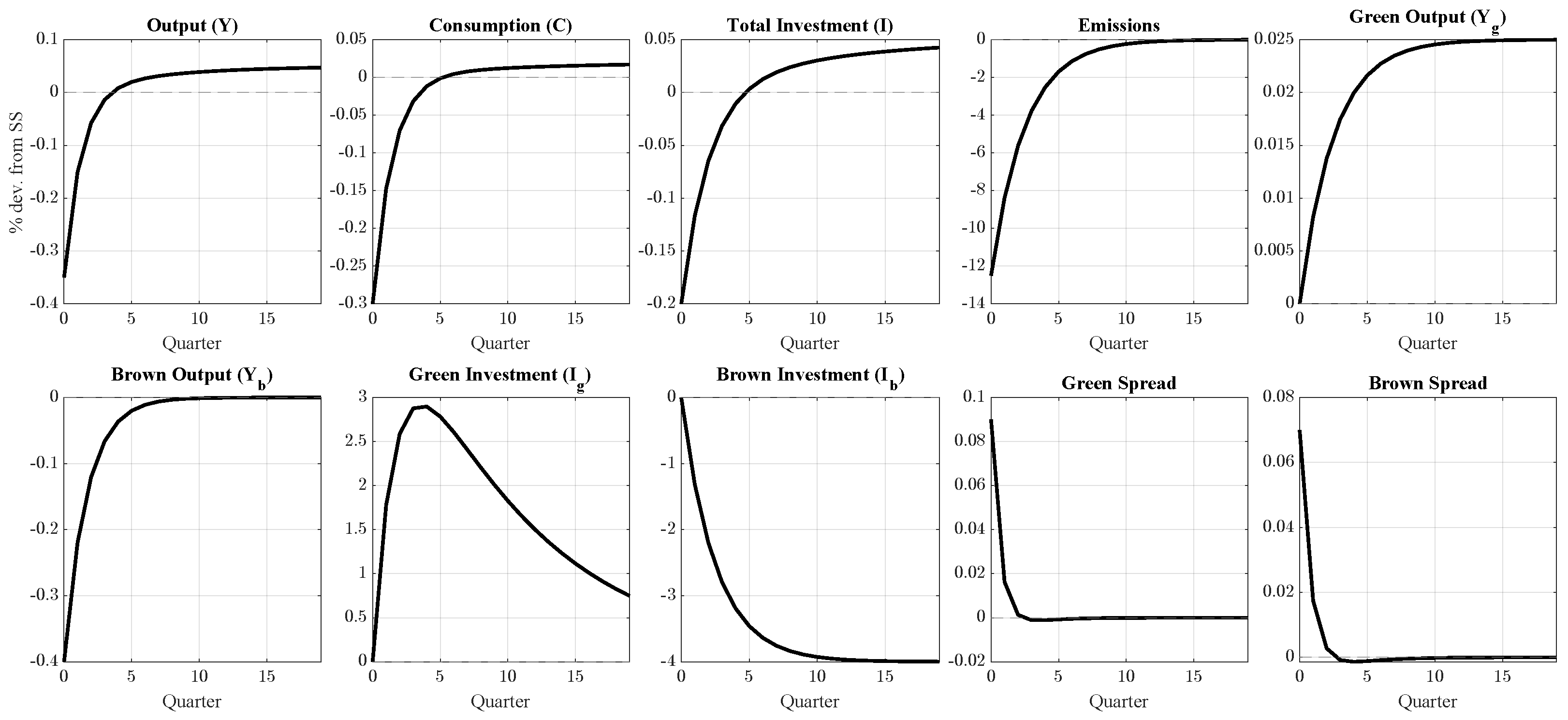
Figure 1 shows the impulse response functions (IRFs) to a coordinated rise in the domestic effective carbon price in the absence of CBAM. Aggregate activity weakens immediately. Output, consumption, and total investment fall in the first few quarters, reflecting the higher cost of carbon-intensive production and the presence of adjustment frictions. The decline is short-lived, however. As the economy reallocates, these aggregates recover steadily and move slightly above baseline later in the horizon.
Emissions respond much more strongly at the start. The shock delivers a sharp reduction in emissions that gradually fades as the system approaches a new balance, suggesting that most of the near-term abatement comes from rapid changes in production and investment decisions rather than from slow-moving capital deepening alone. The sectoral responses clarify this mechanism. Green investment rises quickly and peaks early, remaining positive even as it tapers off over time. Green output increases persistently and converges to a higher level. In contrast, brown investment falls substantially and remains depressed, while brown output drops on impact but returns toward baseline as the sector shrinks primarily through lower capital formation. Taken together, these patterns indicate that the carbon price operates mainly by reshaping relative returns, shifting capital accumulation toward the green sector and away from the brown sector.
Financial conditions tighten briefly and then normalize. Both green and brown spreads jump at the time of the shock and quickly revert close to steady state. The transient nature of the spread response suggests that the main propagation in the baseline case comes from real reallocation and investment dynamics, rather than from prolonged stress in credit markets.
4.2. CBAM and a Tighter External Constraint
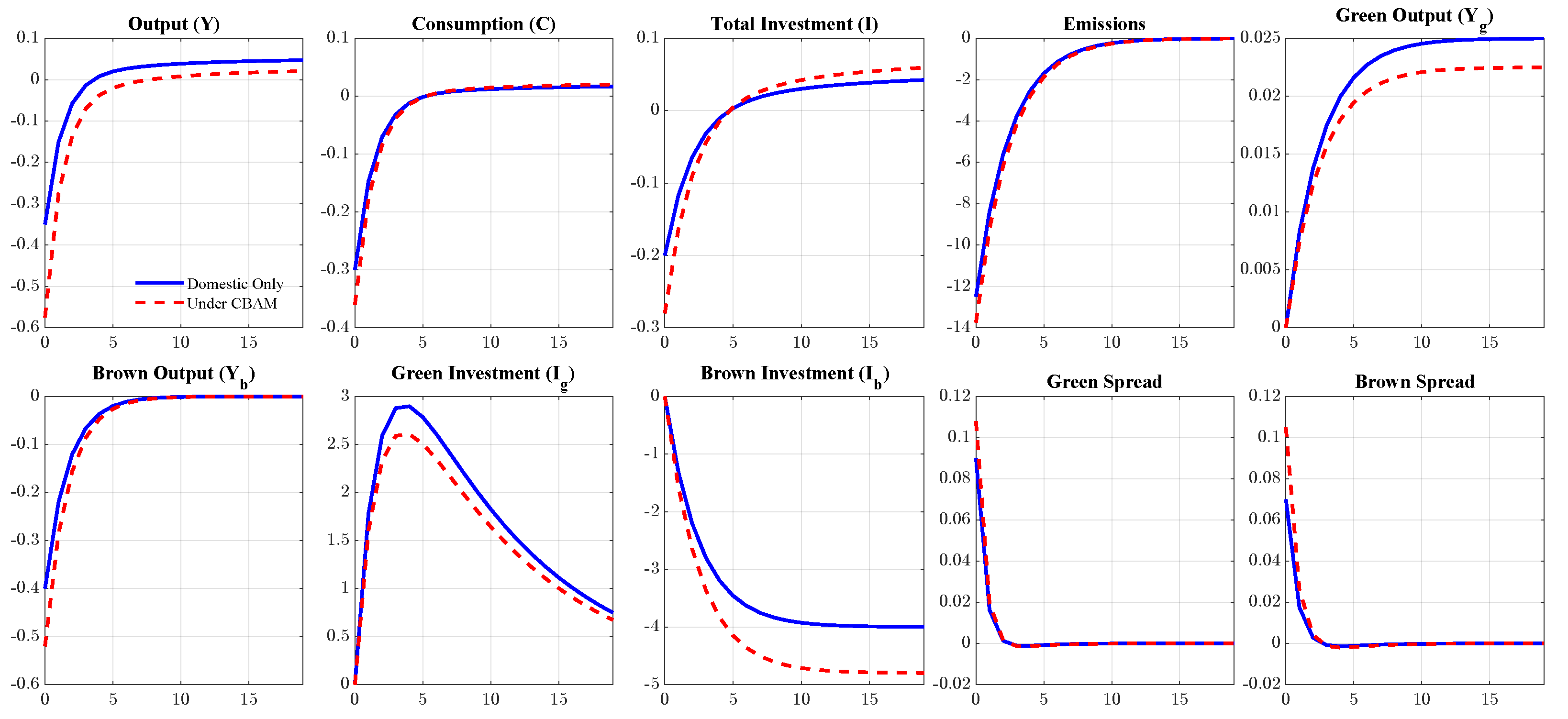
Figure 2 compares the baseline economy with a setting in which exporters face CBAM. Relative to the domestic-only case, the same coordinated carbon pricing shock is followed by a larger short-run decline in aggregate activity. Output falls more on impact, and the recovery is slower, while the drop in total investment is visibly deeper in the early quarters. Consumption moves similarly across the two cases, but the CBAM scenario remains slightly weaker during the initial adjustment.
The sectoral patterns help clarify where the additional cost comes from. Under CBAM, green output and green investment still rise, but the expansion is more muted. At the same time, the contraction in brown investment is stronger and more persistent, consistent with a sharper deterioration in the expected return to carbon-intensive capital when export profitability is reduced. Emissions decline markedly in both cases, and the CBAM scenario delivers a marginally larger reduction early on, reflecting the tighter effective constraint on production and exporting in emissions-intensive activities.
Financial conditions also tighten under CBAM. Both the green and brown spreads display a higher initial spike, which then fades quickly as the economy adjusts. In the model, the export-price wedge lowers profitability in exposed activities and weakens cash flows, which raises risk premia and increases external financing costs. The resulting feedback to investment makes the near-term adjustment more costly. Taken together, the figure suggests that CBAM does not only add pressure through the trade channel; it also increases the sensitivity of the transition to financial conditions, making the short-run balance between decarbonization and stabilization less favorable.
4.3. Green Innovation and the Speed of Adjustment
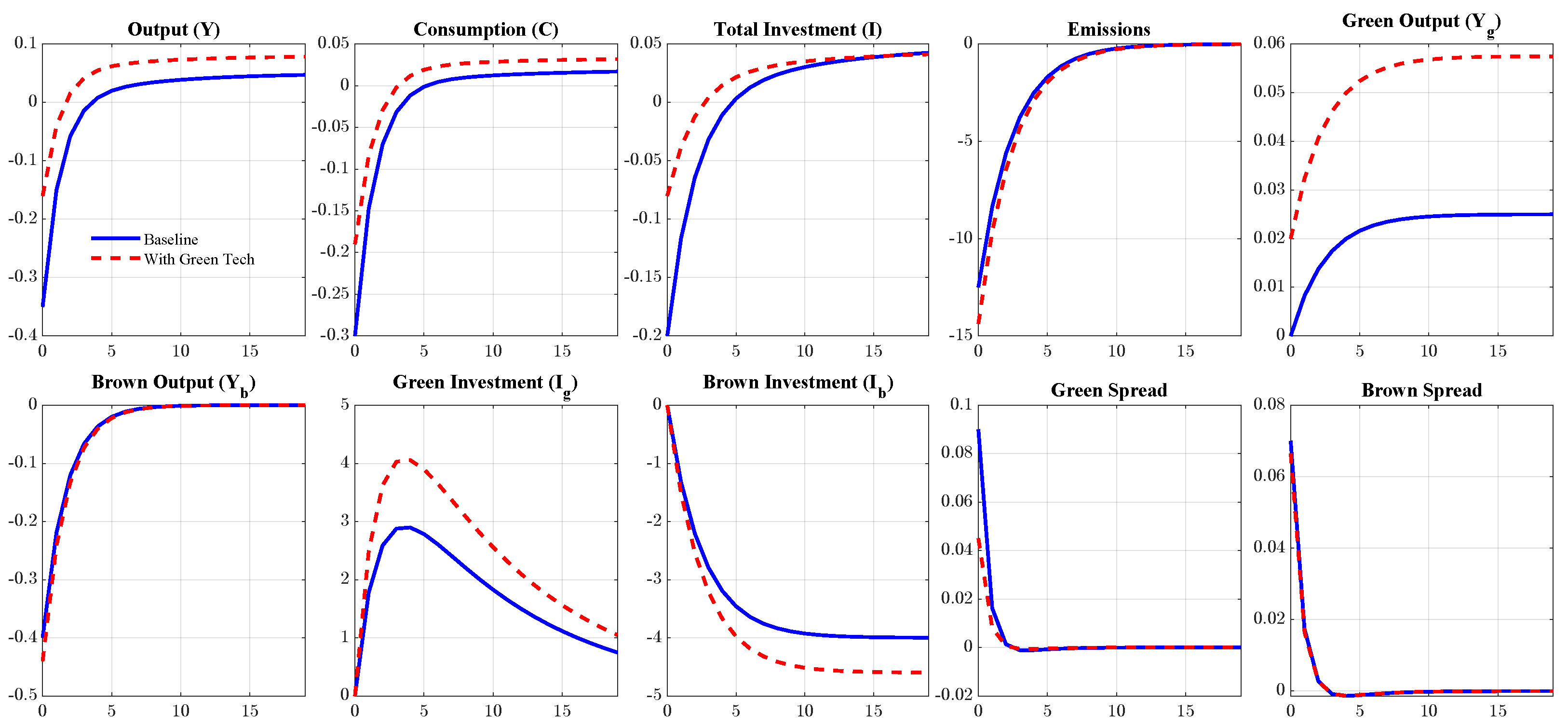
Figure 3 and
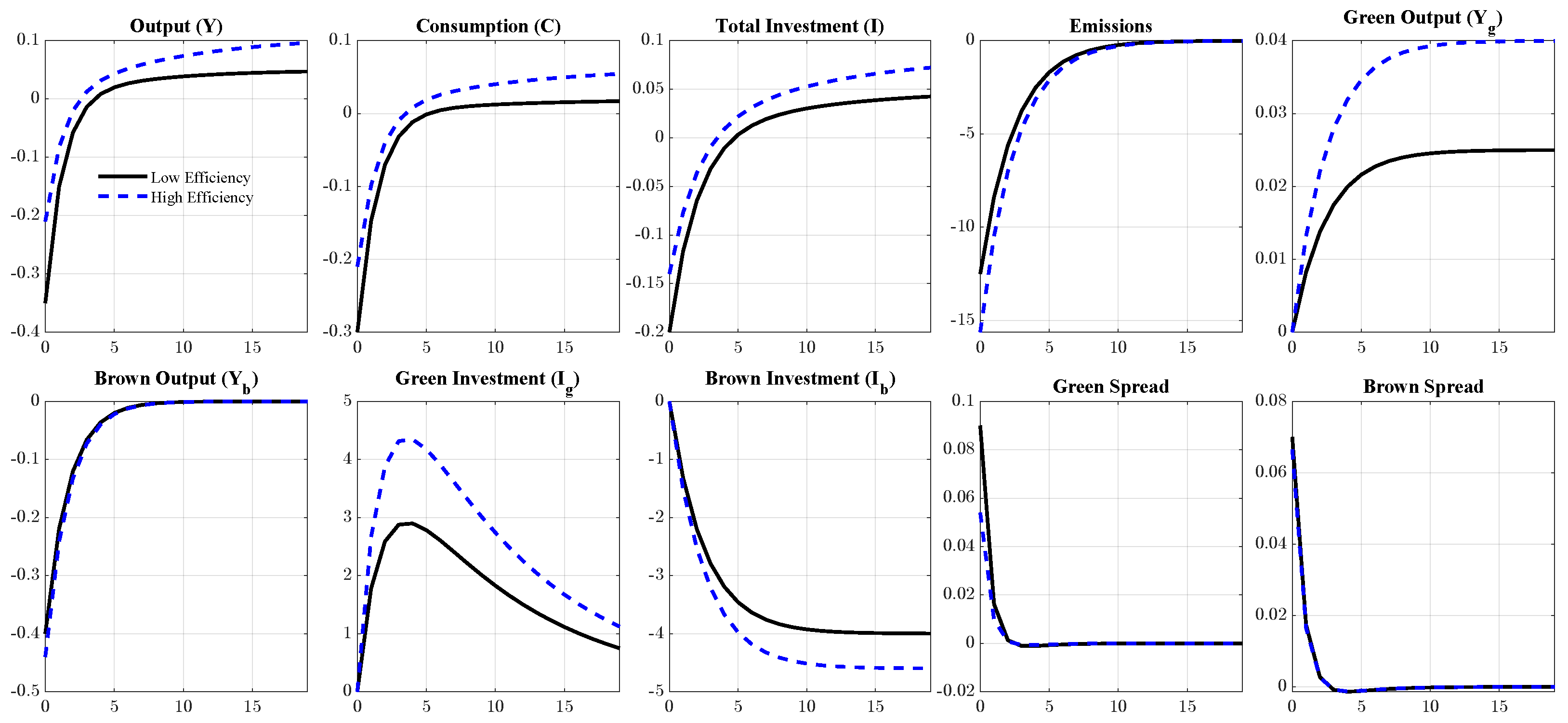
Figure 4 focus on how green innovation changes the transition dynamics after a coordinated increase in the domestic effective carbon price. When green technology responds endogenously, the economy returns to its steady state more smoothly. Output, consumption, and total investment recover faster and settle at a higher level than in the baseline path, while emissions still fall sharply on impact and remain below steady state during the adjustment.
The sectoral responses show why the aggregate cost is smaller. With endogenous green technology, green output rises more strongly and green investment peaks at a noticeably higher level, indicating that the carbon price signal is reinforced by an improvement in expected returns in the green sector. At the same time, brown investment contracts more, which accelerates the shift in capital formation away from carbon-intensive activity. Financial conditions move in the same direction. The initial increase in spreads is smaller once green technology is allowed to improve, consistent with stronger cash flows and a less fragile balance-sheet position during the early phase of the transition.
Figure 4 sharpens this point by comparing alternative innovation efficiency settings. Higher efficiency strengthens the expansion of green output and investment and delivers a better path for aggregate activity. It also compresses the spread response in the first few quarters, suggesting that faster productivity gains reduce the need for a prolonged risk premium during reallocation. The emissions response remains sizable in both cases, but the high-efficiency economy reaches that reduction with smaller near-term macro and financial strain. These patterns matter even more once an external constraint such as CBAM is present, because stronger green productivity helps the economy absorb tighter external conditions without relying as heavily on contraction in aggregate demand.
4.4. Financial Frictions and the Pace of Reallocation
The spike in spreads is the model’s observable indicator of financial amplification, reflecting tighter collateral values through
and an increase in the systemic risk component that raises borrowing costs across sectors.
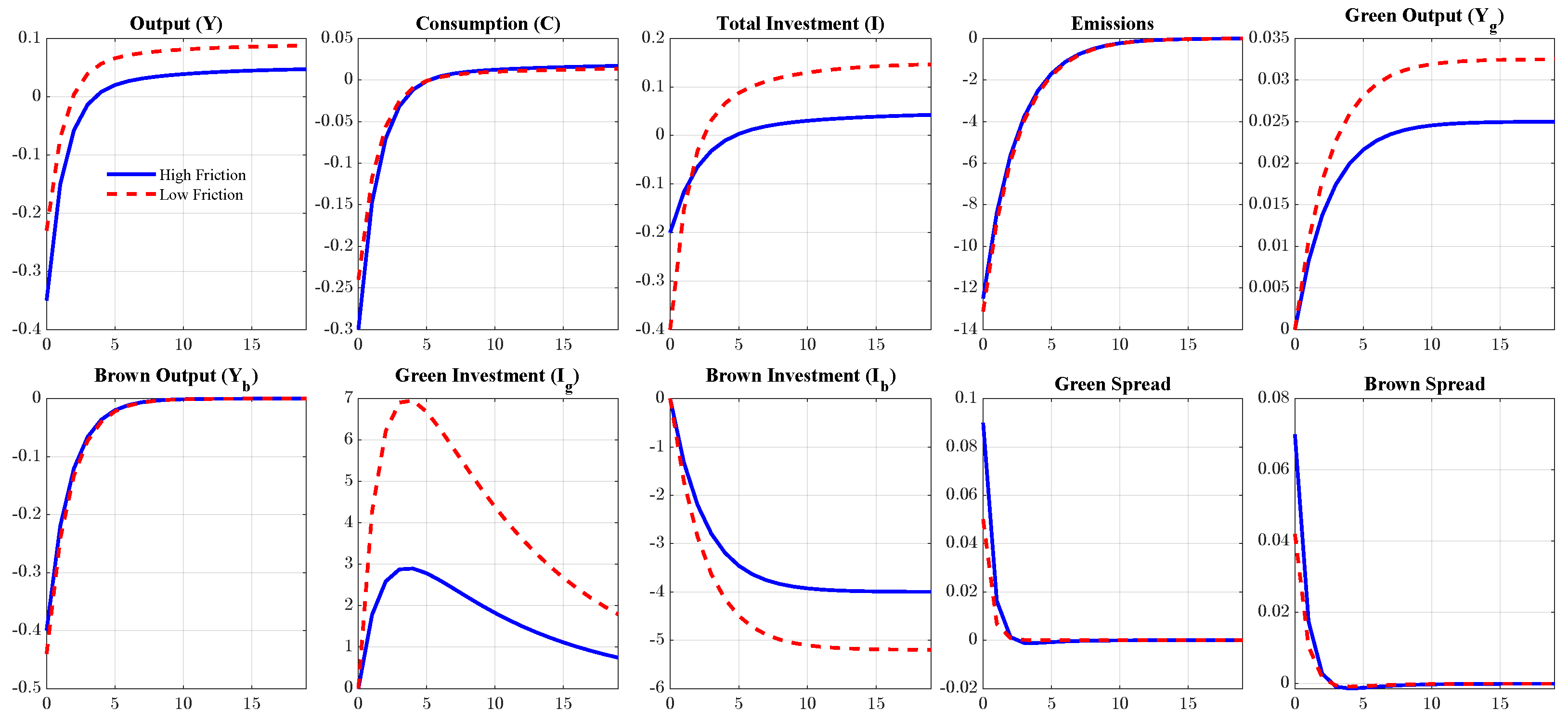
Figure 5 illustrates how financial conditions shape the transition following a coordinated increase in the domestic effective carbon price. When financial frictions are stronger, the economy experiences a sharper tightening in credit markets at the onset of the shock. Both green and brown spreads rise more, and this rise coincides with a larger contraction in total investment. Output and consumption also fall more in the near term, and the recovery is more gradual.
The sectoral adjustment is particularly sensitive to financing conditions. Under high friction, green investment still increases, but the expansion is noticeably smaller and fades sooner. Green output rises more slowly as a result. At the same time, brown investment declines more strongly, reflecting weaker balance sheets and a higher cost of external finance. This combination slows the reallocation of capital toward the green sector because the sector that needs to expand faces tighter financing at precisely the moment when investment demand is strongest.
With lower frictions, spreads are less prone to large spikes and normalize faster. Green investment responds more vigorously, supporting a quicker rise in green output and a smoother aggregate adjustment. Emissions decline in both cases, but the comparison suggests that the economy can reach similar near-term emissions reductions with less disruption when the financial system is better able to accommodate the shift in investment composition. In this sense, carbon pricing provides the direction of change, while financial conditions influence how costly the journey is.
4.5. Green Credit and Macroprudential Policy in the Transition
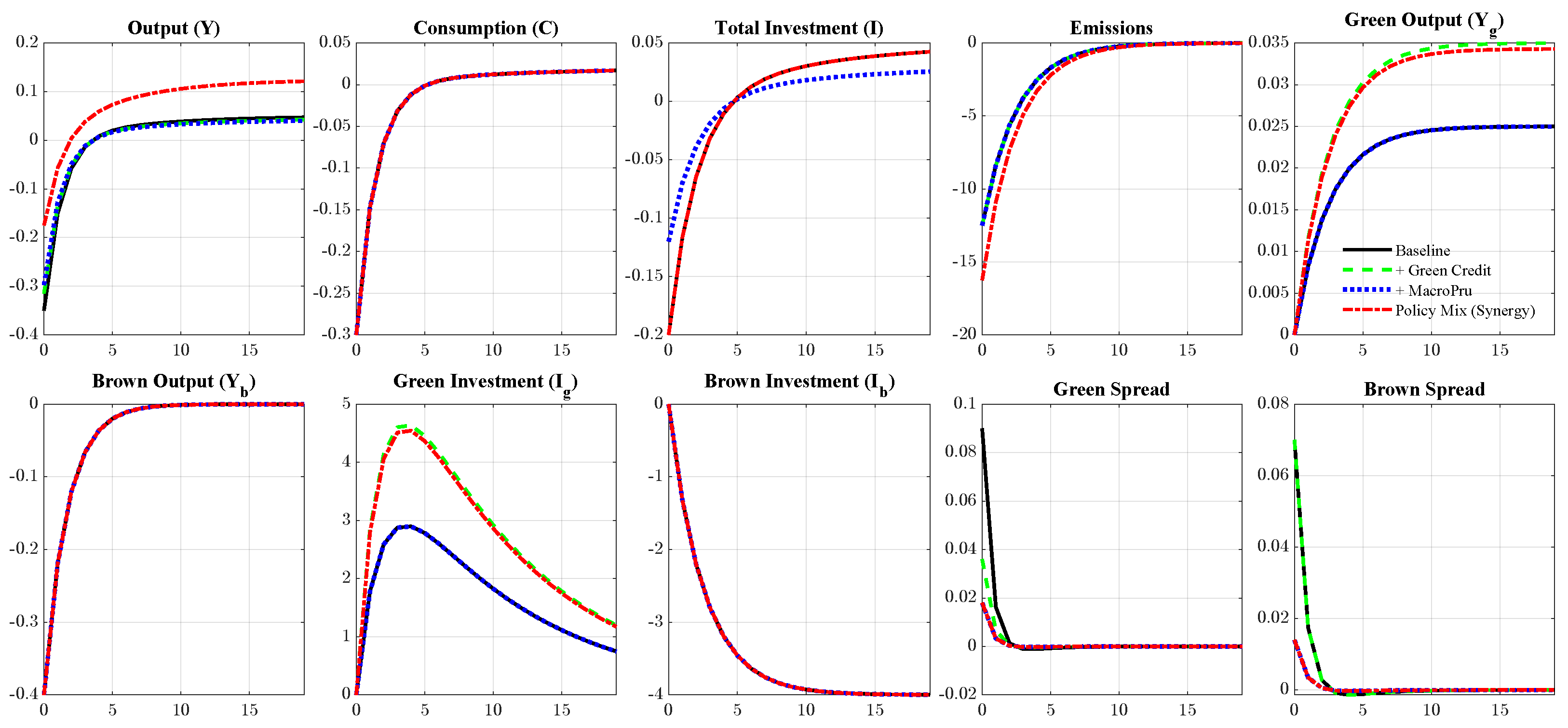
Figure 6 compares the transition path under carbon pricing alone with three policy packages that add financial measures. The baseline trajectory features a sharp but short-lived rise in spreads and a sizeable decline in brown investment, alongside a strong increase in green investment. The policy experiments show that targeted credit support and prudential tightening change this adjustment in distinct ways.
Green credit support mainly works by strengthening the expansion on the green side. Relative to the baseline, green investment rises more and remains higher for longer, and green output reaches a higher level over the horizon. Aggregate investment also recovers more quickly. The spread response is smaller at the onset, which is consistent with improved financing conditions for the sector that is expected to expand during the transition.
Macroprudential policy operates through a different channel. Its most visible effect is a reduction in the initial spike in spreads, especially on the brown side, and a smoother normalization thereafter. The improvement in financial conditions helps stabilize the early quarters, although the expansion in green investment is not as pronounced as under green credit support. In other words, prudential policy mainly limits the amplification from risk premia during the reallocation episode.
The combined package inherits the strengths of both tools. Green investment and green output rise strongly, close to the green-credit case, while spreads remain contained, close to the macroprudential case. As a result, output and total investment follow a more favorable path in the near term without undoing the emissions reductions delivered by coordinated carbon pricing. The figure therefore suggests that the two instruments are complements: credit support helps finance the sector that needs to grow, and prudential policy keeps the balance-sheet adjustment from becoming a source of additional drag.
To facilitate a direct quantitative comparison across the primary scenarios presented in our impulse-response analysis,
Table 3 summarizes the impact effects for key macroeconomic and environmental variables. We focus on the initial impact (the deviation from the steady state at the quarter of the shock) of output, emissions, and the brown credit spread across three defining regimes. This summary clarifies the central quantitative narrative of the model: introducing the CBAM constraint deepens the immediate output loss and amplifies financial frictions, as reflected in the larger brown-spread spike, relative to the domestic-only baseline. Under CBAM, deploying the combined policy mix of green credit support and macroprudential regulation substantially attenuates this amplification. The policy synergy limits the impact of contraction and stabilizes the credit spread while delivering a deeper initial reduction in emissions, consistent with a reallocation channel that is less hindered by balance-sheet tightening.
4.6. Welfare Implications Across Policy Regimes
To compare policy regimes on a common welfare basis, we compute consumption-equivalent variation (CEV). We define CEV as the permanent percentage change in consumption that makes the representative household indifferent between a given regime and the benchmark. This metric is useful because it aggregates the full transition path, capturing not only average consumption outcomes but also the disutility associated with volatility and prolonged periods of weak activity.
Table 4 reports the welfare implications of the policy experiments. Relative to carbon pricing alone, adding green credit improves welfare by supporting the expansion of green investment and speeding up the reallocation of capital toward cleaner production. Macroprudential policy also generates a welfare gain, primarily by moderating fluctuations in spreads and reducing the severity of the near-term tightening in financial conditions. The largest gain arises when the two measures are implemented together. The combined package delivers a faster reallocation response while keeping financial volatility contained, which translates into a more favorable consumption path over the transition and, consequently, the highest CEV among the regimes considered.
To make the welfare metric transparent, we compute CEV from the representative household’s lifetime utility over consumption and labor as specified in the household block. Accordingly, the welfare comparisons capture the transition implications of alternative policy regimes through their effects on the consumption path and labor effort, including the role of macro-financial volatility. In this benchmark implementation, welfare does not include an explicit environmental-benefit term or a climate-damage function. Emissions matter for welfare only indirectly, insofar as policies that reduce emissions also reshape relative prices, sectoral reallocation, productivity, and financing conditions that feed into consumption and labor outcomes during the transition. This benchmark welfare design is meaningful for the question we study. Our aim is to compare policy packages that operate through different margins of the transition, namely reallocation, innovation, and financial amplification, and to assess which combinations deliver a smoother adjustment in macroeconomic quantities while preserving the emissions response induced by coordinated carbon pricing. In this sense, CEV summarizes transition costs and risks associated with alternative policy regimes, rather than measuring the external environmental benefits of emissions reductions.
4.7. Robustness to Alternative CBAM Representations
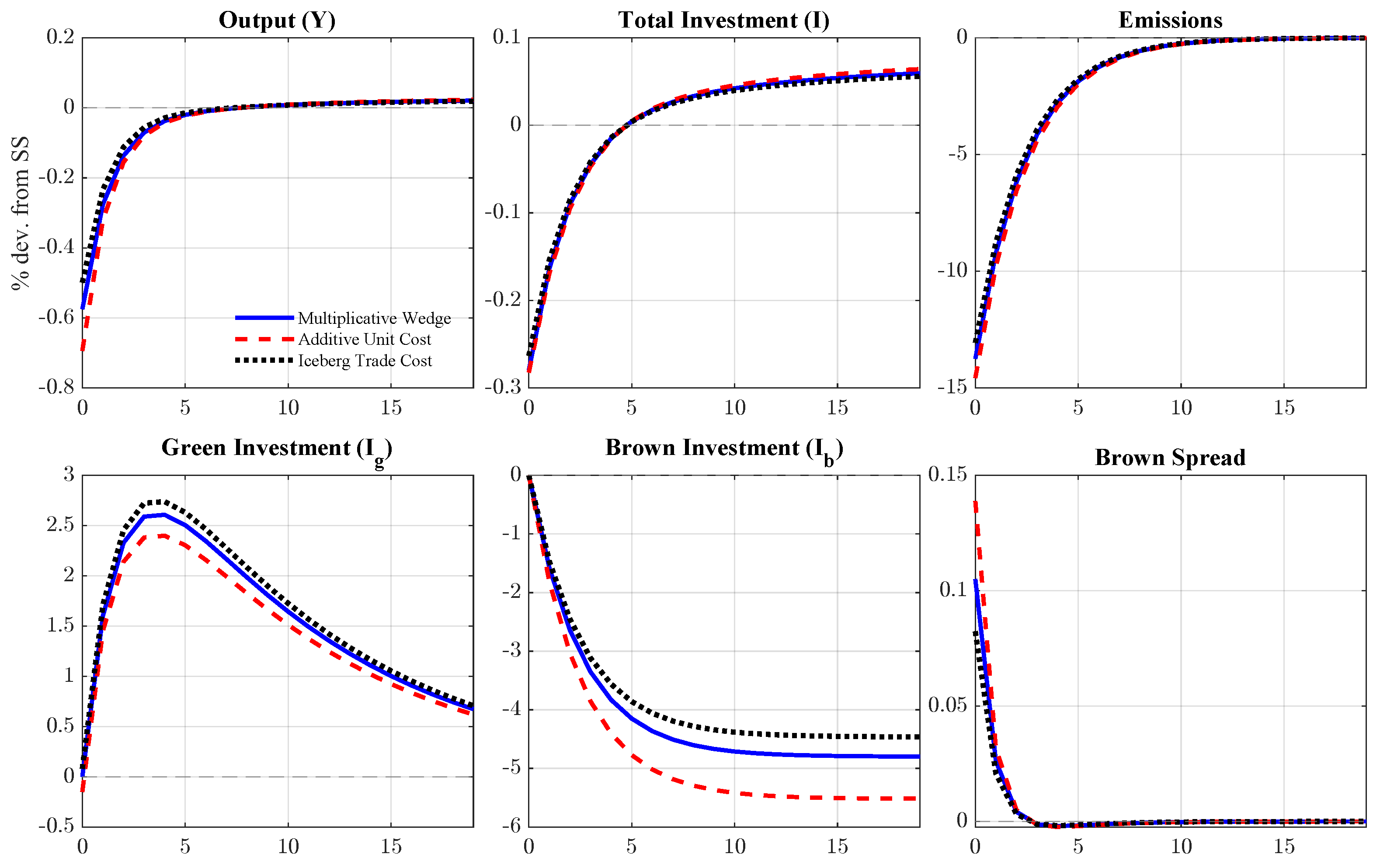
To assess whether our results depend on the specific algebraic form used to represent CBAM, we compare impulse responses under three alternative reduced-form specifications. The baseline uses a multiplicative wedge that lowers effective export receipts in proportion to embedded emissions. We then consider an additive per-unit cost formulation and an iceberg trade cost formulation.
Figure 7 shows that the dynamics of output, investment, emissions, sectoral reallocation, and brown spreads are very similar across the three representations. The key message is unchanged: CBAM amplifies the near-term adjustment by compressing net export receipts for emissions-intensive activities, weakening cash flows and tightening borrowing conditions, while the medium-run transition continues to be driven by reallocation toward the green sector.
4.8. Sensitivity to Key Elasticities
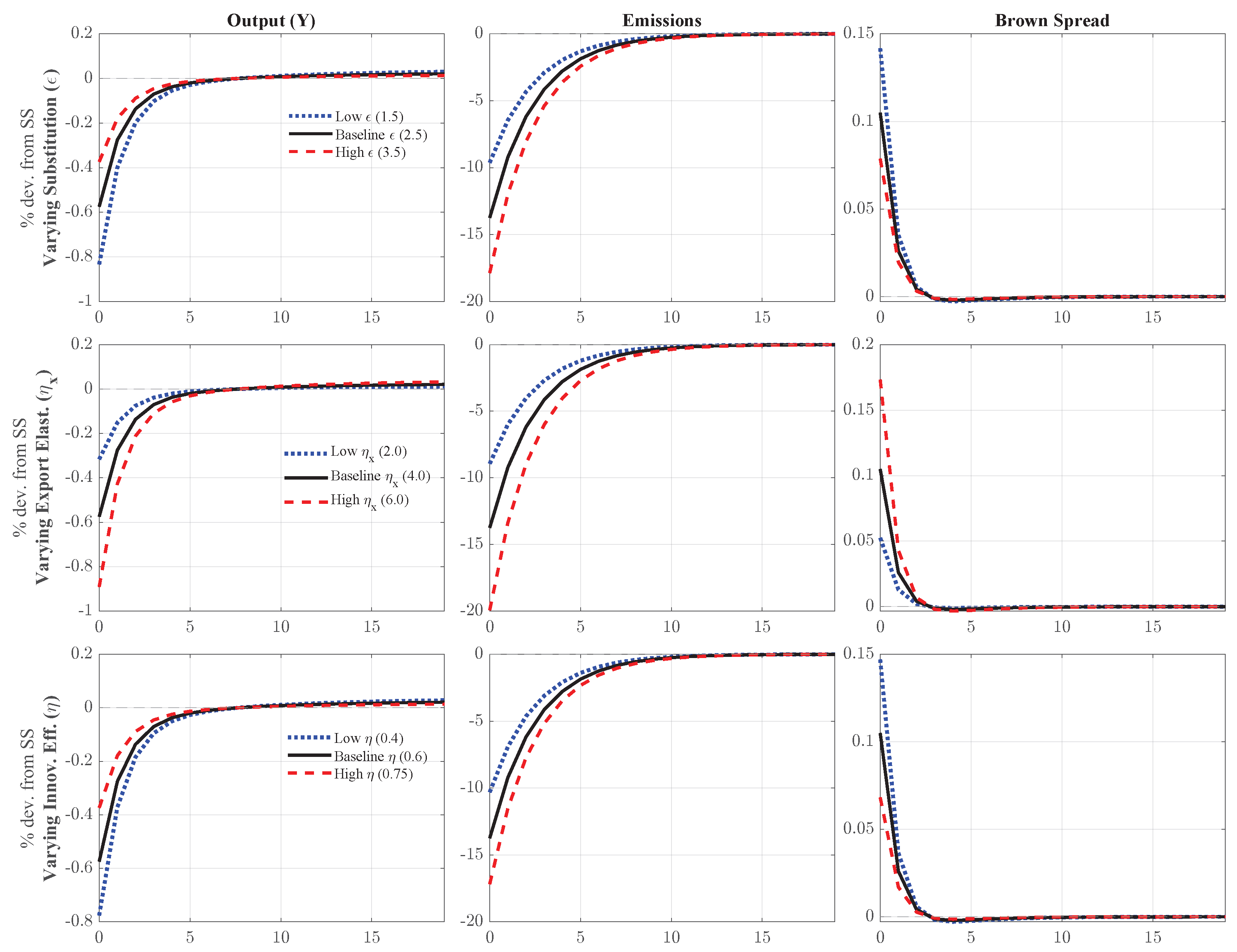
To assess robustness, we vary three elasticities that directly govern the model’s main adjustment margins and re-compute impulse responses to the coordinated domestic carbon pricing shock under CBAM. Throughout this exercise, we change one parameter at a time and keep the remaining parameters fixed at the baseline calibration. We consider alternative values for the substitution elasticity across green and brown bundles, ; the export-demand elasticity, ; and the innovation-efficiency elasticity in the green technology law of motion, . These ranges are chosen to span lower, baseline, and higher responsiveness in the reallocation, external, and innovation channels without changing the model’s steady-state structure.
Figure 8 summarizes the sensitivity results using three outcomes that map directly to the paper’s core mechanisms. Output captures the near-term macroeconomic cost of adjustment, emissions capture the effectiveness of the transition, and the brown spread captures the role of transition risk in financial amplification. Three patterns stand out. First, higher substitutability across sectors lowers the near-term output loss and yields a larger initial emissions decline, consistent with faster reallocation away from emissions-intensive activity. Second, a higher export-demand elasticity strengthens the effective external constraint created by CBAM, leading to a deeper initial output contraction, a stronger emissions reduction driven by a sharper brown-side adjustment, and a more pronounced spike in the brown spread. Third, higher innovation efficiency improves the transition path by accelerating the green-side expansion, which attenuates the near-term output loss and moderates the spread response while preserving substantial emissions reductions. The qualitative conclusions are robust across all configurations. Coordinated carbon pricing continues to deliver rapid emissions abatement through reallocation, CBAM continues to increase the sensitivity of the transition to external and financial conditions, and the macro-financial amplification channel remains central for understanding near-term adjustment costs.
5. Discussion
This paper studies how coordinated domestic carbon pricing plays out for a small open economy when the external environment is shaped by the EU Carbon Border Adjustment Mechanism (CBAM). The model combines two production blocks with different emissions intensities, a green innovation margin, and a banking sector that prices sector-specific transition risk through credit spreads. The results highlight a coherent set of mechanisms: carbon pricing triggers rapid emissions abatement primarily through reallocation of investment and production; CBAM tightens the external constraint and amplifies near-term adjustment costs; endogenous green innovation speeds the recovery by improving expected returns in the green sector; and financial frictions influence how quickly capital can move across sectors. Financial policy tools that operate on distinct margins, namely targeted green credit and macroprudential compression of systemic risk premia, can therefore complement carbon pricing and improve welfare.
5.1. Relation to Existing CBAM and Macro Transition Models
Our framework is related to three complementary strands of research. First, trade-oriented and institutional analyses of CBAM clarify how border adjustment can address leakage and competitiveness concerns, and they highlight implementation challenges such as measurement and reporting of embedded emissions [
6,
7,
8]. These contributions are essential for policy design, but they typically do not examine how an external carbon border regime alters the macrofinancial adjustment path of domestic carbon pricing. Second, macro-climate DSGE studies characterize how carbon taxes and transition dynamics trade off short-run adjustment costs against longer-run gains, often focusing on the timing of policy and the role of technology change [
10,
11,
13,
27]. In most cases, however, border adjustment is absent, and financing conditions are not modeled as an endogenous amplifier of reallocation. Third, a growing macro-financial literature emphasizes that transition risk can affect the cost of external finance and thereby shape investment dynamics [
16,
17,
18]. Our contribution is to integrate these elements in a tractable small open economy setting. By representing CBAM as an emissions-linked export-revenue wedge and embedding a banking sector that prices sector-specific transition risk, the model explains why the same domestic carbon price increase can have different short-run macro costs under different external regimes. It also provides a unified platform for comparing policy packages that operate on distinct margins of the financial system, which is central for interpreting the welfare ranking of green credit, macroprudential policy, and their combination.
5.2. Coordinated Carbon Pricing Under CBAM: Competitiveness, Leakage, and the External Margin
A key message from the impulse responses is that CBAM changes the transition problem even when the domestic carbon price shock is the same. In the domestic-only economy, the carbon price works mainly through relative prices: emissions fall sharply on impact, while aggregate activity weakens temporarily and then recovers as investment and output shift toward the cleaner sector. This pattern is consistent with a broad class of macro-climate models where abatement initially comes from re-optimizing production and investment decisions rather than from slow-moving capital deepening [
11,
13,
33]. Under CBAM, the same domestic shock is followed by a deeper short-run contraction and a larger spike in spreads. The interpretation is that CBAM introduces an additional wedge that reduces export profitability for emissions-intensive activities, weakening cash flows and tightening borrowing constraints. This aligns with economic assessments of border carbon adjustments that emphasize their role in limiting leakage while also shifting adjustment burdens through trade exposure and profitability [
34,
35,
36]. Legal and institutional analyses further stress that CBAM is designed to mirror the carbon cost faced by EU producers and to reduce incentives for emissions relocation, but that its implementation requires credible measurement, reporting, and verification of embedded emissions [
4,
5,
6].
From the perspective of a small open economy, the results suggest that coordinated domestic carbon pricing has an added strategic dimension once CBAM is in place. If domestic pricing is aligned with the carbon cost embedded in export destinations, the economy can reduce the effective external penalty associated with emissions-intensive exports and lower the need for abrupt contraction in brown capital formation. Recent quantitative work on CBAM and supply chains similarly indicates that the incidence of border measures depends on embodied emissions along value chains and on the ability of firms and sectors to substitute toward cleaner inputs and technologies [
37]. In this setting, carbon pricing coordination can be interpreted not only as climate policy, but also as a trade-exposure management tool that influences the distribution of adjustment across sectors. A useful way to interpret the framework is that it embeds explicit penalties for remaining carbon intensive, even though these penalties operate through wedges rather than through an additional adoption constraint. Domestically, coordinated carbon pricing raises marginal costs in proportion to embodied emissions, so the emissions-intensive sector faces a larger effective burden, which reduces the relative return to brown capital and increases the attractiveness of cleaner investment. Empirically, higher and more predictable carbon price signals are associated with stronger low-carbon innovation responses and cleaner investment incentives, consistent with this channel [
38,
39]. Externally, CBAM adds a second penalty-like force by lowering effective export revenue for emissions-intensive goods. By weakening operating cash flows in exposed activities, the CBAM wedge tightens collateral-based borrowing capacity and raises credit spreads, which further discourages high-emissions investment during the transition and reinforces incentives to adjust production and technologies toward lower emissions intensity [
40]. When endogenous innovation is active, these same incentives extend to R&D: the wedges jointly shift expected profitability toward cleaner production, increasing the payoff to research spending in the green technology block and strengthening the medium-run expansion of the green sector.
Although our baseline focuses on a small open economy facing exogenous foreign demand, a large economy may generate additional general-equilibrium feedbacks that can change the magnitude and timing of the adjustment. First, export prices and foreign demand need not be taken as given. If a large economy raises its effective carbon price and reduces the supply of emissions-intensive goods, global relative prices may adjust, so part of the CBAM incidence can be shifted through changes in world prices rather than falling one-for-one on domestic profits. Second, terms-of-trade feedback can either buffer or amplify the transition shock. When the large economy accounts for a sizeable share of global supply in carbon-intensive sectors, the contraction in brown output can lift world prices and partially offset the CBAM-related revenue loss; when demand is highly elastic or substitution toward other suppliers is easy, this offset is weaker and the tightening may remain pronounced. Third, CBAM parameters may be partly endogenous to bargaining and recognition mechanisms. In practice, the deduction in carbon prices paid abroad, default values, and sectoral coverage evolve with institutional design, so the linkage and exposure terms in our reduced-form wedge can be interpreted as policy outcomes rather than purely exogenous primitives. The CBAM reduces net export receipts for emissions-intensive activities; it weakens cash flows, tightens collateral constraints, raises sectoral spreads, and slows the reallocation of investment toward cleaner production, even though the quantitative effects may differ in a large-economy setting.
5.3. Innovation as a Transition Stabilizer and an Amplifier of Reallocation
A second message is that green innovation materially changes the time profile of the adjustment. When the green technology frontier responds endogenously, green investment rises more strongly, the recovery in output and investment is faster, and the initial spread response is smaller. The underlying logic resonates with the directed technical change literature, where a persistent price signal shifts research effort toward cleaner technologies, raising future productivity and lowering the macro cost of emissions reductions [
13,
14]. Empirical evidence from energy and climate policy settings similarly finds that policy incentives and carbon pricing can redirect innovation toward low-carbon technologies, although the magnitude depends on policy design and market structure [
15,
41,
42].
In our results, innovation matters, especially under CBAM, because it improves the economy’s ability to absorb a tighter external constraint without relying predominantly on demand compression. This is consistent with macro perspectives emphasizing that the welfare costs of mitigation depend critically on the speed at which technology and the capital stock can adjust [
33,
33]. It also offers a practical interpretation of policy complementarity: carbon pricing provides a clear direction for reallocation, while innovation capacity determines how quickly cleaner production can scale up and how much the transition must be carried by a contraction in carbon-intensive activity.
This innovation channel is consistent with recent micro evidence showing that market-based carbon regulation can raise firms’ green innovative output. In particular, emissions trading policies have been found to stimulate firm innovation and improve performance through innovation-related channels [
43]. Related evidence also indicates that external carbon regulation can transmit through trade exposure, with the EU emissions trading scheme increasing green patent applications among Chinese exporters serving the EU market [
44]. Finally, installation- and firm-level evaluations of the EU emissions trading scheme document meaningful emissions reductions without systematic declines in profitability or employment [
45], which is consistent with transition adjustments that rely in part on innovation and reallocation rather than persistent aggregate contraction.
5.4. Financial Frictions, Transition Risk, and the Role of Financial Policy Instruments
The model highlights a financial channel that is increasingly central in the climate policy debate. In the impulse responses, spreads rise on impact and then normalize as balance sheets adjust. When financial frictions are stronger, the same transition shock produces a larger spread spike, a deeper investment contraction, and a slower expansion of green output. This mechanism is consistent with the idea that transition risk is priced in financing conditions and can become a macro-relevant amplifier during episodes of rapid policy-driven reallocation [
23,
28]. It also echoes evidence from climate finance showing that markets demand compensation for carbon-related exposures and tail risks, which can translate into higher required returns and tighter financing for emissions-intensive firms [
16,
46].
The policy experiments clarify why green credit and macroprudential policy can be complements. Targeted green credit operates directly on the financing terms of the expanding sector, supporting green investment when demand for reallocation is strongest. Macroprudential policy operates on the systemic component of risk premia, limiting the economy-wide amplification that can arise from synchronized balance-sheet stress. The combined package improves welfare the most in our simulations because it strengthens green capital formation while keeping the transient spread spike contained. This interpretation is aligned with recent macro-financial analyses arguing that climate policy interacts with financial stability considerations and that prudential frameworks can shape the smoothness of the transition [
23,
28].
These results speak directly to the supervisory and central-bank discussion on climate-related and environmental risks. Guidance documents emphasize that climate risks can affect credit, market, and operational risk, and that banks and supervisors should incorporate such risks into governance, risk management, and stress testing practices [
19,
20,
21]. Complementary scenario work underscores that transition pathways differ sharply in their short-run macro-financial implications, making the management of transition risk a practical policy concern rather than a purely long-run issue [
22,
47,
48]. In this context, the model-based welfare ranking in our policy experiments can be read as a disciplined statement of a broader principle: policies that facilitate reallocation in expanding green activities while preventing systemic balance-sheet feedbacks can reduce the near-term cost of decarbonization without diluting the emissions response.
5.5. Carbon Revenue Recycling and Fiscal Design
Carbon pricing generates fiscal revenue that can be recycled in ways that matter for macroeconomic adjustment and welfare. While lump-sum rebates provide a clean benchmark, recycling through reductions in distortionary taxes can attenuate the near-term output cost by lowering pre-existing wedges, thereby raising consumption-equivalent welfare in general equilibrium settings. Recent quantitative analyses show that the welfare and inequality implications of recycling depend on whether revenues are returned via the tax system or transfers, and that revenue-neutral designs can substantially reshape welfare outcomes even when the carbon-price path is held fixed [
49,
50]. Related macroeconomic studies also emphasize that combining environmental taxation with fiscal adjustments can change transitional dynamics and the strength of short-run contractions [
51,
52]. Recycling revenues to support green innovation is particularly relevant in our framework because the transition speed depends on the strength of endogenous technology improvement in the green sector. If a portion of carbon revenues were earmarked to fund green research investment or to subsidize clean innovation, the model would predict a stronger and earlier rise in green productivity, which would reinforce green investment and reduce the macro-financial strain associated with reallocation, especially under CBAM. This mechanism is consistent with recent work highlighting the gains from policy mixes that combine carbon pricing with innovation-oriented instruments and financial conditions that affect clean investment [
53,
54]. In short, alternative recycling schemes can shift welfare levels and the smoothness of adjustment, while the paper’s main comparative mechanisms remain centered on how CBAM tightens the external constraint and interacts with reallocation, innovation, and credit spreads.
5.6. Welfare Implications and Policy Design Under Policy Interaction
The welfare results summarize these mechanisms in a single metric. Carbon pricing alone delivers the core environmental outcome through reallocation, but it can be associated with avoidable short-run financial volatility and a slower recovery when the banking channel is tight or when CBAM amplifies external stress. Adding green credit improves welfare by financing the sector that needs to scale up. Adding macroprudential regulation improves welfare by lowering the systemic amplification associated with transition risk premia. Combining both yields the largest gain because it addresses both margins simultaneously. A useful way to interpret this finding is that climate policy effectiveness depends on the consistency of the overall policy package. Border measures such as CBAM can strengthen incentives to decarbonize globally, but they also reshape the incidence of adjustment and can raise the premium on domestic policy credibility, measurement capacity, and financial resilience [
4,
5,
55,
56]. In such an environment, coordinated domestic carbon pricing that is supported by innovation capacity and complemented by targeted financial and prudential tools can help reconcile three objectives that often conflict during the early phase of a transition: fast emissions reductions, macro stabilization, and financial stability [
35,
37,
57].
Our three policy blocks are stylized, but each is meant to summarize a margin that is already present in current European climate and financial frameworks. First, the green credit instrument captures the effect of concessional or preferential funding for low-carbon investment that is often delivered through public and policy-oriented finance. A concrete example is the European Investment Bank’s role in scaling climate-related lending and transition investment support, which operates in practice by lowering effective financing costs for eligible projects and by relaxing funding constraints for green capital formation [
58]. Second, the relevance of taxonomy-based lending is reflected in the EU Taxonomy, which has provided a common classification of environmentally sustainable activities and has increasingly entered bank disclosure, risk assessment, and portfolio allocation. Consistent with this channel, evidence from the syndicated loan market suggests that firms with higher Taxonomy-eligible transitional revenues face lower loan spreads, indicating that financial markets can price Taxonomy-aligned activity through borrowing terms [
59]. Third, the macroprudential instrument corresponds to supervisory tools that focus on system-wide resilience during transition episodes, including climate stress testing and capital planning exercises. These frameworks are designed to assess losses and capital adequacy under adverse transition scenarios and to inform supervisory expectations, which are aligned with our representation in which macroprudential policy compresses the systemic component of spreads during the transition [
60].
A related limitation concerns welfare measurement. Our benchmark CEV comparisons are designed to rank policy packages by their macroeconomic transition costs and their ability to contain financial amplification, holding the model’s environmental structure fixed. A full social-welfare evaluation would additionally internalize the external benefits of emissions reductions, for example, by incorporating a climate-damage function that links cumulative emissions to output losses or by adding an explicit environmental term to household utility. Such an extension would be useful for quantifying optimal policy levels, but it would require additional calibration of damage parameters and a richer mapping from emissions to climate outcomes. We therefore leave an explicit climate-damage welfare extension for future work, and interpret the reported welfare rankings as transition-welfare comparisons conditional on the policy-induced adjustment path.
5.7. Feasibility, Resource Costs, and Policy Constraints
Green credit support in the model is a representation of policies that lower borrowing costs for qualifying low-carbon investment. In practice, this may take the form of interest subsidies, guarantee schemes, policy-bank credit lines, or central-bank refinancing operations that affect the marginal cost of funding for targeted lending. Such arrangements rely on fiscal resources or quasi-fiscal balance sheets and can create contingent liabilities when public entities absorb part of the credit risk. This motivates interpreting
as a policy intensity that is ultimately bounded by budget envelopes and by the administrative capacity to define eligibility and verify compliance [
61,
62,
63]. Macroprudential intervention is better interpreted as regulatory and supervisory measures that influence the systemic component of risk premia, for example, through sectoral capital buffers or exposure limits. These instruments typically do not require direct fiscal outlays, but they can entail real economic costs by raising banks’ funding costs and altering credit supply when capital requirements bind [
64]. Recent analyses of climate-related capital requirements also emphasize that strengthening resilience can change lending conditions and that feasibility depends on calibration, data availability, and the scope for risk migration outside the regulated banking perimeter [
65,
66]. In our quantitative experiments, these constraints primarily affect the interpretation of magnitudes rather than the qualitative mechanisms. The policy packages are designed as moderate and temporary interventions that operate on distinct margins, a targeted reduction in the green spread and a compression of the systemic premium. Mapping these mechanisms to a specific jurisdiction would require translating
and
into explicit budget constraints, capital requirements, or supervisory actions, and accounting for institutional capacity and verification design [
61].
5.8. Comparison with Existing CBAM and Carbon-Pricing Macro Models
Our analysis relates to two adjacent quantitative studies that are often studied separately, and the comparison helps clarify what is new conceptually and quantitatively in our framework.
A first strand evaluates CBAM primarily through multi-region trade and general-equilibrium or structural-gravity approaches. These studies emphasize leakage, competitiveness, and heterogeneous incidence across partners and sectors under alternative design choices and implementation rules. For example, quantitative CBAM assessments document that aggregate trade and welfare effects can be modest under certain configurations, yet distributional impacts across exporters can be substantial when embodied emissions differ and when default values or coverage choices bind [
67,
68,
69,
70]. Relative to this literature, our objective is complementary. We do not aim to reproduce the full cross-country general-equilibrium incidence of CBAM. Instead, we discipline a tractable exporter-side mechanism in which CBAM enters as an external profitability wedge that is proportional to embodied emissions, and we use this structure to study how the transition path inside the exporting economy is reshaped once the external regime tightens.
A second strand studies carbon pricing and the transition path in dynamic equilibrium macro models, including work that highlights transitional welfare, technology adjustment, and the role of frictions. Recent contributions in macro-finance further emphasize that transition risk can become macro-relevant when it is priced in financing conditions, so that cash-flow deterioration and collateral constraints raise credit spreads and amplify investment dynamics [
71,
72]. Our framework nests this insight but places it in an open-economy setting where external policy interacts with domestic decarbonization. In particular, the CBAM wedge directly weakens export revenue in exposed activities, which tightens borrowing constraints and raises spreads precisely when the economy must reallocate investment toward the expanding green sector. This open-economy interaction is central for interpreting why similar domestic carbon-pricing moves can have different short-run macro-financial costs under different external regimes.
Seen through this lens, our contribution is twofold. Conceptually, we link CBAM-induced external pressure to a macro-financial amplification channel in a small open economy with two sectors and an innovation margin, so the transition path is determined jointly by relative prices, reallocation, and financing conditions. Quantitatively, our simulations show that CBAM amplifies the impact contraction and the spread spike for a given domestic carbon-pricing shock, while endogenous green innovation and a combined financial package that targets the green spread and the systemic component of spreads can materially smooth the adjustment and improve welfare. The comparison helps position our results as complementary to trade-focused CBAM evaluations and as an open-economy extension of macro-climate and macro-financial transition frameworks.
6. Conclusions
This paper examined how coordinated domestic carbon pricing unfolds in a small open economy when exports are exposed to the EU Carbon Border Adjustment Mechanism. In our framework, carbon pricing reduces emissions quickly by shifting investment and production away from emissions-intensive activity and toward the cleaner sector. The same transition becomes more demanding once CBAM is introduced, because the loss of export revenue in emissions-intensive production weakens cash flows and raises borrowing costs, deepening the near-term contraction. Allowing green technology to improve endogenously changes the adjustment path in an important way, as stronger innovation makes green expansion more responsive and reduces the macro and financial strain associated with reallocation.
The policy experiments show that carbon pricing is more effective and less costly when it is embedded in a coherent package that supports both reallocation and financial resilience. Targeted green credit strengthens investment in the sector that needs to grow, while macroprudential measures reduce the systemic component of risk premia that can amplify transition shocks. Implemented together, these tools deliver a smoother adjustment without undoing the emissions response, and they improve welfare relative to carbon pricing alone. Taken as a whole, the results underline that the sustainability of decarbonization in open economies depends not only on the level of the carbon price, but also on the surrounding innovation capacity, the stability of the financial system, and the external trade regime under which the transition takes place.
Our analysis is intentionally stylized, and several limitations delimit the scope of interpretation. First, firms are representative within each sector, so we abstract from within-sector heterogeneity in productivity, carbon intensity, compliance costs, and entry or exit. In settings where such heterogeneity is salient, CBAM and carbon pricing may trigger stronger selection and within-industry reallocation, potentially altering the timing and the dispersion of adjustment costs. Second, the model features a representative household, so we do not quantify distributional effects across income groups, worker types, or regions. Alternative revenue-recycling rules and credit conditions can generate heterogeneous welfare changes, which may matter for political economy constraints and for the practical design of policy packages. Third, we treat the economy as small and the external regime as exogenous, and we do not model cross-country strategic interactions under CBAM, such as bargaining over recognition, default values, coverage, or retaliatory trade responses. Extending the framework to a multi-country environment with endogenous policy interaction would help quantify how terms-of-trade feedback and strategic behavior reshape the magnitude and incidence of the transition, while preserving the core amplification channel emphasized here. Relatedly, we do not model separate brown-sector innovation paths; incorporating such mechanisms, especially those that lower emissions intensity in high-carbon production, is a natural extension that could refine the relative magnitudes while preserving the core external-wedge-to-cash-flow-to-spreads-to-reallocation channel emphasized in this paper.