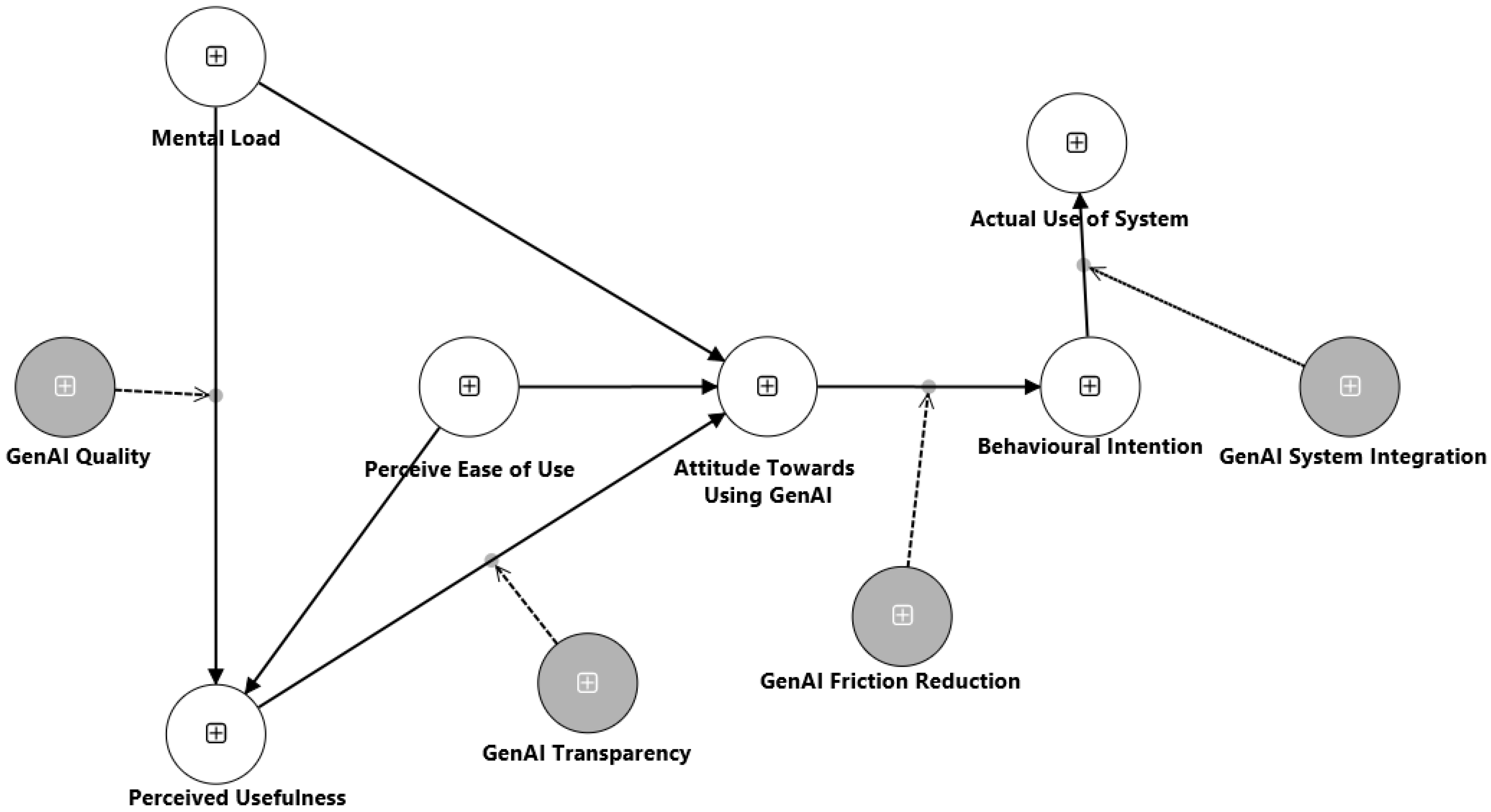
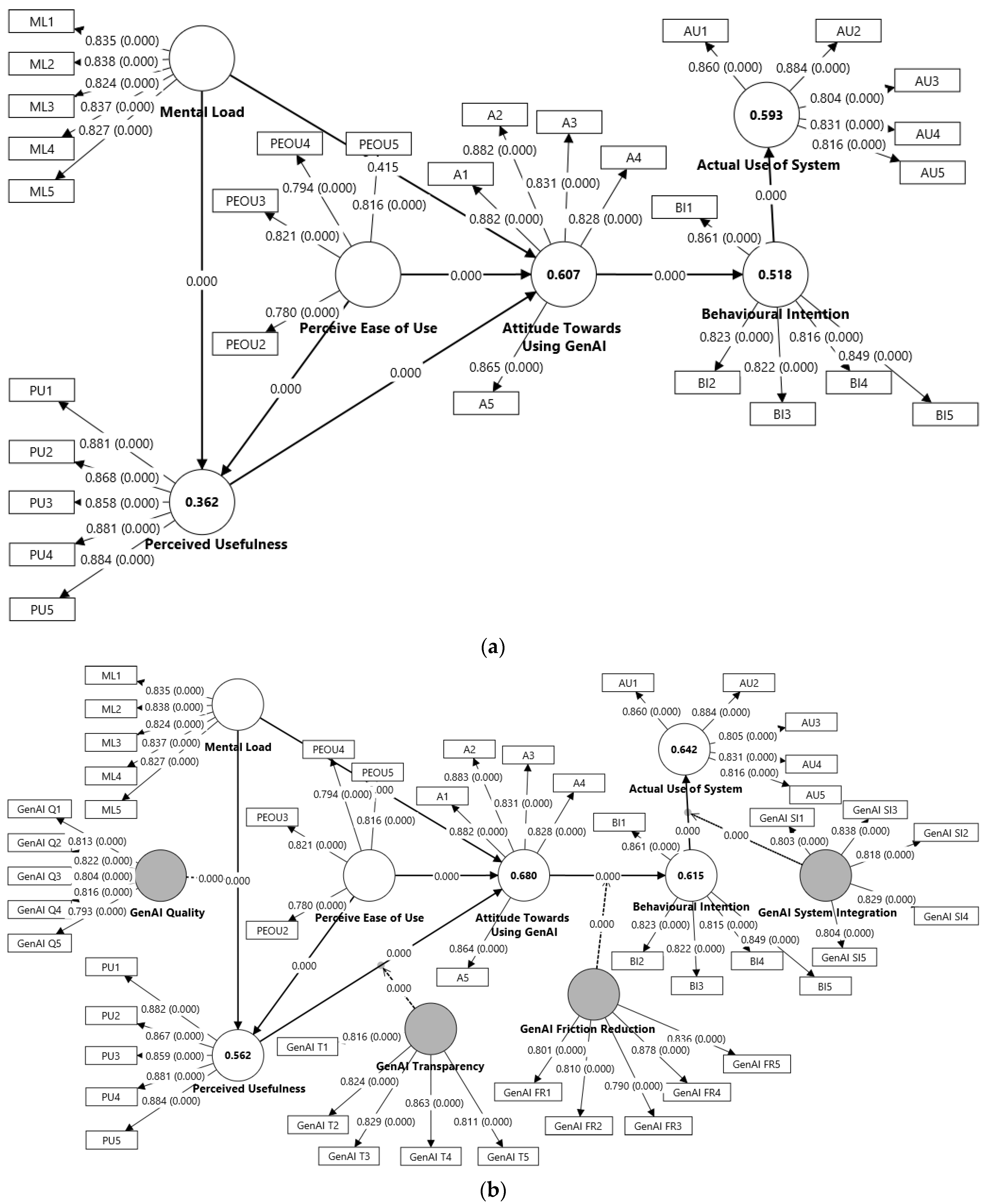
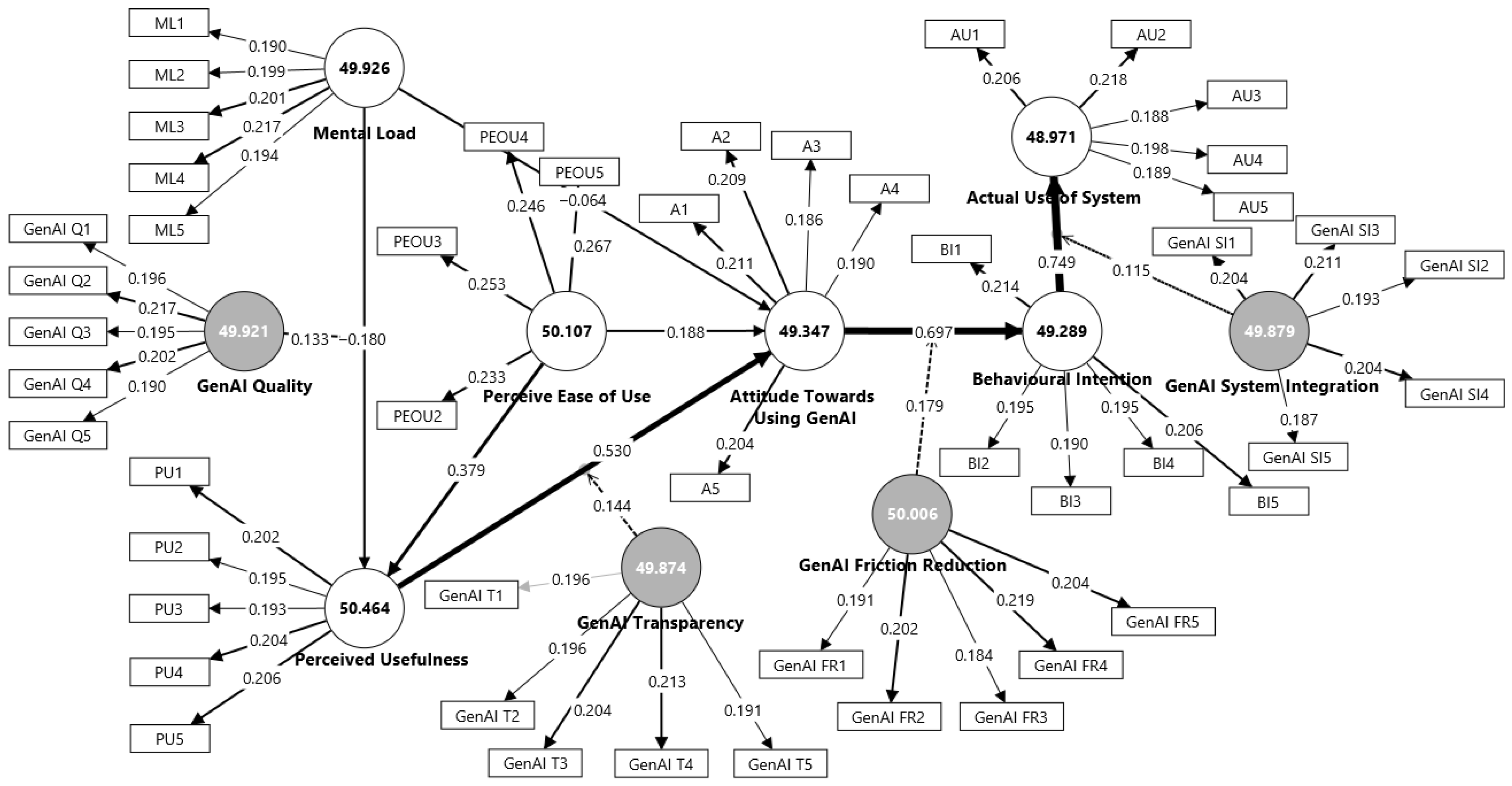
Digital Adoption of Generative AI Tools: A Multi-Theory Model Linking Cognitive Load, User Perceptions, and System Attributes


Abstract
1. Introduction
2. Literature Review
2.1. Mental Load
2.2. Perceived Ease of Use and Perceived Usefulness in GenAI Contexts
2.3. Attitude Toward Using GenAI
2.4. Actual Use of GenAI
2.5. Theoretical Foundation of the Study
2.6. Conceptual Framework
3. Research Methodology
3.1. Research Design
3.2. Population, Sampling, and Data Collection
3.3. Instrument Development
3.4. Data Analysis Technique
3.5. Moderation and Structural Testing
3.6. Predictive Assessment
3.7. Common Method Bias Assessment
3.8. Ethical Considerations
4. Results
4.1. Measurement Model
4.2. Structural Model
4.3. Importance—Performance Map Analysis
5. Discussion
5.1. Integration of TAM with GenAI System Characteristics
5.2. Validation and Extension of TAM Relationships
5.3. Role of Mental Load and Cognitive Load Theory
5.4. Moderating Role of GenAI System Attributes
5.5. Interpretation of IPMA and Predictive Findings
5.6. Theoretical, Practical, and Sustainability Implications
6. Conclusions
Funding
Institutional Review Board Statement
Informed Consent Statement
Data Availability Statement
Conflicts of Interest
Appendix A

| Construct | Item Code | Measurement Item | Source (Adapted From) |
|---|---|---|---|
| Perceived Usefulness | PU1 | Using GenAI improves my performance in completing tasks. | [66,67] |
| PU2 | GenAI helps me accomplish tasks more efficiently. | [65] | |
| PU3 | GenAI enhances the quality of my task outcomes. | [67] | |
| Perceived Ease of Use | PEOU1 | Learning to use GenAI is easy for me. | [65] |
| PEOU2 | Interacting with GenAI does not require a lot of mental effort. | [68] | |
| Attitude Toward Using GenAI | ATT1 | Using GenAI is a good idea. | [35] |
| ATT2 | I have a positive feeling about using GenAI. | [35,69] | |
| Behavioral Intention | BI1 | I intend to use GenAI regularly in the future. | [67,70] |
| BI2 | I plan to continue using GenAI for my tasks. | [70] | |
| Actual Use | AU1 | I frequently use GenAI in my daily activities. | [15] |
| Mental Load | ML1 | Using GenAI requires high mental effort. | [71] |
| ML2 | Interacting with GenAI makes me feel cognitively overloaded. | [67] | |
| GenAI Quality | GQ1 | GenAI provides accurate and reliable outputs. | [7] |
| GenAI Transparency | GT1 | GenAI explains its outputs in a clear and understandable way. | [67] |
| GenAI Friction Reduction | GFR1 | GenAI minimizes unnecessary steps in completing tasks. | [67] |
| GenAI System Integration | GSI1 | GenAI integrates well with tools and platforms I already use. | [67] |
References
- Liu, X.; Zhong, B. Integrating generative Artificial Intelligence into student learning: A systematic review from a TPACK perspective. Educ. Res. Rev. 2025, 49, 100741. [Google Scholar] [CrossRef]
- Hamidi, H. A model for generative artificial intelligence in customer decision-making process using social interaction. Telemat. Inform. Rep. 2025, 19, 100237. [Google Scholar] [CrossRef]
- Ali, O.; Murray, P.A.; Momin, M.; Dwivedi, Y.K.; Malik, T. The effects of artificial intelligence applications in educational settings: Challenges and strategies. Technol. Forecast. Soc. Change 2024, 199, 123076. [Google Scholar] [CrossRef]
- Kumar, A.; Shankar, A.; Hollebeek, L.D.; Behl, A.; Lim, W.M. Generative artificial intelligence (GenAI) revolution: A deep dive into GenAI adoption. J. Bus. Res. 2025, 189, 115160. [Google Scholar] [CrossRef]
- Davis, F.D. Perceived Usefulness, Perceived Ease of Use, and User Acceptance of Information Technology. MIS Q. 1989, 13, 319–340. [Google Scholar] [CrossRef]
- Bashir, H.; Zhou, R. Mental load, ChatGPT, and work-study balance: A TAM-based study of AI adoption by employees in non-traditional education. Telemat. Inform. Rep. 2025, 19, 100216. [Google Scholar] [CrossRef]
- DeLone, W.H.; McLean, E.R. Information systems success: The quest for the dependent variable. Inf. Syst. Res. 1992, 3, 60–95. [Google Scholar] [CrossRef]
- Sweller, J. Cognitive load during problem solving: Effects on learning. Cogn. Sci. 1988, 12, 257–285. [Google Scholar] [CrossRef]
- Chen, O.; Paas, F.; Sweller, J. A Cognitive Load Theory Approach to Defining and Measuring Task Complexity Through Element Interactivity. Educ. Psychol. Rev. 2023, 35, 63. [Google Scholar] [CrossRef]
- Zeitlhofer, I.; Zumbach, J.; Schweppe, J. Complexity affects performance, cognitive load, and awareness. Learn. Instr. 2024, 94, 102001. [Google Scholar] [CrossRef]
- Borragán, G.; Slama, H.; Bartolomei, M.; Peigneux, P. Cognitive fatigue: A Time-based Resource-sharing account. Cortex 2017, 89, 71–84. [Google Scholar] [CrossRef] [PubMed]
- del Carmen Ocón Palma, M.; Seeger, A.M.; Heinzl, A. Mitigating information overload in e-commerce interactions with conversational agents. In Lecture Notes in Information Systems and Organisation; Springer Nature: Cham, Switzerland, 2020; Volume 32. [Google Scholar]
- Suhluli, S.A.; Khan, S.M.F.A. Determinants of user acceptance of wearable IoT devices. Cogent Eng. 2022, 9, 2087456. [Google Scholar] [CrossRef]
- Kim, K.; Kim, B. Decision-Making Model for Reinforcing Digital Transformation Strategies Based on Artificial Intelligence Technology. Information 2022, 13, 253. [Google Scholar] [CrossRef]
- Shehawy, Y.M.; Khan, S.M.F.A.; Khalufi, N.A.M.; Abdullah, R.S. Customer adoption of robot: Synergizing customer acceptance of robot-assisted retail technologies. J. Retail. Consum. Serv. 2025, 82, 104062. [Google Scholar] [CrossRef]
- Shehawy, Y.M.; Khan, S.M.F.A. Consumer readiness for green consumption: The role of green awareness as a moderator of the relationship between green attitudes and purchase intentions. J. Retail. Consum. Serv. 2024, 78, 103739. [Google Scholar] [CrossRef]
- Ding, Z.; Xue, W. Navigating anxiety in digital learning: How AI-driven personalization and emotion recognition shape EFL students’ engagement. Acta Psychol. 2025, 260, 105466. [Google Scholar] [CrossRef]
- Lim, K.K.; Lee, C.S. Generative AI-Driven Personalized Nudges. In Communications in Computer and Information Science; Springer Nature: Berlin/Heidelberg, Germany, 2025; Volume 2529 CCIS, pp. 359–367. [Google Scholar]
- Patel, K.; Shah, M.; Qureshi, K.M.; Qureshi, M.R.N. A systematic review of generative AI: Importance of industry and startup-centered perspectives, agentic AI, ethical considerations & challenges, and future directions. Artif. Intell. Rev. 2025, 59, 7. [Google Scholar] [CrossRef]
- Dong, X.; Wang, Z.; Han, S. Mitigating Learning Burnout Caused by Generative Artificial Intelligence Misuse in Higher Education: A Case Study in Programming Language Teaching. Informatics 2025, 12, 51. [Google Scholar] [CrossRef]
- Song, C. Harmonising Minds: How AI-Powered Learning Tools Shape Music Education Students’ Cognitive Load, Well-Being and Academic Success. Eur. J. Educ. 2025, 60, e70122. [Google Scholar] [CrossRef]
- Ma, J.; Wang, P.; Li, B.; Wang, T.; Pang, X.S.; Wang, D. Exploring User Adoption of ChatGPT: A Technology Acceptance Model Perspective. Int. J. Hum. Comput. Interact. 2025, 41, 1431–1445. [Google Scholar] [CrossRef]
- Wang, Y.; Yu, R. Exploring the Factors on the Acceptance of Generative Artificial Intelligence Teaching Assistants: The Perspective of Technology Acceptance Model. Int. J. Hum. Comput. Interact. 2025, 42, 794–808. [Google Scholar] [CrossRef]
- Iddamalgoda, C.; Ng, K.H.; Koleva, B. Generative AI for Supporting Cultural Learning and Reflection: A Study on Technology User Acceptance. Int. J. Hum. Comput. Interact. 2025, 42, 197–210. [Google Scholar] [CrossRef]
- Islam, Q.; Khan, S.M.A. Assessing Consumer Behavior in Sustainable Product Markets: A Structural Equation Modeling Approach with Partial Least Squares Analysis. Sustainability 2024, 16, 3400. [Google Scholar] [CrossRef]
- Hoonsopon, D.; Ketkaew, C.; Puriwat, W.; Viriyasitavat, W.; Tripopsakul, S. Reasons for and against GenAI: Trait-driven adoption under open innovation dynamics. J. Open Innov. Technol. Mark. Complex. 2025, 11, 100653. [Google Scholar] [CrossRef]
- Ivanov, S.; Soliman, M.; Tuomi, A.; Alkathiri, N.A.; Al-Alawi, A.N. Drivers of generative AI adoption in higher education through the lens of the Theory of Planned Behaviour. Technol. Soc. 2024, 77, 102521. [Google Scholar] [CrossRef]
- Baier, D.; Karasenko, A.; Rese, A. Measuring technology acceptance over time using transfer models based on online customer reviews. J. Retail. Consum. Serv. 2025, 85, 104278. [Google Scholar] [CrossRef]
- Khalufi, N.A.M.; Sheikh, R.A.; Khan, S.M.; Onn, C.W. Evaluating the Impact of Sustainability Practices on Customer Relationship Quality: An SEM-PLS Approach to Align with SDG. Sustainability 2025, 17, 798. [Google Scholar] [CrossRef]
- Islam, Q.; Khan, S.M.F.A. Understanding deep learning across academic domains: A structural equation modelling approach with a partial least squares approach. Int. J. Innov. Res. Sci. Stud. 2024, 7, 1389–1407. [Google Scholar] [CrossRef]
- Bawa, R.; Jain, K.; Goel, P. Generative AI adoption in universities: How TAM–TTF and neuroticism influence sustained usage. Interact. Technol. Smart Educ. 2025, 1–31. [Google Scholar] [CrossRef]
- Kelly, S.; Kaye, S.-A.; Oviedo-Trespalacios, O. What factors contribute to the acceptance of artificial intelligence? A systematic review. Telemat. Inform. 2023, 77, 101925. [Google Scholar] [CrossRef]
- Miranda, F.J.; Chamorro-Mera, A. Exploring the adoption of generative artificial intelligence tools among university teachers. High. Educ. Res. Dev. 2025, 1–17. [Google Scholar] [CrossRef]
- Chen, J.; Dai, J.; Yu, T.; Wang, C. Factors influencing the adoption of generative AI in supply chain management: An empirical study based on task-technology fit and the theory of planned behaviour. Int. J. Logist. Res. Appl. 2025, 1–22. [Google Scholar] [CrossRef]
- Khan, S.M.; Shehawy, Y.M. Perceived AI Consumer-Driven Decision Integrity: Assessing Mediating Effect of Cognitive Load and Response Bias. Technologies 2025, 13, 374. [Google Scholar] [CrossRef]
- Shehawy, Y.M.; Khan, S.M.F.A.; Madkhali, H. An Integrated SEM-ESG Framework for Understanding Consumer’s Green Technology Adoption Behavior. J. Knowl. Econ. 2024, 16, 8887–8928. [Google Scholar] [CrossRef]
- Medabesh, A.; Khan, S.M.F.A. Sustainability management among enterprises in United Kingdom and Saudi Arabia. Acad. Strateg. Manag. J. 2020, 19, 1–13. [Google Scholar]
- Abdullah, R.S.; Masmali, F.H.; Alhazemi, A.; Onn, C.W.; Khan, S.M.F.A. Enhancing institutional readiness: A Multi-Stakeholder approach to learning analytics policy with the SHEILA-UTAUT framework using PLS-SEM. Educ. Inf. Technol. 2025, 30, 22315–22342. [Google Scholar] [CrossRef]
- Hakami, T.A.; Al-Shargabi, B.; Sabri, O.; Khan, S.M.F.A. Impact of Blackboard Technology Acceptance on Students Learning in Saudi Arabia. J. Educ. Online 2023, 20, n3. [Google Scholar] [CrossRef]
- Islam, Q.; Khan, S.M.F.A. Integrating IT and Sustainability in Higher Education Infrastructure: Impacts on Quality, Innovation and Research. Int. J. Learn. Teach. Educ. Res. 2023, 22, 210–236. [Google Scholar] [CrossRef]
- Stöhr, C.; Ou, A.W.; Malmström, H. Perceptions and usage of AI chatbots among students in higher education across genders, academic levels and fields of study. Comput. Educ. Artif. Intell. 2024, 7, 100259. [Google Scholar] [CrossRef]
- Khana, S.M.F.A.; Ranab, D.; Singhc, H. An Empirical Study of Organised Retailing Strategies in developing customer loyalty, changing purchase decision and developing satisfaction in Consumer of Indian Sub-Continent. Int. J. Multidiscip. Curr. Res. 2014, 2, 247–253. [Google Scholar]
- Mekheimer, M.A.; Mahdy, E. University teachers’ perceptions of EFL students’ engagement in Google Classroom. Soc. Sci. Humanit. Open 2025, 12, 101585. [Google Scholar] [CrossRef]
- Valle, N.N.; Kilat, R.V.; Lim, J.; General, E.; Cruz, J.D.; Colina, S.J.; Batican, I.; Valle, L. Modeling learners’ behavioral intention toward using artificial intelligence in education. Soc. Sci. Humanit. Open 2024, 10, 101167. [Google Scholar] [CrossRef]
- Salhieh, S.M.; Al-Abdallat, Y. Technopreneurial Intentions: The Effect of Innate Innovativeness and Academic Self-Efficacy. Sustainability 2022, 14, 238. [Google Scholar] [CrossRef]
- Vidergor, H.E. The effect of teachers’ self- innovativeness on accountability, distance learning self-efficacy, and teaching practices. Comput. Educ. 2023, 199, 104777. [Google Scholar] [CrossRef] [PubMed]
- Zhao, S.; Chen, Y. ESG rating and labor income share: Firm-level evidence. Financ. Res. Lett. 2024, 63, 105361. [Google Scholar] [CrossRef]
- Chia, J.; Frattarola, A. A design-based approach to analysing student engagement with a GenAI-Enabled brainstorming app. Comput. Educ. Artif. Intell. 2025, 9, 100468. [Google Scholar] [CrossRef]
- Lee, D.; Arnold, M.; Srivastava, A.; Plastow, K.; Strelan, P.; Ploeckl, F.; Lekkas, D.; Palmer, E. The impact of generative AI on higher education learning and teaching: A study of educators’ perspectives. Comput. Educ. Artif. Intell. 2024, 6, 100221. [Google Scholar] [CrossRef]
- Lim, T.; Gottipati, S.; Cheong, M. What students really think: Unpacking AI ethics in educational assessments through a triadic framework. Int. J. Educ. Technol. High. Educ. 2025, 22, 56. [Google Scholar] [CrossRef]
- Tomczyk, Ł.; Fedeli, L.; Włoch, A.; Limone, P.; Frania, M.; Guarini, P.; Szyszka, M.; Mascia, M.L. Digital Competences of Pre-service Teachers in Italy and Poland. Technol. Knowl. Learn. 2023, 28, 651–681. [Google Scholar] [CrossRef]
- Bodini, M. Generative Artificial Intelligence and Regulations: Can We Plan a Resilient Journey Toward the Safe Application of Generative Artificial Intelligence? Societies 2024, 14, 268. [Google Scholar] [CrossRef]
- Yoon, S.-H.; Yang, S.-B.; Lee, S.-H. Comprehensive examination of the bright and dark sides of generative AI services: A mixed-methods approach. Electron. Commer. Res. Appl. 2025, 70, 101491. [Google Scholar] [CrossRef]
- Wagler, K.R.; Wells, T.T. Effects of personality and gender on nudgeability for mental health-related behaviors. Curr. Opin. Psychol. 2024, 60, 101938. [Google Scholar] [CrossRef]
- Yu, Y.; Bannasilp, A.; Kwong, S.C.M. Virtual Idols’ influence on Consumer’s brand attitude and purchase intention: A perspective of para-social interaction. Electron. Commer. Res. Appl. 2025, 74, 101546. [Google Scholar] [CrossRef]
- Haque, A.K.M.B.; Islam, A.K.M.N.; Mikalef, P. Explainable Artificial Intelligence (XAI) from a user perspective: A synthesis of prior literature and problematizing avenues for future research. Technol. Forecast. Soc. Change 2023, 186, 122120. [Google Scholar] [CrossRef]
- Hassija, V.; Chamola, V.; Mahapatra, A.; Singal, A.; Goel, D.; Huang, K.; Scardapane, S.; Spinelli, I.; Mahmud, M.; Hussain, A. Interpreting Black-Box Models: A Review on Explainable Artificial Intelligence. Cognit. Comput. 2024, 16, 45–74. [Google Scholar] [CrossRef]
- Joshi, I.; Grimmer, M.; Rathgeb, C.; Busch, C.; Bremond, F.; Dantcheva, A. Synthetic Data in Human Analysis: A Survey. IEEE Trans. Pattern Anal. Mach. Intell. 2024, 46, 4957–4976. [Google Scholar] [CrossRef] [PubMed]
- Afzal, U.; Prouzeau, A.; Lawrence, L.; Dwyer, T.; Bichinepally, S.; Liebman, A.; Goodwin, S. Investigating Cognitive Load in Energy Network Control Rooms: Recommendations for Future Designs. Front. Psychol. 2022, 13, 812677. [Google Scholar] [CrossRef]
- Sharma, A.P. Consumers’ purchase behaviour and green marketing: A synthesis, review and agenda. Int. J. Consum. Stud. 2021, 45, 1217–1238. [Google Scholar] [CrossRef]
- Jiao, H.; Wang, T.; Libaers, D.; Yang, J.; Hu, L. The relationship between digital technologies and innovation: A review, critique, and research agenda. J. Innov. Knowl. 2025, 10, 100638. [Google Scholar] [CrossRef]
- Zhai, C.; Wibowo, S.; Li, L.D. The effects of over-reliance on AI dialogue systems on students’ cognitive abilities: A systematic review. Smart Learn. Environ. 2024, 11, 28. [Google Scholar] [CrossRef]
- Herzallah, F.; Mohammad, B.A.; Alhayek, M.; Khan, S.M.F.A. Mitigating uncertainty in travel agency selection in Jordan: A signaling theory approach. Int. J. Inf. Manag. Data Insights 2025, 5, 100362. [Google Scholar] [CrossRef]
- Schmidt, D.A.; Alboloushi, B.; Thomas, A.; Magalhaes, R. Integrating artificial intelligence in higher education: Perceptions, challenges, and strategies for academic innovation. Comput. Educ. Open 2025, 9, 100274. [Google Scholar] [CrossRef]
- Liu, C.; Yang, L.; Dong, X.; Li, X. Factors Influencing Generative AI Usage Intention in China: Extending the Acceptance–Avoidance Framework with Perceived AI Literacy. Systems 2025, 13, 639. [Google Scholar] [CrossRef]
- Singh, K.; Chatterjee, S.; Mariani, M. Applications of generative AI and future organizational performance: The mediating role of explorative and exploitative innovation and the moderating role of ethical dilemmas and environmental dynamism. Technovation 2024, 133, 103021. [Google Scholar] [CrossRef]
- Venkatesh, V.; Davis, F.D. A Theoretical Extension of the Technology Acceptance Model: Four Longitudinal Field Studies. Manag. Sci. 2000, 46, 186–204. [Google Scholar] [CrossRef]
- Khan, S.M.; Suhluli, S. Generative AI and Cognitive Challenges in Research: Balancing Cognitive Load, Fatigue, and Human Resilience. Technologies 2025, 13, 486. [Google Scholar] [CrossRef]
- Rana, D.; Khan, S.M.F.A.; Arahant, A.; Chaudhary, J.K. Beyond Bitcoin: Green Cryptocurrencies as a Sustainable Alternative. In Green Economics and Strategies for Business Sustainability; Yıldırım, S., Demirtaş, I., Malik, F.A., Eds.; IGI Global: Hershey, PA, USA, 2025; pp. 235–260. [Google Scholar]
- Masmali, F.H.; Khan, S.M.; Hakim, T. IoT-Enabled Digital Nudge Architecture for Sustainable Energy Behavior: An SEM-PLS Approach. Technologies 2025, 13, 504. [Google Scholar] [CrossRef]
- Goh, A.Y.H.; Hartanto, A.; Majeed, N.M. Generative artificial intelligence dependency: Scale development, validation, and its motivational, behavioral, and psychological correlates. Comput. Hum. Behav. Rep. 2025, 20, 100845. [Google Scholar] [CrossRef]


| Construct | α | rho_A | rho_C | AVE | 1 | 2 | 3 | 4 | 5 | 6 | 7 | 8 | 9 | 10 | 11 | 12 | 13 | 14 |
|---|---|---|---|---|---|---|---|---|---|---|---|---|---|---|---|---|---|---|
| 1. Actual Use of System | 0.895 | 0.897 | 0.923 | 0.705 | — | 0.837 | 0.861 | 0.284 | 0.642 | 0.286 | 0.504 | 0.290 | 0.617 | 0.808 | 0.146 | 0.109 | 0.150 | 0.109 |
| 2. Attitude Towards Using GenAI | 0.910 | 0.912 | 0.933 | 0.736 | 0.837 | — | 0.798 | 0.096 | 0.668 | 0.128 | 0.584 | 0.275 | 0.644 | 0.833 | 0.042 | 0.126 | 0.148 | 0.006 |
| 3. Behavioural Intention | 0.891 | 0.892 | 0.920 | 0.696 | 0.861 | 0.798 | — | 0.356 | 0.578 | 0.096 | 0.472 | 0.290 | 0.602 | 0.774 | 0.037 | 0.093 | 0.161 | 0.185 |
| 4. GenAI Friction Reduction | 0.881 | 0.884 | 0.913 | 0.678 | 0.284 | 0.096 | 0.356 | — | 0.025 | 0.017 | 0.024 | 0.019 | 0.309 | 0.122 | 0.015 | 0.056 | 0.012 | 0.023 |
| 5. GenAI Quality | 0.869 | 0.870 | 0.905 | 0.656 | 0.642 | 0.668 | 0.578 | 0.025 | — | 0.166 | 0.351 | 0.129 | 0.399 | 0.671 | 0.019 | 0.020 | 0.014 | 0.017 |
| 6. GenAI System Integration | 0.877 | 0.878 | 0.910 | 0.670 | 0.286 | 0.128 | 0.096 | 0.017 | 0.166 | — | 0.197 | 0.025 | 0.017 | 0.124 | 0.029 | 0.031 | 0.032 | 0.025 |
| 7. GenAI Transparency | 0.886 | 0.887 | 0.916 | 0.687 | 0.504 | 0.584 | 0.472 | 0.024 | 0.351 | 0.197 | — | 0.028 | 0.251 | 0.477 | 0.022 | 0.019 | 0.038 | 0.027 |
| 8. Mental Load | 0.889 | 0.890 | 0.919 | 0.693 | 0.290 | 0.275 | 0.290 | 0.019 | 0.129 | 0.025 | 0.028 | — | 0.227 | 0.339 | 0.025 | 0.069 | 0.011 | 0.023 |
| 9. Perceived Ease of Use | 0.816 | 0.818 | 0.879 | 0.645 | 0.617 | 0.644 | 0.602 | 0.309 | 0.399 | 0.017 | 0.251 | 0.227 | — | 0.652 | 0.055 | 0.018 | 0.022 | 0.017 |
| 10. Perceived Usefulness | 0.923 | 0.923 | 0.942 | 0.765 | 0.808 | 0.833 | 0.774 | 0.122 | 0.671 | 0.124 | 0.477 | 0.339 | 0.652 | — | 0.034 | 0.028 | 0.147 | 0.020 |
| 11. GenAI System Integration × Behavioural Intention | — | — | — | — | 0.146 | 0.042 | 0.037 | 0.015 | 0.019 | 0.029 | 0.022 | 0.025 | 0.055 | 0.034 | — | 0.126 | 0.031 | 0.028 |
| 12. GenAI Transparency × Perceived Usefulness | — | — | — | — | 0.109 | 0.126 | 0.093 | 0.056 | 0.020 | 0.031 | 0.019 | 0.069 | 0.018 | 0.028 | 0.126 | — | 0.093 | 0.054 |
| 13. GenAI Quality × Mental Load | — | — | — | — | 0.150 | 0.148 | 0.161 | 0.012 | 0.014 | 0.032 | 0.038 | 0.011 | 0.022 | 0.147 | 0.031 | 0.093 | — | 0.010 |
| 14. GenAI Friction Reduction × Attitude | — | — | — | — | 0.109 | 0.006 | 0.185 | 0.023 | 0.017 | 0.025 | 0.027 | 0.023 | 0.017 | 0.020 | 0.028 | 0.054 | 0.010 | — |
| Indicator/Construct | VIF Range | Remarks | ||
|---|---|---|---|---|
| Measurement Items | 1.61—2.93 | All within acceptable threshold (<5; [61] → No collinearity concern) | ||
| Interaction Terms | 1.00 | Ideal (no multicollinearity) | ||
| Model Fit Indices | Saturated Model | Estimated Model | Acceptable Thresholds | Remarks |
| SRMR | 0.026 | 0.076 | <0.08 | Both values acceptable |
| d_ULS | 0.845 | 7.281 | Closer to 0 is better | The estimated model is higher, but still acceptable |
| d_G | 0.308 | 0.427 | Closer to 0 is better | Good fit |
| Chi-square | 4270.83 | 5235.366 | Lower is better | Large sample leads to significance, common in PLS-SEM |
| NFI | 0.943 | 0.931 | >0.90 | Acceptable |
| Construct | Q2predict (No GenAI) | Q2predict (With GenAI) | RMSE (No GenAI) | RMSE (With GenAI) | MAE (No GenAI) | MAE (With GenAI) | R2 (No GenAI) | R2 (With GenAI) | Adj. R2 (No GenAI) | Adj. R2 (With GenAI) | Remarks |
|---|---|---|---|---|---|---|---|---|---|---|---|
| Actual Use of System | 0.249 | 0.506 | 0.867 | 0.703 | 0.721 | 0.580 | 0.593 | 0.642 | 0.592 | 0.641 | Significant improvement with GenAI |
| Attitude Towards Using GenAI | 0.329 | 0.616 | 0.820 | 0.620 | 0.668 | 0.503 | 0.607 | 0.677 | 0.607 | 0.676 | Stronger predictive power with GenAI |
| Behavioural Intention | 0.273 | 0.524 | 0.853 | 0.691 | 0.710 | 0.567 | 0.518 | 0.615 | 0.517 | 0.615 | Better accuracy and explained variance |
| Perceived Usefulness | 0.361 | 0.560 | 0.800 | 0.664 | 0.656 | 0.536 | 0.362 | 0.562 | 0.362 | 0.561 | Improved prediction with GenAI |
| Hypothesis | Path | β (O) | t-Value | p-Value | f2 | Effect Size | Result |
|---|---|---|---|---|---|---|---|
| H1 | PEOU → PU | 0.379 | 26.012 | 0.000 | 0.283 | Moderate | Supported |
| H2 | PEOU → Attitude | 0.389 | 30.833 | 0.000 | 0.075 | Small | Supported |
| H3 | PU → Attitude | 0.530 | 35.251 | 0.000 | 0.464 | Large | Supported |
| H4 | Attitude → BI | 0.697 | 66.317 | 0.000 | 1.253 | Very Large | Supported |
| H5 | BI → AU | 0.749 | 83.093 | 0.000 | 1.553 | Very Large | Supported |
| H6 | ML → PU | −0.180 | 12.805 | 0.000 | 0.071 | Small (Negative) | Supported |
| H7 | ML → Attitude | −0.159 | 12.176 | 0.000 | 0.011 | Negligible (Negative) | Supported |
| H8a | GenAI Quality × ML → PU | 0.133 | 10.710 | 0.000 | 0.041 | Small | Supported |
| H8b | GenAI Transparency × PU → Attitude | 0.144 | 13.555 | 0.000 | 0.064 | Small | Supported |
| H8c | GenAI Friction Reduction × Attitude → BI | 0.179 | 14.821 | 0.000 | 0.084 | Small | Supported |
| H8d | GenAI System Integration × BI → AU | 0.115 | 11.027 | 0.000 | 0.038 | Small | Supported |
| H9 | Extended Model vs. Baseline (↑ R2 = 0.677, ↑ Q2 = 0.614, ↓ RMSE/MAE) | – | – | – | – | Improved Predictive Power | Supported |
| Rank | Construct | Importance (β) | Performance | f2 Effect Size | Category | Performance Gap | Implication |
|---|---|---|---|---|---|---|---|
| 1 | Behavioral Intention | 0.749 | 49.289 | 1.553 | High | −0.6 | Key driver, focus on sustaining intention → actual use |
| 2 | Attitude Towards Using GenAI | 0.522 | 49.347 | 1.253 | High | −0.5 | Strengthen attitudes through positive user experiences |
| 3 | Perceived Usefulness | 0.277 | 50.464 | 0.464 | Medium | +0.6 | Already strong, continue highlighting usefulness |
| 4 | Perceived Ease of Use | 0.203 | 50.107 | 0.283 | Medium | +0.3 | Ease is adequate, less urgent for improvement |
| 5 | GenAI Friction Reduction | 0.195 | 50.006 | 0.084 | Medium | +0.2 | Supports adoption, can be optimized |
| 6 | GenAI System Integration | 0.192 | 49.879 | 0.038 | Medium | −0.1 | Needs improvement to ensure seamless adoption |
| 7 | GenAI Transparency | 0.136 | 49.874 | 0.060 | Low | −0.1 | Transparency builds trust, invest moderately |
| 8 | GenAI Quality | 0.125 | 49.921 | 0.041 | Low | 0.0 | Stable, less immediate priority |
| 9 | Mental Load | −0.083 | 49.926 | 0.011 | Negative | 0.0 | Barrier—should be minimized with supportive features |
| Aspect | Insights from the Present Study | Limitation Addressed | Logical Future Research Direction |
|---|---|---|---|
| Practical Implications | The study demonstrates that GenAI output quality, transparency, friction reduction, and system integration significantly strengthen key Technology Acceptance Model (TAM) relationships. Users are more likely to adopt GenAI when outputs are reliable, explanations are clear, effort is minimized, and tools integrate smoothly into daily routines. | Moderating effects were examined at a single point in time using self-reported perceptions. | Future studies may validate these effects using longitudinal usage data, real-time interaction logs, or experimental manipulations of transparency, quality, and interface design. |
| Theoretical Implications | By integrating TAM, Cognitive Load Theory, and the DeLone and McLean IS Success Model, the study shows that psychological drivers (perceived usefulness, perceived ease of use, attitude) interact with cognitive strain and system-level attributes to explain GenAI adoption. The integrated model improves both explanatory and predictive power. | The framework includes a limited set of GenAI-specific moderators. Other AI-related constructs were not examined. | Future research may extend the framework by incorporating additional GenAI-specific constructs, such as AI safety, personalization, explainability depth, or hallucination control, and testing their mediating or moderating roles. |
| Social Implications | Reducing cognitive load and enhancing transparency improves accessibility for non-expert users, older individuals, and users with lower digital literacy, supporting more inclusive adoption of GenAI technologies. | Demographic heterogeneity was not the primary analytical focus of the study. | Future research should examine how age, education, digital literacy, and socio-cultural expectations shape cognitive load, transparency needs, and adoption behavior. |
| Managerial Implications | Organizations implementing GenAI should prioritize system quality and friction reduction, as these factors help translate favorable attitudes into behavioral intention and actual usage. | Organizational and workplace-specific contexts were not explicitly examined. | Future studies may apply the proposed model in professional settings (e.g., healthcare, education, corporate environments) to identify industry-specific adoption barriers and facilitators. |
| Technological/System Design Implications | The findings highlight that system design choices—such as high-quality outputs, clear explanations, and seamless integration—directly enhance user trust, satisfaction, and continued use of GenAI systems. | General-purpose GenAI systems were examined without experimental control over design features. | Controlled experiments comparing interface designs, transparency levels, and prompt structures could quantify their effects on mental load, usefulness, and trust. |
| Predictive and Analytical Implications | The extended model significantly outperforms the baseline TAM in predictive accuracy, demonstrating that system attributes are essential for forecasting real GenAI usage behavior. | Cross-sectional data limit the ability to capture behavioral change over time. | Longitudinal predictive modeling or machine-learning approaches may be used to track evolving patterns of reliance, trust, and repeated use as users gain experience. |
| General Limitations | The study is based on cross-sectional, self-reported data from a single national context with a limited set of moderators. | — | Each limitation opens avenues for future research, including longitudinal designs, multi-source data, cross-cultural comparisons, richer GenAI constructs, and multi-sector analysis. |
Disclaimer/Publisher’s Note: The statements, opinions and data contained in all publications are solely those of the individual author(s) and contributor(s) and not of MDPI and/or the editor(s). MDPI and/or the editor(s) disclaim responsibility for any injury to people or property resulting from any ideas, methods, instructions or products referred to in the content. |
© 2026 by the author. Licensee MDPI, Basel, Switzerland. This article is an open access article distributed under the terms and conditions of the Creative Commons Attribution (CC BY) license.
Share and Cite
Suhluli, S. Digital Adoption of Generative AI Tools: A Multi-Theory Model Linking Cognitive Load, User Perceptions, and System Attributes. Sustainability 2026, 18, 2076. https://doi.org/10.3390/su18042076
Suhluli S. Digital Adoption of Generative AI Tools: A Multi-Theory Model Linking Cognitive Load, User Perceptions, and System Attributes. Sustainability. 2026; 18(4):2076. https://doi.org/10.3390/su18042076
Chicago/Turabian StyleSuhluli, Salem. 2026. "Digital Adoption of Generative AI Tools: A Multi-Theory Model Linking Cognitive Load, User Perceptions, and System Attributes" Sustainability 18, no. 4: 2076. https://doi.org/10.3390/su18042076
APA StyleSuhluli, S. (2026). Digital Adoption of Generative AI Tools: A Multi-Theory Model Linking Cognitive Load, User Perceptions, and System Attributes. Sustainability, 18(4), 2076. https://doi.org/10.3390/su18042076