Article

Trophic Niche Plasticity and Differentiation Facilitate Non-Native Fish Invasion and Drive Competition with Native Fish in Erhai, a Plateau Lake


1
Donghu Experimental Station of Lake Ecosystems, State Key Laboratory of Breeding Biotechnology and Sustainable Aquaculture, Institute of Hydrobiology, Chinese Academy of Sciences, Wuhan 430072, China
2
College of Advanced Agricultural Sciences, University of Chinese Academy of Sciences, Beijing 100049, China
*
Author to whom correspondence should be addressed.
Sustainability 2026, 18(4), 1996; https://doi.org/10.3390/su18041996
Submission received: 23 January 2026 / Revised: 11 February 2026 / Accepted: 13 February 2026 / Published: 14 February 2026

Abstract

Non-native fish invasions are important drivers of freshwater biodiversity and ecosystem function loss. In this study, we compared the trophic niches of four non-native (Rhinogobius giurinus, Hemiculter leucisculus, Hypomesus nipponensis, and Tachysurus fulvidraco) and one native fish species (Carassius auratus) from April 2022 to December 2023 in Erhai Lake, a typical plateau lake on the Yunnan–Guizhou Plateau, China. We analyzed δ13C and δ15N from 766 fish samples and calculated 103 SEAb values across species, seasons, and lake regions. Stable isotope analyses revealed pronounced trophic niche differentiation between non-native and native fishes. Non-native species exhibited wider niche width (4.81 ± 0.48), lower overlap (24.43 ± 1.57), and higher within-group dispersion (2.69 ± 0.07), indicating greater trophic plasticity. In contrast, native fishes showed narrower niches (2.72 ± 0.32), higher overlap (37.32 ± 4.21), and lower plasticity (1.68 ± 0.08). Moreover, non-native and native fishes adopted contrasting trophic strategies: individual fitness increased with niche expansion in non-native fishes, whereas it declined in native fishes. Multiple linear analyses further indicated significant competitive effects of non-native fishes on native species’ niches, suggesting that niche expansion in native fishes represents a passive response to intensified competition rather than an adaptive strategy. Overall, the high trophic plasticity of non-native fishes and their asymmetric effects on native species imply a high risk of food web reorganization in Erhai Lake. These results provide guidance for the sustainable management of Erhai Lake, balancing invasive species control with native fish conservation. Our results underscored the importance of incorporating trophic interactions into invasion management and native fish conservation.

1. Introduction

Species invasions fundamentally alter the architecture of ecological interactions, with cascading effects extending from individual species to entire ecosystems [1]. These alterations are often mediated through trophic pathways, whereby non-native species integrate into resident food webs via trophic dispersion (diet broadening and variability) and trophic displacement (prey switching), thereby reconstructing food webs [2,3]. Such cascading effects can modify food web topology, energy flow, and ecosystem stability, particularly in freshwater systems with low resilience, which may amplify ecological feedbacks [4]. Non-native fishes often occupy higher trophic positions and display greater trophic and life-history plasticity than native fishes, allowing invaders to better utilize unexploited resources in varying environments [5]. By modulating their trophic plasticity, invasive fish populations can rapidly expand [6], exerting profound impacts on native food web structures [7,8]. On the other hand, native fishes respond to the presence of invaders through feeding on suboptimal prey [9] to mitigate direct competition, consequently reducing individual fitness and populations [10].
Assessing the ecological impacts of non-native fish species remains challenging [11,12]. Stable isotope analysis (SIA) is widely used to investigate trophic overlap between invasive and native species. Analyses of carbon (δ13C, 13C/12C ratio) and nitrogen (δ15N, 15N/14N ratio) have been used to infer trophic niche partitioning and the displacement of native species with invaders [13,14]. Biotic interactions and environmental heterogeneity play central roles in facilitating trophic niche differentiation [15,16]. Specifically, species with similar traits (e.g., body size, reproduction, and feeding strategy) may experience more intense competition, promoting divergence in resource use and ecological niches [17]. In parallel, environmental factors such as water quality and food resource availability can strongly modulate the trophic niche [18]. Experimental studies indicate that trophic niche differentiation not only promotes the successful invasion of non-native species [19] but also enables native fishes to maintain individual fitness under competitive pressure from non-native fishes [20]. Accordingly, in this study, we employ stable isotope analyses across spatially heterogeneous habitats to investigate the drivers of niche differentiation between non-native and native fishes, which enhances the understanding of biological invasions and supports biodiversity conservation.
The Yunnan–Guizhou Plateau is a hotspot for fish biodiversity and a major recipient of non-native species [21]. Non-native fish invasions have emerged as the most pressing threat to biodiversity conservation in this region, driving both the taxonomic and functional homogenization of fish assemblages [22,23]. Erhai Lake is the most typical lake that has undergone multiple non-native fish invasions [24,25]. Erhai Lake, located along the Lancang–Mekong River Basin in southwestern China, is the second largest plateau lake in Yunnan Province. The surface area of Erhai Lake is 256.5 km2 with an average depth of 10.5 m [26]. Fish assemblages in Erhai Lake have undergone profound changes since the 1960s due to widespread fish introductions. Rhinogobius giurinus (Rutter, 1897; family Gobiidae), introduced in the 1960s, is a small, benthic, predominantly carnivorous goby widely distributed in lowland rivers and lakes in China [27]. Hemiculter leucisculus (Basilewsky, 1855; family Cyprinidae), first recorded in 2004, is a pelagic, planktivorous cyprinid species commonly known as sharp belly [28]. Hypomesus nipponensis (McAllister, 1963; family Osmeridae), reported in 2010, is a pelagic, planktivorous smelt native to the Heilongjiang River Basin in northeastern China [8]. Tachysurus fulvidraco (Richardson, 1846; family Bagridae), reported in 2010, is a demersal, carnivorous catfish widely known as yellow catfish [29]. Except for H. nipponensis, the other three non-native species are native to the middle–lower Yangtze River Basin in southeastern China. The four species dominated the fish assemblage structure of Erhai Lake from the 2010s to 2020s. Recent surveys indicate that among native fishes in Erhai Lake, only Carassius auratus (Linnaeus, 1758; family Cyprinidae) emerges as a dominant species, which is a benthic omnivorous fish [30]. During the study period, these five species together accounted for 81% of the total fish abundance and 46% of the total biomass in Lake Erhai. However, the specific impacts of these non-native fishes on native species and the underlying mechanisms remain unclear.
In this study, we selected the five dominant fish species in Erhai Lake—four non-native species and one native species—to examine their trophic niches and individual fitness. By integrating trophic characteristics with body size metrics, we addressed two key questions: What differences exist in trophic niches between non-native and native fishes? What impacts do non-native fishes exert on native fishes? Specifically, we hypothesized: (1) non-native fishes exhibit more flexible trophic niches compared to native fishes, and (2) non-native fishes exert significant competitive effects on the trophic niches of native fishes. By quantifying trophic niche differentiation and invasive impacts on native fishes, this research provides evidence to support the sustainable management of Erhai Lake’s fisheries and ecosystems.

2. Materials and Methods

2.1. Fish Sampling

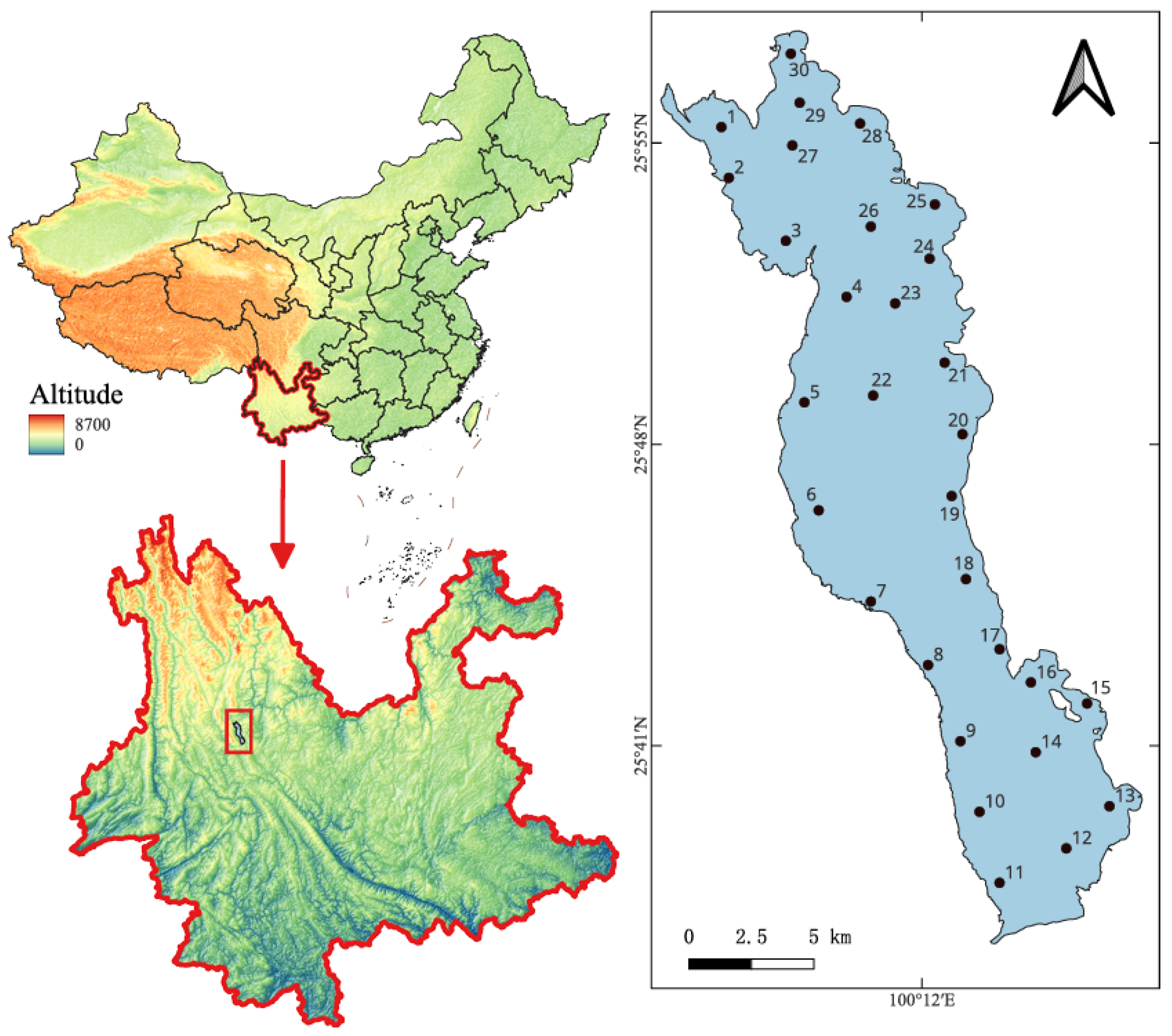
We established 30 sampling sites distributed across Erhai Lake (Figure 1). The lake’s elongated north–south orientation generates pronounced spatial gradients in temperature, nutrient levels, and water transparency [31]. Based on these spatial patterns, we divided the lake into three regions—north, middle, and south—with each region containing ten sites (north: 1–3, 24–30; middle: 4–7, 18–23; south: 8–17). Seasonal sampling was conducted from April 2022 to December 2023.
At each sampling site, we deployed two pelagic gillnets, two benthic gillnets and two fyke nets and deployed them for 12 h (18:00–19:00 to 6:00–7:00). The benthic and pelagic gillnets have different heights of 2 and 5 m, respectively, but have the same total length (30 m) and mesh size structure. Each gillnet consisted of 12 panels (2.5 m each) of different mesh sizes (5, 6.25, 8, 10, 12.5, 15.5, 19.5, 24, 30, 35, 43, 55 mm, stretched mesh sizes). The fyke nets had a mesh size of 5 mm and a total length of 25 m and were divided into 20 compartments, with 10 cm openings at both ends. We identified all fish samples to the species level and measured their total length (TL) and body weight (BW) to 0.1 mm and 0.01 g precision, respectively.

2.2. Stable Isotope Sampling

We collected at least five individuals per species from each sampling section and extracted dorsal muscle tissue for the analysis of the stable isotope ratios of carbon (δ13C, ‰) and nitrogen (δ15N, ‰). All samples were collected from adult individuals to minimize the potential effects of ontogenetic dietary shifts. We dried muscle samples at 60 °C for 48 h and ground them to a fine powder using an automatic grinder. We weighed samples to the nearest 0.001 mg and packed them into UltraPure tin capsules for the determination of percent carbon, percent nitrogen, and isotopic ratios (δ13C, δ15N) using mass spectrometry.

2.3. Environmental Variables

We measured eleven water quality variables at each sampling site per season. At each site, water depth (WD) was measured using an echo sounder, and Secchi depth (SD) was measured using a Secchi disk. We determined pH, water temperature (WT), dissolved oxygen (DO), and conductivity (Cond) by using a YSI ProPlus meter (Thermo Fisher Scientific, Waltham, MA, USA). In the laboratory, we determined total nitrogen (TN), total phosphorus (TP), chemical oxygen demand (COD), chlorophyll-a (Chl-a), and ammonia nitrogen (NH3-N) following standard protocols [32].
To evaluate the availability of food resources, one liter of water was collected with a PVC bottle and immediately fixed in 10% Lugol’s solution for phytoplankton analysis, and the other 10 L of water was filtered through a 64 µm plankton net, with the concentrate preserved in 5% formalin for zooplankton analysis. The density and biomass of phytoplankton and zooplankton were estimated following Zhao (2016) [33]. Benthic macroinvertebrates were sampled at each site using a generic Petersen grab (sampling area: 0.0625 m2). Macroinvertebrates were manually separated from sediment and preserved in 75% ethanol. In the laboratory, the macroinvertebrate individuals were enumerated, identified, and weighed following standard references [34]. The Shannon diversity index was also calculated for three prey groups.

2.4. Data Analysis

2.4.1. Index of Relative Importance (IRI)

We calculated the Index of Relative Importance (IRI) for each fish species to evaluate species dominance, using the following formula:
I R I = ( N % + W % ) × F %
where N% is the abundance percentage, W% is the biomass percentage, and F% is the occurrence frequency of each fish species. We defined species with an IRI ≥ 1000 as dominant species [35].

2.4.2. Lipid Correction of Stable Isotope Values

We obtained 766 fish samples for δ13C and δ15N analysis. For fish samples with a C/N ratio > 3.5, we arithmetically corrected their δ13C value to avoid the influence of lipids following [36,37].

2.4.3. Niche Width and Niche Overlap

We quantified the trophic niche width and niche overlap among target species to evaluate potential trophic interactions. We quantified niche width as Bayesian standard ellipse areas (SEAb), which incorporate sampling uncertainty and were calculated at the 95% credibility level (α = 0.95) following the methods proposed by Jackson et al. [38] and Swanson et al. [39]. We calculated the SEAb of each focal fish species separately for each quarter and lake region, accounting for seasonal and spatial variations, resulting in 103 SEAb values.
Niche overlap was calculated as the probability that the isotopic niche region of one species falls within that of another (Overlap). This was estimated using 10,000 Monte Carlo simulations drawn from the posterior distributions of each species’ isotopic parameters, with 95% credible intervals [39]. To ensure interpretive clarity, niche overlap was assessed in a directional manner (i.e., as the probability that the isotopic niche of the focal species [Species 1] fell within that of the comparison species [Species 2]) rather than as a symmetric metric, thereby allowing us to distinguish overlap proportion between native and non-native fishes. All niche width and overlap metrics were calculated using the SIBER and nicheROVER packages [40,41].

2.4.4. Individual Fitness

We used Fulton’s (1904) condition coefficient (K, g·cm−3) to characterize individual fitness [42]. The calculation formula is as follows:
K = 100 × B W / T L 3

2.5. Statistical Analyses

Differences in δ13C, δ15N, trophic niche width (SEAb), niche overlap (Overlap), and Fulton’s condition factor (K) among fish groups (native vs. non-native), species, and lake regions were tested using Wilcoxon rank-sum tests or Kruskal–Wallis tests, followed by Dunn’s post hoc comparisons when appropriate. Shifts in trophic niche centroids were examined using a permutational multivariate analysis of variance (PERMANOVA), and within-group trophic dispersion was assessed using a permutational analysis of multivariate dispersions (PERMDISP).
Isotopic niche structure was visualized using δ13C–δ15N biplots for each species across lake regions based on the mean ± SE values from each sampling event. Point size represented SEAb, and 60% confidence ellipses were used to illustrate species-specific trophic niche space. Interspecific differences in trophic niche characteristics were further summarized using centroid plots of SEAb and niche overlap, with point size indicating the mean individual fitness (K).
Relationships between trophic niche characteristics and individual fitness were evaluated using generalized additive models (GAMs) fitted separately for native and non-native fishes. In both models, SEAb and niche overlap were included as explanatory variables, while lake region and season were incorporated as random effects. Species identity was additionally included as a random effect for non-native fishes. Partial effects were visualized using the mgcv and gratia packages.
To assess the effects of environmental factors on native fish trophic niches and fitness, separate linear regression models were constructed for K, SEAb, and niche overlap. A composite water quality index (WQI_pc1) was derived as the first principal component of water quality variables, with higher values indicating increased nutrient levels. All continuous variables were Z-score-standardized prior to analysis. Model selection was based on Akaike’s information criterion (AIC) [43], and the relative contributions of explanatory variables were quantified using hierarchical partitioning approaches [44,45].

3. Results

3.1. Fish Community Composition in Lake Erhai

During 2022–2023, a total of 28,396 fish individuals were captured in Erhai Lake, with a combined biomass of 1,261,387.15 g. The collected fishes comprised 25 species, belonging to 4 orders, 8 families, and 18 genera (Table A1), of which 17 species (62.22%) were non-native.
Based on the Index of Relative Importance (IRI), four non-native species—R. giurinus (5787.36), H. leucisculus (1768.06), T. fulvidraco (1253.48), and H. nipponensis (1065.25)—exhibited the highest dominance within the fish assemblage. Among native fishes, only C. auratus showed a comparatively high IRI (2851.20). After excluding stocked species that cannot reproduce naturally in Erhai Lake (Hypophthalmichthys molitrix, IRI = 3342.97; Aristichthys nobilis, IRI = 1086.38), these four non-native species, together with native C. auratus, constituted the dominant components of the fish assemblage in Erhai Lake.

3.2. Isotopic Composition of Non-Native and Native Fishes

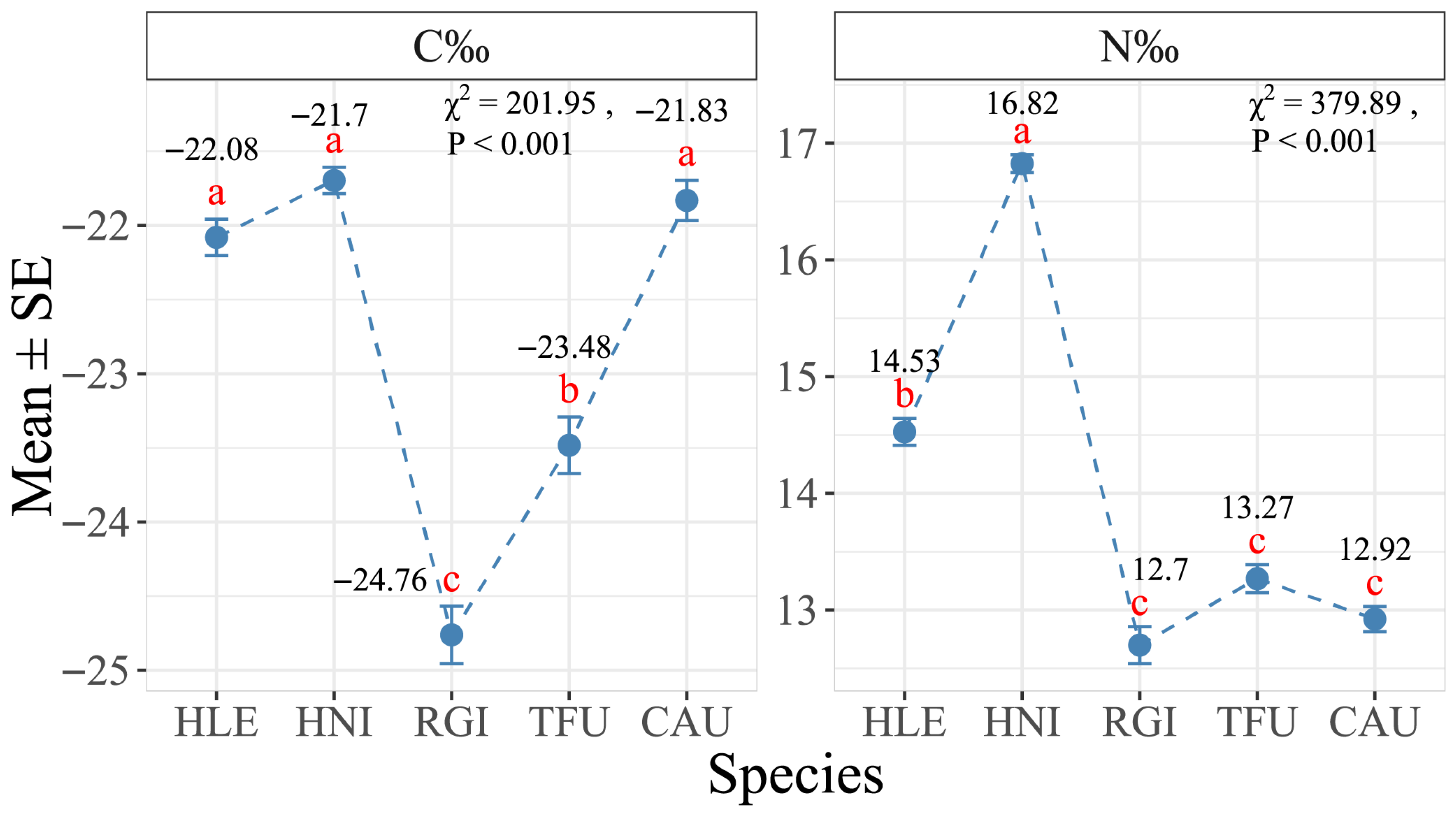
Across the five focal species, H. leucisculus (−21.7‰), H. nipponensis (−22.08‰), and C. auratus (−21.83‰) exhibited relatively similar δ13C values, which were significantly higher than those of T. fulvidraco (−23.48‰) and R. giurinus (−24.76‰), indicating some differences in the primary carbon sources used among species (Kruskal–Wallis tests followed by Dunn’s post hoc comparisons: all p < 0.05; Figure A1).
For δ15N, H. nipponensis exhibited the highest value (16.82‰), followed by H. leucisculus (14.59‰), while the remaining species clustered between 12 and 13‰, suggesting that most species occupy similar trophic positions (Kruskal–Wallis tests followed by Dunn’s post hoc comparisons: all p < 0.05; Figure A1).
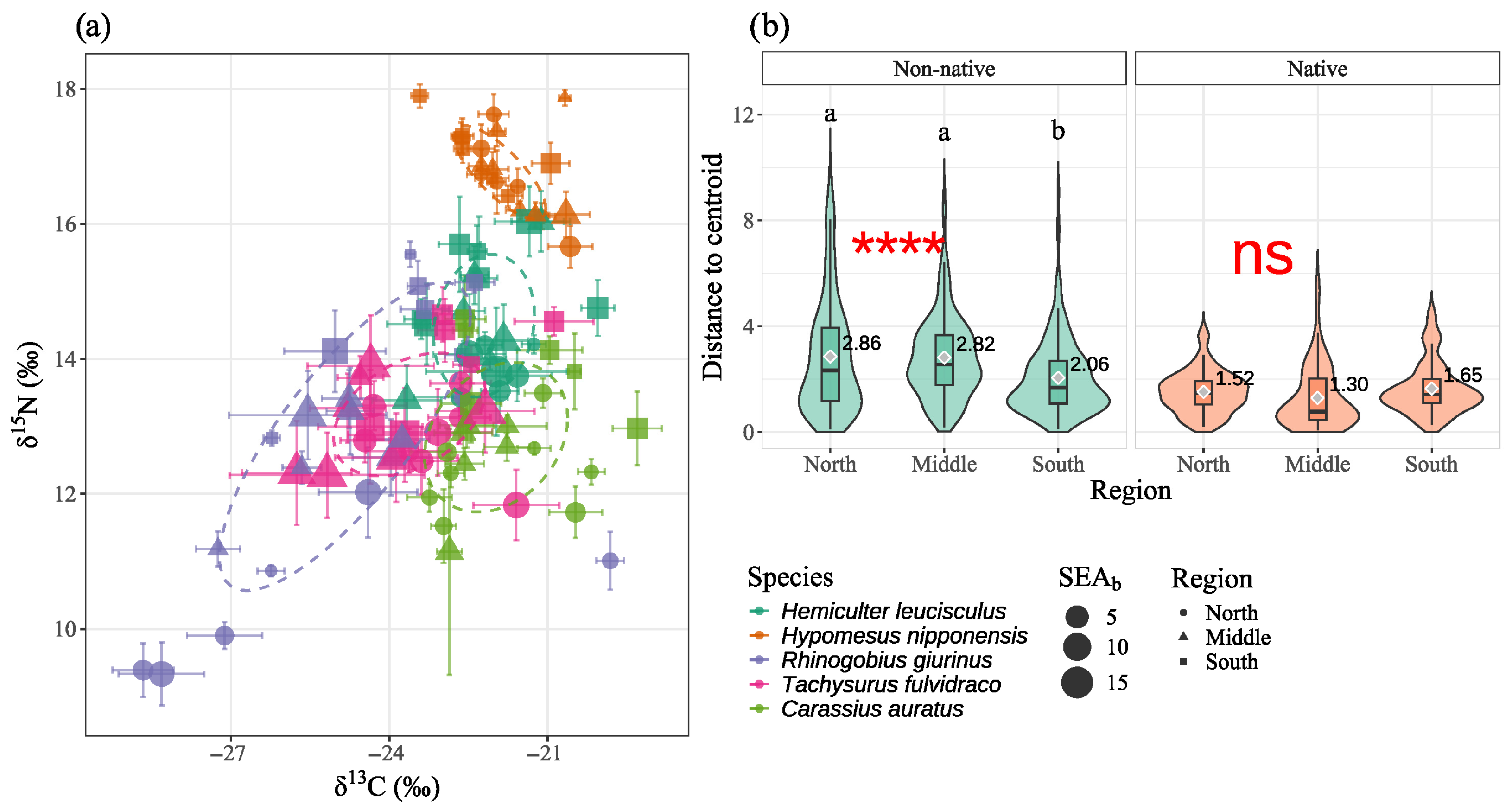
The δ13C–δ15N biplots revealed different trophic niches among the five fish species (PERMANOVA and PERMDISP; Table 1, Figure 2a). Specifically, H. nipponensis occupied a relatively distinct trophic position compared with the other fish species, whereas the other non-native fishes showed a high degree of trophic overlap with the native C. auratus. Furthermore, non-native species exhibited higher dispersion (2.69 ± 0.07) than native fishes (1.68 ± 0.08, Wilcoxon rank-sum test: W = 51,920, p < 0.001), indicating higher trophic plasticity in non-native fishes.
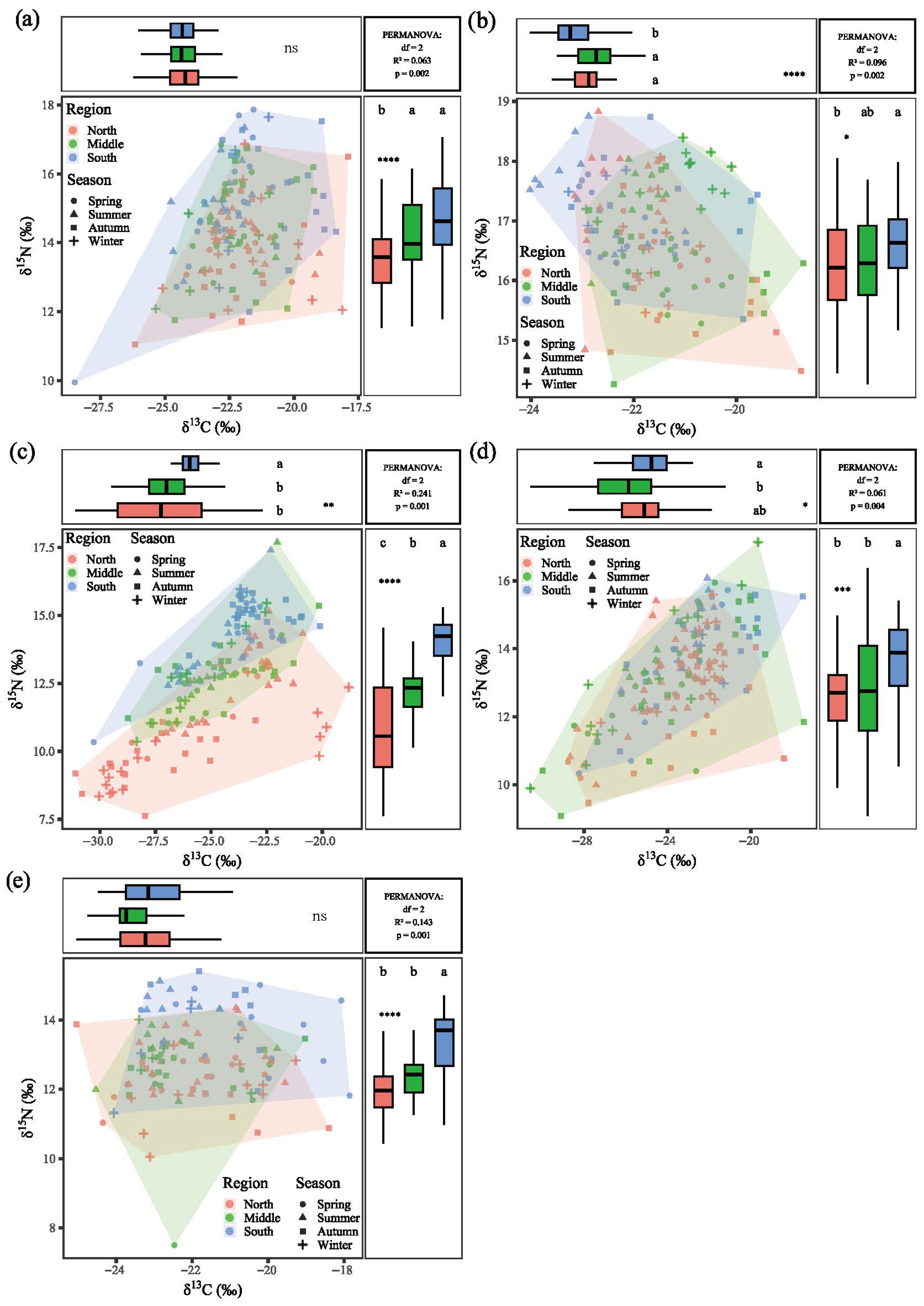
Across different lake regions, the trophic centroids of both non-native and native fishes shifted significantly (PERMANOVA; Table 1). In particular, δ15N values were the highest in the south lake region (mean ± SE: 15.01 ± 0.11‰), intermediate in the middle (14.08 ± 0.13‰), and the lowest in the north lake region (13.21 ± 0.13‰; Kruskal–Wallis tests followed by Dunn’s post hoc comparisons: all p < 0.05; Figure A2).
Moreover, the trophic dispersion of non-native fishes differed significantly among regions (PERMDISP; Table 1), with values being the lowest in the south lake region (2.06 ± 0.10). Trophic dispersion was significantly higher in the middle (2.82 ± 0.11) and north lake regions (2.86 ± 0.14; Figure 2b).

3.3. Niche Width and Niche Overlap of Native and Non-Native Fishes

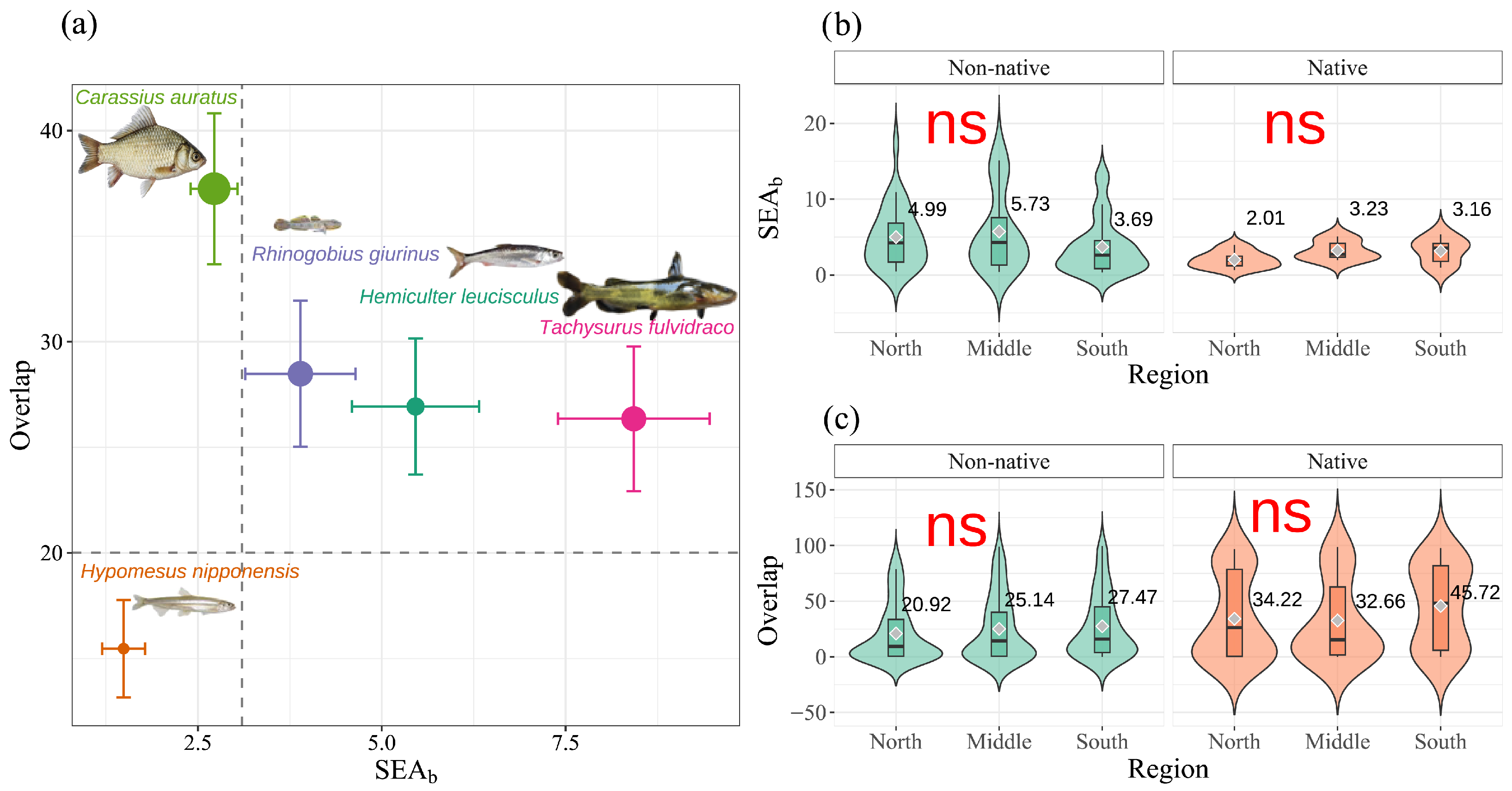
Overall, non-native fishes exhibited a broader trophic niche width (4.81 ± 0.48) than native species (2.72 ± 0.32), although this difference was not statistically significant (Table 2). At the species level, T. fulvidraco had the largest SEAb (8.43 ± 1.03), followed by H. leucisculus (5.46 ± 0.87), R. giurinus (3.89 ± 0.75), and H. nipponensis (1.49 ± 0.29). After excluding H. nipponensis, the trophic niche width of the remaining non-native fishes (5.93 ± 0.56) became significantly larger than that of native species (Wilcoxon rank-sum test: W = 904, p = 0.002). Moreover, the niche overlap of non-native fishes (24.43 ± 1.57) was significantly lower than that of native species (37.32 ± 4.21; Table 2).
The centroid plot revealed different trophic niche characteristics among the five species (Figure 3a). The native C. auratus showed a narrow SEAb and the highest trophic overlap, indicating a relatively constrained trophic niche. In contrast, three non-native species generally occupied broader niches with lower overlap. Hypomesus nipponensis represented a deviated case, with the smallest SEAb and the lowest overlap (1.49 ± 0.29 and 15.24 ± 2.59, respectively), reflecting a highly specialized trophic position. Across lake regions, no significantly spatial differences were detected in niche width or overlap for either non-native or native fishes (Figure 3b,c).

3.4. Contrasting Trophic Strategies of Native and Non-Native Fishes

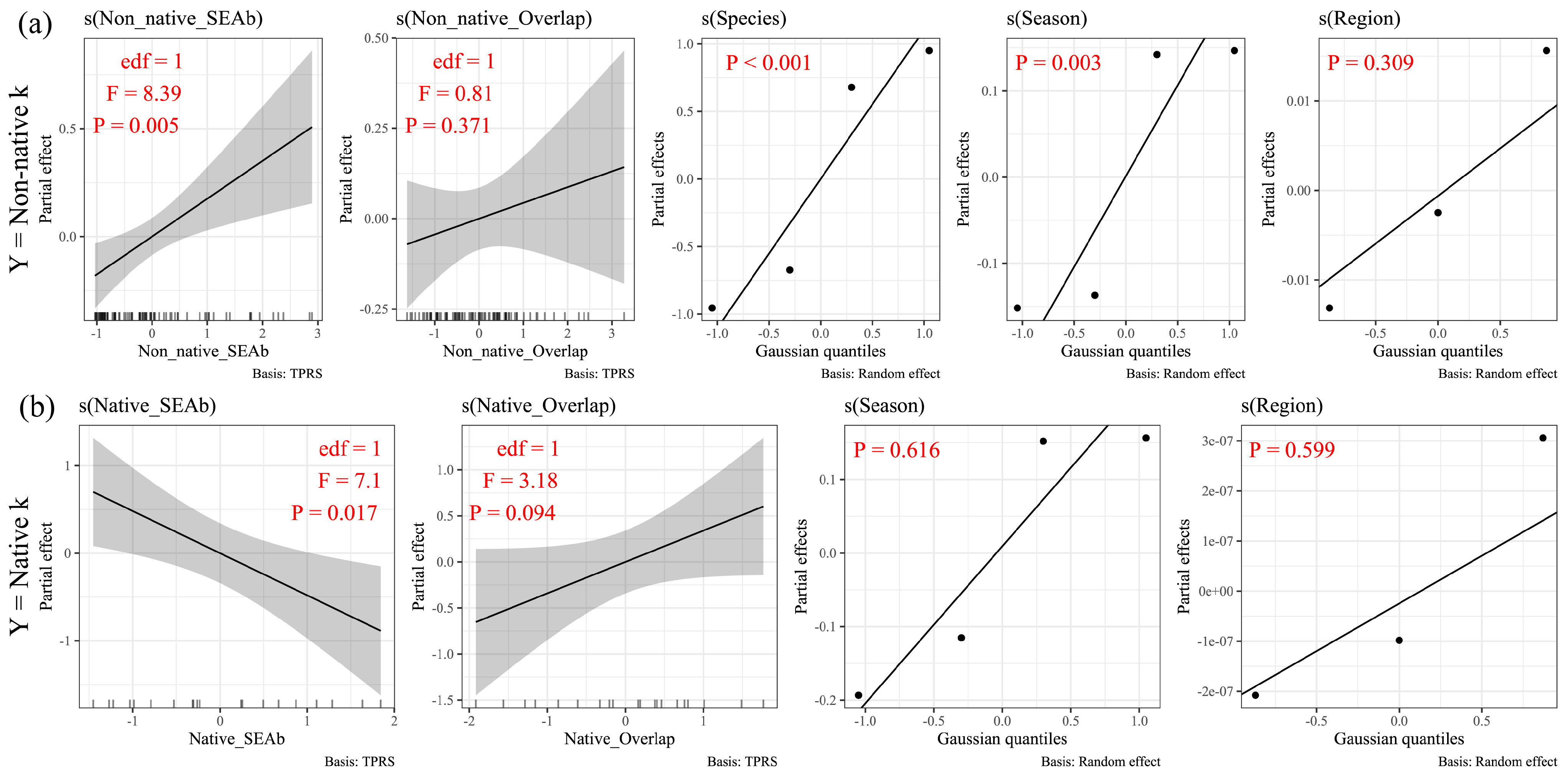
The GAM explained 85.6% of the deviance for non-native fishes (adjusted R2 = 0.841) and 49.4% for native fishes (adjusted R2 = 0.394). The GAM results revealed contrasting relationships between trophic niche characteristics and individual fitness for native and non-native fishes. For non-native fishes, the K value increased significantly with trophic niche width (SEAb; Figure 4a), suggesting a positive and linear relationship between trophic niche expansion and individual fitness. In contrast, the K value decreased significantly with increasing SEAb for native fishes (Figure 4b).
Trophic niche overlap did not significantly affect K in both non-native and native fishes (Figure 4). Species identity and seasonal effects were significant for non-native fishes. No spatial effect of lake region was detected for either non-native or native fishes.

3.5. Effects of Non-Native Trophic Characteristics and Environment Factors on Native Fish Trophic Niche and Fitness

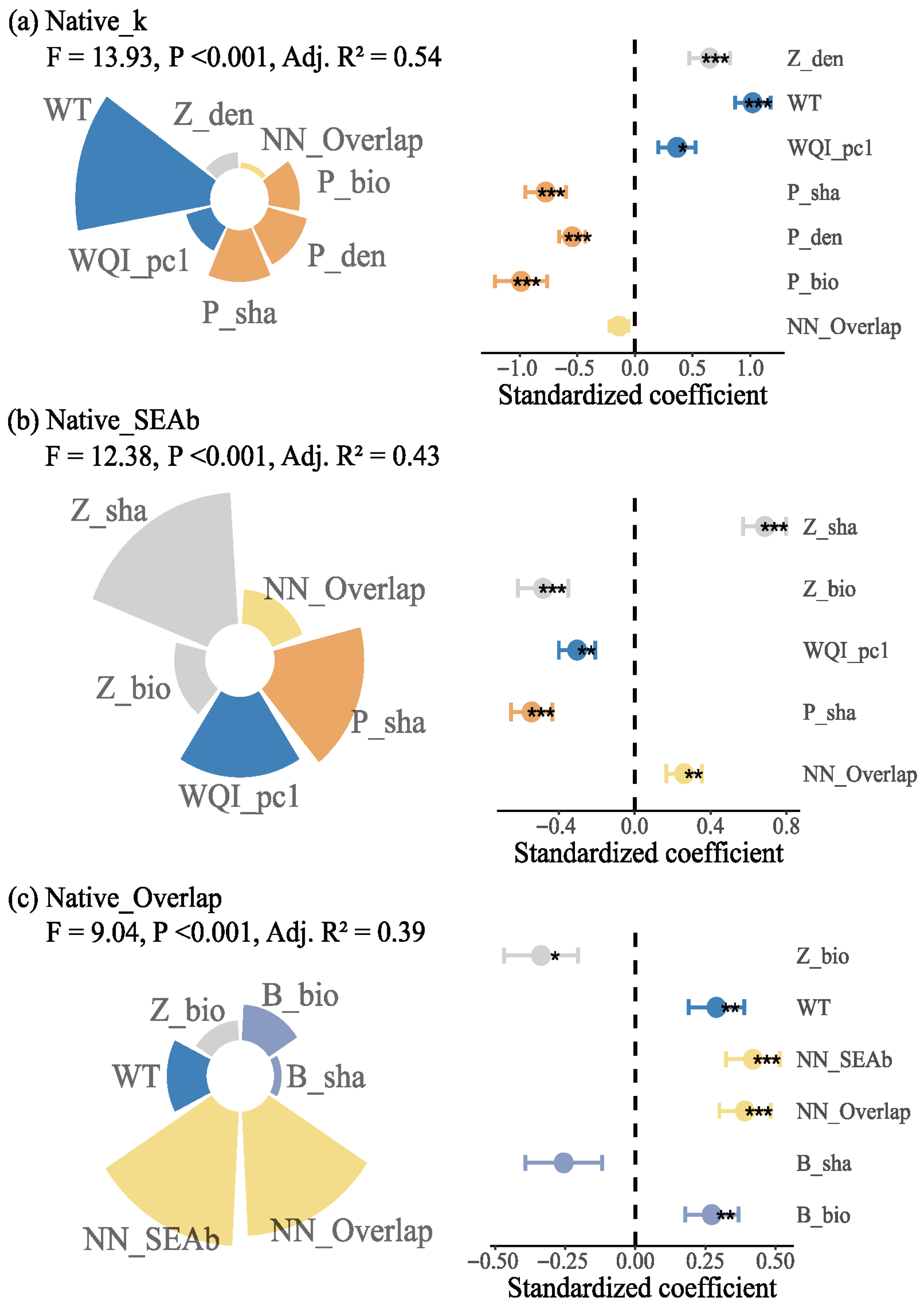
Native K was primarily driven by water temperature accounting for 45% of the variance, indicating a pronounced seasonal effect (Estimate = 1.02; Figure 5a). Native trophic niche width (SEAb) was mainly explained by prey availability, with the three prey groups jointly accounting for 69% of the variance. In addition, trophic niche overlap imposed by non-native fishes also exerted a significant positive effect on native SEAb (Estimate = 0.26; Figure 5b). Native niche overlap was largely determined by trophic competition from non-native fishes, whose niche metrics explained 71% of the variation and were positively associated with both non-native SEAb and overlap (Estimate = 0.42 and 0.39, respectively; Figure 5c).

4. Discussion

Non-native fish invasions have emerged as one of the primary drivers of freshwater biodiversity loss and ecosystem function decline. Understanding the mechanisms underlying the successful establishment of non-native fishes and their interactions with native species is essential for assessing the ecological impacts of biological invasions in freshwater ecosystems [46].
Firstly, our study demonstrates clear trophic niche differentiation between native and non-native fishes in Erhai Lake, implying that these species exploit distinct prey resources [47]. Occupying distinct or empty ecological niches has been identified as a key mechanism facilitating the successful invasion of non-native fishes [48]. Resource partitioning was evident among non-native species with similar ecological traits. For instance, the mid-upper-layer planktivorous species H. nipponensis and H. leucisculus exhibited similar δ13C values, suggesting that they rely on comparable basal carbon sources. However, their δ15N values differed significantly, indicating separation in trophic position. In contrast, the mid-lower-layer species R. giurinus and T. fulvidraco displayed significant divergence in δ13C but similar δ15N values. This implies that these species utilize disparate carbon sources while occupying similar trophic positions. These findings suggest that, even when overall feeding habits and habitats overlap, non-native species achieve resource partitioning by exploiting distinct carbon sources or diverging in vertical trophic levels. Such fine-scale trophic differentiation likely mitigates interspecific competition, thereby facilitating the successful establishment and coexistence of non-native fishes within the Erhai Lake ecosystem.
By comparing the trophic dispersion of fish among lake regions, we also found that non-native species exhibited markedly greater trophic dispersion than native species, indicating higher trophic plasticity, which suggests that non-native fish are capable of exploiting a broader range of resources and basal sources, thereby enabling them to maintain or even expand their populations under spatial or environmental variation [49].
Further, non-native fishes exhibited markedly broad trophic niches, lower overlap and higher trophic plasticity, whereas the native C. auratus displayed constrained trophic niche and experienced stronger biotic pressure from invaders. Both generalized and specialized foraging strategies reflect the high trophic plasticity of non-native fishes, which facilitates their establishment and expansion in novel environments [50,51]. In this study, three non-native fishes supported trophic generalization [52]. Trophic generalization reduces reliance on specific food resources and enables the rapid exploitation of diverse prey in novel environments, thereby enhancing environmental adaptability and the potential for invasion success [53]. Such broad diets also promote population persistence under fluctuating resource conditions and facilitate establishment and expansion by reducing direct trophic competition with native species [54,55]. While H. nipponensis provides a typical case for specialization [56], it occupies a distinct position in trophic space, exhibits the highest trophic level, shows little niche overlap with the other four species, and maintains the smallest niche width. Such trophic specialization is also commonly observed in invasive predatory fishes [57]. These invasive species often occupy unexploited trophic positions or higher trophic levels within the invaded food webs and achieve pronounced competitive advantages through the efficient exploitation of specific prey resources [58]. This specialization not only allows them to avoid direct competition with coexisting native species and other invaders but can also restructure food web dynamics via strong top-down effects, driving successful colonization and dominance within novel ecosystems [59]. Yin et al. (2021) [8] reported that the invasion of H. nipponensis in Erhai Lake exerted strong grazing pressure on zooplankton, triggering a trophic cascade that weakened top-down control on phytoplankton and increased algal bloom risks. Overall, trophic plasticity—whether generalized or specialized—facilitates the establishment of non-native fishes and intensifies their competitive and predatory pressure on native fish populations.
In contrast, the native C. auratus, despite also having a relatively narrow niche, experienced the highest trophic overlap, suggesting that its trophic niche is being compressed by co-occurring non-native species. Increasing evidence suggested that, compared with invasive fishes, native species generally exhibit lower trophic plasticity [60]. From an evolutionary ecological perspective, native fishes have undergone long-term natural selection, resulting in phenotypic traits and life-history strategies that are highly matched to relatively stable local environments [61]. Such reduced phenotypic plasticity, shaped under stable selective pressures, may constrain the ability of native species to rapidly adjust their trophic niches and feeding strategies in response to novel competitors or abrupt environmental changes [62]. By contrast, many successful invasive fishes originate from more heterogeneous or environmentally variable regions and therefore retain higher levels of phenotypic and behavioral plasticity [63]. The three invasive species in Erhai Lake (H. leucisculus, R. giurinus, and T. fulvidraco) originate from the middle and lower reaches of the Yangtze River, a system characterized by high hydrological connectivity and intense predatory pressure. This allows them to thrive under the anthropogenic environmental fluctuations currently observed in Erhai Lake, which typically disadvantage native species adapted to the historically stable conditions of plateau lakes.
Notably, our results revealed clear contrasts in trophic strategies between non-native and native fishes in Erhai Lake. Non-native fishes increase individual fitness by broadening their trophic niche width while maintaining relatively low niche overlap, suggesting that trophic plasticity represents an adaptive strategy facilitating invasion success. Similar patterns have been documented for other invasive fishes, where dietary width and flexibility increase establishment probability and ecological impact [64,65]. In contrast, the individual fitness of native fishes was significantly negatively correlated with niche width, indicating that niche expansion may reflect compensatory feeding under competitive pressure rather than adaptive plasticity [66]. Multiple linear regression analyses further support this view. Non-native fishes exerted significant effects on both the trophic niche characteristics and individual fitness of native fishes. Specifically, increases in trophic niche overlap caused by non-native fishes were positively associated with broader niche width and higher niche overlap in native fishes; however, the individual fitness of native fishes decreased significantly with increasing niche width. This pattern suggests that trophic niche expansion in native fishes is not an active adaptive strategy, as observed in non-native fishes, but rather a passive expansion in response to intensified competition [3,67]. This result is consistent with recent studies on endangered native fishes, which have shown that under intensified competition or environmental fluctuations, native species may exhibit some dietary shifts when resources are scarce. However, due to their morphological and physiological traits, digestive capacity, and behavioral strategies—shaped by long-term adaptation to relatively stable food resources—they are often unable to efficiently exploit novel food items [68]. Such forced niche expansion or dietary shifts are typically accompanied by reduced energy acquisition efficiency, slower growth rates, and decreased individual fitness [69]. Carassius auratus, the native fish species in Erhai Lake, is a benthic omnivorous species consistent with the predictions of optimal foraging theory [70]. Under intensified competition from non-native fishes, preferred food resources may become limited, forcing C. auratus to exploit suboptimal prey items. This competition-driven niche expansion is likely associated with reduced foraging efficiency and lower energy assimilation, ultimately leading to declining individual fitness despite an apparent increase in trophic niche width. Overall, the combination of low trophic plasticity and passive niche expansion induced by invasive fishes places native species at a persistent disadvantage under intensified competition and environmental variability, thereby substantially increasing their risk of population decline.
Non-native fishes exhibited the widest trophic niches and highest trophic dispersion in the north lake region, whereas native fishes showed the widest niches and highest dispersion in the south lake, despite the absence of statistical significance. These patterns indicate that suitable habitats may differ for native and non-native fishes across Erhai Lake: the north region appears more favorable for non-native fishes, while the south region is more suitable for native fishes. From a lake management perspective, the targeted removal of non-native fishes should prioritize the north region. Measures such as reducing eutrophication can further limit bottom-up support for invasive fish dominance and alleviate competitive pressure on native fishes. In the south region, management should focus on conserving native fishes by protecting their habitats and ensuring adequate food resources.
Overall, our study underscores the importance of incorporating trophic interactions between non-native and native fishes into lake management and ecological restoration objectives, rather than relying solely on species richness or abundance-based assessments. Beyond our system, the ecological consequences of non-native fish invasions are pervasive across global biodiversity hotspots [71,72]. By embedding themselves into local food webs, invaders can trigger cascading disruptions—over-competing natives, destabilizing community, promoting biotic homogenization and eroding biodiversity [73]. Interventions such as controlling the population sizes of dominant non-native fish species [74] and restoring habitat heterogeneity [75] can alleviate competitive pressures, reopen ecological niche space, and promote the recovery of native species [76].

5. Conclusions

Together, these findings demonstrated that non-native and native fishes in Erhai Lake exhibited contrasting trophic niche characteristics. Non-native fishes not only occupied distinct trophic space relative to native species but also had broader niches, lower overlap, and greater trophic flexibility, reinforcing their invasion success. In contrast, native fishes were constrained by higher trophic overlap and lower plasticity. Furthermore, individual fitness increased with niche expansion in non-native fishes, whereas it decreased in native fishes. Our results indicated that non-native fishes exerted significant competitive effects on native species’ trophic niches, while native fishes passively adjusted their trophic strategies to mitigate competition. For the sustainable management of Erhai Lake, these insights highlight the need for region-specific strategies—removing invasive fishes and reducing nutrients in the north while conserving habitats and food for native fishes in the south. These results emphasize incorporating trophic interactions into invasion management and native fish conservation, beyond species richness or abundance alone.

Author Contributions

Conceptualization, T.Z., C.L., C.G. and J.L.; methodology, T.Z., C.L., C.G. and J.L.; validation, T.Z., C.L., C.G. and J.L.; formal analysis, T.Z.; investigation, T.Z.; writing—original draft preparation, T.Z., C.L., C.G. and J.L.; writing—review and editing, T.Z., C.L., C.G. and J.L.; supervision, C.L., C.G. and J.L.; project administration, C.L., C.G. and J.L.; funding acquisition, C.L., C.G. and J.L. All authors have read and agreed to the published version of the manuscript.

Funding

This work was financially supported by the National Key Research and Development Program of China (No. 2023YFD2400900), the Natural Science Foundation of Hubei Province (No. 2023000304), the National Natural Science Foundation of China (No. 32172980), and the earmarked fund for China Agriculture Research System (CARS-45).

Institutional Review Board Statement

Not applicable.

Informed Consent Statement

Not applicable.

Data Availability Statement

The datasets analyzed during the current study are available from the corresponding author on reasonable request.

Conflicts of Interest

The authors declare no conflicts of interest.

Appendix A

Figure A1. Mean ± SE of carbon (δ13C) and nitrogen (δ15N) values for five focal fish species in Erhai Lake. Statistical differences among species were assessed using Kruskal–Wallis tests followed by Dunn’s post hoc comparisons. HLE, Hemiculter leucisculus; HNI, Hypomesus nipponensis; RGI, Rhinogobius giurinus; TFU, Tachysurus fulvidraco; CAU, Carassius auratus. Different letters indicate significant differences between groups.
Sustainability 18 01996 g0a1
Figure A2. δ13C–δ15N biplots of non-native and native fishes across lake regions in Erhai Lake. (a) Hemiculter leucisculus, (b) Hypomesus nipponensis, (c) Rhinogobius giurinus, (d) Tachysurus fulvidraco, (e) Carassius auratus. Significance levels: * p < 0.05; ** p < 0.01; *** p < 0.001; **** p < 0.0001.
Sustainability 18 01996 g0a2
Table A1. Species composition and relative importance of fish assemblages in Erhai Lake during 2022–2023, including abundance, biomass, occurrence frequency, and Index of Relative Importance (IRI).
OrderFamilySpecieAbs_AbuRel_AbuAbs_BioRel_BioFreqIRI
CypriniformesCyprinidae* Cyprinus chilia1140%28,854.573%80%277.60
* Cyprinus longipeatoralis210%1365.350%37%7.55
* Cyprinus barbatus20%699.570%7%0.55
Cyprinus carpio340%22,374.022%70%178.19
Hypophthalmichthys molitrix4421%293,928.3232%100%3342.97
Aristichthys nobilis1200%115,895.5513%83%1086.38
Ctenopharyngodon Idella10%825.000%3%0.31
* Carassius auratus19565%212,326.0323%100%2851.20
* Schizothorax lissolabiatus40%680.220%13%1.14
* Schizothorax yunnanensis20%179.350%7%0.17
* Schizothorax griseus310%3485.670%57%26.36
Hemiculter leucisculus32589%81,978.579%100%1768.06
Pseudorasbora parva29048%12,044.661%100%906.33
Abbottina rivularis130%143.190%17%0.84
Rhodeus sinensis780%190.620%63%14.49
Rhodeus ocellatus1130%189.220%50%16.10
Acheilognathus chankaensis8502%5906.771%87%252.56
Cobitidae* Misgurnus anguillicaudatus1130%1278.940%93%41.21
PerciformesOdontobutidaeMicropercops swinhonis3621%184.250%97%95.24
GobiidaeRhinogobius giurinus20,72755%23,858.023%100%5787.36
Rhinogobius cliffordpopei6242%368.820%100%170.40
SiluriformesSiluridaeSilurus asotus50%2510.980%17%4.81
BagridaeTachysurus fulvidraco14754%78,401.739%100%1253.48
SalmoniformesOsmeridaeHypomesus nipponensis30768%22,348.902%100%1065.25
SalangidaeNeosalanx taihuensis11863%1347.430%97%319.93
Notes: Abs_abu, absolute abundance; Rel_abu, relative abundance; Abs_bio, absolute biomass (g); Rel_bio, relative biomass (% of total biomass); Freq, frequency of occurrence; IRI, Index of Relative Importance, calculated as IRI = (Rel_abu + Rel_bio) × Freq. Species marked with a red asterisk (*) indicate native species. Species without an asterisk are non-native. Bold text indicates the focal species.

References

  1. Leclerc, C.; Frossard, V.; Sharaf, N.; Bazin, S.; Bruel, R.; Sentis, A. Climate impacts on lake food-webs are mediated by biological invasions. Glob. Change Biol. 2025, 31, e70144. [Google Scholar] [CrossRef]
  2. Britton, J.R.; Lynch, A.J.; Bardal, H.; Bradbeer, S.J.; Coetzee, J.A.; Coughlan, N.E.; Dalu, T.; Tricarico, E.; Gallardo, B.; Lintermans, M.; et al. Preventing and controlling nonnative species invasions to bend the curve of global freshwater biodiversity loss. Environ. Rev. 2023, 31, 310–326. [Google Scholar] [CrossRef]
  3. Wainright, C.A.; Muhlfeld, C.C.; Elser, J.J.; Bourret, S.L.; Devlin, S.P. Species invasion progressively disrupts the trophic structure of native food webs. Proc. Natl. Acad. Sci. USA 2021, 118, e2102179118. [Google Scholar] [CrossRef] [PubMed]
  4. Pennuto, C.M.; Cudney, K.A.; Janik, C.E. Fish invasion alters ecosystem function in a small heterotrophic stream. Biol. Invasions 2018, 20, 1033–1047. [Google Scholar] [CrossRef]
  5. Su, G.; Mertel, A.; Brosse, S.; Calabrese, J.M. Species invasiveness and community invasibility of North American freshwater fish fauna revealed via trait-based analysis. Nat. Commun. 2023, 14, 2332. [Google Scholar] [CrossRef] [PubMed]
  6. Wang, J.; Ding, C.; Heino, J.; Ding, L.; Chen, J.; He, D.; Tao, J. Analysing spatio-temporal patterns of non-native fish in a biodiversity hotspot across decades. Divers. Distrib. 2023, 29, 1492–1507. [Google Scholar] [CrossRef]
  7. Ding, C.; Jiang, X.; Xie, Z.; Brosse, S. Seventy-five years of biodiversity decline of fish assemblages in Chinese isolated plateau lakes: Widespread introductions and extirpations of narrow endemics lead to regional loss of dissimilarity. Divers. Distrib. 2017, 23, 171–184. [Google Scholar] [CrossRef]
  8. Yin, C.; Chen, Y.; Guo, L.; Ni, L. Fish assemblage shift after Japanese smelt (Hypomesus nipponensis mcallister, 1963) invasion in Lake Erhai, a subtropical plateau lake in China. Water 2021, 13, 1800. [Google Scholar] [CrossRef]
  9. Bøhn, T.; Amundsen, P.-A.; Sparrow, A. Competitive exclusion after invasion? Biol. Invasions 2008, 10, 359–368. [Google Scholar] [CrossRef]
  10. Balzani, P.; Vizzini, S.; Santini, G.; Masoni, A.; Ciofi, C.; Ricevuto, E.; Chelazzi, G. Stable isotope analysis of trophic niche in two co-occurring native and invasive terrapins, Emys orbicularis and Trachemys scripta elegans. Biol. Invasions 2016, 18, 3611–3621. [Google Scholar] [CrossRef]
  11. Cucherousset, J.; Olden, J.D. Ecological impacts of nonnative freshwater fishes. Fisheries 2011, 36, 215–230. [Google Scholar] [CrossRef]
  12. Gargano, M.; Colosimo, G.; Gratton, P.; Marta, S.; Brilli, M.; Giustini, F.; Sevilla, C.; Gentile, G. Nitrogen and carbon stable isotope analysis sheds light on trophic competition between two syntopic land iguana species from Galápagos. Sci. Rep. 2022, 12, 16897. [Google Scholar] [CrossRef]
  13. García, K.; Sanpera, C.; Jover, L.; Palazón, S.; Gosálbez, J.; Górski, K.; Melero, Y.; García, K.; Sanpera, C.; Jover, L.; et al. High trophic niche overlap between a native and invasive mink does not drive trophic displacement of the native mink during an invasion process. Animals 2020, 10, 1387. [Google Scholar] [CrossRef] [PubMed]
  14. Ludovisi, A.; Goretti, E.; Pallottini, M.; Lucentini, L.; Pizzirani, C.; Vizzini, S.; Mancinelli, G. Stable isotope analysis reveals trophic segregation between the invasive zebra mussel Dreissena polymorpha and the native duck mussel Anodonta anatina in Lake Trasimeno (Italy). Hydrobiologia 2022, 849, 2091–2108. [Google Scholar] [CrossRef]
  15. Eloranta, A.P.; Helland, I.P.; Sandlund, O.T.; Hesthagen, T.; Ugedal, O.; Finstad, A.G. Community structure influences species’ abundance along environmental gradients. J. Anim. Ecol. 2016, 85, 273–282. [Google Scholar] [CrossRef] [PubMed]
  16. Clement, T.A.; Murry, B.A.; Uzarski, D.G. Fish community size structure of small lakes: The role of lake size, biodiversity and disturbance. J. Freshw. Ecol. 2015, 30, 557–568. [Google Scholar] [CrossRef]
  17. Zhang, Y.; Britton, J.R.; Huang, D.; He, Y.; Li, Y.; Chen, W.; Li, J. Coexistence mechanisms and individual trophic niche variation between functionally analogous non-native and native carp species. Sci. Rep. 2024, 14, 27352. [Google Scholar] [CrossRef]
  18. Godoy, O.; Levine, J.M. Phenology effects on invasion success: Insights from coupling field experiments to coexistence theory. Ecology 2014, 95, 726–736. [Google Scholar] [CrossRef]
  19. Vanessa, D.S.; Davide, C.; Ilaria, B.; Chiara, B.; Stefano, B.; Mattia, I.; Silvia, Z.; Pietro, V. Non-native fish assemblages display potential competitive advantages in two protected small and shallow lakes of Northern Italy. Glob. Ecol. Conserv. 2022, 35, e02082. [Google Scholar] [CrossRef]
  20. Tran, T.N.Q.; Jackson, M.C.; Sheath, D.; Verreycken, H.; Britton, J.R. Patterns of trophic niche divergence between invasive and native fishes in wild communities are predictable from mesocosm studies. J. Anim. Ecol. 2015, 84, 1071–1080. [Google Scholar] [CrossRef]
  21. Xie, D.-F.; Li, M.-J.; Tan, J.-B.; Price, M.; Xiao, Q.-Y.; Zhou, S.-D.; Yu, Y.; He, X.-J. Phylogeography and genetic effects of habitat fragmentation on endemic Urophysa (Ranunculaceae) in Yungui Plateau and adjacent regions. PLoS ONE 2017, 12, e0186378. [Google Scholar] [CrossRef]
  22. Ge, Y.; Gu, X.; Zeng, Q.; Mao, Z.; Chen, H.; Yang, H. Risk screening of non-native freshwater fishes in Yunnan Province, China. Manag. Biol. Invasions 2024, 15, 73–90. [Google Scholar] [CrossRef]
  23. Shi, L.; Xiang, T.; Dong, X.; Xu, C.; Wang, H.; Jeppesen, E.; Xie, P. Homogenization of fish assemblages in an endemic biodiversity hot spot: Evidence from 70-year data from the Yun-gui Plateau, China. Freshw. Biol. 2024, 69, 1537–1552. [Google Scholar] [CrossRef]
  24. Jiang, Z.; Brosse, S.; Jiang, X.; Zhang, E. Measuring ecosystem degradation through half a century of fish species introductions and extirpations in a large isolated lake. Ecol. Indic. 2015, 58, 104–112. [Google Scholar] [CrossRef]
  25. Liu, C.; He, D.; Chen, Y.; Olden, J.D. Species Invasions Threaten the Antiquity of China’s Freshwater Fish Fauna. Divers. Distrib. 2017, 23, 556–566. [Google Scholar] [CrossRef]
  26. Zhang, L.; Xu, K.; Wang, S.; Wang, S.; Li, Y.; Li, Q.; Meng, Z. Characteristics of dissolved organic nitrogen in overlying water of typical lakes of Yunnan Plateau, China. Ecol. Indic. 2018, 84, 727–737. [Google Scholar] [CrossRef]
  27. Guo, Z.; Liu, J.; Lek, S.; Li, Z.; Zhu, F.; Tang, J.; Cucherousset, J. Age, growth and population dynamics of two congeneric and invasive gobies, Rhinogobius giurinus and R. cliffordpopei (Actinopterygii, Gobiidae) in a plateau lake, southwestern China. Hydrobiologia 2016, 763, 69–79. [Google Scholar] [CrossRef]
  28. Wang, T.; Jakovlić, I.; Huang, D.; Wang, J.; Shen, J. Reproductive strategy of the invasive sharpbelly, Hemiculter leucisculus (Basilewsky 1855), in Erhai Lake, China. J. Appl. Ichthyol. 2016, 32, 324–331. [Google Scholar] [CrossRef]
  29. Tang, J.; Ye, S.; Li, W.; Liu, J.; Zhang, T.; Guo, Z.; Zhu, F.; Li, Z. Status and historical changes in the fish community in Erhai Lake. Chin. J. Oceanol. Limnol. 2013, 31, 712–723. [Google Scholar] [CrossRef]
  30. Zhang, H.; Liang, Z.C.; Kuang, C.Y.; Zhou, T.; Liao, C.S.; Yuan, J.; Guo, C.B.; Liu, J.S. Spatiotemporal distribution characteristics of fishery resources in Lake Erhai based on hydroacoustic and catch survey. Acta Hydrobiol. Sin. 2024, 48, 2029–2041. (In Chinese) [Google Scholar]
  31. Zheng, L.; An, Z.; Chen, X.; Liu, H. Changes in water environment in Erhai Lake and its influencing factors. Water 2021, 13, 1362. [Google Scholar] [CrossRef]
  32. Rice, E.W.; Baird, R.B.; Eaton, A.D. Standard Methods for the Examination of Water and Wastewater, 23rd ed.; American Water Works Association: Washington, DC, USA, 2017; ISBN 978-0-87553-287-5. [Google Scholar]
  33. Zhao, W. Aquatic Biology, 2nd ed.; China Agriculture Press: Beijing, China, 2016; ISBN 978-7-109-20948-0. [Google Scholar]
  34. Zhou, C.; Gui, H.; Zhou, K. Larval key to families of Ephemeroptera from China (insecta). J. Nanjing Norm. Univ. (Nat. Sci. Ed.) 2003, 26, 65–68. [Google Scholar]
  35. Ji, X.; Zhou, T.; Chen, X.; Yang, L.; Ye, J.; Huang, Z.; Yuan, J.; Li, W.; Liao, C.; Guo, C.; et al. Abundance of non-native fish species varies among subtropical reservoirs with different water quality, depths, and ages. Sustainability 2025, 17, 1688. [Google Scholar] [CrossRef]
  36. Kiljunen, M.; Grey, J.; Sinisalo, T.; Harrod, C.; Immonen, H.; Jones, R.I. A revised model for lipid-normalizing δ13C values from aquatic organisms, with implications for isotope mixing models. J. Appl. Ecol. 2006, 43, 1213–1222. [Google Scholar] [CrossRef]
  37. Hoffman, J.C.; Sierszen, M.E.; Cotter, A.M. Fish tissue lipid-C:N relationships for correcting δ13C values and estimating lipid content in aquatic food-web studies. Rapid Commun. Mass Spectrom. 2015, 29, 2069–2077. [Google Scholar] [CrossRef]
  38. Jackson, A.L.; Inger, R.; Parnell, A.C.; Bearhop, S. Comparing isotopic niche widths among and within communities: SIBER—Stable Isotope Bayesian Ellipses in R. J. Anim. Ecol. 2011, 80, 595–602. [Google Scholar] [CrossRef]
  39. Swanson, H.K.; Lysy, M.; Power, M.; Stasko, A.D.; Johnson, J.D.; Reist, J.D. A new probabilistic method for quantifying N-dimensional ecological niches and niche overlap. Ecology 2015, 96, 318–324. [Google Scholar] [CrossRef]
  40. Lysy, M.; Stasko, A.D.; Swanson, H.K. nicheROVER: Niche Region and Niche Overlap Metrics for Multidimensional Ecological Niches 2014, R Package, Version 1.1.2; The R Foundation: Vienna, Austria, 2014. [Google Scholar] [CrossRef]
  41. Jackson, A.L. SIBER: Stable Isotope Bayesian Ellipses in R. R Package; Version 2.1.9; The R Foundation: Vienna, Austria, 2023. [Google Scholar] [CrossRef]
  42. Froese, R. Cube law, condition factor and weight–length relationships: History, meta-analysis and recommendations. J. Appl. Ichthyol. 2006, 22, 241–253. [Google Scholar] [CrossRef]
  43. Barton, K. MuMIn: Multi-Model Inference. R Package; Version 1.48.11; The R Foundation: Vienna, Austria, 2025. [Google Scholar] [CrossRef]
  44. Lai, J.; Zou, Y.; Zhang, J.; Peres-Neto, P.R. Generalizing hierarchical and variation partitioning in multiple regression and canonical analyses using the rdacca.hp R package. Methods Ecol. Evol. 2022, 13, 782–788. [Google Scholar] [CrossRef]
  45. Grömping, U. Relative importance for linear regression in R: The Package relaimpo. J. Stat. Softw. 2006, 17, 1–27. [Google Scholar] [CrossRef]
  46. Quintana, Y.; Keppeler, F.W.; Winemiller, K.O. Does invasion by armored catfish shift trophic ecology of native fishes? evidence from stable isotope analysis. Ecology 2023, 104, e4024. [Google Scholar] [CrossRef] [PubMed]
  47. Kingsbury, K.M.; Gillanders, B.M.; Booth, D.J.; Nagelkerken, I. Trophic niche segregation allows range-extending coral reef fishes to co-exist with temperate species under climate change. Glob. Change Biol. 2020, 26, 721–733. [Google Scholar] [CrossRef] [PubMed]
  48. Juncos, R.; Milano, D.; Macchi, P.J.; Vigliano, P.H. Niche segregation facilitates coexistence between native and introduced fishes in a deep Patagonian Lake. Hydrobiologia 2015, 747, 53–67. [Google Scholar] [CrossRef]
  49. Yang, L.; Liao, C.; Ji, X.; Chen, X.; Guo, M.; Zhang, G.; Neves, M.P.; Wang, Y.; Zhang, H.; Guo, C.; et al. Trophic niche variation driven by water level fluctuations facilitates the co-occurrence of invasive tilapia species in a subtropical reservoir in China. J. Fish Biol. 2024, 106, 1071–1082. [Google Scholar] [CrossRef]
  50. Haubrock, P.J.; Balzani, P.; Matsuzaki, S.-I.S.; Tarkan, A.S.; Kourantidou, M.; Haase, P. Spatio-temporal niche plasticity of a freshwater invader as a harbinger of impact variability. Sci. Total Environ. 2021, 777, 145947. [Google Scholar] [CrossRef]
  51. Rolla, M.; Consuegra, S.; Garcia de Leaniz, C. Trophic plasticity of the highly invasive topmouth gudgeon (Pseudorasbora parva) inferred from stable isotope analysis. Front. Ecol. Evol. 2020, 8, 212. [Google Scholar] [CrossRef]
  52. Svanbäck, R.; Bolnick, D.I. Intraspecific competition drives increased resource use diversity within a natural population. Proc. R. Soc. B Biol. Sci. 2006, 274, 839–844. [Google Scholar] [CrossRef]
  53. González, K.; Rivara, P.; Docmac, F.; Gomez−Uchida, D.; Harrod, C. Habitat-based variation in the trophic ecology of the world’s highest-altitude self-sustaining population of invasive rainbow trout. Knowl. Manag. Aquat. Ec. 2024, 425, 15. [Google Scholar] [CrossRef]
  54. Nocita, A.; La Sala, G.; Busatto, T.; Santini, G.; Balzani, P. Population structure and dietary plasticity of four invasive populations of the topmouth gudgeon Pseudorasbora parva. Int. Rev. Hydrobiol. 2022, 107, 167–178. [Google Scholar] [CrossRef]
  55. Garcia, F.; Olden, J.D.; Sturbois, A.; Cucherousset, J. Patterns and drivers of fish trophic trajectories over time. Ecology 2025, 106, e70201. [Google Scholar] [CrossRef]
  56. Correa, S.B.; Winemiller, K.O. Niche partitioning among frugivorous fishes in response to fluctuating resources in the Amazonian floodplain forest. Ecology 2014, 95, 210–224. [Google Scholar] [CrossRef] [PubMed]
  57. Lasci, J.D.; Hobson, K.A.; Neff, B.D. Potential effects of introduced salmonids on native lake trout Salvelinus namaycush in Lake Huron: Evaluating niche overlap using stable isotopes. Can. J. Fish. Aquat. Sci. 2025, 82, 1–13. [Google Scholar] [CrossRef]
  58. Liao, C.; Neves, M.P.; Correa, S.B.; Qin, X.; Xiong, M.; Guo, C.; Li, W.; Yuan, J.; Guo, C.; Liu, J. Trophic niche interactions among native and non-native fish species vary spatially in one of the world’s largest reservoirs. Aquat. Sci. 2025, 87, 46. [Google Scholar] [CrossRef]
  59. Cusa, M.; Berge, J.; Varpe, Ø. Seasonal shifts in feeding patterns: Individual and population realized specialization in a high Arctic fish. Ecol. Evol. 2019, 9, 11112–11121. [Google Scholar] [CrossRef]
  60. Davidson, A.M.; Jennions, M.; Nicotra, A.B. Do invasive species show higher phenotypic plasticity than native species and, if so, is it adaptive? A meta-analysis. Ecol. Lett. 2011, 14, 419–431. [Google Scholar] [CrossRef]
  61. Lande, R. Adaptation to an extraordinary environment by evolution of phenotypic plasticity and genetic assimilation. J. Evol. Biol. 2009, 22, 1435–1446. [Google Scholar] [CrossRef]
  62. Merilä, J.; Hendry, A.P. Climate change, adaptation, and phenotypic plasticity: The problem and the evidence. Evol. Appl. 2014, 7, 1–14. [Google Scholar] [CrossRef]
  63. Sakai, A.K.; Allendorf, F.W.; Holt, J.S.; Lodge, D.M.; Molofsky, J.; With, K.A.; Baughman, S.; Cabin, R.J.; Cohen, J.E.; Ellstrand, N.C.; et al. The population biology of invasive species. Annu. Rev. Ecol. Syst. 2001, 32, 305–332. [Google Scholar] [CrossRef]
  64. Bahamonde, P.A.; Chiang, G.; Mancilla, G.; Contador, T.; Quezada-Romegialli, C.; Munkittrick, K.R.; Harrod, C. Ecological variation in invasive brown trout (Salmo trutta) within a remote coastal river catchment in Northern Patagonia complicates estimates of invasion impact. J. Fish Biol. 2024, 104, 139–154. [Google Scholar] [CrossRef]
  65. Comte, L.; Cucherousset, J.; Olden, J.D. Global test of Eltonian niche conservatism of nonnative freshwater fish species between their native and introduced ranges. Ecography 2017, 40, 384–392. [Google Scholar] [CrossRef]
  66. Spurgeon, J.J.; Paukert, C.P.; Healy, B.D.; Kelley, C.A.; Whiting, D.P. Can translocated native fishes retain their trophic niche when confronted with a resident invasive? Ecol. Freshw. Fish 2015, 24, 456–466. [Google Scholar] [CrossRef]
  67. Larocque, S.M.; Johnson, T.B.; Fisk, A.T. Trophic niche overlap and abundance reveal potential impact of interspecific interactions on a reintroduced fish. Can. J. Fish. Aquat. Sci. 2021, 78, 765–774. [Google Scholar] [CrossRef]
  68. Dominguez Almela, V.; South, J.; Britton, J.R. Predicting the competitive interactions and trophic niche consequences of a globally invasive fish with threatened native species. J. Anim. Ecol. 2021, 90, 2651–2662. [Google Scholar] [CrossRef] [PubMed]
  69. Cicala, D.; Polgar, G.; Mor, J.R.; Piscia, R.; Brignone, S.; Zaupa, S.; Volta, P. Trophic niches, trophic positions, and niche overlaps between non-native and native fish species in a Subalpine Lake. Water 2020, 12, 3475. [Google Scholar] [CrossRef]
  70. Neves, M.P.; Delariva, R.L.; Perkins, D.M.; Fialho, C.B.; Kratina, P. Trophic plasticity of omnivorous fishes in natural and human-dominated landscapes. Limnol. Oceanogr. 2024, 69, 189–202. [Google Scholar] [CrossRef]
  71. Myers, N.; Mittermeier, R.A.; Mittermeier, C.G.; Da Fonseca, G.A.B.; Kent, J. Biodiversity hotspots for conservation priorities. Nature 2000, 403, 853–858. [Google Scholar] [CrossRef]
  72. Bellard, C.; Leclerc, C.; Leroy, B.; Bakkenes, M.; Veloz, S.; Thuiller, W.; Courchamp, F. Vulnerability of biodiversity hotspots to global change. Glob. Ecol. Biogeogr. 2014, 23, 1376–1386. [Google Scholar] [CrossRef]
  73. Xu, M.; Li, S.; Liu, C.; Tedesco, P.A.; Dick, J.T.A.; Fang, M.; Wei, H.; Yu, F.; Shu, L.; Wang, X.; et al. Global freshwater fish invasion linked to the presence of closely related species. Nat. Commun. 2024, 15, 1411. [Google Scholar] [CrossRef]
  74. Chang, C.; Todd, P.A. Reduced predation pressure as a potential driver of prey diversity and abundance in complex habitats. npj Biodiversity 2023, 2, 1–5. [Google Scholar] [CrossRef]
  75. Granot, I.; Shenkar, N.; Belmaker, J. Habitat niche breadth predicts invasiveness in solitary ascidians. Ecol. Evol. 2017, 7, 7838–7847. [Google Scholar] [CrossRef]
  76. Liu, C.; Wolter, C.; Courchamp, F.; Roura-Pascual, N.; Jeschke, J.M. Biological invasions reveal how niche change affects the transferability of species distribution models. Ecology 2022, 103, e3719. [Google Scholar] [CrossRef]
Figure 1. Map of study areas and sampling sites in Erhai Lake.
Sustainability 18 01996 g001
Figure 2. (a) δ13C–δ15N biplots for each species across lake regions. Point size reflects SEAb per sampling event, and 60% confidence ellipses depict species-specific trophic niche space. (b) Comparisons of group dispersion in δ13C–δ15N space based on PERMDISP. Different letters indicate significant differences between groups. **** denotes p < 0.001 and ns denotes no significant difference.
Sustainability 18 01996 g002
Figure 3. (a) Centroid plot summarizing species-level trophic niche attributes in Erhai Lake, with point size indicating individual fitness. Values are mean ± SE. Dashed lines indicate SEAb (vertical) and niche overlap (horizontal) gradients for orientation purposes. (b) Spatial variation in trophic niche width (SEAb) and overlap (c) among non-native and native fishes. ns denotes no significant difference.
Sustainability 18 01996 g003
Figure 4. Partial effects of explanatory variables on individual fitness (K) for non-native (a) and native (b) fishes. Shaded regions indicate 95% confidence intervals. Smooth lines show the fitted GAM smooth terms; the rug plot beneath each smooth shows the density of the predictor; for random effect smooths, points indicate observations at each level, and lines represent the estimated random effects.
Sustainability 18 01996 g004
Figure 5. Multiple linear regression analyses of Fulton’s condition factor (K, (a)), trophic niche width (SEAb, (b)), and overlap (Overlap, (c)) of native fishes in relation to trophic niche metrics of non-native fishes and environmental variables, together with their explanatory rates. Significance levels: * p < 0.05; ** p < 0.01; *** p < 0.001. Abbreviations: NN_SEAb, non-native SEAb; NN_Overlap, non-native overlap; WT, water temperature; WQI_pc1, the first principal component of ten water quality variables (excluding WT); P_den, phytoplankton density; P_bio, phytoplankton biomass; P_sha, phytoplankton Shannon diversity; Z_den, zooplankton density; Z_bio, zooplankton biomass; Z_sha, zooplankton Shannon diversity; B_den, benthic macroinvertebrate density; B_bio, benthic macroinvertebrate biomass; B_sha, benthic macroinvertebrate Shannon diversity.
Sustainability 18 01996 g005
Table 1. Results of PERMANOVA and PERMDISP examining differences in trophic niche positions (δ13C–δ15N isotopic space) among fish species and among lake regions.
AnalysisSpeciesGroupR2Fp
PERMANOVAFive speciesSpecies0.377115.280<0.001 ***
Native speciesRegion0.1439.731<0.001 ***
Non-native speciesRegion0.05920.202<0.001 ***
PERMDISPFive speciesSpecies 35.775<0.001 ***
Native speciesRegion 1.1760.324
Non-native speciesRegion 13.115<0.001 ***
Notes: PERMANOVA tests whether centroids of groups differ in isotopic space. PERMDISP evaluates whether dispersion (within-group variability) differs among groups. Analyses were conducted separately for all five species, native species (Carassius auratus) and non-native species collectively. *** denotes p < 0.001.
Table 2. Comparison of trophic niche width (SEAb) and overlap between native and non-native fishes in Lake Erhai. Values are mean ± SE, and statistical differences were assessed using Wilcoxon rank-sum tests.
Non-NativeNativeWp
SEAb4.81 ± 0.482.72 ± 0.329970.165
Overlap24.43 ± 1.5737.32 ± 4.2110,2880.047
Disclaimer/Publisher’s Note: The statements, opinions and data contained in all publications are solely those of the individual author(s) and contributor(s) and not of MDPI and/or the editor(s). MDPI and/or the editor(s) disclaim responsibility for any injury to people or property resulting from any ideas, methods, instructions or products referred to in the content.