Article

Strategies for Enhancing Carbon Sink Capacity and Optimizing Blue-Green Infrastructure in Guilin City Based on ArcGIS and the InVEST Model

College of Environment and Resources, Guangxi Normal University, Guilin 541000, China
*
Author to whom correspondence should be addressed.
Sustainability 2026, 18(4), 1977; https://doi.org/10.3390/su18041977
Submission received: 16 January 2026 / Revised: 11 February 2026 / Accepted: 12 February 2026 / Published: 14 February 2026

Abstract

Enhancing carbon sink capacity and optimizing urban blue-green infrastructure (UBGI) are crucial for urban planning and sustainable development. Based on the ArcGIS 10.8 platform and the InVEST model, this study comprehensively evaluates the spatiotemporal evolution characteristics of three ecosystem services (carbon storage, habitat quality, and water retention) in Guilin. By applying the coupling coordination degree model, bivariate spatial autocorrelation, and K-means clustering methods, it systematically reveals the synergistic and trade-off relationships among multiple ecosystem services in karst cities, identifies the spatial differentiation pattern of ecological spaces, and proposes UBGI optimization strategies. The results show that the three types of ecosystem services in Guilin exhibited a spatiotemporal differentiation pattern of stable high values in mountainous areas and continuous expansion of low values around urban areas from 1993 to 2023, with their changes mainly driven by the significant negative impact of human activity intensity (nighttime light, population density). Guilin’s ecological space can be divided into four functional zones: Ecological Core Cluster (77.50%), Degraded Carbon-Poor Cluster (1.47%), Habitat Protection Cluster (0.46%), and Buffer Balance Cluster (20.58%). Carbon storage, habitat quality, and water retention showed significant spatial gradient differences (Kruskal–Wallis nonparametric test, p < 0.001) and local decoupling characteristics. Furthermore, the study proposed key ecological management thresholds, such as impervious surface ratio < 15% and forestland ratio > 30%, and constructed a differentiated “zoning-classification-grading” UBGI optimization strategy system based on the four functional zones, including ecological corridor construction, promotion of vertical greening and sponge facilities, supplementary planting of native vegetation, and integration of ecological agriculture. These strategies aim to enhance the synergistic efficiency of ecosystem services, improve regional carbon sink capacity, and provide a scientific basis for Guilin’s ecological planning, the implementation of “dual carbon” goals, and the construction of the National Innovation Demonstration Zone for Sustainable Development Agenda.

1. Introduction

Under the dual impacts of global climate change and accelerated urbanization, carbon dioxide emissions continue to rise. According to the Greenhouse Gas Bulletin released by the World Meteorological Organization (WMO) in October 2024, the global average concentration of CO2 has increased from 377.1 ppm to 420.0 ppm over the past 20 years, 1.51 times the pre-industrial level. As intensive human activity zones, cities contribute over 70% of total carbon emissions [1,2]. To address this challenge, China officially proposed the “dual carbon” goals in September 2020: striving to peak carbon dioxide emissions before 2030 and achieve carbon neutrality before 2060 [3]. Achieving these goals, especially carbon neutrality, not only relies on protecting existing carbon storage (carbon storage refers to the state or location where carbon is retained in natural or artificial systems) but also urgently requires enhancing carbon sequestration capacity through active ecological management and restoration (carbon sequestration refers to the process of actively removing carbon dioxide from the atmosphere and storing it for a long time). Driven by both carbon sink enhancement and emission reduction, the ecological value of urban blue-green infrastructure (UBGI) has attracted widespread global attention. UBGI consists of blue spaces composed of surface water bodies (e.g., rivers, lakes, wetlands) and green spaces composed of natural, semi-natural, or artificial green areas (e.g., urban forests, park green spaces) [4]. Through mechanisms such as vegetation carbon fixation, soil carbon sequestration, and aquatic carbon cycling, UBGI exerts direct carbon sink effects; it also indirectly reduces carbon emissions by regulating microclimates to cut building energy consumption and promoting low-carbon travel [4]. With dual functions of increasing sinks and reducing emissions, UBGI plays a vital role in advancing urban sustainable development, regulating climate, mitigating floods and disasters, and enhancing biodiversity.
Existing studies have confirmed the significant carbon sink and emission reduction potential of BGI: as the core “green carbon” carrier, green spaces can offset 28–37% of urban carbon dioxide emissions through photosynthesis [5]; although wetlands account for only 5–8% of global land area, their soil carbon storage accounts for 20–30% of global terrestrial soil carbon storage, demonstrating strong carbon sequestration capacity [6]. At the urban agglomeration scale, the annual total carbon sink of blue-green spaces in the Changsha-Zhuzhou-Xiangtan Urban Agglomeration reaches 151.56 × 10⁶ t, with green spaces as the dominant carbon sink source [7]; at the site scale, the synergy of water and green spaces can significantly enhance carbon sequestration efficiency, and the carbon sink efficiency of waterfront green spaces is higher than that of non-waterfront green spaces [8]. However, with accelerated urbanization, high-intensity development has led to fragmentation and functional degradation of blue-green spaces, compression of carbon sink space, and difficulty in fully releasing their carbon sink potential [9], which is particularly prominent in ecologically sensitive areas.
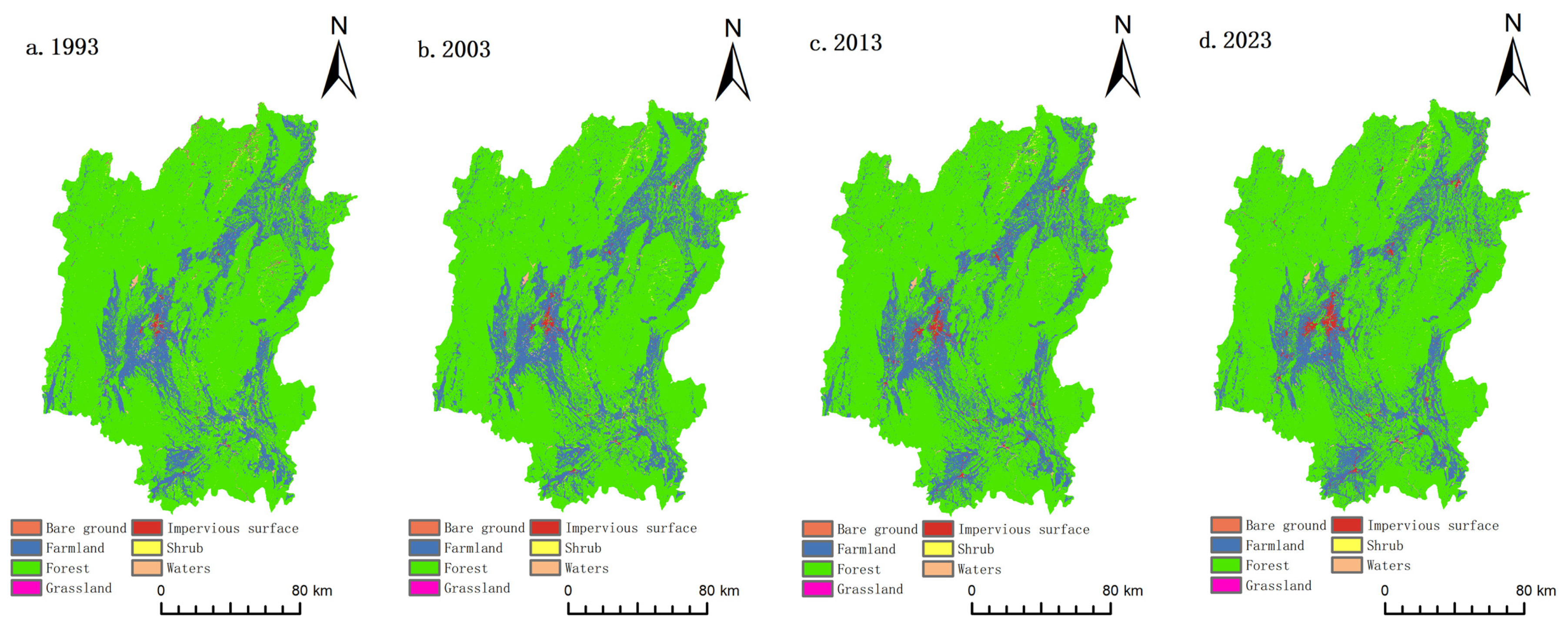
Guilin, located in northeastern Guangxi, is a typical representative of continental tower-like karst landforms with prominent ecological vulnerability. In 2024, Guilin was selected as one of the second batch of 100 Global Geoscience Heritage Sites by the International Union of Geological Sciences, recognizing its international-level geological value and ecological research significance, especially in global karst carbon cycle studies [10]. Due to the sensitivity of karst ecosystems and continuous human disturbances such as urbanization and tourism development in recent years, Guilin’s carbon sequestration capacity has decreased. The total regional carbon storage showed an overall decreasing trend from 2000 to 2020, with an average annual reduction of 0.1905 × 10⁶ t. The decrease in forestland area and expansion and fragmentation of impervious surfaces are the main reasons for the decline in carbon storage. Under the natural change scenario, it is predicted that Guilin’s carbon storage will decrease by 2.77 × 10⁶ t in 2040 compared with 2020. The spatial evolution characteristics of shrinking high-carbon-storage areas and expanding low-carbon-storage areas highlight the urgency of in-depth research on the degradation mechanism and mitigation pathways of its ecosystem services [11,12]. Therefore, it is necessary to conduct an in-depth study on the problem of declining carbon storage in Guilin and propose practical countermeasures.
In addition, remote sensing technology has been widely used in karst ecological monitoring in recent years, such as InSAR for surface deformation [13], hyperspectral for soil element content inversion [14], and GIS models for monitoring karst ecological vulnerability [15], but studies on multi-service synergistic clustering are still scarce. Meanwhile, as an international tourist city, Guilin faces dual challenges of rising carbon emissions and deepening conflicts between UBGI construction and urbanization amid the booming tourism industry [16]. On one hand, energy consumption and carbon emissions from tourist activities, transportation, and hotel catering services are increasing synchronously—from 2000 to 2012, the average annual growth rate of carbon emissions from Guilin’s tourism transportation, accommodation, and activities was 9.35% [17]. On the other hand, rapid urbanization and tourism development in Guilin have led to compressed ecological space, reduced vegetation coverage, and water pollution. As a national low-carbon city pilot, the Guilin Ecological Civilization Construction Plan (2023–2030) explicitly incorporates “carbon sink capacity improvement” as a core indicator, requiring ecological restoration areas to account for over 25% of the total area by 2030, highlighting the urgency of governance.
Therefore, focusing on the particularity of ecological functions in karst cities, this study takes Guilin as the research object; uses land use and land cover change (LUCC) data of Guilin from 1993, 2003, 2013, and 2023; couples the InVEST model with ArcGIS software; and conducts dynamic synergy research on carbon storage, carbon sink, habitat quality, and water retention of Guilin’s karst landforms from the innovative perspective of dynamic synergy among carbon sink, habitat quality, and water retention. It proposes UBGI construction measures for Guilin from the perspective of improving ecosystem services, providing a scientific reference for the sustainable development research of other karst cities.

2. Literature Review

From the perspective of global ecological governance, the synergy between blue-green infrastructure (BGI) and nature-based solutions (NbS) has become an important path to address global climate change and enhance the comprehensive benefits of ecosystem services. NbS has attracted widespread attention for providing effective strategies for BGI construction [18]. Currently, the application of BGI and NbS to the synergy of ecosystem services has been extensively studied. Chen Siyu et al. (2025) pointed out that NbS can effectively integrate BGI at different spatial scales to optimize ecological quality and enhance green space multifunctionality [19]; Li Yibin et al. (2025) introduced the SCGE model to comprehensively predict the environmental and social impacts of urban green spaces, building a comprehensive framework for long-term nature-based solutions [20]; Alida Alves et al. (2024) proposed a GIS-based three-step multi-criteria method to help improve urban multifunctional planning while balancing the benefits among multiple NbS [21]; in addition, Veljko Prodanovic et al. (2024) explored the application of artificial intelligence in NbS urban planning, promoting the shaping of urban biodiversity patterns and providing important scientific references for global ecological governance [22].
Meanwhile, domestic research on carbon sink development, habitat quality, and water retention is abundant. In terms of content, early studies focused on the impact of single natural or anthropogenic factors on carbon sinks, such as natural processes [23] and LUCC [24]. Research on habitat quality focused on biodiversity [25], ecosystem services [26], and spatiotemporal evolution [27], while studies on water retention emphasized spatiotemporal evolution [28] and ecosystem services [29]. However, existing studies mostly focus on single ecosystem services, approaching carbon sinks, habitat quality, or water retention in isolation, lacking exploration of the dynamic synergy mechanism among “carbon sink–habitat quality–water retention,” especially in karst cities. Methodologically, models such as the PLUS model [30], InVEST model [31], and XGBoost algorithm [32] are mainly used to analyze the spatiotemporal changes in carbon storage and water retention. In terms of scale, existing research results cover regional [33], provincial [34], watershed [35], and urban agglomeration [36] scales. Due to the unique landform, fragile ecological environment, and distinctive carbon sink function of karst areas, research on the coupling relationships between carbon sinks, habitat quality, and water retention in these regions remains insufficient.
In summary, from the perspective of global ecological governance and spatial planning practice, existing studies still face the following key research gaps when promoting the implementation of BGI and NbS concepts in ecologically fragile areas such as karst regions: (1) There is a lack of quantitative revelation of the synergy and decoupling mechanisms of multiple ecosystem services; in particular, the dynamic correlation between carbon sinks, habitat quality, and water retention in ecologically fragile karst areas has not been systematically analyzed. (2) The disconnection between ecosystem service research and spatial planning practice fails to effectively transform service assessment into operable ecological zoning and management plans, making it difficult to support the precise layout of BGI. (3) There is a lack of quantitative ecological control thresholds and differentiated strategies; most existing studies stay at trend analysis and fail to propose hierarchical optimization goals and management paths with spatial heterogeneity.
Therefore, focusing on Guilin, a typical karst city, this study innovatively combines carbon storage, habitat quality, and water retention with K-means clustering to systematically reveal the synergy and decoupling mechanisms of the three services, filling the gap of multi-service synergy research in existing studies. It converts the four types of ecosystem service clusters into implementable ecological spatial zoning, clarifies the management direction of each zone, and provides a precise spatial basis for BGI layout and ecological protection redline delineation. Furthermore, it quantitatively proposes ecological control thresholds (impervious surface ratio < 15%, forestland ratio > 30%) and constructs a “zoning-classification-grading” differentiated optimization strategy based on the spatial heterogeneity of driving factors, breaking the limitation of disconnection between research and planning practice, and improving the practical operability of research results. It provides a scientific basis for Guilin’s ecological protection, implementation of “dual carbon” goals, and construction of an ecological civilization city and the National Innovation Demonstration Zone for Sustainable Development Agenda.

3. Overview of the Study Area and Data Sources

3.1. Overview of the Study Area

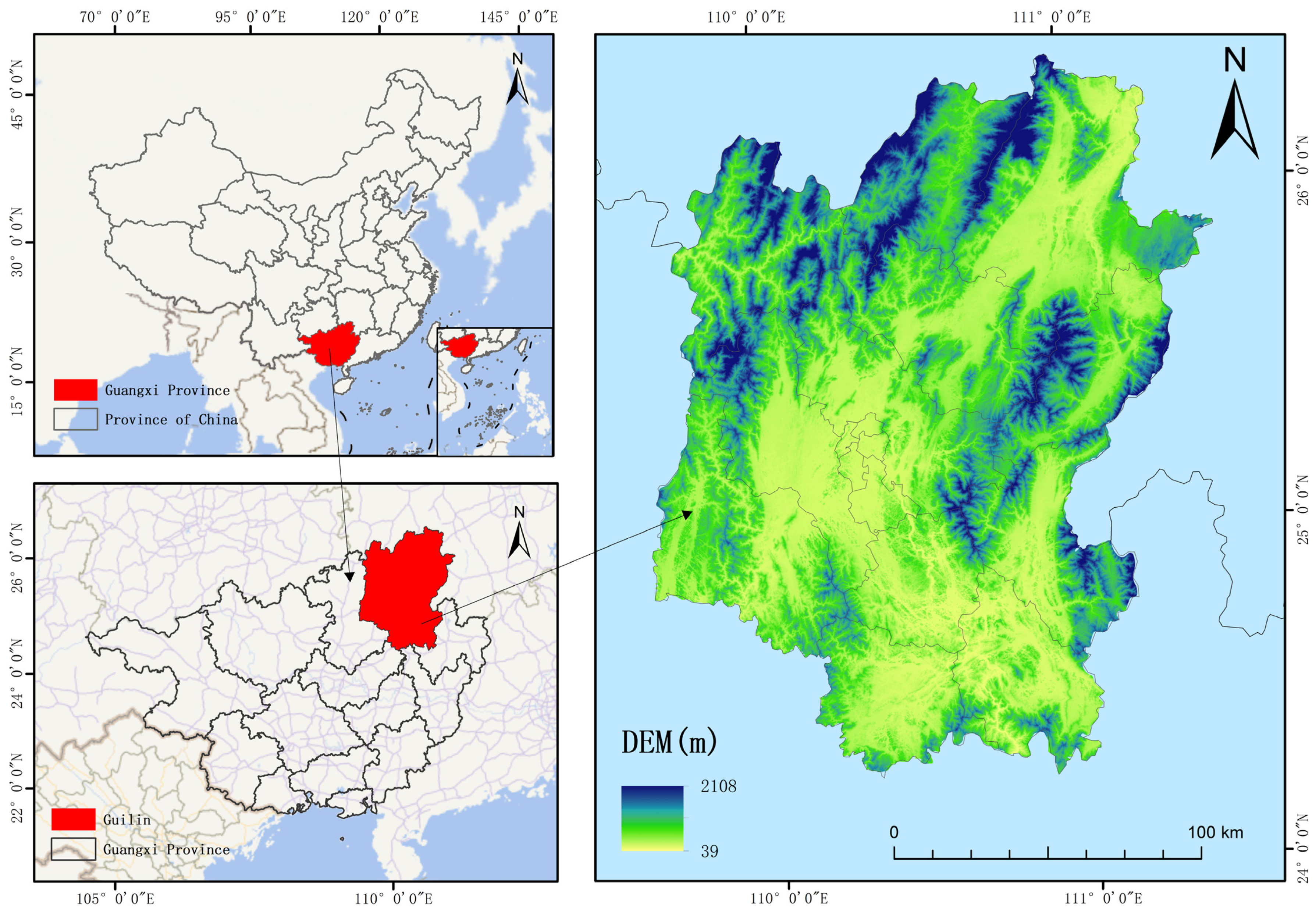
Guilin is located in the southwestern part of the Nanling Mountains (24°15′23″ N–26°23′30″ E), at the southern end of the Xiang-Gui Corridor, covering a total area of 27,800 km2. It administers 10 counties and 6 urban districts, accounting for 11.74% of the total area of Guangxi Zhuang Autonomous Region. The terrain is predominantly mountainous and hilly, with elevated mountainous areas encircling the west, north, and east, while the central region features relatively flat terrain (as shown in Figure 1). It has a subtropical monsoon climate with an average annual temperature of 20 °C and average annual rainfall of 1900–2000 mm, providing favorable conditions for the formation of regional ecological space.
Guilin boasts outstanding ecological endowments: the forest coverage rate reaches 66.28%, and 1.96 million hectares of forestland serve as the most important and stable carbon pool in the city, accounting for 73.28% of the city’s total carbon storage, while the Ecological Core Cluster accounts for 77.50% of the city’s area. The mountainous areas in northern Longsheng and Ziyuan are typical “ecological carbon pools” and “super water towers.” Complementing this, the city’s total water resources reached 44.18 billion m3 in 2022, ranking first in Guangxi. The Lijiang River, Taohua River, and the “Two Rivers and Four Lakes” are interconnected, forming an excellent high-quality blue-green space base [37,38]. Guilin is also supported by favorable policies and development endowments: as a national low-carbon city pilot, the Guilin Ecological Civilization Construction Plan (2023–2030) incorporates carbon sink capacity improvement as a core indicator; the implementation of the Sponge City Construction Regulations and three national key R&D projects has empowered ecological restoration. Meanwhile, its well-known cultural tourism brand “Guilin landscapes are the finest under heaven” attracts global attention, with four national 5A-level and 47 national 4A-level tourist attractions, demonstrating great potential for the coordinated development of eco-tourism and carbon sink economy.

3.2. Data Sources

The data used in this study mainly include LUCC data, 2022 administrative boundary data of Chinese cities (Table 1), and carbon pool data, with sources detailed in the following table:

4. Research Methods

4.1. Assessment of Individual Ecosystem Services

The InVEST model helps visualize the spatial distribution and evolutionary patterns of ecosystems, providing a scientific basis for planners and managers to make decisions.

4.1.1. Carbon Storage Assessment

The InVEST model helps visualize the spatial distribution and evolutionary patterns of ecosystems, providing a scientific basis for planners and managers to make decisions.
  • Carbon Storage Assessment
The InVEST model divides ecosystem carbon storage into four basic carbon pools: aboveground biomass, belowground biomass, soil organic carbon, and dead organic matter. Total carbon storage in the study area is estimated by summing these four pools and multiplying by the area of each LUCC type [28]. Using LUCC data from different years, the temporal and spatial evolution characteristics of carbon storage in the study area can be analyzed. The formulas for calculating ecosystem carbon storage in the InVEST model are as follows:
Ctotal = Csoil + Cabove + Cbelow + Cdead
Ctotal = C × Ai
where:
Ctotal: total carbon storage in the study area(t);
Cabove: aboveground carbon density (t/hm2);
Cbelow: belowground carbon density (t/hm2);
Csoil: soil carbon density (t/hm2);
Cdead: dead organic matter carbon density (t/hm2);
Ai: area of land use type i (hm2).
This study refers to the carbon density data for Guilin modified by temperature and precipitation factors from Wei Zhenfeng et al. (Guangxi University of Finance and Economics) in their study Evolution of System Carbon Storage and Land Use Drivers in Guilin from 2010 to 2020 [39].

4.1.2. Habitat Quality Assessment

Habitat quality reflects an ecosystem’s ability to provide suitable living conditions, influencing both biological habitats and human well-being. In the InVEST model’s Habitat Quality module, the core assessment involves linking habitats to threat factor sensitivity and distance based on LUCC types (Table A1) [30], combined with habitat threat level parameters for estimation. The formulas are as follows:
Q x j = H j 1 D x j z D x j z + k 2
where:
Qxj: habitat quality index of grid x in habitat type j (range: 0–1);
H j : habitat suitability of habitat type j;
z: default model parameter (set to 2.5);
k: half-saturation constant (default value from the InVEST model);
Dxj: habitat degradation degree of grid x in habitat type j.
The formula for habitat degradation degree (Dxj) is:
D x j = r = 1 R y = 1 Y r W r r = 1 R W r r y i r x y β x K j r
where:
R: number of threat sources;
Yr: number of grids affected by threat source r;
Wr: weight of threat source r;
ry: threat intensity of grid y;
irxy: distance decay function between grid x and y;
βx: the habitat’s resistance level;
Kjr: sensitivity of land use type j to threat factor r (range: 0–1).
The distance decay function (irxy) is calculated as:
i r x y = 1 d x y d m a x
i r x y = e x p 2.99 d m a x d x y
where:
dxy: horizontal distance between grid x and y;
dmax: maximum effective distance of threat source r.
Key parameters for the model were referenced from the InVEST model user guide and existing literature (Table A2 and Table A3) [40].

4.1.3. Water Retention Assessment

Water retention refers to the function of ecosystems to intercept and retain precipitation, enhance soil infiltration, conserve soil moisture, recharge groundwater, regulate river flow, and increase available water resources through their structure and processes.
(1) Water Balance Principle and Calculation Formula
In this study, water retention is calculated using the water balance equation:
W R = P R E T
where:
WR: annual average water retention (mm);
P: annual average precipitation (mm);
R: annual average surface runoff (mm);
ET: annual average actual evapotranspiration (mm).
Surface runoff (R) is calculated as:
R = α × P
where α is the average surface runoff coefficient of the ecosystem. Without human disturbance, precipitation minus actual evapotranspiration equals water yield. Therefore, the InVEST model’s Water Yield module was first used to calculate water yield, and then surface runoff was computed using the ecosystem average surface runoff coefficient, LUCC data, and annual average precipitation to obtain water retention [41].
(2) Calculation Process of the InVEST Water Yield Module
The InVEST Water Yield module assesses the relative contribution of different landscape components to water yield and predicts how LUCC changes affect annual water yield. It requires input data including precipitation, evapotranspiration, maximum root depth, plant-available water content, LUCC data, a biophysical table, and the Z parameter (Z = 13.0) [42]. Annual water yield (Yield) is calculated as:
Y x j = 1 A E T x j P x P x
where:
Yxj: annual water yield;
Px: annual average precipitation of grid cell x;
AETxj: annual average evapotranspiration of grid x on land use type j.

4.2. Coupling Coordination Degree Model

The coupling coordination degree model is a core method to quantify the interconnection and coordinated development level among multiple systems, which can effectively reveal the interaction and coordinated development status of three ecosystem services: carbon storage, water retention, and habitat quality [20]. Based on the inherent correlation characteristics of the three services, this study refers to the classic coupling coordination degree theoretical framework proposed by Liao Chongbin [43] and combines the equal weight assumption of the research object to construct an ecological system service coupling coordination evaluation model suitable for karst cities. The core formulas are as follows:
(1) Comprehensive Evaluation Index (T)
The comprehensive evaluation index is used to reflect the overall development level of the three ecosystem services. Considering that carbon storage, water retention, and habitat quality have equal ecological value in karst ecosystems and there is no clear priority basis for weights, the equal weight assumption is adopted, i.e., assigning equal weights to the three services (α = β = γ = 1/3) to reflect the overall development level:
T = U 1 + U 2 + U 3 3
where:
T: comprehensive evaluation index (range: 0–1), with higher values indicating higher overall development level of the three services;
U1, U2, U3: standardized grids of the three ecosystem services (i.e., standardized development level indices).
(2) Coupling Degree (C)
The coupling degree is used to measure the closeness of interaction and interdependence among the three subsystems (range: 0–1), with values closer to 1 indicating stronger correlation and interaction among subsystems [44]. Based on the number of subsystems (n = 3) and the equal weight assumption, the classic coupling degree formula is simplified and derived, and the final formula is as follows:
C = U 1 × U 2 × U 3 U 1 + U 2 + U 3 3 3
where:
C: coupling degree;
U1, U2, U3: standardized grids of the three ecosystem services (i.e., standardized development level indices).
The formula uses arithmetic mean instead of weighted sum to eliminate the impact of weight differences on the coupling degree, which is more in line with the equal importance characteristics of the three services in this study.
(3) Coupling Coordination Degree (D)
The coupling degree can only reflect the correlation intensity among subsystems and cannot reflect the impact of the overall development level of the system on the coordination status [43]. Therefore, the coupling coordination degree (D) is introduced to combine the coupling degree with the comprehensive evaluation index to fully characterize the coordinated development level of the three services. The formula is as follows:
D = C × T
where D is the coupling coordination degree (range: 0–1), with higher values indicating better coordinated development status of the three ecosystem services at a higher development level.

4.3. Local Bivariate Moran’s I

The bivariate spatial autocorrelation model can be used to reveal the spatial distribution characteristics of factors and the correlation between two factors, including global and local analyses. To explore the spatial correlation characteristics of carbon storage, habitat quality, and water retention, this study uses the bivariate Moran’s I index method based on the GeoDa platform to identify local spatial correlation patterns and their heterogeneity through the local Moran’s I index.
I = x i x ¯ s x j = 1 n W i j y j y ¯ s y
where:
I: local bivariate Moran’s I index of the i-th spatial unit;
n: total number of spatial units in the study area;
xi: attribute value of variable x for the i-th spatial unit;
x ¯ : global mean value of variable x across all spatial units;
sx: standard deviation of variable x across all spatial units;
yj: attribute value of variable y for the j-th spatial unit;
y ¯ : global mean value of variable y across all spatial units;
sy: standard deviation of variable y across all spatial units;
Wij: spatial weight matrix between spatial units i and j [45].

4.4. K-Means Clustering Analysis

K-means is a distance-based unsupervised learning algorithm whose main function is to partition n sample points into K clusters, minimizing the sum of squared Euclidean distances from each sample within a cluster to the cluster’s centroid, as shown in the following formula:
S S E = i = 1 K x C i x μ i 2
where:
K: preset number of clusters;
Ci: sample set of the i-th cluster;
x: sample vector;
μi: centroid (mean vector) of cluster Ci.

5. Results Analysis

5.1. Temporal and Spatial Changes of Carbon Storage

In ArcGIS, this study classifies Guilin’s carbon storage into three levels (low, medium, high) using the Jenks natural breaks classification method. By calculating the area proportion of carbon storage at different levels, the changes of Guilin’s carbon storage in different periods are analyzed [46].

5.1.1. Temporal Change Trend of Carbon Storage

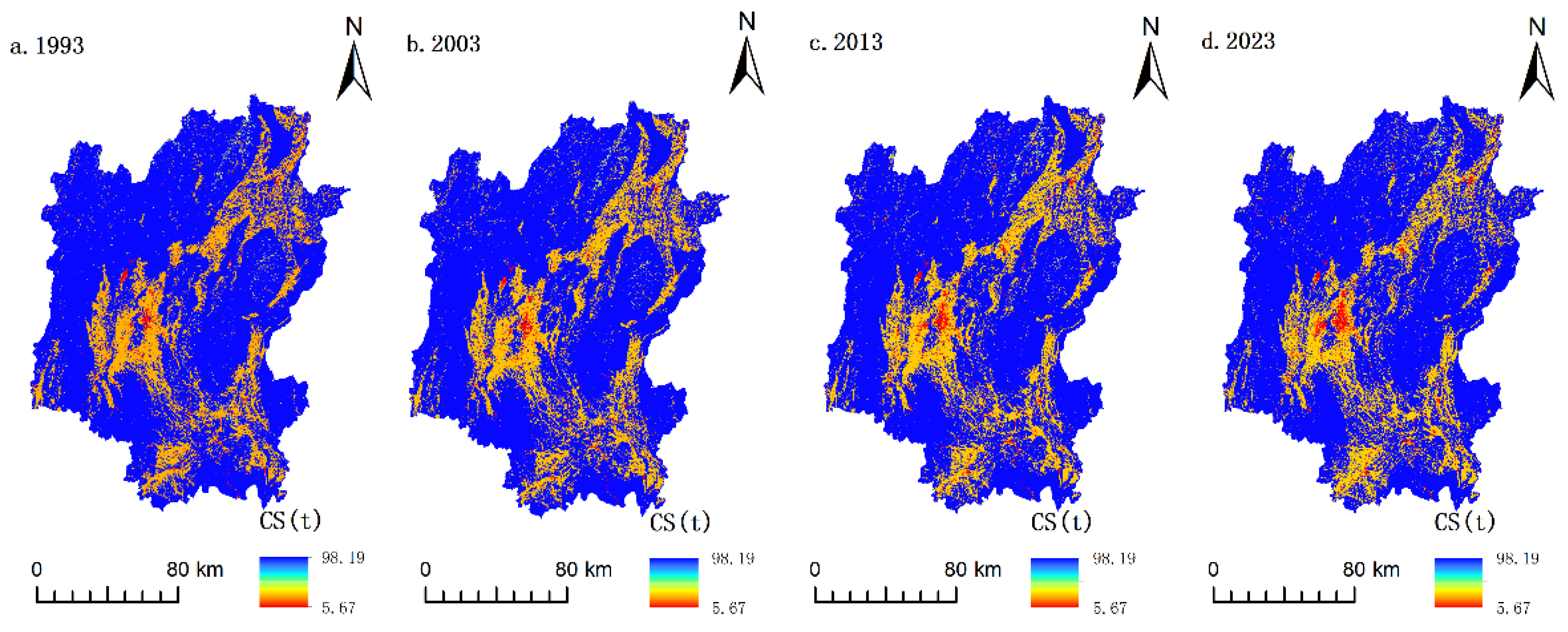
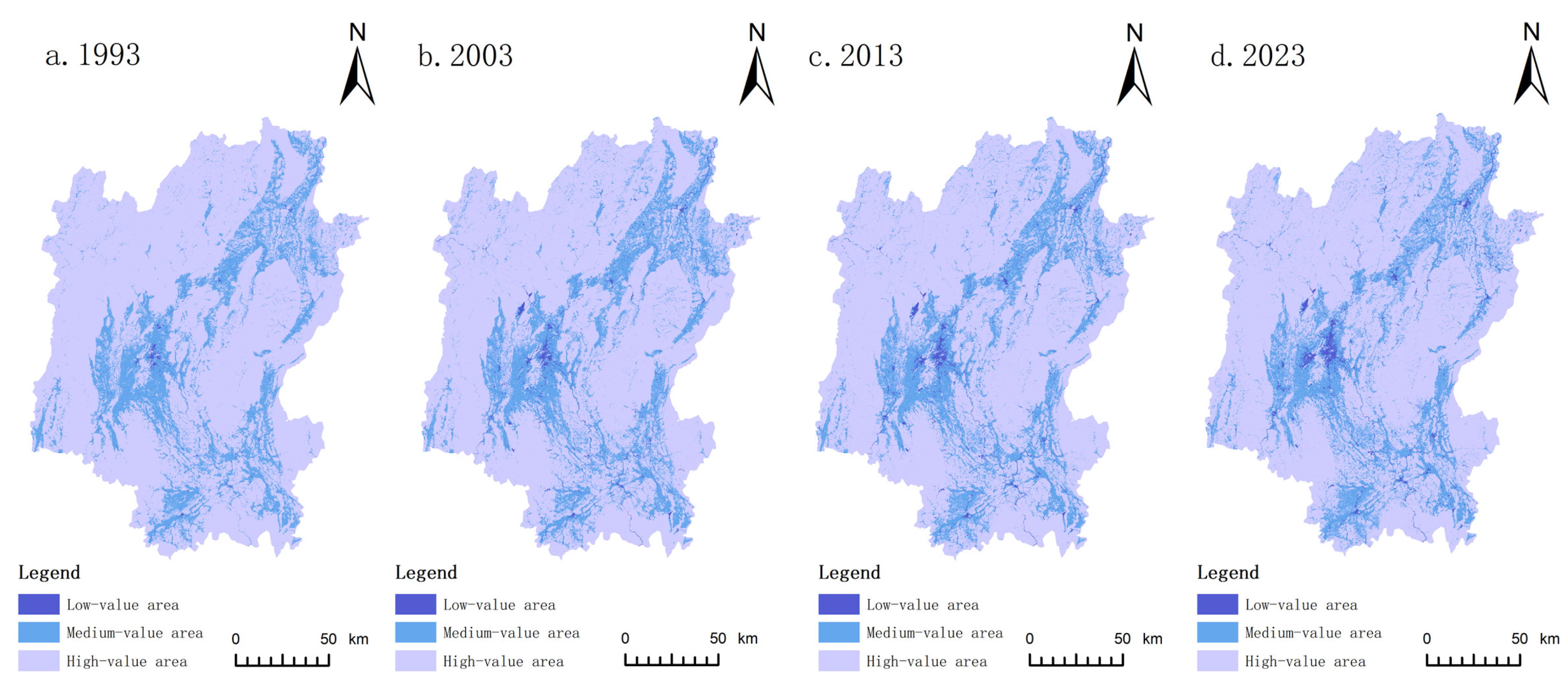
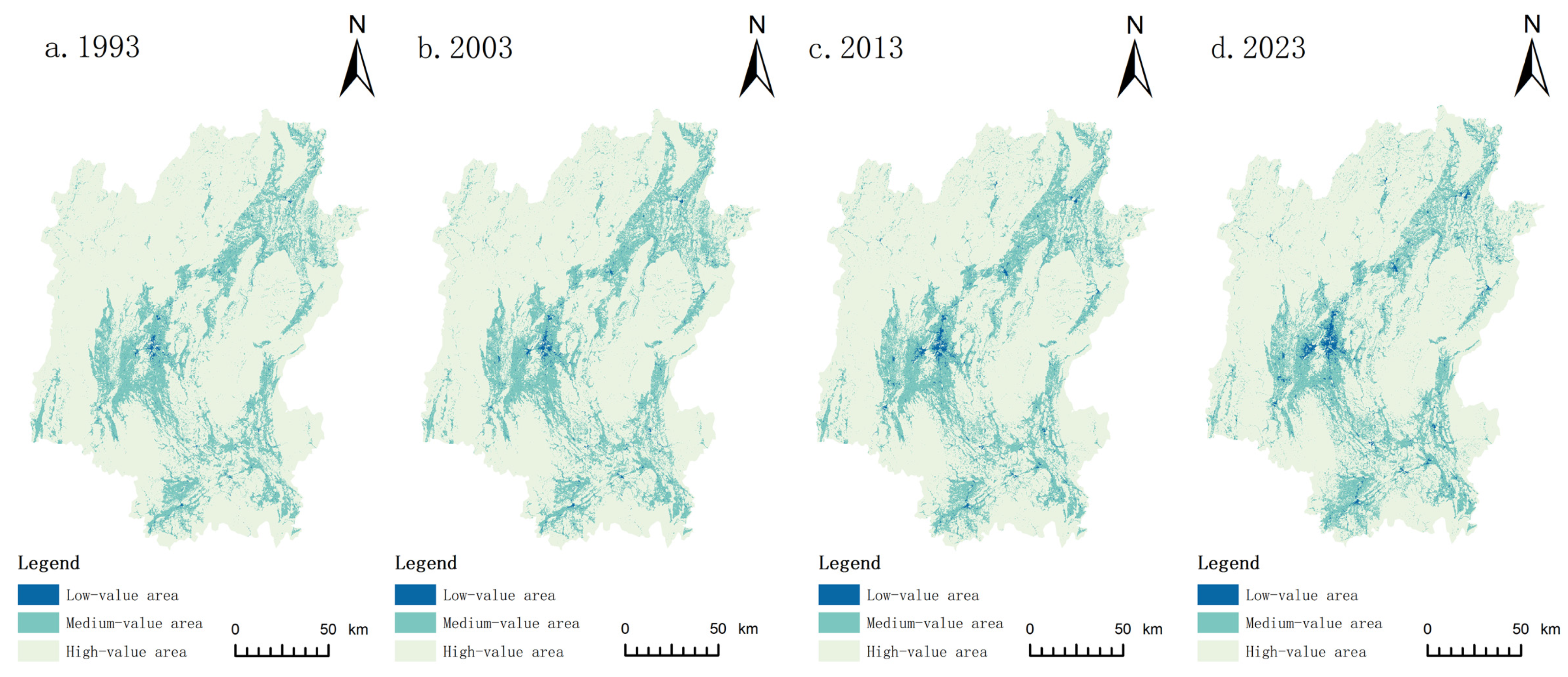
From 1993 to 2023, Guilin’s carbon storage showed an overall trend of slight changes in high-value areas, slow expansion of medium-value areas to surrounding regions, and continuous encroachment of low-value areas centered on Guilin’s urban area at a rate of 12.62 km2/year (Table 2).
From 1993 to 2003, centered along the middle Lijiang River in Guilin, low-carbon-storage areas gradually expanded outward, with an area proportion growth rate of 149.45% over ten years; the area proportion growth rate of medium-carbon-storage areas in the city was 6.72%, with growth areas mainly concentrated around Guilin’s urban area and southern Lingchuan County; the area proportion of high-carbon-storage areas showed negative growth, with a growth rate of −2.69%. Among them, the high-value areas in mountainous areas such as northern Longsheng Various Nationalities Autonomous County and western Ziyuan County were well preserved, indicating that forest ecosystems far from towns were less disturbed, while high-carbon-storage areas adjacent to towns were strongly disturbed.
From 2003 to 2013, the expansion rate of low-carbon-storage areas in Guilin slowed significantly but continued to encroach on areas around towns, further spreading in Lingui District, northern Yangshuo County, and other places. The temporal change of carbon storage in this stage was characterized by the conversion of medium- and high-value areas to low-value areas, with the area proportion growth rate of low-value areas being 24.67%, that of medium-value areas being −1.06%, and that of high-value areas being −0.14%.
From 2013 to 2023, the temporal change of carbon storage was characterized by the conversion of medium-value areas to low-value areas. The expansion rate of low-carbon-storage areas further slowed down, with an area proportion growth rate of 13.87% and a growth rate of −1.08% for medium-value areas. However, in local areas such as Yongfu County and Pingle County, affected by human activities such as industrial development and agricultural restructuring, low-carbon storage areas continued to expand.

5.1.2. Spatial Distribution Pattern of Carbon Storage

From 1993 to 2023, the spatial pattern evolution of Guilin’s carbon storage showed that mountainous areas in the north and west maintained high carbon storage levels due to high forest coverage (Figure 2 and Figure 3), while medium- and low-carbon storage areas in central and eastern regions with relatively concentrated human activities expanded to varying degrees.
Low-carbon-storage areas gradually expanded outward from Guilin’s central urban area, with the most prominent performance in Lingui New Area in the western urban area. In 1993, Guilin’s carbon storage was dominated by medium-value areas, with low-value areas concentrated in Qixing District and Xiangshan District. By 2023, due to urban construction in Guilin, low-carbon-storage areas infiltrated from the urban edge to the interior, especially along some sections of the Lijiang River, where carbon storage declined significantly. In 1993, Lingui District’s carbon storage was dominated by high-value areas with scattered medium-value patches, and the LUCC types were mainly farmland and forestland. From 1993 to 2023, the construction of Lingui New Area accelerated, with large-scale expansion of impervious surfaces. The original high-carbon storage areas were divided into fragmented patches by medium- and low-value areas, and the coverage of low-value areas was close to half of the regional total area, resulting in a significant decline in regional carbon sink function.
The mountainous areas in western and northern Guilin have maintained high carbon storage levels for a long time, among which Longsheng Various Nationalities Autonomous County in the northern mountainous area has particularly stable high-carbon-storage areas. From 1993 to 2023, the carbon storage in this region has always maintained a high level, with contiguous and stable high-value areas. The county’s main vegetation is natural forests, with a forest coverage rate exceeding 70% and minimal human disturbance, resulting in strong ecosystem carbon sequestration capacity. Only at the southern border with Lingui District, affected by small-scale agricultural development, a small number of low-carbon-storage areas appeared at the edge of high-value areas, but this change did not break the overall high-carbon-sink pattern of the region, making it Guilin’s core “ecological carbon pool”.
As a world-famous tourist city and a major producer of characteristic fruits, Guilin is significantly affected by tourism development and agricultural production activities. Medium- and low-carbon-storage areas expanded synchronously in popular tourist areas and large-scale agricultural cultivation areas, with the most prominent performance in Yangshuo County, the core tourist area in the south, and Yongfu County in the southwest. In 1993, Yangshuo County was densely forested, with high-value areas continuously distributed along mountain ranges and strong ecological carbon sequestration capacity. From 1993 to 2023, tourism development activities such as homestay construction and scenic area expansion along the Lijiang River continued to advance, leading to the rapid expansion of low-carbon-storage areas in Yangshuo Town, Baisha Town, and other places. Some natural ecosystems along the river were damaged, and biological carbon sequestration capacity decreased accordingly. Although the implementation of ecological protection policies such as the Yulong River ecological restoration has improved carbon storage in some local areas and significantly slowed down the expansion rate of low-value areas, carbon storage in areas with long-term saturated tourist flows such as Xingping Town remains at a low level. In 1993, Yongfu County had a good foundation for carbon storage with widely distributed high-value areas. However, after 2003, industrial development and large-scale cultivation of fruits and other crops in the county progressed simultaneously, converting a large amount of forestland and grassland into industrial land and orchards. Affected by both agricultural development and industrial construction, low-carbon-storage areas spread from eastern to western parts of the county. By 2023, medium- and low-carbon-storage areas in Yongfu County continued to expand, and the carbon sequestration capacity of forests and soil significantly declined.

5.1.3. Preliminary Analysis of Driving Factors

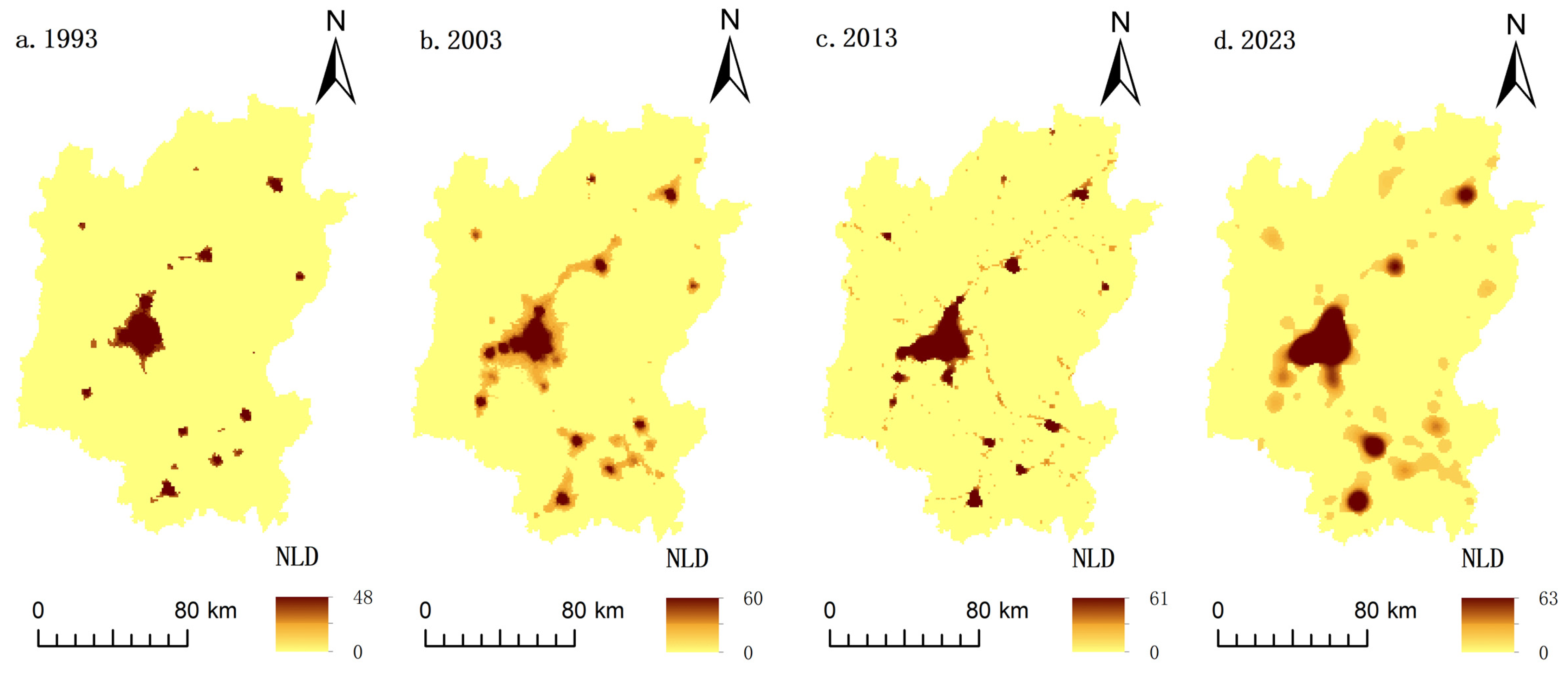
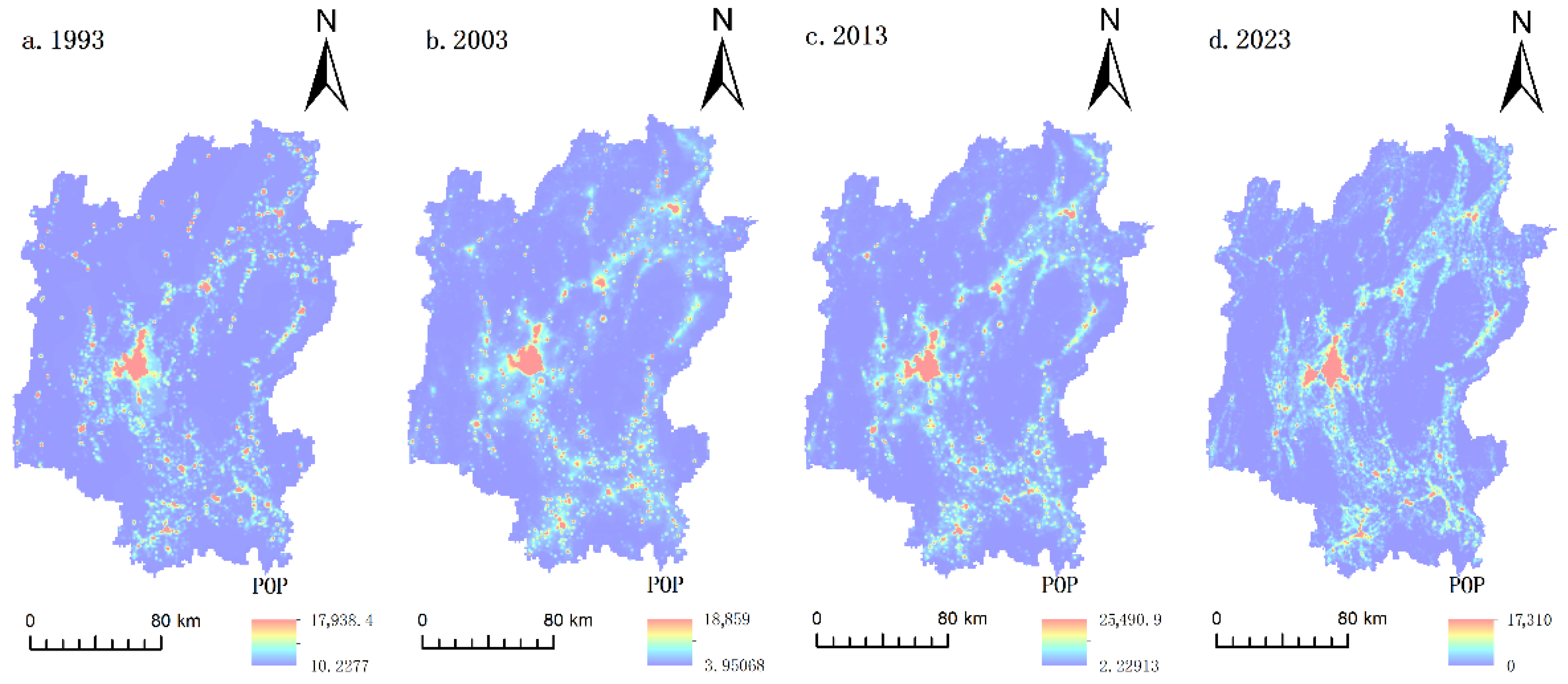
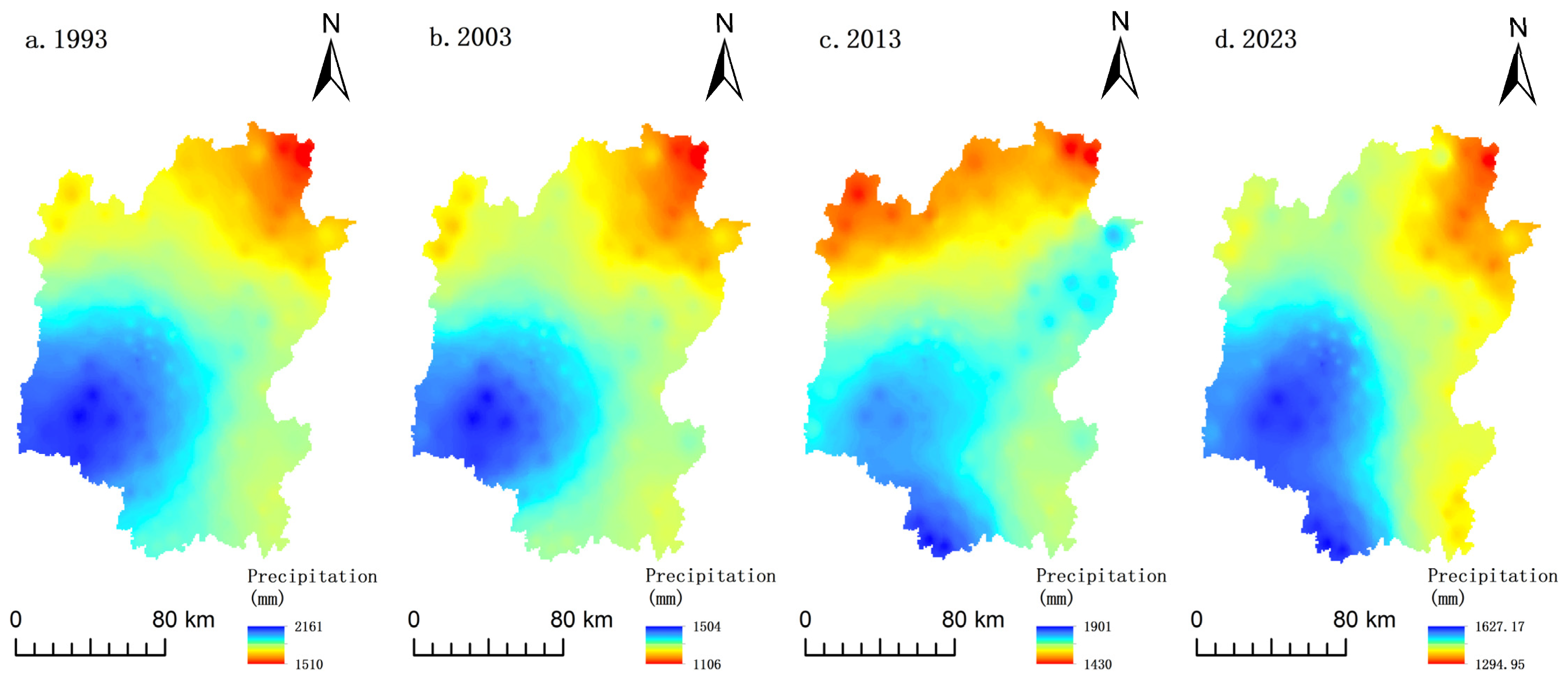
To identify the key driving factors affecting the temporal and spatial evolution of Guilin’s carbon storage, this study selected three indicators—nighttime light intensity, population density, and annual average precipitation—for correlation analysis. The selection basis is as follows: (1) nighttime light data are widely used to characterize regional human activity intensity and economic development level, and their spatial distribution can indirectly reflect the stress effects of LUCC conversion, energy consumption, etc., on carbon sinks; (2) population density directly reflects human settlement and resource utilization pressure, which is an important social driving factor leading to the compression of natural habitats and the degradation of ecosystem services; (3) as a climatic factor, precipitation has a fundamental regulatory effect on carbon storage accumulation by affecting vegetation growth and soil carbon processes. LUCC data are the basic input for the operation of the InVEST model, and their type conversion has been directly reflected in the carbon storage estimation process. Therefore, in this section and the subsequent preliminary analysis of driving factors for habitat quality and water retention, separate correlation statistics are no longer performed, but the identification and analysis of the impacts of the above three driving factors are focused on.
Based on data from four periods (1993, 2003, 2013, 2023), the Pearson correlation coefficients between each driving factor and carbon storage were calculated (Table 3). The results show:
Nighttime light intensity and carbon storage showed a continuous and strengthening negative correlation. The correlation coefficient decreased from −0.0451 in 1993 to −0.2381 in 2023 (p < 0.001), indicating that with the passage of time, the negative impact of human economic activity intensity on carbon storage has become increasingly significant. This confirms that economic development, especially urbanization and industrialization, is usually accompanied by the occupation of natural land and increased carbon emissions, thereby damaging regional carbon sink capacity.
Population density also showed a stable and significant negative correlation with carbon storage, with an average correlation coefficient of −0.5739 (p < 0.001) in each period. This indicates that the pressure of land development, resource consumption, etc., brought about by population agglomeration is an important social driving force leading to the loss of carbon storage. Although high-population-density areas may also be accompanied by higher ecological protection awareness and investment in green space construction, the statistical results of this study generally support the general pattern of population pressure leading to weakened carbon sinks.
The correlation between annual average precipitation and carbon storage was weak and negative, with coefficients fluctuating between −0.02 and −0.12 in each period (p < 0.001). This slight negative correlation may be related to the relatively abundant and spatially uniform precipitation in Guilin, making precipitation not the dominant limiting factor for the spatial differentiation of carbon storage. In addition, in areas with strong human disturbance, the positive effect of natural climatic factors on carbon sinks is masked.
In summary, human activity intensity and population pressure are key negative factors driving the spatial differentiation and temporal changes of Guilin’s carbon storage, while the direct impact of natural precipitation factors is relatively limited. This provides an empirical basis for formulating carbon sink enhancement strategies to reduce human activity disturbance and optimize the relationship between population and land in the future.

5.2. Temporal and Spatial Changes of Habitat Quality

In ArcGIS, this study classifies Guilin’s habitat quality into three levels (low, medium, high) using the Jenks natural breaks classification method. By calculating the area proportion of habitat quality at different levels, the changes of Guilin’s habitat quality in different periods are analyzed [46].

5.2.1. Temporal Change Trend of Habitat Quality

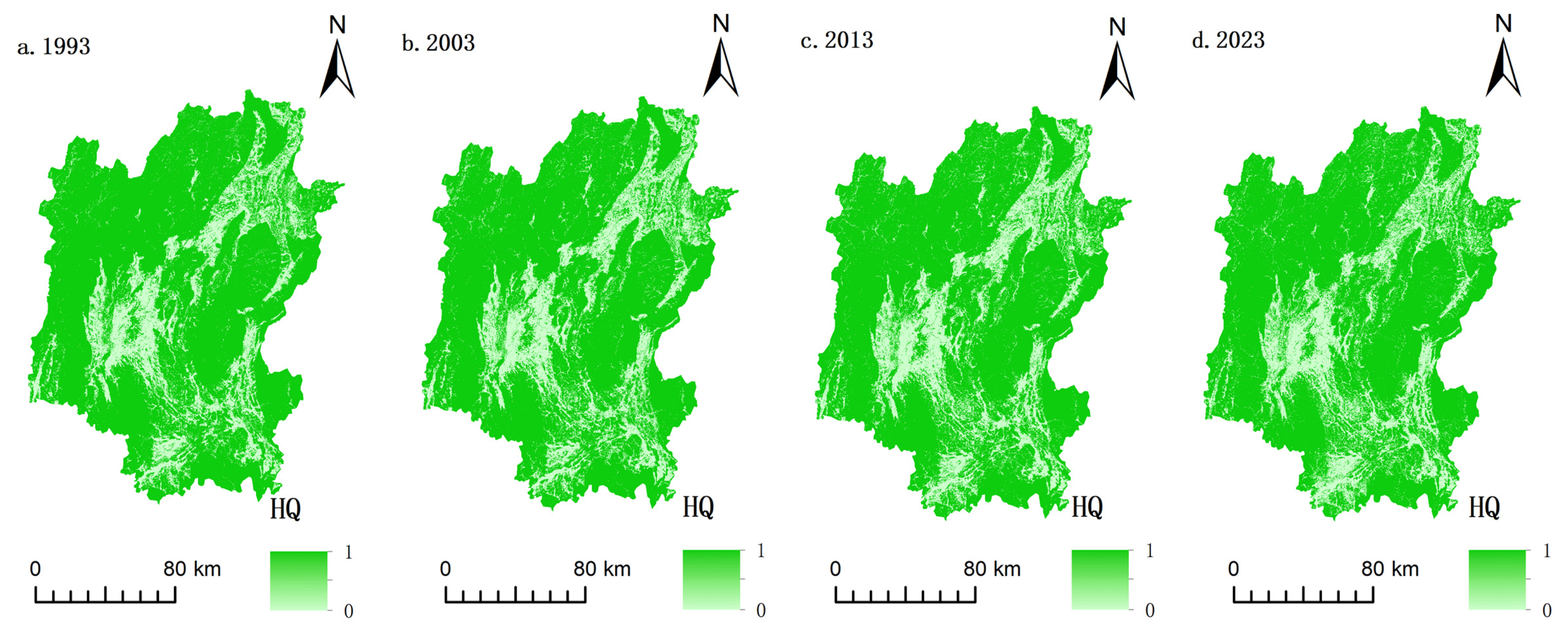
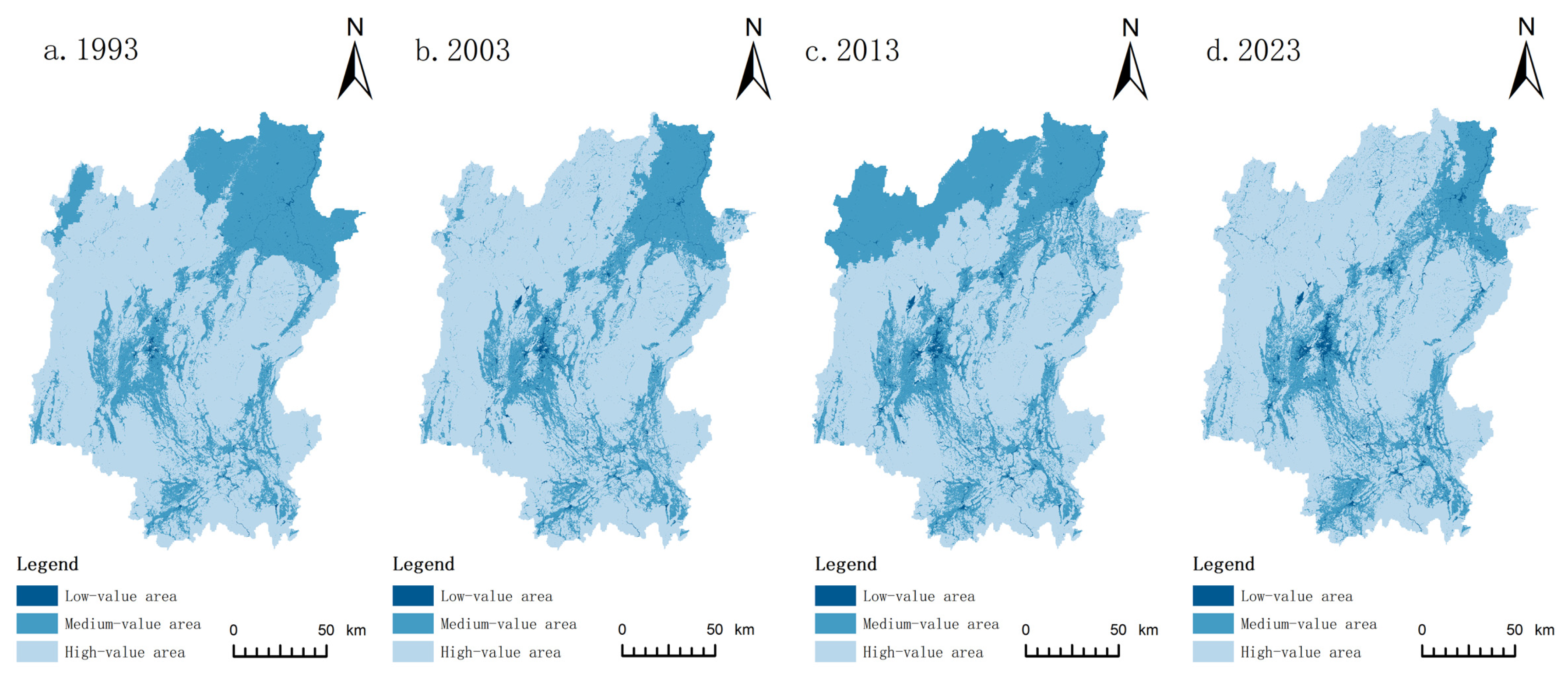
From 1993 to 2023, Guilin’s habitat quality showed an overall trend of fluctuating changes in high-value areas and decreasing quality in some regions (Table 4).
From 1993 to 2003, low-habitat-quality areas gradually expanded outward along the central Lijiang River and surrounding regions in Guilin, with an area proportion growth rate of 43.23% over ten years. The growth areas were mainly concentrated around Guilin’s urban area and southern Lingchuan County; the area proportion growth rate of medium-habitat-quality areas in the city was 6.67%; and the area proportion of high-habitat-quality areas showed negative growth with a growth rate of −1.90%. Among them, the high-value areas of habitat quality in mountainous areas such as northern Longsheng Various Nationalities Autonomous County and western Ziyuan County were well preserved, indicating that forest ecosystems far from towns were less disturbed by human activities, while high-value areas of habitat quality adjacent to towns were strongly disturbed.
From 2003 to 2013, the expansion rate of low-habitat-quality areas in Guilin slowed slightly, but the encroachment on areas around towns still proceeded at a high speed, further spreading in Lingui District, northern Yangshuo County, and other places. The temporal change of habitat quality in Guilin at this stage was characterized by the conversion of medium- and high-value areas to low-value areas, with the area proportion growth rate of low-value areas being 41.98%, that of medium-value areas being −0.23%, and that of high-value areas being −0.35%.
From 2013 to 2023, the temporal change of habitat quality was characterized by the conversion of medium-value areas to low-value areas. The expansion rate of low-carbon-storage areas slowed significantly compared with the previous period, with an area proportion growth rate of 32.57% and a growth rate of −0.94% for medium-value areas. However, in regions such as Yongfu County and Pingle County, affected by industrial development and agricultural restructuring, low-habitat-quality areas continued to expand.

5.2.2. Spatial Distribution Pattern of Habitat Quality

From 1993 to 2023, the spatial pattern evolution of Guilin’s habitat quality showed that mountainous areas in the north and west have long been high-value areas of habitat quality due to high forest coverage (Figure 4 and Figure 5), while medium- and low-value areas of habitat quality in central and eastern regions with relatively concentrated human activities expanded to varying degrees.
Low-habitat-quality areas gradually expanded outward from Guilin’s central urban area, with the most prominent performance in Lingui New Area in the western urban area. In 1993, Guilin’s habitat quality was dominated by medium and high values, with a large proportion of medium-value areas. By 2023, due to urban construction in Guilin, low-habitat-quality areas infiltrated from the urban edge to the interior, especially along some sections of the Lijiang River, where habitat quality declined significantly. In 1993, Lingui District’s habitat quality was dominated by high-value areas with scattered medium-value patches, and the LUCC types were mainly farmland and forestland. From 1993 to 2023, the construction of Lingui New Area accelerated, with large-scale expansion of impervious surfaces. The original high-value areas of habitat quality were divided into fragmented patches by medium- and low-value areas, and the coverage of low-value areas was close to half of the regional total area, resulting in a significant decline in regional carbon sink function.
The mountainous areas in western and northern Guilin have long been high-value areas of habitat quality, among which Longsheng Various Nationalities Autonomous County in the northern mountainous area has particularly stable high-value areas of habitat quality. From 1993 to 2023, the habitat quality in this region always maintained a high level, with minimal changes in the scope of high-value areas. Longsheng Various Nationalities Autonomous County is dominated by forest ecosystems and has long implemented strict forest protection policies. Human activities have controllable interference on habitats, and the ecosystem structure is stable, enabling habitats to continuously provide high-quality living conditions for organisms. It is a stable core area of habitat quality in Guilin.
As a world-renowned tourist resort and a major producer of characteristic fruits, Guilin is particularly affected by tourism development and agricultural production activities—medium- and low-value areas of habitat quality expanded synchronously in popular tourist attractions and large-scale agricultural planting areas, which is most typical in Yangshuo County, the core tourist area in the south, and Yongfu County in the southwest.
In 1993, Yangshuo County’s habitat quality showed a spatial distribution characteristic of “higher in mountains and medium in plains.” From 2003 to 2023, tourism development activities such as homestay construction and scenic area expansion along the Lijiang River continued, leading to the rapid spread of low-habitat-quality areas in Yangshuo Town, Baisha Town, and other regions. Some natural ecosystems along the river were damaged, and biodiversity also decreased accordingly. Although the implementation of ecological protection measures such as the Yulong River ecological restoration has improved habitat quality in some local areas and significantly slowed down the expansion rate of low-value areas, habitat quality in areas with long-term saturated tourist flows, such as Xingping Town, still remains at a low level. In 1993, Yongfu County had a good foundation for habitat quality with widely distributed high-value areas. However, after 2003, industrial development and large-scale fruit planting in the county progressed simultaneously, converting a large amount of forestland and grassland into industrial land and orchards. Affected by both agricultural development and industrial construction, low-habitat-quality areas spread from eastern to western parts of the county. By 2023, they had covered nearly half of Yongfu County, and the ecosystem service functions had significantly declined.

5.2.3. Preliminary Analysis of Driving Factors

To identify the key driving factors affecting the temporal and spatial evolution of Guilin’s carbon storage, this study selected three indicators—nighttime light intensity, population density, and annual average precipitation—for correlation analysis. The selection basis is as follows: (1) nighttime light data are widely used to characterize regional human activity intensity and economic development level, and their spatial distribution can indirectly reflect the stress effects of LUCC conversion, energy consumption, etc., on habitat quality; (2) population density directly reflects human settlement and resource utilization pressure, which is an important social driving factor leading to the compression of natural habitats and the degradation of ecosystem services; (3) as a climatic factor, precipitation has a fundamental regulatory effect on habitat quality by affecting vegetation growth and soil carbon processes.
Based on data from four periods (1993, 2003, 2013, 2023), the Pearson correlation coefficients between each driving factor and habitat quality were calculated (Table 5). The results show:
Nighttime light intensity and habitat quality showed a continuous and strengthening negative correlation. The correlation coefficient decreased from −0.0436 in 1993 to −0.2409 in 2023 (p < 0.001), indicating that with the passage of time, the negative impact of human economic activity intensity on habitat quality has become increasingly significant. This confirms that economic development, especially urbanization and industrialization, is usually accompanied by the occupation of natural land and increased carbon emissions, thereby damaging regional habitat quality.
Population density also showed a stable and significant negative correlation with habitat quality, with an average correlation coefficient of −0.5780 (p < 0.001) in each period. This indicates that the pressure of land development, resource consumption, etc., brought about by population agglomeration is an important social driving force leading to habitat quality damage. Although high-population-density areas may also be accompanied by higher ecological protection awareness and investment in green space construction, the statistical results of this study generally support the general pattern of population pressure leading to habitat quality damage.
The correlation between annual average precipitation and habitat quality was weak and negative, with coefficients fluctuating between −0.02 and −0.12 in each period (p < 0.001). This slight negative correlation may be related to the relatively abundant and spatially uniform precipitation in Guilin, making precipitation not the dominant limiting factor for the spatial differentiation of habitat quality. In addition, in areas with strong human disturbance, the positive effect of natural climatic factors on habitat quality is masked.
In summary, human activity intensity and population pressure are key negative factors driving the spatial differentiation and temporal changes of Guilin’s habitat quality, while the direct impact of natural precipitation factors is relatively limited. This provides an empirical basis for formulating habitat quality enhancement strategies to reduce human activity disturbance and optimize the relationship between population and land in the future.

5.3. Temporal and Spatial Changes of Water Retention

In ArcGIS, this study classifies Guilin’s water retention into three levels (low, medium, high) using the Jenks natural breaks classification method. By calculating the area proportion and change rate of water retention at different levels, the temporal evolution characteristics and spatial distribution pattern of Guilin’s water retention from 1993 to 2023 are systematically analyzed, and the change mechanism is revealed in combination with relevant driving factors [46].

5.3.1. Temporal Change Trend of Water Retention

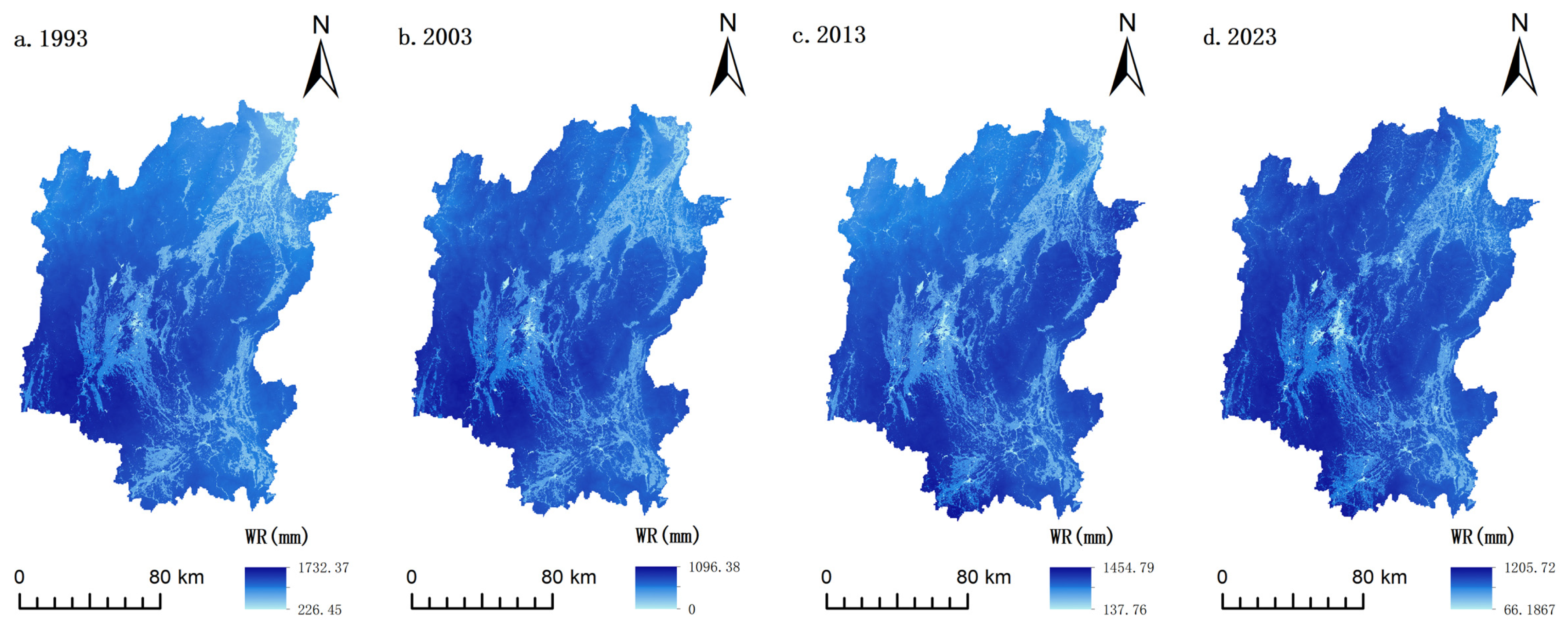
From 1993 to 2023, Guilin’s water retention was jointly affected by natural factors such as terrain, vegetation, and rainfall, and anthropogenic factors such as ecological projects, urbanization, and human activities. It showed an overall complex trend of sharp decline, fluctuating recovery, and gradual decline. The area of low-value areas increased by 1.14%, the area of medium-value areas decreased by −9.47%, and the area of high-value areas increased by 8.33% (as shown in Table 6).
From 1993 to 2003, medium- and low-value areas of water retention expanded, and high-value areas fragmented. The area proportion of low-value areas increased from 0.77% to 1.35%, with a growth rate of 75.06%; the area proportion of medium-value areas decreased by 23.04%. Although the area of high-value areas increased slightly, the water retention in areas around the central Lijiang River basin and low mountain and hilly areas showed a cliff-like decline due to urbanization expansion, wetland filling, and forestland destruction, becoming the most significant change area during this period.
From 2003 to 2013, medium- and high-value areas of water retention showed an increasing trend, and the expansion rate of low-value areas slowed down. The growth rate decreased from 75.06% to 24.46%, the area proportion of medium-value areas rebounded sharply by 44.11%, and high-value areas gradually recovered contiguously. The intensive implementation of ecological policies such as “Grain for Green” and the “Pearl River Basin Shelterbelt Project” promoted the recovery of vegetation coverage, especially in areas with severe previous degradation, where water retention capacity was significantly enhanced, and ecological restoration achieved remarkable results.
From 2013 to 2023, water retention showed an overall gradual decline, and regional differentiation intensified. The area proportion of low-value areas continued to grow by 14.00%, the area proportion of medium-value areas decreased by 35.36%, and the area proportion growth rate of high-value areas reached 21.04%, but it was mainly concentrated in core ecological protection areas; some mountainous areas in the west and east experienced fluctuations in water retention function due to frequent extreme climates and extensive understory vegetation management; water retention in the central urbanization core area remained low, and the conservation gradient gap with surrounding mountainous areas expanded, reflecting the long-term pressure of urban expansion on water regulation.

5.3.2. Spatial Distribution Pattern of Water Retention

From 1993 to 2023, the spatial pattern of Guilin’s water retention showed the characteristics of “stable core areas, fluctuating transition areas, and degraded built-up areas” (Figure 6 and Figure 7): northern and western mountainous areas have always been concentrated high-value areas, central and southeastern built-up areas and tourist development-concentrated areas are dominated by low-value areas, and the spatial difference further highlighted with the urbanization process.
High-value areas were restored and improved, and the Lijiang River basin became a conservation model. In 1993, the proportion of high-value areas was high, and the karst mountainous areas in Fuli Town and Yangdi Township in western Yangshuo County were core high-value areas. The “mountains-rivers-forests-farmlands” ecosystem along the Lijiang River synergistically conserved water sources. In 2003, affected by tourism development, illegal logging, and urbanization, the water storage capacity of western mountainous areas sharply decreased, wetlands along the Lijiang River were filled, farmland was hardened, low-value areas expanded sharply, and the area proportion of medium-value areas decreased significantly. In 2013, the continuous Lijiang ecological protection actions promoted vegetation recovery, ecological wetland clusters were built along the river, farmland was transformed into ecological ditches, water retention rebounded strongly, and medium- and high-value areas recovered contiguously. In 2023, mixed forests were cultivated and litter was protected in western mountainous areas, the area proportion of high-value areas reached a historical peak, and a triple composite conservation system of “mountains-wetlands-farmlands” was built in the Lijiang River basin, with water retention function exceeding the 1993 level.
Northern Lingchuan County: The “high north and low south” pattern was reconstructed, and the function of suburban transition areas was reshaped. In 1993, it showed a “high north and low south” pattern. The primitive broad-leaved forests in the northern Haiyangshan Mountainous Area were dense, serving as a super water retention area; the southern suburbs were dominated by agriculture, with ecologically intact medium- and low-value areas. In 2003, the north–south differentiation collapsed. In the north, natural broad-leaved forests were replaced by star anise plantations, the litter layer disappeared, and high-value areas contracted; in the south, due to northern urban development, impervious surfaces engulfed forestland and farmland, low-value areas expanded contiguously, and the county’s water retention fell to the middle level in Guilin. In 2013, north–south collaborative restoration began. Broad-leaved forests were restored in the north, reconnecting high-value areas; the south improved water retention around impervious surfaces through the “sponge city pilot,” but the ecological connectivity between north and south was weak, and the area proportion of medium-value areas rebounded. In 2023, the north became a “Guangxi Ecological Public Welfare Forest Demonstration Base,” and the synergistic water retention function of mixed forests and native vegetation reached their best historical level, and the ecological function of the southern suburban transition area was gradually reshaped.
Lingui District: East–west integration and improvement and coordinated development of ecology and conservation in the new area are noted. In 1993, the “strong west and weak east” pattern was significant. The Yuechengling residual veins in Wantian Yao Township and Huangsha Yao Township in the west were top high-value areas; the east was dominated by agriculture, with medium- and low-value areas with low ecological pressure. In 2003, water retention fluctuated sharply. Large-scale logging of Chinese fir plantations in the west led to the disappearance of high-value areas and a sharp contraction of medium-value areas. The development of Lingui New Area in the east led to the expansion of impervious surfaces, low-value areas spread rapidly, and the district’s water retention plummeted. In 2013, high-value areas in the west recovered slowly, but the east–west conservation gap was significant, and the area proportion of medium-value areas gradually rebounded. In 2023, east–west integration and improvement were achieved, high-value areas in the west continued to expand, and the eastern new area improved water retention capacity through blue-green space optimization, with an overall upward trend in water retention and a significant increase in the area proportion of high-value areas, becoming a model of coordinated ecology and conservation in Guilin’s new area.
Longsheng Various Nationalities Autonomous County: High-value areas dominated stably, always serving as the regional “super water tower.” In 1993, water retention ranked first in Guilin. The main peak area of Yuechengling in Pingdeng Town and Mati Township in the north was the core high-value area. The southern river valleys had dense forests and strong water retention capacity, with a synergistic and efficient ecosystem. In 2003, local firewood collection and slope farming led to minor gaps in the high mountain forest belt, the area of high-value areas contracted slightly, and water retention decreased slightly, but overall, it was still far higher than other counties. In 2013, relying on the “National Key Ecological Function Zone” policy, the northern forest areas were restored to primitive conditions, and high-value areas expanded contiguously, becoming the “Guangxi Water Retention Core Area.” In 2023, the area proportion of high-value areas continued to lead, and water retention remained the highest in the city, becoming a national model of coordinated ecological protection and water retention.

5.3.3. Preliminary Analysis of Driving Factors

To identify the key driving factors affecting the temporal and spatial evolution of Guilin’s water retention, this study selected three indicators—nighttime light intensity, population density, and annual average precipitation—for correlation analysis. The selection basis is as follows: (1) nighttime light data are widely used to characterize regional human activity intensity and economic development level, and their spatial distribution can indirectly reflect the stress effects of LUCC conversion, energy consumption, etc., on water retention; (2) population density directly reflects human settlement and resource utilization pressure, which is an important social driving factor leading to the compression of natural habitats and the degradation of hydrological regulation functions; (3) as a climatic factor, precipitation has a fundamental regulatory effect on water retention capacity by affecting surface runoff, soil infiltration, and vegetation growth.
Based on data from four periods (1993, 2003, 2013, 2023), the Pearson correlation coefficients between each driving factor and water retention were calculated (as shown in Table 7). The results show:
Annual average precipitation was significantly positively correlated with water retention, being the core natural driving factor, with an average correlation coefficient of 0.3843 (p < 0.001) in each period. However, the correlation coefficient gradually decreased from 0.5554 in 1993 to 0.2362 in 2023, reflecting the weakening of natural conservation potential due to frequent extreme climates, and the positive effect of precipitation was masked to a certain extent by high-intensity human activities.
Nighttime light intensity and water retention showed a continuous and strengthening negative correlation. The correlation coefficient decreased from −0.0525 in 1993 to −0.2392 in 2023 (p < 0.001), indicating that with the passage of time, the negative impact of human economic activity intensity on water retention has become increasingly significant. This confirms that in the process of urbanization and industrialization, the expansion of impervious surfaces and vegetation destruction will directly occupy water retention space, leading to the damage of regional hydrological regulation functions.
Population density also showed a stable and significant negative correlation with water retention, with an average correlation coefficient of −0.4845 (p < 0.001) in each period. This indicates that the pressure of land development, resource consumption, etc., brought about by population agglomeration is an important social driving force leading to the decline of water retention capacity. Human activities in densely populated areas cause a more intense disturbance to natural habitats, thereby affecting the water storage and conservation functions of ecosystems.

5.4. Synergy Analysis of Ecosystem Services

5.4.1. Global Correlation Analysis

There were extremely significant positive correlations between each pair of the three services (p < 0.01), as shown in Table 8. The correlation coefficient between carbon storage and habitat quality was the highest (r = 0.970), followed by carbon storage and water retention (r = 0.826), while that between habitat quality and water retention was relatively lower (r = 0.775). This indicates that at the study area scale, the three ecosystem services are dominated by synergistic relationships.

5.4.2. Coupling Coordination Degree Analysis

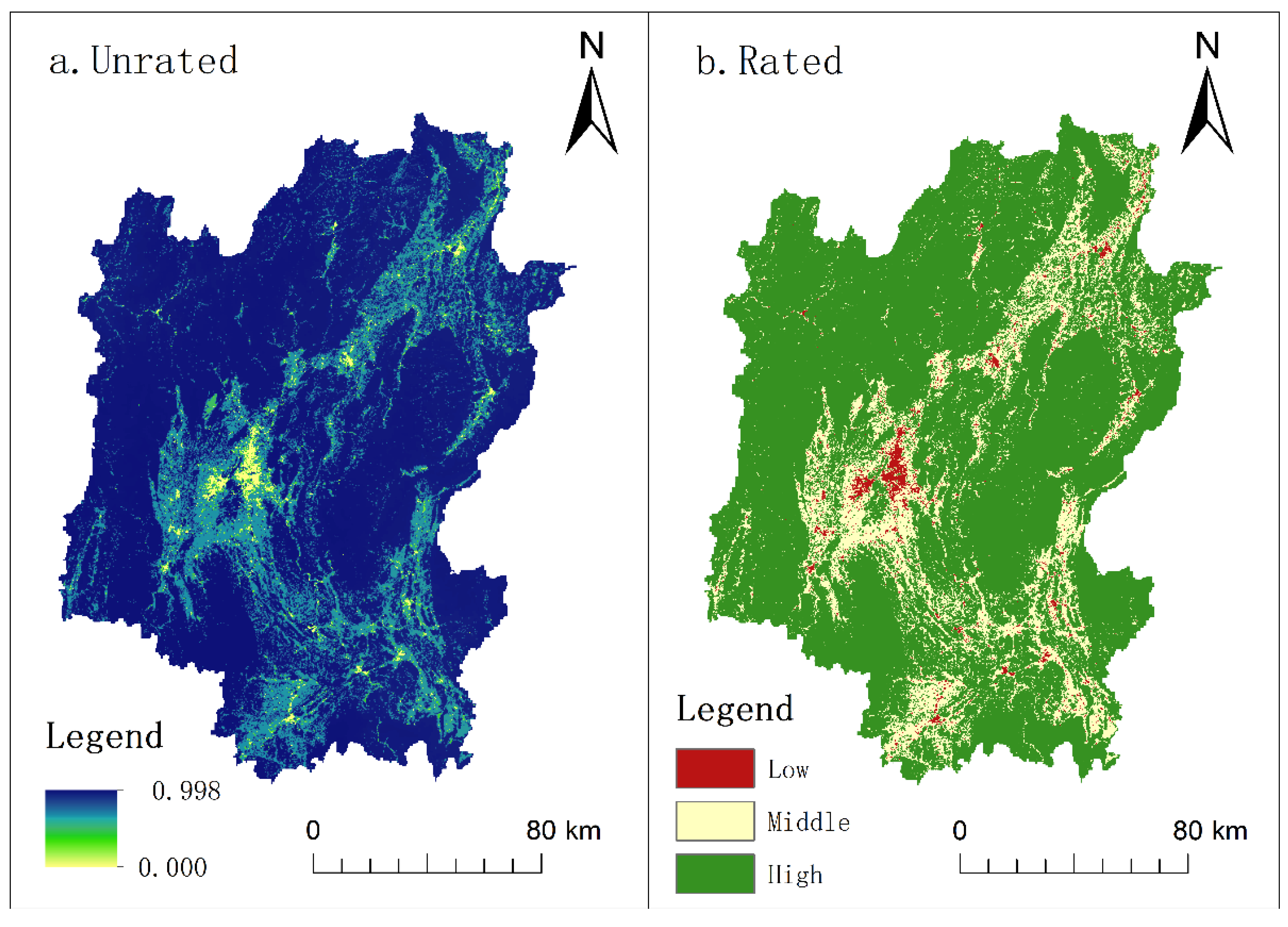
The coupling coordination degree model further revealed the spatial differentiation characteristics of the synergistic relationships among various services. The coupling coordination degree D value of Guilin ranged from 0.000 to 0.998, which was classified into three levels in this study (as shown in Figure 8): low-coordination area (0.000 ≤ D < 0.500), medium-coordination area (0.500 ≤ D < 0.800), and high-coordination area (0.800 ≤ D < 0.998). The results show that the average coupling coordination degree of the city was 0.906, at a high coordination level overall, indicating that the three ecosystem services are dominated by synergistic relationships within the city, but there is still room for improvement. Among them, the area proportion of high-coordination areas reached 81.45%, forming the basic foundation of stable regional ecological functions.
Spatially, the coordination degree pattern showed a significant gradient differentiation characteristic of “high in the northwest and low in the southeast” (Figure 4). High-coordination areas (D ≥ 0.8) accounted for 81.45% of the total area, spatially highly concentrated in the entire territory of Longsheng Various Nationalities Autonomous County and Ziyuan County in the northwest, and northern Xing’an County. This region is dominated by intact primary or secondary forest ecosystems, and extremely low human activity disturbance provides ideal conditions for the high-level synchronous supply of the three services, forming a stable “high carbon sink–high habitat quality–strong water retention” synergistic core.
On the contrary, low-coordination areas (D < 0.5) accounted for 1.78% of the total area, concentrated in Guilin’s central urban area (such as the core areas of Xiangshan District, Diecai District, and Xiufeng District), as well as urbanization frontier areas such as Lingui District and southern Lingchuan County. High-intensity human development activities in these areas led to the rapid expansion of impervious surfaces and high landscape fragmentation, seriously damaging the integrity and connectivity of ecosystems, triggering multiple negative effects such as the collapse of carbon storage capacity, habitat degradation, and the weakening of hydrological regulation functions, ultimately leading to the collapse of synergistic relationships among system services and falling into a state of deep imbalance.
Notably, in typical tourist and agricultural areas such as Yangshuo County and Pingle County in the middle reaches of the Lijiang River within the medium coordination area, the coordination degree is mostly at a medium level. This region has complex LUCC types, with natural forestland, agricultural land, and tourist facility impervious surfaces interleaved. Human activities exert moderate intensity and spatial heterogeneity of disturbance on the ecosystem, resulting in a dynamic and unstable synergistic balance state among the three services.
In summary, the spatial pattern of coupling coordination degree clearly reflects the game result between natural background support and human activity pressure. High-coordination areas are the embodiment of natural ecological advantages, while low-coordination areas are the direct product of high-intensity human disturbance, providing precise spatial targets for identifying key regulatory areas and implementing differentiated ecological management strategies.

5.4.3. Bivariate Spatial Autocorrelation

To explore the pattern and stability of local spatial correlations between two ecosystem services, this study further conducted a bivariate spatial autocorrelation analysis. The global bivariate Moran’s I index and local spatial association indicator (LISA) clustering results jointly revealed the spatial dependence and heterogeneity of the synergistic relationships among the three pairs of services.
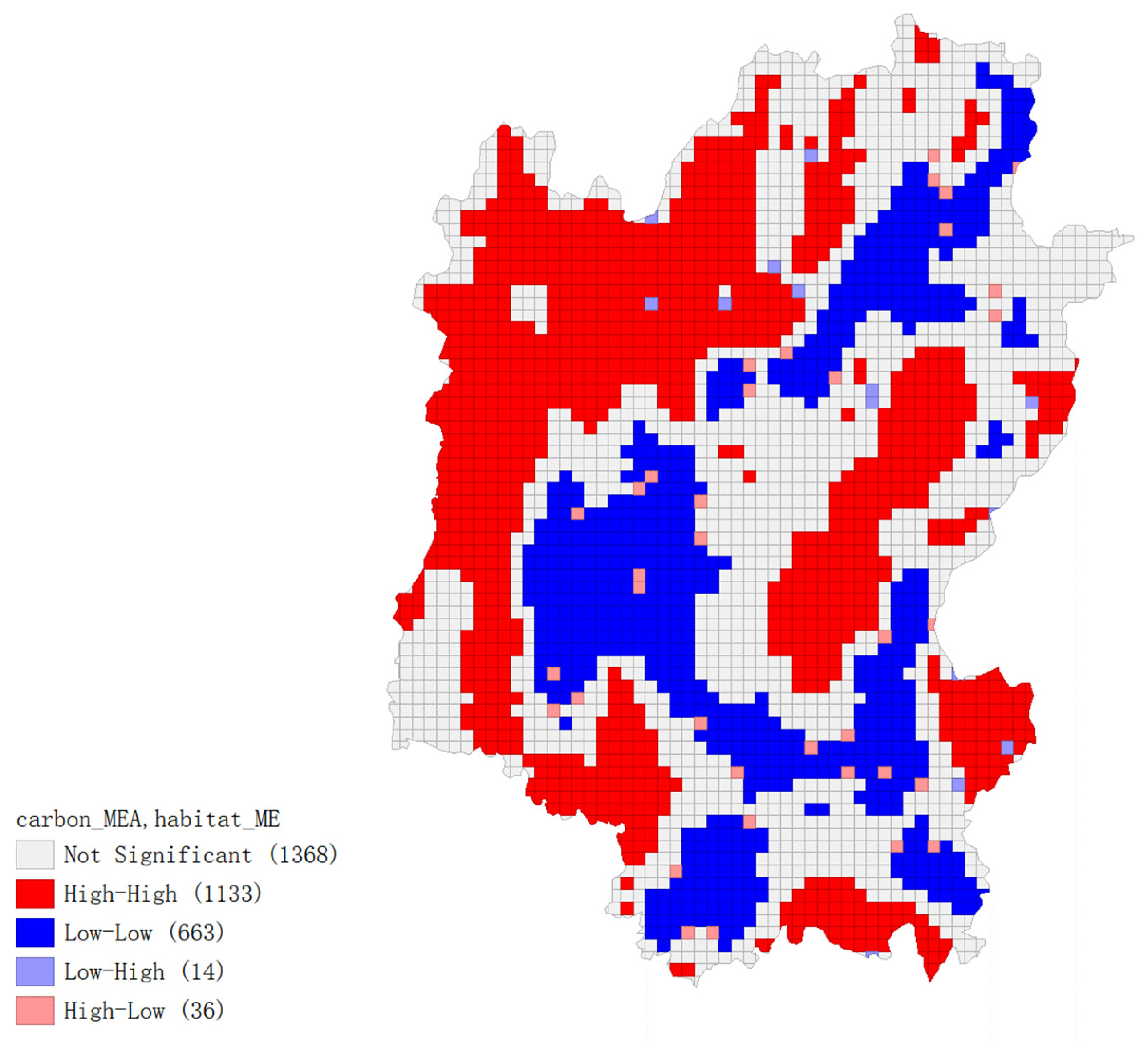
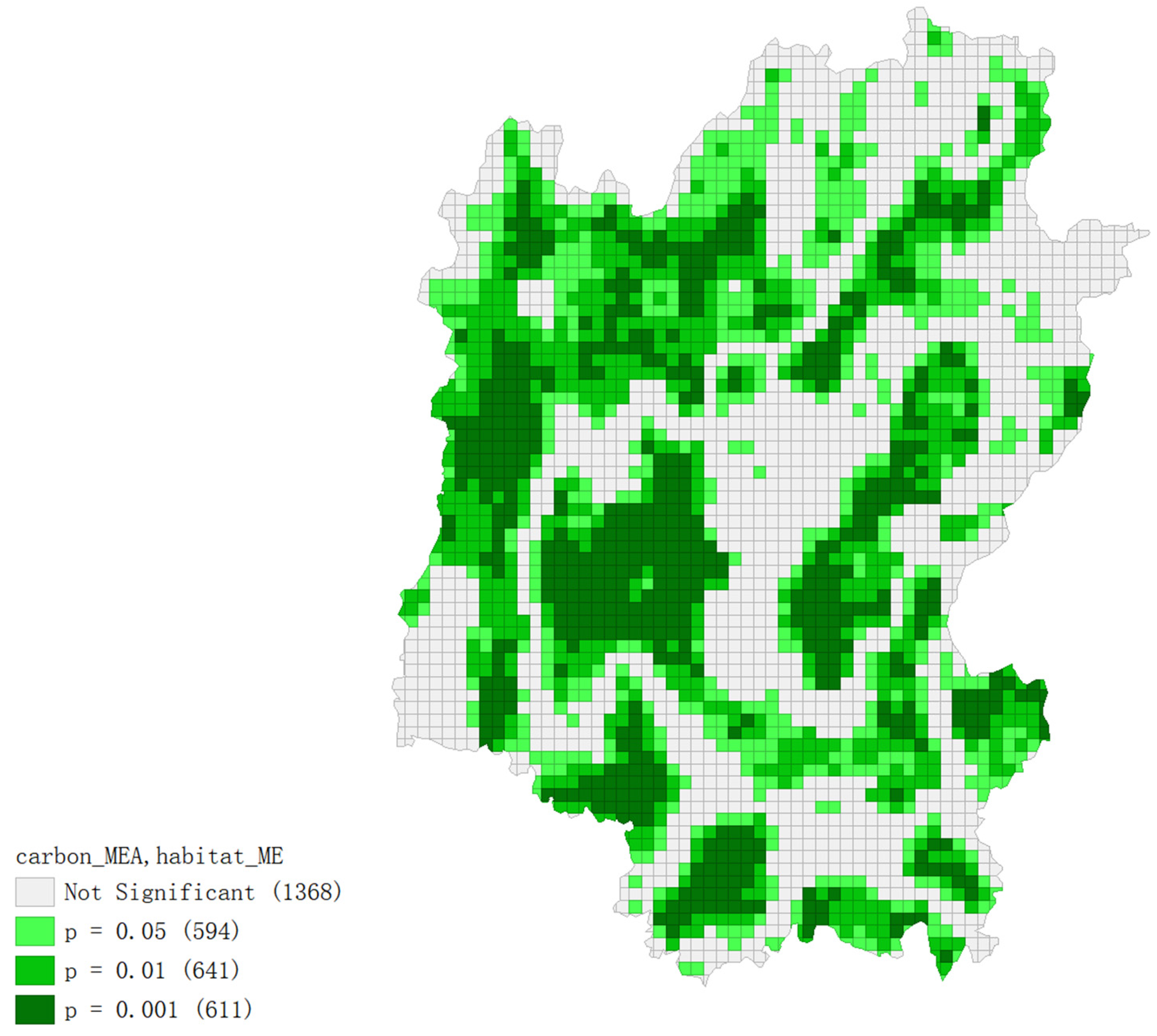
(1) Spatial Correlation between Carbon Storage and Habitat Quality (Figure 9 and Figure 10)
The global bivariate Moran’s I index of carbon storage and habitat quality was 0.695 (p < 0.001), indicating an extremely strong positive spatial dependence between the two services—i.e., a region with high carbon storage tends to be accompanied by high habitat quality in adjacent regions, and vice versa. The LISA clustering map further identified significant local spatial association types. The “High-High” synergistic area (high carbon storage–high habitat quality) is the dominant type, with 1133 significant units identified, widely and continuously distributed in the mountainous areas of Longsheng, Ziyuan, and northern Xing’an in the northwest of the study area, highly overlapping with the aforementioned high-coordination areas. The “Low-Low” trade-off area (low carbon storage–low habitat quality) identified 663 significant units, concentrated in the core urbanization areas such as Guilin’s central urban area, Lingui New Area, and southern Lingchuan County. In addition, there are a small number of discrete “High-Low” and “Low-High” heterogeneous areas, scattered in the urban–rural transition zone, which may indicate service decoupling phenomena caused by local special disturbances (such as mining, monoculture planting).
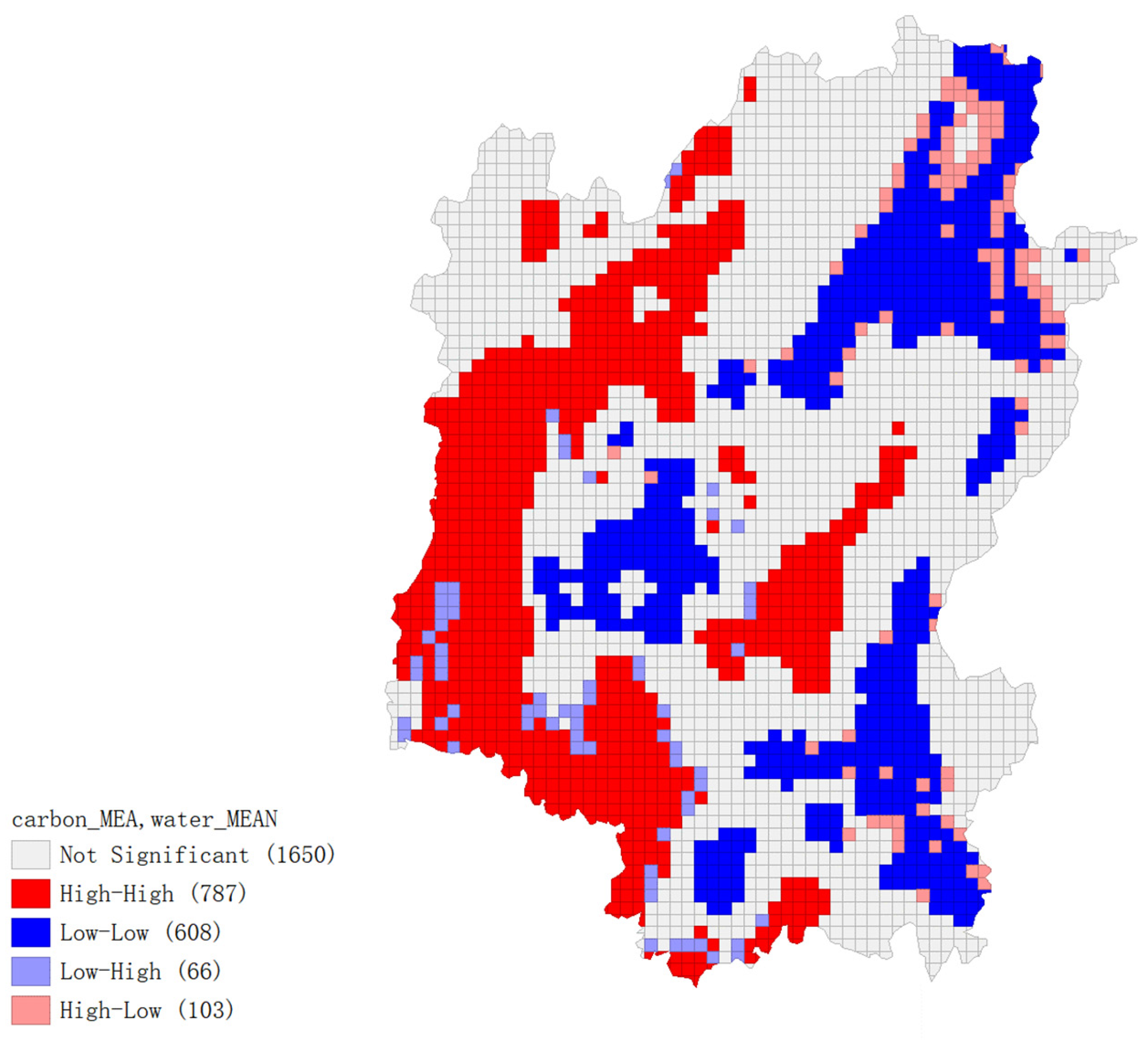
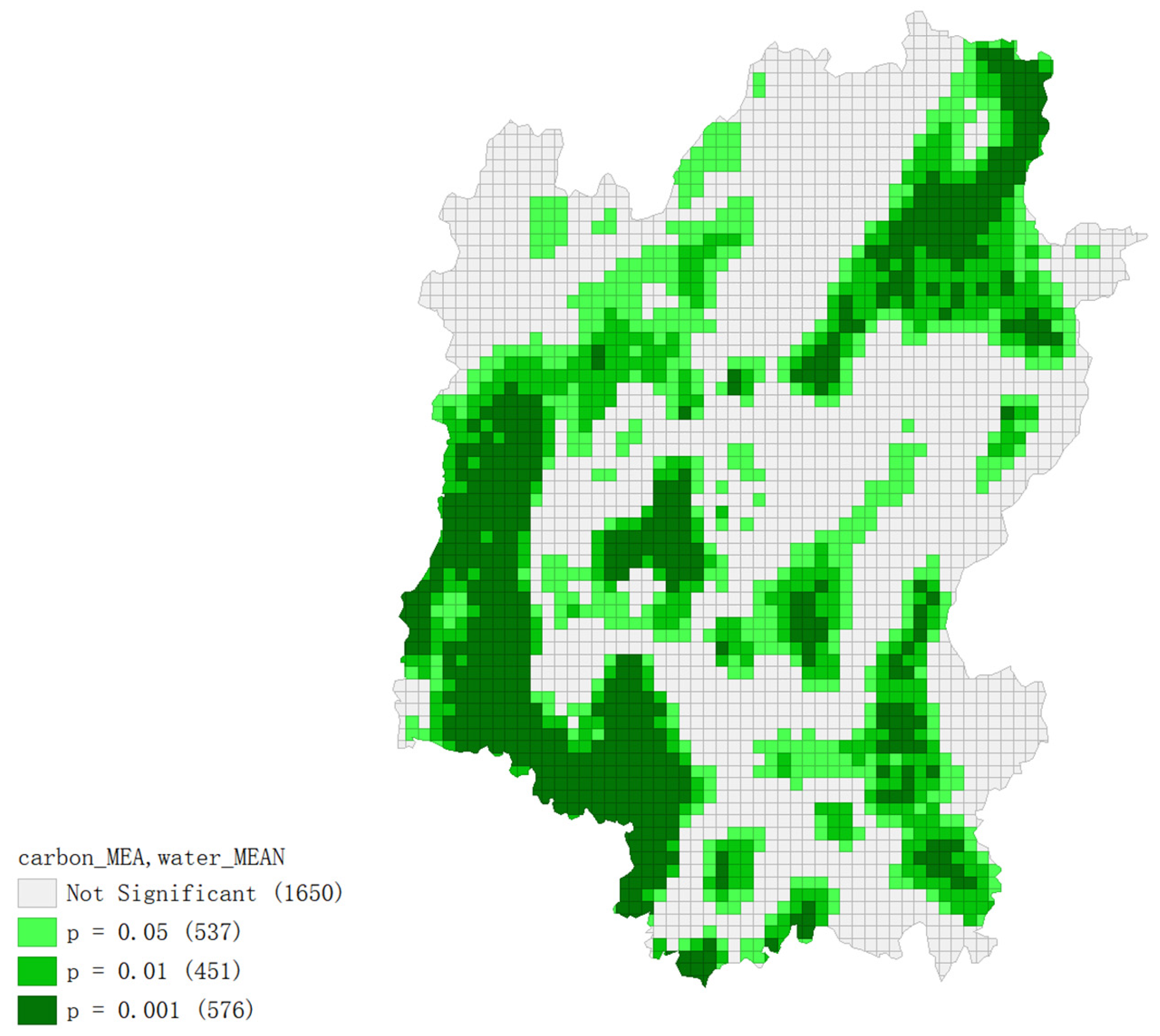
(2) Spatial Correlation between Carbon Storage and Water Retention (Figure 11 and Figure 12)
The global bivariate Moran’s I index of carbon storage and water retention was 0.578 (p < 0.001), showing a significant positive spatial autocorrelation between the two, but the intensity was slightly lower than that between carbon storage and habitat quality. The LISA clustering results show that the “High-High” synergistic area and the “Low-Low” trade-off area present a confrontational pattern in space. The “High-High” area also stably occupies the northwest forest ecosystem, while the “Low-Low” area is mainly distributed in urban and intensive agricultural areas in the central-eastern basin and along river valleys. Notably, the number and proportion of “Low-High” and “High-Low” heterogeneous areas are higher than those of the carbon storage–habitat quality pair, especially distributed along the middle and lower reaches of the Lijiang River and around some large reservoirs. This indicates that in regions where hydrological processes are active but strongly regulated by humans, the carbon accumulation process and hydrological regulation function may be locally decoupled.
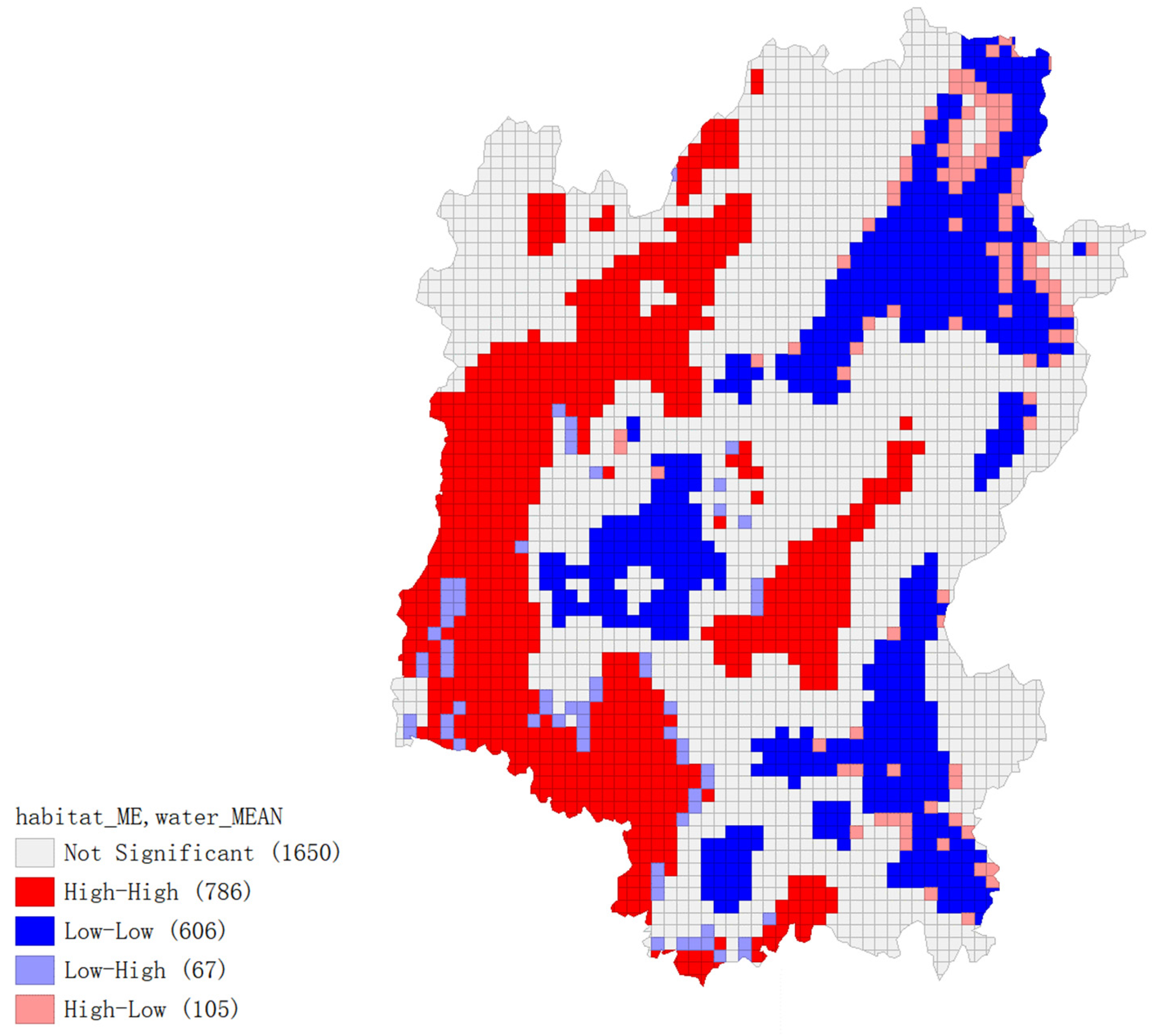
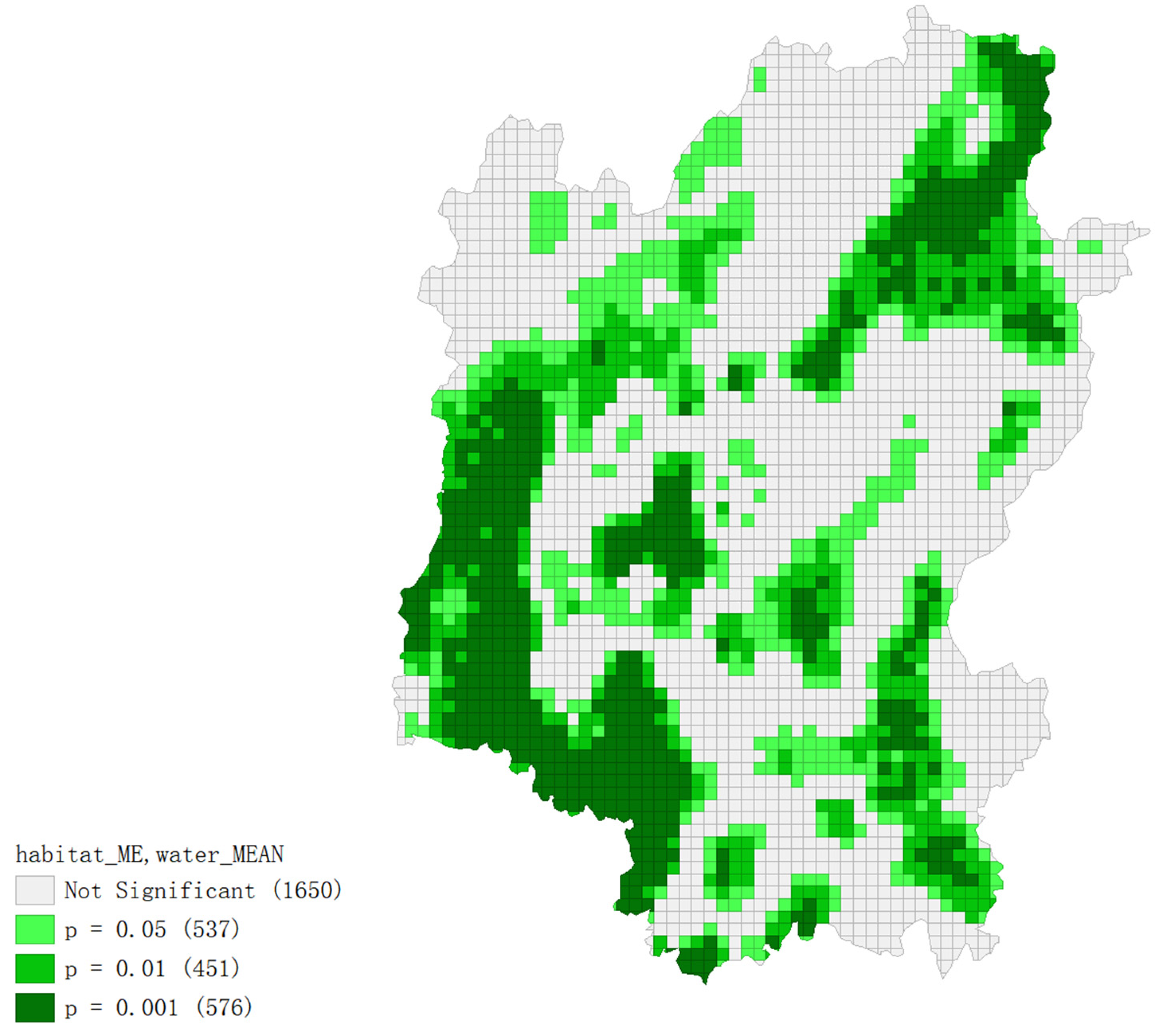
(3) Spatial Correlation between Habitat Quality and Water Retention (Figure 13 and Figure 14)
The global bivariate Moran’s I index of habitat quality and water retention was 0.580 (p < 0.001), with a correlation intensity equivalent to that of carbon storage–water retention. Its LISA clustering pattern is highly similar to that of the carbon storage–water retention pair but with slight differences. The “High-High” synergistic area and the “Low-Low” trade-off area are still the main types, with basically consistent spatial distribution ranges. However, the distribution of “High-Low” and “Low-High” heterogeneous areas is more scattered, appearing in both the eastern hilly agricultural area and the western artificial forest area. This may reflect subtle differences in the responses of habitat quality and water retention to land use and management methods. For example, in some karst areas with good vegetation coverage but severe soil compaction or underground leakage, an abnormal combination of “high habitat quality–low water retention” may form.
The bivariate spatial autocorrelation analysis confirmed that there is a strong positive spatial dependence between each pair of the three ecosystem services, dominated by two stable spatial clustering patterns: “High-High” synergy and “Low-Low” trade-off. This statistically strengthens the core conclusion that natural areas are synergistically improved while human activity areas are synergistically degraded from a spatial perspective. At the same time, the emergence of a small number of heterogeneous clustering areas (“High-Low”, “Low-High”) with clear spatial significance reveals the complex nonlinear relationships and service decoupling risks that may exist in the boundary zone between natural and human activity gradients, providing new spatial clues for accurately identifying key nodes of ecological restoration.

5.4.4. Driving Mechanism of Synergistic Pattern

To deeply reveal the formation mechanism of the synergistic pattern of the three types of ecosystem services, this study selected key factors including nighttime light intensity, population density, annual average precipitation, impervious surface ratio, forestland ratio, and cultivated land ratio (as shown in Figure 15, Figure 16, Figure 17 and Figure 18) based on the natural–social dual-drive theory, and constructed a multi-level driving analysis framework. Through correlation analysis, spatial superposition, and zonal statistics (see Table 9, Table 10 and Table 11), the following main findings were obtained:
(1) Significant negative driving effect of human activity intensity: The coordination degree D was extremely significantly negatively correlated with nighttime light intensity (r = −0.389, p < 0.001) and population density (r = −0.493, p < 0.001), indicating that high-intensity human activity is the main driving force of service trade-off. Spatial superposition analysis further confirmed that 70.8% of low-coordination areas (D < 0.5) are located in high-nighttime-light-value areas, 97.2% in high-population-density-value areas, and the overlapping area of the two reaches 70.3%. Human activities during urbanization have significantly reduced the multi-functional synergistic supply capacity of ecosystems through the expansion of impervious surfaces and resource competition.
(2) Key regulatory role of land use pattern: The coordination degree D was extremely significantly negatively correlated with impervious surface ratio (r = −0.504, p < 0.001), extremely significantly positively correlated with forestland ratio (r = 0.610, p < 0.001), and significantly negatively correlated with cultivated land ratio (r = −0.542, p < 0.001). Threshold analysis showed that among areas with impervious surface ratio lower than 15%, 98.8% have a coordination degree greater than 0.6; among areas with a forest ratio higher than 30%, 98.6% have a coordination degree greater than 0.7, which provides clear quantitative indicators for ecological management. Forestland promotes the synergy of multiple services by maintaining the integrity of ecosystem structure and functions, while the expansion of impervious surfaces disrupts the continuity of ecological processes.
(3) Complex spatial effect of precipitation factor: The coordination degree D was weakly negatively correlated with annual average precipitation (r = −0.028, p < 0.001), which is different from traditional results. Zonal comparison analysis revealed the reason for this phenomenon: the average coordination degree of high-precipitation areas (>1984 mm) was 0.885, while that of low-precipitation areas (<1792 mm) was 0.907. Further analysis found that the nighttime light intensity and population density in high-precipitation areas were significantly higher than those in low-precipitation areas, and the impervious surface ratio was also higher. This indicates that the impact of precipitation factor is masked by high-intensity human activities, forming a special pattern of “high precipitation–high human activity–low synergy,” reflecting the complex interaction between natural conditions and human activities.
(4) Spatial heterogeneity characteristics of driving factors: There are significant differences in the dominant driving factors in different land use type areas (Table 5). The urban area (impervious surface ratio > 50%) has the lowest coordination degree (0.221) and the highest impervious surface ratio (0.653), with the dominant driving factor being the expansion of impervious surfaces (r = −0.175). The forest area (forestland ratio > 70%) has the highest coordination degree (0.959), with the dominant driving factor being population density (r = −0.358), indicating that even in forest protected areas, human activity pressure still affects service synergy. The agricultural area (cultivated land ratio > 50%) has a medium coordination degree (0.752), also mainly affected by population density (r = −0.335). The mixed area shows the characteristics of combined driving of multiple factors.
Comprehensive mechanism and management implications: The synergistic pattern of ecosystem services in the study area is the product of the combined action of natural background conditions, land use patterns, and human activity intensity, with complex spatial interaction and masking effects among various factors. High forest coverage is the foundation for maintaining service synergy, while the expansion of impervious surfaces and high-intensity human activities are the direct causes of trade-offs. Notably, the impact of natural conditions such as precipitation may be masked by human activities, forming complex spatial heterogeneity. Suggestions: (1) strictly control the expansion of impervious surfaces (ratio < 15%) in rapid urbanization areas; (2) strengthen the management of population activities in ecological protected areas; (3) optimize the land use structure in agricultural areas to reduce the interference of human activities on ecological processes; (4) establish a “zoning-classification-grading” differentiated ecological management strategy, fully considering the spatial heterogeneity of driving factors.

5.5. Ecosystem Service Cluster Analysis

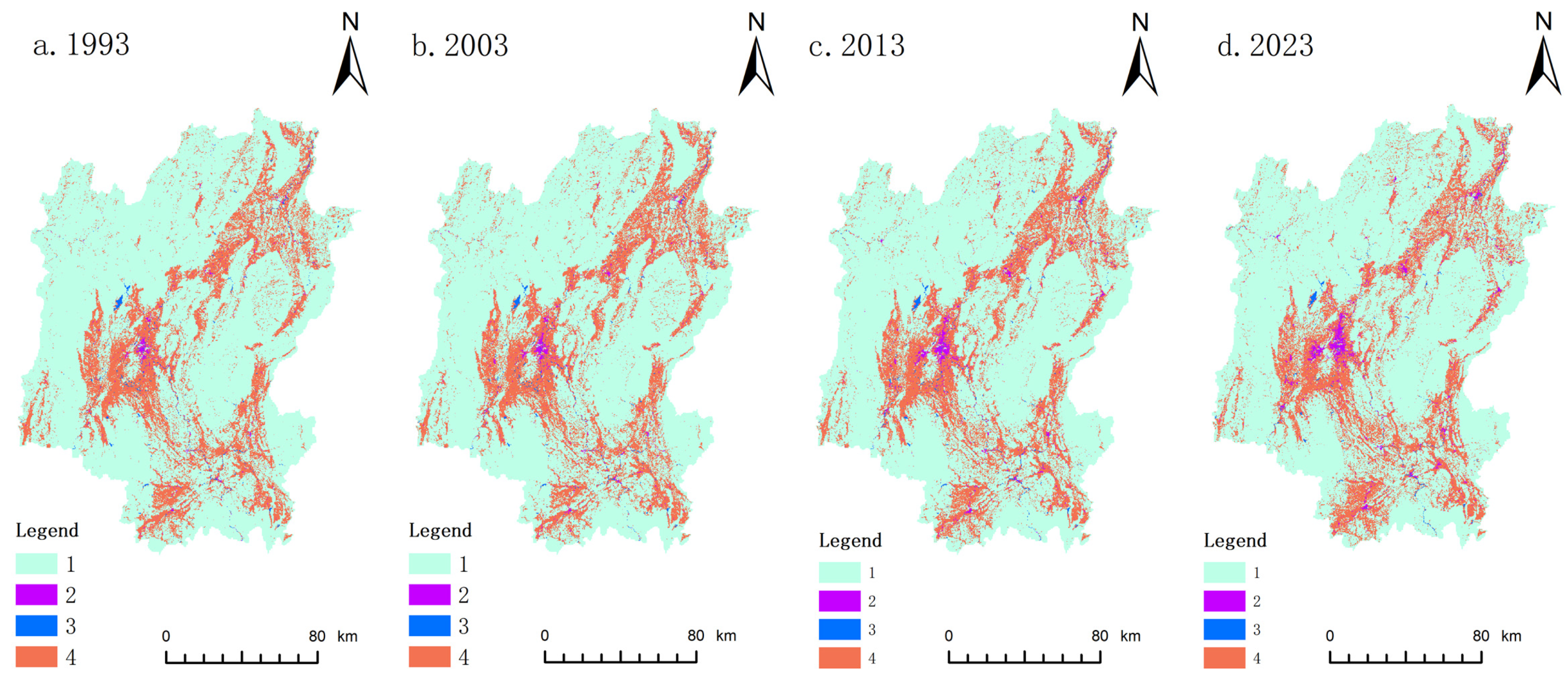
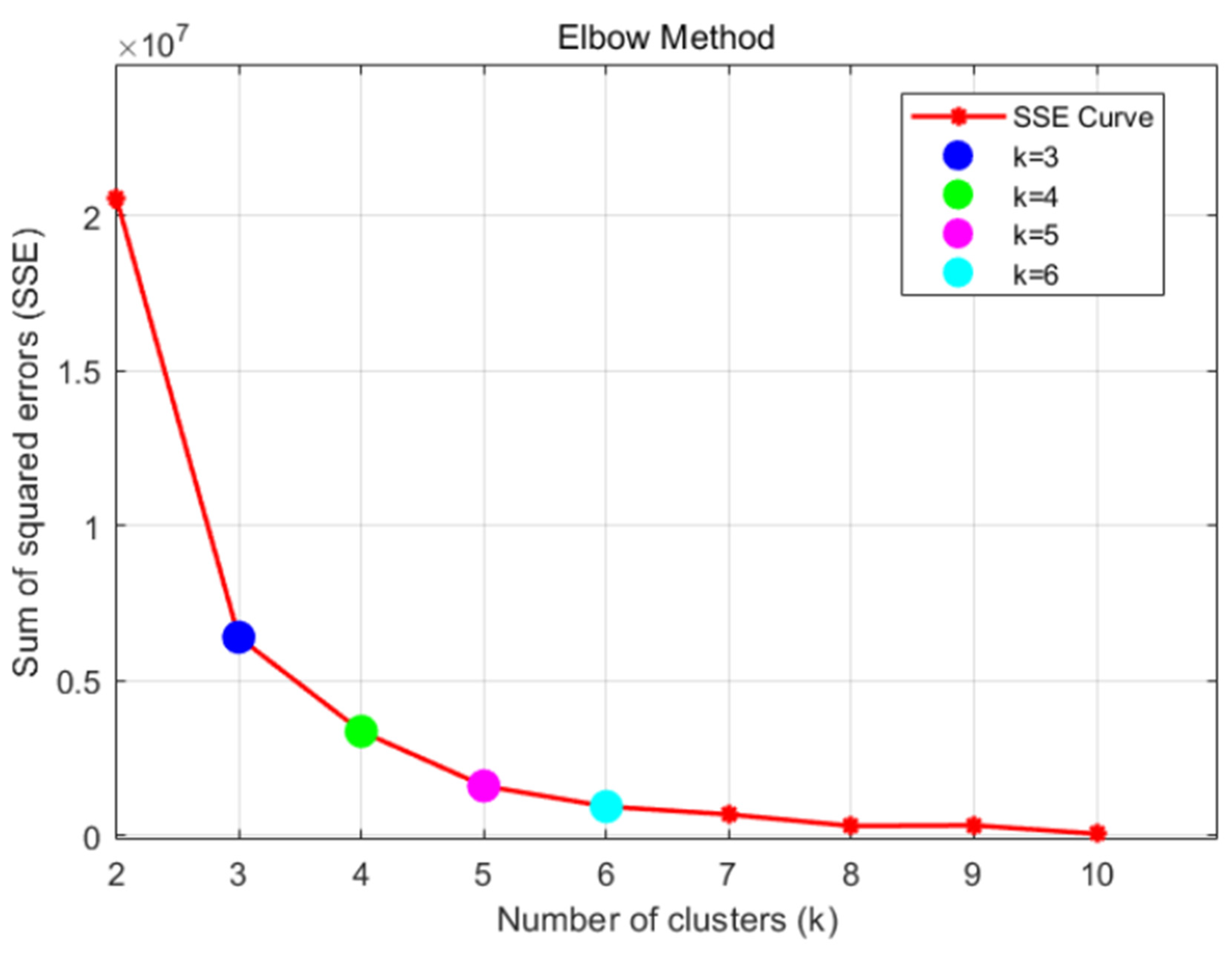
This study adopted the K-means clustering algorithm to carry out the identification and spatial differentiation research of Guilin’s ecological space service clusters. The number of clusters was determined by the elbow method (Figure A1) and comprehensively evaluated with multiple indicators including SSE (sum of squared errors), silhouette coefficient, and DB index (Davies–Bouldin index). Finally, the optimal number of clusters k = 4 was determined (see Table 12), forming four types of ecosystem service clusters (Figure 19). The visualization expression was completed by combining the numerical characteristics of three core indicators: carbon storage, habitat quality, and water retention. The specific characteristics and spatial distribution of each type of ecosystem service cluster are as follows:

5.5.1. Ecological Core Cluster (High-Density Carbon Sink Functional Area)

The Ecological Core Cluster is a high-density carbon sink functional area in Guilin and the core foundation of the regional ecological security pattern, accounting for 77.50% of the total area of the study area. This type of area is dominated by natural forests and secondary forests, extending from the edge of Guilin to the central hinterland spatially, constructing an ecological barrier network covering the entire region. From the perspective of time-series data, the average carbon storage of this cluster remained stable between 98.02 and 98.19 t from 1993 to 2023 (see Table 13), the average habitat quality always maintained the optimal level of 1.00, and the average water retention fluctuated between 907.16 and 1424.07 mm, with stable and prominent overall ecological service supply capacity. This wide distribution characteristic fully confirms Guilin’s high-quality carbon sink foundation dominated by forest wetlands. In the future, rigid management measures such as establishing protected area clusters and strictly controlling development intensity can be adopted to further strengthen the carbon storage and biodiversity conservation functions of such ecological core areas.

5.5.2. Degraded Carbon-Poor Cluster (Ecologically Fragile Extreme Area)

The Degraded Carbon-Poor Cluster is an ecologically fragile extreme area, with its habitat quality index maintaining the lowest level of 0.00 for a long time and the average carbon storage stabilizing between 18.08 and 18.10 t. It is the type with the worst ecological service capacity among the four types of service clusters, showing a “simultaneous functional collapse” state of carbon deficit and biological connectivity disruption. This type of cluster is spatially concentrated in Guilin’s urban core belt, dominated by high-intensity developed impervious surfaces and continuous impervious surfaces. Its area proportion gradually increased from 0.55% to 1.47% from 1993 to 2023, showing an obvious expansion trend. Time-series changes show that the water retention capacity of this cluster has significantly declined, with the average value dropping from 1016.63 mm in 1993 to 153.56 mm in 2023 (see Table 13), and the ecological base has been severely disturbed by human activities. For this area, it is urgent to adopt restoration measures such as introducing carbon sink green spaces and constructing ecological stepping-stone corridors along the Taohua River to promote the reconstruction of habitat networks and realize the synergistic improvement of carbon sink increment and habitat quality.

5.5.3. Habitat Protection Cluster (Biodiversity Conservation Priority Area)

The Habitat Protection Cluster is a biodiversity conservation priority area, showing a significant decoupling characteristic of carbon storage–habitat quality: the average carbon storage remained stable between 19.48 and 19.98 t from 1993 to 2023, only at a medium-low level, but the average habitat quality always maintained a high level of 0.90. This cluster is dominated by shrublands and riparian open woodlands, spatially distributed as a discrete patch network, mainly concentrated in ecologically sensitive areas such as around Qingshitang Reservoir in Lingchuan County and the upper reaches of the Chaotian River. Its area proportion remained between 0.46 and 0.58% from 1993 to 2023 (see Table 13), with a relatively stable distribution range. Restricted by natural conditions such as weak carbon sequestration capacity of shallow karst soil and rapid decomposition of litter, the soil carbon pool capacity in this area is relatively low. In the future, intervention measures such as supplementary planting of nitrogen-fixing and carbon-sequestering shrubs and litter mulching and returning carbon can be adopted to further enhance the carbon sequestration potential of karst areas while maintaining high habitat quality.

5.5.4. Buffer Balance Cluster (Medium-Low Carbon Sink Transition Area)

As a medium-low carbon sink transition area, the Buffer Balance Cluster constitutes a stable buffer zone for ecological service supply in Guilin. Its area proportion fluctuated between 20.20 and 21.56% from 1993 to 2023, accounting for 20.58% in 2023. This cluster is dominated by cultivated land, spatially distributed continuously in a belt along the middle reaches of the Lijiang River (Lingchuan-Yangshuo section), extending south to the Lipu River basin, and has dual service functions of food supply and habitat maintenance. Time-series data show that the average carbon storage of this cluster remained stable between 49.66 and 50.15 t, the average habitat quality between 0.39 and 0.42, and the average water retention between 760.40 and 1230.42 mm (see Table 13). Restricted by factors such as high cultivation intensity and low vegetation coverage, the carbon fixation level still has great room for improvement. It is recommended to adopt agroforestry composite management models, such as constructing ridge forest network buffer zones, to realize the synchronous improvement of cultivated land productivity and soil carbon pool capacity.
Figure 19. Clustering Results from 1993 to 2023. Note: 1: Ecological Core Cluster; 2: Degraded Carbon-Poor Cluster; 3: Habitat Protection Cluster; 4: Buffer Balance Cluster.
Sustainability 18 01977 g019

6. Discussion

6.1. Comparison with Existing Studies

Taking Guilin, a typical karst landform area, as the research object, this study revealed the spatiotemporal evolution and synergistic mechanism of three major ecosystem services: carbon storage, habitat quality, and water retention. The results are not only consistent with existing studies but also show differentiated characteristics due to the particularity of karst ecosystems.

6.1.1. Synergy Between Blue-Green Infrastructure and Ecosystem Services

In terms of the core conclusion that blue-green spaces dominate the synergy of ecosystem services, this study is highly consistent with existing studies. For example, Liu Song et al. (2025) pointed out that urban blue-green infrastructure achieves ecological benefit improvement through the dual driving of carbon sink increase and emission reduction [4]. This study found that in areas with dense blue-green spaces such as Longsheng Various Nationalities Autonomous County in northern Guilin, carbon storage, habitat quality, and water retention are highly synergistic, confirming the role of blue-green spaces as the core carrier of ecological services.
However, the particularity of karst landforms makes this study show unique laws: compared with non-karst urban agglomerations, Liu Yiwen et al. (2025) found that the high-value carbon sink areas of blue-green spaces in the Changsha-Zhuzhou-Xiangtan urban agglomeration are long-term stable and less disturbed, while in Guilin, due to the weak carbon sequestration capacity of karst soil and fragmented vegetation, even in ecological core areas, the carbon storage of the Habitat Protection Cluster is significantly lower than that of similar areas in Changsha-Zhuzhou-Xiangtan [7]; at the same time, the expansion rate of low-carbon-sink areas caused by tourism development in Guilin is much higher than that caused by urbanization in Changsha-Zhuzhou-Xiangtan, reflecting the higher sensitivity of karst ecosystems to human activities [7].

6.1.2. Dominance of Human Activities in the Mechanism of Driving Factors and Guilin’s Particularity

Existing studies generally state that human activities are the core negative factor for the degradation of ecosystem services. For example, Yang Jianhui et al. (2025) found that urban expansion in Xi’an led to the fragmentation of blue-green spaces [9]. In this study, the negative correlation coefficient between nighttime light intensity and carbon storage in Guilin increased from −0.0451 in 1993 to −0.2381 in 2023, and population density was significantly negatively correlated with the three services, which is consistent with this conclusion.
However, there are particularities in Guilin’s driving mechanism: First, generally speaking, precipitation has a positive driving effect on water retention, but in this study, the annual average precipitation in Guilin was weakly negatively correlated with the coordination degree (r = −0.028). The reason is that high-precipitation areas are mostly located in tourist-intensive areas along the Lijiang River, where human activity intensity is much higher than that in low-precipitation areas, and the positive effect of precipitation is masked, forming a unique pattern of “high precipitation–high disturbance–low synergy” [6]. Second, the short-term restoration effect of policies is more significant. From 2003 to 2013, the “Grain for Green” policy led to a 44.11% increase in the medium-value area of water retention in Guilin, and the shrinkage rate of high-value carbon storage areas slowed from −2.69% to −0.14%. This restoration efficiency is higher than that in non-karst areas, confirming the rapid response potential of karst ecosystems under policy intervention [8].

6.1.3. Expansion of Multi-Service Synergy Research

Existing studies mostly focus on single ecosystem services, while this study integrates carbon storage, habitat quality, and water retention, and identifies four types of functional areas through K-means clustering: Ecological Core Cluster, Degraded Carbon-Poor Cluster, Habitat Protection Cluster, and Buffer Balance Cluster. Among them, the decoupling characteristic of high habitat quality–low carbon storage in the Habitat Protection Cluster is a typical manifestation of the fragility of the soil carbon pool in karst areas, providing empirical evidence for the differentiation of karst ecological services in existing studies [5]. In addition, the coupling coordination degree analysis in this study is more comprehensive than single service evaluation, and the spatial differentiation of coordination degree in Guilin further reveals the game between natural background and human activities [7].

6.2. Limitations of the Study

Although this study systematically revealed the evolution and synergistic mechanism of ecosystem services in Guilin, it still has many deficiencies due to the limitations of data, models, and research scales.

6.2.1. Limitations in Data Accuracy and Representativeness

Carbon density data relies on literature reference rather than field measurement. This study refers to the modified carbon density data by Wei Zhenfeng et al. (2025), but the karst soil carbon pool in Guilin is characterized by shallow enrichment and easy leakage, and the soil organic carbon density varies greatly among different karst landforms [39]. The existing data do not refine such micro-differences, which may lead to deviations in carbon storage estimation.
There is a lack of direct data on tourism carbon emissions. Although it was found that the low-carbon-sink area in the Yangshuo tourist area expanded, direct data such as tourist volume and energy consumption of homestays were not obtained, so it is impossible to quantify the direct correlation between tourism activities and carbon sink loss, and only indirect inference through LUCC can be made, which weakens the accuracy of the driving mechanism.

6.2.2. Error Risks Caused by the Lack of Model Sensitivity Analysis

This study did not conduct a systematic model sensitivity analysis, which may lead to potential deviations in the accuracy and reliability of the results, mainly reflected in the uncertainty transmission error of InVEST model parameters. The operation of the InVEST model relies on key parameters such as carbon density and soil texture, while the spatial heterogeneity of parameters in karst areas is significant—for example, there are differences in carbon density between artificial forests and natural forests in Guilin, and the difference in soil infiltration rate between peak cluster areas and plain areas is large—but the study did not quantify the impact of parameter fluctuations on the estimation results of carbon storage and water retention. Referring to the study by Tan Hanze et al. (2025) in the Ten Kongdui River Basin, parameter selection deviations may lead to errors of 10–25% in ecosystem service assessment, thereby affecting the accuracy of coupling coordination degree and clustering analysis [47].

6.2.3. Lack of Research Scale and Scenario Simulation

Although this study selected four nodes (1993, 2003, 2013, and 2023), it did not construct a continuous time series, so it is impossible to capture short-term fluctuations in water retention caused by seasonal precipitation, nor did it carry out future scenario simulation. Compared with the scenario prediction of Changsha-Zhuzhou-Xiangtan by Liu Yiwen et al. (2025), the forward-looking utility of practical guidance is insufficient [7]; moreover, this study focuses on the municipal scale and does not conduct in-depth analysis on the impact of vegetation fragmentation on carbon sinks in the buffer zone along the Lijiang River. The spatial scale does not cover micro-patches, and compared with the micro-study of waterfront green spaces by Yuan Yangyang et al. (2025), it lacks detailed support for small-scale optimization [8].

6.3. Practical Significance and Transferability

6.3.1. Practical Guidance for Ecological Protection and “Dual Carbon” Goals in Guilin

This study provides a systematic spatialized plan for the coordinated advancement of ecological protection and “dual carbon” goals in Guilin and provides scientific reference for the construction of Guilin’s National Innovation Demonstration Zone for Sustainable Development Agenda. Based on the cluster zoning of carbon storage, habitat quality, and water retention (Ecological Core Cluster, Degraded Carbon-Poor Cluster, Habitat Protection Cluster, and Buffer Balance Cluster), it provides a basis for formulating differentiated management and control strategies in the future. Through the regulation of key driving factors, quantitative thresholds such as impervious surface ratio < 15% and forestland ratio > 30% are clarified, providing a direct basis for urban expansion and ecological restoration, and realizing the effective transmission from scientific assessment to planning implementation.

6.3.2. Transferability to Karst Cities

The framework and conclusions of this study have direct reference value for the southwest karst region of China. The integrated method of InVEST model, coupling coordination degree, and K-means clustering is suitable for the multi-service synergy diagnosis and spatial identification of fragile karst ecosystems. The proposed key driving factors and management thresholds such as human activity intensity, impervious surface, and forestland ratio can provide a clear ecological management basis for similar cities. The formed “zoning-classification-grading” strategy framework can be locally adjusted according to the background conditions and pressure characteristics of different karst cities to support the precise formulation of their ecological protection and restoration policies.

6.3.3. Reference Value for Non-Karst Cities

Although the study is based on karst landforms, its core concepts and methods also have reference significance for non-karst cities. The research paradigm emphasizing the multi-functional synergy of blue-green infrastructure in carbon sink increase, water conservation, and habitat protection can promote general cities to carry out multi-service evaluation and spatial optimization. The adopted natural–social dual-drive analysis framework helps reveal the general impact mechanism of human activities and land use on ecological services. In addition, the complete technical path from ecosystem service evaluation to ecological spatial zoning and then to the formulation of management and control strategies provides an operable example for non-karst cities to realize the transformation of ecological planning from qualitative description to quantitative decision-making.

7. Optimization Strategies for Blue-Green Infrastructure

As the core carrier of climate-adaptive planning, the construction of low-carbon resilience synergistic efficiency paths for urban blue-green space systems is an inevitable choice to achieve the “dual carbon” strategic goals. Through the Kruskal–Wallis non-parametric test of three ecological indicators in Guilin—carbon storage, habitat quality, and water retention—it was found that there are extremely significant differences among the four clustering clusters (p < 0.001). Effect size analysis shows that the differences between clusters in carbon storage (ε2 = 0.990) and habitat quality (ε2 = 1.000) are almost completely distinguishable, and water retention (ε2 = 0.519) also shows a large effect. The average values of each ecological indicator in the four clusters show obvious gradient changes. These results fully indicate that the clustering results based on k-means can effectively distinguish different ecological functional areas, and there are significant ecological gradient differences between each cluster, providing a precise spatial basis for formulating differentiated blue-green infrastructure optimization strategies.
Based on the 2023 clustering results, this study formulates differentiated blue-green infrastructure optimization strategies for the four types of clusters (see Table 14 and Table 15), as follows:

7.1. Ecological Core Cluster (High-Density Carbon Sink Functional Area)

This cluster is dominated by natural forests and secondary forests, with strong synergy among carbon storage, habitat quality, and water retention. It is the regional ecological security base with weak human activity disturbance, accounting for 77.50% of Guilin’s area, with high and stable forest coverage.
Therefore, for the Ecological Core Cluster, an integrated optimization strategy oriented to protection and function enhancement should be implemented. The primary task is to strictly restrict human disturbance, protect the existing forest structure and biodiversity, and promote natural succession to maintain its high carbon sink function [48]. On this basis, native tree species can be supplemented in suitable areas to construct multi-layer mixed forests of arbor–shrub–herb, further improving stand stability and carbon storage [49]. At the same time, efforts should be made to build ecological corridors to enhance the connectivity between this area and surrounding ecological patches, promote biological migration and gene flow, and thus consolidate the regional ecological network structure [50]. In addition, smart monitoring methods such as drones and sensors can be introduced to realize the precise management of stand health and carbon sink dynamics.

7.2. Degraded Carbon-Poor Cluster (Ecologically Fragile Extreme Area)

This cluster has the worst ecological service capacity, showing a “simultaneous functional collapse” state of carbon deficit and biological connectivity disruption. The habitat quality index has long held at 0.00, the average carbon storage is stable between 18.08 and 18.10 t, and the water retention capacity plummeted from 1016.63 mm to 153.56 mm from 1993 to 2023. Spatially concentrated in the urban core belt, dominated by high-intensity developed impervious surfaces, its area proportion increased from 0.55% to 1.47%, and the ecological base has been severely disturbed by human activities.
Therefore, for the Degraded Carbon-Poor Cluster, an integrated optimization strategy focusing on ecological restoration and system reconstruction should be adopted. The primary measure is to vigorously promote greening, including roof greening, vertical greening, and wall greening, and select native high-carbon-sequestering plants to quickly increase green volume and improve carbon absorption capacity [51]. At the same time, systematic construction of sponge facilities should be carried out, such as arranging rain gardens, sunken green spaces, and permeable pavements to enhance rainwater infiltration and storage functions and improve local microclimate and soil conditions [52,53]. In addition, idle spaces can be fully utilized to construct micro-wetlands and artificial wetlands, planting plants with purification functions to synergistically improve carbon sink and habitat functions [54]. Finally, community participation and carbon sink visualization can be promoted by setting carbon sink monitoring and display devices, enhancing public awareness and support for ecological restoration [55].

7.3. Habitat Protection Cluster (Biodiversity Conservation Priority Area)

This cluster shows a significant decoupling characteristic of carbon storage–habitat quality. The average habitat quality in the area always maintains a high level of 0.90, but the average carbon storage is only 19.48–19.98 t, at a medium–low level. Dominated by shrublands and riparian open woodlands, it is spatially distributed as discrete patches, concentrated in ecologically sensitive areas such as around Qingshitang Reservoir in Lingchuan County. Its area proportion remained between 0.46 and 0.58%, restricted by natural conditions such as weak carbon sequestration capacity of shallow karst soil and rapid decomposition of litter.
Therefore, for the Habitat Protection Cluster, an integrated optimization strategy focusing on the synergistic improvement of biodiversity conservation and carbon sink should be implemented. Considering the characteristics of high habitat quality but low carbon storage in this area, first of all, fast-growing and deep-rooted native arbor trees can be appropriately supplemented in the existing shrublands and open woodlands to effectively improve the carbon storage of plant communities [48]. At the same time, efforts should be made to construct a composite habitat system, creating a continuous habitat sequence from deep water, to shallow water, to tidal flats and forestlands, enhancing the structural complexity and functional stability of the ecosystem. In addition, it is necessary to actively promote low-impact development facilities such as ecological revetments and grassed swales to reduce soil erosion and maintain the integrity and health of habitat space [52]. Finally, citizen science monitoring projects can be carried out to encourage the public to participate in species observation and ecological data collection, further enhancing social awareness of ecological protection [55].

7.4. Buffer Balance Cluster (Medium–Low Carbon Sink Transition Area)

As a stable buffer zone for ecological service supply, this area is dominated by cultivated land, distributed continuously in a belt along the middle reaches of the Lijiang River (Lingchuan-Yangshuo section). From 1993 to 2023, the average carbon storage remained stable between 49.66 and 50.15 t, the average habitat quality between 0.39 and 0.42, and the average water retention between 760.40 and 1230.42 mm. It has dual functions of food supply and habitat maintenance, and its carbon fixation potential is relatively large, restricted by factors such as high cultivation intensity and low vegetation coverage.
Therefore, for the Buffer Balance Cluster, a composite optimization strategy focusing on the synergy of agriculture and ecology should be implemented. On the basis of ensuring food production, ecological agricultural models such as rice–fish–azolla symbiosis and fruit–grass–livestock composite can be vigorously promoted to improve soil carbon sink capacity and enhance system resilience [56]. At the same time, shelterbelt and hedgerow networks composed of arbor and shrub trees should be built along farmland boundaries and ditches, which can not only enhance the continuity of carbon sink space but also provide habitat and migration corridors for organisms [57]. In addition, under-forest economy should be actively developed, such as planting medicinal materials and edible fungi in orchards or forestlands, forming an operation mode of supporting long-term development with short-term benefits, and improving the comprehensive benefits of land use [58]. On this basis, an attempt could be made to establish an agricultural carbon sink monitoring system, and carbon sink trading pilots can be carried out to explore effective paths for realizing ecological value [58].

8. Conclusions

Taking Guilin, a typical karst city, as an example, this study systematically evaluated the spatiotemporal evolution and interaction of carbon storage, habitat quality, and water retention through coupling the InVEST model, spatial statistical analysis, and K-means clustering methods, and proposed blue-green infrastructure optimization strategies accordingly. The main conclusions are as follows:
(1) Revealed the human-activity-dominated ecosystem service degradation pattern and key management thresholds. From 1993 to 2023, carbon storage and habitat quality showed a spatial differentiation of “high in the northwest and low in the southeast,” and their low-value areas continued to expand with urbanization; the change of water retention was affected by both natural and engineering measures, but the urban–rural gradient difference still tended to be significant. Driving factor analysis showed that nighttime light intensity and population density are the core negative factors leading to service degradation. The study further clarified key land use thresholds for maintaining regional ecological functions: impervious surface ratio < 15% and forestland ratio > 30%.
(2) Clarified the spatial heterogeneous relationship of “overall synergy and local decoupling” of multiple ecosystem services in karst areas. Globally, the three services are significantly positively correlated, but coupling coordination degree analysis shows that high-coordination areas (accounting for 81.45%) are concentrated in the northwest forest areas, forming a stable synergistic core; low-coordination areas (accounting for 1.78%) are concentrated in urban built-up areas, showing a “carbon sink-habitat-water retention” coupled failure state. In addition, areas such as the Habitat Protection Cluster show a typical trade-off characteristic of “high habitat quality–low carbon storage,” revealing the service decoupling mechanism of karst ecosystems.
(3) Constructed a “zoning-classification-grading” blue-green infrastructure optimization framework based on ecosystem service clusters. The study area was divided into four types of functional areas: Ecological Core Cluster, Degraded Carbon-Poor Cluster, Habitat Protection Cluster, and Buffer Balance Cluster. According to their functional characteristics, differentiated strategies were proposed: implementing protection and connectivity enhancement for the Ecological Core Cluster, promoting vertical greening and sponge system reconstruction for the Degraded Carbon-Poor Cluster, carrying out habitat conservation and carbon sink synergistic improvement for the Habitat Protection Cluster, and developing ecological agriculture and shelterbelt network construction for the Buffer Balance Cluster. This framework realizes the connection from scientific assessment to spatial planning, providing an operable decision-making basis for ecological protection, “dual carbon” goal implementation, and sustainable development of karst cities.

Author Contributions

Conceptualization, Y.M.; methodology, Y.M.; software, Y.M. and S.L.; validation, Y.M., M.M. and S.L.; formal analysis, Y.M.; investigation, M.M. and W.L.; resources, Y.M.; data curation, M.M. and W.L.; writing—original draft preparation, M.M., W.L. and Y.M.; writing—review and editing, Y.W., Y.M. and S.L.; visualization, Y.M. and S.L.; supervision, Y.M.; project administration, Y.M.; funding acquisition, Y.M. All authors have read and agreed to the published version of the manuscript.

Funding

Project Coupling Research on Urban Ecosystem Service Value and Human Activity Intensity in Karst Areas—Taking Guilin City as a Case Study (Grant Number: S202510602267), supported by Guangxi Normal University’s Provincial Training Program of Innovation and Entrepreneurship for Undergraduates; Innovation Project of Guangxi Graduate Education (JGY2024076).

Institutional Review Board Statement

Not applicable.

Informed Consent Statement

Not applicable.

Data Availability Statement

Data supporting the results of this study are available from the first author upon reasonable request.

Conflicts of Interest

The authors declare no conflicts of interest.

Appendix A

Table A1. Carbon density table of different land use types in Guilin (t/hm2).
LULC_NameC_AboveC_BelowC_SoilC_Dead
Farmland23.7335.8181.810
Forest176.4482.3397.235.1
Shrub146.9359.9167.510
Grassland146.9359.9167.510
Waters116.599.900
Bare ground10.4052.60
Impervious surface5.4143.152.60
Table A2. Threat sources.
Threat SourceMaximum Impact
Distance(km)
WeightCorrelation
Farmland50.5linear
Impervious surface91exponential
Table A3. Suitability of habitat quality and sensitivity to different threat sources in different land use types.
NameHabitatSensitivity
FarmlandImpervious Surface
Farmland0.40.30.3
Forest10.60.9
Shrub10.60.9
Grassland0.80.20.6
Waters0.90.80.9
Bare ground000
Impervious surface000
Figure A1. Elbow method.
Sustainability 18 01977 g0a1

References

  1. Liu, D.; Deng, J.S.; Cheng, C.H.; Zhang, J.X.; Xu, W.T.; Liu, Q.Y.; Wu, L. Multi-platform remote sensing detection of greenhouse gases. Acta Opt. Sin. 2026, 46, 50. [Google Scholar]
  2. Chen, Q.K. Research on the Impact of Urban Population Agglomeration on Carbon Emissions. Ph.D. Thesis, Sichuan University, Chengdu, China, 2025. [Google Scholar] [CrossRef]
  3. Ding, Y.F. Research on the Optimization of Carbon Peaking and Carbon Neutrality Policies of Provincial Governments in China. Master’s Thesis, Guangdong University of Technology, Guangzhou, China, 2025. [Google Scholar] [CrossRef]
  4. Liu, S.; Bai, Z.C.; Liu, D.Z.; Shen, P.Y. Research progress and planning strategies for multi-scale carbon sink and emission reduction efficiency measurement of urban blue-green infrastructure. Landsc. Archit. 2025, 32, 14–22. [Google Scholar] [CrossRef]
  5. Wu, J.; Jiang, Z.L.; Wu, X.L. Research hotspots and trends of carbon sinks in urban blue-green spaces. Landsc. Archit. 2022, 29, 43–49. [Google Scholar] [CrossRef]
  6. Sun, M.M.; Lü, J.T.; Li, X.W.; Li, P.; Xiao, Z.Y.; Hao, J.Y.; Zhi, L.H. Urban-rural differences and scale effects of ecosystem services of blue-green infrastructure. Chin. J. Appl. Ecol. 2024, 35, 3295–3303. [Google Scholar] [CrossRef]
  7. Liu, Y.W.; Li, Z.X.; Yan, J.J. Spatiotemporal evolution and configuration improvement paths of carbon sinks in blue-green spaces of the Changsha-Zhuzhou-Xiangtan urban agglomeration. Acta Ecol. Sin. 2025, 45, 7349–7361. [Google Scholar] [CrossRef]
  8. Yuan, Y.Y.; Luo, S.C.; Yang, M.Z.; Huang, T.R.; Yao, S.D.; Mao, J.W.; Hong, Q.Y. Carbon sequestration efficiency of urban waterfront green spaces under the synergistic effect of water and greenery. J. Chin. Urban For. 2025, 23, 82–90. [Google Scholar] [CrossRef]
  9. Yang, J.H.; Liu, J.C.; Li, Y.Q.; Bai, C.M.; Wang, D.R. Trade-offs and synergies of ecosystem services in urban blue-green spaces of Xi’an based on Bayesian networks. J. Chin. Urban For. 2025, 23, 1–8. [Google Scholar]
  10. Xin, Y. Three places in China selected into the second batch of 100 Global Geoscience Heritage Sites. Science 2024, 76, 29. [Google Scholar] [CrossRef]
  11. Zhu, B.L.; Yang, Q.Y.; Xie, Y.Q.; Yan, D.; Tang, R.M.; Liu, D.C.; Zeng, H.C. Spatial distribution and driving factors of rocky desertification in the Lijiang River Basin. J. Guangxi Norm. Univ. (Nat. Sci. Ed.) 2021, 39, 139–150. [Google Scholar] [CrossRef]
  12. Zhang, K.Q.; Chen, J.J.; Hou, J.K.; Zhou, G.Q.; You, H.T.; Han, X.W. Research on the sustainable development of carbon storage in Guilin by coupling InVEST and GeoSOS-FLUS models. China Environ. Sci. 2022, 42, 2799–2809. [Google Scholar] [CrossRef]
  13. Huang, L.K.; Zhu, P.J.; Zhang, T.X.; He, L.; Wu, W.H.; Ge, Z.X.; Ai, H. Investigation of land subsidence in Guangdong Province, China, using PS-InSAR technique. Adv. Space Res. 2025, 75, 3507–3520. [Google Scholar] [CrossRef]
  14. Ni, L.K.; He, W.; Gu, D.X. Hyperspectral inversion of soil Ca content in karst areas of Guangxi. J. Jiangxi Agric. Univ. 2020, 42, 203–212. [Google Scholar] [CrossRef]
  15. Moalemi, S.; Ghadimi, M. Assessment of groundwater vulnerability in karst aquifer using GIS-based model. Int. J. Environ. Sci. Technol. 2025, 22, 16643–16660. [Google Scholar] [CrossRef]
  16. Xu, Y.L. Research on the Resilience of Tourism Social-Ecological Systems in Protected Areas. Ph.D. Thesis, Guangxi University, Nanning, China, 2025. [Google Scholar] [CrossRef]
  17. Yang, S.S.; Qiu, X.C.; Zhang, X.J. Preliminary estimation of carbon emissions from tourism in Guilin and analysis of decoupling relationship. J. Guilin Univ. Technol. 2014, 34, 797–803. [Google Scholar] [CrossRef]
  18. Kayleigh, H.T.; Ziter, C.D.; Barbara, F. What evidence exists for the use of urban forest management in nature-based carbon solutions and bird conservation: A systematic map protocol. Environ. Evid. 2022, 11, 34. [Google Scholar] [CrossRef]
  19. Chen, S.Y.; Qiu, J.; Yang, M. Addressing the green space management challenges of the Park City in China: How can nature-based solutions contribute? Environ. Dev. 2025, 55, 101235. [Google Scholar] [CrossRef]
  20. Li, Y.B.; Wang, Q.C.; Song, Y.R.; Xu, X.T.; Wang, Y.Q. Assessing nature-based solutions: A developed SCGE model for long-term environmental and social impacts of urban green spaces on sustainable development. Environ. Impact Assess. Rev. 2025, 112, 107776. [Google Scholar] [CrossRef]
  21. Alves, A.; van Opstal, C.; Keijzer, N.; Sutton, N.; Chen, W.S. Planning the multifunctionality of nature-based solutions in urban spaces. Cities 2024, 146, 104751. [Google Scholar] [CrossRef]
  22. Prodanovic, V.; Bach, P.M.; Stojkovic, M. Urban nature-based solutions planning for biodiversity outcomes: Human, ecological, and artificial intelligence perspectives. Urban Ecosyst. 2024, 27, 1795–1806. [Google Scholar] [CrossRef]
  23. Qiu, D.S.; Zhuang, D.F.; Hu, Y.F.; Yao, R. Estimation of carbon sink capacity caused by rock weathering in China. Earth Sci. (J. China Univ. Geosci.) 2004, 29, 177–182, 190. [Google Scholar] [CrossRef]
  24. Deng, X.Z.; Zhao, Y.H.; Zhan, J.Y.; Han, J.Z. Review on farmland carbon sink estimation models and their applications. J. Anhui Agric. Sci. 2009, 37, 17649–17652, 17691. [Google Scholar] [CrossRef]
  25. Liu, M.X.; Yuan, H.F. Research on biodiversity and protection countermeasures of wetlands in Dunhuang Xihu Nature Reserve. J. Arid. Land Resour. Environ. 2007, 11, 75–79. [Google Scholar] [CrossRef]
  26. Gao, L.; Zhao, Z.J.; Zhang, H.; Guan, X.B.; Xiao, M. Ecosystem service value estimation of Haikou City based on habitat quality and ecological location. Acta Sci. Nat. Univ. Pekin. 2012, 48, 833–840. [Google Scholar] [CrossRef]
  27. Meng, S.S.; Lu, R.C.; Pang, X.F. Evolution of habitat quality in Guangxi’s land border areas from 2000 to 2020. Res. Soil Water Conserv. 2023, 30, 376–385. [Google Scholar] [CrossRef]
  28. Zhang, T.F.; Wang, L.Q.; Song, Y. Analysis of spatiotemporal evolution characteristics of water retention in the gully region of the Loess Plateau. Water Conserv. Constr. Manag. 2025, 45, 63–70. [Google Scholar] [CrossRef]
  29. Wang, S.Y.; Hu, Z.Y.; Cheng, Y.J.; Li, H.; Liu, X.Y. Evaluation of typical ecosystem services and their trade-off and synergy relationships in Daxing District, Beijing. J. Beijing For. Univ. 2025, 47, 142–151. [Google Scholar] [CrossRef]
  30. Hu, F.; Zhang, Y.; Guo, Y.; Zhang, P.P.; Lv, S.; Zhang, C.C. Spatiotemporal changes and prediction of land use and habitat quality in the Weihe River Basin based on PLUS and InVEST models. Arid Land Geogr. 2022, 45, 1125–1136. [Google Scholar] [CrossRef]
  31. Guan, R.J.; Chen, Y.L.; Huang, X.B.; Lian, W.-H.; Liu, X.-G. Multi-scenario simulation of land use and ecosystem service response in southern Jiangxi based on PLUS-InVEST models. Environ. Sci. 2025, 46, 7270–7285. [Google Scholar] [CrossRef]
  32. Zhao, H.; Liu, Q.; Zhang, M.; Li, J.-Y. Spatial pattern and driving factors of ecosystem services in Beijing based on XGBoost-SHAP model. Environ. Sci. 2025, 1–16. [Google Scholar] [CrossRef]
  33. Zhu, B.L.; Deng, Y.; Xie, Y.Q.; Ke, J.; Wu, S.; Huang, J.; Hou, M. Study on carbon storage function of typical karst peak cluster depressions in Guilin. Carsologica Sin. 2023, 42, 785–794. [Google Scholar] [CrossRef]
  34. Dou, L.X.; Xu, L.T.; Li, W.Z.Y.; Xu, X.; Zhou, D.B.; Xu, Y. Evolution and simulation of land use and habitat quality in Jiangxi Province based on SD-PLUS-InVEST models. Environ. Sci. 2025, 1–18. [Google Scholar] [CrossRef]
  35. Wu, Y.T.; Yu, R.; Yu, Q.Q.; Wang, C.; Zhang, Z.H. Habitat quality evaluation and multi-scenario optimization in the Wanjiang River Basin. Ecol. Environ. Sci. 2025, 34, 961–973. [Google Scholar] [CrossRef]
  36. Wang, Y.Y.; Zhang, L.Z.; Zhen, Y.L.; Zhang, C.G.; Dong, J.Q.; Lu, X.H.; Zhang, X.Y. Impact of construction land expansion and cultivated land protection on terrestrial ecosystem carbon sinks in the Yangtze River Delta urban agglomeration. Geogr. Geo-Inf. Sci. 2024, 40, 35–41. [Google Scholar] [CrossRef]
  37. Li, Y.P. Study on sponge city construction in Guilin. Guangxi Water Resour. Hydropower 2025, 135, 123–125. [Google Scholar] [CrossRef]
  38. Yin, Y. Research on the Evaluation of Human Settlements in Guilin, a Landscape City. Master’s Thesis, Guilin University of Technology, Guilin, China, 2022. [Google Scholar] [CrossRef]
  39. Wei, Z.F.; Li, J.X.; Huang, Q.Y. Evolution of ecosystem carbon storage and driving impact of land use in Guilin from 2010 to 2020. Agric. Res. Appl. 2024, 37, 39–50. [Google Scholar] [CrossRef]
  40. He, J.Y.; Liang, Y.L.; Ou, F.Y.; Wen, F.; Peng, B. Spatiotemporal changes of habitat quality in Guangxi based on InVEST model. Guangxi Sci. 2025, 32, 362–373. [Google Scholar] [CrossRef]
  41. Zhang, C.S.; Fan, N.; Liu, C.L.; Xie, G.D. Spatiotemporal pattern and evolution of water retention function of ecosystems in China from 1990 to 2018. Acta Ecol. Sin. 2023, 43, 5536–5545. [Google Scholar] [CrossRef]
  42. Zhang, K.Q. Research on the Sustainable Function of Typical Ecosystem Services in Guilin. Master’s Thesis, Guilin University of Technology, Guilin, China, 2023. [Google Scholar]
  43. Liao, C.B. Quantitative evaluation of coordinated development between environment and economy and its classification system—A case study of the Pearl River Delta urban agglomeration. Trop. Geogr. 1999, 19, 76–82. [Google Scholar] [CrossRef]
  44. Shi, G. Measurement of the coupling degree between urbanization and ecological environment in China’s coastal zone—A case study of 8 coastal cities including Dalian. Urban Probl. 2018, 10, 20–26+52. [Google Scholar] [CrossRef]
  45. Yang, Y.; Li, C.Y.; Liu, Z.Y.; Wang, D.Q. Dynamic response relationship between ecosystem services and urbanization considering spatial scale in Zhangjiajie City. Environ. Sci. 2026, 1–23. [Google Scholar] [CrossRef]
  46. Ning, X.C. Research on the Spatiotemporal Evolution Characteristics and Spatial Effects of Health Tourism Suitability in Guangxi. Master’s Thesis, Nanning Normal University, Nanning, China, 2024. [Google Scholar] [CrossRef]
  47. Tan, H.Z.; Zhang, Z.Z.; Feng, K.; Luo, X.D.; Zhou, Q.C.; Liu, Y.; Zhang, D.Q. Coordination and driving mechanism of the water-energy-food-ecology coupling system in the Ten Kongdui River Basin based on the coupling coordination degree model. Pearl River 2025, 46, 101–112. [Google Scholar]
  48. Yao, W.; Wang, Y.W. Transformation of low-efficiency Eucalyptus forests in Weishan County under the “dual carbon” goal. J. Green Sci. Technol. 2024, 26, 98–103. [Google Scholar] [CrossRef]
  49. Jiang, K.R. Landscape design and health benefits of pocket parks in super-large cities. Shanghai Packag. 2025, 12, 119–121. [Google Scholar] [CrossRef]
  50. Cui, G.M.; Zhai, F.S. Application of ecological wisdom landscape concept in park plant landscape design. Anhui Agric. Sci. Bull. 2021, 27, 85–86. [Google Scholar] [CrossRef]
  51. Zhang, J.B. Research on Vertical Greening Landscape Design of Urban Street Space Under the Ecological Concept. Master’s Thesis, Xi’an University of Architecture and Technology, Xi’an, China, 2023. [Google Scholar]
  52. Sun, Y. Landscape design path based on low-carbon concept. Mod. Hortic. 2026, 49, 117–119. [Google Scholar] [CrossRef]
  53. Wu, T.T.; Li, Y.Y. Research on landscape design based on the sponge city concept—A case study of Chizhou Wetland Park. J. Heihe Univ. 2025, 16, 124–126. [Google Scholar] [CrossRef]
  54. Tan, S.S. Research on Planning and Design of Lake-Type Wetland Parks Based on Ecological Restoration Theory. Master’s Thesis, Guangxi University of Science and Technology, Liuzhou, China, 2025. [Google Scholar] [CrossRef]
  55. Zhao, G.W.; Wang, W.Q.; Yang, X.Y.; Yuan, Z.J. Perceptual differences of urban wetland ecosystem services in discourse and footprint practices: A case study of Guangzhou Haizhu National Wetland Park. Sci. Geogr. Sin. 2026, 1–11. [Google Scholar] [CrossRef]
  56. Chen, Z.D.; Liu, P.H.; Huang, X.S.; Weng, B.Q.; Pan, J.W.; Zhang, L.M. Construction of governance models and countermeasures for abandoned land in small watersheds of southern mountainous areas in China. J. China Agric. Univ. 2026, 31, 205–214. [Google Scholar]
  57. Luo, X.N. Research on Landscape Design of Slow-Traffic Spaces in Urban Community Greenways. Master’s Thesis, Nanjing Forestry University, Nanjing, China, 2025. [Google Scholar] [CrossRef]
  58. Weng, B.Q.; Li, Y.C.; Wang, Y.X.; Lin, Y.; Ye, J.; Liu, C.W. Construction and application research of a new modern ecological agriculture system: Theoretical models and countermeasures. Acta Ecol. Sin. 2026, 5, 1–12. [Google Scholar] [CrossRef]
Figure 1. Study area.
Sustainability 18 01977 g001
Figure 2. Spatial distribution pattern of carbon storage in Guilin from 1993 to 2023.
Sustainability 18 01977 g002
Figure 3. Spatial distribution pattern of carbon storage in Guilin from 1993 to 2023 (classified).
Sustainability 18 01977 g003
Figure 4. Spatial distribution pattern of habitat quality in Guilin from 1993 to 2023.
Sustainability 18 01977 g004
Figure 5. Spatial distribution pattern of habitat quality in Guilin from 1993 to 2023 (classified).
Sustainability 18 01977 g005
Figure 6. Spatial distribution pattern of water retention in Guilin from 1993 to 2023.
Sustainability 18 01977 g006
Figure 7. Spatial distribution pattern of water retention in Guilin from 1993 to 2023 (classified).
Sustainability 18 01977 g007
Figure 8. Spatial pattern of coupling coordination degree.
Sustainability 18 01977 g008
Figure 9. Spatial autocorrelation distribution pattern of carbon storage–habitat quality.
Sustainability 18 01977 g009
Figure 10. Spatial autocorrelation p-value distribution of carbon storage–habitat quality.
Sustainability 18 01977 g010
Figure 11. Spatial autocorrelation distribution pattern of carbon storage–water retention.
Sustainability 18 01977 g011
Figure 12. Spatial autocorrelation distribution pattern of habitat quality–water retention.
Sustainability 18 01977 g012
Figure 13. Spatial autocorrelation distribution pattern of habitat quality–water retention.
Sustainability 18 01977 g013
Figure 14. Spatial autocorrelation p-value distribution of habitat quality–water retention.
Sustainability 18 01977 g014
Figure 15. Spatial distribution of nighttime light in Guilin from 1993 to 2023.
Sustainability 18 01977 g015
Figure 16. Spatial distribution of population density in Guilin from 1993 to 2023.
Sustainability 18 01977 g016
Figure 17. Spatial distribution of LUCC types in Guilin from 1993 to 2023.
Sustainability 18 01977 g017
Figure 18. Spatial distribution of precipitation in Guilin from 1993 to 2023.
Sustainability 18 01977 g018
Table 1. Data sources.
Data TypeData Source
LUCC Data Zenodo (https://zenodo.org/)
2022 Administrative Boundary Data of Chinese CitiesNational Geomatics Center of China (http://www.ngcc.cn)
Carbon Pools DataGlobal Carbon Project (https://www.globalcarbonproject.org)
Threats TableIPBES Ecosystem Services Assessment Report (https://www.ipbes.net)
Sensitivity TableUnited Nations Environment Programme (UNEP, https://www.unep.org)
Precipitation Data National Tibetan Plateau Scientific Data Center (https://data.tpdc.ac.cn)
Potential Evapotranspiration National Tibetan Plateau Scientific Data Center (https://data.tpdc.ac.cn)
Soil DataFood and Agriculture Organization of the United Nations (https://www.fao.org)
Watershed DataScientific Data-Nature (https://www.nature.com)
Biophysical TableNatural Capital Project (https://naturalcapitalproject.stanford.edu)
Runoff CoefficientSustainability (https://www.mdpi.com)
Note: All spatial data in this paper are processed to a resolution of 30 m, with the coordinate system and projection uniformly adopted as China Geodetic Coordinate System 2000 (CGCS2000) Albers Equal Area Conic Projection.
Table 2. Changes in area proportion of carbon storage from 1993 to 2023.
PeriodArea
Proportion (Low)
Area
Proportion
(Medium)
Area
Proportion (High)
Change Rate (Low vs.
Previous
Period)
Change Rate
(Medium vs. Previous
Period)
Change Rate
(High vs.
Previous
Period)
19930.54%19.90%79.56%///
20031.34%21.24%77.42%+149.45%+6.72%−2.69%
20131.67%21.01%77.32%+24.67%−1.06%−0.14%
20231.90%20.79%77.32%+13.87%−1.08%−0.01%
Total Change+1.36%+0.89%−2.25%+254.11%+4.45%−2.82%
Table 3. Pearson correlation coefficients between carbon storage and driving factors from 1993 to 2023.
PeriodNighttime LightPopulation DensityPrecipitation
1993−0.0451−0.5512−0.0575
2003−0.0934−0.5685−0.0224
2013−0.1533−0.5908−0.1200
2023−0.2381−0.5849−0.0734
Average−0.1325−0.5739−0.0683
Note: All correlation coefficients are significant at p < 0.001.
Table 4. Changes in area proportion of habitat quality from 1993 to 2023.
PeriodArea
Proportion (Low)
Area
Proportion
(Medium)
Area
Proportion (High)
Change Rate (Low vs.
Previous
Period)
Change Rate (Medium vs. Previous
Period)
Change Rate (High vs.
Previous
Period)
19930.54%19.34%80.13%///
20030.77%20.63%78.60%+43.23%+6.67%−1.90%
20131.09%20.58%78.33%+41.98%−0.23%−0.35%
20231.44%20.39%78.17%+32.57%−0.94%−0.21%
Total Change+0.91%+1.05%−1.96%+169.57%+5.42%−2.44%
Table 5. Pearson correlation coefficients between habitat quality and driving factors from 1993 to 2023.
PeriodNighttime LightPopulation DensityPrecipitation
1993−0.0436−0.5545−0.0613
2003−0.0919−0.5692−0.0236
2013−0.1539−0.5962−0.1253
2023−0.2409−0.5921−0.0796
Average−0.1326−0.5780−0.0725
Note: All correlation coefficients are significant at p < 0.001.
Table 6. Changes in area proportion of water retention from 1993 to 2023.
PeriodArea
Proportion (Low)
Area
Proportion
(Medium)
Area
Proportion (High)
Change Rate (Low vs.
Previous
Period)
Change Rate (Medium vs. Previous
Period)
Change Rate (High vs.
Previous
Period)
19930.77%33.45%65.78%///
20031.35%25.74%72.91%+75.06%−23.04%+10.83%
20131.68%37.10%61.23%+24.46%+44.11%−16.02%
20231.91%23.98%74.11%+14.00%−35.36%+21.04%
Total Change+1.14%−9.47%+8.33%+148.38%−28.31%+12.65%
Table 7. Pearson correlation coefficients between water retention and driving factors from 1993 to 2023.
PeriodNighttime LightPopulation DensityPrecipitation
1993−0.0525−0.40460.5554
2003−0.1469−0.50200.4039
2013−0.2244−0.50080.3418
2023−0.2392−0.53060.2362
Average−0.1658−0.48450.3843
Note: All correlation coefficients are significant at p < 0.001.
Table 8. Pearson correlation coefficient matrix.
VariableCarbon StorageHabitat QualityWater Retention
Carbon Storage1.0000.9700.826
Habitat Quality0.9701.0000.775
Water Retention0.8260.7751.000
Note: All correlation coefficients are significant at p < 0.001.
Table 9. Analysis of dominant driving factors in different land use type areas.
Zonal TypeAverage Coordination DegreeAverage Precipitation (mm)Average Nighttime LightAverage Impervious Surface RatioAverage Forestland RatioAverage Cultivated Land RatioAverage Population Density (Persons/km2)Dominant Driving FactorCorrelation Coefficient of Dominant Factor
Urban Area0.2212039.958.440.6530.0720.2575565.6Impervious Surface−0.175
Forest Area0.9591880.90.4100.0020.9240.06837.4Population Density−0.358
Agricultural Area0.7521915.96.9010.0350.2850.672348.9Population Density−0.335
Mixed Area0.8321886.15.4020.0370.5620.384274.7Population Density−0.465
Table 10. Correlation coefficients between coordination degree D and each driving factor.
Driving FactorPearson Correlation Coefficient (r)p-Value
Forestland Ratio0.610<0.001
Impervious Surface Ratio−0.504<0.001
Cultivated Land Ratio−0.542<0.001
Population Density−0.493<0.001
Nighttime Light Intensity−0.389<0.001
Annual Average Precipitation−0.028<0.001
Table 11. Threshold analysis results.
Threshold ConditionProportion of Coordination Degree > 0.6Average Coordination Degree
Impervious Surface Ratio < 15%98.8%0.913
Forestland Ratio > 30%98.6%0.928
Table 12. Multi-indicator comprehensive evaluation of k value.
k ValueSSESilhouette CoefficientDB Index
31,346,439.990.98230.4316
4571,776.190.98960.1174
5120,956.050.71590.3257
638,365.810.78490.3100
Table 13. Average ecosystem service values and area proportions of each cluster in different periods.
YearClusterAverage Carbon Storage (±Standard Deviation)Average Habitat Quality (±Standard Deviation)Average Water Retention (±Standard Deviation)Area Percentage
1993Degraded Carbon-Poor Cluster 18.10 ± 0.0000.00 ± 0.0001016.63 ± 276.8120.55%
Ecological Core Cluster 98.19 ± 0.0001.00 ± 0.0001424.07 ± 124.50978.33%
Buffer
Balance Cluster
50.15 ± 2.4760.42 ± 0.1151230.42 ± 155.74020.55%
Habitat
Protection Cluster
19.48 ± 0.0000.90 ± 0.0001135.04 ± 210.2120.57%
2003Degraded Carbon-Poor Cluster 18.10 ± 0.0000.00 ± 0.000545.44 ± 238.5090.78%
Ecological Core Cluster 98.19 ± 0.0001.00 ± 0.000907.16 ± 78.50377.08%
Buffer
Balance Cluster
49.95 ± 1.9780.41 ± 0.095760.40 ± 114.81221.56%
Habitat
Protection Cluster
19.48 ± 0.0000.90 ± 0.000576.40 ± 238.6510.58%
2013Degraded Carbon-Poor Cluster 18.08 ± 0.4290.00 ± 0.000752.64 ± 249.8391.12%
Ecological Core Cluster 98.02 ± 2.4691.00 ± 0.0031211.37 ± 95.47177.32%
Buffer
Balance Cluster
49.66 ± 0.7140.39 ± 0.0241038.02 ± 138.31120.97%
Habitat
Protection Cluster
19.98 ± 4.5620.90 ± 0.011874.55 ± 232.0690.59%
2023Degraded Carbon-Poor Cluster 18.10 ± 0.0000.00 ± 0.000153.56 ± 26.3901.47%
Ecological Core Cluster 98.05 ± 2.2731.00 ± 0.0021050.25 ± 54.41877.50%
Buffer
Balance Cluster
49.67 ± 0.8120.39 ± 0.028839.19 ± 57.20220.58%
Habitat
Protection Cluster
19.48 ± 0.0000.90 ± 0.000258.13 ± 86.1210.46%
Table 14. Classification characteristics and management strategies of ecosystem service clusters in Guilin.
Type of Ecosystem Service ClusterCore Research FindingsConnection with Service Synergy/Decoupling MechanismOriented Spatial Zoning and Management Strategies
Ecological Core ClusterAccounts for as high as 77.50% of the area; all three services are at a high level with strong synergy.Confirms that forest-dominated karst areas are natural synergistic gain areas. High-quality forest ecosystems can simultaneously and efficiently provide multiple services.Identified as the core ecological protection area. Evidence supports the strategy of rigid protection to maintain its high-level comprehensive service supply as the base of the ecological security pattern.
Degraded Carbon-Poor ClusterSmall in area but continuously expanding; all three services are at extremely low values, and water retention capacity has declined sharply.Reveals the systematic collapse of ecosystems under high-intensity human disturbance, manifested as coupled failure between services, which is the area with the highest ecological risk.Identified as the ecologically fragile extreme area. Evidence indicates that systematic reconstruction strategies must be adopted to reverse its ecological deficit and curb its spatial spread.
Habitat Protection ClusterExtremely high habitat quality but medium–low carbon storage; showing a significant “carbon storage-habitat quality decoupling” characteristic.Reveals the trade-off relationship between services under specific landforms and land use. Provides scientific basis for the decision of protecting biodiversity or increasing carbon sinks.Identified as the priority biodiversity conservation and carbon sink improvement synergy area. Strategies need to be refined: on the premise of absolute habitat protection, targeted measures are taken to increase carbon sinks.
Buffer Balance ClusterDominated by cultivated land, providing medium-level but stable composite services.Shows the key buffer and balance role of agricultural ecosystems in multi-service supply, serving as a bridge connecting natural and artificial systems.Identified as the agriculture–ecology synergy improvement area. Evidence supports the synergy improvement of production and ecological functions through ecological agriculture and landscape improvement, rather than single protection or development.
Table 15. Proposed ecological zoning optimization plans, responsible subjects, and monitoring indicators.
Ecological ZoningProposed SolutionsImplementing Subjects and ProcessesKey Monitoring Indicators
Ecological Core Cluster1. Strict development control;
2. Supplementary planting of native tree species to optimize stand structure;
3. Construction of ecological corridors to enhance connectivity.
Subjects: Natural Resources and Forestry Departments, Protected Area Administration Bureaus.
Process: Control through territorial spatial planning legislation; use ecological restoration project funds to entrust professional teams to carry out forest tending and corridor construction.
1. Changes in forestland ratio
2. Forest carbon storage/carbon density.
3. Ecological connectivity index
Degraded Carbon-Poor Cluster1. Promotion of vertical greening and sponge facilities;
2. Construction of micro-wetlands and ecological stepping stones;
3. Community participation in carbon sink visualization.
Subjects: Housing and Urban–Rural Development Departments, Municipal Garden Departments, Sub-district Communities, Developers.
Process: Mandatory implementation of green building and sponge city standards in urban renewal and new construction projects; community organizations or social organizations lead the construction of micro-green spaces and public education activities.
1. Impervious surface ratio
2. Green space coverage rate
3. Rainwater runoff reduction rate and peak delay time.
4. Public satisfaction/awareness of ecological restoration
Habitat Protection Cluster1. Supplementary planting of carbon-sequestering native arbor trees;
2. Creation of composite habitats and ecological revetments;
3. Conduct of citizen science monitoring.
Subjects: Ecological Environment Departments, Water Conservancy Departments, scientific research institutions
Process: Special design in ecological protection and restoration projects; scientific research institutions design monitoring protocols
1. Habitat quality index
2. Changes in soil organic carbon content in supplementary planting areas
3. Population size of indicator species
Buffer Balance Cluster1. Promotion of ecological agricultural models (such as rice–fish symbiosis);
2. Construction of farmland shelterbelt networks and hedgerows;
3. Exploration of farmland carbon sink monitoring and trading pilots.
Subjects: Agriculture and Rural Affairs Departments, farmer cooperatives, agricultural enterprises
Process: Agriculture departments provide technical training and subsidies; cooperatives organize large-scale implementation.
1. Annual changes in soil organic carbon content
2. Farmland biodiversity index
3. Adoption rate and area of ecological agricultural technologies
Disclaimer/Publisher’s Note: The statements, opinions and data contained in all publications are solely those of the individual author(s) and contributor(s) and not of MDPI and/or the editor(s). MDPI and/or the editor(s) disclaim responsibility for any injury to people or property resulting from any ideas, methods, instructions or products referred to in the content.