Article

The Resilience of Agricultural Product Supply Chain: An Empirical Analysis Based on Spatial Spillover and Threshold Effects

School of Economics and Management, Hebei Agricultural University, Baoding 071000, China
*
Author to whom correspondence should be addressed.
Sustainability 2026, 18(4), 1975; https://doi.org/10.3390/su18041975
Submission received: 25 December 2025 / Revised: 6 February 2026 / Accepted: 12 February 2026 / Published: 14 February 2026
(This article belongs to the Section Sustainable Agriculture)

Abstract

This study draws on panel data from 31 Chinese provinces spanning 2012–2023 to develop a comprehensive indicator system capturing both the digital economy and agricultural product supply chain resilience. Anchored in the perspective of sustainable agricultural development, the analysis examines how the digital economy contributes to enhancing the resilience and long-term stability of agricultural product supply chains amid rising external uncertainties. The results show that the digital economy significantly improves supply chain resilience not only within a province but also across neighboring regions, indicating a clear digital empowerment effect with pronounced spatial spillovers. Further heterogeneity analysis reveals marked regional and urban–rural disparities: the estimated effects are substantially stronger in eastern China than in the central and western regions, and cities located within urban agglomerations experience more pronounced resilience gains than those outside such clusters. In addition, threshold analyses indicate that agricultural technological progress and industrial structure upgrading act as positive moderating factors, implying a nonlinear and stage-dependent relationship between the digital economy and agricultural product supply chain resilience. Overall, these findings underscore the role of digital development in fostering resilient and sustainable agricultural supply chains and provide insights relevant to coordinated regional development under the broader agenda of high-quality agricultural transformation.

1. Introduction

The resilience of agricultural product supply chains is central to national food security and constitutes a critical foundation for strengthening the agricultural sector. Amid accelerating globalization and intensifying climate change, agricultural supply chains are exposed to increasingly complex and multifaceted risks. Structural deficiencies remain evident, particularly in China’s cold-chain logistics and storage infrastructure, which constrain overall supply chain efficiency [1]. Inadequate information flows and imperfect supply–demand matching mechanisms further exacerbate logistics losses and undermine distribution efficiency, thereby weakening market supply capacity and price stability [2]. At the same time, agricultural production remains highly sensitive to natural conditions. Beyond sudden shocks such as extreme weather events, chronic resource constraints—particularly water scarcity—have emerged as a critical structural risk affecting the stability of agricultural production and supply chains. Persistent water shortages can constrain crop yields, disrupt planting schedules, and increase production uncertainty, thereby amplifying upstream supply volatility and transmission risks along agricultural supply chains. The rising frequency of extreme weather events, together with sudden public health emergencies, has repeatedly disrupted supply chains [3]. As illustrated by pandemic-related interruptions and disaster-induced production shortages, these shocks have revealed the vulnerability of agricultural supply chains to major disruptions [4]. External pressures have also intensified, as geopolitical tensions and trade frictions increasingly affect the cross-border circulation of agricultural products. In an environment characterized by heightened uncertainty and systemic risk, the stability of agricultural supply chains is not only essential for sustaining agricultural productivity in a populous and agriculture-dependent economy, but also closely linked to food security, economic development, and social stability. Enhancing supply chain resilience therefore plays a pivotal role in strengthening emergency response capacity, mitigating the adverse effects of external shocks on production and distribution, and supporting the long-term stability and structural upgrading of agricultural production systems [5].
Existing studies primarily examine the conceptual foundations, measurement approaches, and determinants of agricultural product supply chain resilience. The concept of supply chain resilience was initially introduced by Rice and Caniato and defined as the capacity of a supply chain system to withstand disruptions, maintain operations, and recover rapidly [6]. Compared with industrial products, agricultural products are characterized by pronounced seasonality, high perishability, and significant price fluctuations [7], making their supply chains more susceptible to unexpected shocks and underscoring the importance of resilience enhancement. Accordingly, agricultural product supply chain resilience is commonly conceptualized as a dynamic process encompassing resistance, adaptation, recovery, and innovation [8], and is theoretically decomposed into dimensions such as flexibility, visibility, collaboration, and redundancy [9]. In terms of measurement, most studies adopt indicator-based approaches to construct evaluation frameworks, incorporating dimensions such as infrastructure, information sharing, risk perception, financial security, and logistics efficiency [10]. In addition, a variety of quantitative methods, including inverse probability weighting [11], improved Grey-DEMATEL-ISM [12], the AHP-FCE model [13], and mixed grounded theory [14], have been employed to assess agricultural product supply chain resilience. With respect to influencing factors, existing research generally examines them from two perspectives: internal capabilities and the external environment. Internal factors include enterprise leadership, operational capabilities, information collaboration, technology adoption, and emergency management [2,15], whereas external factors encompass policy support, infrastructure development, supply–demand coordination, and access to financial services [1]. Among these factors, digital technology empowerment and coordinated regional development are widely regarded as key drivers of supply chain resilience [16]. Overall, despite a growing body of literature, existing studies tend to emphasize conceptual construction and indicator design [6,7,8,9,10,11,12,13], while providing limited insight into the dynamic evolution of resilience formation mechanisms and their systematic and complex characteristics. In particular, the adaptive and self-repair capacities of agricultural product supply chains in response to complex and diverse external shocks warrant further investigation [17].
As a key driver of supply chain resilience, existing research on the digital economy has predominantly focused on manufacturing and retail sectors, while empirical evidence for agricultural product supply chains remains relatively scarce. In this study, the digital economy is defined as an advanced system supported by digital infrastructure, with data as a key production factor, and driven by the deep integration of digital technologies with traditional industries [18]; in the context of agricultural supply chains, it primarily manifests through the application of digital technologies—such as big data, cloud computing, and digital platforms—that promote the networking and intelligent transformation of agricultural production and circulation. The existing literature generally examines the relationship between the digital economy and supply chain resilience from two perspectives: theoretical mechanisms and empirical evidence. At the theoretical level, scholars have clarified the mechanisms through which the digital economy enhances supply chain resilience, emphasizing dimensions such as resource integration, dynamic capability evolution, information processing efficiency, and system complexity regulation. Li et al. argue that digital technology, as a strategic resource, improves supply chains’ capacity for risk identification, resource integration, and dynamic restructuring, thereby enhancing overall resilience [19]. Shekarian et al. further suggest that under conditions of frequent external shocks, enterprises strengthen adaptability, responsiveness, and recovery through the continuous evolution of dynamic capabilities [20]. Drawing on information processing theory, Wang et al. emphasize that big data analytics significantly expands organizational information-processing capacity and alleviates persistent information asymmetry and delays within supply chain systems [21]. Waller et al. contend that the adoption of digital technologies, including real-time data collection, intelligent analytics, and visual monitoring, enables supply chain firms to better identify potential risks, optimize resource allocation and production scheduling, and enhance system stability and flexibility [22]. From the perspective of system complexity theory, Al-Banna et al. demonstrate that during digital transformation, organizations should adopt a structured roadmap and maintain a balanced relationship between supply chain resilience (SCR) and vulnerability (SCV), thereby strengthening adaptive resilience [23]. In the context of agricultural product supply chains, digital economy empowerment is expected to alleviate persistent vulnerabilities, including supply–demand mismatches, logistics delays, and information silos, thereby exerting a particularly pronounced effect on resilience enhancement [19,20,21,22,23].
At the empirical level, scholars have systematically investigated the mechanisms through which the digital economy influences supply chain resilience, drawing on micro-level enterprise data, industry surveys, and regional panel datasets. Zhao et al. employ a multiple mediation model to empirically identify the mediating role of digital technology elements—such as information transparency, real-time monitoring, and intelligent analytics—in linking digitalization to supply chain resilience [24]. Using data from China’s manufacturing sector, Wang et al. find that digital economy empowerment significantly enhances supply chain resilience by stimulating innovation capacity [25]. Moreover, the effect is more pronounced under conditions of high environmental uncertainty and exhibits heterogeneity across industrial structures and degrees of market competition. Although existing empirical evidence has begun to uncover the complex processes through which the digital economy enhances supply chain resilience, these mechanisms may operate in more intricate ways within agricultural product supply chains—characterized by high perishability and volatility—thereby warranting further empirical verification.
Overall, existing studies reveal several important gaps that warrant further investigation. Existing research on the interaction between the digital economy and agricultural product supply chains’ resilience remains limited. Much of the literature is confined to macro-level empirical analysis and lacks an in-depth exploration of the underlying mechanisms and system modeling tailored to the specific characteristics of agricultural supply chains. As a result, the theoretical logic through which digital technology is embedded in agricultural product supply chains to enhance resilience has yet to be fully clarified. In addition, empirical evidence is often based on limited regional samples and lacks systematic analysis using national-scale, multi-level panel data. This constraint weakens the robustness and generalizability of existing findings and limits their ability to capture heterogeneity across different stages of regional development. Furthermore, current studies tend to focus on the intraregional effects of the digital economy, paying relatively little attention to cross-regional spillover effects in the spatial dimension. The potential linkage effects arising from the cross-regional flow of digital infrastructure and data elements are also frequently overlooked, resulting in limited theoretical support and policy guidance for coordinated regional development and resilience enhancement. In response to these gaps, this study integrates spatial economics and threshold mechanism theory to examine how the digital economy shapes its transmission pathways and boundary conditions through spatial spillover effects and nonlinear threshold characteristics, thereby enhancing the resilience of interregional agricultural product supply chains.

2. Theoretical Analysis and Research Hypotheses

The digital economy enhances the risk resistance and dynamic adaptability of agricultural product supply chains through technological synergy, organizational transformation, and financial innovation. First, digital agricultural technologies enabled a deeper understanding of supply chain operations and provided a more solid basis for decision-making. On the production side, Internet of Things (IoT) and big data technologies allowed real-time monitoring of soil moisture, meteorological conditions, and crop growth, thereby supporting the dynamic optimization of agricultural production. These precision-based approaches not only mitigate natural risks but also facilitate early disaster warnings through data-driven predictive modeling, thereby improving overall supply chain stability [26]. In the circulation stage, blockchain technology enabled full-process traceability of agricultural products from farm to table through immutable distributed ledgers. Meanwhile, digital logistics platforms that integrate GPS tracking, route optimization, and intelligent scheduling improved distribution timeliness, reduced in-transit losses, and enhanced supply chain agility [27]. Second, organizational structures within supply chain networks were flexibly restructured. E-commerce platforms and digital marketing tools transcend geographical constraints, increase the density of inter-node connections, and integrate suppliers and retailers into more decentralized and flexible network structures. Such structures strengthen supply chain resistance to external shocks while improving adaptability and resource allocation efficiency through enhanced information sharing and resource reuse [28]. Third, digital financial innovation activated the endogenous driving forces of agricultural product supply chains. By reducing incentives for fraudulent joint lending, increasing potential penalties, and improving banks’ capacity to detect irregularities, blockchain-based technology helps curb opportunistic behavior among farmers. More importantly, digital finance alleviated the persistent mismatch whereby farmers fulfill contractual obligations yet continue to face financing constraints. In this way, it strengthens the resilience of capital flows within agricultural supply chains and mitigates long-standing financing bottlenecks [9]. Through these mechanisms, the digital economy unlocks latent value in agricultural product supply chains, generates technological dividends, and injects sustained momentum into regional development. Accordingly, this study proposes the following hypothesis:
H1. 
The digital economy can significantly enhance the resilience of local agricultural product supply chains.
The spatial spillover effect of the digital economy on the resilience of agricultural product supply chains was mainly reflected in four dimensions: technology diffusion, resource sharing, industrial linkage, and talent mobility. First, with respect to digital technology diffusion and the dissemination of innovative concepts, the business models and institutional arrangements generated by the digital economy provided important references for neighboring regions. Regions with more advanced levels of digital development disseminated agricultural Internet of Things (IoT), big data analytics, and artificial intelligence (AI) technologies through technical cooperation and industrial alliances. This process improved precision management in agricultural production, mitigated production risks, and enhanced supply chain stability at the source [29]. Second, in terms of logistics resource sharing and integrated market allocation, the digital economy promoted the development of logistics information platforms. The establishment of regional agricultural product big data centers facilitated the sharing of information on production conditions, price fluctuations, and market demand across neighboring regions. Enterprises and farmers could optimize production plans and sales strategies based on shared data, adjust crop structures and production scales, and reduce the risk of supply–demand mismatches. This cross-regional linkage mechanism enhanced the flexibility by integrating logistics enterprises, transportation resources, and warehousing facilities across regions. thereby reducing delays, accelerating supply chain responsiveness, and fostering a more interconnected supply chain network [6]. Third, in terms of industrial chain extension and regional coordinated development, the digital economy helped overcome constraints related to factor endowments and production methods. By leveraging economies of scale and synergy effects, it facilitated the formation of agricultural industrial clusters and promoted the extension of industrial chains in adjacent regions [30]. Fourth, with respect to talent mobility and knowledge diffusion, the digital economy attracted the concentration of professional talent. Through cross-regional exchanges and project-based collaborations, these professionals transmitted digital technology applications and supply chain management expertise to neighboring regions, thereby promoting mutual learning and knowledge spillovers. In addition, digital economy–enabled online education platforms allowed agricultural practitioners to access updated technologies, market information, and e-commerce skills, providing human capital support for strengthening agricultural product supply chains [31]. Based on this analysis, the following hypothesis is proposed:
H2. 
The digital economy exerted a positive spatial spillover effect on the resilience of agricultural product supply chains.
Agricultural technological progress refers to a dynamic process in which, under given institutional arrangements and factor allocation conditions, agricultural production factor efficiency is enhanced through technology development, adoption, and diffusion, thereby promoting the transformation of agricultural production toward efficiency- and quality-oriented modes [32]. In regions with relatively high levels of digital economy development, agricultural technological progress exerts complex and diverse empowering effects on the resilience of agricultural product supply chains. In such regions, agricultural technological progress initially acted as a key driver that significantly enhanced supply chain resilience [33]. In the production stage, advances in planting and breeding technologies improved both the yield and quality of agricultural products. In the logistics stage, innovations in cold chain logistics enhanced transportation conditions for perishable products, as efficient refrigeration equipment and temperature monitoring systems reduced loss rates during in-transit losses and ensured that fresh products reach consumers in a timely and intact manner, thereby improving supply chain timeliness and stability. From an information perspective, the application of big data and Internet of Things (IoT) technologies reduced information asymmetries. Real-time collection of production, inventory, and sales data enabled efficient information sharing across supply chain links, thereby improving collaborative efficiency, response speed, and adaptability to market fluctuations. However, this enabling effect may not be sustained and could weaken or even be reversed beyond a certain stage, mainly due to constraints in technology application [34]. Despite continuous innovation, some regions experienced limitations in technology diffusion and adoption. On the one hand, farmers’ relatively limited educational attainment restricted their ability to adopt and effectively use new technologies; on the other hand, insufficient supporting infrastructure and services hindered the transformation of data into actionable decision-making inputs. Moreover, the rising costs associated with technological progress may exert negative effects on supply chain resilience. The adoption of advanced technologies often requires substantial investments in equipment, skilled labor, and training. If these costs are not compensated by improvements in efficiency or product value, profit margins may be compressed, incentives among supply chain participants may be weakened, and overall resilience may be reduced. Based on this analysis, the following hypothesis is proposed:
H3. 
Agricultural technological progress induced a nonlinear effect on the relationship between the digital economy and the resilience of regional agricultural product supply chains.
Agricultural industrial structure reflects the configuration and evolutionary dynamics of different agricultural sectors and related activities in terms of resource allocation, division of labor, and value creation [35]. Its adjustment process essentially involves optimizing industrial layout and production organization, thereby promoting the transformation of agriculture from a single production-oriented model toward a more diversified, coordinated, and efficiency-oriented development path. As the industrial structure evolved from a low to a high stage, it created more favorable conditions for resource allocation, technological upgrading, and coordinated development within agricultural product supply chains. At different stages of industrial structure upgrading, the impact of the digital economy on agricultural product supply chains may have exhibited a “critical mass” effect [36]. At lower stages of industrial structure, regional infrastructure—particularly in rural areas—remained relatively underdeveloped. Limited network coverage, unstable connectivity, incomplete logistics and distribution systems, and shortages of skilled digital talent and capital investment constrained the application and diffusion of the digital technologies within agricultural product supply chains. Although the digital economy had progressed in some regions, inter-industry synergies and technology spillovers had yet to reach sufficient scale, limiting their deep integration with agricultural product supply chains and weakening their capacity to enhance supply chain resilience. By contrast, as regional industrial structures advanced toward higher levels of industrialization and servitization, more favorable conditions emerged for the deep integration of the digital economy and agricultural product supply chains. This process facilitated the formation of a more complete digital industry ecosystem and supporting service system. At this stage, the network and multiplier effects of the digital economy gradually materialized, substantially improving collaborative efficiency and risk resilience across all nodes of the agricultural product supply chain. Based on this analysis, the following hypothesis is proposed:
H4. 
Industrial structure upgrading induced nonlinear effects in the relationship between the digital economy and the resilience of regional agricultural product supply chains.

3. Research Design

3.1. Theoretical Model

3.1.1. Kernel Density Estimation Model

To illustrate the spatiotemporal evolution of the digital economy and the resilience of agricultural product supply chains, this study employs kernel density estimation, where f ( x ) denotes the density function of the variable x .
f ( x ) = 1 n h i = 1 n K ( x i x 0 h )
In Formula (1), x denotes the level of the digital economy and the resilience of agricultural product supply chains; x 0 indicates the mean value of x ; n refers to the number of provinces; h denotes the bandwidth; and K ( · ) represents the kernel function.

3.1.2. Benchmark Regression Model

To investigate the mechanism by which the digital economy enhances the resilience of agricultural product supply chains, this study establishes the following baseline econometric model:
A S C R i t = α 0 + α 1 D E i t + α 2 C o n t r o l i t + v i + v t + ε i t
In Formula (2), i and t denote provincial-level regions and years, respectively; A S C R is the dependent variable, representing the provincial-level resilience of agricultural product supply chains; D E is the core explanatory variable, indicating the provincial-level development of the digital economy; C o n t r o l represents the set of control variables; v i and v t denote the fixed effects for provinces and years, respectively; and ε i t denotes the random error term.

3.1.3. Spatial Regression Model

To examine the spatial spillover effects of the digital economy on the resilience of agricultural product supply chains, this study employs a Spatial Durbin Model (SDM) and specifies the econometric model as follows:
A S C R = β 0 + ρ × W × A S C R i t + β 1 I n D E i t + β 2 C o n t r o l i t + β 3 × W × I n D E i t + β 4 × W × C o n t r o l i t + v i + v t + ε i t
In Formula (3), W denotes the spatial weight matrix; ρ represents the spatial regression coefficient of the dependent variable; β 1 and β 2 are the estimated coefficients of the explanatory and control variables, respectively, capturing their direct effects on provincial-level agricultural product supply chain resilience; β 3 and β 4 are the spatial regression coefficients of the explanatory and control variables, respectively, reflecting their spatial spillover effects on provincial-level agricultural product supply chain resilience.
Regarding the selection of the spatial weight matrix, this study constructs the following: (1) the inverse distance spatial weight matrix ( W d ), which employs the reciprocal of the distance ( d i j ) between provincial capital cities to characterize the geographical spatial relationships among provinces. The elements of this matrix are calculated as follows:
W i j d = W i j d / j = 1 n w i j d , i j ,   w i j d = 1 d i j 0 , i = j
(2) The spillover effect of the digital economy on the resilience of agricultural product supply chains is influenced not only by geographical proximity but also by differences in regional economic development levels. To mitigate potential biases in the conclusions, this study incorporates regional per capita GDP to construct a nested geographical–economic distance weight matrix ( W d e ), which captures the spatial correlation among regions by jointly considering geographical distance ( d i j ) and economic distance ( e i j ). In addition, to prevent the “island effect,” Hainan Province and Guangdong Province are treated as adjacent regions.
W i j e = w i j e / j = 1 n W i j e , i j 0 , i = j , w i j e = 1 / E i E j , i j 0 , i = j
W de = τ W d + ( 1 τ ) W e
Following the approach of Shao Shuai et al., this study sets τ = 0.5, and the elements of the standardized nested spatial weight matrix ( W i j * d e ) are defined as follows:
W i j * d e = W i j d e / j = 1 n w i j d e , i j 0 , i = j

3.1.4. Threshold Regression Model

To investigate the nonlinear effects of the digital economy on the resilience of agricultural product supply chains, a threshold regression model is specified as follows:
A S C R i t = λ 0 + λ 1 D E i t · I A T P i t η 1 + λ 2 D E i t · I η 1 A T P i t η 2 + + λ n D E i t · I ( η n 1 A T P i t η n ) + C o n t r o l i t + v i + v t + ε i t
A S C R i t = λ 0 + λ 1 D E i t · I ( I S i t η 1 ) + λ 2 D E i t · I ( η 1 I S i t η 2 ) + + λ n D E i t · I ( η n 1 I S i t η n ) + C o n t r o l i t + v i + v t + ε i t
In Formulas (8) and (9), A T P i t , I S i t are the threshold variables, representing agricultural technological progress and industrial structure, respectively. η 1 η n denote the threshold values. I is an indicator function that equals 1 when the condition in the parentheses is satisfied and 0 otherwise.

3.2. Variable Definition and Measurement

3.2.1. Core Explanatory Variable

To more comprehensively measure the level of the digital economy at the provincial level, this study draws on prior research by Li Ziyuan et al. [37] and Zhu Jingmin and Lu Xiaoli [38] to construct an evaluation index system for the digital economy. As a new form of economic development driven by digital technologies, the digital economy is not only reflected in the completeness of digital infrastructure, but also in the depth of digital technology penetration across industrial systems and the breadth of digital application scenarios. Based on this understanding, we develop a multidimensional digital economy index system encompassing three dimensions—digital infrastructure, digital industrialization, and industrial digitalization (Table 1)—to systematically capture the overall level of regional digital economy development. To enhance the objectivity of indicator weighting and reduce biases arising from subjective judgment, this study employs the entropy weight method to construct a composite index of the digital economy based on multiple dimensions. This method determines indicator weights according to the degree of information dispersion across regions, thereby providing a more objective reflection of interprovincial differences in the level of digital economic development. The calculation formulas are presented as follows:
w j = 1 e j j = 1 m ( 1 e j )
In Equation (10), w j denotes the weight of the j evaluation indicator, where w j 0 ,   1 and the sum of all indicator weights equals 1, e j represents the entropy value of the j evaluation indicator, which is used to measure the degree of dispersion of the indicator. The entropy value is calculated as follows: e j = 1 I n ( n ) i 1 n p i j I n ( p i j ) , where n denotes the number of evaluation objects and m denotes the number of evaluation indicators. p i j is the standardized proportion of the j indicator for the i evaluation object, satisfying i = 1 n p i j = 1 denotes the natural logarithm. The subscripts i and j represent the indices of evaluation objects and indicators, respectively.
Specifically, the digital infrastructure dimension reflects the material foundation and network support conditions for the application of digital technologies. Indicators related to internet access, communication networks, and information carriers are selected to measure the accessibility and availability of digital factors. The digital industrialization dimension focuses on the development of digital industries, such as information transmission, software, and information technology services. Indicators, including the number of enterprises, employment scale, and technological innovation outcomes, are used to reflect the industrial support capacity of the digital economy. The industrial digitalization dimension, in turn, emphasizes the integration and application of digital technologies within the real economy. Key indicators such as e-commerce development, logistics service capacity, and industrial value added are incorporated to capture the extent to which digital technologies reshape the operational efficiency and organizational structure of traditional industries.
Through the construction of this indicator system, this study aims to comprehensively assess the level of digital economy development from the perspectives of infrastructure, industrial support, and application integration, thereby providing a solid and realistic quantitative basis for analyzing the impact of the digital economy on agricultural supply chain resilience.

3.2.2. Explained Variable

Drawing on the characteristics of agricultural products and the concept of supply chain resilience, and referring to prior studies by Zhang Xiangqi et al. [39] and Abuduwali Aibai et al. [40], this study constructs a comprehensive evaluation index system for agricultural supply chain resilience based on five dimensions: predictive ability, response ability, resistance ability, recovery ability, and development ability, as reported in Table 2. Agricultural supply chain resilience is a multidimensional concept that encompasses risk anticipation, shock response, system resistance, post-shock recovery, and long-term evolutionary capacity. To systematically capture the stability, adaptability, and sustainability of agricultural supply chains under uncertain and shock-prone environments, indicator selection follows the principles of systematic coverage, data availability, and practical relevance, with the aim of reflecting the operational characteristics of agricultural production and circulation systems across different stages and contexts.
Specifically, predictive ability reflects the capacity of agricultural production systems to anticipate changes in natural conditions and market environments and is measured using indicators such as agricultural price indices, output indices, and meteorological monitoring variables. Response ability and resistance ability capture the capacity of agricultural production organizations, logistics systems, and factor allocation mechanisms to respond to and buffer risks when shocks occur, incorporating indicators related to infrastructure investment, logistics scale, agricultural organizational entities, and support conditions. Recovery ability emphasizes the adjustment and reallocation capacity of agricultural supply chains following external shocks. Considering the openness of agricultural product supply chains to domestic and international markets, import and export dependence is included under this dimension to reflect exposure to external shocks and heterogeneity in recovery pathways. Development ability reflects the long-term foundations for the sustainable evolution of agricultural supply chains and includes indicators such as agricultural research and development investment, the scale of technical personnel, and agricultural carbon emissions. Agricultural carbon emissions are treated as a negative indicator to capture resource constraints and environmental pressures embedded in agricultural production modes, thereby revealing potential long-term vulnerabilities associated with high energy consumption and emission-intensive patterns.
Based on this multidimensional indicator system, the entropy weight method is employed to objectively determine the weights of individual indicators and to construct a composite index of agricultural supply chain resilience at the provincial level. By relying on the information dispersion of indicators rather than subjective judgment, this approach allows the constructed index to more objectively reflect interregional differences in agricultural supply chain resilience.

3.2.3. Control Variables

To comprehensively examine the enabling effect of the digital economy on the development of agricultural supply chain resilience, this study draws on prior research by Xie Yujie and Zhou Haixia [41], Liu Huiyu and Xu Lizhi [42], and selects the following control variables: ① Industrial Level (IL): Measured as the proportion of agricultural output value to total output value. ② Market Environment (ME): Measured by the urbanization level, defined as the proportion of the urban population to the total population. ③ Financial Support (FS): Measured as the total amount of agriculture-related loans issued by the state. ④ Demand Structure (DS): Measured as the per capita disposable income of urban and rural residents. ⑤ Road Density (RD): Considering the actual conditions of each province, road density is measured as the total mileage (sum of highway and railway operating mileage) divided by the regional area. ⑥ Population Density (PD): Measured as the permanent population of a region at the end of the year divided by the regional area.

3.2.4. Threshold Variables

Agricultural technological progress constitutes a fundamental prerequisite for the enabling effect of the digital economy, while industrial structure determines the boundary and magnitude of this effect. Drawing on prior research by Shi Shuhua et al. [43], the level of agricultural technological progress is measured as the ratio of total agricultural machinery power to the number of employees in the primary industry. Following Ni Xuanming et al. [44], industrial structure rationalization is measured as the weighted sum of the proportions of output values of the primary, secondary, and tertiary industries, with weights of 1, 2, and 3 assigned to the primary, secondary, and tertiary industries, respectively.

3.3. Data Sources and Descriptive Statistics

To ensure data objectivity and availability, this study uses a panel from 31 Chinese provinces over the period 2012–2023. Data for all variables are obtained from the China Rural Statistical Yearbook, China City Statistical Yearbook, China Science and Technology Statistical Yearbook, China Energy Statistical Yearbook, China Logistics Yearbook, regional statistical yearbooks, the National Bureau of Statistics of China, and the iFind database. The statistical coverage of logistics-related variables follows the “transportation, storage, and postal services” category defined by the National Bureau of Statistics. For agricultural products, the statistical scope includes 14 categories of primary agricultural products, namely food crops, oil crops, sugar crops, cotton and hemp, meat products, vegetables, fruits, poultry eggs, milk, wool, tea, tobacco, honey, and aquatic products. Missing values are supplemented using linear interpolation. Descriptive statistics for the main variables are reported in Table 3.

4. Result Analysis

4.1. Kernel Density Estimation Analysis

4.1.1. Kernel Density Estimation Result

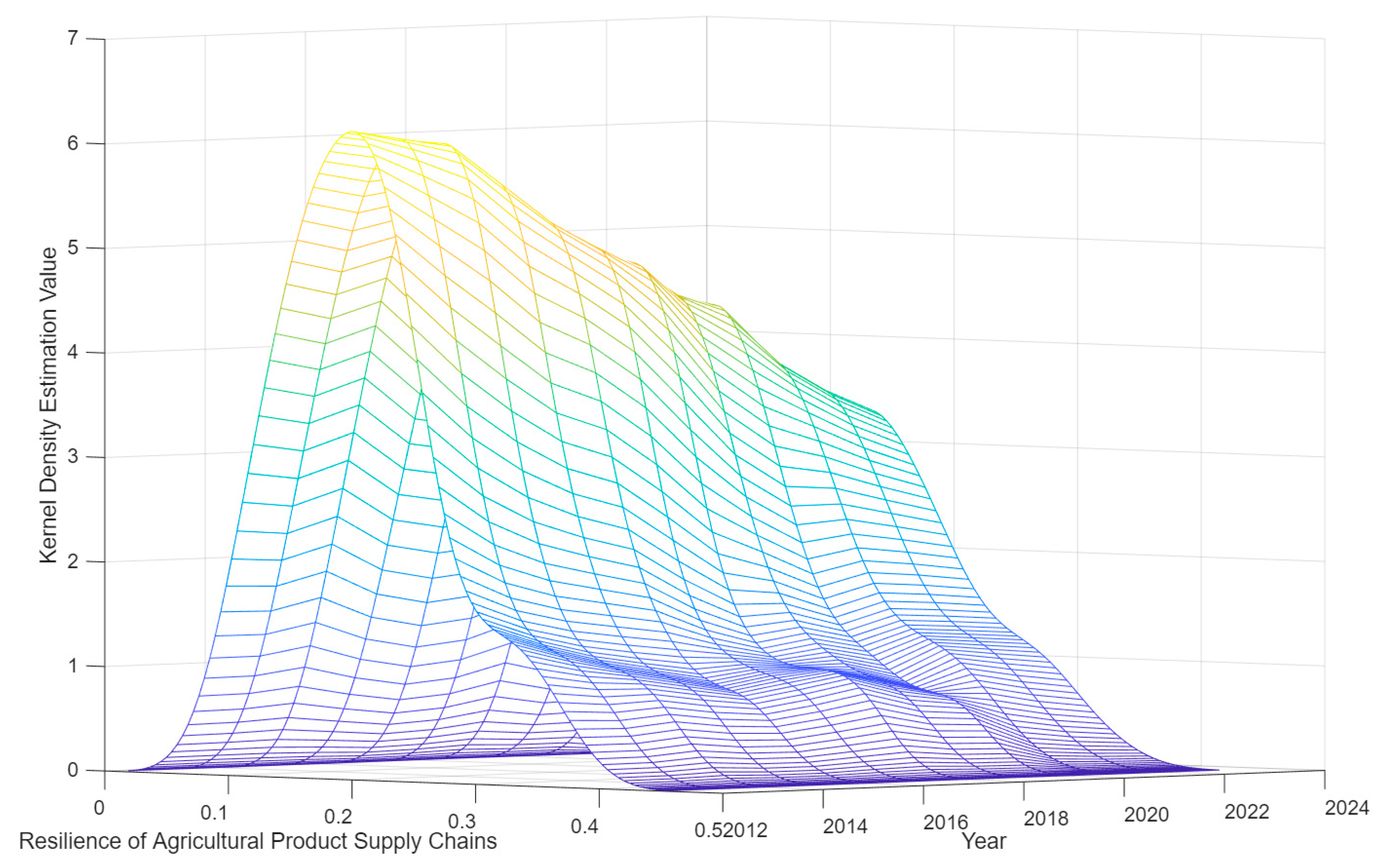
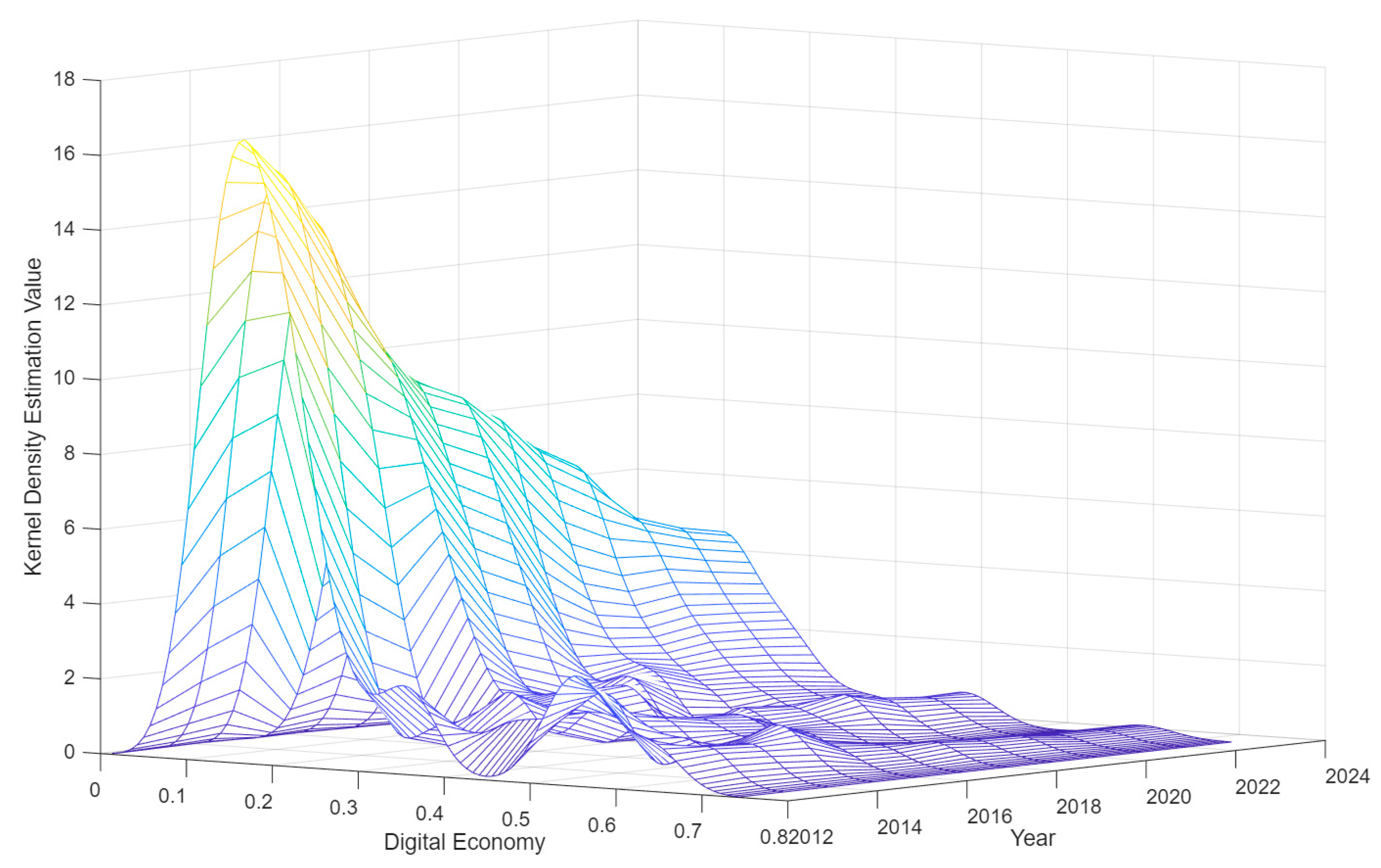
To visually illustrate the relationship between the digital economy and agricultural supply chain resilience, this study employs MATLAB R2025a to generate three-dimensional dynamic kernel density plots for the period 2012–2023. A Gaussian kernel function is adopted to estimate the dynamic distributions of the sample. The corresponding kernel density estimation results are presented in Figure 1 and Figure 2.
As shown in Figure 1, regarding distribution spread, the right tail of the main peak gradually extends over the years, indicating a continuous upward trend in the development level of the digital economy. Regarding the number and shape of peaks, the main peak becomes shorter and wider over time. In certain years, bimodal and multimodal patterns emerge, and the distribution exhibits a gradient effect. This indicates that the absolute differences in digital economy levels among provinces gradually widen, forming a trend of “differentiation.” This trend is associated with variations in local digital economy infrastructure, policy support, and talent endowments across provinces. Overall, the development of the digital economy follows a dynamic trajectory from “low-level concentration” to “differentiated development,” and finally to “overall improvement with dispersion.”
As shown in Figure 2, regarding distribution spread, the center of the main peak gradually shifts to the right over the years, indicating a continuous upward trend in the development level of agricultural supply chain resilience. Regarding the number and shape of peaks, the main peak’s trend of becoming shorter and wider has slowed, and the inter-provincial differences in agricultural supply chain resilience levels remain relatively small. Additionally, the right tail of the kernel density plot gradually diminishes, suggesting that the distribution of agricultural supply chain resilience levels across provinces is relatively balanced. Overall, agricultural supply chain resilience follows a dynamic trajectory from “low-level concentration” to “overall improvement with moderated differences.”

4.1.2. Bandwidth Sensitivity Result

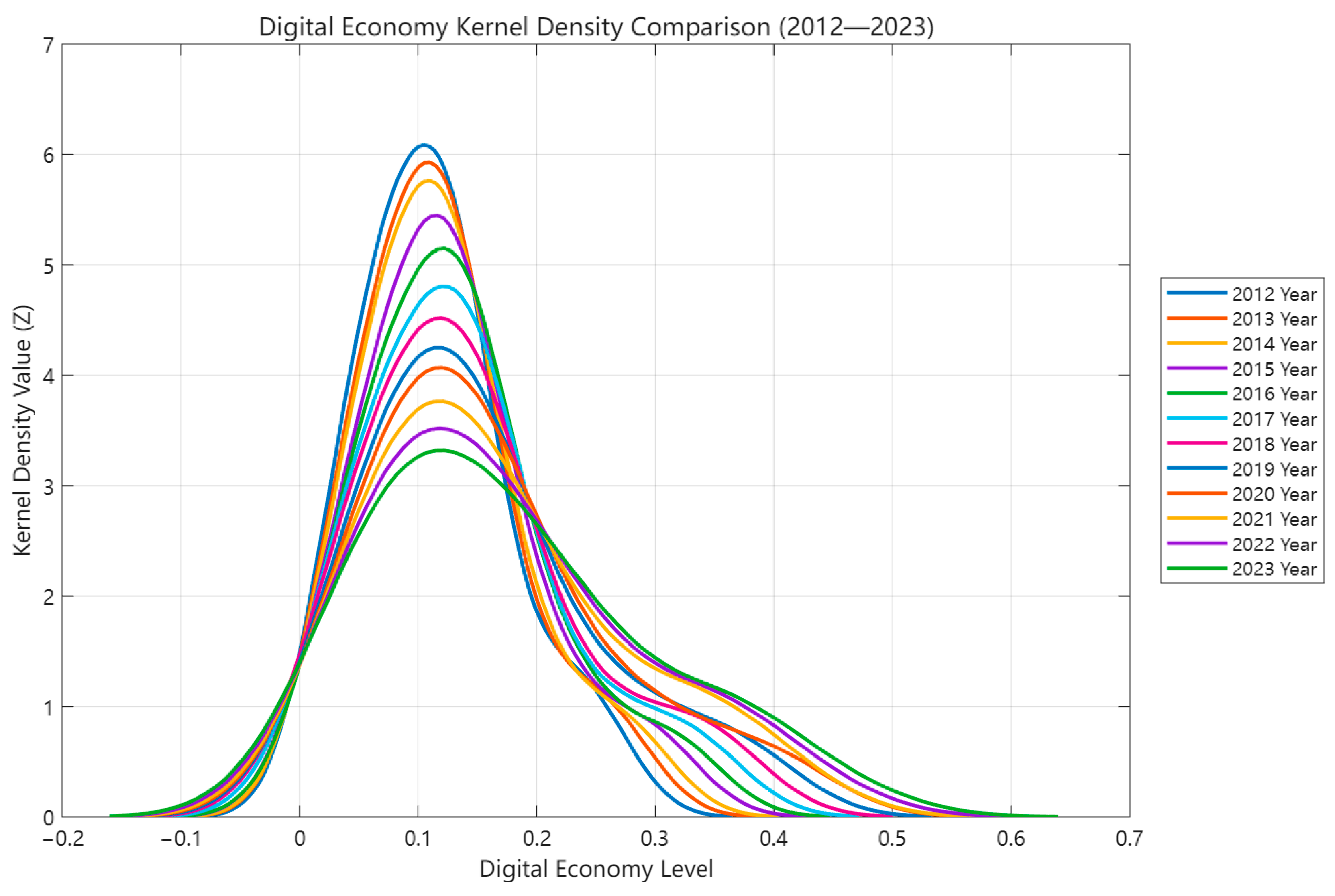
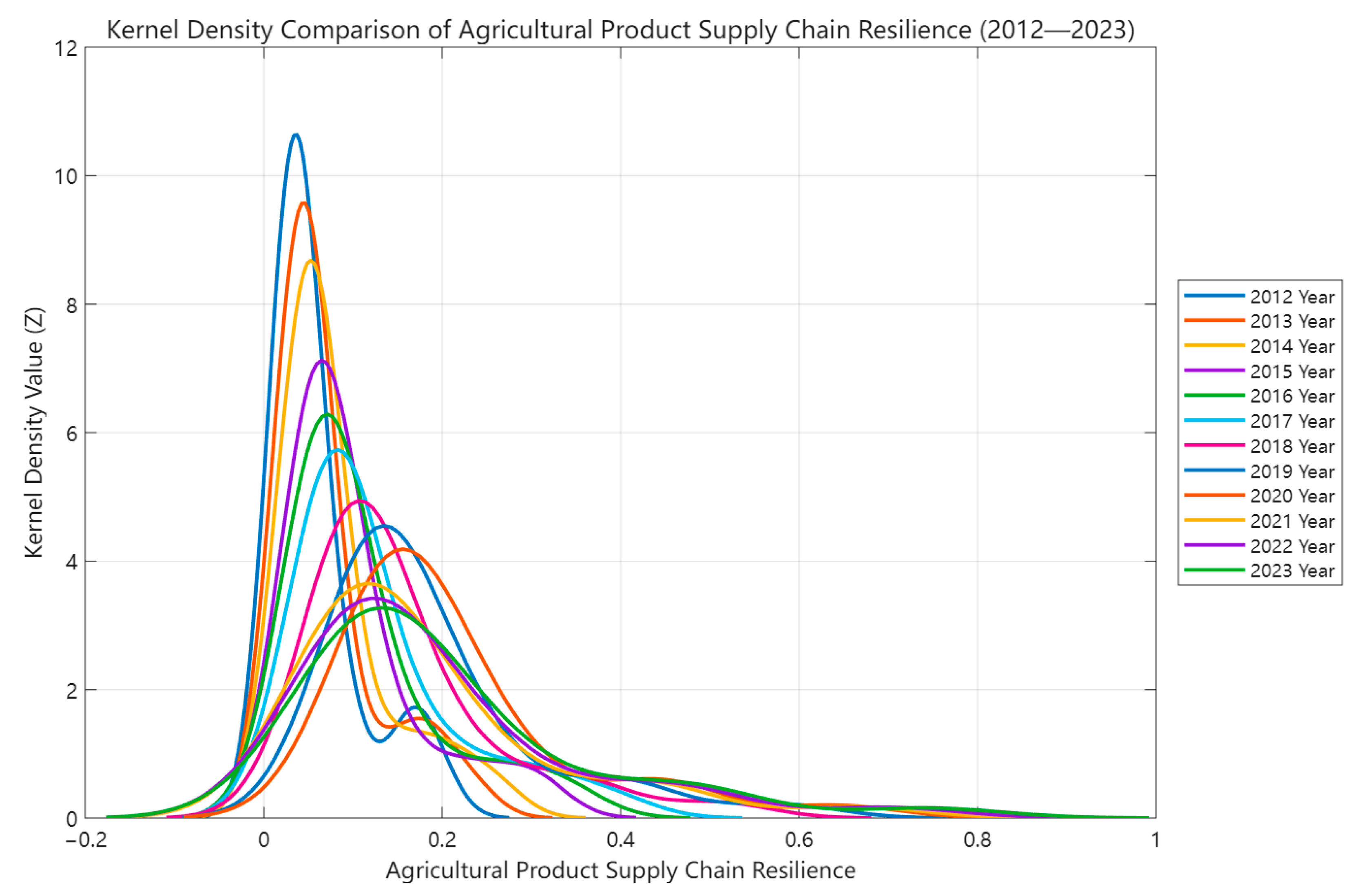
This section conducts a bandwidth sensitivity analysis of the kernel density estimation results for China’s digital economy development level and agricultural product supply chain resilience over the period 2012–2023. The primary objective is to verify the robustness of the core distributional characteristics and temporal trends of these two indicators, thereby ensuring that the research conclusions are not driven by specific choices of model parameters. The analysis is based on panel data from 31 provinces across China, stored in wide format, with each column representing observations for a given year.
The sensitivity test follows three key steps. First, for each year’s sample, the baseline bandwidth is calculated using Silverman’s rule of thumb, expressed as h 0 = 1.06 · s t d ( X ) · n 1 / 5 ,where denotes s t d ( X ) the standard deviation of the annual indicator and n represents the sample size. Second, taking the baseline bandwidth as the center, a reasonable testing interval of 0.7 h 0 1.3 h 0 is specified, within which 12 equally spaced bandwidths are generated to comprehensively cover potential variations in parameter selection. Finally, the coefficient of variation ( C V ) of the kernel density peak values across different bandwidths is used as the robustness criterion. When C V < 0.1 , the estimation results are regarded as robust with respect to bandwidth choice.
From the perspective of kernel density distribution characteristics, as shown in Figure 3 and Figure 4, the kernel density curves of both the digital economy level and agricultural product supply chain resilience exhibit a unimodal pattern; however, pronounced differences exist in their distributional stability and evolutionary features. The unimodal structure of the digital economy is highly stable, with the peak persistently concentrated around 0.1. Over time, the peak rises steadily and the curve becomes increasingly steeper, indicating a continuously strengthening agglomeration effect, a gradual convergence of interregional development gaps, and a stable core growth interval. In contrast, although the kernel density curve of agricultural product supply chain resilience also maintains a unimodal shape, its peak position and height display more evident interannual fluctuations, and the distribution spans a wider range along the horizontal axis. This reflects stronger regional heterogeneity in agricultural product supply chain resilience and a markedly weaker stability of agglomeration effects compared with the digital economy.
The bandwidth sensitivity statistics are reported in Table 4. At the digital economy level, the baseline bandwidths for 2012–2023 range from 0.0327 to 0.0641, while the coefficients of variation of the kernel density peaks lie between 0.0477 and 0.074. All years satisfy the criterion of CV < 0.1, and the robustness tests are therefore passed, indicating that the core statistical features of the kernel density estimation for the digital economy are insensitive to reasonable bandwidth choices. Consequently, the temporal pattern characterized by a strengthening agglomeration effect and a narrowing of interregional disparities remains consistent and reliable under different bandwidth settings. In contrast, for agricultural product supply chain resilience, the coefficients of variation of the peak values range from 0.2340 to 0.2929 across years, all exceeding 0.1, suggesting that robustness warrants further attention. This outcome is consistent with theoretical expectations, as agricultural product supply chain resilience is more strongly affected by exogenous factors such as natural conditions, regional agricultural policies, and logistics infrastructure, resulting in weaker distributional stability than that of the digital economy. Further analysis shows that when the bandwidth testing interval is narrowed to 0.8 h 0 1.2 h 0 , the coefficients of variation for agricultural product supply chain resilience exhibit a clear downward trend, confirming the potential robustness of the results. Moreover, under different bandwidth settings, the unimodal shape of the kernel density curves and the overall agglomeration-oriented development trend do not reverse or display abrupt changes, indicating that the core research conclusions remain reliable.
Overall, the bandwidth sensitivity analysis reveals distinct differences in the robustness of kernel density estimates for the digital economy and agricultural product supply chain resilience. The digital economy exhibits high robustness to reasonable bandwidth adjustments, with stable trends of agglomerated development and interregional convergence, consistent with the diffusion of digital technologies, relatively stable development paths, and diminishing regional heterogeneity. In contrast, agricultural product supply chain resilience shows greater sensitivity to bandwidth choice due to its reliance on natural conditions, agricultural foundations, logistics infrastructure, and exposure to exogenous shocks; however, this sensitivity does not overturn the core findings, as the unimodal distribution and agglomeration trend remain unchanged across bandwidth settings, and narrowing the bandwidth interval further reduces sensitivity, thereby confirming the robustness potential of the results.

4.2. Benchmark Regression Analysis

4.2.1. Benchmark Regression Results

To assess data reliability and model goodness-of-fit, a Hausman test is conducted before the benchmark regression. The results indicate a p-value of 0.000, which is significant at the 1% level (p < 0.01), indicating that a fixed-effects model is appropriate. Table 5 Column (1) excludes control variables, whereas Column (2) includes them; both specifications control for individual and time fixed effects. Regression results show that the coefficient of the digital economy (DE) is 0.484 in both columns and is significantly positive at the 1% level (p < 0.01). This suggests that the digital economy exerts a stable and robust positive effect on agricultural supply chain resilience, regardless of whether control variables are included. Moreover, the estimated coefficients of the control variables are largely consistent with theoretical expectations. These results provide empirical support for Hypothesis H1.

4.2.2. Endogeneity Test Results

In examining the positive effect of the digital economy on agricultural supply chain resilience, potential endogeneity concerns may arise from omitted variables or reverse causality. Accordingly, following Li Shengzhu et al. [45], two instrumental variables are employed: the first-order lag of the core explanatory variable (DV1) and an interaction term (DV2) constructed from provincial postal and telecommunications business volume in 1984 and the one-period lagged internet penetration rate. Based on these instruments, the benchmark model is re-estimated using the two-stage least squares (2SLS) method. Columns (1) and (2) of Table 6 report the 2SLS results for DV1, while Columns (3) and (4) present the corresponding results for DV2. After addressing endogeneity, the digital economy remains positively associated with agricultural supply chain resilience. The Kleibergen-Paap rk LM statistic rejects the null hypothesis of under-identification, and the Kleibergen-Paap rk Wald F statistic rejects the weak identification hypothesis, supporting the validity of the instrumental variables and the robustness of the estimated effect.

4.3. Spatial Regression Analysis

4.3.1. Global Moran’s I Results

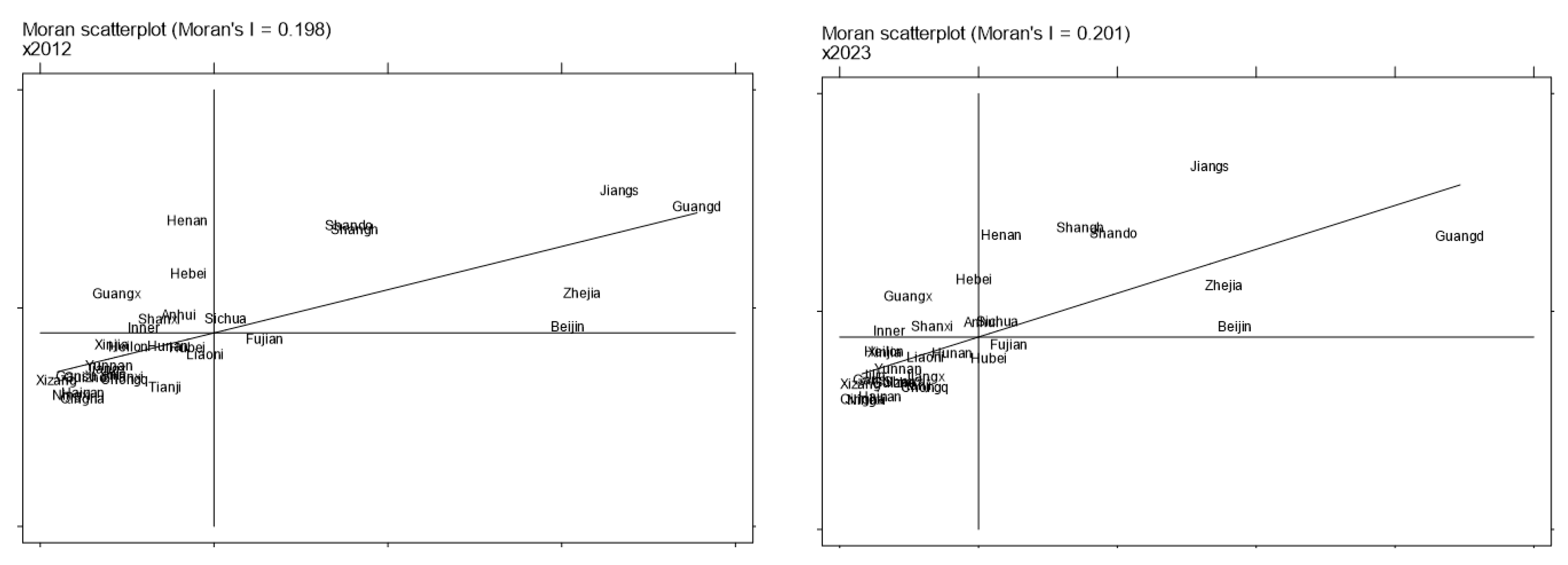
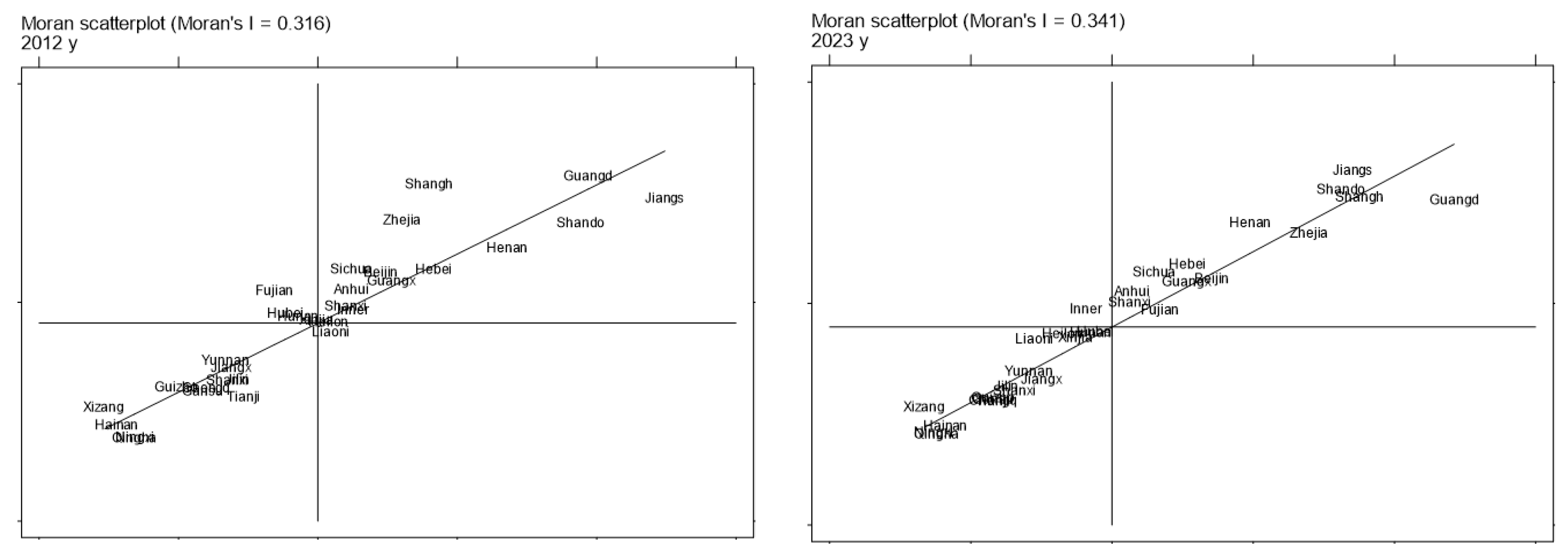
The inverse distance spatial weight matrix is used to calculate the Global Moran’s I for the digital economy and agricultural supply chain resilience across 31 provinces from 2012 to 2023, thereby testing for spatial autocorrelation. Global Moran’s I ranges from −1 to 1, with positive (negative) values indicating positive (negative) spatial autocorrelation. As presented in Table 7, the Moran’s I values for both the digital economy and agricultural supply chain resilience are positive throughout the sample period and are all significant at the 1% level. This indicates that This indicates that neither variable is randomly distributed across space; instead, both exhibit significant spatial autocorrelation among Chinese provinces. Overall, despite some fluctuations, Moran’s I for the digital economy increases from 0.1977 to 0.2012, while that for agricultural supply chain resilience increases from 0.3160 to 0.3407. These results suggest that both variables display pronounced and strengthening positive spatial dependence over time, thereby justifying the use of a spatial econometric model.

4.3.2. Local Moran’s I Results

To assess the degree of spatial correlation within specific regions, this study constructs Local Moran scatter plots for both the digital economy and agricultural supply chain resilience. Owing to space constraints, only the results for the years 2012 and 2023 are presented.
As shown in Figure 5 and Figure 6, most provincial observations are concentrated in the first and third quadrants of the Moran scatter plots, indicating pronounced positive local spatial correlation, which is consistent with the Global Moran’s I results. From 2012 to 2023, the number of provinces located in these two quadrants increases, reflecting stronger high–high and low–low agglomeration patterns. This evolution suggests that the positive local spatial association between the digital economy and agricultural supply chain resilience has intensified over time.

4.3.3. Spatial Model Fitness Results

To identify the appropriate econometric model, the Lagrange Multiplier (LM) test is initially employed to assess the necessity of adopting a spatial econometric model. The results are presented in Table 8. The LM-lag test, LM-Error test, and robust LM-lag test statistics are all significant at the 1% level, whereas the robust LM-Error test statistic is significant at the 5% level. Hence, the LM test preliminarily confirms the suitability of adopting a spatial econometric model. Subsequently, the Wald test and Likelihood Ratio (LR) test are conducted to examine whether the Spatial Durbin Model (SDM) degenerates into the Spatial Autoregressive Model (SAR) or the Spatial Error Model (SEM). Under the spatial weight matrix, both the Wald and LR test results are significant at the 1% level, indicating that the SDM does not degenerate into either the SAR or SEM. Therefore, the SDM is appropriate for this study. Finally, the Hausman test is conducted to determine whether a fixed-effects or random-effects model should be adopted. The results show that the chi-squared statistics are significant, with p-values of 0.000, indicating that a two-way fixed-effects model with individual and time fixed effects is appropriate.

4.3.4. Regression Results of the Spatial Durbin Model

Based on the results of the LM, Wald, LR, and Hausman tests, this study adopts a dynamic Spatial Durbin Model with two-way fixed effects, controlling for both individual and time effects, as the appropriate specification for the regression analysis.
Table 9 presents the regression results. Column (1) indicates that the coefficient of the local digital economy on local agricultural supply chain resilience is 0.067 and significant at the 1% level, indicating a significantly positive effect. Column (2) reports that, in the geographic distance spatial weight matrix (denoted as ( W d )), the coefficient of the spatial lag term of the digital economy is positive and significant at the 1% level. This suggests that improvements in the local digital economy significantly enhance the agricultural supply chain resilience of neighboring provinces, thereby supporting Hypothesis H2.

4.3.5. Decomposition Results of Spatial Effects

Since the Spatial Durbin Model (SDM) considers spatial economic correlations among provinces, its parameter estimates do not directly reveal the magnitude of direct and spillover effects. To further examine the impact of the digital economy on agricultural supply chain resilience, this study employs the partial derivative method proposed by Le Sage and Pace [46] and utilizes the inverse geographic distance spatial weight matrix (denoted as ( W d )) to decompose the total effect into direct and indirect components. The direct effect represents the influence of the digital economy within a region on the agricultural supply chain resilience of that same region. The indirect effect captures the impact of the digital economy in one region on the agricultural supply chain resilience of other regions, reflecting the spatial spillover effect.
As shown in Table 10, the estimated coefficients of the digital economy on regional agricultural supply chain resilience—the direct effect, indirect effect, and total effect—are 0.063, 0.152, and 0.215, respectively, all statistically significant at the 1% level. These results reveal two key spatial mechanisms. First, the development of the digital economy within a province directly enhances its own agricultural supply chain resilience, as indicated by the significantly positive direct effect. Second, it generates a pronounced positive spatial spillover effect on the agricultural supply chain resilience of neighboring provinces, as reflected by the significantly positive indirect effect. Ignoring spatial interaction—for example, by relying on traditional ordinary least squares (OLS) models that do not account for interregional spatial correlation—would underestimate the overall impact of the digital economy on agricultural supply chain resilience. These findings further justify the use of a spatial econometric framework, such as the Spatial Durbin Model adopted in this study, which effectively captures spatial interdependence that non-spatial models cannot adequately reflect.

4.3.6. Robustness Results

To ensure the robustness of the empirical results, this study employs three complementary methods for robustness verification:
(1) Controlling for the influence of extreme outliers: The data were winsorized—a standard procedure to mitigate the impact of extreme values—and re-estimated using the inverse geographic distance spatial weight matrix ( W d ). The regression results, presented in Column (1) of Table 11, indicate that the coefficient of the variable Dig3 is significantly positive at the 1% level, further corroborating the robustness of the core finding that the digital economy exerts a positive spatial spillover effect on agricultural supply chain resilience.
(2) Controlling for the impact of exceptional years: The global supply chain system experienced significant disruptions due to the COVID-19 pandemic in 2020, resulting in nationwide interruptions and operational challenges. To mitigate potential biases introduced by this exceptional event, data from 2020 were excluded before re-estimating the regression. The results, shown in Column (2) of Table 11, reveal that the coefficient of the variable Dig2 remains significantly positive at the 1% level, further confirming the robustness of the main finding that the digital economy exerts a positive spatial spillover effect on agricultural supply chain resilience.
(3) Replacing the spatial weight matrix: The economic-geographic nested matrix (denoted as ( W d e )) was employed in place of the original inverse geographic distance spatial weight matrix ( W d ) to re-estimate the regression. The results, presented in Column (3) of Table 11, indicate that the coefficient of the variable Dig2 remains significantly positive at the 1% level, once again confirming the robustness of the main finding that the digital economy exerts a positive spatial spillover effect on agricultural supply chain resilience.

4.3.7. Heterogeneity Results

(1) Heterogeneity Analysis Based on Urban Geographic Location.
Owing to provincial differences in “location” (e.g., latitude, land-sea relationship, and regional hub status) and “locational conditions” (e.g., resource endowment, transportation accessibility, and policy orientation), the impact of the digital economy on agricultural supply chain resilience may vary across regions. Accordingly, the 31 Chinese provinces are divided into three subsamples—eastern, central, and western regions—based on geographic location, and separate regressions are conducted for each subsample. Table 12 shows that the coefficients of the digital economy on agricultural supply chain resilience in the western, central, and eastern regions are 0.122, 0.778, and 0.083, respectively, all significant at the 1% level. The corresponding spatial coefficients are 0.134, 1.667, and 0.238, with the western and eastern regions’ coefficients significant at the 1% level, while the central region’s coefficient is not significant. These results suggest that the positive spatial spillover effect of the digital economy is primarily concentrated in the western and eastern regions.
In the eastern region, a robust digital economy foundation and relatively advanced infrastructure—such as 5G networks and modern logistics systems—enable the digital economy to enhance local agricultural supply chain resilience while generating spillover effects to neighboring areas. Frequent digital collaboration among enterprises in the Yangtze River Delta and Pearl River Delta generates notable technology spillovers, further improving supply chain flexibility and risk resistance. In the western region, although the digital economy developed later, national initiatives such as the “West–East Data Transfer Project” have significantly improved digital infrastructure. The region’s abundant characteristic agricultural products, facilitated by digital technologies such as e-commerce live streaming, enable surrounding areas to benefit from technology transfer and market expansion. Moreover, the western region capitalizes on a “latecomer advantage,” adopting advanced digital technologies to circumvent limitations inherent in traditional supply chains. In contrast, the central region’s insignificant spillover effect may result from the “intermediate zone paradox,” which dilutes such effects. As a geographic hub (including Henan, Hubei, and Hunan), the region experiences “double siphoning,” and a combination of uneven infrastructure and an industrial structure skewed toward processing and manufacturing—leading to insufficient digital investment in agricultural supply chain resilience—contributes to weak inter-regional synergy.
(2) Heterogeneity Analysis Based on Urban Agglomerations.
China exhibits substantial regional economic disparities, with urban agglomerations—such as the Beijing-Tianjin-Hebei (BTH) Region, Yangtze River Delta (YRD), and Pearl River Delta (PRD)—typically concentrating more resources, capital, talent, technology, and infrastructure. These regions constitute China’s core economic zones, characterized by advanced digital economy development and well-established supply chain systems, whereas non-urban agglomeration areas lag behind, with comparatively weaker infrastructure. Accordingly, based on provincial inclusion within urban agglomerations, China’s 31 provinces are divided into two subsamples: urban agglomeration provinces (eight provinces, including Beijing, Tianjin, Hebei, Shanghai, Jiangsu, Zhejiang, Anhui, and Guangdong) and non-urban agglomeration provinces (the remaining 23 provinces), with separate regressions performed for each subsample. Table 13 indicates that the coefficients of the digital economy on agricultural supply chain resilience for the two subsamples are 0.071 and 0.099, respectively, both significant at the 1% level. The corresponding spatial coefficients are 0.257 (significant at 1%) and 0.127 (significant at 10%), suggesting that the digital economy exerts a stronger positive spatial spillover effect in urban agglomeration provinces. This phenomenon can be attributed to the formation of an “institutional dividend superimposition effect” in urban agglomerations through coordinated policy measures. For instance, the YRD has established a “Digital Economy Coordinated Demonstration Zone” with cross-regional policy linkages; the PRD provides financial support for smart agriculture initiatives; and the BTH Region functions as a national digital economy pilot zone with synergistic effects. These coordinated efforts are likely to generate agglomeration and radiative effects, thereby strengthening the positive spatial spillover effect on agricultural supply chain resilience.

4.4. Threshold Regression Analysis

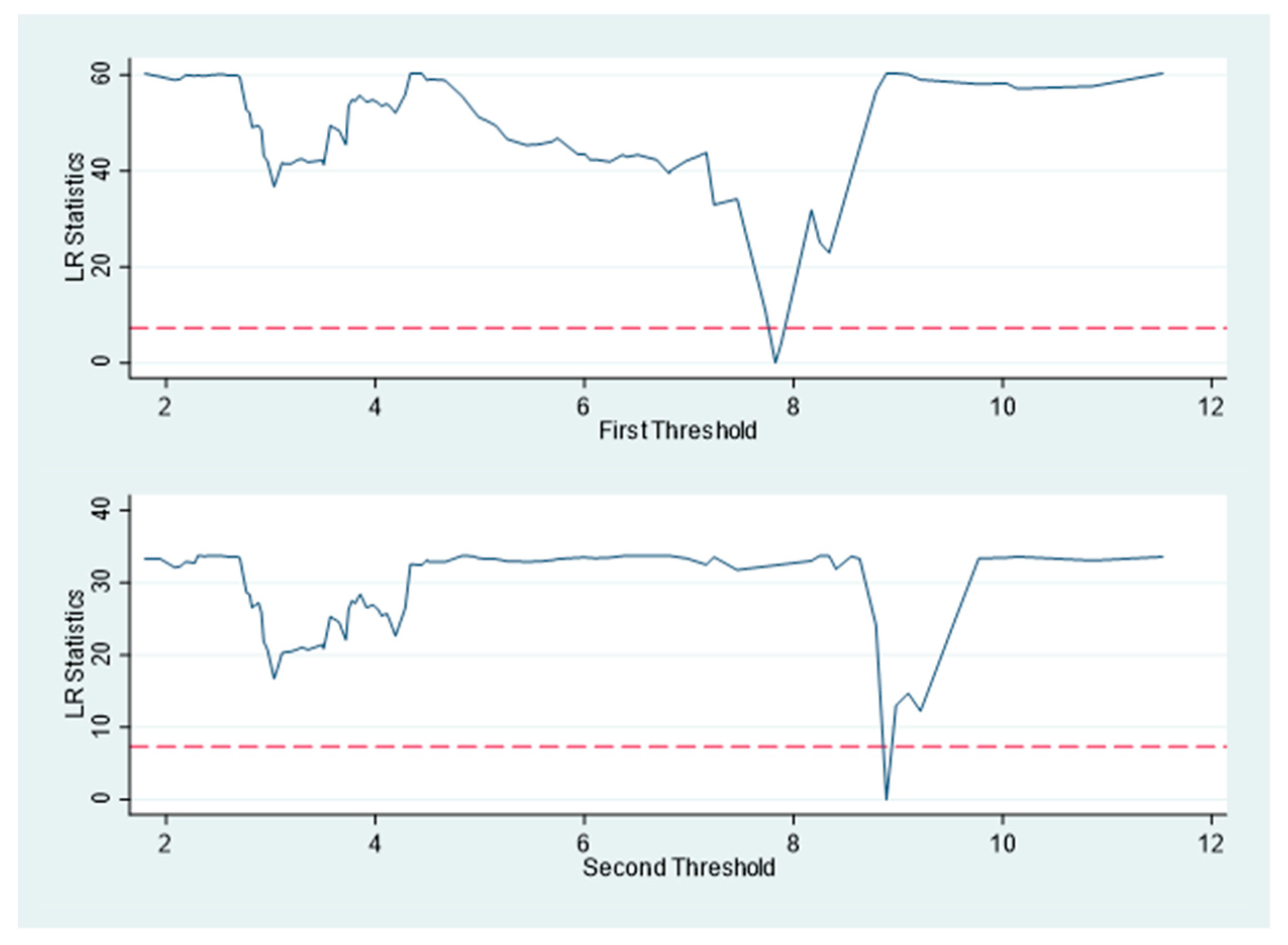
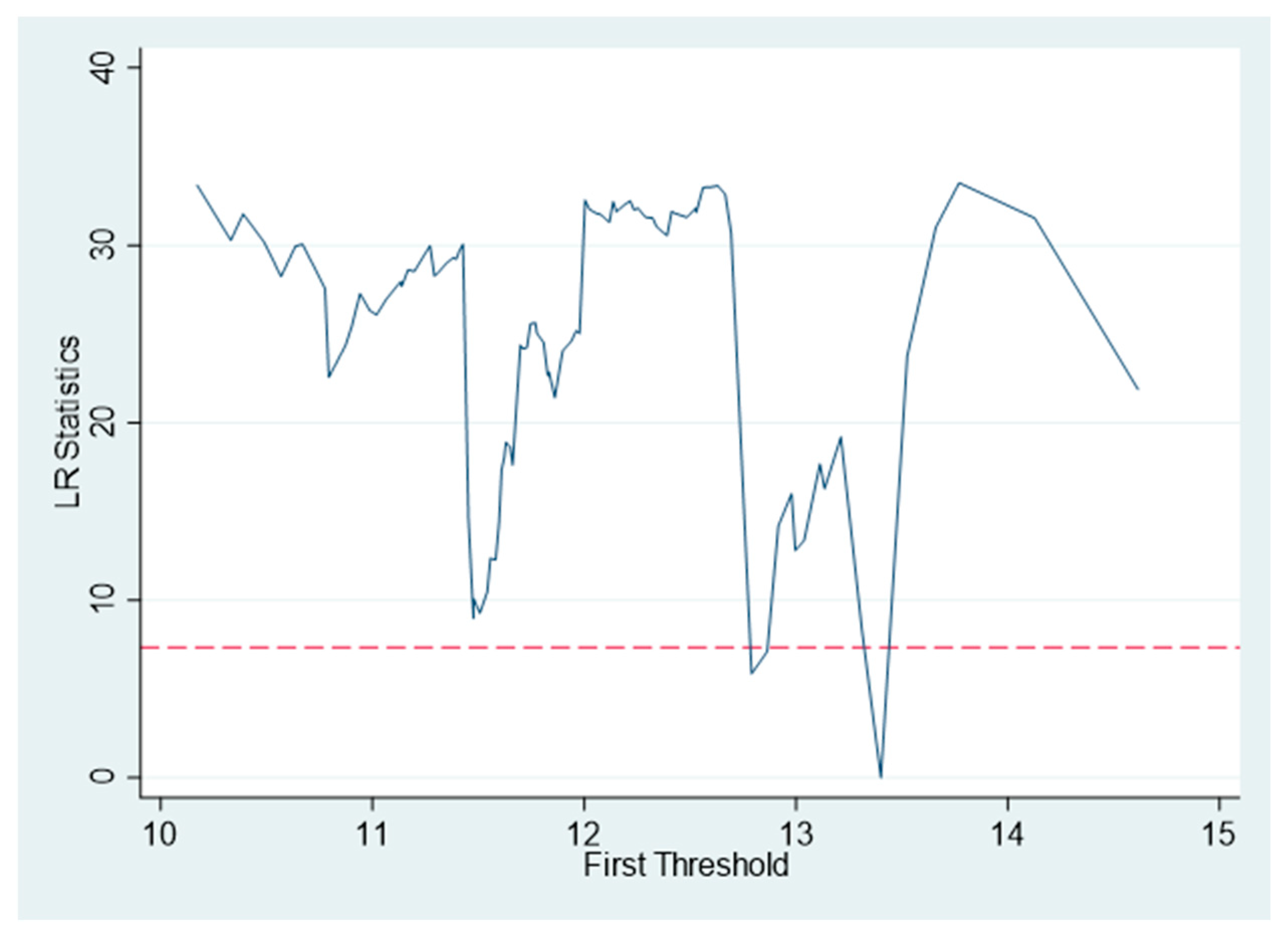
Considering that the impact of the digital economy on agricultural supply chain resilience may not be linear or stable, but instead exhibits stage-dependent characteristics as key development conditions change, this study employs the Hansen panel threshold regression model, with agricultural technological progress (ATR) and industrial structure (IS) specified as threshold variables, to construct a nonlinear framework for examining the effect of the digital economy on agricultural supply chain resilience. The results are reported in Table 14. As shown in Figure 7, The dashed red line in the figure represents the critical value for statistical significance, where the threshold estimate is considered valid when the LR statistic curve falls below this line. When agricultural technological progress serves as the threshold variable, a significant double-threshold effect is identified, with threshold values of 7.827 and 8.889. Figure 8 indicates a significant single-threshold effect when industrial structure is used as the threshold variable, with a threshold value of 13.401.
From a practical perspective, substantial regional heterogeneity exists in terms of agricultural technological foundations, factor allocation capacity, and institutional environments, which implies that the enabling effect of the digital economy on agricultural supply chain resilience may evolve alongside changes in technological progress and industrial upgrading. Once the threshold variables cross specific critical values, the transmission channels, intensity, and marginal effects of the digital economy on agricultural supply chain resilience may undergo structural shifts. Accordingly, introducing agricultural technological progress and industrial structure as threshold variables not only captures the nonlinear characteristics of the digital economy’s enabling effects across different development stages but also provides a clear economic rationale and practical relevance for the threshold regression specification.
The estimation results in column (1) of Table 15 indicate that when agricultural technological progress surpasses the first threshold value (7.827) and the second threshold value (8.889), the impact of the digital economy on agricultural supply chain resilience exhibits a complex “N-shaped” nonlinear pattern characterized by an initial increase, a subsequent decline, and a renewed enhancement. This finding partially reflects the stage-specific manifestation of the “Solow paradox.” From institutional and behavioral perspectives, in the early stage of agricultural technological progress, investments are primarily concentrated on equipment introduction and pilot applications. However, constraints such as insufficient agricultural human capital, imperfect technology diffusion mechanisms, and lagging supporting infrastructure hinder effective coordination between technological inputs and digital technologies, resulting in low marginal returns or even negative effects. As agricultural technology advances but has not yet formed a mature application system, the coexistence of high investment and low conversion efficiency may exacerbate resource misallocation, giving rise to negative threshold effects. With the further maturation of agricultural technology and the continuous improvement of institutional arrangements and factor allocation mechanisms, the complementarity between digital technologies and agricultural technologies becomes increasingly pronounced. As a result, scale effects and synergistic innovation are gradually released, and the positive empowering effect of the digital economy on agricultural supply chain resilience re-emerges and strengthens, thereby supporting Hypothesis H3.
The estimation results in column (2) of Table 15 show that the empowering effect of the digital economy on agricultural supply chain resilience becomes statistically significant only after the industrial structure surpasses the threshold value (13.401). At lower levels of industrial upgrading, agricultural supply chains are primarily oriented toward ensuring basic supply stability, with relatively extensive production organization, limited marketization, and low levels of specialization and coordination. These characteristics create structural constraints that reduce both the reliance on and adaptability to digital technologies. In this stage, digital technologies mainly function as auxiliary tools and thus have a limited impact on enhancing supply chain resilience. As industrial upgrading deepens, agricultural production gradually shifts from subsistence-oriented activities toward market-oriented and industrialized operations. Consequently, supply chains exhibit stronger demand for efficiency improvement, risk mitigation, and adaptive flexibility, while institutional environments and behavioral patterns become more conducive to the deep integration of digital elements. Once this demand surpasses the critical threshold, digital technologies transform from optional instruments into essential factors, allowing their positive empowering effects to be fully realized and significantly enhancing agricultural supply chain resilience. These results provide empirical support for Hypothesis H4.

5. Conclusions and Policy Implications

Using panel data from 31 Chinese provinces covering the period 2012–2023, this study empirically examines the mechanisms through which the digital economy enhances the resilience of agricultural product supply chains, focusing on three dimensions: direct effects, spatial spillover effects, and threshold effects. The results indicate the following.
The empirical results show that the digital economy significantly enhances the resilience of agricultural product supply chains. Spatial econometric analysis further reveals a positive spatial spillover effect, whereby digital economic development in one region promotes supply chain resilience in neighboring regions [47]. This conclusion remains robust across multiple robustness tests.
The magnitude of this effect varies across space. Heterogeneity analysis indicates that both geographical location and urban agglomeration membership condition the impact of the digital economy [48]. Specifically, the effect follows the pattern Eastern China > Western China > Central China, with the effect in Central China being statistically insignificant. Moreover, cities within urban agglomerations exhibit a significantly stronger resilience-enhancing effect than those outside.
Threshold regression results further uncover nonlinear dynamics in this relationship. As agricultural technological progress advances, the impact of the digital economy on supply chain resilience follows a phased pattern—initially strengthening, then weakening, and subsequently strengthening again. In contrast, with continuous optimization of the industrial structure, the positive effect of the digital economy increases steadily.
Although this study focuses on China, its findings exhibit a certain degree of generalizability to other developing economies. From a mechanistic perspective, the digital economy enhances agricultural product supply chain resilience by improving information transmission efficiency, optimizing resource allocation, and strengthening supply chain coordination—mechanisms that are not unique to the Chinese context. Many developing economies face similar structural challenges, including a high dependence on agriculture, regional development disparities, fragmented supply chain organization, and limited resilience to external shocks. Moreover, their stages of agricultural modernization and digital transformation are comparable to those of certain regions in China. In this regard, the mechanisms and stage-specific characteristics identified in this study may provide useful insights for other developing economies seeking to promote agricultural digitalization and enhance supply chain resilience. Nevertheless, given cross-country differences in institutional environments, resource endowments, and policy frameworks, the applicability of these findings should be interpreted with caution and adapted to country-specific contexts.
Based on the above findings, the following policy recommendations are offered:
First, strengthen digital infrastructure and accelerate the adoption of digital technologies across agricultural supply chains [49]. Robust infrastructure underpins resilience and stable operation. Governments should invest in technologies that enhance efficiency, sustainability, and risk management, promote collaborative innovation between research institutions and enterprises, and provide technical training to improve digital literacy [50]. This will support data-driven, low-carbon, and precise agricultural production.
Second, promote coordinated regional development through technological innovation and industrial upgrading [51]. Spatial spillover effects indicate that digital advancement in one region benefits neighboring areas. Policies should adopt differentiated strategies: eastern regions and urban agglomerations should deepen integration of digital technologies, while central and western regions should focus on technology diffusion and infrastructure improvement, supported by interregional cooperation. Simultaneously, fostering smart agriculture, precision farming, and integration with processing and logistics can reduce losses, improve efficiency, and enhance both the resilience and value-added capacity of agricultural supply chains.


Author Contributions

Validation, F.S.; Writing—original draft, F.S.; Writing—review & editing, F.J.; Funding acquisition, F.J. All authors have read and agreed to the published version of the manuscript.

Funding

This research was supported by the Science Research Project of Hebei Education Department (Grant No. BJS2024028), the Youth Project of Humanities and Social Sciences of the Ministry of Education of China (Grant No. 23YJC630066), and the Science Research Project of Hebei Education Department (Grant No. JCZX2024008).

Institutional Review Board Statement

Not applicable.

Informed Consent Statement

Not applicable.

Data Availability Statement

The original contributions presented in this study are included in the article. Further inquiries can be directed to the corresponding author.

Conflicts of Interest

The authors declare no conflicts of interest.

References

  1. Guo, Y.; Yin, Y. Analysis on optimization of agricultural products supply chain based on dynamic system. Discret. Dyn. Nat. Soc. 2022, 1, 1656636. [Google Scholar] [CrossRef]
  2. Luo, J.; Ji, C.; Qiu, C.; Jia, F. Agri-Food Supply Chain Management: Bibliometric and Content Analyses. Sustainability 2018, 10, 1573. [Google Scholar] [CrossRef]
  3. Ju, X.; An, X.; Yao, P. “Storing Grain in Water”: How the South-to-North Water Diversion Project Safeguards Food Security. China Ind. Econ. Rev. 2026, 1–27. Available online: https://link.cnki.net/urlid/CN.20260114.1016.008 (accessed on 16 November 2025).
  4. Wang, W.; Cao, Q.; Liu, Y.; Zhou, C.; Jiao, Q.; Mangla, S.K. Risk management of green supply chains for agricultural products based on social network evaluation framework. Bus. Strategy Environ. 2024, 33, 4913–4934. [Google Scholar] [CrossRef]
  5. Zheng, T.; Zhao, G.; Chu, S. A Study on the Impact of External Shocks on the Resilience of China’s Grain Supply Chain. Sustainability 2024, 16, 956. [Google Scholar] [CrossRef]
  6. Rice, J.B.; Caniato, F. Building a secure and resilient supply network. Supply Chain. Manag. Rev. 2003, 7, 22–30. [Google Scholar]
  7. Liao, Z.; Li, C.; Lu, L.; Luo, X. The improvement strategy of fresh produce supply chain resilience based on extenics. Plosone 2024, 19, e0309008. [Google Scholar] [CrossRef]
  8. Ivanov, D.; Dolgui, A. A digital supply chain twin for managing the disruption risks and resilience in the era of Industry 4.0. Prod. Plan. Control 2021, 32, 775–788. [Google Scholar] [CrossRef]
  9. Dubey, R.; Altay, N.; Gunasekaran, A. Supply chain agility, adaptability and alignment: Empirical evidence from the Indian auto components industry. Int. J. Oper. Prod. Manag. 2018, 38, 129–148. [Google Scholar] [CrossRef]
  10. Yan, B.; Liu, G.; Zhang, Z.; Yan, C. Optimal financing and operation strategy of fresh agricultural supply chain. Aust. J. Agric. Resour. Econ. 2020, 64, 776–794. [Google Scholar] [CrossRef]
  11. Stevens, A.W.; Teal, J. Diversification and resilience of firms in the agrifood supply chain. Am. J. Agric. Econ. 2024, 106, 739–778. [Google Scholar] [CrossRef]
  12. Wang, J.; Liu, M.; Chen, Y.; Yu, M. Influencing factors on green supply chain resilience of agricultural products: An improved gray-DEMATEL-ISM approach. Front. Sustain. Food Syst. 2023, 7, 1166395. [Google Scholar] [CrossRef]
  13. Dong, W. Research on supply chain resilience of agricultural products based on AHP-FCE model. Learn. Educ. 2020, 9, 114–117. [Google Scholar] [CrossRef]
  14. Wang, G.; Hou, Y.; Shin, C. Exploring Sustainable Development Pathways for Agri-Food Supply Chains Empowered by Cross-Border E-Commerce Platforms: A Hybrid Grounded Theory and DEMATEL-ISM-MICMAC Approach. Foods 2023, 12, 3916. [Google Scholar] [CrossRef] [PubMed]
  15. Zhong, J.; Cheng, H.; Jia, F. Supply chain resilience capability factors in agri-food supply chains. Oper. Manag. Res. 2024, 17, 850–868. [Google Scholar] [CrossRef]
  16. Wei, Y. A Study on the Impact of the Digital Economy on the Resilience of China’s Agricultural Product Supply Chains: From the Perspective of New-Quality Productive Forces. Supply Chain. Manag. 2025, 10, 27–38. [Google Scholar] [CrossRef]
  17. Singh, R.; Dwivedi, G. Resilience in agri-food supply chains: A framework for risk assessment and strategy development. Int. J. Logist. Res. Appl. 2025, 2, 1659–1690. [Google Scholar] [CrossRef]
  18. Wang, Q.; Jin, L. Empowering the coordinated development of the “four chains” in agriculture through the digital economy: Theoretical logic and practical pathways. Mod. Econ. Res. 2026, 1, 124–132. [Google Scholar] [CrossRef]
  19. Li, Y.; Li, D.; Liu, Y.; Shou, Y. Digitalization for supply chain resilience and robustness: The roles of collaboration and formal contracts. Front. Eng. Manag. 2023, 10, 5–19. [Google Scholar] [CrossRef]
  20. Mansoor, S.; Nooraie, S.V.R.; Parast, M.M. An examination of the impact of flexibility and agility on mitigating supply chain disruptions. Int. J. Prod. Econ. 2020, 220, 107438. [Google Scholar] [CrossRef]
  21. Wang, G.; Gunasekaran, A.; Ngai, E.W.; Papadopoulos, T. Big data analytics in logistics and supply chain management: Certain investigations for research and applications. Int. J. Prod. Econ. 2016, 176, 98–110. [Google Scholar] [CrossRef]
  22. Waller Matthew, A.; Fawcett, S.E. Data science, predictive analytics, and big data: A revolution that will transform supply chain design and management. J. Bus. Logist. 2013, 34, 7–84. [Google Scholar] [CrossRef]
  23. Adnan, A.-B.; Yaqot, M.; Menezes, B. Roadmap to digital supply chain resilience under investment constraints. Prod. Manuf. Res. 2023, 11, 2194943. [Google Scholar] [CrossRef]
  24. Zhao, N.; Jiang, T.; Lau, K.H. Impact of supply chain digitalization on supply chain resilience and performance: A multi-mediation model. Int. J. Prod. Econ. 2023, 259, 108817. [Google Scholar] [CrossRef] [PubMed]
  25. Wang, H.; Chen, Y.; Xie, J.; Liu, C. Research on digital empowerment, innovation vitality and manufacturing supply chain resilience mechanism. PLoS ONE 2025, 20, e0316183. [Google Scholar] [CrossRef]
  26. Li, C.; Lu, Y.; Bian, Y.; Tian, J.; Yuan, M. Design of safety evaluation and risk traceability system for agricultural product quality. Appl. Sci. 2024, 14, 2980. [Google Scholar] [CrossRef]
  27. Raimbekov, Z.; Syzdykbayeva, B.; Rakhmetulina, A.; Rakhmetulina, Z.; Abylaikhanova, T.; Ordabayeva, M.; Doltes, L. The impact of agri-food supply channels on the efficiency and links in supply chains. Economies 2023, 11, 206. [Google Scholar] [CrossRef]
  28. Bosona, T.; Gebresenbet, G. The role of blockchain technology in promoting traceability systems in agri-food production and supply chains. Sensors 2023, 11, 5342. [Google Scholar] [CrossRef]
  29. Anil, K.; Singh, R.K.; Modgil, S. Exploring the relationship between ICT, SCM practices and organizational performance in agri-food supply chain. Benchmarking Int. J. 2020, 27, 1003–1041. [Google Scholar] [CrossRef]
  30. Huang, Q.H.; Yin, L.Y.; Wang, H.L.; Liang, S. The Digital Economy Promotes the Integrated Development of Urban-Rural Industrial Chains: Theoretical Mechanisms and Empirical Tests. Agric. Econ. Manag. 2025, 1, 30–44. [Google Scholar] [CrossRef]
  31. Pan, H.L.; Huang, Q.Y. How Does Rural Digitalization Empower Agricultural Economic Resilience-A Case Study of Eight Ethnic Minority Provinces and Autonomous Regions. J. Shanxi Agric. Univ. (Soc. Sci. Ed.) 2024, 23, 72–83+125. [Google Scholar] [CrossRef]
  32. Ma, N.; You, Q.; Qin, L. Endowment structure and biased technological progress: Effects on agricultural development. China Rural Econ. 2025, 12, 22–41. [Google Scholar] [CrossRef]
  33. Cricelli, L.; Mauriello, R.; Strazzullo, S. Technological innovation in agri-food supply chains. Br. Food J. 2024, 126, 1852–1869. [Google Scholar] [CrossRef]
  34. Lu, J.Y.; Guo, J.H.; Li, Z.H. The Digital Economy and Green Agricultural Growth: From the Perspective of Input-Output Structure and Technological Empowerment. Stat. Decis. 2025, 41, 24–29. [Google Scholar] [CrossRef]
  35. Yang, Z.; Ma, F. Spatial effects of agricultural industrial structure adjustment on agricultural production efficiency. Chin. J. Agric. Resour. Reg. Plan. 2026, 46, 1–16. Available online: https://link.cnki.net/urlid/11.3513.S.20250110.1452.027 (accessed on 18 November 2025).
  36. Wang, W.C.; Zhang, S.F. An Empirical Test of the Digital Economy Driving the Modernization of Agricultural Industry Chains. Stat. Decis. 2024, 40, 22–27. [Google Scholar] [CrossRef]
  37. Li, Z.Y.; Gao, S.P.; Guo, D.D.; Guo, Y. The Digital Economy, New-Quality Productive Forces, and Industrial Chain Supply Chain Resilience. J. Technoeconomics Manag. 2024, 12, 65–70. [Google Scholar] [CrossRef]
  38. Zhu, J.M.; Lu, X.L. The Mechanism and Spatial Effect of the Digital Economy Enhancing Tourism Economic Resilience. Prog. Geogr. 2024, 43, 2004–2020. [Google Scholar]
  39. Zhang, X.Q.; Yu, Y. A Study on the Impact of Digital Inclusive Finance on Grain Supply Chain Resilience: From the Perspective of Factor of Production Development. Res. Agric. Mod. 2025, 46, 270–281. [Google Scholar] [CrossRef]
  40. Abdurawup, A.; Mirkamal, D.; Zhao, Z.N. Rural Digitalization and Grain Supply Chain Resilience: Theoretical Mechanisms, Empirical Evidence, and Policy Options. J. Northwest AF Univ. (Soc. Sci. Ed.) 2024, 24, 83–90. [Google Scholar] [CrossRef]
  41. Xie, Y.J.; Zhou, H.X. Measurement of Resilience Level of Fresh Agricultural Product Supply Chain and Analysis of Influencing Factors. Acta Agric. Jiangxi 2024, 36, 109–117. [Google Scholar] [CrossRef]
  42. Liu, H.Y.; Xu, L.Z. A Study on the Impact of Agricultural Digitalization on Grain Supply Chain Resilience from the Perspective of Food Security. Guangdong Agric. Sci. 2024, 51, 79–90. [Google Scholar] [CrossRef]
  43. Shi, S.H.; Lou, Z.L.; Liu, J.C. A Study on the Impact of New-Quality Productive Forces on Employment Scale. J. Xi’an Univ. Financ. Econ. 2026, 1–14. [Google Scholar] [CrossRef]
  44. Ni, X.M.; Zhou, Z.Q.; Jiang, M.; Zhao, H. A Study on the Spatial Spillover Effect of Sci-Tech Finance on Technological Innovation. Syst. Eng.-Theory Pract. 2025, 45, 1–16. Available online: https://link.cnki.net/urlid/11.2267.N.20250313.0920.006 (accessed on 20 November 2025).
  45. Li, S.Z.; Xue, F.; Jiang, J.G. A Study on the Impact of Agricultural Digitalization on China’s New-Quality Productive Forces in Grain Sector. J. Agro-For. Econ. Manag. 2024, 23, 435–445. [Google Scholar] [CrossRef]
  46. LeSage, J.P.; Pace, R.K. Interpreting spatial econometric models. In Handbook of Regional Science; Springer: Berlin/Heidelberg, Germany, 2021; pp. 2201–2218. [Google Scholar]
  47. Zhao, W.; Xu, X. Impact Effects and Mechanisms of the Digital Economy on Agricultural Economic Resilience. J. South China Agric. Univ. (Soc. Sci. Ed.) 2023, 22, 87–96. [Google Scholar]
  48. Wang, Y.; Long, Y.; Wang, J. Does the Innovation-Driven Digital Economy Improve the Resilience of Industrial and Supply Chains? J. Innov. Knowl. 2025, 10, 100733. [Google Scholar] [CrossRef]
  49. Gao, Y.; Zong, Y. Benefit-Sharing Mechanism in Cross-Regional Agricultural Product Supply Chain: A Grounded Theory Approach. Sustainability 2024, 16, 10842. [Google Scholar] [CrossRef]
  50. Zhao, Z.; Zhu, Z. Research on the Measurement and Improvement in Fresh Product Supply Chain Resilience Based on Blockchain Technology. Sustainability 2025, 17, 1954. [Google Scholar] [CrossRef]
  51. Zhou, X.; Chi, L.; Li, J.; Xing, L.; Yang, L.; Wu, J.; Meng, H. A Study on Revenue Distribution of Chinese Agricultural E-Commerce Supply Chain Based on the Modified Shapley Value Method. Sustainability 2024, 16, 9023. [Google Scholar] [CrossRef]
Figure 1. Kernel Density Estimation Plot of Digital Economy Development.
Sustainability 18 01975 g001
Figure 2. Kernel Density Estimation Plot of Agricultural Supply Chain Resilience Level.
Sustainability 18 01975 g002
Figure 3. Digital Economy Kernel Density Comparison.
Sustainability 18 01975 g003
Figure 4. Agricultural Supply Chain Resilience Kernel Density Comparison.
Sustainability 18 01975 g004
Figure 5. Local Moran Scatter Plots of Digital Economy (2012 & 2023).
Sustainability 18 01975 g005
Figure 6. Local Moran Scatter Plots of Agricultural Supply Chain Resilience (2012 & 2023).
Sustainability 18 01975 g006
Figure 7. Threshold Estimates and Confidence Intervals of Agricultural Technological Progress (ATP).
Sustainability 18 01975 g007
Figure 8. Threshold Estimates and Confidence Intervals of Industrial Structure (IS).
Sustainability 18 01975 g008
Table 1. Indicator System for Digital Economy.
Total IndicatorFirst-Level IndicatorSecond-Level IndicatorAttribute
Indicator System of Digital EconomyDigitalization
Infrastructure
Internet broadband access ratePositive
Internet broadband penetration ratePositive
Number of mobile phone exchange subscribersPositive
Length of long-distance optical cable linesPositive
Number of web pagesPositive
Number of domain namesPositive
Digital IndustrializationPer capita total telecommunications business volumePositive
Mobile phone penetration ratePositive
Number of legal entities in information transmission, software and information technology service industriesPositive
Proportion of employees in the information software industryPositive
Number of domestic patent applications acceptedPositive
Number of domestic patent applications grantedPositive
Industrial Digitalizationhe Peking University Digital Financial Inclusion Index of ChinaPositive
Proportion of enterprises with e-commerce transaction activitiesPositive
E-commerce salesPositive
Number of websites per 100 enterprisesPositive
Added value of secondary and tertiary industriesPositive
Investment in scientific and technological innovationPositive
Number of express deliveriesPositive
Table 2. Evaluation Index System for Agricultural Supply Chain Resilience.
Total IndicatorFirst-Level IndicatorSecond-Level IndicatorAttribute
Evaluation Index System for Agricultural Supply Chain ResiliencePredictive AbilityProducer Price Index of Agricultural Products (Preceding Year = 100)Positive
Gross Agricultural Production Index (Preceding Year = 100)Positive
Agricultural Product Wastage RateNegative
Number of Environmental and Agro-Meteorological Observation StationsPositive
Response AbilitySown Area of Crops (1000 Hectares)Positive
Fixed-Asset Investment in Transportation, Storage and Post Services (100 Million Yuan)Positive
Number of Employees in the Logistics IndustryPositive
Number of Taobao VillagesPositive
Number of Stores of Chain Retail EnterprisesPositive
Resistance AbilityOutput of Agricultural Products (10,000 Tons)Positive
Agricultural Electricity Consumption (Kilowatt-Hour)Positive
Freight Volume (10,000 Tons)Positive
Freight Turnover (100 Million Ton-Kilometers)Positive
Number of Leading Agricultural EnterprisesPositive
Recovery AbilityEffective Irrigation Area of Crops (1000 Hectares)Positive
Agricultural Insurance Indemnity RatePositive
Total Power of Agricultural Machinery (10,000 Kilowatts)Positive
Dependence Degree of Agricultural Product ImportsPositive
Dependence Degree of Agricultural Product ExportsPositive
Added Value of Transportation, Storage and Post Services (100 Million Yuan)Positive
Development AbilityFinancial Expenditure Related to Agriculture (100 Million Yuan)Positive
Local Fiscal Expenditure on Transportation (100 Million Yuan)Positive
Agricultural Scientific Research Expenditure (100 Million Yuan)Positive
Number of Agricultural Technical PersonnelPositive
Agricultural Carbon Emissions (10,000 Tons)Negative
Table 3. Descriptive Statistics Results.
VariableObservationsMeanStandard DeviationMinimum ValueMaximum Value
Explanatory VariableDE3720.1390.1030.0130.743
Explained VariableASCR3720.1430.1290.0190.455
Control VariableIL3720.5270.5100.3000.734
ME3720.6030.5950.2290.896
FS37210,719.4507974.56089.00076,310.930
DS37227,313.69924,622.6707682.00084,834.000
RD3720.9830.9600.0532.299
PD372457.690275.9892.5643925.876
Threshold VariableATP3725.1634.3361.77213.980
IS372251,697.441137,373.6249508.5473,815,546.5
Table 4. Bandwidth Sensitivity Test Results.
YearDEASCR
h0CVh0CV
20120.03270.04770.02650.1425
20130.03450.05820.02980.1495
20140.03590.05870.03270.1476
20150.03860.06920.03890.1388
20160.04050.06830.04350.1403
20170.04410.06900.04770.1453
20180.04760.06610.05610.1445
20190.05090.07200.06140.1411
20200.05370.07470.06700.1399
20210.05580.07000.07460.1342
20220.05860.06750.07920.1323
20230.06140.06660.08300.1324
Table 5. Presents the benchmark regression results of the impact of the digital economy on agricultural supply chain resilience.
Variable(1)(2)
DE0.139 *** (2.845)0.078 *** (3.464)
IS-0.059 (1.105)
ME-−0.061 (−0.223)
FS-0.223 * (1.796)
DS-0.629 *** (2.980)
RD-−0.166 (−1.548)
PD-6.448 ** (2.735)
Constant0.204 *** (18.619)−0.545 ** (−2.485)
Individual/Time Fixed Effectsyesyes
R20.4950.841
N372372
Note: ***, **, * indicate significance at the 1%, 5%, and 10% significance levels, respectively. Values in parentheses represent t-values. The same applies to the following tables.
Table 6. Regression Results of Instrumental Variables.
Variable(1)(2)(1)(2)
X-0.379 *** (8.531)-1.310 *** (4.827)
D V 1 0.943 *** (30.229)---
D V 2 0.228 *** (4.240)-
Control VariablesYesYesYesYes
Individual Fixed EffectsYesYesYesYes
Time Fixed EffectsYesYesYesYes
N341341372372
R2-0.986-0.963
K-P rk LM Statistic22.877 (0.000)13.493 (0.000)
K-P rk W F Statistic913.81322.017
Note: *** indicate significance at the 1% significance levels, respectively. Values in parentheses represent t-values.
Table 7. Test Results of Global Moran’s I.
YearDigital Economy (DE)Agricultural Supply Chain Resilience (ASCR)
Moran’s IZ-Valuep-ValueMoran’s IZ-Valuep-Value
20120.19776.68160.00000.31609.81950.0000
20130.20506.89960.00000.31599.84630.0000
20140.19526.64410.00000.31499.83870.0000
20150.17496.05810.00000.325210.13190.0000
20160.18436.30550.00000.331010.30430.0000
20170.18186.23400.00000.334610.38950.0000
20180.18016.36440.00000.335310.39550.0000
20190.17756.32590.00000.333510.33040.0000
20200.18846.65020.00000.331810.30610.0000
20210.19956.95400.00000.337910.37810.0000
20220.19666.84930.00000.340110.43040.0000
20230.20127.01390.00000.340710.44080.0000
Table 8. Regression Results of Model Fit Tests.
TESTTest EffectStatistic Valuep-Value
LM-lag TestSpatial Lag123.0320.000
LM-Error TestSpatial Error33.6110.000
Robust LM-lag TestSpatial Lag93.0000.000
Robust LM-Error TestSpatial Error3.5790.059
LR-lag TestSpatial Lag114.890.000
LR-Error TestSpatial Error136.170.000
Wald-lag TestSpatial Lag78.230.000
Wald-Error TestSpatial Error105.090.000
LR-time TestTime Fixed Effects502.190.000
LR-ind TestIndividual Fixed Effects83.980.002
Hausman Test-76.290.000
Table 9. Regression Results of the Spatial Durbin Model.
Variable(1)(2)
MainW × X
DE0.067 *** (5.91)0.240 *** (3.43)
IS0.045 * (1.70)0.603 *** (2.59)
ME0.140 (1.44)0.395 (0.55)
FS0.066 ** (1.98)1.268 *** (6.15)
DS0.675 *** (9.38)1.549 *** (2.66)
RD−0.103 ** (−2.20)−0.262 (−0.66)
PD4.064 *** (7.30)−0.932 (−0.25)
rho−0.421 *** (−2.04)
Sigma2_e0.000 *** (13.96)
Individual/Time Fixed Effectsyes
R20.256
N372
Note: ***, **, * indicate significance at the 1%, 5%, and 10% significance levels, respectively. Values in parentheses represent t-values.
Table 10. Decomposition Results of Spatial Effects.
VariableDirect EffectIndirect EffectTotal Effect
DE0.063 *** (5.72)0.152 *** (3.12)0.215 *** (4.22)
IS0.033 (1.38)0.431 *** (2.62)0.465 *** (2.68)
ME0.144 (1.61)0.302 (0.58)0.445 (0.81)
FS0.042 (1.28)0.900 *** (5.30)0.941 *** (5.54)
DS0.657 *** (9.82)0.955 ** (2.17)1.612 *** (3.51)
RD−0.098 ** (−2.31)−0.163 (−0.54)−0.261 (−0.81)
PD4.098 *** (7.24)−2.006 (−0.73)2.092 (0.75)
Note: ***, ** indicate significance at the 1% and 5% significance levels, respectively. Values in parentheses represent t-values.
Table 11. Regression Results of Robustness Tests.
VariableWinsorizationExcluding Special YearReplacing Spatial Weight Matrix
X0.065 *** (5.62)0.065 *** (5.66)0.068 *** (5.69)
W × X0.258 *** (3.65)0.231 *** (3.26)0.368 *** (2.87)
Direct Effect0.064 *** (5.49)0.061 *** (5.51)0.063 *** (5.58)
Indirect Effect0.215 *** (3.22)0.137 *** (2.90)0.203 ** (2.30)
Total Effect0.279 *** (3.84)0.198 *** (3.80)0.266 *** (2.83)
Control VariableYesYesYes
Individual Fixed EffectsYesYesYes
Time Fixed EffectsYesYesYes
N372341372
R20.2100.3720.225
Note: ***, ** indicate significance at the 1% and 5% significance levels, respectively. Values in parentheses represent t-values.
Table 12. Regression Results of Heterogeneity Tests Based on Urban Geographic Location.
VariableWestern RegionCentral RegionEastern Region
X0.122 *** (7.98)0.778 *** (2.99)0.083 *** (4.82)
W × X0.134 *** (2.81)1.667 (1.49)0.238 *** (3.99)
Direct Effect0.118 *** (7.69)0.744 *** (2.91)0.066 *** (4.28)
Indirect Effect0.065 ** (2.11)1.356 (1.20)0.094 *** (3.02)
Total Effect0.184 *** (5.14)2.100 (1.55)0.160 *** (4.30)
Control VariableYesYesYes
Individual Fixed EffectsYesYesYes
Time Fixed EffectsYesYesYes
N14496132
R20.3710.3720.225
Note: ***, ** indicate significance at the 1% and 5% significance levels, respectively. Values in parentheses represent t-values.
Table 13. Regression Results of Heterogeneity Tests Based on Urban Agglomerations.
VariableUrban AgglomerationsNon-Urban Agglomerations
X0.071 *** (4.30)0.099 *** (7.08)
W × X0.257 *** (4.83)0.127 * (1.88)
Direct Effect0.044 *** (3.12)0.098 *** (7.04)
Indirect Effect0.125 *** (4.16)0.064 (1.34)
Total Effect0.169 *** (4.72)0.162 *** (3.01)
Control VariableYesYes
Individual Fixed EffectsYesYes
Time Fixed EffectsYesYes
N96276
R20.2920.504
Note: ***, * indicate significance at the 1% and 10% significance levels, respectively. Values in parentheses represent t-values.
Table 14. Correlation Test for Threshold Effect.
ModelBS TimesF-ValueCritical ValueThreshold Value
VariableNumber of Thresholds10%5%1%
ATPSingle Threshold30037.0220.47423.61635.4107.827
Double Threshold30033.8218.41327.90842.4058.889
Triple Threshold30020.7571.45281.597100.064-
ISSingle Threshold30033.6519.70425.70231.52713.401
Double Threshold30022.5932.28342.04554.963-
Table 15. Estimation Results of Threshold Regression.
Threshold Value(1)(2)
Agricultural Technological Progress ( A T P 7.827 )0.087 ***
(6.700)
-
Agricultural Technological Progress ( 7.827 < A T P 8.889 )−0.085 ***
(−3.365)
-
Agricultural Technological Progress ( A T P > 8.889 )0.102 ***
(2.790)
-
Industrial Structure
I S 13.401
-−0.015
(−0.687)
Industrial Structure
I S > 13.401
-0.101 ***
(7.088)
Control VariablesYesYes
Individual Fixed EffectsYesYes
Time Fixed EffectsYesYes
N372372
R20.8560.841
Note: *** indicate significance at the 1% significance levels, respectively. Values in parentheses represent t-values.
Disclaimer/Publisher’s Note: The statements, opinions and data contained in all publications are solely those of the individual author(s) and contributor(s) and not of MDPI and/or the editor(s). MDPI and/or the editor(s) disclaim responsibility for any injury to people or property resulting from any ideas, methods, instructions or products referred to in the content.