1. Introduction
Port sustainability is one of the main features of modern port operations and is related to the planning of port infrastructure and superstructure and the navigational safety of ships [
1]. The sustainability of the port is analyzed in this article, primarily focusing on the safety of port navigation (port entrances and internal navigation channels, ship turning basins and approaches to the quays) and the capabilities of port tugs to ensure the safety of port navigation. This article also focuses on the reduction of environmental impact and the efficient operation of the port and terminals in serving passengers and handling cargo (including high qualification and work culture of port and terminal employees, decarburization and digitalization of the port and terminal, and other factors).
The optimal development of port superstructure, reducing the time of ship handling in the port, plays an important role in reducing the environmental impact of ships and port terminals [
2]. Safe maneuvering of ships during entry and maneuvering in the port, while reducing the fuel consumption of ships and, if tugs are used, their fuel consumption, reduces the amount of emissions from port facilities and ships and ultimately reduces the environmental impact [
3]. The sustainability of ports from a technical, technological and environmental impact point of view is directly related to optimal conditions for ship entry and maneuvering in ports, convenient ship mooring options at quays and optimal passenger service, and cargo handling technologies.
The navigation safety of ships entering ports and maneuvering in them independently or with the help of port tugs is important not only from the point of view of shipping safety and ship arrival time, but also from the point of view of environmental protection, as it reduces the time of ships entering the port and maneuvering in it, fuel consumption during such operations and the resulting emissions [
4]. Individual port areas, such as port entrances and internal navigation channels, ship turning basins, approaches to quays, often have complex configurations and require many and very precise ship maneuvers.
Modern ports are trying to accommodate as many large ships as possible, developing port infrastructure and superstructure, using tugboats and trying to minimize downtime. In some ports, when ships enter and maneuver in ports, it is mandatory to order tugboats, although some large ships, such as large cruise ships, can maneuver and moor independently. In some countries and ports, port navigation rules require that during autonomous mooring operations, for example, for cruise ships, one or two tugboats be on standby next to such mooring ships. Such rules apply in some ports in Japan, where one tug must be on standby next to a ship mooring independently, and in many ports in South Korea, for example, two tugs must be ordered and on standby next to a ship mooring independently [
5,
6]. Tugs may be used compulsorily based on port regulations or at the decision of the ship’s captain and pilot if the ship does not have sufficient maneuverability or due to difficult hydro meteorological and hydrological conditions.
Accurate knowledge and assessment of a ship’s maneuvering characteristics allows reducing the number of maneuvers when maneuvering in the port, reducing fuel consumption and at the same time minimizing the resulting emissions [
4,
7], which is important in developing sustainable ports.
Optimizing the ability of ships to maneuver independently or using tugboats in ports is related to the good development of sustainable port infrastructure and is important from a theoretical and practical point of view, as it allows for the assessment of optimal ship maneuvering conditions in advance and the timely implementation of necessary additional factors. Additional actions are related to the optimal planning of port infrastructure, the assessment and ordering of the required tugboat traction force (quantity and power) in order to avoid unforeseen situations during ship maneuvering. It is necessary to consider that once ship maneuvers in the port have begun, there are often very limited conditions and time to attract additional capacity (tugboats) if during the maneuver it turns out that the initial decisions made are insufficient.
The superstructure of port terminals is very important in the development of sustainable ports, so that ships are processed in the shortest possible time, without causing additional environmental impact. The superstructure of port terminals must correspond as closely as possible to the optimal ship processing capabilities, since, for example, when loading bulk cargo onto ships at a particularly high intensity, it is not always possible to avoid significant dispersion of solid particles beyond the ship’s loading areas.
The development of sustainable ports is a very important task from a maritime safety, economic and environmental perspective; therefore research in this area is important for many countries and ports.
This article analyses the following key factors of port sustainability: optimality of port entrances and internal navigation channels (maneuverability and environmental impact); sustainability of port turning basins (maneuverability and environmental impact); sustainability of port tugs (capacity and environmental impact); optimality of quayside (area and environmental impact); sustainability of terminal (port) activities (efficiency, intensity, energy demand for port operations and environmental impact); emissions; additional actions (port organization, staff quality, fuel quantities, etc.) that influence port sustainability and environmental impact.
The main research objectives are as follows: port (terminal) sustainability (optimality), based on ensuring shipping safety in ports, using the necessary power capabilities of port tugs; improving port sustainability, based on reducing environmental impact, using more friendly energy sources; sustainability of port terminal operations, assessing optimal passenger service and cargo handling.
The novelty, innovation and contribution to the development of science in the field of port sustainability of this article is manifested in the fact that a comprehensive study of the sustainability of ports (terminals) has been carried out, supplemented by factors of shipping safety and tugboat capabilities, which were not assessed in previous port sustainability studies (most were limited to port economic and environmental factors). This article studies a comprehensive assessment of port sustainability, including (but not limited to) the following port sustainability factors: ensuring shipping safety in ports, using the necessary port tugboat capacities; reducing environmental impact by using more friendly energy sources; ensuring the sustainability of port terminal operations, assessing optimal passenger service and cargo handling. Based on the results of the study, new methods for assessing sustainable port elements and their applicability in various ports have been developed. The developed sustainable port benchmark index allows for assessing the port’s capacity and comparing the port’s sustainability situation with other ports, which is important when implementing elements of sustainable port good practice in any port.
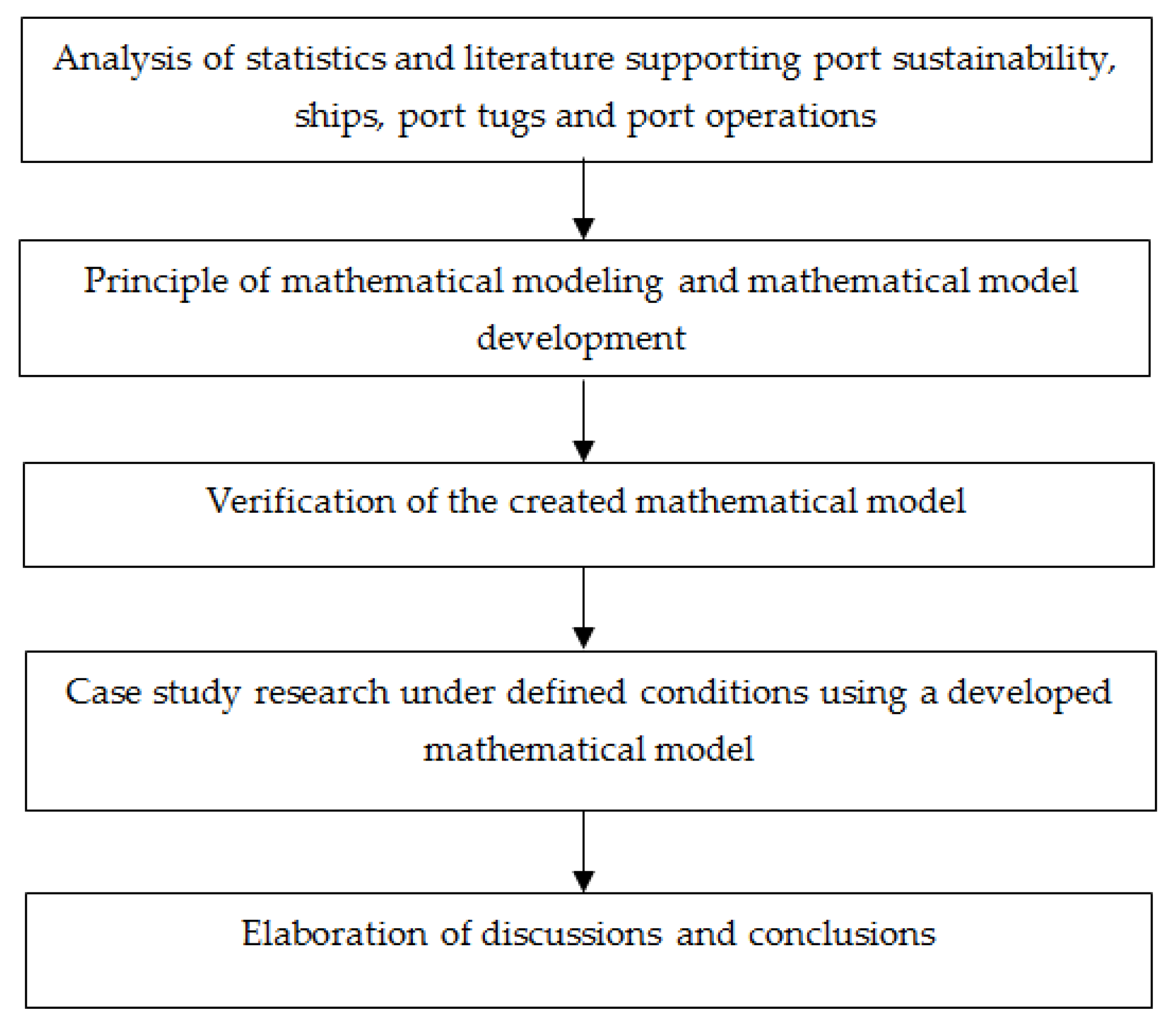
In order to achieve innovation and innovativeness, the following structure of this article was adopted: first, an analysis of the current situation and literature of ports was performed, a mathematical model of methods was created, a case study was conducted with real ships and ports. Based on the case study, the created mathematical model was tested and its correction was made, and a discussion section was prepared, which discusses the achieved results and anticipates possible directions for further research, as well as conclusions.
2. Review of Port Sustainability Conditions and the Literature
Port sustainability is one of the main conditions for successful port operations, as it allows for the optimization of many areas of port operations, ensuring shipping safety in the port and minimal environmental impact. Many ports around the world are trying to optimally develop port infrastructure, installing the latest navigation systems, using modern tugs to ensure shipping safety, and accepting the largest possible ships, including new passenger service and cargo handling technologies [
8]. When optimizing port operations, efforts are made to ensure that ships spend as little time in the port as possible, performing passenger service and cargo handling operations [
9,
10]. By optimizing ship entry into the port and port operating conditions, fuel and energy consumption of ships and port facilities in the port is reduced and at the same time emissions generated from ships and port facilities are minimized [
11,
12].
The water and air resistance of ships, studied from various aspects, and their accurate assessment are important in order to ensure navigation safety in the port, optimize ship utilization and increase port sustainability [
7,
13,
14]. Many researchers have limited themselves to studying ship handling in individual port locations. The handling of ships due to the effects of wind, currents, waves and shoals can vary significantly in the port entrance channels, which in most cases are affected by all of the above-mentioned effects, in the inner harbor channels and ship turning basins, where waves are usually absent, and in the approaches to the quays, where current parameters often change [
15].
Port infrastructure, i.e., port entrances and internal navigation channels, ship turning basins, approach to quays, piers, port navigation equipment and other elements of port infrastructure are very important in creating a optimally (sustainable) port, because a well-planned and developed port infrastructure can increase the parameters of ships entering the port and ensure their safe navigation [
1,
10,
16].
Port tugs are very important in ensuring shipping safety in the port, accepting the largest ships possible, because they help to ensure a safe entry for ships into the port, maneuvering and mooring in the port and departure from the ports [
17]. Modern tugs are usually equipped with “azipod” systems, their maneuverability is significantly better compared to traditional (classic) tugs; therefore, with the use of new tugs, additional opportunities for safe entry of larger ships into the port appear [
17,
18]. Thus, research into ship maneuvering in ports using tugs is important in ensuring shipping safety, reducing emissions and achieving the potential for sustainable port development. The entry of larger ships into the port not only improves the economic indicators of the port and the image of the port, but also makes the port sustainable, because there are opportunities to develop a wider range of port activities, increase navigation safety and reduce environmental impact. Reducing environmental impact is manifested in the fact that using larger ships reduces relative fuel consumption and at the same time the amount of emissions per one conditional passenger or cargo unit [
19].
The use of port tugs to ensure the safety of port navigation is related to the port use or navigation rules and the decisions of the ship’s captain or harbor master, if in specific conditions there are no sufficient ship control capabilities and there is a reasonable risk to the safety of the ship [
20,
21]. Port tugs usually have powerful engines, in some cases up to 4000–5000 kW; therefore, when carrying out ship towing operations in ports under difficult conditions, their need (number of tugs and their traction force) must be assessed as accurately as possible. Inaccurate preliminary preparation of maneuvers and their execution in ports, using high-power engines of ships and tugs, consumes a lot of fuel and generates large amounts of emissions, which negatively affects the sustainability of the port [
22].
In some cases, navigation conditions in ports can change in a very short time. If such a possibility exists, for example, the probability of squalls, ship and port masters, aware of the possibility of a change in navigation conditions, usually take precautionary measures in advance, using additional port tug capacities to safely maneuver the ship or looking for other options to ensure the safety of the ship. If there is a significant possibility of a change in navigation conditions, the ship’s entry into or departure from the port is often postponed, additional mooring lines are used when the ship is moored at the quay, and so on [
23]. The use of additional measures to increase the safety of the ship also requires additional costs; therefore, the most accurate assessment of the ship’s capabilities becomes very important both from the economic and port sustainability point of view [
24].
The port terminal superstructure is also very important from the perspective of a sustainable (optimal) port, as a well-designed and operated port terminal superstructure shortens the processing time of ships in the port, improves the economic condition of ships and port terminals. Due to the shorter time of ships in the port, the environmental impact of the ship in the port is reduced, which is important for achieving sustainable port conditions [
9,
10].
Port operations related to passenger service and cargo handling are important from an environmental impact perspective, as such operations consume a lot of energy and emit a lot of pollutants [
11,
25]. Optimizing port operations is one of the most important factors in reducing environmental impact and at the same time improving port sustainability. Port cargo handling operations, such as grain drying and loading, require high energy inputs, using high-power cranes or other handling machines. Optimizing loading operations, if correctly and accurately assessed, planned and implemented, significantly saves energy requirements and reduces the amount of pollutants generated in port operations [
25].
By properly planning and developing port infrastructure (especially when creating new ports or individual parts thereof), optimizing the well-prepared arrival of ships to and departure from ports and port terminal activities, it is possible to reduce energy consumption and emissions, improve the economic performance of the port and terminals, and at the same time improve the sustainability of the port.
Port sustainability has so far been largely focused on the economic and environmental indicators of the port. Transport is associated with increased risk; therefore, maritime safety is of particular importance in the development of sustainable ports. Maritime safety hearings are regulated by PIANC, IMO and other recommendations and guidelines [
26,
27], which provide very general results and only partially cover the elements of port sustainability. Therefore, it is necessary to assess the provision of maritime safety as one of the most important factors of port sustainability as accurately as possible. Port tugs play an important role in providing maritime safety in modern ports; therefore, an accurate assessment of their capabilities is important as one of the factors of sustainable port development.
As can be seen from the analysis of the port situation and literature from the perspective of port sustainability, there are many scientific and practical problems to be solved in order to increase the sustainability of ports (terminals).
3. Mathematical Basis for Assessing Port Sustainability
In order to achieve port sustainability by improving port efficiency and increasing shipping safety in ports, reducing energy consumption and emissions of incoming ships, port tugs and port operations, it is very important to create a mathematical model of port sustainability. It is also important to verify the created mathematical model based on real experimental data, make corrections to it and, after creating the final mathematical model, conduct port (terminal) sustainability studies.
3.1. Research Progress and Principle of Mathematical Model Development
When developing a mathematical model for assessing port sustainability, it is first necessary to collect a port database based on statistics and literature analysis of port operations of ships, port tugs and environmental impact. Based on the collected database and acceptable mathematical research methods, a principle for developing a mathematical model is created. Using the principle for developing a mathematical model and the collected database, a primary mathematical model for assessing port sustainability is created. The created primary mathematical model is verified using the results of experiments related to real port activities, ships, port tugs and port operations and environmental impact. Based on the results of the verification of the primary mathematical model, the created primary mathematical model is corrected, a final mathematical model is created and with its help the obtained port sustainability assessment results are verified (
Figure 1).
During the verification of the mathematical model, the mathematical model for assessing the sustainability of the port is adjusted and, using the created and adjusted mathematical model, the sustainability of the port is assessed and options for improving the sustainability of the port are sought. Based on the obtained assessment results, a discussion part is prepared, in which the obtained results, possible further studies of the sustainability of the port are discussed and conclusions are prepared and presented.
3.2. Mathematical Model for Assessing Port Sustainability Based on the Comparative Index Principle
For the assessment of port sustainability, it is appropriate to create a generalized assessment system (model) that would combine the impact of port infrastructure and superstructure on port sustainability, as well as the ship or ships entering the port and their controllability, the capabilities of port tugs, the assessment of port operations and other possible factors that have or may have an impact on port sustainability. For the assessment of the generalized sustainable port impact, it is appropriate to use the principle of the comparative method, expressed in a comparative index (
), which can be expressed in the following functional dependence:
where:
—port entrance channel optimality (sustainability) (maneuverability and environmental impact);
—port inside navigational channels optimality (sustainability) (maneuverability and environmental impact);
—port ships turning basins optimality (sustainability) (maneuverability and environmental impact);
—port tugboats sustainability (capability and environmental impact);
—optimality (sustainability) of the berth (area and environmental impact);
—terminal (port) operation sustainability (productivity, intensively, energy requirements for port operations and environmental impact);
—quantities of generated emissions;
—additional actions (port organization, employ quality, fuel quantities and so on), affecting the port sustainability and environmental impact.
To assess the sustainability of a port, it is necessary to adopt either ideal conditions for port sustainability or to use a comparison of ports from a sustainability perspective. In general, comparisons between ports are usually inaccurate, since it is practically impossible to find ports that are absolutely similar in terms of their areas of activity, parameters, etc. In many cases, it is appropriate to compare port terminals with each other, since their activities are similar, for example, container, bulk cargo, Ro-Ro or other specific terminals are similar at least in terms of their activities and in many cases in terms of basic parameters. Therefore, when assessing the sustainability of ports, it is appropriate to limit ourselves to comparing individual port terminals or their groups.
Given the large number of different factors that affect the sustainability of ports or terminals, the comparative index is often based on deterministic assumptions [
26]. Given the large number of factors, which is typical for assessing the sustainability of ports, according to the centile limit theorem, a normal distribution is approached and in this case Gauss’s law can be used [
28]. By using factor weight coefficients, nonlinear influences of factors are also taken into account when assessing the comparative sustainability index of ports. In such a case, the comparative port sustainability index can be written as follows:
Here: —correlation coefficient, depending on the number of similar elements, can be from 0.95 to 1.0 (1.0 will be if there are no similar factors or elements). The correlation coefficient is adopted when evaluating similar factors; in this study, the interaction of port infrastructure, ship maneuverability, and tugboat capabilities was evaluated;—factors weight coefficients; —elements (factors) of the analyzed port (terminal), can be expressed as coefficients or absolute values; —elements of an ideal sustainable or comparable port, expressed in the same parameters as the elements of the analyzed port. A relatively ideal port can be recognized as a port that meets all international and national requirements in terms of shipping safety (in the broad sense), has the minimum possible impact on the environment at any given moment, and meets the best technical, technological, organizational and legal international and national requirements. In reality, such ports are difficult to find; therefore, for the purpose of assessing the comparative port sustainability index, a comparable port may be adopted, the above indicators of which, or some of them, are better than the port under study.
It is worth noting that the developed sustainable port comparative index allows the use of all or part of the factors, as well as expanding the number of factors. In all cases, it is necessary to evaluate the weight coefficients of the factors; their sum in all cases must be equal to one.
3.3. Mathematical Model for Assessing Navigation Safety Based on Ship Trajectory and Water Area Parameters
Port infrastructure optimality (sustainability) (approach and inside port navigational channels, ships turning basins configuration and main parameters, influence on navigational safety and environmental impact), could be evaluated via channels parameters and ship’s maneuverability, that means whether a ship can independently or with the help of tugboats enter the port, maneuver in it and moor, performing a minimum number of maneuvers.
Port infrastructure: port entrances and internal navigation channels, ship turning basins, quays, etc. should be designed so that the trajectories of the largest possible ships entering the port “fit” into the planned channels, i.e., so that ships can safely enter the port and maneuver in it. The ship trajectory, i.e., the coordinates of the trajectory in the absence of external forces (wind, current, waves, shallows),
and
can be calculated as follows [
7]:
where
is ship’s speed module (can be taken from ship’s navigational equipment or could be calculated [
7,
13]);
is turning velocity, rad/s (can be taken from ships navigational equipment and calculate using methodology, presented in [
7,
13];
is drift angle, rad;
,
and
can be calculated depending on the sailing conditions using methods presented in [
7,
13].
In most cases, when ships enter and maneuver in ports, they are affected by aerodynamic and hydrodynamic forces, i.e., wind, current and waves (waves mainly affect the ship’s trajectory in the port’s entrance channels). In such situations, when the ship’s trajectory is affected by current, waves and wind, and the ship’s propulsion system is also used, the ship’s trajectory coordinates can be calculated as follows [
7,
13,
14]:
where
,
are the current speeds in the
and
directions;
,
are the ship’s drift speeds in the
and
directions, which can be calculated using the methodology given in [
7,
13,
14];
,
are the ship’s acquired speeds in the
and
directions due to the impact of waves on the ship, which can be calculated using the methodology given in [
13,
14].
Taking into account the calculation method presented in Equations (5) and (6) and after considering the effect of shallowing in the port entrance channel and other parts of the port, Equations (5) and (6) can be written as follows:
Here:
the speed of the ship when moving along a curvilinear trajectory at shallow depth can be calculated using the methodology presented in [
7,
13];
the angular speed of rotation of the ship when moving along a curvilinear trajectory at shallow depth can be calculated using the methodology presented in [
7,
13];
the angle of drift of the ship when moving along a curvilinear trajectory at shallow depth can be calculated using the methodology presented in [
7,
13]. At the same time, when considering specific port conditions and the relatively short sailing time of a ship through the port entrance and internal navigation channels, in many cases it is possible to assume constant wind, current and depth parameters and then simplify the calculation of the ship’s trajectory.
The width of the port entrance and internal navigation channels, so that the largest planned ships can safely enter the port, can be calculated according to the following formula, taking into account the coordinates of the ship’s navigation trajectory, from which the navigation lane occupied by the ship is calculated [
7,
14]:
Here:
—length of the ship between perpendiculars (maximum ship‘s length between perpendiculars is assumed);
—width of the ship (width of the widest ship is assumed);
—angle of the ship’s course inclination when navigating the channel (for large ships it should not exceed 2 degrees);
probability supply coefficient, 95% supply is assumed in navigation; therefore
applicable in this case is about 2; LNG ships, oil tankers, chemical tankers have specific requirements; therefore a coefficient of up to 3 is applied, i.e., assuming up to 99.7% probability supply [
7,
26,
27];
—accuracy of determining the ship’s location relative to the channel axis, for example, the sensitivity of the guide;
—navigation margin, which depends on the accuracy of the channel slope position and the stability of the channel slopes (in depth, it is calculated based on the geotechnical properties of the soil in which the channel is dug) and amounts to (0.5–1.0)
[
7,
13,
26,
27].
After evaluating the ship’s trajectory and the navigation lane occupied by the ship (at each point in time, the width of the navigation lane occupied by the ship must be added to the ship’s navigation trajectory), the required minimum channel width and its configuration (entry and internal navigation channels) are obtained.
The minimum width of the navigation channel (entry and internal) must not be less than the navigation lane occupied by the vessel, calculated from the vessel’s navigation trajectory using Formulas (7) and (8), and estimating the width of the vessel’s navigation lane according to Formula (9). In individual cases, the width of the vessel’s navigation lane may be reduced by using additional vessel steering devices (thrusters) or tugs, or by reducing the permissible wind and current parameters.
For practical purposes, when calculating the minimum width of a port entrance or internal navigation channels, it is recommended to use a ship’s rudder angle of no greater than 20° in order to have a margin of controllability in case external forces suddenly change (wind gusts) or the ship’s controllability is not accurately assessed. It should be emphasized that the presented methodology for calculating channel parameters can be applied in any navigation area.
If the channel width is smaller than that obtained using the presented calculation methodology, additional ship steering devices (thrusters) or tugs can be used to improve the ship’s maneuverability. At the same time, it is necessary to take into account that if, under specific hydro meteorological and hydrological conditions, the ship cannot independently safely navigate the port’s entrance and internal navigation channels, the ship’s navigation is restricted; therefore, the ports set maximum permissible boundary conditions for entering and leaving the port (wind and current parameters). The minimum channel width for typical ships, taking into account the ship’s drift angle and other ship movement parameters, can be calculated in advance using Formula (9) or other methods, for example, using PIANC [
26] or other recommendations [
27]. Assuming that the ship can reach a drift angle of up to 15° during a turn [
7,
13,
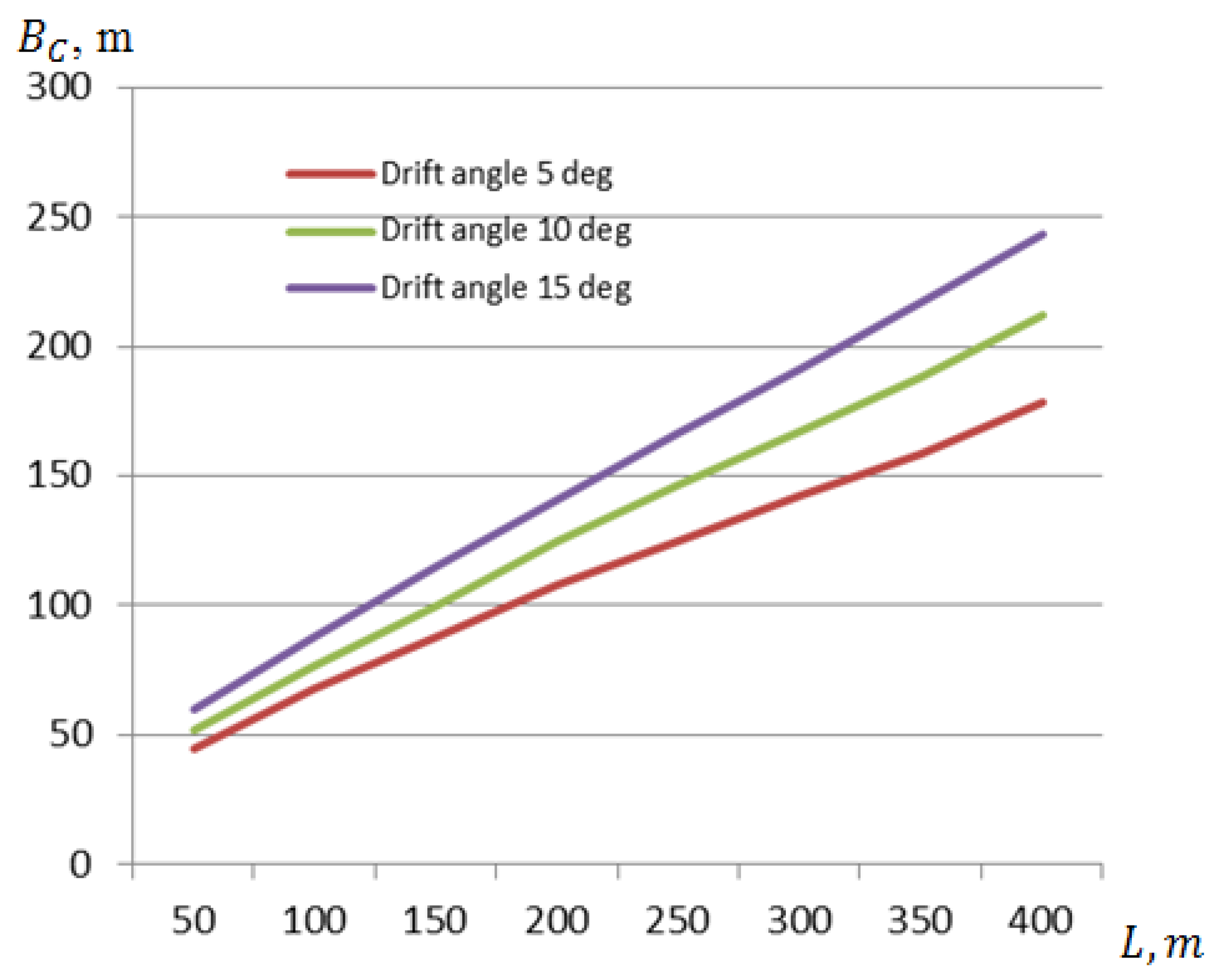
14], depending on the main geometric parameters of the ship, i.e., The preliminary results of calculating the width of the channels, assuming a probability of about 95%, are presented in
Figure 2 as an example, based on the ratio of the length to the width of the ship (this ratio is taken to be approximately 6.5).
If the channel width is insufficient during the turn, depending on the length of the ship and the specified basic parameters (drift angle and accuracy of ship location determination), ship thrusters, tugs or tugs can be used to increase the angular speed of the ship and at the same time reduce the channel width required during the turn. When a ship moves through channels, the best result is achieved by using a stern thruster or a stern tug, because the ship’s pole of rotation, when the ship moves forward, is located in the forward part of the ship and in this case a larger turning moment is created. The abscissa of the ship’s pole of rotation, when moving forward of the ship (from the middle of the ship, i.e., from the intersection point of the waterline and midship planes), can be calculated according to the following formula [
7,
13]:
Here: —ship’s stern draft; —ship’s bow draft; —rudder plate rotation angle, rad.
In this way, using stern thruster(s) or a tugboat at the stern can significantly increase the ship’s maneuverability when navigating through straits and channels, which is very important for the development of sustainable ports.
When assessing the sustainability of a port from the point of view of the approach and internal navigational channels, it is very important that the minimum width of the channels is as close as possible to the calculated one using Formula (9). In the event that the actual minimum width of the port channels is greater than that calculated using Formula (2), the ratio or /, is taken equal to unity.
Ship turning basins are one of the important elements of port infrastructure, and for a optimality (sustainable) port it is very important that the ship turning basin(s) meet the needs of shipping safety. In ship turning basins, tugboats are used to improve the maneuverability of large ships that do not have high-power propulsion systems (thrusters). For example, cruise ships, whose additional control systems (thrusters) sometimes have a power of up to 12–14 MW, (greater than the power of 3–4 port tugs), usually do not use tugs.
The recommended diameter of ship turning basins, i.e., about 1.6 of the maximum possible ship length [
13,
14,
26,
27], is difficult to achieve in many ports, since the length of modern ships sometimes reaches 350–400 m. Preparing turning basins of the specified diameter of about 1.6 of the maximum ship length, especially in old ports, is often difficult due to geographical conditions; therefore, in many ports the diameter of ship turning basins is smaller than specified in the recommendations. In many ports, turning basins currently being prepared for the longest ships currently in operation (length up to 400 m) are about 500 m in diameter [
20,
21], i.e., the ratio of the turning basin diameter to the longest ship length is about 1.25. With a similar ratio of turning basin to ship length (about 1.25), an accurate preliminary estimate of the number of tugs and their power or pulling force is very important. The moments created by the ship and external forces must be accurately estimated.
3.4. Mathematical Model to Estimate the Required Pulling Power of Port Tugs and Their Capabilities for Navigation Safety
The moments acting on the ship when entering and maneuvering in the port must be compensated by the forces and moments created by the ship’s rudder or, if the ship uses the assistance of steering devices or tugboats, by the forces and moments created by additional steering devices (thrusters) and/or tugboats.
Large ships in ports usually use port tugboats, especially if the ship does not have its own additional steering devices (thrusters). Considering that there are no waves in the ships turning basins of ports, the current changes little when the ship turns (due to the relatively small time interval), and the ship has a minimum longitudinal speed, using D’ Lambert’s principle [
7,
13,
14], the equation of the ship’s turning moments can be written as follows:
where
is the inertia moment;
is the moment created by the ship’s hull, which could be calculated by using the methodology stated at [
7,
13,
14];
is the moment created by thrusters [
7,
13,
14];
is aerodynamic moment, which could be calculated using the methodology stated at [
7,
13,
14];
is the moment created by shallow water effect [
7] (in port conditions, this parameter is very important, especially when the ratio of the ship’s draft to the depth of the turning basin is greater than 0.9);
is the moment created by ship’s propeller (propellers) and rudder(s), which could be calculated using the methodology stated in [
7,
13,
14]; and
is the moment created by tugboats. Additional moments could be created by anchor or mooring ropes or other factors.
The moment of inertia of a ship moving through canal bends and turning the ship in a turning basin can be expressed as follows [
7,
13]:
where
is the moment of inertia of the ship;
is added moment of inertia of the ship turning in water;
is the acceleration of the ship’s rotational angular velocity.
The moment of inertia of a ship, assuming the ship as a rigid body, can be calculated using the principles of theoretical mechanics, as follows [
29,
30].
where
is water density;
is ships displacement;
is ship’s length.
When evaluating the rotational moment of the connected fluid mass, the total moment of inertia can be calculated as follows: [
7,
13,
29,
30]:
where
—added moment coefficient, which for the analyzed situation (ship turning in port turning basin in case of T/H = 0.90–0.95), is equal to 3 [
7,
13,
14];
is ship’s inertia period, can be taken as
[
7,
14].
The ship’s hull moment (
) can be calculated as the hull’s resistance to lateral acceleration (
) [
7,
13,
14]:
where
is the coefficient of the added water mass when the ship moves in the transverse direction;
is the speed of the ship’s movement in the transverse direction;
is the average draft of the ship;
is the depth of the port ships turning basin.
The aerodynamic moment when the ship is turning can be calculated as follows [
13,
14]:
where:
is the aerodynamic coefficient of the above-water part of the ship;
here is air density, 1.25 kg/m
3 can be accepted for calculations;
and
here are the areas of the projections of the above-water part of the ship to the middle and transverse planes;
here is the wind speed;
is the abscissa of the aerodynamic force addition point with respect to the middle plane of the ship;
is the wind heading angle at the start of the maneuver.
The ship will start turning when the moment created by the thrusters, or tugboats is greater than the moments of inertia and other external forces. A lot of big conventional ships have not thrusters and in this case, tugs created moment can be calculate as follows:
In this way, the part of the moment created by the tugboats, which will act to turn the ship, will be calculate as follows [
31]:
Port tugboats sustainability (capability and environmental impact) (
), means having a sufficient number and the required pulling power of tugboats in the port to provide safe entry of vessels into the port and maneuvering in it up to the permissible hydro meteorological and hydrological conditions. When mooring ships and turning them in the ship turning basin or other port area, the pulling force of tugs is required to create the necessary torque, which would be greater than the torques created by other external forces. The minimum torque created by tugs depends on the pulling force of tugs and the moment arm must be greater as forces created by external factors (wind, current, waves, shallow water effect and so on. The necessary lateral force created by tugs (taking into account the ship’s course) together with ships propulsion mechanisms can be calculated as follows [
7]:
where:
—forces are generated by the ship’s propulsion mechanisms (thrusters);
—ship’s inertia force;
—ship’s developed hull force;
—aerodynamic force generate by ship;
—the force is created by the current on ship;
—the force is created by the impact of shallow water on ship.
Considering the short-term necessary traction force of tugs (pushers) and the relatively low speed of the ship, when the ship moves through the port channels or in the port ship turning basin and when it is moored or unmoored, the inertia force, taking into account the resistance of the ship’s lateral hull, can be considered to be approximately 1.3–1.5 times greater than the lateral resistance force of the ship. Then, regardless of the forces generated by the engine(s) (if the ship has one) (they remain as an additional safety margin of the ship), Equation (19) can be written as follows [
7,
14]:
where:
—the hydrodynamic coefficient of the hull of the ship, for marine ships during mooring or turning the ship, at relatively low speeds in the
direction, can be taken as about 1.3–1.5 (as a plate with rounded edges placed across the flow) [
7,
13];
—water density;
—ship length;
—mean draft of the ship;
—depth;
—the area of the projection of the above-water part of the ship to the middle plane;
—aerodynamic coefficient [
7,
13];
—the speed of the ship moving on
dirrection to the ship’s course during sailing in channels, turning or during moving to quay or from quay [
13,
14,
32];
—wind velocity;
—current speed;
—the angle of the wind to the ship‘s course;
—the angle of the current to the ship’s course.
The ability of tugboats in the port to help turn a ship around in extreme hydro meteorological and hydrological conditions is an important factor in a sustainable port. In many ports, maximum wind and current speeds are set, up to which ships can enter the port (enter, maneuver and moor). In the case when the power of the ship’s engines or tugboats (traction forces) is equal to or greater than the forces created by external forces, calculated according to Formula (20), the ratio / is considered equal to one.
Entrance to quay sustainability (area and environmental impact) (
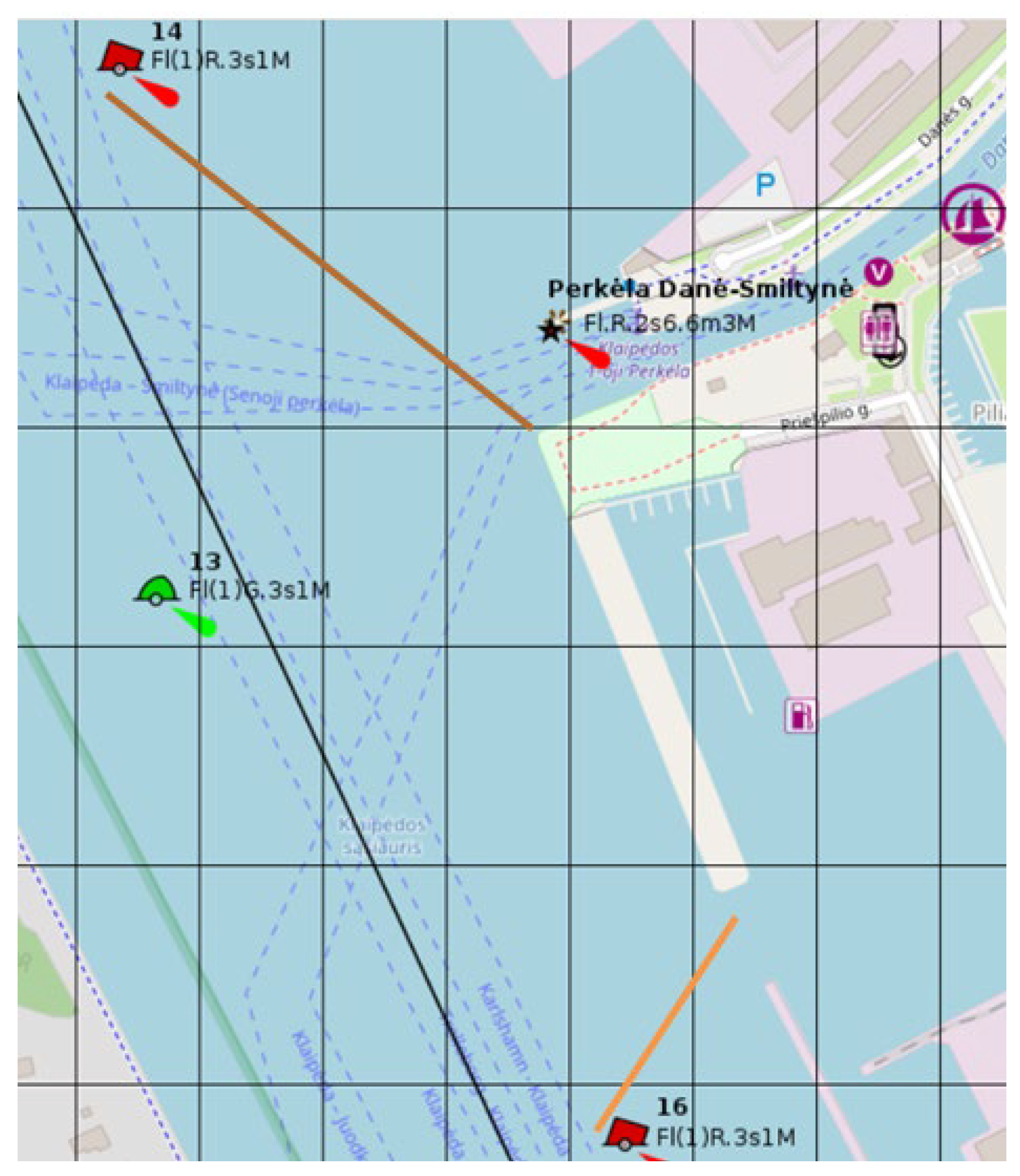
) means the comfortable approach of a ship to the quay, without the need for special maneuvers. In most cases, this corresponds to the required depths for access to the quay, which are located at the quay at a distance of not less than 0.1 L on both sides of the largest moored ship and at an angle of not less than 45° (
Figure 3). Under better conditions than those specified above, the ratio
/
is taken equal to unity.
3.5. Mathematical Model for Assessing Port (Terminal) Activity
Port sustainability (activity intensity and energy demand for port operations and environmental impact) (
) refers to the loading capacity and energy demand of port facilities for passenger and cargo handling, for example per passenger or per tonne of cargo, and the corresponding emissions [
7,
33,
34]. This parameter depends on the superstructure and equipment present in the port and can be estimated using terminal intensity, energy consumption and emissions [
35,
36,
37].
The optimal terminal intensity (one of the conditions for terminal sustainability) depends on the type of cargo and the planned ship sizes. As examples, the capacity of container, car, bulk, liquid bulk and Ro-Ro terminals evaluation formulas presented below. Container terminal capacity can be evaluated using the terminal area utilization factor, the vertical loading of containers and the average container storage time at the terminal. Studies conducted at various terminals allow for a more accurate assessment of the volume and area utilization coefficients of sustainable ports and terminals, which often differ from the design norms of various countries [
25,
27,
38]. The annual terminal capacity (
) can be calculated using the following formula [
7,
38,
39]:
Here: —terminal area utilization factor, applicable to many container terminals, taking into account the total area of the terminal and the area required for container handling (access roads, gaps between container storage racks, area required between quay(s) and storage areas, etc.). Based on studies of terminal area utilization factors in several container terminals, it has been found that this indicator varies from 0.2 to 0.5 in different terminals. The application of optimization principles has shown that in sustainable container terminals this factor can range from 0.25 to 0.35; —total terminal area; —area occupied by one container, for a 20-foot container (TEU—twenty equalent unit) it is about 15 m2; —average vertical loading of containers, this value in many container terminals is from 2 to 4; —total operating time of the container terminal per year, if the terminal operates all year round without breaks, this time can be taken as 365 days; —average storage time of containers in the terminal, in many container terminals this time is up to 10 days.
Terminals for cars and other wheeled vehicles are very important and many ports around the world have such terminals. The annual capacity of a sustainable car terminal (
) can be calculated using the following formula [
7,
40]:
Here: —terminal area utilization factor. Studies conducted in several car terminals (single and multi-level) have shown a very wide range of this coefficient, i.e., from 0.3 in multi-level terminals (access roads, other infrastructure required for the structure are required), to 0.85 in single-level car terminals. For a sustainable car terminal, the optimal terminal area utilization factor, considering the total terminal area and the area required for car servicing, can be accepted as 0.5 to 0.8; —total terminal area; —area occupied by one car, for passenger cars it is about 10 m2; —number of levels (storeys) of the car warehouse, if multi-storey terminals (warehouses) are used, this value usually amounts to 3–4 levels; —total working time of the car terminal per year, in most terminals of this type work all year round without breaks, then this time can be taken as 365 days; —average car storage time at the terminal, calculated in days. In most car terminals, this time is about 10–20 days.
The annual capacity of a bulk cargo terminal (
) (Formula (23)) and closed-type liquid cargo storage facilities (
) (Formula (24)), located in many ports around the world, can be calculated as follows: [
7,
41,
42]:
Here: —bulk terminal area utilization factor. Based on research conducted at bulk terminals (research conducted at 5 bulk cargo terminals), depending on the design, it can be from 0.7 to 1.0, for example, (1.0 could be for silo terminals); —bulk cargo terminal volume in cubic meters or tons; —terminal turnover per year, in many terminals it is up to 6–15, depending on the type of bulk cargo and market conditions; —liquid cargo terminal area or volume utilization coefficient. Based on research conducted at 6 liquid cargo terminals (research conducted at oil, oil products and LNG cargo terminals) in most cases it is about 0.90–0.95, i.e., from the maximum filling of the tanks; —liquid cargo terminal volume in cubic meters or tons; —terminal turnover per year, in many terminals it is up to 30–40, depending on the type of liquid cargo and market conditions.
Ro-Ro transport is very important in supplying the activities of many countries; therefore Ro-Ro terminals are being developed in many ports. The capacity of Ro-Ro terminals (
) can be calculated as follows [
7,
43]:
Here: —terminal area utilization factor. Based on the research conducted on Ro-Ro terminals (5 terminals of this type in 3 ports were studied), it can be assumed that for many Ro-Ro terminals, when assessing the total terminal area and the necessary area for servicing Ro-Ro vehicles (approach roads, spaces between Ro-Ro vehicle storage rows, other additional areas necessary for vehicles to exit or enter without moving others), it can be taken from 0.4 to 0.6; —total terminal area, m2; —area occupied by one Ro-Ro unit (truck or trailer, on average for Ro-Ro vehicles it is about 45 m2; —total working time of the Ro-Ro terminal per year, in most terminals of this type work all year round without breaks, then this time can be taken as 365 days; —average storage time of Ro-Ro vehicles at the terminal, calculated in days. In most Ro-Ro terminals this time is from 0.5 to 1.0 days.
The presented formulas for assessing the annual turnover of sustainable terminals can be used in any port by adjusting the conditions of the specific port, in particular, such as customs procedures, cargo arrival and departure from the terminal, and other conditions.
For further research, as example, it is appropriate to present a detailed evaluation methodology for one terminal. In modern ports, container terminals have the most equipment and mechanisms; therefore, as an example, it is appropriate to analyze this type of (container) terminal. The main equipment of container terminals includes: STS (shore to ship) cranes, RTG cranes, terminal tugs (tractors), reach stackers, vertical lifts (forklifts) and other auxiliary equipment [
7,
38,
39].
The average number of container transshipments from ship to quay or vice versa by one STS crane is up to 30–35 per hour. In many feeder ports, container ships carry out loading operations for no longer than 12 h, and in hub ports—for no longer than 24 h. Thus, knowing or assuming the planned number of container transshipments per ship, the required number of STS cranes (
) for the hub or feeder port can be calculated according to the formula [
7,
38,
39]:
where:
—number of ships scheduled at the terminal at the same time;
—average number of containers brought to the port by container ship;
—time of ship’s stay in the port (in hours);
—hourly capacity of one STS crane.
The amount of equipment operating in a container terminal is calculated based on the planned annual container traffic at the terminal. The main equipment of a container terminal consists of: rubber tyred gantry cranes (RTG), terminal tractors, reach stackers and forklifts. In addition, frame lifts and other additional equipment may be used.
The number of RTG cranes (
(Formula (27)), terminal tractors (
) (Formula (28)), reach stackers (
) (Formula (29)) and forklifts (
) (Formula (30)) depends on the annual container flow and can be calculated as follows [
7,
39]:
where:
—RTG coefficient corresponding to the average number of containers processed by one RTG per year, in modern sustainable container terminals it is accepted on average from 40 thousand to 60 thousand;
—terminal tug coefficient, corresponding to the average number of containers handled by one tug per year, for modern container terminals it is taken from 30 thousand to 50 thousand;
—terminal reach stackers coefficient, corresponding to the average number of containers processed by the side lift per year, for modern container terminals it is accepted from 90 thousand to 110 thousand;
—forklifts (vertical lift) coefficient, corresponding to the average number of containers processed by one vertical lift per year, for modern sustainable container terminals it is accepted from 190 thousand to 210 thousand.
The coefficients of the necessary equipment of a container terminal depend significantly on the container handling technology used, i.e., currently, STS crane grabs are widely used, which pick up one 40-foot container or two 20-foot containers at a time and are accompanied by other terminal handling equipment. Some container terminals have started to use a block container handling system, when STS cranes load two 40-foot containers or four 20-foot containers at a time. When assessing the rapid change in technology, it is important to examine the real situation of the available container terminal equipment in each specific case and adjust the coefficients for calculating the necessary equipment accordingly.
Some equipment typically used in container terminals is often used in other terminals, especially general cargo and multi-purpose terminals, so the methods provided for calculating the amount of equipment can be applied to other types of terminals.
The majority of the port superstructure equipment, such as RTG cranes, terminal tractors, reach stackers, forklifts and other equipment and mechanisms with internal combustion engines, consume a significant amount of fuel, especially diesel. The annual fuel consumption of RTGs, terminal tugs, side and vertical lifts can be calculated by assessing the number of equipment and mechanisms in the terminal, the relative fuel consumption of the engines of equipment and mechanisms, the power of the engines of equipment and mechanisms, the power utilization factor of the engines of equipment and mechanisms and the average coefficient of their use time.
3.6. Mathematical Model for Estimating Fuel Consumption and Environmental Impact of Ships and Port Equipment
Thus, the amount of fuel consumed per year in the terminal (
) can be calculated according to the formula [
44,
45]:
where:
—number of specific equipment (mechanisms) in the terminal;
—relative fuel consumption of specific equipment (mechanisms), the relative fuel consumption of diesel engines of many terminal equipment (mechanisms) is from 0.25 to 0.35 kg/kWh (more accurate data is provided in the specifications of specific engines);
—power utilization factor of specific equipment (mechanisms) engines;
—time coefficient of specific equipment (mechanisms) utilization;
—engine power of specific equipment (mechanisms).
The fuel consumption of another port terminal or other facility, such as a warehouse, equipment, per year (or other period of time) (
) can be calculated according to the general formula [
7,
44]:
where:
—the amount of equipment or mechanisms of a terminal or other facility;
—the relative fuel consumption of the equipment or mechanisms of a terminal or other facility, the relative fuel consumption of diesel or other engines of many port or other facility equipment or mechanisms is from 0.12 to 0.40 kg/kWh (more precise data is provided in the specifications of the engines of specific equipment or mechanisms);
—the power utilization factor of the engines of the equipment or mechanisms of a terminal or other facility;
—the time coefficient of the use of the equipment or mechanisms of the terminal or other facility;
—the power of the engines of the equipment or mechanisms of a terminal or other facility.
The total fuel consumption at the terminal per year or other period (
) can be calculated using the formula [
7,
45]:
Here: —the amount of fuel consumed by the terminal’s RTG cranes per year; —the amount of fuel consumed by the terminal’s tugs per year; —the amount of fuel consumed by the terminal’s side lifts per year; —the amount of fuel consumed by the terminal’s vertical lifts per year; —the amount of fuel consumed by other terminal equipment per year.
The methodology obtained in this way allows for the assessment of fuel consumption of port superstructure equipment and mechanisms. By assessing the fuel consumption of port superstructure equipment and mechanisms, the average operating time of equipment and mechanisms (engine hours) and the average power used by equipment and mechanisms, the amount of emissions generated can be estimated.
A sustainable port should have minimal environmental impact, but it employs a wide range of machinery and equipment. Many of the vehicles operating in the port have powerful engines and consume a lot of fuel. Ships consume a lot of fuel when sailing into the port, maneuvering in it, and slightly less when they are moored at quays or anchored at anchorages, i.e., while waiting to enter the port. The fuel consumption of vehicles and other machinery operating in the port is calculated during sailing or at another time. The fuel consumption of vehicles and machinery engines if they use fossil fuels, such as diesel, LNG or other fuels, (
) can be calculated as follows [
44,
45]:
where:
is the coefficient, which depends on the type of engine;
is the consumption of fuel for the definite engine;
is the engine’s average power during the working period, which can be calculated using Equation (35):
where:
—is the instantaneous transport means (equipment) engine power;
—is the transport means working time in hours.
Equipment engine power (
) and the amount of fuel consumed (
) over a given period of equipment working, during which equipment working, time (
), e.g., an hour, and the relative fuel consumption (
) link as [
44,
45]:
The amount of fuel consumed by equipment when it works can be calculated as:
Here, is the average engines power of the equipment during it work.
The amount of pollutants emitted by ships and port equipment and port machinery during operation directly depends on the amount and quality of fuel used, engine power and engine operating time [
7,
37,
46,
47,
48]. The main types of pollutants emitted by engines are: carbon dioxide (
), nitrogen oxides (
), carbon monoxide (
), sulfur oxides (
) and particulate matter (
) [
37,
46,
48]. Thus, the amount of carbon dioxide, Sulphur oxide, carbon monoxide, nitrogen oxides and particulate matter emissions could be calculated according to the Formulas (38)–(42) [
38,
46,
47]:
Here,
is carbon dioxide coefficient for petroleum products (diesel, fuel oil) is between 3.0 and 3.5, for LNG between 2.5 and 2.9 [
7,
37,
47];
is the Sulphur oxide coefficient, which depends on the type of fuel: for petroleum products it ranges from 0.001 to 0.035, for LNG it is around zero [
37,
47];
is carbon monoxide coefficient, which depends on the type of engine [
7,
37,
46];
is nitrogen oxide coefficient, depending on engine type [
37,
46];
is the particulate matter coefficient, which depends on the type of engine and the type of fuel, up to 10 g/kWh for petroleum products and close to zero for LNG fuels [
37,
46,
48].
Additional actions affecting the sustainability and environmental impact of the port () refer to the necessary amount of energy and correspondingly generated emissions used to perform additional operations at the port, including daily maintenance of the port (terminal), not related to passenger service and cargo processing.
The developed methodology for assessing a sustainable port (terminal) using the sustainable port comparative index allows revealing the real situation of the technical, technological, organizational and other factors of the port (terminal) from the perspective of a sustainable port. Knowing the real situation of the port (terminal) allows you to effectively seek opportunities to optimally and sustainably develop the technical, technological, organizational and other capabilities of the port (terminal) and at the same time, by assessing the weaknesses of the port (terminal) according to individual factors of the sustainable port benchmark index, achieve better port performance results.
4. Case Study Assessing the Sustainability Situation of a Port (Terminal)
For the case study, as an example, a port container terminal was selected to assess the sustainability of a port (terminal), located next to the port’s inner navigation channel and ship turning basin.
Depending on the type of port terminal (container, Ro-Ro, LNG, etc.) and its location in the port, the probability parameters of shipping safety must be assessed. For LNG, crude oil and petroleum product terminals, a probability of 99.7% is assumed, for other terminals, under simple navigational conditions, the standard shipping probability of 95% is assumed [
7,
26]. For terminals located far from the port entrance channel and with a complex channel configuration, a probability between the above-mentioned probabilities is assumed, after additional navigational safety assessments have been performed [
7,
26].
The port’s entrance channel is 150 m wide, its depth is 15.5 m, and the diameter of the ship turning basin is 410 m. The terminal has 5 STS cranes, 16 RTG cranes, 20 terminal tugs, 8 side lifts, and 4 vertical lifts. The container terminal’s capacity is approximately 800,000 TEU per year. The NEW PANAMAX container ship was selected for the assessment of the sustainable port terminal, with a length between perpendiculars of 355 m, a width of 48 m, a draft of 14 m, and a container capacity of approximately 14,000 TEU. The ship handles an average of approximately 4000 TEU at the terminal, and the average ship’s parking time at the terminal is up to 24 h. The area of the projection of the above-water part of the ship onto the midplane is approximately 14,000 m2, and onto the midship plane—approximately 2200 m2. The area of the projection of the underwater part of the ship onto the midship plane, at a draft of 14 m, is approximately 5100 m2. The sailing of a G-class container ship (length 400 m, width 61 m) to the port was also partially analyzed.
Experimental data on the arrival, maneuvering and departure of real ships to the port were used for the case study. Experimental studies of the arrival, maneuvering and departure of various types of real ships from ports were carried out by the authors (over 50 ships) in 20 ports, as well as using AIS data [
7,
24,
37]. To confirm the theoretical results, it is very important to conduct experiments with real objects (ships) using highly accurate navigation equipment [
49,
50,
51], and according to the results obtained, adjust the mathematical models so that they can be applied to any dynamic objects (ships) and in various locations in the ports. i.e., ship motion parameters: trajectories, linear and angular velocities, drift angles, obtained parameters of the main engine of the ships, etc.
Currently, simulators are often used, with the help of which various situations can be created. At the same time, it is not always possible to accurately enter all possible parameters into simulators, especially for dynamic objects (ships); therefore it is very important that the ship parameters in the simulator are as close as possible to real ships. Based on the results of experiments with real ships, calibration coefficients were calculated for the simulator, as the differences between the results obtained in analogous conditions on real ships and in the simulator. Using calibration coefficients, with the help of simulators it is possible to create various research situations, the necessary parameters of ship movement and maneuvering [
7,
24,
52].
The calibrated simulator “Simflex Navigator” [
53] was used for the research, for the calibration of which experimental results of real ships with analogous parameters were used.
After performing calculations of ship trajectories and other parameters using the methodology presented in
Section 3 and comparing them with experimental results obtained on real ships and with the help of a calibrated simulator, it was determined that the ship motion parameters (calculated and experimental) differed from the values of the parameters themselves by no more than 10% [
7,
24,
37,
51,
52].
When manoeuvring the ship, i.e., entering the port and turning it around in the port’s ship turning basin, approaching the terminal quay and towing the ship away from the terminal quay, and when the ship leaves the port, 2 tugboats were used, each with a maximum pulling force of up to 520 kN.
The real ship’s approach to the port, maneuvering in it, mooring and sailing from the quay and sailing from the port were carried out in a southwesterly wind with a speed of about 12 m/s, and the current in the channel direction towards the port gate reached up to 0.5 knots. The same external conditions were used in the calibrated simulator. The simulator was also used to collect statistical data.
The ship’s movement trajectories in the port’s entrance and internal navigation channels and the required channel width were calculated using the methodology presented in
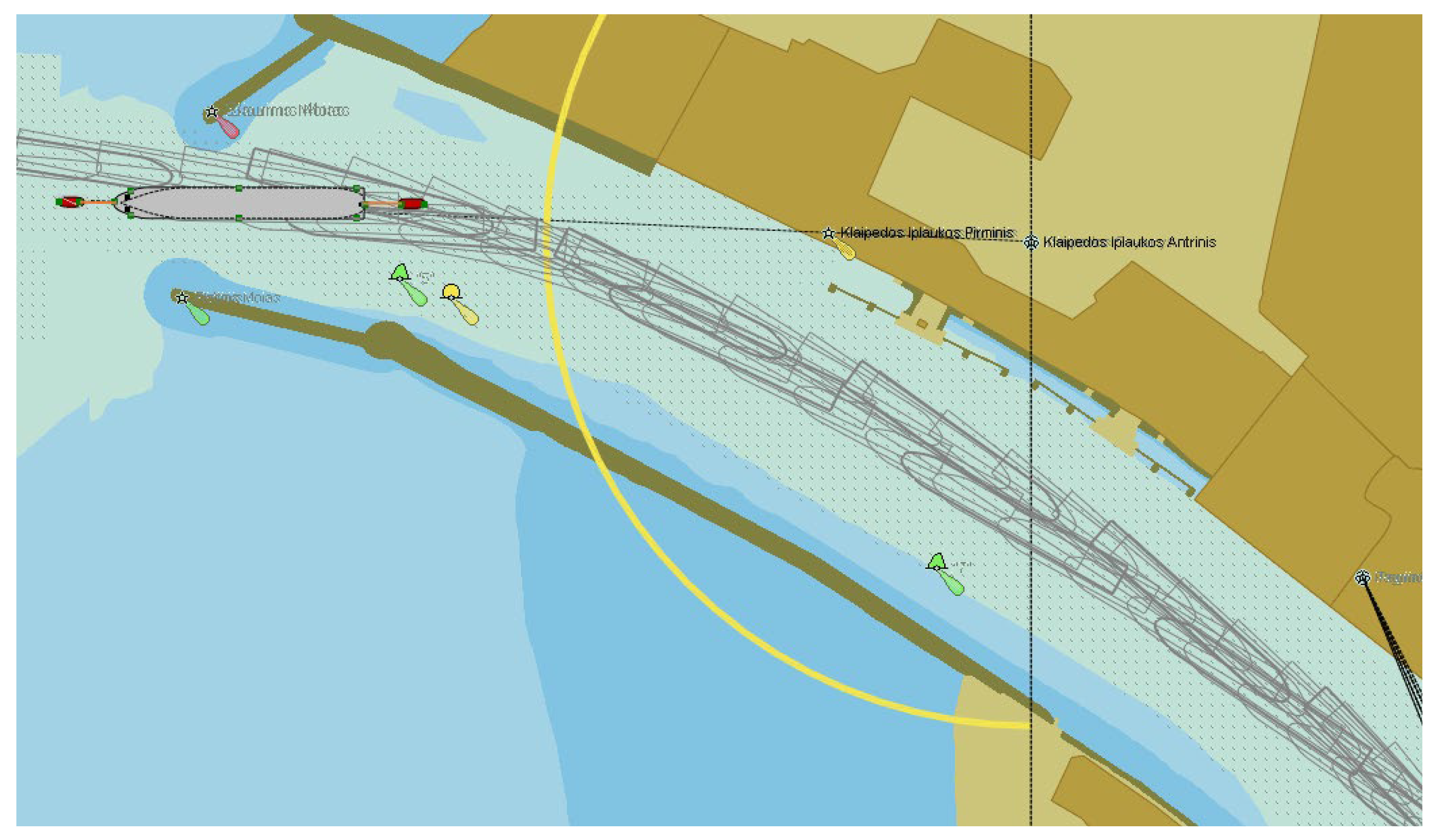
Section 3. The ship’s movement trajectories obtained on real ships and with the help of a simulator during experiments were also used and analyzed. During the ship’s navigation in the port’s entrance and internal navigation channel, the wind speed was 12 m/s, the wind direction angle in the port’s entrance channel was about 120° from the starboard side, in the internal navigation channel when entering the port—about 90° from the starboard side, and when sailing towards the quay and sailing away from the quay and when sailing from the port was from 90° to 60° from the port side. The current speed in the entrance channel (at the port gate) and in the internal navigation channel reached up to 0.4–0.5 knots. The direction of the current coincided with the direction of the channels (inlet and internal). The maximum drift angle of the ship in the port entrance channel reached up to 4°, in the inner navigation channel—up to 5°, in the turn, when sailing in the inner navigation channel—up to 10°. The angle of the ship’s yaw about the course reached up to 1–2° (
Figure 4,
Figure 5,
Figure 6 and
Figure 7).
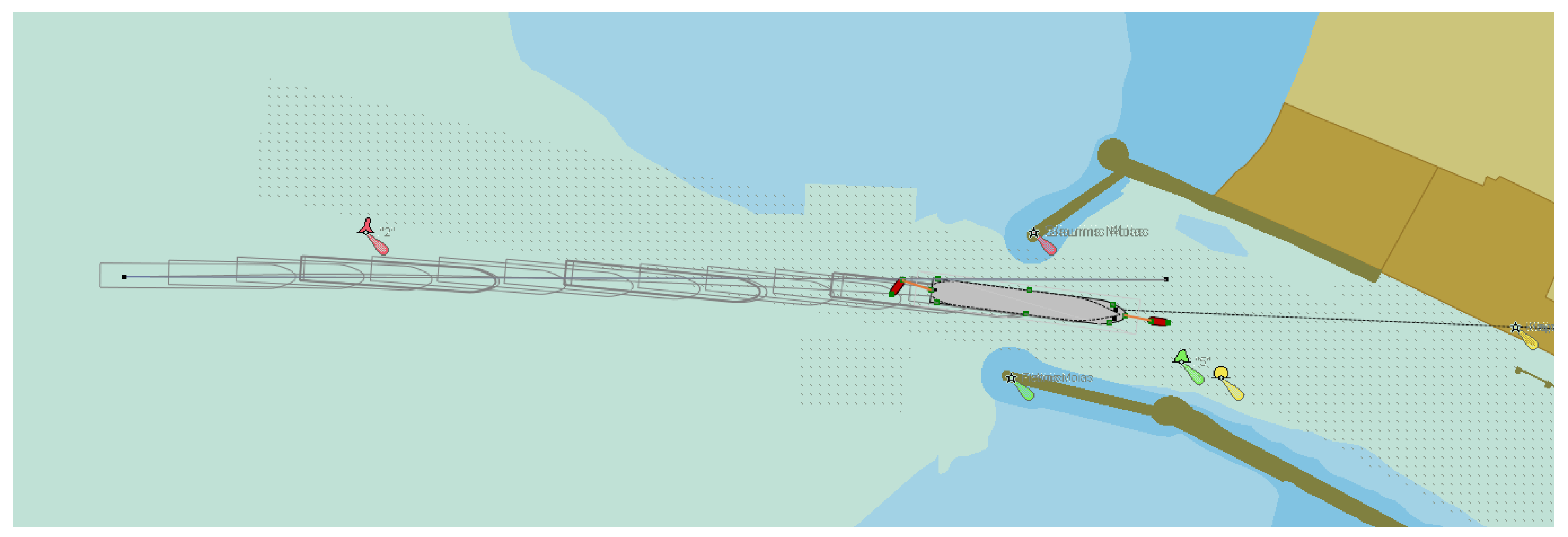
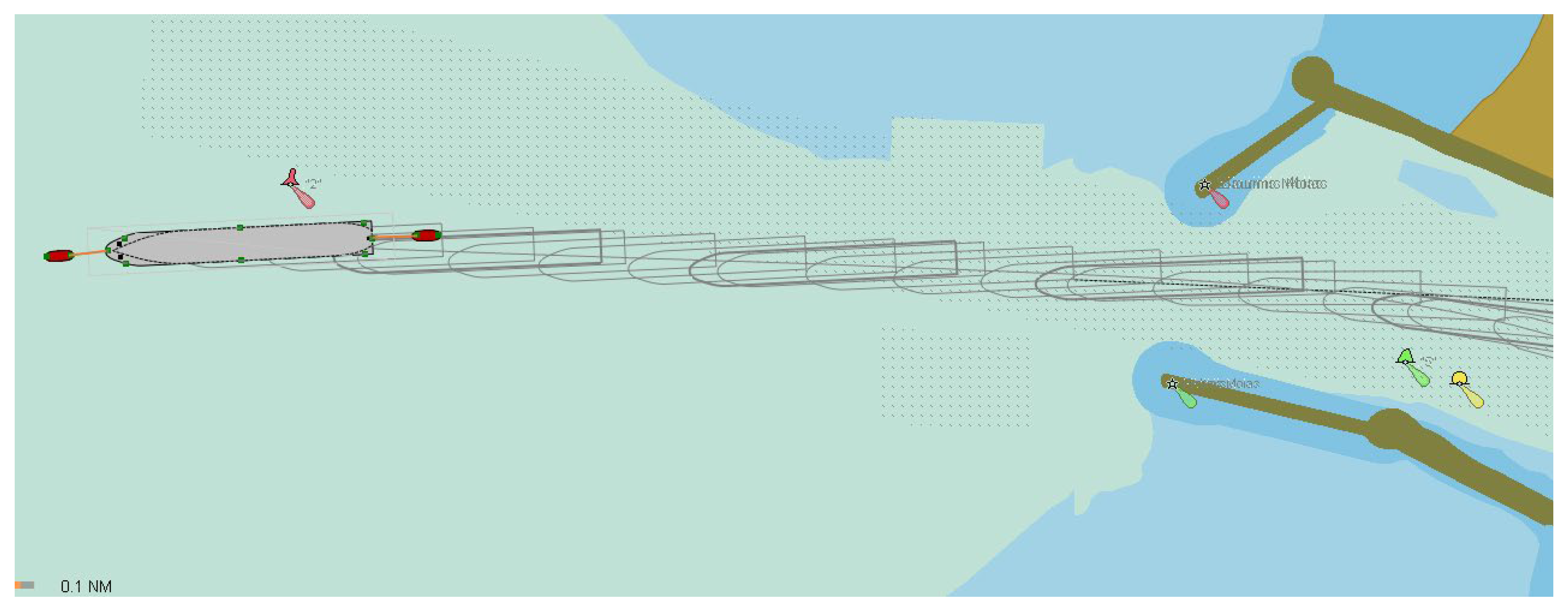
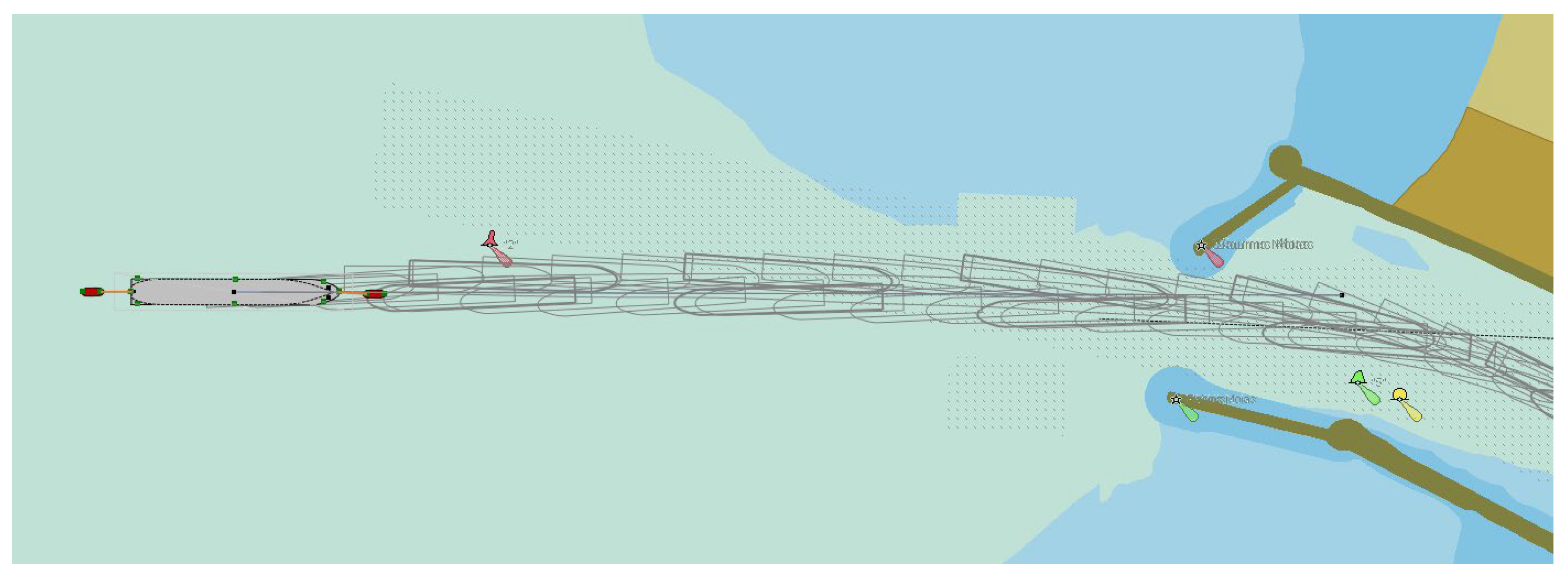
The port entrance channel is very important for achieving a sustainable port; therefore its parameters must ensure not only the navigation safety of incoming and outgoing ships, but also its configuration is important, allowing ships to navigate easily without additional special ship maneuvers. Examples of ship navigation lanes when a ship navigates through the port entrance channel, entering the port and leaving the port are presented in
Figure 4 and
Figure 5.
When assessing the sustainability of the port entrance channel, the necessary channel width was estimated using the methodology presented in
Section 3 (using the results of calculations and experiments) and assuming that the ship’s drift angle reached up to 4°, the ship’s yaw angle reached up to 2°, the accuracy of determining the ship’s location with the help of a lead line was about 8 m. Assuming a probability of 95% and a navigation margin of 0.5 B, the calculated width of the port entrance channel was obtained to be about 125 m.
In rough sea conditions, the width of the port entrance channel must correspond to the calculated width, as the effects of external forces in individual cases require additional maneuvers to keep the ship in the channel (
Figure 6).
The actual width of the port entrance channel is about 150 m. Thus, considering similar drift angles, the sustainable width of the port entrance channel is sufficient for ships up to 400 m in length and 62 m in width (class G container ship), for which the calculated channel width is about 149 m. Thus, for both analyzed ships, the port entrance channel comparative port sustainability index can be assumed to be equal to one.
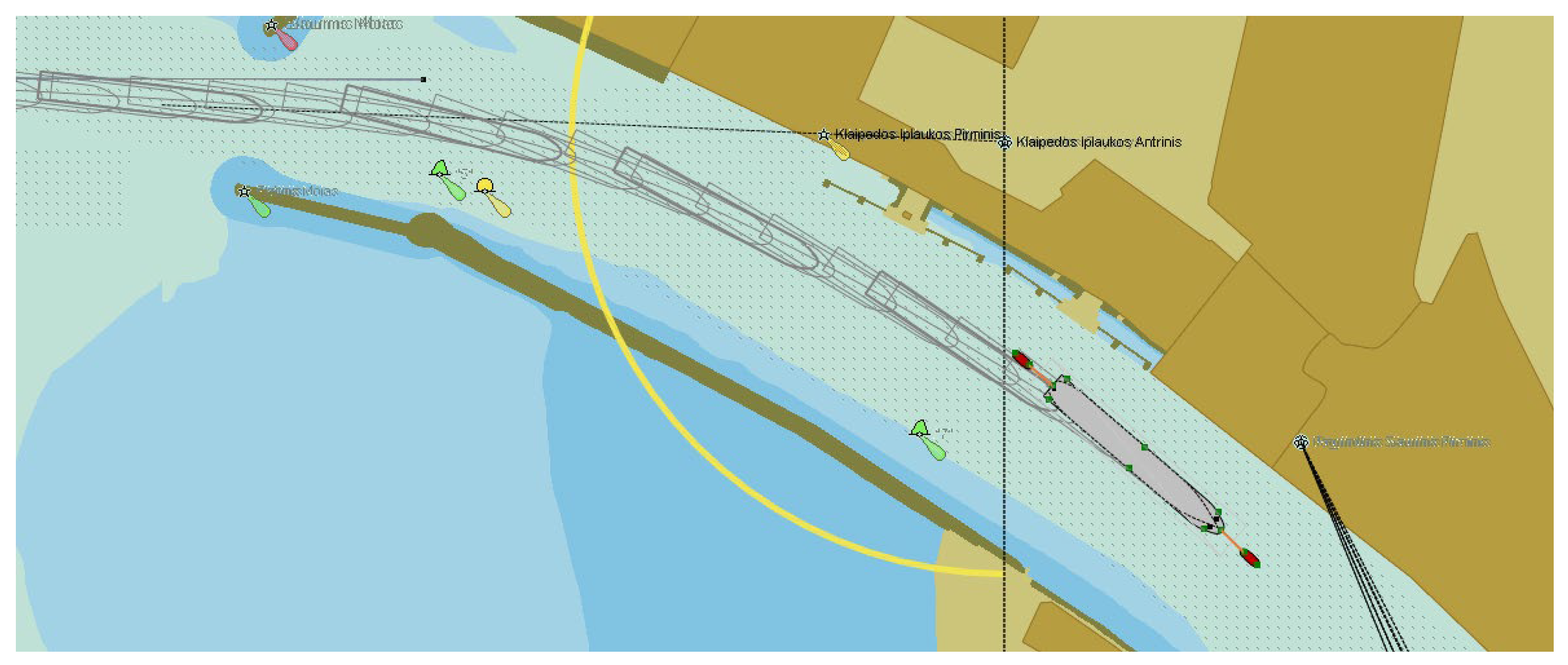
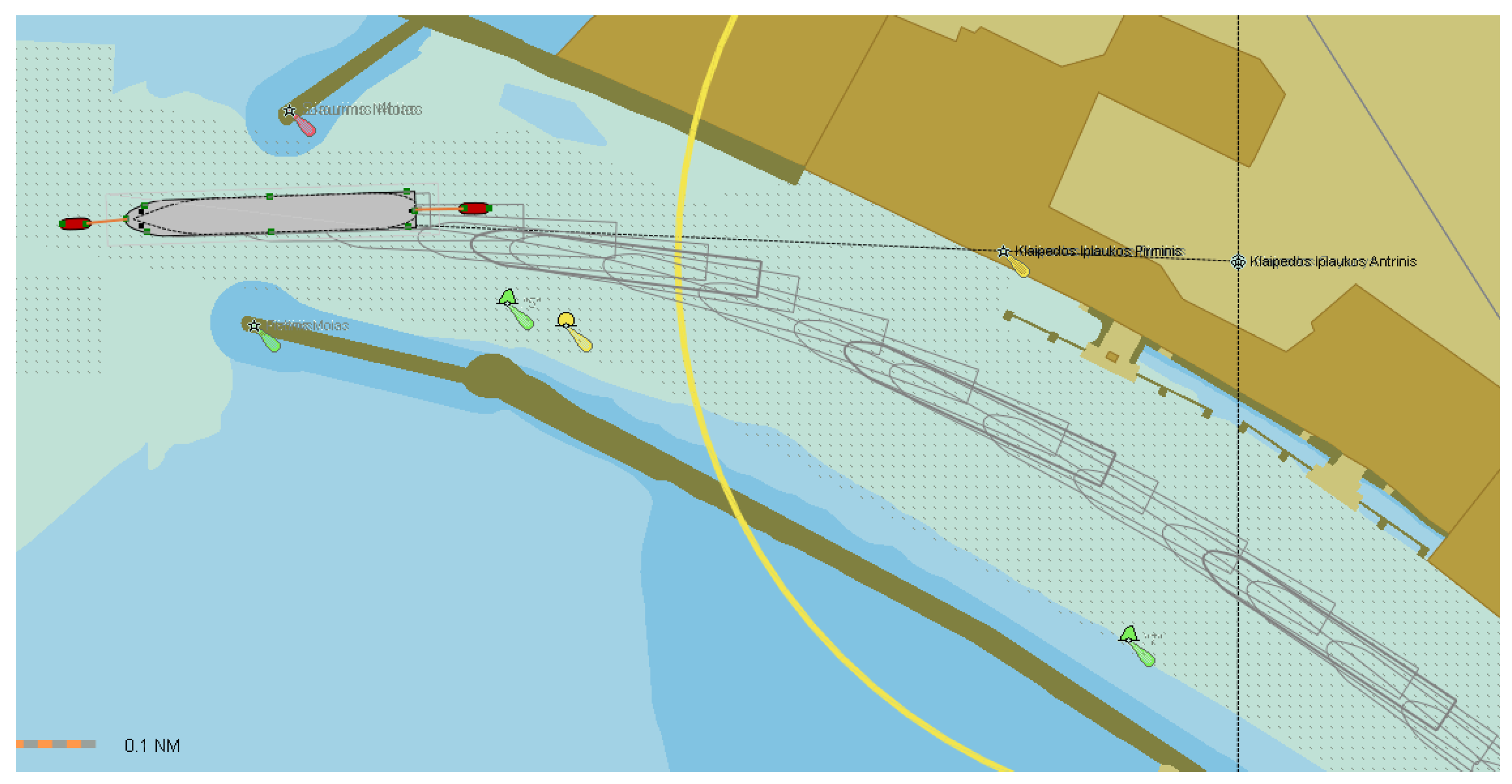
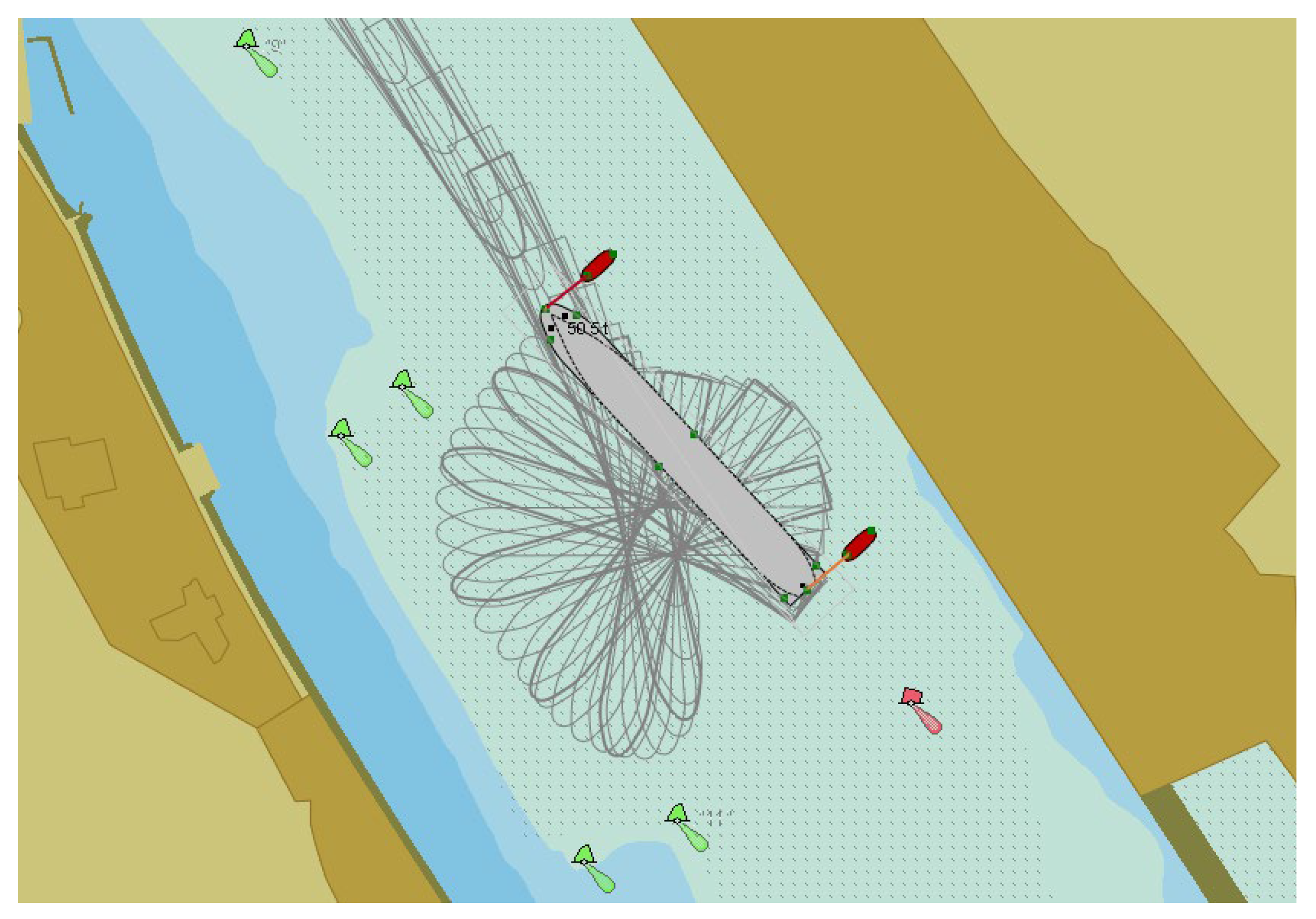
The inner navigation channels of the port, especially if they contain large turns, are very important for the safe passage of ships in the port. As an example,
Figure 7 and
Figure 8 show the lanes of ships in the inner navigation channel when a ship enters and leaves the port and makes a turn in the inner navigation channel of the port.
In order to assess the sustainability of the inner navigation channel, maximum ship drift angles were adopted, which reached up to 10° when turning at the port gate. The width of the inner navigation channel, the above-mentioned ship sailing conditions, for a 355 m long ship (NEW PANAMAX container ship), is about 161 m.
The width of the inner navigation channels is also important due to possible additional effects, such as hydrodynamic effects between the ship and the quay walls or channel slopes, when ships pass ships moored at the quays, etc. Ship navigation lanes in the inner navigation channel, as an example, are shown in
Figure 9.
For a ship with a length of 400 m (class G container ship), the calculated channel width, when the drift angle reaches 10°, is about 192 m. The actual width at the channel bend is about 200 m. Thus, for both analyzed ships, the port internal navigation channel comparative port sustainability index can be taken equal to one.
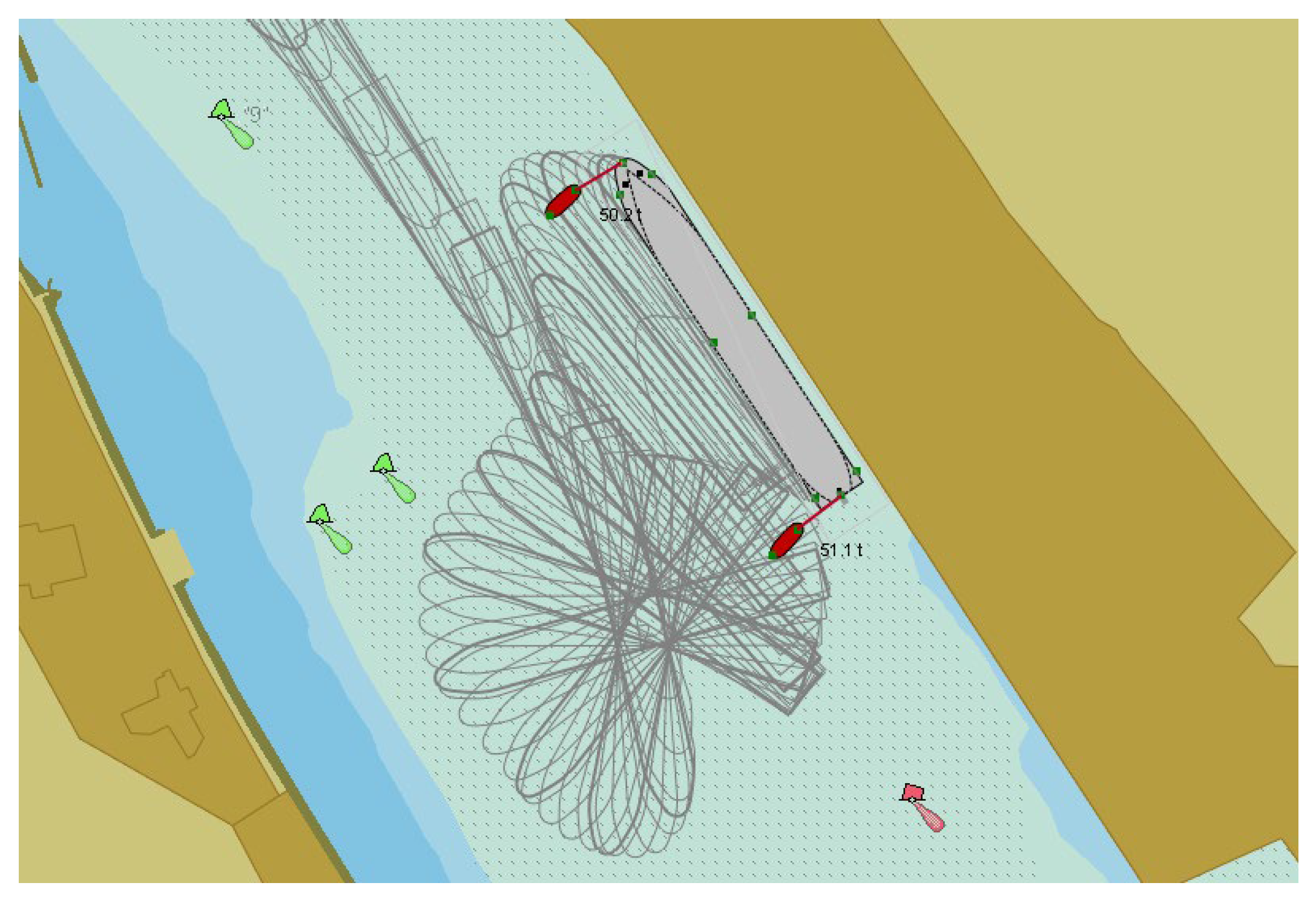
Port ship turning basins are essential for the safe turning of ships in the port. As an example,
Figure 10 shows the ship turning trajectory when a NEW PANAMAX container ship is turned in the ship turning basin with the help of two tugboats.
To assess the sustainability of the port’s ship turning basin, a NEW PANAMAX container ship was used, which was turned around with the help of two tugboats, each with a pulling force of up to 520 kN. Using the methodology for assessing the sustainable diameter of the port’s ship turning basin presented in
Section 3, the recommended diameter of the port’s ship turning basin for a sustainable port was calculated. The actual diameter of the port’s ship turning basin is 410 m, the length of the ship is 355 m, so the ratio of the diameter of the ship turning basin to the length of the ship is 1.15, which does not provide a 95% probability that the ship will be able to turn around safely. In this case, the sustainability coefficient of the port’s ship turning basin is about 0.87.
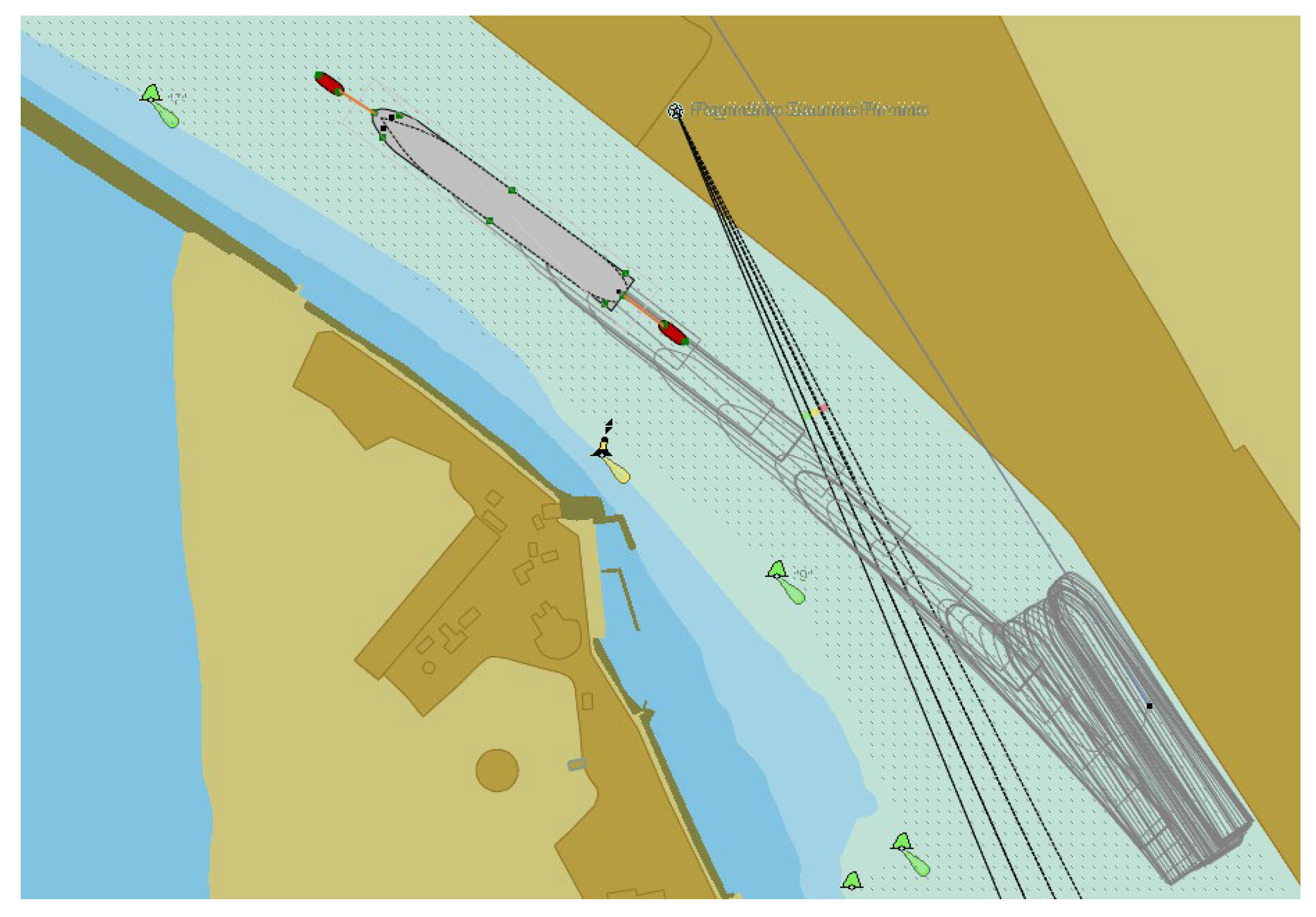
Access to the quay is very important in cases where there is limited depth at the approach to the quay. Using the methodology for assessing the sustainability of quay access presented in
Section 3. The depths of other quays near the specified quay are similar to the depths at which the ship is moored, which means that there is sufficient space for the ship to manoeuvre.
Figure 11 shows the movement lane of a ship as it approaches the quay. The same conditions apply when the ship is being driven away from the quay (
Figure 12).
When assessing the sustainability of the ship’s arrival and departure from the quay, the depth of the nearby water area and the power (traction force) of the tugs used are very important. In the case where there are enough tugs in the port and their traction force is high, optimal solutions can be found, but it is always very important to assess the required traction forces of the tugboats in advance.
Using the methodology presented in
Section 3, the required tugboat traction force was estimated and verified with similar real ships under similar conditions. The tugboat traction force required to turn and moor to and unmoor from the berth of the NEW PANAMAX ship (the calculation results are presented in
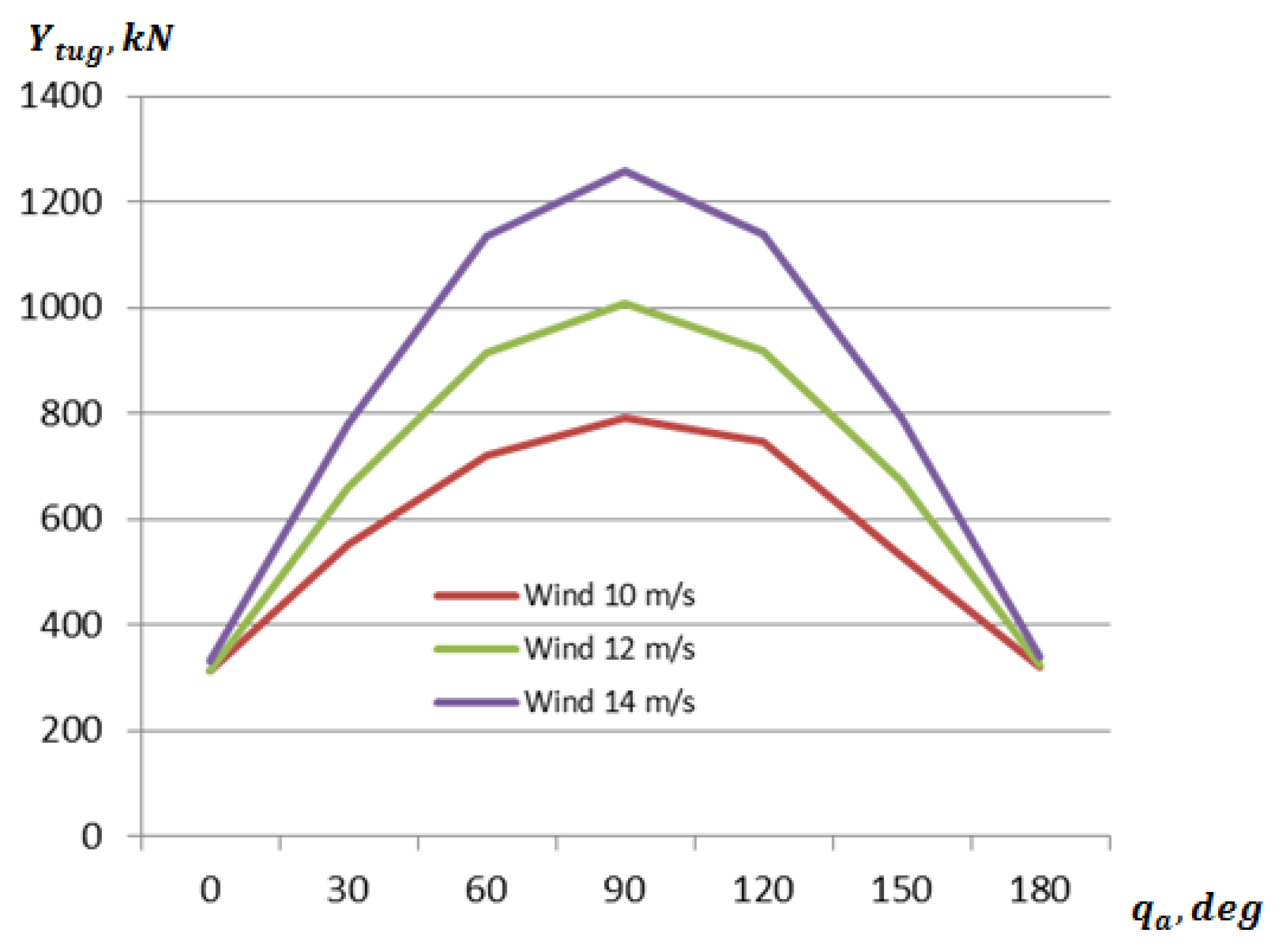
Figure 13). The tugboat traction force required for mooring operations of the NEW PANAMAX ship, depending on the current and wind parameters and depth at the maneuvering site, was obtained by calculation and by conducting experiments with real ships and using a calibrated simulator. The difference between the obtained calculation and experimental results did not exceed 10%.
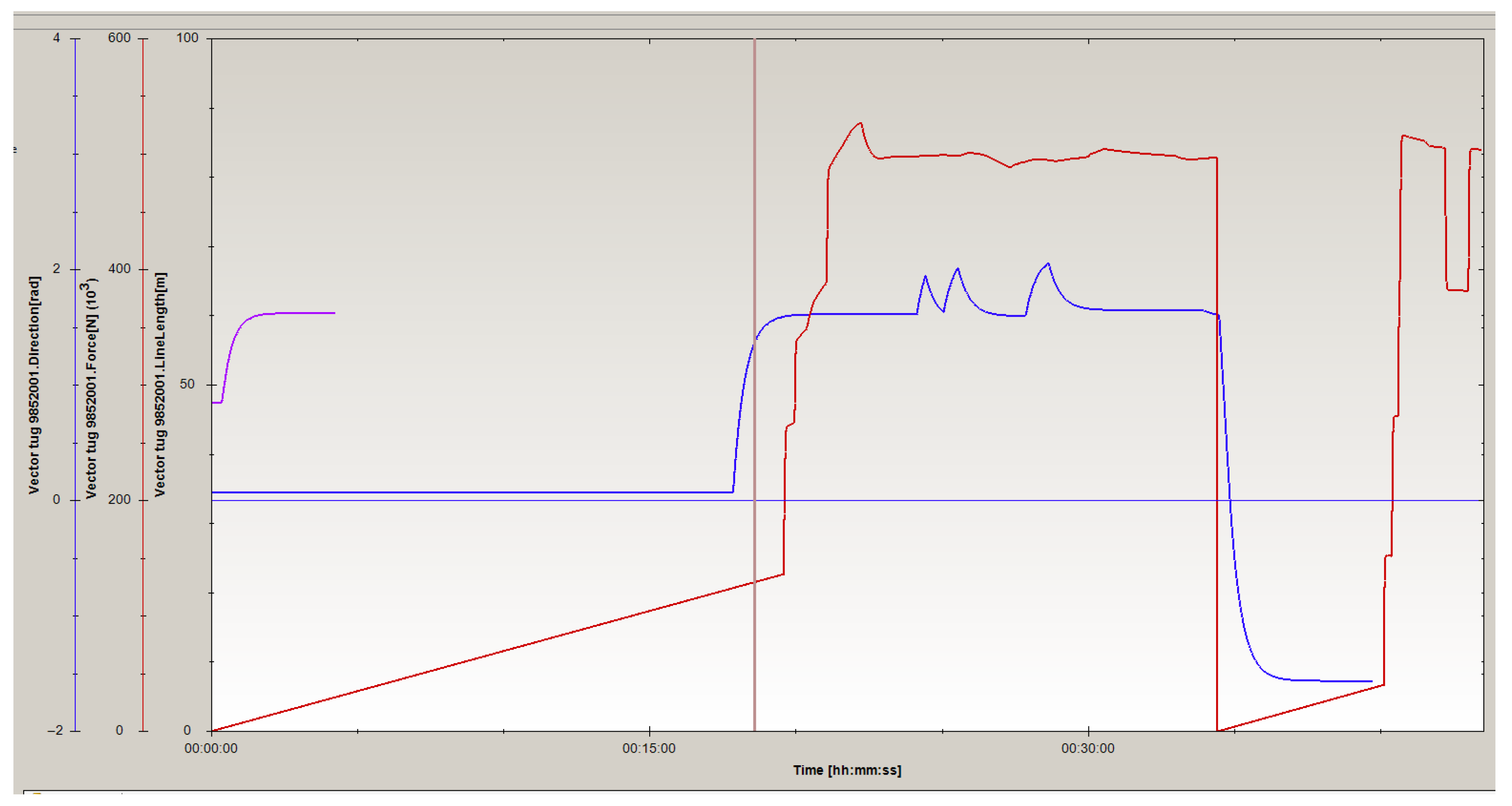
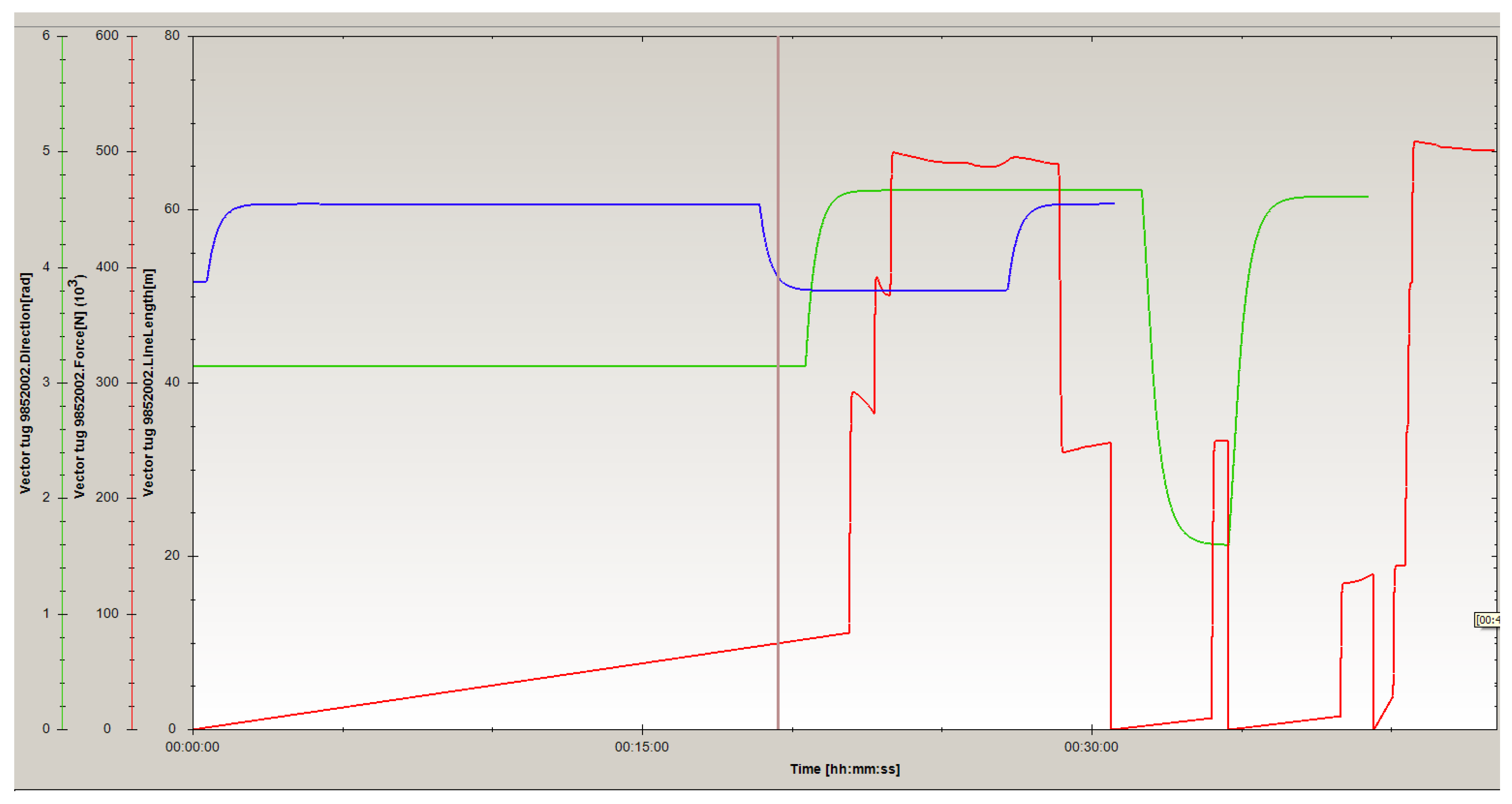
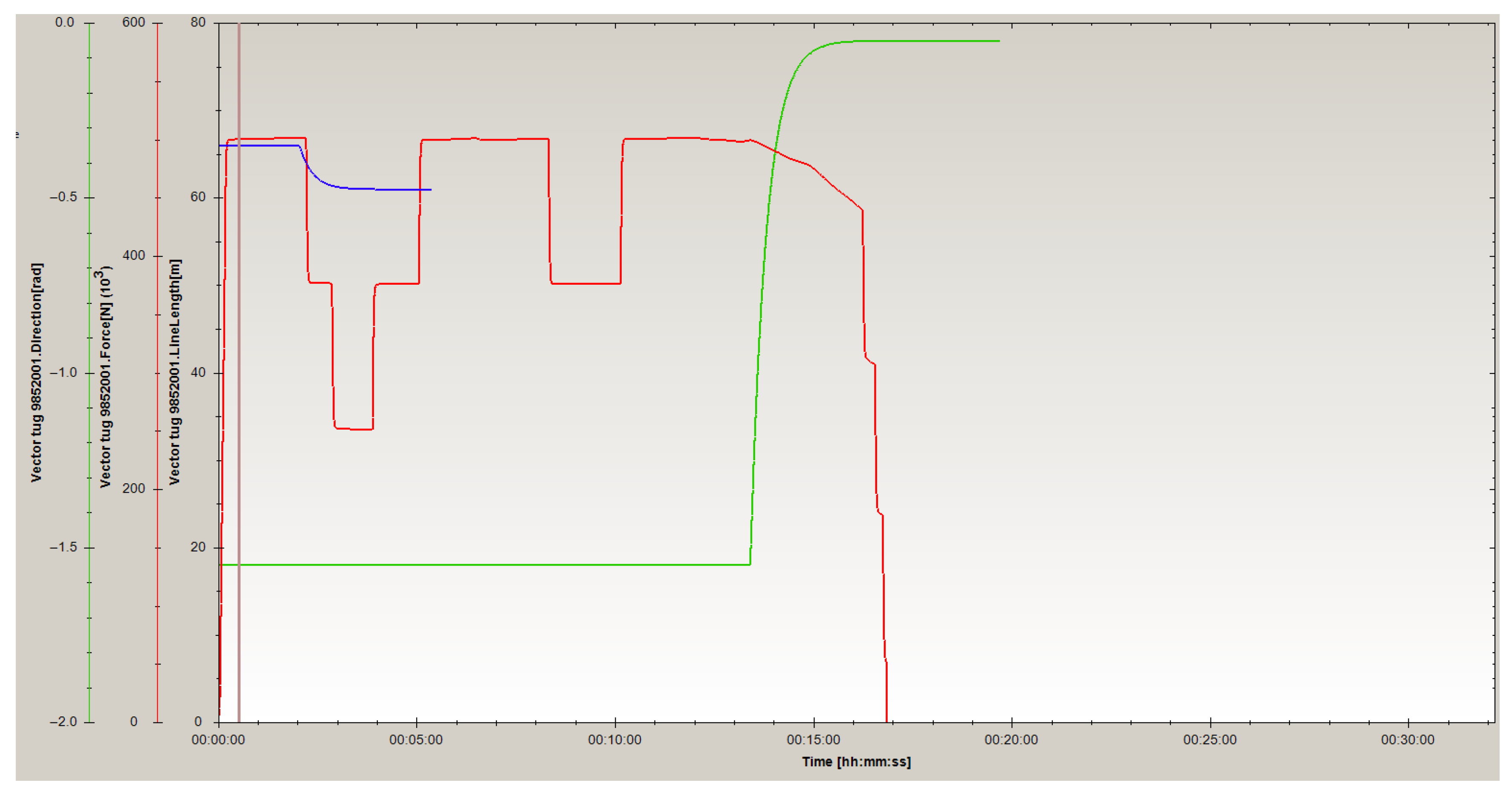
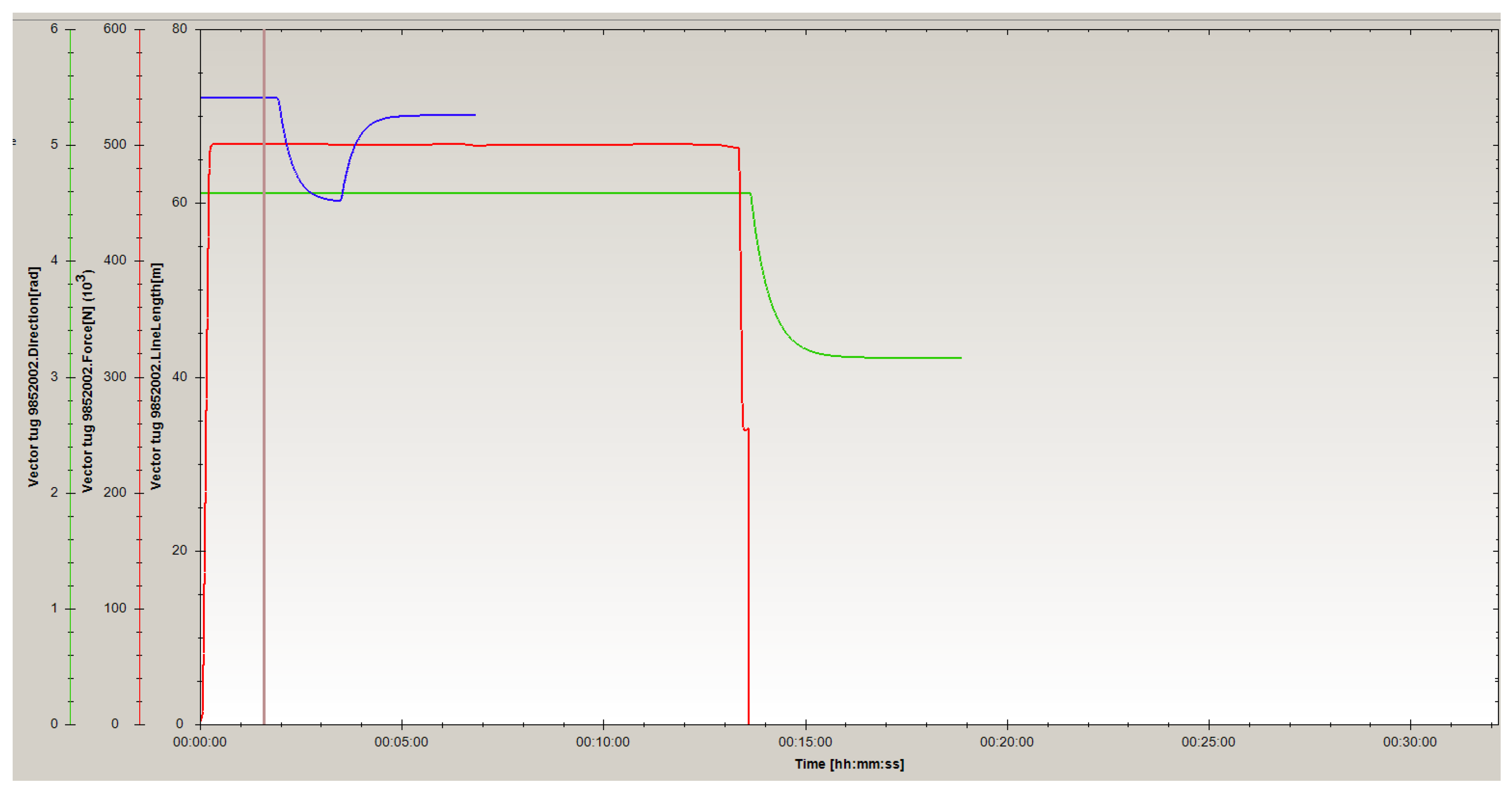
The tugboats pulling force, obtained by calculation and experimentally, depending on the current and wind parameters and the effect of the shallowing effect, is important when planning ship maneuvers in the port. As can be seen from the results obtained, at wind speeds up to 12 m/s and current speeds up to 0.5 knots, when its direction corresponds to the direction of the channel, the use of two tugboats, each with a pulling force of up to 520 kN, is sustainable. The tugboat pulling forces and pulling directions when turning the NEW PANAMAX ship and when mooring and unmooring it under the above conditions, obtained experimentally with a real ship and using a calibrated simulator, are presented in
Figure 14 and
Figure 15. At higher wind and current speeds and in other directions, for the above-mentioned type of ship (NEW PANAMAX container ship) could be necessary to have higher tugboats pulling forces, i.e., three or more tugboats may be used and this information is very important to have when planning the entry or exit of a ship into or out of port.
The sustainable use of port tugs in the port is important to ensure the safety of shipping navigation and to optimize the number of maneuvers of ships with high main engine power, while reducing the environmental impact, which is important for sustainable port factors.
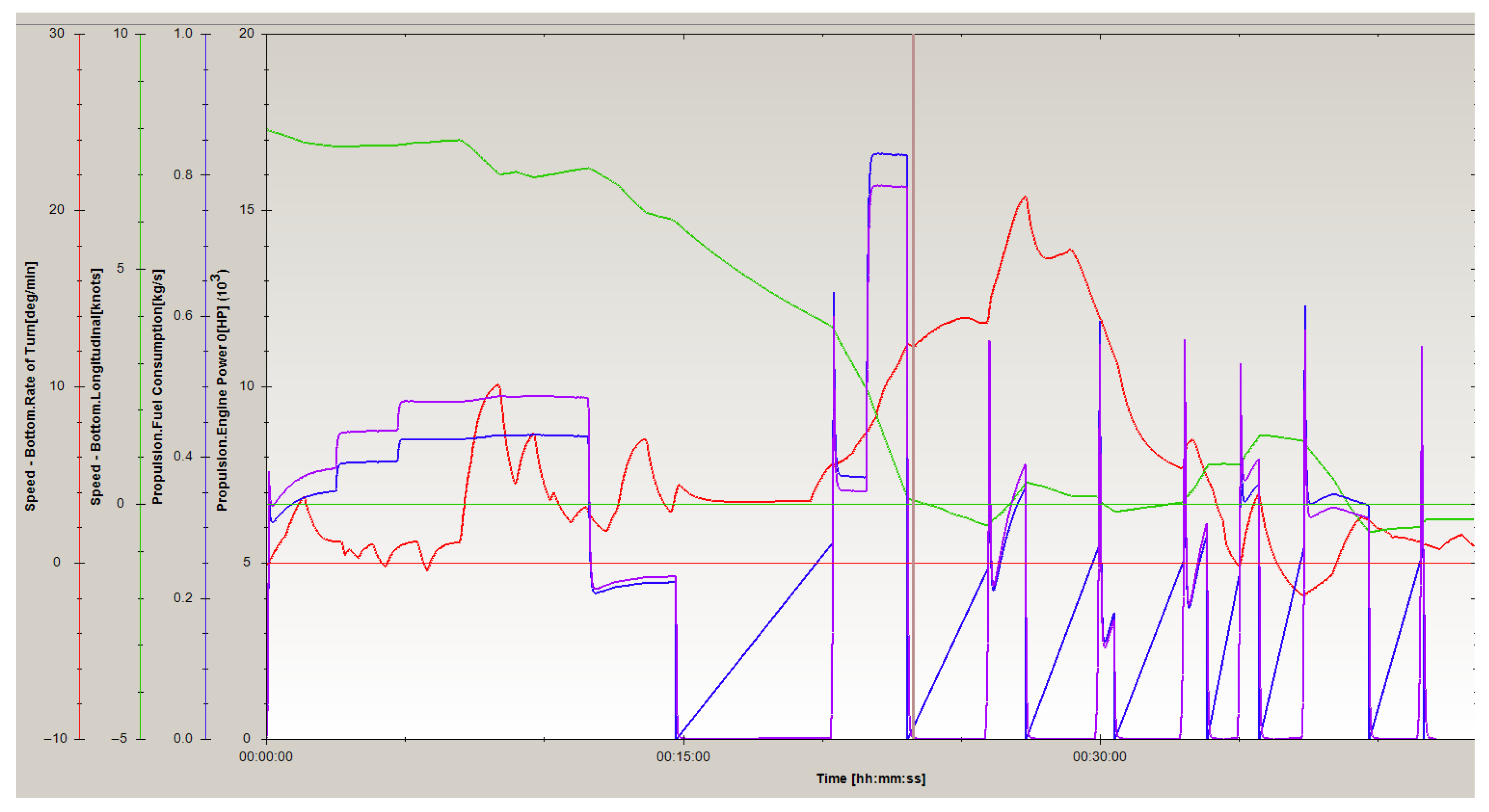
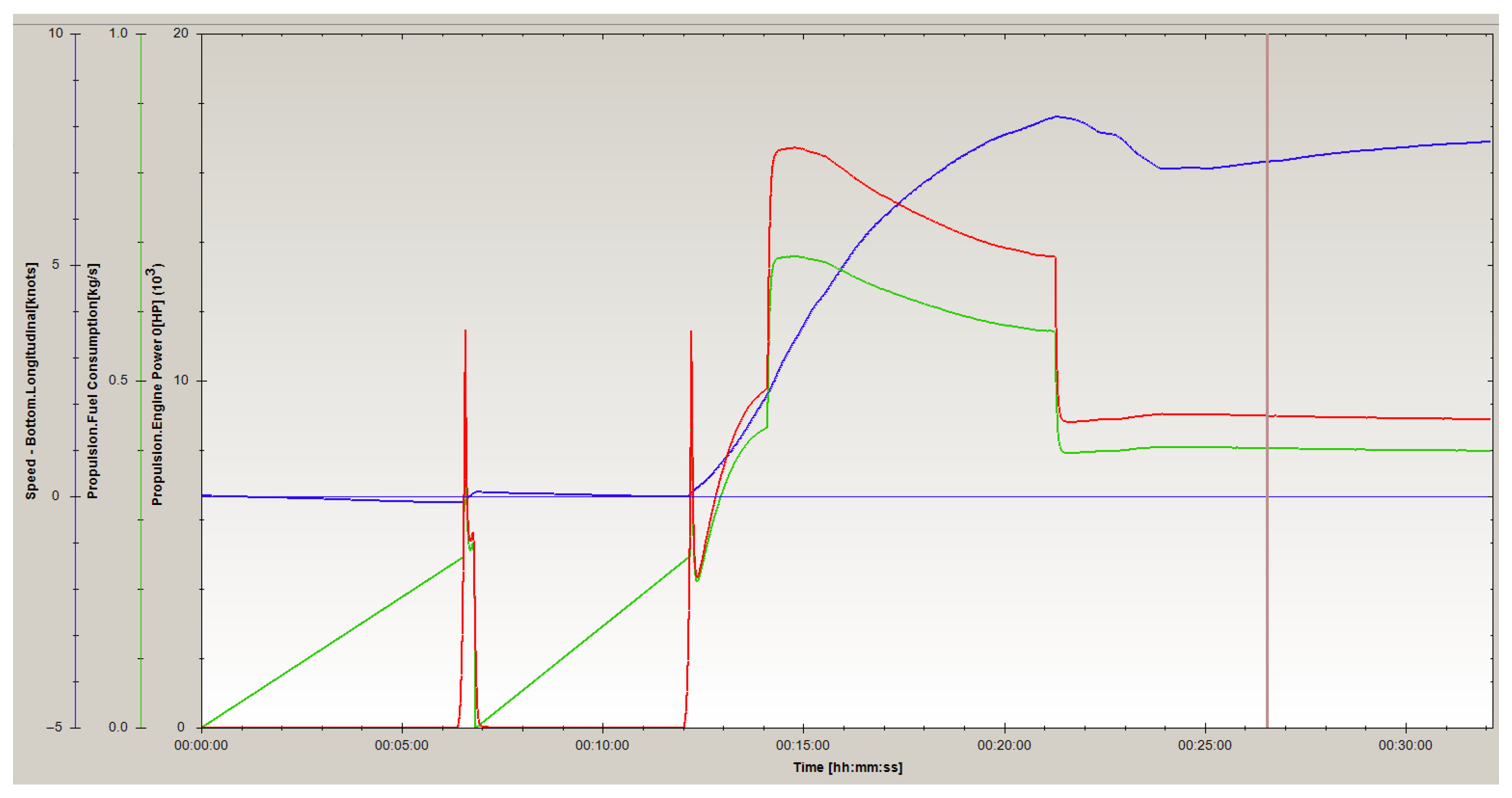
The impact on the environment in the port is caused by the equipment and mechanisms of the incoming vessels, tugs and terminals. During the experiments on real analyzed ships (NEW PANAMAX), it was determined that the sailing time of the ship entering the port was about 45 min (from the entrance channel to the start of the mooring operation), the average power of the main engine was about 7000 kW and the ship consumed about 1100 kg of diesel fuel in 45 min (
Figure 16).
When reloading from a container ship at the terminal, an average of about 4000 TEU, the ship stays at the terminal quay for an average of about 24 h, the average power of the auxiliary engines while standing at the quay is about 2000 kW, and the ship consumes about 9500 kg of diesel fuel during the stay. The work of the tugboats towing the ship into the port and mooring it takes about 1.5 h, the average power of the engines (of both tugboats together) is about 4500 kW, and during this time they consume about 1600 kg of diesel fuel.
The energy required to process one container (TEU) using STS cranes (which use electricity), RTG cranes, terminal tugs, skateboards and forklifts, using the methodology presented in
Section 3 and the information provided in [
54,
55,
56,
57], is about 4 kWh per TEU. Converted into fuel consumption, it can be stated that about 4800–5000 kg of diesel fuel and about 16,000–18,000 kWh of energy are consumed for processing one container cargo of the analyzed ship (on average about 4000 TEU) at the terminal.
The ship’s departure from the port (from the terminal quay to the departure beyond the port’s entrance channel) takes about 32 min, the average ship’s engine power is about 4000 kW and during this time the ship consumes about 500 kg of diesel fuel (
Figure 17).
The port tugs, when unmooring and taking a ship out of the port (from the terminal quay to the exit from the port entrance channel), work for about 32 min, the average engine power used (both together) is about 4000 kW, and the diesel consumption is about 640 kg (
Figure 18 and
Figure 19).
In this way, a NEW PANAMAX ship consumes about 3200–3500 kg of diesel fuel during one port call, the average power of the main and auxiliary engines used is about 3200 kW, and the ship’s stay in the port (from entering the port’s entrance channel to leaving the port’s entrance channel) is about 26 h on average.
Port tugboats, servicing the NEW PANAMAX vessel entering the port, consume about 2250 kg of diesel fuel, worked for about 2 h in total and the average total power used by the engines (of both tugs) during the aforementioned 2 h was about 4300 kW.
The terminal equipment and mechanisms operate for about 20 h during the arrival of one analyzed vessel, consume about 18,000 kWh of energy and about 5400 kg of diesel fuel.
Sustainable port development requires minimal environmental impact, which can be achieved by using greener fuels. The likelihood that ships, tugs and terminal equipment and machinery arriving at the port at the same time will start using, for example, LNG fuel is very low. Ships, port tugs and terminal equipment and machinery are gradually switching to LNG fuel. The colorimetric value of LNG fuel is on average about 15% higher than that of diesel [
53]; therefore, about 15% less fuel mass is required to obtain the same amount of energy. The results of different fuel consumption (diesel and LNG) and the emission levels generated, using the methodology presented in
Section 3, are presented in
Table 1.
In the event that the ship, tugboats and terminal equipment and mechanisms had used LNG fuel, LNG fuel consumption would be about 15% less than when using diesel fuel, i.e., instead of about 11,150 kg of diesel fuel consumed, about 9477 kg of LNG fuel would have been consumed.
The results of emissions from ships, port tugs and terminal equipment and mechanisms clearly demonstrate the benefits of using more environmentally friendly energy sources for environmental impact. In the studied cases, the use of LNG fuel reduces the amount of by about 28%, by about 35%, by about 58%. When using LNG fuel, and emissions are not generated. Recently, a significant part of port terminals are developing or connecting to alternative energy source generations (solar, wind, hydroelectric power plants) and are starting to use other energy sources, such as hydrogen, some ships are starting to use ammonium fuels. By using new environmentally friendly energy sources, emissions can be reduced by up to 60–80% or more.
After evaluating the results obtained, the comparative index (
) for the analyzed ship and port terminal is presented in
Table 2.
The weighting coefficients of sustainable port factors were obtained using an expert method, evaluating the port data [
56]. To determine the factor weighting coefficients, 20 ship masters, 10 terminal management representatives, 12 port pilots and 5 tugboat masters from 3 ports were interviewed. The survey results were processed using the maximum distribution methods [
7,
24,
28,
56,
57].
In the case of the port under study, when compared with an ideal (comparable) port, assessing the parameters of the port infrastructure (port entrance and internal navigation channels, ship turning basin), the port terminal operational capabilities, container handling, and the environmental impact of using diesel and LNG fuels, it can be stated that achieving a sustainable port (terminal) even with individual factors allows improving the image of the port, increasing shipping safety conditions in the port, using the necessary tugboat capabilities, and reducing environmental impact. For example, the obtained ratio of the diameter of the port’s ship turning basin (0.93) shows that when accepting ships of similar parameters, it is necessary to accurately assess the capabilities of the port’s tugboats and order the required number of tugboats with the necessary pulling force to avoid non-standard situations during ship maneuvers.
By adopting the weighting coefficients of sustainable port factors and factor values presented in
Table 2, the sustainable port comparative index was obtained, presented in
Table 3.
The resulting sustainable port benchmark index (compared to an ideal port) is not so important in its absolute value, but at the same time it shows individual sustainable port factors that need to be improved in order to achieve better sustainable port results. From the obtained sustainable port benchmark index, it is clear which of them should be developed in order to increase shipping safety in the port, reduce environmental impact, which should positively affect working conditions in the port, improve the quality of life in the port region, by reducing generated emissions.
The developed sustainable port comparative index methodology is important in that it can be applied not only to the assessment of the overall sustainable port index, but also to the assessment of individual sustainable port factors, and it can be applied to any port or terminal after adapting it to local conditions.