Green Well-Being and Governance


Centre for Environment and Sustainability (CES), University of Surrey, Guildford, Surrey GU2 7XH, UK
Sustainability 2026, 18(4), 1842; https://doi.org/10.3390/su18041842
Submission received: 6 January 2026
/
Revised: 4 February 2026
/
Accepted: 9 February 2026
/
Published: 11 February 2026
(This article belongs to the Section Social Ecology and Sustainability)
Abstract
This paper explores the relationships between indicators designed to assess the quality of natural habitats, the quality of governance, and self-reported well-being (often equated with ‘happiness’) at the country scale. A habitat/species ‘protection’ group of indicators was identified comprising the Terrestrial Biome Protection based on national weights (TBN), the Species Protection Index (SPI), and the Protected Area Representativeness Index (PAR), all of which require identification, demarcation, management, and protection of habitats and species, typically backed up with legislation, by government. This group of ‘protection’ indicators had a statistically significant and positive relationship with both the quality of governance and happiness (p < 0.05). However, it is suggested that the positive impact of this group of indicators on happiness is indirect; a better quality of governance has a positive influence on both this group of ‘protection’ indicators and happiness. A fourth indicator, the Species Habitat Index (SHI), differs from the other three in that it assesses the proportion of suitable habitats for a country’s species that remain intact relative to a baseline year, and this is not necessarily tied solely to protected areas and thus to government intervention. The SHI had no statistically significant association with the quality of governance and had a negative association with happiness (p < 0.001). It is suggested that the SHI may be conceptualized as an inverse indicator of perceived ‘development’; lower SHI values equate to greater pressures on land use for housing, farming, and industry, among others, and all of these can be seen by at least some people as positive and thus improve their sense of happiness. This paper makes suggestions for future research in this important nexus for sustainability of environment, governance, and happiness.
1. Introduction
The nexus between the quality of the natural environment and well-being, often equated with happiness, is an important one in sustainability [1], and there is a growing body of literature on this topic. Ferrer-i-Carbonell and Gowdy [2], for example, looked at the relationship between well-being and environmental quality, and noted that “positive environmental features (e.g., nature landscapes, interaction with plants and wildlife) is positively connected with well-being” [2] (p. 515). Studies can be broadly categorized into two types. Firstly, there are the individual reports (self-assessments) of well-being (or happiness) when people are in different places, including natural habitats and greenspace (urban parks, etc.). These studies often make use of software apps for people to record how they feel, and the assessments can be readily geolocated [3]. The results of such individual assessments are largely unambiguous as people tend to feel happier and ‘better’ when in natural habitats and greenspaces compared to urban environments [3,4]. There have been various mechanisms for explaining a positive link between a sense of happiness or well-being and the natural environment. For example, MacKerron and Mourato [3] suggested that, as natural environments are generally perceived to be lower in pollution, this can have positive impacts on both physical and mental health. Being in natural habitats and greenspaces can also be associated with healthy behaviors, such as exercise, recreation, and social interaction.
Secondly, and especially since the 1990s, economists have employed country-scale datasets to analyze the linkages between a variety of environmental indicators and well-being, both within and across countries and time [5,6,7]. When it comes to indicators designed to capture dimensions, such as pollution, and availability of resources, such as clean air and water, the correlations with well-being tend to be positive and straightforward; less pollution results in a better sense of well-being. However, studies have often generated mixed sets of results between the extent and quality of natural habitats and a variety of socio-economic indicators including those that capture a sense of well-being [8]. In their exploration using panel data derived from a survey of a link between urban resilience—defined in terms of ecological resilience, infrastructure resilience, social resilience, and economic resilience—and subjective happiness in China, Liao et al. [9] noted that these were positively correlated; better resilience generates a better sense of happiness. However, studies that are based on panel data collected from a range of countries can often vary in terms of their findings. For example, in a recently published study [10] using data from 124 countries the authors concluded that: “Ecosystem Health, Biodiversity, Long-Term Climate Stability, and Clean Energy were not found to be significantly related to nations’ well-being… Arguably, the less tangible measures such as Ecosystem Health, Biodiversity and Long-Term Climate Stability refer to complex phenomena that may partly go unperceived by individuals. In addition, the bulk of effects that follow from their deterioration will occur in the future rather than at present.” [10] (pp. 13–14). In this paper, well-being was assessed at the country-scale using the Life Ladder Scores (LLSs) published in the World Happiness Reports (WHR), and the analysis included a number of socio-economic ‘pillars’, such as Inclusion, Social Cohesion, State Capacity, Individual Capabilities, Economy, and Civic Space that were also considered to be important for ‘state resilience’ alongside the environmental indicators [10].
Given the points made in the quotation above from Welsch [10], a degree of ambiguity between well-being and indicators designed to capture facets of habitats, such as protection and biodiversity, in country-level studies is perhaps understandable. For example, a paucity of direct contact between people who live in urban contexts and more geographically distant natural habitats could potentially be an issue when it comes to framing perceptions. With studies based on asking individual respondents how they feel when in natural habitats, and indeed in urban greenspaces, compared to being in other environments, then an association can be clearly identified [3]. However, with the country-scale studies that draw upon large yet separate datasets, the connections between perceptions and the extent and quality of natural habitats may be far less clear. Araújo et al. [8] have noted that the establishment of protected habitats may not necessarily be perceived by all communities as positive, especially if it deprives people from access to important resources (e.g., land, firewood) and thereby threatens their livelihood. Finally, even if the linkages between people’s perceptions of well-being and indicators designed to assess the quality of natural habitats are identified then these could be due to other mediating factors, such as the quality of governance. For example, Toigo and de Mattos [11] explored the relationships between a suite of country level environmental indicators and how they were correlated with well-being as well as indicators of the quality of governance, such as those that assess corruption. They found that countries having better environmental performance also tend to have better governance, and this is correlated positively with well-being; better governance was also positively correlated with measures of environmental performance. Tandoc Jr. and Takahashi [12] found that well-being was positively related to press freedom (as assessed by a group of experts) which is also linked to governance. Indeed, the WHR, published annually by the Wellbeing Research Centre at the University of Oxford, in partnership with Gallup, the UN Sustainable Development Solutions Network, often includes corruption as an explanatory factor for happiness [13]. Hence, when measures of well-being or happiness are positively correlated with indicators that assess the quality of natural environments, then the key question is whether this is a direct cause–effect or are these two simply reflections of an underlying quality of governance [11]?
This hypothesis of a link between governance, natural habitats, and happiness could be explored in various ways. For example, the Environmental Performance Index (EPI) provides an opportunity to study these links, given that it comprises many indicators designed to capture aspects of natural habitats, and it can be hypothesized that some of these may be more closely linked to governance than others. The EPI reports are published biannually, and while the Index has been used to explore links with happiness [11,14], this has typically been undertaken using the Index rather than disaggregating into component indicators. However, the EPI is a complex index comprising 24 indicators in the 2018 version and 58 indicators in 2024, each having their own weightings. Of the indicators that comprise the EPI, there is a group that have appeared in all the reports from 2018 to 2024 which seek to capture various aspects of the quality of natural habitats, and which could be hypothesized to have a degree of association with the quality of governance [15]. These are as follows:
- Terrestrial Biome Protection based on national weights (TBN)
- Species Protection Index (SPI)
- Protected Area Representativeness Index (PAR)
- Species Habitat Index (SHI)
The first three in the list (TBN, SPI, and PAR) can be described as ‘habitat/species protection’ indicators, and the ‘polarity’ is such that higher values for the indicators equate to ‘better’ protection of species and habitats. The TBN is designed to assess a country’s efforts to protect its terrestrial biomes, although the definition of what is meant by a biome and the classification of biomes are somewhat complex and contested [16,17]. Data for the TBN are sourced from the World Database on Protected Areas (WDPA), where a protected area is defined by the International Union for Conservation of Nature [18] as “a clearly defined geographical space, recognized, dedicated and managed, through legal or other effective means, to achieve the long term conservation of nature with associated ecosystem services and cultural values”. The value of the TBN is found by calculating the proportion of each biome in a country that is located within a protected area, with a higher ‘weighting’ given to biomes that are relatively rare in the country. Higher TBN values suggest that the country is better at protecting its various biomes. The SPI is an indicator designed to capture the effectiveness of protected areas in terms of conserving suitable habitats for terrestrial species. The SPI is derived as the average of the Species Protection Score (SPS) for individual species based on how much of its species range or population is in protected areas as defined above. For example, if 50% of a species range was within protected areas, then the SPS would be 50. Higher SPI values suggest, on average, that there is better protection of species within the country. The PAR assesses how well a country’s protected areas reflect its ecological diversity, with higher values suggesting a better reflection of ecological diversity. All three of these indicators can be assessed, at least in part, using data derived from remote sensing techniques. While there are limitations with the use of remote sensing, including earth observation via satellites, there has been something of a surge in the availability of higher resolution (<1 m) imagery in recent years that can provide a valuable resource [19], especially when used in combination with techniques such as machine learning [20,21]. Perhaps more relevant here is that all three of these indicators are based on the concept of ‘protected areas’ and thus have at their heart a degree of active engagement by government and its agencies in the protection of biomes, habitats, and species. Hence, there is logic in expecting these ‘protection’ indicators to be positively associated with the quality of governance, as protected areas and species need to be identified and demarcated as well as requiring ongoing monitoring and management to ensure that the protections are maintained.
The SHI is different from the other three EPI indicators (TBN, SPI, and PAR) in that it is designed to assess the proportion of suitable habitats for a country’s species that remain intact relative to a baseline year (i.e., 2001) [22], although this is not necessarily tied solely to protected areas. It is calculated for each species before being aggregated, and a weighting is used to reflect the proportion of the global range of a species found within the country (i.e., a stewardship weighting). Higher SHI values suggest less habitat loss compared to the reference year. The SHI reflects various facets important to species, such as the quality and size of their habitat as well as their degree of fragmentation and connectivity. The rationale is that, as habitats shrink, degrade (e.g., lose biodiversity), or perhaps become more fragmented with little in the way of corridors connecting the fragments, the species that depend on them are likely to decline and may even become locally extinct. Therefore, the SHI can be regarded as a measure of habitat intactness [22] and habitat condition [23], and is used as a proxy indicator of ecological integrity [24], species abundance [25], and biodiversity [10,23,26,27,28]. As with the other indicators discussed above, the SHI is assessed using remote sensing based on the natural growth of vegetation over space [28,29]. However, the SHI does have its critics when used to proxy characteristics such as biodiversity: “While indices such as the Red List Index and the Species Habitat Index are widely recognized, they may not fully capture the multidimensional nature of biodiversity or localized ecological nuances.” [23] (p. 18).
The forces at play in causing such a decline in the extent and quality of habitat include pressures for development (urbanization, deforestation for agriculture, and plantations) [26,28,30] as well as factors outside the control of a country, such as climate change. A government can, of course, act to limit declines in both habitat condition and extent as well as the prevention or reversal of fragmentation [31] and introduce mitigations such as the establishment of corridors between fragmented pieces of habitat. Indeed, the period called the ‘Great Stagnation’ following the Great Financial Crisis of 2008/9 [32] has witnessed a negative impact on biodiversity globally, although some have pointed to a small increase in the SHI [29,33]. However, loss of natural habitat may be popular with the public if it addresses needs for more housing and employment opportunities as well as increasing consumption of agricultural products [26]. Hence, the SHI is arguably not a measure of the effective protection of biomes and species, as are the TBN, SPI, and PAR [29]. This division between the SHI and a ‘protection’ group of indicators (TBN, SPI, and PAR) is a variant on the classification derived by Gareiou et al. [34], who regarded all these indicators as being within a ‘Biodiversity and habitat’ category, and indeed they can be grouped that way as they all share that general theme.
The question at the heart of the research reported here is whether there is a difference between the ‘protection’ group of indicators and the SHI in terms of their relationship with the quality of governance and with well-being/happiness. Based on the broad hypothesis set out by Toigo and de Mattos [11], it would be expected that the habitat/species ‘protection’ group of indicators would have a positive correlation with governance and therefore with well-being; in effect, well-being and the ‘protection’ group of indicators are both influenced by the quality of governance. Following this same logic, is the pattern the same for the SHI? Assuming that the SHI may not be so directly tied to the quality of governance, then does this result in a different relationship between the SHI and well-being? If there are differences between the habitat/species ‘protection’ group of indicators and the SHI in terms of their relationship to well-being, then this could potentially offer support for an indirect influence arising from the quality of governance as set out by Toigo and de Mattos [11].
2. Materials and Methods
2.1. Model Design
The analysis of the data involved three steps designed to tease out the relations between the LLS, governance, as assessed via the World Governance Indicators (WGIs) produced by the World Bank annually [35], and the four EPI indicators that are designed to capture aspects of what can loosely be called ‘habitat/species quality’ (TBN, SPI, PAR, and SHI). These steps explored sequentially the relationships between the following:
- 1.
- Happiness and governance;
- 2.
- Habitat/species quality and governance;
- 3.
- Happiness and habitat/species quality.
For all four years (2018, 2020, 2022, and 2024), the first step in the analysis was to check for a relationship between the WGIs as independent variables and income as the independent variable, with year also included as a nominal category, as indeed it is in the WHRs with their analysis of the factors which influence ‘happiness’ (i.e., LLS). However, it is acknowledged that this is something of a simplification as YEAR is strictly speaking an ordinal category, although treating it as a nominal category does help to simplify the interpretation. Including YEAR as a nominal category is generally acceptable, especially when the number of years is relatively small with little expected difference between them [36]. A summary of the six dimensions of governance in the WGIs is presented in Table 1, and the correlations between these WGI components over the years 2018, 2020, 2022, and 2024 are shown in Table 2. The six WGI components are highly correlated (p < 0.001) and this could potentially result in issues with multicollinearity. The significant correlation between the six components allows the data to be reduced via a principal component analysis (PCA), and the results of the first and second principal components (PCs) are shown in Table 3. The first two PCs account for some 90% of the variation in the data.
It is well established that all three sets of indicators tend to be positively correlated with income, as are so many social and environmental indicators [37,38]. Indeed, the WHRs include income as one of their key independent variables when analyzing patterns in the LLS. Hence the analyses included measures of income for each country (gross domestic product, GDP, per capita adjusted for purchasing power parity at current USD). The income data were then transformed using the natural logarithm (LN).
The model for the initial check for a relationship between income and the quality of governance is set out as Equation (1).
LN INCOME = constant + b1 PC1 of WGI + b2 PC2 WGI + b3 YEAR + error
Once this check had been completed, the first step of the analysis was to undertake a least-squares regression with the LLS (proxy for ‘happiness’) as the dependent variable and the natural logarithm (LN) of income (GDP/capita) and WGI as the independent variable. The regression equation for this step is as follows:
LLS = constant + b1 PC1 of WGI + b2 PC2 WGI + b3 LN INCOME + b4 YEAR + error
The Pearson correlation coefficients for all four of the EPI indicators that capture ‘habitat/species quality’ are presented in Table 4. As anticipated, the three indicators in the habitat/species ‘protection’ group—TBN, SPI, and PAR—are correlated positively and significantly at p < 0.001. The fourth indicator (SHI) is not correlated with the other three indicators, with the exception of the PAR at p < 0.05. This suggests that the TBN, SPI, and PAR indicators can be reduced using PCA; the results for PC1 and PC2 are shown in Table 5. The first PC accounts for some 78.5% of the total variation in these three indicators and higher PC1 values broadly correspond to higher values for the three indicators it encompasses.
Step 2 involved testing the following two least-squares regression models as follows:
PC1 of the ‘Protection indicators’ = constant + b1 PC1 of WGI + b2 PC2 WGI + b3 LN INCOME + b4 YEAR + error
SHI = constant + b1 PC1 of WGI + b2 PC2 WGI + b3 LN INCOME + b4 YEAR + error
The third step explored the influences of protection indicators (first and second PCs), SHI, and income on the LLS with the regression equation as follows:
LLS = constant + b1 PC1 of the protection indicators + b2 PC2 of the protection indicators + b3 SHI + b4 LN INCOME + b5 YEAR + error
For all the regression models the variance inflation factor (VIF) and the Durbin–Watson statistic was calculated to check for collinearity and autocorrection, respectively. An analysis of the data was undertaken using the MINITAB 17 software package. Three contour plots were created for the LLS as the dependent and LN INCOME, PC1 of the WGI, PC1 of the habitat/species protection indicators, and the SHI as independent variables to provide a more visual analysis.
2.2. Data Sources
The self-reported well-being (i.e., happiness) data for this study were taken from the WHRs for 2018, 2020, 2022, and 2024. The WHRs and datasets are available at the WHR website and the methodology behind their assessment of ‘happiness’ is set out in the WHRs [13]; hence, the details do not need to be provided here. The principal source of data in the WHRs is provided by the Gallup World Poll (GWP) and involves interviews via telephone or face-to-face with respondents (all over 15 years of age). The sample of respondents is claimed by Gallup to be representative of the wider population, and the sample size for each country is typically around 1000 but can vary from 500 to 2000. The key question in the GWP survey used to assess ‘happiness’ is as follows (English version of the wording): “Please imagine a ladder, with steps numbered from 0 at the bottom to 10 at the top. The top of the ladder represents the best possible life for you and the bottom of the ladder represents the worst possible life for you. On which step of the ladder would you say you personally feel you stand at this time?” ([39], Appendix 1, p. 1). The respondents then provide a score from 0 (worst possible life) to 10 (best possible life); this is an approach based on ‘self-anchoring’, where each respondent has their own sense of what the ‘best’ and ‘worst’ possible lives are for them [39,40]. The result is a set of ‘Life Ladder Scores’ (LLSs) for each country, and the reported (in the WHRs) LLS values are the averages based on the results for each country over a three-year period. Hence, the reported LLS in 2024 for a country is the average of the GWP survey results from 2022, 2023, and 2024. However, the question in the GWP survey is perhaps more about ‘self-reported well-being’ than it is about happiness, although in the WHRs, and indeed in many published studies these are assumed to be synonymous, that is the approach that has been taken here.
The WGI data are readily available via the World Bank website [35]. The WGIs comprise a set of indicators collected across 200 countries that are aggregated into six dimensions of governance. The current version of the available dataset spans from 1996 to 2024. The WGIs underwent a significant revision in December 2025 [41], and the changes introduced include “a stricter protocol for screening data sources; the addition of new qualified sources; a closer alignment of indicators with an institutional-functions framework; targeted refinements to the mapping of indicators across the six governance dimensions; revisions to the aggregation model that allow the global average of governance to vary over time.” [41] (p. 1). The 2025 revision was applied primarily to the 2024 WGIs but it also included a re-calculation, in so far as it was possible, of all the WGIs published from 2016 to 2023 based on the revised methodology. It needs to be noted that all the WGIs are founded on capturing people’s perceptions of the six dimensions, and the process of aggregation from indicators to derive values for these dimensions is complex. The data are derived from a mix of courses, including surveys of companies and households and expert assessments. The details of the methodology can be found in the WGIs (2015) [41] and in Kaufmann and Kraay [42]. In essence, higher values for the WGIs suggest better quality of governance.
The EPI reports and datasets are readily available via the EPI websites [43,44]. The methodology for the EPI is complex and tends to vary, sometimes significantly, for each iteration of the index. Also, the suite of indicators included in the EPI, as well as their weighting, varies between years, and this complicates the use of the EPI to explore changes over time. Indeed, the Index and its predecessor, the Environmental Sustainability Index (ESI), have attracted criticism for the decisions made over what indicators to include and how they are weighted [37,38]. This research did not make use of the aggregated EPI but only the four indicators described above (TBG, SPI, PAR, and SHI).
GDP/capita data were downloaded from the World Bank DataBank website [45]. At this point, it does need to be acknowledged that the use of such country-level indicators and indices, as well as country rankings based on them, does have its critics [46]. These indices, and indeed many others, such as the Human Development Index (HDI), remain popular with many national and international agencies as well as the media [46].
2.3. Panel of Countries
The panel of 180 countries included in the analysis is set out in Table 6. Each country had at least some data available for the LLS, the WGIs, and the four indicators of the EPI, although there were some gaps. No changes were made to the reported data, and no attempt was made to fill in any gaps via interpolation. Similarly, if a value for a country in a particular year was reported as zero then that was the value used for the analysis.
3. Results
3.1. Happiness and Governance
An initial check in the analysis is to check whether income, as a dependent variable, is related to the WGIs; Table 7 presents the results of the regression analysis with LN income as the dependent variable and the first and second PCs of the WGIs as independent variables along with the year. The VIFs of the independent variables are all well below 2, suggesting there is no multicollinearity, and the Durbin–Watson statistic is just under 2, indicating no significant issue with autocorrelation. The results suggest that the first and second PCs of the WGIs have a positive and statistically significant (p < 0.001) influence on income. This is a logical finding; it would be expected that better quality of governance, as represented by these two PCs of the WGIs, could lead to higher mean income levels. No doubt, this cause–effect mechanism can potentially be reversed, as higher average income levels could generate more funding for government through taxation, which in turn could result in better governance. It is intriguing to note that the regression coefficient for the year 2024 is statistically significant at p < 0.001. The latter is also the case for some of the other regressions reported here based on the WGIs as independent variables and may be due in part to the revision of the WGIs in December 2025.
The first and second PCs of the WGIs can be used as independent variables, alongside income and YEAR, for a regression with the LLS (happiness) as the dependent variable; the results are presented in Table 8. The VIFs are all below 3.0, and this can be interpreted as meaning that there are no issues with multicollinearity, and the Durbin–Watson statistic is 2.00, suggesting no issues with autocorrelation. Both income and the first PC of the WGI components are statistically significant at p < 0.001. In both cases, the positive coefficients suggest that, as income and the ‘quality’ of governance increase, so too does the LLS (i.e., well-being/happiness). The second PC of the WGI components was also statistically significant (p < 0.01), but in this case the coefficient is negative. The adjusted R2 for the least-squares regression model is 67%. Overall, the results suggest that self-reported well-being (happiness) does increase with both income and the quality of governance as represented by the first PC of the WGIs.
3.2. Natural Habitat Quality and Governance
The first PC of the three habitat/species ‘protection’ indicators (TBN, SPI, and PAR) can be employed as a dependent variable with the first and second PCs of the WGI components and income as the independent variables; the results are shown in Table 9. All the VIFs are well below 3.0, which suggests that there are no issues with collinearity, and the Durbin–Watson statistic is 2.04, which indicates no issues with autocorrelation. The first PC of the WGI components is statistically significant at p < 0.05, although LN income was not significant (p > 0.05). The results suggest that the habitat/species ‘protection’ group of indicators may be influenced by the quality of governance, although the adjusted R2 for the best-fit model is not high (15.5%). The same analysis can be undertaken with the SHI as the dependent variable; those results are presented in Table 10. In this case, the first PC of the WGI components was not statistically significant (p > 0.05), suggesting that the quality of governance may not be a factor in influencing the value of the SHI.
3.3. Happiness and Greenspace
The final step of the analysis involves the LLS as the dependent variables and the ‘protection’ group of indicators, SHI, income, and YEAR as independent variables; the results of the regression are presented as Table 11. All the VIFs are well below 3.0 and the Durbin–Watson statistic is 2.07, suggesting that there are no issues here with multicollinearity and autocorrelation. The adjusted R2 for the best-fit model is just over 66%. The first PC of the ‘protection’ group of indicators and income were statistically significant, and the positive coefficients suggest that the LLS increases with these two independent variables. However, it is interesting to note that, while the SHI is also statistically significant (p < 0.001), the coefficient is negative, suggesting that self-reported well-being (happiness) increases as the SHI declines.
This difference between the influence of the habitat/species ‘protection’ group of the three indicators and the SHI on self-reported well-being (happiness) is intriguing and can be illustrated with the three contour plots presented in Figure 1, where darker color equates to higher LLSs (i.e., more happiness). All three of the graphs in Figure 1 include LN income as the horizontal axis but differ in terms of the variable as the vertical axis. In Figure 1a, the vertical axis comprises the first PC of the WGIs; in Figure 1b, it is the first PC of the ‘protection’ group of indicators; in Figure 1c, it is the SHI. In all three graphs, the influence of income is clear; in all three graphs, the darker colors are towards the right-hand side of the contour plots equating to higher incomes. In Figure 1a the influence of governance is also clear, as well-being is higher towards the top-right hand side of the graph, suggesting that the quality of governance also impacts positively on well-being. With Figure 1b, the trend is less readily apparent but, for the ‘protection’ group of indicators, it appears that well-being tends to be higher with better protection of habitats/species. For the SHI (Figure 1c), the darker shading spans both the top and bottom of the right-hand side of the plot.
3.4. Summary of the Results
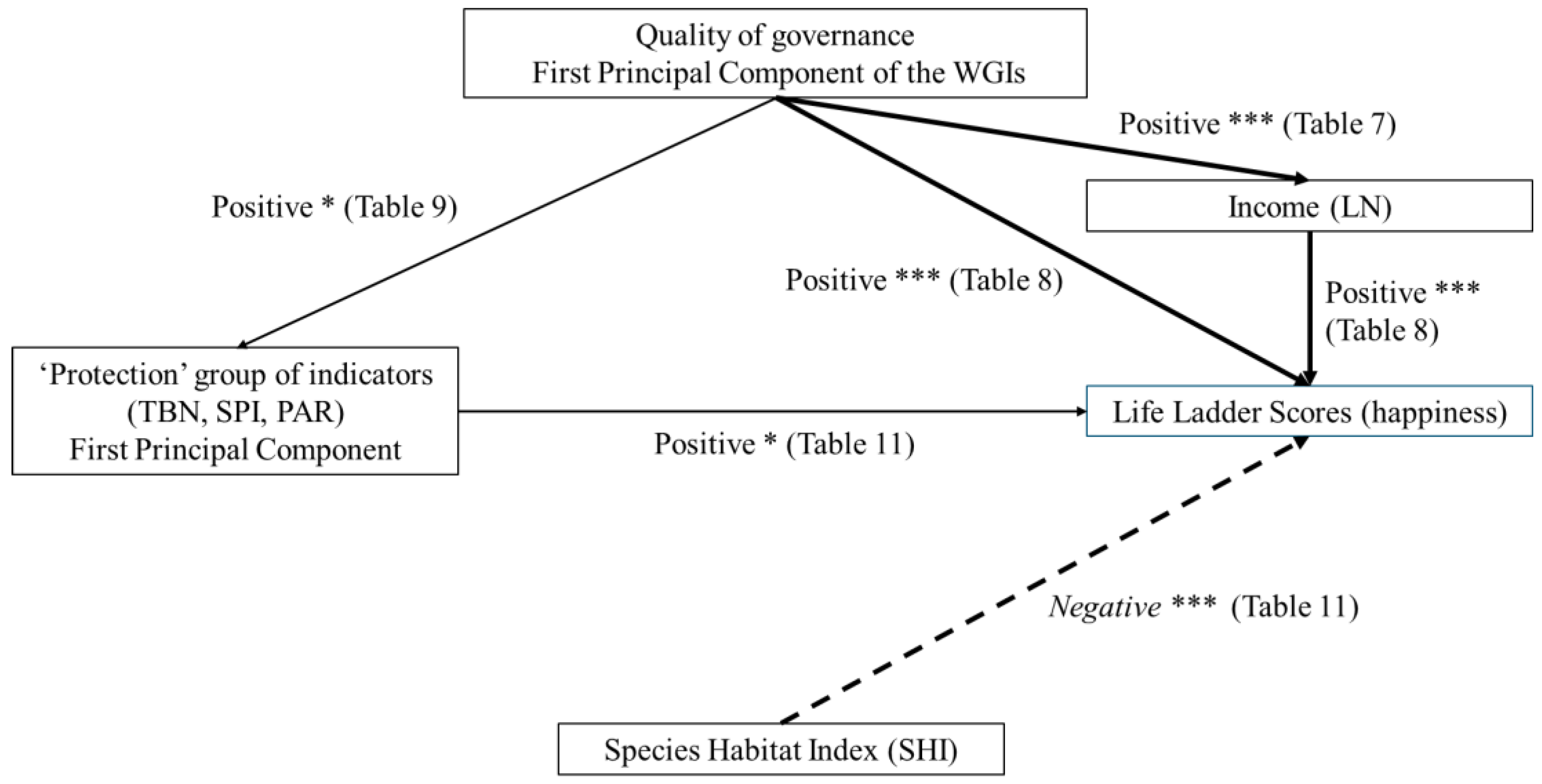
A summary of the main results arising from the regression analyses are presented in Figure 2. The arrows connect the dependent and independent variables identified as statistically significant in the regressions presented in Table 7, Table 8, Table 9, Table 10 and Table 11, and the nature of the regression coefficient (positive and negative) are shown along with the level of significance. Only statistically significant connections are shown in Figure 2, with the arrows pointing from independent to dependent variables in the analyses, and with thickness of the arrows representing the level of statistical significance. Starting at the top right-hand side of Figure 2, the first PC of the WGIs is significantly (p < 0.001) and positively related to both income and LLS, and income is also significantly (p < 0.001) and positively related to the LLS. Hence, governance does appear to have influence on both income and LLS, and the LLS is also influenced by income; a result often commented on in the WHRs. Moving to the left-hand side of Figure 2, the first PC of the WGIs is also a significant (p < 0.05) and positive contributor to the first PC of the ‘protection’ group of indicators (i.e., TBN, SPI, and PAR). The first PC of the WGIs does not have a significant influence on the SHI; hence, there is no line connecting these two in Figure 2. The results of the regressions suggest that the quality of governance does have a positive impact on the ‘protection’ group of indicators, but not on the SHI. In terms of how these ‘habitat condition’ indicators influence the LLS, the first PC of the ‘protection’ group of indicators has a statistically significant (p < 0.05) and positive influence on the LLS but for the SHI the influence is still statistically significant (p < 0.001) but negative.
4. Discussion
There are various ways of explaining the different relationships between the indicators of habitat quality and the LLS summarized in Figure 2. Taking as a foundation the findings of Toigo and de Mattos [11] that environmental performance (i.e., the EPI) as well as well-being are both positively influenced by the quality of governance, then one explanation is that the habitat/species ‘protection’ group of indicators and well-being are also positively influenced by governance. Hence, what is seen in Figure 2 is really the influence of an underlying quality of governance on both the habitat/species ‘protection’ group of indicators and self-reported well-being, with income perhaps being a mediating factor (i.e., higher income helps create better well-being). Hence, for many of the respondents to the GWP survey, their self-reported well-being may not be influenced directly by the group of ‘protection’ indicators; what they are responding to is the quality of governance. Given that the habitat/species ‘protection’ indicators are also influenced positively by governance, then that would help explain the apparent association between those indicators and well-being, but this may not be a direct ‘cause–effect’.
However, the negative association between the SHI and well-being shown in Figure 2 does not at first glance fit with the explanation set out in the previous paragraph. The SHI is not influenced by the quality of governance, and perhaps this can be explained as the SHI is more a reflection of habitat intactness [22] and condition [23], and much of that habitat within a country may not necessarily be in protected areas. Government does have a role, of course, in helping to limit habitat loss and to introduce mitigations, such as habitat corridors [26], but governments are often under competing and often strong social and economic pressures to allow changes in land use [23,26,30]. The habitat/species ‘protection’ group of indicators are different in this regard; all three of them relate to protected areas that have been demarcated, protected, and managed with government input and oversight, including legal designations. Therefore, it is perhaps unsurprising that the SHI does not share the same degree of influence from governance as does the ‘protection’ group of indicators.
However, there remains the statistically significant but negative association between the SHI and self-reported well-being to explain. It could be that self-reported well-being is a reflection of other factors, such as shifts in land use towards housing, agriculture, and industry (hence employment). These changes in land use could have a negative impact on the SHI, and that would help explain why there is a negative association between the SHI and well-being. In effect, the SHI may be a reverse indicator of perceived ‘development’. This is, admittedly, supposition, but it is a potentially important and intriguing hypothesis that would warrant more research. The perception of impacts arising from land-use changes are likely to be complex and highly site-specific, with communities living in or near natural habitats reporting negative views, while others may see them as much more positive, but it does need to be noted that the GWP sampling frame does not take account of such intra-country locational differences when selecting respondents to its survey. It is known that the SHI is positively and significantly associated with human capital, suggesting that citizens’ awareness and cooperation may be more influential when it comes to maintaining habitat than are physical investment and political institutions [47], but perhaps it also matters where that human capital is located.
There is much relevance here for future work in the field of the relationship between the quality and extent of natural habitats and well-being at these country-level scales. The complex nexus between aspects of environmental quality, governance, and happiness sits at the heart of much policymaking, but matching diverse data sets in terms of their focus and methodology remains a challenge. One way forward would be to work with the indicators that comprise the EPI, as shown here with the TBN, SPI, PAR, and SHI indicators, rather than the aggregated index, which has been the approach taken by many when exploring the relationship between the EPI and social and economic indicators [48]. Working with such a complex, and methodologically variable index and using that to relate to well-being or indeed to governance can result in the loss of much information. Secondly, the differences between the ‘protection’ group of indicators and the SHI in terms of their apparent association with self-reported well-being do need to be explored further, especially in terms of the potential explanations set out here. There is much logic in the assumption that the ‘protection’ group of indicators are influenced by the quality of governance, and this would help explain their apparent relationships with self-reported well-being. The pattern for the SHI and for well-being is very different, and this needs much more unpacking. Is the SHI really an inverse indicator of land-use change, and thus people’s perception of ‘development’? Maybe a first step would be to explore how land-use change influences people’s perceptions of ‘development’, although this can be expected to be highly context-specific. If this is the case, then a next step would be to explore how these land-use changes impact on people’s perceptions of their well-being. If these hypothesized relationships can be proven, then the notion of the SHI being an inverse indicator of perceived development, and hence well-being, would have a theoretical foundation. However, it is likely that such studies will need to take a more intra-country approach with trends explored over time, perhaps involving a smaller sample of countries. Another approach would be to explore variation in the relationships between the WGIs, the EPI, and self-reported well-being indicators based on geopolitical categorizations (regions, continents, level of development, etc.). Given how important well-being is in terms of influencing people’s behavior and the impacts that may have on processes such as biodiversity loss and climate change, such a comparative ecology of well-being would be well worth the effort.
5. Conclusions
A number of conclusions can be drawn from this research. Firstly, there is an apparent association between the habitat/species ‘protection’ group of indicators (TBN, SPI, and PAR) and self-reported well-being, although this may be indirect and more a reflection of a common association with the quality of governance, as represented here by the WGIs. This finding provides support for the conclusions reached by Toigo and de Mattos [6]. However, the SHI indicator does not have a relationship with the quality of governance, although it does appear to have a negative influence on self-reported well-being. One explanation is that the SHI is perhaps an inverse indicator of perceived ‘development’ in the sense that lower SHI values may be caused by greater pressures on land for housing, farming, and industry, among others, and these could lead to more employment, for example, and perhaps be seen by at least some as positive and thus enhance well-being. However, this assumption needs to be tested through research, along with the eventual development of a framework to help guide policymakers and others within this nexus of natural habitats, governance, and happiness.
Funding
This research received no external funding.
Data Availability Statement
The data used in the research are all openly available online via various sources and these have been outlined in this paper with links provided.
Conflicts of Interest
The author declares no conflicts of interest.
Abbreviations
The following abbreviations are used in this manuscript:
| EPI | Environmental Performance Index |
| GDP | Gross Domestic Product |
| LLS | Life Ladder Score |
| PAR | Protected Area Representativeness Index |
| PCA | Principal Component Analysis |
| SHI | Species Habitat Index |
| SPI | Species Protection Index |
| TBN | Terrestrial Biome Protection Based on National Weights |
| WGIs | World Governance Indicators |
| WHR | World Happiness Report |
References
- Jain, M.; Sharma, G.D.; Mahendru, M. Can I Sustain My Happiness? A Review, Critique and Research Agenda for Economics of Happiness. Sustainability 2019, 11, 6375. [Google Scholar] [CrossRef]
- Ferrer-i-Carbonell, A.; Gowdy, J.M. Environmental degradation and happiness. Ecol. Econ. 2007, 60, 509–516. [Google Scholar] [CrossRef]
- MacKerron, H.; Mourato, S. Happiness is greater in natural environments. Glob. Environ. Change 2013, 23, 992–1000. [Google Scholar] [CrossRef]
- Krekel, C.; MacKerron, G. How Environmental Quality Affects Our Happiness. In The World Happiness Report 2020; Helliwell, J.F., Layard, R., Sachs, J.D., De Neve, J.-E., Eds.; Sustainable Development Solutions Network: New York, NY, USA, 2020; Chapter 5. [Google Scholar]
- Frey, B.S.; Stutzer, A. What can economists learn from happiness research? J. Econ. Lit. 2002, 40, 402–435. [Google Scholar] [CrossRef]
- Graham, C. The Pursuit of Happiness. An Economy of Wellbeing; Brookings Institution Press: Washington, DC, USA, 2011. [Google Scholar]
- Easterlin, R.A. Does Economic Growth Improve the Human Lot? Some Empirical Evidence. In Nations and Households in Economic Growth: Essays in Honor of Moses Abramowitz; David, P.A., Reder, M.W., Eds.; Academic Press: New York, NY, USA, 1974; pp. 89–125. [Google Scholar]
- Araújo, R.E.D.; Silva, H.A.D.; Salvio, G.M.M. Statistical correlation between socioeconomic indicators and protected natural areas around the world. Rev. Árvore 2022, 46, e4601. [Google Scholar] [CrossRef]
- Liao, L.; Du, M.; Huang, J. The Effect of Urban Resilience on Residents’ Subjective Happiness: Evidence from China. Land 2022, 11, 1896. [Google Scholar] [CrossRef]
- Welsch, H. Do National Well-Being Scores Capture Nations’ Ecological Resilience? Evidence for 124 Countries. In Oldenburg Discussion Papers in Economics; University of Oldenburg: Oldenburg, Germany, 2024. [Google Scholar]
- Toigo, C.H.; de Mattos, E.J. Happier and greener? The relationship between subjective well-being and environmental performance. Int. J. Soc. Econ. 2021, 48, 1697–1717. [Google Scholar] [CrossRef]
- Tandoc, E.C., Jr.; Takahashi, B. The Complex Road to Happiness: The Influence of Human Development, a Healthy Environment and a Free Press. Soc. Indic. Res. 2013, 113, 537–550. [Google Scholar] [CrossRef]
- World Happiness Report (WHR). Partnership with Gallup, the UN Sustainable Development Solutions Network; Wellbeing Research Centre at the University of Oxford: Oxford, UK, 2025; Available online: https://www.worldhappiness.report/ (accessed on 4 February 2026).
- Stewart, J.C.; Davis, A.; Stewart, B.M. Correlating happiness and environmental initiatives at the international level using machine learning. Issues Inf. Syst. 2005, 26, 334–339. [Google Scholar]
- Nyirarwasa, A.; Han, F.; Yang, Z.; Mperejekumana, P.; Dufatanye Umwali, E.; Nsengiyumva, J.N.; Habibulloev, S. Evaluating the Impact of Environmental Performance and Socioeconomic and Demographic Factors on Land Use and Land Cover Changes in Kibira National Park, Burundi. Sustainability 2024, 16, 473. [Google Scholar] [CrossRef]
- Hunter, J.; Franklin, S.; Luxton, S.; Loidi, J. Terrestrial biomes: A conceptual review. Veg. Classif. Surv. 2021, 2, 73–85. [Google Scholar] [CrossRef]
- Champreux, A.; Saltré, F.; Traylor, W.; Hickler, T.; Bradshaw, C.J.A. How to map biomes: Quantitative comparison and review of biome-mapping methods. Ecol. Monogr. 2024, 94, e1615. [Google Scholar] [CrossRef]
- International Union for Conservation of Nature (IUCN). Effective Protected Areas. 2025. Available online: https://iucn.org/our-work/topic/effective-protected-areas (accessed on 4 February 2026).
- Zhao, Q.; Yu, L.; Du, Z.; Peng, D.; Hao, P.; Zhang, Y.; Gong, P. An Overview of the Applications of Earth Observation Satellite Data: Impacts and Future Trends. Remote Sens. 2022, 14, 1863. [Google Scholar] [CrossRef]
- Cruz, C.; Martin, J.R.; Perrin, P.M.; O’Connell, J.; McGuinness, K.; Connolly, J. Mapping of temperate upland habitats using high resolution satellite imagery and machine learning. Environ. Monit. Assess. 2024, 196, 869. [Google Scholar] [CrossRef]
- Perpinyà-Vallès, M.; Cendagorta-Galarza, D.; Ameztegui, A.; Huertas, C.; Escorihuela, M.J.; Romero, L. High-Resolution Above ground Biomass Mapping: The Benefits of Biome-Specific Deep Learning Models. Remote Sens. 2025, 17, 1268. [Google Scholar] [CrossRef]
- Jetz, W.; McGowan, J.; Rinnan, D.S.; Possingham, H.P.; Visconti, P.; O’Donnell, B.; Londoño-Murcia, M.C. Include biodiversity representation indicators in area-based conservation targets. Nat. Ecol. Evol. 2022, 6, 123–126. [Google Scholar] [CrossRef]
- Seker, A.; Isgüven, M.K. The Nexus Between Biodiversity and Sovereign Credit Ratings: Global Environmental and Economic Interdependencies from a Sustainability Perspective. Sustainability 2025, 17, 4977. [Google Scholar] [CrossRef]
- Alejo, C.; Luers, A.; Ventimiglia, A.; Arce-Plata, M.-I.; Matthews, H.D. Maximizing Nature-based Solutions using Artificial Intelligence to align global biodiversity, climate, and water targets. bioRxiv 2025. [Google Scholar] [CrossRef]
- Olivito, S.; Ruffing-Straube, P. Does Biodiversity at the Subsidiary Location Relate to Financial Performance? 2025. Available online: https://papers.ssrn.com/sol3/papers.cfm?abstract_id=5241242 (accessed on 4 February 2026).
- Schwarzmueller, F.; Kastner, T. Agricultural trade and its impacts on cropland use and the global loss of species habitat. Sustain. Sci. 2022, 17, 2363–2377. [Google Scholar] [CrossRef]
- Phogole, B.; Yessoufou, K. Biodiversity and Economy but Not Social Factors Predict Human Population Dynamics in South Africa. Sustainability 2022, 14, 8668. [Google Scholar] [CrossRef]
- Rabeschini, G.; Persson, U.M.; West, C.; Kastner, T. Choosing fit-for-purpose biodiversity impact indicators for agriculture in the Brazilian Cerrado ecoregion. Nat. Commun. 2025, 16, 1799. [Google Scholar] [CrossRef] [PubMed]
- Antoniades, A.; Antonarakis, A. Financial Crises, Environment and Transition (Version 1); University of Sussex: Sussex, UK, 2022; Available online: https://hdl.handle.net/10779/uos.23486582.v1 (accessed on 4 February 2026).
- Powers, R.P.; Jetz, W. Global habitat loss and extinction risk of terrestrial vertebrates under future land-use-change scenarios. Nat. Clim. Change 2019, 9, 323–329. [Google Scholar] [CrossRef]
- Woltjer, G.; Michels, R.; Arets, E.; van Baren, S.; Jongbloed, R.; Gursel, I.V.; Piet, G.; van Alphen, M.; Linderhof, V. Methodologies for Assessing the Impact of Socioeconomic Activities on Biodiversity. State of Play on Biodiversity Monitoring, Impact Assessments, Accounting and Monetary Valuation of Biodiversity; Wageningen Economic Research: Wageningen, The Netherlands, 2024. [Google Scholar]
- Cowen, T. The Great Stagnation: How America Ate All the Low-Hanging Fruit of Modern History, Got Sick, and Will (Eventually) Feel Better; Penguin: New York, NY, USA, 2011. [Google Scholar]
- Cantone, B.; Antonarakis, A.S.; Antoniades, A. The great stagnation and environmental sustainability: A multidimensional perspective. Sustain. Dev. 2021, 29, 485–503. [Google Scholar] [CrossRef]
- Gareiou, Z.; Gizani, N.; Laskari, I.; Mavromati, I.; Zervas, E. Review of composite environmental indicators. E3S Web Conf. 2023, 436, 07002. [Google Scholar] [CrossRef]
- World Bank. World Governance Indicators (WGI). Available online: www.worldbank.org/en/publication/worldwide-governance-indicators (accessed on 4 February 2026).
- Long, J.S. Regression Models for Nominal and Ordinal Outcomes. In The SAGE Handbook of Regression Analysis and Causal Inference; Best, H., Wolf, C., Eds.; Sage: London, UK, 2014; pp. 173–204. [Google Scholar]
- Morse, S.; Fraser, E.D.G. Making ‘dirty’ nations look clean? The nation state and the problem of selecting and weighting indices as tools for measuring progress towards sustainability. Geoforum 2005, 36, 625–640. [Google Scholar] [CrossRef]
- Morse, S. Relating Environmental Performance of Nation States to Income and Income Inequality. Sustain. Dev. 2018, 26, 99–115. [Google Scholar] [CrossRef]
- Helliwell, J.F.; Layard, R.; Sachs, J.D.; De Neve, J.-E.; Aknin, L.B.; Wang, S. (Eds.) World Happiness Report 2024; University of Oxford, Wellbeing Research Centre: Oxford, UK, 2024. [Google Scholar]
- Cantril, H. The Pattern of Human Concerns; Rutgers University Press: New Brunswick, NJ, USA, 1965. [Google Scholar]
- World Bank. The Worldwide Governance Indicators: Revised Methodology for Measuring Governance Using Perception Data; World Bank: Washington, DC, USA, 2025; Available online: https://www.worldbank.org/content/dam/sites/govindicators/doc/The%20Worldwide%20Governance%20Indicators%202025%20Methodology%20Revision.pdf (accessed on 4 February 2026).
- Kaufmann, D.; Kraay, A. The Worldwide Governance Indicators Methodology and 2024 Update; Policy Research Working Paper 10952; The World Bank Group: Washington, DC, USA, 2024. [Google Scholar]
- Environmental Performance Index Report 2024. Available online: https://epi.yale.edu/downloads (accessed on 4 February 2026).
- Environmental Performance Index Reports (Except 2024). Available online: www.earthdata.nasa.gov/data/catalog (accessed on 4 February 2026).
- World Bank. World Development Indicators. Available online: https://databank.worldbank.org/source/world-development-indicators (accessed on 4 February 2026).
- Morse, S. Ranking Nations: The Value of Indicators and Indices; Edward Elgar: Cheltenham, UK, 2023. [Google Scholar]
- Kim, D.; Go, S. Human Capital and Environmental Sustainability. Sustainability 2020, 12, 4736. [Google Scholar] [CrossRef]
- Pimonenko, T.; Lyulyov, O.; Chygryn, O.; Palienko, M. Environmental Performance Index: Relation between social and economic welfare of the countries. Environ. Econ. 2018, 9, 1–11. [Google Scholar] [CrossRef]
Figure 1.
Contour plots of three sets of indicators (Y axis) and LN income (X axis) with (a) First PC of the WGI indicators; (b) First PC of the ‘protection’ group of indicators and (c) Species Habitat Index. Darker colors signify greater LLSs (i.e., happiness).
Figure 1.
Contour plots of three sets of indicators (Y axis) and LN income (X axis) with (a) First PC of the WGI indicators; (b) First PC of the ‘protection’ group of indicators and (c) Species Habitat Index. Darker colors signify greater LLSs (i.e., happiness).
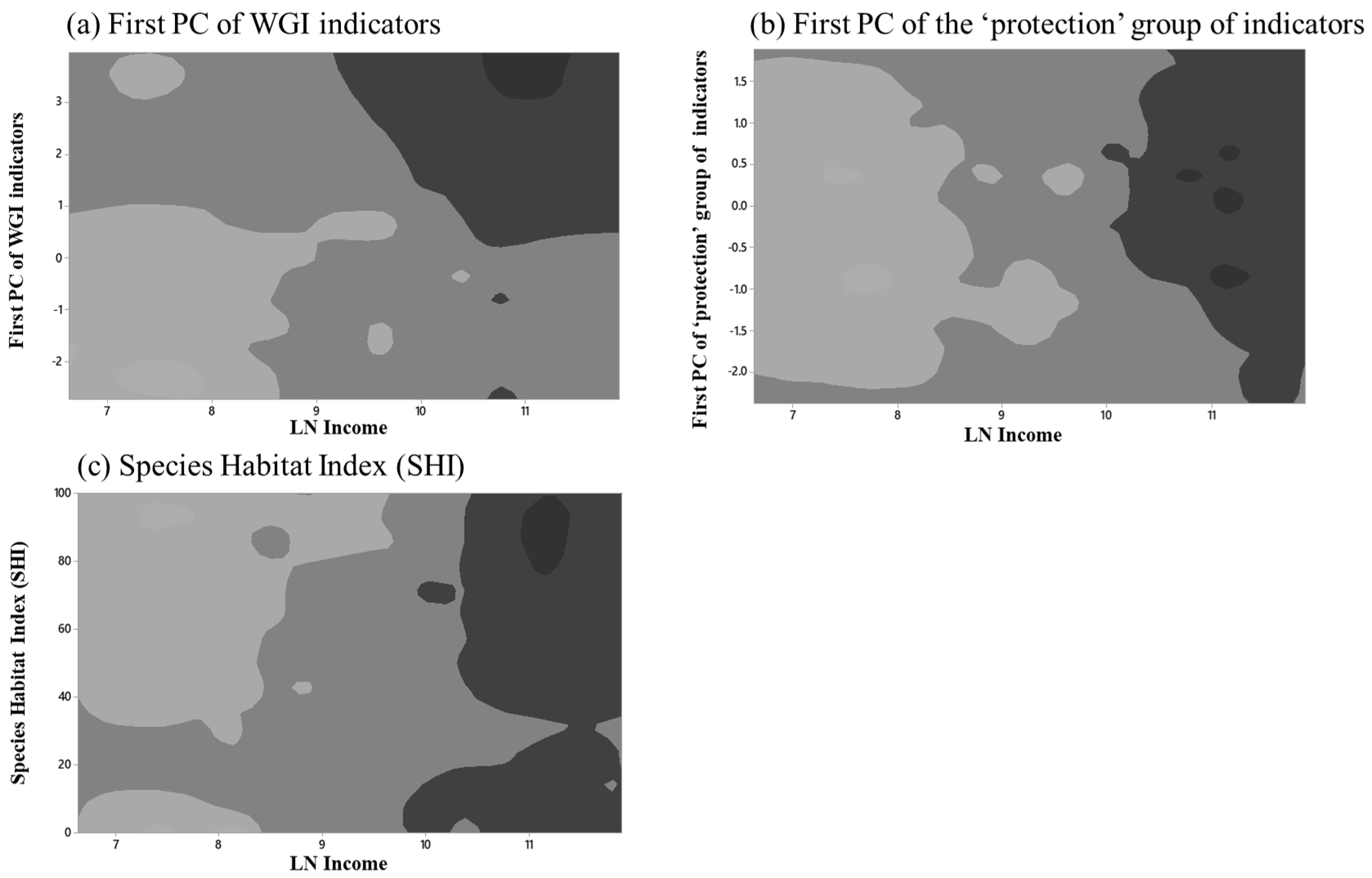
Figure 2.
Summary of regression results for the set of indicators employed in the analysis. Notes: * p < 0.05, *** p < 0.001. The summary of results presented here have been taken from the regression analyses in Table 7, Table 8, Table 9, Table 10 and Table 11, and the direction of the arrow points from independent to dependent variable. The ‘positive’ (solid lines) and ‘negative’ (dotted line) terms describe the nature of the regression coefficient and only statistically significant relationships, the degree of which is represented by the thickness of the lines, are presented here.
Figure 2.
Summary of regression results for the set of indicators employed in the analysis. Notes: * p < 0.05, *** p < 0.001. The summary of results presented here have been taken from the regression analyses in Table 7, Table 8, Table 9, Table 10 and Table 11, and the direction of the arrow points from independent to dependent variable. The ‘positive’ (solid lines) and ‘negative’ (dotted line) terms describe the nature of the regression coefficient and only statistically significant relationships, the degree of which is represented by the thickness of the lines, are presented here.


Table 1.
The six dimensions of governance employed in the World Governance Indicators (WGIs) published by the World Bank.
Table 1.
The six dimensions of governance employed in the World Governance Indicators (WGIs) published by the World Bank.
| Indicator Dimension | Acronym | Notes (Short Extracts from the WGI Descriptors) |
|---|---|---|
| Control of Corruption | cc | “Captures perceptions of the extent to which public power is exercised for private gain, including both petty and grand forms of corruption, as well as “capture” of the state by elites and private interests.” |
| Government Effectiveness | ge | “Captures perceptions of the quality of public services, the quality of the civil service and the degree of its independence from political pressures, the quality of policy formulation and implementation, and the credibility of the government’s commitment to such policies.” |
| Political Stability and Absence of Violence/Terrorism | pv | “Measures perceptions of the likelihood of political instability and/or politically motivated violence, including terrorism.” |
| Rule of Law | rl | “Captures perceptions of the extent to which agents have confidence in and abide by the rules of society, and in particular the quality of contract enforcement, property rights, the police, and the courts, as well as the likelihood of crime and violence.” |
| Regulatory Quality | rq | “Captures perceptions of the ability of the government to formulate and implement sound policies and regulations that permit and promote private sector development.” |
| Voice and Accountability | va | “Captures perceptions of the extent to which a country’s citizens are able to participate in selecting their government, as well as freedom of expression, freedom of association, and a free media.” |
Note: Full descriptions of each of the indicator dimensions are available in [35].
Table 2.
Pearson Correlation coefficients between the six components of the World Governance Indicators (WGIs).
Table 2.
Pearson Correlation coefficients between the six components of the World Governance Indicators (WGIs).
| The Six Components of the World Governance Indicators | ||||||
|---|---|---|---|---|---|---|
| cc | ge | pv | rl | rq | va | |
| cc | 1.000 | 0.919 *** | 0.748 *** | 0.950 *** | 0.899 *** | 0.822 *** |
| ge | 1.000 | 0.703 *** | 0.918 *** | 0.943 *** | 0.767 *** | |
| pv | 1.000 | 0.790 *** | 0.658 *** | 0.704 *** | ||
| rl | 1.000 | 0.921 *** | 0.888 *** | |||
| rq | 1.000 | 0.792 *** | ||||
| va | 1.000 | |||||
*** p < 0.001.
Table 3.
First and second principal component (PC) eigenvectors for the six elements of the six components of the World Governance Indicators (WGIs).
Table 3.
First and second principal component (PC) eigenvectors for the six elements of the six components of the World Governance Indicators (WGIs).
| Indicator | PC1 | PC2 |
|---|---|---|
| Control of Corruption (cc) | 0.456 | 0.102 |
| Government Effectiveness (ge) | 0.480 | 0.192 |
| Political Stability and Absence of Violence/Terrorism (pv) | −0.334 | 0.557 |
| Rule of Law (rl) | 0.465 | 0.158 |
| Regulatory Quality (rq) | 0.484 | −0.031 |
| Voice and Accountability (va) | 0.015 | −0.785 |
| Eigenvalue | 3.9354 | 1.4557 |
| Proportion | 0.66 | 0.24 |
| Cumulative proportion | 0.90 | |
Table 4.
Pearson correlation coefficients between the four habitat quality indicators taken from the Environmental Performance Index (EPI).
Table 4.
Pearson correlation coefficients between the four habitat quality indicators taken from the Environmental Performance Index (EPI).
| ‘Protection’ Group of Indicators | ||||
|---|---|---|---|---|
| TBN | SPI | PAR | SHI | |
| TBN | 1.000 | 0.733 *** | 0.546 *** | −0.024 ns |
| SPI | 1.000 | 0.511 *** | 0.068 ns | |
| PAR | 1.000 | −0.082 * | ||
| SHI | 1.000 | |||
ns = not significant (p > 0.05); * p < 0.05; *** p < 0.001.
Table 5.
First and second principal component (PC) eigenvectors for the TBN, SPI, and PAR group of indictors that comprise the habitat/species ‘protection’ group.
Table 5.
First and second principal component (PC) eigenvectors for the TBN, SPI, and PAR group of indictors that comprise the habitat/species ‘protection’ group.
| Indicator | PC1 | PC2 |
|---|---|---|
| TBN | 0.517 | −0.757 |
| SPI | 0.555 | 0.652 |
| PAR | −0.651 | −0.046 |
| Eigenvalue | 2.3559 | 0.6441 |
| Proportion | 0.785 | 0.215 |
| Cumulative proportion | 1.00 | |
Table 6.
List of countries and territories included in the analysis.
| Armenia | Grenada | Panama |
| Australia | Guatemala | Papua New Guinea |
| Austria | Guinea | Paraguay |
| Azerbaijan | Guinea-Bissau | Peru |
| Bahamas | Guyana | Philippines |
| Bahrain | Haiti | Poland |
| Bangladesh | Honduras | Portugal |
| Barbados | Hungary | Qatar |
| Belarus | Iceland | Romania |
| Belgium | India | Russian Federation |
| Belize | Indonesia | Rwanda |
| Benin | Iran, Islamic Republic | Samoa |
| Bhutan | Iraq | São Tomé and Principe |
| Bolivia | Ireland | Saudi Arabia |
| Bosnia and Herzegovina | Israel | Senegal |
| Botswana | Italy | Serbia |
| Brazil | Jamaica | Seychelles |
| Brunei Darussalam | Japan | Sierra Leone |
| Bulgaria | Jordan | Singapore |
| Burkina Faso | Kazakhstan | Slovak Republic |
| Burundi | Kenya | Slovenia |
| Cambodia | Kiribati | Solomon Islands |
| Cameroon | Korea, Rep. | South Africa |
| Canada | Kuwait | Spain |
| Cape Verde | Kyrgyz Republic | Sri Lanka |
| Central African Republic | Lao PDR | St. Lucia |
| Chad | Latvia | St. Vincent and the Grenadines |
| Chile | Lebanon | Sudan |
| China | Lesotho | Suriname |
| Colombia | Liberia | Sweden |
| Comoros | Lithuania | Switzerland |
| Congo, Dem. Rep. | Luxembourg | Taiwan, China |
| Congo, Rep. | Madagascar | Tajikistan |
| Costa Rica | Malawi | Tanzania |
| Côte d’Ivoire | Malaysia | Thailand |
| Croatia | Maldives | Timor-Leste |
| Cuba | Mali | Togo |
| Cyprus | Malta | Tonga |
| Czech Republic | Marshall Islands | Trinidad and Tobago |
| Denmark | Mauritania | Tunisia |
| Djibouti | Mauritius | Türkiye |
| Dominica | Mexico | Turkmenistan |
| Dominican Republic | Micronesia, Federated States | Uganda |
| Ecuador | Moldova | Ukraine |
| Egypt, Arab Republic | Mongolia | United Arab Emirates |
| El Salvador | Montenegro | United Kingdom |
| Equatorial Guinea | Morocco | United States |
| Eritrea | Mozambique | Uruguay |
| Estonia | Myanmar | Uzbekistan |
| Eswatini | Namibia | Vanuatu |
| Ethiopia | Nepal | Venezuela, Bolivarian Republic |
| Fiji | Netherlands, The | Viet Nam |
| Finland | New Zealand | Zambia |
| France | Nicaragua | Zimbabwe |
Table 7.
Results of a regression analysis with the natural logarithm of income (LN Income) as the dependent variable and WGIs (first and second PC) and year as the independent variables.
Table 7.
Results of a regression analysis with the natural logarithm of income (LN Income) as the dependent variable and WGIs (first and second PC) and year as the independent variables.
| Term | Coefficient | SE | t-Value and Significance | VIF |
|---|---|---|---|---|
| Constant | 9.3596 | 0.0606 | 154.49 *** | |
| PC1 of WGI | 0.5193 | 0.0205 | 25.36 *** | 1.04 |
| PC2 of WGI | 0.3944 | 0.0633 | 6.23 *** | 1.04 |
| Year | ||||
| 2020 | 0.0539 | 0.0856 | 0.63 ns | 1.5 |
| 2022 | 0.1305 | 0.0858 | 1.52 ns | 1.5 |
| 2024 | 0.3094 | 0.0855 | 3.62 *** | 1.51 |
Adjusted R2 = 52.73%; F = 157.48 *** (df = 5, 696); Durbin–Watson Statistic = 1.96; ns = not significant (p > 0.05); *** p < 0.001.
Table 8.
Results of a regression analysis with the reported LLS as the dependent variable and governance indicators, income, and year as the independent variables.
Table 8.
Results of a regression analysis with the reported LLS as the dependent variable and governance indicators, income, and year as the independent variables.
| Term | Coefficient | SE | t-Value and Significance | VIF |
|---|---|---|---|---|
| Constant | −0.629 | 0.327 | −1.92 ns | |
| PC1 of WGI | 0.1522 | 0.0251 | 6.07 *** | 2.1 |
| PC2 of WGI | −0.18 | 0.0597 | −3.02 ** | 1.07 |
| LN Income | 0.6449 | 0.0344 | 18.75 *** | 2.2 |
| Year | ||||
| 2020 | 0.0379 | 0.076 | 0.5 ns | 1.48 |
| 2022 | −0.0513 | 0.0775 | −0.66 ns | 1.47 |
| 2024 | −0.1091 | 0.0771 | −1.42 ns | 1.51 |
Adjusted R2 = 67.3%; F = 192.08 *** (df = 6,551); Durbin–Watson Statistic = 1.98; ns = not significant (p > 0.05); ** p < 0.01; *** p < 0.001.
Table 9.
Results of a regression analysis with first PC of the ‘protection’ group of indicators (TBN, SPI, and PAR) as the dependent variable and first and second PCs of governance indicators and income as the independent variables.
Table 9.
Results of a regression analysis with first PC of the ‘protection’ group of indicators (TBN, SPI, and PAR) as the dependent variable and first and second PCs of governance indicators and income as the independent variables.
| Term | Coefficient | SE | t-Value and Significance | VIF |
|---|---|---|---|---|
| Constant | −0.208 | 0.348 | −0.6 ns | |
| PC1 of WGI | 0.0638 | 0.027 | 2.36 * | 2.03 |
| PC2 of WGI | −0.053 | 0.0631 | −0.84 ns | 1.1 |
| LN Income | 0.0352 | 0.0366 | 0.96 ns | 2.18 |
| Year | ||||
| 2020 | 0.3525 | 0.0835 | 4.22 *** | 1.49 |
| 2022 | −0.1934 | 0.0812 | −2.38 * | 1.53 |
| 2024 | −0.4899 | 0.0837 | −5.85 *** | 1.53 |
Adjusted R2 = 15.47%; F = 20.52 *** (df = 6,634); Durbin–Watson Statistic = 2.04; ns = not significant (p > 0.05); * p < 0.05; *** p < 0.001.
Table 10.
Results of a regression analysis with the SHI as the dependent variable and governance indicators, income, and year as the independent variables.
Table 10.
Results of a regression analysis with the SHI as the dependent variable and governance indicators, income, and year as the independent variables.
| Term | Coefficient | SE | t-Value and Significance | VIF |
|---|---|---|---|---|
| Constant | 79.3 | 12.4 | 6.39 *** | |
| PC1 of WGI | 1.162 | 0.959 | 1.21 ns | 2.05 |
| PC2 of WGI | −0.16 | 2.26 | −0.07 ns | 1.1 |
| LN Income | −0.01 | 1.31 | −0.01 ns | 2.21 |
| Year | ||||
| 2020 | 0.25 | 2.94 | 0.08 ns | 1.48 |
| 2022 | −3.89 | 2.92 | −1.33 ns | 1.49 |
| 2024 | −25.3 | 2.94 | −8.62 *** | 1.52 |
Adjusted R2 = 13.94%; F = 17.96 *** (df = 6,622); Durbin–Watson Statistic = 2.16; ns = not significant (p > 0.05); *** p < 0.001.
Table 11.
Results of a regression analysis with the reported LLS as the dependent variable and the ‘protection’ group of indicators (first and second PCs), income, and year as the independent variables.
Table 11.
Results of a regression analysis with the reported LLS as the dependent variable and the ‘protection’ group of indicators (first and second PCs), income, and year as the independent variables.
| Term | Coefficient | SE | t-Value and Significance | VIF |
|---|---|---|---|---|
| Constant | −1.479 | 0.248 | −5.97 *** | |
| PC1 of protection indicators | 0.0871 | 0.043 | 2.02 * | 1.3 |
| PC2 of protection indicators | −0.0582 | 0.063 | −0.92 ns | 1.25 |
| SHI | −0.00585 | 0.001 | −5.22 *** | 1.2 |
| LN Income | 0.7856 | 0.025 | 31.63 *** | 1 |
| Year | ||||
| 2020 | 0.0096 | 0.081 | 0.12 ns | 1.5 |
| 2022 | −0.1023 | 0.085 | −1.2 ns | 1.65 |
| 2024 | −0.2571 | 0.087 | −2.94 ** | 1.8 |
Adjusted R2 = 66.28%; F = 151.77 *** (df = 7,530); Durbin–Watson Statistic = 2.07; ns = not significant (p > 0.05); * p < 0.05; ** p < 0.01; *** p < 0.001.
Disclaimer/Publisher’s Note: The statements, opinions and data contained in all publications are solely those of the individual author(s) and contributor(s) and not of MDPI and/or the editor(s). MDPI and/or the editor(s) disclaim responsibility for any injury to people or property resulting from any ideas, methods, instructions or products referred to in the content. |
© 2026 by the author. Licensee MDPI, Basel, Switzerland. This article is an open access article distributed under the terms and conditions of the Creative Commons Attribution (CC BY) license.
Share and Cite
MDPI and ACS Style
Morse, S. Green Well-Being and Governance. Sustainability 2026, 18, 1842. https://doi.org/10.3390/su18041842
AMA Style
Morse S. Green Well-Being and Governance. Sustainability. 2026; 18(4):1842. https://doi.org/10.3390/su18041842
Chicago/Turabian StyleMorse, Stephen. 2026. "Green Well-Being and Governance" Sustainability 18, no. 4: 1842. https://doi.org/10.3390/su18041842
APA StyleMorse, S. (2026). Green Well-Being and Governance. Sustainability, 18(4), 1842. https://doi.org/10.3390/su18041842
Note that from the first issue of 2016, this journal uses article numbers instead of page numbers. See further details here.