Environmental Analysis of Emulsified Asphalt Products in the United States: A Comparative Cradle-to-Gate Life Cycle Assessment


Abstract
1. Introduction
2. Goal and Scope of the Study
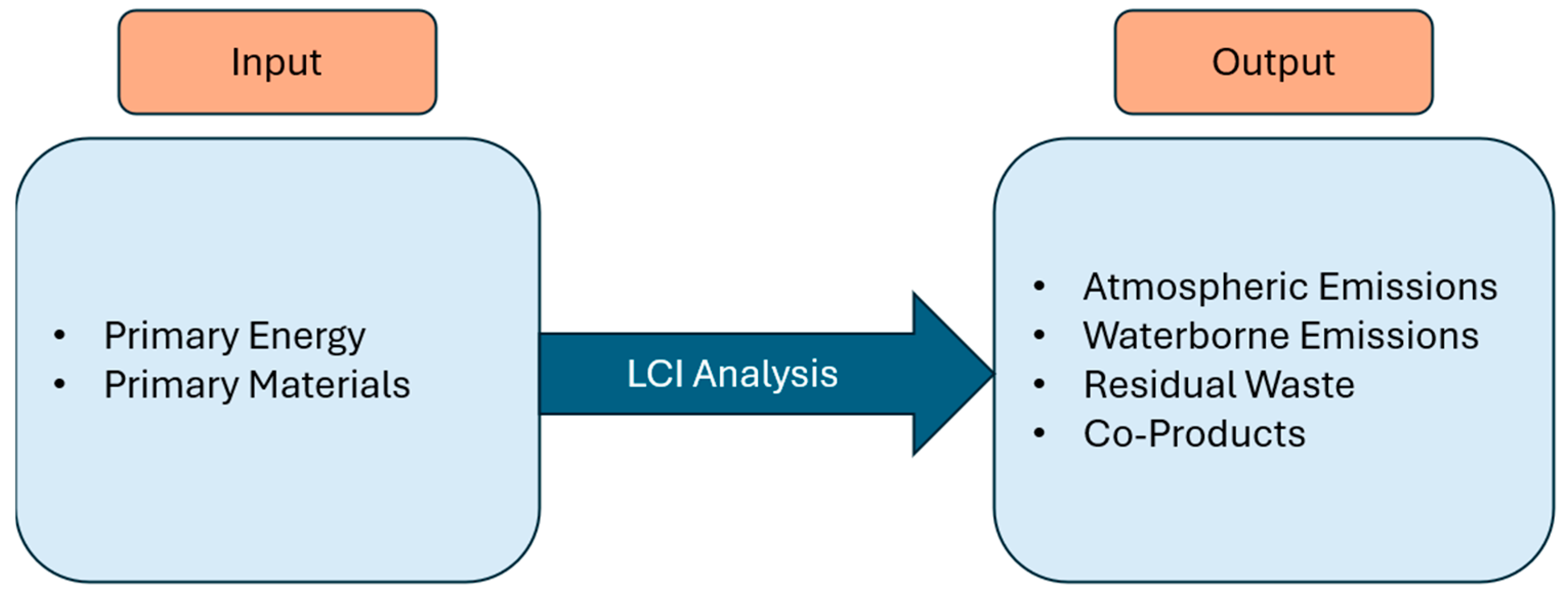
3. LCI and LCIA
- Classification: In this phase, items from the LCI are grouped into relevant environmental impact categories based on the specific type of damage they contribute to. These categories often include acidification, eutrophication, human toxicity, ozone depletion, and GHG emissions.
- Characterization: Here, numerical values or weighting factors are applied to the categorized data, quantifying the magnitude of each impact and reflecting the overall environmental burden associated with the product or process life cycle.
- Global Warming Potential (GWP): Expressed in kilograms of CO2 equivalent (kg CO2-eq), GWP reflects the climate impact of greenhouse gas emissions over a 100-year horizon, based on characterization factors from the IPCC’s Fifth Assessment Report (AR5), which is widely adopted as the GWP100 metric [21].
- Photochemical Ozone Creation Potential (POCP): Represented in kilograms of ozone equivalent (kg O3-eq) using TRACI, this category quantifies the contribution of emissions to ground-level ozone (smog) generation, also known as smog formation potential (SFP).
- Human Health (PM2.5): Expressed in kilograms of PM2.5, this metric quantifies the emission of fine airborne particles with diameters of 2.5 μm or less, which are harmful to human health when inhaled.
- Nonrenewable Primary Energy Demand: Reported in megajoules (MJ), this metric accounts for the net calorific energy extracted from fossil fuels and other nonrenewable sources, excluding feedstock contributions.
- Renewable Primary Energy Demand: Also measured in MJ, this refers to the usable energy obtained from renewable sources such as biomass, wind, or solar, again excluding feedstock energy.
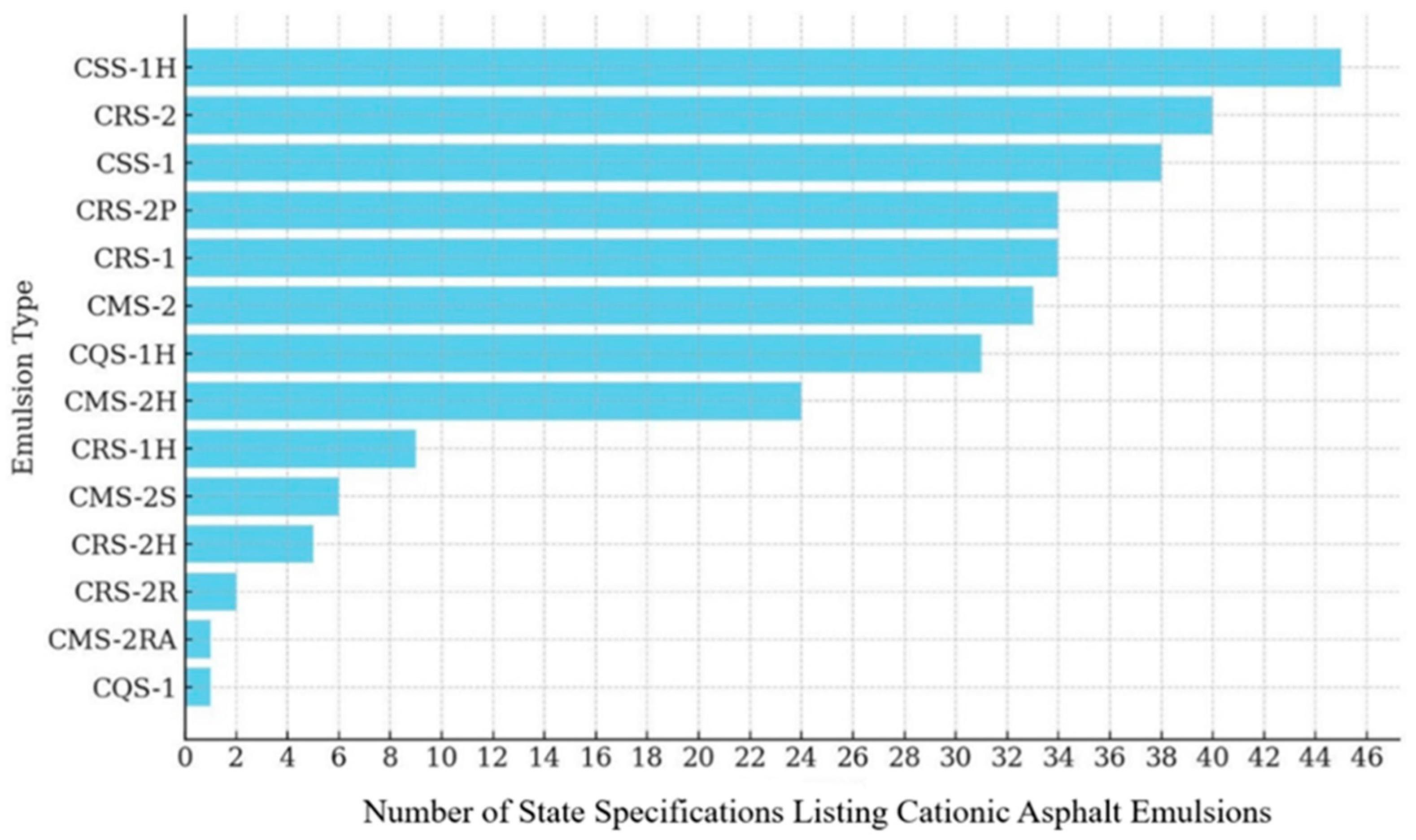
3.1. Selected Types of Emulsified Asphalt
3.2. Presence of Chosen Emulsified Asphalt Types Across Supplier Locations
3.3. Data Compilation for LCI
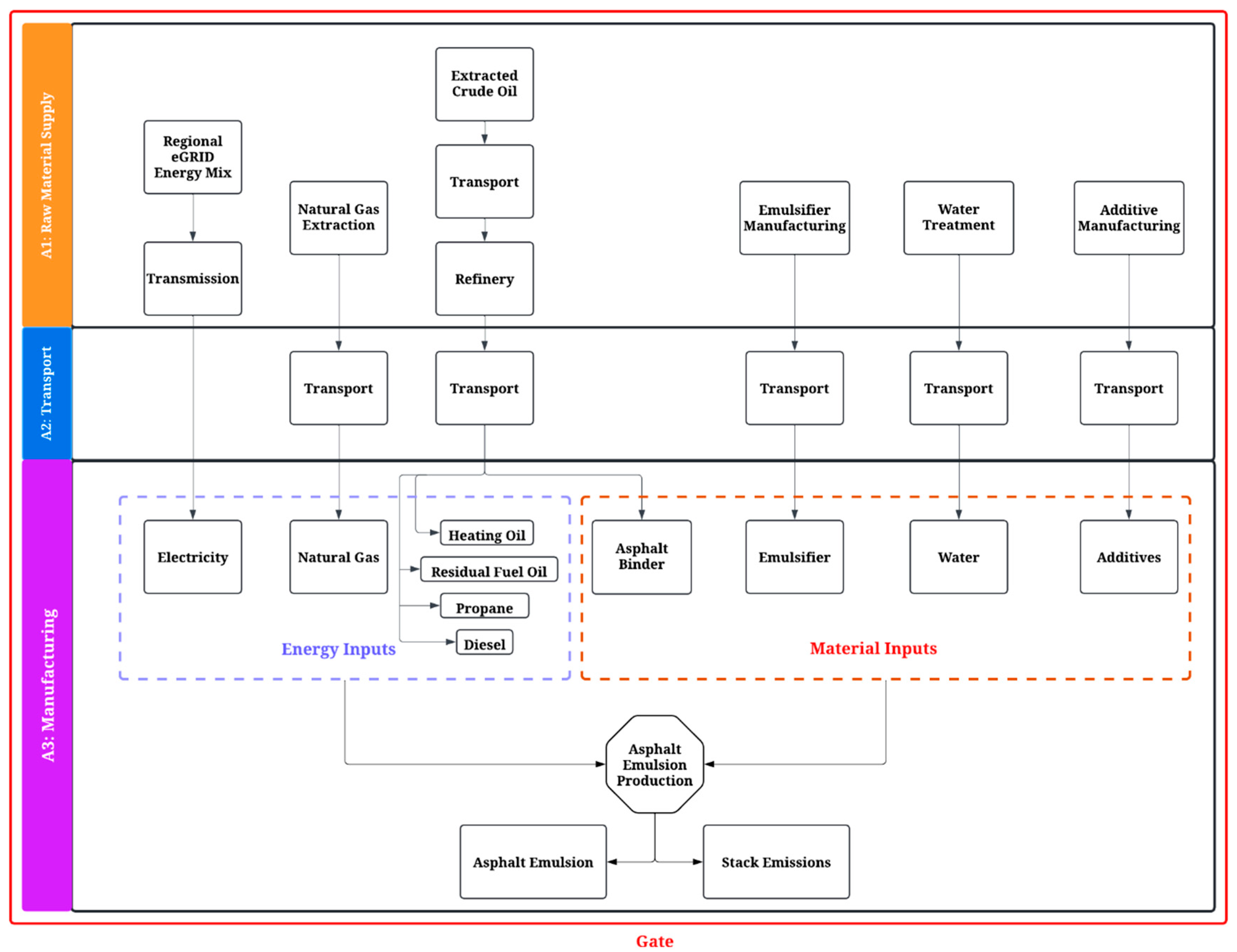
- Raw Material Inputs:
- Binder: Secondary data referencing the Asphalt Institute’s report for the North American region.
- Emulsifying Agents: Based on primary data gathered from supplier-provided safety data sheets (SDSs).
- Additive Agents: Based on primary data gathered from supplier-provided SDSs.
- Water: Obtained as secondary data from the GaBi LCI database.
- Hydrochloric acid: Sourced from the same secondary database as water.
- Energy Inputs:
- Natural Gas: Primary figures directly reported by emulsified asphalt producers.
- Electricity: Also based on primary data obtained from those same industry partners.
4. LCIA Results
4.1. Resource Acquisition and Plant Manufacturing Stages
4.2. Transportation Stage
4.3. Resource Acquisition, Plant Manufacturing, and Transportation Stages
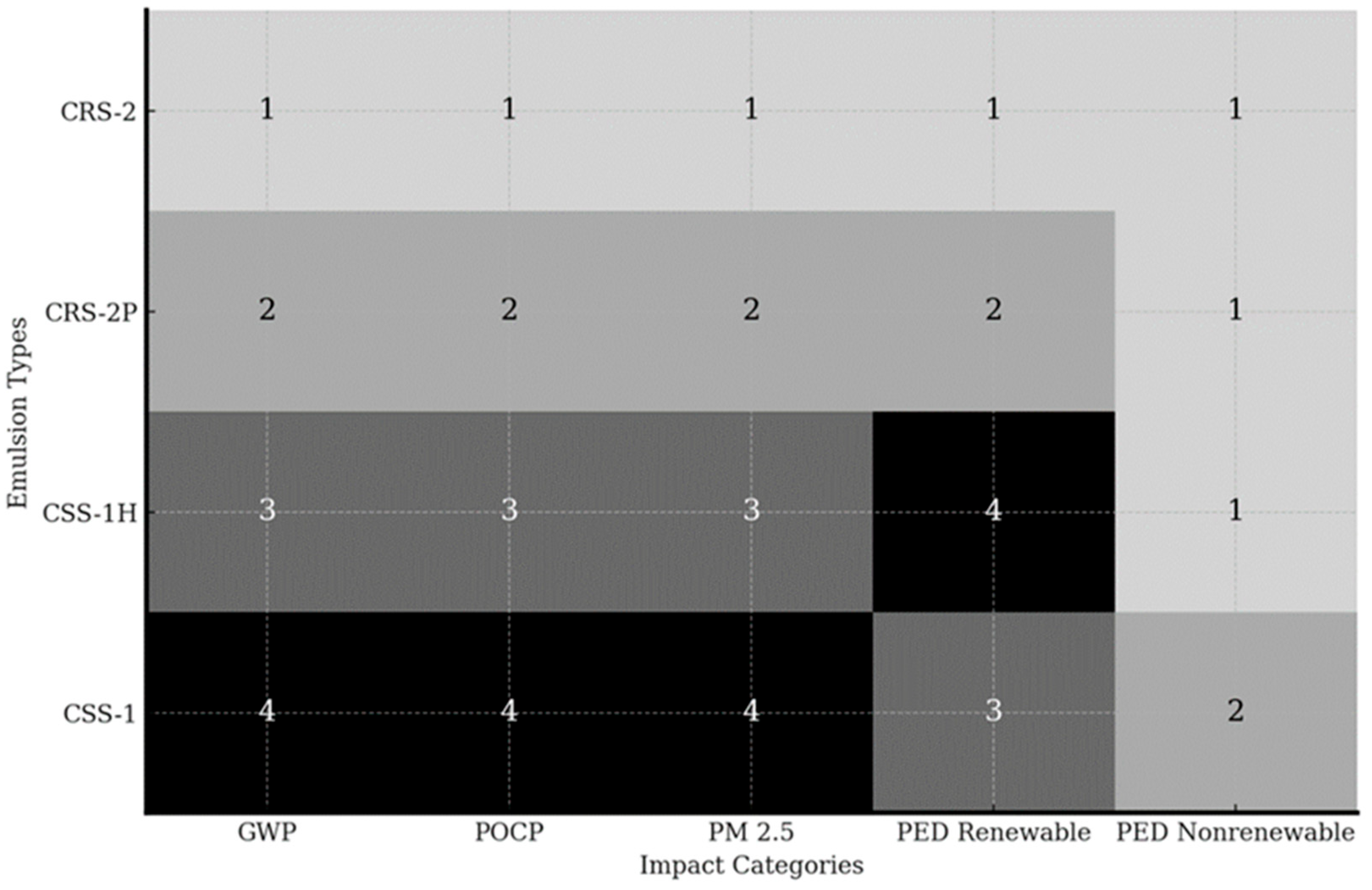
4.4. LCIA Comparative Results for Selected Emulsified
5. Sensitivity Analysis
6. Discussion and Interpretation
7. Conclusions
Author Contributions
Funding
Institutional Review Board Statement
Informed Consent Statement
Data Availability Statement
Acknowledgments
Conflicts of Interest
Abbreviations
| AASHTO | American Association of State Highway and Transportation Officials |
| ASTM | ASTM International (formerly American Society for Testing and Materials) |
| CMA | Cold Mix Asphalt |
| CRS | Cationic Rapid Setting |
| CSS | Cationic Slow Setting |
| DOT | Department of Transportation |
| eGRID | Emissions and Generation Resource Integrated Database |
| EPD | Environmental Product Declaration |
| GHG | Greenhouse Gas |
| GWP | Global Warming Potential |
| HCI | Hydrochloric Acid |
| HMA | Hot Mix Asphalt |
| ISO | International Organization for Standardization |
| LCA | Life Cycle Assessment |
| LCI | Life Cycle Inventory |
| LCIA | Life Cycle Impact Assessment |
| MJ | Megajoule |
| MS | Medium Setting |
| PED | Primary Energy Demand |
| PM2.5 | Particulate Matter with aerodynamic diameter ≤ 2.5 μm |
| PCOP | Photochemical Ozone Creation Potential |
| QS | Quick Setting |
| RS | Rapid Setting |
| SDS | Safety Data Sheet |
| SS | Slow Setting |
| US | United States |
References
- James, A. Overview of asphalt emulsion. Transp. Res. Circ. E-C102 Asph. Emuls. Technol. Transp. Res. Circ. 2006, 1–15. Available online: https://scholar.google.com/scholar?hl=en&as_sdt=0%2C5&q=1.%09James%2C+A.+Overview+of+asphalt+emulsion.+Transp.+Res.+Circ.++2006%2C+E-C102%2C+1%E2%80%9315&btnG= (accessed on 20 August 2025).
- Sarella, C.; Galipelli, R.; Sabavath, S. A review on design, evaluation, and performance of emulsified asphalt-treated bases using recycled aggregates. Environ. Sci. Pollut. Res. 2022, 29, 46570–46586. [Google Scholar] [CrossRef] [PubMed]
- Yu, L.; Li, R.; Zhang, H.; Pei, J.; Hu, J. Research on improving the performance of emulsified asphalt modifiers. Int. J. Pavement Res. Technol. 2025, 18, 41–55. [Google Scholar] [CrossRef]
- Little, D.N.; Allen, D.H.; Bhasin, A. Asphalt binders. In Modeling and Design of Flexible Pavements and Materials; Springer International Publishing: Cham, Switzerland, 2017; pp. 27–77. [Google Scholar]
- Hu, Y.; Yin, Y.; Sreeram, A.; Liu, J.; Si, W.; Tang, D.; Airey, G.D. Nano-Aggregation of Asphaltenes and Its Influence on the Multiscale Properties of Bitumen Recycled through Multiple Ageing and Rejuvenation Cycles. Chem. Eng. J. 2025, 512, 162348. [Google Scholar] [CrossRef]
- Lei, J.A.; He, Y.; Zhao, F. Rheological Properties of Evaporative Residue of SBS-C9 Compound Modified Emulsified Asphalt. Int. J. Pavement Res. Technol. 2025, 21, 1–11. [Google Scholar] [CrossRef]
- Mehdizadeh, G.; Erfani, E.; McDonough, F.; Hosseinpour, F. Quantifying the Influence of Cloud Seeding on Ice Particle Growth and Snowfall through Idealized Microphysical Modeling. Atmosphere 2024, 15, 1460. [Google Scholar] [CrossRef]
- Gholaminejad, A.; Mehdizadeh, G.; Dolatimehr, A.; Arfaeinia, H.; Farjadfard, S.; Dobaradaran, S.; Bonyadi, Z.; Ramavandi, B. Phthalate esters pollution in the leachate, soil, and water around a landfill near the sea, Iran. Environ. Res. 2024, 248, 118234. [Google Scholar] [CrossRef] [PubMed]
- Asphalt Institute; Asphalt Emulsion Manufacturers Association. A Basic Asphalt Emulsion Manual; U.S. Department of Transportation, Federal Highway Administration: Washington, DC, USA, 2008.
- Mehdizadeh, G.; Nikoo, M.R.; Talebbeydokhti, N.; Vanda, S.; Nematollahi, B. Hypolimnetic aeration optimization based on reservoir thermal stratification simulation. J. Hydrol. 2023, 625, 130106. [Google Scholar] [CrossRef]
- You, L.; Dai, Q.; You, Z.; Zhou, X.; Washko, S. Stability and rheology of asphalt emulsion under varying acidic and alkaline levels. J. Clean. Prod. 2020, 256, 120417. [Google Scholar] [CrossRef]
- Baumgardner, G.L. Asphalt emulsion manufacturing today and tomorrow. Asph. Emuls. Technol. 2006, 2006, 16–25. [Google Scholar]
- Chen, F.; Wang, X.; Li, Z. Effects of activated cold regenerant on pavement properties and sustainability of emulsified asphalt cold recycling mixtures. Materials 2025, 18, 3529. [Google Scholar] [CrossRef]
- Schulz, E.N.; Ambrusi, R.E.; Miraglia, D.B.; Schulz, E.P.; García, S.G.; Rodriguez, J.L.; Schulz, P.C. Evaluation of oil-in-water emulsions with cationic–anionic surfactants mixtures for potential use in the oil industry. Colloids Surf. A Physicochem. Eng. Asp. 2016, 490, 145–154. [Google Scholar] [CrossRef]
- Birgani, S.A.; Shomal Zadeh, S.; Davani Davari, D.; Ostovar, A. Deep Learning Applications for Analysing Concrete Surface Cracks. Int. J. Appl. Data Sci. Eng. Health 2024, 1, 69–84. [Google Scholar]
- Thiriet, A.; Gaudefroy, V.; Piau, J.M.; Delfosse, F.; Chailleux, E.; Leroy, C. Assessment of the Behavior of Emulsified Asphalt Mixes During Curing. In RILEM International Symposium on Bituminous Materials; Springer International Publishing: Cham, Switzerland, 2020; pp. 331–337. [Google Scholar]
- Jiang, Q.; Liu, W.; Wu, S. Technological advances and challenges of reclaimed asphalt pavement (RAP) application in road engineering—A bibliometric analysis from 2000 to 2022. Environ. Sci. Pollut. Res. 2024, 31, 35519–35552. [Google Scholar] [CrossRef]
- Hasheminezhad, A.; Ceylan, H.; Kim, S. Sustainability promotion through asphalt pavements: A review of existing tools and innovations. Sustain. Mater. Technol. 2024, 42, e01162. [Google Scholar] [CrossRef]
- Gunka, V.; Hidei, V.; Sidun, I.; Demchuk, Y.; Stadnik, V.; Shapoval, P.; Bratychak, M. Wastepaper Sludge Ash and Acid Tar as Activated Filler Aggregates for Stone Mastic Asphalt. Coatings 2023, 13, 1183. [Google Scholar] [CrossRef]
- Harvey, J.; Meijer, J.; Ozer, H.; Al-Qadi, I.L.; Saboori, A.; Kendall, A. Pavement Life Cycle Assessment Framework; FHWA-HIF-16-014; Federal Highway Administration: Washington, DC, USA, 2016.
- Eurobitume. Life Cycle Inventory: Bitumen, 2nd ed.; European Bitumen Association: Brussels, Belgium, 2012; Available online: https://eurobitume.eu/bitumen-life-cycle-assessment/ (accessed on 20 August 2025).
- Schuller, O. The GaBi LCA Refinery Model 2016; Thinkstep: 2016. Available online: https://sphera.com/product-sustainability-software/ (accessed on 14 April 2024).
- Abella, J.P.; Motazedi, K.; Guo, J.; Bergerson, J.A. Petroleum Refinery Life Cycle Inventory Model (PRELIM), PRELIM v1.4; University of Calgary: Calgary, AB, Canada, 2015. [Google Scholar]
- Saboori, A.; Butt, A.; Harvey, J.; Ostovar, M.; Li, H.; Wang, T. UCPRC Life Cycle Assessment Inventories (LCIs) from Three Studies (UCPRCTM-2020-01); University of California Pavement Research Center: Davis, CA, USA, 2022. [Google Scholar]
- ISO 14040 2006; Environmental Management—Life Cycle Assessment—Principles and Framework. International Organization for Standardization: Geneva, Switzerland, 2006.
- Chester, M.; Matute, J.; Bunje, P.; Eisenstein, W.; Pincetl, S.; Elizabeth, Z.; Cepeda, C. Life cycle assessment for transportation decision-making. In Report of UCLA Institute of the Environment and Sustainability; Transportation Research Board: Washington, DC, USA, 2014. [Google Scholar]
- Miliutenko, S. Consideration of Life Cycle Energy Use and Greenhouse Gas Emissions for Improved Road Infrastructure Planning. Ph.D. Thesis, KTH Royal Institute of Technology, Stockholm, Sweden, 2016. [Google Scholar]
- Harvey, J.T.; Kendall, A.; Saboori, A.; Ostovar, M.; Butt, A.A.; Hernandez, J.; Haynes, B. Framework for Life Cycle Assessment of Complete Streets Projects; National Center for Sustainable Transportation (NCST): Davis, CA, USA, 2018. [Google Scholar]
- Ostovar, A. Comparative Life Cycle Assessment (LCA) of Different Asphalt Emulsion Types. Master’s Thesis, University of Nevada, Reno, NV, USA, 2023. [Google Scholar]
- Bjørn, A.; Moltesen, A.; Laurent, A.; Owsianiak, M.; Corona, A.; Birkved, M.; Hauschild, M.Z. Life cycle inventory analysis. In Life Cycle Assessment: Theory and Practice; Springer: Cham, Switzerland, 2018; pp. 117–165. [Google Scholar]
- Suh, S.; Huppes, G. Methods in the life cycle inventory of a product. In Handbook of Input-Output Economics in Industrial Ecology; Springer: Dordrecht, The Netherlands, 2009; pp. 263–282. [Google Scholar]
- Vigon, B.W.; Tolle, D.A.; Cornaby, B.W.; Latham, H.C.; Harrison, C.L.; Boguski, T.L.; Hunt, R.G.; Sellers, J.D. Life Cycle Assessment: Inventory Guidelines and Principles; EPA/600/R-92/245; Environmental Protection Agency: Washington, DC, USA, 1993.
- Bare, J.; Young, D.; Hopton, M. Tool for the Reduction and Assessment of Chemical and Other Environmental Impacts (TRACI) User’s Manual; United States Environmental Protection Agency: Washington, DC, USA, 2012.
- Huijbregts, M.A.J.; Steinmann, Z.J.N.; Elshout, P.M.F.; Stam, G.; Verones, F.; Vieira, M.; Zijp, M.; Hollander, A.; Van Zelm, R. ReCiPe2016: A harmonised life cycle impact assessment method at midpoint and endpoint level. Int. J. Life Cycle Assess. 2017, 22, 138–147. [Google Scholar] [CrossRef]
- Guinée, J.B. Handbook on Life Cycle Assessment; Operational Guide to the ISO Standards; Springer Science & Business Media: Dordrecht, The Netherlands, 2002; Volume 7. [Google Scholar]
- Goedkoop, M. Factual errors in the eco-indicator 95. Int. J. Life Cycle Assess 2001, 6, 45. [Google Scholar] [CrossRef]
- Verones, F.; Hellweg, S.; Azevedo, L.B.; Laurent, A.; Mutel, C.L.; Pfister, S. LC-Impact; Version 0.5; 2016; pp. 1–143. Available online: https://lc-impact.eu/doc/LC-Impact_report_SEPT2016_20160927.pdf (accessed on 21 September 2025).
- Ostovar, M.; Butt, A.A.; Harvey, J.T.; Ramalingam, Z.T.; Hernandez, J.; Kendall, A. Case Studies of Socio-Economic and Environmental Life Cycle Assessment of Complete Streets; National Center for Sustainable Transportation (NCST): Davis, CA, USA, 2022. [Google Scholar]
- Ostovar, A.; Davani Davari, D.; Dzikuć, M. Determinants of Design with Multilayer Perceptron Neural Networks: A Comparison with Logistic Regression. Sustainability 2025, 17, 2611. [Google Scholar] [CrossRef]
- Bare, J.C.; Norris, G.A.; Pennington, D.W.; McKone, T. TRACI—The Tool for the Reduction and Assessment of Chemical and Other Environmental Impacts. J. Ind. Ecol. 2003, 6, 49–78. [Google Scholar] [CrossRef]
- de Bortoli, A.; Rahimy, O.; Levasseur, A. Environmental life-cycle impacts of bitumen: Systematic review and life-cycle modeling for Canadian markets using TRACI 2.1 and ecoinvent v3.6. J. Clean. Prod. 2024, 430, 140355. [Google Scholar]
- Sharaai, A.H.; Mahmood, N.Z.; Sulaiman, A.H. Life cycle impact assessment (LCIA) using TRACI methodology: An analysis of potential impact on potable water production. Aust. J. Basic Appl. Sci. 2010, 4, 4313–4322. [Google Scholar]
- Dos Santos, J.M.O.; Thyagarajan, S.; Keijzer, E.; Fernández Flores, R.; Flintsch, G. Comparison of life-cycle assessment tools for road pavement infrastructure. Transp. Res. Rec. 2017, 2646, 28–38. [Google Scholar] [CrossRef]
- Afshin, A.; Behnood, A. Sustainability of asphalt pavements: The role of life cycle assessment (LCA) and emerging technologies. Clean. Mater. 2025, 18, 100346. [Google Scholar] [CrossRef]
- ASTM International. Standard Specification for Emulsified Asphalt (ASTM D977/D977M-20); ASTM International: West Conshohocken, PA, USA, 2020. [Google Scholar]
- AASHTO. Standard Specification for Emulsified Asphalt (M 140); American Association of State Highway and Transportation Officials: Washington, DC, USA, 2018. [Google Scholar]
- ISO 14044:2006; Environmental Management—Life Cycle Assessment—Requirements and Guidelines. International Organization for Standardization (ISO): Geneva, Switzerland, 2006.
- Stripple, H.; Uppenberg, S. Life cycle assessment of railways and road infrastructure. J. Clean. Prod. 2010, 18, 141–151. [Google Scholar] [CrossRef]
- Thives, L.P.; Ghisi, E. Life cycle assessment of asphalt pavements based on mechanistic–empirical design. J. Clean. Prod. 2017, 164, 130–143. [Google Scholar] [CrossRef]
- Lévenard, F.; Gaudefroy, V.; Petiteau, C.; Chailleux, E.; Capron, I.; Bujoli, B. Bio-based emulsifiers for pavement material: Emulsion formulation and cold asphalt mix properties. In Proceedings of the 11th International Conference on the Bearing Capacity of Roads, Railways and Airfields, Trondheim, Norway, 27–30 June 2022; Hoff, M., Mork, H., Saba, R., Eds.; CRC Press: Boca Raton, FL, USA, 2022; pp. 332–340. [Google Scholar] [CrossRef]




| Emulsified Asphalt Production Facility | Type of Emulsified Asphalt Produced | |||
|---|---|---|---|---|
| A | CRS-2 | – | – | – |
| B | CRS-2 | CSS-1 | CSS-1H | CRS-2P |
| C | CRS-2 | – | CSS-1H | CRS-2P |
| D | CRS-2 | – | – | CRS-2P |
| E | CRS-2 | – | – | CRS-2P |
| F | CRS-2 | – | – | – |
| G | – | – | CSS-1H | – |
| H | CRS-2 | – | – | – |
| I | CRS-2 | CSS-1 | – | CRS-2P |
| J | – | – | CSS-1H | - |
| K | – | – | CSS-1H | - |
| L | CRS-2 | – | CSS-1H | CRS-2P |
| M | – | – | - | CRS-2P |
| N | CRS-2 | – | CSS-1H | CRS-2P |
| O | CRS-2 | – | – | – |
| P | – | CSS-1 | – | CRS-2P |
| Q | CRS-2 | – | CSS-1H | CRS-2P |
| No. of facilities | 12 | 3 | 8 | 10 |
| Facility | Emulsified Asphalt Type | GWP | POCP | PM2.5 | PED (Renewable) | PED (Non-Renewable) |
|---|---|---|---|---|---|---|
| A | CRS-2 | 98% | 97% | 99% | 106% | 98% |
| B | CSS-1 | 114% | 112% | 103% | 167% | 99% |
| CSS-1H | 114% | 112% | 103% | 167% | 99% | |
| CRS-2 | 100% | 100% | 100% | 100% | 100% | |
| CRS-2P | 113% | 105% | 103% | 142% | 103% | |
| C | CSS-1H | 112% | 110% | 101% | 164% | 96% |
| CRS-2 | 97% | 98% | 99% | 91% | 98% | |
| CRS-2P | 98% | 98% | 98% | 96% | 98% | |
| D | CRS-2 | 101% | 100% | 100% | 119% | 99% |
| CRS-2P | 111% | 103% | 103% | 148% | 102% | |
| E | CRS-2 | 104% | 104% | 105% | 98% | 105% |
| CRS-2P | 115% | 108% | 108% | 130% | 108% | |
| F | CRS-2 | 96% | 97% | 98% | 89% | 97% |
| G | CSS-1H | 117% | 114% | 103% | 183% | 99% |
| H | CRS-2 | 95% | 96% | 97% | 88% | 97% |
| I | CSS-1 | 113% | 111% | 100% | 175% | 94% |
| CRS-2 | 98% | 99% | 100% | 90% | 100% | |
| CRS-2P | 99% | 100% | 102% | 92% | 101% | |
| J | CSS-1H | 116% | 112% | 102% | 193% | 95% |
| K | CSS-1H | 118% | 113% | 104% | 210% | 99% |
| L | CSS-1H | 124% | 120% | 108% | 221% | 101% |
| CRS-2 | 100% | 98% | 99% | 115% | 100% | |
| CRS-2P | 114% | 103% | 103% | 159% | 103% | |
| M | CRS-2P | 111% | 102% | 102% | 147% | 101% |
| N | CSS-1H | 112% | 110% | 101% | 167% | 97% |
| CRS-2 | 98% | 98% | 98% | 94% | 99% | |
| CRS-2P | 113% | 105% | 104% | 135% | 104% | |
| O | CRS-2 | 93% | 93% | 94% | 91% | 94% |
| P | CSS-1 | 130% | 127% | 110% | 230% | 101% |
| CRS-2P | 106% | 102% | 102% | 120% | 101% | |
| Q | CSS-1H | 129% | 126% | 109% | 233% | 99% |
| CRS-2 | 97% | 97% | 98% | 99% | 96% | |
| CRS-2P | 105% | 102% | 101% | 122% | 100% |
| Facility | Emulsified Asphalt Type | GWP | POCP | PM2.5 | PED (Renewable) | PED (Non-Renewable) |
|---|---|---|---|---|---|---|
| A | CRS-2 | 146% | 145% | 145% | 100% | 145% |
| B | CSS-1 | 106% | 105% | 105% | 100% | 105% |
| CSS-1H | 106% | 105% | 105% | 100% | 105% | |
| CRS-2 | 100% | 100% | 100% | 100% | 100% | |
| CRS-2P | 103% | 103% | 103% | 100% | 103% | |
| C | CSS-1H | 93% | 93% | 93% | 100% | 93% |
| CRS-2 | 85% | 84% | 84% | 100% | 84% | |
| CRS-2P | 94% | 94% | 94% | 100% | 94% | |
| D | CRS-2 | 14% | 14% | 14% | 100% | 14% |
| CRS-2P | 22% | 22% | 22% | 100% | 22% | |
| E | CRS-2 | 7% | 7% | 7% | 100% | 7% |
| CRS-2P | 17% | 17% | 17% | 100% | 17% | |
| F | CRS-2 | 32% | 32% | 32% | 100% | 32% |
| G | CSS-1H | 702% | 700% | 699% | 100% | 700% |
| H | CRS-2 | 137% | 137% | 137% | 100% | 137% |
| I | CSS-1 | 89% | 89% | 89% | 100% | 89% |
| CRS-2 | 89% | 89% | 89% | 100% | 89% | |
| CRS-2P | 91% | 91% | 91% | 100% | 91% | |
| J | CSS-1H | 115% | 115% | 115% | 100% | 115% |
| K | CSS-1H | 909% | 910% | 910% | 100% | 911% |
| L | CSS-1H | 10% | 10% | 10% | 100% | 10% |
| CRS-2 | 6% | 6% | 6% | 100% | 6% | |
| CRS-2P | 19% | 19% | 19% | 100% | 19% | |
| M | CRS-2P | 49% | 49% | 49% | 100% | 49% |
| N | CSS-1H | 123% | 122% | 123% | 100% | 122% |
| CRS-2 | 118% | 118% | 118% | 100% | 118% | |
| CRS-2P | 122% | 122% | 121% | 100% | 122% | |
| O | CRS-2 | 774% | 771% | 771% | 100% | 771% |
| P | CSS-1 | 408% | 409% | 408% | 100% | 408% |
| CRS-2P | 389% | 388% | 388% | 100% | 387% | |
| Q | CSS-1H | 186% | 186% | 185% | 100% | 186% |
| CRS-2 | 148% | 147% | 147% | 100% | 147% | |
| CRS-2P | 156% | 156% | 156% | 100% | 156% |
| Facility | Emulsified Asphalt Type | GWP | POCP | PM2.5 | PED (Renewable) | PED (Non-Renewable) |
|---|---|---|---|---|---|---|
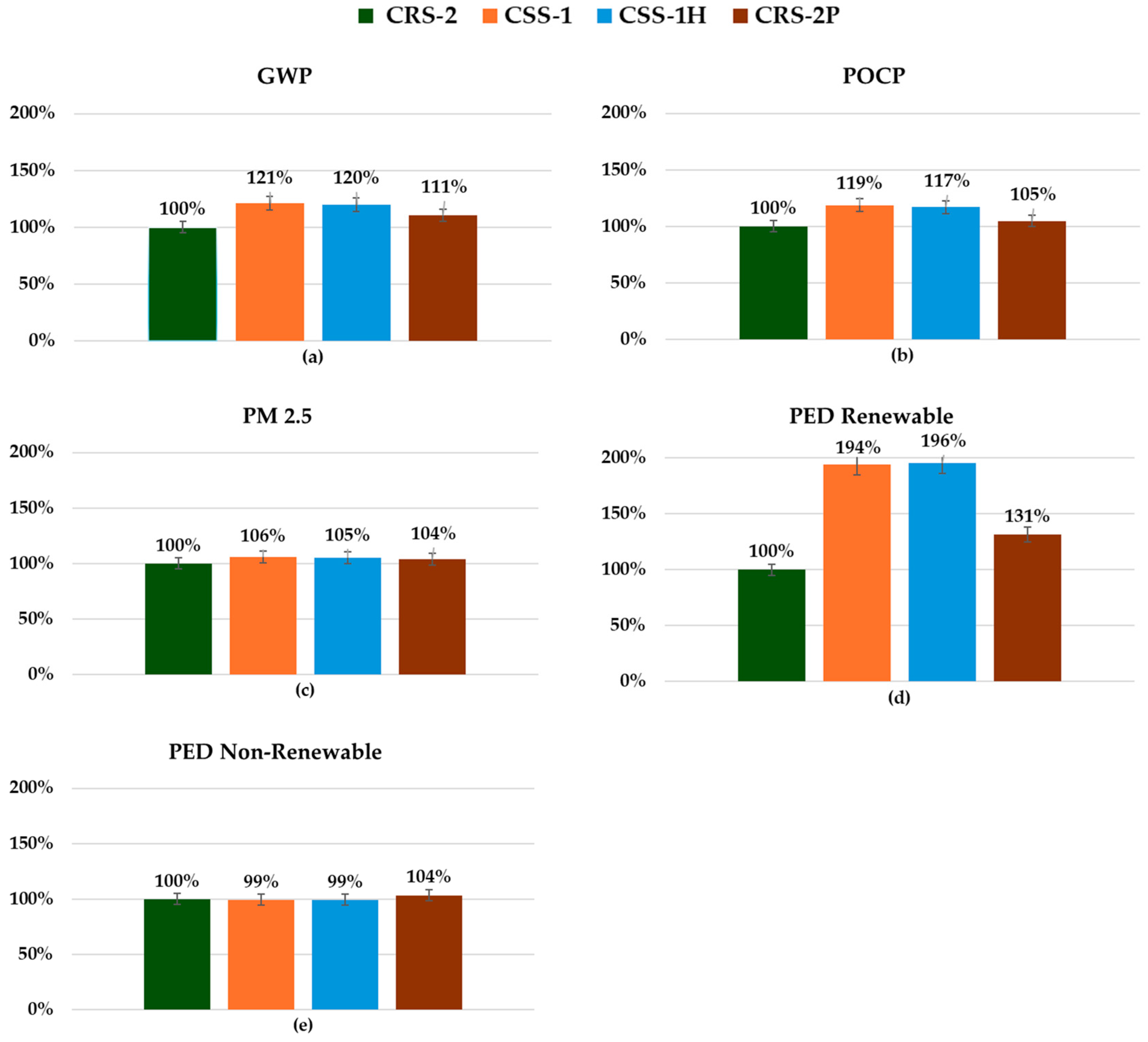
| A | CRS-2 | 99% | 101% | 102% | 106% | 98% |
| B | CSS-1 | 114% | 112% | 104% | 167% | 99% |
| CSS-1H | 114% | 112% | 104% | 167% | 99% | |
| CRS-2 | 100% | 100% | 100% | 100% | 100% | |
| CRS-2P | 113% | 105% | 103% | 142% | 103% | |
| C | CSS-1H | 111% | 109% | 101% | 164% | 96% |
| CRS-2 | 97% | 97% | 98% | 91% | 98% | |
| CRS-2P | 98% | 97% | 98% | 96% | 98% | |
| D | CRS-2 | 99% | 94% | 95% | 119% | 99% |
| CRS-2P | 108% | 97% | 98% | 148% | 102% | |
| E | CRS-2 | 101% | 97% | 98% | 98% | 104% |
| CRS-2P | 112% | 101% | 102% | 130% | 108% | |
| F | CRS-2 | 94% | 92% | 94% | 89% | 97% |
| G | CSS-1H | 133% | 159% | 141% | 183% | 102% |
| H | CRS-2 | 96% | 99% | 99% | 88% | 97% |
| I | CSS-1 | 112% | 109% | 99% | 175% | 94% |
| CRS-2 | 98% | 98% | 100% | 90% | 100% | |
| CRS-2P | 99% | 99% | 101% | 92% | 101% | |
| J | CSS-1H | 116% | 112% | 103% | 193% | 95% |
| K | CSS-1H | 140% | 174% | 156% | 210% | 103% |
| L | CSS-1H | 121% | 112% | 101% | 221% | 101% |
| CRS-2 | 97% | 91% | 94% | 115% | 99% | |
| CRS-2P | 111% | 97% | 98% | 159% | 103% | |
| M | CRS-2P | 109% | 98% | 98% | 147% | 100% |
| N | CSS-1H | 112% | 111% | 103% | 167% | 97% |
| CRS-2 | 98% | 99% | 100% | 94% | 99% | |
| CRS-2P | 113% | 106% | 105% | 135% | 104% | |
| O | CRS-2 | 113% | 145% | 137% | 91% | 98% |
| P | CSS-1 | 138% | 148% | 129% | 230% | 103% |
| CRS-2P | 114% | 124% | 120% | 120% | 103% | |
| Q | CSS-1H | 131% | 131% | 114% | 233% | 100% |
| CRS-2 | 98% | 101% | 101% | 99% | 97% | |
| CRS-2P | 107% | 106% | 105% | 122% | 100% |
Disclaimer/Publisher’s Note: The statements, opinions and data contained in all publications are solely those of the individual author(s) and contributor(s) and not of MDPI and/or the editor(s). MDPI and/or the editor(s) disclaim responsibility for any injury to people or property resulting from any ideas, methods, instructions or products referred to in the content. |
© 2026 by the authors. Licensee MDPI, Basel, Switzerland. This article is an open access article distributed under the terms and conditions of the Creative Commons Attribution (CC BY) license.
Share and Cite
Ostovar, A.; Hajj, E.; Mehdizadeh, G.; Hand, A. Environmental Analysis of Emulsified Asphalt Products in the United States: A Comparative Cradle-to-Gate Life Cycle Assessment. Sustainability 2026, 18, 1821. https://doi.org/10.3390/su18041821
Ostovar A, Hajj E, Mehdizadeh G, Hand A. Environmental Analysis of Emulsified Asphalt Products in the United States: A Comparative Cradle-to-Gate Life Cycle Assessment. Sustainability. 2026; 18(4):1821. https://doi.org/10.3390/su18041821
Chicago/Turabian StyleOstovar, Amirhossein, Elie Hajj, Ghazal Mehdizadeh, and Adam Hand. 2026. "Environmental Analysis of Emulsified Asphalt Products in the United States: A Comparative Cradle-to-Gate Life Cycle Assessment" Sustainability 18, no. 4: 1821. https://doi.org/10.3390/su18041821
APA StyleOstovar, A., Hajj, E., Mehdizadeh, G., & Hand, A. (2026). Environmental Analysis of Emulsified Asphalt Products in the United States: A Comparative Cradle-to-Gate Life Cycle Assessment. Sustainability, 18(4), 1821. https://doi.org/10.3390/su18041821