All articles published by MDPI are made immediately available worldwide under an open access license. No special
permission is required to reuse all or part of the article published by MDPI, including figures and tables. For
articles published under an open access Creative Common CC BY license, any part of the article may be reused without
permission provided that the original article is clearly cited. For more information, please refer to
https://www.mdpi.com/openaccess.
Feature papers represent the most advanced research with significant potential for high impact in the field. A Feature
Paper should be a substantial original Article that involves several techniques or approaches, provides an outlook for
future research directions and describes possible research applications.
Feature papers are submitted upon individual invitation or recommendation by the scientific editors and must receive
positive feedback from the reviewers.
Editor’s Choice articles are based on recommendations by the scientific editors of MDPI journals from around the world.
Editors select a small number of articles recently published in the journal that they believe will be particularly
interesting to readers, or important in the respective research area. The aim is to provide a snapshot of some of the
most exciting work published in the various research areas of the journal.
Estimating the shadow price of undesirable outputs is an important topic in production and environmental economics, as it provides information on the economic cost of environmental regulation. Directional distance function (DDF) approaches have been widely employed for this purpose; however, conventional DDF estimation methods are largely limited to point estimation, which constrains statistical inference. This study proposes a bootstrap procedure integrated into a parametric linear programming-based DDF framework that explicitly incorporates undesirable outputs. The proposed methodology is applied to Korean firm-level data. By allowing interval estimation of DDF values, the approach makes it possible to conduct statistical inference on the estimated parameters. The empirical results indicate that DDF estimates obtained using the bootstrap approach differ from those derived from the non-bootstrap method. The resulting shadow prices of CO2 are economically interpretable and comparable in magnitude to observed emission permit prices, suggesting their relevance for policy analysis. The results indicate that incorporating bootstrapping into a parametric DDF framework enhances statistical inference in the estimation of shadow prices for undesirable outputs.
In the process of economic growth or GDP production, undesirable outputs such as CO2 emissions are generated as by-products [1]. Among market-based schemes designed to reduce undesirable outputs, particularly CO2 emissions, cap-and-trade and carbon taxes have received widespread support. A number of countries, including Sweden, Finland, Canada, Germany, and Singapore, have implemented carbon taxes, often in combination with emissions trading systems and complementary policy instruments [2]. In contrast, Korea has not adopted a carbon tax largely due to path dependence stemming from the early introduction of an economy-wide emissions trading system (ETS), the dominance of energy-intensive export-oriented manufacturing industries, and regulated electricity prices.
After the Korea ETS (K-ETS) was introduced in 2015, energy-intensive firms criticized insufficient allowance allocation, while low trading volumes and price volatility raised concerns about market liquidity and regulatory uncertainty. During the subsequent consolidation phase, discussions increasingly focused on refining the system, including the gradual reduction of free allocation, the expansion of auctioning, and the introduction of market-stabilization measures, with the ETS being positioned as a core instrument within a broader climate policy mix rather than a standalone solution. In recent years, allowance prices in the K-ETS have tended to remain relatively low compared with major international markets, averaging roughly KRW 9000–10,000 per tonne (approximately USD 7–8) in recent trading, prompting calls from some analysts and policymakers to strengthen scarcity and reduce free allocations to elevate the carbon price signal.
This study aims to derive policy implications by estimating the technical efficiency and shadow prices of CO2 for energy-related firms in Korea from 2012 to 2022, a period spanning the introduction of the K-ETS. To this end, we constructed a firm-level panel dataset for empirical investigation. The rationale of our methodology is to address the limitations of conventional linear programming (LP) [3], which does not allow for statistical testing of estimated parameters. Specifically, we propose an improved methodological framework that incorporates the bootstrap idea suggested by Ferrier and Hirschberg [4] into the conventional LP approach. This suggested approach is not only straightforward to implement but also computationally efficient. Furthermore, while traditional LP-based shadow price estimation often suffers from sensitivity issues—where results fluctuate significantly due to minor variations in data—our study effectively controls for such statistical uncertainties by applying the approach of Ferrier and Hirschberg [4].
As of 2020, Korea’s CO2 emissions reached 656.2 million , of which energy-related firms (including energy transition, power generation, and integrated energy sectors) accounted for 237 million . This represents approximately 34% of Korea’s total emissions [5]. If these energy-related firms can successfully mitigate their CO2 emissions, it would significantly contribute to achieving national reduction targets. Moreover, if these firms can eliminate production inefficiencies, they would be able to increase desirable outputs while simultaneously reducing undesirable outputs using the same level of input factors, thereby achieving more effective production from both economic and environmental perspectives.
The main contribution of this study lies in enhancing the parametric LP framework, which is a methodology for mathematically describing the joint production of desirable and undesirable outputs, to enable statistical validation. While previous studies primarily provided point estimates, making it difficult to judge the statistical significance of shadow prices, this study provides confidence intervals through bootstrapping, thereby reducing uncertainty in policy decision-making. A second contribution is the construction of a unique firm-level database by reconciling and merging disparate data sources to estimate the shadow price of CO2.
The remainder of this paper is organized as follows. Section 2 reviews the existing literature from both methodological and empirical perspectives. Section 3 describes the methodology proposed in this study. Section 4 examines the data used for quantitative analysis, and Section 5 provides the empirical results. Section 6 discusses our results. Finally, Section 7 provides concluding remarks.
2. Literature Review
2.1. Methodological Development
Previous studies employing parametric LP (Aigner and Chu [6]) to measure the efficiency and shadow prices of environmental pollutants have demonstrated significant methodological advances. Färe et al. [7] first established the formal framework for deriving the shadow prices of undesirable outputs by exploiting the duality between the output distance function and the revenue function. Their work provided a crucial theoretical foundation, enabling the estimation of shadow prices using only observed input-output quantity data without requiring explicit marginal abatement cost data. Extending this to an input-oriented perspective, Hailu and Veeman [8] investigated the Canadian pulp and paper industry using an input distance function approach. They argued that an input distance function associated with cost minimization might be more appropriate than an output-oriented one, given that environmental regulations typically increase costs by constraining input use. This perspective allows for the interpretation of pollution abatement as an input-saving activity, offering a distinct alternative to the conventional output-expansion view.
Further methodological refinements have focused on substitution possibilities and functional forms. Lee [9] estimated not only shadow prices but also incorporated the concept of indirect Morishima elasticity of substitution to analyze the substitutability between capital and pollutants. Vardanyan and Noh [10] conducted an in-depth analysis of how the choice of functional forms and mapping rules affects the estimation of abatement costs. By comparing the translog function with the quadratic directional distance function (DDF), they experimented with various direction vectors for projecting inefficient observations onto the efficient frontier. To address the limitations of deterministic LP—which ignores stochastic errors—and stochastic frontier analysis (SFA)—which struggles to incorporate inequality constraints—Rezek and Campbell [11] proposed an inequality-restricted generalized maximum entropy (GME) technique.
While parametric LP is widely used for estimating the shadow prices of undesirable outputs, it inherently lacks the capacity for statistical inference. In contrast, non-parametric methods such as data envelopment analysis (DEA) have frequently incorporated bootstrapping to enable statistical testing. Following the pioneering work of Ferrier and Hirschberg [4], subsequent research by Simar and Wilson [12] and Simar et al. [13] has further developed this area. Simar and Wilson [12] introduced a bootstrap procedure for non-parametric frontier models to analyze the sampling sensitivity of efficiency scores, allowing for bias correction and the construction of confidence intervals. Simar et al. [13] extended this framework to the non-parametric DDF, establishing the statistical properties of DEA estimators and developing a consistent bootstrap procedure for hypothesis testing. However, it should be emphasized that the DDF-bootstrap framework utilized by Simar et al. [13] remains strictly within a non-parametric context.
2.2. Measurement of CO2 Shadow Price
Numerous empirical investigations have been conducted at the national, industrial, and firm levels to estimate the shadow prices of undesirable outputs. Maradan et al. [14] estimated CO2 shadow prices for 76 developing and developed countries in 1985, finding a wide range from USD 0.60 to 5.22 per tonne, which highlights significant cross-country disparities in marginal abatement costs. In contrast, Marklund and Samakovlis [15] reported much higher average shadow prices ranging from EUR 570 to 670 per tonne for 15 EU member states between 1990 and 2000. Early cross-country studies documented substantial heterogeneity in CO2 shadow prices across economies.
Subsequent cross-country studies have evolved along two complementary strands. One strand relies on large global panels to identify macro-level drivers of productivity, environmental performance, and clean energy transition, with shadow prices reflected implicitly through efficiency measures or policy price signals. Using a directional distance function (DDF), Napolitano et al. [16] showed that improvements in energy and CO2 efficiency contribute positively to national productivity across 127 countries, while documenting substantial technological heterogeneity across development stages. Similarly, Zhang et al. [17] analyzed 171 economies and found that green total factor productivity (GTFP), which internalizes carbon emissions as an undesirable output, promotes clean energy transition more strongly than conventional TFP.
A second strand focuses on OECD economies and applies frontier-based methods to provide more granular assessments of technological trade-offs between economic output and pollution abatement. Boussemart et al. [18] developed DEA models for 20 OECD countries and identified a negative correlation between environmental performance improvement and GDP growth (r = −0.53), capturing the trade-off between abatement and output through shadow prices. Using a stochastic frontier analysis combined with a multiple-output directional distance function, D’Errico [19] showed for 22 OECD countries that energy self-sufficiency improves environmental-economic efficiency, whereas excessive environmental taxation increases the effective shadow price of emission reduction. Chen et al. [20] applied a metafrontier Malmquist-Luenberger index to cities in China’s Yangtze River Economic Belt and showed that accounting for regional technology gaps yields heterogeneous environmental efficiency and implied shadow prices of undesirable outputs, revealing differentiated abatement potentials and improvement paths across cities. Choi et al. [21] used an SBM-DEA model for the Korean steel industry to reveal firm-level efficiency gaps and implied pollution shadow prices, thereby identifying heterogeneous abatement potentials across firms.
Comparable regional patterns have also been documented in the United States. Using U.S. state-level data, Aparicio et al. [22] demonstrated that properly derived pollution shadow prices resolve sign inconsistencies in conventional models and allow consistent comparison between observed market prices and technologically implied shadow prices. Likewise, Halkos and Polemis [23] found that the implied shadow prices of environmental performance in the U.S. electricity sector follow a stable N-shaped relationship with regional income, suggesting that environmental gains from economic development may reverse beyond certain income thresholds. For China, Lee and Zhang [24] analyzed 30 manufacturing industries in 2009 and reported a relatively low average price of USD 3.13, despite industrial variations from USD 0 to 18.82. More recently, Deng and Du [25] utilized endogenous direction vectors for 52 Belt and Road Initiative countries from 2005 to 2016, finding that the average relative shadow price of CO2 (in GDP units) steadily rose from 1544 in 2005 to 3264 in 2016. In the agricultural sector, Färe et al. [26] used state-level data for the US from 1960 to 1996 to estimate the environmental costs of pesticide leaching and runoff, which accounted for approximately 6% of annual agricultural sales.
Regarding firm-level analyses, previous studies have focused on specific industrial sectors to derive empirical evidence on shadow pricing, particularly in the power industry. Coggins and Swinton [27] estimated the average shadow price of SO2 at USD 292.70 per tonne (in 1992 constant prices) for 14 coal-fired power plants in Wisconsin. Färe et al. [7] found an average BOD shadow price of USD 1043 per tonne for 30 pulp and paper mills in Michigan and Wisconsin in 1976. In the Korean context, Kwon and Yun [28] analyzed bunker-C and coal-fired power plants from 1990 to 1995, reporting average shadow prices of KRW 310,600 for SOx, KRW 146,700 for NOx, KRW 15,482,300 for TSP, and KRW 3800 for CO2. Furthermore, Rezek and Campbell [11] applied an inequality-restricted GME model to 260 US coal-fired plants in 1998, deriving shadow prices of USD 289 for SO2, USD 920 for NOx, USD 18 for CO2, and USD 470 per ounce for mercury. Wei et al. [29] investigated 124 thermal power enterprises in Zhejiang, China, and found that CO2 shadow prices were highly sensitive to the methodology, with USD 249 under deterministic LP versus USD 74 under a stochastic model. Finally, Oh et al. [30] compared deterministic (LP) and stochastic (COLS) DDF approaches for five Korean fossil-fuel generation companies (GENCOs) from 2001 to 2016. The shadow prices from the deterministic method (average 82,758 KRW/tCO2) were higher and exhibited greater volatility than those from the stochastic method (average 49,830 KRW/tCO2).
Using product-level data for Indian manufacturing firms, Barrows and Ollivier [31] showed that more efficient producers exhibit lower implicit shadow prices of emissions and identified a product-mix effect whereby core products are systematically cleaner than peripheral products. Wang et al. [32] found that U.S. firms adopting sustainable development modes face higher marginal abatement costs but are better positioned to achieve joint economic and environmental gains. Under emissions trading regimes, Rekker et al. [33] reported that estimated CO2 shadow prices for European chemical companies substantially exceed observed carbon market prices, suggesting a divergence between marginal abatement costs and market incentives. Complementing these findings, Nikos et al. [34] derived regulation impact indicators as proxies for pollution shadow prices and showed that higher regulatory shadow prices are associated with productivity gains, lending support to a weak version of the Porter hypothesis.
The applicability of shadow price estimation has also been extended beyond manufacturing and energy industries. Molinos-Senante et al. [35] provided empirical estimates of CO2 shadow prices for wastewater treatment plants in Spain and showed that facilities adopting anaerobic digestion exhibit lower abatement costs. In the aviation sector, See et al. [36] applied virtual profit efficiency—the dual concept of shadow pricing—to quantify costs associated with technical and capacity inefficiencies and derived managerial indicators for optimizing resource allocation. In the financial sector, Philippas et al. [37] showed that ESG engagement by European banks is associated with short-run deterioration in cost management efficiency, reflecting implicit shadow costs during early stages of ESG adoption.
3. Methodology
As noted in the Introduction, this study modifies the conventional LP approach to measure technical inefficiency and the shadow prices of undesirable outputs by incorporating a bootstrap technique. The conventional LP framework for estimating shadow prices was primarily developed by Färe et al. [3], building upon the pioneering work of Aigner and Chu [6]. Since the contribution of Färe et al. [3], similar techniques have been extensively employed to measure CO2 shadow prices and production inefficiency (e.g., [30,35,38]).
This section discusses the methodological framework for measuring shadow prices and inefficiency by investigating the properties of the joint production of desirable and undesirable outputs. We then present the DDF approach. The rationale of our methodology is to integrate a bootstrap framework into the conventional parametric DDF to address a critical limitation of the traditional LP approach: its inability to provide statistical inference, such as confidence intervals for the estimates. By doing so, the suggested method overcomes the inherent weakness of deterministic estimation and enhances the statistical reliability of the empirical results.
3.1. Underlying Assumptions
Suppose that there exist J producers (or decision making units, DMUs or firms in this study), indexed as . Each producer produces K kinds of desirable outputs, , and M kinds of undesirable outputs, , using N kinds of input factors, . With given input factors, producers are assumed to produce desirable and undesirable outputs simultaneously. The common objective of the DMUs is to minimize the production of undesirable outputs while maximizing the production of desirable outputs. An output set, , is constructed with the combinations of possible outputs, as follows:
The following assumptions on an output set are held.
(i)
if , then .
(ii)
if and , then .
(iii)
if and , then .
The first assumption states that the output set will not shrink with an increase in the input vector. This implies that input factors do not congest outputs.
The second assumption is on the null-jointness of desirable and undesirable outputs. This implies that if no undesirable outputs are produced, then it is not possible to produce desirable outputs. Or, conversely, undesirable outputs should be produced in order to produce desirable outputs.
The third assumption is on the weak disposability of desirable and undesirable outputs. This implies that if a combination of desirable and undesirable outputs is produced, then any proportionally shrunk quantity of the combination is always possible to be produced. Weak disposability is quite different from strong disposability, which is defined as follows:
Strong disposability implies the following: if a combination of desirable and undesirable outputs is possible to be produced, then the combination of a lower level of desirable outputs and the original level of undesirable outputs is always possible to be produced. The strong disposability of outputs can be interpreted as the ‘free disposability of desirable outputs’.
3.2. Directional Distance Function
Although the set representation of desirable and undesirable outputs is easy to understand and conceptually useful, the measurement of specific metrics is difficult to apply in practice. Because of this difficulty, the DDF has been developed and is considered an effective tool for this purpose. The DDF is defined as follows:
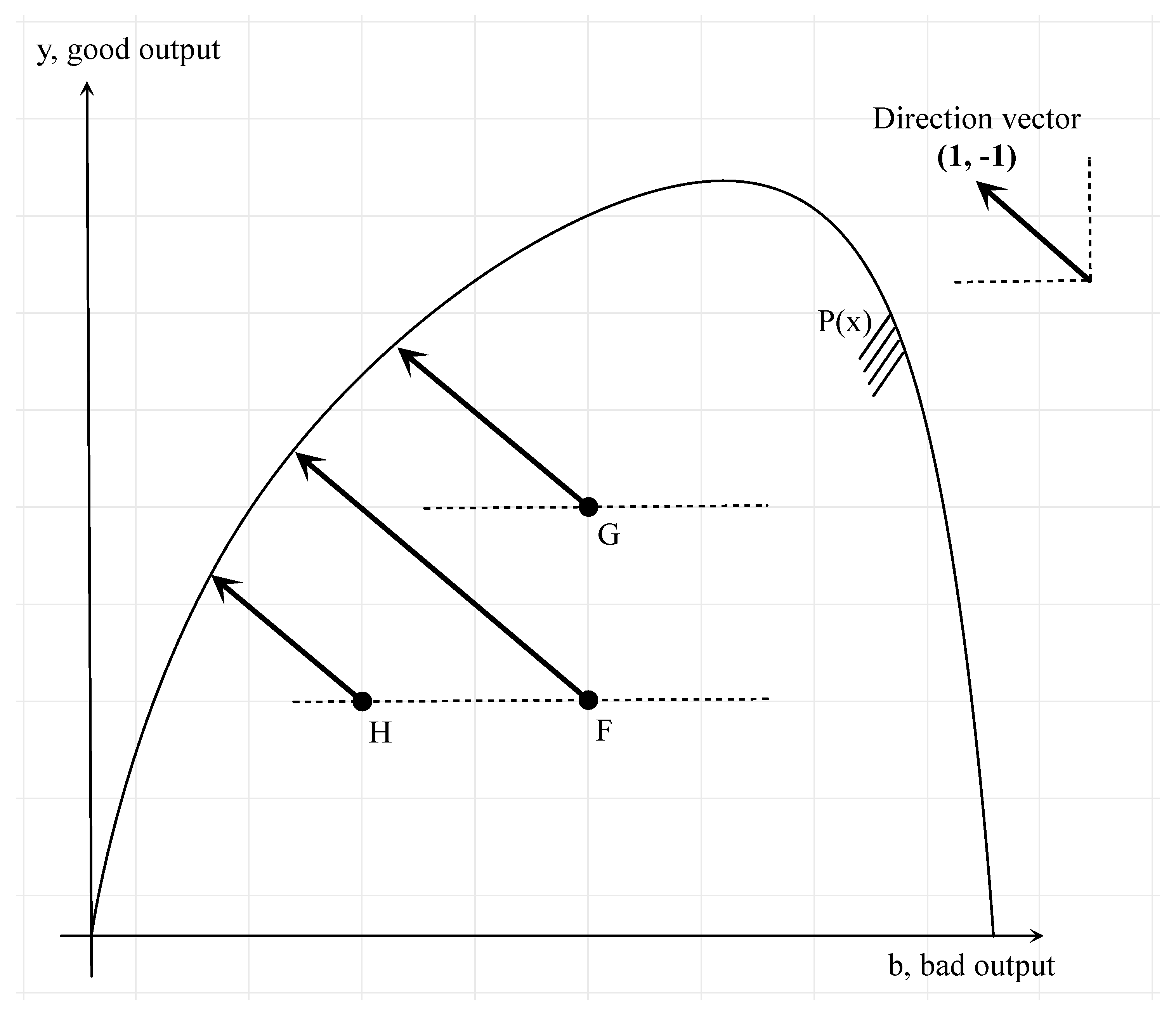
The DDF in Equation (2) measures the maximal increase in desirable outputs and decrease in undesirable outputs simultaneously. The resulting metric of the DDF tells us how much desirable outputs can be increased and undesirable outputs can be decreased by the factor of , by following the direction of in an output set. This metric corresponds to the conventional inefficiency measure, except for the fact that undesirable outputs are considered to be decreased. The output set and DDF are represented in Figure 1. In this figure, is chosen for the direction vector and the DDFs of the three DMUs (F, G, and H) are conceptually measured. For simplicity, we assume that these DMUs produce one kind of desirable output and one kind of undesirable output by using the same quantities of input factors. The level of undesirable output of F and G is the same, while their desirable output levels are different. Also, the level of desirable output of F and H is the same, whilst their undesirable output levels are different. The length of the solid black arrow corresponds to the DDF for each DMU. Hence, the DDF of F is larger than those of G and H.
The DDF inherits the properties of the output set discussed in Section 3.1, as follows:
(i)
if and only if is an element of .
(ii)
for .
(iii)
for .
(iv)
for and .
(v)
is concave in .
The first property of the DDF coincides with the existence of an output set. The second property of the DDF tells us that an increase in desirable outputs decreases the DDF. The third property is that the DDF is an increasing function with respect to undesirable outputs. The second and third properties are called the monotonicity property. The fourth property corresponds to the weak disposability of an output set. The fifth property ensures that any expansion speed of the output combination is faster than an increase in the DDF.
The ongoing debate on the DDF involves the selection of a direction vector, . The direction vector is typically set by researchers a priori. The common choices for the direction vector are or . With the selection of the former, we can measure the quantity of increase in desirable outputs and decrease in undesirable outputs. The employment of the latter direction vector yields a percentage change in desirable and undesirable outputs with reference to the current production level. Lee et al. [39] discusses the selection of direction vectors when measuring shadow prices, and Vardanyan and Noh [10] compares the strengths and weaknesses of each selection of direction vectors. A hybrid approach that integrates ideas from environmental economics and engineering studies was introduced by Lee et al. [40]. In this study, we use following the suggestion of Färe et al. [3]. The selection of this direction vector is a necessary condition for satisfying the translation property. Furthermore, it aligns with the efforts of the energy-related firms in our quantitative analysis to maximize desirable outputs while simultaneously minimizing undesirable outputs.
The DDF measures how far a DMU is located from the boundary of an output set, i.e., the frontier. If a DMU is located on the frontier of an output set, the DDF equals zero. If a DMU is located within the output set, the DDF is larger than zero. Hence, a DMU with a positive DDF has an opportunity to increase the production of desirable outputs while reducing the production of undesirable outputs. For this, a DMU with a positive DDF is seen as being inefficient. By contrast, a DMU with a zero DDF is seen as being efficient. For example, with the direction vector of , if a DMU has a DDF of 0.5, then 0.5 more units of desirable outputs can be produced and 0.5 fewer units of undesirable outputs can be produced.
3.3. Conventional Measurement of DDF
To measure the shadow price and inefficiency of each DMU, the translation property needs to be employed with the selection of the direction vector, , as follows:
Since we have three inputs, one desirable output, and one undesirable output, the parametric modeling of our DDF is set as follows:
In order for the DDF to satisfy the properties discussed in Section 3.2 along with the translation property, we impose the following restrictions:
The symmetry assumption is also applied, as follows:
The monotonicity property discussed in Section 3.2 also needs to be integrated into measuring the DDF. The monotonicity property shown in (ii) and (iii) can be interpreted as and , respectively.
Using the above assumptions, parameters of the DDF can be estimated using the following LP problem.
The parameter estimates from Equation (7) are used for finding the DDF and shadow price of CO2 for each DMU in our sample.
3.4. Measurement of DDF Using Bootstrap Framework
Since the conventional LP shown in Equation (7) is incapable of obtaining any confidence intervals for the parameter estimates, we integrated the idea of Ferrier and Hirschberg [4] into it. As far as the authors know, their work is the first attempt to integrate bootstrapping into efficiency measurement under the framework of data envelopment analysis. The estimation steps suggested by Ferrier and Hirschberg [4] are described in Appendix A.
Our suggested framework is analogous to that of Ferrier and Hirschberg [4]. Our suggested steps are as follows:
(a)
The conventional LP in Equation (7) is solved using all DMUs, the parameters of which are used in estimating the DDF for each DMU. Let us denote the DDFs found in this step as .
(b)
Desirable outputs and undesirable outputs are adjusted by the amount of the DDF found in the previous step. Let us denote the adjustment matrix as , where is a diagonal matrix where the diagonal elements are and the off-diagonal elements are 0. The identity matrix is denoted by . Also, let us denote the desirable output matrix as and the undesirable output matrix as . (In this study, K and M are unity for the empirical investigation.) Then the adjustment is made as follows:
(c)
Set the number of replicates, I. (The convention of the number of replicates is B in most bootstrap studies. Since this study uses b, and as undesirable outputs, we use I for the number of replicates to exclude any confusions. Hence, each bootstrap sampling has index i in subscript of any mathematical notations.) Then, for each replicate i, where , the following sub-processes are made.
(c-1)
Randomly sample J elements with replacement from . Let the sampled DDF be denoted as .
(c-2)
The adjusted output matrices in Equation (8) are readjusted using , as follows:
(c-3)
The following LP is solved.
where and are the jth row of and , respectively.
(d)
For each parameter, a confidence interval is estimated using the average and standard deviation of the I parameter estimates found in step (c). This confidence interval is used for testing the null hypothesis that the parameter is zero.
The bootstrap methodology proposed in this study differs from existing approaches in several important respects. While conventional DDF estimation methods are limited to point estimation, our approach allows for interval estimation. This feature enables us to statistically test whether the DDF values for individual observations are significant. In addition, compared with nonparametric DDF estimation methods, such as DEA-based approaches, the shape of the output set can be more easily characterized in our framework, as the proposed methodology is based on a parametric approach. Moreover, our approach allows us to assess the statistical significance of the estimated parameters themselves, which constitutes an additional advantage of the proposed methodology.
To facilitate readers’ understanding, we briefly summarize the differences between Ferrier and Hirschberg [4] and the approach proposed in this study. Ferrier and Hirschberg [4] propose a bootstrapping procedure that does not account for undesirable outputs, whereas the present study incorporates bootstrapping in a framework where undesirable outputs are explicitly considered. Accordingly, Ferrier and Hirschberg [4] apply bootstrapping only in directions that radially expand outputs, while our approach allows for bootstrapping in directions that simultaneously increase certain outputs and decrease others. In addition, because Ferrier and Hirschberg [4] are based on the conventional DEA framework, the most efficient DMUs are interpreted as having an efficiency score of one. In contrast, in our framework, such DMUs are interpreted as having zero inefficiency.
To illustrate how the DDF is calculated with and without bootstrapping, we consider a simple example. Suppose there are five combinations of desirable and undesirable outputs: A (1, 1), B (2, 4), C (3, 3), D (4, 4), and E (3, 1). We now measure the DDF for observation E. Under the traditional non-bootstrap approach, the frontier consists of A, B, and D, and when the direction vector is set to (1, −1), the DDF value for E is approximately 2.12. Now consider a highly simplified bootstrap case with a single replicate. If, during resampling, observation A is drawn twice and observation C is drawn three times, the resulting DDF value for E is approximately 1.41. When the number of replicates increases and the average of the resulting DDFs is taken, this average value is expected to lie between 1.41 and 2.12. As this example illustrates, differences in the shape of the frontier induced by bootstrapping lead to differences in the resulting DDF values compared to the non-bootstrap case.
3.5. Elasticity of Transformation and Shadow Price
The shadow price of CO2 emissions for each DMU is estimated on the boundary of the output set. For this purpose, with the selection of the direction vector , the inefficiency of each DMU is assumed to have been removed, yielding the shadow price of CO2 emissions. The fact that all DMUs produce outputs means that they are located within the output set or on the boundary of the output set. Hence, the revenue of each DMU can be formulated as follows:
where is the price vector of desirable outputs and is the price vector of undesirable outputs.
As Chambers et al. [41] show, the Lagrangian multiplier for the problem in Equation (11) is as follows:
Hence, the revenue function can be rewritten as follows:
To maximize revenue under an unconstrained condition, the partial derivative of Equation (13) should be zero. This gives the following:
Under the condition that , the ratio between Equations (14a) and (14b) gives the following:
If the price of the kth desirable output is known, the shadow price of the mth undesirable output is estimated using Equation (15). The shadow price of the mth undesirable output can be computed using the following equation:
Since the DDF is specified as Equation (5), the shadow price in Equation (16) can be reformulated as follows:
In deriving Equation (17), we use the fact that we have only one desirable output and one undesirable output.
The Morishima elasticity is defined as follows:
The Morishima elasticity measures the curvature of the frontier. It is a measure of the change in the desirable-undesirable shadow price ratio as the relative pollution intensity changes. The basic concept of the Morishima elasticity is well described in Blackorby and Russell [42].
As Färe et al. [3] suggest, the Morishima elasticity in terms of the DDF can be defined as follows:
where . Using the quadratic DDF shown in Equation (7), the Morishima elasticity can be formulated as follows:
As explained in Färe et al. [3], the sign of the Morishima elasticity is negative for a positive . If the values of are more negative, a given change in the ratio will yield greater changes in the shadow price ratio . This indicates that it becomes more costly for DMUs to reduce CO2 as becomes more negative.
4. Data
As suggested by Färe et al. [3], production processes that simultaneously generate desirable and undesirable outputs utilize multiple inputs. The energy-related firms analyzed in this study are producers of electricity, hot water, and heat, and it is physically infeasible to aggregate such heterogeneous desirable outputs. Accordingly, following standard production economics textbooks, we use value added as the measure of desirable output. While production units may generate various types of undesirable outputs, we focus on CO2 as the undesirable output, as estimating the shadow price of CO2 is one of the main objectives of this empirical analysis. As microeconomics textbook suggests, the inputs used to produce these desirable and undesirable outputs are labor, capital, and energy. Although it is true that these three inputs are often highly correlated in previous empirical studies, from an economic perspective, neither desirable nor undesirable outputs can be produced without any one of these inputs. Therefore, we include all three inputs in the analysis.
The data used in this study is firm-level unbalanced panel data, which is used to measure the shadow price and inefficiency of each firm for each year. (Whether a balanced panel should be used is an important issue in econometric perspectives. Firm-level datasets that are typically compiled are often unbalanced panels, or they must undergo a procedure in which observations are discarded in order to reconstruct a balanced panel. While this process yields the advantage of more stable estimation due to a simpler variance-covariance structure, it also entails the drawback of failing to adequately reflect real-world dynamics such as firm entry and exit. In this study, we therefore choose to use an unbalanced panel in order to estimate shadow prices from a more realistic perspective.) The unbalanced panel data was constructed by merging two data sources: Korea Data (koData) and the Greenhouse Gas Inventory and Research Center of Korea (GGIRC). The koData provides a firm-level database containing financial and corporate information for both audited and non-audited firms in Korea. The GGIRC’s main database of greenhouse gas statements provides annual information on greenhouse gas emissions and energy consumption for each firm. (Firms or workplaces that emit greenhouse gases above a certain average annual threshold are designated as entities subject to the Emissions Trading Scheme or the Target Management System. These entities are required to submit greenhouse gas emission statements to the GGIRC.) Since the koData database includes corporate registration numbers while the GGIRC database does not, the two databases were merged, using the firm name as the key. Observations with missing values for value-added, energy usage, or CO2 emissions were deleted. Subsequently, only firms engaged in energy-related industries were identified, including district energy, power generation, and energy conversion. To minimize the impact of outliers during the model estimation process, firms with excessively large desirable outputs but very small undesirable outputs were identified and removed.
The number of observations used in the analysis is 416, representing 60 unique firms. The number of observations varies by year, generally showing an increasing pattern over time. The year with the fewest observations is 2012, with 23 observations, while the years with the most observations are 2019 and 2021, with 48 observations each. The reason for the variation in the number of observations by year is mainly due to the large number of firms with missing value-added data. Value-added is an item that must be calculated from various detailed financial information; if any of this information is missing, value-added cannot be calculated. (Since value-added is not directly recorded in financial data, it was calculated by summing operating profit, bad debt expenses, labor costs, taxes and dues, and depreciation, following the recommendations of the Bank of Korea.)
The desirable output used in the empirical study is value-added (Y) and the undesirable output (B) is CO2 emissions. Three inputs are used to produce these outputs: capital stock (K), labor (L), and energy usage (F). For capital stock, net fixed asset value was used as a proxy following the approach suggested by Fu et al. [43], measured in billions of KRW (Tril. KRW). Labor was measured in full-time equivalents (FTE), in thousands of employees. Energy usage data was converted into petajoules (PJ) for all types of energy consumed by the firms. All data measured in monetary units were deflated using the GDP deflator to remove price effects and reflect real values.
The descriptive statistics for these five variables are presented in Table 1. For all variables, the mean is greater than the median, indicating that the distributions are skewed to the right. This suggests that a small number of firms produce a large volume of outputs using a large number of inputs, while most firms produce small amounts of output with fewer inputs. (The skewness of the input and output variables used in the empirical study is positive, confirming that the distributions of these variables are right-skewed.)
The correlations between variables are presented in Table 2. The first finding from this table is that the correlations between all variables are positive, which confirms that they are consistent with economic textbooks or our prior expectations. The second finding is that while some combinations of variables show relatively small correlation values, certain variables exhibit particularly high correlations. Specifically, capital stock has a very high correlation with labor, and labor has a high correlation with value added. Furthermore, energy usage shows a high correlation with CO2 emissions.
5. Empirical Results
In order to estimate the parameters of the LP models in Equations (7) and (10), we normalized all variables by their respective means. This normalization offers two distinct merits. First, it ensures numerical stability for parameter estimation. Previous studies, such as Färe et al. [3] and Saal et al. [44], have reported that non-normalized variables are unlikely to yield proper parameter estimates. Second, this normalization facilitates the interpretation of the estimation results. Since parameters are estimated around the mean of each variable, an estimate directly represents the marginal change in the DDF. For the bootstrap LP model in Equation (10), we set the number of replicates to 10,000, following the suggestion of Efron and Tibshirani [45]. The quantitative analysis was conducted using R-4.5.2, utilizing the lpSolve package alongside functions authored by the researchers. The computation for 10,000 replicates was highly efficient, taking less than one minute.
The parameter estimates for the DDF described in Equation (4), obtained both with and without bootstrapping, are summarized in Table 3. When bootstrapping is employed, a total of 10,000 estimates are obtained for each parameter; the mean of these values is taken as the parameter estimate and reported in the table. The standard deviation of these 10,000 estimates is considered the standard error of the parameter estimate, which is provided in parentheses.
The first column of the table lists the parameter estimates obtained without bootstrapping. In the case of a simple LP application without bootstrapping, standard errors or confidence intervals cannot be determined because there is no underlying distributional assumption for the parameters. Consequently, this approach has the limitation of being unable to conduct statistical tests on the parameter estimates. The second column presents the parameter estimates and standard errors obtained through bootstrapping. Most parameter estimates are found to be statistically significant, with only a few exceptions.
Comparing the estimates in the first and second columns reveals that 9 out of the 16 parameters have different signs. Such discrepancies in parameter signs between the two methodologies are commonly observed. For instance, Färe et al. [3] reported similar phenomena, yet they did not conclude that the statistical method is superior to the non-statistical one from a methodological or empirical perspective. Similarly, this study does not conclude that one methodology is superior to the other simply because the estimated signs differ. However, we wish to emphasize that the bootstrapping approach offers the distinct advantage of providing standard errors, which, in turn, allows for the estimation of confidence intervals.
The DDF values calculated for each methodology using the parameter estimates from Table 3 are presented in Table 4. The mean of the DDF is 0.1576 when bootstrapping is not used and 1.2737 when bootstrapping is employed. For both methodologies, the mean values are greater than the medians, indicating that the distribution of the DDF is right-skewed regardless of the method used.
As discussed in Section 3.2, a DMU with a DDF of zero is considered to be producing on the frontier. Without bootstrapping, a total of 12 such DMUs were identified. In the case of bootstrapping, the DDF is estimated using the average of 10,000 sets of parameter estimates, which may result in negative DDF values. A DMU with a negative DDF can be interpreted as producing outside the sample frontier. (As discussed in Section 3.2, a DMU producing within the PPS is equivalent to having a positive DDF. This implies that when the DDF is negative, the DMU is producing outside the PPS.) Producing outside the frontier does not mean that production occurs in an impossible region; rather, it indicates that the DMU’s production efficiency is highly superior. This is analogous to measuring efficiency by incorporating the concept of super-efficiency into traditional data envelopment analysis (DEA) models, where efficiency values greater than 1 can be observed. When bootstrapping was used, 14 such highly efficient DMUs were identified. Regardless of whether bootstrapping was applied, four DMUs were consistently found to be efficient, producing either on or outside the frontier.
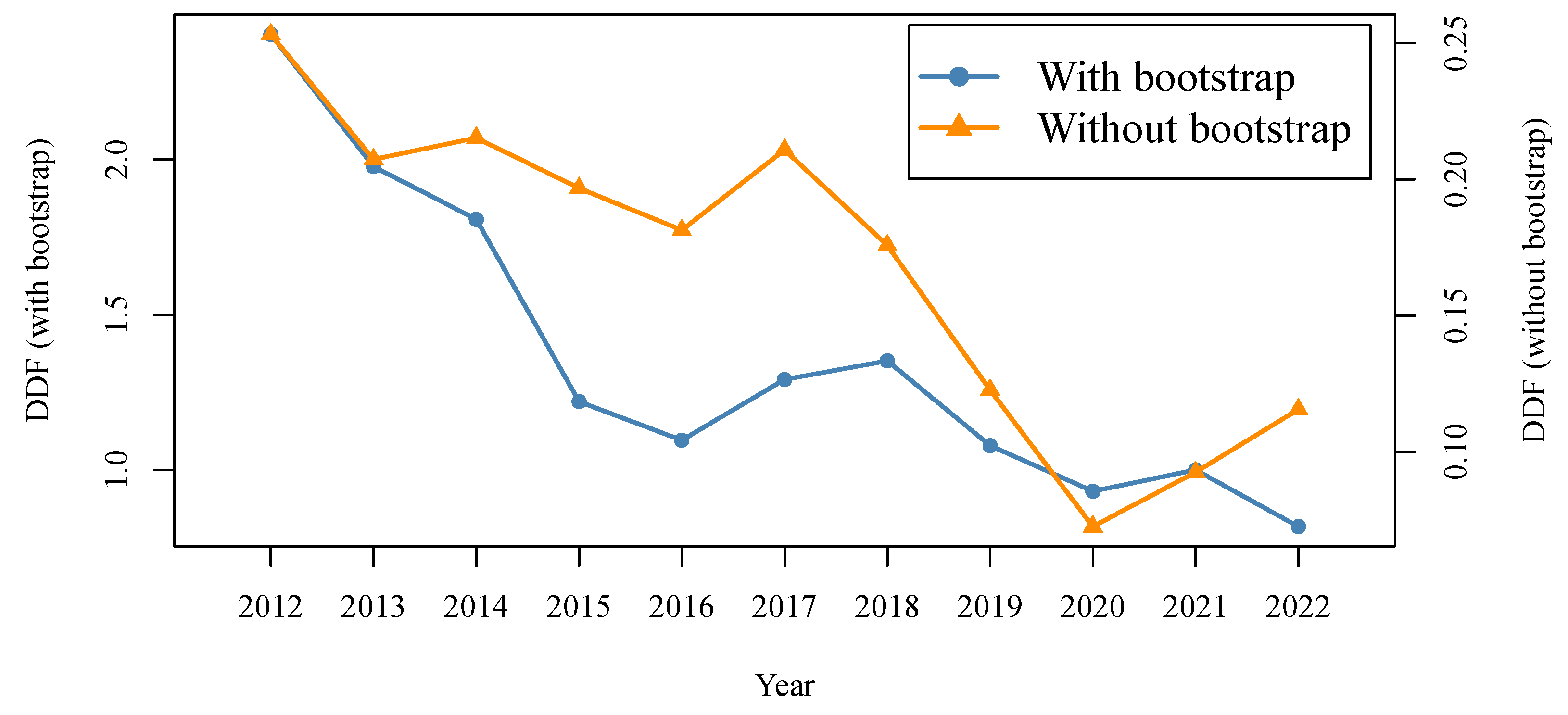
The annual average DDF values, both with and without bootstrapping, are plotted in Figure 2. The left vertical axis of this figure corresponds to the DDF values estimated using bootstrapping, while the right vertical axis corresponds to the DDF values estimated without bootstrapping. Although the absolute magnitudes differ depending on the methodology, both approaches yield similar results in that they show an overall downward trend. Since the DDF can be interpreted as production inefficiency, this declining trend suggests that the production inefficiency of Korean energy-related firms has been gradually decreasing over time. While it is difficult to provide a definitive answer as to whether this downward trend is due to the implementation of the K-ETS, it is clear that the hypothetical average firm has progressively moved toward the frontier over time. Considering the direction vector, it can be inferred that this hypothetical average firm approached the frontier by increasing desirable output and decreasing undesirable output.
As discussed in Section 3.2, when is set to , this implies that desirable output can be increased by the DDF unit while undesirable output can be decreased by the same DDF unit. Applying the DDF results measured via bootstrapping to the average firm, we find that the average firm produces KRW 84.71 billion in desirable output and 6.163 million tCO2 in undesirable output. If this firm were to eliminate its inefficiencies and produce efficiently, its desirable output would increase to KRW 85.98 billion and its undesirable output would decrease to 4.89 million tCO2. This indicates that desirable output could be increased by approximately 1.5%, while undesirable output could be reduced by 20.6%. (Applying the same logic to the DDF measured without bootstrapping, desirable output could be increased by 0.2% and undesirable output could be decreased by 2.6%.)
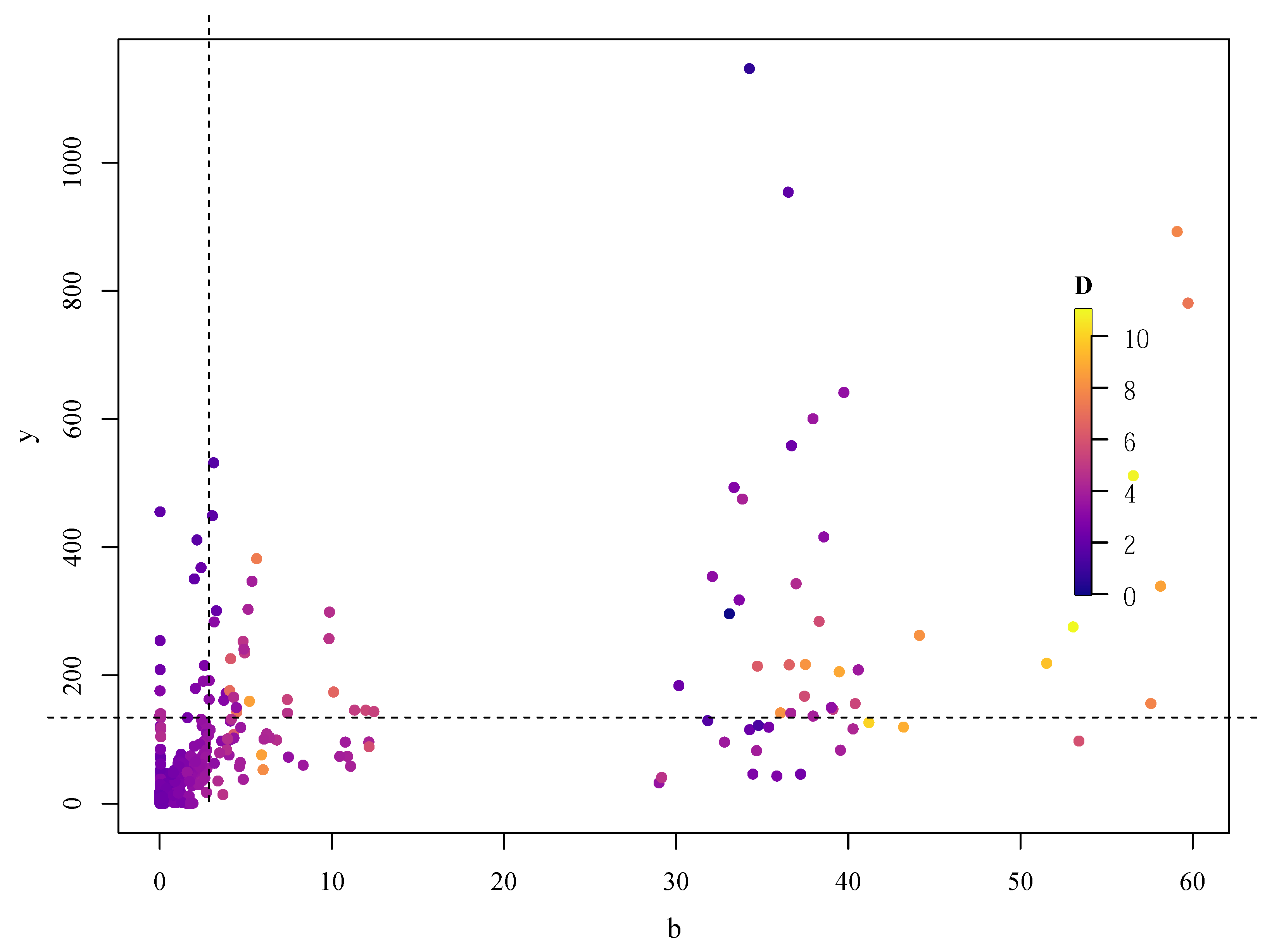
Regardless of the methodology used, DDF values can exceed 1. This occurs because the direction vector is set to . As can be inferred from the second and third constraints in Equation (7), a DMU with a small desirable output and large undesirable output is more likely to have a larger DDF compared to others. To indirectly confirm this, the DDF values measured through bootstrapping were plotted in the b-y space, as shown in Figure 3. In this figure, the color of each point represents the magnitude of the DDF, where colors closer to yellow signify DMUs with larger DDF values. Additionally, green points represent DMUs producing on the frontier, and dashed lines represent the mean values of each output. The figure demonstrates that DMUs further from the frontier—those with larger undesirable output and smaller desirable output—generally exhibit larger DDF values, which is consistent with our expectations. (To save space, the b-y space plot of the DDF measured without bootstrapping is not included in this paper. The results showed a very similar pattern to those obtained with bootstrapping. Readers interested in these results may obtain them from the authors upon request.)
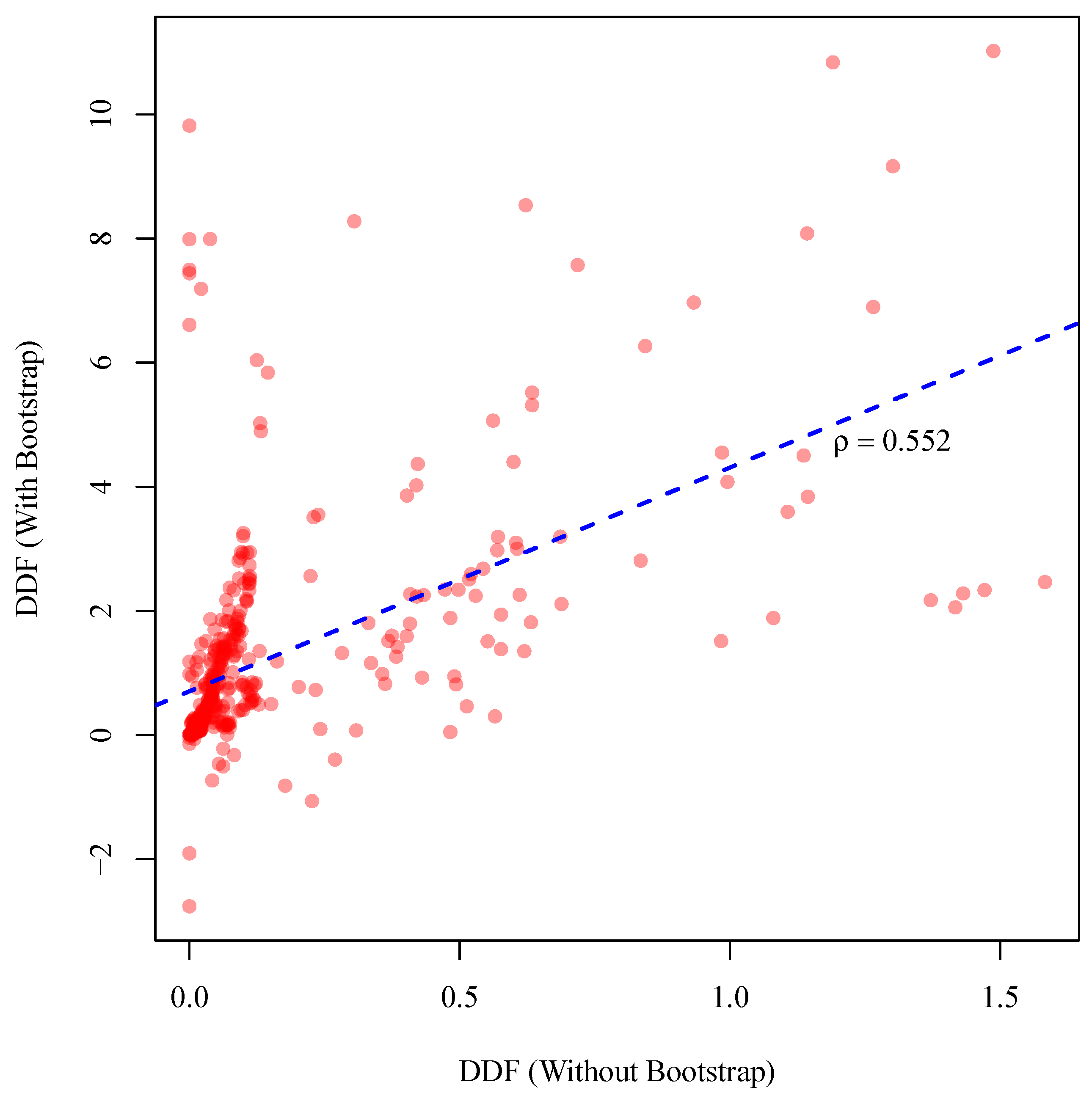
The scatterplot of the DDF values measured using the two methodologies is presented in Figure 4. As shown in the figure, the correlation between the DDFs estimated by the two methods is 0.552, indicating a high degree of association. However, the absolute magnitudes and distributions of the DDF differ significantly between the two approaches; specifically, when bootstrapping is applied, both the absolute values of the DDF and the deviations across DMUs are generally larger than those obtained without bootstrapping. Indeed, when a Wilcoxon rank-sum test was performed on the DDFs estimated by the two methodologies, the test statistic was 144,960 (p-value: <), confirming that the means of the DDF values are statistically different from each other.
The results of measuring the Morishima elasticity and shadow price of CO2, with and without bootstrapping, are summarized in Table 5. When bootstrapping is not used, the ratio of the change in the DDF relative to the change in desirable output () is larger than the ratio relative to the change in undesirable output (). Conversely, when bootstrapping is applied, the absolute magnitudes of these two ratios are similar. The mean Morishima elasticity is estimated to be larger in absolute value when bootstrapping is used compared to when it is not, implying that the bootstrapping approach estimates the output set with greater curvature. However, it remains unclear whether this inference regarding the curvature of the output set is due to the characteristics of the data used in this study or the nature of the methodology itself. This appears to be an area that warrants further research.
The average shadow price for CO2 shows a significant difference depending on whether bootstrapping is employed. When bootstrapping is used, the shadow price per ton of CO2 is estimated at KRW 15,215. This value is remarkably similar to the carbon emission permit prices traded on the KRX as of January 2025, which range from KRW 9000 to 15,000. In contrast, when bootstrapping is not used, the shadow price is overestimated at KRW 32 million, presenting a clear problem of overestimation. This suggests that the shadow price estimated using bootstrapping provides a much more realistic figure compared to the non-bootstrap approach.
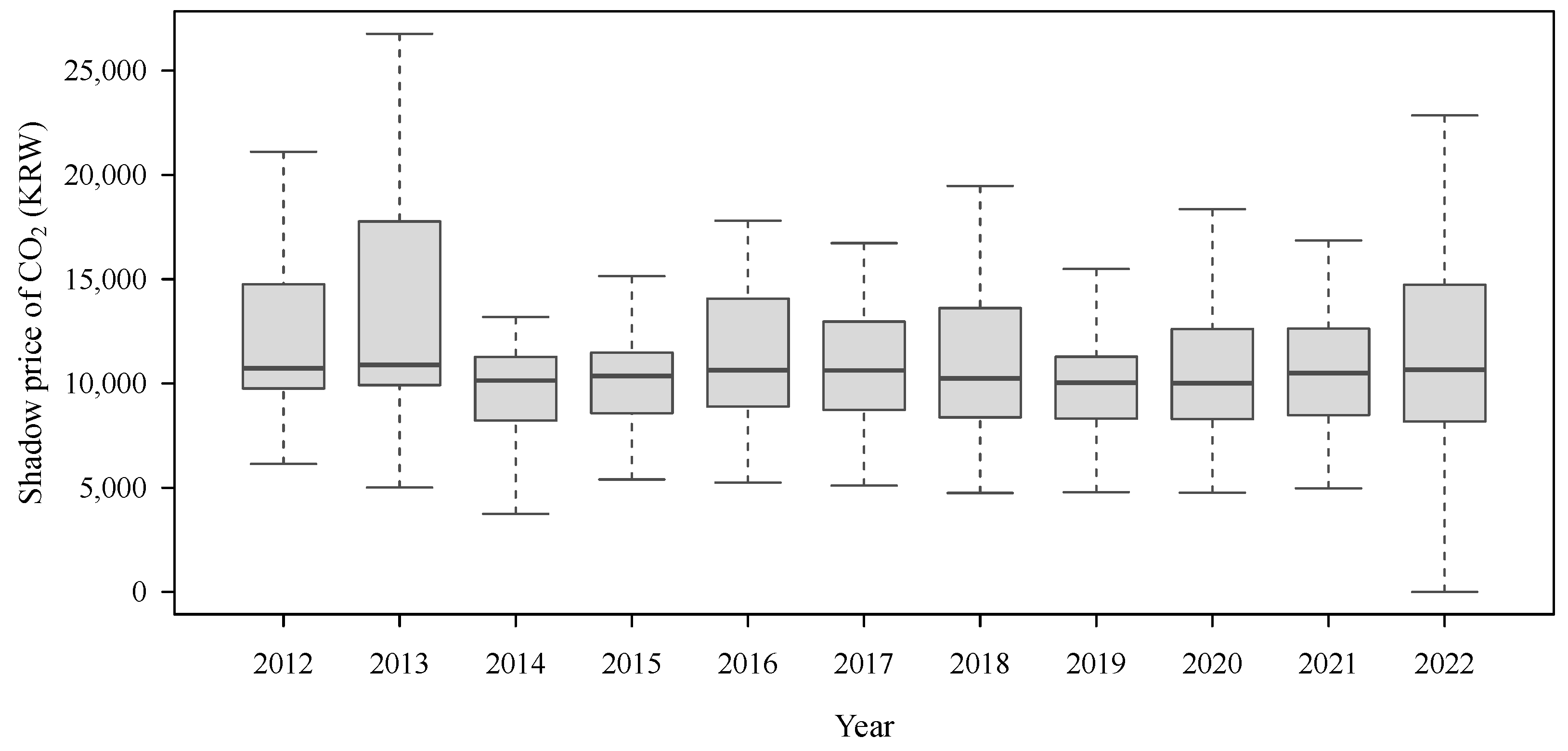
The annual boxplots of the shadow price of CO2 estimated using bootstrapping are presented in Figure 5. These boxplots were constructed by excluding several outliers from the shadow price estimates. With the exception of 2013 and 2022, the distribution of shadow prices does not show significant variation by year throughout the study period. Furthermore, it can be observed that the distributions for all years are right-skewed. Indeed, the skewness of the shadow prices is positive for every year, confirming the right-skewed nature of the distributions.
6. Discussion
This study analyzes the shadow price of CO2 using firm-level data from Korean energy-related companies. Although the empirical analysis is conducted for Korea, the analytical framework and the main findings are not specific to a single country. Many Asian economies share similar characteristics, including a high reliance on fossil-fuel-based electricity generation, increasing electricity demand, and the coexistence of market-based environmental regulations with regulated energy prices. In this respect, the Korean case can serve as a useful reference for understanding CO2 mitigation in other Asian countries and in a broader global context.
The proposed framework can be applied to other countries where emissions trading schemes or carbon pricing mechanisms are implemented or under consideration. In particular, several emerging Asian economies face comparable challenges in balancing economic growth, energy supply, and emissions reduction. Applying the bootstrap-based parametric DDF framework to such settings would allow for a consistent estimation of shadow prices across different institutional and technological environments.
To provide a benchmark for the empirical results, we compare our estimates with those reported in Oh et al. [30], summarized in Table 6. Although the estimated shadow prices of CO2 vary depending on the methodology and the unit of analysis, previous studies generally report values ranging from USD 10 to 100 per ton. The estimates obtained using the methodology proposed in this study are around KRW 15,215 per ton, which are lower than those reported in much of the existing literature. However, as discussed earlier, the price of CO2 in the Korean Emissions Trading Scheme (K-ETS) has generally ranged from approximately KRW 10,000 to 20,000 per ton. In this context, the estimates obtained in this study can be regarded as realistic.
The comparison indicates that estimated shadow prices are sensitive to methodological choices. Even with similar data and functional forms, differences in estimation procedures can lead to variation in results. By incorporating bootstrapping into a parametric DDF framework, this study provides additional information on the dispersion of shadow price estimates that is not available from point estimation alone.
From a policy perspective, the estimated CO2 shadow prices provide information that may be useful for evaluating climate policy instruments. When estimated shadow prices are comparable to observed emission permit prices, they indicate consistency between firms’ marginal abatement costs and market outcomes. At the same time, differences in shadow prices across firms imply that potential efficiency gains may exist, depending on how policy instruments are designed and implemented.
Finally, the results highlight the relevance of firm-level analysis. Firm-level shadow prices reflect not only technological characteristics but also organizational and managerial factors that influence production and emissions decisions. These aspects are not captured in plant-level or aggregate analyses. Extending the analysis to other countries or sectors would be a natural direction for future research.
7. Conclusions
This study proposes a methodology to estimate the shadow prices of undesirable outputs, such as CO2, and measures these prices using firm-level panel data from Korea. We modified the approach of Ferrier and Hirschberg [4] for integrating bootstrapping into data envelopment analysis to accommodate output sets that include undesirable outputs, and subsequently incorporated this into the conventional LP methodology [3]. Compared to the conventional LP approach, this methodology exhibits the following characteristics. First, it enables the estimation of confidence intervals by providing standard errors for the parameter estimates. Second, the DDF values measured via bootstrapping tend to be larger than those from the conventional LP. Third, the shadow prices estimated through bootstrapping are remarkably similar to the actual carbon emission permit prices traded on the KRX.
The empirical results employing the proposed method are summarized as follows. First, by eliminating technical inefficiency, firms could have produced 1.5% more desirable outputs and 20.6% less undesirable outputs with the same input levels. Second, technical inefficiency has shown a declining trend, implying an improvement in production efficiency as the representative firm gradually approaches the production frontier. Third, the shadow price of CO2 is estimated at KRW 15,215, which is remarkably consistent with the CO2 allowance prices traded on the Korea Exchange (KRX).
Despite the aforementioned methodological advantages, the proposed methodology has certain limitations. First, although bootstrapping was applied, the statistical properties of the proposed methodology were not examined in the manner of Simar and Wilson [52]. This could be addressed by deriving the asymptotic distribution of DDF estimators through a mathematical-statistical approach. Future research could thus perform more rigorous hypothesis testing by applying asymptotic distribution theory beyond simple bootstrapping. Second, while the DDF was assumed to have a quadratic functional form, the actual DDF may not follow such a specification. Consequently, the results are not entirely free from specification problems. Future studies should conduct specification tests on the functional form of the DDF to ensure more robust results.
Furthermore, the following research topics could complement the findings of this study. First, the sensitivity of DDF and shadow price measurements to the choice of the direction vector warrants investigation. The setting of the direction vector is directly linked to the satisfaction of the translation property, which also influences the specification of the DDF. Therefore, research aimed at theoretically clarifying these relationships is necessary. Second, this study analyzed energy-related firms as a single, homogenous sample. However, these firms can be categorized into distinct groups, such as district energy, power generation, and energy transition industries, which inevitably possess highly heterogeneous characteristics. For this reason, methodological improvements are needed to account for group heterogeneity. For instance, the concept of the metafrontier [53] could be integrated into the current framework.
Author Contributions
Conceptualization, D.-h.O. and S.L.; methodology, D.-h.O.; software, D.-h.O. and S.L.; formal analysis, D.-h.O. and S.L.; data curation, S.L.; writing—original draft preparation, D.-h.O.; visualization, S.L.; supervision and project administration, D.-h.O.; funding acquisition, D.-h.O. All authors have read and agreed to the published version of the manuscript.
Funding
This research was funded by Inha University (grant number: 65479).
Institutional Review Board Statement
Not applicable.
Informed Consent Statement
Not applicable.
Data Availability Statement
Readers can obtain data used in this study from the authors upon request.
Conflicts of Interest
The authors declare no conflicts of interest.
Appendix A
In Ferrier and Hirschberg [4], bootstrap efficiency is measured through the following steps.
(a)
The efficiency scores of all DMUs are measured using a conventional input-oriented DEA model, such as the CCR or BCC model. The efficiency score of the jth DMU can be obtained by solving the following LP problem:
where is an input matrix, is a output matrix, is the jth column of , and is the jth column of . We solve the LP in Equation (A1) for all DMUs, . Let us denote the efficiency score vector obtained in this step as .
(b)
The input matrix, , is adjusted using the efficiency scores, , obtained in the first step. Defining the adjustment matrix as , the adjusted input matrix can be obtained as follows:
(c)
For the jth DMU, the distribution of its efficiency score can be obtained through the following sub-process:
(c-i)
Set the number of replicates, I. For each replicate i, where , the following sub-processes are performed:
(c-i-1)
Randomly sample J elements with replacement from . Construct the readjustment matrix as follows:
(c-i-2)
Readjust the adjusted input matrix, , using the readjustment matrix from Equation (A3), as follows:
(c-i-3)
Solve the following LP.
(c-ii)
The distribution of the efficiency score for the jth DMU can be inferred using the set .
References
Chung, Y.H.; Färe, R.; Grosskopf, S. Productivity and undesirable outputs: A directional distance function approach. J. Environ. Manag.1997, 51, 229–240. [Google Scholar] [CrossRef]
World Bank. State and Trends of Carbon Pricing 2024; World Bank: Washington, DC, USA, 2024. [Google Scholar]
Färe, R.; Grosskopf, S.; Noh, D.W.; Weber, W. Characteristics of a polluting technology: Theory and practice. J. Econom.2005, 126, 469–492. [Google Scholar] [CrossRef]
Ferrier, G.; Hirschberg, J. Bootstrapping Confidence Intervals for Linear Programming Efficiency Scores: With an Illustration Using Italian Banking Data. J. Product. Anal.1997, 8, 19–33. [Google Scholar] [CrossRef]
Greenhouse Gas Inventory and Research Center of Korea. 2022 National Greenhouse Gas Inventory Report; Ministry of Climate, Enrgy and Environment: Sejong City, Republic of Korea, 2022. (In Korean)
Aigner, D.J.; Chu, S.F. On estimating the industry production function. Am. Econ. Rev.1968, 58, 826–839. [Google Scholar]
Färe, R.; Grosskopf, S.; Lovell, C.A.K.; Yaisawarng, S. Derivation of Shadow Prices for Undesirable Outputs: A Distance Function Approach. Rev. Econ. Stat.1993, 75, 374–380. [Google Scholar] [CrossRef]
Hailu, A.; Veeman, T.S. Environmentally Sensitive Productivity Analysis of the Canadian Pulp and Paper Industry, 1959–1994: An Input Distance Function Approach. J. Environ. Econ. Manag.2000, 40, 251–274. [Google Scholar] [CrossRef]
Lee, M. The shadow price of substitutable sulfur in the US electric power plant: A distance function approach. J. Environ. Manag.2005, 77, 104–110. [Google Scholar] [CrossRef]
Vardanyan, M.; Noh, D.W. Approximating pollution abatement costs via alternative specifications of a multi-output production technology: A case of the US electric utility industry. J. Environ. Manag.2006, 80, 177–190. [Google Scholar] [CrossRef]
Rezek, J.P.; Campbell, R.C. Cost estimates for multiple pollutants: A maximum entropy approach. Energy Econ.2007, 29, 503–519. [Google Scholar] [CrossRef]
Simar, L.; Wilson, P.W. Sensitivity Analysis of Efficiency Scores: How to Bootstrap in Nonparametric Frontier Models. Manag. Sci.1998, 44, 49–61. [Google Scholar] [CrossRef]
Simar, L.; Vanhems, A.; Wilson, P.W. Statistical inference for DEA estimators of directional distances. Eur. J. Oper. Res.2012, 220, 853–864. [Google Scholar] [CrossRef]
Maradan, D.; Vassiliev, A. Marginal costs of carbon dioxide abatement: Empirical evidence from cross-country analysis. Swiss J. Econ. Stat.2005, 141, 377–410. [Google Scholar]
Marklund, P.O.; Samakovlis, E. What is driving the EU burden-sharing agreement: Efficiency or equity? J. Environ. Manag.2007, 85, 317–329. [Google Scholar] [CrossRef] [PubMed]
Napolitano, O.; Foresti, P.; Kounetas, K.; Spagnolo, N. The impact of energy, renewable and CO2 emissions efficiency on countries’ productivity. Energy Econ.2023, 125, 106795. [Google Scholar] [CrossRef]
Zhang, C.; Zhu, H.; Li, X. Which productivity can promote clean energy transition—Total factor productivity or green total factor productivity? J. Environ. Manag.2024, 366, 121899. [Google Scholar] [CrossRef]
Boussemart, J.P.; Leleu, H.; Shen, Z.; Valdmanis, V. Performance analysis for three pillars of sustainability. J. Product. Anal.2020, 53, 305–320. [Google Scholar] [CrossRef]
D’Errico, M.C. Sustainable economic growth and energy security nexus: A stochastic frontier analysis across OECD countries. Energy Econ.2024, 132, 107447. [Google Scholar] [CrossRef]
Chen, G.; Yang, Z.; Chen, S. Measurement and Convergence Analysis of Inclusive Green Growth in the Yangtze River Economic Belt Cities. Sustainability2020, 12, 2356. [Google Scholar] [CrossRef]
Choi, Y.; Yu, Y.; Lee, H.S. A Study on the Sustainable Performance of the Steel Industry in Korea Based on SBM-DEA. Sustainability2018, 10, 173. [Google Scholar] [CrossRef]
Aparicio, J.; Kapelko, M.; Zofío, J. The measurement of environmental economic inefficiency with pollution-generating technologies. Resour. Energy Econ.2020, 62, 101185. [Google Scholar] [CrossRef]
Halkos, G.E.; Polemis, M.L. The impact of economic growth on environmental efficiency of the electricity sector: A hybrid window DEA methodology for the USA. J. Environ. Manag.2018, 211, 334–346. [Google Scholar] [CrossRef]
Lee, M.; Zhang, N. Technical efficiency, shadow price of carbon dioxide emissions, and substitutability for energy in the Chinese manufacturing industries. Energy Econ.2012, 34, 1492–1497. [Google Scholar] [CrossRef]
Deng, X.; Du, L. Estimating the environmental efficiency, productivity, and shadow price of carbon dioxide emissions for the Belt and Road Initiative countries. J. Clean. Prod.2020, 277, 123808. [Google Scholar] [CrossRef]
Färe, R.; Grosskopf, S.; Weber, W.L. Shadow prices and pollution costs in U.S. agriculture. Ecol. Econ.2006, 56, 89–103. [Google Scholar] [CrossRef]
Coggins, J.S.; Swinton, J.R. The Price of Pollution: A Dual Approach to Valuing SO2 Allowances. J. Environ. Econ. Manag.1996, 30, 58–72. [Google Scholar] [CrossRef]
Kwon, O.S.; Yun, W.C. Estimation of the marginal abatement costs of airborne pollutants in Korea’s power generation sector. Energy Econ.1999, 21, 545–558. [Google Scholar] [CrossRef]
Wei, C.; Löschel, A.; Liu, B. An empirical analysis of the CO2 shadow price in Chinese thermal power enterprises. Energy Econ.2013, 40, 22–31. [Google Scholar] [CrossRef]
Oh, D.H.; Ahn, J.; Lee, S.; Choi, H. Measuring technical inefficiency and CO2 shadow price of Korean fossil-fuel generation companies using deterministic and stochastic approaches. Energy Environ.2020, 32, 403–423. [Google Scholar] [CrossRef]
Barrows, G.; Ollivier, H. Cleaner firms or cleaner products? How product mix shapes emission intensity from manufacturing. J. Environ. Econ. Manag.2018, 88, 134–158. [Google Scholar] [CrossRef]
Wang, Y.; Wang, Q.; Hang, Y.; Zhao, Z.; Ge, S. CO2 emission abatement cost and its decomposition: A directional distance function approach. J. Clean. Prod.2018, 170, 205–215. [Google Scholar] [CrossRef]
Rekker, L.; Kesina, M.; Mulder, M. Carbon abatement in the European chemical industry: Assessing the feasibility of abatement technologies by estimating firm-level marginal abatement costs. Energy Econ.2023, 126, 106889. [Google Scholar] [CrossRef]
Nikos, R.; Kounetas, E.K.; Konstantinos, T.; Salvatore, C. Environmental productivity growth, regulation and types of pollutants: Evidence from European firms. J. Environ. Manag.2024, 368, 122078. [Google Scholar] [CrossRef]
Molinos-Senante, M.; Hanley, N.; Sala-Garrido, R. Measuring the CO2 shadow price for wastewater treatment: A directional distance function approach. Appl. Energy2015, 144, 241–249. [Google Scholar] [CrossRef]
See, K.F.; Abdul Rashid, A.; Yu, M.M. Incorporating CO2 emissions and capacity utilization in the airline inefficiency analysis: A two-stage multiproduct network technology with a nonconvex metafrontier framework. J. Air Transp. Manag.2024, 120, 102644. [Google Scholar] [CrossRef]
Philippas, D.; Tziogkidis, P.; Sfakianakis, M. The fine line between ESG commitment and bank performance. Energy Econ.2025, 151, 108978. [Google Scholar] [CrossRef]
Wang, K.; Yang, K.; Wei, Y.M.; Zhang, C. Shadow prices of direct and overall carbon emissions in China’s construction industry: A parametric directional distance function-based sensitive estimation. Struct. Change Econ. Dyn.2018, 47, 180–193. [Google Scholar] [CrossRef]
Lee, J.D.; Park, J.B.; Kim, T.Y. Estimation of the Shadow Prices of Pollutants with Production/Environment Inefficiency Taken into Account: A Nonparametric Directional Distance Function Approach. J. Environ. Manag.2002, 64, 365–375. [Google Scholar] [CrossRef]
Lee, S.c.; Oh, D.h.; Lee, J.d. A new approach to measuring shadow price: Reconciling engineering and economic perspectives. Energy Econ.2014, 46, 66–77. [Google Scholar] [CrossRef]
Chambers, R.G.; Chung, Y.; Färe, R. Profit, Directional Distance Functions, and Nerlovian Efficiency. J. Optim. Theory Appl.1998, 98, 351–364. [Google Scholar] [CrossRef]
Blackorby, C.; Russell, R.R. Will the Real Elasticity of Substitution Please Stand Up? (A Comparison of the Allen/Uzawa and Morishima Elasticities). Am. Econ. Rev.1989, 79, 882–888. [Google Scholar]
Fu, F.C.; Vijverberg, C.P.; Chen, Y.S. Productivity and efficiency of state-owned enterprises in China. J. Product. Anal.2008, 29, 249–259. [Google Scholar] [CrossRef]
Saal, D.S.; Parker, D.; Weyman-Jones, T. Determining the contribution of technical change, efficiency change and scale change to productivity growth in the privatized English and Welsh water and sewerage industry: 1985–2000. J. Product. Anal.2007, 28, 127–139. [Google Scholar] [CrossRef]
Efron, B.; Tibshirani, R. An Introduction to the Bootstrap; Chapman & Hall: New York, NY, USA, 1993. [Google Scholar]
Gupta, M. Cost of Reducing Greehouse Gas Emissinos: A Case Study of India’s Power Generation Sector; Technical Report NOTA DI LAVORO 147.2006; Fondazione Eni Enrico Mattei: Milano, Italy, 2006. [Google Scholar]
Park, H.; Lim, J. Valuation of marginal CO2 abatement options for electric power plants in Korea. Energy Policy2009, 37, 1834–1841. [Google Scholar] [CrossRef]
Lee, M. Potential cost savings from internal/external CO2 emissions trading in the Korean electric power industry. Energy Policy2011, 39, 6162–6167. [Google Scholar] [CrossRef]
Matsushita, K.; Yamane, F. Pollution from the electric power sector in Japan and efficient pollution reduction. Energy Econ.2012, 34, 1124–1130. [Google Scholar] [CrossRef]
Zhou, X.; Fan, L.W.; Zhou, P. Marginal CO2 abatement costs: Findings from alternative shadow price estimates for Shanghai industrial sectors. Energy Policy2015, 77, 109–117. [Google Scholar] [CrossRef]
Ji, D.J.; Zhou, P. Marginal abatement cost, air pollution and economic growth: Evidence from Chinese cities. Energy Econ.2020, 86, 104658. [Google Scholar] [CrossRef]
Simar, L.; Wilson, P.W. A General Methodology for Bootstrapping in Nonparametric Frontier Models. J. Appl. Stat.2000, 27, 779–802. [Google Scholar] [CrossRef]
Oh, D.h. A metafrontier approach for measuring an environmentally sensitive productivity growth index. Energy Econ.2010, 32, 146–157. [Google Scholar] [CrossRef]
Figure 1.
Output set and DDF. Source: Authors’ calculations.
Figure 1.
Output set and DDF. Source: Authors’ calculations.
Figure 2.
Average DDF over time. Source: Authors’ calculations.
Figure 2.
Average DDF over time. Source: Authors’ calculations.
Figure 3.
DDF in the desirable and undesirable output space. Source: Authors’ calculations.
Figure 3.
DDF in the desirable and undesirable output space. Source: Authors’ calculations.
Figure 4.
Scatter plot of DDFs. Source: Authors’ calculations.
Figure 4.
Scatter plot of DDFs. Source: Authors’ calculations.
Figure 5.
Boxplots of the shadow price of CO2 (KRW). Source: Authors’ calculations.
Figure 5.
Boxplots of the shadow price of CO2 (KRW). Source: Authors’ calculations.
Table 1.
Descriptive statistics of the variables used in this study (n = 416).
Table 1.
Descriptive statistics of the variables used in this study (n = 416).
Variable
Mean
Median
SD
Min
Max
K (Capital stock, Tril. KRW)
1.54
0.46
3.44
0.00
40.08
L (Labor, Thousand FTE)
0.50
0.09
0.99
0.00
9.43
F (Energy usage, PJ)
79.24
16.41
154.96
0.01
670.23
Y (Value added, Bil. KRW)
84.71
40.24
135.02
0.08
1146.60
B (CO2 emissions, Mil. tCO2 eq.)
6.16
1.02
12.86
0.00
59.73
Source: Authors’ own calculations.
Table 2.
Correlations between variables.
Table 2.
Correlations between variables.
x2 (Labor)
x3 (Energy Usage)
y (Value Added)
b (CO2 Emissions)
x1 (Capital stock)
0.9539
0.5790
0.4991
0.5639
x2 (Labor)
0.7000
0.5415
0.6820
x3 (Energy usage)
0.6023
0.9932
y (Value-added)
0.5937
Source: Authors’ own calculations.
Table 3.
Parameter estimates of DDF.
Table 3.
Parameter estimates of DDF.
Variable
Without Bootstrap
With Bootstrap
Constant
−0.0017
−0.0158 (0.0083) *
0.0106
0.3612 (0.1305) ***
0.0696
0.9287 (0.2512) ***
−0.5035
2.5404 (0.1379) ***
y
−0.5785 (0.0321) ***
b
1.0000
0.4215 (·)
−0.2342
0.0095 (1.4096)
−0.1400
4.1709 (1.5227) ***
−0.0385
2.0350 (0.1723) ***
0.3888
−3.3156 (2.6921)
−0.0657
1.6073 (0.5011) ***
−0.2894
−6.9337 (0.6928) ***
0.0002
0.0180 (0.0082) **
0.0002
−0.1598 (0.0110) ***
−0.0008
0.2412 (0.0088) ***
−0.0189
−0.0869 (0.0093) ***
Note: ***, **, and * represent statistical significance at the 1%, 5%, and 10% levels, respectively. Source: Authors’ own calculations.
Table 4.
Estimates of the directional distance function.
Table 4.
Estimates of the directional distance function.
Mean
Median
SD
Min
Max
# Frontier Firms
Without Bootstrap
0.1576
0.0490
0.2826
0.0000
1.5829
12
With Bootstrap
1.2737
0.6505
1.8454
−2.7580
11.0205
14
Source: Authors’ own calculations.
Table 5.
Average Morishima elasticity and shadow price of CO2.
Table 5.
Average Morishima elasticity and shadow price of CO2.
Interpretation
Without Bootstrap
With Bootstrap
Slope of DDF w.r.t. b
0.9809
0.4519
Slope of DDF w.r.t. y
−0.0191
−0.5481
Morishima elasticity
−0.1700
−0.7966
Shadow price of CO2 (KRW)
32,462,898
15,215
Source: Authors’ own calculations.
Table 6.
Comparison between CO2 shadow prices of present and previous studies.
Table 6.
Comparison between CO2 shadow prices of present and previous studies.
Disclaimer/Publisher’s Note: The statements, opinions and data contained in all publications are solely those of the individual author(s) and contributor(s) and not of MDPI and/or the editor(s). MDPI and/or the editor(s) disclaim responsibility for any injury to people or property resulting from any ideas, methods, instructions or products referred to in the content.
Lim, S.; Oh, D.-h.
Robust Estimation of CO2 Shadow Prices for Korean Energy Firms: Integrating Bootstrapping into the Conventional LP Framework. Sustainability2026, 18, 1810.
https://doi.org/10.3390/su18041810
AMA Style
Lim S, Oh D-h.
Robust Estimation of CO2 Shadow Prices for Korean Energy Firms: Integrating Bootstrapping into the Conventional LP Framework. Sustainability. 2026; 18(4):1810.
https://doi.org/10.3390/su18041810
Chicago/Turabian Style
Lim, Sesil, and Dong-hyun Oh.
2026. "Robust Estimation of CO2 Shadow Prices for Korean Energy Firms: Integrating Bootstrapping into the Conventional LP Framework" Sustainability 18, no. 4: 1810.
https://doi.org/10.3390/su18041810
APA Style
Lim, S., & Oh, D.-h.
(2026). Robust Estimation of CO2 Shadow Prices for Korean Energy Firms: Integrating Bootstrapping into the Conventional LP Framework. Sustainability, 18(4), 1810.
https://doi.org/10.3390/su18041810
Note that from the first issue of 2016, this journal uses article numbers instead of page numbers. See further details here.
Article Metrics
No
No
Article Access Statistics
For more information on the journal statistics, click here.
Multiple requests from the same IP address are counted as one view.
Lim, S.; Oh, D.-h.
Robust Estimation of CO2 Shadow Prices for Korean Energy Firms: Integrating Bootstrapping into the Conventional LP Framework. Sustainability2026, 18, 1810.
https://doi.org/10.3390/su18041810
AMA Style
Lim S, Oh D-h.
Robust Estimation of CO2 Shadow Prices for Korean Energy Firms: Integrating Bootstrapping into the Conventional LP Framework. Sustainability. 2026; 18(4):1810.
https://doi.org/10.3390/su18041810
Chicago/Turabian Style
Lim, Sesil, and Dong-hyun Oh.
2026. "Robust Estimation of CO2 Shadow Prices for Korean Energy Firms: Integrating Bootstrapping into the Conventional LP Framework" Sustainability 18, no. 4: 1810.
https://doi.org/10.3390/su18041810
APA Style
Lim, S., & Oh, D.-h.
(2026). Robust Estimation of CO2 Shadow Prices for Korean Energy Firms: Integrating Bootstrapping into the Conventional LP Framework. Sustainability, 18(4), 1810.
https://doi.org/10.3390/su18041810
Note that from the first issue of 2016, this journal uses article numbers instead of page numbers. See further details here.