1. Introduction
Over the past decade, China has elevated “Digital China” to a national strategic priority while simultaneously committing to carbon-peak and carbon-neutral targets. The Report of the 20th CCP National Congress emphasizes that “high-quality development is the primary task in building a modern socialist country, and harmony between humanity and nature is a defining feature of Chinese-style modernization [
1].” As a new engine for growth, the digital economy accelerates the transformation and upgrading of traditional industries through pervasive and substitutive technological innovation, yet its early stages have also driven substantial resource consumption, posing significant challenges to green development and the realization of China’s “beautiful nation” vision. In August 2024, the government’s “Implementation Guidelines for the Coordinated Transformation and Development of Digitalization and Greening” underscored the need to “deeply promote coordinated digital and green development to generate new momentum for high-quality growth [
2].” Because firms are the main carriers of economic activity, achieving true coordination between digitalization and greening depends on their behavior: from strategic resource allocation to operational execution. However, many Chinese enterprises still lag in digital maturity and continue to generate heavy pollution, leaving a wide gap between policy ambition and on-the-ground practice.
Coordinated digital–green development enables firms to synchronize the expansion of their digital and environmental subsystems, embedding green principles into every stage of production and operation. This creates positive synergies “1 + 1 > 2” that both boost efficiency and reduce ecological impact. Digital–green coordination thus refers to the simultaneous and integrated pursuit of digital and environmental initiatives, yielding synergies that exceed the sum of their individual effects. Previous studies have separately confirmed that digital transformation can substitute for traditional capital and enhance inter-departmental synergies to raise total factor productivity (TFP) [
3,
4], while green transformation promotes TFP via technological innovation and optimized resource allocation [
5,
6]. Yet the pairwise interaction of these subsystems forms a complex, mutually reinforcing system that single-dimension analyses cannot fully capture.
In practice, digitalization drives greening in three main ways: first, by facilitating knowledge sharing and new innovation models, digital technologies enhance a firm’s capacity for green innovation; second, by alleviating information asymmetries—especially around environmental data—digital tools motivate and empower firms to assume greater social responsibility and accelerate their green transition; and third, by improving production efficiency while limiting energy and material consumption [
7], digitalization inherently fosters greener processes. Conversely, a firm’s green initiatives can propel digital adoption by creating demand for digital tools in green supply chain and inventory management or in real-time pollution monitoring systems. Critically, failure to integrate these subsystems can produce rebound effects where improved efficiency paradoxically spurs higher resource use [
8], inflates management costs, crowds out R&D investment [
9], impairs resource allocation, and increases cost stickiness (CS), all of which undermine high-quality development.
Despite this importance, existing research offers little clarity on how to measure digital–green coordination at the firm level or on its concrete impact mechanisms. Key questions thus remain: What is the current degree of coordination between digital and green subsystems in Chinese A-share firms? How does this coordination influence TFP growth, and through which channels does it operate? To answer these questions, this paper develops a firm-level digital–green coordination index using the Haken synergy model and analyzes its effect on TFP measured via the Levinsohn–Petrin and Olley–Pakes methods through panel regressions and three-stage mediation models. We specifically explore how coordination empowers firms via corporate social responsibility (CSR), CS reduction, and green technological innovation (GTI).
This study contributes to the literature in an incremental but policy-relevant way. (i) Prior research has separately linked digital transformation and productivity and (ii) environmental/green practices and productivity. We do not claim to overturn or replace these established findings. Instead, we focus on the extent to which firms’ digitalization and greening efforts appear to be aligned and examine whether such alignment is associated with total factor productivity beyond the additive relationships documented in prior work. (ii) In addition, unlike studies focusing solely on revenue expansion, our inclusion of cost stickiness offers a unique operational perspective. We argue that digital–green synergy enhances productivity not just by selling more but by reducing the rigidity of cost structures, allowing firms to manage downward demand shocks more efficiently. (iii) To operationalize alignment, we construct a coordination index that summarizes the joint intensity and balance of digital and green orientation as reflected in firm reporting. This index provides a parsimonious way to study whether the “two transitions” move together at the firm level and whether that joint movement is economically meaningful.
2. Literature Review
Four categories of the literature are closely related to this research. The first of these focuses on firm-level TFP growth. TFP is often referred to as the “Solow residual”, which captures output growth not explained by measurable inputs such as labor and capital, reflecting technological progress and efficiency improvements [
10,
11]. As a key indicator of high-quality development, firm-level TFP growth embodies technological upgrading, managerial innovation, product quality improvements, and structural adjustment [
12]. Early research primarily focused on measurement methodologies for TFP, but with the rise of the “high-quality development” paradigm, scholars have turned to exploring the determinants and mechanisms that enhance firm-level TFP. Estimating TFP at the enterprise level poses two main econometric challenges. First, simultaneity bias arises because managers observe current productivity and adjust input mixes accordingly, rendering TFP endogenous to input choices. Second, sample-selection bias occurs when low-productivity firms exit the market, causing surviving samples to overstate average productivity [
13]. To address these issues, Levinsohn–Petrin (LP) and Olley–Pakes (OP) semi-parametric estimators have become standard [
14]. Scholars applied LP to Chinese manufacturing firms (1999–2003), while [
15,
16] extended the approach to Chinese industrial firms (1999–2007). As environmental concerns mounted, scholars also measured green TFP using Malmquist–Luenberger indices [
17]. Beyond measurement, research has probed the drivers of TFP growth. From a corporate governance perspective, equity concentration, board composition, CEO duality, and executive compensation structure exhibit nonlinear and positive relationships with TFP [
18]. External environment studies show that economic policy uncertainty dampens TFP by disrupting investment [
19,
20], and environmental regulation has an “inverted-N” effect on firms’ productivity via innovation incentives [
21]. At the production management level, both technological innovation and managerial efficiency improvements have been shown to enhance TFP [
22,
23].
The second category focuses on digitalization and TFP growth. TFP can be decomposed into technological progress and efficiency change [
24]. Correspondingly, studies on digitalization’s impact on TFP growth fall into two streams. The first examines how digital transformation drives technological progress within and among firms; the second focuses on how it enhances resource allocation and operational efficiency. Regarding technological progress, digitalization empowers firms to upgrade innovation capabilities and fosters inter-firm collaborative innovation. At the firm level, ICT deployment accelerates modernization, reshapes innovation modes, and boosts R&D productivity [
25,
26], with empirical evidence showing that optimizing R&D teams and university–industry partnerships under digital regimes increases firms’ innovation outputs and TFP [
27,
28]. Across firms, digital platforms facilitate knowledge spillovers and risk-sharing in R&D alliances, accelerating catch-up by lagging firms and deepening the innovation ecosystem [
29]. On the efficiency frontier, digitalization improves cross-firm resource allocation and internal operational processes. By integrating data across the value chain, firms reallocate inputs toward higher-productivity partners [
30], while within firms, digital tools enhance both factor utilization and managerial decision-making. Digital systems broaden the mix of available inputs, ease capital–labor mismatches, and elevate labor quality via automation [
31], and they reduce communication frictions and improve demand forecasting, thereby raising managerial efficiency and overall TFP [
32]. Although the literature richly documents digitalization’s singular effects, it overlooks interactions with firms’ green transformation—interactions that are crucial under policies emphasizing coordinated digital–green development.
The third category of the literature centers on greening and TFP growth. Research on green transformation and TFP growth can be grouped into three strands. First, macro-policy studies examine how environmental regulations shape firm productivity. Wang et al. [
33] find an inverted-U relationship between regulation stringency and TFP, while emission trading pilots have been shown to boost productivity via efficiency incentives [
34,
35]. Second, green TFP measurement studies identify firm-level determinants of green productivity. Using Malmquist–Luenberger indices, scholars demonstrate that inward FDI, service-oriented upgrading, and structural optimization significantly enhance green TFP in Chinese industrial firms [
34,
35,
36,
37]. Third, micro-level analyses of green practices reveal that proactive green management—such as resource optimization and green supply chain oversight—promotes product and process innovation, thereby underpinning TFP improvements [
38,
39]. Recent work further links green technology advances to cost reductions and labor productivity gains [
40]. Yet few studies directly assess how firms’ green transformation—taken as an integrated strategic path—drives conventional TFP growth.
The fourth category examines the interactions between digitalization and greening. A growing body of theory and evidence documents bidirectional reinforcement between digital and green strategies. On the one hand, resource orchestration and resource-based theories suggest that digital capabilities catalyze firms’ transition from mere digitization to intelligent, eco-oriented operations [
41,
42], enabling resource-efficient, low-emission processes and new green business models [
43]. Empirically, digitalization not only increases the quantity and quality of green patents [
44] but also does so by optimizing human capital structures and easing environmental information constraints, thereby enhancing CSR and GTI [
45]. Conversely, stringent environmental requirements prompt firms—especially in heavily regulated sectors like energy—to adopt digital tools for leaner operations and emission monitoring, thus accelerating digital transformation [
46,
47]. These studies establish a solid foundation for digital–green coordination: digital systems improve resource allocation while supporting cleaner production, and green imperatives embed sustainability into digital initiatives [
48,
49]. Yet extant research has not quantified the degree of this coordination at the firm level, nor has it unpacked its combined effect on TFP growth.
Although the literature details the separate impacts of digitalization and greening on TFP, three gaps remain. First, scholars have yet to examine the mutually reinforcing relationship, i.e., the synergy, between these two subsystems and its aggregate effect on firm productivity. Second, while bidirectional influences are documented, no study quantifies coordination intensity or trajectories within the firm. Third, the mechanisms through which digital–green synergy drives TFP via CSR, CS, and GTI remain underexplored. In response, this paper (1) defines firm-level digital–green coordination based on synergy theory and measures its intensity using the Haken model; (2) evaluates its impact on TFP measured via the LP and OP methods through panel regressions; and (3) uncovers the mediating roles of CSR, CS reduction, and GTI using multi-stage mediation analysis.
3. Theoretical Analysis and Research Hypothesis
3.1. Theoretical Analysis
In this paper, digital–green coordination refers to the degree to which a firm’s digitalization orientation and greening orientation appear jointly advanced and mutually consistent, rather than progressing in isolation. Conceptually, this aligns with the complementarity view: productivity benefits may be higher when digital technologies—e.g., data systems, process automation, and monitoring—support environmental objectives, e.g., efficiency, emissions control, and green innovation, and when environmental initiatives are implemented through digitally enabled processes. The term coordination is used to describe this joint advancement and balance; it is not meant to imply a literal physical self-organization process.
Digital–green coordination both aligns a firm’s internal digital and green subsystems and, through the complex interplay of digital and environmental technologies, stimulates disruptive innovation that directly fuels TFP growth. Empirical work has firmly established that standalone digital transformation and green transformation each significantly enhance firms’ productivity [
50]. However, the integrated effect of a coordinated digital–green system on TFP remains under-investigated. According to synergetics, an open system achieves higher-order organization by continuously exchanging matter and energy with its environment, amplifying fluctuations via positive feedback until self-organization emerges from disorder to order [
51]. In a digital–green coordination system, these “fluctuations” manifest as ongoing innovations in digital and green technologies and the transfer of knowledge between firms. When coordination is strong, a firm’s digital and environmental departments share resources and collaborate, causing digital and green know-how to interact in ways that magnify the overall capabilities of the firm’s system. This concurrent development of digital and green subsystems not only increases operational efficiency but also generates direct gains in TFP. Synergy theory further identifies competition and cooperation as twin drivers of emergent order. Diversity among subsystems gives rise to competition—here, the distinct objectives and expertise of digital versus green technologies. Digital initiatives focus on data-driven process optimization and smart management systems [
52], whereas green transformation prioritizes clean production and low-emission operations. Limited R&D budgets make siloed investments suboptimal, compelling firms to integrate their digital and green efforts. At the same time, complementarity between digital and green technologies—stemming from digital’s fungibility and broad applicability [
53]—creates fertile ground for disruptive breakthroughs. Diverse disciplinary knowledge pools enhance the novelty and creativity of innovation [
54], enabling the development of higher-efficiency clean technologies that further boost TFP.
Hypothesis 1. Greater digital–green coordination contributes positively to firm-level TFP growth.
3.2. Mechanism Analysis
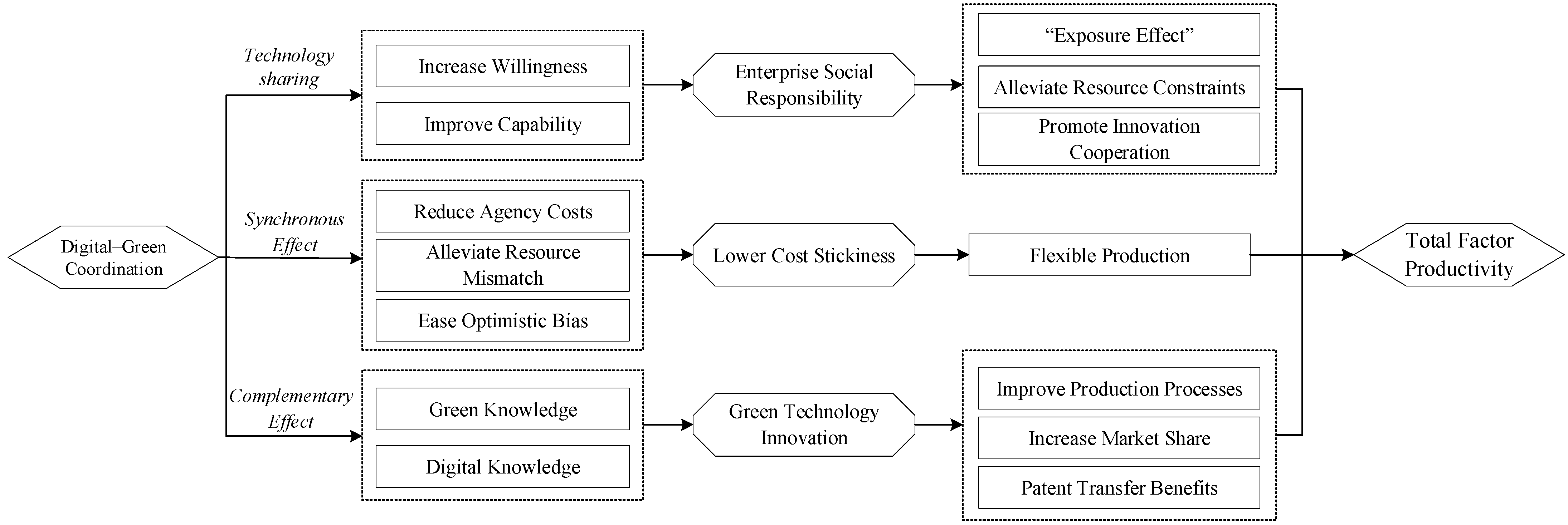
This paper develops a theoretical framework in which digital–green coordination exerts both a direct productivity-enhancing effect and an indirect effect through three key mechanisms: CSR, CS reduction, and GTI (
Figure 1).
First, by enabling the costless sharing of digital technologies between a firm’s digital and environmental subsystems, coordination creates a sharing effect that boosts both the willingness and capacity to undertake CSR. Because digital innovations lower the marginal cost of information diffusion, firms can deploy the same platforms for stakeholder engagement, forging integrated networks of investors, suppliers, and customers. This expanded stakeholder network raises the firm’s incentive to maintain a positive reputation and to signal its sustainable management philosophy, while cross-departmental digital–green collaboration accelerates joint innovation projects and the real-time monitoring of environmental performance. In turn, elevated CSR generates reputation-driven “exposure effects” that attract customers and investors and enable scale economies; it also eases resource constraints via improved access to government and stakeholder support and deepens R&D partnerships with universities and research institutes that each channel translating into higher TFP growth.
Second, digital–green coordination produces a synchronization effect that lowers CS by aligning resource allocation, organizational structure, and managerial forecasts. When digital and environmental units operate in tandem, firms optimize the coupling of capital, labor, and ecological inputs to reduce misallocation frictions; flatten communication hierarchies and strengthen inter-departmental accountability to mitigate principal–agent distortions; and leverage real-time data streams from smart inventories and digital supply chain platforms to temper managers’ overoptimistic demand projections. The resulting decline in cost rigidity increases operational flexibility, raises profit margins, and thus contributes to TFP enhancement.
Third, coordination fosters a complementarity effect by integrating digital know-how with green expertise, thereby lowering the cost of green R&D and spurring breakthrough clean tech innovations. Digital and green knowledge overlap in their shared emphasis on resource efficiency, yet they differ in focus in that digital methods optimize data-driven processes, while green approaches prioritize emission reduction. Their convergence deepens cross-functional collaboration, accelerates knowledge spillovers, and generates novel, high-performance green technologies, e.g., IoT-enabled pollution control or cloud-based carbon tracking. These innovations streamline production workflows, expand market share, and ultimately drive further TFP growth.
3.2.1. Mediating Role of CSR
Digital–green coordination allows firms to share digital infrastructure across departments at virtually zero marginal cost, generating a sharing effect that directly encourages CSR activities. In pursuing coordinated digital and green initiatives, firms seek external resources and stakeholder support, prompting them to actively improve relationships with investors, regulators, suppliers, and communities and to assume broader social responsibilities [
55]. Moreover, initiatives such as energy efficiency upgrades and emission reductions are themselves core CSR measures. Empirical evidence shows that CSR not only directly enhances TFP but also does so indirectly by boosting R&D investment [
56]. Thus, we hypothesize that CSR mediates the relationship between digital–green coordination and firm-level TFP growth.
Hypothesis 2. Corporate social responsibility partially mediates the effect of digital–green coordination on firm TFP growth.
3.2.2. Mediating Role of CS
CS refers to the phenomenon whereby costs rise more rapidly when output expands than they fall when output contracts, reflecting resource redundancies and misallocation [
57]. Coordinated digital and green investments reduce CS through three channels. First, by enabling holistic resource planning, firms can rebalance inputs across production, operations, and environmental units, alleviating misallocation and lowering adjustment costs. Second, cross-departmental collaboration and real-time data sharing flatten hierarchies and improve transparency, mitigating principal–agent frictions and associated moral hazards [
58]. Third, the uncertainties inherent in joint digital–green projects temper managers’ overoptimistic projections, further reducing cost rigidities. Lower CS, in turn, has been shown to promote TFP growth [
59]. Accordingly, we propose the following hypothesis:
Hypothesis 3. Reduced cost stickiness mediates the positive effect of digital–green coordination on firm TFP growth.
3.2.3. Mediating Role of GTI
Digital–green coordination deepens collaboration between digital and environmental subsystems, fostering complementarity effects between data-driven know-how and green expertise. This synergy accelerates the development of high-efficiency clean technologies and lowers innovation costs. GTI enhances TFP in three ways. First, by upgrading equipment and processes, it reduces energy and material consumption per unit of output, directly boosting production efficiency. Second, it generates differentiated competitive advantages in markets where consumers increasingly value eco-friendly products [
60], allowing firms to capture greater market share and higher margins. Third, the sale or licensing of green patents creates additional revenue streams and supports sustainable growth [
61]. Therefore, the following hypothesis can be made:
Hypothesis 4. Green technological innovation mediates the relationship between digital–green coordination and firm-level TFP growth.
4. Model Setting and Description of Variables
To evaluate how digital–green coordination affects firm TFP growth, we construct our core independent variable in two stages. First, we extract firm-level measures of digital transformation and green transformation via a text analysis of annual reports and then apply the Haken synergy model to compute the digital–green coordination index. As a robustness check, we re-estimate this index using a coupling coordination framework in place of the Haken model. Dependent variable is firm TFP growth, which we estimate using the Levinsohn–Petrin (LP) semi-parametric method. To verify the robustness of our productivity estimates, we also recompute TFP using the OP approach. Standard errors are clustered at the firm level, and all regressions include both firm and year fixed effects.
4.1. Model Setting
To empirically assess the effect of digital–green coordination on firm
TFP growth, we estimate two sets of panel models.
In Equation (1), is the total factor productivity growth of firm i in year t; is the firm’s digital–green coordination index; is a vector of control variables; and is the idiosyncratic error term.
Following Yu and Choi [
62], we then test for mediating effects via the following:
In these equations, denotes each mediator in turn—CSR, CS, or GTI. A significant indicates that coordination influences the mediator, and a significant shows that the mediator affects TFP. The product measures the indirect (mediating) effect. All regressions include firm and year fixed effects, and standard errors are clustered at the firm level.
4.2. Measures
4.2.1. Explanatory Variable: Digital–Green Coordination (Syn)
We adopt the Haken synergy model to quantify how a firm’s digitalization and greening subsystems co-evolve, following Yang et al. [
63] and Li et al. [
64]. This model captures both the dominant (“order”) and responsive (“slave”) dynamics between two state variables digitalization (
) and greening (
) and translates their interaction into a single coordination score.
Before applying the Haken model, we independently measure each subsystem’s digitalization level (
Digi,t) and greening level (
Geni,t).
Digi,t is obtained via a machine learning text analysis of annual reports against a policy-based digital dictionary. We then take In(
Digi + 1).
Geni,t is proxied by the log frequency of 113 green keywords in annual reports, which is depicted as In(freq
green + 1) [
65].
Notably, the canonical Haken model uses continuous-time differential equations, but our data are annual. We therefore discretize the evolution equations. This step preserves the model’s dynamics while matching our data frequency.
Under the adiabatic assumption (
),
decays faster and serves as the slave variable. We estimate the discrete-time equations via pooled OLS to obtain coefficients
The relative magnitudes confirm which subsystem (
Digi,t or Geni,t) is the system’s order parameter that drives co-evolution. Estimating Equations (4) and (5) via pooled OLS yields the coefficients in
Table 1, where we treat
as the candidate slow parameter. The keywords of
Dig and
Gen are presented in
Appendix A and
Appendix B. Annual report text measures capture managerial emphasis and disclosed orientation toward digitalization and greening. While annual reports are regulated disclosures, text-based proxies may still be affected by impression management and communication intensity. To mitigate these concerns, we normalize keyword counts by document length and include controls for report-level disclosure characteristics, e.g., length and other reporting intensity proxies, to reduce the likelihood that the coordination index merely reflects verbosity or communication strategy. We also use lagged explanatory variables to limit contemporaneous reverse causality.
From these estimates we infer that , , , and . Since and , the adiabatic condition holds, and Dig is confirmed as the system’s order parameter.
To derive the potential function and coordination score, we set Equation (5) = 0, which yields
and substituting Equation (6) into Equation (5) results in slow-variable evolution
Integrating
yields the potential function
Solving
gives equilibria
. The point
is unstable
. We then compute each firm’s coordination score as the Euclidean distance from its
to (0.7040,
(0.7040) = 0.0010), as presented in Equation (9). A larger Syn indicates a higher degree of digital–green synergy.
The coupling coordination index (CCI) is used for robustness checks. As an alternative, we calculate the classical coupling coordination index to validate Syn according to Equation (10).
where
and
are normalized digital and green scores;
and
are weights for digitalization and greening, which were set to be 0.5 in this study. High concordance between Syn and the CCI confirms the robustness of our coordination measure.
4.2.2. Dependent Variable: TFP Growth (TFP_LP, TFP_OP)
Firm-level TFP growth is estimated primarily via the LP semi-parametric method, which uses intermediate goods inputs as proxies for unobserved investment and thus corrects for zero-investment observations. For robustness, we also compute TFP using the OP estimator, labeling the two measures as TFP_LP and TFP_OP.
We estimate firm-level TFP by first specifying a Cobb–Douglas production function:
where
is output,
is labor input,
is capital input, and
is the firm’s TFP. Taking natural logarithms yields the following:
To address endogeneity, we adopt the LP two-stage estimator, which uses intermediate inputs as proxies for unobserved productivity shocks. In Stage 1, we approximate by regressing on a high-order polynomial in and , where denotes intermediate inputs. In Stage 2, we then estimate and the productivity term using the residual from Stage 1. This yields consistent estimates of and . We therefore use the LP-based TFP as our primary dependent variable.
All input and output series come from the CSMAR database, following standard practice. Capital (K) equals the net book value of fixed assets, labor (L) equals the number of employees, the intermediate inputs (M) equal “operating cost + period expenses—current depreciation & amortization—total employee compensation”, and the output (Y) is the main business revenue.
As a robustness check, we also compute TFP using the OP estimator, which proxies productivity shocks with contemporaneous investment. We further measure investment as cash paid for the purchase or construction of fixed assets, intangible assets, and other long-term assets [
3]. Throughout, we include firm and year fixed effects and cluster standard errors at the firm level.
Mediating Variables. (1) GTI. We proxy a firm’s green innovation by its annual count of green patent applications [
65], transformed as
(2) CSR. CSR is measured using the Huazheng ESG ratings [
66], which span nine tiers from C (lowest) to AAA (highest). We assign integer scores 1–9 to these tiers to form the variable
CSR. (3) CS. Following Weiss [
67], we compute CS as CS
i,t, where
denote two quarters within the same year,
is the change in total operating cost including CSMAR’s “operating cost” and “period expense”, and
is the change in revenue. We take the absolute value so that larger CS denotes stronger cost rigidity [
68].
Control Variables. Following previous studies [
69,
70,
71,
72], we include eight firm-level controls to isolate the effect of digital–green coordination on TFP growth: firm size (
Size), shareholding concentration (
Sha), CEO–Chair duality (
Dual), Tobin’s Q (
Tbq), return on assets (
Roa), leverage (
Lev), growth rate (
Gro), and board independence (
Board).
Firm size (
Size): Larger firms typically have more developed management structures, greater financial and technological resources, and stronger market power, all of which facilitate productivity improvements [
72]. Measured as
.
Shareholding concentration (
Sha): A higher proportion of shares held by the top three shareholders can improve R&D decision efficiency by aligning large-shareholder incentives with firm performance, thereby raising TFP [
73]. However, excessive concentration may also foster tunneling activities that harm minority investors and inhibit productivity. Measured as the combined share of the top three shareholders.
CEO–Chair duality (
Dual): A dummy variable equal to 1 if the chairman and CEO are the same person, 0 otherwise. Duality centralizes power, weakens governance checks, and can exacerbate managerial myopia, hindering innovation investment and TFP growth [
19].
Tobin’s Q (Tbq): The market value-to-book value ratio of assets. Higher Tobin’s Q indicates greater market overvaluation, which may inflate managerial optimism and affect investment decisions, with ambiguous effects on TFP.
Return on assets (Roa): Net profit divided by total assets. Firms with higher Roa have more internal funds for R&D, supporting productivity improvements.
Leverage (
Lev): Total liabilities over total assets. Lower leverage often signals easier access to external financing, facilitating innovation investments and TFP enhancement [
19].
Growth rate (
Gro): Measured by the year-on-year growth rate of operating costs. A higher growth rate reflects improved operational efficiency and innovation capacity, positively correlating with TFP growth [
74].
Board independence (
Board): The ratio of independent directors to total board size. Board independence exhibits a nonlinear relationship with firm performance and can influence TFP by affecting governance quality [
75].
4.3. Data Description
Our sample comprises all A-share firms listed on the Shanghai and Shenzhen stock exchanges over 2011–2025. To ensure data integrity, we apply the following exclusions: (1) firms with continuous losses during 2011–2025 (ST and *ST companies); (2) all financial institutions, including banks and insurers; and (3) observations with severe missing values in any control variable. After screening, the unbalanced panel includes 3394 firms and 24,349 firm-year observations. Details are presented in
Table 2.
5. Results
In this section, we empirically examine how the synergistic integration of digitalization and greening affects firms’ TFP growth and explore the underlying mechanisms to validate our hypotheses, including descriptive statistics, correlation analysis, the main effect of digital–green synergy on TFP growth, mediating effects, robustness checks, and heterogeneity discussion.
5.1. Benchmark Results
A fundamental statistical description is presented in
Table 3. It shows that the mean TFP_LP is 8.3765 (range 5.03), indicating substantial cross-firm differences in productivity growth. Syn averages 3.0425 with a wide range (0.0150–9.58), reflecting diverse coordination levels across firms. Among controls,
Sha exhibits the greatest dispersion (std. 15.3424), whereas
Board is the most uniform (std. 0.0561).
As shown in
Table 4, TFP_LP and Syn exhibit a small but highly significant positive correlation, offering preliminary support for a positive link between digital–green coordination and productivity growth. Among controls,
Size,
Sha,
Roa,
Lev, and
Gro each correlate positively with Syn (all significant at 1%), while
Dual and
Tbq are negatively correlated (
p < 0.01). Notably, the highest correlation is between
Size and TFP_LP (0.6370), and all other pairwise coefficients are below 0.50, indicating no serious multicollinearity concerns. These bivariate relationships set the stage for our subsequent regression analyses to rigorously test the hypothesized effects.
To test Hypothesis 1, we estimate Equation (1) via pooled panel regressions.
Table 5 reports five specifications: (1) only Syn; (2) plus firm controls; (3) adds industry fixed effects; (4) adds year fixed effects; (5) includes both effects. The results are presented in
Table 5.
In Specification (1), the coefficient on Syn is 0.1270, indicating that higher digital–green coordination is associated with greater TFP growth. Adding firm controls in Specification (2) reduces the Syn coefficient to 0.0870, which remains highly significant. Controlling for industry and year fixed effects in Specifications (3)–(5) yields Syn coefficients of 0.0930, 0.0200, and 0.0260, respectively, which remain significant as well. Thus, Hypothesis 1 is confirmed: digital–green coordination significantly promotes firm-level TFP growth.
Among controls in Specification (5), Size (0.3770), Gro (0.2470), Roa (2.3160), and Lev (0.7380) all exhibit positive, significant effects on TFP. In contrast, Sha (−0.0011), Dual (−0.0300), and Tbq (−0.0290) negatively impact productivity, consistent with tunneling risk at high ownership concentration, compromised governance under CEO–Chair duality, and overoptimistic investment behavior under high market valuation.
5.2. Analysis of Mediating Mechanisms
To unpack the mechanisms through which digital–green coordination (
Syn) influences TFP growth, we estimate the mediation through Equations (2) and (3) for three channels: CSR, CS, and GTI.
Table 6 reports the mediation results. Note that our mediators are measured contemporaneously, and thus we interpret the mediation findings as associations consistent with the hypothesized channels.
As the table indicates, column (1) shows the direct effect Syn → TFP_LP with a value of 0.0268. Column (2) indicates that higher Syn strongly increases CSR by 0.0585. Column (3) jointly includes Syn and CSR: Syn’s effect on TFP remains positive and significant, and CSR itself contributes 0.0200. These findings confirm that digital–green coordination promotes TFP growth in part by enhancing firms’ CSR engagement, supporting Hypothesis 2.
From column (4), the negative coefficient of −0.0254 shows that higher Syn significantly reduces CS, consistent with coordination relieving resource misallocation, agency frictions, and overoptimism. From column (5), when both Syn and CS enter the TFP regression, Syn’s coefficient remains positive, and CS contributes −0.0291. These patterns confirm that digital–green coordination promotes TFP growth partly by lowering CS, supporting Hypothesis 3.
Column (6) shows that Syn’s coefficient of 0.0231 confirms that higher digital–green coordination significantly increases firms’ green innovation. Column (7) indicates that when both Syn and GTI enter the TFP regression, Syn remains positive, and GTI itself contributes 0.0468. Thus, digital–green coordination boosts TFP growth in part by accelerating GTI, supporting Hypothesis 4.
Table 7 summarizes the empirical tests of our four hypotheses. All are strongly supported.
5.3. Endogeneity Test
To address the potential endogeneity between digital–green coordination and TFP growth, stemming from reverse causality in that firms with higher TFP can invest more in digital and green initiatives, as well as omitted variables, we implement a two-stage least squares (2SLS) estimator.
This study uses the one-year-lagged coordination index (Syn
t−1) as an instrument for current Syn. In the first stage, the lagged Syn isolates the exogenous component of current Syn; the fitted values (denoted Syn
est) are then used in the second-stage regression. Notably, Syn
t−1 is used as an instrument for Syn
t to isolate variation due to persistence, but this instrument may still correlate with productivity through other lagged factors. Thus, we view the IV results as a robustness check rather than definitive causal estimates. The validity of the instrument is confirmed by Kleibergen–Paap
rk LM and Wald
F tests, which reject both under-identification and weak instrument nulls. The endogeneity test results are presented in
Table 8.
Column (1) presents instrumented Synest → TFP_LP, confirming a strong causal effect, supporting H1. Columns (2)–(3) show Synest → CSR (0.0965) and CSR → TFP (0.0482), demonstrating that CSR mediates part of the effect, supporting Hypothesis 2.
Columns (4)–(5) indicate Synest → lower CS (−0.0268) and stickiness → TFP (−0.0651), confirming the cost channel, supporting Hypothesis 3. Columns (6)–(7) show Synest → GTI (0.0654) and GTI → TFP (0.1108), confirming the green tech channel, supporting Hypothesis 4.
5.4. Robustness Test
5.4.1. Replacement Variable Robustness Test
For clarity and interpretability, this section presents the replacement variable robustness checks in three separate panels, with one each for CSR, CS, and GTI, rather than forcing them into a single, unwieldy table. Each panel succinctly shows that substituting either the core dependent variable (TFP_OP) or the CCI leaves both the sign and significance of the mediation coefficients unchanged, thereby confirming that our results are robust across variable definitions. Below are the three robustness panels.
The results indicate that the CSR mediation remains robust when substituting both TFP_OP and CCI. In
Table 9a columns (1)–(3), Syn
est’s effect on CSR and CSR’s effect on TFP_OP mirror the baseline, with an adjusted R
2 around 0.36 indicating strong explanatory power.
Table 9a columns (4)–(6), using the CCI and TFP_LP, yield nearly identical coefficients and an even higher adjusted R
2, underscoring that the CSR channel is stable across variable definitions.
Table 9b columns (1)–(3) confirm that Syn
est continues to reduce CS and that reduced stickiness significantly enhances TFP_OP.
Table 9b columns (4)–(6), using the CCI and TFP_LP, replicate these findings. The stability of coefficients and fit statistics across all six specifications demonstrates the reliability of the cost stickiness mediation channel.
The green innovation channel shows robust mediation under both variable substitutions.
Table 9c columns (1)–(3) indicate moderate explanatory power when using Syn
est and TFP_OP.
Table 9c columns (4)–(6), with the CCI and TFP_LP, greatly improve fit, reflecting the strong alignment between the coupling index and green innovation impact on productivity. Across all six models, the positive Syn/CCI → GTI and GTI → TFP effects remain consistent, confirming Hypothesis 4.
5.4.2. Propensity Score Matching (PSM) Robustness Test
A single, consolidated table is shown reporting the propensity score matching (PSM) robustness checks for all three mediation channels (
Table 10). Each channel is tested in three successive specifications: (i) the main effect (TFP_LP on Syn), (ii) the mediator on Syn, and (iii) the joint model (TFP_LP on Syn + Mediator). All models include the full set of controls and industry and year fixed effects and are estimated on the matched sample of 13 247 firm-years. All regressions are based on a matched sample of 13,247 firm-year observations, controlling for firm-level covariates (
Size,
Board,
Gro,
Sha,
Dual,
Roa,
Tbq,
Lev) and including both industry and year fixed effects.
After matching firms on all controls, the positive main effect of Syn on TFP_LP remains highly significant across all three channels (columns (1), (4), (7): coefficient ≈ 0.0248), confirming Hypothesis 1 under PSM. In the CSR channel, Syn boosts CSR by 0.0558, and CSR raises TFP by 0.0251, with an overall stable fit. In the CS channel, Syn significantly lowers stickiness (−0.0246), and reduced stickiness enhances TFP by 0.0297, again with an adjusted R2 = 0.4597. The green innovation channel shows that Syn increases GTI by 0.0165 and that each unit increase in GTI contributes 0.0612 to TFP, with comparable explanatory power. Across all nine matched sample specifications, the signs, magnitudes, and significance levels mirror the baseline, demonstrating that our mediation findings are robust to self-selection into coordination.
5.4.3. Alternative Measures of Digital–Green Coordination
To evaluate whether our findings are sensitive to the construction of the digital–green coordination index, we conduct an additional robustness test using the coupling coordination degree (CCD) approach proposed by Chen, Wang, Li, Luo, and Hou [
27].
Following their formulation, we treat the normalized firm-level digitalization score
and greening score
as two subsystem performance measures and compute the coupling coefficient
. We then construct the comprehensive index
with equal weights
and obtain the alternative coordination measure
. In addition, we implement modified coupling coordination specification to address potential distributional concerns. Replacing our baseline coordination measure with these alternatives leaves the main conclusions unchanged, as shown in
Table 11.
5.4.4. City Fixed-Effects Test
To account for unobserved city-level influences, we re-estimate the main effect and each mediation channel including city fixed effects (alongside industry and year dummies). All specifications use the full sample (N = 24349) and the same controls. The results are presented in
Table 12.
Across all nine specifications, the primary effect of digital–green coordination remains strongly positive (≈0.0245), confirming Hypothesis 1 even when city-level differences are absorbed.
In the CSR channel, coordination increases CSR (Specification 2), and CSR then significantly contributes to TFP growth (Specification 3), with constants around 3.7 reflecting the baseline productivity level.
In the cost channel, coordination sharply reduces stickiness (Specification 5), and this reduction mediates a boost in TFP (Specification 6), although the constant term in Specification 5 drops to 0.41 ns, reflecting the different scale of the second-stage dependent variable.
In the green innovation channel, coordination still spurs green R&D (Specification 8), and green innovation drives additional productivity gains (Specification 9). The negative constant in Specification 8 (−2.3192) is due to the log-transformed nature of the green innovation measure.
Altogether, these city-FE results uphold all four hypotheses and demonstrate that our findings are robust to controlling for the broader economic context in which firms operate.
5.5. Heterogeneity Tests
5.5.1. Ownership Heterogeneity
The heterogeneity analysis by ownership reveals a consistent pattern across all three mediation channels. While non-state-owned enterprises (non-SOEs) derive a substantially larger direct productivity gain from digital–green coordination than state-owned enterprises (SOEs), the indirect channels via CSR, CS reduction, and GTI play a more pronounced mediating role within SOEs. The results are presented in
Table 13, in which the sample size is 24,349 in all cases. Notably, column “Syn” indicates the direct effect of digital–green coordination.
In
Table 13, CSR mediation reports both Syn → CSR and CSR → TFP (only CSR → TFP is used to illustrate mediation strength).
CS mediation reports Syn → CS and CS→TFP. GTI mediation reports Syn → GTI and GTI → TFP. All models control for
firm size,
board size,
growth,
shareholding concentration,
duality,
ROA,
Tobin’s Q,
leverage, industry, and year.
CSR channel. In SOEs, coordination increases CSR by 0.0489, and CSR further boosts TFP by 0.0133, yielding a mediated effect. In non-SOEs, coordination’s CSR boost is larger (0.0591), but the CSR→TFP coefficient is identical (0.0133), producing a slightly smaller mediated effect than the direct SOE pathway.
CS channel. In SOEs, coordination reduces CS by 0.0256, and stickiness reduction adds to TFP, for a mediated effect. Non-SOEs experience an even larger stickiness drop (−0.0307) but a marginally smaller stickiness → TFP effect, resulting in a mediated effect.
GTI channel. In SOEs, coordination drives green innovation by 0.0239, and each unit of green innovation is delivered to TFP, for a mediated effect of ~0.00146. In non-SOEs, coordination yields a larger innovation boost (0.0297), but innovation’s payoff to TFP is smaller (0.0285), producing a mediated effect.
Non-SOEs appear more agile in translating digital–green investments directly into productivity gains—perhaps reflecting fewer bureaucratic constraints and stronger market incentives. SOEs, by contrast, leverage their broader social mandate and institutional support to channel coordination efforts more strongly through CSR, cost efficiency, and green technology initiatives. This stronger indirect mechanism may reflect SOEs’ dual objectives of economic performance and the provision of public goods. Taken together, these findings suggest that policy and managerial approaches to fostering digital–green coordination should be tailored to firm ownership: non-SOEs may benefit the most from policies that lower direct barriers to digital–green investments, while SOEs may realize greater returns if coordination is embedded within their CSR, efficiency, and innovation frameworks.
5.5.2. Period-by-Period Analysis
Since digital–green coordination evolves over time and policy emphasis shifts across China’s Five-Year Plans, we separately estimate its impact on TFP growth during the 12th (2011–2015), 13th (2016–2020), and 14th (2021–2025) Plans. All regressions include firm controls (
Size,
Board,
Gro,
Sha,
Dual,
Roa,
Tbq,
Lev) and industry and year fixed effects.
Table 14 indicates that all three periods show a positive and significant direct effect of coordination on TFP, peaking in the 13th Plan (coef ≈ 0.0268). This reflects how the mid-period “Digital China” and “Beautiful China” strategies most strongly aligned firms’ digital–green efforts with productivity gains, built upon foundations laid during the 12th Plan and before cost and innovation pressures moderated marginal returns in the 14th Plan.
5.5.3. Heterogeneity by TFP Growth Level
We divide firms into three groups by their TFP growth terciles (“Low”, “Medium”, “High”) and re-estimate both the direct effect of Syn and its mediation through CSR, CS, and GTI. All regressions include controls (
Size,
Board,
Gro,
Sha,
Dual,
Roa,
Tbq,
Lev), plus industry and year fixed effects. The results are presented in
Table 15. The following can be seen:
The direct productivity boost from coordination rises monotonically with firms’ own TFP growth level, at 0.0162 (Low), 0.0220 (Medium), and 0.0401 (High).
CSR mediation holds in the High and Low groups but breaks down for Medium-growth firms (CSR → TFP), consistent with a U-shaped CSR–CS relationship that can offset net benefits at intermediate performance levels.
CS mediation is significant for High and Low groups but not for Medium-growth firms (CS → TFP), suggesting that only the fastest- or slowest-improving firms realize cost adjustment gains from coordination.
GTI mediation remains significant across all terciles, though its strength is the greatest in High-growth firms (0.0382) and the weakest in Low-growth firms (0.0330), underscoring that more productive firms capture larger green technology dividends.
6. Discussion
The empirical results of this study provide robust evidence that the synergistic coordination of digital and green transformations significantly enhances the TFP of Chinese A-share listed companies. Unlike previous studies that examine digital transformation or green transition in isolation, our findings highlight the critical value of their coupling. This supports the theoretical conjecture that digital technologies act as a force multiplier for environmental strategies, which are best interpreted as incremental evidence consistent with prior digitalization TFP and greening TFP findings. By integrating digital tools into green processes, firms not only achieve compliance but also do so with greater efficiency, effectively lowering the marginal cost of abatement and resource utilization. This “1 + 1 > 2” effect is crucial; isolated green transformation often imposes heavy cost burdens due to compliance rigidities, while isolated digital transformation may miss the strategic legitimacy provided by sustainability. The synergy observed here suggests that digital capabilities provide the necessary data granularity and process optimization to turn environmental constraints into productivity opportunities.
The coordination index in this study is not intended to imply a large, discontinuous productivity gain. Rather, it captures whether firms that exhibit a more balanced and jointly elevated digital–green orientation also display higher productivity. The estimated magnitudes are modest but non-trivial in aggregate: small firm-level productivity improvements can cumulate to economically meaningful impacts when scaled across large firm populations and over time. Therefore, it is positioned as providing a complementary, integrative measurement and interpretation rather than a claim of fundamentally new causal mechanisms.
Our mechanism analysis elucidates three distinct channels through which this synergy operates: GTI, CSR, and CS.
First, consistent with the technological innovation hypothesis, we find that digital–green coordination significantly boosts green innovation. Digital technologies such as big data analytics and IoT reduce the information asymmetry inherent in R&D activities, allowing firms to identify high-value green technologies more precisely [
67]. This aligns with recent findings by Maihaiti et al. [
76], who demonstrate that Fintech development fosters climate-resilient innovation. In our context, internal digital coordination acts similarly to external Fintech, optimizing the internal allocation of capital and intellect toward patentable green technologies that directly improve production efficiency.
Second, the CSR channel reveals that digital–green synergy serves as a potent signaling mechanism. In an era where stakeholders scrutinize environmental performance, the transparency afforded by digital tools allows firms to credibly communicate their green commitments [
77]. This enhances the firm’s reputational capital, lowers external transaction costs, and attracts better talent and financing—factors that collectively contribute to higher TFP. This extends the view of CSR from a mere cost center to a strategic asset that, when coupled with digital verification, drives productivity.
Third, and perhaps most novel, is the role of CSR. The traditional literature often focuses on revenue generation, but our analysis emphasizes operational flexibility. We find that digital–green synergy significantly reduces CS, meaning that firms can adjust their resource commitment more nimbly in response to sales declines. This reduction in cost rigidity implies that digital tools provide the real-time monitoring of energy and material flows, allowing managers to cut waste immediately when demand falls [
78]. This operational “agility” protects margins and maintains productivity levels even during volatility.
However, the temporal heterogeneity analysis reveals an intriguing inverted-U pattern across different Five-Year Plan periods. While the initial stages of policy integration drove rapid productivity gains, the magnitude of the effect appears to dampen in later periods. This points to an economic intuition of diminishing marginal returns and saturation effects. Early adopters of digital–green coordination reaped significant benefits from “low-hanging fruit”—simple optimizations in energy use and process digitization. As coordination levels mature, further productivity gains require more complex, capital-intensive structural changes, leading to a natural plateau. This suggests that policy and strategy must evolve from encouraging basic coordination to supporting deep tech integration to restart the productivity growth curve.
Lastly, regarding market outcomes, while our dependent variable is TFP, the implications extend to market performance. While our primary focus is productivity, these operational gains arguably translate into market advantages. For instance, Karim et al. [
79] report that firms pursuing green revenue growth typically absorb green costs through improved operational efficiency rather than raising prices. Similarly, work by Charnley et al. [
80] emphasizes that digital tools such as analytics, online platforms, and data-driven marketing play a crucial role in increasing the consumer acceptance of sustainable products. These insights suggest that digital–green coordination may help firms translate sustainability investments into market success. Digital–green synergy creates the necessary cost efficiency baseline that allows firms to price sustainable products competitively, thereby bridging the gap between operational efficiency and consumer willingness to pay.
7. Conclusions
This study set out to explore the internal mechanics of China’s high-quality development strategy by investigating the coupling coordination between digital transformation and green transformation. Based on a comprehensive dataset of Chinese A-share listed companies, we conclude that digital–green coordination is not merely a regulatory compliance exercise but a fundamental driver of total factor productivity. Our analysis establishes that firms achieving high levels of coordination are better positioned to leverage green innovation, fulfill social responsibilities, and optimize cost structures, thereby creating a virtuous cycle of sustainable growth.
The policy implications of these findings are substantial. For policymakers, the evidence suggests that the current siloed approach, where digital policies, e.g., “Digital China”, and environmental policies, e.g., “dual carbon”, are administered separately, is suboptimal. We recommend the establishment of integrated “Digital–Green” standards that incentivize the simultaneous adoption of both strategies. Subsidies and tax incentives should be targeted specifically at projects that demonstrate this coupling effect, such as smart energy management systems or digital carbon footprint tracking, rather than subsidizing hardware or pollution controls in isolation. Furthermore, recognizing the inverted-U pattern of benefits, policy intensity should be dynamic; as industries mature, support should shift from adoption incentives to innovation-based grants to overcome diminishing returns.
From a managerial perspective, corporate leaders must abandon the view that green transformation is a cost burden and digital transformation is solely for marketing. Instead, they must be viewed as interlocking gears. Managers should prioritize investments that serve dual purposes such as AI-driven waste reduction or blockchain-enabled supply chain transparency. The reduction in CS identified in our study provides a compelling financial argument for CFOs: investing in digital–green synergy is essentially purchasing insurance against market volatility by making the cost structure more flexible.
Crucially, while this study is grounded in the Chinese institutional context, the economic logic holds significant international relevance. The tension between industrial development and environmental protection is not unique to China; it is a shared challenge for all emerging economies, particularly the BRICS nations. These economies are simultaneously navigating the Fourth Industrial Revolution and the global decarbonization mandate. Our findings suggest that the “digital–green” model is a viable pathway for these nations to bypass the pollution-heavy developmental stages experienced by the West. By leveraging digital late-mover advantages to optimize resource use, emerging economies can achieve what we term “leapfrog sustainability”, enhancing productivity without the heavy carbon footprint traditionally associated with industrialization.
In summary, this paper contributes to the literature by moving beyond the “whether” to the “how” of sustainable development. We demonstrate that the fusion of bytes (digital) and atoms (green) creates a distinct productivity advantage. As the global economy transitions toward a low-carbon future, the ability to digitally orchestrate green transformation will likely become the defining competitive advantage for firms and nations alike.
8. Limitation and Future Research
Despite the robust findings and theoretical contributions, this study is subject to several limitations that offer fertile ground for future research.
First, regarding causal inference and methodology, we must acknowledge the limitations of our mediation analysis. Our study utilizes contemporaneous measurements for mediators such as CSR, CS, and GTI. While theoretically grounded, empirically, there is likely simultaneity; for instance, high-productivity firms may have more slack resources to invest in CSR and digital tools simultaneously. Consequently, our mediation results should be interpreted as identifying dominant associative channels rather than strictly proven causal pathways. Additionally, our endogeneity strategy, which relies on using lagged values of the digital–green coordination index as an instrument, is imperfect. While statistical tests support the instrument’s validity, conceptually, past coordination may influence current TFP through unobserved channels such as accumulated managerial quality or long-term reputation effects. Future research should aim to employ more rigorous identification strategies, such as difference-in-differences (DID) designs exploiting exogenous policy shocks, e.g., “Smart City” pilots or specific carbon trading mandates or randomized control trials where feasible, to better isolate the causal impact.
Second, concerning measurement and data, our analysis relies on text-mining techniques to construct the digital and green indices. While this is a widely accepted method, it fundamentally measures disclosure rather than implementation. There is a risk of “greenwashing” or “digital-washing,” where firms overstate their activities in annual reports. Future studies could benefit from integrating alternative data sources, such as actual energy consumption data, hardware investment logs, or patent utilization rates rather than just counts, to validate the depth of transformation. On the other hand, text-based measures may be noisy and potentially influenced by impression management. Future work could triangulate our coordination construct using more direct activity-based measures, e.g., IT investment, environmental capital expenditure, energy intensity, emissions data, or verified environmental management actions and use identification strategies that better separate reporting from operations. Furthermore, our sample is limited to A-share listed companies. These firms are generally larger and more resource-rich than the average SME. Therefore, the generalizability of our findings to small and SMEs, which often lack the capital for dual transformation, remains an open empirical question.
Third, our study focuses primarily on the productivity side of the equation. However, the ultimate economic sustainability of digital–green synergy depends on market acceptance. We did not empirically test whether this synergy translates into higher revenues or stronger consumer loyalty. As suggested, consumers’ willingness to bear the cost of sustainability is a critical variable. Future research should link operational synergy with market-side outcomes, investigating whether products resulting from digital–green processes command a price premium or enjoy faster market penetration.
Regional heterogeneity is another important boundary condition that is not explicitly examined in this study. China’s digital infrastructure, environmental regulation intensity, and industrial composition vary substantially across provinces and city clusters, implying that the productivity payoff from digital–green coordination may differ across regions rather than being uniform nationwide. For example, coastal regions with stronger digital ecosystems and deeper green finance markets may experience larger productivity gains through the faster diffusion of green technologies, whereas resource-dependent or heavy-industry regions may face higher adjustment costs and slower coordination due to legacy capital and factor rigidities. Future research could therefore test regional moderation effects by interacting digital–green coordination with province-level policy indicators, e.g., environmental enforcement intensity, digital economy pilot programs, green finance development, or by adopting multi-level designs that jointly model firm behavior and regional institutional environments. Relatedly, future work could explore spatial spillovers such as whether digital–green practices diffuse through supply chains or neighboring jurisdictions using spatial econometric models or quasi-experimental settings tied to regionally staggered policy rollouts.
Fourth, we were unable to fully empirically isolate the “1 + 1 > 2” effect by comparing the synergy group against a “digital-only” or “green-only” control group due to the high correlation of these strategies in our sample. The index is constructed from observed orientation measures, and it may capture co-movement in managerial emphasis and reporting as well as genuine operational alignment. Future research could target specific industries where these strategies are less correlated to perform a comparative analysis that quantifies the exact “synergy premium.”.
Lastly, extending international applicability, future comparative studies are needed. Examining how digital–green synergy impacts productivity in other institutional contexts, such as the European Union with its strict GDPR and ETS frameworks versus other emerging markets like India or Brazil, would provide valuable insights into the boundary conditions of our theory. Do strict regulatory environments amplify or dampen the benefits of coordination? Answering this would significantly enhance the global policy relevance of the digital–green nexus.