1. Introduction
The worsening global climate crisis is placing unprecedented pressure on governments to adopt truly effective decarbonization strategies. Now the world’s largest carbon dioxide emitter, China faces the dual challenge of maintaining robust economic growth while still meeting two ambitious climate targets: peak carbon emissions by 2030 and carbon neutrality by 2060. To reach them, China has rolled out an array of low-carbon policies, consisting chiefly of command-and-control (e.g., industrial closure mandates, sector-specific emission limits) and market-based policies (e.g., emissions trading pilots, green subsidies). However, compared with developed countries, China faces a tighter timeline and greater difficulty in fulfilling its carbon peaking and carbon neutrality targets, which place exceptionally high demands on the efficiency of emission reductions. Put differently, China’s low-carbon policies must go beyond simply achieving emission cuts; they must also drive industrial and energy structural transformations while also fostering a technology-driven, enduring mode of decarbonization.
Research on low-carbon policies in advanced Western economies, such as the EU emissions trading system and California’s cap-and-trade program, would suggest they have succeeded in achieving durable emission reductions [
1,
2,
3]. Yet, we should not overlook opposing views. For instance, Sinn [
4] argued that environmental regulations could actually augment carbon emissions (called the “green paradox”), perhaps due to either improperly designed carbon taxes or delays in the implementation of certain administrative measures. Later, Smulders et al. [
5] highlighted how the early introduction of environmental regulations can lead to a rise in carbon emissions, while Ritter and Schopf [
6] reported that pursuing green policies is capable of accelerating the extraction and consumption of fossil fuels, resulting in higher carbon emissions. Such debates are likely rooted in various complex social conditions characterizing different regions. For example, using OECD countries’ data, Jiang and Ma [
7] discovered a nonlinear relationship between environmental regulation and the carbon emission network: when the former is at a low level, an innovation suppression effect prevails, but once the regulation reaches a certain threshold, there begins to emerge an innovation compensation effect. In China, where much more extensive heterogeneity is found across its regions in terms of socioeconomic, cultural, and natural factors, such dynamics are probably even stronger. For instance, using provincial-level data, several researchers have independently identified stark regional disparities in the impact of environmental regulation on carbon emissions [
8,
9,
10]. Yet, most evaluations of low-carbon policy effectiveness in China have focused on policy-oriented investigations that take a regional perspective, leaving a dearth of comprehensive national-level analyses. This glaring knowledge gap may inadvertently invite biased perceptions of the overall efficacy of China’s low-carbon policies to date.
To rectify the lack of comprehensive evidence on the performance of China’s low-carbon policy framework, this study conducted a nationwide evaluation at the fine-grained city-level scale. We sought to address three interrelated questions: (1) Have China’s low-carbon policies—encompassing both command-and-control and market-based types—achieved even the minimum objective of reducing carbon emissions nationally? (2) If emission reductions have ensued, which operative mechanisms were responsible; that is, were outputs merely curbed, or did policies also somehow induce pronounced structural transformation and technological innovation? (3) Can these policies be sustained over time, both nationally and regionally? By answering these outstanding questions, our aim is not only to assess policy effectiveness but also to uncover the pertinent structural and institutional factors explaining the observed patterns.
Our research rests on a suite of complementary analyses. First, we carry out a city-level, national-scale empirical assessment of both policy types (i.e., command-and-control and market-based) for the 2007–2017 period, providing comprehensive coverage rarely seen in the existing literature. Second, we decompose the policies’ carbon-reducing effects into three dimensions (i.e., technique, composition, and scale effects), leveraging methods adapted from decomposition-related literature in environmental economics. Third, we check for domestic leakage by examining the impact of policies on carbon emissions in provincial border areas versus central areas and by comparing values for an urban carbon emissions Gini index, thus introducing a novel spatial lens to environmental governance. Fourth, we used transfer learning to simulate forward-looking policy resilience, allowing us to evaluate whether current policy frameworks will remain effective under projected socioeconomic shifts; this ex-ante approach is hard to find in climate policy research. Overall, this research delivers several policy-relevant insights. For China’s low-carbon transition to succeed, it will require a coherent and adaptive policy architecture, one that blends regulatory mandates with targeted financial support, aligns carbon pricing with energy reforms, harmonizes enforcement in boundary areas, and embeds adaptation to technological and economic evolution.
2. Literature Review and Theoretical Framework
Existing studies on the impact of carbon regulation on carbon emissions in China are predominantly policy-oriented, in that they usually take policies, such as the carbon emission trading scheme and the low-carbon city pilot policy, as entry points. Those studies often rely on difference-in-difference (DID) models to evaluate the emission-reduction effects and to explore the underlying mechanisms involved. In contrast, research that directly quantifies the effects of regulatory stringency (i.e., policy intensity) is still relatively scarce. For example, Liu et al. [
11] and Huo et al. [
12] found that China’s low-carbon city pilot policy has been effective in reducing carbon emissions; Hu et al. [
13] and Wu [
14] reported that China’s carbon emission trading scheme could significantly augment carbon abatement. Moreover, other research has argued that those policies may not even be effective. For instance, Zhang et al. [
15] showed that the impact of China’s low-carbon city pilot policy on urban carbon emissions and their intensity is actually not significant. Yet, given the complexity and diversity of natural and socioeconomic conditions across China’s different regions, conclusions drawn from policy-oriented research are not widely generalizable, and their applicability to informing nationwide carbon reduction efforts is limited.
Relative to whether low-carbon policies have achieved emission reductions, understanding the mechanisms by which they enable carbon abatement is of greater importance. Drawing on the decomposition framework of Grossman and Krueger [
16] and Antweiler et al. [
17], we analyze policy effectiveness through three distinct channels. The scale effect achieves abatement by curtailing high-carbon production activities due to increased compliance costs. The composition effect reduces emissions by driving structural shifts toward cleaner sectors and energy types. Finally, the technique effect, grounded in the Porter hypothesis [
18], posits that regulation stimulates innovation to lower emission intensity per unit of output. Previous research focused on China is usually concerned with technique effects and industrial structure upgrading with respect to composition effects. For example, Chen et al. [
19] and Pan et al. [
20] revealed that its low-carbon city pilot policy could promote technological progress; Sun et al. [
21] and Zhao et al. [
22] provided similar, corroborative evidence vis-à-vis the country’s carbon emission trading scheme. Qiu et al. [
23] and Wang et al. [
24] found that the low-carbon city pilot policy could encourage the upgrading of urban industrial structure; Liu and Sun [
25] and Jiang et al. [
26] provided complementary evidence supporting the carbon emission trading scheme. However, conclusions regarding the transition to clean energy remain controversial. For instance, Lee et al. [
27] found that the low-carbon city pilot policy could hasten energy transformation, while Zhang et al. [
28] argued that the carbon emission trading scheme impedes the development of renewable energy. Achieving sustained carbon emission reductions requires the combined action of composition effects and technique effects: the former steers and reshapes the industrial and energy structure toward a low-carbon configuration, while the latter improves production processes and technologies to lower the emission intensity per unit of output. The scale effect, in contrast, can only deliver short-term gains; it lacks the capacity to secure long-term abatement without undermining economic vitality.
Furthermore, fairness issues caused by low-carbon policies also deserve inquiry. According to the pollution haven hypothesis proposed by Copeland and Taylor [
29], differences in the stringency of environmental regulations can lead to the relocation of pollution-intensive industries from developed countries to developing countries. When applied to carbon emissions, Ma and Zhang [
30] and Jiang et al. [
31] revealed that China’s low-carbon city pilot policy and carbon emission trading scheme resulted in more carbon emissions in adjacent cities of pilot cities, a phenomenon termed “carbon leakage”. In the context of nationwide research, we argue that administrative border regions warrant special attention in particular. In China, ecological and environmental governance is organized primarily at the provincial or prefectural level, with responsibilities delineated by administrative boundaries in the absence of an integrated coordination mechanism across jurisdictions. Interprovincial border areas—characterized by multiple governing entities, unclear divisions of authority and responsibility, and institutional fragmentation—are thus prone to becoming “governance vacuums”. To be more precise, these regions often fall under the management of several provinces, with environmental policy formulation and implementation constrained by each jurisdiction’s own vested peculiar interests. Under the “promotion tournament” theory, the career advancement of local officials depends heavily on quantifiable performance indicators, especially short-term economic metrics such as GDP (gross domestic product), investment attraction, and fiscal revenue. Border areas, which are usually geographically remote from administration centers and possess limited resource endowments and economic foundations, rely much more on investment promotion and industrial relocation to achieve their growth targets in the face of intense regional competition. In this dynamic context, local governments are more inclined to relax environmental standards and reduce enforcement frequency so as to lower firms’ compliance costs and enhance their investment appeal. Such a strategy leaves environmental regulation policies vulnerable to substantial implementation flexibility in those border regions, where lax enforcement is likely prevalent.
In summary, while the existing literature has extensively evaluated specific policies, our comprehensive synthesis suggests five critical gaps remain unaddressed. First, regarding spatial resolution, previous assessments are mostly “policy-oriented” evaluations of economically advanced pilot regions, or they rely on provincial-level data, leading to sample selection bias that fails to assess the “average” effect across China’s diverse landscape. Second, concerning policy measurement, the prevailing methodological approach typically utilizes binary policy dummies to represent regulation. Such simplifications are unable to capture the continuous variation in enforcement stringency across different jurisdictions. Third, in terms of mechanism identification, most studies confirm that emissions are decreasing but do not systematically analyze the underlying processes. They often overlook the pivotal distinction between short-term “scale effects” (output contraction) and sustainable “technique effects” (green innovation). Fourth, with respect to spatial leakage and equity, research is still mainly focused on international or interprovincial transfers, leaving the phenomenon of intra-national leakage toward provincial border areas largely unexplored. Finally, considering sustainability assessment, the evaluations are overwhelmingly retrospective and rely solely on historical datasets. Hence, they fail to examine whether current policy frameworks will stay resilient or face diminishing returns under future economic and structural shifts.
Table 1 below compiles the chief differences between this study and prior representative studies in those five-dimensional aspects.
To fill these knowledge gaps, this study contributes to the literature in four specific ways. First, in terms of scale and representativeness, unlike studies limited to pilot zones, we carry out the first nationwide, city-level evaluation, using a comprehensive policy intensity index and satellite data. Our work covers 284 cities, thereby rectifying the bias of past regional studies. Second, concerning mechanism decomposition, we explicitly decouple “contraction-led” reductions from “transformation-led” reductions. By isolating scale, technique, and composition effects, we are able to provide empirical evidence on the fragility of China’s current abatement model. Third, with respect to spatial equity, we identify a novel form of “intra-national carbon leakage” by focusing on provincial border areas as “governance vacuums”. Doing so adds a neglected equity dimension to the pollution haven hypothesis. Finally, regarding methodological innovation, we introduce transfer learning into climate policy evaluation. This novel ex-ante analysis is capable of showing whether existing measures are likely (or not) to remain effective in the future, thus complementing the predominantly retrospective orientation of most prior research. By combining these elements, our unique study delivers evidence-based insights into how China’s low-carbon transition can shift from short-term output suppression to a durable, innovation-driven pathway. The findings presented here do more than advance our empirical understanding of environmental regulation in large emerging economies. They have immediate, practical implications for the design of more coherent, equitable, and adaptive low-carbon policies worldwide.
4. Results
This section presents empirical evidence on the impact of China’s low-carbon policies. We begin with baseline regression results in
Table 2, which established the average effect of low-carbon policies on CO
2 emissions. Then
Table 3 reports a series of robustness checks to verify the stability of those baseline findings, with
Table 4 examining potential endogeneity concerns by taking a 2SLS approach. Next, the underlying mechanisms by which low-carbon policies affect emissions were explored. Specifically,
Table 5,
Table 6 and
Table 7 present the total effect of technique, composition, and scale effects.
Table 8,
Table 9 and
Table 10 then examine heterogeneity and extended outcomes. These encompass regional differences, distributional effects on emission inequality, and impacts on the establishment of high-carbon enterprises.
The baseline regression (
Table 2) suggested that China’s low-carbon policies negatively affected carbon emissions, and this effect is statistically significant. Further, both command-and-control policies and market-based policies had significant negative effects on carbon emissions. Therefore, on the whole, this analysis indicated that China’s low-carbon policies could promote carbon abatement.
Table 2.
Regression coefficients, statistical significance, total sample size (N), and the goodness of fit (R2) of fitted econometric models for the impact of China’s low-carbon policies on CO2 emissions. The values in brackets under each coefficient are their cluster-robust standard errors. See the Methods and Materials Section for details. Cons means the regression y-intercept. Significance levels: *** 0.01, ** 0.05, * 0.1.
Table 2.
Regression coefficients, statistical significance, total sample size (N), and the goodness of fit (R2) of fitted econometric models for the impact of China’s low-carbon policies on CO2 emissions. The values in brackets under each coefficient are their cluster-robust standard errors. See the Methods and Materials Section for details. Cons means the regression y-intercept. Significance levels: *** 0.01, ** 0.05, * 0.1.
| | (1) | (2) | (3) | (4) | (5) | (6) |
|---|
| | Total | Command | Market | Total | Command | Market |
|---|
| PI | −0.0442 *** | −0.0204 *** | −0.0138 *** | −0.0343 *** | −0.0149 *** | −0.0115 *** |
| | (0.0080) | (0.0037) | (0.0034) | (0.0071) | (0.0035) | (0.0030) |
| gdp | | | | 0.0654 ** | 0.0680 ** | 0.0656 ** |
| | | | | (0.0254) | (0.0265) | (0.0256) |
| indus | | | | 0.0032 *** | 0.0032 *** | 0.0033 *** |
| | | | | (0.0010) | (0.0010) | (0.0010) |
| pden | | | | 0.0130 | 0.0171 | 0.0139 |
| | | | | (0.0874) | (0.0861) | (0.0870) |
| urb | | | | 0.1139 * | 0.1246 ** | 0.1230 ** |
| | | | | (0.0597) | (0.0599) | (0.0607) |
| decent | | | | −0.0461 | −0.0490 | −0.0524 |
| | | | | (0.0327) | (0.0334) | (0.0324) |
| scir | | | | −0.4215 * | −0.4119 * | −0.4152 * |
| | | | | (0.2424) | (0.2382) | (0.2403) |
| open | | | | −0.3192 | −0.3537 | −0.3143 |
| | | | | (0.3588) | (0.3622) | (0.3620) |
| Cons | 2.9366 *** | 2.8212 *** | 2.7950 *** | 2.0163 *** | 1.8722 *** | 1.8923 *** |
| | (0.0326) | (0.0135) | (0.0100) | (0.5158) | (0.5108) | (0.5135) |
| City FE | Yes | Yes | Yes | Yes | Yes | Yes |
| Year FE | Yes | Yes | Yes | Yes | Yes | Yes |
| N | 3113 | 3113 | 3113 | 3113 | 3113 | 3113 |
| R2 | 0.7891 | 0.7864 | 0.7867 | 0.8034 | 0.8017 | 0.8022 |
Our robustness test findings are reported in
Table 3 and
Table 4. According to panel A in
Table 3, the Oster bounds test showed that the coefficient does not contain zero (i.e.,
β-test). Moreover, based on the results of double-debiased LASSO in panel B, the negative effect of low-carbon policies on carbon emissions is still significant, which suggests that omitted variable bias would not change our baseline results. In addition, from the 2SLS regression (
Table 4), we can see the
p-value of the Kleibergen–Paap LM statistic for three IVs is statistically significant at the 5% level, indicating a strong correlation between instrumental variables and the endogenous variable. In addition, the Hansen J statistics are all insignificant at the 10% level, implying that the instrument variables are jointly exogenous. Hence, the fitted 2SLS regression demonstrated that China’s low-carbon policies could still significantly reduce carbon emissions, confirming the robustness of our baseline results.
Table 3.
Results of robustness test for the baseline regression. The values in brackets under each coefficient are their cluster-robust standard errors. See the Methods and Materials Section for details. Significance levels: *** 0.01, ** 0.05, * 0.1.
Table 3.
Results of robustness test for the baseline regression. The values in brackets under each coefficient are their cluster-robust standard errors. See the Methods and Materials Section for details. Significance levels: *** 0.01, ** 0.05, * 0.1.
| Panel A: Oster Bounds Test |
| PI | −0.0343 *** |
| | (0.0071) |
| -test () | (−0.0244, −0.0343) |
| Panel B: Double-Debiased LASSO |
| PI | −0.0342 *** |
| | (0.0053) |
| Control variables | Yes |
| City FE | Yes |
| Year FE | Yes |
| N | 3113 |
Table 4.
Results of 2SLS. The values in brackets under each coefficient are their cluster-robust standard errors. See the Methods and Materials Section for details. Cons means the regression y-intercept. Significance levels: *** 0.01, ** 0.05, * 0.1.
Table 4.
Results of 2SLS. The values in brackets under each coefficient are their cluster-robust standard errors. See the Methods and Materials Section for details. Cons means the regression y-intercept. Significance levels: *** 0.01, ** 0.05, * 0.1.
| | (1) | (2) | (3) |
|---|
| | IV1 | IV1 IV2 | IV1 IV2 IV3 |
|---|
| PI | −0.5104 ** | −0.5048 ** | −0.5021 *** |
| | (0.2372) | (0.2218) | (0.1766) |
| gdp | 0.0201 | 0.0206 | 0.0209 |
| | (0.0295) | (0.0286) | (0.0258) |
| indus | 0.0014 | 0.0014 | 0.0014 |
| | (0.0015) | (0.0014) | (0.0013) |
| pden | −0.0440 | −0.0433 | −0.0430 |
| | (0.1166) | (0.1159) | (0.1161) |
| urb | −0.1258 | −0.1230 | −0.1216 |
| | (0.1420) | (0.1340) | (0.1173) |
| decent | 0.0682 | 0.0668 | 0.0662 |
| | (0.0718) | (0.0681) | (0.0615) |
| scir | −0.6587 | −0.6559 | −0.6545 |
| | (0.4419) | (0.4358) | (0.4250) |
| open | −0.1019 | −0.1045 | −0.1058 |
| | (0.3770) | (0.3747) | (0.3764) |
| K-P LM P-val | 0.0356 | 0.0616 | 0.0231 |
| Hansen J P-val | | 0.8744 | 0.9875 |
| N | 3113 | 3113 | 3113 |
Although our baseline regression results do show that China’s low-carbon policies were effective at carbon abatement, the findings of our mechanism tests (i.e., technique, composition, and scale effects) in
Table 5,
Table 6 and
Table 7 are cause for concern. First, according to column 1 in
Table 5, China’s low-carbon policies had a significant negative relationship with green innovation. Also, the results in columns 2 and 3 reveal that command-and-control policies have had a significant negative effect on green innovation, but the effect of market-based policies was not significant. Likewise, according to the results in columns 4, 5, and 6, we find that command-and-control policies exerted a significant negative effect on carbon TFP, yet total policies or market-based policies did not have any discernible positive effect. Secondly, from
Table 6, it is evident that China’s low-carbon policies did not promote industrial structure upgrading (column 1), nor did command-and-control policies (column 2), whereas market-based policies (column 3) do show a weak positive effect (significant at the 10% level). As for the clean energy transition, both low-carbon policies and command-and-control policies lacked a significant effect (columns 4 and 5), with market-based policies even featuring a significant negative coefficient (column 6). Thirdly, according to
Table 7 results, China’s low-carbon policies (total, command-and-control, and market-based) have significantly reduced the number of industrial enterprises. Intriguingly, total and market-based policies negatively affected the output value of industrial enterprises in a significant way. Therefore, it is suggested that China’s low-carbon policies could reduce carbon emissions through a scale effect but not a technique or composition effect, which cannot be sustained indefinitely (i.e., over the long term).
Table 5.
Regression coefficients, statistical significance, total sample size (N), and the goodness of fit (R2) of fitted econometric models for the technique effect of China’s low-carbon policies. The values in brackets under each coefficient are their cluster-robust standard errors. See the Methods and Materials Section for details. Cons means the regression y-intercept. Significance levels: *** 0.01, ** 0.05, * 0.1.
Table 5.
Regression coefficients, statistical significance, total sample size (N), and the goodness of fit (R2) of fitted econometric models for the technique effect of China’s low-carbon policies. The values in brackets under each coefficient are their cluster-robust standard errors. See the Methods and Materials Section for details. Cons means the regression y-intercept. Significance levels: *** 0.01, ** 0.05, * 0.1.
| | Green Innovation | Carbon TFP |
|---|
| | (1) | (2) | (3) | (4) | (5) | (6) |
|---|
| | Total | Command | Market | Total | Command | Market |
|---|
| PI | −0.1400 *** | −0.0802 *** | −0.0069 | −0.0008 | −0.0031 * | 0.0015 |
| | (0.0391) | (0.0249) | (0.0187) | (0.0028) | (0.0016) | (0.0012) |
| gdp | −0.0636 | −0.0538 | −0.0521 | −0.0036 | −0.0036 | −0.0047 |
| | (0.0668) | (0.0688) | (0.0684) | (0.0036) | (0.0036) | (0.0041) |
| indus | −0.0020 | −0.0021 | −0.0015 | 0.0006 *** | 0.0006 *** | 0.0004 ** |
| | (0.0046) | (0.0045) | (0.0046) | (0.0002) | (0.0002) | (0.0002) |
| pden | 0.4509 | 0.4677 | 0.4657 | −0.0157 | −0.0156 | −0.0147 |
| | (0.3105) | (0.3071) | (0.3121) | (0.0120) | (0.0120) | (0.0103) |
| urb | 0.8725 *** | 0.9078 *** | 0.9381 *** | −0.0073 | −0.0082 | −0.0012 |
| | (0.3041) | (0.3089) | (0.3111) | (0.0124) | (0.0124) | (0.0098) |
| decent | −0.0772 | −0.0822 | −0.1096 | −0.0002 | 0.0007 | 0.0008 |
| | (0.1826) | (0.1814) | (0.1827) | (0.0113) | (0.0113) | (0.0091) |
| scir | 8.3931 *** | 8.4227 *** | 8.4564 *** | 0.0312 | 0.0329 | 0.0109 |
| | (2.6112) | (2.6521) | (2.6669) | (0.0497) | (0.0502) | (0.0443) |
| open | −2.0408 | −2.2057 | −2.0923 | 0.0446 | 0.0410 | 0.0251 |
| | (1.3385) | (1.3627) | (1.3558) | (0.0524) | (0.0532) | (0.0461) |
| Cons | −0.5862 | −1.0963 | −1.3764 | 1.0910 *** | 1.0984 *** | 1.0756 *** |
| | (1.9417) | (1.9075) | (1.9406) | (0.0753) | (0.0742) | (0.0680) |
| City FE | Yes | Yes | Yes | Yes | Yes | Yes |
| Year FE | Yes | Yes | Yes | Yes | Yes | Yes |
| N | 3113 | 3113 | 3113 | 3113 | 3113 | 3113 |
| R2 | 0.7044 | 0.7039 | 0.7029 | 0.4032 | 0.4037 | 0.4530 |
Table 6.
Regression coefficients, statistical significance, total sample size (N), and the goodness of fit (R2) of fitted econometric models for the composition effect of China’s low-carbon policies. The values in brackets under each coefficient are their cluster-robust standard errors. See the Methods and Materials Section for details. Cons means the regression y-intercept. Significance levels: *** 0.01, ** 0.05, * 0.1.
Table 6.
Regression coefficients, statistical significance, total sample size (N), and the goodness of fit (R2) of fitted econometric models for the composition effect of China’s low-carbon policies. The values in brackets under each coefficient are their cluster-robust standard errors. See the Methods and Materials Section for details. Cons means the regression y-intercept. Significance levels: *** 0.01, ** 0.05, * 0.1.
| | Industrial Structure Upgrading | Clean Energy Transition |
|---|
| | (1) | (2) | (3) | (4) | (5) | (6) |
|---|
| | Total | Command | Market | Total | Command | Market |
|---|
| PI | 0.0029 | −0.0070 | 0.0048 * | −0.0602 | 0.0127 | −0.0366 ** |
| | (0.0069) | (0.0049) | (0.0027) | (0.0398) | (0.0131) | (0.0161) |
| gdp | 0.0613 * | 0.0607 * | 0.0623 * | −0.3233 ** | −0.3170 ** | −0.3272 ** |
| | (0.0347) | (0.0346) | (0.0351) | (0.1346) | (0.1311) | (0.1360) |
| indus | −0.0337 *** | −0.0338 *** | −0.0338 *** | −0.0200 *** | −0.0197 *** | −0.0197 *** |
| | (0.0018) | (0.0018) | (0.0018) | (0.0051) | (0.0051) | (0.0051) |
| pden | 0.2201 *** | 0.2197 *** | 0.2211 *** | −0.0468 | −0.0397 | −0.0498 |
| | (0.0593) | (0.0592) | (0.0596) | (0.1992) | (0.1966) | (0.1978) |
| urb | −0.0820 | −0.0865 | −0.0800 | 0.3860 | 0.4219 | 0.3901 |
| | (0.0914) | (0.0922) | (0.0923) | (0.3574) | (0.3657) | (0.3584) |
| decent | 0.0298 | 0.0329 | 0.0296 | 0.2741 * | 0.2551 * | 0.2658 * |
| | (0.0376) | (0.0381) | (0.0376) | (0.1416) | (0.1389) | (0.1388) |
| scir | −0.3431 | −0.3480 | −0.3400 | −2.9733 ** | −2.9370 ** | −2.9777 ** |
| | (0.3527) | (0.3543) | (0.3543) | (1.3232) | (1.3090) | (1.3228) |
| open | −0.9085 * | −0.9159 * | −0.9158 * | 2.1533 ** | 2.1418 ** | 2.1913 *** |
| | (0.5498) | (0.5521) | (0.5506) | (0.8362) | (0.8282) | (0.8391) |
| Cons | 0.6338 | 0.6799 | 0.6171 | 4.8974 *** | 4.4843 *** | 4.7959 *** |
| | (0.4335) | (0.4290) | (0.4373) | (1.5810) | (1.5205) | (1.5628) |
| City FE | Yes | Yes | Yes | Yes | Yes | Yes |
| Year FE | Yes | Yes | Yes | Yes | Yes | Yes |
| N | 3113 | 3113 | 3113 | 3113 | 3113 | 3113 |
| R2 | 0.7965 | 0.7966 | 0.7966 | 0.5836 | 0.5829 | 0.5843 |
Table 7.
Regression coefficients, statistical significance, total sample size (N), and the goodness of fit (R2) of fitted econometric models the scale effect of China’s low-carbon policies. The values in brackets under each coefficient are their cluster-robust standard errors. See the Methods and Materials Section for details. Cons means the regression y-intercept. Significance levels: *** 0.01, ** 0.05, * 0.1.
Table 7.
Regression coefficients, statistical significance, total sample size (N), and the goodness of fit (R2) of fitted econometric models the scale effect of China’s low-carbon policies. The values in brackets under each coefficient are their cluster-robust standard errors. See the Methods and Materials Section for details. Cons means the regression y-intercept. Significance levels: *** 0.01, ** 0.05, * 0.1.
| | Number of Industrial Enterprises | Output Value of Industrial Enterprises |
|---|
| | (1) | (2) | (3) | (4) | (5) | (6) |
|---|
| | Total | Command | Market | Total | Command | Market |
|---|
| PI | −0.0897 *** | −0.0518 *** | −0.0381 *** | −0.0378 ** | 0.0004 | −0.0141 * |
| | (0.0176) | (0.0099) | (0.0095) | (0.0159) | (0.0117) | (0.0074) |
| gdp | 0.2747 *** | 0.2824 *** | 0.2731 *** | 0.4211 ** | 0.4248 ** | 0.4210 ** |
| | (0.0942) | (0.0415) | (0.0943) | (0.1851) | (0.1866) | (0.1853) |
| indus | 0.0148 *** | 0.0133 *** | 0.0153 *** | 0.0342 *** | 0.0344 *** | 0.0344 *** |
| | (0.0040) | (0.0036) | (0.0040) | (0.0037) | (0.0037) | (0.0037) |
| pden | −0.0177 | 0.0587 | −0.0176 | 0.2077 | 0.2122 | 0.2083 |
| | (0.2248) | (0.2173) | (0.2244) | (0.1580) | (0.1598) | (0.1587) |
| urb | 0.0067 | 0.2078 | 0.0246 | 0.1756 | 0.1948 | 0.1846 |
| | (0.1883) | (0.1887) | (0.1920) | (0.1622) | (0.1638) | (0.1626) |
| decent | 0.2197 ** | 0.0288 | 0.2046 ** | 0.3673 *** | 0.3581 *** | 0.3607 *** |
| | (0.1043) | (0.0898) | (0.1033) | (0.0982) | (0.0979) | (0.0968) |
| scir | 1.4320 | 1.1842 | 1.4409 | 2.8304 *** | 2.8494 *** | 2.8360 *** |
| | (0.9167) | (0.9340) | (0.9244) | (0.9475) | (0.9622) | (0.9623) |
| open | 4.7146 *** | 4.6433 *** | 4.7419 *** | 2.4773 *** | 2.4605 *** | 2.4853 *** |
| | (0.8074) | (0.8359) | (0.8106) | (0.6617) | (0.6683) | (0.6651) |
| Cons | 2.6048 | 2.0758 * | 2.3374 | −5.3281 *** | −5.5562 *** | −5.4547 *** |
| | (1.7145) | (1.1750) | (1.7291) | (1.7308) | (1.7417) | (1.7236) |
| City FE | Yes | Yes | Yes | Yes | Yes | Yes |
| Year FE | Yes | Yes | Yes | Yes | Yes | Yes |
| N | 3113 | 3113 | 3113 | 3113 | 3113 | 3113 |
| R2 | 0.3041 | 0.3054 | 0.3036 | 0.8712 | 0.8709 | 0.8711 |
Our further analysis on fairness issues regarding carbon emissions also produced notable results. According to
Table 8, China’s total low-carbon policies and market-based policies could significantly promote carbon abatement in cities’ provincial border areas (column 1 and 3), but the effect of command-and control policies is not significant (column 2); however, the effects of low-carbon policies in non-provincial border areas are all significant (column 4, 5, and 6). In addition, there is evidence that China’s total low-carbon policies and market-based policies significantly stimulated the urban Gini index of carbon emissions (see column 1 and 3 in
Table 9), but not so for command-and-control policies. Furthermore, as per
Table 10, we uncovered evidence for leakage: either total low-carbon policies or market-based policies significantly promoted the establishment of high-carbon enterprises in provincial border areas but not in non-provincial border areas. That is, China’s low-carbon policies have unintentionally shifted emissions to urban boundaries, which is arguably an unfair outcome.
Table 8.
Regression coefficients, statistical significance, total sample size (N), and the goodness of fit (R2) of fitted econometric models for the impact of China’s low-carbon policies on CO2 emissions in different kinds of areas. The values in brackets under each coefficient are their cluster-robust standard errors. See the Methods and Materials Section for details. Cons means the regression y-intercept. Significance levels: *** 0.01, ** 0.05, * 0.1.
Table 8.
Regression coefficients, statistical significance, total sample size (N), and the goodness of fit (R2) of fitted econometric models for the impact of China’s low-carbon policies on CO2 emissions in different kinds of areas. The values in brackets under each coefficient are their cluster-robust standard errors. See the Methods and Materials Section for details. Cons means the regression y-intercept. Significance levels: *** 0.01, ** 0.05, * 0.1.
| | Provincial Border Areas | Non-Provincial Border Areas |
|---|
| | (1) | (2) | (3) | (4) | (5) | (6) |
|---|
| | Total | Command | Market | Total | Command | Market |
|---|
| PI | −0.0245 *** | −0.0046 | −0.0124 *** | −0.0270 *** | −0.0134 *** | −0.0081 ** |
| | (0.0093) | (0.0051) | (0.0039) | (0.0072) | (0.0039) | (0.0031) |
| gdp | 0.0690 ** | 0.0712 ** | 0.0681 ** | 0.0441 ** | 0.0461 ** | 0.0445 ** |
| | (0.0292) | (0.0299) | (0.0289) | (0.0174) | (0.0181) | (0.0176) |
| indus | 0.0046 *** | 0.0046 *** | 0.0047 *** | 0.0022 ** | 0.0022 ** | 0.0024 ** |
| | (0.0014) | (0.0014) | (0.0014) | (0.0010) | (0.0010) | (0.0010) |
| pden | 0.0482 | 0.0511 | 0.0477 | 0.0829 | 0.0862 | 0.0839 |
| | (0.0811) | (0.0812) | (0.0806) | (0.0960) | (0.0947) | (0.0957) |
| urb | 0.1587 ** | 0.1690 ** | 0.1622 ** | 0.1960 *** | 0.2038 *** | 0.2039 *** |
| | (0.0761) | (0.0763) | (0.0765) | (0.0631) | (0.0632) | (0.0642) |
| decent | −0.0632 | −0.0675 | −0.0670 | −0.0214 | −0.0231 | −0.0265 |
| | (0.0498) | (0.0504) | (0.0493) | (0.0373) | (0.0379) | (0.0370) |
| scir | −0.8066 ** | −0.7967 ** | −0.8060 ** | −0.3572 | −0.3505 | −0.3514 |
| | (0.4002) | (0.3957) | (0.3911) | (0.2876) | (0.2838) | (0.2872) |
| open | −0.1624 | −0.1793 | −0.1514 | −0.1643 | −0.1934 | −0.1621 |
| | (0.4163) | (0.4196) | (0.4181) | (0.2943) | (0.2969) | (0.2951) |
| Cons | 0.3137 | 0.1854 | 0.2545 | 1.1519 ** | 1.0447 * | 1.0471 * |
| | (0.4876) | (0.4872) | (0.4810) | (0.5734) | (0.5687) | (0.5714) |
| City FE | Yes | Yes | Yes | Yes | Yes | Yes |
| Year FE | Yes | Yes | Yes | Yes | Yes | Yes |
| N | 3113 | 3113 | 3113 | 3113 | 3113 | 3113 |
| R2 | 0.7891 | 0.7864 | 0.7867 | 0.8034 | 0.8017 | 0.8022 |
Table 9.
Regression coefficients, statistical significance, total sample size (N), and the goodness of fit (R2) of fitted econometric models for the impact of China’s low-carbon policies on the Gini index of CO2 emissions. The values in brackets under each coefficient are their cluster-robust standard errors. See the Methods and Materials Section for details. Cons means the regression y-intercept. Significance levels: *** 0.01, ** 0.05, * 0.1.
Table 9.
Regression coefficients, statistical significance, total sample size (N), and the goodness of fit (R2) of fitted econometric models for the impact of China’s low-carbon policies on the Gini index of CO2 emissions. The values in brackets under each coefficient are their cluster-robust standard errors. See the Methods and Materials Section for details. Cons means the regression y-intercept. Significance levels: *** 0.01, ** 0.05, * 0.1.
| | (1) | (2) | (3) |
|---|
| | Total | Command | Market |
|---|
| PI | 0.0018 * | −0.0012 * | 0.0013 *** |
| | (0.0009) | (0.0007) | (0.0004) |
| gdp | −0.0099 *** | −0.0101 *** | −0.0097 *** |
| | (0.0031) | (0.0031) | (0.0030) |
| indus | −0.0001 | −0.0001 | −0.0001 |
| | (0.0002) | (0.0002) | (0.0002) |
| pden | −0.0034 | −0.0036 | −0.0033 |
| | (0.0114) | (0.0114) | (0.0113) |
| urb | 0.0023 | 0.0009 | 0.0023 |
| | (0.0088) | (0.0088) | (0.0088) |
| decent | −0.0048 | −0.0040 | −0.0046 |
| | (0.0056) | (0.0056) | (0.0056) |
| scir | 0.1322 | 0.1308 | 0.1326 * |
| | (0.0801) | (0.0796) | (0.0799) |
| open | −0.0721 | −0.0727 | −0.0736 |
| | (0.0532) | (0.0531) | (0.0531) |
| Cons | 0.3991 *** | 0.4149 *** | 0.4008 *** |
| | (0.0746) | (0.0737) | (0.0730) |
| City FE | Yes | Yes | Yes |
| Year FE | Yes | Yes | Yes |
| N | 3113 | 3113 | 3113 |
| R2 | 0.0715 | 0.0714 | 0.0737 |
Table 10.
Regression coefficients, statistical significance, total sample size (N), and the goodness of fit (R2) of fitted econometric models for the impact of China’s low-carbon policies on the establishment of high-carbon enterprises in different kinds of areas. The values in brackets under each coefficient are their cluster-robust standard errors. See the Methods and Materials Section for details. Cons means the regression y-intercept. Significance levels: *** 0.01, ** 0.05, * 0.1.
Table 10.
Regression coefficients, statistical significance, total sample size (N), and the goodness of fit (R2) of fitted econometric models for the impact of China’s low-carbon policies on the establishment of high-carbon enterprises in different kinds of areas. The values in brackets under each coefficient are their cluster-robust standard errors. See the Methods and Materials Section for details. Cons means the regression y-intercept. Significance levels: *** 0.01, ** 0.05, * 0.1.
| | Provincial Border Areas | Non-Provincial Border Areas |
|---|
| | (1) | (2) | (3) | (4) | (5) | (6) |
|---|
| | Total | Command | Market | Total | Command | Market |
|---|
| PI | 0.0549 *** | 0.0026 | 0.0280 *** | 0.0250 | −0.0166 | 0.0119 |
| | (0.0201) | (0.0158) | (0.0100) | (0.0191) | (0.0152) | (0.0098) |
| gdp | −0.0557 | −0.0608 | −0.0535 | 0.0879 | 0.0712 | 0.0751 |
| | (0.0761) | (0.0741) | (0.0766) | (0.1060) | (0.1003) | (0.1021) |
| indus | 0.0027 | 0.0026 | 0.0024 | 0.0048 | 0.0041 | 0.0042 |
| | (0.0027) | (0.0027) | (0.0027) | (0.0031) | (0.0031) | (0.0031) |
| pden | 0.7920 *** | 0.7854 *** | 0.7932 *** | 1.0729 ** | 1.0528 ** | 1.0561 ** |
| | (0.1845) | (0.1857) | (0.1852) | (0.4362) | (0.4417) | (0.4423) |
| urb | 0.4967 ** | 0.4702 ** | 0.4891 ** | 0.4870 ** | 0.4633 ** | 0.4792 ** |
| | (0.2211) | (0.2218) | (0.2217) | (0.1940) | (0.1943) | (0.1942) |
| decent | −0.0499 | −0.0376 | −0.0415 | 0.1598 | 0.1558 | 0.1478 |
| | (0.1248) | (0.1255) | (0.1247) | (0.1120) | (0.1097) | (0.1095) |
| scir | −0.7965 | −0.8225 | −0.7975 | −0.4228 | −0.4374 | −0.4178 |
| | (1.3852) | (1.3982) | (1.4006) | (1.0535) | (1.0349) | (1.0351) |
| open | 0.6818 | 0.7101 | 0.6567 | 0.5891 | 0.7034 | 0.7030 |
| | (0.7399) | (0.7398) | (0.7435) | (0.9265) | (0.9211) | (0.9197) |
| Cons | −0.0719 | 0.2467 | 0.0586 | −1.9921 | −1.7197 | −1.8726 |
| | (1.2282) | (1.2145) | (1.2360) | (2.6239) | (2.6183) | (2.6416) |
| City FE | Yes | Yes | Yes | Yes | Yes | Yes |
| Year FE | Yes | Yes | Yes | Yes | Yes | Yes |
| N | 3113 | 3113 | 3113 | 3113 | 3113 | 3113 |
| R2 | 0.4593 | 0.4581 | 0.4597 | 0.5257 | 0.5285 | 0.5286 |
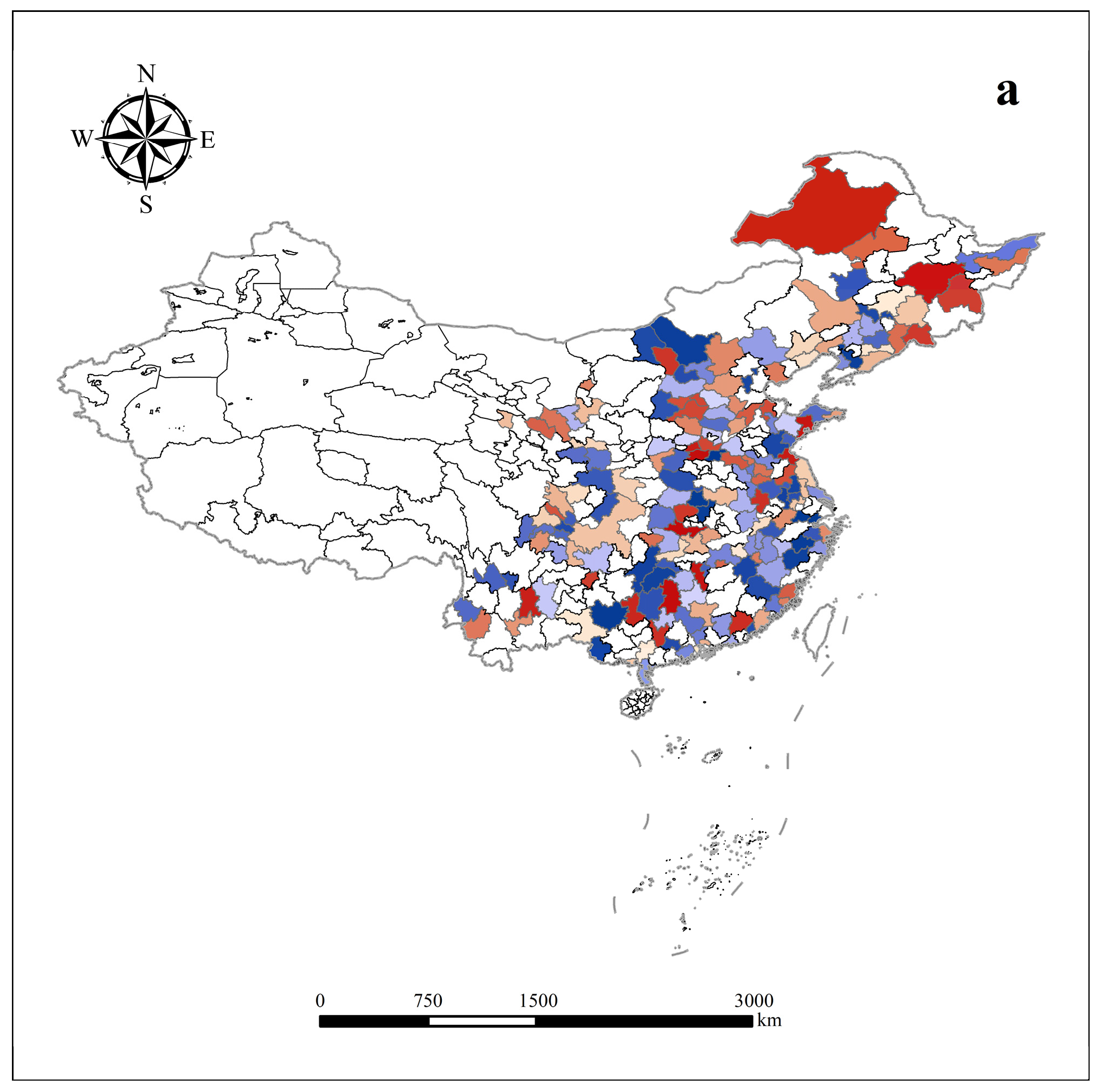
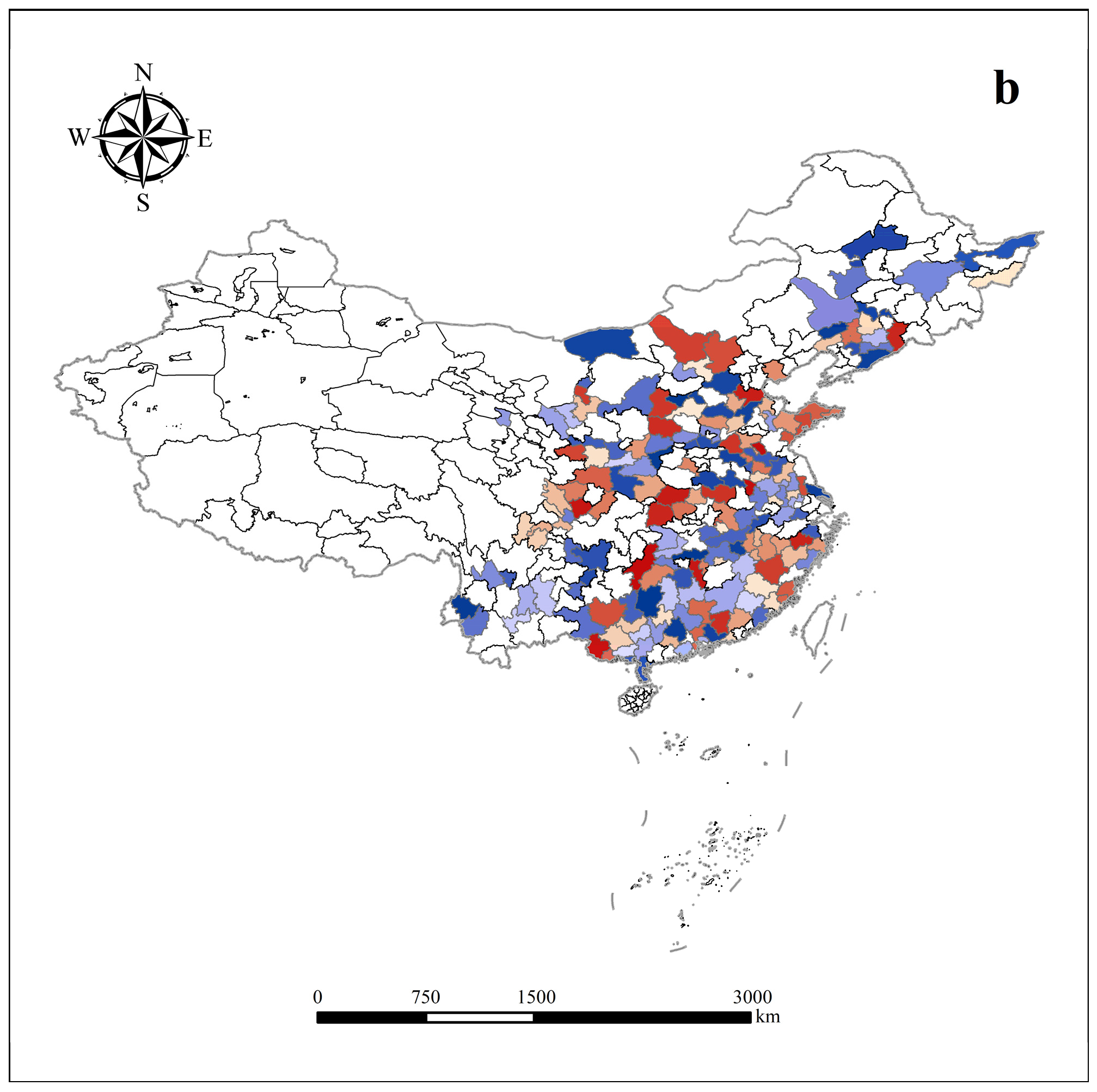
Figure 1 depicts the transfer learning results for the carbon abatement effect. For 284 Chinese cities examined in this study, we obtained 184 learning results for command-and-control policies and 182 learning results for market-based policies. Comparing them, we see that command-and-control policies can continue to be effective for carbon abatement in 97 cities, with a mean coefficient of −0.0535; similarly, market-based policies can continue to be effective in 95 cities, with a mean coefficient of −0.0637. In other words, according to our estimation, China’s command-and-control and market-based policies will cease to be effective for carbon abatement in nearly 47.3% and 47.8% cities, respectively. These findings raise serious concerns about whether current carbon regulation policies in China can be sustained.
Figure 1.
Results of carbon abatement effect transfer learning for (a) command-and-control policies and (b) market-based policies in China. Blue shading indicates regions where low-carbon policies continue to deliver sustained emission reductions, while red shading marks regions where such policies cease to be effective. Increasing color intensity corresponds to stronger effects.
Figure 1.
Results of carbon abatement effect transfer learning for (a) command-and-control policies and (b) market-based policies in China. Blue shading indicates regions where low-carbon policies continue to deliver sustained emission reductions, while red shading marks regions where such policies cease to be effective. Increasing color intensity corresponds to stronger effects.
5. Discussion
Collectively, our quantitative empirical findings provide strong validation for the phenomenon of “regulation without transformation”. While the amassed evidence confirms that China’s low-carbon policies have successfully enforced “regulation” to significantly curb its CO2 emissions, the underlying mechanisms point to a critical lack of “transformation”. This study’s decomposition analysis shows that this abatement was driven almost entirely by scale effects (i.e., contraction of industrial output and enterprise numbers), rather than the intended technique effects (i.e., green innovation and TFP growth) or composition effects (i.e., structural upgrading). This surprising dominance of output suppression over technological and structural progress implies that national policy pressure has, in effect, operated as a constraint on economic activity, as opposed to a catalyst for the country’s green transition. This overarching dependence on contraction rather than transformation raises critical questions about the sustainability, efficiency, and equity of China’s decarbonization pathway in the 21st century. The marked discrepancy between our findings and prior policy-oriented studies can be explained, at least partly, by the latter’s inherent sample selection bias, especially when considering the outcomes of market-based policies. Studies reporting significant technique effects of market-based instruments in China have mostly focused on its carbon emission trading scheme pilot cities; these cities are economically advanced and institutionally mature with well-developed innovation ecosystems, best exemplified by Beijing, Shanghai, and Shenzhen. These cities enjoy both a higher absorptive capacity and greater access to complementary resources, enabling firms to readily undergo technological upgrading in response to carbon price signals. In contrast, our dataset covers 284 prefecture-level cities harboring substantial heterogeneity in their economic structure, institutional capacity, and market development, which provides a more accurate and representative estimate of the average national effect of China’s low-carbon policies.
As our regression results show (
Table 7), the observed carbon emission reductions in our studied sample of cities are driven mainly by declines in the number and economic output of large-scale industrial enterprises, with no concomitant gains in green invention patents, carbon TFP (total factor productivity), or clean energy uptake (see
Table 5 and
Table 6). This pattern deviates sharply from an optimistic reading of the Porter hypothesis, in which regulation is believed to spur compensating innovation, aligning instead with the regulation-induced contraction literature. The latter finds that, under tight regulatory regimes, the measured TFP tends to drop, with plants induced to shut down or scale back their activities, rather than productivity-enhancing innovation being triggered [
54]. Work by Walker [
55] has revealed that the Clean Air Act Amendments of the US (implemented in 1990) led to quantifiable declines in polluting firms’ TFP, as well as substantial costs in terms of output and employment. More recently, Huo et al. [
12] found that the loss in GDP associated with China’s pilot low-carbon city policy is around 1.19 trillion RMB, which closely agrees with our observed shrinkage of industrial scale across China during the study period.
From the above mechanism, two corollary implications. First, carbon abatement attained by scale compression is inherently fragile: if fewer emissions are principally a by-product of lower production rather than structural or technological changes, then aggregate emissions remain vulnerable to reversal when either demand recovers or stimulus policies revive industrial activity. Second, that contraction-driven abatement also generates distinct social and economic costs (e.g., job losses, slower productivity growth) without creating a notable domestic comparative advantage in low-carbon technologies, which inevitably weakens the sustainability of environmental policies [
56]. This view of ours is supported by several salient facts: Between 2005 and 2020, China’s carbon emission intensity plunged by 48.4%, surpassing its pledged target of a 40% to 45% reduction by 2020. Yet, according to the
Statistical Communiqué on National Economic and Social Development, from 2020 to 2024, carbon emission intensity fell by just 1%, 3.8%, 0.8%, 0%, and 3.4%, respectively, corresponding to an average annual decline of only 1.6%. Hence, the cumulative reduction over this 5-year period was below 10%, well short of the 18% reduction anticipated for 2020 to 2025. These data clearly indicate that a much slower pace of emission reductions is unfolding in China. Pressured by the national “dual control” assessment on energy consumption and intensity, Chinese provinces started rationing electricity and curtailing production through various measures. This had pronounced negative impacts in manufacturing-intensive provinces like Zhejiang, Jiangsu, and Guangdong, where certain energy-intensive enterprises were either abruptly shut down or forced to cut output drastically. However, in response to the COVID-19 pandemic, stimulus measures were introduced that favored energy-intensive industries, which emboldened high-energy-consuming enterprises to instead accelerate production, driving up both their energy consumption and carbon emissions. Moreover, while the national ETS launched in 2021 is arguably a major milestone, it lacks adaptive features (e.g., price floors, auctioning) required to drive genuine technique effects. Without strong price signals to incentivize R&D, firms are likely to continue viewing compliance as just another cost to manage via output adjustments instead of a signal for technological transformation.
Why the contrasting low-carbon policy types failed in China also varies to some extent. Command-and-control policies are linked to diminished green patenting activity and a lower carbon TFP (
Table 5). The underlying reason is not simply the new binding rules themselves but rather how they interact with the enforcement domain as well as firms’ incentives. The regulatory economics literature suggests that prescriptive, narrowly specified standards limit the choice sets available to firms and increase their short-run compliance costs; since these latter are financed out of cash flow, firms will rationally postpone or underinvest in long-horizon R&D and large capital projects [
57]. In the Chinese context studied here (2007–2017), this pathway mechanism was amplified by three institutional features: First, due to local fiscal and promotion incentives, short-term GDP and employment stabilization became the paramount objective of many subnational governments; hence, strict national standards often translated into selective enforcement or rapid but administratively convenient responses (e.g., capacity cuts, temporary shutdowns) instead of incentivized innovation [
58]. Second, modest fossil fuel support in that period (e.g., coal subsidies and other assistance for producers) weakened any private returns to investments in fuel switching or electrification, rendering expensive low-carbon capital projects a less attractive option. Third, capital and credit constraints for many industrial firms meant taking on mandatory retrofits with high upfront costs, these being financially harder to absorb than output adjustments or shutdowns. Taken together, these contextual factors adequately explain why command-and-control policies elicited compliance via contraction in China rather than the Porter effect (i.e., stimulus for innovation).
By contrast, market-based instruments are characterized by a mixed profile in our results. There is a weak positive association with industrial upgrading, yet little if any consistent effect on innovation measures, along with a significant negative relationship to clean energy transition that was unexpected (
Table 6). According to other research, market instruments induce technological change only when they deliver credible, sustained price signals and when carbon revenues or complementary policy measures channel resources directly into innovation and infrastructure [
59,
60]. In practice, early market-based policies that relied heavily on free allocation, were marked by low and volatile allowance prices, or failed to recycle revenue into clean-tech funds, generally yielded limited innovation benefits [
1]. The international experience is instructive here: After the EU emissions trading system increased its auctioning and combined allowance revenues with dedicated innovation and modernization funds, there emerged measurable upward effects on low-carbon patenting and investment [
61]. Similarly, California’s cap-and-trade market for greenhouse gases explicitly ties auction revenue to renewables, energy efficiency, and community projects, forming what is believed to be a crucial component of its recognized structural impacts [
3]. In stark contrast to these international precedents, the observed negative association of China’s market-based policies with its clean energy transition can be attributed to a systemic “double signal failure”. First, a “signal generation failure” has occurred within the carbon market itself. As remarked in other studies, China’s pilot projects issued generous free allowances but lacked deep secondary markets [
62,
63]. This structural flaw muted the carbon price signal, rendering it too weak and volatile to be properly factored into long-horizon project appraisals for renewable energy investments. Second, a “signal transmission blockage” severed the link between carbon pricing and the energy power sector. These policies were not tightly integrated with energy-sector reforms concerning market liberalization and electricity tariffs [
64,
65]. In consequence, even when regulated firms incurred carbon costs, rigid electricity pricing prevented these costs from being transmitted downstream to create a comparative advantage for clean power. This culmination of internal pricing weakness, coupled with external transmission blockage, meant the carbon market imposed compliance costs without offering the corresponding revenue incentives for renewables. This likely led to signal failure, stalling the sought-after transition.
We do, however, acknowledge that measuring “transformation” requires the careful selection of proxies. Our key finding that policies faltered in spawning technique and composition effects remains robust when considering alternative indicators. While some studies have used patent applications or utility models as proxies, we deliberately focused on green invention patents granted. In the Chinese context, patent application counts are often inflated by strategic filing behaviors seeking government subsidies in lieu of genuine R&D breakthroughs. By adhering to the stricter standard of “granted inventions”, we could filter out this “subsidy-seeking noise” to confirm that the observed lack of innovation reflects a genuine stagnation of technological capabilities and is not a measurement artifact. Likewise, we utilized clean energy’s consumption rather than its installed capacity. Given the well-documented issue of renewable energy curtailment (i.e., idle wind and solar capacity) in China’s electricity grid, using installed capacity would overstate the success of the transition. Our consumption-based metric reliably captures the actual utilization of clean energy, reinforcing this study’s conclusion that market-based policies have yet to successfully close the loop between investment and actual decarbonization.
Our results also revealed a domestic analog to the pollution haven hypothesis for carbon emissions. Namely, we find that China’s provincial border areas—where environmental governance is fragmented and regulatory responsibilities often overlap—underwent widening inequality in CO
2 emissions (
Table 8) and the establishment of more high-carbon enterprises (
Table 10). Both trends suggest an intra-national carbon leakage dynamic exists, in which emission-intensive production migrates to those jurisdictions with weaker enforcement despite a unified national political system. Documented international experiences have already warned about such a phenomenon: in the EU emissions trading system, Ellerman et al. [
2] detected carbon leakage initially concentrated in cross-border industries that then shifted to countries not within the system; in California’s cap-and-trade program, Fowlie et al. [
66] found that it prompted electricity imports from neighboring states with more carbon-intensive generation mixes. Such research focused on the leakage between different countries or provinces, as in several studies done in China [
67,
68]. Building on that, our research extends this body of evidence by explicitly bringing to it a border-region perspective. We show that the leakage phenomenon is not limited to isolated sectoral shifts but can manifest as a broader spatial pattern: Geographically, border areas, especially those limited in fiscal capacity and enforcement resources, tend to lure high-carbon enterprises displaced from stricter central areas. This insight matters because border areas often lie at the nexus of multiple administrative systems, which can complicate the task of coordinated enforcement. In the context of China’s “dual carbon” targets and likely greater regulatory pressure in the coming years, we predict that border regions are at high risk of becoming future domestic pollution havens. Features of these areas, such as their permeable administrative boundaries, generally poor monitoring infrastructure, and outsized dependence on mobile industrial investment, are the very same that create favorable conditions for location-driven leakage.
In addition, our forward-looking transfer learning analysis indicates that, under their current configuration, low-carbon policies would lose their efficacy in about 47% of Chinese cities if current economic and structural conditions change as projected. To better understand this novel empirical finding, we explore aspects of cities where low-carbon policies would or would not reduce future carbon emissions. For command-and-control low-carbon policies, the cities where mitigation effects disappear are concentrated in heavy industrial centers in China’s north and northwest (e.g., Taiyuan, Harbin), accounting for 62% of effective cases in its Northeast region. Conversely, cities where such policies continue to be effective are concentrated in the more developed southern and eastern regions (e.g., Nanjing, Guangzhou), representing 60% of effective cases in East China. For market-based low-carbon policies, we find that the loss of policy effectiveness is most prevalent in manufacturing hubs in the east (e.g., Qingdao, Jinhua), constituting 55% of effective cases in East China; the country’s western and northeastern resource-dependent areas (e.g., Xining, Fushun) are home to 65% of effective cases in Northwest China. These heterogeneous outcomes underscore the influence of interacting geographic, economic, and industrial factors. In the coal- and steel-dependent heavy industrial cities of northern China, high compliance costs and rebound effects triggered by stringent mandates have imperiled command-and-control low-carbon policies to sustain long-term effectiveness there. In contrast, southern developed cities are benefiting from a stronger enforcement infrastructure and their service-oriented economies, cementing the sustained performance of such policies. For market-based policies, the maturity of China’s eastern markets may have facilitated carbon leakage and corresponding unwanted behaviors, thereby weakening their overall efficiency. In its less developed western regions, subsidies along with other incentives for firms have provided fresh stimulus for transformation, albeit from a low baseline scenario. Additionally, our transfer learning approach frequently failed to give predictions in data-scarce remote areas (e.g., Xinjiang, Gansu). Considering the lagging socioeconomic conditions in these regions, the actual national situation—the rate of cities where low-carbon policies can be continuously effective—is probably even worse than our present estimates would suggest. This divergence emphasizes the urgent need to reform and enhance China’s low-carbon policies.
Moreover, our results reinforce a central insight from the emerging literature on climate policy resilience and adaptive governance: that static regulatory frameworks are ill-suited to dynamic socioeconomic situations [
69]. Climate regulation operates in a realm riddled with much uncertainty. Macroeconomic conditions (e.g., industrial composition, energy demand profiles, investment) evolve rapidly, as do technological trajectories (e.g., cost curves for renewables, breakthroughs in storage or hydrogen), more often than not in nonlinear, unpredictable ways [
70]. Fixing regulatory architecture at its inception—in terms of carbon prices, allocation rules, technology standards, or sectoral coverage—may fit well with current conditions, yet is apt to gradually drift out of sync as those conditions inevitably change. For example, a carbon price deemed initially sufficient to shift investment decisions in coal-heavy cities may eventually be too low once those cities’ marginal abatement costs rise as “low-hanging fruit” plants are closed. Likewise, innovation subsidies designed for the technological frontier may fail to encourage the adoption of next-generation technologies (smart production, AI, robotics, drone delivery, etc.) if cost differentials widen too much. Therefore, flexible adaptation and adjustment mechanisms are pivotal for the long-term implementation of low-carbon policies. A case in point is the EU’s market stability reserve, introduced in 2019, which automatically adjusts the supply of the EU emissions trading system allowances based on the surplus volume in the market [
71]. The purpose of this embedded mechanism is to stabilize prices and maintain scarcity signals under conditions of fluctuating demand, thereby protecting the credibility of long-term investment signals. In the same vein, other adaptive carbon price floors, capable of being adjusted automatically for inflation, energy price volatility, and abatement cost indices, also exist in New Zealand’s emissions trading scheme [
72], which could extend the effective lifespan of climate regulations. Such forward-looking adaptive designs, however, have yet to be systematically incorporated into China’s framework of national low-carbon policies. Its current carbon pricing pilots and national emissions trading system still lack (in a systematic way) proven automatic adjustment triggers, such as price floors linked to inflation or GDP growth, or the dynamic tightening of carbon caps in response to slower rates of emissions. Similarly, technology support schemes (e.g., feed-in tariffs for clean energy) are usually reformed in abrupt, ad hoc ways, rather than via pre-committed adaptive pathways. The absence of institutionalized recalibration renders it more likely that policies will underperform when confronted with structural change. Until such mechanisms are duly included, China’s low-carbon policies, in their current form, risk delivering only transient gains in emission reductions while entrenching structural vulnerabilities, inevitably hindering the attainment of both carbon peaking and neutrality objectives.
Our finding that carbon abatement has relied, so far, on scale contraction rather than technological progress is not unique to China. It serves as a cautionary tale for other industrializing nations (e.g., India, Vietnam) facing the dual pressures of growth and decarbonization. Without mature financial markets to fund green R&D, stringent top-down mandates will likely force firms into the same “survival mode” condition uncovered in our study—cutting output to minimize immediate compliance costs instead of investing in long-term structural transformation. The identification of provincial border areas in China as “governance vacuums” offers timely, critical insights for federal or decentralized countries worldwide (e.g., the U.S., Brazil, and EU member states). Taken together, our results suggest that without harmonized cross-jurisdictional enforcement, the “pollution haven” effect will likely manifest domestically, undermining national climate targets through internal displacement. In addition, the evidence for command-and-control policies being negatively associated with innovation contributes to the global debate on the Porter hypothesis. This would suggest that, in developing contexts, where firms face capital constraints and soft budget constraints are absent, rigid regulation comes to act as a tax on production rather than a stimulus for innovation. This insight implies that for Global South nations, regulatory instruments must be coupled with explicit technology finance mechanisms to be effective.
6. Policy Implications
Collectively, our findings point to a core challenge in carbon regulation. During the recent study period, China’s low-carbon policies have achieved carbon abatement primarily via industrial-scale contraction; yet, its command-and-control policies were accompanied by a decline in green innovation, while market-based policies did not seem to catalyze its clean energy transition. To address these shortcomings, it is imperative to reconfigure the policy framework in several ways so that temporary emission reductions are converted into sustained, technology-driven decarbonization.
To begin with, command-and-control standards should be redesigned to accelerate, not impede, the upgrading of technology in China. This would entail pairing regulatory mandates with both targeted financing mechanisms and innovation subsidies to jointly lower the upfront capital costs of developing and adopting green technologies. By easing liquidity constraints and matching compliance obligations with investment horizons, firms can better respond to regulatory pressure through efficiency improvements and technology adoption rather than relying on production cuts alone.
Next, market-based instruments must shift decisively toward stronger price signals and revenue recycling strategies. Moving from free allocation to full or majority auctioning should generate stable public revenues, which can then be reinvested in low-carbon infrastructure, energy grid modernization, and fruitful R&D programs. When coupled with transparent, predictable rules to limit carbon price volatility, this will undoubtedly bolster the credibility of long-term investment signals and increase the likelihood that firms make truly transformative—rather than marginal—changes to their production processes. Furthermore, carbon pricing ought to be harmonized with energy-sector reforms. Without its sound integration into electricity market liberalization, tariff adjustments, and renewable grid access, the carbon price signal remains crude and muted. Reforming fossil fuel subsidies, improving dispatch rules for renewables, and ensuring that carbon costs are fully reflected in purchasing power and investment decisions are essential for closing the broken “signal loop” between carbon pricing and real-world decarbonization.
Importantly, intra-national carbon leakage must be tackled, ideally through institutional and enforcement innovations. We recommend establishing “cross-provincial joint enforcement units” for boundary regions. Instead of relying on fragmented local management, these units should operate under a unified command with shared authority to eliminate the “governance vacuums” where high-carbon firms can currently hide. Also, a “carbon archive and traceability system” should be implemented for industrial relocation. When enterprises move operations across jurisdictions, their historical emission records should remain tied to their original registration, as this would deter firms from evading regulation simply by relocating to looser jurisdictions. Finally, satellite-based monitoring technologies should be formally integrated into official surveillance activities to provide real-time, unbiased surveillance of border areas, given the difficulty in accessing or patrolling them frequently by ground teams.
Finally, policy adaptability must be embraced and embedded as a design principle. To preclude policy obsolescence, instead of blindly relying on discretionary reform, there should be a pre-commitment to adaptive mechanisms. First, as an alternative to fixed prices, China should design and implement a pricing mechanism that automatically indexes the carbon price floor to inflation rates and average abatement costs. This would ensure the price signal remains robust enough to drive innovation in spite of fluctuating economic conditions. Second, to counteract the innovation-stifling effect of command-and-control policies, subsidies should be linked to performance. Financial support ought to be automatically triggered when a city’s abatement relies excessively on output contraction as opposed to efficiency gains, thereby actively steering the region back toward a technology-driven transition pathway. Third, we advise shifting to rolling multi-year targets, which can be automatically adjusted according to regional GDP growth and industrial structure changes, to guarantee targets remain ambitious yet achievable without forcing coarse production shutdowns.
To conclude, China’s low-carbon transition calls for a coherent and adaptive spatially coordinated policy architecture. A well-calibrated combination of improved command instruments, credible market signals, integrated clean energy policy linkages, cross-border enforcement, and built-in adaptability can steer the basis of abatement from temporary contraction to sustained, innovation-led transformations. By proactively addressing carbon abatement mechanisms and emission fairness issues in tandem, we envision a future low-carbon framework for China that is capable of ensuring its relevant policies remain effective under both current conditions and a changing economic/technological landscape, bringing it closer to carbon peaking and neutrality.