1. Introduction
Countries that can develop new ideas, introduce innovations, and swiftly adopt technological progress have experienced significant growth. With the rise of the knowledge-based economy, R&D and innovation have become the main driving forces behind leading economies, emphasizing the importance of innovation for economic growth [
1]. R. Nelson, in an evolutionist economic framework, mentions that “in the long run, standards of living can be enhanced only by innovation” [
2]. At the national level, innovation is often defined as the capacity of a country to generate, diffuse, and apply new knowledge and technologies that improve economic performance, societal welfare, and competitiveness in global markets [
3]. Innovations are crucial not only for maintaining competitiveness and achieving sustainable growth, but also for addressing societal challenges such as climate change, digital transformation, or demographic shifts. In this sense, innovation can be perceived as the new “wealth of nations,” shaping economic prosperity and social well-being in the 21st century [
4].
Innovation is extremely important for economic development, but it is not evenly distributed. Innovation grows the fastest in countries with developed start-up ecosystems. The mere fact that cities are at the forefront of the start-up ecosystem ranking is a testament to the high prestige of the countries concerned. Start-ups provide a playground where bold and innovative ideas can flourish. This phenomenon is evident in corporations, for example [
5]. Large companies with multi-level structures need more time to implement disruptive changes. It is the time it takes to react to changes in the business environment that can have a key impact on a company’s performance and even its survival. These companies have the necessary resources and are aware of the priority of innovation, which is why they are interested in investing in start-ups, as evidenced by the fact that it is corporations that finance most innovations. This action is also justified by risk reduction, as the changes necessary for innovation bring uncertainty and the risk of failure. Investing in a start-up, which is a separate entity, makes it a convenient testing ground for experiments without exposing the main organization.
Innovation plays an essential role in the effectiveness and progression of start-ups, especially in vibrant markets like Poland. It is well known as a crucial driver of success in modern companies. Furthermore, in the context of start-ups, innovation is often defined as the process of transforming creative ideas into marketable products, services, or business models that generate value and enable firms to compete effectively in uncertain and dynamic environments [
6].
Start-ups use innovation as a way to differentiate themselves from the competition and capture market share [
7]. Not only is there a challenge for entrepreneurs to come up with innovative ideas but also to implement these ideas into reality using appropriate business models. Innovation alone is not enough for a start-up to succeed or even survive in the market. For this reason, its long-term strategy should combine the implementation of innovation at many levels, such as monetization, marketing, process implementation and management.
Innovation in start-ups does not emerge uniformly but is shaped by a complex interplay of conditions and contexts, making it essential to examine the determinants that influence their innovative capabilities [
8]. Understanding these determinants helps identify barriers and opportunities that shape innovative activities in different regions. Exploring them is crucial for designing effective policies and support instruments that foster entrepreneurial ecosystems. Ultimately, studying the factors driving start-up innovation can contribute to economic growth, competitiveness, and societal progress. Despite its value, the determinants of innovation in start-ups are still an inadequately explored area of research. They are considered as complex, involving both internal and external factors. Despite the growing body of empirical research on start-up innovation, three important gaps remain. First, most quantitative studies focus on mature innovation ecosystems in Western Europe, leaving transitional economies such as Poland underrepresented. Poland represents a particularly relevant empirical setting because it combines rapid start-up ecosystem growth with relatively low national innovation performance, classifying it as an Emerging Innovator within the EU. This institutional configuration allows for the examination of whether commonly identified innovation drivers operate differently outside mature ecosystems and whether nonlinear threshold effects become more pronounced in such contexts. Second, existing studies predominantly rely on linear or discrete-choice models, implicitly assuming uniform effects of innovation determinants across firms. Third, while ecosystem participation is widely discussed conceptually, few studies operationalize ecosystem engagement into measurable determinants and examine how its effects vary across levels of experience and network embeddedness. This study addresses these gaps by providing nonlinear, multivariate evidence on innovation determinants in Polish start-ups. The main purpose of the paper was to investigate the importance of both internal and external factors in driving innovation, with a particular emphasis on the role of the start-up ecosystem, financial resources, and collaboration. This study aims to acknowledge and investigate the key determinants of innovation within Polish start-ups through a multivariate regression analysis approach. This research seeks to address two strategic research questions:
(Q1) How do internal and external determinants of start-up innovation interact conceptually within emerging innovation ecosystems?
(Q2) Which internal and external factors contribute most significantly to a start-up’s innovation in the context of the Polish market?
This study focuses on identifying general patterns in innovation determinants across Polish start-ups, irrespective of sectoral specialization. The objective is not to estimate sector-specific innovation functions, but to uncover nonlinear relationships that hold across heterogeneous start-up environments. Accordingly, the analysis is conducted at an aggregate level, allowing for broader analytical generalization.
In order to answer the research questions, the authors constructed a multivariate regression model to examine which external and internal factors have an impact on the innovation of Polish start-ups. The determinants that were used in the model were obtained from the literature on the subject. The research approach integrates the results of previous studies with a new regression model, which was created based on data collected from 200 Polish companies in a self-report survey.
The article opens with an introduction to innovation in the start-up context, followed by a literature review that discusses start-ups, innovation ecosystems, and prior studies on determinants of innovation in start-ups and SMEs. It then details the research methodology and statistical modelling approach, presents results from both exploratory and multivariate analyses, and concludes with a discussion comparing the findings to the existing literature, highlighting unique insights into factors influencing innovation in Polish start-ups.
Beyond its contribution to entrepreneurship research, this study is relevant to sustainable development in its examination of how innovation drivers in start-ups can be supported efficiently over time. Understanding nonlinear innovation dynamics helps design policies and ecosystems that foster long-term economic resilience rather than short-term growth at the expense of sustainability.
2. Literature Review
Start-ups can be characterized as small companies with big ideas. They introduce disruptive solutions to the market that can completely revolutionize industries and economies. Historically, the term start-up meant a new company. During the period of rapid digitalisation, start-ups were seen as internet-related companies located in Silicon Valley. Nowadays, the term start-up refers to the initial phase of an innovative company’s existence.
Start-ups are special companies that are difficult to define. They differ significantly from traditional companies. It is helpful to distinguish a set of characteristics of a start-up in order to define them. Start-up companies are usually up to 5 years old [
9]. One of the most frequently cited definitions in the literature on the subject is that proposed by E. Ries. It describes a startup as an enterprise designed to create new products or services under conditions of high uncertainty [
10]. These companies seek to introduce disruptive products and business models, which significantly increases the risk of their activities. This is due to the fact that it is difficult to predict their future when there is no data on the company’s activities, and other established businesses on the market differ from new companies [
11]. What is more, start-ups do not refine their business model at the outset, but focus on its rapid scalability, which translates into profit [
12]. Finally, it is worth noting two features of start-ups that does not appear in every definition, which are innovations and the use of new technologies. Start-up products can be disruptive, changing long-established standards and revolutionizing the market, or they can be innovative imitations, improving on an existing product [
13]. The definitions reviewed above emphasize uncertainty, scalability, innovation orientation, and founder-driven decision-making. These characteristics directly inform the selection of variables used in the empirical model, particularly founders’ business experience, ecosystem partnerships, and access to institutional support. Innovation is thus treated not as a binary outcome but as a continuous capability shaped by both individual-level and ecosystem-level factors
When focusing on the immediate environment of start-ups, it is worth focusing on start-up ecosystems. From the point of view of start-ups, these are interactive networks of resources of institutions and stakeholders [
14]. Young companies particularly need such a network of connections in order to gain access to external financing, human resources, and knowledge. What is more, ecosystems facilitate experimentation and learning, which is particularly important when start-ups are under pressure to respond dynamically to market needs [
15]. However, too much focus on resources from entrepreneurial ecosystems can lead to inequalities and reduced opportunities for development outside of large cities where activities began, which in turn can lead to a slowdown in scalability in the long term [
16]. It can therefore be seen that startup ecosystems help reduce barriers to starting a business and support innovation. For this reason, innovation ecosystems can be a source of determinants that support innovation development in start-ups.
In this study, participation in the start-up ecosystem is operationalized through three observable indicators: (I) the number of partnerships within the ecosystem, capturing network embeddedness; (II) collaborations with universities or research institutions, reflecting knowledge-oriented ties; and (III) engagement with public support initiatives, representing institutional interaction. This operationalization allows ecosystem theories to be empirically tested within a regression framework.
2.1. Studies on Determinants of Innovation in Start-Ups and SMEs
The literature on start-ups is rich in publications attempting to predict the success of a given venture because of the applicability of this knowledge in practice. It has been proven that the innovativeness of start-ups can be linked to their success. This raises the question of what determinants affect the innovativeness of a start-up. The factors driving innovation start-ups are complex, involving a mix of internal and external influences that shape their capacity to innovate [
17]. These factors emerge from a diverse set of interrelated factors, such as access to financial resources, market opportunities, the skills and experience of founders, collaboration networks, and regional innovation ecosystems [
18]. However, start-ups do not exhibit uniform levels of innovation activity. Significant heterogeneity exists, stemming from sectoral characteristics, technological intensity, and differences in entrepreneurial ecosystems [
19]. Some start-ups emerge as highly innovative gazelles driving disruptive change, while others focus on incremental improvements or struggle with resource constraints limiting their innovation capacity [
20]. Recognizing this diversity is essential, as it highlights that innovation in start-ups cannot be explained by a single factor but rather results from the interplay of multiple, context-dependent determinants [
21].
In order to identify these factors, a literature review was conducted, looking for publications that used statistical models to examine individual determinants and their impact on company innovation. Macron et al. discovered that participating in an innovative ecosystem is more important for increasing business model innovativeness than technological innovativeness. Determinants highlighted by the authors include: speed of technological change, unpredictability of demand, market profitability, participation in the innovation ecosystem, technological innovation, and business model innovation. What is more, start-up ecosystems help to effectively manage external actors to utilize start-ups’ resources and address existing challenges such as external uncertainties, rapid technological changes, demand unpredictability, and market profitability. By strategically managing relationships and leveraging resources from the IE, start-ups align their IE structure with the necessary strategies to adapt to external conditions and enhance their innovation performance [
22]. Start-up ecosystem participation is particularly beneficial for start-ups operating in rapidly changing, less predictable, and low-profit markets. In such environments, start-ups with many partnerships within the ecosystem are better equipped to develop technological innovations by leveraging external resources and knowledge. This aligns with the resource-based view, which suggests that external collaborations can help start-ups overcome internal resource constraints and enhance their competitive advantage [
23].
A similar approach to the determinants of innovation is presented by Kus and Grego-Planer. The authors’ research is similar to the results of our study. Their chosen determinants of innovation are workforce mobility, populational level of education, work ethic, and pace of technological development [
24]. The results indicate that workforce mobility and strong work ethic reduce innovation in small enterprises, while higher education, technological development, positive management attitudes, and strong company reputation increase it. Results show that internal factors are as important as external factors.
Koch and Strotmann consider the following to be the main determinants of innovation in a company: the professional background and experience of the founder, collaboration and networking with external partners such as universities and customers, size and age, and industry characteristics [
25]. The analysis performed by the authors confirms that external networking is crucial for fostering innovation. Their findings strongly support the idea that access to knowledge and information is essential for Knowledge Intensive Business Service Firms’ innovative activities. In particular, collaborations with scientific institutions, universities, and other public entities significantly boost the likelihood of radical innovations. Interestingly, links with private sector partners such as suppliers and clients do not exhibit the same positive impact. Based on previous research, authors argued that developing new products demands either new competencies or novel combinations of existing skills. In early-stage, independent start-ups, the founder’s unique experiences, motivations, and networks shape the firm’s internal capabilities and drive strategic decisions and innovation. The results show that the access to knowledge through cooperation and networking is an important factor determining innovative activity in the Knowledge Intensive Business Service Firms sector, whereas, surprisingly, neither managerial characteristics nor spatial proximity has a general influence.
In contrast to the research conducted by Koch and Strotmann, publications have been found showing that the characteristics of a start-up’s owner can affect its innovativeness. In their 2021 study titled “Innovative Startup Creation: The Effect of Local Factors and Demographic Characteristics of Entrepreneurs,” authors Del Bosco, Mazzucchelli, Chierici, and Di Gregorio investigated the determinants of innovation in Italy, focusing on the relationship between local factors and the emergence of innovative start-ups. The study revealed a positive correlation between the birth rates of innovative start-ups and the educational level of the local population [
26]. The most important determinants of innovation recognized included the presence of certified incubators, the density of universities and research centres, and the overall education level of the region. These findings stress the importance of educational infrastructure and institutional support in adopting entrepreneurial innovation and highlight the role of localized knowledge ecosystems in leading startup formation.
Completely different results were shown by Jestrepo-Morales, Loaiza, and i. Vanegas. The authors noted that Colombian SMEs gain little from R&D alliances, relying instead on internal innovation focused on product development [
27]. Imitators achieve performance levels that almost match those of innovators. The different outcome of the study may be due to its location in Colombia, where the start-up ecosystem operates differently than in Europe.
2.2. Research Gaps and Study Positioning
Okrah and Nepp came to yet another conclusion by studying start-ups in Belgium. They took into account determinants of innovation such as funding, post-education, and openness of the internal market. According to their research, turnover has no impact on start-up innovation. Funding supports innovation. For a start-up to grow and innovate, financial support is crucial [
28]. Many start-ups fail and leave the market due to bankruptcy, often because insufficient financing prevents them from developing and launching innovative products or services. As a result, companies that are able to invest in research and development tend to be those that lead and dominate their markets in the long term [
29]. Essentially, financial resources are the cornerstone of any start-up’s success.
Escorcias’s et al.’s study in Colombia focused on owner traits, completely ignoring external determinants, especially those related to the effect in the start-up ecosystem. The focus on the personality of the entrepreneur is indicated by the determinants selected by the researchers [
30], such as social capital, person–entrepreneurship fit, entrepreneurial self-efficacy, and social and psychological variables. The study finds that person–entrepreneurship fit is the key factor influencing venture creation, with stronger alignment between personal needs and entrepreneurial activities increasing the likelihood of success. The mixed evidence from European and non-European contexts suggests that innovation determinants are highly sensitive to institutional maturity. Poland occupies an intermediate position between mature Western European ecosystems and emerging non-European systems, making it a theoretically informative case for examining whether nonlinear effects and diminishing returns emerge under partial ecosystem development.
Taken together, existing studies provide fragmented and often contradictory evidence on innovation determinants, rarely accounting for nonlinear dynamics or transitional institutional contexts. This study addresses this gap by jointly modelling internal and external determinants of innovation in Polish start-ups using a flexible nonlinear approach.
3. Materials and Methods
The collection of the data necessary for the study was done using a survey form. The survey questionnaire was divided into two sections. The first was a comprehensive survey questionnaire, consisting of 7 metric questions and 13 pertinent questions, of which 6 questions included a Likert scale. The survey topics included issues such as enterprise innovation, determinants of innovation, the role of innovation, etc. The
Section 2 of the survey questionnaire measured business innovation, which consisted of a survey form with 21 questions.
Analytical variables were constructed directly from specific survey questions. Participation in the start-up ecosystem was derived from questions asking respondents to report (I) the number of partnerships with ecosystem actors, (II) whether they collaborated with universities or research institutions, and (III) whether they participated in public support programs. Innovation-related constructs were based on multiple Likert-scale questions and aggregated by averaging the corresponding items, while numerical responses were used as count variables. This approach ensures transparency between the survey instrument and the regression variables.
The survey was conducted in the form of online, live meetings and a phone call. The average time to complete the form was about 30 min. Depending on the survey mode, either a supervised or unsupervised method was employed. Due to potentially sensitive data that could be disclosed during the survey, we decided to conduct an unnamed (anonymous) survey. Data for the study was collected from 10 January 2021 to 7 January 2022. The number of respondents was 200. The total population of start-ups is estimated at 4300 start-ups in Poland [
31]. According to the formula, the minimum sample size is 93, so the number of respondents is sufficient. Due to data availability constraints, the study relies on cross-sectional survey data capturing firms at different stages of development.
3.1. Research Group Characteristics
The research group consisted of 200 start-up companies that originated in Poland. Respondents for the survey were selected using Crunchbase, a modern source of information on start-ups [
32]. In order to participate in the study, it was necessary for them to represent a company that is considered a start-up according to the previously accepted definition.
For the purposes of this study, a start-up is assumed to be an organization in the early stages of development that operates under a high degree of uncertainty caused by the search for a business model, the testing of its own products or services and the identification of a target audience. It is focused on rapid growth and scalability. It is often an innovative enterprise [
33]. The research group was selected selectively rather than randomly [
34]. Respondents declared to have knowledge of the company’s goals and strategy, as well as innovations in the company.
3.2. Innovation Measurement
The literature on business innovation offers a wide range of indicators; however, there are few models to comprehensively assess this phenomenon. In addition, one of the challenges is the appropriate choice of a model for start-ups, since most of the available tools focus on small- and medium-sized firms, which differ from start-ups in their characteristics. Small- and medium-sized enterprises are not as focused on innovation as start-ups. For this reason, it is important that the chosen model for measuring innovation corresponds to the specifics of start-ups. A model by Motyka and Jarmula, presented in the publication “Measuring enterprise innovation using the MATLAB environment” [
35], was selected for the evaluation of innovation within the framework of this research. It follows the guidelines of the Oslo Manual, which ensures consistency with the data collection methodology for this study. The indicators proposed by Bielski and Kotler were used to construct the model [
36]. These indicators are used to assess innovation in general and include: number of innovations introduced, types of innovations introduced, number of innovations planned to be introduced, length of implementation and development work cycles, number of patent applications, amount of spending on research and development, and the value of sales of innovative products in relation to the number of employees. Based on these indicators, the model assigns a numerical value to each of them, and then sums up the results obtained. As a result, each company surveyed by the model received a numerical score for innovation on a scale of 0 to 10, where 1 means no innovation at all and 10 means a high level of creativity. Based on these partial variables, the model generates a synthetic innovation index that can take on numerically comparable values between companies. This index facilitates the classification of innovation levels.
Although the innovation index was originally designed for firm-level assessments, its use with self-reported survey data is justified by the close alignment between the index indicators and the Oslo Manual guidelines. Nevertheless, results should be interpreted as perceived innovation capability rather than objective innovation output. While the index relies on self-reported data, its composite nature reduces measurement error by aggregating across multiple indicators.
3.3. Data Analysis
Data analysis and modelling were conducted with R programming language on RStudio (version 2025.09.2). Generalized addictive models (GAM) were built with ‘mgcv’ package [
37]. Figures were generated with the ‘ggplot2’ [
38] package, and model diagnostics were performed with the ‘ggfortify’ [
28,
39] and ‘gratia’ packages [
40].
To facilitate downstream statistical modelling, the innovation score, as the response variable, was scaled to [0, 1] and denoted as . The innovation index was rescaled to the [0, 1] interval using min–max normalization. This transformation facilitates interpretation as a relative innovation intensity measure and enables the application of beta-distributed GAMs, which are appropriate for bounded continuous outcomes. The explanatory variables were years of experience in business (); number of partnerships within the start-up ecosystem (); number of owners (); number of grants, subsadiaries, etc. from the government (); average age of all owners (); collaborations with universities or other research units (); number of markets where the company operates (); number of joint ventures outside of the start-up ecosystem (); and number of initiatives to use non-financial support from the government ().
4. Regression Model
The analyzed sample consists of 200 Polish start-ups operating across multiple sectors, primarily in technology-intensive and knowledge-based industries. Most firms are in early or growth stages. Respondents represented micro and small enterprises predominantly, with limited medium and large companies. Legal forms varied, with the most common being limited liability companies and sole proprietorships. Firms reported mostly local or national market reach, with fewer international and global operations. Employees included team members, mid-level managers, and independent workers. Respondents were familiar with company strategy, innovation, and success metrics.
4.1. Exploratory Analysis
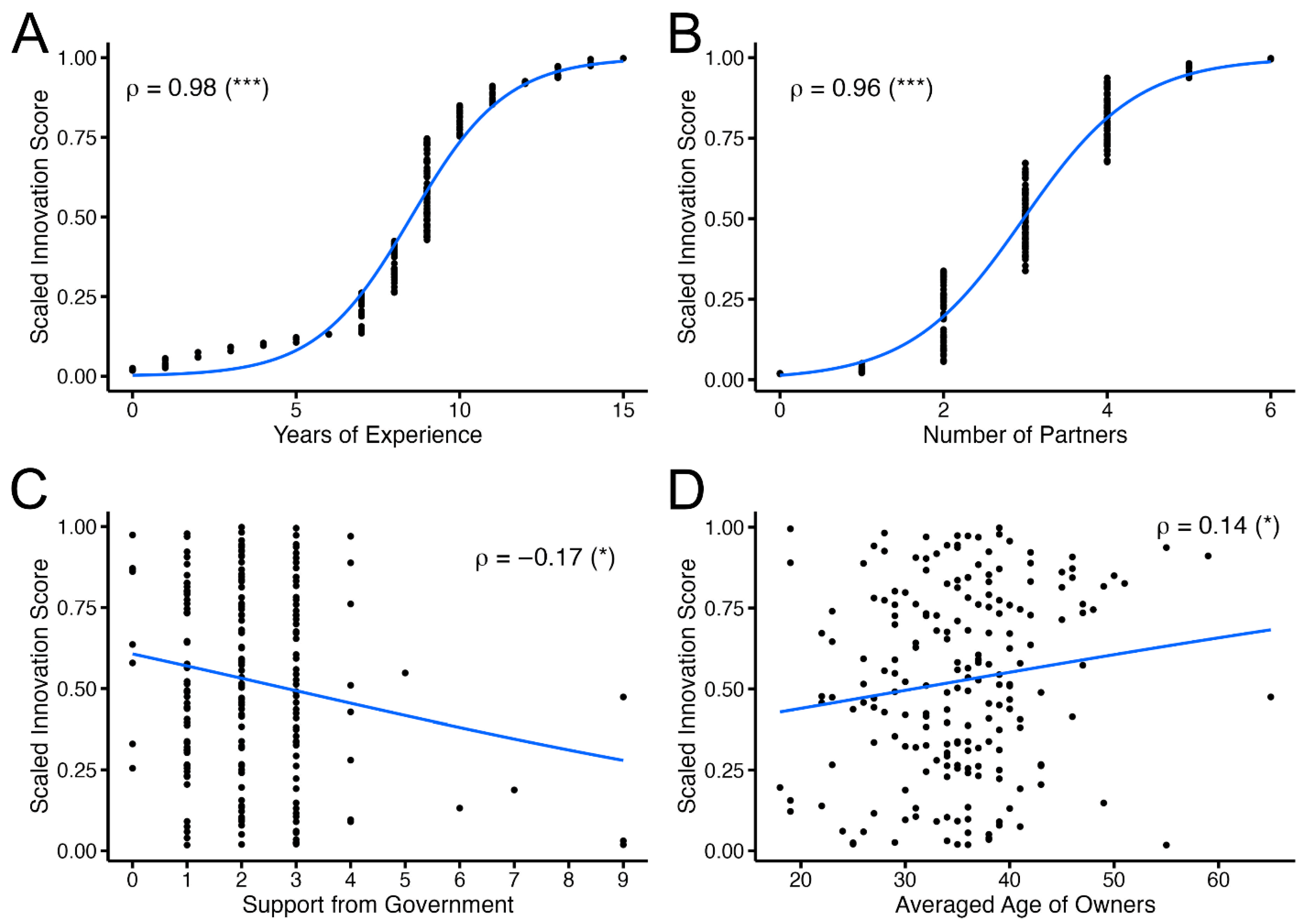
We begin with exploratory correlation analysis to identify potential relationships and assess whether linear assumptions are plausible. The analyzed sample consists of 200 Polish start-ups operating across multiple sectors, primarily in technology-intensive and knowledge-based industries. Most firms are in early or growth stages, with an average founder experience of 8,42 years and an average of 2 owners per firm. The majority operate in more than one market and report some level of engagement with the start-up ecosystem. We first calculated pairwise correlation between the scaled innovation score and the explanatory variables (
Figure 1). Innovation index was significantly correlated with years of experience in business (
) and number of partnerships within the start-up ecosystem (
) in a nonlinear fashion,
Figure 1A,B. On the other hand, innovation index was not correlated much with other factors, apart from number of grants and subsidies, etc., from the government (−0.17) and the average age of all owners (0.14). Unexpectedly, the innovation index was negatively correlated with the number of fundings and subsidies from the government (
). The observed nonlinear correlations suggest that innovation in start-ups does not increase proportionally with experience or ecosystem engagement.
The first 5 years of experience does not have much influence on innovation. At this stage, the start-ups accumulate experience, technology, train staffs and specialists, build infrastructure, and establish collaboration. From 6 to 12 years of experience, the innovation increases exponentially. At this stage, start-ups gain a lot of momentum to speed up innovation. The effect of innovation slows down and saturates after 12 years. At this stage, more years of experience do not translate to more innovation. After 12 years, start-ups with more experience do not show more innovation than younger ones. Years of experience are positively correlated with the number of partners, which reflects a plausible underlying mechanism: founders with greater professional experience tend to have more extensive networks, leading to a higher number of partnerships.
4.2. Multivariate Linear Model
Based on exploratory results, multivariate linear models were estimated as a benchmark before moving to nonlinear specifications. To avoid overfitting, simple multivariate linear regression models were fitted to the data, with the full and reduced models described as (1) and (2) respectively.
where
,
indicated the i
th row of dataset, and
was the index for explanatory variables, e.g.,
,
, etc.
Both the full and reduced model displayed high adjusted
values of 0.9 and 0.901, respectively. However, ANOVA showed that including all the explanatory variables did not improve the multivariate linear model (
p-value = 0.664). In both models, coefficients for years of experience, number of partners and averaged age of owners were significant, suggesting that those factors were likely the main drivers for innovation in Polish start-ups (
Table 1).
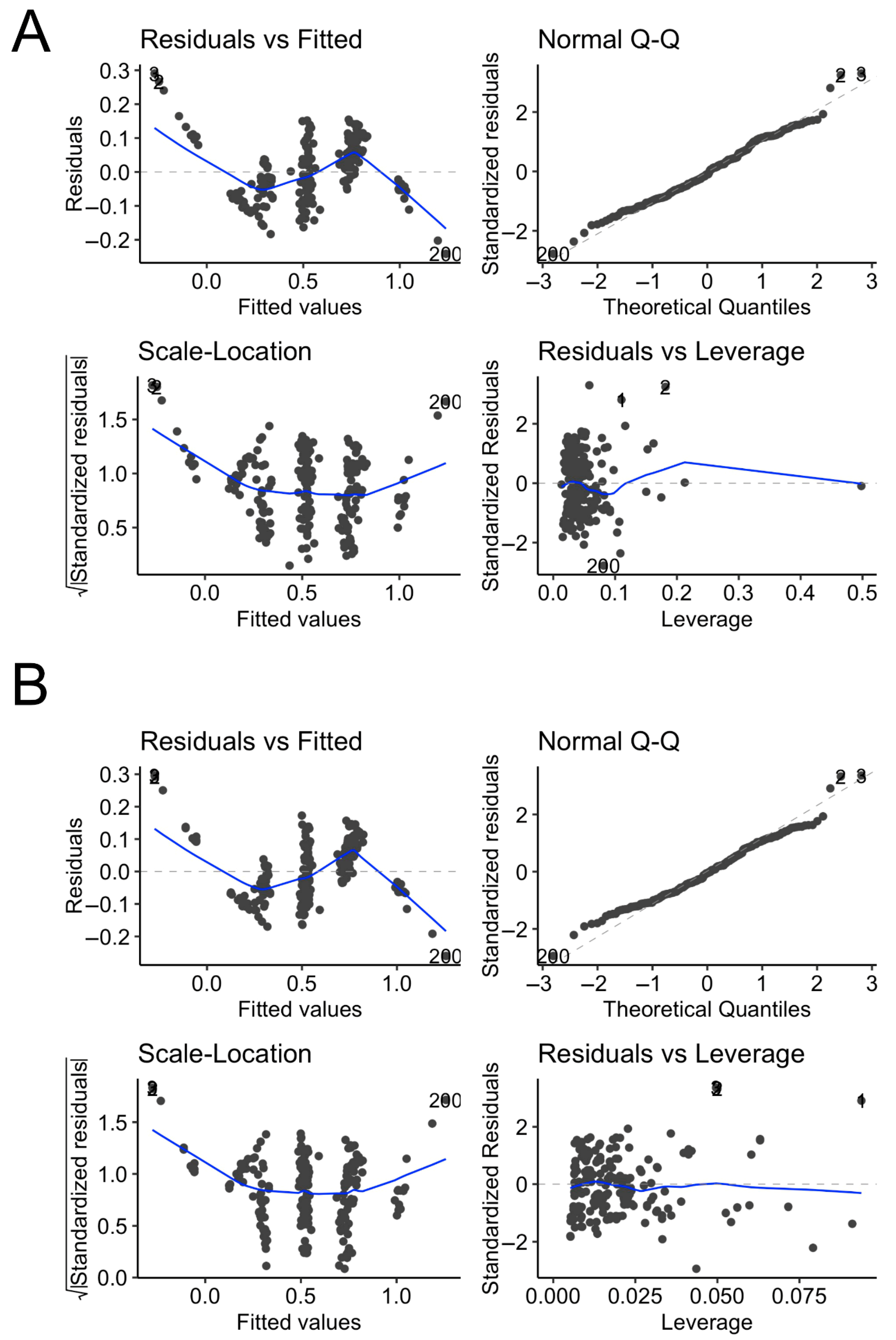
We then performed model diagnostics for both the full and reduced multivariate linear regression models (
Figure 2). Overall, neither model exhibited influential or outlier data points. However, the quantile–quantile (Q–Q) plots revealed a slight deviation of the residuals from a normal distribution. In addition, the residual plots showed nonmonotonic patterns, indicating a substantial violation of the linearity assumption. Similarly, the scale–location plots displayed nonlinear trends in the standardized residuals, suggesting a breach of the assumption of homoscedasticity.
These diagnostic results indicate that conventional linear regression models may be insufficient to capture the complexity of innovation processes in start-ups, where effects are unlikely to be linear across different levels of experience, networking intensity, or institutional support.
4.3. Generalized Additive Models
The violation of the linearity assumption in the multivariate linear regression models suggested a nonlinear relationship between the scaled innovation scores and the explanatory variables. To address this, we modelled the influences of explanatory variables on the innovation of Polish start-ups with GAMs, which provide enhanced flexibility by incorporating smooth functions and supporting a wide range of distributions from the exponential family.
To identify appropriate distribution, we fitted GAMs to the data with several candidate distributions from the exponential family, such as Gaussian, beta, and Tweedie. The candidates were nominated based on their appropriation to model non-negative real values of innovation scores. To compare the distribution fit, we computed Akaike’s Information Criterion (AIC), in which lower values indicate superior balance between goodness-of-fit and model complexity. The GAM with beta distribution displayed the lowest AIC of −757.759, compared to those of Gaussian (−646.683) and Tweedie (−672.536) distribution. Overall, the best fitted GAM with beta distribution was described as Equation (3).
where
was the smooth function for the j
th explanatory variable,
was logit link function, and thin plate regression spline was used as smooth function
The GAM gave a high deviance explanation of 98.7%. Note that to assess the goodness-of-fit, deviance explained in GAM is equivalent to adjusted R-square in linear regression. Amongst nine smooth terms, six were non-significant and three were significant (
Table 2). Of the three significant smooth terms, years of experience and number of partners possessed estimated degrees of freedom greater than two, while that for the number of grants and subsidies, etc., from the government was one.
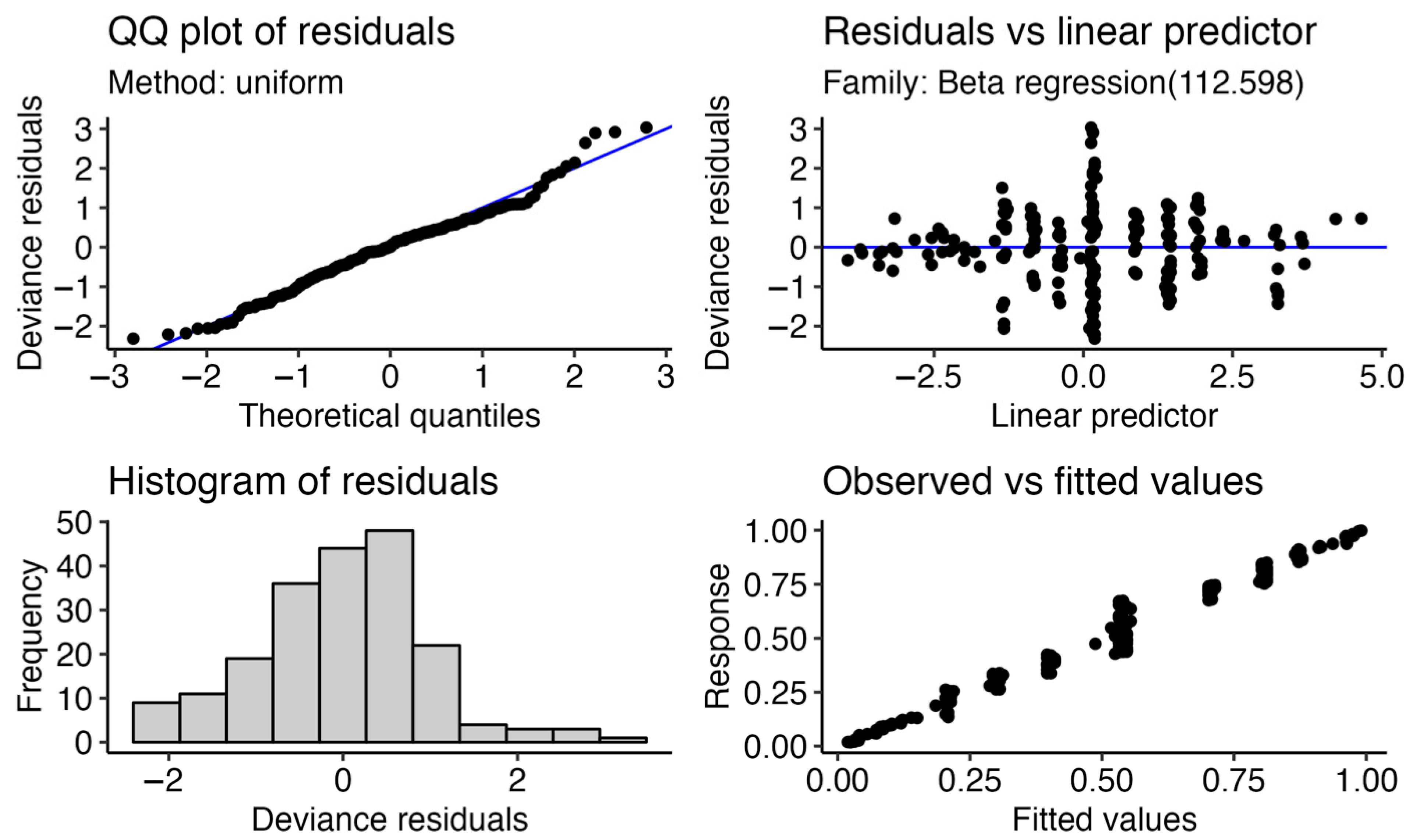
Next, we fitted a reduced beta-distributed GAM with the three significant explanatory variables. Years of experience and number of partners were included to the model as smooth terms, and number of grants, subsidies, etc., from the government was incorporated as a linear term (Equation (4)). Compared to the full model, the reduced model displayed a lower AIC of −760.972, suggesting superior balance between goodness-of-fit and model complexity. Model diagnostics showed a strong agreement between the fitted and observed values (
Figure 3, bottom-right). Although the histogram of deviance residuals was slightly right skewed (
Figure 3, bottom-left), the Q–Q plot was close to a straight line, indicating that the distributional assumption was upheld (
Figure 3, top-left). As expected, the deviance residuals showed a relatively wide spread within a range from −2 to 2 of the linear predictor, as more datapoints were distributed around these values (
Figure 3, top-right). However, with increased values of the linear predictor, deviance residuals substantially centralized around 0, which suggests a constant variance. In all, the reduced GAM fit well with the data, with the model assumptions reasonably holding, and thus would be used for downstream analysis.
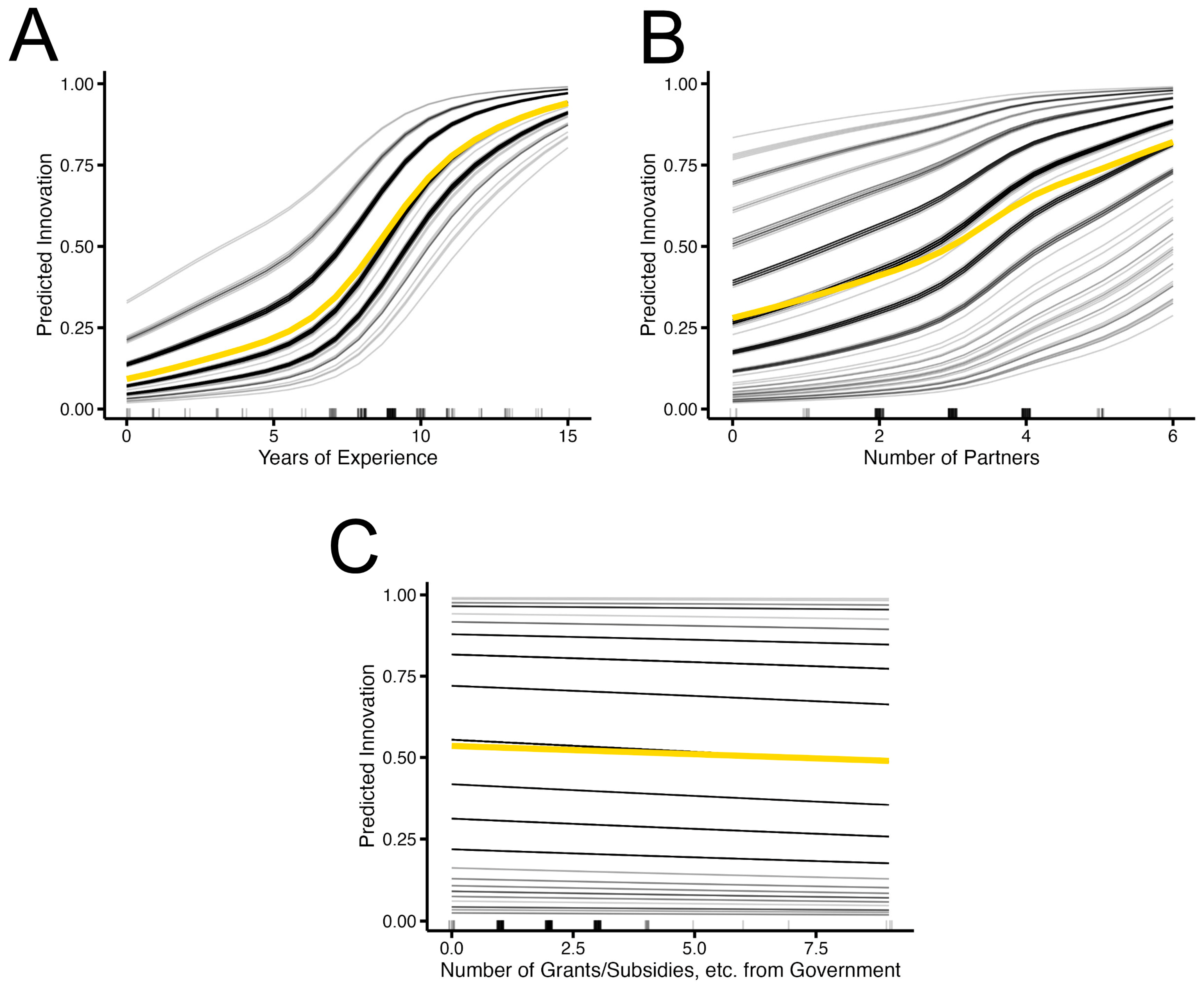
Having fitted the reduced model to predict the scaled innovation score (Equation (4)), we next examined how each explanatory variable influences innovation amongst Polish start-ups (
Figure 4). Briefly, for each datapoint, we calculated the Individual Conditional Expectation (ICE) showing how the GAM prediction changes in regard to the change in one explanatory variable. The Partial Dependence Plot (PDP) for one variable was calculated as an average of the ICE values. Consistent with the exploratory plots (
Figure 1A,B), both years of experience and number of partners exert a nonlinear effect: as each increases, the innovation score rises gradually, then accelerates, and finally decelerates toward a plateau, yielding a characteristic “logistic”-style curve. In contrast, the number of grants and subsidies, etc., from the government negatively correlated with the scaled innovation score in a linear fashion. With an increasing number of grants and subsidies, etc., from the government, the innovation score slightly decreased. Altogether, the GAM proposed three main factors driving innovation of Polish start-ups, of which two exerted positive nonlinear influence and one exerted a negative linear effect.
From a managerial perspective, these nonlinear patterns imply that both entrepreneurial experience and ecosystem partnerships are most critical in the early growth phases of start-ups. Once firms reach a certain level of maturity and network embeddedness, additional experience or partnerships contribute less to innovation outcomes, likely due to increasing coordination costs and organizational rigidity. The negative linear association between government grants and innovation suggests that public support mechanisms may introduce constraints that outweigh their financial benefits, particularly in early-stage ventures that rely on flexibility and rapid experimentation.
5. Discussion and Conclusions
This study contributes to the literature in three ways: first, by providing rare quantitative evidence from Poland; second, by demonstrating nonlinear and saturating effects of innovation determinants; and third, by empirically operationalizing ecosystem engagement within a flexible modelling framework. It provides new empirical insights into the determinants of innovation in Polish start-ups, enriching the existing literature on entrepreneurial innovation dynamics. By applying Generalized Additive Models, the analysis reveals not only which factors matter, but also how they influence innovation in a nonlinear and context-dependent manner. The findings underscore the multifaceted nature of innovation processes, shaped by both internal resources and external interactions, consistent with prior research highlighting innovation as a complex, systemic phenomenon [
22]. Ecosystem partnerships captured in this study include a broad range of actors, such as incubators, accelerators, universities, and corporate partners. While the data do not allow disentangling the isolated effects of incubators and accelerators, the nonlinear partnership effects observed likely reflect cumulative benefits from mentorship, funding access, and structured networking commonly provided by such programs.
5.1. Core Findings and Their Interpretation
The results identify three determinants of start-up innovation in Poland: founders’ business experience, the breadth of ecosystem partnerships, and access to government grants. These determinants exhibit the strongest average across observed ranges. Notably, founders’ experience and ecosystem partnerships exert nonlinear positive effects, while government funding displays a negative linear association with innovation outcomes. It means that early accumulation of business experience significantly enhances innovative capacity. At the same time, additional experience beyond a certain threshold yields progressively smaller gains. These results align with Koch and Strotmann [
25], who emphasize founder experience as crucial for leveraging knowledge and networks to foster innovative activities. However, our research adds nuance by demonstrating that the sheer number of partnerships within the start-up ecosystem correlates with higher innovativeness, suggesting that broad and diverse network engagement may serve as an important pathway for accessing resources and knowledge, especially in emerging economies.
Similarly, the number of ecosystem partnerships demonstrates a nonlinear relationship with innovation. Innovation increases rapidly as start-ups expand their network but plateaus once coordination costs and cognitive overload offset additional benefits. This result extends innovation ecosystem theory [
14,
22] by empirically showing that ecosystem embeddedness matters more in scale than in mere participation, particularly in emerging innovation systems. In addition, founders’ experience is positively correlated with the number of ecosystem partners, which is consistent with the notion that more experienced founders tend to possess broader and more developed professional networks.
As summarized in
Table 3, prior empirical studies on start-up and SME innovation predominantly rely on linear or discrete-choice models. They reported mixed evidence on the role of founder characteristics, ecosystem participation, and financial support. In contrast, our results demonstrate that these determinants exert nonlinear and context-dependent effects. We suggest that earlier findings may obscure important threshold dynamics. In particular, while ecosystem participation is widely recognized as beneficial, our analysis shows that its impact saturates beyond a certain level of network embeddedness. Earlier studies may not have detected nonlinearities because they focused on binary innovation outcomes, narrow firm age ranges, or mature ecosystems where saturation effects are less visible.
5.2. The Role of Government Support: A Contextual Explanation
One of the most distinctive findings of this study is the negative association between government grants and innovation. Contrary to evidence from mature ecosystems [
28], Polish start-ups receiving higher levels of public financial support tend to exhibit lower innovation scores. It also aligns with Poland’s low innovation score which places this country in the Emerging Innovators category. This may reflect bureaucratic constraints, misalignment between grant objectives and market-driven innovation. While mechanisms such as bureaucratic burden or crowding-out are plausible explanations, they are not directly tested in this study. Therefore, the negative association should be interpreted as correlational, warranting further investigation using policy-level or qualitative data. It is also a sign of a crowding-out effect whereby public funding substitutes for entrepreneurial experimentation rather than enabling it. This result underscores the importance of institutional quality and policy design. We suggest that financial support alone does not guarantee innovative outcomes and it should be more aligned with start-up needs. It is especially visible in transitional economies where administrative rigidity may slow adaptive learning processes.
These nonlinear effects may also reflect how entrepreneurs’ perceptions of technology evolve over time, shaping their willingness to adopt and strategically integrate digital tools. As highlighted by Noroño Sánchez [
42], perceived usefulness and sectoral context condition technology-driven innovation trajectories, which may explain why innovation accelerates during early learning phases and plateaus as technological routines stabilize.
5.3. Contributions to the Literature and Practical Implications
This study provides quantitative evidence from Poland, a national context that remains underrepresented in empirical research on start-up innovation. It enriches comparative perspectives on how innovation determinants operate outside well-established ecosystems. The saturation effect observed in our research can be mitigated. Companies with stronger learning capabilities can continue to extract value from expanding networks [
43]. Routines and learning investments enable organizations to process external knowledge more efficiently.
This study contributes to the sustainability literature by providing empirical evidence on how innovation in start-ups can be supported in a more efficient, balanced, and durable manner. Innovation is a key driver of sustainable economic development, as it enhances productivity, supports structural transformation, and enables firms to address societal challenges through new products, services, and business models. By identifying nonlinear relationships between innovation and its determinants, this research highlights that sustainability-oriented policies should account for diminishing returns and saturation effects rather than assume constant positive impacts. The findings have implications for sustainable development by informing the design of innovation policies and entrepreneurial ecosystems that support long-term, resource-efficient growth.
This is an important contribution to the literature on innovation, as Poland is a dynamically developing market for start-ups, despite the country’s low innovation output, which represents a significant research gap. This research advances methodological practice by demonstrating the value of nonlinear modelling approaches in entrepreneurship research. Traditional linear regressions risk oversimplifying complex innovation dynamics, whereas GAMs capture threshold effects and saturation points that better reflect real-world entrepreneurial processes. The findings conceptually integrate individual-level characteristics and ecosystem-level interactions, showing that innovation emerges from their joint nonlinear influence rather than from isolated factors.
From a policy perspective, the findings indicate that innovation support instruments should extend beyond direct financial transfers. The results of our research suggest that innovation policy should prioritize ecosystem connectivity and founder capability development. Initiatives that facilitate meaningful partnerships with universities, research institutions, and peer firms may yield higher innovation returns than traditional grant schemes. For participants and the start-up ecosystem environment, this is a sign that it is important to support the quality of the network of connections, which will enable appropriate relationships for start-ups, thereby reducing costs and providing access to the resources of this network. Entrepreneurs, on the other hand, should focus on gaining experience internally or externally and on developing a network of relevant connections, which, according to our study, is the key factor in the development of innovation in Polish start-ups.
Altogether, the results demonstrate both convergence with, and extension of, the existing body of research. The study contributes empirically by providing quantitative evidence from Poland, a national context still underrepresented in global innovation research, and conceptually by integrating entrepreneurial characteristics with ecosystem participation as co-determinants of start-up innovation. These insights offer practical implications for policymakers and ecosystem developers seeking to support start-up innovation through targeted initiatives focused on network-building and entrepreneurial capability development.
5.4. Limitations and Future Research
While this study offers new insights into the determinants of innovation in Polish start-ups, several limitations should be acknowledged. First, the data for this research was collected during a challenging period for Polish businesses, marked by the war in Ukraine and the post-COVID-19 recovery, which may have influenced the results. Finally, reliance on self-reported data may introduce bias due to subjective perceptions or social desirability effects. However, the study does not aim to estimate the causal impact of macroeconomic or geopolitical shocks. Such effects would require dedicated macro-level indicators and time-series or quasi-experimental designs. Although the findings are context-specific, the identified nonlinear patterns are likely analytically generalizable to other emerging or transitional innovation ecosystems.
A purposive sampling strategy was adopted due to the absence of a comprehensive public registry of Polish start-ups and the high heterogeneity of the population. Crunchbase provides one of the most comprehensive and systematically curated databases of start-ups, making it suitable for identifying active ventures operating under conditions of innovation and growth. This approach is commonly used in entrepreneurship research when probability sampling is infeasible.
The analysis does not differentiate between sectors such as technology, healthcare, or manufacturing. While sectoral contexts may shape specific innovation drivers, the present study prioritizes identifying common nonlinear mechanisms applicable across sectors. Future research could extend this framework by estimating sector-specific GAMs to examine how innovation determinants differ between industries with distinct regulatory, technological, and market characteristics.
Future research could benefit from a deeper investigation into the qualitative nature of ecosystem partnerships, distinguishing, for instance, between collaborations with research institutions, corporations, or peer start-ups, as such analyses might yield more nuanced insights into how various types of networks shape innovation outcomes. The cross-sectional nature of the data limits causal inference and prevents direct observation of how innovation determinants evolve over time. Longitudinal panel studies tracking cohorts of start-ups over extended periods would allow future research to analyze dynamic learning effects, changing ecosystem roles, and maturation processes. Future studies could disaggregate ecosystem actors to isolate the specific contribution of incubators and accelerators to innovation outcomes. Additionally, integrating psychological constructs such as entrepreneurial resilience, risk tolerance, and opportunity recognition into statistical models could provide a richer understanding of how individual characteristics interact with external environments to drive innovation performance. Future studies could disaggregate ecosystem actors to isolate the specific contribution of incubators and accelerators to innovation outcomes.