Empowerment and Poverty Reduction: Land Certification, Factor Allocation, and Multidimensional Relative Poverty


Abstract
1. Introduction
2. Literature Review and Research Hypotheses
2.1. Literature Review
2.1.1. Multidimensional Relative Poverty: Measurement and Influencing Factors
2.1.2. Background of China’s Land System Reform
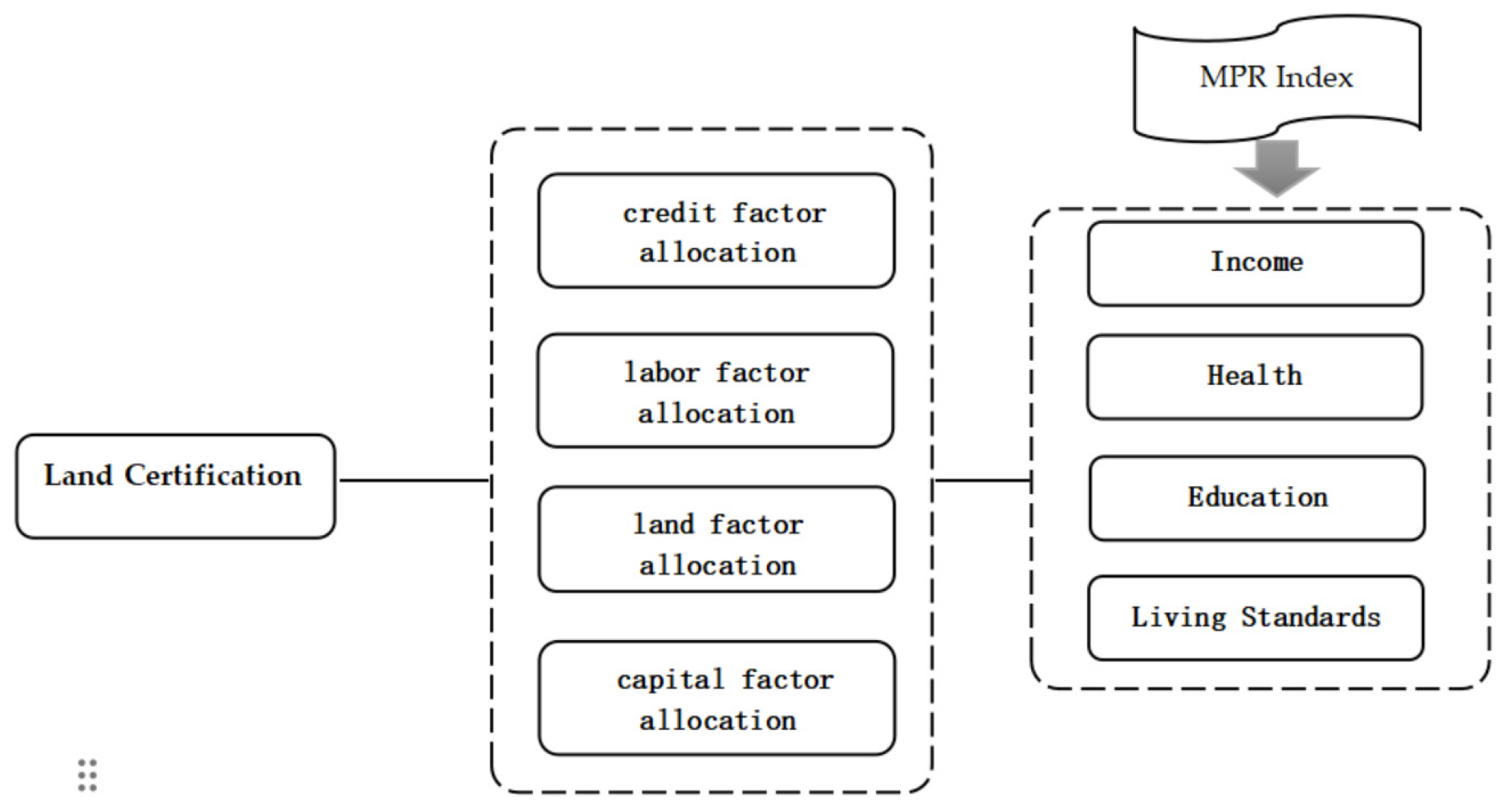
2.2. Land Certification, Credit Factor Allocation and MRP
3. Data Sources, Variable Selection, and Model Specification
3.1. Data Sources
3.2. Variable Selection
3.2.1. Multidimensional Relative Poverty Index
3.2.2. Land Certification
3.2.3. Mediating Variables
3.2.4. Control Variables
3.3. Model Specification
4. Empirical Test Results and Analysis
4.1. Benchmark Regression
4.2. Mechanism Validation
5. Discussion
6. Conclusions and Policy Recommendations
6.1. Conclusions
6.2. Policy Recommendations
Author Contributions
Funding
Institutional Review Board Statement
Informed Consent Statement
Data Availability Statement
Conflicts of Interest
References
- Liu, N.; Wang, G. Targeted Poverty Alleviation in China: The Policy Perspective of the Communist Party of China. Sci. Soc. 2024, 88, 250–271. [Google Scholar] [CrossRef]
- Alkire, S.; Santos, M.E. A Multidimensional Approach: Poverty Measurement & Beyond. Soc. Indic. Res. 2013, 112, 239–257. [Google Scholar] [CrossRef]
- Wang, X. On the Relationship Between Income Poverty and Multidimensional Poverty in China. In Multidimensional Poverty Measurement: Theory and Methodology; Springer: Singapore, 2022; pp. 85–106. [Google Scholar] [CrossRef]
- Li, Y.; Wu, W.; Wang, Y. Global poverty dynamics and resilience building for sustainable poverty reduction. J. Geogr. Sci. 2021, 31, 1159–1170. [Google Scholar] [CrossRef]
- Yan, X.; Zheng, B.; Qi, X.; Lin, J. Early Warning of Vulnerability to Re-Poverty in China: Integrating Regional and Household Perspectives. Appl. Spat. Anal. Policy 2024, 17, 1237–1271. [Google Scholar] [CrossRef]
- van Egmond, M.C.; Berges, A.N.; Omarshah, T.; Benton, J. The Role of Intrinsic Motivation and the Satisfaction of Basic Psychological Needs Under Conditions of Severe Resource Scarcity. Psychol. Sci. 2017, 28, 822–828. [Google Scholar] [CrossRef]
- Li, G.; Cai, Z.; Liu, J.; Liu, X.; Su, S.; Huang, X.; Li, B. Multidimensional Poverty in Rural China: Indicators, Spatiotemporal Patterns and Applications. Soc. Indic. Res. 2019, 144, 1099–1134. [Google Scholar] [CrossRef]
- Barbier, E.B.; Hochard, J.P. Land degradation and poverty. Nat. Sustain. 2018, 1, 623–631. [Google Scholar] [CrossRef]
- Weng, Y.; Wang, S. Perception of land rights, village industrial development, and household entrepreneurial behavior—Evidence from non-farm entrepreneurship in rural China. Front. Sustain. Food Syst. 2025, 8, 1509213. [Google Scholar] [CrossRef]
- Tesfaye, B.; Lengoiboni, M.; Zevenbergen, J.; Simane, B. Rethinking the Impact of Land Certification on Tenure Security, Land Disputes, Land Management, and Agricultural Production: Insights from South Wello, Ethiopia. Land 2023, 12, 1713. [Google Scholar] [CrossRef]
- Vu, H.T.; Goto, D. Does awareness about land tenure security (LTS) increase investments in agriculture? Evidence from rural households in Vietnam. Land Use Policy 2020, 97, 104721. [Google Scholar] [CrossRef]
- Deininger, K.; Jin, S.; Xia, F.; Huang, J. Moving Off the Farm: Land Institutions to Facilitate Structural Transformation and Agricultural Productivity Growth in China. World Dev. 2014, 59, 505–520. [Google Scholar] [CrossRef]
- Tian, C.; Luo, Y.; Teng, Y. Land certification, tenure security and off-farm employment: Evidence from China. Land Use Policy 2024, 147, 107328. [Google Scholar] [CrossRef]
- Zhang, H.; Ren, G.; Feng, S. Institutional credibility and land investment: Evidence from new-round land certification program in China. Nat. Resour. Forum 2025, 49, 2225–2247. [Google Scholar] [CrossRef]
- Xu, H.; Zhao, Y.; Tan, R.; Yin, H. Does the policy of rural land rights confirmation promote the transfer of farmland in China? Acta Oecon. 2017, 67, 643–672. [Google Scholar] [CrossRef]
- Luo, B. 40-year reform of farmland institution in China: Target, effort and the future. China Agric. Econ. Rev. 2018, 10, 16–35. [Google Scholar] [CrossRef]
- Sen, A. Poverty: An Ordinal Approach to Measurement. Econom. J. Econom. Soc. 1976, 44, 219–231. [Google Scholar] [CrossRef]
- Alkire, S.; Roche, J.M.; Seth, S.; Sumner, A. Identifying the Poorest People and Groups: Strategies Using the Global Multidimensional Poverty Index. J. Int. Dev. 2015, 27, 362–387. [Google Scholar] [CrossRef]
- Alkire, S.; Foster, J. Counting and multidimensional poverty measurement. J. Public Econ. 2011, 95, 476–487. [Google Scholar] [CrossRef]
- Palomäki, L.-M.; Riekhoff, A.-J.; Kuitto, K. What it means to be poor: Dimensions of economic hardship among older people living in poverty across Europe. Ageing Soc. 2025, 45, 947–968. [Google Scholar] [CrossRef]
- Lekobane, K.R. Does it matter which poverty measure we use to identify those left behind? Investigating poverty mismatch and overlap for Botswana. J. Soc. Econ. Dev. 2022, 24, 171–196. [Google Scholar] [CrossRef]
- Huluka, A.T. How is the multidimensional poverty changing in Ethiopia? An empirical examination using demographic and health survey data. Cogent Econ. Financ. 2024, 12, 2364359. [Google Scholar] [CrossRef]
- Guo, J.; Qu, S.; Zhu, T. Estimating China’s relative and multidimensional Poverty: Evidence from micro-level data of 6145 rural households. World Dev. Perspect. 2022, 26, 100402. [Google Scholar] [CrossRef]
- Pham, A.T.Q.; Mukhopadhaya, P. Multidimensionl Poverty and The Role of Social Capital in Poverty Alleviation Among Ethnic Groups in Rural Vietnam: A Multilevel Analysis. Soc. Indic. Res. 2022, 159, 281–317. [Google Scholar] [CrossRef] [PubMed]
- Islam, M.S.; Alam, K. Does social capital reduce poverty? A cross-sectional study of rural household in Bangladesh. Int. J. Soc. Econ. 2018, 45, 1515–1532. [Google Scholar] [CrossRef]
- Li, C.; Jiao, Y.; Sun, T.; Liu, A. Alleviating multi-dimensional poverty through land transfer: Evidence from poverty-stricken villages in China. China Econ. Rev. 2021, 69, 101670. [Google Scholar] [CrossRef]
- Qin, M.; Lin, W.; Li, J.; Yu, Z.; Wachenheim, C. Impact of land registration and certification on land rental by Chinese farmers. Land Use Policy 2020, 99, 104875. [Google Scholar] [CrossRef]
- Xu, Q.; Zhang, X.; Liu, J.; Yang, Q. The New Round of Land Certification Improves Total Factor Productivity of Grain: An Analysis Based on the Data of National Rural Fixed Observation Sites. China Econ. Q. 2025, 25, 877–891. (In Chinese) [Google Scholar]
- Liu, Y.; Wang, M.; Qian, Z.; Hou, B.; Chen, X.; Lei, Q.; He, L.; Zhao, L. Effect of Farmland Transfer on Poverty Reduction under Different Targeted Poverty Alleviation Patterns Based on PSM-DID Model in Karst Area of China. Math. Probl. Eng. 2022, 2022, 9143080. [Google Scholar] [CrossRef]
- Dong, Z.; Chen, Z.; Chen, J.; Shen, G. Unlocking Rural Entrepreneurship Through Rural Land Mortgage: Evidence From an Institutional Reform in China. Econ. Transit. Institutional Change 2026, 34, 137–160. [Google Scholar] [CrossRef]
- Fang, D.; Guo, Y. Induced Agricultural Production Organizations under the Transition of Rural Land Market: Evidence from China. Agriculture 2021, 11, 881. [Google Scholar] [CrossRef]
- Witzany, J. Credit Risk Management. In Credit Risk Management: Pricing, Measurement, and Modeling; Springer International Publishing: Berlin/Heidelberg, Germany, 2017; pp. 5–18. [Google Scholar] [CrossRef]
- Ayamga, M.; Yeboah, R.W.N.; Dzanku, F.M. Determinants of Farmland Tenure Security in Ghana. Ghana J. Sci. 2015, 2, 1–21. [Google Scholar]
- He, X.; Liu, W. Analysis of spatial patterns and influencing factors of farmland transfer in China based on ESDA-GeoDetector. Sci. Rep. 2024, 14, 12485. [Google Scholar] [CrossRef] [PubMed]
- Navarro-Castañeda, S.; Arranz, J.M.; Burguillo, M.; Robertis, E.C.D. Land tenure security and agrarian investments in the Peruvian Highlands. Land Use Policy 2021, 109, 105651. [Google Scholar] [CrossRef]
- Boubacar, I.; Nene, G. Land to the landless: Does the type of approach matter? Land Use Policy 2024, 141, 107135. [Google Scholar] [CrossRef]
- Lawry, S.; Samii, C.; Hall, R.; Leopold, A.; Hornby, D.; Mtero, F. The Impact of Land Property Rights Interventions on Investment and Agricultural Productivity in Developing Countries: A Systematic Review. Campbell Syst. Rev. 2014, 10, 1–104. [Google Scholar] [CrossRef]
- Dippel, C.; Ferrara, A.; Heblich, S. Causal mediation analysis in instrumental-variables regressions. Stata J. 2020, 20, 613–626. [Google Scholar] [CrossRef]
- Wen, H.; Lee, C.-C. Impact of fiscal decentralization on firm environmental performance: Evidence from a county-level fiscal reform in China. Environ. Sci. Pollut. Res. 2020, 27, 36147–36159. [Google Scholar] [CrossRef]
- Shittu, A.M.; Kehinde, M.O.; Ogunnaike, M.G.; Oyawole, F.P. Effects of Land Tenure and Property Rights on Farm Households’ Willingness to Accept Incentives to Invest in Measures to Combat Land Degradation in Nigeria. Agric. Resour. Econ. Rev. 2018, 47, 357–387. [Google Scholar] [CrossRef]
- Deininger, K.; Ali, D.A.; Alemu, T. Impacts of Land Certification on Tenure Security, Investment, and Land Market Participation: Evidence from Ethiopia. Land Econ. 2011, 87, 312–334. [Google Scholar] [CrossRef]
- Deininger, K.; Jin, S. Tenure security and land-related investment: Evidence from Ethiopia. Eur. Econ. Rev. 2006, 50, 1245–1277. [Google Scholar] [CrossRef]
- Séogo, W.; Zahonogo, P. Do land property rights matter for stimulating agricultural productivity? Empirical evidence from Burkina Faso. Land Use Policy 2023, 125, 106475. [Google Scholar] [CrossRef]
- Holden, S.T.; Otsuka, K. The Roles of Land Tenure Reforms and Land Markets in the Context of Population Growth and Land Use Intensification in Africa. Food Policy 2014, 48, 88–97. [Google Scholar] [CrossRef]


| Deprivation Domain | Deprivation Indicator | Deprivation Threshold |
|---|---|---|
| Income (0.25) | Per capita household income (0.25) | Deprivation exists if per capita net household income is below 2300 yuan (2010 prices) |
| Health (0.25) | Self-reported health (0.125) | Deprivation exists if self-reported health status is “relatively unhealthy” or “very unhealthy”; no deprivation if status is “very healthy”, “relatively healthy”, or “fair”. |
| Health Insurance (0.125) | Deprivation exists if the household head has no health insurance. | |
| Education (0.25) | Education Level (0.25) | Deprivation exists if the average highest education level of household members is below primary school. |
| Living Standards (0.25) | Drinking Water (0.083) | Deprivation exists if the household’s drinking water source is “river water, well water, rainwater, or spring water”; no deprivation if the source is “tap water, mineral water, or purified water”. |
| Sewage Disposal (0.083) | Deprivation exists if the toilet type is “non-flush public toilet outdoors or other”; no deprivation if the toilet is “flush toilet”. | |
| Housing (0.084) | Deprivation exists if the housing structure is “cave dwelling, mud-brick houses, or other”; no deprivation if the structure is “brick-concrete structures or reinforced concrete structures”. |
| Variable Type | Variable Name | Variable Explanation | Mean | Std. |
|---|---|---|---|---|
| Dependent variable | Multidimensional relative poverty (MRP) | Multidimensional relative poverty index | 0.24 | 0.19 |
| Independent variables | Whether holding a rural land contractual management right certificate (certification) | 1 = Yes; 0 = No | 0.70 | 0.46 |
| Mediating variable | Agricultural productive credit accessibility (loan) | Has the household obtained formal financial institution loans for agricultural production and operation? 1 = Yes; 0 = No | 0.23 | 0.42 |
| Land transfer-in area (landtrans) | Mu | 0.09 | 0.29 | |
| proportion of household members engaged purely in agricultural activities (laborate) | % | 0.20 | 0.30 | |
| Agricultural inputs (captureinput) | yuan | 216.89 | 238.96 | |
| Control variables | Age | years | 53.06 | 15.28 |
| Gender | 0 = female; 1 = male | 1.55 | 0.50 | |
| Education level (education) | 1 = primary school and below; 2 = junior high school; 3 = high school/vocational school/technical school; 4 = associate degree; 5 = bachelor’s degree and above | 1.76 | 0.94 | |
| Weather participated in agricultural technical training (training) | 1 = yes; 0 = no | 0.19 | 0.39 | |
| Number of household labor force members (laburnum) | persons | 5.57 | 2.31 | |
| Weather received agricultural subsidies (agrisubsidy) | 1 = Yes; 0 = No | 0.50 | 0.50 | |
| Distance from the village to the county town (towndistance) | km | 7.55 | 9.87 | |
| Level of agricultural mechanization in the village (mechanization) | 1 = low; 2 = medium; 3 = high | 1.99 | 0.59 |
| Variables | (1) | (2) |
|---|---|---|
| certification | −0.193 *** | −0.109 *** |
| (0.015) | (0.013) | |
| gender | 0.002 | |
| (0.012) | ||
| age | 0.001 * | |
| (0.0004) | ||
| education | −0.100 *** | |
| (0.007) | ||
| training | −0.030 ** | |
| (0.014) | ||
| laburnum | −0.004 * | |
| (0.002) | ||
| agrisubsidy | 0.009 | |
| (0.011) | ||
| towndistance | 0.002 *** | |
| (0.001) | ||
| mechanization | −0.038 *** | |
| (0.010) | ||
| constant | 0.371 *** | 0.485 *** |
| (0.012) | (0.039) | |
| Identification deficiency test | - | 860.536 *** |
| Weak instrumental variable test | - | 13,613.801 |
| Hausman test | - | 57.481 ** |
| Variables | (1) Loan | (2) Laborate | (3) Landtrans | (4) Captureinput |
|---|---|---|---|---|
| certification | 0.0001 ** | 0.012 * | 0.937 *** | 0.108 *** |
| (0.037) | (0.026) | (2.890) | (0.085) | |
| gender | 0.033 | −0.003 | 0.082 | −0.041 |
| (0.035) | (0.025) | (4.610) | (0.067) | |
| age | −0.003 *** | 0.001 | −0.101 | −0.001 ** |
| (0.001) | (0.0008) | (0.092) | (0.003) | |
| education | 0.064 *** | −0.015 | −3.747 ** | 0.024 *** |
| (0.023) | (0.015) | (1.808) | (0.049) | |
| training | 0.115 ** | 0.037 | 17.160 ** | 0.054 ** |
| (0.048) | (0.030) | (7.232) | (0.074) | |
| laburnum | −0.00154 | −0.0369 *** | 0.388 | −0.0121 |
| (0.00630) | (0.00733) | (0.601) | (0.0120) | |
| agrisubsidy | 0.00827 | 0.0435 * | 3.961 | 0.183 |
| (0.033) | (0.026) | (4.046) | (0.068) | |
| towndistance | −0.0006 | −0.002 * | −0.827 ** | −0.017 *** |
| (0.002) | (0.001) | (0.418) | (0.006) | |
| mechanization | 0.069 ** | −0.067 *** | 1.852 | 0.010*** |
| (0.031) | (0.020) | (1.876) | (0.051) | |
| constant | 0.0916 | 0.488 *** | 5.394 | 6.108 *** |
| (0.119) | (0.087) | (8.210) | (0.216) | |
| insufficient recognition test | 1340.468 *** | 263.712 *** | 1376.676 *** | 336.814 *** |
| weak instrumental variables test | 2020.026 | 410.937 | 2069.598 | 2014.817 |
| hausman test | 69.955 *** | 15.094 *** | 67.149 *** | 83.548 *** |
| Variables | Step 1 | Step 2 | Step 3 | ||||||
|---|---|---|---|---|---|---|---|---|---|
| MRP | Loan | Laborate | Landtrans | Captureinput | MRP | ||||
| certification | −0.109 *** | 0.0001 ** | 0.012 * | 0.937 *** | 0.108 *** | −0.110 *** | −0.195 *** | −0.111 | −0.113 *** |
| (0.013) | (0.037) | (0.026) | (2.890) | (0.085) | (0.015) | (0.022) | (0.015) | (0.015) | |
| loan | −0.012 | ||||||||
| (0.013) | |||||||||
| laborate | 0.0002 | ||||||||
| (0.0003) | |||||||||
| landtrans | 0.024 | ||||||||
| (0.019) | |||||||||
| captureinput | −0.00002 | ||||||||
| (0.000) | |||||||||
| control | Yes | Yes | Yes | Yes | Yes | Yes | Yes | Yes | Yes |
| constant | 0.485 *** | 0.092 | 0.488 *** | 5.394 | 6.108 *** | 0.486 *** | 0.483 *** | 0.467 *** | 0.491 *** |
| (0.039) | (0.119) | (0.087) | (8.210) | (0.216) | (0.039) | (0.063) | (0.039) | (0.042) | |
| insufficient recognition test | 860.536 *** | 1340.468 *** | 263.712 *** | 1376.676 *** | 336.814 *** | 20.756 *** | 29.180 * | 10.542 *** | 7.532 *** |
| weak instruments test | 13,613.801 | 2020.026 | 410.937 | 2069.598 | 2014.817 | 10.999 | 38.712 | 50.600 | 31.652 |
Disclaimer/Publisher’s Note: The statements, opinions and data contained in all publications are solely those of the individual author(s) and contributor(s) and not of MDPI and/or the editor(s). MDPI and/or the editor(s) disclaim responsibility for any injury to people or property resulting from any ideas, methods, instructions or products referred to in the content. |
© 2026 by the authors. Licensee MDPI, Basel, Switzerland. This article is an open access article distributed under the terms and conditions of the Creative Commons Attribution (CC BY) license.
Share and Cite
Ruan, R.; Wang, L. Empowerment and Poverty Reduction: Land Certification, Factor Allocation, and Multidimensional Relative Poverty. Sustainability 2026, 18, 1763. https://doi.org/10.3390/su18041763
Ruan R, Wang L. Empowerment and Poverty Reduction: Land Certification, Factor Allocation, and Multidimensional Relative Poverty. Sustainability. 2026; 18(4):1763. https://doi.org/10.3390/su18041763
Chicago/Turabian StyleRuan, Ruohui, and Lu Wang. 2026. "Empowerment and Poverty Reduction: Land Certification, Factor Allocation, and Multidimensional Relative Poverty" Sustainability 18, no. 4: 1763. https://doi.org/10.3390/su18041763
APA StyleRuan, R., & Wang, L. (2026). Empowerment and Poverty Reduction: Land Certification, Factor Allocation, and Multidimensional Relative Poverty. Sustainability, 18(4), 1763. https://doi.org/10.3390/su18041763