Article

Managing Poland’s Transition to Circular Economy: Regulatory Implementation and Governance Challenges in Plastic Packaging Sector

by
Agnieszka Czaplicka-Kotas
and
Joanna Kulczycka
*
Faculty of Management, AGH University of Krakow, Gramatyka 10, 30-067 Krakow, Poland
*
Author to whom correspondence should be addressed.
Sustainability 2026, 18(4), 1762; https://doi.org/10.3390/su18041762
Submission received: 22 December 2025 / Revised: 28 January 2026 / Accepted: 30 January 2026 / Published: 9 February 2026
(This article belongs to the Section Economic and Business Aspects of Sustainability)

Abstract

Plastic packaging represents a critical focus in the European Union’s transition to a circular economy owing to its resource-intensive production and substantial greenhouse gas emissions. This article examines Poland’s implementation of plastic packaging regulations within the evolving European Union regulatory framework, alongside complementary policy instruments. It employs legal-normative analysis of European Union and Polish legislation, documentary review of national strategic frameworks, and statistical assessment of packaging generation and recycling performance. Poland has introduced substantial legislative measures, including carrier-bag fees, charges on single-use plastic products, recycled-content mandates for polyethylene terephthalate bottles, and a deposit-return system launched in October 2025. Moreover, national voluntary agreements created by non-governmental organisations and industry stakeholders to improve collection and sorting have been active on the Polish market. Nevertheless, performance indicators reveal significant gaps between regulatory ambitions and operational outcomes. To diagnose these implementation gaps and prioritise the most critical interventions, the article applies a governance-oriented MoSCoW analysis. The article concludes that while the deposit-return system constitutes an essential intervention, achieving European Union circular economy objectives requires comprehensive policy integration encompassing upstream prevention, eco-design standards, extended producer responsibility mechanisms, and coherent strategic planning. An effective regulatory system, sound management practices, and improved information sharing among stakeholders are crucial for promoting eco-innovation and advancing circularity, reuse, and waste reduction.

1. Introduction

Plastic packaging constitutes a key priority in the transition towards a CE, owing to its resource-intensive production processes and significant greenhouse gas emissions. Global plastic production has increased more than 230-fold over recent decades, rising from approximately 2 million tonnes in 1950 to nearly 460 million tonnes in 2019 [1]. However, only about 9% of all plastic waste has been recycled, while roughly 19% has been incinerated, 50% disposed of in landfills, and the remaining 22% inadequately managed through open burning, uncontrolled dumping, or leakage into the environment [2]. If current trends persist, global plastic production is projected to double by 2030 and quadruple by 2050 [3]. Packaging represents the largest application area for plastics, accounting for approximately 44% of total plastic use [4]. The introduction of a wide range of policy instruments, including Extended Producer Responsibility (EPR) schemes, advanced sorting technologies, deposit return system (DRS), and eco-design measures aim to foster both upstream and downstream integration and support the development of closed-loop recycling systems. At the international level, the Intergovernmental Negotiating Committee on Plastic Pollution, convened under the United Nations Environment Programme, is working towards establishing a legally binding global instrument to address plastic pollution, with an emphasis on the reduction, reuse, and recycling of plastic packaging [5].
Within the European Union, a crucial milestone was the publication of “A European Strategy for Plastics in a Circular Economy” under the first EU Circular Economy Action Plan. This strategy outlines actions across the entire plastics value chain—from design and production to use and end-of-life management—and sets the target that by 2030, all plastic packaging placed on the EU market should be reusable or recyclable. Recent research increasingly analyses EU plastic legislation from a governance and policy effectiveness perspective, emphasising that plastic packaging constitutes one of the most problematic material streams due to its short life-cycles, technological limits of recycling and complex multi-actor governance structures [6,7,8,9,10,11]. Accordingly, several studies evaluate the effectiveness of key EU legislative instruments, notably the Single-Use Plastics Directive [12,13,14] and the Regulation on Packaging and Packaging Waste [15,16]. Di Foggia and Beccarello (2022) highlight that although Member States have formally aligned their national systems with EU targets, substantial differences persist in implementation models, financing mechanisms and monitoring indicators [17]. The literature identifies three fundamental tensions underlying these gaps: regulatory fragmentation that fails to account for life-cycle interlinkages [18], economic incentives misaligned with circular objectives [19], and administrative targets established without sufficient consideration of material-specific technical constraints [20].
In the Polish context, several studies explicitly examine the legal and institutional conditions shaping the circular transition of the plastic packaging sector. Krzywda [21] and Sidorczuk-Pietraszko et al. [22] conclude that Poland’s packaging system has historically relied on low-cost compliance mechanisms, with limited incentives for eco-design, reuse, or high-quality recycling. Baran [23,24] demonstrates that while recycling capacity has expanded rapidly, the overall system remains inefficient due to weak enforcement of Extended Producer Responsibility, dominance of energy recovery over material recycling, and low economic attractiveness of secondary polymers. Zarębski et al. [25] and Ziółko and Ziółkowska [26] argue that the introduction of the DRS constitutes a structural breakthrough, yet its effectiveness depends strongly on governance arrangements, cost allocation, retailer participation, and coordination between operators. Empirical evidence from Poland confirms that DRS is one of the most effective instruments for improving selective collection and recyclate quality. Piontek et al. [27] and Broniewicz et al. [28] show that deposit systems significantly outperform traditional municipal collection schemes, particularly for PET bottles, and are more cost-efficient in achieving recycled-content targets under the SUP Directive. However, these studies also emphasise that DRS alone cannot deliver a full circular transition, as it primarily addresses downstream collection while neglecting upstream prevention, design for recyclability, and market development for secondary materials.
The literature consistently identifies several legislative and institutional barriers limiting CE implementation in the plastic packaging sector. These include delays and inconsistencies in the transposition of EU legislation into national law, which generate regulatory uncertainty [29,30], weak fee modulation within EPR systems, which undermines economic incentives for eco-design [23,31], and insufficient integration between waste policy, industrial policy and innovation strategies, constraining the development of competitive secondary polymer markets [32,33].
Overall, the plastic packaging sector represents a critical area for the CE transition, as it concentrates the principal systemic challenges associated with circularity, namely high material throughput, strong consumer interface, technological limits of recycling and complex governance structures. While recent EU and Polish regulations have significantly strengthened the legal framework, existing research suggests that legislative compliance alone is insufficient. Achieving circularity requires a coherent policy mix that combines regulatory instruments (such as DRS and recycled-content mandates) with upstream eco-design requirements, reformed EPR systems, and long-term strategic coordination across the entire packaging value chain.
Despite extensive research on circular economy policies and plastic governance, existing studies remain largely fragmented, focusing either on EU-level regulatory design or on isolated national case studies. There is still a lack of integrated analyses that systematically compare EU legislative obligations with their concrete implementation at the national level, particularly in the context of plastic packaging systems. This article therefore reviews the principal obligations stemming from EU legislation and compares them with actions implemented in Poland from both a legislative and strategic perspective.

2. Materials and Methods

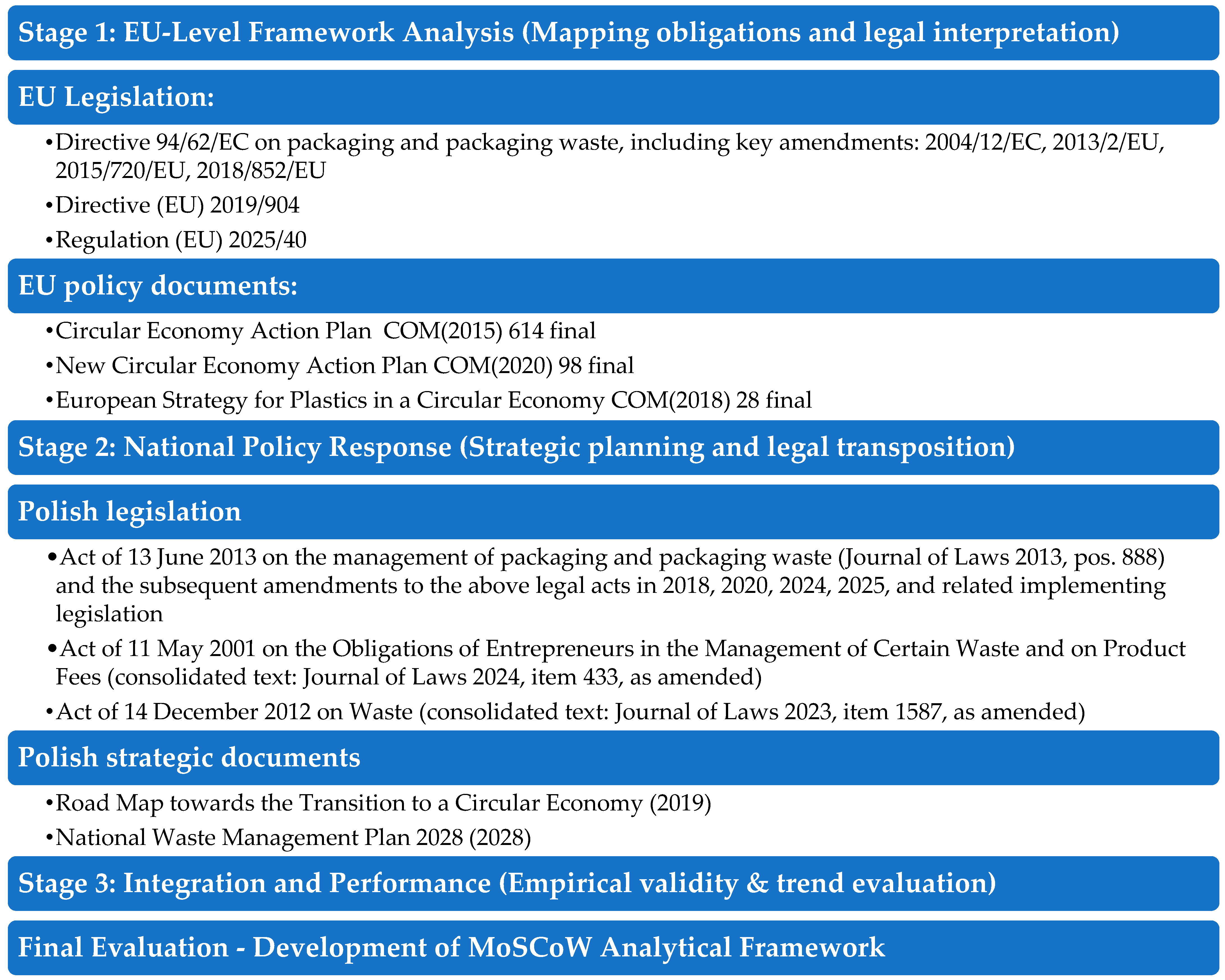
The research focused on reviewing the implementation of plastic packaging regulations in Poland. The study was structured to integrate an assessment of obligations arising from the EU legislative framework, an academic literature review examining CE approaches in the plastic packaging sector, and a critical analysis of legislative and non-legislative measures adopted at the national level in Poland. The objective of this structure was to allow for a systematic transition from analysing EU-level policy design to diagnosing domestic implementation outcomes, based on strategic policy documents, binding legal acts, and harmonised European statistical data (Figure 1).
The first stage involved mapping regulatory obligations and policy instruments embedded in the European CE framework. This phase applied formal legal-normative interpretation to identify binding requirements shaping the packaging policy continuum, including eco-design standards, recycled-content mandates, restrictions and bans on market placement of selected packaging formats, EPR duties, and reverse-logistics collection mechanisms. The analysis placed particular emphasis on EU strategic frameworks and legislative instruments that have defined targets and enforcement mechanisms for the sector, including the European Strategy for Plastics in a Circular Economy, the directly applicable Regulation (EU) 2025/40 [34] on packaging and packaging waste, and Directive (EU) 2019/904 [35] on single-use plastics.
The second stage shifted analytical focus toward Poland’s national policy response, examining both the strategic-planning dimension and the legal transposition process. This included a documentary content analysis of national strategic frameworks such as the Road Map towards the Transition to a Circular Economy and the National Waste Management Plan 2028, supported by forward-looking policy drafts including the National Climate and Energy Plan and the Medium-Term Development Strategy of the State until 2035. In parallel, the study analysed national legal acts forming the core of Poland’s packaging-waste governance, most notably the Act of 13 June 2013 on the Management of Packaging and Packaging Waste and the Act of 11 May 2001 on the obligations of entrepreneurs in the management of certain waste and on the product fee, together with subsequent legislative amendments and secondary ministerial regulations adopted under these statutes.
To ensure empirical validity and policy-performance comparability, the analysis integrated legal-normative compliance assessment, systematic academic literature synthesis, and statistical trend evaluation. Datasets from Eurostat were used to benchmark Poland’s progress against EU-27 recycling performance and selective PET bottle collection targets for 2025 and 2029. This methodological approach was intended to support a comprehensive assessment of national progress toward CE objectives, understood not only as alignment with EU regulatory ambitions, but also as measurable capacity to operationalise those ambitions through domestic infrastructure, governance systems, and market absorption of recycled polymers. The analytical framework was structured using the MoSCoW prioritisation method, which classifies requirements into four categories: “Must” (requirements that must be satisfied for the solution to be considered a success), “Should” (high-priority items that should be included if possible), “Could” (desirable but non-necessary requirements included if time and resources permit), and “Won’t” (requirements deferred to future implementation) [36].
This framework was used to systematically prioritise policy instruments and implementation mechanisms necessary for the effective deployment of the DRS and related regulatory measures. The study aimed to evaluate the regulatory system and the strategic alignment of policy implementation between EU-level frameworks and national planning, as well as to assess the outcomes of CE adoption in Poland’s plastic packaging sector.

3. Results

The first Directive on packaging and packaging waste was adopted by the European Union in 1994. It aimed to establish harmonised market measures for packaging management. The Directive set out the essential requirements in Annex II for EU Member States, which cover three main areas: the manufacturing and composition of packaging, the reusable nature of packaging, and the recoverable nature of packaging. The Directive had undergone several changes, where the crucial changes were related to:
  • packaging waste targets and definitions, sets minimum recycling targets (Amendment of 18 February 2004 (Directive 2004/12/EC))
  • packaging definition in the Annex 1 (Amendment of 28 February 2013 (Commission Directive 2013/2/EU))
  • reducing the consumption of lightweight plastic carrier bags (Amendment of 26 May 2015 (Directive 2015/720/EU))
  • raising recycling targets, legal obligations for EPR, promoting packaging reuse systems (Amendment of 4 July 2018 (Directive 2018/852/EU))
In line with the objectives of the Circular Economy Action Plan (CEAP) 2.0, Directive 94/62/EC on packaging and packaging waste is undergoing a transformation into a Regulation. This legislative transition is intended to eliminate divergent national interpretations that have arisen during the Directive’s implementation and to ensure a more rapid and harmonised application across all Member States. At present, the EU packaging sector is characterised by a lack of harmonisation, with producers and national systems frequently employing their own recyclability and reusability indicators [17,37]. The principal objective of this legislative reform, and of establishing a harmonised internal market, is to advance reuse and refill targets, enhance the recyclability of packaging, and simultaneously reduce both the consumption of packaging materials and the generation of waste. Moreover, the proposed Regulation aspires to ensure that, by 2030, all plastic packaging placed on the EU market will be either reusable or recyclable, thereby aligning with the broader goals of the CE and sustainable resource management.
Plastic packaging constitutes the central focus of the regulation, as it underpins resource- and emission-intensive processes throughout its life cycle. Within this life-cycle perspective, the regulation introduces and reinforces mandatory recycling criteria for packaging, establishes restrictions on certain plastic packaging formats, and maintains the DRS as a fundamental mechanism for improving collection and recycling performance. The key assumptions related to Regulation (EU) 2025/40 concern:
  • Recycled Content and Recyclability (Arts. 6–7)
    A minimum of 30% recycled content in PET bottles by 2030.
    At least 35% recycled content for other plastic packaging.
    A target of 65% recycled content in bottles by 2040.
  • Design and Packaging Minimisation (Arts. 10 and 24)
    Mandatory reductions in maximum packaging weight and volume from 2030 onward.
    A maximum empty space ratio of 50% for e-commerce and transport packaging.
    Harmonised standards are expected to be introduced by 2027.
  • Waste Prevention Targets (Art. 38)
    A 5% reduction per capita by 2030,
    A 10% reduction per capita by 2035, and
    A 15% reduction per capita by 2040, compared to the 2018 baseline.
  • DRS (Arts. 44 and 50)
    Mandatory PET bottle collection targets aligned with the Single-Use Plastics (SUP) Directive.
    Introduction of minimum operational requirements (Annex X).
    A strong focus on consumer convenience and take-back obligations.
  • Market Restrictions (Annex V)
    A ban on single-use grouped packaging.
    A ban on small packaging formats in the HORECA sector.
    A ban on plastic packaging for unprocessed fresh fruit and vegetables.
    A ban on very lightweight plastic carrier bags.
Additional measures aimed at reducing single-use plastic resulting from Regulation (EU) 2025/40 consumption focus on reuse and refill requirements (Articles 26–29, 32, and 33), particularly in the takeaway food and retail sectors. These include mandatory targets for reusable grouped packaging, new obligations for final distributors of beverages to offer reusable packaging, the establishment of formal reuse systems, requirements for providing refill stations, and the development of systems that allow customers to bring their own containers.
At present, plastic packaging is primarily addressed within the CE framework [38]. A key milestone under CEAP 1.0 was the development of the first European Strategy for Plastics in a Circular Economy, published in 2018. The document emphasises the importance of actions aimed at enhancing the durability, reuse, and high-quality recycling of packaging materials, as well as eliminating over-packaging and avoiding single-use plastics. Additionally, the crucial instrument as part of the CEAP 1.0 was as well Directive (EU) 2019/904 on single-use plastics, which aimed to reduce the impact of certain type of plastic packaging trough mandatory targets related to separate collection, requirements related to the labelling system and design, as well as the action related to raising consumer awareness.
The implementation of plastic-management policies is a key driver of the transition toward a more sustainable plastics system [39,40,41]. However, at the EU level, significant gaps remain—particularly the mismatch between recycling capacity and plastic consumption, which continues to drive plastic waste exports, as well as persistent shortages in reliable data on plastic-management flows [42]. The European Court of Auditors [43] also emphasised the risk that the EU may fail to meet its recycling-capacity targets if current efforts are not substantially increased. Achieving the key 2025 targets related to recycled-plastic content, bottle-recycling rates, and the separate collection of plastic packaging (Table 1) depends on the establishment of an effective and coherent policy framework. At present, most Member States face challenges in meeting these targets, particularly in the following areas:
In 2023, only four EU countries met the 50% plastic packaging recycling target (Belgium—54.2%, Germany—51.1%, Slovenia—50.9%, Slovakia—59.6%). Another eight Member States were close to the 50% benchmark (Czechia—47.2%, Estonia—44.3%, Spain—41.2%, Italy—46.6%, Latvia—47.3%, Lithuania—44.1%, the Netherlands—45.7%, Poland—46.3%). In 2023, the average plastic packaging recycling rate in the EU was 42.1% [44]. According to the EEA [45], 19 Member States are at risk of missing the 2025 target.
  • Recycled content in PET bottles.
In 2022, 13 EU countries had already achieved the 2025 target for recycled content in PET beverage bottles (Austria, Belgium, Denmark, Estonia, Finland, France, Ireland, Luxembourg, Germany, The Netherlands, Portugal, Slovenia, Sweden). For eight countries, the average recycled content was estimated at 15–25% (Spain, Czechia, Slovakia, Latvia, Lithuania, Croatia, Cyprus, Malta), while six countries remained below 15% (Hungary, Romania, Bulgaria, Greece, Italy) [46].
  • Selective collection of PET beverage bottles.

16 Member States have already implemented DRS and have reached—or are on track to reach—the 2025 and in some cases the 2029 collection targets [47].
Other countries plan to launch fully operational DRS from 2025 (Poland, Greece) or 2026 (Czechia, Portugal, Spain). In Belgium, France, Italy, and Luxembourg, final decisions on introducing a DRS have not yet been taken. In Slovenia, Cyprus, and Bulgaria, voluntary schemes exist; however, discussions on establishing mandatory DRSs for single-use plastic bottles and metal cans are still ongoing [48].
Table 1. The plastic packaging targets for EU Member States.
Name of the TargetTarget
Recycling targets for all packaging (by weight of bottles placed on the market)50% by 202570% by 2030
Recycled content in bottles in PET beverage bottlesMinimum 25% recycled plastic by 2025Minimum 30% recycled plastic by 2030, 65% recycled plastic by 2040
Selective collection of PET beverage bottles (by weight of bottles placed on the market)77% by 202590% by 2029
Source: based on the [34,35,49].
The first strategic document outlining the national framework for the transformation towards a CE was adopted by the Council of Ministers in 2019. The Road Map towards the Transition to a Circular Economy [50] identifies five key areas of intervention: sustainable industrial production, sustainable consumption, the bioeconomy, new business models, and the implementation, monitoring and financing of the CE. However, it does not sufficiently address the challenges arising from the new EU Circular Economy Action Plan. In the context of packaging, the Road Map highlights the importance of developing effective mechanisms for EPR and acknowledges the significant share of packaging waste in municipal waste streams and its impact on recycling performance. Nevertheless, specific actions targeting plastic packaging were not incorporated. As part of improving life-cycle assessment mechanisms and strengthening extended producer responsibility, Action 5 envisaged a review of the Act of 13 June 2013 on the Management of Packaging and Packaging Waste. According to the analysis conducted by the Supreme Audit Office (NIK) in Implementation of the Circular Economy [29], this measure was not fully implemented. Furthermore, NIK notes that the transition towards a CE has not been fully effective. The actions included in the Road Map were planned only until the end of 2023 and have not been updated. Consequently, since 2024 the strategic document guiding the implementation of CE measures in the waste management sector—including packaging waste—has been the National Waste Management Plan 2028 (NWMP, 2028) [51]. With regard to the management of plastic packaging waste, NIK (2028) [29] and NWMP (2023) [51] identified several key barriers:
  • insufficient processing capacity for plastic waste;
  • inconsistencies in waste classification systems and the lack of reliable data on waste streams in the National Waste Database (BDO);
  • the placing on the market of packaging that is difficult or economically unviable to recycle;
  • the dissemination of misleading or false information across the entire life-cycle of plastic packaging, including claims regarding recycled content, recyclability or recovery rates;
  • the dynamic increase in the volume of plastic packaging waste;
  • delays in the transposition of EU legislation related to plastics management into national law.
Issues related to the management of plastic packaging were also addressed in the updated draft of the National Climate and Energy Plan, as well as in the draft Medium-Term Development Strategy of the State until 2035, where particular emphasis was placed on the effective implementation of the DRS. The draft of the National Climate and Energy Plan additionally highlights Action 99: Reducing the use of plastics, which stresses the importance of research and development activities and the creation of local supply chains, although it does not provide specific or measurable indicators.
From a legal perspective, the first act regulating the implementation of provisions concerning packaging and packaging waste was adopted in 2001. It established the requirements for packaging, the rules for placing it on the market, the obligations of economic operators, and the system for the recovery and recycling of packaging waste. This act has been amended multiple times to ensure consistency with EU legislation, particularly with regard to increasing recycling and recovery targets, clarifying producer obligations, strengthening the supervision of producer responsibility organisations, and improving the documentation of recycling processes.
In 2013, the Act of 13 June 2013 on the management of packaging and packaging waste (consolidated text: Journal of Laws 2025, item 870) [52] entered into force, replacing the Act of 11 May 2001, whose scope and legal instruments were no longer sufficient in light of EU law requirements.
Article 1 sets out the main objectives of implementing the legislation, namely:
  • the requirements that packaging placed on the market should meet,
  • the principles governing the operation of packaging recovery organizations,
  • the rules for handling packaging and packaging waste,
  • the rules for determining and collecting the product fee.
Complementary legislation concerning the transposition of requirements related to single-use plastics is included in the Act of 11 May 2001 on the obligations of entrepreneurs in the management of certain waste and on product fees (Journal of Laws 2020, item 1903, consolidated text as amended) [53]. According to Article 2(1) of the Act of 13 June 2013 on the management of packaging and packaging waste, issues not regulated in this Act concerning waste management are governed by the Act of 14 December 2012 on waste (Journal of Laws 2023, item 1587, consolidated text as amended) [54] . The Waste Act regulates aspects related to the broader framework of extended producer responsibility systems and waste management, which also affect the management of packaging and packaging waste. As mechanisms at the European level developed, these measures were transposed into Polish legislation, and since 2015 they have been linked to the first Circular Economy Action Plan (Table 2).
Most of the recent legislative amendments concern the establishment of the DRS in Poland (Table 2), which plays a central role in supporting the sector’s transition toward circularity [25,26]. The legal foundation for implementing the DRS derives from Article 9 of Directive (EU) 2019/904, which mandates the separate collection of PET bottles at a minimum rate of 77% by 2025 and 90% by 2029. In Poland, the system was officially launched on 1 October 2025, following the Act of 13 June 2013 on Packaging and Packaging Waste Management (as amended on 11 June 2024, Journal of Laws, item 927).
Furthermore, the EEA [31] updated the methodology for calculating recycling rates by accounting for material losses occurring at recycling and sorting facilities. Under this revised approach, Poland’s effective recycling rate for PET bottles may fall to 24.9% by 2025.
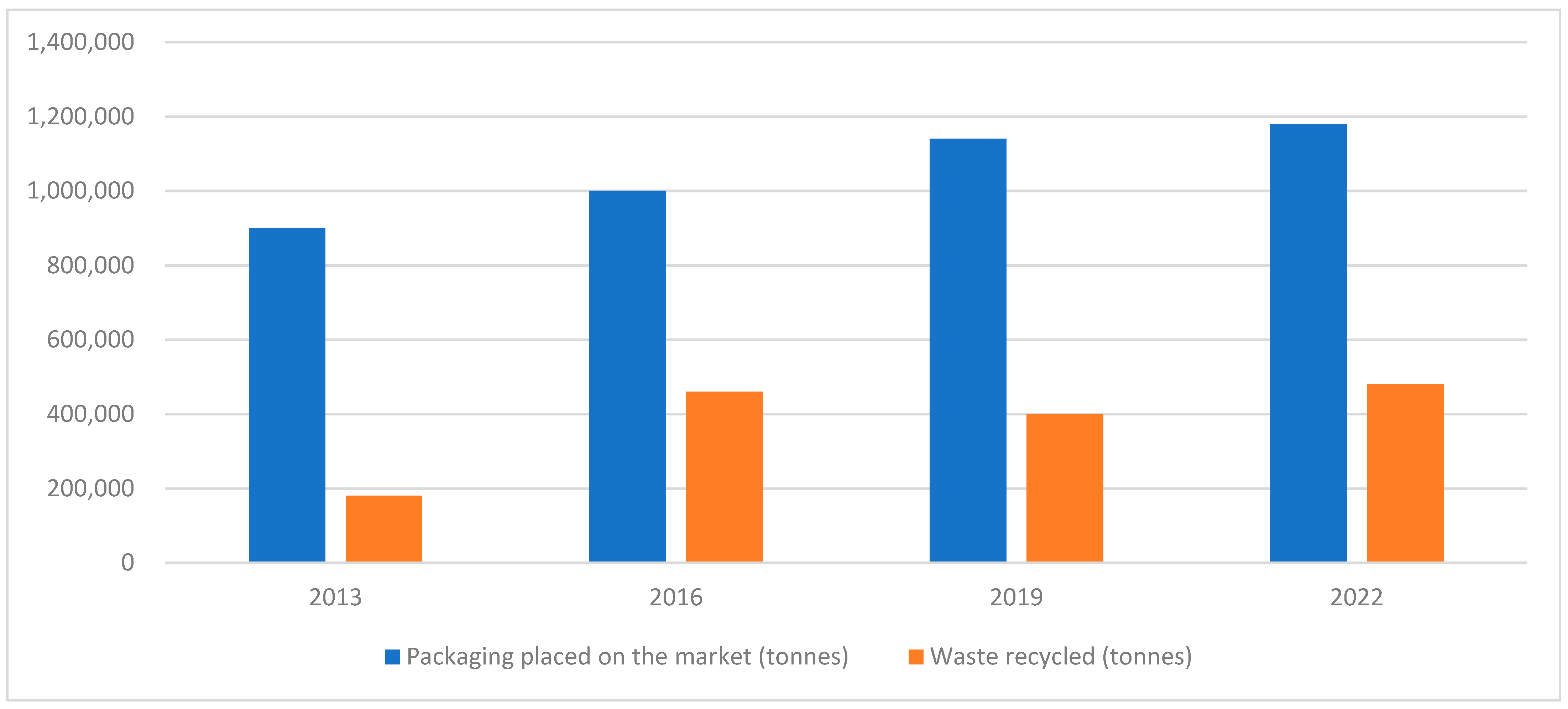
Data from the National Statistics Office (Figure 2) show that the tonnage of recycled plastic packaging placed on the Polish market has increased compared with 2022, yet current levels remain below the binding 2025 target and still mask several structural weaknesses, including incomplete separate-collection coverage, contamination of the selectively collected fraction. Over the whole period 2013–2022, the reported recycling rate in Figure 2 shows a clear upward trend, but this improvement does not translate into a proportional reduction in the quantity of unrecycled plastic packaging per capita, which remains relatively high and indicates that the existing system does not yet exploit the potential for increasing effective recycling performance.
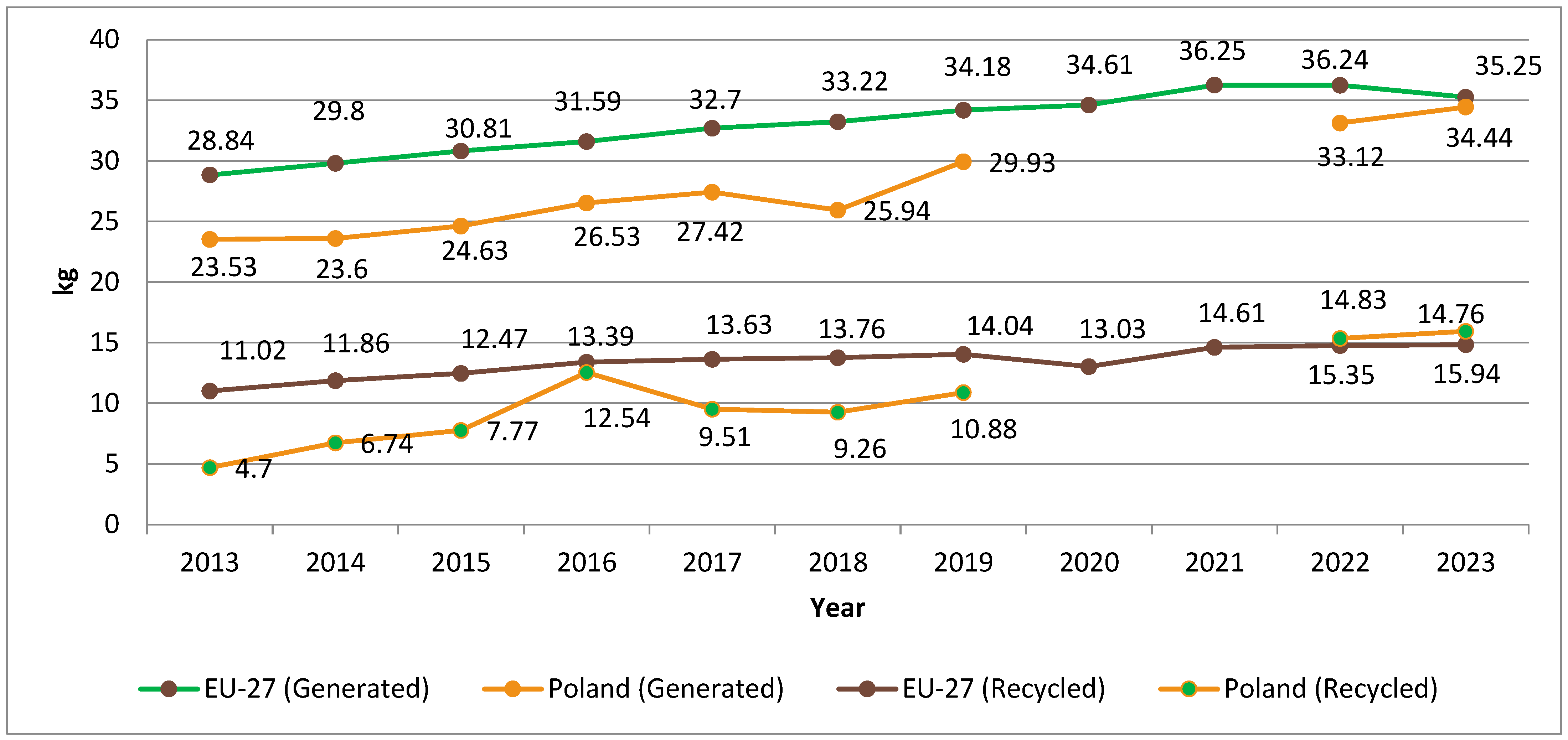
Article 38 of Regulation (EU) 2025/40 requires Member States to reduce per capita packaging-waste generation by 5% by 2030, 10% by 2035, and 15% by 2040, relative to 2018 levels. However, current trends at both the EU-27 and Polish national level indicate the opposite trajectory. By 2023, packaging-waste generation had increased by 2.5% in the EU-27 and by 20% in Poland compared with 2018 (Eurostat).
Plastic-waste generation continues to rise rapidly, despite notable improvements in recycling capacity. In Poland, per capita generation shows a clear upward trend, rising from a lower starting level in 2013 to values well above the 2018 baseline by 2023, whereas in the EU-27 the increase is more moderate, with total growth of about 2.5% over 2018–2023. Over the same period, the “recycled” curve for Poland increases much more steeply than the EU-27 average, reflecting a 239% increase in per capita plastic packaging recycling capacity (from 4.70 to 15.94 kg per capita), compared with only 35% growth at EU-27 level (Figure 3).
Taken together, Figure 2 and Figure 3 suggest that there is considerable scope for further improving the recycling ratios. The data indicate that Poland has already expanded recycling capacity and increased reported recycling rates, but that high and growing per capita generation, contamination of collected waste, incomplete separate-collection systems and design-related barriers (e.g., multi-layer or non-recyclable packaging formats) continue to limit the share of plastic packaging that can be counted as effectively recycled. At the same time, the observed increase in capacity and the experience of higher-performing EU countries point to realistic possibilities for raising collection rates, reducing losses between sorting and final recycling, and improving packaging design, which together could significantly increase Poland’s effective recycling ratios compared with the current trend [66].
The transition toward a circular economy in Poland’s plastic packaging sector has required substantial effort, including the implementation of dedicated policy instruments. However, current measures remain insufficient to effectively reduce the generation and accumulation of plastic packaging waste. In addition, delays in implementing CE policy tools—particularly those targeting plastics—have further hindered progress toward achieving circularity objectives.
In the long-term perspective, EU strategic frameworks, most notably the Circular Economy Action Plan and the European Strategy for Plastics in a Circular Economy, set a clear ambition that by 2030 all plastic packaging placed on the EU market should be reusable or recyclable. Accordingly, instruments such as eco-design requirements, bans on placing specific plastic packaging products on the market, mandatory recycling targets, minimum recycled content requirements for beverage bottles, EPR schemes, and measures promoting packaging reuse are intended to both curb the use of virgin plastics and reduce waste across the product life cycle.
Legislative initiatives introduced at the European level are the main driver of circular transformation in this industry. In Poland, policy attention currently focuses primarily on the DRS, while other key instruments resulting from EU legislation are often overlooked in both short- and long-term planning, which limits broader systemic progress toward circularity in the plastic packaging sector.

4. Discussion

The plastic packaging sector is one of the main pillars of the transformation towards a CE. Currently, as part of the extended producer responsibility, the main task for the Polish ecosystem is the effective implementation of the DRS. The initial implementation was planned for January 2023; however, it was repeatedly postponed due to the absence of detailed ministerial guidelines [51]. The rollout of the DRS required extensive operational and infrastructural adjustments, including the creation of a large number of collection points [67]. and the development of logistics strategies to reduce costs and limit the intensity of material flows [68]. These operational requirements have driven demand for both Reverse Vending Machines (RVMs) and manual collection infrastructure, which currently represent the main cost factors of the system. Deloitte [69] estimated total implementation costs at approximately PLN 3.7 billion.
Although Regulation (EU) 2025/40 introduces an exemption for countries capable of reaching an 80% collection rate by 2026 without a deposit system, Piontek et al. [27] emphasise that the DRS remains one of the most effective mechanisms for increasing plastic bottle collection. Moreover, Broniewicz et al. [28] argue that DRS implementation is expected to be more cost efficient than alternative solutions, particularly in cases where statutory recycled-content or recyclate inclusion requirements are not met.
In accordance with Article 6 of Directive (EU) 2018/852, the minimum recycling target for plastic packaging waste is set at 50% by 2025. However, as noted by the European Commission [30] this threshold is unlikely to be achieved by many Member States within the required timeline. The underlying barriers include limited recycling capacity, inefficiencies in household selective collection, and incomplete implementation of EPR mechanisms. In Poland, existing recycling schemes predominantly capture easily collectable waste fractions, demonstrating a clear need to expand and intensify source-separated collection, especially in households [23,24]. Current plastic packaging waste treatment in Poland is still characterised by relatively low material recycling and a persistently high share of landfilling and energy recovery compared with material recovery pathways [70]. Additional burden which is underline by the prospects for meeting the targets on recycling and landfilling, which is related to the “insufficient separate collection of bio-waste and plastic packaging waste, combined with insufficient recycling capacity for bio-waste, are identified as key factors for this weak performance” [70]. The research highlights as well that the selective collection and management of municipal biowaste in Poland faces economic, technical, and organisational limitations, which constrain both biowaste recycling and the broader integration of organic feedstocks into circular value chains [71]. In the Polish regulatory and infrastructural context, deploying food-waste-derived packaging solutions could therefore complement upstream prevention measures and recycling targets under EU legislation (e.g., Regulation (EU) 2025/40), but only if supported by improvements in bio-waste separate collection, processing capacity, and coherent policy frameworks that ensure compatibility with existing recycling systems and avoid unintended trade-offs. These constraints demonstrate that Poland’s current policy mix remains dominated by downstream collection and treatment measures, while upstream prevention, eco-modulation and system-wide incentive instruments are still insufficiently developed.
The European Environment Agency [45,66] indicates that, while Poland applies taxes on plastic carrier bags and fees on selected single-use plastic packaging formats, the broader policy ecosystem still lacks advanced instruments such as RVM-based collection incentives, fee modulation, or a nationwide incineration tax framework. According to the Supreme Audit Office of Poland [29], Poland, alongside Germany, France, Italy, and Spain, is among the largest payers of the EU plastic tax. Between 2021 and 2023, Poland’s contribution reached approximately PLN 9 billion.
Recent research highlights additional systemic obstacles, including the underdevelopment of the secondary polymer market [32,33], insufficient sorting and processing capacity, a limited number of selective collection points [72] and low levels of public awareness regarding waste-sorting obligations [73]. In the case of PET bottles—one of the country’s largest packaging waste streams—DRS are increasingly recognised as highly effective tools for improving selective collection and boosting recycling rates in Poland [21,22].
The implementation of the DRS requires systematic coordination across multiple stakeholder groups, including non-profit organisations, industry associations, and regulatory bodies. Extensive discussions at the national level regarding the introduction of necessary mechanisms to increase DRS implementation efficiency have been conducted through multi-stakeholder consultations and policy debates.
The MoSCoW analysis (Table 3) highlights that Poland has largely addressed the regulatory compliance dimension of the DRS (MUST HAVE), particularly in terms of legal implementation and alignment with EU targets. At the same time, the analysis reveals that system effectiveness and resilience depend predominantly on governance-related factors classified as SHOULD HAVE, such as coordination in a multi-operator model, public awareness, retailer participation, and the development of secondary raw material markets. This distinction underscores that the DRS is not merely a technical waste-collection instrument, but a complex socio-economic system requiring active management and stakeholder coordination.
In this context, non-governmental organisations and industry-led public-interest initiatives play a critical enabling role. Their activities contribute to bridging the gap between top-down regulation and bottom-up implementation by increasing awareness, building competencies, and facilitating cooperation across the value chain. A prominent example is the Polish Plastics Pact, which delivers training and workshops for internal and external stakeholders and has developed the Polish Plastics Pact Roadmap, defining strategic targets and concrete actions for plastic packaging circularity. Such initiatives enhance policy learning, reduce implementation friction, and support behavioural change among both producers and consumers.
The MoSCoW framework also clarifies the limitations of the DRS as a policy instrument. Objectives such as reducing packaging waste generation per capita or eliminating landfilling of plastics fall outside the scope of a collection-based system and require complementary upstream measures, including eco-design, reuse models, and broader EPR reform. Treating the DRS as the sole CE instrument would therefore risk policy fragmentation and suboptimal outcomes.
Overall, the findings confirm that while the DRS is a necessary condition for meeting EU recycling and collection targets, it is not sufficient to deliver a full circular transition. Its long-term effectiveness depends on the integration of regulatory, economic, and social instruments, supported by active stakeholder engagement and continuous governance adaptation.

5. Conclusions

The article examined Poland’s implementation of plastic packaging regulations within the evolving EU regulatory framework, analysing the transition from Directive 94/62/EC to Regulation (EU) 2025/40 alongside complementary policy instruments. The study revealed significant gaps between regulatory ambitions and operational outcomes. Poland has introduced substantial legislative measures, including carrier-bag fees, charges on single-use plastic products, recycled-content mandates for PET bottles, and a DRS launched in October 2025. However, performance indicators demonstrate critical challenges. The plastic packaging recycling rate reached 46.3% in 2023, approaching but not yet meeting the 50% target. More concerning, per capita packaging waste generation increased by 20% between 2018 and 2023, moving in the opposite direction from EU reduction targets (−5% by 2030).
Based on a systematic review of implementation actions and national-level debate on DRS mechanisms, a MoSCoW model (Table 3) has been applied to identify necessary steps for systematic deployment of policy instruments and mechanisms that will support system implementation and reshape the plastic packaging market. This prioritisation framework enables identification of critical regulatory requirements, necessary enabling conditions, desired enhancements, and out-of-scope elements—revealing both achievements and gaps in Poland’s CE transition.
The MoSCoW analysis (Table 3) revealed a fundamental asymmetry: Poland achieved formal compliance with “Must Have” regulatory requirements while systematically neglecting critical “Should Have” enabling conditions. Three structural gaps emerged as particularly significant: (1) the absence of advanced fee modulation mechanisms that could incentivize eco-design, (2) the implementation of DRS prior to comprehensive Extended Producer Responsibility reform, creating financial instability for municipalities, and (3) governance fragmentation through a multi-operator model without statutory coordination mechanisms.
The DRS constitutes an essential intervention for improving selective collection rates (targeting 77% by 2025 and 90% by 2029), yet it cannot function as a standalone CE solution. Achieving EU CE objectives requires comprehensive policy integration encompassing upstream prevention, eco-design standards, extended producer responsibility mechanisms with fee modulation, and coherent strategic planning that addresses both collection efficiency and waste generation reduction.
The analysis confirms that effective regulatory systems, sound management practices, and improved information sharing among stakeholders—including the critical role of non-governmental organisations in filling awareness and implementation gaps—are crucial for promoting eco-innovation and advancing circularity, reuse, and waste reduction in Poland’s plastic packaging sector.
This study is subject to certain limitations. The analysis is based primarily on legal documents, strategic policy frameworks and harmonised statistical data, which allows for a comprehensive system-level assessment but does not capture the full complexity of operational practices, stakeholder behaviour or informal governance dynamics at the local level. In addition, given the very recent launch of the DRS in Poland, the evaluation necessarily adopts an ex ante perspective, limiting the ability to assess long-term behavioural effects, market restructuring and actual environmental outcomes. Future research should therefore complement regulatory analysis with longitudinal empirical studies and stakeholder-based evidence to better evaluate system performance.

Author Contributions

Conceptualization, A.C.-K.; Methodology, A.C.-K. and J.K.; Validation, J.K.; Formal analysis, A.C.-K.; Investigation, A.C.-K.; Data curation, A.C.-K.; Writing—original draft, A.C.-K.; Writing—review & editing, J.K.; Supervision, J.K.; Funding acquisition, J.K. All authors have read and agreed to the published version of the manuscript.

Funding

Research project partially supported by the program ‘Excellence Initiative—Research University’ at AGH University of Krakow.

Institutional Review Board Statement

Not applicable.

Informed Consent Statement

Not applicable.

Data Availability Statement

The original contributions presented in this study are included in the article. Further inquiries can be directed to the corresponding author.

Conflicts of Interest

The authors declare no conflict of interest.

References

  1. Ritchie, H.; Samborska, V.; Roser, M. Plastic Pollution. Our World in Data. 2023. Available online: https://ourworldindata.org/plastic-pollution (accessed on 21 December 2025).
  2. OECD. Global Plastics Outlook: Economic Drivers, Environmental Impacts and Policy Options; OECD Publishing: Paris, France, 2022. [Google Scholar] [CrossRef]
  3. Bourguignon, D. Plastics in a circular economy: Opportunities and challenges. EPR Serv. 2017, 603, 940. [Google Scholar]
  4. Plastics Europe. Plastics—The Facts 2022: An Analysis of European Plastics Production, Demand and Waste Data. 2022. Available online: https://plasticseurope.org (accessed on 21 December 2025).
  5. United Nations Environment Programme. End Plastic Pollution: Towards an International Legally Binding Instrument (Resolution UNEP/EA.5/Res.14). 2022. Available online: https://www.unep.org/ (accessed on 21 December 2025).
  6. Syberg, K.; Nielsen, M.B.; Clausen, L.P.W.; Van Calster, G.; Van Wezel, A.; Rochman, C.; Hansen, S.F. Regulation of plastic from a circular economy perspective. Curr. Opin. Green Sustain. Chem. 2021, 29, 100462. [Google Scholar] [CrossRef]
  7. Foschi, E.; Bonoli, A. The commitment of packaging industry in the framework of the European strategy for plastics in a circular economy. Adm. Sci. 2019, 9, 18. [Google Scholar] [CrossRef]
  8. Tarantino, M.; Mosconi, E.M.; Tola, F.; Gianvincenzi, M.; Delussu, A.M. A Comprehensive and Multidisciplinary Framework for Advancing Circular Economy Practices in the Packaging Sector: A Systematic Literature Review on Critical Factors. Sustainability 2025, 18, 192. [Google Scholar] [CrossRef]
  9. Amadei, A.; Venturelli, S.; Manfredi, S. Plastics Materials Flows in the EU-27 and Their Environmental Impacts—Unveiling the European Plastic Value Chain; Publications Office of the European Union: Luxembourg, 2025; Available online: https://data.europa.eu/doi/10.2760/6579757 (accessed on 21 December 2025).
  10. Kan, M.; Miller, S.A. Environmental impacts of plastic packaging of food products. Resour. Conserv. Recycl. 2022, 180, 106156. [Google Scholar] [CrossRef]
  11. Beccarello, M.; Di Foggia, G. Economic analysis of EU strengthened packaging waste recycling targets. J. Adv. Res. Law Econ. 2016, 7, 1930–1941. [Google Scholar]
  12. Elliott, T.; Gillie, H.; Thomson, A. European Union’s plastic strategy and an impact assessment of the proposed directive on tackling single-use plastics items. In Plastic Waste and Recycling; Academic Press: Cambridge, MA, USA, 2020; pp. 601–633. [Google Scholar]
  13. Kiessling, T.; Hinzmann, M.; Mederake, L.; Dittmann, S.; Brennecke, D.; Böhm-Beck, M.; Thiel, M. What potential does the EU Single-Use Plastics Directive have for reducing plastic pollution at coastlines and riversides? An evaluation based on citizen science data. Waste Manag. 2023, 164, 106–118. [Google Scholar] [CrossRef] [PubMed]
  14. Ross, V.; van Leeuwen, J. Reducing the tide of single-use plastic pollution: How the EU’s Single-Use Plastic Directive drives (and fails to drive) private company reflexivity. J. Environ. Policy Plan. 2025, 27, 34–48. [Google Scholar] [CrossRef]
  15. Niero, M. Implementation of the European Union’s packaging and packaging waste regulation: A decision support framework combining quantitative environmental sustainability assessment methods and socio-technical approaches. Clean. Waste Syst. 2023, 6, 100112. [Google Scholar] [CrossRef]
  16. Lorang, S.; Yang, Z.; Zhang, H.; Lv, F.; He, P. Achievements and policy trends of extended producer responsibility for plastic packaging waste in Europe. Waste Dispos. Sustain. Energy 2022, 4, 91–103. [Google Scholar] [CrossRef]
  17. Di Foggia, G.; Beccarello, M. An overview of packaging waste models in some European countries. Recycling 2022, 7, 38. [Google Scholar] [CrossRef]
  18. De Waal, I.M. A Legal Framework for the Circular Economy in the European Union: The Role of Coherence in EU Chemicals, Product and Waste Legislation Through the Lens of Three Product Value Chains: Electrical and Electronic Equipment, Plastic Packaging and Batteries. 2024. Available online: https://research-portal.uu.nl/en/publications/a-legal-framework-for-the-circular-economy-in-the-european-union-/ (accessed on 21 December 2025).
  19. De Waal, I.M. The Legal Transition Towards a More Circular Plastic Packaging Chain: A Case Study of the Netherlands. Eur. Energy Environ. Law Rev. 2023, 32, 226–247. [Google Scholar] [CrossRef]
  20. Lopez-Aguilar, J.F.; Sevigné-Itoiz, E.; Maspoch, M.L.; Peña, J. A realistic material flow analysis for end-of-life plastic packaging management in Spain: Data gaps and suggestions for improvements towards effective recyclability. Sustain. Prod. Consum. 2022, 31, 209–219. [Google Scholar] [CrossRef]
  21. Krzywda, D. Closing the loop—Packaging waste management and the deposit system in Poland. Pol. J. Manag. Stud. 2022, 26, 233–247. [Google Scholar] [CrossRef]
  22. Sidorczuk-Pietraszko, E.; Piontek, W.; Larsson, A. Are deposit–return schemes an optimal solution for beverage container collection in the European Union? An evidence review. Sustainability 2025, 17, 8791. [Google Scholar] [CrossRef]
  23. Baran, B. Plastic recycling in Poland—A transformation towards a circular economy? Pr. Nauk. Uniw. Ekon. Wrocławiu 2021, 65, 1–10. [Google Scholar] [CrossRef]
  24. Baran, B. Resource (in)efficiency in the EU: A case of plastic waste. Ekon. Prawo. Econ. Law 2022, 21, 45–62. [Google Scholar] [CrossRef]
  25. Zarębski, A.; Zarębska, J.; Marosek, K. Implementation of the deposit system in Poland as a tool for implementing the circular economy. Energies 2024, 17, 5489. [Google Scholar] [CrossRef]
  26. Ziółko, M.; Ziółkowska, N. System kaucyjny jako narzędzie logistyki zwrotnej w gospodarce o obiegu zamkniętym [Deposit system as a tool of reverse logistics in the circular economy]. Pr. Nauk. Uniw. Ekon. Wrocławiu 2024, 68, 161–173. [Google Scholar]
  27. Piontek, W.; Sidorczuk-Pietraszko, E.; Rachwał, T. Will deposit-return system be effective in achieving the objectives of Single Use Plastic Directive for plastic bottles in Poland? Econ. Environ. 2024, 90, 970. [Google Scholar] [CrossRef]
  28. Broniewicz, E.; Larsson, A.; Piontek, W.; Sidorczuk-Pietraszko, E. Economic effects of introducing a deposit-return system for packaging in Poland. Econ. Environ. 2023, 86, 169–185. [Google Scholar] [CrossRef]
  29. Najwyższa Izba Kontroli. Implementation of a Circular Economy [Wdrażanie Gospodarki o Obiegu Zamkniętym] (Audit Report No. 1/2025/P23/013/KGP). 2025. Available online: https://www.nik.gov.pl/plik/id,30907,vp,33980.pdf (accessed on 21 December 2025).
  30. European Commission. The Early Warning Report for Poland (Commission Staff Working Document No. SWD(2023) 196 Final). 2023. Available online: https://eur-lex.europa.eu/legal-content/EN/TXT/?uri=SWD%3A2023%3A196%3AFIN (accessed on 21 December 2025).
  31. European Environment Agency. Early Warning Assessment Related to the 2025 Targets for Municipal Waste and Packaging Waste; Publications Office of the European Union: Luxembourg, 2024. [Google Scholar]
  32. Formela, K.; Kurańska, M.; Barczewski, M. Recent advances in development of waste-based polymer materials: A review. Polymers 2022, 14, 1050. [Google Scholar] [CrossRef]
  33. Remeikienė, R.; Gasparėnienė, L.; Matulienė, S.; Szarucki, M. Secondary Raw Materials in the Circular Economy: A Multi-Perspective Study; Ksiegarnia Akademicka Publishing: Kraków, Poland, 2024. [Google Scholar]
  34. European Union. Regulation (EU) 2025/40 of the European Parliament and of the Council of 19 December 2024 on Packaging and Packaging Waste; European Union: Brussels, Belgium, 2025; pp. 1–124. [Google Scholar]
  35. European Union. Directive (EU) 2019/904 of the European Parliament and of the Council of 5 June 2019 on the Reduction of the Impact of Certain Plastic Products on the Environment; European Union: Brussels, Belgium, 2019; pp. 1–19. [Google Scholar]
  36. International Institute of Business Analysis. A Guide to the Business Analysis Body of Knowledge, 2nd ed.; IIBA: North York, ON, Canada, 2009. [Google Scholar]
  37. Otto, S.J.; Schinkel, J.; Rotter, V.S. Measuring progress in packaging waste prevention: Trends and gaps in communicated indicators from national policy and the food retail sector. Circ. Econ. Sustain. 2025, 5, 1075–1106. [Google Scholar] [CrossRef]
  38. European Environment Agency. Accelerating the Circular Economy in Europe: State and Outlook 2024. 2024. Available online: https://www.eea.europa.eu/ (accessed on 21 December 2025).
  39. Hartley, K.; Van Santen, R.; Kirchherr, J. Policies for transitioning towards a circular economy: Expectations from the European Union (EU). Resour. Conserv. Recycl. 2020, 155, 104634. [Google Scholar] [CrossRef]
  40. Chioatto, E.; Sospiro, P. Transition from waste management to circular economy: The European Union roadmap. Environ. Dev. Sustain. 2023, 25, 249–276. [Google Scholar] [CrossRef]
  41. Hsu, W.T.; Domenech, T.; McDowall, W. Closing the loop on plastics in Europe: The role of data, information and knowledge. Sustain. Prod. Consum. 2022, 33, 942–951. [Google Scholar] [CrossRef]
  42. Rudenhausen, M.C.; Tenhunen-Lunkka, A.; d’Amato, A.; Almasi, A.; Vanderreydt, I.; Mortensen, L.F.; Nielsen, T. Measuring Europe’s Plastics Circularity—Through the Lenses of the EEA Circularity Metrics Lab (ETC CE Report 2024/6). European Topic Centre on Circular Economy and Resource Use. 2024. Available online: https://www.eionet.europa.eu/etcs/etc-ce/products/etc-ce-report-2024-6-measuring-europes-plastics-circularity-through-the-lenses-of-the-eea-circularity-metrics-lab (accessed on 21 December 2025).
  43. European Court of Auditors. Plastic Packaging Waste: EU Needs to Boost Recycling to Achieve Ambitions (Review). 2020. Available online: https://www.eca.europa.eu/lists/ecadocuments/inrw20_04/inrw_plastic_waste_en.pdf (accessed on 21 December 2025).
  44. Eurostat. Waste and Recycling—Packaging Waste by Waste Management Operations [Data Set]. 2025. Available online: https://ec.europa.eu/eurostat/databrowser/view/env_waspac__custom_16999477/default/table?lang=en (accessed on 21 December 2025).
  45. European Environment Agency. Many EU Member States Not on Track to Meet Recycling Targets for Municipal Waste and Packaging Waste. 2023. Available online: https://www.eea.europa.eu/en/analysis/publications/many-eu-member-states (accessed on 21 December 2025).
  46. Plastics Recyclers Europe. PET Market in Europe: State of Play—V3 (Production, Collection & Recycling Data 2022). 2024. Available online: https://www.plasticsrecyclers.eu/wp-content/uploads/2024/05/PET-Market-in-Europe-State-of-Play-2022-Data-V3.pdf (accessed on 21 December 2025).
  47. Reloop. Global Deposit Book 2024: An Overview of Deposit Return Systems for Single-Use Beverage Containers. 2024. Available online: https://www.reloopplatform.org/wp-content/uploads/2024/12/Reloop-Global-Deposit-Book-2024.pdf (accessed on 21 December 2025).
  48. Czaplicka-Kotas, A. The transition toward adoption of deposit-return systems in EU countries for plastic packaging bottles. In Proceedings of the 45th International Business Information Management Association Conference (IBIMA): Strategies, Innovation, and Human-Centric Practices in the Modern Organizations; Soliman, K.S., Ed.; IBIMA: Málaga, Spain, 2025; pp. 2215–2221. [Google Scholar]
  49. European Union. Directive (EU) 2018/852 of the European Parliament and of the Council of 30 May 2018 Amending Directive 94/62/EC on Packaging and Packaging Waste; European Union: Brussels, Belgium, 2018; Volume 61, pp. 1–161. [Google Scholar]
  50. Ministry of Development. Roadmap Transformation Towards a Circular Economy [Mapa Drogowa Transformacji w Kierunku Gospodarki o Obiegu Zamkniętym]; Ministry of Development: Bandar Seri Begawan, Brunei, 2019. [Google Scholar]
  51. Monitor Polski. Resolution No. 96 of the Council of Ministers of 12 June 2023 on the National Waste Management Plan 2028; item 702; Monitor Polski: Warsaw, Poland, 2023. [Google Scholar]
  52. The Act of 13 June 2013 on the management of packaging and packaging waste (consolidated text: Journal of Laws 2025, item 870). Available online: https://eli.gov.pl/api/acts/DU/2025/870/text/T/D20250870L.pdf (accessed on 21 December 2025).
  53. The Act of 11 May 2001 on the obligations of entrepreneurs in the management of certain waste and on product fees (Journal of Laws 2020, item 1903, consolidated text as amended). Available online: https://isap.sejm.gov.pl/isap.nsf/download.xsp/WDU20200001903/U/D20201903Lj.pdf (accessed on 21 December 2025).
  54. The Act of 14 December 2012 on waste (Journal of Laws 2023, item 1587, consolidated text as amended). Available online: https://isap.sejm.gov.pl/isap.nsf/DocDetails.xsp?id=WDU20130000021 (accessed on 21 December 2025).
  55. The Act of 13 June 2013 on Packaging and Packaging Waste Management (Journal of Laws 2018, item 150). Available online: https://isap.sejm.gov.pl/isap.nsf/DocDetails.xsp?id=WDU20130000888 (accessed on 21 December 2025).
  56. Regulation of the Minister of Environment of 3 December 2018 on Annual Recycling Levels for Household Packaging Waste (Journal of Laws 2018, item 2306). Available online: https://isap.sejm.gov.pl/isap.nsf/DocDetails.xsp?id=WDU20180002306 (accessed on 21 December 2025).
  57. Regulation of the Minister of Environment of 27 August 2019 on the Recycling Fee Rate (Journal of Laws 2019, item 1738). Available online: https://isap.sejm.gov.pl/isap.nsf/DocDetails.xsp?id=WDU20190001738 (accessed on 21 December 2025).
  58. Act of 13 June 2013 on Packaging and Packaging Waste Management (consolidated text, Journal of Laws 2020, item 1114). Available online: https://eli.gov.pl/api/acts/DU/2020/1114/text/O/D20201114.pdf (accessed on 21 December 2025).
  59. Act of 14 April 2023 Amending the Obligations of Entrepreneurs on Certain Waste Streams and the Product Charge (Journal of Laws 2023, item 877). Available online: https://isap.sejm.gov.pl/isap.nsf/DocDetails.xsp?id=WDU20230000877 (accessed on 21 December 2025).
  60. Act of 13 July 2023 Amending Packaging and Packaging Waste Management and Related Acts (Journal of Laws 2023, item 1852). Available online: https://isap.sejm.gov.pl/isap.nsf/DocDetails.xsp?id=WDU20230001852 (accessed on 21 December 2025).
  61. Regulation of the Minister of Climate and Environment of 9 December 2023 on Selective Col-lection Fees and Product Charge Rates (Journal of Laws 2023, item 2683). Available online: https://isap.sejm.gov.pl/isap.nsf/DocDetails.xsp?id=WDU20230002683 (accessed on 21 December 2025).
  62. Regulation of the Minister of Climate and Environment of 7 December 2023 on Fees for Sin-gle-Use Plastic Food and Beverage Packaging (Journal of Laws 2023, item 2679). Available online: https://isap.sejm.gov.pl/isap.nsf/DocDetails.xsp?id=WDU20230002679 (accessed on 21 December 2025).
  63. Act of 11 May 2001 on the Obligations of Entrepreneurs on Certain Waste Streams and the Product Charge (Journal of Laws 2024, item 433). Available online: https://eli.gov.pl/api/acts/DU/2024/433/text/O/D20240433.pdf (accessed on 21 December 2025).
  64. Regulation of the Minister of Climate and Environment of 8 July 2024 on Deposit Rates (Journal of Laws 2024, item 1046). Available online: https://isap.sejm.gov.pl/isap.nsf/DocDetails.xsp?id=WDU20240001046 (accessed on 21 December 2025).
  65. Act of 13 June 2013 on Packaging and Packaging Waste Management (as amended on 11 June 2024, Journal of Laws 2024, item 927). Available online: https://eli.gov.pl/api/acts/DU/2024/927/text/U/D20240927Lj.pdf (accessed on 21 December 2025).
  66. EEA. Waste recycling in Europe. 2025. Available online: https://www.eea.europa.eu/en/analysis/indicators/waste-recycling-in-europe?activeAccordion=546a7c35-9188-4d23-94ee-005d97c26f2b (accessed on 21 December 2025).
  67. Rudewicz, J. Rola systemów depozytowo-zwrotnych (kaucyjnych) w organizacji recyklingu odpadów komunalnych w państwach Europy. Wykorzystanie automatów RVM (butelkomatów). Pr. Kom. Geogr. Przemysłu Pol. Tow. Geogr. 2020, 34, 50–70. [Google Scholar]
  68. Borucka, A.; Grzelak, M. Deposit–refund system as a strategy to drive sustainable energy transition on the example of Poland. Sustainability 2025, 17, 1030. [Google Scholar] [CrossRef]
  69. Deloitte. System Kaucyjny w Polsce—Koszty, Perspektywy, Szanse; Raport Deloitte: Warsaw, Poland, 2024. [Google Scholar]
  70. European Environment Agency. Poland: Municipal Waste Factsheet. 2025. Available online: https://www.eea.europa.eu/en/topics/in-depth/waste-and-recycling/municipal-and-packaging-waste-management-country-profiles-2025/pl-municipal-waste-factsheet.pdf (accessed on 21 December 2025).
  71. Czekała, W. Selective collection and management of biowaste from the municipal sector in Poland: A review. Appl. Sci. 2023, 13, 11015. [Google Scholar] [CrossRef]
  72. Surdykowska, B. The Waste Sector in Poland: Challenges of Organising and Collective Bargaining; Institute of Public Affairs: Warsaw, Poland, 2024; ISBN 978-83-7689-481-2. [Google Scholar]
  73. Zarębska, J.; Zarębski, A.; Lewandowska, A. Polish society towards the implementation of the circular economy and the change of municipal waste management—Ecological, economic and social aspect [Polskie społeczeństwo wobec wdrażania gospodarki o obiegu zamkniętym i zmianie gospodarki odpadami komunalnymi—Aspekt ekologiczny, ekonomiczny i społeczny]. Environ. Stud. 2021, 25, 91–112. [Google Scholar]
Figure 1. Methodological framework. Source: Authors’ own elaboration.
Sustainability 18 01762 g001
Figure 2. Plastic Packaging Market Introduction and Recycling Rates in Poland (2013–2022). Source: National Statistics Office.
Sustainability 18 01762 g002
Figure 3. Generation and recycled of the plastic packaging waste between 2013 and 2023 in EU-27 and Poland (kg per capita). Source: Started from the 2020, the EU introduced stricter reporting rules (under Article 6a of Directive 94/62/EC.) to ensure recycling statistics reflect actual calculating recycled packaging, therefore the data for 2020, 2021 are not available, however the Polish Ministry of Climate and Environment stated that new methods was applied from 2022 [66].
Sustainability 18 01762 g003
Table 2. Key Legal Provisions on Plastic Packaging in Poland (2013–2025), https://isap.sejm.gov.pl/ (accessed on 21 December 2025).
Legislation Act Key Provisions
2013 Act of 13 June 2013 on Packaging and Packaging Waste Management (Journal of Laws 2018, item 150) [55]Introduced Chapter 6a—a recycling fee for plastic shopping bags. Added legal definitions for: plastic shopping bags (Art. 8 (15a)), plastic (Art. 8 (15b)), and biodegradable bag alternatives including oxo-degradable and oxo-biodegradable plastics (Art. 8a; Art. 8 (15)).
2018 Regulation of the Minister of Environment of 3 December 2018 on Annual Recycling Levels for Household Packaging Waste (Journal of Laws 2018, item 2306) [56]Set annual recycling targets for plastic packaging waste: 2019—42%, 2020—44%, 2021—46%, 2022—48%, 2023—50%, 2024—52%, 2025—54%, 2026—56%, 2027—57%, 2028—58%, 2029—59%, 2030 and beyond—60%.
2019 Regulation of the Minister of Environment of 27 August 2019 on the Recycling Fee Rate [57]Established a recycling fee of 0.20 PLN per single-use plastic shopping bag.
2020 Act of 13 June 2013 on Packaging and Packaging Waste Management (consolidated text, Journal of Laws 2020, item 1114) [58]Expanded the scope of regulated plastic shopping bags to include all other non-biodegradable plastic shopping bags with a thickness ≥ 50 μm (Art. 8 (15a)).
2023 Act of 14 April 2023 Amending the Obligations of Entrepreneurs on Certain Waste Streams and the Product Charge (Journal of Laws 2023, item 877) [59]Added provisions on single-use plastic products (Art. 3b–3l). Introduced: fees for single-use plastic packaging (Annex 6), market bans on selected plastic products (Annex 7), mandatory product labelling (Annex 8), and extended producer responsibility (Annex 9).
2023 Act of 13 July 2023 Amending Packaging and Packaging Waste Management and Related Acts (Journal of Laws 2023, item 1852) [60] Revised the definition of plastic to align with REACH (Art. 3(15b)). Introduced mandatory recycled content in PET beverage bottles <3 L: 25% by 2025 and 30% by 2030 (Art. 14a). Set targets for selective collection of PET bottles by market share (by weight): 77% by 2025 and 90% by 2029 (Art. 21a). Introduced new documentation requirements for plastics (Art. 14a (4)) and applied product charges for failure to meet recycling or recycled content requirements (Art. 34).
2023 Regulation of the Minister of Climate and Environment of 9 December 2023 on Selective Collection Fees and Product Charge Rates (Journal of Laws 2023, item 2683) [61]Established product charge rates for failure to meet selective collection targets for single-use plastic bottles <3 L: 2025—0.10 PLN/kg, 2026—1.00 PLN/kg, 2027 and later—5.00 PLN/kg. Introduced a product charge of 1.00 PLN/kg for producers failing to meet recycled content: at least 25% by 2025 and 30% by 2030 for single-use plastic bottles <3 L.
2023 Regulation of the Minister of Climate and Environment of 7 December 2023 on Fees for Single-Use Plastic Food and Beverage Packaging (Journal of Laws 2023, item 2679) [62]Introduced fees for selected single-use plastic products: 0.20 PLN for cups and lids, and 0.25 PLN for food containers intended for immediate consumption.
2024 Act of 11 May 2001 on the Obligations of Entrepreneurs on Certain Waste Streams and the Product Charge (Journal of Laws 2024, item 433) [63]Introduced the obligation to ensure the availability of alternative packaging solutions, including non-biodegradable materials and reusable packaging systems (Art. 3b (3)).
2024 Regulation of the Minister of Climate and Environment of 8 July 2024 on Deposit Rates (Journal of Laws 2024, item 1046) [64]Set the deposit value for single-use plastic bottles <3 L at 0.50 PLN.
2024 Act of 13 June 2013 on Packaging and Packaging Waste Management (as amended on 11 June 2024, Journal of Laws 2024, item 927) [65]Added Chapter 6b on DRS, including: general system conditions (Art. 40g), obligations for entities placing packaged products on the market (Art. 40h), system authorization, licence withdrawal, deposit marking, and operational requirements (Art. 40i–40m). Introduced minimum selective collection targets for single-use plastic bottles <3 L (Annex 1): 2025—77%, 2026—81%, 2027—84%, 2028—87%, 2029—90%.
Table 3. MoSCoW Analysis of DRS Implementation Requirements in Poland.
M—MUST HAVE (Regulatory and systemic requirements)
  • Deposit refund without proof of purchase at any participating collection point
  • Implementation of the DRS into Polish legislation
  • Achievement of EU-mandated targets, including:
  • Recycled content in PET beverage bottles
  • Recycling targets for all packaging
  • Selective collection targets for PET beverage bottles
  • Implementation of measures to reduce single-use plastic packaging, in line with the SUP Directive
  • Payment of the plastic levy on non-recycled plastic packaging waste as required under EU fiscal mechanisms
S—SHOULD HAVE (Conditions for system effectiveness and resilience)
  • Implementation of advanced fee modulation (eco-modulation) for plastic packaging to incentivise better design and recyclability
  • Multi-operator DRS model, allowing competition between operators, supported by coordination and clearing mechanisms to avoid system fragmentation
  • Early implementation of the DRS prior to full reform of EPR—a pragmatic but suboptimal sequencing choice
  • Promotion of universal participation in collection, encouraging the widest possible involvement of retail outlets in the system
  • Building public awareness and understanding of how the deposit system functions
  • Development of a secondary market for plastic waste, ensuring demand for recycled materials
  • tatutory introduction of a handling fee, guaranteeing compensation for retailers and collection points
C—COULD HAVE (Transformational and upstream enhancements)
  • Extension of the deposit system to additional packaging types
  • Increased use of reusable and refillable packaging
  • Reduction in excessive or unnecessary packaging
  • Implementation of eco-design principles in packaging production
W—WON’T HAVE (Out of scope for the DRS instrument)
  • Reduction in packaging waste generation per capita
  • Complete elimination of landfilling of plastic waste
  • Treating the DRS as the single instrument of the CE
Source: based on the own research.
Disclaimer/Publisher’s Note: The statements, opinions and data contained in all publications are solely those of the individual author(s) and contributor(s) and not of MDPI and/or the editor(s). MDPI and/or the editor(s) disclaim responsibility for any injury to people or property resulting from any ideas, methods, instructions or products referred to in the content.