Article

Structural Contrasts and Potential of Complementarity of National Innovation Systems of Russia and Kazakhstan in the Context of EAEU Integration


by
Nataliya V. Yakovenko
1,*,
Zhanar S. Rakhimbekova
2,*,
Natalia A. Azarova
3,
Tatyana B. Klimova
4,5,
Ainur A. Ashimova
6,
Marina Ye. Tsoy
7,
Lyudmila V. Semenova
8 and
Zhuldyz M. Yelubayeva
9
1
Research Institute of Innovative Technologies and the Forestry Complex, Voronezh State University of Forestry and Technologies Named After G.F. Morozov, 8 Timiryazev Str., 394087 Voronezh, Russia
2
School of Management and Tourism, Graduate School of Business, Almaty Management University, 227 Rozybakiev Str., 050010 Almaty, Kazakhstan
3
Department of Global and National Economy, Voronezh State University of Forestry and Technologies Named After G.F. Morozov, 8 Timiryazev Str., 394087 Voronezh, Russia
4
Department of International Tourism and Hotel Business, Belgorod National Research University, 85 Pobedy Str., 308015 Belgorod, Russia
5
Department of Foreign Languages and Communication Technologies, University of Science and Technology MISIS, 4 Leninsky Ave., 119049 Moscow, Russia
6
Graduate School of Business, Almaty Management University, 227 Rozybakiev Str., 050010 Almaty, Kazakhstan
7
Marketing and Service Department, Business Faculty, Novosibirsk State Technical University, 20 Karl Marx Ave., 630092 Novosibirsk, Russia
8
Higher School of Hospitality Educational and Scientific Cluster, Institute of Management and Territorial Development, Immanuel Kant Baltic Federal University, 14 A. Nevsky Str., 236041 Kaliningrad, Russia
9
Accounting and Finance Department, Almaty Technological University, 100 Tole Bi Str., 050005 Almaty, Kazakhstan
*
Authors to whom correspondence should be addressed.
Sustainability 2026, 18(4), 1753; https://doi.org/10.3390/su18041753
Submission received: 22 December 2025 / Revised: 30 January 2026 / Accepted: 3 February 2026 / Published: 9 February 2026

Abstract

The formation of a unified innovation space is a key challenge for deepening Eurasian integration. This study aims to develop the concept of asymmetric complementarity by investigating how the structural asymmetry between the NIS of Russia and Kazakhstan can be transformed from a source of imbalance into a basis for strategic synergy. Based on a mixed methodology that includes quantitative analysis of data from the Global Innovation Index (GII) 2025, SWOT analysis, and scenario modeling, two divergent models were identified. Russia’s NIS is defined as “compensatory disbalanced” (strong human capital with weak institutions), while Kazakhstan’s NIS is defined as “institutionally focused with knowledge deficit” (relatively developed institutions with critically low R&D investment). The theoretical contribution of this work lies in developing the concept of asymmetric complementarity, which demonstrates that the identified structural differences create a foundation for synergistic cooperation. The practical conclusions are aimed at transitioning from rule harmonization to network capability integration, including the creation of distributed excellence centers, the development of “soft” type supranational infrastructure, and the implementation of the “innovative accounting” principle.

1. Introduction

The current stage of global economic dynamics is characterized by the transition to a paradigm where the main source of long-term competitive advantage and economic sovereignty becomes the ability to generate, disseminate, and commercialize knowledge [1]. In this context, regional integration associations face the imperative of evolution from the creation of free trade zones and common markets for traditional goods to the formation of a single innovation space [2]. This transition is a main condition for sustainable development, understood as long-term, inclusive, and resistant to external shocks growth. The Eurasian Economic Union, as one of the main projects in the post-Soviet space, is no exception. The initial stages of integration, aimed at eliminating barriers to the movement of goods, services, capital, and labor, have largely exhausted their potential as drivers of sustainable growth. Further consolidation and enhancement of the Union’s global significance are inextricably linked with the transition to a knowledge and technology-based cooperation model. An important step in this direction was the approval of the long-term program for the scientific and technological development of the EAEU, aimed at deepening integration in the field of science, supporting the sustainable development of regions through innovation, and defining the priorities of joint research.
However, the trajectory of innovative development within the EAEU is formed under conditions of deep and multidimensional structural asymmetry between member states. This asymmetry is manifested in the disproportions in the distribution of financial and personnel resources for research and development, the varying degree of maturity of national innovation system institutions, different industry specializations, and the uneven capacity of the domestic market to perceive innovations [3]. Such heterogeneity creates a fundamental challenge for the integration agenda; the spontaneous development of processes can lead not to synergy and convergence, but to the strengthening of “center-periphery” relations, the technological dependence of less-developed participants, and, as a consequence, to the erosion of political will for deeper cooperation, which directly threatens the long-term sustainability of the project.
Thus, the central research problem is the need to identify configurations and mechanisms capable of transforming objectively existing asymmetry from a source of disproportions and risks into a basis for mutual complementarity, network cooperation, and joint technological breakthrough. Solving this problem is crucial for the transition of the EAEU to a sustainable development model based on jointly creating intellectual rent and technological value.
The choice for an in-depth comparative analysis of specific national innovation systems of the Russian Federation and the Republic of Kazakhstan is not arbitrary. It is determined by a set of political-economic, structural, and strategic factors that make this dichotomy key to understanding and managing the innovative development of the EAEU. Their interaction forms the economic and scientific-technological framework of the Union.
The purpose of the research is to conduct a comprehensive comparative analysis of the structural configurations of the national innovation systems of Russia and Kazakhstan based on the Global Innovation Index data, with subsequent identification of the potential for asymmetric complementarity (asymmetric synergy) for the development of network integration mechanisms aimed at ensuring long-term results in the sustainable development of the EAEU.
To achieve the set goal, the following research questions are formulated and solved in the work:
RQ1. What are the main qualitative and quantitative structural differences (asymmetry) in the configurations of the national innovation systems of Russia and Kazakhstan, revealed based on a detailed analysis of the Global Innovation Index indicators?
RQ2. What institutional and historical factors (dependence on the trajectory of previous development) determine the identified structural configurations and the stability of the existing asymmetry?
RQ3. What specific mechanisms and principles of asymmetric complementarity can be developed to transform the structural differences of the national innovation systems of Russia and Kazakhstan into a strategic synergy resource and a driver of sustainable development of the EAEU?
The answers to these questions will allow us not only to diagnose the nature of the asymmetry but also to move on to building conceptual foundations for management decisions, the results of which will be directly presented in the research conclusions.

2. Theoretical Background

1. Theory of National Innovation Systems and Transitive Economies
The theoretical basis of the research comprises fundamental works on the theory of national innovation systems [4,5,6], in which the emphasis shifted from linear models to nonlinear interactions between firms, universities, research institutes, and the state. An important development of the theory was its application to transitive and catch-up economies, which revealed specific patterns described as “dependence on the previous path of development.” Research shows that post-socialist national innovation systems inherited a powerful yet isolated scientific sector, and weak connections between science and industry [7,8,9]. In the 2010s, the focus shifted from stating general backwardness to analyzing internal structural polarization and the formation of “competence islands” (for example, in information technology, nuclear technologies) against the backdrop of systemic institutional weakness [10,11]. This shift is crucial for understanding the modern configurations of the national innovation systems of Russia and Kazakhstan [12,13], which determine their potential and limitations in the context of transitioning to a sustainable, innovation-oriented economy.
  • Structural asymmetry, complementarity, and sustainable development in regional integration
The classical theory of economic integration considered the similarity of economic structures as a factor reducing adaptation costs [14,15]. However, the experience of expanding the European Union and forming asymmetrical associations in Asia led to a revision of this position [16,17,18]. Modern research emphasizes that structural diversity can generate both risks (“center–periphery” relationships, technological dependence) and opportunities for synergy based on the complementarity of comparative advantages [19,20,21]. The conceptual value is represented by the model of “asymmetrical synergy”, which is observed in other Eurasian formats, where countries with comparative advantages in various spheres (for example, security and economy) form complementary partnerships that maximize overall functionality. In this context, the theory of “smart specialization” gains key importance, which encourages regions to identify and develop unique competitive advantages, avoid duplication, and form synergistic networks [22,23,24]. This concept creates a clear operational relationship between an effective innovation system and long-term sustainable development results, as it is aimed at structural transformation, increased shock resistance, and inclusive growth. Applied to the EAEU, the problem of asymmetry is central to academic discussions [25,26,27]. It is noted that the dominant logic of “harmonization to eliminate barriers” is insufficient for transitioning to a jointly created value model, especially in high-tech sectors [28]. Research emphasizes that the sustainability of an integration project depends not only on economic indicators but also on its legitimacy in public consciousness, fair distribution of benefits [29], as well as the ability to collectively respond to global challenges such as climate change [30].
Thus, a central question arises: how can the structural asymmetry between key participants be transformed from a management problem into a strategic resource to ensure long-term sustainable development results?
2.
Research Gap and Scientific Novelty
Analysis of existing literature allows us to identify three main approaches to the study of the innovative development of Russia and Kazakhstan. The first approach is presented by national case studies. These studies analyze the institutional architecture, state policy, and internal challenges of each country in detail, as in works on Russia [31,32,33] and Kazakhstan [34,35,36]. The second approach covers comparative reviews within the EAEU or post-Soviet space [37,38]. Despite their value in identifying general trends, these works often limit themselves to comparing aggregated macro indicators [39,40] and rarely move on to a deep qualitative analysis of the institutional mechanisms behind these figures [41,42]. The third approach focuses on studying individual, often narrow aspects of innovative ecosystems. This includes research on venture financing [43,44], digitalization and development of information and communication technologies [45,46,47], as well as works on scientific and technical cooperation [48], commercialization of results [49,50], and regional features [51,52].
Thus, a main conceptual and methodological gap remains in the research field. There are no works that would conduct a detailed structural decomposition of the national innovation systems of Russia and Kazakhstan based on modern comparison tools (such as the Global Innovation Index) to identify not just quantitative gaps, but qualitatively different yet potentially complementary institutional configurations. In addition, the issue of specific mechanisms for transforming the identified asymmetry into bilateral cooperation formats capable of becoming a driver for the sustainable development of the entire EAEU has practically not been studied, which is especially relevant in light of the adoption of new programs of scientific and technological cooperation within the framework of the Union.
The scientific novelty of this research lies in overcoming this gap through:
  • Conducting a comprehensive comparison of the national innovation systems of Russia and Kazakhstan based on the structural data of the Global Innovation Index, which will allow us to move from stating lag to identifying synergy points and potential for asymmetric complementarity.
  • Synthesis of quantitative analysis with qualitative institutional assessment (including analysis of modern priorities such as technological sovereignty and digital transformation in Russia) to explain the genesis, stability, and complementarity potential of identified models.
  • Based on this, the development of the concept of asymmetric complementarity of NIS for the sustainable development of the EAEU. This concept offers specific theoretical and applied frameworks in which structural differences are reinterpreted as the basis for building a synergistic, diversified, and sustainable regional innovation ecosystem capable of ensuring long-term development results for all member states.

3. Materials and Methods

3.1. Research Design and Data Sources

This research is aimed at conducting a comparative analysis of the structural configurations of national innovation systems (NIS) of the Russian Federation and the Republic of Kazakhstan in the context of Eurasian integration.
To achieve this purpose, a mixed-method approach was implemented, combining quantitative analysis of aggregated international indicators with a qualitative expert-analytical approach. The research is of a comparative nature and is built on the principle of structural-functional analysis, which allows for the identification of not only absolute differences, but also internal disproportions that determine the effectiveness of systems.
The main source of primary quantitative data was the Global Innovation Index (GII) for 2025, published by the World Intellectual Property Organization (WIPO) in partnership with Cornell University and the INSEAD Business School. The choice of GII is due to its comprehensiveness, international recognition, and structural transparency, allowing for detailed decomposition of the integral indicator. To deepen the analysis and verify the conclusions, data from Rosstat, the Bureau of National Statistics of the Agency for Strategic Planning and Reforms of the Republic of Kazakhstan, as well as the World Bank (Doing Business, Worldwide Governance Indicators) for the period 2018–2023 were used. The qualitative part of the research is based on the analysis of strategic documents (state programs for the scientific and technological development of the Russian Federation and the Republic of Kazakhstan), as well as scientific literature devoted to the problems of the evolution of NIS in the post-Soviet space.

3.2. Methodological Toolkit

Three complementary methods were consistently applied in the work.
  • Comparative analysis based on the GII methodology.
The GII methodology is structured around seven key “pillars” united into two sub-indices: Innovative Resources (Input Sub-Index) and Innovative Results (Output Sub-Index). For structural analysis, the following were used:
Decomposition of integral indicators: Detailed analysis of ranks and scores for each of the seven pillars (Institutions, Human Capital and Research, Infrastructure, Market Development, Business Development, Knowledge and Technology Results, Creative Results) and their constituent components (a total of 80 indicators).
Identifying strengths and weaknesses: Using the GII report marking system to identify absolute strengths (▲) and weaknesses (▼), as well as strengths (β) and weaknesses (β) relative to the country’s income group.
Calculation of the efficiency coefficient (Output/Input): Determining the ratio of sub-index ranks of results and conditions for evaluating the effectiveness of innovation potential transformation [53].
To enhance the reliability and validity of the qualitative part of the study, in particular to verify the factors of SWOT-analysis [54,55] and scenario modeling parameters, a modified Delhi method [56] was used.
This structured approach to expert evaluation allowed for the systematization of opinion gathering, minimizing the subjectivity of individual judgments, and achieving consensus on key research issues.
The procedure for conducting the expert analysis included three stages:
2.
Formation and characterization of the expert group.
To ensure the representativeness and multifaceted nature of the views, a panel of 35 experts from Russia and Kazakhstan was formed. The selection was carried out according to strict criteria:
Country balance: 18 experts from the Russian Federation (51%) and 17 from the Republic of Kazakhstan (49%).
Professional stratification: academic researchers (40%), representatives of state institutions responsible for scientific, technological, and innovation policy (30%), and experts from the business community (30%).
Competence criteria: At least 10 years of experience in innovation; availability of publications or practical results; participation in the development of strategic documents at the national or sectoral level. (More detailed information on the composition of the expert panel is provided in Supplementary SA, Table S1).
3.
Conducting a multi-round expert survey. The research was organized in the form of three anonymous iterative rounds using formalized tools:
Toolkit. A structured questionnaire was developed, including four blocks:
Block A: Assessment of the current state of NIS elements using a 5-point Likert scale.
Block B: Ranking of influencing factors using the pairwise comparison method for subsequent weight calculation using the hierarchy analysis method.
Block C: Evaluation of the probability of implementing scenarios on a probability scale (0–100%).
Block D: Open questions for collecting quality comments and suggestions on cooperation mechanisms.
(The complete questionnaire structure and sample questions are provided in Supplementary SB).
Round procedure:
Round 1 (Preliminary): Experts gave initial assessments, as well as offered additional factors for consideration.
Round 2 (Clarifying): Experts received anonymized summary results of the first round (median, quartiles) and had the opportunity to revise their assessments considering colleagues’ opinions.
Round 3 (Final): The procedure was repeated to generate maximum consensus assessments. The convergence of opinions on key parameters between the 2nd and 3rd rounds was 87%.
Justification of the size and sufficiency of the expert panel. The critical aspect for the validity of the Delphi method is not the statistical representativeness characteristic of quantitative surveys, but the targeted selection of highly qualified experts and the achievement of information saturation—the moment when additional iterations do not bring new meaningful judgments. Classical and modern methodology guides confirm that to achieve this goal, the optimal panel size is typically between 10 and 50 people [57,58]. The panel of 35 experts involved in this study fully corresponds to this established practice and is considered sufficient to generate reliable results in areas such as innovation systems and policy analysis. An empirical indicator of saturation achievement in our case is the high convergence of scores (87%) between the second and third rounds, which demonstrates the stabilization of group judgment.
Despite its proven effectiveness in forming consensus estimates, the Delphi method has a number of methodological limitations recognized in scientific literature. The representativeness and reliability of the results remain dependent on the correctness of the expert panel formation, including the selection criteria, the balance of competencies, and the participants’ professional profile. The process can be influenced by group dynamics, which in some cases contributes to the unintentional convergence of opinions towards dominant judgments or their artificial polarization.
Although the procedure used in the research, which includes anonymous iterations and statistical consistency analysis, is aimed at minimizing these effects, the obtained results are not objective measurements but rather a structured and verified set of expert assessments.
4.
Statistical processing and verification of results. A complex of statistical methods was used to assess the quality and reliability of expert data:
Opinions’ consistency assessment: Kendall’s concordance coefficient (W) [59] was calculated, which demonstrated a high degree of consistency based on the results of the third round (W = 0.78, p < 0.01).
Analysis of the stability (robustness) of conclusions: The verification was carried out using bootstrap analysis (1000 iterations) to construct confidence intervals for assessments and analyze sensitivity to changes in the composition of the expert group. The results showed the statistical stability of the main conclusions.
Comparison of group assessments: Dispersion analysis (ANOVA) did not reveal statistically significant (p < 0.05) systematic discrepancies between the assessments of experts from Russia and Kazakhstan, as well as between representatives of the academy, the state, and business, which indirectly indicates the objectivity of the identified trends.
Main numerical examination results used in modeling: In addition to the probabilities of the scenarios, the experts quantitatively assessed the weighting coefficients of the key factors influencing the development of NIS. The results used to calibrate the model are presented in Table 1.
The results of this stage became critical inputs for the other two methods:
  • For SWOT analysis: Expert assessments were used to verify and clarify the formulation of strengths/weaknesses and opportunities/threats, as well as to determine their relative significance.
  • For scenario modeling: Expert-evaluated probabilities and factor weights were used to calibrate scenario parameters (“Inertial”, “Catching up”, “Breakthrough”) and assess their realism. Thus, the application of the modified Delhi method made it possible to transfer a significant portion of qualitative judgments to the area of quantitatively measurable and statistically verifiable data, significantly increasing the overall evidence base of the study. The detailed protocol, questionnaire structure, and complete statistical processing results are presented in Supplementary SA (Table S1) of this study.

3.3. Methodology of Scenario Modeling

To transition from diagnosing the current state to strategically designing possible trajectories for the development of national innovation systems (NIS) of Russia and Kazakhstan, as well as their cooperation within the framework of the EAEU, the scenario modeling method was applied. This method does not pursue the goal of accurately predicting the future but is aimed at constructing a series of internally consistent and alternative future pictures (scenarios) that reveal the consequences of various combinations of key management decisions and external conditions [60,61].
The formal formulation of the scenario modeling problem can be presented as follows (1):
S = f ( . D 1 , D 2 C ) ,
where
S—a multitude of alternative development scenarios;
D 1 ,   D 2 —key drivers (critical uncertainties);
C—vector of contextual conditions (fixed trends, institutional limitations);
f—A conversion function that reflects the logic of driver influence on scenario formation.
The methodology is implemented as a sequence of stages that integrate the results of all previous parts of the research:
  • Identifying and ranking critical uncertainties (Key Uncertainties):
Based on the synthesis of the conclusions of the GII comparative analysis and the enhanced SWOT analysis, expert selection of factors with the highest degree of uncertainty and impact on the system was carried out. To quantitatively justify the choice, the influence–uncertainty matrix was used, where each factor Fi was evaluated on two scales:
I i [ 1 , 5 ]   ( i n f l u e n c e ) , U i [ 1 , 5 ]   ( i n d e t e r m i n a c y ) , P i = I i × U i   ( p r i o r i t y )                      
Two factors with maximum Pi values were chosen as the axes for constructing the scenario matrix:
Driver 1 (D1): R&D investment dynamics and structure. Covers the absolute volume of financing (R&D’s share in GDP, target indicator Rt) and the key ratio of sources (private investment share qpriv)
Driver 2 (D2): Depth of institutional reforms and integration cooperation within the EAEU. Described by the integration depth index
I i n t [ 0 , 1 ] , aggregating progress in the harmonization of law, the creation of supranational institutions and network structures.
2.
Building a logical field and formalizing scenarios:
Each driver was dichotomized to construct a classic 2 × 2 matrix. Driver states are defined as:
D 1   L o w   l e v e l   ( L )   v s . H i g h   l e v e l   ( H ) . D 2 :   W e a k   c o o p e r a t i o n   ( W )   v s .   D e e p   c o o p e r a t i o n   ( S ) .  
States combinations give rise to four logical quadrants. Based on them, three consistent and relevant scenarios were constructed Sk.
S i : D 1 = L ,     D 2 = W     I n e r t i a l S i : D 1 = H ,   D 2 = W   C a t c h i n g   u p S i : D 1 = L ,     D 2 = S   B r e a k t h r o u g h
The fourth logical quadrant (D1 = L, D2 = S) was recognized by experts as internally contradictory (deep cooperation is impossible with low investments) and was excluded from consideration. Similarly, the quadrant corresponding to high investments and weak cooperation (D1 = H, D2 = W/Catching-up scenario) was also excluded from detailed analysis. While logically possible, this scenario was deemed by the expert panel to be the least stable and relevant for the strategic focus of this study. Firstly, achieving and sustaining a high level of R&D investment, particularly from the private sector, is highly improbable in a context of weak institutional integration within the EAEU, as fragmentation increases transaction costs and deters risk capital. Secondly, and more critically, this scenario does not align with the core research objective of identifying mechanisms for synergistic development through integration. It represents a path of isolated, parallel modernization rather than co-evolution based on complementarity. Therefore, the analysis focuses on the three core scenarios that best illustrate the spectrum from inertia to synergistic breakthrough.
For each scenario Sk, a target parameter vector is assigned.
T k = R t , T q p r i v , I i n t , G p o s
where
G p o s —target position in global rankings (GII).
3.
Expert verification and probability assessment:
The parameters and narratives of the scripts were verified within the framework of the modified Delhi method. The final subjective probability of each scenario P(Sk) was calculated as the median of expert assessments:
P ( S k ) = m e d i a n ( p k , 1 , p k , 2 , , p k , n )
where
p k , 1 , p k , 2 , , —assessment of the probability of the k-scenario by expert j, n = 35. Additionally, the consistency of scoring across scenarios was calculated using the CVk variation coefficient.
This formalized approach allowed:
Quantitatively justify the choice of key drivers and the structure of the scenarios.
Translate analytical conclusions into the plane of specific, parameterized strategic alternatives.
Clearly demonstrate the causal relationships between institutional choice, investment policy, and long-term outcomes.
Justify the research’s central thesis that the transition to a “breakthrough” scenario (S3) is only possible when the conditions D 1   =   H , D 2   =   S , are implemented simultaneously, i.e., through the combination of private investment growth and deep integration based on complementarity.
Thus, scenario modeling acted as the final synthesizing method, linking diagnostics, analysis, and strategic design into a single quantitative-qualitative system.
Methodology limitations
The research has several limitations due to the chosen methodological apparatus:
  • Limitedness of GII quantitative indicators: the index, being an effective tool for cross-national comparisons, records the state at a certain point and weakly reflects the deep institutional, cultural, and historical contexts, as well as the qualitative aspects of interaction between NIS elements.
  • Lag data: statistical data, especially in the field of science and innovation, has a time lag, which does not allow for the analysis of the latest changes.
  • Qualitative nature of SWOT analysis and scenario modeling: These methods largely rely on the researcher’s subjective interpretation and expert assessments, which can introduce an element of bias. To minimize this risk, continuous verification with empirical data and scientific literature was conducted.
Despite the aforementioned limitations, the applied set of methods allows for achieving the set goal—identifying the structural asymmetries of the NIS of Russia and Kazakhstan, assessing the potential for their complementarity, and formulating well-founded scenarios for joint development within the EAEU.

4. Results

This section presents empirical results that answer the first research question (RQ1) on the structural differences between the national innovation systems of Russia and Kazakhstan.
The dynamics of the development of national innovation systems (NIS) in the 21st century testify to their increasing complexity and growing interdependence of elements. Modern NISs function not as simple combinations of scientific organizations and enterprises, but as complex adaptive ecosystems, the effectiveness of which is determined by the synergy between institutions, human capital, infrastructure, and market mechanisms. Under these conditions, the task of comparative benchmarking—an objective assessment of the relative positions and structural features of different systems—comes to the forefront. To solve it, the international community has developed a number of comprehensive metrics, among which the Global Innovation Index (Global Innovation Index, GII) has been established as one of the most authoritative and methodologically transparent instruments. Its value for research lies not so much in the country’s final ranking as in the possibility of structural decomposition of the integral indicator. GII allows us to move from stating the overall level of development to analyzing the internal architecture of the NIS, identifying “supporting” and “weak” pillars, which is crucial for understanding the specifics of countries with transitional economies, where success in some areas often accompanies systemic failures in others.
The focus of this study is on the application of the GII methodology [7] for conducting an in-depth comparative analysis of the NIS of Russia and Kazakhstan. This choice is due to the need to overcome the limitations of superficial comparisons based only on integral ratings. The purpose of the analysis is to reveal deep structural contrasts and test the hypothesis about the existence of not just a gap in levels between two systems, but fundamentally different functioning models that possess the potential for complementarity. The subsequent presentation of the results is organized according to the logic of the GII methodology, from comparing general indicators and subindices to a detailed analysis across seven key blocks. This allows for the consistent identification of both the integral “efficiency paradox” and its structural causes, which together form the empirical foundation for formulating the concept of asymmetric complementarity. Summarized data are presented in Table 2.

4.1. Comparative Analysis of Basic Innovative Indicators

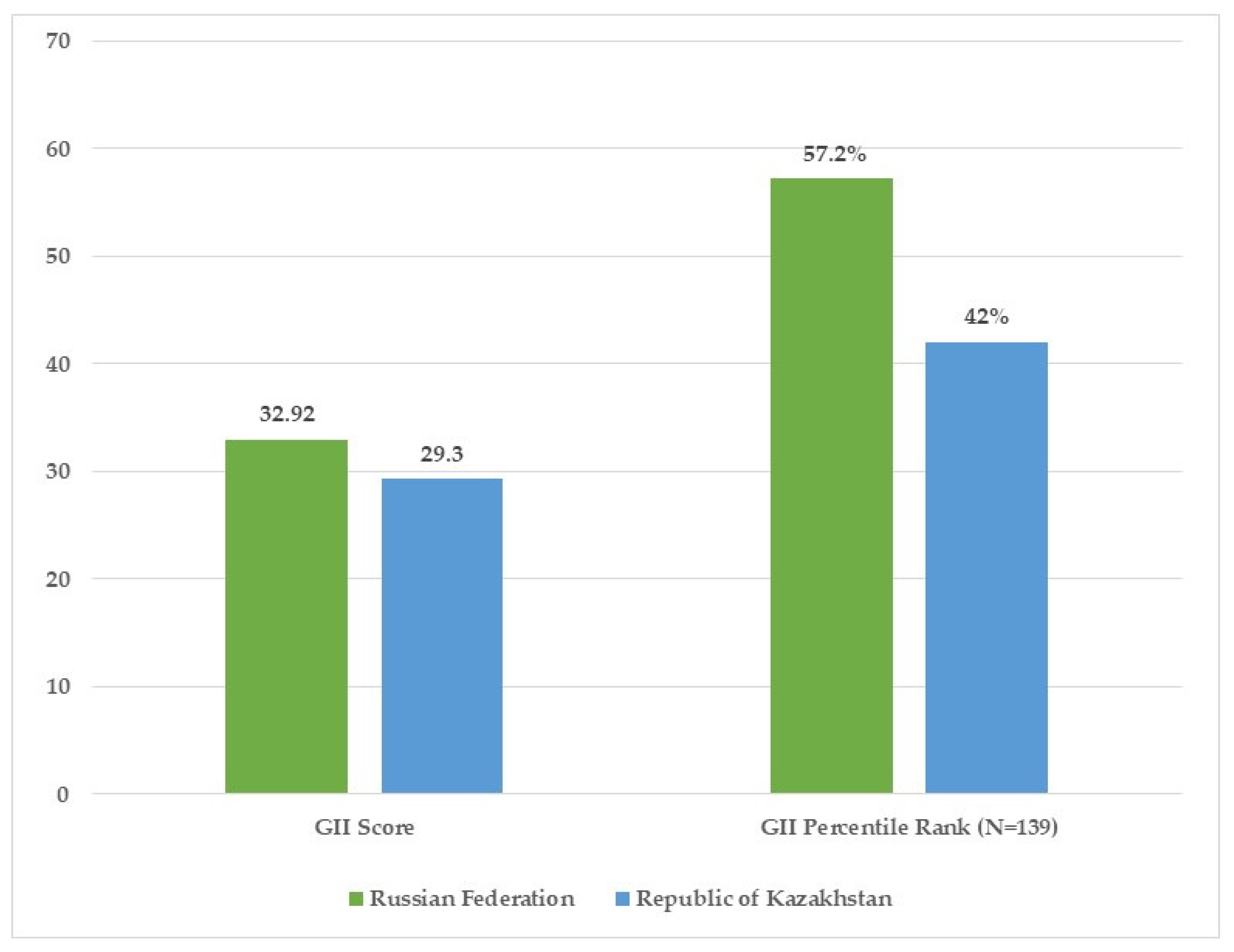
The primary analysis of the 2025 Global Innovation Index (GII) integral indicators shows a significant gap in the positions of the two key economies of the EAEU. The Russian Federation is in 60th place with a score of 32.92, while the Republic of Kazakhstan is in 81st place (29.30 points), forming a distance of 21st place in the overall ranking. However, the true nature of the differences between the innovation systems of the two countries is revealed when transitioning to the analysis of subindices “Conditions” (Input) and “Results” (Output). This analysis reveals a key efficiency paradox characteristic of transitive economies. Despite practically identical ranks in terms of conditions for innovative activity (73rd place in Russia and 75th in Kazakhstan), their effectiveness differs dramatically. Russia demonstrates relatively high efficiency, ranking 55th in the results sub-index, while Kazakhstan lags significantly behind, only at 84th position. A gap of 29 places between ranks for results under similar conditions indicates fundamentally different mechanisms for transforming innovative potential.
The quantitative expression of this paradox is the efficiency coefficient (Output/Input). For Russia, it is 0.75 (<1), which indicates the system’s ability to generate results exceeding the expected level under given conditions. This can be explained by the action of compensatory mechanisms, such as the domestic market scale effect, the persisting backlog in fundamental science, and informal practices for overcoming institutional barriers.
For Kazakhstan, the coefficient is 1.12 (>1), which reflects systemic inefficiency; the created relatively favorable conditions are not converted into proportional innovative results. This fundamental disparity in efficiency is visually summarized in Figure 1, which contrasts the countries’ absolute scores with their relative percentile positions in the global ranking (Figure 1).
The clustered column chart compares two key indicators aligned to a unified “higher is better” logic: the overall GII Score (0–100 scale) and the Percentile Rank (%), calculated for N = 132 economies as [(N − Rank)/(N − 1)] × 100. The visualization reveals the core “efficiency paradox”: while Russia holds a significantly higher percentile position (~57%), its absolute score remains moderate. Kazakhstan lags in both dimensions, indicating a shared systemic challenge in converting innovation inputs into outputs.

4.2. Comparative Analysis by Structural Components

This section discusses the underlying causes of the identified differences, which constitutes the answer to the second research question (RQ2) on institutional factors of asymmetry.
To understand the reasons for the identified paradox, it is necessary to move from integral indicators to the analysis of the internal structure of innovation systems through the prism of the seven key pillars of GII. This analysis not only allows for the identification of differences but also allows for the identification of typological models for the development of NIS in Russia and Kazakhstan.

4.2.1. Analysis of the “Institutions” Block

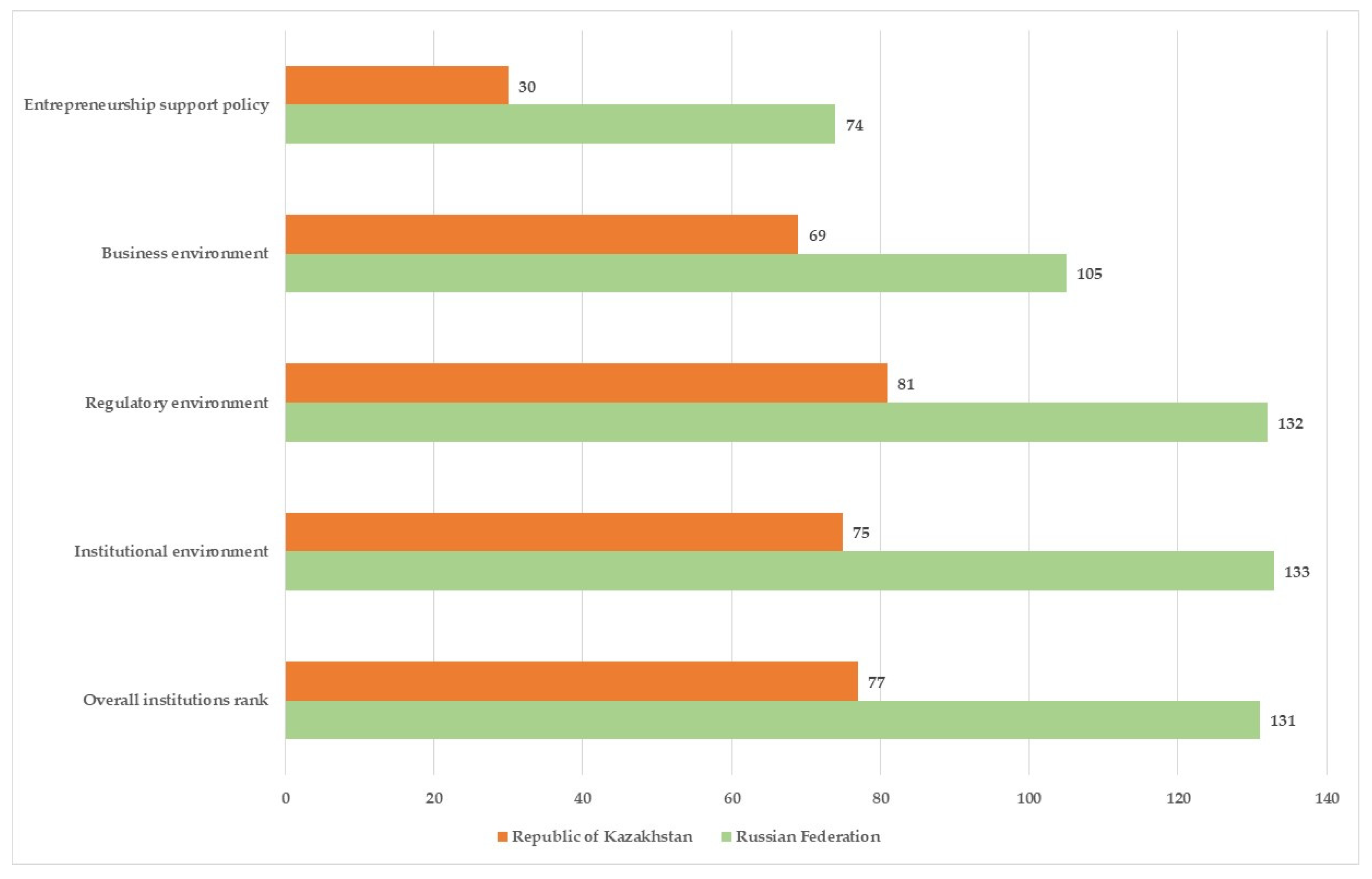
Analysis of the “Institutions” block reveals the most profound and fundamental contrast. Russia demonstrates a critically weak position, ranking 131st (23.3 points), which is noted in the GII report as a systemic weakness for the country’s income group. All components (institutional environment, regulatory environment, business environment) are in the bottom decimal place in the global ranking. This indicates high transaction costs, unpredictability of game rules, and weak property rights protection, which creates a fundamental barrier to innovation commercialization. In contrast, Kazakhstan shows relatively developed institutions (77th place, 47.1 points). The country’s absolute strength (30th place) is the “Entrepreneurship Support Policy” component. This reflects the targeted efforts to create a favorable business environment and the effectiveness of state support measures, which is a key result of the “top-down” modernization policy. This institutional divergence forms the first pole of future complementarity: relatively effective Kazakhstani institutions can potentially serve as an “interface” for reducing the costs of interaction with the Russian scientific and technical sphere (Figure 2).

4.2.2. Analysis of the “Human Capital and Research” Block

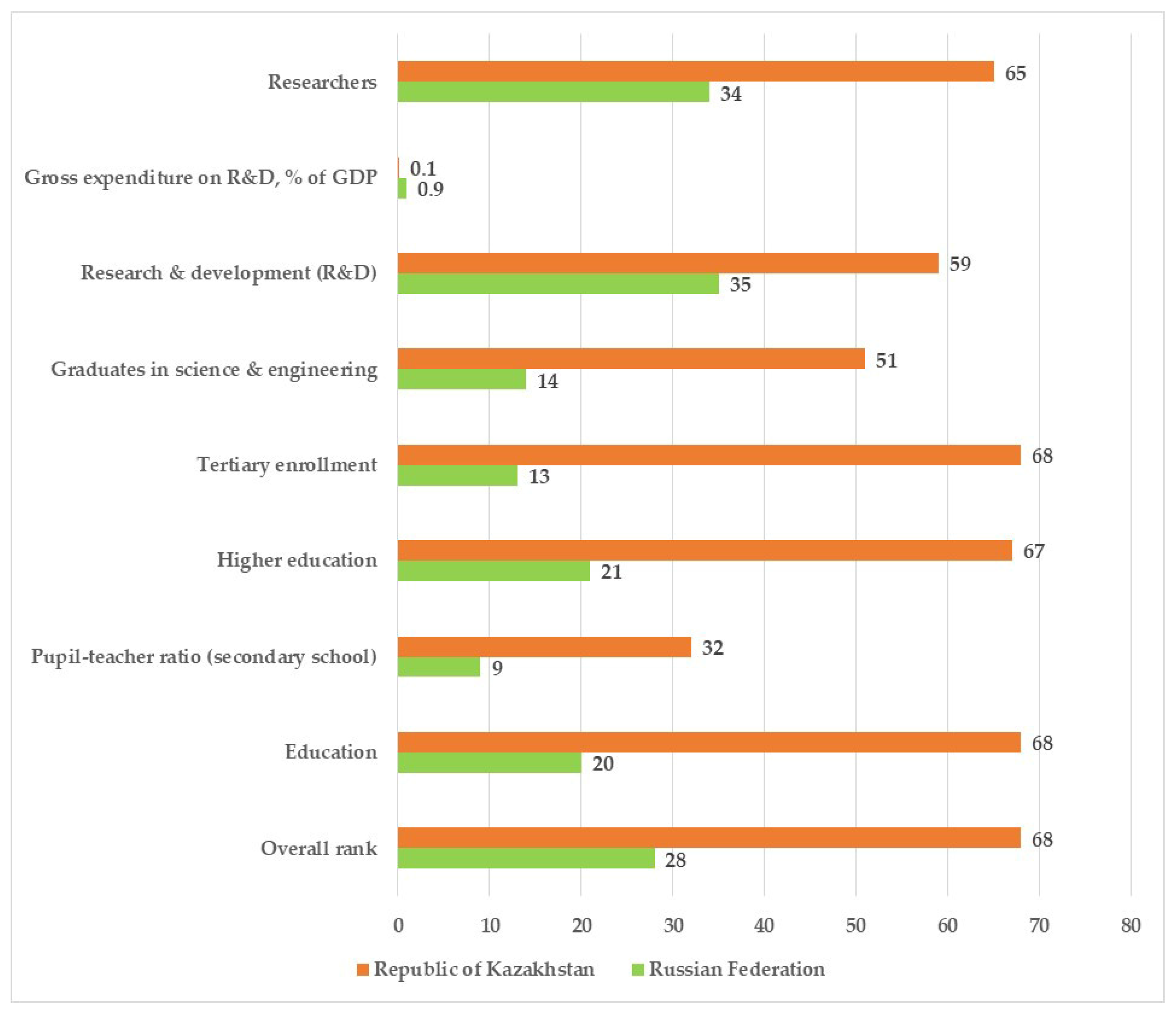
In the “Human Capital and Research” block, a mirror image is observed. Russia has a clear advantage, ranking 28th (47.2 points), qualifying as the absolute strong side. High rankings in the components of education (20th), higher education (21st), including one of the world leaders in coverage (13th place), and research activities (35th place) indicate the preservation of a powerful scientific and educational complex inherited from the Soviet system. Kazakhstan lags significantly behind in this block (68th place, 31.1 points). A critical systemic constraint that forms the “narrow niche” of the entire innovation model is the level of R&D expenditures—0.1% of GDP (95th place). This indicator, which is a weakness for the country’s income group, indicates a deficit not only in funding but also in the research core of the NIS itself. Thus, the second pole of complementarity is formed by a combination of deep Russian scientific and technical background and Kazakhstan’s need to access knowledge generation to fill its institutional frameworks with real content. The mirror-like, complementary nature of strengths and weaknesses in this pillar is clearly depicted in Figure 3.
The clustered column chart displays the scores of Russia and Kazakhstan for the three sub-pillars of the GII “Institutions” pillar. It visually substantiates the fundamental structural contrast: Kazakhstan demonstrates a clear and consistent advantage across all institutional components, highlighting institutional weakness as an absolute vulnerability (▼) for Russia and a relative strength for Kazakhstan within the EAEU context.
This chart compares the positions of Russia and Kazakhstan across the sub-components of the GII “Human Capital and Research” pillar. It graphically confirms the complementary asymmetry; Russia’s significant advantage in education and research scale contrasts sharply with Kazakhstan’s critically low score for “Expenditure on R&D”, visually defining the latter’s model as “institutionally focused with a knowledge deficit”.

4.2.3. Analysis of the “Infrastructure” Block and Environmental Sustainability

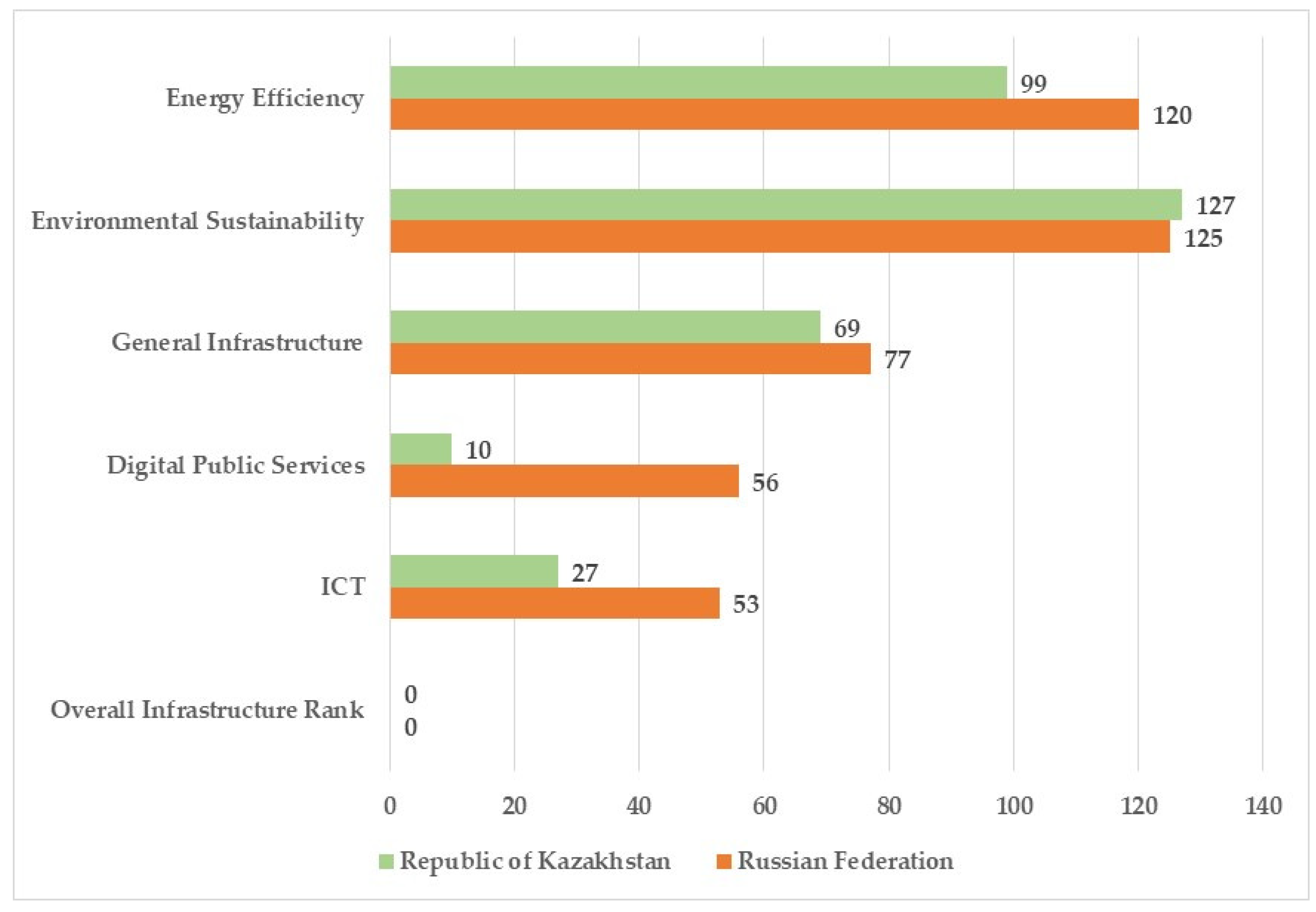
Analysis of the infrastructure block shows a mixed picture. Kazakhstan has a general advantage (64th place versus 76th in Russia), which is ensured by a significant gap in the development of ICT (27th place versus 53rd) and, especially, digital public services (10th place in the world—a strong side). This reflects the successes in implementing digitalization strategies and building a “digital government” However, both countries demonstrate critical low environmental sustainability indicators (respectively 125th and 127th places), which is a common structural weakness. This indicates the preservation of a resource-intensive model of economic development and forms a common problem area for joint R&D in the field of “green” technologies and resource efficiency (Figure 4).

4.2.4. Analysis of the “Business Development” “Knowledge and Technology” and “Creative Results” Blocks

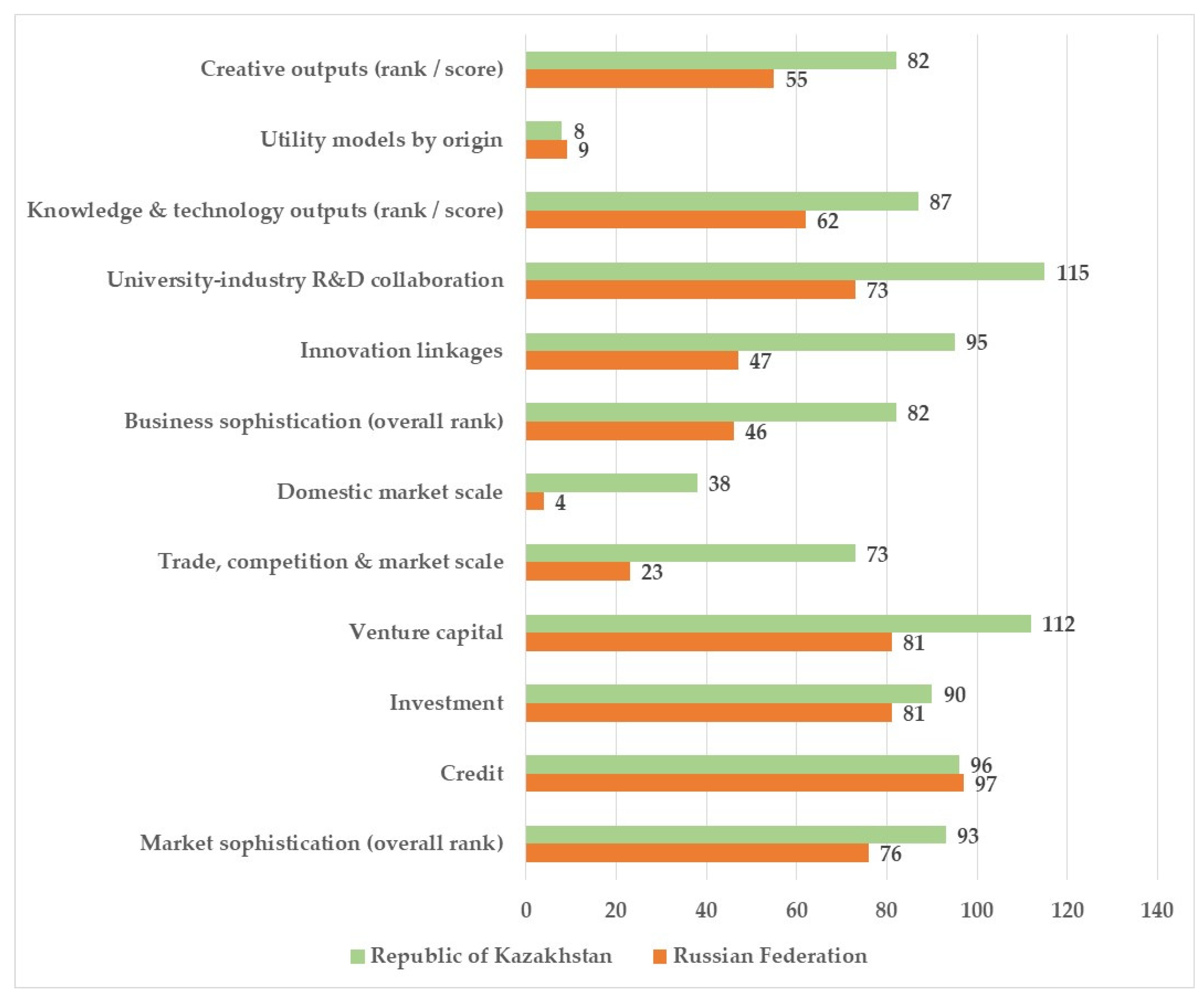
A comparative analysis of the final GII blocks confirms the higher effectiveness of the Russian NIS. In the “Business Development”, “Knowledge and Technology” and “Creative Results” columns, the ranking gap is between 20 and 36 positions in Russia’s favor. Russia’s key structural advantage is the scale of its domestic market (ranking 4th in the world), which creates unique opportunities for testing and implementing innovations. A common weakness for both systems is the mechanisms for financing innovations, especially in the field of venture capital, which indicates the underdevelopment of risk capital markets.
It is noteworthy that both countries demonstrate strong positions in creating useful models (8th and 9th places), which indicates the activity of incremental innovation processes, but can also indicate a focus on less risky and shorter-term forms of technological development (Figure 5).
Thus, the conducted comparative analysis of the national innovation systems (NIS) of the Russian Federation and the Republic of Kazakhstan in terms of the structure of the Global Innovation Index (GII) 2025 allows us to formulate a number of final theoretical and applied provisions that are significant for the architecture of innovative development of the Eurasian Economic Union (EAEU). The obtained data empirically confirm the hypothesis about the existence of divergent trajectories of post-Soviet modernization of innovation systems, which forms a heterogeneous morphology of the integration space.
  • The Russian model can be defined as “resource-intensive, but institutionally challenging” It is characterized by significant inherited potential in the field of human capital and fundamental research (Human Capital and Research pillar, 28th place), which, however, operates under conditions of pronounced institutional limitations (Institutions pillar, 131st place).
  • The paradoxically high efficiency coefficient of resource-to-result transformation (Output/Input = 0.75) indicates the presence of informal compensatory mechanisms and the effect of domestic market scale, which level out part of the institutional costs.
  • Kazakhstan’s model corresponds to the type of “institutional-oriented with a deficit of the research core”. Relatively developed formal institutions and advanced digital infrastructure (subcomponents of Business environment, ICT, Digital public services) contrast with a critical low level of R&D investment (0.1% of GDP) and lag in the generation of technological results (output/input ratio = 1.12). This indicates a systematic gap between the created conditions for innovation and their materialization in new products and technologies.
The comparative analysis yields two fundamental conclusions, clearly illustrated in Figure 4 and Figure 5. First, it reveals a foundation for complementarity, where the asymmetry is not hierarchical but mutually reinforcing—Kazakhstan’s strong digital infrastructure versus Russia’s robust science and technology outputs, and Russia’s large domestic market versus Kazakhstan’s need for such a platform for commercialization. Second, it identifies common systemic challenges: critically low performance in environmental sustainability and venture financing forms a unified problem area that demands coordinated supranational action.
The identified asymmetry should not be interpreted solely as a source of imbalances. Within the framework of economic integration theory, it can be reinterpreted as a basis for the formation of strategic complementarity, where the comparative advantages of one system activate and multiply the potential of another:
  • Institutional and technological symbiosis: Kazakhstan’s competence in creating a favorable regulatory and entrepreneurial environment (Institutions, 77th place) can serve as an “interface” for the commercialization of the Russian scientific and technical department (Knowledge and Technology Outputs, 55th place). This creates an opportunity for institutional arbitration, reducing the transaction costs of bringing innovations to the market.
  • Infrastructure–content cooperation: Kazakhstan’s advanced digital platforms and ICT infrastructure (rank 27) can be used as a testing ground for scaling up Russian developments in the field of “through” digital technologies, which is especially relevant for industrial digitalization programs (Industry 4.0) and public administration.
  • Joint overcoming of structural limitations: Both countries’ critical low indicators in environmental sustainability (125th and 127th places) and energy efficiency form a common field for cooperative R&D. The development and implementation of “green” technologies represent not only a response to global challenges but also a strategic opportunity for the formation of new technological platforms of the EAEU.
To realize the complementarity potential, an evolution from the policy of harmonizing rules to the policy of network integration of capabilities is necessary:
  • Creating distributed centers of excellence: instead of trying to develop all areas equally, it is advisable to form a network of thematic consortia based on the identified strengths. For example, a center for artificial intelligence and big data (based on Russian human capital and Kazakhstani ICT infrastructure) and a resource-efficient technology center (for solving common environmental problems).
  • Development of common infrastructure of the “soft” type: priority should be given not to physical objects, but to supranational legal and financial instruments—a common venture fund with a mechanism of co-investment, a system of mutual recognition of certificates for startups, a unified digital register of intellectual property rights for joint projects.
  • Implementation of the “innovative accounting” principle: Within the framework of joint projects, it is proposed to take into account the contribution of countries not only in terms of financial resources, but also in terms of competencies (scientific personnel, access to unique infrastructure, regulatory experimental regimes), which will allow for the formalization and stimulation of the net exchange of specific NIS assets.
Thus, the prospects for building a unified innovation space of the EAEU are determined by the ability of its key participants—Russia and Kazakhstan—to transfer interaction from the plane of competition for resources and harmonization of indicators to the plane of systemic complementarity. This involves moving from the logic of “equalizing conditions” to the logic of “combination of differences” where potential asymmetry becomes the main resource for generating synergistic effects. The successful testing of this model within the framework of Russian–Kazakh technological cooperation can become a prototype for the integration of innovation systems of the entire Union, transforming it from an association of national economies into a competitive actor for the formation of technological trends at the global level. However, the quantitative analysis presented above, based on aggregated indicators of the Global Innovation Index, is representative for international comparisons, but has certain limitations. It captures the state of systems at a specific point in time, but weakly reflects the deep institutional contexts, strategic vectors, and structural dysfunctions that determine their dynamics. To transition from measuring statics to understanding potential and development trajectories, a comprehensive qualitative analysis is necessary that would consider the historical, institutional, and political-economic features of the formation of innovative systems in Russia and Kazakhstan. To transition from state diagnostics to understanding the dynamics and designing the future, two-stage analytical synthesis is applied: first, a qualitative SWOT analysis is carried out, and then scenario modeling. These blocks act as a logical continuation of quantitative comparison, revealing why systems function exactly this way and what different trajectories of their interaction can lead to under integration conditions.

4.3. SWOT Analysis as a Tool for Interpreting Structural Disproportions and Identifying Complementarity

Quantitative analysis based on GII 2025 (Section 3.2) revealed structural contrasts and the “efficiency paradox” in NISs of Russia and Kazakhstan. To transition from stating these “symptoms” to understanding their institutional and strategic causes, SWOT analysis is applied. Within the framework of this research, it performs not a descriptive but an integrative-explanatory function, synthesizing data from GII, national statistics, and scientific literature to solve three key tasks:
  • Identification of profound factors behind quantitative ranks (for example, institutional barriers causing Russia’s low rank, or funding shortages limiting returns from institutions in Kazakhstan).
  • Concretizing the assumption of asymmetric complementarity by comparing the strengths and weaknesses of each system, demonstrating their mirror-like nature.
  • Identifying main managed factors and critical uncertainties, which subsequently become drivers for constructing scenarios.
The analysis results presented in Table 3 and Table 4 are products of this synthesis. The column “Connection with GII findings and complementarity potential” clearly demonstrates how each qualitative factor relates to empirical data and the research concept.
The comparative SWOT analysis allows for a number of critically important conclusions for the study. Firstly, it confirms and explains the nature of the structural contrasts identified through GII: Russia’s low ranking in institutions (W4, T4) is rooted in high transaction costs and the gap between science and business (W1), while Kazakhstan’s knowledge deficit (W1, W2) is a direct consequence of the chronic underfunding of R&D and the weakness of scientific schools. Secondly, the analysis clearly demonstrates the mirror, complementary nature of the two systems’ strengths and weaknesses: Russia’s strengths (S1, S2, S4) directly target Kazakhstan’s weaknesses (W1, W2, W4), and conversely, Kazakhstan’s strengths in institutions and digital infrastructure (S2, S3) can compensate for Russia’s key institutional weaknesses (W4). Thirdly, it identifies common systemic limitations (raw material dependence, gap between science and production, “brain drain”), which form a unified agenda for policy coordination within the EAEU.
Thus, SWOT analysis is an analytical bridge that transforms quantitative disproportions into a qualitative matrix of specific management problems, opportunities, and synergy points, laying the foundation for scenario-based design of future interactions.

4.4. Scenario Modeling

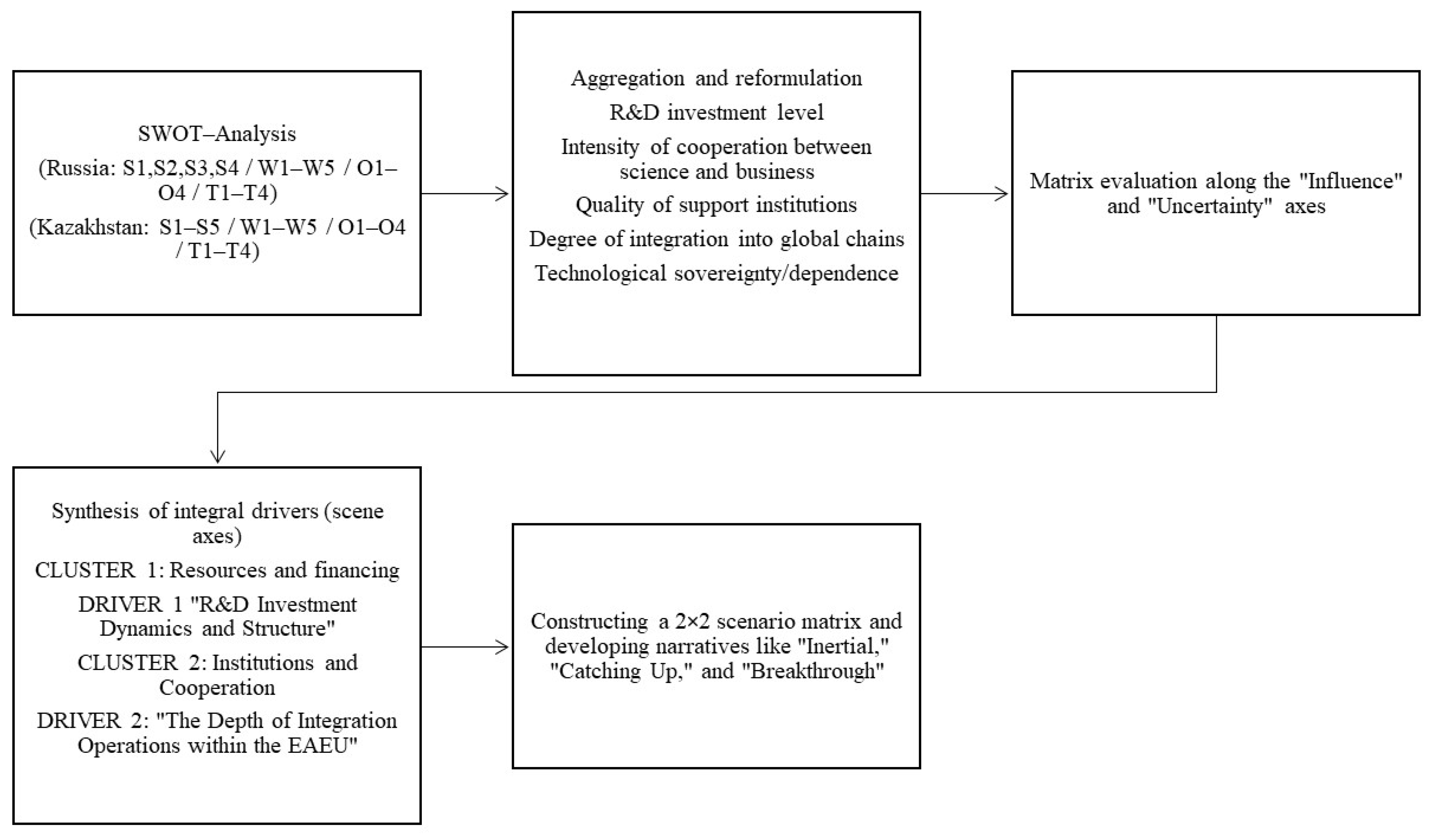
The conclusions of quantitative and SWOT-analysis, however, do not predetermine the single future option. They form a field of uncertainty, where management decisions play a key role. To assess the spectrum of possible trajectories and transfer analytical conclusions to the strategic choice plane, scenario modeling is applied. Its purpose is not to forecast, but to construct alternative, internally agreed-upon future pictures (scenarios), each of which reveals the consequences of implementing various strategic attitudes. Critical uncertainties and drivers for constructing scenarios were directly derived from the factor synthesis identified in the SWOT analysis (see Figure 6 and description of the driver selection procedure).
Based on the integral analysis of quantitative indicators (GII), SWOT analysis results, and verified expert assessments, scenario modeling of possible development trajectories of national innovation systems of Russia and Kazakhstan, both individually and in the context of their cooperation within the EAEU, was carried out. Modeling relied on the methodology of “intellectual assumptions”, where the key drivers and limitations identified in previous stages became the basis for constructing alternative future pictures.

4.4.1. Comparative Characteristics of the Initial Parameters of National Innovation Systems

As a methodological basis for constructing forecast models, a comparative analysis of key parameters of the national innovation systems of the Russian Federation and the Republic of Kazakhstan for 2023 was conducted. The data are presented in Table 5.
The analysis revealed a significant asymmetry in the initial conditions for the development of the national innovation systems of the two countries. The greatest differentiation is observed in the volume of venture investments (differentiation coefficient 10.0) and the number of researchers (coefficient 3.85). Interpretation of the identified coefficients in the context of structural contrasts. The obtained quantitative coefficients serve as direct statistical confirmation and specification of the qualitative structural models identified based on GII 2025. A coefficient of 10.0 on venture investments is the most pronounced indicator of imbalance in market mechanisms for financing innovations. It quantitatively reflects the weakness common to both systems (low ranks in the “Credit” and “Investment” components of the GII) but brought to a critical level in the case of Kazakhstan. This gap is directly correlated with the “institutional-focused knowledge deficit” model in Kazakhstan, where relatively developed formal institutions are not compensated by active risk capital, as well as with the “effectiveness paradox” identified in Russia, where even a limited volume of venture financing (0.5 billion USD) in combination with strong human capital allows for disproportionately higher results. The 3.85 coefficient for the number of researchers directly quantifies the key divergence in the “Human Capital and Research” column of the GII. This indicator is the core around which opposite models are formed—for Russia, it is the basis of the “compensatory-disbalance” model, which allows for the elimination of institutional weaknesses; for Kazakhstan, it is the central “narrow point” which limits the return on the created institutions and leads to an efficiency coefficient of >1. This gap in personnel potential is a fundamental structural contrast that determines the need for complementary cooperation rather than parallel development.
Thus, the calculation of differentiation coefficients not only confirms the presence of asymmetry but also allows for a shift from ranking in GII to measuring the absolute depth of discontinuity for critical parameters.
The identified disproportions in human and financial capital set objective frameworks for a differentiated approach to developing scenario forecasts and determine areas where cooperation potential (for example, through joint research programs or joint venture instruments) can be most effective.

4.4.2. Forecast Scenarios for the Development of National Innovation Systems

Selection of key drivers based on SWOT factor synthesis
The SWOT factor transformation procedure on the scenario uncertainty axis included three sequential analytical steps, visualized in Figure 6.
Step 1. Aggregation and Reformulation. All factors from the SWOT matrices of Russia and Kazakhstan were consolidated into a common list and transferred to a form that allows for assessing the dynamics. For example:
W1 (RF): “Systematic disunity between science and the real sector” → “Intensiveness of cooperation between science and business”
W1 (RK): “Extremely insufficient R&D expenditure” → “R&D investment level (share in GDP)”
O2 (RF/RK): “Deepening Partnership with Asian Economies”/”Creating Conditions for R&D Center Transfer” → “The Degree of Engagement in Global/Regional Technological Chains”
T1 (RF/RK): “Strengthening technological isolation”/”Risk of peripheral position” → “Level of technological sovereignty/dependence”.
Step 2. Matrix positioning and clustering. Each reformulation factor was evaluated by the study’s coordination group based on two criteria based on a 5-point scale:
Impact: the potential of a factor to radically change the trajectory of NIS development.
Uncertainty: the degree of unpredictability of its change in the horizon until 2035.
The obtained estimates allowed for the placement of all factors in the “Influence–Uncertainty” matrix. Two clusters of factors with high values for both axes were clearly highlighted, which corresponds to the criteria for selecting key uncertainties for scenario planning.
Step 3. Synthesis of drivers. Clusters were interpreted and reduced to two integral axes:
Driver 1: “R&D investment dynamics and structure”
Unites: Internal weaknesses related to financing (W1 for the Republic of Kazakhstan, W4 for the Russian Federation) and strategic opportunities requiring resources (O1, O3 for the Russian Federation; O1, O2 for Republic of Kazakhstan).
The driver’s essence: It answers the question “Will sufficient financial resources be mobilized for the technological breakthrough, and will they come from the private sector?” It accumulates the main resource risks and opportunities of both countries.
Driver 2: “The Depth of Institutional Reforms and Integration Cooperation within the EAEU”
Unites: External opportunities related to cooperation (O2, O4 for both countries) and key threats of isolation or dependence (T1, T2, T4).
The essence of the driver: It answers the question “Can the EAEU integration framework evolve from removing barriers to jointly creating technological opportunities?” This driver reflects the institutional and political uncertainty on which the implementation of complementarity depends.
Thus, the axes of the scenarios were not chosen arbitrarily, but are the result of the systematic “conversion” of the multifactorial SWOT-image into two most complex and uncertain dimensions that determine the space of possible future states of the system. This approach ensures a direct and observable connection between current state diagnostics (SWOT) and future planning (scenarios).
Based on regression analysis and probabilistic modeling methods, three alternative scenarios for the development of national innovation systems until 2035 have been developed. The modeling results are presented in Table 6.

4.4.3. Probability Analysis of Scenario Forecasts Implementation

Selecting key drivers for scenario modeling.
The logic of transitioning from SWOT analysis to identifying critical uncertainties for scenario modeling was based on the synthesis of internal and external factors identified for each country.
Formation of a pool of candidate factors. At the first stage, all significant factors from the SWOT matrices (Table 1 and Table 2) were combined into a single list and reformulated as variables that allow for variation (e.g., “Weak Science–Production Connection” → “Intensity of Science–Business Cooperation”).
Expert ranking and uncertainty axes selection. Within the framework of the Delhi round, experts were asked to assess each factor according to two criteria: (1) the degree of manageability (the possibility of influence from the policy of the EAEU and national governments); (2) the level of uncertainty (the unpredictability of its dynamics).
As a result of pairwise comparison, two factors were identified that have high significance for the final result but have the least predictable dynamics, making them ideal axes for constructing the scenario matrix:
R&D investments (D1): Combines internal weaknesses (W1, W4 for RF; W1, W4 for RK) and possibilities (O1, O3 for RF; O1, O2 for RK). This driver reflects the fundamental resource challenge on which the implementation of any strategy depends.
Depth of integration in the EAEU (D2): Unites external opportunities (O2, O4 for RF; O2, O4 for the Republic of Kazakhstan) and threats (T1, T2 for both countries). This driver reflects the key institutional and political uncertainty that determines the possibility of joint use of complementary assets.
Formalization of driver states: each driver was dichotomized based on threshold values verified by experts:
D1 (Investments): Low level (L)—maintaining the share of R&D in GDP at a level not exceeding 1.5% for the Russian Federation and 0.8% for the Republic of Kazakhstan. High level (H)—achievement of target indicators of 2.5% and 1.5%, respectively.
D2 (Integration): Weak cooperation (W)—predominance of bilateral projects, formal harmonization of legislation. Deep cooperation (S)—implementation of the concept of asymmetric complementarity with the creation of supranational institutions of “soft” infrastructure.
Thus, the scenario matrix is built at the intersection of key resource (investment) and institutional (integration) drivers, derived directly from the disproportions recorded in the SWOT analysis.
To assess the probability of implementing the developed scenarios, the Monte Carlo method was used with 10,000 iterations. The results of the probabilistic estimation are presented in Table 7.
The presented probabilities of scenario realization are of a subjective (expert) nature, reflecting the consensus opinion of the formed panel of specialists (n = 35) based on the results of three rounds of the Delphi method. They are based on an integral assessment of current institutional trends, political cycles, and economic constraints in both countries.
The Monte Carlo method (10,000 iterations) was used not to generate the probabilities themselves, but to assess their statistical stability and construct confidence intervals when expert estimates vary within one standard deviation. This allows us to interpret the result not as a point forecast, but as a balanced assessment that takes into account the dispersion of opinions within the expert community.
The obtained results indicate that significant institutional barriers remain for innovative development. The high probability of implementing the inertial scenario (45%) reflects the stability of existing development trajectories.
The low probability of a breakthrough scenario (20%) indicates the need to implement coordinated state policy measures to overcome institutional inertia.

4.4.4. Analysis of Key Developmental Parameters Sensitivity

To identify critical factors of transition between scenarios, an analysis of the sensitivity of key parameters for the development of national innovation systems was conducted. The analysis results are presented in Table 8.
Analysis revealed that the development of cooperation between scientific organizations and business structures has the greatest impact on the probability of transitioning to a breakthrough scenario (elasticity coefficient 0.9). This confirms the hypothesis about the critical importance of overcoming the “innovation chain gap” to achieve a qualitative breakthrough in the development of national innovation systems.

4.4.5. Expected Effects of Coevolutionary Development

Modeling showed a significant synergistic effect from the coevolution of the NIS of Russia and Kazakhstan. When implementing the breakthrough scenario, the integrated innovation space development indicator can reach 0.85, which corresponds to the level of developed European countries.
The greatest potential for synergy is observed in the following areas:
Combining the Russian scientific and technical potential with the Kazakhstani practice of attracting investments
Creation of joint venture funds
Formation of a unified digital platform for innovative cooperation
Development of transboundary innovation clusters
Implementing the breakthrough scenario will allow both countries to overcome the “efficiency paradox” and enter a sustainable innovative development trajectory that meets the criteria of technological leaders.
Thus, three scenarios were identified, covering the spectrum from inertial development to cooperative breakthrough. The critical uncertainties that formed the axes of the scenarios were: (1) the dynamics and structure of investments in R&D (growth/stagnation, public/private); (2) the depth and effectiveness of institutional reforms and cooperation in the EAEU; (3) the degree of integration into global technological chains.
Scenario 1: Inertial (“Distant Adaptation”).
Key prerequisites: Maintaining current trends and system dysfunctions. The increase in budget allocations for R&D is insignificant and has a compensatory nature; the share of the private sector is not increasing. Institutional reforms in both countries are proceeding slowly and haphazardly. Integration within the EAEU remains at the level of trade in goods and formal agreements, with no real coordination of innovation policy. Russia’s global technological isolation is intensifying, while Kazakhstan maintains its peripheral role as a ready-made solutions adapter.
Expected results by 2035:
Russia: An unbroken gap between scientific embellishment and commercialization. The share of high-tech exports is not growing. Conservation of component import dependence in critical industries. The outflow of skilled personnel persists.
Kazakhstan: R&D expenditure growth to 0.5–0.7% of GDP, but without a qualitative leap. Strengthening its position as a regional IT outsourcing center while weakly developing its own R&D base. Strengthening the raw material dependence of the economy.
EAEU: The innovation space remains fragmented. Synergistic effect is not achieved; integration loses strategic perspective for technologically oriented business.
Scenario 2: Catching up (“Selective Cooperation”).
Key prerequisites: Moderate growth of state and private investments in R&D (RF-up to 2% of GDP, RK-up to 1.5% of GDP by 2030). Conducting targeted institutional reforms aimed at reducing administrative barriers and stimulating innovation demand in the public sector. Development of cooperation within the EAEU framework on the principle of “smart specialization”: coordination of 3–4 priority technological areas (for example, agrobiotech, digital medicine, “green” transport). Partial restoration of international scientific ties for Kazakhstan and new partners for Russia.
Expected results by 2035:
Russia: Stabilization of scientific potential, growth of innovative-active medium-sized enterprises. The emergence of the first successful examples of import substitution in non-raw material exports.
Kazakhstan: Formation of strong research centers within the chosen specializations. Growth in exports of IT services and technological solutions for Central Asian countries.
EAEU: Formation of the first full-fledged Eurasian technological chains in narrow segments. The emergence of supranational financing instruments for pilot projects. Slowed technological lag from leading countries, but lack of breakthrough global innovations.
Scenario 3: Breakthrough (“Eurasian Technological Alliance”).
Key prerequisites: A radical increase in the share of private investments in R&D to 60–70% of total expenditures in both countries. Deep institutional reforms creating a unified legal field for research, intellectual property protection, and venture financing in the EAEU. Implementation of the principle of complementarity as the core of integration: creation of joint research infrastructures (mega science), joint venture funds, and mobility programs for scientists and engineers. An active policy of technological sovereignty in key areas, coupled with electoral integration into global chains.
Expected results by 2035:
Russia: The transformation of raw material rent into technological rent, the emergence of transnational technology corporations of the Eurasian scale. Leadership in 2–3 global technological niches (e.g., nuclear medicine, quantum communications).
Kazakhstan: Transformation into a regional hub for testing, adaptation, and implementation of new technologies. Formation of a full-fledged venture market. The growth of the share of high-tech products in exports.
EAEU: Formation of a full-fledged unified innovation space with the circulation of talents, capital, and technologies. The emergence of the “Eurasian Innovation Belt” with competency centers in different countries. Achieving a synergistic effect that allows the Union to become a collective technological player at the global level.
Based on the conducted comparative analysis, scenario modeling, and probabilistic assessment of the development of national innovation systems (NIS) of Russia and Kazakhstan, the following main conclusions were formulated.
  • Deep structural asymmetry of initial conditions was diagnosed. It has been established that there is a significant gap between the NISs of the two countries in key parameters. The greatest differentiation is observed in the volume of venture investments (coefficient 10.0) and the provision of scientific personnel (coefficient 3.85), which indicates fundamentally different starting positions for the formation of a knowledge economy.
  • Critical drivers for transitioning to favorable scenarios have been identified. Analysis of sensitivity showed that the probability of transitioning from the inertial path of development to catching up and breakthrough scenarios most significantly depends on specific institutional factors. The greatest impact potential (elasticity coefficient 0.9) was identified in the factor of strengthening cooperation between scientific organizations and business structures. This confirms the hypothesis that overcoming the “innovation chain gap” is a key condition for activating innovation processes in both countries.
  • The fundamental possibility of achieving a breakthrough scenario through coevolution has been substantiated. The modeling results indicate that despite the low a priori probability (20 ± 3%), the breakthrough scenario is achievable. Its implementation implies not parallel but convergent and coevolutionary development of the NIS of Russia and Kazakhstan, leading to the convergence of their target indicators. The synergistic effect of such integration can lead to the formation of a single innovation space with an integral development index of 0.85, which corresponds to the parameters of developed countries.
Thus, the study confirms that the dominant trend remains the inertial path of development (probability 45%). However, there is significant potential for a managed scenario transition. The realization of this potential is nonlinear and requires a targeted and coordinated policy focused on activating key drivers, primarily on creating effective institutions that link the scientific generation of knowledge with the demands of the real sector of the economy. Russia’s achievement of innovation-oriented economic indicators (2.5% of R&D in GDP), and Kazakhstan’s achievement of the parameters of the formed NIS (1.5% of R&D in GDP) in the 2035 horizon is most likely precisely within the framework of a breakthrough scenario based on deepened bilateral cooperation. The conducted analysis shows that the future of innovative development of Russia and Kazakhstan is not predetermined and largely depends on the ability to overcome internal institutional limitations and realize the potential of Eurasian complementarity.
An inertial scenario leads to increased backwardness and marginalization. Even a relatively optimistic catch-up scenario does not allow us to count on global technological competitiveness. The breakthrough scenario, although assessed by experts as the least likely under current conditions, is the only one that aligns with both Russia’s (technological sovereignty) and Kazakhstan’s (entry into the top thirty developed countries) strategic ambitions. Its implementation is possible only through the transition to a new paradigm of Eurasian integration—from a common market to a common innovative project based on trust, mutual complementarity, and joint investments in a common technological future. Further research should focus on developing specific roadmaps and institutional mechanisms necessary to shift the trajectory from an inertial to a breakthrough scenario.
The synthesis of the obtained results allows us to formulate a key conclusion that determines the direction of further discussion: the identified structural contradictions between the national innovation systems of Russia and Kazakhstan are not a neutral factor, but act as a system-forming condition that determines the possible integration trajectories within the EAEU. Empirically identified models—”compensatory disbalanced” and “institutional focused with knowledge deficit”—impose a specific morphology of asymmetry, while the probabilistic distribution of scenarios (with inertia path dominance) indicates high institutional barriers to achieving sustainable synergy. Thus, the central research problem shifts to the question of complementarity management mechanisms capable of transforming this structural morphology into a sustainable driver of joint technological development. Finding such mechanisms is of not only economic but also strategic importance for ensuring the long-term sustainability of the EAEU in its three dimensions: economic (overcoming raw material dependence through cooperation), social (creating common opportunities for talents, reducing asymmetries), and ecological (jointly solving critical problems of low environmental effectiveness). The following discussion will focus on developing the concept of asymmetric complementarity as a theoretical response to this challenge.

5. Discussion

The obtained results and the proposed concept are reflected and supported in modern research, which further confirms their validity. Firstly, the choice of the Delphi iterative procedure, which allowed us to identify the contours of asymmetrical synergy, corresponds to the established practice of researching regional innovation strategies. Secondly, the identified significance of human and intellectual capital as a key asset of Russia and, at the same time, a growth point for Kazakhstan directly correlates with conclusions about the critical role of universities in innovation generation. Thirdly, the proposed transition to network forms of cooperation (“opportunity architecture”) aligns with the data that it is precisely the density and configuration of connections in the innovation ecosystem that determine its effectiveness. Finally, the goal setting itself—the transformation of asymmetry into a resource of sustainable development—relies on the proven relationship between innovative activity and achieving long-term sustainability goals [62], including through mechanisms of “smart specialization” adapted by us for asymmetric integration conditions. Thus, the proposed concept of asymmetric complementarity synthesizes these directions, offering a specific mechanism for managing differences for the sustainable development of the EAEU.
The obtained results allow us to transition to interpreting the identified structural contradictions within the framework of existing theoretical approaches, to assess their significance for Eurasian integration, and to formulate strategic implications.
While existing studies predominantly state the fact of asymmetry between the NIS of Russia and Kazakhstan or analyze them in isolation, our research takes the next step. Using the structural decomposition of the GII, we not only quantitatively confirm this asymmetry but also reveal its specific, mirror configuration, which allows us to move from stating the problem to designing solutions.

5.1. Interpretation of Structural Disproportions Through the Prism of NIS Theory and Path Dependence

The identified duality of the NIS models of Russia and Kazakhstan is a clear illustration of the divergent trajectories of institutional evolution in the post-Soviet space, caused by the path dependence phenomenon [63,64]. The configuration of the Russian NIS, characterized by the combination of a powerful inherited scientific and educational complex with chronically weak institutions, corresponds to the logic of “inertial adaptation” [65,66]. This model reflects the difficulties of transforming a large-scale yet closed Soviet R&D system into an open, market-oriented innovative ecosystem, where weak connections between science and industry remain a systemic defect [67,68]. The Kazakhstani model, on the contrary, embodies the strategy of “selective construction of institutions” [69,70]. The emphasis on creating a favorable regulatory climate, developing digital infrastructure, and attracting foreign direct investment aligns with the canons of catching up modernization. However, as the theory predicts, the import of institutional forms without simultaneously increasing the endogenous potential of knowledge generation leads to “institutional void” [71]—a gap between formal rules and real capacity for innovation, which is quantitatively expressed in the efficiency coefficient > 1.
The observed “efficiency paradox” (different Output/Input values with similar Input) can be explained through the concept of compensatory mechanisms [72,73]. In the Russian system, the role of such a compensator is performed by informal networks, the effect of domestic market scale, and the preserved “competence islands” in the “science-intensive services” sector [74,75]. In the Kazakhstani case, relatively high Input indicators are not transformed into results due to the lack of critical mass of own R&D activities, making the system dependent on exogenous technology sources.
This finding resonates with the work of Nurlanova, N.K. et al. [76], which also notes the high dependence of Kazakhstan’s innovation system on technology imports. However, our research adds an important nuance to this: this dependence exists against the backdrop of relatively developed formal institutions, creating a unique “institutional paradox” and a specific point for potential policy intervention.

5.2. Asymmetric Complementarity as a New Framework for the Integration Theory and Practice of the EAEU

The identified mirror nature of structural imbalances allows us to propose the concept of “asymmetrical complementarity” as a theoretical framework that synthesizes the provisions of the NIS theory and modern political economy of regional integration [62,77,78]. This concept offers an alternative to the traditional approach for the EAEU focused on harmonization and elimination of differences [79,80]. Instead, it emphasizes heterogeneity management to generate synergy. The concept finds support in the theory of “smart specialization” (Smart Specialization Strategy—S3) [81,82], developed in the context of European regional policy. However, it introduces a specific addition relevant to asymmetrical associations: specialization should not only be “smart” but also complementary at the supranational level. This involves the conscious design of cooperative chains, where the comparative advantages of one system (e.g., knowledge generation in Russia) directly address the key limitations of another (knowledge deficit in Kazakhstan) and vice versa (Kazakhstan’s institutional interface for the commercialization of Russian developments). Thus, asymmetry ceases to be considered solely as a “coordination failure” [83] and is interpreted as a potential source of “cooperation rent” (cooperation rent) arising from the combination of complementary but dispersed assets within a single space. This aligns with research findings that further consolidation of the EAEU is impossible without transitioning from the logic of a common market to the logic of jointly creating added value, especially in high-tech sectors [84].
Our concept builds upon the ideas embedded in the theory of “smart specialization” (S3). If S3 focuses on avoiding duplication of efforts within a region or country, we propose applying this logic between countries with asymmetric NIS. Thus, we extend the application of S3, adapting it to the challenges of asymmetric integration, such as that within the EAEU.

5.3. Strategic Implications and Mechanisms for Realizing Cooperation Potential

The results of scenario modeling unequivocally indicate that the inertial path leads to the conservation of the peripheral position of both systems in global innovation chains. To implement a breakthrough scenario, a targeted policy is needed that transforms the potential of complementarity into specific institutions. Based on the analysis, the following mechanisms are proposed:
  • Creating Distributed Centers of Excellence (Distributed Centers of Excellence): Instead of duplicating efforts, it is advisable to form a network of thematic consortia that institutionally reinforce complementarity. For example, the Center for Digital Industrial Technologies (Russian competencies in software and engineering + Kazakhstani ICT infrastructure and pilot sites) or the Center for Agrobiotechnologies (Russian fundamental science + Kazakhstani testing grounds and access to Asian markets). The proposed mechanism of distributed centers of excellence adjusts the traditional approach for the post-Soviet space to creating joint ventures, described in [85,86]. Instead of combining similar resources (“hard” integration), we propose a model of networked “soft” integration based on the complementarity of unique assets, which can reduce transaction costs and enhance the sustainability of cooperation.
  • The financing of such centers should be carried out through the mechanism of “innovative accounting” taking into account the contribution not only by financial means, but also by providing unique infrastructure, personnel resources, and regulatory preferences.
Development of supranational “soft” infrastructure (Supranational ‘Soft’ Infrastructure): It is critically important to go beyond harmonizing legislation to create common tools:
Eurasian “Co-investment” Venture Fund, which reduces risks for private investors and is aimed at cross-border projects.
A system of mutual recognition of regulatory sandboxes for testing new technological solutions and business models.
A unified digital platform for accounting and managing intellectual property rights, created by analogy with successful European practices (e.g., European Patent with Unitary Effect).
Formation of a common market for innovative talents: it is necessary to supplement existing labor mobility agreements with targeted scientific and engineering mobility programs (based on the European Marie Sklodowska-Curie Actions program), the creation of joint PhD programs and networked departments, which will contribute to overcoming “brain drainage” and the formation of a common scientific identity.

5.4. Research Limitations and Promising Directions

This research has a number of limitations that define the outline for future research:
  • The methodological limitation relates to the use of aggregated GII indicators, which, being an effective benchmarking tool, weakly capture the quality of institutional interactions and the role of informal networks.
  • The expert nature of SWOT analysis and scenario assessments, despite the Delphi verification procedure, implies the presence of a subjective component.
  • The research is of a macro-level nature and does not affect the microeconomic mechanisms of decision making by firms and scientific teams in the context of integration.
In this regard, the following are promising areas:
  • In-depth institutional analysis of specific cooperation barriers within the Triple Helix model, using the example of selected cross-cutting technologies (e.g., quantum computing, biotech).
  • Quantitative assessment of transaction costs for conducting joint innovation activities within the EAEU using economic modeling methods.
  • Comparative analysis of the complementarity potential of Russia and Kazakhstan with other asymmetric integration pairs (e.g., Germany–Poland in the EU, China–Vietnam in ASEAN) to identify universal and specific mechanisms for managing diversity.
The analysis shows that the structural asymmetry of the NIS of Russia and Kazakhstan, being a challenge, simultaneously contains a response to it in the form of the potential for asymmetric complementarity. This moves beyond the traditional view of asymmetry in the EAEU as merely a source of imbalances or a ‘coordination failure’, and aligns with emerging research on the possibility of generating ‘cooperation rent’ from heterogeneity. Our findings, which build upon the diagnosis of divergent post-Soviet modernization paths and extend the theory of smart specialization to the supranational level, demonstrate that the realization of this potential requires a transition to a new paradigm of integration construction in the EAEU—from unification and rule harmonization to synergy and the creation of common opportunities. The success of this transition will determine the Union’s ability to overcome the status of a peripheral technology adapter and become a subject of global technological trends.

6. Conclusions

The main theoretical contribution of this research lies in three interconnected achievements. Firstly, the work introduces and substantiates the original concept of asymmetric complementarity of national innovation systems. Within its framework, structural differences are reinterpreted; from a source of imbalances and an object of harmonization policy, they are transformed into a fundamental basis for the formation of strategic synergy and joint value creation. Secondly, based on the structural decomposition of the Global Innovation Index data, an empirical typology of post-Soviet models for the development of national innovation systems is developed and verified. The key archetypes of this typology are Russia’s “compensation-disbalance” model and Kazakhstan’s “institutional-oriented knowledge deficit model”. It explains the nature of the identified “efficiency paradox” Thirdly, the study translates the theory of “smart specialization” from regional to supranational levels, demonstrating its operationalization for managing heterogeneity and designing cooperative chains in the context of asymmetric integration associations such as the EAEU.
Together, these contributions form a new analytical framework for studying and constructing integration processes that overcomes the limitations of the institutional unification paradigm in favor of the complementary assets network management paradigm.

6.1. Theoretical Contribution

The main theoretical contribution of this study is the development of the concept of asymmetric complementarity of national innovation systems. This concept offers a new analytical perspective for Eurasian integration, reinterpreting the role of structural differences. Instead of interpreting asymmetry as a barrier, this concept justifies its potential as a source of sustainable synergy. A conceptual breakthrough is the consideration of the identified mirror imbalances—the powerful scientific potential under weak institutions in Russia and relatively developed institutions under the deficit of knowledge generation in Kazakhstan—not as flaws, but as complementary elements of the future holistic system.
Thus, this concept is not only a tool for explaining, but also a strategic framework for designing the future, in which diversity becomes the basis for the formation of a competitive Eurasian technological alliance.
The proposed concept of asymmetric complementarity directly forms the theoretical basis for achieving the EAEU’s sustainable development targets in its three key aspects. In economic measurement, it offers a mechanism for diversification and transition from a raw material model to creating joint technological rent, thereby increasing the long-term sustainability of economies. In the social dimension, the concept is aimed at forming a common talent market and network mobility programs. It contributes to reducing asymmetries in human capital development and counteracting “brain drainage,” ensuring more inclusive growth. This relationship is most evident in the environmental dimension; the identified overall critical weakness of both countries in the area of environmental sustainability (positions 125 and 127 in the Global Innovation Index) creates not just a common problem area, but an imperative for a synergistic R&D response. The complementary integration of the research potential, institutional capabilities, and pilot testing grounds of the two countries is the most effective way to jointly develop and implement green technologies, resource-saving practices, and build a low-carbon economy—key elements of the global sustainable development agenda.
Thus, asymmetric complementarity is not only a driver of innovative growth but also a framework for building a sustainable, resilient, and technologically advanced integration platform.

6.2. Political and Practical Implications

In practical terms, the concept of asymmetric complementarity signifies a shift in the EAEU integration policy paradigm—from the harmonization of rules to the construction of a network architecture of opportunities. This requires the creation of flexible supranational institutions. Specific recommendations include:
  • Creation of distributed specialized consortia for the synergy of key competencies (for example, the Eurasian Center for Artificial Intelligence and Big Data, which unites the scientific potential of Russia and the digital infrastructure of Kazakhstan).
  • Development of “soft” supranational infrastructure: joint venture fund, mutual recognition of regulatory “sandboxes,” unified digital register of intellectual property rights.
  • Implementation of the “innovative accounting” principle to assess countries’ contributions not only in financial terms but also in non-material terms (infrastructure, competencies, human capital).
The results of scenario modeling confirm that the transition to a “breakthrough” scenario is managerially dependent and requires precisely such a purposeful evolution of policy.

6.3. Future Research Directions

The analysis opens up several promising areas for further work:
  • In-depth study of micro-level mechanisms for implementing complementarity using specific cases of sectoral cooperation between companies and scientific centers of the two countries.
  • Expanding the comparative framework by including other EAEU member states (Belarus, Armenia, Kyrgyzstan) in the analysis to create a complete map of innovative asymmetry and synergies in the Union.
  • Quantitative assessment of the economic effect from the proposed cooperation mechanisms (for example, through modeling the impact of joint institutions on innovation activity indicators).
  • Studying the impact of external political and geoeconomic factors (such as the “One Belt One Road” initiative) on the dynamics and trajectories of innovation integration within the EAEU.
Thus, the structural contrasts of the national innovation systems of Russia and Kazakhstan form not a barrier, but a basis for strategic complementarity. Overcoming these challenges lies not in leveling out differences, but in their synergistic combination, which opens the way for the formation of a unified yet heterogeneous innovation space within the EAEU.

Supplementary Materials

The following supporting information can be downloaded at: https://www.mdpi.com/article/10.3390/su18041753/s1.

Author Contributions

Conceptualization, N.V.Y. and N.A.A.; methodology, N.V.Y.; software, Z.S.R.; validation, T.B.K. and A.A.A.; formal analysis, M.Y.T.; investigation, N.A.A.; resources, Z.S.R.; data curation, L.V.S.; writing—original draft preparation; writing—review and editing, N.V.Y.; visualization, Z.M.Y.; supervision, N.A.A.; project administration, N.V.Y.; funding acquisition, Z.S.R. All authors have read and agreed to the published version of the manuscript.

Funding

This research received no external funding.

Institutional Review Board Statement

The study was conducted in accordance with the Declaration of Helsinki, and approved by The Local Ethics Committee of the Voronezh State University Forestry and Technologies named after G.F. Morozov (No. VGLTU-2025-2508 and 25 August 2025).

Informed Consent Statement

Informed consent was obtained from all subjects involved in the study.

Data Availability Statement

The original contributions presented in this study are included in the article/Supplementary Materials. Further inquiries can be directed to the corresponding authors.

Conflicts of Interest

The authors declare no conflicts of interest.

References

  1. Freeman, C. Technology Policy and Economic Performance: Lessons from Japan; Pinter Publishers: London, UK, 1987. [Google Scholar]
  2. Lundvall, B.-Å. (Ed.) National Systems of Innovation: Towards a Theory of Innovation and Interactive Learning; Pinter Publishers: London, UK, 1992. [Google Scholar]
  3. Nelson, R.R. (Ed.) National Innovation Systems: A Comparative Analysis; Oxford University Press: New York, NY, USA, 1993. [Google Scholar]
  4. Saxenian, A. Regional Advantage: Culture and Competition in Silicon Valley and Route 128; Harvard University Press: Cambridge, MA, USA, 1996. [Google Scholar]
  5. Malerba, F. Sectoral Systems of Innovation and Production. Res. Policy 2002, 31, 247–264. [Google Scholar] [CrossRef]
  6. Carlsson, B. Internationalization of innovation systems: A survey of the literature. Res. Policy 2006, 35, 56–67. [Google Scholar] [CrossRef]
  7. World Intellectual Property Organization (WIPO). Global Innovation Index 2024: Unlocking the Promise of Social Entrepreneurship; WIPO: Geneva, Switzerland, 2024. [Google Scholar]
  8. OECD. OECD Science, Technology and Innovation Outlook 2023: Enabling Transitions in Times of Disruption; OECD Publishing: Paris, France, 2023. [Google Scholar]
  9. Huarng, K.-H.; Yu, T.H.-K. Analysis of Global Innovation Index by structural qualitative association. Technol. Forecast. Soc. Change 2022, 182, 121850. [Google Scholar] [CrossRef]
  10. Duarte, M.P.; Carvalho, F.M.P.D.O. The Measurement of Innovation: A Systematic Review and Bibliometric Analysis of Global Innovation Index Research. Publications 2025, 13, 31. [Google Scholar] [CrossRef]
  11. Oturakci, M. Comprehensive analysis of the global innovation index: Statistical and strategic approach. Technol. Anal. Strateg. Manag. 2023, 35, 676–688. [Google Scholar] [CrossRef]
  12. Radošević, S. Science and technology capabilities in economies in transition: Effects and prospects. Econ. Transit. 1996, 4, 245–264. [Google Scholar] [CrossRef]
  13. Gokhberg, L.; Kuznetsova, T. Strategy for Innovation Development of the Russian Federation: Challenges and Opportunities. Foresight 2011, 5, 56–69. [Google Scholar]
  14. Madiiarova, D.M. Analysis and Prospects for the Development of Innovativeness of the Republic of Kazakhstan. Bull. Kh. Dosmukhamedov Atyrau Univ. 2025, 76, 244–256. [Google Scholar] [CrossRef]
  15. Vasina, A.V.; Kiseleva, O.N.; Sysoeva, O.V. Practical Realization of the Open Innovation Concept in Russia: State, Regional, and Corporate Levels. Regionologiya 2023, 31, 294–312. [Google Scholar] [CrossRef]
  16. Makharov, V.V.; Starodubov, D.O. Network forms of cooperation among participants in the creation of innovative high-tech products. J. Leg. Econ. Res. 2019, 2, 203–207. [Google Scholar] [CrossRef]
  17. Balassa, B. The Theory of Economic Integration; Irwin: Homewood, IL, USA, 1961. [Google Scholar]
  18. Tinbergen, J. International Economic Integration; Elsevier: Amsterdam, The Netherlands, 1954. [Google Scholar]
  19. Dubovitski, A.A.; Klimentova, E.A.; Rogov, M.A. Regional Features of Innovative Development and Differentiation of Directions of Innovation Policy of Russia. J. Process Manag. New Technol. 2021, 9, 121–132. [Google Scholar] [CrossRef]
  20. Sadyrova, M.; Yusupov, K.; Imanbekova, B. Innovation processes in Kazakhstan: Development factors. J. Innov. Entrep. 2021, 10, 36. [Google Scholar] [CrossRef]
  21. Turnock, D. The Economy of East Central Europe, 1815–1989: Stages of Transformation in a Peripheral Region; Routledge: London, UK, 2006. [Google Scholar]
  22. Khitakhunov, A.; Mukhamediyev, B.; Pomfret, R. Eurasian Economic Union: Present and future perspectives. Econ. Change Restruct. 2017, 50, 59–77. [Google Scholar] [CrossRef]
  23. Drysdale, P.; Narjoko, D.; Maria, R.S. ASEAN and the role of Asian regionalism in managing asymmetric power. In Navigating Prosperity and Security in East Asia; Armstrong, S., Westland, T., Triggs, A., Eds.; ANU Press: Canberra, Australia, 2023; pp. 189–214. [Google Scholar] [CrossRef]
  24. Scharpf, F.W. The asymmetry of European integration, or why the EU cannot be a ‘social market economy’. Socio-Econ. Rev. 2010, 8, 211–250. [Google Scholar] [CrossRef]
  25. Haasnoot, M.; Di Fant, V.; Kwakkel, J.; Lawrence, J. Lessons from a Decade of Adaptive Pathways Studies for Climate Adaptation. Glob. Environ. Chang. 2024, 88, 102907. [Google Scholar] [CrossRef]
  26. Ferreira, H.; Marques, C.S.; Farinha, L. Regional Smart Specialisation Strategies: A Systematic Literature Review. J. Knowl. Econ. 2025, 1–28. [Google Scholar] [CrossRef]
  27. Sarkar, S.; Bilau, J.; Basílio, M. Do anchor infrastructures matter for regional smart specialisation strategy? The Case of Alentejo. Reg. Stud. 2021, 55, 453–464. [Google Scholar] [CrossRef]
  28. Kogut-Jaworska, M.; Ociepa-Kicińska, E. Do Regional Smart Specialization Strategies Affect Innovation in Enterprises? Sustainability 2023, 15, 16405. [Google Scholar] [CrossRef]
  29. Mahardhani, A.J. The role of public policy in fostering technological innovation and sustainability. J. Contemp. Adm. Manag. (ADMAN) 2023, 1, 47–53. [Google Scholar] [CrossRef]
  30. Pinto, H.; Laranja, M.; Uyarra, E. Smart specialization, public authorities, and innovation intermediaries in developing regions. Reg. Sustain. 2024, 5, 100175. [Google Scholar] [CrossRef]
  31. Aubakirova, G.M.; Zhuparova, A.S.; Kozhakhmetova, A.K. Diversification of the Kazakhstan economy through global value chains: A quantitative assessment. Econ. Strategy Pract. 2025, 20, 103–119. [Google Scholar] [CrossRef]
  32. Libman, A.; Vinokurov, E. Holding-Together Regionalism: Twenty Years of Post-Soviet Integration; Palgrave Macmillan: London, UK, 2012. [Google Scholar] [CrossRef]
  33. Yakovenko, N.V.; Semenova, L.V.; Nikolskaya, E.Y.; Semenova, E.Y.; Rakhimbekova, Z.S.; Karanashev, A.K.; Tsoy, M.Y.; Azarova, N.A. Innovative development of Russian regions: Assessment and dynamics in the context of sustainable development. Sustainability 2024, 16, 1271. [Google Scholar] [CrossRef]
  34. Pantin, V.I. The Ideological Foundations of Eurasian Economic Integration. Vestn. RUDN Int. Relat. 2022, 22, 17–29. [Google Scholar] [CrossRef]
  35. Leskova, I.V.; Parfenov, D.A.; Adamskaya, L.V. Benefits and costs of Eurasian integration and reintegration for Russia. Eurasian Sci. J. 2023, 15, 49ECVN423. Available online: https://esj.today/PDF/49ECVN423.pdf (accessed on 12 October 2025). [CrossRef]
  36. Urazymbetov, B. Kazakhstan’s integration into the Eurasian Economic Union: Examining Kazakh experts and citizen assumption of the union prospects. Riv. Studi Sulla Sostenibilita 2024, 14, 255–276. [Google Scholar] [CrossRef]
  37. Izmailova, M.A.; Veselovsky, M.Y.; Stepanov, A.A. Institutional Environment Development of Innovative Economy of Russia: Problems and Solutions. In Economic Systems in the New Era: Stable Systems in an Unstable World; Ashmarina, S.I., Horák, J., Vrbka, J., Šuleř, P., Eds.; Lecture Notes in Networks and Systems; Springer: Cham, Switzerland, 2021; Volume 160, pp. 171–179. [Google Scholar] [CrossRef]
  38. Timoshilova, P.S. Research of the structure and functions of the national innovation system of Russia. Innov. Investig. 2025, 4, 35–39. [Google Scholar]
  39. Abdulglimov, A.M.; Kurnosova, T.I. Development of the national innovation system of Russia. Bull. Chechen State Univ. Named A.A. Kadyrov 2023, 4, 6–15. [Google Scholar] [CrossRef]
  40. Abzhalelova, S.R.; Yernazarova, U.S.; Chelekbay, A.D. Problems of the development of the national innovation system of Kazakhstan and increasing its competitiveness. Qainar J. Soc. Sci. 2023, 2, 87–101. [Google Scholar] [CrossRef]
  41. Stavbunik, Y.; Pelucha, M. The innovation system of Kazakhstan in the context of the Global Innovation Index. Innov. J. Public Sect. Innov. J. 2019, 24, 2. Available online: https://innovation.cc/wp-content/uploads/2019_24_1_2_stavbunik-pelucha_innovation-kazakhstan.pdf (accessed on 12 October 2025).
  42. Niyetalina, G.K. The national innovation system in Kazakhstan: Opportunities of triple helix. Bull. Turan Univ. 2019, 3, 9–15. [Google Scholar]
  43. Kazantsev, K. Analysis of investment activity in the Russian intellectual property market. In Proceedings of the International Scientific Conference “Far East Con” (ISCFEC 2020), Vladivostok, Russia, 17 March 2020; Atlantis Press: Dordrecht, The Netherlands, 2020; pp. 1135–1139. [Google Scholar] [CrossRef]
  44. Klepach, A.N.; Vodovatov, L.B.; Dmitrieva, E.A. Russian Science and Technology: Rise or Progressive Lag (Part I). Stud. Russ. Econ. Dev. 2022, 33, 631–644. [Google Scholar] [CrossRef]
  45. Pashkus, V.Y.; Terekhov, V.; Shcheglov, M.Y.; Koshkin, A.V. Regional Patent Policy Analysis in Russia. Russ. J. Reg. Stud. 2024, 32, 242–262. [Google Scholar] [CrossRef]
  46. Yedgenov, B.M.; Alibekova, G.Z.; Mynbayeva, E.N.; Kozhakhmetova, A.K. Determinants of effective commercialization of scientific projects: Empirical evidence from Kazakhstan. J. Open Innov. Technol. Mark. Complex. 2025, 11, 100683. [Google Scholar] [CrossRef]
  47. Alibekova, G.Z.; Yedgenov, B.M.; Kozhakhmetova, A.K.; Mynbaeva, E.N. Evaluation of Technology Commercialization Factors in Kazakhstan. Econ. Strategy Pract. 2024, 19, 41–57. [Google Scholar] [CrossRef]
  48. Abdikadirova, A.; Sembiyeva, L.; Temirkhanov, Z.; Popov, A.I.; Suchikova, Y. Evaluating the nexus of funding and scientific output in Kazakhstan. Knowl. Perform. Manag. 2024, 8, 17–31. [Google Scholar] [CrossRef]
  49. Nikitina, N.V. Venture financing as one of the main leverage over innovation policy. Financ. Econ. 2020, 3, 186–188. [Google Scholar] [CrossRef]
  50. Kosyanov, V.A.; Kulikov, V.V.; Goldman, E.L. Problems of venture financing development in Russia: Institutional aspects. Econ. Yesterday Today Tomorrow 2021, 11, 9–16. [Google Scholar] [CrossRef]
  51. Yeletsky, A.N.; Mishchenko, K.N.; Konovalov, A.A. Digitalization and development of the ICT sphere as factors of ensuring the international competitiveness of Russia and its regions. Financ. Econ. 2021, 5, 133–136. [Google Scholar]
  52. Lyaskovskaya, E.A.; Grigorieva, K.M. Analysis and diagnostics of ICT sector development and digital transformation in the regional economy. Bull. South Ural State Univ. Ser. Econ. Manag. 2024, 18, 19–38. [Google Scholar] [CrossRef]
  53. World Intellectual Property Organization. Global Innovation Index 2025: Executive Version; World Intellectual Property Organization: Geneva, Switzerland, 2025. [Google Scholar] [CrossRef]
  54. Andrews, K.R. The Concept of Corporate Strategy; Irwin: Homewood, IL, USA, 1971. [Google Scholar]
  55. Pitts, R.; Lei, D. Strategic Management, 4th ed.; Thomson South-Western: Cincinnati, OH, USA, 2006. [Google Scholar]
  56. Dalkey, N.; Helmer, O. An Experimental Application of the Delphi Method to the Use of Experts. Manag. Sci. 1963, 9, 458–467. [Google Scholar] [CrossRef]
  57. Linstone, H.A.; Turoff, M. (Eds.) The Delphi Method: Techniques and Applications; Addison-Wesley Publishing Company: Reading, MA, USA, 1975. [Google Scholar]
  58. Boulkedid, R.; Abdoul, H.; Loustau, M.; Sibony, O.; Alberti, C. Using and Reporting the Delphi Method for Selecting Healthcare Quality Indicators: A Systematic Review. PLoS ONE 2011, 6, e20476. [Google Scholar] [CrossRef] [PubMed]
  59. Siege, S.; Castellan, N.J. Nonparametric Statistics for the Behavioral Sciences, 2nd ed.; McGraw-Hill: Boston, MA, USA, 1988. [Google Scholar]
  60. Sardesai, S.; Stute, M.; Kamphues, J. A Methodology for Future Scenario Planning. In Next Generation Supply Chains; Fornasiero, R., Sardesai, S., Barros, A.C., Matopoulos, A., Eds.; Lecture Notes in Management and Industrial Engineering; Springer: Cham, Switzerland, 2021. [Google Scholar] [CrossRef]
  61. Kahane, A. Transformative scenario planning: Changing the future by exploring alternatives. Strategy Leadersh. 2012, 40, 19–23. [Google Scholar] [CrossRef]
  62. Foray, D.; Goddard, J.; Goenaga, X.; Ortega-Argilés, R. Guide to Research and Innovation Strategies for Smart Specialisation (RIS 3); European Union, DG Regional and Urban Policy: Brussels, Belgium, 2012. [Google Scholar]
  63. Davydova, Y.A.; Kargapolova, E.V.; Simonenko, M.A.; Lezhebokov, A.A. Cooperation between Russia and Kazakhstan in ensuring integrated security in the Caspian macro region. South Russ. Front. 2022, 7, 106–117. [Google Scholar] [CrossRef]
  64. Kravtsov, A.A. Scientific cooperation of Russia in the post-Soviet space. Assessment based on Web of Science publications. Bull. Russ. Acad. Sci. 2019, 89, 699–717. [Google Scholar] [CrossRef]
  65. Radosevic, S. Defining Systems of Innovation: A Methodological Discussion. Technol. Soc. 1998, 20, 75–86. [Google Scholar] [CrossRef][Green Version]
  66. Kirosirova, A.R. Institutional Traps in the Russian Economy. Sci. Notes Acad. 2023, 4, 4–7. [Google Scholar]
  67. Zokirov, Y.; Yamada, D.; Hiwatari, M. Innovation and Competition under Weak Institutions: An Empirical Analysis of Russian Firms. Russ. J. Econ. 2023, 9, 33–56. [Google Scholar] [CrossRef]
  68. Nefedova, T.G.; Treivish, A.I.; Sheludkov, A.V. Spatially Uneven Development in Russia. Reg. Res. Russ. 2022, 12, 4–19. [Google Scholar] [CrossRef]
  69. Zhumasheva, L.; Abdildin, Z.; Aubakirova, S. Kazakhstan’s Society Modernization in Response to the 21st Century Global Challenges: The Material Aspect and the Shifting Discourse Issue. J. Ethn. Cult. Stud. 2023, 10, 81–101. [Google Scholar] [CrossRef]
  70. Hwami, M. Kazakhstan’s Young Flagship University: A Sequential Explanatory Mixed-Methods Study. Cogent Educ. 2023, 10, 2204695. [Google Scholar] [CrossRef]
  71. Afontsev, S.A.; Zubarevich, N.V. Spatial Development as a Mechanism for Modernization of the Republic of Kazakhstan. Vopr. Ekon. 2012, 5, 53–58. [Google Scholar] [CrossRef]
  72. Ryzhichkin, N.N. Post-Soviet Kazakhstan. Ways of Forming National Identity. Free. Thought 2020, 3, 175–186. [Google Scholar]
  73. Rashitov, D.D.; Popadko, A.M. Influence of Internal and External Factors on the Energy Strategy of the Republic of Kazakhstan in Conditions of Turbulence. Econ. Constr. 2025, 7, 60–62. [Google Scholar]
  74. Wei, X.; Liu, R.; Chen, W. Meta theories of technological innovation based on the analysis of classic texts. Heliyon 2023, 9, e16779. [Google Scholar] [CrossRef]
  75. Kirkham, K. The formation of the Eurasian Economic Union: How successful is the Russian regional hegemony? J. Eurasian Stud. 2016, 7, 111–128. [Google Scholar] [CrossRef]
  76. Nurlanova, N.K.; Dnishev, F.M.; Myrzatay, E.K. Study of the Features of the Innovation Infrastructure of Kazakhstan and Recommendations for its Development. Economics 2025, 3, 27–42. [Google Scholar] [CrossRef]
  77. Fomkin, F.S. Russian Science during the Sanctions Period. Respublica Lit. 2022, 3, 106–117. [Google Scholar] [CrossRef]
  78. Sarygulov, A.I.; Zvyagintsev, A.I.; Raipov, A.; Tik, A. Eurasian Integration: Reality and Development Prospects in the Context of External Shocks and Fragmentation of World Trade. Terra Econ. 2025, 23, 107–125. [Google Scholar] [CrossRef]
  79. Kurylev, K.P.; Malyshev, D.V.; Khotivrishvili, A.A.; Shablovsky, V.S. SCO and EAEU in the Context of Eurasian Integration. World Econ. Int. Relat. 2021, 65, 81–88. [Google Scholar] [CrossRef]
  80. Elikbaev, K.N.; Andronova, I.V. Five Years of the EAEU Common Services Market: Some Results. Mod. Eur. 2021, 2, 99–110. [Google Scholar] [CrossRef]
  81. Abramov, N.M.; Rudakova, O.Y.; Akimochkina, T.A.; Bocharova, L.A. Problems and Prospects for the Development of Integration in the Eurasian Economic Union. In Advances in Natural, Human-Made, and Coupled Human-Natural Systems Research; Maximova, S.G., Raikin, R.I., Chibilev, A.A., Silantyeva, M.M., Eds.; Lecture Notes in Networks and Systems; Springer: Cham, Switzerland, 2023; Volume 234, pp. 233–243. [Google Scholar] [CrossRef]
  82. Ovcharenko, D.V. Prospects for the Development of the EAEU in the Context of the Confrontation between Russia and the West. Probl. Post-Sov. Space 2023, 10, 356–364. [Google Scholar] [CrossRef]
  83. Foray, D. From smart specialisation to smart specialisation policy. Eur. J. Innov. Manag. 2014, 17, 492–507. [Google Scholar] [CrossRef]
  84. Zueva, O.A.; Zuev, R.S. The Influence of Digital Technologies on the Formation of Competitive Advantages of the Real and Financial Sectors of the Russian Economy. Sci. J. NRU ITMO Ser. Econ. Environ. Manag. 2021, 2, 97–106. [Google Scholar] [CrossRef]
  85. Tyurchev, K. Management of Innovative Systems: From National to Local Level; Higher School of Economics: Moscow, Russia, 2021; MPRA Paper No. 111908; Available online: https://mpra.ub.uni-muenchen.de/111908/ (accessed on 16 February 2022).
  86. Corrente, S.; Garcia-Bernabeu, A.; Greco, S.; Makkonen, T. Robust Measurement of Innovation Performances in Europe with a Hierarchy of Interacting Composite Indicators. Econ. Innov. New Technol. 2023, 32, 305–322. [Google Scholar] [CrossRef]
Figure 1. Comparative Performance of Russia and Kazakhstan in GII 2025: Score and Percentile Rank. Note: Both indicators are aligned to a ‘higher is better’ scale. The Percentile Rank is calculated as [(139 − Global Rank)/(139 − 1)] × 100%.
Sustainability 18 01753 g001
Figure 2. Comparative indicators of institutional development.
Sustainability 18 01753 g002
Figure 3. Comparative indicators of human capital development.
Sustainability 18 01753 g003
Figure 4. Comparative indicators of infrastructure development.
Sustainability 18 01753 g004
Figure 5. Comparative indicators of market development and results.
Sustainability 18 01753 g005
Figure 6. Scenario uncertainty axis SWOT factor transformation procedure.
Sustainability 18 01753 g006
Table 1. Expert assessments of the weight coefficients of critical factors in the development of NIS (3rd round results).
FactorAverage Weight
(0 to 1)
Standard DeviationRank of Significance
Quality of connection between science and the real sector0.230.041
Volume and structure of R&D funding0.210.052
Effectiveness of state support institutions0.180.053
Integration into global value chains0.150.064
Human capital quality0.130.045
Venture ecosystem development0.100.056
(More complete results, including the distribution of assessments by expert groups, are presented in Supplementary SC).
Table 2. Comparative analysis of the structural configurations of the NIS of Russia and Kazakhstan (GII 2025) [7].
Structural Component/Key IndicatorRussian Federation (Total Rank: 60)Republic of Kazakhstan (Total Rank: 81)Interpretation and Comparative Conclusion
Integrated indicators
GII Total Score32.9229.30The gap in the integral assessment is 3.62 scores.
Rank by condition subindex (Input)7375The conditions for innovative activity are comparable.
Rank by results subindex (Output)5584Significant discrepancy. Russia demonstrates significantly higher performance.
Efficiency coefficient (Output/Input)0.75 (<1) ⬦1.12 (>1) ⬥The effectiveness paradox. For its income group, Russia’s low efficiency is a weakness (⬦). Kazakhstan’s ratio > 1 is a formal strength for its group (⬥), despite lower absolute results.
Block 1. Institutions131 (23.3 scores) ▼77 (47.1 scores)Key divergence. Russia’s rank 131 is an absolute weakness (▼). Kazakhstan’s rank 77 is close to its total rank, not a standout strength/weakness.
Block 2. Human capital and research28 (47.2 scores) ▲68 (31.1 scores)Russia’s key advantage. Rank 28 is an absolute strength (▲). Kazakhstan’s rank 68 is a critical limitation relative to its aspirations.
Block 3. Infrastructure76 (40.4 scores) ⬦64 (43.0 scores) ⬥Mixed picture. Russia’s rank is a weakness for its group (⬦). Kazakhstan’s rank (better than its total) and strong ICT show a strength for its group (⬥).
Block 4. Market development76 (34.6 scores)93 (29.9 scores) ⬦Russia’s structural advantage is the domestic market (4th rank ▲). Kazakhstan’s low rank is a weakness for its group (⬦). Shared problem: financing.
Block 5. Business development46 (35.0 scores)82 (26.6 scores) ⬦Russia is ahead. Kazakhstan’s rank (weaker than its total) indicates a weakness for its group (⬦), notably in innovation linkages.
Results blocks (6–7)55.6282.87Russia’s results are higher. The shared strength is the creation of utility models (ranks 8 and 9 ▲ for both).
Identified NIS modelCompensatory-disbalanced: A powerful scientific complex (▲ in Block 2) compensates for institutional deficits (▲ in Block 1).Institutionally focused with knowledge deficit: Relatively better institutions are not supported by knowledge generation (no ▼ in Block 2).The models are asymmetrical and complementary, creating a basis for synergy.
Common system restrictions1. Weakness of venture financing.
2. Low ecological stability.
3. Insufficient science-production linkage.
They form a common agenda for policy coordination in the EAEU.
Note. The symbols denote the interpretation of the country’s rank within the GII framework: ▲—absolute strength; ⬥—strength for the income group; ⬦—weakness for the income group; ▼—absolute weakness.
Table 3. SWOT analysis of the Russian Federation’s innovation system with interpretation in the context of GII data and complementarity.
CategoryFactorConnection with GII Conclusions and Complementarity Potential
StrengthsS1. The preservation of significant potential in fundamental science, confirmed by high indicators of publication activity in mathematics, physics, and related fields [21,29].Explains the high rank in the “Human Capital and Research” component (28th place ▲). Key asset for complementarity: can serve as a knowledge generation source to fill the research deficit in Kazakhstan’s NIS.
S2. The presence of a critical mass of highly qualified personnel, including in engineering and IT specialties, is reflected in the absolute values of the number of researchers [21,30].It correlates with strong indicators of the “Higher Education” and “Research and Development” subcomponents in the GII. The basis for synergy: represents mobile human capital for participation in joint research programs and distributed excellence centers.
S3. A large domestic market that provides demand and opportunities for testing new technological solutions in certain sectors.Explains the absolute power by the size of the domestic market (4th place ▲ in GII). Creates a foundation for cooperation: provides a unique platform for scaling and testing innovations developed within the framework of joint projects, reducing commercial risks for Kazakhstan partners.
S4. Leadership in a number of strategic areas (atomic energy, rocketry), ensured by preserved competencies and the concentration of state investments [20,24].It confirms the thesis about the presence of “competence islands” in the “compensation disbalanced” model. Potential for joint projects: can become a core for forming Eurasian technological alliances in high-tech industries.
WeaknessesW1. Systemic disunity between the scientific and educational complex and the real sector, manifested in the low proportion of innovative-active enterprises and weak commercialization of developments [21,25].It is the institutional reason for the low rank in the “Business Development” component (46th place) and the “weak link” of innovative connections. The common problem for coordination in the EAEU: requires the creation of supranational instruments for stimulating cooperation.
W2. Critical dependence on the import of key technologies (microelectronics, machine building, complex equipment), creating vulnerabilities in technological chains [23].It correlates with relatively low results in the “Knowledge and Technology Results” component (55th place) for a country with such scientific potential. Forms a common motivation: creates a request for joint projects in the field of technological sovereignty within the EAEU.
W3. Structural dominance of raw material industries limits the incentives of large businesses to invest in risky innovative projects [23,25].Explains the low share of private R&D funding (30%) and the weakness of the venture ecosystem. General structural weakness: indicates the need for joint efforts to diversify economies through innovation.
W4. High administrative burden and insufficient transparency in the distribution of scientific and technological funding, increasing transaction costs.The direct reason for the absolute weak position in the “Institutions” component (131st place ▼). Objects for complementarity: Kazakhstan’s experience in creating transparent development institutions can be used to reduce these costs in joint projects.
W5. A sustainable trend towards “brain drain” manifested in a negative balance of academic mobility for a number of promising scientific fields.Threats key asset (S1, S2). Common Threat and Area for Cooperation: Creating common academic and scientific mobility programs within the EAEU can become a tool for retaining talent in the region.
OpportunitiesO1. Promoting technological sovereignty through import substitution in critical industries and the development of cross-cutting technologies [23,24].Strategic response to W2 weakness. Integration driver: creates a powerful incentive for deepening cooperation within the EAEU to jointly create missing links in technological chains.
O2. Deepening technological partnership with Asian economies and forming new cooperative ties.External vector for diversification. Kazakhstan’s role as a hub: relatively better institutions and Kazakhstan’s geographical location can facilitate the realization of this opportunity for the entire union.
O3. Using the potential of the military-industrial complex as a catalyst for the development of related civilian technologies (spill-overs) [24].Mechanism for realizing S4 strengths. The basis for joint clusters: can lead to the creation of civil high-tech industries with the participation of enterprises of both countries.
O4. Favorable conditions for the implementation of digital innovations, ensured by a high level of internet penetration and digitalization of services.Creates an environment for development. Complementarity platform: can be strengthened through integration with Kazakhstan’s advanced digital infrastructure (power S2 in Table 4).
ThreatsT1. Increased technological isolation and limited access to global value chains and international scientific collaborations [12,13].Increases the risks associated with W1 and W2 weaknesses. An argument for accelerating integration: it makes the creation of its own Eurasian innovation loop critical.
T2. Intensification of the outflow of highly qualified personnel under the influence of geopolitical factors and the limited nature of career paths.It is superimposed on the weakness W5. Common challenge: requires joint response measures, such as creating attractive common scientific centers and programs.
T3. The risk of reducing state and, especially, private spending on science and innovation under conditions of macroeconomic instability and sanctions pressure.Questioning the realization of O1–O4 capabilities. Confirms the importance of the scenario approach: it is one of the main uncertainties that shape the driver of “R&D investment dynamics” in modeling.
T4. The persisting gap between the results of fundamental research and their implementation in mass production (the “Death Valley” of innovation) [21].Systemic manifestation of weakness W1. Purpose for supranational policy: overcoming this gap could become the focus of the EAEU’s joint development institutions.
Note. The symbols ▲ and ▼ next to the GII ranks indicate an absolute strength or weakness, respectively, based on the country’s relative position in the Global Innovation Index ranking.
Table 4. SWOT analysis of the innovation system of the Republic of Kazakhstan with interpretation in the context of GII data and complementarity.
CategoryFactorConnection with GII Conclusions and Complementarity Potential
StrengthsS1. Recognition of the transition to innovation-oriented development as a strategic priority at the state level.Explains the relatively targeted institutional efforts reflected in the “Institutions” component (77th place). It creates a political basis for dialog and joint initiatives with Russia.
S2. Achieving high positions in international e-government development rankings demonstrates progress in the digitalization of public administration.Corresponds with absolute strength in the “Digital Public Services” subcomponent (10th place ▲) in GII. Main asset for complementarity: can serve as an effective “interface” and testing platform for the implementation of digital solutions and startups, including those created with the participation of Russian developers.
S3. Implementation of a relatively liberal economic policy aimed at attracting foreign direct investment.It confirms strong positions in subcomponents related to the regulatory environment for business. Basis for synergy: can contribute to reducing transaction costs and attracting joint (including Asian) investments in high-tech projects with the participation of Russia.
S4. The presence of a young and growing population as a long-term resource for the formation of human capital.Creates demographic potential for development. Object for cooperation: Joint educational programs with Russian universities can accelerate the qualitative fulfillment of this potential.
S5. Potential for positioning as a regional technological and logistics hub.A strategic opportunity arising from the geographical location and strengths of S2–S3. Integration role: can become a “gateway” for bringing Eurasian technological solutions to the markets of Central and South Asia.
WeaknessesW1. The extremely insufficient volume of gross domestic expenditure on R&D as a percentage of GDP indicates insufficient scale of the research base.It is a direct quantitative measure of the critical low rank in the “Human Capital and Research” component (68th place) and the main cause of the “knowledge deficit”. The central point of complementarity creates an objective need for access to Russian scientific and technical achievements.
W2. Limited number of world-class researchers and weak development of scientific schools, which is confirmed by low indicators of publications in high-ranking journals.Qualitative manifestation of weakness W1. Object for joint programs: can be overcome through the creation of joint laboratories, postgraduate studies, and programs of megagrants with the involvement of Russian scientists.
W3. High concentration of innovation activity in the capital region and Almaty city, creating a significant regional imbalance.Indicates the internal fragmentation of the NIS. Opportunity for network cooperation: Involving Russian regions (for example, Novosibirsk, Tomsk) can help in creating a polycentric model of cooperation.
W4. Significant dependence of the economy on the import of ready-made technological solutions and know-how, which limits the development of own R&D competencies.An analog of Russia’s W2 weakness, but with an emphasis on importing technologies rather than components. General incentive: creates demand for joint projects on localization and adaptation of technologies, and in the future—for own developments.
W5. The persistent outflow of talented youth to study and work abroad, leading to the loss of human capital.Increases W2 weakness and threatens S4 strength. Common threat with Russia (W5, T2): requires the creation of common “centers of attraction” for talent within the EAEU.
OpportunitiesO1. Implementation of the “catch-up development” strategy through the introduction and adaptation of technologies already created in the world.Traditional path for the “institutional focused with knowledge deficit” model. Evolution through cooperation: Within the framework of the EAEU, this strategy can be transformed into joint advanced development in selected areas.
O2. Creation of favorable conditions for the organization of joint ventures and transfer of R&D centers of international corporations.Using the strengths of S2 and S3. Complementarity tool: can be aimed at attracting corporations to work on projects significant for the entire Eurasian market, with the participation of a Russian scientific partner.
O3. Formation of competitive advantages in segments relevant to the national economy (for example, “green” energy, agro-industrial complex)“Smart specialization” tactics. The basis for network centers of superiority: These segments can become topics for creating distributed consortia with Russian scientific organizations.
O4. Gradual integration into global value chains as a provider of specialized solutions.Externally oriented possibility. It can be strengthened through cooperation: specialized solutions for higher redistribution can be created jointly with Russia, increasing added value for Kazakhstan.
ThreatsT1. Dependence of budget revenues and, consequently, the financing of innovation programs on raw material price conditions.A fundamental macroeconomic risk common to both countries. Argument for accelerating diversification: emphasizes the strategic importance of innovative cooperation as a tool to reduce this dependence.
T2. The need to adapt to the intensifying competition and geoeconomic rivalry between major regional powers.Foreign policy uncertainty. A factor that increases the value of the EAEU: makes internal Eurasian cooperation a more predictable and strategically stable support for development.
T3. Strengthening competition for foreign investments and technologies with other developing centers (Azerbaijan, Uzbekistan, etc.).External challenge to institutional effectiveness (S3). Incentive for deepening integration with Russia: joint projects and a common market can become a more attractive argument for investors than isolated efforts.
T4. The risk of maintaining a peripheral position in the global innovation system as a consumer rather than a technology generator [12,13].System threat to the catching-up development model. The key motivation for transitioning to a breakthrough scenario: overcoming this threat is only possible through the qualitative growth of our own research potential, where cooperation with Russia is the fastest and most effective tool.
Note. The symbols ▲ next to the GII ranks indicate an absolute strength, based on the country’s relative position in the Global Innovation Index ranking.
Table 5. Comparative characteristics of national innovation systems [7].
ParameterRussian FederationRepublic of KazakhstanDifferentiation Coefficient
R&D share in GDP. %1.10.33.67
Share of private R&D financing. %30201.50
Number of researchers (per 1 million population)25006503.85
Volume of venture investments. Billion dollars0.50.0510.00
Table 6. Consolidated matrix of the development scenarios of the NIS of Russia and Kazakhstan until 2035 (Integration of narratives, quantitative parameters, and probabilities).
Criterion/ScenarioInertial Scenario
(Basic Trend)
Catching Up Scenario (Targeted Modernization)Breakthrough Scenario (Co-Evolutionary Development)
Probability (P)45% ± 5% (High)35% ± 4% (Moderate)20% ± 3%
(Low but achievable)
Key narrativeAdaptation under institutional inertia and constraints.Active policy of catch-up modernization, technology imports.Synergistic breakthrough through integration and cooperation.
Target indicators of the Russian Federation by 2035:
• R&D share in GDP
• NIS Integral Index
1.3%
0.45
1.8%
0.68
2.5%
0.89
Target indicators of the Republic of Kazakhstan by 2035:
• R&D share in GDP
• NIS Integral Index
0.4%
0.32
0.8%
0.54
1.5%
0.76
Qualitative assessment of the resultConservation of structural asymmetry and the raw material model.Reducing the gap, forming the foundations of regional cooperation.Overcoming asymmetry, creating a unified innovation space (Index = 0.85).
Necessary political measuresMinimal, maintaining the status quo.Increasing state funding for R&D, improving the regulatory environment.Cardinal strengthening of cooperation between science and business, creation of joint funds and programs.
Table 7. Probability distributions of scenario forecasts.
ScenarioImplementation Probability, %95% Confidence Interval, %
Inertial45 ± 5[40; 50]
Catching up35 ± 4[31; 39]
Breakthrough20 ± 3[17; 23]
Table 8. Influence of critical factors on the probability of a breakthrough scenario.
FactorImpact on Breakthrough Probability. %Elasticity Coefficient
Increase in private R&D funding by 10%+80.8
Increasing the efficiency of state institutions by 10%+60.6
Strengthening cooperation between science and business by 10%+90.9
Deepening of international cooperation by 10%+50.5
Disclaimer/Publisher’s Note: The statements, opinions and data contained in all publications are solely those of the individual author(s) and contributor(s) and not of MDPI and/or the editor(s). MDPI and/or the editor(s) disclaim responsibility for any injury to people or property resulting from any ideas, methods, instructions or products referred to in the content.