1. Introduction
The structural integrity of agri-food systems is under increased stress during the post-pandemic sequence of crises. Signs of systemic disconnect between trade competitiveness dynamics and the viability of agri-food value chains have become visible [
1,
2]. This is the result of the turbulent global environment, characterized by disrupted supply logistics, changes to the global trade corridors, ongoing geopolitical conflicts, significant fluctuations in energy costs, and high inflation, leading to sustained food price increases. In this regard, an emergent question is whether the capability of agri-food value chains is structurally coherent with trade outcomes, or does it signal short-run market-driven responses? Some chains may ‘win’ in trade, while losing in structural capability [
3]. This lack of coherence creates long-term food systems structural sustainability issues and calls for efficient tools capable of identifying systemic misalignments, in an attempt to facilitate evidence-based actionable policy recommendations for decision-makers.
The Common Agricultural Policy (CAP) of the European Union (EU) is expected to reconcile the sustainability inconsistencies affecting agri-food value chains internally. Securing food output is a priority, but requires further attention. Output can be stabilized through the CAP, but if misaligned with the specific characteristics of particular agri-food value chains, then it can also have an unfavorable impact in the form of value creation externalization [
4]. Food security should not be reduced to volume management alone, nor to the assurance of nutritional availability [
5]. Central to CAP’s rationale, food security has deeper sustainability nuances. By the mediation of trade structure, the sustainability of food security relies, among others, on the conversion capacity to transform output under stress [
6]. In this framework, resilience can be observed when policy efforts have harmonic resonance at a domestic or group-wise level, facilitating value retention and aligning agri-food value chain feasibility with trade competitiveness outcomes [
7]. In the absence of coherence, the incongruency between policy support, chain viability and trade competitiveness can generate profound agri-food value chain deficiencies [
8]. An analytical problem specific to the study of coherence as a structural attribute in this research niche is not whether a country’s exports are competitive or not, but whether its export growth reflects a sustainable coherent upgrading trajectory [
9].
An empirically fertile setting for this study takes the form of the EU sunflower oilseed value chain. Literature work has briefly touched upon this topic [
10], but it remains underexplored through a coherence-based lens on the trade competitiveness–value chain viability relationship. The sunflower oilseed value chain combines high relevance with a clear upstream–downstream distinction. What adds more complexity layers is the double-cropping logic of sunflower cultivation, at both food-fuel and land-use interfaces [
11,
12,
13,
14], making its study a particularly relevant application of the agri-food competitiveness framework. Moreover, the Black Sea trade corridors have been disrupted by the conflict between Russia and Ukraine, two major actors in the global sunflower oilseed value chain [
15,
16]. Thus, this value chain represents a high-stakes stress test for the identification of structural coherence between the chain efficiency, viability, and trade competitiveness.
According to FAO [
17], the combined sunflower acreage of Romania (25.5%), Bulgaria (20.6%), France (19.4%), Spain (18.5%), and Hungary (16%) was 4.2 million hectares in 2023, which represents more than 90% of the EU’s acreage. These five countries have accounted for more than 85% of the EU’s total sunflower seed production for decades. However, Romania, Bulgaria, France, Spain, and Hungary present distinct heterogeneous positions, as supported by the literature. Consequently, cross-case comparisons are well-justified in the case of these countries, because, on the one hand, they have a strong impact on the structural outcomes of the bloc, but, on the other hand, they differ in terms of value chain efficiency, export destination portfolios and competitiveness. The ongoing post-2020 crisis window showed signs of value chain disruptions in the EU [
18]. The 2013–2019 period can represent a pre-crisis benchmark of stable conditions that also has the benefit of showing post 2013-CAP programming effects, a period that faced fewer disruptions. By comparing it with the crisis period, a methodologically advantageous framework emerges for the study of structural coherence between value-chain stability and trade outcomes under shock-induced distortions.
The environmental sustainability of agri-food value chains is well covered in the literature [
19,
20,
21,
22,
23], while structural sustainability is not. There is a growing body of work on EU agri-food competitiveness approached through an economic lens [
24,
25,
26] and environmental lens [
27,
28,
29], some even applied to the case of the sunflower oilseed value chain [
30], while the structural sustainability of the relationship between value chain and trade outcome remains comparatively underexplored. Most work in this field discusses competitiveness through the lens of export-oriented metrics alone [
31,
32,
33]; and, as far as agri-food value chain research is concerned, some other work touches upon input–output dynamics [
34,
35], sometimes correlated with price dynamics or trade balance shifts [
36,
37], but very rarely approached through the lens of sustainability, perceived as the equilibrium between value-creation capacity and external market outcomes [
38].
This paper brings its contribution to the identified research gap by addressing the relationship between value chain viability and competitiveness based on a sustainability-oriented framework of structural coherence and alignment. During periods of crisis, biased perceptions of trade competitiveness can lead to a false image of sustainability. If trade improvements do not converge with the value chain’s specificities and growth pace, then structural coherence is broken. This is exactly the sustainability dimension that this paper focuses on specifically: structural coherence. The goal is not to celebrate or condemn trade performance, but to test whether it reflects structural coherence or event-driven pulls.
In this paper, structural coherence is understood as the degree of alignment between trade outcomes, export-destination diversification, and the domestic capacity of the value chain to retain and transform resources. This use of the concept is related to, but distinct from, broader debates on resilience, efficiency, upgrading, and value capture: resilience highlights the ability to absorb and recover from shocks, efficiency focuses on input–output performance, upgrading refers to movement into higher value-added activities, and value capture to the distribution of value-added among actors and territories. Although these notions shape the broader sustainability debate, in this research, they are integrated within the operationalization of structural coherence, which uses trade, destination-portfolio, and value-chain indicators as proxies for these underlying qualities. Structural coherence is thus treated as an economic–structural lens that examines whether trade performance and value-chain configuration are mutually consistent in a way that can support, or conversely undermine, broader sustainability-related qualities over time.
Accordingly, the objective of this research is to design and operationalize an assessment framework for the structural coherence between trade competitiveness and value-chain viability as an economic–structural dimension of sustainability, applied to the EU sunflower oilseed value chain. This is carried out in a comparative manner by focusing on the five largest market actors in the EU: Romania, Bulgaria, Hungary, France, and Spain, across two different timelines: pre-crisis and crisis-period dynamics. To achieve this objective, a mix of methods is proposed, consisting of a constant market share analysis (CMSA), the Herfindahl–Hirschman Index (HHI), and a physico-structural input–output analysis (I-OA). The resulting diagnosis instrument can isolate binding constraints in structural coherence assessments and has practical utility in signaling the structural decoupling between the elements specific to value chain viability and trade competitiveness. First, CMSA identifies if trade performance is demand- or competitiveness-driven, as well as if it is crisis-sensitive. HHI signals potential export-destination concentration risks. Complementarily to the first two methods, I-OA evaluates the value chain’s structural viability and its development potential.
In addition to the diagnosis instrument, this paper delivers a comparative country- and period-differentiated mapping of the binding constraints affecting the sustainability of the EU’s sunflower oilseed value chain. Targeted interventions relevant to the CAP are proposed, with consideration for the role of volume support in relation with value-retention needs and conditionalities. The diagnosis indicates that binding constraints emerge heterogeneously, as per the structure of the EU’s sunflower oilseed value chain. As a result, solutions are proposed on a country-specific basis.
The remainder of this paper is structured as follows:
Section 2 outlines the data and methodological framework, including method selection rationale and operationalization.
Section 3 reports the empirical results, followed by robustness checks.
Section 4 discusses the findings in relation to the literature, highlighting the study’s methodological and empirical contributions and deriving country-specific CAP-relevant recommendations to enhance structural coherence in the EU sunflower oilseed value chain.
Section 5 concludes with theoretical and practical implications, limitations, and directions for future research.
2. Materials and Methods
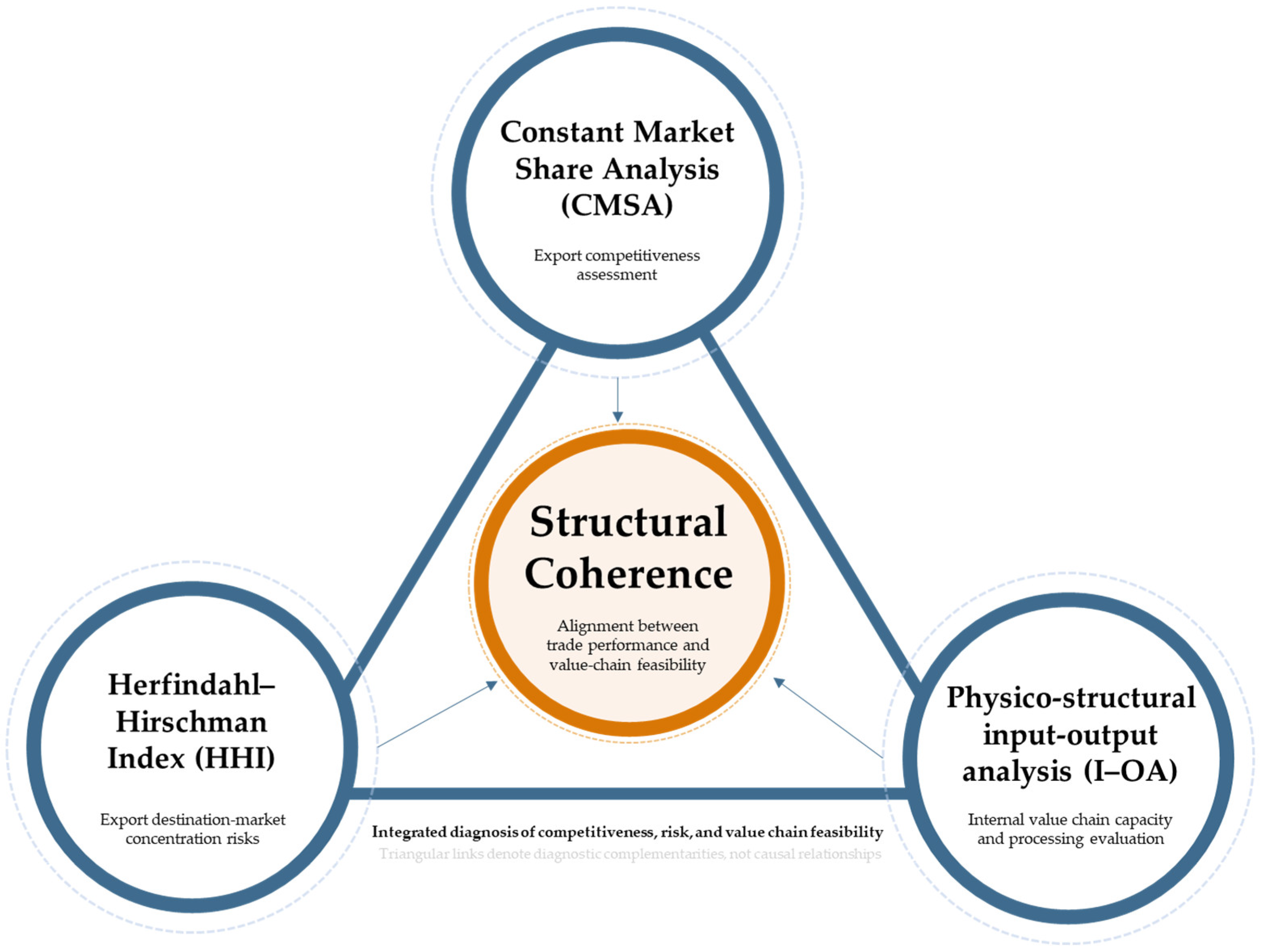
This section outlines the analytical framework used to evaluate structural coherence as a diagnostic property of agri-food value chains. As illustrated in
Figure 1, the framework integrates three complementary analytical layers into a single triangulated assessment instrument. By jointly combining trade competitiveness (CMSA), export-destination concentration risk (HHI), and internal value chain feasibility (physico-structural I-OA), the framework clarifies how external market outcomes are evaluated against internal structural constraints. Structural coherence is therefore assessed not through isolated indicators, but through the consistency of signals across these three analytical components.
2.1. The Constant Market Share Analysis (CMSA)
Building on the scope and analytical focus outlined in the Introduction, this research starts by employing a constant market share analysis (CMSA) to unbundle the drivers of export performance in the sunflower oilseed value chain. The exports of seeds and oil are decomposed into (1) a market growth effect; and (2) a market share effect. The first decomposition element is a structural effect (SE), while the second one is a competitiveness effect (CE). SE captures the changes attributable to overall import demand in destination markets, holding the exporter’s market share constant, as in Equation (1). CE captures changes attributable to gains or losses in the exporter’s market share, holding destination-market demand constant, as in Equation (2). No causal assumptions are imposed. The core CMSA utility lies in separating external market chance from internal effort, hence contributing to the assessment of the structural sustainability of trade performance along the sunflower oilseed value chain.
where
represents the export value of exporter country
i to destination market
m (either EU or extra-EU) in year
t, corresponding to product
p (either sunflower seeds or oil).
represents total imports from the world of market
m for product
p. SE denotes the structural effect; CE the competitiveness effect; SOE the second-order (interaction) effect. CMSA is rounded out by the second-order effect (SOE), as formalized in Equation (3), capturing the interaction between changes in exporter market share and changes in destination-market demand. Generally smaller in magnitude, SOE accounts for the joint contribution of structural and competitiveness dynamics. Lastly, the total change in average exports (ΔX), computed in Equation (4), shows the difference in average export levels between the baseline and crisis period. All effects are computed on a period-average basis and expressed in monetary units, which facilitates comparability across countries, products, and destination markets. All metrics were computed for each
i,
m,
p combination.
From an economic perspective, SOE captures whether changes in market share are synchronized with destination-market demand changes. A positive SOE indicates that changes in market share tend to coincide with demand growth in destination markets, reflecting an alignment between external market conditions and internal competitive dynamics. Conversely, a negative SOE signals a misalignment, whereby changes in market share occur in stagnating or shrinking markets, or where expanding demand is not accompanied by corresponding gains in market share. In the context of this study, SOE therefore serves as an indicator of structural coherence: positive SOE values suggest that trade performance upgrades are structurally supported by demand dynamics, while negative SOE values point to fragile, opportunistic, or incoherent export trajectories. It should be noted, though, that SOE is interpreted descriptively and does not imply causality.
2.2. The Herfindahl–Hirschman Index (HHI)
CMSA shines at identifying the drivers of export performance, but requires complementary methods for the quantification of the degree of vulnerability associated with that trade performance. In this context, the Herfindahl–Hirschman Index (HHI) proves to be a relevant addition to the research framework by evaluating whether export outcomes are structurally resilient, supported by diversified market access, or fragile, due to high concentration in a limited number of destinations markets. By doing so, HHI strengthens CMSA results by providing insight into the structural sustainability of trade performance.
Following the traditional approach from the literature [
39,
40,
41,
42], the HHI was operationalized in Equation (5), measuring export destination concentration for exporter country
i, product
p (either sunflower seeds or oil), in year
t, across all importing destinations
j.
Higher HHI values indicate concentration levels and great exposure to destination-specific shocks, hence sustainability-specific concerns, whereas lower HHI values reflect greater degrees of market diversification, and, consequently, greater degrees of trade performance sustainability. The pre-crisis (2013–2019) HHI was computed based on Equation (6), as well as the HHI corresponding to the crisis period (2020–2024):
where
τ = {2013, …., 2019} for the pre-crisis period and
τ = {2020, …., 2024} for the crisis period. The superscript
A denotes the average annual (equal weighted) formulation, in which each year contributes equally to the period-level concentration measure.
2.3. The Physico-Structural Input–Output Analysis
To reinforce the analytical architecture of this study, a targeted input–output analysis (I-OA) was integrated as a diagnostic measure aimed at assessing the internal structural coherence of trade outcomes and the sunflower oilseed value chain performance. Triangulated with commercial-shift findings, the I-OA provides a holistic understanding of internal value chain feasibility and sustainability, framed in the context of observed trade flow performance (CMSA) and market concentration risks (HHI). In the proposed research design, the I-OA differentiates between three value chain stages: upstream production, midstream processing, and downstream market integration.
At the primary level of this input–output architecture, the upstream segment was operationalized via the actual sunflower seed availability (ASSA) indicator, proxy for raw input volumes, expressed in tonnes. It was calculated as the summation of harvest and seed imports less the volume of exports. For further contextualization within the I-OA framework, a hypothetical sunflower seed availability potential (HSSAP) indicator was included in this study and computed by summing the domestic seed production with the imports, as proxy for an upper-bound resource endowment. Lastly, a third upstream-specific indicator has emerged, the sunflower seed export leakage share (SSELS), computed as 1 − (ASSA/HSSAP), capturing the share of the hypothetical sunflower seed envelope that is not retained domestically, hence the potential leakage (export-based outflow). Within the value-retention lens adopted in this paper, higher SSELS values are treated as a potential vulnerability when they coexist with underutilized crushing capacity and downstream oil import dependence, as they then signal missed internal value-added opportunities. Accordingly, the first I-OA stage assesses sustainability conditional on a policy objective of strengthening domestic value retention and reducing exposure to external shocks, rather than implying that seed exports are inherently undesirable.
The next value chain stage analyzed, the sunflower seed processing stage, was examined using three indicators that reveal latent industry potential relative to actual value chain efficiency levels. This stage includes a first indicator, the
hypothetical oil-equivalent potential (HOP), determined by applying a standardized seed-to-oil conversion coefficient of 0.4 to the HSSAP. The 0.4 conversion parameter aligns with agronomic benchmarks, as supported by the literature [
43,
44,
45]. HOP was introduced in the input–output framework to extend the counterfactual logic through the identification of the upper-bound domestic oil-processing capacity under full internal retention of raw inputs. Following, the
actual oil production (AOP) was, without any further computation, directly introduced in the framework from the FAOSTAT database, and evaluated against the hypothetical capacity (HOP) through the
potential processing utilization rate (PPUR). This third indicator from the processing stage, expressed as a percentage, was operationalized by reporting AOP to HOP and multiplying by 100. Structural sustainability issues specific to the value-added infrastructure are observed in this paper by referring to PPUR as a proxy for latent industrial gaps and capacity underutilization.
The third and final value chain segment analyzed, the downstream stage, was put under the agro-economic lens through three indicators designed to evaluate both trade orientation and the underlying value chain structural sustainability. As a proxy for the external downstream trade vitality, a first indicator was introduced at this stage: the oil trade balance result (OTBR), calculated as the differential between sunflower oil exports and imports. To differentiate actual observed vulnerabilities from those that are structural, two oil import-dependence indicators were introduced in the I-OA: (i) the observed oil import dependence ratio (OOIDR), which is the ratio of sunflower oil imports to actual oil production; and (ii) the structural oil import dependence ratio (SOIDR), as the ratio of sunflower oil imports to the hypothetical oil-equivalent potential. Two different dimensions of the sunflower oilseed value chain are mirrored through the use of OOIDR and SOIDR: the first captures the effective dependence on imports under current seed processing outcomes, while the second reflects oil import dependence relative to the upper-bound domestic processing capacity. Downstream-specific indicators can unmask structural paradoxes: the coexistence of import dependency on external oil markets and potential, yet dormant, domestic oil-producing capacity. Thus, the downstream-specific indicators facilitate the evaluation of the value chain’s economic sustainability, approached through the lens of physico-structural coherence, answering to the following question: Is a nation’s trade performance aligned with its internal value chain efficiency?
2.4. Data Collection and Processing
The data used in this research were taken from the FAOSTAT database (Crops and Livestock Products) and INTRACEN Trade Map, accessed in December 2025. With respect to the Harmonized commodity description and coding system, we utilized code 1206 for sunflower seeds and code 1512 for sunflower oil. The annual export values by partner country, expressed in thousand EUR as reported, were used for the period 2013–2024 with no further transformation. These values were subsequently aggregated into two destination groups (EU and extra-EU) for the CMSA and HHI components. FAOSTAT provides annual data on harvested area, production of sunflower seeds, and sunflower oil output; these series are used in physical units (tonnes). This mixed monetary–physical specification reflects the design of the structural coherence framework, which contrasts external trade performance with internal resource availability and processing capacity.
To ensure consistency between the CMSA and HHI research components with the I-OA, all input–output indicators were calculated using the annual arithmetic means for the two time periods: the pre-crisis baseline and the crisis period. However, a particular temporal adjustment was required for the I-OA component. While trade-specific metrics were available through the year 2024 at the time of carrying out this research, the longitudinal scope of the I-OA segment was truncated at the year 2022 to preserve the statistical integrity of the analysis, as FAOSTAT sunflower seed and oil production datasets for the years 2023 and 2024 have yet to be released. As a result, aligned with both the conceptual definition of the crisis window and production data availability, the I-OA research component focuses on the 2020–2022 period, while the CMSA and HHI research components utilize the 2020–2024 window to capture crisis-related dynamics.
Data cleaning included a set of consistency checks. For the trade data, we verified that each year–partner combination appeared only once before aggregation into EU and extra-EU destination groups. No observations with missing export values or quantities were identified, and no imputation procedures were applied. FAOSTAT series were also used as reported and checked for obvious inconsistencies; no imputation or additional adjustments were required.
3. Results
Because the results must be interpreted jointly across export performance, destination risk, and value chain internal feasibility,
Section 3 reports findings in three diagnostic layers.
Section 3.1 presents CMSA decompositions for sunflower seeds and oil in EU and extra-EU markets;
Section 3.2 reports destination concentration (HHI); and
Section 3.3 evaluates the domestic physico-structural feasibility of the oilseed value chain using I-OA.
Section 3.4 presents robustness checks.
3.1. The Constant Market Share Analysis—A Closer Look at Export Competitiveness
Table 1 reports CMSA-related indicators for sunflower seeds and sunflower oils exported to the EU market, in a comparative manner: before and during periods of crisis. As reasoned in the Introduction, the EU/extra-EU market division facilitates the identification of the differing institutional and regulatory environments and the different levels of access to the market for exporting products within the EU’s internal market versus external trade paradigms. Given some similarity in CMSA patterns across the analyzed countries, the discussion below emphasizes country-specific characteristics, highlighting convergence patterns as well as country-specific inflection points.
All five of the major producing countries experienced positive structural effects in exporting sunflower seeds to the EU; thus the expansion of demand in the EU for sunflower seeds has been the primary driver of export growth, as opposed to changes in exporters’ relative competitiveness. Conversely, the competitiveness effects associated with exporting sunflower seeds have generally been either very weak or negative; and while demand has improved, the relative position of each exporter in the EU market has remained relatively unchanged or even slightly worsened during the crisis.
Heterogeneity was observed across products and countries. Hungary is the weakest performer in terms of value chain competitiveness. With the highest negative CE values (−65,874 for sunflower seeds and −54,814 for oil), Hungary’s strong position in sunflower seed production does not translate into oil export competitiveness on the EU market (
Table 1). Favorable structural conditions in sunflower seed exports (SE: 112,729) do not carry over into competitive performance in downstream oil exports. Negative CE values reflect losses in relative market share, not necessarily declines in export volumes, and may occur even under favorable structural demand conditions (positive SE). Negative SOE values for Hungary across both products indicate that changes in market share are not aligned with demand dynamics. Overall, Hungary fails to convert favorable structural demand conditions into competitiveness gains, pointing to structural incoherence.
Bulgaria follows a different path. Despite competitiveness losses in sunflower seed exports (CE: −72,062), Bulgaria records the strongest competitiveness gains in sunflower oil exports among the five countries (CE: 79,186). In extra-EU markets (
Table 2), Bulgaria also reorients seed exports favorably, with strong structural (51,562) and competitiveness (41,863) effects. Positive SOE for both seeds and oil, especially in extra-EU markets, indicates alignment between demand conditions and competitiveness. This alignment is reflected in large positive total export changes (ΔX), consistent with downstream upgrading under supportive market structure. HHI and I-OA are used next to test whether this performance is also resilient and feasible domestically.
For Romania, CMSA reveals the strongest SE for sunflower seed exports among the top producers in the EU market (275,292), almost triple in the case of oil, but negative CE for both products, reflecting that it is demand structure, rather than competitiveness, that drives sunflower-related export performance. In extra-EU markets, the SE–CE interaction is relatively balanced, yet without downstream upscaling. CE remains modest, implying difficulties in consolidating market share in oil processing despite structurally supportive conditions. The limited SE–CE synergy limits SOE, portraying a profile for Romania that is characterized by favorable demand conditions, but limited capacity for sustained competitiveness upgrading.
In the EU market, positive structural effects (145,093) support France’s sunflower seed exports, while competitiveness effects remain nearly neutral, but negative in extra-EU markets (−18,198). Following the value-chain logic of this analysis, France’s upstream strength does not extend downstream, as France’s sunflower oil exports are characterized by negative CE (−67,409 in the EU market and −25,434 in extra-EU markets), despite strong SE. SOE is mainly negative, indicating the lack of coherence in terms of resource abundance, favorable market conditions, and weak competitiveness dynamics. Taken together, findings suggest the existence of a value-chain configuration in which the competitive advantage of the French sunflower oilseed value chain lies preponderantly in primary production, while value addition in the downstream segment faces inherent difficulties.
Spain’s CMSA findings indicate a sunflower oilseed value chain configuration that is neither upstream-oriented nor structurally supported in terms of exports. Within the EU market, the exports of seeds exhibit weak competitiveness dynamics (CE: −7070), while the exports of oil are substantially supported by SE (102,542) and partially by CE (5287), hence conveying a trade profile in which export performance relies more on downstream market positioning. Similar patterns are noticed in extra-EU markets, but at a smaller scale. CE–SE synergy is present in terms of the Spanish oil export dynamics, as supported by SOE values, but inconsistent in the case of upstream value chain stage. The overall CMSA typology for Spain reveals a downstream-capable but structurally exposed market position. Competitiveness is present but not adequately backed up by sustainable upstream dynamics, as export strategy might be exposed to destination country-specific shocks, an assumption that is further evaluated through the HHI and I-OA analyses.
The constant market share analysis reveals that export growth across countries is driven by distinct combinations of demand expansion, competitiveness effects, and structural components, showing that favorable export outcomes are not necessarily associated with improved competitive positioning. Compared with simple trade performance indicators, this layer adds diagnostic depth by identifying the sources of export change, not magnitude alone, allowing demand-driven growth to be distinguished from competitiveness-based expansion. Within the structural coherence framework, CMSA serves as a first diagnostic filter, identifying cases where strong export performance may already signal potential incoherence, which is subsequently assessed through destination-risk and domestic feasibility layers.
3.2. The Herfindahl–Hirschman Index—Export Concentration and Market Sustainability
The HHI analysis complements the CMSA findings by raising a key question: To what extent are observed export gains (CMSA) dependent on a narrow set of destination markets (HHI)? In this multi-layered analytical framework, export market diversification becomes the benchmark for assessing the economic sustainability of trade. For robustness, two distinct HHI approaches were operationalized:
HHI values calculated annually per country and product, focusing on volatility and changes occurring over a short period of time;
the period-averaged HHI values, employed to identify the structural susceptibility degree in relation to external disturbances during periods of crisis; a value chain approach (product-level HHI: sunflower seeds vs. oil) per country.
The proposed HHI layer adds an additional sustainability dimension to the CMSA-identified trade patterns by quantifying market diversification and signaling concentration vulnerabilities when HHI values are high. Following the natural flow of this research’s design, the CMSA-HHI results are later triangulated with the findings derived from the internal value-chain feasibility checks provided by the I-OA research layer.
In harmony with the EU Council Regulation No. 139/2004 [
46], the Merger Guidelines of the U.S. Department of Justice & Federal Trade Commission [
47], and the literature [
48,
49,
50], this paper adopts well-established concentration benchmarks. HHI values below 0.10 are specific to unconcentrated markets. According to the U.S. framework, HHI values between 0.10 and 0.18 signal moderately concentrated markets, while values exceeding the 0.18 threshold indicate increased concentration with associated vulnerability risks. The EU framework is slightly less restrictive. Although it considers additional factors beyond the HHI alone, for reference, HHI must be situated between 0.10 and 0.20 to be interpreted as indicative of moderate concentration, while values above 0.20 indicate highly concentrated markets.
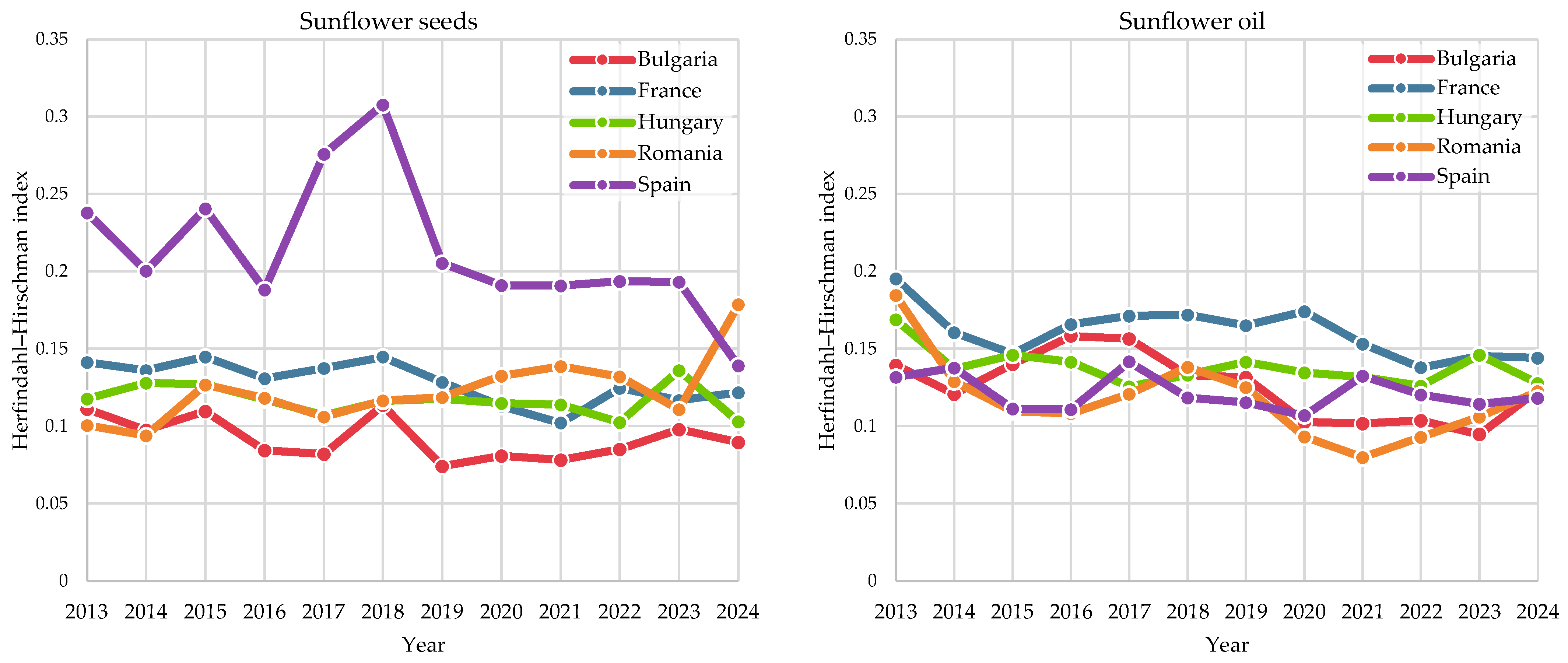
The annual HHI results from
Figure 2 reinforce and further develop the CMSA-derived findings by distinguishing between competitiveness gaps and diversification-related vulnerabilities. In Hungary, its weak value chain trade positioning is not associated with excessive destination concentration, as supported by the HHI average annual values of 0.117 for sunflower seeds and 0.138 for oil (coefficients of variation: 12.67% and 12.53%). As evidenced by the CMSA results, the Hungarian sunflower oilseed value chain is constrained by downstream-related gaps, which, when corroborated by the HHI findings (confirmed absence of high market concentration concerns), point to a possible cause: a structural downstream competitiveness or positioning gap.
Downstream competitive, as evidenced by the CMSA results, Bulgaria’s export performance has occurred under structurally resilient and diversified market conditions, signaling a higher degree of economic sustainability. However, there are differences between these two countries. Romania’s export performance is primarily supported by favorable structural demand conditions. When corroborated, CMSA-HHI results suggest that Romania’s sunflower oilseed value chain is exposed to moderate diversification fragility, with volatility observed, particularly at the upstream stage. Two common unfavorable structural characteristics can be noticed in the cases of both Romania and Hungary: (a) the raw, low-value product export dependency; and (b) competitiveness gaps. Thus, a derived conclusion from the CMSA-HHI framework is that structural domestic deficiencies cannot compensate for resource endowment. In contrast with Romania and Hungary, Bulgaria exhibits a diversified export structure, reinforced by downstream competitiveness and stability, which mirrors the patterns of a highly competitive sunflower oilseed value chain.
France shows different patterns than Hungary, Bulgaria, and Romania. Upstream, destination concentration is moderate (0.128 on average), but the upper bound of the market concentration is reached downstream (0.161 on average, with a maximum observed in 2013: almost 0.2). These HHI dynamics suggest exposure to destination-specific disturbances for processed exports, with amplified risk levels considering the CMSA results that showed that the French downstream competitiveness dynamics remain adverse. From a sustainability standpoint, fragility describes well the French sunflower oilseed value chain: the less diversified downstream export footprint operates in an unfavorable synergy with the competitiveness constraints in downstream upgrading.
Spain is a clear example of market concentration vulnerability among all five countries, particularly upstream in the sunflower oilseed value chain, due to the highest HHI average annual value of 0.214, with volatility spikes noticed. However, the Spanish sunflower oil exports remain moderately concentrated (0.122). The Spanish upstream export vulnerability is not a major concern at the level of the common EU market due to Spain’s low volumes compared to the other major sunflower seed producers, but it might have an impact on the Spanish downstream export performance. HHI findings are convergent with CMSA results: Spain shows the signs of weak upstream competitiveness dynamics but relatively stronger downstream positioning, which is why sustainability challenges emerge. The downstream-capable trading profile of Spain fails to align with a resilient upstream export structure.
Table 3 is structured to reflect the HHI research layer specific to the analysis of medium-term structural exposure to destination-market shocks through the lens of two periods of reference: pre-crisis (2013–2019) and crisis (2020–2024). From the necessity of a coherent assessment of economic sustainability, period-specific HHI results were triangulated with CMSA outcomes. To facilitate this approach, structural (ΔSE) and competitiveness (ΔCE) effects were aggregated across EU and extra-EU destination markets.
Bulgaria’s downstream upgrading is happening in the strongest possible sustainability configuration (ΔSE: 240,363 for seeds; 223,877 for oil; and ΔCE: 176,713 for oil), while competitiveness gains are not dependent on a narrow destination footprint in sunflower oil exports (ΔHHI: −0.0347). For France, demand conditions are very favorable, especially upstream. From a market diversification standpoint, the dynamics are stable regardless of crisis periods, which is why results suggest that the main challenge faced by France is addressing its processing gap. Similarly, for Hungary, the sustainability vulnerability does not imply destination dependence (ΔHHI: −0.0046 for seeds and −0.0087 for oil), but the inability to convert favorable demand (ΔSE: 130,172 for seeds and 448,369 for oil) into market share.
Romania’s upstream performance becomes more destination-dependent (ΔHHI: 0.0269) during periods of crisis, suggesting sustainability concerns, especially when corroborated with two other distinct factors: (i) the strong seed demand pull (ΔSE: 333,709); and (ii) the weak upstream competitiveness (ΔCE: −50,470). Vulnerability is increased because Romania is entertaining a vicious circle: the country is lured by the intense low-added-value seed demand pull with the outcome of increased market concentration, on the one hand, and, on the other hand, the same country is suffering from a processing gap.
Lastly, Spain’s downstream orientation is evident (ΔSE: 170,016), as well as fragility of the upstream dynamics (ΔCE: −7203). The diversification improvements (ΔHHI: −0.0551 and −0.0054) have little impact on Spain’s capacity to upgrade at the upstream stage of the sunflower oilseed value chain, hence with impacts on its economic sustainability.
Within the structural coherence framework, the destination concentration analysis reveals the extent to which export performance across countries relies on a limited number of foreign markets, highlighting differences in exposure to destination-specific shocks that are not visible in aggregate trade outcomes. Building on the CMSA results, this layer adds a risk dimension by showing that both demand-driven and competitiveness-based export growth can coincide with high market concentration. As a second diagnostic filter, HHI distinguishes between expansion supported by diversified market access and structurally vulnerable patterns characterized by excessive destination dependence, which are subsequently assessed against domestic feasibility conditions.
3.3. Internal Value-Chain Feasibility: Physico-Structural I-OA Results
This third analytical layer introduces a physico-structural input–output analysis (I-OA) to assess internal value-chain feasibility and domestic value retention. While CMSA captures external trade dynamics and HHI reflects destination concentration risk, I-OA focuses on the physical consistency of production, processing, and export flows, using physical quantities (tonnes). By integrating these three components, the proposed framework links external competitiveness signals with internal feasibility constraints, allowing export performance to be interpreted not only in terms of market outcomes but also in terms of longer-term structural sustainability. Here, sustainability is understood as the capacity of the value chain to retain and process domestic resources in a way that remains coherent with observed trade patterns, without dependence on externally driven or weakly integrated export configurations. This added layer highlights cases in which favorable trade signals coexist with limited domestic value-chain integration.
The I-OA results reported in
Table 4 and
Table 5 cover the period 2020–2022, which is constrained by data availability for production and input–output flows but remains consistent with the period of heightened market volatility examined in the trade-based analysis. Over this interval, actual sunflower seed availability (ASSA) increased in Bulgaria (+69%), France (+15%), and Hungary (+9%), while it declined slightly in Romania (−2%) and Spain (−2%). These changes broadly mirror production dynamics and indicate heterogeneous capacity across countries to adjust domestic resource availability during the shock period. Within this context, Bulgaria stands out. Its substantial increase in seed availability is accompanied by favorable HHI results (
Section 3.2), indicating that market expansion occurred under the most diversified destination structures among the five countries. Together, these findings point to a comparatively stronger configuration of economic sustainability along Bulgaria’s sunflower oilseed value chain. At the same time, the I-OA perspective highlights a remaining structural margin: enhanced sustainability would have required a fuller translation of the expanded raw resource base into higher value-added downstream outputs.
The hypothetical sunflower seed availability potential (HSSAP) follows the same directional changes as actual seed availability: it increases in Bulgaria (2.1 Mt → 2.7 Mt), France (1.7 Mt → 2.0 Mt), and Hungary (1.9 Mt → 2.0 Mt), and slightly declines in Romania (2.7 Mt → 2.6 Mt) and Spain (1.3 Mt → 1.2 Mt). These patterns indicate uneven upstream resource expansion across countries and are consistent with the positive structural effects for sunflower seeds identified by the CMSA.
The sunflower seed export leakage share (SSELS) provides even more insight in this regard, measuring the share of the hypothetical seed availability (HSSAP) that is not retained in domestic availability (ASSA), i.e., a leakage proxy. Romania’s stable risky seed leakage is consistent with CMSA patterns (strong SE and weak CE) and signals sustainability concerns. The Romanian sunflower oilseed value chain continues to externalize raw inputs and not to internalize processing, with the highest seed leakage noticed among all five countries (53.5% that increased to 54.9% during crisis). Bulgaria’s falling leakage (39.6% → 27.1%) is aligned with the CMSA’s downstream upgrading (strong oil CE), which, corroborated with low market concentration risks (HHI), creates a favorable paradigm. France (25.1% → 25.4%) and Hungary (20.9% → 14.8%) display intermediate leakage levels, and both face different challenges, by triangulation with previous findings: France lacks processing efficiency, not resource loss; while Hungary is not competitive, despite signals of processing capacity. Spain’s near-zero leakage needs to be put into the bigger context by looking further at different indicators.
The second stage of the value chain analysis focuses on seed processing and the challenges associated with managing latent industrial capacity. At this stage, the key question is: How much of the maximum feasible oil-equivalent capacity could be realized if sunflower seeds were retained domestically instead of exported as raw inputs? To address this question, the indicators are interpreted through a sustainability lens that reflects the capacity of the value chain to transform raw inputs into higher value-added outputs.
Congruency in economic sustainability patterns is observed based on Bulgaria’s concrete downstream competitiveness evidence (CMSA results). Upstream conditions are aligned with processing outcomes. The country is capable of translating a substantial share of its hypothetical processing potential into actual output, even during a period of crisis, as supported by PPUR, which has improved from 46.4% (pre-crisis) to 61.4% (during crisis). More value creation is possible along the Bulgarian sunflower oilseed value chain. Further value internalization strategies should be focused on downstream upgrading. Bulgaria’s upstream resource envelope is a fertile ground on which it can develop, given it will maintain its market portfolio as diversified as it is (HHI average: 0.09).
At the opposite end, a lack of value chain coherence describes Romania’s dynamics. Despite reporting the largest hypothetical oil-equivalent potential among the five countries, this performance is overshadowed by the worst potential processing utilization rate. Although a window of opportunity was capitalized during the crisis, as PPUR increased from 40.0% to 49.3%, upstream leakage amplified, and it reached a new peak among all countries: 54.9%. When corroborated with CMSA findings, sustainability concerns amplify. Romania’s export performance is principally driven by favorable structural demand conditions upstream, on the one hand, and by insufficient internalization of processing, with large volumes of sunflower seeds that exit the domestic value chain before value addition. The rising destination-market concentration upstream, as per HHI results, reveals even more sustainability risks. Romania’s sunflower oilseed value chain is structurally fragile and requires immediate intervention to reduce the raw-input externalization and focus on value-added-output internalization strategies.
France’s sunflower oilseed value chain has been negatively affected by the crisis period, especially from the perspective of its capacity for value internalization. Its potential processing utilization rate decreased from 82.2% to 63.7%, despite increased hypothetical oil-equivalent potential, from 688,679 to 835,572 tonnes, hence an increase of 21.3%. What adds more weight on the economic sustainability vulnerabilities identified based on the I-OA internal feasibility analysis is the fact that France struggles downstream (negative CE), even when demand conditions are favorable (positive SE), as per the CMSA results. France’s processing gap is not abstract: the realized oil output uses a larger volume of feasible retained-input capacity (ΔASSA: 196,986 tonnes of sunflower seed) to produce less sunflower oil (ΔAOP: −33,481). The country’s value chain fragile sustainability profile is having more complexity layers added by the moderate downstream concentration, as per the 0.16 average HHI value reported in the case of oil.
Along Hungary’s sunflower oilseed value chain, the midstream segment shows the signs of a structurally inefficient system. Despite favorable dynamics, such as the slight increase of 8.9% in actual seed endowment, strong structural demand effects (SE), and upstream leak mitigation from 20.9% to 14.8%, Hungary’s fundamental constraint is not its potential processing utilization (which is the second highest among the five countries and has increased from 82.3% to 84.6%), nor destination concentration (HHI), but rather the ability to convert sunflower seed endowment and processing activity into sustained value-added export market share. It is a competitiveness and positioning bottleneck. From a sustainability perspective, research triangulation suggests that Hungary’s sunflower oilseed value chain is vulnerable due to the inefficient translation of existing processing potential into downstream competitiveness and market share. Hungary is exposed to a structural disconnect between input endowment and downstream competitiveness, with negative impact on its international trade performance.
What might appear as highly efficient at first, based on the highest potential processing utilization rate (above 90%, regardless of the crisis period) among all five countries analyzed, is actually overshadowed by the highest actual oil import dependence ratio (OOIDR). This ratio is crisis-sensitive, as it has increased from 1.051 to 1.354 during crisis, similarly to Spain’s structural oil import dependence ratio (SOIDR), which rose from 0.982 to 1.269. Internally, the value chain cannot be adjusted because both upstream anchoring and processing scale are insufficient, considering Spain’s oil dependence ratios. The false sense of sustainability coming from the high potential utilization rate is easily contestable considering the insufficient upstream anchoring. For Spain, sustainability improvements are structurally constrained. Spain’s SOIDR exceeding unity indicates that even under full domestic retention and processing of sunflower seeds, domestic oil production would remain insufficient to cover demand, revealing a hard physical limit to value-chain self-sufficiency. These binding physical limits add more to the input supply shocks. Upstream, based on the reported average HHI value of 0.214, Spain’s market concentration is the highest among the five analyzed countries, involving even more sustainability risks.
Lastly, triangulating the oil dependence ratios with the CMSA, HHI and other I-OA-specific indicators reported by Bulgaria, Romania, Hungary, and France, more subtle value chain sustainability patterns can be depicted. Bulgaria’s oil-dependence ratios are crisis-sensitive (OOIDR: 0.050 → 0.161 and SOIDR: 0.037 → 0.121). While this might appear adverse at first glance, sustainability has a different nuance here, and it can be approached as a stress signal specific to the processing scale and seed retention not fully keeping pace with the rapid expansion of the Bulgarian downstream oil activity during the crisis period. As CMSA showed strong downstream competitiveness gains (positive CE), and HHI revealed highly diversified destinations, when corroborated with the I-OA-derived findings, these results describe a favorable value chain configuration that tends to be susceptible to the pressures associated with rapid market growth. Bulgaria’s competitive position can be further enhanced from a sustainability perspective through strategic raw-input internalization processes and sustained processing capacity upgrading.
Romania’s actual oil-dependence ratio rises: 0.086 → 0.124. CMSA showed Romania is largely demand-driven upstream (strong SE) with weak competitiveness (CE), and susceptible to upstream market concentration vulnerabilities, as evidenced during the period of crisis (ΔHHI: 0.0269). Thus, when oil dependence rises at the same time, the combined CMSA-HHI-I-OA signals depict a dysfunctional value chain: strong upstream pull, increasing concentration, rising dependence downstream. The Romanian sunflower oilseed value chain is locked into raw export orientation while relying more on external oil markets. The country is not capable of added-value internalizing processing. Romania’s structural fragility is unsustainable and characterizes a resource-endowed country that is not capable of achieving downstream autonomy.
The French value chain deterioration is clear. By triangulation, France’s actual oil-dependence ratio (0.438 → 0.586), the second highest observed among the analyzed countries, articulates CMSA findings in a broader unsustainable value chain paradigm: France is not competitive in the downstream segment (negative CE), despite favorable structural demand conditions (positive SE). The addition of SOIDR (0.487 → 0.534) contributes with consistency to the characterization of France’s profile. Structurally, the value chain elements are not properly aligned: trade performance outcomes do not reflect the country’s rich resource endowments, but rather signal the input–output inefficiencies. France’s value chain is fragile, as per the CMSA-HHI-I-OA findings, incapable of converting market opportunity into sustainable downstream value creation and internalization. Further sustainability nuances are provided by the HHI results, which signal France’s moderately concentrated downstream export structure. Therefore, France is shock-exposed to specific market destinations at which it has the least competitive capabilities.
A competitiveness-driven sustainability constraint was noticed in the case of Hungary. The country is moderately dependent on oil imports and mildly crisis-sensitive (0.037 → 0.101), uncompetitive (negative CE) despite the favorable structural demand conditions (positive SE), and has a stable destination-market diversification (HHI). The trade performance and internal value chain efficiency misalignment is a systemic failure of the conversion capacity, accentuating the detrimental effects on the sustainability of the Hungarian value chain. The oil import dependency further compounds this challenge. The lack of sustainability emerges from the absence of a coherent strategy of upgrading processing gaps to increase oil market share. Processing and market positioning through added-value internalization are the main challenges Hungary has to overcome with the objective of transitioning to a sustainable sunflower oilseed value chain. The focus of sustainability-oriented strategies should be to embed efficiency within the downstream segment, in harmony with the purpose of avoiding added-value leaks and the dependence on downstream imports.
Within the structural coherence framework developed in this paper, the physico-structural I-OA reveals whether observed export patterns are supported by adequate domestic processing capacity, resource endowments, and overall feasibility, identifying value-added leakage and physical constraints along the value chain. Building on the performance and risk signals identified by CMSA and HHI, this layer adds a feasibility dimension by assessing the extent to which export activity is internally retained and transformed. As a third diagnostic filter, the input–output analysis distinguishes between export structures that are externally successful but internally constrained and those that combine favorable market outcomes with feasible domestic value-creation capacity, thereby completing the integrated structural coherence diagnosis.
3.4. Robustness Checks
To assess the sensitivity of the CMSA results to the choice of crisis-period definition, an explicit robustness check was conducted based on alternative temporal cutoffs while keeping the baseline period fixed. The pre-crisis benchmark (2013–2019) corresponds to a period of stability in the EU agri-food sector and broadly overlaps with the previous EU programming period, making it an analytically meaningful reference. For robustness, CMSA decompositions were recomputed using this common benchmark and contrasting two crisis windows: a truncated window aligned with the I-OA data availability (2020–2022) and the extended window used in the main analysis (2020–2024). Product-level results for sunflower seeds and sunflower oil, aggregated across EU-27 and extra-EU destinations, are reported in
Table A1.
Across both crisis definitions, the qualitative decomposition patterns remain stable. For sunflower seeds, the structural effect (SE) is consistently positive and dominant for all exporters, while competitiveness effects (CE) remain uniformly negative. Illustratively, for Romania, SE exceeds 330,000 in both specifications (368,449 for 2020–2022; 333,709 for 2020–2024), while CE stays negative (−45,231 to −50,470), indicating that export growth is primarily driven by global market expansion. For sunflower oil, SE likewise remains the main contributor, while CE displays heterogeneous signs across countries: Bulgaria and Spain exhibit positive CE in both windows, whereas France and Hungary remain characterized by negative CE, reflecting selective downstream upgrading. Generalized competitiveness shifts were not observed across the five largest EU sunflower seed producers. Importantly, no country-level typology reversals or paradigm shifts are observed when moving from the 2020–2022 to the 2020–2024 window, even though magnitudes vary (
Table A1). This robustness check addresses the temporal mismatch between trade and production data. Restricting CMSA to the 2020–2022 window used in the I-OA analysis yields the same conclusions as the full 2020–2024 specification. This shows that the core findings are not driven by post-2022 trade fluctuations in the context of overlapping crises, but reflect more persistent structural features of the value chain.
To assess the sensitivity of the I-OA results, a robustness analysis was conducted using alternative values of the seed-to-oil conversion coefficient, namely 0.35 and 0.45, representing conservative and optimistic extraction benchmarks, respectively. As expected, variations in the conversion coefficient affect only the crushing-dependent indicators (HOP, PPUR, and SOIDR), while leaving all crushing-invariant indicators (ASSA, HSSAP, SSELS, AOP, OTBR, and OOIDR) unchanged (
Table A2 and
Table A3). Across both periods, the cross-country ranking of the potential processing utilization rate (PPUR) is invariant to the choice of coefficient: Spain exhibits the highest PPUR, followed by Hungary and France, then Bulgaria, and Romania as the weakest user of its potential processing capacity. Similarly, the ordering of structural oil import dependence (SOIDR) remains unchanged in all specifications, with Spain consistently the most structurally dependent, followed by France, Romania, Bulgaria, and Hungary.
In terms of crushing-dependent indicator diagnostics, the sensitivity checks confirm that the main qualitative conclusions are robust. For all countries except Spain, whether SOIDR and OOIDR lie above or below unity does not change when switching from 0.35 to 0.45. Spain is the only case in which SOIDR crosses the unity threshold in the pre-crisis period (1.123 at 0.35; 0.982 at 0.4; 0.873 at 0.45), while remaining structurally dependent in the crisis window (SOIDR = 1.450 at 0.35; 1.269 at 0.4; 1.128 at 0.45). Combined with the fact that observed dependence (OOIDR) stays well above 1 in both periods (1.051 → 1.354), this pattern confirms that Spain’s downstream growth is constrained primarily by physical limits on seed availability. The structural-constraint interpretation therefore survives plausible yield heterogeneity.
This combination of persistently high PPUR with structurally increased oil import dependence illustrates the instrument’s paradox-detection capacity, showing how the CMSA–HHI–I-OA framework can flag configurations where intensive use of processing capacity coexists with systemic vulnerability. Hence, such paradoxical configurations can be interpreted as structural paradoxes that the CMSA–HHI–I-OA instrument is meant to uncover, not as inconsistencies of the evaluation.
For the remaining countries, the robustness checks mainly rescale the level of latent capacity without changing the structural typology. Under the conservative benchmark (0.35), PPUR increases for all countries, but Bulgaria still combines rising processing capacity utilization with falling upstream leakage, consistent with growth-pressure stress rather than a change in value-chain logic. Romania retains the highest seed export leakage (SSELS = 53.5% pre-crisis; 54.9% during crisis) together with persistent downstream dependence (OOIDR = 0.086 → 0.124), confirming that weak internalization is a stable feature of its value chain. For France and Hungary, higher PPUR under 0.35 (France: 93.9% and 72.8%; Hungary: 94.1% and 96.7% in pre-crisis and crisis, respectively) coexists with rising oil import dependence (France OOIDR: 0.438 → 0.586; Hungary OOIDR: 0.037 → 0.101), reinforcing the baseline diagnosis that both countries suffer from downstream competitiveness and positioning challenges. Overall, the robustness checks show that the structural-coherence profiles identified in
Section 3.3 persist under realistic variations in extraction yields.
Overall, the robustness checks show that the CMSA–HHI–I-OA triangulation captures persistent structural constraints in the value chain, beyond short-term trade shocks.
4. Discussion
Going beyond trade-performance assessments, this paper contributes a diagnostic instrument that links export outcomes to structural feasibility and market-risk exposure within agri-food value chains. Building on the trade-based sustainability literature and earlier hybrid approaches, the instrument developed and operationalized in this study triangulates export performance dynamics (CMSA), destination concentration risk (HHI), and internal feasibility and dependence within the value chain (I-OA).
A large part of the sustainability literature infers economic sustainability predominantly from trade outcomes, often without explicitly modelling value-chain feasibility [
51,
52,
53,
54,
55]. Yet trade-based sustainability diagnoses can be misleading when feasibility and vulnerability are not checked in parallel, because demand-pull- or concentration-driven export gains may be labelled as sustainable even when binding feasibility constraints persist within the value chain. The results in this paper confirm that trade-based indicators are useful for describing specialization and market shifts, but they also show their limits when interpreted in isolation. CMSA results therefore require cautious interpretation: the competitiveness effect captures changes in relative market share, not causal competitiveness drivers such as productivity or cost advantages.
Building on the hybrid logic in Zhou and Tong [
56] and related CMSA-I-OA combinations [
34,
57,
58], we extend these frameworks by incorporating market-concentration risk (HHI) as a sustainability-relevant vulnerability channel within the diagnostic. While destination concentration has been treated as a risk dimension in prior work using HHI or related measures [
59,
60,
61,
62], in this paper, HHI is operationalized as more than a risk add-on: it constitutes an explicit pillar of the structural-coherence diagnostic instrument.
The closest research design is Capobianco-Uriarte, Aparicio, and De Pablo-Valenciano [
63], who combine CMSA with destination analysis to assess structural coherence and competitiveness (Spain’s tomato exports). A similar logic is employed in this paper, but the contribution is extended in two directions: first, from a single-case competitiveness reading to a multi-country diagnostic typology; second, from trade-and-destination analysis to an explicit value-chain feasibility check via I-OA. This extension matters empirically because it enables the instrument to identify configurations that may appear beneficial in trade terms while remaining structurally exposed. In doing so, the analysis is shifted from explaining export performance to diagnosing whether that performance is structurally sustainable once feasibility and vulnerability constraints are taken into account.
To synthesize the Discussion and make the triangulation explicit, the combined findings of this study are summarized in
Table 6. The results are presented at the country level and structured around three elements: (1) the primary limiting constraint within the domestic value chain; (2) the resulting sustainability profile, expressed through a concise synthetic characterization; and (3) the corresponding priority policy recommendation inferred from the joint diagnosis.
For Bulgaria, the instrument identifies a market-growth–pressure profile: export expansion is mainly structurally driven, while sustainability risk arises from how growth interacts with concentration and domestic feasibility constraints (
Table 6). This aligns with studies emphasizing market growth and internal value-chain development prospects [
64], including recommendations on yield through technological advancement, agronomic innovation, agile price adjustment, and quality improvements [
65,
66]. The added value, however, should be to place these vectors inside a single diagnostic frame that links export growth to feasibility and risk. This framework should allow the policy priority to be inferred from the interaction of components, not considering indicators in isolation. This is why policy priority should be inferred from the joint signal of growth, concentration, and feasibility; single-indicator readings are insufficient to capture structural constraints.
The instrument points to a feasibility-and-transition profile in the case of France: the discussion in the literature focuses strongly on cropping systems and agro-economic performance (including double cropping, risk, and environmental implications) [
67,
68,
69,
70]. The empiric findings derived from this paper do not contradict this work; instead, they extend it by showing that trade competitiveness and destination risk need to be read together with internal feasibility constraints when framing sustainability-oriented policy options for the value chain.
Regarding Hungary, the diagnostic indicates limited competitiveness, which is consistent with literature linking performance to climate stress and drought impacts on production [
71,
72]. Spain represents a different case: despite strong downstream pull, physical feasibility constraints increase reliance on imports, and the instrument highlights this tension in a way that trade-only readings may understate. Weather-related constraints reported for Spain (e.g., Andalucía) [
73,
74] are therefore not just agronomic risks but also structural drivers of dependence within the value chain.
For Romania, the results converge with Chivu and Stanciu [
75] in identifying a structural loss mechanism associated with raw-resource export dependence and underdeveloped domestic processing. Where this paper’s contribution goes further is diagnostic: the CMSA–HHI–I-OA triangulation shows how this dependence persists even under favorable endowments, producing a downstream autonomy failure that becomes visible only when trade performance, market risk, and feasibility are interpreted jointly. Complementary strands on land-use sustainability and circular economy transitions [
13,
76,
77] remain relevant, but the present paper addresses a different layer: economic sustainability as structural coherence between trade outcomes and internal value-chain constraints.
To strengthen the applied relevance, each identified incoherence profile is mapped to implementable CAP instruments: value-added leakage can be addressed through Pillar II (The European Agricultural Fund for Rural Development) investment support for processing capacity, using grant eligibility and performance conditionalities to ensure downstream upgrading; downstream competitiveness gaps can be addressed through CAP-supported modernization and quality schemes (e.g., upgrading, certification, and market-facing improvements); export-destination concentration can be addressed through CAP selection criteria and cooperation measures that support market diversification, complemented, where available, by risk-management instruments under CAP Strategic Plans; and physical or feasibility constraints can be addressed through resilience-oriented CAP investments (e.g., storage and logistics efficiency).
An inflection point from the literature is that this paper does not address the environmental pillar of sustainability. Other authors focus on the sustainability of land use given the sunflower crop implications for food vs. fuel competition and agroecological pathways toward circular economy models, as well as technical solutions to improve processing efficiency in biofuel-related contexts [
78]. In contrast, this paper contributes with an agro-economic assessment instrument, focused on structural coherence, linking trade performance, market share, destination viability, and internal agri-food value-chain feasibility. In this sense, the paper is closer in spirit to strands of work that interpret sustainability-relevant performance through trade outcomes and value-chain competitiveness diagnostics [
79,
80,
81]. With respect to structural coherence—it is not equivalent to resilience or value-chain upgrading, although these concepts are often discussed in close proximity in the literature [
7,
9,
81]. Structural coherence evaluates whether observed trade performance is structurally supportable once feasibility constraints and vulnerability channels are taken into account. Through the CMSA–HHI–I-OA triangulation, this paper operationalizes structural coherence as a performance–vulnerability–constraint alignment, making visible configurations in which favorable trade outcomes coexist with binding feasibility limits or elevated risk exposure. In such cases, competitiveness or upgrading signals may persist yet remain structurally fragile.
In synthesis, each major EU sunflower crop producer faces distinct sustainability challenges. Method triangulation enabled the identification of distinct structural incoherence profiles across countries. More precisely, while Bulgaria suffers from market growth-pressure stress, Hungary lacks competitiveness. Romania is entertaining a vicious circle, observed through the lens of a downstream autonomy failure, despite rich domestic input endowments, and Spain lacks the physical value chain feasibility to sustainably respond to the observed downstream demand-pull.
Overall, the results show that major EU sunflower producers face distinct sustainability bottlenecks that are not reducible to “competitiveness” alone. The CMSA–HHI–I-OA instrument makes this visible by distinguishing (i) growth-pressure stress (Bulgaria), (ii) competitiveness constraints (Hungary), (iii) downstream autonomy failure despite strong endowments (Romania), and (iv) physical feasibility limits under demand pull (Spain). This typology extends prior trade- or agronomy-focused accounts by offering a unified diagnostic that links observed trade outcomes to feasibility and vulnerability inside the value chain.
5. Conclusions
This paper reorients the economic interpretation of sustainability by shifting the analytical focus from export performance to structural coherence, defined as the alignment between trade performance, exposure to destination-market risk, and the domestic agri-food value chain’s capacity to retain and transform resources. Competitiveness-based sustainability metrics alone are insufficient to capture structural coherence, as export growth may reflect external demand expansion or market concentration, creating the appearance of favorable performance even when domestic processing capacity, structural dependence, or resource-use constraints remain unresolved. While empirically demonstrated on the EU sunflower oilseed chain, the diagnostic framework is replicable across other resource-based value chains with comparable upstream–downstream structures.
The theoretical contribution lies in formalizing structural coherence as a sustainability dimension that links value-creation capacity to external market outcomes, thereby arguing for a desirable equilibrium between internal value-creation potential and external market dynamics. The empirical results demonstrate that favorable export outcomes can be sustainability-negative when coherence fractures persist. Methodologically, the contribution is the integrated CMSA–HHI–I-OA triangulation, designed as a diagnostic instrument capable of isolating binding constraints such as demand pressure, competitive weakness, processing gaps, or physical limits. While not intended as an exhaustive toolkit, the framework offers an efficient and systemically integrated diagnostic architecture that captures the synergistic interactions across agri-food value chain layers.
The practical and policy-oriented implications have been differentiated by constraint topographies throughout the paper. The sustainable Bulgarian market growth could involve refinery modernization co-financing, coupled with a quality premium paid only in the case of high-end product output, compliant with quality and certification requirements. Based on transparent benchmarks, output unit value conditionalities should be applied in an effort to convert public support into actual downstream upgrading. A viable solution for increasing France’s downstream efficiency could be processing-plant retrofit project co-financing, with disbursement conditioned on transparent, mutually agreed key performance indicators. Policy should target Hungary’s lack of competitiveness by supporting market access for refined oil. Projects involving certification, packaging and branding upgrades should be a priority in terms of receiving co-financing, with progress monitored via market-share indicators. Fractured from the potential of its input endowments, Romania’s value chain is unsustainable. Public support should follow this diagnosis and, in this regard, the orientation could be toward co-financing crushing upgrades, subject to performance-based conditionalities. Given Spain’s strong input import dependency, policy should prioritize sourcing market diversification and strategic oil inventories.
Acknowledged research limitations are as follows: first, with low-risk impact on the diagnosis, a temporal CMSA-HHI and I-OA discrepancy exists due to data unavailability, which limited the input–output evidence to the year 2022. Second, there are distinct differences between identifying the fracture points of coherence, diagnosing the binding elements, structural attribution, and explicitly determining the occurrence causes. With the exception of the latter, the proposed instrument addresses the other aims well. Third, isolated from the environmental and social pillars of sustainability, which will be integrated in future extensions, the structural coherence dimension of sustainability was deliberately the focal point of this research. Fourth, commonly utilized in the literature, a fixed (0.4) seed-to-oil conversion coefficient value was operationalized in this paper for a cross-country harmonized I-OA diagnostic. However, cultivars, processing technologies, and the climate conditions specific to each of the analyzed countries can influence this coefficient. Lastly, the proposed instrument does not explicitly model price and cost variables. In the case of an increase in export unit values, attention should be paid to inflation and/or energy-cost spikes, as these changes should not necessarily be causally interpreted as improved competitive positioning.
Future research directions can extend beyond the present scope. Framework generalization is possible at the level of other agri-food or bio-based chains. Fine-tuning the instrument through the integration of other strategic layers or variables could be a great addition. Exploring how structural coherence attribution can be complemented by causal testing represents a future research area of increased interest. In line with the previously acknowledged future research direction, designing an explicit price-cost layer and operationalizing it into the CMSA-HHI-I-OA instrument is highly considered, alongside finding pathways to integrate the environmental and social pillars of sustainability into the model. That would enable a more holistic, systemic vision of sustainability in agri-environmental economics.




 ,
,