An Operation Mode Analysis Method for Power Systems with High-Proportion Renewable Energy Integration Based on Autoencoder Clustering

Abstract
1. Introduction
- Operation mode analysis metrics, i.e., renewable energy penetration rate, renewable energy utilization rate, line overload rate, and spinning reserve rate, are proposed. These metrics evaluate the multi-dimensional characteristics of the power system. Based on the analysis metrics, clustering evaluation metrics are designed.
- An AEC-based power system operation mode analysis framework is established. The framework uses AE for the dimensional reduction and transformation of system operating vectors. The obtained feature vectors are clustered, which are used to extract typical system operation modes. The proposed method considers system regulation resources such as pumped hydro storage.
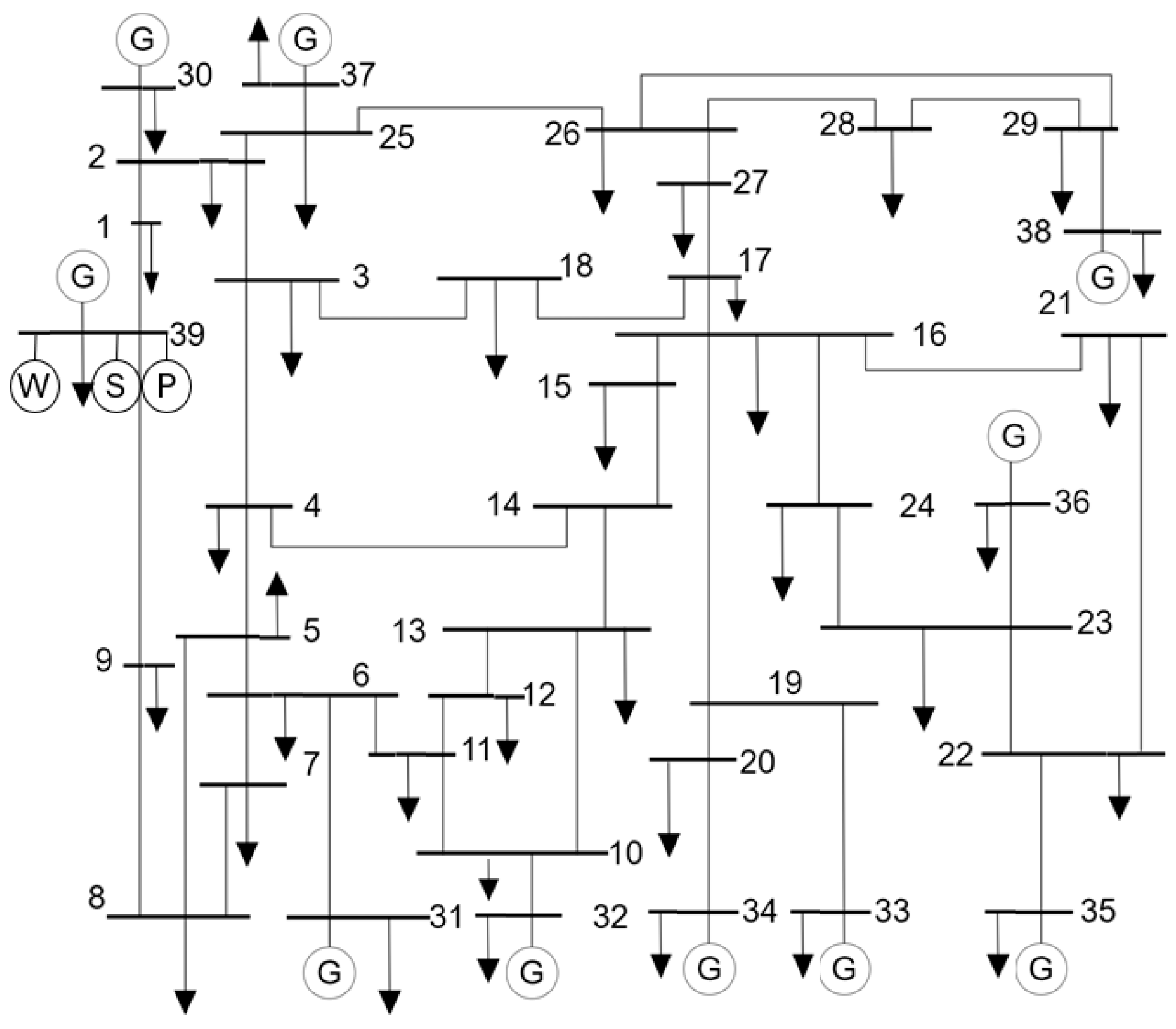
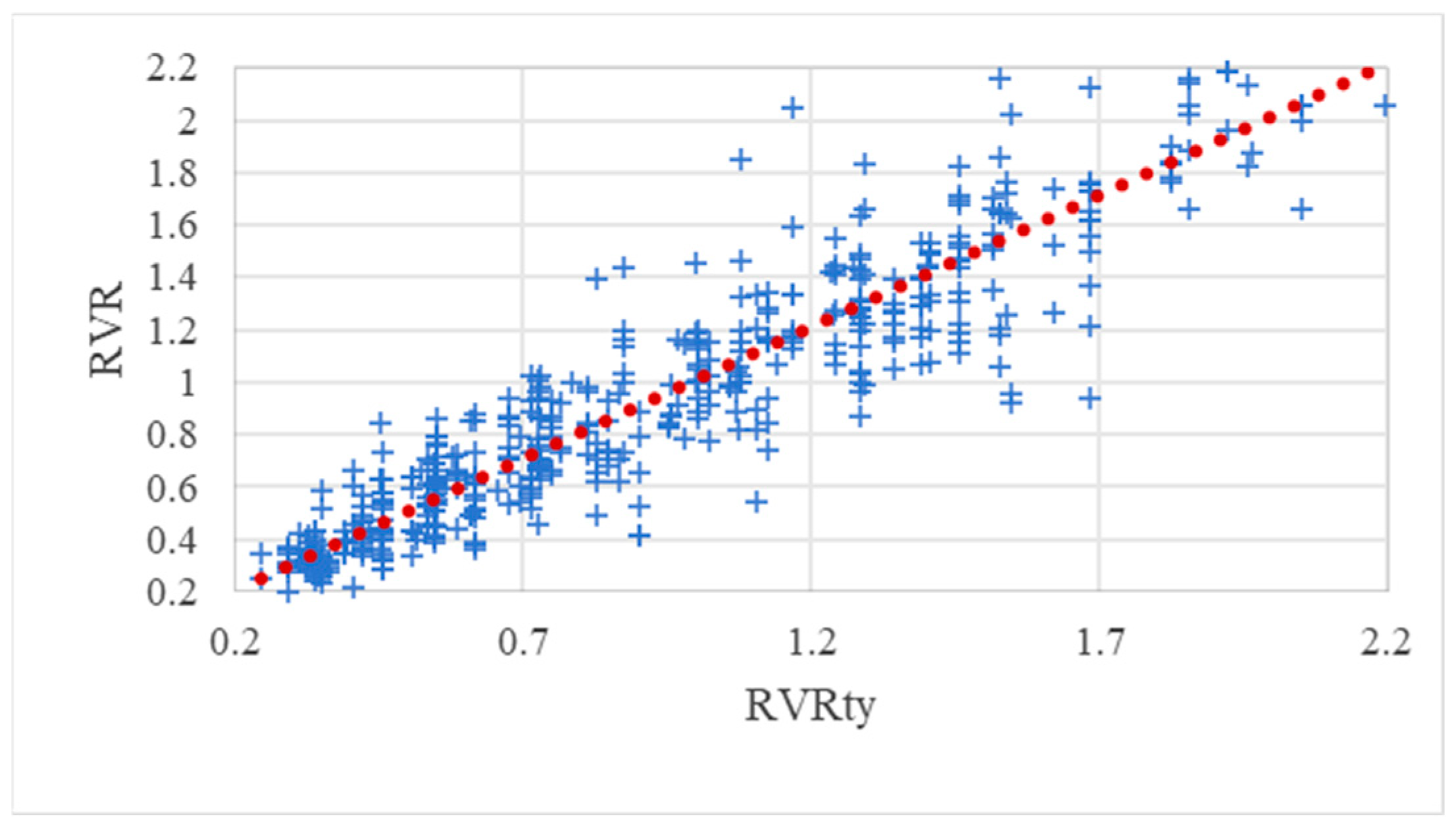
- The proposed method is tested on the IEEE 39-node system. Results show that the proposed method can effectively extract the correlation and coupling relationships among high-dimensional power system operation variables, select typical system operation modes, and accurately assess characteristics and risks of power system operation.
2. Multi-Dimensional Analysis Metrics for Operation Modes of Power Systems with High-Proportion Renewable Energy
2.1. Renewable Energy Utilization Rate
2.2. Renewable Energy Penetration Rate
2.3. Line Overload Rate
2.4. Spinning Reserve Rate
3. An Analysis Framework for Power System Operation Mode Based on AEC
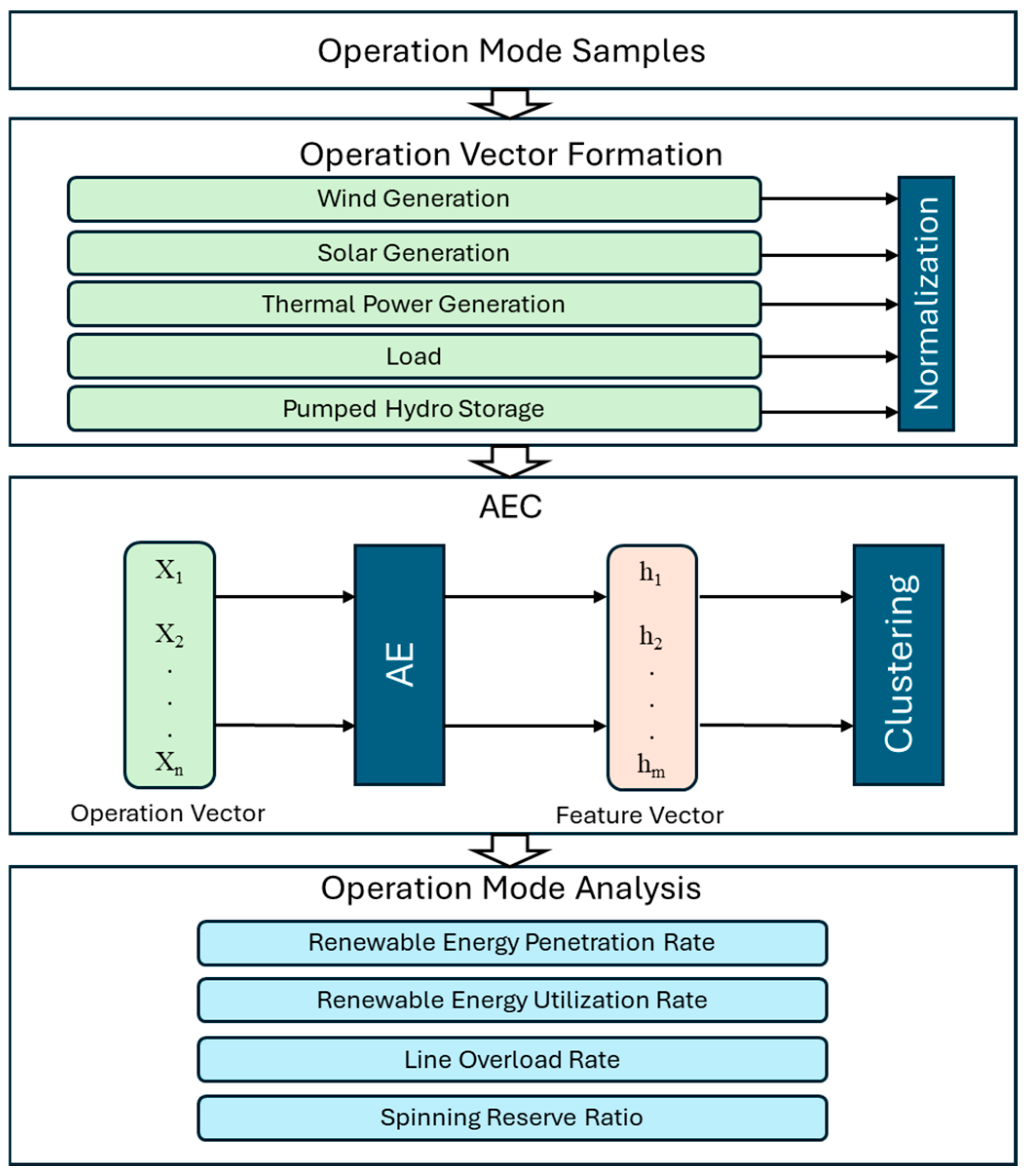
- Obtain operation mode samples of the power system. These samples may come from historical or simulated data. The historical data is obtained from the dispatching automation system, e.g., SCADA data, WAMS data, or day-ahead generation arrangement. The simulated data is generated by random production simulation for day-ahead or long-term applications, e.g., power system analysis, risk assessment, and grid planning. To ensure the quality of operation mode analysis, the criteria for data selection mainly include two rules: (a) The power grid topology should be similar. If dramatic changes occur to the power grid, the data corresponding to the scenario should not be included in the sample set. (b) The quality of data should be relatively good, i.e., no significant data omissions or noise.
- Construct operating vectors for the operation mode samples. Select the power of wind turbines, photovoltaics, thermal power units, load, and the two-way power of pumped hydro storage in the operation mode data to form the operating vector. Each operating vector corresponds to one operation mode. To prevent variables with large numerical ranges from dominating the clustering results, variables in the operating vectors are normalized, where the supply-side data and load data are normalized separately.
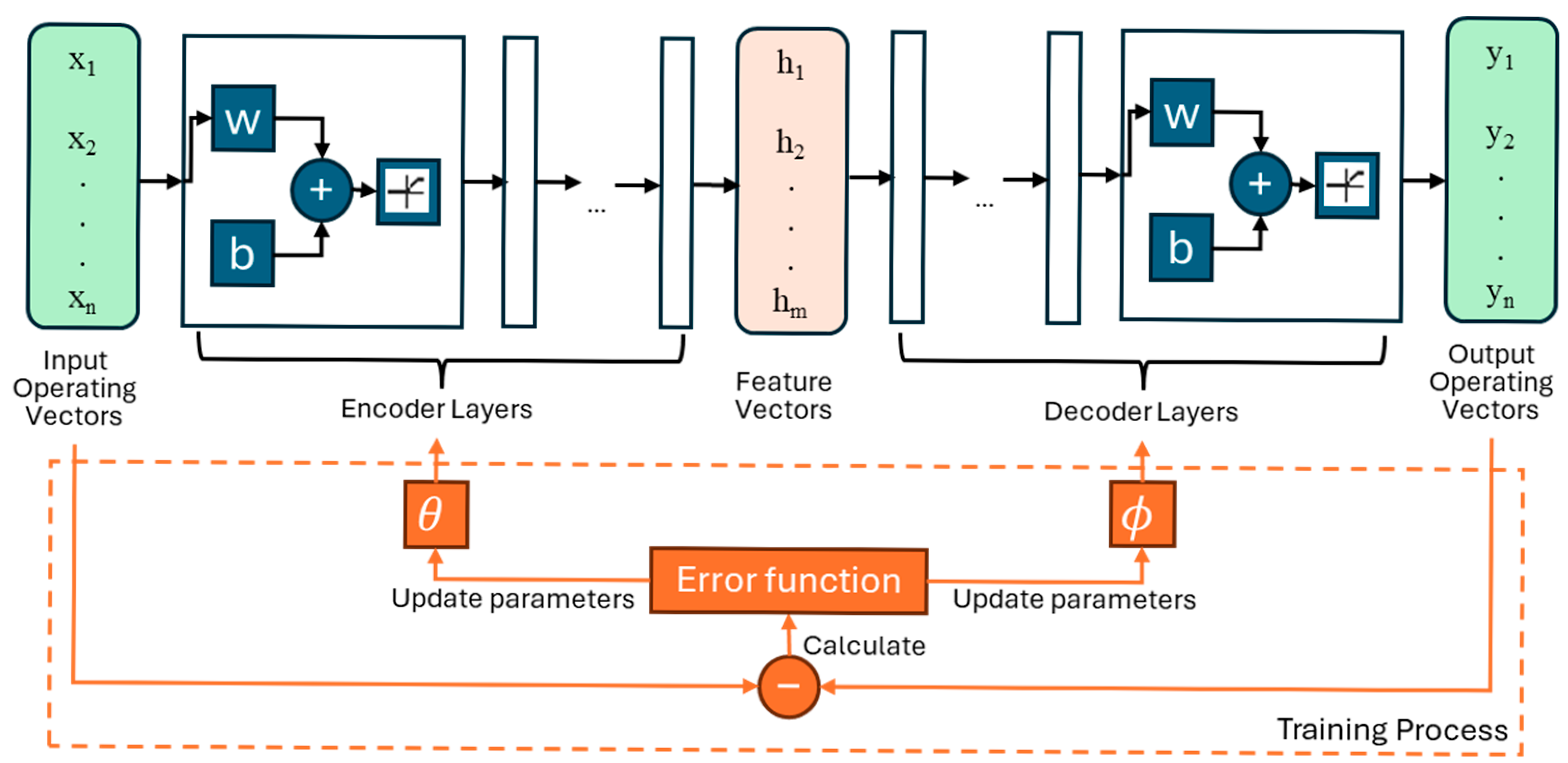
- Use the sample data to train an AE. The trained AE can extract spatial features from the operating vectors and generate feature vectors in a reduced-dimensional space. The feature vectors represent deep-level characteristics of power system operation. Cluster the feature vectors with the k-means clustering method. Use the clustering evaluation metrics to assess the clustering effect, and select the optimal AE training hyperparameters and clustering number to minimize the clustering evaluation metrics.
- Obtain the clusters of operating vectors with the clustering result of feature vectors. Use the operation modes of centroids to select typical operation modes of the system. Evaluate the operational characteristics of the power system using multi-dimensional analysis metrics, i.e., renewable energy penetration rate, renewable energy utilization rate, line overload rate, and spinning reserve rate. The evaluation results can serve as representatives of system operating characteristics.
4. Analysis Method of Power System Operation Mode Based on AEC
4.1. Operating Vector Formation
4.2. AEC Model
4.3. Clustering Evaluation Metric
5. Case Study
5.1. Testing System Introduction
5.2. Comparison of Clustering Effects
5.3. Optimal Clustering Number Selection
5.4. Clustering Result Analysis
5.5. Operation Mode Analysis
6. Conclusions and Discussion
Author Contributions
Funding
Institutional Review Board Statement
Informed Consent Statement
Data Availability Statement
Conflicts of Interest
References
- Gu, Y.; Zhao, M.; Wang, Z.; Zhang, T.; Li, S. Electrical power system network security situational awareness and protection based on deep learning. In Proceedings of the International Conference on Electrical Drives, Power Electronics & Engineering, Athens, Greece, 26–28 March 2025. [Google Scholar]
- Fotis, G.; Maris, T.I.; Mladenov, V. Risks, obstacles and challenges of the electrical energy transition in Europe: Greece as a case study. Sustainability 2025, 17, 5325. [Google Scholar] [CrossRef]
- ICS Investigation Expert Panel. Grid Incident in Spain and Portugal on 28 April 2025. Available online: https://www.entsoe.eu/publications/blackout/28-april-2025-iberian-blackout/#Publications_&_Documents (accessed on 18 January 2026).
- Çetinkaya, Ü.; Yeşil, M.; Bayındır, R.; Irmak, E. Technical analysis and strategic insights from the 2025 Spain Blackout. In Proceedings of the 13th International Conference on Smart Grid, Glasgow, UK, 27–29 May 2025. [Google Scholar]
- Hu, B.; Xie, K.; Shao, C.; Pan, C.; Lin, C.; Zhao, Y. Commentary on risk of new power system under goals of carbon emission peak and carbon neutrality: Characteristics, indices and assessment methods. Autom. Electr. Power Syst. 2023, 47, 1–15. [Google Scholar]
- Wang, T.; Feng, L.; Zhou, H.; Chen, Y.; Yuan, Z.; Zhang, J. Research on grid operation risk assessment methods considering the uncertainty of distributed new energy sources. In Proceedings of the 8th IEEE International Conference on Energy Internet, Zhuhai, China, 1–3 November 2024. [Google Scholar]
- Liu, Y.; Sioshansi, R.; Conejo, A.J. Hierarchical clustering to find representative operating periods for capacity-expansion modeling. IEEE Trans. Power Syst. 2018, 33, 3029–3039. [Google Scholar] [CrossRef]
- Yu, H. Research on Extreme Operation Scenario Generation Method for Power System with High Penetration Renewable Energy Based on Deep Learning Method. Master’s Thesis, North China Electric Power University, Beijing, China, 2023. [Google Scholar]
- Guo, Q.; Lan, J.; Zhou, Y.; Wang, Z.; Zeng, H.; Sun, H. Architecture and key technologies of hybrid-intelligence-based decision-making of operation modes for new type power systems. Electr. Power 2023, 56, 1–13. [Google Scholar]
- Li, X. Extraction of Typical Operating Modes of High Proportion New Energy Power System Based on Cluster Analysis. Master’s Thesis, Northeast Electric Power University, Jilin, China, May 2025. [Google Scholar]
- Liu, X.; Zhang, Y.; Wang, L.; Liu, Y.; Hou, X. Deep learning based power risk prevention and control tracing method. In Proceedings of the 4th International Conference on Smart Grid and Energy Internet, Shenyang, China, 13–15 December 2024. [Google Scholar]
- Han, F.; Li, J.; Qiao, J.; Wei, L.; Jiao, H.; Yao, H. Framework design of power system situation cognition and operational risk assessment technology based on probability statistics and deep learning. In Proceedings of the 10th Asia Conference on Power and Electrical Engineering, Beijing, China, 15–19 April 2025. [Google Scholar]
- Hou, Q.; Du, E.; Tian, X.; Liu, F.; Zhang, N.; Kang, C. Data-driven power system operation mode analysis. Proc. CSEE 2021, 41, 1–12. [Google Scholar]
- Zhang, J.; Zheng, L.; Wang, N.; Zhou, Z.; Zhang, Y. Research on a data-driven safety risk assessment model for electrical switching operations in substations. In Proceedings of the International Conference on Electrical Automation and Artificial Intelligence, Guangzhou, China, 10–12 January 2025. [Google Scholar]
- Li, G.; Chen, X.; Jia, G.; Li, Y.; Chen, X.; Xiao, K. Dynamic risk assessment model for urban power lifeline based on machine learning. In Proceedings of the Boao New Power System International Forum—Power System and New Energy Technology Innovation Forum, Qionghai, China, 8–10 December 2024. [Google Scholar]
- Qian, K.; Liang, Z.; Hu, W.; Yao, Y.; Ma, K.; Sun, Y.; Zhang, X. Balance risk assessment method of power system based on CNN-BiLSTM-Attention. In Proceedings of the 5th International Conference on Power Engineering, Shanghai, China, 13–15 December 2024. [Google Scholar]
- Gu, X.; Liu, T.; Li, S.; Wang, T.; Yang, X. Temporal and spatial similarity mining of power grid running section for future state prediction. Trans. China Electrotech. Soc. 2022, 37, 6145–6156. [Google Scholar]
- Zhao, H. Research on Model and Algorithm of Typical Operation Mode Extraction of Power Grid. Master’s Thesis, North China Electric Power University, Beijing, China, 2020. [Google Scholar]
- Hou, Q.; Du, E.; Zhang, N.; Kang, C. Impact of high renewable penetration on the power system operation mode: A data-driven approach. IEEE Trans. Power Syst. 2020, 35, 731–741. [Google Scholar] [CrossRef]
- Chen, D.; Yang, N.; Sun, X.; Wang, M.; Lu, R.; Liu, D. Identification method of power system operation mode based on improved clustering algorithm. Power Capacit. React. Power Compens. 2024, 45, 91–99. [Google Scholar]
- Liang, H.; Tian, C.; Wang, T.; Cao, X.; Yang, X.; Liu, Y. Running section similarity matching based on improved k-means algorithm. Electr. Power Autom. Equip. 2019, 39, 119–124. [Google Scholar]
- Fu, X.; Jiang, X.; Li, X.; Li, Y.; Liu, X.; Wu, J. Typical operation mode extraction of high proportion new energy power system based on convolutional self-attention clustering algorithm. South. Power Syst. Technol. 2025, 19, 140–149. [Google Scholar]
- Shen, H.; He, C.; Zhang, H.; Liu, T.; Nan, L.; Ye, X.; Sun, X.; Wang, B. A data-driven method for identifying similarity in transmission sections with embedded multi-scale key feature information. Proc. CSEE 2025, in press. [Google Scholar]
- Yang, J. Power System State Identification and Preventive Control Strategy Based on Machine Learning. Master’s Thesis, Taiyuan University of Technology, Taiyuan, China, 2023. [Google Scholar]
- Chen, Z. Research on Identification of Key Transmission Sections and Analysis of Total Transfer Capability in Power Systems Considering Wind Power Integration. Master’s Thesis, South China University of Technology, Guangzhou, China, 2023. [Google Scholar]
- Sadeghi, M.; Soleimani, S.; Armanfard, N. Deep clustering with self-supervision using pairwise similarities. IEEE Access 2025, 13, 148104–148127. [Google Scholar] [CrossRef]
- Wang, Z.; Tang, Y.; Du, H.; Wang, X.; Hu, Z.; Zhai, Q. Two-stage hierarchical clustering based on LSTM autoencoder. In Proceedings of the 18th International Conference on Computational Intelligence and Security, Chengdu, China, 16–18 December 2022. [Google Scholar]
- Zhang, D.; Yan, Y.; Huang, Y.; Liu, B.; Zheng, Q.; Zhang, J.; Xia, N. Unsupervised Cryo-EM images denoising and clustering based on deep convolutional autoencoder and k-means++. IEEE Trans. Med. Imaging 2023, 42, 1509–1521. [Google Scholar] [CrossRef] [PubMed]
- Michelucci, U. An introduction to autoencoders. arXiv 2022, arXiv:2201.03898. [Google Scholar] [CrossRef]
- Zhuang, Y.; Cheng, L.; Qi, N.; Chen, W.; Wu, X.; Yao, Z. Typical scenario generation algorithm for microgrid based on deep temporal clustering. Autom. Electr. Power Syst. 2023, 47, 95–103. [Google Scholar]
- Cortés, D.G.; Onieva, E.; López, I.P.; Trinchera, L.; Wu, J. Autoencoder-enhanced clustering: A dimensionality reduction approach to financial time series. IEEE Access 2024, 12, 16999–17009. [Google Scholar] [CrossRef]
- Islam, M.M.; Faruque, M.O.; Butterfield, J.; Singh, G.; Cooke, T.A. Unsupervised clustering of disturbances in power systems via deep convolutional autoencoders. In Proceedings of the IEEE Power & Energy Society General Meeting, Orlando, FL, USA, 16–20 July 2023. [Google Scholar]
- Wang, X.; Zhou, B.; Lv, C.; Yang, H.; Ma, Q.; Yang, Z.; Cui, Y. Typical power grid operation mode generation based on reinforcement learning and deep belief network. Sustainability 2023, 15, 14844. [Google Scholar] [CrossRef]



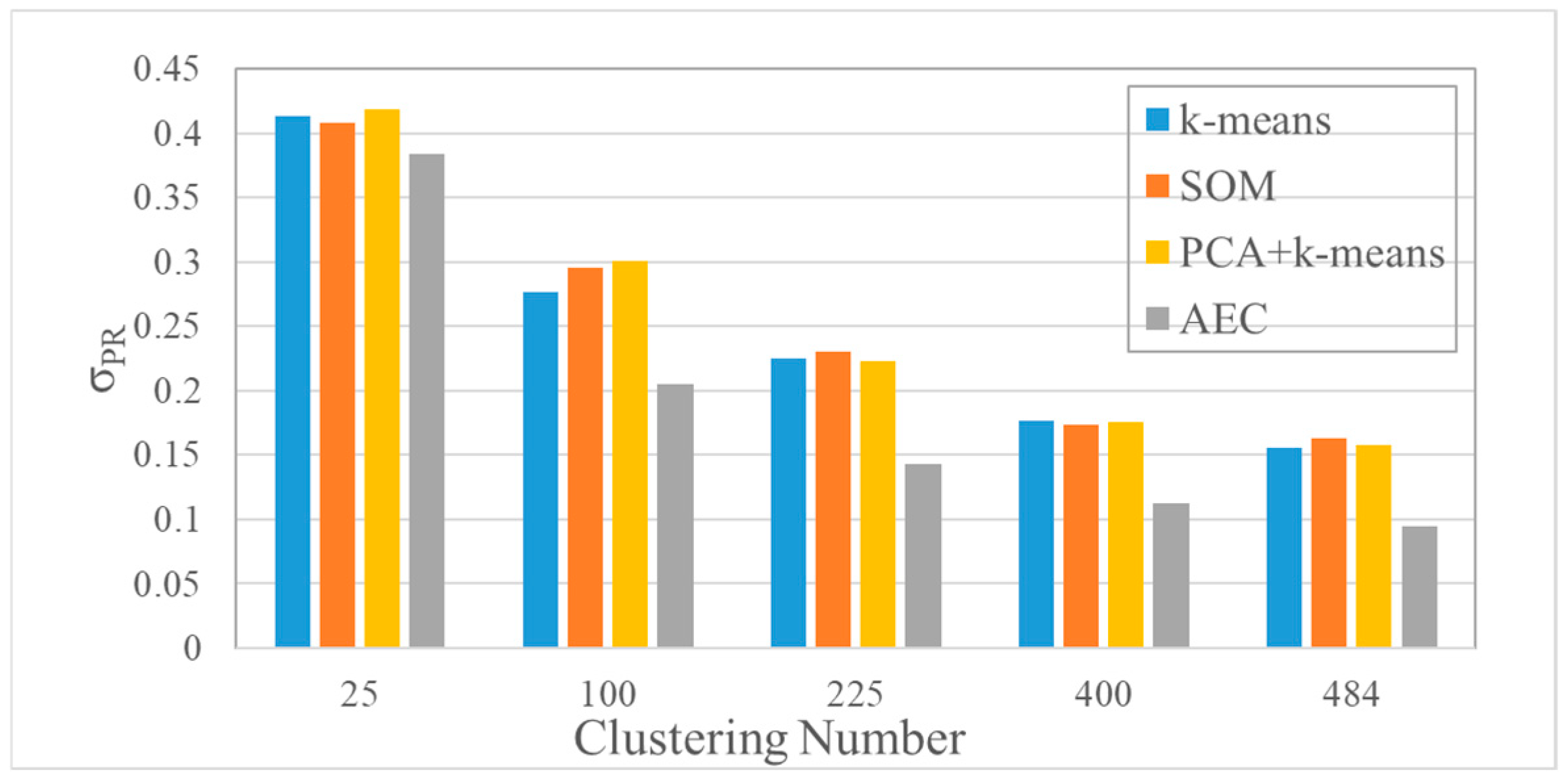
| Clustering Number | Clustering Method | SC | ||||
|---|---|---|---|---|---|---|
| 25 | k-means | 0.413 | 0.1165 | 0.744 | 0.4054 | 0.2899 |
| SOM | 0.4085 | 0.0987 | 0.72 | 0.4014 | 0.1485 | |
| PCA + k-means | 0.4188 | 0.081 | 0.7307 | 0.4022 | 0.2971 | |
| AEC | 0.3837 | 0.0984 | 0.7227 | 0.3978 | 0.5336 | |
| 100 | k-means | 0.2763 | 0.022 | 0.5767 | 0.289 | 0.2683 |
| SOM | 0.296 | 0.0235 | 0.5732 | 0.2779 | 0.1469 | |
| PCA + k-means | 0.3004 | 0.0235 | 0.5827 | 0.2812 | 0.2614 | |
| AEC | 0.2047 | 0.0224 | 0.5707 | 0.2685 | 0.4352 | |
| 225 | k-means | 0.2255 | 0.0195 | 0.504 | 0.2271 | 0.1341 |
| SOM | 0.2302 | 0.0187 | 0.4912 | 0.2292 | 0.2392 | |
| PCA + k-means | 0.2231 | 0.0189 | 0.5076 | 0.2328 | 0.238 | |
| AEC | 0.1431 | 0.0168 | 0.491 | 0.2165 | 0.4158 | |
| 400 | k-means | 0.1769 | 0.0147 | 0.4363 | 0.1915 | 0.1262 |
| SOM | 0.1732 | 0.0147 | 0.4362 | 0.1923 | 0.2405 | |
| PCA + k-means | 0.1758 | 0.0134 | 0.4365 | 0.1916 | 0.2476 | |
| AEC | 0.1129 | 0.0122 | 0.4325 | 0.1857 | 0.3642 | |
| 484 | k-means | 0.1556 | 0.0135 | 0.4091 | 0.1784 | 0.1127 |
| SOM | 0.1631 | 0.0125 | 0.4186 | 0.1822 | 0.2439 | |
| PCA + k-means | 0.1579 | 0.012 | 0.4088 | 0.1781 | 0.2453 | |
| AEC | 0.0951 | 0.0103 | 0.4088 | 0.176 | 0.3752 |
| Avg | Std | Avg | Std | Avg | Std | Avg | Std | |
|---|---|---|---|---|---|---|---|---|
| k-means | 0.3026 | 0.0088 | 0.0317 | 0.0089 | 0.5867 | 0.0044 | 0.2861 | 0.0040 |
| SOM | 0.2953 | 0.0039 | 0.0248 | 0.0015 | 0.5798 | 0.0052 | 0.2794 | 0.0035 |
| PCA + k-means | 0.3032 | 0.0078 | 0.0326 | 0.0105 | 0.5868 | 0.0047 | 0.2862 | 0.0046 |
| AEC | 0.2259 | 0.0166 | 0.0226 | 0.0029 | 0.5731 | 0.0048 | 0.2729 | 0.0069 |
| Euclidean | 0.2047 | 0.0224 | 0.5707 | 0.2685 |
| cosine | 0.2089 | 0.0211 | 0.5793 | 0.2702 |
| Mahalanobis | 0.3441 | 0.0354 | 0.5787 | 0.355 |
| k-Means | SOM | AEC | |
|---|---|---|---|
| Training Time (s) | 0.8 | 21 | 53 |
| Computational Time (s) | 0.009 | 0.01 | 0.009 |
| Testing Cluster | PR | UR | OR | RVR |
|---|---|---|---|---|
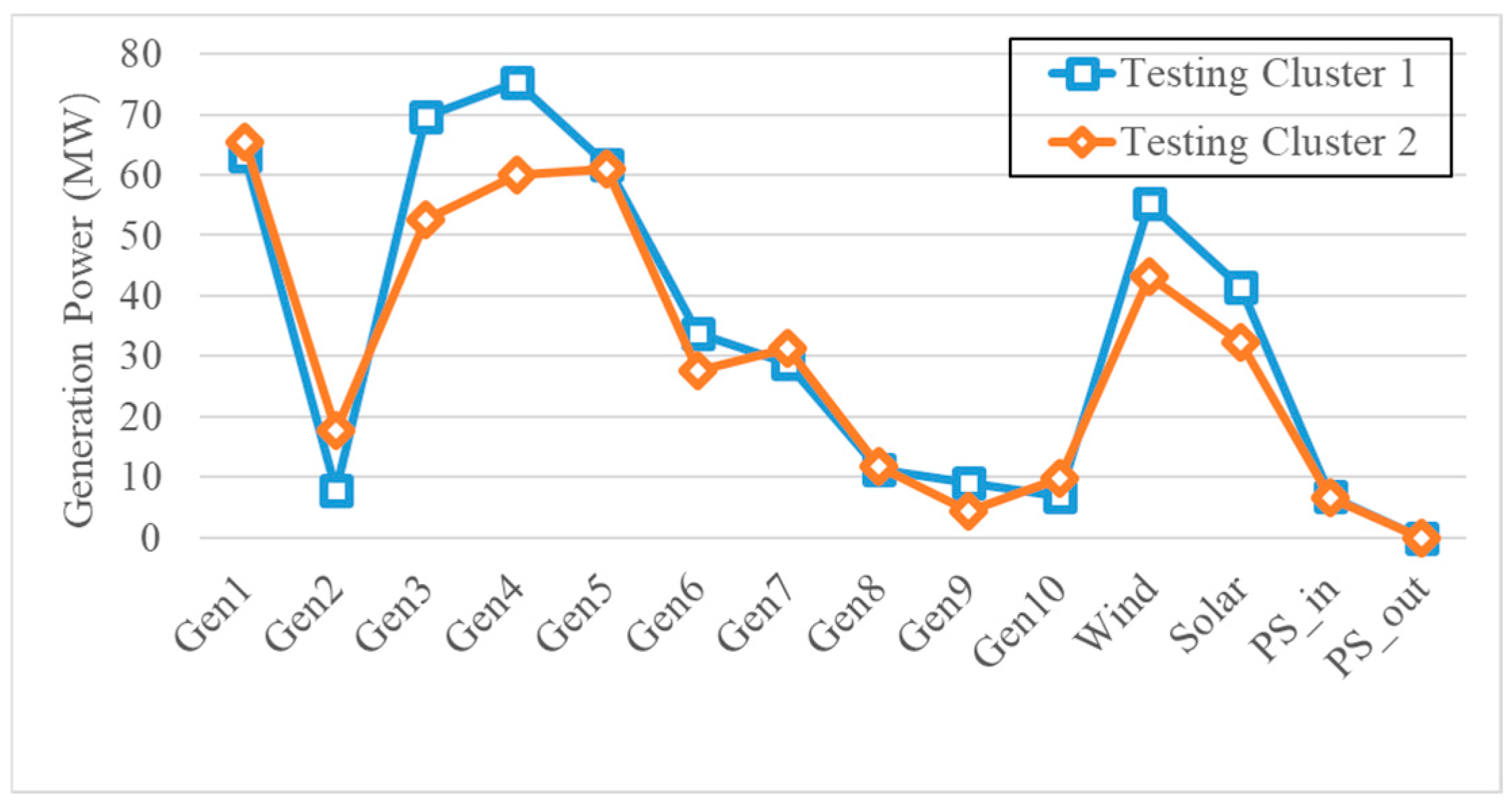
| Testing Cluster 1 | 0.025 | 1 | 0.3696 | 0.5149 |
| Testing Cluster 2 | 0.0144 | 1 | 0.3478 | 1.4576 |
Disclaimer/Publisher’s Note: The statements, opinions and data contained in all publications are solely those of the individual author(s) and contributor(s) and not of MDPI and/or the editor(s). MDPI and/or the editor(s) disclaim responsibility for any injury to people or property resulting from any ideas, methods, instructions or products referred to in the content. |
© 2026 by the authors. Licensee MDPI, Basel, Switzerland. This article is an open access article distributed under the terms and conditions of the Creative Commons Attribution (CC BY) license.
Share and Cite
Zhao, Y.; Qin, L.; Zhou, L.; Zong, H.; Guo, X. An Operation Mode Analysis Method for Power Systems with High-Proportion Renewable Energy Integration Based on Autoencoder Clustering. Sustainability 2026, 18, 1698. https://doi.org/10.3390/su18031698
Zhao Y, Qin L, Zhou L, Zong H, Guo X. An Operation Mode Analysis Method for Power Systems with High-Proportion Renewable Energy Integration Based on Autoencoder Clustering. Sustainability. 2026; 18(3):1698. https://doi.org/10.3390/su18031698
Chicago/Turabian StyleZhao, Ying, Lianle Qin, Liangsong Zhou, Huaiyuan Zong, and Xinxin Guo. 2026. "An Operation Mode Analysis Method for Power Systems with High-Proportion Renewable Energy Integration Based on Autoencoder Clustering" Sustainability 18, no. 3: 1698. https://doi.org/10.3390/su18031698
APA StyleZhao, Y., Qin, L., Zhou, L., Zong, H., & Guo, X. (2026). An Operation Mode Analysis Method for Power Systems with High-Proportion Renewable Energy Integration Based on Autoencoder Clustering. Sustainability, 18(3), 1698. https://doi.org/10.3390/su18031698