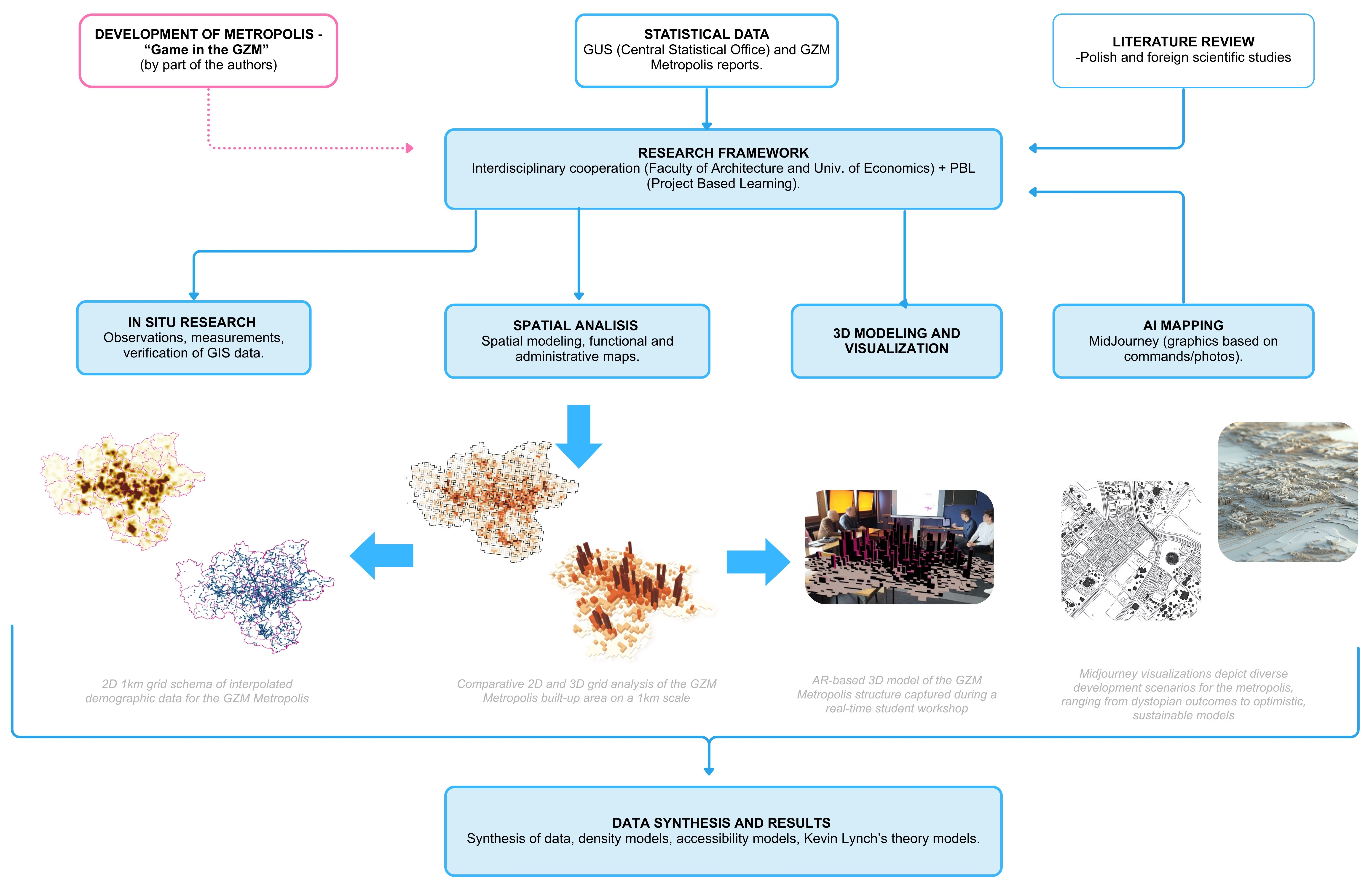
Mapping Metropolitan Structures with Digital Models as a Supporting Tool in Spatial and Strategical Planning—The Case Study of the GZM Metropolis

 ,
,  , , and
Abstract
1. Introduction
1.1. Introduction—Mapping Urban Spaces, Mapping Metropolitan Areas
1.2. GZM Metropolis
1.3. Challenges and Specifics of Spatial Analysis of the GZM Metropolis
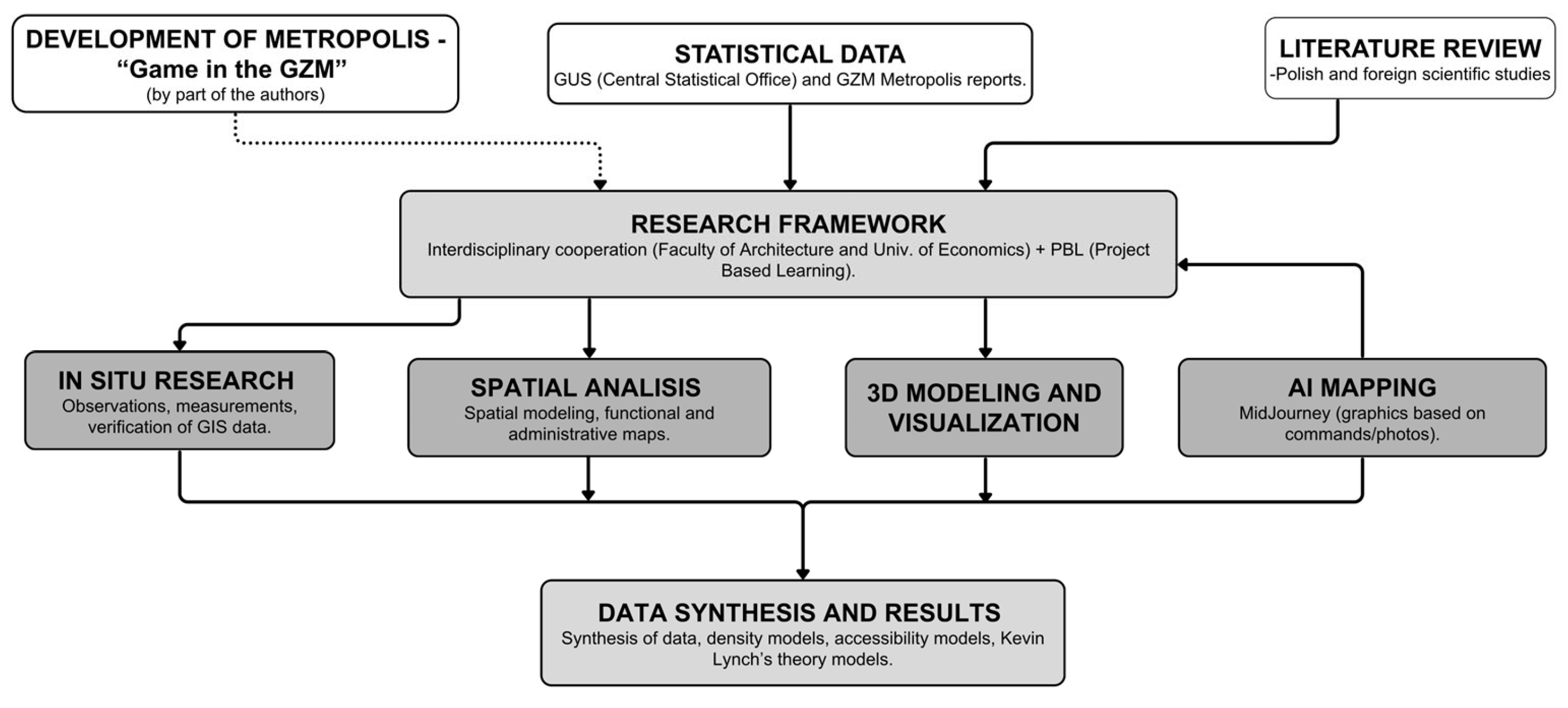
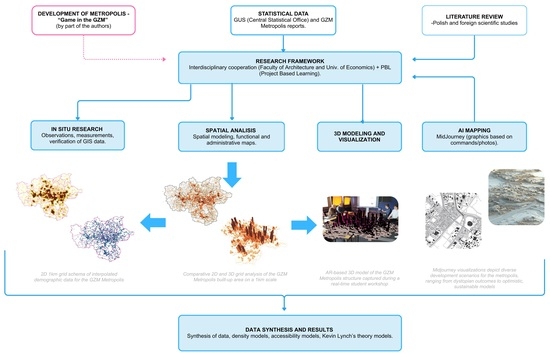
2. Materials and Methods
- Assessment of the applicability of cellular models for analyzing complex functional-spatial structures at supra-local and metropolitan scales.
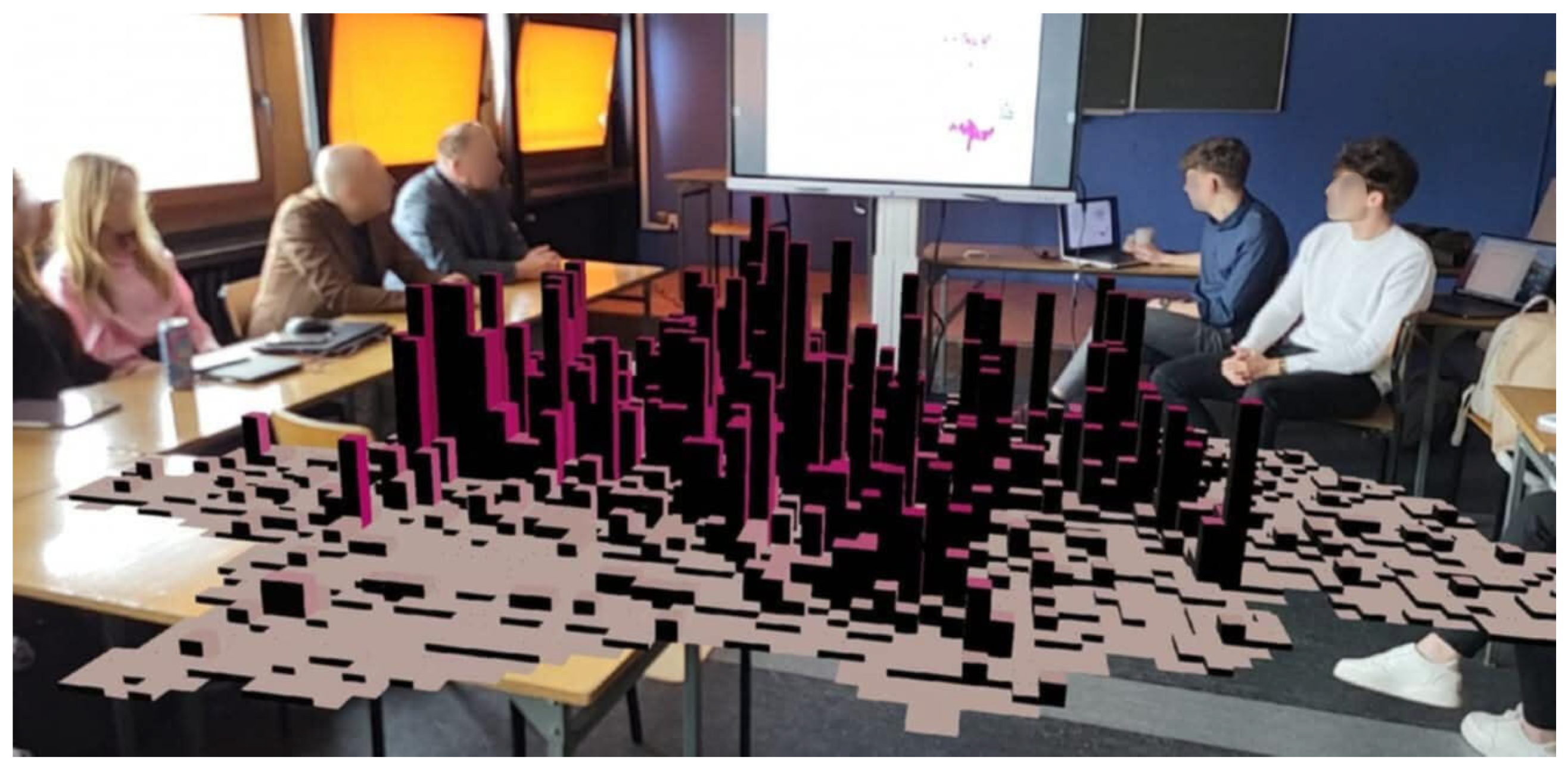
- Assessment of the potential of augmented reality (AR) and extended/immersive reality (XR) tools to improve the accessibility, comprehensibility, and dissemination of spatial analysis results among non-professional audiences.
- Assessment of the applicability of the applied analytical and visualization tools in strategic and scenario-based spatial planning aimed at supporting sustainable metropolitan development.
3. Results
3.1. Cellular Models
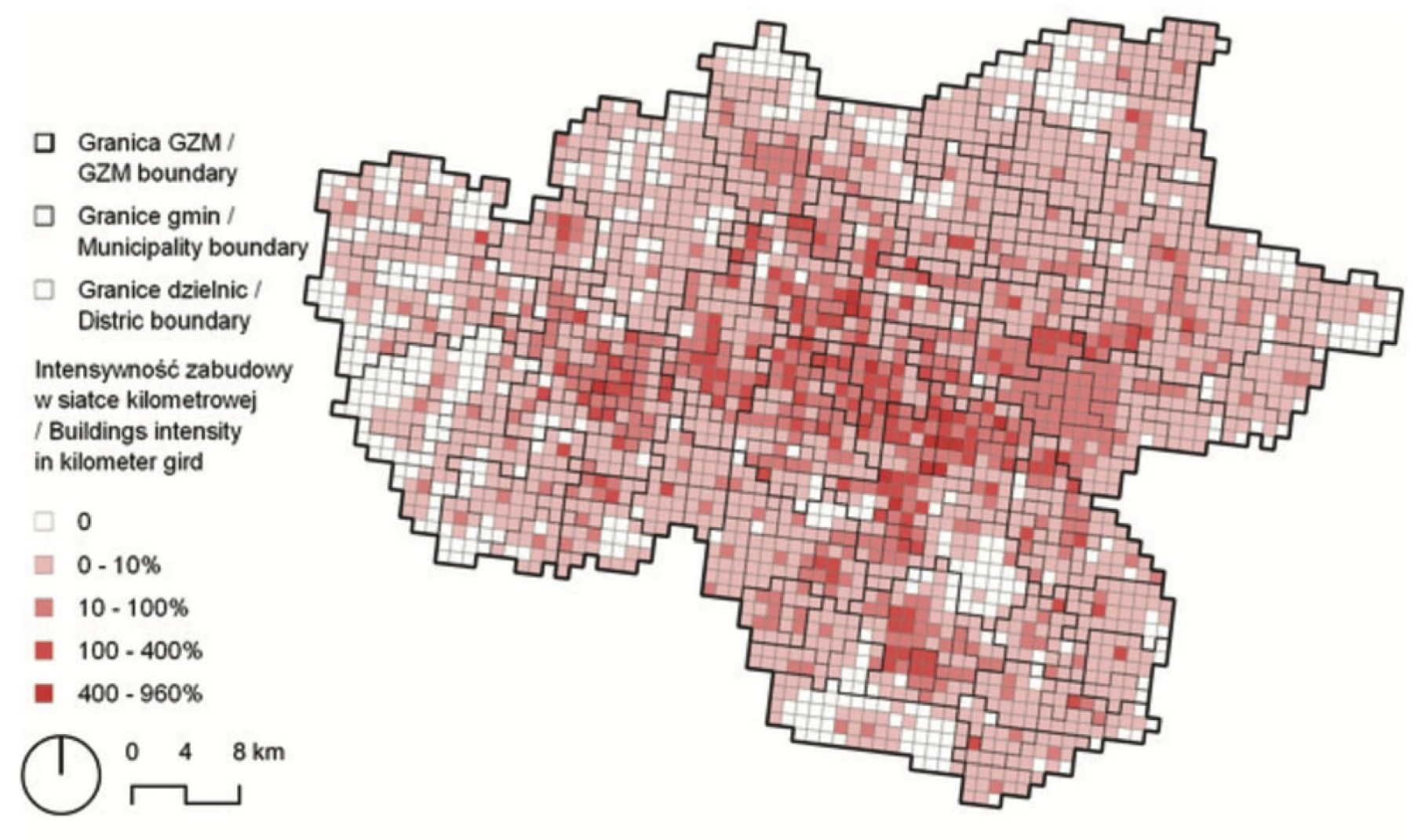
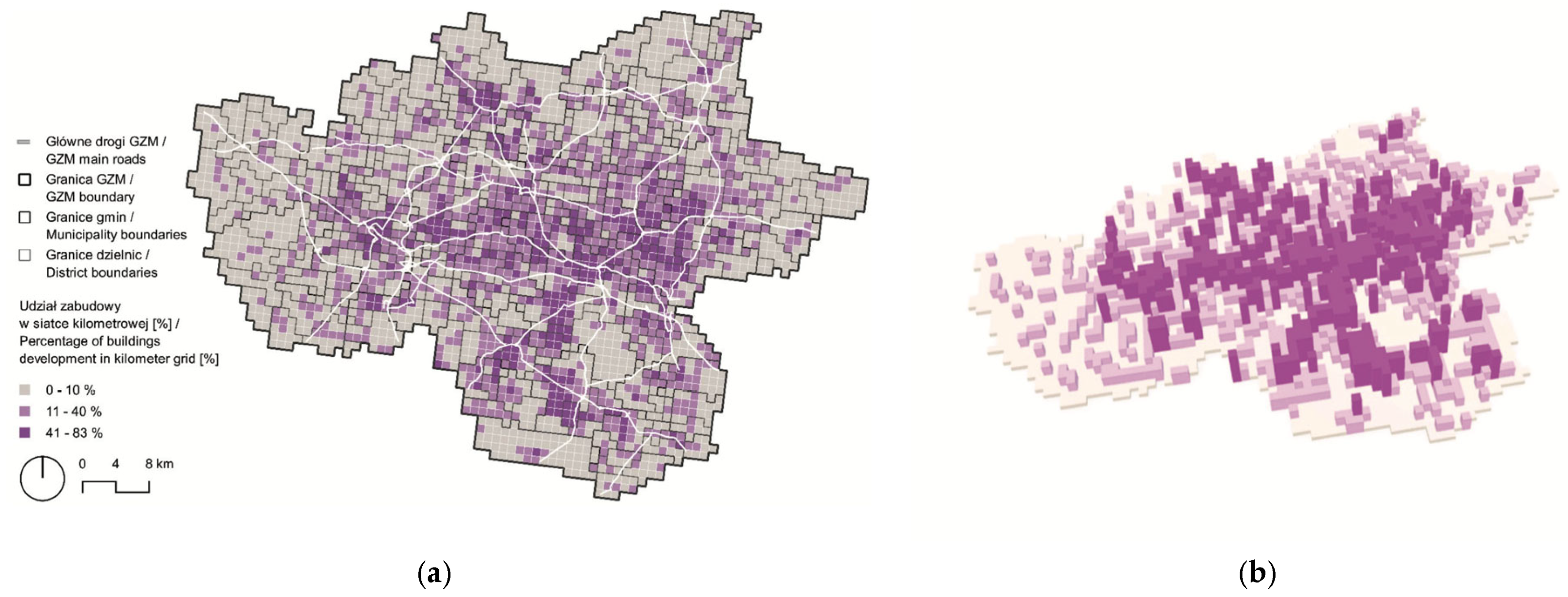
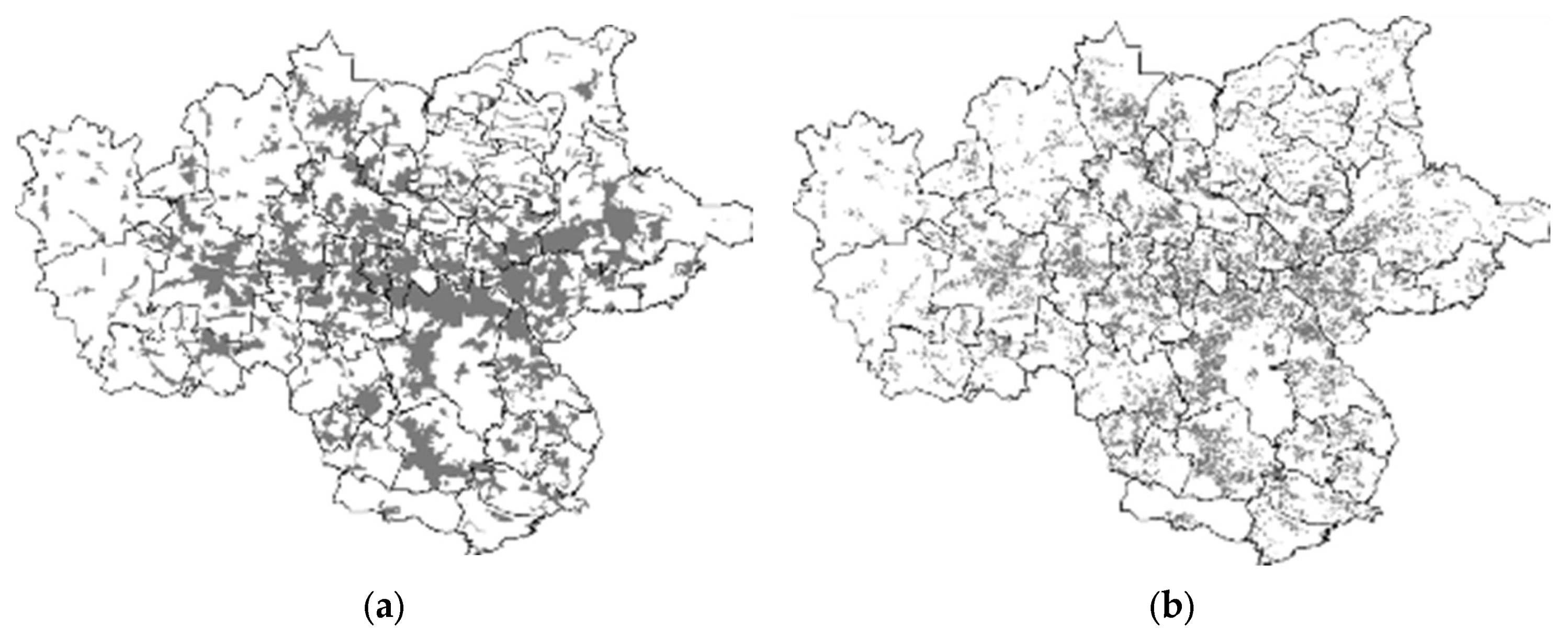
- Building density—the ratio of the total built-up area to the land area (Figure 2).
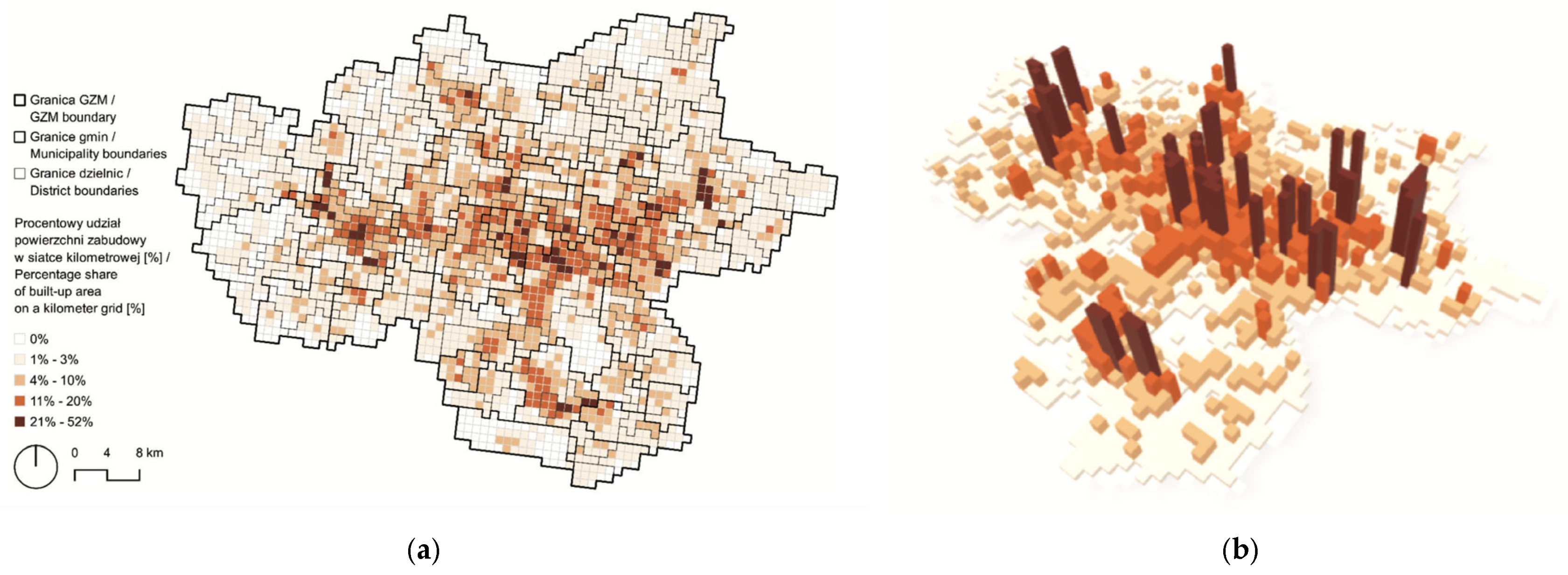
- Building coverage ratio—the percentage of building coverage in relation to the total area of the cell (Figure 3).
- The share of buildings in urbanized areas—that is, the percentage of the area of buildings to the area of urbanized areas in a given cell (Figure 4).
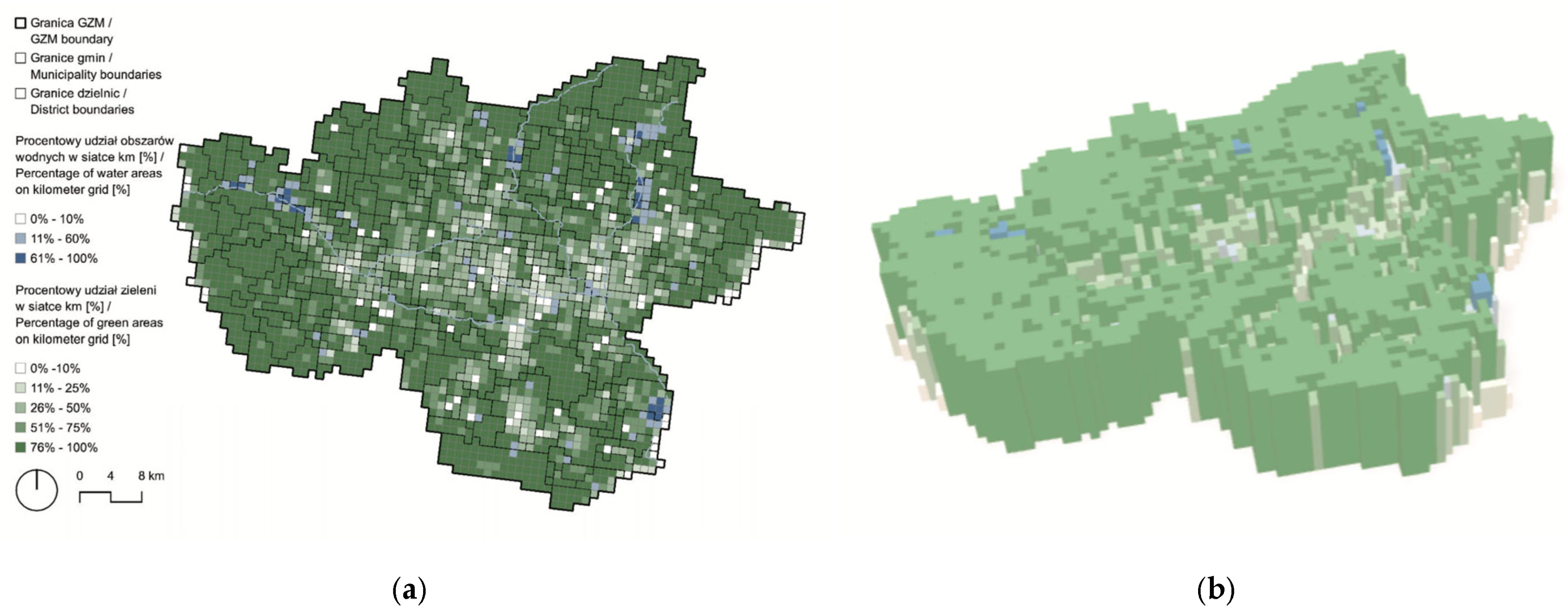
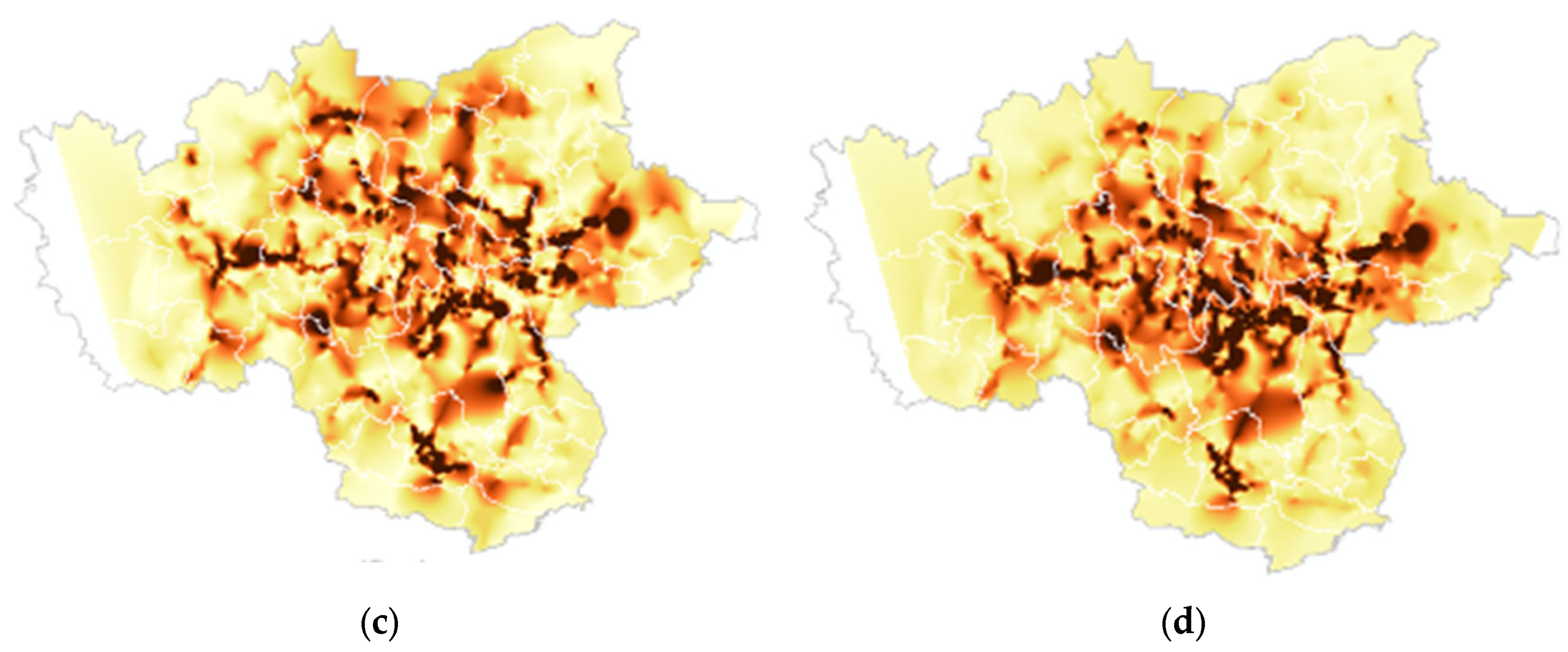
- Blue-green infrastructure—green and water areas present in the urban structure (Figure 5).
3.1.1. Building Density Model
3.1.2. Building Area Participation Model
3.1.3. Model of Building Density in Urbanized Areas
3.1.4. Blue-Green Infrastructure Model
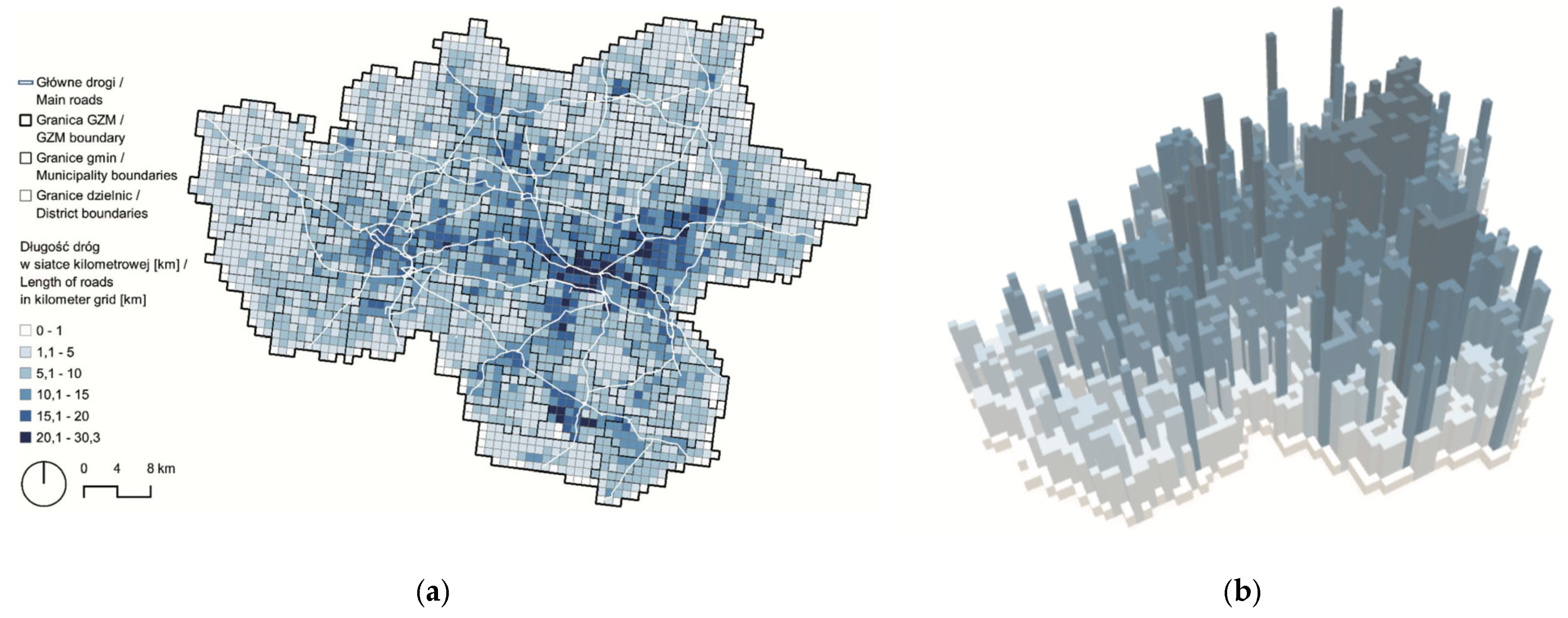
3.1.5. Road Length Model
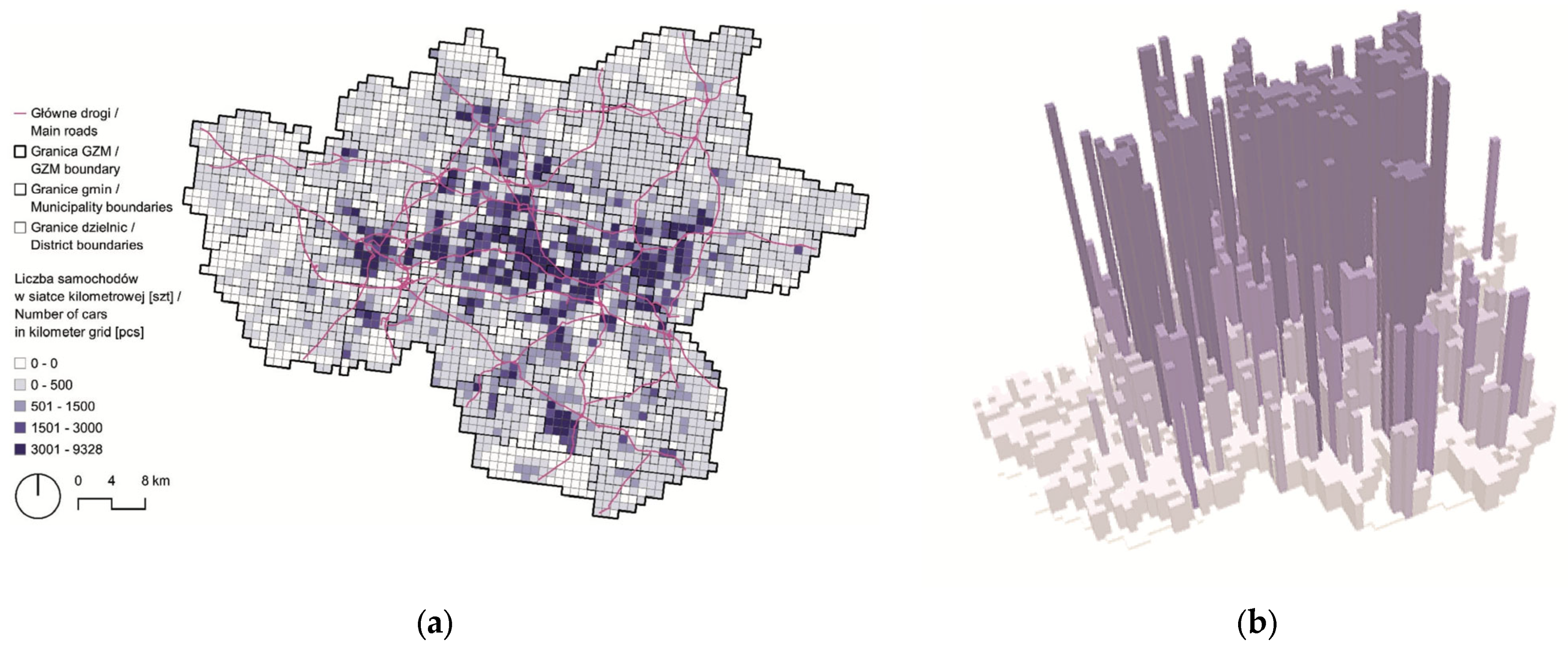
3.1.6. The Number of Cars Model
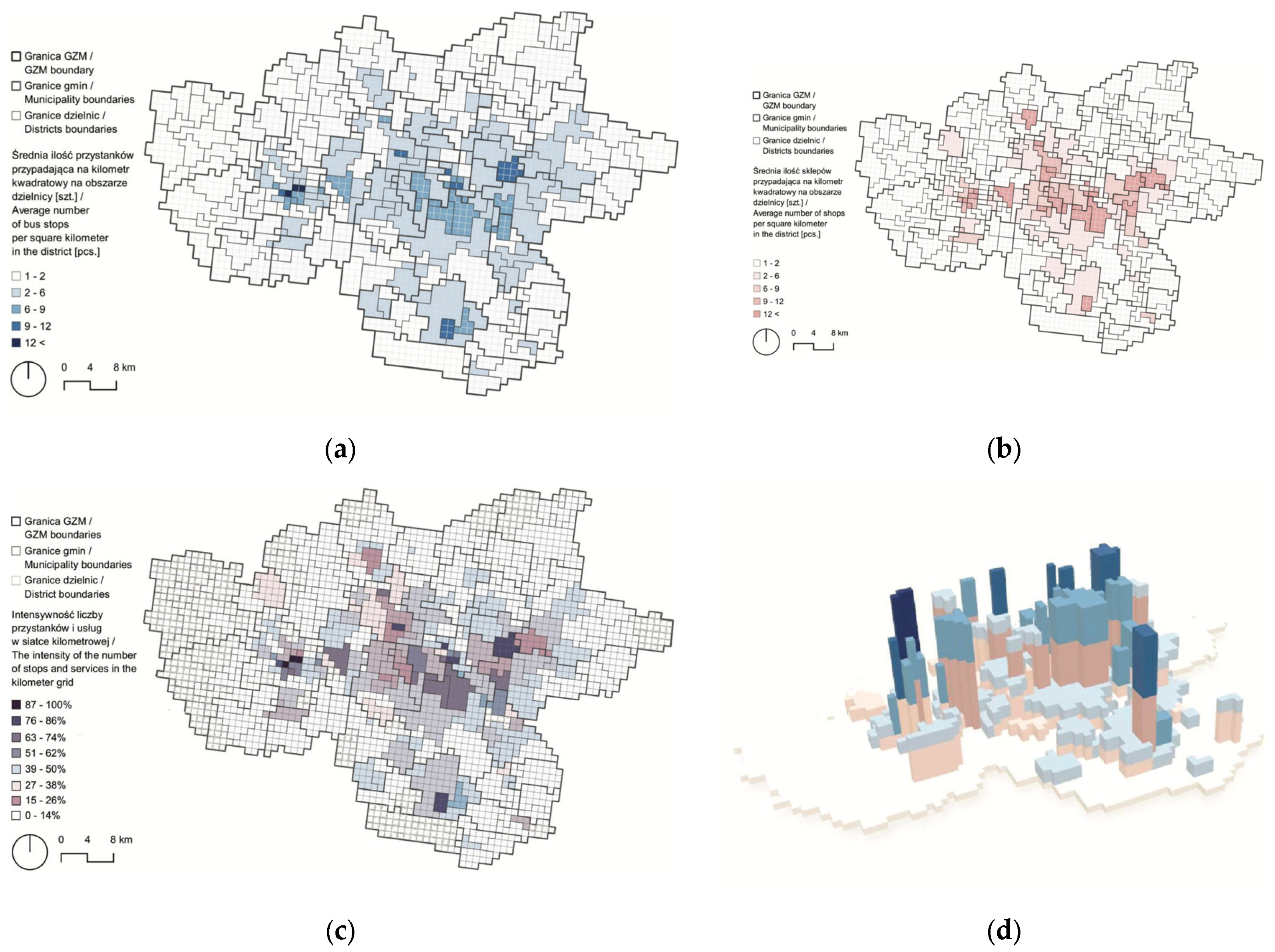
3.1.7. The 15 Min Metropolis Model
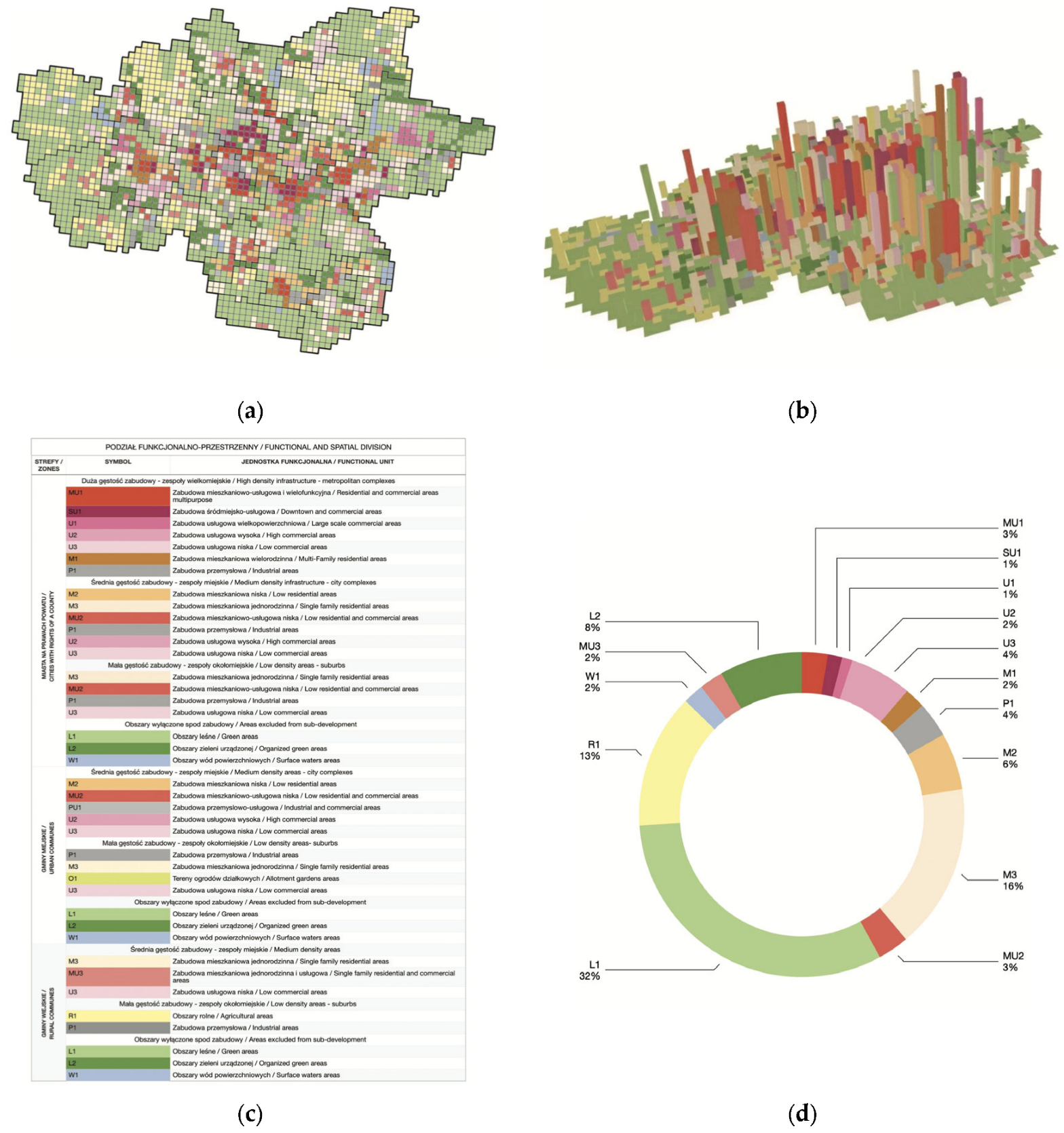
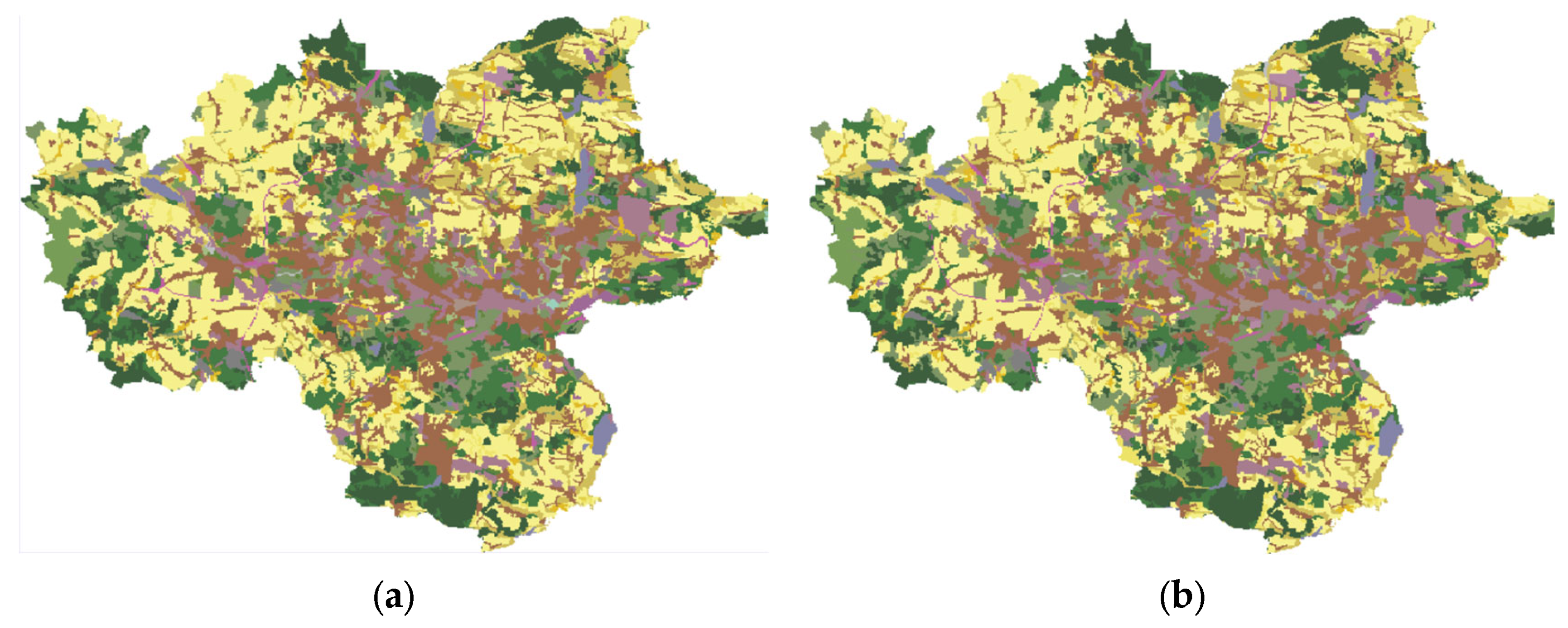
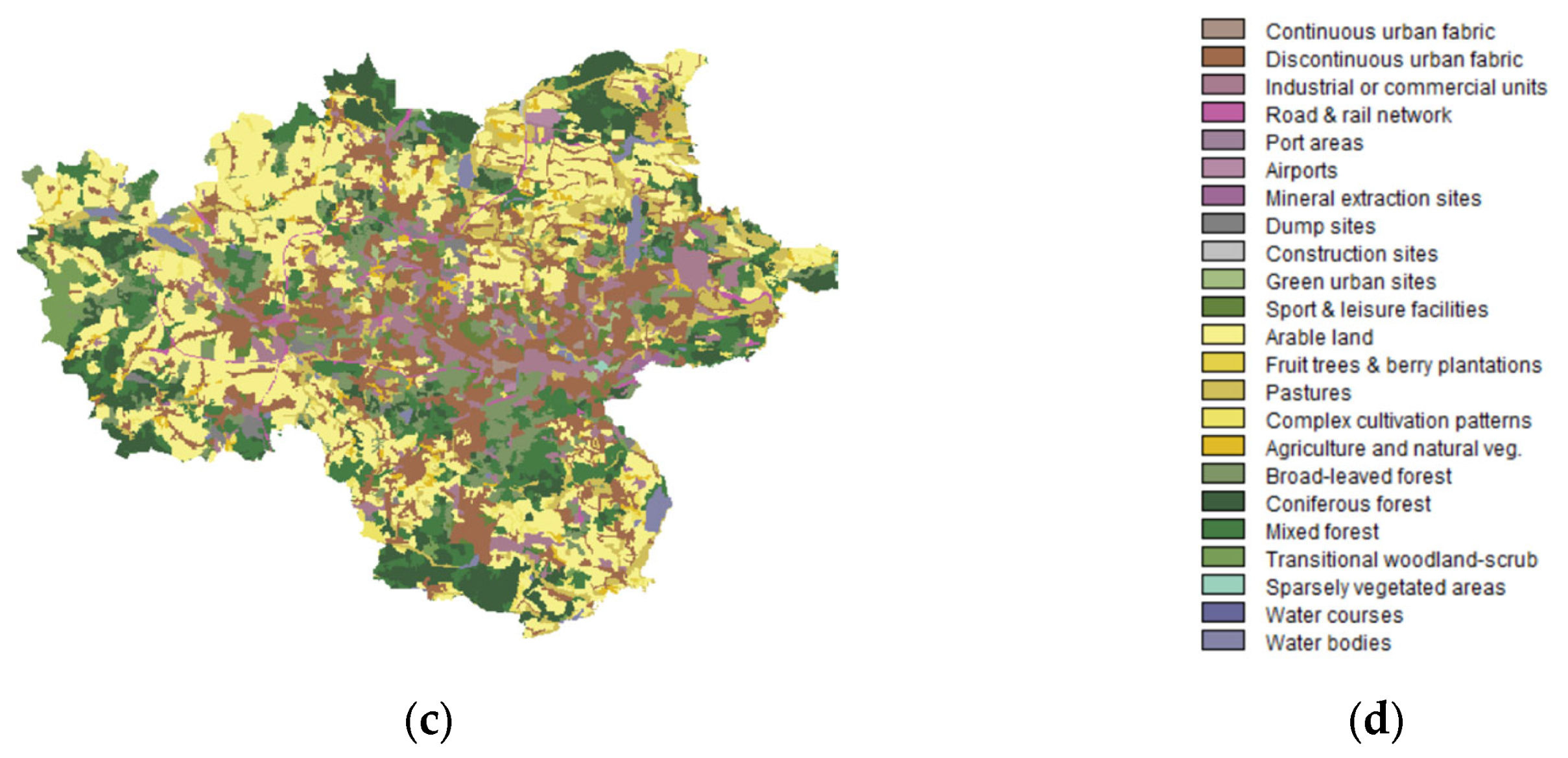
3.1.8. Functional-Spatial Structure Model
3.1.9. Advantages of Cellular Models
3.2. Spatial Simulations
4. Discussion
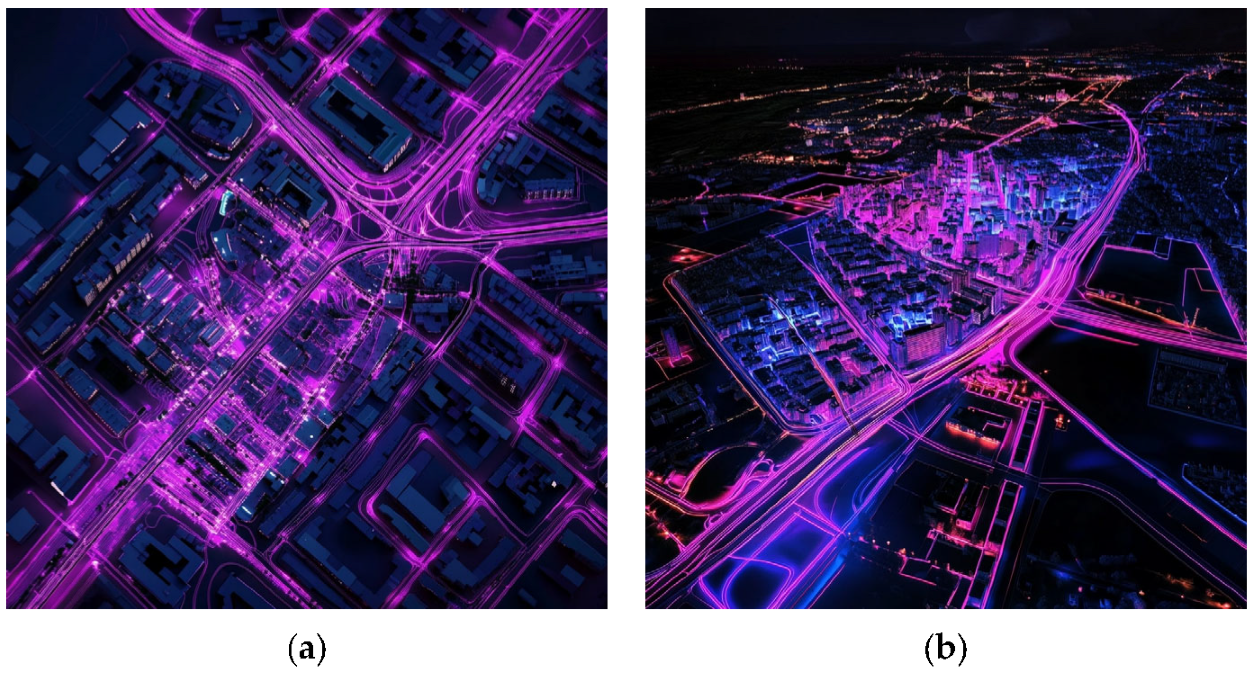
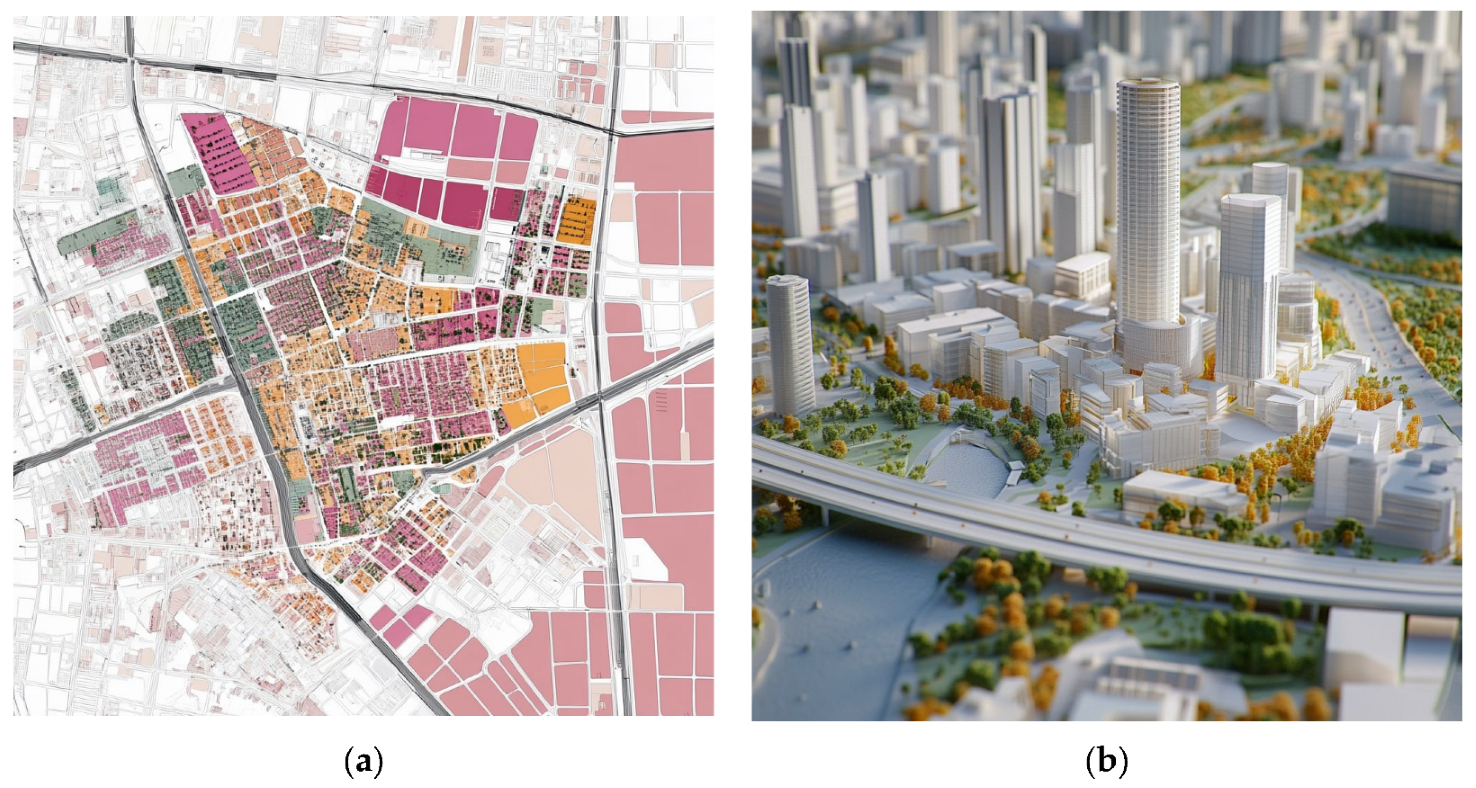
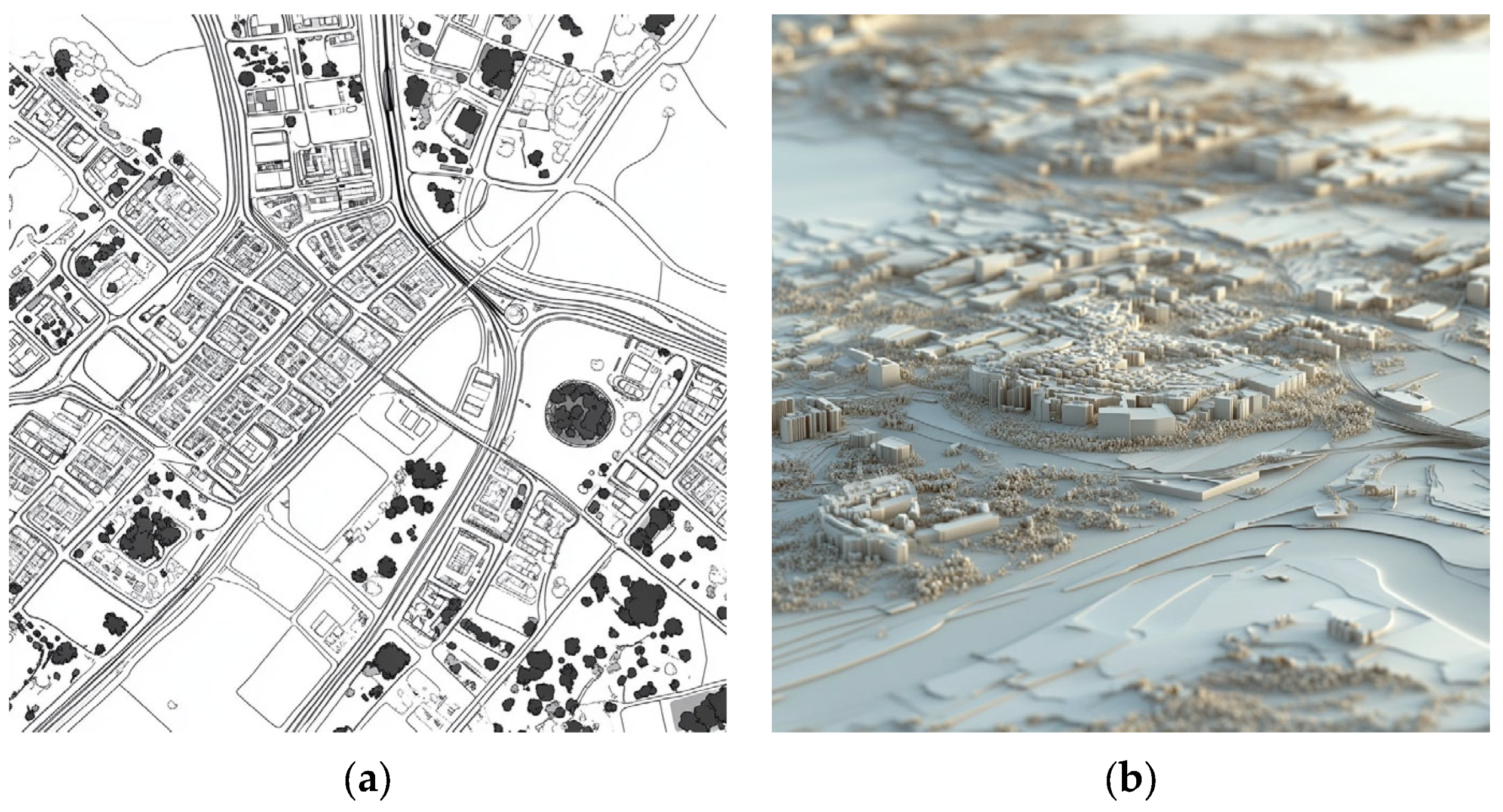
4.1. Attempts to Create Models Using Artificial Intelligence
Mapping the GZM Metropolis
5. Conclusions
Author Contributions
Funding
Institutional Review Board Statement
Informed Consent Statement
Data Availability Statement
Acknowledgments
Conflicts of Interest
References
- Batty, M. The Size, Scale, and Shape of Cities. Science 2008, 319, 769–771. [Google Scholar] [CrossRef] [Scilit] [PubMed]
- Bradecki, T.; Kafka, K.; Ludwig, J.; Mól, B. Modele Struktury Metropolii GZM; Wydawnictwo Politechniki Śląskiej: Gliwice, Poland, 2023. [Google Scholar]
- Bielecka, E. GIS Spatial Analysis Modeling for Land Use Change. A Bibliometric Analysis of the Intellectual Base and Trends. Geosciences 2020, 10, 421. [Google Scholar] [CrossRef] [Scilit]
- Yeh, A.G.O.; Li, X.; Xia, C. Cellular Automata Modelling for Urban and Regional Planning. In Urban Informatics; Shi, W., Goodchild, M.F., Batty, M., Kwan, M.P., Zhang, A., Eds.; Springer: Singapore, 2021; pp. 865–883. [Google Scholar]
- Chakraborty, A. Cellular automata in modeling and predicting urban densification: Revisiting the literature since 1971. Land 2022, 11, 1113. [Google Scholar] [CrossRef] [Scilit]
- Itami, R.M. Simulating spatial dynamics: Cellular automata theory. Landsc. Urban Plan. 1994, 30, 27–47. [Google Scholar] [CrossRef] [Scilit]
- Drzewiecki, W. Automaty komórkowe jako narzędzie modelowania i symulacji procesów przestrzennych w systemach informacji geograficznej. Geodezja 2006, 12, 183–195. [Google Scholar]
- Moos, N.; Jürgens, C.; Redecker, A. Combined Small- and Large-Scale Geo-Spatial Analysis of the Ruhr Area for an Environmental Justice Assessment. Sustainability 2022, 14, 3447. [Google Scholar] [CrossRef] [Scilit]
- Renow, A.; Stenger, D. Geosimulation of Urban Growth and Demographic Decline in the Ruhr: A Case Study for 2025 using the Artificial Intelligence of Cells and Agents. J. Geogr. Syst. 2014, 16, 311–342. [Google Scholar] [CrossRef] [Scilit]
- Xia, N.; Cheng, L.; Li, M. Mapping Urban Areas Using a Combination of Remote Sensing and Geolocation Data. Remote Sens. 2019, 11, 1470. [Google Scholar] [CrossRef] [Scilit]
- Taubenböck, H.; Esch, T.; Felbier, A.; Wiesner, M.; Roth, A.; Dech, S. Monitoring urbanization in mega cities from space. Remote Sens. Environ. 2012, 117, 162–176. [Google Scholar] [CrossRef] [Scilit]
- Huerta, R.E.; Yépez, F.D.; Lozano-García, D.F.; Guerra Cobián, V.H.; Ferriño Fierro, A.L.; de León Gómez, H.; Cavazos González, R.A.; Vargas-Martínez, A. Mapping Urban Green Spaces at the Metropolitan Level Using Very High Resolution Satellite Imagery and Deep Learning Techniques for Semantic Segmentation. Remote Sens. 2021, 13, 2031. [Google Scholar] [CrossRef] [Scilit]
- Mozaffaree Pour, N.; Oja, T. Urban Expansion Simulated by Integrated Cellular Automata and Agent-Based Models; An Example of Tallinn, Estonia. Urban Sci. 2021, 5, 85. [Google Scholar] [CrossRef] [Scilit]
- Chaturvedi, V.; de Vries, W.T. Machine Learning Algorithms for Urban Land Use Planning: A Review. Urban Sci. 2021, 5, 68. [Google Scholar] [CrossRef] [Scilit]
- Huang, C.-W.; Lin, Y.-P.; Ding, T.-S.; Anthony, J. Developing a Cell-Based Spatial Optimization Model for Land-Use Patterns Planning. Sustainability 2014, 6, 9139–9158. [Google Scholar] [CrossRef] [Scilit]
- Mahmoudzadeh, H.; Abedini, A.; Aram, F. Urban Growth Modeling and Land-Use/Land-Cover Change Analysis in a Metropolitan Area (Case Study: Tabriz). Land 2022, 11, 2162. [Google Scholar] [CrossRef] [Scilit]
- Solanki, D.M.; Laddha, H.; Kangda, M.Z.; Noroozinejad Farsangi, E. Augmented and Virtual Realities: The Future of Building Design and Visualization. Civ. Environ. Eng. Rep. 2023, 33, 17–38. [Google Scholar] [CrossRef] [Scilit]
- Batty, M. Digital twins in city planning. Nat. Comput. Sci. 2024, 4, 192–199. [Google Scholar] [CrossRef] [Scilit]
- Bradecki, T. Mapping Urban Spaces with the Use of Physical, Digital, and Augmented Reality Models: Experiences from Applications in Architectural and Urban Education. In Mapping Urban Spaces: Designing the European City; Amistadi, L., Balducci, V., Eds.; Routledge: New York, NY, USA, 2021; pp. 251–260. [Google Scholar]
- Schroeter, S. The Many-Faceted Notion of Space: On the Hypothesis of Mapping and the Observation of Spatial Phenomena. In Mapping Urban Spaces: Designing the European City; Amistadi, L., Balducci, V., Eds.; Routledge: New York, NY, USA, 2021; pp. 26–33. [Google Scholar]
- Nistor, A.; Ioanid, A. Potential Use of Artificial Intelligence and Geospatial Analysis in Environmental Monitoring: Air quality in a large city. Int. Conf. Manag. Ind. Eng. 2023, 11, 369–376. [Google Scholar]
- Hall, P.; Pain, K. The Polycentric Metropolis: Learning from Mega-City Regions in Europe; Geography Business: London, UK, 2009. [Google Scholar]
- Słobodzian, B. Górnośląsko-Zagłębiowska Metropolia jako pionier w kształtowaniu polityki metropolitalnej w Polsce. Nowa Polityka Wschod. 2022, 34, 131–144. [Google Scholar] [CrossRef] [Scilit]
- Czakon, P.; Jarczewski, W. Funkcjonowanie Górnośląsko-Zagłębiowskiej Metropolii (GZM) na tle Rozwiązań Europejskich; Obserwatorium Polityki Miejskiej, Instytut Rozwoju Miast i Regionów: Kraków, Poland, 2023. [Google Scholar]
- Ziobrowski, Z. Modele Zarządzania Gospodarką Przestrzenną w Obszarach Metropolitalnych i Aglomeracjach. Kompendium; Instytut Rozwoju Miast: Kraków, Poland, 2012. [Google Scholar]
- Stankiewicz, B. Formowanie układów osadniczych Aglomeracji Górnośląskiej w okresie wczesnego kapitalizmu na tle społeczno-gospodarczym. Build. Sci. 2022, 302, 32–35. [Google Scholar] [CrossRef] [Scilit]
- Gospodini, A. Portraying, classifying and understanding the emerging landscapes in the postindustrial city. Cites 2006, 23, 311–330. [Google Scholar]
- Duvernoy, I.; Zambon, I.; Sateriano, A.; Salvati, L. Pictures from the other side of the fringe: Urban growth and peri-urban agriculture in a postindustrial city (Toulouse, France). J. Rural Stud. 2018, 57, 25–35. [Google Scholar] [CrossRef] [Scilit]
- Audyt Krajowy Województwa Śląskiego. Uchwała Sejmiku Województwa Śląskiego nr VII/16/16/2025 z 23 czerwca 2025 r. Available online: https://bip.slaskie.pl/resource/81234/Uchwa%25C5%2582a.VII.16.16.2025.2025-06-23.pdf (accessed on 6 November 2025).
- Lang, R. Edgeless Cities: Exploring the Exclusive Metropolis; Brookings Institution Press: Washington, DC, USA, 2003. [Google Scholar]
- Strategia Rozwoju Górnośląsko-Zagłebiowskiej Metropolii na lata 2022–2027 z Perspektywą do 2035 r. Uchwała Nr XLIX/367/2022 Zgromadzenia Górnośląsko-Zagłebiowskiej Metropolii z dnia 16.12. 2022r. Available online: https://bip.slaskie.pl/resource/file/id.28136 (accessed on 12 November 2025).
- Sauer, A. The System of the Local Self-Governments in Poland; Research Paper 6/2013; Association for International Affairs: Prague, Czech Republic, 2013. [Google Scholar]
- Jafari, F.; Karami, S.; Hatami, A.; Asadzadeh, H. Spatial analysis of regional development of the country based on social indicators. Town Ctry. Plan. 2020, 12, 1–28. [Google Scholar]
- Haslett, J. Spatial data analysis—Challenges. J. R. Stat. Soc. Ser. D Stat. 2018, 41, 271–284. [Google Scholar] [CrossRef] [Scilit]
- Goodchild, M.F. Challenges in spatial analysis. In The SAGE Handbook of Spatial Analysis; Fotheringham, A.S., Rogerson, P.A., Eds.; SAGE: Los Angeles, CA, USA, 2009; pp. 465–480. [Google Scholar]
- dos Santos, H.T.M.; Balestieri, J.A.P. Spatial analysis of sustainable development goals: A correlation between socioeconomic variables and electricity use. Renew. Sustain. Energy Rev. 2018, 97, 367–376. [Google Scholar] [CrossRef] [Scilit]
- Regnauld, N. Generalisation and data quality. Int. Soc. Photogramm. Remote Sens. 2015, XL-3/W3, 91–94. [Google Scholar] [CrossRef] [Scilit]
- Weibel, R.; Dutton, G. Generalising spatial data and dealing with multiple representations. In Geographical Information Systems; University of Edinburgh: Edinburgh, UK, 1999; pp. 125–155. Available online: https://www.geos.ed.ac.uk/~gisteac/gis_book_abridged/files/ch10.pdf (accessed on 12 November 2025).
- Wegener, M. New spatial planning models. Int. J. Appl. Earth Obs. Geoinf. 2001, 3, 224–237. [Google Scholar] [CrossRef] [Scilit]
- Tiede, D.; Blaschke, T. A two-way workflow for integrating CAD, 3D visualization and spatial analysis in a GIS environment. In Proceedings of the 6th International Conference for Information Technologies in Landscape Architecture: Real-Time Visualization and Participation, Visualization in Landscape Architecture, Heidelberg, Germany, 26–28 May 2005. [Google Scholar]
- O’Sullivan, D.; Torrens, P.M. Cellural Models of Urban Systems. In Theory and Practical Issues on Cellular Automata; Bandini, S., Worsch, T., Eds.; Springer: London, UK, 2001; pp. 108–116. [Google Scholar]
- Torrens, P.M. How cellular models of urban systems work (1. Theory). In Spatial Analysis Working Paper Series; Springer: London, UK, 2000. [Google Scholar]
- Lloyd, C.D.; Catney, G.; Williamson, P.; Bearman, N. Exploring the utility of grids for analysing long term population change. Comput. Environ. Urban Syst. 2017, 66, 1–12. [Google Scholar] [CrossRef] [Scilit]
- Stein, M.L. Interpolation of Spatial Data: Some Theory for Kriging; Springer: New York, NY, USA, 1999. [Google Scholar]
- Kim, J.; Lee, Y.; Lee, M.-H.; Hong, S.-Y. A Comparative Study of Machine Learning and Spatial Interpolation Methods for Predicting House Prices. Sustainability 2022, 14, 9056. [Google Scholar] [CrossRef] [Scilit]
- Liu, X.H.; Kyriakidis, P.C.; Goodchild, M.F. Population-density estimation using regression and area-to-point residual kriging. Int. J. Geogr. Inf. Sci. 2008, 22, 431–447. [Google Scholar] [CrossRef] [Scilit]
- Majorek-Gdula, A. Atrakcyjność transportu publicznego na terenie Górnośląsko-Zagłębiowskiej Metropolii/Agnieszka Majorek. In Górnośląsko-Zagłębiowska Metropolia: Wybrane Zagadnienia; Kosiń, P., Podsiadło, J., Eds.; Wydawnictwo Naukowe Akademii WSB: Katowice, Poland, 2021; pp. 63–80. [Google Scholar]
- Rimal, B.; Zhang, L.; Keshtkar, H.; Haack, B.N.; Rijal, S.; Zhang, P. Land Use/Land Cover Dynamics and Modeling of Urban Land Expansion by the Integration of Cellular Automata and Markov Chain. ISPRS Int. J. Geo-Inf. 2018, 7, 154. [Google Scholar] [CrossRef] [Scilit]
- Ozturk, D. Urban Growth Simulation of Atakum (Samsun, Turkey) Using Cellular Automata-Markov Chain and Multi-Layer Perceptron-Markov Chain Models. Remote Sens. 2015, 7, 5918–5950. [Google Scholar] [CrossRef] [Scilit]
- Mondal, M.S.; Sharma, N.; Garg, P.K.; Kappas, M. Statistical independence test and validation of CA Markov land use land cover (LULC) prediction results. Egypt. J. Remote Sens. Space Sci. 2016, 19, 259–272. [Google Scholar] [CrossRef] [Scilit]
- Myga-Piątek, U.; Żemła-Siesicka, A.; Pukowiec-Kurda, K.; Sobala, M.; Nita, J. Is There Urban Landscape in Metropolitan Areas? An Unobvious Answer Based on Corine Land Cover Analyses. Land 2021, 10, 51. [Google Scholar] [CrossRef] [Scilit]
- Available online: https://land.copernicus.eu/en/map-viewer?product=130299ac96e54c30a12edd575eff80f7 (accessed on 6 November 2025).
- Gibas, P.; Gargula, K.; Janiszek, M.; Majorek-Gdula, A.; Rysz, K.; Zając, W. Analiza Zmian i Prognoza Przyrostu Zabudowy Mieszkaniowej na Obszarze Polski do 2020 Roku; Bogucki Wydawnictwo Naukowe: Poznań, Poland, 2017. [Google Scholar]
- Jaruga-Rozdolska, A. Architektura 4.0: Proces projektowania wspierany przez sztuczną inteligencję. Potencjał wykorzystania skryptu generatywnego MidJourney w procesie tworzenia koncepcji architektonicznej. Builder 2022, 10, 66–69. [Google Scholar] [CrossRef] [Scilit]
- Bradecki, T.; Bal, D.; Mól, B.; Sanigórska, M. Generating an image of the city structure with the use of mock-ups, 3D models and artificial intelligence on the examples of models of the structure of selected cities of the GZM Metropolis. Struct. Environ. 2024, 16, 194–212. [Google Scholar] [CrossRef] [Scilit]
- Drici, H.; Carpio-Pinedo, J. Urban land use mix and AI: A systematic review. Cities 2025, 165, 106102. [Google Scholar] [CrossRef] [Scilit]


Disclaimer/Publisher’s Note: The statements, opinions and data contained in all publications are solely those of the individual author(s) and contributor(s) and not of MDPI and/or the editor(s). MDPI and/or the editor(s) disclaim responsibility for any injury to people or property resulting from any ideas, methods, instructions or products referred to in the content. |
© 2026 by the authors. Licensee MDPI, Basel, Switzerland. This article is an open access article distributed under the terms and conditions of the Creative Commons Attribution (CC BY) license.
Share and Cite
Bradecki, T.; Kafka, K.; Majorek-Gdula, A.; Mól, B.; Miszczak, P. Mapping Metropolitan Structures with Digital Models as a Supporting Tool in Spatial and Strategical Planning—The Case Study of the GZM Metropolis. Sustainability 2026, 18, 1688. https://doi.org/10.3390/su18031688
Bradecki T, Kafka K, Majorek-Gdula A, Mól B, Miszczak P. Mapping Metropolitan Structures with Digital Models as a Supporting Tool in Spatial and Strategical Planning—The Case Study of the GZM Metropolis. Sustainability. 2026; 18(3):1688. https://doi.org/10.3390/su18031688
Chicago/Turabian StyleBradecki, Tomasz, Krzysztof Kafka, Agnieszka Majorek-Gdula, Błażej Mól, and Paulina Miszczak. 2026. "Mapping Metropolitan Structures with Digital Models as a Supporting Tool in Spatial and Strategical Planning—The Case Study of the GZM Metropolis" Sustainability 18, no. 3: 1688. https://doi.org/10.3390/su18031688
APA StyleBradecki, T., Kafka, K., Majorek-Gdula, A., Mól, B., & Miszczak, P. (2026). Mapping Metropolitan Structures with Digital Models as a Supporting Tool in Spatial and Strategical Planning—The Case Study of the GZM Metropolis. Sustainability, 18(3), 1688. https://doi.org/10.3390/su18031688