Article

Spatiotemporal Evolution of Mid-Channel Bars in the Yalu River Based on DA-UNet

1
School of Geographical Sciences, Liaoning Normal University, Dalian 116029, China
2
Liaoning Provincial Key Laboratory of Physical Geography and Geomatics, Liaoning Normal University, Dalian 116029, China
*
Author to whom correspondence should be addressed.
Sustainability 2026, 18(3), 1681; https://doi.org/10.3390/su18031681
Submission received: 25 December 2025 / Revised: 28 January 2026 / Accepted: 2 February 2026 / Published: 6 February 2026
(This article belongs to the Section Sustainability in Geographic Science)

Abstract

Mid-channel bars are fundamental fluvial geomorphic units that regulate sediment transport, channel stability, and riparian ecosystems, and their spatiotemporal evolution provides critical insights for sustainable river management. This study examines the structural reorganization and migration dynamics of mid-channel bars along the mainstem of the transboundary Yalu River using multi-temporal Sentinel-2 imagery acquired in 2019, 2022, and 2024. An automated extraction framework combining a dense atrous U-Net (DA-UNet) with multispectral indices was developed to robustly identify mid-channel bars under complex water–land transition conditions. Based on the extracted results, changes in bar number, area, size composition, morphological characteristics, and centroid migration were systematically analyzed. The results reveal a pronounced reorganization of mid-channel bars systems over the study period: although the number of bars increased from 111 to 136, the total area decreased from 168.97 km2 to 165.00 km2, indicating a transition from a “few-large” to a “many-small” configuration. Size-based analysis further shows an increase in small and medium bars, while large bars remained relatively stable, leading to a more differentiated multi-scale structure. These findings highlight the effectiveness of integrating multi-temporal remote sensing and deep learning for long-term monitoring of geomorphic dynamics and provide scientific evidence to support sustainable river regulation and transboundary watershed management.

1. Introduction

Against the backdrop of intensified global climate change, reshaped sediment-water processes, and increasing ecological security pressures, the sustainable management of river systems and the protection of riverine ecosystems have become core issues of international concern. The United Nations Sustainable Development Goals explicitly emphasize the need for continuous monitoring and restoration of water-related ecosystems, with the key lying in the establishment of a quantitative monitoring system capable of characterizing river morphologies and their spatiotemporal evolution [1]. As a representative large-river basin country, China highlights the significance of river channel geomorphic units, particularly sedimentary units such as mid-channel bars, in watershed governance and transboundary water management through institutional frameworks such as the Yangtze River Protection Law and the “River and Lake Chief System.” These policy frameworks explicitly link channel stability and geomorphic regulation with sustainable watershed management objectives. In this context, the Yalu River, a major transboundary river shared by China and North Korea, exhibits sensitive sediment-water processes and active channel morphodynamics, with the evolution of its mid-channel bars directly influencing navigation safety, water jurisdiction, bank stability, and regional ecological patterns [2]. Therefore, developing a high-precision, automated, and long-term updatable system for extracting and monitoring mid-channel bars is not only conducive to deepening mechanistic understanding of river sedimentary processes but also holds substantial practical significance for sustainable watershed management and transboundary river governance.
Mid-channel bars are independent sedimentary units developed within the main river channel, and their morphological adjustments are generally regarded as one of the most sensitive indicators of river channel evolution [3]. Because of their strong response to hydrodynamic forcing and sediment supply, mid-channel bars provide valuable diagnostic signals for assessing channel stability and geomorphic resilience in river systems. Their spatiotemporal evolution provides an integrated representation of channel pattern variability, the relative balance between erosion and deposition, and the stability of the land–water interface, thereby offering a geomorphic basis for assessing long-term river regime evolution and supporting sustainable river regulation and ecological conservation [4]. To effectively capture these high-frequency and fine-scale morphological changes, remote sensing imagery has become a core technical approach for automatic identification and extraction of mid-channel bars, owing to its multi-scale coverage, long temporal continuity, and pronounced differentiation. From the perspective of sustainability-oriented monitoring, satellite-based observations offer an effective means to support large-scale and long-term assessments of river morphological dynamics. In recent years, research based on multi-source remote sensing has advanced rapidly, with satellite imagery widely employed for long-term monitoring and morphological analysis of mid-channel bars. Wen et al. utilized long-term Landsat time-series imagery to reveal continuous structural adjustments of mid-channel bars downstream of the Three Gorges Dam [5]; Wang et al. quantified rapid morphological responses of large bars under extreme flood events based on multi-temporal satellite observations [6]; and Li et al. analyzed scale changes and evolutionary trajectories of multiple braiding bars in the lower Yellow River using multi-temporal imagery [7]. Mid-channel bars exhibit clear outlines, stable textures, and strong contrast with surrounding water bodies in remote sensing imagery, making them readily identifiable in both spectral and morphological dimensions [8].
Based on the stable distinguishability of mid-channel bars in spectral, morphological, and spatial texture characteristics, existing studies have established three relatively clear methodological pathways: spectral recognition, object-based analysis, and deep learning-based segmentation. Spectral recognition methods are the most widely applied. Kryniecka et al. compared indices such as NDWI and MNDWI in the lower Vistula River to identify sandbars [9]; Gerardo et al. constructed water-bar interfaces in the lower Tahoe River using NDWI and MNDWI [10]; and Laonamsai et al. reconstructed water-land boundaries in the Ping River, Thailand, using NDWI, MNDWI, and AWEI to analyze erosion and deposition dynamics of sandbars [11]. However, spectral segmentation methods are sensitive to spectral conditions and easily affected by turbidity, shadows, and water-level fluctuations, often resulting in unstable boundaries and increased noise. Such instability limits their applicability for long-term and sustainable monitoring of river geomorphic features. Consequently, research has shifted toward object-based analysis methods that integrate multidimensional features such as morphology and texture to enhance the robustness of mid-channel bar identification and structural representation. For example, Wang et al. employed an object-based segmentation framework combining spectral, shape, and neighborhood features to extract river channel geomorphic units [12]; Hecher et al. compared pixel-level support vector machine classification with object-level analysis tools to obtain more structurally coherent geomorphic objects [13]; and Okpobiri et al. developed a workflow combining object-based segmentation with machine learning classification to extract long-term river morphological information [14]. Although object-based analysis can improve the accuracy of mid-channel bar identification, it remains constrained by segmentation scale and rule settings. In reaches with complex morphology or significant spectral variation, this can lead to imbalanced segmentation accuracy, resulting in over-fragmentation or rough boundaries, and making it difficult to stably characterize bar morphology in support of sustainable river monitoring programs.
To overcome these limitations, research has increasingly turned to deep learning-based semantic segmentation models, aiming to achieve higher accuracy and stability under complex imagery conditions. Moufaddal et al. employed U-Net to extract water-bare land boundaries of the Nile River, significantly improving continuity in shallow areas; however, local confusion still occurred in regions with strong texture variation, highlighting the limited adaptability of the base network to spatial heterogeneity [15]. Building on this, Wu et al. applied DeepLabv3+ to the water-land transitional zones, using atrous convolutions to expand the receptive field and enhance riverbank delineation, yet boundaries remained blurred in highly meandering reaches or areas with intense reflectance changes [16]. Furthermore, Isikdogan et al.’s DeepWaterMap leveraged multi-layer convolutions and residual structures to continuously map river networks, demonstrating stronger overall representation in complex water-land interleaved regions; however, it was still prone to local misclassification under high turbidity or strong reflectance conditions, and its cross-temporal stability was insufficient [17]. These studies indicate that deep learning-based segmentation still faces intrinsic limitations in multi-scale structural representation, boundary detail delineation, and high-dimensional input processing. For mid-channel bars, the pronounced scale differences, boundaries strongly affected by water-level fluctuations, and rapid spectral variations induced by turbidity exacerbate these challenges, making accurate extraction and monitoring particularly difficult.
Given the large scale span and the difficulty of simultaneously representing semantic content and boundary details, enhancing the ability of methods to stably capture multi-scale structures and local edges has become a key technical requirement for accurate extraction of mid-channel bars. In this study, we developed DA-UNet, a network centered on an improved Bottleneck module that employs dense atrous convolution to construct multi-dilation features, thereby capturing full-level information from large-scale bar contours to fine-scale edge structures. Dense connectivity is incorporated to strengthen cross-layer semantic flow, enabling the synergistic integration of contextual semantics and spatial details. Additionally, by optimizing cross-layer feature alignment and combining channel compression with stable supervision, the model enhances cross-temporal boundary consistency and improves robustness under complex backgrounds. By enabling stable and repeatable extraction results across multiple time periods, the proposed framework provides technical support for long-term river monitoring and sustainable watershed management. Leveraging these structural enhancements, DA-UNet can more accurately characterize the morphological features and spatial boundaries of mid-channel bars in dynamically disturbed riverine environments, providing a reliable basis for subsequent evolutionary analysis. It should be emphasized that, with improvements in model accuracy, the spatiotemporal evolution patterns and structural adjustment features of mid-channel bars can be stably and objectively characterized, thereby providing a reliable basis for long-term channel morphological monitoring and sustainability-oriented river management assessment. The overall objective of this study is the establishment of a robust and reproducible multi-temporal framework for the automated extraction and systematic analysis of mid-channel bars, and for the quantitative characterization of their spatiotemporal evolution in terms of abundance, scale structure, morphological attributes, and centroid migration within a representative transboundary river system.
The main contributions of this study are as follows:
  • Development of a multi-scale segmentation model for sustainable river monitoring: Centered on an improved Bottleneck module, the model achieves stable and fine-grained extraction of mid-channel bars, from overall contours to detailed boundaries.
  • Establishment of a recognition framework adaptive to dynamic sediment–water disturbances: By reinforcing feature correlation structures and introducing cross-temporal consistency constraints, the approach enhances boundary stability and result quality under complex conditions.
  • Construction of a comprehensive evolutionary analysis framework relevant to sustainable management: This framework systematically reveals the primary spatiotemporal change patterns and structural adjustments of mid-channel bars in the mainstem of the Yalu River from 2019 to 2024.

2. Study Area and Data

2.1. Study Area

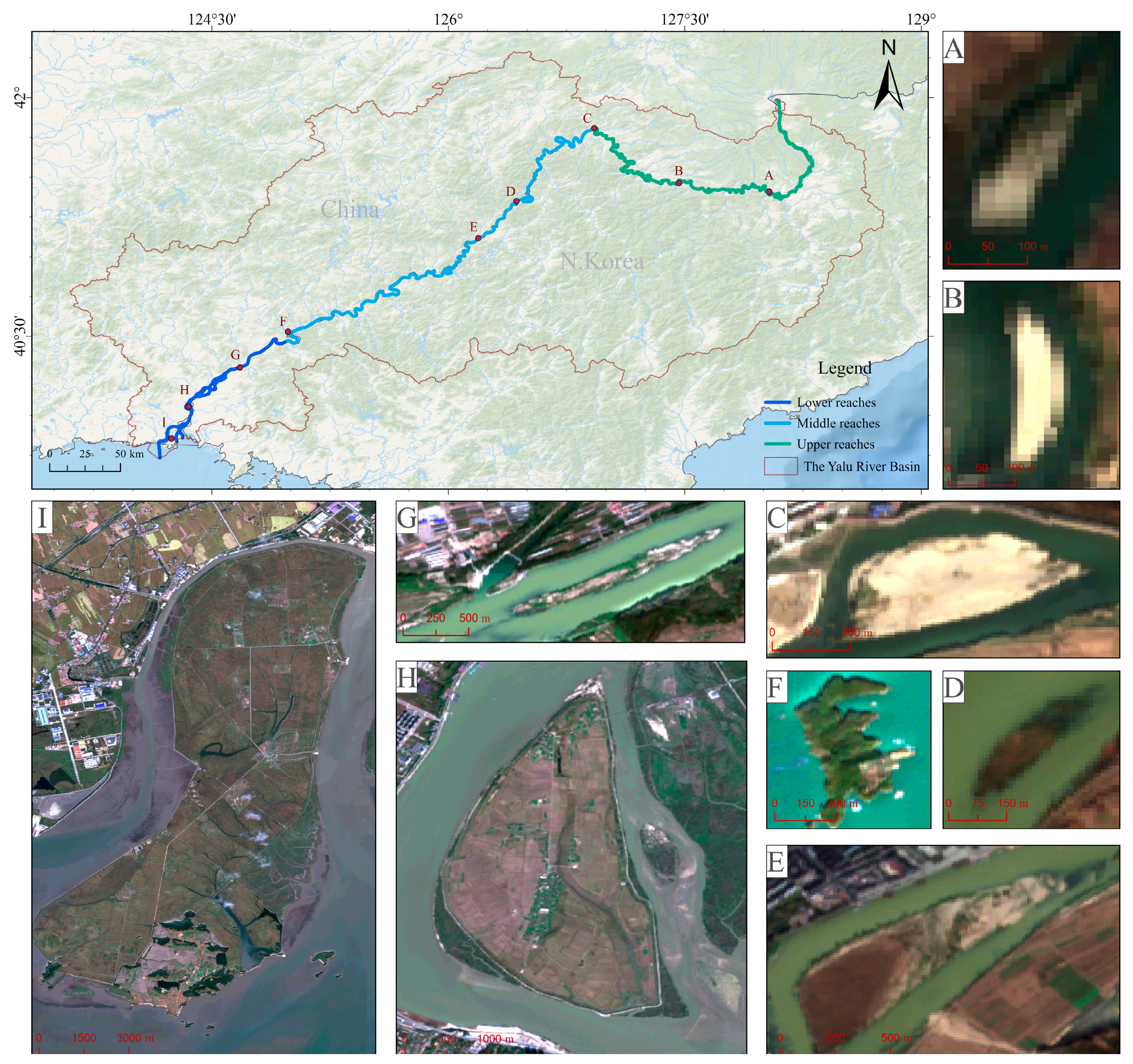
The Yalu River Basin is located between northeastern China and the northwestern Korean Peninsula, covering a total area of approximately 23,000 km2, representing a typical transboundary river system. The mainstem of the Yalu River extends about 795 km, originating from Heaven Lake (Tianchi) on Changbai Mountain, and flows southwest into the Yellow Sea, forming a significant boundary river between China and North Korea throughout its course [18]. The basin experiences a temperate continental monsoon climate, with four distinct seasons and concentrated precipitation during the flood season from June to September, averaging approximately 900–1200 mm annually and exhibiting pronounced seasonal concentration [19]. Winters are cold and dry, with ice cover lasting several months, imposing periodic constraints on river hydrodynamics and sediment transport [20].
The Yalu River exhibits characteristic meandering and braided channel patterns. In its lower reaches, extensive floodplains and alluvial plains provide favorable conditions for the formation and evolution of sedimentary geomorphic units, such as mid-channel bars (Figure 1) [21]. In the upper reaches of the mainstem (from the source to Linjiang Town), the river slope is relatively steep, and typical mid-channel bars are generally absent. In contrast, the middle and lower reaches feature gentler gradients and widened riverbeds, where mid-channel bars are densely distributed, morphologically diverse, and range in scale from several hundred meters to several kilometers. Mid-channel bars play a critical role in maintaining river sediment-water balance, buffering flood energy, and supporting riparian wetland ecosystems [22]. Long-term observations indicate that mid-channel bars experience alternating deposition and erosion during the flood season, while they are exposed as shoals during low-flow periods, providing important space for agriculture, wetland restoration, and avian habitats [23].

2.2. Data Sources and Processing

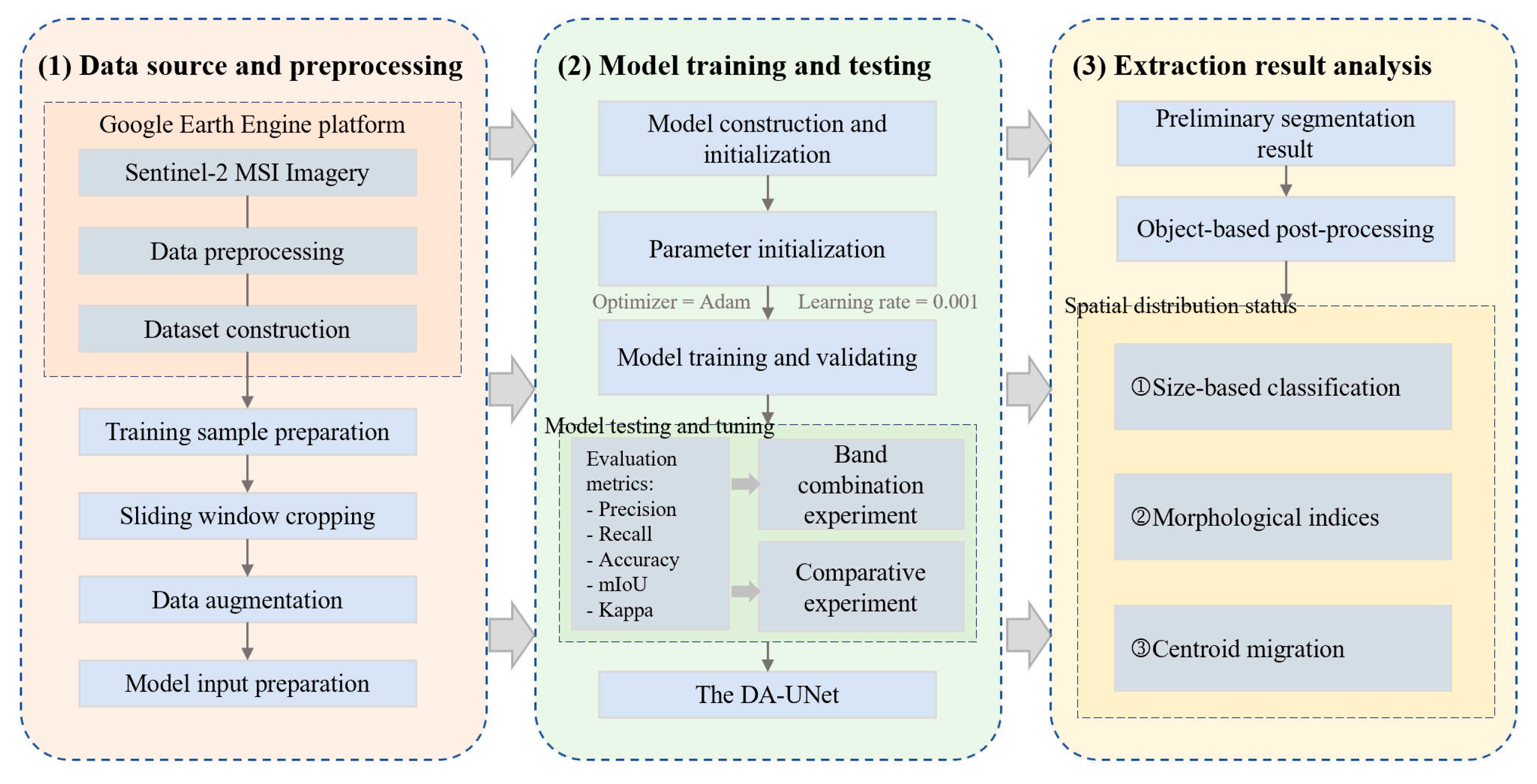
The remote sensing data used in this study were provided jointly by the European Space Agency (ESA) and the Copernicus Programme of the European Union. Specifically, Sentinel-2 multispectral imagery was employed, with Level-2A atmospherically corrected products (Sentinel-2 Surface Reflectance, SR) comprising 13 multispectral bands covering the visible, near-infrared, and shortwave infrared regions, suitable for water monitoring and river geomorphology studies. After unified preprocessing and spatial subsetting, the acquired Sentinel-2 imagery was converted into a high-quality, temporally consistent dataset, forming a reliable foundation for the subsequent automated extraction of mid-channel bars and the analysis of their spatiotemporal evolution (Figure 2).
Image preprocessing was conducted on the Google Earth Engine (GEE) platform. Cloud and cirrus were masked using the quality assessment band (QA60), retaining only images with less than 10% cloud cover. Given the strong dependence of mid-channel bar exposure on river stage, multi-temporal Sentinel-2 images from the low-water season (October–November) of 2019, 2022, and 2024 were selected for analysis. This period corresponds to the typical low-water season of the Yalu River, when water levels are relatively low and interannual fluctuations are limited, allowing maximum exposure of mid-channel bars while minimizing boundary uncertainty caused by partial inundation. Using imagery from the same seasonal and comparable hydrological conditions ensures the consistency and comparability of bar extraction, providing a solid basis for interannual spatiotemporal analysis.

2.3. Dataset Construction

To systematically characterize the spectral response features of mid-channel bars in the Yalu River Basin at different stages and their surface composition differences, a multi-dimensional spectral feature system was constructed based on Sentinel-2 multispectral imagery. This system aims to comprehensively reflect the spectral characteristics of mid-channel bars and surrounding major land-cover types, including water bodies, vegetation, and bare land.
The system is based on eight original bands (B2, B3, B4, B5, B8, B8A, B11, B12) and integrates seven physically meaningful spectral indices: NDWI [24], MNDWI [25], EWI [26], NDVI [27], RWI [28], AWEI [29], and NDBI [30] (Table 1). McFeeters demonstrated that NDWI effectively enhances the spectral contrast between water and non-water features [24], while Xu further confirmed through MNDWI that relying solely on original bands or a single index is insufficient to suppress interference from built-up areas and bare land under complex backgrounds [25]. Moreover, the primary land-cover types considered in this study, such as water bodies, vegetation, bare land, and shoals, exhibit relatively limited spectral differences in the original bands, and their reflectance characteristics are easily influenced by multiple factors, including water level, suspended sediment, and surface moisture [31]. Accordingly, integrating physically meaningful spectral indices with multispectral bands can significantly improve spectral separability among land-cover types and enhance cross-temporal identification robustness. Therefore, a comprehensive feature set comprising 15 variables was constructed in this study to systematically represent the spectral characteristics of mid-channel bars and surrounding key land-cover types, providing a stable and reliable input foundation for subsequent evolutionary analysis.

3. Methods

3.1. DA-UNet

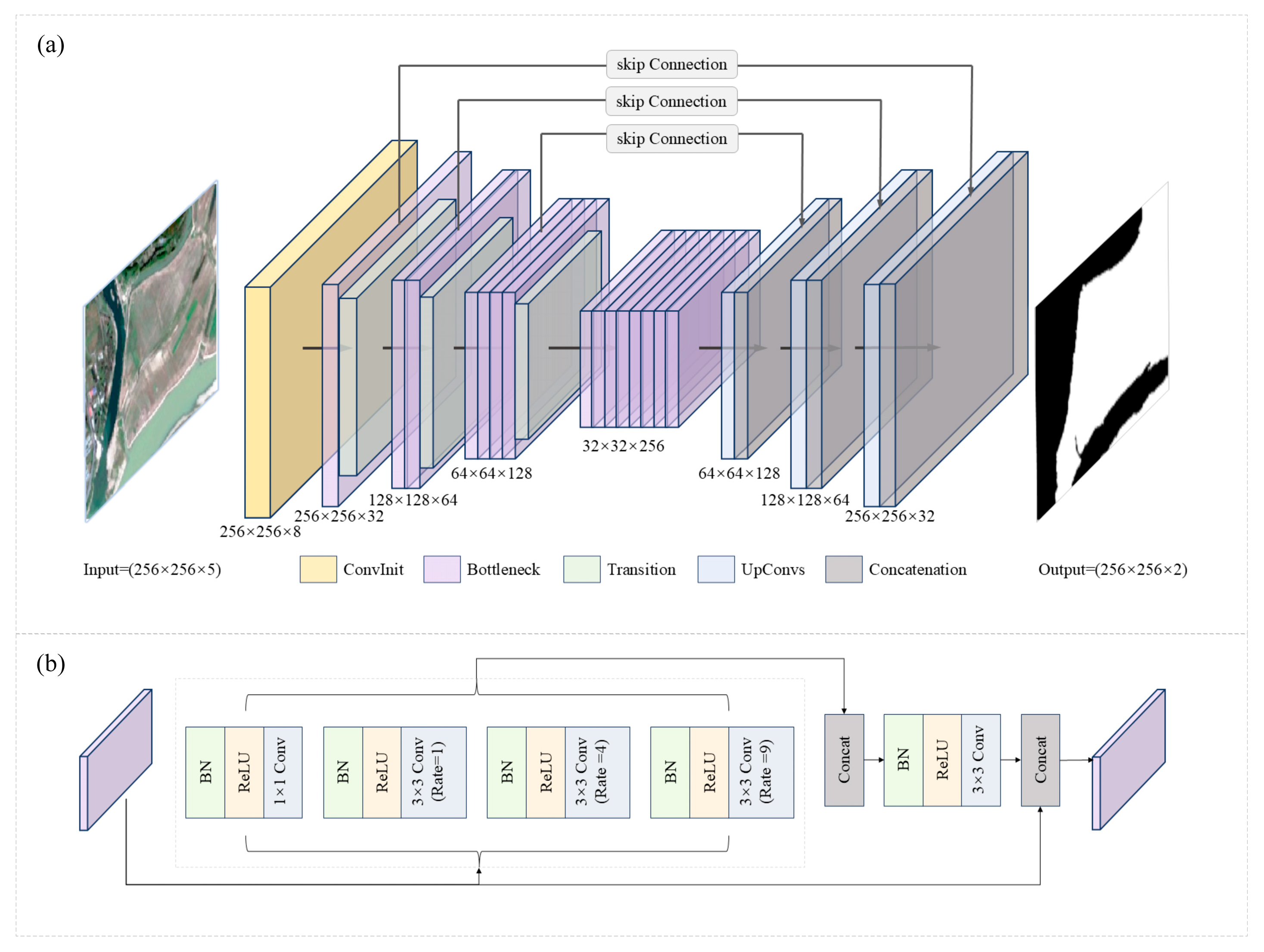
Mid-channel bars in the mainstem of the Yalu River exhibit coexisting multi-scale morphologies and complex water-land transitions, resulting in unstable spectral and boundary features. Their extraction often encounters issues such as discontinuous boundaries, omission of small bars, and water-land confusion. To address these challenges, this study proposes a Dense Atrous U-Net model (DA-UNet) based on the U-Net architecture. The primary objective of the model adjustment is to enhance multi-scale feature responsiveness and edge perception robustness, with the overall architecture illustrated in Figure 3. DA-UNet introduces two main modifications: (1) Dense connectivity is incorporated to strengthen the continuous representation and gradient propagation of cross-layer features. This facilitates the reinforcement of shallow-layer geometric textures and edge details, thereby mitigating boundary discontinuity and reducing the likelihood of missing small mid-channel bars. (2) Atrous convolution is employed to expand the effective receptive field of features, enhancing the model’s holistic perception of morphological variations across large and small scales. This improves the stability of multi-scale structure recognition and reduces misclassification in water-land transitional zones. The Bottleneck module serves as the core innovative unit of the model, integrating the concepts of dense connectivity and Atrous Spatial Pyramid Pooling (ASPP). This design enables the model to maintain a lightweight structure while achieving a dynamic balance between feature extraction depth and spatial resolution.
In terms of structural implementation, the encoder of DA-UNet is composed of multiple stacked Dense-Atrous Blocks, with each block containing several Bottleneck modules and a Transition module. Given an input feature map F i n R H × W × C , the Bottleneck module first applies batch normalization and a non-linear activation, and then performs parallel feature extraction through four convolutional branches with different dilation rates. The output of each branch can be expressed as:
F k = σ W k ( d k ) F i n , k = 1 , 2 , 3 , 4
where F k denotes the output feature of the k-th branch, σ represents the ReLU activation function, W k is the convolutional kernel weight of the corresponding branch, and * ( d k ) denotes the atrous convolution operation with dilation rate d k (which reduces to a standard convolution when d k = 1 ).
Within the Bottleneck module, convolutional branches with low dilation rates are responsible for capturing local textures and fine-scale features, while high-dilation-rate branches perceive the overall morphology of the mid-channel bars and the spatial context of the river basin, thereby enabling multi-scale feature fusion from local to global levels. Features from all branches are concatenated and subsequently fused via a 3 × 3 convolution, then added to the original input feature along the channel dimension, achieving typical DenseNet-style feature reuse [32].
The Transition module primarily handles feature compression and scale transformation, offering higher structural adaptability. It dynamically adjusts the compression ratio according to the number of feature channels, ensuring reasonable feature density at different depths. The decoder is symmetric to the encoder and progressively restores spatial resolution through deconvolutions and upsampling convolutions (UpConvs). For model optimization, to balance overall accuracy with boundary detail preservation, a hybrid loss function with combined constraints was adopted. Pixel-level Binary Cross Entropy (BCE) loss was weighted with structure-level Boundary loss, effectively enhancing the model’s sensitivity and spatial consistency in edge transition regions, thereby ensuring precise segmentation of mid-channel bar contours under complex geomorphic conditions [33].

3.2. Morphological Indices of Mid-Channel Bars

3.2.1. Size-Based Classification

To characterize the scale-dependent spatiotemporal variations of mid-channel bars, we established an area-based size classification scheme, using bar area derived from multi-temporal remote sensing imagery as the primary criterion. Bar area is a fundamental geometric parameter widely employed in studies of river islands and sandbars, as it provides a stable and directly comparable measure of spatial scale across different periods and hydrological conditions [34]. Statistical analyses of area frequency distributions are commonly applied in large-river remote sensing studies to describe the internal scale structure of fluvial landforms, and percentile-based grouping has proven effective in objectively partitioning geomorphic units into size classes according to their relative positions within the overall distribution [35].
Furthermore, recent multi-temporal investigations of river morphological dynamics have shown that percentile-based thresholds reduce the subjectivity associated with fixed absolute criteria, ensuring consistency and comparability of scale classifications across different years [36]. Following these established practices, the 25th and 75th percentiles of the mid-channel bar area distribution in 2024 were adopted as classification boundaries in this study. Bars with areas above the 75th percentile were classified as Large, those between the 25th and 75th percentiles as Medium, and those below the 25th percentile as Small. This percentile-based scheme provides a statistically robust and unified framework for subsequent comparative analyses of spatiotemporal variations in bar number, morphology, and centroid migration across the different size classes.

3.2.2. Morphological Indices

To quantitatively characterize the geometric changes of mid-channel bars across different years, this study established a morphological measurement system centered on the Shape Index (SI) and Length-to-Width Ratio (LWR), systematically capturing bar outlines from the perspectives of boundary complexity and axial structure.
The Shape Index is defined as:
S I = P 2 π A
where P is the perimeter of the bar and A is its area. An SI value of 1 indicates an ideal circular shape, while larger values correspond to more complex and irregular boundaries.
The Length-to-Width Ratio is defined as:
L WR = L m ax L m in
where L max and L min are the lengths of the major and minor axes of the bar, respectively. Higher LWR values indicate more elongated bars.
The adoption of SI and LWR as core geometric indices is grounded in established river geomorphology theory. Previous studies have shown that the regularity of bar boundaries, elongation direction, and axial structure reflect their morphodynamic reshaping under hydrodynamic forces, serving as key geometric characteristics for understanding channel braiding, sediment dynamics, and river island evolution [37,38]. Specifically, SI is sensitive to boundary perturbations and deposition pattern changes, while LWR reveals the axial-dominated morphology controlled by flow direction. Together, these indices constitute one of the most commonly used and physically meaningful representations of bar geometry.
For morphological quantification, the perimeter, area, and major and minor axis lengths of mid-channel bars were extracted from segmentation results of the three temporal phases. SI and LWR were then calculated, and their temporal sequences from 2019, 2022, and 2024 were analyzed to reveal the spatiotemporal evolution of boundary complexity and axial structure. The combined use of SI and LWR effectively identifies the primary directions of morphological change, evaluates the intensity of boundary perturbations, and distinguishes between regularization and elongation adjustments, providing a quantitative basis for interpreting the geometric evolution mechanisms of mid-channel bars.

3.2.3. Centroid Migration Metrics

To quantitatively characterize the planar positional evolution of mid-channel bars, centroid-based migration metrics were employed, including migration distance and migration direction. The centroid, defined as the geometric center of a bar polygon, serves as a stable and consistent reference for multi-temporal comparisons, with its temporal displacement reflecting the overall translational movement and positional adjustment of the bar. Long-term morphodynamic studies of large channel bars in the middle Yangtze River have demonstrated that tracking centroid trajectories derived from multi-temporal remote sensing data is an effective method for quantifying bar mobility and planform stability, as well as for describing spatial reorganization processes of mid-channel bars [39].
Migration distance measures the magnitude of centroid displacement between successive periods and indicates the intensity of positional adjustment, whereas migration direction, typically expressed as an azimuth angle, characterizes the dominant orientation of centroid movement and its geometric relationship with channel alignment. Large-scale satellite-based studies of riverbank erosion and accretion have shown that directional statistics of centroid or feature displacements are valuable for identifying prevailing planform adjustment trends and spatial reorganization patterns of fluvial landforms along river corridors [40]. Consequently, the combined use of migration distance and migration direction provides a concise and physically meaningful framework for quantifying the planar positional evolution of mid-channel bars from both magnitude and directional perspectives, supporting comparative analyses across different periods and river reaches.

4. Experiments and Results

4.1. Accuracy Assessment and Comparison

4.1.1. Experimental Environment

All training and validation in this study were conducted under a unified software and hardware environment to ensure the comparability of results. The model was implemented using the PyTorch 2.5.1 framework and executed on an NVIDIA Quadro P4200 GPU. Optimization was performed with the Adam algorithm, with an initial learning rate of 0.001, and a Cosine Annealing schedule was applied for dynamic convergence. Model training was optimized using the aforementioned hybrid loss function to balance overall segmentation accuracy with boundary delineation capability. The batch size was set to 4, and the total number of training epochs was 100. A total of 1000 samples were used, with 900 for training and 100 for validation, covering upper, middle, and lower reaches and diverse bar sizes and shapes.

4.1.2. Band Combination Experiments

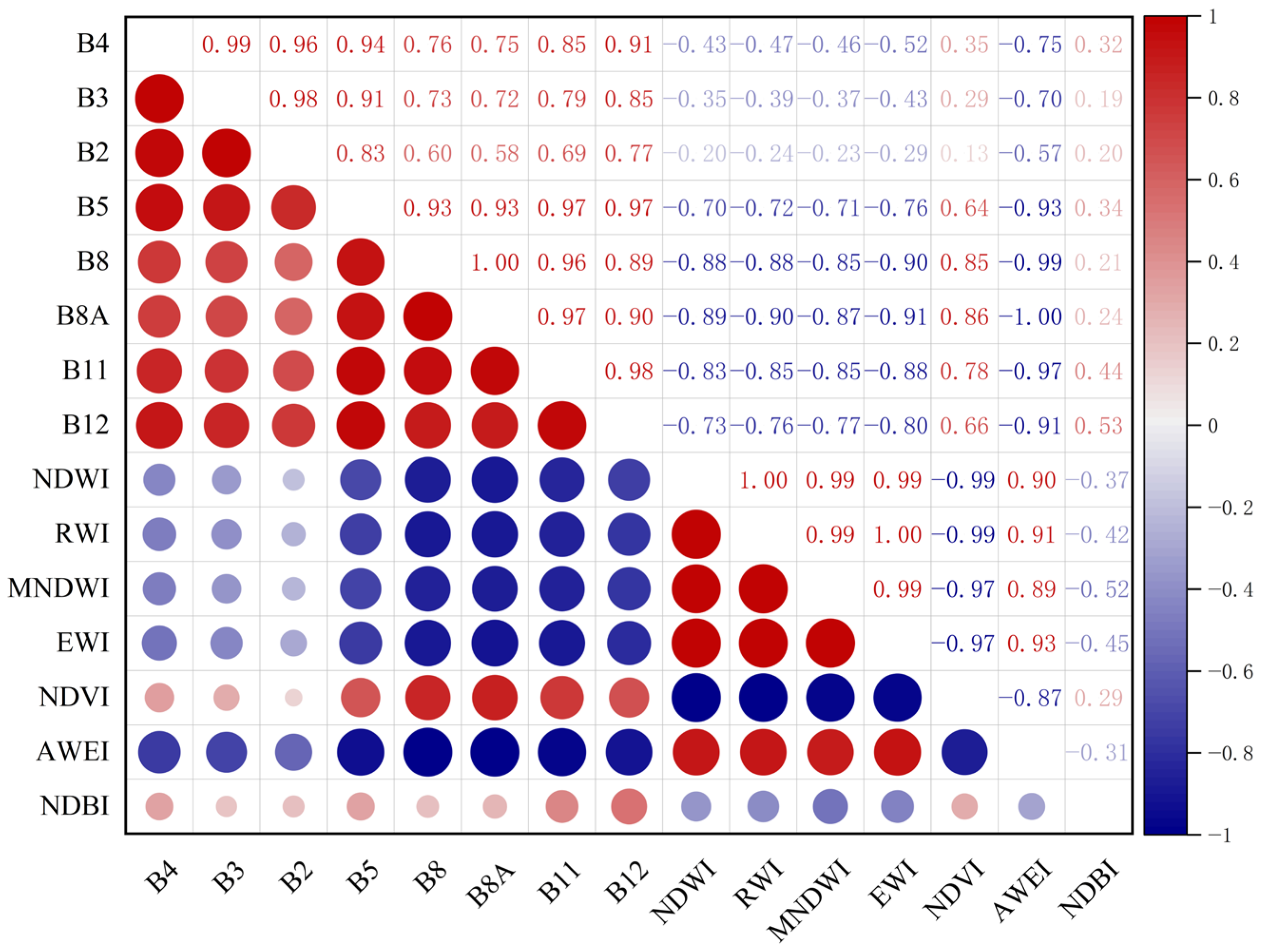
To systematically examine the influence of spectral feature configurations on the extraction of mid-channel bars, the Pearson correlation matrix of the multispectral variables was calculated (Figure 4) to identify potential redundancy and evaluate information independence among variables [41,42]. The results indicate that the visible bands B2, B3, and B4 exhibit high correlation coefficients, generally exceeding 0.90, reflecting substantial spectral overlap. Correlations among near-infrared and shortwave-infrared bands were moderately high, but these bands displayed complementary characteristics in distinguishing water bodies from tidal flats. Additionally, various water indices were generally highly correlated with each other, whereas their correlations with the original bands were relatively low. Notably, NDVI showed pronounced negative correlations with most water indices, while NDBI exhibited weak correlations with other variables overall. Overall, a single band is insufficient to fully characterize the complex and variable surface spectral structure of mid-channel bars. Integrating multiple bands and indices synergistically is necessary to enhance feature discriminability and reduce the risk of collinearity.
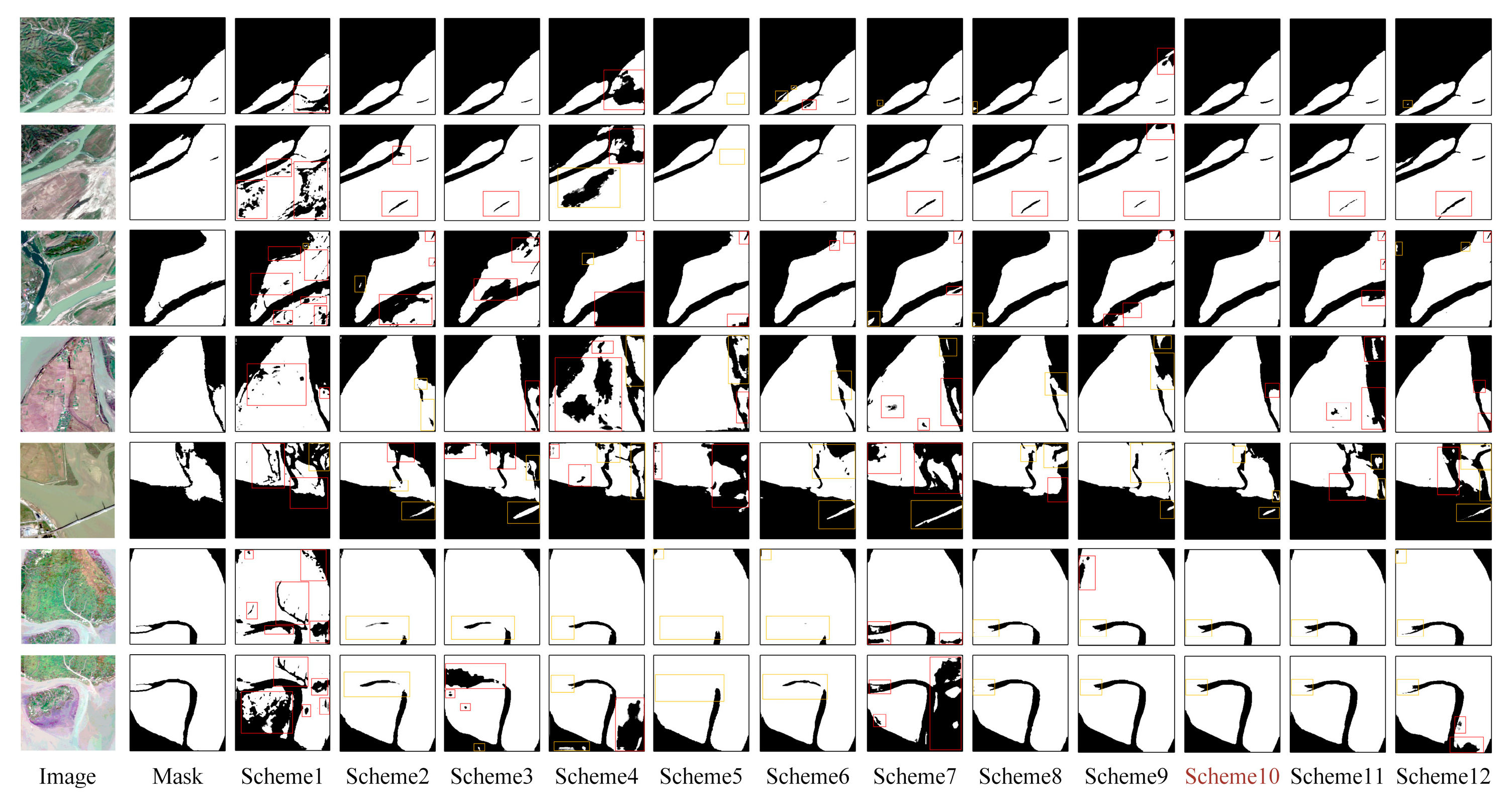
Based on the above analysis, this study followed the principle of “enhancing information diversity while suppressing spectral redundancy” to construct a system of 12 feature combinations, ranging from full-dimensional to highly simplified sets (Table 2), aiming to systematically evaluate the model’s sensitivity and stability under different information levels. Combination 1, representing the upper bound of performance, integrates all bands and indices. Combinations 2–4 remove highly redundant bands based on the correlation matrix to balance dimensionality and accuracy. Combination 5 retains only the original bands to test the baseline capability of multispectral imagery. Combinations 6–8 emphasize synergistic expression among indices to improve boundary recognition. Combination 9 uses a pure index set to verify their independent representational potential. Combinations 10–11 reduce dimensionality based on low-correlation features to enhance generalization. Finally, Combination 12 constructs an efficient scheme using the minimal set of core features. Overall, this combination system spans the full design spectrum from redundancy control to spectral mechanism representation, providing a comprehensive framework for assessing the model’s adaptability to different feature spaces.
Under the premise of a unified model architecture, parameter configuration, and training strategy, the 12 feature combination schemes were systematically evaluated using five performance metrics: Precision, Recall, Accuracy, mean Intersection over Union (mIoU), and Kappa coefficient [43,44]. The results indicate significant differences in precision and recall across different feature combinations (Table 3). Combination 1, with the highest feature dimensionality, achieved the best precision at 99.36%, but its recall was only 71.98%, indicating that excessive redundancy hindered the model’s ability to effectively identify small-scale mid-channel bars, resulting in noticeable omissions. In terms of overall agreement beyond chance, the Kappa coefficients differ markedly among the feature combinations, with Combination 10 exhibiting the highest Kappa value. In contrast, Combination 10 achieved a more balanced and stable performance despite its lower dimensionality. Its advantage primarily derives from the sensitivity of the blue and red bands to reflectance from shoals and tidal flats, as well as the complementary response of MNDWI and AWEI to water body moisture and shadows, enabling robust boundary consistency under varying water levels and illumination conditions.
Further visual inspection validated the above findings (Figure 5), where red boxes indicate omission areas and yellow boxes indicate commission areas, corresponding to undetected targets and false positives, respectively. Combination 10 performed particularly well in regions with complex shorelines and fragmented bars, exhibiting a marked reduction in both omission and commission areas. Boundary continuity, overall bar morphology, and spatial consistency were all notably superior to other combinations. Considering precision, generalization capability, feature complementarity, and computational efficiency, Combination 10 comprising B2, B4, B8, MNDWI, and AWEI was ultimately selected as the optimal spectral input feature set for DA-UNet.

4.1.3. Model Comparison Experiments

To systematically evaluate the adaptability and robustness of different network architectures for mid-channel bar extraction, this study included five representative semantic segmentation models FCN, U-Net, UNet++, DeepLabv3+, and HRNet as comparative baselines. These models encompass major network paradigms ranging from shallow convolutional structures to multi-scale feature fusion and high-resolution feature preservation, providing a comprehensive view of performance differences across architectures in the context of mid-channel bar recognition. In the comparison experiments, all models were trained using the same data splits and the identical spectral feature combination (B2, B4, B8, MNDWI, and AWEI) as DA-UNet, while maintaining consistent training strategies to ensure fairness and comparability. To quantitatively assess segmentation performance, five metrics Precision, Recall, Accuracy, mean Intersection over Union (mIoU) and Kappa coefficient were employed, and evaluations were conducted on inputs resized to a uniform 256 × 256 dimension.
As shown in Table 4, DA-UNet achieved the best performance in mid-channel bar extraction, with Precision, Recall, Accuracy, mean Intersection over Union (mIoU) and Kappa coefficient reaching 98.50%, 90.69%, 96.76%, 92.23%, and 90.09%, respectively. Compared with the next-best model, UNet++, DA-UNet improved Precision, Recall, and mIoU by 1.82%, 7.66%, and 4.96%, respectively. In contrast, the remaining models exhibited larger performance gaps across all four metrics, with overall accuracy generally lagging by approximately 3–10%, demonstrating their limited ability to maintain consistent spatial structure recovery and segmentation stability under complex conditions characterized by fragmented boundaries, large-scale variations, and pronounced spectral changes.
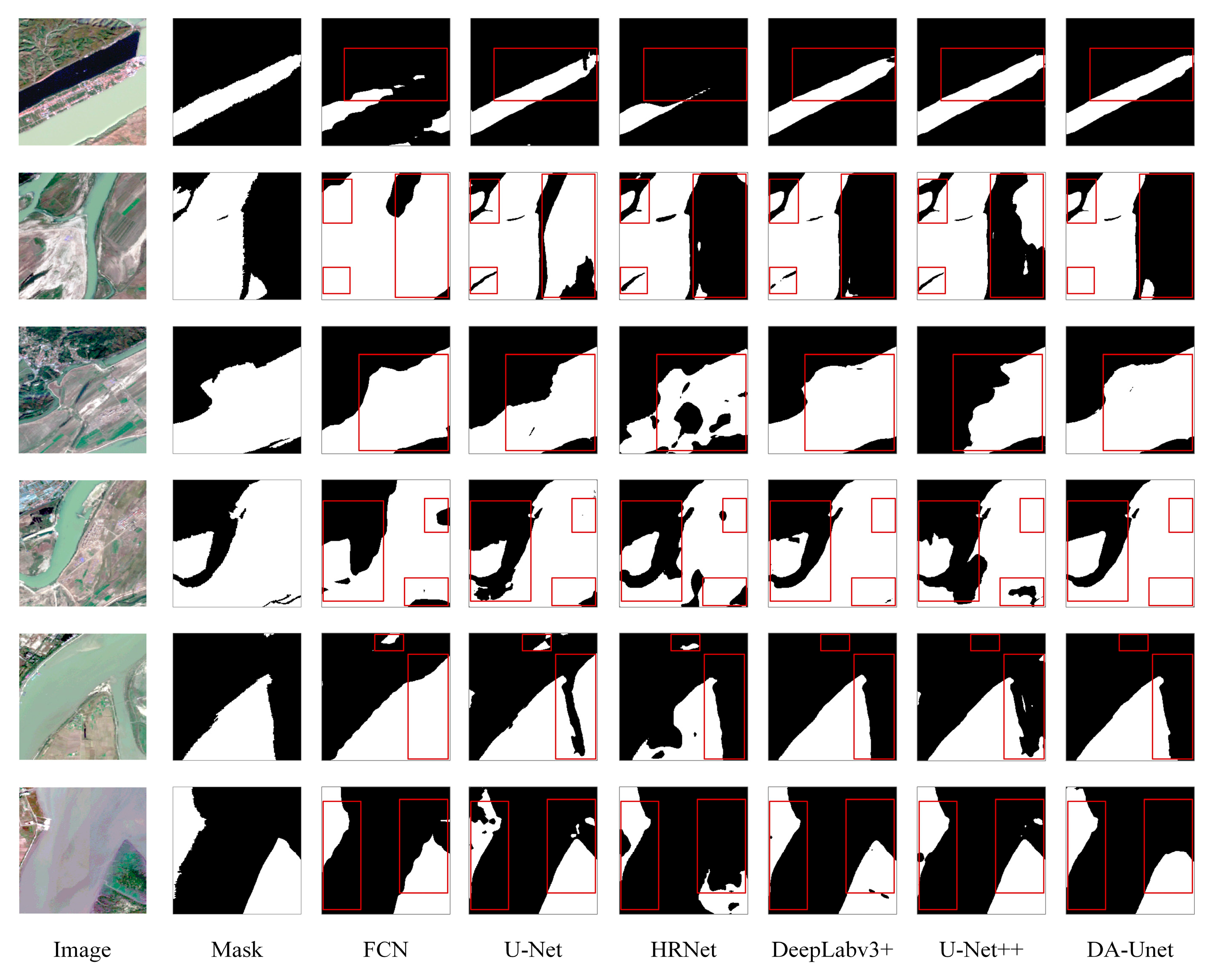
To visually assess the segmentation performance of DA-UNet, the extraction results of all models on the test dataset were compared, as illustrated in Figure 6 (red boxes highlight representative regions to show differences in model performance and detail extraction). In areas with complex shorelines and fragmented bars, FCN and U-Net tend to confuse water and land in weakly reflective water regions and locations with strong spectral transitions, making accurate bar delineation difficult. FCN and HRNet show omissions and boundary gaps in narrow bars. Although DeepLabv3+ and UNet++ achieve some improvement in mid-channel bar recognition, they still struggle to ensure continuous and stable structural representation. In contrast, DA-UNet robustly maintains boundary continuity and the integrity of mid-channel bars in these challenging scenarios, substantially reducing both omission and commission errors.
These results collectively indicate that, under conditions characterized by coexisting multi-scale mid-channel bar morphologies and complex water-land transitions that induce spectral and boundary instability, DA-UNet effectively mitigates common extraction errors such as boundary discontinuities, omission of small bars, and water-land confusion. This demonstrates that DA-UNet provides a reliable and robust technical solution for high-precision monitoring of fluvial depositional landforms.

4.2. Spatiotemporal Variation Characteristics

4.2.1. Changes in Quantity and Area

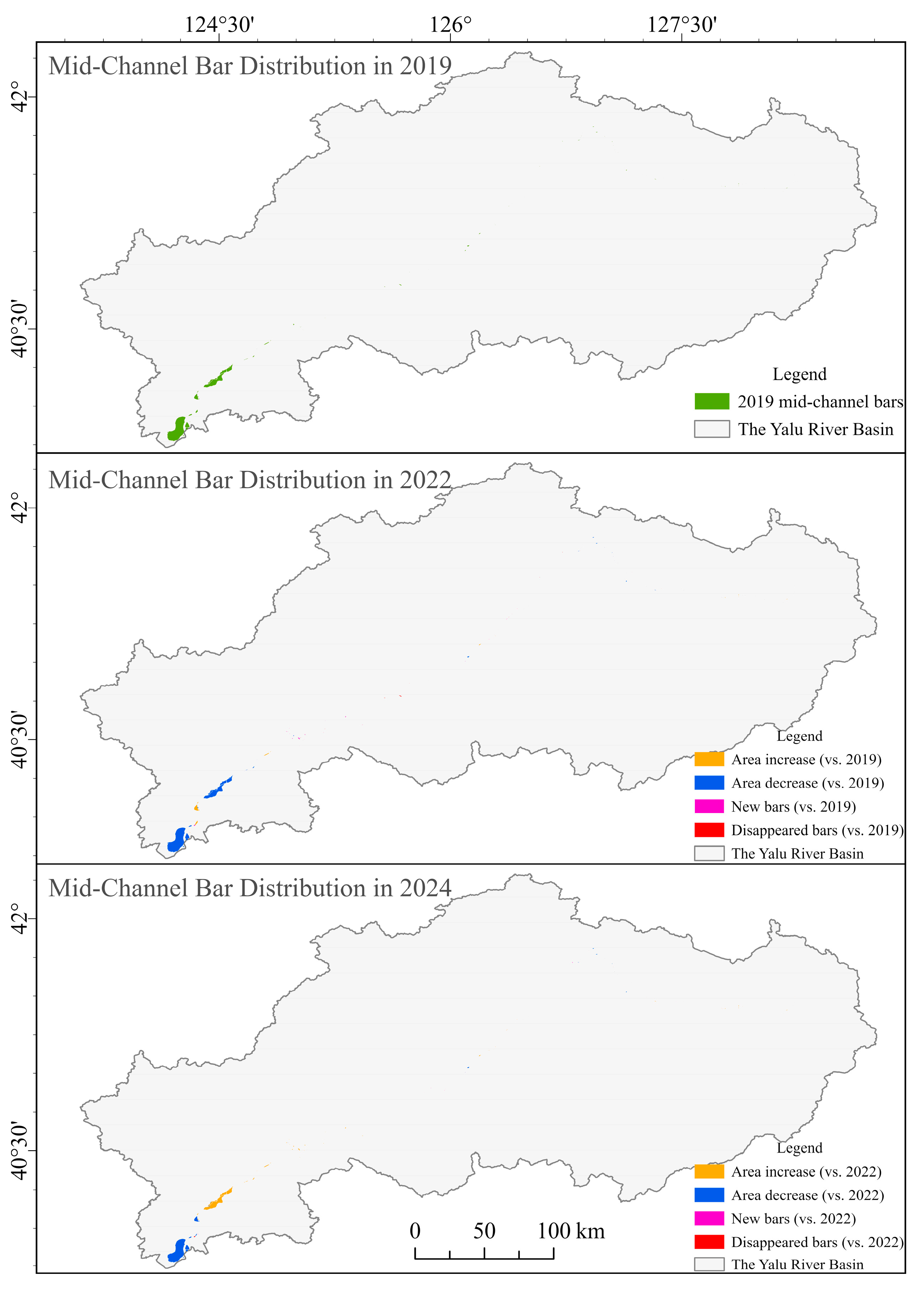
Based on the semantic segmentation results of Sentinel-2 multi-temporal imagery using the DA-UNet model, this study extracted the distribution of mid-channel bars in the Yalu River basin for 2019, 2022, and 2024. Through manual verification and spatial overlay analysis, a total of 178 mid-channel bar units were identified and tracked. Each unit was assigned a unique identifier representing its spatial location, with the same identifier corresponding to the same bar across different temporal phases (Figure 7).
The results indicate that during the study period, the quantity and area of mid-channel bars exhibited opposite, asymmetric evolutionary trends. From 2019 to 2022, the number of bars increased from 111 to 115, representing a growth of approximately 3.6%, while the total area decreased from 168.972 km2 to 167.298 km2, a reduction of about 1.0%. By 2024, the number of bars further increased to 136, corresponding to a cumulative growth of approximately 22.5% relative to the initial year, whereas the total area continued to decline to 165.001 km2, an overall decrease of about 2.4%. This inverse change pattern rising quantity coupled with declining area reveals that the mid-channel bar system in the Yalu River underwent a structural shift from “few but large” to “many but small.” At the basin scale, bar fragmentation and the formation of small new bars became the dominant processes, while large bars exhibited gradual shrinkage or marginal erosion.
From a spatial differentiation perspective, the number and area of mid-channel bars varied significantly along the river (Table 5). The downstream reaches have consistently constituted the primary area for mid-channel bars, accounting for over 96% of the total basin area. Between 2019 and 2024, the number of downstream bars increased slightly from 36 to 38, while their total area decreased from 164.909 km2 to 160.448 km2, a net reduction of approximately 4.461 km2. This indicates that although the bars in the downstream segment remained generally stable, gradual area contraction and marginal segmentation occurred. The middle reaches exhibited the most dynamic changes, representing the region with the most pronounced increase in bar numbers. The number of mid-channel bars rose from 30 to 53, an increase of 76.7%, and the total area grew from 2.683 km2 to 3.197 km2, indicating a coexistence of bar formation and fragmentation with substantial morphological reorganization. In the upstream reaches, the number of bars fluctuated while the total area remained relatively stable, reflecting a locally balanced state constrained by channel conditions. Overall, the downstream segment controls the primary scale and total area pattern of mid-channel bars in the Yalu River, the middle segment dominates structural reorganization and bar renewal, while the upstream segment maintains a high-density, small-scale dynamic equilibrium within its local spatial context.

4.2.2. Scale Transition Characteristics

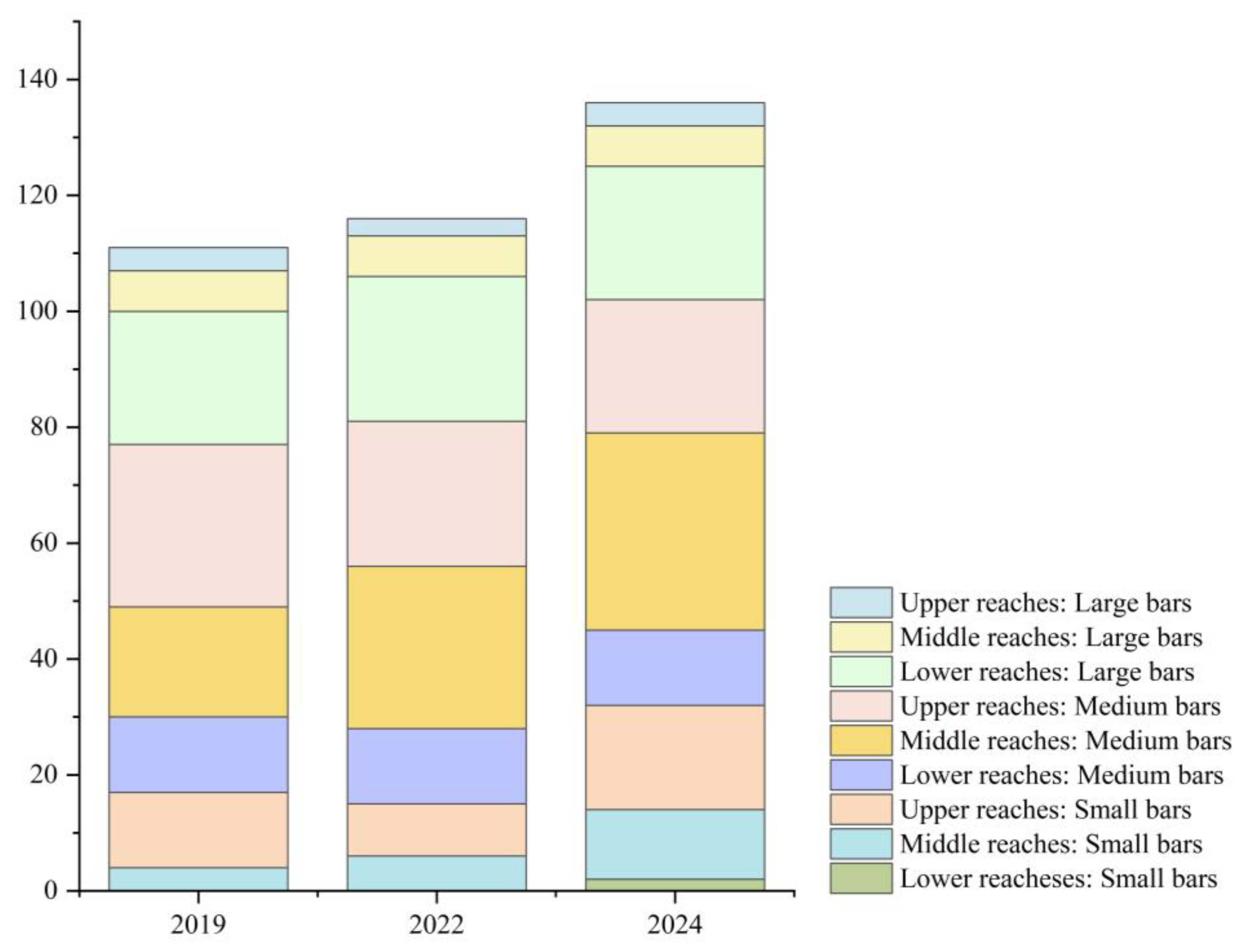
Based on the percentile statistics of the mid-channel bar area distribution in 2024, the 25th and 75th percentiles were 4371.19 m2 and 116,245.85 m2, respectively. To preserve the percentile hierarchy and its statistical meaning, while enhancing the stability and operability of the classification thresholds for multi-temporal comparison and cartographic representation, these values were slightly rounded, resulting in final boundaries of 0.004 km2 and 0.115 km2 for size classification. This adjustment maintains the objectivity of the percentile-based scheme and improves the consistency and robustness of scale partitioning across different years. Using these size classes, a comparison of the scale structure of mid-channel bars in 2019, 2022, and 2024 reveals the following pattern (Figure 8). Medium bars consistently dominate in number, increasing from 60 in 2019 to 66 in 2022, and further to 70 in 2024, thereby constituting the principal scale component of the bar system. In contrast, the number of Large bars remains relatively stable over the three periods, while Small bars exhibit a marked increase in 2024, rising from 17 in 2019 to 32. This trend indicates a shift from a scale structure dominated by medium-to-large units toward a more diversified, multi-scale configuration.
In terms of longitudinal scale organization, clear and persistent differentiation is evident among the upper, middle, and lower reaches. Across the three periods, Large bars are predominantly concentrated in the lower reaches, Medium bars are most densely distributed in the middle reaches, with their number increasing from 19 in 2019 to 34 in 2024, and the upper reaches are characterized by a higher proportion of Small and Medium bars, with a notable increase in Small bars in 2024. Overall, the spatiotemporal pattern of scale classes along the Yalu River is marked by the dominance of Large bars in the lower reaches, the concentration and expansion of Medium bars in the middle reaches, and the growing contribution of Small bars in the upper reaches, reflecting a longitudinally differentiated scale structure and distinct scale-dependent evolutionary dynamics of mid-channel bars.

4.2.3. Morphological Variation Characteristics

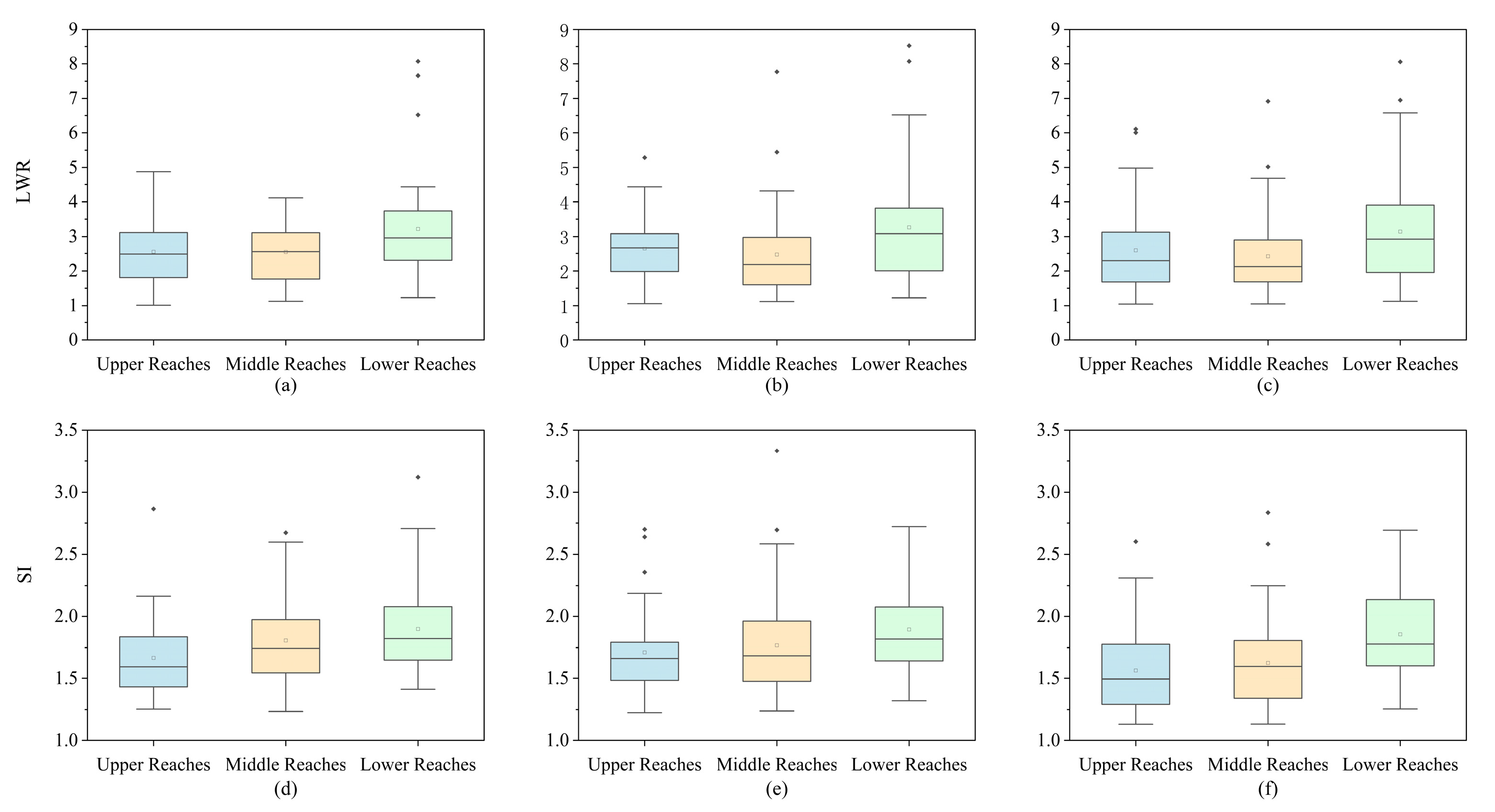
Analysis of the changes in SI and LWR across the three periods (Figure 9) indicates that mid-channel bars in the Yalu River generally evolved from irregular to more regular shapes and from elongated to more compact forms. The mean values of SI and LWR both exhibited a rise-then-fall pattern. Specifically, the mean SI increased from 1.779 in 2019 to 1.791 in 2022, before decreasing to 1.668 in 2024. Similarly, the mean LWR rose from 2.763 to 2.781 and then declined to 2.678. These trends suggest that between 2019 and 2022, bars underwent pronounced elongation and fragmentation, with more slender and complex boundaries, whereas from 2022 to 2024, the bars displayed aggregation and simplification, indicating a trend toward morphological stabilization.
Spatially segmented analysis indicates that the middle reaches experienced the most pronounced morphological changes, with the largest fluctuations in both SI and LWR, reflecting frequent elongation, contraction, and re-aggregation of bars over short timescales. The downstream reaches, dominated by large bars, exhibited the most stable morphology, while the upstream reaches, although containing a higher number of bars, consisted of small-scale units whose shapes gradually became more compact and rounded. Overall, the middle reaches of the Yalu River represent the core zone of morphological dynamics, the downstream reaches are the most stable, and the upstream reaches show moderate stability with gradual morphological adjustments.

4.2.4. Centroid Migration Characteristics

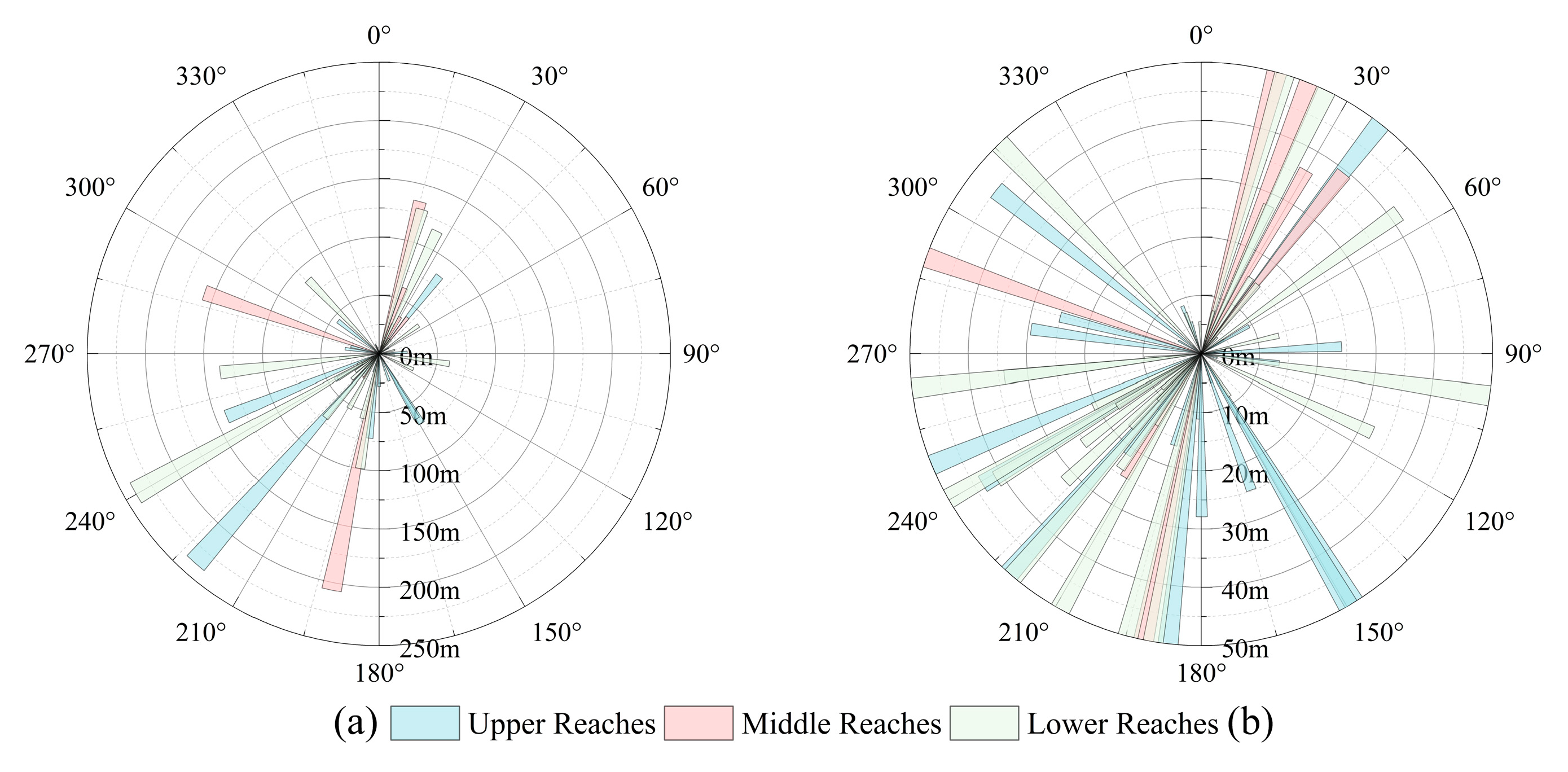
To further elucidate the spatial evolution patterns of mid-channel bars in the Yalu River Basin, this section focuses on 70 bars that were consistently present across all three periods. These persistently existing bars were selected to ensure temporal consistency and positional reliability in centroid tracking, thereby enabling a robust characterization of their migration behavior and planar spatial adjustment processes. The precise centroid coordinates of these bars were used to calculate migration distances and directional angles across different periods, characterizing their planar spatial adjustments and regional variations. The results (Figure 10) indicate that centroid migration of mid-channel bars along the Yalu River mainstem is dominated by short-distance adjustments, exhibiting slow evolution and overall spatial stability. Quantitatively, the median centroid migration distance from 2019 to 2024 was 24.901 m, with a mean of 54.083 m, and over half of the bars moved less than 50 m, suggesting limited changes in the geometric centers of most bars over the five-year period. From a spatial differentiation perspective, centroids were most active in the middle reaches, with a median migration of 60.382 m; in the upstream reaches, the median migration was 18.891 m, and in the downstream reaches, 24.063 m, indicating a pattern of “pronounced migration in the middle reaches, stability in the upstream, and enhanced local disturbances downstream.” In terms of migration direction, most bars shifted toward the south and west, with a circular mean azimuth of 228.1°, reflecting the river’s overall southwest-directed energy transfer and sediment adjustment characteristics.
Overall, the pattern of “active middle reaches with stable upstream and downstream” observed for mid-channel bars in the Yalu River reflects the synergistic control of hydrodynamic forcing, geomorphic constraints, and ecological stabilization, representing a dynamic equilibrium of the fluvial system under the combined influence of natural processes and anthropogenic factors.

5. Discussion

5.1. Model Evaluation

The DA-UNet developed in this study demonstrated overall stable performance in multi-temporal extraction of mid-channel bars, effectively meeting the requirements for long-term and regional-scale river geomorphic monitoring. From a sustainability perspective, the ability to maintain consistent extraction results across multiple time periods is critical for supporting continuous river assessment and management. However, when using medium-resolution Sentinel-2 imagery, the model remains constrained by both observational scale and geomorphic heterogeneity. These limitations are primarily reflected in relatively coarse spatial resolution, high proportion of mixed pixels, significant spectral variability across time periods, and frequent localized disturbances in complex river segments, which are common challenges in large-scale sustainable monitoring using medium-resolution satellite data. Although only three representative periods were analyzed, they were selected under comparable low-water conditions and span a five-year interval, which is sufficient to capture short- to medium-term structural reorganization of mid-channel bars. Moreover, the proposed framework is temporally scalable and can be directly extended to denser or longer time series as additional observations become available.
First, the 10/20 m pixel size of Sentinel-2 imagery cannot fully capture fine-scale geomorphic units. The minimum reliably detectable bar area is approximately 959 m2, implying that smaller bars with highly fragmented spatial patterns have their spectral and geometric signals significantly diluted within mixed-pixel backgrounds. Yet the evolution of mid-channel bars often involves newly emerged sandbanks, fine-scale erosional patches, and narrow ridge structures on the order of tens of meters, which are typically compressed into only a few mixed pixels in the imagery. Their spectral signatures are simultaneously influenced by water, exposed sand, sediment, and vegetation, making it challenging for the model to accurately recover true boundaries. Such scale-related uncertainty limits the detectability of early-stage or transient geomorphic features that may nonetheless be relevant for adaptive river management. This limitation is particularly pronounced in scale-sensitive zones of the upper and middle reaches, where small bars frequently exhibit blurred edges and weakened structural features, even when the model incorporates multi-scale feature extraction mechanisms, due to the inherent physical constraints of the observational scale.
Furthermore, in areas with weak texture, small spatial extent, or significant water-level fluctuations, the local performance of DA-UNet remains somewhat unstable. Extremely narrow ridges or newly emerged/temporarily appearing bars, whose scales approach or fall below the Sentinel-2 pixel size, may occasionally be missed or have rough boundaries. Inter-annual variations in water turbidity and substrate exposure can also induce spectral drift, resulting in locally inconsistent boundary delineation. For sustainability-oriented applications, such temporal inconsistencies highlight the importance of cautious interpretation when using single-scene results to inform management decisions. While these limitations do not affect the overall conclusions, they clearly highlight the intrinsic bottlenecks of the model when dealing with small-scale targets, low-reflectance areas, and spectrally inconsistent conditions.
From a spatial perspective, the uncertainty and classification errors are neither random nor uniformly distributed, but are concentrated in land–water transition zones, along the margins of small-scale bars, and within weak-texture reaches. In these areas, errors primarily manifest as boundary displacement, localized omissions, and interannual instability of bar outlines. Such regions are characterized by a high proportion of mixed pixels, low radiometric contrast, and sensitivity to subtle water-level fluctuations, which cause the bar–water interface to shift between adjacent pixels, thereby amplifying the combined effects of scale limitations and spectral noise on boundary delineation. Overall, this spatially structured error pattern suggests that uncertainty is predominantly governed by geomorphic context and observational constraints, rather than stochastic variability in the model.
From the standpoint of network architecture and parameterization, sensitivity experiments indicate that the adopted dilation-rate scheme—comprising standard convolution combined with atrous branches at rates 4 and 9—and the progressively deepened dense-connection configuration (2, 4, 8, and 16 Bottleneck layers) provide the most stable balance between small-bar detectability and land–water boundary accuracy. Insufficient dilation results in a limited receptive field, producing fragmented or omitted boundaries, whereas excessive dilation leads to over-smoothing, blurring narrow bars and weak-texture interfaces, and introducing systematic positional shifts. A similar trade-off is observed for dense connectivity depth: too few Bottleneck layers weaken discrimination in shallow-water–wet-sand transition zones, while excessive depth introduces redundancy and degrades geometric detail. Overall, the selected parameter settings achieve an optimal compromise between multi-scale contextual representation and fine-scale structural preservation, constituting a robust and rational configuration for multi-temporal mid-channel bar mapping.
Based on the limitations discussed above, future studies should aim to improve both data sources and model architectures simultaneously. First, higher-resolution imagery should be incorporated to enable locally denser monitoring, thereby significantly enhancing the detection of fine-scale structures, small newly emerged bars, and areas with weak texture. This would be particularly beneficial for sustainability-focused applications that require early detection of geomorphic changes. Second, model improvements could include the integration of simplified boundary refinement modules, lightweight attention mechanisms, or multi-scale feature supplementation branches, which would strengthen boundary discrimination in low-reflectance, mixed-pixel, and spectrally variable regions. At the same time, moderate cross-scale feature fusion can improve the stability of overall contour recognition, ultimately enhancing the accuracy and consistency of multi-temporal mid-channel bar extraction and supporting reliable long-term river monitoring frameworks.

5.2. Analysis of Band Selection

The multi-spectral-index feature system constructed in this study provided a reliable basis for DA-UNet’s multi-temporal extraction of mid-channel bars. From the perspective of sustainable river monitoring, the use of widely available multispectral indices ensures methodological transferability and long-term data continuity. However, certain limitations remain under complex spectral conditions, affecting model performance in water-land transition zones, low-reflectance areas, and across multi-temporal scenes. The surface types of mid-channel bars are diverse: wet sand, shallow water, exposed bars, and sparse vegetation often exhibit similar spectral signatures under varying water levels, moisture, and illumination conditions. Consequently, indices such as NDWI, MNDWI, and AWEI may lose sensitivity under rising water levels, increased turbidity, or higher moisture, weakening the stable delineation of water-land boundaries. Moreover, strong collinearity still exists between some original bands and derived indices, resulting in redundancy in the high-dimensional feature space. Such redundancy may reduce feature efficiency and limit the interpretability of spectral responses in long-term monitoring scenarios. In areas with weak spectral differences or high proportions of mixed pixels, the model must rely heavily on convolutional structures to effectively select relevant features, reducing the efficiency of exploiting critical spectral contrasts. At the same time, existing feature construction schemes mainly depend on general bands and hand-crafted indices, providing insufficient representation of sediment dynamics, such as sediment grain size, moisture gradients, and surface water content variations, which limits the model’s semantic discrimination in structurally complex or boundary-ambiguous regions that are often of high relevance for river management. Because the framework relies on widely available multispectral imagery and generic spectral indices, it is transferable to other large river systems with similar sediment–water conditions. With appropriate recalibration of training samples, the approach can be adapted to different riverine environments and sustainability-oriented monitoring objectives.
Overall, while the current feature system can meet primary identification requirements, there remains room for improvement in reducing spectral redundancy, enhancing discrimination in weak-difference zones, and better capturing process-related characteristics. For sustainability-oriented applications, improving feature robustness and temporal consistency is particularly important to ensure comparability across years and hydrological conditions. Future work could focus on constructing more sensitive spectral combinations or introducing adaptive band-selection mechanisms to strengthen feature representation, thereby further enhancing the model’s robustness and inter-temporal consistency in complex water-land environments.

5.3. Transboundary Monitoring and Sustainability

From the perspective of transboundary river governance and sustainable monitoring, the spatiotemporal distribution and stability of mid-channel bars serve as key geometric indicators for characterizing channel configuration and land–water spatial organization in boundary rivers. The multi-temporal automated extraction and mapping framework developed in this study, based on a unified remote sensing data source and a deep learning algorithm, enables consistent and repeatable acquisition of mid-channel bar information at uniform spatial scales and classification standards. This framework provides a robust data foundation for long-term observation and comparative analysis of channel morphology in the Yalu River and demonstrates clear applicability for transboundary river monitoring and cooperative management.
At the management level, a set of quantitative descriptors of mid-channel bars—including their number, areal variation, stability classification, and spatial migration—can be systematically integrated into operational remote sensing–based monitoring and reporting frameworks as core indicators of channel pattern evolution and bankline stability. These indicators allow the temporal evolution of bar morphology to be captured objectively and reproducibly, providing a unified spatial reference for river regime assessment, navigation maintenance, and shoreline management. Furthermore, the establishment of a shared multi-temporal mid-channel bar database, built on standardized data processing workflows and automated mapping procedures, can reduce inconsistencies among countries in interpretation scale, classification criteria, and update frequency. Regular updates of distribution maps and change statistics would further facilitate joint assessment, information exchange, and coordinated planning.
From a sustainability perspective, mid-channel bars and adjacent land–water transition zones represent integral components of riverine ecological spatial structure, with their morphological continuity and stability closely linked to the integrity and coherence of riparian landscapes. Incorporating bar stability and evolutionary intensity into long-term monitoring indicator systems can help establish a unified spatial evaluation framework that balances flood control, channel regulation, and ecological conservation. Overall, the multi-temporal automated mapping and analysis approach proposed in this study provides continuous, objective, and quantifiable spatial information for long-term monitoring and coordinated management of transboundary rivers, offering a robust technical foundation for promoting sustainable management of boundary river basins.

6. Conclusions

Within a unified multi-spectral-index framework and multi-temporal processing pipeline, this study developed DA-UNet to achieve stable and automated extraction of mid-channel bars in the Yalu River from 2019, 2022, and 2024 Sentinel-2 imagery. By enabling consistent extraction across different image conditions and hydrological backgrounds, the proposed approach supports long-term and repeatable river geomorphic monitoring, which is essential for sustainability-oriented assessments. The model maintained high consistency across varying image conditions, providing a continuous and comparable data basis for multi-dimensional analyses, including bar quantity, size-based classification, morphology, and centroid migration.
Overall, between 2019 and 2024, the mid-channel bars exhibited a compound evolutionary pattern characterized by structural refinement, localized high-frequency changes, and moderate spatial adjustments, reflecting an adaptive geomorphic response of the river system under relatively stable external forcing. Quantitatively, the results indicate that the number of mid-channel bars increased from 111 to 136 between 2019 and 2024, while the total bar area declined from 168.972 km2 to 165.001 km2, reflecting an inverse relationship between bar quantity and area and signaling a clear structural reorganization. This pattern corresponds to the widespread emergence of small-scale bars accompanied by the shrinkage or disappearance of pre-existing bars, resulting in pronounced structural refinement. Based on the size classification derived from the 25th and 75th percentiles of the 2024 area distribution, the overall number of small- and medium-sized bars increased markedly, by approximately 30%, whereas the abundance of large bars remained essentially stable. Morphologically, mid-channel bars exhibited a general evolution toward more regular and compact forms, as reflected by the rise-then-fall trends of the shape index (SI) and length-to-width ratio (LWR), indicating a transition from elongated, irregular geometries to more stabilized configurations. Centroid migration of stable mid-channel bars was generally limited during 2019–2024, with a median displacement of only 24.901 m, suggesting slow positional adjustment and high spatial stability.
Nevertheless, the results remain constrained by observational scale and water-level fluctuations in morphologically complex reaches, leading to uncertainties in the detection and boundary delineation of small bars. Future work should incorporate higher-resolution imagery, more sensitive spectral features, and lightweight boundary-refinement and attention modules to enhance fine-scale representation and improve the robustness and reliability of long-term monitoring in complex land–water environments.

Author Contributions

Conceptualization, Q.Y. and F.W.; methodology, Q.Y.; software, Q.Y.; validation, Y.H.; formal analysis, Q.Y. and Y.L.; investigation, Q.Y. and Z.C.; resources, F.W.; data curation, Q.Y. and J.W.; writing—original draft preparation, Q.Y.; writing—review and editing, Q.Y., F.W. and Z.C.; visualization, Q.Y. and Y.L.; supervision, F.W.; project administration, F.W.; funding acquisition, Y.L. All authors have read and agreed to the published version of the manuscript.

Funding

This research was funded by the National Natural Science Foundation of China (NSFC), grant number 42502295, and the Doctoral Research Initiation Fund Project of Liaoning Province, grant number 2025-BS-0770.

Institutional Review Board Statement

Not applicable.

Informed Consent Statement

Not applicable.

Data Availability Statement

The datasets generated during the study are available from the corresponding author upon reasonable request.

Acknowledgments

Thank you for the support from the School of Geographical Sciences, Liaoning Normal University. We thank all anonymous reviewers and editors for their comments and help.

Conflicts of Interest

The authors declare no conflicts of interest.

Abbreviations

The following abbreviations are used in this manuscript:
GEEGoogle Earth Engine
NDWINormalized Difference Water Index
MNDWIModified Normalized Difference Water Index
EWIEnhanced Water Index
NDVINormalized Difference Vegetation Index
RWIRatio Water Index
AWEIAutomated Water Extraction Index
NDBINormalized Difference Built-up Index
DA-UNetDense Atrous U-Net
ASPPAtrous Spatial Pyramid Pooling
ReLURectified Linear Unit
BCEBinary Cross Entropy
SIShape Index
LWRLength-to-Width Ratio
mIoUmean Intersection over Union

References

  1. Hakimdavar, R.; Hubbard, A.; Policelli, F.; Pickens, A.; Hansen, M.; Fatoyinbo, T.; Lagomasino, D.; Pahlevan, N.; Unninayar, S.; Kavvada, A.; et al. Monitoring Water-Related Ecosystems with Earth Observation Data in Support of Sustainable Development Goal (SDG) 6 Reporting. Remote Sens. 2020, 12, 1634. [Google Scholar] [CrossRef]
  2. Gao, J.; Li, J.; Wang, H.; Bai, F.; Cheng, Y.; Wang, Y. Rapid Changes of Sediment Dynamic Processes in Yalu River Estuary under Anthropogenic Impacts. Int. J. Sediment Res. 2012, 27, 37–49. [Google Scholar] [CrossRef]
  3. Ashworth, P.J. Mid-Channel Bar Growth and Its Relationship to Local Flow Strength and Direction. Earth Surf. Process. Landf. 1996, 21, 103–123. [Google Scholar] [CrossRef]
  4. Zhang, Y.; Cai, X.; Yang, C.; Li, E.; Song, X.; Ban, X. Long-Term (1986–2018) Evolution of Channel Bars in Response to Combined Effects of Cascade Reservoirs in the Middle Reaches of the Hanjiang River. Water 2019, 12, 136. [Google Scholar] [CrossRef]
  5. Wen, Z.; Yang, H.; Zhang, C.; Shao, G.; Wu, S. Remotely Sensed Mid-Channel Bar Dynamics in Downstream of the Three Gorges Dam, China. Remote Sens. 2020, 12, 409. [Google Scholar] [CrossRef]
  6. Wang, Z.; Li, H.; Cai, X. Remotely Sensed Analysis of Channel Bar Morphodynamics in the Middle Yangtze River in Response to a Major Monsoon Flood in 2002. Remote Sens. 2018, 10, 1165. [Google Scholar] [CrossRef]
  7. Li, J.; Xia, J.; Kong, L.; Ji, Q.; Li, L.; Chen, F. Geomorphic Adjustments of Channel Bars in the Braided Reach of the Lower Yellow River from 1986 to 2018. Catena 2024, 236, 107735. [Google Scholar] [CrossRef]
  8. Best, J.L.; Ashworth, P.J.; Bristow, C.S.; Roden, J. Three-Dimensional Sedimentary Architecture of a Large, Mid-Channel Sand Braid Bar, Jamuna River, Bangladesh. J. Sediment. Res. 2003, 73, 516–530. [Google Scholar] [CrossRef]
  9. Faculty of Geography and Regional Studies, University of Warsaw; Kryniecka, K.; Magnuszewski, A. Use of Sentinel-2 Images for the Detection of Sandbars along the Lower Vistula. Acta Sci. Pol. Form. Circumiectus 2020, 19, 23–33. [Google Scholar] [CrossRef]
  10. Gerardo, R.; De Lima, I.P. Comparing the Capability of Sentinel-2 and Landsat 9 Imagery for Mapping Water and Sandbars in the River Bed of the Lower Tagus River (Portugal). Remote Sens. 2023, 15, 1927. [Google Scholar] [CrossRef]
  11. Laonamsai, J.; Julphunthong, P.; Saprathet, T.; Kimmany, B.; Ganchanasuragit, T.; Chomcheawchan, P.; Tomun, N. Utilizing NDWI, MNDWI, SAVI, WRI, and AWEI for Estimating Erosion and Deposition in Ping River in Thailand. Hydrology 2023, 10, 70. [Google Scholar] [CrossRef]
  12. Wang, C.; Pavlowsky, R.T.; Huang, Q.; Chang, C. Channel Bar Feature Extraction for a Mining-Contaminated River Using High-Spatial Multispectral Remote-Sensing Imagery. GISci. Remote Sens. 2016, 53, 283–302. [Google Scholar] [CrossRef]
  13. University of Salzburg. Extracting River Features from Remotely Sensed Data: An Evaluation of Thematic Correctness. In Proceedings of the GI_Forum 2013—Creating the GISociety; Austrian Academy of Sciences Press: Salzburg, Austria, 2013; pp. 187–196. [Google Scholar][Green Version]
  14. Okpobiri, O.; Moses, P.; Eteh, D.R.; Omonefe, F. Using GIS and Machine Learning to Monitor Sandbars along the Niger River in the Niger Delta, Nigeria. Int. J. Environ. Clim. Change 2024, 15, 182–203. [Google Scholar] [CrossRef]
  15. Character, L.; Ortiz, A., Jr.; Beach, T.; Luzzadder-Beach, S. Archaeologic Machine Learning for Shipwreck Detection Using Lidar and Sonar. Remote Sens. 2021, 13, 1759. [Google Scholar] [CrossRef]
  16. Wu, L.; Ishikawa, S.; Inazu, D.; Ikeya, T.; Okayasu, A. An Automatic Shoreline Extraction Method from SAR Imagery Using DeepLab-V3+ and Its Versatility. Coastal Eng. J. 2025, 67, 106–118. [Google Scholar] [CrossRef]
  17. Isikdogan, F.; Bovik, A.C.; Passalacqua, P. Surface Water Mapping by Deep Learning. IEEE J. Sel. Top. Appl. Earth Obs. Remote Sens. 2017, 10, 4909–4918. [Google Scholar] [CrossRef]
  18. Lee, S.; Lee, Y. Transboundary Water Management in the Yalu River Basin between North Korea and China: With a Focus on Hydropower Development. JAWRA J. Am. Water Resour. Assoc. 2021, 57, 572–584. [Google Scholar] [CrossRef]
  19. Song, Y.; Gao, M.; Zhang, C.; Qu, G.; Li, F. Variation in Soil Microbial Networks and Biogeochemical Cycles in the Yalu River Estuary Wetland. Ann. Microbiol. 2025, 75, 13. [Google Scholar] [CrossRef]
  20. He, Z.; Xu, X.; Hu, Y.; Han, J.; Wang, X.; Xing, Q.; Wang, X.; Chen, H. Distributions, Influencing Factors and Fluxes of Dissolved Methane in the North Yellow Sea, near the Yalu River Estuary, China. Cont. Shelf Res. 2023, 266, 105081. [Google Scholar] [CrossRef]
  21. Yang, G.; Wang, X.H.; Cheng, Z.; Zhong, Y.; Oliver, T. Modelling Study on Estuarine Circulation and Its Effect on the Turbidity Maximum Zone in the Yalu River Estuary, China. Estuar. Coast. Shelf Sci. 2021, 263, 107634. [Google Scholar] [CrossRef]
  22. Shi, Y.; Liu, Z.; Gao, J.; Yang, Y.; Wang, Y. The Response of Sedimentary Record to Catchment Changes Induced by Human Activities in the Western Intertidal Flat of Yalu River Estuary, China. Acta Oceanolog. Sin. 2017, 36, 54–63. [Google Scholar] [CrossRef]
  23. Liu, Y.; Song, L.; Song, G.; Wu, J.; Wang, K.; Wang, Z.; Liu, S. Spatiotemporal Distribution of Size-Fractioned Phytoplankton in the Yalu River Estuary, China. Ecosyst. Health Sustain. 2022, 8, 2133637. [Google Scholar] [CrossRef]
  24. McFEETERS, S.K. The Use of the Normalized Difference Water Index (NDWI) in the Delineation of Open Water Features. Int. J. Remote Sens. 1996, 17, 1425–1432. [Google Scholar] [CrossRef]
  25. Xu, H. Modification of Normalised Difference Water Index (NDWI) to Enhance Open Water Features in Remotely Sensed Imagery. Int. J. Remote Sens. 2006, 27, 3025–3033. [Google Scholar] [CrossRef]
  26. Yang, J.; Du, X. An Enhanced Water Index in Extracting Water Bodies from Landsat TM Imagery. Ann. Gis 2017, 23, 141–148. [Google Scholar] [CrossRef]
  27. Zhao, Q.; Qu, Y. The Retrieval of Ground NDVI (Normalized Difference Vegetation Index) Data Consistent with Remote-Sensing Observations. Remote Sens. 2024, 16, 1212. [Google Scholar] [CrossRef]
  28. Li, N.; Xu, X.; Huang, S.; Sun, Y.; Ma, J.; Zhu, H.; Hu, M. CRAUnet++: A New Convolutional Neural Network for Land Surface Water Extraction from Sentinel-2 Imagery by Combining RWI with Improved Unet++. Remote Sens. 2024, 16, 3391. [Google Scholar] [CrossRef]
  29. Feyisa, G.L.; Meilby, H.; Fensholt, R.; Proud, S.R. Automated Water Extraction Index: A New Technique for Surface Water Mapping Using Landsat Imagery. Remote Sens. Environ. 2014, 140, 23–35. [Google Scholar] [CrossRef]
  30. Nie, W.; Fan, X.; Nie, G.; Li, H.; Xia, C. Building Function Type Identification Using Mobile Signaling Data Based on a Machine Learning Method. Remote Sens. 2022, 14, 4697. [Google Scholar] [CrossRef]
  31. Ma, S.; Zhou, Y.; Gowda, P.H.; Dong, J.; Zhang, G.; Kakani, V.G.; Wagle, P.; Chen, L.; Flynn, K.C.; Jiang, W. Application of the Water-Related Spectral Reflectance Indices: A Review. Ecol. Indic. 2019, 98, 68–79. [Google Scholar] [CrossRef]
  32. Huang, G.; Liu, Z.; Pleiss, G.; Maaten, L.V.D.; Weinberger, K.Q. Convolutional Networks with Dense Connectivity. IEEE Trans. Pattern Anal. Mach. Intell. 2022, 44, 8704–8716. [Google Scholar] [CrossRef]
  33. Chen, C.; Zhang, C.; Tian, B.; Wu, W.; Zhou, Y. Mapping Intertidal Topographic Changes in a Highly Turbid Estuary Using Dense Sentinel-2 Time Series with Deep Learning. ISPRS J. Photogramm. Remote Sens. 2023, 205, 1–16. [Google Scholar] [CrossRef]
  34. Shi, H.; Gao, C.; Dong, C.; Xia, C.; Xu, G. Variation of River Islands around a Large City along the Yangtze River from Satellite Remote Sensing Images. Sensors 2017, 17, 2213. [Google Scholar] [CrossRef]
  35. Yang, J.; Huang, X.; Tang, Q. Satellite-Derived River Width and Its Spatiotemporal Patterns in China during 1990–2015. Remote Sens. Environ. 2020, 247, 111918. [Google Scholar] [CrossRef]
  36. Bhatpuria, D.; Matheswaran, K.; Piman, T.; Tha, T.; Towashiraporn, P. Assessment of Large-Scale Seasonal River Morphological Changes in Ayeyarwady River Using Optical Remote Sensing Data. Remote Sens. 2022, 14, 3393. [Google Scholar] [CrossRef]
  37. Li, W.; Colombera, L.; Yue, D. Controls on the Morphology of Braided Rivers and Braid Bars: An Empirical Characterization of Numerical Models. Sedimentology 2023, 70, 259–279. [Google Scholar] [CrossRef]
  38. Gani, M.A.; Kwast, J.V.D.; McClain, M.E.; Gettel, G.; Irvine, K. Classification of Geomorphic Units and Their Relevance for Nutrient Retention or Export of a Large Lowland Padma River, Bangladesh: A NDVI Based Approach. Remote Sens. 2022, 14, 1481. [Google Scholar] [CrossRef]
  39. Long, J.; Li, H.; Wang, Z.; Wang, B.; Xu, Y. Three Decadal Morphodynamic Evolution of a Large Channel Bar in the Middle Yangtze River: Influence of Natural and Anthropogenic Interferences. Catena 2021, 199, 105128. [Google Scholar] [CrossRef]
  40. Langhorst, T.; Pavelsky, T. Global Observations of Riverbank Erosion and Accretion from Landsat Imagery. J. Geophys. Res. Earth Surf. 2023, 128, e2022JF006774. [Google Scholar] [CrossRef]
  41. Zhou, Z.; Qiu, C.; Zhang, Y. A Comparative Analysis of Linear Regression, Neural Networks and Random Forest Regression for Predicting Air Ozone Employing Soft Sensor Models. Sci. Rep. 2023, 13, 22420. [Google Scholar] [CrossRef]
  42. Zhang, S.; A, Y.; Wang, L.; Wang, Y.; Zhang, X.; Zhu, Y.; Ma, G. Monitoring of Low Chl-a Concentration in Hulun Lake Based on Fusion of Remote Sensing Satellite and Ground Observation Data. Remote Sens. 2024, 16, 1811. [Google Scholar] [CrossRef]
  43. Yang, X.; Fan, X.; Peng, M.; Guan, Q.; Tang, L. Semantic Segmentation for Remote Sensing Images Based on an AD-HRNet Model. Int. J. Digital Earth 2022, 15, 2376–2399. [Google Scholar] [CrossRef]
  44. Yi, C.; Zhao, X.; Sun, Q.; Wang, Z. Assessing the Accuracy of Remote Sensing Data Products: A Multi-Granular Spatial Sampling Method. Future Gener. Comput. Syst. 2024, 159, 151–160. [Google Scholar] [CrossRef]
Figure 1. Geographic location of the Yalu River basin. Panels (AI) show representative mid-channel bars.
Sustainability 18 01681 g001
Figure 2. Technical flowchart of this study.
Sustainability 18 01681 g002
Figure 3. Architecture of the proposed Dense Atrous U-Net: (a) DA-UNet; (b) Bottleneck module.
Sustainability 18 01681 g003
Figure 4. Correlation matrix of feature variables.
Sustainability 18 01681 g004
Figure 5. Spatial distribution of target recognition results for different feature combinations.
Sustainability 18 01681 g005
Figure 6. Spatial distribution of target recognition results for different models.
Sustainability 18 01681 g006
Figure 7. Mid-channel bar extraction results for the three time periods.
Sustainability 18 01681 g007
Figure 8. Segment-wise statistics of area-based classification changes.
Sustainability 18 01681 g008
Figure 9. Morphological changes. (ac) show LWR variations from 2019 to 2024; (df) show SI variations from 2019 to 2024.
Sustainability 18 01681 g009
Figure 10. Statistics of mid-channel bar migration distances and directions: (a) overall view; (b) local magnification.
Sustainability 18 01681 g010
Table 1. Spectral indices.
VariableAbbrev.EquationPurposeSource
Normalized Difference Water IndexNDWI N DWI = B 3 B 8 B 3 + B 8 Distinguishes open water from vegetation and bare soil.[24]
Modified Normalized Difference Water IndexMNDWI M NDWI = B 3 B 11 B 3 + B 11 Enhances water detection in built-up or turbid areas.[25]
Enhanced Water IndexEWI E WI = B 3 ( B 8 + B 11 ) B 3 + B 8 + B 11 Improves water extraction under complex background conditions.[26]
Normalized Difference Vegetation IndexNDVI N DVI = B 8 B 4 B 8 + B 4 Measures vegetation growth and greenness.[27]
Revised Water IndexRWI RW I = B 3 + B 5 ( B 8 + B 8 A + B 12 ) B 3 + B 5 + B 8 + B 8 A + B 12 Enhances discrimination between water and wet soil in mixed pixels.[28]
Automated Water Extraction IndexAWEI A WEI = B 3 + B 4 2 × B 8 ( B 11 + B 12 ) Minimizes shadow and noise effects in automatic surface water extraction.[29]
Normalized Difference Built-up IndexNDBI NDBI = B 11 B 8 B 11 + B 8 Identifies built-up and bare land areas to distinguish them from water or vegetation.[30]
Table 2. Band combination schemes.
Scheme IDSelected Bands and Spectral Indices
1B2, B3, B4, B5, B8, B8A, B11, B12, NDWI, MNDWI, EWI, NDVI, RWI, AWEI, NDBI
2B3, B5, B8A, B11, B12, NDWI, NDVI, RWI, AWEI, NDBI
3B2, B4, B5I, NDWI, MNDW, NDVI, RWI, AWEI, NDBI
4B2, B3, B4, B5, NDWI, MNDWI, NDVI, AWEI
5B2, B3, B4, B5, B8, B8A, B11, B12
6B3, B8, B8A, NDWI, EWI, NDVI, NDBI
7B3, B4, B8A, NDVI, RWI, AWEI
8B5, B8A, B11, B12, EWI, NDBI
9NDWI, MNDWI, EWI, NDVI, RWI, AWEI, NDBI
10B2, B4, B8, MNDWI, AWEI
11B8, NDWI, MNDWI, EWI, AWEI
12B3, B8, NDWI, NDVI
Table 3. Performance evaluation of different feature combinations.
Scheme IDPrecision (%)Recall (%)Accuracy (%)mIoU (%)Kappa (%)
199.3671.9892.4081.1278.61
296.1779.0795.6084.7882.87
396.4985.3495.1587.6386.04
496.4287.6094.7188.4786.78
588.9783.6395.9986.3785.07
693.6691.5394.8788.9687.53
789.3280.6287.5676.8874.22
896.8289.0593.2187.0785.70
989.7791.6795.3386.2285.16
1098.5090.6996.7692.2390.09
1196.0185.4295.6688.0886.48
1289.0086.1195.4885.7384.27
Table 4. Performance evaluation of different models.
ModelPrecision (%)Recall (%)Accuracy (%)mIoU (%)Kappa (%)
FCN82.0079.2092.6778.4874.81
U-Net86.1186.8693.1083.9280.99
HRNet88.0286.9293.6884.2481.13
DeepLabv3+94.7582.7494.5486.2583.21
UNet++96.6883.0395.4487.2786.77
DA-Unet98.5090.6996.7692.2390.09
Table 5. Changes in the number and area of mid-channel bars.
YearRiver ReachNumberProportion (%)Area (km2)Proportion (%)
2019Upper Reaches4540.541.3800.82
2022Upper Reaches3731.901.2850.76
2024Upper Reaches4533.091.3560.82
2019Middle Reaches3027.032.6831.59
2022Middle Reaches4135.342.8391.69
2024Middle Reaches5338.973.1971.94
2019Lower Reaches3632.43164.90997.60
2022Lower Reaches3832.76164.04497.55
2024Lower Reaches3827.94160.44897.24
Disclaimer/Publisher’s Note: The statements, opinions and data contained in all publications are solely those of the individual author(s) and contributor(s) and not of MDPI and/or the editor(s). MDPI and/or the editor(s) disclaim responsibility for any injury to people or property resulting from any ideas, methods, instructions or products referred to in the content.