Article

Assessment and Attribution of Carbon–Water Synergistic Evolution in the Yellow River Basin

1
School of Water Conservancy, North China University of Water Resources and Electric Power, Zhengzhou 450046, China
2
State Key Laboratory of Water Cycle and Water Security, China Institute of Water Resources and Hydropower Research, Beijing 100038, China
3
Dalate Banner Water Utilities Development Centre, Dalate Banner Water Conservancy Bureau, Ordos 017200, China
*
Authors to whom correspondence should be addressed.
Sustainability 2026, 18(3), 1624; https://doi.org/10.3390/su18031624
Submission received: 1 December 2025 / Revised: 23 January 2026 / Accepted: 28 January 2026 / Published: 5 February 2026

Abstract

Since 2000, the vegetation cover in the Yellow River Basin (YRB) has significantly increased. However, the responses of carbon and water cycles to large-scale vegetation recovery in the basin and their driving mechanisms remain unclear. This study employs methods such as Sen’s slope trend test, partial correlation analysis, residual analysis, and interpretable machine learning models to investigate the variations in gross primary productivity (GPP), evaporation (ET), and water use efficiency (WUE) in the YRB. It aims to reveal the spatial differentiation mechanisms that drive GPP, ET, and WUE. The results indicate the following: (1) From 2001 to 2020, significant increasing trends were observed in GPP, ET, and WUE across the YRB (p < 0.05), with the most pronounced vegetation recovery observed in the middle reaches. (2) GPP, ET, and WUE are most strongly correlated with the Leaf Area Index, with median values of 0.78, 0.30, and 0.70, respectively. (3) On average, climate change contributes spatially 24.8%, 35.6%, and 24.3% to GPP, ET, and WUE, respectively, while human activities contribute, on average, 75.2%, 64.4%, and 75.7%. (4) Regarding their synergistic evolution, GPP changes predominantly drive WUE changes in the YRB relative to ET. (5) The contributions of NDVI changes to WUE, GPP, and ET changes are 60.4%, 73.1%, and 14.9%, respectively. Overall, NDVI changes dominate the changes in GPP and, by extension, in WUE. This research sheds light on the pathways toward ecological restoration and sustainable development in the YRB.

1. Introduction

The Yellow River Basin (YRB) is situated in northern China, stretching from the Qinghai–Tibet Plateau to the Bohai Sea, and represents a critical ecological transition zone between arid, semi-arid, and semi-humid climates. The ecological conservation of the YRB has been upgraded to a key national priority, and its ecological health is closely tied to national ecological security and regional sustainable development [1,2,3]. In recent decades, successful ecological initiatives like the “Grain for Green Program” have led to a significant increase in forest and grassland vegetation coverage in the basin [4,5], and the ecosystem’s carbon storage capacity of the ecosystem has continually strengthened [6,7]. However, while vegetation restoration brings carbon sink benefits, it also poses new challenges, such as increased water consumption by vegetation [8,9]. Within the context of vegetation restoration, how to scientifically reveal the synergies between carbon storage and water consumption has therefore become a core scientific issue for achieving ecological protection goals in the YRB [10,11,12].
Water use efficiency (WUE) is an essential indicator for measuring the carbon–water coupling relationship, typically defined as the ratio of gross primary productivity (GPP) to evaporation (ET) [13,14,15]. It comprehensively reflects the amount of carbon that plants can fix per unit of water consumed and serves as a core physiological and ecological variable for understanding how ecosystems coordinate the carbon and water cycles [16,17]. Accurately depicting the spatio-temporal pattern of WUE and clarifying the mechanisms behind it are of substantial practical importance for optimizing vegetation restoration strategies, alleviating water resource pressure, and enhancing ecosystem services [18,19].
Significant progress has been made in the spatio-temporal assessment and attribution research of ecosystem WUE [20,21]. At the global scale, Hu et al. [22] found that the primary driver of global WUE growth is vegetation greening. In addition, Xiao et al. [23] showed notable variations in WUE across various land cover types. In the YRB, existing research has focused on the synergy between carbon and water in the source area, the effect of land cover variation in typical tributaries, and the spatial differentiation of driving factors [17,20,23]. Most of these studies are based on trend analysis, providing valuable insights into regional WUE changes [24,25]. However, there are still some deficiencies in the existing research: first, most studies focus on specific parts of the basin or single ecological engineering areas, lacking a systematic evaluation of the entire YRB [26,27]; second, there is insufficient understanding of the overall collaborative evolution of GPP, ET, and WUE [20,28]; and third, when quantifying the driving effects of climate change (CC) and human activities (HA) on the carbon–water process, the spatial differentiation mechanism under the combined influence of multiple factors remains unclear [29,30].
This study selects the residual analysis method to distinguish the contributions of CC and HA to the co-evolution of GPP and ET. The residual analysis approach was selected for its robust capability to isolate climate and human contributions using long-term observational data, offering a transparent statistical framework suitable for large-scale assessments where process-based model parameters or high-quality flux data are limited. Compared to machine learning methods that often suffer from “black box” interpretability issues or scenario modeling that relies heavily on predefined assumptions, the residual analysis approach provides a direct, data-driven means of distinguishing anthropogenic signals from climatic noise. However, it is important to acknowledge the method’s limitations: the linear regression framework assumes linear relationships between ecological variables and climate factors, potentially overlooking complex nonlinear thresholds or time-lag effects. Furthermore, the method assumes independence between climate change and human activities, whereas in reality, factors like irrigation can alter microclimates, creating a confounding effect that this statistical approach cannot fully disentangle. Despite these constraints, the residual analysis approach provides a reasonable first-order approximation of the driving mechanisms.
To address the aforementioned research gap, this study aims to analyze the spatio-temporal variation patterns of GPP, ET, and WUE in the YRB and quantitatively identify their driving mechanisms. Specifically, three core research questions are proposed: What are the spatio-temporal co-evolution characteristics of GPP, ET, and WUE across the entire YRB during the study period? How do CC and HA synergistically drive the spatial differentiation of GPP, ET, and WUE, and what are their relative contribution rates? What are the key factors regulating the carbon–water coupling relationship (represented by WUE) in different regions of the YRB, and how do they interact to affect ecosystem carbon sequestration and water consumption? The research aims are as follows: (1) use multi-source data, along with Sen’s slope and the Mann–Kendall test, to reveal the variation trends of GPP, ET, and WUE; (2) combine partial correlation analysis with multiple residuals to attribute the contribution of CC and HA to the spatial differentiation of these variables; (3) analyze the influence of factors such as climate, soil, vegetation, and human activities on WUE, GPP, and ET using interpretable machine learning models.
Additionally, the collaborative relationships and driving mechanisms of the carbon–water process were clarified at the basin scale. This research aims to provide a scientific basis for the adjustment of vegetation greening strategies, and the evaluation of ecological restoration effectiveness in the YRB. It will also offer meaningful insights for adaptive ecosystem management in similar river basins.

2. Materials and Methods

2.1. Study Area and Dataset

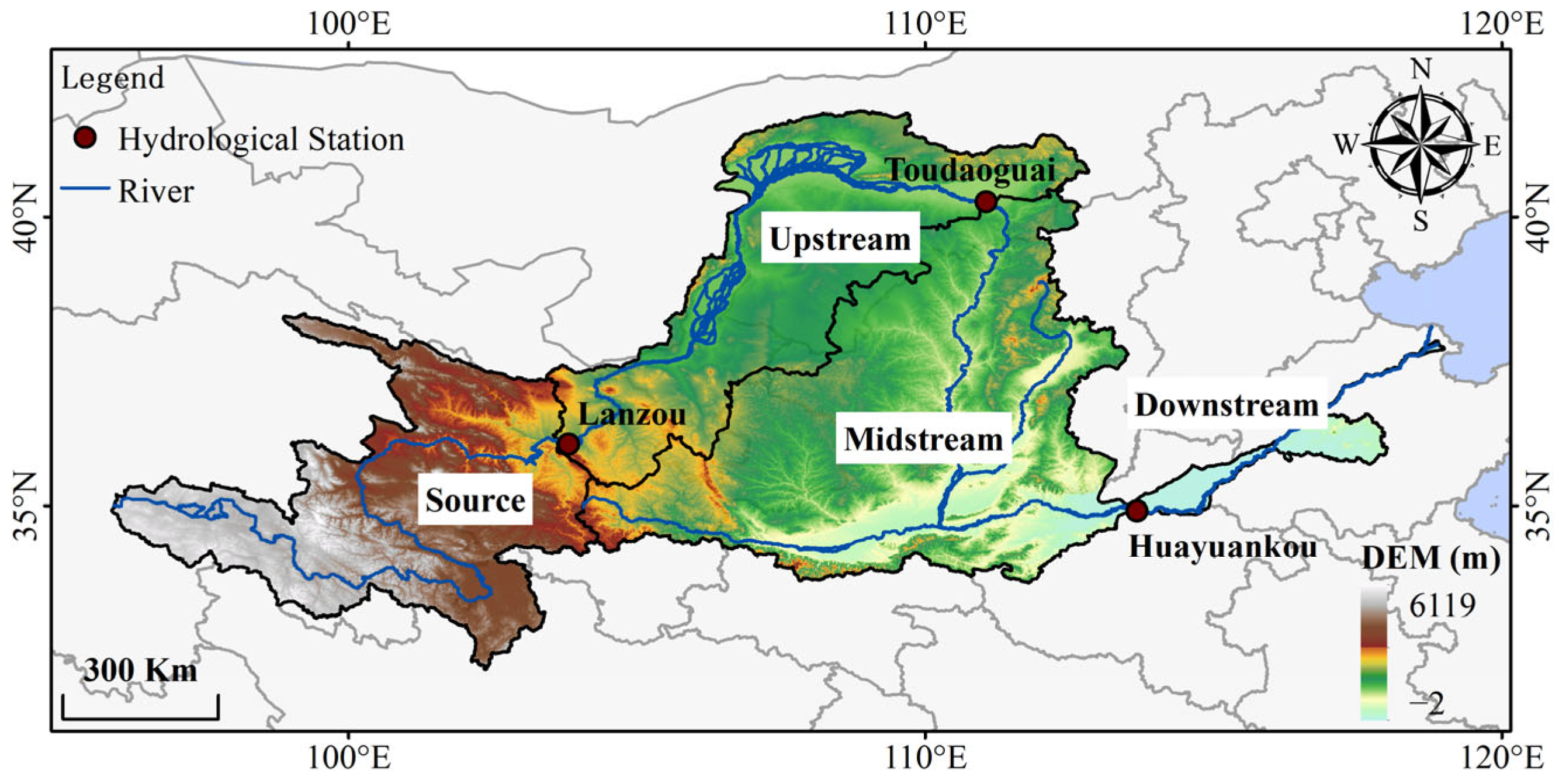
The YRB is the second longest river in China, with a drainage area of 795,000 km2. The average annual precipitation is 482 mm, primarily concentrated in June–September, which accounts for 70.1% of the yearly total. The average annual temperature is 6.2 °C. This region has limited water resources and serves as a core area for the “Grain for Green” project (the conversion of farmland to forest). Human activities, particularly ecological restoration, significantly influence the water–carbon balance here, making the basin a natural laboratory for studying water–carbon synergy evolution under vegetation greening [7,12]. In this study, the reach above Lanzhou is defined as the source region, the section from Lanzhou to Toudaoguai as the upper reaches, that from Toudaoguai to Huayuankou as the middle reaches, and the section below Huayuankou as the lower reaches (Figure 1).
The data used in this study and their explanations are shown in Table 1.

2.2. Methods

2.2.1. WUE

WUE is calculated by using GPP and ET:
W U E = G P P E T
with WUE measured in g C m−2 mm−1, ET in mm, and GPP in g C m−2.

2.2.2. Trend and Mutation Testing Methods

The Sen’s slope assessment, α, is central to the index, providing a direct measure of the trend magnitude [35]. It is calculated as follows:
α = M e d i a n ( x i x j i j )
where α > 0 suggests an increasing trend, while α < 0 demonstrates a decreasing trend.
The procedure of the Mann–Kendall trend test is described below [36,37]:
sgn ( θ ) = 1 , θ > 0 0 , θ = 0 1 , θ < 0
S = i = 1 n 1 j = i 1 n sgn ( x j x i )
where sgn represents the sign function, and x j are x i the j-th and i-th values of the sample sequence, respectively.
Z = S 1 V a r ( S ) , S > 0 0 , S = 0 S + 1 V a r ( S ) , S < 0
V a r ( S ) = n ( n 1 ) ( 2 n + 5 ) 18
where Z is standardized statistic, and S follows a normal distribution.
Mutation tests were conducted using the Pettitt method [38], which is a widely applied non-parametric statistical test method.

2.2.3. Multi-Factor Partial Correlation Coefficient Analysis Method

P, T, and LAI, which influence the carbon–water interaction process of vegetation, are considered as the environmental factors driving GPP, ET, and WUE. The multi-factor partial correlation coefficient analysis method compensates for the limitation of the simple Pearson correlation coefficient method, which cannot comprehensively reflect the influence of multiple variables [39]. Its calculation formula is as follows:
r x y z = r x y r x z r y z ( 1 r x z 2 ) ( 1 r y z 2 )
where r x y z represents the partial correlation coefficient between x and y after controlling for the variable z, r x y represents the correlation coefficient between x and y, r x z represents the correlation coefficient between x and z, and r y z represents the correlation coefficient between y and z.

2.2.4. Residual Analysis Method

The residual analysis method was adopted to separate the impacts of CC and HA on GPP, ET, and WUE [40] (see Table 2). Firstly, the slopes of the observed variables x o b s (GPP, ET, and WUE) can be calculated as follows:
x o b s = n i = 1 n ( i × x i ) i = 1 n i i = 1 n x i n i = 1 n i 2 i = 1 n i
Secondly, the regression relationship between predictor variables x C C and multiple environmental variables (P and T) is established:
x C C = a × T + b × P + c
Finally, the impact of CC and HA on GPP, ET, and WUE is separated:
x H A = x o b s x C C

2.2.5. Sensitivity Analysis Method

For the sensitivity analysis of influencing factors among multiple variables in complex Earth systems, interpretable machine learning methods provide a quick and convenient approach [41]. In this study, the LightGBM model was utilized to interpret the synergistic variations in WUE, GPP and ET driven by climatic, vegetation, soil and human activity factors [42]. Distinguished from other boosting models, it leverages a histogram-based algorithm to speed up training and adopts a depth-constrained, leaf-wise tree growth strategy. It also integrates gradient-based one-side sampling and exclusive feature bundling for optimized training: the gradient-based one-side sampling algorithm filters out most data instances with small gradients, using the remaining samples to estimate information gain, with variance gain applicable for data splitting (Equation (11)).
V j ( d ) = ( x i A l g i + 1 a b x i B l g i ) 2 n l j ( d ) + ( x i A r g i + 1 a b x i B r g i ) 2 n r j ( d ) n
here, n l j ( d ) is the number of nodes in the left, and n r j ( d ) is the number of nodes in right subtrees; 1 a b is the gradient normalization coefficient; A l , A r are subsets of A; and B i , B r are subsets of B.
In this study, the advanced SHAP framework with TreeExplainer was adopted to assess the sensitivity of WUE, GPP and ET to climatic, vegetation, soil and human activity factors [43].
f ( x ) = g ( x ) = φ 0 + i = 1 M φ i x i
where f(x) denotes the original model and g(x′) denotes the explanation model. For a simplified input x′ derived from x, the output of g(x′) is required to align with that of f(x).

3. Results

3.1. Spatio-Temporal Variations in GPP, ET, and WUE

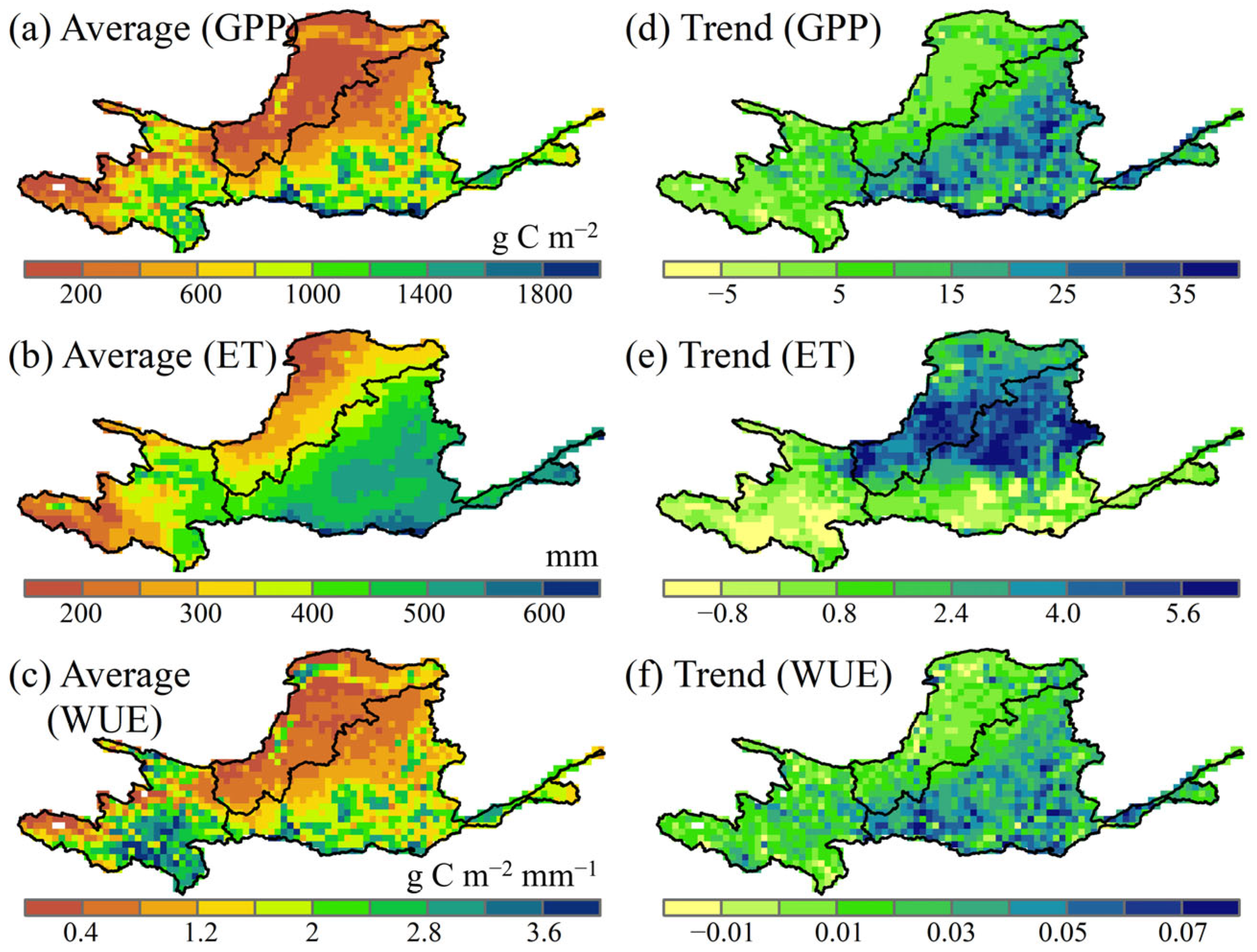
Figure 2 shows the spatial variations in the average and trends of GPP, ET, and WUE in the YRB (2001–2020). The average GPP, ET, and WUE in the YRB are 609.0 g C·m−2, 392.3 mm, and 1.5 g C·m−2·mm−1, respectively. The average GPP in the source area, upstream, midstream, and downstream of the YRB is 653.1 g C·m−2, 225.0 g C·m−2, 778.0 g C·m−2, and 1028.9 g C·m−2, respectively. Spatial analysis shows that areas with higher values of GPP are mainly clustered in the southern part of the source zone, the southern part of the midstream, and the downstream. From the perspective of spatial trends, the proportion of areas with an increase in GPP is 96.6%, with significant increases mainly observed in the midstream and downstream of the YRB. Areas with higher values of ET are mainly clustered in the midstream and downstream of the YRB. The multi-year average ET in the source area, upstream, midstream, and downstream of the YRB is 329.7 mm, 299.3 mm, 478.5 mm, and 521.8 mm, respectively. The proportion of areas with increased ET is 76.9%, with larger increases mainly observed in the eastern part of the upstream and the northern part of the midstream of the YRB. Areas with higher values of WUE are mainly clustered in the southern part of the YRB source region, the southern part of the midstream, and the downstream. The multi-year average WUE in the source area, upstream, midstream, and downstream of the YRB is 2.0, 0.8, 1.6, and 2.0 g C m−2 mm−1, respectively. The proportion of areas with increased WUE is 94.9%, with significant increases mainly observed in the midstream and downstream of the YRB. From the perspective of spatial variation, the changes in GPP and WUE are relatively consistent.
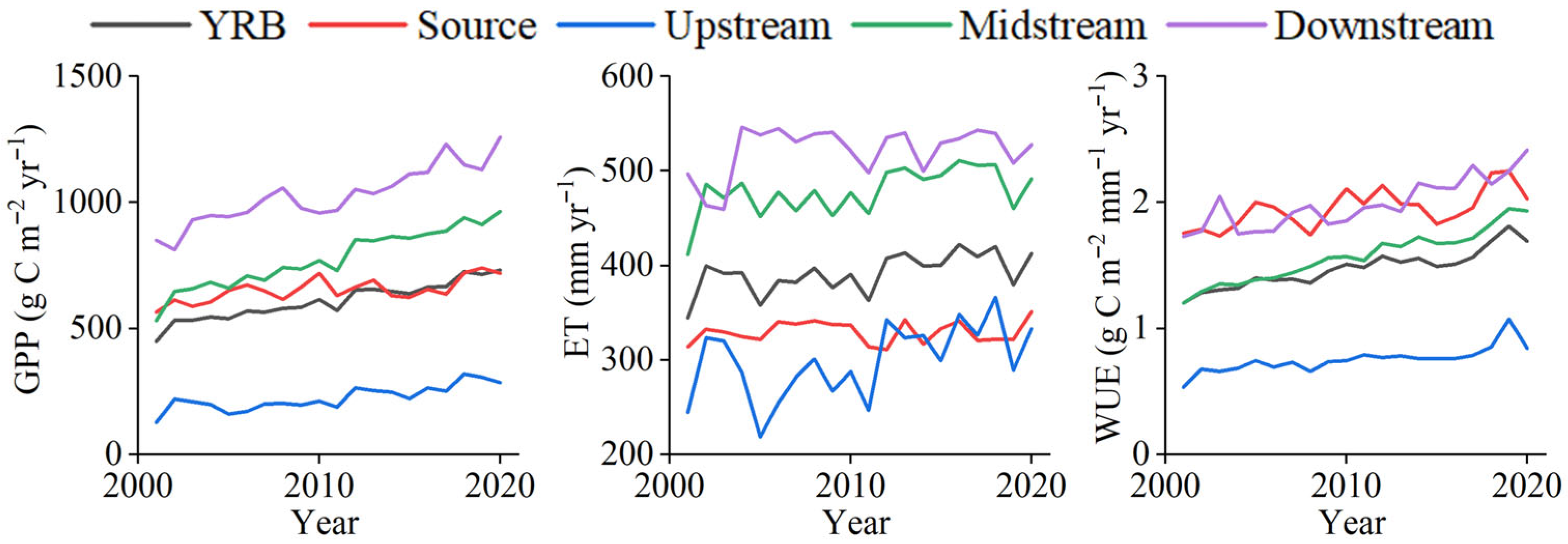
Figure 3 and Table 3 present the multi-year average (2001–2020) trends and abrupt changes in GPP, ET, and WUE. According to the outcomes of the M-K trend test, GPP, ET, and WUE in all areas, except for the source area and the downstream of the YRB, show a remarkable increasing trend (p < 0.05). The ranking of the increasing trends in different regions for GPP is midstream > downstream > upstream > source region; the ranking for ET is midstream > upstream > source region > downstream; and the ranking for WUE is midstream > upstream > downstream > source region. Abrupt changes occurred in GPP, ET, and WUE in the YRB in 2012, 2012, and 2010, respectively. Although there are regional differences, the abrupt change time of GPP, ET, and WUE in most areas occurred around 2012.

3.2. Partial Correlations of GPP, ET, and WUE with Environmental Factors

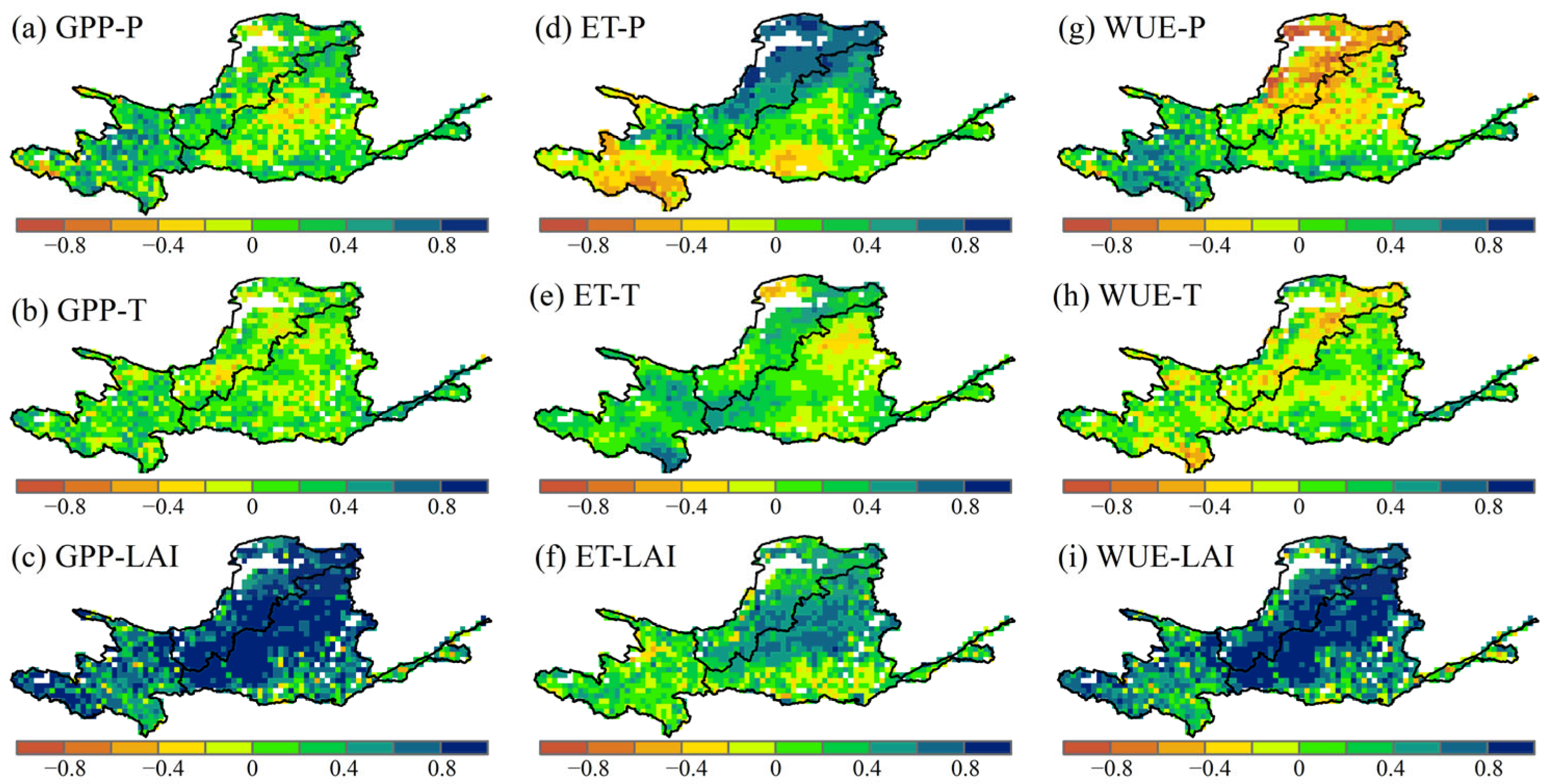
Figure 4 illustrates the spatial partial correlations of GPP, ET, and WUE with environmental factors such as rainfall (P), temperature (T), and LAI in the YRB. The proportions of areas where GPP, ET, and WUE have partial correlation coefficients greater than 0 with P, T, and LAI are 75.4%, 70.2%, and 96.0%, respectively. The proportions of areas where ET has partial correlation coefficients greater than 0 with P, T, and LAI are 67.9%, 77.8%, and 83.9%, respectively. The proportions of areas where WUE has partial correlation coefficients greater than 0 with P, T, and LAI are 53.9%, 54.1%, and 94.0%, respectively. Spatial analysis shows that the spatial distributions of the correlations between GPP and T and between WUE and T, as well as between GPP and LAI and between WUE and LAI, exhibit relatively consistent patterns.
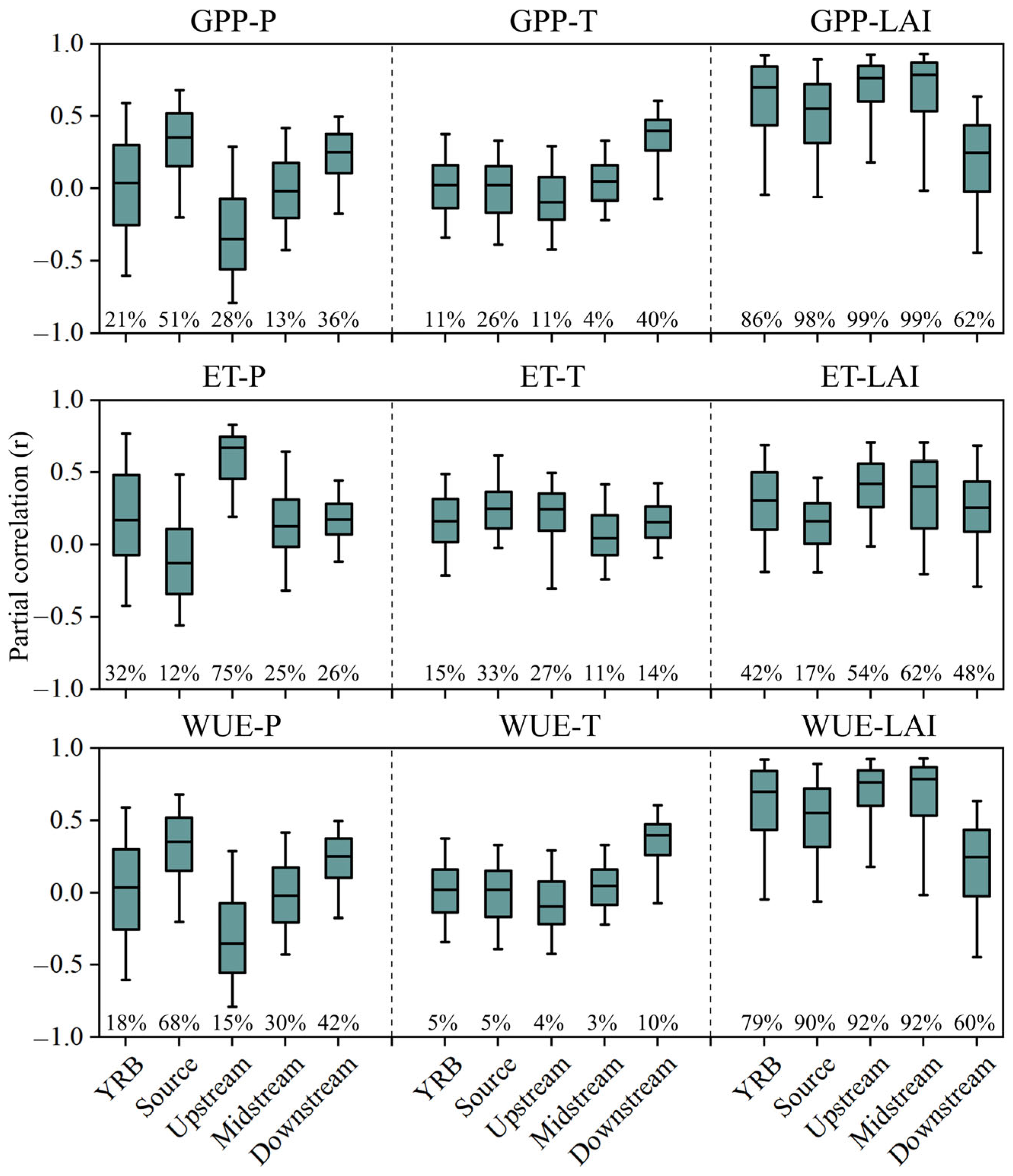
Figure 5 shows the box-type statistics of the partial correlations between GPP, ET, WUE, and driving factors in the YRB. The median partial correlations of GPP with T, P, and LAI in the YRB are 0.19, 0.11, and 0.78, respectively. The median partial correlation coefficients of GPP-P in the source area, upper reaches, middle reaches, and downstream of the YRB are 0.30, 0.18, 0.12, and 0.33, respectively. The median values of the GPP-T partial correlation coefficients in the source area, upper reaches, middle reaches, and downstream of the YRB are 0.17, 0.07, 0.08, and 0.42, respectively. The median partial correlation coefficients of GPP-LAI in the source area, upper reaches, middle reaches, and downstream of the YRB are 0.67, 0.84, 0.83, and 0.36, respectively. The median partial correlations of ET with T, P, and LAI in the YRB were 0.17, 0.16, and 0.30, respectively. The median partial correlation coefficients of ET-P in the source area, upper reaches, middle reaches, and downstream of the YRB are −0.13, 0.67, 0.13, and 0.17, respectively. The median values of the ET-T partial correlation coefficients in the source area, upper reaches, middle reaches, and downstream of the YRB are 0.25, 0.24, 0.05, and 0.16, respectively. The median partial correlation coefficients of ET-LAI in the source area, upper reaches, middle reaches, and downstream of the YRB are 0.16, 0.42, 0.40, and 0.26, respectively. The median partial correlations of WUE with T, P, and LAI in the YRB are 0.04, 0.02, and 0.70, respectively. The median values of the WUE-P partial correlation coefficients in the source area, upper reaches, middle reaches, and downstream of the YRB are 0.35, −0.35, −0.02, and 0.27, respectively. The median values of the WUE-T partial correlation coefficients in the source area, upper reaches, middle reaches, and downstream of the YRB are 0.02, −0.09, 0.05, and 0.40, respectively. The median partial correlation coefficients of WUE-LAI in the source area, upper reaches, middle reaches, and downstream of the YRB are 0.55, 0.77, 0.79, and 0.26, respectively. Regarding the proportion of significant correlations, the partial correlation between GPP and LAI exhibits the largest significant proportion, accounting for 86% of the entire Yellow River Basin (YRB). This is followed by the partial correlation between WUE and LAI (79%), and finally between ET and LAI (42%). Regarding the significant correlations across different regions, variations in GPP also dominate the changes in WUE. From the corresponding results, it can be seen that the changes in GPP-P and WUE-P and in GPP-LAI and WUE-LAI in different regions have relatively consistent patterns.

3.3. Contributions of CC and HA to GPP, ET, and WUE

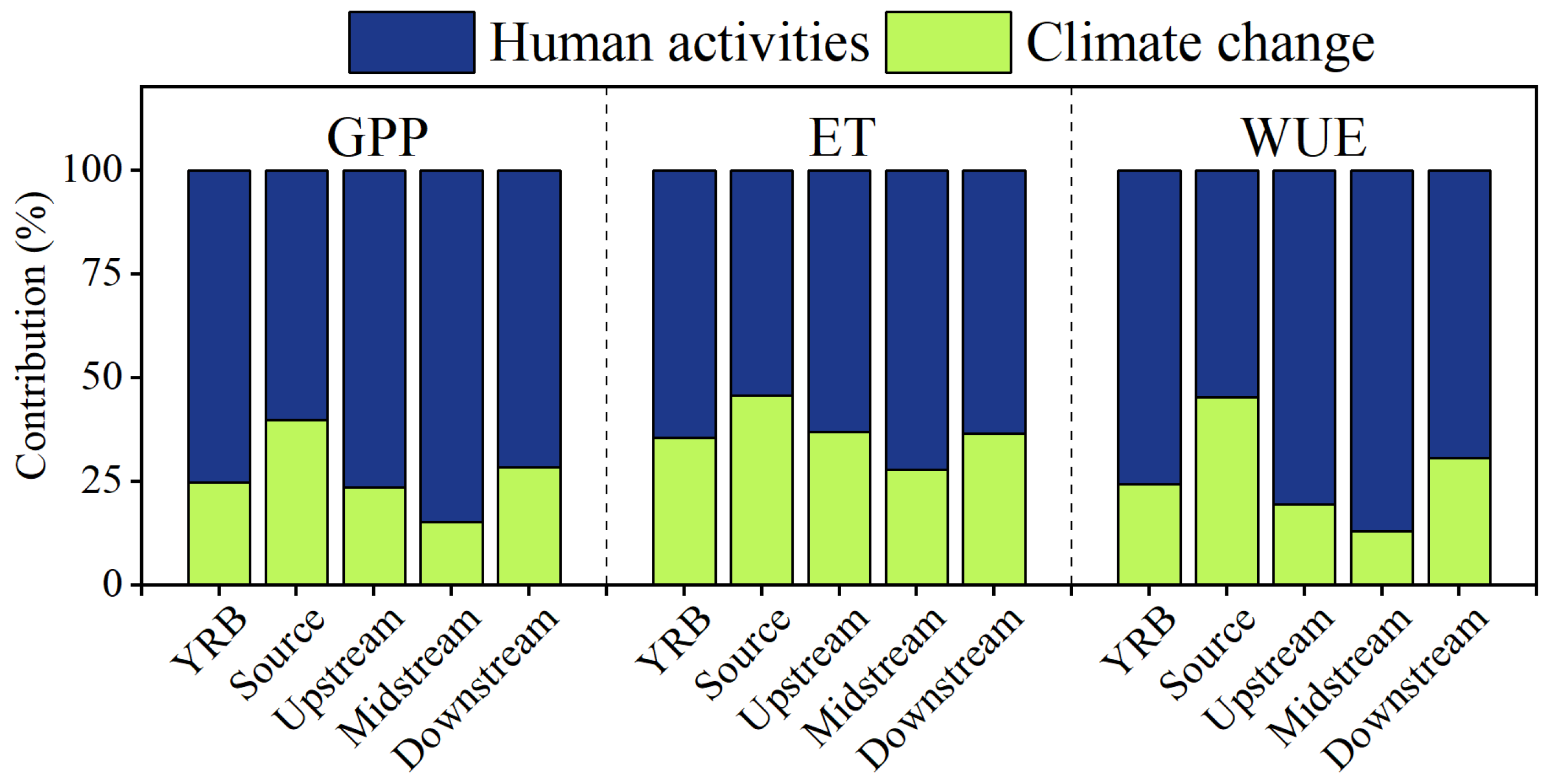
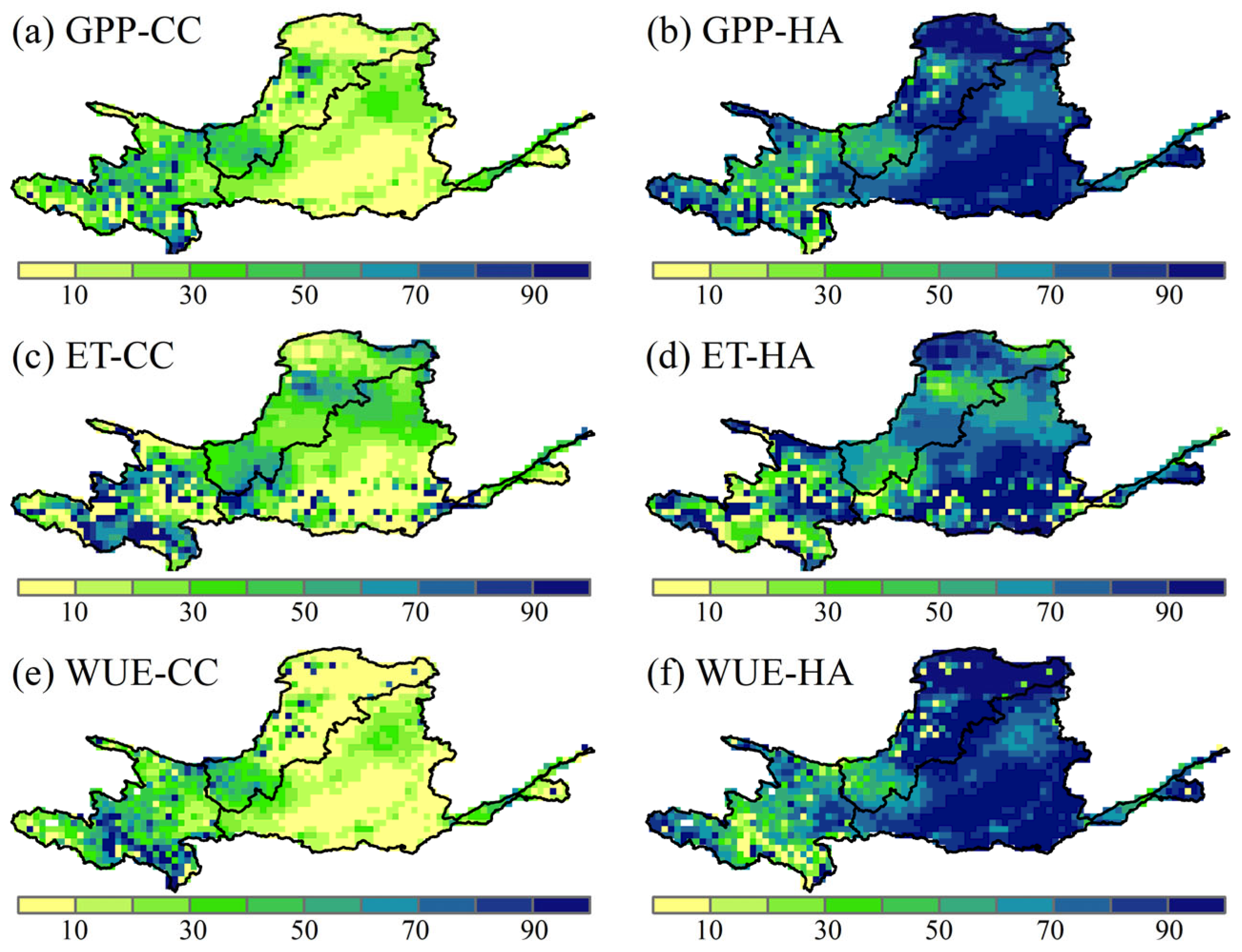
Figure 6 and Figure 7 show the contributions of CC and HA to GPP, ET, and WUE in the YRB. The average contribution of CC to GPP, ET, and WUE is 24.8%, 35.6%, and 24.3%, respectively. The average contribution of HA to GPP, ET, and WUE is 75.2%, 64.4%, and 75.7%, respectively. The contribution of climate change in the source area, upstream, midstream, and downstream of the YRB to GPP is 39.8%, 23.4%, 15.2%, and 28.4%, respectively; that to ET is 45.7%, 37.0%, 27.8%, and 36.5%, respectively; and that to WUE is 45.3%, 19.4%, 12.9%, and 30.5%, respectively. The contribution of HA in the source area, upstream, midstream, and downstream of the YRB to GPP is 60.2%, 76.6%, 84.8%, and 71.6%, respectively; that to ET is 54.3%, 63.0%, 72.2%, and 63.5%, respectively; and that to WUE is 54.7%, 80.6%, 87.1%, and 69.5%, respectively. From a spatial perspective, CC has the greatest impact on the source area of the Yellow River, while human activities have the greatest impact on the midstream of the YRB. Regarding the trend dynamics, the contributions of CC and HA to GPP and WUE show similar fluctuations across different regions.

3.4. Influence of Different Factors on GPP, ET, and WUE

Table 4 presents the simulation results of LightGBM in the Yellow River Basin. For WUE, the R2 values of the model in the training set and the prediction set are 0.994 and 0.948, respectively. For GPP, the R2 values in the training set and the prediction set are 0.996 and 0.969, respectively. For ET, the R2 values in the training set and the prediction set are 0.993 and 0.984, respectively. The overall simulation results demonstrate good performance and are suitable for subsequent analysis.
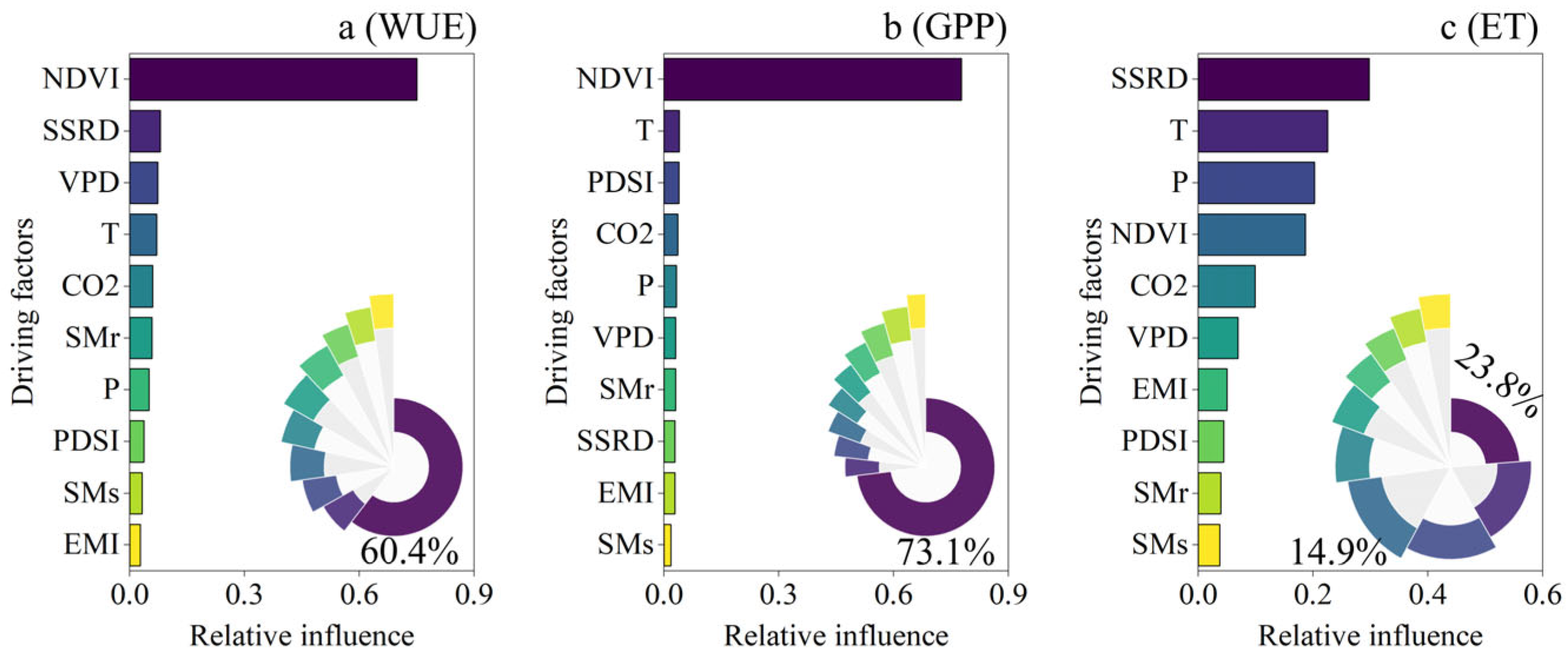
Figure 8 shows the relative influences and contribution ratios of factors such as climate, soil, vegetation, and human activities on WUE, GPP, and ET. The four factors that have the greatest impact on WUE are NDVI, SSRD, VPD, and temperature. Their contributions to the changes in WUE are 60.4%, 6.5%, 5.9%, and 5.7%, respectively. NDVI has the greatest influence on the changes in WUE. The four factors that have the greatest impact on GPP are NDVI, temperature, PDSI, and CO2, with their contributions to the changes in GPP being 73.1%, 3.8%, 3.7%, and 3.4%, respectively. NDVI plays a dominant role in the changes in GPP. The four factors that have the greatest impact on ET are SSRD, temperature, precipitation, and NDVI, with contributions to the changes in ET of 23.8%, 18.0%, 16.2%, and 14.9%, respectively. SSRD, temperature, precipitation, and NDVI together dominate the changes in ET. Overall, changes in NDVI dominate the changes in both GPP and WUE.
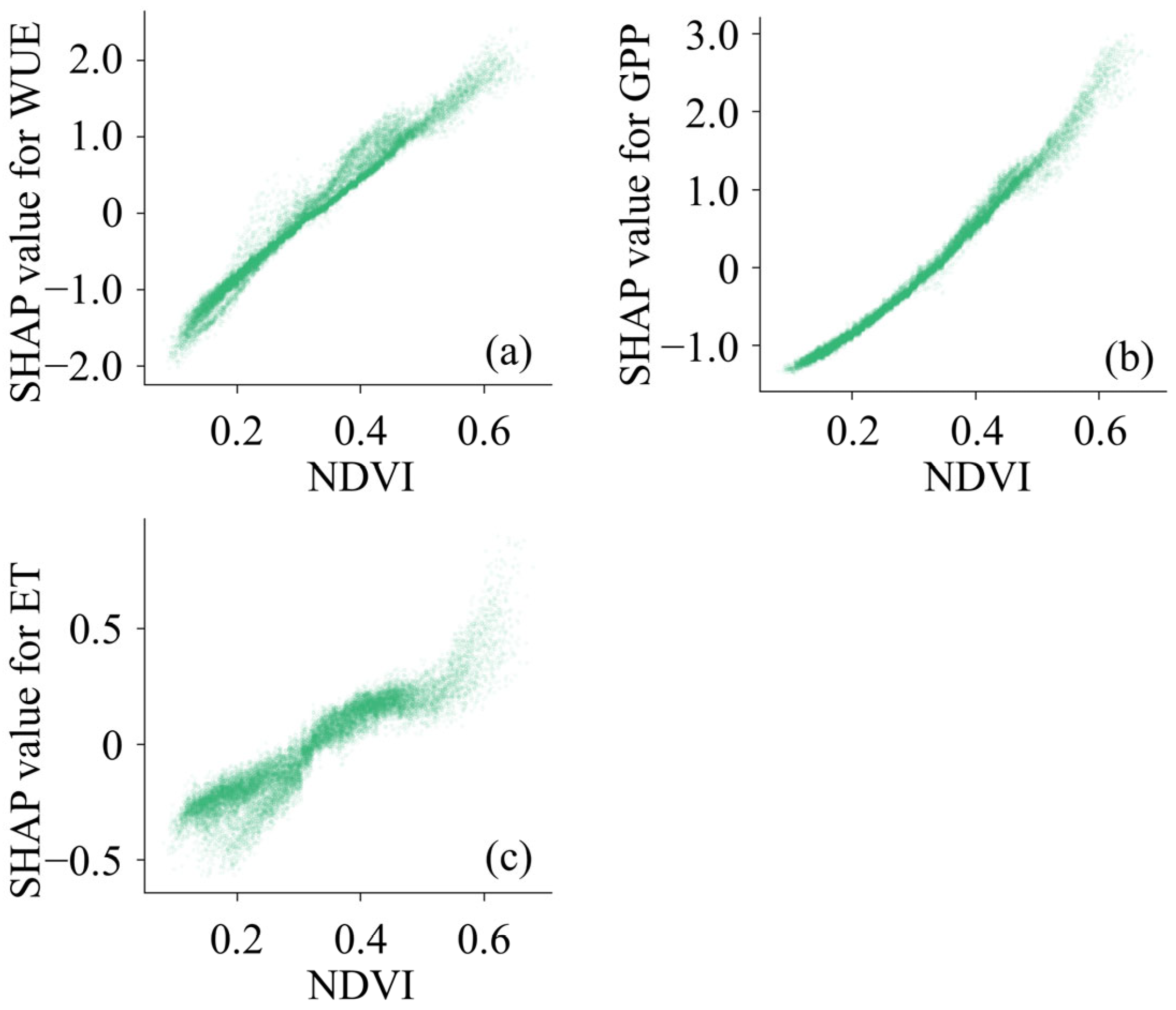
Figure 9 offers an interpretability of the effects of vegetation changes on WUE, GPP, and ET. From the results, it can be seen that WUE, GPP, and ET all increase with an increase in NDVI, but the effects of these changes differ. Specifically, the SHAP values of NDVI variation on WUE show a distribution range mainly from −2.0 to 2.0. During this process, WUE shows a linear increase with NDVI, but the rate of increase slows down over time. For GPP, the SHAP values concerning the change in NDVI have a distribution range mainly from −1.0 to 3.0, which is generally larger than that of WUE. The increase in GPP is linear, but the rate of increase becomes faster over time. For ET, the SHAP values in relation to the change in NDVI show a distribution range mainly from −0.5 to 0.5, with a relatively small overall interval. The increase in ET is linear, but the rate of increase is slow and fluctuates significantly. Figure 8 shows that the contribution of NDVI to WUE, GPP, and ET follows the order GPP > WUE > ET, indicating that NDVI can explain more of the changes in WUE compared to GPP and ET.

4. Discussion

The changes in GPP, ET, and WUE attributed to vegetation changes in the YRB involve complex processes jointly driven by CC and HA [20,27]. However, a comprehensive understanding of how these three variables evolve in synergy and how different driving factors quantitatively contribute to their spatial differentiation is necessary [17,23]. Previous research has centered on individual processes. For example, Lyu et al. [44] examined the impact of land-use change on WUE in the Wuding River Basin, while Chang et al. [23] analyzed the spatial differentiation of driving factors of WUE in the Loess Plateau using partial correlation methods. However, these studies did not achieve quantitative attribution of WUE changes. Additionally, Chen [45] analyzed the contribution of climate factors to WUE using a univariate linear regression residual method. However, this analytical framework did not incorporate the synergistic changes between GPP and ET, hindering a comprehensive understanding of driving mechanisms of the carbon–water cycle coupling.
A key innovation of this study is the use of multiple methods, including Sen’s slope trend analysis, multi-factor partial correlation, and residual analysis, to systematically assess the co-evolution of GPP, ET, and WUE. This study is the first to examine the quantitative attribution of WUE changes at the scale of the entire river basin. The research identified human activities, such as vegetation restoration driven by ecological engineering, as the dominant factors driving the improvement in WUE. This conclusion is consistent with Xue et al. [46], who demonstrate the leading role of LAI in driving WUE, jointly revealing the vital role of human management in enhancing the carbon–water efficiency of ecosystems. This study fills the gap in the current systematic quantitative attribution research on WUE in the YRB and offers a new theoretical foundation for understanding the carbon–water coupling mechanism in this region.
The findings of this study regarding the dominant role of HA in improving WUE align with the broader consensus in the literature regarding ecological restoration impacts [24]. However, our basin-scale analysis provides a more nuanced perspective compared to previous localized studies. For instance, while Lyu et al. [44] focused on the Wuding River Basin and identified land-use change as a key driver, our results quantify this effect across the entire YRB, revealing that the contribution of HA is spatially heterogeneous and often intertwined with CC. When compared to studies on climatically comparable regions, such as Chang et al.’s analysis of the Loess Plateau [23], our application of multi-factor partial correlation analysis further distinguishes the specific contributions of LAI from meteorological factors. The highly significant correlation proportion between GPP and LAI (86%) observed in this study reinforces the conclusions of Xue et al. [46], suggesting that vegetation restoration has fundamentally altered the carbon cycle, which in turn dictates the water use efficiency patterns. Furthermore, the lower significant correlation of ET with LAI (42%) indicates that the biophysical feedbacks of vegetation on hydrology are more complex and potentially lagging compared to the immediate carbon response, a distinction that was often conflated in earlier univariate analyses [17].
The application of the LightGBM model with SHAP values provided deeper insights into the driving mechanisms that traditional linear correlation analyses might overlook. While both methods identified NDVI as a dominant factor, the SHAP analysis revealed its complex nonlinear and threshold effects on WUE. For instance, the model indicates that the marginal contribution of NDVI to WUE enhancement is not constant; it tends to saturate or even decline in areas with extremely high vegetation coverage, suggesting potential water stress limitations that linear regression fails to capture. This finding advances beyond previous studies by quantifying not just the direction but the magnitude of variable importance across different sub-regions, highlighting the asymmetric response of the carbon–water cycle to environmental changes.
Furthermore, the distinct spatial patterns observed between the source region and the midstream can be attributed to fundamental differences in climate sensitivity, ecological project intensity, and land-use history. In the source region, the ecosystem is primarily climate-sensitive, dominated by natural grasslands and meadows where water is relatively abundant. Here, WUE variations are more closely tied to temperature and precipitation changes due to the limited influence of large-scale human engineering. In contrast, the midstream region, characterized by the Loess Plateau, has a long history of severe soil erosion and intensive human intervention. The strong dominance of HA and NDVI in this region reflects the profound impact of large-scale ecological restoration projects (e.g., the “Grain for Green” program), established in the late 1990s. The conversion of cropland to forest/grassland in the midstream has fundamentally altered the land-use trajectory, making the ecosystem more responsive to vegetation dynamics than to interannual climate fluctuations. This divergence underscores that the YRB cannot be treated as a homogeneous unit; instead, its sub-regions operate under distinct eco-hydrological regimes shaped by their unique climatic and anthropogenic histories.
Furthermore, the lower significant correlation of ET with LAI (42%) indicates that the biophysical feedbacks of vegetation on hydrology are more complex and potentially lagging compared to the immediate carbon response, a distinction that was often conflated in earlier univariate analyses. However, scholars have raised concerns that vegetation recovery on the Loess Plateau may be approaching the breakpoint for renewable water resources [8]. Against this backdrop, quantifying the synergistic relationship among GPP, ET, and WUE in this study not only provides a scientific benchmark for evaluating the comprehensive benefits of existing ecological projects, but also serves as an important early warning for avoiding water resource risks associated with excessive vegetation restoration. Looking ahead, it is essential to further explore the water use efficiency and eco-hydrological effects of different vegetation restoration models based on the findings of this study [17,20]. This will deepen our understanding of the green water–blue water transformation process and provide support for the Yellow River Basin and other ecologically fragile areas, particularly under the constraints of the “dual carbon” goals and limited water resources. It will offer solid theoretical support and practical pathways for formulating sustainable ecological protection and high-quality development strategies.
The quantitative attribution of WUE changes holds significant implications for the sustainable management of the YRB, particularly under the constraints of the “dual carbon” goals and limited water resources. The finding that GPP changes dominate WUE variations suggests that current ecological restoration strategies have successfully enhanced carbon sequestration capacity. However, the moderate correlation between ET and LAI (42%) warrants caution. It implies that while vegetation is “greening,” the associated increase in evapotranspiration might not be linearly proportional to the increase in biomass across the entire basin, potentially creating a “green water” surplus in some regions that could be converted to “blue water” runoff with optimized management.
Given the concerns regarding the approaching water resource breakpoint, our results provide a scientific benchmark for optimizing future ecological projects. The spatial differentiation of driving factors indicates that a “one-size-fits-all” restoration approach is no longer suitable. Instead, management strategies should transition towards precision ecological management. In water-scarce regions where the correlations between WUE and climate factors are strong, vegetation restoration should be limited to water-saving species to prevent soil desiccation. Conversely, in areas where human activities dominate WUE improvement, efforts should focus on maintaining the stability of existing ecosystems. This study thus bridges the gap between theoretical eco-hydrological understanding and practical policy-making, offering a pathway to balance the trade-offs between carbon sequestration and water conservation for high-quality development in the YRB.
Although this study revealed the co-variation patterns and dominant driving factors of GPP, ET, and WUE in the YRB using traditional statistical models, it still has certain limitations. The current analytical framework is primarily based on linear or generalized linear assumptions, which makes it difficult to fully capture the complex nonlinear interactions and threshold effects between CC and HA [3,23,24]. Interpretable machine learning offers a powerful tool for addressing the complexity of the issues mentioned above [43]. Future research can employ various machine learning algorithms (such as random forests) to evaluate the contribution of factors and reveal nonlinear influence mechanisms [47]. More importantly, the model should incorporate more comprehensive human activity proxy variables (such as ecological engineering intensity, irrigated area, and urban expansion index), along with high-resolution climate data, to systematically analyze the cascading effects and feedback mechanisms of the “policy–climate–vegetation–hydrology” system.
Furthermore, this study focuses primarily on carbon fixation via GPP and does not incorporate other carbon cycle components such as volatile organic compounds or atmospheric aerosols, which could be explored in future research using more comprehensive atmospheric datasets.

5. Conclusions

This study implemented a structured assessment and attribution analysis of the carbon–water synergistic evolution system in the YRB. The main conclusions and their broader implications as follows: First, the proportions of areas with increased GPP, ET, and WUE in the YRB reached 96.6%, 76.9%, and 94.9%, respectively, with the midstream demonstrating the most pronounced increasing trends—findings that underscore the remarkable effectiveness of ecological restoration efforts in driving carbon sequestration and water use optimization across the basin. Second, the high spatial similarity in the patterns of GPP-T, WUE-T, GPP-LAI, and WUE-LAI correlations reveals inherent linkages between vegetation growth, climate conditions, and carbon–water coupling processes, providing key insights into the coordinated responses of the ecosystem to environmental changes. Third, the existence of differential driving forces across regions—with CC exerting the greatest impact on GPP, ET, and WUE in the source area and HA dominating in the middle reaches—highlights the necessity of regionally tailored management strategies rather than a one-size-fits-all approach. Fourth, HA is confirmed as the leading factor driving the synergistic evolution of GPP, ET, and WUE, and variations in GPP (rather than ET) primarily govern WUE dynamics; this finding, coupled with the finding that NDVI changes contribute to 60.4%, 73.1%, and 14.9% of changes in WUE, GPP, and ET, respectively, emphasizes that vegetation restoration-induced GPP enhancement is the core pathway to improving carbon–water efficiency in the YRB.
These findings hold critical practical relevance for basin-scale management: the widespread increases in GPP and WUE validate the success of current ecological projects, while the moderate ET growth (76.9%) and uneven spatial patterns caution against potential water resource pressures in water-scarce regions, urging the adoption of water-saving vegetation types and precision ecological management. For sustainability, the identified driving mechanisms provide a scientific basis for balancing carbon sequestration under the “dual carbon” goals and water conservation, a key consideration for the YRB’s ecological protection and high-quality development strategy. Additionally, this study offers a valuable case study for carbon–water co-evolution in global ecologically fragile regions. Future research should focus on exploring nonlinear threshold effects between driving factors, integrating high-resolution human activity proxies (e.g., ecological engineering intensity, irrigated area), and evaluating the long-term eco-hydrological risks of excessive vegetation restoration to further refine management practices.

Author Contributions

Conceptualization, H.C.; Methodology, Z.C.; Software, H.C.; Resources, Y.G.; Data curation, Y.G.; Writing—original draft, Z.C.; Writing—review & editing, H.C.; Visualization, L.W. and Y.G.; Supervision, L.W. All authors have read and agreed to the published version of the manuscript.

Funding

National Natural Science Foundation of China (52509017).

Institutional Review Board Statement

Not applicable.

Informed Consent Statement

Not applicable.

Data Availability Statement

The data will be provided as required. For specific information, please refer to Table 1.

Conflicts of Interest

The authors declare no conflicts of interest.

References

  1. Lin, X.; Dröllner, M.; Barham, M.; Liu-Zeng, J.; Jolivet, M.; Liu, H.J.; Guan, K.G.; Hu, C.W.; Chen, X.K. The Cenozoic evolution of the Yellow River. Earth-Sci. Rev. 2025, 261, 104997. [Google Scholar] [CrossRef]
  2. Pang, B.; Li, X.X.; Fu, Y. Coupling coordination analysis and obstacle factors of water-energy-environment-economy in the Yellow River Basin. J. Clean. Prod. 2024, 468, 143108. [Google Scholar] [CrossRef]
  3. Wang, W.Z.; Dong, N.P.; You, J.J.; Dong, Z.C.; Ren, L.; Xue, L.Q. Spatiotemporal variations of the precipitation in the Yellow River Basin considering climate and instrumental disturbance. Environ. Model. Softw. 2025, 183, 106204. [Google Scholar] [CrossRef]
  4. Fang, M.Z.; Si, G.X.; Yu, Q.; Huang, H.G.; Huang, Y.; Liu, W.; Guo, H.Q. Study on the Relationship between Topological Characteristics of Vegetation Ecospatial Network and Carbon Sequestration Capacity in the Yellow River Basin, China. Remote Sens. 2021, 13, 4926. [Google Scholar] [CrossRef]
  5. Liu, K.; Xie, X.Y.; Zhao, M.X.; Zhou, Q. Carbon Emissions in the Yellow River Basin: Analysis of Spatiotemporal Evolution Characteristics and Influencing Factors Based on a Logarithmic Mean Divisia Index (LMDI) Decomposition Method. Sustainability 2022, 14, 9524. [Google Scholar] [CrossRef]
  6. Bryan, B.A.; Gao, L.; Ye, Y.Q.; Sun, X.F.; Connor, J.D.; Crossman, N.D.; Stafford-Smith, M.; Wu, J.G.; He, C.Y.; Yu, D.Y.; et al. China’s response to a national land-system sustainability emergency. Nature 2018, 559, 193–204. [Google Scholar] [CrossRef]
  7. Li, C.J.; Fu, B.J.; Wang, S.; Stringer, L.C.; Wang, Y.P.; Li, Z.D.; Liu, Y.X.; Zhou, W.X. Drivers and impacts of changes in China’s drylands. Nat. Rev. Earth Environ. 2021, 2, 858–873. [Google Scholar] [CrossRef]
  8. Feng, X.M.; Fu, B.J.; Piao, S.; Wang, S.H.; Ciais, P.; Zeng, Z.Z.; Lü, Y.H.; Zeng, Y.; Li, Y.; Jiang, X.H.; et al. Revegetation in China’s Loess Plateau is approaching sustainable water resource limits. Nat. Clim. Change 2016, 6, 1019–1022. [Google Scholar] [CrossRef]
  9. Wang, S.; Song, S.; Zhang, H.Y.; Yu, L.; Jiao, C.T.; Li, C.J.; Wu, X.T.; Zhao, W.W.; Best, J.; Roberts, P.; et al. Anthropogenic impacts on the Yellow River Basin. Nat. Rev. Earth Environ. 2025, 6, 656–671. [Google Scholar] [CrossRef]
  10. Fan, X.L.; Qu, Y.; Zhang, J.; Bai, E.D. China’s vegetation restoration programs accelerated vegetation greening on the Loess Plateau. Agric. For. Meteorol. 2024, 350, 109994. [Google Scholar] [CrossRef]
  11. Guo, W.X.; Jiao, X.Y.; He, N.; Niu, Y.; Wang, H.X. The regulation mechanism of Basin vegetation on river hydrology: A comparison between humid and semi-arid regions. Ecol. Indic. 2025, 178, 114027. [Google Scholar] [CrossRef]
  12. Zhu, Y.W.; Jiang, S.H.; Ren, L.L.; Yan, D.H.; Cui, H.; Wang, M.H.; Xu, C.Y. A Systematic Feedback Assessment Framework to Identify the Impact of Climate Change and Ecological Restoration on Water Yield Patterns. Water Resour. Manag. 2024, 38, 3179–3195. [Google Scholar] [CrossRef]
  13. Ganjurjav, H.; Hu, G.Z.; Zhang, Y.; Gornish, E.S.; Yu, T.Q.; Gao, Q.Z. Warming tends to decrease ecosystem carbon and water use efficiency in dissimilar ways in an alpine meadow and a cultivated grassland in the Tibetan Plateau. Agric. For. Meteorol. 2022, 323, 109079. [Google Scholar] [CrossRef]
  14. Kiniry, J.R.; Kim, S. A Review of Modeled Water Use Efficiency of Highly Productive Perennial Grasses Useful for Bioenergy. Agronomy 2020, 10, 328. [Google Scholar] [CrossRef]
  15. Fathi-Taperasht, A.; Shafizadeh-Moghadam, H.; Kouchakzadeh, M. MODIS-based evaluation of agricultural drought, water use efficiency and post-drought in Iran; considering the influence of heterogeneous climatic regions. J. Clean. Prod. 2022, 374, 133836. [Google Scholar] [CrossRef]
  16. Villalobos-Cano, O.; Santellano-Estrada, E.; Stringam, B.L.; Grover, K.; Esparza-Vela, E. Estimating Water Use Efficiency for Major Crops in Chihuahua, Mexico: Crop Yield Function Models vs. Evapotranspiration. Sustainability 2024, 16, 1851. [Google Scholar] [CrossRef]
  17. Chen, S.W.; Guo, Y.X.; Xu, Y.P.; Wang, L. Future response of ecosystem water use efficiency to CO2 effects in the Yellow River Basin, China. Hydrol. Earth Syst. Sci. 2024, 28, 4989–5009. [Google Scholar] [CrossRef]
  18. Reich, E.G.; Samuels-Crow, K.; Bradford, J.B.; Litvak, M.; Schlaepfer, D.R.; Ogle, K. A Semi-Mechanistic Model for Partitioning Evapotranspiration Reveals Transpiration Dominates the Water Flux in Drylands. J. Geophys. Res. Biogeosci. 2024, 129, e2023JG007914. [Google Scholar] [CrossRef]
  19. Mu, Y.M.; Jia, X.; Ye, Z.Q.; Guo, X.L.; Hao, S.R.; Zha, T.S.; Zhang, Y.Q.; Han, C.; Gao, S.J.; Xing, F.; et al. Vegetation factors and atmospheric dryness regulate the dynamics of ecosystem water use efficiency in a temperate semiarid shrubland. J. Hydrol. 2024, 639, 131644. [Google Scholar] [CrossRef]
  20. Qin, G.X.; Meng, Z.Y.; Fu, Y. Drought and water-use efficiency are dominant environmental factors affecting greenness in the Yellow River Basin, China. Sci. Total Environ. 2022, 834, 155479. [Google Scholar] [CrossRef]
  21. Yadav, M.; Vashisht, B.B.; Jalota, S.K.; Jyolsna, T.; Singh, S.P.; Kumar, A.; Kumar, A.; Singh, G. Improving Water Efficiencies in Rural Agriculture for Sustainability of Water Resources: A Review. Water Resour. Manag. 2024, 38, 3505–3526. [Google Scholar] [CrossRef]
  22. Hu, Z.Y.; Dai, Q.H.; Li, H.Y.; Yan, Y.J.; Zhang, Y.; Yang, X.; Zhang, X.Y.; Zhou, H.; Yao, Y.W. Response of ecosystem water-use efficiency to global vegetation greening. CATENA 2024, 239, 107952. [Google Scholar] [CrossRef]
  23. Chang, X.G.; Wang, Z.H.; Xiao, P.Q.; Wei, F.Y.; Zhang, P.; Ma, L. Spatial Variation Patterns of Dynamics of Water Use Efficiency of Ecosystem and Its Drivers on the Chinese Loess Plateau. Res. Soil Water Conserv. 2022, 29, 244–252. [Google Scholar]
  24. Zhuang, Y.; Zhang, L.A.; Chiu, Y.H.; Guo, Z.Q.; Chu, Y.; Du, X.Y. Evaluating the recycling efficiency of industrial water use systems in China: Basin differences and factor analysis. J. Environ. Manag. 2022, 316, 115313. [Google Scholar] [CrossRef]
  25. Guo, L.S.; Zhu, W.B.; Wei, J.X.; Wang, L.F. Water demand forecasting and countermeasures across the Yellow River basin: Analysis from the perspective of water resources carrying capacity. J. Hydrol. Reg. Stud. 2022, 42, 101148. [Google Scholar] [CrossRef]
  26. Liu, G.; Jiang, E.H.; Li, D.L.; Li, J.Y.; Wang, Y.J.; Zhao, W.J.; Yang, Z. Annual multi-objective optimization model and strategy for scheduling cascade reservoirs on the Yellow River mainstream. J. Hydrol. 2025, 659, 133306. [Google Scholar] [CrossRef]
  27. Ji, Z.H.; Yu, W. Research on Spatial Difference, Distribution Dynamics and Influencing Factors of Urban Water-Use Efficiency in the Yellow River Basin. Sustainability 2023, 15, 405. [Google Scholar] [CrossRef]
  28. Liu, S.; Zhang, H.; Jiang, G.X. Spatiotemporal coupling and regional differences analysis between agricultural land use efficiency and rural revitalization in the Yellow River Basin. Sci. Rep. 2025, 15, 11348. [Google Scholar] [CrossRef]
  29. Han, X.Y.; Zhang, X.; Lei, H. Analysis of the spatial association network structure of water-intensive utilization efficiency and its driving factors in the Yellow River Basin. Ecol. Indic. 2024, 158, 111400. [Google Scholar] [CrossRef]
  30. Zhao, J.C.; Wang, Y.Y.; Zhang, X.F.; Liu, Q.X. Industrial and Agricultural Water Use Efficiency and Influencing Factors in the Process of Urbanization in the Middle and Lower Reaches of the Yellow River Basin, China. Land 2022, 11, 1248. [Google Scholar] [CrossRef]
  31. Li, X.; Xiao, J.F. Mapping Photosynthesis Solely from Solar-Induced Chlorophyll Fluorescence: A Global, Fine-Resolution Dataset of Gross Primary Production Derived from OCO-2. Remote Sens. 2019, 11, 2563. [Google Scholar] [CrossRef]
  32. Miralles, D.G.; Bonte, O.; Koppa, A.; Baez-Villanueva, O.M.; Tronquo, E.; Zhong, F.; Beck, H.E.; Hulsman, P.; Dorigo, W.; Verhoest, N.E.C.; et al. GLEAM4: Global land evaporation and soil moisture dataset at 0.1 resolution from 1980 to near present. Sci. Data 2025, 12, 416. [Google Scholar] [CrossRef] [PubMed]
  33. Wu, J.; Gao, X.J. A gridded daily observation dataset over China region and comparison with the other datasets. Chin. J. Geophys. 2013, 56, 1102–1111. [Google Scholar] [CrossRef]
  34. Cao, S.; Li, M.Y.; Zhu, Z.C.; Wang, Z.; Zha, J.J.; Zhao, W.Q.; Duanmu, Z.; Chen, J.A.; Zheng, Y.Y.; Chen, Y.; et al. Spatiotemporally consistent global dataset of the GIMMS leaf area index (GIMMS LAI4g) from 1982 to 2020. Earth Syst. Sci. Data 2023, 15, 4877–4899. [Google Scholar] [CrossRef]
  35. Sen, P.K. Estimates of the regression coefficient based on Kendall’s tau. J. Am. Stat. Assoc. 1968, 63, 1379–1389. [Google Scholar] [CrossRef]
  36. Mann, H.B. Nonparametric tests against trend. Econometrica 1945, 13, 245–259. [Google Scholar] [CrossRef]
  37. Kendall, M.G. Rank Correlation Methods; Griffin: London, UK, 1975. [Google Scholar]
  38. Pettitt, A.N. A non-parametric approach to the change-point problem. Sci. Adv. 1979, 28, 126–135. [Google Scholar] [CrossRef]
  39. Wang, X.; Chen, G.; Wu, Q.; Cao, L.X.; Awange, J.; Song, Y.Z.; Wu, M.Q. Spatio-temporal patterns and drivers of carbon-water coupling in frozen soil zones across the gradients of freezing over the Qinghai-Tibet Plateau. J. Hydrol. 2023, 621, 129674. [Google Scholar] [CrossRef]
  40. Jiang, S.H.; Zhu, Y.W.; Ren, L.L.; Yan, D.H.; Liu, Y.; Cui, H.; Wang, M.H.; Xu, C.Y. A Complementary Streamflow Attribution Framework Coupled Climate, Vegetation and Water Withdrawal. Water Resour. Manag. 2023, 37, 4807–4822. [Google Scholar] [CrossRef]
  41. Zhu, Y.W.; Jiang, S.H.; Ren, L.L.; Du, S.P.; Cui, H.; He, M.; Xu, C.Y. Exploring interactive effects of water stress and ecological restoration on vegetation eco-regimes using interpretable machine learning based on kernel NDVI. J. Hydrol. 2026, 666, 134789. [Google Scholar] [CrossRef]
  42. Fan, J.L.; Ma, X.; Wu, L.F.; Zhang, F.C.; Yu, X.; Zeng, W.Z. Light Gradient Boosting Machine: An efficient soft computing model for estimating daily reference evapotranspiration with local and external meteorological data. Agric. Water Manag. 2019, 225, 105758. [Google Scholar] [CrossRef]
  43. Jiang, S.J.; Sweet, L.B.; Blougouras, G.; Brenning, A.; Li, W.T.; Reichstein, M.; Denzler, J.; Shangguan, W.; Yu, G.; Huang, F.N.; et al. How Interpretable Machine Learning Can Benefit Process Understanding in the Geosciences. Earths Future 2024, 12, e2024EF004540. [Google Scholar] [CrossRef]
  44. Lyu, J.X.; Liang, K.; Liu, C.M.; Zhang, Y.H.; Liu, L. Spatial differentiation mechanism of land cover and related changes inwater-carbon variables in Wuding River Basin. Arid. Zone Res. 2023, 40, 563–572. [Google Scholar] [CrossRef]
  45. Chen, L.W. Spatio-temporal Variation of Water Use Efficiency and Its Responses toEnvironmental Factors in Yellow River Basin During 2001-2020. Bull. Soil Water Conserv. 2022, 40, 222–230. [Google Scholar] [CrossRef]
  46. Xue, Y.Y.; Liang, H.B.; Zhang, B.Q.; He, C.S. Vegetation restoration dominated the variation of water use efficiency in China. J. Hydrol. 2022, 612, 128257. [Google Scholar] [CrossRef]
  47. Zhu, Y.W.; Jiang, S.H.; Ren, L.L.; Guo, J.Y.; Tang, P.C.; Xu, C.Y. Unraveling Interactive Effects of Climate, Hydrology, and CO2 on Ecological Drought with Interpretable Machine Learning. Forests 2025, 16, 1325. [Google Scholar] [CrossRef]
Figure 1. Geographical position of the Yellow River Basin.
Sustainability 18 01624 g001
Figure 2. Spatial variations in GPP, ET, and WUE in the YRB.
Sustainability 18 01624 g002
Figure 3. Temporal changes in GPP, ET, and WUE in the YRB.
Sustainability 18 01624 g003
Figure 4. Spatial partial correlations of GPP, ET, and WUE with environmental factors.
Sustainability 18 01624 g004
Figure 5. Partial correlation boxplot statistics of GPP, ET, and WUE with environmental factors. The percentage represents the area where the statistics are significant.
Sustainability 18 01624 g005
Figure 6. Spatial distribution of the contributions of CC and HA to GPP, ET, and WUE.
Sustainability 18 01624 g006
Figure 7. Contribution of CC and HA to the variability of GPP, ET, and WUE.
Sustainability 18 01624 g007
Figure 8. The relative effects of climate, vegetation, soil, and human activity factors on WUE, GPP, and ET.
Sustainability 18 01624 g008
Figure 9. Effects of vegetation changes on variation in WUE, GPP, and ET. (a) SHAP value for WUE; (b) SHAP value for GPP; (c) SHAP value for ET.
Sustainability 18 01624 g009
Table 1. Data sources used in this study.
DataTimeResolutionSource
GPP2001–20200.05°Li et al. [31]
ET2001–20200.25°Miralles et al. [32]
P2001–20200.25°Wu et al. [33]
T2001–20200.25°Wu et al. [33]
NDVI2001–20200.083°Cao et al. [34]
SSRD2001–20200.25°https://cds.climate.copernicus.eu/datasets (accessed on 11 June 2025)
SMs2001–20200.25°
SMr2001–20200.25°
CO22001–2020https://www.bgc-jena.mpg.de/CarboScope (accessed on 11 June 2025)
EMI2001–20200.1°https://edgar.jrc.ec.europa.eu (accessed on 11 June 2025)
VPD2001–20200.1°https://doi.org/10.5194/essd-2024-270 (accessed on 11 June 2025)
GPP (gross primary productivity), ET (evaporation), P (precipitation), T (temperature), NDVI (Normalized Difference Vegetation Index), SSRD (surface solar radiation downwards), SMs (surface soil moisture), SMr (root soil moisture), EMI (carbon emission index), VPD (vapor pressure deficit).
Table 2. Calculated contributions of climate change (CC) and human activities (HA) to GPP, ET, and WUE.
x o b s Driving Factors x C C x H A CCHA
>0CC and HA>0>0 x C C / x o b s x H A / x o b s
CC>0<01000
HA<0>00100
<0CC and HA<0<0 x C C / x o b s x H A / x o b s
CC<0>01000
HA>0<00100
Table 3. Trends and mutation results of GPP, ET, and WUE in the YRB.
RegionTrend (M-K)Mutation (Pettitt)
GPPETWUEGPPETWUE
YRB5.422.564.96201220122010
Source2.890.492.76200920112010
Upstream3.602.564.57201220122011
Midstream5.552.635.61201220122012
Downstream5.030.364.38201220102014
Table 4. LightGBM simulation results.
R2WUEGPPET
Train0.9940.9960.993
Test0.9480.9690.954
Disclaimer/Publisher’s Note: The statements, opinions and data contained in all publications are solely those of the individual author(s) and contributor(s) and not of MDPI and/or the editor(s). MDPI and/or the editor(s) disclaim responsibility for any injury to people or property resulting from any ideas, methods, instructions or products referred to in the content.