Article

Evaluating Heap Composting as a Low-Input Alternative to Aerobic Turning for Manure Stabilization

1
Key Laboratory of Fertilization from Agricultural Wastes, Ministry of Agriculture and Rural Affairs, Institute of Plant Protection and Soil Fertilizer, Hubei Academy of Agricultural Sciences, Wuhan 430064, China
2
College of Resources and Environment, Huazhong Agricultural University, Wuhan 430070, China
*
Author to whom correspondence should be addressed.
Sustainability 2026, 18(3), 1622; https://doi.org/10.3390/su18031622
Submission received: 2 December 2025 / Revised: 26 January 2026 / Accepted: 28 January 2026 / Published: 5 February 2026
(This article belongs to the Section Resources and Sustainable Utilization)

Abstract

Livestock and poultry manure is an important recyclable nutrient resource in Chinese agriculture, and heap composting, a low-input static method, is the most common treatment approach on farms. However, most studies have focused on aerobic composting, whereas systematic evaluations of physicochemical evolution and maturity/quality development during heap composting remain limited, hampering reliable assessment of compost performance and land-application readiness. Here, we compared heap and turned composting of chicken manure amended with rice bran under natural aeration. Five treatments were applied: manure alone (CM), manure with rice bran (CM+RB), covered heap compost (CM+RB+C), single-turned compost (CM+RB+ST), and multi-turned compost (CM+RB+MT), monitored for 66 days. Rice-bran addition rapidly induced the thermophilic phase and substantially enhanced organic decomposition, while turning further prolonged the thermophilic phase. Humic acid content increased in all rice-bran treatments, indicating clear humification, with only slight variation among aeration intensities. Nitrogen transformation also differed: turned piles showed faster nitrification, suggesting enhanced aerobic nitrogen conversion under stronger aeration. Compost maturity improved across treatments, and all rice-bran treatments except CM+RB+C achieved a germination index > 70%. Overall, heap composting largely achieved stability, humification, and maturity close to those of aerobic turning, while markedly reducing labor and energy inputs, supporting its suitability for small-scale manure recycling.

1. Introduction

Livestock and poultry manure represents a major recyclable organic resource worldwide, and its effective management is increasingly important for improving soil fertility and reducing reliance on synthetic fertilizers [1]. However, manure management often involves challenging trade-offs among environmental outcomes, economic costs, and stakeholder priorities (e.g., farmers and local communities) [2,3]. In China, the annual generation of livestock and poultry manure is approximately 3.8 billion tons, underscoring the scale of manure management and recycling challenges [4]. The Chinese government has introduced several national initiatives [5], such as the Action Plan for Zero Growth of Fertilizer Use [6] and the Guidelines for the Comprehensive Utilization of Livestock and Poultry Manure [7], aiming to curb excessive chemical fertilizer input while promoting the recycling of livestock manure to cropland. By 2020, the comprehensive utilization rate of livestock manure had reached about 75%, with further increases targeted by 2025 [5].
Fertilizer utilization, mainly through returning manure nutrients to cropland, remains a primary pathway for livestock and poultry manure recycling [8]. In this context, composting is widely adopted because it stabilizes organic matter, reduces pathogens, and improves handling and land-application safety [9]. Both heap composting and aerobic composting are widely practiced in China’s livestock farms and commercial organic fertilizer facilities [10]. Aerobic composting typically relies on forced aeration or regular turning to maintain adequate oxygen supply, whereas heap composting depends mainly on passive aeration driven by natural convection and gaseous diffusion within the pile, representing a low-input management approach [11]. Owing to its simplicity and low investment requirements, heap composting is the dominant approach in rural regions, accounting for approximately 70% of total manure recycling activities [12]. A nationwide survey further revealed that solid manure in Chinese livestock farms is predominantly treated by heap composting, representing 89.40% of all operations, whereas aerobic composting systems are relatively uncommon [13]. However, most existing studies have focused on aerobic composting and engineered aeration strategies, whereas systematic evaluations of physicochemical dynamics and compost quality development during heap composting remain limited, particularly under practical natural-aeration conditions.
In China, approximately 146 million tons of chicken manure is generated annually [14]. Managing this waste via heap composting is challenging because chicken manure is typically rich in nitrogen and moisture but has low porosity and high bulk density, which often leads to oxygen limitation, excessive ammonia volatilization, and salinity accumulation, thereby inhibiting microbial activity and delaying stabilization [15]. Limited aeration also affects temperature development, organic matter degradation, and humification, while promoting localized anaerobic reactions that alter carbon–nitrogen transformations [16]. To mitigate these effects, co-substrate or bulking-agent addition has proven effective in improving porosity, adjusting the C/N ratio, and enhancing air diffusion [17,18,19]. Rice bran and rice husk, as readily available by-products from rice-based systems, have been successfully used to accelerate thermophilic onset, promote humic formation, and reduce gaseous losses during poultry manure composting [20,21,22]. Notably, rice bran typically accounts for ~7–10% of the whole rice grain (by weight) [23], and is therefore produced in large quantities and widely available as a practical co-substrate for manure composting. Meanwhile, in rural areas, surface covering with mature compost or other materials is commonly applied to conserve heat and reduce odor emissions from compost piles [24]; however, the effects of these widely used practices on the composting performance and maturity of chicken-manure heap composting have not been systematically evaluated.
Therefore, this study simulated a simplified rural heap composting system and, under natural aeration, proposed and tested an integrated framework that combines locally used low-input practices (rice-bran co-substrate addition, surface covering, and controlled turning) and explicitly links in-pile oxygen dynamics with carbon transformation, humification, and maturity development during chicken-manure composting. In the experimental design, the multi-turned treatment was regarded as the aerobic control and was used to (i) reveal the physicochemical evolution of manure during composting, (ii) evaluate the effects of aeration intensity on C and N transformation and humification, and (iii) assess whether low-input heap composting could achieve a comparable level of maturity to turned systems. The results provide a scientific and practical basis for developing efficient, low-cost, and scalable manure composting models suitable for small and medium-sized livestock farms.

2. Materials and Methods

2.1. Composting Materials

The experimental site was located at the Ezhou Base of the Hubei Academy of Agricultural Sciences, Hubei Province. The composting materials included chicken manure and rice bran. Chicken manure was collected from Wangda Poultry Farm in Qichun County, Hubei Province, and rice bran used as a co-substrate was obtained from the Ezhou Base of the Hubei Academy of Agricultural Sciences. Mature compost used for surface covering was supplied by the pilot composting plant at this base. The physicochemical properties of these materials are shown in Table 1.

2.2. Composting Experiments and Sample Collection

Treatments were designed based on three factors: material composition, surface covering, and turning frequency (Table 2). In total, five treatments were established to evaluate the impact of different management practices: (1) CM: chicken manure only (control); (2) CM+RB: chicken manure mixed with rice bran to adjust the initial C/N ratio; (3) CM+RB+C: CM+RB mixture with a surface covering (C) of mature compost; (4) CM+RB+ST: CM+RB mixture subjected to a single turning (ST) event; (5) CM+RB+MT: CM+RB mixture subjected to multiple turnings (MT) (total of 4 times). Each treatment was conducted in four replicates (n = 4), yielding 20 experimental units. Composting vessels were plastic barrels (diameter 56 cm × height 70 cm), and the composting depth was uniformly maintained at 50 cm. The fresh-weight mass ratio of chicken manure to rice bran was 55:20, and the surface covering material was mature compost as described above.
According to the temperature evolution of the piles, the CM+RB+ST treatment was turned on day 8, whereas the CM+RB+MT treatment was turned on days 5, 8, 11, and 18. Turning was performed manually: all material in the barrel was emptied, thoroughly mixed on a clean ground surface, and then returned to the barrel. The experiment lasted 66 days. Samples were collected on days 1, 3, 5, 11, 25, 38, 57 and 66. Sampling was conducted from the pile core (the hottest zone, 20–30 cm depth) using a five-point method; subsamples were composited, homogenized, and split into two portions. For each sampling time point, one composite sample was prepared per replicate barrel (i.e., four composite samples per treatment per time point). One portion was kept fresh at 4 °C for moisture and germination index (GI) determinations. The other portion was air-dried in the shade for physicochemical analyses.

2.3. Analysis of Composting Physicochemical Properties

Thermometers were inserted into each of the 20 piles, and the core temperature at 30 cm depth was recorded daily at 10:00 and 16:00, along with ambient temperature. The average of the two readings was used as the daily pile and ambient temperature. Effective thermal accumulation was calculated as follows:
T = Σ(Ti − TAi) × Δt,
where T is the cumulative effective temperature (°C·d); Ti is the pile temperature at time i (°C); TAi is the ambient temperature at time i (°C); and Δt is the duration of Ti (1·d).
A zirconia oxygen analyzer (MC-OMSM, China) was used to periodically measure the oxygen concentration at ~30 cm depth, based on the principle of zirconia-based electrochemical sensing, where the analyzer measures the change in electrical conductivity across the zirconia sensor as oxygen diffuses through the ceramic material. All measurements were performed on four independent replicate barrels per treatment (n = 4). For all sampling times, moisture content, pH, electrical conductivity (EC), total organic carbon (TOC), total nitrogen (TN), ammonium nitrogen (NH4+-N), nitrate nitrogen (NO3-N), and GI were determined. In addition, samples from day 1 and day 66 were analyzed for the concentrations of humic acid (HA) and fulvic acid (FA). pH, EC, TOC, TN and GI were measured following the Chinese agricultural industry standard NY/T 525-2021. Specifically, pH and EC were determined in 1:10 (w/v) water extracts; pH was measured with a pH meter (INESA, PHS-3E, Shanghai, China), and EC with a conductivity meter (OHAUS, ST3100C, Shanghai, China). TOC was determined by the external-heat potassium dichromate oxidation method. After H2SO4-H2O2 digestion, TN was determined by the semi-micro Kjeldahl method. For NO3-N and NH4+-N, samples were extracted with 2 mol L−1 KCl at a 1:10 (w/v) ratio and analyzed using a flow injection analyzer (Technicon AutoAnalyzer II System, Norderstedt, Germany). Humic substances were extracted and separated into soluble fractions following an alkaline extraction procedure. The soluble humic extract was obtained using 0.1 M sodium pyrophosphate–sodium hydroxide, after which HA was precipitated by acidification and separated from the supernatant containing FA. Both HA and FA were then quantified using the potassium dichromate oxidation method [25]. For GI determination, 10 g of fresh compost sample was mixed with 100 mL deionized water, shaken at 170 rpm for 1 h, and centrifuged; the supernatant was collected (deionized water served as the control). Then, 5 mL of the extract or deionized water was added to Petri dishes (diameter 9 cm) lined with filter paper, and 10 cucumber seeds of uniform size were placed in each dish. One dish was used per composite sample. Incubation was conducted at 25 °C in the dark for 48 h. Germination and root length were recorded, and GI (%) was calculated as follows [26]:
GI (%) = (number of germinated seeds in extract)/(number of germinated seeds in control) × (root length in extract)/(root length in control) × 100

2.4. Statistical Analysis

All variables were analyzed using one-way analysis of variance (ANOVA) to evaluate differences among treatments and composting stages, with significant differences identified through the Student–Newman–Keuls test (p < 0.05) using the SPSS v20.0. Bar charts and line plots illustrating temporal changes in physicochemical parameters were produced using Origin 2024. Principal component analysis (PCA) was conducted on standardized data to integrate all compost maturity and physicochemical indicators at the final stage, using the “vegan” package in R (version 4.0.2).

3. Results and Discussion

3.1. Compost Temperature and Oxygen Dynamics

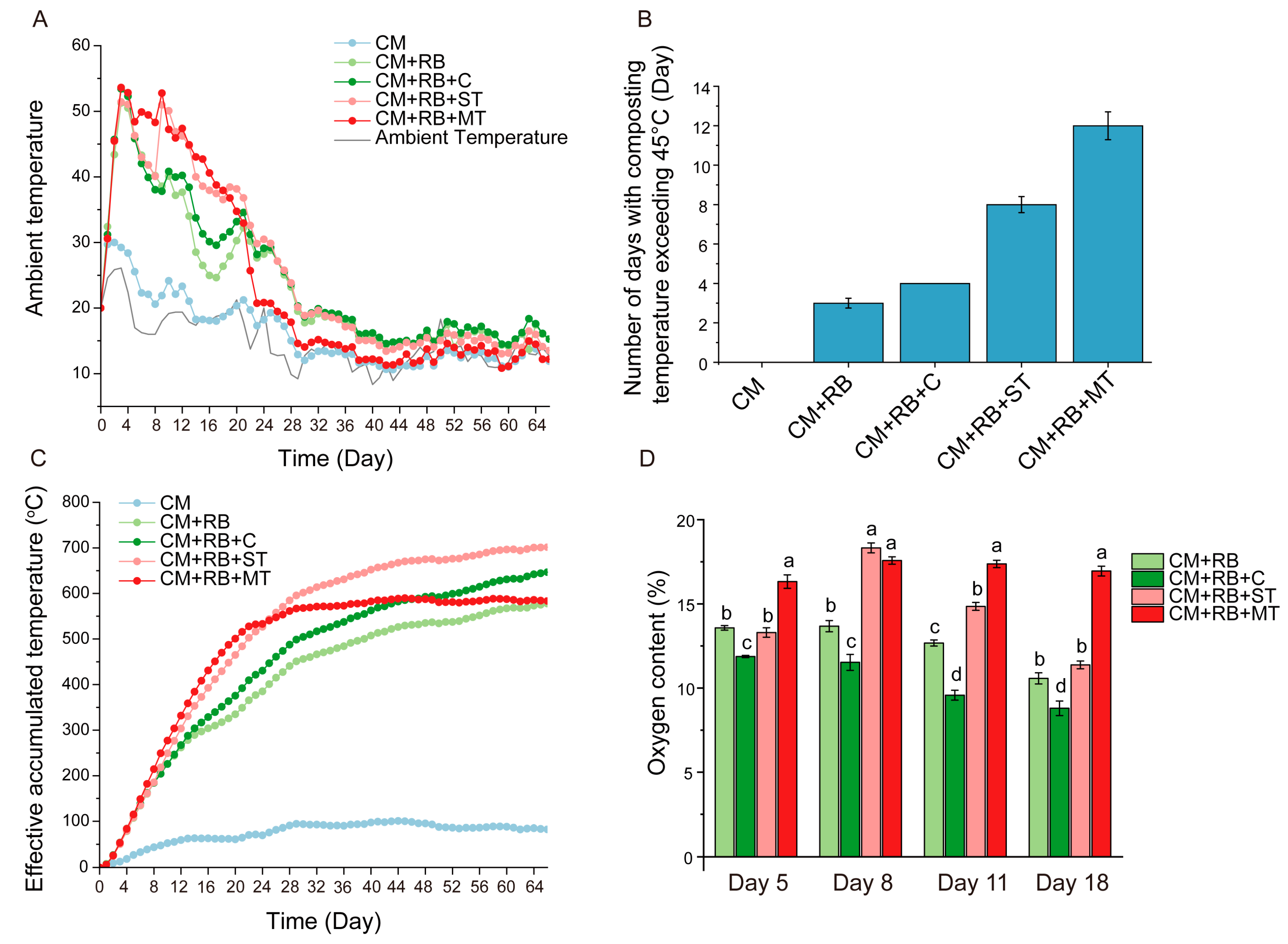
Temperature dynamics in composting systems are primarily driven by microbial metabolic activity and the exothermic decomposition of organic matter. Ambient temperature ranged from 8.4 to 26.1 °C during composting (Figure 1A). The CM pile showed little temperature increase and remained near 30 °C throughout the process, mainly due to the excessively high moisture content of fresh chicken manure, which limited aeration and thus constrained microbial heat generation [27]. After rice-bran addition (CM+RB), temperature rapidly exceeded 45 °C by day 3 and reached a maximum of 51.3 °C, maintaining thermophilic conditions for 3 days (Figure 1B). This indicates that rice-bran addition improved pile structure and adjusted the C/N ratio, thereby stimulating microbial activity and heat generation, which is consistent with previous co-composting studies where bulking/co-substrate materials accelerate thermophilic onset by enhancing aeration and providing readily degradable carbon [28]. Covering (CM+RB+C) further elevated the maximum temperature to 53.4 °C and prolonged the cooling phase. This agrees with evidence that surface coverings, particularly finished or mature compost caps, can reduce convective heat loss and act as an insulating layer, resulting in substantially higher temperatures beneath the cover [24]. The stronger heat retention in CM+RB+C therefore likely reflects reduced heat dissipation at the pile surface. However, the same physical barrier may also restrict gas exchange, which is consistent with the oxygen patterns observed below. Turning substantially enhanced both aeration and microbial heat release: CM+RB+ST peaked at 51.4 °C and maintained ≥45 °C for 8 days, while CM+RB+MT reached 53.6 °C and sustained thermophilic conditions for 12 days. The slightly lower total heat accumulation in CM+RB+MT compared with others likely resulted from heat dissipation during frequent turning (Figure 1C). Nevertheless, turning promoted uniform material mixing and increased contact with oxygen, thereby supporting more active aerobic degradation and energy release [29,30].
Oxygen concentrations also differed markedly among treatments (p < 0.05; Figure 1D). Both CM+RB and CM+RB+C showed a steady decline in oxygen concentration during the first 18 days, and CM+RB+C maintained significantly lower oxygen levels than CM+RB (p < 0.05), suggesting that the cover further restricted oxygen replenishment in the pile interior. In contrast, turning restored aeration: CM+RB+ST reached 18.3% oxygen immediately after the day 8 turning but declined thereafter, whereas CM+RB+MT maintained the highest oxygen concentrations (16.3–17.6%) throughout days 5–18. Temperature and oxygen are tightly coupled during composting, as microbial oxidation both generates heat and consumes oxygen. In CM+RB+MT, the consistently higher oxygen concentrations and temperatures indicate that a more ample oxygen supply supported more active and sustained microbial metabolism. This is consistent with previous studies showing that interstitial oxygen below 5% markedly suppresses aerobic respiration and nitrification [31]. Although the static piles lacked forced aeration, oxygen concentrations in their upper layers remained between 8.8% and 13.6%, indicating that the system was not strictly anaerobic and retained localized aerobic microzones. However, compaction and reduced pore space in the lower layers likely created oxygen gradients that limited heat accumulation. Similar stratification of oxygen and temperature has been reported in other naturally aerated static composting systems [32].

3.2. Carbon Transformation and Humification

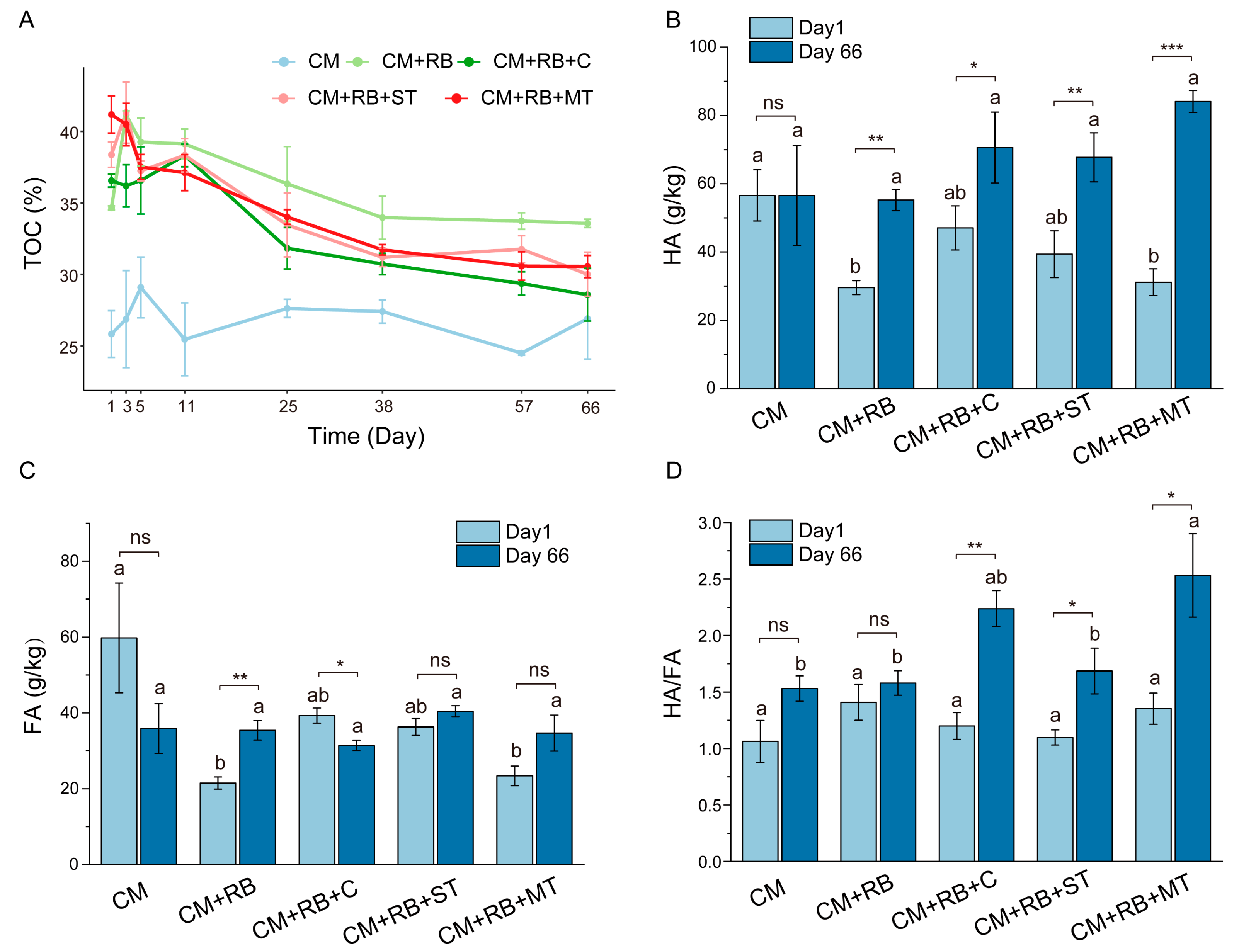
TC decreased markedly in all rice-bran-amended treatments, indicating effective organic matter degradation (Figure 2A). While TC in the CM remained nearly unchanged, rice-bran treatments showed a steady decline throughout composting. By day 66, TC had decreased to 33.6% in CM+RB, 28.6% in CM+RB+C, 30.0% in CM+RB+ST, and 30.6% in CM+RB+MT. The reduction was most pronounced in CM+RB+C, CM+RB+ST, and CM+RB+MT, consistent with their higher cumulative effective temperatures (Figure 1C), suggesting that these treatments achieved more complete microbial decomposition of organic matter. This temperature-linked carbon loss pattern is in line with reports that higher process temperatures are a primary driver of lignocellulose breakdown and subsequent humification during composting [33].
Comparing day 1 and day 66, HA increased significantly in all treatments except CM (p < 0.05), with CM+RB+MT showing the highest HA at the end, followed by CM+RB+C (Figure 2B). FA increased significantly only in CM+RB by day 66 (p < 0.05), with no significant changes in the other treatments (Figure 2C). Consequently, the HA/FA ratio generally rose by day 66, with significant increases in CM+RB+C, CM+RB+ST, and CM+RB+MT (p < 0.05), ranking on day 66 as CM+RB+MT > CM+RB+C > CM+RB+ST (Figure 2D). The overall increase in HA and HA/FA is a typical signature of progressive humification [34]. This pattern indicates that frequent turning promoted more complete oxidation and polymerization of soluble intermediates, thereby enhancing humic condensation and stability. Previous studies have also demonstrated that organic matter decomposition and humification are strongly influenced by oxygen availability [35,36]. However, other studies have reported that moderate oxygen limitation can even enhance humification by promoting aromatic condensation and polymerization of humic precursors [37]. Under low oxygen diffusion, volatile fatty acids and organic acids may transiently accumulate, delaying polymerization until the later stages of composting [38]. Therefore, extending the maturation phase of heap composting, possibly combined with occasional turning, may further enhance humification efficiency.

3.3. Nitrogen Transformation

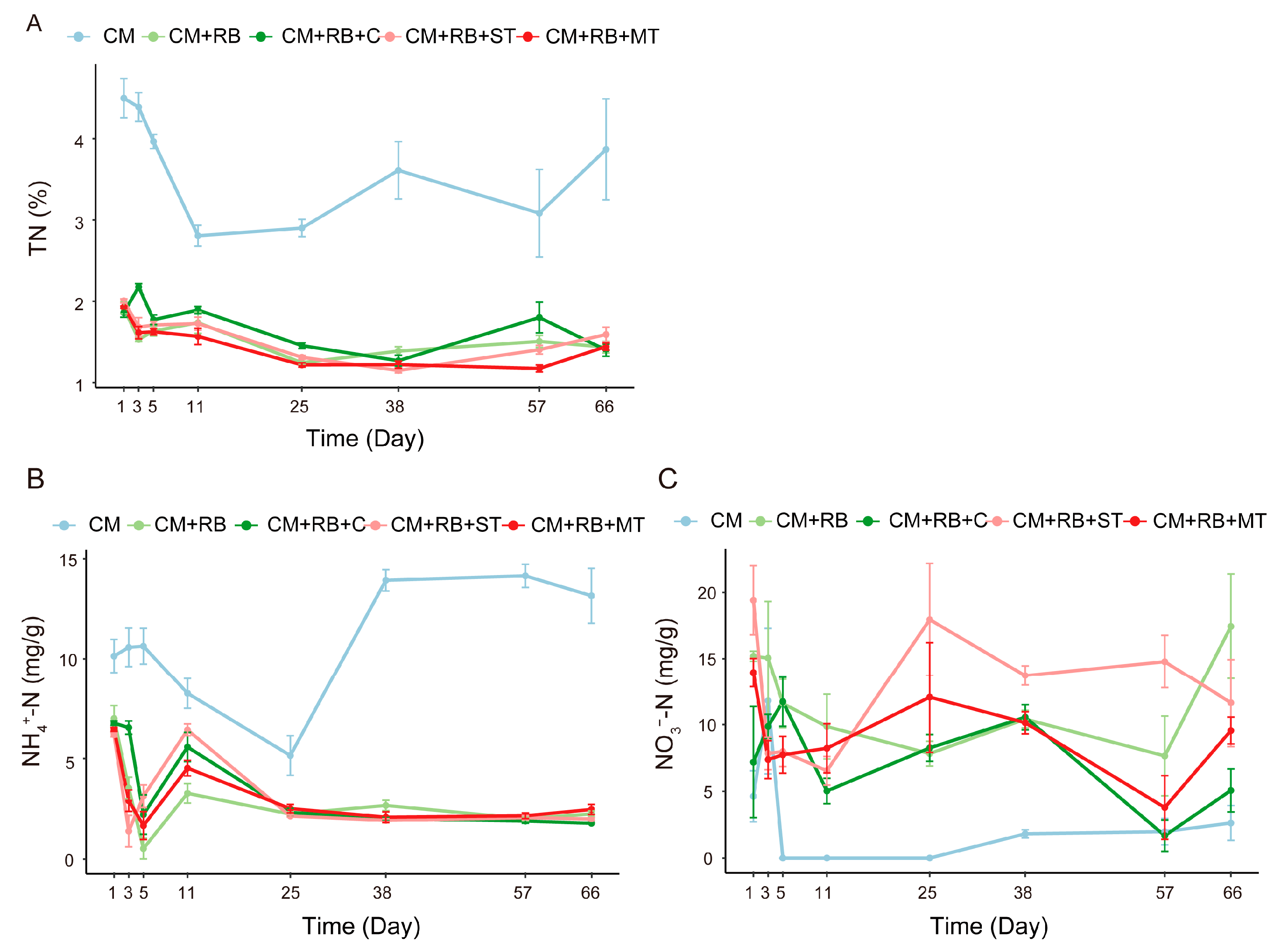
During composting, nitrogen in the feedstock is first converted via ammonification from organic forms to NH4+-N; under elevated pH with ventilation at the pile surface, part of the NH4+ shifts toward NH3 and volatilizes, leading to a decline in TN [31]. With sufficient oxygen supply and when the temperature returns to a suitable range, NH4+ is further oxidized through NO2 to NO3-N, a process known as nitrification, which generally accompanies compost maturation [39]. In this study, the CM treatment showed a pronounced TN decrease at the beginning of composting (Figure 3A), while NH4+-N remained high at day 1–day 5 (10–11 mg g−1), then declined gradually to day 25, but rose again markedly at day 38 and persisted to the end (Figure 3B); by contrast, NO3-N stayed near zero for most of the period (Figure 3C). These patterns indicate that, under static piles of pure chicken manure, NH3 volatilization driven by high pH is an important cause of the TN decrease, and that high moisture and dense aggregation limit oxygen diffusion, suppressing nitrification and thereby promoting NH4+ accumulation in the mid-to-late stages [31].
In comparison, treatments amended with rice bran (with or without turning or covering) exhibited more stable TN dynamics: a gradual decline in the early-mid stages, followed by a slight increase later due to concentration effects from moisture loss and organic carbon mineralization (Figure 3A). Regarding nitrogen species, all rice-bran treatments exhibited a similar NH4+-N pattern, showing a rapid decline in the early stage, a brief rebound on day 11, and a subsequent decrease to a low and stable level (2–3 mg g−1) (Figure 3B). Correspondingly, NO3-N increased after the initial decrease (Figure 3C). The rise was more pronounced in CM+RB+ST and CM+RB+MT by day 25, indicating that turning enhanced nitrification by improving oxygen diffusion and redistributing substrates [29,39]. In contrast, CM+RB+C maintained lower NO3-N levels in the later stage, suggesting that surface covering may restrict nitrification. Although gaseous nitrogen emissions were not directly measured in this study, previous studies suggest that turning and stronger aeration can increase the potential for NH3 volatilization and N2O emission under certain conditions [10,40,41]. For example, a meta-analysis reported that turned composting generally resulted in larger carbon and nitrogen losses than other composting methods [42]. Accordingly, the faster nitrogen turnover observed in turned piles here may be accompanied by a higher likelihood of gaseous N losses; however, this requires confirmation by direct emission measurements. In contrast, heap composting showed lower NO3-N levels, suggesting slower nitrification and nitrogen turnover under micro-aerobic conditions. This may imply a lower likelihood of gaseous N losses, but this cannot be concluded without direct emission measurements. Therefore, oxygen limitation in heap composting should not be regarded as a complete disadvantage but rather as a manageable constraint. When combined with suitable structural bulking agents such as biochar, which enhance pile porosity and aeration, heap composting can still produce composts with high nitrogen content [19,43,44].

3.4. Compost Maturity

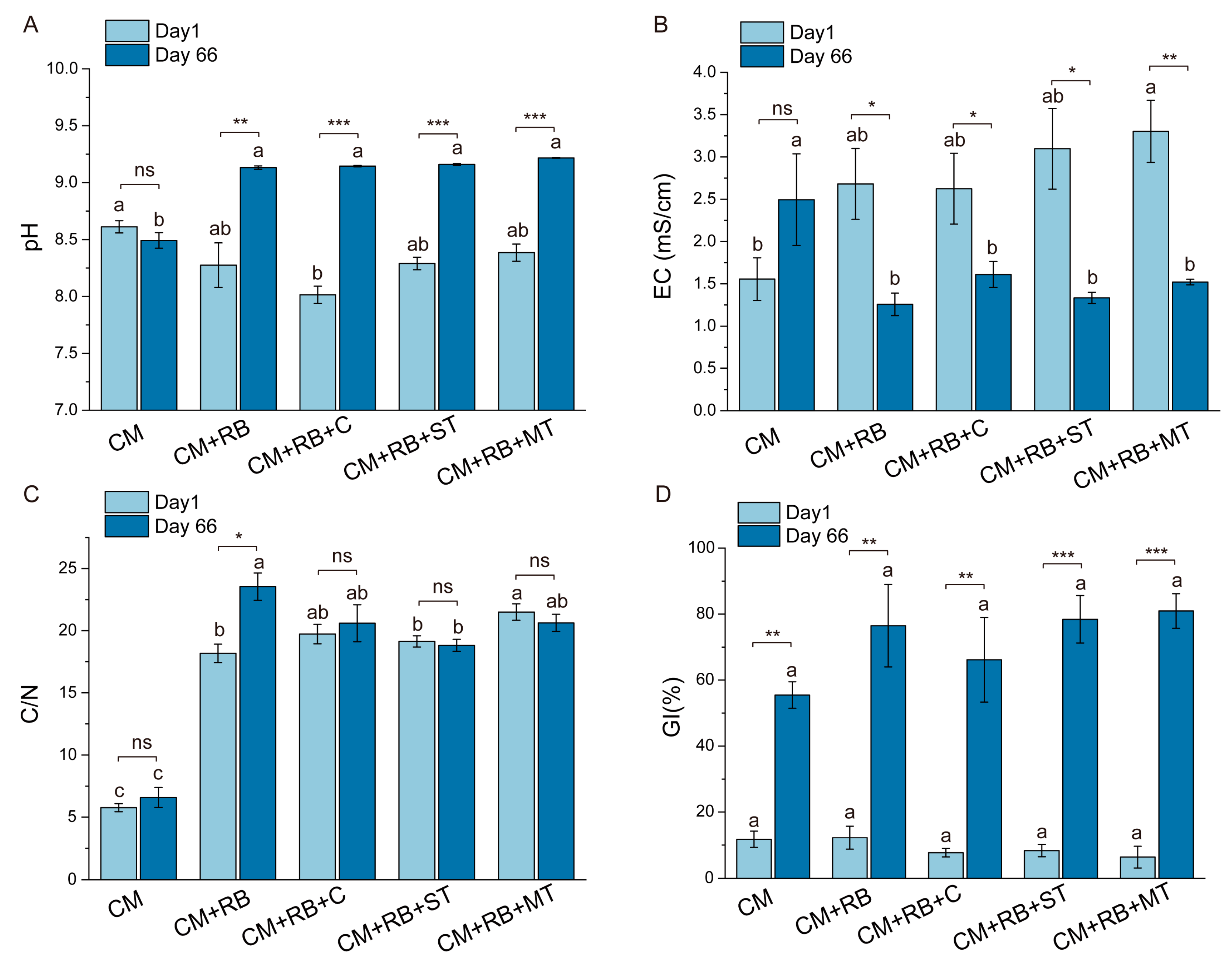
Compost maturity was assessed by pH, EC, C/N, and GI [45]. The initial pH of all treatments was alkaline (8.02–8.61) and remained within this range throughout composting (Figure 4A). By day 66, pH significantly increased in all rice-bran treatments (p < 0.05) but remained stable in CM, reflecting the combined effects of ammonification and organic acid degradation during thermophilic and cooling phases [46]. The sustained alkaline environment is typical for manure-based composts and facilitates humic condensation [47]. However, alkaline conditions can also enhance NH3 volatilization, leading to nitrogen losses [48]. Meanwhile, EC decreased markedly across all treatments except CM, suggesting that soluble salts and ammonium ions were progressively transformed into humic-bound complexes, accompanied by a reduction in free ionic species. The gradual decline of EC is widely regarded as an indicator of the disappearance of toxic intermediates and the formation of stable organic matter [49]. During the composting process, carbon and nitrogen serve as the main sources of energy and nutrients for microbial growth and reproduction, and are continuously decomposed. Consequently, as composting progresses, the C/N ratio of the composting materials changes accordingly. As shown in Figure 4C, except for the CM+RB treatment, which exhibited a significant increase in C/N on day 66, no significant differences were observed among the other treatments. This is mainly because the TN content showed minimal variation throughout the composting process. GI is the only maturity indicator that is independent of the composting method or raw material [45]. It comprehensively reflects the phytotoxicity of compost products and thus serves as a reliable measure of compost maturity. As show in Figure 4D, initial GI values (6.3–12.2%) indicated strong phytotoxicity due to volatile fatty acids and free ammonia, whereas final values reached 55.5% (CM), 76.5% (CM+RB), 66.2% (CM+RB+C), 78.4% (CM+RB+ST), and 80.9% (CM+RB+MT). All treatments except CM and CM+RB+C exceeded the maturity threshold (GI > 70%), consistent with the GI criterion adopted in recent Chinese standards and widely used in compost maturity evaluation [50]. The slightly lower GI in CM+RB+C likely resulted from higher water content and reduced oxygen diffusion under the covering layer, which slowed NH4+-N oxidation and the removal of volatile organic acids [24]. In membrane-covered aerobic composting systems, covering has often been reported to increase GI by retaining heat and improving overall composting performance [51]. In contrast, our mature-compost cover under natural aeration was associated with a slightly lower GI, suggesting that the effect of covering on maturity can vary with the covering material and aeration regime.

3.5. Integrated Evaluation and Process Trade-Offs

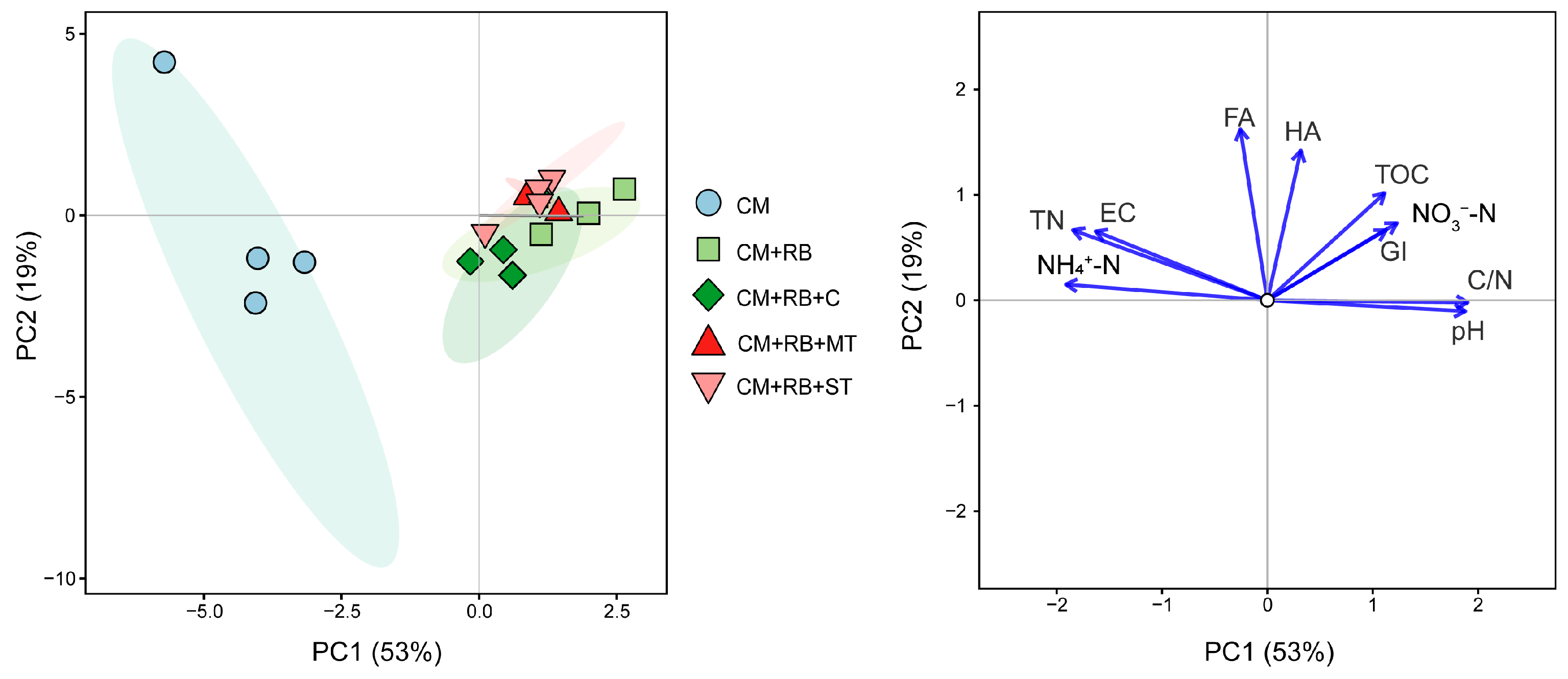
To evaluate the comprehensive impact of different treatments on the composting process, a principal component analysis (PCA) was performed by integrating all physicochemical indicators and maturity indices measured at the end of the process (day 66) (Figure 5). The PCA effectively captured the variance in the dataset, with the first two principal components (PC1 and PC2) explaining 72% of the total variance (53% and 19%, respectively). The CM treatment was distinctly separated along PC1 from all rice-bran-amended piles, reflecting its unique physicochemical profile characterized by low NO3-N, low GI, low HA, and relatively high NH4+-N. This separation confirms that untreated chicken manure underwent limited stabilization and humification. In contrast, the four rice-bran treatments (CM+RB, CM+RB+C, CM+RB+ST, CM+RB+MT) clustered closely in the positive PC1 region, indicating that rice bran effectively unified compost trajectories through improved porosity, C/N balance, and moisture regulation. Their proximity to the arrows representing NO3-N, HA, FA, GI, and TOC suggests that these treatments achieved higher maturity, stronger humification, and more advanced nitrogen transformation. Among the amended treatments, CM+RB+MT and CM+RB+ST were positioned nearest to the NO3-N, HA, and GI vectors, reflecting accelerated nitrification and humic polymerization under stronger aeration. The position of CM+RB+C, slightly away from the maturity-related vectors, suggests that surface covering may have slowed the oxidation of ammonium and organic acids in the late stage.
From a process-engineering perspective, these spatial patterns emphasize the trade-off between operational simplicity and composting efficiency. Multiple turning (CM+RB+MT) clearly shifted the compost toward the direction of maturity-associated indicators, reflecting accelerated stabilization but at the cost of increased labor and energy use, and potentially higher gaseous nitrogen losses, as reported in the literature [10,40]. In contrast, heap composting systems (CM+RB and CM+RB+C) occupied a position intermediate between raw manure and fully aerated compost, demonstrating that low-input management can still achieve acceptable compost quality when supplemented with appropriate bulking agents. This is broadly consistent with recent small-to-medium-scale comparisons showing that static and turned composting can achieve similar final compost quality under certain feedstock and management conditions, even though process trajectories may differ [52,53]. Overall, rice-bran addition was the primary factor shaping the final compost properties, while aeration intensity determined the degree to which nitrogen transformation and humification advanced. Given the experimental scale, our conclusions are most directly applicable to small and medium-sized farm settings with similar pile size and passive aeration. Extrapolation to full farm-scale windrows should be made cautiously, because pile size and aeration conditions can alter heat retention and internal oxygen gradients, potentially affecting nitrification and maturity development. Heap composting achieved slightly slower but still adequate stabilization, representing a practical and resource-efficient approach for small- and medium-scale manure management.

4. Conclusions

Overall, the present results show that although heap composting proceeds more slowly in kinetic terms, it can produce end products comparable to turned aerobic composting in stability, humification, and maturity when an appropriate co-substrate is used. Despite the oxygen-limited nature of heap composting, rice bran, as a structural amendment, helped maintain aerobic microenvironments, thereby supporting effective organic matter degradation and nitrification during the later stages. These findings indicate that rice-bran-amended heap composting can serve as a technically feasible and economically practical option for manure treatment, particularly for small and medium livestock farms where mechanical aeration is unavailable and frequent turning is impractical. In practice, farmers and extension services may prioritize locally available amendments, moisture control, and basic pile-structure management, and apply occasional turning when needed to improve aeration and maturity.
Despite these findings, the present study has several limitations. The experiment was conducted only with small piles, and performance in larger piles may differ due to changes in heat retention and internal oxygen gradients. In addition, gaseous emissions were not directly measured; therefore, interpretations regarding nitrogen loss and retention are mainly inferred from TN dynamics and nitrogen speciation rather than direct flux evidence. Future work should quantify gaseous emissions and establish full nitrogen balances, validate the robustness of this low-input strategy at larger pile scales, and further elucidate underlying mechanisms by linking oxygen distribution with microbial processes.

Author Contributions

M.X.: investigation, visualization, writing—original draft, writing—review and editing; H.F.: formal analysis, investigation; Y.Z.: writing—review and editing; J.X.: writing—review and editing; R.Y.: formal analysis, investigation; Y.C.: resources, funding acquisition, project administration, supervision. All authors have read and agreed to the published version of the manuscript.

Funding

This work was supported by National Natural Science Foundation of China (32271728) and the Open Project of Key Laboratory of Ministry of Agriculture and Rural Affairs (KLTMCUAR2025-01).

Institutional Review Board Statement

Not applicable.

Informed Consent Statement

Not applicable.

Data Availability Statement

Data will be made available on request.

Conflicts of Interest

The authors declare no conflicts of interest.

Abbreviations

The following abbreviations are used in this manuscript:
TOCTotal organic carbon
TNTotal nitrogen
ECElectrical conductivity
GIGermination index
NH4+-NAmmonium nitrogen
NO3-NNitrate nitrogen
HAHumic acid
FAFulvic acid

References

  1. Denoncourt, C.; Chantigny, M.H.; Angers, D.A.; Maillard, É.; Halde, C. Animal manure application promotes nitrogen and organic carbon accumulation in soil organic matter fractions: A global meta-analysis. Sci. Total Environ. 2025, 996, 180097. [Google Scholar] [CrossRef]
  2. Niles, M.T.; Wiltshire, S.; Lombard, J.; Branan, M.; Vuolo, M.; Chintala, R.; Tricarico, J. Manure management strategies are interconnected with complexity across U.S. dairy farms. PLoS ONE 2022, 17, e0267731. [Google Scholar]
  3. Sefeedpari, P.; Vellinga, T.; Rafiee, S.; Sharifi, M.; Shine, P.; Pishgar-Komleh, S.H. Technical, environmental and cost-benefit assessment of manure management chain: A case study of large scale dairy farming. J. Clean. Prod. 2019, 233, 857–868. [Google Scholar] [CrossRef]
  4. Wang, F.; Zhao, S.; Sun, Y.; Song, G.; Sun, Y.; Zhao, K.; Liu, R.; Li, Y.-Y. Strategies optimization to improve environmental benefit of chicken manure anaerobic digestion in China: Insight from life cycle assessment. J. Clean. Prod. 2025, 508, 145589. [Google Scholar] [CrossRef]
  5. Lin, H.; Jiao, H.; Lin, H.; Xu, X. The evolution of policies for the resource utilization of livestock manure in China. Agriculture 2025, 15, 153. [Google Scholar] [CrossRef]
  6. Ministry of Agriculture and Rural Affairs (MARA). Action Plan for Zero Growth of Fertilizer Use; Ministry of Agriculture and Rural Affairs (MARA): Beijing, China, 2015. (In Chinese)
  7. General Office of the State Council (GOSC). Guidance of Accelerating the Utilization of Livestock Manure; General Office of the State Council (GOSC): Beijing, China, 2017. (In Chinese) [Google Scholar]
  8. Wei, S.; Zhu, Z.; Zhao, J.; Chadwick, D.R.; Dong, H. Policies and regulations for promoting manure management for sustainable livestock production in China: A review. Front. Agr. Sci. Eng. 2021, 8, 45–57. [Google Scholar] [CrossRef]
  9. Goldan, E.; Nedeff, V.; Barsan, N.; Culea, M.; Panainte-Lehadus, M.; Mosnegutu, E.; Tomozei, C.; Chitimus, D.; Irimia, O. Assessment of manure compost used as soil amendment: A review. Processes 2023, 11, 1167. [Google Scholar] [CrossRef]
  10. Zhang, Z.; Wu, H.; Zhao, Y.; Wu, Y.; Ming, R.; Liu, D.; Qiao, Y.; Xiao, Z.; Ren, J.; Chen, Y.; et al. Biochar effectively reduced N2O emissions during heap composting and NH3 emissions during aerobic composting. Agriculture 2025, 15, 1907. [Google Scholar] [CrossRef]
  11. Barrington, S.; Choinière, D.; Trigui, M.; Knight, W. Compost convective airflow under passive aeration. Bioresour. Technol. 2003, 86, 259–266. [Google Scholar] [CrossRef]
  12. Yang, Y.; Wang, J.; Yin, J.; Cui, Z.; Li, G.; Liu, G.; Jiang, J.; Yuan, J. Risk level and removal performance of antibiotic resistance genes and bacterial pathogens in static composting with different temperatures. Bioresour. Technol. 2024, 412, 131420. [Google Scholar] [CrossRef]
  13. Zhou, H.; Ding, J.; Meng, H.; Zhang, X.; Li, Y. Survey and development analysis of resource utilization technology of livestock and poultry wastes in China. Trans. Chin. Soc. Agric. Eng. 2022, 38, 237–246. (In Chinese) [Google Scholar]
  14. Chen, X.; Niu, Q.; Li, J.; Zhou, Z.; Wu, Y.; Song, G.; Liu, R. Anaerobic digestion of high-solid chicken manure at different temperature: Intestinal microbiome efficiency, inhibition, and microbial community evolution. Microorganisms 2025, 13, 724. [Google Scholar] [CrossRef] [PubMed]
  15. Manogaran, M.D.; Shamsuddin, R.; Yusoff, M.H.M.; Lay, M.; Siyal, A.A. A review on treatment processes of chicken manure. Clean. Circ. Bioecon. 2022, 2, 100013. [Google Scholar] [CrossRef]
  16. Awasthi, M.K.; Pandey, A.K.; Bundela, P.S.; Khan, J. Co-composting of organic fraction of municipal solid waste mixed with different bulking waste: Characterization of physicochemical parameters and microbial enzymatic dynamics. Bioresour. Technol. 2015, 182, 200–207. [Google Scholar] [CrossRef]
  17. Kazemi, K.; Zhang, B.; Lye, L.M.; Lin, W. Performance of locally available bulking agents in Newfoundland and Labrador during bench-scale municipal solid waste composting. Environ. Syst. Res. 2014, 3, 22. [Google Scholar] [CrossRef]
  18. Yun, M.; Li, C.; Duan, Y.; Chi, X.; Zhu, X.; Ma, J.; Shen, B.; Feng, S.; Zhang, Z. Classification of bulking agents and their regulations on composting: A review. J. Environ. Chem. Eng. 2025, 13, 117318. [Google Scholar] [CrossRef]
  19. Sun, X.P.; Lu, P.; Jiang, T.; Schuchardt, F.; Li, G.X. Influence of bulking agents on CH4, N2O, and NH3 emissions during rapid composting of pig manure from the Chinese Ganqinfen system. J. Zhejiang Univ. Sci. B 2014, 15, 353–364. [Google Scholar] [CrossRef]
  20. Zhang, B.; Fu, T.; Guan, C.-Y.; Cui, S.; Fan, B.; Tan, Y.; Luo, W.; Wei, Q.; Li, G.; Peng, Y. Environmental life cycle assessments of chicken manure compost using tobacco residue, mushroom bran, and biochar as additives. Sustainability 2022, 14, 4976. [Google Scholar] [CrossRef]
  21. Alarefee, H.A.; Ishak, C.F.; Karam, D.S.; Othman, R. Efficiency of rice husk biochar with poultry litter co-composts in oxisols for improving soil physico-chemical properties and enhancing maize performance. Agronomy 2021, 11, 2409. [Google Scholar] [CrossRef]
  22. Noor, R.S.; Shah, A.N.; Tahir, M.B.; Umair, M.; Nawaz, M.; Ali, A.; Ercisli, S.; Abdelsalam, N.R.; Ali, H.M.; Yang, S.H.; et al. Recent trends and advances in additive-mediated composting technology for agricultural waste resources: A comprehensive review. ACS Omega 2024, 9, 8632–8653. [Google Scholar] [CrossRef]
  23. Das, P.P.; Gul, M.Z.; Weber, A.M.; Srivastava, R.K.; Marathi, B.; Ryan, E.P.; Ghazi, I.A. Rice bran extraction and stabilization methods for nutrient and phytochemical biofortification, nutraceutical development, and dietary supplementation. Nutr. Rev. 2025, 83, 692–712. [Google Scholar] [CrossRef] [PubMed]
  24. Maeda, K.; Morioka, R.; Osada, T. Effect of covering composting piles with mature compost on ammonia emission and microbial community structure of composting process. J. Environ. Qual. 2009, 38, 598–606. [Google Scholar] [CrossRef] [PubMed]
  25. Ma, Y.; Liu, L.; Zhou, X.; Tian, T.; Xu, S.; Li, D.; Li, C.; Li, Y. Optimizing straw-rotting cultivation for sustainable edible mushroom production: Composting spent mushroom substrate with straw additions. J. Fungi 2023, 9, 925. [Google Scholar] [CrossRef] [PubMed]
  26. Kong, Y.; Zhang, J.; Yang, Y.; Liu, Y.; Zhang, L.; Wang, G.; Liu, G.; Dang, R.; Li, G.; Yuan, J. Determining the extraction conditions and phytotoxicity threshold for compost maturity evaluation using the seed germination index method. Waste Manag. 2023, 171, 502–511. [Google Scholar] [CrossRef]
  27. Li, M.-X.; He, X.-S.; Tang, J.; Li, X.; Zhao, R.; Tao, Y.-Q.; Wang, C.; Qiu, Z.-P. Influence of moisture content on chicken manure stabilization during microbial agent-enhanced composting. Chemosphere 2021, 264, 128549. [Google Scholar] [CrossRef]
  28. Zhou, J.M. The effect of different C/N ratios on the composting of pig manure and edible fungus residue with rice bran. Compost Sci. Util. 2016, 25, 120–129. [Google Scholar] [CrossRef]
  29. Cook, K.L.; Ritchey, E.L.; Loughrin, J.H.; Haley, M.; Sistani, K.R.; Bolster, C.H. Effect of turning frequency and season on composting materials from swine high-rise facilities. Waste Manag. 2015, 39, 86–95. [Google Scholar] [CrossRef]
  30. Zhou, J.M. Effect of turning frequency on co-composting pig manure and fungus residue. J. Air Waste Manag. Assoc. 2016, 67, 313–321. [Google Scholar] [CrossRef]
  31. Haug, R.T. The Practical Handbook of Compost Engineering, 2nd ed.; CRC Press: Boca Raton, FL, USA, 2018. [Google Scholar]
  32. Wang, K.; Li, W.; Li, X.; Ren, N. Spatial nitrifications of microbial processes during composting of swine, cow and chicken manure. Sci. Rep. 2015, 5, 14932. [Google Scholar] [CrossRef]
  33. Zhao, B.; Wang, Y.; Sun, H.; Xu, Z. Analysis of humus formation and factors for driving the humification process during composting of different agricultural wastes. Front. Environ. Sci. 2022, 10, 954158. [Google Scholar] [CrossRef]
  34. Chang, Y.-T.; Lee, C.-H.; Hsieh, C.-Y.; Chen, T.-C.; Jien, S.-H. Using fluorescence spectroscopy to assess compost maturity degree during composting. Agronomy 2023, 13, 1870. [Google Scholar] [CrossRef]
  35. Nguyen, T.-P.; Koyama, M.; Nakasaki, K. Effect of oxygen deficiency on organic matter decomposition during the early stage of composting. Waste Manag. 2023, 160, 43–50. [Google Scholar] [CrossRef] [PubMed]
  36. Xie, T.; Zhang, Z.; Yu, Y.; Tian, Y.; Wang, F.; Li, D.; Nan, J.; Feng, Y. Aeration intensity drives dissolved organic matter transformation and humification during composting by regulating the organics metabolic functions of microbiome. Chem. Eng. J. 2023, 476, 146645. [Google Scholar] [CrossRef]
  37. Zhu, L.; Tan, C.; Wang, X.; Liu, L.; Dong, C.; Qi, Z.; Zhang, M.; Hu, B. Low-intensity alternating ventilation achieves effective humification during food waste composting by enhancing the intensity of microbial interaction and carbon metabolism. Chemosphere 2024, 357, 142099. [Google Scholar] [CrossRef]
  38. Plachá, D.; Raclavská, H.; Kučerová, M.; Kuchařová, J. Volatile fatty acid evolution in biomass mixture composts prepared in open and closed bioreactors. Waste Manag. 2013, 33, 1104–1112. [Google Scholar] [CrossRef]
  39. Cáceres, R.; Malinska, K.; Marfà, O. Nitrification within composting: A review. Waste Manag. 2018, 72, 119–137. [Google Scholar] [CrossRef]
  40. Ma, Q.; Li, Y.; Xue, J.; Cheng, D.; Li, Z. Effects of turning frequency on ammonia emission during the composting of chicken manure and soybean straw. Molecules 2022, 27, 472. [Google Scholar] [CrossRef]
  41. Nordahl, S.L.; Preble, C.V.; Kirchstetter, T.W.; Scown, C.D. Greenhouse gas and air pollutant emissions from composting. Environ. Sci. Technol. 2023, 57, 2235–2247. [Google Scholar] [CrossRef]
  42. Ba, S.; Qu, Q.; Zhang, K.; Groot, J.C.J. Meta-analysis of greenhouse gas and ammonia emissions from dairy manure composting. Biosyst. Eng. 2020, 193, 126–137. [Google Scholar] [CrossRef]
  43. Harrison, B.P.; Gao, S.; Thao, T.; Gonzales, M.L.; Williams, K.L.; Scott, N.; Hale, L.; Ghezzehei, T.; Diaz, G.; Ryals, R.A. Methane and nitrous oxide emissions during biochar-composting are driven by biochar application rate and aggregate formation. GCB Bioenergy 2023, 16, e13121. [Google Scholar] [CrossRef]
  44. Huang, W.; Sun, X.; Sun, H.; Feng, Y.; Gong, X.; Ma, Y.; Jiang, J.; Xue, L. Effects of biochar and wood vinegar co-application on composting ammonia and nitrous oxide losses and fertility. Bioresour. Technol. 2024, 412, 131388. [Google Scholar] [CrossRef]
  45. Kong, Y.; Zhang, J.; Zhang, X.; Gao, X.; Yin, J.; Wang, G.; Li, J.; Li, G.; Cui, Z.; Yuan, J. Applicability and limitation of compost maturity evaluation indicators: A review. Chem. Eng. J. 2024, 489, 151386. [Google Scholar] [CrossRef]
  46. Sossa, E.L.; Agbangba, C.E.; Koura, T.W.; Ayifimi, O.J.; Houssoukpèvi, I.A.; Bouko, N.D.B.; Yalinkpon, F.; Amadji, G.L. Dynamics of co-composting of pineapple harvest and processing residues with poultry litter and compost quality. Sci. Rep. 2024, 14, 17194. [Google Scholar] [CrossRef] [PubMed]
  47. Zhang, J.; Fan, B.; Zhao, L.; Zhao, C.; Yang, F. Biochar promotes compost humification by regulating bacterial and fungal communities. Front. Microbiol. 2024, 15, 1470930. [Google Scholar] [CrossRef] [PubMed]
  48. Sayara, T.; Sánchez, A. Gaseous emissions from the composting process: Controlling parameters and strategies of mitigation. Processes 2021, 9, 1844. [Google Scholar] [CrossRef]
  49. Jamroz, E.; Bekier, J.; Medynska-Juraszek, A.; Kaluza-Haladyn, A.; Cwielag-Piasecka, I.; Bednik, M. The contribution of water extractable forms of plant nutrients to evaluate MSW compost maturity: A case study. Sci. Rep. 2020, 10, 12842. [Google Scholar] [CrossRef]
  50. Lončarić, Z.; Galić, V.; Nemet, F.; Perić, K.; Galić, L.; Ragályi, P.; Uzinger, N.; Rékási, M. The evaluation of compost maturity and ammonium toxicity using different plant species in a germination test. Agronomy 2024, 14, 2636. [Google Scholar] [CrossRef]
  51. Xiong, J.; Su, Y.; He, X.; Han, L.; Huang, G. Effects of functional membrane coverings on carbon and nitrogen evolution during aerobic composting: Insight into the succession of bacterial and fungal communities. Bioresour. Technol. 2023, 369, 128463. [Google Scholar] [CrossRef]
  52. Morales-Vera, R.; Echeverría-Vega, A.; Ríos-Rozas, H.; Barrera-Valenzuela, F.; Mellado-Quintanilla, D.; Piesche, M.; Roa-Roco, R.; Tramon, S. A comparison of static aeration and conventional turning windrow techniques: Physicochemical and microbial dynamics in wine residue composting. Fermentation 2025, 11, 197. [Google Scholar] [CrossRef]
  53. Assandri, D.; Pampuro, N.; Zara, G.; Bianco, A.; Cavallo, E.; Budroni, M. Co-composting of brewers’ spent grain with animal manures and wheat straw: Influence of two composting strategies on compost quality. Agronomy 2021, 11, 1349. [Google Scholar] [CrossRef]
Figure 1. Temporal dynamics of pile temperature and oxygen concentration under various composting treatments. (A) Variation in pile temperature over time; (B) total duration (days) with temperature above 45 °C; (C) cumulative effective temperature; (D) oxygen concentration in the compost pile. Different lowercase letters indicate significant differences between treatments at the same time point (p < 0.05). Data are presented as mean ± SE (n = 4).
Sustainability 18 01622 g001
Figure 2. Changes in carbon fractions across different composting treatments. (A) Total organic carbon (TOC); (B) humic acid (HA) content; (C) fulvic acid (FA) content; (D) HA/FA ratio. Different lowercase letters indicate significant differences between treatments at the same time point (p < 0.05). Asterisks denote significance levels: * p < 0.05; ** p < 0.01; *** p < 0.001, ns, not significant;. Data are expressed as mean ± SE (n = 4).
Sustainability 18 01622 g002
Figure 3. Dynamics of nitrogen forms across different composting treatments. (A) Total nitrogen (TN); (B) ammonium nitrogen (NH4+-N); (C) nitrate nitrogen (NO3-N). Data are presented as mean ± SE (n = 4).
Sustainability 18 01622 g003
Figure 4. Comparison of compost maturity indices at the initial (day 1) and final (day 66) stages under different treatments. (A) pH; (B) electrical conductivity (EC); (C) carbon-to-nitrogen ratio (C/N); (D) germination index (GI). Different lowercase letters indicate significant differences between treatments within the same day (p < 0.05). Asterisks denote significance levels: ns, not significant; * p < 0.05; ** p < 0.01; *** p < 0.001. Data are expressed as mean ± SE (n = 4).
Sustainability 18 01622 g004
Figure 5. Principal component analysis (PCA) of physicochemical properties and maturity indices on day 66. (Left): score plot showing treatment clusters, where oval shadows (ellipses) in different colors represent 95% confidence intervals for each treatment group. Each point represents a replicate sample (n = 4). (Right): loading plot showing the influence of variables on PC1 and PC2. TOC, total organic carbon; HA, humic acid; FA, fulvic acid; TN, total nitrogen; EC, electrical conductivity; GI, germination index.
Sustainability 18 01622 g005
Table 1. Initial physicochemical properties of the raw materials used for composting.
pHMoisture (%)TOC a
(%)
TN a
(%)
TP a
(%)
TK a
(%)
C/N
Chicken manure8.4776.7832.583.211.341.9010.15
Rice bran8.6110.1552.150.550.150.4394.81
Mature compost9.6221.4720.442.031.522.6510.07
Note: a is calculated on dry basis; TOC: total organic carbon; TN: total nitrogen; TP: total phosphorus; TK: total potassium; C/N: carbon-to-nitrogen ratio.
Table 2. Experimental design and composition of the different composting treatments.
TreatmentChicken ManureRice BranSurface CoveringNumber of Turnings
CM+0
CM+RB++0
CM+RB+C+++0
CM+RB+ST++1
CM+RB+MT++4
Note: “+” and “−” indicate the presence or absence of a material/operation, respectively. CM: chicken manure; RB: rice bran; C: surface covering; ST: single turning; MT: multiple turnings.
Disclaimer/Publisher’s Note: The statements, opinions and data contained in all publications are solely those of the individual author(s) and contributor(s) and not of MDPI and/or the editor(s). MDPI and/or the editor(s) disclaim responsibility for any injury to people or property resulting from any ideas, methods, instructions or products referred to in the content.