Article

Integrating Tsunami Inundation Modelling and Community Preparedness Perception for Coastal Risk Assessment: A Case Study of Tanjung Benoa, Bali, Indonesia


1
Graduate School of Sustainable Development, Universitas Indonesia, Jakarta 16424, Indonesia
2
The Agency for Meteorology Climatology and Geophysics of the Republic of Indonesia, Jakarta 10610, Indonesia
3
Institute of Hydrological and Oceanic Sciences, National Central University, Taoyuan 320, Taiwan
*
Author to whom correspondence should be addressed.
Sustainability 2026, 18(3), 1614; https://doi.org/10.3390/su18031614
Submission received: 31 December 2025 / Revised: 26 January 2026 / Accepted: 28 January 2026 / Published: 5 February 2026

Abstract

Tsunami hazards pose persistent threats to low-lying coastal settlements in Indonesia, where physical exposure and social vulnerability often intersect. This study integrates tsunami inundation modelling using the Cornell Multi-grid Coupled Tsunami (COMCOT) model with a community preparedness assessment to develop a comprehensive understanding of tsunami risk in Tanjung Benoa, Bali, Indonesia. The COMCOT simulation, based on a potential Mw 8.5 earthquake scenario south of Bali, indicates a maximum inundation depth of up to 14 m, where the tsunami waves are projected to traverse the Tanjung Benoa peninsula, with the first tsunami arrival being expected within 24 min after rupture. A social survey involving 327 household heads across six neighborhoods was conducted using the Tsunami Ready Community framework (UNESCO–IOC) to evaluate awareness, preparedness, and response capacities. The overall Preparedness Index (PI) reached 78, categorized as “Ready”, indicating moderate readiness but uneven distribution across neighborhoods. This integrated approach highlights that physical modelling alone is insufficient to capture real tsunami risk without incorporating social preparedness dimensions. The study provides actionable insights for local disaster management authorities and supports the strengthening of the UNESCO–IOC Tsunami Ready Community indicators in Tanjung Benoa. The framework demonstrated here can serve as a replicable model for other coastal communities pursuing sustainable and data-driven tsunami resilience strategies.

1. Introduction

Tsunamis are among the most devastating coastal hazards worldwide, causing extensive loss of life and damage to infrastructure, particularly in low-lying coastal areas. Indonesia, situated along the active convergence of the Indo-Australian and Eurasian plates, is one of the world’s most tsunami-prone countries. Bali, Indonesia, is globally celebrated as a premier tourist destination, with its vibrant economy and critical infrastructure concentrated along picturesque southern coastlines like Kuta, Sanur, and Nusa Dua. This idyllic image, however, belies a significant and imminent seismotectonic threat. The island is situated within the active Sunda Arc, positioning it between two major tsunamigenic sources, the most critical of which is the extended Sunda Megathrust system, specifically the Sumba Megathrust segment [1]. This geographical placement exposes Bali to distinct and severe tsunami hazards, presenting unique challenges for disaster mitigation and public preparedness.
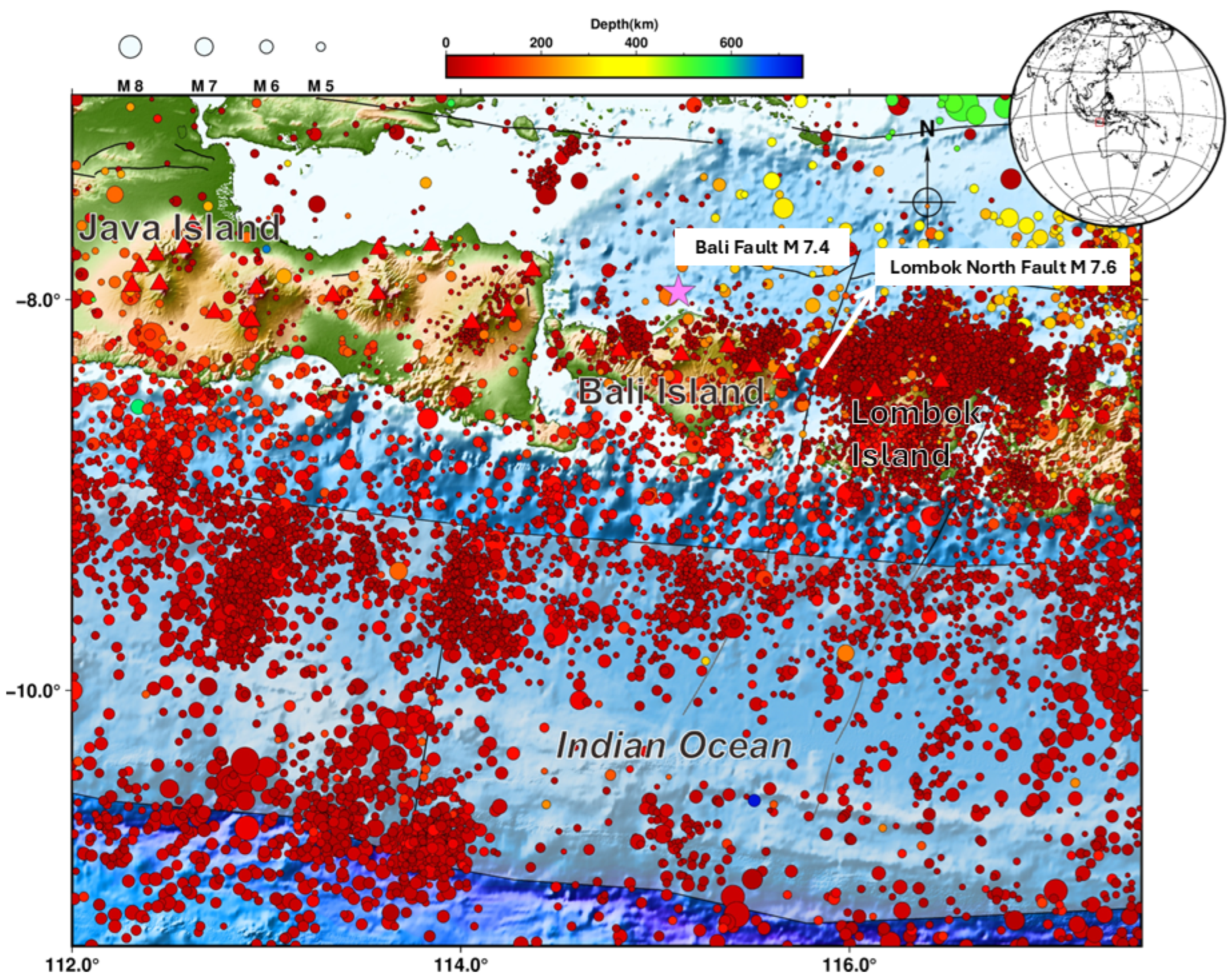
The primary southern hazard originates from the Sumba Megathrust, a major subduction zone with the documented potential to generate a great earthquake of up to magnitude (M) 8.5 [1]. This threat is reinforced by the region’s history of destructive tsunamis along the southern Bali-Nusa Tenggara coastline, including the Sumbawa Tsunami on 19 August 1977, with Mw 8.3 [2], the Banyuwangi Tsunami in June 1994 with Mw 7.8 [3], and the Bali Tsunami on 21 January 1917, with Mw 6.6 [4] which the epicenters distribution show in Figure 1. A major rupture on the Sumba Megathrust would likely trigger a devastating tsunami capable of striking Bali’s densely populated southern shores. Modern assessments confirm that the tsunami’s travel time to the coastline can be as little as 30 to 40 min, leaving a minimal window for effective evacuation [5].
In addition to the megathrust threat, the northern hazard is defined by the Bali Fault (also known as the Flores Back-arc Thrust), a major active fault system [9]. The catastrophic potential of this northern fault was tragically confirmed by historical precedent on 22 November 1815, when a major earthquake (Mw 7.3) triggered a devastating local tsunami that killed 10,253 people in Singaraja and Buleleng on the island’s north coast [8].
Given the immense concentration of population, economic centers, and vital tourism assets in low-lying coastal settlements like Tanjung Benoa Village, the need for robust disaster planning is paramount. Tanjung Benoa is home to approximately 5800 permanent residents [10], a figure that significantly increases with the fluctuating tourist population. Despite having achieved recognition as a UNESCO-IOC Tsunami Ready Community, the village critically lacks a dedicated, permanent tsunami shelter as of 2023. Therefore, this study emphasizes the critical importance of modeling tsunami hazard due to the threat from the Sumba Megathrust earthquake source to provide quantitative data essential for effective mitigation efforts and infrastructure planning.
While advances in tsunami modelling, such as COMCOT (Cornell Multi-grid Coupled Tsunami Model), have significantly improved hazard characterization, the social dimensions of tsunami preparedness remain less explored, particularly in local contexts where community participation is critical. Previous studies often addressed either physical modelling or social perception separately, resulting in a limited understanding of how community readiness aligns with actual hazard exposure. Therefore, an integrated assessment that combines both scientific simulation and community-based insights is urgently needed to support targeted disaster risk reduction strategies.
This study aims to integrate tsunami inundation modelling and community preparedness perception to enhance coastal resilience in Tanjung Benoa, Bali, Indonesia. By combining numerical simulation outputs with empirical data collected from local residents, the research seeks to (1) quantify potential tsunami inundation and affected zones using COMCOT, (2) evaluate the level of awareness, preparedness, and perception within the community, and (3) identify the intersection between physical exposure and social readiness. The results are expected to contribute to the development of locally grounded, evidence-based approaches for achieving a sustainable and tsunami-ready community in coastal Bali.

2. Materials and Methods

This research uses a mixed-methods approach involving quantitative and qualitative analysis.

2.1. Study Area

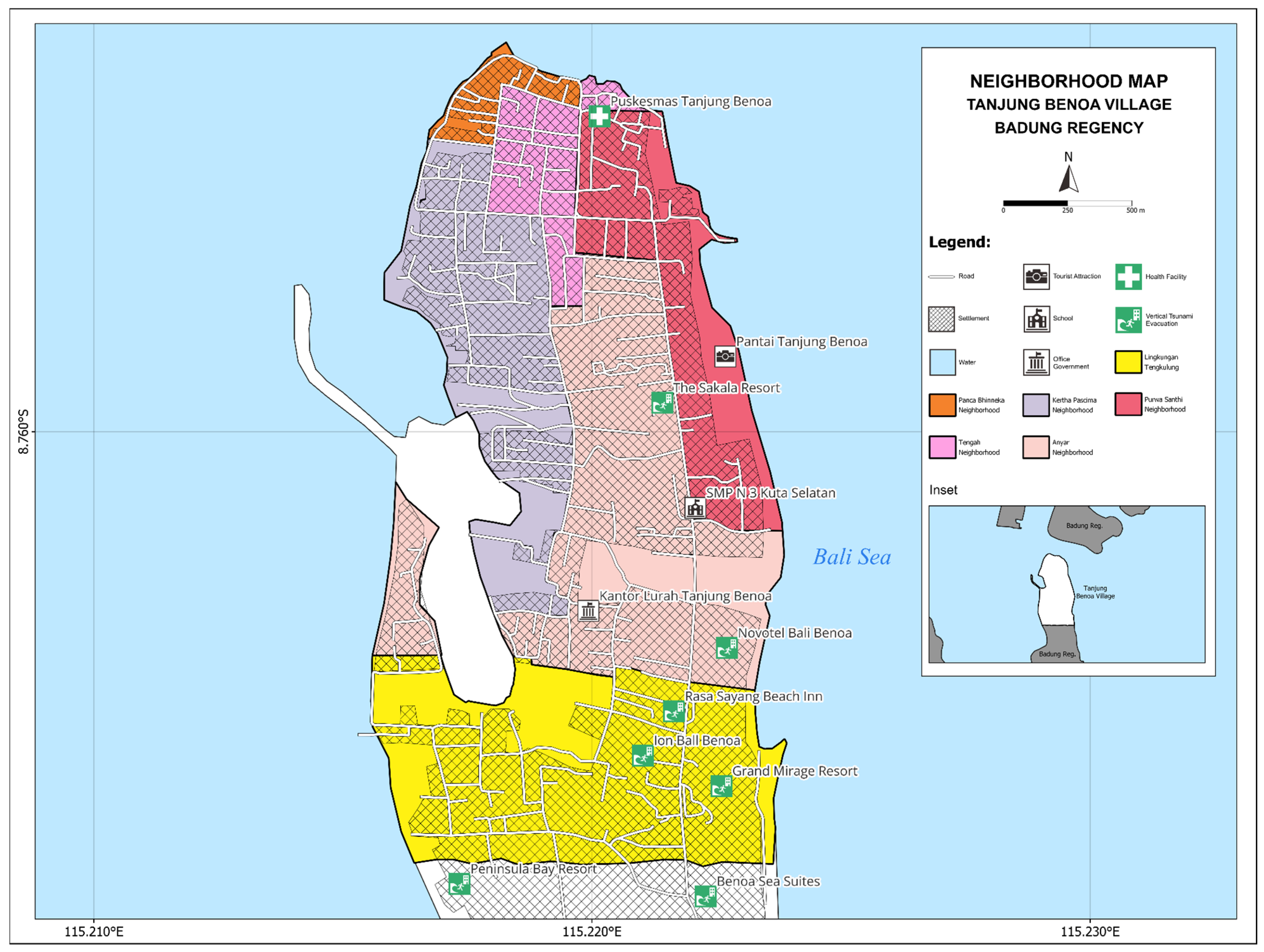
Tanjung Benoa is a narrow peninsula located in Badung Regency, southern Bali, Indonesia (8.759 S–115.220 E). The land covered area is approximately 1.33 km2 and has an average elevation of less than 5 m above sea level (based on satellite imagery data). It is bounded by Benoa Bay to the west and the Indian Ocean to the east. The community consists of six main neighborhoods (banjar), Purwa Santhi, Kerta Pascima, Panca Bhineka, Tengah, Anyar, and Tengkulung, which are shown in Figure 2, with a total population of around 5798 residents in 2025. The region hosts dense residential settlements, tourism facilities, and fishing activities, all of which contribute to high exposure to coastal hazards. Its proximity to the southern Bali megathrust makes it particularly vulnerable to tsunami events generated by offshore earthquakes.

2.2. Tsunami Inundation Modeling

Existing tsunami inundation databases, such as those supporting the Indonesia Tsunami Early Warning System (InaTEWS) [11], provide crucial but coarse hazard information. Specifically, these databases often lack the necessary resolution to produce inundation results at the village level and typically do not adequately incorporate onshore land cover types—a critical factor for accurately estimating bottom friction and run-up distance. Consequently, to generate high-resolution and locally specific hazard maps, a comprehensive deterministic modeling approach was required. This study, therefore, executed the tsunami inundation modeling in sequential stages, commencing with the determination of the earthquake source parameters, followed by the calculation of seafloor deformation, and concluding with the simulation of wave propagation and inundation using the numerical program COMCOT version 1.7 (Cornell Multi-grid Coupled Tsunami Model) [12].

2.2.1. Earthquake Source Model Based on the PusGeN 2017 [1] Assessment

The modeling process commenced by defining a tsunamigenic earthquake scenario with a moment magnitude (Mw) of 8.5, representing the potential worst-case scenario for the subduction segment in the study area, referencing the authoritative 2017 Indonesian Earthquake Source and Hazard Map (PusGeN) [1].
While other potential sources exist to the north, specifically the Bali and Lombok North Faults (Mw 7.4 and Mw 7.6, respectively; Figure 1), they were excluded from this simulation. These northern sources possess significantly lower magnitudes compared to the southern megathrust, and the resulting waves would undergo attenuation while propagating through the narrow straits between Bali and Lombok Islands. Furthermore, the strike-slip mechanism of the Lombok North Fault limits its tsunamigenic potential. Consequently, the study focuses exclusively on the southern megathrust.
Geophysical source parameters, including the centroid coordinates, fault length and width, depth, strike angle, dip angle, and rake angle, were adopted based on the seismic segment boundaries established by PusGeN 2017 [1]. The permanent vertical deformation of the seafloor, which serves as the initial sea-surface displacement for the tsunami wave, was subsequently calculated using the semi-infinite elastic dislocation model developed by [13].

2.2.2. Subfault Discretization Following the Subduction Slab Geometry [14]

To achieve a more realistic and distributed representation of seafloor deformation compared to uniform slip models often used in regional assessments or conventional tsunami modeling studies [15], we utilized a heterogeneous source model consisting of 81 subfaults. The geometry of each subfault, including variations in dip and strike angles, was determined by adapting the regional subduction slab geometry as geophysically assessed, specifically referencing the plate geometry model that was generated by Rupture Generator software [14]. This subfault discretization approach ensures that the initial tsunami condition, calculated as the superposition of deformation from all subfaults, accurately reflects the complex shape of the actual megathrust rupture area.

2.2.3. Tsunami Modeling Using COMCOT with the Nested Layer Method

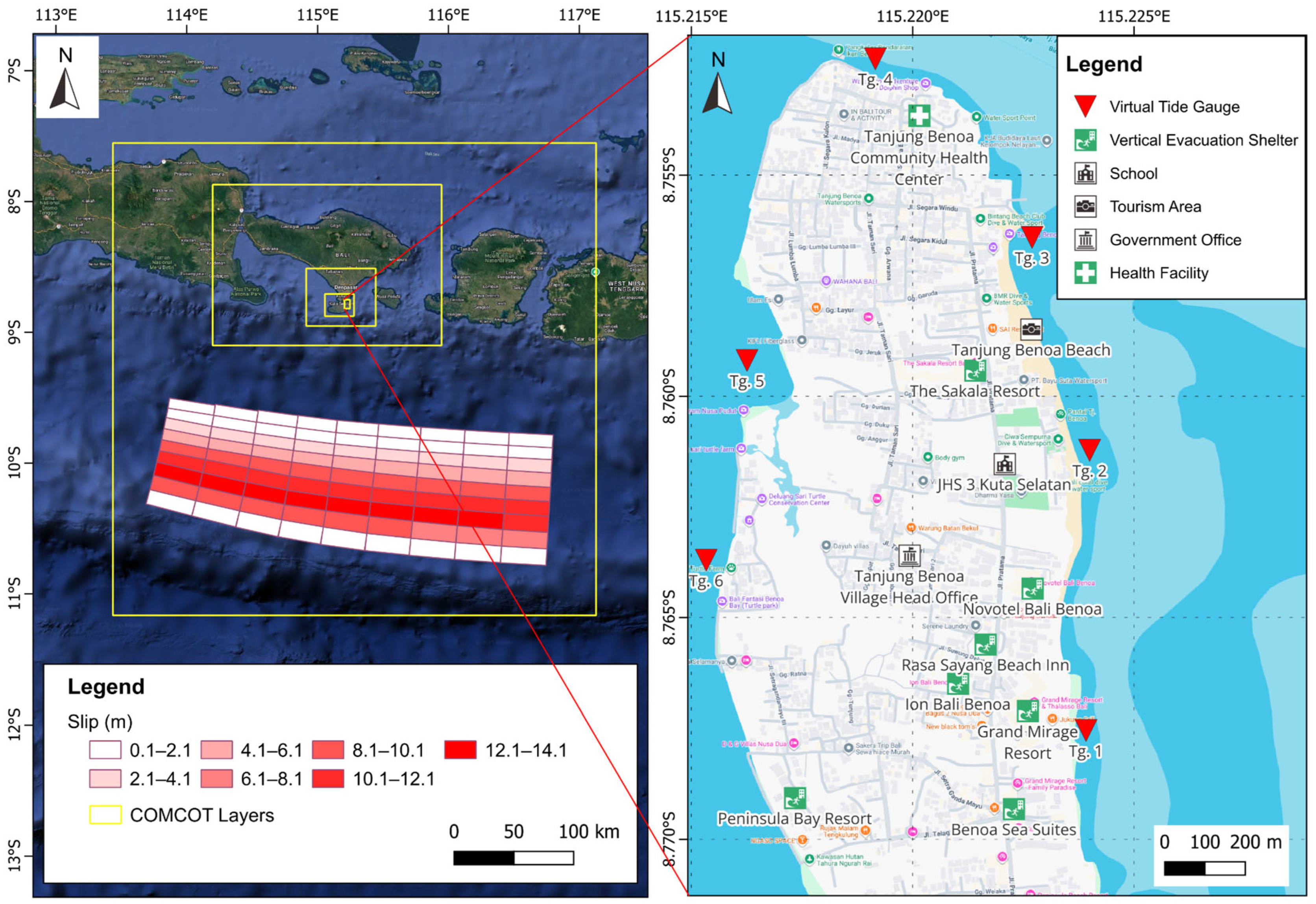
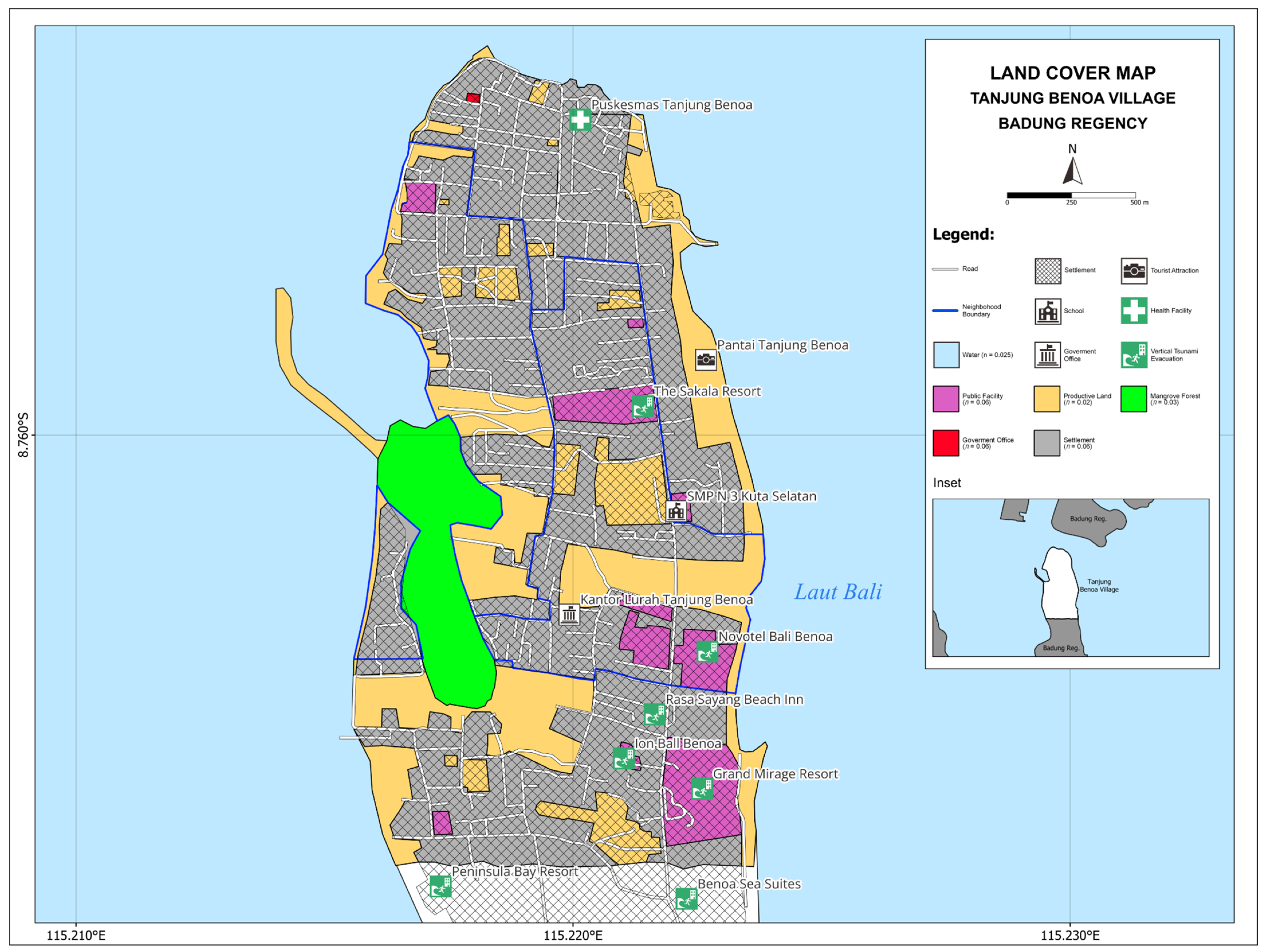
The numerical model COMCOT was configured with specific features for this simulation: it offers flexibility in defining the deformation location (either Centrally, C-Model, or at the Top, T-Model) and supports both Spherical and Cartesian coordinate systems, with the N-wave model selected as the initial deformation model [16]. To manage the disparity between deep ocean and coastal scales and to achieve high-resolution results in the inundation zone, a nested multi-grid system was implemented [12]; this system progressively refined the resolution from first layer (low resolution, deep ocean, e.g., 60 arc second) down to last layer (high resolution, inundation area, e.g., 5 m), maintaining a resolution ratio (e.g., 1:3) between adjacent layers for numerical stability. We employed this 5-layer system to achieve a fine resolution of ~5 m in the innermost domain (Figure 3). This high-resolution micro-zonation represents a critical improvement over regional-scale models (typically ~30–90 m), as it enables ‘street-level’ analysis to identify evacuation bottlenecks within narrow alleys that are often missed by coarser datasets. Within this system, the governing equations were depth-dependent: the computationally efficient Linear Wave Equation (LWE) was used for the first layer (deep ocean) [17], where wave amplitude is small relative to depth, while the Non-linear Shallow Water Equations (NLSWE) were applied to the shallower waters (depths less than 5 m) of the last layer. This transition to the non-linear formulation was necessary because the increasing wave amplitude-to-depth ratio (η/h) makes advective terms significant, requiring the explicit incorporation of bottom friction to correctly model energy loss during run-up [18]. To simulate this dissipation and inundation extent more realistically compared to simplified constant-friction models often used in regional assessments, we implemented spatially varying Manning’s roughness coefficients derived from high-resolution land cover data (Figure 4), utilizing values based on [19]. This heterogeneous friction approach specifically accounts for the distinct flow resistance offered by mangrove forests and dense settlements. Finally, to ensure numerical stability and capture the complete wave train, the simulation utilized a time step of 0.5 s satisfying the stability criterion, with a total run duration of 2 h.

2.3. Community Preparedness and Perception Survey

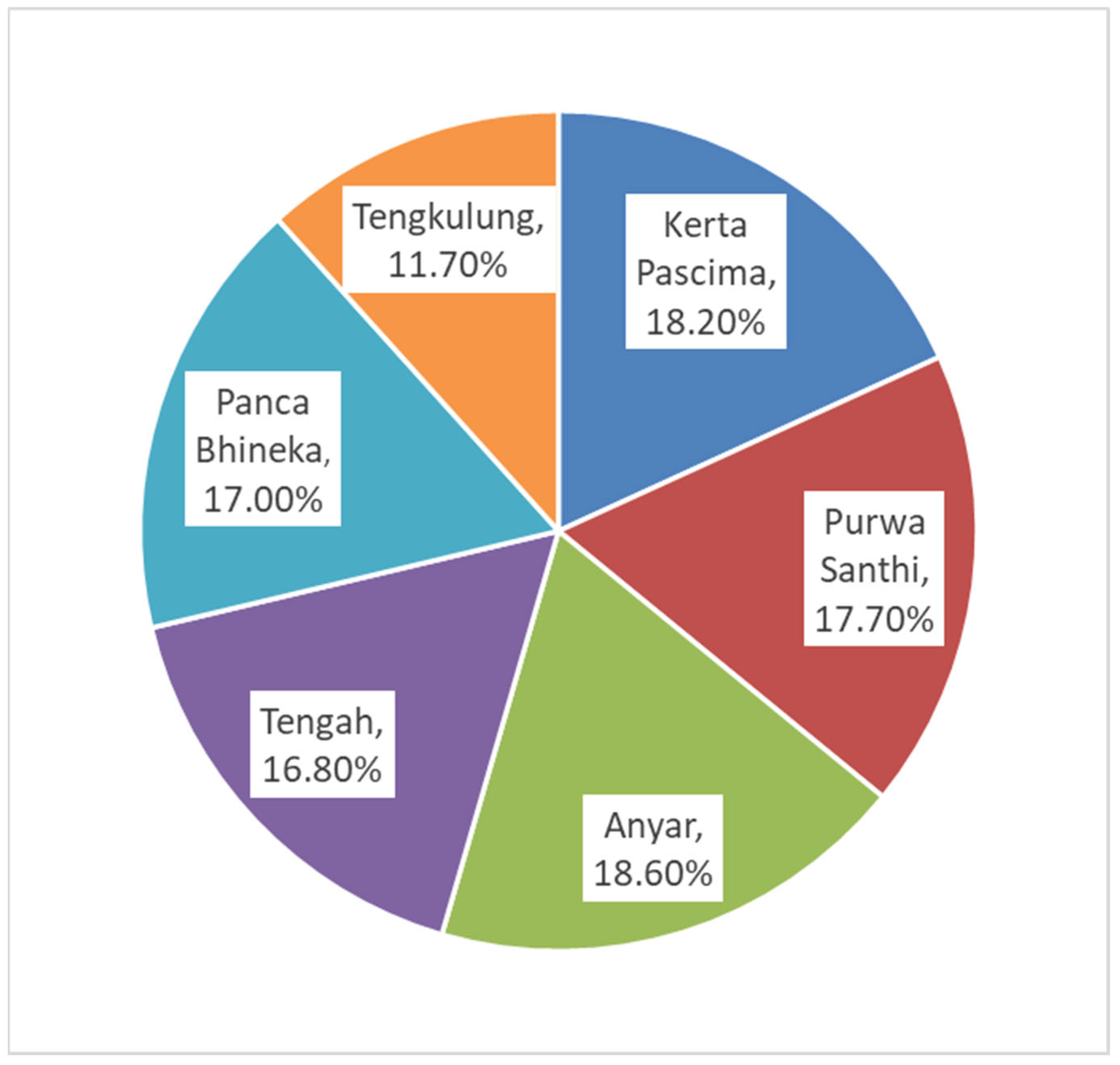
The social component of this research aimed to assess the community’s perception and preparedness toward tsunami hazards in Tanjung Benoa Village. The population consisted of 1303 households in Tanjung Benoa distributed across six neighborhoods (lingkungan): Kerta Pascima, Purwa Santhi, Anyar, Tengah, Panca Bhineka, and Tengkulung. The proportion of neighborhoods as a sample in our study is shown in Figure 5.
The sample size was determined by referring to the sample size determination table developed by [20] for finite populations. Based on the total of 1303 households, the minimum required sample size was 297 respondents. To anticipate potential field errors or non-responses, an additional 10% of the 297 respondents was added, following the recommendation of [21], resulting in a total sample of 327 household heads.
Respondents were selected using a non-probability purposive sampling approach, with specific inclusion criteria:
(1)
The respondent must be the head of household, as they represent primary decision-makers for household-level preparedness;
(2)
Aged 17 years or older, ensuring adequate comprehension and objectivity in responses;
(3)
Permanent residents who have lived in Tanjung Benoa for at least one year.
The number of respondents (around 25%) for each neighborhood was determined proportionally to the total number of households, ensuring equitable representation of both coastal and inland zones. The proportional allocation of 327 respondents is presented in Table 1.
Data analysis in this study was an ongoing process that required continuous reflection on the data, the formulation of analytical questions, and the development of analytical memos during data collection [22]. According to [23], data analysis refers to the systematic process of organizing interview transcripts, field notes, and other collected materials to enhance understanding of a phenomenon and to present it meaningfully to others. Thus, qualitative data analysis in this research involved simultaneous processes of data collection, interpretation, and reporting, aiming to provide an overall picture of community preparedness and to draw conclusions that could inform theoretical and practical implications.

2.3.1. Data Sources and Processing

The data used in this study consisted of both primary and secondary data. Primary data were obtained through field surveys, structured interviews, and direct observations involving 327 household heads from six neighborhoods of Tanjung Benoa. Secondary data were gathered from official documents, reports, and relevant literature concerning tsunami preparedness programs and disaster management policies at the local and national levels.
Data analysis applied a descriptive analytical method, beginning with the preparation of a checklist and scoring system to evaluate community preparedness against tsunami hazards. The main steps included (1) identifying preparedness variables; (2) defining indicators and sub-indicators for each variable; (3) developing a checklist table; and (4) conducting an assessment based on field findings.
To evaluate the level of preparedness, an index-based analysis was used. Each parameter was assigned a specific score and weight, allowing quantitative comparison across different aspects of preparedness.

2.3.2. Data Validation and Triangulation

To ensure data credibility, triangulation was applied as a method of cross-verification from multiple sources and techniques. According to [24], triangulation aims to test data validity by comparing observational data, interview responses, and document content. In this study, the triangulation process involved:
  • Comparing observation results with interview data;
  • Comparing public statements with private opinions;
  • Comparing perceptions over time and between different social groups (community leaders, general residents, business owners, and government representatives);
  • Verifying interview findings against official documents and field observations supported by photographic documentation.
This multi-source comparison enhanced the reliability of the findings and ensured that the results accurately reflected on-the-ground realities.

2.3.3. Checklist Development and Scoring

Preparedness assessment referred to the UNESCO-IOC Tsunami Ready Community indicators [25], adapted to the local context of Tanjung Benoa. Three main parameters were used:
  • Assessment (Identification)—perception and recognition of tsunami risk;
  • Preparedness—household and community-level readiness actions;
  • Response—capacity to act effectively during and after a tsunami warning.
Each parameter consisted of several indicators, organized into a checklist with binary (yes/no) responses. “Yes” responses received a score of 1.03 (reflecting a total of 97 indicators for assessment, preparedness, and response), while “No” responses scored 0. The scoring followed a Guttman-type dichotomous scale, enabling clear classification of preparedness status.

2.3.4. Index Calculation and Classification

The preparedness index for each parameter was calculated using a specific formula [26], in which the total actual score of a parameter is divided by its maximum possible score and then multiplied by 100. The resulting index values range from 0 to 100, where higher scores indicate a greater level of preparedness. Based on these values, the preparedness index classifies readiness levels into five distinct tiers. The top tier, Very Ready, requires an index value of 80–100, while the subsequent Ready level covers the 65–79 range. Mid-tier scores of 55–64 correspond to a Nearly Ready status. On the lower end of the spectrum, scores between 40 and 54 are deemed Less Ready, and any value falling between 0 and 39 is classified as Not Ready [26].
Each parameter was assigned a specific weight based on its relative importance [27], as shown in Table 2.
The weighted index for each parameter was calculated using the equation:
W e i g h t e d   S c o r e = P a r a m e t e r   W e i g h t × A c h i e v e d   S c o r e
The total preparedness index was then derived by summing all weighted scores.

2.4. Tsunami Risk Assessment

Tsunami risk assessment is a systematic approach used to quantify and understand the potential adverse impacts of tsunami hazards on exposed populations, assets, critical infrastructure, and the environment. Internationally, tsunami risk is conceptualized as a function of hazard, exposure, vulnerability, and capacity, where risk increases when high hazard levels intersect with highly vulnerable systems and limited response capability [28]. In disaster science, tsunami risk assessment provides essential evidence for disaster risk reduction (DRR), evacuation planning, early warning systems, land-use regulation, and community-based preparedness programs.

2.4.1. Hazard

Tsunami hazard analysis typically begins with numerical modelling to estimate key parameters that have a direct and immediate impact on exposed communities, particularly tsunami arrival time and inundation characteristics. Hydrodynamic simulation tools are used to determine wave arrival time, inundation extent and depth, flow velocity, and spatial distribution of flooding based on fault parameters, bathymetry, coastal morphology, and wave propagation processes [29]. Among these outputs, the estimated time of arrival is crucial for evacuation planning, while inundation extent and depth govern the scale of damage to populations, infrastructure, and critical facilities [15]. The resulting inundation maps, therefore, form the core of tsunami hazard assessment and provide essential hazard layers describing the intensity and likelihood of tsunami impacts for a given coastal area. These hazard layers are subsequently integrated with spatial data on population distribution and physical assets to support comprehensive tsunami risk evaluation.
The maximum inundation depth was exported as raster format, then was reclassified into three hazard intensity levels:
  • Low hazard (inundation depth < 1 m) has a 0.33 scale value;
  • Moderate hazard (1–3 m) has a 0.66 scale value;
  • High hazard (>3 m) has a 1 scale value.
Each cell value was normalized to a 0–1 scale to allow for comparison with the social preparedness index.

2.4.2. Vulnerability

Exposure assessment identifies people, buildings, critical facilities, and ecosystems located within tsunami-prone zones. Coastal communities with dense settlements, tourism-based economies, or limited high-ground access typically exhibit higher exposure levels [30]. Vulnerability, on the other hand, represents the susceptibility of exposed elements to damage and loss. Vulnerability indicators may include socio-demographic factors (age, income, mobility), structural characteristics of buildings, economic dependence on coastal resources, and ecosystem fragility [31]. Environmental vulnerability is particularly relevant in tsunami-prone regions where mangroves, coral reefs, and wetlands act as natural buffers yet remain sensitive to inundation disturbances.
In calculating vulnerability, we refer to the weighting established by the National Disaster Management Authority of Indonesia (BNPB) to develop the risk map (https://inarisk.bnpb.go.id/metodologi accessed on 3 September 2025) (BNPB, 2012) [32]. There are four types of vulnerability: social vulnerability, physical vulnerability, environmental vulnerability, and economic vulnerability. From these four types, we apply weighting to obtain the total vulnerability index. We express this in the following mathematical equation:
Total Vulnerability Index = Social Vulnerability × 35% + Physical Vulnerability × 25% + Environmental Vulnerability × 10% + Economic Vulnerability × 30%
The normalized value of each vulnerability component is calculated based on classification thresholds (<0.33, 0.33–0.66, and >0.66), which are used to rescale the component values. Social vulnerability considers population, especially population density, female ratio, poverty ratio, disability ratio, and dependency ratio, each having weights of 60%, 10%, 10%, 10%, and 10%, respectively. Physical vulnerability consists of residential areas, public places, and critical facilities with proportional 40%, 30%, and 30%, respectively. Then, environmental vulnerability consists of natural forest, protected forest, and mangrove with proportional 40%, 30%, and 30%, respectively. The other one, economic vulnerability, includes 60% of productive land and 40% of GRDP (Gross Regional Domestic Product) that was obtained from [10]. The population data as of August 2025 for Tanjung Benoa Village is distributed across six neighborhoods (lingkungan) with a total of 5798 residents (Table 3). Anyar neighborhood has the highest population, while Tengkuluug has the lowest. The data also breaks down the population by gender, with a total of 2937 males and 2861 females. The overall gender ratio is 103, indicating slightly more male residents than female residents overall. This information is important for calculating social vulnerability in disaster risk assessment.
Table 4 presents a comparative analysis of vulnerability indices across six distinct neighborhoods, categorized by social, physical, environmental, and economic dimensions. Among the surveyed areas, Anyar exhibits the highest overall susceptibility, recording a Total Vulnerability Index of 0.642, closely followed by Tengkulung at 0.628. This elevated vulnerability in Anyar is driven largely by a high Physical Index (0.697) and a maximum Economic Index of 1. Conversely, Tengah demonstrates the highest resilience with the lowest Total Vulnerability Index of 0.481, despite possessing a relatively high Social Index (0.766). Notably, the Economic Index appears to be a dominant factor, with Kerta Pascima, Anyar, and Tengkulung all registering the maximum value. In terms of environmental factors, Purwa Santhi, Tengah, and Panca Bhineka reported an index of 0, indicating a negligible contribution of environmental issues to their overall vulnerability profiles.

2.4.3. Capacity

Capacity reflects the ability of a community or system to anticipate, respond to, and recover from tsunami impacts. Components of capacity include early warning dissemination, evacuation infrastructure, contingency planning, institutional arrangements, and local knowledge gained from previous events [27]. High community capacity can significantly reduce risk, even when hazard and exposure levels are high.
The integration of hazard, exposure, vulnerability, and capacity produces a comprehensive tsunami risk index that supports prioritization of mitigation strategies. Many countries—including Indonesia—adopt a risk assessment framework similar to that outlined in the Indonesian National Disaster Management Agency (BNPB) regulations, which emphasize spatial analysis, classification of risk levels, and mapping-based decision support tools. Tsunami risk assessment, therefore, plays a central role in guiding preparedness programs, including the UNESCO Tsunami Ready initiative, community evacuation planning, and the design of early warning chains. We assessed the capacity of the residents in Tanjung Benoa Village based on the survey results from three components of the Tsunami Ready evaluation: Assessment, Preparedness, and Response. We assigned weights to these three components as described in Section 2.3.4.

3. Results

3.1. Tsunami Inundation Modelling Results

Numerical simulation using the COMCOT (Cornell Multi-grid Coupled Tsunami Model) produced spatial estimates of tsunami propagation, maximum inundation depth, run-up height, and arrival time for the coastal area of Tanjung Benoa. The model was run under a potential Mw 8.5 subduction earthquake scenario located south of Bali, with an assumed fault plane length of 330 km and a width of 100 km based on seismic parameters from BMKG and the Indonesian Tsunami Model Database [14].
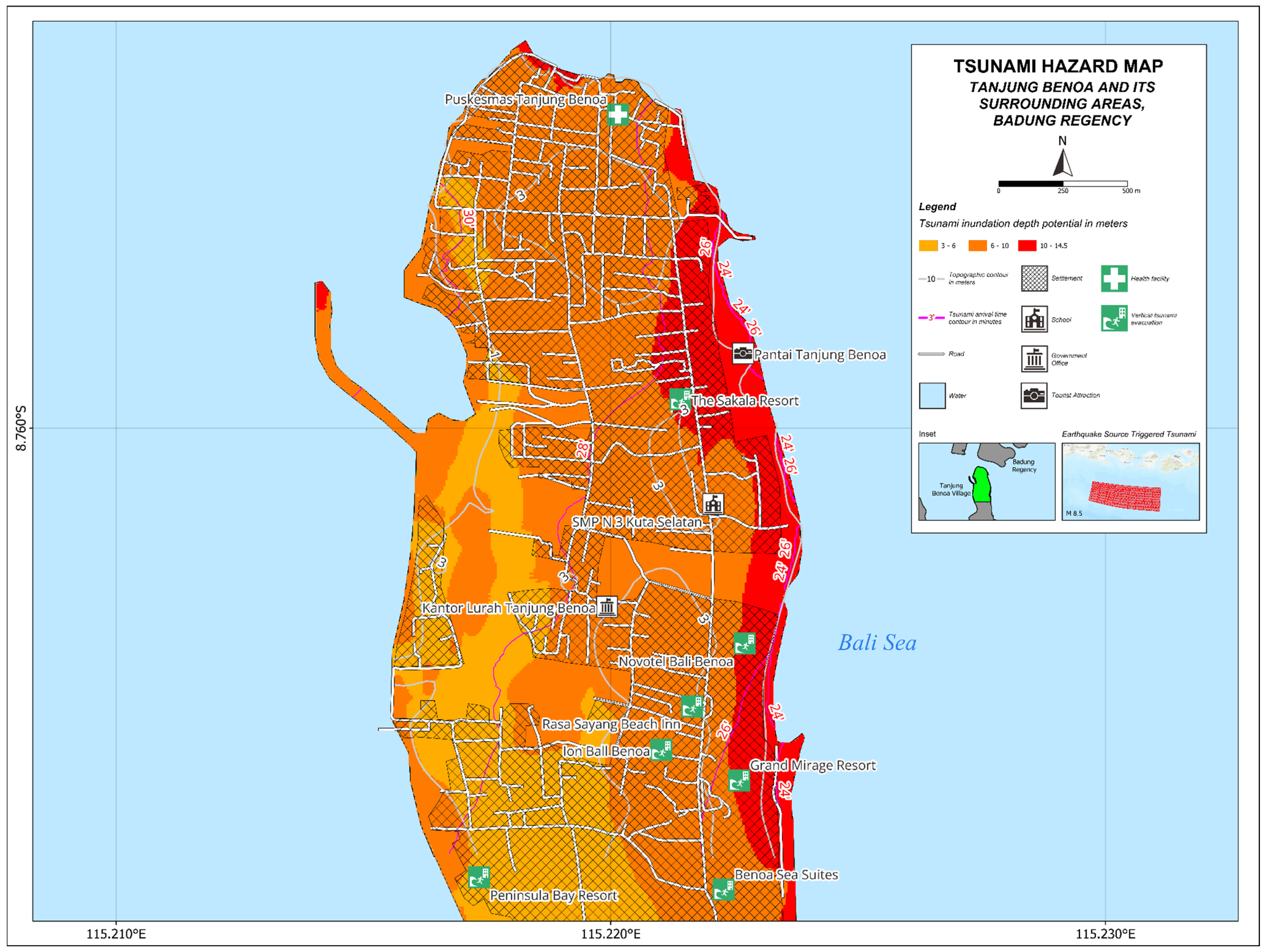
The simulation results indicate that tsunami waves would reach the coastline approximately 24 min after the earthquake rupture. The maximum inundation depth ranges up to 14.474 m in the Purwa Santhi neighborhood, depending on topography and coastal morphology (Figure 6).
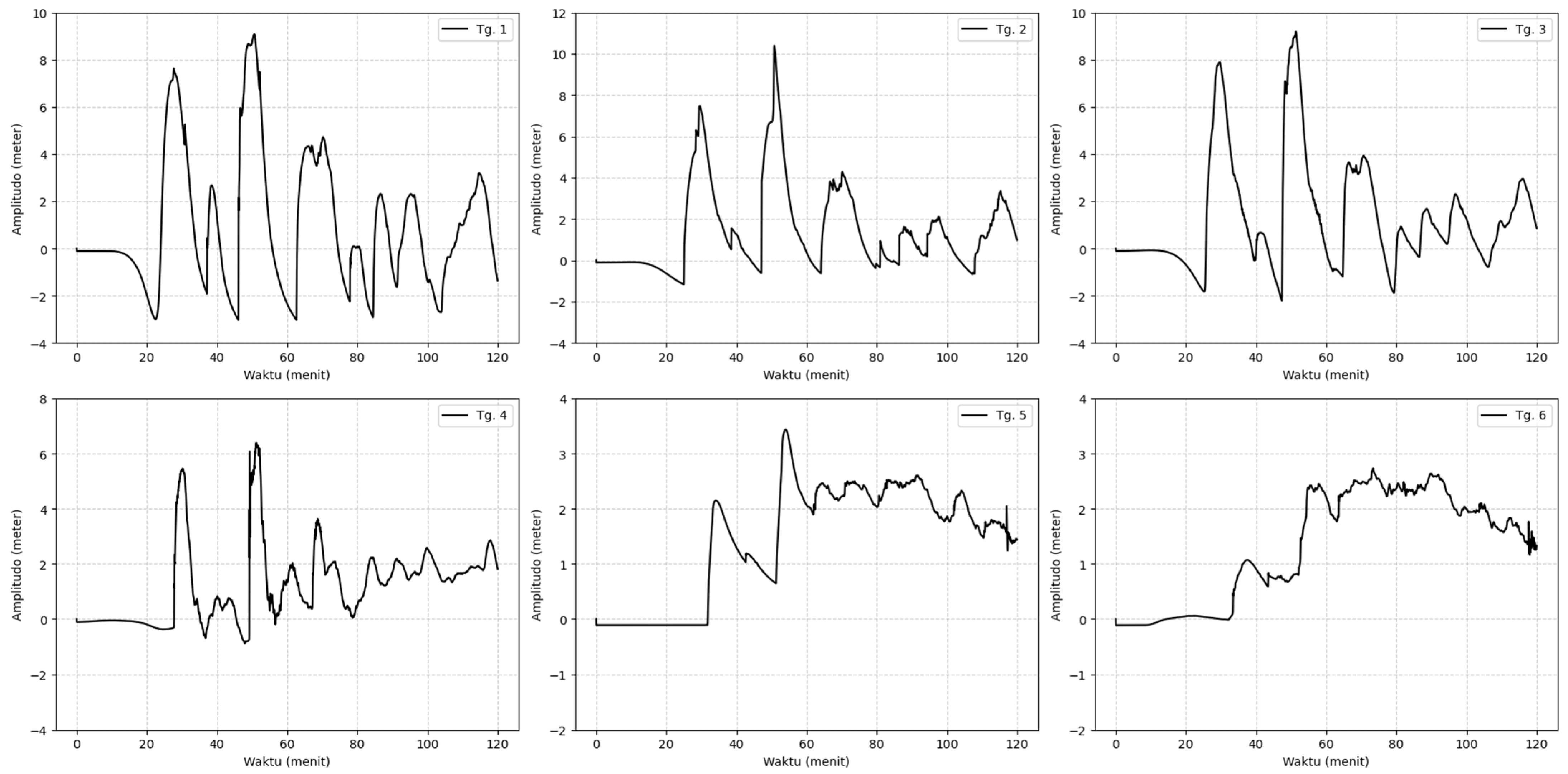
The wave dynamics were further analyzed using virtual tide gauges (Figure 7), which reveal distinct behaviors based on location. The virtual tide gauges positioned outside the bay (i.e., gauges 1, 2, and 3) experienced an initial drawdown of approximately 3 m, whereas this phenomenon was not observed at gauges located inside the bay (i.e., gauges 5 and 6). Furthermore, the simulation shows that the second wave is higher than the first. This amplification is caused by the reflection of wave energy from the island situated to the right, unlike the first wave from the south, this reflected wave propagates perpendicularly and travels directly toward Tanjung Benoa Village (see Video in Supplementary File S1). Meanwhile, the main waves recorded at virtual tide gauges 5 and 6 are those that have already traversed Tanjung Benoa Village. Consequently, the wave energy recorded at these inner-bay locations is attenuated, although the waves exhibit a higher frequency.
These hydrodynamic characteristics directly influence the spatial distribution of the hazard. The southern and central coastal zones, which include tourism facilities, residential clusters, and the main access roads, showed the highest inundation levels (>3 m). The inundation depth in each neighborhood is shown in Table 5.

3.2. Integration of Social, Physical, Environmental, and Economic Vulnerability

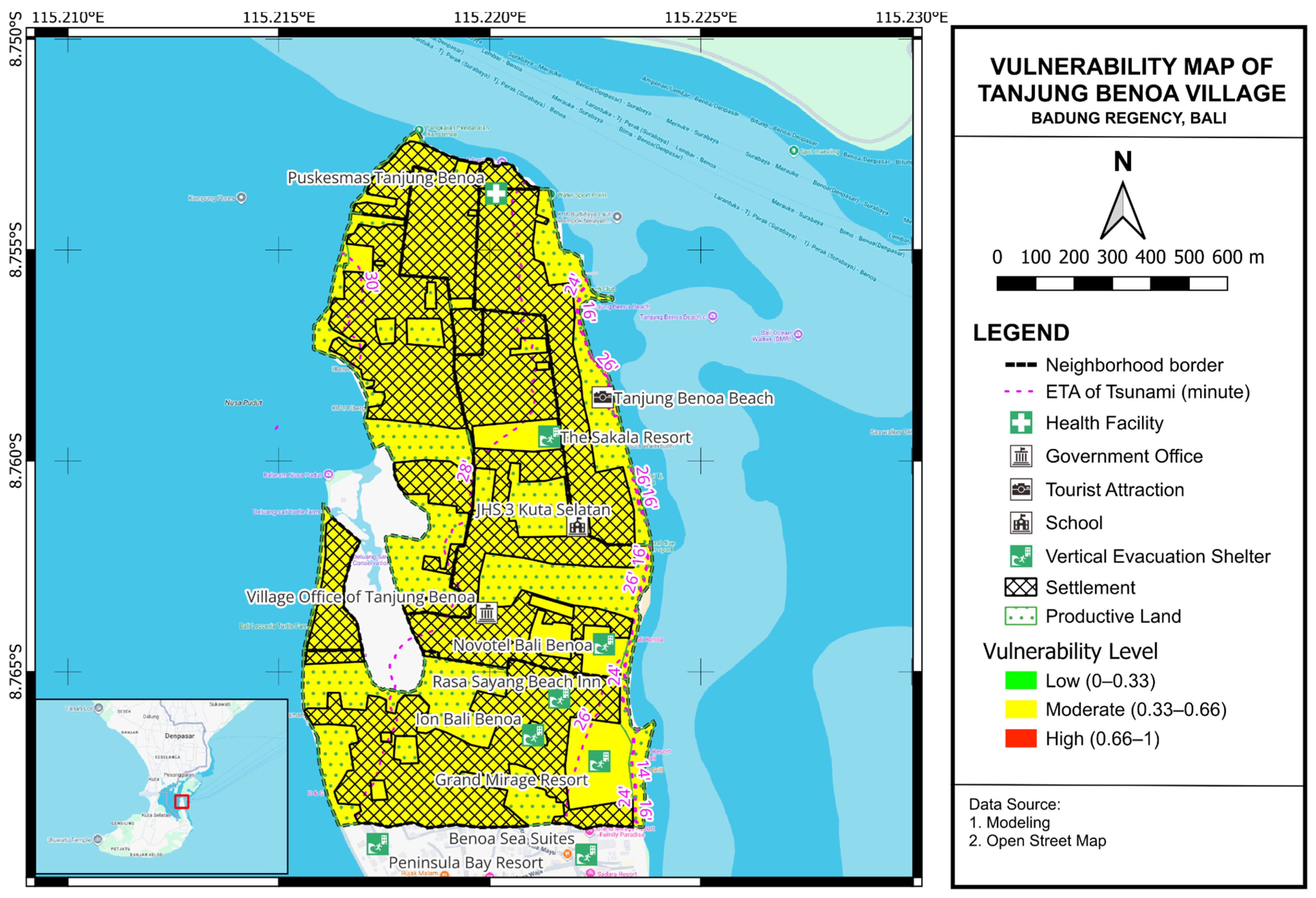
The assessment of tsunami risk in Tanjung Benoa requires a comprehensive understanding of how social conditions and physical interaction influence community vulnerability. The integration of these datasets provides a more nuanced representation of spatial vulnerability, highlighting areas where dense populations, limited resources, and low adaptive capacity converge (Figure 8). This multi-dimensional approach allows for a more accurate identification of zones that are highly exposed not only due to physical proximity to tsunami hazards but also due to social fragilities that may hinder effective response and recovery [33].
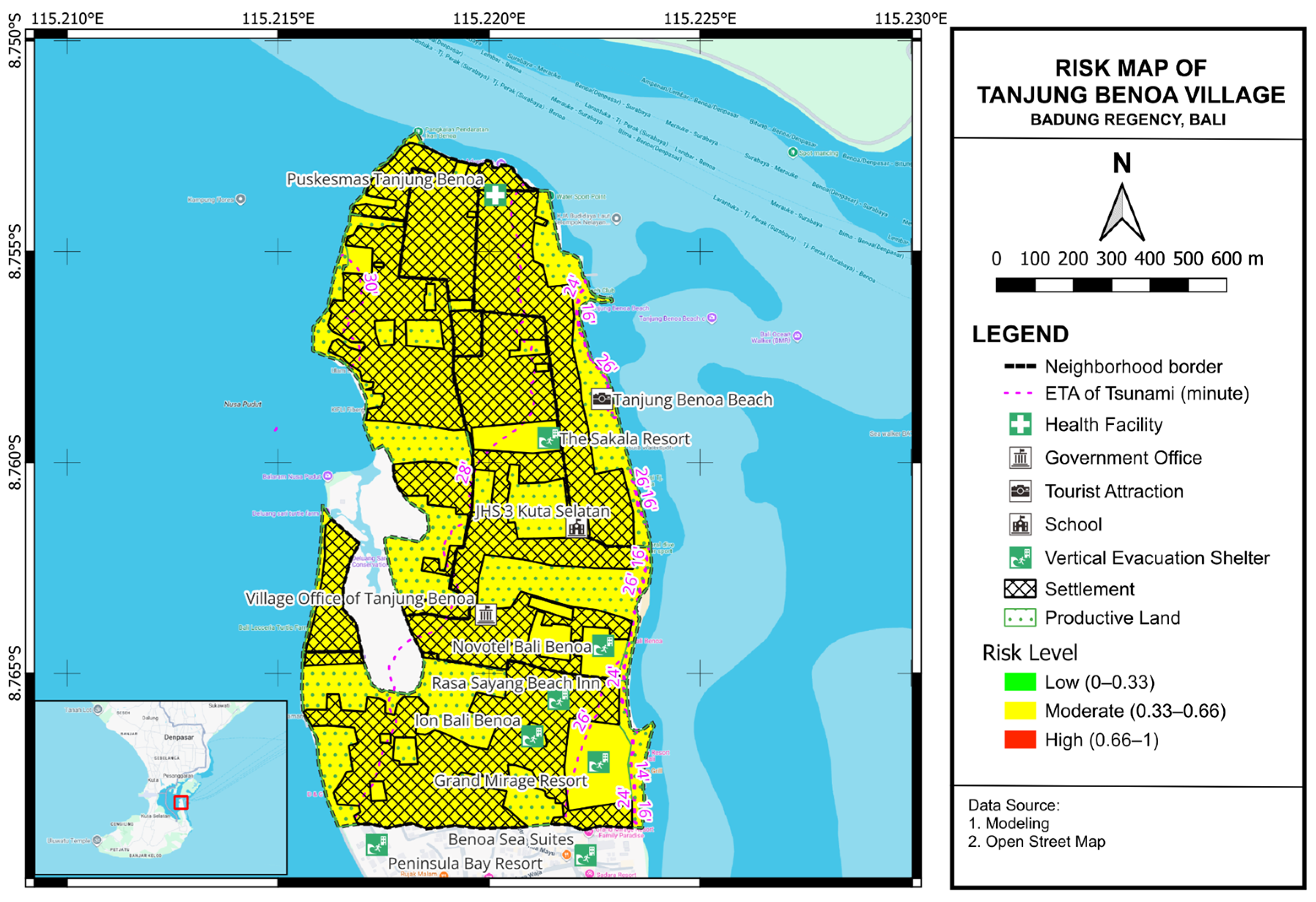
We considered social vulnerability, which consists of population density, female ratio, poverty ratio, disability ratio, and dependency ratio; physical vulnerability, which consists of residential land, public facilities, and critical facilities; environmental vulnerability, which consists of natural forests, protected forests, and mangrove forests; and economic vulnerability, which consists of productive land and Gross Regional Domestic Product (Supplementary File S2).

3.3. Capacity of Tanjung Benoa Villager

Based on the field survey of 327 household heads across six neighborhoods, the overall Capacity Index (CI) of the Tanjung Benoa community was calculated using the method described in Section 2.3. The analysis covered three main parameters—Assessment, Preparedness, and Response—adapted from the UNESCO–IOC Tsunami Ready Community framework.
The results revealed that the overall preparedness level of the Tanjung Benoa community falls into the category of “Ready” with a total weighted index of 78 (Table 6). While awareness of tsunami hazards and early warning systems was relatively high, gaps were identified in evacuation readiness, periodic drills, and access to updated hazard maps.
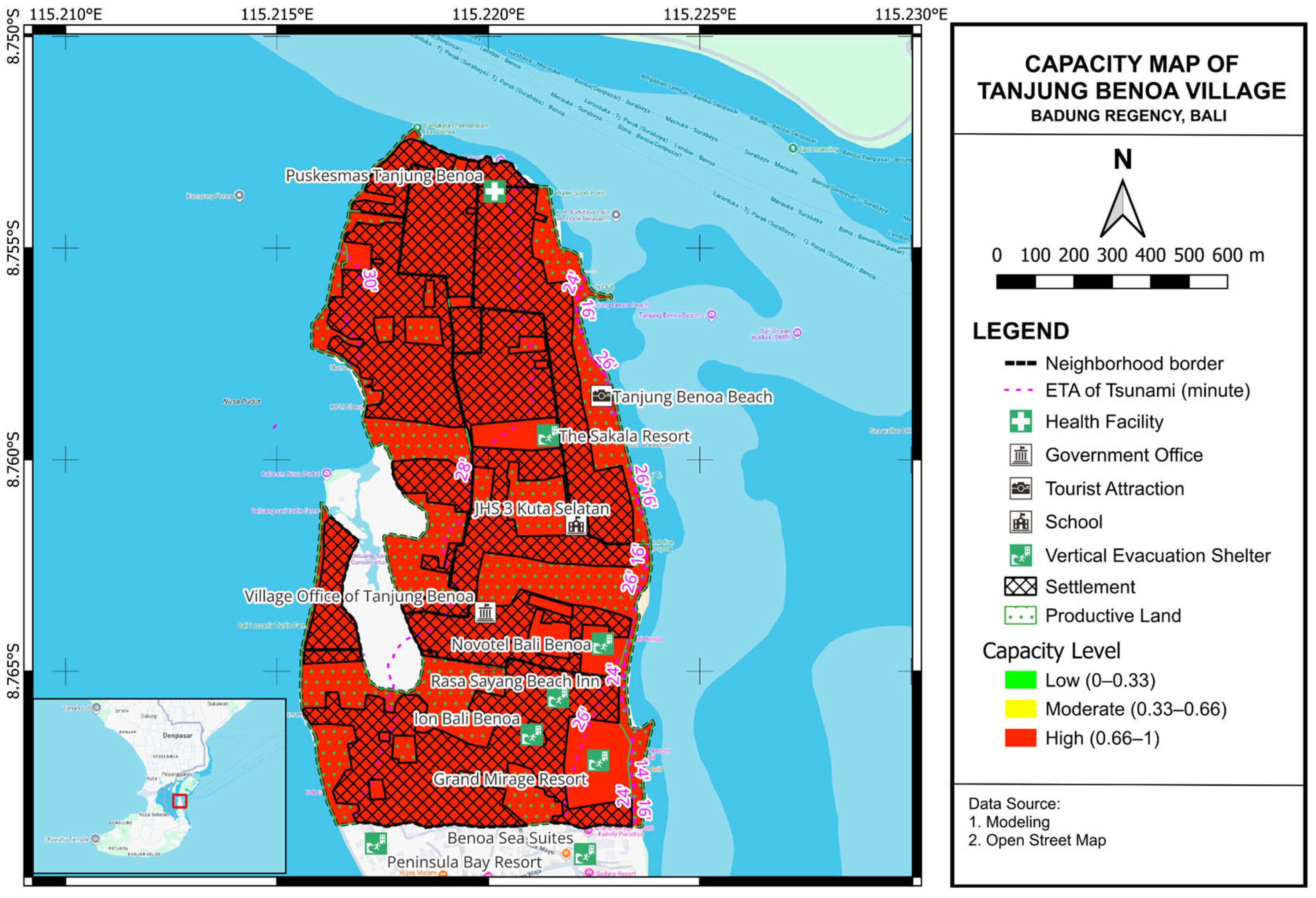
Anyar and Kerta Pascima neighborhoods achieved the highest preparedness scores, largely due to active community participation in BPBD-led tsunami drills and their proximity to early warning sirens. In contrast, Panca Bhineka and Tengkulung showed lower scores, associated with limited access to evacuation routes and a lack of awareness regarding safe zones. The capacity distribution of Tanjung Benoa residents in each neighborhood is shown in Figure 9.

3.4. Tsunami Risk Assessment in Tanjung Benoa Village

The final stage of the analysis involves calculating a composite tsunami risk index. In this framework, hazard represents the inundation potential, vulnerability describes the susceptibility of people and assets to damage, and capacity reflects the level of preparedness and the ability to recover. Each component was spatially analyzed and standardized to ensure consistent comparisons across sub-villages. The resulting composite risk map identifies zones where high hazard and elevated vulnerability intersect with limited capacity, producing significantly higher risk levels (Table 7). Conversely, areas with moderate hazard but strong preparedness capacity exhibit lower overall risk (Figure 10). This integrated approach offers a robust basis for prioritizing risk reduction strategies and guiding targeted intervention planning in Tanjung Benoa [31,34].

4. Discussion

4.1. Analysis of Tsunami Hazard Map

The tsunami hazard map (in Figure 6) is the result of COMCOT modeling with high resolution (grid size ± 5 m, and 5 nested layers as shown in Figure 3) shows that the hall of administrative Tanjung Benoa Village is affected by a tsunami that was used in the megathrust earthquake scenario. Therefore, the inundation depth is irregular; there is a strong gradation from the east to the west. This phenomenon is due to the eastern side where there is no tsunami barrier that propagates to the eastern Tanjung Benoa coastline. On the other side, the western Tanjung Benoa coastline exhibits lower tsunami height, which is due to the land area that covers the Tanjung Benoa. The differences in topography between the east and west sides of Tanjung Benoa Village resulted in an interesting pattern of mariograms that were recorded by virtual six tide gauges.
Given that this study simulates a potential future event rather than reconstructing a historical tsunami, we conducted a benchmarking analysis against the official InaTEWS hazard assessments to ensure physical plausibility. The comparison reveals that our modeling results are consistent with InaTEWS projections. Specifically, the InaTEWS database records a maximum run-up height of 9.943 m at the reference point (Geo code 8.74 S–115.23 E) adjacent to Tanjung Benoa (Supplementary File S3), which aligns with the high-inundation zones observed in our model. Additionally, the simulated first wave arrival time of approximately 24 min is consistent with the dashed line indicating the 30-min estimated arrival time in the InaTEWS warning map (Supplementary File S4).
The eastern and southeastern coasts are dominated by dark red–orange colors, representing inundation depths greater than 8 m, reaching approximately 12–14 m. This zone runs parallel to the shoreline directly facing the earthquake source south of Bali and is geomorphologically characterized by very flat plains. The central and interior areas show a combination of orange and yellow, indicating that inundation depths remain high (around 3–8 m), even though these areas are relatively far from the coast. This suggests that the narrow headland shape and low elevation allow seawater to penetrate far inland. Meanwhile, the western and northwestern coasts, particularly those facing Benoa Bay, are dominated by yellow and light orange, with inundation depths generally less than 3–5 m. In this area, wave energy has diminished due to interactions with the shallow bay and the mangrove vegetation belt [35].
The relationship with land use and critical facilities is evident from the overlay between the hazard map and the distribution of key facilities (Figure 6). The main tourism areas, including hotels and resorts on the eastern side and popular beach zones, are located directly within the high-hazard zone. Essential public service facilities, such as village offices, schools, and health service centers, are also situated within the 3–8 m inundation zone. Furthermore, the primary road connecting Nusa Dua and Tanjung Benoa cuts across the high-hazard zone; in the event of a major tsunami, access in and out of the area, as well as the movement of evacuation vehicles, would be highly likely to be disrupted, underscoring the critical need for effective tsunami preparedness and evacuation planning [36]. One of the measures that needs to be taken to consider the potential inundation height in the Tanjung Benoa area is to use a multi-source approach, as conducted by [37].

4.1.1. Inundation Analysis of Each Neighborhood

The hazard map overlaid with the neighborhood provides a sharper analysis of hazard level on a microscale. Table 5 summarizes the characteristics of the inundation depth and arrival time of the first wave in each neighborhood.
Among the six neighborhoods assessed, Purwa Santhi is identified as the most hazardous. It experiences a maximum inundation depth of 14.474 m, with an average depth of 10.556 m, and an arrival time of 24 min. Nearly the entire area lies within the red zone on the hazard map, where inundation exceeding 10 m would cause destructive damage to buildings and infrastructure [38,39], while the arrival time of less than 24 min leaves very limited evacuation opportunities, especially for vulnerable groups and tourists [40]. Tengkulung, located in the southeastern part of the village and directly facing the open sea, records a maximum inundation depth of 13.958 m, an average depth of 7.085 m, and the fastest arrival time at 24 min. These conditions make it the second most critical zone, with an urgent need for vertical evacuation routes and shelters [41]. Anyar, a densely populated residential and local activity area, shows a maximum inundation depth of 13.523 m, an average depth of 8.377 m, and an arrival time of 24 min. The combination of deep inundation and short arrival time poses a high risk of casualties if not matched by adequate preparedness capacity [42].
Neighborhoods with high hazard levels but longer evacuation times include Tengah and Panca Bhineka. Tengah records a maximum inundation depth of 12.941 m, an average depth of 8.036 m, and an arrival time of 28 min. Although located further inland, it still experiences significant inundation [38]. However, the arrival time—nearly twice as long as that of the eastern areas—provides relatively greater evacuation opportunities, provided that the early warning system functions effectively [43,44]. Panca Bhineka, situated in the northwest, benefits from the presence of Benoa Bay and mangrove vegetation, which slightly reduces the maximum inundation depth to 11.583 m, with an average depth of 8.71 m and an arrival time of 28.258 min. Despite remaining within the high-hazard category, the longer arrival time makes this area a potential evacuation destination, as long as safe locations with sufficient elevation are available. Mangroves have been scientifically shown to reduce tsunami hydrodynamic force and act as natural coastal defenses [45,46].
Kerta Pascima is the neighborhood with relatively lower hazard levels, recording a maximum inundation depth of 8.734 m, an average depth of 6.455 m, and an arrival time of 27.741 min. Although it has the smallest average inundation depth among the six neighborhoods, the range of 6–7 m is still clearly dangerous. With an arrival time of about 28 min, Kerta Pascima has the potential to serve as a relatively safer zone for evacuation assembly points, provided that evacuation routes are well organized and multi-story buildings are effectively utilized [41].

4.1.2. Virtual Tide Gauges Analysis of Each Neighborhood

The analysis of six virtual tide gauges placed around Tanjung Benoa (Figure 4 and Figure 7) provides dynamic information on the tsunami waveforms reaching the study area. All graphs indicate that sea level began to rise within the first tens of minutes after the earthquake, followed by several major wave peaks lasting up to 90–120 min. A clear multi-wave phenomenon is observed, with the second or third peaks at some locations exceeding the height of the first, demonstrating that the tsunami threat does not end once the initial wave has passed [47]. After the main peak, a series of weakening but still significant oscillations occurred, potentially disrupting early search and rescue efforts [48].
The simulation reveals distinct wave characteristics between the exposed and protected coasts, highlighting the influence of island morphology on tsunami propagation [49]. Virtual tide gauges on the eastern and northern sides (Tg. 1, Tg. 2, Tg. 3, and Tg. 4) exhibit a clear initial drawdown (negative phase), typical of a leading depression wave from the south, as characterized by [50]. This phenomenon is observed regardless of the local depth, occurring at both deeper points (Tg 4 at −11.4 m) and very shallow near-shore points (Tg. 1 at −0.15 m and Tg. 2 at −0.13 m). In contrast, gauges on the western side inside Benoa Bay (Tg. 5 and Tg. 6) show an immediate rise in water level without a preceding significant drawdown. Sensitivity tests, including shifting Tg. 5 and Tg. 6 to a deeper position (−0.2 m and −1.0 m), confirmed that the negative phase remains absent even at greater depths (Supplementary File S5). It is important to note that shifting these observation points further offshore was not feasible, as the western area is inherently shallow; doing so would fail to represent the specific hazard characteristics facing the populated coast. The persistence of the waveform pattern, even at these maximum feasible depths, indicates that the phenomenon is governed by hydraulic lag and the complex interaction between wave propagation and the peninsula’s morphology, rather than local bathymetric artifacts. Specifically, the water within the semi-enclosed Benoa Bay cannot recede rapidly through the distant northern strait to generate a drawdown. Furthermore, the positive wave front arriving from the exposed eastern coast overtops the low-lying peninsula, causing the water level at the western gauges to rise immediately via overland flow before any potential withdrawal signal can reach them and the arrival time at the western gauges is significantly later than on the eastern side. Consequently, coastal communities in the western bay area cannot rely on receding sea water as a natural warning sign, highlighting the necessity for artificial early warning systems.
Tide gauges located on the eastern side (e.g., Tg. 1, Tg. 2, and Tg. 3) recorded the highest peak amplitudes, consistent with the extreme inundation depths in Purwa Santhi, Anyar, and Tengkulung. Following the initial drawdown described previously, the water level rose rapidly and reached its peak in a relatively short time, reflecting the concentration of wave energy along the eastern coast. The waves rose rapidly and reached their peaks in a relatively short time, reflecting the concentration of wave energy along the eastern coast. In contrast, tide gauges on the western side (Tg. 5, Tg. 6) showed lower peak amplitudes and gentler wave curves, in line with the role of Benoa Bay and mangrove vegetation in dissipating energy, as well as the shallower inundation depths in Panca Bhineka and Kerta Pascima [51,52]. Mangroves can significantly reduce tsunami wave heights and velocities, thereby lessening inundation [51,52,53]. One tide gauge in a more sheltered area displayed prolonged oscillations of moderate amplitude, indicating local resonance within the bay that can sustain water-level fluctuations for an extended duration [54]. Overall, the tide gauge patterns are highly consistent with the hazard map and neighborhood-level inundation results [55,56]: high amplitudes at eastern gauges correspond to deep inundation in eastern neighborhoods, lower amplitudes at western gauges align with relatively shallower inundation in western neighborhoods, and the presence of multiple wave peaks explains why flooding can persist and recur, thereby increasing the likelihood of layered damage and prolonging disruption.

4.1.3. Analysis of the Relationship Between Hazard Maps, Inundation per Environment, Tide Gauges, and Evacuation Systems

The analysis of hazard maps, neighborhood inundation, tide gauges, and evacuation systems highlights critical interconnections. Tsunami modeling for the Mw 8.5–8.7 scenario using COMCOT indicates that the entire area of Tanjung Benoa would be inundated. The eastern–northern coastal zones (Purwa Santhi, Anyar, and parts of Tengkulung) experience maximum inundation depths exceeding 12–14 m, with average depths of 8–11 m. In contrast, the western coast near Benoa Bay (Kerta Pascima, Tengah, and Panca Bhineka) is inundated more shallowly (approximately 6–9 m), due to slightly higher elevation and the presence of mangrove vegetation acting as a natural barrier [45,46]. Tsunami arrival times at the shoreline range from 24 to 28 min after the earthquake, faster along the southern–central eastern coast and slower in the western and northern sectors. The implications for evacuation are significant: since no permanently safe zones exist at ground level, vertical evacuation is the primary strategy [41]. The relatively dense road network in the eastern–central coastal area allows short horizontal movement (3–10 min on foot) toward tsunami evacuation shelter (TES)-designated hotels or multi-story buildings. However, zones with inundation depths greater than 10 m require TES floors at sufficient elevation (≥12–15 m above mean sea level plus freeboard), meaning not all multi-story buildings are suitable as TES structures [38,39]. The prone residents can be evacuated into community halls in each neighborhood. The results obtained, along with the analysis of buffer time for self-evacuation, are presented in Table 8.

4.2. Integrating Physical Hazard and Social Preparedness Dimensions

Our study demonstrates the importance of integrating physical hazard modelling and social preparedness assessment to generate a comprehensive understanding of tsunami risk in coastal areas such as Tanjung Benoa. The COMCOT simulation provided a quantitative estimation of tsunami inundation potential, revealing that the eastern and central coastal segments are the most exposed zones, with inundation depths exceeding 3 m and travel distances reaching 850 m inland. Meanwhile, the preparedness survey indicated that these same neighborhoods exhibited moderate-to-low preparedness levels, particularly regarding evacuation route familiarity and practical response actions.
This alignment between high hazard exposure and limited preparedness capacity reinforces the necessity of localized risk communication and participatory planning, echoing findings from a similar study in Mentawai [60], where community awareness did not always correspond with physical hazard intensity. By integrating both datasets, this research moves beyond conventional hazard mapping and provides actionable insights for community-based disaster risk reduction (CBDRR).

4.3. Spatial Variability of Risk and Implications for Evacuation Planning

The Tsunami Risk Index revealed clear spatial differentiation among neighborhoods.
  • Anyar and Purwa Santhi exhibited high composite risk, driven by both high inundation potential and medium preparedness levels.
  • Kerta Pascima and Tengkulung, although less exposed physically, still require sustained preparedness reinforcement due to their reliance on external information sources and lower participation in evacuation drills.
This spatial variability emphasizes the importance of targeted evacuation planning rather than uniform policy interventions. Evacuation strategies should prioritize neighborhoods with high hazard–low preparedness overlap, where the shortest but safest evacuation routes must be mapped and clearly signposted. The integration of COMCOT model outputs with community data allows local governments and BPBD to design site-specific evacuation maps, improving efficiency and reducing evacuation time under realistic warning scenarios. This approach aligns with the Sendai Framework for Disaster Risk Reduction (2015–2030) priority to “understand disaster risk in all its dimensions of exposure, vulnerability, and capacity.”

4.4. Community Readiness and the Tsunami Ready Framework

The overall preparedness index of 78 (“Ready” category) indicates that Tanjung Benoa has achieved moderate progress toward resilience, particularly in awareness and response capacity.
However, there are remaining challenges in sustaining community participation, maintaining early warning infrastructure, and ensuring inclusivity in preparedness education. Within the UNESCO–IOC Tsunami Ready Community framework, the findings correspond to several critical indicators that still need strengthening:
  • Indicators 1 and 4: Updated tsunami hazard and evacuation maps—not yet fully disseminated to the public.
  • Indicator 7: Outreach or educational activities are held at least three times a year.
  • Indicator 9: Documented community response and recovery plans—require institutionalization within local governance mechanisms (Kelurahan and Disaster Risk Reduction Forum (FPRB)).
These gaps highlight that technical hazard assessment alone is insufficient. Sustainable tsunami preparedness must be rooted in continuous community engagement, local leadership commitment, and integration with local planning policies, such as Rencana Kontinjensi (Contingency Plan) and Rencana Tata Ruang Wilayah (Spatial Plan) of Badung Regency. Although in reality Tanjung Benoa Village is a tourist area with many visitors, this study faced limitations regarding the respondents who participated.

4.5. Comparison with Other Coastal Communities

The integrated results of this study are consistent with global observations where physical exposure does not always correlate with preparedness levels. For example, research in the Maldives [61] found that high tourism density areas, while economically vital, often demonstrate lower preparedness due to transient populations and infrastructure prioritization over local awareness. Similarly, in Indonesia, studies in Palu [62] emphasize that community involvement and drills are critical determinants of evacuation success. Tanjung Benoa’s context mirrors these findings: despite having advanced early warning systems from BMKG (WRS NewGen sirens and dissemination terminals), the community’s behavioral readiness remains uneven. This reflects the “last-mile challenge” in disaster communication—bridging the gap between warning technology and human response.

5. Conclusions and Recommendations

5.1. Conclusions

This study presents an integrated approach to understanding tsunami risk in Tanjung Benoa, Bali, by combining numerical inundation modelling using COMCOT with a community-based preparedness assessment. The key findings can be summarized as follows:
  • Physical hazard: The COMCOT model indicates that under a potential Mw 8.5 earthquake scenario in the southern Bali subduction zone, tsunami waves could reach Tanjung Benoa within approximately 24 min. The maximum inundation depth reaches 14.474 m in the Purwa Santhi neighborhood, with tsunami waves projected to traverse the Tanjung Benoa peninsula. Crucially, communities on the western side of Tanjung Benoa must be particularly vigilant, as the simulation reveals that the tsunami arrival in this area may not be preceded by a characteristic receding of sea level (drawdown), unlike the phenomenon observed on the eastern coast.
  • Community Preparedness: The overall preparedness index of the Tanjung Benoa community was 78 (“Ready” category), indicating moderate readiness levels. While awareness of tsunami hazards was generally high, practical preparedness—such as knowledge of safe zones, evacuation routes, and participation in drills—remains uneven across neighborhoods.
  • Integrated risk mapping: The integration of hazard, vulnerability, and capacity data successfully identified areas of high hazard–low preparedness overlap. Anyar and Tengkulung neighborhoods were identified as having the highest composite risk scores, while Purwa Santhi faces the most extreme physical hazard. These zones represent priority targets for future capacity-building and early warning enhancement.
  • Scientific contribution: The study demonstrates the value of integrating physical and social datasets for disaster risk reduction, producing a spatially explicit risk representation that bridges the gap between technical modelling and community experience.

5.2. Future Research and Recommendations

While the integration of tsunami modelling and community preparedness assessment provides a holistic understanding of risk, future studies should explore additional dimensions to enhance predictive and behavioral accuracy:
  • Dynamic evacuation simulation: Incorporate Agent-Based Modelling (ABM) to evaluate population movement, decision-making, and evacuation time under various warning delays and route capacities.
  • Probabilistic hazard assessment: Combine PTHA (Probabilistic Tsunami Hazard Assessment) with socio-economic vulnerability data to quantify risk in probabilistic rather than deterministic terms.
  • Temporal monitoring: Conduct longitudinal studies to evaluate how preparedness levels evolve following interventions, public education, or infrastructure development.
  • Integration of digital tools: Utilize participatory GIS, mobile-based early warning applications, and community dashboards to continuously update hazard and preparedness data at the local level.

5.3. Final Remarks

This study reinforces that resilience against tsunami disasters is not solely determined by physical protection, but by an informed, organized, and prepared community. The integrated framework developed for Tanjung Benoa—linking COMCOT-based hazard modelling and preparedness perception analysis—serves as a replicable model for other coastal regions of Indonesia and the wider Indian Ocean region pursuing Tsunami Ready Community status under the UNESCO–IOC framework. By bridging scientific modelling and community-based understanding, this research contributes both theoretically and practically to the realization of “Early Warning for All” and resilient coastal futures in the face of tsunami threats.

Supplementary Materials

The following supporting information can be downloaded at https://www.mdpi.com/article/10.3390/su18031614/s1: Supplementary File S1: Tsunami propagation simulation video; Supplementary File S2: Tsunami risk calculation; Supplementary File S3: InaTEWS forecast zone table; Supplementary File S4: InaTEWS forecast zone map; Supplementary File S5: Sensitifity test of Tg. 5 and Tg. 6.

Author Contributions

Conceptualization, methodology, formal analysis, data curation, and writing—review & editing: S.A.; Project administration, conceptualization, supervision, formal analysis, and funding acquisition: D.N.M.; Conceptualization, supervision, formal analysis, and funding acquisition: F.; Conceptualization, supervision, and funding acquisition: D.; Resources, software, validation, visualization, and writing—original draft: S.H.P.; Resources, software, visualization, and writing—original draft: F.T.H.; Methodology, visualization, and writing—original draft: A.A.; Methodology and visualization: A.P.B.; Methodology and data curation: A.K.M.; Formal analysis: W. and S.A.A. All authors have read and agreed to the published version of the manuscript.

Funding

This work was supported by the Agency for Meteorology, Climatology, and Geophysics of Indonesia (BMKG) grant number KEP.51/SU/II/2024.

Institutional Review Board Statement

The study was conducted in accordance with the Declaration of Helsinki, and approved by the Ethics Review Committee School of Environmental Science Universitas Indonesia (KET-060/UN2.F13.D1.KE1/PPM.00/2025, 29 August 2025).

Informed Consent Statement

Informed consent was obtained from all subjects involved in the study.

Data Availability Statement

The raw data supporting the conclusions of this article will be made available by the authors on request.

Conflicts of Interest

The authors declare no conflicts of interest.

References

  1. Irsyam, M. Peta Sumber dan Bahaya Gempa Indonesia Tahun 2017; Pusat Studi Gempa Nasional: Bandung, Indonesia, 2017. [Google Scholar]
  2. Latief, H.; Puspito, N.T.; Imamura, F. Tsunami Catalog and Zones in Indonesia. J. Nat. Disaster Sci. 2000, 22, 25–43. [Google Scholar] [CrossRef]
  3. Hadi, T.A. Kajian Risiko Bencana Tsunami di Indonesia; Bappenas: Jakarta, Indonesia, 2007. [Google Scholar]
  4. Soloviev, S.L.; Chubarov, L.B.; Go, C.N. Tsunami Catalogue for the Pacific; Springer Science & Business Media: Berlin/Heidelberg, Germany, 2000. [Google Scholar]
  5. Sakya, A.E.; Frederik, M.; Anantasari, E.; Gunawan, E.; Anugrah, S.D.; Rahatiningtyas, N.S.; Hanifa, N.R.; Jumantini, N.N.E. Sow the seeds of tsunami ready community in Indonesia: Lesson learned from Tanjung Benoa, Bali. Int. J. Disaster Risk Reduct. 2023, 87, 103567. [Google Scholar] [CrossRef]
  6. Sasmi, A.T.; Nugraha, A.D.; Muzli, M.; Widiyantoro, S.; Zulfakriza, Z.; Wei, S.; Sahara, D.P.; Riyanto, A.; Puspito, N.T.; Priyono, A.; et al. Hypocenter and magnitude analysis of aftershocks of the 2018 Lombok, Indonesia, earthquakes using local seismographic networks. Seismol. Res. Lett. 2020, 91, 2152–2162. [Google Scholar] [CrossRef]
  7. Afif, H.; Nugraha, A.D.; Muzli, M.; Widiyantoro, S.; Zulfakriza, Z.; Wei, S.; Sahara, D.P.; Riyanto, A.; Greenfield, T.; Puspito, N.T.; et al. Local earthquake tomography of the source region of the 2018 Lombok earthquake sequence, Indonesia. Geophys. J. Int. 2021, 226, 1814–1823. [Google Scholar] [CrossRef]
  8. Griffin, J.; Nguyen, N.; Cummins, P.; Cipta, A. Historical Earthquakes of the Eastern Sunda Arc: Source Mechanisms and Intensity-Based Testing of Indonesia’s National Seismic Hazard Assessment. Bull. Seismol. Soc. Am. 2019, 109, 43–65. [Google Scholar] [CrossRef]
  9. Silver, E.A.; Breen, N.A.; Prasetyo, H. Multibeam studyof the Flores backarc thrust belt, Indonesia. J. Geophys. Res. 1986, 91, 3489–3500. [Google Scholar] [CrossRef]
  10. BPS-Statistics of Badung Regency. Kecamatan Kuta Selatan Dalam Angka 2024; Badan Pusat Statistik: Kabupaten Badung, Indonesia, 2024.
  11. Harig, S.; Immerz, A.; Weniza; Griffin, J.; Weber, B.; Babeyko, A.; Rakowsky, N.; Hartanto, D.; Nurokhim, A.; Handayani, T.; et al. The Tsunami Scenario Database of the Indonesia Tsunami Early Warning System (InaTEWS): Evolution of the Coverage and the Involved Modeling Approaches. Pure Appl. Geophys. 2020, 177, 1379–1401. [Google Scholar] [CrossRef]
  12. Wang, X.; Power, W.L. COMCOT: A Tsunami Generation, Propagation, and Run-Up Model; GNS Science: Lower Hutt, New Zealand, 2011. [Google Scholar]
  13. Okada, Y. Surface Deformation Due to Shear and Tensile Faults in a Half-Space. Bull. Seismol. Soc. Am. 1985, 75, 1135–1154. [Google Scholar] [CrossRef]
  14. Babeyko, A.Y.; Hoechner, A.; Sobolev, S.V. Source modeling and inversion with near real-time GPS: A GITEWS perspective for Indonesia. Nat. Hazards Earth Syst. Sci. 2010, 10, 1617–1627. [Google Scholar] [CrossRef]
  15. Hanifa, N.R.; Rahatiningtyas, N.S.; Fatchurochman, I.; Gunawan, E.; Hartanto, D.; Agastya, I.B.O.; Indrawan, I.N.P.; Pradipta, G.C.; Gunawan, T.; Putra, Y.M. Pemodelan bahaya tsunami dan evaluasi strategi evakuasi di Tanjung Benoa Bali untuk mendukung upaya safe-tourism Bali. J. Meteorol. Geofis. 2022, 23, 9–22. [Google Scholar] [CrossRef]
  16. Wang, X.; Liu, P.L.-F. An explicit finite difference model for simulating weakly nonlinear and weakly dispersive waves over slowly varying water depth. Coast. Eng. 2011, 58, 173–183. [Google Scholar] [CrossRef]
  17. Titov, V.V.; González, F.I. Implementation and Testing of the Method of Splitting Tsunami (MOST) Model; NOAA Technical Memorandum ERL PMEL-120; Pacific Marine Environmental Laboratory: Seattle, WA, USA, 1997. [Google Scholar]
  18. Shuto, N. The nature of the shallow water wave equations and their application to tsunami modeling. Nat. Hazards 1991, 4, 193–204. [Google Scholar]
  19. Kotani, M.; Imamura, F.; Shuto, N. Tsunami run-up simulation and damage estimation by using a geographical information system. Proc. Coast. Eng. 1998, 45, 356–360. (In Japanese) [Google Scholar]
  20. Krejcie, R.V.; Morgan, D.W. Determining sample size for research activities. Educ. Psychol. Meas. 1970, 30, 607–610. [Google Scholar] [CrossRef]
  21. Narimawati, U.; Munandar, D. Teknik Sampling: Teori dan Praktik Dengan Menggunakan SPSS 15; Gava Media: Yogyakarta, Indonesia, 2008. [Google Scholar]
  22. Rossman, G.B.; Rallis, S.F. Learning in the Field: An Introduction to Qualitative Research, 2nd ed.; SAGE Publications: Thousand Oaks, CA, USA, 2003. [Google Scholar] [CrossRef]
  23. Bogdan, R.C.; Biklen, S.K. Qualitative Research for Education: An Introduction to Theories and Methods, 7th ed.; Pearson Education: Bengaluru, India, 2007. [Google Scholar]
  24. Mekarisce, A.A. Data validity checking techniques in qualitative research in the field of public health. Sci. J. Public Health Public Health Community Commun. Media 2020, 12, 145–151. [Google Scholar] [CrossRef]
  25. UNESCO-IOC. Standard Guidelines for the Tsunami Ready Recognition Programme; IOC Manuals and Guides, 74; UNESCO-IOC: Paris, France, 2022. [Google Scholar]
  26. LIPI-UNESCO/ISDR. Kajian Kesiapsiagaan Masyarakat Dalam Mengantisipasi Bencana Gempa Bumi & Tsunami; LIPI Press: Jakarta, Indonesia, 2006. [Google Scholar]
  27. UNESCO-IOC. List of Tsunami Terms (IOC Document No. 1221); UNESCO: Paris, France, 2006. [Google Scholar]
  28. Cian, F.; Giupponi, C.; Marconcini, M. Integration of earth observation and census data for mapping a multi-temporal flood vulnerability index: A case study on Northeast Italy. Nat. Hazards 2021, 106, 2163–2184. [Google Scholar] [CrossRef]
  29. Glimsdal, S.; Løvholt, F.; Harbitz, C.B.; Romano, F.; Lorito, S.; Orefice, S.; Brizuela, B.; Selva, J.; Hoechner, A.; Volpe, M.; et al. A new approximate method for quantifying tsunami maximum inundation height probability. Pure Appl. Geophys. 2019, 176, 3227–3246. [Google Scholar] [CrossRef]
  30. Løvholt, F.; Setiadi, N.J.; Birkmann, J.; Harbitz, C.B.; Bach, C.; Fernando, G.; Kaiser, G.; Nadim, F. Tsunami risk reduction: Are we better prepared today than in 2004? Int. J. Disaster Risk Reduct. 2014, 10, 127–142. [Google Scholar] [CrossRef]
  31. Koshimura, S.; Shuto, N. Response to the 2011 great East Japan earthquake and tsunami disaster. Philos. Trans. R. Soc. A Math. Phys. Eng. Sci. 2015, 373, 20140373. [Google Scholar] [CrossRef]
  32. Badan Nasional Penanggulangan Bencana (BNPB). Peraturan Kepala BNPB Nomor 2 Tahun 2012 Tentang Pedoman Umum Pengkajian Risiko Bencana [Regulation of the Head of BNPB Number 2 of 2012 Concerning General Guidelines for Disaster Risk Assessment]; BNPB: Jakarta, Indonesia, 2012.
  33. Cutter, S.L.; Boruff, B.J.; Shirley, W.L. Social vulnerability to environmental hazards. Soc. Sci. Q. 2003, 84, 242–261. [Google Scholar] [CrossRef]
  34. Wisner, B.; Blaikie, P.; Cannon, T.; Davis, I. At Risk: Natural Hazards, People’s Vulnerability and Disasters, 2nd ed.; Routledge: Abingdon, UK, 2004. [Google Scholar]
  35. Marfai, M.A.; Sunarto; Khakim, N.; Fatchurohman, H.; Cahyadi, A.; Wibowo, Y.A.; Rosaji, F.S.C. Tsunami hazard mapping and loss estimation using geographic information system in Drini Beach, Gunungkidul coastal area, Yogyakarta, Indonesia. In E3S Web of Conferences; EDP Sciences: Les Ulis, France, 2019; Volume 76, p. 03010. [Google Scholar] [CrossRef]
  36. Tika, N.; Paksi, N.R.; Muhammad, D. Advancing tsunami vulnerability modelling: A systematic review and bibliometric analysis of remote sensing and GIS applications. Eur. J. Geogr. 2025, 16, 298–318. [Google Scholar] [CrossRef]
  37. Anugrah, S.D.; Latief, H.; Puspito, N.T.; Aswan, A.; Halauwet, Y.; Harvan, M.; Arimuko, A.; Daryono, D.; Simangunsong, G. Tectonic and tsunami characteristics of Banda and Seram Seas: Identifying tsunami-prone villages. Geosci. Lett. 2025, 12, 64. [Google Scholar] [CrossRef]
  38. McGovern, D.J.; Allsop, W.; Rossetto, T.; Chandler, I. Large-scale experiments on tsunami inundation and overtopping forces at vertical sea walls. Coast. Eng. 2023, 179, 104222. [Google Scholar] [CrossRef]
  39. Wong, M.M.R.; Ahmad, N.; Suppasri, A.; Syamsidik. Proposal of a depth-based tsunami intensity scale for coastal buildings based on building vulnerability index: A contribution towards an integrated tsunami intensity framework. Int. J. Disaster Risk Reduct. 2025, 130, 105826. [Google Scholar] [CrossRef]
  40. Wood, N.; Peters, J.; Sheehan, A.; Bausch, D. National population exposure and evacuation potential in the United States to earthquake-generated tsunami threats. Int. J. Disaster Risk Reduct. 2025, 123, 105511. [Google Scholar] [CrossRef]
  41. Hoshino, S.; Sekiguchi, H.; Takeuchi, R.; Miyagi, K.; Sato, Y.; Castro, J.J.; Yamamoto, K.; Kobayashi, J. Feasibility and effectiveness of vertical evacuation of patients with chronic respiratory disease for tsunamis: A prospective study in a coastal area of Okinawa Prefecture, Japan. Int. J. Disaster Risk Reduct. 2025, 116, 105161. [Google Scholar] [CrossRef]
  42. Wood, N.J.; Jones, J.; Spielman, S.; Schmidtlein, M.C. Community clusters of tsunami vulnerability in the US Pacific Northwest. Proc. Natl. Acad. Sci. USA 2015, 112, 5354–5359. [Google Scholar] [CrossRef]
  43. Williamson, A.; Allen, R.M. Improving efficacy of tsunami warnings along the West Coast of the United States. Pure Appl. Geophys. 2023, 180, 1661–1678. [Google Scholar] [CrossRef]
  44. Perez-Rodriguez, J.; Otero-Mateo, M.; Batista, M.; Ramirez-Peña, M.; Perez-Rodriguez, J.; Otero-Mateo, M.; Batista, M.; Ramirez-Peña, M. Tsunami Early Warning Systems: Enhancing Coastal Resilience Through Integrated Risk Management. Water 2025, 17, 3489. [Google Scholar] [CrossRef]
  45. Danielsen, F.; Sørensen, M.K.; Olwig, M.F.; Selvam, V.; Parish, F.; Burgess, N.D.; Hiraishi, T.; Karunagaran, V.M.; Rasmussen, M.S.; Hansen, L.B.; et al. The Asian tsunami: A protective role for coastal vegetation. Science 2005, 310, 643. [Google Scholar] [CrossRef]
  46. Yanagisawa, H.; Koshimura, S.; Miyagi, T.; Imamura, F. Tsunami damage reduction performance of a mangrove forest in Banda Aceh, Indonesia inferred from field data and a numerical model. J. Geophys. Res. Oceans 2010, 115, C06032. [Google Scholar] [CrossRef]
  47. Okal, E.A.; Synolakis, C.E. Sequencing of tsunami waves: Why the first wave is not always the largest. Geophys. J. Int. 2016, 204, 719–735. [Google Scholar] [CrossRef]
  48. Otsuyama, K.; Shaw, R. Exploratory case study for neighborhood participation in recovery process: A case from the Great East Japan earthquake and tsunami in Kesennuma, Japan. Prog. Disaster Sci. 2021, 9, 100141. [Google Scholar] [CrossRef]
  49. Pandadaran, S.H.; Yanagisawa, H.; Shibazaki, B.; Fujii, Y.; Miyagi, T.; Gold, D.P. Solving the puzzle of the 1996 Biak, Indonesia tsunami. Earth Planets Space 2024, 76, 104. [Google Scholar] [CrossRef]
  50. Arimuko, A.; Sriyanto, S.P.D.; Gunawan, T.; Yatimantoro, T. Source characterization of the 1996 Biak tsunami based on earthquake and landslide scenarios. Mar. Geophys. Res. 2024, 45, 21. [Google Scholar] [CrossRef]
  51. Strusińska-Correia, A.; Husrin, S.; Oumeraci, H. Tsunami damping by mangrove forest: A laboratory study using parameterized trees. Nat. Hazards Earth Syst. Sci. 2013, 13, 483–503. [Google Scholar] [CrossRef]
  52. van Wesenbeeck, B.K.; van Zelst, V.T.M.; Antolinez, J.A.A.; de Boer, W.P. Quantifying uncertainty in wave attenuation by mangroves to inform coastal green belt policies. Commun. Earth Environ. 2025, 6, 258. [Google Scholar] [CrossRef]
  53. Chen, C.; Peng, C.; Nandasena, N.; Yan, H. Experimental investigation on tsunami impact reduction on a building by a Mangrove forest. Estuar. Coast. Shelf Sci. 2024, 301, 108756. [Google Scholar] [CrossRef]
  54. Pakoksung, K.; Suppasri, A.; Imamura, F. Resonance characteristics of tsunami in bay of Japan by the Hunga Tonga–Hunga Ha’apai volcano eruption on 15 January 2022. Sci. Rep. 2023, 13, 18385. [Google Scholar] [CrossRef]
  55. Shigihara, Y.; Imai, K.; Iwase, H.; Kawasaki, K.; Nemoto, M.; Baba, T.; Yamamoto Chikasada, N.; Chida, Y.; Arikawa, T. Variation analysis of multiple tsunami inundation models. Coast. Eng. J. 2022, 64, 344–371. [Google Scholar] [CrossRef]
  56. Storrøsten, E.B.; Ramalingam, N.R.; Lorito, S.; Volpe, M.; Sánchez-Linares, C.; Løvholt, F.; Gibbons, S.J. Machine learning emulation of high-resolution inundation maps. Geophys. J. Int. 2024, 238, 382–399. [Google Scholar] [CrossRef]
  57. Goto, Y.; Affan, M.; Agussabti Nurdin, Y.; Yuliana, D.K.; Ardiansyah, J. Tsunami Evacuation Simulation for Disaster Education and City Planning. J. Disaster Res. 2012, 7, 93. [Google Scholar] [CrossRef]
  58. Suzuki, T.; Imamura, F. Simulation model of the evacuation from a tsunami in consideration of the resident consciousness and behavior. J. Jpn. Soc. Nat. Disaster Sci. 2005, 23, 521–538. [Google Scholar]
  59. UNESCO-IOC. Pembentukan Komunitas Sahabat Teluk Benoa. 2025. Available online: https://tsunami.ioc.unesco.org/sites/default/files/medias/fichiers/2025/04/r1_4.pdf (accessed on 15 September 2025).
  60. Suppasri, A.; Imamura, F.; Koshimura, S. Tsunami hazard and casualty estimation in a coastal area that neighbors the Indian Ocean and South China Sea. J. Earthq. Tsunami 2012, 6, 1250010. [Google Scholar] [CrossRef]
  61. Birkmann, J.; Jamshed, A.; McMillan, J.M.; Feldmeyer, D.; Totin, E.; Solecki, W.; Ibrahim, Z.Z.; Roberts, D.; Bezner Kerr, R.; Poertner, H.-O.; et al. Understanding human vulnerability to climate change: A global perspective on index validation for adaptation planning. Sci. Total Environ. 2022, 803, 150065. [Google Scholar] [CrossRef]
  62. Syamsidik; Rasyif, T.M.; Suppasri, A.; Fahmi, M.; Al’ala, M.; Akmal, W.; Hafli, T.M.; Fauzia, A. Challenges in increasing community preparedness against tsunami hazards in tsunami-prone small islands around Sumatra, Indonesia. Int. J. Disaster Risk Reduct. 2020, 47, 101572. [Google Scholar] [CrossRef]
Figure 1. Seismicity around Bali Island during the period of 1900 to 2024, compiled from the USGS catalog (1900–1963), the ISC catalog (1964–2008), and the BMKG catalog (2009–2024). The distribution of earthquakes is dominated by subduction activity in the southern part of the island chain. Additionally, there is a significant distribution of earthquakes resulting from the 2018 Lombok earthquake sequence, as detailed in studies by [6,7]. The purple star indicates the epicenter of the 1815 Mw 7.3 earthquake that caused a tsunami [8] and red triangle is represented mountain.
Sustainability 18 01614 g001
Figure 2. The administration map in Tanjung Benoa Village classifies the neighborhood (banjar) that we use to determine the risk and population capacity of the tsunami hazard.
Sustainability 18 01614 g002
Figure 3. (Left) Tsunami simulation settings for generating inundation in Tanjung Benoa Village. We use 81 subfaults of Mw 8.5 that contourize with the subduction slab model that represents the red line square [14]. We set 5 layers to obtain high-resolution inundation with a grid size of ~5 m, represented by the yellow line square. (Right) The virtual tide gauges (inverted red triangle symbol) that are used in the tsunami simulation and some other landmarks, such as tsunami vertical evacuation shelters, government offices, schools, tourism areas, and health facilities.
Sustainability 18 01614 g003
Figure 4. Land Cover Map of Tanjung Benoa Village. n is the Manning’s coefficient.
Sustainability 18 01614 g004
Figure 5. The proportion of household heads in Tanjung Benoa Village.
Sustainability 18 01614 g005
Figure 6. Spatial distribution of tsunami inundation depth in Tanjung Benoa generated from COMCOT modelling (Scenario Mw 8.5).
Sustainability 18 01614 g006
Figure 7. Tsunami wave at six virtual tide gauges.
Sustainability 18 01614 g007
Figure 8. Tsunami Vulnerability Map in Tanjung Benoa. The vulnerability classification follows a standardized system from BNPB [32].
Sustainability 18 01614 g008
Figure 9. Tsunami Capacity Map in Tanjung Benoa. Red means high capacity. The capacity classification follows a standardized system from BNPB [32].
Sustainability 18 01614 g009
Figure 10. Tsunami risk map in Tanjung Benoa. The risk classification follows a standardized system from BNPB [32].
Sustainability 18 01614 g010
Table 1. Proportional Distribution of Household Head Respondents in Tanjung Benoa—calculated based on [20].
NoNeighborhood (Lingkungan)Number of Households (KK)Proportion to Total Household Population (%)Number of Respondents (~25% of Households)
1Kerta Pascima23718.2%59
2Purwa Santhi23017.7%58
3Anyar24218.6%61
4Tengah21916.8%55
5Panca Bhineka22217.0%56
6Tengkulung15311.7%38
Total1303100%327
Source: Population Recapitulation Data of Tanjung Benoa Village (August 2025).
Table 2. Weight of Preparedness Parameters.
NoParameterWeight (%)
1Assessment/Identification28.33
2Preparedness35.00
3Response36.67
Total100
Table 3. Population data as of August 2025 from the Head of Tanjung Benoa Village.
No.Neighborhood (Lingkungan)Population as of August 2025Population by GenderRatio
MaleFemale
1Kerta Pascima1085552533104
2Purwa Santhi111255256099
3Anyar1139575564102
4Tengah1041523518101
5Panca Bhineka873451422107
6Tengkuluug548284264108
Total579829372861103
Table 4. The total vulnerability index in each neighborhood is based on BNPB’s formula. The details of this calculation can be found in Supplementary File S2.
NoNeighborhoodSocial IndexPhysical IndexEnvironmental IndexEconomic IndexTotal Vulnerability Index
1Kerta Pascima0.3970.3630.26410.556
2Purwa Santhi0.5620.36300.7960.526
3Anyar0.3640.6970.410.642
4Tengah0.7660.13200.5980.481
5Panca Bhineka0.7990.23100.5980.517
6Tengkulung0.3970.5980.410.628
Table 5. Tsunami inundation characteristics by neighborhood in Tanjung Benoa.
NoNeighborhood (Lingkungan)Maximum Inundation Depth (m)Average Inundation Depth (m)Arrival Time (min)
1Kerta Pascima8.7346.45528
2Purwa Santhi14.47410.55624
3Anyar13.5238.37724
4Tengah12.9418.03628
5Panca Bhineka11.5838.7128
6Tengkulung13.9587.08524
Table 6. Presents the detailed index results per parameter and per neighborhood.
NeighborhoodAssessment (28.33%)Preparedness (35%)Response (36.67%)Weighted IndexCategory
Kerta Pascima23282879Ready
Purwa Santhi27273084Very Ready
Anyar25232472Ready
Tengah24252776Ready
Panca Bhineka25273082Very Ready
Tengkulung26272679Ready
Average24262878Ready
Table 7. Risk assessment calculation for each neighborhood in Tanjung Benoa Village.
NeighborhoodHazardVulnerabilityCapacityRisk
Kerta Pascima10.5560.7900.489
Purwa Santhi10.5260.8400.438
Anyar10.6420.7200.564
Tengah10.4810.7600.487
Panca Bhineka10.5170.8200.453
Tengkulung10.6280.7900.509
Table 8. Assessment of vertical evacuation shelter safety and accessibility. The comparison includes the estimated shelter height against inundation depth and the required evacuation time. Note that shelter height is derived by multiplying the number of floors by an assumed height of 3 m. Travel times are calculated assuming a walking speed of 1.50 m/s for adults [57] and 1.06 m/s (0.80 of the adult speed) for the elderly [58].
A*B*C*D*E*F*G*H*
The Sakala ResortPanca Bhineka, Purwa Santhi, Tengah 1214.5259001014
Novotel Bali BenoaKerta Pascima614.52512001319
Rasa Sayang Beach InnKerta Pascima, Anyar31025700811
Grand Mirage ResortAnyar1214.52411001217
Peninsula Bay ResortTengkulung12102412001319
Benoa Sea SuitesTengkulung15102410001116
Ion Bali BenoaKerta Pascima, Anyar15102614001522
A* = Tsunami evacuation shelter (TES), B* = TES for designated neighborhoods [59], C* = Estimated TES height (m), D* = Maximum tsunami inundation depth (m), E* = Tsunami arrival time (min), F* = Farthest distance (m). Farthest distance to designated neighborhood, G* = Walking time of adult people (min), H* = Walking time of elderly people (min).
Disclaimer/Publisher’s Note: The statements, opinions and data contained in all publications are solely those of the individual author(s) and contributor(s) and not of MDPI and/or the editor(s). MDPI and/or the editor(s) disclaim responsibility for any injury to people or property resulting from any ideas, methods, instructions or products referred to in the content.