1. Introduction
The automotive industry plays a pivotal role in modern economies by enabling mobility, fostering large-scale employment, and stimulating both upstream and downstream industries. At the same time, automotive products and operations raise significant sustainability concerns, including environmental impacts throughout production and use, as well as social and economic effects stemming from supply disruptions, production stoppages, and workforce instability. These pressures have increased the need for sustainable supply chain management (SSCM), which integrates environmental, social, and economic objectives into supply chain planning and operations [
1,
2,
3,
4].
SSCM research has expanded rapidly, and numerous studies confirm that sustainability-oriented supply chain practices can improve competitive performance while reducing adverse impacts [
5,
6,
7]. Nevertheless, implementing SSCM in practice remains challenging because automotive supply chains are complex multi-tier networks with strong exposure to uncertainty. Demand volatility, supply shortages, and disruptions can quickly translate into higher costs, delayed delivery, idle capacity, and social consequences such as workforce instability. These challenges are especially pronounced in emerging economies, where structural constraints and external shocks can intensify uncertainty and supply chain fragility.
These challenges are particularly acute in emerging economies, where automotive supply chains often operate under heightened demand volatility, constrained supplier capacities, limited redundancy, and restricted access to flexible logistics and emergency sourcing. Macroeconomic instability, regulatory uncertainty, and infrastructure limitations further amplify the risk of supply disruptions and production stoppages. As a result, decision-support tools that explicitly account for uncertainty and operational flexibility are particularly valuable in emerging economy contexts.
While sustainability is commonly conceptualized through economic, social, and environmental dimensions, this study adopts an operationally grounded perspective aligned with the decision context of automotive production planning. Economic sustainability is explicitly addressed through cost-efficient production, procurement, and inventory decisions under demand uncertainty. Social sustainability is operationalized through service reliability, continuity of production, workforce stability, and mitigation of customer dissatisfaction, which are captured via delay penalties, avoidance of production stoppages, and the use of fractional production strategies during spare-part shortages. Environmental sustainability indicators, such as carbon emissions and energy consumption, are not explicitly modeled in the current formulation due to data availability constraints and the tactical focus of the case study. However, the proposed robust optimization–simulation framework is structurally compatible with the integration of environmental performance measures, and this extension is identified as a key direction for future research.
To address these issues, decision-support methods in SSCM increasingly rely on quantitative modeling. Multi-objective optimization has become a standard approach for capturing trade-offs among cost, service performance, and sustainability targets [
8,
9,
10]. In parallel, robust optimization has gained traction as a practical way to hedge against uncertainty when probability distributions are unavailable or unreliable [
11,
12,
13]. In many industrial settings, robust models provide a controllable balance between conservatism and performance through adjustable protection levels [
14]. However, optimization models often rely on simplifying assumptions, which can limit their ability to represent operational dynamics. For this reason, simulation-based analysis is widely used to validate plans, examine system behavior under stochastic conditions, and support more realistic decision-making [
15].
Despite the progress in these individual streams, the literature reveals a limited number of holistic SSCM frameworks that integrate multi-objective optimization, robust planning, and simulation within a unified structure, supporting both strategic planning and operational evaluation. In addition, recent automotive-focused SSCM studies highlight the growing importance of sustainable supplier selection and procurement strategies under uncertainty, often using multi-criteria and uncertainty-aware decision methods [
16,
17,
18]. Motivated by these gaps, this paper proposes an application-oriented integrated decision-support framework that combines mixed-integer multi-objective optimization, robust planning, and discrete-event simulation to support sustainable and resilient decision-making in automotive supply chains under demand uncertainty. Rather than introducing new optimization or robustness theory, the contribution lies in the operational integration and empirical demonstration of these methods within a realistic automotive setting. The proposed model evaluates practical strategies such as fractional production (to continue operations during spare part shortages), urgent supply, and procurement agreements, while quantifying trade-offs among production, supply, holding, and penalty costs.
The novelty of this study lies not in proposing a new uncertainty-handling theory, but in the integrated and comparative operationalization of established approaches within a realistic automotive supply chain context. Specifically, the contribution is threefold: (i) the study embeds adjustable robust optimization within a multi-objective production–procurement planning model that explicitly captures fractional production and urgent sourcing as resilience mechanisms; (ii) it evaluates how different robustness levels influence economic and social sustainability outcomes under demand uncertainty; and (iii) it validates and stress-tests these planning decisions through discrete-event simulation, enabling an explicit comparison between nominal (deterministic) planning and uncertainty-aware strategies in terms of out-of-sample performance. By positioning robust optimization as a managerially interpretable alternative to deterministic and scenario-based planning in an emerging-economy automotive setting, the proposed framework advances the practical application of uncertainty-aware sustainable supply chain decision support.
The remainder of this paper is organized as follows.
Section 2 reviews related work on SSCM, robust optimization, and simulation-based decision support, with emphasis on recent contributions relevant to automotive supply chains.
Section 3 presents the proposed methodology, mathematical formulation, robust counterpart development, and the solution approach.
Section 4 reports numerical results and simulation-based analyses for the case study. Finally,
Section 5 and
Section 6 discuss managerial implications, limitations, and directions for future research.
2. Literature Review
This section reviews relevant research in SSCM, with emphasis on three themes that motivate the proposed framework: (i) sustainability-oriented supply chain modeling in automotive and related industries, (ii) robust optimization for supply chain and production planning under uncertainty, and (iii) simulation-based decision support and integrated optimization–simulation approaches.
2.1. SSCM and Sustainability-Oriented Supply Chain Modeling
SSCM integrates environmental, social, and economic objectives into supply chain design and management [
1,
2]. Foundational studies developed conceptual and empirical frameworks that clarify SSCM practices, drivers, and barriers, and explain how sustainability initiatives can evolve from internal processes toward external supply chain coordination [
5,
6]. Several contributions emphasize that SSCM can strengthen supply chain control and improve competitive advantage when sustainability is embedded in core operational decisions [
3]. Reviews of SSCM research also confirm substantial growth in methods and applications over the last two decades, covering sustainability performance measurement, supplier management, and sustainable operations across multiple sectors [
4].
More recent studies highlight that sustainability evaluation and supplier-related decisions require uncertainty-aware methods. For example, uncertain multi-criteria frameworks have been proposed for assessing sustainable supply chain performance in automotive manufacturing [
16]. A growing body of work also focuses on sustainable supplier selection using multi-criteria decision-making (MCDM), including systematic reviews and methodological guidance for SSCM settings [
17]. In the context of automotive transitions, sustainability considerations are increasingly linked to structural changes in supply networks, particularly for electric vehicle ecosystems and evolving supplier roles [
18]. Furthermore, new insights into sustainable resource integration suggest that modeling consumer green preferences is essential for reshaping demand characteristics and improving supply chain link performance [
19]. These developments underscore the need for integrated decision frameworks that connect sustainability metrics, procurement strategies, and production planning under conditions of uncertainty.
Prior SSCM studies in automotive and related industries have significantly advanced sustainability assessment and supplier-related decision-making; however, much of this literature remains fragmented, focusing either on conceptual frameworks or static evaluation models. Comprehensive analytical models that simultaneously integrate sustainability objectives with operational uncertainty and production planning are still limited. This gap suggests a need for unified, decision-oriented frameworks that move beyond performance assessment toward actionable planning tools under realistic conditions of uncertainty.
2.2. Robust Optimization in Supply Chain and Production Planning
Uncertainty in demand, supply, costs, and lead times is a central challenge in supply chain planning. Robust optimization has been widely adopted to produce solutions that remain feasible and effective across a range of uncertain outcomes. Early robust models addressed multi-site production planning with uncertain data, demonstrating how robust formulations can minimize total cost while protecting against parameter deviations [
11]. Subsequent studies extended robust planning to supply chain settings, including production and logistics decisions under uncertain demand [
12] and tactical planning in multi-stage systems with demand variability [
13]. Robust optimization has also been applied to complex multi-period and multi-product production planning problems [
20,
21,
22].
Beyond single-objective robust planning, multi-objective robust optimization has gained attention as sustainability objectives become more prominent. Research has examined methodological foundations for dominance and trade-offs in multi-objective robust settings [
23] and developed robust models for sustainable supply chains under uncertainty [
24,
25]. In parallel, robust evaluation frameworks and resilience-oriented studies have emerged in response to disruptions such as pandemics and large-scale shocks [
26,
27]. A recent direction is the integration of life cycle assessment into robust optimization for sustainable supply chain design, which strengthens the environmental relevance of robust decisions [
28]. These studies collectively indicate that robust optimization offers a practical mechanism for managing uncertainty while supporting sustainability goals; however, robust formulations must often be combined with multi-objective analysis to capture trade-offs among competing cost and service objectives.
The Bertsimas–Sim robust optimization approach is particularly attractive in supply chain applications because it controls conservatism through a budget of uncertainty, enabling decision-makers to select protection levels according to risk preferences [
14]. This concept is well-aligned with supply chain planning in uncertain environments, where over-conservatism can be expensive, but under-protection can lead to severe service failures.
The robust optimization literature provides powerful tools for managing uncertainty in supply chain and production planning, yet most existing studies emphasize single-objective formulations or abstract methodological developments. In sustainability-oriented contexts, robust models are often decoupled from practical production strategies and real operational constraints. Moreover, few studies examine how robustness levels interact with multi-objective trade-offs. These limitations highlight the need for applied, multi-objective robust models that explicitly link uncertainty protection to sustainability-relevant decisions.
2.3. Simulation-Based Decision Support and Optimization–Simulation Integration
While optimization models provide structured decision rules, they commonly rely on simplifying assumptions that may not capture system dynamics, stochastic interactions, and operational constraints. Discrete-event simulation is therefore widely used to evaluate supply chain behavior under real operating conditions, test policies under variability, and support decision-makers with scenario-based analysis. Recent research has proposed simulation-based decision support systems for supply chain network design under risk and sustainability scenarios, illustrating how simulation can complement optimization in complex settings [
15]. Simulation is often paired with optimization to enhance the realism and implementability of planning results, particularly when demand and supply processes are stochastic. The integration of these tools represents a growing trend in supply chain engineering, enabling firms to validate mathematical plans against realistic stochastic variability [
29]. Recent frameworks further explore the implementation of artificial intelligence to optimize supply chain resilience and adaptability in response to global disruptions [
30].
In SSCM contexts, integrating robust optimization and simulation can be particularly valuable. Robust optimization provides protection against uncertainty within the mathematical plan, whereas simulation reveals how those plans behave under time-dependent randomness, process variability, and operational constraints. This complementary role motivates hybrid optimization–simulation frameworks for sustainability and resilience analysis, especially in industries such as the automotive industry, where supply uncertainty and operational disruptions directly impact costs, service performance, and social outcomes.
Although simulation-based decision support has been widely adopted to analyze stochastic supply chain behavior, many studies treat simulation as a standalone evaluation tool rather than an integral component of the planning process. Existing optimization–simulation frameworks often lack explicit robustness considerations or sustainability objectives. Consequently, there is limited understanding of how analytically robust decisions perform under dynamic operational conditions, reinforcing the need for integrated frameworks that jointly exploit optimization and simulation for resilient and sustainable supply chain planning.
2.4. Research Gap and Positioning of This Study
The literature demonstrates substantial progress in (i) SSCM conceptualization and performance evaluation [
1,
4,
16], (ii) robust optimization for production and supply chain planning [
11,
12,
14,
25], and (iii) simulation-based analysis and decision support [
15]. Prior studies have successfully combined optimization and simulation for supply chain analysis, and robust optimization approaches such as the Bertsimas–Sim framework have been widely adopted in uncertain planning contexts. However, existing works often focus either on methodological development or on isolated decision layers. This study contributes incrementally by operationalizing these established methods within a single, coherent framework that explicitly incorporates fractional production and urgent procurement strategies, and by validating robust optimization outcomes through discrete-event simulation in a large-scale automotive case study. Building on the representative studies summarized in
Table 1 and
Table 2, the proposed framework unifies these complementary streams to support decision-making under uncertainty.
3. Materials and Methods
This study integrates three methodological components, which are optimization modeling, robust optimization, and simulation, in order to develop a unified framework for managing uncertainty in a sustainable automotive supply chain. These components operate sequentially and complement one another. The optimization model provides the core decision-making mechanism, the robust optimization component strengthens resilience against demand uncertainty, and the simulation model validates and evaluates system performance under real-world stochastic conditions.
The automotive industry is one of the most influential sectors in global commerce, with extensive upstream and downstream linkages. Its performance affects multiple supporting industries, and automotive production capacity is widely recognized as an indicator of national economic development. Automotive manufacturers must therefore manage complex supply chain networks that involve procurement, production, inventory management, and distribution activities. These networks often operate under significant uncertainty, and effective decision-making requires analytical tools that can incorporate variability in demand, supply, and production conditions. The integrated methodology developed in this study addresses these challenges by providing a structured approach for evaluating sustainability-focused strategies in an uncertain environment.
The modeling assumptions adopted in this study are intended to balance realism with analytical tractability. Single sourcing is assumed to reflect the contractual structure of the case company, in which critical spare parts are supplied by designated suppliers, and to enable focused analysis of production flexibility and procurement strategies under uncertainty. Demand uncertainty is emphasized because it represents the most volatile and data-supported source of risk in the studied context, while other uncertainty sources, such as supplier lead times or transportation disruptions, are held constant to avoid excessive model complexity. Finally, the distribution stage is excluded to focus on upstream and internal production decisions, which are the primary drivers of cost, service continuity, and workforce stability in the case environment. Relaxing these assumptions by incorporating multi-sourcing, additional uncertainty dimensions, and downstream distribution decisions represents a valuable direction for future research.
3.1. Case Study
The case study focuses on the Iran Automotive Group, a conglomerate comprising several affiliated companies operating in vehicle manufacturing, insurance, leasing, and related services. The company’s supply chain is highly complex, involving over 600 domestic suppliers and several international suppliers that provide raw materials and spare parts. Production facilities are distributed across multiple provinces, including Tehran, Mazandaran, Esfahan, and Semnan, with the Tehran site containing multiple independent production lines. Sales and distribution are supported by an extensive network of sales representatives and after-sales service centers.
Due to the scale and complexity of this supply chain, operational uncertainty arises across procurement, logistics, inventory management, and production scheduling. Economic performance is highly sensitive to disruptions in the supply chain, as delays in material delivery or production stoppages can lead to increased costs, reduced demand fulfillment, workforce idleness, and wider socioeconomic impacts.
Effective scheduling plays a crucial role in this environment, enabling the efficient allocation of resources, coordination of maintenance and contractor activities, and timely fulfillment of customer orders. However, traditional scheduling approaches often struggle with the high variability in task durations, information flow, and interdependencies inherent in automotive production systems. Consequently, uncertainty in product development and supply chain operations must be explicitly incorporated into planning models [
37]. Collaborative planning among manufacturers, suppliers, and retailers has been shown to improve overall supply chain performance and resilience. Simulation–optimization approaches further support decision-making by evaluating alternative production rates and operational scenarios [
38].
To simplify model implementation, it is assumed that each spare part is supplied by a single designated supplier. Suppliers provide materials at a normal price when orders fall within the contracted limits; excess quantities can be acquired through urgent procurement at a higher price, subject to supply restrictions. Accordingly, two supply modes are considered: (1) normal-price supply and (2) urgent supply at a premium cost.
In alignment with sustainability principles, the manufacturer receives a centralized order quantity at the beginning of each period. However, actual demand may shift due to external factors, causing discrepancies between predicted and definitive demand. Delays in order fulfillment incur penalty costs, which are incorporated into the model. To reduce unnecessary complexity and to align with the company’s sustainability-driven coordination strategy, customer orders are assumed to be centralized. This assumption enables aggregated demand planning and coordinated procurement decisions across production lines. Distribution and downstream logistics decisions are not explicitly modeled and are considered beyond the scope of the present study.
Each supplier commits to delivering a minimum quantity of spare parts each month, although delivery variability is expected due to logistical and environmental uncertainties. In the proposed model, five suppliers are considered. A key resilience strategy within the case study is the ability to assemble vehicles using fractional spare parts when some components are temporarily unavailable. Although this approach increases production cost, it prevents the complete shutdown of production lines, thereby reducing economic losses and maintaining workforce stability. When definitive demand exceeds predicted demand, additional spare parts are obtained through urgent procurement at a higher cost.
Based on these conditions, three production structures are considered:
The analysis in this paper focuses on two production lines located at the Tehran site: the Peugeot 405 and Peugeot Pars lines. To reduce unnecessary complexity in modeling demand and distribution, customer orders are assumed to be centralized, which is a sustainable strategy that aggregates demand information and facilitates coordinated planning across the supply chain. Additionally, historical demand data, supplier contract limits, bills of materials, and production records provided by the case company were used to compute all model parameters, including the binary indicator variables embedded in the mathematical formulation.
In addition to economic cost minimization, the model captures key social sustainability indicators indirectly through operational performance measures. Penalty costs for delayed deliveries represent customer dissatisfaction and service-level degradation, while fractional production enables continued operations during part shortages, reducing workforce idle time and production stoppages. These elements collectively represent social sustainability concerns related to employment stability, service continuity, and stakeholder satisfaction.
3.2. Sustainability Interpretation of Model Decisions
The sustainability contribution of the proposed framework extends beyond cost minimization by embedding social sustainability considerations directly into operational decision-making. Specifically, production stoppages caused by spare-part shortages can lead to workforce idle time, instability in employment, and loss of organizational knowledge. By enabling fractional production, the model allows production lines to continue operating during temporary disruptions, thereby supporting workforce continuity and reducing the social costs associated with shutdowns.
In addition, customer dissatisfaction and service-level degradation are explicitly represented through penalty costs for delayed deliveries. While monetary in form, these penalties serve as proxies for broader social impacts, including loss of trust, reputational damage, and reduced customer welfare. The integration of robust optimization further enhances social sustainability by reducing vulnerability to demand uncertainty, which in turn stabilizes production schedules and employment conditions.
Taken together, these mechanisms ensure that the proposed framework captures key social sustainability outcomes relevant to automotive supply chains operating under uncertainty, even in the absence of explicitly modeled environmental indicators.
3.3. Mathematical Model
In developing the mathematical model, attention is placed on the main drivers of supply chain performance rather than on detailed operational disturbances such as machine failures or short-term capacity variations. The model assesses the economic and social implications of SSCM by minimizing the costs associated with producing items using fractional spare parts and the costs incurred from urgent production. When actual demand exceeds predicted demand, delays in order fulfillment may occur, leading to penalty costs. Minimizing these penalties forms the second objective of the model.
Because these objectives interact with one another, and because actions that reduce supply or holding costs may increase production or penalty costs, they cannot be assessed independently. A multi-objective optimization framework is therefore adopted to represent these trade-offs under uncertainty.
In this study, several assumptions are introduced to model the case study and to reflect common practices in the automotive industry. The key assumptions are summarized below:
Customer demand is uncertain and is modeled using a robust optimization framework.
Demand is realized in two stages:
Two procurement strategies are available for each spare part:
A shortage of any required spare part results in a temporary halt of the production line.
Each production structure is associated with a distinct cost:
complete product ();
fractional product ();
urgent-production product ().
Demand variability is assumed to follow a symmetric probability distribution.
Each spare part is supplied by a single dedicated supplier, with supply quantities limited only by cost.
All decision variables in the model are linear.
The above assumptions are adopted to ensure analytical tractability while preserving the essential operational characteristics of the studied automotive supply chain. In particular, the single-sourcing assumption reflects existing contractual arrangements in the case company, where each critical spare part is supplied by a designated supplier. Although multi-sourcing and supplier switching are common in other contexts, the selected assumption enables a focused examination of production flexibility and demand uncertainty without introducing excessive combinatorial complexity. The subsequent sections introduce the mathematical model and define all notations used throughout its formulation.
3.3.1. Minimizing the Paid Penalty to Customers
A penalty is incurred when a delay in delivery occurs due to insufficient production in relation to actual customer demand. Production planning is initially based on predicted demand at the beginning of the period; however, the definitive demand realized at the end of the period may differ from this forecast. Such discrepancies can create production shortfalls. When the actual demand exceeds the quantity produced, the manufacturer is unable to meet delivery requirements and must pay a penalty to the customer for the unmet portion.
where:
: Index over products.
: Index over possible production structures for each product.
: Definitive demand for product r.
: Number of product r produced using structure j.
: Daily penalty cost for delayed delivery of product r.
: Production lead time for product r.
: Binary parameter that equals 1 if predicted demand is less than definitive demand for product r (as per table note: ).
3.3.2. Minimizing the Holding Cost of Surplus Materials and Products
When the definitive demand at the end of the period is lower than the predicted demand, excess products and spare parts accumulate in inventory. This surplus results in increased holding costs, which represent a significant portion of the total production expenses. Therefore, minimizing both supply-related costs and inventory holding costs is a key objective for manufacturers. The corresponding objective function is defined in Equation (
2):
First Term:
: Sum over all products r.
: Holding cost per unit of product r.
: Total number of product r produced under all structure types j.
: Definitive demand for product r.
: Binary switch (1 if predicted demand meets or exceeds definitive demand; 0 otherwise).
Second Term:
i: Index over material and spare parts
: Sum over all spare parts i and products r.
: Holding cost per unit of spare part i.
: Number of spare parts i received at normal price for product r.
: Total spare parts i consumed in producing product r.
: Consumption index of spare part i in product r.
: Binary switch (1 if received parts exceed consumption; 0 otherwise).
3.3.3. Minimizing the Production Costs
Procurement of raw materials and spare parts is planned at the beginning of each period based on the predicted demand. However, uncertainties in supplier delivery performance and fluctuations in actual customer demand may result in shortages of required components. When such shortages do not completely halt production, the manufacturer continues operations by producing items with fractional spare parts. These partially assembled products are stored in a dedicated warehouse and later completed once the missing components become available, after which they are transferred to the finished goods warehouse.
In situations where shortages are significant enough to halt production, or when definitive demand exceeds predicted demand, the manufacturer relies on urgent procurement. Urgent supplies are obtained at a higher cost and often with shorter lead times, which increases overall production expenses. Therefore, the objective of this part of the model is to minimize total production costs across normal, fractional, and urgent production modes. The corresponding objective function is presented in Equation (
3):
where:
: Summation over all products r.
: Unit production cost of product r using the normal structure.
: Number of product r produced using structure 1 (normal).
: Unit production cost of product r using the fractional structure.
: Number of product r produced using structure 2 (fractional).
: Unit production cost of product r using the urgent structure.
: Number of product r produced using structure 3 (urgent).
3.3.4. Minimizing the Costs of Supplying Raw Materials and Spare Parts
Urgent procurement of materials and spare parts is available when normal supply is insufficient, but it is associated with higher unit costs. As a result, one of the objectives in this sustainable supply chain model is to minimize the total cost of sourcing raw materials and spare parts across both normal and urgent supply modes.
where:
: Double summation over all spare parts i and products r.
: Quantity of spare part i supplied for product r at normal price.
: Unit cost of spare part i under normal supply.
: Quantity of spare part i supplied for product r under urgent delivery.
: Unit cost of spare part i under urgent supply.
3.3.5. Constraints
The constraints incorporated into the proposed model are presented as follows. For clarity, an explanation of each constraint is provided below.
Constraint (5): Ensures that total production satisfies the definitive demand.
Constraint (6): Ensures that predicted demand is met through normal and fractional production.
Constraint (7): Produces the remaining demand using urgent production when definitive demand exceeds predicted demand.
Constraint (8): Limits total production by the available line capacity.
Constraint (9): Determines the feasible number of complete products based on available spare parts.
Constraint (10): Restricts normal production to the part-limited capacity.
Constraint (11): Sets lower and upper bounds on normal-price supply quantities.
Constraint (12): Requires urgent supply when consumption exceeds normal supply limits.
Constraint (13): Sets when definitive demand exceeds predicted demand.
Constraint (14): Sets when spare part consumption exceeds the normal supply upper bound.
Constraint (15): Sets when supplied spare parts exceed consumption.
Constraint (16): Ensures non-negativity of production quantities.
Constraint (17): Ensures non-negativity of normal supply quantities.
Constraint (18): Ensures non-negativity of urgent supply quantities.
Constraint (19): Ensures binary variables take values in 0, 1.
The demand satisfaction constraints and the shortage penalty costs serve complementary but distinct roles in the model. Constraints (5)–(7) ensure feasibility by structuring production decisions across normal, fractional, and urgent modes based on predicted and definitive demand. In contrast, shortage penalty costs are incurred only when definitive demand exceeds the production planned at the beginning of the period, reflecting service-level degradation rather than infeasibility. Thus, penalties do not relax demand satisfaction constraints but quantify the economic and social consequences of delayed fulfillment under demand uncertainty.
3.3.6. Calibration and Interpretation of Binary Parameters
The binary parameters , , and introduced in the mathematical formulation are not estimated through statistical fitting procedures; instead, they are endogenously determined logical indicators derived from realized operational data within each planning period. These parameters are used to activate specific cost and constraint structures and are computed deterministically based on comparisons between observed quantities.
Parameter
indicates whether definitive demand exceeds predicted demand for product
r. Its value is calculated at the end of each period using historical sales data as:
where
is the predicted demand and
is the realized definitive demand. Both quantities are obtained directly from the centralized demand management system of the case company.
Parameter
captures whether the consumption of spare part
i for product
r exceeds the contracted upper supply limit under normal procurement. This parameter is determined using supplier contract data and production bills of materials (BOMs) as:
where
represents the maximum normal supply quantity agreed upon with supplier
i.
Parameter
identifies situations in which delivered spare parts exceed actual consumption, resulting in surplus inventory. Its value is computed as:
Because these parameters are directly derived from observable quantities, no separate estimation or calibration process is required. This formulation improves model transparency and ensures reproducibility, as all parameter values can be recalculated using standard operational data.
3.4. Robust Mathematical Model
The Bertsimas–Sim robust optimization framework is adopted in this study because it provides an effective balance between protection against demand uncertainty and economic efficiency, which is essential in automotive supply chains. Unlike traditional worst-case robust approaches that assume all uncertain parameters deviate simultaneously, often resulting in overly conservative and costly solutions, the Bertsimas–Sim method introduces a budget of uncertainty that limits the number and magnitude of demand deviations considered. This feature enables decision-makers to adjust the level of conservatism according to their risk preferences, thereby avoiding unnecessary increases in production and procurement costs [
14]. In addition, the Bertsimas–Sim framework preserves the linear structure of the mixed-integer model, ensuring computational tractability for large-scale industrial problems. Finally, it requires only nominal demand values and bounded deviations, making it well-suited to automotive settings where reliable probability distributions are difficult to estimate from historical data.
From a managerial perspective, the Bertsimas–Sim robust optimization approach is chosen for its effective balance between tractability and interpretability, which is especially important for large-scale industrial applications. While there are alternative methods for handling uncertainty, such as stochastic programming and fuzzy optimization, these often require detailed probability distributions or add extra computational complexity. The aim of using the Bertsimas–Sim framework in this study is not to introduce a new methodology, but rather to provide a transparent and practically implementable mechanism for robustness that is suitable for managerial decision-making in automotive supply chains.
The robust optimization framework ensures that the solution maintains acceptable performance across different realizations of demand. By adjusting the constraints according to the Bertsimas method [
14], the model becomes more resilient to forecasting errors and operational variability. This transformation produces solutions that satisfy a predefined confidence level while reducing exposure to risk.
In Equation (
20),
denotes the budget of uncertainty, which reflects the level of conservatism selected by the decision-maker. Higher values of
create more conservative and more robust solutions. Based on this formulation, constraint (6) is modified as follows:
where:
: Nominal predicted demand.
: Budget of uncertainty.
z: Auxiliary decision variable for robust modeling.
: Demand deviation in production structure j for product r.
The -Constraint Method
The -constraint method is a widely used technique for generating Pareto optimal solutions in multi-objective optimization problems. A key advantage of this approach is its effectiveness in non-convex solution spaces, where weighted-sum methods often fail to identify non-dominated solutions. The method operates by selecting one objective for direct optimization while transforming the remaining objectives into constraints with specified allowable limits.
In this study, the -constraint method is employed to construct a multi-objective optimization model, where one objective is optimized and the others are bounded through constraint parameters. This structure allows the model to capture acceptable ranges for secondary objectives while producing candidate solutions along the Pareto frontier.
The strength of the -constraint method lies in its ability to reveal trade-offs among competing objectives. By systematically adjusting the permissible bounds for constrained objectives, decision-makers can explore the solution space and identify optimal compromises that reflect their priorities and performance requirements.
In this study, uncertainty is modeled explicitly for customer demand, which represents the most volatile and data-supported risk factor in the case environment. Other sources of uncertainty, such as supplier lead-time variability, transportation delays, or supplier disruptions due to geopolitical or environmental factors, are not explicitly modeled. Incorporating such uncertainties would require either scenario-based stochastic programming or multi-dimensional robust formulations, which may significantly increase computational complexity. These extensions are identified as promising directions for future research.
3.5. Simulation Model
The real automotive supply chain examined in this study involves hundreds of suppliers, multiple production sites, and a wide portfolio of vehicle models. Directly modeling and simulating the full-scale network would require extensive proprietary data and would result in prohibitive computational complexity. Therefore, a reduced and aggregated version of the case study is constructed. This reduced configuration preserves the core structural features of the actual system, including multi-product production, supplier capacity constraints, alternative production structures, and demand uncertainty, while enabling tractable optimization and simulation analyses.
Mathematical models determine optimal values for decision variables, but their applicability can be limited by simplifying assumptions that may not fully capture the behavior of real systems. Simulation provides a complementary approach that can model dynamic interactions, stochastic variability, and operational complexities that are difficult to represent analytically. In the context of the Iran Khodro supply chain, simulation is particularly valuable because several model parameters and operational conditions are subject to uncertainty.
Simulation techniques are widely used in production and manufacturing research due to their ability to replicate the detailed behavior of complex systems. Beyond traditional applications in job and shop scheduling, simulation is well-suited for analyzing multi-stage production environments such as automotive assembly lines. Within sustainable supply chain settings, simulation enables the evaluation of alternative scenarios, supports resource planning, and helps identify policies that improve both operational efficiency and resilience [
39].
In this study, simulation is employed to validate and extend the insights obtained from the mathematical optimization model. The simulation focuses on the use of fractional spare parts in production and evaluates how uncertainty affects system performance. Three key questions are investigated:
How do changes in the upper and lower bounds of supplier order quantities influence system costs and performance?
How do production line failures and stoppages affect production costs and penalty costs?
What is the optimal adjustment factor for predicted demand to minimize deviations from actual demand?
In the Arena-based discrete-event simulation, production line failures are modeled as stochastic downtime events at assembly stations. Failure occurrences and repair durations are represented using time-based probability distributions calibrated from historical production records provided by the case company. When a failure occurs, processing at the affected station is temporarily suspended, and entities remain queued until the line resumes operation, thereby capturing realistic production stoppages and associated delays.
Fractional products are generated when required spare parts are unavailable at a station during the assembly process. In such cases, the partially assembled product is immediately transferred to a dedicated warehouse for fractional products. These fractional products remain in storage until the missing spare parts are delivered through either normal or urgent procurement. Once all required components become available, the fractional products are released from the warehouse and routed back to the appropriate station for completion. After completion, they are transferred to the finished goods warehouse. This logic ensures consistency of material flow and allows the simulation to capture the dynamic interaction between supply shortages, production interruptions, and inventory accumulation.
3.5.1. Simulation Scenario and Process Flow
The discrete-event simulation model was implemented in Arena Simulation, version 14 with an Intel Core i5 CPU and 8 GB of RAM. At the beginning of each period, the predicted demand is generated and used to initiate the flow of products into the assembly line. Based on this demand, suppliers deliver the corresponding number of spare parts. The assembly process proceeds through a series of stations. Completed products are sent to the finished goods warehouse, while partially assembled products created due to missing spare parts are sent to a fractional-products warehouse. These fractional products are completed once the required spare parts arrive. If the definitive demand at the end of the period exceeds the initial predicted demand, the manufacturer procures additional spare parts through urgent supply. The structure of the simulation model is summarized as follows:
At the beginning of the period, the predicted demand is entered into the model. This value is then multiplied by the demand adjustment coefficient to obtain the adjusted demand, which forms the basis for production planning.
A car body enters the production line every 4 min. The total number of car bodies introduced equals the adjusted predicted demand.
The number of spare parts entering the system is limited by the maximum quantity that each supplier can provide. At Station 1, the availability of the required spare part is checked. If available, assembly proceeds; otherwise, the car body moves to the next station, and one unit is added to the count of fractional spare parts.
There are four stations that operate in the same manner as Station 1. Station 2 records Structure 1, which is complete production. Station 3 records Structure 2, fractional production. Station 4 records urgent production, Structure 3. Station 5 is the final classification point, where products are sorted into complete units or units with fractional structures. At this stage, production costs and holding costs for excess inventory are calculated for all structure types.
The simulation generates a comprehensive cost report. All reported values represent averages over multiple independent replications, with variability measures used to assess the robustness of the results under stochastic conditions.
3.5.2. Data Sources and Parameter Estimation
Data Sources and Parameter Estimation. The parameters used in the optimization and simulation models originate from multiple sources. Demand-related parameters are derived from historical sales data provided by the case company over a 12-period horizon and are aggregated to protect confidentiality. Production capacities, lead times, and procurement limits are based on contractual agreements and operational guidelines reported by production managers. Cost parameters, including production, holding, penalty, and urgent procurement costs, are estimated using accounting records and managerial inputs, and are scaled where necessary to ensure consistency across the reduced model. While some parameters are generalized to preserve confidentiality, their relative magnitudes and relationships reflect realistic operational conditions in the studied automotive supply chain.
3.5.3. Experimental Case Study Configuration
The complete case study presented earlier in the manuscript involves a large-scale automotive supply chain with numerous suppliers, production sites, product variants, and complex interdependencies. Due to the significant computational burden and the extensive number of parameters involved, directly simulating the full system is not feasible. Therefore, a reduced or “small” version of the case study is constructed to enable meaningful implementation of the proposed simulation–optimization framework while preserving the essential operational characteristics of the real system.
While the original automotive supply chain of the case company involves hundreds of suppliers, multiple plants, and a wide range of vehicle variants, the case study analyzed in this paper adopts a deliberately aggregated structure. Specifically, suppliers are grouped by part type, production lines are represented at an aggregated level, and a limited number of representative products are selected. This aggregation reduces data requirements and computational burden while preserving the essential decision-making mechanisms related to demand uncertainty, procurement flexibility, and production structure selection.
This modeling choice inevitably limits the realism of the case study, as it abstracts from detailed operational features such as supplier heterogeneity, part-specific lead-time variability, line-specific capacities, and downstream distribution dynamics. However, the objective of the case study is not to reproduce the full operational complexity of the firm, but rather to demonstrate the applicability and managerial value of the proposed robust optimization–simulation framework under realistic uncertainty conditions. The reduced configuration captures the dominant cost drivers and uncertainty interactions that motivate fractional production and urgent procurement decisions in practice.
In this simplified setting, the model considers five suppliers and evaluates three representative vehicle types selected from the company’s broader product portfolio. Even in this reduced environment, maintaining balance across a multi-product production line remains crucial. Production line imbalances can increase idle time, elevate operating costs, reduce throughput efficiency, and ultimately diminish overall productivity [
40]. To manage uncertainty in spare-part availability and demand fluctuations, the manufacturer employs three production strategies:
To ensure consistency across vehicle types, a uniform production lead time of five days is assumed, and each production line is assigned a maximum capacity of 10,000 units. In this configuration, every product (
) is composed of five spare parts indexed by
, with each part contributing to the completion of the corresponding vehicle structure. Each spare part is supplied by a dedicated supplier under defined normal and urgent supply conditions. The quantity of each spare part required to produce one unit of product
r is provided in
Table 3.
Each product can be manufactured under one of three production structures (), as described earlier. Holding costs are assumed to be 10% of the purchasing price for all products. With a purchasing price of 300, the resulting holding cost is $30 per unit.
It is assumed that the manufacturer receives the predicted demand at the beginning of each period from the centralized customer department, while the definitive demand is revealed at the end of the period. For this reason, predicted demand is treated as an uncertain parameter. To define its uncertainty interval, the midpoint and half-length of the interval are computed using historical demand data over 12 periods. The half-length is obtained by subtracting the minimum observed demand from the maximum and dividing by two. Adding this half-length to the minimum value provides the interval midpoint, as summarized in
Table 4.
All remaining parameters used in the simulation, including spare part holding costs, production costs for each structure, daily delay penalties, customer demand, spare part supply costs, production lead time, and boundary of spare parts in the normal supply are summarized in
Table 5,
Table 6,
Table 7,
Table 8,
Table 9,
Table 10 and
Table 11.
These components and production modes correspond to those defined earlier in the model formulation, establishing the fundamental structure of the reduced case study. This reduced configuration preserves the essential operational logic and decision-making processes of the actual system while remaining computationally tractable for robust optimization and discrete-event simulation analyses.
3.5.4. Simulation Replication Design and Statistical Analysis
In discrete-event simulation studies, replications represent repeated runs of the same scenario, using independent random number streams, to estimate the distributions of key performance metrics (e.g., total cost, penalty cost, and holding cost). Conducting multiple replications is standard practice for obtaining statistically meaningful results and for constructing confidence intervals around output estimates. The literature on simulation experiment design emphasizes that multiple independent runs are required to ensure the accuracy and precision of estimated performance measures and to avoid misleading conclusions based on a single simulation execution [
41]. In line with this guidance, each scenario and robustness level in this study was evaluated with 30 independent replications, providing a robust basis for comparing expected system performance under uncertainty.
The reported simulation results correspond to the mean values across replications. Variability was assessed using standard deviations and 95% confidence intervals, calculated under the assumption of approximate normality of the replication outputs. Preliminary tests indicated that increasing the number of replications beyond 30 yielded negligible changes in confidence interval widths, confirming the statistical stability of the results.
4. Results
The presentation of results begins with the specification of the robust model parameters, which determine the degree of protection applied to the uncertain demand. Introducing these parameters first ensures that the subsequent numerical results can be properly interpreted within the chosen robustness framework. Although the numerical values reported in this section are associated with the reduced case study, they are calibrated to reflect realistic cost structures, capacity constraints, and demand patterns observed in the actual firm. The remainder of the section reports the outcomes of the optimization and simulation analyses.
4.1. Robustness Parameters
In the Bertsimas–Sim robust optimization framework [
14], the level of protection against uncertainty is controlled through a robustness parameter, often referred to as the budget of uncertainty,
. This parameter enables the decision maker to specify the level of conservatism the model should employ regarding uncertain inputs. In this study, predicted demand is the only uncertain parameter, and a corresponding protection level is defined for it.
To evaluate the model’s sensitivity to uncertainty, several discrete values of
are considered. The model is solved separately for each protection level, since changes in
alter both the feasible region and the resulting optimal solution. Due to computational complexity, this work examines four protection levels, representing a progression from the least conservative to the most conservative setting (See
Table 12).
After incorporating the robust formulation into the mathematical model, the -constraint method is applied to generate the Pareto frontier for the multi-objective problem. In this approach, one objective function is optimized while the remaining objectives are treated as constraints with allowable bounds. This method is appropriate for problems in which improving one objective tends to worsen another, which is the case for the objectives considered in this study.
Once the appropriate robustness levels are defined, the next step is to identify the objective functions that will be evaluated under these settings. The robust model does not alter the formulation of the objectives themselves; instead, it modifies the feasible region by adjusting the constraints according to the selected protection level. In other words, only the demand satisfaction constraint is robustified and all objective functions retain their nominal form. Therefore, before applying the -constraint method, it is necessary to express the objective functions in their final form, allowing for consistent analysis of trade-offs across different robustness scenarios. Based on the mathematical formulation presented earlier, the two objective functions used in this study are summarized below.
The first objective function in Equation (
22) is derived by combining Equations (1) and (3).
The second objective function in Equation (
23) is obtained by combining Equations (2) and (4).
: Production cost or output under the original/normal operating condition.
: Production cost for product r under the urgent structure.
: Production cost for product r under the fractional structure.
: Production cost for product r under the normal structure.
: Summation over all products.
: Holding cost for excess units of product r.
: Holding cost for surplus spare part i.
: Cost of supplying spare part i under normal supply.
: Cost of supplying spare part i under urgent supply conditions.
: Summations over all spare parts.
4.2. Optimization Results
Based on the formulation above, the optimal Pareto solutions are generated using the
-constraint method. In this framework,
denotes the range of the
ith objective function,
is a small positive constant between 0.001 and 0.000001 used to avoid degeneracy, and
is a non-negative slack variable. To construct the Pareto frontier, the values of
(the nadir or worst objective value) and
(the ideal or best objective value) are first computed for each objective function. The range of the
ith objective is then determined as:
This range is subsequently partitioned into
equally spaced grid points, where
represents the number of desired subdivisions. Each grid point corresponds to a specific
value that will be used to convert secondary objectives into constraints. The
values are generated according to:
where
is the number of intervals along the objective range. In this context,
denotes the grid index used to discretize the range of each objective function. The range is divided into
equal intervals, and
takes the values
Each value of
corresponds to a distinct
level in the
-constraint method, and the model is solved for every such level. This process produces a set of Pareto-optimal solutions that approximate the Pareto frontier. The
values used in the analysis are obtained by applying the equation for
with the specified values of
and
and are reported in
Table 13.
Finally, the boosted
-constraint model is executed in GAMS, version 38 with an Intel Core i5 CPU and 8 GB of RAM, for every generated
value. This process yields a set of Pareto-optimal solutions for each robustness level, which are summarized in
Table 14 and
Table 15.
4.2.1. Pareto Diagrams
This subsection presents the Pareto-optimal solutions generated using the
-constraint method. By systematically varying the parameter
, a set of non-dominated solutions is obtained, each reflecting a different trade-off between the two conflicting objective functions. To assess the impact of uncertainty, this analysis is performed under four robustness levels represented by
. The resulting Pareto solutions illustrate how increasing the robustness parameter alters solution quality and the associated costs. This approach is widely used for constructing Pareto frontiers in multi-objective optimization [
8,
9].
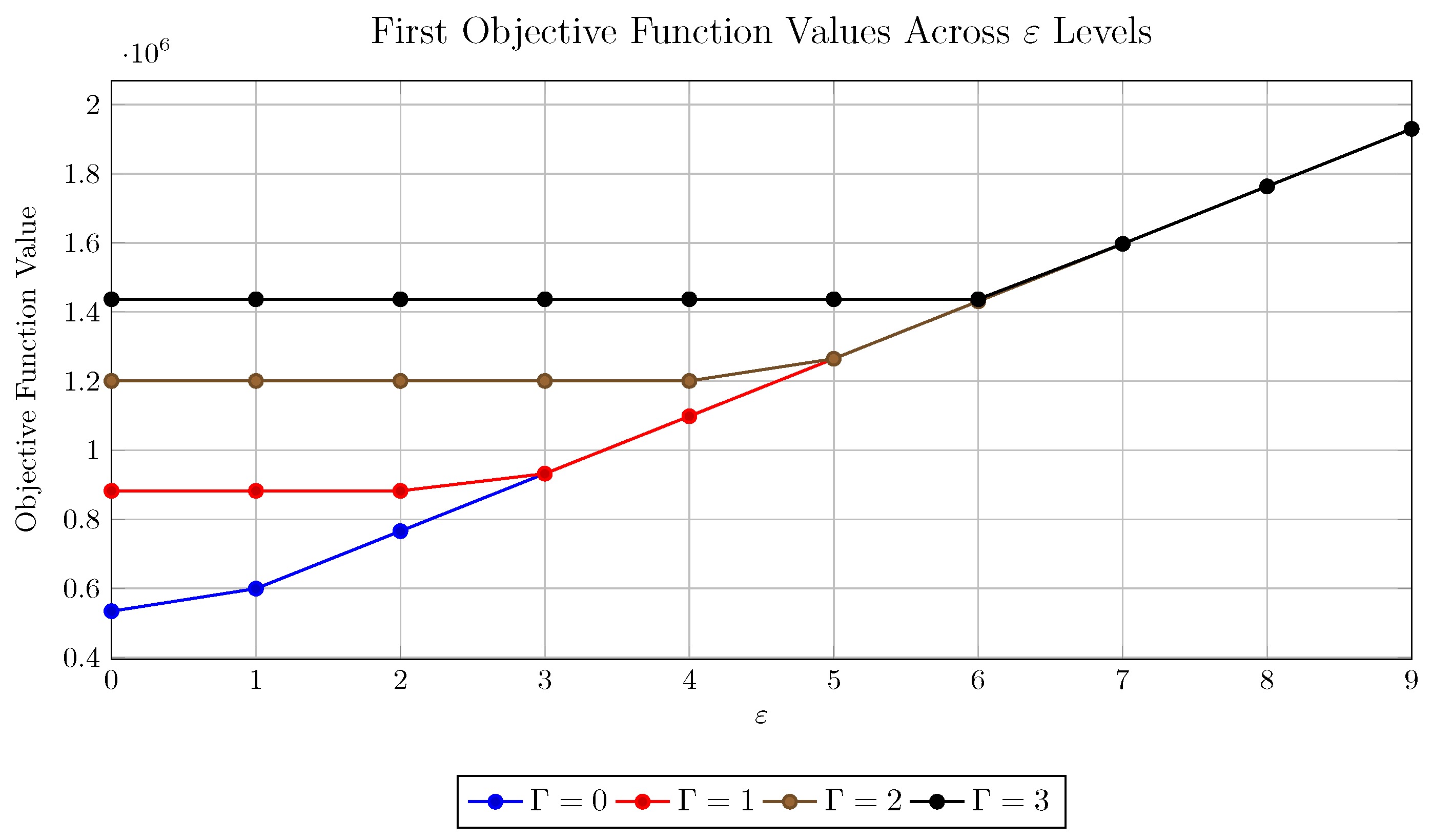
Figure 1 illustrates the behavior of the first objective function as
increases. For all robustness levels, the objective value increases monotonically, which is consistent with the theoretical properties of the
-constraint method. Relaxing one objective (through larger
values) leads to deterioration in the optimized objective, as previously described in multi-objective optimization theory [
8,
9]. The curve for
yields the lowest cost values, representing the least conservative scenario. As
increases to 1, 2, and 3, the objective values shift upward due to the increased level of protection, which requires more conservative decisions and consequently higher costs. This trend aligns with the findings of the robust optimization literature, where higher robustness levels incur a measurable “price of robustness” [
14].
Notably, the gap between the curves narrows as
increases. This indicates that robustness has a greater influence when the constraints on the second objective are tight and the influence diminishes as the feasible region widens. This diminishing sensitivity is also consistent with robust optimization theory, where highly relaxed formulations reduce the marginal value of robustness [
42].
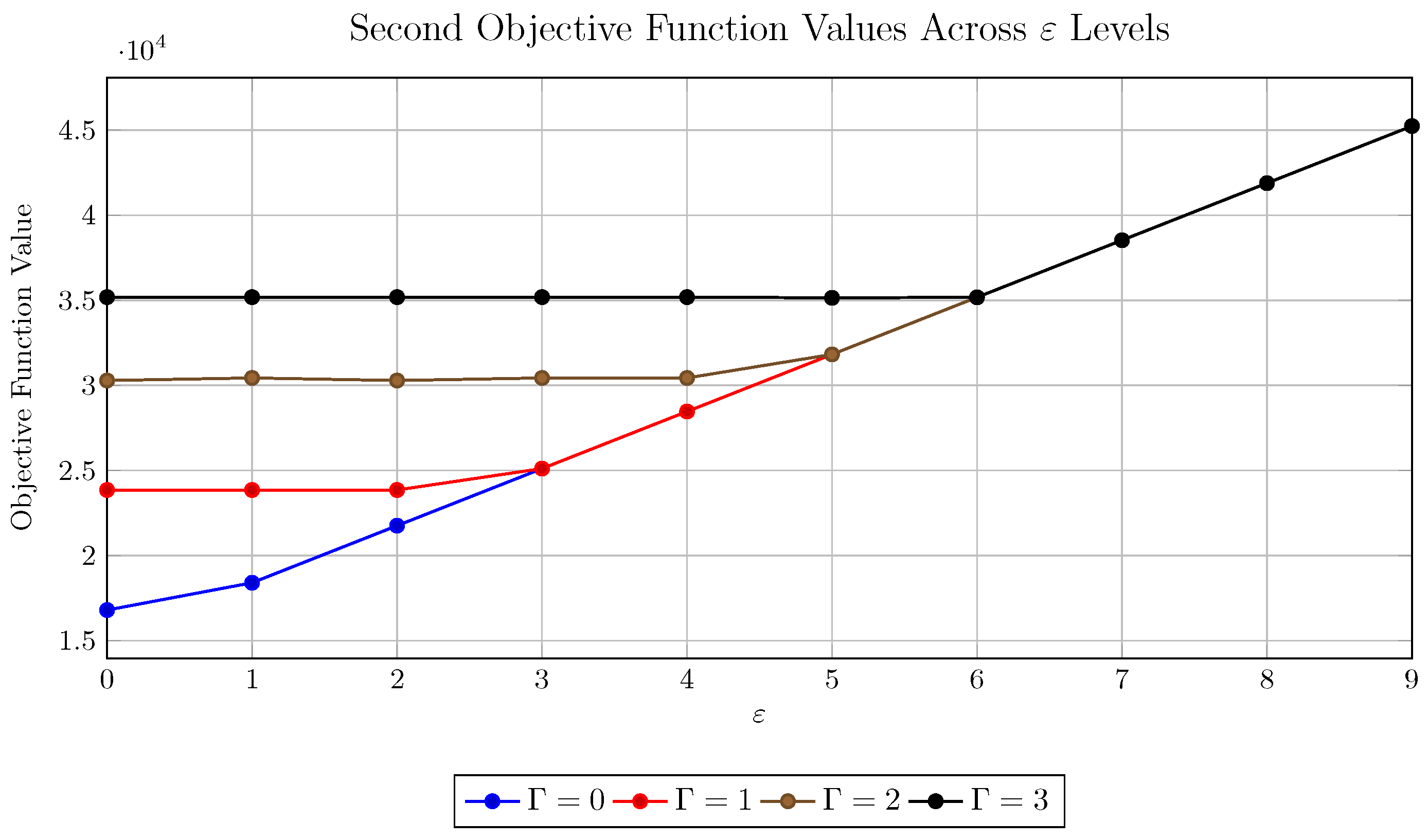
Figure 2 presents the results for the second objective function. A similar pattern is observed: the objective value increases with
for all
levels. Once again, the least conservative case (
) produces the smallest objective values, whereas higher levels of robustness result in progressively larger objective values. For small
values, the differences between the
curves are more pronounced, indicating that robustness significantly affects outcomes when the second objective is constrained tightly. As
grows, the curves converge, showing that the influence of
becomes less significant under relaxed conditions. This behavior mirrors theoretical results on the trade-off between robustness and optimality [
14,
42].
Overall, the Pareto analysis reveals that robustness plays a crucial role when the system operates under stringent performance constraints. For small values, higher levels yield significantly more conservative and costly solutions. However, as the constraints loosen, the benefit of robustness diminishes and the differences between protection levels decrease. These findings provide important managerial insights, suggesting that robust planning is most valuable in high-risk or tightly constrained environments.
Moreover, it is worth noting that the Pareto solutions obtained for different values of and robustness levels are deterministic outputs of the robust optimization model. Therefore, conventional statistical significance tests, which require stochastic sampling or repeated observations, are not directly applicable in this context. Instead, the impact of robustness is evaluated through a systematic comparison of objective function values across protection levels. The results clearly show monotonic increases in both objective functions as increases, reflecting the well-established “price of robustness.” To further support this analysis, relative percentage cost increases between successive robustness levels are examined, providing a quantitative assessment of how additional protection against demand uncertainty affects economic performance.
Beyond sensitivity to uncertainty budgets, the Pareto frontiers reveal clear trade-offs between production-related costs and supply–inventory–penalty costs. Solutions with lower production costs rely more heavily on urgent procurement and incur higher penalty risks, whereas solutions that prioritize inventory and service stability require higher baseline production and sourcing costs. These trade-offs provide managers with actionable insights for selecting operational policies that align with risk tolerance and sustainability priorities, rather than a single cost-minimizing solution.
4.2.2. Optimal Solution Details
Following the Pareto analysis, a representative solution is selected for detailed examination. This solution corresponds to the first
level under the optimistic protection level
, which reflects the most conservative and uncertainty-resilient operational scenario. Such representative-solution evaluation is a common approach in multi-objective and robust optimization studies [
8,
9]. The following subsections present the optimal production quantities, spare-part procurement decisions, and cost components associated with this solution.
4.2.3. Production Quantities
Table 16 reports the optimal production quantities for each product under the three production structures. The results show that most production occurs under the completed structure, which aligns with findings that manufacturers typically prioritize fully assembled output when supply availability permits [
43]. The fractional and urgent structures are activated only when shortages or demand fluctuations necessitate alternative production modes, consistent with flexible production strategies in uncertain supply chains [
44].
4.2.4. Normal Supply Quantities
Table 17 presents the optimal number of spare parts procured at the agreed (normal) price. These quantities reflect the baseline procurement plan and represent cost-efficient sourcing decisions under stable supply conditions. Prior research highlights that planned procurement tends to cluster around predictable consumption levels in well-coordinated production systems [
45]. The variations across spare parts are driven by their consumption rates and the structural requirements of each product.
4.2.5. Urgent Supply Quantities
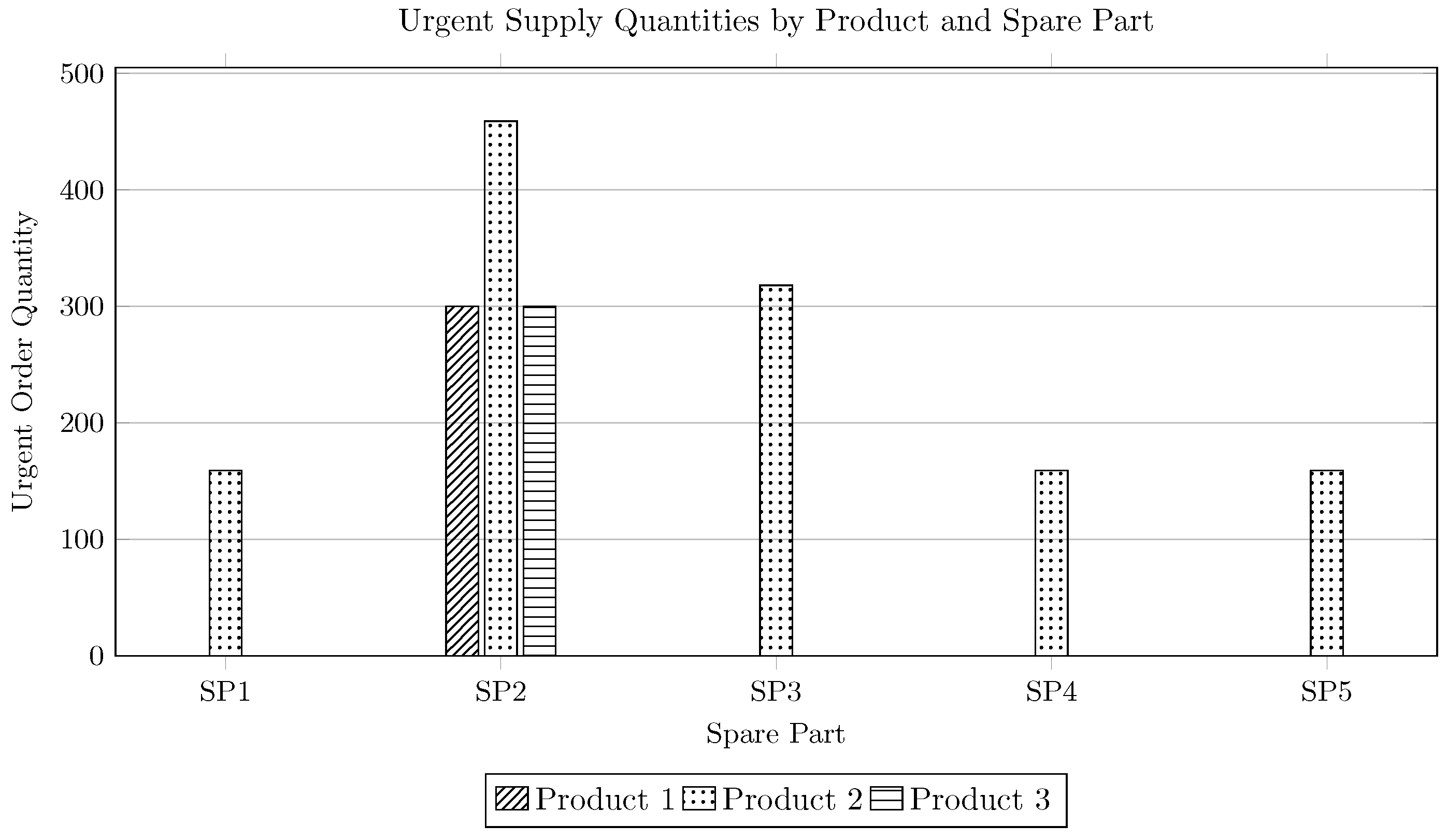
When normal procurement cannot satisfy production requirements, the model activates the urgent supply option.
Table 18 summarizes the corresponding urgent procurement quantities. This behavior mirrors real-world supply chain responses, where sudden shortages or unanticipated demand require expedited and higher-cost sourcing [
46].
Figure 3 visualizes the patterns of urgent procurement, showing which spare parts and products are most susceptible to shortage-driven adjustments.
4.2.6. Cost Breakdown
Table 19 provides a detailed breakdown of the cost components associated with the selected optimal solution. The results show that urgent production and delay penalties constitute the largest additional expenses. These findings align with the literature demonstrating that emergency sourcing and service-level failures significantly increase operational costs in manufacturing supply chains [
47]. Meanwhile, holding costs remain low due to the model’s demand-driven production planning. This breakdown provides insight into the economic impacts of different production structures and procurement decisions within a robust and sustainable supply chain context.
4.3. Simulation Setup and Validation
To ensure that the simulation model accurately reflects the behavior of the robust optimization model, the same assumptions and structural relationships were incorporated into the simulation environment. This alignment enables the simulation model to serve as both a validation tool and a platform for evaluating parameters, such as the demand adjustment coefficient.
To determine the appropriate number of simulation replications, the coefficient of variation (CV) was used as a measure of output stability. The target was to maintain a variation index below 25%. Accordingly, the simulation model was executed for 5, 15, and 20 replications, and the resulting objective function values were used to compute the sample standard deviation and CV:
Table 20 shows that the CV remains above the target threshold of 0.25 for the tested replication sizes, indicating that additional replications would be required for tighter precision. Given the computational burden of the simulation–optimization runs, we proceeded with
replications as a practical compromise.
After validating the simulation model, the outputs for Product 1 were recorded to evaluate delays, holding costs, production costs, and spare-part supply costs. The mean values of these costs are summarized in
Table 21.
To statistically validate the simulation outputs, confidence intervals were constructed for key performance indicators using standard statistical methods. Let
represent the sample mean derived from the simulation,
s denote the sample standard deviation, and
n be the number of independent replications. By rearranging Equation (
26) and using the coefficient of variation and mean values reported in
Table 20 and
Table 21, the value of
can be calculated. The 95% confidence interval for the mean performance measure is then given by
where
is the
-value with
degrees of freedom. For
replications,
.
As an illustration, for the delay penalty cost with a mean value of
, the standard deviation is estimated as
. Substituting these values into Equation (
27) yields a 95% confidence interval of
. The lower and upper bounds of other performance measures can be calculated using the same procedure and are reported in
Table 21. These intervals demonstrate that the observed simulation outcomes are statistically stable and that the discrepancies between the analytical and simulation results are attributable to systematic uncertainty effects rather than random variation.
4.4. Simulation Optimization Using OptQuest
To further improve system performance, the OptQuest tool available in the Arena simulation environment was used to identify the optimal value of the demand adjustment coefficient. This coefficient adjusts the predicted demand received by the manufacturer and enables closer alignment between production quantities and definitive demand. Improved alignment reduces shortages, avoids excessive inventory, and ultimately lowers total cost.
Initially, the adjustment coefficient was set to 1. OptQuest was then used to search for the value that minimizes the total simulation-based objective cost. The optimized adjustment coefficient is reported in
Table 22.
These results suggest that adjusting the predicted demand to approximately 90% of its original value results in improved synchronization between production levels and actual customer demand. This adjustment reduces unnecessary production and holding costs, while also decreasing the likelihood of shortages and the need for urgent procurement.
4.5. Comparison of Analytical and Simulation Models
Table 23 compares the optimal results from the analytical model with those obtained through discrete-event simulation. The analytical model represents an idealized environment in which demand aligns perfectly with predictions and uncertainty is handled deterministically, resulting in zero holding and penalty costs, as well as relatively low production and supply costs. In contrast, the simulation incorporates stochastic demand and operational variability, which produces higher costs across all categories. Production and supply costs increase due to the activation of fractional and urgent production structures, and holding and penalty costs emerge because inventory levels fluctuate and delays occur. These differences demonstrate the practical impact of uncertainty on supply chain performance and highlight the value of using simulation to validate and refine optimization-based decisions.
While the analytical model assumes deterministic realization of robust-adjusted demand, the simulation explicitly captures stochastic demand fluctuations, supplier delivery variability, and operational disruptions. These factors activate fractional and urgent production structures more frequently than predicted by the analytical solution, resulting in higher production, holding, and penalty costs. In particular, emergency procurement and partial assembly introduce non-linear cost escalations that are not fully reflected in the optimization model. This divergence highlights the structural gap between idealized planning environments and real-world operations, emphasizing the importance of simulation-based validation for robust supply chain decision-making.
Although the quantitative comparison in
Table 23 focuses on cost components, these measures also reflect broader sustainability-related performance indicators. Delay penalties serve as a proxy for customer service level and delivery reliability, while holding costs indicate inventory stability and resource utilization. The activation of fractional production and urgent procurement in the simulation model reflects production continuity and workforce utilization, as these strategies prevent prolonged line stoppages and idle labor. Moreover, differences between the analytical and simulation results highlight operational resilience under demand and supply variability. Together, these indicators provide a multi-dimensional assessment of economic and social sustainability, even though they are expressed in monetary terms. Future research could extend this framework by explicitly incorporating environmental indicators such as emissions or energy consumption.
5. Discussion
This study developed an integrated framework that combines multi-objective optimization, robust optimization, and discrete-event simulation to assess and enhance the economic and social sustainability of Iran’s automotive supply chain. The results address the three research questions by clarifying the roles of fractional production strategies, supplier agreements, and uncertainty-aware planning in shaping sustainable supply chain performance.
The results demonstrate that the proposed framework enhances economic sustainability by reducing cost volatility under demand uncertainty and supports social sustainability by maintaining production continuity and service reliability. By enabling fractional production and urgent procurement, the model mitigates production stoppages and workforce disruptions, which are critical social concerns in large-scale automotive manufacturing systems.
From a theoretical perspective, the contribution of this study is incremental rather than foundational. The framework does not propose new optimization or robustness theories; instead, it demonstrates how established methods can be effectively combined and operationalized to address practical challenges in automotive supply chains subject to demand uncertainty. This incremental contribution is nonetheless valuable, as it bridges the gap between abstract modeling approaches and real-world operational decision-making.
Beyond numerical performance, the results reveal important managerial trade-offs. While robust optimization increases baseline costs, the simulation results demonstrate that these costs function as an insurance premium against extreme operational losses under uncertainty. Managers operating in volatile environments may therefore rationally accept higher planned costs in exchange for improved service continuity and workforce stability. Moreover, the interaction between robust planning and simulation highlights that resilience is not solely a mathematical property but an operational outcome shaped by procurement flexibility, production structure design, and demand-adjustment policies.
From an emerging-economy perspective, the results underscore the importance of robustness and operational flexibility as substitutes for structural redundancy. In environments where excess capacity, diversified sourcing, and advanced digital coordination are limited, strategies such as fractional production and robust demand planning provide practical mechanisms for sustaining operations under uncertainty. The findings suggest that managers in emerging markets may benefit more from uncertainty-aware planning tools than their counterparts in more stable, developed supply chain environments.
Despite its contributions, this study has several limitations. The model does not explicitly capture multi-sourcing strategies, supplier disruptions, or lead-time uncertainty, and distribution decisions are not taken into account. These simplifications were necessary to maintain model tractability and to enable integration with discrete-event simulation. Future research may extend the framework by incorporating disruption scenarios, multi-echelon distribution networks, and additional robustness dimensions.
The findings demonstrate that adopting a fractional spare-parts production strategy provides a viable means of maintaining operational continuity during supply shortages. Fractional production serves as an intermediate step prior to full assembly and substantially reduces the risk of complete production stoppages. This aligns with prior research showing that flexible production systems improve supply chain resilience and workforce stability [
43,
46]. As shown in
Table 16, a considerable share of demand, particularly for Product 2, is satisfied through fractional or urgent production structures. This flexibility supports social sustainability by preventing workforce idleness and contributes to economic sustainability by reducing unmet demand and the associated penalty costs, which is consistent with broader SSCM principles [
48,
49].
The model also incorporates two procurement pathways: standard supply at contract prices and urgent supply at premium prices. Under robust optimization settings, these pathways help balance cost efficiency and supply reliability.
Table 17 and
Table 18 illustrate how supplier agreements influence the distribution of normal and urgent procurement quantities. These results reflect findings in the sustainable procurement literature, which emphasize that supplier collaboration and flexible contracting are essential for maintaining supply continuity under uncertainty [
3,
50].
The combination of the
-constraint method with the Bertsimas–Sim robustness framework provides a structured approach for examining trade-offs among production costs, penalty costs, holding costs, and supply costs. Such multi-objective analyses are well supported in the literature [
8,
9]. As shown in
Table 14, increasing the robustness parameter reduces the likelihood of penalty costs, yet increases production and supply costs, reflecting the classical “price of robustness” effect [
14]. Simulation-based optimization using Arena and OptQuest further validates the robustness of the chosen solutions. The simulation identified an optimal demand adjustment coefficient of approximately 0.9, which improves alignment between predicted and actual demand and reduces inventory-driven costs (
Table 21 and
Table 22). This is consistent with existing research demonstrating that simulation–optimization enhances decision-making in uncertain environments [
39].
While this study adopts the Bertsimas–Sim robust optimization framework due to its tractability and managerial interpretability, a systematic numerical comparison with alternative uncertainty-handling approaches such as scenario-based stochastic programming or fuzzy optimization is not conducted. Incorporating such comparative analyses would provide additional insights into the relative strengths and limitations of different uncertainty modeling paradigms in sustainable automotive supply chain planning and represents a promising avenue for future research.
The narrow confidence intervals observed across simulation replications indicate that the proposed optimization solutions exhibit stable performance under stochastic operational conditions, reinforcing the practical reliability of the integrated robust optimization–simulation framework.
Overall, the integrated optimization and simulation framework demonstrates that robust SSCM practices can significantly reduce operational risk and economic inefficiencies. The results highlight the value of flexible production structures, resilient procurement strategies, and uncertainty-aware planning as effective enablers for achieving sustainable automotive supply chain performance.
Managerial Insights
The results of the integrated robust optimization–simulation framework provide several actionable insights for managers in automotive supply chains operating under demand uncertainty.
First, selecting an appropriate level of demand protection is a strategic managerial decision rather than a purely technical one. The results across robustness levels () demonstrate a clear “price of robustness.” For example, increasing the protection level from to results in a noticeable increase in total system cost while providing improved protection against demand deviations. However, further increases to and result in disproportionately higher costs with diminishing marginal benefits, as reflected by the convergence of Pareto curves at higher levels. This suggests that moderate robustness levels, e.g., , represent a balanced choice for managers seeking resilience without excessive cost escalation.
Second, fractional production emerges as a cost-effective resilience mechanism under moderate uncertainty. The optimization and simulation results show that fractional production allows continued operation during spare-part shortages at a lower cost than urgent procurement. Managers can therefore use fractional production as a buffer strategy to avoid complete line stoppages, particularly when demand deviations are moderate and supply disruptions are temporary. The results indicate that relying excessively on urgent production significantly increases total cost, making it suitable primarily as a last-resort response to severe demand shortfalls.
Third, urgent procurement should be treated as a targeted contingency tool rather than a routine strategy. Across all robustness levels, solutions that heavily rely on urgent procurement are associated with higher production and supply costs. This implies that managers should reserve urgent sourcing for situations where definitive demand substantially exceeds forecasts, rather than using it systematically to hedge uncertainty. The framework enables managers to quantify the cost threshold beyond which urgent procurement becomes unavoidable.
Fourth, the Pareto frontiers provide a practical decision-support tool for aligning cost and service objectives. Rather than identifying a single “optimal” solution, the Pareto analysis allows managers to visualize trade-offs between production-related costs and holding/penalty costs. For example, managers prioritizing customer service and delivery reliability can select solutions at lower values, accepting higher production costs to reduce penalties. Conversely, cost-focused strategies can be adopted by relaxing service constraints, as shown by higher solutions. This flexibility supports scenario-based planning aligned with managerial priorities.
Finally, integrating simulation with optimization improves the credibility of implementation decisions. The simulation results confirm that solutions obtained from the robust optimization model remain stable under stochastic operating conditions, including machine failures and demand variability. This provides managers with greater confidence that the recommended production and procurement policies are not only optimal in theory but also robust in practice.
Overall, the proposed framework supports managers in choosing robustness levels, designing contingency production strategies, and explicitly managing cost–service trade-offs, rather than relying on ad hoc buffers or overly conservative planning rules.
6. Conclusions
This study presented an integrated methodology that combines robust multi-objective optimization, the -constraint approach, and discrete-event simulation to evaluate and improve the economic and social sustainability of automotive supply chains in emerging economies, with a focus on Iran. The framework addressed three research questions concerning the influence of production strategies, supplier agreements, and uncertainty-aware planning on sustainable supply chain performance. The primary contribution of this research lies in its practical integration and empirical validation of robust optimization and simulation techniques within an automotive supply chain context, rather than in the development of new methodological constructs.
The results show that fractional production strategies help maintain operational continuity during spare-part shortages, reducing economic losses and supporting workforce stability. The robust multi-objective model revealed the trade-offs among production, supply, holding, and penalty costs under varying levels of demand uncertainty, while the simulation model validated these findings in a stochastic environment and identified an optimal demand adjustment coefficient that improves forecast accuracy and reduces cost variability.
Furthermore, the comparison between analytical and simulation results demonstrated the practical impact of uncertainty on supply chain outcomes. The analytical model provided an ideal benchmark, whereas the simulation results reflected the actual economic consequences of demand fluctuations and operational disruptions. This highlights the importance of using robust and flexible strategies together with simulation-based evaluation to ensure that optimal decisions remain effective under realistic conditions.
The study offers both methodological and managerial contributions. Methodologically, it illustrates how robustness and simulation can be integrated to evaluate trade-offs and improve decision-making under uncertainty. From a managerial perspective, the findings emphasize the value of fractional production, flexible supplier agreements, and robust planning approaches in supporting sustainable and resilient automotive operations.
Several limitations should be acknowledged. The current model considers a single-period planning horizon and does not incorporate environmental sustainability metrics such as emissions or energy consumption. Future research may extend the framework to multi-period and multi-echelon supply chains, integrate environmental performance indicators, and employ scenario-based and sensitivity analyses to examine the model’s generalizability.
Although this study is positioned within the sustainable supply chain management literature, environmental sustainability indicators such as greenhouse gas emissions, energy consumption, waste generation, and life-cycle impacts are not explicitly modeled. Incorporating these dimensions would require additional data and modeling layers, such as emission-based objective functions or life cycle assessment integration. Future research can extend the proposed robust optimization–simulation framework by explicitly embedding environmental metrics alongside economic and social objectives, particularly for carbon-intensive industries such as automotive manufacturing.
Author Contributions
Conceptualization, Z.J., M.D., S.M.S., A.A., and M.T.Y.; methodology, Z.J., M.D., S.M.S., A.A., and M.T.Y.; software, Z.J., M.D., S.M.S., A.A., and M.T.Y.; validation, Z.J., M.D., S.M.S., A.A., and M.T.Y.; formal analysis, Z.J., M.D., S.M.S., A.A., and M.T.Y.; investigation, Z.J., M.D., S.M.S., A.A., and M.T.Y.; resources, Z.J., M.D., S.M.S., A.A., and M.T.Y.; data curation, Z.J., M.D., S.M.S., A.A., and M.T.Y.; writing—original draft preparation, Z.J., M.D., S.M.S., A.A., and M.T.Y.; writing—review and editing, Z.J., M.D., S.M.S., A.A., and M.T.Y.; visualization, Z.J., M.D., S.M.S., A.A., and M.T.Y.; supervision, Z.J., M.D., S.M.S., A.A., and M.T.Y.; project administration, Z.J., M.D., S.M.S., A.A., and M.T.Y. All authors have read and agreed to the published version of the manuscript.
Funding
This research received no external funding.
Institutional Review Board Statement
This study uses aggregated and anonymized operational data provided by the case company. No personal, sensitive, or individual-level information was collected or analyzed, and the data were used exclusively for academic research with the organization’s permission. Accordingly, formal ethical approval was not required.
Informed Consent Statement
Not applicable.
Data Availability Statement
Due to confidentiality restrictions, the underlying dataset is not publicly available. However, summary data and model details are reported in the manuscript.
Conflicts of Interest
The authors declare no conflict of interest.
Abbreviations
The following abbreviations are used in this manuscript:
| SCM | Supply Chain Management |
| SSCM | Sustainable Supply Chain Management |
| SSCMI | Sustainable Supply Chain Management Integration |
| MCDM | Multi-Criteria Decision-Making |
| COPRAS | Complex Proportional Assessment |
| SF-AHP | Spherical Fuzzy Analytic Hierarchy Process |
| DSS | Decision Support System |
| SCND | Supply Chain Network Design |
| CV | Coefficient of Variation |
References
- Wolf, J. Sustainable supply chain management integration: A qualitative analysis of the German manufacturing industry. J. Bus. Ethics 2011, 102, 221–235. [Google Scholar] [CrossRef]
- Wittstruck, D.; Teuteberg, F. Understanding the success factors of sustainable supply chain management: Empirical evidence from the electrics and electronics industry. Corp. Soc. Responsib. Environ. Manag. 2012, 19, 141–158. [Google Scholar] [CrossRef]
- Beske, P.; Land, A.; Seuring, S. Sustainable supply chain management practices and dynamic capabilities in the food industry: A critical analysis of the literature. Int. J. Prod. Econ. 2014, 152, 131–143. [Google Scholar] [CrossRef]
- Ansari, Z.N.; Kant, R. A state-of-art literature review reflecting 15 years of focus on sustainable supply chain management. J. Clean. Prod. 2017, 142, 2524–2543. [Google Scholar] [CrossRef]
- Walker, H.; Jones, N. Sustainable supply chain management across the UK private sector. Supply Chain. Manag. Int. J. 2012, 17, 15–28. [Google Scholar] [CrossRef]
- Gualandris, J.; Kalchschmidt, M. Customer pressure and innovativeness: Their role in sustainable supply chain management. J. Purch. Supply Manag. 2014, 20, 92–103. [Google Scholar] [CrossRef]
- Dubey, R.; Gunasekaran, A.; Samar Ali, S. Exploring the relationship between leadership, operational practices, institutional pressures and environmental performance: A framework for green supply chain. Int. J. Prod. Econ. 2015, 160, 120–132. [Google Scholar] [CrossRef]
- Ehrgott, M. Multicriteria Optimization; Springer: Berlin/Heidelberg, Germany, 2005. [Google Scholar] [CrossRef]
- Mavrotas, G. Effective implementation of the ε-constraint method in multi-objective mathematical programming problems. Appl. Math. Comput. 2009, 213, 455–465. [Google Scholar] [CrossRef]
- Taqi, H.M.M.; Ali, S.M.; Fathollahi-Fard, A.M.; Paul, S.K.; Kabir, G. Supply chain network design with flexibility, resiliency, and sustainability. Sustain. Resilient Infrastruct. 2025, 1–31. [Google Scholar] [CrossRef]
- Leung, S.C.; Tsang, S.O.; Ng, W.L.; Wu, Y. A robust optimization model for multi-site production planning problem in an uncertain environment. Eur. J. Oper. Res. 2007, 181, 224–238. [Google Scholar] [CrossRef]
- Pan, F.; Nagi, R. Robust supply chain design under uncertain demand in agile manufacturing. Comput. Oper. Res. 2010, 37, 668–683. [Google Scholar] [CrossRef]
- Aghezzaf, E.H.; Sitompul, C.; Najid, N.M. Models for robust tactical planning in multi-stage production systems with uncertain demands. Comput. Oper. Res. 2010, 37, 880–889. [Google Scholar] [CrossRef]
- Bertsimas, D.; Sim, M. The price of robustness. Oper. Res. 2004, 52, 35–53. [Google Scholar] [CrossRef]
- Vieira, A.A.; Figueira, J.R.; Fragoso, R. A multi-objective simulation-based decision support tool for wine supply chain design and risk management under sustainability goals. Expert Syst. Appl. 2023, 232, 120757. [Google Scholar] [CrossRef]
- Yang, Q.; Liu, M.; Wang, Z.S.; Jiang, W.h. Sustainable supply chain performance evaluation using uncertain multi-criteria decision-making method: A case study in automobile manufacturing enterprises. Environ. Dev. Sustain. 2025, 1–52. [Google Scholar] [CrossRef]
- Štreimikienė, D.; Bathaei, A.; Streimikis, J. MCDM Approaches for Supplier Selection in Sustainable Supply Chain Management. Sustainability 2024, 16, 10446. [Google Scholar] [CrossRef]
- Jagani, S.; Marsillac, E.; Hong, P. The Electric Vehicle Supply Chain Ecosystem: Changing Roles of Automotive Suppliers. Sustainability 2024, 16, 1570. [Google Scholar] [CrossRef]
- Shao, Y.; Li, H.; Yao, J. Optimizing Sustainable Supply Chain Resource Integration: A Multi-Objective Approach Considering Consumer Green Preferences and Policy Interventions. Sustainability 2025, 17, 9795. [Google Scholar] [CrossRef]
- Mirzapour Al-E-Hashem, S.; Malekly, H.; Aryanezhad, M.B. A multi-objective robust optimization model for multi-product multi-site aggregate production planning in a supply chain under uncertainty. Int. J. Prod. Econ. 2011, 134, 28–42. [Google Scholar] [CrossRef]
- Rahmani, D.; Ramezanian, R.; Fattahi, P.; Heydari, M. A robust optimization model for multi-product two-stage capacitated production planning under uncertainty. Appl. Math. Model. 2013, 37, 8957–8971. [Google Scholar] [CrossRef]
- Kim, J.; Qiu, R.; Jon, J.; Sun, M. Multi-objective programming for multi-period multi-product closed-loop supply chain network design: A fuzzy robust optimization approach. Environ. Dev. Sustain. 2025, 27, 10203–10239. [Google Scholar] [CrossRef]
- Botte, M.; Schöbel, A. Dominance for multi-objective robust optimization concepts. Eur. J. Oper. Res. 2019, 273, 430–440. [Google Scholar] [CrossRef]
- Nayeri, S.; Paydar, M.M.; Asadi-Gangraj, E.; Emami, S. Multi-objective fuzzy robust optimization approach to sustainable closed-loop supply chain network design. Comput. Ind. Eng. 2020, 148, 106716. [Google Scholar] [CrossRef]
- Janatyan, N.; Zandieh, M.; Alem-Tabriz, A.; Rabieh, M. A robust optimization model for sustainable pharmaceutical distribution network design: A case study. Ann. Oper. Res. 2025, 349, 911–930. [Google Scholar] [CrossRef]
- Dang, T.T.; Nguyen, N.A.T.; Nguyen, V.T.T.; Dang, L.T.H. A two-stage multi-criteria supplier selection model for sustainable automotive supply chain under uncertainty. Axioms 2022, 11, 228. [Google Scholar] [CrossRef]
- Singh, J.; Hamid, A.B.A.; Garza-Reyes, J.A. Supply chain resilience strategies and their impact on sustainability: An investigation from the automobile sector. Supply Chain. Manag. Int. J. 2023, 28, 787–802. [Google Scholar] [CrossRef]
- Flores-Siguenza, P.; Marmolejo-Saucedo, J.A.; Niembro-Garcia, J. Robust Optimization Model for Sustainable Supply Chain Design Integrating LCA. Sustainability 2023, 15, 14039. [Google Scholar] [CrossRef]
- Nguyen, N.A.T.; Wang, C.N.; Dang, T.T. Advanced Process Optimization in Logistics and Supply Chain Management. Processes 2025, 13, 1864. [Google Scholar] [CrossRef]
- Riad, M.; Naimi, M.; Okar, C. Enhancing Supply Chain Resilience Through Artificial Intelligence: Developing a Comprehensive Conceptual Framework for AI Implementation and Supply Chain Optimization. Logistics 2024, 8, 111. [Google Scholar] [CrossRef]
- Al Zaabi, S.; Al Dhaheri, N.; Diabat, A. Analysis of interaction between the barriers for the implementation of sustainable supply chain management. Int. J. Adv. Manuf. Technol. 2013, 68, 895–905. [Google Scholar] [CrossRef]
- Mohammadi, T.; Sajadi, S.M.; Najafi, S.E.; Taghizadeh Yazdi, M. Optimizing Smart Supply Chain with Vendor Managed Inventory through the Internet of Things. Ind. Manag. J. 2022, 14, 458–483. [Google Scholar] [CrossRef]
- Roy, V.; Silvestre, B.S.; Singh, S. Reactive and proactive pathways to sustainable apparel supply chains: Manufacturer’s perspective on stakeholder salience and organizational learning toward responsible management. Int. J. Prod. Econ. 2020, 227, 107672. [Google Scholar] [CrossRef]
- Moktadir, M.A.; Dwivedi, A.; Khan, N.S.; Paul, S.K.; Khan, S.A.; Ahmed, S.; Sultana, R. Analysis of risk factors in sustainable supply chain management in an emerging economy of leather industry. J. Clean. Prod. 2021, 283, 124641. [Google Scholar] [CrossRef]
- Shahedi, A.; Nasiri, M.M.; Sangari, M.S.; Werner, F.; Jolai, F. A stochastic multi-objective model for a sustainable closed-loop supply chain network design in the automotive industry. Process Integr. Optim. Sustain. 2022, 6, 189–209. [Google Scholar] [CrossRef]
- Zhao, L.; Ning, C.; You, F. Operational optimization of industrial steam systems under uncertainty using data-D riven adaptive robust optimization. AIChE J. 2019, 65, e16500. [Google Scholar] [CrossRef]
- Mohammadi, M.; Sajadi, S.M.; Tavakoli, M.M. Scheduling new product development projects using simulation-based dependency structure matrix. Int. J. Logist. Syst. Manag. 2014, 19, 311–328. [Google Scholar] [CrossRef]
- Sajadi, S.M.; Rad, M.F. Optimal production rate in production planning problem with simulation optimisation approach by simulated annealing. Int. J. Ind. Syst. Eng. 2016, 22, 262–280. [Google Scholar] [CrossRef]
- Shahbazi, S.; Sajadi, S.M.; Jolai, F. A simulation-based optimization model for scheduling new product development projects in research and development centers. Interdiscip. J. Manag. Stud. (Former. Known Iran. J. Manag. Stud.) 2017, 10, 883–904. [Google Scholar] [CrossRef]
- Soroush, H.; Sajjadi, S.M.; Arabzad, S.M. Efficiency analysis and optimisation of a multi-product assembly line using simulation. Int. J. Product. Qual. Manag. 2014, 13, 89–104. [Google Scholar] [CrossRef]
- Hoad, K.; Robinson, S.; Davies, R. Automated selection of the number of replications for a discrete-event simulation. J. Oper. Res. Soc. 2010, 61, 1632–1644. [Google Scholar] [CrossRef]
- Ben-Tal, A.; El Ghaoui, L.; Nemirovski, A. Robust Optimization; Princeton University Press: Princeton, NJ, USA, 2009. [Google Scholar] [CrossRef]
- Gunasekaran, A.; Patel, C.; Tirtiroglu, E. Performance measures and metrics in a supply chain environment. Int. J. Oper. Prod. Manag. 2001, 21, 71–87. [Google Scholar] [CrossRef]
- Chopra, S.; Meindl, P. Supply chain management. Strategy, planning & operation. In Das Summa Summarum des Management: Die 25 Wichtigsten Werke für Strategie, Führung und Veränderung; Springer: Berlin/Heidelberg, Germany, 2007; pp. 265–275. [Google Scholar] [CrossRef]
- Simchi-Levi, D.; Kaminsky, P.; Simchi-Levi, E. Designing and Managing the Supply Chain; McGraw-Hill LLC: Columbus, ON, USA, 2004. [Google Scholar]
- Tang, C.S. Robust strategies for mitigating supply chain disruptions. Int. J. Logist. Res. Appl. 2006, 9, 33–45. [Google Scholar] [CrossRef]
- Christopher, M. Logistics & Supply Chain Management; Pearson: London, UK, 2016. [Google Scholar]
- Mani, V.; Agarwal, R.; Gunasekaran, A.; Papadopoulos, T.; Dubey, R.; Childe, S.J. Social sustainability in the supply chain: Construct development and measurement validation. Ecol. Indic. 2016, 71, 270–279. [Google Scholar] [CrossRef]
- Badri Ahmadi, H.; Kusi-Sarpong, S.; Rezaei, J. Assessing the social sustainability of supply chains using Best Worst Method. Resour. Conserv. Recycl. 2017, 126, 99–106. [Google Scholar] [CrossRef]
- Hong, J.; Zhang, Y.; Ding, M. Sustainable supply chain management practices, supply chain dynamic capabilities, and enterprise performance. J. Clean. Prod. 2018, 172, 3508–3519. [Google Scholar] [CrossRef]
Figure 1.
First objective function values across different levels for robustness parameters.
Figure 1.
First objective function values across different levels for robustness parameters.
Figure 2.
Second objective function values across different levels for robustness parameters.
Figure 2.
Second objective function values across different levels for robustness parameters.
Figure 3.
Urgent procurement quantities for each spare part across the three products.
Figure 3.
Urgent procurement quantities for each spare part across the three products.
Table 1.
Summary of key contributions to SSCM research.
Table 1.
Summary of key contributions to SSCM research.
| Research | Contribution |
|---|
| [1] | To afford a comprehensible and testable model of sustainable supply chain management combination (SSCMI). |
| [2] | Recognizing and investigating the factors that hold SSCM successfully. |
| [5] | Examine sustainable SCM concerns in businesses recognized as leaders in their divisions, and examine what influences sustainable SCM and how it might evolve. |
| [31] | Define the connection among the boundaries and identify prominent obstacles using interpretive fundamental modeling. |
| [6] | Examines how sustainable supply chain management develops from internal to external activities. |
| [3] | Explains how SSCM enables organizations to maintain control over their supply chain and gain competitive advantage. |
| [7] | Explores the effects of SRM and TQM on environmental performance under governance and institutional pressures. |
| [32] | Develops a mathematical model for intelligent supply chains that integrate Vendor Managed Inventory (VMI) through IoT technology. |
| [4] | Reviews 286 papers published from 2002 to 2016 in sustainable SCM. |
| [33] | Examines stakeholder salience and sustainability training in apparel manufacturing in emerging economies. |
| [34] | Evaluates supply chain risk in the leather industry. |
| [35] | Proposes a sustainable closed-loop supply chain model for the automotive sector. |
| [15] | Proposes a simulation-based DSS for Portuguese wine SCND under risk and sustainability scenarios. |
| [18] | Examines changing roles of automotive suppliers and sustainability impacts in the electric vehicle supply chain ecosystem. |
| [17] | Reviews multi-criteria approaches for sustainable supplier selection in automotive supply chains. |
| [16] | Evaluates sustainable supply chain performance in automotive manufacturing using uncertain multi-criteria decision-making. |
Table 2.
Robust optimization models for supply chain and production planning under uncertainty.
Table 2.
Robust optimization models for supply chain and production planning under uncertainty.
| Research | Contribution |
|---|
| [11] | Proposes a robust optimization model to address multi-site production planning problems with uncertain data, minimizing total costs including production, labor, inventory, and workforce switching. |
| [12] | Addresses a supply chain decision problem for a single retail opportunity under uncertain demand, integrating optimization of logistics and production costs. |
| [13] | Examines the challenge of robust tactical production planning in multi-stage systems with periodic demand variability. |
| [20] | Investigates a complex multi-site, multi-period, multi-product production planning problem under uncertainty. |
| [21] | Analyzes a two-stage capacitated production system with lead time and planning decisions under uncertain costs and demand. |
| [23] | Focuses on mastering multi-objective robust optimization concepts. |
| [36] | Uses adaptive robust optimization to optimize industrial steam systems under equipment performance uncertainty. |
| [24] | Develops a multi-objective model for sustainable closed-loop supply chain design under uncertainty, using fuzzy robust optimization. |
| [25] | Presents a mixed-integer linear programming model for sustainable pharmaceutical supply chain planning under uncertainty. |
| [26] | Evaluates sustainable supplier adaptability to COVID-19 using a hybrid MCDM framework with SF-AHP and G-COPRAS. |
| [27] | Proposes a framework for supply chain resilience strategies to manage disruptive events and their sustainability impacts. |
| [28] | Proposes a robust optimization model integrating life cycle assessment for sustainable supply chain design under uncertainty. |
Table 3.
Quantity of spare parts consumed in each product.
Table 3.
Quantity of spare parts consumed in each product.
| Product | SP1 | SP2 | SP3 | SP4 | SP5 |
|---|
| Peugeot XU7 | 1 | 1 | 2 | 1 | 1 |
| Peugeot TU5 | 1 | 1 | 2 | 1 | 1 |
| Peugeot GLX XU7 405 | 1 | 1 | 2 | 1 | 1 |
Table 4.
Indefinite parameters of the mode.
Table 4.
Indefinite parameters of the mode.
| Product | Predicted Demand | Half-Length |
|---|
| Peugeot XU7 | 3465 | 1753 |
| Peugeot TU5 | 3038 | 1126 |
| Peugeot GLX XU7 405 | 3119 | 1515 |
Table 5.
Holding costs of spare parts.
Table 5.
Holding costs of spare parts.
| | SP1 | SP2 | SP3 | SP4 | SP5 |
|---|
| Holding Cost ($) | 0.0074 | 0.0092 | 0.0008 | 0.0738 | 0.0257 |
Table 6.
Production costs by production structure.
Table 6.
Production costs by production structure.
| Production Type | Product 1 | Product 2 | Product 3 |
|---|
| Normal Production ($) | 50 | 50 | 45 |
| Urgent Production ($) | 100 | 100 | 90 |
| Fractional Production ($) | 70 | 70 | 70 |
Table 7.
Daily delay penalty for product delivery.
Table 7.
Daily delay penalty for product delivery.
| | Product 1 | Product 2 | Product 3 |
|---|
| Daily Penalty ($) | 5 | 5 | 4 |
Table 8.
Definitive customer demand for products.
Table 8.
Definitive customer demand for products.
| | Product 1 | Product 2 | Product 3 |
|---|
| Demand (Units) | 3397 | 2459 | 2946 |
Table 9.
Supply costs of spare parts.
Table 9.
Supply costs of spare parts.
| Supply Type | SP1 | SP2 | SP3 | SP4 | SP5 |
|---|
| Supply Type | SP1 | SP2 | SP3 | SP4 | SP5 |
| Normal Supply Cost ($) | 0.074 | 0.092 | 0.008 | 0.738 | 0.257 |
| Urgent Supply Cost ($) | 0.088 | 0.110 | 0.010 | 0.886 | 0.308 |
Table 10.
Production lead time.
Table 10.
Production lead time.
| | Product 1 | Product 2 | Product 3 |
|---|
| Leadtime (days) | 5 | 5 | 5 |
Table 11.
Boundary of spare parts in normal supply.
Table 11.
Boundary of spare parts in normal supply.
| Supply Type | SP1 | SP2 | SP3 | SP4 | SP5 |
|---|
| Maximum Supply () | 5400 | 7650 | 12,478 | 5056 | 5400 |
| Minimum Supply () | 1512 | 1120 | 900 | 576 | 1576 |
Table 12.
Level of protection.
Table 12.
Level of protection.
| Level of Protection | 1 | 2 | 3 | 4 |
|---|
| 0 | 1 | 2 | 3 |
Table 13.
Discretized values for the objective function range.
Table 13.
Discretized values for the objective function range.
| 1 | 2 | 3 | 4 | 5 | 6 | 7 | 8 | 9 | 10 |
|---|
| 15,047 | 18,401 | 21,756 | 25,111 | 28,465 | 31,820 | 35,175 | 38,529 | 41,884 | 45,239 |
Table 14.
Objective values with protection level 0 and 1.
Table 14.
Objective values with protection level 0 and 1.
| | | |
|---|
| ε() | | | | |
|---|
| 15,047 | 534,045 | 16,797 | 882,295 | 23,854 |
| 18,401 | 599,384 | 18,401 | 882,295 | 23,854 |
| 21,756 | 765,708 | 21,756 | 882,295 | 23,854 |
| 25,111 | 932,033 | 25,111 | 932,033 | 25,111 |
| 28,465 | 1,098,308 | 28,465 | 1,098,308 | 28,465 |
| 31,820 | 1,264,632 | 31,820 | 1,264,632 | 31,820 |
| 35,175 | 1,430,956 | 35,175 | 1,430,956 | 35,175 |
| 38,529 | 1,597,231 | 38,529 | 1,597,231 | 38,529 |
| 41,884 | 1,763,555 | 41,884 | 1,763,555 | 41,884 |
| 45,239 | 1,929,915 | 45,239 | 1,929,915 | 45,239 |
Table 15.
Objective values with protection level 2 and 3.
Table 15.
Objective values with protection level 2 and 3.
| | | |
|---|
| ε() | | | | |
|---|
| 15,047 | 1,200,445 | 30,286 | 1,436,905 | 35,187 |
| 18,401 | 1,200,445 | 30,437 | 1,436,905 | 35,187 |
| 21,756 | 1,200,445 | 30,286 | 1,436,905 | 35,187 |
| 25,111 | 1,200,445 | 30,437 | 1,436,905 | 35,187 |
| 28,465 | 1,200,445 | 30,437 | 1,436,905 | 35,187 |
| 31,820 | 1,264,632 | 31,820 | 1,436,905 | 35,146 |
| 35,175 | 1,430,956 | 35,175 | 1,436,905 | 35,175 |
| 38,529 | 1,597,231 | 38,529 | 1,597,231 | 38,529 |
| 41,884 | 1,763,555 | 41,884 | 1,763,555 | 41,884 |
| 45,239 | 1,929,915 | 45,239 | 1,929,915 | 45,239 |
Table 16.
Optimal production quantities for the selected Pareto solution (first and highest protection level.
Table 16.
Optimal production quantities for the selected Pareto solution (first and highest protection level.
| Product | Structure 1 | Structure 2 | Structure 3 |
|---|
| Product 1 | 3000 | 268 | 32 |
| Product 2 | 3000 | 38 | 421 |
| Product 3 | 3000 | 300 | 0 |
Table 17.
Spare parts procured at the normal price for the selected Pareto solution.
Table 17.
Spare parts procured at the normal price for the selected Pareto solution.
| Product/Spare | Product 1 | Product 2 | Product 3 |
|---|
| Spare Part 1 | 3006 | 3018 | 3150 |
| Spare Part 2 | 3000 | 3000 | 3000 |
| Spare Part 3 | 6600 | 6076 | 6600 |
| Spare Part 4 | 3300 | 3187 | 3300 |
| Spare Part 5 | 3300 | 3038 | 3000 |
Table 18.
Urgent procurement quantities required to satisfy production and demand in the selected scenario.
Table 18.
Urgent procurement quantities required to satisfy production and demand in the selected scenario.
| Product/Spare | Product 1 | Product 2 | Product 3 |
|---|
| Spare Part 1 | 0 | 159 | 0 |
| Spare Part 2 | 300 | 459 | 300 |
| Spare Part 3 | 0 | 318 | 0 |
| Spare Part 4 | 0 | 159 | 0 |
| Spare Part 5 | 0 | 159 | 0 |
Table 19.
Cost components for each product under the selected Pareto-optimal solution.
Table 19.
Cost components for each product under the selected Pareto-optimal solution.
| Cost Component | Product 1 | Product 2 | Product 3 |
|---|
| Normal Structure Production Cost | 150,000 | 150,000 | 150,000 |
| Fractional Structure Production Cost | 18,760 | 2660 | 21,000 |
| Urgent Structure Production Cost | 3200 | 42,100 | – |
| Daily Delay Penalty | 800 | 10,525 | – |
| Holding Cost of Spare Parts | – | – | – |
| Holding Cost of Products | – | – | 5190 |
Table 20.
Variation index for 5, 15, and 20 simulation replications.
Table 20.
Variation index for 5, 15, and 20 simulation replications.
| Variation Index (n = 5) | Variation Index (n = 15) | Variation Index (n = 20) |
|---|
| 0.254 | 0.294 | 0.363 |
Table 21.
Simulation-based performance outputs for Product 1.
Table 21.
Simulation-based performance outputs for Product 1.
| Output Category | Mean Value | Lower Bound | Upper Bound |
|---|
| Delay penalty cost | 9863 | 8259 | 11,467 |
| Holding cost (spare parts and products) | 3900 | 3264 | 4536 |
| Production cost | 227,233 | 190,293 | 264,173 |
| Supply cost of spare parts | 5,396,230 | 4,517,619 | 6,274,841 |
Table 22.
Optimal value of the demand adjustment coefficient.
Table 22.
Optimal value of the demand adjustment coefficient.
| Initial Value | Optimal Value |
|---|
| 1.0000 | 0.900054 |
Table 23.
Comparison of optimal results from analytical and simulation models.
Table 23.
Comparison of optimal results from analytical and simulation models.
| | Production Costs | Supply Costs | Holding + Delay Penalty Costs |
|---|
| Robust Multi-Objective Model | 171,960 | 3868 | 0 |
| Discrete-Event Simulation | 227,233 | 4038 | 3900 |
| Disclaimer/Publisher’s Note: The statements, opinions and data contained in all publications are solely those of the individual author(s) and contributor(s) and not of MDPI and/or the editor(s). MDPI and/or the editor(s) disclaim responsibility for any injury to people or property resulting from any ideas, methods, instructions or products referred to in the content. |





 ,
,