Article

Exploring Comfort and Efficiency: Comparing Vernacular and Modern Dwellings in Rural Handan, Northern China


1
Faculty of Built Environment, Universiti Teknologi MARA, Shah Alam 40450, Selangor, Malaysia
2
Faculty of Built Environment, Universiti Teknologi MARA, Puncak Alam 42300, Selangor, Malaysia
*
Author to whom correspondence should be addressed.
Sustainability 2026, 18(3), 1575; https://doi.org/10.3390/su18031575
Submission received: 2 January 2026 / Revised: 22 January 2026 / Accepted: 29 January 2026 / Published: 4 February 2026
(This article belongs to the Section Environmental Sustainability and Applications)

Abstract

The residential building sector is a significant source of global energy consumption and carbon emissions, especially in rapidly changing rural areas. In China, the shift from vernacular courtyard dwellings to modern rural housing has altered the relationship among architectural form, thermal comfort (TC), and energy use. Vernacular dwellings in northern China employ passive strategies, such as courtyard-centred layouts, high thermal-mass envelopes, and natural ventilation, to achieve summer comfort with minimal energy input. In contrast, modern dwellings (brick–concrete) depend more on mechanical cooling and consume more electricity. This study investigates how dwelling type, spatial configuration, building materials, courtyard configuration, thermal comfort, and housing satisfaction interact to shape residential environmental adaptability in rural Handan, Hebei Province. A questionnaire survey of 383 households was analysed using Partial Least Squares Structural Equation Modelling (PLS-SEM). To supplement perceptual data, summer electricity consumption was monitored in 20 typical dwellings from June to August 2025, and on-site measurements of air temperature, relative humidity, and courtyard air velocity were conducted in six representative cases. The results indicate that dwelling type significantly affects spatial configuration and courtyard form, while spatial configuration and courtyard characteristics together influence material performance. Thermal comfort is identified as a key mediating variable with a strong direct impact on housing satisfaction. Field measurements confirm that vernacular dwellings have lower summer electricity consumption, more stable thermal conditions, improved humidity regulation, and higher courtyard air velocity, indicating superior passive cooling potential. These findings provide empirical evidence that incorporating vernacular passive design principles into contemporary rural housing can improve thermal comfort and reduce energy dependence, thereby supporting climate-responsive, low-carbon rural revitalization strategies.

1. Introduction

The building sector is among the most energy-intensive parts of the global economy, responsible for approximately 35–40% of total energy consumption and nearly one-third of global CO2 emissions [1,2]. Residential buildings are particularly important because they directly affect household energy demand, indoor comfort, and daily behavioural patterns [3,4,5]. In light of accelerating climate change and rapid rural transformation, creating comfortable indoor environments while reducing energy dependence has become a significant challenge for sustainable housing development [6,7,8].
In rural northern China, housing construction has rapidly transitioned from traditional courtyard dwellings to modern brick-and-concrete buildings. Traditional courtyard houses, such as Sanheyuan and Siheyuan, incorporated passive design features—thick masonry walls, shaded courtyards, deep eaves, and natural ventilation—that helped regulate indoor conditions with minimal mechanical assistance [9,10]. These homes exemplified an ecological balance between spatial organization, materials, and adaptable lifestyles. In contrast, modern rural homes prioritize standardized construction, durability, and visual appeal. The increasing use of impermeable materials and closed layouts has led to reduced ventilation and limited passive microclimatic regulation [11,12]. Empirical studies indicate that summer electricity consumption in modern rural homes is typically two to three times higher than in traditional dwellings, primarily due to air conditioning usage [13,14]. Additionally, field evidence shows that vernacular houses maintain lower afternoon temperatures and allow for faster cooling at night, demonstrating superior passive performance. This contrast underscores an ongoing comfort-energy dilemma: while vernacular dwellings are more energy-efficient, they are often perceived as outdated. Conversely, modern homes enhance perceived comfort but come at the expense of increased energy dependence.
Residential thermal performance is influenced not only by the properties of materials but also by spatial configuration and microclimatic adaptations [15,16,17]. Courtyard-centred layouts and semi-open spaces promote natural ventilation and help to buffer temperature fluctuations. In contrast, structures with enclosed and impermeable surfaces tend to trap heat, resulting in increased demand for mechanical cooling. Additionally, thermal comfort is affected by behavioural, cultural, and psychological factors. According to adaptive comfort theory, occupants modify their expectations and actions—such as opening windows, using shades, or moving indoors—to maintain their comfort [18,19]. Recent research highlights the importance of behavioural adaptation and demand-side flexibility in residential air conditioning, providing valuable insights into thermal comfort and energy use [20]. However, most studies conducted in rural China have addressed architectural form, comfort perception, and satisfaction as separate issues. Few have quantitatively examined how thermal comfort mediates the relationship between dwelling type, spatial organization, material selection, and overall housing satisfaction within an integrated empirical model [21,22].
This study examines the relationships among dwelling type, spatial configuration, building materials, courtyard design, thermal comfort, and housing satisfaction in Shatun Village, Handan City, Hebei Province, which experiences a warm-temperate continental climate in northern China. Data were collected from 383 households through a questionnaire According to ASHRAE Standard 55 [23], Thermal Environmental Conditions for Human Occupancy, the adaptive thermal comfort model defines the acceptable indoor operative temperature range under naturally ventilated conditions as a function of prevailing outdoor climate and analysed using Partial Least Squares Structural Equation Modelling (PLS-SEM). Additionally, on-site monitoring of electricity consumption, temperature, humidity, and courtyard airflow provided supplementary validation of the findings related to comfort. In this context, thermal comfort is understood not only as a result of architectural performance but also as a perceptual mechanism that connects dwelling form, spatial organization, and residential satisfaction.
This study enhances research on low-carbon rural housing by integrating subjective thermal perceptions, measured environmental parameters, and energy use data within a unified PLS-SEM framework in three significant ways. First, it provides a comparative evaluation of vernacular and modern dwellings under the same climatic conditions, incorporating both human feedback and objective physical data. Second, it quantifies the mediating role of thermal comfort between architectural design and housing satisfaction, addressing an important research gap. Finally, it extends the application of PLS-SEM to studies of human-environment interaction in rural contexts. The findings offer empirical evidence and insights relevant to policy-making for developing hybrid rural housing models that combine traditional passive strategies with modern construction techniques, thus supporting low-carbon rural revitalization goals.

2. Literature Review

Research on sustainable rural housing is increasingly focusing on the relationship between building design, material performance, thermal comfort, and user satisfaction, rather than just on technological efficiency. This review highlights empirical studies that are most relevant to these aspects, with a particular emphasis on evidence from northern China and similar continental climates [24]. In this context, housing sustainability encompasses not only energy reduction but also the ability of dwellings to support long-term thermal adaptability, comfort perception, and everyday living practices in response to changing climatic conditions.

2.1. Vernacular Versus Modern Dwellings: Contrasting Approaches to Environmental Adaptation

Vernacular dwellings in northern China, exemplified by Sanheyuan and Siheyuan courtyard houses, function as climate-adaptive systems developed through sustained interaction among environmental conditions, cultural practices, and construction techniques. Passive design strategies, such as thick masonry or rammed-earth walls, south-facing courtyards, and deep eaves, collectively regulate solar gain, ventilation, and thermal inertia. These features enable satisfactory thermal comfort (TC) with minimal reliance on mechanical systems [25,26]. Furthermore, these dwellings integrate spatial hierarchy with microclimatic regulation, resulting in cohesive passive environmental systems.
In contrast, modern rural dwellings constructed since the 2010s primarily use reinforced concrete or brick–concrete structures, prioritizing construction efficiency, standardized layouts, and contemporary aesthetics [27,28]. While these dwellings often enhance durability and daylight access, they typically diminish passive thermal regulation by reducing courtyard permeability, increasing impervious surfaces, and adopting more compact or linear spatial configurations [29,30]. Empirical studies that combine summer electricity consumption data with field-based thermal measurements demonstrate that these typological changes are linked to increased cooling demand and diminished microclimatic buffering capacity [31,32]. Consequently, modern dwellings tend to depend more on mechanical cooling, which influences residents’ comfort perceptions and long-term energy consumption patterns [31,32].

2.2. The Influence of Spatial Configuration and Building Materials on Thermal Comfort

Spatial configuration serves as a key intermediary between architectural form and environmental performance. Courtyard-centred layouts promote cross-ventilation, gradual transitions between indoor and outdoor spaces, and the adaptive use of semi-open areas, collectively enhancing thermal comfort and spatial flexibility [33,34]. Conversely, compartmentalized modern layouts disrupt airflow continuity and restrict natural ventilation. Empirical studies indicate that spatial openness and connectivity are closely linked to improved perceived comfort and reduced cooling demand [35].
Building materials influence thermal performance through characteristics such as thermal mass, permeability, and moisture buffering capacity. Vernacular materials, including locally sourced bricks, clay tiles, and timber, help moderate indoor temperature fluctuations and relative humidity, resulting in stable thermal comfort across seasons. In contrast, reinforced concrete and extensive hard paving, when not adapted to local climate conditions, can increase heat storage and reduce microclimatic variability [36]. Field measurements of temperature and humidity in rural dwellings underscore the significance of material–space integration in shaping indoor and courtyard thermal environments. Additionally, material authenticity and tactile quality affect residents’ emotional attachment and housing satisfaction through perceptual and cultural mechanisms [37,38].

2.3. Housing Satisfaction in Relation to Courtyard Configuration

Housing satisfaction is widely regarded as a multidimensional construct that includes thermal comfort, spatial adequacy, environmental adaptability, and cultural congruence [32,39]. Vernacular dwellings frequently yield higher satisfaction by aligning spatial form and environmental performance with residents’ daily living patterns. In contrast, modern dwellings may present comfort deficits even when equipped with advanced amenities [40,41].
Courtyards serve as critical adaptive interfaces that connect architectural design, microclimatic conditions, and occupant behaviour. Research on traditional Chinese courtyard environments indicates that vegetation, shading, and permeable ground surfaces can substantially reduce heat stress while improving ventilation and facilitating social interaction [42]. Empirical studies that integrate humidity regulation and courtyard air velocity measurements further underscore the importance of courtyards in moderating summer microclimates and enabling adaptive comfort strategies [43].

2.4. Quantitative Integration and Identification of Research Gaps

Although qualitative research has yielded valuable insights, quantitative integration of dwelling typology, spatial configuration, building materials, thermal comfort, and housing satisfaction in rural China remains limited. Most existing studies analyse these variables independently, resulting in limited connections between subjective comfort perceptions and objective energy or microclimatic data. Partial Least Squares Structural Equation Modelling (PLS-SEM) offers a robust approach for examining complex causal relationships among physical and perceptual constructs [44]. International studies have demonstrated the effectiveness of PLS-SEM in linking spatial design, comfort perception, and adaptive behaviour, especially when combined with energy monitoring and field measurement [19,45]. This study addresses these research gaps by developing an integrated PLS-SEM framework that incorporates questionnaire-based thermal comfort assessments, summer electricity consumption monitoring, and on-site microclimatic measurements to advance empirical understanding of climate-responsive adaptation in rural dwellings.

3. Materials and Methods

A quantitative research framework was employed to examine the interrelationships among dwelling type, spatial configuration, building materials, courtyard configuration, thermal comfort (TC), and housing satisfaction (HS) in rural Handan, northern China. The methodological design integrated subjective perception data with objective energy and microclimatic evidence, facilitating a comprehensive assessment of residential thermal performance and adaptive comfort in real-world conditions.
The research framework, as illustrated in Figure 1, combines questionnaire-based surveys, electricity consumption monitoring, and on-site thermal environment measurements. This methodological design adheres to internationally recognized standards for measuring thermal comfort and environmental conditions [23]; Thermal comfort assessment was conducted in accordance with ISO 7726 [46], which provides analytical methods for predicting the thermal sensation and degree of discomfort of people exposed to moderate thermal environments. The current study presents newly collected empirical datasets, expanded analytical variables, and a comprehensive Partial Least Squares Structural Equation Modelling (PLS-SEM) framework. The descriptions of the methodology have been thoroughly refined for clarity and transparency, with relevant prior studies referenced for contextual background. This research ensures complete originality in data collection, analysis, and interpretation [8]. A total of 383 valid responses were obtained from households residing in both vernacular and modern rural dwellings. Socio-demographic variables, including age, household income, and household size, were collected as control variables to account for individual differences in thermal perception and adaptive behaviour.
Six latent constructs—Dwelling Type (DT), Spatial Configuration (SC), Building Materials (BM), Courtyard Configuration (CC), Thermal Comfort (TC), and Housing Satisfaction (HS)—were operationalized using a structured questionnaire consisting of 35 items measured on a five-point Likert scale. Thermal comfort reflects residents’ overall thermal perception and seasonal comfort experience, whereas housing satisfaction represents an integrated evaluation of comfort, usability, and living quality.
Electricity consumption monitoring was conducted from June to August 2025 for 20 representative households, comprising 10 vernacular and 10 modern dwellings, to complement the subjective summer comfort assessment. Monthly household electricity use and per capita electricity consumption were recorded to capture cooling-related energy demand during the peak summer period, thereby providing objective evidence of energy performance differences between dwelling types.
Field measurements of the thermal environment were conducted from 11 to 12 June 2025 over a continuous 24-h period in six typical dwellings, including three vernacular and three modern residences. Measurements included air temperature, relative humidity, and courtyard air velocity, covering indoor spaces, transitional corridors, and courtyards. The resulting data characterized the microclimatic regulation and the potential for natural ventilation associated with different courtyard configurations.
Partial Least Squares Structural Equation Modelling (PLS-SEM) was employed using SmartPLS 4.0 to evaluate both measurement and structural models. This method is appropriate for exploratory research involving complex relationships between physical dwelling attributes and perceptual constructs, with an emphasis on predictive capability rather than strict distributional assumptions. Measurement reliability and validity were assessed using Cronbach’s α, Composite Reliability (CR), and Average Variance Extracted (AVE), while discriminant validity was examined through the Fornell–Larcker criterion. Structural relationships were tested using bootstrapping with 5000 resamples, and overall model performance was evaluated using path coefficients, explained variance (R2), and the Standardized Root Mean Square Residual (SRMR).
This integrated methodological approach ensures conceptual coherence and analytical robustness, enabling interpretation of subjective thermal comfort perception alongside objective energy consumption and microclimatic measurements. The approach provides a robust methodological foundation for examining the influence of courtyard-based passive strategies on thermal comfort and housing satisfaction in rural residential environments.

3.1. Questionnaire Development and Sample Characteristics

A structured questionnaire was developed to examine the influence of rural dwelling physical characteristics on residents’ perceptions of spatial configuration, building materials, courtyard design, thermal comfort, and overall housing satisfaction. The instrument was based on established environmental and housing satisfaction research frameworks [47] and was specifically adapted to the cultural and climatic context of Handan City, Hebei Province.
To ensure clarity and contextual relevance, the questionnaire was pre-tested with 20 households before the formal survey. Feedback from this pilot study was used to refine terminology and structure, ensuring that questions were comprehensible to residents and that completion time remained within 15 min.
The final questionnaire comprised six thematic sections, addressing both objective dwelling characteristics and subjective perceptions (see Table 1 and Table 2 for details):
Demographic Information—including gender, age, income, household size, and occupation, which served as socio-economic control variables.
Dwelling Type and Architectural Features (DT)—covering construction year, wall thickness, roof form, building orientation, window-to-door ratio, and ventilation characteristics (DT1–DT5).
Spatial Configuration (SC)—evaluating residents’ perceptions of internal layout, openings, circulation efficiency, spatial hierarchy, and functional adequacy (SC1–SC6).
Building Materials (BM)—identifying the primary materials used in walls, roofs, floors, and the building envelope, and assessing their perceived performance in insulation, comfort, and maintenance (BM1–BM7).
Courtyard Configuration (CC) was assessed by examining courtyard presence, size, vegetation ratio, surface materials, and user satisfaction regarding comfort and accessibility (CC1–CC4).
Thermal Comfort (TC) was evaluated as a performance-based latent construct integrating indoor thermal conditions and residents’ subjective perceptions, in accordance with ASHRAE Standard 55 (2017). Six indicators were utilized (TC1–TC6).
Housing Satisfaction (HS) was measured by evaluating overall satisfaction with the living environment, natural lighting, ventilation, privacy, and perceived comfort and well-being (HS1–HS7).
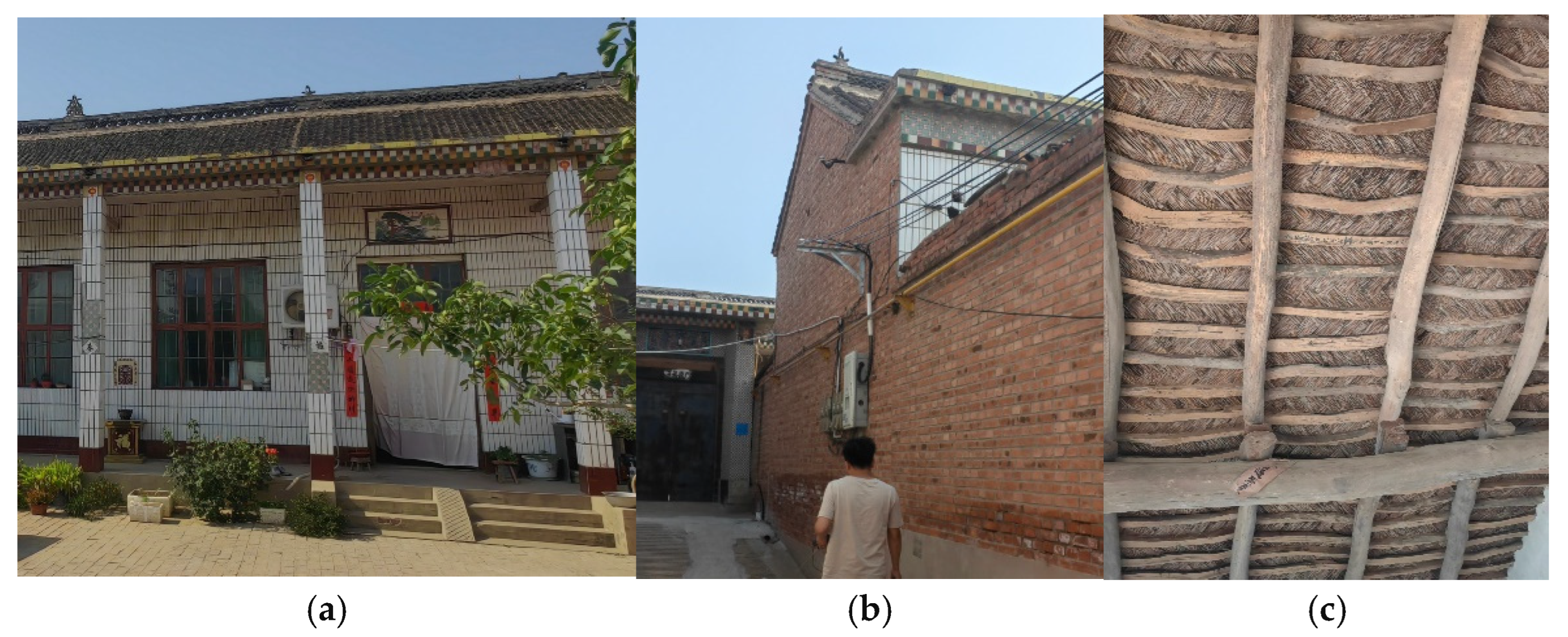
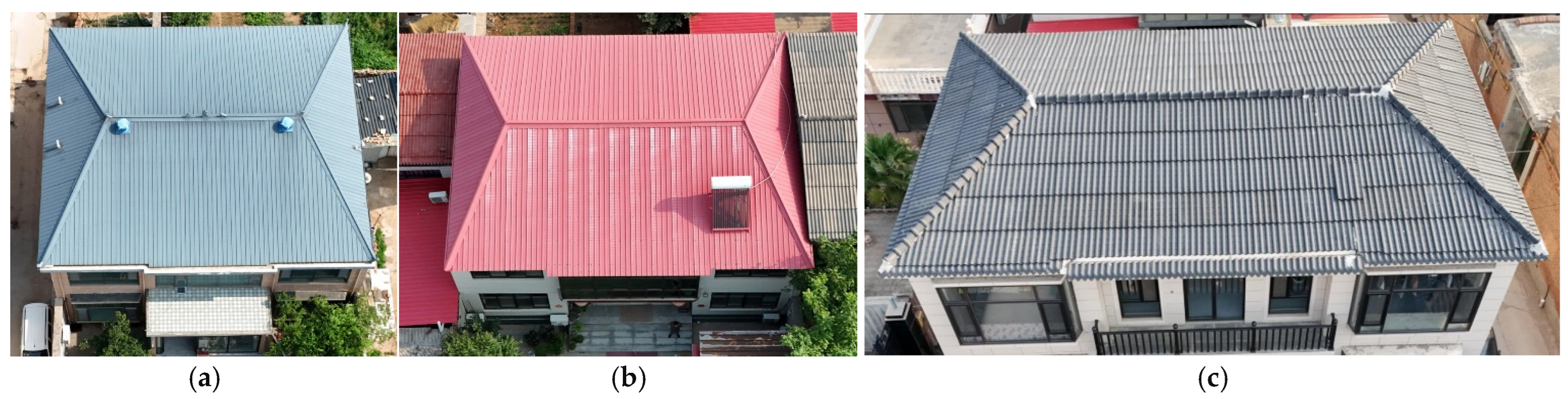
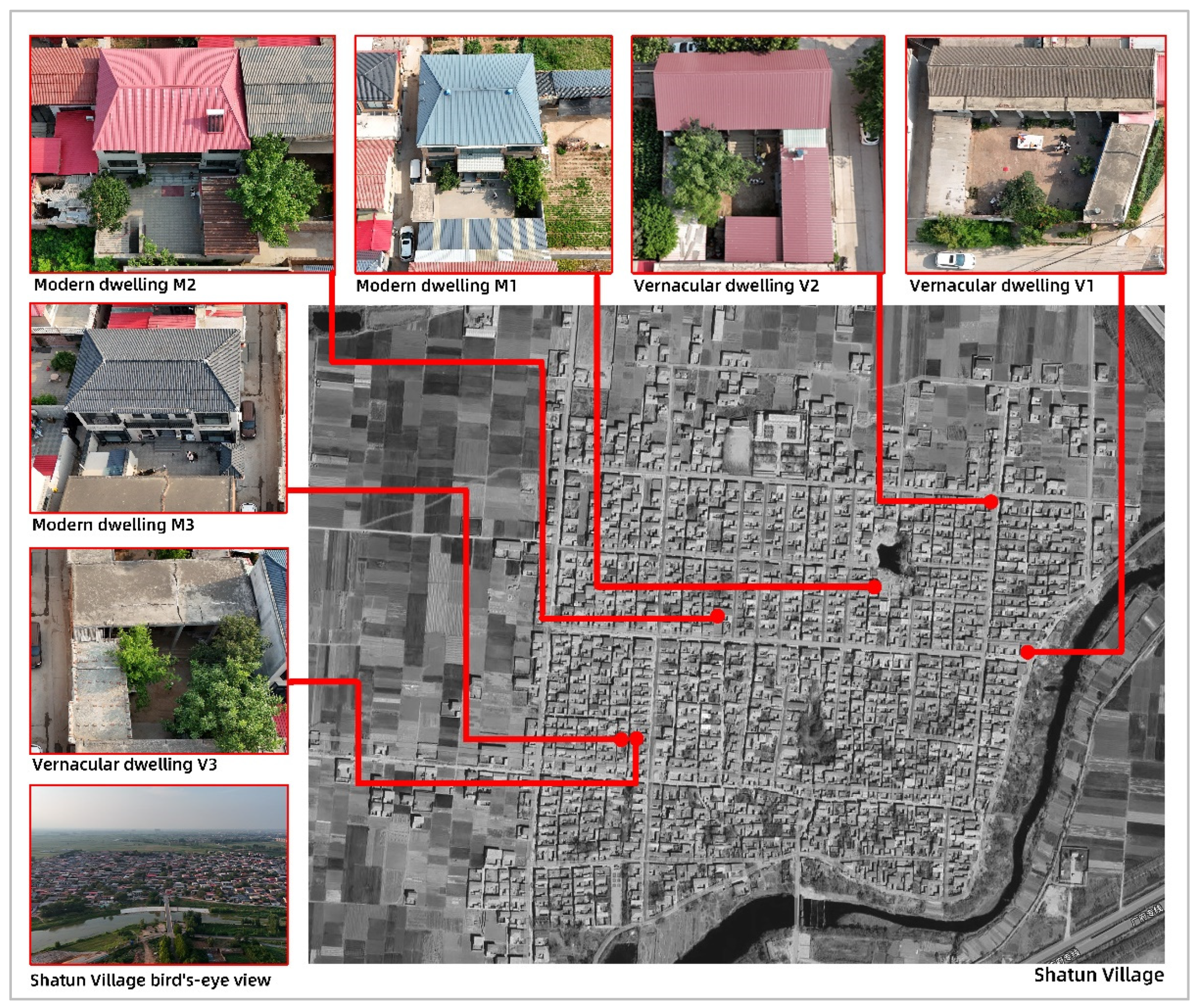
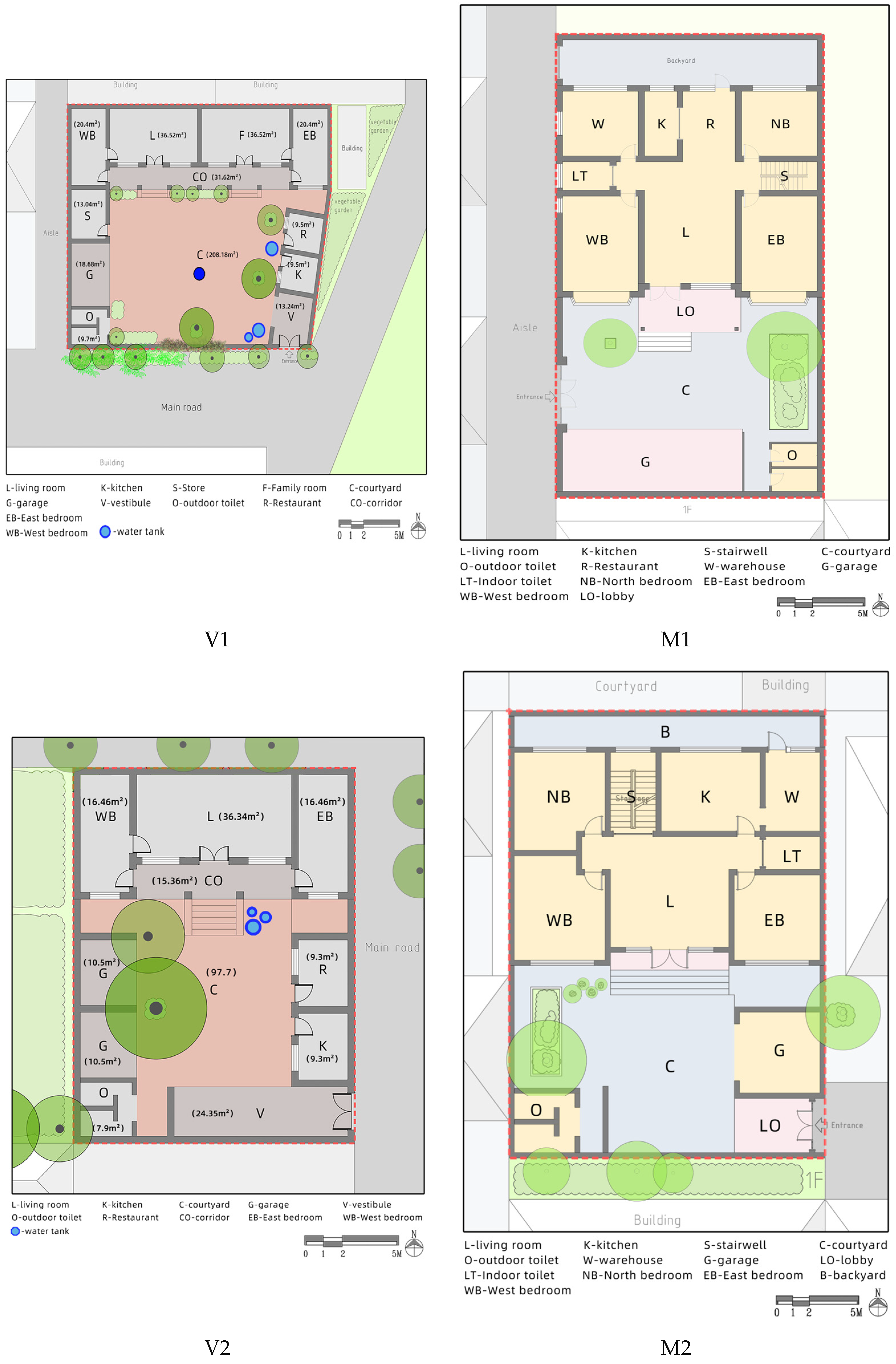
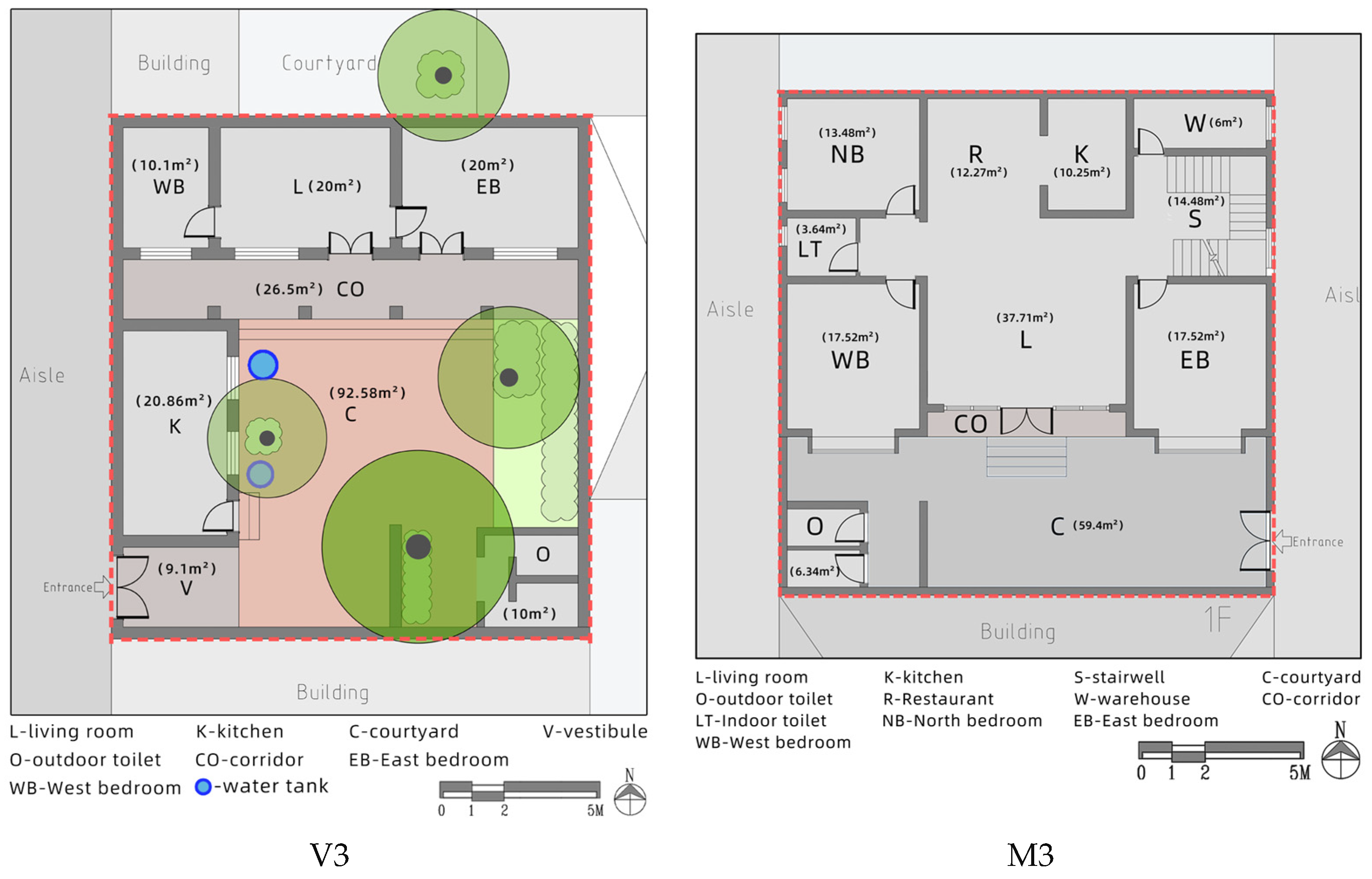
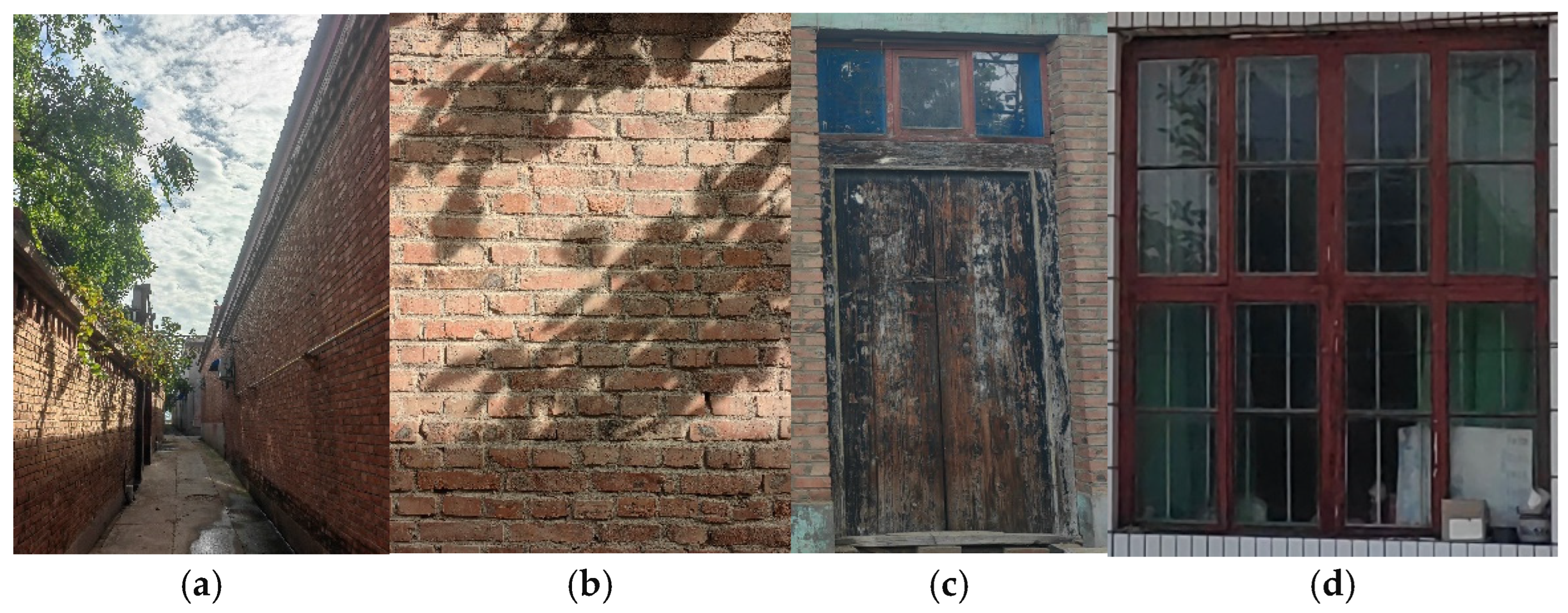
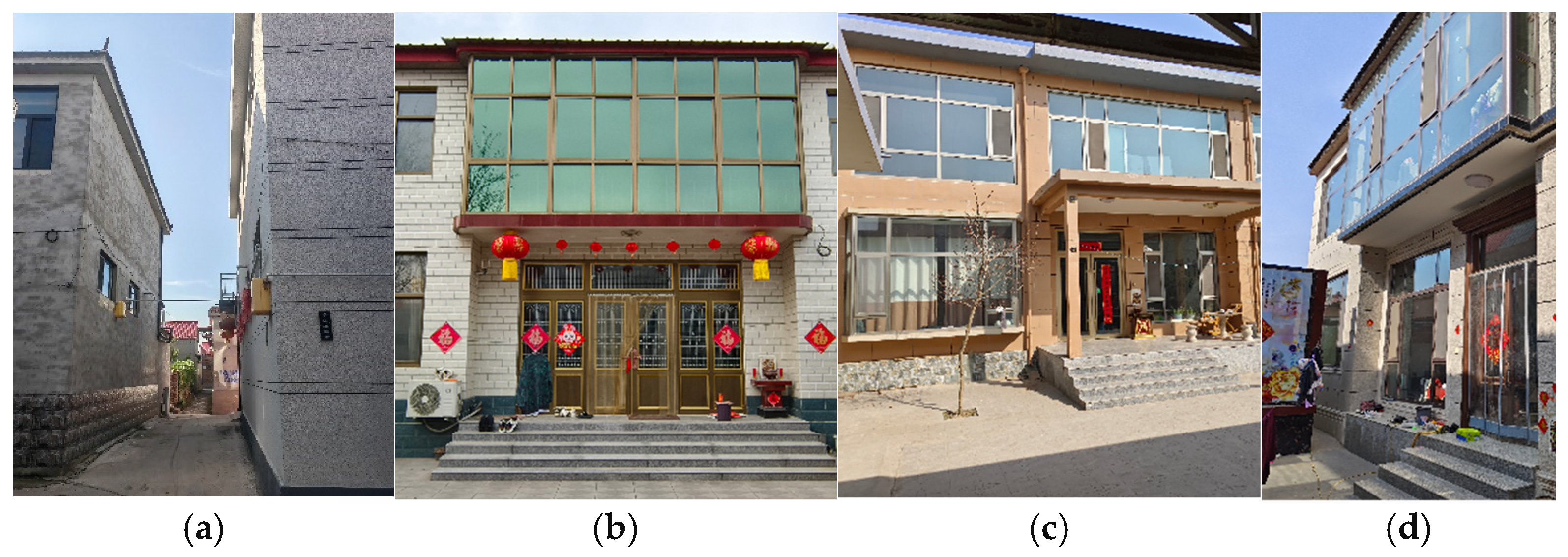
The survey was conducted in Shatun Village, Yaozhai Township, Congtai District, Handan City. The village comprises vernacular dwellings with inward-facing courtyards, thick brick walls, and passive ventilation, as well as modern rural dwellings characterized by concrete structures and a high reliance on air conditioning, as illustrated in Figure 2, Figure 3, Figure 4, Figure 5, Figure 6 and Figure 7. This setting offers a valuable comparative platform for evaluating differences in spatial and environmental adaptability between vernacular and modern dwelling types.
Questionnaires were distributed using a mixed approach that included both online and door-to-door methods. Online forms were shared through local community networks, while printed versions were delivered to households that lacked reliable internet access. Trained research assistants supported both methods, providing clarifications as needed to ensure accurate responses and to minimize potential response bias, particularly among elderly or low-literacy participants.
Sample Size Determination
The target population included all residents of Shatun Village, Yaozhai Township, Congtai District, Handan City, encompassing both vernacular and modern dwelling households. According to the Handan Municipal Bureau of Statistics and the Shatun Village Committee, the village’s population totalled 4980. The required sample size was determined using the Raosoft sample size calculator developed by Raosoft, Inc. (Seattle, WA, USA), applying a 95% confidence level and a margin of error below 5%. The following formula was used:
x = Z(c/100)2r(100 − r)
n = N x/((N − 1) E2 + x)
E= Sqrt [(N − n) x/n(N − 1)]
In this context, N denotes the population size, r denotes the estimated response rate, and Z(c/100) denotes the critical value associated with the specified confidence level. At a 95% confidence level, the calculated minimum sample size was 357.
Participants were recruited using a stratified convenience sampling approach that considered dwelling type and practical measurability. Eligible households included those with full-time residents, accessible spaces for physical measurement, and owners willing to provide consent. To strengthen the reliability of the findings, 410 questionnaires were distributed.
The final survey gathered 383 valid responses collected between July and September 2025, resulting in a response rate of 93.4%. Respondents were evenly divided between vernacular dwellings—characterized by thick masonry or earthen walls, south-facing courtyards, and natural ventilation—and modern dwellings, which consisted of brick–concrete or reinforced concrete structures that depend more on air conditioning and electric appliances [48,49]. Participation was voluntary, anonymity was maintained, and all ethical research standards were followed.

3.2. Supplementary Energy Monitoring and Field Measurements

To supplement the summer thermal comfort survey (n = 383) and provide objective evidence of energy performance, we conducted additional field investigations in Shatun Village, Handan City, during the cooling season from June to August 2025.
Specifically, we continuously monitored household electricity consumption in 20 typical residential buildings, comprising 10 vernacular and 10 modern dwellings, to capture actual energy use associated with summer cooling demand. We recorded and analysed total and per capita monthly electricity consumption data from June to August to support the interpretation of thermal comfort perception and adaptive behaviour.
In addition, we conducted on-site thermal environment measurements in six representative dwellings, including three vernacular and three modern cases. From 11–12 Jnue 2025, we performed 24-h continuous monitoring of indoor and outdoor air temperature, relative humidity, and wind speed at multiple locations, including the main living spaces (east and west bedrooms and the living room), corridors, the foyer, and the courtyard.
All monitored dwellings were located within a 500-m radius in Shatun Village, where the terrain and surface cover are relatively uniform. Simultaneous measurements of wind direction, solar radiation, and humidity confirmed consistent boundary conditions across all sites. Temperature differences within the monitored area remained within ±0.3 °C, a range considered negligible compared to the sensor accuracy. However, some minor spatial variations may still occur due to micro-scale airflow near the southeast river corridor. Future investigations will utilize spatial normalization and computational fluid dynamics (CFD) analysis to further validate and refine the location-based effects.
Field monitoring employed calibrated PM6252B loggers for air temperature (with an accuracy of ±1.2 °C, range 0 to 50 °C) and relative humidity (with an accuracy of ±1.2%). The SWEVY SW6086 was used for measuring air velocity, with an accuracy of <2 m/s: ±0.1% + 5% of the measured value, and ≥2 m/s: ±0.3% + 5% of the measured value. Additionally, a portable weather station (YG-BXZ) was used, which has an accuracy of ±0.3 °C, ±5% RH, and 0.5 m/s + 0.02 m/s for wind speed, with a range of −40 to 80 °C, 0 to 100% RH, and 0 to 70 m/s. All instruments were calibrated before deployment using zero- and span-check procedures and were cross-validated with readings from the HanDan Meteorological Station [8].
Energy consumption and microclimate data were collected to validate the relationships identified in the PLS-SEM analysis. These physical indicators were examined separately to ensure they aligned with trends in comfort and satisfaction. However, they were not included in the PLS-SEM model due to their different measurement scales. Instead, they provided empirical validation to cross-verify the statistical relationships found in the survey-based analysis, thereby enhancing the robustness and interpretability of the overall findings.

3.3. Ethical Approval Statement

Ethical approval for this study was granted by the Universiti Teknologi MARA (UiTM) Research Ethics Committee (Approval number: EC/06/2025 (PG/MR/304)). The research involved administering questionnaire surveys to participants in the Dwelling of Vernacular to Modern study and complied with both institutional ethical standards and the Declaration of Helsinki. Prior to participation, all individuals were informed of the study objectives and provided written informed consent. Participation was voluntary, and all responses were anonymized throughout data collection and processing.

3.4. Conceptual Framework and Hypothesis Development

The conceptual framework developed in this study examines the influence of architectural design strategies on housing satisfaction in rural residential environments through multiple interrelated pathways. The model incorporates five latent constructs: Dwelling Type (DT), Spatial Configuration (SC), Building Materials (BM), Courtyard Configuration (CC), Thermal Comfort (TC), and Housing Satisfaction (HS). Collectively, these constructs represent essential dimensions of rural housing design and the experiential outcomes of occupants.
Informed by literature on vernacular architecture, sustainable residential design, and thermal comfort adaptation [7,50,51,52], the framework integrates objective design characteristics (dwelling type, spatial configuration, building materials, and courtyard configuration) with performance-based perceptions (thermal comfort) and subjective evaluations (housing satisfaction). Unlike models that directly associate physical attributes with satisfaction, this study positions thermal comfort as an intermediate performance mechanism, thereby emphasizing the environmental function of architectural design.
The framework posits that dwelling type, as a fundamental expression of construction logic and cultural tradition, shapes spatial organization, material selection, and courtyard configuration. These design strategies collectively influence residents’ thermal comfort, thereby affecting overall housing satisfaction. Furthermore, specific direct pathways are included to capture the complex interactions among spatial configuration, building materials, and satisfaction outcomes.
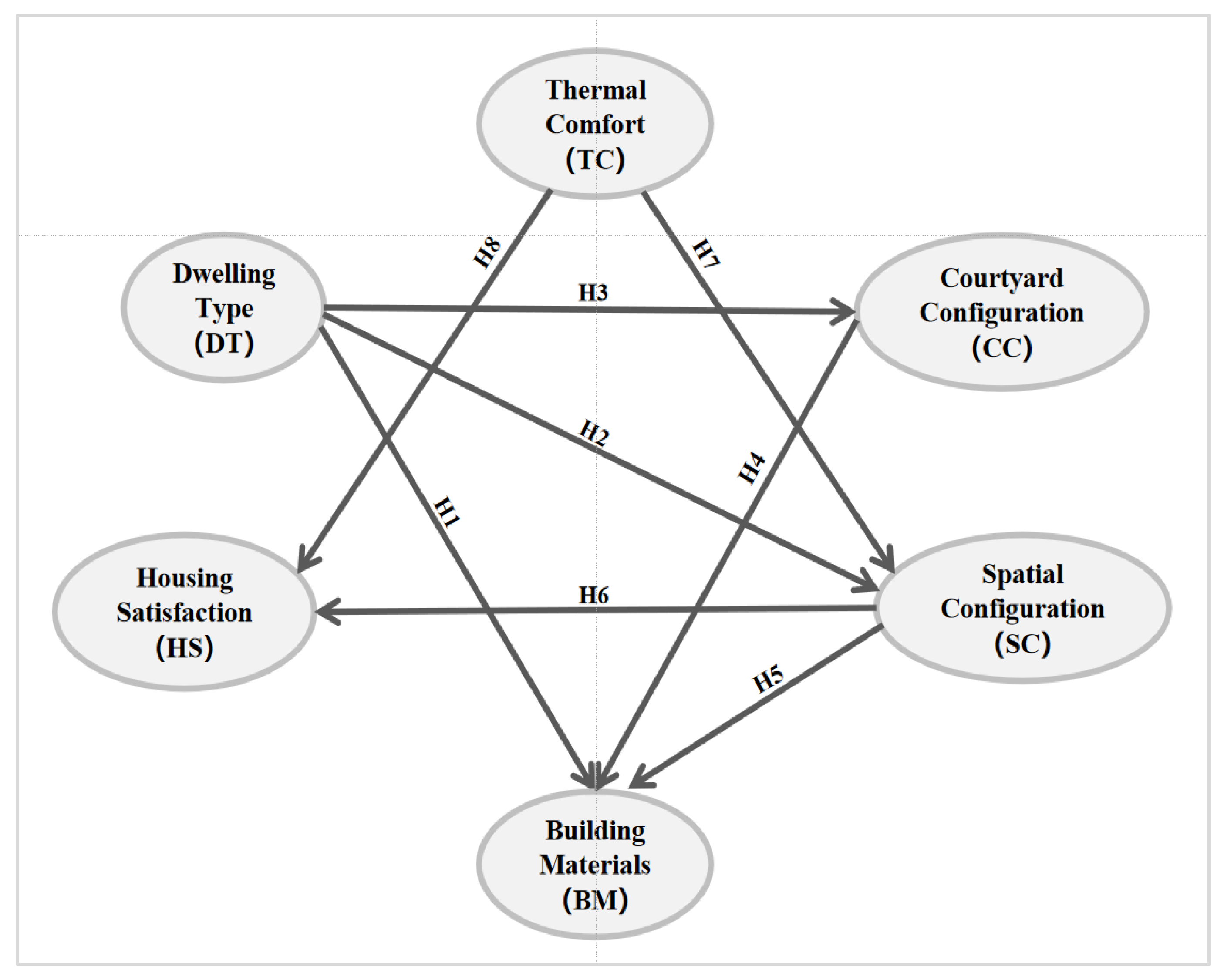
The proposed conceptual model (Figure 8) thus reflects both direct and indirect causal relationships, illustrating how traditional and modern rural dwellings differ in their capacity to balance thermal comfort and sustainability through architectural design strategies.
Hypotheses Development
H1. 
Dwelling Type (DT) has a significant effect on Spatial Configuration (SC).
Distinct dwelling types reflect unique spatial logic and organizational principles. Vernacular dwellings in rural northern China typically feature courtyard-centred layouts, hierarchical room arrangements, and transitional semi-outdoor spaces, which promote spatial continuity and environmental adaptability. In contrast, modern rural dwellings often utilize more compact or linear layouts motivated by construction efficiency. Therefore, dwelling type is anticipated to significantly affect spatial configuration [46].
H2. 
Dwelling type (DT) significantly influences the selection of Building Materials (BM).
Dwelling type reflects historical construction practices and technological conditions. Vernacular dwellings predominantly utilize locally available materials, such as fired brick, clay tile, stone, and timber. In contrast, modern dwellings favour industrialized materials, including reinforced concrete, cement blocks, and synthetic finishes. These differences in material selection influence both construction methods and thermal performance. Consequently, it is hypothesized that dwelling type significantly influences the selection of building materials [53].
H3. 
Dwelling Type (DT) significantly influences Courtyard Configuration (CC).
Courtyard design is intrinsically linked to dwelling typology. Vernacular houses typically incorporate well-proportioned courtyards that serve as microclimatic regulators by facilitating ventilation, providing shading, and supporting outdoor activities. In contrast, modern dwellings frequently reduce the size of courtyards or omit them entirely. Therefore, dwelling type is anticipated to have a substantial impact on courtyard configuration [54].
H4. 
The Courtyard Configuration (CC) significantly influences the selection and performance of Building Materials (BM).
Courtyard configuration plays a critical role in determining the material performance requirements of adjacent building envelopes. Variables such as courtyard size, degree of enclosure, surface treatment, and vegetation coverage directly shape microclimatic conditions, including solar exposure, heat accumulation, and air movement. In response to these factors, building materials are selected to optimize thermal mass, insulation, moisture resistance, and durability. For instance, courtyards with high solar exposure may require thicker masonry walls or materials with greater thermal inertia, whereas vegetated courtyards may benefit from breathable or moisture-regulating materials. Consequently, courtyard configuration is posited to significantly influence the choice of building materials [55].
H5. 
Spatial Configuration (SC) significantly influences the selection and use of Building Materials (BM).
The organization and connectivity of interior and exterior spaces impose constraints on the application of building materials. Spatial configurations characterized by open plans, deep spaces, or semi-enclosed corridors often necessitate materials with superior thermal insulation, durability, and moisture resistance. In contrast, compact layouts may emphasize cost efficiency and structural simplicity. Therefore, it is hypothesized that spatial configuration significantly influences the selection of building materials [56].
H6. 
Spatial Configuration (SC) significantly influences Housing Satisfaction (HS).
Spatial quality is a critical determinant of residents’ daily experiences. Appropriate room proportions, logical circulation, and effective connections between indoor and outdoor spaces enhance usability, privacy, and comfort. These spatial attributes directly inform residents’ evaluations of their living environments. Therefore, spatial configuration is hypothesized to significantly affect housing satisfaction [16].
H7. 
Thermal Comfort (TC) significantly influences Courtyard Configuration (CC).
Thermal comfort conditions determine residents’ perceptions and utilization of courtyard spaces. Favourable thermal environments increase courtyard use and encourage adaptive modifications, such as vegetation planting, shading devices, and surface treatments. Consequently, perceived thermal comfort is anticipated to significantly affect courtyard configuration [57].
The configuration of courtyards (CC) usually impacts thermal comfort (TC) by regulating the microclimate. However, this model also explores the reverse relationship, investigating whether residents’ perceptions of comfort and satisfaction can enhance their awareness and improve their behaviour towards courtyard spaces. Consequently, hypothesis H7 suggests that thermal comfort (TC) may positively influence courtyard configuration (CC) through feedback perception.
H8. 
Thermal Comfort (TC) is a significant factor influencing Housing Satisfaction (HS).
Thermal comfort is a critical determinant of residential satisfaction, especially in naturally ventilated rural dwellings. Stable indoor temperatures, minimized overheating, and enhanced airflow directly support occupants’ physical health and psychological well-being. Consequently, higher levels of thermal comfort are associated with increased housing satisfaction [58].
The figure depicts the proposed conceptual framework, which integrates dwelling type (DT), spatial configuration (SC), building materials (BM), courtyard configuration (CC), thermal comfort (TC), and housing satisfaction (HS). This model delineates the hypothesized causal pathways (H1–H8) that connect architectural design strategies to thermal performance and residential satisfaction in rural dwellings.

3.5. Statistical Analysis Using Partial Least Squares Structural Equation Modelling (PLS-SEM)

Partial Least Squares Structural Equation Modelling (PLS-SEM) was employed using SmartPLS 4.0 to empirically validate the conceptual framework and the hypothesized relationships (H1–H8). PLS-SEM is appropriate for complex models with multiple latent constructs, moderate sample sizes, and non-normal data distributions [59]. The method prioritizes predictive accuracy and variance explanation over strict parametric assumptions, making it suitable for exploratory research on residential performance and sustainable architectural design [60,61].
Latent Constructs and Indicators
The PLS-SEM model incorporates six latent constructs: Dwelling Type (DT), Spatial Configuration (SC), Building Materials (BM), Courtyard Configuration (CC), Thermal Comfort (TC), and Housing Satisfaction (HS), in addition to socio-demographic control variables. Each latent construct was measured using multiple observed indicators obtained from a structured questionnaire.
Dwelling Type (DT) denotes the primary physical and typological characteristics of rural housing, such as construction period, structural system, wall thickness, roof form, and orientation. These attributes collectively influence the dwelling’s passive environmental performance.
Spatial Configuration (SC) refers to the internal spatial organization of the house, including layout efficiency, circulation, openness, and functional hierarchy. This construct reflects how spatial design facilitates natural ventilation, daylight access, and airflow regulation.
Building Materials (BM) encompass the thermal and physical properties of materials used in the building envelope, such as thermal mass, insulation performance, durability, and material sourcing. These properties directly affect indoor thermal conditions and energy performance.
Courtyard Configuration (CC) refers to the physical form and microclimatic function of the courtyard, including size, vegetation coverage, shading conditions, and surface permeability. The courtyard is conceptualized as a key transitional and thermal buffer zone between indoor and outdoor environments.
Thermal Comfort (TC) encompasses residents’ thermal conditions and perceptions, integrating objective and subjective indicators of indoor temperature, thermal sensation, satisfaction with the thermal environment, and thermal preference, in accordance with ASHRAE Standard 55.
Housing Satisfaction (HS) assesses residents’ overall evaluation of their living environment, including perceived comfort, spatial adequacy, environmental quality, and well-being.
Socio-demographic variables, such as age, income, and household size, were included as control variables to minimize potential demographic bias and improve model robustness.
Measurement Model Evaluation
The measurement model underwent assessment for reliability and validity before structural analysis. Internal consistency reliability was determined using Cronbach’s α and Composite Reliability (CR), with all constructs surpassing the recommended threshold of 0.70 [59].
Convergent validity was established through Average Variance Extracted (AVE) values exceeding 0.50 for all latent variables. Discriminant validity was confirmed using the Fornell–Larcker criterion and cross-loading analysis. All indicator loadings were statistically significant (p < 0.001), indicating satisfactory measurement quality.
Evaluation of the Structural Model
After confirming the adequacy of the measurement model, the structural model was evaluated using bootstrapping with 5000 resamples. Model performance was assessed through path coefficients (β) to test hypothesized relationships (H1–H8), coefficients of determination (R2) to evaluate explanatory power, and effect sizes (f2) to determine the relative contribution of each predictor. The overall model fit was assessed using the Standardized Root Mean Square Residual (SRMR), with values below 0.08 considered acceptable [60].
Analytical Framework
The analytical framework facilitates the examination of direct and indirect pathways that connect architectural design strategies to residential outcomes. In this model, dwelling type and spatial configuration determine material selection and courtyard design. These elements, in turn, influence thermal comfort and, ultimately, housing satisfaction. By explicitly including thermal comfort as a key performance variable, the PLS-SEM analysis quantitatively demonstrates that both vernacular and modern design strategies produce measurable comfort outcomes and increased resident satisfaction. The results provide empirical evidence for climate-responsive, sustainable housing design in rural settings.

3.6. Validation and Robustness Assessment of the Model

After establishing the PLS-SEM framework, a series of validation and robustness assessments were conducted to ensure the model’s reliability, stability, and predictive adequacy before testing the hypotheses. This section analyses the methodological validity of both the measurement and structural models. Detailed numerical results will be presented in Section 4.

3.6.1. Measurement Model Robustness

The robustness of the measurement model was evaluated to ensure that all latent constructs, including Dwelling Type (DT), Spatial Configuration (SC), Building Materials (BM), Courtyard Configuration (CC), Thermal Comfort (TC), and Housing Satisfaction (HS), accurately reflected their theoretical definitions.
Indicator reliability was established through assessment of outer loadings; all retained indicators exceeded the recommended threshold of 0.70 following refinement. Internal consistency reliability was demonstrated using Cronbach’s α and Composite Reliability (CR), with all constructs surpassing the 0.70 criterion. Convergent validity was confirmed by Average Variance Extracted (AVE) values above 0.50 for all latent variables.
Discriminant validity was assessed using both the Fornell–Larcker criterion and the Heterotrait–Monotrait (HTMT) ratio, which confirmed clear conceptual distinctions among architectural design variables, thermal comfort, and housing satisfaction.

3.6.2. Data Robustness and Multicollinearity

Data screening and multicollinearity diagnostics were conducted prior to structural model estimation to minimize statistical bias. All Variance Inflation Factor (VIF) values were below 5, indicating no evidence of multicollinearity among predictors. Normality tests indicated moderate deviations from normality, further supporting the use of PLS-SEM due to its minimal reliance on normality assumptions.
Model stability was evaluated using bootstrapping with 5000 resamples. The consistency of parameter estimates across subsamples confirmed the robustness of the results.

3.6.3. Predictive Relevance and Model Fit

The overall quality of the model was evaluated using several criteria. The Standardized Root Mean Square Residual (SRMR) served as a global indicator of goodness-of-fit, with values below 0.05 indicating an acceptable fit between the observed and predicted covariance matrices. Predictive relevance (Q2) values indicated adequate explanatory power for the endogenous constructs, especially thermal comfort and housing satisfaction.
Additionally, an effect size (f2) analysis was performed to evaluate the relative contributions of architectural, material, spatial, and courtyard-related factors to thermal comfort and residential satisfaction.

3.6.4. Summary of Validation Results

All validation criteria met or exceeded the recommended thresholds proposed by Hair et al. [62]. These results demonstrate that the proposed PLS-SEM model is statistically robust and conceptually coherent. Consequently, the validated model is suitable for hypothesis testing and further interpretation. Section 4 presents detailed structural results, including standardized path coefficients, significance levels, and R2 values, along with the finalized PLS-SEM model diagram.

4. Results

4.1. Descriptive Statistics and Sample Profile

A total of 383 valid questionnaires were collected from households in Shatun Village, Handan City, with 51.7% representing vernacular dwellings and 48.3% modern dwellings. This distribution provides a balanced foundation for comparative analysis. The demographic composition of the sample (Table 3) closely mirrors that of rural northern China, thereby supporting the dataset’s representativeness.
Male respondents comprised 56.9% of the sample, while females accounted for 43.1%. The majority of participants were aged 18–50 years (66.8%), and 20.9% were aged 60 or older, reflecting an aging yet economically active rural population. Most respondents reported average heights (161–180 cm) and weights (51–70 kg), providing a reasonable physiological basis for interpreting self-reported thermal comfort and sensation.
Occupational and income profiles indicated a mixed rural economy. Nearly half of respondents were wage-employed (48.3%), followed by farmers (11.2%), retirees (13.1%), and self-employed individuals or homemakers. Monthly household income varied considerably, with over one-quarter earning more than 5000 CNY. This range captures both low- and middle-income households, enabling analysis of socio-economic influences on comfort perception and housing satisfaction.
Distinct differences were identified between dwelling types. Vernacular dwellings were primarily single-story courtyard houses constructed before 2000, characterized by thick masonry walls, grey-tile roofs, and semi-open spaces that facilitate passive ventilation and thermal buffering. In contrast, modern dwellings were mainly two-story reinforced concrete buildings constructed after 2010, featuring larger glazed facades, reduced courtyard openness, and increased reliance on mechanical cooling.
Vernacular and modern dwellings differ in their geometric characteristics, such as shape factor and window-to-wall ratio, which affect their thermal behaviour. This comparison focuses on the different types of rural housing rather than on geometrically equivalent structures, with the goal of evaluating how well each type adapts to similar climatic conditions. The variations observed in comfort and energy responses are seen as reflections of each housing typology’s intrinsic ability to adapt to the environment.
Preliminary descriptive analysis identified notable differences in thermal comfort (TC) and environmental perception. Residents of vernacular dwellings reported higher overall thermal comfort and greater ventilation effectiveness. In contrast, occupants of modern dwellings expressed higher satisfaction with daylight access and interior cleanliness but reported lower comfort during summer. These contrasting patterns underscore the trade-offs between traditional passive adaptability. Overall, the descriptive results demonstrated sufficient variability across all constructs. Cronbach’s α values exceeded 0.7, confirming strong internal consistency and suitability for subsequent PLS-SEM analysis.

4.2. Measurement Model Evaluation

4.2.1. Indicator Reliability

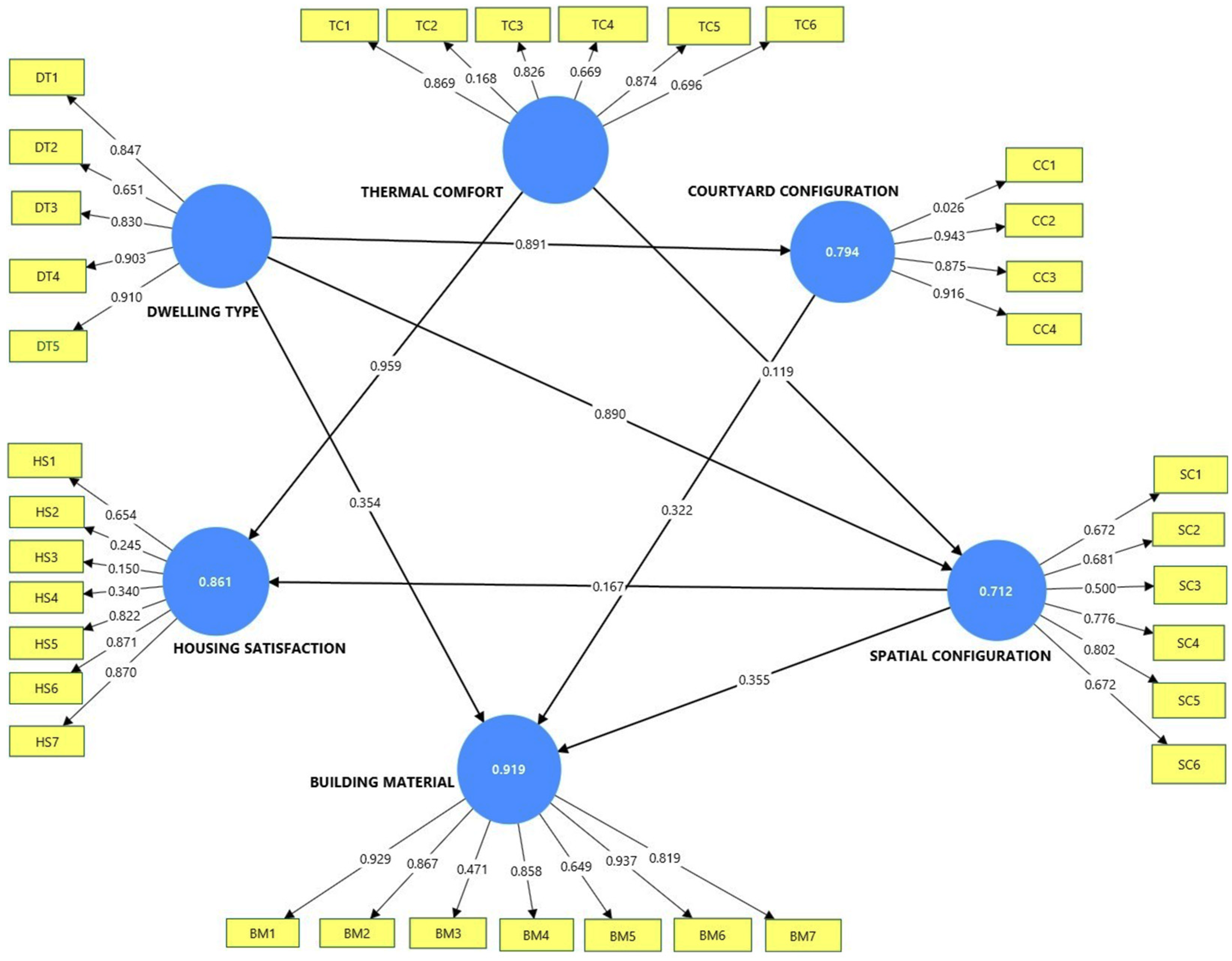
Indicator reliability was evaluated by analysing the outer loadings of observed indicators on their respective latent constructs (Figure 9). In accordance with Bajjou et al. [63], loadings above 0.70 were considered optimal, while values exceeding 0.60 were accepted when justified by theoretical significance.
The measurement model demonstrated satisfactory indicator reliability across all constructs, including architectural characteristics and thermal comfort (TC). For Dwelling Type (DT), outer loadings ranged from 0.651 to 0.910, indicating strong internal consistency in representing dwelling typology, structure, and envelope characteristics. Spatial Configuration (SC) exhibited moderate to high reliability, with loadings ranging from 0.500 to 0.802, reflecting the multidimensional aspects of spatial layout, circulation, and functional organization.
Building Materials (BM) demonstrated particularly strong indicator performance, with loadings ranging from 0.471 to 0.937. Indicators related to window and door materials (BM6–BM7) contributed most significantly, highlighting the importance of envelope components in perceived thermal and environmental performance. Lower-loading items were retained due to their conceptual relevance in representing material diversity across vernacular and modern dwellings.
Most Courtyard Configuration (CC) indicators demonstrated high reliability, with loadings exceeding 0.87, confirming the significance of courtyard size, vegetation, and surface treatment in shaping outdoor microclimatic conditions. One indicator exhibited a weak loading, reflecting heterogeneity in courtyard presence and usage across dwelling types, but was retained to maintain contextual completeness.
Thermal Comfort (TC) indicators exhibited strong reliability, with most loadings above 0.65, confirming that both objective thermal conditions and subjective thermal perceptions were effectively measured. Items reflecting indoor thermal sensation and satisfaction contributed most significantly, supporting TC’s role as a key experiential mediator within the model.
Housing Satisfaction (HS) demonstrated robust indicator reliability, with loadings predominantly exceeding 0.80, indicating stable measurement of residents’ overall comfort, liveability, and environmental satisfaction.
In summary, most indicators met or exceeded recommended reliability thresholds. These results confirm that the selected measurement items consistently represent their corresponding latent constructs, providing a reliable foundation for subsequent structural model analysis.

4.2.2. Internal Consistency Reliability

Internal consistency reliability was evaluated using Cronbach’s α and Composite Reliability (CR), as summarized in Table 4. The results demonstrate that the measurement model exhibits acceptable to strong internal consistency across all latent constructs, including thermal comfort (TC).
All constructs exhibited CR values exceeding the recommended threshold of 0.70, ranging from 0.838 to 0.929, which confirms adequate internal coherence among indicators. Building Materials (BM) (CR = 0.929) and Dwelling Type (DT) (CR = 0.901) demonstrated strong reliability, reflecting consistent responses regarding material performance and dwelling characteristics. Thermal Comfort (TC) also achieved a high CR value (0.891), indicating that both objective thermal conditions and subjective thermal perceptions were reliably measured.
Cronbach’s α values ranged from 0.714 to 0.900 for most constructs, indicating generally acceptable internal consistency. BM (α = 0.900), DT (α = 0.886), and TC (α = 0.806) demonstrated particularly strong reliability, while Spatial Configuration (SC) (α = 0.793) and Courtyard Configuration (CC) (α = 0.714) exhibited moderate but acceptable values. Housing Satisfaction (HS) presented a slightly lower α (0.777), which may reflect the multidimensional nature of satisfaction-related evaluations.
In summary, despite minor variations in Cronbach’s α across constructs, the consistently high CR values confirm that the measurement model possesses sufficient internal consistency and reliability. This provides a robust foundation for subsequent structural model analysis.

4.2.3. Convergent Validity

Convergent validity was assessed using the Average Variance Extracted (AVE), which measures the extent to which a latent construct accounts for the variance in its indicators relative to measurement error. According to Cheung et al. [64], AVE values greater than 0.50 indicate satisfactory convergent validity.
As shown in Table 4, most constructs demonstrated acceptable convergent validity. Dwelling Type (DT) (AVE = 0.695), Building Materials (BM) (AVE = 0.649), and Courtyard Configuration (CC) (AVE = 0.623) all exceeded the recommended threshold, indicating that their indicators shared substantial common variance. Thermal Comfort (TC) also demonstrated adequate convergent validity (AVE = 0.527), confirming that both objective thermal conditions and subjective thermal perceptions were consistently captured by the measurement items.
Two constructs, Spatial Configuration (SC) (Average Variance Extracted, AVE = 0.477) and Housing Satisfaction (HS) (AVE = 0.402), had AVE values that fell slightly below the recommended threshold. However, following the guidance of Fornell and Larcker [65], the convergent validity remains acceptable because the Composite Reliability (CR) exceeds 0.70 for both constructs: SC (CR = 0.838) and HS (CR = 0.873). This indicates that the multidimensional and perception-based nature of spatial evaluation and housing satisfaction allows for a variety of experiential aspects, rather than a single, uniform construct. The lower AVE values highlight the different perceptual dimensions encompassed by these constructs, which continue to be both theoretically consistent and statistically reliable.
In summary, the AVE results, together with strong composite reliability, confirm that the measurement model demonstrates satisfactory convergent validity and is appropriate for subsequent structural model testing.

4.2.4. Discriminate Validity

Discriminant validity was assessed using two complementary methods: the Fornell–Larcker criterion and the Heterotrait–Monotrait (HTMT) ratio. These approaches ensure that each latent construct represents a conceptually distinct dimension of rural housing performance [66].
The Fornell–Larcker criterion (Table 5) indicated that the square root of the AVE for each construct exceeded its corresponding inter-construct correlations, demonstrating satisfactory discriminant validity. For instance, Building Materials (BM) (√AVE = 0.806), Dwelling Type (DT) (0.834), and Thermal Comfort (TC) (0.726) all exhibited higher self-loadings than their correlations with other constructs. While relatively strong correlations were observed between DT and BM, and between DT and Courtyard Configuration (CC), the diagonal AVE values remained dominant, thereby satisfying the criterion. This pattern reflects the inherent conceptual linkage among dwelling typology, material choices, and courtyard form in vernacular housing contexts, rather than measurement overlap.
The HTMT results presented in Table 6 largely support these findings. Most HTMT values fell below or were close to the conservative threshold of 0.90, indicating acceptable discriminant validity. However, a few construct pairs, such as DT–CC and DT–BM, exhibited slightly elevated HTMT ratios, suggesting a close conceptual relationship between them. This outcome is theoretically expected, as dwelling type directly influences material selection, courtyard layout, and related thermal conditions. Notably, thermal comfort (TC) maintained acceptable HTMT values across all construct pairings, confirming that it represents a distinct experiential dimension rather than merely replicating architectural or spatial variables [67].
In summary, the combined Fornell–Larcker and HTMT assessments confirm that Dwelling Type, Spatial Configuration, Building Materials, Courtyard Configuration, Thermal Comfort, and Housing Satisfaction are empirically distinguishable constructs. The measurement model thus demonstrates adequate discriminant validity and offers a reliable foundation for subsequent structural model analysis.
Although several inter-construct correlations and HTMT values approach or slightly exceed conservative thresholds, this pattern reflects the inherent conceptual proximity among dwelling typology, spatial organization, and material characteristics in vernacular housing systems, rather than measurement overlap. In rural architectural contexts, dwelling types typically integrate spatial logic and material choices into a coherent system. Consistent with prior PLS-SEM research, slightly elevated HTMT values may be acceptable in models where constructs represent theoretically integrated dimensions of a unified system, particularly in environmental–behavioural and architectural studies. In these contexts, discriminant validity should be evaluated alongside theoretical distinctiveness and structural relevance, rather than relying solely on strict numerical thresholds.

4.2.5. Model Fit and Collinearity Diagnostics

The robustness of the PLS-SEM model was evaluated through overall model fit and collinearity diagnostics. Given PLS-SEM’s predictive orientation, the analysis emphasized standardized root mean square residuals (SRMR) and variance inflation factors (VIF) rather than traditional covariance-based fit indices.
Model Fit Evaluation
Table 7 presents the SRMR values for both the saturated model (0.165) and the estimated model (0.168). These values indicate a moderate level of global model fit. Although they exceed the conservative threshold of 0.10, they are generally considered acceptable for complex exploratory models that include both objective architectural variables and perceptual constructs such as thermal comfort (TC). The higher SRMR values reflect the diversity of rural dwellings and the use of mixed-format indicators, which are common in environmental and behavioural housing research [68,69].
The d_ULS values indicate stable residual distributions between the empirical and model-implied correlation matrices, supporting the internal consistency of the estimated model. Traditional covariance-based indices (χ2, NFI) were not emphasized because they are neither required nor fully informative within PLS-SEM frameworks.
Collinearity Diagnostics
Potential multicollinearity among latent constructs was assessed using VIF statistics (Table 8). Most VIF values were within acceptable limits, indicating no severe collinearity. Elevated VIF values for Dwelling Type (DT) and Courtyard Configuration (CC) (VIF = 10.439 and 5.528, respectively) reflect their strong conceptual association with building materials and spatial organization in vernacular housing contexts.
Thermal Comfort (TC) exhibited low VIF values (≤1.241), confirming its role as an independent experiential construct rather than a redundant proxy for architectural or material variables. Spatial Configuration (SC) also demonstrated acceptable VIF levels, supporting its distinct mediating function within the structural model.
Model Interpretation
Recent methodological discussions suggest that SRMR in PLS-SEM should be interpreted as a descriptive rather than a confirmatory index. Consequently, this model prioritizes explanatory power, predictive relevance, and theoretical coherence over strict adherence to global fit thresholds.
The SRMR values for overall model fit are slightly higher than the conservative cut-off criteria typically used in covariance-based SEM. However, given the exploratory nature of this study and the application of PLS-SEM with multiple perceptual and behavioural constructs, SRMR serves as an indicative rather than a decisive fit measure. In line with prior PLS-SEM research that emphasizes prediction and explanation over exact model fit, the obtained SRMR values are considered acceptable for theory-building purposes.

4.3. Structural Model Evaluation

Following validation of the measurement model, the structural relationships among the latent constructs were analysed to evaluate the eight proposed hypotheses (H1–H8).
Partial Least Squares Structural Equation Modelling (PLS-SEM) with bootstrapping (5000 subsamples) was conducted to assess the significance, direction, and magnitude of the hypothesized paths [70,71]. Model performance was subsequently evaluated using the coefficient of determination (R2), the effect size (f2), and the standardized root mean square residual (SRMR) as model fit indices.

4.3.1. Path Coefficients and Hypothesis Testing

The structural model was assessed through bootstrapping with 5000 resamples to estimate standardized path coefficients (β), t-values, and significance levels. Figure 8 presents the validated structural relationships, and Table 9 summarizes the corresponding hypothesis-testing results.
All hypothesized paths (H1–H8) were positive and statistically significant at p < 0.001, thereby confirming both the empirical robustness and theoretical consistency of the proposed model.
Structural Relationship Interpretation
The results demonstrate that Dwelling Type (DT) serves as the primary exogenous driver in the model, exerting substantial influence on spatial organization, material selection, and courtyard configuration. The paths DT → SC (β = 0.890) and DT → CC (β = 0.891) yielded the largest coefficients, indicating that dwelling typology fundamentally determines spatial layout logic and courtyard form in rural housing. Traditional vernacular dwellings, characterized by courtyard-centred layouts, exhibit greater spatial coherence and outdoor–indoor integration compared to modern dwelling types.
DT also exerted a significant influence on Building Materials (BM) (β = 0.354), indicating that architectural typology strongly determines material choice and envelope performance. This effect is further supported by the significant paths SC → BM (β = 0.355) and CC → BM (β = 0.322), suggesting that both spatial configuration and courtyard design mediate material-related decisions and performance.
Thermal Comfort (TC) emerged as a critical experiential variable in the model. TC significantly influenced Spatial Configuration (β = 0.119), indicating that perceived thermal conditions shape residents’ use and evaluation of spatial layouts. Notably, TC exhibited the strongest direct effect on Housing Satisfaction (HS) (β = 0.959), establishing thermal comfort as the primary determinant of overall residential satisfaction in rural dwellings.
Spatial Configuration also exerted a direct positive influence on Housing Satisfaction (β = 0.167), confirming that spatial openness, ventilation potential, and functional connectivity contribute to residents’ perceived well-being in addition to thermal conditions.
Collectively, these results reveal a hierarchical mechanism in which dwelling typology shapes spatial and courtyard structures, which, in turn, influence material performance and thermal comfort, ultimately determining housing satisfaction. The strong explanatory power of TC underscores the central role of thermal adaptation in assessing sustainable rural housing performance.

4.3.2. Coefficient of Determination (R2) and Predictive Power

The coefficient of determination (R2) was utilized to evaluate the explanatory and predictive capabilities of the structural model for each endogenous construct (Table 10). R2 values indicate the proportion of variance accounted for by the respective predictors and are typically classified as weak (0.25), moderate (0.50), or substantial (0.75) [72,73].
The results demonstrate that the model has considerable explanatory power across all endogenous variables, as evidenced by R2 values ranging from 0.712 to 0.919. Building Materials (BM) exhibited the highest explained variance (R2 = 0.919), indicating that dwelling type (DT), spatial configuration (SC), and courtyard configuration (CC) collectively exert a strong influence on material selection and performance in rural dwellings. These findings underscore the close interrelationship among architectural typology, spatial organization, and construction strategies.
Housing Satisfaction (HS) also achieved a high R2 value (0.861), suggesting that residents’ overall satisfaction is effectively predicted by spatial configuration and, most notably, thermal comfort (TC). The significant predictive contribution of TC affirms its central role in determining perceived residential quality and establishes thermal comfort as a critical mediating outcome of architectural and material choices.
For the Courtyard Configuration (CC), the R2 value of 0.794 indicates substantial explanatory strength, suggesting that dwelling typology and material-related characteristics significantly affect courtyard form and microclimatic function. These results support the interpretation of the courtyard as an adaptive interface that connects built form with environmental regulation.
Similarly, Spatial Configuration (SC) yielded a substantial R2 value (0.712), indicating that spatial performance is primarily determined by dwelling type and influenced by thermal comfort conditions. This finding highlights the joint impact of typological planning and thermal perception on residents’ assessments of spatial adequacy and usability.
Overall, the consistently high R2 values across all endogenous constructs confirm the robustness and predictive relevance of the proposed PLS-SEM model. The findings indicate that architectural typology, spatial organization, material performance, and thermal comfort function as an integrated system, collectively shaping housing satisfaction and sustainability outcomes in rural northern China.

4.3.3. Effect Size (f2) and Mediation in Structural Relationships

To assess the relative importance of each structural relationship, an effect size (f2) analysis was conducted. While path coefficients indicate the direction and significance of relationships, f2 values quantify the substantive contribution of each predictor to the explained variance of endogenous constructs. According to Cohen’s classification, f2 values of 0.02, 0.15, and 0.35 correspond to small, medium, and large effects, respectively [74].
The results indicate a distinct hierarchy of influence among architectural, environmental, and experiential factors (Table 11). Dwelling Type (DT) demonstrates very large effect sizes on both Spatial Configuration (f2 = 2.219) and Courtyard Configuration (f2 = 3.858), suggesting that typological characteristics strongly determine spatial organization and courtyard form. This finding confirms that fundamental planning logic, such as courtyard-centred or linear layouts, serves as the primary structural driver of spatial and outdoor environmental performance in rural dwellings.
Spatial Configuration (SC) and Courtyard Configuration (CC) exhibit moderate to large effects on Building Materials (f2 = 0.410 and 0.233, respectively), indicating that material selection and envelope performance are substantially influenced by spatial arrangement and courtyard-related microclimatic demands. In contrast, the direct effect of Dwelling Type on Building Materials (f2 = 0.149) is weaker, suggesting that typology affects material performance primarily through spatial and courtyard mediation rather than direct determination.
Among all relationships, Thermal Comfort (TC) exerts the strongest influence on Housing Satisfaction (HS), with an exceptionally large effect size (f2 = 6.123). This finding indicates that residents’ overall satisfaction is primarily determined by perceived thermal conditions, surpassing the contributions of spatial and material factors. Although Spatial Configuration also has a notable effect on Housing Satisfaction (f2 = 0.185), its influence is secondary to that of thermal experience.
The effect of Thermal Comfort on Spatial Configuration is small (f2 = 0.040), indicating that although thermal perception may influence how residents evaluate or use space, it does not fundamentally alter spatial structure. This asymmetry underscores thermal comfort as a consequential outcome rather than a structural determinant within the housing system.
In summary, the f2 analysis confirms a layered causal mechanism: dwelling typology governs spatial and courtyard structure; spatial and courtyard conditions shape material performance; and thermal comfort ultimately dominates residential satisfaction. This hierarchy emphasizes the importance of passive design strategies in vernacular housing as essential contributors to sustainable comfort outcomes in rural environments.

4.4. Validation of Field Measurements: Energy Consumption and Thermal Environment

To supplement the PLS-SEM results and substantiate the proposed causal pathways, field measurements of energy consumption and indoor and outdoor thermal environments were conducted in 20 representative dwellings, comprising 10 vernacular (V1–V10) and 10 modern dwellings (M1–M10). Additionally, continuous monitoring of air temperature, relative humidity, and air velocity was performed in three typical vernacular dwellings (V1–V3) and three modern dwellings (M1–M3) during the summer.

4.4.1. Analysis of Summer Energy Consumption and per Capita Electricity Use

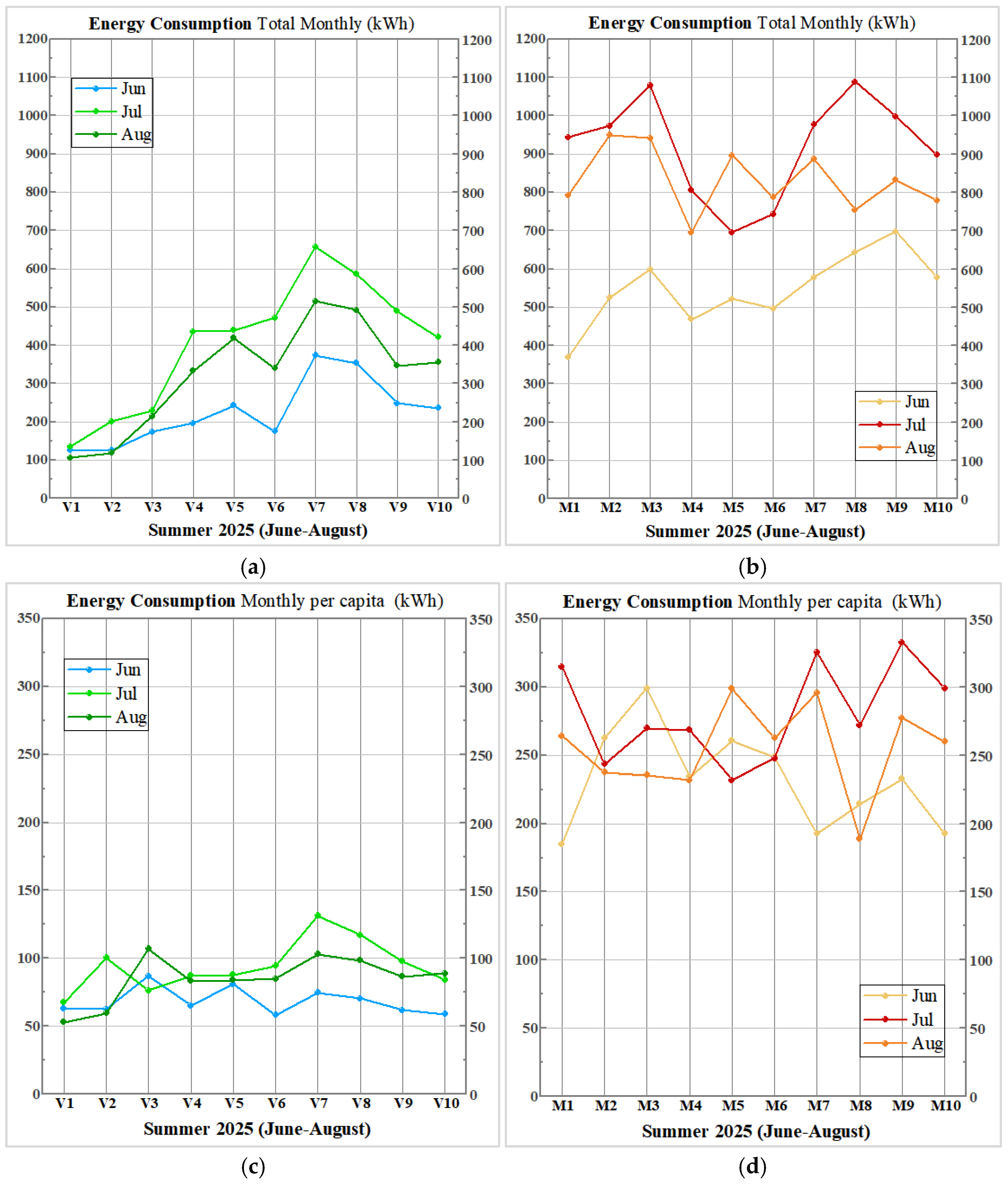
Figure 10 presents the total monthly electricity consumption and per capita energy use for the monitored dwellings from June to August. Vernacular dwellings consistently demonstrated substantially lower total and per capita electricity consumption compared to modern dwellings throughout the study period. The average per capita electricity uses in vernacular dwellings ranged from approximately 55 to 130 kWh per month, while modern dwellings exhibited significantly higher values, typically between 190 and 330 kWh per month.
Although individual households exhibited some variation, the overall energy consumption patterns reveal a distinct structural difference between the two dwelling types. Modern dwellings experienced marked increases in electricity use during July and August, coinciding with greater reliance on mechanical cooling systems. In contrast, vernacular dwellings maintained relatively stable, moderate energy demand, indicating a stronger reliance on passive thermal regulation strategies.
These findings offer direct empirical support for the PLS-SEM results, which identified dwelling type and spatial configuration as significant determinants of residential energy-related behaviour.

4.4.2. Air Temperature Profiles in Representative Dwellings

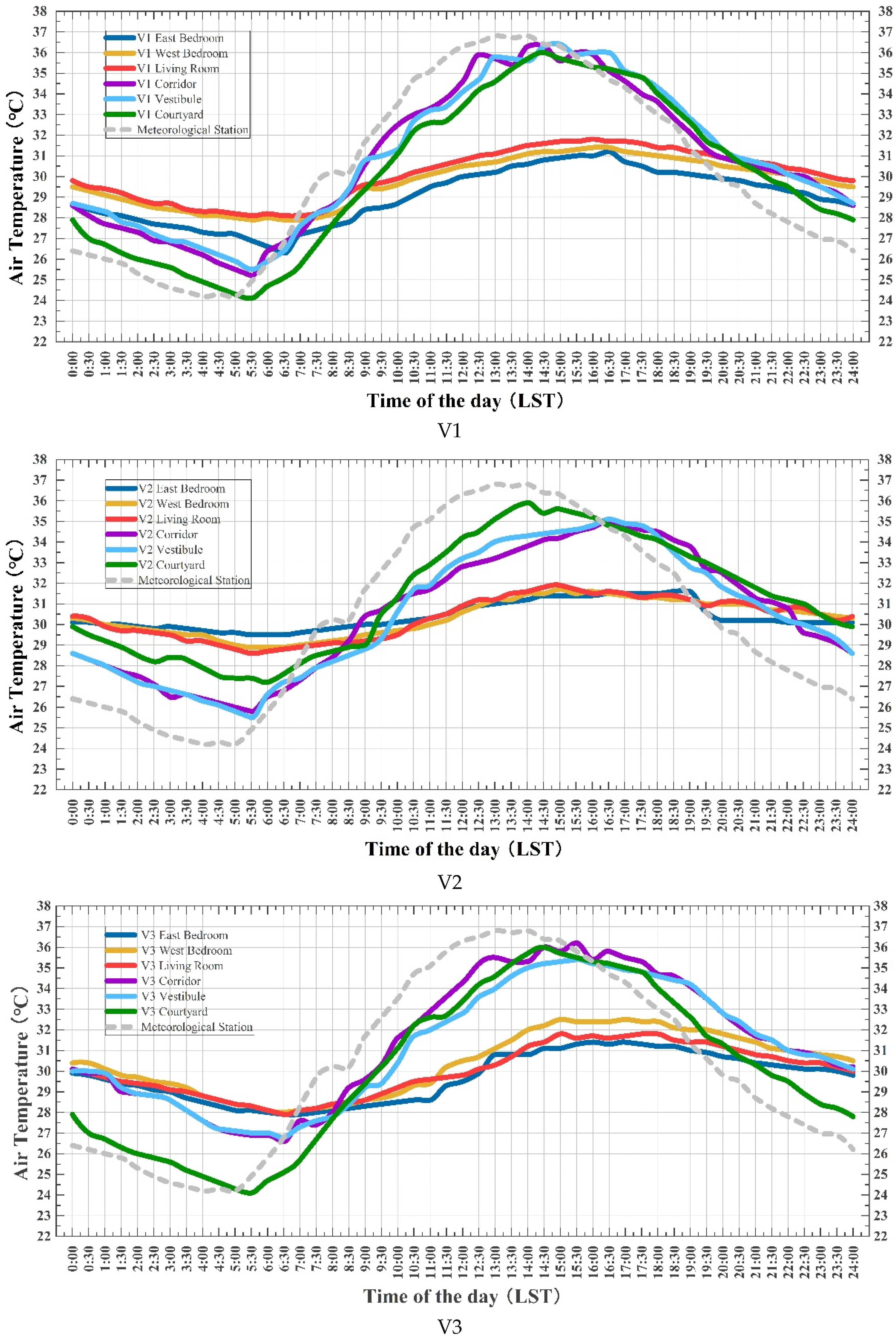
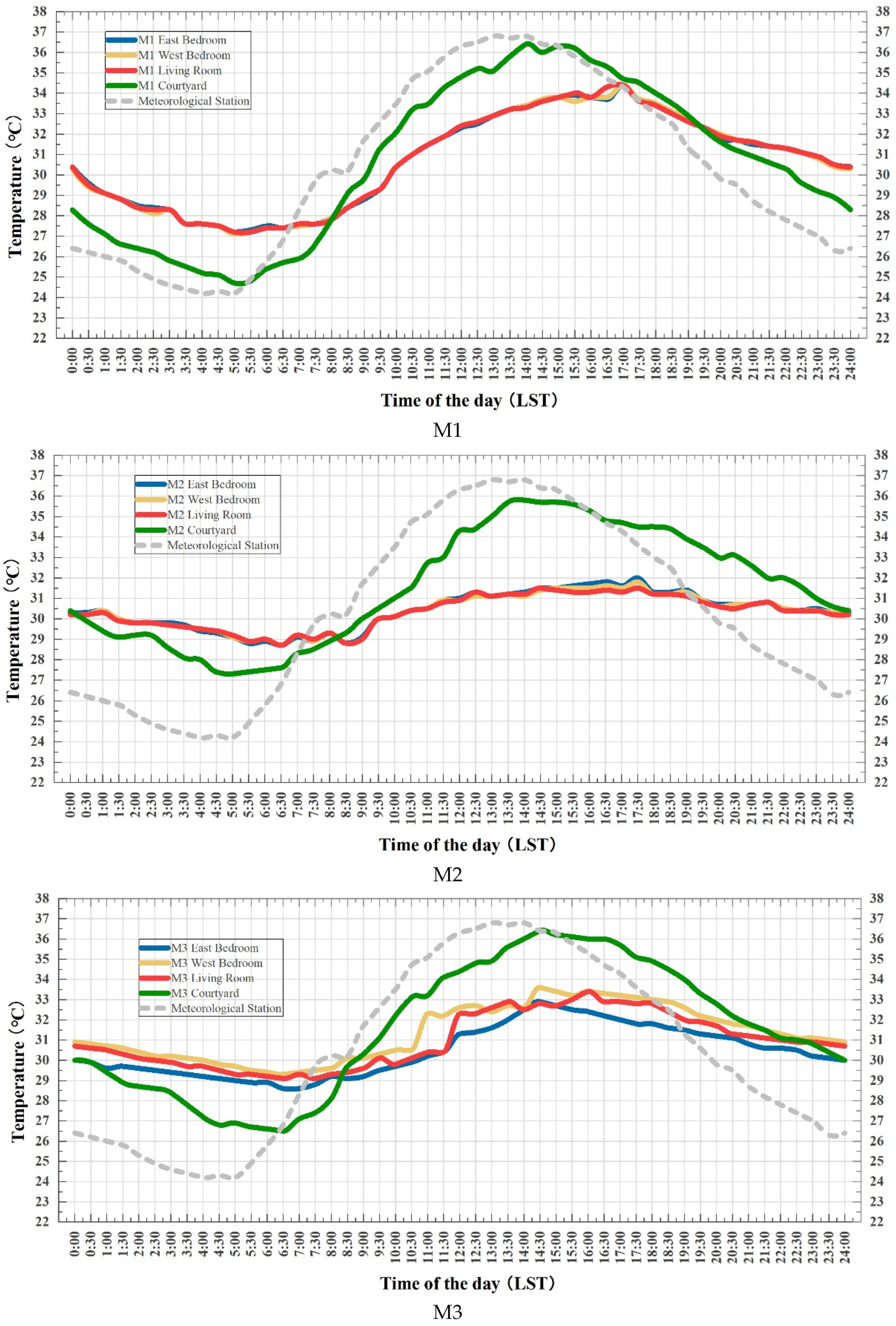
Figure 11 and Figure 12 display 24-h air temperature profiles measured in representative vernacular and modern dwellings, respectively. In vernacular dwellings (V1–V3), indoor temperatures in bedrooms, living rooms, and corridors demonstrated significantly reduced diurnal fluctuations compared to outdoor conditions. Peak indoor temperatures typically remained 3–5 °C lower than those recorded in the corresponding courtyard and at the meteorological station.
Courtyards, shaded corridors, and thick masonry envelopes delayed heat gain and reduced indoor temperature peaks, especially during midday and early afternoon. This thermal buffering effect was consistently observed in all three vernacular dwellings.
In contrast, modern dwellings (M1–M3) exhibited indoor temperature profiles that closely mirrored outdoor variations, with higher peak temperatures and reduced time lag. Courtyard spaces in modern dwellings often experience elevated daytime temperatures, providing limited cooling benefits to adjacent indoor areas.
Field temperature observations indicate that modern brick-concrete homes tend to maintain relatively stable yet consistently high indoor temperatures during the summer, with daily averages around 30 °C throughout the day. In contrast, traditional courtyard houses display a distinct diurnal pattern: indoor temperatures peak around 16:00, approximately two hours later than the outdoor maximum, demonstrating a clear time-lag effect. The thick earthen walls and courtyard layout slow down heat transmission and promote rapid cooling at night, allowing indoor temperatures to drop quickly after sunset to a range that is comfortable for humans. This performance underscores the superior thermal inertia and passive cooling effectiveness of traditional dwellings in hot summer conditions.

4.4.3. Relative Humidity Regulation and Microclimatic Adaptability

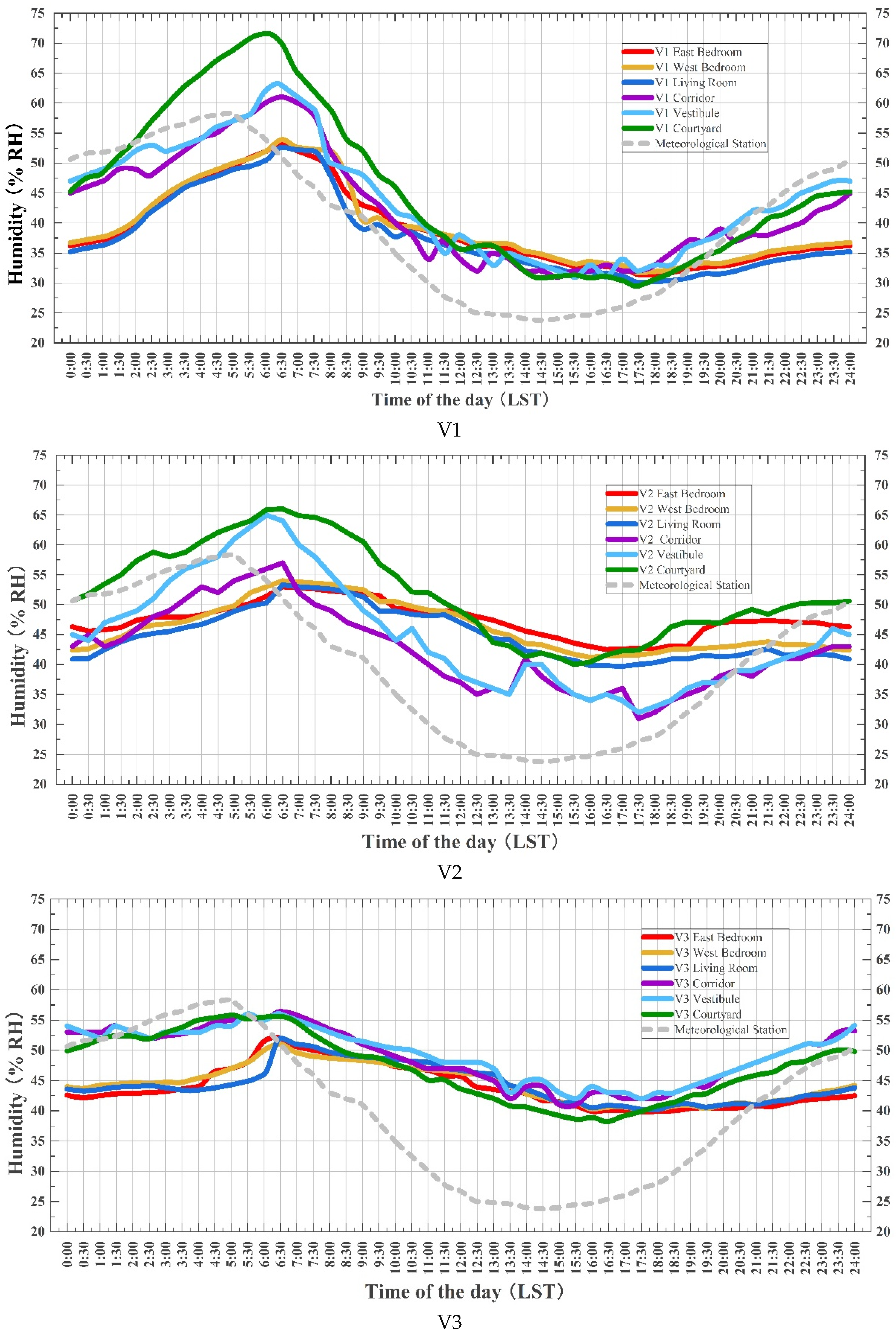
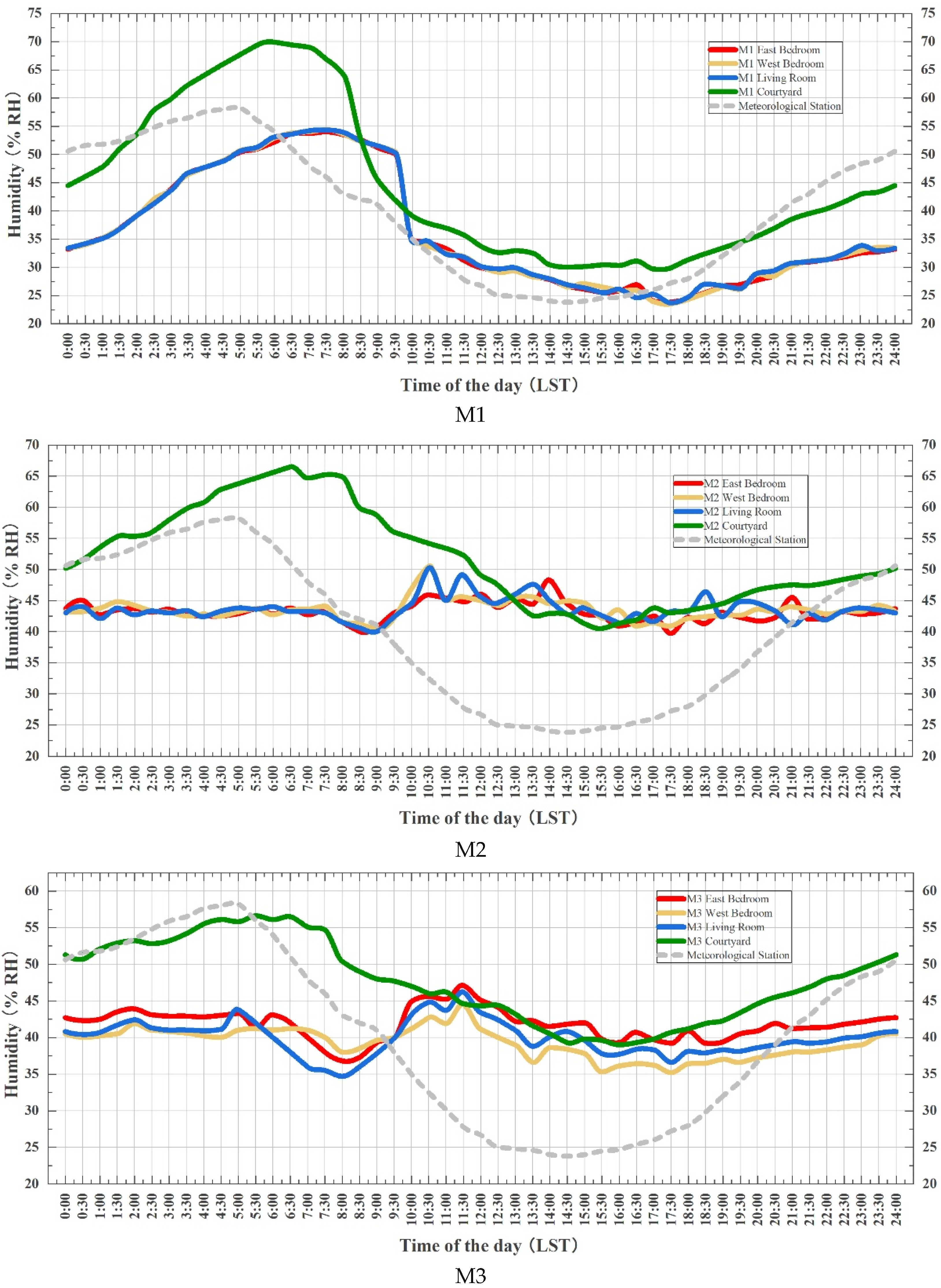
Relative humidity measurements reveal distinct differences in microclimatic regulation between vernacular and modern dwellings, as illustrated in Figure 13 and Figure 14. These differences in relative humidity dynamics are primarily attributable to variations in envelope material properties and courtyard ground treatments. In vernacular dwellings (V1–V3), the use of porous, hygroscopic materials, including masonry and earth-based components, facilitates moisture absorption and release, leading to observable diurnal humidity fluctuations.
Additionally, vegetated courtyards and permeable ground surfaces enhance evapotranspiration and soil moisture retention, thereby moderating indoor and semi-outdoor humidity. Consequently, vernacular dwellings demonstrate greater humidity variability while maintaining levels conducive to adaptive thermal comfort.
In contrast, modern dwellings (M1–M3), which feature reinforced concrete envelope systems and impervious courtyard paving, display consistently lower and more stable humidity levels. The limited moisture buffering capacity of concrete materials and hard ground surfaces restricts these dwellings’ ability to regulate humidity through passive mechanisms.
Residential building M1 differs from M2 and M3 by exhibiting a significant increase in night-time humidity, corresponding to the presence of vegetation in its courtyard. This localized effect indicates that incorporating ecological courtyard elements into modern building systems can partially restore microclimate regulation.
Another notable exception is vernacular dwelling V3, which exhibits consistently lower and more stable humidity levels compared to V1 and V2. Although V3 shares a similar building typology, its courtyard is predominantly paved with concrete bricks, significantly reducing soil moisture retention and evapotranspiration.
The impervious courtyard surface limits the moisture-buffering effect typically provided by permeable ground materials and vegetation, resulting in humidity patterns that closely resemble those in modern dwellings. This finding confirms that courtyard surface treatment plays a critical role in regulating indoor and semi-outdoor humidity, independent of dwelling typology.
These findings demonstrate that humidity regulation is not solely determined by building typology but is strongly influenced by the interaction between envelope material properties and courtyard landscape design, reinforcing the pathways identified in the PLS-SEM model.

4.4.4. Courtyard Air Velocity, Natural Ventilation Potential, and Regulation of Thermal Comfort

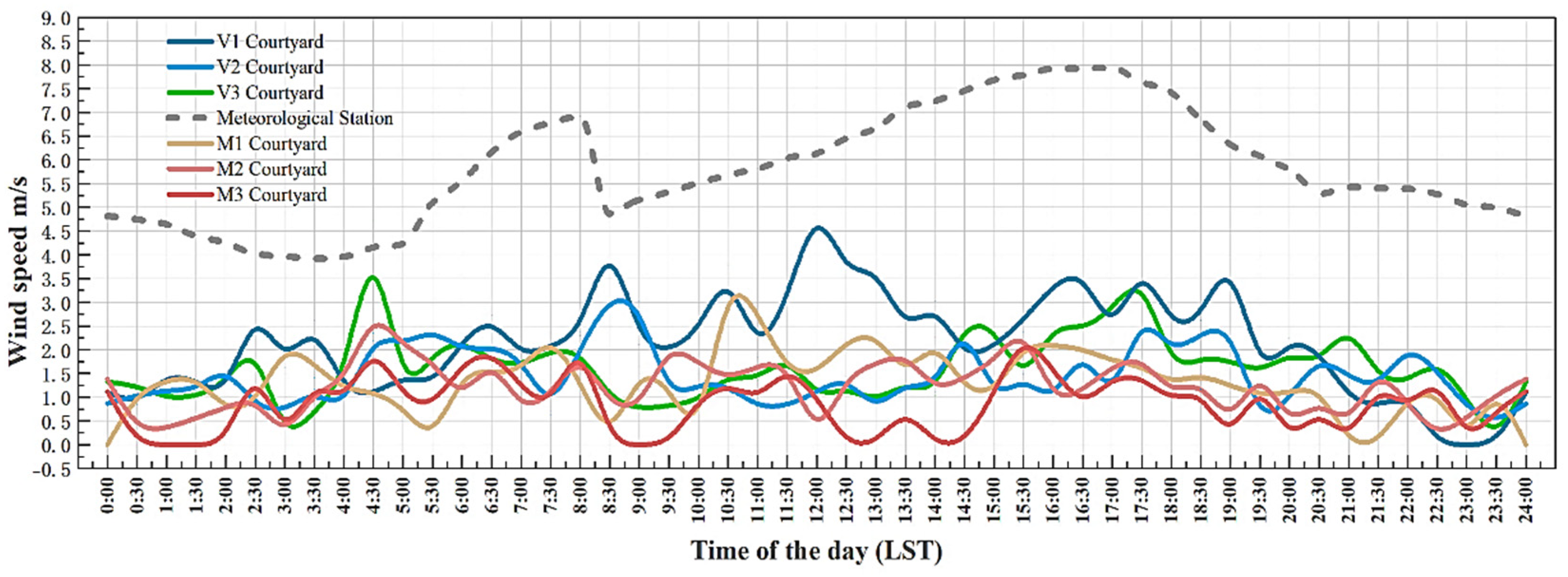
Building on the relative humidity analysis in Section 4.4.3, this section examines courtyard air velocity as a critical microclimatic factor that affects the potential for natural ventilation and adaptive thermal comfort. Figure 15 presents a comparison of measured courtyard air velocity in vernacular dwellings (V1–V3) and modern dwellings (M1–M3) during the summer period.
Vernacular courtyards generally exhibit higher and more variable air velocities than modern counterparts. This outcome is attributed to the spatial openness, porous enclosures, and vegetation-integrated layouts typical of vernacular dwellings, which facilitate wind penetration and airflow circulation. Increased courtyard air movement supports convective heat dissipation and, when combined with permeable paving and vegetation, indirectly enhances thermal comfort (TC) in adjacent indoor and semi-outdoor spaces.
Modern courtyards, by contrast, exhibit consistently lower and more stable air velocity. Rigid enclosure forms and extensive concrete paving restrict airflow, diminishing the courtyard’s effectiveness as a ventilation buffer and reducing its contribution to passive cooling. This limitation increases reliance on mechanical systems.
Among vernacular dwellings, V2 demonstrates a lower air velocity than V1 and V3. This difference is primarily due to V2’s elongated north–south courtyard proportions and partial building obstruction on the eastern side, which limit wind penetration and reduce effective airflow circulation. These results underscore the significance of courtyard geometry and surrounding massing, alongside material characteristics, in determining ventilation performance.
Although measurements were confined to courtyard spaces, the results are significant because courtyards function as transitional zones that precondition air entering interior spaces. When considered alongside the PLS-SEM results, which indicate that Spatial Configuration (SC) and Thermal Comfort (TC) strongly influence Housing Satisfaction (HS), the air velocity data provide empirical support for the modelled relationships. Combined with evidence from air temperature, humidity regulation, and energy use, these findings confirm that vernacular courtyard design enhances thermal comfort by improving airflow and moderating the microclimate.

5. Discussion

5.1. Reconceptualizing the Comfort–Sustainability Trade-Off Through an Integrated Analytical Framework

This study advances the understanding of rural residential sustainability by transcending the conventional dichotomy between vernacular and modern dwellings. Instead of presenting comfort and energy efficiency as mutually exclusive, the findings indicate that these dimensions are structurally interconnected through spatial configuration, building materials, and courtyard design. The PLS-SEM results indicate that dwelling type influences sustainability performance indirectly, through architectural and perceptual variables, rather than directly affecting comfort or energy consumption.
Prior research has typically compared vernacular and modern dwellings using discrete indicators such as indoor temperature, envelope performance, or electricity consumption [6,7,8,9,10].
In contrast, the present study integrates physical characteristics and residents’ perceptions within a unified analytical framework, demonstrating that housing satisfaction serves as a critical mediating factor between spatial design and environmental adaptability. This finding supports adaptive comfort theory [21,22]. by empirically establishing that perceived comfort is not solely a response to thermal conditions, but is shaped by spatial logic, material performance, and daily behavioural adaptation.
By quantitatively validating these relationships, this study reconceptualizes the comfort–sustainability trade-off as a systemic interaction rather than a binary opposition. Vernacular dwellings demonstrate superior passive adaptability, whereas modern dwellings offer enhanced spatial amenities; however, neither typology achieves optimal performance on its own. The primary contribution of this research is the identification of structural pathways for selectively reintegrating vernacular strategies into modern housing to reconcile comfort expectations with low-energy living.

5.2. Dwelling Type as a Structural Driver in Housing Satisfaction

The structural model demonstrates that dwelling type strongly influences spatial configuration and building materials. However, its direct impact on housing satisfaction is relatively limited when mediating variables are accounted for. This challenges the prevailing assumption that residents’ satisfaction is primarily determined by whether a dwelling is classified as “traditional” or “modern.” Rather, satisfaction results from how spatial organization and material selection translate typological characteristics into lived experience.
This result is consistent with previous qualitative findings indicating that modernization changes rural housing form without necessarily enhancing environmental performance [27,28,29,30].
The present study extends this literature by offering quantitative evidence that typology functions as a structural driver, influencing downstream variables such as courtyard usability and perceived comfort. Therefore, dwelling type should be regarded as a contextual condition that enables or constrains sustainability outcomes, rather than as an independent explanatory factor.
From a methodological standpoint, modelling dwelling type as an exogenous latent construct within a PLS-SEM framework constitutes a significant contribution. This approach enables the separation of direct and indirect effects, demonstrating that the sustainability deficit of modern dwellings is not intrinsic but results from the neglect of spatial permeability, material thermal properties, and courtyard integration.

5.3. The Mediating Role of Spatial Configuration and Building Materials

A primary contribution of this study is the explicit identification of spatial configuration and building materials as mediating mechanisms that connect dwelling typology to courtyard adaptability and housing satisfaction. The strong path coefficients observed between spatial configuration, building materials, and courtyard configuration indicate that sustainability performance in rural housing is fundamentally relational and arises from the interaction between indoor and outdoor spaces. In alignment with previous research on courtyard microclimates [33,34,35,42], the findings demonstrate that spatial continuity and material thermal mass together enhance environmental buffering. This study advances the field by quantifying how these physical attributes influence residents’ perceived comfort and satisfaction. The results indicate that residents respond not only to thermal conditions but also to the coherence among spatial layout, material authenticity, and everyday use patterns [75,76].
The identified interdependence between spatial configuration and building materials underscores the limitations of retrofit strategies that focus solely on materials while neglecting spatial logic. Although modern materials can enhance durability and daylighting, their effectiveness is limited when incorporated into spatial layouts that constrain ventilation and courtyard interaction. This finding contributes to sustainable housing research by highlighting the need for integrated design interventions rather than isolated technological upgrades.

5.4. Housing Satisfaction as a Mediator Between Architectural Form and Sustainable Behaviour

In this study, housing satisfaction is identified as a pivotal construct that connects architectural form to sustainable outcomes. The significant mediating effect of housing satisfaction between spatial configuration and courtyard adaptability demonstrates that residents’ subjective evaluations actively influence environmental performance. Elevated satisfaction levels correspond with greater use and maintenance of courtyard spaces, thereby reinforcing their roles as passive cooling and social zones.
This finding aligns with research in behavioural and environmental psychology, which indicates that satisfaction influences adaptive behaviour and energy use [35,77,78]. By integrating housing satisfaction into the structural model, the study demonstrates that sustainability encompasses both technical attributes of buildings and socially mediated processes. In vernacular dwellings, established spatial practices promote comfort tolerance and low-energy behaviour, while modern dwellings may disrupt these adaptive routines despite offering improved amenities.
The inclusion of energy-related indicators within the satisfaction construct underscores the interrelationship between perceived comfort and electricity consumption. Instead of considering energy use as an external outcome, this study positions it within residents’ experiential evaluations of housing quality, thereby providing a more comprehensive understanding of sustainable living in rural contexts.

5.5. Implications for Rural Housing Design and Sustainable Development Policies

The findings of this study have significant implications for rural housing design and policy, especially within the framework of China’s rural revitalization strategy. The results indicate that sustainability-oriented housing policies should advance beyond typological replacement and instead prioritize hybrid design models that incorporate vernacular passive strategies into contemporary construction systems.
In terms of design, this approach involves maintaining courtyard-centred layouts, improving spatial permeability, and selecting materials that balance thermal mass with durability. From a policy standpoint, the findings support the formulation of performance-based rural housing guidelines that emphasize spatial adaptability and user satisfaction, in addition to energy-efficiency metrics.
More broadly, the validated PLS-SEM framework provides a transferable methodological approach for evaluating residential sustainability in regions experiencing rapid housing transformation. By integrating architectural form, resident perception, and environmental performance, this study offers a replicable model for assessing and guiding the development of low-carbon, climate-responsive housing [79,80,81].

5.6. Study Limitations and Recommendations for Future Research

Although this study offers valuable insights, several limitations should be acknowledged. First, the empirical data are derived from a single village in a specific climatic region, which may constrain the generalizability of the findings. Future research should apply the framework to multiple regions or climatic zones to evaluate its broader applicability. Second, while perceived energy consumption is integrated, incorporating direct monitoring of indoor thermal conditions and appliance-level energy use would strengthen causal inferences.
Future studies should also investigate longitudinal changes in housing satisfaction and adaptive behaviour as dwellings undergo renovation or retrofit. These extensions would provide a deeper understanding of how vernacular principles can be systematically applied to contemporary housing solutions across diverse socio-economic contexts.

6. Conclusions

An integrated analytical framework was developed and validated to examine how dwelling typology, spatial configuration, building materials, and courtyard layout collectively influence thermal comfort, housing satisfaction, and cooling-related energy performance in rural residential environments in northern China. By combining Partial Least Squares Structural Equation Modelling (PLS-SEM) with on-site microclimatic measurements and summer electricity consumption monitoring, this research provides multidimensional empirical evidence linking architectural form, residents’ thermal experience, and actual energy use under real operating conditions.
The PLS-SEM results demonstrate strong robustness and explanatory power from a modelling perspective. The measurement model exhibits satisfactory reliability and validity, with Composite Reliability values ranging from 0.838 to 0.929 and Cronbach’s alpha values ranging from 0.714 to 0.900. Although the Average Variance Extracted (AVE) values for Spatial Configuration (0.477) and Housing Satisfaction (0.402) fall slightly below the conventional threshold, their high internal consistency reflects the multidimensional and perception-based nature of these constructs. Discriminant validity is supported by both the Fornell–Larcker criterion and the HTMT ratio, confirming that architectural, environmental, and experiential dimensions are empirically distinguishable. The structural model also demonstrates strong explanatory capability, with R2 values ranging from 0.555 to 0.956.
The findings indicate that dwelling typology serves as a fundamental structural driver within the rural housing system. Dwelling Type (DT) exerts strong effects on Spatial Configuration (β = 0.890, f2 = 2.219) and Courtyard Configuration (β = 0.891, f2 = 3.858), suggesting that spatial organization and courtyard form are primarily shaped by typological decisions. However, typology does not directly determine housing satisfaction; its influence is mediated through spatial and environmental pathways, underscoring the significance of these mechanisms rather than typological replacement alone.
Thermal comfort is identified as the most influential experiential factor in the model. It has a dominant direct effect on Housing Satisfaction (β = 0.959, f2 = 6.123), which far exceeds the contributions of spatial configuration or building materials. This result quantitatively confirms that residents’ overall evaluation of rural housing quality is primarily determined by their thermal experience. While spatial configuration also contributes to satisfaction (β = 0.167), its effect is secondary and largely indirect, operating through microclimatic regulation.
These structural relationships are strongly supported by field measurements. Vernacular courtyard dwellings demonstrate superior thermal stability during summer conditions, with indoor peak temperatures typically 3–5 °C lower than those in courtyard and outdoor spaces, reduced diurnal temperature fluctuations of approximately 2–3 °C, and thermal time-lag effects of 2–4 h. These advantages are associated with courtyard shading, enhanced air movement, and the use of high-thermal-mass envelopes. In addition, vernacular dwellings exhibit more adaptive humidity regulation, with diurnal relative humidity fluctuations generally within 15–25%, and improved natural ventilation performance. Courtyard air velocity is consistently higher by about 0.2–0.4 m/s, indicating more effective convective heat dissipation.
The thermal advantages of vernacular spatial strategies are further evidenced by energy consumption patterns. Summer electricity monitoring (June–August) indicates that vernacular dwellings consistently exhibit lower total and per capita electricity use. Average per capita electricity consumption ranges from approximately 55–130 kWh per person per month in vernacular dwellings, compared to 190–330 kWh per person per month in modern dwellings. Furthermore, modern dwellings exhibit pronounced consumption peaks in July and August, reflecting greater reliance on mechanical cooling, whereas vernacular dwellings exhibit more stable, moderate energy demand profiles.
Taken together, the convergence of PLS-SEM results, microclimatic measurements, and electricity consumption data reveals a coherent causal mechanism. Dwelling typology shapes spatial and courtyard configurations, which influence material performance and microclimatic regulation. Thermal comfort plays a pivotal mediating role, linking architectural form to both housing satisfaction and cooling-related energy use. In this context, thermal comfort functions not only as a perceptual outcome but also as a reliable indicator of passive energy efficiency in naturally ventilated rural housing.
In summary, the findings indicate that enhancing the sustainability of rural housing should not depend primarily on increased technological inputs or mechanical cooling systems. Significant reductions in cooling energy demand can be achieved through climate-responsive architectural strategies, such as courtyard-centred spatial organization, enhanced spatial permeability, and the strategic use of high thermal-mass materials. The study confirms that vernacular dwellings achieve better thermal stability and energy efficiency through passive design principles. By combining measured environmental data with an analysis of comfort perception, the research shows that thermal comfort influences the relationship between building configuration and housing satisfaction. This combined framework presents a replicable model for reintroducing vernacular strategies into contemporary rural housing policy.
This study utilized a PLS-SEM framework to connect architectural, environmental, and perceptual factors. The validity of the constructs and the model specification were confirmed through reliability tests and fit indices. The results illustrate the climatic characteristics of Handan and may not be applicable to other regions. Future research should include comparisons across different climates to improve the external validity of the findings.

Author Contributions

Conceptualisation, C.Y. and A.M.; methodology, C.Y. and A.M.; software, C.Y. and A.M.; investigation, C.Y.; resources, C.Y.; data curation, C.Y.; writing—original draft preparation, C.Y.; writing—review and editing, A.M.; supervision, A.M. All authors have read and agreed to the published version of the manuscript.

Funding

This research is partly supported by Handan Juve Environmental Engineering Design Co., Ltd. [Grant number: HJEE-2024-003].

Institutional Review Board Statement

The study was conducted in accordance with the Declaration of Helsinki, and approved by the Institutional Review Board (Universiti Teknologi MARA (UiTM)—Research Ethics Committee (REC/06/2025 (PG/MR/304), 3 June 2025).

Informed Consent Statement

Informed consent was obtained from all subjects involved in the study.

Data Availability Statement

Data are not available for privacy reasons.

Acknowledgments

The authors sincerely acknowledge the residents of Sha Tun Village, Yao Zhai Township, Cong Tai District, Handan City, Hebei Province, China, for their cooperation and participation in the fieldwork and questionnaire surveys. The authors also thank the administrative and technical staff for their valuable assistance with data collection and facilitation of site access.

Conflicts of Interest

The authors declare that the research was conducted in the absence of any commercial or financial relationships that could be construed as a potential conflict of interest.

References

  1. Aste, N.; Del Pero, C.; Leonforte, F. Toward building sector energy transition. In Handbook of Energy Transitions; CRC Press: Boca Raton, FL, USA, 2022; pp. 127–150. [Google Scholar]
  2. Gursel, A.P.; Shehabi, A.; Horvath, A. Embodied energy and greenhouse gas emission trends from major construction materials of US office buildings constructed after the mid-1940s. Build. Environ. 2023, 234, 110196. [Google Scholar] [CrossRef]
  3. Ren, Z.; Fu, Y.; Dong, Y.; Zhang, P.; He, X. Rapid urbanization and climate change significantly contribute to worsening urban human thermal comfort: A national 183-city, 26-year study in China. Urban Clim. 2022, 43, 101154. [Google Scholar] [CrossRef]
  4. Niza, I.L.; Luz, I.M.d.; Bueno, A.M.; Broday, E.E. Thermal comfort and energy efficiency: Challenges, barriers, and step towards sustainability. Smart Cities 2022, 5, 1721–1741. [Google Scholar] [CrossRef]
  5. Delzendeh, E.; Wu, S.; Lee, A.; Zhou, Y. The impact of occupants’ behaviours on building energy analysis: A research review. Renew. Sustain. Energy Rev. 2017, 80, 1061–1071. [Google Scholar] [CrossRef]
  6. Izadpanahi, P.; Farahani, L.M.; Nikpey, R. Lessons from sustainable and vernacular passive cooling strategies used in traditional Iranian houses. J. Sustain. Res. 2021, 3, e210014. [Google Scholar]
  7. Martinovic, S.; Zecevic, N.; Salihbegović, A. Vernacular Residential Architecture in the Context of Sustainability—Case Study of Svrzo’s House Complex. J. Sustain. Archit. Civ. Eng. 2023, 32, 19–40. [Google Scholar] [CrossRef]
  8. Yang, C.; Misni, A. Analysis of Thermal Comfort in Single-Story Courtyard Vernacular Dwellings in Rural China: Passive Design Strategies for Adapting to the Climate. Buildings 2025, 15, 3964. [Google Scholar] [CrossRef]
  9. Petrucci, C. Thermal Comfort in Traditional and Sustainable Buildings: Comparative Analysis of Thermal Perception in the Middle East and Southeast Asian Buildings. Master’s Thesis, Ca’ Foscari University of Venice, Venice, Italy, 2023. [Google Scholar]
  10. Salimi, A.; Yurtyapan, A.; Ouria, M.; Turkan, Z.; Pilehvarian, N.K. An Overview of Natural Cooling and Ventilation in Vernacular Architectures. Wind 2025, 5, 21. [Google Scholar] [CrossRef]
  11. Allouhi, A.; El Fouih, Y.; Kousksou, T.; Jamil, A.; Zeraouli, Y.; Mourad, Y. Energy consumption and efficiency in buildings: Current status and future trends. J. Clean. Prod. 2015, 109, 118–130. [Google Scholar] [CrossRef]
  12. Elantary, A.R. Energy Consumption Patterns in Residential Buildings: A Comparative Study of Air Conditioning Systems. Yanbu J. Eng. Sci. 2025, 22, 34–47. [Google Scholar] [CrossRef]
  13. Du, J.; Chen, B. Indoor thermal environment and adaptive behaviors in summer of urban households in northern China: Status and trend. Energy Build. 2024, 324, 114916. [Google Scholar] [CrossRef]
  14. Xu, C.; Li, S.; Zhang, X. Energy flexibility for heating and cooling in traditional Chinese dwellings based on adaptive thermal comfort: A case study in Nanjing. Build. Environ. 2020, 179, 106952. [Google Scholar] [CrossRef]
  15. Ascione, F.; Bianco, N.; De Masi, R.F.; Mauro, G.M.; Vanoli, G.P. Design of the building envelope: A novel multi-objective approach for the optimization of energy performance and thermal comfort. Sustainability 2015, 7, 10809–10836. [Google Scholar] [CrossRef]
  16. Chahbi, M. Environmental and socio-cultural transition from traditional courtyard dwellings to contemporary housing practices in Morocco: Insights from Arab and East Asian regions. J. Umm Al-Qura Univ. Eng. Archit. 2024, 15, 574–590. [Google Scholar]
  17. Gharahshir, M. Implementation of Sustainable Architecture Patterns in Hot and Dry Regions of Iran by Investigating on Vernacular Sustainable Architecture Patterns. Master’s Thesis, Hochschule für Technik und Wirtschaft, Berlin, Germany, 2019. [Google Scholar]
  18. Saleem, S.; Alchalabi, O. An In-depth Analysis of Factors Impacting Housing Satisfaction: A Systematic Review and Post-Occupancy Evaluation. Int. J. Sustain. Dev. Plan. 2025, 20, 119–131. [Google Scholar] [CrossRef]
  19. Sadat, S.A.; Taher Tolou Del, M.S.; Tabrizi, S.K. Designing residential courtyards in the built environment: Key factors shaping well-being and open space quality. J. Hous. Built. Environ 2025. [Google Scholar] [CrossRef]
  20. Li, W.; Sui, W.; Cheng, L.; Ji, Y.; Guo, Y.; Zhu, J. Quantifying seasonal demand-side flexibility in residential air conditioning under diverse control strategies. Energy Build. 2025, 352, 116764. [Google Scholar] [CrossRef]
  21. Rao, S.; Rogers, K.; Good, J.; Alavi, H. What Do We Design for When We Design” Smart Buildings”?—A Scoping Review of Human Experience Design Research in Buildings. In Proceedings of the 2025 CHI Conference on Human Factors in Computing Systems, Yokohama, Japan, 26 April–1 May 2025; pp. 1–23. [Google Scholar]
  22. Yadeta, C.; Indraganti, M.; Tucho, G.T.; Alemayehu, E. Study on adaptive thermal comfort model and behavioral adaptation in naturally ventilated residential buildings, Jimma Town, Ethiopia. Energy Build. 2023, 298, 113483. [Google Scholar] [CrossRef]
  23. ASHRAE Standard 55; Thermal Environmental Conditions for Human Occupancy. ASHRAE (American Society of Heating, Refrigerating and Air-Conditioning Engineers): Atlanta, GA, USA, 2017.
  24. Chen, T.; Luh, D.; Hu, L.; Shan, Q. Exploring factors affecting residential satisfaction in old neighborhoods and sustainable design strategies based on post-occupancy evaluation. Sustainability 2023, 15, 15213. [Google Scholar] [CrossRef]
  25. Zhou, Y.; Zhou, Z.; Cai, P.; Utaberta, N. Parametric Visualization, Climate Adaptability Evaluation, and Optimization of Strategies for the Subtropical Hakka Enclosed House: The Guangludi Case in Meizhou. Buildings 2025, 15, 3530. [Google Scholar] [CrossRef]
  26. Yonzan, A. Thermal Comfort Environment of Mud Shelters in Nepal (A Case in Hilly and Mountain Region). Master’s Thesis, IOE Pulchowk Campus, Lalitpur, Nepal, 2022. [Google Scholar]
  27. de Carvalho Matos, B. Modern Construction. In Contributions to Economics; Springer: Cham, Switzerland, 2025. [Google Scholar]
  28. Vagtholm, R.; Matteo, A.; Vand, B.; Tupenaite, L. Evolution and current state of building materials, construction methods, and building regulations in the UK: Implications for sustainable building practices. Buildings 2023, 13, 1480. [Google Scholar] [CrossRef]
  29. Baniassadi, A.; Heusinger, J.; Sailor, D.J. Energy efficiency vs. resiliency to extreme heat and power outages: The role of evolving building energy codes. Build. Environ. 2018, 139, 86–94. [Google Scholar] [CrossRef]
  30. Lundgren, K.; Kjellstrom, T. Sustainability challenges from climate change and air conditioning use in urban areas. Sustainability 2013, 5, 3116–3128. [Google Scholar] [CrossRef]
  31. Chen, F.; Tian, F.; Nielsen, C.P.; Wu, J.; Chen, X. Physical environment, socio-psychological health, and residential satisfaction: A link across housing types in the unique chinese context. Sustainability 2023, 15, 16302. [Google Scholar] [CrossRef]
  32. Zhang, Q.; Hiu-Kwan Yung, E.; Hon-Wan Chan, E. Meshing sustainability with satisfaction: An investigation of residents’ perceptions in three different neighbourhoods in Chengdu, China. Land 2021, 10, 1280. [Google Scholar] [CrossRef]
  33. Patil, D.R. Re-imagining vernacular courtyard logic in contemporary architectural engineering: Towards climate-responsive design in the Indian context. J. Umm Al-Qura Univ. Eng. Archit. 2025. [Google Scholar] [CrossRef]
  34. Sun, H. Multidimensional Analysis of Courtyard Building Environmental Performance Using Computational Fluid Dynamics. Ph.D. Thesis, University of Nottingham, Nottingham, UK, 2024. [Google Scholar]
  35. He, M.; Li, L.; Tao, S. Sustainable Design Methods Translated from the Thermodynamic Theory of Vernacular Architecture: Atrium Prototypes. Buildings 2024, 14, 3142. [Google Scholar] [CrossRef]
  36. Chandel, S.S.; Sharma, V.; Marwah, B.M. Review of energy efficient features in vernacular architecture for improving indoor thermal comfort conditions. Renew. Sustain. Energy Rev. 2016, 65, 459–477. [Google Scholar] [CrossRef]
  37. Kadir, S.A.; Aris, N.N.; Ginting, N. Spatial Identity in the Context of Interior and Building Environment. Asian J. Environ. Behav. Stud. 2024, 9, 69–83. [Google Scholar]
  38. Safarkhani, M. Space to Place, Housing to Home: A Systematic Review of Sense of Place in Housing Studies. Sustainability 2025, 17, 6842. [Google Scholar] [CrossRef]
  39. Ge, J.; Hokao, K. Research on residential lifestyles in Japanese cities from the viewpoints of residential preference, residential choice and residential satisfaction. Landsc. Urban Plan. 2006, 78, 165–178. [Google Scholar] [CrossRef]
  40. Formolly, A.; Saraei, M.H. Socio-cultural transformations in modernity and household patterns: A study on local traditions housing and the impact and evolution of vernacular architecture in Yazd, Iran. City Territ. Archit. 2024, 11, 15. [Google Scholar] [CrossRef]
  41. Kwon, H.-a.; Kim, S. Designing for Modern Living: The Strategic Evolution of Residential Spaces in Response to Improved Lifestyles. Teh. Glas. 2024, 18, 234–245. [Google Scholar] [CrossRef]
  42. Elgheznawy, D. Shading strategies for outdoor waiting areas in hot climates: Improving thermal comfort and healing environments in the post-pandemic era. Port-Said Eng. Res. J. 2024, 28, 85–102. [Google Scholar] [CrossRef]
  43. Zhou, X.; Antonini, E.; Gaspari, J. Impact of Courtyard Microclimate on Building Thermal Performance Under Hot Weather Conditions: A Review. Energies 2025, 18, 5433. [Google Scholar] [CrossRef]
  44. Gkargkavouzi, A.; Halkos, G.E. Psychological Resilience to Climate Change: The Role of Self-Efficacy, Mindfulness, Perceived Nature Restorativeness, and Subjective Well-Being. Sustain. Dev. 2025. early view. [Google Scholar] [CrossRef]
  45. Juba, İ.; Bogenç, Ç. Impact of Courtyard Architecture on Personal Well-Being and Human Health. Türkiye Peyzaj Araştırmaları Derg. 2024, 7, 204–212. [Google Scholar] [CrossRef]
  46. ISO 7726:1998; Ergonomics of the Thermal Environment—Instruments for Measuring Physical Quantities. ISO (International Organization for Standardization): Geneva, Switzerland, 1998.
  47. Kumar, P.; Kumar, P.; Garg, R.K.; Garg, R. Urban housing: A study on housing environment, residents’ satisfaction and happiness. Open House Int. 2021, 46, 528–547. [Google Scholar] [CrossRef]
  48. Dili, A.; Naseer, M.; Varghese, T.Z. Thermal comfort study of Kerala traditional residential buildings based on questionnaire survey among occupants of traditional and modern buildings. Energy Build. 2010, 42, 2139–2150. [Google Scholar] [CrossRef]
  49. Zhang, X.; Li, H.; Jian, Y.; Fu, H.; Wang, Z.; Xu, M. Vernacular or modern: Transitional preferences of residents living in varied stages of urbanisation regarding rural landscape features. J. Rural Stud. 2022, 95, 95–108. [Google Scholar] [CrossRef]
  50. Shetty, S.S.; Patil, S. Vernacular Architecture and Indoor Environmental Satisfaction: A Systematic Review of Influencing Factors. Architecture 2025, 5, 87. [Google Scholar] [CrossRef]
  51. Tawayha, F.A.; Braganca, L.; Mateus, R. Contribution of the vernacular architecture to the sustainability: A comparative study between the contemporary areas and the old quarter of a Mediterranean city. Sustainability 2019, 11, 896. [Google Scholar] [CrossRef]
  52. Zhang, M.; Wang, L.; Zhang, Q. Research on subjective-cultural ecological design system of vernacular architecture. Sustainability 2022, 14, 13564. [Google Scholar] [CrossRef]
  53. Dangol, P. Use of Natural and Recycled Materials with Modern and Traditional Skills in Building Construction in Nepalese Communities. Ph.D. Thesis, Kathmandu University School of Education, Lalitpur, Nepal, 2024. [Google Scholar]
  54. Ghaffarianhoseini, A.; Berardi, U.; Ghaffarianhoseini, A. Thermal performance characteristics of unshaded courtyards in hot and humid climates. Build. Environ. 2015, 87, 154–168. [Google Scholar] [CrossRef]
  55. Azimi, Z.; Shafaat, A. Proposing design strategies for contemporary courtyards based on thermal comfort in cold and semi-arid climate zones. Build. Environ. 2024, 266, 112150. [Google Scholar] [CrossRef]
  56. Alghafis, M.F. Investigating Thermal Comfort in Vernacular and Contemporary Houses in Al-Qassim’s Hot-Arid Climate: Technical, Cultural and Behavioural Factors. Ph.D. Thesis, Cardiff University, Cardiff, UK, 2023. [Google Scholar]
  57. Muqoffa, M.; Suyitno; Yaningsih, I.; Rachmanto, R.A.; Himawan, K.; Caroko, N.; Basuki. Exploring natural ventilation strategies in Javanese vernacular houses for sustainable design. J. Asian Archit. Build. Eng. 2025, 24, 4985–5004. [Google Scholar]
  58. Krimly, S. Prospects for Improvement in the Design of Residential Buildings in Jeddah Integrating Passive Ventilation Systems and Enhanced Family Interaction. Ph.D. Thesis, University of Nottingham, Nottingham, UK, 2020. [Google Scholar]
  59. Ng, J.; Wah, K.; Fitriana, M.; Arumugam, T. Assumptions for structure equation modeling (SEM), normality of data distribution analysis & Model fit measures. Norm. Data Distrib. Anal. Model Fit Meas. 2023, 4, 1–5. [Google Scholar] [CrossRef]
  60. Franz, G. An empirical Approach to the Experience of Architectural Space. Ph.D. Thesis, Bauhaus-Universität, Weimar, Germany, 2005. [Google Scholar]
  61. Zhuravchak, R. Variability of Building Energy Performance at a Scale: Conformity of Predictive and Synthesis with Explanatory Modelling Practices. Ph.D. Thesis, Norwegian University of Science and Technology, Trondheim, Norway, 2022. [Google Scholar]
  62. Manley, S.C.; Hair, J.F., Jr.; Williams, R.I., Jr.; McDowell, W.C. Essential new PLS-SEM analysis methods for your entrepreneurship analytical toolbox. Int. Entrep. Manag. J. 2021, 17, 1805–1825. [Google Scholar] [CrossRef]
  63. Bajjou, M.S.; Chafi, A. Developing and validating a new conceptual model for successful implementation of lean construction: SEM analysis. Eng. Constr. Archit. Manag. 2025, 32, 1581–1620. [Google Scholar] [CrossRef]
  64. Cheung, G.W.; Cooper-Thomas, H.D.; Lau, R.S.; Wang, L.C. Reporting reliability, convergent and discriminant validity with structural equation modeling: A review and best-practice recommendations. Asia Pac. J. Manag. 2024, 41, 745–783. [Google Scholar] [CrossRef]
  65. Fornell, C.; Larcker, D.F. Evaluating structural equation models with unobservable variables and measurement error. J. Mark. Res. 1981, 18, 39–50. [Google Scholar] [CrossRef]
  66. Ab Hamid, M.R.; Sami, W.; Sidek, M.M. Discriminant validity assessment: Use of Fornell & Larcker criterion versus HTMT criterion. J. Phys. Conf. Ser. 2017, 890, 012163. [Google Scholar]
  67. Alagarsamy, S.; Prabhuram, S.; Ramadas, R. Assessing the Mediating Role of Planned Behavior and Moderating Effects of Ethical Ideology in Immigrant Family-Owned SMES Sustainability Intentions. Corp. Soc. Responsib. Environ. Manag. 2025, 32, 7920–7937. [Google Scholar] [CrossRef]
  68. Chen, B.; Chen, Y.; Chen, Y.; Gao, J. Model of demand of human settlement environment for rural houses in North China: A structural equation modeling approach. Buildings 2022, 12, 926. [Google Scholar] [CrossRef]
  69. Zhong, J.; Liu, S.; Huang, M.; Cao, S.; Yu, H. Driving forces for the spatial reconstruction of rural settlements in mountainous areas based on structural equation models: A case study in western China. Land 2021, 10, 913. [Google Scholar] [CrossRef]
  70. Pasca, P.; De Simone, E.; Ciavolino, E.; Rochira, A.; Mannarini, T. A higher-order model of community resilience potential: Development and assessment through confirmatory composite analysis based on partial least squares. Qual. Quant. 2023, 57, 1033. [Google Scholar] [CrossRef]
  71. García-Salirrosas, E.E.; Millones-Liza, D.Y.; Esponda-Pérez, J.A.; Acevedo-Duque, Á.; Müller-Pérez, J.; Sánchez Díaz, L.C. Factors influencing loyalty to health food brands: An analysis from the value perceived by the Peruvian consumer. Sustainability 2022, 14, 10529. [Google Scholar] [CrossRef]
  72. Oluwadamilare, A.J.; Ayanwale, M.A. Partial least square modeling of personality traits and academic achievement in physics. Asian J. Assess. Teach. Learn. 2021, 11, 77–92. [Google Scholar] [CrossRef]
  73. Astana, I.N.Y.; Jaya, I.N.M.; Handayani, K.A.S.D. Customer Satisfaction Analysis of Supervisory Consultant Construction Performance at Badung Regency Public Works and Spatial Planning. J. Asian Multicult. Res. Econ. Manag. Study 2023, 4, 1–14. [Google Scholar] [CrossRef]
  74. Ben-David, A. Comparison of classification accuracy using Cohen’s Weighted Kappa. Expert Syst. Appl. 2008, 34, 825–832. [Google Scholar] [CrossRef]
  75. Khalaf, R.W. Architectural compatibility beyond the eye of the beholder. J. Cult. Herit. Manag. Sustain. Dev. 2016, 6, 238–254. [Google Scholar] [CrossRef]
  76. Krüger, E. Impact of site-specific morphology on outdoor thermal perception: A case-study in a subtropical location. Urban Clim. 2017, 21, 123–135. [Google Scholar] [CrossRef]
  77. Habash, R. Sustainability and Health in Intelligent Buildings; Woodhead Publishing: Cambridge, UK, 2022. [Google Scholar]
  78. Altomonte, S.; Rutherford, P.; Wilson, R. Human factors in the design of sustainable built environments. Intell. Build. Int. 2015, 7, 224–241. [Google Scholar] [CrossRef]
  79. Galan, J.; Bourgeau, F.; Pedroli, B. A multidimensional model for the vernacular: Linking disciplines and connecting the vernacular landscape to sustainability challenges. Sustainability 2020, 12, 6347. [Google Scholar] [CrossRef]
  80. Raudonikyte, I.; Grazuleviciute-Vileniske, I. Tacit Sustainability in the Countryside: Cultural and Ecological Layers of Lithuanian Heritage Homestead. Land 2025, 14, 1910. [Google Scholar] [CrossRef]
  81. Roesler, S. The urban microclimate as artefact: Reassessing climate and culture studies in architecture and anthropology. Archit. Theory Rev. 2017, 21, 73–88. [Google Scholar] [CrossRef]
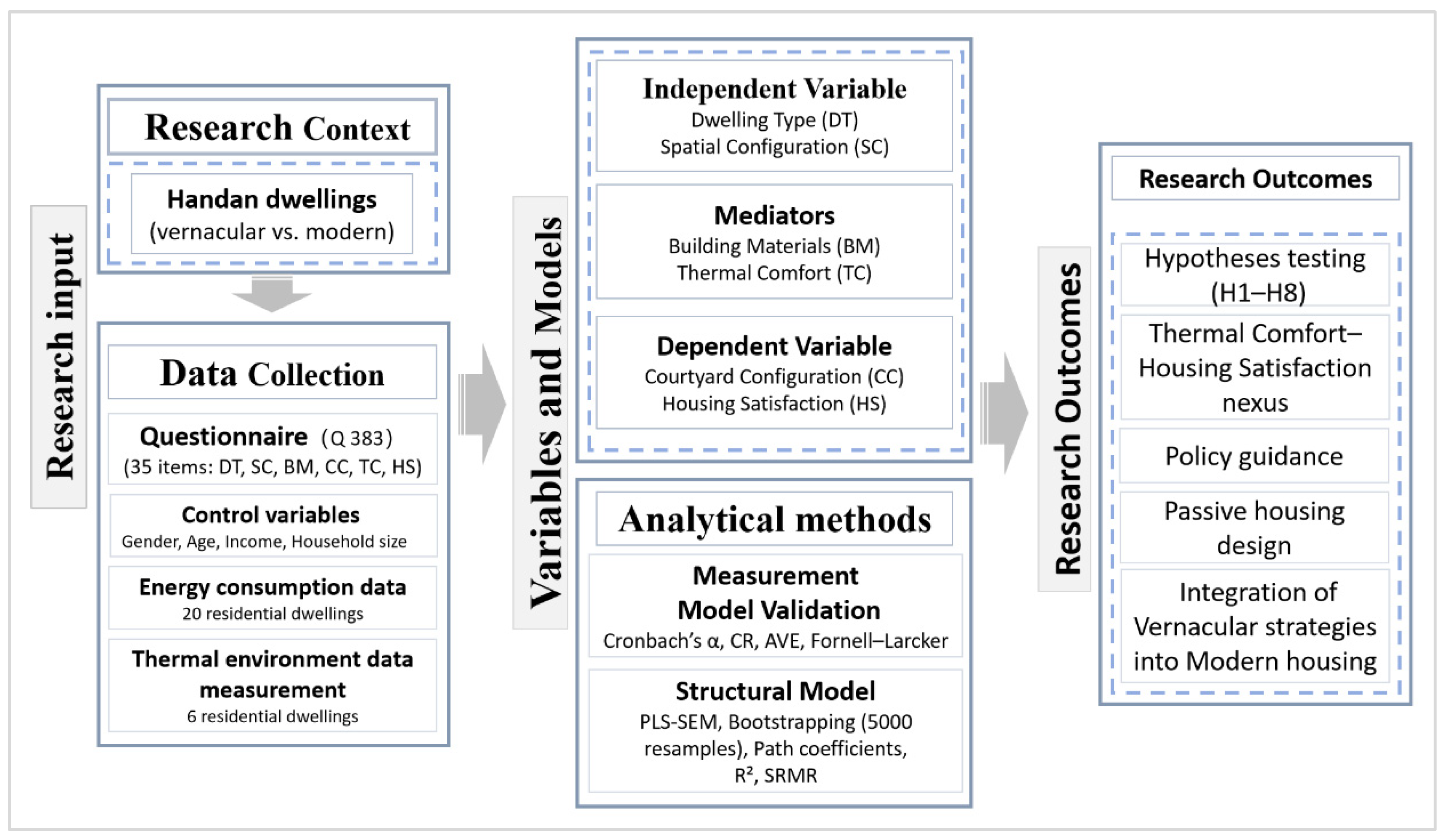
Figure 1. Conceptual Framework and Methodological Structure.
Sustainability 18 01575 g001
Figure 2. Aerial views of the sample villages or locations, including aerial perspectives of three representative vernacular dwelling types and three representative modern dwelling types within the villages.
Sustainability 18 01575 g002
Figure 3. Figures V1–V3 present colour floor plans of three groups of vernacular dwellings in the sample villages, illustrating their spatial and courtyard configurations. Figures M1–M3 display colour floor plans of three groups of modern dwellings in the same villages, highlighting variations in spatial and courtyard arrangements.
Sustainability 18 01575 g003aSustainability 18 01575 g003b
Figure 4. Figures (ad) present the exterior wall materials, specifically 37 cm red bricks, as well as the door and window materials, which consist of wood and single-pane glass, used in the vernacular dwellings of the sample villages studied.
Sustainability 18 01575 g004
Figure 5. Figures (ac) illustrate the pitched roof styles, external roof materials (grey tiles), and internal roof materials (wooden structures and reed mats) of vernacular dwellings in the sample villages.
Sustainability 18 01575 g005
Figure 6. Figures (ac) illustrate the roof styles and materials, specifically cement tiles and corrugated steel tiles, used in modern residential buildings within the sample villages.
Sustainability 18 01575 g006
Figure 7. Figure (a) illustrates the exterior style and materials, including concrete, real stone paint, and imitation stone ceramic tiles, at the base of modern dwellings in the sample villages. Figures (bd) depict the size, structure, and materials of doors and windows in these modern dwellings, which feature aluminium alloy frames and double-glazed glass.
Sustainability 18 01575 g007
Figure 8. Conceptual Model of Hypotheses.
Sustainability 18 01575 g008
Figure 9. Results of the PLS-SEM structural and measurement models.
Sustainability 18 01575 g009
Figure 10. The variable (a) (V1–V10) represents the total energy consumption of ten typical vernacular dwellings from June to August. The variable (b) (M1–M10) denotes the total energy consumption of ten typical modern dwellings during the same period. The variable (c) (V1–V10) indicates the per capita energy consumption of ten typical vernacular dwellings from June to August, while (d) (M1–M10) refers to the per capita energy consumption of ten typical modern dwellings for the same months.
Sustainability 18 01575 g010
Figure 11. V1–V3 represent 24-h temperature profiles recorded at each measurement location in three representative vernacular dwelling cases.
Sustainability 18 01575 g011
Figure 12. M1–M3 represent the 24-h temperature profiles measured at each data collection point in three representative modern residential cases.
Sustainability 18 01575 g012
Figure 13. V1–V3 denote the 24-h humidity profiles recorded at each data collection point for three representative cases of vernacular dwellings.
Sustainability 18 01575 g013
Figure 14. M1–M3 represent the 24-h humidity curves measured at each designated point in three representative modern dwelling cases.
Sustainability 18 01575 g014
Figure 15. Comparison of courtyard air velocity in vernacular (V1–V3) and modern dwellings (M1–M3) during the summer measurement period.
Sustainability 18 01575 g015
Table 1. The operation definition.
Latent VariableDimensionContent Summary
(DT)Dwelling
Type
Architectural typologies and construction features distinguish vernacular from modern dwellings
(SC)Spatial
Configuration
Perception of Architectural Spatial Layout, Openings, Circulation Routes, and Spatial Functions
(BM)Building
Materials
Primary building materials, envelope characteristics, and perceived performance in thermal and sound insulation, and maintenance
(CC)Courtyard
Configuration
The physical and functional attributes of a courtyard encompass vegetation, shade, paving materials, and accessibility
(TC)Thermal ComfortThermal comfort was assessed as a performance-based latent construct integrating indoor thermal conditions and residents’ subjective perceptions, in accordance with ASHRAE Standard 55 (2017)
(HS)Housing
Satisfaction
Assessment of residents’ overall satisfaction regarding comfort, privacy, lighting, ventilation, and energy consumption within buildings
Table 2. Latent constructs and associated questionnaire items.
Latent VariableDimensionQuestionsReferences
(DT)Dwelling
Type
DT1. What is the construction year of your residence?
DT2. What is the approximate ceiling height?
DT3. What is the overall building height?
DT4. What is the primary structural construction material of your residence?
DT5. What is the thickness of your exterior walls?
[7,46]
(SC)Spatial
Configuration
SC1. What is the approximate building area of your residence?
SC2. What is the approximate size of your living room?
SC3. How many bedrooms does your house have?
SC4. Where is your main kitchen located?
SC5. How many toilets do you have?
SC6. How many doors does your house have?
[36,47]
(BM)Building
Materials
BM1. What is the material of the wall?
BM2. What material is used for roof construction/frame?
BM3. What material is used for roof covering?
BM4. Do you have a thermal insulation layer for the roof?
BM5. What material is used for flooring?
BM6. What material are your doors made of?
BM7. What material are your windows made of?
[2,15]
(CC)Courtyard
Configuration
CC1. In your opinion, does the courtyard design enhance the thermal comfort of the vernacular dwelling?
CC2. What is the proportion of green space in your courtyard landscape?
CC3. Do you have a water feature in your courtyard (e.g., water tank, pond, fountain)?
CC4. How permeable is the ground pavement in your courtyard?
[43].
(TC)Thermal
Comfort
TC1. What is the indoor temperature (°C)?
TC2. What is your comfort level temperature (°C)?
TC3. How would you describe your overall thermal sensation?
TC4. How satisfied are you with the current indoor thermal environment?
TC5. In what way does being near the window influence your thermal sensation?
TC6. What is your preferred indoor temperature or thermal condition?
[26]
(HS)Housing
Satisfaction
HS1. How satisfied are you with the natural ventilation in your current residence?
HS2. How satisfied are you with the natural lighting in your current residence?
HS3. How satisfied are you with the spatial layout of your current residence?
HS4. How satisfied are you with the aesthetics of your current residence?
HS5. Are you satisfied with the overall thermal environment of your residence?
HS6. How satisfied are you with the temperature near the window?
HS7. How satisfied are you with the temperature near the exterior wall?
[18,29]
Note. Each latent construct was assessed using multiple observed indicators derived from the structured questionnaire. Control variables were included to address socio-economic heterogeneity and enhance model robustness.
Table 3. Frequency distribution of sample data.
Sample Data ItemsDistribution
GenderMale: 56.9%/Female: 43.1%
Age group18–35 years old (28.2%), 36–50 years old (38.6%),
51–60 years old (12.3%), ≥61 years old (20.9%)
Height
(CM)
≤140 (0.5%), 140–150 (0.5%), 151–160 (17%),
161–170 (39.9%), 171–180 (41.3%), ≥181 (0.8%)
Weight
(KG)
≤40 (0.5%), 41–50 (6.8%), 51–60 (33.9%),
61–70 (33.9%), 71–80 (12.0%), ≥81 (6.0%)
OccupationEmployed for wages (48.3%), Self-employed (7.6%),
A homemaker (11.0%), Farmer (11.2%), Student (8.6%),
Military (0.3%), Retired (13.1%)
Monthly Salary1000 (15.1%), 2000 (14.9%), 3000 (16.2%)
4000 (14.9%), 5000 (11.2%), ≥5000 (27.7%)
Table 4. Reliability and convergent validity statistics for the measurement model.
ConstructCronbach’s αComposite Reliability (CR)AVE
BM0.9000.9290.649
CC0.7140.9010.623
DT0.8860.9010.695
HS0.7770.8730.402
SC0.7930.8380.477
TC0.8060.8910.527
Table 5. Discriminant validity test (Fornell–Larcker).
DimensionsBMCCDTHSSCTC
BM0.806
CC0.8720.790
DT0.9380.8910.834
HS−0.304−0.442−0.3120.634
SC−0.8640.6600.837−0.0950.690
TC−0.432−0.529−0.4410.914−0.2730.726
Table 6. Heterotrait–monotrait ratio of correlations.
DimensionsBMCCDTHSSCTC
BM
CC1.018
DT1.0231.087
HS0.47905860.446
SC0.9470.8280.8870.507
TC0.5350.7140.5350.8840.406
Table 7. Model Fit Summary for PLS-SEM Analysis.
DimensionsSaturated ModelEstimated Model
SRMR0.1650.168
d_ULS17.20217.691
d_Gn/an/a
Chi-squareinfiniteinfinite
NFIn/an/a
Table 8. Collinearity Statistics (VIF) for the Inner Structural Model.
DimensionsBMCCDTHSSCTC
BM
CC5.528
DT10.4391.000 1.241
HS
SC3.805 1.081
TC 1.0811.241
Table 9. Standardized path coefficients and hypothesis testing results.
cPathβt-Valuep-ValueInterpretation
H1DT → BM0.3546.2620.000Supported
H2DT → SC0.89052.6340.000Supported
H3DT → CC0.89176.7860.000Supported
H4CC → BM0.3228.0110.000Supported
H5SC → BM0.35510.2710.000Supported
H6SC → HS0.1674.4100.000Supported
H7TC → SC0.1193.6370.000Supported
H8TC → HS0.95982.5160.000Supported
Table 10. Coefficient of determination (R2) for endogenous constructs.
Endogenous VariableR2R2 Adjusted
Building Materials (BM)0.9190.919
Courtyard Configuration (CC)0.7940.794
Housing Satisfaction (HS)0.8610.860
Spatial Configuration (SC)0.7120.711
Table 11. Effect sizes (f2) for relationships within the structural model.
Pathf2Explanation
Courtyard
Configuration →
Building
Material
0.233A medium-to-large effect was observed, suggesting that courtyard form and microclimatic characteristics have a moderate influence on material selection and envelope performance. This finding reflects adaptive material responses to outdoor spatial conditions.
Dwelling
Type →
Building
Material
0.149A moderate effect was observed, indicating that architectural typology significantly influences material selection, although this influence is partially mediated by spatial and courtyard configurations.
Dwelling
Type →
Courtyard
Configuration
3.858The findings indicate a substantial effect, demonstrating that dwelling typology is the primary determinant of courtyard presence, layout, and functional characteristics, particularly in vernacular courtyard-centred housing forms.
Dwelling
Type →
Spatial
Configuration
2.219The results demonstrate a substantial effect, indicating that spatial organization and layout logic are fundamentally determined by dwelling type. This finding confirms typology as the primary factor influencing spatial configuration.
Spatial
Configuration →
Building Material
0.410The findings indicate that spatial layout exerts a substantial influence on material selection and performance requirements, particularly regarding ventilation, enclosure, and thermal behaviour.
Spatial
Configuration →
Housing
Satisfaction
0.185Spatial organization demonstrates a moderate effect, indicating that it contributes significantly to residential satisfaction, although its influence is less substantial than that of thermal comfort.
Thermal
Comfort →
Housing
Satisfaction
6.123Thermal comfort exerts a substantial and dominant influence, emerging as the primary determinant of housing satisfaction and significantly surpassing structural and spatial factors in residents’ overall assessments.
Thermal
Comfort →
Spatial
Configuration
0.040The results indicate a small effect, suggesting that thermal perception exerts a limited yet measurable influence on residents’ spatial use and evaluation. It functions as a supplementary rather than a primary driver.
Disclaimer/Publisher’s Note: The statements, opinions and data contained in all publications are solely those of the individual author(s) and contributor(s) and not of MDPI and/or the editor(s). MDPI and/or the editor(s) disclaim responsibility for any injury to people or property resulting from any ideas, methods, instructions or products referred to in the content.