Article

A Mental Health-Informed AHP–FCE Assessment of Living-Street Quality for Sustainable Micro-Renewal in Aging Communities: Evidence from Xuesong Road, Wuhan, China

1
School of Civil Engineering, Architecture and Environment, Hubei University of Technology, Wuhan 430068, China
2
Key Laboratory of Intelligent Health Perception and Ecological Restoration of Rivers and Lakes, Ministry of Education, Hubei University of Technology, Wuhan 430068, China
3
Yangtze River Culture Institute, Wuhan 430062, China
*
Author to whom correspondence should be addressed.
Sustainability 2026, 18(3), 1567; https://doi.org/10.3390/su18031567
Submission received: 19 December 2025 / Revised: 26 January 2026 / Accepted: 29 January 2026 / Published: 4 February 2026

Abstract

Neighborhood living streets are key everyday public spaces in mixed residential–commercial districts and are an important setting for residents’ mental well-being. Yet many neighborhood evaluations still rely on coarse spatial indicators and provide limited guidance for fine-grained renewal. This study develops a comprehensive, mental-health-relevant, perception-based framework for assessing living-street quality and applies it to Xuesong Road, an aging community street in Wuhan. Five perception dimensions—walkability, safety, comfort, sociability, and pleasure—are operationalized into 18 micro-spatial indicators. Indicator weights are derived from expert judgments using the Analytic Hierarchy Process, and 178 residents’ Likert-scale ratings are synthesized using Fuzzy Comprehensive Evaluation to obtain dimension-level and composite scores. On a five-point scale, the overall score of 3.08 indicates a mid-range level of perceived street quality in relation to mental health. Sociability performs best, followed by walkability, pleasure, and comfort, while safety is the weakest dimension, mainly due to conflicts with non-motorized traffic and inadequate nighttime lighting. The proposed AHP–FCE framework links micro-scale street attributes to perception-based outcomes and provides actionable evidence to inform micro-renewal, with safety-oriented interventions being prioritized to support social sustainability and age-friendly communities.

1. Introduction

The contemporary discourse on “living streets” draws on the Dutch woonerf and its UK adaptations as “home zones” and increasingly conceives residential streets as low-speed, shared public realms that prioritize pedestrians and cyclists and integrate mobility with social interaction, informal play, and neighborhood encounters [1,2,3]. Classic research has long demonstrated that high traffic volumes erode social ties, children’s play, and the sense of place in residential neighborhoods, affirming that “streets are not simply movement channels but crucial arenas of everyday life” [4,5]. Within rapidly motorizing Asian and developing country cities, scholars have further shown that livable street research has shifted from a purely spatial design perspective toward a multidimensional lens integrating the physical environment, social perception, and quotidian activities, revealing how dense urban morphology, informal practices, and cultural factors jointly shape street livability [6,7]. The transportation scholarship suggests that conventional traffic engineering has long prioritized vehicular throughput at the expense of neighborhood livability. In contrast, recent livable-street and livable-arterial scholarship has called for balancing safety, mobility, and everyday use to serve the perceived needs of neighborhood livability [8].
Under such a conceptual framework, neighborhood “living streets” in China’s high-density cities would be embedded in the large stock of old urban communities, where ageing buildings, rigid spatial forms, and obsolete infrastructure would be found as the key constraints to enhancing community residents’ quality of life and driving sustainable community development [9]. Simultaneously, empirical studies of such communities show that inner-neighborhood public spaces are often dominated by motor vehicle parking and other forms of spatial encroachment, while renewal projects that prioritize physical tidying or aesthetic upgrading alone frequently fall short of residents’ expectations and may even dampen everyday spatial vitality [10]. At the microscale, street-level design features are critical. In this study, we define these pedestrian-scale cues as ‘living elements’ and operationalize them in our indicator system. Their influence depends not only on presence but also on perceived form and proportion, façade articulation, and material texture/colour, shaping coherence, comfort, and atmosphere.
Research in active travel and environmental psychology indicates that both the functional attributes of the street and the experiences of pedestrians at eye level influence their responses. A well-known model for walking and biking breaks the experience down into four main parts: functional provision, perceived safety, aesthetic qualities, and cues related to the destination. The model links each part to visible elements in the environment [11]. Microscale audit tools, such as the Microscale Audit of Pedestrian Streetscapes (MAPS), convert information about street design and management into standardized items and subscales that assess factors like the presence and quality of sidewalks, obstructions, crossing legibility, as well as the aesthetics and social conditions of the streetscape [12]. Studies demonstrate that specific pedestrian-related attributes can be consistently assessed via virtual audits utilizing street-level imagery, thereby facilitating scalable measurement, although reliability may vary among different attributes [13]. Studies utilizing image-based analyses have shown that visual cues from street-level imagery can accurately forecast perceived safety, vibrancy, and aesthetics, thereby connecting experiential evaluations with spatially explicit metrics [14]. This body of literature collectively indicates a pragmatic trajectory from microscale experiences to quantifiable and designable attributes (e.g., effective width/encroachment, crossing legibility, and lighting quality) [15]. In line with this evidence, street-view analyses in Hong Kong show that older adults take longer to walk when there is more greenery at eye level, which suggests that in densely populated areas, everyday mobility is affected by both visible, pedestrian-friendly street conditions and traditional density measures [16].
Taken together, prior work indicates that pedestrians form street-quality judgments through a limited set of salient, eye-level cues that can be read as four interrelated layers: the ground plane (walking surface and crossings), the street edge (frontage activity and conflict management), overhead enclosure (shade, openness, and microclimate buffering), and discrete objects/artifacts (street furniture, signage, and service appurtenances) [11,17,18].
Beyond walking, neighborhood-scale analyses in Guangzhou and at the national level show that built and social environmental attributes—such as density, green space, perceived safety, and neighborhood interaction—are linked to residents’ mental health in part through subjective pathways of environmental perception and community social relations, rather than via objective physical form alone [19,20]. Nevertheless, recent studies on Chinese urban communities still distinguish old and newly built neighborhoods mainly in terms of facility provision and population coverage, offering limited insight into how residents actually experience local streets. Consequently, assessment frameworks for old-community renewal and for planning 15-min community life circles remain anchored in objective spatial metrics, such as facility counts and distributions, POI-based accessibility, and facility–population ratios derived from multi-source spatial data, while paying relatively little attention to residents’ perceptual and emotional relationships with everyday neighborhood streets, particularly in aging, high-density estates [21]. In parallel, a substantial portion of neighborhood-environment research operates at coarse spatial scales using indicators such as land-use mix, intersection density, and distance to parks. These measures are helpful for benchmarking but are insensitive to the micro-morphologies that shape moment-to-moment experiences along specific street segments, where street-level attributes mediate both restorative cues and environmental stressors, yet remain weakly integrated into decision frameworks for micro-renewal. Moreover, because street-level imagery and audit items primarily operationalize visual cues, some non-visual sensory attributes (e.g., odor) typically require on-site protocols or resident reports and can be assessed using established odor-assessment approaches [22]. Crucially, many micro-scale stressors in old-neighborhood living streets are safety-related—such as pedestrian–two-wheel conflicts, curb-space encroachment, and inadequate nighttime illumination—thereby shaping perceived risk and routine street use in dense residential settings.
Safety- and security-related pressures constitute another immediate concern on living streets in old urban neighborhoods. Road traffic injuries remain a major public health burden, and China-specific evidence highlights the growing injury burden among older adults: an analysis based on the Global Burden of Disease 2019 estimated that transport injuries contributed to 30.44 deaths per 100,000 among Chinese adults aged 60 years and older in 2019, with projections indicating a further rise in injury-related deaths by 2030 without effective intervention [23]. Importantly, evidence from national-level fatality data indicates that pedestrian vulnerability is disproportionately elevated after dark; for example, a comprehensive analysis of fatality records in the United States reported that more than 85% of the post-2009 increase in pedestrian fatalities occurred in darkness (1594 of 1868 additional deaths between 2009 and 2017) [24]. From an intervention perspective, a systematic review synthesizing controlled evaluations indicates that installing or upgrading street lighting can substantially reduce fatal crashes (pooled RR = 0.34) [25], suggesting that micro-scale street retrofits can yield measurable safety benefits. Safety concerns in old neighborhoods are not limited to traffic—classic neighborhood research shows that visible disorder and incivilities shape residents’ perceived safety and willingness to use public space [26], while an updated half-century systematic review and meta-analysis reports that street-lighting interventions in public places are associated with an overall crime reduction of about 14% relative to control areas [27]. Taken together, these strands of evidence imply that living-street micro-renewal in old communities is not merely an amenity upgrade but a near-term safety-and-security intervention, strengthening the need for a measurable and interpretable street-quality evaluation framework to support prioritization and design decisions [28].
In response to these limitations, a growing body of street-quality research has developed perception-based indicator systems and applied multi-criteria evaluation methods, such as the Analytic Hierarchy Process (AHP), entropy weighting, and Fuzzy Comprehensive Evaluation (FCE), to translate qualitative judgements and lived experiences into quantitative weights and composite scores. The representative evaluation index systems are summarized in Table 1. Beyond indicator construction, transport and urban studies routinely employ multi-criteria decision-making (MCDM) to elicit weights, capture interdependencies, and rank competing interventions, with commonly used families including AHP/ANP, the best–worst method (BWM), DEMATEL-based influence analysis, and compromise ranking approaches such as TOPSIS/VIKOR [29,30,31,32,33]. Recent advances further extend MCDM toward data-driven and explainable decision support, for example, by integrating DEA with explainability techniques to benchmark public-transport origin–destination pairs and reveal the main contributors to inefficiency [34], or by embedding machine-learning modules into hybrid MCDM workflows to reduce outcome variance and strengthen the stability of transport-safety benchmarking and prioritization [35]. In this context, we adopt an AHP–FCE framework, where AHP yields interpretable weights with a consistency check and FCE accounts for the ambiguity of Likert-type perceptions. The framework is suited to micro-scale street-renewal decisions requiring interpretability and operational usability. We focus on clarifying the “perception–strategy” linkage, while objective operational variables can be added in future work as a complementary extension.
Environmental psychology provides a dual theoretical lens for addressing this gap by combining attention–restoration processes [41] with stress-recovery mechanisms [42]. Attention Restoration Theory frames the importance of “soft fascination” and a sense of being away in restoring directed attention [41]. In contrast, environmental-stress research identifies noise, glare, crowding, and traffic conflicts as stressors on affective and physiological systems [43]. On community streets, tree canopies and sky are examples of restorative cues [44], whereas coherent façades and orderly curb spaces aid legibility and a sense of environmental coherence [41]. In contrast, uncontrolled two-wheel interference reduces perceived restoration and comfort [45], and obstructed sightlines reduce perceived safety [46]. Uneven illumination reduces pedestrians’ perceived control and safety on residential streets [47]. These ideas inform the indicator system used in this study and the interpretation of empirical findings.
Across old urban communities in Chinese cities, neighborhood living streets commonly exhibit several interrelated features. Ground floors are typically lined with dense, small- and micro-business frontages serving diverse everyday needs. At the same time, fine-grained functional mixing sustains day-long foot traffic and blurs the boundaries between residential, commercial, and social uses. The service radius of such streets often extends beyond adjacent blocks, as commercial vitality and neighborhood social functions draw users from a wider catchment. Simultaneously, the physical fabric frequently shows signs of aging, and limited right-of-way intensifies competition among pedestrian movement, non-motorized vehicles, and curb-side parking. Together, these attributes generate a persistent demand for safe, comfortable, and sociable public-realm performance, while constraining the scope for large-scale reconstruction. This makes micro-renewal strategies and mental-health-relevant, perception-based evaluations particularly salient on these living streets.
To connect design expertise with lived experience, we integrated the Analytic Hierarchy Process (AHP) and Fuzzy Comprehensive Evaluation (FCE). The AHP structures expert judgments into transparent importance weights with internal consistency checks, and the FCE maps Likert responses into membership distributions and composite perception scores, enabling a consistent reading of residents’ satisfaction patterns across psychological dimensions. Similar AHP–FCE pipelines have proven effective in related design-evaluation contexts (e.g., emotional healing installations [48] and light scape perception in urban parks [49]); we adapt this logic to street quality from a mental health perspective. Thus, the pipeline is designed to answer weight analysis, perception assessment, and priority identification questions in a method-matched manner. Guided by this framework and aligned with the AHP–FCE methodology, this study asks the following question:
(1)
How can residents’ mental-health-related perceptions of living-street quality in aging communities be captured by a set of street-environment dimensions and micro-scale indicators?
(2)
Given this indicator system, how do experts weight and prioritize these dimensions and indicators via the AHP framework?
(3)
By contrasting expert weights with resident perceptions, which spatial–behavioral mechanisms emerge to guide micro-renewal strategies and their sequencing?
This study operationalizes a perception-based street-quality index relevant to mental well-being comprising five dimensions and 18 micro-indicators drawn from these street-level attributes—for example, interface permeability, greenery and sky openness, surface condition, curb-space organization, and lighting adequacy—and demonstrates a way in which aging urban community streets can be appraised in contexts where restorative cues and stressors coexist. Methodologically, it bridges expert rationality and resident perception through an AHP–FCE pipeline to surface actionable priorities for micro-renewal under spatial-fiscal constraints. The remainder of this paper is organized as follows. Section 2 introduces the study area, evaluation framework, and data collection methods. Section 3 details the AHP–FCE methodology and reports the indicator weights and fuzzy evaluation results. Section 4 interprets these findings through the lenses of environmental psychology and urban design to identify spatial–behavioral mechanisms and policy levers. Section 5 concludes with a summary of the main contributions, limitations, and directions for extending the framework to multiple streets.

2. Study Area and Evaluation Framework

2.1. Study Area

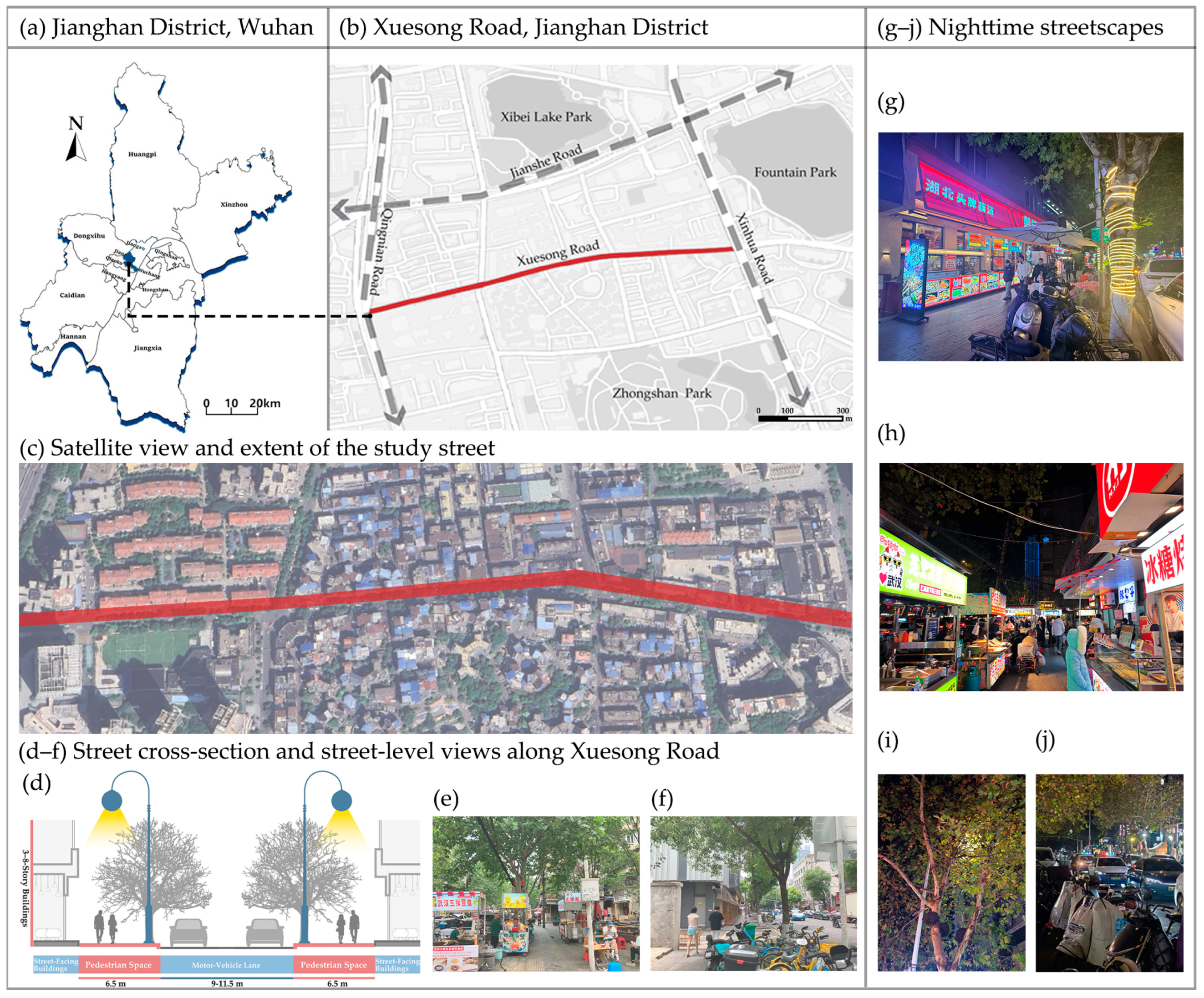
Xuesong Road is a typical living street in an aging residential–commercial district of Wuhan, China. The east–west corridor extends for nearly 1 km within a right-of-way of approximately 20–23 m, comprising a 9–11.5-m two-way carriageway flanked by sidewalks averaging about 6.5 m wide on both sides. The street is lined predominantly with 3- to 8-story low- to mid-rise buildings in a “ground-floor commerce + upper-floor housing” configuration; most were constructed between the early 1990s and the late 2000s, coinciding with the initial large-scale commercialization of housing in China. As a prevalent high-density living-street typology in Chinese cities, this continuous mixed-use frontage supports daily errands while sustaining prolonged street-life routines within tight cross-sectional constraints. Under current municipal criteria, the surrounding estates are classified as “old residential communities,” characterized by aging building stock and infrastructure. Since the early 21st century, Xuesong Road has attracted a growing concentration of small and micro-catering businesses. Dozens of restaurants and snack shops have gradually accumulated along the corridor, expanding the street’s service radius beyond adjacent blocks and attracting visitors from other neighborhoods. In this catering-oriented cluster, operating hours commonly extend into late night, with a smaller subset remaining open until around 04:00, thereby consolidating a pronounced evening-night activity regime. Although the physical fabric is still dominated by its background as a local, everyday street serving nearby residents, commercial intensification has conferred on Xuesong Road the characteristic of “yanhuoqi” (lively, everyday street life) that is commonly found in many similar streets of Chinese cities.
Figure 1 situates Xuesong Road within Wuhan and shows representative streetscapes, including the fine-grained mixed-use frontage and the constrained pedestrian realm (Figure 1d–f). To ground the indicator system in on-site experience, we outline the street-level cues perceived at walking speed; and then maps these cues to their functional and phenomenological implications and the corresponding indicators (C1–C18).
At walking speed, the corridor is experienced as a negotiated pedestrian envelope. Sidewalks are surfaced with a patchwork of permeable and concrete pavers, with frequent joints, localized breakage, and occasional potholes. Under uneven nighttime lighting and shopfront glare, these discontinuities become more salient and may affect foot placement. Although sidewalks are relatively wide in section, the clear walking band is often narrowed by temporary occupations (handcarts, tables, and stools) and bicycle/e-bike parking, including tactile paving. Curbs are relatively high (~15 cm); while curb ramps are provided, stone bollards often constrain approaches and force a zig-zag path for wheelchairs and strollers.
At eye level, frequent shopfront thresholds and high-transparency glazing create a porous move–stay boundary along the retail-on-ground-floor frontage. After ~17:00–18:00, spill-out (queuing, displays, and vendor setups) thickens this edge and intensifies close-range negotiations among pedestrians, bicycles/e-bikes, and small groups. Utility poles/boxes, bins, barrier posts, and informal two-wheel parking form recurrent pinch points, especially near ramps, entrances, and intersection corners. Dense shop signage and LED boards provide destination cues but also increase visual clutter at decision points.
Overhead, a continuous street-tree corridor (mainly camphor, plane, and Magnolia grandiflora) provides a stable sense of enclosure; trees are spaced ~6–10 m apart, and crown depth is roughly 5–8 m. Because evergreen species dominate and pruning is routine, seasonal contrast in shading is modest. Understory planting is limited, and no water-related features are present; restorative cues therefore rely mainly on canopy shade rather than near-eye greenery or blue-space stimuli. At night, canopy shadowing and partially screened luminaires, combined with patchy commercial/vendor lighting, produce low uniformity and localized glare.
Resting opportunities are limited and node-biased. Formal benches are few (n = 5) and concentrated near the school gate; most are backless, with wooden seats on stone supports. Staying therefore clusters around the school frontage and other gate/corner nodes, while elsewhere pedestrians rely on informal edges or brief pauses. This pattern aligns with the street’s daily rhythm: school-related surges occur in daytime, whereas evening intensification is driven by catering activity and mobile vendors, which often occupy the inner sidewalk band and corners and further tighten move–stay overlap. These observations provide context for the subsequent analyses of flow patterns and nighttime visibility.
To quantify these rhythms, we conducted 15-min manual counts of pedestrians, non-motorized vehicles (bicycles/e-bikes), motor vehicles, and active mobile-vendor stalls at a representative vendor-influenced segment. Table 2 summarizes the resulting day–night profile, highlighting the evening peak of multi-modal co-presence alongside sustained vending.
Given the high-intensity evening routine, nighttime visibility becomes critical for legibility and perceived safety. Figure 1g–j illustrates typical nighttime conditions, including glare sources, façade–pavement brightness mismatches, canopy shielding of luminaires, and conflict-prone bottlenecks at key nodes.
We measured illuminance at 15 m intervals on both sides as vertical illuminance at 0.1 m (near-ground) and 1.5 m (eye-level). At each point, measurements were taken facing both walking directions and averaged across three repeats per height and direction to account for directional asymmetry from shopfront and node lighting. Table 3 summarizes the contrast-driven pattern: vendor nodes show substantially higher eye-level illuminance but low near-ground uniformity, whereas canopy-covered segments remain dim with extremely low uniformity.

2.2. Evaluation Framework and Indicator System

This framework translates environmental-psychology and urban-design knowledge into a hierarchical indicator system for residents’ perceived street quality relevant to mental health. Under a dual-source design, experts elicit indicator-importance weights via AHP, while residents provide perception-based performance ratings for FCE. The goal layer is defined as residents’ perceived street quality relevant to mental health and is structured into five dimensions and 18 indicators (C1–C18; weights reported in Section 3.1). To clarify how pedestrian-scale cues are operationalized, Table 4 summarizes the key “living elements” observed along Xuesong Road and maps their functional and phenomenological relevance to the indicator set.
As discussed in Section 1, attention restoration theory and stress-recovery research jointly suggest that urban streets are theorized to influence mental well-being via perceived restorative cues and environmental stressors. Within aging residential–commercial fabrics, micro-spatial attributes such as greenery, sky openness, façade continuity, curb-space organization, and mixed-traffic management act as affordances that influence perceived control, comfort, and emotional tone. Guided by restorative-environment theory and environmental affordance perspectives, residents’ mental health-relevant perception of living-street quality is decomposed into five primary need dimensions: walkability, safety, comfort, sociability, and pleasure.
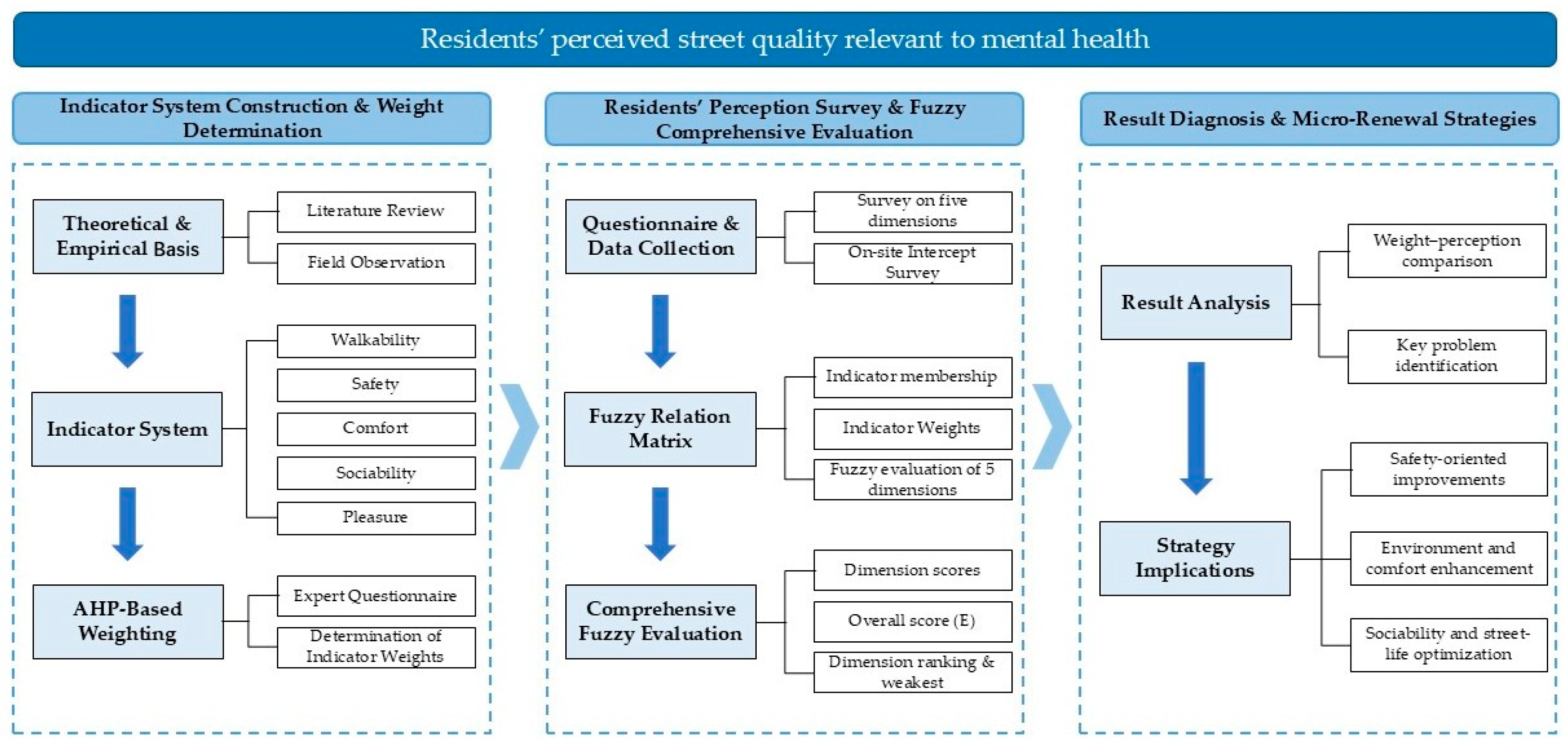
The five dimensions were derived through an integrated process combining a literature review, field observations on Xuesong Road, and expert consultation. Existing studies on restorative public open spaces in aging communities, perceptual evaluations of street and park environments, and AHP–FCE applications in design evaluation (Table 1) provided an initial pool of domains. Candidate domains that residents cannot easily perceive directly or that relate mainly to household-level or city-wide conditions (e.g., economic security, access to metropolitan services) were excluded to maintain the hierarchy’s operability and the questionnaire’s conciseness. Within the final framework, each primary dimension has a specific psychological meaning and is operationalized through secondary indicators C1–C18. The overall evaluation logic and AHP–FCE pipeline are summarized in Figure 2. Below, we clarify the psychological meaning of each first-level dimension (B1–B5).
Walkability (B1) denotes the extent to which the basic requirements for everyday walking are satisfied, including street-level spatial openness, continuity of public space connections, and diversity of everyday destinations. These attributes influence route choice, wayfinding, and perceived effort during routine travel.
Safety (B2) captures perceptions of pavement conditions, street management and maintenance, nighttime illumination, and interference from non-motorized vehicles. Together, they shape perceived risk and controllability, which are critical for the willingness of older and vulnerable groups to walk and linger on the street.
Comfort (B3) captures perceived physical and visual comfort related to green view, interface permeability, view of street front, and sky-view factor that create sensory comfort and restorative stimuli at the pedestrian level.
Sociability (B4) reflects the perceived social atmosphere and informal support level characterized by neighborhood trust, everyday social contact, perceived neighborhood support, and the level of resting facilities that allow staying and face-to-face contact. This dimension explores how the spatial configuration affects social cohesion in an aging neighborhood.
Pleasure (B5) reflects the affective and aesthetic response to the environment, including perceived orderliness of the environment, visual richness, and olfactory pleasantness. It distinguishes between streets that are merely acceptable and those that offer enjoyable and emotionally positive experiences.

2.3. Questionnaire Design and Data Collection

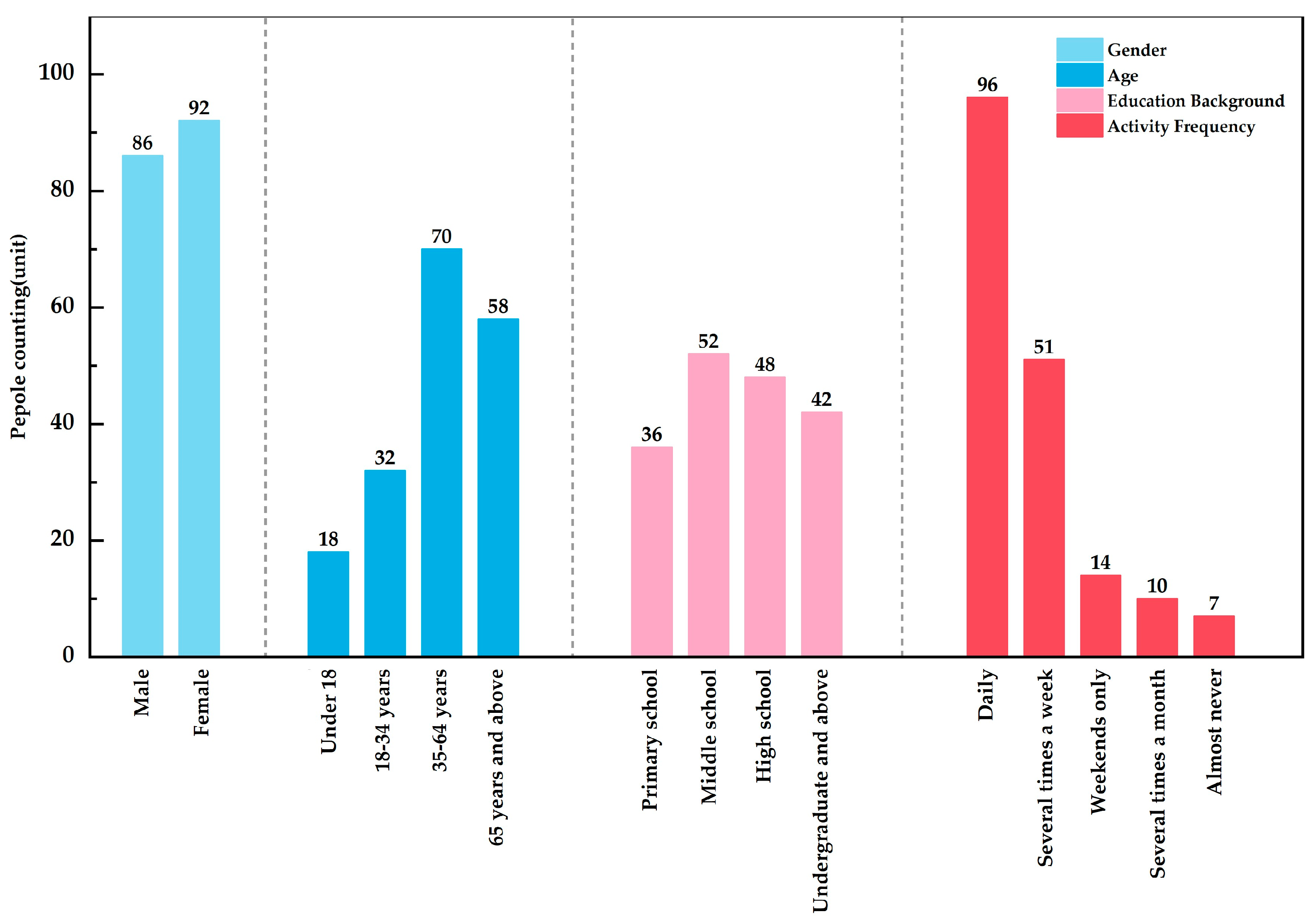
The resident survey adopted an on-site intercept design along Xuesong Road. The questionnaire operationalized the indicator system by translating the 18 second-level indicators (C1–C18) into corresponding resident-rated statements. Responses were recorded on a five-point Likert scale (coded 1–5), with higher values indicating more positive perceptions; where applicable, negatively worded items were reverse-coded to ensure consistent directionality. Trained investigators were stationed near the entrances of residential compounds, small public spaces, and sidewalk segments along the corridor during typical daytime and early evening periods. Intercept locations and time windows were rotated across the corridor to improve exposure to different user groups. Residents from both sides of Xuesong Road, representing all age groups, were invited to participate in the study. These community residents are the most frequent users of the street for daily activities such as shopping, commuting, childcare, and leisure. Participation was voluntary, and the questionnaires were completed face-to-face with assistance from the investigators when needed. A total of 200 questionnaires were randomly distributed, and 178 valid questionnaires were recovered with an effective recovery rate of 89.0%. Questionnaires were screened prior to analysis, and responses with substantial missing items, uniform selections across the 18 items, logical inconsistencies in basic information, or an abnormal completion pattern were excluded. Among the 22 excluded questionnaires, 13 were removed due to substantial missing/incomplete responses, 6 due to straight-lining (identical selections across all 18 items), and 3 due to clear logical inconsistencies or abnormal response patterns. Descriptive analysis of the resident sample by gender, age, level of education, and the frequency of use of Xuesong Road is shown in Figure 3.
As shown in Figure 3, the resident sample included both male and female respondents across all age groups, with middle-aged and older long-term residents of adjacent communities forming the largest share. Most respondents used Xuesong Road daily or several times per week, reflecting the street’s role in supporting everyday neighborhood activities.
These resident survey data provide the empirical basis for the subsequent AHP–FCE analysis, which, together with expert-derived weights, is used to evaluate residents’ perceived street quality relevant to mental well-being on Xuesong Road.

3. Materials and Methods

Building on the evaluation framework presented in Section 2, this section describes how indicator weights were derived using the Analytic Hierarchy Process (AHP) and how residents’ perceptions were translated into composite street-quality scores using the Fuzzy Comprehensive Evaluation (FCE) method. Section 3.1 details the AHP procedure and reports the resulting weights for the five primary dimensions and 18 secondary indicators. Section 3.2 presents the FCE steps for constructing the fuzzy relation matrices and computing the dimension-level and overall scores for Xuesong Road.

3.1. Determination of Indicator Weights Using AHP

Building on the hierarchical indicator system (Section 2.2), indicator weights were derived using the Analytic Hierarchy Process (AHP). Twenty experts in architecture, urban design, and environmental psychology provided pairwise comparisons on a 1–9 scale for the five primary dimensions and 18 secondary indicators. To reduce potential bias associated with panel composition, the expert group was purposively assembled to ensure disciplinary complementarity and institutional diversity, with members having relevant experience in streetscape/public-space design, micro-renewal projects in built-up (often aging) communities, and perception-related appraisal of pedestrian environments. Individual matrices were aggregated using the element-wise geometric mean, and priority vectors were derived from the normalized principal eigenvector. Consistency was evaluated using CI and CR (CR = CI/RI), with all matrices meeting the threshold of CR < 0.10. Random indices (RI) are reported in Table 5, and the resulting weights are presented in Table 6.
Weights were elicited from experts to provide a theory-informed importance structure for renewal prioritization. Resident survey responses were used to rate perceived on-site performance at the FCE stage, so weighting and scoring reflect complementary sources.
Step 1: Calculate the maximum eigenvalue λmax of the decision matrix.
Step 2: Compute the Consistency Index (CI) using the following formula:
C I = λ m a x n n 1
where n is the matrix order.
Step 3: Calculate the Consistency Ratio (CR) using the following formula:
C R = C I R I
where RI represents the Random Consistency Index.
Step 4. The consistency ratio was compared with the criterion of 0.1. Judgment matrices with CR < 0.1 pass the consistency check. Because the consistency index (CI) measures the deviation from perfect consistency, a smaller CI indicates higher coherence. The random index RI, used to normalize CI in CR = CI/RI, is presented in Table 5.
We did two simple robustness checks to see how stable the AHP weights are against possible bias in the expert panel’s makeup. First, a leave-one-out analysis was conducted by recalculating the aggregated weights while omitting one expert at a time (20 iterations) and documenting the resulting rank ranges and minimum–maximum weight intervals for each indicator. Second, a ±10% perturbation test was performed on the first-level weight of the Safety dimension (B2) and on important second-level weights under Safety. After that, the weights were renormalized to see if the main ranking conclusions stayed the same after reasonable changes.
The first-level ranking was completely stable when leave-one-out resampling was used. Safety (B2) was always the dimension with the highest weight (weight range: 0.296–0.335). Non-motorized Vehicle Interference (C7) and Nighttime Illumination Adequacy (C6) were the two most important factors at the indicator level. They were always ranked first and second across all replications (C7 weight range: 0.102–0.129; C6: 0.080–0.085). In 19 out of 20 replications, the baseline Top-5 set {C7, C6, C12, C8, C3} stayed the same. In the other case, C12 and C5 switched places. In general, rank changes were small (the greatest change was 3 across all indicators), which means that the main conclusions will not change if you remove any one expert (Additional Table A1).
In the ±10% perturbation test, safety (B2) stayed the most important first-level dimension, and C7 stayed the most important indicator. The Top-5 results stayed the same when the perturbation was −10%, and when it was +10%, only a small change happened between C3 and C5. This data further supports the strength of the prioritization (Table A2 and Table A3 in Appendix A).

3.2. Fuzzy Comprehensive Evaluation of Street-Environment Perception

The fuzzy comprehensive evaluation (FCE) method was used to convert residents’ qualitative perceptions into measurable outcomes. The evaluation set consisted of five ordered categories—satisfied, relatively satisfied, neutral, relatively dissatisfied, and dissatisfied—coded 5 to 1 (with negatively oriented items reverse-coded). Hierarchical structure consisted of a criterion layer with five dimensions (walkability, safety, comfort, sociability, and pleasure) and a secondary indicator layer with 18 items. Due to the parsimony and clarity of the calculations, they were performed at the secondary indicator level, and the results were aggregated up to the criterion level with the corresponding weights.
The fuzzy relation matrix R was constructed from the 178 valid resident questionnaires by recording, for each indicator, the proportion of respondents selecting each of the five satisfaction levels; each row was normalized to sum to one. The indicator and dimension weights are taken from the AHP results reported in Table 6, all of which satisfy the consistency criterion (CR < 0.10). Using these weights, the comprehensive evaluation vector B is obtained by multiplying A by R (Equation (3)).
B = A × R
where B is the resulting evaluation vector, defuzzification then applies a weighted mean with the score vector H = { 5,4 , 3,2 , 1 } (higher values indicate better perceptions) to produce the dimension-level and overall scores for street-environment perception in the study area as follows:
E = B × H
In addition to the core FCE scoring, we conducted (i) Pearson correlations among the AHP-weighted dimension composites, (ii) exploratory factor analysis (EFA) to examine the coherence and potential redundancy of the 18 indicators, and (iii) non-parametric bootstrapping to quantify sampling uncertainty and to compare key outcomes across demographic/usage subgroups. EFA was implemented using principal component extraction with Promax rotation; sampling adequacy was assessed with the KMO measure and Bartlett’s test. Bootstrapped 95% percentile confidence intervals were computed from 5000 resamples drawn with replacement at the respondent level (for subgroup comparisons, resampling was performed within each subgroup).
Cronbach’s α = 0.922, which shows high internal consistency, and KMO = 0.910, which shows that the sample size was good enough. We used AHP-weighted composite scores to make the inter-dimension correlation matrix. This was the first step in looking at the statistical coherence of the proposed five-dimension structure. The correlations were moderate (r = 0.458–0.711), with the strongest link between Comfort and Pleasure (r = 0.711). This suggests that the constructs are related but not the same, not that they are redundant. We also did an exploratory factor analysis on the 18 indicators using principal-component extraction with oblique (promax) rotation. This gave us five factors that fit with the theoretical framework. The five-factor solution accounted for 70.7% of the total variance, and the item communalities ranged from 0.636 to 0.861. Overall, the indicators most closely related to the intended dimensions had the strongest loadings. However, some indicators related to safety and curb space had small cross-loadings with walkability-related factors. This data shows that there is a practical link between movement continuity and perceived protection. Table 7 (along with Table A4 and Table A5 in Appendix A) shows a summary of the combined distributions of each indicator.
R 1 = 0.022 0.174 0.298 0.354 0.152 0.191 0.478 0.197 0.118 0.017 0.152 0.275 0.399 0.135 0.039
R 2 = 0.112 0.242 0.388 0.180 0.079 0.039 0.281 0.298 0.225 0.157 0.107 0.197 0.315 0.247 0.135 0.000 0.129 0.275 0.427 0.169
R 3 = 0.112 0.242 0.399 0.191 0.056 0.112 0.287 0.433 0.140 0.028 0.011 0.185 0.360 0.354 0.090 0.056 0.247 0.472 0.191 0.034
R 4 = 0.185 0.354 0.348 0.107 0.006 0.219 0.393 0.270 0.107 0.011 0.135 0.275 0.444 0.124 0.022 0.118 0.213 0.292 0.270 0.107
R 5 = 0.051 0.242 0.433 0.169 0.107 0.174 0.438 0.258 0.118 0.011 0.062 0.185 0.287 0.371 0.096
Based on the fuzzy relation matrices R 1 R 5 the fuzzy evaluation vectors B i for the five primary dimensions were obtained by aggregating the weighted membership degrees of all secondary indicators under each category. B1 = {0.120, 0.294, 0.316, 0.200, 0.069}; B2 = {0.056, 0.197, 0.310, 0.296, 0.142}; B3 = {0.083, 0.245, 0.418, 0.205, 0.049}; B4 = {0.167, 0.315, 0.340, 0.145, 0.032}; B5 = {0.096, 0.295, 0.336, 0.203, 0.071}. Subsequently, defuzzification was conducted to transform these fuzzy membership distributions into quantitative satisfaction scores for each dimension using the weighted average method, as expressed by
E i = B i × H   ( i = 1 ,   2 ,   3 ,   4 ,   5 )
The calculated scores were E1 = 3.196, E2 = 2.730, E3 = 3.106, E4 = 3.441 and E5 = 3.141. Through this transformation, the initially qualitative perception data were converted into quantitative satisfaction indices, providing a consistent basis for an inter-dimensional comparison. The comprehensive evaluation vector was then determined as W = { 0.101 , 0.259 , 0.342 , 0.218 , 0.080 } , and the overall evaluation score was computed as E = 5 W 1 + 4 W 2 + 3 W 3 + 2 W 4 + W 5 = 3.084 , which serves as the quantitative foundation for the subsequent discussion presented in Section 4.
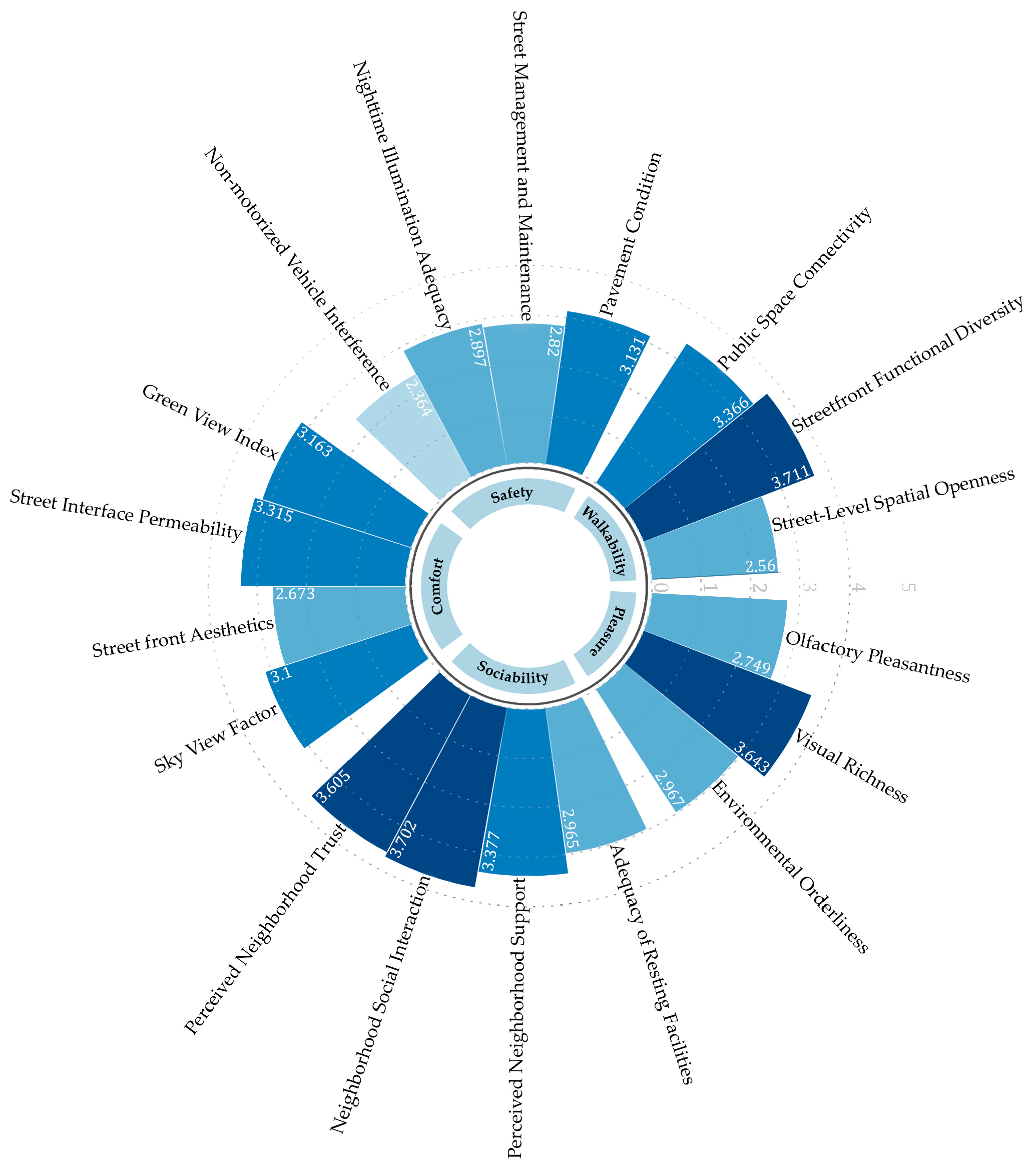
We made 5000 bootstrap resamples (with replacement) and then recalculated the FCE scores to figure out how uncertain the sampling was. The 95% percentile confidence intervals that came out were E1 = 3.196 (3.068–3.317), E2 = 2.730 (2.613–2.848), E3 = 3.106 (2.988–3.224), E4 = 3.441 (3.321–3.562), E5 = 3.141 (3.017–3.266), and overall E = 3.084 (2.988–3.181). Safety was still the lowest dimension, and its confidence interval did not overlap with those of the other dimensions. This makes the ranking in Figure 4 even stronger. We used bootstrap differences to compare groups by gender (male vs. female), age (<60 vs. ≥60), and how often they used the product (daily vs. non-daily). The ranking of the dimensions stayed the same for all groups, with safety always being the lowest. Females had lower overall perceptions than males (E = 2.726 vs. 3.466; Δ = −0.741, 95% CI −0.899 to −0.587), while daily users had higher perceptions than non-daily users. There were still differences by age, but they were smaller (Δ = 0.387, 95% CI 0.209–0.569).

4. Discussion

4.1. Interpreting AHP–FCE Results by Dimension

On a five-point scale, the composite score for the case street (E = 3.084) indicates a mid-range level of perceived environmental quality relevant to mental well-being (Table 7; Figure 4). The FCE-derived satisfaction scores suggest only moderate mental-health–relevant quality, with perceived restorative cues offset by salient perceived stressors. Sociability (E4 = 3.441) ranks first, followed by walkability (E1 = 3.196), pleasure (E5 = 3.141), and comfort (E3 = 3.106), while safety (E2 = 2.730) is the weakest dimension. Bootstrap 95% confidence intervals (Section 3.2) confirm this ordering, with Safety significantly lower than the other dimensions; the ranking also remains stable across gender, age, and usage-frequency subgroups. Overall, the street appears socially vibrant yet constrained by weak safety- and protection-related cues.
The prominence of sociability reflects how semi-public edges—such as thresholds, benches, and curbside niches—lower the threshold for everyday encounters. Older adults frequently stay in these places, chatting, watching, and engaging in light leisure activities; this type of use contributes to a sense of belonging and attachment to the district, despite the limited right-of-way. Sociability does not guarantee a good flow. This trade-off is consistent with the evening operating regime observed on site, where vendor inventory and multi-modal co-presence peak at hotspots and entrances (Table 2; Figure 1j). For a good flow, the continuity of the corridor and the absence of local conflicts are needed.
Scores for overall walkability are concentrated in the upper-middle range, suggesting a network that is predominantly used for everyday errands and social visits, but that exhibits localized frictions. Mixed pedestrian–vehicle use in the curb lane and recurring encroachment onto the pedestrian corridor by two-wheel parking and short-term vending reduce continuity and unpredictability. Overall, movements are possible but sometimes challenging, and the ease of walking is occasionally affected by the degree of friction in the curb space.
A more ambivalent pattern is apparent for pleasure. Scores for middling reflect that active ground floors, incidental greenery, and everyday street life generate positive affect, but to the detriment of ad hoc signage, uneven façade maintenance, and node clutter. In ageing fabrics, vitality does not guarantee a pleasurable experience: residents also require basic visual ordering, animating activities rather than a cacophony.
Comfort received a relatively low score, suggesting that comfort-related perceptual qualities—namely green view, interface permeability, street-front aesthetics, and sky-view factor—were relatively limited along Xuesong Road. In practical terms, the result reflects fewer restorative green cues in the pedestrian visual field, a less permeable street interface, uneven street-front aesthetics, and restricted sky openness, which together may reduce perceived spaciousness and visual restoration during everyday walking.
The lowest score was achieved in the safety category. The deficiency was attributable to sustained non-motorized through-movement and within-corridor parking that intermittently narrowed the pedestrian path and created irregular speed differentials along the corridor. This is in line with the indicator-level pattern shown in Table 6, where non-motorized vehicle interference (C7) and nighttime illumination adequacy (C6) have the highest combined weight within the safety dimension. From early evening to about 11 pm, the central pressure emanating from the corridor comes from itinerant vendors and other non-motorized, movable vehicles, which are mainly located at the storefront edges, narrowing the effective walking envelope. The impacts of lighting conditions are magnified by mature tree canopies that intervene between the luminaires and the pavement, reducing pavement-level uniformity. Additionally, bright shopfronts and vendors’ lighting increase vertical luminance and glare, while failing to provide adequate horizontal illuminance at the footfall level. In other words, it is a “bright-yet-dim” situation—pedestrians feel that the façades are bright. This pattern is corroborated by the illuminance survey, which shows markedly higher eye-level illuminance relative to near-ground levels at vendor-influenced nodes and very low uniformity under canopy-covered segments (Table 3; Figure 1g–i). Still, they themselves and the conflict points are dimly lit, which reduces the ability to detect nearby hazards and judge distance. Even when a minimum passable clear width is provided, frequent lateral deflections and brief stoppages along the way, in addition to variable crossing locations, weaken the sense of control over, rather than capacity to cross, reducing the attenuation of the benefits of sociability, walkability, and comfort.

4.2. Spatial–Behavioral Mechanisms Underpinning Perceptual Differences

Discrepancies between expert-derived weights and resident-reported performance scores for behavior-related attributes indicate the spatial and behavioral mechanisms shaping street perception. Experts, who evaluated the environment from a design and management perspective, assigned the highest weights to safety (B2) and accessibility and physical continuity of walkability (B1) (Table 6). Residents’ evaluations show the strongest perceived performance in sociability (E4 = 3.441) and only moderate or low scores for safety (E2 = 2.730) (Table 7). This result suggests a mismatch between the dimensions for which experts assign high weights and those in which residents currently experience the environment as being physically supportive.
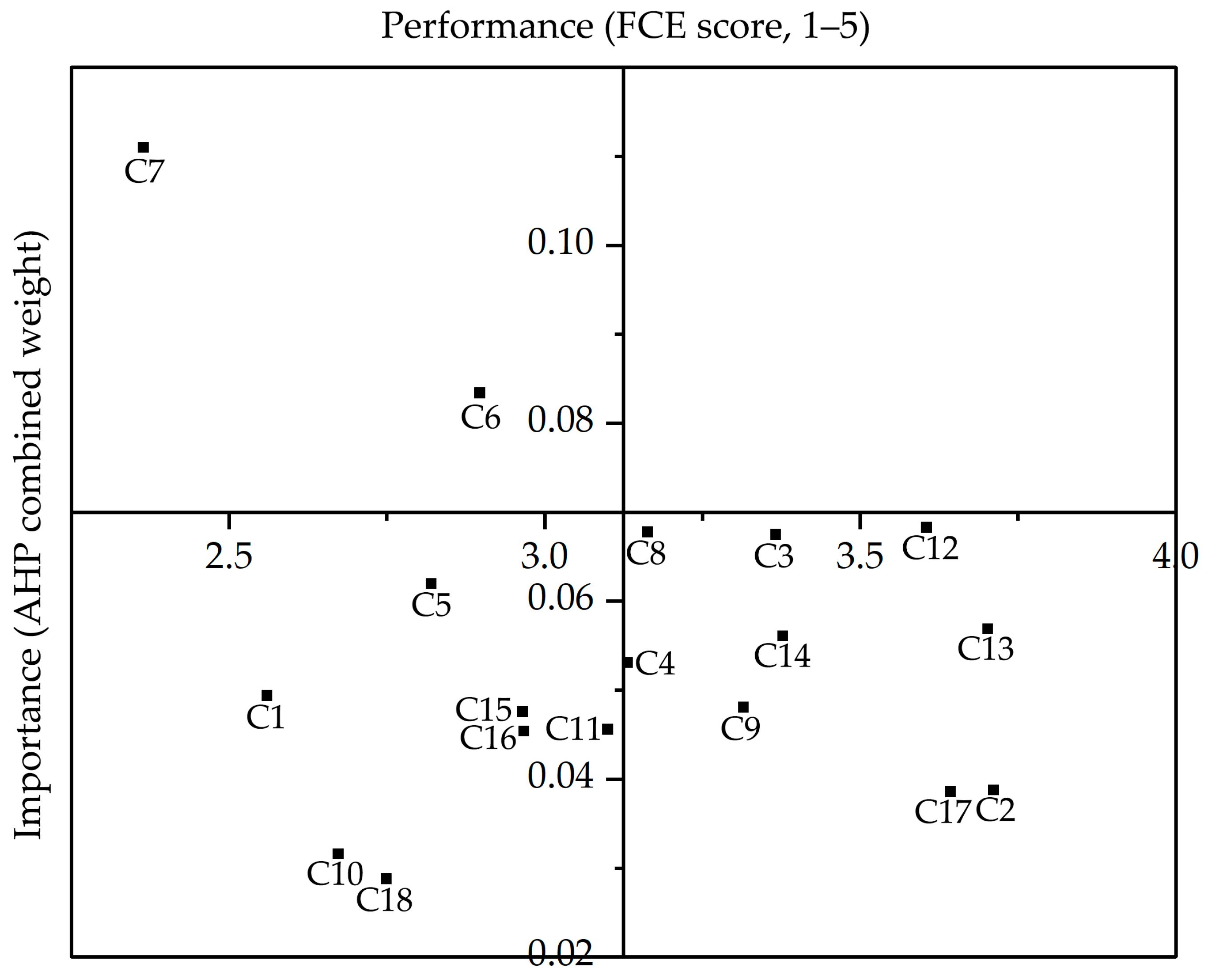
We further conducted an importance–performance analysis (IPA) (Figure 5) to translate the AHP–FCE results into a micro-renewal priority map: indicators with above-mean importance ( w - = 0.0556 ) but below-mean performance ( x - = 3.117 ) are treated as first-order targets, whereas high-importance/high-performance items are maintained as strengths. These IPA-based priorities can be interpreted through the spatial–behavioral mechanisms observed in older communities.
Spatially, the street morphology of older communities contributes directly to these outcomes. Street morphology characterized by narrow cross-sections and irregular building interfaces with mixed use on the ground floor results in complex spatial visibility and high pedestrian density. Although this environment decreases objective safety, it increases the likelihood of social contact and enhances residents’ sense of community. The behavioral layer further magnifies this effect: older adults tend to linger in semi-public spaces for prolonged periods and engage in low-intensity social interactions that enhance their attachment to the environment; however, the behavior in which they are engaged is not protected. Thus, the concurrent presence of sociability and vulnerability is an inherent quality of urban space.
From a psychological perspective, these results are consistent with ecological accounts of environmental affordances, that is, the action possibilities that streetscapes offer to their users [50,51] and restorative-environment frameworks that associate specific physical cues with stress recovery and perceived safety [42,52]. The street offers abundant affordances for social behavior and reinforcement of identity, but fewer cues of control and security than the mall. The disparity between ‘inviting interaction’ and ‘ensuring safety’ reflects a balance between social vibrancy and perceived comfort that must be negotiated in street-renewal projects.
To translate the above mechanism-based interpretation into actionable targets for street micro-renewal, we further operationalize the two binding constraints highlighted by residents—non-motorized interference and inadequate nighttime lighting—into measurable variables. Non-motorized interference can be quantified using effective sidewalk width (i.e., the unobstructed walking envelope after accounting for vendors, parking, and street furniture), traffic mix (shares of pedestrians, two-wheelers, and motor vehicles), and conflict-point density/near-miss counts at key nodes during peak periods. In parallel, inadequate lighting can be assessed through pavement-level illuminance and uniformity (e.g., E avg and U 0 = E m i n / E avg ), complemented by eye-level vertical illuminance and documentation of glare sources, which together help explain the “bright-yet-dim” perception. These variables provide a transparent bridge from subjective experience to implementable design and management targets, and they also offer a basis for integrating additional metrics (e.g., two-wheeler speed variability and pedestrian LOS) in future work to support intervention prioritization and monitoring.

4.3. Positioning the Findings and Boundary Conditions

The results of this study support a growing body of research indicating that residents’ perceptions of neighborhood environments are significantly correlated with their psychological responses and mental health in urban public and semi-public spaces [53]. Similarly to recent studies on street perception and comfort, the results of this study suggest that emotional comfort, perceived safety, and opportunities for social interaction are key perceptual dimensions that influence overall evaluations of street environments [54,55]. However, in contrast to previous studies, which mainly focus on newly developed or structurally improved districts, this study highlights the specific social and spatial characteristics of aging urban communities, where physical constraints and limited opportunities for outdoor activities coexist with persistent neighborhood relationships and high levels of social cohesion.
This study supports recent work on old communities, showing that informal spatial occupations and micro-scale social encounters can buffer the impacts of environmental deficits and lead to a unique type of everyday urban resilience [56,57].
Methodologically, the combination of AHP and FCE provides a hierarchical and quantitative process that bridges expert judgment and resident perception. Previous studies that applied the combination of these two methods have mainly focused on the physical or visual quality of urban spaces, such as greening, accessibility, and façade coherence. Unlike these studies, this study applied the combination method from a psychological perspective, transforming perceptual indicators of safety, comfort, walkability, sociability, and pleasure into measurable variables. This combined weighting–evaluation mechanism keeps expert-derived weights transparent while linking the composite scores to residents’ perceived street experience.
From this perspective, this study contributes to the debate on how to systematically incorporate perceptual and affective dimensions into spatial assessment frameworks, demonstrating that residents’ sensory and emotional experiences are as meaningful as the physical form in defining street quality. By linking the evaluation to expert criteria and residents’ perceived street experience, this study demonstrates a way forward for human-centered renewal models, in which psychological comfort and social vitality are considered alongside the physical form in sustainable urban regeneration.
The suggested framework offers a comprehensible connection between residents’ perceptions and micro-renewal priorities; however, the limitations of the existing indicator system must be recognized. Street acoustics and the overall soundscape are important parts of everyday life that can be easily heard, but this study did not use them as a clear indicator module or monitor them in any way. Consequently, the findings are most accurately interpreted as cohesive perceptual profiles rather than causal assessments of particular environmental exposures. Future research will integrate the sonic environment as an auxiliary indicator module to facilitate a more thorough, multi-sensory assessment of micro-renewal interventions.

4.4. Design and Policy Implications for Sustainability-Oriented Micro-Renewal in Aging Streets

Although the overall quality level remains moderate (E = 3.084), the variations among dimensions (especially the high score for sociability, E4 = 3.441, and the low score for safety, E2 = 2.730) provide valuable insights for guiding future street renewal strategies. From a sustainability perspective, micro-renewal should prioritize small-scale interventions that maximize perceived well-being benefits, while keeping implementation disruption and long-term maintenance burdens within acceptable limits. The results show that simply improving physical conditions is not enough; successful regeneration should consider the affective and behavioral experiences that constitute residents’ attachment to their neighborhoods. Practically, this implies a layered intervention logic organized around pedestrian-scale “living elements”—the ground plane, street edge, overhead enclosure, and street objects—because their form, scale, articulation, texture, and colour shape both functional usability and lived experience.
Guided by the IPA priority map (Figure 5), non-motorized vehicle interference (C7) and nighttime illumination adequacy (C6) emerge as first-order targets. We therefore propose sidewalk-scale actions for conflict management (Table 8) and targeted lighting upgrades (Table 9), complemented by low-cost amenity and coherence measures across other pedestrian-scale ‘living elements’ (Table 10), aiming to restore predictability and visibility while preserving everyday street life.
At the same time, maintaining social vitality is essential for strengthening community resilience. High sociability scores suggest that residents rely on everyday semi-public street spaces for social connection and emotional support. Renewal strategies should therefore avoid undermining these social affordances in the name of modernization. At the sidewalk scale, small interventions—such as rest areas, shaded seating, micro-green pockets, and flexible space for informal activities—can help sustain community ties while improving comfort and inclusiveness. Attention should also be paid to sensory and aesthetic qualities. Green streets, color contrast, and locally embedded cultural elements may elicit positive affect and are often associated with perceived restoration, thereby enhancing residents’ mental-health-relevant experience of the street. In older communities where large-scale reconstruction is difficult, micro-renewal offers a practical and human-centered pathway to improving street quality and everyday life.
In summary, the results suggest that a balanced design logic should be employed to integrate safety, comfort, and sociability within limited spatial and financial constraints, considering both the functional demands and the residents’ nuanced psychological needs.

5. Conclusions

This study translates resident perceptions and expert judgement into a coherent, mental-health-relevant assessment of living-street quality in an aging urban community using an AHP–FCE approach. The composite score (E = 3.084) falls in the mid-range of a five-point scale, suggesting moderate perceived quality relevant to mental well-being, with restorative cues appearing intermittent and offset by salient stressors. Sociability performs best, walkability is mid-range, pleasure and comfort are slightly lower, and safety remains the binding constraint. These results indicate that sustainable regeneration should prioritize safety and comfort upgrades while preserving existing low-cost features that support sociability, thereby improving everyday well-being without adding undue resource inputs or long-term maintenance burdens. However, the street operates as everyday social infrastructure, yet it does not consistently provide cues of protection or bodily ease. Read through the lens of “living elements”, the binding deficits concentrate in the ground-plane and edge layers (surface continuity, effective walking width, and conflict points) and are amplified after dark by the overhead light–canopy interplay.
An implication of the safety deficit is discernible from the evidence base. At all times of day, non-motorized through-movement and within-corridor parking intermittently narrow the pedestrian path, creating speed differentials along the route. Furthermore, in the evening, itinerant vendors and their associated equipment further narrow the effective walking envelope. At night, lighting conditions exacerbate these pressures, yielding a “bright-yet-dim” environment in which the façades are bright. Still, the pavement and conflict zones are poorly lit, undermining the sense of control that pedestrians need for near-field conflict detection.
Operationally, the research results can be summarized in three horizontal directions for micro-renewal along Xuesong Road. At the corridor level, adequate management measures are needed to ensure a stable, clear width along the main line of sight, manage non-motorized traffic at conflict points through spatial separation or time-sharing, and time-regulate or remove vending points so that peak periods in the evening do not coincide with the occupation of the pedestrian corridor. Meanwhile, street lighting should recalibrate lighting for the pavement based on equalized levels of illuminance; this can include canopy pruning, shielding, or repositioning of luminaires to alleviate glare, and providing dedicated lighting instead of using vertical shopfront signage as a substitute for lighting. Where feasible, implement these adjustments through high-efficacy, modular retrofits with straightforward maintenance to reduce life-cycle energy use and operating costs. This needs to be accompanied by carefully selecting and shaping the social affordances of the street. Place shade, seating, and small green inserts where they do not cut off movement corridors or lines of sight. Enhance the material and visual order so that the existing vibrancy is perceived as more tranquil and legible, rather than chaotic.
Taken together, the study’s findings contribute to both methodological and practical aspects. Through the combination of AHP and FCE around a set of psychologically framed indicators, the study demonstrates how expert judgments can be made transparent. At the same time, composite evaluations are grounded in residents’ experiences of a street segment. The street segment analysis connects the safety deficit to tangible, designable levers (non-motorized interference, vending encroachment, misaligned lighting), and thus transforms fuzzy perceptual data into spatial levers. On this basis, the study finds a micro-renewal path that is feasible for limited-latitude living streets. Accordingly, under tight spatial and fiscal constraints, sequencing matters: micro-renewal should first stabilize safety and legibility (surface continuity, effective width, conflict management, and pavement-level lighting) and then consolidate comfort- and sociability-enhancing add-ons.
However, several caveats warrant note. The empirical demonstration is currently confined to a single living street (Xuesong Road, Wuhan), and further applications across additional streets are needed to test and refine the framework under varying spatial and management conditions. In addition, objective noise/soundscape monitoring was not conducted as a systematic spatiotemporal campaign; thus, the current assessment primarily reflects perceived multisensory profiles rather than instrumented exposure–response relationships. Future work will validate the framework across multiple streets and segmented corridors, integrate key engineering variables with instrumented soundscape and lighting measurements, and employ structural equation modeling (SEM) to relate objective exposures to perceived dimensions and overall evaluation in pre–post intervention designs.

Author Contributions

Conceptualization, W.G., J.S. and W.S.; methodology, W.G.; software, W.G.; investigation, W.G. and G.A.; writing—original draft preparation, W.G. and G.A.; writing— review and editing, W.G. and J.S.; visualization, W.G. and G.A.; funding acquisition, W.S. All authors have read and agreed to the published version of the manuscript.

Funding

This research was supported by the Social Science Foundation of Hubei Province (General Project), Research on the Construction Path of “Dual-Age Co-care” Elderly and Young Integrated Communities—Based on the Demand Assessment and Behavior Analysis of the Elderly and Children, HBSKJJ20243324, October 2024.

Institutional Review Board Statement

The study was conducted in accordance with the Declaration of Helsinki and approved by the Research Ethics and Science & Technology Safety Committee of Hubei University of Technology (Approval No.: HBUT20250072).

Informed Consent Statement

Written informed consent was obtained from all subjects involved in the study. Participation was voluntary and anonymous, and no personally identifiable information was collected.

Data Availability Statement

The original contributions presented in this study are included in the article. Further inquiries can be directed to the corresponding author.

Conflicts of Interest

The authors declare no conflicts of interest.

Appendix A. Structured Interview Questionnaire

Appendix A.1. Survey Procedure

The resident survey used an on-site intercept, face-to-face design on Xuesong Road. Trained investigators conducted interviews near residential-compound entrances, small public spaces, and sidewalk segments during typical daytime and early evening periods, rotating locations/time windows to reach different user groups. Participation was voluntary, and investigators assisted respondents when needed. A total of 200 questionnaires were distributed, and 178 valid questionnaires were retained (effective recovery rate 89.0%), after excluding cases with substantial missing items, uniform responding across the 18 items, logical inconsistencies in basic information, or obviously abnormal completion patterns.

Appendix A.2. Structured Interview Questionnaire

Hello. We are graduate researchers conducting an on-site resident survey on Xuesong Road. The interview takes about 10 min. We do not collect any personally identifiable information. Your responses will be used for academic research only and will be kept confidential and anonymous. Participation is voluntary, and you may skip any question or stop at any time. If you agree, we will begin with a few background questions, followed by a short set of ratings about your experience of the street.
Consent confirmation: I have carefully read and signed the informed consent form and agree to participate in this study.
Part A. Socio-demographics and use frequency
A1. Gender: ☐ Male ☐ Female
A2. Age group: ☐ Under 18 ☐ 18–34 ☐ 35–64 ☐ 65 and above
A3. Education background: ☐ Primary school ☐ Middle school ☐ High school ☐ Undergraduate and above
A4. Frequency of use of Xuesong Road: ☐ Daily ☐ Weekends only ☐ Several times a week ☐ Several times a month ☐ Almost never
Part B. Perception ratings (C1–C18)
Respondents rated each item on a five-point Likert scale (higher values indicate more positive perceptions in analysis). In the field form, items were presented as bipolar descriptors (negative → positive) with five response levels. Five response levels were displayed with numeric anchors −2, −1, 0, 1, 2 (from very poor to very good).
Walkability (B1)
C1. Street-Level Spatial Openness: −2; ☐−1; ☐0; ☐1; ☐2
C2. Street front Functional Diversity: ☐−2; ☐−1; ☐0; ☐1; ☐2
C3. Public Space Connectivity: ☐−2; ☐−1; ☐0; ☐1; ☐2
Safety (B2)
C4. Pavement Condition: ☐−2; ☐−1; ☐0; ☐1; ☐2
C5. Street Management and Maintenance: ☐−2; ☐−1; ☐0; ☐1; ☐2
C6. Nighttime Illumination Adequacy: ☐−2; ☐−1; ☐0; ☐1; ☐2
C7. Non-motorized Vehicle Interference: ☐−2; ☐−1; ☐0; ☐1; ☐2
Comfort (B3)
C8. Green View Index: ☐−2; ☐−1; ☐0; ☐1; ☐2
C9. Street Interface Permeability: ☐−2; ☐−1; ☐0; ☐1; ☐2
C10. Street front Aesthetics: ☐−2; ☐−1; ☐0; ☐1; ☐2
C11. Sky View Factor: ☐−2; ☐−1; ☐0; ☐1; ☐2
Sociability (B4)
C12. Perceived Neighborhood Trust: ☐−2; ☐−1; ☐0; ☐1; ☐2
C13. Neighborhood Social Interaction: ☐−2; ☐−1; ☐0; ☐1; ☐2
C14. Perceived Neighborhood Support: ☐−2; ☐−1; ☐0; ☐1; ☐2
C15. Adequacy of Resting Facilities: ☐−2; ☐−1; ☐0; ☐1; ☐2
Pleasure (B5)
C16. Environmental Orderliness: ☐−2; ☐−1; ☐0; ☐1; ☐2
C17. Visual Richness: ☐−2; ☐−1; ☐0; ☐1; ☐2
C18. Olfactory Pleasantness: ☐−2; ☐−1; ☐0; ☐1; ☐2

Appendix A.3. Reverse-Coded Items

Although all items were displayed with negative-to-positive bipolar anchors in the field questionnaire, C7 (Non-motorized Vehicle Interference) was operationalized in the dataset such that higher scores indicate more interference (worse conditions). Therefore, C7 was reverse-coded before aggregation to ensure a consistent directionality across items (higher = better) in the final analysis dataset.

Appendix A.4. Scale Recoding

All items (C1–C18) were administered using five-level bipolar anchors scored from −2 to 2 (very poor to very good). For analysis, responses were linearly recoded to a 1–5 scale (higher = better) using the mapping −2→1, −1→2, 0→3, 1→4, 2→5 (i.e., s = x + 3 ).
Table A1. Leave-one-out robustness of AHP-derived weights across experts.
Excluded ExpertSafety
Weight
Safety
Rank
Global Top-1Top-5 MatchTop-5 IntersectionJaccard SimilaritySpearmanKendallTau
10.3013574371C71510.9793601650.895424837
20.3022926791C71510.9793601650.895424837
30.3024687251C71510.9752321980.869281046
40.3002055851C71510.9793601650.895424837
50.3026184641C7040.6666666670.9711042310.869281046
60.304029541C71510.9711042310.895424837
70.3047880381C71510.9772961820.895424837
80.3052939781C71510.9669762640.869281046
90.3075569281C71510.9731682150.895424837
100.3059027121C71510.9690402480.882352941
110.3345363791C71510.9752321980.908496732
120.3321945781C71510.9731682150.895424837
130.3310134861C71510.9731682150.895424837
140.3337496931C71510.9752321980.908496732
150.3349159741C71510.9731682150.895424837
160.297259781C71510.9752321980.908496732
170.3003113631C71510.9834881320.921568627
180.2957467741C71510.9752321980.908496732
190.2969351751C71510.9834881320.921568627
200.2963741461C71510.9752321980.908496732
Table A2. Sensitivity analysis of AHP weights under ±10% perturbations to the first-level Safety weight.
ScenarioSafety WeightFirst-Level TopGlobal Top-1 IndicatorTop-5 ChangedTop-5 AddedTop-5 Removed
First-level: Safety −10%0.287418B2C7No--
First-level: Safety +10%0.330199B2C7YesC5C3
Table A3. Sensitivity analysis of AHP weights under ±10% perturbations to selected second-level weights under Safety.
ScenarioGlobal Top-1 IndicatorTop-5 Changed
Second-level: C7 −10% (renormalized within Safety)C7No
Second-level: C7 +10% (renormalized within Safety)C7No
Second-level: C6 −10% (renormalized within Safety)C7No
Second-level: C6 +10% (renormalized within Safety)C7No
Table A4. Correlation matrix of AHP-weighted dimension composite scores.
DimensionB1B2B3B4B5
B110.5640.5850.5030.572
B20.56410.5580.4580.488
B30.5850.55810.6150.711
B40.5030.4580.61510.585
B50.5720.4880.7110.5851
Table A5. Exploratory factor analysis results (PCA extraction): rotated factor loadings and communalities (h2).
IndicatorF1F2F3F4F5h2
C10.4380.0510.1160.7570.0660.786
C20.168−0.0660.2170.4550.7130.795
C30.0290.0870.20.7920.2230.726
C40.4510.5560.1670.361−0.0470.674
C50.3350.360.2430.5660.1690.65
C600.9220.0370.0610.0760.861
C70.4020.3290.2820.548−0.0510.652
C80.6810.1530.2380.0620.3330.659
C90.7080.1310.2470.180.1860.647
C100.5720.1180.4580.1920.220.636
C110.6690.1260.1170.340.250.656
C120.2950.0780.8330.0710.050.794
C130.0620.0670.8090.1760.2720.767
C140.1770.0720.7660.2440.1550.708
C150.547−0.1520.510.180.1530.638
C160.6440.0710.2110.2460.3540.65
C170.30.1270.1850.0060.8360.839
C180.66−0.0910.1950.3780.1790.657

References

  1. Biddulph, M. Evaluating the English home-zone initiatives. J. Am. Plan. Assoc. 2010, 76, 199–218. [Google Scholar] [CrossRef]
  2. Dumbaugh, E.; King, M. Engineering livable streets: A thematic review of advancements in urban street design. J. Plan. Lit. 2018, 33, 451–465. [Google Scholar] [CrossRef]
  3. Istrate, A.L.; Chen, F.; Kadetz, P.; Chang, Y.; Williams, A.R. Developing an analytical framework for liveable streets in Shanghai. Urban Des. Int. 2021, 26, 3–20. [Google Scholar] [CrossRef]
  4. Appleyard, D. Livable streets: Protected neighborhoods? Ann. Am. Acad. Polit. Soc. Sci. 1980, 451, 106–117. [Google Scholar] [CrossRef]
  5. Dumbaugh, E.; Gattis, J.L. Safe streets, livable streets. J. Am. Plan. Assoc. 2005, 71, 283–300. [Google Scholar] [CrossRef]
  6. Mahmoudi, M.; Ahmad, F.; Abbasi, B. Livable streets: The effects of physical problems on the quality and livability of Kuala Lumpur streets. Cities 2015, 43, 104–114. [Google Scholar] [CrossRef]
  7. Sanders, P.; Zuidgeest, M.; Geurs, K. Liveable streets in Hanoi: A principal component analysis. Habitat Int. 2015, 49, 547–558. [Google Scholar] [CrossRef]
  8. McAndrews, C.; Marshall, W. Livable streets, livable arterials? Characteristics of commercial arterial roads associated with neighborhood livability. J. Am. Plan. Assoc. 2018, 84, 33–44. [Google Scholar] [CrossRef]
  9. Ding, Q.; Zhang, T.; Zhu, X.; Zhang, J. Impact of perceived value and community attachment on smart renovation participation willingness for sustainable development of old urban communities in China. Sustainability 2022, 14, 11675. [Google Scholar] [CrossRef]
  10. Zhang, B.; Guo, W.; Xing, Z.; Zhou, R. Current situation and sustainable renewal strategies of public space in Chinese old communities. Sustainability 2022, 14, 6723. [Google Scholar] [CrossRef]
  11. Pikora, T.; Giles-Corti, B.; Bull, F.; Jamrozik, K.; Donovan, R. Developing a framework for assessment of the environmental determinants of walking and cycling. Soc. Sci. Med. 2003, 56, 1693–1703. [Google Scholar] [CrossRef] [PubMed]
  12. Millstein, R.A.; Cain, K.L.; Sallis, J.F.; Conway, T.L.; Geremia, C.; Frank, L.D.; Chapman, J.; Van Dyck, D.; Dipzinski, L.R.; Kerr, J.; et al. Development, scoring, and reliability of the Microscale Audit of Pedestrian Streetscapes (MAPS). BMC Public Health 2013, 13, 403. [Google Scholar] [CrossRef] [PubMed]
  13. Rundle, A.G.; Bader, M.D.; Richards, C.A.; Neckerman, K.M.; Teitler, J.O. Using Google Street View to audit neigh-borhood environments. Am. J. Prev. Med. 2011, 40, 94–100. [Google Scholar] [CrossRef]
  14. Zhang, F.; Zhou, B.; Liu, L.; Liu, Y.; Fung, H.H.; Lin, H.; Ratti, C. Measuring human perceptions of a large-scale urban region using machine learning. Landsc. Urban Plan. 2018, 180, 148–160. [Google Scholar] [CrossRef]
  15. Fotios, S.; Unwin, J.; Farrall, S. Road lighting and pedestrian reassurance after dark: A review. Light. Res. Technol. 2015, 47, 449–469. [Google Scholar] [CrossRef]
  16. Yang, Y.; He, D.; Gou, Z.; Wang, R.; Liu, Y.; Lu, Y. Association between street greenery and walking behavior in older adults in Hong Kong. Sustain. Cities Soc. 2019, 51, 101747. [Google Scholar] [CrossRef]
  17. Ewing, R.; Handy, S. Measuring the unmeasurable: Urban design qualities related to walkability. J. Urban Des. 2009, 14, 65–84. [Google Scholar] [CrossRef]
  18. Ewing, R.H.; Clemente, O.; Neckerman, K.M.; Purciel-Hill, M.; Quinn, J.W.; Rundle, A. Measuring Urban Design: Metrics for Livable Places; Island press: Washington, DC, USA, 2013; Volume 200. [Google Scholar]
  19. Qiu, Y.; Liu, Y.; Liu, Y.; Li, Z. Exploring the linkage between the neighborhood environment and mental health in Guangzhou, China. Int. J. Environ. Res. Public Health 2019, 16, 3206. [Google Scholar] [CrossRef]
  20. Lei, K.; Yang, J.; Ke, X. The impact of neighborhood environment on the mental health: Evidence from China. Front. Public Health 2025, 12, 1452744. [Google Scholar] [CrossRef]
  21. Wu, H.; Wang, L.; Zhang, Z.; Gao, J. Analysis and optimization of 15-minute community life circle based on supply and demand matching: A case study of Shanghai. PLoS ONE 2021, 16, e0256904. [Google Scholar] [CrossRef]
  22. Conti, C.; Guarino, M.; Bacenetti, J. Measurements techniques and models to assess odor annoyance: A review. Environ. Int. 2020, 134, 105261. [Google Scholar] [CrossRef] [PubMed]
  23. Wen, T.; Yuan, C.; Chai, P.; Zhang, B.; Zhai, T.; Li, Y.; Liu, Y. The burden of injury among elderly individuals in China from 1990 to 2019: An analysis of data from the global burden of disease study 2019. Prev. Med. Rep. 2024, 44, 102815. [Google Scholar] [CrossRef]
  24. Ferenchak, N.N.; Abadi, M.G. Nighttime pedestrian fatalities: A comprehensive examination of infrastructure, user, vehicle, and situational factors. J. Saf. Res. 2021, 79, 14–25. [Google Scholar] [CrossRef] [PubMed]
  25. Beyer, F.R.; Ker, K. Street lighting for preventing road traffic injuries. Cochrane Database Syst. Rev. 2009. [Google Scholar] [CrossRef] [PubMed]
  26. Sampson, R.J.; Raudenbush, S.W. Systematic social observation of public spaces: A new look at disorder in urban neighborhoods. Am. J. Sociol. 1999, 105, 603–651. [Google Scholar] [CrossRef]
  27. Welsh, B.C.; Farrington, D.P.; Douglas, S. The impact and policy relevance of street lighting for crime prevention: A systematic review based on a half-century of evaluation research. Criminol. Public Policy 2022, 21, 739–765. [Google Scholar] [CrossRef]
  28. Li, W.; Li, Q.; Liu, Y.; Wang, S.; Jia, L. Decision-making factors for renovation of old residential areas in Chinese cities under the concept of sustainable development. Environ. Sci. Pollut. Res. 2023, 30, 39695–39707. [Google Scholar] [CrossRef]
  29. Yannis, G.; Kopsacheili, A.; Dragomanovits, A.; Petraki, V. State-of-the-art review on multi-criteria decision-making in the transport sector. J. Traffic Transp. Eng. (Engl. Ed.) 2020, 7, 413–431. [Google Scholar] [CrossRef]
  30. Rezaei, J. Best-worst multi-criteria decision-making method. Omega 2015, 53, 49–57. [Google Scholar] [CrossRef]
  31. Si, S.L.; You, X.Y.; Liu, H.C.; Zhang, P. DEMATEL technique: A systematic review of the state-of-the-art literature on methodologies and applications. Math. Probl. Eng. 2018, 2018, 3696457. [Google Scholar]
  32. Behzadian, M.; Otaghsara, S.K.; Yazdani, M.; Ignatius, J. A state-of the-art survey of TOPSIS applications. Expert Syst. Appl. 2012, 39, 13051–13069. [Google Scholar]
  33. Opricovic, S.; Tzeng, G.H. Compromise solution by MCDM methods: A comparative analysis of VIKOR and TOPSIS. Eur. J. Oper. Res. 2004, 156, 445–455. [Google Scholar] [CrossRef]
  34. Lee, E.H. eXplainable DEA approach for evaluating performance of public transport origin-destination pairs. Res. Transp.-Tion Econ. 2024, 108, 101491. [Google Scholar] [CrossRef]
  35. Wang, X.; Hou, B.; Teng, Y.; Yang, Y.; Zhang, X.; Sun, L.; Chen, F. Reformative ROCOSD–ORESTE–LDA model with an MLP neural network to enhance decision reliability. Knowl.-Based Syst. 2024, 286, 111384. [Google Scholar]
  36. Peng, H.; Zhu, T.; Yang, T.; Zeng, M.; Tan, S.; Yan, L. Depression or recovery? A study of the influencing elements of urban street environments to alleviate mental stress. Front. Archit. Res. 2025, 14, 846–862. [Google Scholar]
  37. Saadi, I.; Aganze, R.; Moeinaddini, M.; Asadi-Shekari, Z.; Cools, M. A participatory assessment of perceived neighbourhood walkability in a small urban environment. Sustainability 2021, 14, 206. [Google Scholar] [CrossRef]
  38. Vallejo-Borda, J.A.; Cantillo, V.; Rodriguez-Valencia, A. A perception-based cognitive map of the pedestrian perceived quality of service on urban sidewalks. Transp. Res. Part F Traffic Psychol. Behav. 2020, 73, 107–118. [Google Scholar]
  39. Zhang, L.; Xu, X.; Guo, Y. Comprehensive evaluation of the implementation effect of commercial street quality improvement based on AHP-Entropy Weight Method—Taking Hefei Shuanggang Old Street as an example. Land 2022, 11, 2091. [Google Scholar]
  40. Ren, X.; Wei, P.; Wang, Q.; Sun, W.; Yuan, M.; Shao, S.; Zhu, D.; Xue, Y. The effects of audio-visual perceptual characteristics on environmental health of pedestrian streets with traffic noise: A case study in Dalian, China. Front. Psychol. 2023, 14, 1122639. [Google Scholar] [CrossRef]
  41. Kaplan, R.; Kaplan, S. The Experience of Nature: A Psychological Perspective; Cambridge University Press: Cambridge, UK, 1989. [Google Scholar]
  42. Ulrich, R.S.; Simons, R.F.; Losito, B.D.; Fiorito, E.; Miles, M.A.; Zelson, M. Stress recovery during exposure to natural and urban environments. J. Environ. Psychol. 1991, 11, 201–230. [Google Scholar] [CrossRef]
  43. Evans, G.W. The built environment and mental health. J. Urban Health 2003, 80, 536–555. [Google Scholar] [CrossRef]
  44. Liu, Y.; Yu, Z.; Song, Y.; Yu, X.; Zhang, J.; Song, D. Psychological influence of sky view factor and green view index on daytime thermal comfort of pedestrians in Shanghai. Urban Clim. 2024, 56, 102014. [Google Scholar] [CrossRef]
  45. Zhao, J.; Wu, J.; Wang, H. Characteristics of urban streets in relation to perceived restorativeness. J. Expo. Sci. Environ. Epidemiol. 2020, 30, 309–319. [Google Scholar] [CrossRef]
  46. Nasar, J.L.; Fisher, B.; Grannis, M. Proximate physical cues to fear of crime. Landsc. Urban Plan. 1993, 26, 161–178. [Google Scholar] [CrossRef]
  47. Liu, M.; Zhang, B.; Luo, T.; Liu, Y.; Portnov, B.A.; Trop, T.; Jiao, W.; Liu, H.; Li, Y.; Liu, Q. Evaluating street lighting quality in residential areas by combining remote sensing tools and a survey on pedestrians’ perceptions of safety and visual comfort. Remote Sens. 2022, 14, 826. [Google Scholar] [CrossRef]
  48. Gao, T.; Bernstein, P. Physical appearance design evaluation of community emotional healing installations based on analytic hierarchy process–fuzzy comprehensive evaluation method. Buildings 2025, 15, 773. [Google Scholar] [CrossRef]
  49. Li, Y.; Zhang, M.; Yan, H.; Wang, Q. Evaluating lightscape perception in urban parks: A fuzzy comprehensive approach with case study of Shuixi Park, Tianjin. Buildings 2025, 15, 3080. [Google Scholar] [CrossRef]
  50. Guo, D.; Shi, Y.; Chen, R. Environmental affordances and children’s needs: Insights from child-friendly community streets in China. Front. Archit. Res. 2023, 12, 411–422. [Google Scholar] [CrossRef]
  51. Gibson, J.J. The Ecological Approach to Visual Perception; Houghton Mifflin: Boston, MA, USA, 1979. [Google Scholar]
  52. Kaplan, S. The restorative benefits of nature: Toward an integrative framework. J. Environ. Psychol. 1995, 15, 169–182. [Google Scholar] [CrossRef]
  53. Tao, Y.; Yang, J.; Chai, Y. The anatomy of health-supportive neighborhoods: A multilevel analysis of built environment, perceived disorder, social interaction and mental health in Beijing. Int. J. Environ. Res. Public Health 2020, 17, 13. [Google Scholar] [CrossRef]
  54. Qin, J.; Feng, Y.; Sheng, Y.; Huang, Y.; Zhang, F.; Zhang, K. Evaluation of pedestrian-perceived comfort on urban streets using multi-source data: A case study in Nanjing, China. ISPRS Int. J. Geo-Inf. 2025, 14, 63. [Google Scholar] [CrossRef]
  55. Wang, L.; Han, X.; He, J.; Jung, T. Measuring residents’ perceptions of city streets to inform better street planning through deep learning and space syntax. ISPRS J. Photogramm. Remote Sens. 2022, 190, 215–230. [Google Scholar]
  56. Sun, X.; Wang, L.; Wang, F.; Soltani, S. Behaviors of seniors and impact of spatial form in small-scale public spaces in Chinese old city zones. Cities 2020, 107, 102894. [Google Scholar] [CrossRef]
  57. Hawken, S.; Sunindijo, R.Y.; Sanderson, D. The critical role of community networks in building everyday resilience—Insights from the urban villages of Surabaya. Int. J. Disaster Risk Reduct. 2023, 98, 104090. [Google Scholar]
  58. Lusk, A.C.; Furth, P.G.; Morency, P.; Miranda-Moreno, L.F.; Willett, W.C.; Dennerlein, J.T. Risk of injury for bicycling on cycle tracks versus in the street. Inj. Prev. 2011, 17, 131–135. [Google Scholar] [CrossRef] [PubMed]
  59. Brown, A.; Klein, N.J.; Thigpen, C.; Williams, N. Impeding access: The frequency and characteristics of improper scooter, bike, and car parking. Transp. Res. Interdiscip. Perspect. 2020, 4, 100099. [Google Scholar] [CrossRef]
  60. Brown, A.; Thigpen, C.; Klein, N.J. Implementing shared micromobility parking: Planning and engineering best practices from around the globe. Transp. Res. Interdiscip. Perspect. 2025, 31, 101467. [Google Scholar] [CrossRef]
  61. Hagos, K.G.; Adnan, M. Effect of sidewalk vendors on pedestrian movement characteristics: A microscopic simulation study of Addis Ababa, Ethiopia. Cities 2020, 103, 102769. [Google Scholar] [CrossRef]
  62. Ren, J.; Li, Y.; Liu, H.; Li, K.; Hao, D.; Wang, Z. Analysis of Light Obstruction from Street Lighting in Road Scenes. Remote Sens. 2023, 15, 5655. [Google Scholar]
  63. Larue, G.S.; Watling, C.N.; Black, A.A.; Wood, J.M.; Khakzar, M. Pedestrians distracted by their smartphone: Are in-ground flashing lights catching their attention? A laboratory study. Accid. Anal. Prev. 2020, 134, 105346. [Google Scholar] [CrossRef] [PubMed]
  64. Carrese, S.; Pallante, L.; Patella, S.M.; Sportiello, S. Assessing the impact of LED-illuminated crosswalks on pedestrian safety. Transp. Res. Procedia 2023, 69, 719–726. [Google Scholar] [CrossRef]
  65. Gebremariam, D.; Kuhilen, T.; Seboka, H.; Grum, B. Effect of sidewalk design and obstructions on pedestrian mobility: A case study of the main streets of Mekelle City, Northern Ethiopia. Adv. Civ. Eng. 2024, 2024, 5672280. [Google Scholar] [CrossRef]
  66. Pluijter, N.; de Wit, L.P.; Bruijn, S.M.; Plaisier, M.A. Tactile pavement for guiding walking direction: An assessment of heading direction and gait stability. Gait Posture 2015, 42, 534–538. [Google Scholar] [CrossRef] [PubMed]
  67. Kawshalya, L.W.G.; Weerasinghe, U.G.D.; Chandrasekara, D.P. The impact of visual complexity on perceived safety and comfort of the users: A study on urban streetscape of Sri Lanka. PLoS ONE 2022, 17, e0272074. [Google Scholar]
  68. Huang, Z.; Wu, C.; Teng, M.; Lin, Y. Impacts of tree canopy cover on microclimate and human thermal comfort in a shallow street canyon in Wuhan, China. Atmosphere 2020, 11, 588. [Google Scholar] [CrossRef]
  69. Ki, D.; Lee, S. Analyzing the effects of Green View Index of neighborhood streets on walking time using Google Street View and deep learning. Landsc. Urban Plan. 2021, 205, 103920. [Google Scholar] [CrossRef]
  70. White, M.; Smith, A.; Humphryes, K.; Pahl, S.; Snelling, D.; Depledge, M. Blue space: The importance of water for preference, affect, and restorativeness ratings of natural and built scenes. J. Environ. Psychol. 2010, 30, 482–493. [Google Scholar] [CrossRef]
  71. Li, X.; Chen, J.; Feng, H.; Brown, R.; Zhu, R. Development and Application of a Street Furniture Design Evaluation Framework: Empirical Evidence from the Yangzhou Ecological Science and Technology New Town. Buildings 2025, 15, 2973. [Google Scholar] [CrossRef]
  72. Chmielewski, S.; Lee, D.J.; Tompalski, P.; Chmielewski, T.J.; Wężyk, P. Measuring visual pollution by outdoor advertisements in an urban street using intervisibilty analysis and public surveys. Int. J. Geogr. Inf. Sci. 2016, 30, 801–818. [Google Scholar]
  73. Ma, X.; Yang, Q. Research on the spatial location design of guidance signage systems to connect the space of transit-orientated development sites based on multi-software analysis. Buildings 2025, 15, 683. [Google Scholar] [CrossRef]
  74. Usui, H. Furthest neighbour distance distribution function: An application to evaluate the relationship between the density of city benches and the required continuous walking distance distribution. Appl. Spat. Anal. Policy 2022, 15, 1469–1492. [Google Scholar] [CrossRef]
  75. Ottoni, C.A.; Sims-Gould, J.; Winters, M.; Heijnen, M.; McKay, H.A. “Benches become like porches”: Built and social environment influences on older adults’ experiences of mobility and well-being. Soc. Sci. Med. 2016, 169, 33–41. [Google Scholar] [CrossRef] [PubMed]
Figure 1. Study area: location and streetscapes of Xuesong Road, Jianghan District, Wuhan.
Sustainability 18 01567 g001
Figure 2. Perception-based AHP–FCE framework for street quality relevant to mental health.
Sustainability 18 01567 g002
Figure 3. Socio-demographic characteristics and frequency of use of Xuesong Road by residents of adjacent communities.
Sustainability 18 01567 g003
Figure 4. Dimension- and indicator-level FCE scores for residents’ perceptions of Xuesong Road’s street environment.
Sustainability 18 01567 g004
Figure 5. IPA matrix of secondary indicators (C1–C18): importance (AHP combined weight) versus performance (FCE score, 1–5).
Sustainability 18 01567 g005
Table 1. Representative evaluation index systems for perceived quality of urban streets.
Author and YearStreet TypeIndicatorsMethodKey Findings
Peng et al. [36] (2025)Living streetGreen looking ratio; Degree of walkability; Facility distribution rate; Motor vehicle presence rate; Slow-moving occurrences; Sky visibility; Building enclosure; Elevation permeability of façades; Environmental complexity; Color richness; EEG-derived emotional statesOpen-ended interviewsTen living-street environmental elements were identified; motor vehicle presence rate and environmental complexity were positively correlated with boredom, whereas elevation permeability, green looking ratio, and building enclosure were positively correlated with engagement/interest.
Saadi Ismail et al. [37] (2021)Neighborhood streetCleanness: Presence of garbage; Pavement quality and cleanness; Smell
Visual aesthetics: General view; Colours; Beautiful scenes; Remarkable architecture; Open spaces
Landscape and nature: Green spaces; Water; Natural scenes; Playgrounds; Noise;
Feeling of pressure: Building height; Industrial sites and brownfields; Monotony; Landscape fragmentation; Road safety
Feeling of safety: Security; Traffic volume; Lighting; Suspicious people
Questionnaire surveySocio-demographics showed no direct effects on PNW (except education level), while “general view” was by far the most influencing factor and safety/cleanness items (e.g., “suspicious people”, “pavement quality and cleanness”) played a key role.
Vallejo-Borda et al. [38] (2020)Urban sidewalkSidewalk Characteristics: Width and condition; Furniture; Trees; Public transit access; Signage
Surrounding: Weather and lighting; Odor; Environment and cleanliness; Landscape
Externalities: Road width and number of lanes; Heavy-goods-vehicle flow and vehicular speed; Noise
Discomfort: Distance from other pedestrians; Stress; Too many pedestrians; Preference not to walk here
Bike Hassles: Bike flow and speed in both directions.
Protection: Personal security; Sidewalk safety; Road safety
Amenities: Restrooms; Shops; Shade
Questionnaire surveyPerceived QoS is directly explained by sidewalk characteristics and surrounding, while externalities, discomfort, and bike hassles impact perceived QoS negatively in the cognitive map.
Le Zhang et al. [39] (2022)Renovated commercial streetSpatial Carrying Capacity: Harmony between old and new buildings; Building facade richness; Street pavement neatness; Street furniture abundance. Street Attractiveness: Street accessibility; Cultural uniqueness; Shop diversity. Travel Safety: Vehicle disturbance; Proportion of street appurtenances. Environmental Comfort: Green vision; Street openness; Color richness. Social Interactivity: Crowd gathering; Social interface indexQuestionnaire survey; Analytic Hierarchy Process; Entropy weight methodAn AHP–entropy evaluation indicates that travel safety and social interaction significantly affect perceived quality enhancement, but residents’ evaluations of old–new building coordination and street-environment comfort are insufficient at this stage.
Ren Xinxin et al. [40] (2023)Urban pedestrian streetVisual Environment: Building form; Quantity of street greening; Type of greenery; Service facilities; Cleanliness; Width of pedestrian space; Sky visibility; Spatial scale; Interface height variation; Interface concavity variation; Building height; Building distance along the street
Acoustic Environment: LAeq of traffic noise; Acoustic comfort; Subjective loudness; Sound preference; Noise annoyance
Health Evaluations: Willingness to walk; Relaxation; Safety; Beauty; Comprehensive comfort
Questionnaire survey; Semantic Differences ScaleCombined audio–visual indicators (soundscape + streetscape) explained 55.40% of the variance in health evaluations, with acoustic comfort and several visual/spatial features among the determining factors.
Table 2. Temporal profile of multimodal passages and mobile-vendor activity (15-min counts) on Xuesong Road.
Time Window (15 min)Ped (Passages/15 min)NMVs (Passages/15 min)MVs (Passages/15 min)Total Passages (All Modes)Vendor Inventory (Active Stalls, n)
10:00–10:1515183282620
12:00–12:15229118493960
14:00–14:15193107403400
16:00–16:152451387846126
18:00–18:1527115617560284
20:00–20:15276150129555102
22:00–22:1525614996501102
00:00–00:15181964231976
Ped, pedestrians (persons/15 min); NMVs, non-motorized vehicles (bicycles and e-bikes; passages/15 min); MVs, motor vehicles (passages/15 min). Vendor inventory indicates active mobile street-vendor stalls present in the designated segment (n).
Table 3. Illuminance characteristics by spatial unit (uniformity metrics).
Node TypeN
(Points)
Mean Illuminance at 0.1 m (l×)Minimum Illuminance at 0.1 m (l×)Uniformity Ratio at 0.1 m (Emin/Emean, −)Mean Illuminance at 1.5 m (l×)Mean Illuminance Ratio
(1.5 m/0.1 m, −) *
Intersection2134.717.60.50736.21.043
mobile street vendors5239.24.70.120179.34.574
Canopy-covered334.90.20.0415.21.061
Regular2414.83.00.20315.11.020
* Mean illuminance ratio was calculated as E 1.5 - / E 0.1 - (ratio of group means), rather than the mean of pointwise ratios.
Table 4. Pedestrian-scale “living elements” of Xuesong Road and their operational links to the indicator system (C1–C18).
Streetscape Layer (Living Elements)Key Pedestrian-Scale Cues ObservedUtilitarian Implications (Functional/Ergonomic)Phenomenological/Sensory Experience (Legibility/Atmosphere)Operational Link to Indicators (C1–C18)
Ground plane & crossingsMixed paving surfaces; intermittent surface defects; partially obstructed tactile guidance; step-up curbs and constrained ramp approachesWalking stability and barrier-free continuity; predictable footfall line; reduced detour burdenPerceived effort increases with discontinuity; weaker legibility of inclusive guidance; reduced sense of controlC3 Public Space Connectivity; C4 Pavement Condition; C5 Street Management and Maintenance; C7 Non-motorized Vehicle Interference
Street edge/interface (movement–staying boundary)Fine-grained storefront thresholds; permeable move–stay interface; evening spill-out and queuing; intensified close-range negotiation at hotspotsDestination accessibility and permeability; maintain minimum clear walking width; manage edge-related conflictsEveryday vitality and “yanhuoqi”; sociability affordances vs. perceived encroachment/chaos if unmanagedC2 Street front Functional Diversity; C9 Street Interface Permeability; C13 Neighborhood Social Interaction; C16 Environmental Orderliness; C17 Visual Richness
Overhead canopy & microclimate cuesContinuous street-tree canopy; stable enclosure/shade cue; limited eye-level planting; scarce water-related micro-restorative stimuliPerceived shade/thermal relief cues; microclimate buffering potential; spatial rhythm for orientationEnclosure and potential restorative cues; limited near-eye green stimuli may constrain restorationC8 Green View Index; C10 Street front Aesthetics; C11 Sky View Factor;
Street objects & technical artefactsConcentrations of utility appurtenances and street furniture; ad hoc items near entrances/corners; recurrent pinch points; persistent two-wheel encroachmentBottleneck avoidance; clear-width protection at high-demand nodes; conflict reduction“Clutter vs. coherence”: objects aid orientation but can read as disorder and raise irritation/stressC1 Street-Level Spatial Openness; C5 Street Management and Maintenance; C7 Non-motorized Vehicle Interference; C16 Environmental Orderliness
Night-time lightscapeMixed high-mast and shop/vendor lighting; canopy shadowing; localized glare; pronounced node–segment luminance contrastsHazard detection and conflict visibility at footfall level; reassurance and glare controlVisual adaptation load increases with abrupt contrasts; atmosphere shaped by node-based brightness rather than uniform guidanceC6 Nighttime Illumination Adequacy; C16 Environmental Orderliness; C17 Visual Richness
Visual information layer (signage/ads/wayfinding)High-density commercial signage and LED displays; ad hoc posters; inconsistent scale and mounting height; limited formal wayfinding cuesWayfinding and destination confirmation; decision-making at nodes; cognitive load increases when information is clutteredIdentity/character cues; legibility vs. visual overload (“clutter vs. coherence”) shaping comfort, stress, and perceived controlC3 Public Space Connectivity; C10 Street front Aesthetics; C16 Environmental Orderliness; C17 Visual Richness
Resting affordances & temporal rhythmSparse seating concentrated at nodes; staying clusters near key frontages; vendor-driven evening intensification; variable food-related odorsResting opportunities for older adults; capacity to pause without blocking flow; support for daily routinesSocial-support atmosphere and encounter opportunities; pleasure/attachment vs. crowding/odor-related discomfortC7 Non-motorized Vehicle Interference; C12 Perceived Neighborhood Trust; C13 Neighborhood Social Interaction; C14 Perceived Neighborhood Support; C15 Adequacy of Resting Facilities; C18 Olfactory Pleasantness;
Table 5. RI comparison table.
n12345678910
RI000.520.891.121.261.361.411.461.49
Table 6. Weight calculation results for the evaluation index system.
Goal LayerFirst-Level IndicatorsFirst-Level WeightNo.Secondary IndicatorsSecondary
Weight
Combined
Weights
Rank
Residents’ perceived street quality relevant to mental healthB1. Walkability0.1557C1Street-Level Spatial Openness0.31720.049410
C2Street front Functional Diversity0.24900.038815
C3Public Space Connectivity0.43380.06755
B2. Safety 0.3095C4Pavement Condition0.17170.05319
C5Street Management and Maintenance0.20030.06206
C6Nighttime Illumination Adequacy0.26950.08342
C7Non-motorized Vehicle Interference0.35850.11101
B3. Comfort0.1931C8Green View Index0.35110.06784
C9Street Interface Permeability0.24900.048111
C10Street front Aesthetics0.16360.031617
C11Sky View Factor0.23630.045613
B4. Sociability0.2289C12Perceived Neighborhood Trust0.29820.06833
C13Neighborhood Social Interaction0.24870.05697
C14Perceived Neighborhood Support0.24510.05618
C15Adequacy of Resting Facilities0.20800.047612
B5. Pleasure 0.1128C16Environmental Orderliness0.40310.045414
C17Visual Richness0.34200.038616
C18Olfactory Pleasantness0.25490.028818
Table 7. Proportions of respondents in each satisfaction category for street-environment indicators.
First-Level IndicatorsSecondary IndicatorsThe Proportion of Evaluators to the Total Number of People
SatisfiedRelatively
Satisfied
NeutralRelatively
Dissatisfied
Dissatisfied
WalkabilityStreet-Level Spatial Openness0.0220.1740.2980.3540.152
Street front Functional Diversity0.1910.4780.1970.1180.017
Public Space Connectivity0.1520.2750.3990.1350.039
SafetyPavement Condition0.1120.2420.3880.1800.079
Street Management and Maintenance0.0390.2810.2980.2250.157
Nighttime Illumination Adequacy0.1070.1970.3150.2470.135
Non-motorized Vehicle Interference0.0000.1290.2750.4270.169
ComfortGreen View Index0.1120.2420.3990.1910.056
Street Interface Permeability0.1120.2870.4330.1400.028
Street front Aesthetics0.0110.1850.360.3540.09
Sky View Factor0.0560.2470.4720.1910.034
SociabilityPerceived Neighborhood Trust0.1850.3540.3480.1070.006
Neighborhood Social Interaction0.2190.3930.2700.1070.011
Perceived Neighborhood Support0.1350.2750.4440.1240.022
Adequacy of Resting Facilities0.1180.2130.2920.270.107
PleasureEnvironmental Orderliness0.0510.2420.4330.1690.107
Visual Richness0.1740.4380.2580.1180.011
Olfactory Pleasantness0.0620.1850.2870.3710.096
Table 8. Sidewalk conflict types and corresponding micro-renewal strategies on Xuesong Road.
Problem DiagramStreet ViewProblem DescriptionDiagram of Optimization StrategyOptimization Strategy
Sustainability 18 01567 i001Sustainability 18 01567 i002Encroachment of sidewalk space by moving non-motorized vehiclesSustainability 18 01567 i003Implementing tidal lanes to temporally separate pedestrian and non-motorized traffic [58]
Sustainability 18 01567 i004Sustainability 18 01567 i005Encroachment of sidewalks by parked non-motorized vehiclesSustainability 18 01567 i006Integrating non-motorized parking with street furniture in a dedicated edge strip [59,60]
Sustainability 18 01567 i007Sustainability 18 01567 i008Temporary sidewalk encroachment by mobile street vendorsSustainability 18 01567 i009Designate temporary, regulation-compliant vending zones [61]
Table 9. Night-time lighting deficiencies at the pedestrian scale and corresponding micro-renewal strategies on Xuesong Road.
Problem DescriptionDiagram of Issues and StrategiesOptimization Strategy
Tree canopies obstruct luminaires, resulting in low and uneven pavement-level illuminanceSustainability 18 01567 i010Recalibrate street lighting by pruning canopies and lowering or repositioning lamp heads to restore uniform pavement illuminance [62]
Insufficient guiding light at night leaves pedestrian routes and pavement edges weakly definedSustainability 18 01567 i011Install linear ground lighting to provide directional guidance and visually highlight the edge of the pavement [63]
Key nodes and conflict zones lack accent lighting, reducing the visibility of pedestrians and obstacles at nightSustainability 18 01567 i012Introduce targeted accent lighting at crossings, entrances, and other critical points to enhance visibility and perceived safety [64]
Table 10. Pedestrian-scale “living elements” and associated micro-renewal actions for Xuesong Road.
Pedestrian-Scale “Living Element”Micro-Renewal Measures (Low-Cost/Small-Scale)Indicators Primarily Targeted
Ground plane & crossingsRepair and level defective paving to restore a stable walking surface and reduce trip risk. Keep curb-ramp approaches and corner turning areas unobstructed. Use subtle material/texture/colour contrast (and, where applicable, continuous surface guidance cues) to distinguish a clear walking band from the edge-use band [17,39].C3, C4, C5
Street edge/interface (move–stay boundary)Safeguard a continuous minimum clear walking width at hotspots (e.g., shopfront thresholds and entrances) [65], and mark the walking band with subtle banding/paving cues [66]. Organise spill-out and queuing into a controlled edge strip using modular planters/rails [61], keeping key “negotiation nodes” legible while avoiding uncontrolled clutter [67].C2, C7, C9, C13, C16, C17
Overhead canopy & microclimate cuesRetain shade where possible and maintain canopy continuity; add pocket greens and eye-level planting at rest points and decision nodes to strengthen near-eye greenery cues and thermal comfort [68,69]. Prune/raise canopies at key nodes to preserve sightlines and coordinate with night-time visibility (see Table 9). Where feasible, integrate small, maintainable blue–green cues (e.g., fountains or drinking water points) as comfort/restorative signals [70].C8, C10, C11
Street objects & technical artefactsDe-clutter and consolidate poles, utility boxes and temporary fixtures; align posts away from desire lines and keep corners/ramps clear [65]. Standardise small furniture details (material/colour palette, spacing) to improve coherence and reduce perceived disorder [71].C1, C5, C16
Visual information layer (signage/ads/wayfinding)Curate signage/advertising to stay within a readable complexity window: unify mounting-height band, spacing and (where relevant) night-time illumination; remove ad hoc posters while retaining necessary identity cues [67,72]. Add minimal, consistent wayfinding cues at decision points to support legibility and reduce cognitive load [73].C3, C10, C16, C17
Resting affordances & temporal rhythmProvide benches/leaning rails near daily destinations and at intervals aligned with older adults’ walking tolerance [74,75]; avoid blocking through-movement and maintain sightlines. Pair seating with shade and nearby greenery to extend comfortable dwell time in warm conditions [75]. Treat “pause pockets” as part of the walking network—kept clean, visible and socially supportive—to encourage brief rests and informal interaction [74].C12, C13, C14, C15, C18
Disclaimer/Publisher’s Note: The statements, opinions and data contained in all publications are solely those of the individual author(s) and contributor(s) and not of MDPI and/or the editor(s). MDPI and/or the editor(s) disclaim responsibility for any injury to people or property resulting from any ideas, methods, instructions or products referred to in the content.