Integrating Technology Acceptance, Sustainability Orientation, and Entrepreneurial Orientation: Evidence from Saudi Smallholder Farmers’ Social Media Marketing


Abstract
1. Introduction
2. Literature Review
2.1. Social Media as a Catalyst for Agricultural Market Transformation
2.2. The Relationship Between Social Media and Sustainability Orientation
2.3. Theoretical Foundations: The Technology Acceptance Model (TAM)
2.3.1. Contrast with TAM-Performance Outcome Extensions
2.3.2. Contrast with TAM-Values and Ethics-Based Extensions
2.3.3. Reconceptualizing Sustainability Orientation Within TAM
2.4. Global Perspectives on Social Media Adoption in Agribusiness
3. Conceptual Framework and Hypotheses
4. Materials and Methods
4.1. Data Collection Procedure
4.2. Research Design and Sample
4.3. Survey Instrument and Measures
4.4. Data Analysis Methods
4.4.1. Measurement Model Assessment
4.4.2. Structural Model Assessment
5. Integrated Results and Discussion
5.1. Technology Acceptance: The Primacy of Usability (H1, H2, H3)
5.2. Digital Engagement as a Strategic Driver (H4, H5, H6, H7, H8, H11, H13)
5.3. Entrepreneurial Orientation: The Engine of Success (H9, H10, H12)
5.4. The Dark Side of Digital Engagement: Beyond Positive Outcomes:
5.5. Implications
5.5.1. Theoretical Contributions
5.5.2. Practical and Policy Implications
6. Conclusions, Limitations, and Future Research
6.1. Conclusions
6.2. Limitations and Future Research
Funding
Institutional Review Board Statement
Informed Consent Statement
Data Availability Statement
Conflicts of Interest
Abbreviations
| SMMU | Social media marketing use |
| PEOU | Perceived Ease of Use |
| PU | Perceived Usefulness |
| SO | Sustainability Orientation |
| EO | Entrepreneurial Orientation |
| FP | Financial Performance |
| MC | Marketing Capabilities |
Appendix A

| Construct | Items | Reference |
|---|---|---|
| Perceived Ease of Use (PEOU) | PEOU1. It is easy to learn to use social media for marketing. PEOU2. Posting and managing content on social media is easy for me. PEOU3. Interacting with customers via social media is straightforward. | [23] |
| Perceived Usefulness (PU) | PU1. Social media use improves my farm’s marketing performance. PU2. Social media helps me reach more customers efficiently. PU3. Using social media increases my sales and profits. | [23] |
| Social Media Marketing Use (SMMU) | SMMU1. I frequently use social media to market my products. SMMU2. I share photos or videos of my farm products on social media. | [82] |
| Sustainability Orientation (SO) | SO1. I prioritize eco-friendly farming practices. SO2. I highlight my farm’s sustainable practices in marketing. SO3. I am committed to sustainable agriculture, even if costs are higher. | [49] |
| Marketing Capabilities—MC | MC1. I have a strong knowledge of my target market. MC2. I have effective control over and access to key market channels. MC3. I have privileged and strong relationships with my clients. MC4. I have a stable and fixed base of regular clients. | [49] |
| Entrepreneurial Orientation—EO | EO2. My farm has implemented several new product lines in the last five years. EO3. My farm has implemented important shifts in product lines in the lastfive years. EO4. My farm is generally the first to begin actions that the competitors follow. EO5. My farm is very often the first to implement new products, new technologies, new production methods, etc. EO8. Attending to the type of environment, audacious acts accomplish the farm’s purposes, and not minimum tactical modifications. | [49] |
| Financial Performance—FP | FP1. On average, my farm has increased its sales in the last five years. FP3. The product portfolio of my farm has improved in the past five years. FP4. New product markets were reached by my farm in the past five years. FP5. New geographical markets were reached by my farm in the past five years. | [49] |
References
- Anber Abraheem Shlash, M.; Suleiman Ibrahim, M.; Khaleel Ibrahim Al, D.; Badrea Al, O.; Majed, Q.; Asokan, V.; Yuhan, W. Digital Platforms and Agricultural Marketing: Bridging Gaps between Farmers and Consumers in Jordan. Res. World Agric. Econ. 2025, 6, 740–756. [Google Scholar] [CrossRef] [Scilit]
- Zhang, X.; Yang, Q.; Al Mamun, A.; Masukujjaman, M.; Masud, M.M. Acceptance of new agricultural technology among small rural farmers. Humanit. Soc. Sci. Commun. 2024, 11, 1641. [Google Scholar] [CrossRef] [Scilit]
- Kanellos, N.; Karountzos, P.; Giannakopoulos, N.T.; Terzi, M.C.; Sakas, D.P. Digital Marketing Strategies and Profitability in the Agri-Food Industry: Resource Efficiency and Value Chains. Sustainability 2024, 16, 5889. [Google Scholar] [CrossRef] [Scilit]
- Singh, R.; Sharma, S. Farmer’s perspectives on use of social media for marketing of agricultural products. J. Agribus. Dev. Emerg. Econ. 2025. ahead-of-print. [Google Scholar] [CrossRef] [Scilit]
- Dreist, D.; Schulze, H.; Harder, N.; Kühl, S. When will I be successful? The use of social media in agricultural direct marketing in Germany. Agric. Food Econ. 2025, 13, 23. [Google Scholar] [CrossRef] [Scilit]
- Tiemann, T.; Douxchamps, S. Opportunities and challenges for integrated smallholder farming systems to improve soil nutrient management in Southeast Asia. World Dev. Sustain. 2023, 3, 100080. [Google Scholar] [CrossRef] [Scilit]
- Zaki, K.; Alhomaid, A.; Ghareb, A.; Shared, H.; Raslan, A.; Khalifa, G.S.A.; Elnagar, A.K. Digital Synergy and Strategic Vision: Unlocking Sustainability-Oriented Innovation in Saudi SMEs. Adm. Sci. 2025, 15, 59. [Google Scholar] [CrossRef] [Scilit]
- Arangurí, M.; Mera, H.; Noblecilla, W.; Lucini, C. Digital Literacy and Technology Adoption in Agriculture: A Systematic Review of Factors and Strategies. AgriEngineering 2025, 7, 296. [Google Scholar] [CrossRef] [Scilit]
- Abubakar, M.; Maharvi, Z.; Sattar, T.; Ahmad, S.R. Role of social media in promoting environmental advocacy and climate change awareness. NUST J. Nat. Sci. 2025, 10, 1–14. [Google Scholar] [CrossRef] [Scilit]
- Hamza, A.; Yonghong, D.; Ullah, I.; Khan, N. Assessing the impact of social media on farmers’ income: Evidence from Punjab, Pakistan. Front. Sustain. Food Syst. 2025, 9, 1555584. [Google Scholar] [CrossRef] [Scilit]
- Krings, W.; Sharmen, S.; Faisal-E-Alam, M.; Bhuiyan, A. Divulging Young Population’s Willingness To Purchase Green Products. Bangladesh J. Multidiscip. Sci. Res. 2024, 9, 42–50. [Google Scholar] [CrossRef] [Scilit]
- Dharmawan, M.; Rahayu, W.; Khomah, I.; Kusnandar, K. Determinants of Social Media Adoption by Millennial Farmers to Improve Business Performance: Perspectives from the Technology-Organization-Environment (TOE) Framework. Res. World Agric. Econ. 2024, 5, 533–554. [Google Scholar] [CrossRef] [Scilit]
- Singh, P. Beyond the basics: Exploring the impact of social media marketing enablers on business success. Heliyon 2024, 10, e26435. [Google Scholar] [CrossRef] [Scilit] [PubMed]
- Jabeen, N.; Gul, J. The Role of social media in promoting sustainable agriculture practices. Indus J. Agric. Biol. 2023, 2, 17–32. [Google Scholar] [CrossRef] [Scilit]
- Uy, T.C.; Limnirankul, B.; Kramol, P.; Sen, L.T.H.; Hung, H.G.; Kanjina, S.; Sirisunyaluck, R. Social Media adoption for agricultural development: Insights from smallholders in central Vietnam. Inf. Dev. 2024. online first. [Google Scholar] [CrossRef] [Scilit]
- Sun, Y.; Xing, J. The Impact of Social Media Information Sharing on the Green Purchase Intention among Generation Z. Sustainability 2022, 14, 6879. [Google Scholar] [CrossRef] [Scilit]
- Tang, S.-J.; Wang, J.-Y.; Liu, A.-D. Farmers’ willingness to adopt conservation tillage technology based on UTAUT model. J. Anhui Agric. Sci. 2023, 15, 228–233. [Google Scholar] [CrossRef] [Scilit]
- Jabir, B.; Noureddine, F. Digital agriculture in Morocco, opportunities and challenges. In Proceedings of the 2020 IEEE 6th International Conference on Optimization and Applications (ICOA), Beni Mellal, Morocco, 20–21 April 2020. [Google Scholar] [CrossRef] [Scilit]
- La Ragione, G.; Risitano, M. Rethinking consumer behaviour in a green digital marketing landscape. J. Bus. Res. 2026, 202, 115755. [Google Scholar] [CrossRef] [Scilit]
- Hendrawan, S.; Trihandoyo, A.; Saroso, D. Implementing Technology Acceptance Model to measure ICT usage by smallholder farmers. Sinergi 2023, 27, 123. [Google Scholar] [CrossRef] [Scilit]
- Pratiwi, L.; Kusuma, P.; Maharani, M. The Effectiveness of Integrated Agribusiness Cooperatives on the Income of Local Farmers. J. Sustain. Dev. Sci. 2021, 3, 56–63. [Google Scholar] [CrossRef] [Scilit]
- Ola, O.; Menapace, L. Smallholders’ perceptions and preferences for market attributes promoting sustained participation in modern agricultural value chains. Food Policy 2020, 97, 101962. [Google Scholar] [CrossRef] [Scilit]
- Davis, F.; Davis, F. Perceived Usefulness, Perceived Ease of Use, and User Acceptance of Information Technology. MIS Q. 1989, 13, 319. [Google Scholar] [CrossRef] [Scilit]
- Adnan, N.; Nordin, S.; Bahruddin, M.; Tareq, A. A state-of-the-art review on Facilitating Sustainable Agriculture through Green Fertiliser Technology Adoption: Assessing Farmers Behavior. Trends Food Sci. Technol. 2019, 86, 439–452. [Google Scholar] [CrossRef] [Scilit]
- Hsu, P.-F.; Kraemer, K.; Dunkle, D. Determinants of E-Business Use in U.S. Firms. Int. J. Electron. Commer. 2006, 10, 9–45. [Google Scholar] [CrossRef] [Scilit]
- Ahmad, S.; Abu Bakar, A.R.; Ahmad, N. Social media adoption and its impact on firm performance: The case of the UAE. Int. J. Entrep. Behav. Res. 2018, 25, 84–111. [Google Scholar] [CrossRef] [Scilit]
- Meng, Y.; Li, D. Digital Pathways to Sustainable Agriculture: Examining the Role of Agricultural Digitalization in Green Development in China. Sustainability 2025, 17, 3652. [Google Scholar] [CrossRef] [Scilit]
- Thomas, R.J.; O’Hare, G.; Coyle, D. Understanding technology acceptance in smart agriculture: A systematic review of empirical research in crop production. Technol. Forecast. Soc. Change 2023, 189, 122374. [Google Scholar] [CrossRef] [Scilit]
- Ramdani, B.; Chevers, D.; Williams, D. SMEs’ adoption of enterprise applications: A technology-organisation-environment model. J. Small Bus. Enterp. Dev. 2013, 20, 735–753. [Google Scholar] [CrossRef] [Scilit]
- Inegbedion, H.; Inegbedion, E.; Asaleye, A.; Obadiaru, E.; Asamu, F. Use of social media in the marketing of agricultural products and farmers’ turnover in South-South Nigeria. F1000Research 2021, 9, 1220. [Google Scholar] [CrossRef] [Scilit]
- Alsaghan, B.; Diab, A.; Alhotan, A. Social network sites utilized in agricultural extension services in Kingdom of Saudi Arabia. AGROFOR Int. J. 2017, 2, 19–27. [Google Scholar] [CrossRef] [Scilit]
- Zondo, W.N.S.; Ndoro, J.T. Attributes of Diffusion of Innovation’s Influence on Smallholder farmers’ social media adoption in Mpumalanga Province, South Africa. Sustainability 2023, 15, 4017. [Google Scholar] [CrossRef] [Scilit]
- Yuan, Y.; Sun, Y. Practices, Challenges, and Future of Digital Transformation in Smallholder Agriculture: Insights from a Literature Review. Agriculture 2024, 14, 2193. [Google Scholar] [CrossRef] [Scilit]
- Veseli, A.; Bytyqi, L.; Hasanaj, P.; Bajraktari, A. The Impact of Digital Marketing on Promotion and Sustainable Tourism Development. Tour. Hosp. 2025, 6, 56. [Google Scholar] [CrossRef] [Scilit]
- Udomthanasansakul, P. The Influence Of Entrepreneurial Orientation On Firm Performance: The Mediating Role Of Learning Orientation In Small And Medium-Sized Enterprises. RMUTT Glob. Bus. Econ. Rev. 2025, 20, 133–151. [Google Scholar] [CrossRef] [Scilit]
- Lee, A.T.; Ramasamy, R.K.; Subbarao, A. Understanding Psychosocial Barriers to Healthcare Technology Adoption: A Review of TAM Technology Acceptance Model and Unified Theory of Acceptance and Use of Technology and UTAUT Frameworks. Healthcare 2025, 13, 250. [Google Scholar] [CrossRef] [Scilit]
- Wang, S.; Yang, Y.; Yin, H.; Zhao, J.; Wang, T.; Yang, X.; Ren, J.; Yin, C. Towards Digital Transformation of Agriculture for Sustainable Development in China: Experience and Lessons Learned. Sustainability 2025, 17, 3756. [Google Scholar] [CrossRef] [Scilit]
- Verma, A. The Impact of Digital Marketing Adoption on Firm Performance: A Case Study of Small and Medium Enterprises in India. Int. J. Strateg. Mark. Pract. 2024, 6, 1–11. [Google Scholar] [CrossRef] [Scilit]
- Zhang, Y.; Lin, Z.; Zhang, R.; Zhao, K. The impact of digital capabilities on farmers’ choice of marketing channels: Evidence from rural areas of the Yellow River Basin in China. Humanit. Soc. Sci. Commun. 2025, 12, 1629. [Google Scholar] [CrossRef] [Scilit]
- Venkatesh, V.; Bala, H. Technology acceptance model 3 and a research agenda on interventions. Decis. Sci. 2008, 39, 273–315. [Google Scholar] [CrossRef] [Scilit]
- Tombe, R.; Smuts, H. Agricultural Social Networks: An Agricultural Value Chain-Based Digitalization Framework for an Inclusive Digital Economy. Appl. Sci. 2023, 13, 6382. [Google Scholar] [CrossRef] [Scilit]
- Zhang, Q.; Feng, X.; Xu, W.; Wei, L. Digitalization’s Role in Shaping Sustainable Agriculture—Evidence from Chinese Provincial Panel Data Using the Baidu Index. Agriculture 2025, 15, 1275. [Google Scholar] [CrossRef] [Scilit]
- Venkatesh, V.; Morris, M.; Davis, G.; Davis, F. User Acceptance of Information Technology: Toward a Unified View. MIS Q. 2003, 27, 425–478. [Google Scholar] [CrossRef] [Scilit]
- Xie, K.; Zhu, Y.; Ma, Y.; Chen, Y.; Chen, S.; Chen, Z. Willingness of tea farmers to adopt ecological agriculture techniques based on the UTAUT extended model. Int. J. Environ. Res. Public Health 2022, 19, 15351. [Google Scholar] [CrossRef] [Scilit]
- Arisanto, S.; Fitriyah, H. Sustainable Marketing Strategy Through Social Media as a Supporting Force for Food Security in Chili and Tomato Seed Products. J. Artif. Intell. Digit. Econ. 2025, 2, 47–68. [Google Scholar] [CrossRef] [Scilit]
- Boza, E.; Kilipiri, E.; Papaioannou, E. Integrating Sustainability into an Organizational Marketing Strategy: A Systematic Literature Review. Proceedings 2024, 111, 23. [Google Scholar] [CrossRef] [Scilit]
- de Sena Silva, N.; Gomes, S.C.; Filho, E.J.M.A.; Galina, S.V.R. Sustainability Orientation, Environmental Knowledge Integration, and Strength of Ties: Governance and Sustainable Performance in Regulated Agribusiness. Corp. Soc. Responsib. Environ. Manag. 2025, 32, 7310–7325. [Google Scholar] [CrossRef] [Scilit]
- Claudy, M.; Peterson, M.; Pagell, M. The Roles of Sustainability Orientation and Market Knowledge Competence in New Product Development Success. J. Prod. Innov. Manag. 2016, 33, 72–85. [Google Scholar] [CrossRef] [Scilit]
- Dias, C.; Rodrigues, R.; Ferreira, J.J. Small agricultural businesses’ performance—What is the role of dynamic capabilities, entrepreneurial orientation, and environmental sustainability commitment? Bus. Strategy Environ. 2021, 30, 1898–1912. [Google Scholar] [CrossRef] [Scilit]
- Trainor, K.J.; Andzulis, J.; Rapp, A.; Agnihotri, R. Social media technology usage and customer relationship performance: A capabilities-based examination of social CRM. J. Bus. Res. 2014, 67, 1201–1208. [Google Scholar] [CrossRef] [Scilit]
- Vorhies, D.; Morgan, N. Benchmarking Marketing Capabilities for Sustainable Competitive Advantage. J. Mark. J. Mark. 2005, 69, 80–94. [Google Scholar] [CrossRef] [Scilit]
- Tajvidi, R.; Karami, A. The effect of social media on firm performance. Comput. Hum. Behav. 2017, 115, 105174. [Google Scholar] [CrossRef] [Scilit]
- Bresciani, S.; Huarng, K.-H.; Malhotra, A.; Ferraris, A. Digital transformation as a springboard for product, process and business model innovation. J. Bus. Res. 2021, 128, 204–210. [Google Scholar] [CrossRef] [Scilit]
- Felix, R.; Rauschnabel, P.A.; Hinsch, C. Elements of strategic social media marketing: A holistic framework. J. Bus. Res. 2017, 70, 118–126. [Google Scholar] [CrossRef] [Scilit]
- Dwivedi, Y.K.; Ismagilova, E.; Hughes, D.L.; Carlson, J.; Filieri, R.; Jacobson, J.; Jain, V.; Karjaluoto, H.; Kefi, H.; Krishen, A.S.; et al. Setting the future of digital and social media marketing research: Perspectives and research propositions. Int. J. Inf. Manag. 2021, 59, 102168. [Google Scholar] [CrossRef] [Scilit]
- Martínez-Cañas, R.; Ruiz-Palomino, P.; Linuesa-Langreo, J.; Blázquez-Resino, J.J. Consumer Participation in Co-creation: An Enlightening Model of Causes and Effects Based on Ethical Values and Transcendent Motives. Front. Psychol. 2016, 7, 793. [Google Scholar] [CrossRef] [Scilit]
- Roundy, P.; Fayard, D. Dynamic Capabilities and Entrepreneurial Ecosystems: The Micro-Foundations of Regional Entrepreneurship. J. Entrep. 2018, 28, 94–120. [Google Scholar] [CrossRef] [Scilit]
- Herrada-Lores, S.; Palazón, M.; Iniesta-Bonillo, M.Á.; Estrella-Ramón, A. The communication of sustainability on social media: The role of dialogical communication. J. Res. Interact. Mark. 2024, 19, 307–332. [Google Scholar] [CrossRef] [Scilit]
- Lumpkin, G.T.; Dess, G.G. Clarifying the Entrepreneurial Orientation Construct and Linking It to Performance. Acad. Manag. Rev. 1996, 21, 135–172. [Google Scholar] [CrossRef] [Scilit]
- Anim, P.; Arthur, E.; Amoako, G. Entrepreneurial orientation, social media and SME performance: An emerging economy perspective. Asia-Pac. J. Bus. Adm. 2023, 16, 1037–1066. [Google Scholar] [CrossRef] [Scilit]
- Aloulou, W.J.; Alsadi, A.K.; Ayadi, F.M.; Alaskar, T.H. Exploring the Effects of Entrepreneurial and Digital Orientations on the Competitive Advantage of Saudi Firms: Is Strategic Agility the Missing Link? Adm. Sci. 2024, 14, 306. [Google Scholar] [CrossRef] [Scilit]
- Reshi, Z.M.; Saqib, N.; Nazir, H. Entrepreneurial orientation: A systematic literature review and future research. J. Manag. Hist. 2025. ahead-of-print. [Google Scholar] [CrossRef] [Scilit]
- Moreno-Ortiz, C.; Peterson, D.; Collart, A.; Downey, L.; Seal, S.; Gallardo, R. Small Farmers’ Use of Social Media and Other Channels for Marketing their Agricultural Products. J. Ext. 2021, 59, 19. [Google Scholar] [CrossRef] [Scilit]
- Kumar, B.; Asheq, A.; Rahaman, M.; Karim, M. Determinants of Social Media Marketing Adoption Among Smes: A Conceptual Framework. Acad. Mark. Stud. J. 2019, 23, 1–6. [Google Scholar]
- Covin, J.G.; Wales, W.J. Crafting High-Impact Entrepreneurial Orientation Research: Some Suggested Guidelines. Entrep. Theory Pract. 2019, 43, 3–18. [Google Scholar] [CrossRef] [Scilit]
- Rauch, A.; Wiklund, J.; Lumpkin, G.T.; Frese, M. Entrepreneurial Orientation and Business Performance: An Assessment of past Research and Suggestions for the Future. Entrep. Theory Pract. 2009, 33, 761–787. [Google Scholar] [CrossRef] [Scilit]
- Klewitz, J.; Hansen, E. Sustainability-Oriented Innovation of SMEs: A Systematic Review. J. Clean. Prod. 2014, 65, 57–75. [Google Scholar] [CrossRef] [Scilit]
- Prihatiningrum, R.Y.; Fauzi, A.; Lutfi, L.; Imron, M.; Fithoni, A. Sustainable Marketing Strategies: Aligning Brand Values with Consumer Demand for Environmental Responsibility. Glob. Int. J. Innov. Res. 2024, 2, 2271–2283. [Google Scholar] [CrossRef] [Scilit]
- Cheng, P.; Wu, S.; Xiao, J. Exploring the impact of entrepreneurial orientation and market orientation on entrepreneurial performance in the context of environmental uncertainty. Sci. Rep. 2025, 15, 1913. [Google Scholar] [CrossRef] [Scilit]
- Adjakou, O.J.L. Transformational entrepreneurship in Low-Innovation sectors of least developed countries: Is entrepreneurial orientation enough, and is market orientation needed? J. Entrep. Emerg. Econ. 2025. ahead-of-print. [Google Scholar] [CrossRef] [Scilit]
- Hidayat, M.; Sudarmiatin, S.; Mukhlis, I.; Hermawan, A. The Influence of Entrepreneurial Orientation, Market Orientation, Learning Orientation on Marketing Performance Mediated by SME Marketing Capabilities to Support the Achievement of the Sustainable Develoipment Goals. J. Lifestyle SDGs Rev. 2024, 4, e01729. [Google Scholar] [CrossRef] [Scilit]
- Hidayati, H.A.; Siti Astuti, E.; Kusumawati, A.; Iqbal, M. The nexus between entrepreneurial and market orientation on digital marketing capabilities and marketing performance of SMEs in emerging markets. Cogent Bus. Manag. 2025, 12, 2526150. [Google Scholar] [CrossRef] [Scilit]
- Susanto, P.; Hoque, M.E.; Shah, N.; Candra, A.; Abdullah, N. Entrepreneurial orientation and performance of SMEs: The roles of marketing capabilities and social media usage. J. Entrep. Emerg. Econ. 2021. ahead-of-print. [Google Scholar] [CrossRef] [Scilit]
- Wang, M.; Ramasamy, S.S.; Dawod, A.Y.; Yu, X. Development and TAM-Based Validation of a User Experience Scale for Actual System Use in Online Courses. Educ. Sci. 2025, 15, 855. [Google Scholar] [CrossRef] [Scilit]
- Sedovs, E.; Volkova, T.; Ludviga, I. Does Sustainability Orientation Drive Financial Success in a Non-Ergodic World? A Systematic Literature Review. J. Risk Financ. Manag. 2025, 18, 339. [Google Scholar] [CrossRef] [Scilit]
- Phillips, T.; McEntee, M.; Klerkx, L. An investigation into the use of social media for knowledge exchange by farmers and advisors. Rural Ext. Innov. Syst. J. 2021, 17, 1–13. [Google Scholar]
- Hartiani, H.; Zainuddin, M.; Rahadi, I. The Role of Social Media in Improving the Marketing Performance of SMEs. Iqtishoduna 2025, 21, 135–155. [Google Scholar] [CrossRef] [Scilit]
- Shahbaz, P.; Haq, S.; Abbas, A.; Azadi, H.; Boz, I.; Yu, M.; Watson, S. Role of farmers’ entrepreneurial orientation, women’s participation, and information and communication technology use in responsible farm production: A step towards sustainable food production. Front. Sustain. Food Syst. 2023, 7, 1248889. [Google Scholar] [CrossRef] [Scilit]
- Asad, M.; Magableh, I.; Ta’amnha, M.; Mahrouq, M.; Asif, M. Mediating role of social media adoption between the impact of entrepreneurial orientation and perceived benefits of social media on performance of Jordanian entrepreneurial firms. Cogent Bus. Manag. 2025, 12, 2592424. [Google Scholar] [CrossRef] [Scilit]
- Osei, C.D.; Zhuang, J. The Effects of Institutional Supports on Farm Entrepreneurial Performance: Exploring the Mediating Role of Entrepreneurial Orientation. Sage Open 2024, 14, 21582440241227713. [Google Scholar] [CrossRef] [Scilit]
- Ram, D.; Pandey, D.; Das, U. Examining the relationship between entrepreneurial orientation and performance of vegetable growers in Bangladesh. J. Agribus. Dev. Emerg. Econ. 2025. ahead-of-print. [Google Scholar] [CrossRef] [Scilit]
- Kim, A.; Ko, E. Do social media marketing activities enhance customer equity? An empirical study of luxury fashion brand. J. Bus. Res. 2012, 65, 1480–1486. [Google Scholar] [CrossRef] [Scilit]
- Hair, J.F. A Primer on Partial Least Squares Structural Equation Modeling (PLS-SEM); Sage: Thousand Oaks, CA, USA, 2014. [Google Scholar]
- Podsakoff, P.; MacKenzie, S.; Lee, J.-Y.; Podsakoff, N. Common Method Biases in Behavioral Research: A Critical Review of the Literature and Recommended Remedies. J. Appl. Psychol. 2003, 88, 879–903. [Google Scholar] [CrossRef] [Scilit]
- Chin, W. How to Write Up and Report PLS Analyses. In Handbook of Partial Least Squares; Springer: Berlin/Heidelberg, Germany, 2010; pp. 655–690. [Google Scholar] [CrossRef] [Scilit]
- Wang, X.; Yuan, M.; Suo, X.; Yu, M.; Huang, P.; Lin, H. Strategic imperatives of ESG in fostering corporate digital innovation: A resource-based view. J. Knowl. Econ. 2024, 16, 15286–15315. [Google Scholar] [CrossRef] [Scilit]
- Madhani, P. Resource based view (RBV) of competitive advantage: An overview. In Resource Based View: Concepts and Practices; Madhani, P.M., Ed.; Icfai University Press: Hyderabad, India, 2009; pp. 3–22. Available online: https://ssrn.com/abstract=1578704 (accessed on 27 January 2026).
- Olaopa, O.; Alsuhaibany, Y. Economic diversification in Saudi Arabia: The role of information communication technology and e-commerce in achieving Vision 2030 and beyond. Int. J. Technol. Learn. Innov. Dev. 2023, 15, 137–161. [Google Scholar] [CrossRef] [Scilit]
- Alnasser, A.; Al Ghofaili, A.Y.R.; Mohammad, A.; Alzaidan, Z. Navigating Digital Transformation in Alignment with Vision 2030: A Review of Organizational Strategies, Innovations, and Implications in Saudi Arabia. J. Knowl. Learn. Sci. Technol. 2024, 3, 21–29. [Google Scholar] [CrossRef] [Scilit]
- Aldosari, F.; Sakran, S.; Alkhubizi, H.; Muddassir, M.; Noor, M.A.; Mubushar, M. Use of cell phones by the farmers as an extension tool to practice sustainable agriculture and achieve food security in the Kingdom of Saudi Arabia. J. Exp. Biol. Agric. Sci. 2017, 5, 91–98. [Google Scholar] [CrossRef] [Scilit]
- Blandon, J.; Henson, S.; Islam, T. Marketing Preferences of Small-Scale Farmers in the Context of New Agrifood Systems: A Stated Choice Model. Agribusiness 2009, 25, 251–267. [Google Scholar] [CrossRef] [Scilit]
- Worakittikul, W.; Srisathan, W.A.; Rattanpon, K.; Kulkaew, A.; Groves, J.; Pontun, P.; Naruetharadhol, P. Cultivating sustainability: Harnessing open innovation and circular economy practices for eco-innovation in agricultural SMEs. J. Open Innov. Technol. Mark. Complex. 2025, 11, 100494. [Google Scholar] [CrossRef] [Scilit]
- Mailani, D.; Hulu, M.; Simamora, M.; Kesuma, S. Resource-Based View Theory to Achieve a Sustainable Competitive Advantage of the Firm: Systematic Literature Review. Int. J. Entrep. Sustain. Stud. 2024, 4, 1–15. [Google Scholar] [CrossRef] [Scilit]
- Alsanhani, A.N.; Al-Shayaa, M.S.; Dabiah, A.T.; Alfridi, J.S. Advancing Sustainable Agriculture Through Digital Technology: The Role of the ‘Agricultural Guide’ App in Improving Olive Farming Practices in Saudi Arabia. Sustainability 2025, 17, 2340. [Google Scholar] [CrossRef] [Scilit]
- Almutlaq, A.M.; Al-Shayaa, M.S.; Dabiah, A.T.; Alfridi, J.S.; Alsanhani, A.N. Adoption of Sustainable Beekeeping Practices Among Rural Women in Hail Region, Kingdom of Saudi Arabia: Implications for Agricultural Extension. Sustainability 2025, 17, 4186. [Google Scholar] [CrossRef] [Scilit]
- Mapuranga, R.; Chisango, S.; Chavunduka, D. Digital and Social Media Marketing for Sustainable Agritourism. In Agritourism Marketing in Africa; Springer: Berlin/Heidelberg, Germany, 2025; pp. 261–285. [Google Scholar] [CrossRef] [Scilit]
- Balajti, P.; Jámbor, A.; Nagy, V. The Digitalisation of Agriculture: Opportunities and Drawbacks Towards the Reduction of GHG Emissions in Agriculture; Publisher of the European Union: Brüsszel, Belgium, 2025. [Google Scholar] [CrossRef]
- Ogunyiola, A. Interrogating the Socio-Ethical Dilemmas of Precision Agriculture Technologies. Ph.D. Thesis, South Dakota State University, Brookings, SD, USA, 2021. [Google Scholar]
- Konoplyannikova, M.; Radkevych, L.; Netreba, M.; Bilan, M.; Lorvi, I.; Nahorna, O. Digital marketing and communication strategies of agri-food enterprises on social media platforms. Agron. Res. 2024, 22, 444–463. [Google Scholar] [CrossRef]
- Schoemaker, E.; Talhouk, R.; Kamanu, C.; McDonaugh, E.; McDonaugh, C.; Casey, E.; Wills, A.; Richardson, F.; Donner, J. Social Agriculture: Examining the Affordances of Social Media for Agricultural Practices. In Proceedings of the 5th ACM SIGCAS/SIGCHI Conference on Computing and Sustainable Societies, Seattle, WA, USA, 29 June–1 July 2022; pp. 476–489. [Google Scholar] [CrossRef] [Scilit]
- Yusuf, N.; Lytras, M.D. Competitive sustainability of saudi companies through digitalization and the circular carbon economy model: A bold contribution to the vision 2030 agenda in Saudi Arabia. Sustainability 2023, 15, 2616. [Google Scholar] [CrossRef] [Scilit]
- Alamoudi, A.K.; Abidoye, R.B.; Lam, T.Y. Implementing smart sustainable cities in Saudi Arabia: A framework for citizens’ participation towards Saudi vision 2030. Sustainability 2023, 15, 6648. [Google Scholar] [CrossRef] [Scilit]
- Alghamdi, N. Knowledge and awareness of sustainability in Saudi Arabian public universities. In Handbook of Sustainability Science and Research; Springer: Berlin/Heidelberg, Germany, 2017; pp. 103–127. [Google Scholar] [CrossRef] [Scilit]
- Morris, W.; James, P. Social media, an entrepreneurial opportunity for agriculture-based enterprises. J. Small Bus. Enterp. Dev. 2017, 24, 1028–1045. [Google Scholar] [CrossRef] [Scilit]
- Chaudhuri, S.; Roy, M.; McDonald, L.M.; Emendack, Y. Reflections on farmers’ social networks: A means for sustainable agricultural development? Environ. Dev. Sustain. 2021, 23, 2973–3008. [Google Scholar] [CrossRef] [Scilit]
- Prost, M.; Gross, H.; Prost, L. How could social media support farmers concerned with sustainability issues? J. Agric. Educ. Ext. 2024, 30, 113–135. [Google Scholar] [CrossRef] [Scilit]
- Hoang, L.A.; Castella, J.-C.; Novosad, P. Social networks and information access: Implications for agricultural extension in a rice farming community in northern Vietnam. Agric. Hum. Values 2006, 23, 513–527. [Google Scholar] [CrossRef] [Scilit]
- Hoq, K.M.G. Information overload: Causes, consequences and remedies-A study. Philos. Prog. 2014, 55, 49–68. [Google Scholar] [CrossRef] [Scilit]
- Zhang, X.; Ding, X.; Ma, L. The influences of information overload and social overload on intention to switch in social media. Behav. Inf. Technol. 2022, 41, 228–241. [Google Scholar] [CrossRef] [Scilit]
- Kuria, C.W. Use of Social Media as a Source of Agricultural Information by Small Holder Farmers; A Case Study of Lower Kabete, Kiambu County. Master’s Thesis, University of Nairobi, Nairobi, Kenya, 2014. [Google Scholar]
- Panda, R.; Sinha, B. An exploratory study on impact of social media on agriculture development from farmers growth perspective. Online J. Distance Educ. E-Learn. 2023, 11, 1966–1973. [Google Scholar]
- Lyu, Z.; Jing, Z.; Yang, X. Bridging the digital divide for sustainable agriculture: How digital adoption strengthens farmer livelihood resilience. Front. Sustain. Food Syst. 2025, 9, 1628588. [Google Scholar] [CrossRef] [Scilit]
- Camargo, O. Women and the agri-food system. Rev. Fac. Nac. De Agron. Medellín 2023, 76, 10273–10274. [Google Scholar]
- Phillips, L.; Quisumbing, A.; Slavchevska, V.; Davis, B.; Kilic, T.; Mane, E. Gender Inequalities in Agrifood Systems: An overview of the state of research. Glob. Food Secur. 2025, 47, 100892. [Google Scholar] [CrossRef] [Scilit]
- Bucher, T.; Helmond, A. The affordances of social media platforms. SAGE Handb. Soc. Media 2018, 1, 233–253. [Google Scholar] [CrossRef] [Scilit]


| Dimension | Traditional TAM | TAM–Performance Models | TAM–Values/Ethics Models | Proposed Model (This Study) |
|---|---|---|---|---|
| Core Focus | Technology adoption intention | Adoption → performance outcomes | Adoption → values/ethical alignment | Adoption → strategic value creation |
| Role of Sustainability | Not considered | Implicit or secondary | Normative outcome or contextual moderator | Endogenous strategic mechanism |
| View of Technology Use | Behavioral outcome | Instrumental utilization | Moral/ethical alignment | Strategic utilization logic |
| Assumption about Value Creation | Adoption is sufficient | Use automatically improves performance | Values coexist with adoption | Value emerges only when digital use is sustainability-driven |
| Theoretical Logic | Socio-psychological | Linear, outcome-oriented | Normative/ethics-based | Process-based, RBV-informed |
| Role of Entrepreneurial Orientation | Not included | Rarely included | Not theorized | Complementary strategic driver |
| Key Limitation Addressed | Explains adoption only | Ignores how value is realized | Lacks an economic translation mechanism | Explains how and why digital engagement yields economic resilience |
| Nature of Contribution | Foundational | Incremental extension | Contextual enrichment | Transformative extension of TAM |
| Hypothesis | Statement | Supporting Studies |
|---|---|---|
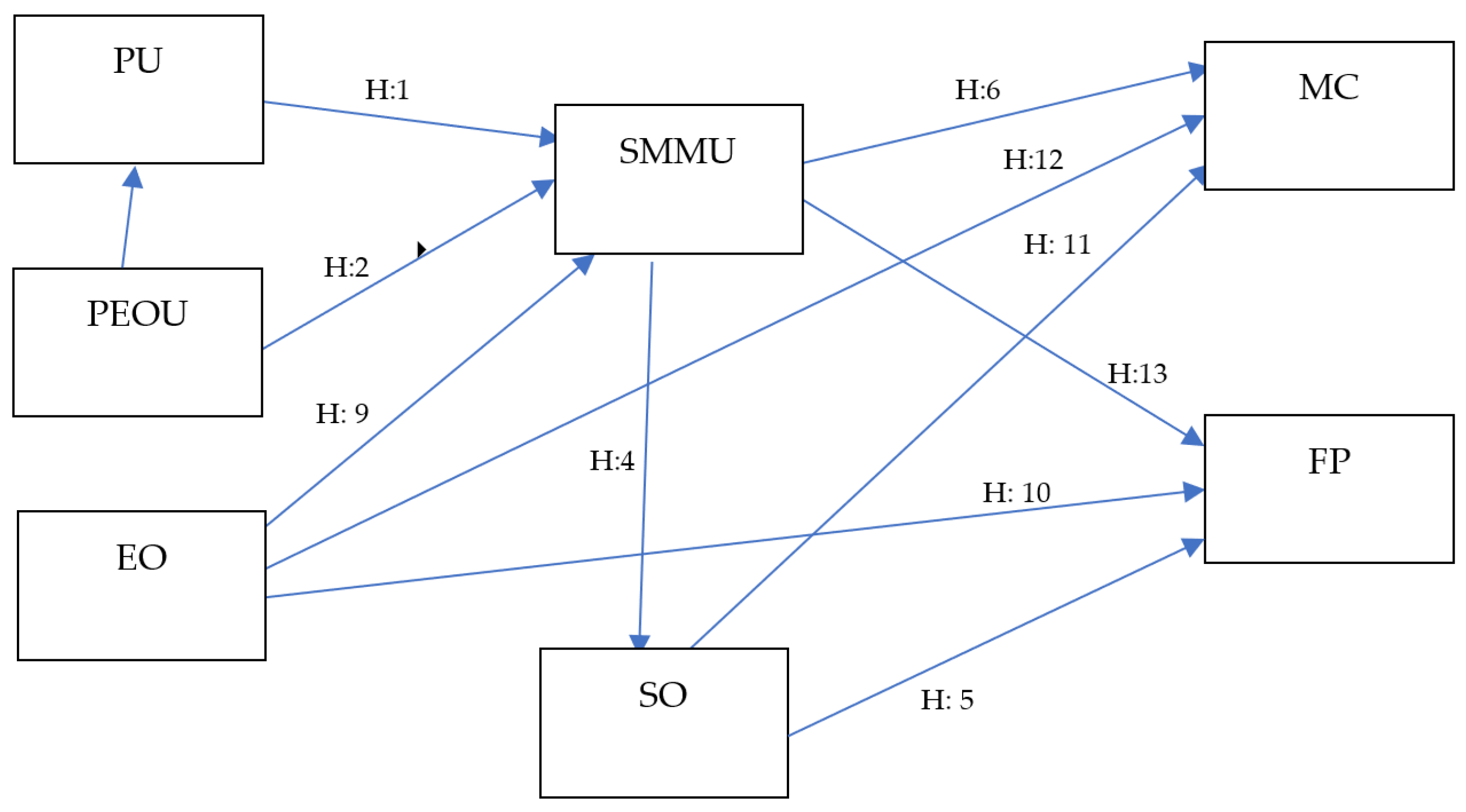
| H1 | Farmers’ utilization of media, for marketing (SMMU), is positively influenced by the Perceived Usefulness (PU) of social media. | [2,17,23,43] |
| H2 | The perceived ease of use (PEOU) positively influences its application in marketing (SMMU). | [23,32,40,41] |
| H3 | Perceived Ease of Use positively influences Perceived Usefulness of social media marketing use. | [23,40,74] |
| H4 | The utilization of Social Media Marketing (SMMU) positively influences the farmer’s Sustainability Orientation (SO). | [14,22,46] |
| H5 | Sustainability Orientation (SO) positively influences Financial Performance (FP). | [49,75] |
| H6 | The utilization of Social Media Marketing (SMMU) positively impacts Marketing Capabilities (MC). | [4,76,77] |
| H7 | Sustainability Orientation (SO) acts as a mediator in the connection between Social Media Marketing Use (SMMU) and Marketing Capabilities (MC). | [22,75] |
| H8 | Sustainability orientation (SO) mediates the relationship between social media marketing use (SMMU) and financial performance (FP). | [49,75] |
| H9 | Entrepreneurial Orientation positively influences Social Media Marketing Use. | [78,79] |
| H10 | Entrepreneurial Orientation (EO) positively influences Financial Performance (FP). | [49,80,81] |
| H11 | Sustainability orientation (SO) positively influences marketing capabilities (MC). | [46,49] |
| H12 | Entrepreneurial Orientation (EO) has a positive influence on marketing capabilities (MC). | [78,79] |
| H13 | Social media marketing use (SMMU) positively influences financial performance (FP). | [4,10,30] |
| Variable | Category | Frequency (n) | Percentage (%) |
|---|---|---|---|
| Age (years) | 18–24 | 62 | 20.7 |
| 25–34 | 63 | 21.0 | |
| 35–44 | 57 | 19.0 | |
| 45–54 | 57 | 19.0 | |
| 55 and above | 61 | 20.3 | |
| Gender | Male | 271 | 90.3 |
| Female | 29 | 9.7 | |
| Education Level | Secondary education or less | 121 | 40.3 |
| Post-secondary diploma | 98 | 32.7 | |
| Bachelor’s degree | 49 | 16.3 | |
| Master’s degree | 24 | 8.0 | |
| Doctoral degree | 8 | 2.7 | |
| Geographical Region | Central Region | 62 | 20.7 |
| Western Region | 67 | 22.3 | |
| Eastern Region | 46 | 15.3 | |
| Northern Region | 70 | 23.3 | |
| Southern Region | 55 | 18.3 | |
| Farm Size | Less than 0.5 hectare | 30 | 10.0 |
| 0.5 to <1 hectare | 46 | 15.3 | |
| 1 to <1.5 hectares | 70 | 23.3 | |
| 1.5 to <2 hectares | 91 | 30.3 | |
| More than 2 hectares | 63 | 21.0 |
| Construct | Items | Loading | Cronbach’s α | Composite Reliability | R-Square R2 | Average Variance Extracted (AVE) |
|---|---|---|---|---|---|---|
| Social Media Marketing Use (SMMU) | SMMU1 | 0.935 | 0.859 | 0.859 | 0.530 | 0.876 |
| SMMU2 | 0.937 | |||||
| Perceived Ease of Use (PEOU) | PEOU1 | 0.903 | 0.901 | 0.902 | 0.834 | |
| PEOU2 | 0.935 | |||||
| PEOU3 | 0.902 | |||||
| Perceived Usefulness (PU) | PU1 | 0.868 | 0.808 | 0.868 | 0.195 | 0.713 |
| PU2 | 0.791 | |||||
| PU3 | 0.871 | |||||
| Marketing capabilities (MC) | MC1 | 0.749 | 0.771 | 0.786 | 0.398 | 0.585 |
| MC2 | 0.786 | |||||
| MC3 | 0.776 | |||||
| MC4 | 0.747 | |||||
| Sustainability orientation (SO) | SO1 | 0.818 | 0.744 | 0.744 | 0.273 | 0.662 |
| SO2 | 0.790 | |||||
| SO3 | 0.831 | |||||
| Entrepreneurial Orientation (EO) | EO2 | 0.836 | 0.861 | 0.869 | 0.646 | |
| EO3 | 0.835 | |||||
| EO4 | 0.878 | |||||
| EO5 | 0.753 | |||||
| EO8 | 0.705 | |||||
| Financial Performance (FP) | FP1 | 0.704 | 0.823 | 0.833 | 0.731 | 0.655 |
| FP3 | 0.842 | |||||
| FP4 | 0.848 | |||||
| FP5 | 0.834 |
| Entrepreneurial Orientation (EO) | Financial Performance (FP) | Marketing Capabilities (MC) | Perceived Ease of Use (PEOU) | Perceived Usefulness (PU) | Social Media Marketing Use (SMMU) | Sustainability Orientation (SO) | |
|---|---|---|---|---|---|---|---|
| Entrepreneurial Orientation (EO) | |||||||
| Financial Performance (FP) | 0.826 | ||||||
| Marketing Capabilities (MC) | 0.647 | 0.842 | |||||
| Perceived Ease of Use (PEOU) | 0.512 | 0.655 | 0.751 | ||||
| Perceived Usefulness (PU) | 0.593 | 0.577 | 0.520 | 0.712 | |||
| Social Media Marketing Use (SMMU) | 0.533 | 0.401 | 0.558 | 0.487 | 0.878 | ||
| Sustainability Orientation (SO) | 0.657 | 0.590 | 0.661 | 0.631 | 0.682 | 0.557 |
| Entrepreneurial Orientation (EO) | Financial Performance (FP) | Marketing Capabilities (MC) | Perceived Ease of Use (PEOU) | Perceived Usefulness (PU) | Social Media Marketing Use (SMMU) | Sustainability Orientation (SO) | |
|---|---|---|---|---|---|---|---|
| Entrepreneurial Orientation (EO) | 0.804 | ||||||
| Financial Performance (FP) | 0.704 | 0.809 | |||||
| Marketing Capabilities (MC) | 0.562 | 0.554 | 0.765 | ||||
| Perceived Ease of Use (PEOU) | 0.509 | 0.534 | 0.614 | 0.913 | |||
| Perceived Usefulness (PU) | 0.353 | 0.461 | 0.416 | 0.445 | 0.844 | ||
| Social Media Marketing Use (SMMU) | 0.506 | 0.554 | 0.538 | 0.688 | 0.485 | 0.736 | |
| Sustainability Orientation (SO) | 0.657 | 0.742 | 0.569 | 0.485 | 0.419 | 0.525 | 0.813 |
| Hypothesis | Path | β | t-Value | p-Value | Supported |
|---|---|---|---|---|---|
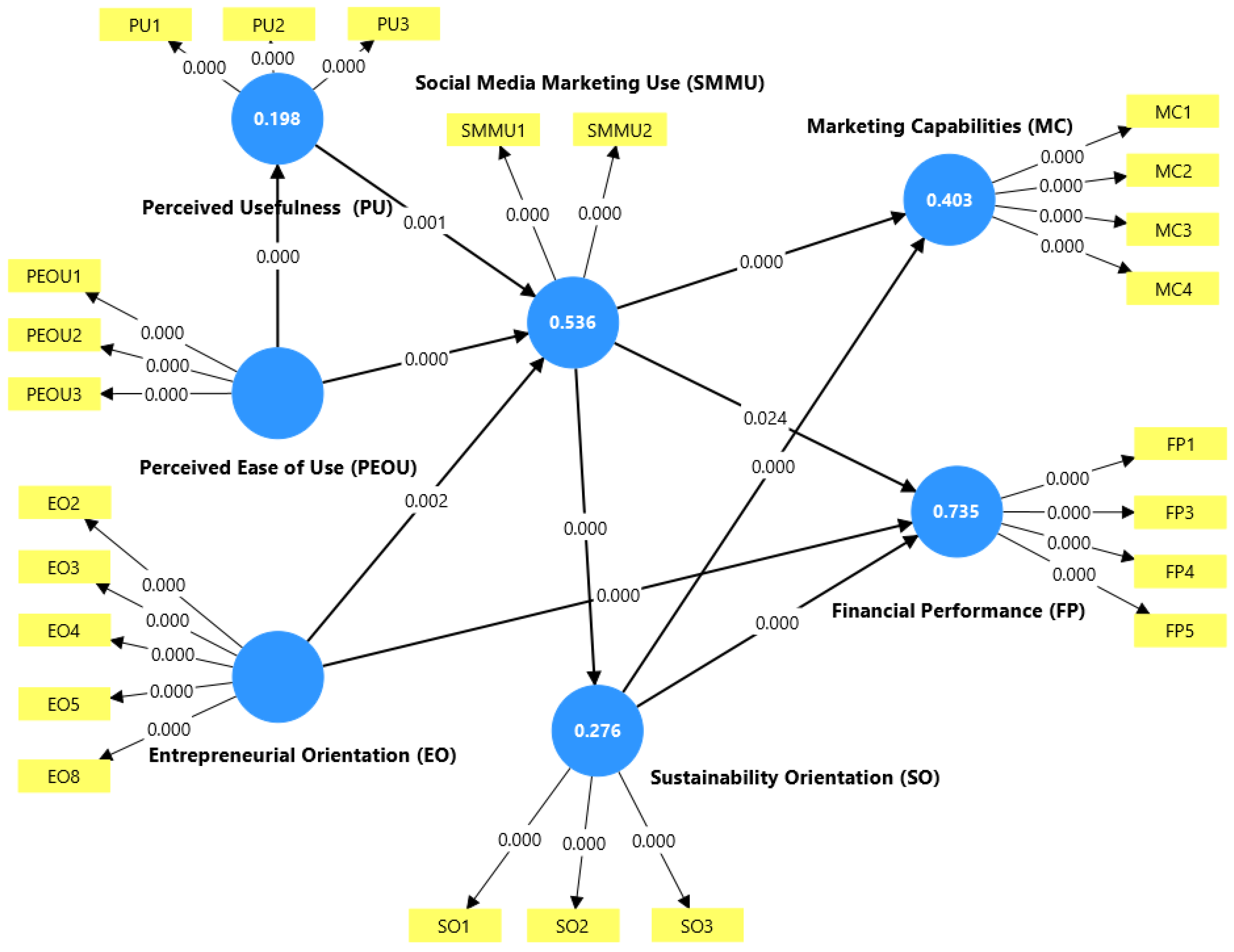
| H1 | PU → SMMU | 0.195 | 3.298 | <0.001 | Supported |
| H2 | PEOU → SMMU | 0.511 | 8.742 | <0.001 | Supported |
| H3 | PEOU → PU | 0.445 | 6.968 | <0.001 | Supported |
| H4 | SMMU → SO | 0.525 | 8.869 | <0.001 | Supported |
| H5 | SO → FP | 0.338 | 5.737 | <0.001 | Supported |
| H6 | SMMU → MC | 0.330 | 4.931 | <0.001 | Supported |
| H7 | SMMU → SO → MC | 0.208 | 5.235 | <0.001 | Supported |
| H8 | SMMU → SO → FP | 0.178 | 4.446 | <0.001 | Supported |
| H9 | EO → SMMU | 0.178 | 3.030 | <0.002 | Supported |
| H10 | EO → FP | 0.526 | 7.429 | <0.001 | Supported |
| H11 | SO → MC | 0.396 | 6.997 | <0.001 | Supported |
| H12 | EO → MC | 0.178 | 3.030 | <0.002 | Supported |
| H13 | SMMU → FP | 0.110 | 2.257 | <0.024 | Supported |
Disclaimer/Publisher’s Note: The statements, opinions and data contained in all publications are solely those of the individual author(s) and contributor(s) and not of MDPI and/or the editor(s). MDPI and/or the editor(s) disclaim responsibility for any injury to people or property resulting from any ideas, methods, instructions or products referred to in the content. |
© 2026 by the author. Licensee MDPI, Basel, Switzerland. This article is an open access article distributed under the terms and conditions of the Creative Commons Attribution (CC BY) license.
Share and Cite
Oraini, B.A. Integrating Technology Acceptance, Sustainability Orientation, and Entrepreneurial Orientation: Evidence from Saudi Smallholder Farmers’ Social Media Marketing. Sustainability 2026, 18, 1556. https://doi.org/10.3390/su18031556
Oraini BA. Integrating Technology Acceptance, Sustainability Orientation, and Entrepreneurial Orientation: Evidence from Saudi Smallholder Farmers’ Social Media Marketing. Sustainability. 2026; 18(3):1556. https://doi.org/10.3390/su18031556
Chicago/Turabian StyleOraini, Badrea Al. 2026. "Integrating Technology Acceptance, Sustainability Orientation, and Entrepreneurial Orientation: Evidence from Saudi Smallholder Farmers’ Social Media Marketing" Sustainability 18, no. 3: 1556. https://doi.org/10.3390/su18031556
APA StyleOraini, B. A. (2026). Integrating Technology Acceptance, Sustainability Orientation, and Entrepreneurial Orientation: Evidence from Saudi Smallholder Farmers’ Social Media Marketing. Sustainability, 18(3), 1556. https://doi.org/10.3390/su18031556