Article

Circular Strategies for Protected Areas: Valorization and Recycling of Forest Resources in the Madonie Park (Italy)


1
Department of Architecture, University of Naples “Federico II”, 80134 Naples, Italy
2
Department of Architecture, University of Palermo, 90128 Palermo, Italy
*
Author to whom correspondence should be addressed.
Sustainability 2026, 18(3), 1552; https://doi.org/10.3390/su18031552
Submission received: 9 December 2025 / Revised: 22 January 2026 / Accepted: 27 January 2026 / Published: 3 February 2026

Abstract

The emerging concept of circular parks positions protected areas as active generators of shared value, as they integrate biodiversity conservation with natural resource optimization, local economies, and social cohesion. This perspective challenges traditional passive management by applying circular economy principles to parks as dynamic territorial organisms embedded within a regional socio-ecological metabolism. The research explores and tests circular park approaches starting from forest-related resource flows in areas where ecological richness coexists with socio-economic fragility. Focusing on the case study of the Madonie Regional Park (Sicily, Italy), the research investigates alternative pathways for the reuse of retrievable biomass by relating material flows to local social, economic, and cultural activities potentially involved in circular processes. This study supports the design of recycling, repurpose, and re-vision strategies to transform residual biomass into regenerative local value and strengthen the territorial resilience in inner areas characterized by demographic fragility despite being endowed with significant environmental and cultural capital. Through a design-oriented approach, the research experiments with alternative circular strategies in a case study, proposing a shift from extractive and mono-output models towards multi-output approaches and from an energy-centered towards a community-centered model. This perspective emerges not only as a cultural challenge but also as an opportunity to build an operational and replicable planning practice within the Italian and European park system, contributing to the debate on the ecological transition of fragile territories.

1. Introduction

Across Europe, protected areas (PAs) have progressively moved beyond their traditional conservation mandate to become strategic socio-ecological infrastructures supporting climate adaptation, risk mitigation, and biodiversity restoration. Covering approximately 26% of the EU terrestrial area [1], they represent a core component of EU ecological policy, including the EU Biodiversity Strategy 2030 [2] and the Green Deal [3].
Within contemporary literature, PAs are increasingly framed as nature-based system operators, whose functioning produces a wide range of ecosystem services, particularly regulation operations such as carbon sequestration, hydrological regulation, climate buffering, and soil protection [4,5]. Forest ecosystems, which constitute much of the PA surface, act as key climate regulators by stabilizing microclimates, reducing hydrogeological vulnerability, and preserving high levels of biodiversity.
This evolution has encouraged scholars and policymakers to reinterpret PAs not as isolated “conservation islands” but as active territorial organisms, embedded within a regional socio-ecological metabolism. In this context, the emerging concept of the circular park proposes viewing PAs as productive, regenerative systems capable of linking ecological cycles with local economies, social innovation, and community-based stewardship [6].
A significant share of European protected areas lies within inner and peripheral territories, as conceptualized in the ESPON Inner Peripheries framework [7]. These areas are marked by demographic decline, low accessibility, limited services, and structural marginality. Their overlap with protected areas is particularly evident in mountain regions, uplands, and sparsely populated rural landscapes.
Italy exemplifies this trend: most of its national and regional parks fall within “Aree Interne” (Inner Areas), defined by the National Strategy for Inner Areas (SNAI) as “areas characterized by significant distances from the main centers offering essential services such as education, healthcare and transport” [8,9], and frequently coincide with the Apennine regions, where ecological richness coexists with socio-economic fragility. Here, forests perform fundamental ecosystem functions—risk regulation, carbon sequestration, and biodiversity conservation—yet their management is often hindered by depopulation, ageing populations, and reduced local economies.
This dual condition—high ecological value combined with socio-economic vulnerability—makes protected areas within inner peripheries priority laboratories for sustainable development models, where ecological capital stands as a driver for community resilience [10], local innovation, and territorial regeneration.
The debate on the circular economy has only recently started to consider protected areas as potential platforms for regenerative cycles. Both in Europe and in Italy, theoretical and practical experiments on this topic remain at an embryonic stage [11]. Some early applications can be found in initiatives such as zero-emission parks and waste-free parks, which include renewable energy communities, green communities, sustainable mobility, and circular bioeconomy practices. The most widespread experiments in Europe, however, are primarily linked to forest resources and are largely oriented towards the energetic valorization of biomass [12]. Although relevant, this mono-functional approach limits the full expression of the circular paradigm, which instead promotes cascading valorization of forest resources, preserving material quality as long as possible [13].
This research addresses the gap by focusing on the park’s primary metabolic flow and advancing a systemic vision oriented towards a circular park model. This entails moving beyond an extractive paradigm to strengthen the park’s capacity to regenerate natural, social, and economic capital, sustaining a dynamic, co-evolutionary balance between people and the environment. Forest residues are transformed into multiple value streams within a framework where rural areas are no longer mere suppliers of raw materials but become active hubs of innovation and sustainable transition.
Recent studies advocate for a shift from energy-focused uses toward multi-output circular strategies that integrate reuse, repair, eco-design, artisanal production, soil regeneration, bio-based building materials, and cultural reinterpretation [14]. This perspective is consistent with the broader R framework of circular practices. The latter promotes resource reduction, life extension, and material recovery and aligns with regenerative and ecosystem-based design principles aimed at restoring ecological functions and supporting long-term socio-ecological resilience [15].
Against this background, the Madonie Regional Park, Sicily (Italy), emerges as an ideal testing ground for proponing multi-output circular strategies of forest resources: it combines extensive forest cover and high biodiversity with demographic fragility, making it representative of European inner peripheries where circular strategies can strengthen resilience, revive local economies, and enhance cultural identity.
The analysis of maintenance processes in the Madonie Park in Sicily (Italy) offers an empirical context to investigate differentiated trajectories of the recycling, reuse, and redesign of forest flows, demonstrating how such practices can simultaneously contribute to strengthening biodiversity, creating local micro-supply chains, and regenerating proximity economies [16]. The objective is to test the capacity of circular forest resource management to increase territorial resilience in areas marked by demographic fragility and limited economic opportunities, showing how the valorization of forest by-products can affect risk mitigation, ecosystem stability, identity reinforcement, and community empowerment. In particular, the research elaborates incremental and adaptive circular strategies, showing how the park’s natural capital can act as a catalyst for experimenting with place-based circular pathways that generate systemic benefits and mobilize multidimensional resources across ecological, economic, social, and cultural spheres.
The paper is organized as follows: Section 2 provides an overview of the state of the literature on the valorization of forest residual woodchips and a definition of the aim of the work. Section 3 describes the methods used, while Section 4 presents the case study. The results are discussed in Section 5. Finally, Section 6 presents the conclusions and future developments of the research.

2. Protected Natural Areas and Circular Management of Forest Resources in the European and Italian Context

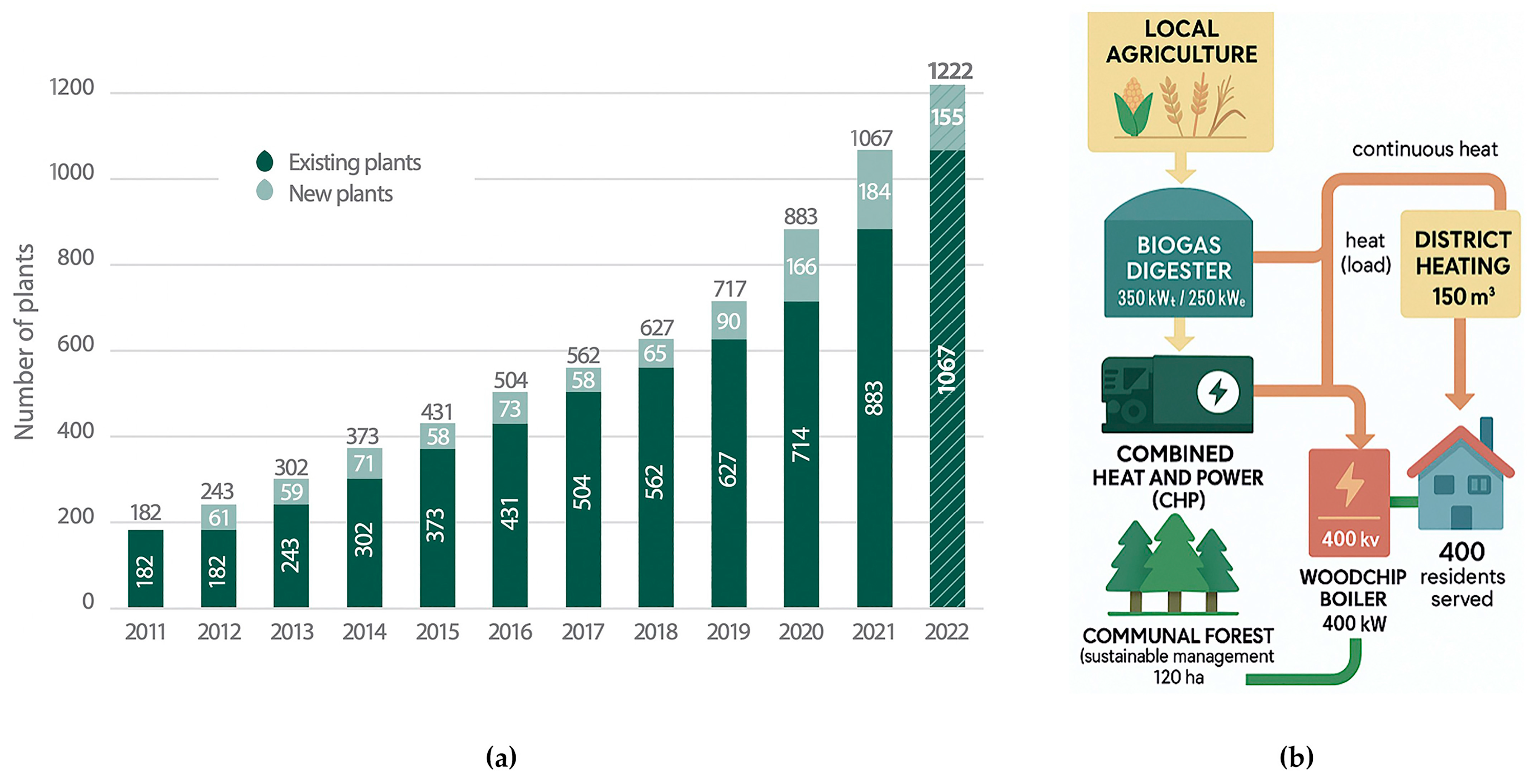
In most European protected natural areas, biomass is considered a locally available and widely accessible resource that can trigger environmental and socio-economic improvements such as crop diversification, the restoration and use of otherwise abandoned soils, and forest maintenance. In Northern Europe, the recovery of residual waste from forest management for energy purposes is an established practice, and throughout Europe the number of biogas plants has increased rapidly in recent years (Figure 1a). Currently, 58% of European plants are connected to the distribution grid [17]. In many cases, even large urban centers, or parts of them, are supplied by district heating networks powered by biogas produced from woody material or agro-forestry residues originating from actual “energy forests” [18]. The high concentration of this best practice in Northern Europe is also supported by the quantity and quality of forest biomass (the highest biogas yields have been recorded for pine needles and branches), which represents an ideal resource for bioenergy production. Furthermore, the collection of residual forest biomass is considered a useful practice for reducing the incidence of devastating summer wildfires [19].
Among rural contexts, one of the earliest best practices is represented by Jühnde, a small village in Lower Saxony, Germany, known for being the country’s first “bio-energy village” [21]. Since 2005, the village has produced nearly all its own energy through a large biogas plant fueled by local biomass such as agricultural slurry, energy crops, and woodchips. The biogas is converted into electricity and heat through cogeneration, producing around 4 million kWh of electricity per year (with approximately 0.5 MW of installed capacity), which satisfies more than twice the village’s own consumption. This model has brought energy autonomy, emission reductions, and economic benefits to the community, becoming an international example of local energy transition.
Another case study in Germany is Mauenheim (Baden-Württemberg), a village of 400 inhabitants whose entire electricity and heat demand is met in this way. The energy system of Mauenheim combines a biogas plant (Figure 1b), which provides the base thermal load, with a woodchip boiler supplied by the municipal forest. The system produces heat for the local district heating network and, thanks to the synergy between agricultural and forestry supply chains, ensures a self-sufficient, circular, and fully local energy model. The woodchip boiler operates only during peak demand, while the biogas plant runs continuously. The biomass originates from forest management activities in the Municipality of Immendingen, an area with controlled forestry practices bordering protected natural areas with stricter regulations. Mauenheim is in the Hegau region, a partly protected forest landscape that includes areas such as the “Landschaftsschutzgebiet Hegau” [22].
Sweden, Finland, and Denmark routinely use bioenergy derived from their forests, and this practice is a central component of their energy and climate policies. In recent years, the volume of Swedish forests, for example, has doubled thanks to active management involving scheduled harvesting, mandatory regeneration, and modern silvicultural techniques. Bioenergy is mainly produced from forest management residues: branches, treetops, bark, sawmill waste, and wood dust from processing. Today, municipal district heating networks are almost entirely powered by biogas obtained through anaerobic digestion and by biomass-fired boilers [23].
In Sweden, numerous small heating plants (<5 MW) supply heat to small areas or to just a few buildings in rural contexts [24], particularly since the National Farmers’ Association established a company dedicated to the construction of local heating plants managed by local farmers. One example is the plant in Vingåker, which supplies around one hundred homes. This model enables even relatively small communities to become energetically self-sufficient using zero-kilometer resources. Table 1 below presents other European examples—located in small-scale contexts such as communities or rural villages—of biogas plants fueled by forest maintenance residues sourced from areas surrounding the served users.
The circular park model based on the use of waste biomass derived from forest maintenance goes beyond conventional approaches to circular forestry and the bioeconomy. Unlike models already established in various parts of Europe—where a dedicated forestry industry is primarily oriented toward energy production from biomass—the circular park proposes a systemic and integrated vision. Forest residues are transformed into multiple value streams (energy and environmental services) within a framework that combines territorial governance, industrial symbiosis, and decarbonization. One of the few European examples attributable to this paradigm is HUB-CEIS in Fundão, a hub that enhances forest biomass through circular governance and decarbonization strategies [24]. The project uses biomass gasification to produce energy and green hydrogen, contributing to global sustainability goals, with an estimated reduction of 120 kt of CO2 per year, the creation of around 60 jobs, and an investment of approximately 60 million EUR. Embedded in a rural context of about 9000 inhabitants, the model shows how peripheral areas can become drivers of the energy transition and economic revitalization, turning waste into resources.
The Italian system of protected areas is among the most extensive and complex in Europe, encompassing over three million hectares of natural green spaces. The purpose of protected areas is the safeguarding of biodiversity, as well as the enhancement of local traditions and the adoption of sustainable economic practices. Territories with high natural value represent crucial contexts for addressing the climate challenge: they are fragile areas yet extremely rich in biodiversity, whose loss is closely connected to the effects of climate change. Protected areas function as genuine banks of ecosystem services that generate and regenerate essential life-supporting goods—traditionally considered inexhaustible and freely available but now recognized as strategic resources for local development: renewable yet nonetheless limited.
The application of circular economy principles to natural parks allows for overcoming the traditional dichotomy between conservation and development, transforming the territory into a laboratory of innovation where natural resources can be regenerated and valorized. Although the use of forest products and by-products for energy production is a viable and regulated practice under Ministerial Decree 13 October 2016, no. 264 [40], several attempts to apply this model exist in Italy, although most are still at an early stage, with few consolidated results.
The Green Community of the Sirente–Velino Park in Abruzzo is among the first emerging examples. The management plan aims to improve the use of the park’s natural resources through shared actions involving the twenty-three municipalities concerned. Among the planned actions is the possibility of producing renewable energy from biomass derived from forest residues, pruning, branches, agricultural by-products, and wood biomasses [41]. A similar action is envisaged in the Gargano National Park in Apulia, where a forest-wood supply chain is being developed, based on active forest management, the valorization of local biomasses, and phytosanitary monitoring, to integrate environmental conservation, renewable energies, and local economic development.
From this perspective, seven municipalities in Val di Fassa (Trentino–Alto Adige) are also working together to build a centralized plant that uses waste biomass from forest operations to fuel a cogeneration system producing both electricity and heat for the interconnected municipalities. The only active case in Italy—which has already been fully operational for several decades—is located in Val di Fiemme, in Cavalese (Trentino–Alto Adige), where 90% of the settlement is heated with wood-processing residues through biomass cogeneration. The Cavalese plant generates electricity and heat; through an underground district heating network, they reach public and private buildings, serving around 4500 residents and rising to as many as 25,000 during the tourist season [42]. The forest-based energy of this circular economy laboratory is produced using virgin woodchips sourced from the forests of the Fiemme Community: a historic green lung containing a heritage of 60 million trees. Also, in Trentino–Alto Adige, the Dobbiaco–San Candido biomass district heating plant is among the first small-scale systems to produce both heat and electricity in cogeneration, fed into the national electricity grid.
Despite the growing attention toward circular models applied to territorial systems, the literature on circular parks remains embryonic and lacks a shared theoretical definition. Existing studies focus predominantly on sectoral practices—from adaptive conservation to the sustainable management of individual resources—without proposing systemic frameworks capable of integrating material cycles, multi-level governance, and ecological resilience strategies [43,44]. This gap is particularly relevant in Europe’s inner areas, where parks represent crucial socio-ecological infrastructures for counteracting marginalization, abandonment, and climate vulnerability [45,46].
In response to these shortcomings, the research aims to improve conceptual and operational understanding of circular strategies for protected areas, exploring how natural resource management, particularly forest maintenance, can become a driver of regenerative territorial development. The main objective is to reposition parks as systems capable of generating shared value, moving beyond the traditional conservation paradigm and integrating the principles of circular economy and regenerative design [13,47,48]. In this perspective, the valorization of residual forest biomass acquires strategic importance: not as a waste material destined primarily for energy recovery—a practice still dominant in European models [49]—but as a high-potential resource capable of activating new ecological, productive, and cultural functions.
This research—whose first results are presented here—aims to formulate an operational and transferable methodology to support park authorities and local administrations in defining alternative circular strategies for protected areas. The ambition is to contribute to the debate on the ecological transition of fragile territories, demonstrating how the circular reconfiguration of natural resource flows can act as a catalyst for sustainable, place-based regeneration, paving the way for an evolution of parks into resilient, polycentric, and productive territorial systems.

3. Methods

From a methodological standpoint, and in line with the objectives outlined above, this study adopts a systemic and multidisciplinary investigative perspective. This approach moves beyond a static reading of the territorial ecosystem of protected areas, allowing the dynamic nature of both active and latent processes to emerge from the “intra-action” [50] between humans and nature.
Starting from the hypothesis that natural parks are territorial systems traversed by flows of matter, energy, and knowledge, the work develops a methodological proposal useful for activating anti-entropic strategies and mechanisms of regeneration and, consequently, reconstructing cycles of value [51,52]. From this perspective, the circular park model is articulated as a self-organized system in which waste and residues—whether given in nature or derived from anthropic actions—do not represent a loss but rather a generative and regenerative resource.
To enhance transparency and reproducibility, the methodological framework is articulated as a sequential and traceable research process, in which analytical steps, data sources, and expected outputs are explicitly connected.
In epistemological terms, the methodology proposed here is grounded in a design-oriented research framework aimed at transformation (Research by Design), where empirical analysis is closely interlinked with experimentation [53,54].
Design experimentation is operationalized through the construction and simulation of alternative circular scenarios, which function as analytical devices to test the capacity of residual forest resources to generate territorial value.
The empirical investigation has therefore focused on the use of wood residues, which assume a demonstrative function within the research. The proposed hypothesis, applied to the territory of Madonie Park, represents an operational prototype to assess the capacity of the circular paradigm to generate territorial added value starting from residual materials. The simulation of alternative reuse scenarios of wood residues—centered on energy production, handicraft, and infrastructure construction—thus constitutes a proof of concept of the validity of the circular park model, proposing an operational, replicable framework capable of activating integrated and anti-entropic supply chains that combine environmental protection, local development, and social responsibility.
Specifically, the investigative work was structured into five phases, each corresponding to a distinct analytical task and producing intermediate outputs that inform subsequent steps, thereby ensuring methodological traceability and replicability in comparable territorial contexts.
(1)
Systemic reading of the territory of the park and the municipalities within the park. This reading is articulated into three main resource systems, natural heritage, built heritage, and productive heritage, which are connected with the social system formed by local communities. This articulation enables the analysis of relationships among territorial resources, anthropic practices, and economic processes, interpreting the park as a metabolic organism endowed with inputs, transformations, and outputs [55].
(2)
Mapping of the forest resource and assessment of retrievable residual biomass flows. This procedure is based on the processing of territorial data from national and regional institutional databases (Park Authority, Sicilian Region, Istat, ISPRA) and—specifically for this study—from the European ForBioEnergy project (2016–2019), which constitutes the main technical reference for defining residual forest biomass flows. This mapping made it possible to identify the forest areas that generate the highest production of wood residues derived from forest management and maintenance operations, and to estimate their quantities through a comparative analysis of forest cover data and retrievable biomass estimates.
(3)
Classification of wood residues. The residual materials obtained from forest maintenance activities are classified according to their size and potential reuses, distinguishing between assortments suitable for productive uses and smaller fractions primarily oriented towards energy or soil-regeneration processes. Several indicators representative of the implications of the potential uses of wood residues are selected and quantified. These indicators support the evaluation of environmental, energetic, and socio-economic impacts associated with different circular options.
(4)
Definition of circularity strategies. These strategies are activable thanks to the recycling of the quantity and quality of retrievable biomass and articulated according to different combinations of mono-output or multi-output approaches with energy-centered or community-centered approaches. The resulting strategies may be calibrated and compared on the basis of a set of indicators, with the aim of transforming forest management into a circular-regeneration platform capable of activating new ecological, productive, and cultural functions and of creating local micro-supply chains.
The entire methodological process was supported by the adoption of the convergent parallel mixed-methods model [56], in which quantitative data (spatial and territorial data, socio-economic data, and GIS analyses) and qualitative data (observations, policy analysis, and document analysis) were collected and interpreted jointly, enabling triangulation among ecological, socio-economic, and design dimensions.
Overall, the proposed methodology constitutes an operational and transferable framework, explicitly designed to support replication in other protected areas aiming to implement circular and regenerative strategies.

4. The Case Study: The Madonie Park in Sicily (Italy)

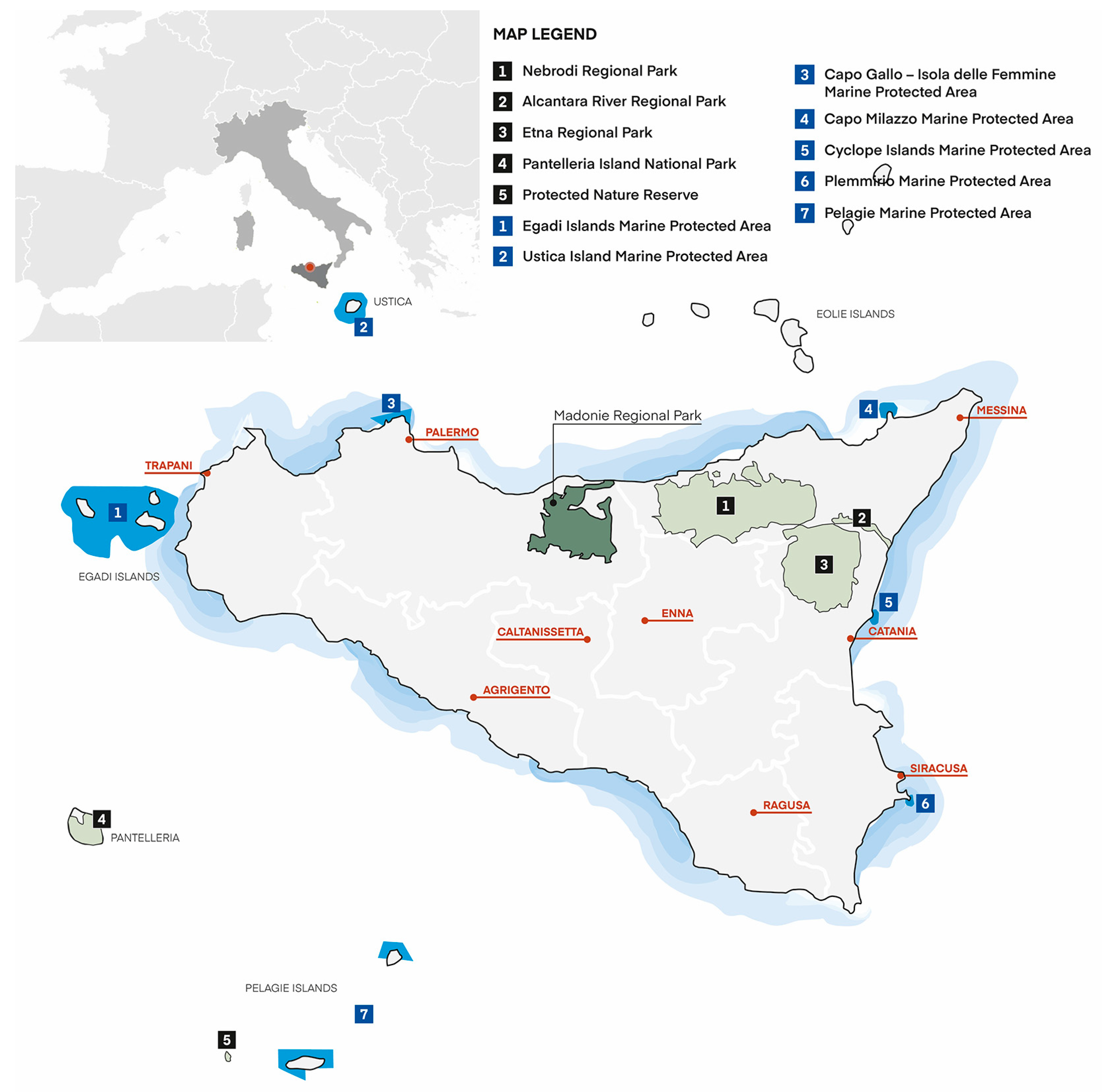
Southern Europe, overlooking the Mediterranean, constitutes one of the most heterogeneous environmental contexts on the continent, characterized by a variety of ecosystems, geomorphological structures, and cultural landscapes that have shaped, over time, articulated forms of protection and management of natural resources (Figure 2). Within this geographical framework, Italy occupies a central position thanks to its extraordinary biological, geological, and landscape richness, which finds one of its most complex expressions in the insular dimension of Sicily. Sicily, the largest island in the Mediterranean and the most extensive region in Italy, lies in a quasi-barycentric position within the basin, a condition that has favored over the centuries the encounter of cultures, productive systems, and ecological arrangements, giving rise to a mosaic of landscapes that reflects a long history of interactions between the environment and human activities.
Today, the Sicily region represents one of the most extensive and articulated systems of protected areas at the national scale: over 20% of its territory falls under protection regimes, comprising four regional natural parks, seventy-five nature reserves, a particularly dense network of 245 Natura 2000 sites, seven marine protected areas, and, since 2016, also the National Park of the Island of Pantelleria, the island’s first and only national park (Figure 2). This polycentric structure reflects not only the ecological complexity of the region but also the challenges associated with managing natural heritage embedded within territorial contexts often marked by socio-economic fragilities, persistent forms of marginality, and a relationship between resources and local communities that demands governance models capable of integrating conservation, development, and resilience.
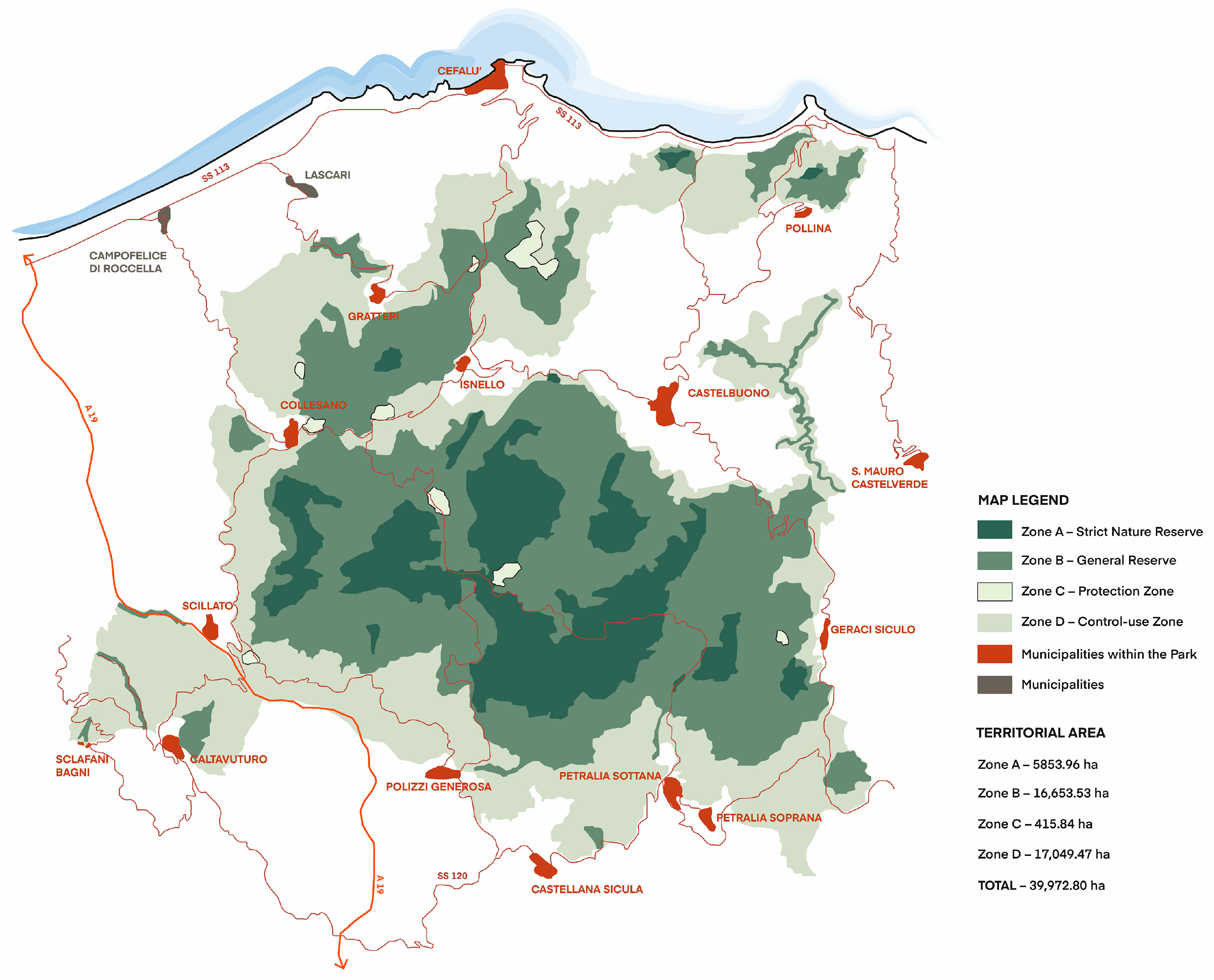
Established in 1989, the Madonie Park covers approximately 40,000 hectares and its perimeter includes the territories of fifteen municipalities within the Metropolitan City of Palermo: Cefalù, Castelbuono, Gratteri, Collesano, Isnello, Pollina, San Mauro Castelverde, Scillato, Sclafani Bagni, Caltavuturo, Polizzi Generosa, Castellana Sicula, Petralia Sottana, Petralia Soprana, and Geraci Siculo (Figure 3). The territory of all these municipalities extends for 1309 square kilometers, in which 48,453 inhabitants live.
The geological formations of the area span more than 200 million years, and the Madonie massif, with peaks reaching 1979 meters above sea level, such as Pizzo Carbonara, exhibits extraordinary geomorphological and bioclimatic heterogeneity, generating a rich combination of habitats and ecological conditions and hosting over half of Sicily’s plant species as well as numerous endemisms, including Abies nebrodensis, a biogeographical relict of international relevance.
In the Madonie Park a graded zoning system balances conservation, scientific research, public use, and local development, Zone A, strict nature reserve; Zone B, general reserve; Zone C, protection zone; and Zone D, controlled-use zone, forming an articulated system of integrated management (Figure 3). This configuration makes the Madonie area a privileged setting for observing interactions among environmental conservation, sustainable resource management, and the socio-economic dynamics of local communities.

4.1. A Natural Park Facing Territorial Fragility

The choice of Madonie Park as a case study stems from the purpose to analyze a territory that falls entirely within the so-called “Inner Areas” identified by the National Strategy for Inner Areas (SNAI) [9], an Italian territorial policy referring to municipalities distant from essential service hubs—healthcare, education, and mobility—and therefore more exposed to structural phenomena of depopulation, demographic ageing, economic fragility, and infrastructural decline. In the European debate, such areas correspond to the so-called “territorial fragilities”, spaces characterized by a progressive weakening of their attractiveness and increasing vulnerability to climate change, the crisis of public services, and processes of socio-territorial marginalization.
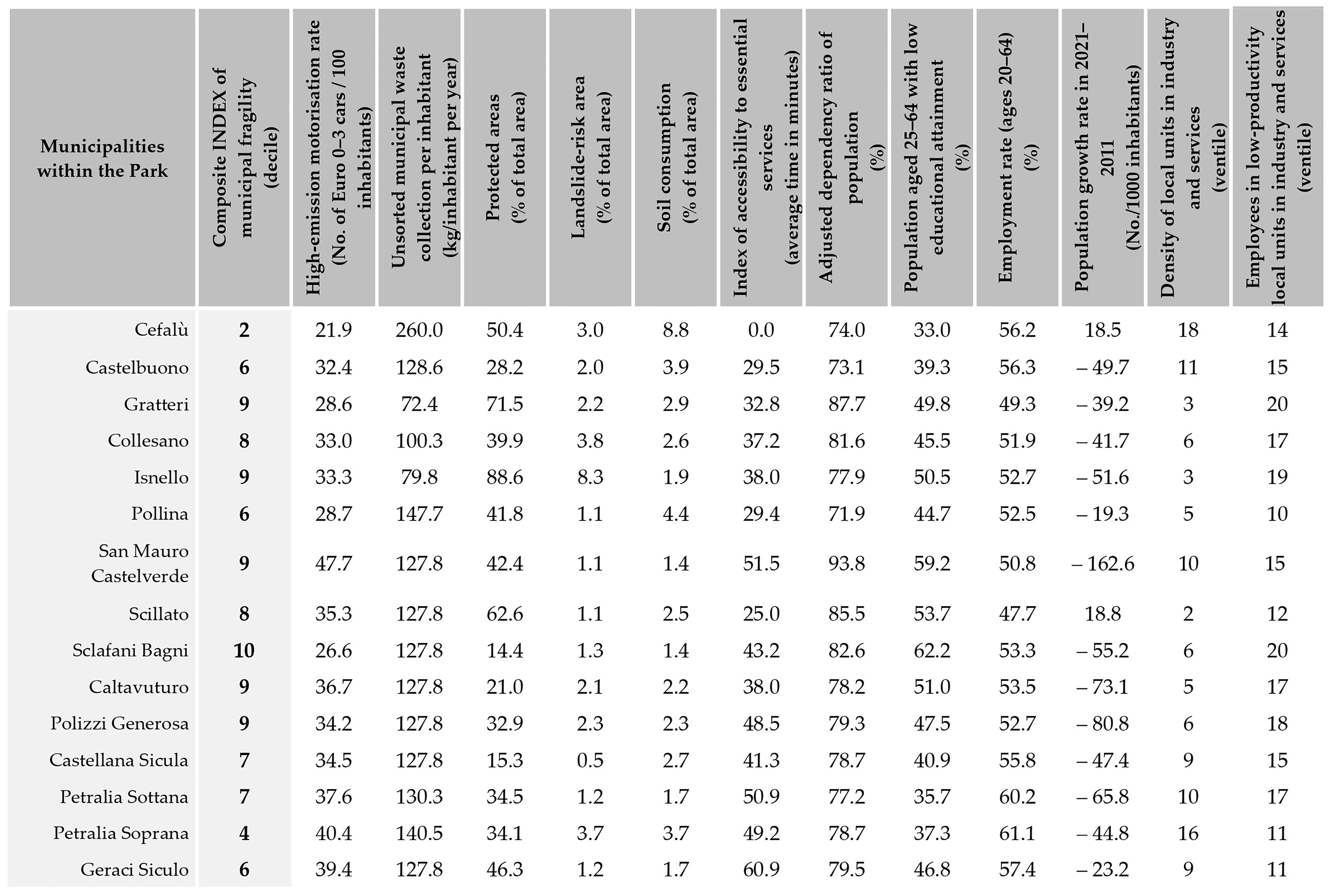
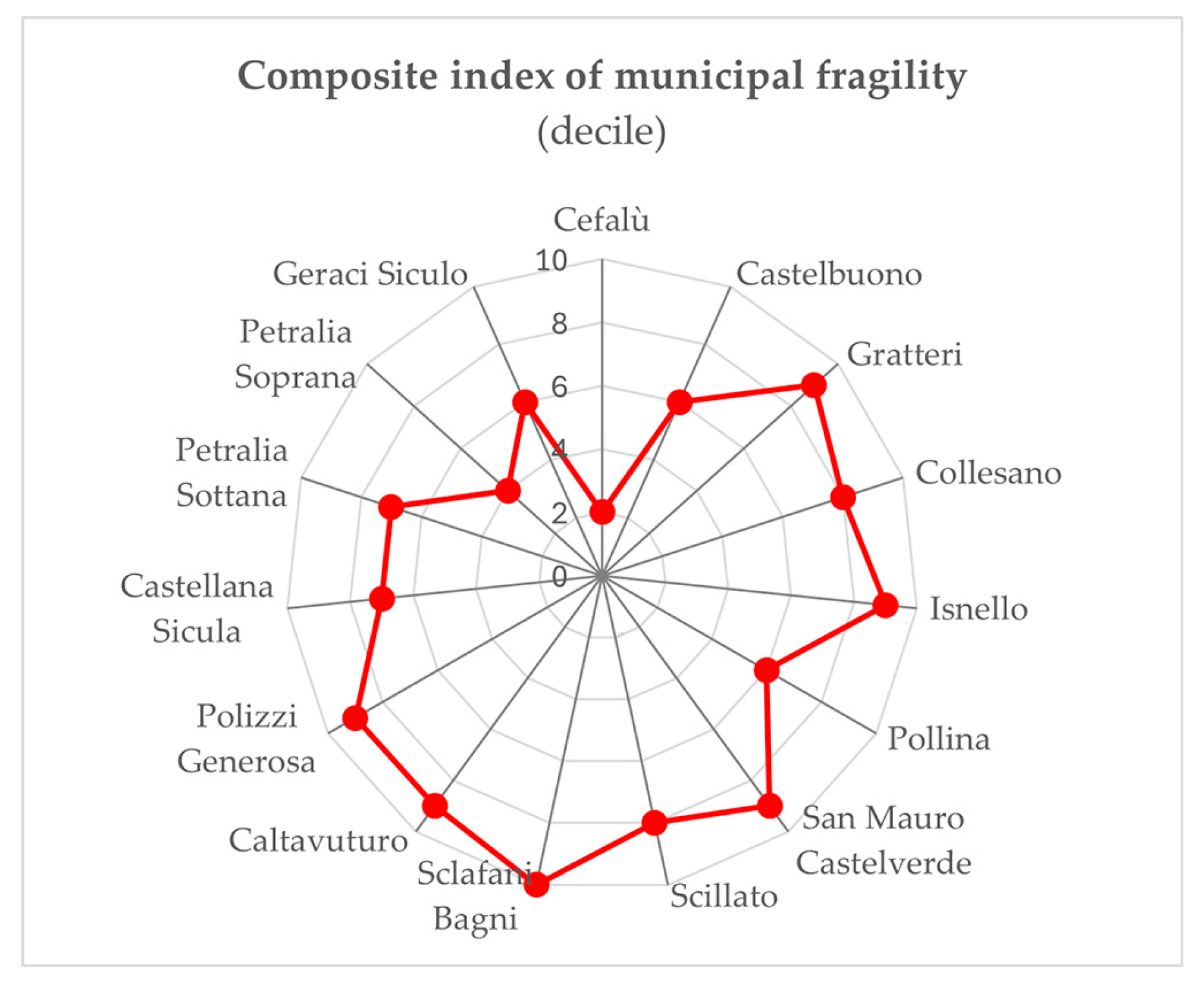
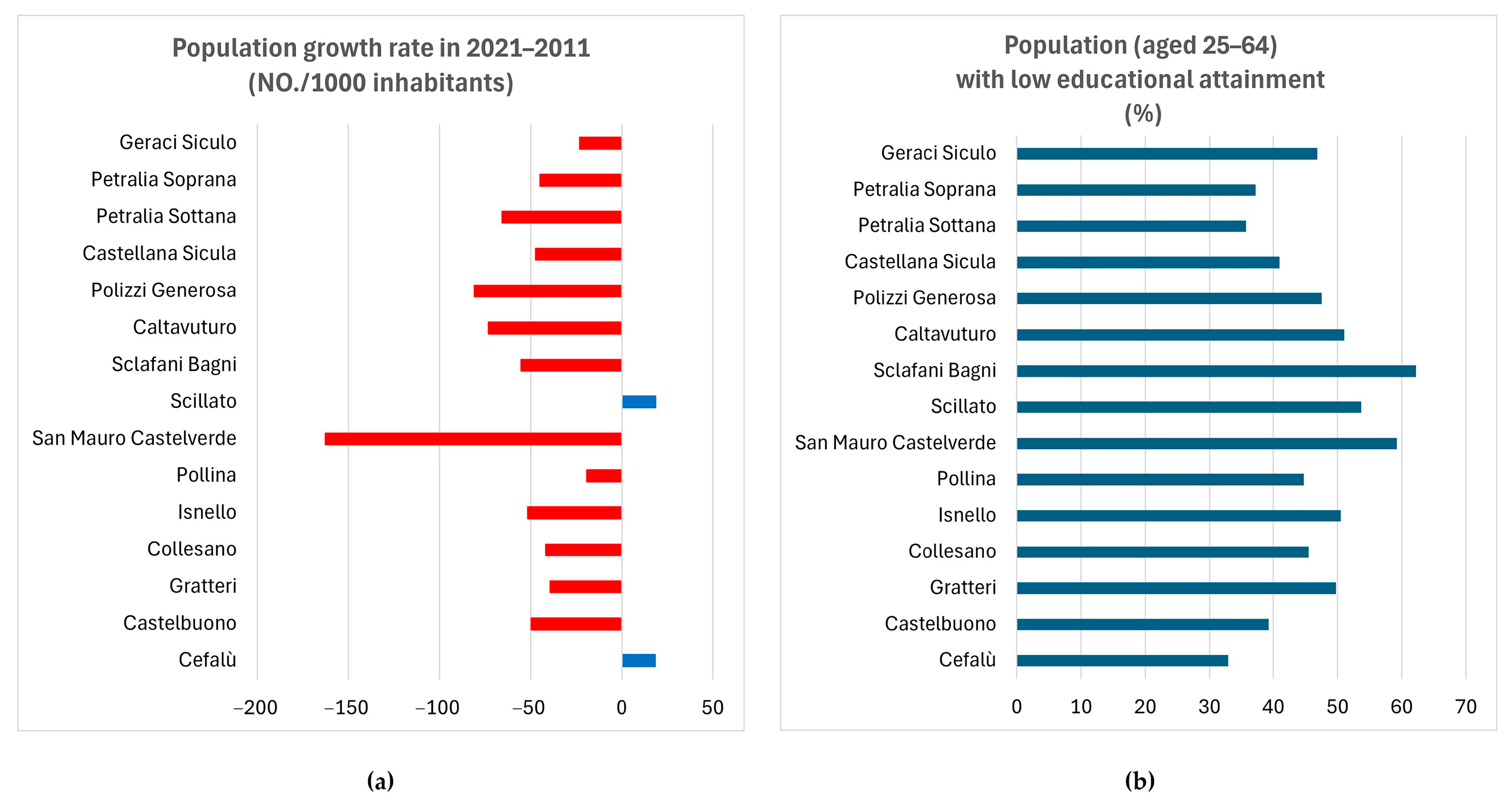
The “Composite Index of Municipal Fragility”, developed by ISTAT in 2021 [59], measures the overall fragility of a municipality, summarizing 12 indicators, according to a decile scale, where 1 indicates the lowest level and 10 the highest level of fragility (Figure 4). As shown also in Figure 5, the fragility area is very large, and furthermore, this index reaches the higher values, from 8 to 10, for 8 out of 15 municipalities (53%). Among the various indicators, the “Population Growth Rate in 2021–2011” per 1000 inhabitants and the “Population (aged 25–64) with low educational attainment” rate show that a particularly serious situation exists in these areas. In fact, the first indicator is negative in almost all cases, recording a common trend towards depopulation (Figure 6a). The other indicator very often exceeds 40%, and in five municipalities even 50%, highlighting that high percentages of the working age population have at most only a lower secondary school diploma (Figure 6b).
The Madonie thus emerge as a paradigmatic context for observing how an inner area can respond in the long term to such pressures, transforming the presence of a protected area into an opportunity for social and economic revitalization rather than an additional constraint, by adopting the circular parks approach.

4.2. Territorial Assets and Heritage: A Systemic Reading

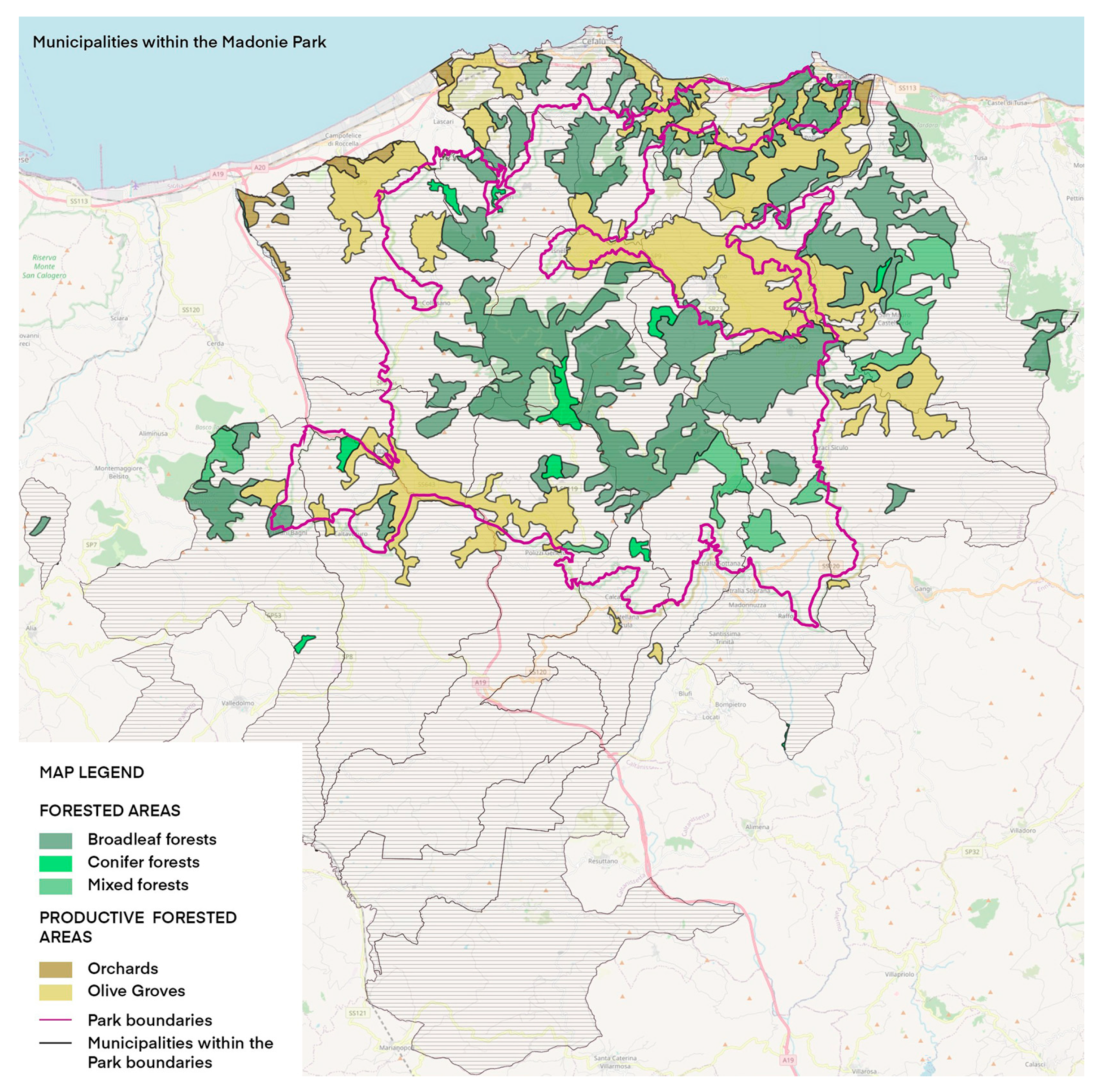
According to the first phase of the methodology presented in Section 3, the data relating to the natural, built, and productive heritage of the Madonie Park were collected, classified, and georeferenced. In this study, the natural heritage refers exclusively to the forest heritage within the boundaries of the Park Authority, covering a total area of 27,227 hectares which reaches 36,612 hectares if the wooded areas within the municipalities of the park are also included. The forest heritage is characterized by an extraordinary variety of broadleaf, conifer, and mixed forests, which constitute one of the most emblematic and strategic elements for local biodiversity (Table 2).
The built heritage in the Madonie Park, strictly complementary to natural systems, comprises an articulated set of infrastructures and artefacts that testify to the historical co-evolution between local communities and the mountain landscape. Within the park area lie numerous buildings of high architectural value, 29 assets in total, well integrated into the natural environment, which pass on a long construction and cultural tradition, typical of the Madonie identity (Table 3). In addition, the park preserves a widespread network of rural and forestry infrastructures, including shelters, paths, forestry houses, and minor constructions. These constitute an essential territorial framework for management activities and controlled enjoyment of the mountain environment. The trail network consists of 30 routes, with lengths ranging from 3.4 km to 50.9 km and totaling 449.5 km, and four equipped areas—Portella Ferrone, Serra Daino, San Focà, and Piano Zucchi—which serve recreational and logistical functions, while forestry houses play a strategic role as operational depots and logistical nodes for forest maintenance and wildfire-prevention interventions.
The analysis of the productive heritage in the 15 municipalities within the park was limited to certain categories of economic activities, namely, “Agricultural companies” and “Wood processing manufacturing companies”. There are 4037 agricultural companies and 41 enterprises specializing in timber arboriculture (Table 3), with cultivation practices aimed at producing high-quality wood intended for structural, artisanal, or industrial uses. This system contributes to maintaining an active socio-economic fabric, strengthening community resilience and enabling the integration of agro-sylvo-pastoral supply chains with activities aimed at valorizing forest resources. Within the park’s municipalities, 26 manufacturing enterprises, specializing in the production of wood, cork, straw, and woven-material products, are active. These data are particularly relevant for the research purposes, as the presence of such manufacturing activities, dedicated to wood-based materials, could enable the development of a local micro-supply chain for the valorization of forest heritage and its integration into local production processes.

4.3. Territorial Biomass and Circular Metrics

The second phase of the study assumes that active forest management aims not only to ensure the persistence of forest cover but also to systemically implement “territorial care”. Each maintenance action contributes to building a dynamic balance among environmental conservation, natural resource valorization, and sustainable innovation. A mapping of the wooded areas in the Madonie Park and in the municipalities of the park was then carried out, differentiated by tree species (Figure 7). Forest heritage maintenance and production of residual biomass became a cornerstone the park’s transition toward a fully circular model.
To acquire the availability and characteristics of woody biomass, the data and documents were analyzed from the European ForBioEnergy project (2016–2019) [61], developed within the Interreg MED Programme as an evolution of the previous Proforbiomed programme. The project identified the area of Madonie Park as the Italian pilot district for the experimentation of an integrated model for managing residual forest biomass, with the primary objective of analyzing the availability of forest and agricultural woody resources and assessing the sustainability of short forest–wood–energy supply chains. The available data refers to the wooded areas owned by the Municipality of Petralia Sottana and the Regional Department for Rural and Territorial Development of the Sicilian Region, located within Madonie Regional Park, estimating both the volume per hectare and the total above-ground biomass. The above-ground biomass, corresponding to the dry woody mass present in forest stands at the time of measurement, depends on forest fertility and ecological characteristics, and was estimated at 308,054 tons. To define the retrievable biomass, i.e., the amount that can be harvested during the 10-year Forest Management Plan, an extraction rate compatible with forest regeneration was applied according to silvicultural and ecological-sustainability criteria.
In the following phase, the retrievable biomass, equal to 87,880 tons over a ten-year management period, was then classified into two main categories: assortment biomass, equal to 58,215 tons, including valuable trunks and fractions suitable for productive activities, e.g., crafts and construction, and small-size timber, equal to 29,665 tons, consisting of smaller trunks, branches, and low-value species, which is usually used in energy production (Table 4).
These data form the starting point for developing a preliminary study aimed at analyzing the effects of circular park strategies and defining the corresponding quantitative and qualitative indicators. The main effects considered concern the capacity of the residual biomass to contribute to (i) the coverage of a share of local energy demand, (ii) the reduction in climate-altering emissions, and (iii) the production of digestate.
It is important to emphasize that the quantity of residual biomass considered derives exclusively from routine forest management and maintenance activities since no further biomass extraction from forest resources is planned. This aspect clearly distinguishes the present approach from others commonly adopted at the European level. Moreover, under Italian legislation (Legislative Decree No. 116/2020), woody residues from forest maintenance activities are classified as municipal waste, and therefore, in the absence of local recovery supply chains, they must be transported to facilities located outside the park, resulting in additional disposal costs.
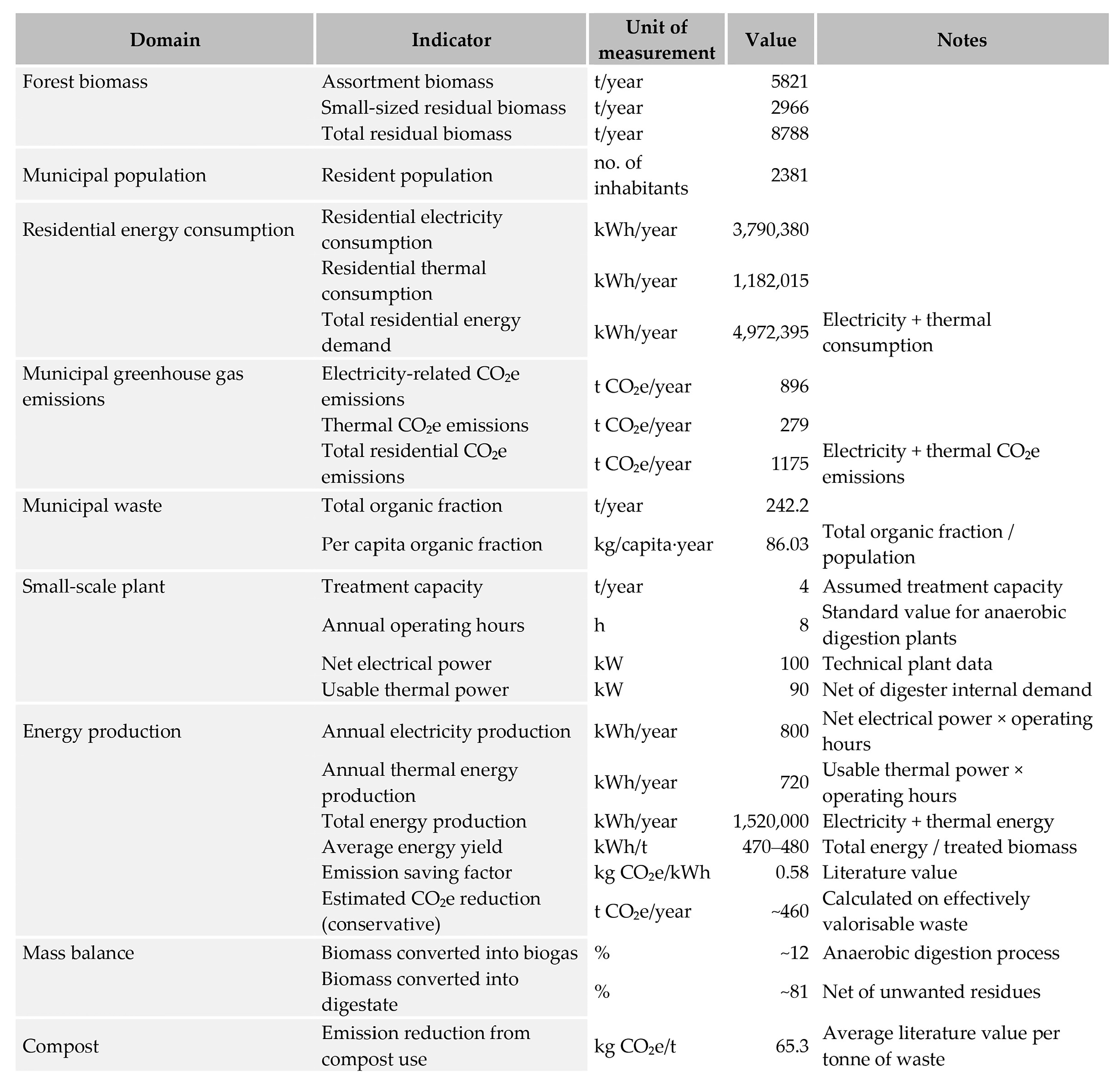
Demographic and socio-economic data were collected by considering the municipality of Petralia Sottana as a pilot case study. In 2025, the resident population amounted to 2381 inhabitants [62]. To extend the analysis to the urban dimension of territorial metabolism, data on organic municipal waste were also collected. In 2023, the quantity of organic waste was 242.2 tons/year, corresponding to 101 kg per capita per year and to 3.7% of the total organic waste (Table 5). These data are particularly relevant for exploring the possibility of an integrated valorization of forest residues and urban organic waste. Residential energy consumption in the municipality of Petralia Sottana in 2023 was 3,790,380 kWh of electricity and 1,182,015 kWh for space heating [63].
To quantify the magnitude of energy outputs obtainable from residual biomass, the performance of a small-scale containerized anaerobic digestion plant with combined heat and power (CHP) was assessed. The plant has a treatment capacity of 4000 t/year and is intended to be located near the boundaries of the park and the urban area. Since, at this stage of the study, no project for a power plant is under development, according to some technical parameters [64,65], the estimated annual energy production is approximately 800,000 kWh of electricity and 720,000 kWh of usable thermal energy, resulting in a total energy output of 1,520,000 kWh/year. The average energy yield is approximately 370–380 kWh per tons of organic waste (additional details are provided in Figure 8).
In 2023, the climate-altering emissions in the municipality of Petralia Sottana, expressed in CO2 equivalent (CO2e), were almost equal to 896 t CO2e/year and 279 t CO2e/year, respectively, for residential electricity and heating consumption. Total residential emissions therefore amounted to 1175 t CO2e/year [66]. The reduction in climate-altering emissions achieved thanks to the valorization of residual biomass depends on two main factors. The first factor is the substitution of fossil-based energy sources with renewable energy produced from biogas. According to conversion factors reported in the literature, the emission savings associated with energy production from biogas are approximately 0.58 kg CO2e per kWh of energy produced [64]. For the plant considered, this value was conservatively estimated at approximately 460 t CO2e/year. The second factor relates to the production and use of digestate. From a mass balance perspective, the anaerobic digestion process converts approximately 12% of the input material into biogas and approximately 81% into stabilized digestate. The use of digestate in agriculture and green area management produces climate benefits attributable to three main effects: (i) an increase in soil carbon sequestration, (ii) a reduction in the use of synthetic fertilizers, and (iii) the substitution of fossil-based substrates, such as peat. According to the literature, these benefits correspond to emissions reduction of approximately 65.3 kg CO2e per tons of waste sent to composting.
Keeping the type of plant and the other technical parameters constant (see Figure 8), three different hypotheses were formulated regarding the quantity and type of recoverable biomass that is introduced into the anaerobic digestion plant circuit (Table 6).
In Case a, the entire quantity of retrievable biomass is equal to 8787 t/year and the total energy obtained varies between 3250 and 3340 MWh/year. In Case b, the organic waste fraction from the municipality of Petralia Sottana and Petralia Soprana was added to the total biomass to obtain a minimum of 3445 of MWh/year of energy. Case c, however, selects only the small-sized biomass fraction, equal to 2966 t/year, to which the organic waste fraction was added, producing approximately 1300 MWh/year. As a result, the minimum percentage of residential energy consumption met can therefore vary from 26 to 69%.
These percentages correspond to significant reductions in climate-altering emissions, ranging between 390 and 1040 tCO2e/year. Furthermore, the anaerobic digestion plant produces a minimum quantity of digestate, equal to 2800 t/year in Case c or to 7500 t/year in Case b, for agricultural use or for the maintenance of forests or public green spaces.
The use of digestate also contributes to reducing CO2e emissions by between 186 and 494 t CO2e/year.
This preliminary, although approximate, quantification of the indicators is functional to the definition of a range of possible strategies for the circular transformation processes of wood waste.

5. Discussion

The study on the activation of circular processes in Madonie Park focused on the potential transformation of wood residues, obtained from forest maintenance activities, into a renewable and sustainable resource capable of activating local micro-supply chains and promoting local innovation and community resilience.
Although data on retractable biomass only refer to the forested area of the municipality of Petralia Sottana falling within the park, they still demonstrate that forest maintenance activities adopting sustainable extraction rates of forest biomass generate, as output, a significant amount of wood residues—amounting to 87,880 tons over a decade—which can be converted into input for other local activities. The knowledge of the actual quantity and quality of this retrievable resource across the entire forested surface depends on the preparation of analogous studies in the other municipalities belonging to Madonie Park.
Based on the data currently available, several potential circularity strategies and mechanisms for activating local economies can be outlined.
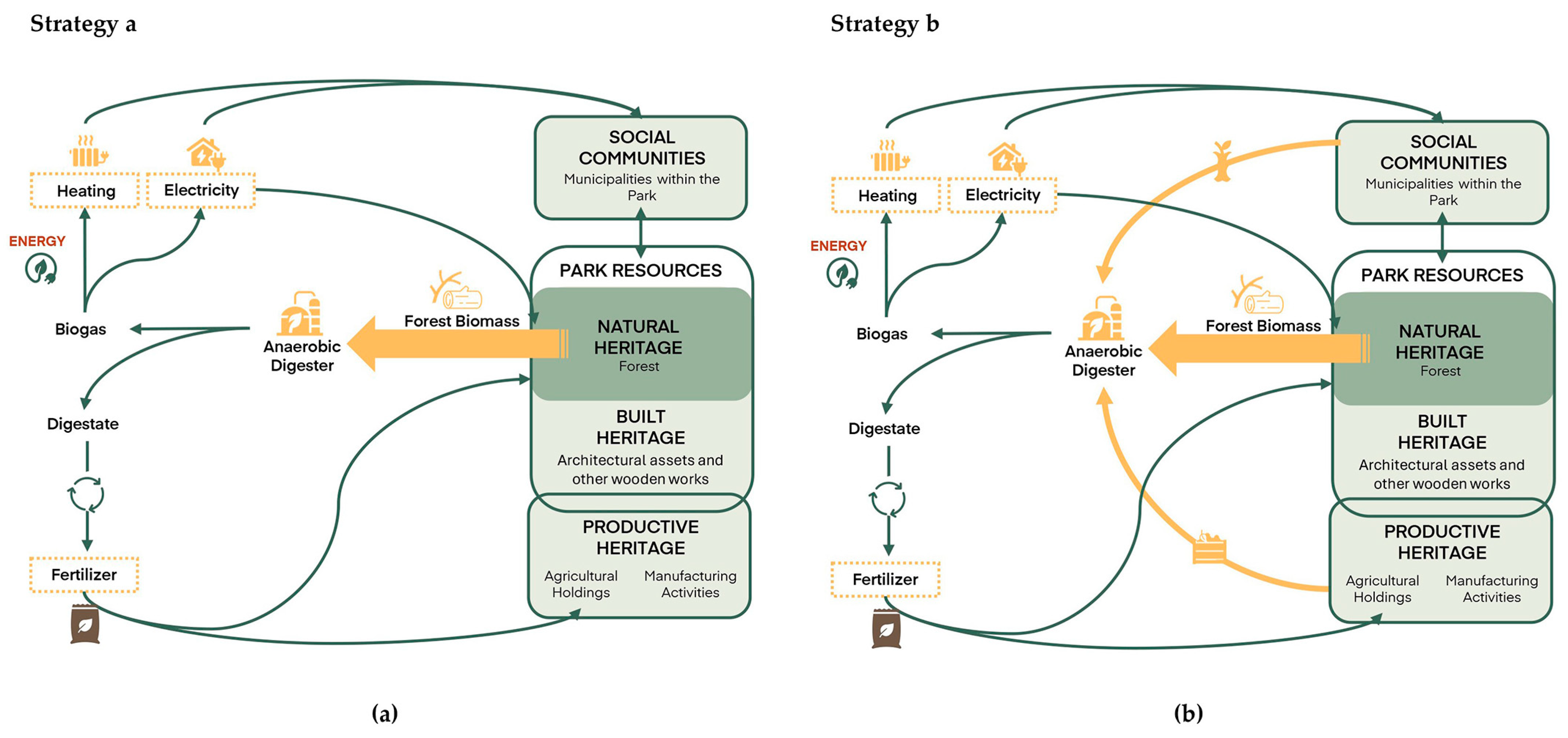
Strategy a. Circular energy-centered and mono-output strategy. This strategy is based on circularity activated through forest maintenance operations that provide a continuous flow of retrievable forest biomass amounting to 87,870 tons per decade (single output), which is entirely converted into input for powering small anaerobic digestion plants (Figure 9a). The sizing, number, and location of these plants will be defined on the basis of further technical, financial, economic, and environmental factors. Therefore, according to the calculations and indicators developed in Figure 8 and Table 6 (see Case a), this strategy would allow for producing energy to meet at least 65% of the population’s demand and 7100 t/year of digestate to support maintenance and management activities within the park area and to contribute to the fertilizer needs of agricultural activities, thereby closing the circularity loop while respecting sustainability criteria. There are other environmental benefits in terms of reducing greenhouse gas emissions by approximately 1450 tons of CO2e/year. The Park Authority should be the main promoter in collaboration with the Municipality di Petralia Sottana for identifying the area in which to locate the biogas plant and for the distribution of energy and digestate.
Strategy b. Expanded circular energy-centered and mono-output strategy. Strategy b is close to Strategy a but differs because it proposes a broad circularity, promoted by the Park Authority together with the Municipality of Petralia Sottana and potentially capable of involving all the Municipalities in the park. (Figure 9b). The total flow of forest biomass (mono-output) can be supplemented by the organic fraction of waste from agricultural enterprises and municipal collection feeding the biogas plants and producing energy corresponding to 69% of the population’s demand of energy (see Case b in Table 6). Despite the addition of the current fraction of organic municipal waste in Petralia Sottana and Petralia Soprana, this fraction has a low value, equal to only 544.6 t/year, but could be incremented through targeted awareness campaigns and above all by trying to channel organic and woody waste from other municipalities—potentially around 7000 t/year—into a network of small anaerobic digestion plants (Table 5). The involvement of even just a fraction of the 4037 agricultural enterprises operating in the municipalities within the Madonie Park could generate a further increase in both energy and fertilizer production (Table 3). The production of digestate is equal to 7500 t/year. This strategy also contributes to reducing greenhouse gas emissions by approximately 15,340 tons of CO2e/year.
The expansion of circularity from the park to local communities generates another co-benefit of social relevance to citizens who can actively participate as prosumers to a sustainable process of transforming waste materials into an endogenous resource.
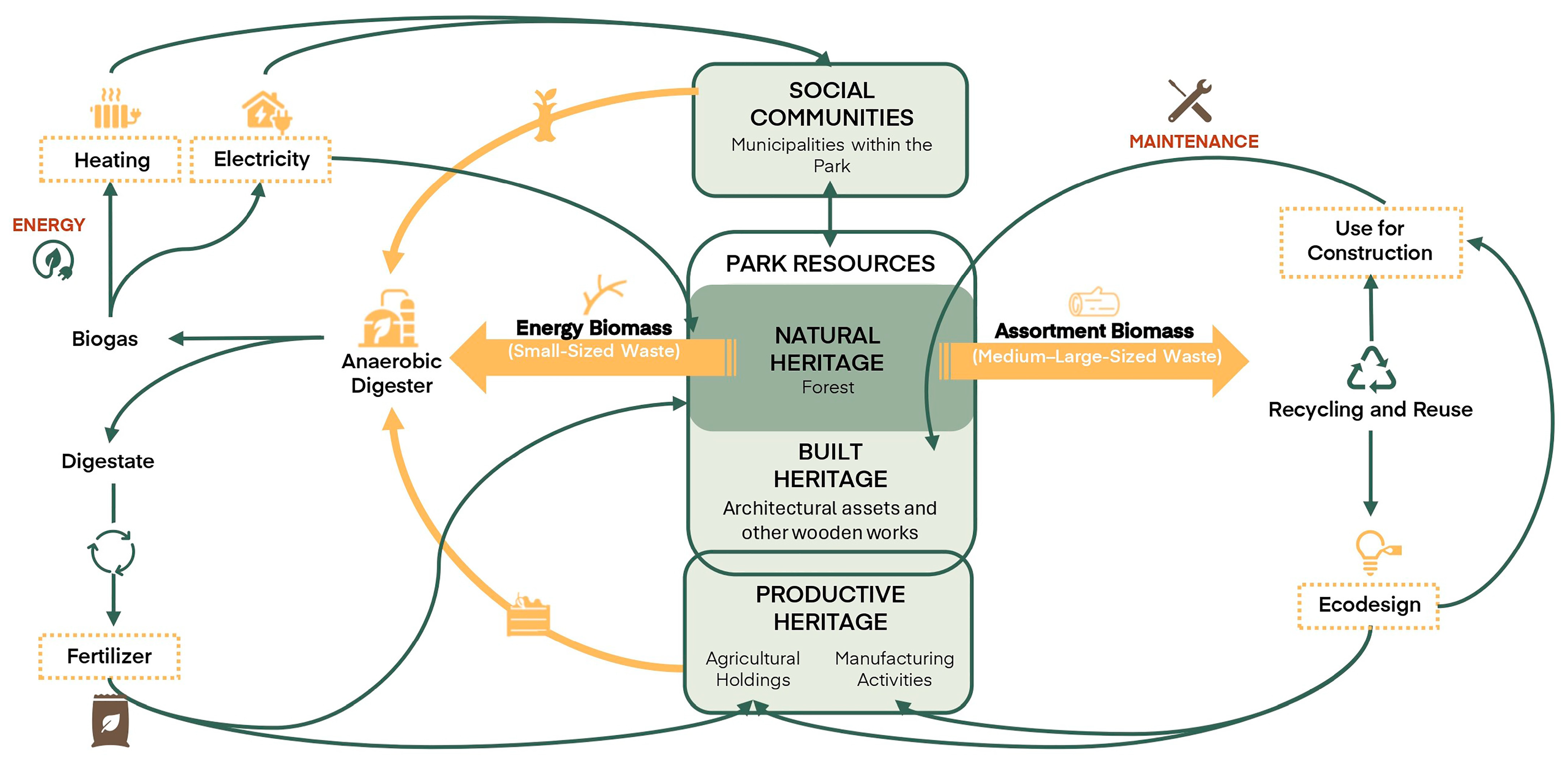
Strategy c. Circular community-centered and multi-output strategy. Strategy c is multi-output, as it divides the retrievable forest biomass into two categories: assortment-grade biomass, consisting of valuable trunks and medium-to-large wood fractions, amounting to 58,215 tons per decade, and biomass consisting of small trunks, branches, and low-quality species, amounting to 29,665 tons per decade (Figure 10). The latter initiates a circular process identical to Strategy b (except for the quantity) allocating the small-size biomass quota to fuel small anaerobic digestion plants to which local communities and agricultural enterprises contribute with additional organic waste, benefiting from the energy and digestate produced. Energy production is a lower percentage than in Strategy b, just 26% of the population’s demand; the digestate quantity is equal to 2800 t/year and the reduction in emissions is almost 580 t CO2e/year (see Case c in Table 6). The quota of assortment-grade biomass, on the other hand, can activate a new and wide cycle of value extended to all municipalities within the park. The quality and size make this biomass a valuable resource for various activities such as maintenance of buildings, infrastructures, and other forest works within the park; maintenance of architecturally valuable buildings in the park municipalities; and local craftsmanship, especially if enhanced by eco-design.
The enjoyment of the Madonie Park, its shelters, and forestry houses requires constant maintenance, repair, and replacement of numerous wooden elements—such as fences, edging, signage, raised walkways, retaining palisades, tables, and benches—located in the four equipped recreational areas and along the 450 km trail network. The maintenance of forestry buildings also requires wood for the repair or replacement of floor and roof components, fencing, and interior fittings. Architecturally valuable buildings are subject to rules and constraints, particularly regarding the types of materials permitted for maintenance. Medium- and large-sized wood residues can be effectively employed, for example, in the replacement or repair of existing windows and door frames. Across the park’s municipalities, 26 enterprises are active in the manufacture of wood, cork, straw, and woven-material products (Table 3). They are mainly concentrated in Castelbuono (13), Cefalù (4), and Geraci Siculo (4). In five other municipalities, only one craft enterprise is present; in the remaining seven municipalities, no such activities exist. The availability of a local resource can benefit existing enterprises and encourage the emergence of innovative eco-design activities.
Wood residues, even small-sized ones, can be also transformed through eco-design into modular indoor or outdoor furnishings (benches, shelving, movable displays, etc.); new visual-communication elements such as totems, information boards, and trail signage for the park; or gadgets and souvenirs for visitors. Eco-design can also be directed toward the valorization of local agricultural, agri-food, and craft products by designing sustainable packaging for direct sales and small exhibition stands and supports for presenting products at fairs and markets. These activities, if promoted and supported by appropriate public policies, may contribute to reducing the vulnerability of the municipalities within the park, which is very high due to progressive depopulation and a high ratio of population with low educational attainment (Figure 6). Since Strategy c is focused on proposing multiple uses of recoverable forest biomass and on extending the circularity model beyond the park, its success depends largely on the activation of participatory decision-making and management processes between public institutions, the Park Authority and municipal administrations, and local social communities, such as cultural associations, cooperatives, and third-sector associations.
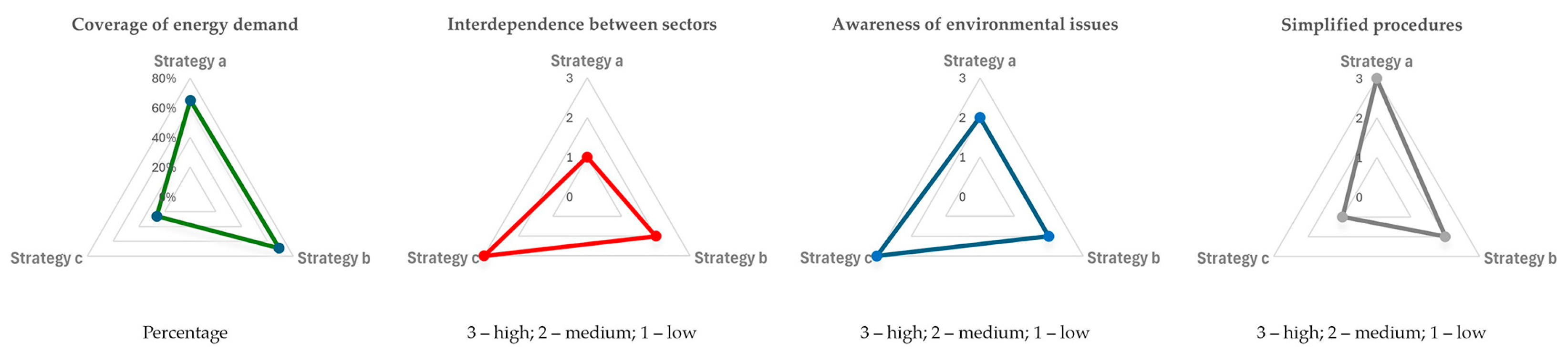
For each of the three strategies, there are several aspects, both positive and negative, that must be considered. From an environmental perspective, based on the indicators calculated previously, such as the share of energy covered in Table 6, Strategy b seems to be the best one. This result is a direct consequence of an energy-centered approach, which uses only quantitative data relating to energy and compost flows produced and emissions avoided.
The complexity of the circular park issue, however, requires a multicriteria analysis —Multicriteria Decision Analysis (MCDA) [67]—to compare alternative strategies according to multiple, even conflicting, criteria. When MCDA is applied to projects and plans for the transformation of territorial or environmental resources, the criteria commonly used are environmental, economic, social, and political-administrative sustainability [68,69]. Each general criterion is specified by subcriteria selected to describe the specific characteristics of the alternatives. Table 7 shows an example of criteria and subcriteria that can be used in our case study.
Strategy c, therefore, is only apparently weak, since it gives up a large amount of energy and digestate to allocate a considerable part of the biomass to various activities in and around the Madonie Park, as previously described. Indeed, despite the low percentage of energy demand coverage, Strategy c presents a high level of interdependence with many economic sectors, enabling the activation of local micro-supply chains and promoting local awareness of environmental issues. This variety of biomass uses—multi-output—corresponds, however, to greater complexity in biomass utilization procedures compared to a mono-output approach (Figure 11).
Through the simulation of scenarios for the reuse and reconfiguration of material flows, the study allowed for exploring the transformative potential of circularity not only in terms of resource recovery and life-cycle extension—which reduces the entropic loss associated with waste—but also as a tool for ecological, productive, and social regeneration.
From this perspective, the park becomes a territorial laboratory of circular metabolism, capable of triggering “anti-entropic” processes of systemic renewal within an area that is fragile in multiple respects.

6. Conclusions

The analysis conducted on the Madonie Regional Park (Sicily, Italy), framed within the still largely unexplored and rarely implemented paradigm of the circular park, suggests the opportunity to rethink the traditionally conservation-oriented approach to the management of protected areas (PAs). The preliminary results of the study indicate that parks—especially those situated in peripheral European rural areas characterized by demographic and socio-economic fragility—can be interpreted as active and potentially regenerative metabolic systems.
The circular park model, as applied to the Madonie context and based on the valorization of residual forest biomass, has proven to be a significant proof of concept supporting the validity of a circular approach to territorial management.
More specifically, the study demonstrates that forest maintenance activities, when managed under sustainability-oriented extraction rates, generate significant quantities of retrievable biomass that can be reintroduced into local circular value chains. The simulation carried out for the Madonie Park shows that even small-scale, place-based circular strategies can contribute to local energy supply, reduce greenhouse gas emissions, lower waste-management costs, and support the regeneration of soils and ecosystems while simultaneously strengthening proximity economies and community resilience.
Compared to more widespread approaches—often monofunctional and focused solely on energy recovery (as shown by numerous best practices in Northern Europe [see Section 2])—the identification of community-centered and multi-output circular strategies calibrated to the potential uses of biomass and their expected impacts on the local economy emerges as a promising direction for maximizing the residual value of waste. Such circular strategies can contribute not only to ecosystem stability (primary ecological functions) but also to the activation of micro-supply chains capable of countering economic and demographic decline, thereby combining ecological, productive, and social functions in a synergistic way.
The study’s value also lies in the methodological process presented. Organizing the work into four phases –from systemic reading of the territory (Phase 1) to the construction of circularity scenarios (Phase 4)—offers a decision-support and governance tool for park authorities and local administrations. In this sense, the study contributes both to broadening the theoretical framework of a possible circular park model and to outlining an operational and transferable methodology for forest resource management, transforming maintenance into an opportunity for territorial value creation. The systemic reading of the territory, based on the integration of GIS, socio-economic, and qualitative data, supported by territorial metabolism analysis tools, enables a multidimensional reinterpretation of waste (ecological, socio-economic, and design-oriented). Identifying the waste/resource—as demonstrated in the mapping of forest resources and the estimation of retrievable biomass (Phase 2)—provides an empirical basis useful for calibrating circular strategies (Phase 4), shifting the focus from generic management to targeted waste management consistent with the principles of regenerative design. The hypothesis of transforming forest management into a circular-regeneration platform thus appears plausible and operationally achievable.
At the same time, the research presents some limitations that should be acknowledged. Quantitative assessments of retrievable biomass and energy production are currently based on detailed data available for a pilot municipality and on scenario-based simulations; their extension to the entire park requires further forest management plans, harmonized datasets, and long-term monitoring. Moreover, the proposed circular strategies are exploratory in nature and do not yet include full techno-economic feasibility analyses, governance arrangements, or systematic evaluations of social acceptance. Finally, the study focuses primarily on forest biomass flows, without yet integrating other relevant material and immaterial resources, such as water cycles, agricultural by-products, cultural heritage, or knowledge-based assets.
Some other considerations concern the perspectives and implications for territorial policies and the management of protected natural areas in fragile contexts. The research conducted in the Madonie Park highlights dynamics that transcend the boundaries of the case study, outlining broader implications for territorial policies and the management of protected natural areas in marginal European territories. In the light of the literature on socio-ecological governance and adaptive management [70,71], the results underline how such contexts can function as experimental platforms for advanced forms of territorial innovation grounded in the valorization of natural capital.
  • Relevance for Inner peripheries and Place-Based Policies. The proposed model addresses the dual vulnerability of inner peripheries—high ecological value combined with socio-demographic fragility—offering an operational framework aligned with place-based approaches to local development. This approach is consistent with European strategies for biodiversity and nature-based solutions [2,72], which recognize PAs as territorial infrastructures capable of generating essential ecosystem services and fostering socio-territorial cohesion. In this regard, the capacity of local communities to collectively manage natural resources emerges as a crucial lever for countering marginalization and decline [73].
  • Evolution of the Parks’ Mandate. The conceptualization of the circular park model situates itself within the broader international debate on the transformation of protected areas from mere conservation devices into integrated socio-ecological systems [74,75]. The circular paradigm reconfigures the park as a productive and regenerative infrastructure capable of generating shared value through the development of bio-based supply chains, the enhancement of ecosystem services, and the promotion of collaborative governance. This aligns with adaptive management models and with research highlighting the role of conservation policies in strengthening social capital and supporting local economies. In line with recent contributions on socio-ecological transformation [76,77], parks are no longer interpreted solely as spaces of protection but as dynamic devices for regeneration, production, and innovation, positioned at the center of a new balance between conservation, sustainability, and local development.
Future research developments aim to expand the experimentation of the circular park model, evolving from the circular management of natural capital towards a systemic transition that encompasses multidimensional resources [46]. Pursuing a circular model implies addressing technical and technological innovation needs, understanding and leveraging the potential of new economic models and resource valorization, and engaging knowledge and skills to promote sustainable lifestyles. This approach represents both a challenge and an opportunity to rethink the role of parks as key actors in the transition towards more resilient and inclusive territorial models.
From this perspective, future research developments aim to expand the experimentation of the circular park model by extending quantitative analyses to the entire park and to other protected areas, testing pilot circular infrastructures under real operating conditions, integrating regulatory constraints related to environmental protection and forest management, and developing governance models capable of coordinating park authorities, municipalities, and local communities.

Author Contributions

Conceptualization, K.F., A.G., A.M. and G.N.; Methodology, K.F., A.G., A.M. and G.N.; Investigation, E.N. and F.R.; Data curation, E.N. and F.R. All authors have read and agreed to the published version of the manuscript.

Funding

This research received no external funding.

Institutional Review Board Statement

Not applicable.

Informed Consent Statement

Not applicable.

Data Availability Statement

The original contributions presented in this study are included in the article. Further inquiries can be directed to the corresponding author.

Conflicts of Interest

The authors declare no conflicts of interest.

References

  1. European Environment Agency. Protected Areas in Europe: Key Figures. 2023. Available online: https://www.eea.europa.eu/en/analysis/indicators/terrestrial-protected-areas-in-europe (accessed on 8 December 2025).
  2. European Commission. EU Biodiversity Strategy for 2030—Bringing Nature Back into Our Lives. COM(2020) 380 Final, Brussels, 2020. Available online: https://environment.ec.europa.eu/strategy/biodiversity-strategy-2030_en (accessed on 8 December 2025).
  3. European Commission. The European Green Deal. COM(2019) 640 Final, Brussels, 2019. Available online: https://eur-lex.europa.eu/legal-content/EN/TXT/?uri=CELEX:52019DC0640 (accessed on 8 December 2025).
  4. Millennium Ecosystem Assessment (MEA). Ecosystems and Human Well-being: Synthesis Report; Island Press: Washington, DC, USA, 2005. [Google Scholar]
  5. IPBES. Global Assessment Report on Biodiversity and Ecosystem Services of the Intergovernmental Science-Policy Platform on Biodiversity and Ecosystem Services; IPBES Secretariat: Bonn, Germany, 2019. [Google Scholar] [CrossRef]
  6. Fabbricatti, K.; Cerreta, M.; Oppido, S.; Ragozino, S. (Eds.) CiLab Cookbook. I Monti Picentini in Cammino per un Parco Circolare; Cratera, Napoli, 2025. [Google Scholar]
  7. ESPON. PROFECY—Inner Peripheries: National Territories Facing Challenges of Access to Basic Services; EPSON: Luxembourg, 2017. [Google Scholar]
  8. Barca, F.; Casavola, P.; Lucatelli, S. A Strategy for Inner Areas in Italy: Definition, Objectives, Tools and Governance; Italian Government: Roma, Italy, 2014.
  9. Presidenza del Consiglio dei Ministri—Dipartimento per le Politiche di Coesione. Accordo di Partenariato 2014–2020. Quadro Strategico Nazionale per L’attuazione della Strategia Nazionale Aree Interne; Presidenza del Consiglio dei Ministri: Roma, Italy, 2014.
  10. Fabbricatti, K.; Boissenin, L.; Citoni, M. Heritage Community Resilience: Towards New Approaches for Urban Resilience and Sustainability. City Territ. Archit. 2020, 7, 17. [Google Scholar] [CrossRef]
  11. European Commission. Updated Bioeconomy Strategy: A Sustainable Bioeconomy for Europe; European Commission: Brussels, Belgium, 2018; Available online: https://environment.ec.europa.eu/strategy/bioeconomy-strategy_en (accessed on 8 December 2025).
  12. Ellen MacArthur Foundation. Completing the Picture: How the Circular Economy Tackles Climate Change; Ellen MacArthur Foundation: Cowes, UK, 2019; Available online: https://content.ellenmacarthurfoundation.org/m/2de7e6f42b72ccdf/original/Executive-summary-Completing-the-picture.pdf (accessed on 8 December 2025).
  13. Vural Gursel, I.; Elbersen, B.; Meesters, K.P.H.; van Leeuwen, M. Defining Circular Economy Principles for Biobased Products. Sustainability 2022, 14, 12780. [Google Scholar] [CrossRef]
  14. Velenturf, A.P.M.; Purnell, P. Principles for a sustainable circular economy. Sustain. Prod. Consum. 2021, 27, 1437–1457. [Google Scholar] [CrossRef]
  15. Routa, J.; Asikainen, A.; Björheden, R.; Laitila, J.; Röoser, D. Forest energy procurement: State of the art in Finland and Sweden. Adv. Bioenergy Sustain. Chall. 2016, 273–283. [Google Scholar]
  16. Eftaxias, A.; Passa, E.A.; Michailidis, C.; Daoutis, C.; Kantartzis, A.; Diamantis, V. Residual forest biomass in pinus stands: Accumulation and biogas production potential. Energies 2022, 15, 5233. [Google Scholar] [CrossRef]
  17. Schmuck, P.; Eigner-Thiel, S.; Karpenstein-Machan, M.; Sauer, B.; Ruppert, H.; Girschner, W.; Roland, F. Bioenergy villages in Germany: Applying the Göttingen Approach of Sustainability Science to promote sustainable bioenergy projects. In Sustainable Bioenergy Production-An Integrated Approach; Springer: Dordrecht, The Netherlands, 2013; pp. 37–71. [Google Scholar]
  18. Jenssen, T. The good, the bad, and the ugly: Acceptance and opposition as keys to bioenergy technologies. J. Urban Technol. 2010, 17, 99–115. [Google Scholar] [CrossRef]
  19. Rosenqvist, H.; Uhlin, H.E. Central Heating System Based Upon Energy Forests—A Business Mission for a Group of Farmers; FUD-Rapport; Sveriges Lantbruksuniversitet: Uppsala, Sweden, 1992. [Google Scholar]
  20. European Biogas Association. Design, build, and monitor biogas and biomethane plants to slash methane emissions 2023. Available online: https://www.europeanbiogas.eu/publication/design-build-and-monitor-biogas-and-biomethane-plants-to-slash-methane-emissions/ (accessed on 8 December 2025).
  21. Hillring, B. Rural development and bioenergy—Experiences from 20 years of development in Sweden. Biomass Bioenergy 2002, 23, 443–451. [Google Scholar] [CrossRef]
  22. Salomón, M.; Savola, T.; Martin, A.; Fogelholm, C.J.; Fransson, T. Small-scale biomass CHP plants in Sweden and Finland. Renew. Sustain. Energy Rev. 2011, 15, 4451–4465. [Google Scholar] [CrossRef]
  23. Abart-Heriszt, L.; Erker, S.; Stoeglehner, G. The energy mosaic Austria—A nationwide energy and greenhouse gas inventory on municipal level as action field of integrated spatial and energy planning. Energies 2019, 12, 3065. [Google Scholar] [CrossRef]
  24. De Santana Filho, J.J.; Gaspar, P.D.; do Paço, A.; Marcelino, S.M. Governance-Centred Industrial Symbiosis for Circular Economy Transitions: A Rural Forest Biomass Hub Framework Proposal. Sustainability 2025, 17, 5659. [Google Scholar] [CrossRef]
  25. Lichtenwoehrer, P.; Abart-Heriszt, L.; Kretschmer, F.; Suppan, F.; Stoeglehner, G.; Neugebauer, G. Evaluating spatial interdependencies of sector coupling using spatiotemporal modelling. Energies 2021, 14, 1256. [Google Scholar] [CrossRef]
  26. Koch, R.; Brunner, C.; Hacker, J.; Urschik, A.; Sabara, D.; Hotwagner, M.; Aichernich, C.; Hofbauer, H.W.; Fercher, E. Energieautarker Bezirk Güssing. Berichte Energ. Umweltforsch. 2006, 82, 2006. [Google Scholar]
  27. Huber, M.; Meyer, U.; Rys, P. Biodegradation mechanisms of linear alcohol ethoxylates under anaerobic conditions. Environ. Sci. Technol. 2000, 34, 1737–1741. [Google Scholar] [CrossRef]
  28. Pesta, G.; Hansemann, E.; Bochmann, G.; Drosg, B.; Gabauer, W. Implementation of Anaerobic Digestion facilities in the Food and Beverage Industry; Liebetrau, J., Ed.; IEA Bioenergy Task 37; IEA: Paris, France, 2025. [Google Scholar]
  29. Rayasam, R. A Power Grid of Their Own: German Village Becomes Model for Renewable Energy. Spiegel Online International. 2012. Available online: https://ec.msvu.ca/server/api/core/bitstreams/ff39a780-dbd5-43bc-b0e0-03195e5a7963/content (accessed on 8 December 2025).
  30. European Economic and Social Committee (EESC). Village of Feldheim: Energy Self-Sufficient District of the Town of Treuenbrietzen in Germany’s County Potsdam-Mittelmark. Available online: https://eu-cap-network.ec.europa.eu/sites/default/files/2023-06/gp_de_energy_sustain_village_143_web.pdf (accessed on 8 December 2025).
  31. Brohmann, B.; Fritsche, U.; Hünecke, K. Case Study: The Bioenergy Village Jühnde. In Report by Öko-Institute eV for Create Acceptance Work Package; Institute for Applied Ecology: Darmstadt, Germany, 2006; Volume 2. [Google Scholar]
  32. Neubert, F.P.; Pretzsch, J.; Becker, G. Socio-Economic Sustainability Criteria for Bioenergy Villages Incorporating Short Rotation Coppice in Their Energy Supply. In Bioenergy from Dendromass for the Sustainable Development of Rural Areas; John Wiley & Sons, Inc.: Hoboken, NJ, USA, 2015; pp. 303–316. [Google Scholar]
  33. Jenssen, T.; König, A.; Eltrop, L. Bioenergy villages in Germany: Bringing a low carbon energy supply for rural areas into practice. Renew. Energy 2014, 61, 74–80. [Google Scholar] [CrossRef]
  34. Guhl, F.; Zeigermann, U. Local heat transitions—A comparative case study of five bioenergy villages in Northern and Southern Germany. Z. Vgl. Polit. 2024, 18, 157–179. [Google Scholar] [CrossRef]
  35. Balling, T. Feeding bio methan from the view of a plant operator. In Proceedings of the FNR/KTBL Congress “Biogas in Agriculture. Status and Prospects”, Goettingen, Germany, 20–21 September 2011. [Google Scholar]
  36. Höher, M.; Tretter, H.; Athavale, S.; Strimitze, L.; Krizmanić, M.; Vrček, V.; Šegon, V.; Bozhikaliev, V.; Sazdovski, I.; Dimov, L.; et al. Report on the Social and Environmental Impacts for the Target Villages Bioenergy Villages (Biovill) Horizon 2020 Research and Innovation Programme under Grant Agreement N° 691661. 2017. Available online: https://ec.europa.eu/research/participants/documents/downloadPublic?documentIds=080166e5b7580dab&appId=PPGMS (accessed on 8 December 2025).
  37. Metson, G.S.; Feiz, R.; Lindegaard, I.; Ranggård, T.; Quttineh, N.H.; Gunnarsson, E. Not all sites are created equal–Exploring the impact of constraints to suitable biogas plant locations in Sweden. J. Clean. Prod. 2022, 349, 131390. [Google Scholar] [CrossRef]
  38. Municipality of Bologna, Monzuno, Savings and Sustainability with the New Biomass District Heating Plant. Available online: https://www.cittametropolitana.bo.it/portale/Comunicazione/Archivio_news/Monzuno_risparmio_e_sostenibilita_con_la_nuova_centrale_a_biomassa (accessed on 8 December 2025).
  39. Rudra, S.; Rossendahl, L.; From, N. Optimization of a local district heating plant under fuel flexibility and performance. Energy Sustain. 2011, 54686, 1159–1165. [Google Scholar]
  40. Repubblica Italiana, Ministero dell’Ambiente e Della Tutela del Territorio e del Mare, Decreto 13 Ottobre 2016, n. 264, Regolamento Recante Criteri Indicativi per Agevolare la Dimostrazione Della Sussistenza dei Requisiti per la Qualifica dei Residui di Produzione come Sottoprodotti e Non Come Rifiuti. Available online: https://www.normattiva.it/uri-res/N2Ls?urn:nir:ministero.ambiente.e.tutela.territorio.e.mare:decreto:2016-10-13;264!vig= (accessed on 8 December 2025).
  41. Asvis, Alleanza Italiana per lo Sviluppo Sostenibile, I Territori e gli Obiettivi di Sviluppo Sostenibile 2022. Available online: https://asvis.it/public/asvis2/files/Pubblicazioni/Rapporto_Territori/2022/RapportoASviSTerritori2022.pdf (accessed on 8 December 2025).
  42. Buonocore, E.; Paletto, A.; Russo, G.F.; Franzese, P.P. Indicators of environmental performance to assess wood-based bioenergy production: A case study in Northern Italy. J. Clean. Prod. 2019, 221, 242–248. [Google Scholar] [CrossRef]
  43. Bennett, E.M.; Peterson, G.D.; Gordon, L.J. Understanding relationships among multiple ecosystem services. Ecol. Lett. 2009, 12, 1394–1404. [Google Scholar] [CrossRef]
  44. Prezioso, M.; Coronato, M.; D’Orazio, A.; Pigliucci, M.; Sargolini, M.; Idone, M.T.; Perna, P.; Pierantoni, I.; Omizzolo, A.; Cetara, L.; et al. LinkPAs—Linking Networks of Protected Areas to Territorial Development: Targeted Analysis—Scientific Report; ESPON EGTC: Luxembourg, 2018. [Google Scholar]
  45. Carrosio, G. I Margini al Centro. L’Italia Delle Aree Interne tra Fragilità e Innovazione; Donzelli Editore: Roma, Italy, 2019. [Google Scholar]
  46. Cerreta, M.; Fabbricatti, K.; Oppido, S.; Ragozino, S. Pratiche abilitanti di innovazione territoriale. Il progetto Monti Picentini CiLAB. BDC Boll. Cent. Calza Bini 2021, 21, 337–357. [Google Scholar]
  47. Mang, P.; Reed, B. Designing from place: A regenerative framework and methodology. Build. Res. Inf. 2012, 40, 23–38. [Google Scholar] [CrossRef]
  48. Bauhus, J.; Van der Meer, P.; Kanninen, M. Ecosystem Goods and Services from Plantation Forests; Earthscan: London, UK, 2010. [Google Scholar]
  49. Pretzsch, H.; Forrester, D.I.; Bauhus, J. (Eds.) Mixed-Species Forests: Ecology and Management; Springer: Berlin/Heidelberg, Germany, 2017. [Google Scholar] [CrossRef]
  50. Barad, K. Meeting the Universe Halfway: Quantum Physics and the Entanglement of Matter and Meaning; Duke University Press: Durham, NC, USA, 2007. [Google Scholar]
  51. Odum, H.T. Environmental Accounting: Emergy and Environmental Decision Making; Wiley: New York, NY, USA, 1995. [Google Scholar]
  52. Morin, E. La Méthode, 5. L’Humanité de l’humanité. L’identité Humaine; Éditions du Seuil: Paris, France, 2001. [Google Scholar]
  53. Cross, N. Designerly ways of knowing: Design discipline versus design science. Des. Stud. 2001, 17, 49–55. [Google Scholar] [CrossRef]
  54. Stolterman, E. The nature of design practice and implications for interaction design research. Int. J. Des. 2008, 2, 55–65. [Google Scholar]
  55. Fischer-Kowalski, M.; Hüttler, W. Society’s Metabolism: The Intellectual History of Materials Flow Analysis, Part II, 1970–1971998. J. Ind. Ecol. 1998, 2, 107–136. [Google Scholar] [CrossRef]
  56. Creswell, J.W.; Plano Clark, V.L. Designing and Conducting Mixed Methods Research; Sage Publications: Thousand Oaks, CA, USA, 2017. [Google Scholar]
  57. Legambiente. Available online: https://www.legambienteriserve.it/sistema-regionale-delle-aree-protette/ (accessed on 7 December 2025).
  58. Madonie Park Authority. Available online: https://www.parcodellemadonie.it/ (accessed on 7 December 2025).
  59. ISTAT. Available online: https://www.istat.it/dati/infografiche-e-grafici/dashboard/ (accessed on 7 December 2025).
  60. Antista, G. I tesori architettonici nel Parco delle Madonie; Collana editoriale del Parco delle Madonie. Cultura, Storia e Antropologia. Italy; Academia: San Francisco, CA, USA, 2011. [Google Scholar]
  61. Comune di Petralia Sottana, Progetto ForBioEnergy. Available online: https://www.intradata.it/www.comune.petraliasottana.pa.it/info/progetto-forbioenergy/index.html (accessed on 7 December 2025).
  62. ISTAT. Available online: https://demo.istat.it/app/?i=POS (accessed on 7 December 2025).
  63. ISPRA. Available online: https://www.isprambiente.gov.it/it (accessed on 7 December 2025).
  64. Grisanti, F. Rifiuti ed Energia Nella Riqualificazione Sostenibile Della Periferia Urbana. Ph.D. Thesis, Università degli Studi di Napoli Federico II, Naples, Italy, 2011. [Google Scholar]
  65. Bonafede, G.; Grisanti, F.; Mamì, A. Green Small Technology for Neighbourhood Regeneration: A Southern Case-Study; Improving the Quality of Suburban Building Stock, COST Action TU0701; Unife Press: Ferrara, Italy, 2012. [Google Scholar]
  66. ENEA. Piattaforma PAESC-Sicilia. Available online: https://www.paesc-sicilia.enea.it/comune_p.php?cod_istat=082056 (accessed on 7 December 2025).
  67. Ishizaka, A.; Nemery, P. Multi-Criteria Decision Analysis; Wiley: Chichester, UK, 2013. [Google Scholar]
  68. Napoli, G.; Leone, M. The urban park as a “social island”. The ANP in the participatory project of Parco Uditore in Palermo, In Values and Functions for Future Cities, Green Energy and Technology; Mondini, G., Stanghellini, S., Oppio, A., Bottero, M., Abastante, F., Eds.; Springer International Publishing: Berlin/Heidelberg, Germany, 2019; pp. 229–248. [Google Scholar] [CrossRef]
  69. Napoli, G.; Schilleci, F. An application of analytic network process in the planning process: The case of an urban transformation in palermo (Italy). In Computational Science and Its Applications—ICCSA 2014. LNCS Vol 8581; Murgante, B., Misra, S., Rocha, A.M., Torre, C., Rocha, J.G., Falcão, M.I., Taniar, D., Apduhan, B.O., Gervasi, O., Eds.; Springer: Cham, Switzerland, 2014; pp. 300–314. [Google Scholar] [CrossRef]
  70. Schultz, L.; Folke, C.; Österblom, H.; Olsson, P. Adaptive governance, ecosystem management, and natural capital. Proc. Natl. Acad. Sci. USA 2015, 112, 7369–7374. [Google Scholar] [CrossRef]
  71. Ghodsvali, M.; Dane, G.; De Vries, B. The nexus social-ecological system framework (NexSESF): A conceptual and empirical examination of transdisciplinary food-water-energy nexus. Environ. Sci. Policy 2022, 130, 16–24. [Google Scholar] [CrossRef]
  72. European Environment Agency. Nature-Based Solutions in Europe Policy, Knowledge and Practice for Climate Change Adaptation and Disaster Risk Reduction; Publications Office: Luxembourg, 2021; Available online: https://data.europa.eu/doi/10.2800/919315 (accessed on 8 December 2025).
  73. Giacomelli, M.; Sargolini, M.; Felipe-Lucia, M.R. Including the perspective of stakeholders in landscape planning through the Ecosystem Services co-production framework: An empirical exploration in Le Marche, Italy. Reg. Environ. Change 2024, 24, 24. [Google Scholar] [CrossRef]
  74. Cumming, G.S.; Allen, C.R. Protected areas as social-ecological systems: Perspectives from resilience and social-ecological systems theory. Ecol. Appl. 2017, 27, 1709–1717. [Google Scholar] [CrossRef]
  75. Hoffmann, S. Challenges and opportunities of area-based conservation in reaching biodiversity and sustainability goals. Biodivers. Conserv. 2022, 31, 325–352. [Google Scholar] [CrossRef]
  76. Brand, U.; Wissen, M. The Imperial Mode of Living. Everyday Life and the Ecological Crisis of Capitalism; Verso: London, UK, 2021. [Google Scholar]
  77. López-Felices, B.; Schoenemann, M.; Román-Sánchez, I.M.; Aznar-Sánchez, J.A. Sociocultural valuation of ecosystem services in protected areas: A study applied to Southeast Spain. Oeconomia Copernic. 2023, 14, 1257–1302. [Google Scholar] [CrossRef]
Figure 1. Biogas plants in Europe (source: [20]) (a); infographic diagram for the production system of energy from biomass in the Municipality of Mauenheim in Germany (elaborated by E. Nicolini) (b).
Sustainability 18 01552 g001
Figure 2. Parks, nature reserves, and protected areas in Sicily (Italy) (source: authors’ elaboration on Legambiente data [57]).
Sustainability 18 01552 g002
Figure 3. The Madonie Regional Park (Italy) (source: authors’ elaboration on Madonie Park Authority [58]).
Sustainability 18 01552 g003
Figure 4. Municipalities within the Madonie Park: “Composite index of municipal fragility” and other related indicators (source: authors’ elaboration on ISTAT 2021 data).
Sustainability 18 01552 g004
Figure 5. Municipalities within the Madonie Park: “Composite index of municipal fragility” (authors’ elaboration on ISTAT data, 2021).
Sustainability 18 01552 g005
Figure 6. Municipalities within the Madonie Park: indicator of “Population growth rate in 2021–2011” (a); indicator of “Population (aged 25–64) with low educational attainment” (b) (authors’ elaboration on ISTAT data, 2021).
Sustainability 18 01552 g006
Figure 7. Forested areas within municipalities of the Madonie Park (source: authors’ elaboration on Madonie Park Authority).
Sustainability 18 01552 g007
Figure 8. Retrievable biomass in 10 years in the wooded areas of Petralia Sottana and other technical parameters (authors’ elaboration on various sources [61,62,63,66]).
Sustainability 18 01552 g008
Figure 9. Strategy a—circular energy-centered and mono-output strategy (a); strategy b—expanded circular energy-centered and mono-output strategy (b).
Sustainability 18 01552 g009
Figure 10. Strategy c—circular community-centered and multi-output strategy.
Sustainability 18 01552 g010
Figure 11. A sample of subcriteria to evaluate the performances of the strategies.
Sustainability 18 01552 g011
Table 1. Examples of rural communities supplied with energy and heat produced by biogas plants fueled by forest maintenance residues.
LocationPopulation and
Settlement Type
Main CharacteristicsPlant
Capacity (MW)
Protected Area
Yes/No
Bibliographic
Reference
Bad Schallerbach—Austria~4545 inh. rural communityWood-chip biogas; generates electricity for 9000 households and heat for 2000 households per year.2 × 0.25Yes—hillside forests between the Inn and Hausruck rivers[25,26]
Plant operator: https://www.hargassner.com
Güttenbach—Austria~900 inh. rural villageBiomass heating plant and 12-km district heating network with approx. 240 connected users.~1Yes—mixed natural forests in southern Burgenland. Natura 2000 areas (SIC/ZPS) nearby.[27]
Plant operator: https://r-aces.eu
Frastanz—Austria~6375 inh. semi-rural communityBiogas from 55% wood chips and 45% industrial and sawmill by-products from the region.1–2Yes—managed Alpine forests. Natura 2000 areas (SIC/ZPS) nearby.[28,29]
Plant operator: https://www.11er.at
Feldheim—Germany~150 inh. small peri-urban hamletWood-chip biogas + wind power (50 turbines) enabling full energy autonomy for the settlement.~1No—mixed forests in Brandenburg managed under German forestry law.[30,31]
Plant operator: https://nef-feldheim.info
Jühnde—Germany~970 inh. rural villageWood-chip biogas + photovoltaic (20 kWp). The district heating network extends 6 km and supplies 100 buildings.0.7–0.8 + 0.5–0.7No—agricultural area with managed forests in Lower Saxony.[32,33]
Plant operator: https://www.ieabioenergy.com
Mauenheim—Germany~400 inh. rural village“Low impact” small-scale model. Agricultural-chain biogas + wood-chip boiler supplying energy and heat to the entire village.0.3–0.5Yes—landscape-protected area and Naturpark; extensive area with traditional silviculture.[34,35]
Plant operator: https://regeneration.org/nexus/biogas
Unsleben—Germany~919 inh. rural villageBiogas from agricultural residues and wood chips producing enough electricity for approx. 3000–4000 inhabitants.0.5–1Yes—nearby nature reserve (Trockenhänge bei Unsleben) and managed woodland areas.[36]
Plant operator: https://www.sensopower.com
Estelnic—Romania~1162 inh. rural communityWood-chip micro-grid. Electricity fed into the grid, sufficient for approx. 4500 households.0.3–0.5Yes—Baraolt Mountains, heavily forested. Natura 2000 (SIC/ZSC).[37]
Plant operator: project yet to be implemented
Monzuno—Italy~6450 inh. rural communityWood-chip heating plant and district heating network supplying all public buildings of the municipality.~0.2Yes—Monte Sole Historical Park (protected area). Nearby SIC/ZSC zones.[38]
Plant operator: https://www.cittametropolitana.bo.it
Tomelilla—Sweden~12,930 inh. rural communityWoody biofuel (wood chips, pellets, wood-industry residues) and district heating serving the entire settlement.~6Yes—Fyledalen protected nature reserve; Christinehofs Ekopark ecological area.[39]
Plant operator: https://againity.com
Aabybro—Denmark~6800 inh. rural communityBiogas and wood-chip boiler. District heating network serving 2000 households.~8.4Yes—Lille Vildmose Natura 2000 habitat; Langdal Plantager partly protected areas.[14]
Plant operator: https://www.broen.com
Table 2. Forested and productive areas in the Madonie Park and municipalities within the park (source: GIS by A. Giampino).
Forested and
Productive
Areas
Areas of
Municipalities Within the Park
(ha)
Area Under
Park Authority
(ha)
Park Area/
Municipalities Area (%)
Broadleaf forests18,29413,50173.8
Conifer forests91271578.4
Mixed forests259390234.8
Orchards17711317.4
Olive groves13,04111,97891.9
Total36,61227,22774.4
Table 3. High architectural assets, trail network, agricultural and timber arboriculture enterprises, and manufacturing activities in each municipality within the park (data source: Antista 2011 [60]; ISTAT 2020, 2023).
Municipalities
Within
the Park
High
Architectural
Assets
(No.)
Trail
Network
(30 Routes)
(km)
Agricultural Enterprises
(No.)
Timber
Arboriculture
Enterprises
(No.)
Manufacturing
Activities Linked to Wood
Processing
(No.)
Cefalù5-28624
Castelbuono5-432613
Gratteri1-10800
Collesano2-45151
Isnello0-10411
Pollina0-18960
San Mauro Castelverde0-28310
Scillato0-6420
Sclafani Bagni0-23820
Caltavuturo3-36720
Polizzi Generosa5-25641
Castellana Sicula1-27431
Petralia Sottana2-37210
Petralia Soprana2-39021
Geraci Siculo3-22344
Total29449.540374126
Table 4. Retrievable biomass in 10 years in the wooded areas of Petralia Sottana (source: Forest Management Plan—ForBioEnergy Project).
Forested and Productive
Areas
Retrievable Biomass
(in 10 Years)
(Tons)
Retrievable Biomass
(in 10 Years)
(%)
Assortment Biomass58,21566.3
Small-sized Biomass29,66533.7
Total87,880100
Table 5. Waste collection by each municipality within the Madonie Park (data source: [63]).
Municipalities
Within the Madonie Park
Total
Waste
(Tons/Year)
Organic
Waste
(Tons/Year)
Wood
Waste
(Tons/Year)
Cefalù6620.32466.2289.3
Castelbuono2053.5841.784.9
Gratteri173.084.30
Collesano749.7455.00
Isnello274.4142.60
Pollina931.4424.935.3
San Mauro Castelverde242.2161.30
Scillato172.3101.90
Sclafani Bagni105.046.70
Caltavuturo685.1398.40
Polizzi Generosa590.9293.20
Castellana Sicula753.0389.30
Petralia Sottana602.7242.218.0
Petralia Soprana604.8302.40
Geraci Siculo348.1204.20
Total14,906.46554.3427.5
Table 6. Potential production of energy and digestate and environmental benefit of reuse of the residual biomass and organic waste in the Municipality of Petralia Sottana (source: authors’ elaboration).
Indicators Unit of MeasurementCase aCase bCase c
Indicator B_W—Biomass and Organic wasteAssortiment Biomasst/year58215821
Small-sized Biomasst/year296629662966
Organic waste *t/year 544.6544.6
Total of biomass and organic wastet/year878793323511
Indicator P_E—Production of Energytotal Energy minMWh/year325034451300
total Energy maxMWh/year334035501350
Indicator C_E—Coverage of residential electricity demandCovered energy demand min%656926
Covered energy demand max%677127
Indicator R_E—Reduction of climate-alterating emissionsReduction of CO2e from produced energy (cautious assessment)t CO2e/year9801040390
Reduction of CO2e from compostt CO2e/year465494186
Total reduction of CO2et CO2e/year14451534576
Indicator P_D—Production of DigestateDigestate mint/year710075002800
Digestate maxt/year720076002900
* Organic waste from the municipalities of Petralia Sottana and Petralia Soprana.
Table 7. A sample of criteria and subcriteria to evaluate the strategies.
CriteriaEnvironmental
Sustainability
Economic FeasibilitySocial SustainabilityPolitical Sustainability
SubcriteriaCoverage of energy
demand
Plant construction costsAwareness of environmental issuesSimplified procedures
Reduction in CO2e
emissions
Plant operative costsSocial cohesionPublic administrations
involved
Production of digestateIncrease in employmentStrengthening identity
values
Park fruitionInterdependence between economic sectorsCultural and educational
activities
New economic activities
Disclaimer/Publisher’s Note: The statements, opinions and data contained in all publications are solely those of the individual author(s) and contributor(s) and not of MDPI and/or the editor(s). MDPI and/or the editor(s) disclaim responsibility for any injury to people or property resulting from any ideas, methods, instructions or products referred to in the content.