Article

How Green Skepticism Undermines Green Purchase Intention: The Roles of Information Seeking and Anticipated Guilt

Graduate School of Humanities and Social Sciences, Hiroshima University, Hiroshima 730-0053, Japan
*
Authors to whom correspondence should be addressed.
Sustainability 2026, 18(3), 1539; https://doi.org/10.3390/su18031539
Submission received: 25 December 2025 / Revised: 27 January 2026 / Accepted: 30 January 2026 / Published: 3 February 2026
(This article belongs to the Section Economic and Business Aspects of Sustainability)

Abstract

Against the backdrop of the transition toward a sustainable society, the green product market has expanded steadily. However, green skepticism poses a significant challenge to promoting sustainable consumption. This study develops a parallel mediation model to examine how green skepticism influences green purchase intention through information seeking and anticipated guilt among Chinese consumers. Survey data were collected from 511 Chinese respondents and analyzed using structural equation modeling (SEM) with IBM SPSS AMOS 30. While prior research typically assumes a direct negative effect of skepticism on green purchase intention, our results show that green skepticism does not exert a significant direct effect on green purchase intention. Instead, green skepticism indirectly undermines green purchase intention by reducing consumers’ motivation to seek green product information and weakening anticipated guilt. These findings challenge the prevailing “skepticism-as-verification” view and suggest that green skepticism may foster information avoidance and moral disengagement rather than deeper cognitive and moral engagement. By identifying these disengagement pathways, this study helps clarify previously mixed findings on the relationship between green skepticism and green purchase intention. It delineates important boundary conditions for the effectiveness of green marketing and policy interventions.

1. Introduction

Recent industry reports consistently indicate that sustainability has become a key driver of consumer behavior worldwide. A global survey by NielsenIQ revealed that 81% of consumers consider corporate environmental initiatives extremely or very important, and 73% are willing to adjust their consumption habits to reduce their ecological impact [1]. A joint study by McKinsey & Company and NielsenIQ further showed a strong positive correlation between consumer spending and sustainability-related claims on product packaging across multiple categories [2]. Similarly, PwC’s 2024 Voice of the Consumer Survey reported that consumers remain willing to increase their spending on sustainably produced goods by an average of 9.7% despite inflation and rising living costs, with 85% feeling personally affected by climate change and prioritizing sustainable consumption [3]. Together, these reports underscore that sustainability has moved from a niche concern to a mainstream driver of consumer choice across markets.
As interest in sustainable consumption continues to grow, many companies have been found to selectively or misleadingly present environmental information to shape consumer perceptions, contributing to widespread greenwashing [4,5]. Greenwashing refers to the practice whereby firms make inaccurate or misleading claims about their sustainability practices or the environmental performance of their products [6]. Confronted with a large volume of environmental claims of varying credibility, consumers often experience confusion [7], which helps explain why, despite widespread willingness to pay a premium for green products [8], the actual purchase rate of such products remains relatively low [9]. In such environments, repeated exposure to inconsistent or exaggerated claims can erode trust in corporate communication, fostering a more generalized skepticism toward green messages. This tendency to question the authenticity of environmental claims and the environmental performance of green products—commonly referred to as green skepticism [7]—has been identified as one of the significant barriers to sustainable (green) consumption [8,10,11].
Despite the growing scholarly attention to green skepticism, prior research still exhibits three important limitations. First, existing empirical findings remain inconsistent. Some studies suggest that green skepticism directly undermines sustainable consumption [11]. In contrast, others report no significant direct effect and instead emphasize its potential indirect influence through cognitive mechanisms [7]. These mixed findings indicate a lack of consensus on the pathways through which green skepticism shapes consumer behavior. These inconsistencies suggest that green skepticism may not operate through a single, universal pathway, but rather through multiple mechanisms that vary across contexts. Second, the psychological mechanisms activated by green skepticism have not been sufficiently explored. Previous research has predominantly focused on cognitive processes such as information evaluation and judgment [7,10], while paying limited attention to emotional mechanisms that are equally crucial in green consumption contexts. Notably, green purchasing involves not only rational assessments but also affective responses [12]. Emotions such as anticipated guilt have been shown to play a significant role in pro-environmental behavior [13,14,15]. Overlooking emotional processes may therefore lead to an incomplete understanding of how skepticism influences consumer decision-making. Third, existing studies have yet to integrate cognitive and emotional responses within a unified analytical framework. As a result, the current literature provides only a partial explanation of how green skepticism is translated into green purchase intention, and the specific mechanisms underlying this transformation remain insufficiently clarified.
Against this backdrop, most existing studies implicitly assume that green skepticism primarily stimulates greater information processing and moral engagement, for example, by motivating consumers to search for more diagnostic information [7,10] or by heightening guilt [15] about making environmentally harmful choices. However, skepticism may also elicit alternative responses under conditions of heightened uncertainty, such as information avoidance and moral disengagement, whereby consumers withdraw from effortful evaluation and downplay the moral significance of their choices. These disengagement responses are particularly likely in low-trust, greenwashing-prone contexts, where consumers doubt that additional information will meaningfully improve their decisions. By explicitly examining these potential disengagement pathways, the present study moves beyond the dominant “skepticism-as-verification” view. It explores how green skepticism can undermine green purchase intention by reducing information seeking and weakening anticipated guilt.
To address these gaps, the present study develops a conceptual framework to examine how green skepticism shapes consumers’ green purchase intention by integrating cognitive and emotional mechanisms. Drawing on Attitude Certainty Theory, the Norm Activation Model, and moral disengagement theory, we conceptualize information seeking and anticipated guilt as parallel mediators capturing, respectively, consumers’ cognitive responses to uncertainty and their moral–emotional evaluations of responsibility. Specifically, this study aims to (1) reassess the direct effect of green skepticism on green purchase intention, (2) examine the mediating role of green product information-seeking behavior, and (3) investigate the mediating role of anticipated guilt in the context of sustainable consumption.
This study explicitly examines how green skepticism influences information seeking and anticipated guilt through alternative theoretical pathways, thereby comparing the relative applicability of verification-oriented and disengagement-oriented explanations. We empirically test whether green skepticism primarily exerts its influence via verification-oriented or disengagement-oriented pathways. By uncovering these disengagement pathways, the study clarifies mixed empirical findings on the green skepticism–behavior relationship, identifies important boundary conditions for the operation of existing theories, and offers actionable insights for policymakers and firms seeking to foster sustainable consumption.
The remainder of this paper is structured as follows. First, we review the relevant literature and develop the research hypotheses. Second, we describe the research methodology adopted in this study. Third, we present the data analysis and empirical findings. Finally, we discuss the implications of the results and outline the study’s limitations and directions for future research.

2. Literature Review

This study examines four key constructs: (1) green skepticism, (2) information seeking behavior, (3) anticipated guilt, and (4) green purchase intention. Rather than treating these constructs as independent concepts, the literature review is structured to reflect the sequential pathways through which green skepticism shapes consumer behavior. We first review green skepticism as the central explanatory construct. Next, we discuss information-seeking behavior as a cognitive response consumers employ to cope with the uncertainty triggered by skepticism. We then examine anticipated guilt as a moral–emotional response that is shaped by consumers’ evaluations of the consequences of their choices under conditions of skepticism. Finally, we review green purchase intention as the behavioral outcome jointly influenced by these cognitive and emotional processes.

2.1. Green Skepticism: Conceptualization and Behavioral Implications

Skepticism is commonly understood as an individual’s tendency to distrust or question others’ claims. The term originates from the Greek word skeptomai, meaning “to think,” “to reflect,” or “to consider carefully” [10]. Although some scholars conceptualize skepticism as a stable personality trait, the majority regard it as a temporary psychological state shaped by situational factors [7,16]. Building on this general conceptualization, green skepticism is defined as the tendency to doubt the environmental claims or environmental performance of green products [7]. The concept has been applied broadly across environmental domains, sometimes extending to doubts regarding climate change [17], energy use [18], economic issues [19], or technological capabilities [20]. However, it should be noted that some individuals exhibit skepticism rooted in value- or ideology-based reservations rather than environmental considerations [21], which falls outside the scope of the present study. In the marketing literature, green skepticism has been examined across several domains, including corporate social responsibility [22], sustainable consumption [7,8,10,23], and marketing communications [24,25]. Because green skepticism has been most extensively examined in the context of sustainable consumption (green consumption) [8], the present study focuses explicitly on this domain.
In the field of sustainable consumption, studies on green skepticism can be broadly classified into two research directions: those that emphasize its antecedents and those that examine its effects on consumer behavior. The first stream suggests that the emergence of skepticism is driven by both psychological and external environmental factors [8]. From a psychological perspective, motivation, perceived consumer effectiveness, and attributional processes play important roles. For instance, Matthes and Wonneberger argued that consumers with strong green motivation actively seek information about green products, which helps them process complex environmental information, enhances perceived consumer effectiveness, and ultimately reduces skepticism toward green advertising [26]. Conversely, Leonidou and Skarmeas reported that when consumers attribute firms’ environmental claims to extrinsic motives—such as profit-seeking or reputation enhancement—such attributions intensify skepticism toward the firm [10]. In addition, perceived green risk and environmental knowledge have been widely examined as external environmental factors. Chen and Chang found that perceived green risk reduces consumers’ trust in the credibility of green products, thereby heightening skepticism [23]. In contrast, Copeland and Bhaduri showed that higher levels of ecological knowledge enable consumers to more accurately evaluate the credibility of environmental information in the apparel industry, thereby weakening skepticism and enhancing green purchase intention [17].
The second stream of research focuses on the influence of green skepticism on consumer behavior. To explain these effects, scholars have applied a variety of theoretical frameworks, including the Theory of Planned Behavior (TPB), attribution theory, and the Attitude–Behavior–Context (ABC) model [8]. Based on TPB, Albayrak et al. showed that consumer skepticism weakens the positive effect of environmental concern on green purchasing behavior [27]. Using the ABC model, Goh and Balaji demonstrated that skeptical attitudes reduce consumers’ environmental knowledge and concern in emerging markets, ultimately diminishing their green purchase intention [7]. Similarly, drawing on attribution theory, Leonidou and Skarmeas found that skepticism toward green products motivates consumers to search for additional information and facilitates the spread of negative word-of-mouth within close social networks—both of which undermine purchase intention [10]. At the same time, these studies implicitly portray skepticism as a primarily activating force that stimulates cognitive and emotional engagement with environmental information, leaving relatively unexplored the possibility that skepticism may also trigger disengagement or withdrawal from such information. This gap motivates the present study’s focus on both verification-oriented and disengagement-oriented pathways, in which green skepticism can either stimulate effortful information processing or, under certain conditions, undermine such engagement.
Importantly, this stream of research implies that green skepticism fundamentally alters whether and how consumers engage with environmental information. Green skepticism frequently arises from consumers’ difficulty in accurately evaluating the credibility of environmental claims [7]. Such uncertainty undermines the clarity and confidence of their judgments, motivating them to seek additional information to either verify or resolve their doubts [28]. In market environments characterized by widespread greenwashing, this uncertainty becomes even more pronounced, making information seeking a particularly salient cognitive coping strategy [10]. Building on this reasoning, the following section examines information seeking as a key cognitive response to green skepticism.

2.2. Green Product Information Seeking Behavior as a Cognitive Response to Green Skepticism

Drawing on prior research, we define green product information seeking as consumers’ tendency to actively seek information about the environmental attributes of green products [10,29]. This construct captures the extent to which consumers deliberately seek environmental information when evaluating green products. It is widely regarded as a precursor to subsequent behavior, as acquiring additional information deepens consumers’ understanding of product attributes and facilitates decision-making [30]. Marketing research has identified a variety of factors influencing consumers’ information-seeking tendencies, including uncertainty and perceived risk [31], product involvement and prior knowledge [32], and situational constraints such as time pressure and information availability [33]. Among these factors, uncertainty has consistently been recognized as one of the most critical triggers [31], as consumers are motivated to seek information when they feel unable to make confident judgments based on existing knowledge [32]. Existing research supports this view: uncertainty increases consumers’ information-seeking [28,29], while detailed product information helps them assess the credibility of environmental attributes, thereby reducing uncertainty and enhancing trust [34]. However, most of this work has examined settings in which consumers can reasonably expect that additional information will help resolve uncertainty (e.g., [31]). This assumption may not hold in highly complex or greenwashed markets.
This mechanism is particularly salient in the context of sustainable consumption. Consumers’ knowledge of product attributes has been shown to influence their green purchasing behavior [15]. Specifically, consumers need to understand the environmental characteristics of the products they purchase to make informed, optimal choices [15]. However, the environmental attributes of green products are often difficult to evaluate and are frequently obscured by greenwashing practices [7]. When consumers lack confidence in their own judgments, they tend to rely more heavily on external cues [10]. Information seeking, therefore, plays a critical role in the decision-making process by helping to reduce uncertainty and confusion [28]. For skeptical consumers in particular, detailed and transparent product information can serve as credible evidence that helps establish trust [34,35]. When consumers can access clear information about a product’s environmental benefits, they are more willing to pay a premium for environmentally friendly products [36].
However, information seeking alone is insufficient to capture the emotional consequences that green skepticism may trigger. Even when consumers actively search for and obtain additional information, their decisions remain shaped by moral-evaluative processes. Prior research demonstrates that when evaluating adverse events, individuals actively seek information about an actor’s causal role and psychological states, as such information directly informs attributional judgments [37]. Particularly relevant in sustainable consumption contexts is anticipated guilt. This emotion arises from the possibility of failing to act in an environmentally responsible manner, which firmly guides consumer behavior [13]. However, existing work has largely examined contexts in which additional information is expected to reduce uncertainty and improve decision quality, paying less attention to situations where pervasive greenwashing or low information credibility may render further research less attractive. Accordingly, the following section examines anticipated guilt as a core moral–emotional mechanism in sustainable consumption.

2.3. Anticipated Guilt as a Moral–Emotional Response to Green Skepticism

Guilt is a psychological state characterized by individuals’ anticipation of self-imposed punishment when they violate, anticipate the violation of, or fail to meet internalized moral standards [13]. It arises from concerns about one’s own potential wrongdoing and involves negative evaluations of one’s actions, omissions, circumstances, or intentions [38]. In marketing research, three forms of guilt are commonly distinguished: anticipated, reactive, and existential guilt [15]. Reactive guilt refers to guilt experienced after a decision has been made, whereas anticipated guilt occurs before the decision, when individuals evaluate the possible moral implications of their future actions [13,15,39]. By contrast, existential guilt involves a broader cognitive awareness of the discrepancy between one’s own well-being and others’ well-being [39]. Although guilt is typically regarded as a retrospective emotion focused on past transgressions, it also encompasses a precise anticipatory dimension (e.g., [14,40,41,42]). Moreover, anticipated emotional responses are often more intense than emotions experienced after the actual occurrence of an event [43]. Anticipated guilt refers to the feeling that arises when individuals contemplate engaging in behavior that violates their personal standards of acceptability [44]. Such anticipated wrongdoing signals that a particular behavior is morally inappropriate and should be avoided [40]. It typically emerges when actions are subject to moral evaluation and depends on whether individuals perceive their behavior as morally justified [40,42]. In practice, guilt is elicited when individuals evaluate themselves and recognize that their behavior deviates from personal or social standards [41]. Because people tend to pursue positive emotions and avoid negative emotions, even emotions that have not yet been experienced can significantly influence behavior, making anticipated guilt an important psychological mechanism for understanding human decision-making processes [41].
Consumer guilt is a form of guilt that is closely associated with consumption decision contexts [38]. In sustainable consumption settings, consumers may experience hesitation when deciding whether to purchase green products [15,45]. Although moral considerations encourage consumers to act in environmentally responsible ways—such as by choosing green products—these options are often accompanied by higher personal costs, which can intensify decision conflict and lead to hesitation during actual choice processes [15,45,46]. In such morally charged decision contexts, individuals tend to anticipate the emotional consequences of their choices, making anticipated guilt an important psychological factor influencing consumption decisions [40,41]. Guilt is particularly salient in sustainable consumption contexts, especially when consumers fail to achieve their intended goals or perceive their actions as violating personal or societal moral standards [14]. More specifically, guilt arises when individuals view a behavior or intention as deviating from their self-expectations or as potentially leading to undesirable consequences (e.g., [14,42]). Because these standards are inherently moral, the resulting self-conscious emotions tend to promote prosocial and environmentally responsible behavior [14,15]. Accordingly, in the domain of sustainable consumption, guilt plays a pivotal role by emerging during the evaluation of specific behaviors, directing individuals’ attention to the moral implications of their choices, and motivating more responsible consumption decisions [15,41]. However, these guilt-based regulatory processes presuppose that individuals can clearly discern the environmental consequences of their choices (e.g., [14,42]) and feel personally responsible for them, conditions that may be undermined when consumers are highly skeptical of environmental claims [41].
Both the cognitive effort to reduce uncertainty and the emotional evaluation of moral responsibility play crucial roles in shaping consumer behavior. To understand how these mechanisms translate into actual decision-making, the following section reviews green purchase intention as the behavioral outcome of these cognitive and emotional processes.

2.4. Green Purchase Intention as a Behavioral Outcome of Cognitive and Emotional Processes

Green purchase intention is defined as the likelihood that consumers will purchase a particular product based on environmental needs [23]. Within the green skepticism literature, it represents one of the most extensively examined behavioral outcomes [8]. Since intention is regarded as the most immediate precursor of behavior [47], green purchase intention is widely recognized as a key predictor of consumers’ environmentally responsible actions (e.g., [9,48]). Accordingly, green purchase intention serves as a theoretically grounded and empirically validated indicator of sustainable consumption behavior. Previous studies have identified a wide range of antecedents of green purchase intention, particularly psychological–cognitive factors such as environmental knowledge, subjective norms, perceived green value, environmental concern, trust, and emotions, as well as perceived green risk, which typically exerts a negative influence [7,13,17,23,30,40,48,49,50]. In addition, contextual factors such as receptivity to green communication and exposure to corporate greenwashing have been shown to positively and negatively influence green purchase intention, respectively, mainly because they shape consumers’ trust in corporate actors and perceptions of the credibility of environmental claims [11,47].
Despite these important insights, several limitations remain in the existing literature. First, although prior research has highlighted the role of external information in promoting green purchase intention [36], most studies have focused on passively received information, such as advertising or product claims. Far less attention has been given to active information-seeking behavior, a critical consumer response to uncertainty. Second, anticipated guilt has been recognized as an important emotional driver of green consumption [13]. However, it has typically been examined as an isolated construct, with limited attention to its antecedents or triggering mechanisms. Third, few studies have examined how these psychological and behavioral mechanisms operate in the context of green skepticism. As greenwashing becomes increasingly prevalent, the need to integrate consumers’ cognitive and emotional pathways into a unified analytical framework has become ever more salient. In summary, although prior research has identified various antecedents of green purchase intention, relatively few studies have examined how cognitive and emotional mechanisms jointly transmit the influence of skepticism on purchasing behavior. To address this theoretical gap, the final section introduces Attitude Certainty Theory and the Norm Activation Model, which provide the theoretical foundations for the two pathways proposed in this study.

2.5. Theoretical Foundations for Cognitive and Emotional Pathways

The Attitude Certainty Theory, Norm Activation Model (NAM), and moral disengagement theory provide complementary theoretical foundations for the two psychological pathways through which green skepticism may influence green consumption behavior. Specifically, Attitude Certainty Theory elucidates the cognitive processes underlying information seeking, whereas NAM and moral disengagement theory clarify the moral–emotional processes associated with anticipated guilt.
Attitude certainty refers to individuals’ subjective confidence in their own attitudes [51] and plays an important role in shaping behavioral intentions and information processing [52,53]. Prior research grounded in a metacognitive perspective suggests that attitude certainty is not determined solely by objective amounts of cognitive processing, but also by individuals’ perceptions of how much and how deeply they have thought about an issue. For example, the thoughtfulness heuristic proposes that people infer greater certainty when they perceive themselves as having engaged in more extensive or effortful thinking [54]. Related work further shows that cues such as expressed certainty or value-consistent attitudes can increase attitude certainty by enhancing perceived cognitive engagement [55,56]. However, uncertainty does not uniformly promote information seeking. While moderate uncertainty may motivate further processing, high and persistent uncertainty can instead suppress information search when the perceived costs of additional effort outweigh expected accuracy gains [57,58]. Under such conditions, individuals may shift away from active information acquisition, which can give rise to information avoidance. Information avoidance refers to a tendency to prevent or delay exposure to available but potentially unwanted information [59]. Such tendencies are more likely to emerge when further information acquisition is perceived as unproductive or destabilizing [60]. For example, prior research suggests that when individuals perceive additional information as difficult to integrate, lacking clear diagnostic cues, or likely to generate further confusion, information search may be experienced as a cognitive burden, thereby promoting information avoidance [59,61]. Taken together, these perspectives suggest that attitude certainty does not exert a uniformly facilitative effect on information processing; rather, it may either encourage or inhibit information seeking, or even foster information avoidance, depending on how uncertainty is experienced and evaluated. Accordingly, in the context of green skepticism, attitude certainty regarding environmental claims may play a nuanced role in shaping consumers’ information-related responses, giving rise to competing theoretical predictions.
Complementing this cognitive pathway, the Norm Activation Model (NAM) offers a well-established framework for understanding the moral–emotional mechanisms underlying prosocial and pro-environmental behavior [62]. According to NAM, personal norms are activated when individuals become aware of the consequences of their actions and ascribe responsibility for those consequences to themselves, thereby motivating norm-consistent behavior [62]. A substantial body of research has applied this framework across diverse contexts, including pro-environmental behavior [41], sustainable consumption [63], energy-saving behavior [64], and donation behavior [65], consistently highlighting the role of anticipated guilt in translating activated personal norms into behavioral motivation. Prior studies further indicate that anticipated guilt functions as a key self-regulatory emotion that discourages norm violations and promotes prosocial and environmentally responsible behavior (e.g., [41]). When individuals recognize that failing to act in an environmentally responsible manner may harm others and perceive themselves as responsible for these outcomes, personal norms become salient and anticipated guilt is more likely to be activated, thereby motivating corrective or norm-consistent behavior [63,64,65]. At the same time, recent research suggests that this guilt-based mechanism can be weakened under conditions of moral ambiguity. Moral disengagement refers to a set of cognitive strategies that allow individuals to decouple moral standards from their actions, thereby attenuating self-sanctioning emotions such as guilt [66]. Although some earlier studies conceptualized moral disengagement primarily as a post hoc coping mechanism [15], emerging evidence suggests that it may also operate as a broader cognitive orientation that shapes moral judgment prior to action, particularly when the moral implications of behavior are unclear or contested [67]. Taken together, these perspectives suggest that guilt-based moral motivation does not respond uniformly to skepticism. Rather, depending on how moral ambiguity is experienced and interpreted, skepticism may either activate anticipated guilt by heightening awareness of consequences and responsibility or attenuate guilt-based motivation by fostering a morally ambiguous evaluative context, thereby giving rise to competing theoretical predictions regarding green consumption.
It is important to note that, because the study does not directly measure information avoidance or moral disengagement as focal constructs, these theories are used to motivate and interpret the predicted and tested behavioral (i.e., reduced information seeking) and moral–emotional (i.e., weakened anticipated guilt) responses, which are conceptually consistent with avoidance and disengagement processes. At the same time, although we focus on skepticism-driven information avoidance and moral disengagement, it is important to acknowledge that other mechanisms—such as motivated reasoning, perceived behavioral control constraints, and structural barriers (e.g., price, availability, and quality trade-offs)—may also shape consumers’ responses to green claims. Some of the patterns attributed to skepticism in our framework may therefore partly reflect broader cynical orientations or pragmatic trade-offs. We return to these alternative explanations in the limitations section and highlight them as important directions for future research.

3. Research Design and Hypothesis Development

3.1. Research Model

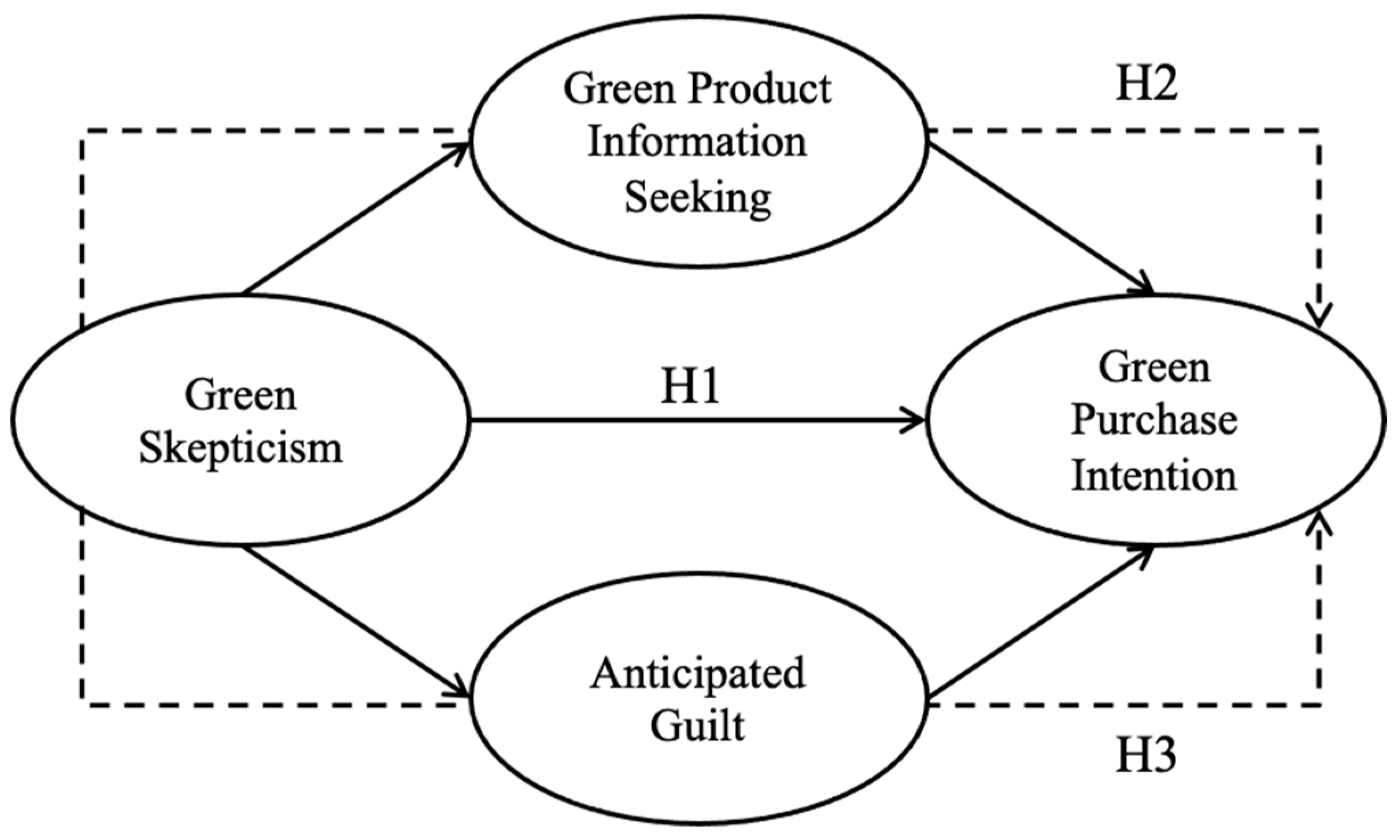
This study aims to examine how green skepticism shapes consumers’ green purchase intention by drawing on Attitude Certainty Theory, the Norm Activation Model, and moral disengagement theory. To this end, we incorporate information-seeking and anticipated guilt as mediating variables in the proposed framework. In contrast to the prevailing view that skepticism primarily stimulates greater cognitive and moral engagement, the model also allows for the possibility that green skepticism may be associated with reduced information seeking and weakened anticipated guilt. Thus, the model accommodates both verification-oriented pathways, in which skepticism stimulates information seeking and moral engagement, and disengagement-oriented pathways, in which skepticism is associated with information avoidance and weakened guilt (Figure 1).

3.2. Hypothesis Development

Building on prior literature, we propose three hypotheses to explain both the direct and indirect effects of green skepticism on green purchase intention.

3.2.1. The Effect of Green Skepticism on Green Purchase Intention

Several studies have indicated that green skepticism has a direct adverse effect on consumers’ purchase intentions. For instance, Mostafa noted that consumers often lack credible evidence to evaluate environmental advertising, leading to the development of skeptical attitudes that undermine their purchase intentions [68]. Similarly, Leonidou and Skarmeas argued that when consumers are skeptical of green products, they tend to discount their environmental performance, thereby reducing their motivation to purchase them for environmental reasons and ultimately lowering their purchase intentions [10]. Nguyen et al. also found that green skepticism directly decreases impulsive green purchase intentions [11]. They attributed this effect to the tendency of skeptical consumers to make negative attributions about corporate motives—for example, assuming that “a company’s actions are inconsistent with its claims”—which disrupts the formation of trust in green advertising and other positive cues, hindering the development of favorable attitudes and purchase intentions [69]. Overall, green skepticism often arises from misunderstandings about green products and from corporate misrepresentation of environmental claims [7]. As a result, skeptical consumers tend to attribute green advertising and product messages to external motives, such as profit maximization or corporate image enhancement [22], further diminishing their willingness to purchase green products. Based on these arguments, we propose the following hypothesis:
H1. 
Green skepticism negatively influences green purchase intention.
This hypothesis reflects the predominant view in the existing literature and serves as a benchmark against which alternative, indirect pathways are evaluated in the present study.

3.2.2. Rationale for Mediators

Incorporating mediating variables is essential for clarifying how and why green skepticism affects green purchase intention. Mediators help illuminate the psychological and behavioral pathways through which skepticism exerts its influence, thereby providing a more theoretically grounded understanding of consumer decision-making. Moreover, including mediators enhances the model’s explanatory power by allowing the present study to move beyond documenting associations [70] toward identifying the underlying mechanisms that shape consumers’ responses to environmental claims.
We posit that when consumers experience green skepticism, they tend to respond through two complementary mechanisms: a behavioral verification response (information-seeking behavior) and an emotional moral-evaluation response (anticipated guilt). These two processes are selected as mediators for the following reasons. First, both mediators are theoretically grounded in prior research as meaningful responses to skepticism. When consumers doubt the credibility of environmental claims, they often cope with this uncertainty by actively seeking additional information to verify or disconfirm such claims [7,10]. Information seeking thus represents a natural behavioral reaction to skepticism and plays a central role in shaping how consumers process environmental cues and evaluate product credibility [34,35,36]. Second, in the context of sustainable consumption, consumers frequently face moral dilemmas [15], as they are expected to fulfill environmental responsibilities while simultaneously bearing personal costs [45,46]. Consumers’ skepticism toward green products may undermine decision certainty, which can heighten individuals’ awareness that their choices do not fully satisfy their perceived moral obligations, thereby strengthening the subjective sense of having potentially committed a moral transgression. In other words, consumers may interpret their inaction as a violation of internal moral standards, which in turn elicits feelings of guilt [15]. Although anticipated guilt has frequently been examined as a standalone predictor, its psychological antecedents—particularly the role of green skepticism in shaping guilt-related moral evaluations—remain underexplored. Examining anticipated guilt as a mediator, therefore, helps clarify how skepticism influences downstream emotional processes that ultimately affect green purchase intention.
Taken together, these two mediators capture the behavioral (information seeking) and emotional (anticipated guilt) pathways through which skepticism may influence consumer decision-making. By integrating both mechanisms, the present study offers a more comprehensive and nuanced explanation of consumer responses to environmental claims under conditions of perceived uncertainty, thereby addressing important gaps in the existing literature. While other psychological and structural mechanisms may also shape responses to green claims, focusing on these two mediators allows us to directly compare verification-oriented and disengagement-oriented pathways of green skepticism within a parsimonious framework.

3.2.3. Green Product Information Seeking as a Potential Mediating Mechanism

Prior research suggests that information seeking plays an important role in consumers’ evaluative processes and purchase decisions, particularly in contexts characterized by uncertainty (e.g., [57]). However, the direction of the relationship between skepticism and information seeking may vary depending on how uncertainty is experienced and evaluated. Much of the existing literature adopts a verification-oriented perspective, proposing that attitude uncertainty motivates individuals to invest greater cognitive effort—such as information seeking—in order to restore subjective certainty. From this perspective, cues that enhance perceived cognitive engagement can strengthen attitude certainty. For example, Karmarkar and Tormala show that expressed certainty increases persuasion not because it signals greater credibility, but because it heightens recipients’ cognitive engagement, particularly when certainty cues violate expectations about source expertise [55]. Similarly, Blankenship et al. demonstrate that attitudes grounded in core personal values enhance attitude certainty by increasing individuals’ subjective sense of having processed counter-attitudinal information deeply [56]. At the same time, emerging evidence suggests that this verification-oriented process is contingent on how uncertainty is experienced. When uncertainty is high, persistent, or perceived as difficult to resolve, individuals may discount the perceived benefits of further cognitive effort, especially under conditions of low information credibility [67]. In such cases, additional information seeking may be viewed as inefficient or even destabilizing, increasing the likelihood of decision reversals rather than improving decision quality [58,71]. Given these competing theoretical perspectives, we advance two competing hypotheses regarding the direction of the relationship between green skepticism and information seeking.
One theoretically plausible possibility is that green skepticism activates information seeking as a means of restoring attitude certainty. It is commonly argued that consumers tend to approach environmental claims with caution and, in the absence of credible evidence, are unlikely to accept them readily [68]. Prior research suggests that skepticism represents an antecedent to attitude strength [72]. Individuals holding skeptical attitudes have not yet determined whether a given claim is accurate, indicating that their attitudes remain unsettled rather than firmly formed [7,10,72,73]. Accordingly, skepticism toward green products does not necessarily stem from strong negative convictions [22] but may instead reflect uncertainty regarding one’s own attitude. Drawing on attitude certainty theory, lower levels of attitude certainty motivate individuals to restore confidence in their evaluations, thereby encouraging more effortful and systematic information processing, such as active information seeking [53]. Prior research suggests that information often helps individuals reduce uncertainty in decision-making contexts; even consumers who are initially skeptical may revise their judgments once reliable information becomes available [73]. Moreover, substantial evidence indicates that reliable information enhances consumers’ ability to evaluate green products accurately, thereby increasing attitude certainty and supporting more informed and deliberate purchase decisions [53,68,73]. In the context of green consumption, green skepticism may in many cases prompt consumers to seek additional information, as those who lack confidence in a product’s environmental performance tend to look for cues that can either substantiate or alleviate their doubts [10]. From this perspective, green skepticism may activate information seeking as a means of restoring attitude certainty. Based on this reasoning, the following hypothesis is proposed:
H2a. 
Green skepticism is expected to be positively associated with green product information seeking.
At the same time, the motivational consequences of skepticism may depend on the degree of attitude uncertainty experienced by consumers. When uncertainty is moderate and perceived as potentially resolvable, skepticism may activate information seeking as a means of restoring evaluative confidence. However, when attitude uncertainty becomes sufficiently high, such that additional information is perceived as difficult to process or unlikely to meaningfully reduce uncertainty, skepticism may instead suppress information seeking.
Prior research has largely focused on contexts in which consumers expect that additional information will reduce uncertainty and thereby increase information search (e.g., [10]), while comparatively less attention has been paid to the possibility that uncertainty may also suppress search behavior. However, emerging research suggests that the relationship between uncertainty and information search is not uniformly positive. For example, He and Rucker propose that uncertainty simultaneously heightens consumers’ accuracy motivations to seek information and their efficiency concerns regarding the time and effort required for further search, giving rise to an inherent accuracy–efficiency tradeoff [57]. When uncertainty is relatively low, this tradeoff is perceived as more favorable, and information search tends to increase. By contrast, when uncertainty becomes sufficiently high, efficiency considerations may come to dominate, as additional gains in accuracy are perceived to entail substantial costs, thereby discouraging further information search [57]. Accordingly, the effect of uncertainty on information seeking may, at least in part, depend on whether consumers perceive further information search as sufficiently useful to justify its cognitive and efficiency costs.
Consistent with this perspective, when consumers perceive the information environment as highly complex or suspect the presence of strategic manipulation such as greenwashing, skeptical attitudes may reduce the perceived usefulness of further information search, a pattern that has been discussed in the information avoidance literature. Information avoidance refers to a tendency to prevent or delay exposure to available but potentially unwanted information [59]. For example, when additional information is perceived as difficult to integrate or lacking clear diagnostic cues, or when it is expected to introduce further confusion, information search may no longer be viewed as a means of clarifying judgments but rather as a cognitive burden [59,61]. Drawing on prospect theory, individuals tend to overweight potential losses relative to equivalent gains and thus are more likely to avoid behaviors that may entail psychological or cognitive burdens [74,75]. When information credibility is low, the time, effort, and psychological costs associated with information seeking may be perceived as outweighing its expected benefits [58]. Importantly, even information that is intended to reduce uncertainty does not necessarily improve decision-making. When uncertainty is only partially resolved, additional information may increase decision reversals—defined as situations in which consumers revise or abandon an initial choice or purchase decision—and undermine decision stability [71]. This is because information that only partially reduces uncertainty may increase consumers’ expectations without providing sufficient clarity to support stable evaluations, thereby increasing the likelihood of decision instability. From this perspective, when attitude uncertainty is experienced as high, persistent, and difficult to alleviate, green skepticism may suppress information seeking rather than motivate further search. Based on this reasoning, the following hypothesis is proposed:
H2b. 
Green skepticism is expected to be negatively associated with green product information seeking.
Taken together, prior research suggests that information seeking is relevant to consumers’ evaluative processes and purchase decisions. From a process perspective, green product information seeking may therefore represent a potential psychological pathway through which green skepticism is linked to green purchase intention.
H2. 
Green product information seeking behavior mediates the relationship between green skepticism and green purchase intention.

3.2.4. Anticipated Guilt as a Potential Mediating Mechanism

Prior research suggests that anticipated guilt plays an important role in shaping consumers’ moral evaluations and subsequent purchase decisions, particularly in the context of sustainable consumption. However, the emotional consequences of green skepticism may vary depending on whether uncertainty allows consumers to perceive their consumption choices as morally consequential. Given these competing psychological pathways, we advance competing hypotheses regarding the relationship between green skepticism and anticipated guilt.
In the context of sustainable consumption, consumers often confront moral dilemmas as they attempt to fulfill environmental responsibilities while simultaneously facing personal costs, such as the price premiums associated with green products [15,45,46,76]. When such moral standards are salient, deviations from them are likely to trigger self-sanctions, such as feelings of guilt or shame [15,76,77,78]. However, when confronted with complex and heterogeneous environmental claims, individuals may find it difficult to assess their credibility and to determine whether such claims reliably signal actual environmental performance [7]. Under conditions of such uncertainty, individuals may become aware that their consumption choices might fall short of their perceived moral obligations, thereby increasing the salience of potential moral transgressions. This tension has been conceptualized as the “dilemma of not buying green products,” which captures the experience of being aware of environmental problems yet refraining from what is perceived as appropriate action, thereby eliciting anticipated guilt [15]. According to the Norm Activation Model (NAM), anticipated guilt is more likely to be activated when individuals become aware of the consequences of their actions and perceive personal responsibility for those consequences [41,79]. This emotional response is consistent with prior research indicating that guilt tends to arise when individuals perceive a discrepancy between their moral obligations and their actual behavior [38,41]. Accordingly, green skepticism may intensify consumers’ anticipated guilt by heightening perceptions that their moral responsibilities related to sustainable consumption remain unmet.
In the green marketing literature, numerous scholars suggest that consumers may seek to purchase green products to avoid guilt [13,14,15,40,41]. Humans are inherently motivated to view themselves as moral individuals. When this moral self-image is threatened, individuals are likely to experience internal conflict—such as feelings of guilt—and to seek ways to alleviate this discomfort [40]. Guilt is an emotion commonly accompanied by a desire to correct one’s behavior or to make amends for perceived wrongdoing [39,65]. Individuals who experience guilt are therefore motivated to engage in specific actions to reduce the associated psychological discomfort [15]. More specifically, guilt has been linked to problem-focused coping strategies, whereby individuals attempt to regulate or modify their behavior in order to address the source of the emotion [42]. Accordingly, anticipated guilt may motivate individuals to consider corrective actions aimed at restoring their moral self-image, which can include, but is not limited to, engaging in green consumption [39,40]. In this sense, green skepticism may heighten anticipated guilt by increasing consumers’ sensitivity to potential moral shortcomings associated with non-green consumption (e.g., [13,14,15]). Based on this reasoning, the following hypothesis is proposed:
H3a. 
Green skepticism is expected to be positively associated with anticipated guilt regarding non-green consumption.
However, in the context of sustainable consumption, moral beliefs do not always translate into consistent action. Prior research indicates that moral standards do not necessarily function as absolute constraints on behavior; rather, individuals may selectively employ psychosocial strategies that weaken moral self-sanctions [80]. As a result, individuals who express environmental concern do not necessarily engage in corresponding pro-environmental actions [76]. Moral disengagement refers to a set of cognitive strategies that allow individuals to decouple moral standards from their behavior, thereby reducing feelings of guilt or self-reproach [66]. Within the Norm Activation Model, moral disengagement can be understood as a defensive mechanism that attenuates individuals’ perceptions of the moral relevance of their own behavior, thereby weakening the activation of self-sanctioning emotions [15,76,79].
It is important to note that green skepticism is conceptually distinct from moral disengagement. We draw on moral disengagement theory solely to explain why green skepticism may alleviate anticipated guilt by increasing moral ambiguity prior to action. Some prior research has conceptualized moral disengagement as a post hoc coping mechanism that alleviates guilt after discrepancies between behavior and moral standards have emerged (e.g., [15]). However, emerging research suggests that moral disengagement may extend beyond a purely post hoc mechanism and function as a broader cognitive orientation shaping moral judgment in morally ambiguous contexts [67]. Moral disengagement is rooted in cognitive theory and conceptualized as a generalized cognitive orientation [74,79]. Accordingly, when the moral implications of behavior are unclear or contested, such contexts may facilitate the activation of moral disengagement, which in turn can attenuate the likelihood or intensity of anticipated guilt. In this vein, green skepticism may create a morally ambiguous evaluative context in which moral disengagement is more likely to be enacted prior to action.
Within the Norm Activation Model, anticipated guilt is often conceptualized as an important self-sanctioning emotion [41], particularly when the moral meaning of the behavior is perceived as clear rather than ambiguous or contested. However, when consumers question the authenticity, effectiveness, or environmental benefits of green products (e.g., green skepticism), the clarity of behavioral consequences and the certainty of responsibility attribution may be reduced. Under such conditions, efforts to clarify the consequences of one’s behavior (such as the information-seeking activities discussed above) may be perceived as cognitively costly and of limited utility, such that their perceived cost–benefit ratio is diminished and the expected benefits of further action are discounted [57,59,73]. Consequently, loosening moral self-restraints becomes a cognitively less demanding coping response, allowing individuals to attenuate the perceived moral relevance of their choices without engaging in further effortful evaluation. In other words, green skepticism does not constitute moral disengagement per se, but rather represents a contextual source of moral ambiguity that weakens the clarity of moral evaluation prior to action.
From this perspective, green skepticism represents a source of moral uncertainty that may increase the likelihood of moral disengagement prior to action. When the clarity of behavioral consequences and personal responsibility is undermined, individuals may more readily disengage from moral self-sanctions, thereby attenuating the anticipatory moral appraisal that gives rise to guilt. As a result, anticipated guilt regarding non-green consumption may be attenuated. Taken together, these considerations suggest that green skepticism may either heighten anticipated guilt by making moral standards more salient (H3a) or, under conditions of moral ambiguity, attenuate anticipated guilt via moral disengagement processes (H3b). Based on this reasoning, the following hypothesis is proposed:
H3b. 
Green skepticism is expected to be negatively associated with anticipated guilt regarding non-green consumption.
Taken together, prior research suggests that anticipated guilt is relevant to consumers’ moral evaluations and subsequent purchase decisions. From a process perspective, anticipated guilt may therefore represent a potential psychological pathway through which green skepticism is linked to green purchase intention.
H3. 
Anticipated guilt mediates the relationship between green skepticism and green purchase intention.


4. Methodology

4.1. Data Collection and Sample

To test the proposed hypotheses, this study employed statistical analyses based on questionnaire data. The survey was conducted online from 10 to 20 September 2025 via Questionnaire Star, a professional Chinese survey platform that provides paid access to qualified respondents. The platform maintains a large national panel of adult consumers. It stratifies invitations by age, gender, and region, which helps approximate the demographic composition of the urban population in mainland China. A total of 575 responses were collected, and after excluding invalid responses (i.e., questionnaires with more than 20% of items unanswered), 511 valid cases remained for analysis, yielding a valid response rate of 88.9% (approximately 89%), indicating a satisfactory level of data quality. In addition, two instructed-response (attention-check) items were embedded in the questionnaire, and cases that failed either attention check or completed the survey in less than one-third of the median completion time were removed. These procedures helped to provide initial assurance regarding the quality and reliability of the final dataset. The demographic characteristics of the sample are summarized as follows. Among the 511 respondents, 43.1% were male and 56.9% were female. In terms of age distribution, 15.1% were between 18 and 25 years old, 59.9% were between 26 and 35 years old, 20.2% were between 36 and 45 years old, 3.1% were between 46 and 55 years old, and 1.8% were aged 56 or above. Regarding educational background, the majority of participants (88.8%) held or were pursuing an undergraduate degree.

4.2. Measurement Instruments

The final questionnaire consisted of two sections. The first section collected demographic information, including gender, age, income, occupation, education level, and marital status. The second section included items measuring the study’s key constructs: Green Skepticism (GS), Green Product Information Seeking (GPIS), Anticipated Guilt (AG), and Green Purchase Intention (GPI). Data were collected using a structured questionnaire. All measurement items were adapted from well-established scales in prior research and were revised where necessary to ensure contextual relevance. All constructs were measured using five-point Likert scales ranging from 1 (“strongly disagree”) to 5 (“strongly agree”). The English source items were translated into Chinese using a standard back-translation procedure: two bilingual researchers independently translated and back-translated the items, and discrepancies were resolved through discussion to ensure semantic equivalence. Green Skepticism was measured using four items adapted from Goh and Balaji [7]. Green Product Information Seeking behavior was assessed using five items adapted from Leonidou and Skarmeas [10] and Dholakia [81]. Anticipated Guilt was measured using four items adapted from Jiang et al. [82] and Steenhaut and Van Kenhove [40]. Green Purchase Intention was assessed using five items adapted from Goh and Balaji [7] and Chen and Deng [23,49].

5. Analysis and Results

5.1. Measurement Model

5.1.1. Common Method Bias and Preliminary Analyses

To assess the presence of common method bias (CMB), Harman’s single-factor test was conducted according to the procedure recommended by Podsakoff and Organ [83]. All measurement items were entered into an unrotated exploratory factor analysis. The results revealed four factors with eigenvalues greater than 1, collectively accounting for 61.35% of the total variance. The first factor explained 30.56% of the variance, which is well below the commonly accepted threshold of 50%. To further examine the potential impact of common method bias, a confirmatory factor analysis (CFA) was conducted using a single-factor model, with all items loading onto a single latent factor. This model exhibited poor fit (e.g., CFI = 0.604, GFI = 0.713, RMSEA = 0.146, χ2/df = 11.848), indicating that a single latent factor could not adequately account for the observed covariance among the measures. Taken together, the results of Harman’s test and the poor fit of the single-factor model suggest that common method bias is unlikely to pose a serious threat to the validity of this study’s findings.
To further ensure the reliability and validity of the measurement scales, subsequent data analyses were conducted using IBM SPSS Statistics 30 and IBM SPSS AMOS 30, following established procedures [10]. First, item–total correlations were examined to assess the internal consistency of each scale. Subsequently, confirmatory factor analysis (CFA) was performed to evaluate construct validity. Descriptive statistics and bivariate correlations are reported in Table 1. Following the rule of thumb that collinearity may be a concern when the absolute value of Pearson correlation coefficients approaches 0.8 [84], none of the observed correlations reached this level, suggesting that excessively high intercorrelations were unlikely.

5.1.2. Convergent Validity and Reliability

Confirmatory factor analysis (CFA) was conducted in IBM SPSS AMOS 30 using the Graphics interface to examine the measurement model. The results indicated an acceptable model fit (χ2 = 186.349, df = 98, CFI = 0.969, GFI = 0.957, TLI = 0.962, RMSEA = 0.042, SRMR = 0.034, and χ2/df = 1.902). Table 2 summarizes the results of the reliability and validity analyses. Except for Green Purchase Intention, all constructs demonstrated satisfactory internal consistency, with Cronbach’s alpha and composite reliability (CR) values exceeding the commonly recommended threshold of 0.70 [85,86]. Although the CR value of Green Purchase Intention did not exceed the recommended threshold of 0.70, it remained above 0.60, which is generally regarded as acceptable in exploratory or early-stage research [86].
The construct of Green Purchase Intention was initially measured using five items adapted from established scales [7,49]. However, when all items were modeled as individual indicators, both the AVE (0.28) and CR (0.66) were below recommended thresholds, suggesting substantial item-level measurement error. To address the relatively weak item-level psychometric properties while maintaining conceptual coherence, item parceling was employed following established methodological recommendations [87,88]. Specifically, the five Green Purchase Intention items were combined into three parcels based on content similarity and factor loadings: GPI items 1 and 5 were averaged to form Parcel 1, items 2 and 4 were averaged to form Parcel 2, and item 3 was retained as a single-indicator parcel. Unidimensionality of the Green Purchase Intention construct was first verified through CFA, which indicated an acceptable fit to a single-factor measurement model (χ2/df = 3.210, CFI = 0.964, GFI = 0.988, TLI = 0.927, RMSEA = 0.066, SRMR = 0.032). The parceling procedure resulted in more stable psychometric properties (CR = 0.69; AVE = 0.43). While parceling can improve model stability and overall fit, it may also obscure item-level heterogeneity and should therefore be viewed as a pragmatic rather than an ideal solution. The implications of this modeling choice are further examined through sensitivity analyses reported in the results section.
Regarding convergent validity, although several AVE values did not reach the conventional threshold of 0.50, prior methodological research suggests that AVE values above 0.40 may still be considered tolerable when composite reliability exceeds 0.60, particularly in applied or exploratory research contexts [85]. In line with these recommendations, slightly lower AVE values were retained to preserve the conceptual breadth of the constructs and avoid discarding substantively important indicators. Nevertheless, these relatively low AVE values indicate limited convergent validity and should be interpreted with caution. Taken together, these results suggest that the measurement model demonstrates acceptable internal consistency and a reasonable—though not optimal—level of construct validity, providing a cautious basis for subsequent structural analyses.

5.1.3. Discriminant Validity

Discriminant validity was first examined using the Fornell–Larcker criterion [85]. As reported in Table A1 in Appendix A, the square roots of average variance extracted (AVE) for most constructs exceeded the corresponding inter-construct correlations, providing initial support for discriminant validity. However, the correlation between GPIS and GPI (r = 0.728) exceeded √AVE for GPI (0.657), indicating that the Fornell–Larcker criterion was not met for this construct pair and suggesting potential conceptual overlap. Given that the Fornell–Larcker criterion typically provides only initial evidence of discriminant validity [89], this study further employed the heterotrait–monotrait ratio (HTMT) to assess discriminant validity. HTMT has been proposed as a more reliable criterion for detecting discriminant validity issues and has been recommended in seminal methodological research [86]. HTMT values below 0.85 (conservative) or 0.90 (lenient) were considered indicative of adequate discriminant validity [86]. As shown in Table 3, all HTMT values ranged from 0.27 to 0.73, well below both thresholds, supporting acceptable discriminant validity among all constructs.
To provide additional model-level evidence for discriminant validity, a series of alternative confirmatory factor models were estimated and compared with the hypothesized four-factor model, following established competing-model CFA procedures [90]. As shown in Table A2 in Appendix A, the four-factor model demonstrated the best overall fit to the data (χ2/df = 1.902, CFI = 0.969, TLI = 0.962, RMSEA = 0.042, SRMR = 0.034). All alternative models exhibited poorer model fit, as reflected in lower CFI and TLI values and higher RMSEA and SRMR values. In addition, decreases in CFI were observed for all alternative models relative to the four-factor model (ΔCFI ranging from 0.024 to 0.392), all exceeding the commonly recommended cutoff of 0.01 for meaningful differences in model fit [91]. These results indicate a clear deterioration in model fit when theoretically distinct constructs were combined. Taken together, the Fornell–Larcker criterion, HTMT analysis, and competing-model CFA jointly suggest that the focal constructs are empirically distinguishable, albeit with some overlap between closely related constructs such as GPIS and GPI.

5.2. Structural Model

The structural model was estimated using the maximum likelihood method in IBM SPSS AMOS 30. Bootstrapping with 5000 resamples was employed to generate robust standard errors and bias-corrected 95% confidence intervals for indirect effects. The model demonstrated an acceptable fit to the data (χ2 = 381.740, df = 183, CFI = 0.942, GFI = 0.939, TLI = 0.927, SRMR = 0.076, RMSEA = 0.046, χ2/df = 2.085), indicating that the proposed structural relationships adequately represent the observed data. The model explained 16.8% of the variance in green product information seeking (R2 = 0.17), 10.2% in Anticipated Guilt (R2 = 0.10), and 53.1% in Green Purchase Intention (R2 = 0.53), suggesting modest to substantial explanatory power across the endogenous constructs.
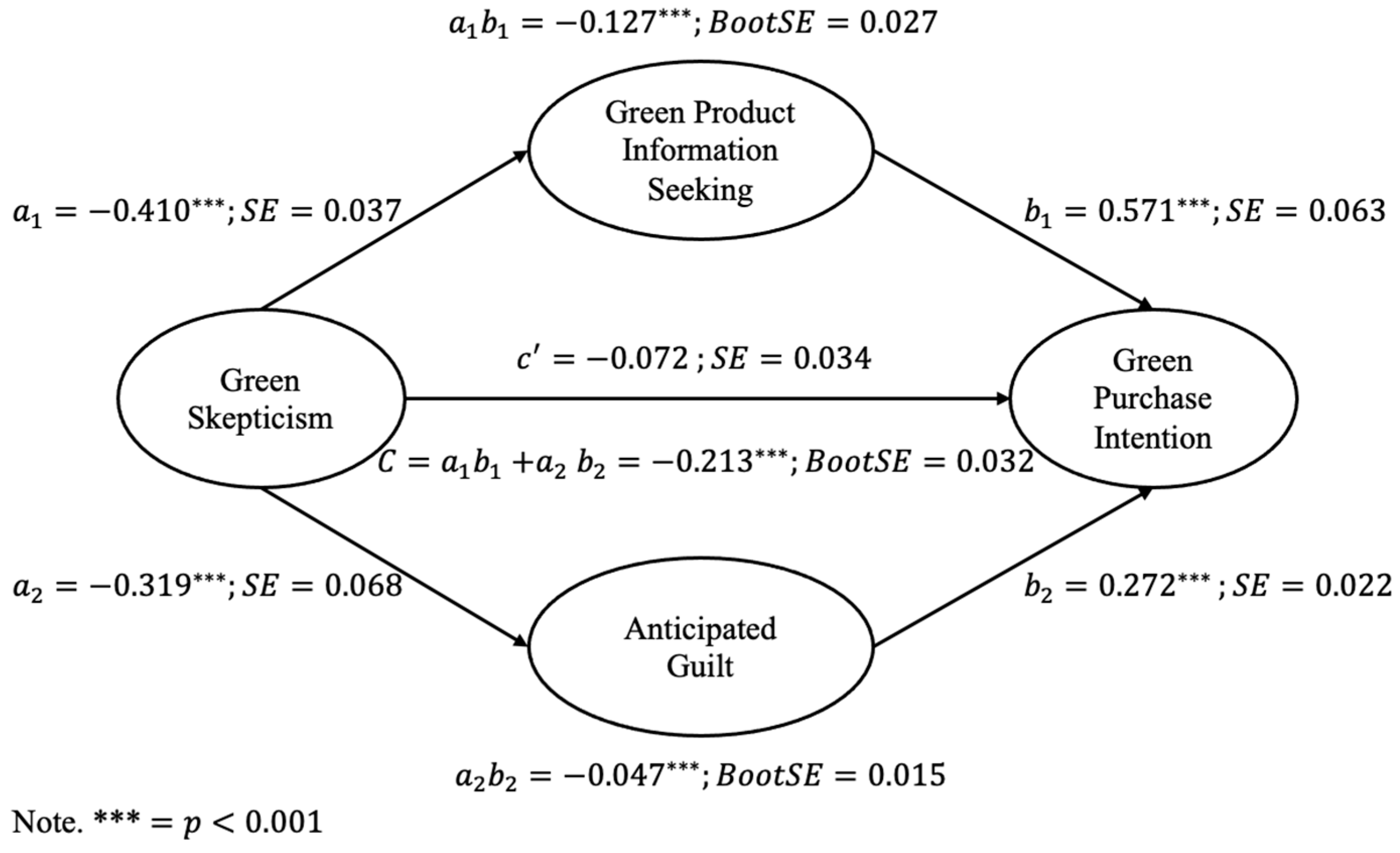
Table 4 presents all structural paths, including both hypothesized and control variables. Among the control variables, only job exerted a significant positive effect on Green Purchase Intention (β = 0.149, t = 2.718). In contrast, gender, years, income, marital status, and education level did not show significant effects. Regarding the hypothesized relationships, the direct path from Green Skepticism to Green Purchase Intention was negative but nonsignificant (β = −0.072, t = −1.147), providing no support for H1. Green skepticism had significant negative effects on green product information seeking (β = −0.410, t = −6.640, p < 0.001) and anticipated guilt (β = −0.319, t = −5.933, p < 0.001), indicating that higher levels of skepticism are associated with reduced information-seeking behavior and weaker anticipated guilt. Both mediating variables exerted significant positive effects on Green Purchase Intention: Green Product Information Seeking (β = 0.571, t = 8.156, p < 0.001) and Anticipated Guilt (β = 0.272, t = 5.249, p < 0.001).

5.3. Mediation Analysis

Bootstrapping analysis (5000 resamples; 95% bias-corrected confidence intervals) was conducted to examine the indirect effects of green skepticism on green purchase intention. The indirect effect through green product information seeking was significant and negative (β = −0.127, Boot SE = 0.027, 95% BC CI [−0.187, −0.082], p < 0.001), indicating that higher levels of green skepticism reduce information seeking, which in turn lowers green purchase intention. Consistent with the competing hypothesis (H2b), this finding suggests that green skepticism is associated with a disengagement-oriented pattern, characterized by lower levels of information-seeking behavior rather than heightened verification-oriented engagement. Similarly, the indirect effect through anticipated guilt was significant and negative (β = −0.047, Boot SE = 0.015, 95% BC CI [−0.082, −0.023], p < 0.001). This result supports the competing hypothesis (H3b), indicating that higher levels of skepticism are linked to weaker guilt-based moral motivation, potentially reflecting reduced clarity in moral evaluation prior to action. The total indirect effect of green skepticism on green purchase intention was −0.174 (Boot SE = 0.031, 95% BC CI [−0.245, −0.121], p < 0.001), and the total effect was −0.213 (Boot SE = 0.032, 95% BC CI [−0.279, −0.153], p < 0.001), indicating that the overall negative influence of green skepticism on green purchase intention is primarily transmitted through the two mediating mechanisms. Taken together, these results provide convergent evidence that the association between green skepticism and green purchase intention is primarily indirect, and is characterized by reduced cognitive engagement and weaker moral motivation, rather than by a direct relationship. Detailed results are presented in Table 5 and Figure 2.
Taken together, the structural model yields a coherent pattern of results regarding the role of green skepticism in green purchase intention. The direct effect of green skepticism on green purchase intention was negative but statistically nonsignificant, and thus H1 was not supported. In contrast, green skepticism exhibited significant indirect effects through both mediating variables. Specifically, higher levels of green skepticism were associated with lower levels of green product information seeking and anticipated guilt, both of which were positively related to green purchase intention. These findings are consistent with the competing hypotheses (H2b and H3b), indicating that the influence of green skepticism on green purchase intention is transmitted indirectly through these mediating mechanisms rather than through a direct effect.

5.4. Sensitivity Analysis

To examine whether the use of item parceling may have influenced the estimated structural relationships, a sensitivity analysis was conducted by comparing the primary parceled model with an alternative item-level specification. This comparison was intended to assess the extent to which the direction and statistical significance of the key structural paths were robust to alternative measurement operationalizations.
As shown in Table A3 in Appendix B, the results are broadly consistent across the two specifications. In both models, the direct association between green skepticism and green purchase intention remained non-significant (parceled model: β = −0.072, p = 0.251; item-level model: β = −0.087, p = 0.190). The negative relationship between green skepticism and green product information seeking was statistically significant and identical in magnitude across specifications (β = −0.410, p < 0.001). Similarly, the positive effects of green product information seeking (β = 0.571 vs. 0.596, both p < 0.001) and anticipated guilt (β = 0.272 vs. 0.283, both p < 0.001) on green purchase intention were observed consistently in both models. Overall, the comparison does not indicate substantive changes in the direction or statistical significance of the key structural paths as a function of the parceling strategy.
Consistent with the previously noted concerns regarding convergent validity at the item level, the item-level specification was therefore considered a complementary sensitivity check rather than a preferred measurement model. Nevertheless, both specifications exhibited acceptable overall structural model fit, with only minor differences in fit indices (parceled model: CFI = 0.942, TLI = 0.927, SRMR = 0.076, RMSEA = 0.046, χ2/df = 2.085; item-level model: CFI = 0.933, TLI = 0.918, SRMR = 0.073, RMSEA = 0.045, χ2/df = 2.049). In addition, the indirect associations via green product information seeking and anticipated guilt were not sensitive to the alternative measurement specification, indicating that the primary conclusions regarding the proposed indirect relationships were broadly consistent across the two models.

5.5. Supplementary Analysis: Demographic Heterogeneity

Within the current sample, we conducted supplementary analyses to examine potential variation in the focal relationships across selected socio-demographic characteristics (see Table A4 in Appendix B). Although a small number of interaction terms attain statistical significance, these effects are not consistent across outcomes and contribute limited additional explanatory power. Accordingly, these analyses are intended to be descriptive rather than definitive. The main effects observed in the primary analyses remain broadly comparable across specifications, but the findings should be interpreted cautiously and within the boundaries of the sampled population.

6. Discussion

6.1. Interpretation of Findings

This study examined how green skepticism influences consumers’ green purchase intention by integrating both cognitive and emotional pathways. Overall, the results indicate that green skepticism does not exert a significant direct effect on green purchase intention. Instead, its influence operates primarily through two indirect pathways, whereby higher skepticism is associated with lower green product information seeking and weaker anticipated guilt, both of which in turn reduce green purchase intention. These findings suggest that green skepticism affects green purchase decisions by disrupting underlying psychological processes rather than by directly shaping purchase intentions.
First, the results show that the direct relationship between green skepticism and green purchase intention is negative but statistically nonsignificant. This finding contrasts with earlier research reporting a significant negative association between green skepticism and green purchase intention [10,11,68]. One possible explanation lies in changes in the contemporary green product landscape. Earlier generations of green products were often perceived as inferior in functional performance [92], leading consumers to rely more on the credibility of environmental claims when forming purchase intentions. In contrast, recent evidence suggests that consumers are increasingly emphasizing product quality, prompting manufacturers to improve the functional performance of green products [15]. As a result, many green products now match—or even surpass—conventional alternatives in terms of performance, safety, and reliability [93]. As functional attributes become more salient, consumers may rely less on environmental claims when evaluating purchase options. Consequently, even skeptical consumers may still consider purchasing green products if they perceive them as functionally satisfactory, which may help explain the absence of a significant direct effect. In addition, this emphasis on functional performance may also be relevant for understanding the observed disengagement pathways. When functional attributes become particularly salient, consumers may rely more heavily on rational, utilitarian evaluations [94] and place less emphasis on moral considerations. Utilitarian reasoning emphasizes product performance, reliability, and functional benefits [42], and functional value remains an important determinant of green product choice, even among consumers with strong pro-environmental beliefs [94]. In such contexts, moral considerations may become less central to purchase judgments, and engagement with product information aimed at evaluating green attributes may be perceived as less instrumental.
Second, the results reveal a significant negative relationship between green skepticism and green product information seeking. Contrary to the dominant skepticism-as-verification view, this finding suggests that skepticism does not uniformly motivate consumers to engage in further information search. Importantly, this result does not imply that skepticism inherently discourages cognitive engagement; rather, it highlights the context-dependent nature of skepticism’s motivational consequences. Prior research has primarily examined settings in which consumers reasonably expect that additional information can reduce uncertainty and improve judgment accuracy (e.g., [10]). Such accounts implicitly assume that environmental information is perceived as sufficiently diagnostic and that uncertainty is, at least in principle, resolvable through further search. Under such conditions, skepticism may activate information seeking as a means of restoring evaluative confidence. However, this assumption may be less applicable in information environments characterized by high complexity and limited diagnostic clarity. In environments marked by high uncertainty and questioned information credibility, information seeking may be perceived as cognitively costly and emotionally unrewarding [59], for instance, due to information overload or difficulties in distinguishing authentic information from strategically exaggerated claims [61]. When uncertainty is experienced as persistent rather than resolvable, additional information is less likely to be perceived as instrumental for decision improvement. Drawing on the accuracy–efficiency tradeoff perspective, when uncertainty is perceived as persistent and difficult to resolve, the marginal benefits of further information search may be discounted relative to its cognitive and emotional costs [74,75]. From an interpretive standpoint, this pattern suggests that skepticism, in information environments where environmental claims are perceived as difficult to verify, and information credibility is questioned, is less likely to motivate systematic verification and more likely to constrain further cognitive investment. Rather than motivating consumers to “think harder,” green skepticism in such contexts may encourage cognitive disengagement and information avoidance as a means of conserving cognitive resources in the face of unresolved uncertainty. This disengagement-oriented response at the cognitive level is conceptually consistent with the attenuation of moral engagement observed in the emotional pathway discussed below.
Third, the results indicate that green skepticism is negatively associated with anticipated guilt, whereas anticipated guilt is positively associated with green purchase intention. In the context examined in the present study, once activated, anticipated guilt appears to function as an important self-regulatory moral emotion and is associated with higher levels of green purchase intention, in line with prior research grounded in the Norm Activation Model [41]. When individuals anticipate guilt associated with environmentally irresponsible behavior, this negative self-conscious emotion is typically accompanied by tendencies toward corrective or norm-consistent behavior [65], underscoring the importance of anticipated guilt in pro-environmental consumption. At the same time, the present results do not challenge the motivational role of anticipated guilt per se. Rather, they suggest that the activation of guilt may be contingent on the clarity of moral evaluation, which can be undermined under conditions of heightened skepticism. The present study finds a significant negative association between green skepticism and anticipated guilt. One possible explanation is that skepticism is associated with lower confidence in the authenticity, effectiveness, or meaningfulness of green products [10], which may increase uncertainty about the moral relevance of consumption choices and contribute to greater moral ambiguity within the decision context. Existing research suggests that when the environmental consequences of consumption choices are perceived as unclear or contested, individuals may find it more difficult to clearly attribute responsibility to themselves [95]. From this perspective, skepticism toward green product claims makes it more difficult for consumers to clearly delineate responsibility, thereby creating a context of moral ambiguity that may be closely related to moral disengagement. Moral disengagement allows individuals to rationalize their own wrongdoing and to avoid self-sanctions, thereby alleviating feelings of guilt and self-condemnation [15]. In addition, ambiguity in perceptions of consequences and responsibility, together with the attenuation of moral self-sanctions, may help reduce consumers’ psychological costs, potentially providing conditions conducive to this process [65,66,79]. In the context examined in this study, skepticism toward green product claims may therefore be accompanied by lower clarity in moral evaluation and a weaker motivation to engage in effortful moral reasoning, which in turn is associated with lower levels of anticipated guilt.

6.2. Theoretical Contributions

This study offers several theoretical contributions to the literature on green skepticism and sustainable consumption. The core contribution lies in documenting an empirically observed disengagement-oriented response pattern associated with green skepticism, offering an alternative perspective to the dominant verification-oriented account in prior research. Rather than functioning primarily as a cue for diagnostic information search, skepticism in the present context is associated with lower levels of information seeking and weaker guilt-based moral responses.
First, this study advances discussions on the relationship between skepticism and information processing in green markets. Prior research has typically conceptualized skepticism as a motivational cue that encourages consumers to seek additional evidence and engage in more systematic information processing, under the assumption that further information search can reduce uncertainty and improve judgment accuracy. However, the present findings show a significant negative association between green skepticism and green product information seeking, indicating that skepticism does not uniformly motivate further information search across contexts. From an interpretive perspective, this result highlights the context-dependent nature of the motivational consequences of skepticism. In information environments where environmental claims are widely perceived as difficult to compare, strategically exaggerated, and lacking clear diagnostic value, uncertainty is more likely to be experienced as persistent and difficult to resolve through additional search. Under such conditions, further information acquisition may not be perceived as instrumental for improving decisions, but instead may be viewed as cognitively costly and emotionally unrewarding. Accordingly, skepticism in such information environments may be more likely to co-occur with reduced cognitive investment and information avoidance, rather than with systematic verification-oriented information search.
Second, this study extends research on emotional processes in green consumption by examining the association between green skepticism and anticipated guilt. While anticipated guilt has been widely recognized as an important correlate of pro-environmental behavior, comparatively less attention has been devoted to its antecedents. The present findings indicate a significant negative association between skepticism toward environmental claims and anticipated guilt. This pattern highlights how skepticism may be associated with reduced clarity in moral evaluation and responsibility attribution, and is theoretically consistent with accounts of moral disengagement. In this sense, the findings suggest that skepticism may be associated with weaker guilt-based moral motivation, potentially limiting the role of anticipated guilt in shaping green purchase intention.
Third, by integrating cognitive (information seeking) and emotional (anticipated guilt) pathways within a unified analytical framework informed by Attitude Certainty Theory, the Norm Activation Model, and moral disengagement theory, this study offers a more integrative account of how green skepticism relates to sustainable consumption. The results indicate that green skepticism is not directly associated with green purchase intention but is associated with lower purchase intention in conjunction with its negative associations with information seeking and anticipated guilt. Together, these findings suggest that cognitive and moral disengagement represent complementary manifestations of a common response orientation to skepticism, rather than isolated or unrelated mechanisms.

6.3. Practical Contributions

The dual cognitive and emotional pathways identified in this study offer several practical implications for managers, policymakers, and institutions seeking to promote sustainable consumption. First, because green skepticism is associated with lower motivation to seek environmental information, firms may not be able to rely on skeptical consumers to actively verify green claims. Instead, managers are encouraged to reduce the perceived cost of verification by providing clear, standardized, and easily accessible information. Transparent disclosures, third-party certifications, traceable supply chain information, and simplified eco-labels—potentially supported by digital tools such as QR codes—may help reduce uncertainty and mitigate tendencies toward information avoidance. Policymakers may further support these efforts by standardizing eco-labeling practices and strengthening oversight of misleading environmental claims.
Second, the findings indicate that green skepticism is associated with weaker anticipated guilt, a factor that has traditionally been regarded as an important moral driver of green purchase intention. Importantly, this attenuation of guilt does not necessarily imply a decline in green purchasing itself. Instead, it suggests a shift in the underlying decision logic: when moral emotions such as guilt are less salient, consumers may rely more heavily on functional and utilitarian evaluations in their purchase decisions. From a managerial perspective, this implies that green consumption in highly skeptical contexts is less likely to be driven by moral obligation and more likely to be influenced by assessments of product performance, quality, and practical value. Accordingly, firms may benefit from emphasizing functional benefits alongside environmental attributes when developing and communicating green products. At the same time, demonstrating genuine, tangible societal contributions may provide a credible basis for function-oriented consumers to justify green purchasing decisions, even in the absence of strong guilt-based motivation.
A third practical implication concerns how to address green skepticism. The findings of this study indicate that higher levels of green skepticism are associated with information avoidance and weakened moral motivation, both of which may undermine green purchase intention. Importantly, these results do not suggest that skepticism should be eliminated; instead, they highlight the potential risks of leaving skepticism unmanaged. Because skepticism may reduce consumers’ willingness to seek information and respond to moral appeals, strategies that rely solely on moral persuasion or assume active consumer verification may be less effective in skeptical contexts. Instead, firms and policymakers may benefit from minimizing the likelihood that skepticism translates into cognitive disengagement, for instance, by improving the credibility, consistency, and verifiability of environmental information, which prior research suggests can foster consumer involvement and cognitive elaboration [55]. By lowering the effort required to evaluate green claims and increasing perceived information quality, such approaches may help prevent skepticism from translating into withdrawal from the decision process, thereby supporting more evidence-based and function-oriented evaluations.

6.4. Limitations and Future Research

This study has several limitations that suggest avenues for future research. First, our cross-sectional design, reliance on self-reported measures, and focus on intention rather than actual purchasing behavior limit the strength of causal inferences that can be drawn from the proposed pathways. Longitudinal or experimental designs, as well as behavioral data, would be valuable to establish temporal ordering and to test whether changes in skepticism causally shape information seeking, anticipated guilt, and subsequent green purchasing.
Second, our model emphasizes green skepticism, information seeking, and anticipated guilt as the primary psychological mechanisms linking environmental claims to green purchase intention. However, competing theoretical perspectives may also account for the observed negative associations. For example, motivated reasoning, perceived behavioral control constraints, and structural barriers such as price, availability, and quality trade-offs can independently reduce both information search and pro-environmental emotions, even in the absence of strong skepticism. Because we did not explicitly model variables such as perceived greenwashing frequency, generalized distrust, or resource constraints, some of the effects attributed to skepticism and anticipated guilt in our model may partly reflect broader cynicism or pragmatic trade-offs in consumers’ everyday decision-making. Future research should incorporate and compare these alternative explanations by including such constructs and by testing whether they moderate or mediate the relationships examined here.
Third, the measurement properties of some key constructs warrant caution. Although composite reliability indices were acceptable, the AVE values for GPIS and GPI were below conventional thresholds, and item parceling was used for GPI to improve model fit. Our supplementary analyses indicate that the main structural paths are robust to alternative measurement specifications, yet the relatively low AVE suggests that future studies should develop and validate more psychometrically robust scales for information seeking and green purchase intention in green skepticism contexts.
Finally, the data were collected from a non-probability sample of Chinese consumers and may over-represent relatively young, educated, and environmentally aware individuals. Institutional features of the Chinese context—such as regulatory inconsistencies and high perceived greenwashing—also limit the generalizability of our findings to other markets. Subsequent research should examine whether the disengagement-oriented pathways identified here replicate across different countries, institutional regimes, and consumer segments, and should employ more diverse and representative sampling strategies.

7. Conclusions

This study examined the association between green skepticism and green purchase intention by integrating cognitive and moral–emotional mechanisms within a parallel mediation framework. Using survey data from 511 Chinese consumers and structural equation modeling, the results show that green skepticism has no significant direct association with green purchase intention but is indirectly associated with lower purchase intention via lower green product information seeking and weaker anticipated guilt, both of which are positively related to purchase intention. These findings help reconcile mixed evidence in prior research by suggesting that the influence of skepticism is primarily reflected in underlying psychological processes rather than a simple direct deterrent relationship. Theoretically, the results challenge the dominant “skepticism-as-verification” view by indicating that, in skeptical market environments, uncertainty may be associated with reduced information-seeking motivation and weaker guilt-based self-regulation. By integrating attitude certainty considerations with norm-based moral–emotional processes, this study offers a more nuanced account of how skepticism may contribute to information avoidance and attenuated moral motivation in sustainable consumption. From a practical standpoint, addressing green skepticism likely requires credibility-based interventions—such as transparent, verifiable environmental information and strengthened third-party certification—rather than conventional persuasive or moral appeals.

Author Contributions

Conceptualization, S.Z. and E.S.; methodology, S.Z. and E.S.; software, S.Z.; formal analysis, S.Z.; investigation, S.Z. and E.S.; resources, S.Z. and E.S.; data curation, S.Z.; writing—original draft preparation, S.Z.; writing—review and editing, S.Z. and E.S.; supervision, E.S.; project administration, E.S.; funding acquisition, E.S. All authors have read and agreed to the published version of the manuscript.

Funding

This work was supported by JSPS KAKENHI, grant number 23K01647.

Institutional Review Board Statement

This study was conducted according to the guidelines of the Declaration of Helsinki and approved by the Research Ethics Committee of Hiroshima University (protocol code HR-LPES-003245 and date of approval: 5 September 2025).

Informed Consent Statement

Informed consent was obtained from all participants through implied consent prior to their participation in the study.

Data Availability Statement

The data presented in this study are available on request from the corresponding author due to privacy and ethical restrictions.

Acknowledgments

The authors have reviewed and edited the output and take full responsibility for the content of this publication.

Conflicts of Interest

The authors declare no conflicts of interest.

Appendix A

Table A1. Discriminant Validity (Fornell–Larcker Criterion).
ConstructsGSGPISAGGPI
GS0.715
GPIS0.5620.632
AG0.2780.3640.790
GPI0.3610.7280.5370.657
Note: Diagonal elements (in bold) represent the square roots of average variance extracted (AVE). Off-diagonal elements represent inter-construct correlations.
Table A2. Results of alternative confirmatory factor analyses.
ModelDescriptionχ2/dfCFITLIRMSEASRMR C F I
M1Four-factor model1.9020.9690.9620.0420.034-
M2GPIS + AG combined5.4510.8420.8130.0930.0790.127
M3GPIS + GPI combined2.5590.9450.9340.0550.0420.024
M4GS + GPIS combined5.1940.8510.8230.0910.1050.118
M5One-factor model12.4790.5770.5170.1500.1500.392
Note: CFI = Comparative Fit Index; TLI = Tucker–Lewis Index; RMSEA = Root Mean Square Error of Approximation; SRMR = Standardized Root Mean Square Residual. ΔCFI represents the absolute change in CFI relative to the hypothesized four-factor model (M1) and is reported for descriptive comparison purposes.

Appendix B

Table A3. Comparison of Structural Path Estimates Across Model Specifications.
PathParceled Model βpItem-Level Model βp
GS → GPI−0.0720.251−0.0870.190
GS → GPIS−0.410<0.001−0.410<0.001
GS → AG−0.319<0.001−0.319<0.001
GPIS → GPI0.571<0.0010.596<0.001
AG → GPI0.272<0.0010.283<0.001
Note: The two specifications differ only in the measurement of GPI (parceled vs. item-level); therefore, differences in coefficients are observed primarily for paths involving GPI, whereas other paths remain virtually unchanged. AMOS reports standardized estimates to three decimals, so some coefficients may appear identical due to rounding. Overall, the direction and statistical significance of the key paths are consistent across specifications.
Table A4. Hierarchical regression analyses testing demographic moderation.
PredictorsGPIS M1GPIS M2AG M1AG M2GPI M1GPI M2
Block 1: Main effects and controls
Green skepticism (centered)−0.238 ***−0.809 *−0.199 ***−0.831 *−0.222 ***−1.024 **
Age (centered)−0.037−0.035−0.014−0.016−0.044−0.044
Income (centered)0.182 ***0.223 ***0.119 *0.0930.165 ***0.180 ***
Education (0/1)0.107 *0.087 *0.0740.0480.111 **0.079
Block 2: Interaction terms
GS × Age-0.050-0.050-0.025
GS × Income-−0.129 **-0.038-−0.058
GS × Education-0.602-0.617-0.819 *
Model fit
R20.1230.1390.0720.0840.1070.119
Adjusted R20.1160.1270.0650.0710.1000.107
ΔR2-0.016-0.012-0.012
F change-3.082 *-2.241-2.350
N511511511511511511
Note: Entries are standardized coefficients (β). * p < 0.05, ** p < 0.01, *** p < 0.001. Block 1 includes main effects and demographic controls; Block 2 adds interaction terms. Education was dummy-coded (0 = senior high school or below, 1 = junior college or above).

References

  1. What Sustainability Means Today. Available online: https://www.nielsen.com/insights/2018/what-sustainability-means-today/ (accessed on 5 December 2025).
  2. Consumers Are in Fact Buying Sustainable Goods: Highlights from New Research. Available online: https://www.mckinsey.com/industries/consumer-packaged-goods/our-insights/consumers-are-in-fact-buying-sustainable-goods-highlights-from-new-research (accessed on 5 December 2025).
  3. PwC 2024 Voice of Consumer Survey. Available online: https://www.pwc.com/gx/en/news-room/press-releases/2024/pwc-2024-voice-of-consumer-survey.html (accessed on 5 December 2025).
  4. Acuti, D.; Pizzetti, M.; Dolnicar, S. When Sustainability Backfires: A Review on the Unintended Negative Side-effects of Product and Service Sustainability on Consumer Behavior. Psychol. Mark. 2022, 39, 1933–1945. [Google Scholar] [CrossRef]
  5. Natsir, S.A.; Takai, A.; Seo, E.; Seo, G.-H.; Kim, J. How Awareness of Organic JAS and RSPO Labels Influences Japanese Consumers’ Willingness to Pay More for Organic Cosmetics. Sustainability 2025, 17, 7466. [Google Scholar] [CrossRef]
  6. Eng, N.; DiRusso, C.; Troy, C.L.C.; Freeman, J.R.; Liao, M.Q.; Sun, Y. ‘I Had No Idea That Greenwashing Was Even a Thing’: Identifying the Cognitive Mechanisms of Exemplars in Greenwashing Literacy Interventions. Environ. Educ. Res. 2021, 27, 1599–1617. [Google Scholar] [CrossRef]
  7. Goh, S.K.; Balaji, M.S. Linking Green Skepticism to Green Purchase Behavior. J. Clean. Prod. 2016, 131, 629–638. [Google Scholar] [CrossRef]
  8. Sivapalan, A.; Jebarajakirthy, C.; Saha, R.; Mehta, P.; Balaji, M.S.; Maseeh, H.I. Green Skepticism: Review and Research Agenda. Mark. Intell. Plan. 2024, 42, 1541–1580. [Google Scholar] [CrossRef]
  9. Zhuang, W.; Luo, X.; Riaz, M.U. On the Factors Influencing Green Purchase Intention: A Meta-Analysis Approach. Front. Psychol. 2021, 12, 644020. [Google Scholar] [CrossRef] [PubMed]
  10. Leonidou, C.N.; Skarmeas, D. Gray Shades of Green: Causes and Consequences of Green Skepticism. J. Bus. Ethics 2017, 144, 401–415. [Google Scholar] [CrossRef]
  11. Nguyen, T.T.H.; Yang, Z.; Nguyen, N.; Johnson, L.W.; Cao, T.K. Greenwash and Green Purchase Intention: The Mediating Role of Green Skepticism. Sustainability 2019, 11, 2653. [Google Scholar] [CrossRef]
  12. Wang, J.; Wu, L. The Impact of Emotions on the Intention of Sustainable Consumption Choices: Evidence from a Big City in an Emerging Country. J. Clean. Prod. 2016, 126, 325–336. [Google Scholar] [CrossRef]
  13. Kabadayı, E.T.; Dursun, İ.; Alan, A.K.; Tuğer, A.T. Green Purchase Intention of Young Turkish Consumers: Effects of Consumer’s Guilt, Self-Monitoring and Perceived Consumer Effectiveness. Procedia Soc. Behav. Sci. 2015, 207, 165–174. [Google Scholar] [CrossRef]
  14. Ha, S.; Kwon, S. Spillover from Past Recycling to Green Apparel Shopping Behavior: The Role of Environmental Concern and Anticipated Guilt. Fash. Text. 2016, 3, 16. [Google Scholar] [CrossRef]
  15. Sharma, N.; Paço, A. Moral Disengagement: A Guilt Free Mechanism for Non-Green Buying Behavior. J. Clean. Prod. 2021, 297, 126649. [Google Scholar] [CrossRef]
  16. Obermiller, C.; Spangenberg, E.R. Development of a Scale to Measure Consumer Skepticism Toward Advertising. J. Consum. Psychol. 1998, 7, 159–186. [Google Scholar] [CrossRef]
  17. Copeland, L.; Bhaduri, G. Consumer Relationship with Pro-Environmental Apparel Brands: Effect of Knowledge, Skepticism and Brand Familiarity. J. Prod. Brand Manag. 2019, 29, 1–14. [Google Scholar] [CrossRef]
  18. Kreczmańska-Gigol, K.; Gigol, T. The Impact of Consumers’ Green Skepticism on the Purchase of Energy-Efficient and Environmentally Friendly Products. Energies 2022, 15, 2077. [Google Scholar] [CrossRef]
  19. Silva, M.E.; Sousa-Filho, J.M.D.; Yamim, A.P.; Diógenes, A.P. Exploring Nuances of Green Skepticism in Different Economies. Mark. Intell. Plan. 2020, 38, 449–463. [Google Scholar] [CrossRef]
  20. Trieste, L.; Turchetti, G. The Nature, Causes, and Effects of Skepticism on Technology Diffusion. Technol. Forecast. Soc. Change 2024, 208, 123663. [Google Scholar] [CrossRef]
  21. Skarmeas, D.; Leonidou, C.N. When Consumers Doubt, Watch out! The Role of CSR Skepticism. J. Bus. Res. 2013, 66, 1831–1838. [Google Scholar] [CrossRef]
  22. Elving, W.J.L. Scepticism and Corporate Social Responsibility Communications: The Influence of Fit and Reputation. J. Mark. Commun. 2013, 19, 277–292. [Google Scholar] [CrossRef]
  23. Chen, Y.; Chang, C. Enhance Green Purchase Intentions: The Roles of Green Perceived Value, Green Perceived Risk, and Green Trust. Manag. Decis. 2012, 50, 502–520. [Google Scholar] [CrossRef]
  24. Mohr, L.A.; Eroǧlu, D.; Ellen, P.S. The Development and Testing of a Measure of Skepticism Toward Environmental Claims in Marketers’ Communications. J. Consum. Aff. 1998, 32, 30–55. [Google Scholar] [CrossRef]
  25. Grebmer, C.; Diefenbach, S. The Challenges of Green Marketing Communication: Effective Communication to Environmentally Conscious but Skeptical Consumers. Designs 2020, 4, 25. [Google Scholar] [CrossRef]
  26. Matthes, J.; Wonneberger, A. The Skeptical Green Consumer Revisited: Testing the Relationship Between Green Consumerism and Skepticism Toward Advertising. J. Advert. 2014, 43, 115–127. [Google Scholar] [CrossRef]
  27. Albayrak, T.; Aksoy, Ş.; Caber, M. The Effect of Environmental Concern and Scepticism on Green Purchase Behaviour. Mark. Intell. Plan. 2013, 31, 27–39. [Google Scholar] [CrossRef]
  28. Sinaceur, M. Suspending Judgment to Create Value: Suspicion and Trust in Negotiation. J. Exp. Soc. Psychol. 2010, 46, 543–550. [Google Scholar] [CrossRef]
  29. Zarei, A.; Maleki, F. From Decision to Run: The Moderating Role of Green Skepticism. J. Food Prod. Mark. 2018, 24, 96–116. [Google Scholar] [CrossRef]
  30. Zhu, W.; Yao, N.; Ma, B.; Wang, F. Consumers’ Risk Perception, Information Seeking, and Intention to Purchase Genetically Modified Food: An Empirical Study in China. Br. Food J. 2018, 120, 2182–2194. [Google Scholar] [CrossRef]
  31. Haridasan, A.C.; Fernando, A.G.; Saju, B. A Systematic Review of Consumer Information Search in Online and Offline Environments. RAUSP Manag. J. 2021, 56, 234–253. [Google Scholar] [CrossRef]
  32. Utkarsh; Medhavi, S. Information Search Behaviour of Service Consumers: Review and Future Directions. Mark. Rev. 2015, 15, 201–219. [Google Scholar] [CrossRef]
  33. Xia, L.; Monroe, K.B. Consumer Information Acquisition: A Review and an Extension. In Review of Marketing Research; Malhotra, N.K., Ed.; M. E. Sharpe: Armonk, NY, USA, 2004; Volume 1, pp. 101–152. [Google Scholar]
  34. Osburg, V.-S.; Yoganathan, V.; Brueckner, S.; Toporowski, W. How Detailed Product Information Strengthens Eco-Friendly Consumption. Manag. Decis. 2019, 58, 1084–1099. [Google Scholar] [CrossRef]
  35. Osburg, V.S. An Empirical Investigation of the Determinants Influencing Consumers’ Planned Choices of Eco-Innovative Materials. Int. J. Innov. Sustain. Dev. 2016, 10, 339. [Google Scholar] [CrossRef]
  36. Cheung, M.F.Y.; To, W.M. An Extended Model of Value-Attitude-Behavior to Explain Chinese Consumers’ Green Purchase Behavior. J. Retail. Consum. Serv. 2019, 50, 145–153. [Google Scholar] [CrossRef]
  37. Guglielmo, S. Moral Judgment as Information Processing: An Integrative Review. Front. Psychol. 2015, 6, 1637. [Google Scholar] [CrossRef] [PubMed]
  38. Dedeoğlu, A.Ö.; Kazançoğlu, İ. The feelings of consumer guilt: A phenomenological exploration. J. Bus. Econ. Manag. 2010, 11, 462–482. [Google Scholar] [CrossRef][Green Version]
  39. Urbonavicius, S.; Adomaviciute, K.; Urbutyte, I.; Cherian, J. Donation to Charity and Purchase of Cause-related Products: The Influence of Existential Guilt and Experience. J. Consum. Behav. 2019, 18, 89–96. [Google Scholar] [CrossRef]
  40. Steenhaut, S.; Van Kenhove, P. The Mediating Role of Anticipated Guilt in Consumers’ Ethical Decision-Making. J. Bus. Ethics 2006, 69, 269–288. [Google Scholar] [CrossRef]
  41. Onwezen, M.C.; Antonides, G.; Bartels, J. The Norm Activation Model: An Exploration of the Functions of Anticipated Pride and Guilt in pro-Environmental Behaviour. J. Econ. Psychol. 2013, 39, 141–153. [Google Scholar] [CrossRef]
  42. Antonetti, P.; Maklan, S. Feelings That Make a Difference: How Guilt and Pride Convince Consumers of the Effectiveness of Sustainable Consumption Choices. J. Bus. Ethics 2014, 124, 117–134. [Google Scholar] [CrossRef]
  43. Mellers, B.A.; McGraw, A.P. Anticipated Emotions as Guides to Choice. Curr. Dir. Psychol. Sci. 2001, 10, 210–214. [Google Scholar] [CrossRef]
  44. Hibbert, S.; Smith, A.; Davies, A.; Ireland, F. Guilt Appeals: Persuasion Knowledge and Charitable Giving. Psychol. Mark. 2007, 24, 723–742. [Google Scholar] [CrossRef]
  45. Suh, M.; Yoo, J.E. Exploring the Impact of Sustainability Trade-Offs: The Role of Product and Sustainability Types in Consumer Purchases Mediated by Moral Regulation. Behav. Sci. 2024, 14, 702. [Google Scholar] [CrossRef] [PubMed]
  46. Vringer, K.; Heijden, E.V.D.; Soest, D.V.; Vollebergh, H.; Dietz, F. Sustainable Consumption Dilemmas. Sustainability 2017, 9, 942. [Google Scholar] [CrossRef]
  47. Tewari, A.; Mathur, S.; Srivastava, S.; Gangwar, D. Examining the Role of Receptivity to Green Communication, Altruism and Openness to Change on Young Consumers’ Intention to Purchase Green Apparel: A Multi-Analytical Approach. J. Retail. Consum. Serv. 2022, 66, 102938. [Google Scholar] [CrossRef]
  48. Paul, J.; Modi, A.; Patel, J. Predicting Green Product Consumption Using Theory of Planned Behavior and Reasoned Action. J. Retail. Consum. Serv. 2016, 29, 123–134. [Google Scholar] [CrossRef]
  49. Chen, K.; Deng, T. Research on the Green Purchase Intentions from the Perspective of Product Knowledge. Sustainability 2016, 8, 943. [Google Scholar] [CrossRef]
  50. Kim, H.-W.; Xu, Y.; Gupta, S. Which Is More Important in Internet Shopping, Perceived Price or Trust? Electron. Commer. Res. Appl. 2012, 11, 241–252. [Google Scholar] [CrossRef]
  51. Tormala, Z.L.; Rucker, D.D. Attitude Certainty: Antecedents, Consequences, and New Directions. Consum. Psychol. Rev. 2018, 1, 72–89. [Google Scholar] [CrossRef]
  52. Rucker, D.D.; Tormala, Z.L.; Petty, R.E.; Briñol, P. Consumer Conviction and Commitment: An Appraisal-based Framework for Attitude Certainty. J. Consum. Psychol. 2014, 24, 119–136. [Google Scholar] [CrossRef]
  53. Tormala, Z.L.; Rucker, D.D. Attitude Certainty: A Review of Past Findings and Emerging Perspectives. Soc. Personal. Psych. 2007, 1, 469–492. [Google Scholar] [CrossRef]
  54. Barden, J.; Petty, R.E. The Mere Perception of Elaboration Creates Attitude Certainty: Exploring the Thoughtfulness Heuristic. J. Personal. Soc. Psychol. 2008, 95, 489–509. [Google Scholar] [CrossRef]
  55. Karmarkar, U.R.; Tormala, Z.L. Believe Me, I Have No Idea What I’m Talking About: The Effects of Source Certainty on Consumer Involvement and Persuasion. J. Consum. Res. 2010, 36, 1033–1049. [Google Scholar] [CrossRef]
  56. Blankenship, K.L.; Kane, K.A.; Machacek, M.G. Values and Attitude Certainty: The Case for Attitude Clarity and Correctness. Front. Psychol. 2022, 13, 975864. [Google Scholar] [CrossRef]
  57. He, S.; Rucker, D.D. How Uncertainty Affects Information Search among Consumers: A Curvilinear Perspective. Mark. Lett. 2023, 34, 415–428. [Google Scholar] [CrossRef]
  58. Kerstetter, D.; Cho, M.-H. Prior Knowledge, Credibility and Information Search. Ann. Tour. Res. 2004, 31, 961–985. [Google Scholar] [CrossRef]
  59. Sweeny, K.; Melnyk, D.; Miller, W.; Shepperd, J.A. Information Avoidance: Who, What, When, and Why. Rev. Gen. Psychol. 2010, 14, 340–353. [Google Scholar] [CrossRef]
  60. Yang, R.; Ramsaran, R.; Wibowo, S. The Effects of Risk Aversion and Uncertainty Avoidance on Information Search and Brand Preference: Evidence from the Chinese Dairy Market. J. Food Prod. Mark. 2022, 28, 257–275. [Google Scholar] [CrossRef]
  61. Schwartz, S.H. Normative Influences on Altruism. In Advances in Experimental Social Psychology; Elsevier: Amsterdam, The Netherlands, 1977; Volume 10, pp. 221–279. ISBN 978-0-12-015210-0. [Google Scholar]
  62. Lin, C.A.; Wang, X.; Yang, Y. Sustainable Apparel Consumption: Personal Norms, CSR Expectations, and Hedonic vs. Utilitarian Shopping Value. Sustainability 2023, 15, 9116. [Google Scholar] [CrossRef]
  63. Wang, B.; Wang, X.; Guo, D.; Zhang, B.; Wang, Z. Analysis of Factors Influencing Residents’ Habitual Energy-Saving Behaviour Based on NAM and TPB Models: Egoism or Altruism? Energy Policy 2018, 116, 68–77. [Google Scholar] [CrossRef]
  64. Turner, M.M.; Jang, Y.; Wade, R.; Heo, R.J.; Ye, Q.; Hembroff, L.A.; Lim, J.I. The Effects of Moral Norms and Anticipated Guilt on COVID19 Prevention Behaviors. Curr. Psychol. 2024, 43, 16767–16779. [Google Scholar] [CrossRef] [PubMed]
  65. Bandura, A. Moral Disengagement in the Perpetration of Inhumanities. Pers. Soc. Psychol. Rev. 1999, 3, 193–209. [Google Scholar] [CrossRef]
  66. Huang, Y.; Ma, E.; Yen, T.-H. Generation Z Diners’ Moral Judgements of Restaurant Food Waste in the United States: A Qualitative Inquiry. J. Sustain. Tour. 2025, 33, 1196–1215. [Google Scholar] [CrossRef]
  67. Mostafa, M.M. Antecedents of Egyptian Consumers’ Green Purchase Intentions: A Hierarchical Multivariate Regression Model. J. Int. Consum. Mark. 2006, 19, 97–126. [Google Scholar] [CrossRef]
  68. Nyilasy, G.; Gangadharbatla, H.; Paladino, A. Perceived Greenwashing: The Interactive Effects of Green Advertising and Corporate Environmental Performance on Consumer Reactions. J. Bus. Ethics 2014, 125, 693–707. [Google Scholar] [CrossRef]
  69. Preacher, K.J.; Hayes, A.F. SPSS and SAS Procedures for Estimating Indirect Effects in Simple Mediation Models. Behav. Res. Methods Instrum. Comput. 2004, 36, 717–731. [Google Scholar] [CrossRef]
  70. Shulman, J.D.; Cunha, M.; Saint Clair, J.K. Consumer Uncertainty and Purchase Decision Reversals: Theory and Evidence. Mark. Sci. 2015, 34, 590–605. [Google Scholar] [CrossRef]
  71. Morel, K.P.N.; Pruyn, A.T.H. Consumer Skepticism Toward New Products. In Proceedings of the European Advances in Consumer Research, Dublin, Ireland, 4–7 June 2003; Association for Consumer Research (ACR): Duluth, MN, USA, 2003; pp. 351–358. [Google Scholar]
  72. Foreh, M.R.; Grier, S. When Is Honesty the Best Policy? The Effect of Stated Company Intent on Consumer Skepticism. J. Consum. Psychol. 2003, 13, 349–356. [Google Scholar] [CrossRef]
  73. Bawden, D.; Robinson, L. Information Overload: An Introduction. In Oxford Research Encyclopedia of Politics; Oxford University Press: Oxford, UK, 2020; ISBN 978-0-19-022863-7. [Google Scholar]
  74. Wang, M.; Rieger, M.O.; Hens, T. The Impact of Culture on Loss Aversion. Behav. Decis. Mak. 2017, 30, 270–281. [Google Scholar] [CrossRef]
  75. Kahneman, D.; Tversky, A. Prospect Theory: An Analysis of Decision under Risk. Econometrica 1979, 47, 263. [Google Scholar] [CrossRef]
  76. Marchetti, V.; Scopelliti, M.; Angelini, G.; Boezeman, E.J.; Van Doesum, N.J.; Staats, H.; Fiorilli, C. Understanding Proenvironmental Behavior: A Model Based on Moral Identity and Connection to Nature. J. Appl. Soc. Pyschol. 2025, 55, 644–656. [Google Scholar] [CrossRef]
  77. Wu, J.; Font, X.; Liu, J. Tourists’ Pro-Environmental Behaviors: Moral Obligation or Disengagement? J. Travel. Res. 2021, 60, 735–748. [Google Scholar] [CrossRef]
  78. Wu, H.; Guo, H.; Zhang, B.; Bu, M. Westward Movement of New Polluting Firms in China: Pollution Reduction Mandates and Location Choice. J. Comp. Econ. 2017, 45, 119–138. [Google Scholar] [CrossRef]
  79. Wu, J.; Font, X.; McCamley, C. COVID-19 Social Distancing Compliance Mechanisms: UK Evidence. Environ. Res. 2022, 205, 112528. [Google Scholar] [CrossRef] [PubMed]
  80. Bandura, A. Moral Disengagement. In The Encyclopedia of Peace Psychology; Christie, D.J., Ed.; Wiley: Hoboken, NJ, USA, 2011; ISBN 978-1-4051-9644-4. [Google Scholar]
  81. Dholakia, U.M. A Motivational Process Model of Product Involvement and Consumer Risk Perception. Eur. J. Mark. 2001, 35, 1340–1362. [Google Scholar] [CrossRef]
  82. Jiang, X.; Ding, Z.; Li, X.; Sun, J.; Jiang, Y.; Liu, R.; Wang, D.; Wang, Y.; Sun, W. How Cultural Values and Anticipated Guilt Matter in Chinese Residents’ Intention of Low Carbon Consuming Behavior. J. Clean. Prod. 2020, 246, 119069. [Google Scholar] [CrossRef]
  83. Podsakoff, P.M.; Organ, D.W. Self-Reports in Organizational Research: Problems and Prospects. J. Manag. 1986, 12, 531–544. [Google Scholar] [CrossRef]
  84. Shrestha, N. Detecting Multicollinearity in Regression Analysis. Am. J. Appl. Math. Stat. 2020, 8, 39–42. [Google Scholar] [CrossRef]
  85. Fornell, C.; Larcker, D.F. Evaluating Structural Equation Models with Unobservable Variables and Measurement Error. J. Mark. Res. 1981, 18, 39–50. [Google Scholar] [CrossRef]
  86. Hair, J.F.; Black, W.C.; Babin, B.J.; Anderson, R.E. Multivariate Data Analysis, 8th ed.; Cengage: Andover, UK, 2019; ISBN 978-1-4737-5654-0. [Google Scholar]
  87. Bandalos, D.L. The Effects of Item Parceling on Goodness-of-Fit and Parameter Estimate Bias in Structural Equation Modeling. Struct. Equ. Model. Multidiscip. J. 2002, 9, 78–102. [Google Scholar] [CrossRef]
  88. Matsunaga, M. Item Parceling in Structural Equation Modeling: A Primer. Commun. Methods Meas. 2008, 2, 260–293. [Google Scholar] [CrossRef]
  89. Henseler, J.; Ringle, C.M.; Sarstedt, M. A New Criterion for Assessing Discriminant Validity in Variance-Based Structural Equation Modeling. J. Acad. Mark. Sci. 2015, 43, 115–135. [Google Scholar] [CrossRef]
  90. Anderson, J.C.; Gerbing, D.W. Structural Equation Modeling in Practice: A Review and Recommended Two-Step Approach. Psychol. Bull. 1988, 103, 411–423. [Google Scholar] [CrossRef]
  91. Cheung, G.W.; Rensvold, R.B. Evaluating Goodness-of-Fit Indexes for Testing Measurement Invariance. Struct. Equ. Model. Multidiscip. J. 2002, 9, 233–255. [Google Scholar] [CrossRef]
  92. Kaufman, N. Overcoming the Barriers to the Market Performance of Green Consumer Goods. Resour. Energy Econ. 2014, 36, 487–507. [Google Scholar] [CrossRef]
  93. Shen, B.; Cao, Y.; Xu, X. Product Line Design and Quality Differentiation for Green and Non-Green Products in a Supply Chain. Int. J. Prod. Res. 2020, 58, 148–164. [Google Scholar] [CrossRef]
  94. Rahnama, H.; Rajabpour, S. Identifying Effective Factors on Consumers’ Choice Behavior toward Green Products: The Case of Tehran, the Capital of Iran. Environ. Sci. Pollut. Res. 2017, 24, 911–925. [Google Scholar] [CrossRef]
  95. Wu, B.; Yang, Z. The Impact of Moral Identity on Consumers’ Green Consumption Tendency: The Role of Perceived Responsibility for Environmental Damage. J. Environ. Psychol. 2018, 59, 74–84. [Google Scholar] [CrossRef]
Figure 1. Conceptual framework. Solid arrows represent structural paths in the mediation model, whereas dashed arrows indicate hypothesized indirect effects.
Sustainability 18 01539 g001
Figure 2. Indirect Effects of Green Product Information Seeking and Anticipated Guilt in the Relationship between Green Skepticism and Green Purchase Intention.
Sustainability 18 01539 g002
Table 1. Correlation analysis results.
Constructs ItemsNMeanSD1234
Green Skepticism5113.140.931
Green Product Information Seeking5113.860.65−0.281 **1
Anticipated Guilt5113.490.92−0.228 **0.455 **1
Green Purchase Intention5114.220.47−0.259 **0.532 **0.427 **1
Note: ** Correlation is significant at the 0.01 level (2-tailed). 1 = Green Skepticism; 2 = Green Product Information Seeking; 3 = Anticipated Guilt; 4 = Green Purchase Intention.
Table 2. Reliability and Convergent Validity Results.
Construct ItemsFactor LoadingαCRAVE
Green Skepticism (GS) 0.8050.8060.511
GS1. Most eco-friendly products overstate or exaggerate what their green functionality actually is.0.790
GS2. Most eco-friendly products leave out or mask important information, making their green claims sound better than they are.0.704
GS3. Most eco-friendly products fail to earn my assurance because environmental claims are often exaggerated, and consumers would benefit if such claims were more transparent or eliminated.0.667
GS4. Most eco-friendly products fail to earn my confidence, as I am skeptical of the environmental claims made on their labels and in advertisements.0.692
Green Product Information Seeking (GPIS) 0.7660.7690.400
GPIS1. I would search for more information about green products’ environmental performance.0.625
GPIS2. I would seek information about these products’ environmental attributes from additional sources like websites and friends.0.640
GPIS3. I would search for more information about pollution and misleading claims.0.623
GPIS4. I would carefully examine all the information about products’ overstated environmental attributes.0.649
GPIS5. I would seek information about a misleading product’s environmental attributes from additional sources.0.626
Anticipated Guilt (AG) 0.8680.8690.624
If you realized that a product you purchased had a negative impact on the environment, how would you feel?
AG1. I would feel guilty.0.802
AG2. I would feel regretful.0.745
AG3. I would feel sorry.0.782
AG4. I would feel ashamed.0.828
Green Purchase Intention (GPI) 0.6550.6890.431
Item Parcel 10.771
GPI1. I will choose green products the next time I go shopping.
GPI5. I expect to purchase green products in the future because of their environmental performance.
Item Parcel 20.655
GPI2. I intend to purchase green products in the future because of their environmental concern.
GPI4. Compared to non-green products, I prefer to purchase green products.
GPI3. I am willing to buy green products because they are environmentally friendly.0.519
Note: CR = composite reliability; AVE = average variance extracted.
Table 3. Discriminant validity results based on the Heterotrait–Monotrait (HTMT) ratio.
ConstructsGSGPISAGGPI
Green Skepticism (GS)
Green Product Information Seeking (GPIS)0.357
Anticipated Guilt (AG)0.2720.558
Green Purchase Intention (GPI)0.3680.7300.554
Note: All HTMT values are below the recommended thresholds of 0.85 (strict) or 0.90 (lenient).
Table 4. Structural Model Results (Direct Effects).
Panel A. Hypothesized Paths
Pathβ (Standardized)SECRp
GS → GPI−0.0720.034−1.1470.251
GS → GPIS−0.4100.037−6.6400.000
GS → AG−0.3190.068−5.9330.000
GPIS → GPI0.5710.0638.1560.000
AG → GPI0.2720.0225.2490.000
Panel B. Control Variables
Variableβ (Standardized)SECRp
Gender0.0290.0370.6490.516
Years−0.0490.027−0.9280.354
Income0.0020.0210.0360.917
Job0.1490.0182.7180.007
Marital Status−0.0310.017−0.5590.576
Education Level0.0650.0511.4550.146
Note: β indicates standardized regression weights. SE = standard error; CR = critical ratio.
Table 5. Mediation Analysis: Indirect and Total Effects of Green Skepticism on Green Purchase Intention.
EffectNotationEstimateBoot SEBoot LLCIBoot ULCIp
M1 (GPIS) a 1 b 1 −0.1270.027−0.187−0.0820.000
M2 (AG) a 2 b 2 −0.0470.015−0.082−0.0230.000
Total Indirect effect a 1 b 1 + a 2 b 2 −0.1740.031−0.245−0.1210.000
Total effect C = c + a 1 b 1 + a 2 b 2 −0.2130.032−0.279−0.1530.000
Note: a 1 b 1 and a 2 b 2 represent the specific indirect effects through M1 (GPIS) and M2 (AG), respectively. The corresponding structural paths are illustrated in Figure 2.
Disclaimer/Publisher’s Note: The statements, opinions and data contained in all publications are solely those of the individual author(s) and contributor(s) and not of MDPI and/or the editor(s). MDPI and/or the editor(s) disclaim responsibility for any injury to people or property resulting from any ideas, methods, instructions or products referred to in the content.