Article

Multigas Emission Quota Allocation Considering Policy Preferences and Synergistic Emission Reduction Potential: A Case Study of the Coal-Fired Power Sector

1
Collaborative Innovation Institute of Carbon Neutrality and Green Development, Guangdong University of Technology, Guangzhou 510006, China
2
Guangdong Basic Research Center of Excellence for Ecological Security and Green Development, Key Laboratory for City Cluster Environmental Safety and Green Development of the Ministry of Education, School of Ecology, Environment and Resources, Guangdong University of Technology, Guangzhou 510006, China
*
Author to whom correspondence should be addressed.
Sustainability 2026, 18(3), 1525; https://doi.org/10.3390/su18031525
Submission received: 6 December 2025 / Revised: 14 January 2026 / Accepted: 22 January 2026 / Published: 3 February 2026

Abstract

In the coordinated management of air pollutants and carbon emissions, governments impose differentiated regulatory requirements on gases, while mitigation technologies have heterogeneous abatement potential. However, existing studies on emission quota management, an important mitigation instrument, focus on single gases and neglect integrating multigas policy preferences and heterogeneous abatement potentials, weakening policy responsiveness and scheme feasibility. This study develops a two-stage allocation framework. First, policy preference weights are introduced to evaluate multigas synergistic emission reduction potential and determine maximum quota reduction constraints for each gas. Second, policy preference weights and a non-radial directional distance function (NDDF) are embedded in a zero-sum gains data envelopment analysis (ZSG-DEA) model to capture multigas heterogeneity in policy preferences and reduction constraints, improving applicability and feasibility. Applied to the coal-fired power sector, the results show that, relative to the equal weight scenario, CO2 incentive intensity rises by 22% under a carbon priority scenario and SO2 incentive intensity increases by 13% under a pollution priority scenario, while the maximum quota reduction ratios of CO2 and SO2 are constrained from 41.75% to 9.18% and from 78.57% to 37.28%, respectively, ensuring alignment with policy preferences and keeping abatement within feasible ranges to support carbon neutrality and pollution control targets, thereby contributing to sustainable development.

1. Introduction

With the acceleration of economic development and industrialization, local air pollution and global climate change have become increasingly severe issues [1,2]. At the same time, mitigating local air pollution and global climate change is closely linked to achieving the UN Sustainable Development Goals on sustainable cities and communities (SDG 11) and climate action (SDG 13) [3,4]. Carbon dioxide and air pollutants mainly originate from fossil fuel combustion [5], and the commonality of these emission sources provides a foundation for coordinated management. In this context, coordinated governance has become a global consensus [6]. Studies have shown that coordinated management of carbon dioxide and air pollutants can significantly improve cost-effectiveness and regulatory efficiency [7,8].
Emission quotas are essential policy tools for pollution control and carbon reduction [9,10]. The principles of quota allocation typically include efficiency, fairness, and feasibility [11]. Among these, the efficiency principle emphasizes economic effectiveness by linking quota to enterprises’ emission efficiency: higher-efficiency enterprises are more likely to receive quota surpluses, whereas lower-efficiency enterprises face larger shortages and greater reduction pressure [12], thereby encouraging technological upgrading and process optimization [13].
However, current research on quota allocation primarily focuses on single-gas control, lacks practical methods for coordinated quota allocation, and thus fails to adapt to the demands of multigas coordinated management. In multigas quota allocation, two factors should be incorporated to enhance policy applicability and implementation feasibility: multigas policy preferences and the potential for synergistic emission reduction. But current emission quota allocation methods generally consider principles such as fairness, efficiency, and feasibility, but lack consideration of policy preferences for different gases and the potential for synergistic emission reduction. This omission may lead to quota allocation results that do not respond to policy demands and may reduce the feasibility of implementing the quota scheme.
Policy preference reflects the government’s priorities in environmental governance, influencing the allocation of environmental resources through policy tools such as regulations and subsidies, thus guiding enterprises to focus on core emission reduction goals [14]. Empirical evidence suggests that the relative priorities between CO2 and air pollutants vary over time; for instance, China’s governance focus shifted toward air pollutant control during 2008–2020, whereas carbon reduction became more prominent after the 14th Five-Year Plan [15]. Therefore, in the process of multigas emission quota allocation, it is necessary to strengthen incentives for high-efficiency enterprises associated with gases that have higher policy preference priorities and increase the emission reduction responsibilities of inefficient enterprises, thus conveying policy direction and prioritizing the reduction of key pollutants in line with policy preferences. Neglecting the differences in multigas policy preferences may weaken the incentives for high-efficiency enterprises controlling key pollutants and the constraints on inefficient enterprises.
In addition, the potential for synergistic emission reduction is a crucial factor in enhancing the practicality of quota allocation schemes. Emission reduction potential refers to the maximum achievable reduction of a specific greenhouse gas or pollutant under given time and technical conditions. By identifying cost-effective technologies and deriving the optimal mix of emission reduction measures, emission reduction potential analysis provides decision-makers with quantitative evidence on the maximum achievable reduction and its corresponding marginal costs under existing technical constraints. This, in turn, offers a reference for setting reduction ratio limits in quota allocation [16,17]. Synergistic emission reduction potential extends this logic to multiple gases by evaluating the combined mitigation effects of specific technologies, while also allowing for possible cross-gas trade-offs [18]. For example, some measures may reduce CO2 while cutting other pollutants [19], whereas certain end-of-pipe controls for SO2 and NOx may entail additional energy use and thus increase CO2 emission [20,21]. On this basis, incorporating synergistic emission reduction potential into the quota allocation process helps comprehensively evaluate the synergistic reduction potential and marginal costs of various emission reduction technologies. It encourages enterprises to prioritize technologies with high synergistic reduction potential and low abatement costs, while ensuring that the quota allocation outcomes better reflect the actual reduction potential of technological combinations, and thereby enhance the feasibility of implementing quota allocation schemes.
To address the fact that current research lacks consideration of policy preferences for different gases and the potential for synergistic emission reduction, this study develops an enterprise-level multigas emission quota allocation framework. This framework incorporates policy preference weights and synergistic emission reduction potential analysis for multigas emissions, consisting of two stages: the first stage involves introducing policy preference weights to assess the synergistic emission reduction potential of multiple gases, supporting the determination of the maximum quota reduction constraints for each gas; the second stage incorporates policy preference weights and the non-radial directional distance function (NDDF) into the zero-sum gains data envelopment analysis (ZSG-DEA) to reflect the multigas policy preference differences and maximum quota reduction constraints, achieving policy applicability and feasibility. Finally, this study verifies the effectiveness of the proposed emission quota allocation framework through an empirical analysis of the coal-fired power sector. The study aims to provide innovative methodological support for promoting coordinated pollution and carbon reduction and offer decision-making references for achieving carbon neutrality and pollution control goals.

2. Literature Review

The allocation mechanisms for carbon emission quotas and air pollutant emission quotas share a common theoretical foundation, both originating from the Coase theorem [22], and therefore exhibit significant similarities in allocation principles and methods [12,23]. The methods employed, types of gases addressed, considering factors and research scales in representative emission quota allocation studies are summarized in Table 1.
Current allocation methods for air pollutants and carbon emissions can be primarily categorized into four types: the indicator-based method [30], the optimization method [27,28,31,32], the game-theoretic method [25,33], and the hybrid method [23,24,26,34]. Among optimization methods, data envelopment analysis (DEA) models, particularly the zero-sum gains data envelopment analysis (ZSG-DEA) model, have become a primary method for quota allocation [34]. These models achieve fairness and efficiency in quota allocation by optimizing efficiency while maintaining total quantity constraints.
In terms of gas types, existing studies predominantly focus on single-gas allocation. For CO2 quota allocation, He and Zhang developed 11 provincial allocation schemes based on information entropy and DEA, and assessed the fairness of China’s 2030 carbon quota allocation using the environmental Gini coefficient [24]. Liu et al. focused on the context of Industry 4.0, and proposed a coupled two-stage network DEA and improved Shapley value entropy method model to optimize enterprise-level CO2 quota allocation [35]. For SO2, Zhao et al. integrated DEA, shadow price, and information entropy models, introducing a relative deprivation coefficient (RDC) to evaluate the fairness of SO2 emission permit allocation in the Yangtze River Delta urban agglomeration [27]. Teng et al. further coupled multi-indicator weighting, RDC, and SBM-DDF models to achieve a balance between fairness, feasibility, and efficiency in SO2 quota allocation [26].
In multigas allocation, Song et al. constructed an improved centralized DEA model to achieve the synergistic allocation of provincial-level energy consumption, SO2, NOx, and CO2 emission rights in China, considering differences in resource endowment and GDP development goals, but did not consider policy preferences or the synergistic emission reduction potential of technologies [28]. Song et al. proposed a weighted environmental ZSG-DEA model to allocate provincial-level energy consumption, air pollutant, and CO2 emission quotas in China, but sensitivity analysis showed that the optimal allocation result was only related to the initial quota and independent of the weights of various elements, thus failing to effectively distinguish policy preferences in the final allocation [29].
In summary, current research has two limitations: (1) Most existing papers on CO2 and air pollutant quota allocation focus on a single gas, and the research scale is mainly at the provincial, city or sector level, with scarce research on enterprise-level multigas emission quota synergistic allocation. (2) Existing studies do not fully consider the importance differences of different gases and the synergistic emission reduction potential of emission reduction technologies, leading to a lack of systematic integration between policy preference heterogeneity and technology-based synergistic emission reduction potential, which makes it difficult to guarantee both the responsiveness of multigas quota management to policy preferences and the feasibility of allocation schemes in practice.
To address these gaps, this study takes coal-fired power enterprises as the research object to construct an enterprise-level multigas emission quota allocation framework, explicitly incorporating two core elements, namely policy preference and synergistic emission reduction potential, into an integrated two-stage quota allocation framework. By linking differentiated gas priorities with technology-grounded synergy potential, the proposed framework aims to improve the policy responsiveness and implementation feasibility of multigas emission quota allocation compared with existing approaches.

3. Materials and Methods

3.1. Model Framework

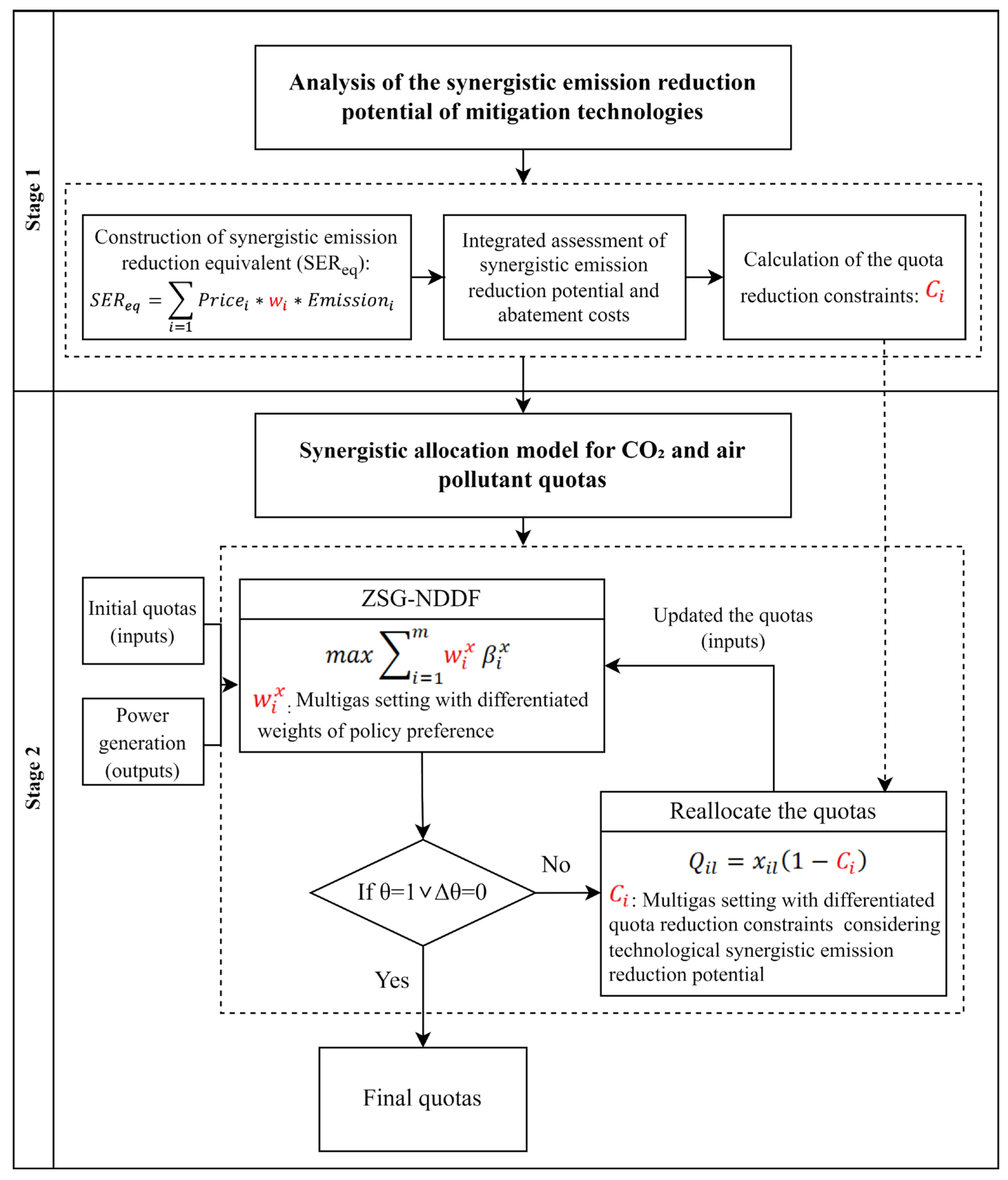
This study establishes an enterprise-level multigas emission quota allocation framework. As shown in Figure 1, this framework incorporates policy preference weights and analysis of the synergistic emission reduction potential of multigas emissions. It consists of two stages.
Stage 1: Analysis of synergistic emission reduction potential
This stage quantifies the synergistic benefits of mitigation technologies on multiple gases (e.g., CO2 and SO2) and derives corresponding quota reduction constraints. First, we construct the synergistic emission reduction equivalent index (SEReq). The SEReq combines gas prices and policy preference weights ( w i ) to convert emissions into a unified equivalent. Decision-makers can adjust weights based on regional policy preferences to ensure alignment between assessment results and policy preferences. Second, we conduct a comprehensive evaluation of synergistic emission reduction potential and abatement costs. Based on SEReq, we evaluate both the synergistic emission reduction potential and marginal abatement cost for each mitigation technology. By setting a cost threshold, we identify technology portfolios with relative cost advantages. Finally, we calculate the maximum quota reduction ratio. For each gas, we sum the synergistic emission reductions delivered by the selected optimal technology portfolio and divide the cumulative synergistic reduction by the baseline emissions in the base year. This ratio sets an upper limit for quota allocation, ensuring the emission reduction range is within the feasible scope of technology and policies.
Stage 2: Synergistic allocation model for carbon dioxide and air pollutants
The second stage adopts the zero-sum gains non-radial directional distance function (ZSG-NDDF) model. Under the premise of a fixed total quota, it iteratively optimizes quota allocation, incorporating the maximum quota reduction ratio derived from the first stage as a constraint. First, we construct the ZSG-NDDF model, which integrates the zero-sum property of the ZSG-DEA framework and the flexibility of non-radial adjustment. It not only achieves total quota control but also reflects policy preferences and technical emission reduction limits. Second, we establish an iterative optimization and constraint mechanism. In each iteration, quotas are adjusted within the maximum quota reduction ratio ( C i ). This mechanism prevents enterprises from exceeding their technical capacity in emission reduction while ensuring efficiency incentives and fairness among enterprises. Finally, the iterative process continues until all decision-making units (DMUs) reach optimal efficiency or the efficiency improvement margin is negligible (i.e., less than 0.01). The final quota allocation balances policy preferences and technical feasibility, providing a comprehensive and implementable quota management plan.

3.2. Analysis of Synergistic Emission Reduction Potential of Technologies

3.2.1. Synergistic Emission Reduction Equivalent Index

Drawing on the approach of Mao et al. and Gao et al. for analyzing the synergistic emission reduction potential of mitigation technologies [18,36], this study first constructs a synergistic emission reduction equivalent index (SEReq). The index is defined as follows:
S E R e q = α C O 2 E C O 2 + α S O 2 E S O 2
E C O 2 and E S O 2 represent emission amounts.
α C O 2 and α S O 2 represent conversion coefficients for converting gases into the S E R e q (the conversion coefficients can be valued using various methods, such as monetized assessments of their external impacts or decision-makers’ policy preferences [18]). Most existing studies use pollutant prices as conversion coefficients; this study combines prices with weights reflecting the importance differences of different gases in management as conversion coefficients, and the equation is as follows:
α C O 2 = P r i c e C O 2 × w C O 2 α S O 2 = P r i c e S O 2 × w S O 2
w C O 2 and w S O 2 represent weights reflecting the importance differences of gases in management (in this study, they serve both as part of the comprehensive air pollutant conversion coefficients and as weight coefficients in the quota allocation model). The conversion coefficients α C O 2 and α S O 2 incorporate differences in the management importance of different gases and differences in their prices. P r i c e C O 2 and P r i c e S O 2 represent the prices of CO2 and SO2. For CO2, as China did not have an explicit carbon market price in 2010, we refer to the 2010 CDM credit price of 10–15 EUR/t and set CO2 at 100 yuan/t. For SO2, following Mao et al. [37], which, based on SO2 emission-permit trading cases in Shanxi, Shaanxi and other regions during 2009–2010, an SO2 price of 5000 yuan/t is adopted.

3.2.2. Calculation of Emission Reduction Potential

The emission reduction potential of mitigation technologies is calculated as follows:
E R i , j = E F i , j × E C × E T × τ
E R i , j is the emission reduction potential of measure i for pollutant j ;
E C is the sector’s baseline installed capacity;
E T is the annual average operating hours;
τ is the technology penetration rate;
E F i , j is the technical emission reduction coefficient of measure i for pollutant j .
Based on the S E R e q , the equation for the synergistic emission reduction potential of mitigation technology i is as follows:
E R i , S E R e q = α C O 2 × E R i , C O 2 + α S O 2 × E R i , S O 2

3.2.3. Calculation of Emission Reduction Costs

The equation for the unit pollutant emission reduction cost indicator is as follows:
C o s t i , j = T C i S i , j
C o s t i , j is the cost of measure i for reducing unit pollutant j , yuan/kg;
T C i is the total emission reduction cost of measure i for pollutant j , yuan;
S i , j is the emission reduction of measure i for pollutant j , kg.
Combined with S E R e q , the equation for the synergistic emission reduction cost of mitigation technology i is as follows:
C o s t i , S E R e q = T C i α C O 2 × S i , C O 2 + α S O 2 × S i , S O 2

3.2.4. Maximum Quota Reduction Ratio

The method for transforming the synergistic emission reduction potential and synergistic emission reduction costs of different mitigation technologies into the maximum quota reduction ratio in the quota allocation process is as follows. Set a specific synergistic emission reduction cost c (e.g., less than or equal to 0 or the average value, set according to practical needs), calculate the emission reduction of the technology portfolio under this cost constraint, and divide the emission reduction by the baseline year emissions to obtain the maximum quota reduction ratio.
For each gas i , under the scenario where the marginal abatement cost does not exceed the preset threshold c , the mitigation technology portfolio T i ( c ) is defined, where
T i ( c ) = { t | M A C t , i c }
Then, sum the emission reduction potential R p t , i of each technology t in the set T i ( c ) for pollutant i , to obtain the cumulative emission reduction potential of pollutant i under the cost constraint c :
R p i ( c ) = t T i ( c ) R p t , i
Divide R p i ( c ) by the baseline year emissions E i b a s e to obtain the maximum quota reduction ratio C i c :
C i c = R p i ( c ) E i b a s e

3.3. Multigas Quota Synergistic Allocation Model

3.3.1. ZSG-NDDF

We develop a quota allocation model integrating ZSG-DEA with NDDF, which has the following characteristics: (1) The structure of ZSG-DEA keeps the total quota constant during the iterative optimization process of quota allocation. (2) The introduction of NDDF allows it to effectively distinguish differences in the importance of gases, reflecting the varying stringency of control across gases. (3) The ZSG-NDDF model introduces constraint variables during iterative optimization.
The ZSG-NDDF model equation is as follows:
D ( x , y ; g ) = m a x i = 1 m w i x β i x + r = 1 s w r y β r y s . t . j = 1 n λ j x i j [ 1 + β i x g i x j 0 x i j ] x i k + β i x g i x , i = 1 , 2 , , m j = 1 n λ j y r j y r k + β r y g r y , r = 1 , 2 , , s λ j 0 , j = 1 , 2 , , n ; β i x , β r y 0
In the equation, x i j represents the i -th input allocation indicator of the j -th decision-making unit (DMU), y r j represents the r -th output indicator of the j -th DMU, λ j represents the combination proportion of D M U j in reconstructing an effective DMU combination relative to D M U 0 , and w i x and w r y are weight variables, representing the relative importance of each variable in achieving the maximization or minimization objectives, thus allowing different weights to be assigned to input and output variables based on policy control preferences. In this study, weighting is only applied to CO2 and air pollutants; hence, w r y = 0 . β i x   a n d   β r y are slack vectors, representing the reduction proportion of input variables and undesirable output variables or the expansion proportion of desirable output variables when each DMU improves efficiency. g i x and g r y are direction vectors, representing the direction in which each variable needs to change when each DMU reaches efficiency. Since the research objects of this study are carbon dioxide and air pollutants, the direction vector is set as follows: g = ( g i C O 2 , g i S O 2 , 0 ) . The direction vector is set to the enterprises’ emission. Assuming D M U k is a non-DEA efficient decision-making unit, to achieve DEA efficiency, it must reduce a certain amount of input, the reduction amount is u k = β i x g i x , and this amount of input is proportionally allocated to other DMUs. Then, the allocation value obtained by D M U j from D M U k is
x i j j k x i j × β i x g i x
The efficiency calculation of the ZSG-NDDF model refers to the research results of Yang et al. and Li et al. on the efficiency calculation of directional distance functions [38,39]. θ k indicates the relative efficiency of the k -th DMU. The calculation equation is as follows:
θ k = 1 1 m i = 1 m β i x g i x x i o 1 1 s r = 1 s β r y g r y y r o

3.3.2. Iterative Optimization

Since all DMUs undergo proportional input reductions, the adjustment of carbon dioxide and air pollutant quotas after a single optimization iteration can be determined accordingly:
x i j = k j [ x i j j k x i j × β k x g k x ] β i x g i x
Furthermore, to prevent certain emission-inefficient enterprises from bearing excessive emission reduction pressures, this study incorporates a constraint on the maximum quota reduction ratio C i during the quota iteration process. This constraint sets an upper limit on the quota reduction for any D M U l with a negative quota adjustment ( x i l < 0 ) . Accordingly, the single-iteration optimized quota Q i l for D M U l is determined as follows:
Q i l = { x i l + x i l ,   x i l x i l C i x i l ( 1 C i ) ,   x i l x i l > C i
Additionally, since the quota for D M U l is subject to a reduction cap, instances where the reduction proportion exceeds the set maximum ( x i l / x i l > C i ) result in higher allocated quotas than would be the case without the constraint, leading to an overall increase in total quotas. Assuming that the total increase in quotas is T i , to maintain the unchanged total quota, T i is proportionally distributed among D M U s with positive quota adjustments ( x i s > 0 ) . Each such D M U s has its adjustment amount modified as follows:
x i s T i × x i s S x i s
Consequently, the single-iteration optimized quota Q i s for D M U s is as follows:
Q i s = x i s + x i s T i × x i s S x i s

3.4. Initial Allocation and Definition of Quota Adjustment Ratio

This study sets the actual emissions of each enterprise as its initial quota and obtains the final allocation through iterative adjustment optimization. The difference between the final quota and the initial quota is defined as the quota adjustment amount, which reflects the gap between the allocated quota and the actual emissions, thereby indicating whether the enterprise is in a surplus or shortage state. Furthermore, since the emissions of each enterprise vary, we use the quota adjustment ratio, i.e., the ratio of the enterprise’s quota adjustment amount to its emissions, to reflect the degree of incentive or reduction pressure imposed on the enterprise by the allocation result.

3.5. Materials

This study conducts an empirical analysis on China’s coal-fired power industry in 2010. Emission data for coal-fired power enterprises are sourced from the Global Power Emissions Database (GPED) [40], which also provides detailed anthropogenic emission data for thermal power enterprises in 2010, including emissions of two pollutants: CO2 and SO2. Power generation data are sourced from the 2011 China Electric Power Yearbook, which records the power generation data of coal-fired power enterprises for the year 2010. By matching enterprise names and installed capacity, the GPED data are aligned with the data from the 2011 China Electric Power Yearbook. Outliers are removed using the interquartile range (IQR) method, resulting in a dataset of 150 enterprises. Descriptive statistics of the emission factors for enterprises are shown in Table 2. The original sample contains 155 enterprises. Outliers were identified using enterprise-level emission efficiency (power generation/emissions), and five observations were removed to avoid undue influence on the model results. The raw dataset is provided in the Supplementary Materials. The geographic distribution is shown in Figure S1.
This study selects 11 emission reduction technologies for synergistic emission reduction potential analysis. Referring to Mao et al. [37], the emission reduction coefficients and emission reduction costs of different technologies are shown in Table 3.
Table 3 shows that most mitigation measures deliver synergistic reductions (i.e., positive reduction coefficients for both CO2 and SO2). However, not all measures generate uniformly positive co-benefits across gases. Some technologies reduce one pollutant while increasing another, implying cross-pollutant trade-offs (“negative synergies”). For example, flue gas desulfurization (T9) reduces SO2 but has a negative CO2 reduction coefficient (−16.29 kg/MWh), reflecting the electricity penalty associated with end-of-pipe control. Similarly, carbon capture and storage (CCS, T11) delivers substantial CO2 reductions but has a negative SO2 reduction coefficient (−0.76 kg/MWh). These trade-offs are explicitly incorporated into the SEReq evaluation and the derivation of maximum quota reduction constraints. First, when calculating synergistic emission reduction potential, we retain the sign of each technology-specific coefficient. Using T9 as an example, because its SO2 coefficient is positive while its CO2 coefficient is negative, the resulting synergistic emission reduction potential is smaller than it would be if the CO2 penalty were ignored. Second, because policy weights in Equation (1) enter multiplicatively with emissions, they amplify this effect and therefore influence the estimated synergistic emission reduction costs and potentials; this is further discussed in the sensitivity analysis in Section 4.4.1.

4. Results and Discussion

4.1. Scenario Setting

First, we set different policy preference scenarios: the baseline scenario with equal weights (S0); carbon reduction priority (S1); enhanced carbon reduction priority (S2); pollution reduction priority (S3); and enhanced pollution reduction priority (S4). The specific weight settings are reported in Table 4.

4.2. Results of Synergistic Emission Reduction Potential of Technologies

4.2.1. Results of Synergistic Emission Reduction Costs and Potentials

The synergistic emission reduction costs and potentials of each emission reduction technology under different scenarios are calculated, and the results are shown in Table 5. The average synergistic emission reduction costs for S0, S1, S2, S3, and S4 are 14.33 yuan/kg, 8.16 yuan/kg, 6.00 yuan/kg, 12.40 yuan/kg, and 11.24 yuan/kg, respectively.

4.2.2. Maximum Quota Reduction Ratio Settings

This study selects the technology portfolio T i ( c ) with synergistic emission reduction costs less than or equal to the average for further analysis. Furthermore, based on Equation (8), the cumulative emission reduction potential R p i ( c ) of pollutant i under the cost constraint c is calculated. Finally, dividing by the baseline emissions of the power sector in 2010 (CO2: 3580 Mt, SO2: 9.56 Mt) yields the maximum quota reduction ratio for each scenario, as shown in Table 6. The maximum quota reduction ratio for CO2 is relatively small because carbon capture technology was in its early development stage in 2010 and had not been widely applied, while SO2 technology was relatively mature, hence its larger maximum quota reduction ratio.
Additionally, this study defines scenarios without considering the synergistic emission reduction potential of technologies (i.e., unconstrained scenarios) as S0_u, S1_u, S2_u, S3_u, and S4_u.

4.3. Quota Allocation Results Under Different Scenarios

For the five policy preference scenarios, the iterative solution converges after requiring 11, 12, 8, 17, and 15 iterations for S0–S4, respectively. Building upon the scenario settings and the derived maximum quota reduction ratios presented, this section presents and discusses the results of the proposed two-stage allocation framework in three steps. First, the correlation between enterprises’ quota adjustment ratios and emission efficiency under different scenarios is analyzed to examine the incentive and constraint effects of quota allocation under different weight settings, i.e., whether higher-weight gases provide greater emission reduction incentives for efficient enterprises and greater reduction pressure for inefficient enterprises. Second, we analyze the impact of the maximum quota reduction ratio constraint on the quota allocation results. Finally, we conduct a sensitivity analysis to assess the robustness of the allocation results under different weight configurations.

4.3.1. Quota Allocation Results Under Different Policy Preference Scenarios

To illustrate the allocation outcomes under different policy preference scenarios, we use the quota adjustment ratio to analyze enterprises’ quota positions in each scenario. According to the definition in Section 3.4, this ratio reflects the extent to which the allocation outcome provides incentives or imposes reduction pressure on enterprises. The relationship between the quota adjustment ratio and emission efficiency reveals how enterprises with different efficiency levels are treated in terms of quota adjustments, and thus enables us to evaluate the incentive and constraint effects of quota allocation under different scenarios and to assess the impact of incorporating policy preference weights.
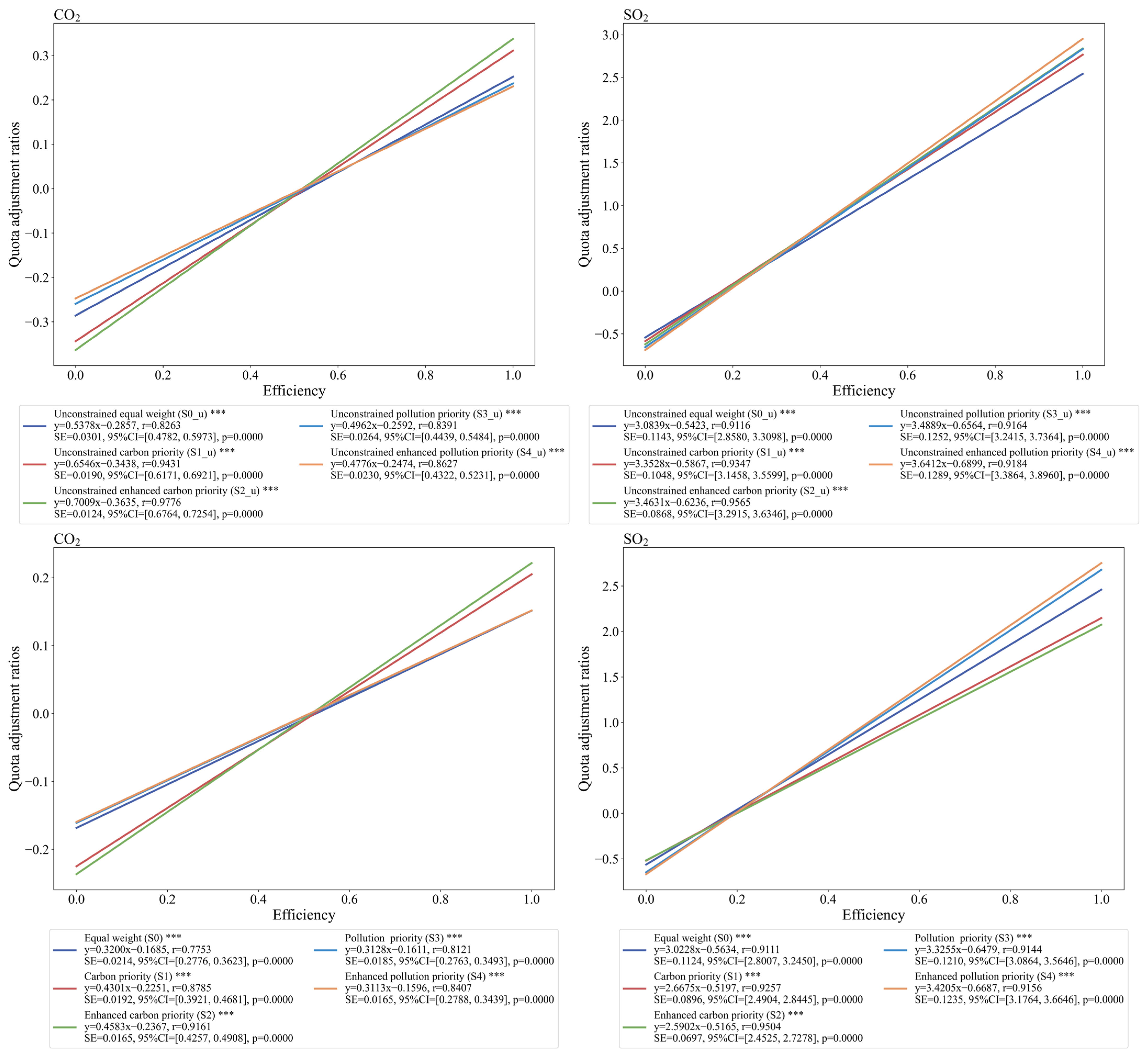
We employ ordinary least squares (OLS) to analyze the relationship between enterprises’ quota adjustment ratios and their emission efficiencies; the regression results are shown in Figure 2. The slope of the fitted line represents the strength of the incentive and constraint effect: a positive slope indicates the presence of positive incentives, and a larger absolute value implies stronger positive incentives (or stronger negative constraints). First, the regression lines in all scenarios exhibit significantly positive slopes (p < 0.001), confirming that the positive incentive mechanism of quota allocation holds generally across all scenarios.
Second, comparisons across scenarios verify the effectiveness of incorporating differentiated policy preferences, especially for the enhanced priority scenarios (S2_u and S4_u). In the CO2 quota without the maximum quota reduction constraints (unconstrained scenarios), the slope in the enhanced carbon priority scenario S2_u (0.7009) is markedly higher than that in the carbon priority scenario S1_u (0.6546) and the equal weight scenario S0_u (0.5378). Specifically, relative to S0_u, the incentive intensity for CO2 in S2_u increases by 30.4% (from 0.5378 to 0.7009), which is 7.2% higher than the increment in S1_u (22% relative to S0_u). This indicates that as the policy weight of CO2 increases from 2:1 (S1) to 3:1 (S2), the incentive and constraint effects on enterprises in the CO2 dimension are further strengthened, reflecting the policy’s targeted guidance for enhanced carbon reduction. In the SO2 quota without constraints, the slope in the enhanced pollution priority scenario S4_u (3.6412) is higher than that in the pollution priority scenario S3_u (3.4889) and the equal weight scenario S0_u (3.0839). Compared with S0_u, the incentive intensity for SO2 in S4_u rises by 18.0% (from 3.0839 to 3.6412), which is 4.9% higher than the increment in S3_u (13.1% relative to S0_u). These results demonstrate that as policy preference weights are gradually strengthened (from 1:1 to 3:1 for carbon priority and from 1:1 to 1:3 for pollution priority), the incentive and constraint intensity for the target gas is correspondingly enhanced, with the enhanced priority scenarios (S2_u and S4_u) exhibiting more pronounced policy guiding effects.
Finally, after the maximum quota reduction constraints are imposed, the slopes in all scenarios decrease to varying degrees. For the CO2 quota, the slope of S2 (0.4583) is lower than that of S2_u (0.7009), and also higher than that of S1 (0.4301) and the equal weight scenario S0 (0.3200); for the SO2 quota, the slope of S4 (3.4205) is lower than that of S4_u (3.6412), while exceeding that of S3 (3.3255) and S0 (3.0228). This suggests that once the synergistic emission reduction potential of technologies is incorporated, the incentive intensity calculated by the ZSG-NDDF model is moderated for both enhanced priority scenarios, but the core role of policy preference weights remains unchanged. Specifically, in the CO2 dimension, carbon-priority settings (S1 and S2) still generate stronger incentives than the equal weight scenario (S0) even under constraints, with the enhanced carbon priority scenario S2 outperforming the basic carbon priority scenario S1. In the SO2 dimension, pollution-priority settings (S3 and S4) maintain higher incentive intensity than S0, and the enhanced pollution priority scenario S4 surpasses the basic pollution priority scenario S3. This incorporation of constraints not only ensures that the emission reduction burden on individual enterprises remains within the technically feasible range of synergistic emission reduction potential but also preserves the role of policy weights in modulating the incentive and constraint effects of quota allocation. Consequently, it enhances the practical feasibility of the allocation scheme while upholding the policy responsiveness of quota allocation, achieving a balanced integration of technical constraints and policy guidance.
In summary, the OLS analysis yields the following findings:
(1)
In all scenarios, the quota adjustment ratio is significantly and positively correlated with emission efficiency, confirming that the positive incentive mechanism of quota allocation for high-efficiency enterprises is pervasive; enterprises with higher emission efficiency receive more quotas, which supports the use of market-based instruments to reward better performers.
(2)
Differences across scenarios reflect the positive correlation between policy preference weights and incentive intensity: as the policy weight of a target gas is gradually strengthened, the corresponding incentive and constraint effects are significantly enhanced. Specifically, the enhanced carbon priority scenario exerts the strongest incentives and constraints on CO2, while the enhanced pollution priority scenario achieves the most prominent regulatory effect on SO2. Such weight adjustment enables decision-makers to achieve “targeted precision” in multigas management, where the strengthening of policy preferences directly translates into more effective guidance for enterprises’ emission reduction behaviors. After introducing the maximum quota reduction ratio constraints, the role of policy weights in modulating the incentive and constraint effects of quota allocation remains preserved.
(3)
The introduction of maximum quota reduction ratio constraints moderates the incentive intensity produced by the ZSG-NDDF model, but by explicitly considering the synergistic emission reduction potential of technologies, it enhances the feasibility of implementing the allocation scheme.

4.3.2. Impact Before and After Adding Constraints Reflecting Synergistic Emission Reduction Potential

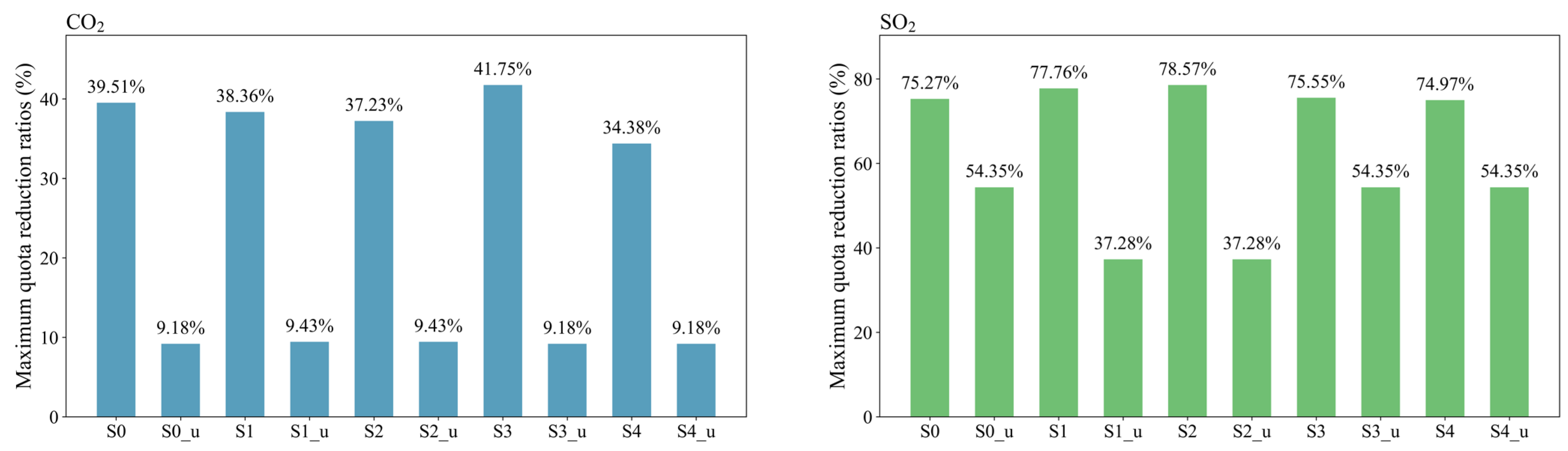
This subsection analyzes the impact of the maximum quota reduction constraints on the allocation results. Figure 3 compares the maximum quota reduction ratios under scenarios with and without the constraints. In the unconstrained scenarios (S0_u–S4_u), the maximum quota reduction ratios for CO2 and SO2 range from 39.51% to 41.75% and from 75.27% to 78.57%, respectively. After the synergistic reduction potential constraints are imposed (S0–S4), the corresponding ranges shrink to 9.18–9.43% for CO2 and 37.28–54.35% for SO2. These findings imply that, without considering synergistic emission reduction potential, the model may allocate an excessively high reduction burden to some enterprises, thereby undermining the feasibility of the scheme. By explicitly incorporating maximum quota reduction ratios derived from synergistic emission reduction potentials, the allocation model can effectively keep the maximum quota reduction ratios within the predefined upper bounds. This setting fully captures the synergistic emission reduction potential of sectoral technologies and ensures that the quota allocation strikes a balance between efficiency and implementability.

4.4. Sensitivity Analysis

4.4.1. Sensitivity Analysis of Negative Reduction Coefficient Treatment

Table 3 indicates that not all mitigation measures generate uniformly positive co-benefits across gases, implying cross-pollutant trade-offs. In evaluating synergistic emission reduction potential, we retain the sign of each technology-specific reduction coefficient so that emission increases are explicitly reflected in the aggregated synergistic emission reduction potential and cost, rather than being implicitly removed. To make the quantitative implications transparent, we conduct a sensitivity analysis by comparing two coefficient treatments: retaining negative coefficients (“Considered”) versus setting negative coefficients to zero (“Unconsidered”). The resulting synergistic emission reduction costs and potentials are reported in Table 7 and Table 8. The comparison shows that, relative to the “Considered” case, the “Unconsidered” treatment systematically underestimates synergistic emission reduction costs and overestimates synergistic emission reduction potentials, and that the magnitude of this bias increases as policy weights become more concentrated on the gas subject to the trade-off. For T9, as CO2 priority increases from S1 to S2, the “Unconsidered” treatment underestimates the synergistic emission reduction cost by 2.02 yuan/kg (21.7%) in S1 and by 3.51 yuan/kg (32.5%) in S2, while overestimating the synergistic emission reduction potential by 35.45 × 10⁴ t (27.8%) in S1 and by 53.17 × 104 t (48.3%) in S2. Similarly, for T11, as SO2 priority increases from S3 to S4, the “Unconsidered” treatment underestimates the synergistic emission reduction cost by 3.57 yuan/kg (13.3%) in S3 and by 5.79 yuan/kg (19.9%) in S4, while overestimating the synergistic emission reduction potential by 3.73 × 10⁴ t (10.1%) in S3 and by 8.10 × 104 t (24.8%) in S4. These results confirm that ignoring negative coefficients can bias the cost–potential assessment, with larger biases emerging under stronger policy prioritization.

4.4.2. Sensitivity Analysis of Technology Penetration Rate (τ)

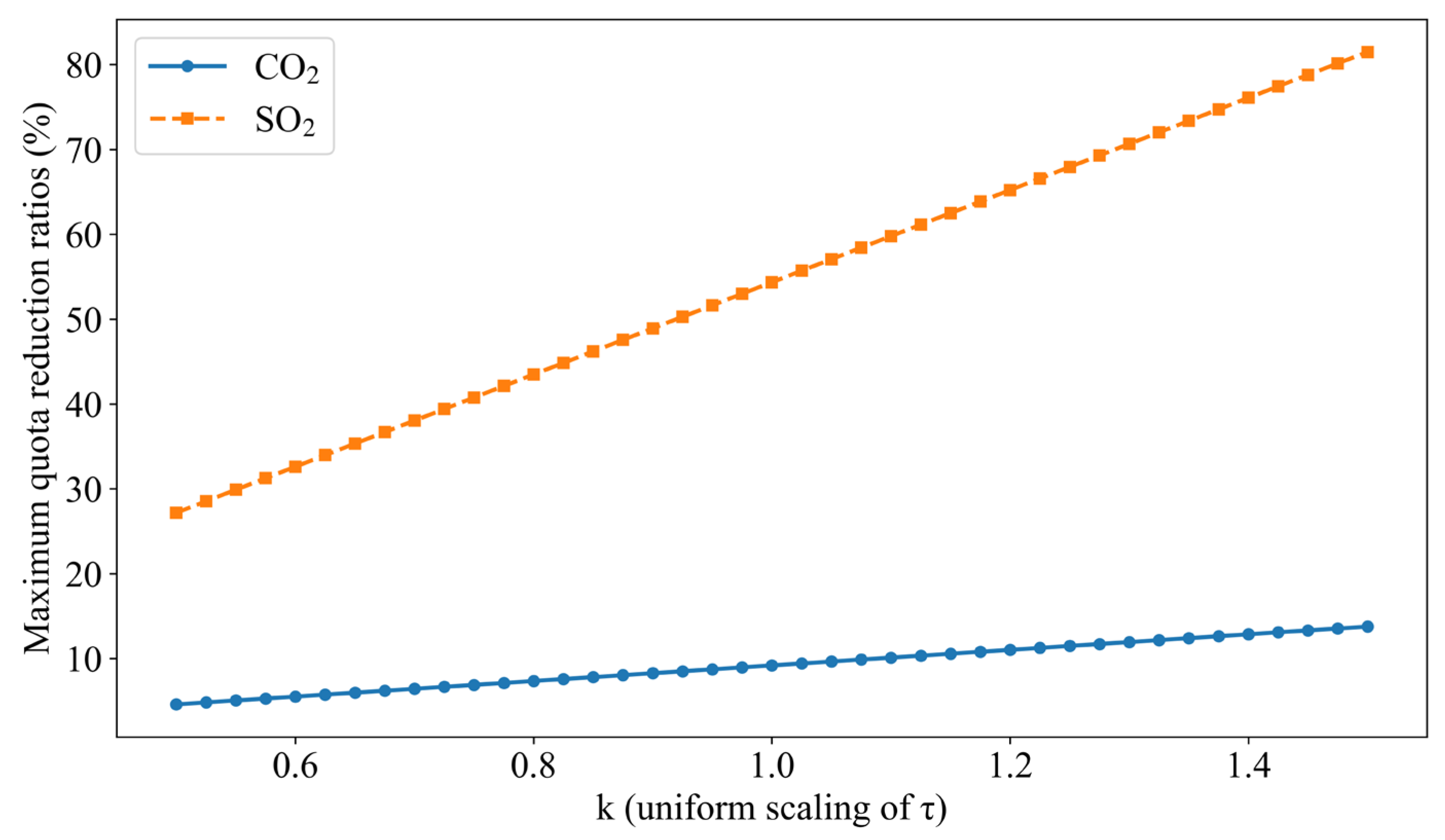
Technology penetration rate (τ) in Table 3 represents the assumed deployment share of each mitigation technology. To evaluate how uncertainty in τ affects the estimated maximum reduction constraints, we conducted a one-factor sensitivity analysis by uniformly scaling all penetration rates while keeping all other inputs and the portfolio-screening rule unchanged. Specifically, we define τ i k = k τ i 0 , where τ i 0 is the baseline value in Table 3 and k is a scalar. We test a continuous range   k [ 0.5,1.5 ] using 41 evenly spaced grid points with a step size of Δ k = 0.025 . For each k , installed capacity, generation, and technology-specific abatement potentials are recalculated, and abatement is aggregated using the same screening criterion as the main analysis (technologies with synergistic abatement cost below the sample mean). The aggregated abatement is then converted into the maximum quota reduction ratios for CO2 and SO2 using the same unit conversions and denominators as in the baseline case.
As shown in Figure 4, the maximum reduction ratios increase monotonically with k and exhibit an almost proportional response. At the baseline ( k = 1.0 ), the CO2 and SO2 maximum quota reduction ratios are 9.18% and 54.35%, respectively. When k varies from 0.5 to 1.5, the CO2 maximum reduction ratio ranges from 4.59% to 13.75%, and the SO2 maximum reduction ratio ranges from 27.17% to 81.49%. This near-linear behavior is expected because τ enters Equation (3) multiplicatively and therefore scales technology-specific abatement potentials directly.
Overall, the sensitivity analysis confirms that the estimated CO2 and SO2 reduction caps respond in a transparent and bounded manner to uncertainty in τ, and the key implications of the framework remain robust over a wide and continuous perturbation range of penetration assumptions.

4.4.3. Sensitivity Analysis of Policy Preference Weights

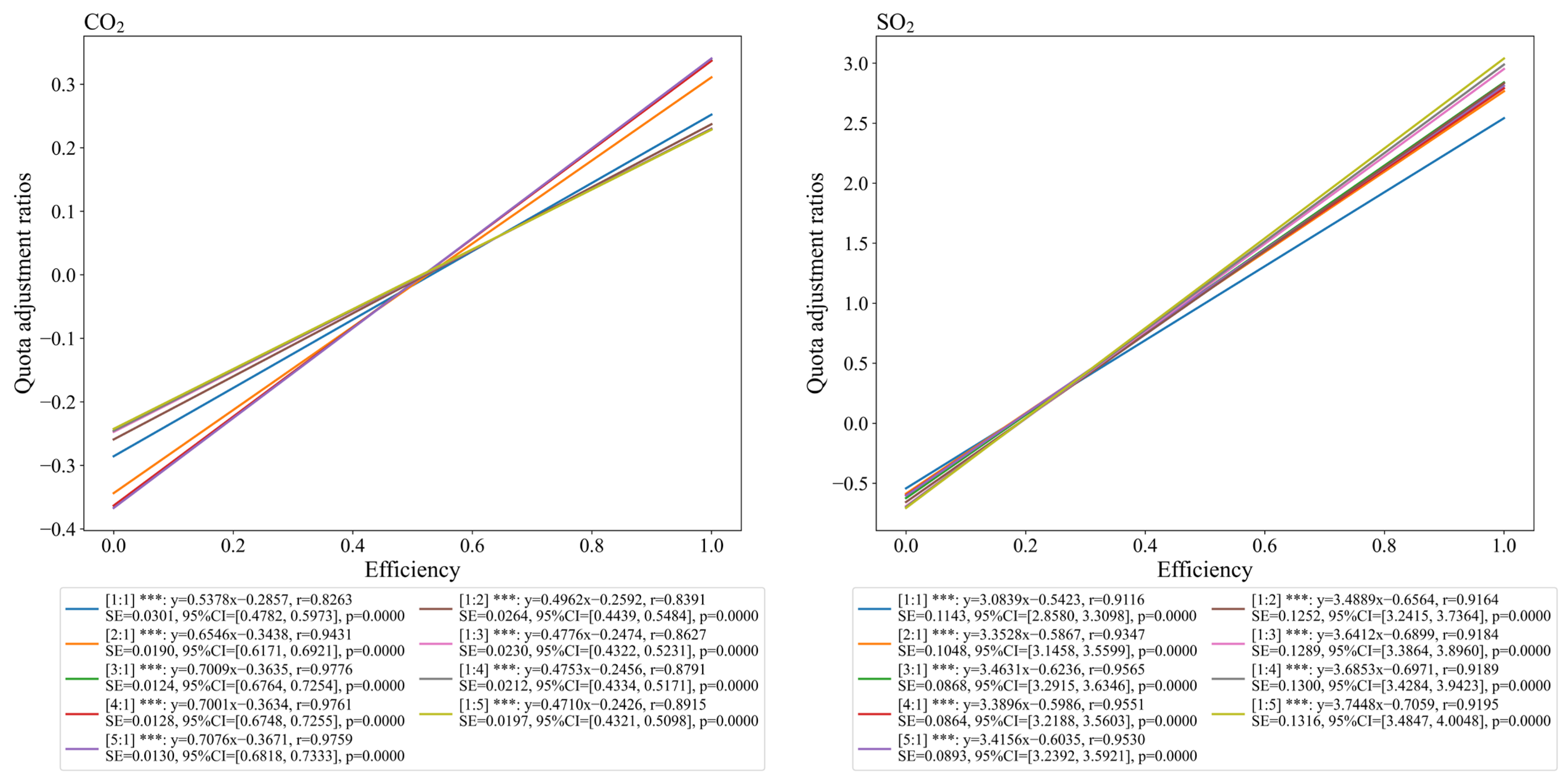
This subsection focuses on the sensitivity of the allocation results to policy preference weights. Under the unconstrained conditions, we specify gradient scenarios for the weight ratios of CO2 and SO2 (from [1:1] to [5:1] and from [1:2] to [1:5]). Taking [1:1] as the benchmark, we use changes in the regression slope between the quota adjustment ratio and emission efficiency to quantify the impact of weight settings; the results are depicted in Figure 5.
In the CO2 quota, when the weight of CO2 increases from 1 to 3, the slope in the [3:1] scenario (0.7009) is 30.78% higher than that in the [1:1] scenario (0.5378). Further increasing the weight to 4 and 5 leads to only marginal increases in the slope, indicating a “growth–saturation” pattern. When the weight of CO2 is reduced (e.g., from [1:1] to [1:3]), the slope decreases by 11.19%, but the magnitude of the decline also diminishes as the weight continues to fall. This suggests that the regulatory effect of policy preference weights exhibits a threshold: beyond this point, the marginal benefit of changing the weights declines, providing empirical evidence for setting a reasonable range of policy preference weights.
In the SO2 quota, by contrast, increasing the SO2 weight from 1 to 5 leads to a continuous increase in the slope; the slope in the [1:5] scenario is 21.43% higher than that in the [1:1] scenario, and weight reductions do not exhibit a symmetrical decline as observed for CO2. This difference arises from the combination of endogenous DEA weights and exogenous policy preference weights. In our dataset, CO2 has relatively high endogenous weight in the DEA model, so changes in its exogenous weight more quickly hit the total quota constraint, leading to the observed saturation. SO2 has relatively low endogenous weight; its sensitivity to exogenous weights depends more on the interaction with these endogenous weights, so increasing its exogenous weight continues to drive stronger incentives, whereas decreasing it does not immediately weaken the effect.
Overall, the coexistence of endogenous weights (determined by emission data) and exogenous policy preference weights means that the model can simultaneously reflect the objective emission structure and embed policy preferences, thereby coordinating multigas governance targets with firm-level incentive constraints and promoting closer alignment between enterprises’ abatement behavior and policy preferences.

4.4.4. Sensitivity Analysis of CO2 and SO2 Price Assumptions

Price parameters affect SEReq by changing the valuation of CO2 and SO2 reductions and, consequently, the cost ranking and composition of cost-effective measures. The price sensitivity analysis is conducted under the equal policy weight setting ( w C O 2 : w S O 2 = 1:1) to isolate the effect of price uncertainty from preference weight effects. The baseline is CO2 = 100 yuan/t and SO2 = 5000 yuan/t. Two designs are implemented: proportional scaling (PS), where both prices are perturbed by the same percentage (−50%, −30%, −10%, 0, +10%, +30%, +50%), and one-at-a-time (OAT) scenarios, where only one price varies while the other is fixed. For comparability across scenarios, in this study, the technologies with synergistic emission reduction costs less than or equal to the average are selected as the “low-cost” measures for further analysis. Meanwhile, the aggregated SO2 and CO2 maximum quota reduction ratios are recalculated for each price setting, and the results are presented in Figures S2–S4.
Results show a piecewise-stable response with clear threshold effects. Under PS, the SO2 maximum quota reduction ratio ranges from 37.28 to 59.11% and the CO2 maximum quota reduction ratio from 9.18 to 12.35%, while the number of selected measures varies from 4 to 8 (Figure S5). Relative to the baseline (PS0: SO2 = 54.34%, CO2 = 9.18%, 5 measures), outcomes remain unchanged for moderate perturbations (−30% to +10%). A deviation occurs only at the lowest price level (−50%), where the selected set reduces to 4 measures and the SO2 maximum quota reduction ratio drops to 37.28%. At higher price levels (+30% and +50%), additional measures enter (six and eight measures), and the CO2 maximum quota reduction ratio increases to 9.90% and 12.35%.
OAT results indicate that portfolio changes are mainly triggered by high CO2 prices or extremely low SO2 prices. Varying CO2 alone leaves results unchanged up to +10%, but expands the selected set at +30% and +50% (to 6–7 measures) and raises the CO2 maximum quota reduction ratio (up to 11.91%). Varying SO2 alone produces identical outcomes for −30% to +50%, with a change only at −50%, consistent with the PS case. Overall, the key outcomes are robust to a broad range of price assumptions and shift only when price changes are large enough to switch the cost-effective measure set.

4.4.5. Sensitivity to Sample Screening and Outlier Treatment

To assess whether the main findings are sensitive to sample screening and outlier handling, we apply an interquartile range (IQR) rule to enterprise-level emission efficiency (power generation divided by emissions, kWh/kg) and compare results between the screened sample and the full sample. The original dataset contains 155 enterprises. Using the IQR criterion, five extreme observations are identified and removed, yielding a screened sample of 150 enterprises for the main analysis. Figure S6 visualizes the distribution and the IQR bounds for both gases, showing that the excluded observations are isolated extremes (three for CO2 efficiency and two for SO2 efficiency) rather than systematic shifts in the bulk of the data.
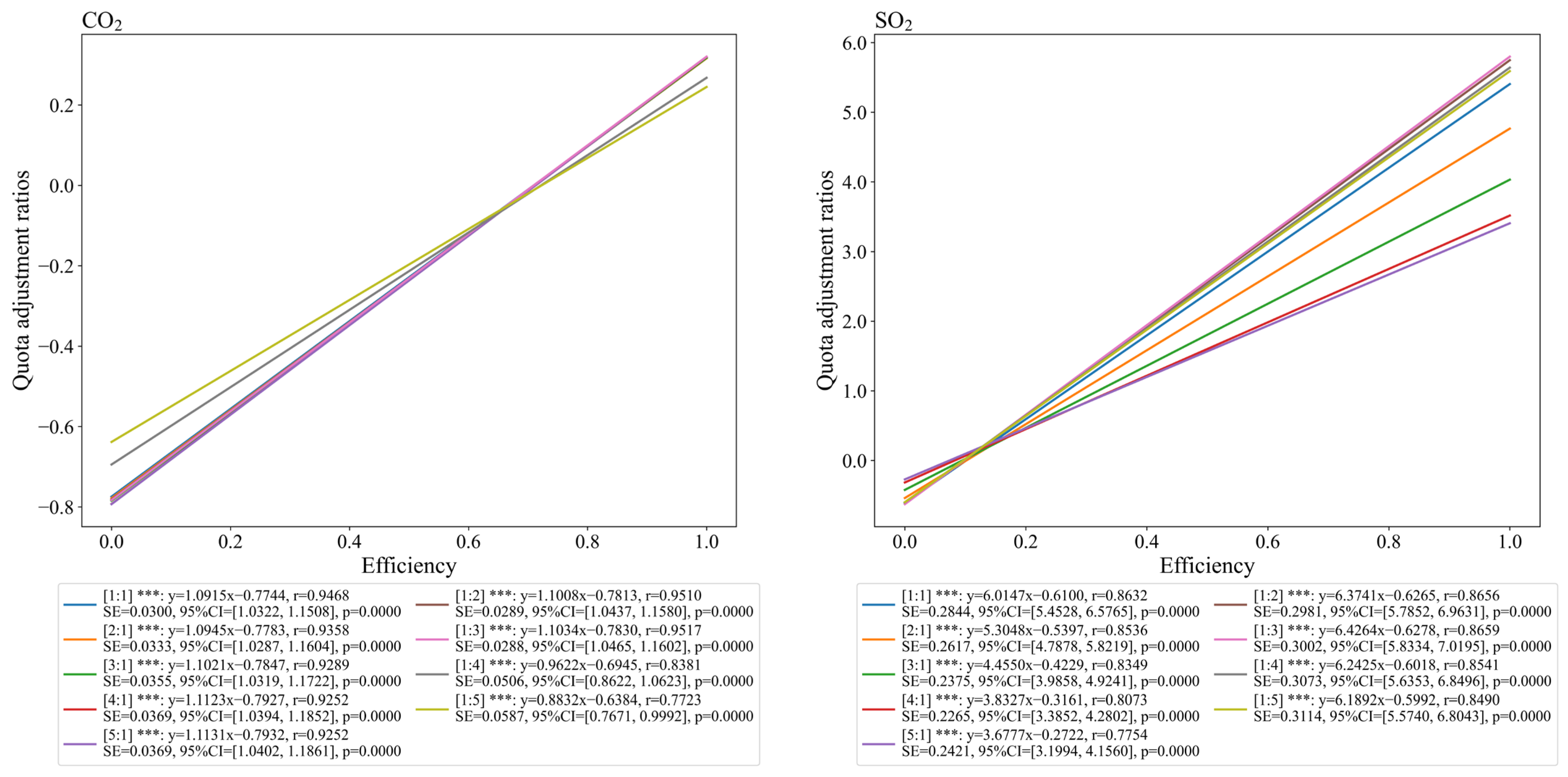
We then rerun the weight-sensitivity exercise on the full (unscreened) sample and contrast it with the screened-sample results. As shown in Figure 6, the empirical relationship between quota adjustment ratios and emission efficiencies remains consistent after including outliers: higher-efficiency enterprises continue to receive more favorable quota adjustments, while lower-efficiency enterprises face stronger tightening. Importantly, the qualitative response to policy preference weights is preserved. CO2 incentives exhibit a “growth–saturation” pattern as the CO2 weight increases, whereas SO2 incentives show a more continuously strengthening response as the SO2 weight rises. Overall, the core conclusions are robust to alternative sample definitions, indicating that the proposed framework’s incentive patterns are not driven by a small number of extreme observations.

5. Conclusions and Policy Implications

5.1. Conclusions

This study constructs a two-stage multigas emission quota allocation framework integrating policy preferences and synergistic emission reduction potential, with empirical validation in the coal-fired power sector. The key findings are as follows:
First, this study confirms that the proposed emission quota allocation framework exerts a universal positive incentive effect on high-efficiency enterprises. Under different scenarios, the adjustment ratio of enterprise quotas shows a significant positive correlation with emission efficiency (regression slopes are all significantly positive), verifying the effectiveness of the incentive and restraint mechanism. This indicates that, by adjusting policy preference weights, policy precision in multigas coordinated management can be achieved.
Second, the maximum quota reduction constraints introduced in this study effectively addresses the issue of existing quota allocation models overlooking the synergistic emission reduction potential of emission reduction technologies. Moreover, the introduction of constraints adjusts the incentive intensity of the model, making quota allocation more aligned with actual emission reduction technology conditions, thereby balancing efficiency and feasibility.
This study constructs a multigas emission quota allocation model that simultaneously considers policy preference weights and the synergistic emission reduction potential of technologies, thereby helping to address the limited integration of multigas coordination logic and implementation feasibility in existing quota allocation research. On the practical side, the framework provides an operational pathway for the coordinated management of “pollution and carbon reduction,” enabling quota allocation to reflect policy preferences while embedding the objective characteristics of emission reduction technologies. Empirical results from the coal-fired power sector demonstrate that this framework can achieve a coherent combination of incentive and restraint effects in quota allocation and the feasibility of emission reduction technologies, offering important support for advancing multigas coordinated control from policy concept to practical operation.
This study has several limitations that warrant future exploration. First, the empirical analysis relies on 2010 data, which predate China’s national carbon market (launched in 2021), ultra-low emission standards for power enterprises (implemented in 2014), and widespread deployment of advanced technologies such as flue gas desulfurization (FGD) and selective catalytic reduction (SCR). While the framework itself retains theoretical and methodological validity, the empirical results have limited direct relevance to contemporary policy contexts. Second, although the empirical application focuses on CO2 and SO2, due to data availability and the comparability of technology-specific reduction coefficients and cost parameters, the proposed framework is not restricted to two pollutants. In principle, it can accommodate additional pollutants (e.g., NOx and particulate matter) by extending the emissions vector and the technology-specific reduction coefficient matrix, together with the corresponding conversion coefficients, without changing the core allocation structure. Third, the current model is static and limited to the coal-fired power sector; its generalizability to other high-emission sectors (e.g., iron and steel, cement) requires further testing. On the basis of the above findings, we propose the following regulatory recommendations to promote synergistic reductions in air pollutants and carbon emissions.

5.2. Policy Implications

5.2.1. Refine the Multigas Quota Allocation Mechanism with Evidence-Based Weight Setting

Regulators could consider establishing a hybrid weight determination method combining data-driven analysis and expert consultation to quantify policy preferences. Specifically, weight ratios might be derived from national or regional environmental targets (e.g., 14th Five-Year Plan emission reduction goals), technological maturity, and health-economic impact assessments. In practice, structured expert elicitation and multi-criteria assessment tools can be adopted to balance policy intent and data objectivity. A dynamic adjustment mechanism may be established—weights could be revised every 2–3 years to reflect updates in policy priorities, technological breakthroughs (e.g., advances in CCS), and emission structure changes.

5.2.2. Ensure Operational Feasibility of Emission Reduction Responsibilities via Sector-Specific Constraints

Quota reduction upper bounds should be formulated based on up-to-date technological inventories and synergistic emission reduction potential assessments. Regulators are advised to avoid one-size-fits-all targets; instead, tailor constraints to sub-sectors with different technological bases (e.g., new coal-fired enterprises and retrofitted ones) to ensure that low-efficiency enterprises face manageable pressure to upgrade technologies while high-efficiency enterprises are rewarded with quota surpluses.

5.2.3. Strengthen Coordination Between Pollution Control and Carbon Management Systems

To integrate the framework with China’s existing policy infrastructure, we must (1) embed the two-stage allocation method as a supplementary tool for the national carbon market, using it to adjust initial quotas based on multigas synergies and local policy priorities; (2) explore the establishment of a unified data sharing platform linking carbon emission trading, air pollutant discharge permits, and power generation data to ensure consistency in quota calculation and compliance monitoring; and (3) provide differentiated incentives (e.g., preferential loans, tax breaks) for enterprises adopting technologies with high multigas synergistic emission reduction potential (e.g., cogeneration, coal washing), which may align policy support with the framework’s core logic and enhance synergistic emission reduction effects.


Supplementary Materials

The following supporting information can be downloaded at https://www.mdpi.com/article/10.3390/su18031525/s1, Figure S1: Geographic distribution of the 150 enterprises; Figure S2: SO2 and CO2 reduction ratios under OAT-C scenario (SO2 price fixed, CO2 price varying); Figure S3: SO2 and CO2 reduction ratios under OAT-S scenario (CO2 price fixed, SO2 price varying); Figure S4: SO2 and CO2 reduction ratios under PS scenario (proportional scaling of both CO2 and SO2 prices); Figure S5: Count of selected technologies across price perturbation scenarios; Figure S6: Distribution of enterprise-level CO2 and SO2 emission efficiencies with outlier screening results based on the IQR rule. Spreadsheets: The emissions and power generation of enterprises employed in this research.

Author Contributions

Conceptualization, X.W. and X.Z.; methodology, X.W. and W.L.; software, X.W.; validation, X.W. and W.L.; formal analysis, X.W.; investigation, X.W.; resources, X.Z.; data curation, X.W.; writing—original draft preparation, X.W.; writing—review and editing, X.W., W.L. and X.Z.; visualization, X.W.; supervision, W.L. and X.Z.; project administration, X.W.; funding acquisition, X.Z. All authors have read and agreed to the published version of the manuscript.

Funding

This research received no external funding.

Institutional Review Board Statement

Not applicable.

Informed Consent Statement

Not applicable.

Data Availability Statement

The data that support the findings of this study are available from the corresponding author upon reasonable request.

Conflicts of Interest

The authors declare no conflicts of interest.

References

  1. Lee, H.; Calvin, K.; Dasgupta, D.; Krinner, G.; Mukherji, A.; Thorne, P.; Trisos, C.; Romero, J.; Aldunce, P.; Barrett, K.; et al. Climate Change 2023: Synthesis Report. Contribution of Working Groups I, II and III to the Sixth Assessment Report of the Intergovernmental Panel on Climate Change; IPCC: Geneva, Switzerland, 2023. [Google Scholar]
  2. Manisalidis, I.; Stavropoulou, E.; Stavropoulos, A.; Bezirtzoglou, E. Environmental and health impacts of air pollution: A review. Front. Public Health 2020, 8, 14. [Google Scholar] [CrossRef]
  3. Fuso Nerini, F.; Sovacool, B.; Hughes, N.; Cozzi, L.; Cosgrave, E.; Howells, M.; Tavoni, M.; Tomei, J.; Zerriffi, H.; Milligan, B. Connecting climate action with other Sustainable Development Goals. Nat. Sustain. 2019, 2, 674–680. [Google Scholar] [CrossRef]
  4. Wang, G.; Xia, W.; Xiao, Y.; Guan, X.; Zhang, X. The synergy between CO2 and air pollution emissions in Chinese cities by 2060: An assessment based on the emissions inventory and dynamic projection model. Sustainability 2024, 16, 9338. [Google Scholar] [CrossRef]
  5. Kim, S.; Kerr, G.H.; van Donkelaar, A.; Martin, R.V.; West, J.J.; Anenberg, S.C. Tracking air pollution and CO2 emissions in 13,189 urban areas worldwide using large geospatial datasets. Commun. Earth Environ. 2025, 6, 311. [Google Scholar] [CrossRef]
  6. Arshad, K.; Hussain, N.; Ashraf, M.H.; Saleem, M.Z. Air pollution and climate change as grand challenges to sustainability. Sci. Total Environ. 2024, 928, 172370. [Google Scholar]
  7. Feng, T.; Shi, Y.; Wang, X.; Wan, X.; Mi, Z. Synergies of air pollution control policies: A review. J. Environ. Manag. 2025, 377, 124655. [Google Scholar] [CrossRef]
  8. Zhang, Q.; Wang, Y.; Zhang, W.; Xu, J. Energy and resource conservation and air pollution abatement in China’s iron and steel industry. Resour. Conserv. Recycl. 2019, 147, 67–84. [Google Scholar] [CrossRef]
  9. Mackenzie, I.A.; Hanley, N.; Kornienko, T. The optimal initial allocation of pollution permits: A relative performance approach. Environ. Resour. Econ. 2008, 39, 265–282. [Google Scholar] [CrossRef]
  10. Tang, L.; Wang, H.; Li, L.; Yang, K.; Mi, Z. Quantitative models in emission trading system research: A literature review. Renew. Sustain. Energy Rev. 2020, 132, 110052. [Google Scholar] [CrossRef]
  11. Li, Z.Y.; Zhao, T.; Wang, J.; Cui, X.Y. Two-step allocation of CO2 emission quotas in China based on multi-principles: Going regional to provincial. J. Clean. Prod. 2021, 305, 127173. [Google Scholar] [CrossRef]
  12. Zhou, P.; Wang, M. Carbon dioxide emissions allocation: A review. Ecol. Econ. 2016, 125, 47–59. [Google Scholar] [CrossRef]
  13. Jia, L.; Zhang, X.; Wang, X.; Chen, X.; Xu, X.; Song, M. Impact of carbon emission trading system on green technology innovation of energy enterprises in China. J. Environ. Manag. 2024, 360, 121229. [Google Scholar] [CrossRef]
  14. Liu, X.; Cifuentes-Faura, J.; Zhao, S.; Wang, L. Government environmental attention and carbon emissions governance: Firm-level evidence from China. Econ. Anal. Policy 2023, 80, 121–142. [Google Scholar] [CrossRef]
  15. Yu, S.; Yang, X.; Cai, Z.; Guo, L.; Jiang, P. Analysis of the government environmental attention on tackling air pollution and greenhouse gas emissions through a spatial econometric approach. Environ. Impact Assess. 2025, 113, 107866. [Google Scholar] [CrossRef]
  16. Liu, H.; Cai, B.; Zhang, L.; Wang, Z.; Chen, Y.; Xia, C.; Yang, L.; Dong, J.; Song, X. Research on carbon dioxide abatement technologies and cost in China’s power industry. Environ. Eng. 2021, 39, 8–14. [Google Scholar]
  17. Wang, X.; Zhao, X.; Yang, Y.; Shao, Y.; Zhang, L.; Ni, Y.; Pan, J.; Zhang, Y.; Zheng, C.; Gao, X. Comprehensive analysis of carbon emission reduction technologies (CRTs) in China’s coal-fired power sector: A bottom-up approach. Renew. Sustain. Energy Rev. 2024, 202, 114696. [Google Scholar] [CrossRef]
  18. Mao, X.; Xing, Y.K.; Gao, Y.B.; He, F.; Zeng, A.; Kuai, P.; Hu, T. Study on GHGs and air pollutants co-control: Assessment and planning. China Environ. Sci. 2021, 41, 3390–3398. [Google Scholar]
  19. Li, S.; Wang, S.; Wu, Q.; Zhao, B.; Jiang, Y.; Zheng, H.; Wen, Y.; Zhang, S.; Wu, Y.; Hao, J. Integrated benefits of synergistically reducing air pollutants and carbon dioxide in China. Environ. Sci. Technol. 2024, 58, 14193–14202. [Google Scholar] [CrossRef]
  20. Xian, B.; Xu, Y.; Chen, W.; Wang, Y.; Qiu, L. Co-benefits of policies to reduce air pollution and carbon emissions in China. Environ. Impact Assess. 2024, 104, 107301. [Google Scholar] [CrossRef]
  21. Guan, Y.; Xiao, Y.; Rong, B.; Lu, W.; Zhang, N.; Qin, C. Assessing the synergy between CO2 emission and ambient PM2.5 pollution in Chinese cities: An integrated study based on economic impact and synergy index. Environ. Impact Assess. 2023, 99, 106989. [Google Scholar] [CrossRef]
  22. Coase, R.H. The Problem of Social Cost. In Classic Papers in Natural Resource Economics; Gopalakrishnan, C., Ed.; Palgrave Macmillan: London, UK, 1960; pp. 87–137. [Google Scholar]
  23. Zhou, J.; Wang, J.; Bi, J.; Zhou, Q.; Luo, K.; Wang, Q.; Xue, W.; Dong, Z.; Ge, C. Environmental quality-oriented air pollution emission permit allocation methods: A plant-level study. J. Clean. Prod. 2022, 381, 135205. [Google Scholar] [CrossRef]
  24. He, W.; Zhang, B. A comparative analysis of Chinese provincial carbon dioxide emissions allowances allocation schemes in 2030: An egalitarian perspective. Sci. Total Environ. 2021, 765, 142705. [Google Scholar] [CrossRef] [PubMed]
  25. Wei, Y.; Zhao, T.; Wang, J.; Zhang, X.; Li, Z. Two-level allocation and its future change of CO2 reduction responsibility in China’s power sector. Environ. Impact Assess. 2023, 99, 107031. [Google Scholar] [CrossRef]
  26. Teng, M.; Ji, D.; Han, C.; Liu, P. Optimizing the Allocation of CO2 Emission Rights in the Yangtze River Delta City Agglomeration Region of China Based on Equity, Efficiency and Sustainability. Int. J. Environ. Res. 2025, 19, 29. [Google Scholar] [CrossRef]
  27. Zhao, J.; Wu, X.; Guo, J.; Zhao, H.; Wang, Z. Study on the allocation of SO2 emission rights in the Yangtze River Delta City Agglomeration Region of China based on efficiency and feasibility. Sustain. Cities Soc. 2022, 87, 104237. [Google Scholar] [CrossRef]
  28. Song, J.; Chen, R.; Ma, X. Collaborative Allocation of Energy Consumption, Air Pollutants and CO2 Emissions in China. Sustainability 2021, 13, 9443. [Google Scholar] [CrossRef]
  29. Song, J.; Chen, R.; Ma, X. Provincial allocation of energy consumption, air pollutant and CO2 emission quotas in China: Based on a weighted environment ZSG-DEA model. Sustainability 2022, 14, 2243. [Google Scholar] [CrossRef]
  30. Feng, Y.; Zheng, Y.; Chen, C.; Cao, W.; Sun, Y.; Liu, W.; He, J.; Ning, M.; Lei, Y.; Yan, G. Fairly sharing environmental targets in China: A multicriteria decision-making framework for provincial PM2.5 target allocation. J. Environ. Manag. 2025, 391, 126498. [Google Scholar] [CrossRef]
  31. Chen, L.; Li, Z. Efficiency of Carbon Dioxide (CO2) Emission Control Target Allocations in China. Math. Probl. Eng. 2022, 2022, 9605743. [Google Scholar] [CrossRef]
  32. Xie, Z.; Li, Y.; Qin, Y. Allocation of control targets for PM2.5 concentration: An empirical study from cities of atmospheric pollution transmission channel in the Beijing-Tianjin-Hebei district. J. Clean. Prod. 2020, 270, 122545. [Google Scholar] [CrossRef]
  33. Wang, B.J.; Zhao, J.L.; Wei, Y.X. Carbon emission quota allocating on coal and electric power enterprises under carbon trading pilot in China: Mathematical formulation and solution technique. J. Clean. Prod. 2019, 239, 118104. [Google Scholar] [CrossRef]
  34. Cui, X.Y.; Zhao, T.; Wang, J. Allocation of carbon emission quotas in China’s provincial power sector based on entropy method and ZSG-DEA. J. Clean. Prod. 2021, 284, 124683. [Google Scholar] [CrossRef]
  35. Liu, H.; Chen, Y.; Wu, J.; Pan, Y.; Song, Y. Allocation of CO2 emission quotas for industrial production in Industry 4.0: Efficiency and equity. Comput. Ind. Eng. 2024, 194, 110375. [Google Scholar] [CrossRef]
  36. Gao, Y.B.; Xing, Y.K.; He, F.; Kuai, P.; Mao, X.Q. Research on co-control effectiveness evaluation of energy saving and emission reduction measures in China’s iron and steel industry. Adv. Clim. Change Res. 2021, 17, 388. [Google Scholar]
  37. Mao, X.; Xing, Y.; Hu, T.; Zeng, A.; Liu, S. An environmental-economic analysis of carbon, sulfur and nitrogen co-reduction path for China’s power industry. China Environ. Sci. 2012, 32, 748–756. [Google Scholar]
  38. Yang, F.; Wei, F.; Li, Y.; Huang, Y.; Chen, Y. Expected efficiency based on directional distance function in data envelopment analysis. Comput. Ind. Eng. 2018, 125, 33–45. [Google Scholar] [CrossRef]
  39. Li, Y.; Li, J.; Gong, Y.; Wei, F.; Huang, Q. CO2 emission performance evaluation of Chinese port enterprises: A modified meta-frontier non-radial directional distance function approach. Transp. Res. Part D Transp. Environ. 2020, 89, 102605. [Google Scholar] [CrossRef]
  40. Tong, D.; Zhang, Q.; Davis, S.J.; Liu, F.; Zheng, B.; Geng, G.; Xue, T.; Li, M.; Hong, C.; Lu, Z. Targeted emission reductions from global super-polluting power plant units. Nat. Sustain. 2018, 1, 59–68. [Google Scholar] [CrossRef]
Figure 1. Model framework.
Sustainability 18 01525 g001
Figure 2. Ordinary least squares (OLS) regression of CO2 and SO2 quota adjustment ratios on enterprises’ emission efficiencies under different policy preference and constraint scenarios. Note: *** p < 0.001.
Sustainability 18 01525 g002
Figure 3. Maximum quota reduction ratios before and after imposing the maximum quota reduction constraints.
Sustainability 18 01525 g003
Figure 4. Sensitivity analysis of technology penetration rate (τ).
Sustainability 18 01525 g004
Figure 5. Least-squares regression of CO2 and SO2 quota adjustment ratios on enterprises’ emission efficiencies under scenarios with increasing policy preference weights. Note: *** p < 0.001.
Sustainability 18 01525 g005
Figure 6. Full-sample results before outlier removal: least-squares regression of CO2 and SO2 quota adjustment ratios on enterprises’ emission efficiencies under scenarios with increasing policy preference weights. Note: *** p < 0.001.
Sustainability 18 01525 g006
Table 1. Summary of representative emission quota allocation studies.
ReferenceMethodGas Type (s)Considering FactorsResearch Scale
He & Zhang [24]Information entropy + DEACO2FairnessProvincial
Li et al. [11]Shapley value + entropy weight + ZSG-DEACO2Fairness, efficiency, feasibility, sustainabilityProvincial
Wei et al. [25]Graph game model + game-theory combination weighting methodCO2Fairness, efficiency, sustainabilitySector
Teng et al. [26]Multi-indicator weighting + RDC + SBM-DDFCO2Balance among fairness, feasibility, and efficiencyCity
Zhao et al. [27]DEA + shadow price + information entropySO2FairnessCity
Song et al. [28]Improved centralized DEAEnergy consumption + SO2 + NOx + CO2Fairness, efficiencyProvincial
Song et al. [29]Weighted environmental ZSG-DEAEnergy consumption + SO2 + NOx + CO2Weighting different gasesProvincial
Table 2. Descriptive statistics of the emission factors for enterprises.
Emission FactorCO2 (kg CO2/kWh)SO2 (kg SO2/kWh)
Min0.59050.0004
Mean0.79000.0017
Max1.26790.0079
SD0.12290.0016
Table 3. Emission reduction coefficients and costs of various emission reduction technologies.
Tech IDTechnology NameTechnology Penetration Rate (τ)New Installed Capacity (MW)Power Generation (104 MWh)Emission Reduction Cost (Yuan/MWh)CO2 Reduction Coefficient (kg/MWh)SO2 Reduction Coefficient (kg/MWh)
T1Low-NOx combustion70.00%494,641248,8540.383.880.02
T2Low-energy ignition40.00%282,652142,2020.490.620.002
T3Slagging warning5.00%35,332177,7530.961.590.01
T4Air preheater modification10.00%70,66335,5511.2912.430.05
T5Turbine flow path modification15.00%105,99553,3261.65402.871.59
T6Steam seal modification60.00%423,978213,3033.737.290.03
T7Coal washing technology50.00%353,315177,7534.261.141.49
T8High-voltage frequency conversion30.00%211,989106,6529.4423.950.1
T9Flue gas desulfurization15.30%108,11454,39221.83−16.293
T10Cogeneration20.00%141,32671,10148.58101.520.4
T11CCS1.00%70663555267.67573.57−0.76
Note: The assumed incremental shares of τ are referenced from the National Key Energy-Saving Technology Promotion Catalog (third and fourth batch), and are set by decision-makers. New installed capacity (MW) is calculated as the thermal power installed capacity in 2010 (706,630 MW) multiplied by τ. Power generation is calculated as the average operating hours of thermal power in 2010 (5031 h) multiplied by the new installed capacity.
Table 4. Scenario settings.
ScenarioScenario ID Weights   w C O 2 : w S O 2
Equal weightsS01:1
Carbon reduction priorityS12:1
Enhanced carbon reduction priorityS23:1
Pollution reduction priorityS31:2
Enhanced pollution reduction priorityS41:3
Table 5. Emission reduction costs and synergistic emission reduction potentials of various technologies under different scenarios.
Tech IDSynergistic Emission Reduction Cost (Yuan/kg)Synergistic Emission Reduction Potential (104 t)
S0S1S2S3S4S0S1S2S3S4
T13.892.171.503.232.7624.2943.6062.9129.2734.24
T234.0318.2812.5029.8826.632.053.815.572.332.62
T322.9713.049.1118.5315.530.741.311.870.921.10
T44.322.361.623.703.2410.6219.4528.2912.3914.17
T50.170.090.060.150.13514.46944.121373.79599.24684.03
T621.2211.607.9818.1215.8237.5068.6099.7043.9050.30
T71.551.070.811.000.74482.21699.56916.92747.061011.91
T816.308.926.1413.9012.1261.75112.84163.9272.4283.08
T98.169.3010.793.852.52145.46127.73110.01308.63471.81
T1019.9910.897.4817.1615.04172.80317.17461.53201.24229.69
T1124.9912.077.9526.9029.1238.0878.86119.6435.3832.68
Table 6. Maximum quota reduction ratios under different scenarios.
Scenario Weights   w C O 2 : w S O 2 Technology PortfolioCO2 Reduction Potential (Mt)SO2 Reduction Potential (104 t)CO2 Maximum Quota Reduction RatioSO2 Maximum Quota Reduction Ratio
S01:1T5-T7-T1-T4-T9328.73519.579.18%54.35%
S12:1T5-T7-T1-T4337.59356.399.43%37.28%
S23:1T5-T7-T1-T4337.59356.399.43%37.28%
S31:2T5-T7-T1-T4-T9328.73519.579.18%54.35%
S41:3T5-T7-T9-T1-T4328.73519.579.18%54.35%
Table 7. Synergistic emission reduction costs of T9 and T11 under alternative treatments of negative emission reduction coefficients across weight scenarios.
Tech IDConsidered or Unconsidered Negative Emission Reduction CoefficientsSynergistic Emission Reduction Cost (Yuan/kg)
S0S1S2S3S4
T9Considered8.169.3010.793.852.52
Unconsidered7.287.287.283.642.43
T11Considered24.9912.077.9526.9029.12
Unconsidered23.3311.677.7823.3323.33
Table 8. Synergistic emission reduction potential of T9 and T11 under alternative treatments of negative emission reduction coefficients across weight scenarios.
Tech IDConsidered or Unconsidered Negative Emission Reduction CoefficientsSynergistic Emission Reduction Potential (104 t)
S0S1S2S3S4
T9Considered145.46127.73110.01308.63471.81
Unconsidered163.18163.18163.18489.53326.35
T11Considered38.0878.86119.6435.3832.68
Unconsidered40.7881.56122.3440.7840.78
Disclaimer/Publisher’s Note: The statements, opinions and data contained in all publications are solely those of the individual author(s) and contributor(s) and not of MDPI and/or the editor(s). MDPI and/or the editor(s) disclaim responsibility for any injury to people or property resulting from any ideas, methods, instructions or products referred to in the content.