


Abstract
Municipalities aiming for climate neutrality and resilience must take a systemic approach to planning, implementing, and monitoring climate actions, to be able to mobilise the resources needed to achieve this ambitious goal. This involves complementing conventional top-down and technological measures with bottom-up and inclusive strategies that include not only citizen engagement but also the innovation of social practices. This study presents a comparative analysis of social innovation actions for climate neutrality planned by 53 cities from 21 countries participating in the Pilot Programme of the EU-funded project NetZeroCities. By identifying 445 actions across all cities’ pilot programmes and classifying them into 10 categories and 38 sub-categories, it is found that 53.71% of actions are linked with social innovation, offering timely insights into how social innovations are being designed in cities’ urban plans. The results reveal emerging patterns and geographical variations across Europe. With more than half of all social innovation interventions focused on stationary-energy and Scope-3-related emissions reduction, the analysis reveals that cities are increasingly relying on social innovation to foster the behavioural and socio-technical changes needed to shape sustainable energy use, consumption, and mobility patterns. These actions are based on co-creation, co-design, cross-sectoral partnerships, and public-sector capacity building, with regional differences. The comparative approach and analysis contribute to the transdisciplinary discourse on social innovation assessment in systemic innovation for transitions.
1. Introduction
The complexity of climate change classifies it as a wicked problem [1,2,3], calling for transdisciplinary and multifaceted approaches to address it [4]. The underlying urgency for municipalities to plan and implement their climate transition is driving cities to shift away from traditional, siloed approaches that are primarily unilateral and technology driven [5,6,7]. A systemic approach is necessary because of the magnitude of the challenge, with about 50–70% of global greenhouse gas emissions leading to climate change driven by household consumption and lifestyle-related demand, directly or through the supply chains of the goods and services we use [8,9,10]. Thus, conventional climate action that focuses on technical and infrastructural solutions alone to GHG emissions reduction is inadequate to foster long-lasting socio-technical transformations that are dependent on behavioural and mindset change of citizens [11,12] and shifts in social practices.
Systemic transformations are complex and deeply interconnected within the socio-cultural and socio-technical fabric of cities. Social innovation is central in a systemic approach to tackling the climate challenge, especially because of its promising potential to actively engage stakeholders and enable behavioural change to adopt low-carbon lifestyles [13] and practices. A growing consensus on the adoption of systemic approaches to socio-technical transformations through co-creation across sectors, actors, contexts, and expertise is rapidly gaining ground [7,11,12,14]. As such, social innovation (SI) emerges as a category of innovation that has proven to be highly effective in navigating the complex interconnections in socio-technical transformations, empowering a network of actors (including institutions, local communities, businesses, and citizens) to actively engage, co-design, and co-create enduring and meaningful change [12,15]. Although the concept of social innovation continues to evolve, this paper adopts the definition proposed by Murray et al. [16] in The Open Book of Social Innovation and subsequently endorsed by Manzini [15], encompassing “innovations that are social both in their ends and in their means”. This definition, which broadly aligns with perspectives within the design field, conceptualises social innovation as “new ideas (products, services and models) that simultaneously meet social needs and create new social relationships or collaborations. In other words, they are innovations that are both good for society and enhance society’s capacity to act” [16].
The crucial role and importance of SI in systemic climate transitions have also been well established in the extant literature [16,17]. Its potential as a people-centred form of innovation ensures economic development and the well-being of people through the co-design and co-creation of social and economic value that benefits all contributing stakeholders, while striving towards the common goals of net-zero carbon emissions and climate mitigation. It is conceived as inclusive and democratic, enabling multi-stakeholder engagement and participation that ultimately drives behavioural change among people as they start to take ownership of the solution to the crisis. Several success stories of social innovation in cities have emerged in recent years, activated through Living Labs and pilot initiatives of municipalities aiming at capacity building, raising awareness, mobilising community engagement, and citizen participation in local challenges of climate and energy transitions, leading to sustainable behavioural change [18] and co-creation of solutions.
However, as social innovation increasingly gains prominence in climate transitions, there remains a limited understanding of how cities embed and operationalise social innovation within their systemic climate action pathways in a way that allows for systematic comparison across cities and nations. This gap may be attributed to two main factors: First, the adoption of systemic approaches to climate neutrality is a relatively recent development in urban policy and planning. Second, while the transdisciplinary literature on social innovation for climate neutrality is extensive, it is largely dominated by single or small numbers of practice-based case studies, also due to the difficulties of collecting comparable data across a large number of city cases. Although these studies provide rich and valuable contextual insights, they offer limited capacity for cross-city or cross-regional comparison and rarely employ a common set of indicators through which social innovation actions can be analysed across different governance contexts, emission domains, and phases of transition [11,17]. As a result, there is still a need to complement the extant literature with empirically grounded approaches that enable the identification of emerging evidence-based patterns in how municipalities design, implement, and scale social innovation as part of systemic climate action. Addressing this gap requires an approach that moves beyond isolated case descriptions and enables systematic comparison across cities and regions.
This understanding is critical for enacting a truly systemic approach, as it provides knowledge of how social innovation enables cities to activate their local context and accelerate their climate and energy transitions in alignment with broader goals of national and international policies, which is essential to critically assess the outcomes of a systemic approach in comparison to conventional approaches.
The European Union’s Mission “100 Climate Neutral and Smart Cities by 2030” [19] supports cities in planning and implementing a mission-oriented approach [20] by requiring the development of a cross-sectoral portfolio of climate actions that are focused not only on assessing greenhouse gas (GHG) emissions reduction, but also on inclusive strategies to ensure just and scalable change. Aligning with the goals of the mission, the EU project NetZeroCities (https://netzerocities.eu/) supports cities with knowledge, tools, and expertise to foster systemic change through their climate transition journeys. More specifically, it provides cities with tailored guidance to conceive and implement a cross-sectoral and interconnected theory of change [21] spanning the six standard emission domains (including stationary energy, transportation, waste, IPPU, AFOLU, and “other, scope 3” sectors) and six levers of change (including social innovation, democracy and participation, finance and funding, technology and infrastructure, and governance and policy). Since such systemic approaches are relatively new and complex for cities, several municipalities have already started to pilot, test, evaluate, and critically reflect on the impact of their proposed actions across the intersections of various domains and systemic levers, enabling them to make iterative course corrections in their pathways to climate neutrality. While cities are rigorously engaged in monitoring and evaluating indicators for GHG emission reduction, it is also critical within a systemic approach to support continuous learning (both at the local level of municipalities and the broader supra-national level) on bottom-up activities conceived to scale the climate transition. However, indicators and systematic assessment frameworks for such activities (specifically leveraging social innovation) remain confined to fragmented academic literature.
With the specific purpose of classifying social innovations for climate neutrality, a Social Innovation Actionable Pathways framework [22,23] was developed within a project based on the literature [11] to provide a comprehensive set of social innovation indicators classified in 10 categories and corresponding sub-categories derived from the triangulation of an extensive review of the literature and evidence emerging from SI case studies aimed at climate action. This framework categorises SI actions into three broad phases, namely “Prepare”, “Act”, and “Accelerate”.
This study contributes to the transdisciplinary literature on the intersection of social innovation and systemic approaches to climate neutrality by empirically testing the Social Innovation Actionable Pathways framework. It therefore addresses the following research questions: How do cities’ systemic approaches to designing climate action pathways embed social innovation, and how does this differ across regions?
An indicator-based coding is employed, which provides a means to assess social innovation in a structured and comparable way, allowing for the analysis of how different types of social innovation actions are embedded within cities’ systemic climate action pathways. Rather than seeking to explain the causal motivations behind cities’ choices, such an approach makes it possible to identify patterns, commonalities, and divergences in the design, implementation, and scaling of social innovation across diverse urban contexts. This is particularly relevant in the context of mission-oriented climate governance, where learning across cities is essential for iterative policy development and collective progress towards climate neutrality.
By identifying and analysing 445 climate actions designed by 53 municipalities participating in the pilot programme of the NetZeroCities project, the study provides a comprehensive overview of the most frequently selected social innovation categories, in relation to geographical contexts and the emission domains of actions that cities are focused on. More specifically, it provides timely evidence on municipalities’ design, implementation, and scaling strategies of social innovation as a key lever for enabling a systemic approach to climate neutrality.
Assessing Social Innovation: Categories and Indicators
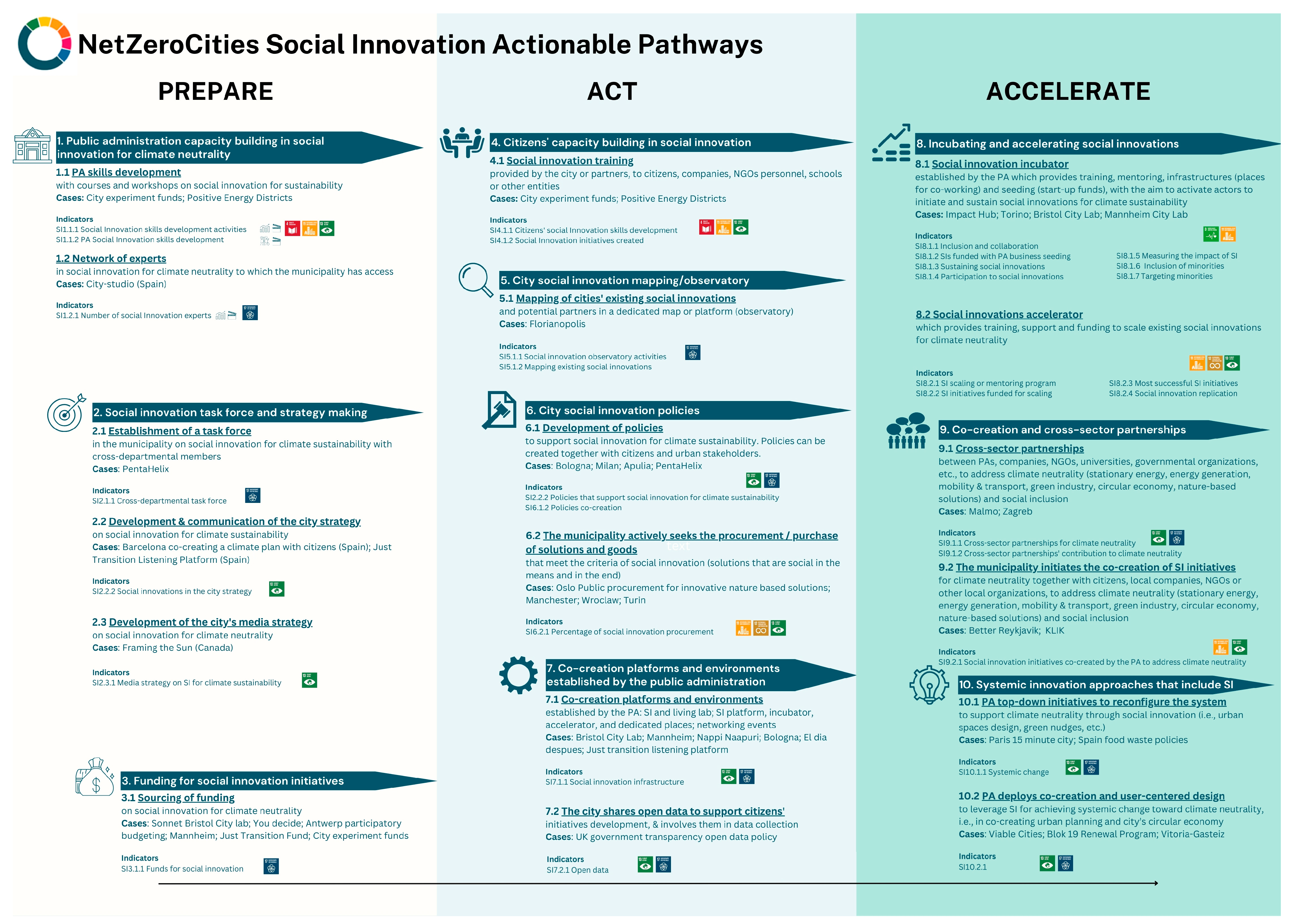
The deployment of social innovation as a lever for climate mitigation and adaptation is an emerging research area which is still partly fragmented across disciplines. With the aim to provide a comprehensive framework for the classification of social innovation action, a review of the literature across related domain has been conducted [22]; by triangulating this literature review with 40 case studies of social innovations for climate action, a framework for the design, scaling, and assessment of social innovations for sustainability was derived [22,23], and iteratively improved through co-design sessions held within the project with experts, with the aim to be not only a theoretical framework but also a pragmatic tool to support the scaling up, out, and deep [24,25] of social innovation actions. The framework provides 10 categories of social innovation and corresponding sub-categories and associated indicators (Figure 1) to structure the design and impact of social innovation as a systemic lever.
Figure 1.
Social Innovation Actionable Pathways, adapted from [22,23].
The framework is applied as an analytical classification tool, enabling systematic comparison of social innovation actions across cities, rather than as an evaluative or causal assessment framework. The following sections describe how this framework has been applied to code and assess the climate actions submitted by 53 of the cities participating in the pilot programme (cohort 1) of the NetZeroCities project, highlighting key insights and patterns emerging from the data.
2. Data Sources
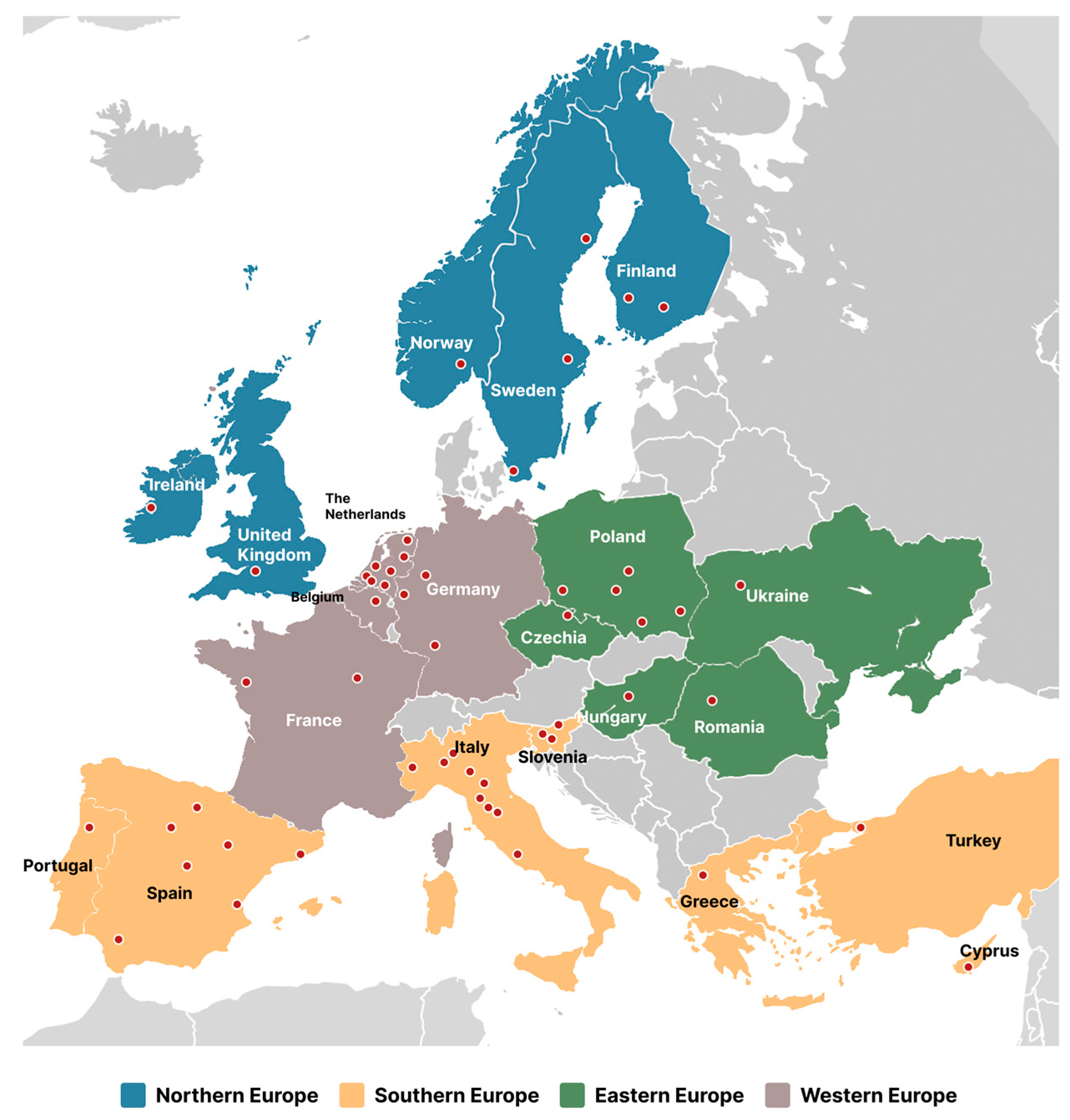
The climate actions planned by the cities were mapped from Proposal Refinement Documents (PRDs) submitted by the first 53 cities participating in the NetZeroCities Pilot City Programme and from the publicly accessible information published on the NetZeroCities website (https://netzerocities.eu/pilot-cities-cohort-1-2022/ accessed on 10 January 2026). The cities included in this analysis are: Bristol (U.K.), Budapest (Hungary), Cluj-Napoca (Romania), Dijon Metropole (France), Drammen (Norway), Galway (Ireland), Guimarães (Portugal), Istanbul (Turkey), Kozani (Greece), Lahti (Finland), Leuven (Belgium), Liberec (Czech Republic), Limassol (Cyprus), Malmö (Sweden), Nantes (France), Rivne (Ukraine), Turku (Finland), Umeå (Sweden), Uppsala (Sweden), and six multi-city pilot projects—nine Italian cities including Bologna, Bergamo, Florence, Milan, Padova, Parma, Prato, Rome, and Turin; three German cities including Aachen, Mannheim, and Münster; five Polish cities including Krakow, Łódź, Rzeszów, Warsaw, and Wrocław; the seven Dutch cities of Amsterdam, Eindhoven, Groningen, Helmond, Rotterdam, The Hague, and Utrecht; the three Slovenian cities of Kranj, Ljubljana, and Velenje; and seven Spanish cities including Barcelona, Madrid, Seville, Valencia, Valladolid, Vitoria-Gasteiz, and Zaragoza. Figure 2 visually marks these projects on a map of Europe, illustrating the diverse geographical and cultural contexts included in this study.
Figure 2.
Map of the 53 cities analysed (the red dots visually indicate the cities considered in this analysis).
Cities submitted documents as part of their pilot proposals for funding; the analysis of these documents allowed manual extraction and systematic compilation into a spreadsheet, with coding according to the social innovation indicator categories and subcategories of the Social Innovation Actionable Pathways framework [22,23].
3. Methods
3.1. Extraction and Compilation of the Data
Data were available at two levels: (1) overview of each pilot project comprising general qualitative information about the cities’ pilot activities, and (2) more specific, granular data on the individual proposed actions per city, providing a more in-depth understanding of the pilot projects from the bottom up. Both these levels of granularity were extracted and systematically captured in a spreadsheet as follows:
- Extraction of qualitative data of the proposed pilot activities: For each of the pilot projects, data were extracted from the publicly available documents on the NetZeroCities website (as mentioned in the Data Sources Section (Section 2)) and compiled in a spreadsheet. These data provide names of cities within each pilot, the size of the cities, a description of the pilot proposals, and the emission domains the pilot projects addressed.
- Coding of climate actions proposed by the cities: The templates provided to the cities by the project for the funding application required them to describe direct and indirect impacts of their planned climate actions. For the purpose of this study, the climate actions were extracted from each of the PRDs submitted by the cities as part of their pilot project proposals. While the extracted set of climate actions was unique for each single-city pilot proposal, for multi-city pilots, the proposed actions were replicated in each city independently, following the requirements of the call for cities to propose their pilot actions for the NetZeroCities project at the municipality level. Hence, such multi-city actions were also replicated in this dataset for analysis, keeping the unit of the analysis consistent at the municipality level per city. The extracted data were systematically organised within the spreadsheet created in the previous step.
3.2. Coding Actions with SI Indicator Categories and Sub-Categories
Each action was then coded according to the 10 social innovation categories and sub-categories by two of the authors individually, and then by a research assistant employing an investigator triangulation method [26]. In order to establish a consistent and shared coding logic for all the researchers, a set of criteria for assigning indicators to the actions was defined:
- Actions were considered to involve social innovation if their descriptions either explicitly referred to “social innovation” or implicitly aligned with the definition of social innovation adopted in this study [16].
- The description of each action was required to contain at least one relevant keyword or a recognised synonym associated with the corresponding social innovation indicator(s).
For example, the action to engage “citizens and communities [to] actively participate in energy-related activities” implies processes that “create new social collaborations” and “enhance society’s capacity to act”. Once an action was identified as relating to social innovation, it was subsequently matched to the most relevant social innovation (SI) indicator in accordance with the second criterion. In this instance, the action most closely aligns with the SI indicator “Participation in social innovations for climate neutrality” (SI8.1.5) within Category 8 of the Social Innovation Actionable Pathways framework. This procedure was applied systematically to all 445 actions included in the analysis, individually by two researchers and a research assistant. On the other hand, actions that referred solely to participation or collaboration without sufficient contextual detail were treated as borderline cases, where descriptions did not clearly indicate the presence of socially innovative processes or outcomes; such actions were excluded from SI coding to avoid over-interpretation. Examples of excluded cases include “Energy communities & agrivoltaics”, “Co-creation techniques for the methodology development”, and “Energy community’s management, social and economic aspects”. Although these descriptions partially reference participatory or engagement-related elements, they lacked sufficient information to determine whether concrete social innovation activities were planned. This conservative approach was adopted to ensure conceptual consistency in distinguishing social innovation from purely engagement practices.
Lastly, it is to be noted that the coding process allowed for the coding of actions in more than one category to ensure that relevant dimensions of social innovation were not excluded due to the constraints of mutually exclusive categorisation.
Differences in coding were resolved through structured discussions among the authors to reach a unanimous agreement on the final coding prior to analysis. Nevertheless, as with all qualitative coding processes, the potential for individual interpretive bias cannot be entirely eliminated and is therefore acknowledged as a limitation later in this study, highlighting the value of future research incorporating additional data sources, such as interviews or implementation evidence, to further validate coding decisions.
3.3. Analysis of the Coded Data
The final coded data set was systematically analysed at three levels: First, actions were coded by emission domains, which were used by the cities to categorise their actions in their pilot proposals. The evidence of the most frequently selected emission domains answers the research question regarding which sectors adopt social innovation most as a lever for climate action in Europe.
Second, the frequency of occurrence of each SI category and subcategory was computed to analyse and visualise the frequency of social innovation actions per category.
Thirdly, the geographical distribution of cities was coded and analysed according to SI categories. This provided two novel insights: (1) the spread of social innovation across European geographical regions as per United Nations Geoscheme for Europe (https://unstats.un.org/unsd/methodology/m49/ accessed on 10 January 2026), presenting the ratio of actions related to SI in each of the countries, and (2) the SI categories occurring per country, mapping which SI categories are most often planned by countries.
The summaries of distribution of categories of SI per country are provided in Appendix A and presented in the next Section.
4. Results
The analysis shows that 53.71% (or 239 out of 445) of the climate actions of the analysed cities’ pilot programmes are directly or indirectly related to social innovation as a lever of change based on the coding using the adopted framework. This includes a wide range of actions that span across the six standard emission domains and are linked to one of the 10 categories and subcategories of social innovation. The following sections elaborate on the key results of this analysis.
4.1. Selection of Emission Domains
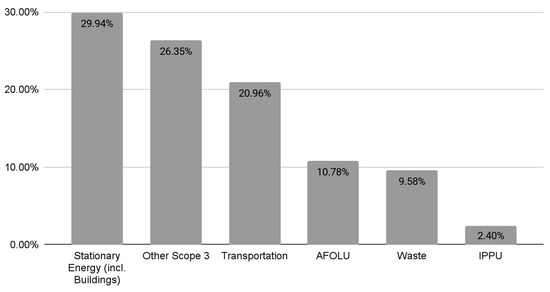
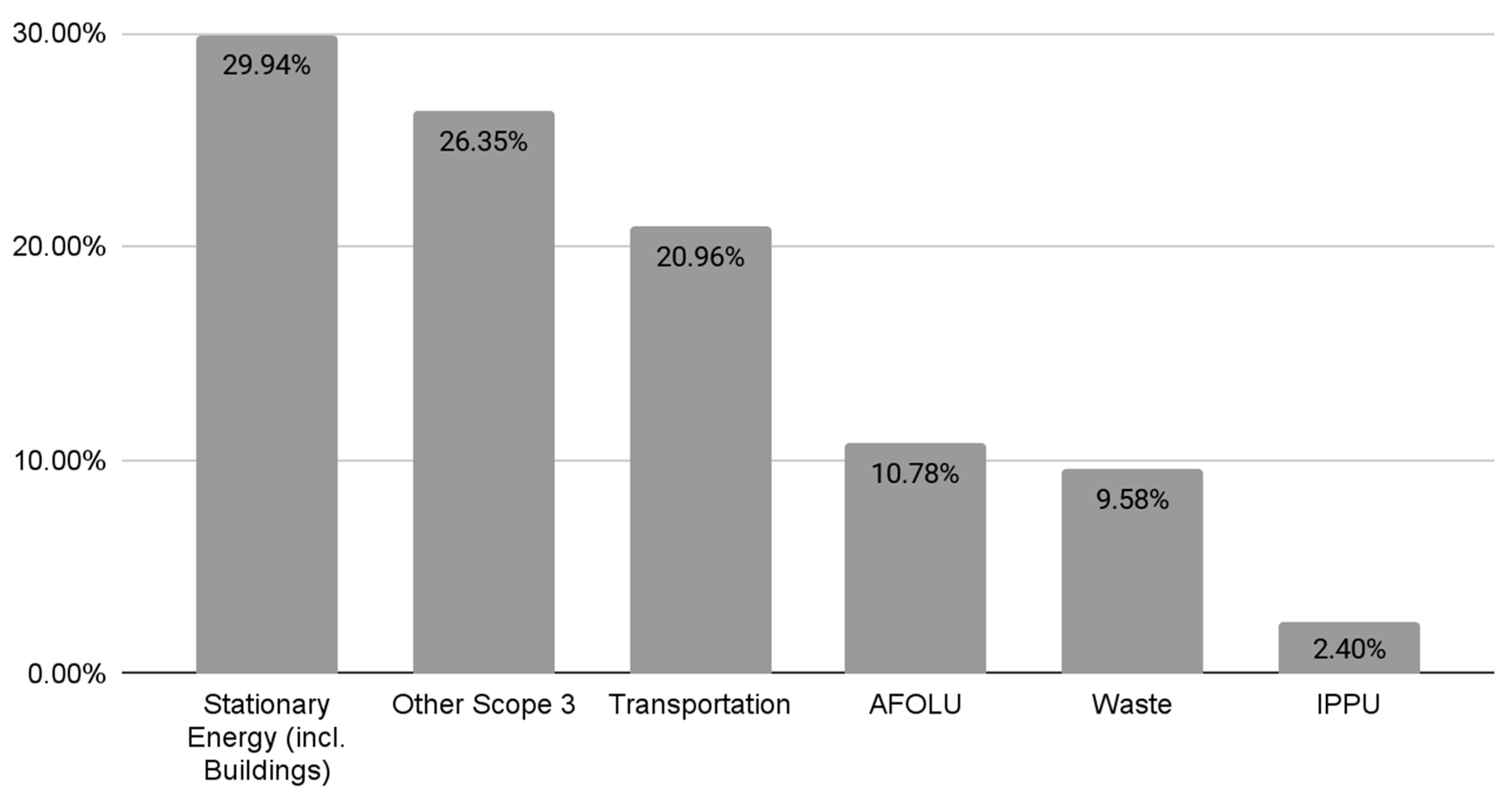
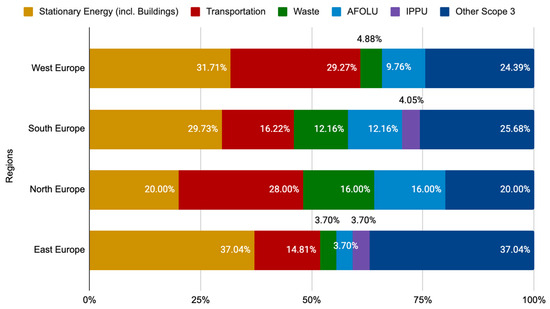
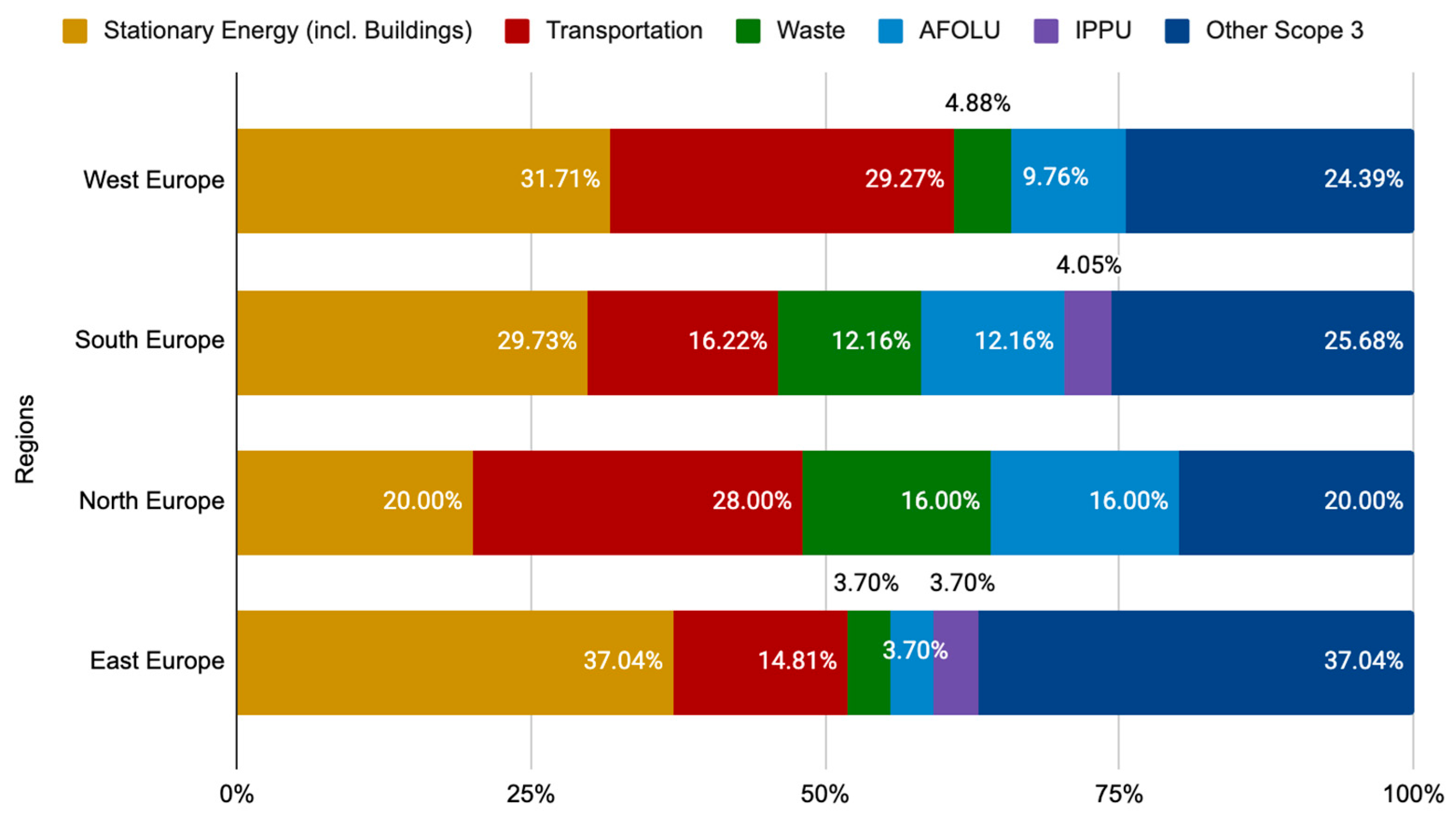
The distribution of social innovation actions per emission domain across European regions shows that stationary energy remains the dominant focus of cities’ climate action. As shown in the graph (Figure 3), stationary energy consistently takes up the largest share of actions in every European region and accounts for 29.94% of all domain selections. This is followed by “Other, Scope 3” emissions at 26.35%, which also feature prominently across regions, particularly in Southern, Western, and Eastern Europe, reflecting growing attention to consumption-based emissions and how social innovation is particularly relevant for this (Figure 4). Transportation represents 20.96% of all selections and appears strongly in Northern and Western Europe, though less elsewhere, suggesting regional differences in mobility infrastructure and policy emphasis. The remaining domains, including waste, IPPU, and AFOLU, are comparatively minor, with IPPU at only 2.4%, indicating limited relevance for urban-level climate action. These emerging patterns show that cities across Europe prioritise emission domains where socio-technical and behavioural factors are especially influential, namely stationary energy use, consumption patterns, and transport.
Figure 3.
Percentage of social innovation actions by emission domain.
Figure 4.
Distribution of social innovation actions by emission domain across European regions.
4.2. Social Innovation Indicator Frequency
The frequency of the social innovation actions per sub-category can be analysed at two levels of granularity: first, the level of the 10 categories of the Social Innovation Actionable Pathways framework, and second, at the level of the sub-categories (corresponding to the SI indicators) of the same framework [17]. Table 1 shows the total number of social innovation actions per category (sorted from lowest to highest frequency). Climate actions of cities linked to social innovation belong mostly to category 8, “Incubating and accelerating social innovations for climate neutrality”, with 216 actions (accounting for 28.35% of all SI actions).
Table 1.
Frequency of social innovation categories (ascending order).
This is closely followed by category 9, “Co-creation and cross-sector partnerships”, with 162 actions (21.26%). Both these categories correspond to the “Accelerate” phase of the SI Actionable Pathways framework, together accounting for 49.61% of all the cities’ climate actions. Category 7, “Co-creation platforms and environments”, and category 1, “Public administration capacity building in social innovation”, respectively account for over 10% of the total, indicating diversity in the levels of readiness, available resources, and long-term visions of the cities to scale social innovations to achieve climate neutrality.
A smaller number of cities show a focus on category 4, “Citizens’ capacity building in social innovation for climate neutrality”, and category 3, “Funding for Social Innovation initiatives for climate neutrality”, with occurrences at 7.87% and 5.51%, respectively. The remaining categories have a relatively low count (less than 5%), indicating a low focus of cities on these steps of the social innovation process, with the lowest count of six occurrences for category 5, “City Social Innovation mapping/observatory”.
In terms of phases, the “Prepare” phase accounts for 21.26% of all climate actions related to social innovation, while the “Act” phase accounts for 24.67%. The remaining 54.07% are climate actions that correspond to the three categories of SI listed under the “Accelerate” phase of the SI Actionable Pathways.
To assess the actions at a more granular level, the frequency results of the 38 sub-categories can be categorized as:
- (1)
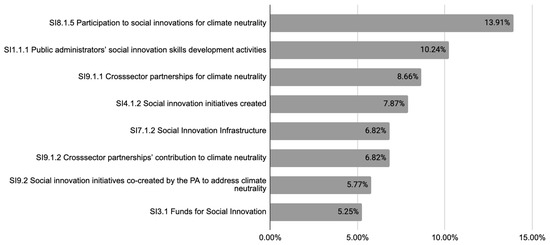
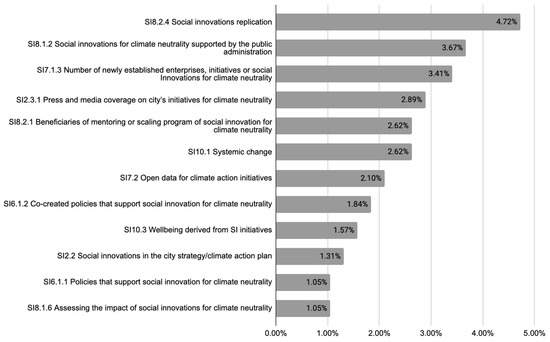
- High occurrence: 40 or more (or above 5%) (Figure 5);Figure 5. Frequency of the most selected SI sub-categories based on the coding climate actions.
- (2)
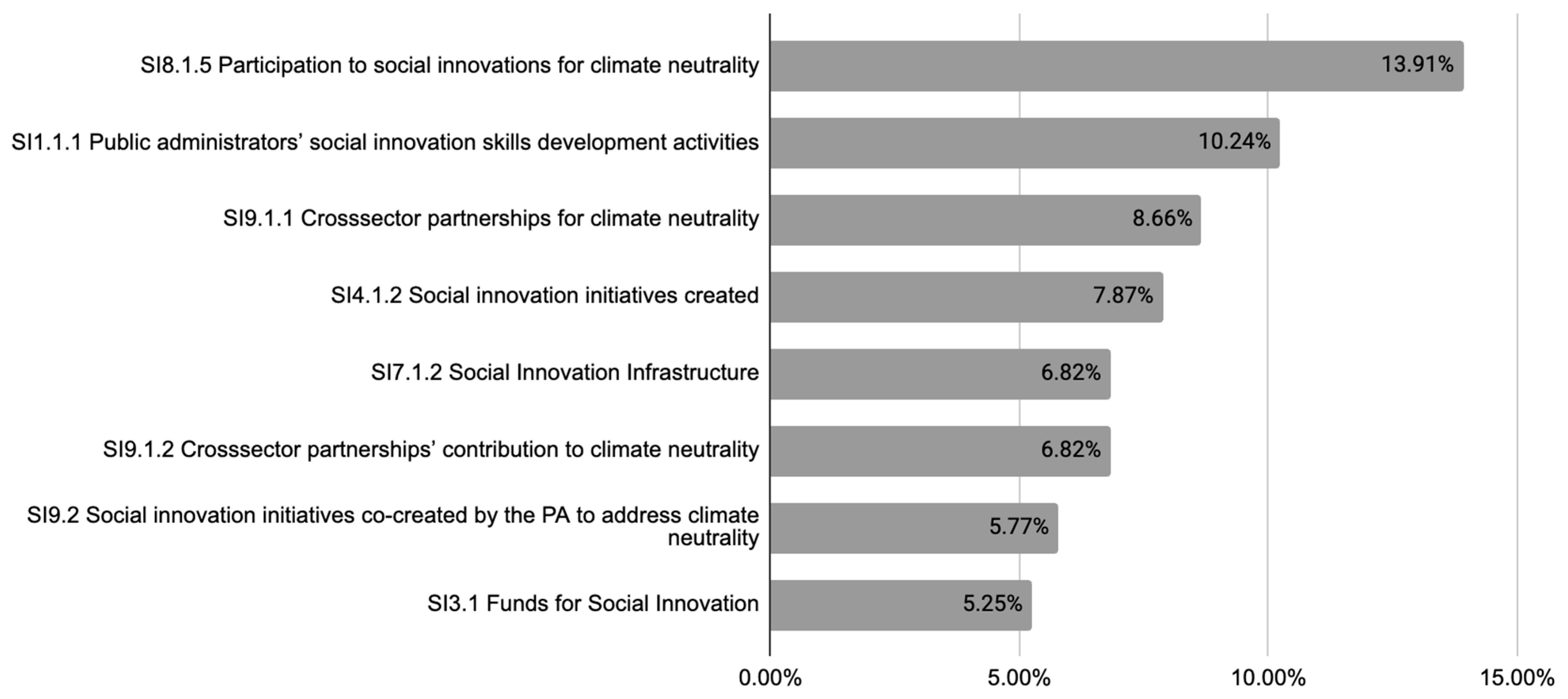
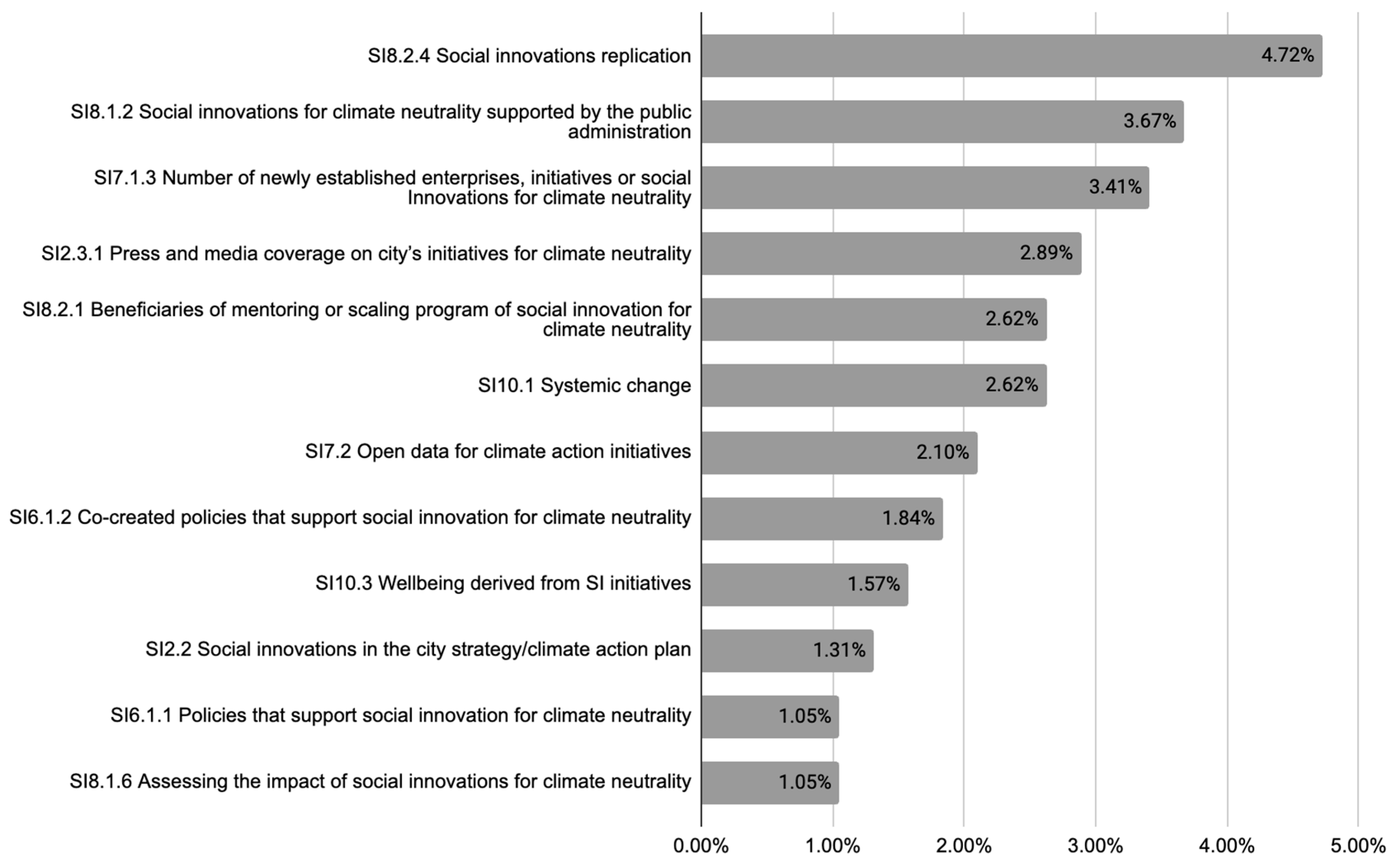
- Medium occurrence: between 8 and 40 (or 1 to 5%) (Figure 6);Figure 6. Social innovation sub-categories with medium occurrence.
- (3)
- Low or no occurrence: below 8 (or less than 1% occurrence).
Table 2 lists the frequencies for all 38 social innovation sub-categories.
Table 2.
Frequency of social innovation sub-categories for climate actions.
Within the high-occurrence group (Figure 5), all three indicators corresponding to category 9, “Co-creation and cross-sector partnerships”, are present. SI9.1.1 (Cross-sector partnerships for climate neutrality) accounts for 8.66% (or 66 climate actions), SI9.1.2 (Cross-sector partnerships’ contribution to climate neutrality) accounts for 6.82% (or 52 climate actions), and SI9.2 (Social innovation initiatives co-created by the PA to address climate neutrality) accounts for 5.77% (or 44 climate actions). This insight points to a strongly emerging practice among European Mission Cities to focus on fostering co-creation and cross-sectoral partnerships as an integral part of their systemic approach to climate neutrality.
It is also observed that the indicator SI8.1.5, “Participation in social innovations for climate neutrality”, has the highest occurrence at 13.91% (corresponding to 106 climate actions). This indicator corresponds to category 8, “Incubating and accelerating social innovations for climate neutrality”, which is also the highest occurring category. However, SI1.1.1, “Public administrators’ social innovation skills development activities”, accounts for 10.24% (78 climate actions), making it the second most occurring indicator, while its corresponding category is 1, “Public administration capacity building in social innovation”, which has a total of 82 occurrences and only ranks fourth among the highest selected categories (Table 1). In other words, 78 out of 82 (or about 85%) occurrences of category 1 are due to the high occurrence of SI indicator SI1.1.1. This insight shows that at the granular level, the focus on SI skill development activities for the public administration is a common area of focus of municipalities across European cities. Similarly, SI4.1.2, “Social innovation initiatives created”, has a high occurrence of 7.87% and accounts for all 60 occurrences of category 4, “Citizens’ capacity building in social innovation for climate neutrality”. This indicates that cities are currently focused on creating social innovation initiatives without citizens and stakeholder capability building initiatives, which seems like a missed opportunity (SI4.1.1 “Citizens’ Social Innovation for climate neutrality skills development”).
Lastly, within this grouping, SI7.1.2 (Social Innovation Infrastructure) also shows a high occurrence at 6.82% (52 occurrences), providing evidence of cities’ intention to foster enabling conditions for social innovation to emerge.
Of all SI sub-categories, 12 out of 38 sub-categories have a medium occurrence, accounting for 1 to 5% (Figure 6). Categories within this grouping include SI8.1.2, “Social innovations for climate neutrality supported by the public administration”, and SI8.2.4, “Social innovations replication”, at 3.67% and 4.72%, respectively. This finding is aligned with category 8 being the highest occurring category. SI7.1.3, “Number of newly established enterprises, initiatives or social innovations for climate neutrality”, occurs at 3.41% or across 26 actions, significantly contributing to the overall popularity of category 7, “Co-creation platforms and environments”. In addition, indicators associated with category 6, “Social innovation policies”, and category 10, “Systemic innovation approaches which include social innovation”, show a medium frequency, specifically with SI6.1.1 (Policies that support social innovation for climate neutrality), SI6.1.2 (Co-created policies that support social innovation for climate neutrality), SI10.1 (Systemic change), and SI10.3 (Well-being derived from SI initiatives). Although overall, these categories are less frequent among cities, as seen in Table 2, it indicates the presence of a diverse spectrum of actions linked with social innovation, which go beyond the more common ones usually found across European cities. For instance, SI6.1.2 (Co-created policies that support social innovation for climate neutrality) and SI10.3 (Well-being derived from SI initiatives) have been selected by the analysed Polish cities (Kraków, Łódź, Rzeszów, Warsaw, and Wrocław); however, they are not popular among other cities across Europe. This indicates a possible variation in the long-term plans and objectives towards climate neutrality of the cities, depending on their contextual needs. It may also reflect differences in national planning theories and practices, shaped by each country’s historical planning traditions [27]. The frequency of category 2 indicators shows an emergent focus across some cities towards social innovation strategy building and communication as a key driver of the “Prepare” phase of the SI actionable pathways model (SI2.2 “Social innovations in the city strategy/climate action plan” and SI2.3.2 “Press and media coverage on cities’ initiatives for climate neutrality”).
It is also noteworthy to analyse sub-categories that have not been addressed by municipalities. Specifically, five sub-categories have no corresponding action, indicating that cities are not considering such typologies of actions: SI1.2 “Social Innovation experts”, SI2.1 “Social innovation experts participating in the city transition team/climate task force”, SI4.1.1 “Citizens’ Social Innovation for climate neutrality skills development”, SI6.2 “Percentage of procurement from sustainable providers”, and SI8.1.7 “Inclusion of minorities”. The remaining indicators have occurred across 3–4 climate actions on average, making them specific to certain climate actions listed by the cities.
4.3. Geographical Distribution of SI Indicators
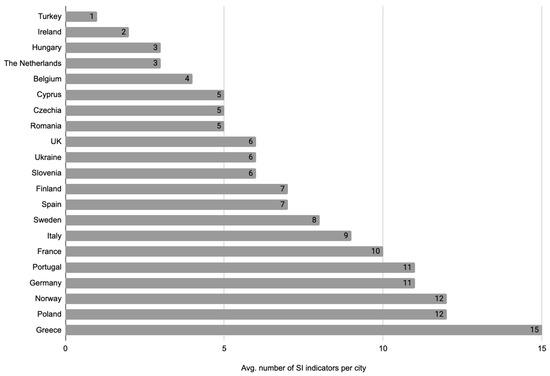
Figure 7 presents the average number of social innovation (SI) indicators identified per city in each country. A per-city average is used to normalise the dataset, as countries are unevenly represented in the project, with varying numbers of participating cities. For example, Italy, with nine participating cities, accounts for a total of 81 indicator assignments, whereas Greece, represented by a single city, accounts for 15 assignments. By using averages, the figure enables a more meaningful comparison across countries.
Figure 7.
Bar chart showing the average number of SI indicators per city’s pilot project in each country.
Overall, the figure provides a high-level overview of the diversity in SI prioritisation across EU countries. Greece shows the highest average number of SI dimensions addressed per city, while Turkey shows the lowest. Importantly, this should not be interpreted as an indication of countries’ relative commitment to social innovation. Rather, it reflects whether social innovation efforts are concentrated on a limited number of dimensions or distributed across multiple dimensions within cities’ climate action pathways.
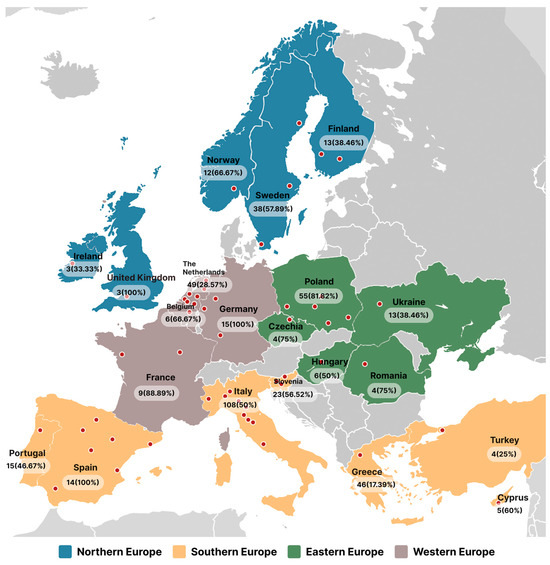
Figure 8, by contrast, shows the total number of actions per country and the proportion of these actions that can be linked to social innovation categories and indicators (shown within simple brackets below the names of each country). The analysis indicates that, although individual climate actions may address multiple dimensions of social innovation, not all actions related to the societal aspects of climate transitions can be classified as social innovation. Nevertheless, from the perspective of cities, actions related to engagement, participation, social innovation, and societal impact are often perceived as overlapping or belonging to a single category, as reflected in their descriptions of actions and anticipated impacts.
Figure 8.
Map showing the total number of actions with percentages of actions related to SI (within simple brackets) per country (the red dots visually indicate the cities considered in this analysis).
The results also suggest that the analytical framework used in this study, derived from a systematic literature review, does not capture all social innovation aspects planned by cities. The elements that fall outside the framework primarily relate to broader social aspects, which are more appropriately understood as co-benefits of climate action rather than as innovations in social practices.
Regional and Country-Level Social Innovation Patterns Across Europe
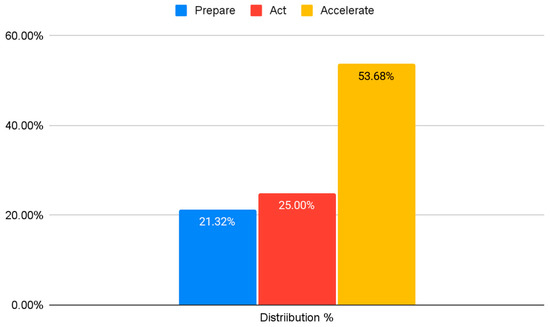
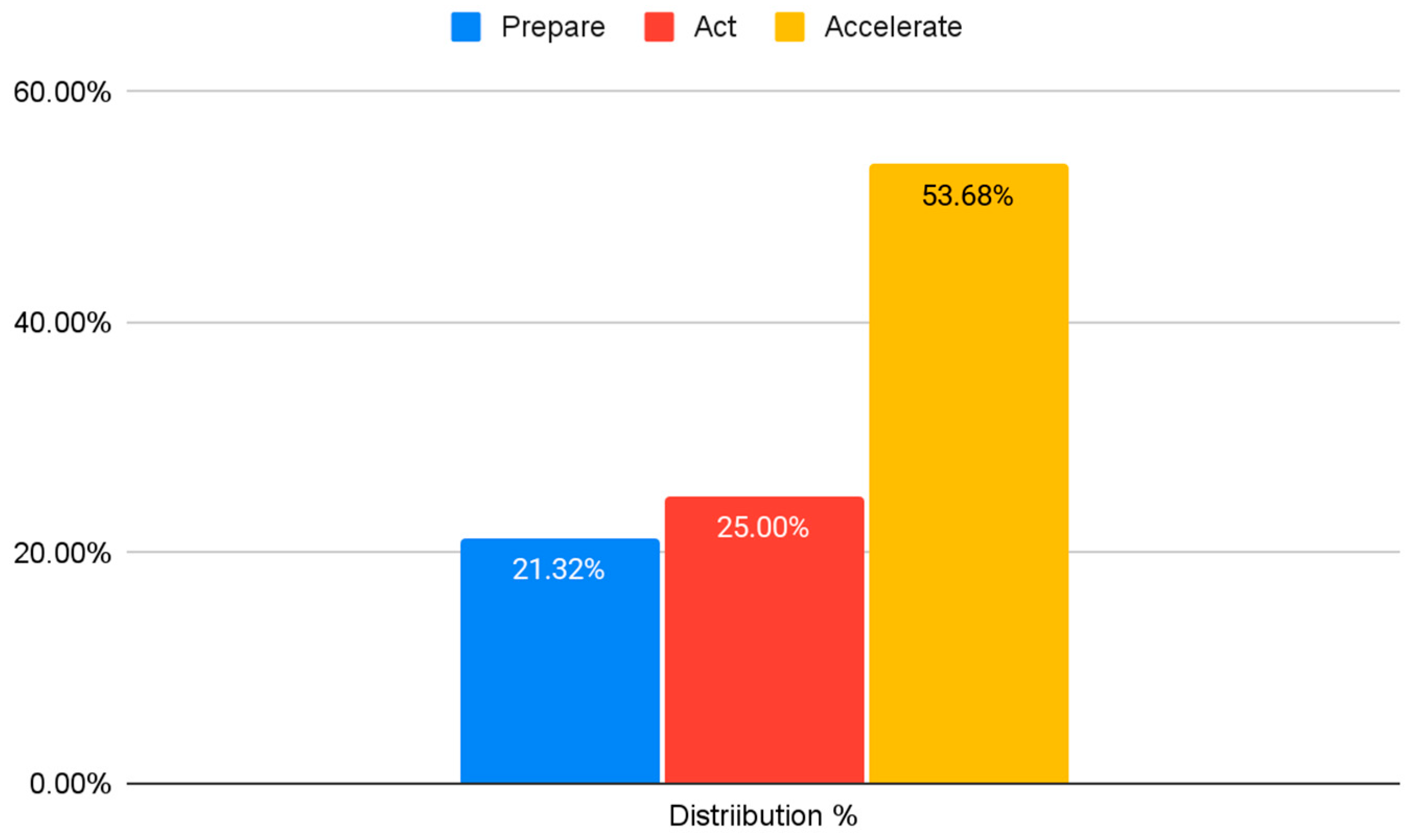
Across Europe, the distribution of social innovation activity shows a clear emphasis on the Accelerate phase, which accounts for 53.68% of all actions. This reflects the strong prominence of incubating and accelerating social innovations (Category 8) and co-creation and cross-sector partnerships (Category 9), together forming the dominant drivers of European SI actions. The Act phase represents 25% of social innovation actions, characterised particularly by co-creation platforms and environments (Category 7), indicating a common focus of cities on participatory and collaborative actions. The Prepare phase, at 21.32%, receives nearly equal emphasis and plays a significant role through actions in public administration capacity building in social innovation (Category 1), social innovation in transition teams and city strategy-making (Category 2), and funding for social innovation initiatives (Category 3). At a broad EU level, the pattern suggests that while cities have significant actions within the Prepare and Act phases, emerging social innovation efforts are most strongly oriented toward scaling, acceleration, and partnership-based transformation (Figure 9).
Figure 9.
Distribution of all social innovation actions submitted by the 53 cities across the Prepare, Act, and Accelerate phases of the Social Innovation Actionable Pathways framework.
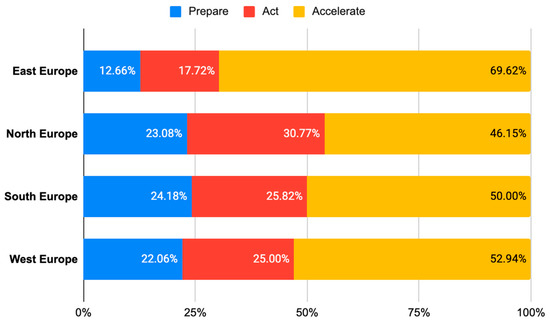
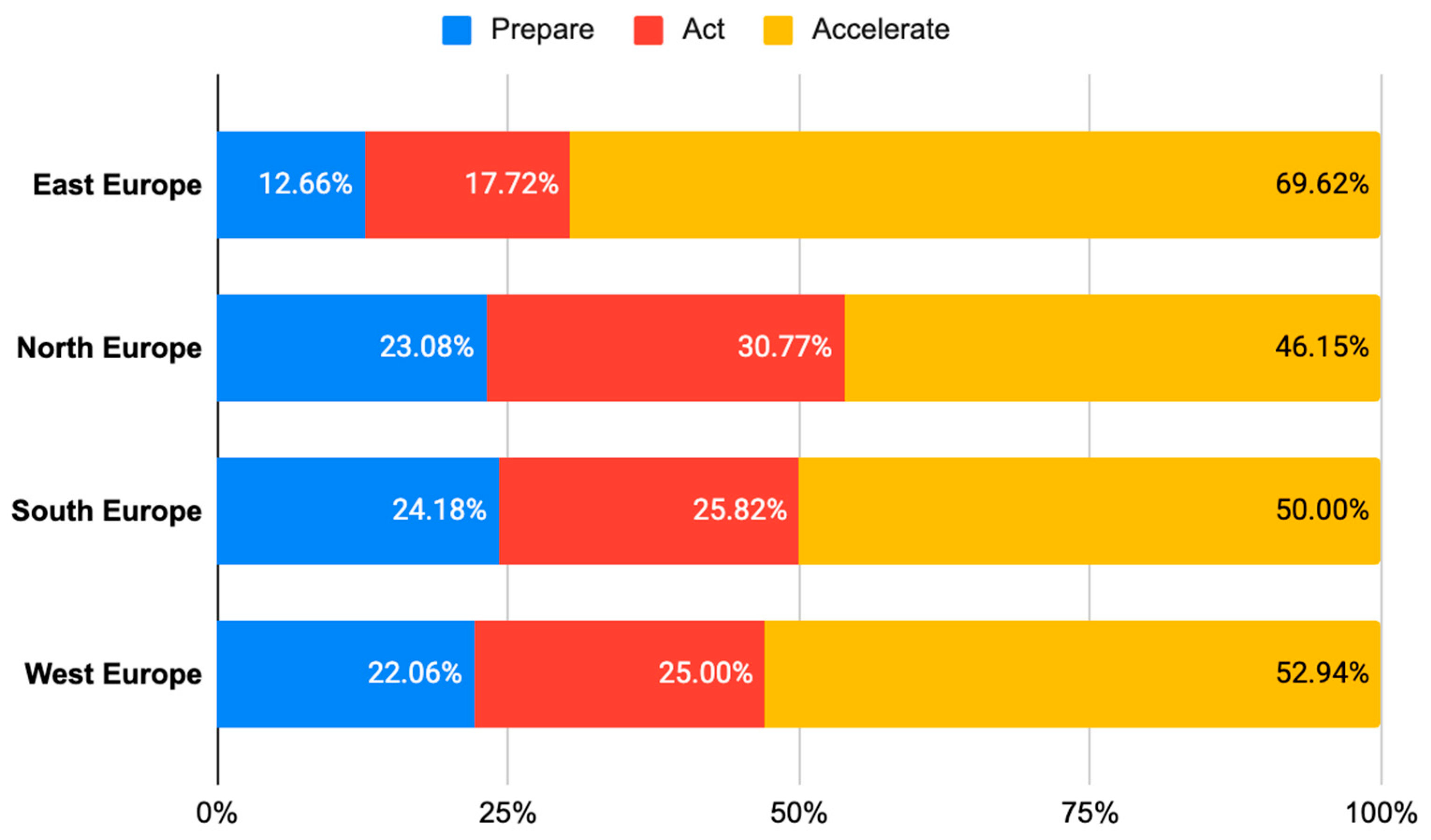
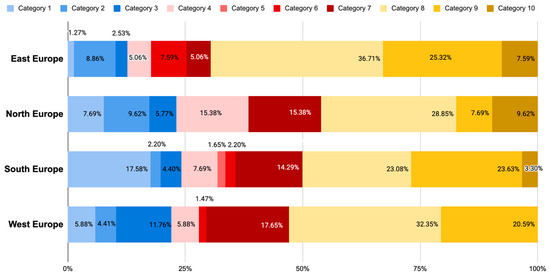
At the regional level (Figure 10 and Figure 11), Northern Europe shows a balanced social innovation ecosystem, with a relatively even distribution of preparatory actions in Categories 1 (7.69%), 2 (9.62%), and 3 (5.77%), Act phase contributions through Category 4 (15.38%) and co-creation platforms and environments (Category 7) (15.38%), and a strong emphasis on acceleration, led by Category 8 (28.85%) and supported by Category 9 (7.69%) and Category 10 (9.62%).
Figure 10.
Distribution of social innovation actions planned in cities’ pilot projects, by European region, categorised according to the Prepare–Act–Accelerate phases.
Figure 11.
Distribution of cities’ planned social innovation actions by European region, categorised according to the 10 categories of the Social Innovation Actionable Pathways framework.
On the other hand, Eastern Europe is highly acceleration-oriented, driven by 36.71% in Category 8, 25.32% in co-creation and cross-sector partnerships (Category 9), and 7.59% in Category 10, while the focus on the Prepare and Act phase categories remains relatively limited.
Southern Europe shows both the highest number and broadest mix of SI activity, with strong preparatory actions in Category 1 (17.58%), significant Act phase activity in Category 4 (7.69%) and Category 7 (14.29%), and dominant Accelerate phase activity in Category 8 (23.08%) and Category 9 (23.63%).
Lastly, Western Europe also presents a scaling-oriented configuration. The region’s SI activity is strongly weighted toward the Accelerate phase, driven by 32.35% in incubating and accelerating social innovations (Category 8) and 20.59% in co-creation and cross-sector partnerships (Category 9), complemented by notable Act phase contributions in Category 7 (17.65%). Prepare phase activity is present but more modest, with contributions across Category 1 (5.88%), Category 2 (4.41%), and Category 3 (11.76%).
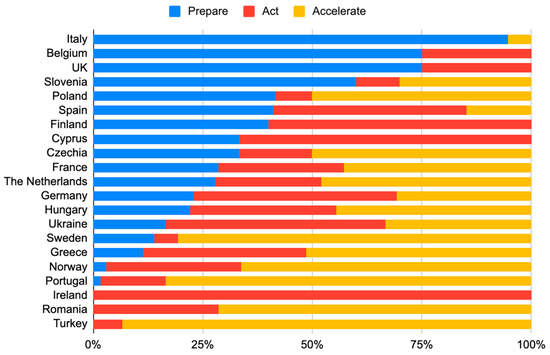
Further analysis at the level of countries reflects these regional patterns with granular contextual distinctions (Figure 12 and Table A1). Across European countries, social innovation activity exhibits patterns of concentration within specific stages of the social innovation actionable pathway, with only a limited number of cities showing significant engagement across all three phases. Several countries show a strong orientation toward the Prepare phase, led by Italy (94.74% prepare-related actions), followed by the UK (75%), Belgium (75%), Slovenia (60%), Poland (41.67%), Spain (41.18%), and Finland (40%). In these cases, activity is rooted primarily in public administration capacity building in social innovation (Category 1) and social innovation in transition teams and city strategy-making (Category 2).
Figure 12.
Distribution of social innovation planned actions by country, categorised according to the Prepare–Act–Accelerate phases of the Social Innovation Actionable Pathways framework.
A second group of countries displays a marked emphasis on the Act phase, led by Ireland (with 100% actions related to the Act phase), followed by Cyprus (66.67%), Finland (60%), Ukraine (50%), Spain (44.12%), Greece (37.14%), and France (28.57%). These portfolios are shaped largely by actions towards citizens’ capacity building in social innovation (Category 4), city social innovation mapping/observatory (Category 5), social innovation policies (Category 6), and co-creation platforms and environments (Category 7).
On the other hand, a broad set of countries exhibit a dominant emphasis on the Accelerate phase, with the strongest concentrations found in Turkey (93.33% Accelerate), Portugal (83.33%), Sweden (80.56%), Romania (71.43%), Norway (66.18%), Greece (51.43%), Czechia (50%), Poland (50%), France (42.86%), the Netherlands (48%), and Hungary (44.44%). Their activity is driven primarily by incubating and accelerating systemic innovations, including social (Category 8) and co-creation and cross-sector partnerships (Category 9).
A smaller number of countries demonstrate a more balanced distribution of actions across the three phases, combining preparatory actions, participatory mechanisms, and scaling strategies. These include France (28.57% Prepare, 28.57% Act, 42.86% Accelerate), followed by Germany (23.08% Prepare, 46.15% Act, 30.77% Accelerate), Hungary (22.22% Prepare, 33.33% Act, 44.44% Accelerate), the Netherlands (28% Prepare, 24% Act, 48% Accelerate), Czechia (33.33% Prepare, 16.67% Act, 50% Accelerate), Spain (41.18% Prepare, 44.12% Act, 14.71% Accelerate), and Ukraine (16.67% Prepare, 50% Act, 33.33% Accelerate).
In synthesis, the SI landscape of the most ambitious European cities in terms of climate mitigation reveals distinct national orientations, with many countries concentrating activity within a single stage (most often acceleration) while a smaller subset demonstrates more balanced SI strategies across the Prepare–Act–Accelerate phases.
5. Discussions
Although social innovation (SI) has long been positioned as a key enabler of socio-technical transformations (particularly capable of fostering co-creation, citizen engagement, cross-sector collaboration, and behavioural change), empirical evidence has remained mostly at the micro-level, dominated by the analysis of in-depth case studies or theoretical thematic analyses in diverse domains. What has been missing is a comparative overview of how SI is embedded within the climate action pathways of cities, particularly in the context of systemic transitions, such as those enabled by EU Missions on mitigation and adaptation. By analysing climate actions from 53 cities’ pilot projects across 21 countries using the Social Innovation Actionable Pathways framework, this study directly addresses the gap and offers pan-European insights on how SI is planned, configured, and distributed within the climate action agendas of cities adopting a systemic approach to climate neutrality. While the analysis is necessarily limited to descriptions of planned actions, the indicator-based classification enables systematic comparison across cities, emission domains, SI phases, and geographical contexts, therefore addressing the fragmentation in the extant literature on SI assessment beyond singular case studies. The discussion, therefore, focuses on interpreting what the observed distributions suggest about how cities are currently designing SI strategies within systemic approaches to climate neutrality, while limiting causal claims that cannot be derived from frequency patterns alone.
A key insight derived from the analysis is the distribution of SI across emission domains: the majority of actions are concentrated in the “Stationary Energy” domain, followed by “Other, Scope 3” emissions and “Transportation”. These domains strongly align with the most frequently selected SI categories, incubating and accelerating social innovations (Category 8) and fostering co-creation and cross-sector partnerships (Category 9). This alignment suggests that cities are most likely to mobilise SI in domains where technological measures alone are insufficient, and where climate progress depends more prominently on citizen participation, behavioural shifts, collaborative governance, and changes in consumption and mobility practices. However, this pattern should not be interpreted as evidence that social innovation is absent in other domains. Rather, it reflects the domains in which social innovation is most explicitly articulated in cities’ pilot proposal documents at the time of analysis. It should also be acknowledged that this emerging pattern may partly result from municipalities’ strategic framing of actions to align with the stated priorities of the EU Mission, thereby strengthening their funding applications. This interpretation remains a hypothesis that cannot be empirically tested within the scope of the present study and is therefore acknowledged as a limitation to be explored in future research.
Across all analysed cities, SI actions are strongly oriented towards the Accelerate phase (accounting for more than half of all SI-related actions), driven primarily by “Incubating and accelerating social innovations” (Category 8) and “Co-creation and cross-sector partnerships” (Category 9). One interpretation is that participating cities are prioritising the scaling and diffusion of solutions through partnerships, replication, and programme-like initiatives, over preparatory activities such as mapping or formal policy consolidation. However, an alternative interpretation is that actions framed as scalable, partnership-oriented, and implementation-ready may be more salient within funding applications and mission-oriented programmes, which often prioritise deliverability, upscaling potential, and stakeholder mobilisation. In this sense, the prominence of acceleration-oriented categories may reflect not only cities’ strategic preferences, but also how cities position themselves within a competitive funding and mission governance environment. This finding, therefore, raises a plausible hypothesis for future testing: that cities may be moving rapidly towards scaling-oriented SI activities while preparatory capacities develop more unevenly (because it might already be present, or because the city’s focus is on rapid action). The present study cannot confirm this capacity gap empirically (as it does not include measures of impact, organisational resources, administrative capacity, budget, or institutional maturity), but it identifies the pattern clearly enough to provide a promising venue of research for subsequent mixed-method and longitudinal studies.
Sub-categories analysis reveals that a small number of action typologies dominate cities’ planning of social innovation: participation in social innovation initiatives (SI8.1.5), cross-sector partnerships (SI9.1.1 and 9.1.2), co-created SI initiatives (SI9.2), and public administrators’ SI skill development (SI1.1.1). These findings illustrate that SI, as understood by cities, is primarily planned for leveraging participation, strengthening partnerships, and improving public administration capacity. Conversely, indicators such as SI1.2 “Social Innovation experts”, SI2.1 “Social innovation experts participating in the city transition team/climate task force”, SI4.1.1 “Citizens’ Social Innovation for climate neutrality skills development”, SI6.2 “Percentage of procurement from sustainable providers”, and SI8.1.7 “Inclusion of minorities” are rare or absent across Europe’s climate planning. These gaps indicate that SI is not yet consistently used as a lever to challenge underlying inequities, redistribute expertise, or embed long-term social objectives into European cities’ climate transition pathways. Instead, SI appears as a combination of collaborative practices and scaling mechanisms that operate within, rather than fundamentally shift, existing governance structures, thus bringing incremental rather than disruptive innovation, which the EU Missions aim towards. However, it is also possible that some categories or indicators, as currently formulated, do not fully capture how cities describe or implement these dimensions, particularly where different terminology is used or where such considerations are embedded implicitly rather than articulated explicitly. This may represent a current limitation of the framework. At the same time, the patterns observed in this study are based on a limited sample of the first 53 cities engaging with the Mission (which have not prioritised such SI dimensions in their proposals), and potential shifts in these trends cannot be ruled out as additional cities join. Nevertheless, the findings provide valuable directions for future research to examine these assumptions, refine the framework, and deepen understanding of the role of social innovation in challenging the status quo towards more sustainable and inclusive practices.
Geographical analysis further advances our understanding of municipalities’ intentions in social innovation practices. Southern and Western European countries show large volumes of SI activity with strong acceleration emphasis. Northern Europe presents a more balanced configuration with contributions across all phases. Eastern Europe shows acceleration-oriented SI on a limited set of preparatory actions. Only a small number of countries, including France, Germany, Hungary, the Netherlands, Czechia, Spain, and Ukraine, demonstrate activity across all three SI phases. This diversity highlights that the SI landscape of the EU cities is geographically differentiated, reflecting distinct institutional histories, diverse local contexts, resource configurations, and political cultures. While these patterns require further explanation, the present dataset does not include direct measures of contextual factors such as administrative capacity, availability of resources and funding, or local political conditions. Nevertheless, the observed variation is consistent with the proposition that SI portfolios are shaped not only by climate priorities but also by governance capacities and institutional arrangements that condition what cities can plan, coordinate, and credibly propose. Future work could therefore extend this analysis by systematically relating SI configurations to governance capacity indicators (e.g., administrative capacity, budget capacity, institutionalised participation mechanisms, political will, etc.), as well as socio-economic and infrastructural differences. Such analysis would enable stronger explanatory inference while building directly on the comparative baseline established here.
The findings of this study offer actionable insights for initiatives that promote socially embedded and mission-oriented approaches to climate neutrality. For instance, the strong concentration of social innovation actions in the Accelerate phase, particularly in participation, cross-sector partnerships, and scaling initiatives, aligns with the objectives of the New European Bauhaus (NEB) [28], an EU initiative that connects the European Green Deal with everyday life by promoting places and projects that are sustainable, inclusive, and beautiful and thus emphasises participatory, inclusive, and place-based transformation. This alignment is illustrated by cases such as Cluj-Napoca [29], a city included in this analysis, which has also been associated with a project recognised under the New European Bauhaus Prizes, demonstrating how social innovation for climate action can intersect with broader policy agendas on sustainability, inclusion, and quality of life. At the same time, the limited presence of preparatory capacities, such as citizen skill development and social innovation expertise within governance structures, suggests that further coordination across EU initiatives could help reinforce preparatory social innovation capacities needed to sustain systemic change. By systematically mapping how social innovation is currently embedded in municipal climate strategies, this research provides an initial empirical basis for aligning and supporting EU projects and policy instruments that seek to leverage social innovation as a driver of systemic urban transformation.
In addition, the near absence or low frequency of indicators related to the inclusion of minorities and sustainable procurement highlights a gap between cities’ climate action portfolios and the equity-oriented objectives of the European Social Fund Plus (ESF+) [30] and the Social Economy Action Plan (SEAP) [31]. These findings point to specific blind spots that programme designers and policymakers could address more explicitly, for instance, by requiring clearer criteria of inclusion and equity mechanisms in climate-related funding calls and supporting observatories/monitoring infrastructures that make social innovation activities visible and comparable and foster mutual learning across cities
The regional differentiation observed in the analysis further suggests that EU-level capacity-building support should be tailored to national needs. Regions or contexts characterised by limited preparatory activity may benefit most from targeted support focused on SI capability building, governance capability, systemic innovation, and long-term strategy-building. Conversely, cities with stronger preparatory foundations may benefit from structured pathways for replication, scaling, and cross-city peer learning.
The findings also provide theoretical implications, contributing to some of the critical discussions in the intersection of social innovation and systemic climate transitions by showing where, in practice, European mission cities currently position social innovation within their transition portfolios. By applying a comparative coding approach to assess 445 climate actions within pilot projects aiming at systemic transitions, the study illustrates how SI theory can move beyond singular case studies to a cross-contextual assessment of SI, enabling pattern detection across governance contexts while retaining conceptual grounding in an established SI definition [16]. This is particularly essential for shaping transdisciplinary perspectives of social innovation when applied as a systemic lever for socio-technical transformations [7,13,14].
The analysis shows that cities are primarily engaging in “scaling out” and “scaling up” [24,25], using social innovation to replicate and diffuse practices while coordinating actors and embedding these practices within mission-oriented governance structures [19,20], as evidenced by the high concentration of SI-related actions within the Accelerate phase. On the other hand, “scaling deep”, involving shifts in values, norms, and long-term capabilities, appears to be less emphasised and addressed indirectly, as an assumed consequence of diffusion rather than as a central design focus. The findings also reveal a tension with the normative definition of social innovation (adopted in this study) as inherently inclusive and democratising [15,16], as dimensions such as minority inclusion are largely absent. While it is acknowledged that the absence of such levers may be a limitation of the assessment framework used in this study, as well as the pilot programme focus on carbon neutrality, it also presents a useful direction for future research to investigate whether mission-oriented social innovations are more oriented towards scalable strategies through participation, partnership, and replication compared to those aligned with inclusivity- and equity-driven objectives of the EU Mission and pillar of social rights [28,30,31].
With this systematic and comparative overview of how SI is positioned within urban climate actions in Europe, this study contributes critical insights for future policy design, peer learning among cities, and advancing theoretical discourse on SI in systemic climate transitions.
6. Conclusions
This study provides a comprehensive overview of how social innovation (SI) is being integrated into the climate actions of European cities striving to be climate neutral by 2030, complementing studies on comparative and meta-analyses of technical solutions to climate neutrality [32]. By applying the Social Innovation Actionable Pathways framework to assess 53 cities’ pilot programmes (445 planned climate actions), it offers new empirical insight into how cities harness SI within their systemic climate transition pathways. The actions are categorised across the three phases of the SI (Prepare–Act–Accelerate) framework, spanning 10 categories of SI and 38 indicators, allowing both a comparative and granular analysis of how SI is being planned in Europe. In addition, by examining SI across cities, countries, and European regions, the study captures both local specificities and broader regional patterns. This macro- and meso-level comparative analysis is relevant for building a comprehensive and yet detailed understanding of how SI is being planned and embedded within the complexities of EU cities’ climate transition pathways. As the Social Innovation Actionable Pathways framework utilised for the analysis is built on a systemic literature review, the results show patterns of which aspects are perceived as being of higher relevance in real-world applications and provide insights on how to further refine the framework [22,23].
While the study points toward several critical insights, there are some limitations that should be explicitly acknowledged. Firstly, the analysis is based on planned rather than implemented actions; thus, the results of this study reflect strategic intentions rather than realised outcomes or impacts and may be influenced by cities’ incentives to align their proposals for acquiring funding with programme priorities. However, it provides a baseline against which to compare cities’ actions in the near future with further studies. In relation to this, the absence of external data sources for validating whether and to what extent the proposed social innovation actions are implemented on the ground constitutes an additional limitation. Future research should therefore triangulate proposal-based analyses with additional sources, such as implementation reports, monitoring data, or interviews with key stakeholders, to assess the extent to which planned social innovation activities are realised in practice and to better account for potential positive reporting bias.
Secondly, the coding process is based on textual descriptions provided by municipalities that vary in their level of detail and clarity, which may introduce self-reporting bias. Although the qualitative coding criteria defined for this study were applied systematically and rigorously, a degree of subjectivity remains inherent in document-based qualitative coding, particularly in cases where action descriptions are brief, ambiguous, or lacking in contextual detail. While this paper is based primarily on document analysis, future research would benefit from incorporating interviews with key stakeholders involved in the planning and implementation of the actions. Such qualitative work would allow for contextualisation of findings derived from documents.
Thirdly, inter-coder reliability statistics (e.g., Cohen’s kappa) have not been applied in this study. While such metrics are commonly applied in deductive content analysis, qualitative methods literature notes that they are not always appropriate for interpretive coding involving conceptually complex and context-dependent categories [33,34]. To address reliability and mitigate individual interpretive bias in this context, the study employed investigator triangulation and a structured, consensus-based coding process [35]. All actions were coded independently by two researchers and subsequently reviewed by a third coder, with discrepancies resolved through iterative discussion until unanimous agreement was reached. This is therefore acknowledged as a methodological limitation, and future research may complement consensus-based coding with formal reliability statistics where appropriate.
Fourthly, while the framework used in this study was developed through an extensive review of the previously published transdisciplinary literature, it may nevertheless have limitations that influence the observed absence of certain SI indicators in the analysis. Since the analysis presented in this study is based on intended actions as documented in proposal materials rather than on evidence of implementation or impact, it is not possible at this stage to accurately determine whether the observed absence reflects genuine gaps in municipal practice or constraints in the framework itself. Future research could further empirically validate the framework using data on the implementation and outcomes of actions, assessing its effectiveness as a categorisation tool for realised social innovation practices in addition to intended plans.
Lastly, the dataset includes cities that are engaged in an ambitious, systemic, mission-oriented programme to tackle climate action, which limits the extent to which the results can be generalised across other cities in Europe and worldwide. To overcome these limitations, promising research directions include extending the analysis to a wider set of European and non-European cities, which would further clarify whether the patterns identified here are characteristic of highly ambitious mission-oriented cities or indicate generalisable trends of cities enabling SI, as well as utilising geospatial technology in addition to self-reported data [36]. These directions can not only advance the theoretical understanding but also inform climate policy on the role of social innovation in systemic climate transitions.
Despite these limitations, the comparative study offers some innovative contributions for both theory and policy. Theoretical implications include providing a replicable approach for future comparative research on social innovation practices [14] and beyond [37] that can advance sustainable urban planning and design. For policy and practice, the results identify where SI activity is concentrated and where important gaps remain. This can inform the design of capacity building, funding, and regulatory interventions to further support cities in their systemic approach to reach climate neutrality. Moreover, it highlights support opportunities to reinforce currently underdeveloped SI dimensions, such as citizens’ SI skill development, mapping observatories, inclusive practices, and sustainable procurement [15]. Additionally, cities with strong preparatory action can be supported to build more coherent pathways for scaling, while those with strong acceleration activity may benefit from strengthening preparatory SI capacities.
Building on this foundation, future research should investigate how social innovation actions translate into implementation and impact over time, including enabling behavioural change and well-being. Longitudinal, mixed-methods studies and AI-supported data harnessing and analysis [38] would be particularly valuable in assessing the transformative and transformational capacity of social innovations’ integration into urban planning and design to integrate environmental and social aspects.
Author Contributions
Conceptualisation, S.B., R.M. and F.R.; methodology, R.M. and S.B.; validation, R.M. and A.R.; formal analysis, R.M.; data curation, R.M. and A.R.; writing—original draft preparation, R.M.; writing—review and editing, S.B.; visualisation, R.M.; supervision, S.B. and F.R.; project administration, S.B.; funding acquisition, F.R. All authors have read and agreed to the published version of the manuscript.
Funding
This research was funded by the EU Horizon 2020 Program grant number 101036519 (project NetZeroCities) and EU Horizon Europe Program grant number 101139652 SGA2-NZC.
Institutional Review Board Statement
Not applicable.
Informed Consent Statement
Not applicable.
Data Availability Statement
The original contributions presented in this study are included in the article. Further inquiries can be directed to the corresponding author.
Acknowledgments
The authors are especially thankful to Nikhil Chaudhary and the Climate-KIC team, as well as to the consortium members that were part of the task, Angelica Gomez Castilla and Francesco Noera.
Conflicts of Interest
The authors declare no conflicts of interest.
Appendix A
Table A1.
Distribution of categories of SI per country.
References
- Buchanan, R. Wicked Problems in Design Thinking. Des. Issues 1992, 8, 5. [Google Scholar] [CrossRef] [Scilit]
- Hautamäki, A.; Oksanen, K. Sustainable innovation: Solving wicked problems through innovation. In Open Innovation: A Multifaceted Perspective Volume 1; World Scientific Publishing Co. Pte. Ltd.: Singapore, 2016; pp. 87–110. [Google Scholar]
- Pohl, C.; Truffer, B.; Hirsch-Hadorn, G. Addressing Wicked Problems through Transdisciplinary Research. In The Oxford Handbook of Interdisciplinarity, 2nd ed.; Frodeman, R., Ed.; Oxford University Press: Oxford, UK, 2017; pp. 319–331. [Google Scholar] [CrossRef] [Scilit]
- Wolfram, M.; Frantzeskaki, N. Cities and Systemic Change for Sustainability: Prevailing Epistemologies and an Emerging Research Agenda. Sustainability 2016, 8, 144. [Google Scholar] [CrossRef] [Scilit]
- Hulme, M. Abrupt climate change: Can society cope? Philos. Trans. R. Soc. Lond. Ser. A Math. Phys. Eng. Sci. 2003, 361, 2001–2021. [Google Scholar] [CrossRef] [Scilit] [PubMed]
- Mayer, A.L. Strengths and weaknesses of common sustainability indices for multidimensional systems. Environ. Int. 2008, 34, 277–291. [Google Scholar] [CrossRef] [Scilit] [PubMed]
- Repo, P.; Matschoss, K. Social innovation for sustainability challenges. Sustainability 2019, 12, 319. [Google Scholar] [CrossRef] [Scilit]
- Akenji, L.; Lettenmeier, M.; Koide, R.; Toivio, V.; Amellina, A. 1.5-Degree Lifestyles: Targets and Options for Reducing Lifestyle Carbon Footprints; Institute for Global Environmental Strategies: Hayama, Japan, 2019. [Google Scholar] [CrossRef]
- Hirano, Y.; Ihara, T.; Yoshida, Y. Estimating residential CO2 emissions based on daily activities and consideration of methods to reduce emissions. Build. Environ. 2016, 103, 1–8. [Google Scholar] [CrossRef] [Scilit]
- Newell, P.; Twena, M.; Daley, F. Scaling behaviour change for a 1.5-degree world: Challenges and opportunities. Glob. Sustain. 2021, 4, e22. [Google Scholar] [CrossRef] [Scilit]
- Bresciani, S.; Rizzo, F.; Deserti, A. Toward a Comprehensive Framework of Social Innovation for Climate Neutrality: A Systematic Literature Review from Business/Production, Public Policy, Environmental Sciences, Energy, Sustainability and Related Fields. Sustainability 2022, 14, 13793. [Google Scholar] [CrossRef] [Scilit]
- Unceta, A.; Luna, Á.; Castro, J.; Wintjes, R. Social Innovation Regime: An integrated approach to measure social innovation. Eur. Plan. Stud. 2020, 28, 906–924. [Google Scholar] [CrossRef] [Scilit]
- Geels, F.W. Micro-foundations of the multi-level perspective on socio-technical transitions: Developing a multi-dimensional model of agency through crossovers between social constructivism, evolutionary economics and neo-institutional theory. Technol. Forecast. Soc. Change 2020, 152, 119894. [Google Scholar] [CrossRef] [Scilit]
- Diepenmaat, H.; Kemp, R.; Velter, M. Why Sustainable Development Requires Societal Innovation and Cannot Be Achieved without This. Sustainability 2020, 12, 1270. [Google Scholar] [CrossRef] [Scilit]
- Manzini, E. Design, When Everybody Designs: An Introduction to Design for Social Innovation; The MIT Press: Cambridge, MA, USA, 2015. [Google Scholar] [CrossRef] [Scilit]
- Murray, R.; Caulier-Grice, J.; Mulgan, G. The Open Book of Social Innovation; National Endowment for Science, Technology and the Arts (NESTA) and The Young Foundation: London, UK, 2010. [Google Scholar]
- Bresciani, S.; Rizzo, F.; Mureddu, F. Assessment Framework for People-Centred Solutions to Carbon Neutrality: A Comprehensive List of Case Studies and Social Innovation Indicators at Urban Level; Springer: Cham, Switzerland, 2024. [Google Scholar]
- Olwig, S.; Bolkesjø, T.F.; Klitkou, A.; Lund, P.D.; Bergaentzlé, C.; Borch, K.; Olsen, O.J.; Kirkerud, J.G.; Chen, Y.-K.; Gunkel, P.A.; et al. Climate-friendly but socially rejected energy-transition pathways: The integration of techno-economic and socio-technical approaches in the Nordic-Baltic region. Energy Res. Soc. Sci. 2020, 67, 101559. [Google Scholar]
- European Commission. European Missions—100 Climate-Neutral and Smart Cities by 2030. 2021. Available online: https://netzerocities.eu/ (accessed on 10 January 2026).
- Mazzucato, M. Mission Economy: A Moonshot Guide to Changing Capitalism; Allen Lane: London, UK, 2021. [Google Scholar]
- Chaudhary, N.; Hawkins, P.; Palavicino, C.A. NetZeroCities Theory of Change; Deliverable 2.14. NetZeroCities EU H2020 Grant Agreement n°101036519; European Union: Brussels, Belgium, 2022. [Google Scholar]
- Bresciani, S.; Tjahja, C.; Komatsu, T.; Rizzo, F. Social innovation for climate neutrality in cities: Actionable pathways for policymakers. In Proceedings of the IASDR 2023: Life-Changing Design, Design Research Society, Milan, Italy, 9–13 October 2023. [Google Scholar] [CrossRef] [Scilit]
- Bresciani, S.; Tjahja, C. Social Innovation Scaling at Urban Level. In Social Innovation Projects for Climate Neutral Cities; SpringerBriefs in Applied Sciences and Technology; Springer Nature: Cham, Switzerland, 2025; pp. 53–62. [Google Scholar] [CrossRef] [Scilit]
- Dees, G.; Anderson, B.B.; Wei-Skillern, J. Scaling social impact: Strategies for spreading social innovations. Stanf. Soc. Innov. Rev. 2004, 1, 24–33. [Google Scholar]
- Moore, M.-L.; Riddell, D.; Vocisano, D. Scaling Out, Scaling Up, Scaling Deep: Strategies of Non-profits in Advancing Systemic Social Innovation. J. Corp. Citizsh. 2015, 67–84. [Google Scholar] [CrossRef] [Scilit]
- Carter, N.; Bryant-Lukosius, D.; DiCenso, A.; Blythe, J.; Neville, A.J. The Use of Triangulation in Qualitative Research. Oncol. Nurs. Forum 2014, 41, 545–547. [Google Scholar] [CrossRef] [Scilit] [PubMed]
- Eckersley, P. Cities and climate change: How historical legacies shape policy-making in English and German municipalities. Politics 2017, 37, 151–166. [Google Scholar] [CrossRef] [Scilit]
- European Commission. New European Bauhaus. 2024. Available online: https://new-european-bauhaus.europa.eu/index_en (accessed on 10 January 2026).
- NetZeroCities. 9 Mission Cities Among the 20 New European Bauhaus Awards Winners and Runners-Up. 25 April 2024. Available online: https://netzerocities.eu/2024/04/25/9-mission-cities-among-the-20-new-european-bauhaus-awards-winners-and-runners-up/ (accessed on 26 January 2026).
- European Commission. European Social Fund Plus (ESF+): Employment and Social Innovation (EaSI). 2024. Available online: https://european-social-fund-plus.ec.europa.eu/en/direct-management-easi (accessed on 10 January 2026).
- European Commission. Social Economy Action Plan. 2021. Available online: https://employment-social-affairs.ec.europa.eu/policies-and-activities/eu-employment-policies/social-economy-and-inclusive-entrepreneurship/social-economy-action-plan_en (accessed on 10 January 2026).
- Cardoso, J.P.; Azevedo, I.; Leal, V.; Silva, M.C.; da Costa, C. Meta-analysis of district-level solutions towards energy, carbon and economic targets. Energy Build. 2025, 115701. [Google Scholar] [CrossRef] [Scilit]
- Lincoln, Y.S.; Guba, E.G. Naturalistic Inquiry; Sage Publications: Beverly Hills, CA, USA, 1985. [Google Scholar]
- Saldaña, J. The Coding Manual for Qualitative Researchers, 3rd ed.; Sage Publications: London, UK, 2016. [Google Scholar]
- Denzin, N.K. The Research Act: A Theoretical Introduction to Sociological Methods, 2nd ed.; McGraw-Hill: New York, NY, USA, 1978. [Google Scholar]
- Sharma, R.; Pradhan, L.; Kumari, M.; Bhattacharya, P. Urban green space planning and development in urban cities using geospatial technology: A case study of Noida. J. Landsc. Ecol. 2022, 15, 27–46. [Google Scholar] [CrossRef] [Scilit]
- Ceschin, F. How the design of socio-technical experiments can enable radical changes for sustainability. Int. J. Des. 2014, 8, 1–21. [Google Scholar]
- Kumar, D.; Shekhar, S.; Tewary, T. AI and data analytics for climate data management. Front. Environ. Sci. 2025, 13, 1679608. [Google Scholar] [CrossRef] [Scilit]

Disclaimer/Publisher’s Note: The statements, opinions and data contained in all publications are solely those of the individual author(s) and contributor(s) and not of MDPI and/or the editor(s). MDPI and/or the editor(s) disclaim responsibility for any injury to people or property resulting from any ideas, methods, instructions or products referred to in the content. |
© 2026 by the authors. Licensee MDPI, Basel, Switzerland. This article is an open access article distributed under the terms and conditions of the Creative Commons Attribution (CC BY) license.