Regional Lessons to Support Local Guidelines: Adaptive Housing Solutions from the Baltic Sea Region for Climate-Sensitive Waterfronts in Gdańsk

 , ,
, ,
Abstract
1. Introduction
1.1. Climate Change and Water-Sensitive Urban Regions
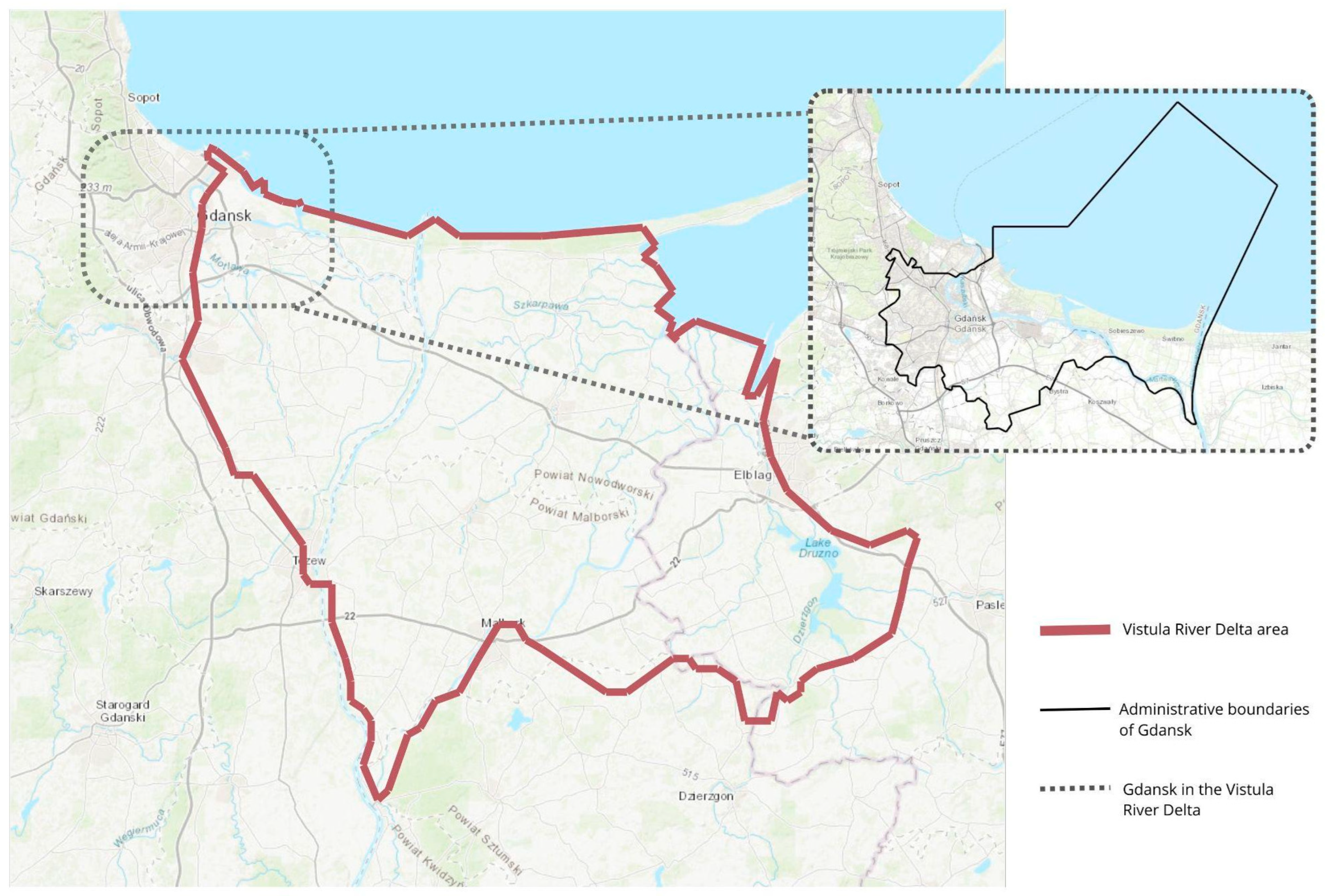
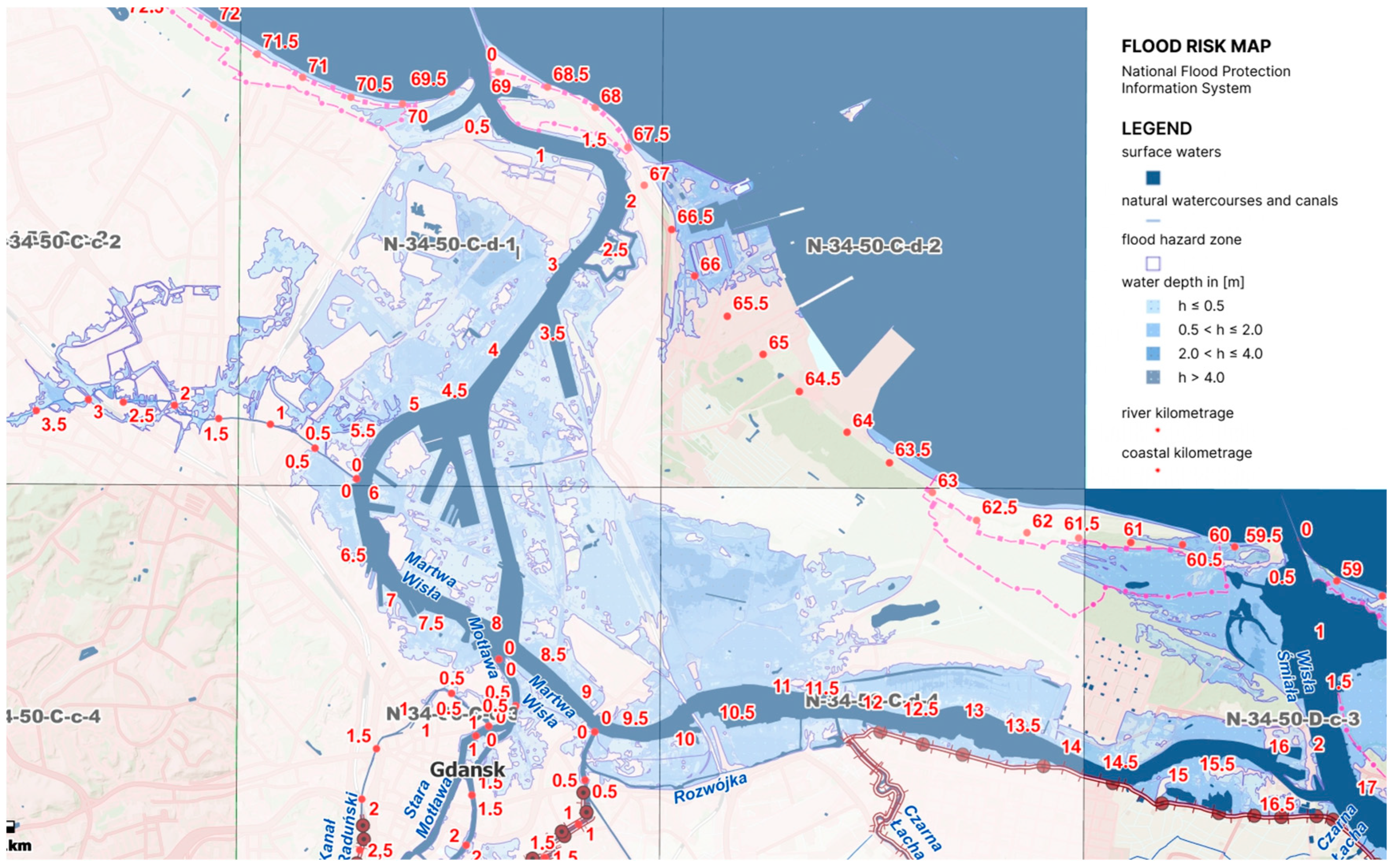
1.2. Urban Vulnerabilities and the Case of Gdańsk
1.3. Planning Gaps, and the Need for Adaptation
1.4. Research Aim and Questions
- Comparative insights
- Which adaptive housing projects have been successfully implemented in other Baltic cities, particularly regarding flood resilience, social inclusion, and urban regeneration? How do these projects reflect local responses to environmental risks, demographic shifts, and housing needs? Which architectural and urban design solutions contributed to their success?
- Application to Gdańsk
- How can these lessons be translated into planning and architectural guidelines tailored to Gdańsk’s waterfront challenges? What barriers may affect the implementation of adaptive housing solutions in Gdańsk, and how can they be addressed through integrated urban policies?
2. State of the Art
2.1. Policy Frameworks Supporting Adaptive Climate, Flexible Housing
2.2. Urban Housing Vulnerabilities and Resilience
2.3. Projects Addressing Similar Challenges, Emphasizing Social and Cultural Similarities with Gdańsk
2.4. Identifying Gaps and the Need for Localized, Evidence-Based Guidance
3. Methodology
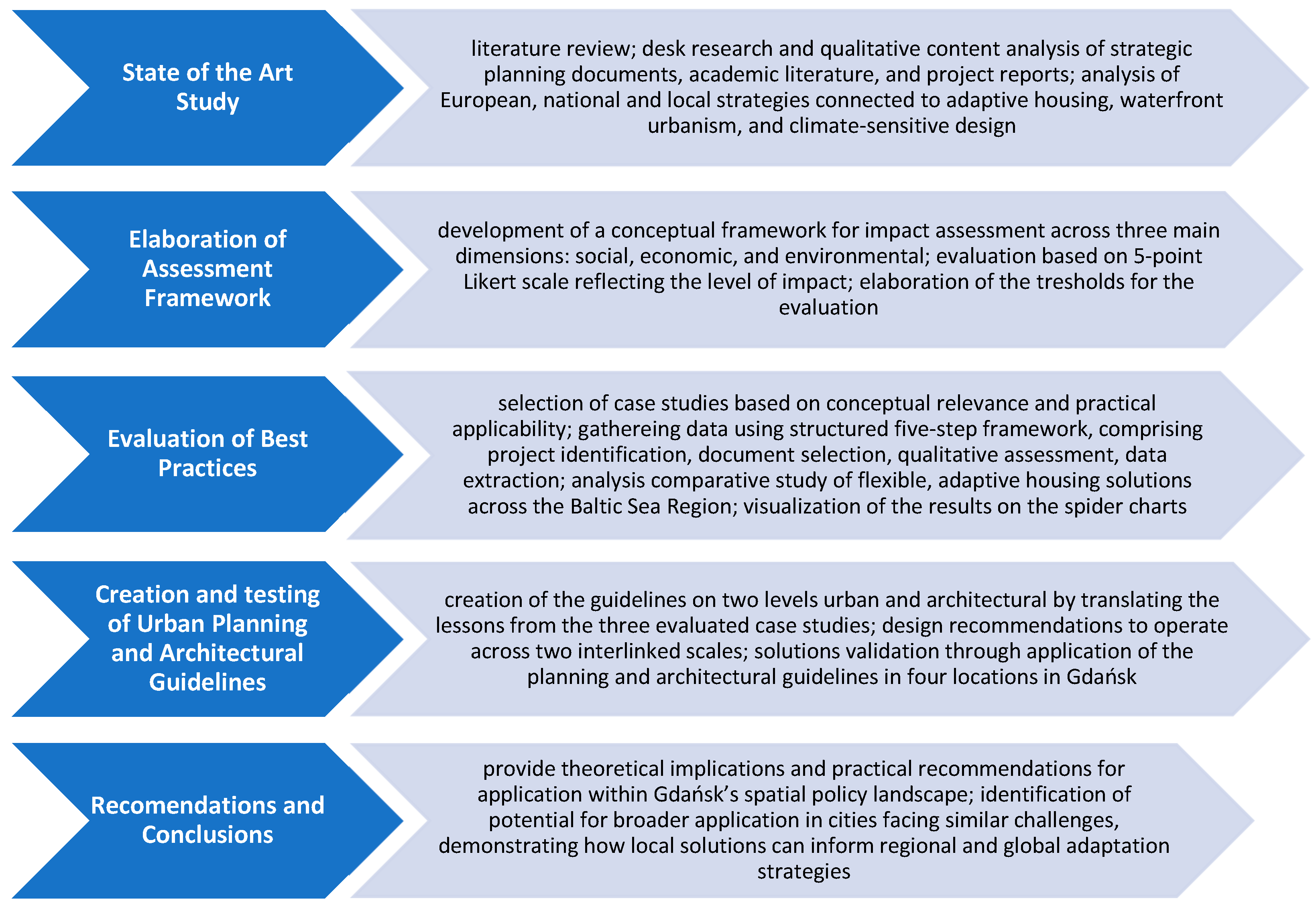
3.1. Methods and Materials
3.2. Impact Assessment Framework
4. Selected Interventions—Baltic Sea Region
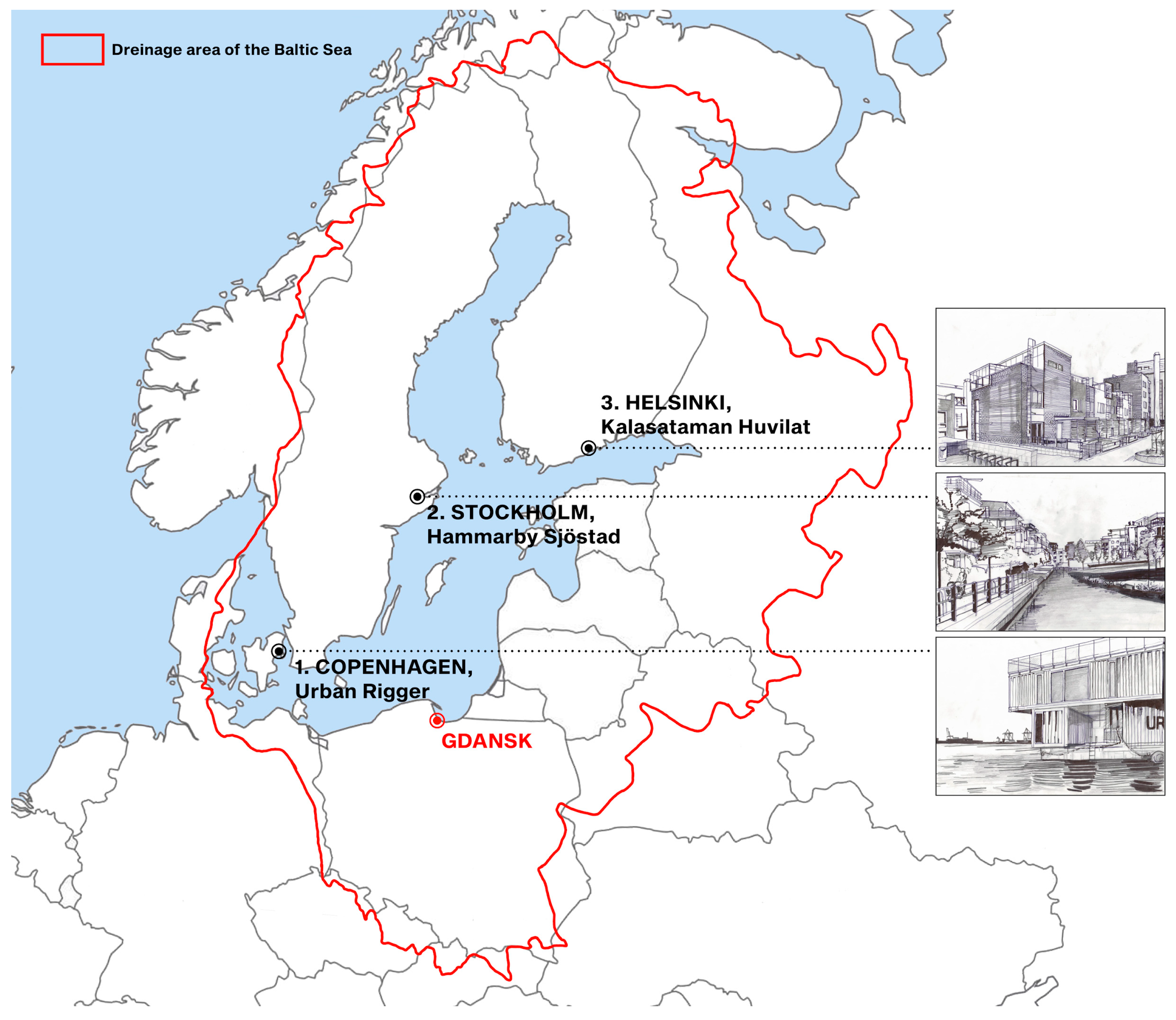
4.1. Selection of the Case Studies
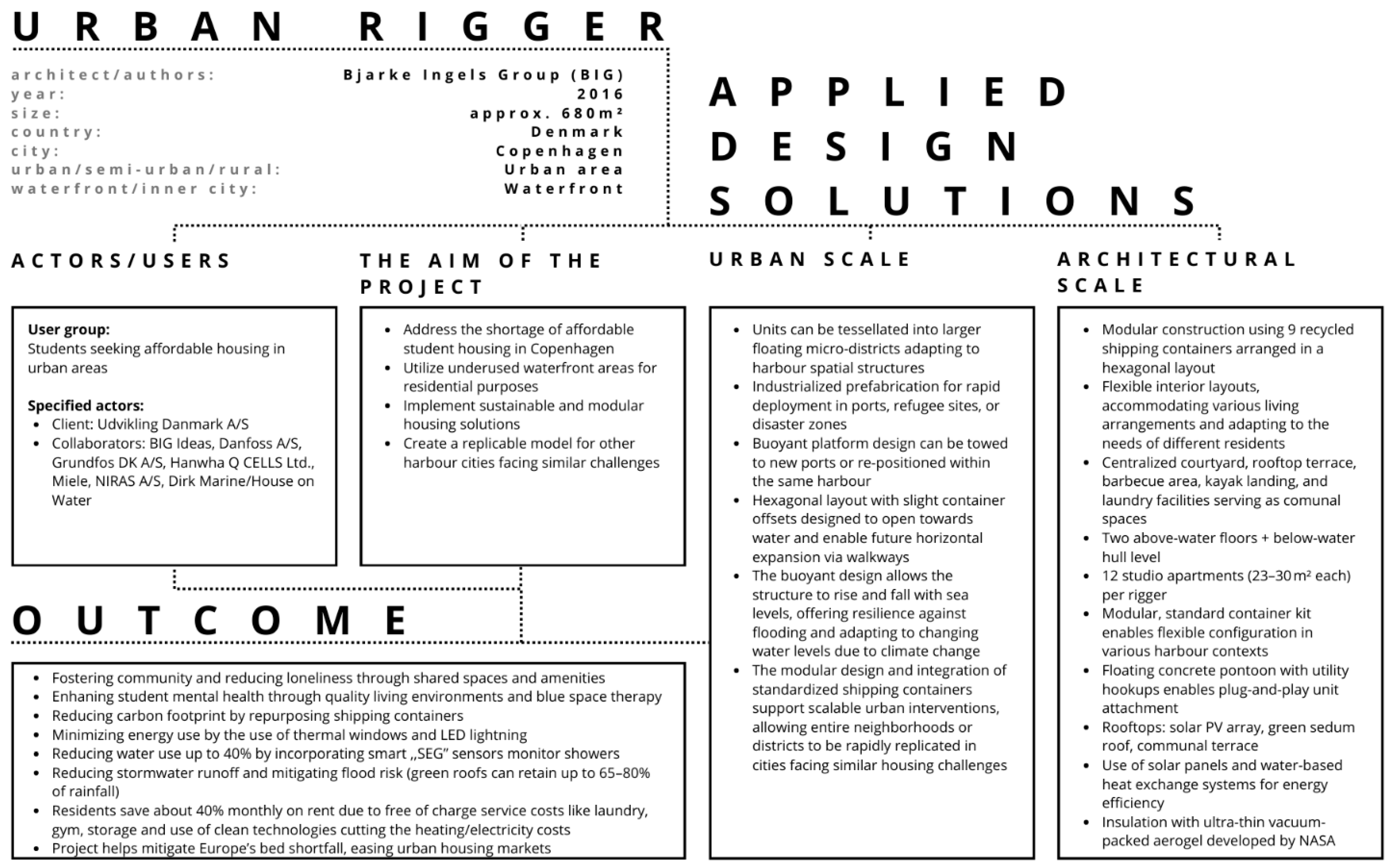
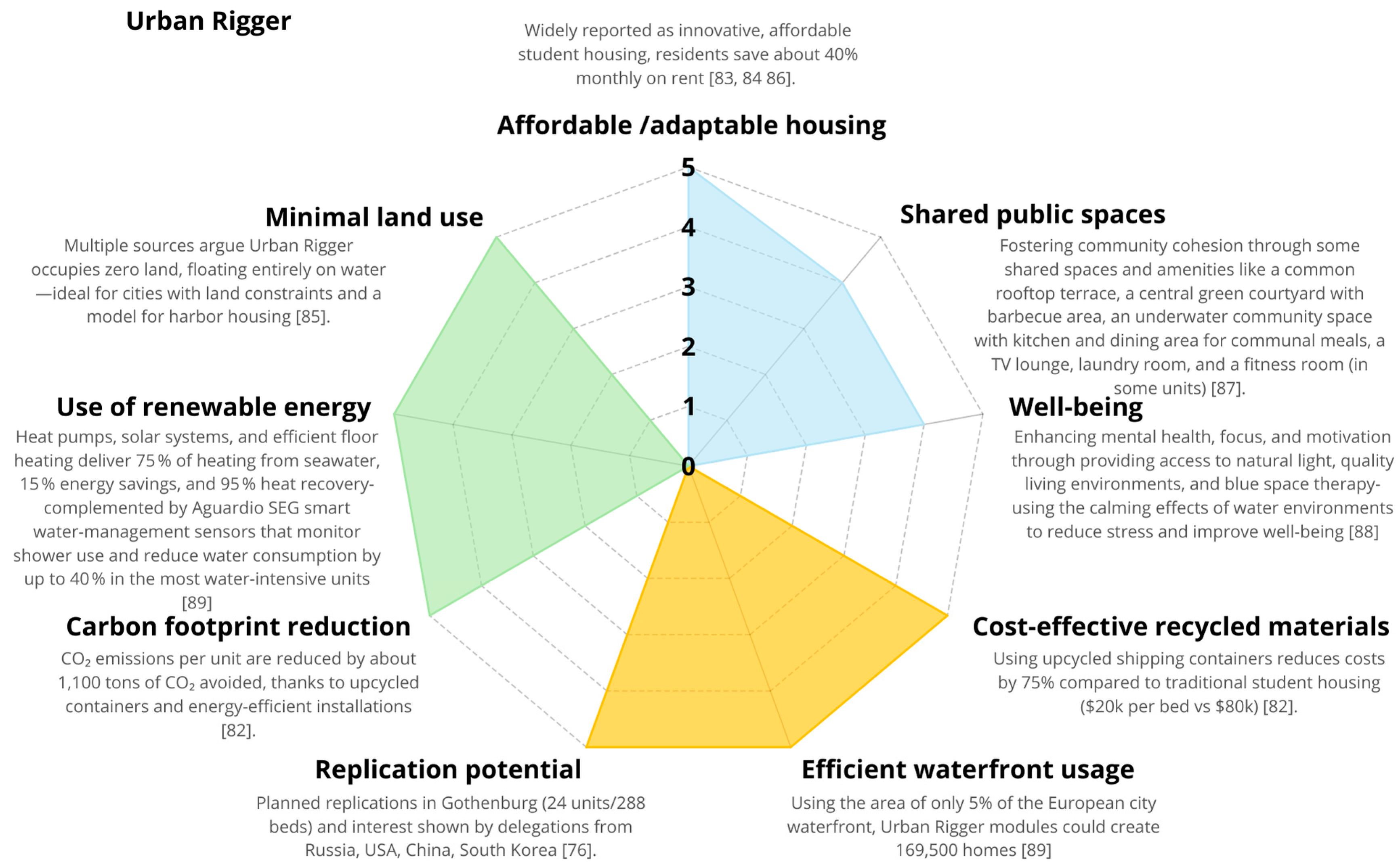
- Urban Rigger (Copenhagen, Denmark): A floating modular housing solution designed to address urban density and flood risk through sustainable, scalable architecture.
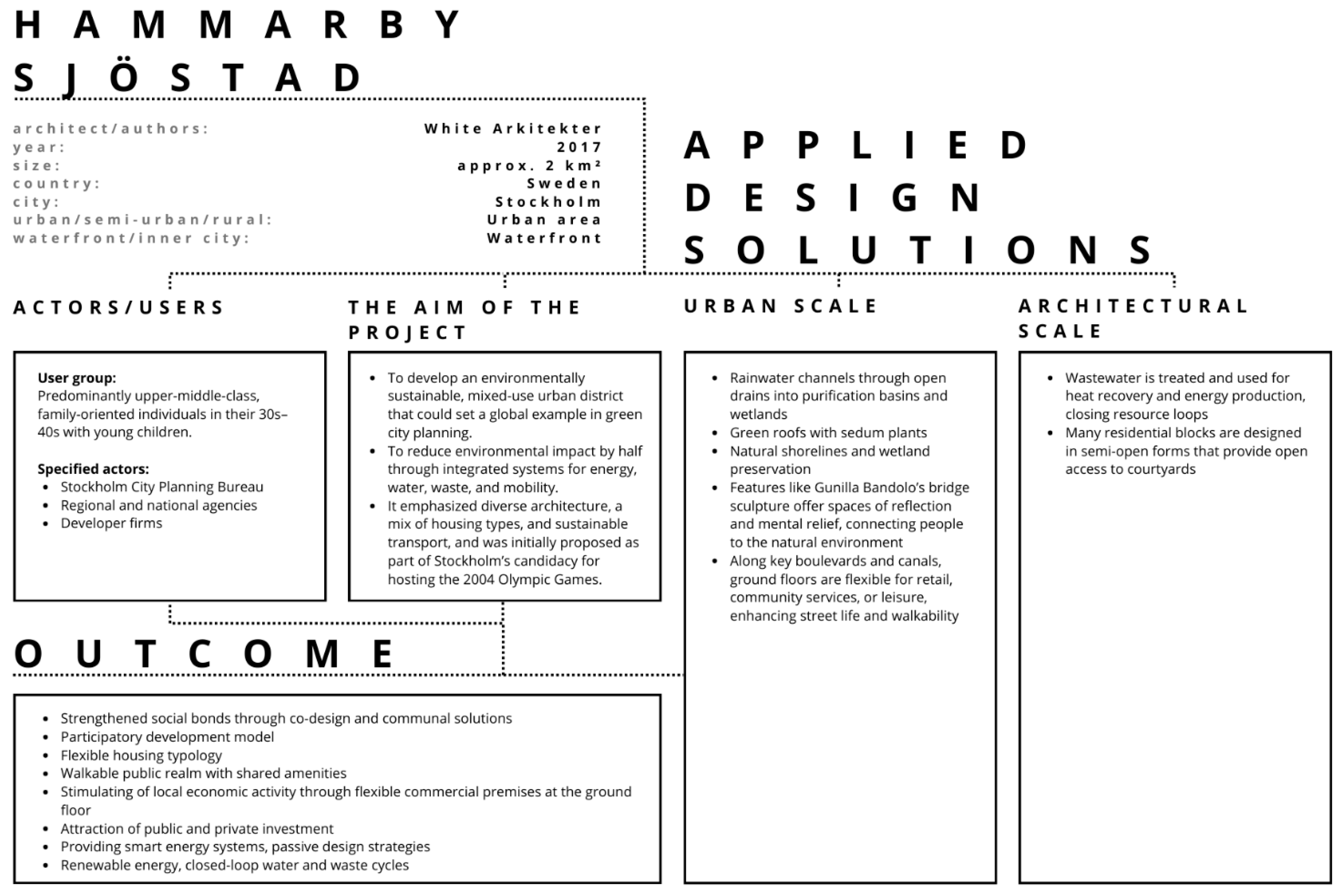
- Hammarby Sjöstad (Stockholm, Sweden): An eco-district integrating renewable energy, green-blue infrastructure, and sustainable mobility to enhance climate resilience.
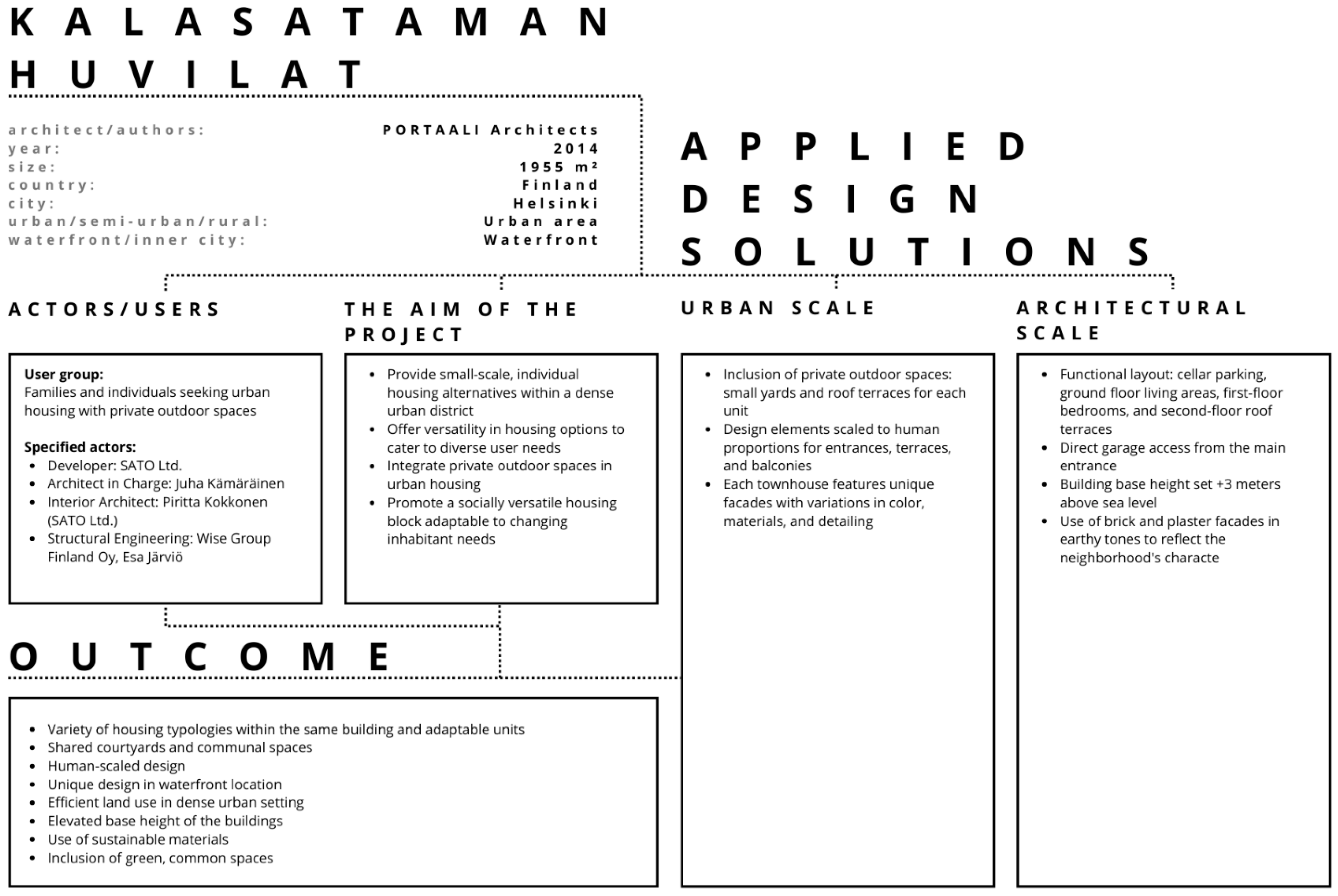
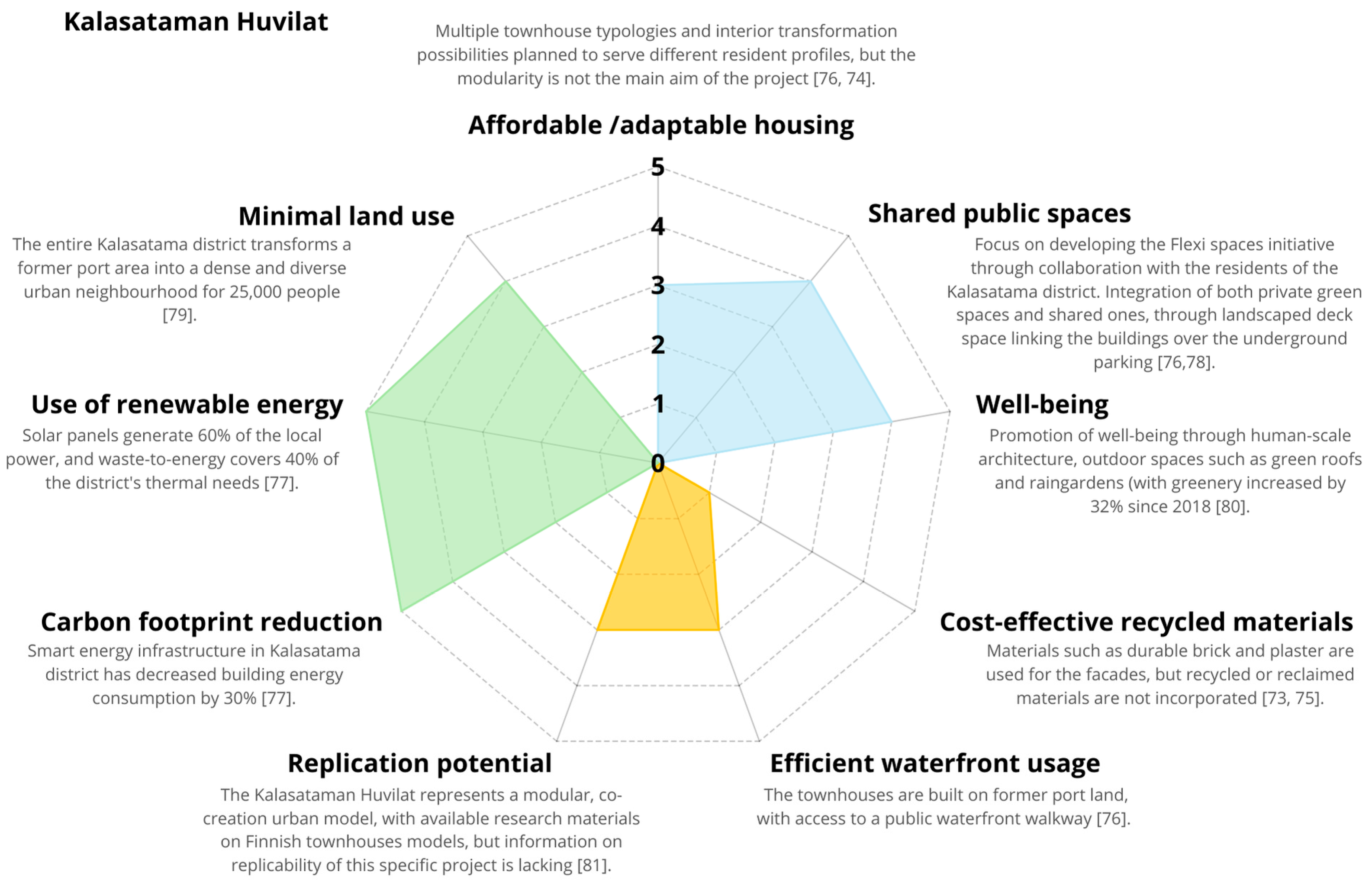
- Kalasataman Huvilat (Helsinki, Finland): A compact, elevated housing development emphasizing environmental performance and community-oriented design.
- Documented Outcomes: Availability of verifiable data and reporting on social, environmental, and economic impacts.
- Innovative Approaches: Use of modular, amphibious, or nature-integrated design strategies that respond to climate risks.
- Contextual Relevance: Alignment with the socio-spatial conditions of Gdańsk and other Baltic cities.
- Transferability: Potential to inform planning and design guidelines beyond their original implementation sites.
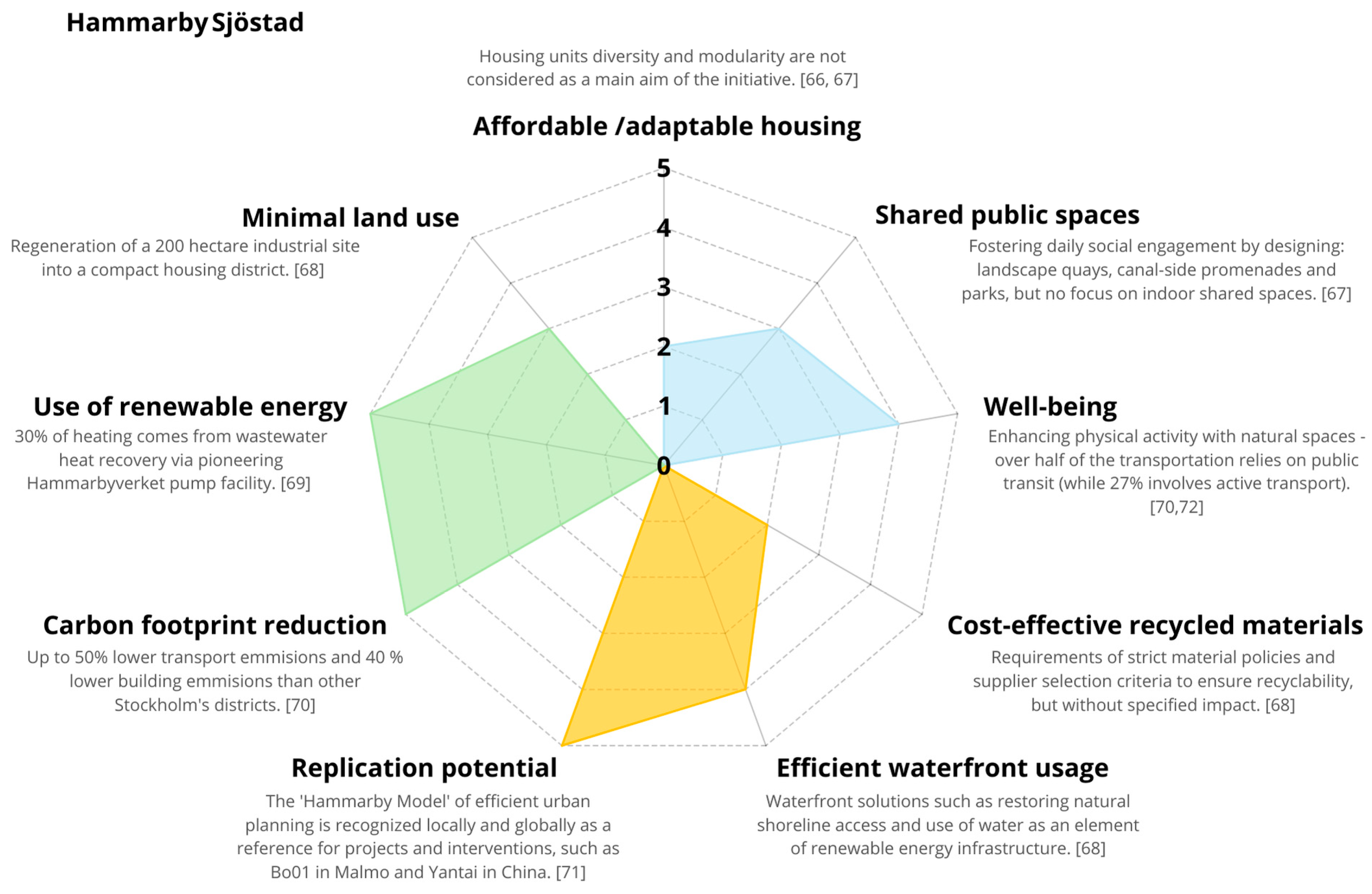
4.1.1. Case Study 1: Hammarby Sjöstad
4.1.2. Case Study 2: Kalasataman Huvilat
4.1.3. Case Study 3: Urban Rigger
5. Results—Evaluation of Case Studies and Impact Assessment
6. Results—Urban Planning and Architectural Guidelines
6.1. Urban Design-Level Guidelines
- Green-Blue Infrastructure Integration: Inspired by Hammarby Sjöstad, Gdańsk should embed bioswales, retention ponds, and permeable surfaces into its waterfront public realm to mitigate flood risk and enhance ecological resilience.
- Flexible Zoning and Mixed-Use Planning: Adaptive housing requires zoning reforms that allow hybrid typologies and encourage density through mixed-use developments.
- Floating and Amphibious Districts: Drawing from Urban Rigger, Gdańsk can designate zones for floating housing clusters, particularly in low-lying or underutilized waterfronts, supported by modular docks and water-based mobility.
- Public Space as Climate Buffer: Waterfront parks, elevated boardwalks, and floodable plazas should be designed to absorb excess water while remaining accessible and safe, reinforcing both resilience and community engagement
6.2. Architectural-Level Guidelines
- Modular and Prefabricated Construction: Inspired by Kalasataman Huvilat and Urban Rigger, modular housing allows rapid deployment, cost efficiency, and flexibility. Units can be stacked, clustered, or floated depending on site conditions.
- Elevated and Amphibious Foundations: Buildings should be designed with raised plinths, stilts, or buoyant bases to adapt to fluctuating water levels, especially near the Motława River and Dead Vistula.
- Passive Design and Renewable Integration: Orientation, insulation, and ventilation strategies should be optimized for energy efficiency. Solar panels, heat pumps, and rainwater harvesting systems can be integrated into building envelopes.
- Shared Amenities and Co-Housing Models: Architectural layouts should support communal kitchens, workshops, and greenhouses to foster social resilience and reduce resource consumption.
7. Solutions Validations
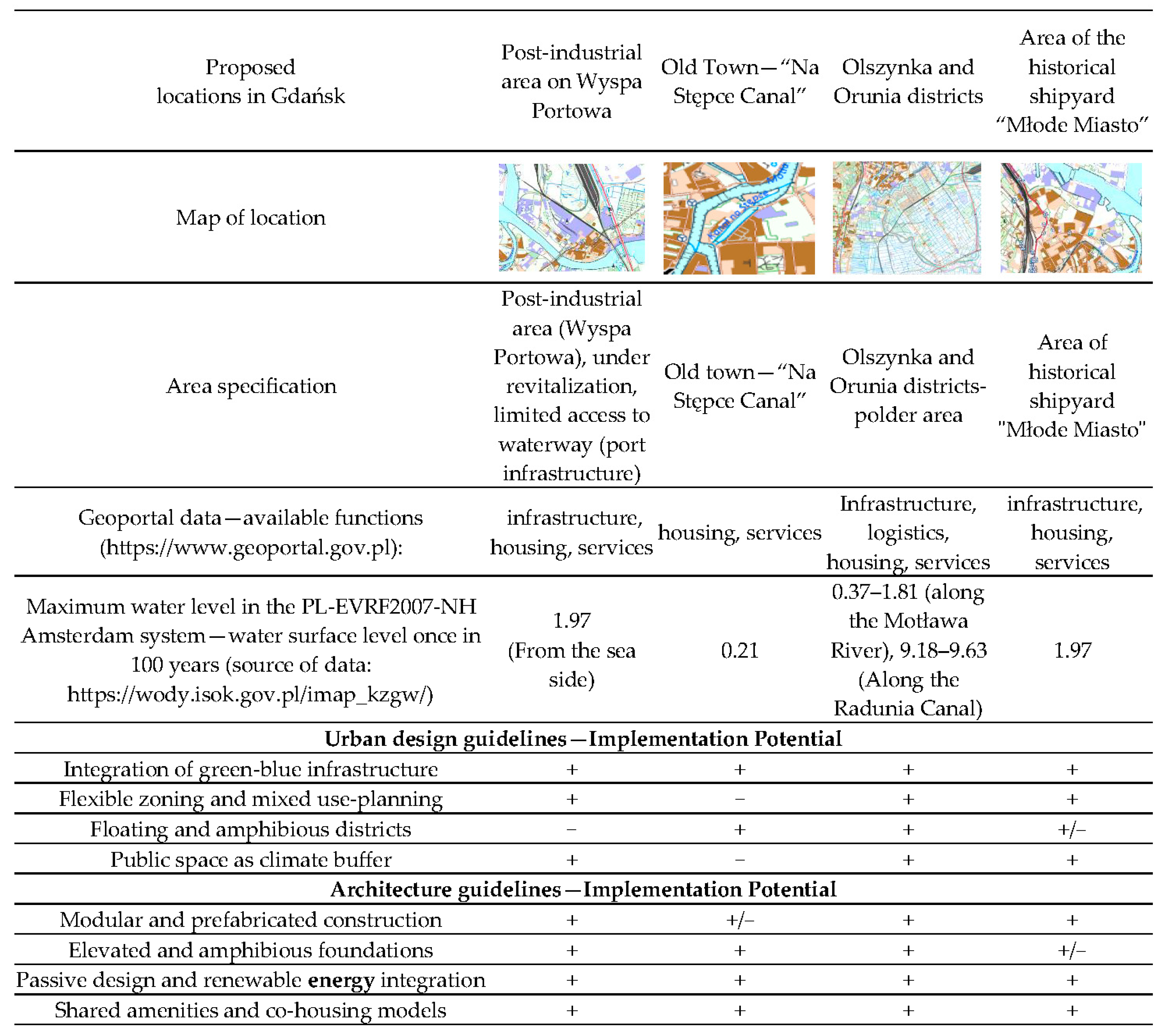
- Post-industrial area on Wyspa Portowa: A zone currently undergoing revitalization, shaped by the legacy of industrial functions. Its limited accessibility to waterways, due to the dominance of port infrastructure, poses challenges for integration with public waterfront spaces (but no possibility of amphibious housing due to the importance of port waterway connection), yet it offers opportunities for adaptive reuse of industrial landscapes.
- Old Town—“Na Stępce Canal”: A location embedded within the historic urban fabric, where proximity to water and heritage assets creates conditions for sensitive interventions. The site provides potential for enhancing waterfront accessibility and reinforcing the cultural identity of Gdańsk through carefully scaled residential amphibious developments and limited or impossible mixed-use developments.
- Olszynka and Orunia districts: Situated in a polder landscape, these areas are closely tied to Gdańsk’s hydraulic heritage. Their specific hydrological conditions require flood-resilient planning strategies and climate-adaptive architecture. At the same time, the presence of open green spaces offers a rare potential for sustainable, low-density development integrated with nature-based solutions.
- The area of the historical shipyard “Młode Miasto”: A strategic zone of industrial heritage, symbolically connected to the city’s modern history. Its transformation into a mixed-use urban quarter represents both an opportunity to preserve and reinterpret cultural identity and a challenge to balance large-scale redevelopment with climate adaptation measures, particularly in relation to water management and urban resilience.
8. Discussion and Conclusions
8.1. Theoretical Implication
8.2. Practical Implication
8.3. Conclusions
- In the environmental dimension, Hammarby Sjöstad and Kalasataman Huvilat both achieved 5/5 for carbon footprint reduction and renewable energy integration, while Urban Rigger scored 4/5 and 5/5, respectively, with an additional 5/5 for land-use efficiency.
- For the social dimension, the projects achieved 3–4/5 in public space quality and 4/5 in user well-being, while adaptability ranged from 2/5 in Hammarby Sjöstad to 4/5 in Urban Rigger.
- Under the economic dimension, the use of recycled materials varied between 1/5 in Kalasataman Huvilat and 5/5 in Urban Rigger. Replication potential was highest in Hammarby Sjöstad (5/5) and Urban Rigger (4/5), confirming their strong scalability potential.
Author Contributions
Funding
Institutional Review Board Statement
Informed Consent Statement
Data Availability Statement
Acknowledgments
Conflicts of Interest
References
- Griggs, G.; Reguero, B.G. Coastal Adaptation to Climate Change and Sea-Level Rise. Water 2021, 13, 2151. [Google Scholar] [CrossRef]
- Konapala, G.; Mishra, A.K.; Wada, Y.; Mann, M.E. Climate change will affect global water availability through compounding changes in seasonal precipitation and evaporation. Nat. Commun. 2020, 11, 3044. [Google Scholar] [CrossRef] [PubMed]
- Christensen, O.B.; Kjellström, E.; Dieterich, C.; Gröger, M.; Meier, H.E.M. Atmospheric regional climate projections for the Baltic Sea region until 2100. Earth Syst. Dynam. 2022, 13, 133–157. [Google Scholar] [CrossRef]
- Rutgersson, A.; Kjellström, E.; Haapala, J.; Stendel, M.; Danilovich, I.; Drews, M.; Jylhä, K.; Kujala, P.; Larsén, X.G.; Halsnæs, K.; et al. Natural hazards and extreme events in the Baltic Sea region. Earth Syst. Dynam. 2022, 13, 251–301. [Google Scholar] [CrossRef]
- Meier, H.E.M.; Kniebusch, M.; Dieterich, C.; Gröger, M.; Zorita, E.; Elmgren, R.; Myrberg, K.; Ahola, M.P.; Bartosova, A.; Bonsdorff, E.; et al. Climate change in the Baltic Sea region: A summary. Earth Syst. Dynam. 2022, 13, 457–593. [Google Scholar] [CrossRef]
- Habitat for Humanity Poland. Housing Problems of People Living in Poland and Evaluation of Existing Solutions—Report of a Public Opinion Poll. 2023. Available online: https://habitat.pl/files/HfH%20-%20badanie%20opinii%20publicznej%20-%20problemy%20mieszkaniowe%20-%202023.pdf (accessed on 3 September 2025).
- Stachurski, T.; Ża̧dło, T.; Wolny-Dominiak, A. Predicting Social Inequality in Poland Using Price Dispersion on the Real Estate Market. Soc. Indic. Res. 2024, 172, 985–1003. [Google Scholar] [CrossRef]
- Główny Urząd Statystyczny. Income and Living Conditions of the Polish Population—Report from the EU-SILC 2023 Study. 2023. Available online: https://stat.gov.pl/obszary-tematyczne/warunki-zycia/dochody-wydatki-i-warunki-zycia-ludnosci/dochody-i-warunki-zycia-ludnosci-polski-raport-z-badania-eu-silc-2023,6,17.html (accessed on 1 September 2025).
- Sanders, F.; Sanders, H.; Jonkers, K. Crossover comparison of climate-change adaptation measures taken in the Gdansk (Baltic-sea) and Rotterdam (Nord-sea) deltas. Open Res. Europe 2021, 1, 9. [Google Scholar] [CrossRef]
- Dubinina, A.; Wawrzyńska, A.; Krośnicka, K.A. Permeability of Waterfronts—Contemporary Approach in Designing Urban Blue Spaces. Sustainability 2022, 14, 9357. [Google Scholar] [CrossRef]
- Laino, E.; Iglesias, G. High-Level characterisation and mapping of key climate-change hazards in European coastal cities. Nat. Hazards 2024, 120, 3623–3659. [Google Scholar] [CrossRef]
- Gulshad, K.; Szydłowski, M.; Mustafa, A. Assessing climate change threats and urbanization impacts on surface runoff in Gdańsk (Poland): Insights from remote sensing, machine learning and hydrological modeling. Stoch. Environ. Res. Risk Assess. 2024, 38, 4825–4842. [Google Scholar] [CrossRef]
- Paprotny, D. Trends in storm surge probability of occurrence along the Polish Baltic Sea coast. arXiv 2014, arXiv:1410.2547. [Google Scholar] [CrossRef]
- Kowalewska-Kalkowska, H.; Kowalewski, M.; Wiśniewski, B. Application of Hydrodynamic Model of the Baltic Sea to Storm Surge Representation along the Polish Baltic Coast. Geogr. Pol. 2007, 80, 181–190. [Google Scholar]
- Matusik, A.; Racoń-Leja, K.; Gyurkovich, M.; Dudzic-Gyurkovich, K. Hydrourban spatial development model for a resilient inner-city: The example of Gdańsk. ACE Archit. City Environ. 2020, 15, 1–21. [Google Scholar] [CrossRef]
- Mannucci, S.; Rosso, F.; D’Amico, A.; Bernardini, G.; Morganti, M. Flood Resilience and Adaptation in the Built Environment: How Far along Are We? Sustainability 2022, 14, 4096. [Google Scholar] [CrossRef]
- Piątek, Ł.; Wojnowska-Heciak, M. Multicase Study Comparison of Different Types of Flood-Resilient Buildings (Elevated, Amphibious, and Floating) at the Vistula River in Warsaw, Poland. Sustainability 2020, 12, 9725. [Google Scholar] [CrossRef]
- Zielinski, T.; Piwowarczyk, J.; Koroza, A. Coastal zone, key area for adaptation to sea level rise. The Gulf of Gdansk case. J. Water Land Dev. 2024, 59, 208–215. [Google Scholar] [CrossRef]
- Badach, J.; Raszeja, E. Developing a Framework for the Implementation of Landscape and Greenspace Indicators in Sustainable Urban Planning. Waterfront Landscape Management: Case Studies in Gdańsk, Poznań and Bristol. Sustainability 2019, 11, 2291. [Google Scholar] [CrossRef]
- Öztürk, Ş.; Yılmaz, K.; Dinçer, A.E.; Kalpakcı, V. Effect of urbanization on surface runoff and performance of green roofs and permeable pavement for mitigating urban floods. Nat. Hazards 2024, 120, 12375–12399. [Google Scholar] [CrossRef]
- Joint Research Centre-European Commission. Climate Change Impacts and Adaptation in Europe: JRC PESETA IV Final Report; Publications Office: Luxembourg, 2020; Available online: https://data.europa.eu/doi/10.2760/171121 (accessed on 10 September 2025).
- Gaget, E.; Frederiksen, M.; Pavón-Jordán, D. Climate Change in the Baltic Sea—2021 Facts Sheet. 2021. Available online: https://helcom.fi/wp-content/uploads/2021/09/Baltic-Sea-Climate-Change-Fact-Sheet-2021.pdf (accessed on 3 September 2025).
- HEAL (HEALTH AND ENVIRONMENT ALLIANCE). Floods in Poland: The Need for Urgent Action for Health and Climate Protection. 2024. Available online: https://www.env-health.org/floods-in-poland-the-need-for-urgent-action-for-health-and-climate-protection/ (accessed on 3 September 2025).
- Schneider, T.; Till, J. Flexible housing: Opportunities and limits. Arq Archit. Res. Q. 2005, 9, 157–166. [Google Scholar] [CrossRef]
- Nie, L. Enhancing urban flood resilience—A case study for policy implementation. Proc. Inst. Civil. Eng.-Water Manag. 2016, 169, 85–93. [Google Scholar] [CrossRef]
- Carriere, Z.D.; Lesnikowski, A. The climate change adaptation readiness of co-operative housing in Nova Scotia, Canada. Env. Pol. Gov. 2024, 34, 724–739. [Google Scholar] [CrossRef]
- Quesada-Molina, F.; Astudillo-Cordero, S.; Lema, M.; Ortiz-Fernández, J.; Baquero Larriva, M.T. Strategic Prioritization of Sustainable Development Goal 11 Targets to Mitigate the Impact of COVID-19: Insights from Cuenca’s Urban Future. Sustainability 2025, 17, 7623. [Google Scholar] [CrossRef]
- European Commission EU. Strategy on Adaptation to Climate Change. 2021. Available online: https://climate.ec.europa.eu/eu-action/adaptation-and-resilience-climate-change/eu-adaptation-strategy_en (accessed on 3 September 2025).
- European Commission. New European Bauhaus. Available online: https://new-european-bauhaus.europa.eu/index_en (accessed on 8 October 2025).
- EUSBSR. ClimaResponse Project Supports Building Safer, Better Prepared, and Climate-Resilient Communities. Available online: https://eusbsr.eu/climaresponse-project-suports-building-safer-better-prepared-and-climate-resilient-communities/ (accessed on 3 September 2025).
- Andersson, L. Baltadapt Strategy for Adaptation to Climate Change in the Baltic Sea Region a Proposal Preparing the Ground for Political Endorsement Throughout the Baltic Sea Region. 2013. Available online: https://www4.unfccc.int/sites/NAPC/Documents%20NAP/Adaptation%20Strategies%20and%20Plans/Latvia%20Baltadapt%20Strategy%20for%20an%20Adaptation%20to%20Climate%20Change%20in%20the%20Baltic%20Sea%20Region.pdf (accessed on 3 September 2025).
- SEI (Stockholm Environment Institute). BalticClimate. Available online: https://www.sei.org/tools/balticclimate/ (accessed on 5 September 2025).
- Schernewski, G.; Konrad, A.; Roskothen, J.; Von Thenen, M. Coastal Adaptation to Climate Change and Sea Level Rise: Ecosystem Service Assessments in Spatial and Sectoral Planning. Appl. Sci. 2023, 13, 2623. [Google Scholar] [CrossRef]
- Climate ADAPT Baltic Sea. 2025. Available online: https://climate-adapt.eea.europa.eu/en (accessed on 5 September 2025).
- Söderholm, K.; Wihlborg, E. Striving for Sustainable Development and the Coordinating Role of the Central Government: Lessons from Swedish Housing Policy. Sustainability 2016, 8, 827. [Google Scholar] [CrossRef]
- IPCC. Climate Change 2022—Impacts, Adaptation and Vulnerability: Working Group II Contribution to the Sixth Assessment Report of the Intergovernmental Panel on Climate Change, 1st ed.; Cambridge University Press: Cambridge, UK, 2023. [Google Scholar] [CrossRef]
- Ministerstwo Rozwoju i Technologii. Narodowy Program Mieszkaniowy (National Housing Program). 2025. Available online: https://www.gov.pl/web/rozwoj-technologia/narodowy-program-mieszkaniowy (accessed on 5 September 2025).
- Sejm Rzeczypospolitej Polskiej. Ustawa o Kooperatywach Mieszkaniowych oraz Zasadach Zbywania Lokali Mieszkalnych albo Niezabudowanych Nieruchomości Przeznaczonych na cele Mieszkaniowe [Act on Housing Cooperatives and the Principles for Disposing of Residential Premises or Undeveloped Real Estate Intended for Residential Purposes]. Dziennik Ustaw; 2023. Available online: https://isap.sejm.gov.pl/isap.nsf/download.xsp/WDU20230000028/T/D20230028L.pdf (accessed on 3 September 2025).
- Urząd Marszałkowski Województwa Pomorskiego. Strategia Rozwoju Województwa Pomorskiego 2030 (Strategy for the Development of Pomeranian Voivodeship 2030). Zarząd Województwa Pomorskiego (Pomeranian Voivodeship Board). Available online: https://strategia2030.pomorskie.eu/2021/04/12/strategia-rozwoju-wojewodztwa-pomorskiego-2030/?doing_wp_cron=1748457679.7710809707641601562500 (accessed on 3 September 2025).
- Biuro Rozwoju Gdańska Błękitno-Zielona. Infrastruktura Gdańska [Blue-Green Infrastructure of Gdańsk]. 2021. Available online: https://www.brg.gda.pl/blekitno-zielona-infrastruktura-gdanska#aktualnosci (accessed on 3 September 2025).
- Füssel, H.-M. Vulnerability: A generally applicable conceptual framework for climate change research. Glob. Environ. Change 2007, 17, 155–167. [Google Scholar] [CrossRef]
- Cutter, S.L.; Burton, C.G.; Emrich, C.T. Disaster Resilience Indicators for Benchmarking Baseline Conditions. J. Homel. Secur. Emerg. Manag. 2010, 7, 1–24. [Google Scholar] [CrossRef]
- Meerow, S.; Newell, J.P.; Stults, M. Defining urban resilience: A review. Landsc. Urban. Plan. 2016, 147, 38–49. [Google Scholar] [CrossRef]
- Vale, L.J.; Campanella, T.J. The Resilient City: How Modern Cities Recover from Disaster; Vale, L.J., Campanella, T.J., Eds.; Oxford University Press: Oxford, UK, 2005; ISBN 978-0-19-517584-4. [Google Scholar]
- Johnson, C.; Lizarralde, G.; Davidson, C.H. A systems view of temporary housing projects in post-disaster reconstruction. Constr. Manag. Econ. 2006, 24, 367–378. [Google Scholar] [CrossRef]
- Ameh, H.; Badarnah, L.; Lamond, J. Amphibious Architecture: A Biomimetic Design Approach to Flood Resilience. Sustainability 2024, 16, 1069. [Google Scholar] [CrossRef]
- Christmann, G.B.; Ibert, O. Vulnerability and Resilience in a Socio-Spatial Perspective: A Social-Scientific Approach. Raumforsch. Raumordn. 2012, 70, 259–272. [Google Scholar] [CrossRef]
- Birkmann, J.; Cardona, O.D.; Carreño, M.L.; Barbat, A.H.; Pelling, M.; Schneiderbauer, S.; Kienberger, S.; Keiler, M.; Alexander, D.; Zeil, P.; et al. Framing vulnerability, risk and societal responses: The MOVE framework. Nat. Hazards 2013, 67, 193–211. [Google Scholar] [CrossRef]
- Arkitema; Soeters, S. Sluseholmen/Arkitema + Sjoerd Soeters. ArchDaily. 2013. Available online: https://www.archdaily.com/office/sjoerd-soeters?ad_name=project-specs&ad_medium=single (accessed on 3 September 2025).
- Leardi, L. All-In-One Structure Solves Flooding, Parking and the Lack of Green Space in Cities. 2017. Available online: https://www.archdaily.com/880164/all-in-one-structure-solves-flooding-parking-and-the-lack-of-green-space-in-cities (accessed on 3 September 2025).
- Natur, T. Saint Kjeld’s Climate-Adapted Neighborhood, Dezeen. 2012. Available online: https://www.dezeen.com/2012/08/18/saint-kjelds-climate-adapted-neighborhood-by-tredje-natur/ (accessed on 5 September 2025).
- Vinnitskaya, I. Oceanic Living: Floating City Apps/Koen Olthuis. 2012. Available online: https://www.archdaily.com/221347/oceanic-living-floating-city-apps-koen-olthuis (accessed on 3 September 2025).
- Ulla Tervo Architects. Flood-Proof Housing. 2023. Available online: https://www.ut-a.com/work/flood-proof-housing (accessed on 5 September 2025).
- Architectenbureau Marlies Rohmer. Floating Houses in IJburg. 2011. Available online: https://www.archdaily.com/120238/floating-houses-in-ijburg-architectenbureau-marlies-rohmer (accessed on 3 September 2025).
- Minner, K. 8 House/BIG. 2010. Available online: https://www.archdaily.com/83307/8-house-big (accessed on 5 September 2025).
- Bjarke Ingels Group. Sneglehusene Housing/BIG. 2022. Available online: https://www.archdaily.com/989940/sneglehusene-housing-big (accessed on 5 September 2025).
- Aberdeen, T.; Yin, R.K. Case Study Research: Design and Methods, 4th ed.; Sage: Thousand Oaks, CA, USA, 2009; Volume 14, pp. 69–71. [Google Scholar]
- Meyer, C.B. A Case in Case Study Methodology. Field Methods 2001, 13, 329–352. [Google Scholar] [CrossRef]
- Johnson, J.B.; Reynolds, H.T.; Mycoff, J.D. Political Science Research Methods, 9th ed.; CQ press: Washington, DC, USA, 2019. [Google Scholar]
- Denis, M.; Cysek-Pawlak, M.M.; Krzysztofik, S.; Majewska, A. Sustainable and vibrant cities. Opportunities and threats to the development of Polish cities. Cities 2021, 109, 103014. [Google Scholar] [CrossRef]
- Joshi, A.; Kale, S.; Chandel, S.; Pal, D. Likert Scale: Explored and Explained. Br. J. Appl. Sci. Technol. 2015, 7, 396–403. [Google Scholar] [CrossRef]
- OECD. Quality Standards for Development Evaluation; DAC Guidelines and Reference Series; OECD: Paris, France, 2010. [Google Scholar] [CrossRef]
- UN-Habitat. Guide to the City Resilience Profiling Tool. 2018. Available online: https://unhabitat.org/guide-to-the-city-resilience-profiling-tool (accessed on 5 September 2025).
- Joint Research Centre-European Commission. Delivering the EU Green Deal: Progress Towards Targets; Publications Office: Luxembourg, 2025; Available online: https://data.europa.eu/doi/10.2760/3105205 (accessed on 5 September 2025).
- European Commission. Interreg Baltic Sea Region Programme 2021–2027. 2024. Available online: https://transport.ec.europa.eu/transport-modes/maritime/ship-financing-portal/interreg-baltic-sea-region-programme-2021-2027_en (accessed on 5 September 2025).
- Design Commission for Wales. Hammarby Sjöstad, Stockholm, Sweden. Available online: https://dcfw.buildhost.org/hammarby-sjostad-stockholm-sweden/ (accessed on 5 September 2025).
- White Arkitekter. Hammarby Sjöstad—Regeneration. Available online: https://whitearkitekter.com/project/hammarby-sjostad/ (accessed on 5 September 2025).
- Urban Morphology and Complex Systems Institute (UMCSII). Hammarby Sjöstad Green Regeneration in Stockholm, Sweden. Available online: https://www.neighbourhoodguidelines.org/hammarby-sjstad-case-study (accessed on 5 September 2025).
- Copenhagen Water Blog. Hammarby Sjöstad PDF. Available online: https://copenhagenwater.wordpress.com/wp-content/uploads/2013/11/hammarby-sjostad.pdf (accessed on 5 September 2025).
- C40 Cities. Industrial Area Transformed: Hammarby Sjöstad. January 2015. Available online: https://www.c40.org/case-studies/c40-good-practice-guides-stockholm-hammarby-sjostad (accessed on 5 September 2025).
- Global Times. Swedish Hammarby Eco-City Model to Fit in E. China’s Yantai. 28 May 2019. Available online: https://www.globaltimes.cn/content/1152111.shtml (accessed on 5 September 2025).
- UNEP C2E2. The Urban Redevelopment of Hammarby Sjöstad. Available online: https://c2e2.unepccc.org/kms_object/the-urban-redevelopment-of-hammarby-sjostad (accessed on 5 September 2025).
- PORTAALI Architects Ltd.; ArkOpen Ltd. Kalasataman Huvilat Townhouses/Townhouses by PORTAALI Architects Ltd. + ArkOpen Ltd. ArchDaily. Available online: https://www.archdaily.com/611232/kalasataman-huvilat-townhouses-portaali-architects-ltd-arkopen-ltd (accessed on 5 September 2025).
- ArkOpen Ltd. Kalasataman Huvilat Townhouses. Available online: https://www.arkopen.fi/en/kalasataman-huvilat-townhouses/ (accessed on 5 September 2025).
- Smart Kalasatama. Smart Kalasatama—Smart City District of Helsinki. FiksuKalasatama. Available online: https://fiksukalasatama.fi/en/smart-city/ (accessed on 5 September 2025).
- Fiksu Kalasatama. Smart Kalasatama—Smart City District of Helsinki. Available online: https://fiksukalasatama.fi/en/smart-city/ (accessed on 5 September 2025).
- The Atlas of Urban Tech. Smart Kalasatama (Helsinki). Available online: https://atlasofurbantech.org/cases/fin-helsinki-kalasatama-2 (accessed on 5 September 2025).
- MySMARTLife project. Kalasatama High-Performance Residential Buildings. Available online: https://www.mysmartlife.eu/interventions/kalasatama-high-performance-residential-buildings/ (accessed on 5 September 2025).
- Energy Cities. Welcome to Smart Houses! Helsinki (Finland). 16 March 2015. Available online: https://energy-cities.eu/welcome-to-smart-houses-helsinki-finland/ (accessed on 5 September 2025).
- Forum Virium Helsinki. Life and Innovations, Smart Kalasatama—A District for Experimentation. Available online: https://forumvirium.fi/en/publication/smartkalasatama-final-report/ (accessed on 5 September 2025).
- Kestävyys (City of Helsinki). Alliance Rail Project from Kalasatama to Pasila. Available online: https://kestavyys.hel.fi/en/alliance-rail-project-from-kalasatama-to-pasila/ (accessed on 5 September 2025).
- Rylander, A.R.; Signe, R. Urban Rigger and Floating City Solutions for Ecological Transformation. Field Actions Science Reports. Available online: https://journals.openedition.org/factsreports/7234 (accessed on 5 September 2025).
- BIG|Bjarke Ingels Group. Urban Rigger: Floating Student Housing (Copenhagen). 2016. Shipping Containers Floated as the Next BIG Thing in Student Housing. New Atlas. Available online: https://newatlas.com/big-urban-rigger/45572/ (accessed on 5 September 2025).
- Floating Dorms Could Help Students Rent in City Centers. Next City. Available online: https://nextcity.org/urbanist-news/copenhagen-floating-dorms-affordable-housing (accessed on 5 September 2025).
- Bjarke Ingels′ Floating Container Housing. Global Construction Review. Available online: https://www.globalconstructionreview.com/bjarke-ingles-creates-stude7nt-housi7ng-float7ing/ (accessed on 5 September 2025).
- Floating Student Flats—Urban Rigger. Aluthermo. 22 November 2016. Available online: https://www.aluthermo.com/en/references/urban-rigger-floating-student-flats (accessed on 5 September 2025).
- Urban Rigger—Student Housing. Visit Denmark (Video). Available online: https://video.visitdenmark.com/video/53788199/urban-rigger-student-housing (accessed on 5 September 2025).
- Floating Student Housing Made of Shipping Containers. Climates can. Created 11 June 2017. Available online: https://www.climatescan.nl/projects/1435/detail (accessed on 5 September 2025).
- Urban Rigger. Housing Coop—Inspiring Housing & Mixed-Use Projects. Available online: https://housingcoop.eu/resources/databases/inspiring-housing-mixed-use-projects/urban-rigger (accessed on 5 September 2025).



| Impact Level | Extent of Change | Evidence/Indicators |
|---|---|---|
| 1—Very Low | Minimal or no observable impact | No mention or very limited references in the news or reports. No measurable outcomes were reported. |
| 2—Low | Slight impact, limited effect | Small-scale effects mentioned, limited to isolated instances or minor improvements. |
| 3—Moderate | Noticeable impact, but not widespread | Documented cases of positive effects in some communities or settings; some metrics improved. |
| 4—High | Strong impact with clear benefits | Multiple reliable sources report significant benefits; evident improvements in social/economic/environmental factors. |
| 5—Very High | Replicable, transformative, or model-setting impact | Widely covered in news as innovative/breakthrough; serves as a model replicated elsewhere; measurable long-term positive effects demonstrated. |
| Indicator | Primary Source/Reference Type | Supporting Framework or Document | Justification for Inclusion |
|---|---|---|---|
| Minimal or no observable impact | Research on program evaluation and impact measurement | OECD [62] Evaluation Frameworks | Serves as a baseline category for identifying interventions with negligible or unverified effects |
| Slight impact, limited effect | Urban resilience literature; local adaptation policy assessments | IPCC AR6 [63] Adaptation Metrics; EU Climate Adaptation Strategy (2021) | Captures incremental improvements or pilot actions with minimal scale or duration |
| Noticeable impact, but not widespread | Comparative case studies on adaptive housing and community resilience | UN-Habitat City Resilience Profiling Tool [36]; European Environment Agency (EEA) reports | Reflects moderate, context-specific outcomes that demonstrate measurable progress but lack systemic reach |
| Strong impact with clear benefits | Policy evaluation frameworks; sustainability impact assessments | European Green Deal Progress Reports [64]; New European Bauhaus [29] | Identifies cases with demonstrable, multi-dimensional benefits across environmental, social, or economic aspects |
| Replicable, transformative, or model-setting impact | Innovation diffusion theory; transnational best-practice studies | IPCC Good Practice Case Studies; Interreg Baltic Sea Programme projects [65] | Represents high-impact, scalable interventions recognized as models for replication and long-term transformation |
| Impact Dimension | Impact Area | Justification |
|---|---|---|
| Social | Affordable/adaptable housing | Addresses critical urban housing shortage with accessible pricing. |
| Shared public spaces | Enhances social cohesion and interaction. | |
| Well-being | Quality design improves mental and physical comfort. | |
| Economic | Cost-effective recycled materials | Reuses shipping containers, reducing material and construction costs. |
| Efficient waterfront usage | Uses previously underutilized water areas in urban zones. | |
| Replication potential | Modular and scalable model suitable for other cities. | |
| Environmental | Carbon footprint reduction | Circular materials and reduction in energy flows. |
| Use of renewable energy | Incorporates innovative solutions incl. solar power and heat exchange systems. | |
| Reduction in land-use | Floating structure eliminates the need for land occupation. |
Disclaimer/Publisher’s Note: The statements, opinions and data contained in all publications are solely those of the individual author(s) and contributor(s) and not of MDPI and/or the editor(s). MDPI and/or the editor(s) disclaim responsibility for any injury to people or property resulting from any ideas, methods, instructions or products referred to in the content. |
© 2025 by the authors. Licensee MDPI, Basel, Switzerland. This article is an open access article distributed under the terms and conditions of the Creative Commons Attribution (CC BY) license (https://creativecommons.org/licenses/by/4.0/).
Share and Cite
Kalfouni, B.B.; Rubczak, A.; Wiszniewska, O.; Warżała, P.; Lasota, F.; Kamrowska-Załuska, D. Regional Lessons to Support Local Guidelines: Adaptive Housing Solutions from the Baltic Sea Region for Climate-Sensitive Waterfronts in Gdańsk. Sustainability 2025, 17, 11082. https://doi.org/10.3390/su172411082
Kalfouni BB, Rubczak A, Wiszniewska O, Warżała P, Lasota F, Kamrowska-Załuska D. Regional Lessons to Support Local Guidelines: Adaptive Housing Solutions from the Baltic Sea Region for Climate-Sensitive Waterfronts in Gdańsk. Sustainability. 2025; 17(24):11082. https://doi.org/10.3390/su172411082
Chicago/Turabian StyleKalfouni, Bahaa Bou, Anna Rubczak, Olga Wiszniewska, Piotr Warżała, Filip Lasota, and Dorota Kamrowska-Załuska. 2025. "Regional Lessons to Support Local Guidelines: Adaptive Housing Solutions from the Baltic Sea Region for Climate-Sensitive Waterfronts in Gdańsk" Sustainability 17, no. 24: 11082. https://doi.org/10.3390/su172411082
APA StyleKalfouni, B. B., Rubczak, A., Wiszniewska, O., Warżała, P., Lasota, F., & Kamrowska-Załuska, D. (2025). Regional Lessons to Support Local Guidelines: Adaptive Housing Solutions from the Baltic Sea Region for Climate-Sensitive Waterfronts in Gdańsk. Sustainability, 17(24), 11082. https://doi.org/10.3390/su172411082