The European Union (EU) aims to achieve net-zero emissions by 2050, with member states collectively reducing emissions by 9% in 2023 [
1]. Within this framework, Ireland targets a 22–30% reduction in agricultural emissions, a 62–81% reduction in the electricity sector, and an 80% renewable electricity share by 2030 relative to 2018 levels [
2]. The agricultural sector is the largest contributor to Ireland’s greenhouse gas (GHG) emissions, accounting for 38.4% of the national total [
3]. This sector faces a dual energy challenge: rising fossil-fuel-based electricity costs and the need to adopt clean, sustainable, and low-carbon energy sources. Dairy farming is among the most energy- and emission-intensive sub-sectors, requiring substantial energy for milking, milk cooling, and water heating. This high energy demand makes dairy farms highly suitable for renewable energy integration. In particular, solar photovoltaic (PV) systems can substantially offset this energy burden, with recent studies reporting short payback periods (PBPs) and significant carbon dioxide (CO
2) emission reductions [
4]. However, there are variations in the adoption of these systems across regions due to local climatic conditions, policy frameworks, and economic incentives [
5]. Solar PV systems hold immense potential in advancing a shift toward renewable energy sources, particularly in tandem with supportive policy environments. By harnessing energy from the sun, solar PV technology offers a sustainable, clean, and low-carbon solution to meet growing energy demands while reducing reliance on fossil fuels. The widespread deployment of solar PV systems not only contributes to climate change mitigation but also strengthens regional energy security. Integrating solar PV systems into the agriculture sector (dairy farming) demonstrates scalability and the potential to deliver both environmental and economic benefits.
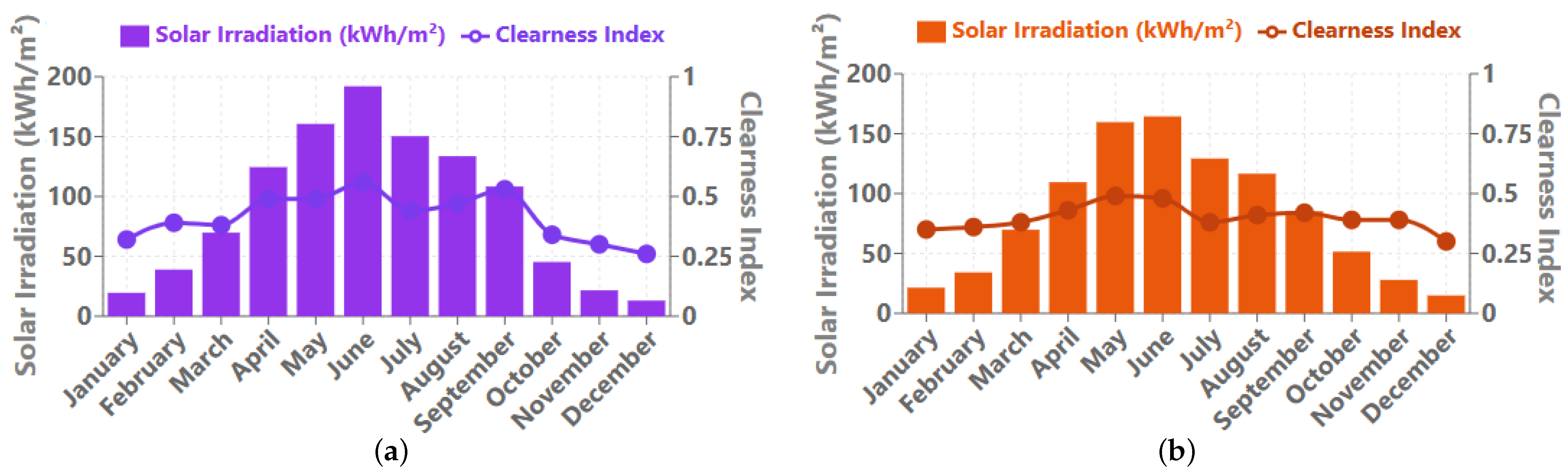
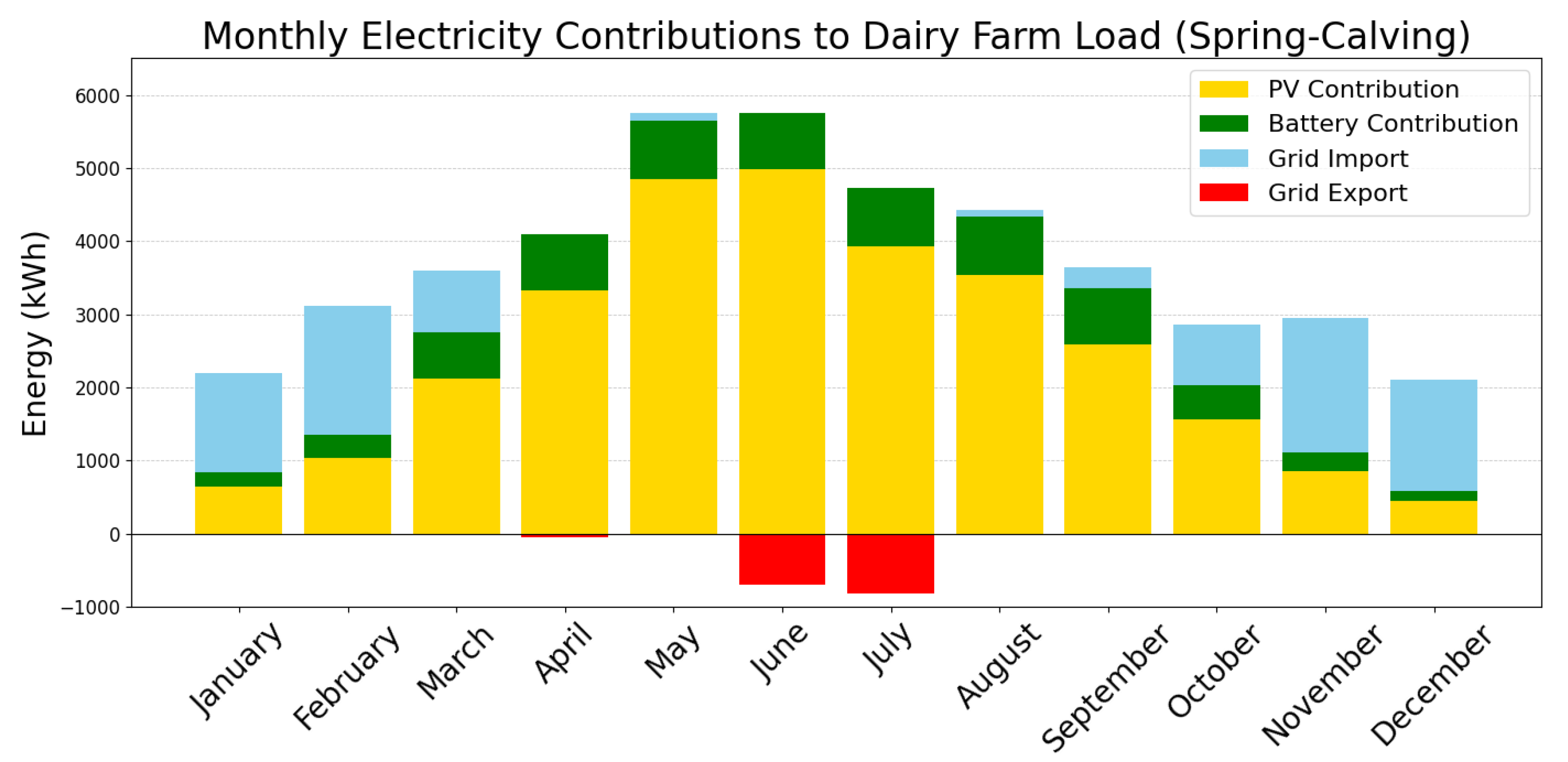
Despite these advantages, comprehensive solar PV assessments in the dairy sector remain limited, thereby demonstrating a necessity for this study. This research is critical in order to contribute to some research gaps evident in this area. In particular, the impact of different seasonal calving patterns (such as spring- and winter-calving) on techno-economic viability is underexplored. Such operations exhibit distinct energy-use profiles and seasonal dynamics, which are important issues to consider when modelling solar PV systems as they strongly influence renewable energy integration strategies. In addition, existing studies tend to focus on general agricultural applications without differentiating between dairy farms operating in distinct locations in temperate climates [
6,
7,
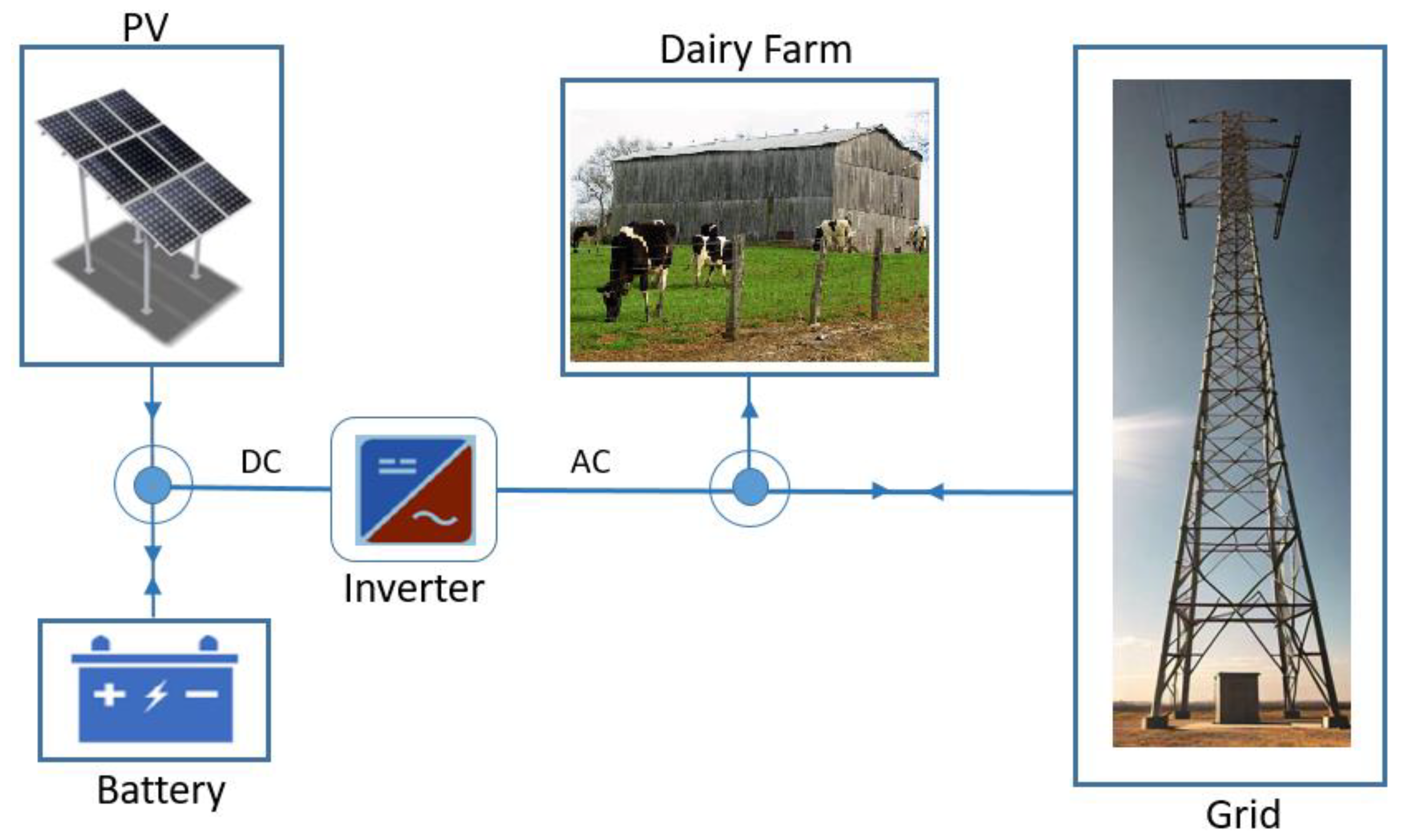
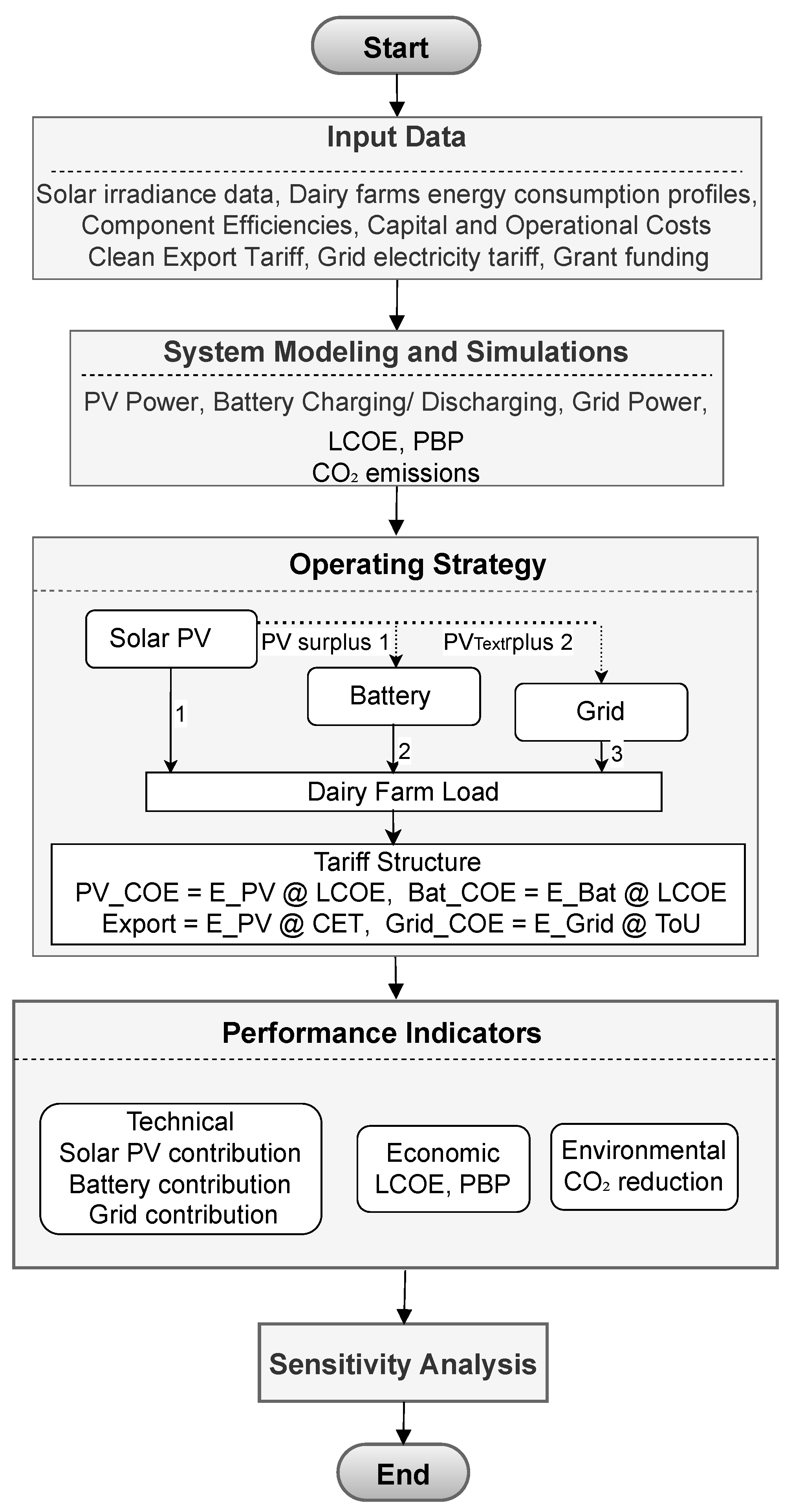
8]. Furthermore, no prior study has examined the combined influence of a specific country’s policy landscape, including time-of-use (ToU) electricity pricing, export tariff, and grant funding, together with seasonal variations in farm energy demand. The methodology adopted in this study addresses these research gaps by modelling solar PV and battery systems tailored to climatic conditions, policy environment, and the specific energy use characteristics of both spring- and winter-calving dairy operations. Essentially, this study models the technical requirements of solar PV and battery systems suitable to meet the specific energy needs of real-life case farms that adopt contrasting dairy operations (spring- and winter-calving) and function under distinctive climatic conditions (varying location-specific solar irradiance data). These systems are then used to assess the economic and environmental impact of adopting them, based on the policy landscape (ToU electricity pricing, export tariff, and grant funding) in existence. No prior study has examined all these parameters within the same study, thereby demonstrating the critical research gap that this study addresses.
In summary, the main objective of this study is to present a comprehensive techno-economic and environmental assessment of grid-connected solar PV systems for two types of dairy farm operations: spring-calving and winter-calving. This is undertaken through a detailed assessment of the viability of solar PV integration across these contrasting operational models. Additionally, a comprehensive sensitivity analysis is performed to assess the impact of key financial and technical parameters on system outcomes. The contributions of this study include the following:
The findings from this study offer actionable insights for farmers, policymakers, and stakeholders to accelerate renewable energy adoption and optimise solar PV integration across diverse dairy operations. Such action will contribute to many sustainable development goals (SDG’s), most specifically affordable and clean energy (SDG-7), and the development of economically viable farm enterprises will assist in combating zero hunger, achieve food security and promote sustainable agriculture (SDG-2). This paper is structured as follows:
Section 1 introduces the background, policy incentives, and the literature;
Section 2 describes the materials and methods;
Section 3 presents the results and discussion; and
Section 4 concludes this paper and outlines future research directions.
1.2. Literature Review
The existing literature on solar PV in dairy farming can broadly be categorised into three main areas: technical, economic, and techno-economic studies. Technical studies primarily examine system performance, energy output, and reliability. In Brazil, a study [
11] evaluated the performance of solar PV systems for small, medium, and large dairy farms under different solar radiation scenarios. The study concluded that although performance was dependent on climate, herd size, and panel area, solar PV generation met the electricity requirements for milking operations. Similarly, a prior study [
12] assessed the performance of standalone solar PV systems on large dairy farms in temperate climates of New Zealand. The economic analysis focused on the financial viability of solar PV adoption without extensive technical modelling. Economic studies often focus on the financial viability of solar PV adoption without extensive technical modelling. In Tunisia, a study [
13] compared three milk-cooling configurations (no cooling, grid-powered, and solar-powered) where solar PV systems were found to be the most cost-effective based on internal rate of return (IRR), net present value (NPV), and PBP indicators. Additionally, a study in Germany [
14] showed that smaller PV systems optimised for summer use achieve higher self-consumption and lower PBPs due to low CET rates and seasonal alignment of generation and demand.
Techno-economic studies combine performance and cost analysis, and provide a more comprehensive understanding. For instance, a study [
15] in India demonstrated that an off-grid solar PV and battery system reliably supplied 9.5 MWh annually at a cost of USD 0.0259/kWh, highlighting its competitiveness over fossil-based electricity. In Germany, a study [
16] evaluated a hybrid solar PV-thermal system that reused heat from milk coolers and achieved a PBP below six years with a solar thermal fraction of 52%. Other comparative studies in Turkey and Brazil [
17,
18] confirmed that solar PV systems can reduce both energy costs and carbon emissions for dairy operations if they are techno-economically optimised. Recently, environmental considerations on solar PV adoption have become increasingly prominent [
19]. For example, some studies [
4,
20] advocated for incorporating carbon footprint metrics as sustainability indicators alongside techno-economic benchmarks. Similarly, an open-source techno-economic optimisation model was adapted to analyse a hybrid solar PV biogas polygeneration plant serving a cooperative of 30 small dairy farms in [
21]. The model optimised electricity, refrigeration, biogas use, and fertiliser recovery, yielding an energy cost of USD 0.044–0.070/kWh and CO
2 savings between 109 and 127 tonnes annually. This study emphasised the importance of simultaneous thermal and electrical energy supply systems in Bolivia. Similarly, another study in Pakistan [
22] evaluated hybrid solid oxide fuel cell with solar PV and battery storage for a rural dairy farm. The authors reported 328 MWh/year of electricity and 513.6 MWh/year of thermal energy, with a PBP under 5 years. Their system reduced CO
2 emissions by up to 41% compared to conventional fossil fuels. Despite a growing number of studies, research on comprehensive, multi-dimensional evaluation remains limited, particularly that tailored to regional contexts.
While most existing studies focus on warmer or high-irradiance countries such as Brazil, Tunisia, India, Turkey, and Germany, research tailored to the Irish context remains limited. Few studies have examined solar PV adoption under Ireland’s temperate climate conditions. For instance, a study [
23] applied Q-learning for battery management to reduce grid imports on Irish dairy farms but did not include economic or environmental assessments. Similarly, a study [
24] developed an agent-based model to analyse investment behaviour under varying electricity prices and capital costs, yet excluded the influence of CET and grant schemes. Recently, another study [
4] evaluated 11 Irish dairy farms to assess PV-driven cost savings and GHG reductions. That study reported average PBPs of 5 years for small systems and 8.5 years for larger installations, with GHG intensity reduced by 29%. However, that analysis relied on a cycle-charging dispatch process to charge batteries from grid electricity, a strategy that can only partially maximise the environmental benefits of solar energy utilisation.
Although previous studies demonstrate the potential of solar PV in dairy farming, key knowledge gaps remain. Understanding how seasonal calving patterns, local climatic conditions, and national energy policies influence solar PV system performance and investment feasibility is crucial. Including all these parameters allows for a comprehensive techno-economic and environmental assessments of solar PV integration in dairy farming. The configurations, key parameters, and limitations of the reviewed studies are summarised in
Table 2.
Table 2 highlights that of the prior studies that have examined solar PV for dairy farm applications, few have combined a technical, environmental and economic assessment in their analysis. While all the identified studies combine a technical and economic assessment, the absence of the associated environmental impact is noteworthy in many studies.
Table 2 also underscores that, of the prior studies that have combined a technical, environmental and economic assessment, significant limitations are evident. It is also important to highlight that only one of the prior studies that have combined a technical, environmental and economic assessment has adopted a methodology including battery, grid and solar PV in its system components. In this context, the authors of the current study argue that more research adopting such a methodology is warranted and, in doing so, a critical research gap is addressed.