Evaluation of Geotourism Potential Based on Spatial Pattern Analysis in Jiangxi Province, China

Abstract
1. Introduction
- (1)
- What multi-scale patterns and clustering characteristics characterize the spatial distribution of geoheritage in Jiangxi Province?
- (2)
- How does geotourism potential differ among the various prefecture-level cities?
- (3)
- How can differentiated strategies be proposed, based on spatial analysis and potential assessment, to promote the sustainable development of geotourism?
2. Literature Review
3. Methods and Data Sources
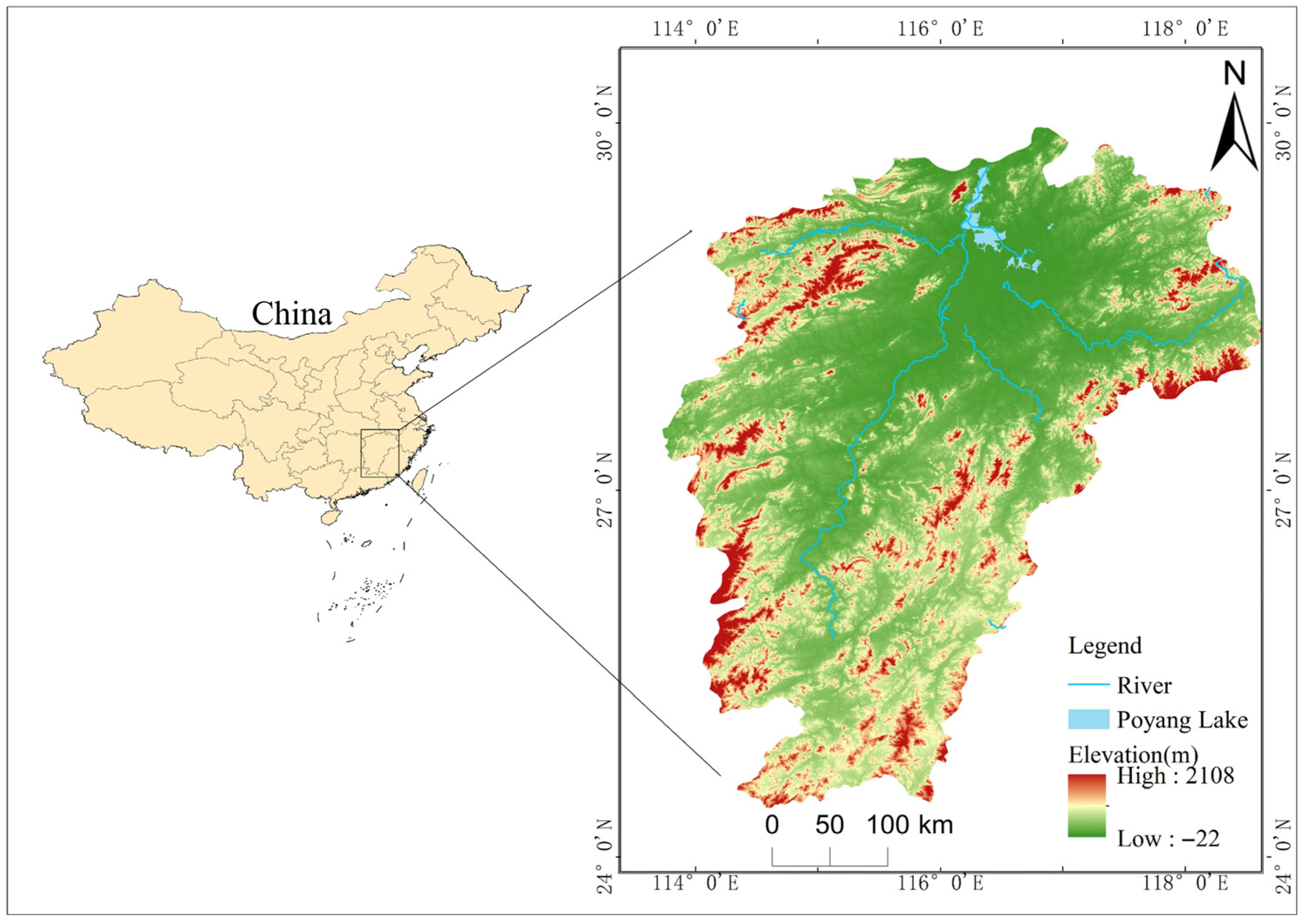
3.1. Study Area
3.2. Study Methods
3.2.1. Average Nearest Neighbour
3.2.2. Kernel Density Estimation
3.2.3. Spatial Autocorrelation
3.2.4. Entropy Weight TOPSIS Model
3.3. Data Source
4. Analysis of Multi-Scale Spatial Pattern of Geoheritage
4.1. Spatial Equilibrium Characteristics
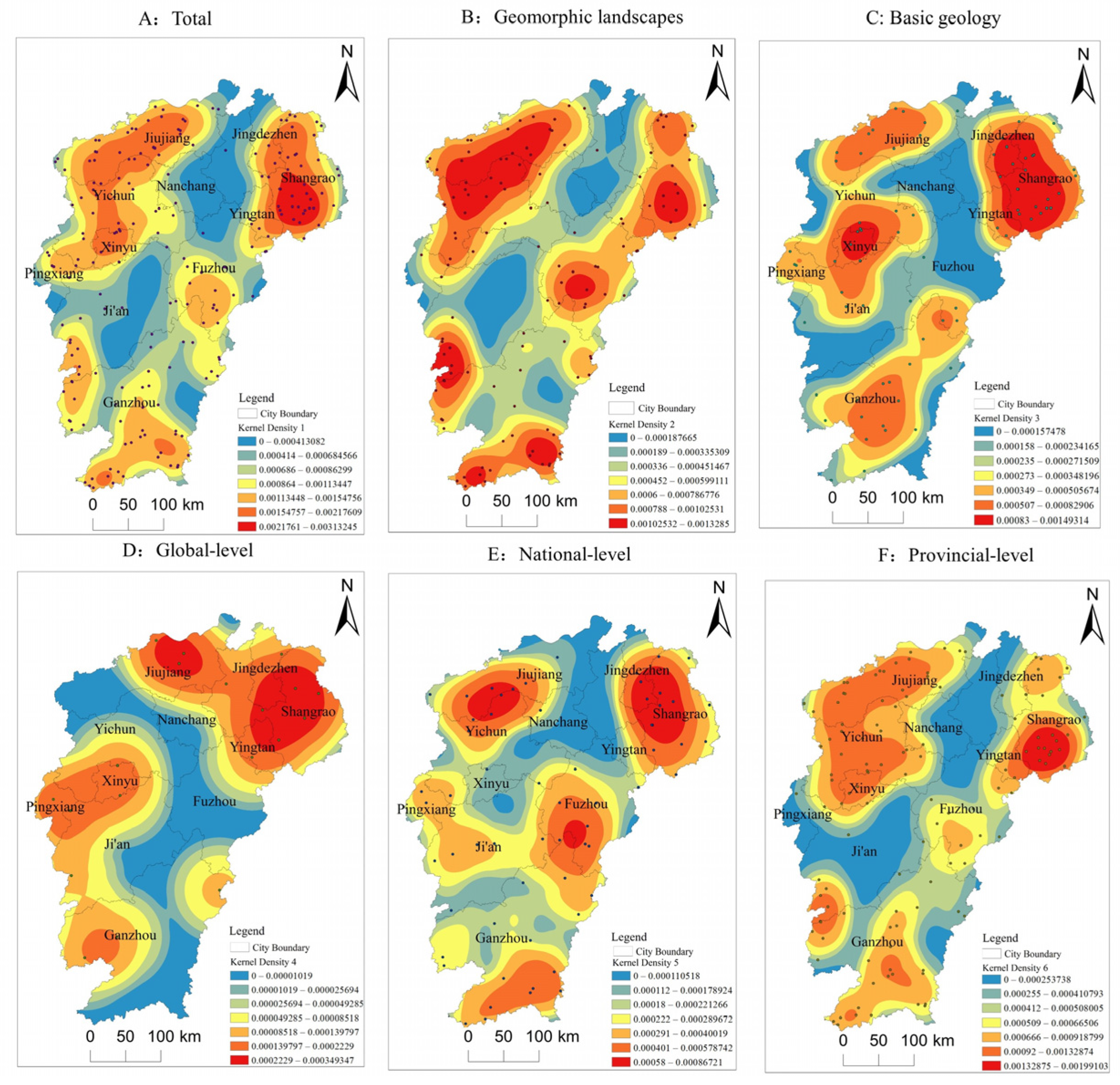
4.2. Spatial Density Characteristics
4.3. Spatial Correlation Characteristics
4.3.1. Global Spatial Autocorrelation
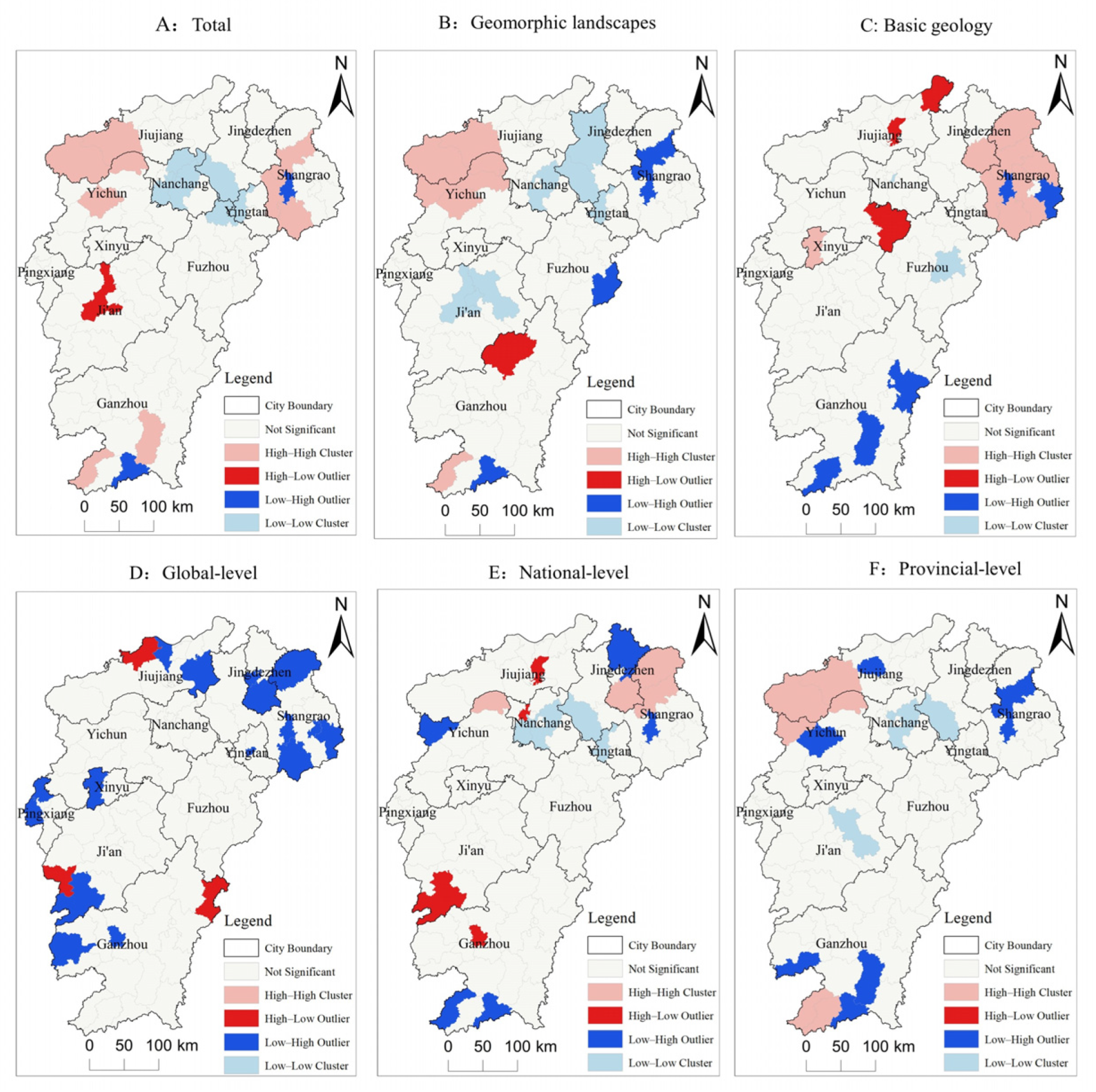
4.3.2. Local Spatial Autocorrelation
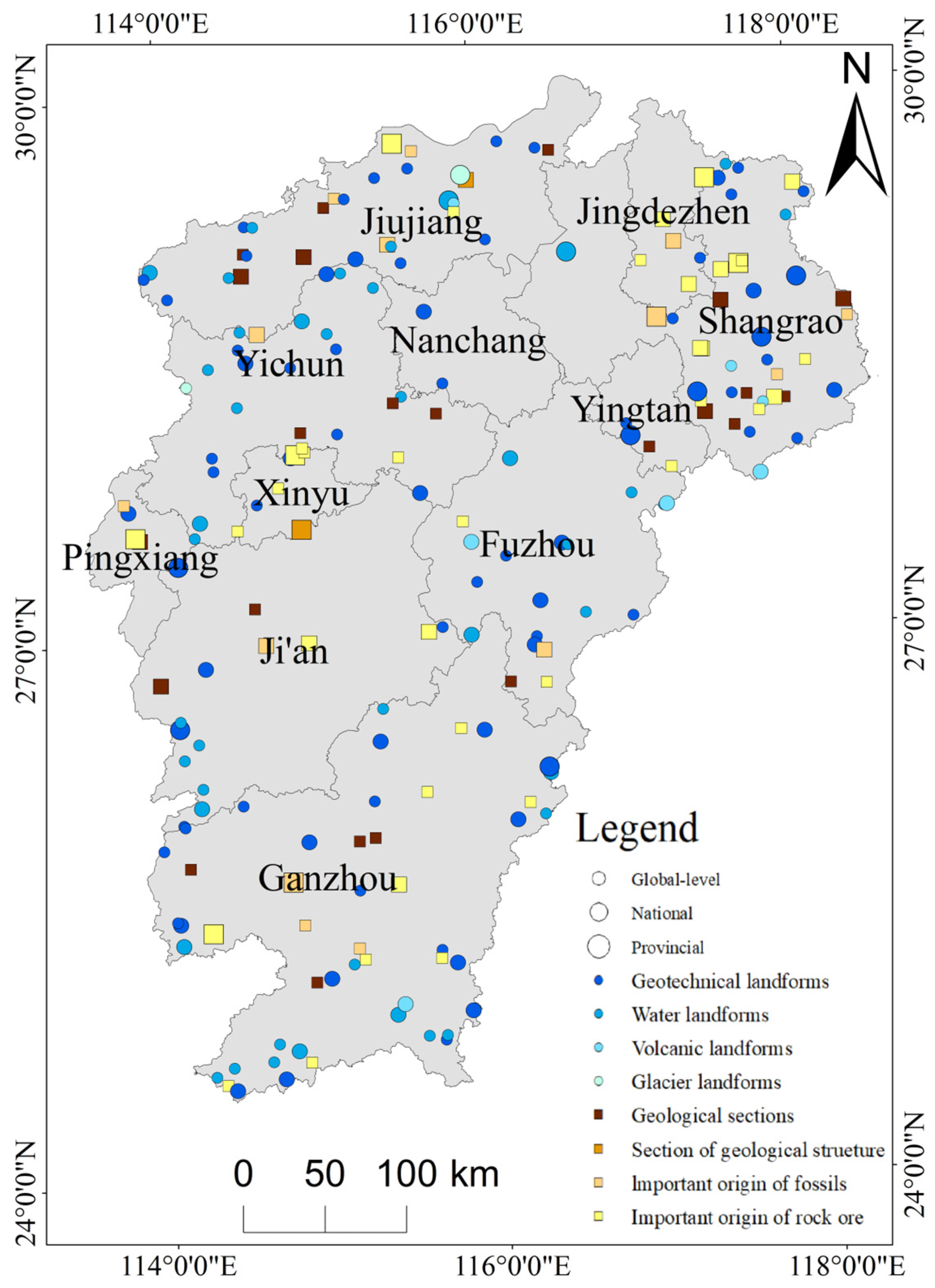
4.4. Analysis of Spatial Pattern of Geoheritage
5. Evaluation of Geotourism Development Potential
5.1. Indicator System Construction
5.2. Evaluation Results
5.3. Analysis of Evaluation Results
6. Discussion
6.1. Comparison with Related Research Conclusions
6.2. Recommendations for Geotourism Development
6.3. Limitations and Future Research Directions
7. Conclusions
- (1)
- The geoheritage sites in Jiangxi Province exhibit an overall aggregated distribution pattern.
- (2)
- Significant differences exist in the degree of clustering among sites of different types and grades.
- (3)
- Key geoheritage sites are primarily distributed along the Gan River, its tributaries, and major mountainous terrains.
- (4)
- The eastern part of Shangrao City is identified as the absolute core distribution area for geoheritage.
- (5)
- Global spatial autocorrelation analysis indicates that, with the exception of global-level geoheritage sites, all other geoheritage sites in Jiangxi Province demonstrate significant spatial clustering and exhibit positive spatial correlation.
- (6)
- Local spatial autocorrelation analysis reveals high–high clustering areas in southern Ganzhou, eastern Shangrao, and the western border region between Yichun and Jiujiang, while low–low clustering areas are found around Nanchang. There are notable differences in spatial association characteristics among geoheritages of various grades and types.
- (7)
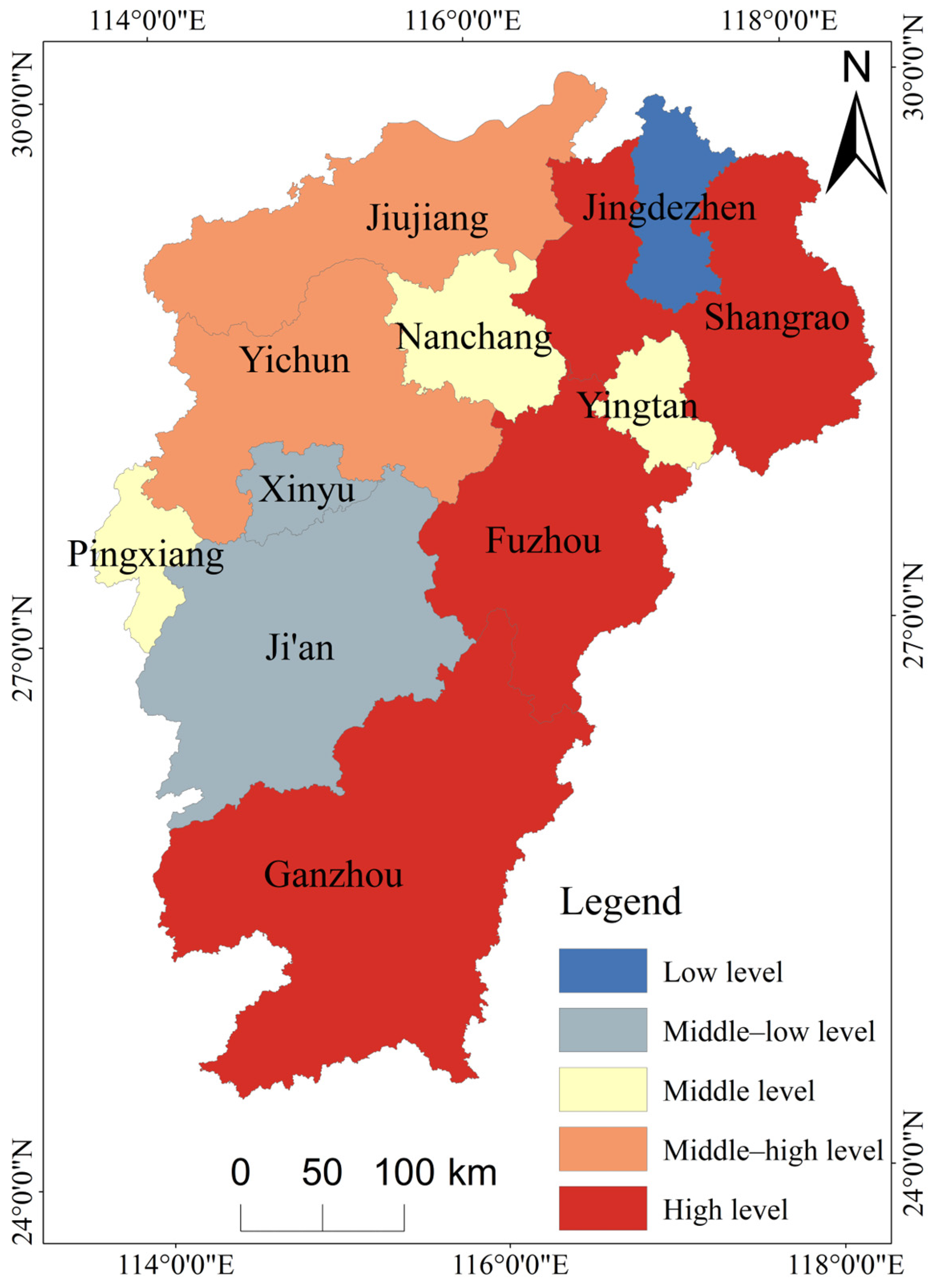
- The overall geotourism development potential of Jiangxi Province is relatively high. Cities with high and relatively high potential account for 45% of the total and are mainly concentrated in the eastern and southern regions, forming contiguous spatial patterns. In contrast, cities with low and relatively low potential represent about 27% of the total, are fewer in number, and display a more scattered distribution.
Author Contributions
Funding
Institutional Review Board Statement
Informed Consent Statement
Data Availability Statement
Acknowledgments
Conflicts of Interest
References
- Ye, Z.H.; Yin, G.S.; Guo, F.S.; Zeng, Q.L.; Huang, G.Q.; Hu, Q.F.; Zhou, Q. Values of Geological Heritages in Jiangxi’s Jingganshan. Resour. Ind. 2012, 14, 112. [Google Scholar]
- Ye, Z.H.; Liu, J.Q.; Yin, G.S.; Chen, A.Z.; Zha, Q.Z.; Chen, Y.Q. Overview of Geoheritage Resources in Jiangxi Sanqingshan National Geopark. Resour. Ind. 2013, 15, 82–88. [Google Scholar]
- Yin, Z.; Huang, H.X.; Luo, P.; Wei, C.S. Geoheritage Classification of the Sanqingshan World Geopark and their Geological Significance. Northwest. Geol. 2018, 51, 276–283. [Google Scholar]
- He, X.; Li, C.; Xu, J. The Features of Tourists Perception of Popular Science Education in Mount Longhu Global Geopark. J. Arid Land Resour. Environ. 2018, 32, 202–208. [Google Scholar]
- Liu, X.; Zhang, W.; Li, G.; Guo, F.; Zhou, W.; Jiang, Y. Characteristics of Tourism Resources in Linggu Peak of Fuzhou, Jiangxi Province and Its Countermeasures of Protection and Development. East China Geol. 2021, 42, 55–65. [Google Scholar]
- Xu, K.; Wu, W. Geoparks and Geotourism in China: A Sustainable Approach to Geoheritage Conservation and Local Development—A Review. Land 2022, 11, 1493. [Google Scholar] [CrossRef]
- Hose, T. Selling the Story of Britain’s Stone. Environ. Interpret. 1995, 10, 16–17. [Google Scholar]
- Hose, T.A. European Geotourism—Geological Interpretation and Geoconservation Promotion for Tourists. In Geological Heritage: Its Conservation and Management; Barretino, D., Wimbledon, W.P., Gallego, E., Eds.; Instituto Tecnologico Geominero de Espana: Madrid, Spain, 2000; pp. 127–146. [Google Scholar]
- Dowling, R.K.; Newsome, D. The scope and nature of geotourism. In Geotourism; Dowling, R., Newsome, D., Eds.; Routledge: Oxford, UK, 2006; pp. 31–53. [Google Scholar]
- Joyce, B. Geotourism, Geosites and Geoparks: Working together in Australia. Aust. Geol. 2007, 144, 26–29. [Google Scholar]
- Newsome, D.; Dowling, R.K. Setting an agenda for geotourism. In Geotourism: The Tourism of Geology and Landscape; Newsome, D., Dowling, R., Eds.; Goodfellow Publishers Limited: Oxford, UK, 2010; pp. 1–12. [Google Scholar]
- Stokes, A.M.; Cook, S.D.; Drew, D. Geotourism: The New Trend in Travel; Travel Industry America and National Geographic Traveler: Washington, DC, USA, 2003. [Google Scholar]
- Olafsdóttir, R.; Tverijonaite, E. Geotourism: A systematic literature review. Geosciences 2018, 8, 234. [Google Scholar] [CrossRef]
- Bentivenga, M.; Cavalcante, F.; Mastronuzzi, G.; Palladino, G.; Prosser, G. Geoheritage: The Foundation for Sustainable Geotourism. Geoheritage 2019, 11, 1367–1369. [Google Scholar] [CrossRef]
- Brilha, J. Inventory and quantitative assessment of geosites and geodiversity sites: A review. Geoheritage 2016, 8, 119–134. [Google Scholar] [CrossRef]
- Chen, A.Z. The establishment and development of tourism earth-science and geopark, and geoheritage re-sources in China: Celebrating the 60th anniversary of Chinese Academy of Geological Sciences. Acta Geosci. Sin. 2016, 37, 535–561. [Google Scholar]
- Santangelo, N.; Valente, E. Geoheritage and Geotourism Resources. Resources 2020, 9, 80. [Google Scholar] [CrossRef]
- Jaafar, M.; Nordin, A.O.S.; Abdullah, S.; Marzuki, A. Geopark Ecotourism Product Development: A Study on Tourist Differences. Asian Soc. Sci. 2014, 10, 42–55. [Google Scholar] [CrossRef]
- Newsome, D.; Dowling, R.K. Geoheritage and geotourism. In Geoheritage. Assessment, Protection, and Management; Reynard, E., Brilha, J., Eds.; Elsevier: Amsterdam, The Netherlands, 2018; pp. 305–321. [Google Scholar]
- Štrba, Ľ.; Vravcová, A.; Podoláková, M.; Varcholová, L.; Kršák, B. Linking Geoheritage or Geosite Assessment Results with Geotourism Potential and Development: A Literature Review. Sustainability 2023, 15, 9539. [Google Scholar] [CrossRef]
- Welc, E.; Miśkiewicz, K. The Concept of the Geotourism Potential and Its Practical Application: A Case Study of the Prządki (the Spinners) Nature Reserve in the Carpathians, Poland. Resources 2020, 9, 145. [Google Scholar] [CrossRef]
- Kuo, H.P.; Wu, K.L. The Potential of Cultural Heritage Tourism to Promote Sustainable Urban Development: The Case of Tainan City. Appl. Mech. Mater. 2013, 316, 446–450. [Google Scholar] [CrossRef]
- Tamang, L.; Mandal, U.K.; Karmakar, M.; Banerjee, M.; Ghosh, D. Geomorphosite Evaluation for Geotourism Development Using Geosite Assessment Model (GAM): A Study from a Proterozoic Terrain in Eastern India. Int. J. Geoherit. Parks 2023, 11, 82–99. [Google Scholar] [CrossRef]
- Marjanović, M.; Tomić, N.; Radivojević, A.R.; Marković, S.B. Assessing the Geotourism Potential of the Niš City Area (South-east Serbia). Geoheritage 2021, 13, 70. [Google Scholar] [CrossRef]
- Iatu, C.; Bulai, M. New Approach in Evaluating Tourism Attractiveness in the Region of Moldavia (Romania). Int. J. Energy Environ. 2011, 5, 165–174. [Google Scholar]
- Mazanec, J.A.; Wöber, K.; Zins, A.H. Tourism Destination Competitiveness: From Definition to Explanation? J. Travel Res. 2007, 46, 86–95. [Google Scholar] [CrossRef]
- Effat, H.; Hegazy, M.N. Cartographic Modeling and Multicriteria Evaluation for Exploring the Potentials for Tour-ism Development in the Suez Governorate, Egypt. Appl. Geoinf. Soc. Environ. 2009, 103, 11–18. [Google Scholar]
- González-Ramiro, A.; Gonçalves, G.; Sánchez-Ríos, A.; Jeong, J. Using a VGI and GIS-Based Multicriteria Approach for Assessing the Potential of Rural Tourism in Extremadura (Spain). Sustainability 2016, 8, 1144. [Google Scholar] [CrossRef]
- De Sena, Í.S.; Ruchkys, Ú.D.A.; Travassos, L.E.P. Geotourism Potential in Karst Geosystems: An Example from the Lund Warming Ramsar Site, Minas Gerais, Brazil. CATENA 2022, 208, 105717. [Google Scholar] [CrossRef]
- Zuo, Y.; Chen, H.; Pan, J.; Si, Y.; Law, R.; Zhang, M. Spatial Distribution Pattern and Influencing Factors of Sports Tourism Resources in China. ISPRS Int. J. Geo-Inf. 2021, 10, 428. [Google Scholar] [CrossRef]
- Forte, J.P.; Brilha, J.; Pereira, D.I.; Nolasco, M. Kernel Density Applied to the Quantitative Assessment of Geodiversity. Geoheritage 2018, 10, 205–217. [Google Scholar] [CrossRef]
- Du, J.; Zhao, B.; Feng, Y. Spatial Distribution and Influencing Factors of Rural Tourism: A Case Study of Henan Province. Heliyon 2024, 10, e29039. [Google Scholar] [CrossRef]
- Zhang, X.; Lin, Y.; Cheng, C.; Li, J. Determinant Powers of Socioeconomic Factors and Their Interactive Impacts on Particulate Matter Pollution in North China. Int. J. Environ. Res. Public Health 2021, 18, 6261. [Google Scholar] [CrossRef]
- Liu, J.; Wang, J.; Xi, Y.D. The Evaluation, Pattern Evolution and Its Influencing Factors of the Quality of Tourism Economic Growth in China. Bus. Manag. J. 2016, 38, 160–173. [Google Scholar]
- Zhou, Y.; Wang, X. Measuring the Level of Tourism Development Based on Entropy Weight TOPSIS Method. In Proceedings of the 2023 8th International Conference on Intelligent Information Processing, Wuhan, China, 17–19 November 2023; Association for Computing Machinery: New York, NY, USA, 2023; pp. 236–241. [Google Scholar] [CrossRef]
- Yin, G.S.; Wang, F.; Xie, C.Y.; Ma, Y.L.; Zhang, X. Investigation Report on Key Geoheritage in Jiangxi Province(V1); Jiangxi Provincial Institute of Geological Survey: Nanchang, China, 2017; Available online: https://www.ngac.cn/dzzlfw_sjgl/d2d/dse/category/detail.do?method=cdetail&_id=102_183003&tableCode=ty_qgg_edmk_t_ajxx&categoryCode=dzzlk (accessed on 18 January 2026).
- DZ/T 0303-2017; Specification for Geoheritage Investigation. Ministry of Land and Resources of the People’s Republic of China: Beijing, China, 2017.
- Du, Q.S. Characteristics of Geological Heritage Resources in Silk Road Economic Belt and Related Countermeasures for Tourism Poverty Alleviation. Northwest. Geol. 2019, 52, 279–285. [Google Scholar]
- Wang, L.; Ma, X. Geotourism Resource Value Evolution Based on Planning Text Analysis for the Yellow River Stone Forest. Resour. Sci. 2016, 38, 1653–1662. [Google Scholar]
- Wang, L.; Tian, M.; Sun, H. Major Regional Benefits of Geological Tourism of Chinese Mountain-Type Global Geoparks. Mt. Res. 2015, 33, 733–741. [Google Scholar]
- Xie, Z.; Liu, M.; Yan, X.; Ren, Y. Spatial Pattern of Important Geological Remains and Evaluation of Geotourism Development Potential in the Yellow River Basin. J. Desert Res. 2024, 44, 128–139. [Google Scholar] [CrossRef]
- Pourahmad, A.; Hosseini, A.; Pourahmad, A.; Zoghi, M.; Sadat, M. Tourist Value Assessment of Geotourism and Environmental Capabilities in Qeshm Island, Iran. Geoheritage 2017, 1–20. [Google Scholar] [CrossRef]
- Dwyer, L.; Kim, C.W. Destination competitiveness: A model and indicators. Curr. Issues Tour. 2003, 6, 369–414. [Google Scholar] [CrossRef]
- Luan, F.; Wang, F. Classification, Spatial Distribution Pattern, Forming Reasons, and Driving Forces of National Geoparks in China. Geoheritage 2022, 14, 52. [Google Scholar] [CrossRef]



| Type | Source |
|---|---|
| Geoheritage sites | GeoCloud (https://geocloud.cgs.gov.cn/) |
| The base map of the administrative region of Jiangxi Province and the DEM data with 30 m resolution | Geospatial Data Cloud (https://www.gscloud.cn/) |
| Number of National Geoparks | China Geological Survey (https://www.cgs.gov.cn/) |
| Number of A-level scenic spots | Jiangxi Department of Culture and Tourism (http://dct.jiangxi.gov.cn/) |
| Number of Star-Rated Hotels | China Tourist Hotel Association (http://www.ctha.com.cn/) |
| Online Travel Asset Index | China Tourism Academy (Data Center of the Ministry of Culture and Tourism) (https://www.ctaweb.org.cn/) |
| Domestic tourism revenue, domestic tourist arrivals, added value of the tertiary industry, per capita GDP, per capita disposable income, highway mileage data, permanent population, green coverage area, waste gas treatment facility treatment capacity, sewage treatment rate, among which the number of inbound tourists and tourism foreign exchange income are taken as an example in 2019 | Jiangxi Statistical Yearbook (2019–2023) (Jiangxi Provincial Bureau of Statistics, 2019–2023), or Statistical Bulletin on National Economic and Social Development of Jiangxi Province (https://www.jiangxi.gov.cn/) |
| The number of geological hazard hidden danger points | Resource and Environmental Science Data Platform (https://www.resdc.cn/) |
| Category | Quantity | Average Observed Distance/m | Predicted Mean Distance/m | R | Z | p | Spatial Distribution Type |
|---|---|---|---|---|---|---|---|
| Total | 202 | 12,571.35 | 17,778.07 | 0.71 | −7.96 | 0.00 | Clustering type |
| Geomorphic landscapes | 125 | 17,475.05 | 22,165.13 | 0.79 | −4.53 | 0.00 | Clustering type |
| Basic geology | 77 | 22,254.04 | 26,535.58 | 0.84 | −2.71 | 0.00 | Clustering type |
| Global-level | 19 | 53,260.66 | 45,678.06 | 1.17 | 1.38 | 0.16 | Random type |
| National-level | 62 | 31,701.18 | 31,455.66 | 1.01 | 0.12 | 0.91 | Random type |
| Provincial-level | 111 | 17,352.26 | 22,713.92 | 0.76 | −4.99 | 0.00 | Clustering type |
| Criterion Layer | Indicator Layer | Metric Weights | Attribute | Explanation and References |
|---|---|---|---|---|
| Geological endowment 0.2066 | Number of geoheritage sites | 0.0512 | + | Number of geoheritage in the region |
| Density of geoheritage sites | 0.0181 | + | The ratio of the number of geoheritage in a region to the area | |
| Geoheritage value | 0.0470 | + | 5 × number of global-level geoheritage + 3 × number of national-level geoheritage + 1 × number of provincial-level geoheritage | |
| Resource combination advantage | 0.0903 | + | The number of national geoparks in the region | |
| Tourism infrastructure and accessibility 0.4615 | Tourist attraction | 0.0773 | + | 5 × the number of 5A-level scenic spots + 3 × 4A-level scenic spots |
| Tourist reception capacity | 0.1587 | + | 5 × number of five-star hotels + 3 × number of four-star hotels | |
| Foreign exchange earnings from tourism | 0.0439 | + | — | |
| Domestic tourism revenue | 0.0804 | + | — | |
| Number of inbound tourists | 0.0386 | + | — | |
| Domestic tourism | 0.0374 | + | — | |
| Online Travel Asset Index | 0.0252 | + | The online asset performance index of destination tour operators published by the China Tourism Academy | |
| Socio-economic conditions 0.2058 | Added value of the tertiary industry | 0.0249 | + | — |
| GDP per capita | 0.0468 | + | — | |
| Disposable income per capita | 0.0364 | + | — | |
| Number of permanent residents | 0.0461 | + | — | |
| Highway mileage | 0.0516 | + | — | |
| Ecological environment 0.1261 | Green coverage area | 0.0392 | + | The area of urban green space |
| Waste gas treatment facility treatment capacity | 0.0555 | + | — | |
| Sewage treatment rate | 0.0175 | + | — | |
| Geological setting | 0.0139 | – | Number of geological hazard risk points in the area |
| Prefecture-Level Divisions | Ideal Positive Distance d+ | Ideal Negative Distance d− | Relative Proximity Ci | Rank |
|---|---|---|---|---|
| Ganzhou | 0.189 | 0.176 | 0.482 | 1 |
| Fuzhou | 0.187 | 0.166 | 0.471 | 2 |
| Shangrao | 0.191 | 0.154 | 0.447 | 3 |
| Jiujiang | 0.198 | 0.138 | 0.411 | 4 |
| Yichun | 0.190 | 0.112 | 0.370 | 5 |
| Nanchang | 0.219 | 0.114 | 0.342 | 6 |
| Pingxiang | 0.223 | 0.099 | 0.309 | 7 |
| Yingtan | 0.234 | 0.104 | 0.308 | 8 |
| Xinyu | 0.221 | 0.078 | 0.260 | 9 |
| Ji’an | 0.227 | 0.073 | 0.243 | 10 |
| Jingdezhen | 0.249 | 0.045 | 0.152 | 11 |
Disclaimer/Publisher’s Note: The statements, opinions and data contained in all publications are solely those of the individual author(s) and contributor(s) and not of MDPI and/or the editor(s). MDPI and/or the editor(s) disclaim responsibility for any injury to people or property resulting from any ideas, methods, instructions or products referred to in the content. |
© 2026 by the authors. Licensee MDPI, Basel, Switzerland. This article is an open access article distributed under the terms and conditions of the Creative Commons Attribution (CC BY) license.
Share and Cite
Cao, Q.; Deng, H.; Zheng, L.; Wang, Q.; Xu, K. Evaluation of Geotourism Potential Based on Spatial Pattern Analysis in Jiangxi Province, China. Sustainability 2026, 18, 1449. https://doi.org/10.3390/su18031449
Cao Q, Deng H, Zheng L, Wang Q, Xu K. Evaluation of Geotourism Potential Based on Spatial Pattern Analysis in Jiangxi Province, China. Sustainability. 2026; 18(3):1449. https://doi.org/10.3390/su18031449
Chicago/Turabian StyleCao, Qiuxiang, Haixia Deng, Lanshu Zheng, Qing Wang, and Kai Xu. 2026. "Evaluation of Geotourism Potential Based on Spatial Pattern Analysis in Jiangxi Province, China" Sustainability 18, no. 3: 1449. https://doi.org/10.3390/su18031449
APA StyleCao, Q., Deng, H., Zheng, L., Wang, Q., & Xu, K. (2026). Evaluation of Geotourism Potential Based on Spatial Pattern Analysis in Jiangxi Province, China. Sustainability, 18(3), 1449. https://doi.org/10.3390/su18031449