

Time-Dependent Vehicle Routing Problem with Simultaneous Pickup-and-Delivery and Time Windows Considering Carbon Emission Costs Using an Improved Ant Colony Optimization Algorithm


Abstract
1. Introduction
- This study proposes a novel TDVRPSPDTW model, which simultaneously accounts for carbon emissions, time-varying vehicle speeds, and customer requests for both pickup-and-delivery services. The model is developed by integrating fixed, transportation, carbon emission, and time window penalty costs, addressing the gaps in prior research.
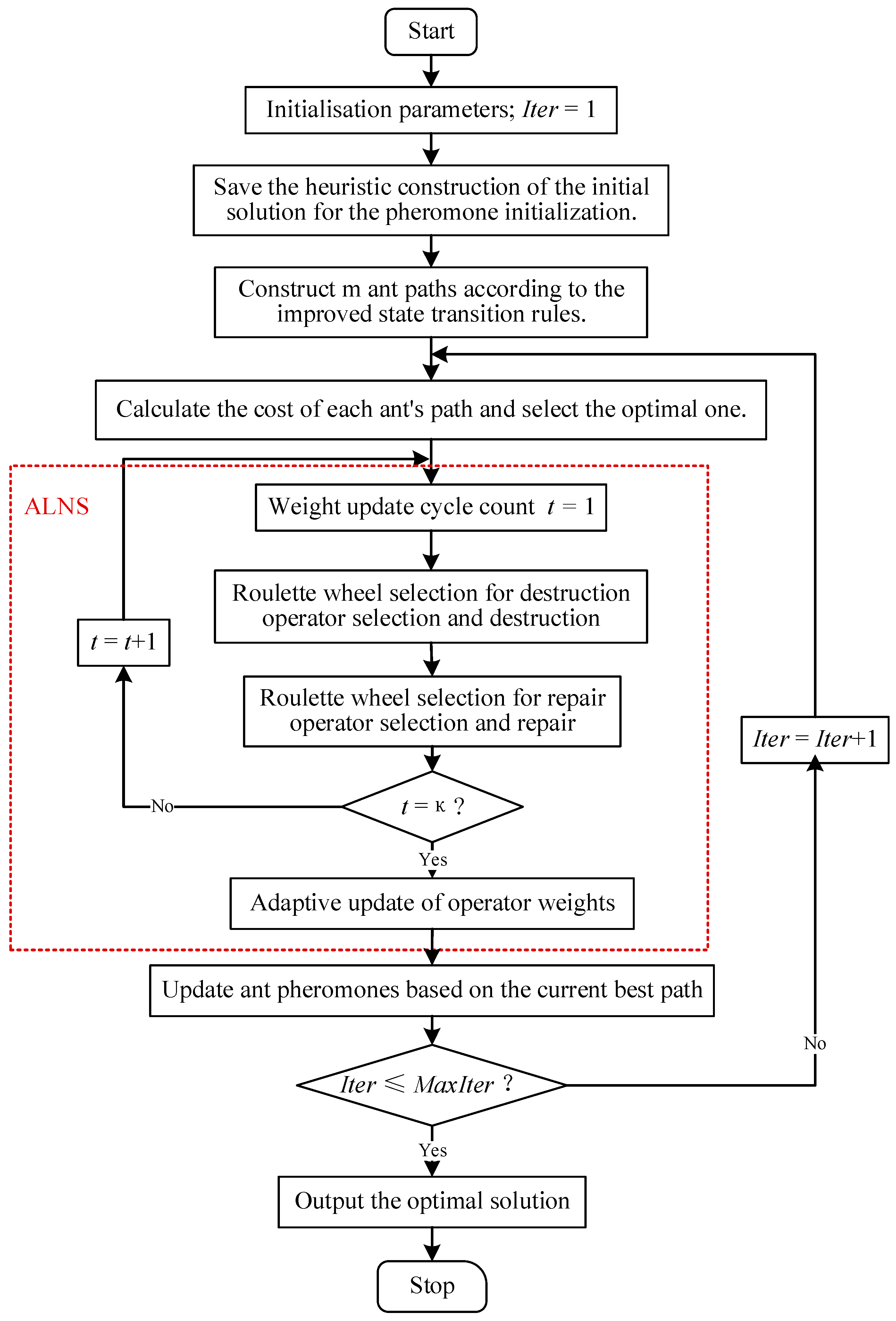
- An IACO algorithm is designed to solve the proposed TDVRPSPDTW. The algorithm initializes pheromone trails using a savings-based heuristic, modifies the state transition rule by introducing distance-saving values, time window deviation factors, and time window width factors, and incorporates a large neighborhood search strategy to destruct and repair local optima. Furthermore, an operator scoring mechanism is introduced for adaptive selection of removal and insertion operators.
- Extensive computational experiments are conducted on standard international VRPSPDTW benchmark datasets of varying scales. Comparative analyses with representative algorithms demonstrate the superior performance of the proposed approach. In addition, sensitivity analyses on constructed TDVRPSPDTW instances confirm that the use of soft time windows and simultaneous pickup–delivery strategies can effectively enhance efficiency and reduce overall costs.
2. Literature Review
2.1. Objectives
2.1.1. Classical VRPs
2.1.2. VRPs with Carbon Emission
2.2. Model Formulations
2.2.1. VRPTW
2.2.2. TDVRPTW
2.2.3. VRPSPDTW
2.3. Solution Algorithms
3. TDVRPSPDTW Description and Formulation
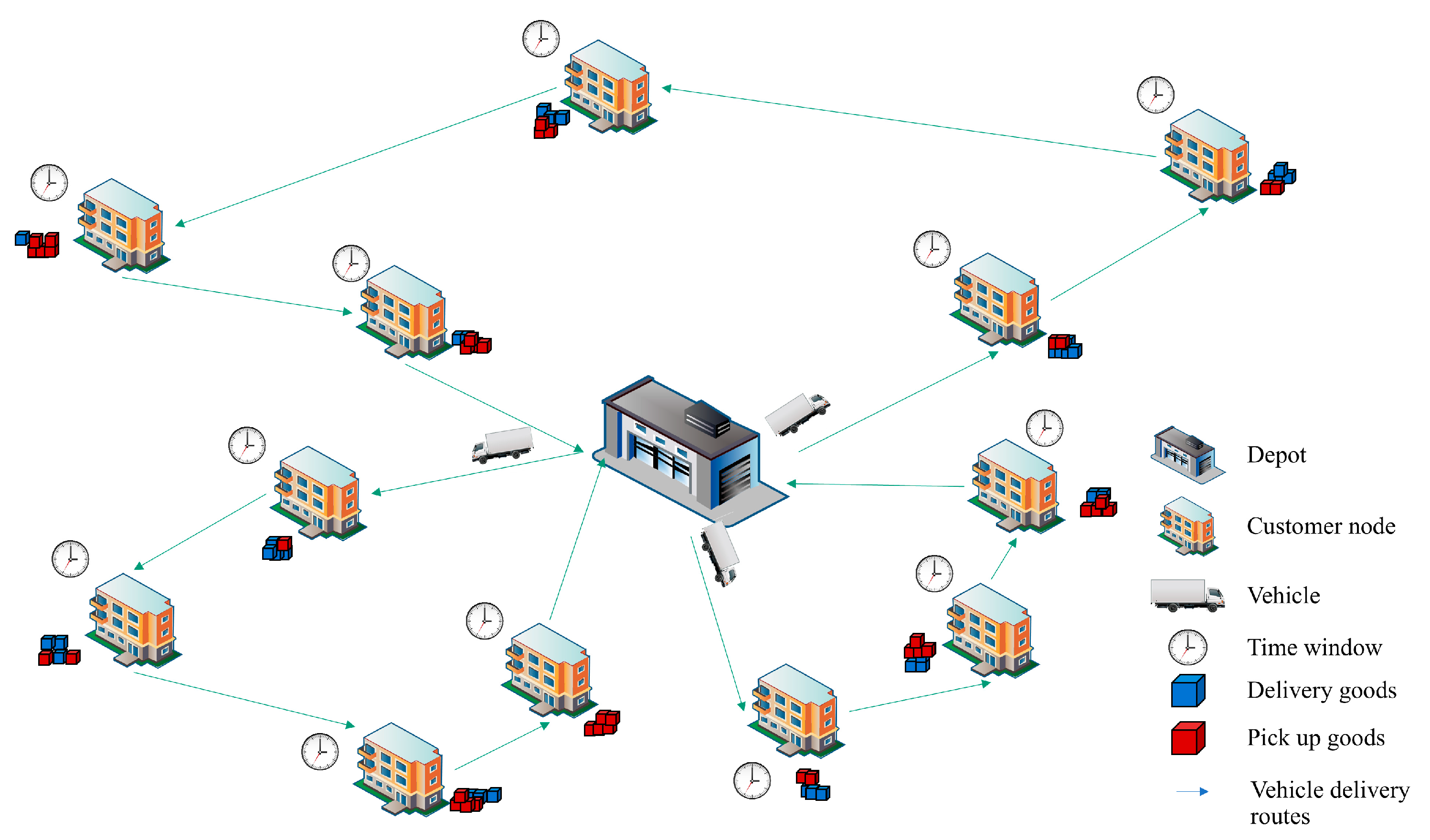
3.1. Problem Description
- (1)
- The distribution network comprises a single depot. Vehicles depart from the depot to perform their assigned services and are required to return to the depot with a load equal to the aggregate pickup demand of the customer nodes served. The return must occur prior to the designated depot opening time.
- (2)
- Each vehicle can provide simultaneous pickup-and-delivery services to multiple customer nodes. However, each customer node can be visited by only one vehicle exactly once, implying that customer demand is indivisible and cannot be split among multiple vehicles.
- (3)
- For customer nodes with simultaneous pickup-and-delivery demands, the service operation follows a “delivery-first, pickup-later” sequence, whereby delivery is completed prior to loading the items to be picked up. The volume of goods is not considered in this study.
- (4)
- The maximum load capacity of all vehicles is assumed to be identical and known a priori. Overloading is strictly prohibited during the distribution process.
- (5)
- For each customer, the location, delivery demand, pickup demand, and time window information are known. The delivery-and-pickup demands of a single customer are both smaller than the vehicle’s maximum capacity.
- (6)
- Vehicles are allowed to arrive outside the specified time window; however, such violations incur the corresponding penalty costs.
- (7)
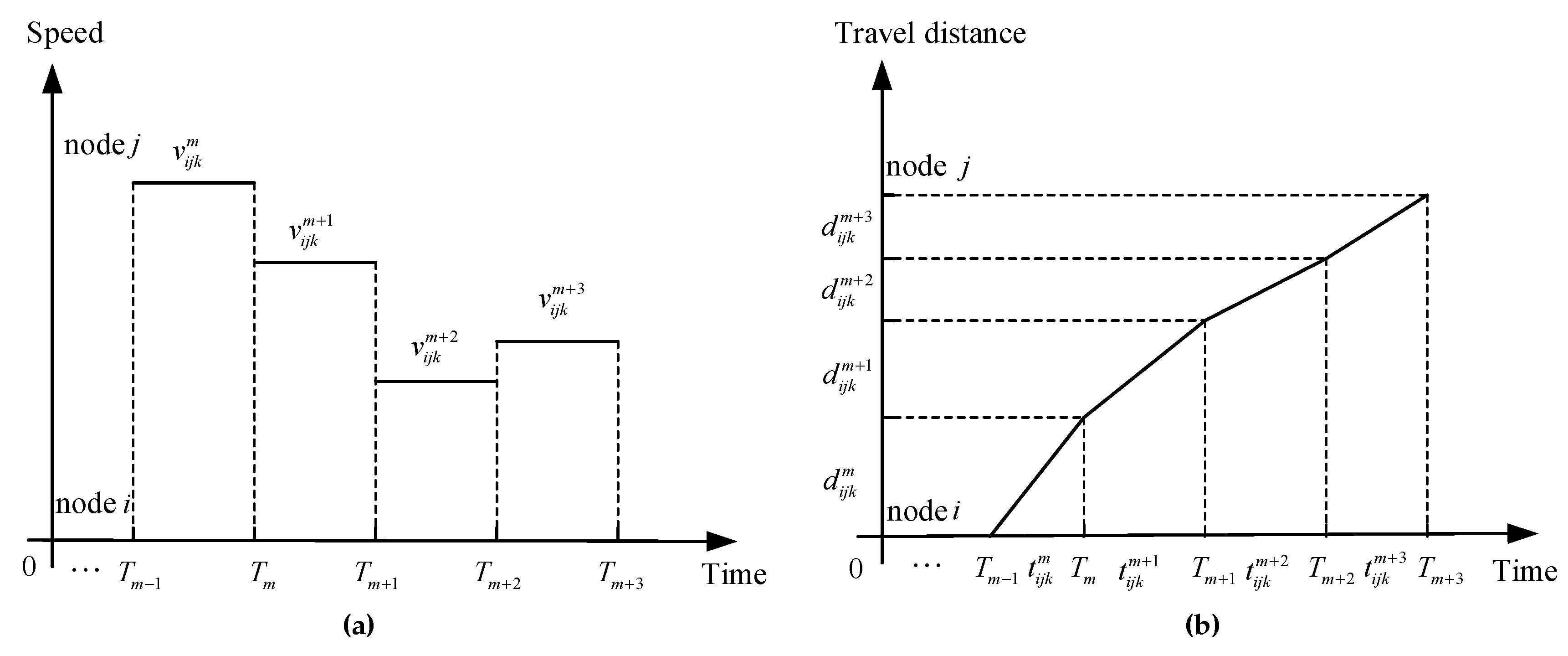
- The distribution road network exhibits time-dependent characteristics, reflected by variations in vehicle travel speed across different time intervals.
- (8)
- During service at a customer node, the vehicle engine is deactivated, thereby generating no fuel consumption or carbon emissions.
3.2. Mathematical Formulation
4. Solution Methodology
4.1. Initial Pheromone Initialization
- Initialization: Construct independent routes for all customer nodes, each traveling directly to and from the depot, i.e., assign one vehicle per customer node.
- Savings calculation: Compute the distance savings resulting from merging every pair of routes, and rank these values in descending order.
- Route merging: Iteratively evaluate the ranked savings list to identify feasible route pairs that satisfy the vehicle load capacity constraint. Merge the first feasible pair, update the savings list, and repeat the process. If no feasible pair remains, the procedure terminates.
4.2. Improved State Transition Rules
4.3. ALNS Local Search
4.3.1. Destruction Operators
- (1)
- Similarity destruction operator
- (2)
- Worst-cost destruction operator
- (3)
- Worst-route destruction operator
- (4)
- Random destruction operator
4.3.2. Repair Operators
- (1)
- Greedy repair operator
- (2)
- Regret value repair operator
4.3.3. Operator Selection Strategy
- If the repaired solution is better than the current solution and constitutes a global optimum, the operator is awarded points.
- If the repaired solution is better than the current solution but not a global optimum, the operator is awarded points.
- If the repaired solution is accepted as the current solution according to a Metropolis acceptance criterion, the operator is awarded points.
4.4. Solution Process
5. Experimental Analysis
5.1. Parameter Settings
5.2. Verification of Algorithm Effectiveness
5.3. TDVRPSPDTW Instance Analysis
5.3.1. Algorithm Performance Comparison
5.3.2. Influence of Time-Dependent Road Network Characteristics
5.3.3. Influence of Time Window Characteristics
5.3.4. Influence of Different Distribution Modes
6. Conclusions and Future Research
6.1. Conclusions
- First, a TDVRPSPDTW model is constructed by jointly considering time-dependent traffic conditions, simultaneous pickup–delivery demands, and carbon emission costs. It is a further deepening and expansion of the VRP. Based on the comprehensive emission model, it calculates the carbon emission cost of vehicles under time-dependent road networks, combines the time-dependent function to simulate the time-dependent characteristics of the road network and considers the simultaneous pickup–delivery demands of customers.
- Second, the IACO incorporates several tailored strategies, including a savings-based heuristic for generating high-quality initial solutions, a modified state transition rule that considers distance-saving and time window deviation, and an embedded adaptive large neighborhood search mechanism to enhance exploration and prevent premature convergence. Experimental results on internationally recognized VRPSPDTW benchmark datasets show that the proposed IACO outperforms representative algorithms, such as CPLEX [22], DCS [58], MATE [59], CO-GA [17] and SFSSA [40], demonstrating its effectiveness and robustness in solving complex large-scale distribution problems.
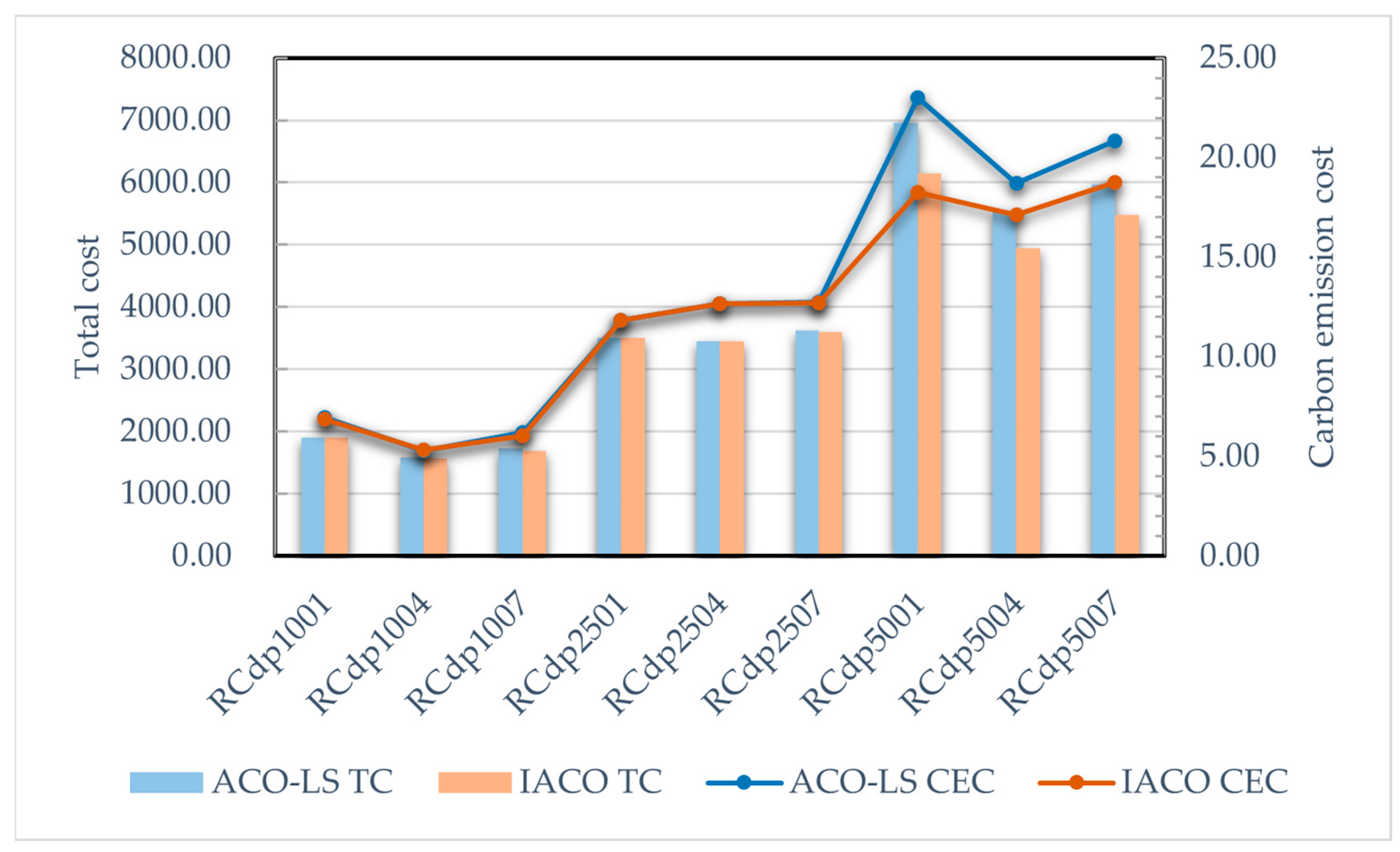
- Third, comparative experiments on constructed TDVRPSPDTW instances show that the proposed IACO yields lower optimal and average distribution costs than the ACO-LS algorithm. The average relative deviation of the optimal solutions is 4.23%, and the performance gap widens with increasing instance size—reaching up to 11.78% when the number of customers is 50.
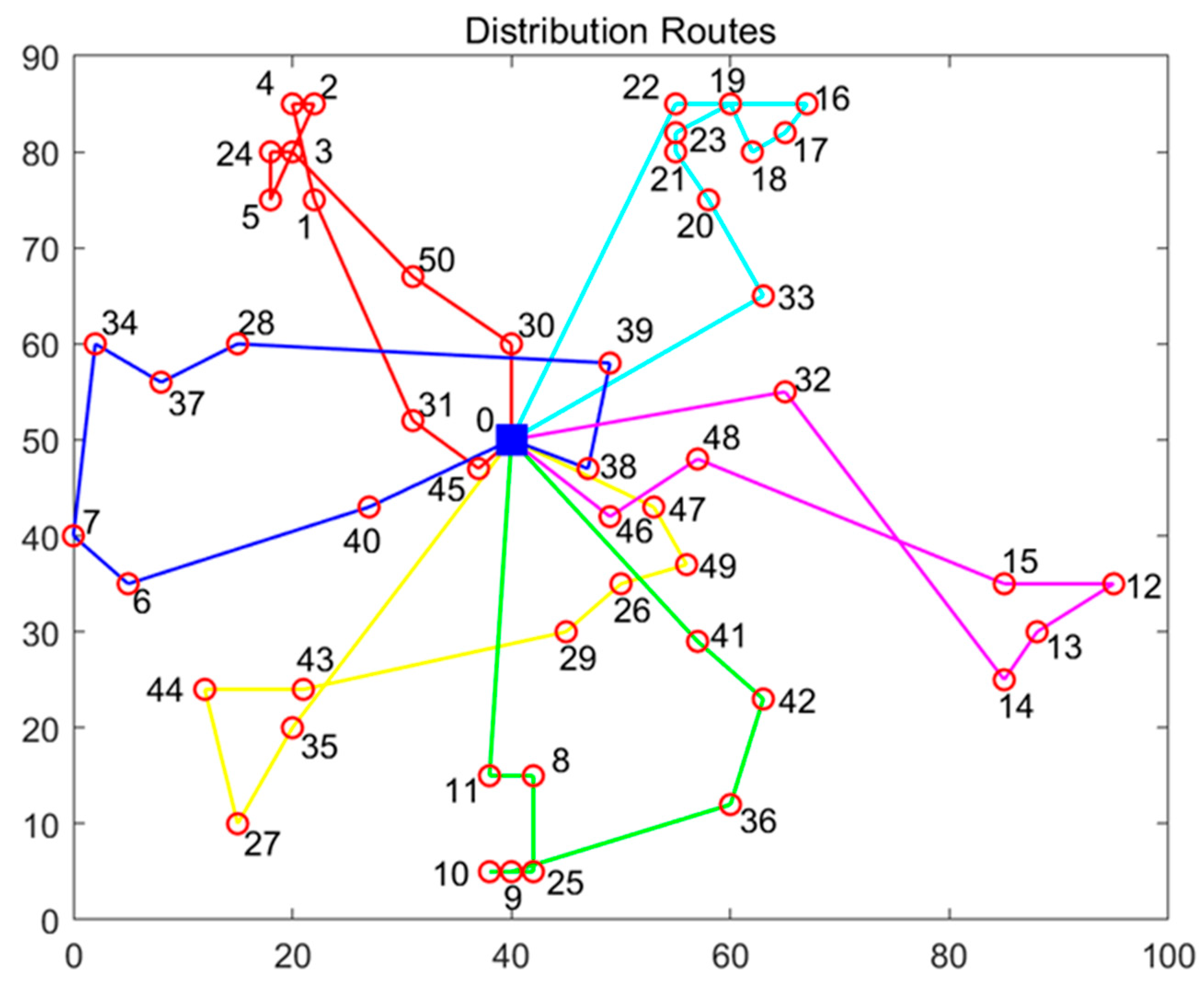
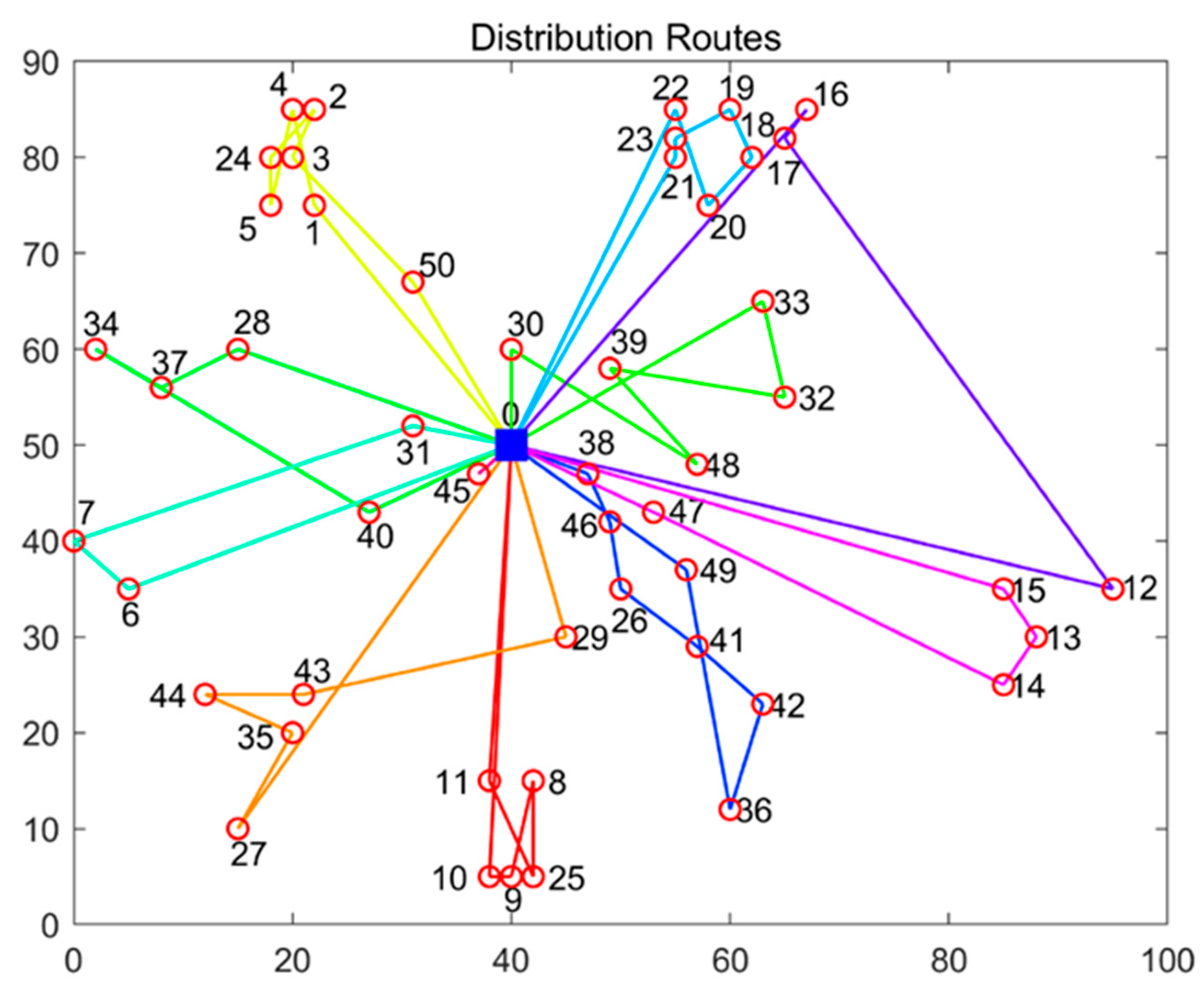
- Fourth, sensitivity analyses conducted on the constructed TDVRPSPDTW instances reveal the influence of time-dependent road networks, time window flexibility, and delivery modes on optimization performance. Compared with static networks, hard time windows, and separate pickup–delivery operations, the proposed model better reflects real urban logistics dynamics and improves routing efficiency. Incorporating time-dependent road networks helps alleviate peak-hour congestion effects; soft time windows reduce carbon emissions and distribution cost by 31.29% and 25.14%, respectively. Further, allowing simultaneous pickup–delivery demands lowers empty-load rates, reducing vehicle usage by 6, and cutting carbon emission and total cost by 53.48% and 50.29%, respectively.
- Finally, beyond the methodological contributions, the proposed TDVRPSPDTW framework provides clear practical guidance for sustainable urban logistics operations. The model can be directly integrated into existing vehicle dispatching or logistics management systems by incorporating time-dependent traffic information, flexible time window settings, and simultaneous pickup–delivery strategies. From an operational perspective, logistics enterprises may apply the proposed approach in offline planning scenarios, such as daily or shift-based route scheduling, to improve fleet utilization, reduce empty-load rates, and achieve measurable reductions in distribution cost and carbon emissions. These implementation-oriented insights highlight the applicability of the proposed framework as a decision-support tool for low-carbon and congestion-aware urban logistics planning.
6.2. Limitations and Future Research
Author Contributions
Funding
Institutional Review Board Statement
Informed Consent Statement
Data Availability Statement
Conflicts of Interest
References
- Garg, V.; Niranjan, S.; Prybutok, V.; Pohlen, T.; Gligor, D. Drones in Last-Mile Delivery: A Systematic Review on Efficiency, Accessibility, and Sustainability. Transp. Res. Part D Transp. Environ. 2023, 123, 103831. [Google Scholar]
- IEA. Global Energy Review 2025; IEA: Paris, France, 2025. [Google Scholar]
- Guo, X.L.; Zhang, W.; Liu, B.B. Low-Carbon Routing for Cold-Chain Logistics Considering the Time-Dependent Effects of Traffic Congestion. Transp. Res. Part D Transp. Environ. 2022, 113, 103502. [Google Scholar] [CrossRef]
- Zhang, X.; Hao, Y.; Zhang, L.; Yuan, X. Application of Improved Genetic Algorithm to Vehicle Routing Problem Considering the Environmental Self-Regulation of the Freight Companies. Expert. Syst. Appl. 2025, 274, 127010. [Google Scholar] [CrossRef]
- Nan, Y. Multiobjective Optimization for Vehicle Routing Optimization Problem in Low-Carbon Intelligent Transportation. IEEE Trans. Intell. Transp. Syst. 2023, 24, 13161–13170. [Google Scholar]
- Ren, C.X.; Lu, L.; Teng, J.; Yin, C.C.; Li, J.T.; Ji, H.W.; Wang, X.Q.; Fu, F.F.; Vincent, F.Y. Logistics Distribution Path Optimization Considering Carbon Emissions and Multifuel-Type Vehicles. J. Adv. Transp. 2025, 2025, 6668589. [Google Scholar] [CrossRef]
- Bajaj, A.S.; Dhodiya, J.M. Sustainable 4D TSP to Reduce Carbon Emission Using Reference Point MOQO Jaya Algorithm in Uncertain Environment. J. Clean. Prod. 2025, 486, 144487. [Google Scholar] [CrossRef]
- Dantzig, G.B.; Ramser, J.H. The Truck Dispatching Problem. Manag. Sci. 1959, 6, 80–91. [Google Scholar] [CrossRef]
- Clarke, G.; Wright, J.W. Scheduling of Vehicles from a Central Depot to a Number of Delivery Points. Oper. Res. 1964, 12, 568–581. [Google Scholar] [CrossRef]
- Solomon, M.M. Algorithms for the Vehicle Routing and Scheduling Problems with Time Window Constraints. Oper. Res. 1987, 35, 254–265. [Google Scholar] [CrossRef]
- Ichoua, S.; Gendreau, M.; Potvin, J. Vehicle Dispatching with Time-Dependent Travel Times. Eur. J. Oper. Res. 2003, 144, 379–396. [Google Scholar] [CrossRef]
- Fan, H.M.; Jun, Z.P.; Yu, C.; Xue, R.X. Dynamic Vehicle Routing Problem of Heterogeneous Fleets with Time-Dependent Networks. Syst. Eng.-Theory Pract. 2022, 42, 455–470. [Google Scholar]
- Demir, E.; Bektaş, T.; Laporte, G. An Adaptive Large Neighborhood Search Heuristic for the Pollution-Routing Problem. Eur. J. Oper. Res. 2012, 223, 346–359. [Google Scholar] [CrossRef]
- Majidi, S.; Hosseini-Motlagh, S.; Ignatius, J. Adaptive Large Neighborhood Search Heuristic for Pollution-Routing Problem with Simultaneous Pickup and Delivery. Soft Comput. 2018, 22, 2851–2865. [Google Scholar] [CrossRef]
- Qin, G.; Tao, F.; Li, L.; Chen, Z. Optimization of the Simultaneous Pickup and Delivery Vehicle Routing Problem based on Carbon Tax. Ind. Manag. Data Syst. 2019, 119, 2055–2071. [Google Scholar] [CrossRef]
- Chen, J.; Liao, W.; Yu, C. Route Optimization for Cold Chain Logistics of Front Warehouses based on Traffic Congestion and Carbon Emission. Comput. Ind. Eng. 2021, 161, 107663. [Google Scholar] [CrossRef]
- Wang, H.F.; Chen, Y.Y. A Genetic Algorithm for the Simultaneous Delivery and Pickup Problems with Time Window. Comput. Ind. Eng. 2012, 62, 84–95. [Google Scholar] [CrossRef]
- Wang, H.; Chen, S.H.; Yin, X.Y.; Meng, L.X.; Wang, Z.W.; Wang, Z.F. A Hybrid Fuzzy C-Means Heuristic Approach for Two-Echelon Vehicle Routing with Simultaneous Pickup and Delivery of Multicommodity. IEEE Trans. Fuzzy Syst. 2025, 33, 218–230. [Google Scholar] [CrossRef]
- Xiao, Y.; Konak, A. A Simulating Annealing Algorithm to Solve the Green Vehicle Routing & Scheduling Problem with Hierarchical Objectives and Weighted Tardiness. Appl. Soft Comput. 2015, 34, 372–388. [Google Scholar] [CrossRef]
- Pan, B.B.; Zhang, Z.Z.; Lim, A. A Hybrid Algorithm for Time-Dependent Vehicle Routing Problem with Time Windows. Comput. Oper. Res. 2021, 128, 105193. [Google Scholar] [CrossRef]
- Kyriakakis, N.A.; Sevastopoulos, I.; Marinaki, M.; Marinakis, Y. A Hybrid Tabu Search-Variable Neighborhood Descent Algorithm for the Cumulative Capacitated Vehicle Routing Problem with Time Windows in Humanitarian Applications. Comput. Ind. Eng. 2022, 164, 107868. [Google Scholar] [CrossRef]
- Wang, C.; Mu, D.; Zhao, F.; Sutherland, J.W. A Parallel Simulated Annealing Method for the Vehicle Routing Problem with Simultaneous Pickup–Delivery and Time Windows. Comput. Ind. Eng. 2015, 83, 111–122. [Google Scholar] [CrossRef]
- Zhao, J.; Poon, M.; Tan, V.Y.F.; Zhang, Z. A Hybrid Genetic Search and Dynamic Programming-based Split Algorithm for the Multi-Trip Time-Dependent Vehicle Routing Problem. Eur. J. Oper. Res. 2024, 317, 921–935. [Google Scholar] [CrossRef]
- Wang, S.; Sun, W.; Huang, M. An Adaptive Large Neighborhood Search for the Multi-Depot Dynamic Vehicle Routing Problem with Time Windows. Comput. Ind. Eng. 2024, 191, 110122. [Google Scholar] [CrossRef]
- Srivastava, G.; Singh, A.; Mallipeddi, R. NSGA-II with Objective-Specific Variation Operators for Multiobjective Vehicle Routing Problem with Time Windows. Expert. Syst. Appl. 2021, 176, 114779. [Google Scholar] [CrossRef]
- Cai, Y.; Cheng, M.; Zhou, Y.; Liu, P.; Guo, J. A Hybrid Evolutionary Multitask Algorithm for the Multiobjective Vehicle Routing Problem with Time Windows. Inform. Sci. 2022, 612, 168–187. [Google Scholar] [CrossRef]
- Qi, R.; Li, J.; Wang, J.; Jin, H.; Han, Y. QMOEA: A Q-Learning-based Multiobjective Evolutionary Algorithm for Solving Time-Dependent Green Vehicle Routing Problems with Time Windows. Inform. Sci. 2022, 608, 178–201. [Google Scholar] [CrossRef]
- Wang, Y.; Ran, L.; Guan, X.; Fan, J.; Sun, Y.; Wang, H. Collaborative Multicenter Vehicle Routing Problem with Time Windows and Mixed Deliveries and Pickups. Expert. Syst. Appl. 2022, 197, 116690. [Google Scholar] [CrossRef]
- Nyako, S.I.; Tayachi, D.; Abdelaziz, F.B. Machine Learning Multi-Objective Optimization for Time-Dependent Green Vehicle Routing Problem. Energ. Econ. 2025, 148, 108628. [Google Scholar] [CrossRef]
- Li, Y.; Soleimani, H.; Zohal, M. An Improved Ant Colony Optimization Algorithm for the Multi-Depot Green Vehicle Routing Problem with Multiple Objectives. J. Clean. Prod. 2019, 227, 1161–1172. [Google Scholar] [CrossRef]
- Frey, C.M.M.; Jungwirth, A.; Frey, M.; Kolisch, R. The Vehicle Routing Problem with Time Windows and Flexible Delivery Locations. Eur. J. Oper. Res. 2023, 308, 1142–1159. [Google Scholar] [CrossRef]
- Liu, J.; Tong, L.; Xia, X. A Genetic Algorithm for Vehicle Routing Problems with Time Windows based on Cluster of Geographic Positions and Time Windows. Appl. Soft Comput. 2025, 169, 112593. [Google Scholar] [CrossRef]
- Lai, C.; Chiu, C.; Chen, T. A Nondominated Sorting Simplified Swarm Optimization with Local Search Mechanisms for Multi-Objective Vehicle Routing Problems with Time Windows. Appl. Soft Comput. 2025, 174, 112989. [Google Scholar] [CrossRef]
- Wu, Q.; Xia, X.; Song, H.; Zeng, H.; Xu, X.; Zhang, Y.; Yu, F.; Wu, H. A Neighborhood Comprehensive Learning Particle Swarm Optimization for the Vehicle Routing Problem with Time Windows. Swarm Evol. Comput. 2024, 84, 101425. [Google Scholar] [CrossRef]
- Maroof, A.; Ayvaz, B.; Naeem, K. Logistics Optimization Using Hybrid Genetic Algorithm (HGA): A Solution to the Vehicle Routing Problem with Time Windows (VRPTW). IEEE Access 2024, 12, 36974–36989. [Google Scholar] [CrossRef]
- Gmira, M.; Gendreau, M.; Lodi, A.; Potvin, J. Tabu Search for the Time-Dependent Vehicle Routing Problem with Time Windows on a Road Network. Eur. J. Oper. Res. 2021, 288, 129–140. [Google Scholar] [CrossRef]
- Wu, Y.; Ma, Z. Time-Dependent Production-Delivery Problem with Time Windows for Perishable Foods. Syst. Eng.-Theory Pract. 2017, 37, 172–181. [Google Scholar]
- Ma, H.; Yang, T. Improved Adaptive Large Neighborhood Search Combined with Simulated Annealing (IALNS-SA) Algorithm for Vehicle Routing Problem with Simultaneous Delivery and Pickup and Time Windows. Electronics 2025, 14, 2375. [Google Scholar] [CrossRef]
- Pasupuleti, V.; Bharadwaj, T.; Chandra, S.K.; Malisetty, S. Enhancing Supply Chain Agility and Sustainability through Machine Learning: Optimization Techniques for Logistics and Inventory Management. Logistics 2024, 8, 73. [Google Scholar] [CrossRef]
- Liu, F.; Wang, L.; Gui, M.; Zhang, Y.; Lan, Y.; Lai, C.; Zhu, B. A Hybrid Heuristic Algorithm for Urban Distribution with Simultaneous Pickup-Delivery and Time Window. J. Heuristics 2023, 29, 269–311. [Google Scholar] [CrossRef]
- Little, J.D.C.; Murty, K.G.; Sweeney, D.W.; Karel, C. An Algorithm for the Traveling Salesman Problem. Oper. Res. 1963, 11, 972–989. [Google Scholar] [CrossRef]
- Andres Figliozzi, M. The Time Dependent Vehicle Routing Problem with Time Windows: Benchmark Problems, an Efficient Solution Algorithm, and Solution Characteristics. Transp. Res. Part E Logist. Transp. Rev. 2012, 48, 616–636. [Google Scholar] [CrossRef]
- Hof, J.; Schneider, M. An Adaptive Large Neighborhood Search with Path Relinking for a Class of Vehicle-Routing Problems with Simultaneous Pickup and Delivery. Networks 2019, 74, 207–250. [Google Scholar] [CrossRef]
- Shi, Y.; Zhou, Y.J.; Boudouh, T.; Grunder, O. A Lexicographic-based Two-Stage Algorithm for Vehicle Routing Problem with Simultaneous Pickup-Delivery and Time Window. Eng. Appl. Artif. Intel. 2020, 95, 103901. [Google Scholar] [CrossRef]
- Wu, H.; Gao, Y. An Ant Colony Optimization based on Local Search for the Vehicle Routing Problem with Simultaneous Pickup–Delivery and Time Window. Appl. Soft Comput. 2023, 139, 110203. [Google Scholar] [CrossRef]
- Chen, G.; Gao, J.; Chen, D. Research on Vehicle Routing Problem with Time Windows Based on Improved Genetic Algorithm and Ant Colony Algorithm. Electronics 2025, 14, 647. [Google Scholar] [CrossRef]
- Ren, T.; Luo, T.; Jia, B.; Yang, B.; Wang, L.; Xing, L. Improved Ant Colony Optimization for the Vehicle Routing Problem with Split Pickup and Split Delivery. Swarm Evol. Comput. 2023, 77, 101228. [Google Scholar] [CrossRef]
- Yu, V.F.; Jodiawan, P.; Gunawan, A. An Adaptive Large Neighborhood Search for the Green Mixed Fleet Vehicle Routing Problem with Realistic Energy Consumption and Partial Recharges. Appl. Soft Comput. 2021, 105, 107251. [Google Scholar] [CrossRef]
- Liu, W.; Zhou, Y.; Liu, W.; Qiu, J.; Xie, N.; Chang, X.; Chen, J. A Hybrid ACS-VTM Algorithm for the Vehicle Routing Problem with Simultaneous Delivery & Pickup and Real-Time Traffic Condition. Comput. Ind. Eng. 2021, 162, 107747. [Google Scholar]
- Erdogdu, K.; Karabulut, K. Bi-Objective Green Vehicle Routing Problem. Int. Trans. Oper. Res. 2022, 29, 1602–1626. [Google Scholar] [CrossRef]
- Wen, M.Y.; Sun, W.; Yu, Y.; Tang, J.F.; Ikou, K.K. An Adaptive Large Neighborhood Search for the Larger-Scale Multi Depot Green Vehicle Routing Problem with Time Windows. J. Clean. Prod. 2022, 374, 133916. [Google Scholar] [CrossRef]
- Luo, H.; Dridi, M.; Grunder, O. A Branch-Price-and-Cut Algorithm for a Time-Dependent Green Vehicle Routing Problem with the Consideration of Traffic Congestion. Comput. Ind. Eng. 2023, 177, 109093. [Google Scholar] [CrossRef]
- Ahmed, Z.H.; Maleki, F.; Yousefikhoshbakht, M.; Haron, H. Solving the Vehicle Routing Problem with Time Windows Using Modified Football Game Algorithm. Egypt. Inform. J. 2023, 24, 100403. [Google Scholar] [CrossRef]
- Praxedes, R.; Bulhões, T.; Subramanian, A.; Uchoa, E. A Unified Exact Approach for a Broad Class of Vehicle Routing Problems with Simultaneous Pickup and Delivery. Comput. Oper. Res. 2024, 162, 106467. [Google Scholar] [CrossRef]
- Huang, S.; Huang, Y.; Blazquez, C.A.; Chen, C. Solving the Vehicle Routing Problem with Drone for Delivery Services Using an Ant Colony Optimization Algorithm. Adv. Eng. Inform. 2022, 51, 101536. [Google Scholar] [CrossRef]
- Wang, Y.; Wang, L.; Chen, G.; Cai, Z.; Zhou, Y.; Xing, L. An Improved Ant Colony Optimization Algorithm to the Periodic Vehicle Routing Problem with Time Window and Service Choice. Swarm Evol. Comput. 2020, 55, 100675. [Google Scholar] [CrossRef]
- Zhang, H.; Zhang, Q.; Ma, L.; Zhang, Z.; Liu, Y. A Hybrid Ant Colony Optimization Algorithm for a Multi-Objective Vehicle Routing Problem with Flexible Time Windows. Inform. Sci. 2019, 490, 166–190. [Google Scholar] [CrossRef]
- Wang, C.; Liu, C.; Mu, D.; Gao, Y. VRPSPDTW Problem Solving by Discrete Cuckoo Search. Comput. Integr. Manuf. Syst. 2018, 24, 570–582. [Google Scholar]
- Liu, S.; Tang, K.; Yao, X. Memetic Search for Vehicle Routing with Simultaneous Pickup-Delivery and Time Windows. Swarm Evol. Comput. 2021, 66, 100927. [Google Scholar] [CrossRef]
- Liu, Z.; Wang, W.; He, J.; Zhang, J.; Wang, J.; Li, S.; Sun, Y.; Ren, X. A New Hybrid Algorithm for Vehicle Routing Optimization. Sustainability 2023, 15, 10982. [Google Scholar] [CrossRef]



| Reference | Network Condition | Objectives | Distribution Modes | Resolution | |||
|---|---|---|---|---|---|---|---|
| NV | TD | CEC | TPC | ||||
| Yu et al. [48] | Static | - | √ | √ | - | Delivery | ALNS |
| Liu et al. [49] | Time- dependent | - | √ | - | - | Pickup and delivery | Ant colony system and virtual transformation method |
| Chen et al. [16] | Time- dependent | √ | √ | √ | √ | Delivery | Hybrid simulated annealing algorithm |
| Erdogdu and Karabulut [50] | Static | - | √ | √ | - | Delivery | Hybrid-ALNS |
| Wen et al. [51] | Static | √ | √ | √ | - | Delivery | Adaptive large neighborhood search |
| Wang et al. [28] | Static | √ | √ | - | √ | Pickup and delivery | Genetic and particle swarm optimization algorithm |
| Ren et al. [47] | Static | √ | √ | √ | √ | Pickup and delivery | Improved ant colony optimization |
| Luo et al. [52] | Time- dependent | - | - | √ | - | Delivery | Branch-price-and-cut algorithm |
| Ahmed et al. [53] | Static | √ | √ | - | - | Delivery | Modified football game algorithm |
| Wu et al. [45] | Static | √ | √ | - | - | Pickup and delivery | An ant colony optimization algorithm with destroy and repair strategies |
| Praxedes et al. [54] | Static | √ | √ | - | - | Pickup and delivery | Branch-cut-and-price algorithm |
| Zhao et al. [23] | Time- dependent | √ | √ | - | - | Delivery | Time-dependent split algorithm |
| Ren et al. [6] | Static | √ | √ | √ | - | Delivery | Improved genetic algorithm |
| Chen et al. [46] | Static | - | √ | - | √ | Delivery | Improved genetic ant colony optimization algorithm |
| Nyako et al. [29] | Time- dependent | - | √ | √ | √ | Delivery | Non-dominated sorting genetic Algorithm enhanced with machine learning |
| This paper | Time- dependent | √ | √ | √ | √ | Pickup and delivery | Improved ant colony optimization |
| Parameter | Definitions |
|---|---|
| Customer nodes, | |
| All nodes, , 0 represents the depot | |
| Set of arcs, where | |
| Set of all vehicles, | |
| Set of all time intervals, | |
| Fixed unit departure cost of a vehicle (CNY) | |
| Unit transportation cost per unit time of a vehicle (CNY/h) | |
| Unit carbon emission cost of a vehicle (CNY/kg) | |
| Unit time penalty cost for a vehicle’s early arrival at a customer node (CNY/h) | |
| Unit time penalty cost for a vehicle’s late arrival at a customer node (CNY/h) | |
| Delivery demand of customer node , (kg) | |
| Pickup demand of customer node , (kg) | |
| Distance from node to node , (km) | |
| Maximum load capacity of a vehicle (kg) | |
| Unloaded weight (dead weight) of a vehicle (kg) | |
| Service time at customer node , (h) | |
| Preset time window of customer node , | |
| Opening hours of the depot | |
| Start time of the mth time interval | |
| End time of the mth time interval | |
| Travel speed of vehicle from node to node within the mth time interval, (km/h) | |
| Travel distance of vehicle from node to node within the mth time interval, (km) | |
| Travel time of vehicle from node to node within the mth time interval, (h) | |
| Total travel time of vehicle from node to node , (h) | |
| Carbon emission factor (CO2/kg) | |
| Carbon emissions of vehicle from node to node within the mth time interval, (kg) | |
| Decision variable: equals 1 if vehicle travels from node to node within the mth time interval, and 0 otherwise | |
| Time when vehicle departs from customer node | |
| Time when vehicle arrives at customer node | |
| Load of vehicle when traveling from node to node (kg) | |
| Calorific value of fuel (L/kJ) | |
| Engine friction coefficient (kJ/rev/L) | |
| Engine speed (rev/s) | |
| Engine displacement (L) | |
| Transmission coefficient | |
| Air resistance coefficient |
| Instance/Number of Customers | CPLEX | DCS | META | IACO | ||||
|---|---|---|---|---|---|---|---|---|
| NV | TD | NV | TD | NV | TD | NV | TD | |
| RCdp1001/10 | 3 | 348.98 | 3 | 348.98 | 3 | 348.98 | 3 | 348.98 |
| RCdp1004/10 | 2 | 216.69 | 2 | 216.69 | 2 | 216.69 | 2 | 216.69 |
| RCdp1007/10 | 2 | 310.81 | 2 | 310.81 | 2 | 310.81 | 2 | 310.81 |
| RCdp2501/25 | 5 | 551.05 | 5 | 551.05 | 5 | 551.05 | 5 | 551.05 |
| RCdp2504/25 | 7 * | 738.32 * | 4 | 473.46 | 4 | 473.46 | 4 | 473.46 |
| RCdp2507/25 | 7 * | 634.20 * | 5 | 540.87 | 5 | 540.87 | 5 | 540.87 |
| RCdp5001/50 | 9 | 994.18 | 9 | 944.18 | 9 | 944.18 | 9 | 944.18 |
| RCdp5004/50 | 14 * | 1961.53 * | 6 | 725.59 | 6 | 733.21 | 6 | 733.32 |
| RCdp5007/50 | 13 * | 1814.33 * | 7 | 809.72 | 7 | 809.72 | 7 | 809.72 |
| Instance | CO-GA | DCS | SFSSA | IACO | ||||
|---|---|---|---|---|---|---|---|---|
| NV | TD | NV | TD | NV | TD | NV | TD | |
| Rdp102 | 17 | 1488.04 | 17 | 1490.13 | 17 | 1485.85 | 17 | 1490.08 |
| Rdp107 | 11 | 1087.95 | 11 | 1084.00 | 11 | 1081.90 | 11 | 1094.80 |
| Rdp110 | 12 | 1116.99 | 12 | 1108.81 | 12 | 1120.88 | 11 | 1135.09 |
| Rdp205 | 3 | 1064.43 | 3 | 1051.38 | 3 | 1016.54 | 3 | 1015.71 |
| Rdp206 | 3 | 961.32 | 3 | 957.81 | 3 | 902.11 | 3 | 916.63 |
| Rdp211 | 3 | 839.61 | 3 | 819.88 | 3 | 806.04 | 3 | 805.40 |
| Cdp105 | 11 | 983.10 | 11 | 981.45 | 11 | 983.10 | 11 | 983.10 |
| Cdp106 | 11 | 878.29 | 11 | 878.29 | 11 | 878.29 | 11 | 878.29 |
| Cdp109 | 10 | 940.49 | 10 | 940.49 | 10 | 985.08 | 10 | 931.90 |
| Cdp202 | 3 | 591.56 | 3 | 591.56 | 3 | 591.56 | 3 | 591.56 |
| Cdp204 | 3 | 590.60 | 3 | 590.60 | 3 | 590.60 | 3 | 590.60 |
| Cdp207 | 3 | 588.29 | 3 | 588.29 | 3 | 588.29 | 3 | 588.29 |
| RCdp101 | 15 | 1652.90 | 15 | 1654.32 | 15 | 1654.84 | 15 | 1667.57 |
| RCdp105 | 14 | 1581.26 | 14 | 1581.26 | 15 | 1578.78 | 14 | 1573.60 |
| RCdp108 | 11 | 1175.04 | 11 | 1170.12 | 11 | 1169.84 | 11 | 1203.64 |
| RCdp203 | 4 | 964.65 | 3 | 1087.37 | 4 | 987.15 | 3 | 1064.83 |
| RCdp204 | 3 | 822.02 | 3 | 822.02 | 3 | 845.55 | 3 | 800.89 |
| RCdp206 | 3 | 1176.85 | 3 | 1166.88 | 3 | 1124.5 | 3 | 1194.97 |
| Type | Travel Speed |
|---|---|
| Instance | ACO-LS | IACO | Gap(%) | ||||||
|---|---|---|---|---|---|---|---|---|---|
| Best | Avg | SD | Time | Best | Avg | SD | Time | ||
| RCdp1001 | 1903.95 | 2035.02 | 232.40 | 18.94 | 1903.99 | 1903.99 | 0.00 | 21.70 | 0.00% |
| RCdp1004 | 1588.68 | 1588.68 | 0.00 | 17.97 | 1566.71 | 1566.71 | 0.00 | 23.75 | −1.38% |
| RCdp1007 | 1734.53 | 1764.87 | 20.20 | 18.30 | 1695.80 | 1695.80 | 0.00 | 23.78 | −2.23% |
| RCdp2501 | 3504.43 | 3912.63 | 310.11 | 69.91 | 3504.43 | 3508.31 | 4.55 | 108.28 | 0.00% |
| RCdp2504 | 3445.66 | 3566.63 | 214.64 | 72.02 | 3450.05 | 3493.14 | 44.12 | 106.25 | 0.13% |
| RCdp2507 | 3630.52 | 3841.11 | 213.66 | 70.60 | 3596.30 | 3615.80 | 66.96 | 103.01 | −0.94% |
| RCdp5001 | 6959.93 | 7343.34 | 371.14 | 232.47 | 6140.32 | 6570.14 | 271.45 | 428.72 | −11.78% |
| RCdp5004 | 5531.57 | 5616.87 | 48.09 | 235.37 | 4944.77 | 5013.71 | 79.75 | 400.36 | −10.61% |
| RCdp5007 | 5973.28 | 6157.94 | 288.49 | 230.25 | 5475.33 | 6006.12 | 256.03 | 420.05 | −8.34% |
| Instance | Mode 1 | Mode 2 | Mode 3 | ||||||
|---|---|---|---|---|---|---|---|---|---|
| TD | CEC | TC | TD | CEC | TC | TD | CEC | TC | |
| RCdp5001 | 703.41 | 17.22 | 6398.66 | 706.54 | 17.18 | 6240.64 | 745.81 | 18.25 | 6140.32 |
| RCdp5004 | 690.86 | 17.23 | 5614.51 | 692.22 | 16.94 | 5112.65 | 699.57 | 17.11 | 4944.77 |
| RCdp5007 | 740.89 | 18.13 | 5500.49 | 756.12 | 18.03 | 5499.58 | 760.38 | 18.73 | 5475.33 |
| Network Conditions | NV | TD | TT | CEC | TC |
|---|---|---|---|---|---|
| Case 1 | 6 | 699.57 | 809.67 | 17.11 | 4944.77 |
| Case 2 | 6 | 724.98 | 827.39 | 17.70 | 5014.01 |
| Case 3 | 6 | 700.09 | 821.95 | 17.44 | 5043.81 |
| Case 4 | 6 | 738.24 | 861.57 | 17.26 | 5084.45 |
| Case 5 | 6 | 733.91 | 884.23 | 17.61 | 5188.34 |
| Case 6 | 8 | 815.13 | 1216.62 | 20.62 | 6994.84 |
| Case 7 | 6 | 707.27 | 707.27 | 16.56 | 4787.06 |
| Instance | Soft Time Windows | Hard Time Windows | ||||||||
|---|---|---|---|---|---|---|---|---|---|---|
| NV | TD | VT | CEC | TC | NV | TD | WT | CEC | TC | |
| RCdp1001 | 2 | 280.56 | 107.72 | 6.88 | 1903.99 | 3 | 348.98 | 101.23 | 8.50 | 2442.12 |
| RCdp1004 | 2 | 218.68 | 20.62 | 5.32 | 1566.71 | 2 | 218.68 | 20.62 | 5.32 | 1553.57 |
| RCdp1007 | 2 | 246.27 | 69.74 | 6.03 | 1695.80 | 3 | 243.17 | 112.84 | 5.92 | 2055.25 |
| RCdp2501 | 4 | 485.07 | 158.62 | 11.84 | 3504.43 | 6 | 546.37 | 180.75 | 13.34 | 4381.75 |
| RCdp2504 | 4 | 515.41 | 51.02 | 12.65 | 3450.05 | 4 | 558.54 | 3.35 | 13.68 | 3632.26 |
| RCdp2507 | 4 | 517.11 | 179.10 | 12.70 | 3596.30 | 5 | 562.54 | 33.88 | 13.73 | 3973.68 |
| RCdp5001 | 6 | 745.81 | 768.78 | 18.25 | 6140.32 | 11 | 1087.6 | 354.58 | 26.56 | 8202.42 |
| RCdp5004 | 6 | 699.57 | 86.61 | 17.11 | 4944.77 | 7 | 796.05 | 48.21 | 19.54 | 5574.29 |
| RCdp5007 | 6 | 760.38 | 292.83 | 18.73 | 5475.33 | 8 | 945.53 | 33.82 | 22.63 | 6445.24 |
| Distribution Modes | NV | Total NV | CEC | Total CEC | TC | Total TC | |
|---|---|---|---|---|---|---|---|
| Separate pickup + separate delivery | Separate delivery | 6 | 12 | 16.95 | 36.78 | 4927.61 | 9881.49 |
| Separate pickup | 6 | 19.83 | 4953.88 | ||||
| Simultaneous pickup–delivery | 6 | 6 | 17.11 | 17.11 | 4944.77 | 4944.77 | |
Disclaimer/Publisher’s Note: The statements, opinions and data contained in all publications are solely those of the individual author(s) and contributor(s) and not of MDPI and/or the editor(s). MDPI and/or the editor(s) disclaim responsibility for any injury to people or property resulting from any ideas, methods, instructions or products referred to in the content. |
© 2026 by the authors. Licensee MDPI, Basel, Switzerland. This article is an open access article distributed under the terms and conditions of the Creative Commons Attribution (CC BY) license.
Share and Cite
He, M.; Zhang, J.; Han, X.; Yang, M.; Yang, X.; Wu, X.; Ma, X. Time-Dependent Vehicle Routing Problem with Simultaneous Pickup-and-Delivery and Time Windows Considering Carbon Emission Costs Using an Improved Ant Colony Optimization Algorithm. Sustainability 2026, 18, 1430. https://doi.org/10.3390/su18031430
He M, Zhang J, Han X, Yang M, Yang X, Wu X, Ma X. Time-Dependent Vehicle Routing Problem with Simultaneous Pickup-and-Delivery and Time Windows Considering Carbon Emission Costs Using an Improved Ant Colony Optimization Algorithm. Sustainability. 2026; 18(3):1430. https://doi.org/10.3390/su18031430
Chicago/Turabian StyleHe, Meiling, Jin Zhang, Xun Han, Mei Yang, Xi Yang, Xiaohui Wu, and Xiaolai Ma. 2026. "Time-Dependent Vehicle Routing Problem with Simultaneous Pickup-and-Delivery and Time Windows Considering Carbon Emission Costs Using an Improved Ant Colony Optimization Algorithm" Sustainability 18, no. 3: 1430. https://doi.org/10.3390/su18031430
APA StyleHe, M., Zhang, J., Han, X., Yang, M., Yang, X., Wu, X., & Ma, X. (2026). Time-Dependent Vehicle Routing Problem with Simultaneous Pickup-and-Delivery and Time Windows Considering Carbon Emission Costs Using an Improved Ant Colony Optimization Algorithm. Sustainability, 18(3), 1430. https://doi.org/10.3390/su18031430