Article

Environmental Laws and Sustainable Development of Green Technology Innovation: Evidence from Chinese Listed Firms


School of Law, Hainan University, No. 58 People’s Avenue, Haikou 570228, China
*
Author to whom correspondence should be addressed.
Sustainability 2026, 18(3), 1420; https://doi.org/10.3390/su18031420
Submission received: 17 December 2025 / Revised: 21 January 2026 / Accepted: 28 January 2026 / Published: 31 January 2026
(This article belongs to the Special Issue Public Policy and Economic Analysis in Sustainability Transitions)

Abstract

The revision and implementation of the Environmental Protection Law signaled a major transformation in China’s environmental regulatory paradigm—from a traditional command-and-control model to a more diversified and market-oriented approach. This shift has raised critical questions regarding the actual impact of regulation on green technological innovation. Using panel data from A-share listed firms in China between 2011 and 2022, this study employs a propensity score matching–difference-in-differences (PSM-DID) model to identify the causal effect of environmental regulation on green innovation. Results reveal that the enactment of the law significantly enhances firms’ green innovation capacity. Robustness tests confirm the stability of these findings. Further analysis identifies several potential transmission mechanisms. Specifically, we find robust empirical evidence that environmental regulation exerts its effects through elevated R&D investment levels and strengthened executives’ environmental awareness, while the financing constraint and environmental information disclosure channels yield suggestive yet less statistically robust results in indirect effect tests. Moreover, heterogeneous effects are more evident among non-state-owned enterprises, firms in the eastern region, and those in highly market-oriented provinces. This study contributes empirical evidence to the literature on environmental regulation and green innovation, and offers policy insights for improving environmental governance in emerging economies.

1. Introduction

The global drive for sustainable development has elevated the transition to a green economy as an increasingly pivotal policy objective for both developed and developing nations. A core engine of this transition is green technological innovation, which simultaneously targets environmental performance improvements and firms’ long-run productivity and competitiveness [1]. In practice, such innovation is seldom purely voluntary; it is frequently shaped by shifts in the institutional environment, especially changes in binding laws and policy instruments [2]. Within this setting, environmental regulation functions as a credible commitment device and an enforcement backdrop that can alter firms’ expected returns from green R&D and patenting [3].
Despite this well-recognized significance, global institutions such as the United Nations have highlighted that technology and innovation have yet to fulfill their full potential in advancing sustainable development. The 2023 UN Sustainable Development Goals (SDGs) Report attributes this gap partly to institutional and policy barriers that impede technological progress [4]. Consequently, governments and enterprises worldwide are actively exploring effective regulatory frameworks to stimulate green innovation. For instance, the European Union’s Carbon Border Adjustment Mechanism (CBAM) is designed not only to curb carbon leakage but also to generate positive policy spillovers globally [5], thereby encouraging other countries to accelerate their green transition efforts.
In China, the enactment of the revised Environmental Protection Law in 2015 marked a paradigm shift from traditional command-and-control regulation to a more diversified, stringent, and institutionalized environmental governance system [6]. This transition has intensified compliance pressure on firms and may reshape their innovation behavior [7,8]. As such, the relationship between environmental regulation and green technological innovation has garnered growing attention from policymakers and scholars domestically and internationally.
Empirical evidence remains far from uniform, with estimates varying across contexts, regulatory designs, and firm characteristics. On the one hand, some scholars argue that environmental regulation stimulates green innovation by creating incentives for firms to upgrade technologies or improve resource efficiency [9,10,11]. On the other hand, others emphasize that compliance costs may divert resources away from research and development (R&D), thereby hindering innovation [12,13,14,15]. A growing body of studies has explored the differential impacts of various regulatory types or intensities [16,17,18], while a limited number have begun to identify specific mediating mechanisms such as financial constraints or firm-level characteristics [19]. Nevertheless, systematic empirical evidence on the underlying mechanisms and heterogeneous effects of environmental regulation remains scarce.
To address this research gap, the present study investigates whether and how environmental regulation promotes green technological innovation by utilizing the implementation of China’s revised Environmental Protection Law (EPL)—which officially took effect on 1 January 2015 and strengthened regulatory enforcement, deterrence, and accountability mechanisms—as a quasi-natural experiment. Specifically, sustainable development is understood in a firm-level and channel-specific context: rather than constructing a macro-level sustainability index, we focus on the technology-upgrading channel through which stricter environmental governance may reconcile environmental goals with firms’ long-term competitiveness and development quality. Accordingly, we treat green innovation as measurable, technology-verified advances that reduce environmental burdens, and we proxy it with firm-year green patent applications to capture observable innovation output. Concretely, we construct firm-level green patent measures from the Chinese Research Data Services Platform (CNRDS) by (i) employing the full set of patents identified by CNRDS’s built-in green patent tag, (ii) aggregating these patents at the firm-year level by application year, and (iii) using the natural logarithm of (1 + green patent applications) as the baseline outcome variable. Finally, while patent-based indicators are standard proxies for innovation output, we further use invention-type green patent applications as a more stringent, higher-quality proxy in robustness and sensitivity analyses. This design ensures that the main findings do not depend on a single patent category and helps alleviate concerns that strategic or symbolic responses (e.g., greenwashing practices) might drive the baseline results.
This study makes three key contributions to the existing literature. First, it provides rigorous empirical evidence for the causal relationship between environmental regulation and green technological innovation. Second, it unpacks the mechanisms through which regulatory pressure translates into innovation outcomes. Third, it identifies the boundary conditions under which such regulatory effects are most pronounced. These insights offer direct implications for the design of effective environmental policies in emerging economies like China.

2. Literature Review and Research Hypotheses

2.1. Conflicting Theories: Compliance Cost vs. Innovation Compensation

Existing studies have primarily coalesced around two opposing academic perspectives on the relationship between environmental regulation and green technological innovation: the compliance cost hypothesis and the innovation compensation hypothesis. The compliance cost hypothesis suggests that environmental regulation increases firms’ compliance costs, forcing them to invest substantial resources to meet regulatory requirements [19,20,21,22]. This reallocation of financial capital often reduces firms’ actual input into innovation activities, ultimately suppressing the development of green technological innovation. The pilot carbon emission trading system (ETS) policy has laid the foundation for regulatory changes in environmental governance, while simultaneously increasing corporate debt costs by 0.140 percentage points [23].
Yang et al. argued that under climate policy constraints, state-owned enterprises (SOEs) gain preferential credit access and direct funds into low-efficiency projects. This capital misallocation bottlenecks technical efficiency gains by diverting resources from innovation and operational optimization [24]. Yun Wang et al. further posited that beyond a critical threshold of regulatory stringency, environmental regulations may yield negative outcomes when compliance costs exceed innovation offsets [25]. An alternative view highlights an induced-innovation channel: when compliance becomes costly, firms may respond by upgrading processes and products so that marginal abatement costs fall over time, potentially improving efficiency and competitiveness [26,27].
Mark A. Cohen and Adeline Tubb, through a meta-analysis of the Porter Hypothesis, concluded that well-designed environmental regulations can not only promote technological innovation but also enhance firm-level and national competitiveness [28]. Suphi Sen found that effective environmental governance policies can foster corporate green transformation by encouraging green technological innovation and facilitating industrial upgrading [29]. Xingmin Yin et al. demonstrated that appropriate regulatory tools can significantly promote green innovation, and that green finance serves as a critical moderator in the relationship between heterogeneous environmental regulations and green technological innovation [3]. A minority of scholars argue that there may be no direct link between environmental regulation and firm competitiveness. Antoine Dechezleprêtre and Misato Sato suggested that environmental regulations induce green technological innovation, but the resulting benefits do not appear to be large enough to outweigh the costs of regulations for the regulated entities [30].
Notwithstanding extensive work, two issues remain under-addressed: (i) the micro-level pathways linking enforcement shocks to innovation outcomes, and (ii) whether effects systematically differ across ownership types, regions, and institutional environments. Building upon this review, the present study addresses these gaps by focusing on three key aspects. First, it explores the mediating mechanisms through which environmental regulation influences green innovation, particularly financing constraints and managerial cognition. Second, it investigates this relationship within the specific institutional setting of a developing country—China—paying special attention to the differences between state-owned and non-state-owned enterprises in terms of policy implementation and innovation capabilities. Finally, it examines industry-level differences, emphasizing how sectoral characteristics and policy enforcement variations influence the effectiveness of environmental regulation on corporate green innovation.

2.2. Research Hypotheses

Green technological innovation is characterized by cross-disciplinary integration, dynamic development, and dual externalities [31,32,33,34]. These features make green innovation inherently risky and uncertain for firms, posing significant barriers to voluntary adoption and market-driven transformation [35]. Therefore, it is difficult to rely solely on market forces to incentivize green innovation, and effective environmental regulation becomes necessary to provide external impetus. According to the Porter Hypothesis, environmental regulation can act as a “forcing mechanism” to drive technological progress in firms [36].
Medium-level environmental regulation can stimulate green technological innovation and improve innovation efficiency [37]. Green industrial policies, especially those that offer financing and supervisory mechanisms, can further guide firm behavior and promote innovation in a targeted and effective manner [38]. Additionally, regulation plays an essential role in the optimal allocation of resources to green innovation, as seen in the effectiveness of green credit policies in shaping corporate investment directions [39]. Based on these arguments, we propose the following:
H1. 
Environmental regulation has a significantly positive effect on firms’ green technological innovation.
To understand how environmental regulation affects green innovation, we next examine several potential mediating pathways:
Based on signaling theory, environmental regulation can convey a credible green commitment signal to capital markets [40]. This enhances the firm’s reputation and green value, attracting more investors and reducing financing costs. According to the resource-based view, a reduction in financing costs alleviates financial constraints and releases more internal resources for innovation-related activities [41]. Accordingly, we propose the following:
H2a. 
Environmental regulation promotes green technological innovation by alleviating firms’ financing constraints.
In line with the innovation compensation effect under the Porter Hypothesis, strict environmental standards compel firms to increase R&D investment to reduce long-term compliance costs and enhance competitiveness. Additionally, from a dynamic capabilities perspective [42], continuous R&D efforts enable firms to absorb, integrate, and apply external green knowledge, fostering sustained innovation capacity and competitive advantage [43]. Therefore, we propose the following:
H2b. 
Environmental regulation promotes green technological innovation by increasing firms’ R&D investment.
From a strategic-decision perspective, executives’ cognitive frames shape how regulatory threats and opportunities are interpreted, which in turn affects the prioritization of green R&D projects and patenting strategies [44,45,46]. When top managers attach greater salience to environmental objectives, regulatory enforcement is more likely to be translated into internal targets, budgets, and performance evaluation criteria that support green innovation [47,48,49,50,51]. Moreover, under legitimacy-oriented pressures, firms may recalibrate strategies and governance arrangements to align with regulatory expectations, which can indirectly facilitate the adoption of cleaner technologies and related inventive activity [52,53]. Hence, we propose the following:
H2c. 
Environmental regulation promotes green technological innovation by enhancing managerial green cognition.
Under legitimacy theory and resource dependence theory, transparent environmental disclosure enables stakeholders to monitor firms’ environmental performance more effectively, placing external pressure on firms to engage in green innovation [54,55,56]. From a signaling theory perspective, high-quality disclosure attracts green investors and strategic partners, thereby helping to mitigate the resource constraints of green innovation [57]. Empirical research shows that mandatory disclosure policies have led to an increase in green patent output by influencing stakeholder pressure [58,59]. Based on this, we propose the following:
H2d. 
Environmental regulation promotes green technological innovation by improving environmental information disclosure.

3. Research Design

3.1. Data Collection

The empirical analysis draws on a firm-year panel of Chinese A-share listed companies over 2011–2022, merged with firm-linked patent application records via consistent firm identifiers and standardized firm names. Firm-level financial indicators (including key items from the balance sheet and cash flow statement) are obtained from the Wind and CSMAR databases—two leading financial data platforms in China—while patent records and the built-in green patent tag are sourced from CNRDS. Industry codes for listed firms follow the China Securities Regulatory Commission (CSRC) industry classification system, and the heavy-polluting vs. non-heavy-polluting classification is retrieved from the standardized listed-firm database; this industry-based categorization is used to construct the binary treatment indicator (Treat) as specified in Section 3.2. The sample period is restricted to 2011–2022 to support causal identification around the 2015 Environmental Protection Law (EPL) revision by ensuring sufficiently long pre- and post-reform observation windows. We exclude 2023–2024 because data updating and processing lags for key covariates and firm–patent matches may compromise data completeness and cross-period comparability.
To examine the policy effect, we proxy green innovation with firm-year green patenting outcomes constructed from CNRDS records and aggregated by application year. The baseline dependent variable is ln(1 + green patent applications); robustness checks further consider invention-type applications and patent grants to assess sensitivity to patent-quality definitions and examination outcomes. We applied the following sample selection criteria: (1) Excluded firms in the financial industry; (2) Removed firms classified as ST, *ST, or PT due to abnormal financial status; (3) Dropped observations with missing values after data matching; (4) Winsorized all continuous variables at the 1st and 99th percentiles to mitigate the impact of extreme values. After applying these filters, the final sample comprises 33,832 firm-year observations.

3.2. Model Specification and Variable Definitions

To examine the effect of environmental regulation on firms’ green technological innovation, we employ a DID approach, treating the enactment of China’s revised Environmental Protection Law as a quasi-natural experiment. Green technological innovation is proxied by green patent outputs. We retrieve the full set of green patents identified by CNRDS’s built-in green patent tag—a classification tool aligned with the WIPO Green Patent Classification System—aggregate these patents at the firm-year level by application year, and use the natural logarithm of (1 + green patent applications) as our baseline proxy for firm-level green technological innovation. A firm-level fixed effects panel model is constructed as follows:
G P a t e n t a p p l y i , t = β 0 + β 1 D I D i , t + β 2 X i , t + δ i + γ t + ε i , t
D I D i , t = T r e a t i × P o s t t
As shown in Equation (1), the dependent variable, G P a t e n t A p p l y i , t , represents the level of green innovation for firm i in year t. It is measured by the natural logarithm of the number of green patent applications plus one [60,61,62,63]. We use applications to better match the timing of inventive activity, while acknowledging examination lags and therefore supplementing baseline results with grant- and invention-based measures in robustness checks.
While patent-based indicators serve as objective, technology-anchored proxies for innovation outputs, they are not devoid of limitations. First, patent counts may not fully capture innovation quality: firms differ in their patenting propensity, and some filings reflect strategic (rather than substantive) innovations. Second, using patent applications enhances timeliness but may introduce noise relative to granted patents due to examination outcomes and approval lags; accordingly, we complement the baseline measure with alternative patent indicators—including green patent grants and invention-type green patent applications—in robustness analyses. Third, although the CNRDS green patent classification tag is based on standardized classification codes, measurement error at the boundaries of green patent classifications cannot be entirely ruled out, particularly across sectors with divergent technological trajectories. We therefore interpret our results as capturing patent-observable green innovation and discuss these remaining caveats in the Limitations section.
Although the 2015 Environmental Protection Law (EPL) revision was implemented nationwide, its regulatory impact was heterogeneous across firms. In particular, enterprises operating in pollution-intensive industries faced substantially higher compliance costs and enforcement pressure after the reform—a pattern that creates differential regulatory exposure well-suited for a difference-in-differences (DID) identification strategy. That said, firms facing stronger regulatory pressure may systematically differ from their counterparts in both observable characteristics and unobservable factors, which could jointly influence green innovation outcomes. Accordingly, our DID framework incorporates firm fixed effects and year fixed effects to absorb time-invariant firm-specific heterogeneity and time-varying common shocks. We further examine pre-trend dynamics via an event-study specification to verify whether treated and control firms followed comparable trajectories prior to the EPL revision.
As shown in Equation (2), the key explanatory variable is the interaction term ( T r e a t × P o s t ), capturing the effect of the EPL revision under differential industry exposure. Specifically, T r e a t i is a treatment-group dummy equal to 1 if firm i operates in a pollution-intensive (heavy-polluting) industry and 0 otherwise. P o s t t is a post-policy dummy equal to 1 for years 2015 and onward and 0 otherwise. The DID regressor is D I D i t = T r e a t i × P o s t t , and the coefficient β on D I D i t is the main parameter of interest. A significantly positive β would indicate that the EPL revision increases firms’ green technological innovation under higher regulatory exposure. The control group should be interpreted as a lower-exposure comparison group rather than firms unaffected by the policy.
In line with previous studies, we control for a comprehensive set of firm-level variables to mitigate potential endogeneity issues. The control variables include the following firm-level characteristics: Size (natural logarithm of total assets), Lev (ratio of total liabilities to total assets), ROA (ratio of net profit to total assets). The model also includes firm fixed effects to control for unobservable firm-specific heterogeneity that does not vary over time, year fixed effects to account for time trends and macroeconomic fluctuations, and a random error term.

3.3. Descriptive Statistics

Table 1 presents the descriptive statistics for the main variables used in this study. The mean value of DID reflects the proportion of firm-year observations classified as high-exposure (pollution-intensive) industries in the post-reform period, rather than the share of firms affected by the policy. The descriptive statistics of other variables are broadly consistent with previous literature.

3.4. Correlation Analysis

To ensure the robustness of the empirical results, we employed both Pearson and Spearman correlation coefficients to examine the relationships among the variables in this study. As shown in Table 2, the lower left triangle of the table presents the Pearson correlation coefficients, which assess the linear relationships between the variables. The upper right triangle of the table reports the Spearman correlation coefficients—an approach more robust to non-linear associations and outliers among variables.
Many pairwise correlations are statistically significant at conventional levels, indicating systematic associations among key variables. Notably, the DID indicator shows a statistically significant bivariate association with green technological innovation in the correlation matrix, providing preliminary descriptive evidence. The causal effect is subsequently identified using the DID specification with fixed effects and controls. This finding suggests that, in the absence of additional control variables, environmental regulation is associated with a higher level of corporate green innovation, providing preliminary descriptive evidence. The causal effect is subsequently identified using the DID specification with fixed effects and controls.
Furthermore, the majority of control variables exhibit statistically significant correlations with GPatentapply, which indicates that these covariates are systematically associated with green innovation and are therefore included to improve precision and reduce observable confounding in the DID regressions. Importantly, the pairwise correlations are generally moderate in magnitude. Although a few coefficients exceed 0.3 (e.g., between EGP and EID, and between FC and RD), the overall pattern does not suggest severe multicollinearity. This indicates that the potential for multicollinearity in the empirical model is limited and unlikely to severely bias the estimation results.

4. Empirical Results and Analysis

4.1. Baseline Regression Analysis

4.1.1. Parallel Trend Test

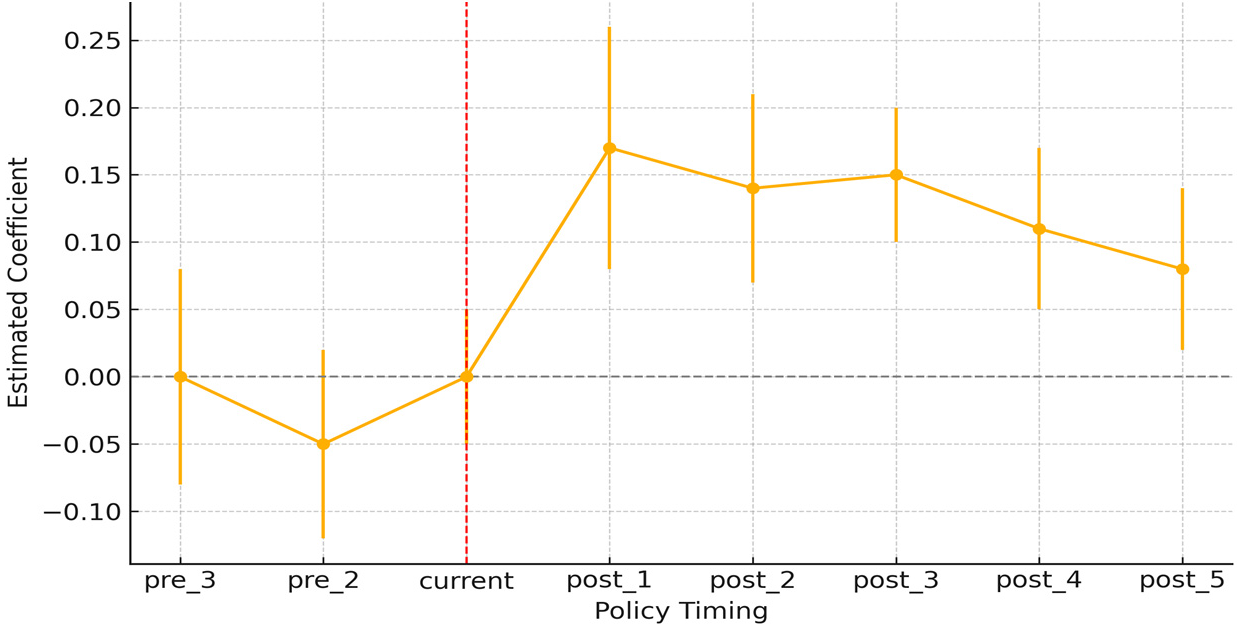
Before applying the DID model, it is essential to verify the parallel trend assumption between the treatment and control groups. This assumption is a fundamental prerequisite to ensure the validity of the DID estimation strategy. This study conducts a graphical test based on the baseline model to assess the parallel trend hypothesis. In Figure 1, the time point labeled “current” refers to the policy implementation year—specifically, the enactment of the Environmental Protection Law of the People’s Republic of China in 2015. The vertical axis represents the estimated coefficients of the dynamic effect of green technological innovation.
As shown in Figure 1, prior to the implementation of the policy (pre_3 and pre_2), the estimated coefficients are close to zero, suggesting no significant difference in the trends of green innovation between the treatment and control groups. This finding supports the validity of the parallel trend assumption. However, following the policy implementation (post_1 to post_5), the estimated dynamic effects of green innovation increase significantly, and the confidence intervals remain consistently above zero. This indicates a statistically significant impact of environmental regulation on green innovation. Therefore, the results of the parallel trend test confirm that the treatment and control groups satisfy the key assumption of parallel trends. Accordingly, the DID model is deemed suitable for the subsequent empirical analysis conducted in this study.
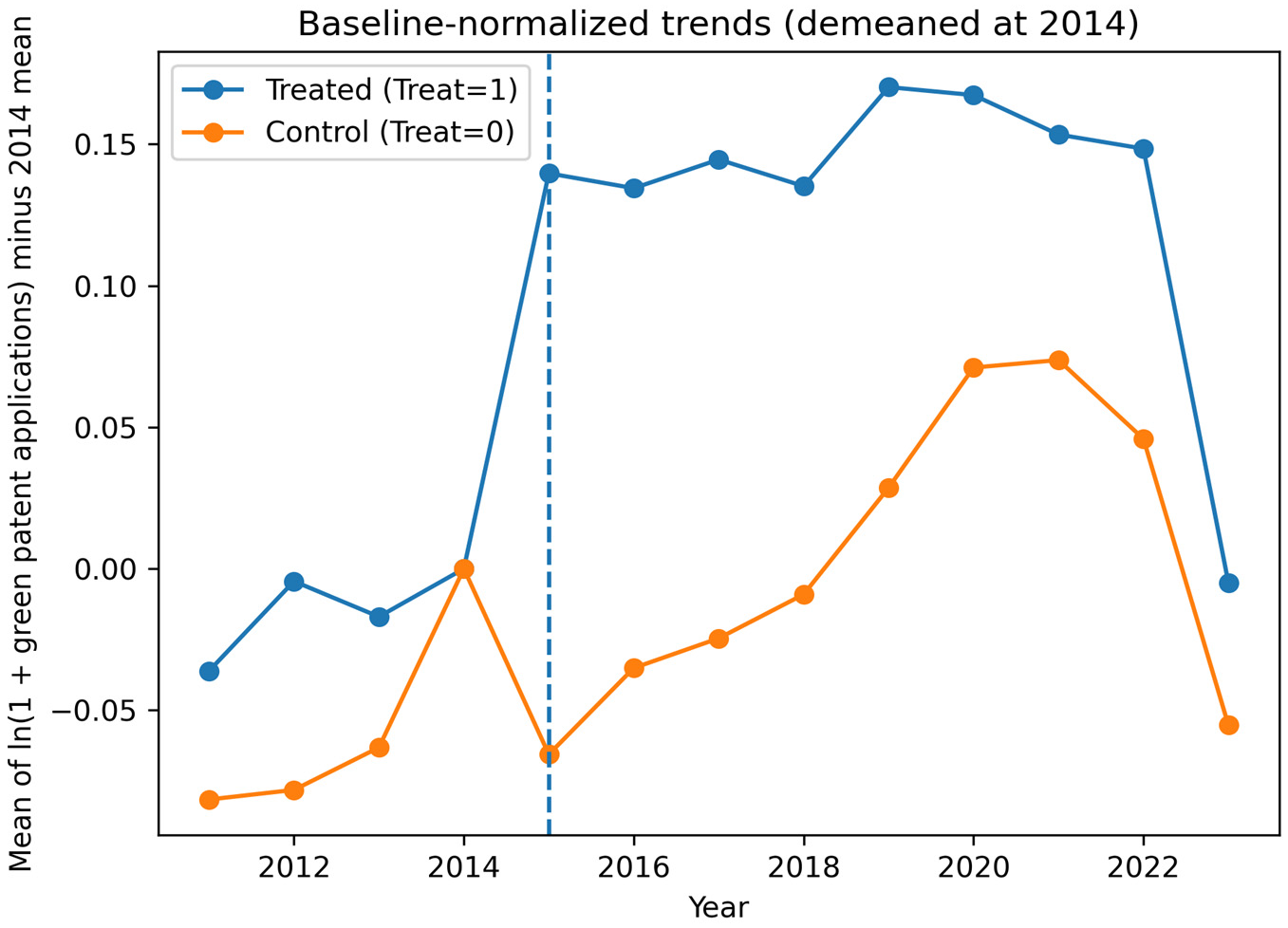
In addition to the regression-based event-study evidence reported in Figure 1, we provide a raw-data visualization to facilitate an intuitive assessment of the parallel-trend condition. Specifically, Figure 2 plots the group-year means of ln(1 + green patent applications) for treated and control firms after normalizing each group to its 2014 (pre-policy) level (demeaned at 2014). The two series exhibit broadly similar trajectories in the pre-policy period (2011–2014), offering direct visual support for the parallel-trend assumption. This raw-trend evidence complements Figure 1, where the estimated pre-treatment coefficients are statistically indistinguishable from zero.

4.1.2. DID Regression Analysis

To assess the net effect of environmental regulation on corporate green technological innovation, we perform a baseline regression using a DID model. The regression incorporates firm fixed effects and year fixed effects to control for unobservable heterogeneity and time-specific shocks that might otherwise bias the estimates. As reported in Column (1) of Table 3, only firm and year fixed effects are included, without additional covariates. The coefficient on the interaction term is positively significant at the 1% level, indicating that even in the absence of other controls, environmental regulation exhibits a positive and statistically significant effect on green innovation. In Column (2), we extend the model by including a set of firm-level control variables, such as firm size, firm age, ownership type, profitability, and leverage, to isolate the net impact of environmental regulation more precisely. The estimated coefficient for DID remains positively significant at the 1% level, with a value of 0.080. This implies that, ceteris paribus, the implementation of environmental regulation increases corporate green innovation output by approximately 8%, providing robust support for Hypothesis H1. Furthermore, the significance of most control variables confirms the model’s specification validity and reinforces the appropriateness of our variable selection.

4.2. Mechanism Analysis

To improve the statistical rigor and transparency of the mechanism (mediation) analysis, we report a complete set of regressions that jointly evaluate (i) whether the policy shock significantly affects each mediator and (ii) whether each mediator is significantly associated with green innovation conditional on the policy indicator. Specifically, Table 4 reports the stepwise regressions for the four proposed channels—financing constraints (FC), R&D investment (RD), managerial green awareness (EGP), and environmental information disclosure (EID)—and explicitly includes the coefficients and statistical significance of the mediators in the green innovation equation. In addition, we directly test the statistical significance of the indirect effects using the Sobel test and a bootstrap-based (Monte Carlo) confidence interval, reported in Table S2 (Indirect effects tests). These additions allow readers to evaluate the empirical support for the proposed mediation channels in a transparent and statistically rigorous manner, corresponding to Hypotheses H2a–H2d.
Column (2) of Table 4 shows that the policy shock significantly affects FC (DID = −0.010, p < 0.05), consistent with the notion that the regulation alters firms’ financing conditions. Column (3) further reports the mediator coefficient in the green innovation equation, where FC is negatively associated with GPatent (FC = −0.071, p < 0.10) conditional on DID and controls. However, the indirect effect test in Table S2 indicates that the FC-mediated indirect effect is not statistically significant at conventional levels (Sobel p = 0.107; the bootstrap CI includes zero), suggesting that this channel is at most weakly supported in the current data.
Column (4) indicates that the policy shock significantly increases RD (DID = 0.003, p < 0.05). Column (5) then shows that RD is positively and strongly associated with green innovation (RD = 0.775, p < 0.01) conditional on DID and controls, which is consistent with an innovation-compensation mechanism. Importantly, Table S2 confirms that the RD-mediated indirect effect is statistically significant (Sobel p = 0.013; the bootstrap CI excludes zero). Therefore, the results support H2b.
Column (6) shows that the policy shock significantly increases EGP (DID = 0.002, p < 0.01). Column (7) further demonstrates that EGP is positively associated with green innovation (EGP = 2.180, p < 0.05) conditional on DID and controls. The indirect effect test in Table S2 also indicates a statistically significant mediated effect through EGP (Sobel p = 0.044; the bootstrap CI excludes zero). Taken together, these findings support H2c.
Column (8) reports that the policy shock significantly increases EID (DID = 0.058, p < 0.05), and Column (9) shows that EID is positively associated with green innovation (EID = 0.016, p < 0.01) conditional on DID and controls. Nevertheless, Table S2 suggests that the EID-mediated indirect effect is not statistically significant at conventional levels (Sobel p = 0.138; the bootstrap CI includes zero), implying that the disclosure channel is suggestive but not robustly identified as a mediation pathway in the current specification. Overall, the mediation evidence supports H2b and H2c, while H2a receives only weak support and H2d is not robustly supported under the indirect-effect tests.

4.3. Heterogeneity Analysis

4.3.1. Heterogeneity by Ownership Type

To examine whether the effect of environmental regulation on green innovation varies across firms with different ownership structures, we conduct a heterogeneity test by distinguishing between state-owned enterprises (SOEs) and non-state-owned enterprises (non-SOEs). The regression results are reported in Table 5. As shown in Column (2) of Table 5, for non-SOEs, the coefficient of the interaction term DID on GPatentapply is 0.082, which is significant at the 1% level. This suggests that environmental regulation significantly promotes green technological innovation in non-state-owned firms. In contrast, Column (1) presents the results for SOEs, where the coefficient of DID is 0.064, but it is not statistically significant. This indicates that, under the current sample conditions, environmental regulation does not exert a significant incentive effect on green innovation among state-owned enterprises. Overall, the findings from Table 5 reveal that the effectiveness of environmental regulation is more pronounced in non-SOEs, underscoring the stronger responsiveness of privately owned firms to regulatory incentives. This suggests that greater regulatory attention and policy support should be directed toward non-state-owned enterprises to maximize the overall effectiveness of innovation-driven environmental policies.

4.3.2. Heterogeneity by Geographic Region

To examine whether the impact of environmental regulation on green innovation exhibits contextual heterogeneity across geographic regions, this study performs a regional heterogeneity analysis based on firms’ registered locations. The regression results are presented in Table 6. It should be emphasized that this geographic heterogeneity test only serves as a supplementary analysis and does not underpin the core DID identification strategy.
As shown in Column (1) of Table 6, the coefficient of the DID interaction term on GPatentapply is 0.085, which is statistically significant at the 1% level (p < 0.01). This indicates that environmental regulation exerts a strong and statistically significant positive effect on green innovation among firms located in eastern China—consistent with the region’s superior institutional capacity, well-developed innovation infrastructure, and high enforcement intensity. In Column (2), the coefficient for firms in central China is 0.081, significant at the 10% level (p < 0.1). This suggests that while environmental regulation also promotes green innovation in the central region, the policy effect is marginally weaker than that in the eastern region, reflecting the central region’s moderate economic development level and relatively limited innovation resources compared to the east. Column (3) reports the results for firms in western China, with a coefficient of 0.105 that is not statistically significant. This implies that environmental regulation exerts no statistically significant impact on green innovation in the western region under the current sample setting, likely due to insufficient institutional enforcement capacity, inadequate innovation infrastructure, and relatively backward industrial structures in this region.
Overall, the results reveal a clear regional gradient in the effectiveness of environmental regulation, with firms in the eastern region being the most responsive, followed by those in the central region, and those in the western region being the least responsive. These findings highlight the importance of tailored, region-specific environmental regulatory frameworks that account for local disparities in institutional capacity, economic development stages, and innovation infrastructure endowments.

4.3.3. Heterogeneity by Regional Marketization Level

To examine the moderating role of regional marketization levels, we conduct a heterogeneity analysis by dividing the sample into regions with high and low levels of marketization. The regression results are presented in Table 7. As shown in Column (2), for firms located in low-marketization regions, the coefficient of the interaction term DID on GPatentapply is 0.115, and it is significant at the 1% level. This indicates that environmental regulation has a strong positive effect on green innovation in regions with lower levels of market development. In contrast, Column (1) reports the results for high-marketization regions, where the coefficient of DID is 0.036 and not statistically significant. This suggests that in highly marketized regions, environmental regulation does not exert a significant impact on green innovation performance. Overall, these results imply that environmental regulation is more effective in promoting green innovation in less marketized regions, where regulatory intervention can compensate for weak market mechanisms. In contrast, in highly marketized areas, a combination of environmental regulation with complementary market-based instruments may be necessary to effectively stimulate firms’ green innovation.

4.4. Robustness Checks

To enhance the transparency of the robustness evidence, this study provides an integrative summary of the key checks conducted throughout the robustness section. Overall, the baseline conclusion remains unchanged across the event-study parallel-trends diagnosis, placebo assignments, the PSM-DID design, alternative outcome definitions (e.g., grants and invention-type green patents), and alternative samples (e.g., manufacturing-only and excluding specific time windows).

4.4.1. Placebo Test

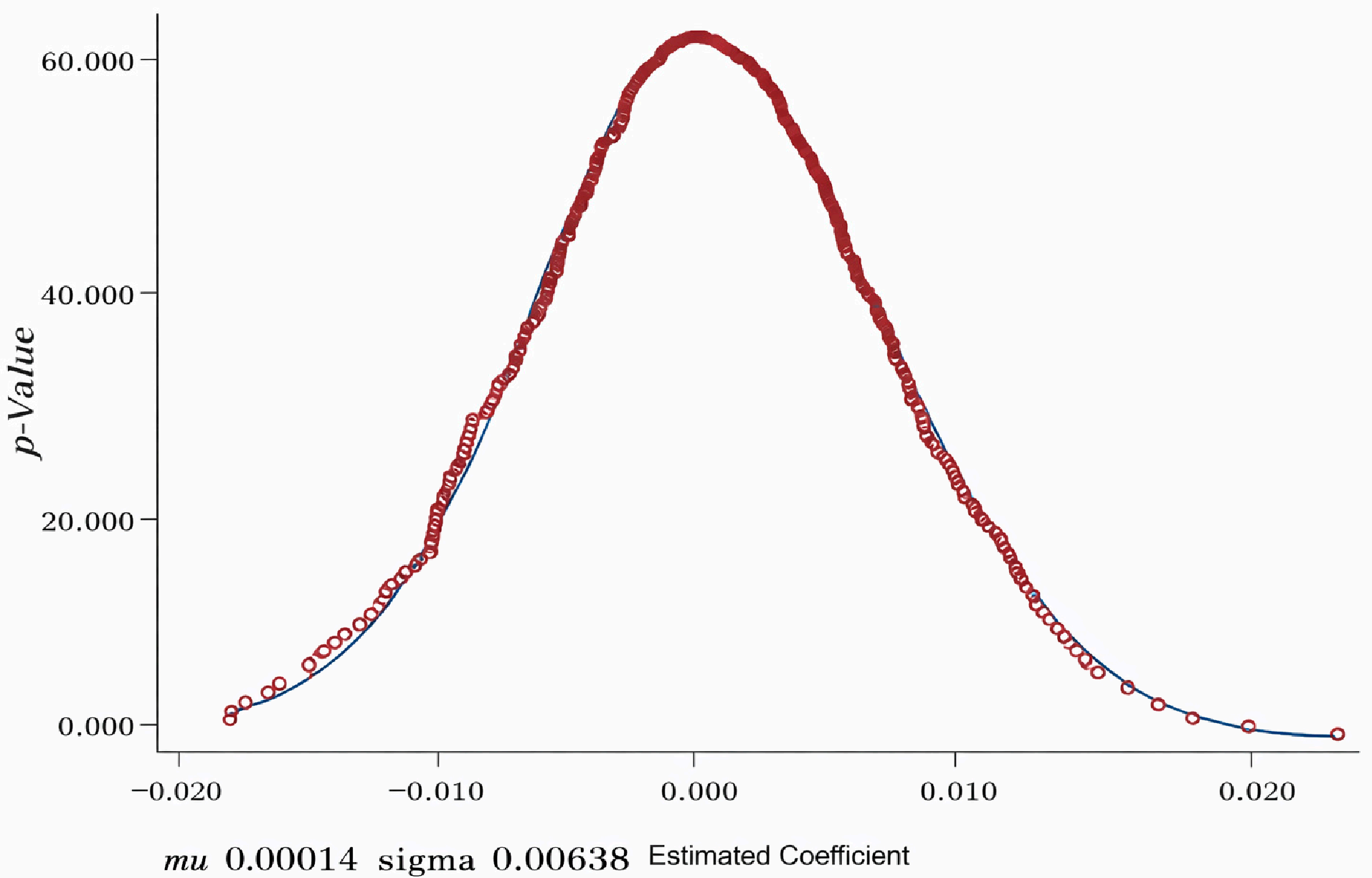
To ensure the robustness of the findings and rule out the influence of unobservable confounding factors, we conduct a placebo test following a commonly used approach. The procedure is implemented as follows. First, we randomly assign a subset of firms from the sample as the “treated group,” assuming that they were affected by environmental regulation. Second, we construct a pseudo treatment variable and estimate the DID model based on this randomly generated variable. This process is repeated 500 times to simulate the distribution of the estimated coefficients in the absence of a true policy shock.
Figure 3 illustrates the distribution of p-values for the estimated coefficients of the placebo regressions. As expected, the p-values of the pseudo DID interaction term estimates are predominantly greater than 0.1 (p > 0.1), indicating that the placebo treatment exerts no statistically significant effect on corporate green innovation outcomes. This finding alleviates concerns that the documented regulatory effect is spuriously driven by random confounding factors rather than the actual implementation of the 2015 Environmental Protection Law (EPL) revision. Moreover, the baseline DID estimate lies well outside the empirical distribution of placebo-derived coefficient estimates. This provides additional empirical support that the core findings are unlikely to be attributable to chance correlations under random treatment assignment, thereby bolstering the causal interpretation and credibility of our baseline regression results.

4.4.2. PSM-DID Robustness Test

To assess the robustness of our empirical results, we adopt a PSM-DID approach, which mitigates potential selection bias by improving the comparability between treated and control firms on observable characteristics. First, we estimate propensity scores using the same baseline firm-level covariates as in the main specification (including Size and ROA), together with year fixed effects. Second, we employ 1:1 nearest-neighbor matching without replacement to identify the most similar control firm for each treated firm. After excluding observations with missing values in the covariates included in the propensity score estimation, the initial matching pool consists of 9548 treated and 24,284 control firm-year observations. Applying 1:1 nearest-neighbor matching without replacement yields a matched sample of 9548 treated and 9548 matched control firm-year observations (19,096 firm-year observations in total), consistent with the sample size reported in Table 8. We further verify the quality of the matching by reporting covariate balance diagnostics before and after matching: standardized mean differences (SMDs) for key covariates indicate that observable covariate imbalances are substantially alleviated after matching (see Supplementary Table S1). Based on this matched sample, we re-estimate the DID model specification, and the results confirm that our baseline conclusions remain robust.
This matching method ensures that the treatment and control groups are comparable in terms of observable characteristics, except for the exposure to environmental regulation. By doing so, we mitigate the influence of potential confounding variables and better isolate the effect of environmental regulation on green technology innovation.
Importantly, the PSM-DID approach has inherent limitations: while matching can improve comparability on observable characteristics, it cannot fully eliminate bias stemming from unobserved time-varying factors that simultaneously affect both regulatory exposure and green innovation. Accordingly, we position PSM-DID as a complementary rather than standalone identification strategy, and we assess robustness through a suite of additional robustness diagnostics, including event-study parallel-trends analysis, placebo tests, alternative outcome definitions, and alternative sample/time window specifications.
Column (1) of Table 8 presents the regression results with only firm and year fixed effects included, excluding other control variables. The coefficient of the DID interaction term is 0.062, which is statistically significant at the 5% level (p < 0.05). This indicates that the implementation of environmental regulation promotes corporate green technological innovation even in the absence of additional covariate controls. Column (2) incorporates firm-level control variables as discussed previously. The estimated coefficient of DID increases slightly to 0.068, and remains significant at the 1% level, further confirming the robustness of the positive regulatory effect when firm characteristics are accounted for. Moreover, the coefficients of key control variables yield meaningful insights: Firm size (Size) and profitability (ROA) are positively associated with green innovation, with coefficients of 0.042 and 0.257, respectively (both p < 0.05). This suggests that larger and more profitable firms are more inclined to invest in green technology, as they possess greater resource slack to support long-term innovative activities. The coefficient of Growth is –0.031 (p < 0.05), indicating that rapidly growing firms may prioritize short-term expansion over long-term green innovation investments due to resource constraints and short-term performance pressures. The coefficient of Top1 (the ownership share of the largest shareholder) is –0.196 (p < 0.05), implying that high ownership concentration may constrain firms’ green innovation initiatives—potentially reflecting risk-averse behavior among controlling shareholders or reduced decision-making flexibility for long-term innovation. Other control variables exhibit no statistically significant impacts. Overall, these findings are consistent with the baseline regression results, providing strong empirical support for the robustness of the study’s core conclusions.

4.4.3. Indicator Sensitivity Test

To further assess the robustness of the baseline results, this study conducts an indicator sensitivity analysis by adopting alternative measures of corporate green innovation performance. Specifically, we employ three different dependent variables: the natural logarithm of one plus the total number of granted green patents (GPatent Award), the natural logarithm of one plus the total number of green invention patent applications (GInnov), and the natural logarithm of one plus the lagged value of green patent applications (F_GPatentapply). The regression results are presented in Table 9. As shown in the table, when green innovation performance is proxied by GPatent Award, the estimated coefficient of the interaction term DID is 0.041, significant at the 5% level. When using GInnov as the alternative measure, the coefficient of DID increases to 0.068, and remains significant at the 1% level, indicating a stronger regulatory impact on invention-oriented innovation activities. Furthermore, when the lagged value F_GPatentapply is employed, the coefficient of DID remains significantly positive at 0.050, also at the 5% level. These consistent and statistically significant results across various specifications reinforce the central conclusion of this study: environmental regulation exerts a robust and positive effect on firms’ green technology innovation, regardless of how innovation performance is measured.

4.4.4. Sample Sensitivity Test

Following the prior literature, this study conducts sample sensitivity tests from both industry and temporal perspectives to mitigate concerns related to potential omitted variables and confounding shocks. From an industry perspective, there are significant differences between the manufacturing sector and other industries in terms of operational models and demand for green patent applications. As a core component of the real economy, the manufacturing sector is typically characterized by substantial resource consumption and significant environmental externalities—features that may generate distinct incentives for green technological innovation compared to non-manufacturing sectors. From a temporal perspective, the global outbreak of COVID-19 in early 2020 severely disrupted the normal production and operations of Chinese enterprises. This exogenous public health shock may introduce estimation noise and potentially distort the true relationship between environmental regulation and corporate green innovation under regular economic conditions. These subsample analyses directly address cross-industry heterogeneity concerns by verifying that the estimated regulatory effect is not systematically driven by sector-specific patenting intensity or underlying industry composition. Furthermore, the time-window sensitivity exercises alleviate concerns that the baseline estimates are confounded by period-specific shocks exerting asymmetric impacts across industries.
To address these concerns, we conduct robustness checks based on two subsamples: (1) firms in the manufacturing industry, and (2) observations from the period 2011–2019 (excluding the COVID-affected years). The regression results of these subsample tests are reported in Table 10.
Table 10 presents the results of robustness tests using alternative subsamples. In Column (1), we restrict the sample to core manufacturing firms (the most resource- and emission-intensive sector). The estimated coefficient of the DID interaction term on GPatentapply is 0.093, which is statistically significant at the 1% level (p < 0.01). This finding indicates that environmental regulation exerts a statistically significant positive impact on green innovation among manufacturing firms—consistent with expectations, as these firms are inherently more sensitive to regulatory interventions due to their resource-intensive production processes and higher environmental externalities. Column (2) reports results based on a restricted time window of 2011–2019, excluding the potential confounding effects of the COVID-19 pandemic (2020–2022). The DID coefficient remains positively significant at 0.046 (p < 0.05), confirming that the baseline conclusion holds robust even after excluding pandemic-induced production and operational distortions. Overall, the results from both industry-specific and time-restricted subsample analyses are consistent with the baseline findings. These results further corroborate the conclusion that environmental regulation plays a salient role in promoting corporate green technological innovation. They also provide additional empirical support for the credibility and practical policy relevance of this study—particularly in policy contexts requiring industry- and period-specific differentiated regulatory strategies.

5. Research Conclusions and Policy Implications

5.1. Research Conclusions

This section summarizes the key empirical findings and situates them within the recent literature on environmental regulation and green innovation. To elaborate, we first compare our results with current empirical studies to clarify points of convergence and divergence, and subsequently provide a concise synthesis of the main findings derived from the baseline, mechanism, heterogeneity, and robustness analyses.

5.1.1. Comparison with Recent Literature

Our baseline evidence indicates that the 2015 Environmental Protection Law (EPL) revision significantly increases firms’ green patenting activity—a result that aligns broadly with the Porter hypothesis, as strengthened regulation may induce innovation compensation through technological upgrading rather than merely imposing compliance burdens. This finding is consistent with a growing stream of quasi-experimental firm-level studies documenting innovation-enhancing effects of stricter environmental governance, particularly under conditions of rigorous enforcement and elevated expected violation costs.
In particular, recent firm-level analyses exploiting policy shocks comparable to the EPL revision similarly report a positive association between intensified environmental regulation and green innovation outputs, while emphasizing the importance of identification transparency and robustness diagnostics [64,65,66]. Our DID design—complemented by dynamic effect evidence and placebo-based validity checks—is consistent with this identification logic and contributes additional empirical support within the context of a major national legal reform.
Beyond the EPL setting, related quasi-experimental studies focusing on adjacent regulatory or market-based environmental policy tools also offer partially consistent evidence. These works collectively suggest that the regulation–innovation relationship can be positive when enforcement credibility is strengthened and when firms face sufficiently strong incentives to re-optimize production processes [67,68]. This broader body of literature supports interpreting our baseline effect as part of a conditional innovation-compensation pattern rather than an unconditional regularity.
At the same time, the empirical literature remains mixed: a substantial set of studies endorses the compliance cost hypothesis, arguing that regulation may crowd out innovation by reallocating financial and managerial resources toward pollution abatement and compliance—especially under rigid policy design, inconsistent enforcement, or severe financial constraints. This divergence implies that conflicting findings may reflect differences in policy intensity and credibility, outcome measurement (e.g., patent applications versus grants), time horizons, and firm capabilities. Interpreted in this light, our results suggest that the EPL revision is more likely to trigger innovation-compensation mechanisms in contexts where firms can credibly anticipate enforcement and where adaptive innovation yields measurable economic returns. This cross-study heterogeneity also calls for a cross-jurisdictional comparison, especially with the EU where the regulatory toolkit and institutional infrastructure differ substantially from China.
EU-oriented research provides a useful benchmark for interpreting our EPL-based evidence, because regulatory design and policy mixes differ from a single command-and-control legal shock. In the EU, sustainability governance increasingly relies on disclosure and classification instruments, which aims to standardize non-financial information and strengthen external monitoring and capital reallocation, thereby shaping innovation incentives through channels that may be more finance- and disclosure-driven than in the EPL context [69,70]. In addition, EU patent governance arrangements and the innovation ecosystem can condition firms’ innovation responses, implying that green-patenting reactions to regulation may vary with institutional settings that govern appropriation and diffusion of innovation returns [71]. Evidence on innovation determinants in Central European economies further suggests that innovation outcomes are jointly shaped by firm-level and macro-institutional factors, which helps explain heterogeneous findings across jurisdictions even under comparable environmental goals [72]. Finally, EU circular-economy research emphasizes that environmental objectives are often pursued via a policy mix embedded in multi-level governance frameworks, reinforcing the view that institutional complementarities can be decisive for eco-innovation incentives [73]. Taken together, these EU comparisons suggest that differences in regulatory instruments, enforcement credibility, disclosure infrastructures, and innovation institutions can systematically shape both the magnitude of green-innovation responses and the relative salience of mediation channels, thereby helping interpret our EPL-based evidence and its contribution to the mixed Porter versus compliance-cost debate.
Against this backdrop, our mechanism and heterogeneity findings help refine and reconcile the mixed evidence. The mediation results indicate that R&D investment and managerial green awareness constitute statistically significant transmission channels, while the financing-constraint and environmental information disclosure channels are suggestive but not statistically robust in the indirect-effect tests (Sobel and bootstrap tests). Moreover, stronger effects among non-state-owned enterprises (non-SOEs) and in the eastern region point to contextual boundary conditions related to organizational flexibility, absorptive capacity, and institutional quality. Collectively, these results contribute to the ongoing debate by clarifying when and through which pathways a major legal strengthening of environmental regulation can be innovation-enhancing, thereby offering a more nuanced reconciliation of the compliance cost hypothesis versus Porter hypothesis evidence.

5.1.2. Summary of Main Findings

This study investigates the impact of environmental regulation on corporate green technological innovation, using panel data of A-share listed firms in China from 2011–2022. Based on a quasi-natural experiment and DID method, the main findings are as follows:
First, environmental regulation significantly enhances corporate green innovation. Even without controlling for other covariates, the implementation of environmental regulation exerts a statistically significant positive impact on green patent applications. From an economic perspective, the baseline DID estimate implies an approximate 8% increase in green patent applications relative to the pre-policy sample mean, indicating a substantively meaningful change in firms’ green innovative activity. This effect remains robust after controlling for firm-level covariates and is further validated by a battery of robustness checks, including the parallel trend test, placebo tests, and PSM-DID analysis. This conclusion is consistent with Hypothesis H1, confirming the “innovation-forcing effect” of environmental regulation on green technological innovation.
Second, environmental regulation affects green innovation through multiple potential transmission channels, as hypothesized in H2a–H2d. The mediation analysis provides robust empirical support for the R&D investment and managerial green awareness channels: the indirect effects of these two pathways are statistically significant in both Sobel tests and bootstrap confidence interval procedures. By contrast, the financing constraint and environmental information disclosure channels yield suggestive evidence: although the policy shock is significantly associated with these mediators, and the mediators are correlated with green innovation, their indirect effects fail to reach statistical significance at conventional levels (p < 0.05) in formal indirect-effect tests. Overall, the results imply a multidimensional yet uneven transmission pattern, with some channels more robustly identified than others.
Third, the policy effect of environmental regulation exhibits contextual heterogeneity across ownership structures, regional locations, and marketization levels. From an ownership perspective, non-state-owned enterprises (non-SOEs) exhibit a stronger response to regulatory pressure than state-owned enterprises (SOEs), reflecting differences in organizational flexibility and incentive mechanisms between the two ownership types. Regionally, the policy effect is most pronounced in the eastern region, followed by the central region, and weakest in the western region—consistent with disparities in institutional quality, infrastructure support, and technological absorptive capacity across regions. In terms of marketization, firms located in regions with relatively lower marketization levels exhibit a more pronounced policy response than those in regions with high marketization levels, suggesting that environmental regulation may act as a complementary governance tool in less developed market environments.
Fourth, the core conclusion remains unchanged across a range of robustness checks and alternative specifications. Placebo tests show no significant effects when randomly assigning the policy implementation year; the PSM-DID approach confirms the consistency of the baseline results; and indicator sensitivity tests (e.g., replacing green patent applications with green patent grants) and subsample analyses (by industry or time period) further validate the conclusions.

5.2. Policy Recommendations

5.2.1. Promote Differentiated Supporting Policies for Environmental Regulation

For non-SOEs: Although the financing-constraint and disclosure channels are only suggestive in the mediation tests, policy measures that ease financing frictions and improve disclosure can still complement the innovation-enhancing effects of regulation by strengthening firms’ implementation capacity and external monitoring. To ease financing constraints, the government should encourage financial institutions to develop green financial products tailored to non-SOEs, streamline green intellectual property (IP) pledge financing procedures, and reduce entry barriers and transaction costs [74]. To boost R&D investment, dedicated green R&D subsidies and preferential tax policies should be provided. Additionally, a centralized, transparent nationwide environmental information disclosure platform should be established to improve non-SOEs’ environmental transparency; targeted training (e.g., green transformation workshops, case studies of successful green innovation) should also be organized to enhance executives’ green development awareness. For SOEs: Since environmental regulation has no statistically significant effect on SOEs’ green innovation, policies should focus on addressing their insufficient innovation motivation. First, strengthen oversight of green transformation bonds to prevent resource misallocation and ensure funds are channeled into green technological innovation. Second, enhance green innovation training for SOE executives to build capacity for sustainability-driven decision-making. Third, improve SOEs’ environmental information disclosure framework to strengthen transparency, accountability, and intrinsic incentives for green innovation.

5.2.2. Strengthen Interregional Coordination in Environmental Regulation Governance

To address regional heterogeneity in policy effects and facilitate balanced green innovation development nationwide, interregional coordinated governance should be strengthened. Eastern region: Leverage its leading role by establishing national/regional green innovation demonstration parks to amplify spillover effects of innovation resources. Accelerate the industrialization, commercialization, and internationalization of green technologies in the region, and promote the transfer of technologies, talent, and innovation models to central and western regions. Central region: Strengthen collaboration with the eastern region, including cross-regional cooperation between research institutions, universities, and enterprises, and the establishment of joint green innovation centers for collaborative R&D. Western region: Address its weak responsiveness to regulation by improving green innovation infrastructure (e.g., increasing fiscal investment, attracting eastern/central green enterprises to set up branches/R&D bases) and implementing region-specific green financial policies (e.g., special green loans, green credit guarantee funds) to reduce financing burdens for innovative firms.

5.2.3. Leverage Market Mechanisms to Promote Green Technological Innovation

Policy design should align with regional marketization differences. Highly marketized regions: Reduce direct government intervention and focus on optimizing market mechanisms. Prioritize building a transparent, fair, and efficient market environment, and strengthen the protection of green technology IPRs to create a conducive institutional framework for corporate innovation. Low-marketization regions: Emphasize the implementation of environmental regulation to guide green innovation. Integrate local green technology markets with financial systems to improve technological exchange and funding access; target key barriers (e.g., financing constraints, limited managerial awareness, inadequate disclosure).
Across all regions, improving green innovation-related market infrastructure (e.g., factor markets, service platforms) remains fundamental—this enables efficient resource allocation and free flow of innovation factors, which are prerequisites for sustainable green technology development.

5.2.4. Enhance Environmental Information Disclosure and Strengthen Regulatory Enforcement

Given that environmental information disclosure is positively associated with green innovation and responds to the policy shock, strengthening environmental disclosure systems and enforcement capacity remains important. However, since our indirect effect tests do not identify environmental information disclosure as a robust mediating pathway in the current specification, such policy measures should be conceptualized as complementary governance tools that reinforce innovation incentives, rather than as the sole empirically validated transmission mechanism.
Establish standardized disclosure frameworks: Government authorities should take the lead in formulating unified regulatory standards/guidelines, clearly defining the scope and format of key environmental information that firms must disclose—ensuring consistency, transparency, and comparability of data. Strengthen institutional enforcement: Build a collaborative enforcement mechanism led by environmental authorities and supported by other agencies (e.g., finance, taxation) for comprehensive oversight. Introduce clear punitive measures (e.g., fines, public warnings) for false/misleading disclosures to enhance regulatory credibility and deterrence. Develop integrated digital platforms: Leverage digital technologies to consolidate multidimensional corporate environmental metrics, improving data accessibility and enabling real-time oversight by regulators, investors, and other stakeholders—effectively incentivizing firms to engage in green innovation.

5.3. Limitations and Future Directions

Despite providing robust empirical evidence, this study has limitations. Sample coverage: The analysis relies solely on A-share listed firms in Shanghai and Shenzhen, excluding small and medium-sized enterprises (SMEs). Since SMEs face distinct regulatory pressures and innovation capacities, this limits the generalizability of the findings. Temporal scope: The study primarily captures short- to medium-term impacts of environmental regulation, potentially overlooking delayed or cumulative effects that may emerge over a longer timeframe. Residual endogeneity concerns stemming from unobserved time-varying factors cannot be fully eliminated in non-experimental research designs; future work could explore empirical designs with richer exogenous variation in regulatory exposure.
In addition, our patent-based metrics capture green innovation observable through patent filings but may not fully reflect non-patented green innovations—such as process improvements protected as trade secrets or firm-specific managerial know-how. Although we address measurement concerns by employing alternative patent indicators (i.e., green patent grants and invention-type green patents) and conducting subsample analyses, cross-industry heterogeneity in patenting propensity and technological trajectories may still marginally compromise cross-sector comparability.
Future research could address these limitations by integrating richer quality-oriented metrics and complementary outcome measures with more granular industry-specific research designs (e.g., high- vs. low-polluting subsectors), expanding the sample to include small and medium-sized enterprises (SMEs) and non-listed firms, and extending the time window to investigate long-run and heterogeneous policy impacts.

Supplementary Materials

The following supporting information can be downloaded at: https://www.mdpi.com/article/10.3390/su18031420/s1, Figure S1: Raw trends in green patent applications (group-year means); Table S1: Covariate balance diagnostics before and after propensity score matching (PSM), reporting standardized mean differences (SMDs) for key covariates (including Size and ROA); Table S2: Indirect effects tests for mediating variables (using Sobel test and Bootstrap Monte Carlo confidence interval, CI).

Author Contributions

Conceptualization, Methodology, Formal Analysis, Investigation, Data Curation, Validation, Writing—Original Draft Preparation, L.X.; Legal Analysis, Writing—Review and Editing, Supervision, Project Administration, Funding Acquisition, Y.Z. All authors have read and agreed to the published version of the manuscript.

Funding

This research was funded by Social Science Program of Hainan province (HNSKZC24-213); The Social Science Program of Party School of CPC Hainan Municipal Committee (DXXTKT2024-03); The Philosophy and Social Sciences Planning Project of Haikou City (2025-YBKT-20).

Institutional Review Board Statement

Not applicable.

Informed Consent Statement

Not applicable.

Data Availability Statement

The data supporting the findings of this study are available on request from the corresponding author.

Conflicts of Interest

The authors declare no conflicts of interest.

References

  1. Hasan, M.M.; Du, F. Nexus between green financial development, green technological innovation and environmental regulation in China. Renew. Energy 2023, 204, 218–228. [Google Scholar] [CrossRef]
  2. Rogge, K.S.; Reichardt, K. Policy mixes for sustainability transitions: An extended concept and framework for analysis. Res. Policy 2016, 45, 1620–1635. [Google Scholar] [CrossRef]
  3. Yin, X.; Chen, D.; Ji, J. How does environmental regulation influence green technological innovation? Moderating effect of green finance. J. Environ. Manag. 2023, 342, 118112. [Google Scholar] [CrossRef] [PubMed]
  4. Siy, A.L.; Wang, A.; Zheng, T.; Hu, X. Research on the Impact of the EU’s Carbon Border Adjustment Mechanism: Based on the GTAP Model. Sustainability 2023, 15, 4761. [Google Scholar] [CrossRef]
  5. Xu, X.; Li, X.; Zheng, L. A Blessing or a Curse? Exploring the Impact of Environmental Regulation on China’s Regional Green Development from the Perspective of Governance Transformation. Int. J. Environ. Res. Public Health 2022, 19, 1312. [Google Scholar] [CrossRef]
  6. Zhao, X.; Sun, B. The influence of Chinese environmental regulation on corporation innovation and competitiveness. J. Clean. Prod. 2016, 112, 1528–1536. [Google Scholar] [CrossRef]
  7. Fang, Z.; Kong, X.; Sensoy, A.; Cui, X.; Cheng, F. Government’s awareness of Environmental protection and corporate green innovation: A natural experiment from the new environmental protection law in China. Econ. Anal. Policy 2021, 70, 294–312. [Google Scholar] [CrossRef]
  8. Porter, M.E.; van der Linde, C. Toward a New Conception of the Environment-Competitiveness Relationship. J. Econ. Perspect. 1995, 9, 97–118. [Google Scholar] [CrossRef]
  9. Acemoglu, D.; Aghion, P.; Bursztyn, L.; Hemous, D. The Environment and Directed Technical Change. Am. Econ. Rev. 2012, 102, 131–166. [Google Scholar] [CrossRef]
  10. Li, Y.; Li, J.; Gan, L. A Meta-Analysis of the Relationship between Environmental Regulations and Competitiveness and Conditions for Its Realization. Int. J. Environ. Res. Public Health 2022, 19, 7968. [Google Scholar] [CrossRef]
  11. Palmer, K.; Oates, W.E.; Portney, P.R. Tightening Environmental Standards: The Benefit-Cost or the No-Cost Paradigm? J. Econ. Perspect. 1995, 9, 119–132. [Google Scholar] [CrossRef]
  12. Yuan, K.; Wu, B. The crowding-out effect of the environmental regulation on corporate sustainability. Front. Environ. Sci. 2024, 11, 1273278. [Google Scholar] [CrossRef]
  13. Lanoie, P.; Patry, M.; Lajeunesse, R. Environmental regulation and productivity: Testing the porter hypothesis. J. Product. Anal. 2008, 30, 121–128. [Google Scholar] [CrossRef]
  14. Zhou, Z.; Xu, L.; Guo, P.; Ai, H. Environmental regulation and corporate financialization: Insight from Blue Sky Protection Campaign in China. Environ. Sci. Pollut. Res. 2023, 30, 54993–55008. [Google Scholar] [CrossRef] [PubMed]
  15. Zhou, P.; Song, F.M.; Huang, X. Environmental regulations and firms’ green innovations: Transforming pressure into incentives. Int. Rev. Financ. Anal. 2023, 86, 102504. [Google Scholar] [CrossRef]
  16. Mei, T.; Qin, Y.; Li, P.; Deng, Y. Influence Mechanism of Construction Supply Chain Information Collaboration Based on Structural Equation Model. Sustainability 2023, 15, 2155. [Google Scholar] [CrossRef]
  17. Zhang, N.; Bi, Y.; Gao, W.; Deng, J.; Tang, E. Heterogeneous effects of environmental regulations on green technology innovation: Measurement by using patents and evidence from China’s prefecture-level cities. Scientometrics 2024, 129, 7667–7698. [Google Scholar] [CrossRef]
  18. Cui, J.; Dai, J.; Wang, Z.; Zhao, X. Does Environmental Regulation Induce Green Innovation? A Panel Study of Chinese Listed Firms. Technol. Forecast. Soc. Change 2022, 176, 121492. [Google Scholar] [CrossRef]
  19. Jiang, S.; Wu, H. Dose the New Environmental Protection Law promote the quality of green innovation of enterprises: Based on a quasi-natural experiment of the New Environmental Protection Law. J. Chongqing Univ. Technol. 2024, 6, 82–100. [Google Scholar]
  20. Zhou, Y.; Duan, Y.; Huang, X. Corporate Green Technology Innovation Under Environmental Regulation: Substantive or Strategic? Res. Econ. Manag. 2025, 1, 124–144. [Google Scholar]
  21. Xu, Y.; Liang, J.; Dong, Z.; Shi, M. Can Environmental Regulation Promote Green Innovation and Productivity? The Moderating Role of Government Interventions in Urban China. Int. J. Environ. Res. Public Health 2022, 19, 13974. [Google Scholar] [CrossRef] [PubMed]
  22. Huang, Z.-x.; Yang, X. Carbon emissions and firm innovation. Econ. Anal. Policy 2021, 69, 503–513. [Google Scholar] [CrossRef]
  23. Ni, X.; Jin, Q.; Huang, K. Environmental regulation and the cost of debt: Evidence from the carbon emission trading system pilot in China. Financ. Res. Lett. 2022, 49, 103134. [Google Scholar] [CrossRef]
  24. Yang, Z.; Shao, S.; Yang, L. Unintended consequences of carbon regulation on the performance of SOEs in China: The role of technical efficiency. Energy Econ. 2021, 94, 105072. [Google Scholar] [CrossRef]
  25. Wang, Y.; Sun, X.; Guo, X. Environmental regulation and green productivity growth: Empirical evidence on the Porter Hypothesis from OECD industrial sectors. Energy Policy 2019, 132, 611–619. [Google Scholar] [CrossRef]
  26. Le, D.; Ren, F.; Li, Y. The Effect of Energy Use Rights Trading Policy on Environmental Performance: Evidence from Chinese 262 Cities. Int. J. Environ. Res. Public Health 2023, 20, 3570. [Google Scholar] [CrossRef]
  27. Qiu, L.D.; Zhou, M.; Wei, X. Regulation, innovation, and firm selection: The porter hypothesis under monopolistic competition. J. Environ. Econ. Manag. 2018, 92, 638–658. [Google Scholar] [CrossRef]
  28. Cohen, M.A.; Tubb, A. The Impact of Environmental Regulation on Firm and Country Competitiveness: A Meta-analysis of the Porter Hypothesis. J. Assoc. Environ. Resour. Econ. 2017, 5, 371–399. [Google Scholar]
  29. Sen, S. Corporate governance, environmental regulations, and technological change. Eur. Econ. Rev. 2015, 80, 36–61. [Google Scholar] [CrossRef]
  30. Dechezleprêtre, A.; Sato, M. The Impacts of Environmental Regulations on Competitiveness. Rev. Environ. Econ. Policy 2017, 11, 183–206. [Google Scholar] [CrossRef]
  31. Hao, X.; Liang, Y.; Yang, C.; Wu, H.; Hao, Y. Can Industrial Digitalization Promote Regional Green Technology Innovation? J. Innov. Knowl. 2024, 9, 100463. [Google Scholar] [CrossRef]
  32. Xin, X.; Lyu, L.; Zhao, Y. Dynamic evolution and trend prediction of multi-scale green innovation in China. Geogr. Sustain. 2023, 4, 222–231. [Google Scholar] [CrossRef]
  33. Kivimaa, P. Transforming innovation policy in the context of global security. Environ. Innov. Soc. Transit. 2022, 43, 55–61. [Google Scholar] [CrossRef]
  34. Nordhaus, W.D. The Spirit of Green 18 The Double Externality of Green Innovation. In The Economics of Collisions and Contagions in a Crowded World; Princeton University Press: Princeton, NJ, USA, 2021; pp. 204–224. [Google Scholar]
  35. Xu, Y.; Liu, S.; Wang, J. Impact of environmental regulation intensity on green innovation efficiency in the Yellow River Basin, China. J. Clean. Prod. 2022, 373, 133789. [Google Scholar] [CrossRef]
  36. Li, X.; Yang, J.; Yao, Y.; Ding, Z.; Hao, J.; Yin, W.; Shen, Q. Boosting green technology innovation in China’s construction industry: The power of energy-consuming rights trading policy. Econ. Anal. Policy 2024, 84, 410–423. [Google Scholar] [CrossRef]
  37. Li, H.; Lu, Z.; Junbiao, Z.; Li, W. Impact of technological innovation on agricultural green total factor productivity in China: Considering the threshold effect of environmental regulation. J. Environ. Plan. Manag. 2025, 68, 1057–1081. [Google Scholar] [CrossRef]
  38. Liu, Y.; Huang, H.; Mbanyele, W.; Wei, Z.; Li, X. How does green industrial policy affect corporate green innovation? Evidence from the green factory identification in China. Energy Econ. 2025, 141, 108047. [Google Scholar] [CrossRef]
  39. Zhang, J.; Wei, H.; Yuan, K.; Yang, X. New industrial policy and corporate digital transformation: Empowering or impairing? Emerging evidence from green credit policy. Energy Econ. 2024, 140, 107960. [Google Scholar] [CrossRef]
  40. Song, S.; Lian, J.; Skowronski, K.; Yan, T. Customer base environmental disclosure and supplier greenhouse gas emissions: A signaling theory perspective. J. Oper. Manag. 2024, 70, 355–380. [Google Scholar] [CrossRef]
  41. Russo, M.V.; Fouts, P.A. A Resource-Based Perspective On Corporate Environmental Performance And Profitability. Acad. Manag. J. 1997, 40, 534–559. [Google Scholar] [CrossRef]
  42. Teece, D.J.; Pisano, G.; Shuen, A. Dynamic capabilities and strategic management. Strateg. Manag. J. 1997, 18, 509–533. [Google Scholar] [CrossRef]
  43. Horbach, J.; Rammer, C.; Rennings, K. Determinants of eco-innovations by type of environmental impact—The role of regulatory push/pull, technology push and market pull. Ecol. Econ. 2012, 78, 112–122. [Google Scholar] [CrossRef]
  44. Hambrick, D.C. Upper Echelons Theory. In The Palgrave Encyclopedia of Strategic Management; Augier, M., Teece, D.J., Eds.; Palgrave Macmillan: London, UK, 2018; pp. 1782–1785. [Google Scholar]
  45. Kim, R. Managerial Cognition, Strategic Behavior and Innovation: Biopharmaceutical R & D. Pharm. Pharmacol. Int. J. 2015, 2, 2. [Google Scholar] [CrossRef]
  46. Najmaei, A.; Sadeghinejad, Z. Metacognition, Entrepreneurial Orientation, and Firm Performance: An Upper Echelons View. In The Anatomy of Entrepreneurial Decisions: Past, Present and Future Research Directions; Caputo, A., Pellegrini, M.M., Eds.; Springer International Publishing: Cham, Switzerland, 2019; pp. 79–114. [Google Scholar]
  47. Zhao, S.; Linjiao, T.; Ji, J. Impact of environmental regulations on eco-innovation: The moderating role of top managers’ environmental awareness and commitment. J. Environ. Plan. Manag. 2024, 67, 2229–2256. [Google Scholar] [CrossRef]
  48. Bhatia, M.S.; Jakhar, S.K. The effect of environmental regulations, top management commitment, and organizational learning on green product innovation: Evidence from automobile industry. Bus. Strategy Environ. 2021, 30, 3907–3918. [Google Scholar] [CrossRef]
  49. Bai, X.; Lyu, C. Executive’s Environmental Protection Background and Corporate Green Innovation: Evidence from China. Sustainability 2023, 15, 4154. [Google Scholar] [CrossRef]
  50. Tan, Y.; Zhu, Z. The effect of ESG rating events on corporate green innovation in China: The mediating role of financial constraints and managers’ environmental awareness. Technol. Soc. 2022, 68, 101906. [Google Scholar] [CrossRef]
  51. Lin, D.; Zhao, Y. The Impact of Environmental Regulations on Enterprises’ Green Innovation: The Mediating Effect of Managers’ Environmental Awareness. Sustainability 2023, 15, 10906. [Google Scholar] [CrossRef]
  52. DiMaggio, P.J.; Powell, W.W. The Iron Cage Revisited: Institutional Isomorphism and Collective Rationality in Organizational Fields. Am. Sociol. Rev. 1983, 48, 147–160. [Google Scholar] [CrossRef]
  53. Huang, Q.; Chen, X.; Zhou, M.; Zhang, X.; Duan, L. How Does CEO’s Environmental Awareness Affect Technological Innovation? Int. J. Environ. Res. Public Health 2019, 16, 261. [Google Scholar] [CrossRef]
  54. Zhang, Y.; Xing, C.; Wang, Y. Does green innovation mitigate financing constraints? Evidence from China’s private enterprises. J. Clean. Prod. 2020, 264, 121698. [Google Scholar] [CrossRef]
  55. Bai, X.; Lyu, C. Environmental Information Disclosure and Corporate Green Innovation: The Moderating Effect of Formal and Informal Institutions. Sustainability 2023, 15, 6169. [Google Scholar] [CrossRef]
  56. Yin, J.; Wang, S. The effects of corporate environmental disclosure on environmental innovation from stakeholder perspectives. Appl. Econ. 2018, 50, 905–919. [Google Scholar] [CrossRef]
  57. López-Santamaría, M.; Amaya, N.; Grueso Hinestroza, M.P.; Cuero, Y.A. Sustainability disclosure practices as seen through the lens of the signaling theory: A study of companies listed on the Colombian Stock Exchange. J. Clean. Prod. 2021, 317, 128416. [Google Scholar] [CrossRef]
  58. Mbanyele, W.; Huang, H.; Li, Y.; Muchenje, L.T.; Wang, F. Corporate social responsibility and green innovation: Evidence from mandatory CSR disclosure laws. Econ. Lett. 2022, 212, 110322. [Google Scholar] [CrossRef]
  59. Lu, Z.; Li, H. Does environmental information disclosure affect green innovation? Econ. Anal. Policy 2023, 80, 47–59. [Google Scholar] [CrossRef]
  60. Liu, R.; Zhu, X.; Zhang, M.; Hu, C. Innovation incentives and urban carbon dioxide emissions: A quasi-natural experiment based on fast-tracking green patent applications in China. J. Clean. Prod. 2023, 382, 135444. [Google Scholar] [CrossRef]
  61. Wang, X.; Elahi, E.; Zhang, L. Mandatory Environmental Regulation and Green Technology Innovation: Evidence from China. Sustainability 2022, 14, 13431. [Google Scholar] [CrossRef]
  62. Ma, J.; Hu, Q.; Shen, W.; Wei, X. Does the Low-Carbon City Pilot Policy Promote Green Technology Innovation? Based on Green Patent Data of Chinese A-Share Listed Companies. Int. J. Environ. Res. Public Health 2021, 18, 3695. [Google Scholar] [CrossRef]
  63. Makeeva, E.; Popov, K.; Teplova, O. Patenting for profitability: Green energy innovations and firm performance in BRICS countries. Front. Environ. Sci. 2024, 12, 1332792. [Google Scholar] [CrossRef]
  64. Zhang, Z.; Dai, X.; Ding, Y. Government environmental governance and firms’ green innovation: Evidence from listed firms in heavy pollution industries of China. Financ. Res. Lett. 2023, 55, 103848. [Google Scholar] [CrossRef]
  65. Wu, G.; Sun, M.; Feng, Y. How does the new environmental protection law affect the environmental social responsibility of enterprises in Chinese heavily polluting industries? Humanit. Soc. Sci. Commun. 2024, 11, 168. [Google Scholar] [CrossRef]
  66. Dechezleprêtre, A.; Nachtigall, D.; Venmans, F. The joint impact of the European Union emissions trading system on carbon emissions and economic performance. J. Environ. Econ. Manag. 2023, 118, 102758. [Google Scholar] [CrossRef]
  67. Lambrecht, D.; Willeke, T. Which green path to follow: The development of green transportation technology under the EU ETS and its interplay with carbon emission reduction. J. Clean. Prod. 2025, 501, 145228. [Google Scholar] [CrossRef]
  68. Liu, J.; Liu, X. Effects of carbon emission trading schemes on green technological innovation by industrial enterprises: Evidence from a quasi-natural experiment in China. J. Innov. Knowl. 2023, 8, 100410. [Google Scholar] [CrossRef]
  69. Balcerzak, A.; MacGregor, R.; Pelikánová, R.; Rogalska, E.; Szostek, D. The EU regulation of sustainable investment: The end of sustainability trade-offs? Entrep. Bus. Econ. Rev. 2023, 11, 199–212. [Google Scholar] [CrossRef]
  70. Rubáček, F.; Pelikánová, R.M.; MacGregor, R.K. The Sustainability of Esas Triumvirate for Sustainability-Related Disclosures in the Financial Sector—All for One and One for All? Acta Univ. Lodz. Folia Iurid. 2024, 105, 123–143. [Google Scholar]
  71. Pelikánová, R.M.; Hála, M.; Beneš, M. Unitary patent system and innovation dynamics in the European Union: The role of economic resources and R&D investments. J. Entrep. Manag. Innov. 2025, 21, 98–115. [Google Scholar] [CrossRef]
  72. Vokoun, M.; Dvoulety, O. International, national and sectoral determinants of innovation: Evolutionary perspective from the Czech, German, Hungarian and Slovak Community Innovation Survey data. Innov. Eur. J. Soc. Sci. Res. 2022, 38, 495–535. [Google Scholar] [CrossRef]
  73. D’Adamo, I.; Gastaldi, M.; Morone, P.; Rosa, P.; Sassanelli, C.; Settembre-Blundo, D.; Shen, Y. Bioeconomy of Sustainability: Drivers, Opportunities and Policy Implications. Sustainability 2022, 14, 200. [Google Scholar] [CrossRef]
  74. Shi, T.; Liu, W.; Xu, J. Pledge to green: The green innovation effect of intellectual property pledge financing pilot policy. Appl. Econ. 2025, 57, 4710–4722. [Google Scholar] [CrossRef]
Figure 1. Effects of environmental regulation on green innovation.
Sustainability 18 01420 g001
Figure 2. Baseline-normalized raw trends in green patent applications for treated and control firms (demeaned at 2014). Notes: The figure plots group-year means of ln(1 + green patent applications) for treated (Treat = 1) and control (Treat = 0) firms, demeaned by each group’s 2014 (pre-policy) mean. The vertical dashed line marks 2015, the policy year.
Sustainability 18 01420 g002
Figure 3. Placebo test for the impact of environmental regulation on corporate green innovation.
Sustainability 18 01420 g003
Table 1. Descriptive statistics of key variables.
VariableNMeanStandard DeviationMinMedianMax
GPatentapply33,8320.3890.7930.0000.0003.664
DID33,8320.2260.4180.0000.0001.000
FC33,8300.5120.2910.0050.5490.970
RD32,2410.0560.0590.0000.0400.331
Size33,83222.1791.28820.02521.95226.369
Lev33,8320.3880.1950.0490.3780.834
ROA33,8320.0470.060−0.1750.0450.224
Firm Age33,8322.9170.3311.9462.9443.555
Table 2. Correlation matrix of key variables.
VariablesGPatentapplyDIDFCRDEGPEID
GPatentapply1.0000.045 ***−0.100 ***0.162 ***0.085 ***0.116 ***
DID0.006 **1.000−0.083 ***−0.106 ***0.267 ***0.322 ***
FC−0.145 ***−0.084 ***1.0000.321 ***−0.111 ***−0.325 ***
RD0.095 ***−0.063 ***0.192 ***1.000−0.140 ***−0.098 ***
EGP0.117 ***0.244 ***−0.108 ***−0.144 ***1.0000.409 ***
EID0.126 ***0.307 ***−0.307 ***−0.093 ***0.306 ***1.000
Firm Age−0.028 ***0.139 ***−0.203 ***−0.084 ***0.057 ***0.217 ***
** and *** indicate significance at the 5% and 1% levels, respectively.
Table 3. Baseline regression results of environmental regulation on green innovation.
(1)(2)
VariablesGPatentapplyGPatentapply
DID0.075 ***0.080 ***
(3.26)(3.49)
_cons0.275 ***−1.145 ***
(18.81)(−2.80)
FirmYesYes
YearYesYes
N33,83233,832
R20.0160.019
*** indicate significance at the 1% levels.
Table 4. Mechanism analysis: mediating effects of FC, RD, EGP, and EID.
(1)(2)(3)(4)(5)(6)(7)(8)(9)
VariablesGPatentapplyFCGPatentapplyRDGPatentapplyEGPGPatentapplyEIDGPatentapply
DID0.080 ***−0.010 **0.079 ***0.003 **0.077 ***0.002 ***0.076 ***0.058 **0.079 ***
(3.49)(−1.99)(3.46)(2.16)(3.27)(6.21)(3.40)(2.02)(3.45)
FC −0.071 *
(−1.91)
RD 0.775 ***
(5.04)
EGP 2.180 **
(2.11)
EID 0.016 ***
(2.68)
_cons−1.145 ***4.540 ***−0.826 *0.039−1.194 ***0.007 *−1.160 ***−3.302 ***−1.091 ***
(2.80)(51.93)(−1.81)(1.50)(−2.79)(1.80)(−2.84)(6.64)(−2.68)
ControlsYesYesYesYesYesYesYesYesYes
FirmYesYesYesYesYesYesYesYesYes
YearYesYesYesYesYesYesYesYesYes
N33,83233,83033,83032,24132,24133,83133,83133,83233,832
R20.0190.5700.0190.1080.0210.0320.0190.3200.019
*, **, and *** indicate significance at the 10%, 5%, and 1% levels, respectively.
Table 5. Heterogeneity analysis by ownership type.
(1)(2)
State-Owned EnterprisesNon-State-Owned Enterprises
VariablesGPatentapplyGPatentapply
DID0.0640.082 ***
(1.60)(3.13)
_cons−0.607−1.563 ***
(−0.76)(−3.27)
FirmYesYes
YearYesYes
N10,34323,489
R20.0230.020
*** indicate significance at the 1% levels.
Table 6. Analysis by geographic region.
(1)(2)(3)
Eastern RegionCentral RegionWestern Region
VariablesGPatentapplyGPatentapplyGPatentapply
DID0.085 ***0.081 *0.105
Firm Age0.121−0.094−0.397
(1.13)(−0.35)(−0.73)
_cons−1.674 ***0.1411.669
(−3.68)(0.13)(1.08)
FirmYesYesYes
YearYesYesYes
N25,41852293160
R20.0240.0200.015
* and *** indicate significance at the 10% and 1% levels, respectively.
Table 7. Heterogeneity analysis by regional marketization level.
(1)(2)
High-Marketization RegionLow-Marketization Region
VariablesGPatentapplyGPatentapply
DID0.0360.115 ***
_cons−1.631 **−0.546
(−2.48)(−0.93)
FirmYesYes
YearYesYes
N14,22419,608
R20.0260.015
** and *** indicate significance at the 5% and 1% levels, respectively.
Table 8. Robustness check using PSM-DID estimation.
(1)(2)
VariablesGPatentapplyGPatentapply
DID0.062 **0.068 ***
(2.49)(2.70)
_cons0.272 ***−0.276
(14.65)(−0.54)
FirmYesYes
YearYesYes
N19,09619,096
R20.0140.016
** and *** indicate significance at the 5% and 1% levels, respectively.
Table 9. Sensitivity test using alternative measures of green innovation.
(1)(2)(3)
VariablesGPatentAwardGInnovF_GPatentapply
DID0.041 **0.068 ***0.050 **
(2.11)(3.36)(2.36)
_cons−1.305 ***−0.919 ***−0.820 *
(−3.63)(−2.78)(−1.83)
FirmYesYesYes
YearYesYesYes
N33,83233,83228,900
R20.0270.0150.020
*, **, and *** indicate significance at the 10%, 5%, and 1% levels, respectively.
Table 10. Robustness tests based on industry- and time-specific subsamples.
(1)(2)
Manufacturing FirmsPre-Pandemic Period (2011–2019)
VariablesGPatentapplyGPatentapply
DID0.093 ***0.046 **
(3.49)(2.05)
_cons−1.161 **−0.497
(−2.06)(−0.91)
FirmYesYes
YearYesYes
N23,49418,101
R20.0220.015
** and *** indicate significance at the 5% and 1% levels, respectively.
Disclaimer/Publisher’s Note: The statements, opinions and data contained in all publications are solely those of the individual author(s) and contributor(s) and not of MDPI and/or the editor(s). MDPI and/or the editor(s) disclaim responsibility for any injury to people or property resulting from any ideas, methods, instructions or products referred to in the content.