Skip to Content
SustainabilitySustainability
  • Article
  • Open Access

31 January 2026

A Multi-Criteria Decision Support System for Data-Driven Strategic Planning in Sustainable Cultural Tourism

,
,
,
,
,
,
,
and
1
TECNALIA, Basque Research and Technology Alliance (BRTA), Parque Científico y Tecnológico de Bizkaia, Astondo Bidea, Edificio 700, E-48160 Derio, Spain
2
NOVA School of Science and Technology, UNINOVA-CTS and LASI, Universidade NOVA de Lisboa, 2829-516 Caparica, Portugal
3
Institute of Baltic Studies, Lai 30, 51005 Tartu, Estonia
4
Department of Business Administration, Tallinn University of Technology, 19086 Tallinn, Estonia

Abstract

Cultural tourism (CT) has emerged as a critical driver of destination competitiveness; however, stakeholders struggle to balance heritage preservation, sustainable growth, and visitor management. Current decision making often lacks the practical information required to assess the multi-dimensional impacts of CT and to align strategies with sustainability goals. This paper presents a user-centred digital decision support system (DSS) developed under the European project IMPACTOUR. The methodological contribution is a procedure that uncovers links among strategies, actions, and performance indicators, conditioned on destination characteristics, by leveraging hierarchical multi-criteria analysis to weight sustainability domains. Co-designed with stakeholders, it integrates social and technological components and uses triangulated data to prioritise strategies and evaluate impacts. The visual interface offers a smart dashboard that supports strategic decision making and displays related key performance indicators, enabling stakeholders to monitor outcomes against predefined sustainability objectives. Pilot implementations in several European regions demonstrate the tool’s efficacy in fostering data-driven planning to achieve a balanced approach between tourism and liveability. While the system is scalable, its current limits include regional specificity and data availability. Future work will incorporate AI-driven predictive analytics and adapt the DSS for application in non-European contexts, providing a replicable framework for advancing sustainable tourism policies in culturally rich destinations.

1. Introduction

Over the past decade, cultural tourism (CT) has emerged as a driver of destination attractiveness and competitiveness, placing cultural heritage at the centre of tourism strategies [1]. According to the World Tourism Organization [2], four out of ten tourists choose their destination primarily based on the cultural attractions and offerings. Tourism destinations are increasingly experiencing multiple pressures such as limited carrying capacity, rapid growth, sustainable use of natural and cultural assets, and the well-being of local communities. These challenges have been addressed in the literature under headings such as overtourism [3,4,5], sustainable growth [6,7], visitor management [8], optimisation [9,10] and smart tourism development [11,12].
CT can also act as a catalyst for sustainable development, offering opportunities to preserve heritage, generate economic value, and foster cross-cultural exchange. However, stakeholders—from local communities to policymakers—face increasing challenges in balancing tourism growth with the protection of cultural assets, environmental sustainability, and equitable socio-economic outcomes. Traditional decision-making processes often lack tools to systematically evaluate the complex trade-offs that characterise CT planning, especially in dealing with overtourism, resource depletion, and conflicting stakeholder priorities.
Despite the growing demand for robust decision support systems (DSSs) to guide CT strategies, existing tools frequently fall short of practical needs. Many are anchored in limited theoretical frameworks rather than delivering actionable insights, failing to integrate the perspectives of all relevant stakeholders, or lacking the flexibility to adapt to the unique contexts of cultural destinations. This gap underscores the urgent need for a user-centred framework that bridges data-driven analysis and real-world implementation.
This study addresses three interrelated research questions: (RQ1) How can destinations systematically address the multi-dimensional impacts of CT across different impact domains? (RQ2) How can strategic frameworks be hierarchically structured to ensure coherence between CT strategies and their associated performance indicators? (RQ3) How can a decision-making tool be designed to operationalise the insights from the first two research questions, enabling stakeholders to implement CT strategies and measure their impacts effectively?
To answer these questions, this study introduces a collaborative framework developed under the European project IMPACTOUR. It combines social and technological innovation to empower stakeholders to make informed, sustainable decisions. The framework integrates an analytic hierarchy process (AHP) to prioritise strategies and link them to performance indicators and a co-design methodology for stakeholder engagement to ensure relevance and acceptance.
The resulting system enables destinations to evaluate and monitor the impact of CT strategies against predefined sustainability objectives. It features a structured hierarchy of criteria (e.g., site type, strategic approach, impact metrics) to rank actions using both quantitative and qualitative data. Data collection is triangulated and validated using surveys, interviews, and workshops to ensure alignment with stakeholder needs. Finally, a dynamic dashboard allows one to visualise performance indicators, such as visitor behaviour trends, heritage preservation metrics, and socio-economic outcomes.
This paper makes both a theoretical and a practical contribution. On the theoretical side, we develop a hierarchical decision support framework that explicitly connects destination characteristics, stakeholder-defined sustainability objectives, and weighted impact domains to a concrete set of 11 strategies, 61 actions, and 43 KPIs, providing a reproducible template for data-driven sustainable cultural tourism planning. On the practical side, the framework was co-designed and validated with 18 European pilot destinations and implemented as a web-based tool that lets users rank strategies, select actions, and monitor the associated KPIs using an intuitive dashboard.
The paper is organised as follows. Section 2 reviews existing frameworks and approaches in CT strategic planning, with a particular focus on information and communication technology (ICT)-based approaches. Section 3 details the methodology adopted in the study and describes the implementation of the decision support system and its outputs. Section 4 presents the results, while Section 5 discusses the findings. Section 6 summarises the main insights derived from our research and proposes avenues for future work. Finally, Section 7 outlines the limitations of the study.

2. Frameworks and Approaches to Sustainable Cultural Tourism Planning

During the last decade, global models and metrics used to evaluate tourism performance have shifted from the conventional focus on visitor arrival growth and tourism expenditure maximisation toward impact forecasting and sustainable-oriented outcomes [7]. Strategic planning in tourism can manifest as either a straightforward decision-making process or a complex set of multiple decision directions. However, in both instances, it must consider tourism as a multi-dimensional system, in which economic, environmental, social, and cultural factors as well as the overall sustainability of the organisation or destination are simultaneously assessed [13,14].
In this context, and as a prerequisite for any balanced strategy, understanding the destination’s current state becomes essential. This entails identifying the drivers that shape performance; mapping stakeholders’ awareness, expectations, and development needs; and recognising the key elements of sustainability—people, the environment, and the economy [15,16,17]. Only with this diagnostic baseline, the tourism planning process can be evidence based, strategically structured and logically sequenced. The implementation and delivery of public policies and services must be informed by sound evidence and effectively and efficiently designed. A coherent planning cycle should therefore identify relevant development opportunities and problematic areas [13], define clear targets, and develop concrete actions together with performance indicators [18]. The resulting strategy should be easily communicable, propose plausible future scenarios aligned with the objectives of relevant interest groups, and define step-by-step guidelines for problem-solving and best practices presentation [14].
This shift in tourism models and planning has also driven the search for smarter tourism management, amplifying the importance of embracing digital and data-driven tools to enhance destination competitiveness. A sound tourism management data approach maps the tourism ecosystem, distinguishing data users and producers, clarifying the purpose of data collection, and discriminating among the many data types and data sources [19]. When applied to CT, these capabilities emerge as critical, and transformation must be carefully adapted and assessed. While tourism in general exploits natural and cultural resources for economic gain, CT uniquely positions heritage—both tangible and intangible—as a driver of inclusive development, requiring tailored frameworks that go beyond generic tourism management [20].
Despite the growing emphasis on sustainability, the measurement of sustainable cultural tourism (SCT) remains underdeveloped. SCT planning deals with complex systems composed of various interconnected and interacting dimensions, including economic, social, cultural, and environmental dimensions, which are not always predictable when aspects are considered individually. While economic indicators for sustainable tourism have reached a relatively mature state [21], metrics that capture the specific impacts of cultural tourism are still scarce [22]. Several tools and approaches have been developed to assess and promote sustainable tourism, emphasising cultural, economic, environmental, and social dimensions [23]; however, these instruments are typically too generic to address the distinctive challenges of CT, where the creation of well-thought-out places and the management of change is needed to maximise regional benefits, minimise costs, and ensure economically and socially stable, environmentally sustainable outcomes [20].
Strategic planning is crucial for addressing these challenges and fostering thriving destination growth [15,18]. Strategic tourism planning is a dynamic, forward-looking process that sets goals for destinations, tourism associations, or other entities and provides a roadmap for the future. As a collaborative management tool, it helps determine a destination’s or organisation’s present situation, impact factors, vision, goals, objectives, strategies, and tactics, guiding resource allocation and stakeholder communication [13,14,15,24].
To tackle these complexities, advanced decision support methodologies have been integrated into planning processes. The literature presents a diverse array of instruments, each built on unique methodologies, which can be broadly divided into two key categories: multi-criteria decision analysis (MCDA), which structures the comparison of alternatives across criteria, and multi-objective optimisation, which mathematically balances competing goals. Both families of techniques enable systemic handling of conflicting stakeholders priorities and non-linear relationships, providing a solid foundation for strategic SCT planning [25,26].
Parallel to methodological advances, the integration of ICT has become a key aspect of modern tourism management. Advanced technologies reveal previously hidden insights in large tourism datasets, particularly when they are enriched with resilience metrics that aim at managing shock-absorption capacity [27], supporting governments and institutions in making more informed choices [28]. European and international programmes have actively promoted digital innovation, particularly those that enhance cross-border and cross-sector collaboration [29]. Tourism organisations have long adopted ICT to streamline internal and external operations, including reservation and revenue management systems [30,31], and to deliver recommendation systems that foster proactive resource management [32] and digital accessibility. However, several challenges remain in the automation of processed data for decision support and in understanding the complex dynamics of tourism systems [33]. In response, researchers have proposed various indicators to evaluate cultural tourism policies and practices, ranging from simple to complex models [34]. However, many of these approaches lack integration across social, economic, and environmental dimensions, limiting their effectiveness [35], and there is a notable shortage of validated, user-friendly platforms that translate complex analytics into actionable strategies for cultural tourism stakeholders.
While many decision support tools exist, the existing approaches lack an operationalised framework that is both stakeholder driven and context aware for cultural tourism. Even though comprehensive DSSs have been developed for cultural heritage management [36], current tourism-oriented tools remain either technology-centric or overly generic. They still fail to embed stakeholder knowledge, multi-actor governance, and local cultural values. This creates a clear theoretical gap: it is necessary to integrate rigorous quantitative analysis with the qualitative, place-based context of each destination. To fill this gap, the framework in this research is grounded in a socio-technical systems theory lens, emphasizing that effective solutions emerge from the interplay of technical tools and social structures [37]. By linking advanced analytics with stakeholder co-creation, governance mechanisms, and local cultural knowledge, the approach ensures that the tool adapts to each destination’s institutional realities and delivers actionable, context-sensitive insights [38].
To bridge these gaps and by analysing existing methodologies, the IMPACTOUR project developed an ICT-enabled indicator framework designed for sustainable cultural tourism. It supports stakeholders’ strategic planning by providing a data-driven decision support tool that guides the user in selecting and prioritising its strategies and evaluates the effects of smart CT (IMPACTOUR defines cultural tourism as “A type of tourism activity in which the visitor’s motivation and aim is to learn, discover, experience, participate and benefit from the tangible and intangible cultural offers in a tourism destination. These offers relate to a set of distinctive material, intellectual, spiritual, and emotional features, and the relationships with and within a society. It encompasses the places they inhabit, arts and architecture, historical and cultural and natural heritage, landscapes, culinary heritage, literature, music, creative industries, and the living cultures with their cultural and social values”.) on destination performance, facilitating the understanding of cultural resources management and fostering a more responsible and equitable impact [20] through a user-friendly dashboard that allows one to visualise results and key performance indicators (KPIs). The framework examines how evaluation interacts with planned CT strategies and actions from both a theoretical and practical perspective, emphasizing the importance of supportive tools for decision making. The IMPACTOUR DSS demonstrates how advanced ICT, rigorous decision-analysis, and inclusive stakeholder engagement can be combined to produce a reliable, actionable platform for sustainable cultural tourism management.

3. Materials and Methods

3.1. Conceptual and Methodological Approach

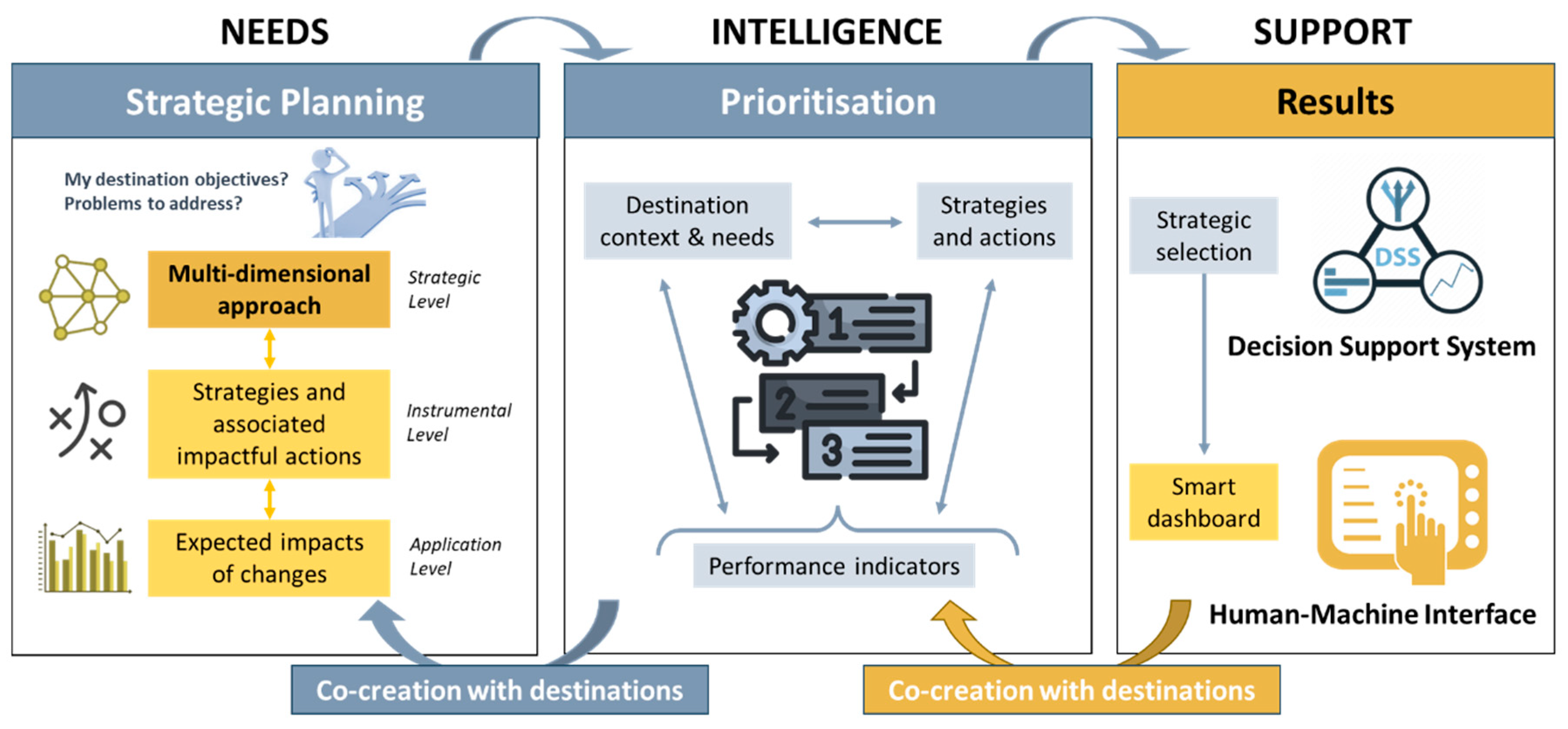
The research moves beyond the state of the art on CT management by developing, implementing and validating a decision support system that meets the concrete needs identified by destination managers. The DSS not only enables destinations to identify and prioritise context-specific CT strategies, it also monitors the implementation of those strategies against predefined tourism impact objectives. The methodology integrates a conceptual framework (Figure 1) that bridges theoretical foundations with participatory co-design, ensuring alignment with the multi-dimensional challenges of CT planning.
Figure 1. Conceptual framework employed in the research.
The Strategic Planning block focuses on identifying and contextualizing CT strategies within the multi-dimensional impact domains aiming to address destinations’ needs. The Prioritisation block employs the intelligence and hierarchy calculations to prioritise strategies by establishing relationships among actions, indicators, and sustainability goals. The Results operationalise these insights into a user-centred DSS, featuring a smart dashboard for strategic selection and subsequent impact monitoring using KPIs.
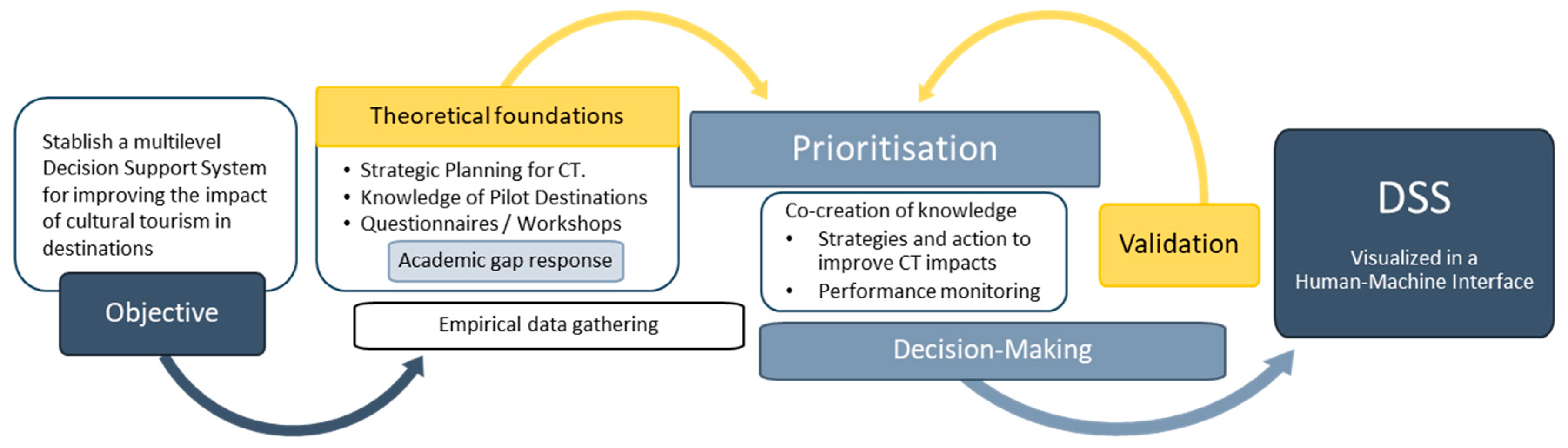
To address this approach, the IMPACTOUR project tool followed a comprehensive step-based methodology that integrated a literature review, academic gap response, and hierarchical decision modelling, following a collaborative and iterative process that involved stakeholders in data collection, model building, and validation to establish a multi-level DSS for sustainable CT planning. Figure 2 outlines how the knowledge was co-created.
Figure 2. Overview of the step-based methodology to develop the DSS.
The process was grounded in a co-creation framework within a participatory research design. Data were systematically collected from 18 European pilot destinations located in Portugal (various sites, also in the Azores), Spain (various sites), France, Germany, Italy (various sites), Estonia (various sites), Slovakia, Lithuania, Cyprus (various sites), Greece, Croatia, and Bosnia and Herzegovina, generating a comprehensive database of strategies, actions, and monitoring indicators. The data gathering for the knowledge-building phase covered the period of 2011–2022, while the validation and testing were carried out between 2020 and 2023. This empirical foundation was built using destination-specific questionnaires and two stakeholder workshops [39,40], gathering both qualitative and quantitative information. Questionnaires were used to capture baseline information and populate indicators, while workshops were structured to acquire knowledge about local challenges and opportunities and validate strategy–impact relationships and refine outputs. They also promoted focus group discussions that clustered destinations by similar characteristics (e.g., rural vs. urban, overtourism vs. heritage degradation), enabling collaborative knowledge generation and iterative refinement of the DSS hierarchical model. To guard against dominance effects and ensure balanced input of pilot destinations, the workshops employed structured facilitation and multiple deliberative rounds, as well as explicit discussion of the results, allowing divergent viewpoints to be reconciled before using the gained knowledge to develop the inter-relations for the hierarchical model. This approach served two purposes: identifying contextual challenges and extracting actionable insights to structure the DSS strategy–impact relationships. Triangulation of the different data sources and data types ensures that the DSS rests on empirical rigor while capturing stakeholder priorities and contextual knowledge. A key outcome of the workshops was the generation of a comprehensive database of strategies, actions, and monitoring indicators, organised into validated KPIs that track implementation impacts. The preliminary DSS was tested in culturally diverse CT contexts, demonstrating its flexibility to address regional specificity (e.g., seasonal tourism in rural sites vs. overtourism in urban destinations). This iterative validation, rooted in stakeholders’ collaboration, was carried out to assess the technical robustness, user friendliness, and alignment of the DSS with the priorities expressed by the pilot destinations, thereby strengthening its scalability and practical applicability. In parallel, a human–machine interface (HMI) tailored for diverse stakeholder groups, including destination management organizations (DMOs), policymakers, and public bodies, was developed. HMI user testing was performed and stakeholder feedback gathered, ensuring usability and contextual adaptability.
The deployment of the conceptual framework using the step-based methodology ensures a seamless transition from theoretical analysis to practical implementation. This integration is further reinforced by the DSS’s emphasis on stakeholder engagement, which overcomes the limitations of existing CT management tools by prioritizing user needs and contextual specificity.
The methodology’s strengths lie in its triangulated data approach, participatory co-design, and iterative validation. By combining quantitative methods (prioritisation for decision modelling) with qualitative insights (workshop feedback), the study ensures both scientific rigor and practical relevance. The pilot application in European regions further validates the DSS’s potential to serve as a scalable model for sustainable CT planning.

3.2. Strategic Planning for SCT

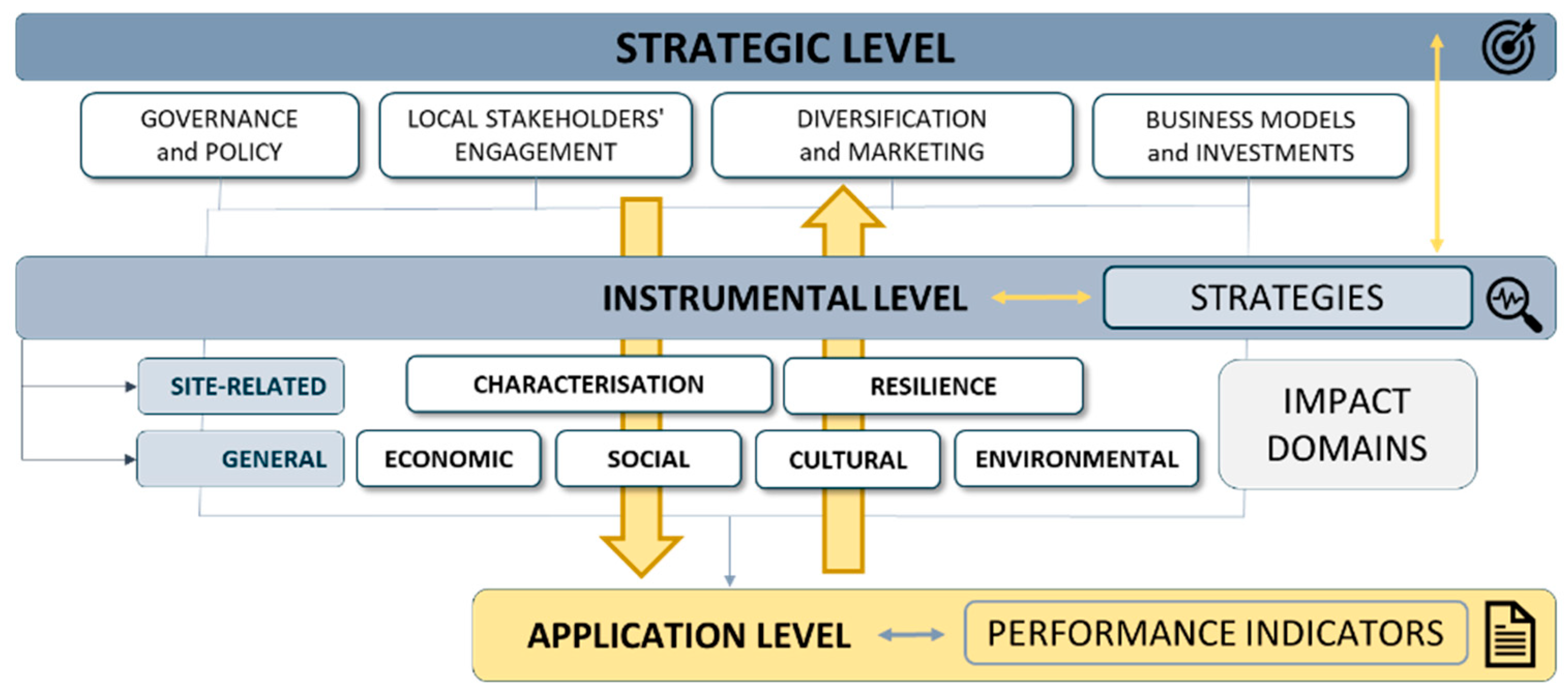
The strategic planning approach constitutes the foundation of the IMPACTOUR framework and is structured around three operative levels of the research: strategic, instrumental, and application. Figure 3 illustrates the interplay among these levels. This categorised structure ensures alignment between theoretical concepts and practical implementation, enabling destinations to address the multi-dimensional impacts of CT systematically.
Figure 3. Interrelations among the three operative levels.
At the strategic level, the framework is grounded in management dimensions that delineate the scope of CT strategies and actions. These dimensions, derived from stakeholder workshops and literature review [41], encompass governance and policy, local stakeholder engagement, diversification and marketing, and business models and investments. By clustering destinations that share similar characteristics, the model ensures that strategies are both context sensitive and scalable. This level establishes the baseline for CT planning and integrates site-specific challenges such as overtourism, heritage preservation, and socio-cultural dynamics.
The instrumental level operationalises the strategies into concrete impact domains: economic, social, cultural, and environmental. This mapping is essential for developing a hierarchical decision framework, as it establishes the logical relationships among CT strategies, their associated actions, and the measurable outcomes.
The application level focuses on the selection and monitoring of KPIs that evaluate the effectiveness of the implemented strategies and actions. KPIs are designed to capture changes in the baseline situation of each destination, providing evidence-based feedback for iterative adjustments. The tool allows users to select strategies that specifically target the most relevant KPIs to their context.
Collectively, this structured hierarchy ensures methodological coherence, enabling stakeholders to select strategies that align with their goals while adapting to regional specificity.

3.2.1. Strategies and Actions

Within the instrumental level, and based on the dimensional approach distilled from the strategic level, strategies and actions were structured to address the multi-dimensional challenges of CT across six impact domains: characterisation, resilience, cultural, social, environmental, and economic. The development process [42] followed an iterative, participatory approach that involved pilot destinations.
A set of 11 strategies and 61 associated actions was generated (accessible in [42]). The strategies balance context-specific needs (e.g., heritage preservation in urban sites vs. need of visitors in remote landscapes) with transversal objectives such as stakeholder collaboration and digital transformation. For instance, Strategy 1 (arts and heritage) prioritises tangible and intangible heritage protection, while Strategy 10 (environment) targets ecological sustainability throughout the tourism value chain. Each strategy is mapped to site-specific impact metrics (e.g., visitor behaviour, resource use), ensuring alignment with the instrumental level’s focus on measurable outcomes. The development process combined triangulated data collection (workshop, surveys, literature) with iterative validation by local stakeholders.
By embedding strategies into the instrumental level, the methodology ensures coherence between CT planning and actionable, data-driven decision making, enabling scalable, context-sensitive solutions.

3.2.2. Key Performance Indicators

The application level of the smart destination model defines KPIs as the core mechanism for evaluating the effectiveness of CT strategies and actions. This subsection outlines the methodological development of these KPIs, which are used to track changes in a destination’s situation after the implementation of specific actions. The complete list of KPIs is provided in Appendix A.
KPIs originated from baseline indicators that were initially intended for comparative destination assessments. They were subsequently transformed into dynamic metrics aligned with the six impact domains identified at the instrumental level: characterisation, resilience, economic, social, cultural, and environmental. This evolution transformed static baseline indicators—used to compare destinations—into KPIs tailored to measure post-implementation impacts of CT strategies [20]. The development process was based on stakeholder collaboration and scientific validation. Through iterative dialogues with destination representatives, KPIs were refined to reflect local challenges while maintaining academic rigor. Internal workshops examined the interrelations between KPIs and strategies, ensuring alignment with sustainability objectives.
Each KPI has been defined with a unique code, the name of the KPI, data needed, and calculation method. This standardisation enables consistent monitoring across diverse destination types (e.g., rural, urban, natural, itinerary).

3.3. Strategic Prioritisation for Destinations

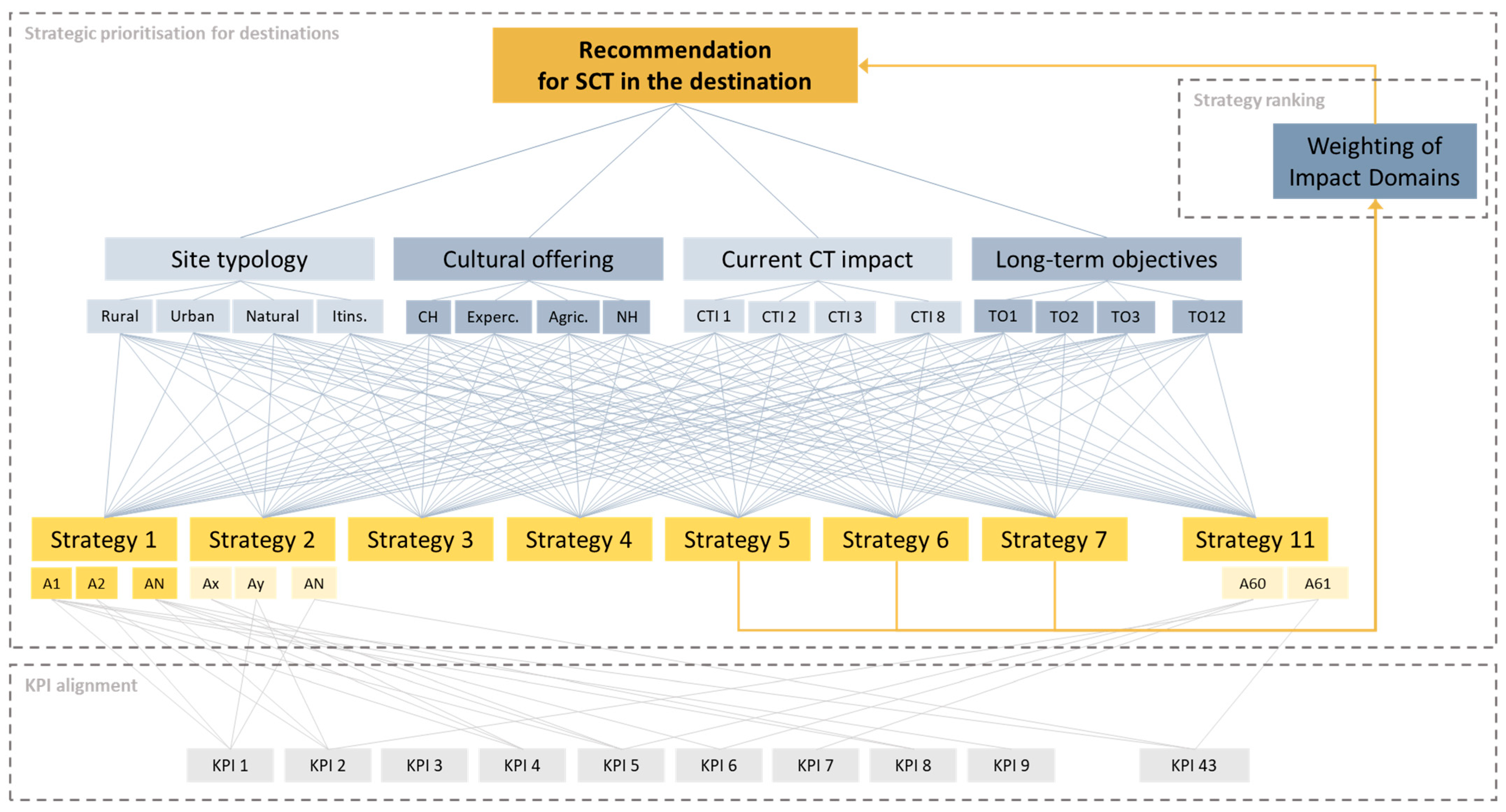
Building on the strategy development and their potential impact monitoring (3.2), this subsection describes how the DSS operationalises destination characterisation to inform strategy prioritisation. The following relationship matrix (Figure 4) illustrates how the interrelationships among the levels of the strategic planning are structured.
Figure 4. Strategic prioritisation relationships matrix.
Decision making begins by assigning each destination to a set of categories: site typology, predominant cultural activities, and current CT impact status. The site typology classifies destinations into four fixed categories—rural, urban, natural, and itineraries. This classification remains static for each destination, providing a foundational context for strategy recommendation.
In addition, the major cultural activities act as a critical contextual criterion to refine CT strategies recommendations. Six categories are established that capture the primary cultural offerings: cultural heritage based (tangible and intangible, such as historical monuments and living traditions), experience based (e.g., immersive cultural activities and participatory events), agriculture based (e.g., culinary heritage and farm tourism), and natural heritage based (e.g., landscapes and/or protected natural areas). By embedding these cultural activity types into the characterisation process, the decision making ensures context-specific strategy alignment with the destination’s unique assets and tourism dynamics.
The current CT impact status, in contrast, reflects dynamic prevailing challenges identified by destinations, described using a list of eight predefined statements (no tourism activity; tourism activity but no cultural tourism; overtourism; seasonal tourism; the touristic activity directly damages cultural heritage; unbalanced impact of tourism; highly dependent of international tourism; lack of knowledge about cultural tourism impact). This typological framework ensures the decision making will recommend strategies tailored to the destination’s context.
The decision-making process follows with the integration of long-term objectives and impact domain prioritisation. Twelve long-term objectives, distilled from cross-regional workshops are proposed, representing common goals for sustainable CT management (based on local skills to develop socio-economic sustainable cultural tourism; better address overtourism; diversify CT towards a green transition; reinforce the CT ecosystem; raise funds for CT management and increase revenues; achieve an adaptative tourism sector; achieve innovative cultural tourism management; prioritise quality of life above tourism development; prioritise natural and cultural heritage conservation above tourism development; increase the satisfaction of all types of visitors; agree and accomplish shared objectives with stakeholders for SCT; develop a greener and better connected site). Each destination selects one to three objectives that align with their needs.
Lastly, the prioritisation process is further guided by the user’s input on impact domains: cultural (well-preserved and vibrant arts and cultural heritage for unique, diverse, and immersive cultural tourism), social (accessible and inclusive cultural tourism with strong links to local communities), environmental (reduced ecological footprint of the cultural tourism sector), and economic (renewed and profitable sector with long-term sustainable growth). Stakeholders assign weights to these domains, reflecting their relative importance in the destination’s sustainability agenda. The weighted domains are fed into the analytic hierarchy process model (described in Section 4.1.2), which ranks the 11 strategies according to their alignment with user-defined priorities.

Integration with Decision Making

The DSS uses the combined outputs of the contextual classification and strategic prioritisation to filter the database of 61 CT actions (grouped under the eleven strategies) and proposes a shortlist of context-appropriate interventions. Simultaneously, the tool dynamically filters the relevant KPIs that will monitor the effectiveness of selected actions, ensuring that performance metrics (e.g., visitor seasonality patterns, occupancy rates) are aligned with the destination’s specific challenges.
This structured approach ensures the DSS transcends generic recommendations, offering instead a tailored decision-making framework that directly links the destination context, stakeholders’ objectives, and measurable outcomes. The outputs feed into the AHP-based strategy ranking described in Section 4.1.3, optimizing the final decision outcome.

4. Results

4.1. Decision Support System

The decision support system included in the IMPACTOUR tool implements an automated multi-criteria analysis, enabling the systematic prioritisation of 11 strategies. The engine ingests the destination’s characterisation (4 site types, 4 cultural offerings, 8 current CT impact statuses), the user-defined long-term objectives (12 objectives, with the possibility of choosing a maximum of 3), and the stakeholder-elicited weighting of the 4 impact domains. From these inputs, the DSS (i) computes the relevance scores for each of the 11 strategies, (ii) ranks the strategies, (iii) filters the 61 concrete actions that belong to the selected strategies (S1-S11), and (iv) displays the subset of KPIs that are directly affected by the chosen actions. The process is underpinned by equations that weight and rank strategies (Equations 1 to 6), ensuring that the recommendations are context sensitive and aligned with sustainability goals.
The relevance of strategy i for destination d is obtained from the hierarchical model (characterisation–objectives–impact domain–strategies). The relevance score that the DSS assigns to each of the eleven strategies is built in two main steps.
The first step covers the destination characterisation and strategic objectives, leading to a preliminary relevance score for each strategy and excluding those that are not linked to the selected strategic objectives.
The second step applies stakeholder-derived weights for the impact domains to the preliminary relevance, producing the final relevance that is used for ranking.

4.1.1. Step 1—Preliminary Relevance of the Strategy for a Destination

For a given destination d and strategy i the relevance is calculated as follows:
R i , d = T d   ×   A d   ×   C i
where:
Td = Type of Site (rural, urban, natural, itinerary). Normalised value [0, 1], where 1 is relevant and 0 not relevant.
Ad = Primary cultural offering (heritage-based offering, experience-based offering, agriculture-based offering, natural heritage). Normalised value [0, 1], where 1 represents how CT expression is expected to be modified.
Ci = Current CT impact. Correction factor for strategy i (1.1 = directly, 0.9 = indirectly or partially), representing the extent to which a strategy can influence the current situation.
A binary matrix O (size 11 × 12) encodes whether strategy i is linked to objective j that the stakeholder may choose. The objective contribution for destination d is expressed as follows:
S i , d = j = 1 12 O i j   f j , d
with
O i j = 1 , if   a   strategy   i   is   linked   to   objective   j   0 , otherwise  
and
f j , d 1   if   objective   j   has   been   selected   by   the   user   for   destination   d   0 , otherwise  
The preliminary relevance that is passed to the second step is the product of the two terms:
P R i , d = R i , d   ×   S i , d
If a strategy is not linked to any of the chosen objectives (Si,d = 0), its relevance becomes zero irrespective of the site type, activity, or impact correction values.

4.1.2. Step 2—Weighting by Impact Domains

The 4 impact domains (cultural, social, environmental, economic) are weighted by the destination manager through the AHP [43,44] using a 1–9 scale (Table 1).
Table 1. Pairwise comparison scale. Source: [43].
The pairwise comparison process involves the following:
  • Judgment input: The relative importance of each pair of domains.
  • Matrix construction: The judgments are represented as numerical values, indicating the strength of preference for one domain over another as presented in Table 2.
    Table 2. An example of comparisons of domain pairs (scored by a decision maker).
  • Weight derivation: This determines the priority weights of the domains based on the pairwise comparison matrix. The matrix is processed to find the eigenvalues and eigenvectors, which help derive the normalised weight vector. The maximum eigenvalue “λmax” of the matrix is obtained.
  • Consistency validation: This includes transforming the raw data into meaningful absolute values using the formula Aw = λmaxW. A consistency ratio (CR) is calculated to validate the results, which involves computing the consistency index (CI) through a specific formula, CR = CI/RI. The value of RI is related to the dimension of the matrix. When this value is less than 0.10, it verifies the results of the comparison.
Each of the eleven CT strategies is pre-assigned to one or more impact domains. This information is encoded in a binary matrix as follows:
D = D i k 11 × 4
with
D i k = 1 , if   a   strategy   i   is   linked   to   domain   k   0 ,   if   a   strategy   i   i s n t   linked   to   domain   k
The domain weight that belongs to strategy i is the dot product of the i-th row of D with the AHP-derived weight vector w and is expressed as follows:
W i = k = 1 4 D i k w k
Wi is a scalar in the interval [0, 1] that reflects how strongly the strategy aligns with the domains that the stakeholders deem most important.
The final relevance of strategy i for destination d is obtained by multiplying the preliminary relevance (which already incorporates site type, cultural activity, CT impact correction, and the selected long-term objectives) by the domain weight Wi and then normalising across all eleven strategies:
R ^ i , d = P R i , d   x   W i i = 1 11 P R i , d x   W i
The vector R ^ d = R ^ 1 , d , . R ^ 11 , d   is the output used for ranking the strategies, for filtering the associated actions, and for selecting the KPIs that will be monitored.

4.1.3. Strategy Ranking, Action Retrieval, and KPI Alignment

The ranking produced by Equation (6) is rendered on the human–machine interface. For each of the displayed strategies, the system automatically queries the actions (61 rows) and presents the actions that belong to the selected strategy.
A second filter selects only those KPIs that are linked to at least one of the displayed actions. Formally, a KPI ℓ is shown when the following is noted:
  a   A S i   s u c h   t h a t   l a 0
where A S i   is the set of actions belonging to strategy S i , and l a   2 ,   1 ,   0 ,   1 ,   2 is the expert-defined directional impact of action a on KPI ℓ. The resulting KPI list is therefore action specific rather than a generic catalogue of 43 indicators, which reduces information overload and allows the manager to focus on the metrics that actually change after implementation.

4.2. Human–Machine Interface

The HMI is the visual front end through which destination managers interact with the IMPACTOUR tool. It bridges the knowledge-based framework and the user’s decision-making process, guaranteeing that every input is stored, every calculation is reproducible, and every output is presented in an intuitive, action-oriented form.
The landing page (https://impactour.grisenergia.pt/ (accessed on 15 December 2025)) serves as the gateway to the three modules in which the HMI is structured:
  • Input module: Collects and validates destination-specific data, ensuring structured storage for subsequent analysis.
  • Decision support system module: Executes the algorithm calculation to compute the preliminary relevance and apply the stakeholder-derived impact domain weights to obtain the final ranking of strategies and associated KPIs, translating stakeholder preferences and destination context into actionable recommendations.
  • Visual Analytics module: Interactive dashboards that visualise the selected KPIs, baseline values, and projected changes after action implementation.
Although all three modules are required for end-to-end usage, this section concentrates on the DSS module because it encapsulates the methodological contribution of the paper: a transparent, data-driven prioritisation of culturally relevant tourism strategies that respects regional specificities and stakeholder preferences.
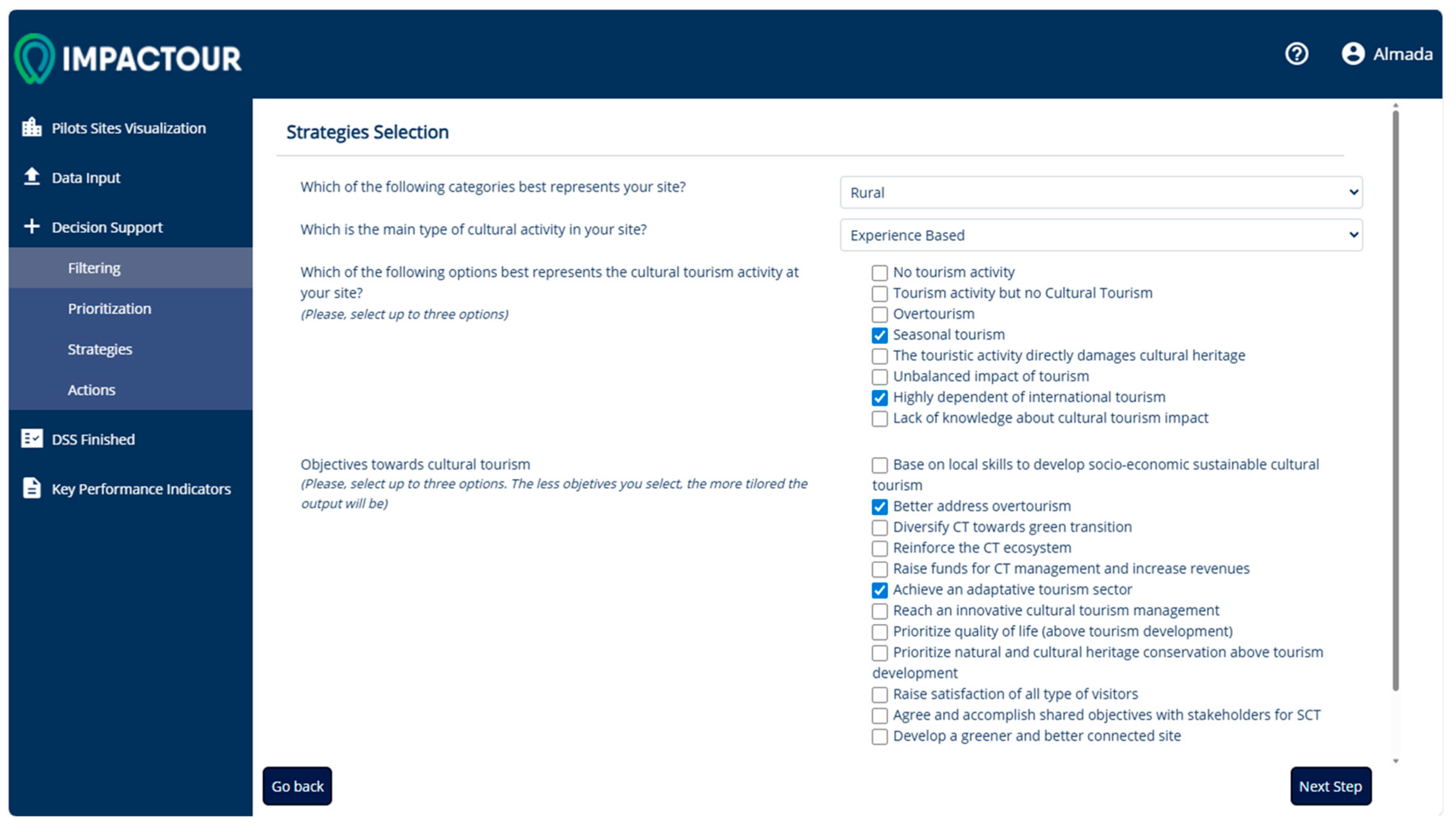
The first screen on the DSS (Figure 5) collects the four variables that feed the preliminary relevance calculation: site type, principal cultural activity, current CT impacts, and strategic long-term objectives.
Figure 5. Decision support module: Inputs for prioritisation (1).
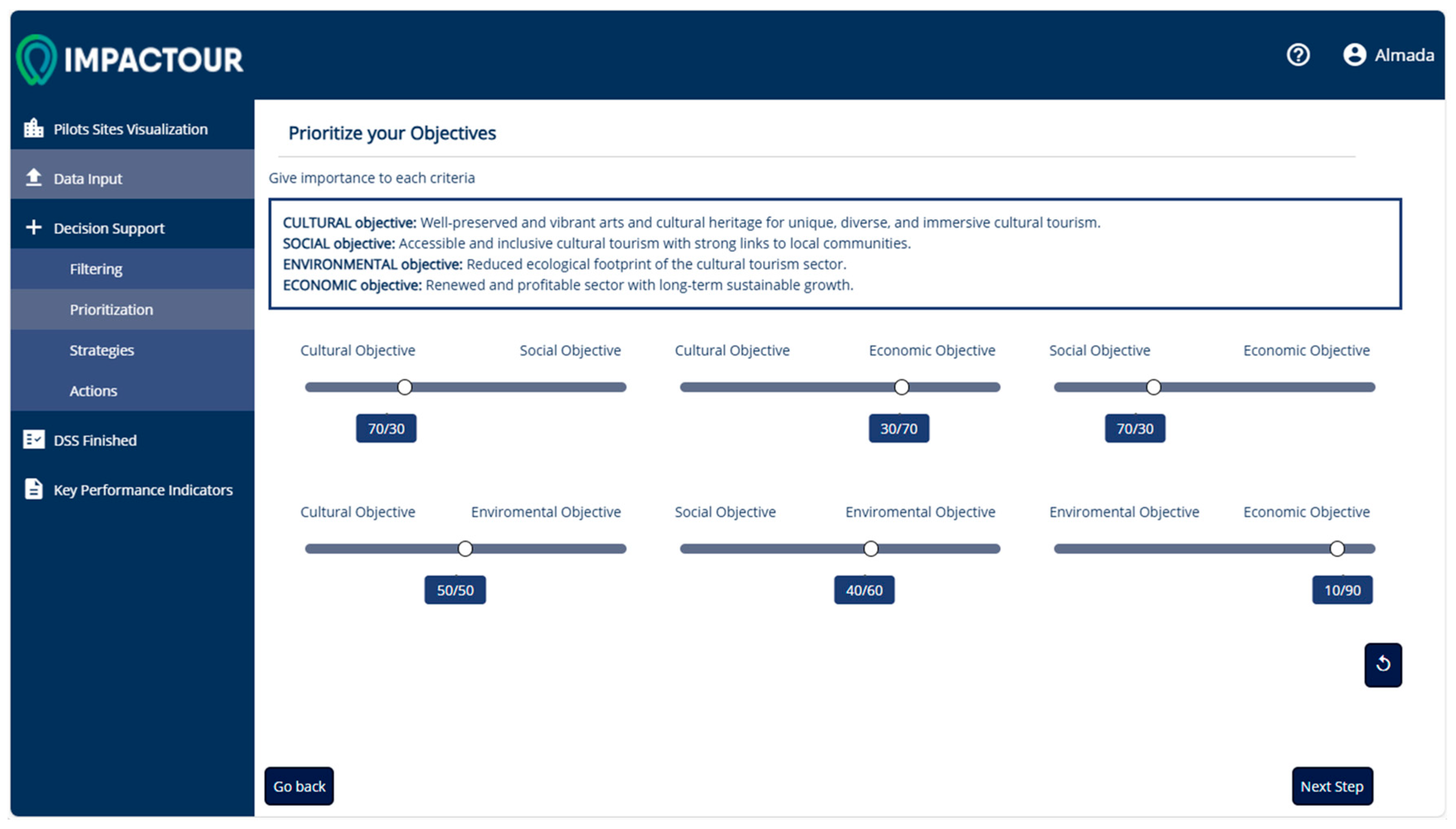
Upon competition of the information, the system proceeds to the weighting stage (Figure 6) for the impact domain priorities (calculated using pairwise comparisons as required by the AHP). This step ensures stakeholders obtain the domain-adjusted weight for each strategy and that the final relevance is normalised.
Figure 6. Decision support module: Inputs for prioritisation (2).
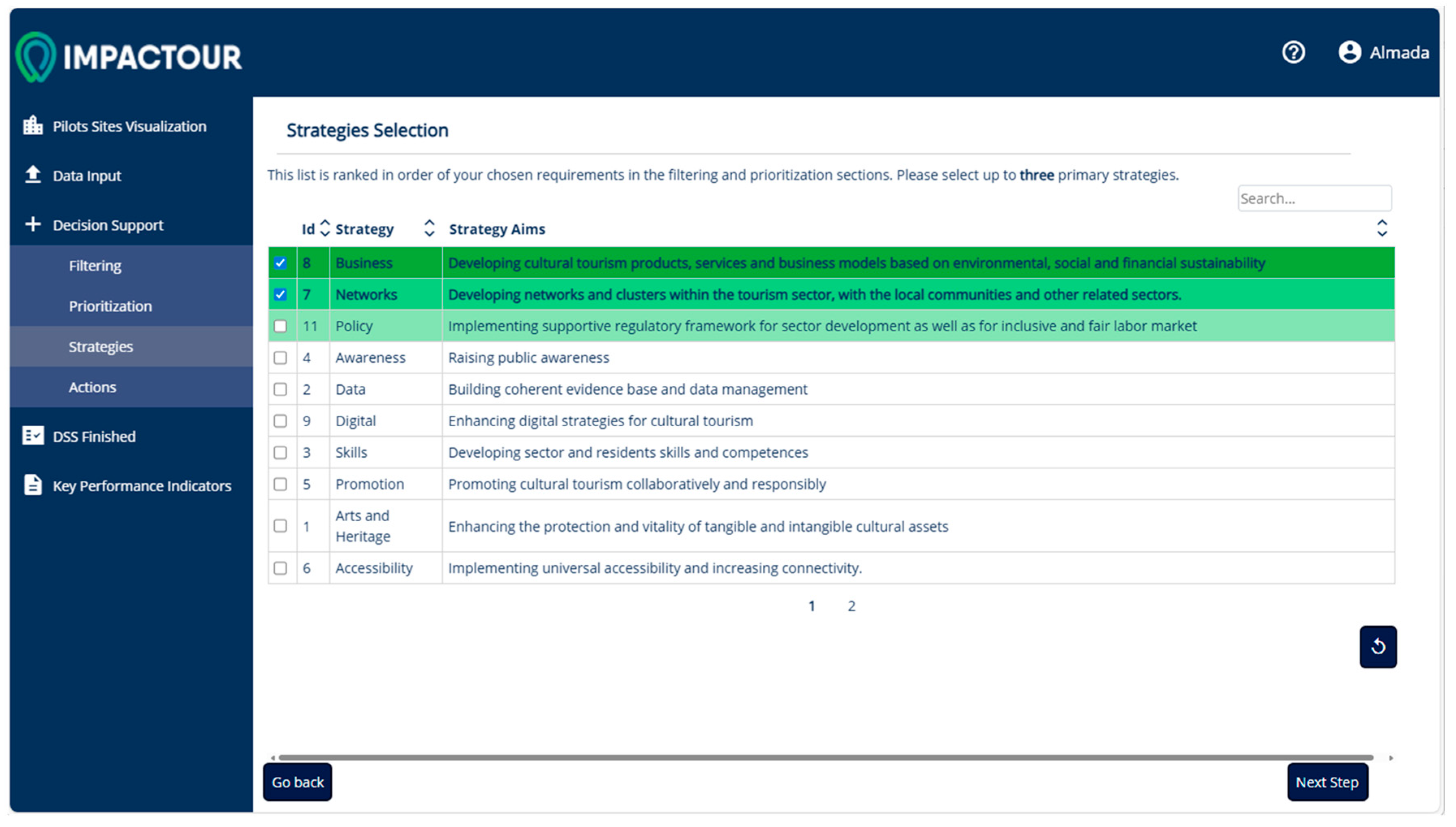
Figure 7 displays the ranked list, where the three highest-scoring strategies are highlighted in green. While the DSS prioritises these, the interface allows users to override these recommendations and select any of the remaining strategies, preserving the tool’s advisory character while respecting autonomy in decision making.
Figure 7. Decision support module: Recommended strategies.
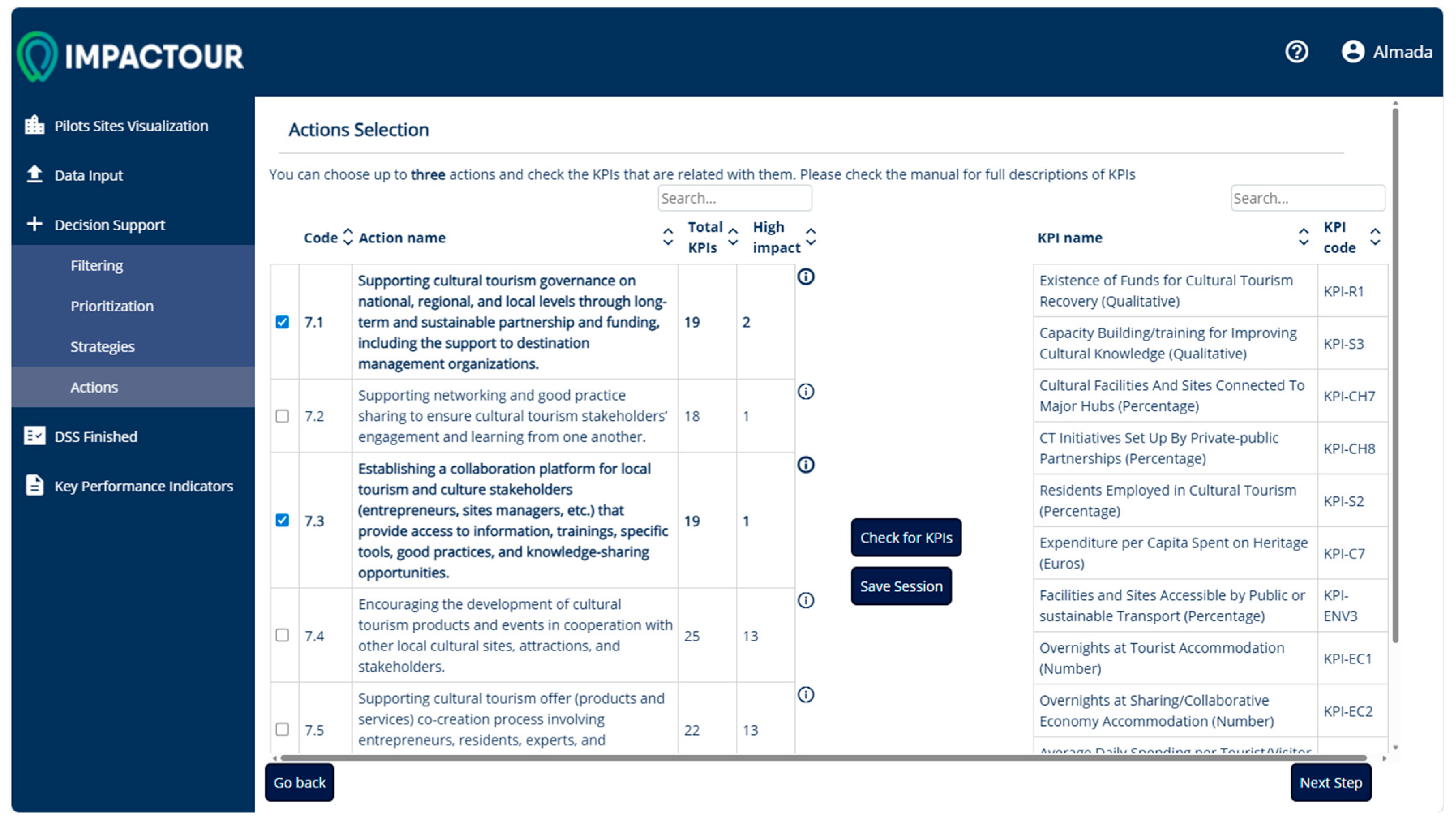
When a strategy, or a set of strategies are confirmed, the system displays the actions that belong to a chosen strategy (Figure 8, left panel) and the subset of KPIs that are directly affected by those actions (Figure 8, right panel). The tool dynamically filters KPIs based on the selected strategies and the site’s initial characterisation. Consequently, only the KPIs relevant to the user’s action selection are displayed, avoiding information overload and focusing monitoring efforts on measurable outcomes once actions are implemented.
Figure 8. Decision support module: Actions related to selected strategies and related KPIs.
The HMI synthesises the theoretical and methodological foundations of this study, transforming abstract decision-making frameworks into a dynamic, context-specific interface that integrates stakeholder priorities into actionable, data-driven strategies for sustainable cultural tourism management.

5. Discussion

The IMPACTOUR user-centred digital DSS has demonstrated that sustainability objectives can be turned into concrete, context-sensitive actions for cultural tourism. By structuring the decision process into three hierarchical levels—strategic objectives, instrumental impact domains, and application-level KPIs—the system allows destinations to address the multi-dimensional impacts of CT (RQ 1). The linkage of each of the eleven strategies to the four impact domains (cultural, social, environmental, economic) and the automatic selection of the most relevant actions and KPIs ensure coherence between the chosen actions and the metrics used to evaluate their performance (RQ 2). The tool, through a multi-criteria decision analysis that incorporates user-provided site characteristics, stakeholder-defined objective preferences, and domain priority weights, produces a ranked shortlist of recommended strategies together with a filtered set of indicators that are expected to change after implementation (RQ 3). Pilot applications across diverse European regions showed that stakeholders can move from strategy selection to KPI tracking within a single session, demonstrating the practical utility of the approach.
The validation phase confirmed that the DSS is both technically robust and user friendly. Qualitative validation through two stakeholder workshops and destination-specific questionnaires demonstrated that the hierarchy of strategies, actions, and KPIs is relevant for real-world planning. A brief usability test of the prototype interface showed that stakeholders find the tool intuitive and that it supports the complete decision-making workflow. Moreover, validation revealed that the model’s top-ranked strategies are consistent with the expected priorities expressed by the pilot destinations. Stakeholders especially highlighted the intuitive layout of the HMI and the strategic relevance of the recommendations.
The results substantiate that the DSS successfully integrates destination characterisation, selected long-term objectives, and stakeholder-derived impact domain weights to produce quality impact changes on current CT trends in destinations. This is because the two-step relevance calculation (4.1.) first discards strategies unrelated to the chosen objectives and then adjusts the remaining scores by the domain weights, yielding a final ranking that aligns with local priorities. The system subsequently extracts the specific actions belonging to the selected strategies and filters the KPI set to include only those directly influenced by those actions, thereby preventing information overload and focusing monitoring on measurable outcomes. The user interface operationalises this workflow, allowing managers to input data, view the weighted strategy ranking, and instantly retrieve the associated actions and KPIs.
These findings echo earlier research on tourism impact management [20] by producing a context-specific approach that provides guidance and confirms that this structured management framework can help managers not only address CT impacts but also monitor the outcomes of the implemented sustainable cultural tourism strategies.

6. Conclusions and Recommendations

The findings of this study offer a robust and replicable framework for sustainable CT planning. The system proved its effectiveness in pilot regions, where the co-created strategies, actions, and KPIs were considered appropriate to lead to measurable improvements in CT management, confirming that the DSS can translate destination manager objectives into concrete outcomes despite the distinct geographic, socio-economic, and cultural contexts of each region. The DSS merges multi-criteria decision analysis with a stakeholder-driven knowledge base comprising 11 strategies, 61 actions, and 43 KPIs. Its development process, rooted in iterative workshops, triangulated data collection, and continuous validation, ensures that the strategies align with regional challenges such as overtourism, heritage preservation, and socio-economic resilience. Pilot applications in several European regions demonstrated its efficacy in translating abstract sustainability objectives into actionable strategies, supported by a dynamic dashboard for KPI monitoring.
A key innovation lies in the tool’s adaptability: its modular structure and stakeholder-aligned methodology make the system scalable to new destinations and future methodological upgrades. The modularity originates from the system’s architecture, in which strategies, actions, KPIs, and weighting mechanisms operate as independent components that can be updated or expanded without altering the overall framework. Scalability is underpinned by an intuitive user interface that enables non-technical stakeholders to interpret and adjust output parameters without specialized training. By emphasizing participatory governance and data-driven feedback loops, the DSS fosters collaborative decision making, a critical need in CT’s complex, multi-dimensional landscape.
This work demonstrates how a socio-technical approach to decision support—aligning technological tools with social collaboration and governance—can accelerate sustainability transitions in cultural tourism, ensuring that strategic planning is both evidence based and deeply context responsive.
Future work will focus on enhancing the AI-driven capabilities of the DSS, such as integrating machine learning algorithms to predict tourism trends and simulate action impacts, allowing the DSS to rank strategies by considering possible future situations, thus enabling proactive decision making. The system will connect heterogeneous data sources, including IoT sensors, social media, and satellite imagery into a continuous data pipeline to enable automated KPI updates and real-time dashboard monitoring.
Expanding the tool’s adaptability to non-European contexts is another critical direction, which will require reconfiguration of strategies, actions, and related KPIs, as well as governance frameworks to reflect regional specificity. By embedding AI-driven scenario modelling and real-time feedback loops, the DSS can evolve into a living system that continuously learns from implementation outcomes, ensuring its recommendations remain relevant as the tourism landscape changes.
Future enhancements, such as AI-driven predictive analytics and multi-lingual support, will strengthen its global relevance, enabling the tool’s capacity to respond to emerging challenges such as climate change or shifts in travel behaviour.
Ultimately, the IMPACTOUR DSS bridges the gap between theory and practice, offering a replicable template for sustainable tourism management. Its emphasis on context-specific solutions and stakeholder engagement sets a precedent for balancing heritage protection, economic growth, and environmental resilience. As the tool evolves, it has the potential to redefine strategic planning in CT, ensuring long-term adaptability in an increasingly globalised and data-centric tourism sector.
Overall, the IMPACTOUR DSS provides a scalable and adaptive framework capable of supporting long-term sustainability transitions in CT, ensuring that destinations can respond effectively to evolving environmental, cultural, social, and economic challenges.

7. Limitations

Several limitations emerged during the development of the DSS. The reliance on historical data, static datasets, and the fact that KPI values are not updated in real-time highlight the need for adaptive models to capture rapidly changing conditions, such as post-pandemic travel patterns or sudden changes due to climate change and hazards. In addition, because the strategies and KPIs were co-created within European pilot regions, the tool’s transferability to destinations with different governance cultures remains uncertain. The validation process was also limited in duration, meaning that long-term behavioural changes in destination management could not be assessed. From a technical perspective, the current version does not yet integrate real-time data ingestion from IoT sensors, social media, or satellite sources, which restricts its responsiveness to sudden fluctuations in tourism flows.

Author Contributions

Conceptualisation, M.Z.D.l.C., A.G., S.P., T.K. (Tarmo Kalvet), P.P. and J.M.; methodology, M.Z.D.l.C., A.G., S.P. and A.S.G.; validation, S.P. and J.M.; formal analysis, M.Z.D.l.C. and A.G.; investigation, M.Z.D.l.C., A.G. and S.P.; resources, M.Z.D.l.C., A.G., S.P., T.K. (Tarmo Kalvet), A.L.d.A.B., P.P., T.K. (Tatjana Koor) and J.M.; writing—original draft preparation, M.Z.D.l.C.; writing—review and editing, M.Z.D.l.C., A.G., S.P., A.S.G., T.K. (Tarmo Kalvet), A.L.d.A.B., P.P., T.K. (Tatjana Koor) and J.M.; visualisation, A.L.d.A.B.; supervision, J.M.; project administration, J.M.; funding acquisition, M.Z.D.l.C., A.G., T.K. (Tarmo Kalvet), P.P. and J.M. All authors have read and agreed to the published version of the manuscript.

Funding

This research was funded by European Union’s Horizon 2020 research and innovation programme, under Grant Agreement No. 870747.

Institutional Review Board Statement

Not applicable.

Data Availability Statement

The results of this research are included in the article; additional datasets and information can be found on the IMPACTOUR website: https://www.impactour.eu/ (accessed on 12 December 2025).

Acknowledgments

The research was undertaken within the project “Improving Sustainable Development Policies and Practices to Assess, diversify, and foster Cultural Tourism in European regions and areas” (IMPACTOUR). The authors gratefully acknowledge the European Commission for providing financial support during the research. The participation of all IMPACTOUR consortium members is gratefully acknowledged. During the preparation of this manuscript, the authors used GureGPT, version 4.2 released 12 October 2025, for the purposes of text-level assistance—grammar correction, enhancing coherence, improving flow, and minimizing redundancy—without influencing the underlying research itself. The scientific design, data acquisition, analysis, and interpretation were performed entirely by the research team. The authors have reviewed and edited the output and take full responsibility for the content of this publication.

Conflicts of Interest

Authors Mr. Mikel Zubiaga De la Cal, Dr. Alessandra Gandini, Dr. Amaia Sopelana Gato, and Mrs. Amaia Lopez de Aguileta Benito are employed at TECNALIA (Basque Research and Technology Alliance). The remaining authors declare that the research was conducted in the absence of any commercial or financial relationships that could be considered a conflict of interest.

Abbreviations

The following abbreviations are used in this manuscript:
AHPAnalytic hierarchy process
CTCultural tourism
DSSDecision support system
HMIHuman–machine interface
ICTInformation and communication technologies
KPIKey performance indicator
RQResearch question
SCTSustainable cultural tourism

Appendix A. Set of Key Performance Indicators for CT Impact Monitoring

Table A1. Key performance indicators for CT impact monitoring.
CodeKPIRequired DataCalculation Method
Characterisation Indicators
KPI-CH1Population density(A) Total population
(B) Area
Quantitative: A/B
KPI-CH2Percentage of cultural tourists(A) Number of cultural tourists
(B) Number of overall tourists
Quantitative: A/B × 100
KPI-CH3Number of designated or formally listed natural and heritage sites or intangible cultural heritage per population(A) Number of natural heritage sites
(B) Number of tangible cultural heritage sites (buildings, monuments, group of buildings, assets, route, etc.)
(C) Number of intangible heritage
(D) Total population OR total area
Quantitative:
(A + B + C)/D
KPI-CH4Existence of sites with recognised international designation (WHS, GIAHS, Capital of Culture, Cultural Route)(A) World Heritage Sites
(B) Globally Important Agricultural Heritage Systems
(C) European Capital of Culture
(D) Cultural Route
(E) Others
Qualitative (scale):
(1) No designation and “no plans to designate” or “not applicable”.
(2) Actively working towards designation or interested in considering designation.
(3) Designation exists.
KPI-CH5Number of cultural facilities open to the public and aiming at promoting arts and culture per population(A) Number of museums and art galleries
(B) Number of cinema
(C) Number of music venues (concert halls, clubs, etc.)
(D) Number of theatres
(E) Number of libraries or archives
(F) Number of exhibition halls
(G) Number of conference/conv. centres
(H) Others
(I) Total population OR total area
Quantitative:
(A + B + C + D + E + G + H)/I
KPI-CH6Quality Certification for Destination Management OrganizationsQualitative assessment based on multiple choice scale on DMO certificationQualitative (scale):
(1) No DMO exists.
(2) DMO is functioning but has not been certified, or it is in process of being certified.
(3) DMO is excellently functioning, services are used widely, though not certified.
(4) DMO exists and has successfully complied certification criteria and standards.
KPI-CH7Percentage of cultural facilities and natural and cultural sites connected to major hubs (airports, port, and central train/bus stations) and accessible in less than 1 h(A) Number of cultural facilities (all A-H from KPI-CH5)
(B) Number of tangible cultural heritage sites (KPI-CH3)
(C) Number of natural heritage sites (KPI-CH3)
(D) Number of facilities (A) and sites (B+C) accessible in less than 1 h from major hub
Quantitative:
A + B + C/D × 100
KPI-CH8Percentage of CT initiatives (products, services, etc.) set up by formal or informal private–public partnerships (PPP)(A) Total number of CT initiatives
(B) Number of PPP in CT initiatives
Quantitative:
A/B × 100
KPI-CH9Percentage of tourists that are satisfied with their overall cultural experience in the destinationQualitative assessment based on multiple choice scale based on visitors’ satisfactionQualitative (scale):
(1) The majority of tourists are not satisfied with their overall cultural experience.
(2) At least 25% of tourists are satisfied.
(3) At least 50% of tourists are satisfied.
(4) At least 75% of tourists are satisfied.
KPI-CH10Availability of products with designation of origin or geographical indications (PDO, PGI) and traditional specialties guaranteed (TSG)(A) Protected designation of origin
(B) Protected geographical indication
(C) Traditional specialties guaranteed
Qualitative (scale):
(1) No products potentially subject of designation available in the area.
(2) Products are available but no designation in place.
(3) Products are available and under designation process.
(4) Products with some designation exist and are identified by a consolidated brand.
Resilience Indicators
KPI-R1Existence of funds, including social safety nets or incentives, for cultural tourism recoveryQualitative assessment based on multiple choice scale on the existence of recovery funds, safety nets, or incentivesQualitative (scale):
(1) No CT recovery funds exist.
(2) CT recovery funds exist but are not guaranteed as their availability varies.
(3) CT recovery funds exist but are insufficient to ensure the overall coverage.
(4) CT recovery funds exist and defined procedures, responsibilities, and resources are needed to activate them.
KPI-R2Existence of tools or counting systems able to act in real time to manage carrying capacityQualitative assessment based on multiple choice scale on implementation of manual counting system or ICT tools for tourism carrying capacity managementQualitative (scale):
(1) No tools or systems exist.
(2) Some tools or systems exist, but basic information is provided only in place (e.g., queuing time, number of left entrances/day, etc.).
(3) Tools in place and information on occupancy levels, queuing time, etc. is given in real time and available via remote systems, but no alternatives are provided.
(4) Tools are in place and information is available via remote systems, providing information and notices to change visitors flows according to real-time variables (e.g., suggestion of alternative routes, spreading visitors to less visited sites, road cuts, etc.).
KPI-R3Percentage of domestic tourists(A) Number of domestic tourists
(B) Total number of tourists
Quantitative:
A/B × 100
KPI-R4Percentage of cultural facilities and sites offering digital tourism offer(A) Number of cultural facilities offering digital content
(B) Number of cultural and natural sites offering digital content
(C) Total number of facilities and sites (KPI-CH5 and KPI-CH3)
Quantitative:
A + B/C × 100
Social Indicators
KPI-S1Tourists per capita or area(A) Number of tourists (KPI-CH2)
(B) Total population OR area (KPI-CH1)
Quantitative:
A/B
KPI-S2Percentage of residents employed in cultural tourism(A) Employments in CT (total number of people employed in cultural occupations according to selected International Standard Classification of Occupations (ISCO) codes)
(B) Total residents employed in CT
Cultural employment includes the following:
A. People who have a cultural occupation and who work in businesses with a cultural activity (e.g., an actor in a theatre)
B. People who have a cultural occupation but who work in a business which is not engaged in cultural activity (e.g., a designer in the motor industry)
C. People who work in cultural businesses but who do not have a cultural occupation (e.g., an accountant working in a theatre)
The KPI sums these three groups.
Quantitative:
A/B × 100
KPI-S3Capacity building/training activities/mentoring opportunities promoted by institutions for improving cultural knowledgeQualitative assessment based on multiple choice scale on training opportunities for improving cultural knowledgeQualitative (scale):
(1) No training or capacity building programmes exist.
(2) Some training and capacity building initiatives are under development or exist as ad hoc content provision.
(3) Some training and capacity building initiatives exist but are specific to some heritage.
(4) Training and capacity building initiatives are available for all heritage and involve all relevant stakeholders and the community.
KPI-S4Percentage of facilities and sites offering free/discounted/educational access to local community(A) Number of facilities and sites offering discount to locals
(B) Total number of facilities and sites
Quantitative:
A/B × 100
KPI-S5Average of physical, mental, and visual accessibility of cultural facilities and sitesQualitative assessment based on multiple choice scale per different items of accessibilityQualitative (scale):
A SCALE answer is provided to EACH item:
(1) No plans or actions taken for promoting accessible tourism.
(2) Accessible tourism plans under development.
(3) Accessible tourism plans partly implemented.
(4) Accessible tourism plans largely completed.
Average of scale values of each item: (A) Step-free access routes outdoors and at facility and site entrances (via level access, ramps, or platform lifts) (1 to 4); (B) Tactile routes (guidance for blind persons) (1 to 4); (C) Accessible overnight accommodation (1 to 4); ( D) Accessible toilets (1 to 4); (E) Wheelchair accessible public transport (bus, train, ferry, boat) (1 to 4); (F) Tourist information in alternative formats and languages: large print/easy reading/Braille/audio/video with sign language(s) (1 to 4); (G) Use of pictograms at CT sites/facilities (1 to 4); (H) Training of managers and frontline staff on disability awareness, accessibility, and inclusion (1 to 4)
KPI-S6Accessible multi-lingual directions to cultural facilities and sitesQualitative assessment based on multiple choice scale on accessible multi-lingual directionsQualitative (scale):
(1) No plans for accessible multi-lingual directions.
(2) Accessible multi-lingual directions under development.
(3) Accessible multi-lingual directions partly implemented.
(4) Accessible multi-lingual directions largely implemented.
KPI-S7Website accessibility for all(A) Number of sites and facilities providing a Web Content Accessibility Guideline (WCAG)-compliant websiteQuantitative
A
Cultural Indicators
KPI-C1Existence of adopted visitors’ management plans that address seasonality of tourism and carrying capacity of propertiesQualitative assessment based on multiple choice scale on the existence and characteristics of a visitor management planQualitative (scale):
(1) No visitor management plan (VMP) exists.
(2) VMP exists but does not address seasonality of tourism and carrying capacity.
(3) VMP exists that addresses seasonality and carrying capacity, but it has not yet been implemented.
(4) VMP exists, fully covers the specific problematic of the area, and is continuously monitored.
KPI-C2Share of revenues from tourism that contribute to the protection and restoration of historic building/sites in the area(A) Total economic contributions coming from tourism
(B) Total economic contributions coming from tourism that are spent on restoration of historical buildings/sites at destination
Quantitative:
A/B × 100
KPI-C3Resources allocated to public space and pathway maintenance, improvement, and accessibility, including installation of equipment for cultural use(A) Expenditure for space and pathway maintenance and improvementQuantitative
A
KPI-C4Number of endangered cultural and natural heritage sites(A) Number of historic buildings, monuments, or sites in bad states of conservation or included in endangered listsQuantitative
A
KPI-C5Annual numbers of tickets sold in cultural facilities(1) Tickets sold for cultural facilities:
(A) Museums and art galleries
(B) Cinema
(C) Music venues (concert halls, clubs...)
(D) Theatres
(E) Libraries
(F) Exhibition halls
(G) Conference or conventions centres
(H) Others
Quantitative:
A + B + C + D + E + F + G + H
KPI-C6Number of vacant and dilapidated tangible cultural heritage reused as cultural facilities(A) Total number of vacant and dilapidated heritage assets that have been reused as cultural facilitiesQuantitative
A
KPI-C7Total expenditure (public and private) per capita spent on the preservation, protection, and conservation of all cultural and natural heritage(1) Expenditure spent on the preservation (Exp_PU + Expe_Pr)
(2) Population
Disaggregation would be required:
  • By type of heritage: cultural, natural, mixed, World Heritage properties
  • Public expenditure by level of government (national, regional, local/municipal)
  • Type of public expenditure (capital expenditure, operating expenditure)
  • Private funding: donations in kind, private non-profit sector, sponsorship
Environmental Indicators
KPI-ENV1Percentage of local enterprises in the tourism sector actively supporting conservation of local biodiversity and landscapes(A) Number of local enterprises in the tourism sector that actively fund conservation or invest in it
(B) Number of local enterprises in the tourism sector
Quantitative:
A/B × 100
KPI-ENV2Percentage of tourism enterprises/establishments using a voluntary certification/labelling for environmental/quality/sustainability and/or corporate social responsibility(A) Number of tourism enterprises using a voluntary certification for the environmental quality
(B) Total number of tourism enterprises in the area
Quantitative:
A/B × 100
KPI-ENV3Percentage of cultural facilities and sites accessible by public transport or other environmentally friendly transport or cycle tracks(A) Number of cultural tourist facilities accessible by bike/scooter/public transport
(B) Number of built cultural heritage sites accessible by bike/scooter/public transport
(C) Total cultural tourist facilities
Quantitative:
(A + B)/C × 100
KPI-ENV4Number of days in a year in which maximum tourism carrying capacity has been exceed(A) Carrying capacity needs to be defined per site
(B) Counting times the carrying capacity is exceeded can be performed either manually or using ICT tools
Quantitative
B
KPI-ENV5Percentage of buildings rehabilitated following sustainable traditional building techniques and materials(A) Buildings rehabilitated following traditional techniques
(B) Total buildings rehabilitated
Quantitative:
A/B × 100
Economic Indicators
KPI-EC1Average overnights at tourist accommodation establishments per quarter/year(1) Number of nights spent per touristAverage of the total number provided by Eurostat
KPI-EC2Average overnights at sharing/collaborative economy accommodation establishments per quarter/year(1) Number of nights tourists stay in sharing accommodationsAverage of the total number provided by Eurostat
KPI-EC3Average daily spending per tourist/visitor(1) Average daily spending per touristAverage of the total number provided by Eurostat
KPI-EC4Net occupancy rate in accommodation per season (quarterly)(1) Occupation rate/monthly/quarterlyThe occupancy rate of bed places in reference period is obtained by dividing the total number of overnight stays by the number of the bed places on offer (excluding extra beds) and the number of days when the bed places are actually available for use (net of seasonal closures and other temporary closures for decoration, by police order, etc.). The result is multiplied by 100 to express the occupancy rate as a percentage.
KPI-EC5Employment rate in cultural sector(A) The CEIsco code is the total number of people employed in cultural occupations according to the selected International Standard Classification of Occupations (ISCO) codes or ISIC codes [45].
“Persons working in economic activities that are deemed cultural, irrespective of whether the person is employed in a cultural occupation. It also covers persons with a cultural occupation, irrespective of whether they are employed in a cultural economic activity. Cultural employment is defined in terms of the statistical classification of economic activities in the European Community (NACE Rev. 2) and by the international standard classification of occupations (ISCO)-Eurostat”
(B) EP is the total number of the employed population.
Quantitative
(CEIsco (A)/EP (B)) × 100
KPI-EC6Percentage of cultural businesses over all types of businesses(A) Number of CT facilities (KPI-CH5) and services
(B) Total number of establishments in the city/region/territory (NACE index)
Quantitative
A/B × 100
KPI-EC7Percentage of gross domestic product attributable to private and formal cultural production(A) GVA is (GDP + subsidies−(direct, sales) taxes).
(B) GDP
Add the values obtained using the ISIC statistic codes include in the UIS Framework for Cultural Statistics [46] and then compare this sum with the gross domestic product (GDP) of the local economy.
KPI-EC8Turnover per cultural tourism activity(A) Total annual VAT declaration of companies
(B) Number of companies in the cultural sector
Quantitative
A × B
KPI-EC9Income related to the access (e.g., museum) and use (e.g., renting a facility) of cultural facilities and cultural tangible sites(A) Income from the access (KPI-C2)
(B) Income from the use (data from public and private renters)
(C) Total population
Quantitative
(A + B)/C
KPI-EC10Exports of PDO (protected denomination of origin) or PGI (protected geographical indication) as a percentage of all regional sales(A) Exports of PDO, PGI
(B) All regional sales
Quantitative
A/B × 100

References

  1. OECD. OECD Tourism Trends and Policies 2024; OECD Publishing: Paris, France, 2024. [Google Scholar]
  2. European Union Tourism Trends. Available online: https://www.e-unwto.org/doi/epdf/10.18111/9789284419470 (accessed on 3 December 2025).
  3. Adie, B.; Falk, M.; Savioli, M. Overtourism as a Perceived Threat to Cultural Heritage in Europe. Curr. Issues Tour. 2019, 23, 1737–1741. [Google Scholar] [CrossRef]
  4. Dodds, R.; Butler, R. The Phenomena of Overtourism: A Review. Int. J. Tour. Cities 2019, 5, 519–528. [Google Scholar] [CrossRef]
  5. Jaramillo, E.; Garmendia, L.; Gandini, A.; Chica, J.A.; Larrauri, M. Los Efectos del Turismo Cultural en Centros Históricos: Una revisión Literaria en Ciudades Históricas Europeas; University of Cantabria-Building Technology R&D Group: Cantabria, Spain, 2024. [Google Scholar]
  6. Cheung, K.S.; Li, L.-H. Understanding Visitor–Resident Relations in Overtourism: Developing Resilience for Sustainable Tourism. J. Sustain. Tour. 2019, 27, 1197–1216. [Google Scholar] [CrossRef]
  7. Milano, C.; Novelli, M.; Cheer, J. Overtourism and Tourismphobia: A Journey Through Five Decades of Tourism Development, Planning and Local Concerns. In Travel and Tourism in the Age of Overtourism; Routledge: Abingdon, UK, 2021; pp. 1–5. [Google Scholar]
  8. Goodwin, D. NHS Inquiries and the Problem of Culture. Political Q. 2019, 90, 202–209. [Google Scholar] [CrossRef]
  9. Mandic, A.; Petrić, L. Introduction to Mediterranean Protected Areas in the Era of Overtourism. In Mediterranean Protected Areas in the Era of Overtourism; Springer: Cham, Switzerland, 2021; pp. 1–12. [Google Scholar]
  10. Oklevik, O.; Gössling, S.; Hall, C.; Jacobsen, J.; Grøtte, I.; McCabe, S. Overtourism, Optimisation, and Destination Performance Indicators: A Case Study of Activities in Fjord Norway (OPEN ACCESS). J. Sustain. Tour. 2019, 27, 1804–1824. [Google Scholar] [CrossRef]
  11. Koens, K.; Melissen, F.; Mayer, I.; Aall, C. The Smart City Hospitality Framework: Creating a Foundation for Collaborative Reflections on Overtourism That Support Destination Design. J. Destin. Mark. Manag. 2021, 19, 100376. [Google Scholar] [CrossRef]
  12. Bacsi, Z. The Influence of Heritage on the Revealed Comparative Advantage of Tourism—A Worldwide Analysis from 2011 to 2022. Heritage 2024, 7, 5232–5250. [Google Scholar] [CrossRef]
  13. Stories of Practice: Tourism Policy and Planning. Available online: https://www.routledge.com/Stories-of-Practice-Tourism-Policy-and-Planning/Dredge-Jenkins/p/book/9781138248175 (accessed on 3 December 2025).
  14. Tourism Policy and Planning: Yesterday, Today, and Tomorrow. Available online: https://www.routledge.com/Tourism-Policy-and-Planning-Yesterday-Today-and-Tomorrow/EdgellSr-Swanson-Allen-Smith/p/book/9780750685573 (accessed on 3 December 2025).
  15. Tourism Impacts, Planning and Management. Available online: https://www.routledge.com/Tourism-Impacts-Planning-and-Management/Mason/p/book/9780367221621 (accessed on 3 December 2025).
  16. Božena, K.M.; Tomislav, K.; Razovič, M. Management of Sustainable Tourism Destination through Stakeholder Cooperation. Management 2016, 21, 99–120. [Google Scholar]
  17. Xavier, M.; Nawijn, M.; von Zumbusch, J. A New Materialist Governance Paradigm for Tourism Destinations. J. Sustain. Tour. 2022, 30, 169–184. [Google Scholar] [CrossRef]
  18. Toposophy Ltd. Encouraging Sustainable Tourism Practices; European Travel Commission (ETC): Brussels, Belgium, 2021. [Google Scholar]
  19. Galasso, G. EU Guide on Data for Tourism Destinations. In Smart Tourism Destinations; EU: Brussels, Belgium, 2022; Available online: https://smarttourismdestinations.eu/wp-content/uploads/2022/07/Smart-Tourism-Destinations_EU-guide_v1_EN.pdf (accessed on 3 December 2025).
  20. Zubiaga, M.; Sopelana, A.; Gandini, A.; Aliaga, H.M.; Kalvet, T.; Zubiaga, M.; Sopelana, A.; Gandini, A.; Aliaga, H.M.; Kalvet, T. Sustainable Cultural Tourism: Proposal for a Comparative Indicator-Based Framework in European Destinations. Sustainability 2024, 16, 2062. [Google Scholar] [CrossRef]
  21. Rasoolimanesh, S.M.; Ramakrishna, S.; Hall, C.M.; Esfandiar, K.; Seyfi, S. A Systematic Scoping Review of Sustainable Tourism Indicators in Relation to the Sustainable Development Goals. Available online: https://www.researchgate.net/publication/341641986_A_Systematic_Scoping_Review_of_Sustainable_Tourism_Indicators_in_Relation_to_the_Sustainable_Development_Goals (accessed on 3 December 2025).
  22. Kalvet, T.; Olesk, M.; Tiits, M.; Raun, J.; Kalvet, T.; Olesk, M.; Tiits, M.; Raun, J. Innovative Tools for Tourism and Cultural Tourism Impact Assessment. Sustainability 2020, 12, 7470. [Google Scholar] [CrossRef]
  23. Font, X.; Torres-Delgado, A.; Crabolu, G.; Martinez, J.P.; Kanterbacher, J.; Miller, G. The Impact of Sustainable Tourism Indicators on Destination Competitiveness: The European Tourism Indicator System. Available online: https://www.researchgate.net/publication/350989407_The_impact_of_sustainable_tourism_indicators_on_destination_competitiveness_the_European_Tourism_Indicator_System (accessed on 3 December 2025).
  24. Udosen, C. Capacity Building for Environmental Impact Analysis in Nigeria. In Capacity Building for Sustainable Development; CABI Books: Wallingford, UK, 2018; pp. 65–74. [Google Scholar]
  25. Soltani, A.; Hewage, K.; Reza, B.; Sadiq, R. Multiple Stakeholders in Multi-Criteria Decision-Making in the Context of Municipal Solid Waste Management: A Review. Waste Manag. 2015, 35, 318–328. [Google Scholar] [CrossRef] [PubMed]
  26. Arbolino, R.; Boffardi, R.; De Simone, L.; Ioppolo, G. Multi-Objective Optimization Technique: A Novel Approach in Tourism Sustainability Planning. J. Environ. Manag. 2021, 285, 112016. [Google Scholar] [CrossRef] [PubMed]
  27. Azzaz, A.M.S.; Elshaer, I.A.; Azzaz, A.M.S.; Elshaer, I.A. Heritage Tourism Resilience and Sustainable Performance Post COVID-19: Evidence from Hotels Sector. Heritage 2024, 7, 1162–1173. [Google Scholar] [CrossRef]
  28. Embracing Innovation in Government-Global Trends. 2019. Available online: https://trends.oecd-opsi.org (accessed on 3 December 2025).
  29. Pasandideh, S.; Martins, J.; Pereira, P.; Gandini, A.; De La Cal, M.Z.; Kalvet, T.; Koor, T.; Sopelana, A.; de Aguileta, A.L. Co-Creation Method for Fostering Cultural Tourism Impact. In Proceedings of the Advances in Cultural Tourism Research; Neuts, B., Martins, J., Ioannides, M., Eds.; Springer Nature: Cham, Switzerland, 2025; pp. 35–46. [Google Scholar]
  30. Buhalis, D. Information Technology as a Strategic Tool for Economic, Social, Cultural and Environmental Benefits Enhancement of Tourism at Destination Regions. Prog. Tour. Hosp. Res. 1997, 3, 71–93. [Google Scholar] [CrossRef]
  31. van Nuenen, T. Caroline Scarles Advancements in Technology and Digital Media in Tourism. Available online: https://www.researchgate.net/publication/349292452_Advancements_in_technology_and_digital_media_in_tourism (accessed on 3 December 2025).
  32. Ivars-Baidal, J.A.; Celdrán-Bernabeu, M.A.; Mazón, J.-N.; Perles-Ivars, Á.F. Smart Destinations and the Evolution of ICTs: A New Scenario for Destination Management? Curr. Issues Tour. 2019, 22, 1581–1600. [Google Scholar] [CrossRef]
  33. Song, H.; Li, G. Tourism Demand Modelling and Forecasting—A Review of Recent Research. Available online: https://www.researchgate.net/publication/238087247_Tourism_demand_modelling_and_forecasting_-_A_review_of_Recent_research (accessed on 3 December 2025).
  34. Pulido-Fernández, J.I.; Andrades-Caldito, L.; Sánchez-Rivero, M.; Pulido-Fernández, J.I.; Andrades-Caldito, L.; Sánchez-Rivero, M. Is Sustainable Tourism an Obstacle to the Economic Performance of the Tourism Industry? Evidence from an International Empirical Study. J. Sustain. Tour. 2015, 23, 47–64. [Google Scholar] [CrossRef]
  35. Braunerhielm, L.; Hoppstadius, F. The Relationship between Technology and Place in Tourism. Available online: https://www.researchgate.net/publication/385044121_The_relationship_between_technology_and_place_in_tourism (accessed on 3 December 2025).
  36. Matteo, E.D.; Roma, P.; Zafonte, S.; Panniello, U.; Abbate, L.; Matteo, E.D.; Roma, P.; Zafonte, S.; Panniello, U.; Abbate, L. Development of a Decision Support System Framework for Cultural Heritage Management. Sustainability 2021, 13, 7070. [Google Scholar] [CrossRef]
  37. Mendoza-Moheno, J.; Cruz-Coria, E.; González-Cruz, T.F. Socio-Technical Innovation in Community-Based Tourism Organizations: A Proposal for Local Development. Technol. Forecast. Soc. Change 2021, 171, 120949. [Google Scholar] [CrossRef]
  38. Lu, J.; García-Badell, G.; Rodriguez, J.B.; Lu, J.; García-Badell, G.; Rodriguez, J.B. Digital Heritage from a Socio-Technical Systems Perspective: Integrated Case Analysis and Framework Development. Heritage 2025, 8, 348. [Google Scholar] [CrossRef]
  39. García Álvarez, J.; Aliaga de Miguel, H. Data Collection Results. IMPACTOUR Deliverable 3.4. Available online: https://www.impactour.eu/sites/default/files/2024-05/D3.4%20-%20IMPACTOUR%20Results%20from%20data%20collection%20phase%20-%20vFinal.pdf (accessed on 15 December 2025).
  40. Ioannides, M.; Nikita, E. IMPACTOUR Tool Validation Methodology. IMPACTOUR Deliverable 6.1. Available online: https://www.impactour.eu/sites/default/files/2024-05/D6.1%20-%20IMPACTOUR%20Tool%20Validation%20Methodology%20vFinal.pdf (accessed on 15 December 2025).
  41. Ivars-Baidal, J.A.; Celdrán-Bernabeu, M.A.; Femenia-Serra, F.; Perles-Ribes, J.F.; Giner-Sánchez, D. Measuring the Progress of Smart Destinations: The Use of Indicators as a Management Tool. J. Destin. Mark. Manag. 2021, 19, 100531. [Google Scholar] [CrossRef]
  42. Koor, T.; Olesk, M.; Kalvet, T. Cultural Tourism Strategies Repository. IMPACTOUR Deliverable 4.3. Available online: https://www.impactour.eu/sites/default/files/2024-05/D4.3%20-%20IMPACTOUR%20Cultural%20Tourism%20strategies%20repository_vFinal.pdf (accessed on 3 December 2025).
  43. Saaty, T.L. The Analytic Hierarchy Process; McGraw Hill: New York, NY, USA, 1980. [Google Scholar]
  44. Saaty, T.L. Decision-Making with the AHP: Why Is the Principal Eigenvector Necessary. Eur. J. Oper. Res. 2003, 145, 85–91. [Google Scholar] [CrossRef]
  45. The Leading Source of Labour Statistics-ILOSTAT. Available online: https://ilostat.ilo.org/ (accessed on 12 December 2025).
  46. The 2009 UNESCO Framework for Cultural Statistics (FCS)-UNESCO Biblioteca Digital. Available online: https://unesdoc.unesco.org/ark:/48223/pf0000184082 (accessed on 12 December 2025).
Disclaimer/Publisher’s Note: The statements, opinions and data contained in all publications are solely those of the individual author(s) and contributor(s) and not of MDPI and/or the editor(s). MDPI and/or the editor(s) disclaim responsibility for any injury to people or property resulting from any ideas, methods, instructions or products referred to in the content.

Article Metrics

Citations

Article Access Statistics

Multiple requests from the same IP address are counted as one view.