Determination of the Suitable Lake Surface Area of Typical Terminal Lakes in Arid Regions


Abstract
1. Introduction
2. Materials and Methods
2.1. Research Area
2.2. Data Sources
2.3. Research Methods
2.3.1. Ecological Security Assessment System
2.3.2. Ecological Water Use Benefits
2.3.3. MIKE 11 Hydrodynamic Model
3. Results
3.1. Spatio-Temporal Variation Characteristics of the Surface of Taitema Lake
3.2. Determination of the Appropriate Surface Area of Lake Taitema
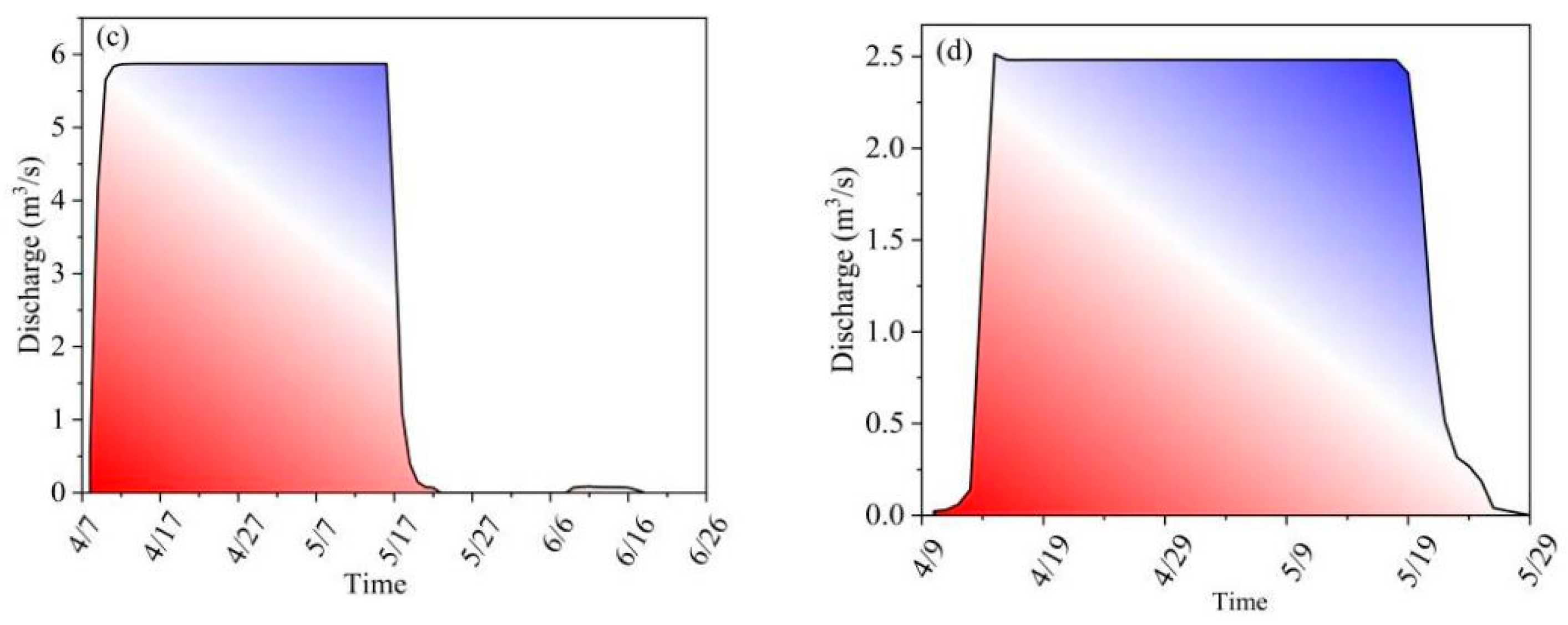
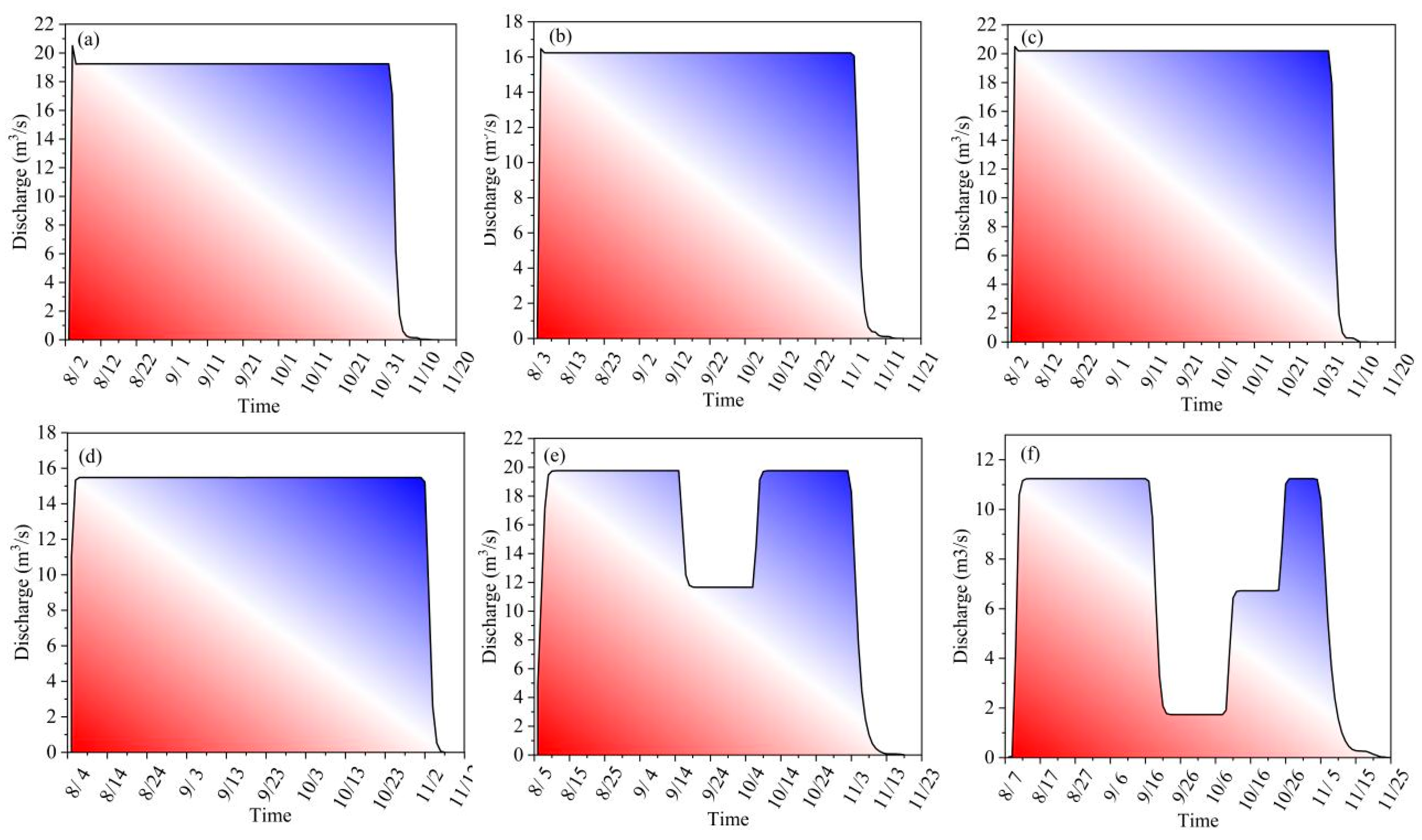
3.3. Determination of the Water Supply Plan for the Lower Reaches of the Tarim River
4. Discussion
4.1. New Ideas for Determining the Appropriate Lake Surface Area
4.2. Water Supply Plans for Maintaining the Ecological Security of Lakes
5. Conclusions
Author Contributions
Funding
Institutional Review Board Statement
Informed Consent Statement
Data Availability Statement
Conflicts of Interest
References
- Lv, G.; Wang, Y.; Ma, X.; Han, Y.; Luo, C.; Yu, W.; Liu, J.; Du, Z. Trade-Offs and Synergies of Ecosystem Services in Terminal Lake Basins of Arid Regions Under Environmental Change: A Case Study of the Ebinur Lake Basin. Land 2025, 14, 1240. [Google Scholar] [CrossRef]
- Cao, Y.; Fu, C.; Yang, M.; Wu, H.; Wu, H.; Zhang, H.; Xia, Y.; Zhu, Z. Exploring the Drivers for Changes in Lake Area in a Typical Arid Region during Past Decades. Water 2023, 15, 3354. [Google Scholar] [CrossRef]
- Li, Y.; Ma, L.; Wang, J.; Liu, W.; Abuduwaili, J. Diffusion Process and Risks of Heavy Metal(Loid)s in an Arid-Region Lake Sediments: Influencing Factors and Management Suggestions. J. Environ. Manag. 2025, 393, 127092. [Google Scholar] [CrossRef]
- Li, X.; Liu, Q.; Gui, D.; Ci, M.; Liu, Y.; Nuerhamanti, N.; Ma, X. Zonation-Based Prioritization of Vegetation Conservation for Terminal Lakes in Drylands. Ecol. Inform. 2024, 79, 102400. [Google Scholar] [CrossRef]
- Liu, K.; Chen, Y.; Wu, B.; Xu, H.; Waheed, A.; Gao, F.; He, B.; Zhou, L.; Wu, J.; Zhang, Q. Enhancing Water Use Efficiency: Insights from Hydrological Variability Encounter of Multiple Water Sources and Implications for Terminal Lake Management in Arid Regions. Ecol. Indic. 2025, 175, 113564. [Google Scholar] [CrossRef]
- Li, Z.; Wang, Z.; Xue, M.; Shan, N.; Xu, X.; Yang, W.; Gu, X.; Zhao, C.; Wang, Q.; Bao, M. Contribution of LGD Source Carbon to the Carbon Emission of Eutrophic Steppe Lakes in Northern Cold and Arid Regions. Ecol. Indic. 2025, 176, 113717. [Google Scholar] [CrossRef]
- Doulgeris, C.; Ntislidou, C.; Petriki, O.; Zervas, D.; Nikolaidou, R.; Bobori, D.C. Assessment of Environmentally Minimum Water Level in a Mediterranean Lake Using Morphological, Hydrological and Biological Factors. Sustainability 2024, 16, 933. [Google Scholar] [CrossRef]
- Wang, Y.; Zhou, X.; Engel, B. Water Environment Carrying Capacity in Bosten Lake Basin. J. Clean. Prod. 2018, 199, 574–583. [Google Scholar] [CrossRef]
- Pekel, J.-F.; Cottam, A.; Gorelick, N.; Belward, A.S. High-Resolution Mapping of Global Surface Water and Its Long-Term Changes. Nature 2016, 540. [Google Scholar] [CrossRef] [PubMed]
- Mueller, N.; Lewis, A.; Roberts, D.; Ring, S.; Melrose, R.; Sixsmith, J.; Lymburner, L.; McIntyre, A.; Tan, P.; Curnow, S.; et al. Water Observations from Space: Mapping Surface Water from 25 Years of Landsat Imagery across Australia. Remote Sens. Environ. 2016, 174, 341–352. [Google Scholar] [CrossRef]
- Dou, X.; Liu, D.; Wang, S.; Chen, F. Assessment of the Environmental Effects of Ecological Water Conveyance over 31 Years for a Terminal Lake in Central Asia. Catena 2022, 208, 105725. [Google Scholar] [CrossRef]
- Zhang, Y.; Ling, H.; Yan, J.; Zhang, Y.; Qin, X. Determination of Water Surface Area Thresholds for Terminal Lakes in Arid Regions: Balancing Ecological Security and Water Use Efficiency. Water Resour. Manag. 2025, 39, 3801–3815. [Google Scholar] [CrossRef]
- Shang, H.; Shang, C. A Simplified Method for Estimating the Ecological Water Demand of Wetlands in Arid Regions. Water 2018, 10, 1056. [Google Scholar] [CrossRef]
- Yang, W.; Xu, M.; Li, R.; Zhang, L.; Deng, Q. Estimating the Ecological Water Levels of Shallow Lakes: A Case Study in Tangxun Lake, China. Sci. Rep. 2020, 10, 5637. [Google Scholar] [CrossRef]
- Wang, X.; Xu, H.; Liu, K.; Zhao, X.; Wei, G.; Aili, A.; Zheng, G. Ecological Water Conveyance-Driven Wetland Hydrological Connectivity and Morphological Changes in Arid Regions: An Analysis of the Taitema Lake Wetland. J. Environ. Manag. 2025, 385, 125615. [Google Scholar] [CrossRef]
- Zhang, C.; Chen, W.; Huang, F. Determining the Suitable Ecological Water Level Based on the Response Relationship between Landscape Connectivity and Water Level: A Case Study of Poyang Lake, China. Ecol. Indic. 2025, 175, 113562. [Google Scholar] [CrossRef]
- Chen, W.; Wang, J.; Cao, X.; Teng, D.; Huang, S.; Li, Z.; Chen, Y. Assessing Arid Inland Lake Watershed Area and Vegetation Response to Multiple Temporal Scales of Drought across the Ebinur Lake Watershed. Sci. Rep. 2020, 10, 1354. [Google Scholar] [CrossRef] [PubMed]
- Wickert, A.D.; Brook, G.A.; Bordonali, C.; Shen, J.; Zhang, Y.; Cai, Y. Desiccation of the Tarim River, Xinjiang, China, and Mitigation. Quat. Int. 2011, 244, 264–271. [Google Scholar] [CrossRef]
- Ambroise, B. Variable ‘active’ versus ‘contributing’ areas or periods: A necessary distinction. Hydrol. Process. 2004, 18, 1149–1155. [Google Scholar] [CrossRef]
- Zhao, X.; Xu, H. Study on vegetation change of Taitemar Lake during ecological water transfer. Environ. Monit. Assess. 2019, 191, 613. [Google Scholar] [CrossRef]
- Zou, Z.; Yun, Y.; Sun, J. Entropy Method for Determination of Weight of Evaluating Indicators in Fuzzy Synthetic Evaluation for Water Quality Assessment. J. Environ. Sci. 2006, 18, 1020–1023. [Google Scholar] [CrossRef]
- Lin, L.; Wei, X.; Luo, P.; Wang, S.; Kong, D.; Yang, J. Ecological Security Patterns at Different Spatial Scales on the Loess Plateau. Remote Sens. 2023, 15, 1011. [Google Scholar] [CrossRef]
- Haile, A.T.; Abebe, M.T.; Tamene, L.; Demissie, S.S. Interannual Comparison of Historical Floods through Flood Detection Using Multi-Temporal Sentinel-1 SAR Images, Awash River Basin, Ethiopia. Int. J. Appl. Earth Obs. Geoinf. 2023, 124, 103505. [Google Scholar] [CrossRef]
- Meera Gandhi, G.; Parthiban, S.; Thummalu, N.; Christy, A. Vegetation Change Detection Using Remote Sensing and GIS – A Case Study of Vellore District. Procedia Comput. Sci. 2015, 57, 415–424. [Google Scholar] [CrossRef]
- Holben, B.N. Characteristics of Maximum-Value Composite Images from Temporal AVHRR Data. Int. J. Remote Sens. 1986, 7, 1417–1434. [Google Scholar] [CrossRef]
- Sandholt, I.; Rasmussen, K.; Andersen, J. A Simple Interpretation of the Surface Temperature–Vegetation Index Space for Assessment of Surface Moisture Status. Remote Sens. Environ. 2002, 79, 213–224. [Google Scholar] [CrossRef]
- Costanza, R.; d’Arge, R.; de Groot, R.; Farber, S.; Grasso, M.; Hannon, B.; Limburg, K.; Naeem, S.; O’Neill, R.V.; Paruelo, J.; et al. The Value of the World’s Ecosystem Services and Natural Capital. Nature 1997, 387, 253–260. [Google Scholar] [CrossRef]
- Haines-Young, R.; Chopping, M. Quantifying Landscape Structure: A Review of Landscape Indices and Their Application to Forested Landscapes. Prog. Phys. Geogr. 1996, 20, 418–445. [Google Scholar] [CrossRef]
- O’Neill, R.V.; Krummel, J.R.; Gardner, R.H.; Sugihara, G.; Jackson, B.; DeAngelis, D.L.; Milne, B.T.; Turner, M.G.; Zygmunt, B.; Christensen, S.W.; et al. Indices of Landscape Pattern. Landsc. Ecol. 1988, 1, 153–162. [Google Scholar] [CrossRef]
- Mandelbrot, B.B. The Fractal Geometry of Nature; W. H. Freeman and Company: San Francisco, CA, USA, 1983. [Google Scholar]
- McGarigal, K.; Marks, B.J. FRAGSTATS: Spatial Pattern Analysis Program for Quantifying Landscape Structure; General Technical Report PNW-GTR-351; USDA Forest Service: Portland, OR, USA, 1995.
- Turner, M.G. Spatial and Temporal Analysis of Landscape Patterns. Landsc. Ecol. 1990, 4, 21–30. [Google Scholar] [CrossRef]
- Jaeger, J.A.G. Landscape Division, Splitting Index, and Effective Mesh Size: New Measures of Landscape Fragmentation. Landsc. Ecol. 2000, 15, 115–130. [Google Scholar] [CrossRef]
- Al-Hanbali, A.; Kondoh, A. Groundwater Vulnerability Assessment and Evaluation of Human Activity Impact (HAI) within the Dead Sea Groundwater Basin, Jordan. Hydrogeol. J. 2008, 16, 499–510. [Google Scholar] [CrossRef]
- Hu, T.; Zhang, D.; Wang, J. A Meta-Analysis of the Trait Resilience and Mental Health. Personal. Individ. Differ. 2015, 76, 18–27. [Google Scholar] [CrossRef]
- Lv, C.; Xu, W.; Ling, M.; Wu, Z.; Yan, D. Research on Emergy Evaluation Method of Ecological Water Use Efficiency Based on Comprehensive Benefits. Environ. Sci. Pollut. Res. 2023, 30, 69453–69464. [Google Scholar] [CrossRef]
- Pramanik, N.; Panda, R.K.; Sen, D. One Dimensional Hydrodynamic Modeling of River Flow Using DEM Extracted River Cross-Sections. Water Resour. Manag. 2009, 24, 835–852. [Google Scholar] [CrossRef]
- Nguyen, H.D.; Dang, D.K.; Nguyen, N.Y.; Pham Van, C.; Van Nguyen, T.T.; Nguyen, Q.-H.; Nguyen, X.L.; Pham, L.T.; Pham, V.T.; Bui, Q.-T. Integration of Machine Learning and Hydrodynamic Modeling to Solve the Extrapolation Problem in Flood Depth Estimation. J. Water Clim. Change 2023, 15, 284–304. [Google Scholar] [CrossRef]
- Nash, J.E.; Sutcliffe, J.V. River Flow Forecasting through Conceptual Models Part I — A Discussion of Principles. J. Hydrol. 1970, 10, 282–290. [Google Scholar] [CrossRef]
- Li, X.; Jiang, X.; Lei, Y. Suitable Water Surface Area of the Tail Lake under the Constraint of Water Diversion Scheme in Arid Areas Based on Emergy Theory. J. Hydrol. Reg. Stud. 2023, 49, 101491. [Google Scholar] [CrossRef]
- Street-Perrott, F.A.; Harrison, S.P. Lake Levels and Climate Reconstruction. Palaeogeogr. Palaeoclimatol. Palaeoecol. 1985, 50, 1–57. [Google Scholar]
- Benson, L.; Paillet, F. The Use of Total Lake-Surface Area as an Indicator of Climatic Change: Examples from the Lahontan Basin. Quat. Res. 1989, 32, 262–275. [Google Scholar] [CrossRef]
- Dynesius, M.; Nilsson, C. Fragmentation and Flow Regulation of River Systems in the Northern Third of the World. Science 1994, 266, 753–762. [Google Scholar] [CrossRef]
- Eagleson, P.S. Climate, Soil, and Vegetation: 1. Introduction to Water Balance Dynamics. Water Resour. Res. 1978, 14, 705–712. [Google Scholar] [CrossRef]
- Running, S.W.; Nemani, R.R. Relating Seasonal Patterns of the AVHRR Vegetation Index to Simulated Photosynthesis and Transpiration of Forests in Different Climates. Remote Sens. Environ. 1988, 24, 347–367. [Google Scholar] [CrossRef]
- Le Houérou, H.N. Rainfall- and Drought-Related Dynamics of Vegetation in the Arid Regions of the World. J. Arid Environ. 1984, 7, 213–247. [Google Scholar] [CrossRef]
- Schirpke, U.; Candiago, S.; Egarter Vigl, L.; Jäger, H.; Labadini, A.; Marsoner, T.; Meisch, C.; Tasser, E.; Tappeiner, U. Integrating Supply, Flow and Demand to Enhance the Understanding of Interactions among Multiple Ecosystem Services. Sci. Total Environ. 2019, 651, 928–941. [Google Scholar] [CrossRef]
- Yang, H.; Wang, J.; Li, J.; Zhou, H.; Liu, Z. Modelling Impacts of Water Diversion on Water Quality in an Urban Artificial Lake. Environ. Pollut. 2021, 276, 116694. [Google Scholar] [CrossRef]
- Mo, C.; Ruan, Y.; Xiao, X.; Lan, H.; Jin, J. Impact of Climate Change and Human Activities on the Baseflow in a Typical Karst Basin, Southwest China. Ecol. Indic. 2021, 126, 107628. [Google Scholar] [CrossRef]
- Song, J.-H.; Shin, S.; Khare, Y.P.; Her, Y. Climate Change Impacts on Streamflow and Nutrient Loading to Lake Okeechobee. Clim. Change 2023, 176, 178. [Google Scholar] [CrossRef]
- Wang, G.; Lv, C.; Gu, C.; Yu, Y.; Yang, Z.; Zhang, Z.; Tang, C. Pollutants Source Assessment and Load Calculation in Baiyangdian Lake Using Multi-Model Statistical Analysis. Water 2022, 14, 3386. [Google Scholar] [CrossRef]



| Indicator | Purpose | Calculation Method |
|---|---|---|
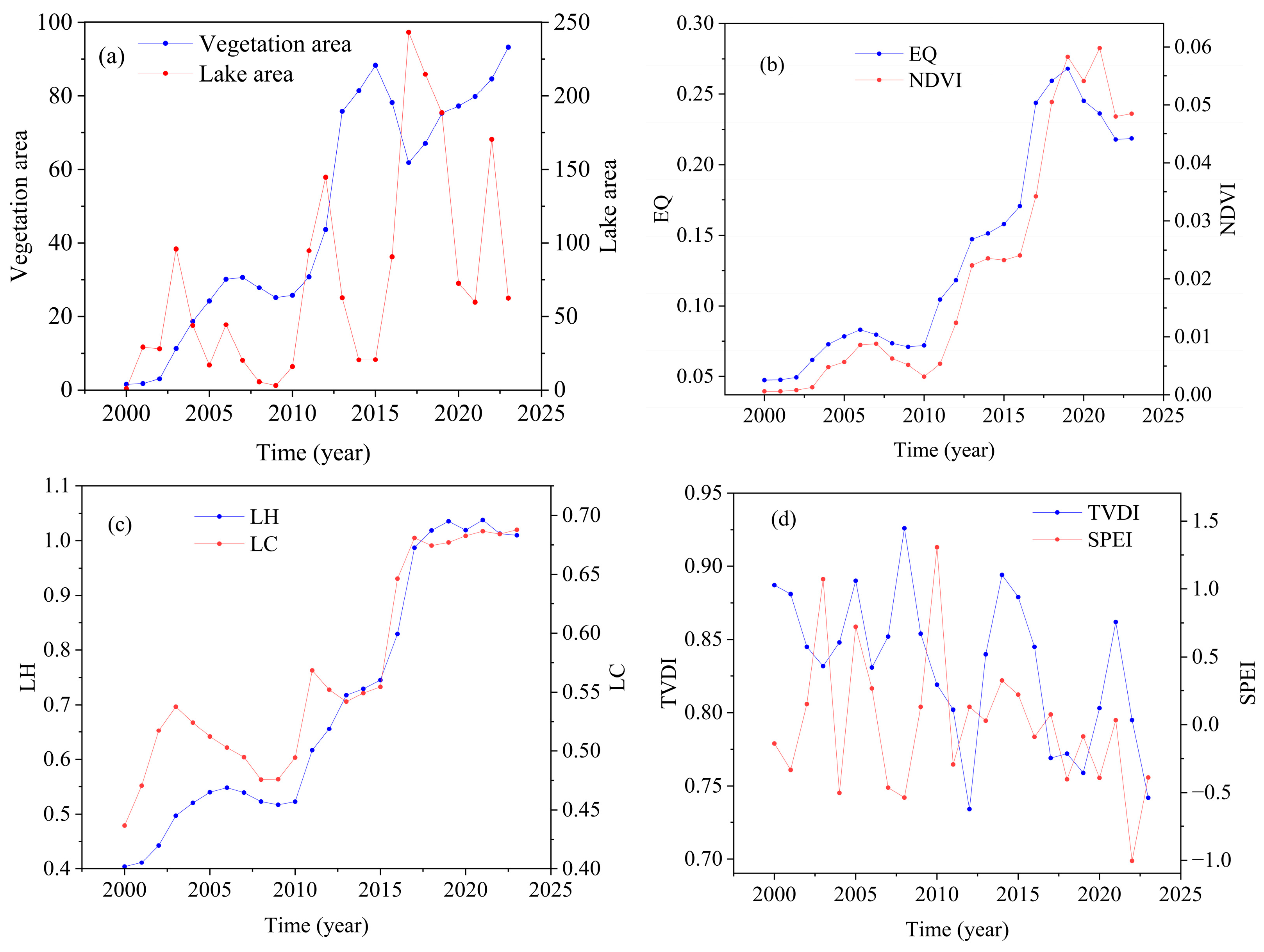
| LA | Characterizes the annual surface area of effective lake water bodies. | On the Google Earth Engine platform, the JRC Global Surface Water dataset is used. A pixel is classified as water if it is identified as water in ≥7 months within a given year, and the annual lake area is obtained by summing all such water pixels [23]. |
| VA | Reflects the total area covered by vegetation. | Based on the NDVI, areas with NDVI > 0.1 are considered vegetated; whereas areas with NDVI < 0.1 are regarded as non-vegetated [24]. The vegetation area (VA) is obtained by summing all pixels with NDVI > 0.1. |
| NDVI | Reflects vegetation cover. | The annual NDVI is derived using the maximum value composite method: NDVI images for all 12 months in a year are collected, and for each pixel, the maximum monthly NDVI value is taken as that pixel’s annual NDVI [25]. |
| TVDI | Used to characterize surface drought conditions. | is the minimum land surface temperature corresponding to the same NDVI value [26]. |
| SPEI | Reflects the degree to which drought conditions over a given period deviate from the multi-year normal. | Monthly mean precipitation, monthly mean air temperature, and geographic coordinates (latitude and longitude) are imported into Python 3.8.0. The SPEI is then calculated using standard SPEI calculation codes to obtain time series of drought indices. |
| EQ | Characterizes the overall health status of an ecosystem. | , is unused land area, A is the total area of the study region, and Abio is the normalization coefficient of the habitat quality index (458.5 for the Taitema Lake region) [27,28]. |
| LH | Evaluates landscape diversity. | , where SHDI is the Shannon diversity index, and PAFR_AC is the area-weighted mean patch fractal dimension index [29,30]. |
| LC | Evaluates landscape connectivity. | , where IJI is the interspersion and juxtaposition index, CONTAG is the contagion index, and DIVISION is the landscape division index [31,32,33]. |
| Primary Indicator | Secondary Indicator | Weight |
|---|---|---|
| Landscape Structure | Landscape Heterogeneity (LH) | 0.097 |
| Landscape Connectivity (LD) | 0.083 | |
| Steady-State Condition | Lake Area (LA) | 0.234 |
| Vegetation Area (VA) | 0.209 | |
| Normalized Difference Vegetation Index (NDVI) | 0.112 | |
| Ecological Quality (EQ) | 0.106 | |
| Habitat Elements | Temperature Vegetation Dryness Index (TVDI) | 0.085 |
| Standardized Precipitation Evapotranspiration Index (SPEI) | 0.074 |
| Primary Category | Secondary Category | Grassland | Water Body | Unused Land | Construction Land |
|---|---|---|---|---|---|
| Supply Services | Food Production | 1505.46 | 0 | 0 | 0 |
| Raw Material Production | 1693.64 | 865.64 | 0 | 0 | |
| Regulation Services | Gas Regulation | 1505.46 | 38,351.50 | 56.45 | 0 |
| Climate Regulation | 3669.55 | 18.82 | 37.64 | 0 | |
| Hydrological Regulation | 2465.18 | 34,211.50 | 18.82 | 0 | |
| Waste Treatment | 2051.18 | 4685.73 | 639.82 | 0 | |
| Supporting Services | Soil Retention | 564.55 | 188.18 | 18.32 | 0 |
| Biodiversity Maintenance | 94.09 | 18.82 | 0 | 0 | |
| Cultural Services | Aesthetic Landscape Provision | 75.27 | 8167.1 | 18.82 | 82.6 |
| Total | 13,624.38 | 86,507.29 | 790.36 | 82.6 | |
Disclaimer/Publisher’s Note: The statements, opinions and data contained in all publications are solely those of the individual author(s) and contributor(s) and not of MDPI and/or the editor(s). MDPI and/or the editor(s) disclaim responsibility for any injury to people or property resulting from any ideas, methods, instructions or products referred to in the content. |
© 2026 by the authors. Licensee MDPI, Basel, Switzerland. This article is an open access article distributed under the terms and conditions of the Creative Commons Attribution (CC BY) license.
Share and Cite
Zhang, H.; Ling, H.; Chen, F. Determination of the Suitable Lake Surface Area of Typical Terminal Lakes in Arid Regions. Sustainability 2026, 18, 1411. https://doi.org/10.3390/su18031411
Zhang H, Ling H, Chen F. Determination of the Suitable Lake Surface Area of Typical Terminal Lakes in Arid Regions. Sustainability. 2026; 18(3):1411. https://doi.org/10.3390/su18031411
Chicago/Turabian StyleZhang, Hao, Hongbo Ling, and Fulong Chen. 2026. "Determination of the Suitable Lake Surface Area of Typical Terminal Lakes in Arid Regions" Sustainability 18, no. 3: 1411. https://doi.org/10.3390/su18031411
APA StyleZhang, H., Ling, H., & Chen, F. (2026). Determination of the Suitable Lake Surface Area of Typical Terminal Lakes in Arid Regions. Sustainability, 18(3), 1411. https://doi.org/10.3390/su18031411