Article

Ecological Niche Analysis Based on Phytoindicative Assessment of Reed–Sedge Marsh Vegetation in the East European Plain

1
Department of Grassland and Landscape Planning, University of Life Sciences in Lublin, 20-950 Lublin, Poland
2
Department of Applied Mathematics and Computer Science, University of Life Sciences in Lublin, 20-950 Lublin, Poland
3
Institute of Agricultural Sciences, Land Management and Environmental Protection, Faculty of Technology and Life Sciences, University of Rzeszów, 35-601 Rzeszów, Poland
4
Institute of Mathematics, Informatics and Landscape Architecture, John Paul II Catholic University of Lublin, 20-950 Lublin, Poland
*
Author to whom correspondence should be addressed.
Sustainability 2026, 18(3), 1396; https://doi.org/10.3390/su18031396
Submission received: 27 November 2025 / Revised: 19 January 2026 / Accepted: 26 January 2026 / Published: 30 January 2026
(This article belongs to the Special Issue Plant Ecological Function Research and Ecological Conservation)

Abstract

Wetlands characterized by the presence of rare and endangered reed plant communities are seriously threatened by hydrological changes and pollution caused by human activity, e.g., drainage, river regulation, and conversion to agricultural land. Despite numerous studies of wetland communities, the “volume of ecological niche” based on Ellenberg indices, i.e., the ecological preferences of vascular plant species, has rarely been analyzed at the level of entire plant communities. Properly defined indicators of microclimatic and habitat factors (ranges of environmental conditions), appropriate for individual rush and sedge communities (specific communities), are very important for the sustainable management of ecosystems and potential restoration processes in renaturation activities. Therefore, a comprehensive floristic and habitat assessment of wetland communities of the Phragmitetea class was conducted in a Natura 2000 site in southeastern Poland (name and number of the Natura 2000 site—Wolica Valley PLH060058), located within the East European Lowland. The communities were analyzed in the context of the variability of individual Ellenberg indices and designated ecological hypervolumes. These were typical rush communities occurring in wet and fertile soils with a neutral or alkaline pH. The microclimatic conditions were typical for these habitats. The studied communities differ in terms of the variability of Ellenberg ecological indices. Some of them are characterized by low ecological niches, while others are characterized by larger ones. The volume of determined multidimensional hypervolumes allowed us to distinguish two communities (Phragmitetum australis and Caricetum rostratae) to have greater generality compared to the others. They can occur in a greater variety of environmental conditions than other communities that require more specific conditions. Other phytocenoses with low hypervolume values (hypervolumes more than 10 times smaller than mentioned before) were distinguished by high habitat specialization. In turn, the analysis of the overlapping of hypervolumes allowed us to group communities into four clusters with similar ranges of Ellenberg indices’ values: (1) Caricetum distichae and Caricetum gracilis; (2) Glycerietum maximae, Iridetum pseudoacori, Caricetum appropinquatae, and Phalaridetum arundinaceae; (3) Phragmitetum australis and Caricetum rostratae; and (4) Caricetum acutiformis, Caricetum vesicariae, and Caricetum elatae.

1. Introduction

Wetlands are recognized as areas of high biodiversity that significantly contribute to the ecological coherence of the Natura 2000 network. They play a key role in maintaining biodiversity and ecosystem services, despite threats from human activities and climate change [1,2,3,4,5,6,7,8,9,10,11,12,13,14,15]. Wetlands play a crucial role in reducing carbon emissions and thus mitigating climate change [15], a finding supported by the Millennium Ecosystem Assessment [16], which identifies climate regulation as one of the most important ecosystem services provided by these areas. Wetlands are characterized by the presence of rare and endangered plant communities [6,11,17,18,19,20,21,22]. The uniqueness of wetlands in the modern world is enshrined in the Ramsar Convention, an international agreement dating back to 1971. Poland has been a party to this agreement since 1978, and 19 such areas have been designated in our country. They play a key role in preserving the unique wetland vegetation of these habitats, the life cycles of amphibians, reptiles, and birds, storing water, preventing droughts and floods, accumulating large amounts of carbon, purifying the air, and they are a place of research for scientists [23].
Wetlands are seriously threatened by human-induced changes, such as hydrological changes, pollution, and invasive species. Land drainage causes carbon release and transforms habitats into eutrophic ones. Aquatic and marsh vegetation disappears irretrievably and is replaced by nitrophilic and invasive plant communities. The soil structure changes and often dries out in summer. This causes the disappearance of many animal species, including birds. To prevent this, targeted renaturation and conservation measures are necessary, e.g., active protection, restoration of degraded habitats, sustainable use, and promotion of knowledge about the importance of wetlands [24,25,26,27,28,29]. Desertification risk assessments have also shown that a significant proportion of plant communities are at risk, highlighting the need to prioritize conservation actions [25]. It is estimated that approximately 50% of peatlands and 25% of other wetlands had been destroyed by the early 20th century [30]. In the Wieprz River valley, Kulik et al. [31] reported lower moisture indices over the last 40 years. Sometimes deliberate human activity can contribute to an increase in wetland areas, e.g., through the creation of artificial water reservoirs, the lack of river regulation, the preservation of oxbow lakes, and the creation of polders. In Europe, unfavorable changes in the species composition of wetland communities are increasingly observed [31,32,33,34,35], caused by both changes in habitat conditions and changes in land use, which can lead to the succession of nitrophilous, ruderal, or invasive vegetation [4,35,36,37,38,39,40,41,42]. The connectivity of wetland habitats within and outside Natura 2000 sites is crucial for maintaining biodiversity. Studies have demonstrated the importance of well-connected landscapes for maintaining ecological coherence and supporting diverse species communities. In Germany, Natura 2000 sites cover 20% of the country’s land area, with lower coverage in the Nordic countries, France, and the Netherlands, and a low coverage in the United Kingdom—1.1% [1,43,44].
Phytoindication methods are used in studies of natural and anthropogenic ecosystems in Central Europe [45]. Tutova et al. [46] argue that it is a valuable tool for conservation monitoring, restoration planning, and ecosystem service assessment. However, it requires complementary analyses (evaluation of correlation structure, ordination, and variance partitioning), as strong correlations between ecological indicator scales limit direct comparison of absolute values across space and time. Physicochemical studies cannot replace phytoindication because they only record the values of environmental factors, not the integrated, context-dependent, and often nonlinear responses of plant communities. On the other hand, indicator values are treated as estimates of the optimal position of species along gradients of environmental factors [47]. Therefore, it is an assessment of the ecosystem’s response to various environmental factors [48]. The Braun-Blanquet method is used to assess various plant ecosystems due to its versatility, advanced methodology, flexible classification criteria, and universal nomenclature [49]. Ellenberg indices have been widely used in geographical studies, including studies of meadows, wetlands, and forests [50]. Due to their narrower ecological amplitude, plant communities are more sensitive indicators of environmental conditions than individual species [51]. In the case of anthropogenic ecosystems, phytoindication studies can be used to assess light conditions in urban parks, which is a significant challenge for the management of ecosystem functions within the context of urban green spaces [52], and on nitrogen content and soil reaction in experimental meadow areas [53,54]. Phytoindication studies of forest ecosystems allow us to determine which environmental gradients are reflected in phytoindication in different forest types [55], and in the case of vascular plants, are helpful in determining the affiliation of their subspecies to specific habitats and plant communities in which they occur [56]. Ellenberg’s phytoindicative method is an indispensable tool in vegetation research as a result of disturbances and global climate changes occurring in Europe in recent years [49]. However, even in the case of partial destruction of the ecosystem, vegetation does not lose its indicator properties [57].
Effective monitoring and management of wetland habitats are essential for their conservation. For example, the use of sample plots, point transect methods, and visual assessments can provide valuable information on habitat conditions and biodiversity [58].
Every species or community requires appropriate living conditions. These conditions can be defined as an ecological niche, a combination of certain variables such as temperature, humidity, soil fertility, and the absence of pollution. Such an n-dimensional space for quantifying species niches is known as hypervolume. It has become an increasingly widespread tool in studies of functional diversity, enabling quantitative assessments of the volume and overlap of trait spaces in ecological communities. As an example of hypervolume analysis, a comparison of trait variation in native and alien plant species using traits like height, leaf area, or leaf dry matter content can be found [59]. It showed that both native and alien species occupy overlapping spaces, but aliens are more variable than natives. In the context of wetland communities, direct applications of hypervolume approaches remain relatively scarce. However, numerous studies on plant functional traits and their responses to hydrological conditions and drainage highlight the strong potential of multidimensional approaches for advancing our understanding of wetland ecosystem structure and resilience. Such an analysis of the ecological niche was used, for example, to assess environmental requirements and sensitivity of aquatic Isoëtes species to certain water physical and chemical factors, such as total phosphorus, total nitrogen, pH, or conductivity [60].
Some species are characterized by a wide range of possible conditions, generally a broad ecological niche. Other species, on the other hand, are highly sensitive to change and can only occur under very specific conditions. These are specific species, characterized by a narrow niche. Species (communities) sharing a common niche will compete for resources, while those with different niches will prefer different environments [61]. Specific habitats include wetlands, which are crucial for biodiversity conservation, offering a broad ecological niche that supports a wide variety of species. However, they face numerous threats that require comprehensive monitoring, targeted conservation actions, and improved ecological connectivity to ensure their long-term survival and functionality. Integrating habitat and species perspectives can improve conservation strategies and provide effective wetland management tools [1,4,25,27,44]. A variety of tools are used to assess biodiversity and ecological niche breadth in wetland habitats, such as spatial analysis, remote sensing techniques, and vegetation analysis. For example, hyperspectral and lidar data have been used to map ecosystem diversity with high thematic resolution [62]. Moreover, vegetation studies using the Braun-Blanquet method [20,21,31], phytoindicative indices [21,63,64,65,66,67,68,69,70], or other analyses help in understanding the ecological fingerprint of wetland vegetation [2,35].
Entire plant communities are better indicators of habitat than individual species—the amplitude of their ecological requirements is narrower than that of the species comprising them [66,68,70,71,72,73]. However, in Europe, the “ecological niche volume” based on Ellenberg’s indices has rarely been analyzed at the level of entire plant communities, especially wetlands. Therefore, a comprehensive floristic and habitat assessment of reed–sedge communities of the Phragmitetea class was conducted in a Natura 2000 site in southeastern Poland (Wolica Valley PLH060058), located within the East European Lowland, taking into account the ecological niche volume at the level of wetland plant communities. The communities were analyzed in the context of the variability of individual Ellenberg indices and designated ecological hypervolumes. Based on the size of the hypervolumes’ intersections, communities with similar ecological niches were identified. According to the wetland classification [74], the studied wetlands are marshes, defined as wetlands that are frequently or permanently flooded.
The aim of the study was to examine the reed and sedge marsh vegetation occurring in the Natura 2000 site PLH060058 Wolica Valley and to determine its species richness, as well as the light, thermal, continental, humidity, and soil pH conditions, and nitrogen abundance for the distinguished plant communities. The aim was to present a novel application of two known concepts, Ellenberg indices and hypervolumes, in wetland communities. It provides a quantitative framework to compare the width of communities’ ecological niches based on Ellenberg indices and to identify groups of communities with similar niches based on the degree of overlap of hypervolumes. The aim was also to test whether the concept of ecological niche hypervolume is a useful tool for studying wetland communities in Central Europe.

2. Materials and Methods

2.1. Study Area

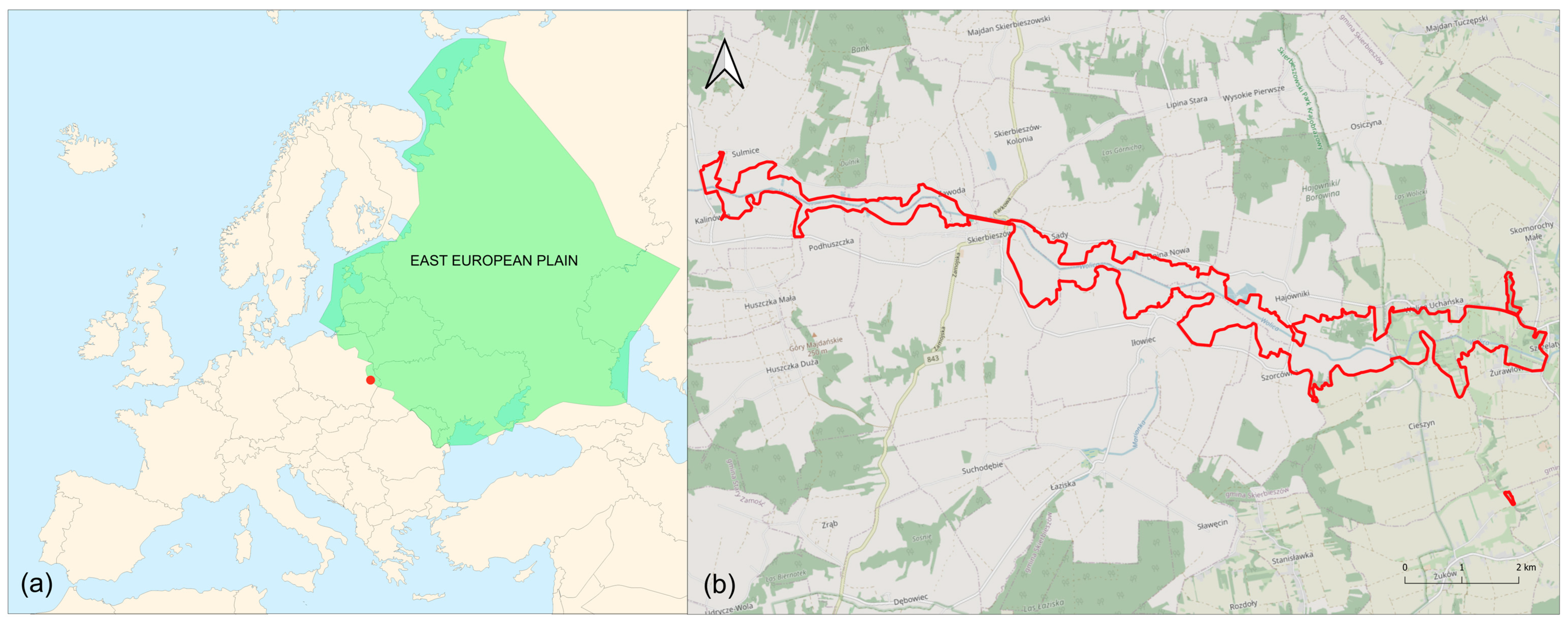
The Natura 2000 site Wolica Valley (PLH060058) is located in southeastern Poland, in the southwestern part of the East European Plain (Figure 1), approximately between 50.7958 and 50.8727° N and 23.2990–23.4994° E (WGS84). Boundary coordinates were derived from the site management plan [75] and transformed from the PL-1992 coordinate system to WGS84 [75,76]. The studied area is not located within the areas registered in the Ramsar Convention. The Poleski National Park Ramsar Site is located approximately 80 km north. The terrain is characterized by a parallel system of valleys and intervalley hummocks, and a large part of the surface is covered by loess and loess-like formations, 10–15 m thick, masking the relief of the Cretaceous bedrock and older Quaternary sediments [77,78]. Organic soils dominated: peat-muck, silt-muck, peat and silt bog, and black muck and proper earths [79,80,81].

2.2. Vegetation Research

The study covered Phragmitetea phytocoenoses developing in periodically drying ditches, valley depressions, and the Wolica River bed. In the analyzed wetland habitats, groundwater occurred at a depth of 10–50 cm, the lowest in the Glycerietum maximae, Caricetum acutiformis, and C. rostratae communities, and the highest in C. distichae. Study sites were designated based on topographic and geological maps to represent a variety of habitat conditions. Field studies were conducted in May–June 2018–2022 in reed–sedge marsh vegetation using the Braun-Blanquet method [82] to take phytosociological relevés on 10 m × 10 m (100 m2) in representative fragments reflecting the floristic diversity of the studied area. The phytosociological relevés were entered into the Turboveg database v.2.128 [83] and then subjected to numerical classification [84]. Analysis performed in the MULVA 5 program [85] allowed the studied patches to be classified into plant communities. Species nomenclature is provided according to Mirek et al. [86]. The names of the subordinate syntaxons of the class Phragmitetea R. Tx. et Prsg 1942 are given according to Matuszkiewicz [12], also referring to the European study by Mucina et al. [87], according to which the class of wetland communities is called Phragmito-Magnocaricetea Klika in Klika et Novák 1941. In the case of the class of reed swamp and sedge bed, there are no differences in the affiliation of individual communities to higher units between the above-mentioned phytosociological schools.

2.3. Statistical Analysis

The floristic diversity of the communities was determined based on numerical classification and floristic diversity indices. Based on numerical, quantitative, and qualitative analysis [88,89], 11 plant associations were identified from 166 phytosociological relevés of the class Phragmitetea (Table 1). The floristic diversity of each defined plant association was determined based on species richness (S), defined as the number of species in a single phytosociological relevé.
The phytoindicative assessment of wetland habitats was based on the analysis of identified plant communities and the calculation of Ellenberg’s [69] ecological indices, including light (L), temperature (T), continentality (K), habitat moisture (F), soil pH (R), and trophism (N). Each index describes a species’ optimum or preferred conditions along a specific ecological gradient, typically on a 1–9 or 1–12 scale. The following gradients are used: L—from deep shade (1) to full sun (9), T—from cold-adapted (1) to warmth-loving (9), K—from oceanic (1) to continental (9), F—from extremely dry (1) to submerged aquatic (10–12), R—from strongly acidic (1) to strongly basic (9), and N—from nutrient-poor (1) to nutrient-rich (9).
The value of the selected Ellenberg index E for the selected community was calculated according to the formula:
E i = j = 1 S i E j · p i j
where E—Ellenberg index (E = L, T, K, F, R or N), i—community index, j—species index, Si—number of species in i-th community, Ej—Ellenberg index for species j, and pij—share of j-th species in j-th community.
The calculated diversity indices were statistically assessed using R ver. 4.5.0 statistical software. A one-way analysis of variance (ANOVA) with Welch’s correction for unequal variances was used to compare mean values of the indices between groups, with the community as a factor. Tukey’s multiple comparisons test (HSD) for unequal samples was used to precisely identify communities with statistically significant differences in the indices’ values. A significance level of α = 0.05 was used for these tests.
In addition to the analysis of individual indices, the overall ecological niche was also examined using all of Ellenberg’s climatic indices. For this purpose, six-dimensional hypervolumes were constructed using the hypervolume package ver. 3.1.6 [90]. Hypervolumes were constructed by random points using a Gaussian kernel density estimate (function hypervolume_gaussian) on an adaptive grid of random points wrapped around the original data points [90,91]. This method assumes that values accumulate around the mean value, and outliers are of less importance. To compare ecological niches, areas of overlap between the hypervolumes of individual communities were determined. The Sørensen–Dice similarity index was used to measure the similarity (or overlap) between two ecological communities. It is calculated using the following formula:
S D I = 2 c a + b
where c is the number of common elements to both samples, a is the number of elements in the first sample, and b is the number of elements in the second sample. The resulting index ranges from 0 (no similarity) to 1 (complete similarity). Based on the obtained SDI values, clusters of communities with similar ecological niches were identified. The grouping of communities into similar groups was presented in a dendrogram constructed using Ward’s statistics. Additionally, principal component analysis (PCA) was performed to reduce the number of analyzed indicators and identify those that most differentiated the communities [92].
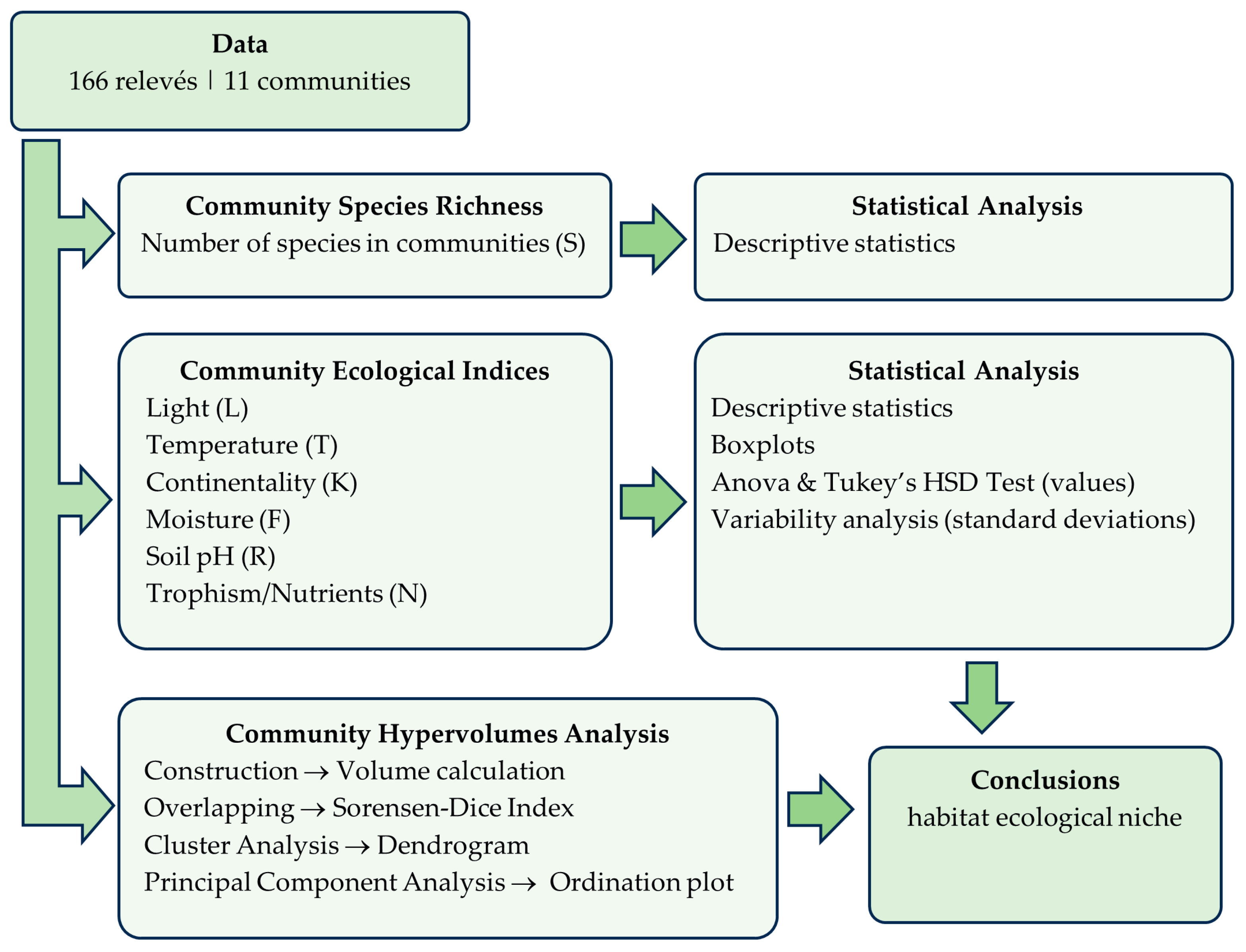
The stages of the ecological niche analysis are presented schematically in Figure 2.

3. Results

Phragmitetea class phytocenoses R. Tx. et Prsg 1942 [12] are characterized by a wide ecological amplitude and floristic diversity, which allows the distinction of lower phytosociological units. According to Mucina et al. [87], the name of this class is Phragmito-Magnocaricetea Klika in Klika et Novák 1941. Analysis of 166 phytosociological relevés allowed the distinction of two associations: Phragmition (29 relevés, two associations) and Magnocaricion (137 relevés, nine associations). The average species richness (S) ranged from 13 to 24 species and was diverse (Table 1). The Phalaridetum arundinaceae (Par) association had the lowest average number of species (13), while the highest were Caricetum appropinquatae (Cap) (24) and Caricetum gracilis (Cg) (21).
The highest coefficient of species variation (Vc) was observed in the Caricetum elatae (Ce) (32.53%) and Glycerietum maximae (Gm) (32.37%) communities, while the lowest was observed in Caricetum vesicariae (Cv) (6.52%) and Caricetum appropinquatae (Cap) (6.87%).
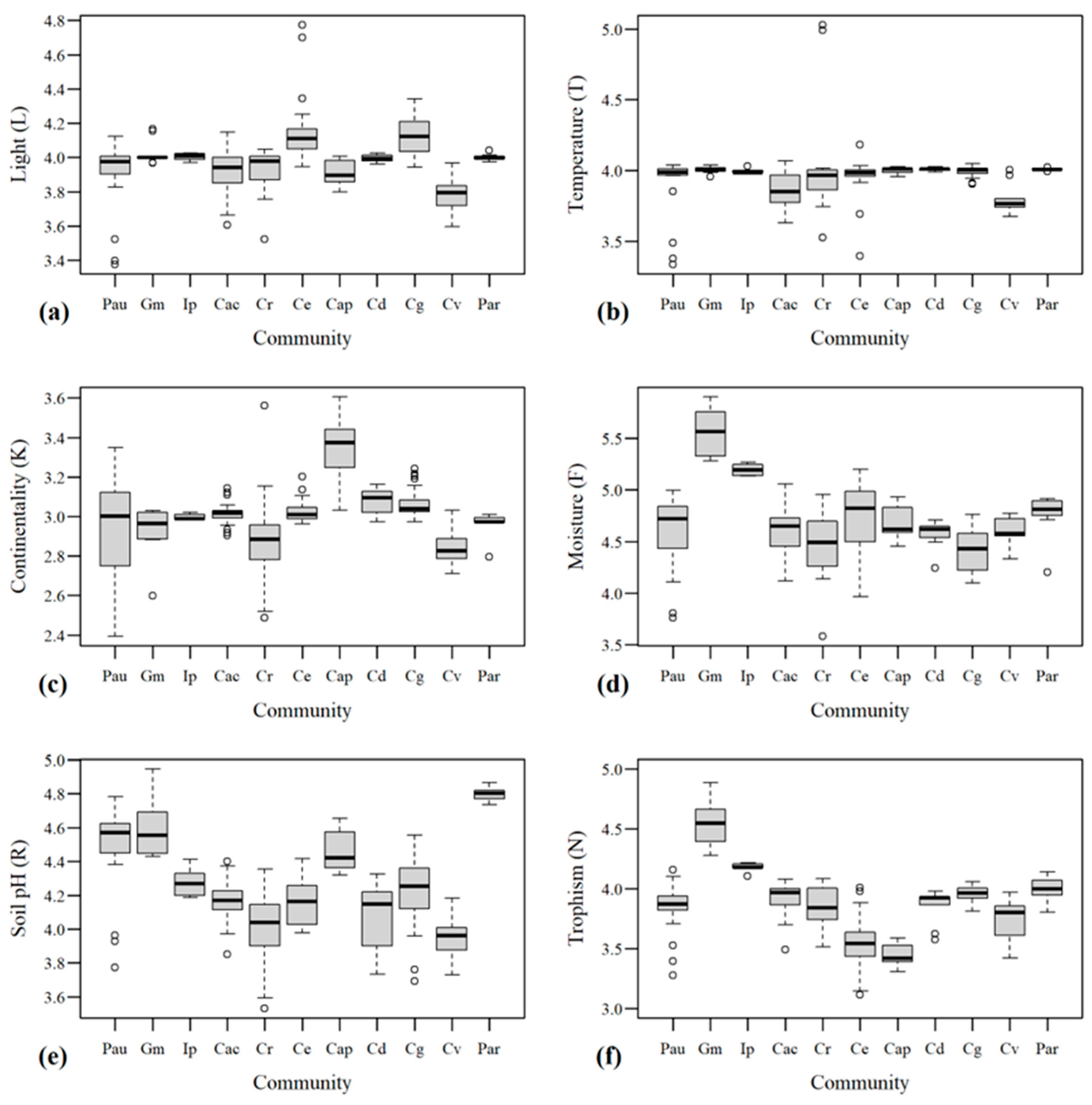
Variation in Ellenberg indices’ values within communities (between phytosociological relevés) and between communities is presented in box plots (Figure 3). The smallest niche was observed for the T index (Figure 3b). The average of the standard deviations calculated within each community for the T index was 0.101. This index is little differentiated within most communities and amounts to approximately four, as evidenced by the narrow interquartile range of the graphs. Slightly greater differentiation is visible for the L index (Figure 3a), where the average of the standard deviation for groups was 0.103; for K (Figure 3c) the average of the standard deviation was 0.116. In turn, the largest niche was found for the F index (Figure 3d), for which the average of the standard deviation was 0.226.
Considering the average standard deviations of all indices, the communities with the widest niche were Phragmitetum australis (Pau) (0.265) and Caricetum rostratae (Cr) (0.254). The least variation in standard deviations across all indices was observed for Iridetum pseudacori (Ip) (0.044), Phalaridetum arundinaceae (Par) (0.086), and Caricetum distichae (Cd) (0.096). However, it should be noted that in some cases outliers were observed, which indicates that the analyzed communities may also occur in slightly different environmental conditions.
In addition to the variability (niche), the values of the Ellenberg indices were also analyzed. The analysis of variance confirmed statistically significant differences in index values across the analyzed plant communities (Table 2). The smallest differences occurred in the mean values for the T index (ANOVA p-value = 0.037), while the remaining indices had p-values < 0.001. Tukey’s multiple comparisons test revealed significant differences only between the Caricetum rostratae (Cr) and Caricetum vesicariae (Cv) communities (p-value = 0.043). Caricetum elatae (Ce) had the significantly highest light index (L) (4.16), while the lowest was Caricetum vesicariae (Cv) (3.79). Less difference was observed in the mean values of temperature (T) and continentality (K) indices. Glycerietum maximae (Gm) (5.56) had the significantly highest moisture index (F), while Caricetum gracilis (Cg) (4.41) had the lowest. Phalaridetum arundinaceae (Par) had the significantly highest acidity index (R) (4.80), while Caricetum vesicariae (Cv) (3.96) had the lowest. Gm (4.56) had the significantly highest moisture index, while Caricetum appropinquatae (3.46) had the lowest.
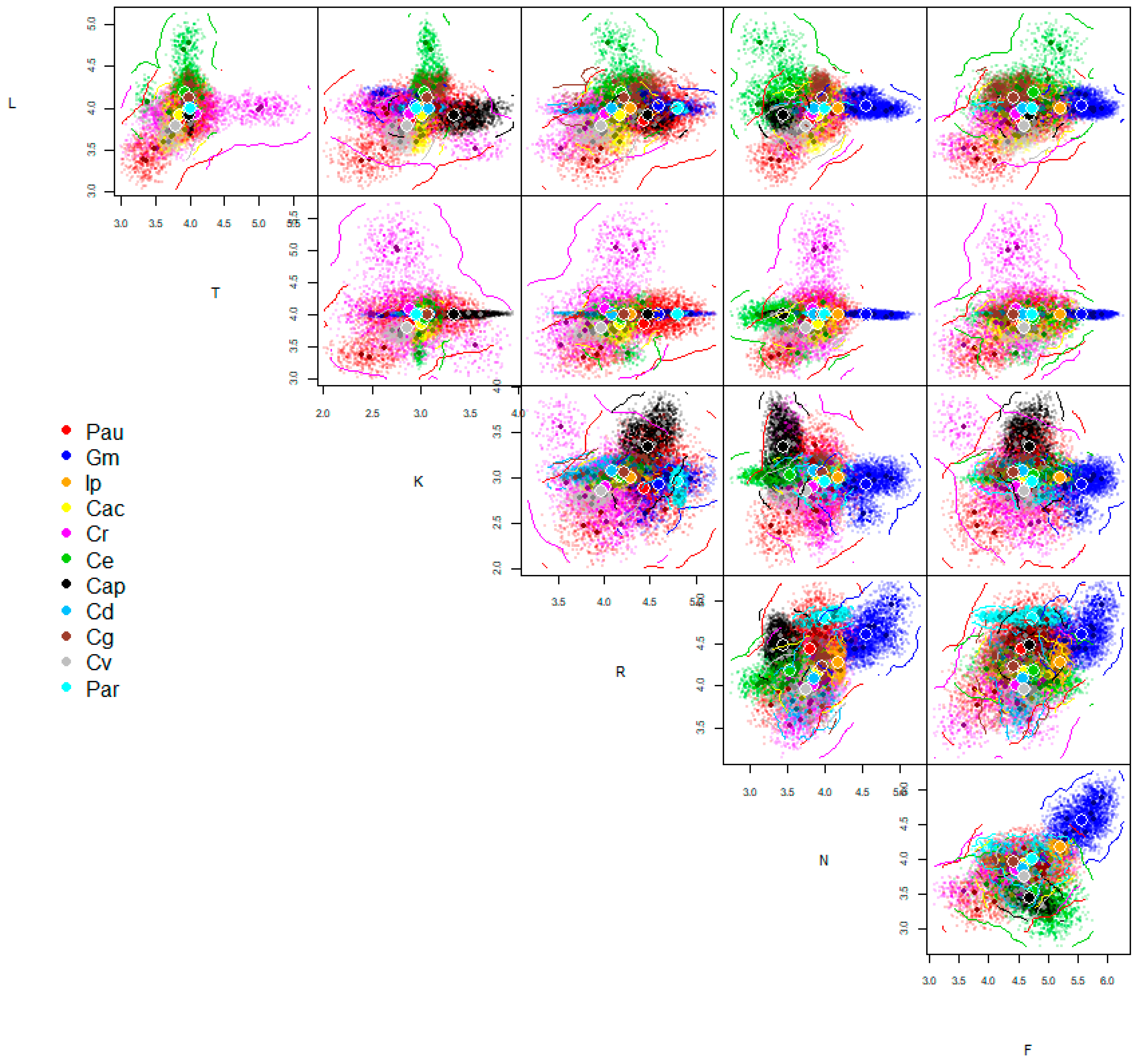
The combination of these six Ellenberg indices constitutes six-dimensional hypervolumes generated for each community. Figure 4 presents the created hypervolumes broken down into coordinate systems generated by individual indices. The hypervolumes are represented by random points generated according to a Gaussian function around the original points. In the case of the L index, the Ce community is clearly distinguished, for which the index values can be significantly higher compared to other communities, and Pau, with possible values lower than the others. In turn, the Cr community has a significantly wider niche of T index values, while Cap and Gm have a very narrow niche. In the case of the K index, the Cap and Cr communities can possibly achieve higher values compared to other communities. In turn, the Gm community is distinguished by higher values of R, N, and F compared to other communities. The Cap community has higher values of K and R but lower values of N. The Ce community has lower values of R. In the case of hypervolumes, however, the influence of outliers can be observed, which increases the range of generated hypervolumes compared to the standard deviations presented in Table 1.
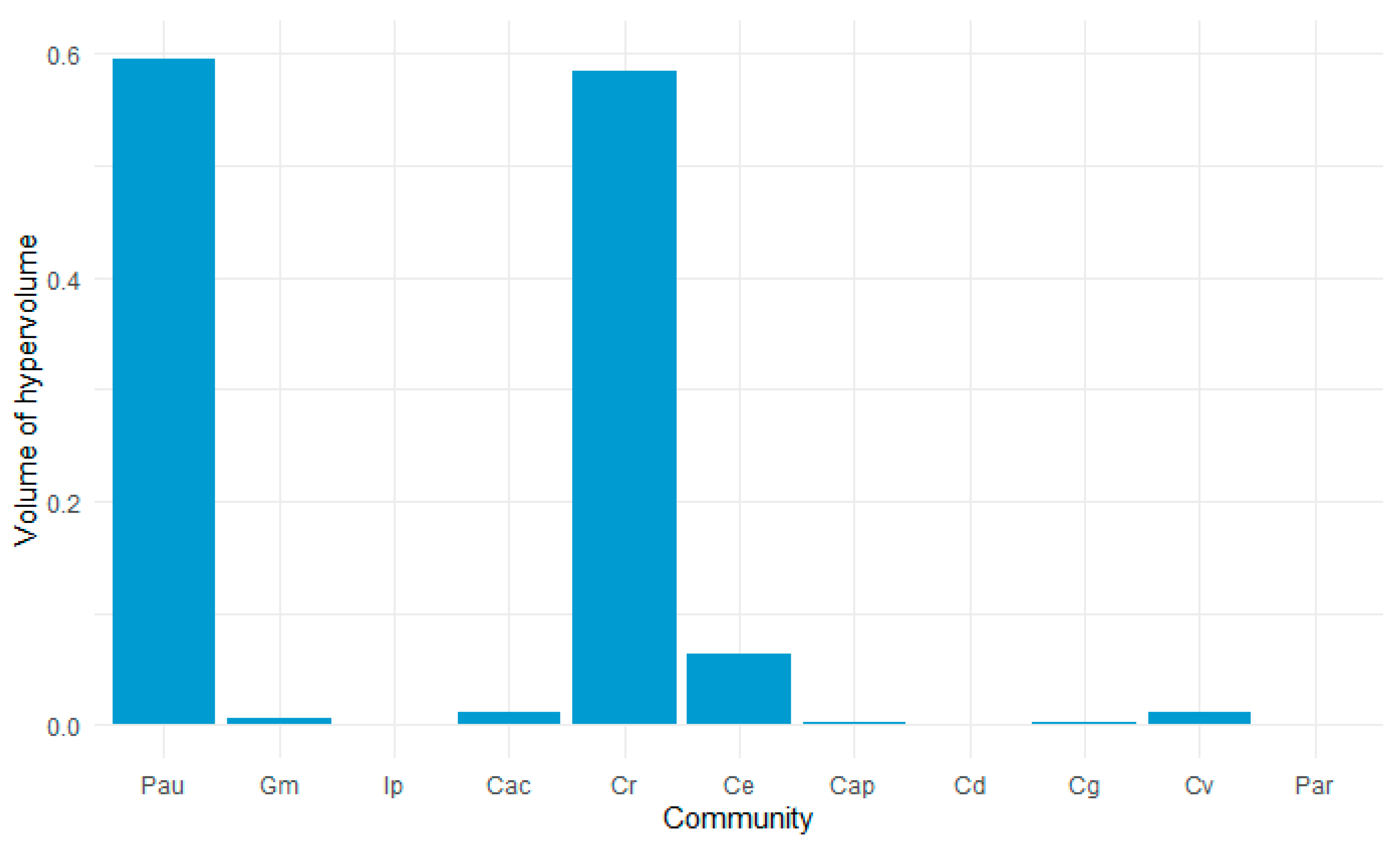
Volumes were calculated for the six-dimensional hypervolumes created for each community (Figure 5). As can be seen in the plot, two communities stand out from the rest. Communities Pau and Cr have much larger volumes (respectively, 0.595 and 0.58) than the others. This fact indicates that they can occur in different conditions, considering all 6 Ellenberg indices. This proves their greater generality compared to others. The volumes of the remaining hypervolumes do not exceed the value of 0.1, and the highest value in this group occurs for the Ce community (0.06). This indicates that these communities can be more specific in nature, requiring specific environmental conditions.
To compare the hypervolumes for individual communities, their relative positions were also analyzed. Table 3 presents the Sørensen–Dice similarity index (SDI) values, which determine the degree of overlap between hypervolumes. Analyzing the SDI values, significant variation was observed between the volumes’ positions. The highest value was obtained between Cac and Cv, at 0.3.
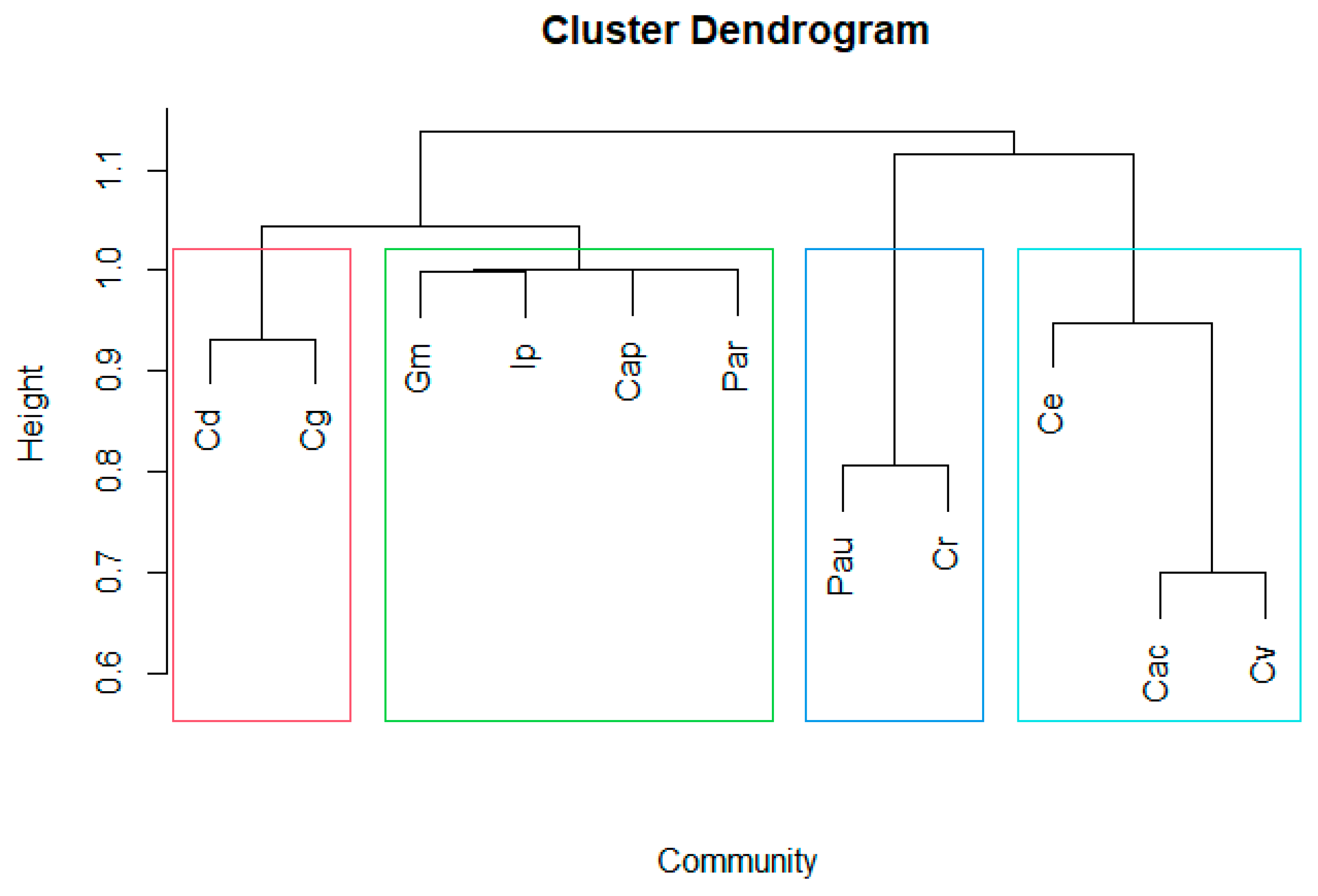
Based on the obtained values of the volume overlap index, the communities were grouped into clusters according to their similarity (Figure 6). Four groups of communities were distinguished: (1) Cd and Cg; (2) Gm, Ip, Cap, and Par; (3) Pau and Cr; and (4) Cac, Cv, and Ce. Cac and Cv, as well as Pau and Cr, are the most similar to each other. For these pairs, the dissimilarity measures (height) are the lowest, approximately 0.7 and 0.8, respectively. In other cases, despite belonging to the same clusters, individual communities demonstrate quite a strongly differentiated ecological niche.
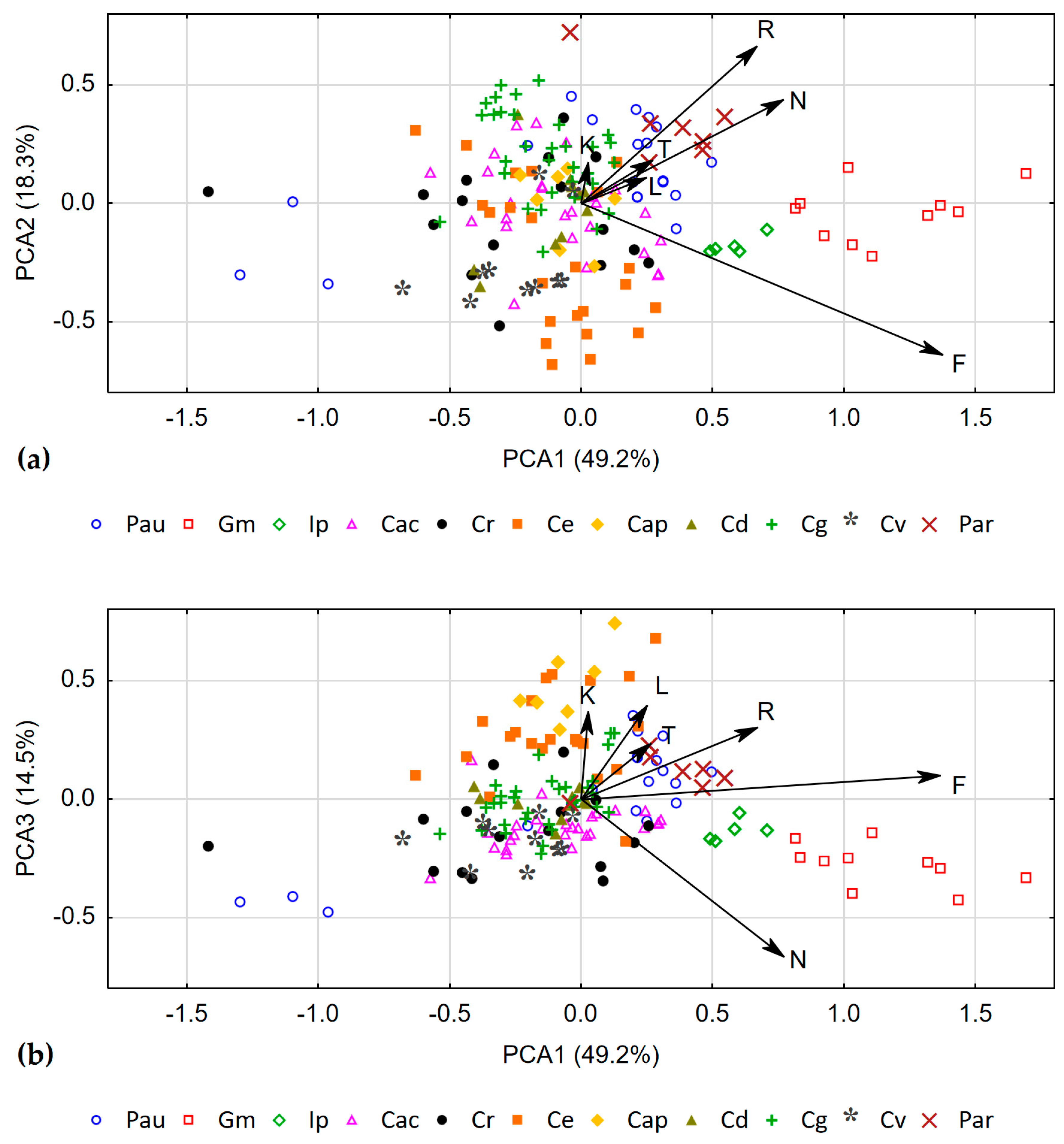
To facilitate visualization of the ecological niche of the studied communities, PCA was also performed, confirming the previously described differences between the analyzed communities. Thanks to the dimensionality reduction offered by this method, it is possible to present the diversity of the communities in a 3D plot. The first three components determined by the method (PCA1, PCA2, and PCA3) explain 82% of the total variability in the ecological coefficient values found in the dataset (Figure 7). The contribution of the individual components is 49.2% for PCA1, 18.3% for PCA2, and 14.5% for PCA3, respectively. Three indices, F, R, and N, contributed the most to the values of these principal components, having the greatest impact on diversity. PCA1 is positively correlated with all indices (Figure 7a), PCA2—positively with R and N and negatively with F (Figure 7a,b), while the PCA3 component—negatively with F and positively with the L, K, and R indices (Figure 7b). The most distinctive community is Gm, which has the highest values of the PCA1 component and indirectly also higher values of the F, N, and R indices. Slightly lower values of the PCA1 (Figure 7a) component are found in the assemblages: Ip, Par, and Pau, with the occurrence of Ip being more closely related to moisture (F), and the other two to acidity (R) and fertility (N). For the Z1 community, three deviating observations can be observed, indicating that species with lower R, N, and F values may occur in these communities. Analyzing the distribution of points according to PCA2, it should be noted that the Cg community had positive values, while the Cv and Ce communities had negative values (Figure 7a,b). In the case of the PCA3 component, higher values can be observed for the Ce and Cap communities and lower values for Gm, Ip, Cv, or Cac (Figure 7b). The principal component analysis, which reduces the visual analysis to three dimensions, confirms the existence of differences in the ecological niche width of the studied communities. It can be observed that the communities differ in the obtained values of Ellenberg indices, as well as in the ranges of the obtained values.

4. Discussion

Phragmitetea wetland communities are characterized by significant floristic and ecological diversity [87,93,94]. The identified communities showed significant differences in both species richness and Ellenberg indices, reflecting their diverse habitat requirements and distinct ecological strategies [31,95,96,97]. The variation in Ellenberg indices’ values indicates that the analyzed wetland communities occupy a relatively narrow range of climatic conditions described by the numbers L, T, and K. This is typical for studies conducted on a regional scale, where a uniform macroclimate and similar spatial structure of habitats limit the variability of light and thermal conditions [69,97,98]. At the same time, the communities clearly differed in terms of trophism, pH, and habitat moisture (F, R, and N), which reflects the local heterogeneity of soils and water relations, typical of wetland phytocoenoses [31,93,99]. The strong variation in edaphic indices, coupled with the low variability of climatic indices, is consistent with the findings of previous studies and confirms that soil and hydrological conditions are the main factors determining the ecological diversity of Phragmitetea communities at the local scale [31,95]. With the increase in the intensity of anthropopressure, the value of the trophy index most often increases, while the value of the light and humidity indices decreases [57]. High hyperniche volume values indicate that reed–sedge marsh vegetation is capable of functioning under a wide range of moisture, soil nutrient, and pH conditions, which is consistent with the general interpretation of ecological niche width as a measure of environmental tolerance [61]. This observation corresponds well with previous data on the ecology of Phragmites australis and Carex rostrata, which are attributed to large ecological amplitude and high tolerance to variability in water and trophic regimes [100,101,102,103].
These results are consistent with more recent analyses, which indicate that the relationship between species richness and ecological niche width is weak, scale-dependent, and locally even negative [104,105,106]. Greater niche breadth and a greater degree of niche overlap may reflect greater functional redundancy and environmental flexibility in reed–sedge marsh communities, potentially increasing their ability to absorb fluctuations in habitat conditions. However, this interpretation is indirect and relies on relative measures of niche.
As shown by Devictor et al. [107] and Matias et al. [108], high ecological specialization translates into a narrower range of tolerable environmental conditions, which, despite promoting species richness in stable environments, increases the vulnerability of communities to disturbances. Our study results confirm this mechanism: narrow-niche communities exhibit high diversity in conditions of relative stability but are potentially more vulnerable to changes in water regime or trophic status.
The greatest ecological similarity was found between Caricetum acutiformis, C. gracilis, and Caricetum vesicariae, and between Phragmitetum australis and Caricetum rostratae. In both cases, these associations inhabit highly humid, eutrophic habitats within the Magnocaricion and Phragmition regions, with similar values of moisture, acidity, and trophism indices (Ellenberg’s F, R, and N), which is confirmed by the habitat characteristics of these associations [93,109,110,111].
Interpretation of Ellenberg’s six-dimensional hypervolumes revealed that only Phragmitetum australis (Pau) and Caricetum rostratae (Cr) were characterized by a very wide ecological niche. The high-volume values indicate the ability of these associations to function in a wide range of moisture, soil nutrient, and pH conditions. This observation is consistent with the ecological characteristics of Phragmites australis and Carex rostrata, which exhibit high tolerance to hydrological and trophic variability [69,87].
Most of the remaining communities exhibited a narrow ecological niche, indicating their highly specialized nature. In particular, sedge communities such as Caricetum distichae, C. acutiformis, and C. elatae exhibited small deviations in Ellenberg coefficients, suggesting a close link between their occurrence and a specific range of soil moisture and chemical conditions. Similar observations were made in studies of peat bogs and moor grass meadows, where sedge complexes were characterized by some of the lowest ecological tolerances among wetland vegetation [8,35].
These results contradict the common assumption that higher species richness correlates with a broader ecological niche. In this study, the communities with the highest species richness exhibited relatively narrow niches, while the floristically poor communities were characterized by broad habitat tolerance. This phenomenon is described by the “trade-off” theory between specialization and competitiveness, well known from wetland ecology [43,61]. High levels of ecological specialization may favor species diversity under stable conditions but make communities more sensitive to environmental changes.
Hypervolume overlap analysis revealed four clearly distinguished groups of communities. The greatest ecological similarity was between Caricetum acutiformis and C. vesicariae, and between Phragmitetum australis and C. rostratae. In both cases, similar niches result from similar moisture levels and similar R and N values. The overlap of niches between sedge communities is consistent with previous observations regarding their edaphic preferences [6,20].
In other groups, despite cluster classification, differences between communities were greater, suggesting the complexity of wetland ecology and the overlap of only some niche dimensions. This differentiation highlights the advantage of the hypervolume method over classical floristic analyses, which only consider similarities in species composition but do not reflect the multidimensional nature of habitat preferences [58,61].
In Europe, multidimensional niche analyses have so far focused primarily on the species level, while studies covering entire plant communities are rare [87,112]. Combining Ellenberg’s indices with hypervolumes, based on Blonder’s concept [61,91], provides a new approach to quantifying the niche breadth and degree of overlap within ecological communities. This method allows for the identification of both generalist and highly specialized communities, a finding rarely analyzed in phytocoenotic studies [113]. This method can be successfully used to assess the resilience of communities to environmental change and to plan the conservation of wetland ecosystems within the Natura 2000 network, particularly where hydrological changes pose a major threat [25,26].
However, it should be noted that for some communities (Iridetum pseudoacori or Caricetum appropinquatae), a small number of relevés (less than 10) were observed. This may affect the accuracy of the estimated ranges of Ellenberg coefficients and determined hypervolumes. Additionally, the occurrence of outliers, which may distort the generated hypervolumes, should be considered. Therefore, further research is necessary to more precisely assess the ecological niche of the analyzed communities.
The results presented in this paper provide a solid foundation for further research on the diversity and stability of wetland communities. However, the obtained environmental gradients should be interpreted as relative niche positions in the indicator space. A full understanding of the mechanisms shaping ecological niches requires the integration of additional data sources, and a key direction is the inclusion of direct measurements of soil, hydrological, and chemical parameters, which are a fundamental factor determining the functioning of wetlands [28,114]. Therefore, it is worthwhile to verify the results presented in this study in additional studies in the future. It is also important to consider seasonal and interannual habitat variability, especially in the context of community responses to water level fluctuations [115]. The use of high-resolution remote sensing data, such as LiDAR or hyperspectral imaging, opens up new possibilities for analyzing the spatial structure and heterogeneity of wetlands [62]. Furthermore, a temporal perspective of hypervolumes would allow for a better assessment of the stability of ecological niches and the dynamics of community responses to environmental changes [91,112].

5. Conclusions

Based on the analyses carried out among 11 communities occurring in the Wolica River Valley, it was found that
  • Phragmitetea wetland communities in the Wolica Valley Natura 2000 site (PLH060058) are characterized by high floristic and ecological diversity. Average species richness ranged from 13 to 24 species per image, with the highest values recorded in the Caricetum appropinquatae and C. gracilis communities, confirming the high natural value of the studied wetlands.
  • Ellenberg indices analysis confirmed that the studied wetland communities represent typical wetlands (marshes) associated with wet meadows, transitional fens, and water edges. These communities prefer habitats with moderate exposure, moderate warmth, moist to wet soils, predominantly neutral or slightly alkaline, and moderately fertile.
  • The greatest ecological niche amplitude, assessed based on six-dimensional Ellenberg hypervolumes, was found in the Phragmitetum australis (Pau) and Caricetum rostratae (Cr) communities. High hypervolume values may indicate the ability of these communities to occur in a wide range of habitat conditions, confirming their more “general” nature and potentially greater resistance to environmental changes. However, for both of these communities, there were observations that deviated from the majority of cases, which require further research on these communities (Figure 3 and Figure 7).
  • The remaining communities, with small hypervolume values, exhibit greater habitat specialization. This is particularly true for Iridetum pseudoacori, Phalaridetum arundinaceae, and Caricetum distichae, for which small deviations in Ellenberg indices were found. These communities may be more sensitive to changes in water and trophic conditions.
  • The most important factors differentiating the ecological niches of the studied communities were habitat moisture (F), soil pH (R), and nitrogen content (N). This was confirmed by both hypervolume analysis and PCA, in which the first three components explained a total of 82% of the variability in the indicator values. The Glycerietum maximae community, associated with very moist habitats with higher abundance and higher values of R and N, stood out in particular.
  • Hypervolume overlap analysis and cluster grouping allowed us to distinguish four main groups of communities with similar ecological niches. The greatest similarity was found between Caricetum acutiformis and C. vesicariae, as well as between Phragmitetum australis and Caricetum rostratae. This information is important for conservation planning because it indicates which communities may partially fulfill substitute functions and which require a separate approach.
  • Applying the concept of ecological niche hypervolume at the level of entire plant communities has proven to be a useful tool for assessing the specificity and overlap of niches in wetland communities. This method complements classical phytosociological and phytoindicative approaches, providing a quantitative basis for comparisons between communities and defining similar habitat groups.
  • The obtained results have practical implications for the protection and management of wetlands within the Natura 2000 network. Maintaining a diverse gradient of soil moisture, pH, and fertility, as well as preserving a natural hydrological regime, is crucial for the preservation of both general and specialized wetland communities. The research results can be used to prioritize conservation measures, monitor habitat changes, and plan restoration activities in the Wolica Valley and other areas with similar habitat structures.

Author Contributions

Conceptualization, T.W., M.K., A.B. and M.S.; methodology, T.W., M.K., A.B., P.W. and M.S.; software, A.B. and M.S.; validation, T.W., M.K., P.W. and M.S.; formal analysis, A.B. and M.K.; investigation, T.W. and M.K.; resources, T.W. and M.S.; data curation, T.W., M.K., A.B., P.W. and M.S.; writing—original draft preparation, T.W., M.K., P.W. and M.S.; writing—review and editing, T.W., M.K., A.B., M.S., P.W. and A.K.; visualization, A.B. and M.S.; supervision, T.W., P.W. and M.K.; project administration, T.W., M.K.; funding acquisition, T.W., M.K. and A.B. All authors have read and agreed to the published version of the manuscript.

Funding

This research received no external funding.

Data Availability Statement

The original data presented in the study are openly available in https://kzmi.up.lublin.pl/opendata/sustainability-18-01396/.

Conflicts of Interest

The authors declare no conflict of interest.

Abbreviations

PauAss. Phragmitetum australis
GmAss. Glycerietum maximae
IpAss. Iridetum pseudoacori
CacAss. Caricetum acutiformis
CrAss. Caricetum rostratae
CeAss. Caricetum elatae
CapAss. Caricetum appropinquatae
CdAss. Caricetum distichae
CgAss. Caricetum gracilis
CvAss. Caricetum vesicariae
ParAss. Phalaridetum arundinaceae
LEllenberg’s light index
TEllenberg’s temperature index
KEllenberg’s continentality index
FEllenberg’s habitat moisture index
REllenberg’s soil index
NEllenberg’s trophism index

References

  1. Fitoka, E.; Hatziiordanou, L. Mapping and Assessment of Wetland Ecosystems Beyond Boundaries. A Pilot Demonstration in the Transboundary Nestos/Mesta River Basin. In Smart Geography 100 Years of the Bulgarian Geographical Society; Nedkov, S., Zhelezov, G., Ilieva, N., Nikolova, M., Naydenov, K., Dimitrov, S., Koulov, B., Eds.; Springer: Berlin/Heidelberg, Germany, 2019; pp. 357–368. [Google Scholar]
  2. Tavilla, G.; Lamoliere, A.; Gabarretta, J.; Attard, V.; Henwood, J.; Stevens, D.T.; del Galdo, G.G.; Minissale, P.; Ranno, V.; Adamo, M.; et al. Climate Change and Wetland Ecosystems: The Effects on Halophilous Vegetation Diversity in Il-Ballut Ta’ Marsaxlokk Natura 2000 Site (Malta). Land 2023, 12, 1679. [Google Scholar] [CrossRef]
  3. Marandi, A.; Veinla, H.; Karro, E. Legal Aspects Related to the Effect of Underground Mining Close to the Site Entered into the List of Potential Natura 2000 Network Areas. Environ. Sci. Policy 2014, 38, 217–224. [Google Scholar] [CrossRef]
  4. Kulik, M.; Urban, D.; Grzywaczewski, G.; Bochniak, A.; Grzywna, A.; Sender, J. Half a Century of Wetland Degradation: The Present State and Trends of Changes in Western Polesie—Long-Term Wetland Degradation. Glob. Ecol. Conserv. 2024, 56, e03324. [Google Scholar] [CrossRef]
  5. Hopkins, A.; Holz, B. Grassland for Agriculture and Nature Conservation: Production, Quality and Multi-Functionality. Agron. Res. 2006, 4, 3–20. [Google Scholar]
  6. Kryszak, A.; Kryszak, J.; Grynia, M.; Czemko, M. Dynamika Zmian Różnorodności Florystycznej Zbiorowisk Trawiastych Doliny Obry (Dynamics of Floristic Diversity Changes in Grassland Communities of the Obra Valley). Woda-Sr.-Obsz. Wiej. 2006, 6, 229–237. [Google Scholar]
  7. Zimková, E.; Barochovský, J. Odhad Potenciálneho Produktu a Produkčnej Medzery v Slovenských Podmienkach (Estimation of Potential Product and Output Gap in Slovak Conditions). Polit. Ekon. 2007, 55, 473–489. [Google Scholar] [CrossRef]
  8. Kozłowski, S.; Swędrzyński, A. Łąka—Środowisko—Człowiek (Meadow—Environment—Humans). WSA Łomża Zesz. Nauk. 2010, 46, 241–260. [Google Scholar]
  9. Salis, L.; Marrosu, M.; Bagella, S.; Sitzia, M.; Roggero, P.P. Grassland Management, Forage Production and Plant Biodiversity in a Mediterranean Grazing System. Options Méditerranéennes 2010, 185, 181–185. [Google Scholar]
  10. Trąba, C.; Wolański, P. Zróżnicowanie Florystyczne Zbiorowisk Łąkowych Ze Związków Molinion, Cnidion Dubii i Filipendulion w Polsce—Zagrożenia i Ochrona (Floristic Diversity of Meadow Plant Communities of the Alliances Molinion, Cnidion Dubii and Filipendulion in Poland: Threats and Conservation). Inżynieria Ekol. 2012, 29, 224–235. [Google Scholar]
  11. Wyłupek, T.; Harkot, W.; Czarnecki, Z. The Floristic Composition of Extensive Pastures in the Valley of the Wieprz River. Grassl. Sci. Eur. 2012, 17, 713–715. [Google Scholar]
  12. Matuszkiewicz, W. Przewodnik Do Oznaczania Zbiorowisk Roślinnych Polski (Guide to the Identification of Plant Communities of Poland); Wydawnictwo Naukowe PWN: Warszawa, Poland, 2014; ISBN 978-83-01-16707-3. [Google Scholar]
  13. Klarzyńska, A.; Kryszak, A.; Kaczmarek, K.; Maćkowiak, Ł. Wpływ Sposobu Użytkowania Terenu Na Różnorodność Nadbrzeżnych Zbiorowisk Roślinnych i Stan Wód Rzeki Wirenki (Impact of Land Use on the Diversity of Riparian Plant Communities and the Water Status of the Wirenka River). Fragm. Agron. 2015, 32, 39–50. [Google Scholar]
  14. Firouz, E.; Hoffmann, L.; Matthews, G. Ramsar Convention on Wetlands of International Importance Especially as Waterfowl Habitat; UNESCO: Ramsar, Iran, 1971. [Google Scholar]
  15. Moomaw, W.R.; Chmura, G.L.; Davies, G.T.; Finlayson, C.M.; Middleton, B.A.; Natali, S.M.; Perry, J.E.; Roulet, N.; Sutton-Grier, A.E. Wetlands in a Changing Climate: Science, Policy and Management. Wetlands 2018, 38, 183–205. [Google Scholar] [CrossRef]
  16. Churchill, E. Environmental Degradation and Human Well-Being: Report of the Millennium Ecosystem Assessment. Popul. Dev. Rev. 2005, 31, 389–398. [Google Scholar] [CrossRef]
  17. Dembek, W. Problemy Ochrony i Restytucji Mokradeł w Polsce (Challenges in the Conservation and Restoration of Wetlands in Poland). Inżynieria Ekol. 2002, 6, 68–85. [Google Scholar]
  18. Armitage, P.D.; Szoszkiewicz, K.; Blackburn, J.H.; Nesbitt, I. Ditch Communities: A Major Contributor to Floodplain Biodiversity. Aquat. Conserv. 2003, 13, 165–185. [Google Scholar] [CrossRef]
  19. Wyłupek, T. Waloryzacja Fitocenoz Szuwarowych i Łąkowych Nadmiernie Uwilgotnionych Siedlisk Doliny Wieprza w Roztoczańskim Parku Narodowym (Valorization of Reed and Meadow Phytocoenoses of Over-Moistened Habitats in the Wieprz River Valley within Roztocze National Park). Łąkarstwo Polsce 2005, 8, 215–226. [Google Scholar]
  20. Osadowski, Z. Program Natura 2000 Oraz Programy Rolno-Środowiskowe Szansą Dla Ochrony Przyrody Dolin Małych Rzek Pomorza—Teoria, Praktyka i Potrzeby Działań Na Przyszłość (The Natura 2000 Programme and Agri-Environmental Schemes as an Opportunity for the Conservation of Small River Valleys in Pomerania: Theory, Practice and Future Needs). In Studia Ekologiczno-Krajobrazowe w Programowaniu Rozwoju Zrównoważonego: Przegląd Polskich Doświadczeń u Progu Integracji z Unią Europejską, Seria: Problemy Ekologii Krajobrazu, Tom 13; Kistowski, M., Ed.; Uniwersytet Gdański: Gdańsk, Poland, 2004; pp. 177–183. [Google Scholar]
  21. Kryszak, A.; Grynia, M. The Vegetation of Wet Meadows in Relation to Water Level Fluctuations Journal: Fragmenta Floristica et Geobotanica Polonica. Fragm. Florist. Geobot. Pol. 2005, 12, 73–91. [Google Scholar]
  22. Kulik, M.; Baryła, R.; Urban, D.; Grzywaczewski, G.; Bochniak, A.; Różycki, A.; Tokarz, E. Vegetation and Birds Species Changes in Meadow Habitats in Polesie National Park, Eastern Poland. Rocz. Ochr. Srodowiska 2017, 19, 211–229. [Google Scholar]
  23. Kordowska, M. The Usefulness of the Ramsar Sites of Poland for Ornithological Tourism. Prac. Studi. Geograf. 2018, 63, 101–116. [Google Scholar]
  24. Zisenis, M. Is the Natura 2000 Network of the European Union the Key Land Use Policy Tool for Preserving Europe’s Biodiversity Heritage? Land Use Policy 2017, 69, 408–416. [Google Scholar] [CrossRef]
  25. Zotos, A.; Kokkoris, I.P.; Charalampopoulos, I.; Bekri, E.S.; Dimopoulos, P. Wetlands in Crisis: The Silent Desertification Threat on the Greek Wetlands. Land 2024, 13, 1567. [Google Scholar] [CrossRef]
  26. Perzanowska, J.; Korzeniak, J.; Chmura, D. Alien Species as a Potential Threat for Natura 2000 Habitats: A National Survey. PeerJ 2019, 7, e8032. [Google Scholar] [CrossRef]
  27. Grzybowski, M.; Glińska-Lewczuk, K. The Principal Threats to the Peatlands Habitats, in the Continental Bioregion of Central Europe—A Case Study of Peatland Conservation in Poland. J. Nat. Conserv. 2020, 53, 125778. [Google Scholar] [CrossRef]
  28. Erwin, K.L. Wetlands and Global Climate Change: The Role of Wetland Restoration in a Changing World. Wetl. Ecol. Manag. 2009, 17, 71–84. [Google Scholar] [CrossRef]
  29. Gallego-Sala, A.V.; Charman, D.J.; Brewer, S.; Page, S.E.; Prentice, I.C.; Friedlingstein, P.; Moreton, S.; Amesbury, M.J.; Beilman, D.W.; Björck, S.; et al. Latitudinal Limits to the Predicted Increase of the Peatland Carbon Sink with Warming. Nat. Clim. Change 2018, 8, 907–913. [Google Scholar] [CrossRef]
  30. Ontel, I.; Cheval, S.; Irimescu, A.; Boldeanu, G.; Amihaesei, V.-A.; Mihailescu, D.; Nertan, A.; Angearu, C.-V.; Craciunescu, V. Assessing the Recent Trends of Land Degradation and Desertification in Romania Using Remote Sensing Indicators. Remote Sens. 2023, 15, 4842. [Google Scholar] [CrossRef]
  31. Kulik, M.; Bochniak, A.; Baryła, R.; Warda, M.; Wyłupek, T. Changes of the Phragmitetea Class Vegetation in the Bystra Valley, Eastern Poland. Rocz. Ochr. Srodowiska 2018, 20, 1049–1065. [Google Scholar]
  32. Wasilewski, Z. Stan Obecny i Kierunki Gospodarowania Na Użytkach Zielonych Zgodnie z Wymogami Wspólnej Polityki Rolnej (Current Status and Management Directions for Grasslands in Compliance with the Requirements of the Common Agricultural Policy). Woda-Sr.-Obsz. Wiej. 2009, 9, 169–184. [Google Scholar]
  33. Kozłowska, T.; Burs, W. Przekształcanie Się Zbiorowisk Łąkowych w Wyniku Zmian Uwilgotnienia Siedlisk Łąkowych (Transformation of Meadow Plant Communities Resulting from Changes in Habitat Moisture). J. Res. Appl. Agric. Eng. 2013, 58, 7–11. [Google Scholar]
  34. Alberski, J.; Grzegorczyk, S.; Kozikowski, A.; Olszewska, M. Habitat Occurrence and Nutrition Value of Achillea millefolium L. in Grasslands. J. Elem. 2009, 14, 429–436. [Google Scholar] [CrossRef]
  35. Bochniak, A.; Kulik, M.; Jaźwa, M.; Sender, J.; Ścibior, R. Evaluation of the Mowing Frequency Effect on Floristic Diversity of Seminatural Meadows Using Generalized Diversity Indices. Ecol. Indic. 2024, 159, 111719. [Google Scholar] [CrossRef]
  36. Kamiński, J.; Chrzanowski, S. Wpływ Użytkowania Kośnego i Pastwiskowego Na Właściwości Fizyczne Gleb Oraz Skład Florystyczny Zbiorowisk Roślinnych Na Zmeliorowanym Torfowisku (Effects of Mowing and Grazing Management on Soil Physical Properties and the Floristic Composition of Plant Communities in a Drained Peatland). Woda-Sr.-Obsz. Wiej. 2007, 7, 75–86. [Google Scholar]
  37. Łyszczarz, R.; Dembek, R.; Suś, R.; Zimmer-Grajewska, M.; Kornacki, P. Renowacja Łąk Trwałych Położonych Na Glebach Torfowo-Murszowych (Restoration of Permanent Grasslands on Peat-Muck Soils). Woda-Sr.-Obsz. Wiej. 2010, 10, 129–148. [Google Scholar]
  38. Sienkiewicz-Paderewska, D.; Borawska-Jarmułowicz, B.; Mastalerczuk, G.; Chodkiewicz, A.; Stypiński, P. Wpływ Zaprzestania Koszenia Na Roślinność Łąki Trzęślicowej (Molinietum caerulae) (Effect of Mowing Abandonment on the Vegetation of Molinietum caeruleae Meadow). Woda-Sr.-Obsz. Wiej. 2012, 12, 167–179. [Google Scholar]
  39. Barszczewski, J.; Wasilewski, Z.; Wróbel, B. Ocena pratotechnicznych wskaźników intensywności gospodarowania na trwałych użytkach zielonych w systemie konwencjonalnym (Assessment of Meadow-Management Indicators of Farming Intensity on Permanent Grasslands under a Conventional System). Woda-Sr.-Obsz. Wiej. 2013, 13, 5–22. [Google Scholar]
  40. Jankowska-Huflejt, H. Gospodarowanie Na Łąkach i Pastwiskach w Gospodarstwach Ekologicznych (Management of Meadows and Pastures in Organic Farms); Instytut Technologiczno-Przyrodniczy (ITP): Falenty, Poland, 2015. [Google Scholar]
  41. Wróbel, B.; Terlikowski, J.; Wesołowski, P.; Barszczewski, J. Racjonalne Użytkowanie Łąk Niżowych (Rational Management of Lowland Meadows); Instytut Technologiczno-Przyrodniczy: Falenty, Poland, 2015. [Google Scholar]
  42. Petrescu, A.M.R.; Lohila, A.; Tuovinen, J.P.; Baldocchi, D.D.; Desai, A.R.; Roulet, N.T.; Vesala, T.; Dolman, A.J.; Oechel, W.C.; Marcolla, B.; et al. The Uncertain Climate Footprint of Wetlands under Human Pressure. Proc. Natl. Acad. Sci. USA 2015, 112, 4594–4599. [Google Scholar] [CrossRef]
  43. Zullo, F.; Montaldi, C.; Di Pietro, G.; Romano, B. Urban Growth and Habitat Connectivity: A Study on European Countries. Sustainability 2022, 14, 14689. [Google Scholar] [CrossRef]
  44. Guareschi, S.; Laini, A.; Viaroli, P.; Bolpagni, R. Integrating Habitat- and Species-Based Perspectives for Wetland Conservation in Lowland Agricultural Landscapes. Biodivers. Conserv. 2020, 29, 153–171. [Google Scholar] [CrossRef]
  45. Dengler, J.; Jansen, F.; Chusova, O.; Hüllbusch, E.; Nobis, M.P.; Van Meerbeek, K.; Axmanová, I.; Bruun, H.H.; Chytrý, M.; Guarino, R.; et al. Ecological Indicator Values for Europe (EIVE) 1.0. Veg. Classif. Surv. 2023, 4, 729. [Google Scholar] [CrossRef]
  46. Tutova, H.; Lisovets, O.; Kunakh, O.; Zhukov, O. Phytoindication Is a Useful Tool for Assessing the Response of Plant Communities to Environmental Factors. Diversity 2025, 17, 738. [Google Scholar] [CrossRef]
  47. Tichý, L.; Axmanová, I.; Dengler, J.; Guarino, R.; Jansen, F.; Midolo, G. Ellenberg-Type Indicator Values for European Vascular Plant Species. J. Veg. Sci. 2023, 34, e13168. [Google Scholar] [CrossRef]
  48. Kunakh, O.M.; Lisovets, O.I.; Yorkina, N.V.; Zhukova, Y.O. Phytoindication Assessment of the Effect of Reconstruction on the Light Regime of an Urban Park. Biosyst. Divers. 2021, 29, 276–285. [Google Scholar] [CrossRef]
  49. Ivanova, N. Global Overview of the Application of the Braun-Blanquet Approach in Research. Forests 2024, 15, 937. [Google Scholar] [CrossRef]
  50. Ivanova, N.; Zolotova, E. Vegetation Dynamics Studies Based on Ellenberg and Landolt Indicator Values: A Review. Land 2024, 13, 1643. [Google Scholar] [CrossRef]
  51. Myśliwy, M. Assessment of Vegetation Habitat Conditions Using the Phytoindication Method in Selected Lakes of the Gorzów Forest. Water–Environ. –Rural Areas 2010, 10, 109–121. [Google Scholar]
  52. Lisovets, O.; Kunakh, O.; Tutova, H.; Zhukov, O. Phytoindication Is an Effective Method for Accurately Determining the Lighting Intensity in Urban Parks. Ekológia 2025, 44, 129–137. [Google Scholar] [CrossRef]
  53. Hill, M.O.; Carey, P.D. Prediction of Yield in the Rothamsted Park Grass Experiment by Ellenberg Indicator Values. J. Veg. Sci. 1997, 8, 579–586. [Google Scholar] [CrossRef]
  54. Löfgren, O.; Hall, K.; Schmid, B.C.; Prentice, H.C. Grasslands Ancient and Modern: Soil Nutrients, Habitat Age and Their Relation to Ellenberg. J. Veg. Sci. 2020, 31, 367–379. [Google Scholar] [CrossRef]
  55. Szymura, T.H.; Szymura, M.; Macioł, A. Bioindication with Ellenberg’s Indicator Values: A Comparison with Measured Parameters in Central European Oak Forests. Ecol. Indic. 2014, 46, 495–503. [Google Scholar] [CrossRef]
  56. Hegedušova, K.; Škodová, I.; Janišova, M.; Kochjarova, J. Phytosociological Affiliation of Annex II Species Tephroseris Longifolia Subsp. Moravica in Comparison with Two Related Tephroseris Species with Overlapping Distribution. Biologia 2013, 68, 861–871. [Google Scholar] [CrossRef]
  57. Roo-Zielińska, E.; Solon, J.; Degórski, M. Evaluation of Natural Environment Based on Geobotanical, Landscape, and Soil Indicators (Theoretical Foundations and Application Examples); Monografie; IGiPZ PAN: Warsaw, Poland, 2007; Volume 9. [Google Scholar]
  58. Cantarello, E.; Newton, A.C. Identifying Cost-Effective Indicators to Assess the Conservation Status of Forested Habitats in Natura 2000 Sites. For. Ecol. Manag. 2008, 256, 815–826. [Google Scholar] [CrossRef]
  59. Eymar-Dauphin, P.; Renault, D.; Bounous, M.; Le Falher, K.; Pillard, C.; Bittebiere, A.-K. Living Together in a Context of Plant Invasion: The Example of the Plant Communities at the Iles Kerguelen. npj Biodivers. 2025, 4, 43. [Google Scholar] [CrossRef] [PubMed]
  60. Azzella, M.M.; Vecchia, A.D.; Abeli, T.; Alahuhta, J.; Amoroso, V.B.; Ballesteros, E.; Bertrin, V.; Brunton, D.; Bobrov, A.A.; Caldeira, C.; et al. Global Assessment of Aquatic Isoëtes Species Ecology. Freshw. Biol. 2024, 69, 1420–1437. [Google Scholar] [CrossRef]
  61. Blonder, B.; Lamanna, C.; Violle, C.; Enquist, B.J. The N-Dimensional Hypervolume. Glob. Ecol. Biogeogr. 2014, 23, 595–609. [Google Scholar] [CrossRef]
  62. Vaglio Laurin, G.; Zabeo, C.; Giuliarelli, D.; Tesfamariam, B.G.; Cotrina-Sanchez, A.; Valentini, R.; Tufail, B.; Ventura, B.; Calfapietra, C.; Barbati, A. Monitoring Habitat Diversity with PRISMA Hyperspectral and Lidar-Derived Data in Natura 2000 Sites: Case Study from a Mediterranean Forest. Ecol. Indic. 2025, 172, 113254. [Google Scholar] [CrossRef]
  63. Fijałkowski, D.; Chojnacka-Fijałkowska, E. Zbiorowiska z Klas Phragmitetea, Molinio-Arrhenatheretea i Scheuchzerio-Caricetea Fuscae w Makroregionie Lubelskim (Plant Communities of the Classes Phragmitetea, Molinio-Arrhenatheretea, and Scheuchzerio-Caricetea Fuscae in the Lublin Macroregion); Roczniki Nauk Rolniczych, PWN: Warszawa, Poland, 1990; Volume 217, ISBN 978-83-01-08921-4. [Google Scholar]
  64. Wyłupek, T. Florystyczna i Rolnicza Charakterystyka Łąk i Pastwisk w Dolinie Poru (Floristic and Agricultural Characteristics of Meadows and Pastures in the Por River Valley). Ph.D. Thesis, Akademia Rolnicza w Lublinie, Lublin, Poland, 1999. [Google Scholar]
  65. Wolański, P. Przyrodnicza i Rolnicza Waloryzacja Łąk i Pastwisk Pogórza Dynowskiego (Natural and Agricultural Valorization of Meadows and Pastures in the Dynów Foothills). Ph.D. Thesis, University of Rzeszów, Rzeszów, Poland, 2006. [Google Scholar]
  66. Żyszkowska, M. Zbiorowiska z Rzędu Arrhenatheretalia Jako Wskaźnik Warunków Siedliskowych w Dolinie Bystrzycy Dusznickiej (Plant Communities of the Order Arrhenatheretalia as Indicators of Habitat Conditions in the Bystrzyca Dusznicka Valley). Woda-Sr.-Obsz. Wiej. 2007, 7, 205–218. [Google Scholar]
  67. Michalska-Hejduk, D.; Kopeć, D.; Kucharski, L.; Kębłowska, A.; Otręba, A.; Kloss, M.; Dembek, A. Roślinność Terenów Mokradłowych—Stan Zachowania i Tendencje Dynamiczne (Vegetation of Wetland Areas: Conservation Status and Dynamic Trends). In Ochrona i Renaturyzacja Mokradeł Kampinoskiego Parku Narodowego; Okruszko, T., Mioduszewski, W., Kucharski, L., Eds.; Wydawnictwo SGGW: Warszawa, Poland, 2011; pp. 119–141. ISBN 978-83-7583-275-4. [Google Scholar]
  68. Roo-Zielińska, E. Wskaźniki Ekologiczne Zespołów Roślinnych Polski (Ecological Indicators of Plant Communities in Poland); Wydawnictwo Akademickie Sedno: Warszawa, Poland, 2014; ISBN 978-83-7963-000-4. [Google Scholar]
  69. Ellenberg, H.; Weber, H.E.; Düll, R.; Wirth, V.; Werner, W.; Paulißen, D. Zeigerwerte Der Gefäßpflanzen Mitteleuropas; Scripta Geobotanica; Erich Goltze GmbH: Göttingen, Germany, 1992; Volume 18. [Google Scholar]
  70. Oświt, J. Metoda Przyrodniczej Waloryzacji Mokradeł i Wyniki Jej Zastosowania Na Wybranych Obiektach (Method of Ecological Evaluation of Wetlands and the Results of Its Application on Selected Sites); Instytut Melioracji i Użytków Zielonych (IMUZ): Falenty, Poland, 2000; Volume 35. [Google Scholar]
  71. Trąba, C.; Wyłupek, T. Fitoindykacyjna Ocena Uwilgotnienia Łąk Wyczyńcowych w Kotlinie Zamojskiej (Phytindication-Based Assessment of Moisture Conditions in Alopecurus Pratensis Meadows of the Zamość Basin). Łąkarstwo Polsce 2001, 4, 199–212. [Google Scholar]
  72. Wyłupek, T. Różnorodność Florystyczna Zbiorowisk Mokradłowych z Klasy Phragmitetea (R. Tx. et Prsg 1942) w Dolinie Huczwy (Floristic Diversity of Wetland Plant Communities of the Class Phragmitetea (R. Tx. & Prsg 1942) in the Huczwa River Valley). In Krajobraz i Ogród Wiejski; Wydawnictwo Akademii Rolniczej w Lublinie: Lublin, Poland, 2004; Volume 3, pp. 67–75. [Google Scholar]
  73. Miatkowski, Z.; Sołtysik, A.; Turbaniak, J.; Wasilewski, Z. Ocena Uwilgotnienia Siedlisk Łąkowych Metodą Fitoindykacji w Rejonie Leja Depresji KWB Bełchatów (Assessment of Moisture Conditions of Meadow Habitats Using the Phytoindication Method in the Depression Cone Area of the Bełchatów Lignite Mine). Łąkarstwo Polsce 2005, 8, 123–130. [Google Scholar]
  74. Federal Geographic Data Committee. Classification of Wetlands and Deepwater Habitats of the United States Edition, 2nd ed.; U.S. Fish and Wildlife Service: Washington, DC, USA, 2013.
  75. Regional Directorate for Environmental Protection. Plan of Conservation Tasks for the Natura 2000 Site Dolina Wolicy (PLH060058): Annex 1—Boundary Coordinates (PL-1992); Regional Directorate for Environmental Protection: Lublin, Poland, 2021. [Google Scholar]
  76. Kondracki, J. Geografia Regionalna Polski (Regional Geography of Poland); PWN: Warszawa, Poland, 2002; ISBN 83-01-13809-3. [Google Scholar]
  77. Harasimiuk, M.; Henkiel, A.; Król, T. Objaśnienia Do Szczegółowej Mapy Geologicznej Polski 1:50 000. In Arkusz Krasnystaw (825) (Explanatory Notes to the Detailed Geological Map of Poland, 1:50,000 Scale: Krasnystaw Sheet (825)); Państwowy Instytut Geologiczny: Warszawa, Poland, 1988. [Google Scholar]
  78. Marszałek, S.; Buczek, K. Objaśnienie Do Szczegółowej Mapy Geologicznej Polski 1:50 000. Arkusz Kraśniczyn (826) (Explanatory Notes to the Detailed Geological Map of Poland, 1:50,000 Scale: Kraśniczyn Sheet (826)); Państwowy Instytut Geologiczny—Państwowy Instytut Badawczy (PIG-PIB): Warszawa, Poland, 2004. [Google Scholar]
  79. Borowiec, J. Torfowiska Regionu Lubelskiego (Peatlands of the Lublin Region); PWN (Państwowe Wydawnictwo Naukowe): Warszawa, Poland, 1990.
  80. Borowiec, J.; Urban, D. Środowisko Przyrodnicze Lubelszczyzny. Łąki. Cz. II. Kondycja Geologiczna Siedlisk Łąkowych Lubelszczyzny (The Natural Environment of the Lublin Region. Meadows. Part II: Geological Condition of Meadow Habitats in the Lublin Region); Lubelskie Towarzystwo Naukowe (LTN): Lublin, Poland, 1997. [Google Scholar]
  81. Urban, D. Siedliska Hydrogeniczne Oraz Geneza i Ewolucja Wybranych Torfowisk Dolinowych Wyżyny Lubelskiej i Wołyńskiej (Hydrogenic Habitats and the Genesis and Evolution of Selected Valley Peatlands of the Lublin and Volhynia Uplands); Akademia Rolnicza w Lublinie: Lublin, Poland, 2004. [Google Scholar]
  82. Braun-Blanquet, J. Pflanzensoziologie. Grundzüge der Vegetationskunde (Plant Sociology: The Study of Plant Communities), 3rd ed.; Springer Vienna: Wien, Austria, 1964. [Google Scholar]
  83. Hennekens, S.M.; Schaminée, J.H.J. Turboveg, a Comprehensive Data Base Management System for Vegetation Data. J. Veg. Sci. 2001, 12, 589–591. [Google Scholar] [CrossRef]
  84. Dzwonko, Z. Przewodnik Do Badań Fitosocjologicznych; Instytut Botaniki Uniwersytetu Jagiellońskiego: Kraków, Poland, 2007. [Google Scholar]
  85. Wildi, O.; Orlóci, L. Numerical Exploration of Community Patterns: A Guide to the Use of MULVA-5; SPB Academic Publishing: Amsterdam, The Netherlands, 1996. [Google Scholar]
  86. Mirek, Z.; Piękoś-Mirkowa, H.; Zając, A.; Zając, M. Flowering Plants and Pteridophytes of Poland. A Checklist. Krytyczna Lista Roślin Naczyniowych Polski; W.Szafer Institute of Botany, Polish Academy of Sciences: Krakow, Poland, 2002. [Google Scholar]
  87. Mucina, L.; Bültmann, H.; Dierßen, K.; Theurillat, J.P.; Raus, T.; Čarni, A.; Šumberová, K.; Willner, W.; Dengler, J.; García, R.G.; et al. Vegetation of Europe: Hierarchical Floristic Classification System of Vascular Plant, Bryophyte, Lichen, and Algal Communities. Appl. Veg. Sci. 2016, 19, 3–264. [Google Scholar] [CrossRef]
  88. Piernik, A. Metody Numeryczne w Ekologii Na Przykładzie Zastosowań Pakietu MVSP Do Analiz Roślinności (Numerical Methods in Ecology Applications of the MVSP Package in Vegetation Analysis); Wydawnictwo Naukowe Uniwersytetu Mikołaja Kopernika: Toruń, Poland, 2008; ISBN 978-83-231-2279-1. [Google Scholar]
  89. Kovach, W.L. MVSP—A Multivariate Statistical Package for Windows, Version 3.2; Kovach Computing Services: Pentraeth, Wales, 2010. [Google Scholar]
  90. Blonder, B.; Morrow, C.B.; Brown, S.; Butruille, G.; Chen, D.; Laini, A.; Harris, D.J.; Violet, C. Hypervolume: High Dimensional Geometry, Set Operations, Projection, and Inference Using Kernel Density Estimation, Support Vector Machines, and Convex Hulls; Version 3.1.6; Comprehensive R Archive Network (CRAN): Vienna, Austria, 2025. [Google Scholar]
  91. Blonder, B. Hypervolume Concepts in Niche- and Trait-Based Ecology. Ecography 2018, 41, 1441–1455. [Google Scholar] [CrossRef]
  92. Jolliffe, I.T. Principal Component Analysis, 2nd ed.; Springer-Verlag: New York, NY, USA, 2002; ISBN 0-387-95442-2. [Google Scholar]
  93. Landucci, F.; Gigante, D.; Venanzoni, R.; Chytrý, M. Wetland Vegetation of the Class Phragmito-Magno-Caricetea in Central Italy. Phytocoenologia 2013, 43, 67–102. [Google Scholar] [CrossRef]
  94. Kryszak, A.; Kryszak, J.; Klarzyńska, A.; Strychalska, A. Zmienność siedliskowa i florystyczna wybranych zbiorowisk szuwarowych doliny Warty na odcinku Konin–Rogalin (Habitat and Floristic Variability of Selected Reed Communities in the Warta River Valley between Konin and Rogalin). Woda–Sr.–Obsz. Wiej. 2010, 10, 51–58. [Google Scholar]
  95. Wyłupek, T.G.; Ziemińska-Smyk, M.; Czarnecki, Z. Floristic Diversity and Agricultural Value of Phalaridetum Arundinaceae (Koch 1926 n.n.) Lib. 1931 in the Selected River Valleys of the Zamość Region. Acta Agrobot. 2015, 68, 109–113. [Google Scholar] [CrossRef]
  96. Lastrucci, L.; Landi, M.; Angiolini, C. Vegetation Analysis on Wetlands in a Tuscan Agricultural Landscape (Central Italy). Biologia 2010, 65, 54–68. [Google Scholar] [CrossRef]
  97. Roo-Zielińska, E. Fitoindykacja Jako Narzędzie Oceny Środowiska Fizycznogeograficznego: Podstawy Teoretyczne i Analiza Porównawcza Stosowanych Metod (Indicator Plants as a Tool for Environmental Assessment: Theoretical Basis and Comparative Analysis of Applied Methods); Instytut Geografii i Przestrzennego Zagospodarowania PAN: Warszawa, Poland, 2004; Volume 199. [Google Scholar]
  98. Diekmann, M.R. Species Indicator Values as an Important Tool in Applied Plant Ecology—A Review. Basic Appl. Ecol. 2003, 4, 493–506. [Google Scholar] [CrossRef]
  99. Schaffers, A.P.; Sýkora, K.V. Reliability of Ellenberg Indicator Values for Moisture, Nitrogen and Soil Reaction: A Comparison with Field Measurements. J. Veg. Sci. 2000, 11, 225–244. [Google Scholar] [CrossRef]
  100. Engloner, A.I. Structure, Growth Dynamics and Biomass of Reed (Phragmites Australis)—A Review. Flora 2009, 204, 331–346. [Google Scholar] [CrossRef]
  101. Pagter, M.; Bragato, C.; Brix, H. Tolerance and Physiological Responses of Phragmites Australis to Water Deficit. Aquat. Bot. 2005, 81, 285–299. [Google Scholar] [CrossRef]
  102. Visser, E.J.W.; Colmer, T.D.; Blom, C.W.P.M.; Voesenek, L.A.C.J. Changes in Growth, Porosity, and Radial Oxygen Loss from Adventitious Roots of Selected Mono- and Dicotyledonous Wetland Species with Contrasting Types of Aerenchyma. Plant Cell Environ. 2000, 25, 1237–1245. [Google Scholar] [CrossRef]
  103. Hultgren, A.B.C. A Demographic Study of Aerial Shoots of Carex Rostrata in Relation to Water Level. Aquat. Bot. 1988, 30, 81–93. [Google Scholar] [CrossRef]
  104. Carscadden, K.A.; Emery, N.C.; Arnillas, C.A.; Cadotte, M.W.; Afkhami, M.E.; Gravel, D.; Livingstone, S.W.; Wiens, J.J. Niche Breadth: Causes and Consequences for Ecology, Evolution, and Conservation. Q. Rev. Biol. 2020, 95, 179–214. [Google Scholar] [CrossRef]
  105. Soininen, J.; McDonald, R.; Hillebrand, H. The Distance Decay of Similarity in Ecological Communities. Ecography 2007, 30, 3–12. [Google Scholar] [CrossRef]
  106. Barandun, M.; Paz, A.; van Tiel, N.; van den Hoogen, J.; Pellissier, L.; Crowther, T.W.; Maynard, D.S. Global Patterns in Plant Environmental Breadths. Ecography 2025, 2025, e07637. [Google Scholar] [CrossRef]
  107. Devictor, V.; Clavel, J.; Julliard, R.; Lavergne, S.; Mouillot, D.; Thuiller, W.; Venail, P.; Villéger, S.; Mouquet, N. Defining and Measuring Ecological Specialization. J. Appl. Ecol. 2010, 47, 15–25. [Google Scholar] [CrossRef]
  108. Matias, M.G.; Combe, M.; Barbera, C.; Mouquet, N. Ecological Strategies Shape the Insurance Potential of Biodiversity. Front. Microbiol. 2012, 3, 432. [Google Scholar] [CrossRef] [PubMed]
  109. Grzelak, M.; Gaweł, E.; Murawski, M.; Runowski, S.; Knioła, A. Charakterystyka Przyrodniczo-Użytkowa Zbiorowisk Ze Związku Phragmition i Magnocaricion w Dolinie Noteci Bystrej (Environmental and Utilitarian Characteristics of Plant Communities of the Phragmition and Magnocaricion Alliances in the Bystra Noteć Valley). Fragm. Agron. 2015, 32, 24–31. [Google Scholar]
  110. Łaska, G. Zbiorowiska Roślinne Siedlisk Mokradłowych w Dolinie Płoski—Ocena Aktualnego Stanu w Zależności Od Różnych Form Użytkowania (Plant Communities of Wetland Habitats in the Płoska Valley—Assessment of Their Current State in Relation to Different Land-Use Forms). Woda-Sr.-Obsz. Wiej. 2009, 9, 141–162. [Google Scholar]
  111. Papchenkov, V.; Čížková, H. Variation in the Biomass of Phragmites Australis across Community Types in the Aquatic Habitats of the Middle Volga Valley. Diversity 2024, 16, 644. [Google Scholar] [CrossRef]
  112. Carmona, C.P.; de Bello, F.; Mason, N.W.H.; Lepš, J. Traits Without Borders: Integrating Functional Diversity Across Scales. Trends Ecol. EVolume 2016, 31, 382–394. [Google Scholar] [CrossRef]
  113. Ackerly, D.D.; Cornwell, W.K. A Trait-Based Approach to Community Assembly: Partitioning of Species Trait Values into within- and among-Community Components. Ecol. Lett. 2007, 10, 135–145. [Google Scholar] [CrossRef] [PubMed]
  114. Zedler, J.B.; Kercher, S. Wetland Resources: Status, Trends, Ecosystem Services, and Restorability. Annu. Rev. Environ. Resour. 2005, 30, 39–74. [Google Scholar] [CrossRef]
  115. Hájek, M.; Hekera, P. Can Seasonal Variation in Fen Water Chemistry Influence the Reliability of Vegetation–Environment Analyses? Preslia 2004, 76, 1–14. [Google Scholar]
Figure 1. Location of the Natura 2000 site Wolica Valley (PLH060058) in southeastern Poland, within the southwestern part of the East European Plain. (a) Location of the study area at the European scale; the red dot indicates the position of the Wolica Valley. (b) Detailed map of the study area; the red line shows the official boundary of the Natura 2000 site based on Natura 2000 spatial data and the site management plan [75]. The background map is based on OpenStreetMap (public domain).
Sustainability 18 01396 g001
Figure 2. The stages of the ecological niche analysis.
Sustainability 18 01396 g002
Figure 3. Boxplots showing the variation in Ellenberg indices within and between individual communities in the Wolica Valley for Ellenberg’s index (a) L—light; (b) T—temperature; (c) K—continentality; (d) F—habitat moisture; (e) R—soil pH; and (f) N—trophism (Pau—…—Par)—abbreviations of plant communities—explanations as in Table 1.
Sustainability 18 01396 g003
Figure 4. Ecological niche of communities in the Wolica Valley in terms of six-dimensional hypervolumes, (Pau—…—Par)—abbreviations of plant communities—explanations as in Table 1.
Sustainability 18 01396 g004
Figure 5. Volume of six-dimensional hypervolume for communities in the Wolica Valley, (Pau—…—Par)—abbreviations of plant communities—explanations as in Table 1.
Sustainability 18 01396 g005
Figure 6. Dendrogram grouping similar communities in the Wolica Valley by degree of hypervolume overlap, (Pau—…—Par)—abbreviations of plant communities—explanations as in Table 1.
Sustainability 18 01396 g006
Figure 7. PCA ordination diagram for the analyzed groups depending on the Ellenberg indices for communities in the Wolica Valley; (Pau—…—Par)—abbreviations of plant communities—explanations as in Table 1. (a) on the plane determined by the components PCA1 and PCA2; (b) on the plane determined by the components PCA1 and PCA3.
Sustainability 18 01396 g007
Table 1. Descriptive statistics of species richness (S) of wetland plant communities acc. to Matuszkiewicz [12] and Mucina et al. [87] in the Wolica Valley.
Syntaxon [Abbreviation]No. of RelevésS—Mean No. Spp. Per RelevéSDSEVc
Cl. Phragmitetea R. Tx. et Prsg 1942 (Phragmito-Magnocaricetea Klika in Klika et Novák 1941)
O. Phragmitetalia Koch 1926
All. Phragmition Koch 1926
Ass. Phragmitetum australis (Gams 1927) Schmale 1939 [Pau]19195.371.2328.49
Ass. Glycerietum maximae Hueck 1931 [Gm]10165.021.5932.37
O. Magnocaricetalia Pignatti 1953
All. Magnocaricion Koch 1926 (Magnocaricion elatae Koch 1926)
Ass. Iridetum pseudoacori Eggler 1933 [Ip]5162.861.2817.68
Ass. Caricetum acutiformis Sauer 1937 [Cac]27174.470.8626.19
Ass. Caricetum rostratae Rübel 1912 [Cr]16193.560.8619.17
Ass. Caricetum elatae Koch 1926 [Ce]23175.601.1732.53
Ass. Caricetum appropinquatae (Koch 1926) Soó 1938 [Cap]7241.620.616.87
Ass. Caricetum distichae (Nowiński 1928) Jonas 1933 [Cd]10201.810.579.16
Ass. Caricetum gracilis (Graebn. et Hueck 1931) R. Tx. 1937 [Cg]32214.350.7720.52
Ass. Caricetum vesicariae Br-Bl. et Denis 1926 [Cv]10191.270.406.52
Ass. Phalaridetum arundinaceae (Koch 1926 n.n.) Lib. 1931 [Par]10133.461.0927.01
SD—standard deviation; SE—standard error; Vc—variability coefficient (%).
Table 2. Mean values (±standard deviation) of Ellenberg coefficients in individual associations in the Wolica Valley.
CommunitynL T K F R N
Pau193.90
± 0.22
ab3.90
± 0.22
ab2.94
± 0.27
abc4.61
± 0.37
ab4.48
± 0.28
d3.84
± 0.23
c
Gm104.03
± 0.06
bcd4.00
± 0.02
ab2.92
± 0.14
abc5.56
± 0.22
d4.60
± 0.16
de4.56
± 0.19
e
Ip54.00
± 0.02
abcd4.00
± 0.02
ab3.00
± 0.02
abc5.20
± 0.06
cd4.28
± 0.09
abcd4.17
± 0.05
d
Cac273.92
± 0.13
abc3.87
± 0.11
ab3.01
± 0.05
abc4.60
± 0.25
ab4.17
± 0.12
ab3.93
± 0.13
cd
Cr163.91
± 0.12
ab4.03
± 0.40
b2.89
± 0.24
ab4.46
± 0.35
ab4.01
± 0.22
a3.85
± 0.17
c
Ce234.16
± 0.20
d3.95
± 0.15
ab3.03
± 0.05
abc4.75
± 0.33
bc4.16
± 0.14
ab3.54
± 0.22
ab
Cap73.91
± 0.07
abc3.99
± 0.01
ab3.33
± 0.18
d4.70
± 0.17
abc4.48
± 0.13
cd3.46
± 0.09
a
Cd104.00
± 0.02
abcd4.00
± 0.01
ab3.09
± 0.06
bc4.57
± 0.13
ab4.08
± 0.20
ab3.87
± 0.14
cd
Cg324.13
± 0.11
cd4.00
± 0.02
ab3.06
± 0.07
bc4.41
± 0.21
a4.23
± 0.19
abc3.96
± 0.05
cd
Cv103.79
± 0.11
a3.80
± 0.11
a2.86
± 0.09
a4.61
± 0.14
ab3.96
± 0.14
a3.76
± 0.17
bc
Par74.00
± 0.02
abcd4.00
± 0.01
ab2.97
± 0.08
abc4.74
± 0.25
abc4.80
± 0.06
e3.99
± 0.11
cd
(Pau—…—Par)—abbreviations of plant communities—explanations as in Table 1, n—number of relevés. a–d—means in columns containing the same letters are not statistically significantly different (Tuckey test)
Table 3. Sorensen similarity for overlapping hypervolumes for communities in the Wolica Valley.
PauGmIpCacCrCeCapCdCgCvPar
Pau-0.00240.00000.03070.19480.06610.00700.00050.00640.01310.0002
  Gm0.0024-0.00150.00050.00040.00020.00000.00000.00000.00000.0007
  Ip0.00000.0015-0.00060.00000.00000.00000.00000.00000.00000.0000
  Cac0.03070.00050.0006-0.03820.15050.00070.01360.13210.30120.0000
  Cr0.19480.00040.00000.0382-0.09150.00200.00070.00550.03180.0000
  Ce0.06610.00020.00000.15050.0915-0.01350.00310.03780.06630.0000
  Cap0.00700.00000.00000.00070.00200.0135-0.00000.00000.00020.0000
  Cd0.00050.00000.00000.01360.00070.00310.0000-0.06800.01590.0000
  Cg0.00640.00000.00000.13210.00550.03780.00000.0680-0.09540.0000
  Cv0.01310.00000.00000.30120.03180.06630.00020.01590.0954-0.0000
  Par0.00020.00070.00000.00000.00000.00000.00000.00000.00000.0000-
(Pau—…—Par)—abbreviations of plant communities—explanations as in Table 1.
Disclaimer/Publisher’s Note: The statements, opinions and data contained in all publications are solely those of the individual author(s) and contributor(s) and not of MDPI and/or the editor(s). MDPI and/or the editor(s) disclaim responsibility for any injury to people or property resulting from any ideas, methods, instructions or products referred to in the content.