Article

Site-Specific Phytoremediation Potential of Plants in Urban Polluted Sites in Romania: A Case Study in Baia Mare

1
Department of Microbiology, Faculty of Agriculture, University of Agricultural Sciences and Veterinary Medicine Cluj-Napoca, Calea Mănăştur 3-5, 400372 Cluj-Napoca, Romania
2
Department of Grasslands and Forage Crops, Faculty of Agriculture, University of Agricultural Sciences and Veterinary Medicine Cluj-Napoca, Calea Mănăştur 3-5, 400372 Cluj-Napoca, Romania
3
Urbasofia, 010421 Bucharest, Romania
*
Author to whom correspondence should be addressed.
Sustainability 2026, 18(3), 1386; https://doi.org/10.3390/su18031386 (registering DOI)
Submission received: 9 December 2025 / Revised: 22 January 2026 / Accepted: 27 January 2026 / Published: 30 January 2026

Abstract

The SPIRE project, conducted in Baia Mare, Romania, investigated the use of nature-based solutions for the phytoremediation of soils contaminated with heavy metals such as lead (Pb), cadmium (Cd), copper (Cu), and zinc (Zn). In five pilot sites with various levels of pollution a selection of species were planted based on their potential for remediation. The results suggested that species such as Salix alba, Salix viminalis, Reynoutria japonica, Betula pendula, and Agrostis capillaris were effective in the absorption of high concentrations of heavy metals, especially cadmium and zinc. Data analysis showed distinct patterns of heavy metal uptake depending on location and species and highlighted the importance of adapting remediation strategies to local conditions. The study demonstrates the applicability of phytoremediation in post-industrial urban environments, with significant reductions in soil contaminants and potential for ecological remediation.

1. Introduction

Metals are natural constituents that exist in the ecosystem. They are substances with high electrical conductivity that lose electrons to form cations [1]. Heavy metals and metalloids are naturally present in different layers of the Earth’s crust and are essential in several biological processes. Soils typically contain almost the entire range of heavy metals, originating primarily from lithogenic sources (parent materials) and secondarily from anthropogenic activity, which has a high cation exchange capacity and acts as a reservoir for a diversity of heavy metal (HM) contaminants [2]. However, heavy metal concentration can vary substantially.
In particular, urban soils often show higher levels of Pb, Zn, Cd and Cu [3]. Heavy metal contamination of soil may pose risks and hazards to humans and the ecosystem via several pathways, including direct ingestion or contact with contaminated soil, the food chain (soil–plant–human [4] or soil–plant–animal–human), consumption of contaminated ground water, and reduced food quality (safety and marketability) due to phytotoxicity. Additionally, it can reduce land suitability for agricultural production, leading to food insecurity and issues related to land ownership and use [5].
Phytoremediation provides an effective and environmentally friendly approach to restoring contaminated soil. Its efficiency depends on soil properties, metal bioavailability, and plant tolerance capacity [6,7,8]. Approximately 400 plant species from at least 45 plant families have been reported to hyperaccumulate metals [5]. Based on their accumulation capacity, they are classified as hyperaccumulators (>1000 μg/g) or non-hyperaccumulators (<500 μg/g) [9,10].
At low concentrations, elements such as zinc and copper are important micronutrients for plant metabolism; however, when their levels exceed certain thresholds, they can be toxic to plant species, as well as to microorganisms, animals, and humans [11,12]. Other elements, such as cadmium and lead, are harmful even at low concentrations [13,14,15,16]. In addition to their natural occurrence, human activities including mining, industrial processes, and agriculture significantly contribute to the emission and release of these elements, leading to contamination of soil, water, and air [17,18,19].
Excessive accumulation of metalloids in plants induces oxidative stress and triggers the production of reactive oxygen species, leading to cellular and physiological damage [20,21,22,23]. To cope with this stress, plants employ a range of defense mechanisms, which include sequestration, chelation, exclusion, and changes in metal speciation [24,25,26].
The root system serves as the primary entrance for metal uptake, with the root tip—containing the root cap and root apical meristem—being the primary site of contact and injury. This can result in inhibited growth, alteration of normal root architecture, and disrupted meristematic activity [27,28]. Once absorbed by the roots, metals are transported through the xylem, moving upward with the sap as free ions or bound complexes. Their concentration depends on the efficiency of xylem loading, interactions with cell wall components, and selective removal during transport [29]. In the absence of redistribution, these metals generally accumulate in leaves with high photosynthesis and transpiration rates, where water loss is greatest [29].
Phytoremediation is also constrained by plant growth rate [30]. Due to this biological aspect, the remediation of contaminated sites may require more time compared to other, more traditional clean-up technologies. Excavation followed by disposal or incineration typically takes weeks to months to accomplish, whereas phytoextraction or degradation may need several years [30]. Under optimal climatic conditions, with irrigation and fertilization, total biomass productivity can reach 100 t/ha−1 [31,32,33].
The SPIRE (Smart Post-Industrial Regenerative Ecosystem) project introduced an innovative strategy for restoring heavy metal–contaminated land in Baia Mare, Romania, aiming to enhance residents’ well-being. The initiative focused on phytoremediation and the regeneration of urban ecosystems, guided by a vision of sustainable, long-term urban development. Its core objective used an innovative approach to restore contaminated post-industrial areas using plants as tools for remediation and ecosystem regeneration [34]. The project was implemented between September 2019 and August 2022, followed by a one-year phase dedicated to project closure and knowledge transfer. SPIRE provides a valuable framework for municipal, metropolitan, and regional authorities in developing brownfield regeneration strategies, operational plans, and urban policies within broader economic, social, and environmental development agendas [34].
The aim of this paper was to investigate the potential phytoremediation of different plant species at five pilot sites in Baia Mare, Romania. These sites were selected due to their historical soil pollution conditions. The main objective of the research was to analyze the concentrations of heavy metal in the set of species after one year and one year and a half since phytoremediation began. A secondary objective was to assess the site–species links in terms of heavy metal extraction potential. Objective 1: to evaluate the concentrations of heavy metals accumulated in selected plant species at two different time intervals (one year and one year and a half) after the initiation of the phytoremediation process. Objective 2: to assess the relationship between the study site and the investigated plant species by analyzing their potential for heavy metal extraction.

2. Materials and Methods

2.1. Study Area and Sample Processing

The designed experiments were conducted in Baia Mare, Romania. The five sites, covering a total of 7.3 ha of brownfields, present different levels of soil contamination with heavy metals (mainly Cd, Cu, Pb and Zn) [35]. The phytoremediation program was applied on these sites (2019–2023) within the SPIRE research initiative [35]. Plant samples for analyses were collected from the five pilot sites included in this study. Samples were cleaned to eliminate any residues and then air-dried by spreading them on paper and exposing them to room temperature [16]. The results presented in this article reflect the average of these two sampling periods. For each plant species and for each site, five biological samples (n = 5 individuals) were collected in each sampling campaign, using a random sampling strategy, designed to ensure the spatial representativeness of the results. Sampling was not repeated on the same individuals at different times, to avoid the effects of harvesting on the subsequent metal accumulation capacity.
At the time of harvesting, the plants were 2 years old, corresponding to the period since their establishment on the phytoremediation sites. For each individual, both aboveground plant parts (stems and leaves) and the underground parts (root system) were harvested.
The year 2022 was selected for sampling because it corresponded to an intermediate stage of the phytoremediation program, in which the plants were already well established, and the processes of heavy metal uptake and accumulation had reached a relatively stable level, allowing a relevant assessment of the phytoremediation efficiency.
This approach was used to emphasize that the availability of heavy metals for plant uptake is influenced by their mobility in soil, interactions with the organic and mineral fraction, and local soil conditions, all of which contribute to the observed differences in accumulation patterns within plant biomass.
Samples were taken at different distances from five industrial sites [16]. Next, plant samples were grounded to reduce particle size to less than 0.125 mm, homogenized, and then analyzed for HM (Cd, Cu, Pb and Zn) concentration using a portable X-ray fluorescence (XRF) (Romspectra Impex Srl, Bucharest, Romania) spectroscope [16]. After drying, the samples were ground in a non-metallic (ceramic) mill until a fine and homogeneous powder was obtained, which was then introduced into a PXRF analysis cell (polypropylene capsules with Mylar film). The PXRF device was recalibrated, and the analysis was performed over at least 3 measurements/samples.
Heavy metal pollution of the soil results in the accumulation of heavy metals in plants [36]. Concentration in plants can reach high levels that induce phytotoxicity (Table 1).

2.2. Data Analysis

All data analysis was conducted with RStudio 2024.12.1 [39]. Basic statistics were extracted for all species based on the combination site combined with the heavy metal detected, separately for each sampling period to observe the differences after one and one and a half years of phytoremediation with formulas from the “psych” [40] package. All data were further analyzed with ANOVA and least significant differences tests, using the “agricolae” [41] package to identify the differences in the concentration of heavy metals in each species from each site. Non-metric dimensional scaling (NMDS) from the “vegan” and “MASS” packages [42,43] was applied on all data for each sampling period.
All statistical analyses were performed using RStudio 2024.12.1 software [39]. Data analysis followed a structured workflow designed to assess both quantitative differences in heavy metal concentrations and multivariate relationships between sites and investigated plant species.
In the first step, basic descriptive statistics were calculated for all species, based on the site x heavy metal combination, as well as separately for each sampling period, in order to highlight general trends and possible differences between sampling times corresponding to one year and one and a half years of phytoremediation. These analyses were performed using the functions available in the “psych” package [40].
In the next step, to test the hypotheses regarding statistically significant differences in heavy metal concentrations between species and sites, ANOVA analyses were applied. In cases where the main effects were significant, the post-hoc least significant difference (LSD) test, with formulas from the “agricolae” package [41], was used to identify specific differences between groups. This approach was chosen to enable detailed comparisons among species within each site. Finally, in order to explore multivariate patterns and complex relationships between plant communities, sites, and the analyzed heavy metals, non-metric dimensional scaling (NMDS) analysis was applied, using the “vegan” and “MASS” packages [42,43]. NMDS was performed separately for each sampling period, using two datasets: (i) a dataset including the concentration of each heavy metal at each site at the level of the entire plant community, and (ii) a dataset including the concentration of all measured heavy metals for each plant species at each site. This method was selected due to its ability to highlight similarities and differences between sites and species without imposing strict assumptions on the distribution of the data. The first dataset contained the concentration of each heavy metal at each site for the entire plant community, while the second one was composed of all heavy metals in each plant from each site. This approach allowed the assessment of data dispersion and the association of species with one site [44,45], as well as the potential perturbation of heavy metals in one specific site. The averages obtained from the two datasets were used to construct two different clusters to show the similarity between plant heavy metal extraction at each site and the similarity between heavy metals recorded concentrations in each site, based on values recorded for the entire plant community. The cluster analysis was developed with the “ape” [46] package, and the projection used was the “radial” one.

3. Results

After one year of phytoremediation, in spring, the concentration of heavy metals in plants varied across the five sites studied (Table 2, Table 3, Table 4 and Table 5).
At the Craica site, the highest lead concentrations were recorded in the biomass of the species Miscanthus giganteus and Salix alba, with values over 50 ppm in the case of the first species and around 30 ppm in the case of the second (Table 2). At the Colonia Topitorilor site, lead was mainly identified in Lavandula angustifolia, with a concentration higher than 35 ppm; Pinus nigra had 27 ppm, while other species analyzed showed values below the 20 ppm threshold, such as Robinia pseudocacia with 16 ppm. At the Ferneziu and Romplumb sites, the highest lead concentrations were recorded in Reynoutria japonica (>45 ppm) and Salis viminalis (~33 ppm).
At the Urbis site, lead concentrations were higher in certain species, reaching 101 ppm in Lavandula angustifolia and around 50 ppm in Equisetum arvense.
Cadmium was detected in a larger number of species compared to Pb (Table 3), with the highest concentration found in Salix alba (more than 620 ppm at the Ferneziu site), followed by Betula pendula, Reynoutria japonica, Salix alba and Salix viminalis, all at the Romplumb site. More than half of the analyzed species presented concentrations of more than 100 ppm of cadmium. Cadmium concentrations exceeding 100 ppm were observed in several of the studied species; however, these levels were not consistently recorded across all samples.
Copper was present in more than five species at each site, with more than half of the species having a concentration higher than 30 ppm (Table 4). The highest Cu concentration was recorded in Lavandula angustifolia at the Urbis site (>60 ppm), followed by Salix viminalis at the Colonia Topitorilor, Ferneziu, and Urbis sites, with around 50 ppm at each site. Betula pendula (Ferneziu site), Equisetum arvense and Juniperus communis (Urbis site) were recorded as species presenting concentrations above 43 ppm.
Zinc had a similar presence to cadmium and copper in plant species, but with higher concentrations at the analyzed sites (Table 5). Salix viminalis at the Colonia Topitorilor site and Salix alba in the Ferneziu site showed concentrations of more than 1030 ppm for this element. Compared to these two species, a concentration of almost 630 ppm was found in Salix viminalis at the Ferneziu site and concentrations of 565 ppm in Salix viminalis at the Romplumb site and Reynoutria japonica at the Urbis site.
At the Craica site, the highest concentrations of lead were found in Mischantus giganteus and Salix alba, with one showing more than 50 ppm and the other almost 30 ppm of lead in their biomass. In Colonia Topitorilor, this element was present in Lavandula angustifolia at a concentration of more than 35 ppm, while all the rest of the plants presented less than 20 ppm. In both Ferneziu and Romplumb, concentrations of more than 45 ppm and 33 ppm were found in Reynoutria japonica and Salix viminalis, respectively. Compared to these, the three species that showed lead concentrations at the Urbis site reached 101 ppm in Lavandula angustifolia and almost 50 ppm at Equisetum arvense.
After one and a half years of phytoremediation, during the autumn sampling period, the species associated with high concentrations in the four elements targeted were slightly different (Table 6). Lead reached 75 ppm in Agrostis capillaris, a species that was installed spontaneously at the Craica site during phytoremediation, while the second-highest concentration recorded was reached in Betula pendula at the Ferneziu site. Both Reynoutria japonica (Ferneziu) and Sorbus aucuparia (Romplumb) showed concentrations of more than 30 ppm of lead. The total number of species that presented lead was nine, a decrease from the previous period analyzed.
Copper was detected in Agrostis capillaris in concentrations close to 95 ppm, followed by Salix alba (at the same site, in Craica) and Reynoutria japonica in Colonia Topitorilor, with both showing concentrations over 58 ppm. Compared to these species, Calamagrostis epigejos and Mischantus giganteus, both at the Craica site, were found to present concentrations of almost 50 ppm of this element.
Cadmium showed an interesting pattern, with elevated values recorded predominantly in a single species. Salix alba presented concentrations in the interval 21–26 ppm at three sites where this species was present. In comparison, only Agrostis capillaris from the Ferneziu site presented concentrations near to 25 ppm, while the rest of the species presented concentrations of lead of less than 20 ppm. Betula pendula at the Ferneziu site and Calamagrostis epigejos at the Urbis site recorded cadmium concentrations of 9–11 ppm, representing the lowest concentrations for this element.
Zinc was present at very high concentrations across all the analyzed sites: more than 2000 ppm in Calamagrostis epigejos (Ferneziu site) and 1300 ppm in Betula pendula (Romplumb site). These two concentrations were the highest recorded for the analyzed sites. The third highest concentration was shared by Agrostis capillaris and Salix viminalis at the Ferneziu site and Salix alba at the Romplumb site, all more than 1000 ppm. For the rest of the species, the concentrations varied greatly from 71 ppm (Robinia pseudoacacia) to 995 ppm (Salix viminalis).
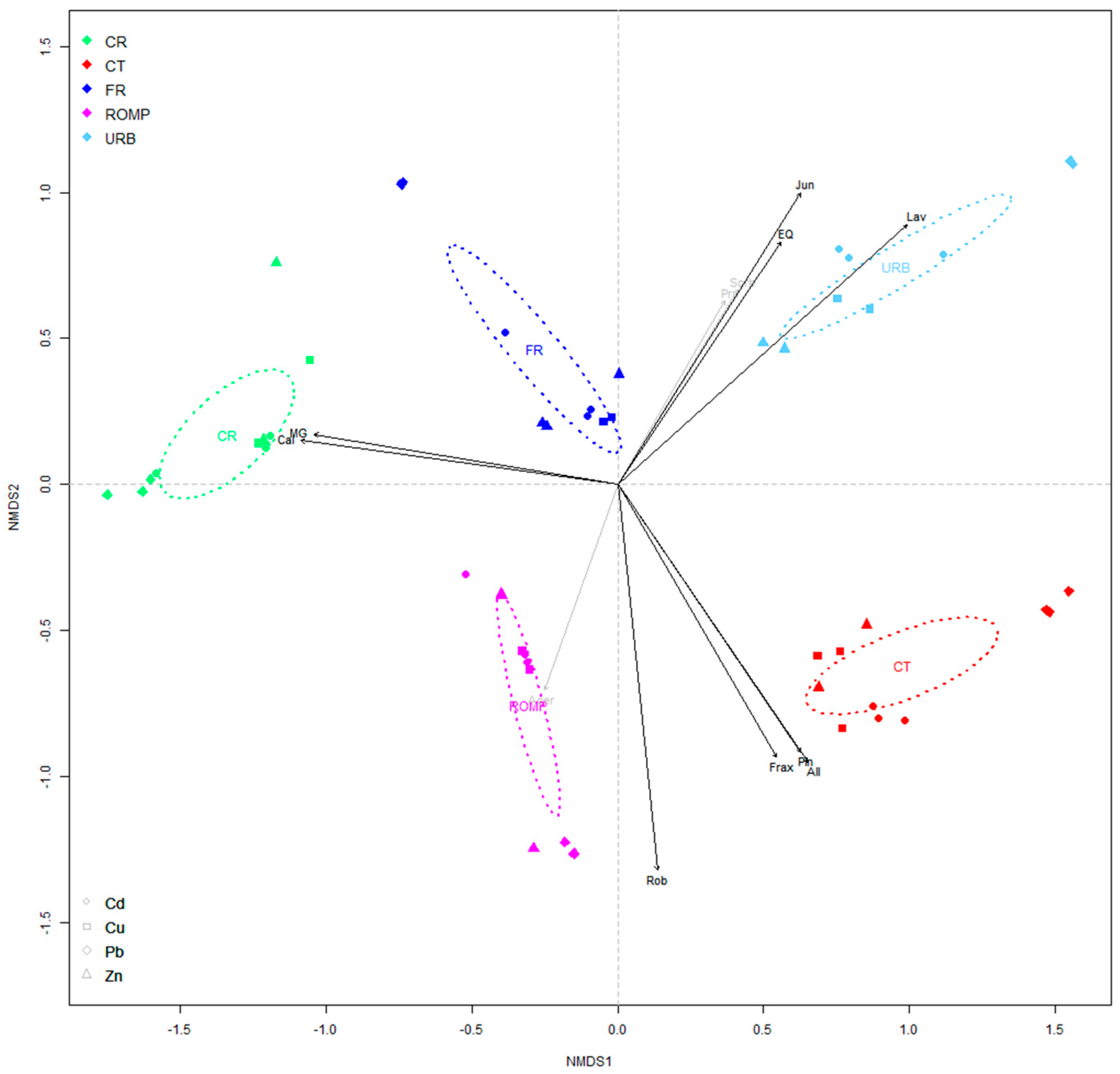
The use of NMDS ordination in the assessment of species community similarity, based on the four targeted elements’ concentrations in each species, was a good tool to observe the dispersion of data associated with each element (Figure 1). Another aspect was the specific location of each site and its relation to one or multiple species. For one site, the most sensitive species were Calamagrostis epigejos and Mischantus giganteus, both with a medium concentration in each element. A similar site, placed at a 180° position, was Colonia Topitorilor, with a similar dispersion of data. For this site, three species were considered good indicators: Fraxinus excelsior, Pinus nigra and Iris germanica, with all of them showing a medium concentration of heavy metals. The position of the vectors for the three species is near to the site centroid, which shows their sensitivity to an increase in heavy metal concentration. The rest of the three sites were placed in different quadrats of the ordination, and only Urbis was found to be associated with plant species. For this site, the concentrations found in Lavandula angustifolia are important for the extraction dynamics, while Equisetum arvense and Juniperus communis were found to be good extractors. The position of Ferneziu between the vectors associated with Urbis and Craica indicates high site heterogeneity and variability in the concentrations recorded for each species. Romplumb had a similar position, between Craica vectors and the Robinia pseudoacacia vector (not associated with other sites), a position that indicates both heterogeneity in the number of species and their extraction potential. For these two last sites, there is no stability in the community associated with a specific element, and each plant has a different phytoextraction potential for one or multiple elements at once. Non-metric dimensional scaling (NMDS) ordination analysis was used to examine the similarity of plant communities in relation to the concentrations of the four heavy metals analyzed in the species biomass. The ordination was performed based on the Bray–Curtis distance, using two dimensions (k = 2) and a maximum number of 100 iterations. The quality of the representation was assessed by the stress value of the NMDS solution, which was lower than the threshold of 0.2, indicating an adequate representation of the relationships between sites and species (Figure 1).
The distribution of points in the ordination space reflected the variation in heavy metal concentrations across sites and associated species. The Craica and Colonia Topitorilor sites occupied close positions in the NMDS space, indicating similar profiles of heavy metal concentrations. At the Craica site, the species Calamagrostis epigejos and Miscanthus giganteus were positioned in the proximity of the site centroid, which suggests average values regarding the concentrations of the analyzed metals. A similar pattern was observed for the Colonia Topitorilor site, where Fraxinus excelsior, Pinus nigra and Iris germanica were located closed to the centroid, indicating a comparable profile of heavy metal accumulation.
The other three sites were distributed in different quadrants of the NMDS ordination, reflecting more-pronounced differences in plant community composition and heavy metal concentration levels. The Urbis site was associated with a restricted subset of species, of which Lavandula angustifolia presented a distinct position in the ordination space, corresponding to high heavy metal concentrations, while Equisetum arvense and Juniperus communis occupied similar positions, indicating comparable accumulation patterns.
The positioning of the Ferneziu site between the vectors associated with the Urbis and Craica sites indicates a high internal variability of heavy metal concentrations among the analyzed species. Similarly, the Romplumb site was positioned between the vectors corresponding to the Craica site and the Robinia pseudoacacia species, which was not associated with other sites, suggesting a heterogeneous structure of the plant community and differences between the accumulation potentials of the species.
For the Ferneziu and Romplumb sites, the NMDS ordination did not indicate a stable association between a site and a specific element, with the results suggesting that the analyzed species present differentiated patterns of accumulation for one or more heavy metals.
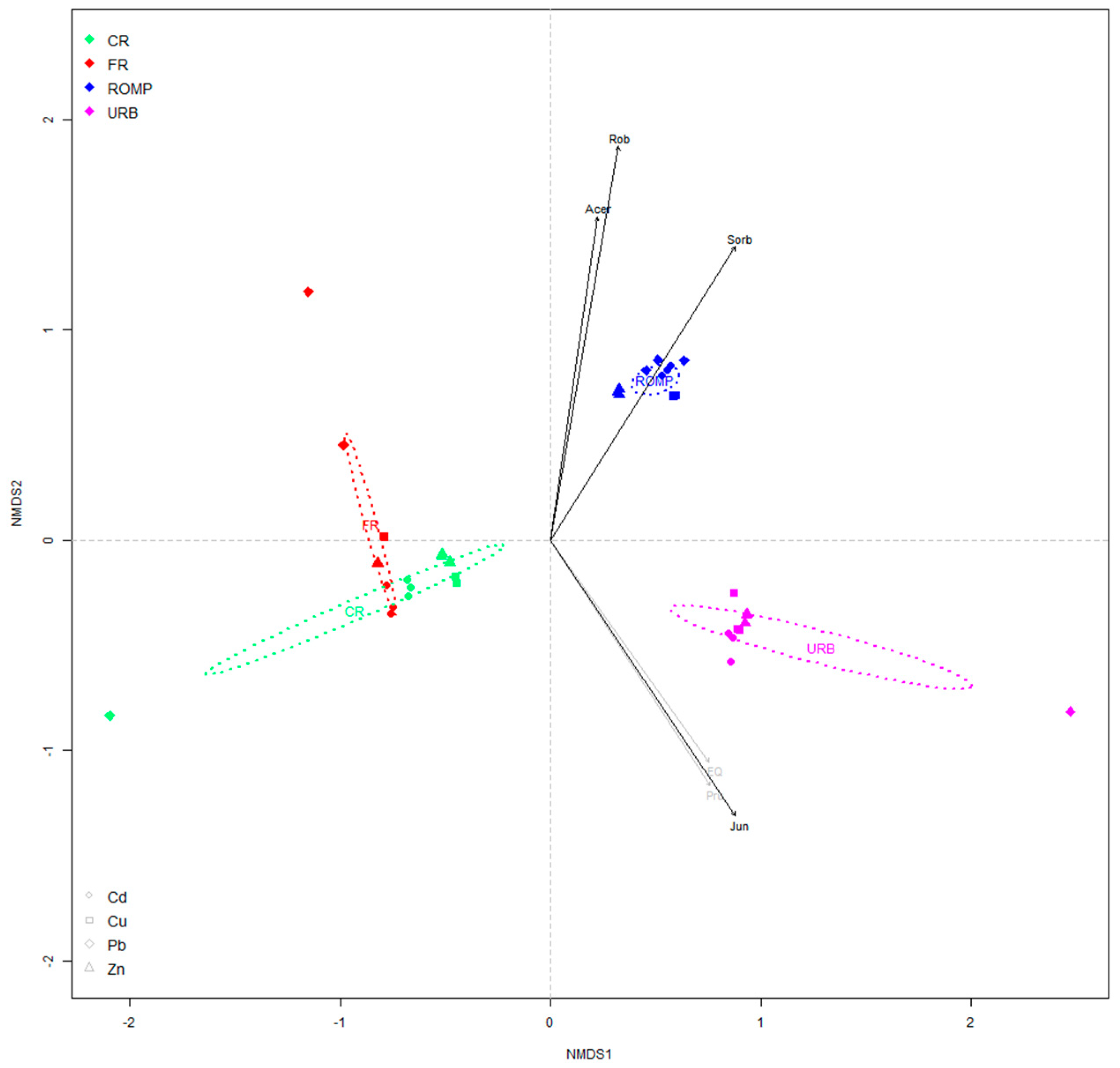
After one and a half years of phytoremediation, only four sites contained a sufficient number of species that survived in heavy metal conditions (Figure 2). The projection of the four heavy metal concentrations for each species and site shows a variable pattern in each plant community. The Urbis site was projected in the +/− quadrat, with most points occupying a similar position close to the center of the ordination. The plant community and its removal of heavy metals from soil is more associated with Sorbus aucuparia and Juniperus communis, which show a medium capacity for the removal of cadmium, copper and zinc. A change in the extraction capacities of these two species will significantly influence the overall extraction process at this site. Romplumb shows a dense community structure, characterized by low point dispersion. This phenomenon appears to be driven by the medium capacity of Sorbus aucuparia to extract all of the four heavy metals analyzed. The other two species present vectors located near to this community, but with the missing capacity for lead extraction (Robinia aucuparia) and copper extraction (Acer platanoides). The removal capacities of these two species may, in the future, contribute to changes in the overall removal potential of the Romplumb site, along with their interaction with Sorbus aucuparia. Both the Craica and Ferneziu datasets were not associated a single dominant species; instead, they present overlapping communities and vertically superimposed centroids. For these two sites, the extraction of lead is missing in most of the dataset, and the species (Agrostis capillaris, Betula pendula, Reynoutria japonica and Salix viminalis) are the only ones that present lead concentrations.
In parallel with the analysis of plants, soil samples were also taken at the five sites studied in Baia Mare. Our analysis reveals a clear pattern of uneven heavy metal contamination in the soils of Baia Mare, correlated with the region’s industrial history and proximity to former mining centers. The sites analyzed show significant differences for Pb, Cu, and Zn, while Cd appears to be more evenly distributed—a situation similar to that described by other authors for this area. In parallel with the analysis of plant biomass, soil samples were taken from the five studied locations in the Baia Mare municipality to assess the levels of heavy metal contamination and their relationship with accumulation in plants. After one year of the phytoremediation process, the concentrations of heavy metals in the soil remained high, but the differences observed between metals and between locations indicated a variable degree of their mobility and availability in the soil.
The concentrations of heavy metals determined in the soil after one year of phytoremediation are presented in Table 7. A comparative analysis of these values indicates that sites with higher soil concentrations of Pb, Cu and Zn generally also showed increased levels of these elements in the biomass of the associated plant species. This relationship suggests that the variation in soil concentrations is a determining factor for the accumulation patterns observed in plants.
The uneven distribution of heavy metals in the analyzed soil reflects the influence of the industrial history of the region and the proximity to former mining centers. Significant differences between locations were recorded for Pb, Cu and Zn, while Cd showed a relatively uniform distribution between sites. A similar pattern of Cd distribution has been reported in previous studies conducted in this area, and the relatively homogeneous values in the soil are consistent with the lower variable accumulation levels observed in plant biomass.

4. Discussion

Understanding the interconnection between society, the economy and the environment is now essential for protective measures. Former industrial activities, the main sources of heavy metal pollution, have left behind extensive soil contamination. Because of the impact on health, decontamination and reductions in the levels of these pollutants are vital for present and future well-being [34]. At a global level, there are multiple projects in urban areas that target the ecological restoration of areas with a post-industrial pollution profile. This approach ensures sustainable use of land resources, their reintegration in the local circular economy, and benefits for the population. The restoration of affected areas and giving them increased value for the urban circuits in these ecosystems makes possible the achievement of multiple UN Sustainable Development goals: good health and well-being (SDG 3), sustainable cities and communities (SDG 11), life on land (SDG 15).
Soil is currently considered a non-renewable resource due to its extremely long formation process. Awareness of the link between soil and human health has recently increased. The concentrations of Cd, Cu, Pb, and Zn found in the studied sites have typical phytotoxic levels, suggesting negative effects on plant growth and development. The study conducted by [47] and colleagues reported elevated levels of several metals (including Pb, Cu, Zn, Cd, As, and Sb) especially in the vicinity of the former Romplumb plant, with some values exceeding the intervention thresholds for sensitive soil use by up to 19 times. Our data align with these observations, highlighting lead concentrations exceeding 2000 mg kg−1 at some sites and high levels of Cu and Zn at other sites.
Depending on their capacity to absorb and store metals, according to international thresholds and values from the study, the following can be considered hyperaccumulators due to concentrations of >1000 ppm (Zn) and >500 ppm (Cd) in their biomass: Calamagrostis epigejos, Salix alba, Salix viminalis, Betula pendula, Reynoutria japonica, and Agrostis capillaris. For example, Salix alba had concentrations of up to 620 ppm of Cd (Ferneziu) and >1000 ppm of Zn (Romplumb), while Salix viminalis had >1030 ppm of Zn at the Colonia Topitorilor site and up to 630 ppm at other sites. Reynoutria japonica had >600 ppm of Cd (Romplumb) and ~565 ppm of Zn, Betula pendula had >1000 ppm of Zn (Romplumb), Calamagrostis epigejos had >2000 ppm of Zn (Ferneziu), and Agrostis capillaris had up to 75 ppm of Pb and >1000 ppm of Zn (Ferneziu).
Plants generally do not accumulate trace elements beyond near-term metabolic needs. And these requirements are small: 10 to 15 ppm of most trace elements suffice for most needs. The exceptions are “hyperaccumulator” plants, which can take up toxic metal ions at levels in the thousands of ppm [30].
Plants that are effective in phytoremediation but are considered only heavy metal accumulators are: Acer platanoides, which extracts Cd, As, Cu, Pb, Tl, and Zn; Robinia pseudoacacia, which extracts Mg, Cu, Fe, Mn, Zn, and Pb; Fraxinus excelsior, which extracts Pb, Cd, Cu, Ni, Cr, and Zn; Sorbus aucuparia, which extracts Cd, Pb, Mn, and Fe; Pinus nigra, which extracts As, Cd, Cu, Pb, and Zn; Juniperus communis, which extracts Fe, Mn, Zn, Cu, Pb, and Cd; Lavandula angustifolia, which recorded high concentrations of Cu (up to 101 ppm).
The success of phytoremediation may be limited by factors such as plant growth period, climate, root depth, soil chemistry, and contamination level [48,49,50]. Root contact represents a major limitation for the applicability of phytoremediation, as remediation requires contaminants to be accessible within the plant root zone. Age greatly affects the physiological activity of a plant, especially its roots [51,52]. In general, the roots of younger plants show a higher capacity to absorb ions than those of older plants when of a similar size. It is important to use healthy young plants for more-efficient plant removal. However, this does not rule out the use of larger older plants whose larger size may compensate for their lower physiological activity as compared to smaller, younger plants [30].
Ideally, hyperaccumulators should thrive in toxic environments and require little maintenance, although few plants perfectly fulfil these requirements [30]. Efficient phytoextraction from metal-contaminated matrices requires plants characterized by: (a) effective metal uptake and translocation to shoots; (b) the ability to accumulate and tolerate high metal concentrations; (c) rapid shoot growth and high aboveground biomass; and (d) a deep root system. Some plants, commonly described as hyperaccumulators, show the ability to accumulate metals in aboveground tissues at very high concentrations, without phytotoxic effects [53]. This is the reason why it is important to examine native plants as natural sources with less costs for phytoremediation, because these plants have better potential in terms of their survival, growth and reproduction under environmental stress than plants introduced from other environments [54].
In addition to the criteria, the plant species considered within this project were selected based on their potential to extract the four heavy metals targeted. During the development of the species list, additional secondary uses provided by the introduced species were also taken into account. For example, Lavandula angustifolia and Juniperus communis have medical applications, Robinia pseudoacacia and Reynoutria japonica can be used for pollination, Salix alba and Salix viminalis provide a source of biomass, and Calamagrostis epigejos and Parthenocissus quinquefolia are used for aesthetic purposes. The plant species included in this study were selected based on a set of ecological and functional criteria. These include: (i) the natural presence or spontaneous establishment of the species on the contaminated sites in Baia Mare; (ii) documented tolerance to heavy-metal-polluted soils, as reported in the literature; (iii) the ability to produce a significant biomass, relevant for phytoextraction processes; and (iv) adaptability to local edaphic and climatic conditions.
Although the inclusion of a larger number of native species could expand the applicability of the results, the selection reflects the plant composition actually present at the investigated sites and allowed a comparable assessment of the phytoremediation potential under real field conditions.
Based on the high levels of heavy metals in some areas, there is significant potential for phytoremediation. Plants from the Baia Mare sites, especially those identified with high accumulation capacities, may be suitable for use in phytoremediation strategies for the remediation of contaminated soils. Despite the fact that the plant species were chosen based on their good adaptability to the local conditions encountered at the site, all plant species (and especially trees) are vulnerable during the establishment process in the new environment (the first months—up to a year for some species).
High levels of Pb, Cu, and Zn in the soil pose obvious risks to the ecosystem—they can promote accumulation in plants and, subsequently, in the food chain. For example, Agrostis capillaris is, in Romania, found most often on grazed pastures [55,56,57] belonging to key endangered habitats in Europe [58,59], and in Baia Mare, on all the pastures at the sites. This shows us its great ecological plasticity [60,61,62].
Acer platanoides is resistant to heat, drought, pollution [63], strong winds [64], and heavy metals [65]. In terms of toxicity, it has been reported that this species does not contain hypoglycin A, at least in measurable quantities, and can extract heavy metals such as Cd, As, Cu, Pb, Tl, and Zn [66]. Acer platanoides’s wildlife value supports Imperial Moth (Eacles imperialis) larvae, which have one brood per season and appear from April to October [66].
Robinia pseudoacacia is tolerant to drought, clay soil, black walnuts, and air pollution [63]. The plant is used in the phytoextraction of heavy metals such as, Mg, Cu, Fe, Mn, Zn, and Pb [67] and is frequently used in restoration and rehabilitation programs for contaminated or degraded soils. Its extensive root system contributes to soil stabilization, while its nitrogen fixation capacity contributes to improving soil fertility. All parts of the plant, except the flowers, are toxic, especially the bark, but the toxins are destroyed by heat [64]. The plant is often found as a pioneer on old fields, burned areas, and lands strip-mined for coal [64]. Regarding its wildlife value, it has a high ecological value, being attractive to bees and butterflies and providing food for birds and rabbits [66].
Salix alba is used in phytoremediation, through the phytoextraction of heavy metals [68]. Regarding its wildlife value, it is an early source of nectar and pollen for bees and provides a habitat for over 200 insect species. It also has toxic potential, being associated with gastrointestinal bleeding and kidney damage. This fast-growing, upright tree species reaches 15–25 m in height and develops a broad, airy crown [64]. Salix viminalis’s phytoremediation potential is highest for Pb [69].
Fraxinus excelsior is used in phytoremediation to extract heavy metals such as Pb, Cd, Cu, Ni, Cr and Zn [70]. It is an important food source for numerous insect species and supports herbivore populations [71,72]. The plant is toxic to herbivores [64]. Also, it can reach a diameter of 60 cm in 60–70 years, and under favorable conditions, it can reach 130–200 m3/ha in 150 years [72].
Betula pendula has aromatic and aliphatic hydrocarbons in its tar, which can cause skin irritations [64], and birch pollen is known to cause seasonal asthma in people [73]. The species is used for the phytoextraction of heavy metals, including Mn, Fe, Ni, Zn, Cd, and Pb [74]. The plant has high ecological value. Cultivated forests can be harvested in 40 years, with a yield of over 400 m3/ha [73].
Regarding the toxicity of Sorbus aucuparia, the consumption of its raw fruits can cause vomiting, but in small quantities, can stimulate breathing and digestion [64]. The plants are used to remove heavy metals such as Cd, Pb, Mn and Fe [73,74], and as for its significant ecological importance, it attracts birds with its fruits and hosts 28 species of insects [63,64].
The wood, sawdust, and resins of some pine species such as Pinus nigra can cause dermatitis [64]. The species is used for the extraction of As, Cd, Cu, Pb and Zn [75]. In addition, the resins remaining after turpentine removal are used by violinists as rosin for bows [64].
Although the fruits of Juniperus communis are widely used for medicinal purposes and as flavors in food and drinks, large doses can cause kidney damage and digestive problems [64]. Juniperus communis also shows potential for the phytoextraction of heavy metals, including Fe, Mn, Zn, Cu, Pb and Cd [76].
Regarding the toxicity of Lavandula angustifolia, volatile oil can cause sensitization [77]. The species has potential for the phytoextraction of heavy metals such as Cd, Pb, Cu, Mn, Zn and Fe [78]. Also, it has significant ecological value, attracting bees and butterflies, and contributes to the maintenance of biodiversity [63,64].
Regarding Prunus laurocerasus’s toxicity: all parts of the plant contain hydrogen cyanide, and in small quantities, it can stimulate breathing and digestion, but in excess, it can cause respiratory failure and death [78]. Due to its dense foliage, this species is used in phytoremediation to prevent contaminated dust from being lifted, reducing human exposure through inhalation. It also has an important ecological value [79].
The berries of the climbing plant Parthenocissus quinquefolia are toxic and can be fatal. The plant also contains oxalic acid, and contact with the leaves in autumn can cause dermatitis due to irritating crystals [64,66]. In phytoremediation, it can extract U, Th, Ba, Ni, Sr, and Pb [65].
The importance of the solution applied to restore the riparian brownfields included in the SPIRE project stands in developing and delivering a sustainable remediation technique that could provide not only healthier and functional riparian areas, but also a wide range of ecosystem services. Ecosystem services go beyond the simple elimination of environmental loads and apply synergic, circular approaches to sustainable brownfield regeneration, including: (1) the socio-economic integration of lands in the urban system; (2) technological innovation and behavioral change towards the land’s bioremediation; and (3) participatory and co-creation arrangement with citizens and stakeholders [80,81].
The variability in heavy metal concentrations across different sites suggests localized pollution sources linked to the historical industrial activities in Baia Mare. Sites with the highest contamination levels, such as Ferneziu and Urbis, were more directly influenced by industrial discharges or waste disposal practices. Our objective was confirmed: the sites with the highest concentrations—especially for Pb, Cu, and Zn—overlap with industrial or urban areas, suggesting accumulation due to mining and metallurgical activities. This is in line with the conclusions in the literature: the study “Heavy Metal Pollution of Soils from Baia-Mare” highlights that the industrial history of the area (e.g., the former Cuprom company, the Romplumb plant, etc.) has led to significant contamination with Cu, Pb, and Zn [82]. The application of phytoremediation techniques contributes directly to sustainability goals, as it allows for the decontamination of degraded soils through natural processes, with low resource consumption and minimal impact on ecosystems. The use of plant species for heavy metal extraction represents an ecological restoration alternative, by gently decontaminating post-industrial areas and revitalizing them in order to sustain biodiversity and restore ecosystem services. The technique contributes to the circular economy by increasing sustainable land use. A higher focus on urban restoration and the reintegration of contaminated sites is necessary in the current context of high ecological pressure and the need for cleaner cities and healthier communities.

5. Conclusions

The analysis of heavy metal concentrations after one year of phytoremediation shows that there are significant variations in the ability of plants to accumulate these metals, depending on both species and location. Acer platanoides, Salix alba and Salix viminalis were among the most efficient in accumulating metals such as cadmium and zinc, highlighting their potential utility in phytoremediation strategies in contaminated areas in Baia Mare.
The Craica site was characterized by high concentrations of heavy metals in the soil, requiring remediation using the identified plant species. This analysis suggests that the use of appropriate species, such as Acer platanoides for lead and cadmium or Salix alba and Salix viminalis for zinc, could significantly contribute to reducing the level of soil contamination, thus improving the environmental quality.
The analyzed plants demonstrated a mixed capacity for heavy metal accumulation, which supports their potential use in phytoremediation. Acer platanoides, Salix alba and Salix viminalis are efficient in their uptake of cadmium (Cd) and zinc (Zn), while Robinia pseudoacacia and Fraxinus excelsior have the capacity to extract copper (Cu) and lead (Pb). The distribution of metals varies between species, suggesting the need to use a combination of plants for effective phytoremediation.
The results obtained at the contaminated urban sites of Baia Mare highlight a methodological framework that can be transferred to other regions affected by historical heavy metal pollution, especially in areas with similar mining or metallurgical activities. The selection of tolerant species, adapted to local soil and climate conditions, is a key element for the successful application of phytoremediation in different regional contexts.
The investigated plant species are known for their ability to tolerate severe edaphic stress conditions as well as substantial climatic variability, including drought episodes, extreme temperatures and seasonal fluctuations. This resilience is essential for maintaining the long-term stability of phytoremediation systems. However, the explicit assessment of plant response to extreme weather events and multiple stresses represent an important direction for future research.
After a year and a half of phytoremediation, a significant decrease in heavy metals in the soil was noticed, but sites such as Craica and Ferneziu still showed high levels. The variability in metal accumulation between species and locations shows that remediation strategies need to be adapted to each site.
The SPIRE project (2019–2023) has successfully demonstrated that phytoremediation is a sustainable option for the remediation of contaminated soils. Its benefits include improved soil quality, reduced health risks and increased biodiversity.

Author Contributions

Conceptualization, R.V., B.P. and A.P.; methodology, V.S., B.P. and A.G.; software, V.S., B.P. and A.G.; validation, R.V., B.P. and A.P.; formal analysis, R.V., B.P. and A.P.; investigation, R.V., B.P. and A.P.; resources, R.V., B.P. and A.P.; data curation, R.V., B.P. and A.P.; writing—original draft preparation, R.V., B.P., V.S., A.G., C.P. and A.P.; writing—review and editing, R.V., B.P., V.S., A.G., C.P. and A.P. All authors have read and agreed to the published version of the manuscript.

Funding

This research received no external funding.

Institutional Review Board Statement

Not applicable.

Informed Consent Statement

Not applicable.

Data Availability Statement

Data is available by request from the corresponding author.

Acknowledgments

This paper is part of a study in the thematic area of “The traceability of heavy metals in historically polluted sites and the possibilities for their return to agriculture”, conducted by the first author B.P., under the coordination of R.V. SPIRE-Smart: Post-Industrial Regenerative Ecosystem Baia Mare (Project UIA04-138) supported the research for this work. The European Regional Development Fund through the Urban Innovative Actions Initiative is the co-financier of this project.

Conflicts of Interest

The authors declare no conflicts of interest.

References

  1. Godwill, A.E.; Paschaline Udoka, F.; Friday, N.N.; Unachukwu, M. Mechanism and health effects of heavy metal toxicity in humans. In Poisoning in the Modern World—New Tricks for an Old Dog? Karcioglu, O., Arslan, B., Eds.; IntechOpen: London, UK, 2019. [Google Scholar] [CrossRef]
  2. Oyewo, O.A.; Adeniyi, A.; Bopape, M.F.; Onyango, M.S. Heavy metal mobility in surface water and soil, climate change, and soil interactions. In Climate Change and Soil Interactions; Elsevier: Amsterdam, The Netherlands, 2020; pp. 51–88. [Google Scholar]
  3. Alloway, B.J. Heavy metals and metalloids as micronutrients for plants and animals. In Heavy Metals in Soils: Trace Metals and Metalloids in Soils and Their Bioavailability; Springer: Dordrecht, the Netherlands, 2013; pp. 195–209. [Google Scholar]
  4. Păcurar, F.; Marușca, T.; Scrob, N.; Vaida, I.; Nicola, N. The ecological and agronomic study of some grasslands phytocenoses from the site Natura 2000 ROSCI0002. Apuseni-Rom. J. Grassl. Forage Crops 2023, 27, 9–28. [Google Scholar]
  5. Wuana, R.A.; Okieimen, F.E. Heavy metals in contaminated soils: A review of sources, chemistry, risks and best available strategies for remediation. Int. Sch. Res. Not. 2011, 2011, 402647. [Google Scholar] [CrossRef]
  6. Wang, L.; Hou, D.; Shen, Z.; Zhu, J.; Jia, X.; Ok, Y.S.; Tack, F.M.; Rinklebe, J. Field trials of phytomining and phytoremediation: A critical review of influencing factors and effects of additives. Crit. Rev. Environ. Sci. Technol. 2020, 50, 2724–2774. [Google Scholar] [CrossRef]
  7. Shen, X.; Dai, M.; Yang, J.; Sun, L.; Tan, X.; Peng, C.; Ali, I.; Naz, I. A critical review on the phytoremediation of heavy metals from environment: Performance and challenges. Chemosphere 2022, 291, 132979. [Google Scholar] [CrossRef]
  8. Gavrilescu, M. Enhancing phytoremediation of soils polluted with heavy metals. Curr. Opin. Biotechnol. 2022, 74, 21–31. [Google Scholar] [CrossRef]
  9. van der Ent, A.; Kopittke, P.M.; Schat, H.; Chaney, R.L. Hydroponics in physiological studies of trace element tolerance and accumulation in plants focussing on metallophytes and hyperaccumulator plants. Plant Soil 2024, 501, 573–594. [Google Scholar] [CrossRef]
  10. Naila, A.; Meerdink, G.; Jayasena, V.; Sulaiman, A.Z.; Ajit, A.B.; Berta, G. A Review on Global Metal Accumu-Lators—Mechanism, Enhancement, Commercial Application, and Research Trend. Environ. Sci. Pollut. Res. 2019, 26, 26449–26471. [Google Scholar] [CrossRef]
  11. Kopittke, P.M.; Wang, P.; Lombi, E.; Donner, E. Synchrotron-based X-Ray approaches for examining toxic trace metal (loid) s in soil–plant systems. J. Environ. Qual. 2017, 46, 1175–1189. [Google Scholar] [CrossRef]
  12. Rahman, Z.; Singh, V.P. The relative impact of toxic heavy metals (THMs) (arsenic (As), cadmium (Cd), chromium (Cr) (VI), mercury (Hg), and lead (Pb)) on the total environment: An overview. Environ. Monit. Assess. 2019, 191, 419. [Google Scholar] [CrossRef]
  13. Aminedi, R.; Ram, H.; Kumar, G.; Koramutla, M.K.; Vasupalli, N.; Deshmukh, R.; Negi, M.; Bhattacharya, R. Mechanisms of plant resistance to metalloid ions and potential biotechnological applications. In Metalloids in Plants: Advances and Future Prospects; John Wiley & Sons: Hoboken, NJ, USA, 2020; pp. 185–211. [Google Scholar]
  14. Angulo-Bejarano, P.I.; Puente-Rivera, J.; Cruz-Ortega, R. Metal and metalloid toxicity in plants: An overview on molecular aspects. Plants 2021, 10, 635. [Google Scholar] [CrossRef]
  15. Martínez-Alcalá, I.; Bernal, M.P. Environmental impact of metals, metalloids, and their toxicity. In Metalloids in Plants: Advances and Future Prospects; John Wiley & Sons: Hoboken, NJ, USA, 2020; pp. 451–488. [Google Scholar]
  16. Yu, G.; Ma, J.; Jiang, P.; Li, J.; Gao, J.; Qiao, S.; Zhao, Z. The mechanism of plant resistance to heavy metal. In IOP Conference Series: Earth and Environmental Science; IOP Publishing: Bristol, UK, 2019; Volume 310, p. 052004. [Google Scholar]
  17. Akhtar, N.; Syakir Ishak, M.I.; Bhawani, S.A.; Umar, K. Various natural and anthropogenic factors responsible for water quality degradation: A review. Water 2021, 13, 2660. [Google Scholar] [CrossRef]
  18. Narendrula-Kotha, R.; Theriault, G.; Mehes-Smith, M.; Kalubi, K.; Nkongolo, K. Metal toxicity and resistance in plants and microorganisms in terrestrial ecosystems. Rev. Environ. Contam. Toxicol. 2020, 249, 1–27. [Google Scholar] [PubMed]
  19. Manisalidis, I.; Stavropoulou, E.; Stavropoulos, A.; Bezirtzoglou, E. Environmental and health impacts of air pollution: A review. Front. Public Health 2020, 8, 14. [Google Scholar] [CrossRef]
  20. Ali, M.A.; Fahad, S.; Haider, I.; Ahmed, N.; Ahmad, S.; Hussain, S.; Arshad, M. Oxidative Stress and Antioxidant Defense in Plants Exposed to Metal/Metalloid Toxicity. In Reactive Oxygen, Nitrogen and Sulfur Species in Plants; Hasanuzzaman, M., Fotopoulos, V., Nahar, K., Fujita, M., Eds.; Wiley: Hoboken, NJ, USA, 2019; pp. 353–370. ISBN 978-1-119-46869-1. [Google Scholar]
  21. Fryzova, R.; Pohanka, M.; Martinkova, P.; Cihlarova, H.; Brtnicky, M.; Hladky, J.; Kynicky, J. Oxidative stress and heavy metals in plants. In Reviews of Environmental Contamination and Toxicology; Springer International Publishing: Cham, Switzerland, 2018; Volume 245, pp. 129–156. [Google Scholar]
  22. Al Mahmud, J.; Bhuyan, M.B.; Anee, T.I.; Nahar, K.; Fujita, M.; Hasanuzzaman, M. Reactive oxygen species metabolism and antioxidant defense in plants under metal/metalloid stress. In Plant Abiotic Stress Tolerance: Agronomic, Molecular and Biotechnological Approaches; Springer: Cham, Switzerland, 2019; pp. 221–257. [Google Scholar]
  23. Shahid, M.; Pourrut, B.; Dumat, C.; Nadeem, M.; Aslam, M.; Pinelli, E. Heavy-metal-induced reactive oxygen species: Phytotoxicity and physicochemical changes in plants. Rev. Environ. Contam. Toxicol. 2014, 232, 1–44. [Google Scholar] [PubMed]
  24. Chmielowska-Bąk, J.; Deckert, J. Plant recovery after metal stress—A review. Plants 2021, 10, 450. [Google Scholar] [CrossRef] [PubMed]
  25. Riyazuddin, R.; Nisha, N.; Ejaz, B.; Khan, M.I.; Kumar, M.; Ramteke, P.W.; Gupta, R. A comprehensive review on the heavy metal toxicity and sequestration in plants. Biomolecules 2021, 12, 43. [Google Scholar] [CrossRef]
  26. Kumar, D.; Kumar, S.; Shukla, V.; Kumar, N. Adaptation strategies of plants against common inorganic pollutants and metals. In Plant Adaptation Strategies in Changing Environment; Springer: Singapore, 2017; pp. 315–328. [Google Scholar]
  27. Yadav, V.; Arif, N.; Kováč, J.; Singh, V.P.; Tripathi, D.K.; Chauhan, D.K.; Vaculík, M. Structural modifications of plant organs and tissues by metals and metalloids in the environment: A review. Plant Physiol. Biochem. 2021, 159, 100–112. [Google Scholar] [CrossRef]
  28. Clemens, S.; Ma, J.F. Toxic heavy metal and metalloid accumulation in crop plants and foods. Annu. Rev. Plant Biol. 2016, 67, 489–512. [Google Scholar] [CrossRef]
  29. Page, V.; Feller, U. Heavy metals in crop plants: Transport and redistribution processes on the whole plant level. Agronomy 2015, 5, 447–463. [Google Scholar] [CrossRef]
  30. Tangahu, B.V.; Sheikh Abdullah, S.R.; Basri, H.; Idris, M.; Anuar, N.; Mukhlisin, M. A review on heavy metals (As, Pb, and Hg) uptake by plants through phytoremediation. Int. J. Chem. Eng. 2011, 2011, 939161. [Google Scholar] [CrossRef]
  31. Gaga, I.; Păcurar, F.; Vaida, I.; Plesa, A.; Rotar, I. Responses of Diversity and Productivity to Organo-Mineral Fertilizer Inputs in a High-Natural-Value Grassland, Transylvanian Plain, Romania. Plants 2022, 11, 1975. [Google Scholar] [CrossRef]
  32. Rotar, I.; Cirebea, M.; Vidican, R.; Păcurar, F.; Mălinaş, A.; Ranta, O. Productivity of Festuca rubra L.–Agrostis capillaris L. Grasslands. Bull. Univ. Agric. Sci. Vet. Med. Cluj-Napoca. Agric. 2015, 72, 519–521. [Google Scholar] [CrossRef] [PubMed]
  33. Păcurar, F.; Morea, A.; Gârda, N. Productivity and biodiversity evolution of Festuca rubra grasslands during a seven years period. Bull. Univ. Agric. Sci. Vet. Med. Cluj-Napoca. Agric. 2008, 65, 1843–5246. [Google Scholar]
  34. SPIRE. Deliverable 7.1.1. Available online: https://spire.city/index.php/project-deliverables/ (accessed on 20 November 2025).
  35. Available online: https://uia.urban-initiative.eu/en/uia-cities/baia-mare (accessed on 20 November 2025).
  36. Chojnacka, K.; Chojnacki, A.; Gorecka, H.; Górecki, H. Bioavailability of heavy metals from polluted soils to plants. Sci. Total Environ. 2005, 337, 175–182. [Google Scholar] [CrossRef] [PubMed]
  37. Yan, A.; Wang, Y.; Tan, S.N.; Mohd Yusof, M.L.; Ghosh, S.; Chen, Z. Phytoremediation: A promising approach for revegetation of heavy metal-polluted land. Front. Plant Sci. 2020, 11, 359. [Google Scholar] [CrossRef]
  38. Hajara, E.W.; Sulaiman, A.Z.; Sakinah, A.M. Assessment of heavy metals tolerance in leaves, stems and flowers of Stevia rebaudiana plant. Procedia Environ. Sci. 2014, 20, 386–393. [Google Scholar] [CrossRef]
  39. R Core Team. R: A Language and Environment for Statistical Computing; R Foundation for Statistical Computing: Vienna, Austria, 2016; Available online: http://www.R-project.org/ (accessed on 20 November 2025).
  40. Revelle, W. Psych: Procedures for Psychological, Psychometric, and Personality Research, R. Package version 2.5.6; Northwestern University: Evanston, IL, USA, 2020. [Google Scholar]
  41. de Mendiburu, F. Agricolae: Statistical Procedures for Agricultural Research. R. Package Version 2020, 1.3-2. Available online: https://CRAN.Rproject.org/package=agricolae (accessed on 20 November 2025).
  42. Oksanen, J.; Simpson, G.; Blanchet, F.; Kindt, R.; Legendre, P.; Minchin, P.; O’Hara, R.; Solymos, P.; Stevens, M.; Szoecs, E.; et al. _Vegan: Community Ecology Package_. R Package Version 2.6-4. 2022. Available online: https://CRAN.R-project.org/package=vegan (accessed on 20 November 2025).
  43. Venables, W.N.; Ripley, B.D. Modern Applied Statistics with S, 4th ed.; Springer: New York, NY, USA, 2002; ISBN 0-387-95457-0. [Google Scholar]
  44. Vaida, I.; Păcurar, F.; Rotar, I.; Tomoș, L.; Stoian, V. Changes in Diversity Due to Long-Term Management in a High Natural Value Grassland. Plants 2021, 10, 739. [Google Scholar] [CrossRef]
  45. Stoian, V.; Vidican, R.; Florin, P.; Corcoz, L.; Pop-Moldovan, V.; Vaida, I.; Vâtcă, S.-D.; Stoian, V.A.; Pleșa, A. Exploration of Soil Functional Microbiomes—A Concept Proposal for Long-Term Fertilized Grasslands. Plants 2022, 11, 1253. [Google Scholar] [CrossRef]
  46. Paradis, E.; Schliep, K. ape 5.0: An environment for modern phylogenetics and evolutionary analyses in R. Bioinformatics 2019, 35, 526–528. [Google Scholar] [CrossRef]
  47. Mihali, C.; Dippong, T.; Butean, C.; Goga, F. Heavy metals and as content in soil and in plants in the Baia Mare mining and metallurgical area (NW of Roumania). Rev. Roum. Chim. 2017, 62, 373–379. [Google Scholar]
  48. Vidican, R.; Păcurar, F.; Vâtcă, S.D.; Pleșa, A.; Stoian, V. Arbuscular Mycorrhizas Traits and Yield of Winter Wheat Profiled by Mineral Fertilization. Agronomy 2020, 10, 846. [Google Scholar] [CrossRef]
  49. Marușca, T.; Păcurar, F.; Memedemin, D.; Oprea, A.; Vaida, I.; Taulescu, E.; Nicola, N. Ecological, Agronomic and Anthropogenic Characterization of the Habitat 62C0* Ponto-Sarmatian Steppes in the North of Dobrogea (Romania). Bull. Univ. Agric. Sci. Vet.-Med. Cluj-Napoca. Agric. 2022, 79, 42–53. [Google Scholar] [CrossRef] [PubMed]
  50. Mălinas, A.; Rotar, I.; Vidican, R.; Iuga, V.; Păcurar, F.; Mălinas, C.; Moldovan, C. Designing a Sustainable Temporary Grassland System by Monitoring Nitrogen Use Efficiency. Agronomy 2020, 10, 149. [Google Scholar] [CrossRef]
  51. Corcoz, L.; Păcurar, F.; Pop-Moldovan, V.; Vaida, I.; Pleșa, A.; Stoian, V.; Vidican, R. Long-Term Fertilization Alters Mycorrhizal Colonization Strategy in the Roots of Agrostis capillaris. Agriculture 2022, 12, 847. [Google Scholar] [CrossRef]
  52. Pop, B.; Corcoz, L.; Gheorghiță, A.; Pleșa, A.; Stoian, V.; Vidican, R. Dynamics of Functional Microbiome in Polluted Soil After One Year of Bioremediation. Sci. Papers. Ser. A Agron. 2025, 68, 171. [Google Scholar]
  53. DalCorso, G.; Manara, A.; Piasentin, S.; Furini, A. Nutrient metal elements in plants. Metallomics 2014, 6, 1770–1788. [Google Scholar] [CrossRef]
  54. Chandra, R.; Kumar, V. Phytoextraction of heavy metals by potential native plants and their microscopic observation of root growing on stabilized distillery sludge as a prospective tool for in situ phytoremediation of industrial waste. Environ. Sci. Pollut. Res. 2017, 24, 2605–2619. [Google Scholar] [CrossRef]
  55. Păcurar, F.; Reif, A.; Rusḑea, E. Conservation of oligotrophic grassland of high nature value (HNV) through sustainable use of Arnica montana in the Apuseni Mountains, Romania. In Medicinal Agroecology; CRC Press: Boca Raton, FL, USA, 2023. [Google Scholar]
  56. Reif, A.; Ruşdea, E.; Păcurar, F.; Rotar, I.; Brinkmann, K.; Auch, E.; Goia, A.; Bühler, J. A Traditional Cultural Landscape in Transformation. Mt. Res. Dev. 2008, 28, 18–22. [Google Scholar] [CrossRef]
  57. Cirebea, M.; Rotar, I.; Vidican, R.; Păcurar, F.; Malinas, A.; Ranta, O. Characterization phyto-socio-ecological of Agrostis capillaris L. Grasslands. Bull. Univ. Agric. Sci. Veter-Med. Cluj-Napoca. Agric. 2016, 73, 189. [Google Scholar] [CrossRef]
  58. Cirebea, M.; Rotar, I.; Păcurar, F.; Vidican, R.; Plesa, A.; Mălinaș, A. Influence of Mineral Fertilization with UAN on a Natural Meadow Festuca Rubra with Agrostis Capillaris. Rom. J. Grassl. Forage Crops 2015, 11, 25–30. [Google Scholar]
  59. Reif, A.; Auch, E.; Bühler, J.; Brinkmann, K.; Goia, A.I.; Păcurar, F.; Rusdea, E. Landschaft Und Landnutzung Im Apusenigebirge Rumäniens. Carinth. II 2005, 195, 161–201. [Google Scholar]
  60. Păcurar, F.S.; Rotar, I.; Vaida, I. The Effects of Wild Boar Disturbances on the Agronomical Value of Semi-Natural Grasslands. Rom. J. Grassl. Forage Crops 2019, 20, 27–34. [Google Scholar]
  61. Păcurar, F.; Rotar, I.; Vidican, R.; Vaida, I.; Pleșa, A.; Stoian, V.; Tomoș, L.; Ghețe, A. Density-Based Assessment of Adonis Vernalis Abundance in Native Habitats. Sci. Pap. Ser. A Agron. 2025, 68. [Google Scholar]
  62. Vaida, I.; Rotar, I.; Păcurar, F. The Cumulative Effect of Manure on a Festuca Rubra Grasslands for 15 Years. Bull. Univ. Agric. Sci. Vet.-Med. Cluj-Napoca. Agric. 2017, 74, 126. [Google Scholar] [CrossRef] [PubMed]
  63. MBG. Missouri Botanical Garden—Gardening Help. Available online: http://www.missouribotanicalgarden.org/PlantFinder/ (accessed on 20 November 2025).
  64. PFAF—Plants for a Future. Available online: https://pfaf.org (accessed on 20 November 2025).
  65. CABI. 2019a, Acer Platanoides. Available online: https://www.cabi.org/isc/datasheet/2883 (accessed on 20 November 2025).
  66. NCSU. North Carolina State University—Extension Gardener Plant Toolbox. Available online: https://plants.ces.ncsu.edu/plants/ (accessed on 20 November 2025).
  67. Caudullo, G.; de Rigo, D. Acer platanoides in Europe: Distribution, habitat, usage and threats. In European Atlas of Forest Tree Species; Publication Office of the European Union: Luxembourg, 2016; p. e019159. [Google Scholar]
  68. Xue, W.; Jiang, Y.; Shang, X.; Zou, J. Characterisation of early responses in lead accumulation and localization of Salix babylonica L. roots. BMC Plant Biol. 2020, 20, 296. [Google Scholar] [CrossRef] [PubMed]
  69. Aksoy, A.; Demirezen, D.İ. Fraxinus excelsior as a Biomonitor of Heavy Metal Pollution. Pol. J. Environ. Stud. 2006, 15, 27–33. [Google Scholar]
  70. Dobrowolska, D.; Hein, S.; Oosterbaan, A.; Wagner, S.; Clark, J.O.; Skovsgaard, J.P. A review of European ash (Fraxinus excelsior L.): Implications for silviculture. Forestry 2011, 84, 133–148. [Google Scholar] [CrossRef]
  71. Balázsi, Á.; Păcurar, F.; Mihu-Pintilie, A.; Konold, W. How Do Public Institutions on Nature Conservation and Agriculture Contribute to the Conservation of Species-Rich Hay Meadows? Int. J. Conserv. Sci. 2018, 9, 549–564. [Google Scholar]
  72. OECD. Section 2—European White Birch (Betula pendula Roth). In Safety Assessment of Transgenic Organisms, Volume 2: OECD Consensus Documents; OECD Publishing: Paris, France, 2006. [Google Scholar] [CrossRef]
  73. Ansari, A.A.; Gill, S.S.; Gill, R.; Lanza, G.R.; Newman, L. (Eds.) Phytoremediation: Management of Environmental Contaminants; Springer: Berlin/Heidelberg, Germany, 2014; Volume 1. [Google Scholar]
  74. Malá, J.; Machova, P.; Cvrckova, H.; Vanek, T. Heavy metals uptake by the hybrid aspen and rowan-tree clones. J. For. Sci. 2007, 53, 491–497. [Google Scholar] [CrossRef]
  75. Coşkun, M. Toxic metals in the Austrian pine (Pinus nigra) bark in the Thrace region, Turkey. Environ. Monit. Assess. 2006, 121, 173–179. [Google Scholar] [CrossRef]
  76. Abu-Darwish, M.; Rivka, O. Heavy metals content and essential oil yield of Juniperus phoenicea L. in different origins in Jordan. Environ. Eng. Manag. J. 2014, 13, 3009–3014. [Google Scholar] [CrossRef]
  77. Zheljazkov, V.D.; Nielsen, N.E. Studies on the effect of heavy metals (Cd, Pb, Cu, Mn, Zn and Fe) upon the growth, productivity and quality of lavender (Lavandula angustifolia Mill.) production. J. Essent. Oil Res. 1996, 8, 259–274. [Google Scholar] [CrossRef]
  78. Li, G.-Y.; Nan, H.; Ding, D.-X.; Zheng, J.-F.; Liu, Y.-l.; Wang, Y.-D.; Nie, X.-Q. Screening of Plant Species for Phytoremediation of Uranium, Thorium, Barium, Nickel, Strontium and Lead Contaminated Soils from a Uranium Mill Tailings Repository in South China. Bull. Environ. Contam. Toxicol. 2011, 86, 646–652. [Google Scholar] [CrossRef] [PubMed]
  79. Hammad, D.; Thu, K.; Miyazaki, T. Particulate Matter Phytoremediation Effectiveness of Japanese Prunus × Yedoensis Tree Through Spring and Summer Season. E3S Web Conf. 2023, 465, 02030. [Google Scholar] [CrossRef]
  80. Sângeorzan, D.D.; Rotar, I.; Vidican, R.; Păcurar, F.; Ranta, O. Romania’s diet footprints: Minimum arable land and ecological footprint of consumption, from 1961 to 2013. Rom. J. Grassl. Forage Crops 2018, 18, 65. [Google Scholar]
  81. Vaida, I.; Rotar, I.; Vidican, R. The influence of mineral fertilization on Festuca rubra grassland. Rom. J. Grassl. Forage Crops 2017, 15, 81–85. [Google Scholar]
  82. Boros, M.N.; Smical, I.; Micle, V.; Lichtscheidl-Schultz, I. Heavy metal pollution of soils from BAIA-Mare–Case study: Cuprom Industrial Area. Sci. Papers. Ser. E Land Reclam. Earth Obs. Surv. Environ. Eng. 2015, IV, 99–106. [Google Scholar]
Figure 1. NMDS ordination of site and species concentration profile after one year of phytoremediation. Pb—lead; Cd—cadmium; Cu—copper; Zn—zinc. Site: CR—Craica; CT—Colonia Topitorilor; FE—Ferneziu; RO—Romblumb; URB—Urbis. Plants: Bet—Betula pendula; Cal—Calamagrostis epigejos; MG—Mischantus giganteus; Sal—Salix alba; All—Iris germanica; Lav—Lavandula angustifolia; Pin—Pinus nigra; Rob—Robinia pseudoacacia; SVi—Salix viminalis; Part—Parthenocissus quinquefolia; Rey—Reynoutria japonica; Frax—Fraxinus excelsior; Acer—Acer platanoides; EQ—Equisetum arvense; Jun—Juniperus communis; Pru—Prunus laurocerasus; Sorb—Sorbus aucuparia; Acapi—Agrostis capillaris.
Sustainability 18 01386 g001
Figure 2. NMDS ordination of site and species concentration profile after one and a half years of phytoremediation. Pb—lead; Cd—cadmium; Cu—copper; Zn—zinc. Site: CR—Craica; CT—Colonia Topitorilor; FE—Ferneziu; RO—Romblumb; URB—Urbis. Plants: Bet—Betula pendula; Cal—Calamagrostis epigejos; MG—Mischantus giganteus; Sal—Salix alba; All—Iris germanica; Lav—Lavandula angustifolia; Pin—Pinus nigra; Rob—Robinia pseudoacacia; SVi—Salix viminalis; Part—Parthenocissus quinquefolia; Rey—Reynoutria japonica; Frax—Fraxinus excelsior; Acer—Acer platanoides; EQ—Equisetum arvense; Jun—Juniperus communis; Pru—Prunus laurocerasus; Sorb—Sorbus aucuparia; Acapi—Agrostis capillaris.
Sustainability 18 01386 g002
Table 1. Bioavailability of heavy metals in soil and phytotoxicity.
Heavy MetalMetabolic Role in PlantBioavailability to PlantsNon-Phytotoxic Levels (mg/kg)Highest Concentration Reached in Plants (mg/kg)
Pblow3>40,000
Cu+readily<45>20,000
Zn+readily<160>50,000
Cdreadily2>10,000
Sources[36,37][37,38][38][37]
Table 2. Lead concentrations in plants cultivated on historically polluted soil after 1 year of phytoremediation.
ElSiteSp%Sp%Sp%Sp%
PbCRBet8 ± 0.57 efgCal23.66 ± 14.16 cdefgMG53 ± 10.01 b
Rey
7 fg
Sal29.16 ± 9.00 cdef
CTAll19.66 ± 0.33 cdefgFrax
2 g
Lav35.66±
16.16 bcde
Pin27±
15 cdefg
Rob16.33±
16.33 defg
SVi15.33±
2.027 defg
FEBet
0 efg
Part9.33±
0.33 efg
Rey45±
4.50 bcd
Sal18.33±
18.33 cdefg
ROAcer27±
13.50 cdefg
Bet15.33±
15.33 defg
Rey15.66±
15.66 defg
Rob21.66±
12.17 cdefg
Sal22.33±
14.83 cdefg
SVi33.66±
13.16 bcdef
URBEQ49.66±
13.67 bc
Jun7.5±
0.28 efg
Lav101.66±
5.69 a
Note: Means ± s.e. followed by different letters indicate significant differences at p < 0.05 based on LSD test. Pb—lead; Cd—cadmium; Cu—copper; Zn—zinc. Site: CR—Craica; CT—Colonia Topitorilor; FE—Ferneziu; RO—Romblumb; URB—Urbis. Plants: Bet—Betula pendula; Cal—Calamagrostis epigejos; MG—Mischantus giganteus; Sal—Salix alba; All—Iris germanica; Lav—Lavandula angustifolia; Pin—Pinus nigra; Rob—Robinia pseudoacacia; SVi—Salix viminalis; Part—Parthenocissus quinquefolia; Rey—Reynoutria japonica; Frax—Fraxinus excelsior; Acer—Acer platanoides; EQ—Equisetum arvense; Jun—Juniperus communis; Pru—Prunus laurocerasus; Sorb—Sorbus aucuparia.
Table 3. Cadmium concentrations in plants cultivated on historically polluted soil after 1 year of phytoremediation.
ElSiteSp%Sp%Sp%Sp%
CdCRBet20.33 ± 4.09 bCal58.33 ± 49.33 bMG58.71 ± 43.71 b
Rey64 ± 46.02 bSal271.08±
116.97 b
CTAll16±
3.21 b
Frax21.33±
2.84 b
Lav52±
34 b
Pin59.33±
48.34 b
Rey18.33±
2.02 b
Rob51.66±
30.17 b
SVi24±
2.51 b
FEBet22±
0.57 b
MG15.83±
1.90 b
Part20.66±
2.33 b
Rey130.66±
111.66 b
Sal623.33±
593.33 a
SVi17.33±
0.88 b
ROAcer72.66±
52.20 b
Bet277.33±
252.84 ab
Rey279.33±
260.33 ab
Rob16.33±
3.28 b
Sal327.33±
299.33 ab
SVi347.66±
321.16 ab
URBEQ135.66±
121.17 b
Jun20±
1.29 b
Lav133±
118.00 b
Pru24.33±
2.33 b
Rey23.66±
2.40 b
Sal23.66±
2.40 b
Sorb9.333±
4.70 b
SVi20.33±
2.33 b
Note: Means ± s.e. followed by different letters indicate significant differences at p < 0.05 based on LSD test. Pb—lead; Cd—cadmium; Cu—copper; Zn—zinc. Site: CR—Craica; CT—Colonia Topitorilor; FE—Ferneziu; RO—Romblumb; URB—Urbis. Plants: Bet—Betula pendula; Cal—Calamagrostis epigejos; MG—Mischantus giganteus; Sal—Salix alba; All—Iris germanica; Lav—Lavandula angustifolia; Pin—Pinus nigra; Rob—Robinia pseudoacacia; SVi—Salix viminalis; Part—Parthenocissus quinquefolia; Rey—Reynoutria japonica; Frax—Fraxinus excelsior; Acer—Acer platanoides; EQ—Equisetum arvense; Jun—Juniperus communis; Pru—Prunus laurocerasus; Sorb—Sorbus aucuparia.
Table 4. Copper concentrations in plants cultivated on historically polluted soil after 1 year of phytoremediation.
ElSiteSp%Sp%Sp%Sp%
CuCRBet39.66 ± 1.85 abcdeCal29 ± 14.50 bcdeMG26 ± 11.15 de
Rey38.28 ± 3.74 bcdeSal41.41 ± 4.68 abcd
CTAll38±
19.13 bcde
Frax25.33±
12.66 de
Lav35.33±
12.19 bcde
Pin32.66±
10.39 bcde
Rey42.66±
2.18 abcd
Rob39.33±
7.21 abcde
SVi48.66±
1.85 abcd
FEBet43.66±
0.33 abcd
MG27.83±
8.84 cde
Part38±
1.52 bcde
Rey36.33±
11.68 bcde
Sal44±
9.01 abcd
SVi53±
2.64 ab
ROAcer36.66±
9.33 bcde
Bet35.33±
6.17 bcde
Rey35±
4.50 bcde
Rob37.33±
11.72 bcde
Sal38.33±
5.66 abcde
SVi37.33±
6.69 bcde
URBEQ46.66±
10.83 abcd
Jun43±
0.70 abcd
Lav62±
22.50 a
Pru14±
14 e
Rey40.33±
0.66 abcde
Sal45.5±
1.80 abcd
Sorb46.33±
1.20 abcd
SVi49.66±
0.66 abc
Note: Means ± s.e. followed by different letters indicate significant differences at p < 0.05 based on LSD test. Pb—lead; Cd—cadmium; Cu—copper; Zn—zinc. Site: CR—Craica; CT—Colonia Topitorilor; FE—Ferneziu; RO—Romblumb; URB—Urbis. Plants: Bet—Betula pendula; Cal—Calamagrostis epigejos; MG—Mischantus giganteus; Sal—Salix alba; All—Iris germanica; Lav—Lavandula angustifolia; Pin—Pinus nigra; Rob—Robinia pseudoacacia; SVi—Salix viminalis; Part—Parthenocissus quinquefolia; Rey—Reynoutria japonica; Frax—Fraxinus excelsior; Acer—Acer platanoides; EQ—Equisetum arvense; Jun—Juniperus communis; Pru—Prunus laurocerasus; Sorb—Sorbus aucuparia.
Table 5. Zinc concentrations in plants cultivated on historically polluted soil after 1 year of phytoremediation.
ElSiteSp%Sp%Sp%Sp%
ZnCRBet235.66 ± 4.40 cdefCal83.33 ± 41.68 fMG120.14 ± 28.95 f
CTAll92±
1.15 f
Frax65.66±
1.66 f
Lav56.33±
14.71 f
Pin79.66±
32.33 f
Rey187.33±
4.97 def
Rob49.66±
24.87 f
SVi1056.6±
13.33 a
FEBet269.66±
4.807 bcdef
MG86.33±
4.90 f
Part127±
1.52 ef
Rey195.66±
74.34 cdef
Sal1030±
515.00 a
SVi628±
14.93 b
ROAcer91.66±
34.33 f
Bet397.33±
193.69 bcdef
Rey505.66±
252.84 bcd
Rob119±
4.58 f
Sal456.33±
221.71 bcde
SVi565.66±
266.33 bc
URBEQ214±
74.51 cdef
Jun60.25±
1.10 f
Lav229.66±
30.83 cdef
Pru79±
1 f
Rey533±
9.018 bc
Sal361.33±
64.94 bcdef
Sorb123±
2.081 ef
SVi456.33±
11.85 bcde
Note: Means ± s.e. followed by different letters indicate significant differences at p < 0.05 based on LSD test. Pb—lead; Cd—cadmium; Cu—copper; Zn—zinc. Site: CR—Craica; CT—Colonia Topitorilor; FE—Ferneziu; RO—Romblumb; URB—Urbis. Plants: Bet—Betula pendula; Cal—Calamagrostis epigejos; MG—Mischantus giganteus; Sal—Salix alba; All—Iris germanica; Lav—Lavandula angustifolia; Pin—Pinus nigra; Rob—Robinia pseudoacacia; SVi—Salix viminalis; Part—Parthenocissus quinquefolia; Rey—Reynoutria japonica; Frax—Fraxinus excelsior; Acer—Acer platanoides; EQ—Equisetum arvense; Jun—Juniperus communis; Pru—Prunus laurocerasus; Sorb—Sorbus aucuparia.
Table 6. Heavy metal concentrations in plants cultivated on historically polluted soil after 1 year and half of phytoremediation.
ElSitSp%Sp%Sp%Sp%Sp%Sp%Sp%
PbCRAcapi75±
4.16 a
Bet21.66±
5.17 de
FRBet63.67±
2.33 b
Rey31±
15.63 cd
Svi31±
0.5 cde
SVi22.5±
0.5 de
ROAcer15.67±
2.03 ef
Bet21.67±
5.17 de
Cal8.67±
0.33 fg
Sal
3 fg
Sorb37.33± 5.24 c
URBEQ25.67± 5.67 de
CuCRAcapi95.33±
5.61 a
Bet44.67±
1.2 def
Cal50.33±
7.36 cde
MG49.33±
3.84 cdef
Rey38±
1.15 f
Sal58±
1.53 bc
FRAcapi48±
2 cdef
Bet50.67± 1.2 cdeRey67±
2.52 b
Sal52±
3.21 cd
Svi50 ± 1 cdefSVi45 ± 1 def
ROBet45.67 ± 1.86 defCal44 ± 1.15 defRob42±
2.52 def
Sal44 ± 2.52 defSorb49 ± 3 cdef ±
URBCal40.33 ± 1.33 efEQ50 ± 4.51 cdefJun43.33 ± 2.6 defPru26 ± 13.0 gRey34.67 ± 1.76 fgSorb43.67 ± 1.2 def
CdCRAcapi14.33±
1.33 defg
Bet14.33±
1.76 defg
Cal
0 h
MG13±
1.53 fg
Rey14±
2.52 efg
Sal26.33±
4.91 a
FRAcapi25.33 ± 3.28 abBet11±
1 fg
Pan18±
3.79 bcdef
Rey17±
2.52 cdef
Sal21.67±
2.33 abcd
Svi20±
0.5 abcde
SVi21.5±
6.5 abcdef
ROAcer19.67±
1.67 abcdef
Bet14.33 ± 0.33 defgCal14±
1 efg
Rob14±
3.21 efg
Sal24.33 ± 1.76 abcSorb14.67 ± 1.2 defg
URBCal9.33 ± 4.81 gEQ22.33 ± 1.45 abcJun18.67 ± 0.88 bcdefPru18 ± 3.79 bcdefRey22.67 ± 3.48 abcSorb17.3 ± 1.45 cdef
ZnCRAcapi451.33±
17.3 ef
Bet521.67±
22.4 e
Cal91±
20.0 lm
MG244±
51.0 ij
Rey368.67±
13.4 gh
Sal169±
13.5 k
FRAcapi1096.6±
66.9 c
Bet169.33± 11.0 jkPan78±
7 lm
Rey429±
22.5 fg
Sal2093.3±
63.6 a
Svi1140±
10 c
SVi995±
15 d
ROAcer107 ± 21.5 klmBet1306.6 ± 29.0 bCal309.33 ± 21.1 hiRob71.3 ± 0.88 mSal1156.6 ± 13.3 cSorb146.33 ± 1.86 kl
URBCal254.33 ± 4.33 iEQ436 ± 20.8 fgJun77.3 ± 5.46 lmPru88.6 ± 14.1 lmRey100 ± 13.5 klmSorb109 ± 4.51 klm
Note: Means ± s.e. followed by different letters indicate significant differences at p < 0.05 based on LSD test. Pb—lead; Cd—cadmium; Cu—copper; Zn—zinc. Site: CR—Craica; CT—Colonia Topitorilor; FE—Ferneziu; RO—Romblumb; URB—Urbis. Plants: Bet—Betula pendula; Cal—Calamagrostis epigejos; MG—Mischantus giganteus; Sal—Salix alba; All—Iris germanica; Lav—Lavandula angustifolia; Pin—Pinus nigra; Rob—Robinia pseudoacacia; SVi—Salix viminalis; Part—Parthenocissus quinquefolia; Rey—Reynoutria japonica; Frax—Fraxinus excelsior; Acer—Acer platanoides; EQ—Equisetum arvense; Jun—Juniperus communis; Pru—Prunus laurocerasus; Sorb—Sorbus aucuparia; Acapi—Agrostis capillaris.
Table 7. Heavy metals concentrations in Baia Mare soil.
IndicatorRomplumbFerneziuColonia
Topitorilor
UrbisCraica
Cd16.46 ± 4.83 a10.69 ± 2.22 ab6.26 ± 1.67 b17.22 ± 1.21 a11.00 ± 0.60 ab
Cu429.94 ± 211.55 bc506.67 ± 50.82 b113.46 ± 20.20 c1055.11 ± 213.32 a239.00 ± 22.14 bc
Pb2125.11 ± 820.46 a1984.11 ± 231.17 a318.67 ± 48.30 b2442.22 ± 416.25 a308.67 ± 29.68 b
Zn1384.11 ± 645.36 b992.78 ± 86.93 b273.00 ± 41.142691.11 ± 668.07 a326.00 ± 26.01 b
Note: Means ± s.e. followed by different letters indicate significant differences at p < 0.05 based on LSD test. Pb—lead; Cd—cadmium; Cu—copper; Zn—zinc.
Disclaimer/Publisher’s Note: The statements, opinions and data contained in all publications are solely those of the individual author(s) and contributor(s) and not of MDPI and/or the editor(s). MDPI and/or the editor(s) disclaim responsibility for any injury to people or property resulting from any ideas, methods, instructions or products referred to in the content.